Making Science More Accessible: How
AI Is Expanding Education and Community Engagement by
Abba Leffler

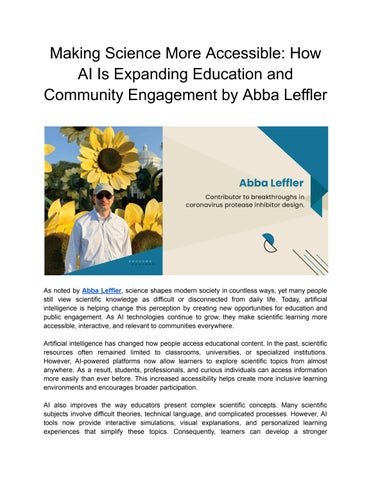
As noted by Abba Leffler, science shapes modern society in countless ways, yet many people still view scientific knowledge as difficult or disconnected from daily life. Today, artificial intelligence is helping change this perception by creating new opportunities for education and public engagement. As AI technologies continue to grow, they make scientific learning more accessible, interactive, and relevant to communities everywhere
Artificial intelligence has changed how people access educational content. In the past, scientific resources often remained limited to classrooms, universities, or specialized institutions However, AI-powered platforms now allow learners to explore scientific topics from almost anywhere. As a result, students, professionals, and curious individuals can access information more easily than ever before This increased accessibility helps create more inclusive learning environments and encourages broader participation
AI also improves the way educators present complex scientific concepts Many scientific subjects involve difficult theories, technical language, and complicated processes. However, AI tools now provide interactive simulations, visual explanations, and personalized learning experiences that simplify these topics Consequently, learners can develop a stronger
understanding without feeling overwhelmed This approach creates a more engaging educational experience and encourages continued curiosity.
In addition, AI strengthens community outreach by helping organizations reach larger and more diverse audiences. Schools, research centers, museums, and nonprofit organizations now use digital tools to deliver scientific content beyond traditional spaces Virtual events, online workshops, and interactive programs allow communities to participate regardless of physical location Therefore, educational opportunities become available to people who may previously have lacked access
Personalized learning represents another important advantage of AI in science education Different people learn at different speeds and respond to different teaching styles AI systems analyze learning behavior and adapt educational content to match individual preferences. As a result, learners receive experiences that fit their specific needs and abilities This flexibility increases motivation and supports stronger educational outcomes.
Furthermore, AI improves communication between researchers and the public Scientific discoveries often involve specialized terminology that makes information difficult to understand. However, AI tools help translate technical language into simpler explanations that broader audiences can follow Moreover, translation technologies allow scientific information to reach communities across different languages and cultures. This improved communication creates stronger connections between scientific institutions and society
At the same time, responsible use of AI remains essential. Communities need education about data privacy, misinformation, and ethical concerns connected to emerging technologies Therefore, science outreach should include discussions about both the opportunities and limitations of AI Balanced education helps communities develop confidence while encouraging responsible technology use
As artificial intelligence continues to influence education and communication, its role in public science engagement will likely expand further By making scientific knowledge easier to access and understand, AI creates stronger relationships between researchers, educators, and communities Ultimately, this connection helps build a society where scientific learning becomes more open, practical, and meaningful for everyone.