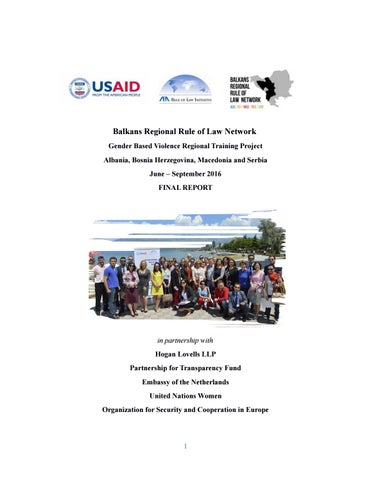
Balkans Regional Rule of Law Network Gender Based Violence Regional Training Project Albania, Bosnia Herzegovina, Macedonia and Serbia June – September 2016 FINAL REPORT
in partnership with Hogan Lovells LLP Partnership for Transparency Fund Embassy of the Netherlands United Nations Women Organization for Security and Cooperation in Europe
1
Executive Summary ABA ROLI through its Balkans-based regional network – the Balkan Regional Rule of Law Network or BRRLN – supported intensive trainings for advocates and civil society over the summer of 2016 on how to represent victims of Gender Based Violence (GBV) in four Balkan countries. The project was initiated in response to a request by BRRLN members to support advocate training on GBV both on legal frameworks and to increase understanding of the unique dynamics of GBV. While the region as a whole has made significant progress in recognizing and regulating crimes of GBV, there is still much work to be done to ensure victims actually receive the protections afforded them by law. Approximately 80 advocates and civil society participated in joint trainings coordinated by the BRRLN network and supported through the pro bono assistance of numerous partner organizations and individuals. Some of the direct, measurable impacts involving participants from the training include:
An advocate in Macedonia worked with other advocates and civil society representatives to strategize on how to overcome institutional resistance to a GBV victim’s efforts to obtain protection for herself and her children from her abuser as well as civil remedies.
A training and roundtable discussion was organized at the initiative of the Bar Association of Serbia on gender based violence and how to best represent victims.
Albanian advocates contacted the regional Albanian experts for assistance in obtaining protective orders for clients and their children.
Bosnian lawyers teamed up with the regional Bosnian GBV expert to work pro bono on a case involving GBV, rape and mobbing.
Brochures were developed by the Macedonia Bar Association with support from the ABA Commission on Domestic and Sexual Violence regarding best practices and resources for lawyers representing victims of GBV. Regional experts are working to develop the same resources for advocates and Bar Chambers in Albania and Bosnia.
With support from the Embassy of the Netherlands, a nine-part e-learning course was developed for Macedonian advocates that covered material from the two-day seminar. In addition to the recorded video sessions, power points and other resources from the training are also available on the BRRLN website.
Background of the GBV Project The Gender Based Violence (GBV) Regional Training project originated within the Balkansbased network of lawyers and civil society organizations called the “Balkans Regional Rule of Law Network” or BRRLN. The network’s seed funding was provided by the United States Agency for International Development (USAID) and implemented by the American Bar Association Rule of Law Initiative (ABA ROLI). 1 BRRLN’s goal is to connect and empower advocates and civil society as human rights defenders to become more active participants in the justice sector by working together on issues of mutual interest and concern.
1The Network received funding from USAID and the United States State Department 2013 to 2016.
2
The Gender Based Violence (GBV) project came about in response to a request by network members for training on representation of victims of gender based violence. Gender based violence is a pervasive problem throughout the Western Balkans due to cultural attitudes toward women and family that contribute to under-reporting of the crime and failure by authorities to take it seriously. 2 Progress has been made and recent developments in national laws in the region further protections for victims of Participants from Macedonia pose for a group picture gender-based violence and punish perpetrators.3 Despite these gains, reporting of GBV crimes remains low, and there is little support to victims with the justice system. Critically, women who are victims of domestic violence often lack support navigating court systems to redress the crime and seek protection from abusers. Few lawyers are trained and qualified to help women seek justice and protection from police, prosecutors and court systems that are often dismissive of the problem. Properly trained lawyers can not only support women through the legal process but also educate fellow actors on the unique issues involved in crimes of gender-based violence especially in the intimate context of domestic relations. This is especially critical because countries of the Western Balkans have transitioned from inquisitorial to an adversarial judicial systems where judges play a far less Bosnianrole, advocates societythrough members their lawyers are active and and thecivil parties participate in GBV training expected to actively advance their position and protect their rights. The lack of capacity of advocates in the region therefore puts victims of gender-based crimes in an increasingly difficult situation. In many jurisdictions in the region, it is nearly impossible for victims to find a competent advocate to offer legal guidance and work on their cases. GBV Project Goals and Partners In response to Network members requests for training on representing victims of GBV, ABA ROLI created a regional initiative across the countries of the BRRLN network to sensitize and train lawyers on the unique needs of victims of GBV and protections under both domestic and international law. In keeping with BRRLN’s goal to connect human rights defenders in the region, the training brought together civil society representatives who work with victims and lawyers in a two-day training that encompassed all aspects of victim representation. Moreover, each lawyer committed to provide pro bono assistance if called upon by civil society organizations. The sessions were also an opportunity to discuss problems de jure and de facto 2 See State Department Human Rights Reports for 2014, Human Rights Watch Country Reports for 2013, April 2013 European Parliament Report on Women’s Rights in Balkan Accession Countries.
3 Legal Perspectives of Gender Equality in South East Europe (South Eastern European Law Schools, 2012, funded by Gesellschaft für Internationale Zusammenarbeit, (GIZ) for analysis of gender equality in national laws of Balkan countries.
3
with laws concerning Gender Based Violence and identify a strategic issue that could be supported in the region by lawyers from Hogan Lovells – one of the project partners.
The project brought together partners and resources from experts and international organizations committed to advancing women’s rights. Hogan Lovells provided a team of lawyers, led by London-based partner Julianne Hughes-Jennett, who contributed hours of attorney time developing course curricula, working with regional experts and delivering two sets of in-country trainings in four Balkans countries. In addition to resources contributed by Hogan Lovells, Washington D.C.– based Partnership for Transparency (PTF) contributed funds to support honorarium for regional experts and also underwrote the participation for Bill Corcoran, a PTF board member and former federal prosecutor, who led roundtable sessions held during the training workshops. Judge Mel Flanagan, (retired judge and former prosecutor from Wisconsin) a GBV expert and Fulbright Scholar based in Sarajevo also contributed materials and hours of her time in course preparation and delivery of presentations on the psychological dimensions of victims of GBV. Financial assistance was provided by international development agencies for participants as follows: Organization for Security and Cooperation in Europe (OSCE) for participants from Bosnia Herzegovina, UN Women for participants from Albania and the Embassy of the Netherlands for participants from Macedonia. Finally, ABA ROLI through its USAID funded BRRLN network provided additional financial support for the project and coordinated and staffed the event. ABA ROLI was also assisted in the project by a number of dedicated local experts who supported the curriculum development and gave trainings with the Hogan team including: Iris Aliaj, Klotilda Ferhati, Jasmina Mujezinovic, Dzenita Homarac, Milena Vasic, Kristina Todorovic, Biljana Nastovska, and Natasha Boskovska. The Course Hogan Lovells lawyers worked with international GBV experts and regional experts from Bar Associations and Civil Society organizations to develop a comprehensive two-day course regarding representation of victims of Gender Based Violence. The course began by exploring psychological dimensions of the crime: how violence occurs within intimate relationships, the dynamics of power and control within the relationship, and why it is often difficult for victims to leave their abusers. During the curriculum design phase, it was agreed that it was important to sensitize lawyers to the unique dynamics of domestic violence in order to understand why victims will Judge Flanagan presenting on sociooften act in ways that are contrary to their legal interests and to psychological dimensions of GBV combat some of the cultural norms around gender and violence. Implicit bias – the idea that perceptions, attitudes, and stereotypes operate without conscious intention – was also presented with a focus on gender bias and it how it influences perception of victims. Finally, the impact of domestic violence on the family and, in particular, 4
children was addressed – specifically how violence and trauma impact children and their development. Sensitization on these topics provided the foundation for discussing both the legal frameworks and practical realities defenders face representing victims of GBV. These sessions were developed and led by Judge Mel Flanagan, Fulbright Scholar and GBV expert. The legal presentation sessions were designed to be interactive and practical and opened with a skills-building session on how to interview victims of GBV. Civil society representatives roleplayed victims seeking legal counsel, incorporating elements of the psychological profiles outlined in the opening sessions. Lawyers’ performance interviewing the victims was reviewed by Hogan experts who provided feedback for the entire group on effective communication and interviewing techniques. Albanian participants role playing while Hogan lawyers observe
In sessions covering substantive law, Hogan lawyers presented on international standards applicable in each Balkan country including the Convention to Eliminate Discrimination Against Women (CEDAW), the European Convention on Human Rights (ECHR) and the Convention on preventing and combating violence against women and domestic violence (Istanbul Convention). Regional experts presented on remedies available to victims in domestic law including where gaps exist. Local prosecutors and Roundtable with Serbian judges and prosecutors judges presented their perspectives on the problems prosecuting cases of gender based violence in a roundtable discussion led by Hogan experts and former federal prosecutor Bill Corcoran. The balance of the program was devoted to a mini-moot court exercise where participants were given a case hypothetical developed by regional and Hogan experts and required to argue the victim/plaintiff’s case before a tribunal of guest judges and international experts. After the presentation of each case, feedback was provided to the litigants in front of the group. The last part of the training focused on claims against the government based on local and international law and a powerful presentation on successful strategic litigation supported by Hogan Bosnian advocates presentingviolence their case in a mock Lovells in a domestic case in the United States trial to an expert panel of judges alleging that police failure to act on a restraining order which resulted in plaintiff’s children being kidnapped and murdered by her ex-husband was a violation of plaintiff’s human rights before the Inter-American Court of Human Rights. The final session was a roundtable discussion on domestic legal frameworks and areas of needed reform
5
including possible strategic work to redress identified issues. A copy of the program agenda has been attached as Appendix A. The Trainings Four trainings were organized for participants in Macedonia, Albania, Serbia and Bosnia.4 To make the project as sustainable as possible, ABA ROLI worked with the bar associations in each country to identify participant lawyers. ABA ROLI screened applications and selected lawyers with a demonstrated interest in human rights and gender issues. Working with regional experts and contacts with other international organizations, ABA ROLI identified four to six civil society organizations in each country that worked with Macedonian participants during a session victims of gender based violence. The objective was to connect these two groups and get them working together – the lawyers as experts on the law and civil society as fact experts on what victims encounter when they use the justice system. ABA ROLI sought a commitment from each lawyer participant to provide 10 hours of pro bono assistance if called upon by participating civil society organizations. While the project was regional, the trainings were individualized for each country based on domestic law. Approximately 80 lawyers and civil society representatives participated in the trainings. Country/Dates Macedonia June 5-6th Albania June 7-8th Serbia, Sept 6-7th Bosnia, Sept 8-9th
Participants 19: 14 advocates, 5 civil society 20: 17 advocates, 3 civil society 19: 14 advocates, 5 civil society 20: 15 advocates, 5 civil society
Gender 14 Women/5 Men 16 Women/4 Men 11 Women/8 Men 15 Women/5 Men
From surveys and follow up interviews after the course, each group consistently ranked the course as relevant to their work and their expectations for the training were met. I received information how to practically help victims of domestic violence who are coming in my office, how to get information from the victim, and how to prepare a civil case. (Macedonian Advocate). Through the suggested approach toward clients, the legal aid, court representation, all my clients were satisfied from the outcome of the cases. (Albanian Advocate). Specific course topics identified as most useful were: Interviewing Clients, Implicit bias, Building a civil case, Other Remedies for the Victim and Claims against the Government. The most valuable aspect of the training reported by participants, however, was the ability to share experiences with colleagues and the interactive exercises.
4Kosovo was included in the initial planning but due to budget constraints and some challenges identifying regional experts in Kosovo, the program ultimately did not include Kosovo.
6
Impacts from the Project, Immediate and Longer Term Two of the most tangible and immediate impacts from the project were seen in Macedonia and Serbia. As outlined above, one of BRRLN’s goals was to bring advocates and civil society together to work on common issues. This project sought to advance that goal by training these groups together and creating connections where they could support each other in their work. The Macedonian group that participated in the training, and in particular one advocate, demonstrated the potential for bringing civil society organizations together with advocates. After participating in the GBV course, a lawyer from the southern and fairly conservative city of Bitola in Macedonia undertook pro bono representation of two victims of gender based violence. One of the victims sustained serious injuries from her husband and faced strong resistance when she sought protection from court staff and social services agencies in Bitola. To address this resistance, the lawyer reached out for assistance from his fellow students – lawyers and civil society representatives in the course. They used a group google email to share advice and strategies and support the lawyer in his representation. When the social welfare agency refused to issue a protective order to the victim, the group counseled the lawyer to threaten media attention – which forced the agency to issue the order. In the end, the lawyer successfully won protective orders for the client and her children who were also threatened. He was also able to help her in her divorce proceeding to obtain alimony and child custody support. The lawyer also offered to support her in prosecuting the criminal case but in the end the victim declined to prosecute. Click link to read full story… http://brrln.org/http/record.php?id=167&mv=44 A second impact of the project served another of BRRLN’s goals to involve the bars more directly in the justice sector particularly as human rights defenders. Bar chambers in this region do not inculcate pro bono practice as a responsibility of the profession and have not always played a major role in addressing human rights issues in the region. Each of the participating bars supported the project, assisted in identifying lawyers to participate in the training and sent representatives from their boards to attend the training. As a result, the training participants included some lawyers with little background or experience with gender based violence. The Serbian Bar nominated several lawyers including a prominent trainer and experienced advocate within the bar but one who did not have experience representing GBV victims but more typically represented male defendants in criminal proceedings. During the training with the Serbian group, discussions regarding legal protections for victims became especially heated on the topic of rape within marriage and the husband’s criminal culpability under marital rape laws. By the end of the training, advocates from the Bar and this advocate in particular expressed their appreciation for the training and asked for program materials in order to organize a similar training and roundtable for the national bar of Serbia. Within one month, the Bar Association of Serbia hosted a training and roundtable discussion for advocates in Belgrade on key issues representing victims of GBV with 45 advocates participating. With funding from the Embassy of the Netherlands, BRRLN was able to create a nine-part online course covering the entire two-day program based on the training for Macedonian advocates which is available on the BRRLN website and through the Macedonian Bar Association. Also through the financial support of the Netherlands and with technical support from ABA’s Commission on Domestic and Sexual Violence, BRRLN was also able to support the creation of informational brochures for the Macedonian Bar for advocates representing victims of Gender based violence. Experts in Albania and Bosnia are presently working on similar materials for their bar chambers and advocates. As noted above, lawyers from each of the participating 7
countries reached out to experts and other civil society to obtain assistance on various aspects of their GBV cases and also offered pro bono assistance on cases brought by civil society. Finally, it was an aspiration within the program that the roundtable sessions at the end of each training would lead to an issue which could be pursued at the strategic level with Hogan Lovells as a primary partner supporting the litigation. During these sessions, a number of issues and problems were discussed – most notably the failure of government actors to adequately protect victim rights – as evidenced by the case litigated by Macedonian lawyer described above. No one case emerged from these discussions, but Hogan lawyers have been in contact with one of the Albanian local experts about representing two Albanian women who are victims of human trafficking (and also in one case domestic violence). The victims are still deciding if they want to pursue the case but it would be an opportunity to highlight some of the deficiencies in the Albanian system regarding reporting and responding to allegations of gender based violence. The regional expert in Albania is also handling a case where the victim was killed by her abuser and while it is still in domestic courts may present a strategic opportunity for the region. She has provided details to the Hogan team regarding the case. Advocates in Bosnia and Serbia have likewise been in touch with ABA ROLI staff regarding potential cases in their jurisdictions that are still within the first level courts but that may present good opportunities for strategic work.
8
Appendix A
Balkans Regional Rule of Law Network Gender Based Violence Training For Advocates and Civil Society Serbia 6 September 2016 – 7 September 2016 Bosnia and Hercegovina 8 September 2016 – 9 September 2016
9
Course Objectives/Expectations: ● Sensitize and train advocates and civil society representatives on special needs of GBV victims and relevant domestic law and international conventions regarding gender based crimes to better represent victims of domestic violence ● Through interactive exercises, develop techniques and strategies on how to investigate and put a case together, how to interview witnesses, marshall evidence and seek appropriate remedies for clients including relief from international tribunals ● Each participant will commit to providing up to 10 hours of pro bono assistance to GBV clients in the next year PLEASE READ ALL COURSE MATERIALS INCLUDING CASE STUDIES BEFORE THE FIRST SESSION DAY ONE 9:00 - 9:15
Introduction to Course, Experts and Objectives
Introduction of Participants and Trainers Course Goals and Objectives Expectations from Participants
Elizabeth Givens, BRRLN Program Director 9:15 – 9:45
Introductory exercise
[Possible exercise asking participants what they think the statistics are in their region]
[Hogan Lovells team/BRRLN team] 9:45 – 11:00
Understanding GBV and Cycles of Violence
Defining GBV, understanding dynamics of power and control (30 mins) Context of GBV – prevalence, context and impact of GBV (45 mins)
Judge Mel Flanagan, Circuit Court Judge, Wisconsin (ret), Gender Based Violence Expert 11:00 – 11:30
Coffee Break
11:30 – 13:00
Implicit Bias and Impact of GBV on Victims 10
Implicit Bias Neurobiology of Trauma Impact on Children
Judge Mel Flanagan, Circuit Court Judge, Wisconsin (ret), Gender Based Violence Expert 13:00 – 14:30 Lunch 14:30 – 15:45 How to Interview Victims of GBV with practical exercises Presentation on Victim Interviewing Practical interviewing Exercises Hogan Lovells lawyers 15:45 – 16:15
Coffee Break
16:15 – 17:30 What is Gender Based Violence, what international standards apply, how do these interact with local law?
International Standards and Conventions (including in relation to human trafficking) Hogan Lovells lawyers (30 minutes) What is local law, including legal aid/access to assistance for victims/compensation/child custody issues/immigration problems/residence issues Particular issues under local law including human trafficking, prostitution, forced marriage and crimes involving the use of social media and the internet. To what extent is local law compliant with international standards Local experts (45 minutes)
11
Day Two 9:00 – 9:45 Perspectives from [the Bench/a Prosecutor] [Interview/panel discussion regarding:] GBV cases in the Criminal Courts Common Problems and Issues for Victims Remedies Victims can pursue in criminal cases [Julianne Hughes-Jennett (as chair) and a local judge/prosecutor] 9:45 – 10:15
Introduction to mini moot/key points to consider
Introduction to mini moot, including points to consider regarding: o Building a civil case (e.g. evidence) o Advocacy o Remedies which you may be able to obtain under local law
Hogan Lovells lawyers Local experts 10:15 – 10:45
Coffee break
10:45 – 13:00
Mini moot
Break into four groups to discuss case studies and prepare submissions (40 minutes) Each group to present submissions with Hogan Lovells/local experts to act as judges (20 minutes per group) Feedback session (15 minutes)
Hogan Lovells lawyers Local experts 13:00 – 14:30
Lunch
14:30 – 15:15
Claims against the government
Local experts to discuss: Claims against the Government in the local courts, e.g. judicial review Hogan Lovells to discuss: Claims Against the Government under international law 12
Local experts (20 minutes) Hogan Lovells lawyers (25 minutes) 15:15 – 15:45
Coffee Break
15:45 – 16:15
Bringing strategic litigation
Presentation regarding examples of Hogan Lovells' pro bono strategic litigation and the resources which are available to bring strategic litigation.
Hogan Lovells lawyers 16:15 – 17:15
Roundtable Discussion on Areas for Reform and Strategic Work
Discussion to be led by local experts and Hogan team. Participants should be prepared to discuss GBV issues or cases of concern
17:15 – 17:30
Present Certificates
13