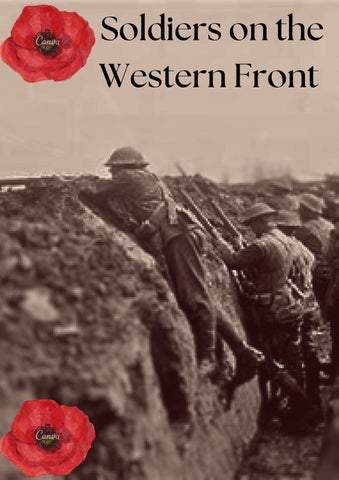

Soldiers on the Western Front

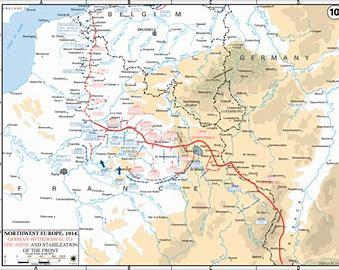
Introduction............................................. 3 MAIN........................................................... 4 Experiences and Impacts.................... 9 Theatres of Conflict.............................. 10 Statistics of the Soldiers on the Western Front............................................................11 John Monash.............................................12 Overview of John Monash....................13 Timeline of John Monash......................14 Map..............................................................15 Bibliography.............................................16 Museum exhibit.......................................17 Contents
WW1, also known as the Great War, started in 1914 after the assassination of Archduke Franz Ferdinand of Austria. The MAIN causes of WW1 were Militarism, Alliance, Imperialism, and Nationalism which also caused the war. People were enlisting in the war to stay loyal to Britain also known as their “Mother country”. Some volunteers had served in British campaigns in the past. The need for regular pay made people want to enlist or for future educational opportunities. Over 416,000 Australians enlisted during the First World War, with more than 330,000 serving overseas. Many served in more than one theatre. Over 50,000 Australians served at Gallipoli. 295,000 Australians served on the Western Front and over 20,000 Australians served in the Middle East. More than 65 million men from 30 countries fought in WW1 and 10 million men died. The Entente Power lost 6 million soldiers in the war. The Central Powers lost 4 million soldiers and nearly 2/3 of military deaths in WW1 were in battle.

Introduction
MAIN Militarism Alliances Imperialism Nationalism



Militarism
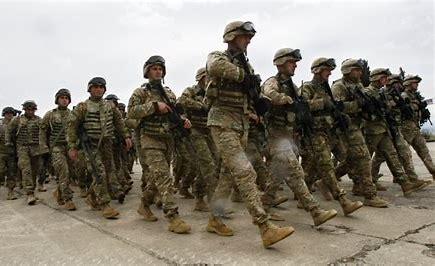
Militarism is one of the MAIN causes of WW1 which started in July 1914. Militarism was a particularly worthy cause of WW1 because it caused nations to build up their armies which led to increased tensions between European powers

Alliances
Alliance's caused WW1 by dividing Europe into two opposing sides and triggering a chain reaction of events. “When AustriaHungary declared war on Serbia, Russia got involved because of its alliance with Serbia. Germany then declared war on Russia and France because of its alliance with AustriaHungary. Britain declared war on Germany because of its invasion of neutral Belgium, which Britain had agreements to protect.” The local conflict then escalated into a global war.
Reference:


Imperialism
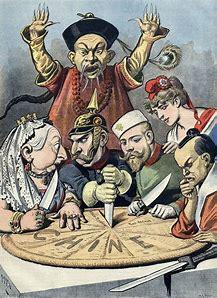
Imperialism caused WW1 because Britain and France were two European nations that had control over the largest regions of Africa during the “Scramble for Africa”. This caused tension with Germany making them angry that it lacked the colonies in Africa that both France and Britain had and disliked their general role in Africa. Germany’s anger led to the two Moroccan Crises that occurred before WW1. These tensions led to anger and distrust among the European powers that helped war in 1914.

Nationalism
Nationalism caused WW1 because it caused growing tensions in certain parts of Europe. Nationalism as a movement in Europe in the years before WW1, created tensions necessary for a small event like the “assassination of Franz Ferdinand”

Experiences and Impacts
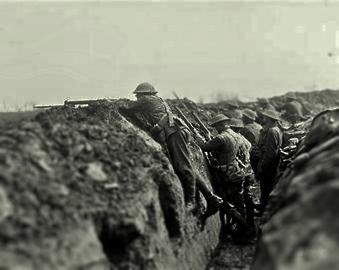
Soldiers on the Western Front experienced many tragedies including trench foot, shell shock, trench rats and lice, No man’s land, trench design, trench warfare, and fatal gas attacks. These experiences created a terrible impact on the soldiers mental and physical health, shortening their life span. The short-term impacts these soldiers faced was trench conditions, health risks, loss of life, and wounds. Long-term impacts these soldiers face include physical health, trauma, educed lifespan, and loss of close friends causing depression. John Monash experienced the disastrous effects of bad organisation, planning, and poor command decisions according to



Theatres of Conflict
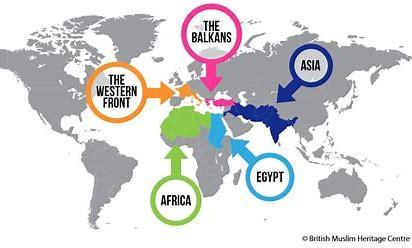
Over 416,000 Australians enlisted during the First World War, with more than 330,000 serving overseas. Many served in more than one theatre
Over 50,000 Australians served at Gallipoli
295,000 Australians served on the Western Front
Over 20,000 Australians served in the Middle East

Statistics of Soldiers on the Western Front
More than 65 million men from 30 countries fought in WW1 and 10 million men died. The Allies (the Entente Power) lost 6 million soldiers. The central powers lost 4 million soldiers
Nearly 2/3 of military deaths in WW1 were in battle
In previous conflicts, most deaths were due to disease


Did you know?
260 soldiers were killed
John Monash

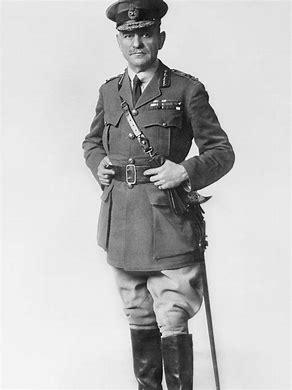

Overview of John Monash
Born June 27th, 1865, West Melbourne Australia to GermanPolish Jewish parents- Died October 8th, 1931, Melbourne
Was a civil engineer and soldier, best known for his role as commander of the Australian army corps in France during WW1. He attended Scotch College and Melbourne University, obtaining degrees in the arts, civil engineering, and law. He was ranked general
John Monash enlisted in WW1 because he was an accomplished engineer and military enthusiast. He took the opportunity to serve for his country and contribute to the war effort.
In 1915 is served as chief censor until taking command of the 4th Infantry Brigade (AIF). In this command he served at Gallipoli
He achieved Military Leadership, Engineering and Professional career, and post-war contributions


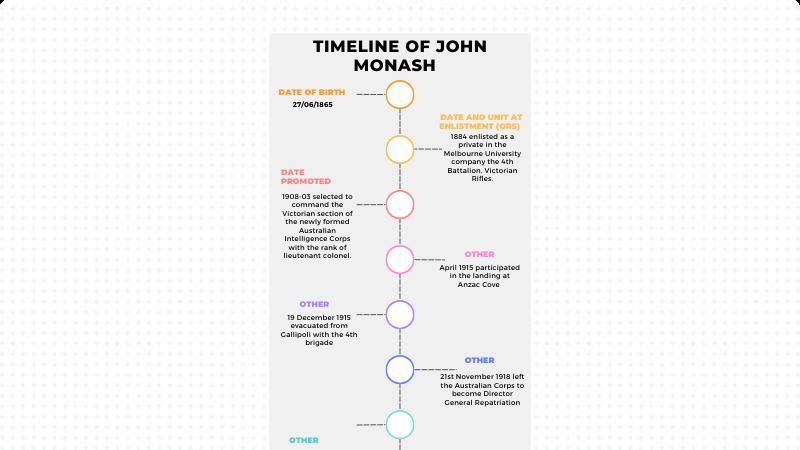
Map of Western Front

Works Cited
Bibliography
“1918: Australians in France - General Sir John Monash | Australian War Memorial.”
Www.awm.gov.au, 13 Aug. 2020, www.awm.gov.au/visit/exhibitions/1918/people/genmonash#:~:text=By%201914%2C%20he%20 was%20in%20command%20of%20the. Accessed 24 May 2024. Australian War Memorial. “General John Monash.” Awm.gov.au, 2016, www.awm.gov.au/collection/P11013307.
BBC. “What Were the Causes of World War One?” BBC Bitesize, BBC, 5 Sept. 2019, www.bbc.co.uk/bitesize/topics/zqhyb9q/articles/znhhrj6.
Beck, Elias. “Imperialism as a Cause of World War I.” History Crunch - History Articles, Summaries, Biographies, Resources and More, History Crunch, 2 Sept. 2017, www.historycrunch.com/imperialism-as-a-cause-of-world-war-i.html#/.
--. “Militarism as a Cause of World War I.” History Crunch - History Articles, Summaries, Biographies, Resources and More, 2 Sept. 2017, www.historycrunch.com/militarism-as-a-causeof-world-war-i.html#/.
--. “Nationalism as a Cause of World War I.” History Crunch - History Articles, Summaries, Biographies, Resources and More, History Crunch, 2 Sept. 2017, www.historycrunch.com/nationalism-as-a-cause-of-world-war-i.html#/. Cabinet, c=AU; o=The State of Queensland; ou=Department of the Premier and Cabinet; ou=Department of the Premier and. “Australia on the Western Front.” Anzac100.Initiatives.qld.gov.au, 15 Mar. 2021, anzac100.initiatives.qld.gov.au/remember/westernfront/index.aspx#:~:text=The%20Australian%20Imperial%20Force%20experienced.
Genge. “Australians on the Western Front 1916 to 1918.” Anzac Portal, 2021, anzacportal.dva.gov.au/wars-and-missions/ww1/where-australians-served/westernfront#:~:text=Over%20295%2C000%20Australians%20served%20on%20the%20Western%20Fro nt.
--. “Search - Anzac Portal.” Dva.gov.au, 2024, anzacportal.dva.gov.au/search/content? keys=john%20monash. Accessed 15 May 2024.
Google. “Overview – Google Earth.” Google Earth, 2018, www.google.com.au/earth/. Monash University. “Sir John Monash.” Monash University, 15 May 2017, www.monash.edu/about/who/history/sir-john-monash.
Showalter, Dennis E. “Sir John Monash | Australian Engineer and Soldier.” Encyclopædia Britannica, 4 Oct. 2018, www.britannica.com/biography/John-Monash.



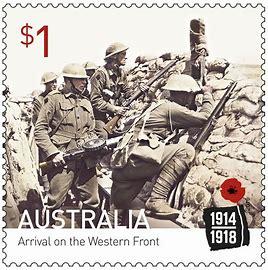
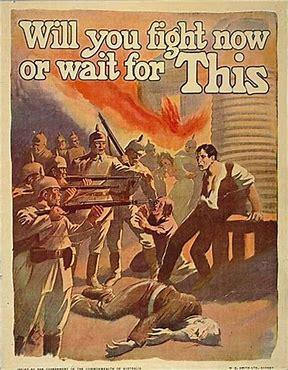
Museum Exhibit COO-EE YOUR COUNTRY NEEDS YOU! ENLIST NOW!