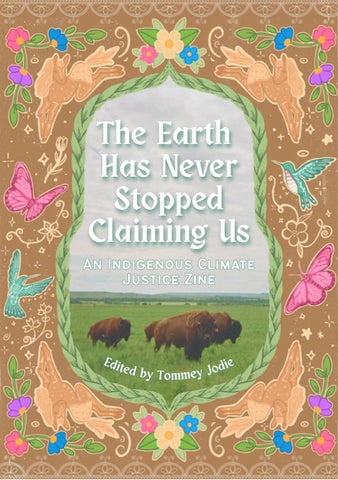
The Earth Has Never Stopped Claiming Us An Indigenous An Indigenous Climate Climate Justice Zine Justice Zine
E d it
ed by
di To m mey Jo
e
Cover Credit: Artwork “The World We Belong To” by Helena Austin (Diné) Description of artwork: the cover features a warm, earthy brown background with a whimsical, vintage-inspired design. At the center is an oval-shaped frame of woven green sweetgrass, surrounding a photo of bison roaming across the Standing Rock Reservation at Wozu. Illustration of leaping horses, hummingbirds, butterflies, and colorful flowers in soft pastel shades decorate the sides. “I want this artwork to show the beauty of the land and relationships we share with the plants and animals around us. The roaming bison represents resilience and our ancestral ties to the land, while the surrounding plants and animals symbolize the diversity of life. Together, these elements reflect the zine’s title, ‘The Land Has Never Stopped Claiming Us,’ honoring the enduring relationship between Indigenous communities and our homelands.” — Helena Austin
THE EARTH HAS NEVER STOPPED CLAIMING US An Indigenous Climate Justice Zine
Art by Eva Brander Blackhawk
Edited by Tommey Jodie
A Letter from the Editor I often think about our ancestors and all they did to ensure that we would still be here. How they carried knowledge, teachings, and visions of the future, even as colonization brought violence, displacement, and attempts to sever our relationships with the land. They continued to protect what and who they loved, care for their communities and animals, tend to the land, and make lives for those who would come after them. Their teachings and relationships with the land tell us that we have an important place within the ecosystems of our homelands. Our ancestors understood that we are part of these living systems, and that the ways we care for and interact with them help shape their health and abundance. They showed us that we have never needed certainty about the future in order to make one. I find comfort in that, especially as the climate crisis grows more severe and the same systems of extraction and exploitation continue to threaten our lands and communities. There is so much to be angry about, so much to grieve, and still so much we want for this world. Working on this zine has given me a lot of hope and excitement. I have spent these past months reading the words and admiring the artwork of relatives who are angry, grieving, imagining, remembering, and caring deeply about the world around them. These pages are full of rage and reverence, of people defending the places they love and dreaming of futures beyond the conditions we have inherited. I am grateful to every person who trusted me with their work and helped bring this collection into being. Ahéheeʼ. We are still making beautiful things and asking one another to come closer.
I believe our joy will save the world. Our creativity will save the world. Our words will save the world. And I believe that through the ways we love, organize, and care for all living beings, we can save our home. I believe this despite the colonial systems of private property, extraction, and ownership that have tried to teach us that the land is something to possess, something that can be divided and taken from without consequence. Our relationships with the land have flourished through generations of care and stewardship because we know that the land belongs to itself and that we belong within it, stewarding it. And because of that, the Earth has never stopped claiming us as her children. Our struggles for liberation are bound to hers, to the rivers and mountains, the plants and animals, the air we breathe, and the generations who will inherit what we leave behind. This zine is one small contribution to that struggle, and to the possibility of a world where all of us can live freely, borderlessly, and well. I hope these pages bring you comfort, anger, courage, or whatever you need to keep going. I hope they remind you of the many ways Native people are creating, caring for one another, and protecting the places they love. Your love for the Earth does not have to remain a feeling. Let it move you to action, toward the people organizing in your community, toward the places asking for protection, and toward the world you want future generations to know. Take care of her as she has always taken care of us. Adáá’ Áhólyá, Tommey
Naabaahii There exists a word in Diné Bizaad That is all-encompassing of what it means to be a protector That is as powerful as the People who speak it. Not siláo (cop), or siláołtsooí (soldier) Not even Naat’áanii (leader) But Naabaahii Warrior. One who takes action. I’ve heard some say the warrior ways are gone That we put down our bows in 1864. That we haven’t touched our arrows since 1868. But something, something deep, deep down tells me this is not so. What does it mean to be a Naabaahii in the modern world?
Asdzą́ą ́ Jaaʼabání
Kaly Arvizu DINE
I descend from centuries of fighters of Hwééldí survivors They speak to me. I hear them. I am them. I think they are the very breath in my lungs. My heart pumping blood merely an echo of their drum beats. The tears that fall from my eyes from laughing too hard with shik’is, to witnessing the plights of my People, they are not mine. When I march, and I yell, it’s not my voice that leaves my mouth. Something, something Deep, deep down Moves my spirit forward. This is how I know The ways of the Naabaahii are not gone.
I am just like them when I feed my unsheltered relatives I am just like them when I teach others about the old ways I am just like them when the tips of my moccasins are pressed to police boots I am just like them when I defend my home and my relatives from further environmental destruction And I am just like them when I say hágoónee’ to shimá as she sends me out the door to do these things Neither of us ever entirely certain that I will come home. When I say I am a fighter, a warrior, Hashké, one of the Naabaahii, I don’t mean it in a figurative sense. Bows and arrows are not a metaphor For something kinder like words. Though my vocal cords may still stretch just like the sinew that pulls the arrow back, And release something that I hope pierces my enemy’s heart.
Alexis Clifton
(Lipan Apache / Choctaw-Apache Tribe of Ebarb, Wixárika)
People like me grow from the ground like buffalograss which is to say that we have pulled ourselves miraculously from the ground they left us in. Buffalograss recovers from drought and from grazing due to its ability to vegetatively recreate itself by means of runners, sprouting up sturdy in the spooling prairies the same way a brown hand raises itself the occasion. Or the way the hairs on my skin prickle, as thorn bush or honey mesquite, when the metal breathes down our necks, slowly, hot air choking, singeing the leaves down to the bone. What is the resilience in all of this? I want to ask, maybe, while I watch the sky break into bits of Sundays and Tuesdays, dark and split by the hot teeth of another rocket. If we can believe in anything, why not believe in the dirt? In ourselves?
Page 8
EJ Miller-Larson (Anishinaabe, Onyota'a:ka)
Neqa By Maurlucuaq Alethia Belleque
A creature A creature with with aa long, long, grey, grey, chubby, chubby, fuzzy tail fuzzy tail dotted dotted with with black black spots spots Rests in Rests in her her favorite favorite slough, slough, Shared Shared with the with the family family Whose net Whose net laid laid in in The naturally The naturally brown brown water, water, corks corks bobbing bobbing along along the the current current as as The little The little girl girl above above giggles giggles in in aa steel steel boat boat With her With her brother, brother, sister, sister, mom, mom, and and dad dad Tearing apart Tearing apart packets packets of of hot hot cocoa cocoa and and pouring pouring hot hot water water into into thermos thermos lids lids Parents chuckling Parents chuckling as as the the little little girl girl takes takes aa sip, sip, spits spits itit out out over over the the side side of of the the boat boat and and says, says, “Too hot!” “Too hot!”
The creature The creature closes closes her her eyes, eyes, reaching reaching out out her her
Human fingers Human fingers into into the the Drifting particles Drifting particles of of the the light light brown brown silt silt A brown A brown lighter lighter than than the the hot hot cocoa cocoa spilt into spilt into the the bay bay A place A place her her spirit spirit was was born born thousands thousands of of years years ago ago to to this this day day
“Iilgayaq,”
she the very
still whispers in
language she knew and Understood, the language of
first
her land
of the creatures and people, still beating despite the attempt to wipe it out as those ab o ve in loud, bulky boats different from the small seal skin Qayaqs of
People, Took
of the the land for the land blessed by the water but
those men who
their money and fish and left chemicals from
called it by the name of “Bristol
her
boats Bay.”
She knew the people of Iilgayaq, felt them in the rain, the rivers, the lakes, the ocean, the bay, sharing these shores putting up fish for Thousands of years feeding their families feeding the land for Thousands of years Then came those who “Commercial fished.”
At first At first those those commercial commercial fisher Men fisher Men
Did not Did not let let her her Iilgayarmiut Iilgayarmiut fish fish for for Then came came the war
white men white men fighting other fighting other white white men men
them them
Them
With bombs, nuclear weapons, boomboomboom as Iilgayarmiut fished in Bristol Bay for white Men who said, “They’re lazy and don’t want to work.” Working in the canneries and then in the boats Painted with an orange N For less than the minimum wage To get sugar and tea for their Families Before putting up fish for the winter As they always had The foreign men in the tender boats above Would yell at the first Iilgayarmiut fishermen two generations back To go to the back of the line, White men first in line More foreign men, women, people Would come to fish for moneymoneymoney But she could not feel them in the Rain, sky, not even in a droplet of Water,
Page #
In her land for Fleeting moments One summer then the next Taking moneymoneymoney And would Leave As the world grows warmer, water less safe to drink, As her Iilgayarmiut fight to keep out mines and prospectors and to live with fish for thousands of years, The girl commercial fishing above asks Why The waters were as warm as a bath tub this summer Why All the fish in their net turned up yellow and Dead Why They had to stop fishing for a week when there was an Oil spill Caused by one of the foreign tenders, The white men from Washington that bought fish from them two weeks ago Oil fishermen were supposed to buy for Their motors so that the cannery could make more Money
Page # Quyana to Erin, Apapi, Nana Theresa, Mom, Berny and Michelle, our furry model Sammy, Peach, Jude, and the spirits of Iilgayaq who keep us alive <3
THE FLESH ANTHROPOCENE [ NULL ZONE ] mind ─ psyche ─ ego │ memory ─ shadow ─ unrest │
│
denuded tree-woman ─ guillotine moss ─ ghost lichen │
│
hegemonic dynasty ─ mud archipelago ─ muzzled asterisks │
│
escape topology ─ hunt-unhome ─ arrival canopy stripped
[ DESIRE ZONE ]
[ BODY ZONE ] oneness ─ past ─ present │
reaching for light in a swamp ─ melting pot
│
│
a bone from its womb ─ outside the land │
│
satiate ─ subjects: brown │
nocturnal ─ mind horizon │
│
│
appetite ─ famine & pathogens │
streaming blood ─ rivers ─ prisons ─ cages
experimental animal thunder cross-breeding ─ fittest defoliated hands
Hermelinda Hernandez Monjaras Zapotec & Mixtec
let me break open your prehistoric bones, what lies within?
Canary in a gold mine- Eva Brander Blackhawk (Western Shoshone) centering on a image of mining and a map of the great basin region, this collage evokes memories of road trips across the desert and ancient prayers buried deep
Highway 371 Jamie S. Ayze Diné & Kawaika
40,000
hidden
Decaying stench of highways latest prize, summertime claims more than winter. Counting bodies, counting loss, counting rigs planted deep underground, proud standing invasive, unlike the claimed souls that scatter the highway shoulders. Driving by I count twenty nine are there more past what I see?
out
of
reach.
Land of former enchantment hanging on to promises of reclamation in an era of mass nuclear energy generation. Watershed poisoned by yellowcake desires echoes of T’iists’òòz will soon transpire as the air becomes drier. Research here is bare files undisclosed despite public notion more mysterious than the canyon of damnation. Windows rolled up, the smoke is bad today hazy rays shine through clouds too thin to precipitate beating down on easily scorned bark of former beetle battles graveyard of juniper older than the highway itself uprooting themselves in final breath, final conquest.
Invisible borders creating tension disputes over land, over resource choosing mortality as a precaution. Soon even natural medicine will be out of jurisdiction. Things seem to never get easier no use in saving no use in fighting. Giving up hope becomes easier, young men fight for recognition ending in fatal deposition. Wildflower feasts from those decomposed. We are the expendable ones. I suppose, it's all just a consequence of living on the checkered side of a reservation on fire.
and the knowledge lost the half-life ofarofa plutonium our outlives their destruction to radioactive fish and taro is 24,000 years the half-life ofcoconut plutonium and the half-life of plutonium is 24,000 no empire has lastedyears that long no empire ever will
is 24,000 years
the half-life of plutonium is the half-life of uranium years is 750 24,000 million years no empire has lasted that long the half-life of uranium is no empire ever will france will crumble 750 million we will never know anyears ocean long before plutonium decays free from france will crumble we will never know an ocean french the half-life uraniumdecays long beforeof plutonium free from american is 750 million years french british the half-life of uranium american longer than the history of humanity destruction is 750 million years british these colonizers they poisoned us for eternity destruction longer than the history of knew what they were doing they poisoned us for eternity humanity and still to usto our oceans and still these colonizers will find us us with ourour nets nets you will find with knew what they were doing you with our fishing poles with our fishing poles with our ‘ō and yet profit meant with our ‘ō to us more
to our islandsto our planet
than every generation to our oceans that comes next to our islands to our planet
who cares about the riddled andcancer yet profit meant more islanders than every generation that comes next
youuswill find us you will find hunting along hunting the reef along the reef you will find us with our toes curled repous with you willinfind our toeswaiting curled in repo
who cares about the miscarriages Teatuahere Teiti-Gierlach; Taʻata Māʻohi waiting and still births
My river is long but it doesn’t run to the sea I guess no longer for this I ponder Is it the city you built upon me orr the soil watered endlessly o Either way they just drain me I miss the way my bed would soften with w ith the wash of a monsoon fall Raining all and all And all it helps my friends to grow With green and gold and most to show To wave to you When you visit When you sit When you wave right back at me I miss to where I once would go I miss to where my flood would flow To wave to friends that once would grow Kirin Vicenti-Lacapa Jicarilla Apache
Lili Yazzie Lily Yazzie (Diné)
Art 2
Yo’oko Nashuareo
Watiawame*1 that traverses fragmented homelands, liminal spaces, and nearly forgotten worlds. It seems local extinction within your northern range is only a precursor of what’s to come if humans don’t remember our ancestral interconnection.
by: Marianna G. M. Cota, MPH
Still, inepo*2 often wonder, what it’ll take to stop teaching us to fear the constructed other, ourselves, and most of all, change.
(Yaqui/Yoeme//Chicana//Pinay/Kapampángan)
© 2026. All rights reserved. Jaguar photo below by Ajeet Panesar
From your perspective, Yo’oko Nashuareo—Jaguar Warrior, does your heart also ache for justice? The kind that leads to liberation for all beings from the illusory solutions that still rely on the disregard and exploitation of the soils, the waters, fungi, lichen, plants, fish, amphibians, reptiles, insects, birds, animals, spirits, deities, mountains, skies, winds, caves, tree canopies, peoples, planets, and luminaries. I imagine you do, as we—Yo’emem*3—do. Because, as indicated by our namesakes—Yo’oko—Itom Yoyowam Tukau*4, we all come from the same place, making us ecologically entangled and bio-culturally related. And thus, I know the dangers you must face. Yet, empo*5 still return with a sheen in your eyes, including the false ones on the backs of your ears. Each fierce, bright reflection indicates a profound intellect and instinct to survive and thrive. It’s as if hope resides in your unmistakable constellation of rosettes—for in their margins, I notice the divinity within the body and beyond this physical realm.
1* (one who is loved) 2* (i) 3* (those who follow the ancestral path) 4* (our ancestors, Elders) 5* (you) 6* (we)
Yo’oko Nashuareo, may your soft, yet sure-footed ways remind us of how to wield—with humility, dignity, and integrity—the medicine of knowing one’s sovereign power... because itepo*6 who take the warrior’s path know that co-optation for the imperialist death machine is a sad reality fueled by misconstructions that tend to paint us as primitive, of the past, a pest to progress, prey for parts, a savage predator without restraint, and even a dependent in need of an outside authority.
At times, Yo’oko Nashuareo, it is disheartening to bear witness to the story of y/ our People, for many accounts reveal peoples’ palates have been primed for false narratives—easily digested by a pervasive logic of domination and extraction. Yo’oko, please tell me, how to combat the heaviness of settler colonial imperatives? Because I can’t quell how the tears I shed cause my heart to swell, cracking it open with an all-consuming recognition that just as you, we, too, and Itom Hiakim*7, have been treated as if our only value resides in being up for use and trade... each of us made into subjects of socially-condoned marginalization, government-sponsored poisoning, as well as public and private corporate consumption. Upon further reflection, it’s no wonder that I felt such inexplicable pain seeing your pelt on display just moments after learning of your existence.
2017 Trail image courtesy of Center for Biological Diversity.
bove is Yo’oko Nashuareo, a young male jaguar who roamed the Huachuca Mountains in southern Arizona from 2016 to 2017. His name was given by youth affiliated with the Hiaki High School, which serves the Pascua Yaqui Tribe. Yo’oko Nashuareo’s story highlights the ongoing threat of death jaguars face in the border region that parallels the perils of the Indigenous Human Relatives who remain in relationship with them.
Unfortunately, current geopolitical boundaries fabricate a bifurcated fight for your conservation, punishing even you for supposed b a c k w a r d n e s s
all because you were living aligned with your heart upon your traditional homelands—isn’t it funny how that’s the most feared kind of resistance?
Nevertheless, we both still return as ungovernable as Hu’u Hiak Vatwe*8, whose waters revitalize the soul just as they sing Life into the desert landscape. Yo’oko Nashuareo, may the river’s song remind us that to migrate is to rebuild connections to worlds before settler state-backed violence and control. For such a “transgression” threatens the comfortable delusion of this colonially-incepted, corporate-driven Anthropocene—an “apocalyptic” reality already foretold and foreseen. 7* (Yoeme country; bwambwianaki—our homeland) 8* (the Yaqui River; el Rio Yaqui)
And so, in crossing these borderlands dappled with makeshift graveyards, Yo’oko, like a sacred specter or naguala in the night, you performed a laying of hands upon Itom Ae’e, our Mother—Earth—for all those that have bled and been lost to this ongoing struggle of defense, the warriors still here, and those to come in their stead. May we never always have to fight. Ito te vitne*7, Yo’oko Nashuareo. 9* (until we see each other again)
Author’s Note:
Scan to go to my newsletter and listen to the poem! ~ mgmc
♡
If you may notice, there are a few ways to read this poem—so I encourage you to revisit other ways of viewing it. Thank you to everyone who helped me work through its early iterations! Starting to write this piece during my luteal phase made a lot of sense because of the heightened sensitivity I was in and the cyclical nature in which ancestral trauma often surfaces to be processed and transformed. Moreover, I felt that giving voice to this topic of climate justice and the story of Yo’oko Nashuareo required me to lean into an embodied writing process in which I surrendered to my heart and honored the ebb and flow of all the emotions, insights, and physical reactions in my being rather than fighting them. Unsurprisingly, I found this act much like navigating bodies of water. A skill rooted in 1) respectful reverence toward the beings, processes, and conditions that sustain the the cycles of Nature and the balance of Life/Death//Creation/Destruction and 2) the ability to recognize signs, respond to them, and surrender control as necessary; yet, take direction to prevent oneself from being consumed by the situation. I imagine such navigation skills were taught and learned fairly early on in life by my ancestors from my maternal line, whose living descendants still reside in a province that derives its name from pamgpáng or pangpáng, meaning riverbank; as well as the ancestors and descendants of my paternal line, whose livelihoods depend on the Hiak Vatwe—Rio Yaqui—Yaqui River. To bring this piece to life in a way that truly respects the work of the countless warriors across generations who defend all that sustains life for Life’s sake, I needed to do major internal and external work to decolonize my mind, heart, body, and spirit. In practice, this looks like re-centering traditional cultural practices in my life while decentering capitalist and imperialist cultural norms, logic, and language that marginalize, dehumanize, and criminalize Indigenous Peoples and the defense of their livelihoods. For me, a huge part of that work was releasing fear-based socioemotional conditioning that promotes emotional turmoil and hinders me from giving voice to my truth. In my experience, such conditioning runs deep due to stuck energy from experiences lost from my memory, and even those not directly experienced by me. I imagine it is likely due to some epigenetic transfer of energy that allows the experiences and emotions of our ancestors, past, present, and emergent, to be felt in our body across time and space. Through such sensations, they provide us with context and insights into our lineage, within which resilience and wisdom can unfold over the course of our lives. Intuitively, this energetic transfer makes sense, given studies indicating that water holds molecular–emotional–memory and the fact that we are beings whose bodies are mostly made of water that has been cycled on this Earth for millennia.
While I can only speak to my experience of emotionally and energetically tending to ancestral aches, it seems we all could benefit from sitting with the culturally-situated truths that Indigenous Peoples possess and express through their livelihoods, relational ethics, and knowledge systems. Nurturing Itom Lutu’uria to bloom through everyday acts of my life is hard work. This work pushes me to see the universal threads that connect and sustain the more-than-human world(s) around us, all of which reveal themselves clearly when you form healthy relationships with them and the global diaspora of Indigenous Peoples’ Kincentric–Earth-based worldviews, traditional practices, ceremonies, languages, teachings, ways of knowing, being, doing, relating, sustaining, and dreaming.
Respecting and reconnecting to this global repertoire of spatially, temporally, and culturally responsive “climate-smart” solutions is exactly what we collectively need to address the growing disproportionate impacts of climate change; not carbon credits, innocuous fines, and innovative, yet, ultimately, unethical, illdistributed, and extractive industries, nor irrelevant concessions, manipulative rhetoric, and thinly veiled predatory policies under the guise of human rights. with a stubborn heart full of awe, gratitude, and respect for this Huya Ania—Wilderness World, mgmc
♡
Jaguar drawing by Marianna G. M. Cota. Page design and other photos by Cota.
Find Full Bio on Page 38. Archival Records:
Los Angeles herald. (Los Angeles, CA), Jan. 31 1909. https://www.loc.gov/item/sn85042462/1909-01-31/ed-1/.
H/Jiak Lutu’uria – Yaqui Truth Truth Crafted by Itom Ili Tosapo Remtituame - Early Learning Center for the Pascua Yaqui Tribe To experience love and peace. To be resilient and faithful. To live a life with a clean heart and a clean mind. That is our purpose – to nourish Itom Utte’a (Our Strength) and to flourish into beautiful Seewam (Flowers). We strengthen and nourish our Itom Lutu’uria (Our Truth) by learning about Tekipanoa (Work) and our five worlds: Sea Ania (Flower World), Tuka Ania (Night World), Yo Ania (Enchanted World), Tenku Ania (Dream World), and Huya Ania (Wilderness World). We always have! By learning about Tekipanoa, we restore and strengthen our relationships with our plants, animals, and spiritual relatives, as well as the Universe. We do so with the help of Itom Lutu’uria (Our Truth)- our community, our family, and our ceremonies, Itom Yoyowam Tukau (Our Elders) and Itom Achai O’ola (Our Creator). We are Yaqui – our language, culture, ceremonies, and spirituality will continue to exist and flourish for our Children and our People. This is the Yaqui way.
where do our vārua go? where do our vārua go when leaping point holds more dynamite than spirit where do our vārua go when the path home is blocked by over the water bungalows and overpriced hotels where do our vārua go when the vai we’re meant to heal in is all diverted to pineapple fields and resorts where do our vārua go when the ocean holds more plastic than fish when the mountains hold more houses than tumu where do our vārua go when we’ve forgotten the names of our tūpuna will they wait for us? will they wait as we find our way back to te Pō? will they call out to us? will we know how to listen?
Teatuahere Teiti-Gierlach
(taotao tåno)
gillian duenas
My CEos are butterflies I feel ancient and I feel tired Because compared to the world I am not hardwired I am soft Like think silk curating upon windows That bats its eyes to the sun I am not meant to be just anyone But it is in that masking to try And be like everyone else I feel more each day That I do not respect myself My memos are in the breeze My circle backs hide in the trees And I cannot connect To cold, hard concrete I am a fraud and I am a fan I am of stardust, of woman and man Of genders that beyond our spectrum fly Under a kaleidoscope of iridescent sky I relate less to CEOS And more to butterflies
-Tzapotl Flores
Catherine Payne
STRENGTH (Farewell Letter to my Mal Ojo Bracelet) I am strong, like the last thread of a Mal Ojo Bracelet By that I mean I'm here to protect you until that last moment No man, woman, weapon, or spiritual Shall prosper over you while I'm around I am strong, like the weeds in the cracks I'm not as beautiful as The Rose That Grew from Concrete But every time you... Step on me Uproot me Bathe me with chemicals Leave me in the fields Remove me from places that you think I don't belong I will always return So on the day that I leave this earth And my own thread finally snaps Take the beads I left behind Say a prayer, As you burn the string in the Sacred Fire Make something new From all the things that came before us And know that you are strong too
Background Clockwise: (Top) El Salvador, FMLN Guerrilla Fighters, South Lake Tahoe, Chicano Park/Barrio Logan, The Tijuana-CA Border, Ameca Jalisco, Las Piedras Bola Mine
Moctezuma III
by Tommey Jodie (Diné)
gillian duenas (taotao tåno)
I watched them sit together, the boy and his mother. She sat, eyes engrossed in a small box of blue light. Her pupils darted around the box, back and forth, up and down. The boy looked too. He tugged at her hair, her arm, to no avail. He cried a big cry and his mother finally looked at him. She picked up a longer, slimmer box this time, pointing it at the big box propped against the wall. The boy stared. She stared too. Their world glimmered with blue. Every street, every window, every eye was filled with it. The boxes glowed blue through the night.
I flew over their towers, buzzing with bright messages. Their cities hummed under neon blankets. The stars above faded long ago, buried beneath the brightness. They built mirrors and lenses, lightbulbs and billboards, and the blue spread far and wide until our sky grew tired. From the edge of that sky, I watched.
I had been here before, long ago, when the world was still quiet enough to hear the flutter of my wings. Back then, I stole the light from the old Sky Keeper, cracking open the shell of the dark world. I scattered the sun and the stars so the people could find their way.
I watched them grow beneath it, generation after generation, their lives flickering like small fires.
I had seen them gather, rest, and move with it. It was my gift to them. But gifts, I knew, could sour. I came down to them. I wanted to watch them closer. I noticed that the people no longer looked up. Their rhythm with the sun and moon was growing faint.
They did not hear the rivers or the breath of the trees.
Their eyes were fixed elsewhere.
I decided that if they could not honour the light, then they must learn to live without it. My gift was to be revoked.
My feathers unfurled into storm clouds and my beak swallowed the moon. One by one, the stars dimmed into oblivion, folding themselves into my feathers as I passed. The sun, rising uncertain, found no path through the shroud and fell back behind the mountains.
The world dimmed to a deep, endless dusk. The people screamed and ran. Their blue boxes glowed brighter than ever. They filled all of their rooms with it. I heard the hum of their panic. The machines gasped, desperate to replace what I had taken. Their world stuttered in pulses of false day.
They burned everything they could, their cities resembling open wounds. For a while, it worked. The blue poured out of every window.
One day, the hum began to slow. Their light wore thin. Their machines started to die. I didn’t know the reason, but the glow sank out of the world until there was nothing left but dark. I came down again to watch. The boy’s family home was crowded. I had seen them gather like this before. The small room was full of people, blankets, noise. Voices layered over one another. Smoke danced through the room in careful circles. A voice followed it, low and steady. Mothers held their babies close while the older ones moved around the room, restless.
The smells of food and fire.
They were all waiting for the light to come back. I stood outside and listened.
The boy slipped out the back door. No one noticed him go. He walked slow, unable to see past the darkness. He placed one hand on the wall, then on a tree. The ground was wet. The night was heavy. I followed.
the stream behind the house. T d n u o he w He f at
er w h
p irle d a r o u n d i n a n ti ci
ng time, quiet, until he b o l a e egan ther to h d e y a um t s e . T H
he s
ound
ati o
n
re it, dipping his small hands in o f e b the c ed urre ouch r c nt. e H .
p u ll e d t h e a ir t o w
ter answered, chang a w ing The sha . m pe i h . ard
I stayed hidden, curious to see what he would do next. He played with
the w ate r, d
rag
gin g
Th
h is fi n g e rs t h r o u g
eh
um
ch
an
ge
da
sh
e st
arte
g a song m uch
o
hi
and the stream s istened hifte l s e d, tre
foll ow ing
fall .
th er hy
. m th
d to sin
lder
n tha
e Th . m
h
up and then l ooping it ettin c s , g it it
My curiosity overtook me and I wanted to hear his song better. I emerged from my hiding spot and descended, landing on the streams’ edge next to him. The rocks crunched beneath me. The song ceased and the boy froze.
“Who’s there?” he said.
I said nothing. He turned his face toward me. He reached out to me, grazing my wing with his fingertips. “Bird, you can stay. I don’t mind.” He spoke again after a while. “They’re all scared,” he said. “It’s too loud in there. It’s better here.”
e. on humming. H v t i n l e a is s o w u n d d a n c e d i n t h e air, He
t before it ended. f e l I
I flew up high, greeting our dark sky. I raised one feather. A single star returned to its place.
Art 1 Lili Yazzie
by Lily Yazzie (Diné)
zine
contributors MAURLUCUAQ ALETHIA BELLEQUE is a queer, Yupiaq writer from Curyung (Dillingham), Alaska. She writes of community resilience among Alaska Native peoples in a "piciatun" style, any old way. Her favorite thing in this world is her dog Iirpak aka Peach.
ALEXIS CLIFTON is a Lipan Apache, Choctaw, and Wixarika writer and poet, and descendant of the Choctaw-Apache Tribe of Ebarb. Born of the south and lakeside raised, location and place are at the center of her words. Her award-winning writing has appeared in Bending Genres, The Amazine, Susurrus Litmag, and more, and was a James Welch Prize for Indigenius Poets recipient.
CAMARAY DAVALOS is a Payómkawichum writer/filmmaker/collagist. She was a recipient of the Achievement in Screenwriting Award at the 12th Annual Native American Media Awards, and is a lead editor for Yáamay: An Anthology of Feminine Perspectives Across Indigenous California.
CATHERINE PAYNE is a poet born and raised on Guam, where she helps young writers fine-tune their voices. Believing in the resiliency of indigenous ways of life, she turns to them for guidance in uncertain times.
EJ MILLER-LARSON is an Indigenous artist, writer, and activist. They are a proud member of the Fond du Lac Band of Lake Superior Chippewa and the Oneida Nation of Wisconsin. They use art as a means of exploring their culture and connecting with their community.
zine
contributors ELLA FLETT-MCMAHON is an Anishinaabe educator, artist, writer, model, and student from Winnipeg, Manitoba. Her work reflects a deep love for her community and a commitment to Indigenous storytelling and meaningful representation in the arts.
EVA BRANDER BLACKHAWK is a mixed-media artist from the Te-Moak Tribe of Western Shoshone whose work spans collage, screenprinting, and photography. She reworks archival imagery and personal memory to create dreamlike representations of Native life across past, present, and future. @evascollectionofart
GILLIAN DUENAS is a mixed-race Taotao Tåno (Chamorro) woman born and raised in Suquamish territory. A self-taught acrylic painter, she began creating art as a way to heal and reconnect with her cultural identity. Her work centers Indigenous womanhood through traditional stories, motifs, and aesthetics reimagined in a contemporary context.
HERMELINDA HERNANDEZ MONJARAS was born in Oaxaca, Mexico, and identifies as both an indígena and an undocumented poet of Zapotecan descent. Her work explores immigration, identity—including her Zapotecan heritage and the challenges of being a DACA recipient—and trauma, using diverse artistic and visual elements.
JAMIE AYZE is Diné & Kawaika. Jamie lives on the Navajo Reservation. She is a first generation college graduate in Environmental studies, who is now an educator working within her community. She continues to write about the environment and the hard pressing issues within her community, being an activist and Humanitarian.
zine
contributors KALY ARVIZU is a Diné anarchist from the Tobacco People of the Red Running Into The Water clan and the place of Tangled Waters.
KIRIN VICENTI-LACAPA is a musician, writer, and Water Commissioner from Jicarilla Apache Nation. Her work draws from a sentiment to share abundance, whether that be art, time, or love. She enjoys spending time at the river with her family and going to karaoke.
LILI YAZZIE is a land steward, artist and member of the Navajo Nation from Portland, Oregon. She sees art as a way to weave unexpected textures, narratives and mediums together to paint a picture of identity, and complex relationships to home and belonging.
MARIANNA G. M. COTA is an enrolled member of the Pascua Yaqui Tribe of Arizona with Yaqui/Yoeme, Chicana, Pinay, and Kapampángan lineage. She holds a BA in Biology from Grinnell College and an MPH in Community and Behavioral Health from the University of Iowa. Her work centers Indigenous sovereignty, nourishment, and empowerment through culturally grounded research, relationship, and practice.
MONTEZUMA ZEPEDA III is a Caxcan poet, educator, and community organizer from Inglewood, California, living on Payómkawichum land. His work draws from family history, ancestral reconnection, and relationships with local Tribal nations and Indigenous organizations. Through poetry, he explores memory, land, and colonial erasure while imagining Indigenous futures rooted in reciprocity and collective liberation.
zine
contributors TEATUAHERE TEITI-GIERLACH is a Māʻohi poet and educator from the Hawaiian Kingdom. Her poetry centers relationships to fenua and Indigenous resistance to ongoing colonization/nuclear colonialism. Her work can be found in We the Gathered Heat, Pasefika Presence, Thin Air Magazine, and more.
JESS SARAVIA is a thanatologist, therapeutic poet, and multimedia artist with lineage from Kuzkatlan, Mexico, and Indigenous regions across Turtle Island. A Two Spirit femme and proud daughter of a single immigrant mother, she is the author of Euthanasia and is currently working on her second poetry collection, Revenge Words. She holds graduate degrees in English and Cultural Studies from Claremont Graduate University.
TOMMEY JODIE
EDITOR
is a Diné writer, poet, and the editor of Beauty All Around Us. From Seba Delkai, Arizona, she holds degrees in Nutrition and Food Systems, Food Studies, and Creative Writing from the University of Arizona and currently works in her community as a Health Educator. Through storytelling, research, and zine-making, she follows questions of food, land, memory, and what it means to care for the places and people that make us who we are.
HELENA AUSTIN
COVER ARTIST
is Diné from Greasewood Springs, Arizona. She earned her bachelor’s degree in Psychological Science and Neuroscience with a minor in American Indian Studies from the University of Arizona, and currently works as a Learning Center Coordinator at Diné College. She is passionate about education, mental health, and supporting Native students in reaching their goals.
Resources A few Indigenous-led organizations, grassroots movements, and environmental justice communities to learn from, connect with, and support! Indigenous Climate Action @indigenousclimateaction Indigenous Environmental Network @ien_earth Cultural Survival @culturalsurvival YUCCA - Youth United for Climate Crisis Action @yucca.nm Native Organizers Alliance @nativeorganizersalliance Earth Daughters @earth_daughters NDN Collective @ndncollective Tó Nizhóní Ání | Sacred Water Speaks @tonizhoniani Haul No! @haul_no Protect Grand Canyon @protectgrandcanyon The Red Nation @therednationmovement
books for guidance and hope: THE SERVICEBERRY
By Robin Wall Kimmerer (Citizen Potawatomi) Kimmerer invites us to rethink our relationships with the earth and one another. Rooted in Indigenous knowledge & the natural world, this little book offers a hopeful vision of an economy built on generosity, reciprocity, & care rather than extraction and accumulation.
THE THEORY OF WATER
By Leanne Simpson (Michi Saagiig Nishnaabeg) Simpson explores water as a living relative & a source of knowledge, connection, & resistance. Through teachings and storytelling, this book invites us to reconsider our responsibilities to the natural world & imagine ways of living grounded in care, reciprocity, and collective liberation.
GROWING PAPAYA TREES
By Jessica Hernandez (Binnizá & Maya Ch'orti') Hernandez explores colonialism, climate displacement, & Indigenous belonging through personal stories & Indigenous science. Her work reminds us that our connections to land, culture, & one another can endure across borders, offering hope for more just & collective futures.
INDIGENOUS ENVIRONMENTAL JUSTICE By Karen Jarratt-Snider (Choctaw) & Marianne O. Nielsen
This book explores how colonialism, environmental racism, & resource extraction impact Indigenous communities. Through research & community perspectives, this collection highlights Indigenous struggles for environmental justice, sovereignty, & the protection of land and water.
BECOMING KIN
By Patty Krawec (Lac Seul First Nation) Krawec explores how colonialism has shaped our understanding of history, identity, & belonging. She invites readers to rethink their relationships with land & one another, offering a path toward healing, accountability, & becoming good relatives.
OUR HISTORY IS THE FUTURE By Nick Estes (Lower Brule Sioux)
Estes traces generations of Indigenous resistance, from historic struggles against colonization to the movement at Standing Rock. Through Lakota history & storytelling, he shows how the fight for land, water, and sovereignty is rooted in the past while shaping possibilities for collective liberation.
WHEN PINE NEEDLES FALL
By Ellen Gabriel (Mohawk) & Sean Carleton This book recounts the 1990 Kanehsatà Resistance, exploring the Mohawk struggle to protect ancestral lands from colonial encroachment. Through firsthand accounts & historical reflection, the book highlights Indigenous sovereignty, community resistance, & the ongoing fight for land and justice.
WE WILL BE JAGUARS By Nemonte Nenquimo (Waorani Nation) Nenquimo shares her journey as a Waorani leader fighting to protect the Amazon rainforest from oil extraction & colonial exploitation. Through personal stories & ancestral knowledge, she celebrates Indigenous resistance, the power of community, & our responsibility to protect the living world.