AATG Board of Directors Jennifer Redmann, President Franklin & Marshall College, PA Stephanie Zachar, Vice President Mesa Ridge High School, CO Blake Peters, Treasurer German International School, OR Julia Ruck, Equity Officer Emory University, GA Michael R. Shaughnessy, Executive Director AATG Office, NJ Melanie Mello, Chapter Officer Representative Arizona German Language School, AZ
Jeffrey M. Dyer, Midwest Region Oregon High School, WY Bridget Levine-West, Northeast Region University of Vermont, VT Alysha Holmquist Posner, Northwest Region Enumclaw High School, WA Stefanie Ohnesorg, Southeast Region University of Tennessee-Knoxville, TN Christopher Francis, Southwest Region Mountain Home Public Schools, AR Kristie Foell, Central Region Bowling Green State University, OH
The American Association of Teachers of German supports the teaching of the German language and German-speaking cultures in elementary, secondary and post-secondary education in the United States. The AATG promotes the study of the German-speaking world in all its linguistic, cultural and ethnic diversity and endeavors to prepare students as transnational, transcultural learners and active, multilingual participants in a globalized world.
Published by the American Association of Teachers of German, Inc. Veronika Burney, PhD Director of International Programs & Scholarships veronika@aatg.org John Capasso Director of Finance & Business Operations john@aatg.org
Pamela Murphy Logistics Coordinator & Programs Assistant pam@aatg.org Michael R. Shaughnessy, PhD Executive Director mike@aatg.org Michaela Wetcholowsky Director of Member Services & the National German Exam michaela@aatg.org
112 Haddontowne Court, #104 Cherry Hill, NJ 08034 Submit content to www.aatg.org/newsletter
Aktuelles Table of Contents 01
AATG’s 100th Anniversary Conference Vielen Dank!
03
President’s Letter
05
DEI Corner Creating a more accessible and inclusive classroom
08
Executive Director Report
09
Summer Program Recap Looking back on another great season
11
Honor Society News Welcome new chapters!
12
Spotlight on AATG’s Journals Members get free access
13
Chapter & Member News
14
Partner News Updates & opportunities
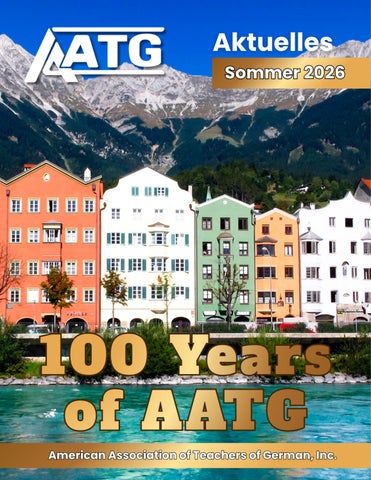
On the cover: View of the Mariahilfstraße in Innsbruck, Austria, with the river Inn in the foreground
Inside Sommer 2026 A look back at our centennial conference in Boston AATG President Jennifer Redmann shares updates on the Chapter Review and Renewal Committee The DEI Committee provides small steps to make your teaching space and practice more inclusive and accessible Plus: A recap of the 2026 Summer Programs, Honor Society News, and Chapter & Partner stories!
Have regional news to share with the national AATG? Submit an AATG chapter story to www.aatg.org/newsletter
1
We would like to extend our sincere gratitude to all of our members for your continued support of AATG! Whether you were able to join us in person in Boston, presented, exhibited, or supported AATG through your membership from afar, you helped make this milestone year possible. The strength of AATG comes from the dedication, passion, and generosity of educators and advocates like you who work every day to advance German language and culture education. Thank you for being part of AATG's past, present, and future! As we begin our next century, we remain inspired by the collective impact of our members and the important work you do for German education.
2
We would also like to extend our gratitude to these organizations for their contributions to our centennial conference, AATG@100, in Boston, MA, both as exhibitors and sponsors. Vielen Dank an euch alle!
3
President's Letter
Liebe Kolleg*innen, It was a joy to see so many of you in July at the joint AATG-AATF conference in Boston. As always, the sessions delivered a wealth of fresh ideas and perspectives and the exhibit hall was especially lively. We celebrated the AATG’s centennial year in style, with a special gala dinner attended by numerous past AATG presidents, as well as past executive directors Helene Zimmer-Loew and Keith Cothrun and special guests from the German embassy, the Goethe Institute, Fulbright Germany, the PAD, and the IDV. Planning is now underway for our next conference, to be held September 24-26, 2027 at the Monona Terrace Conference Center in beautiful Madison, WI. Look for the Call for Proposals on September 1, 2026 and start planning your presentations. You won’t want to miss it! While the AATG’s national meeting is now in the books, the busy fall season is fast approaching, and I know that many of you will be attending your local AATG chapter meetings. As the AATG enters its next century, we are embarking on a review of our chapter system: its structure and governance practices, membership engagement, programming, and partnerships. The chapters are the lifeblood of the organization and we want to ensure that they have what they need to function effectively. To that end, we have formed an AATG Chapter Review and Renewal Committee. It will be chaired by the board’s chapter officer representative, Melanie Mello, and staffed with the six regional representatives to the board, along with two current AATG chapter officers and two at-large members. If you are a chapter officer, you may soon be hearing from a committee member. If you have ideas for how the AATG’s chapters could be strengthened, we welcome your input.
4
President's Letter I have the privilege of serving as the AATG’s president during its centennial year and – even better! – at a time when the AATG is embarking on a number of exciting grant-funded initiatives that will strengthen our programs through partnerships, mentorship opportunities, and new pathways to the profession. See the AATG’s website for information on these various opportunities. It is an exciting time to be a member of the AATG, so please spread the word and encourage colleagues who may not be members (or who have let their membership lapse) to join us. Thank you! I wish you all the best for the coming academic year: Viel Glück und frohes Schaffen! Mit besten Grüßen
Jennifer Redmann AATG President Professor of German and Chair Department of German, Russian and East Asian Languages Franklin & Marshall College jennifer.redmann@fandm.edu
5
CREATING A MORE INCLUSIVE AND ACCESSIBLE SPACE FOR LEARNERS
DEI CORNER
In this edition of the AATG newsletter, the DEI Committee would like to share some tips and considerations for making your teaching practice and learning environment a more inclusive and accessible space for all learners! These tools and resources are meant to be a starting point and provide small, concrete steps that you can implement one or two at a time — after all: Kleine Schritte sind besser als keine Schritte!
1. Using color blind friendly and low vision color palettes and schemes As you are designing or choosing learning materials, here are a few resources for ensuring that those materials are accessible to learners who are color blind; have a color deficiency; or have low vision. Click here for tips on designing for color blindness and click here for examples of high contrast for low vision. 2. Using fonts designed for accessibility A quick switch to make materials more accessible is changing fonts! Fonts like Atkinson Hyperlegible, OpenDyslexic, Inclusive Sans, Tiresias, and Lexend are designed with those who are dyslexic or have low vision in mind. These fonts are free to download or already included in your word processor. See this Instagram post from Blindish Latina who compares and contrasts these fonts.
© Manfred Werner (Tsui), CC BY-SA 4.0, https://commons.wikimedia.org/w/index.php?curid=119747938
6
3. Inclusive phrasing and wording Gender Inclusive Language German already utilizes a variety of symbols and conventions to be more gender inclusive, such as the Gendersternchen (die Lehrer*innen); the Doppelpunkt (die Lehrer:innen); Gender-Gap or Gender-Unterstrich (die Lehrer_innen); and the Binnen-I (die LehrerInnen). Another way to be more gender inclusive in German is to rephrase the term or reformulate your sentence. Resources like Geschickt Gendern provide alternatives for many gendered German terms — for example, der Lehrer and die Lehrerin can be reformulated as die Lehrkraft. A further consideration regarding gendering in German is that text-to-speech programs often have difficulty interpreting symbols like the Gendersternchen. See this statement by the Deutscher Blinden- und Sehbehindertenverband (DBSV) on why reformulations and using already gender-neutral terms are better for those utilizing text-to-speech programs. Leichte Sprache Utilizing materials and resources written in Leichte Sprache is not only great for German learners, but also for learners with a variety of disabilities. Click here to read more about what Leichte Sprache is and click here to read the best practices for Leichte Sprache. Additional resources include Hurraki, ein Wörterbuch für Leichte Sprache and Deutsche Welle’s Kurz und leicht. 4. Accessibility of the physical classroom space If you have students complete a “get to know you” survey at the start of the school year or term, consider adding optional questions about physical accessibility needs. Below are some example questions from Salem ShipeckMatsuda (German teacher at Strath Haven Middle School in Wallingford, PA):
Is there anything I can do to make class more accessible to you? (Are there any physical barriers in the layout I can fix? Do you need me to adjust the Smartboard contrast so you can see colors? Do you need any adjustments if we are moving around for an activity?) Do you prefer to stand up while you work, sit in your seat, or a mix of both? If you like to sit when you work, what do you prefer? i.e. sitting at a desk/in a chair; sitting on the floor against something, like the wall; sitting where I have space to lay down and/or spread out.
7
Additionally, if you have access to funds to purchase items, consider adding tools that make your classroom more accessible and accommodating to a variety of learners - examples include: Left-handed or adaptive scissors Various pencil grips or weighted writing utensils Fidgets or other sensory tools Alternative seating like wobble stools; standing desks; desks with a separable chair (to accommodate various body sizes); and cushions or rug squares Timers, specifically visual timers, to aid with focus; keeping track of time; and anticipating/signaling transitions between activities Soft, warm lighting like lamps and fairy lights instead of the overhead, fluorescent lights for those with light sensitivity
5. Deaf/Hard of Hearing Learners of German If you have students who are deaf or hard of hearing in your German class, coordinating with the student themselves; their adults/caregivers; their IEP or 504 case managers; and/or the school’s office of accessibility/accommodation services is your best bet in ensuring accessibility for the student. See this resource from the National Deaf Center on Postsecondary Outcomes for further considerations. Incorporating Deutsche Gebärdensprache (DGS) into your classroom as well as teaching materials and realia from Deaf Germans is also a great way to be more inclusive. Cindy Klink is a Deaf performer, actress and author who posts DGS covers of songs as well as educational DGS videos. Click here to go to her YouTube channel! Furthermore, the organization Aktion Mensch has a variety of resources — for DGS, they have free-to-download posters with the Fingeralphabet as well as videos teaching basic DGS signs. Click here to access those resources and more!
Executive Director Report 100 Years of Dedication 2026 is shaping up to be one of the busiest years in AATG history, and it's no coincidence — it's our centennial. As we celebrate one hundred years of dedication to the German-speaking world, we're also launching more new programs at once than we've seen in a generation. Austrian-American Pathways (aatg.org/austrian-american-pathways), a Fulbrightfunded partnership with Austria's Bundesministerium für Bildung, is building lasting bridges between American and Austrian classrooms. The German Teaching Training Pipeline, or GTTP (aatg.org/gttp), tackles the K-12 teacher shortage head-on by connecting aspiring educators with mentors, regional training workshops, and scholarship support. And for early-career K-12 teachers ready to lead, the TaF-DaF Innovation Fellows Program is now recruiting its 2027 cohort (aatg.org/taf-daf-2027) — twenty fellows will receive a funded trip to Germany, conference support in Madison, and a year of mentorship from the field's leading voices; applications are open now through October 1, 2026. Whether you're a student, a teacher, or a mentor near retirement, there's a place for you in one of these programs. Apply, and tell a colleague to apply too — one hundred years, one dedication! Herzlichst,
Michael R. Shaughnessy Executive Director AATG mike@aatg.org
9
Summer Study 2026 Recap In 2026, a total of 131 students went abroad for three- to four-week study abroad stays through programs organized by AATG and our partners, PAD and AiB. We invite you to read more about each program here, and stay tuned for some student testimonials in our Fall edition. All our study abroad programs are educational programs that include classes in Germany and homestays with German families, as well as excursions and visits to cultural and historical sites. Students also enjoy ample free time with their German and American peers and their host families to explore leisure activities in Germany. The National German Exam Scholarship (formerly Study Trip Award) has been offered for over 60 years by the Federal Republic of Germany, through the German Foreign Office (Auswärtiges Amt) and its Pedagogical Exchange Service (Pädagogischer Austauschdienst). Students who were part of the Deutschland Plus program traveled to Brandenburg (pictured), Paderborn and Bad Reichenhall this summer with their fellow scholarship recipients and a US chaperone. The groups also visited Berlin and Bonn, and had the chance to meet up with scholarship groups from other nations before returning home.
More information: nge.aatg.org/ngescholarship Our Summer Study Program for High School Students is a three-week study abroad program which includes a two-week homestay with a German family and host sibling and one week of travel to a different German city – in 2026 and 2027, students explore the cities of Köln and Bonn. While at the main course site, students attend classes with their host sibling and with their US group, go on excursions, enjoy leisure activities in Germany and improve their German by being immersed in the German language and culture 24/7. They are accompanied by a US chaperone for the entire duration of the trip. Pictured is the group in Borken, one of our new course sites this year! Learn more here: aatg.org/summer-study
10
Summer Study 2026 Recap Our College Summer Program has now concluded its fifth year! In July 2026, a program record number of 24 US college students traveled to Bonn, Germany, for a fourweek stay, co-organized by our German partners, Akademie für Internationale Bildung (AiB). Accompanied by their academic director, Christina McDade (Diablo Valley College), students explored the Rhineland region on numerous excursions and study trips, and took German language classes as well as a cultural topics course in English. Students also got to enjoy a taste of authentic everyday life in Germany by staying with host families in the city of Bonn. More information: aatg.org/college-summer-program
Plan ahead for 2027! The AATG & Xperitas Summer Program for High School Seniors is back for 2027 - and applications are open!* This program is designed for rising and graduating seniors between the ages of 17 and 19 who would like to spend part of their summer exploring different German cities and experiencing a family stay with a German family. The 16-day trip begins with an initial stay in Munich, followed by a one-week family stay with a German family and host sibling, and wraps up with students exploring the city of Cologne during the last few days. A US-based chaperone accompanies the group on their trip. Check out more information about the program here, and encourage your students to apply: aatg.org/aatgand-xperitas-summer-program-for-high-schoolseniors *Applications for all other programs will open in the Fall.
11
News from the National Honor Societies Welcome new chapters! Est. st. May May -- July July 2026 2026 Est. E
Delta Epsilon Phi
Delta Phi Alpha
Maclay School (Florida Delta Lambda) Charyl Stockwell Preparatory Academy (Michigan Beta Beta) Pioneer High School (Michigan Beta Gamma)
The University of Alabama at Birmingham, AL (Phi Theta) Western Carolina University, NC (Phi Eta)
Ballantyne Ridge High School (North Carolina Gamma Alpha) Lake High School (Ohio Delta Delta)
Interested in starting a chapter at your school? Learn more and get started online: aatg.org/honor-society-faq
Tunkhannock Area High School (Pennsylvania Zeta Lambda)
Send us your Honor Society pictures & stories to be featured in an upcoming newsletter aatg.org/newsletter
FREE ACCESS TO JOURNALS for AATG Members
Die Unterrichtspraxis / Teaching German Die Unterrichtspraxis/Teaching German, devoted to the improvement of German teaching in the United States, is published twice a year. The journal publishes pedagogical articles, reports, and other material of interest to teachers of German at all levels of instruction. Die Unterrichtspraxis/Teaching German provides a forum for recent advances in scholarship on German language teaching and learning; practical suggestions for implementing innovative instruction in German classrooms; information concerning relevant teaching and source materials; information about the linguistic, social, political, and cultural landscape of German-speaking countries; and assessments or suggestions regarding the betterment of the German teaching profession. Co-Editors: Karin Baumgartner (University of Utah) Mathias Schulze (San Diego State University)
The German Quarterly serves as a forum for a variety of scholarly debates - topical, ideological, methodological, theoretical, as well as debates on recent developments in the profession. We encourage essays addressing new theoretical or methodological approaches, recent developments in the field, and subjects that engage with the diversity of German-speaking societies and the heterogeneity of German cultural history The German Quarterly is an equal opportunity publication in terms of approaches, topics, epochs and styles in a landscape in which many of the best journals are now specialized. We welcome submissions on all topics in German literature, culture and film from the Middle Ages to the present, as well as comparative and interdisciplinary articles that are relevant to the field of German. Co-Editors: Muriel Cormican (Texas Christian University) Jen William (Purdue University)
More information & journal access: aatg.org/journals
Chapter and Member News German School Campus Designated Exclusive Official ÖSD Exam Centre for the U.S. West Coast by Ursula Schoeneich Southern California
Celebrating a decade of academic excellence, German School Campus has been appointed the exclusive Official Licensed ÖSD (Österreichisches Sprachdiplom Deutsch) Exam Centre for the U.S. Pacific Coast. As of 2026, German School Campus is the only authorized facility in the Western United States—serving California, Oregon, Washington, Nevada, and Arizona—to administer these globally recognized proficiency exams. This landmark designation eliminates the need for West Coast residents to travel to the Midwest or East Coast to obtain the state-approved certifications required for European residency, university entrance, and professional licensing. The Global Standard for German Certification: The ÖSD is a "Gold Standard" credential officially recognized by the governments of Germany, Austria, and Switzerland. As a full member of the Association of Language Testers in Europe (ALTE), ÖSD ensures the highest scientific and professional testing standards worldwide. An Essential Gateway for International Mobility: Germany: Recognized for spousal immigration (A1) and naturalization/citizenship (B1). Austria: Mandatory for “Family Reunification” and permanent residence; level A2 is required just to apply for university placement. Switzerland: Officially recognized by fide, the Swiss national agency for language competence. United States: Valued by German-speaking corporations and recognized by many U.S. schools for language credits. A Decade of Specialized Education: "After 10 years of building our campus in Newport Beach and our nationwide online programs for K-12 and adults, becoming the exclusive ÖSD hub for the West Coast is a proud milestone," says the Founder and Director of German School Campus, Ursula Schoeneich. "We are now the central gateway for students and professionals across half the country to unlock their futures in Europe." About German School Campus: German School Campus specializes in German language education for K-12 students and adults, offering both an in-person campus in Newport Beach and a robust nationwide online platform. In 2026, it became the exclusive West Coast provider for the internationally accredited ÖSD exams, connecting American students to global opportunities.
Liebe Kolleg*innen, Wir hoffen, Sie konnten die Sommerpause genießen und starten nun gut erholt ins neue Schuljahr! Es war schön, viele von Ihnen auf der AATG@100-Konferenz, der IDV-Kontinentaltagung sowie bei unserem Empfang im GoetheInstitut Boston zu treffen. In der nächsten Ausgabe blicken wir gemeinsam auf die Höhepunkte dieser Veranstaltungen zurück. Außerdem freuen wir uns darauf, viele von Ihnen später in diesem Jahr auf der ACTFL Convention in San Antonio wiederzusehen. Bis dahin laden wir Sie ein, einen Blick auf unseren Regionalkonferenz-Rückblick, unsere Austauschprogramme wie Schulwärts!, GATE, Studienbrücke und die Sommergrüße von SPARK zu werfen. Und auch wenn die Fußball-WM 2026 inzwischen vorbei ist, finden Sie bei uns weiterhin zahlreiche Unterrichtsmaterialien und weitere Angebote, mit denen Sie die Begeisterung für die WM im Herbstsemester in Ihren Unterricht bringen können. Informieren Sie sich außerdem in unserem Veranstaltungskalender über unsere kommenden Veranstaltungen im Herbst. Im Namen aller Kolleg*innen der BKD USA wünscht Ihnen viel Spaß beim Lesen Sebastian Vötter Sebastian Vötter Leitung der Spracharbeit Nordamerika
GOETHE-INSTITUT AUF TOUR BEI DEN REGIONALKONFERENZEN IM FRÜHJAHR 2026 Kolleginnen der Goethe-Institute, unsere GEMs sowie Vertreterinnen der SPARK- und PASCH-Netzwerke waren auch in diesem Jahr wieder unterwegs! Unser Ziel ist es, möglichst alle regionalen Fremdsprachenkonferenzen in den USA zu besuchen, um mit Deutschlehrkräften ins Gespräch zu kommen und den fachlichen Austausch zu fördern. Darüber hinaus vergeben wir Stipendien an Deutschlehrkräfte, die an den Regionalkonferenzen teilnehmen, und unterstützen so ihre Fort- und Weiterbildung. Im Folgenden finden Sie einige Eindrücke von den bereits stattgefundenen Konferenzen 2026. Vielen Dank an alle, die wir dort treffen durften! Wir freuen uns schon auf den Frühling 2027. Denken Sie daran, Abstracts einzureichen und sich über die Webseiten der Regionalkonferenzen für die Goethe-Institut-Stipendien zu Fortbildungen in Deutschland zu bewerben.
SWOCLT: Broomfield, Colorado, February 19-21, 2026 https://www.swcolt.org/ Unsere Bildungs-Multiplikatorinnen (GEMs) Melanie Mello und Berit Jany so wie Jennifer Russell vom GoetheInstitut San Francisco waren in diesem Jahr auf der jährlichen Tagung der Southwest Conference on Language Teaching (SWCOLT) am 20. und 21. Februar vertreten. Melanie und Jennifer präsentierten rund um die Materialpaketen Spielbeginn und Anpfiff sowie die geplanten Fortbildungen zur Fußball-WM in Zusammenarbeit mit AATG in Washington, New York, und San Francisco. Berit stellte Beispiele aus den Materialienreihe U-Häppchen vor, die die deutsche Geschichte und Kultur besonders für Anfänger*innen greifbar machen. Diese und weitere Materialien sind kostenlos über das Deutschstunde Portal verfügbar. Außerdem wurden einige herausragende Kolleg*innen geehrt: Jason Herrman wurde als „Teacher of Excellence“, Jillian Lykens, die neue Präsidentin für das Colorado-Wyoming AATG-Chapter, als „Colorado Teacher of the Year“ Paul T. Maricle, ehemaliger Honorarkonsul als „SWCOLT Friend of the Profession“ NECTFL: New York City, New York, February 26-28, 2026 https://www.nectfl.org/ Wir bedanken uns bei den Deutschlehrkräften, die an der Northeast Conference on the Teaching of Foreign Languages (NECTFL) teilnahmen und Vorträge hielten. Die Teilnehmenden ließen sich inspirieren und knüpften neue Kontakte, um ihre Deutschprogramme zu stärken. Viele besuchten den Stand des Goethe-Instituts, um sich mit Lucy Patterson, Sachbearbeiterin der Bildungskooperation Deutsch am Goethe-Institut New York und Ajkuna Hoppe, Geschäftsführung des German American Partnership Program über unsere Initiativen auszutauschen. Im Rahmen der Vorträge hielten Lucy und Ajkuna einen Vortrag zum Thema Integration von Sport und Fußball in den Fremdsprachenunterricht. Das Goethe-Institut USA gratuliert Dr. Pascale LaFountain, die als diesjährige NECTFL-Stipendiatin ausgewählt wurde, um über das Goethe-Institut an einer Fortbildung in Deutschland teilzunehmen.
CCSCTFL: Chicago, Illinois, March 12-14, 2026 https://www.csctfl.org/ „Languages are FUNdamental“ – unter diesem Motto fand die diesjährige CSCTFL-Konferenz in Chicago statt. Franziska Trepke und Caroline Marinoff begrüßten Deutschlehrkräfte aus dem gesamten Mittleren Westen zu einem Deutsch-Immersionstag mit Colin Benert, Denise Meuser und Ingrid Zeller am Goethe-Institut Chicago. In den darauffolgenden Konferenztagen standen inspirierende Vorträge, fachlicher Austausch und die Vernetzung mit Sprachlehrkräften und Partnerorganisationen im Mittelpunkt.
SCOLT: Raleigh, North Carolina, March 19-21, 2026 https://www.scolt.org/ Die SCOLT 2026 fand unter dem Motto „Where Languages Take Flight“ in Raleigh, North Carolina, statt. Mehr als 500 Sprachlehrkräfte aus dem Südosten der USA kamen zusammen, um sich über aktuelle Entwicklungen und bewährte Praktiken im Sprachunterricht auszutauschen. Das Goethe-Institut war mit einem gut besuchten Stand vertreten und informierte über seine Angebote für Deutschlehrkräfte. Bei der Eröffnungsveranstaltung erhielt Sara Luesch das Goethe-Institut-Reisestipendium – eine verdiente Auszeichnung für ihr Engagement in der Sprachbildung und im interkulturellen Austausch. Außerdem boten Cordula Hunold, Susanne Rinner und Sebastian Voetter einen Workshop zum Thema Fußball und Sport im Deutschunterricht an.
PNCFL: Portland, Oregon, April 10-11, 2026 https://pncfl.wordpress.com/ Die PNCFL-Konferenz 2026 in Portland, Oregon, fand am 10. und 11. April im Hilton Portland Downtown statt und bot Sprachlehrkräften aus Alaska, Idaho, Montana, Oregon, Washington und Wyoming aus der Region wertvolle Möglichkeiten zur beruflichen Fortbildung und zum Austausch. Insgesamt gab es 248 Teilnehmer*innen. Das Goethe-Institut hatte einen Stand, an dem Deutschlehrkräfte mit Julia Koch ins Gespräch kommen konnten, um sich darüber zu informieren, wie sie die Angebote des GoetheInstituts in ihrem Unterricht nutzen können und außerschulische und innovative Lernorte schaffen können, um den transatlantischen Dialog und Austausch zu fördern.
ANGEBOTE ZUR FUßBALL-WM 2026
Das Goethe-Institut USA & Kanada freut sich, Ihnen eine Vielzahl an Materialien und Angeboten rund um die Fußball-WM 2026 zur Verfügung zu stellen. Von Unterrichtsmaterialien über Ausstellungen, Filme, Fortbildungen für Lehrkräfte und Wettbewerbe bis hin zu weiteren spannenden Formaten finden Sie zahlreiche Ressourcen, die sich hervorragend für den Einsatz im Unterricht im Herbstsemester eignen und die Begeisterung für die WM lebendig halten.
Deutschstunde Portal Fußball-WM 2026 Ein Ball – Viele Geschichten: Fußballnation Deutschland Spielbeginn Anpfiff! Fußball-Tabu - Deutschstunde Portal - Goethe-Institut Lernen in Bewegung - Deutschland im Spielfeld
Soccer Film Series “Breaking Lines” Fortbildungen für Lehrende (GEMs Webinare) Fortbildungen - Unsere Angebote zu Fußball im Deutschunterricht Step Into German Auf dem Platz - Fußball-WM 2026 Materialien Fußball Posterausstellungen EIN BALL – VIELE GESCHICHTEN: FUSSBALLNATION DEUTSCHLAND Posterausstellung Nie wieder Abseits - die Geschichte von Gottfried Fuchs
PROGRAMME & INITIATIVEN Austauschprogramm: Von Lehrkraft zu Lehrkraft, von Schule zu Schule! Das Goethe-Institut baut seine Austauschprogramme in Nordamerika weiter aus: Im Herbst startet erstmals das Programm SCHULWÄRTS! in den USA und Kanada. Insgesamt zehn Praktikant*innen, sieben in den USA und drei in Kanada, werden an Partnerschulen tätig sein, den Unterricht unterstützen und eigene Projekte umsetzen. Ein besonderer Dank gilt allen Schulen, die sich engagiert haben, eine Praktikantin oder einen Praktikanten aufzunehmen und so den erfolgreichen Start des Programms ermöglichen. Ein besonderer Dank gilt den zahlreichen Lehrkräften und Schulen in den USA und Kanada, die sich bereit erklärt haben, eine Schulwärts! Praktikantin bzw. einen Praktikanten aufzunehmen und damit dieses neue Austauschformat von Beginn an aktiv zu unterstützen. Nächstes Jahr werden wir wieder zehn Praktikant*innen an Schulen vermitteln und versuchen, weitere Schulen zu berücksichtigen. Auch das GATE Programm erfreut sich großer Beliebtheit und wir werden versuchen, auch dieses Programm weiter auszubauen. Gemeinsam stärken beide Programme den transatlantischen Austausch im Bildungsbereich und fördern nachhaltig die internationale Zusammenarbeit im Deutschunterricht.
Die Studienbrücke: Ein Direkter Weg zum Studium in Deutschland Die Studienbrücke bietet Schülerinnen und Schülern an High Schools in den Vereinigten Staaten die Möglichkeit, sich auf ein Studium in Deutschland vorzubereiten. Derzeit nehmen fast 50 Schülerinnen und Schüler am Programm teil. Sie lernen sowohl Konversations- als auch technisches Deutsch, bereiten sich auf Hochschulaufnahmeprüfungen vor und erfüllen die notwendigen Voraussetzungen für den Zugang zum deutschen Hochschulsystem.
PROGRAMME & INITIATIVEN Deutschland gehört zu den beliebtesten Zielländern für internationale Studierende – unter anderem wegen der niedrigen Studiengebühren (oft sogar kostenlos, insbesondere an den Partneruniversitäten der Studienbrücke), der international anerkannten Universitäten sowie der Möglichkeit, den Abschluss im Heimatland anerkennen zu lassen oder anschließend in Deutschland zu arbeiten. Die Teilnehmenden der Studienbrücke kommen aus den gesamten Vereinigten Staaten und sind leistungsstarke Schülerinnen und Schüler in den Bereichen MINT sowie Wirtschaftswissenschaften. Sie sehen Deutschland als hervorragende Möglichkeit, einen hochwertigen Hochschulabschluss, ohne die damit verbundenen hohen Studiengebühren zu erwerben. Durch die Teilnahme an der Studienbrücke bereits während der High School – teilweise schon ab der 9. Klasse – können sie ihre Deutschkenntnisse auf ein ausreichend hohes Niveau bringen, um die Hochschulaufnahmeprüfungen zu bestehen und universitäre Lehrveranstaltungen erfolgreich zu absolvieren. In diesem Sommer wird die Studienbrücke mit 14 Schülerinnen und Schülern, die in das letzte Jahr des Programms eintreten, nach Deutschland reisen. Dort werden sie an intensiven Sprachkursen teilnehmen, Forschungslabore, Institute und Museen besuchen sowie einige der Partneruniversitäten des Programms kennenlernen. Informationsveranstaltungen zur Studienbrücke finden von September bis Dezember 2026 monatlich statt. Die Sprachkurse beginnen bereits im Sommer, und Deutschkenntnisse aller Niveaustufen sind willkommen! Bei Fragen zur Studienbrücke besuchen Sie bitte die Studienbrücke-Webseite und kontaktieren Sie uns gerne unter us-studybridge@goethe.de.
SPARK FOR GERMAN Sommergrüße an die SPARK Community! Liebe SPARK Community, der Sommer ist da und damit eine wunderbare Gelegenheit, neue Ideen zu sammeln und sich inspirieren zu lassen! Auch im Schuljahr 2025/2026 wurde deutlich, wie viel Wirkung in unserem Netzwerk steckt: An der University of St. Thomas wurde dank SPARK ein großer Erfolg möglich: Ab Fall 2025 gibt es wieder ein K–12 Teacher Licensure Program für Deutsch. Dieser Studiengang ermöglicht, dass sich Deutschlernende zu Deutschlehrenden ausbilden lassen können. Deutschlehrkräfte werden dringend gesucht, von daher hoffen wir, dass viele Studierende diese Gelegenheit nutzen.
SPARK FOR GERMAN Zudem stellt Professorin Susanne Wagner sicher, dass SPARK fest in die Lehre integriert ist, zum Beispiel als Community-Engaged-Learning-Format, als Extra Credit in Einführungskursen und als eigener 2-CreditKurs. Studierende profitieren auch beruflich: SPARK-Erfahrungen sind ein echtes Plus in Bewerbungsgesprächen, da sie zeigen, dass die Studierenden Fähigkeiten wie Teamarbeit, interkulturelle Kommunikation und Programmplanung und -management gelernt haben. Unter der Leitung von Professorin Jocelyn Aksin haben sich an der University of North Carolina Chapel Hill in den letzten Jahren ebenfalls spannende Innovationen entwickelt. Ein Student, der Deutsch und Informatik studiert, entwickelte eine SPARKWebsite mit AlumniKommentarfunktion, ein schönes Beispiel wie Studierende ihre vielfältigen akademischen Interessen im Rahmen von SPARK verbinden und damit ihr erworbenes Wissen und ihre beruflichen Fähigkeiten dokumentieren, ein unüberschätzbarer Wert, um auf dem Arbeitsmarkt Erfolg zu haben. Gleichzeitig wirkt SPARK als Karrieresprungbrett: In nur zwei Jahren erhielten bereits drei Studierende Fulbright USTA-Stipendien. Und an der Montclair State University zeigt ein aktueller Artikel, wie Isabella Zarate Gonzalez mit SPARK durch die Verbindung von German, Linguistik und Data Science neue Wege geht. Wir danken Professorin LaFountain für ihre erfolgreiche Arbeit und gratulieren herzlich, dass das SPARK Lab an der Montclair State University für den prestigereichen Montclair Presidential Excellence Award in the Category International Engagement and Outreach nominiert wurde. Diese Beispiele stehen stellvertretend für die großartige Arbeit aller SPARK Labs. Vielen Dank für euer Engagement! Schickt uns unbedingt eure Updates und Erfolge. Wir freuen uns darauf, sie mit der Community zu teilen! Falls Ihr keine Zeit hattet, unsere Workshops live zu besuchen, laden wir Euch ein, unsere „Schlaue halbe Stunde“ über den Sommer kennenzulernen. Das sind kurze, praxisnahe Impulse, die als Beste: alle Videos sind jederzeit abrufbar sind. Wir wünschen euch einen inspirierenden Sommer
und freuen uns auf den weiteren Austausch!
Liebe Lehrkräfte in den USA, Waren Sie auf der AATG in Boston in einem Hueber Workshop dabei und erhielten die ersten Informationen zu Gefällt mit! Mit diesem Beitrag können Sie es gern vertiefen.
Audivisuell lernen - Gefällt mir! Im Frühjahr 2026 ist im Hueber-Verlag das neue DaF-Lehrwerk Gefällt mir! erschienen, das sich speziell an Jugendliche richtet. Das Besondere daran: Von der ersten Lektion an werden Filme eingesetzt. Sie sollen nicht nur das Hör-Seh-Verstehen fördern, sondern die Lernenden durch authentisches Material motivieren und zur Reflexion anregen. Wie das neue Lehrwerk dies umsetzt, darüber haben wir mit Prof. Dr. Marion Grein, Linguistin und Sprachdidaktikerin (DaF/DaZ) an der Johannes Gutenberg-Universität Mainz, gesprochen. Frau Grein, warum gewinnt das Hör-Seh-Verstehen im Fremdsprachenunterricht für Jugendliche an Bedeutung? Unsere Lebenswelt ist ja allgemein zunehmend medial geprägt. Gerade Jugendliche sind täglich mit audiovisuellen Inhalten konfrontiert. Damit gewinnt natürlich das Hör-Seh-Verstehen (HSV) als sprachdidaktische Kompetenz im Fremd- und Zweitsprachenunterricht stark an Bedeutung. Didaktische Konzepte, die gezielt audiovisuelle Medien wie YouTube-Videos, TikTok-Clips oder Filme integrieren, sind insbesondere bei Jugendlichen besonders wirksam, weil sie eine lebensweltnahe und emotional ansprechende Lernumgebung schaffen. Die neurodidaktische Forschung belegt sogar, dass solche Formate Aufmerksamkeit und Gedächtnisleistung steigern können, was eine nachhaltigere Sprachaneignung begünstigt. Aber im Moment wird ja eher der restriktive Einsatz von Social Media im schulischen Kontext diskutiert. Wie passt das zusammen? Im Lehrwerk Gefällt mir! geht es nicht um die unreflektierte Übernahme sozialer Medien als Plattformen. Vielmehr werden zentrale Mechanismen und Gestaltungsprinzipien digitaler Kommunikationsformate didaktisch aufgegriffen und für den Sprachunterricht fruchtbar gemacht. Also keinesfalls eine unkritische Reproduktion, sondern bewusste, lernzielorientierte Aneignung medialer Strategien. Dazu zählen unter anderem kurze, in sich abgeschlossene Video- und Filmsequenzen, die der begrenzten Aufmerksamkeitsspanne Jugendlicher entgegenkommen, sowie der gezielte Einsatz von Musik, Bildern, humorvollen Elementen und visuellen Effekten. Das spricht emotional direkt an und trägt dazu bei, Inhalte nachhaltiger zu verankern als rein textbasierte Formate. Welche sprachlichen Fähigkeiten können denn durch den Einsatz audiovisueller Medien besonders gefördert werden? Und wie wird das im neuen Hueber-Lehrwerk Gefällt mir! umgesetzt? Untersuchungen zeigen, dass filmische und videobasierte Inhalte durch die Kombination auditiver und visueller Kanäle besonders effektiv für Wortschatz-, Grammatik- und Hörverstehenslernen sind. In Gefällt mir! nimmt der Film eine zentrale didaktische Funktion ein und bildet den Ausgangspunkt für sprachliche und kommunikative Lernprozesse. Schon in den Filmen der Starter-Lektion werden sprachliche chunks eingeführt und wiederholt. So entstehen trotz eines begrenzten sprachlichen Umfangs kohärente Erzählungen. Die Lernenden haben von Beginn an Erfolgserlebnisse, und das fördert natürlich Motivation sowie Selbstwirksamkeit, weil Verstehen auch ohne vollständige sprachliche Durchdringung möglich ist.
Das Lehrwerk folgt dem Ansatz des multimodalen Storytellings. Was versteht man darunter und wie wird dieser Ansatz in Gefällt mir! umgesetzt? Beim multimodalen Storytelling werden audiovisuelle, visuelle und textuelle Elemente systematisch miteinander verzahnt. Lernende begleiten die Figuren nicht nur rezeptiv, sondern werden aktiv in kommunikative und produktive Prozesse eingebunden. Im Lehrwerk Gefällt mir! sieht das konkret so aus: Die filmischen Sequenzen sind seriell angelegt und entfalten sich wie eine fortlaufende Geschichte. Die vier Schüler:innen Jannis, Emma, Lotte und Tim bilden eine Clique, die in einem gemeinsamen Raum – ihrem Cliquenraum –Inhalte für einen eigenen Kanal entwickelt. Diese narrative Rahmung schafft Identifikationsangebote und verleiht dem Sprachlernen Sinnhaftigkeit. Ergänzt werden die Filme durch weitere multimodale Zugänge, etwa direkte Ansprachen von Jugendlichen aus unterschiedlichen Ländern oder bildbasierte Aufgabenformate wie Fotos mit Abstimmungs- und Kommentarfunktion, die als authentische Sprechanlässe im Unterricht dienen. Und wie verbindet das Lehrwerk das Sprachlernen mit der Bildung für nachhaltige Entwicklung (BNE)? Die Clique der Protagonist:innen unternimmt vieles gemeinsam; ihr zentrales Projekt ist der gemeinsam betriebene Kanal. Dadurch werden Kooperation, Kommunikation und gemeinsames Handeln nicht nur thematisiert, sondern narrativ erfahrbar gemacht. Außerdem interagieren die Jugendlichen mit einer internationalen Community, wodurch globale Perspektiven, kulturelle Vielfalt und Perspektivwechsel Bestandteil der Handlung werden. Die Figuren Emma, Tim, Lotte und Jannis gestalten Inhalte kreativ, indem sie zeichnen, Musik machen, Filme drehen und digitale Beiträge produzieren. Auf diese Weise werden Kreativität und Medienkompetenz als handlungsbezogene Kompetenzen sichtbar. Darüber gibt das Storytelling Einblicke in die Gefühlswelten der Protagonist:innen. Emotionen, Beziehungen, Unsicherheiten und Erfolge werden narrativ aufgegriffen und eröffnen den Lernenden Möglichkeiten zur Identifikation, Empathie und emotionalen Perspektivübernahme. Das Lehrwerk umfasst auch die digitale Erweiterung Film Plus. Wie unterstützt sie das Hör-SehVerstehen? In dieser digitalen Erweiterung werden Aufgaben direkt im Film eingeblendet, sodass Verstehensprozesse während des Sehens gezielt gesteuert und unterstützt werden. Kurze Aufgaben, Entscheidungsfragen oder Impulse zur Fokussierung einzelner Aspekte regen die Lernenden dazu an, ihr Hör-Seh-Verstehen unmittelbar zu überprüfen und ihre Antworten aktiv in den Verlauf der Handlung einzubringen. Film Plus fungiert damit als digitales Zusatzangebot und zugleich als Form der Binnendifferenzierung im Bereich des Hör-Seh-Verstehens Quelle: https://blog.hueber-sprachen.de/audiovisuell-lernen-gefaellt-mir/ Alle Infos zum Lehrwerk: www.hueber.de/gefaellt-mir Schauen Sie gern in unsere Fortbildungen rein https://www.hueber.de/webinare Der Blog erscheint regelmäßig unter: https://blog.hueber-sprachen.de/
Immer das richtige Deutschlehrwerk von Hueber!
Paul, Lisa & Co PLUS ab 7/8 Jahren (A1) www.hueber.de/paul-lisa-co-plus
Beste Freunde PLUS ab 11 Jahren (A1 – B1) www.hueber.de/beste-freunde-plus
Mit uns ab 13/14 Jahren (B1+, B2, C1) www.hueber.de/mit-uns In USA erhältlich bei: International Book Import Service www.ibiservice.com
Momente – A1 – B1 für Lernende ab 16 Jahren www.hueber.de/momente
Ein tolles Team ab 12/13 Jahren (A1 – B1) www.hueber.de/ein-tolles-team
Topfit – Prüfungsvorbereitung A1, A2 und B1 shop.hueber.de www.hueber.de Besuchen Sie uns:
Vielfalt – B1+, B2 und C1 für Lernende ab 16 Jahren www.hueber.de/vielfalt
Gute Idee! ab 14 Jahren (A1 – B1) www.hueber.de/gute-idee
Leküre für Jugendliche für A1, A2 und B1 shop.hueber.de
von links: © Racle Fotodesign - stock.adobe.com, © Rido - stock.adobe.com, © JackF - stock.adobe.com
Für Schule und Erwachsene:
AATG Member Exclusive Offer
Turn Any Magazine into a Lesson Starting Tomorrow! Go beyond the textbook and bring language to life. Turn lessons into real conversations.
AATG MEMBER OFFER Use code AATG101 Valid through Sept 30, 2026
DMPUBSTORE
Your source for European Magazines.
SAVE 15%
On All German Magazine Subscriptions when using code AATG101 at checkout. Bonus: Receive a FREE 6-month subscription to Das Fenster with your order.
Authentic German magazines delivered to U.S. classrooms DMPUBSTORE.COM
Da Für alle:
© Cornelsen/Kreuzbergkind GmbH/MaxThrelfall
Unser Deutsch-Lehrwerk für Jugendliche
AATG Professional Partner
Ihre Vorteile auf einen Blick Prima aktiv macht den Einstieg in die deutsche Sprache leichter: Mit spielerischen Lern- und Aufgabenformaten sorgt das Lehrwerk für Abwechslung, Motivation und schnelle Lernerfolge im DaF-Unterricht. Aktivierende und kooperative Aufgaben Lieder, humorvolle Vlogs, Spiele und Rätsel Umfangreiche Materialien in Print und digital –
ideal für hybriden, interaktiven Unterricht Alle Bände von Niveau A1 bis B1 erhältlich
Hier mehr erfahren: crnl.sn/prima-aatg
Jetzt n cke e d t en
klettwl.com Proficiency-based programs for K-12 and Higher Education
We Publish in Four Languages. We Started with German Proficiency-based K-12 German programs, designed for American classrooms by a publisher with German roots.
Klett World Languages is part of the Klett Group, one of Europe’s leading educational publishers, headquartered in Stuttgart. German isn’t our add-on. It’s where we come from. Our K–12 programs are built on communicative, proficiency-based pedagogy, aligned with ACTFL standards, and supported by The KWL Hub, our digital platform for students and teachers.
K-12 DAS REPORTERTEAM The German counterpart to our bestselling Reporteros series. Students become reporters, building communication skills through projects grounded in real-world scenarios. Six immersive units per level explore the cultures and traditions of German-speaking countries through authentic content. Novice Low–Intermediate High | Middle & High School | 4 Levels | ACTFL-aligned
KLASSE!
PORTFOLIO DEUTSCH NEU A communicative, action-oriented program that takes students from Novice Low to Intermediate High in structured, manageable steps. Cooperative activities keep learners engaged and confident.
Novice Low–Intermediate High | Middle & High School | 3 Levels | ACTFL-aligned
klettwl.com/store
A student-centered program with contextual grammar, interdisciplinary and STEM content, teenrelevant topics, and built-in self-assessments. Three levels move students from Novice Low to Intermediate High. Novice Low–Intermediate High | Middle & High School | 3 Levels | ACTFL-aligned
HIGHER EDUCATION IMPULS DEUTSCH Second Edition
NETZWERK NEU
A project-based college German series with frequency -driven vocabulary, flipped-classroom support, and content from the arts, humanities, and STEM. Over 30% new activities and triple the audio materials with regional accents. Novice Low–Intermediate High | College | 2 Levels | ACTFL-aligned
A proven methodology updated with modern content. Clear structure and practical progression make it a reliable choice for any learner.
Novice Low–Intermediate High | College | 3 Levels | ACTFL-aligned
BEYOND THE TEXTBOOK German Readers — 9 series: Literatur-COMIC DaF, Tatort DaF, Leicht und klasse, StadtLand-Abenteuer, graded readers at every level. Grammar: Grammatik mal vier. Test Preparation: So geht’s zum DSD, Mit Erfolg zum Goethe-Zertifikat. Skills Practice: Hören & Sprechen.
THE KWL HUB Our digital platform connects students, teachers, and administrators with interactive content, gradebook tools, lesson plans, assessments, and multimedia resources — all in one place.
Request Free Examination Copies
American Association of Teachers of German, Inc. 112 Haddontowne Court, #104 Cherry Hill, New Jersey 08034