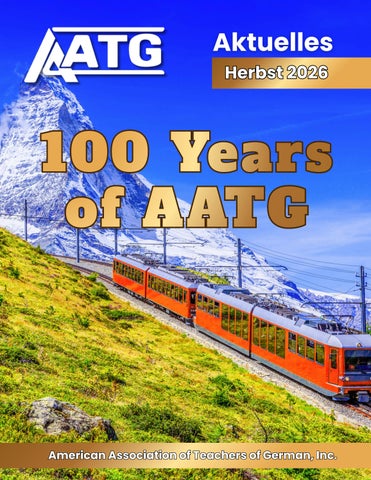
Aktuelles Herbst 2026
100 Years of AATG
American Association of Teachers of German, Inc.
AATG Board of Directors Jennifer Redmann, President Franklin & Marshall College, PA Stephanie Zachar, Vice President Mesa Ridge High School, CO Blake Peters, Treasurer German International School, OR Julia Ruck, Equity Officer Emory University, GA Michael R. Shaughnessy, Executive Director AATG Office, NJ Melanie Mello, Chapter Officer Representative Arizona German Language School, AZ
Jeffrey M. Dyer, Midwest Region Oregon High School, WY Bridget Levine-West, Northeast Region University of Vermont, VT Alysha Holmquist Posner, Northwest Region Enumclaw High School, WA Stefanie Ohnesorg, Southeast Region University of Tennessee-Knoxville, TN Christopher Francis, Southwest Region Mountain Home Public Schools, AR Kristie Foell, Central Region Bowling Green State University, OH
The American Association of Teachers of German supports the teaching of the German language and German-speaking cultures in elementary, secondary and post-secondary education in the United States. The AATG promotes the study of the German-speaking world in all its linguistic, cultural and ethnic diversity and endeavors to prepare students as transnational, transcultural learners and active, multilingual participants in a globalized world.
Published by the American Association of Teachers of German, Inc. Veronika Burney, PhD Director of International Programs & Scholarships veronika@aatg.org John Capasso Director of Finance & Business Operations john@aatg.org
Pamela Murphy Logistics Coordinator & Programs Assistant pam@aatg.org Michael R. Shaughnessy, PhD Executive Director mike@aatg.org Michaela Wetcholowsky Director of Operations michaela@aatg.org
112 Haddontowne Court, #104 Cherry Hill, NJ 08034 Submit content to www.aatg.org/newsletter
Aktuelles Table of Contents
Inside Herbst 2026 Plan your 2027 AATG Conference attendance now!
01
AATG’s Annual Conference Join us in Madison in 2027!
02
President’s Letter
AATG President Jennifer Redmann reflects on the connections between language learning and democracy
04
DEI Corner Media recommendations for your eyes & ears
The DEI Committee has your Fall playlist, watchlist, and reading list covered
08
Executive Director Report
09
Honor Society News Welcome new chapters!
10
Thank you, donors! 2026 Scholarship recipients express their gratitude
13
From the Desk of the Die Unterrichtspraxis Editors Important updates on the publication
16
Chapter & Member News Exciting updates from your fellow AATG members
18
National Office News National German Exam registration opens October 1
19
Partner News Updates & opportunities On the cover: Zermatt, Switzerland. Gornergrat Bahn in front of the Matterhorn mountain
Plus: Heartfelt messages from our scholarship recipients, Honor Society News, and Chapter & Partner stories and updates!
Have regional news to share with the national AATG? Submit an AATG chapter story to www.aatg.org/newsletter
1
Join us in Madison next September!
Join AATG for a conference filled with inspiring sessions, engaging workshops, networking opportunities, and festive celebrations. AATG will meet at the world renowned Monona Terrace Convention Center. Interested in organizing a panel but looking for collaborators? This year, AATG will offer an opportunity for members interested in organizing a panel discussion to connect with potential co-presenters. If you have an idea for a panel but are looking for colleagues to join you, submit your panel idea by September 30, 2026. Please email a proposed title, brief description, and your contact information to Rachel Halverson at rhalverson@uidaho.edu.
Submit a proposal by December 15, 2026: aatg.org/products/2027conference-call-for-papers
Stay in the loop: aatg.org/madison2027
2
President's Letter
Liebe Kolleg*innen, Now that Labor Day has passed, I hope that you have returned to your classrooms with renewed energy after the summer break. Here at Franklin & Marshall College, during the fall semester I am teaching both our Beginning German course and our most advanced literature and culture course. While the transition from one to the other can be a bit jarring – and German 101 is definitely the harder of the two courses to teach! – I am reminded daily what a joy it is to see students develop their skills and make German a part of their identities. The strong showing of the AfD in the recent election in Sachsen-Anhalt is, of course, unprecedented and a cause for concern. The news reminded me of the excellent keynote address given at the IDV’s Kontinentaltagung Nordamerika this past July in Boston. In her presentation, titled “Mehr als Sprache: Zur Bedeutung von Sprachbildung für Demokratie,” Dr. Liana Konstantinidou (Professor at the Züricher Hochschule für angewandte Wissenschaften) drew a connection between language learning and the “Reference Framework of Competences for Democratic Culture” that were developed by the Council of Europe in 2018. I will share links to Dr. Konstantinidou’s presentation and the CoE’s Reference Framework on the AATG Educator Forum on Facebook, and I hope you will check them out. As I mentioned in my last letter, our next AATG national gathering will be September 24-26, 2027 in Madison, WI. This will be the AATG’s first standalone conference in decades, and I am already excited for all of the opportunities we will have to learn
3
President's Letter from each other and forge new connections. Although the conference is still over a year away, now is the time to begin planning your contribution! The conference theme is “Access, Advocacy, and Innovation,” but we welcome proposals for presentations and workshops on a range of topics. If you are interested in organizing a panel and are looking for collaborators, send a title, brief description, and your contact information to Rachel Halverson (rhalverson@uidaho.edu) before September 30. The panels will then be listed on the AATG’s website for all members to access. The link to the proposal form is on the AATG’s website (aatg.org/madison2027).
Wishing all of you a productive and successful fall semester, Mit besten Grüßen
Jennifer Redmann AATG President Professor of German and Chair Department of German, Russian and East Asian Languages Franklin & Marshall College jennifer.redmann@fandm.edu
4
MEDIA RECOMMENDATIONS FROM THE DEI COMMITTEE
DEI CORNER
What we’re reading Sara: I like reading the magazine Gehirn und Geist because it presents studies and research in a clear and contextualized way. It helps me connect scientific findings to a broader understanding of how the mind works. I also enjoy that it makes complex ideas accessible without taking away their depth. And yes, I am apparently the kind of nerd who spends her free time reading about perception, emotions, behavior, and thinking — voluntarily and with genuine enthusiasm.
Sabrina: I am normally not a reader of fantasy, but Spiegelstadt: Tränen aus Gold und Silber absolutely captivated me from the first pages. Described as “Babylon Berlin goes Fantasy”, Spiegelstadt is an urban fantasy novel written that takes place in Berlin — however, there also exists the Spiegelstadt, a version of Berlin frozen in the 1920s and inhabited by a variety of Fae creatures. Travel between the two worlds is forbidden, and only possible with the help of Goldtränen. The main character, Max, discovers the existence of this hidden world and the bloody conflict and greed for power in the Fae realm when he meets Lenyo at a 1920s-themed party in modern-day Berlin.
Julia: Mareike Fallwickl’s Und alle so still (2024) is one of my favorite books that I’ve read recently. The novel intertwines the lives of three protagonists: Elin, a 20something social media influencer; Nuri, a school drop-out adrift in multiple precarious jobs; and Ruth, a nurse in her mid-50s who lost her disabled son. Their lives collide during an ever-growing strike that starts leading into social and economic collapse - women started laying on the streets in silence in a refusal to continue performing unpaid or underpaid care work. I’ve found the story so powerful because it centers many converging factors of marginalization, exploitation, and sheer exhaustion of the people who keep the system alive. Yet, it also highlights the solidarity that people come to find in their struggle to build a better world. I recommend this to people who are looking for contemporary feminist rage novels.
5
Julia: Tahsim Durgun’s book Mama, bitte lern Deutsch (2025) is a beautiful and comic homage to his mother as he shares his story growing up in a Kurdish immigrant family in a Plattenbausiedlung in Oldenburg. As I was reading the book, I empathized with young Tahsim - and the many children like him - as he had to learn to take on too much responsibility way too early in serving as his parent’s translator in school, with immigration authorities, etc. And, as a linguist, I can’t hide my admiration for organizing the book by different linguistic concepts. Pro tip: Follow Tahsim on Instagram (tahdur)!
What we’re listening to Sabrina: One of my favorite German-language shows is the Ku’Damm mini-series on ZDF! Season 1 starts in 1956 in West Berlin and follows the Schöllack family — Caterina, the matriarch and owner of the Galant Tanzschule, and her three daughters: Helga, Monika, and Eva. The subsequent seasons take place in ‘59, ‘63 and ‘77 and portray how the family and the other characters in their personal circle navigate post-war West Germany and the societal expectations and pressures of the times. I have grown very fond of these complex characters and I enjoy seeing their growth over the course of the four seasons.
Sara: I like listening to Girl, Woman, Other because it brings together many different voices and life stories in a vivid and honest way. The novel shows how identity is shaped by gender, race, class, sexuality, family, and history, without making any character feel like a simple “example” of diversity. As an audiobook, the different perspectives feel especially alive and personal. I enjoy how the story moves between characters and lets each woman be complex, flawed, funny, and real.
What we’re dancing to Sabrina:
GRENZKONTROLLE is a punk rock band from Cologne that has been on repeat for me the entire summer! Their music directly tackles topics like pop culture, politics and social inequality. I love that every time I listen to their songs, I discover something new. I highly recommend listening to their entire discography, particularly REVOLUTION and EDELWEIß.
6
Kelsey: YU is a German singer-songwriter whose music often tackles subjects such as relationships, insecurity, growing up and finding your place, social pressure, mental and social alienation, politics/extremism, and hypocrisy. Though I am personally a big fan, I recommend prescreening his music before playing it in the classroom because his style is sometimes ironic, sarcastic, and provocative and some themes might be sensitive for younger audiences or their families. I’d say his sound is a mix of alternative pop, indie rock, and singer/songwriter music. His songs can be melodic and emotionally vulnerable one moment, then loud or aggressive the next. My favorite track by him (so far) is called “Zittern”. It is about the fear, isolation, and pressure that transgender and gender-diverse people can experience when their inner identity doesn't match and pressure that transgender and gender-diverse people can experience when their inner identity doesn't match the label that other people assign to them. The song’s central idea is that transition is not the creation of a new person – it's the ability to live openly as the person you have always been. There is something about YU’s style that made this message feel more accessible to me, despite it not being directly relatable to my own lived experiences. I think the fact that it starts with a deeply personal tone is exactly what makes it very politically powerful.
Sabrina: Another artist that has been on repeat for me is ZANA! She is a Luxembourgish singer and songwriter with Cameroonian roots. Her songs blend many genres like R&B, Hip Hop, Soul, and Pop. The songs fir ëmmer Summer and 9 to 5 have been my favorites so far. Also, it’s really cool to see how much I understand even though those songs are in Luxembourgish :-)
Kelsey: The song “Gut genug” by KitschKrieg, Blumengarten and Shirin David is perhaps this millennium’s bestknown German-language song outside of Germany. Nonetheless, I think this viral phenomenon deserves its moment here, too! It found its international popularity in summer 2026 because it’s the perfect storm of an Ohrwurm, a meme, and a genuinely appealing message. The impact was all the more powerful because the sound of the singer’s voice, the melody, and the rhythm communicate the feeling without requiring listeners to know the words – making it a great song to intro-
7
duce even in beginning-level courses. The affirmation “you are good enough” is perfect for those reflecting on or grappling with confidence, self-image, relationships, and many other internal struggles that exist within each learner (and teacher!) in our classrooms. Because many of the song’s fans did not initially understand the lyrics, a number of American celebrities and influencers participated in a meme trend and/or featured parodies of the song in Tiktok videos. I’m not tuned in there, but I imagine that some new students are already familiar with the song and there is probably also some potential to wrap it into classroom projects!
(Photo s in Ham napped by m e burg in Aug ust!)
Who we’re following Julia: I love the content of the Chefredaktion because it gives voice to young, diverse people in and around Vienna. They feature topics that I don’t find in many of the other journalistic sources that I usually read. Some of my favorite stories include their Seiten auf null stories. These are interviews with young men at the barbershop about their dreams, feelings, and worries, which show young men’s vulnerable, reflective, and caring side. I recommend this to people who want more content from young, smart, engaged people. Sabrina: Janboris Ann-Kathrin Rätz is a queer/ nonbinary moderator, content creator, and artist. Janboris posts a lot of different types of content, but I particularly follow them for their reels on the different neopronouns in German and how to use them in a sentence!
Upcoming DEI Committee Event: Breaking Out of the Culture Box: An Exploration of Critical Approaches to Language Teaching for the Unsure and Hesitant Thursday, October 1, 2026 | 7pm ET, 6pm CT, 5pm MT, 4pm PT | Zoom Register here! Learn more about AATG’s DEI Committee: aatg.org/dei-committee
Executive Director Report Dear AATG Members, Our AATG programs vary in size in scope, but they all have something in common. Every year, more than 15,000 students sit for the National German Exam, and the top performers go on to spend a summer in Germany through the AATG/PAD Deutschland Plus scholarship, while our Title I grants make sure that cost never decides who gets to test. That same commitment runs through our Summer Study Program for High School Students, the Xperitas program for graduating seniors, our College Summer Program, and the teaching grants and professional development funding that help you build your own programs at home. Add the honor societies — from Junior Delta Epsilon Phi through Delta Phi Alpha — the German Centers of Excellence, GEM, and our German Teacher Training Pipeline work, and it comes to nearly $500,000 a year that AATG puts directly into the hands of students and teachers of German across the country. None of it happens by itself. Our professional staff spends the year preparing and monitoring applications, coordinating logistics with our partners in Germany, answering your emails and inquiries, and quietly making sure that every dollar we raise ends up somewhere it will do the most good. They are the reason these programs work, and they are the reason I'm optimistic about where German in the United States is headed. Herzlichst,
Learn more about... The National German Exam
Michael R. Shaughnessy Executive Director AATG mike@aatg.org
AATG’s Student Summer Programs National Honor Societies Grants and Scholarships
9
News from the National Honor Societies Welcome new chapters! Est. st. August August -- September September 2026 2026 Est. E
Delta Phi Alpha
Delta Epsilon Phi Signature School (Indiana Nu)
Morehouse College, GA (Phi Kappa)
Mater Dei High School (Indiana Gamma Kappa)
Centre College, KY (Phi Iota)
Eden Prairie High School (Minnesota Beta Beta)
Belmont University, TN (Phi Lambda)
Gaffney High School (South Carolina Alpha Tau) Burlington High School (Vermont Zeta)
Interested in starting a chapter at your school? Learn more and get started online: aatg.org/honor-society-faq
Send us your Honor Society pictures & stories to be featured in an upcoming newsletter aatg.org/newsletter
10
Thank you, donors!
your donations matter!
“I would like to thank everyone who made my trip to Germany possible and enjoyable—my host family, my chaperone, the friends I’ve made, the German Honor Society, AATG, and all their donors. Germany taught me that feelings of mirth are not only found in extraordinary encounters, but in the genuine connections we make with others. Cultural exchange is a two-way process—while I have left a piece of myself with the people I’ve met on this trip, they have left pieces of themselves with me.” Enya A., 2026 Käthe Wilson Scholarship Recipient, Summer Study Program, traveled to Heidelberg “Thank you so much for giving me the opportunity to travel to Germany this summer through the AATG scholarship program. It was an amazing experience that I will never forget, and I am so grateful for your support. (...) This trip truly meant a lot to me, and none of it would have happened without your generosity. Thank you for supporting students like me and giving us the chance to learn, grow, and explore new cultures!” - Dane M., 2026 Endowed Fund Scholarship Recipient, Summer Study Program, traveled to Rutesheim
“My trip to Hanau was incredible! I was able to speak so much German, and even more importantly, the trip provided me with an immersive environment to actually listen to the language, which I had never had before. I am so grateful to all of the donors to the AATG who facilitated the opportunity I was given- it was far more enlightening and enjoyable than I thought it could be.” Sarah K., 2026 Endowed Fund Scholarship Recipient, Summer Study Program, traveled to Hanau
“Thank you to everyone who made my experiences this summer possible. I really can't thank any of you enough, especially the donors who allowed me to go on a scholarship. I am forever grateful to everyone at AATG for all their time, effort, and money that went into making my summer an unforgettable one.” - Ben W., 2026 Endowed Fund Scholarship Recipient, Summer Study Program, traveled to Kleve
11
your donations matter!
Thank you, donors!
“My time in Germany was an experience I will never forget, and I am thankful to everyone who made it possible. This was my first time visiting Germany after studying the language for the past two and a half years. (...) Without the generosity of the scholarship donors, I likely would not have been able to visit Germany for many years. Because of your support, I was able to experience the country firsthand instead of only learning about it from over 5,000 miles away.” - Logan M., 2026 Endowed Fund Scholarship Recipient, College Summer Program
“Thanks to the generosity of the donors, I have made memories that will last a lifetime. From the incredible excursions to the meaningful moments like strolling along the Rhine, this experience was an absolute delight. I greatly appreciate this opportunity to explore what the Rhineland has to offer, and I hope the wonderful donors can continue to make these experiences possible for other students.” - Justin Y., 2026 Endowed Fund Scholarship Recipient, College Summer Program
“First of all thank you so much for providing me with the opportunity and funding to be able to go to Bonn, Germany for July 2026! It was a very fun and, of course, educational experience in the moment, but after reflecting on it I realized that I had accomplished a lot. The main goal I accomplished was ordering and having casual conversations in full German!(...) It did help that I had amazing teachers/staff and an amazing host mom that I could talk to if I had troubles while there. I am very proud of myself for taking this chance to live in Germany, even if it was only a month!” - Kayla M., 2026 Endowed Fund Scholarship Recipient, College Summer Program “I’m incredibly grateful to the donors of this scholarship for allowing me such an incredible opportunity to experience a different country in the most genuine way possible. I would definitely recommend it to any student learning German or with any interest in German culture.” - Sean O., 2026 Endowed Fund Scholarship Recipient, College Summer Program
12
Thank you, Halle Foundation! “This trip taught me how to be independent in a way nothing else has. Being in an unfamiliar place, having to figure things out with my new fellow American friends, and learning how people live differently broadened my perspective. I came home different. More confident, more curious, and more aware of how big the world actually is. To AATG and the Halle Foundation, you gave me an experience I'll be carrying with me for the rest of my life, and I hope you know how much that generosity mattered. Thank you!!!” - Aadhira V., 2026 Halle Foundation Scholarship Recipient, traveled to Heidelberg “I would like to sincerely thank the Halle Foundation and the contributions by the donors for sponsoring my trip. I will cherish the memories I made in Germany for a lifetime and can use what I’ve learned in school, professional life, and beyond. Claus Halle set out to support and strengthen the relationship between the United States and Germany for the long term, and I feel privileged to be playing a small part in that. ” - Zachary R., 2026 Halle Foundation Scholarship Recipient, traveled to Rutesheim “Thank you so much to AATG and the Halle Foundation for granting me this incredible opportunity. It was such an amazing experience that I will never forget. (...) Everyone I met on this trip was so welcoming, and I will always hold a special place in my heart for the wonderful people I met.” Kacie I., 2026 Halle Foundation Scholarship Recipient, traveled to Heidelberg “I could not have imagined a better way to spend my summer. The countless cultural experiences that I had and the lifelong friends that I made will stay with me forever. I want to extend my heartfelt gratitude to the donors of the Halle Foundation. Without the scholarship that I received, I would not have been able to have this experience. Thank you from the bottom of my heart for this opportunity.” - Kelvin G., 2026 Halle Foundation Scholarship Recipient, traveled to Rutesheim “I want to thank the American Association of Teachers of German (AATG) as well as The Halle Foundation for allowing me to participate in this incredible program. I had an incredible month of fun, learning, and new experiences in Hanau, Germany. My trip was nothing short of fantastic. The souvenirs I see in my room each day bring back memories of classes, friends, and new cities that I will never forget.“ - Grainger B., 2026 Halle Foundation Scholarship Recipient, traveled to Hanau
FREE ACCESS TO JOURNALS for AATG Members
Die Unterrichtspraxis / Teaching German Die Unterrichtspraxis/Teaching German, devoted to the improvement of German teaching in the United States, is published twice a year. The journal publishes pedagogical articles, reports, and other material of interest to teachers of German at all levels of instruction. Die Unterrichtspraxis/Teaching German provides a forum for recent advances in scholarship on German language teaching and learning; practical suggestions for implementing innovative instruction in German classrooms; information concerning relevant teaching and source materials; information about the linguistic, social, political, and cultural landscape of German-speaking countries; and assessments or suggestions regarding the betterment of the German teaching profession. Co-Editors: Karin Baumgartner (University of Utah) Mathias Schulze (San Diego State University)
The German Quarterly serves as a forum for a variety of scholarly debates - topical, ideological, methodological, theoretical, as well as debates on recent developments in the profession. We encourage essays addressing new theoretical or methodological approaches, recent developments in the field, and subjects that engage with the diversity of German-speaking societies and the heterogeneity of German cultural history The German Quarterly is an equal opportunity publication in terms of approaches, topics, epochs and styles in a landscape in which many of the best journals are now specialized. We welcome submissions on all topics in German literature, culture and film from the Middle Ages to the present, as well as comparative and interdisciplinary articles that are relevant to the field of German. Co-Editors: Muriel Cormican (Texas Christian University) Jen William (Purdue University)
More information & journal access: aatg.org/journals
14
Die Unterrichtspraxis / Teaching German Publishing in Motion: Neuigkeiten von Der Unterrichtspraxis Mathias Schulze and Karin Baumgartner, co-editors The world of academic publishing has undergone change for many decades. Journals moved from sales of hard copies to online publication, and individual subscriptions to individual journals have been replaced almost completely by (university) libraries subscribing to whole sets of journals from one publisher — to give just two examples of fundamental changes that have impacted readers, reviewers, authors, and editors of journal articles alike. Recent years and months at Die Unterrichtspraxis / Teaching German have been equally eventful; the publisher of Die Unterrichtspraxis, Wiley or officially Wiley & Sons, Inc., introduced a number of changes in recent months: More and more articles appear as open access. This means they can be viewed and / or downloaded by everyone – all over the world – without having to purchase the individual article or without being a subscriber to the journal (or having access to a library that subscribes to our society journal). Of course, members of AATG have automatic access to all journal articles as one of their membership benefits. Open access ensures that you can freely, and legally, share the articles with interested colleagues and student teachers. And it is a business model for publishers to ensure that research that was funded with taxpayer money can be accessed by the same taxpayers without a paywall. Yet, publishers are making money by publishing, and publishing is costly. These costs (and some corporate profit) are generated from author publication fees. The authors of Die Unterrichtspraxis can choose to – they do not have to – make their own accepted article ‘open access’ by paying the publication fee from their grant funds, for example. Few researchers and teachers have these kinds of grants; their chance is to be part of an institution or institutional network that has a Transformational Agreement with Wiley. These agreements allow members of such an institution to read journal articles from Wiley journals and their researchers to publish in Wiley journals. If you would like further information see: https://authors.wiley.com/author-resources/Journal-Authors/open-access/index.html Die Unterrichtspraxis has moved to continuous publication. This means for authors that, once their manuscript has been accepted for publication, it is published a few days later and everyone can read it.This means for readers that they do not have to wait for an issue to appear; they can read the article seconds after it has been published. We recommend that you set the email alerts, so that you know when a new article was published (see the screenshot for details). As an AATG member, if you have trouble accessing the journal website at https://onlinelibrary.wiley.com/journal/17561221, please contact the AATG office for help.
15
Continuous publication means for us editors that we cannot curate issues by creating a coherent table of contents, for example. Articles published before June 30 of a given year are part of issue 1 in the order in which they were published; in the remaining months of a year, the second issue gets filled one by one. Therefore, we will also create virtual issues, which consist of articles published already. Such a virtual issue will have an editorial and other texts that bridge articles and a coherent table of contents with Research Articles, Praxis Articles, and Forum Articles grouped together and with an organic thematic flow from article to article. Two virtual issues – an issue for the centennial of AATG and one on project-based language learning – are already in the works. Individual articles and the Book Reviews and Media Reviews of teaching resources published in Die Unterrichtspraxis have a slightly different look. Shortly after Wiley had introduced a new system to handle manuscript submissions and the entire review process – the Research Exchange or ReX – they also updated the layout in their journals. We are now using Chicago Style (Author and Year), so bibliographic references get formatted slightly differently. We updated our Author Guidelines (https://onlinelibrary.wiley.com/page/journal/17561221/homepage/forauthors.html), which incorporate useful information about Chicago Style, article types, and the new submission system as well as the Wiley guidelines for using AI tools for writing an article and conducting the necessary research. Some things stay the same: Die Unterrichtspraxis / Teaching German still publishes articles and reviews that are relevant and timely in the field of German-Language Education and an excellent and timely resource for teachers, researchers, and graduate students alike. Remember to subscribe to the article alerts and enjoy reading the work of your colleagues:
Chapter and Member News Danke, AATG! by Del Hausman
Philadelphia/Delaware
No organization has meant more to me personally and my German language teaching career than the American Association of Teachers of German. Immediately out of college, I joined the AATG. As a young teacher, having taught German for five years in a suburban Philadelphia high school, I applied to and participated in the AATG’s Nordhrein/Westfalen program and spent a year teaching English at the Gymnasium Remigianum in Borken/Westfalen. I few years later, I was elected national Vice President of the AATG. I chaired the Annual Meeting in Atlanta. Of course, I have also been active in our local Philadelphia Vicinity and Delaware AATG Chapter. For fifteen summers, I had the opportunity to accompany groups of the very best high school students of German as Begleitlehrer in the AATG/PAD Preisträgerprogramm. Each summer, we would arrive at the Willstätter-Gymnasium in Nürnberg where we were greeted with “Die Austauschschüler sind wieder da!” Eventually, this led to a conversation with my colleague (now friend), Rainer Erhardt, that ultimately led to a real student exchange between the students of the Willstätter-Gymnasium and students at my then high school, Lower Moreland High School, in suburban Philadelphia—in addition to the Preisträgerprogramm. Now students on both sides of the Atlantic had the opportunity to experience each other’s language and culture. Several years later, one of the German colleagues remarked that Mark Twain had once said that education was wasted on the young. Indeed! This led to a teacher exchange between the two schools. Nearly a dozen teachers signed up and, interestingly, we able to pair an art teacher with another art teacher, a history teacher with a history teacher, and a music teacher with a music teacher, etc. This is significant, because a year after this first teacher exchange, came the request for a choir exchange: Could we have an exchange between the Schülerchor des Willstätter-Gymnasiums and the Lower Moreland High School Choir? By this time, I had left the classroom to become the district’s Director of Curriculum and Instruction. “Sure,” was my immediate response. Only then did I learn that maybe I had answered too quickly: We needed to find host families for 75 choir members! Ende gut, alles gut! The exchange took place and the choirs held joint performances in the school, for local German clubs and even at the German Embassy in Washington. Anyone interested in the impact of the of the AATG’s Testing and Awards Program on individual students is urged to read the article my colleague Cherrie Baggs and I wrote for Die Unterrichtspraxis on the occasion of the 25th anniversary of the program: “The Most Rewarding, Magical Time of My Life,” Die Unterrichtspraxis / Teaching German, Vol. 27, No. 2 (Autumn, 1994), pp. 76-79. “Denken heißt vergleichen”—"To think is to compare,” said Walther Rathenau. A full year teaching in a German Gymnasium, 15 summers with PreisträgerInnen in a Gymnasium in Nürnberg and a multiple-year GAPP exchange with the Bondenwald Gymnasium in Hamburg ultimately led to my 1995 PhD dissertation: Riding the Second Wave Across the Sea to Europe: School Administration in the Free State of Bavaria. Liebe AATG, DANKE VIELMALS! 16
Chapter and Member News +++AATG Members and German Programs in the News+++ Dr. John M. Jeep awarded honorary membership in Moses Mendelssohn Society Dessau submitted by by John M. Jeep Ohio
+++ Berlin Wall Collaboration with local museum submitted by Kelleen Rosebaugh Nebraska
Bizz Browning is a fantastic German teacher and runs the entire program for Helena Public Schools German. She hosts a yearly Berlin Wall collaboration between her two high schools.
Read the full article here: https://www.ktvh.com/news/helena-news/high-schoolstudents-celebrate-the-fall-of-the-berlin-wall
+++ 17
Chapter and Member News CGES Brandeis Webinars open to all by Sabine von Mering Massachusetts
The Center for German and European Studies at Brandeis University (CGES) regularly hosts hybrid events and webinars about a variety of Germany-related topics (mostly in English, occasionally in German with interpretation) that are open to the public. Consider joining with your students - and feel free to use the archive (www.brandeis.edu/cges). If you are in the Boston area, you may also be able to join in person events - such as this fall's poster exhibit "Epoch Theater: The Climate Crisis on the German Stage", opening in Farber Library Mezzanine on August 19. Marlene Gmelin and Detlef Schmelz of "Pendelmarionetten", featured in the exhibit, will be participating in a webinar in German on September 23 12-1:30pm ET. Sign up for the newsletter here or email Sabine von Mering (vonmering@brandeis.edu) if you have any questions.
National Office News Registration for the 2027 National German Exam (NGE) opens on October 1! Give your students the opportunity to demonstrate their German skills and join thousands of German learners across the country in this annual AATG program. The NGE provides students with a meaningful way to showcase their language skills while earning national recognition for their achievement. Through AATG’s Title I Grant Program (2027 NGE Title 1 School Grant Application), eligible schools can receive support to help make participation in the NGE accessible to more students. Registration opens October 1, with testing beginning December 1, 2026. Visit nge.aatg.org for registration details, exam information, important dates, and information about Title I Grant support! 18
Liebe Kolleg*innen, wir hoffen, Sie sind gut ins neue Schuljahr gestartet und freuen uns, Sie auch in diesem Herbst mit vielfältigen Angeboten rund um Deutschunterricht, Austausch und Weiterbildung zu begleiten! In dieser Ausgabe erwarten Sie zahlreiche Möglichkeiten, neue Impulse für Ihren Unterricht zu gewinnen: Entdecken Sie unsere Programme SCHULWÄRTS!, GATE und SPARK, informieren Sie sich über Fortbildungsstipendien in Deutschland und erfahren Sie mehr über unsere Angebote für Schülerinnen und Schüler – von Bundesliga Total! bis zur Studienbrücke. Auch für den Unterricht gibt es viel zu entdecken: Beim Workshop „EINFACH SINGEN“ in Houston können Sie Musik und Deutsch miteinander verbinden, während unsere OnlineKonversations- und Phonetik-Clubs dazu einladen, Deutsch aktiv anzuwenden. Wir wünschen Ihnen einen erfolgreichen Start ins Schuljahr und viel Freude beim Entdecken unserer Angebote! Informieren Sie sich außerdem in unserem Veranstaltungskalender über unsere kommenden Veranstaltungen im Herbst.
Im Namen aller Kolleg*innen der BKD USA wünscht Ihnen viel Spaß beim Lesen Sebastian Vötter Sebastian Vötter Leitung der Spracharbeit Nordamerika
AKTUELLES AUS DER ABTEILUNG Weiterbildung im Sommer: Stipendium für Fortbildungskurse in Deutschland Lust auf einen Sommer, der Ihren Deutschunterricht bereichert? Entwickeln Sie neue Ideen für den Unterricht, erweitern Sie Ihre Kompetenzen und erleben Sie Deutschland hautnah: Mit unserem Fortbildungsstipendium für Deutschlehrkräfte verbinden Sie professionelle Weiterbildung mit inspirierenden Erfahrungen vor Ort. Wir übernehmen die Kursgebühren und die Unterkunft. Zusätzlich erhalten Sie einen Reisekostenzuschuss, damit Sie sich ganz auf Ihre Fortbildung konzentrieren können. Ob Sprachkurse, Methodik, Didaktik oder Landeskunde: Unser vielfältiges Kursangebot bietet für jede Lehrkraft das passende Format. Besonders begeistert sind viele Teilnehmende vom Austausch mit Kolleginnen und Kollegen aus aller Welt. Neue Perspektiven, spannende Gespräche und internationale Netzwerke machen die Fortbildung zu einem besonderen Erlebnis. Nutzen Sie die Chance, frische Impulse für Ihren Unterricht mitzunehmen, neue Kontakte zu knüpfen und Deutschland einmal ganz anders kennenzulernen. Bewerben Sie sich noch bis zum 1. November 2026 für Ihr Fortbildungsstipendium! Bei Fragen steht Ihnen unsere Kollegin washington@goethe.de zur Verfügung.
Ulrike
Michalczik
gerne
unter
teacherservice-
Wir freuen uns auf Ihre Bewerbung!
Fortbildungen in Deutschland - Goethe-Institut USA
Deutsch üben und zertifizieren mit dem Goethe-Institut USA Verbessern Sie Ihr Deutsch in unseren Online-Konversations- und Phonetik-Clubs und gewinnen Sie mehr Sicherheit beim Sprechen. Die Clubs sind für verschiedene Sprachniveaus geeignet. Teilnehmende unserer Online-Gruppenkurse im September erhalten 50 % Rabatt. Deutschlehrkräfte können sich außerdem einen Gutschein im Wert von 100 $ für ein Online-Angebot sichern. Sie möchten Ihre Deutschkenntnisse zertifizieren? Das Goethe-Institut USA bietet Deutschprüfungen an mehr als 20 Standorten in den USA an. Weitere Informationen und Anmeldung: Besuchen Sie unsere Website oder kontaktieren Sie unser Team unter exams-usa@goethe.de.
AKTUELLES AUS DER ABTEILUNG Musik & Deutsch: Deutsch gibt den Takt vor Das Goethe-Institut Houston lädt Sie herzlich zu unserem kostenlosen eintägigen Workshop „EINFACH SINGEN“ ein! Der Workshop wendet sich an alle Deutschlehrer*innen, die Lust haben, mit ihrer Klasse im Deutschunterricht zu singen. Angesprochen sind auch die Lehrer*innen, die noch nicht mit ihrer Klasse singen, es aber gerne ausprobieren wollen.
Der Präsenzworkshop findet am Samstag, den 03.10.2026 im Sängerbund in Houston (1703 Heights Blvd, Houston, TX 77008) statt und möchte allen Mut und Freude zum Singen im Deutschunterricht machen. Es gibt kostenlose Parkplätze und es wird eine Bescheinigung für die Teilnahme ausgestellt. Geleitet wird der Workshop von Yoshihisa Matthias Kinoshita, er ist Deutsch-Japaner und wurde1957 in Bremen geboren. Yoshi studierte Gesang und wurde 1987 Stimmbildner beim Tölzer Knabenchor und prägte von 1989 bis 2023 den Wolfratshauser Kinderchor.
Bitte melden Sie sich HIER für den Präsenzworkshop an.
Bundesliga Total! geht in eine neue Runde | Workshop für Lehrkräfte Auch dieses Jahr gibt es wieder den Bundesliga Total! Wettbewerb an dem Middle und Highschool Schüler*innen aus den USA, Kanada, Mexiko, Zentralamerika und der Karibik mitmachen und tolle Preise gewinnen können. Am 29. September 2026 (12:00 PDT | 13:00 CST | 15:00 EDT) laden wir euch zu einem Online-Kick-offWorkshop ein. Dort erklären wir, wie Bundesliga Total! funktioniert, zeigen praktische Unterrichtsbeispiele und beantworten eure Fragen. Der Workshop findet auf Deutsch und/oder Englisch statt. Die Anmeldung zum Workshop erfolgt über das allgemeine Anmeldeformular für Bundesliga Total! Die Anmeldefrist für Bundesliga Total! ist der 5. Oktober und die 1. Runde beginnt am 8. Oktober.
Bundesliga Total! Anmeldung - Step into German - Goethe-Institut
PROGRAMME & INITIATIVEN GATE geht in sein zweites Jahr Wir freuen uns sehr, den zweiten Jahrgang des GATEProgramms (German American Teacher Exchange) ankündigen zu dürfen! In seinem zweiten Jahr knüpft GATE weiterhin bedeutungsvolle Verbindungen zwischen Lehrkräften aus Nordrhein-Westfalen und den USA und fördert den transatlantischen Dialog sowie den interkulturellen Austausch im Klassenzimmer. Der diesjährige Jahrgang mit deutschen und amerikanischen Partnerlehrkräften wurde ausgewählt, und die gegenseitigen Vorstellungen sind bereits gemacht. Wir freuen uns sehr auf die Ankunft der deutschen Lehrkräfte in den USA während ihrer Herbstferien im Oktober, wenn sie Zeit an den Schulen und in den Gemeinden ihrer amerikanischen Partnerlehrkräfte verbringen werden. Im Rahmen des Besuchs freuen wir uns, ein Netzwerktreffen am Goethe-Institut New York zu veranstalten, bei dem der GATE-Jahrgang gemeinsam mit den Teilnehmenden unseres Schulwärts!Programms zusammenkommt. Ein Tag voller gemeinsamer Begegnungen, Vernetzung und der Freude am Deutschunterricht in den USA erwartet uns.
Studienbrücke: A Direkter Weg zum Studium in Deutschland Ihre Schülerinnen und Schüler haben die Möglichkeit, in Deutschland ein Bachelorstudium in den MINT-Fächern oder in den Wirtschaftswissenschaften abzuschließen. Die Studienbrücke bereitet die Teilnehmenden fachlich, sprachlich und kulturell auf ein Studium in Deutschland vor. Durch diese Vorbereitung können die Teilnehmenden einen garantierten Studienplatz an einer renommierten Hochschule erhalten, ohne hohe Studiengebühren zahlen zu müssen. Am 18. September, 16. Oktober und 18. November jeweils um 20:00 EST laden wir euch herzlich zu unseren Informationsveranstaltungen ein. Die Veranstaltungen werden auf Englisch durchgeführt und bieten einen detaillierten Einblick in das Programm der Studienbrücke sowie den individuellen Ablauf für die Teilnehmenden. Klicken Sie hier für mehr Informationen: Informationsveranstaltung
PROGRAMME & INITIATIVEN Nachwuchslehrkräfte auf dem Weg in die Welt: SCHULWÄRTS! kommt nach Nordamerika Wie sieht Unterricht an einer Schule in Billings/Montana, Pittsburgh/Pennsylvania oder in Oakville/Ontario in Kanada aus? Welche Erfahrungen machen angehende Lehrkräfte, wenn sie für mehrere Monate in einem anderen Bildungssystem arbeiten und lernen? Antworten auf diese Fragen liefert das Stipendienprogramm SCHULWÄRTS! des Goethe-Instituts, das deutsche Lehramtsstudierenden internationale Praxiserfahrungen ermöglicht und gleichzeitig Schulen im Ausland unterstützt. Ein besonderer Meilenstein wurde in diesem Jahr erreicht: Erstmals konnten zehn Lehramtsstudierende an Schulen in den USA und Kanada vermittelt werden. Dort erhalten sie die Gelegenheit, den Schulalltag in einem anderen kulturellen Umfeld kennenzulernen, neue Unterrichtsansätze zu beobachten und eigene Erfahrungen im internationalen Bildungsbereich zu sammeln. Das Ziel von SCHULWÄRTS! geht dabei weit über ein klassisches Praktikum hinaus. Die Studierenden lernen andere Schulsysteme und Arbeitsweisen kennen, erweitern ihre interkulturellen Kompetenzen und entwickeln ein tieferes Verständnis für sprachliche und kulturelle Vielfalt im Klassenzimmer.
Gastschulen für 2027 gesucht Für den Zeitraum September bis Dezember 2027 sucht das Goethe-Institut nun weitere Schulen in den USA und Kanada, die bereit sind, eine SCHULWÄRTS!-Stipendiatin oder einen SCHULWÄRTS!-Stipendiaten aufzunehmen. Die Praktika dauern in der Regel rund drei Monate. Die Rolle der Gastschule besteht vor allem darin, die Praktikantin oder den Praktikanten in den Schulalltag einzubinden und eine feste Ansprechperson zu benennen. Die organisatorische Betreuung erfolgt in enger Zusammenarbeit mit dem Goethe-Institut. Für die Visumsangelegenheiten arbeitet das Programm mit einem erfahrenen J1-Visapartner zusammen. Interessiert? Schulen, die sich als Gastschule für einen SCHULWÄRTS!-Stipendiaten oder eine SCHULWÄRTS!-Stipendiatin für Herbst 2027 engagieren möchten, können sich ab sofort bewerben. Weitere Informationen finden Sie hier: Schulwärts! - Goethe-Institut USA
SPARK for German SPARK ist ein Gemeinschaftsprojekt des Goethe-Instituts und der American Association of Teachers of German (AATG), das das Interesse an der deutschen Sprache und am Deutschlehrberuf stärkt. Mit spielerischen und motivierenden Schnupperprogrammen eröffnet SPARK Schülerinnen und Schülern einen frühen Zugang zum Deutschlernen und schafft nachhaltige Lernwege bis in Schule, College und Universität. Gleichzeitig fördert das Programm den sprachlichen und kulturellen Austausch und ermutigt junge Menschen, eine Laufbahn als Deutschlehrkraft in Betracht zu ziehen. Mit mehr als 170 Partnerinstitutionen in den USA baut SPARK erfolgreich Brücken zwischen Schulen, Hochschulen und lokalen Bildungsnetzwerken. Die SPARK Labs unterstützen den Aufbau durchgängiger Lernpfade für Deutsch, während Schulen von hochwertigen, kostenfreien Angeboten profitieren. So trägt SPARK dazu bei, Deutsch langfristig im Bildungswesen zu verankern und die nächste Generation von Deutschlernenden und Deutschlehrkräften zu gewinnen. Werden auch Sie Teil des SPARK-Netzwerks! Ob Schule, College oder Universität: Mit SPARK erweitern Sie Ihr Bildungsangebot, erreichen neue Zielgruppen und stärken die Sichtbarkeit der deutschen Sprache in Ihrer Region. Profitieren Sie von einem engagierten Netzwerk, bewährten Programmen und individueller Unterstützung. Gemeinsam schaffen wir nachhaltige Perspektiven für Deutschlernende und gestalten die Zukunft des Deutschunterrichts in den USA. Informieren Sie sich über die Beteiligungsmöglichkeiten und bringen Sie Deutsch an Ihrer Einrichtung zum Leuchten! Mehr Informationen: https://www.goethe.de/ins/us/en/unt/eng/spa.html
Heidi Lechner, Libertyville High School, Libertyville, Illinois Heidi has been teaching German for over thirty years at both the college and high school levels. She currently teaches dual credit German 3 and 4 through the College of Lake County and is a co-teacher in the EL department at Libertyville High School. She serves as Vice President of the Illinois Council on the Teaching of Foreign Languages (ICTFL) and is a member of the German Educational Multiplier (GEM) Network established by the AATG and Goethe Institut. She holds master’s degrees in German Literature and Educational Leadership.
What is IDO? The Internationale Deutscholympiade (IDO) is the world’s largest competition for young learners of the German language, held biennially by the Goethe-Institut in partnership with the International Association of German Teachers (IDV). Designed for students aged 14 to 17, the ten-day global final gathers top qualifiers from around 60 countries to showcase their language proficiency, collaborate in workshops, and build intercultural connections. I always tell my students that learning a language means you have millions of new friends waiting for you. Language is not just about grammar, culture, and history—it’s about people. This past summer at the Internationale Deutscholympiade (IDO 2026) in Mannheim, Germany, I used my German skills to meet many new friends in one of the most meaningful encounters of my career. I teach high school German in a suburb of Chicago and have had the honor of representing both the AATG and the Goethe-Institut as a German Educational Multiplier (GEM) for the last six years. Through my work as a GEM, I’ve had the chance to collaborate with a wide range of phenomenal German educators across the United States. Attending IDO 2026 as a chaperone for two outstanding students allowed me to take that networking a step further: I lived and worked alongside over 60 other German teachers, each representing a different country.
Connecting with so many global citizens who share a passion for the German language was profoundly impactful. Professionally, we exchanged insights on textbooks, curricula, testing strategies, and advocacy; personally, we built lasting friendships. Highlights included exploring Mannheim from a vintage train, engaging in professional development at the Goethe-Institut Mannheim, and navigating the city’s public transit for daily lunches at the university Mensa. Meanwhile, our students experienced their own ten days of structured learning, adventure, and camaraderie. Think of an international summer camp—that is the best way I can describe the IDO. While it is technically a language competition, every student walks away enriched after exploring their talents alongside peers from 66 countries. I will be presenting about my IDO experience at the Central States conference in Lansing, Michigan, in March 2027, and I look forward to seeing many of you there. I strongly encourage you to inspire your students to participate when the next IDO takes place in 2028. Stay tuned for announcements through the Goethe-Institut. Isabella “Izzy” Ityavkase, Brookfield East High School, Brookfield, Wisconsin German teacher: Kelsie Pattillo-Miller The Internationale Deutsche Olympiade (IDO) was one of the greatest experiences of my life. Although it was a competition, it never felt like one. Even when we did our presentations and writing, I never felt like I was there to prove I was better or more proficient in German. I was there to have fun, meet new people, and try new things. So that’s exactly what I did. The first few days were as fun as they were exhausting. With many workshops planned and a full schedule, there was a lot to do. Monday consisted of walking around the beautiful city of Mannheim, Germany. We walked to the Kunsthalle where an opening ceremony was presented by many wonderful speakers, including the mayor of Mannheim, and a song written and performed by Joshua Caleb. The song was created specifically for IDO and captured the essence of “ZusammenWachsen” as we all sang the earworm throughout the trip. After that, we learned more about the structure of Mannheim, visited the university, and talked with one another. I got to know people from New Zealand, Greece, Bulgaria, Vietnam, and so many more countries spread across the world. Tuesday and Thursday brought out many creative sides. 115 students were split into three groups: Graphic Design, 3D Modeling, and Music Production. We separately worked to create the final product of Fusiopolis. I was assigned to 3D Modeling. Within that group, we split into three sub-groups of animation, 3D printing, and city design. In 3D printing, I helped design the buildings of Fusiopolis. The castle, which was now used as Fusiopolis University, was designed by me. Polina from Cyprus modeled the planetarium, Dheeren from New Zealand created a house, and Alexander from Portugal made airplanes. I have experience in 3D printing, so it was very fun to dive into this project. The final product of Fusiopolis was presented later in the week. You could put on headphones to listen to the podcast created by the students in Music Production while you walked around the city of Fusiopolis. After your tour, you could take a postcard with images promoting Fusiopolis (created by the Graphic Design students).
Between creating Fusipolis, we dabbled in circus performance. Wednesday was a very active day as we all tried acrobatics, Diablo, juggling, ladder-acrobatics, trapeze, and tight-rope. We had around 20 minutes in each station before we chose one speciality to perform in our circus show. I chose ladder-acrobatics, and had so much fun performing with my friends. In 90 minutes, we ended up learning a 6 move routine that we presented in front of our teachers, advisors, and students who practiced other routines. It was incredibly fun learning a new medium and practicing communication in German. A circus routine was not what I was expecting from an international German speaking competition, but it was an amazing and spectacular surprise. Friday was the day before the competition started. To prepare us for the weekend, we did a writing and theater workshop. Writing with Philip was fun. Though most of the time consisted of playing games, the creative writing warmups were very helpful with writing on the spot during the 90 minute essay portion of the competition. Theater also consisted of games, but it also showed us how to improvise, become comfortable with speaking German on the spot, and give us a preview of what our presentations would be like. These workshops made the competition feel less uncertain and more exciting. Although I wasn’t able to place in the top three in A2, I had so much fun over the 11 days in Mannheim. The people were incredibly nice, the workshops were captivating, and the community that was fostered is something I will forever remember. This trip was one of the most amazing experiences I’ve had, and it has taught me so much about communication and reaching out to people. I would have never gotten the chance to learn about all these countries without the Goethe Institut and for that I am eternally grateful. Coming to Mannheim and getting to know all these incredible people has reminded me why learning German (or any foreign language) is so important in our world. Ojas Sachan, Matea Valley High School, Aurora, Illinois German teacher: Elizabeth Hagen Internationale Deutscholympiade – IDO-O-O Guten Tag! Ich heiße Ojas Sachan, und ich bin einer Teilnehmer in die Internationale Deutscholympiade 2026. Ich komme aus der USA. Ich wollte dieses Bericht schreiben, damit alle diese tolle Wettbewerb besser verstehen können. WAS MACHT MAN BEIM IDO? Die IDO ist nicht nur eine Wettbewerb, sondern eine Gemeinschaft von Jugendliche aus dem ganzen Welt, die ich vorher niemals erlebt habe. Es war wirklich interessant, so viele Leute aus verschiedenen Kulturen kennen zu lernen. Jeden Tag gibt es Aktivitäten, z. B. Workshops, Spiele, Karaoke, Tanzen, und viel mehr. Diese Aktivitäten haben mir sehr gefällt, aber ich habe mich besonders auf dem Länderabend gefreut. Wir waren in Gruppen mit Teilnehmer(innen) aus andere Länder, und wir mussten ein Präsentation vorbereiten und aufführen, damit wir zeigen konnten, dass obwohl unsere Länder
und Kulturen unterschiedlich sind, wir sind mit unsere gemeinsame Interessen und Aspekten der Kultur verbindet. WELCHER WORKSHOP HAT DIR AM BESTEN GEFALLEN? Es gab bisher so viele interessante Workshops, aber wenn ich ein auswählen müsste, wäre es der Zirkus-Workshop. Beim Zirkus-Workshop haben wir die Zirkus artist(innen) sehr gut kennengelernt. Sie haben uns erklärt, wie man beim Zirkus übt und aufführt, und danach haben wir eine Aufführung für unsere Begleiter(innen) gemacht. Es hat so viel Spaß gemacht, mit die andere Teilnehmer(innen) etwas zu lernen und zusammen Herausforderungen zu lösen. Zum Beispiel, als ich beim Jonglieren war, hat mich ein Freund von mir gesagt, dass es viel einfacher ist, wenn man vor dem Wand jongliert. Ich habe das besonders interessant gefunden, wie schnell wir gelernt haben. Ich bin sehr dankbar und auch stolz auf meine Aufführung. WELCHER MENSCH HAT DICH BESONDERS BEEINDRUCKT? Ich habe so viele spitze Leute kennengelernt, aber ich bin besonders dankbar an Christian von TUMO-Zentrum, der mich besonders beeindruckt hat. Er hat mein Lehrer für die FusiopolisWorkshop, in dem wir eine Stadt der Zukunft gebaut haben. Christian war immer sehr hilfreich und freundlich. Wenn es Probleme gab, hat er immer versucht, alle Lösungen zu finden, egal ob er die Lösung schon nicht gefunden hatte, deswegen hat er mir besonders beeindruckt. WAS BEDEUTET DAS THEMA DER IDO, „ZUSAMMENWACHSEN“, FÜR DICH? Für mich bedeutet zusammen wachsen, unsere Unterschiede und Vielfalt nicht nur zu akzeptieren, sondern wir aus zu feiern. Wenn wir aus verschiedene Länder mit verschiedene Kulturen und Sprachen kommen und trotzdem für einander Respekt haben können, das ist Zusammenwachsen. Am Länderabend haben alle die Teilnehmerinnen auf ein Azerbaijanisches Lied getanzt. Wir haben uns so viel entspannt und gelacht. Dabei sein bedeutet für mich, dass wir jeden Tag neue Freundschaften zu schließen sollen, egal ob es ein bisschen schwierig ist. Am ersten Tag war ich ein bisschen nervös, aber trotzdem habe ich versucht, neue Freunde zu finden, und für diese Freunde dabei zu sein. Das war meine Zeitung von die Schriftliche Prüfung der IDO. Wie Sie gelesen haben, wir haben bei der IDO außer der Wettbewerb viele besondere Workshops gemacht. Obwohl diese Workshops viel Spaß gemacht haben, ich fand am schönsten die Möglichkeit mit andere Leute aus verschiedene Länder neue Freundschaften zu schließen und mehr über andere Kulturen zu lernen. Ich bin wirklich sehr dankbar, dass ich die Möglichkeit hätte, in der IDO teilzunehmen.
Da Für F alle:
© Cornelsen/Kreuzbergkind GmbH/MaxThrelfall
Unser neues Lehrwerk für Alltag, Uni und Beruf
AATG Professional Partner
Ihre Vorteile auf einen Blick Deutsch lernen, lebensnah: unterwegs motiviert mit praxisbezogenen Themen für Alltag, Uni und Beruf, einem plurikulturellen Ansatz und intuitiven Lernmethoden. Gestalten Sie Ihren DaF-Unterricht lebendig, zeitgemäß und digital – für nachhaltige Lernerfolge. Klar strukturierte Einheiten für intuitive Nutzung und schnelle Vorbereitung
Jetzt NEU
Plurikultureller Ansatz mit Fokus auf die D-A-CH-L-Region
Hier entdecken und im Lehrwerk stöbern
Praxisnahe Handreichungen mit Tipps für den Einsatz digitaler und KI-Tools im Unterricht
e u e N e d n Bä
Alle Informationen unter: crnl.sn/unterwegs-aatg26
September 2026 Neuer Band B1+
Oktober 2026 / Januar 2027 Neue Bände B2.1 und B2.2
klettwl.com Proficiency-based programs for K-12 and Higher Education
We Publish in Four Languages. We Started with German Proficiency-based K-12 German programs, designed for American classrooms by a publisher with German roots.
Klett World Languages is part of the Klett Group, one of Europe’s leading educational publishers, headquartered in Stuttgart. German isn’t our add-on. It’s where we come from. Our K–12 programs are built on communicative, proficiency-based pedagogy, aligned with ACTFL standards, and supported by The KWL Hub, our digital platform for students and teachers.
K-12 DAS REPORTERTEAM The German counterpart to our bestselling Reporteros series. Students become reporters, building communication skills through projects grounded in real-world scenarios. Six immersive units per level explore the cultures and traditions of German-speaking countries through authentic content. Novice Low–Intermediate High | Middle & High School | 4 Levels | ACTFL-aligned
KLASSE!
PORTFOLIO DEUTSCH NEU A communicative, action-oriented program that takes students from Novice Low to Intermediate High in structured, manageable steps. Cooperative activities keep learners engaged and confident.
Novice Low–Intermediate High | Middle & High School | 3 Levels | ACTFL-aligned
klettwl.com/store
A student-centered program with contextual grammar, interdisciplinary and STEM content, teenrelevant topics, and built-in self-assessments. Three levels move students from Novice Low to Intermediate High. Novice Low–Intermediate High | Middle & High School | 3 Levels | ACTFL-aligned
HIGHER EDUCATION IMPULS DEUTSCH Second Edition
NETZWERK NEU
A project-based college German series with frequency -driven vocabulary, flipped-classroom support, and content from the arts, humanities, and STEM. Over 30% new activities and triple the audio materials with regional accents. Novice Low–Intermediate High | College | 2 Levels | ACTFL-aligned
A proven methodology updated with modern content. Clear structure and practical progression make it a reliable choice for any learner.
Novice Low–Intermediate High | College | 3 Levels | ACTFL-aligned
BEYOND THE TEXTBOOK German Readers — 9 series: Literatur-COMIC DaF, Tatort DaF, Leicht und klasse, StadtLand-Abenteuer, graded readers at every level. Grammar: Grammatik mal vier. Test Preparation: So geht’s zum DSD, Mit Erfolg zum Goethe-Zertifikat. Skills Practice: Hören & Sprechen.
THE KWL HUB Our digital platform connects students, teachers, and administrators with interactive content, gradebook tools, lesson plans, assessments, and multimedia resources — all in one place.
Request Free Examination Copies
Proud Partner of
Tour Berlin’s Cold War bunkers and walk along the remainder of the Berlin Wall
American Association of Teachers of German, Inc. 112 Haddontowne Court, #104 Cherry Hill, New Jersey 08034