A Language that is Lived in a Land that is Possessed
Yara Taha
What agency do untranslatables hold in resisting colonial epistemology in Safourya, Palestine?
Supervisor
Rosy Head
2025-2026
Architectural Association School of Architecture
This piece is dedicated to Palestinians from the village of Safourya, including Abu Ehab, my dad and grandfather, who were expelled from their hometown and had to witness the eradication of their homes. It is a tribute to understand the lived, untranslatable reality of their experience. Most of the reflection in this writing was based on extensive tours and conversations with botanists and locals who formed a vivid image of the lands of Safourya.
Power and agency in the mode of the oppressor and the violator operate within a set of relations formed by economic profit and a legal framework that defines a very linear, conventional, and predictable outcome across a set of spaces and their relations, an international formation that makes them translatable. This writing is about the mode of resistance and specifically in relation to land - the social and territorial relational of words, the ones that cannot be translated from the mother tongue in Arabic, arguably offer a form of resistance. Untranslatables possess power within for the simple truth that their formation and operation are distinct from those of translatable words and frameworks. When both land and space are lost, the untranslatables residing in between sustain the truth.
The Western and colonial subjectivity imposed on land and its people - the construction of the otherness penetrates the foundational relations that exist between the two, transforming them. Domesticating words and destroying physical spaces to ultimately create a new set of relations. Withstanding that reality, the existing relationality that is materialised in untranslatables is deemed as a divine entity that is indestructible, a bundle of intangible beings that construct an internal relation between Palestinians and their land, which, in a way, is immutable in its very essence.
This writing asks, ponders and penetrates layers of neglected material of the untranslatables. It seeks to look beyond the threadbare words of laboured texts in racial regimes, property law, and cultural interpretation that characterise the translatables. It engages with what isn’t transparent in studies of collective memory and oral history, and dives deeper. It is a study of the essence of these relations and what makes them impenetrable in times where everything, including land, resources, and rituals, is constantly manipulated. It is a writing that traces hope and reality for the cultures of the global south.
The village of Safourya in the Galilee operates as a lexical ground for the study of the untranslatables. What is the set of relationality of a town like Safourya that passed through complete spatial erasure that cannot be eradicated and is very much the essence of its existence beyond its spatial and physical existence? The aim of this piece of writing is not to analyse the architectural
of the space, cultural norms, and relation with the land on a linear, cause and effect relationship but to reconstruct a rather an incomplete image of that town - and in incomplete - it is not meant that it needs completing but it implies that it needs multiple tangible and intangible frameworks to underpin it and that resides in both the physical and non physical reality of what remains to be an non existent town but one that passes on the endurance of social and territorial relations.
This writing is about the modes of existence of the village of Safourya, which was subjected to complete erasure. The places in themselves become less important unless fathomed in the output of relations they generated and their significance today. The relations of resources to land and land to Palestinians become so fundamental that their erasure becomes the sole fundamental task of the occupier. The existing relations are attacked by a Western capitalist canon of relations where privatisation, territorial division and policy law become the fundamental tools in their deconstruction. Then we ask ourselves, under these vicious scenarios, how is resistance materialised?
This essay aims to be an invitation to the world of the untranslatables across the global south - a means to overcome the West’s ability to conceal the frameworks that exist before it. It is an invitation for people, readers, scholars and students to engage with the untranslatables, the concealed and that which are claimed to be outdated by the Western terminology and dictionary of relations.
Untranslatable Geography
Into the Untranslatables
A Language that is Lived in a Land that is Possessed
The Second Bodies of the Untranslatables
Land doesn’t Belong to People; People Belong to Land
Untranslatables as the New Set of Knowledge Systems
Lexicon of Untranslatable Voices
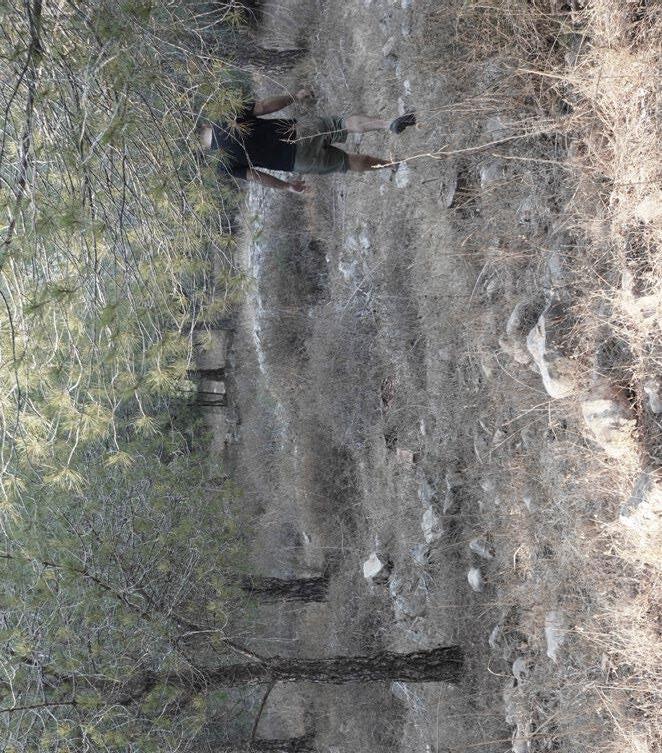
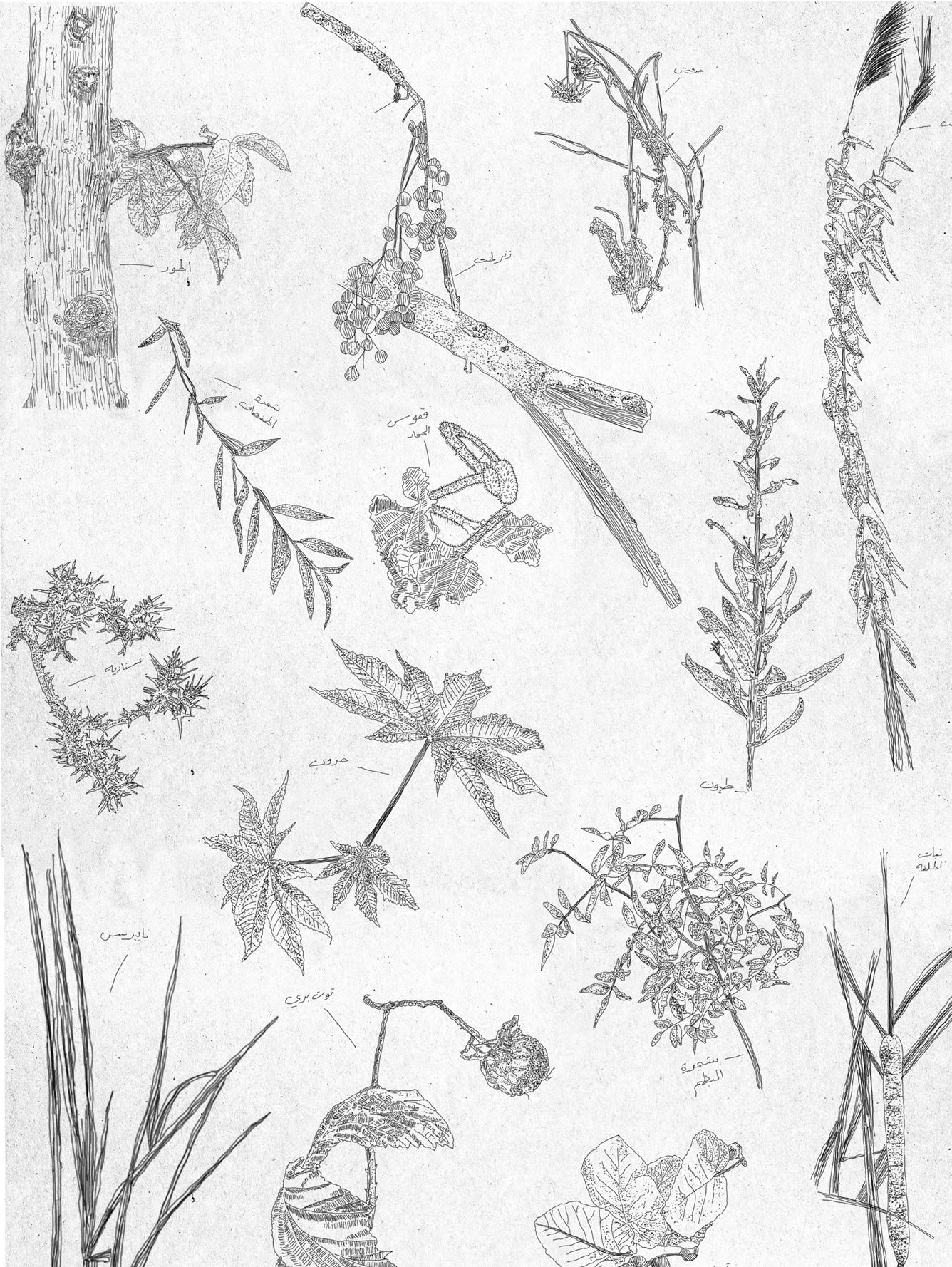
In understanding how the settler, Palestinian and land complex web of relations are formed, it is crucial to fathom how land itself has been dissected to produce a new set of relations that contour the basis of the state of the occupied territories of Palestine today. In the context of villages as opposed to cities, the vast lands circling the villages that were used for agricultural purposes, from olive yards to grounds of figs, have been a lucrative asset for the formation of a series of settlements, and the theft of current natural resources, primarily water in occupied Palestine. The water of the river Naaman in the Galilee, for example, was used to serve a series of demolished villages in the north; its water has been redirected to serve the settlements of Ein Hamifratz and Kfar Masaryk in the south.
On a blessed hill with abundant springs, and in a plain between Nazareth and Haifa, Safourya village is located. The agricultural settlement of Tzipori, located three kilometres southeast of the village site, was established on the village lands in 1949.1 Likewise, the settlement of Hossollilim, also founded in 1949, is situated on the village lands to the west of the site.2 More recently, three settlements were established on the village lands: Alon HaGalil in 1980; Hoshaya in 1981; and Hantun, northwest of the village site, in 1984.3
The dissection of the lands of Safourya village has been subject to racial subjectivity and property law through the process of appropriation: the documentation of the properties during the Ottoman period through tax registry, which led to the recreation of a new formal social structure that conceives a Western fabrication of social and political formation of lands.4 The new “articulation” formed is a type of connection that appears at all times, but that requires being sustained by specific legal processes. Cultivation had a fundamental role in defining who is entitled to own land: “In keeping with the European colonial world-view, subsistence agriculture - agriculture bound for internal markets was a sign of cultural and intellectual inferiority; a prime
1 Wadi Awawdeh, “Saffuriyya: Rich in Archaeological Remains from All Periods,” Al Jazeera Net, August 21, 2012
2 Awawdeh, “Saffuriyya.”
3 Awawdeh, “Saffuriyya.”
4 Brenna Bhandar, “Chapter 3,” in Colonial Lives of Property: Law, Land, and Racial Regimes of Ownership (Durham, NC, and London: Duke University Press, 2018), 115–140.
indicator of backwards, primitive people”. 5 The legal framework that defined what is productive cultivation was responsible for the commoditization of villages like Safourya. The ideology of improvement was fundamental in land appropriation as well as in aligning with the Western terminologies of what is productive.
In the case of the identity of the Palestinian villages, agriculture was not necessarily a mark of national identity for Palestinians, as 5 Ibid., 115–140.
it was used by new settlers as a source of new national life in settlements. Agriculture and cultivation were weaponised, and a new set of relations has been formed by the settlers to create a translatable geography of the lands of Safourya - one that is not marked by the mountains encircling the village, or the various growing land classifications, but by the relationality of the new settlements, and the remaining became the liminal.
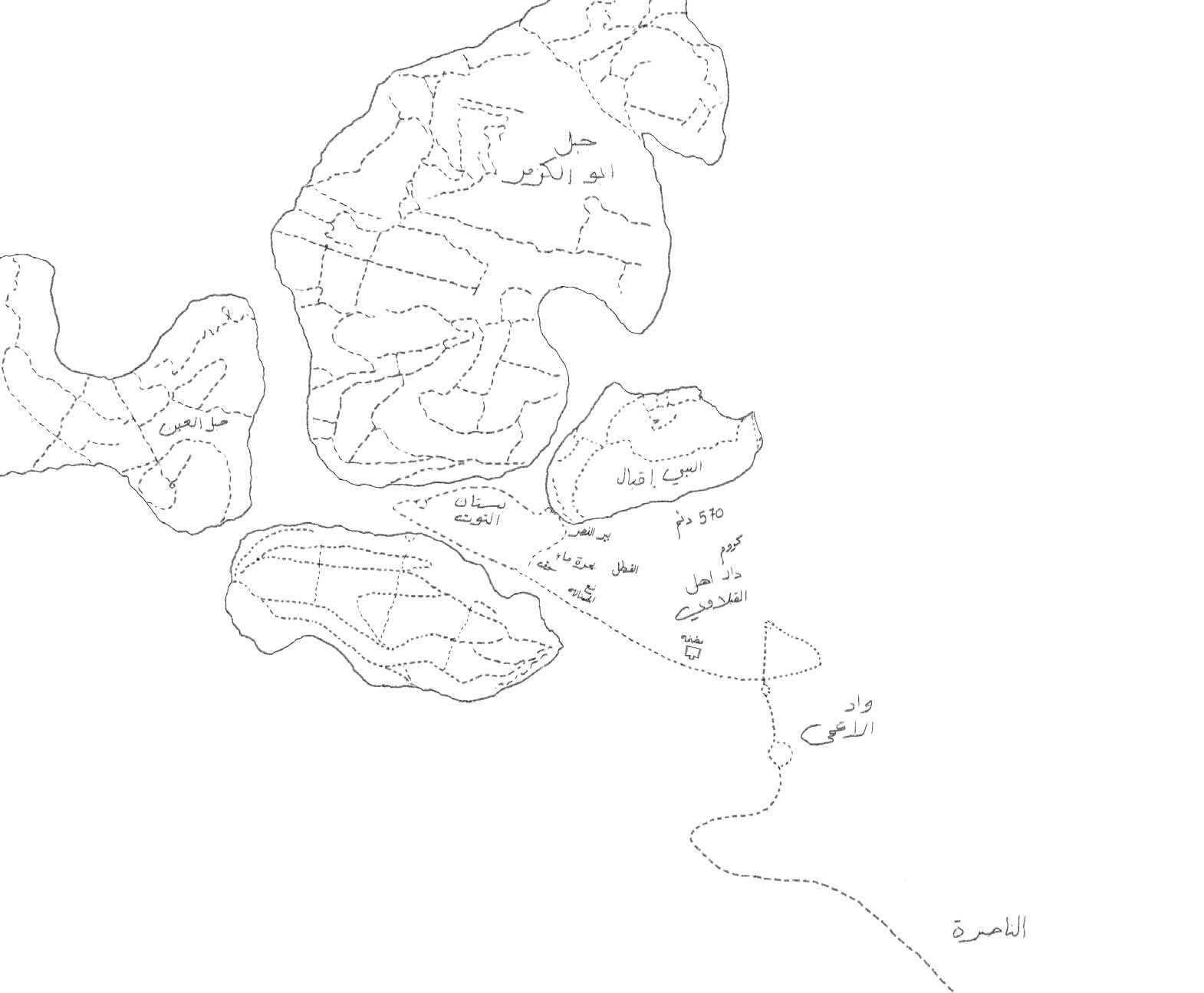
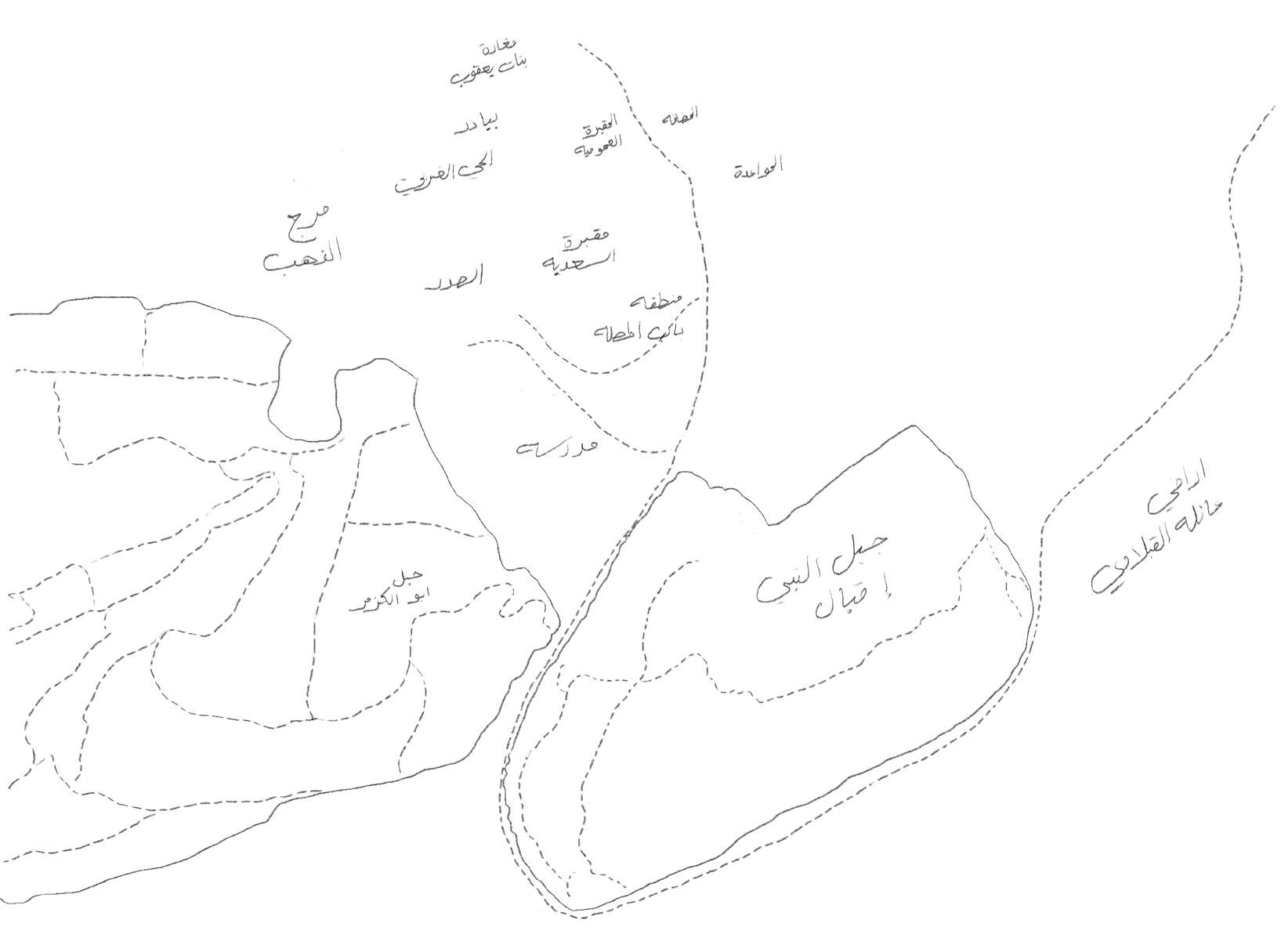
In the drive to Safourya with Abu Ehab, the son of the former village mayor, he said that he’s hoping that the gates are open so we can go through the village - that is now completely erected and replaced by the Tzipori settlement, allowing only settlers to pass. On the way from Nazareth, Abu Ehab pointed to what is now the residential blocks neighbourhood part of the Nazareth boundary line, as Karm Abdula el Daoud, followed by the Alaama Valley, which was confiscated as part of the Absentee property law. This was followed by the Qablawi family lands, Elin and Abu el Kozbor mountains, Strawberry Boustan, home to family gatherings, Nabe Iqbal Mountain, used as a cemetery for the peasants of Safourya, Nos mountain, Ber Nasser mountain, and Bahret May, an area filled with water springs. All names and spaces held no resemblance to what we were seeing from our window seats.
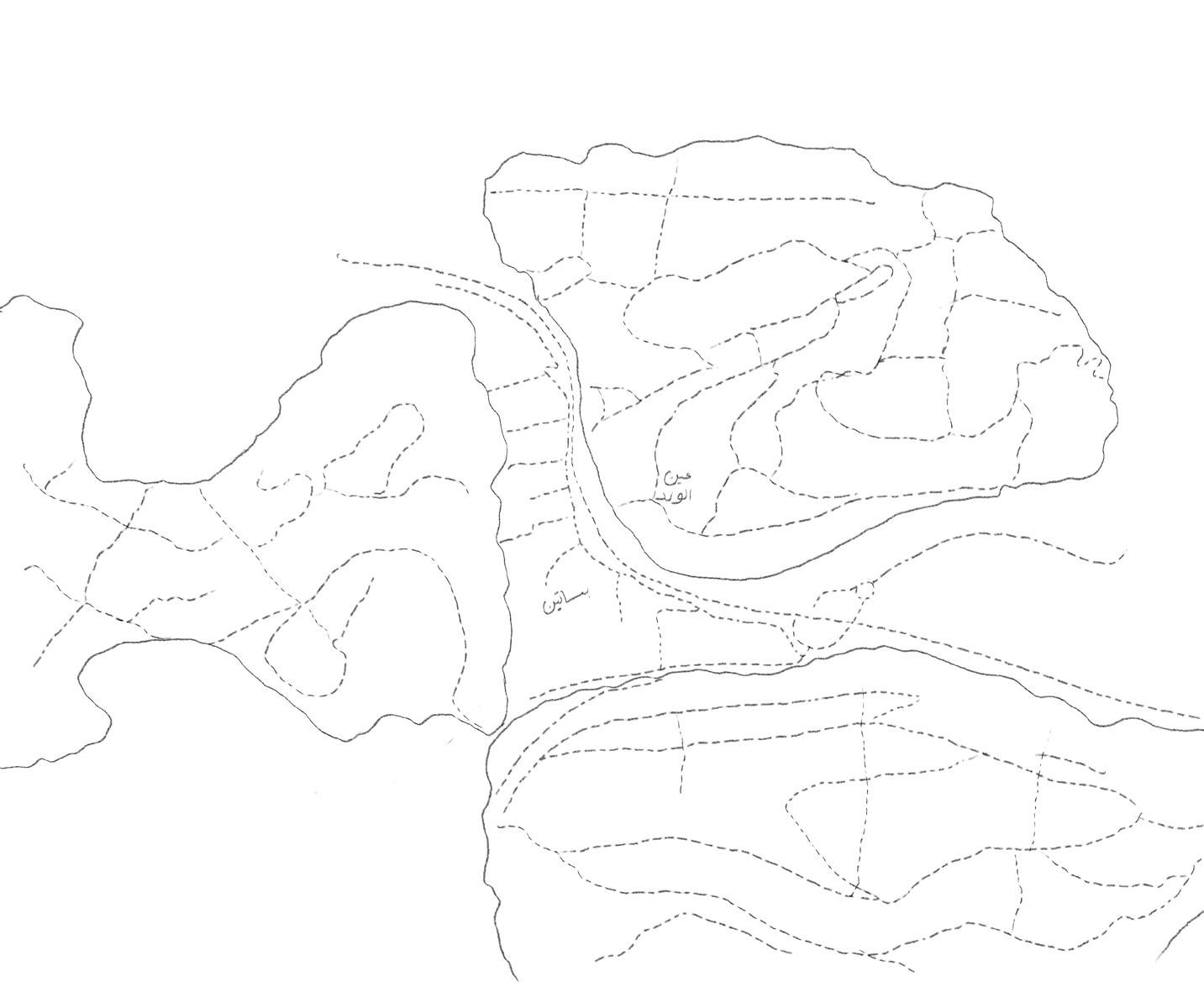
The geography of Safourya in Abu Ehab’s mind was associated with family names and distinct plants and trees that mapped the boundary of the Village of Safourya. The geography of the village became untranslatable in its physicality. The transmission of memory (translation) became the sole truth of the village. Still, the spatial occupation interrupted the translations between generations - it became haunted as there was no spatial continuation for the families that were displaced. The spatial associations and navigation that were clear between the valleys and the mountains, and explicit in Abu Ehab’s mind, became untranslatable and only existed in imagination and memory.
4.
5.
Figure 4. Memory cartography based on conversation with Abu Ehab en-route to Safourya. Drawn by the Author.
Figure 5. Memory cartography based on conversation with Abu Ehab inside Safourya. Drawn by the Author.
Figure 6. Memory cartography based on conversation with Abu Ehab of the remaining allotments owned by Palestinians. Drawn by the Author.
What is lost in translation
“The holes in the meaning are always there in the ear of the translator - Instead of covering them up, we draw attention to the blankness - it gives a space for thinking -”
“The cracks - translations is a weird process - you have the original, the translation and the in between, you have what it should say, but you cannot get to that from either sidethere could be a word, a set of words that does both at once, but we don’t live in that time zone.”
- Anna Carson6
“I cannot seem to find the words to express what I think or feel” even though what my Palestinian friend meant in the sentence is not a lack of words, for he was a very expressive person, but rather that the sum of words is not enough to communicate and relate to others - that very much happened when the reality of a Palestinian coincides with the reality of the world to create a rather third reality for both which leaves the prior misunderstood. Loss, trauma and displacement account for an inconceivable amount of alienation that cannot be translated into a term or a set of words is a common genesis, but to claim that the everyday relations have some non-translation elements in them is to say that reality, in its simplest forms, can not be conveyed or transmitted unless lived, and that is true not only to Palestinians versus foreigners but from a Palestinian from the first generation to the one from the third generation - the change in relations between people and land that is experienced under a colonial and capitalist agenda transformed that existing relations and made them foreigners to their indigenous land. And that itself is a tragedy.
Untranslatables are not solely a linguistic construct. On the contrary, they appear as a haunted memory for Abu Ehab and
6 Anne Carson, “Variations on the Right to Remain Silent,” A Public Space, no. 7 (2008).
other Palestinians. Their essence resides in an experience that is no longer validated by spatial reality but interrupted by the act of colonisation. Abu Ehab would recall times that no longer exist in places that can no longer be articulated. As with all stories told, they start with the normality of life in that village, and end with Nakba Day, which marked the change in that construct of memory, but that is also responsible for the transformation of untranslatables from translatable and relatable formations to being untranslatable. As Spivak explores in Living Translation, referencing Beloved, Morrison writes about Sethe, an enslaved woman who escaped but is haunted by the memory of her dead daughter and the trauma of slavery. 7 The novel attempts to pass on memory, language, and identity, but these are broken and interrupted by the legacy of enslavement. So for Spivak, this is still translation — not linguistic, but a translation of experience, history, and memory across ruptures created by slavery. Spivak focuses on a moment when Sethe remembers her mother’s friend, Nan, saying: “She (Sethe’s mother) told me she had forgotten, along with the language she told it in.”8 Here, the loss of the mother’s language stands for a loss of origin — a break in cultural continuity.
Untranslatable words are critical as they carry with them the truth of the origin, and that is why transmitting them from one generation to the next becomes a necessity and an impossibility. As explained by Spivak: The transmission of memory from mother to daughter (a kind of “translation” of self and history) becomes impossible. 9 Beloved shows translation as an impossibility born of historical violence — the result of being severed from one’s original tongue, family, and story. 10 Spivak calls this broken transmission a “withholding.”The mother’s story, her language, and her identity have been withheld — not willingly, but through the erasure of slavery. When Sethe tries to pass memory on to her ghostly daughter, Beloved, the message is fragmented: “This is not a story to pass on.”This line captures the paradox: the story must be remembered, yet cannot be fully told.11 In a similar vein, Abu Ehab, while he could still recall places and people,
7 Gayatri Chakravorty Spivak, “The Politics of Translation,” in Living Translation, ed. Emily Apter, Avishek Ganguly, Mauro Pala, and Surya Parekh (London, New York, and Calcutta: Seagull Books, 2022), 36–66.
8 Ibid., 36-66.
9 Ibid., 36-66.
10 Ibid., 36-66.
11 Ibid., 36-66.
described the fractured epistemology through which Palestinians attempt to inherit, articulate, and transmit a world that has been spatially interrupted.
Due to withholding, the memory of Palestinians like Abu Ehab becomes so valuable in the community, and even though it is a fragmented story, collectively, all of these stories of Abu Ehab and other Palestinians who lived through the Nakba construct valuable ghosted translations for the next generations of what life looked like when untranslatables today transformed from translatables. Spivak calls the situation of passing something on both necessary and impossible an “aporia” (a deadlock or impasse). The relation between mother and daughter involves both birth and death — Sethe gave life to her daughter, but also killed her to save her from slavery. This paradox mirrors the death-in-birth of a language or story that cannot be passed on. The transmission of memory (translation) happens only through trauma and violence. So, the translation between generations is haunted — it is always a translation through loss. The shared thread of history between generations is manifested in today’s untranslatable experiences.
The concept of transmission has always occupied the settler, especially in property settings, and so the route of it has always been perceived as a clear route with stops across three generations marked by its obsolescence afterwards. The Third Generation Law was enacted to limit the protection period to end with the death of the third generation of tenants. The Third Generation law targets properties rented before 1948 or in the period between 1948 and 1968, and are protected by law. 12 This new legislation goes through the protected first generation (Grandfather), who gives the protection to the second and the third generations (son and grandson). 13 After the death of the third generation, the protection is lifted; thus, the property goes back to its original owner. 14 The generation construct in the eyes of the settler is perceived as an act of passing something on that can be controlled and blocked. Similarly, the transmission of loss and suffering into the Western model of knowledge fails because it attempts to proceed through a clear, straightforward process.
12 Government of Palestine, A Survey of Palestine: Prepared in December 1945 and January 1946 for the Information of the Anglo-American Committee of Inquiry, vol. 1 (Jerusalem: Government Printer, 1946), 35-38.
13 Ibid., 35-38.
14 Ibid., 35-38.
As Slavs and Tatars describe it in their piece Khhhhhhh:
“Replacing one thing with another, telling one tale through another, The Faculty of Substitution questions the received notion that the shortest distance between two points is a straight line.” - Slavs and Tatars, in Khhhhhhh 15
Under the myth of transparency, translation is not a clear transfer of meaning but a process of substitution. Substitution as a faculty, not a flaw — a capacity for transformation inherent to language, belief, and culture. Palestinian geography is now lived as an untranslatable inheritance, carried through voice, memory, and substitution rather than through uninterrupted terrain. Where Enlightenment logic seeks the straight line of clarity and fidelity, Slavs and Tatars embrace the detour, the curve, the loop — translation as a crooked, performative path of meaning. This challenges the Western rationalist model of knowledge, which assumes that clarity equals truth. Instead, substitution becomes a method of thinking sideways, where misunderstanding, echo, and mimicry are productive, even sacred. The impossibility of translating Safourya’s geography into its present terrain echoes Spivak’s account of broken transmission, and the Faculty of
15 Slavs and Tatars, (Brno: The Moravian Gallery in Brno / Moravská Galerie v Brně; MouSse Publishing, 2012), 4-5.
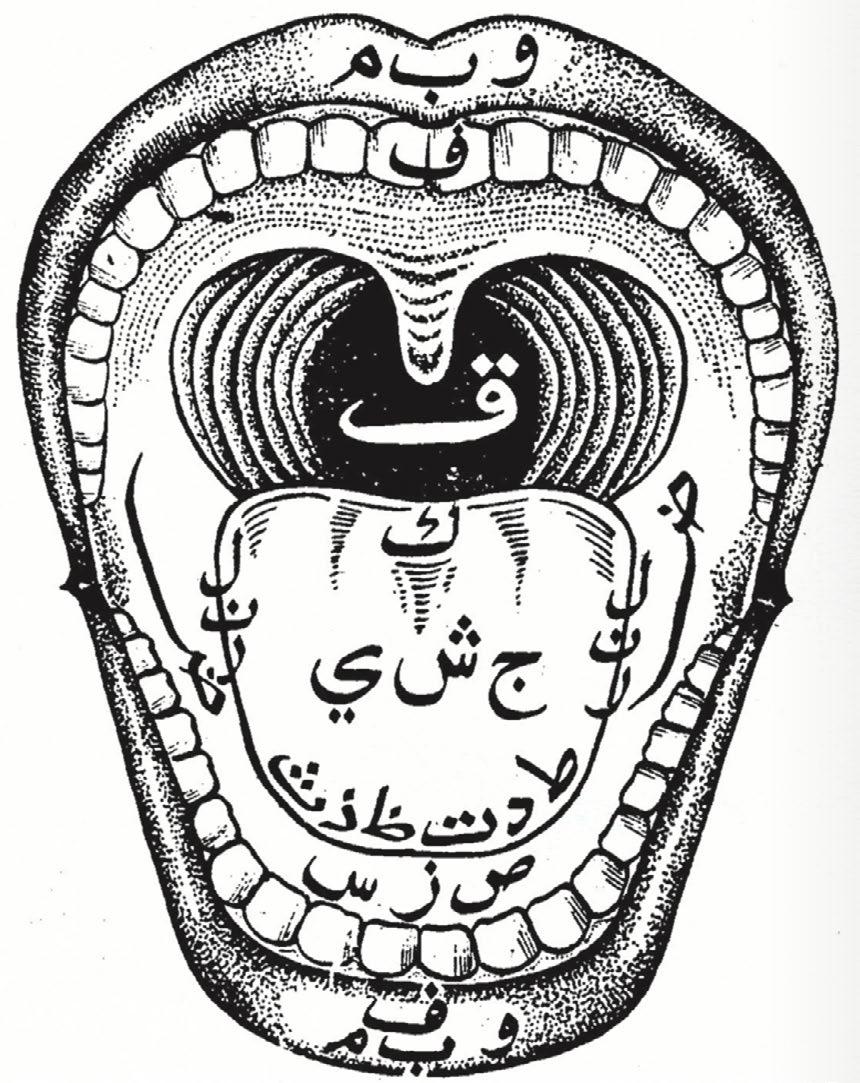
Substitution described by Slavs and Tatars becomes a necessary method for reassembling meaning when the straight line between past and present is severed. Every encounter—between Arabic and Latin, Global South and West—passes through a mediated and oblique path. That curvature is where meaning lives and the only honest form of relation left. The “Faculty of Substitution” thus transforms the tragedy of translation into a method of resistance for Palestinians and other oppressed communities.
A Language that is Lived in a Land that is Possessed
When we speak a language, we create our variation of sentences and terms - that is not to say we speak grammatically wrong per-se - but we own our own version of that language, and it is to do more with the way we express ourselves in the universe and in relation to others Understanding a collective lexicon of the Palestinians from the village of Safourya is a way into the expressive and visual nature of that landscape - it goes beyond understanding the social and cultural norm to a layer that is more profound in its very essence in our understanding. And by lexicon, I don’t simply mean a set of words to be studied, but a collection of words, poems, places, trees, plants, and stories that make that reality irreplaceable and unconquered.
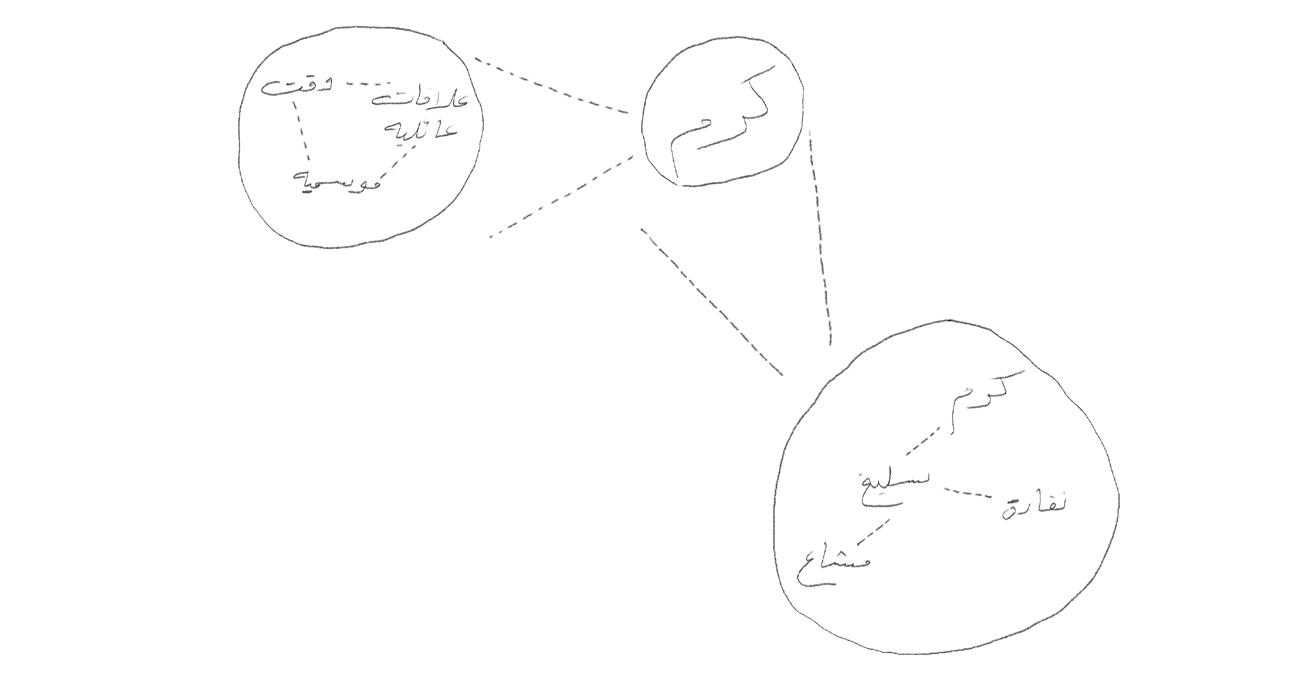
The lexicon of the lands of Safourya demonstrates a great entry into the world of the untranslatables - the five main words selected that the lands are characterised by can not be translated into English word by word, and I will explain why and how that is the case. First it is fundamental to understand the common converger for these words - the basis that make these words used to refer to a particular piece of land that from a distant gaze look rather the same but very much isn’t - the uniqueness of each depends on understanding care, process, and time in how these lands are interpreted - that very much involves Palestinian and the land simultaneously - it does not strip one of the other and it is not a mere relationship of one giving and one receiving but rather it is about the mutual reciprocation of care and wait that builds this impenetrable relation unless omitted completely for there is no replacement for it.
“Al Jadr”, if it is to be translated into English, the closest you would get is rootedness - but it is wrong in its very essence because the root of Jadr is “j.d.r” whilst the root of jather is “j.th.r” which means it becomes a completely different word. Though one interpretation is that the abundance of roots in the land that it acquired its name, the origin of the name is Aramaic. It means something closer to a wall or a fence - that it is very first lands that the Palestinian “darajaha” from the same root which means stepped it or created a series of stone chains around it to protect it from soil drifting that are called Sanasel which also means necklaces - it is very much the act of reliance of one member on the other that create the form of the wall which has a very different form to a dry wall in the countryside of the UK for example.
If we look next at the word Karm, the singular of Kurum, and look at the closest translation in English, it would be vineyard - comes from the Old English word “win-eard” (pronounced roughly “win-yard”), which literally means “wine yard” — a yard or enclosed piece of land where vines are grown for producing wine. However, that translation very much limits the word Karm as it isn’t constrained to the growing of grapes, and doesn’t account for other fruits and vegetables, such as figs that grow there too. Karm is a land that is located close to the village and has a water source that needs a lot of care, but it’s highly nutritious in return. The root of Karm - k.r.m - means to generously give, which is a human act
). Within its meaning, Karm holds a value that communicates a reciprocal relation of giving between the Palestinians and their land, which is very specific. Not all lands can be Karm, and it’s very much dependent not only on the fruits grown but also on the care attached to the process of growing and harvesting. The act of giving isn’t limited to the crops of the Karm, usually referred to as the Kurum of the village, which is deemed a blessed spot that holds gatherings and romantic encounters. As recalled in Fayrouz’s song written by Al Rahbani, “ Ya Karm El Alale”, the Karm becomes a spot where two lovers meet.16 In that sense, the meaning of Karm also becomes universal and not limited to a specific village, such as
16 Fairuz, “Ya Karm El Alaly,” YouTube video, 3:??, uploaded by Fairuz (or channel name), October 9, 2019, https://www.youtube.com/watch?v=OzH-RoWYW3E
Safourya per se, but the specificity of Karm would be in the encounters held in it.
Al Salekh refers to a treeless land that is far from the village and is used to grow wheat, barley, lentils, and chickpeas. It is known that deep in Al Salekh, there is good soil, but the process requires digging and hard work. It is not to say that the Palestinians neglected that land, but rather prioritised winter crops to grow in it. Just after the rain season, the process of weeding starts, which is then followed by threshing in the baydar -threshing floor - and burning that land to increase its fertility. Consequently, it can be used to plant trees. The name Al Salekh refers to the process of stripping the land - the verb Salkh is an act of removal and revealing, and often refers to the revealing of Al Sotra, that is, the coverage and protection of something having an aspect of respect and social conservatism. The land here is not called barren or wasteland after many modern naming, but it refers to the process it has to go through to become fertile. Again, the meaning carries in it the relation between the Palestinians and the land that defines its use and intrinsic value.
Al Naqara refers to a land that is crowned with rocks and wild trees. The one where its spending doesn’t equal its yield. Trees like oak, strawberry and tamarisk grow on it, and it’s also suitable for grazing. As owned land, its owner usually weeds it and plants olive and carob trees on it or makes an olive Karm out of it. Al Naqr is an act of knocking and tapping, which refers to the process the land goes through to be fertile and effectively used.
Lastly, Al Mashaa - commons- refers to land collectively owned by the village. Originated from the root word عاش - which means spread and became common - Mashaa refers to what is shared between a collective. Although it refers to a piece of land that is
rocky, or a woodland in nature, far from town and needs extra care and maintenance, the meaning of the name that emerged is less about ownership in a legal sense and more about the shared responsibility that is carried on that land, rendering it collectively owned as a consequence. The burden of maintenance and cultivating this land is shared among the village members, making it Mashaa - common.
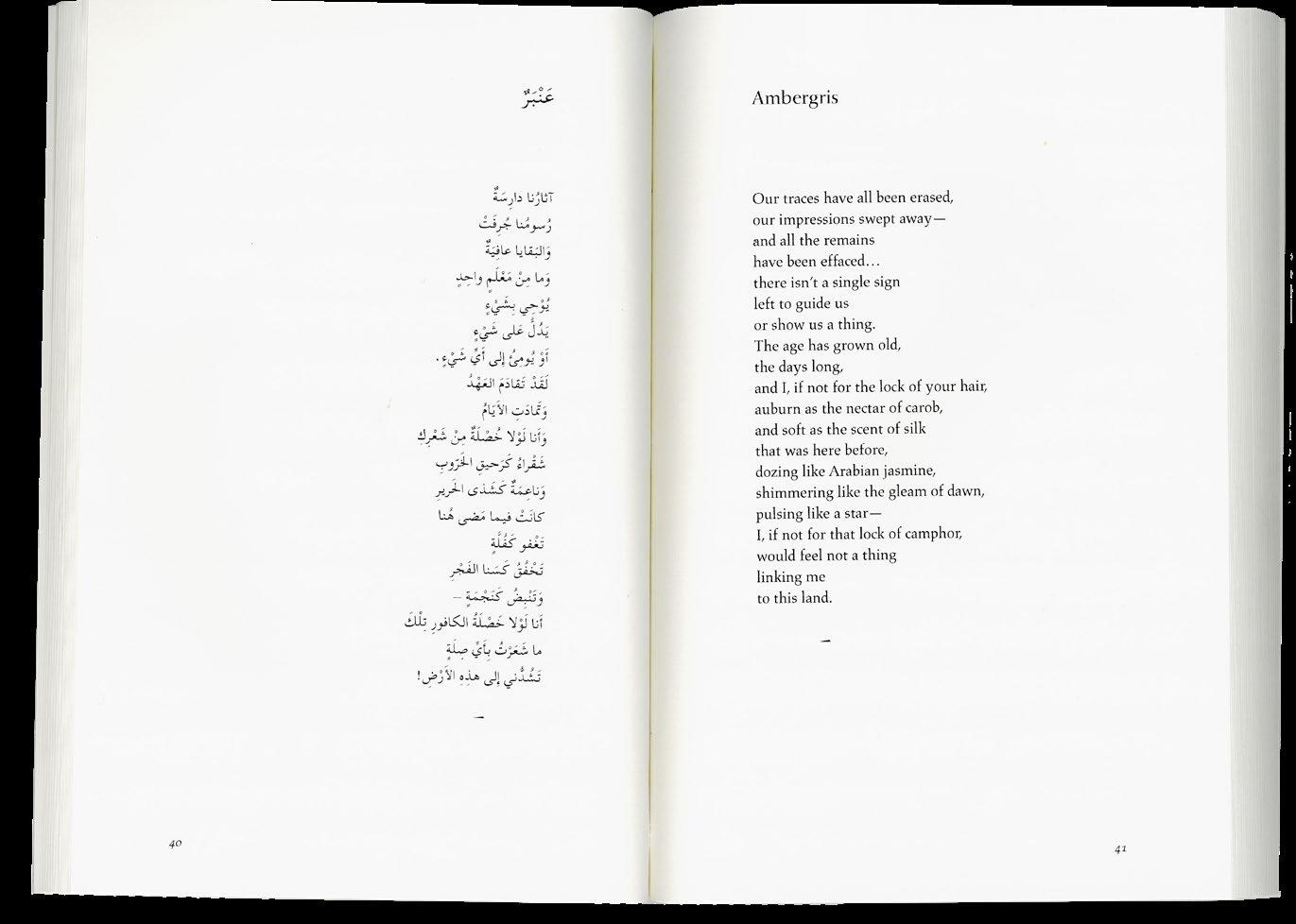
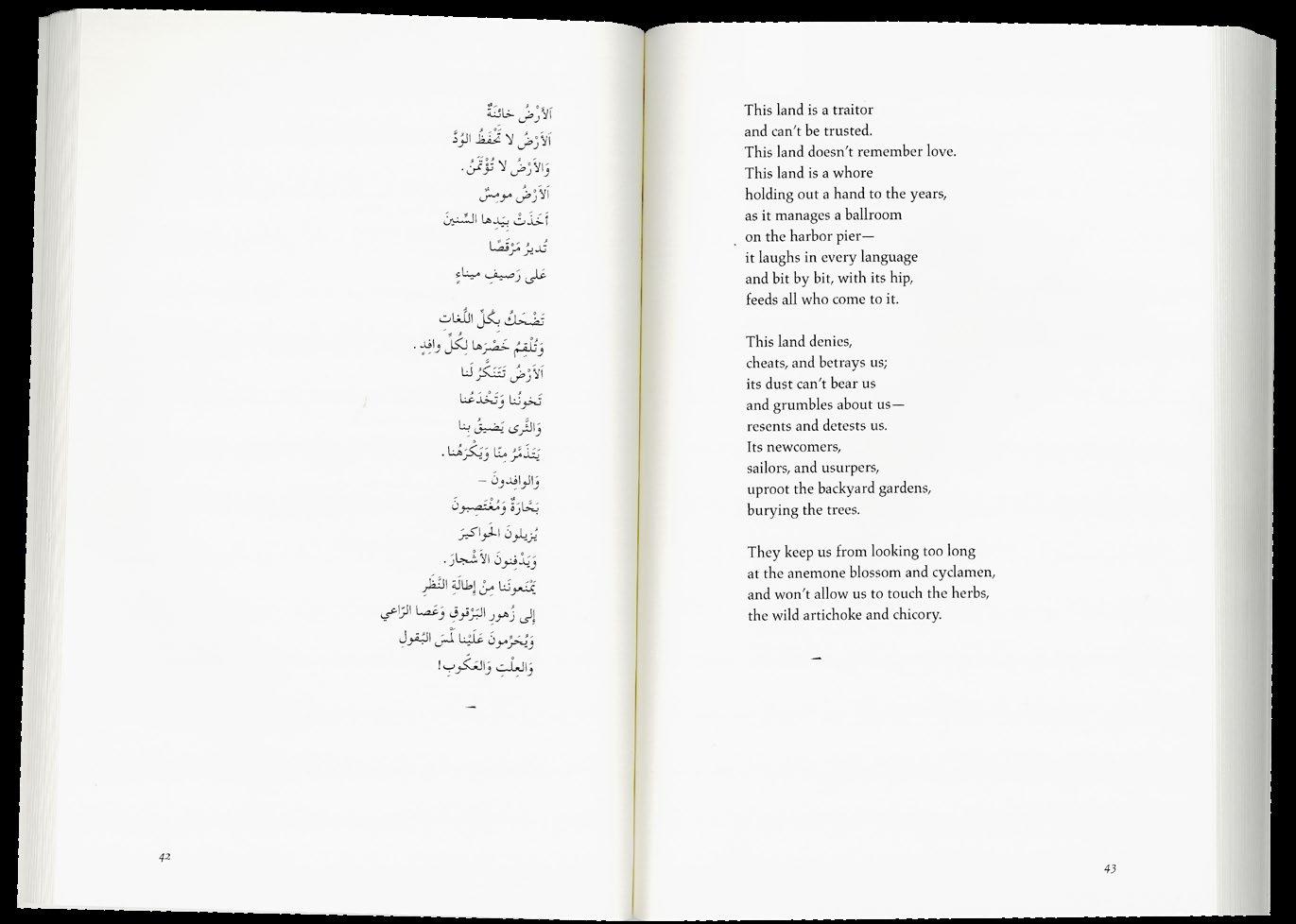
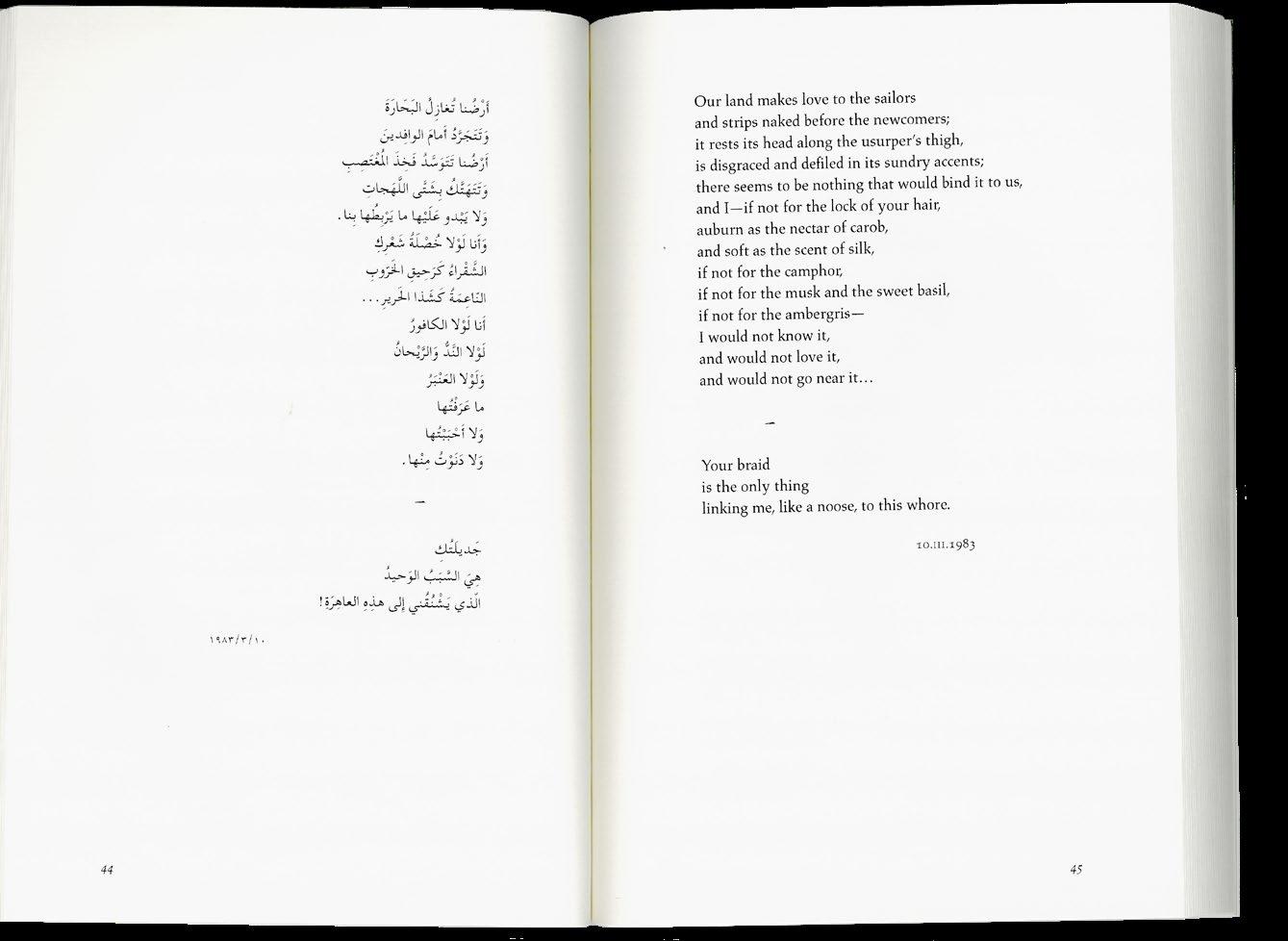
Thinking of this set of places as a set of the untranslatables isn’t an attempt to simply glorify the meaning of these words or to highlight that by translating them, the words pose a superior value that is currently neglected. Still, it is an argument that the loss of these words has a multidimensional effect that is intrinsically political, and by wrong translation or complete dismissal, we are simultaneously disregarding the social and cultural values embedded in them, which very much define the spatial relationships and rituals attached to them. In a colonial context, when foreign languages undermine the mother tongue, what is translated comes to define the banal, while places that have the capacity to transform and be moulded are the untranslatables, which possess a deeper, multi-scalar dimension.
If we were to think of this set of words not as separate entities but as an intermingled web of relations that define a specific time, place, and process, we allow ourselves to step into impenetrable spaces. First, these words have a reciprocal relationship - that allowed the other to exist as a place the absence of the Karm would simultaneously mean the absence of the Al Jadr. They exist in relation to one another, not just geographically, but also conceptually. Apart from the spatial relationship, we have the
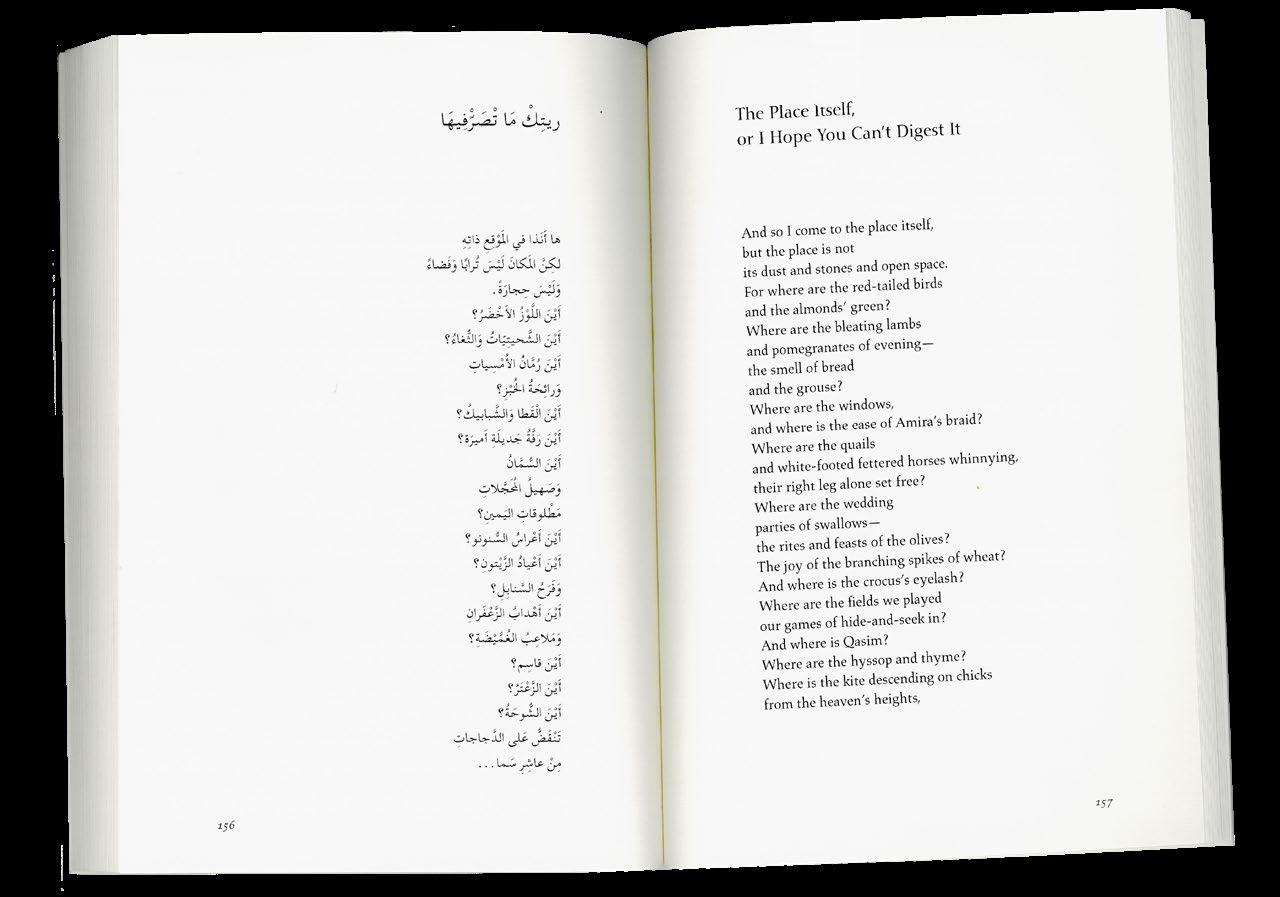
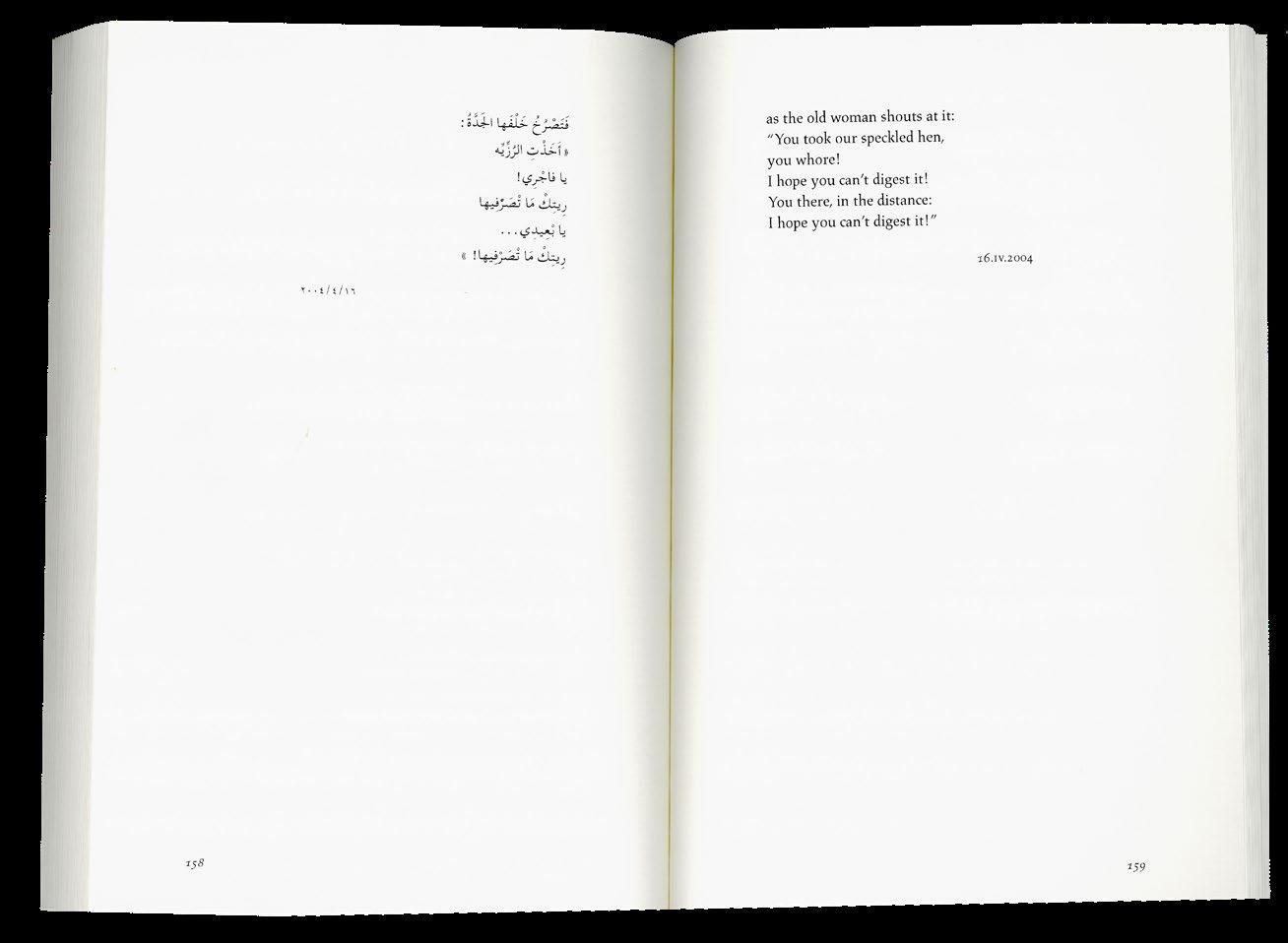
8.“Ambergris” poem by Taha Muhammad Ali in “So What New & Selected Poems”, 1971–2005.
9. Names of Agricultural lands. Drawn by the Author
time-space fabric, the spaces and their name would change if a process is carried out on them, allowing their transformation, and in consequence, their name. The flexibility of these spaces means they are highly particular in their configuration yet malleable enough to be altered. Lastly, they are a collective creation that defines a process where both the collective and the land are part of. In light of the truth of the meaning that these words hold, the untranslatables resist penetration. Within this set of words, what is

retained is usually the ones that are passed on in other media apart from their technical use. For example, the word Karm is highly referenced in contemporary songs and poems that it managed to escape the vicious repression of the colonial language across generations. The time-space fabric of the untranslatables is also identified by the settler when the Kurum, as a spatial construct, is presented as a contested terrain that is violated at a particular time of the year - time when the relation between land and Palestinian is amplified during harvest season. As of every October, during the olive harvest season, the Kurum of Olives are cut down violently by large settler groups - a violent reminder that the simple act of Palestinians tending their land endangers the illusion of a colonial state built on erasure.17 The physical spaces of these places have not escaped the suppression and erasure carried by settler groups.
The Second Bodies of the Untranslatables
“I am because you are, I exist because everything exists” , Pat McCabe18
Untranslatables have second bodies, as exquisitely illustrated in The Second Body by Daisy Hildyard, that every human has two bodies: the physical body that lives locally and the diffused, planetary body that participates in global networks of harm, ecology, labour, and climate.19 These two selves coexist but rarely align; the gap between them produces ethical confusion, alienation, and a sense of untranslatable experience Untranslatables operate as a collective constantly charged by social, political, and economic dimensions and by an overwritten relational framework. Trauma creates a “second body” of memory that is withheld and ruptured. The trauma is not only what happened, but what cannot be transmitted. Memory, to be
17 Al Jazeera Staff, “Israeli Settlers Attack More Palestinians as Olive Harvest Violence Surges,” Al Jazeera, October 25, 2025, https://www.aljazeera.comnews/2025/10/25/israeli-settlers-attack-more-palestinians-as-olive-harvest-violence-surges.
18 Arturo Escobar, Michal Osterweil, and Kriti Sharma, Relationality: An Emergent Politics of Life Beyond the Human (London: Bloomsbury Publishing, 2024),53.
19 Daisy Hildyard, The Second Body (London: Fitzcarraldo Editions, 2017),16 -28.
translated, requires continuity of relation — land, language, proximity, recognisable routes, and shared referents. Displacement severs these. What remains is a memory-body that cannot be “passed on” intact. This second body of memory is not chosen; it is produced by violence. Land itself becomes an example of Spivak’s aporia: it is simultaneously present (in memory) and absent (in physicality), both lived and lost. The generational translation rupture is the direct consequence of this “two-bodied” condition of memory — a geography that survives only in narration, unable to return to its physical origin.
Untranslatables are positioned in a liminal zone between the web of relations of settler, land, and Palestinians, and it is not to say that they are in any way neutral; quite the opposite. But they reveal very much how land exists in the eyes of the occupier versus those of the indigenous. If you were to think of them in the form of a drawing, untranslatables are an eye-bird view for the settler - a distant, void of rationality type of drawing - perceived as plots that are either productive or profitable. In the short book of the Second Body, Daisy attempted to understand how animals are meant to exist differently in the world of a criminologist versus a butcher: both wouldn’t agree on ways in which humans relate to animals.20 While for Gina, the criminologist, “animals exist in the blurry video taken on the phone”: animals’ bodies are in spreadsheets, scans of travel documents, and charts, for Richard, the butcher, “animals exist right in front of you, in flesh and blood”, he knows his animals inside out, and crossover was not allowed between animals, the borders between species were maintained: a real distinction between two legs of a meat.21 In the same view, Palestinians and settlers operate in a parallel world in relation to land. While for a Palestinian it is very much about this one to one relationality, where the soil, the humidity, and type of plants and the relation to other Palestinians close by are in the centre, the settler, having a Tabula Rasa attitude that is summed up in “what does land look like from space?” - And even if the lands are perceived as a collective creation and then subdivided - the fundamental issue is that there is only one dimensional interpretation of them - a private property that is aimed to be productive and profitable. Even if the process of care is carried on them it is usually very secluded and proven to
20 Hildyard, The Second Body, 16 -28.
21 Hildyard, The Second Body, 16 -28.
be ineffective - for example in the current part where allotments are still owned by Palestinians as a substitute for their confiscated homes in Safourya village in 1948, where some families individually own an allotment that can be used to plant aubergine and figs, on my walk in that area there was a fenced allotment left desolate in the heart of the other colourful private plots, that was owned by a settler group while the act of caring for the land have been subdivided in plots of private lands that granted both Palestinians and settlers access, the relational entity with land is almost non existent with the settlers and that is not because it is an impossible operation but because it needs persistence and a time-related process, that a settler has no relationality to pursue.
The divide between embodied memory and abstracted geopolitical knowledge is not simply conceptual — it is lived. When Hildyard speaks of the “first body,” she refers to the intimate, physical, proximate self. 22 Abu Ehab’s geography of Safourya is an ideal illustration: his body knows the land through movement, smell, family stories, and named mountains. This is a knowledge formed by lived relations, not by cartography or modern property categories. But the destruction and settlement of Safourya created a “second body” of the land that is marked by boundaries and borders. Geographies are overwritten, the embodied memory (first body) persists, but the infrastructure needed to support it — the land itself — is removed. The second body, imposed by the state, becomes the dominant one. It overwrites, simplifies, and ultimately erases the first. Generational translation depends on the continuity of the first body — on the ability to walk the same routes and recognise the same paths. When these disappear, translation becomes unattainable. What is passed on is not the experience itself, but its spectre.
Thus, “untranslatability” is not linguistic — it is the space between bodies, between the lived and the abstract. It is the experience of inheriting a geography that exists only in narration, never in physical presence. The rupture is not the memory itself, but its dislocation from the world that once held it. Today in the allotments, iron fences have replaced cactuses separating private allotments; they almost don’t exist and are constantly breached by the web of relations that is formed between Palestinians prior to occupation to combat colonial legal frameworks - as one
22 Hildyard, The Second Body, 16 -28.
Palestinian explained to me in the visit to the allotments that Palestinians are collectively refusing legal and written formats of communication between them and are choosing the words of mouth. The government is very much aware of the power of relationality held in defining a very effective bond between Palestinians and land, and are trying to prevent it with, for example, controlling where the milk and eggs produced are being sold to, limiting them to only monopolised Israeli company - the physical control of land becomes an exploitative act that attempts to cut the creation of further value chains beyond the immediate relations formed on the land.
According to Arturo Escobar, in Relationality: An Emergent Politics of Life Beyond the Human, the word interconnectedness often premises separation then a subsequent relation, but relatedness can be thought of differently: “I am not related to my right hand - I am my right hand, it is me and we are never two separate things that were subsequently bound by relation.”23 In that sense, relationality and interdependence come first. Nothing pre-exists the relations that constitute them. The ideas of “connection”, “interdependence”, “communication”, and “network” have been popularised and exploited by twenty-first-century capitalism, and are premised on a very thin notion of relations as a network of transactions. Thus, in the context of Safourya, while the lands have been physically bisected into small segments of capitalist privatised properties, the interconnectedness of the whole still exists, even if not physically seen. The untranslatables showcase a stronger bond that defeats the twenty-first-century capitalism premise of relations.
23 Escobar, Osterweil, and Sharma, Relationality, 53.
Land doesn’t Belong to People; People Belong to Land
What makes the Palestinian cause more profound in the case of Safourya that is underpinned by the untranslatables is the truth that even though the government is trying to strip land from the people it is failing simply because the people belong to land rather than land belong to people - the motto that Palestinians chant which is “Hun Asli” it is less about possessing the land as a private property but it is about the essence that the rootedness of their existence is intertwined in the existence of the land - Asil comes from Sila - relation - here the untranslatables transform their role not only to describe spaces but relations set of terms that Palestinians use that have been misinterpreted and gentrified in their very essence - it’s the same as is seen on western media platforms when a word of genocide is exchanged with conflictthe words that Palestinians use to describe the relationality with land as there is an uncanny difference between saying: they belong to the land versus the land belongs to them - the later being a very capitalist discourse.
These subtle differences in the configuration of speech highlight the role untranslatables hold and the power they possess by their existence. Untranslatables highlight the real disjunction between perpetrators and indigenous people, as in neither is fighting the same battle - the war isn’t the same. Consequently, the occupier is always occupied in possession and control, resulting in constant loss or rather unattainable victory because the battles are their own creation and reaction. While control very much defines the very formation of translatables - plot of land, allotment and so on - the universality of these words on one hand makes them exchangeable and transactional but on the other they also become static - their formation very much is true across time and in a way becomes irrelevant because even though they describe an exchangeable entity they strip the entity from its entire makeup so it becomes nothing like itself.
Untranslatables as the New Set of Knowledge Systems
If we look into the microscope into one term of the untranslatables - while they are also a social construct - they are, however, in flux. The makeup of the untranslatables, despite them being rooted in land, there is a level of change that is inherent in their formation - they are not fixed in stone, but rather their strength comes from their openness. The elements that form their essence are very different to the economic profit, legal framework, and power that define the reasons for the formation of the translatables. The operation mode of each is very different - where the parameters of translatables are rooted in violent acts of colonisation, the untranslatables are a tangled relation of social, fauna and flora construct.
The element of time is very fundamental in distinguishing the differences between the two: being static, makes translatables have no scale of time; however, untranslatables are not formed as a response of control, they are a social construct that was formed before the occupation of land - the very essence of their formation is entirely different, which allows them to exist regardless. Their makeup is made of seasonality, family relations and a lot of forces at play that are constantly in flux. The agency is very much present in their formation, and while the occupier is busy creating a new set of terms to reclaim land, the act of taking land away, displacing people, and building new settlements becomes irrelevant, as there is an endurance within the land itself. It is only the surface that is shared between the translatables and untranslatables, but the fabric is completely other.
The inherent agency of untranslatables makes them be coapted - it is that they are resisting epistemology of control and power that they then pass on to create a new set of knowledge systems - that is, cognitive and cosmological, allowing them to operate differently. The open system that is constantly in flux is what keeps them alive in their land and in the eyes of their beholders. Loss is inherent in their transition into other forms of art media, which consequently allows them to be accessible across generations, despite the generational breakage; in that sense, they become understood as encrypted entities, and that is what allows them to act as resisting nodes. In that moment in time, we are in that fabric, the fabric of the nodes of untranslatables, in the gap, in the crack; it is not fictional or delusional, it is not memory either. I can see it. Can you see it?
The attached piece is a collection of a recreated sound archive that articulates spaces and places that are untranslatable. It sits in the space in between- the crack - to construct an audial relationship with territory. Untranslatables are a start to defying universality in experiences and to instead solidify a system of knowledge that maintains a distinct way of storing social material. The terms and sounds deal with loss and destruction and consequently function as nodes of resistance.
Supervisor Rosy Head
Abusaada, Nadi, and Wesam Al Asali, eds. Arab Modern: Architecture and the Project of Independence. Zürich: gta Verlag, 2025.
Ali, Taha Muhammad. So What: New & Selected Poems, 1971–2005. Translated by Peter Cole. Berkeley: University of California Press, 2006.
Al Jazeera Staff. “Israeli Settlers Attack More Palestinians as Olive Harvest Violence Surges.” Al Jazeera, October 25, 2025. https://www.aljazeera. com/news/2025/10/25/israeli-settlers-attack-more-palestinians-as-olive-harvest-violence-surges.
Alter,Walter Benjamin. Selected Writings, Volume 1: 1913–1926. Edited by Marcus Bullock and Michael W. Jennings. Cambridge, MA: The Belknap Press of Harvard University Press, 1996.
Awawdeh, Wadi . “Saffuriyya: Rich in Archaeological Remains from All Periods.” Al Jazeera Net, August 21, 2012. https://www.aljazeera.net/cultur e/2012/8/21/%D8%B5%D9%81%D9%88%D8%B1%D9%8A%D8%A9%D8%B2%D8%A7%D8%AE%D8%B1%D8%A9%D8%A8%D8%A2%D8%AB%D8%A7%D8%B1-%D9%85%D9%86%D9%83%D9%84-%D8%A7%D9%84%D8%B9%D8%B5%D9%88%D8%B.
Bhandar, Brenna. Colonial Lives of Property: Law, Land, and Racial Regimes of Ownership. Durham (NC) and London: Duke University Press, 2018.
Carson, Anne. “Variations on the Right to Remain Silent.” A Public Space, no. 7 (2008).
Cassin, Barbara, ed. Dictionary of Untranslatables: A Philosophical Lexicon. Translated by Steven Rendall, Christian Hubert, Jeffrey Mehlman, Nathanaël Stein, and Michael Syrotinski. Princeton, NJ: Princeton University Press, 2014.
Danowski, Déborah, and Eduardo Viveiros de Castro. The Ends of the World. Translated by Rodrigo Nunes. Cambridge: Polity Press, 2017.
Elden, Stuart. The Birth of Territory. Chicago: University of Chicago Press, 2013.
“Elizabeth Price | INSIDE / OUT”, YouTube video, 1hour and twenty two minutes, uploaded by Leeds Beckett, April 27, 2023, URL.
Escobar, Arturo, Michal Osterweil, and Kriti Sharma. Relationality: An Emergent Politics of Life Beyond the Human. London: Bloomsbury Publishing, 2024.
Fairuz. “Ya Karm El Alaly.” YouTube video, 3:??. Uploaded by Fairuz (or the channel name if different), October 9, 2019 [approximate based on upload clues and metadata available]. https://www.youtube.com/ watch?v=OzH-RoWYW3E
Fields, Gary. Enclosure: Palestinian Landscapes in a Historical Mirror. Oakland: University of California Press, 2017.
Gins, Madeline. The Saddest Thing Is That I Have Had to Use Words: A Madeline Gins Reader. Edited by Lucy Ives. Los Angeles: Siglio Press, 2020. Glissant, Édouard. Poetics of Relation. Translated by Betsy Wing. Ann Arbor: University of Michigan Press, 1997.
Government of Palestine. A Survey of Palestine: Prepared in December 1945 and January 1946 for the Information of the Anglo-American Committee of Inquiry. Volume I. Jerusalem: Government Printer, 1946.
Halbwachs, Maurice. On Collective Memory. Edited, translated, and with an introduction by Lewis A. Coser. Chicago: University of Chicago Press, 1992. Hildyard, Daisy. The Second Body. London: Fitzcarraldo Editions, 2017.
Legg, Stephen, and Alexander Vasudevan. “Introduction: Geographies of the Nomos.” In Spatiality, Sovereignty and Carl Schmitt: Geographies of the Nomos, edited by Stephen Legg, 1-24. London & New York: Routledge, 2011.
Pérez Art Museum Miami. Art Talk: Manthia Diawara on “Poetics of Relation”. YouTube video, 1:??. Posted November 9, 2015. https://youtu.be/XtJZ8KiAErw.
Slavs and Tatars. Slavs and Tatars. Brno: The Moravian Gallery in Brno / Moravská Galerie v Brně; MouSse Publishing, 2012.
Spivak, Gayatri Chakravorty. Living Translation. Edited by Emily Apter, Avishek Ganguly, Mauro Pala, and Surya Parekh. London, New York & Calcutta: Seagull Books, 2022.
Stead, Naomi, Janina Gosseye, and Deborah van der Plaat. “Introduction to Part III: The Unspoken and the Unspeakable.” In Speaking of Buildings: Oral History in Architectural Research, 1- 9. New York: Princeton Architectural Press, 2019.
Tufakji, Khalil. Third Generation Law: Altering Jerusalem’s Palestinian Demographics. Edited by Rami Samarah, supervised by Alaa Saffouri and Minas Rajabi, designed by Majd Assali. Palestinian Vision Organisation, 2015. PDF. Accessed December 15, 2025. https://palvision.ps/wp-content/uploads/2021/10/Al-Jeel-Al-Thaleth-Eng.pdf
Viveiros de Castro, Eduardo. Cannibal Metaphysics: For a Post-Structural Anthropology. Translated and edited by Peter Skafish. Minneapolis: Univocal Publishing, 2014.
Writer Anne Carson: Life Is Not Fair. YouTube video, 26:28. Louisiana Channel, September 10, 2024. https://www.youtube.com/watch?v=ksH3FIs0eJs.