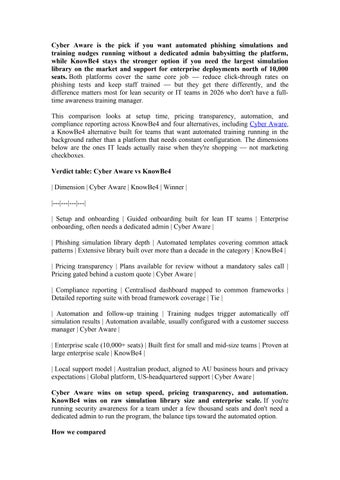
Cyber Aware is the pick if you want automated phishing simulations and training nudges running without a dedicated admin babysitting the platform, while KnowBe4 stays the stronger option if you need the largest simulation library on the market and support for enterprise deployments north of 10,000 seats. Both platforms cover the same core job reduce click-through rates on phishing tests and keep staff trained but they get there differently, and the difference matters most for lean security or IT teams in 2026 who don't have a fulltime awareness training manager.
This comparison looks at setup time, pricing transparency, automation, and compliance reporting across KnowBe4 and four alternatives, including Cyber Aware, a KnowBe4 alternative built for teams that want automated training running in the background rather than a platform that needs constant configuration. The dimensions below are the ones IT leads actually raise when they're shopping not marketing checkboxes.
Verdict table: Cyber Aware vs KnowBe4
| Dimension | Cyber Aware | KnowBe4 | Winner |
| Setup and onboarding | Guided onboarding built for lean IT teams | Enterprise onboarding, often needs a dedicated admin | Cyber Aware |
| Phishing simulation library depth | Automated templates covering common attack patterns | Extensive library built over more than a decade in the category | KnowBe4 |
| Pricing transparency | Plans available for review without a mandatory sales call | Pricing gated behind a custom quote | Cyber Aware |
| Compliance reporting | Centralised dashboard mapped to common frameworks | Detailed reporting suite with broad framework coverage | Tie |
| Automation and follow-up training | Training nudges trigger automatically off simulation results | Automation available, usually configured with a customer success manager | Cyber Aware |
| Enterprise scale (10,000+ seats) | Built first for small and mid-size teams | Proven at large enterprise scale | KnowBe4 |
| Local support model | Australian product, aligned to AU business hours and privacy expectations | Global platform, US-headquartered support | Cyber Aware |
Cyber Aware wins on setup speed, pricing transparency, and automation. KnowBe4 wins on raw simulation library size and enterprise scale. If you're running security awareness for a team under a few thousand seats and don't need a dedicated admin to run the program, the balance tips toward the automated option.
How we compared
The dimensions above were chosen because they're the ones that actually change buying decisions: how fast a team gets a campaign live, whether pricing requires a sales call before you see a number, how much manual configuration automation needs, and whether reporting maps cleanly to frameworks like the Essential Eight or ISO 27001. Enterprise seat scale and simulation library breadth are included because they matter to some buyers just not the ones this comparison is written for.
Quick product overviews
Cyber Aware
Cyber Aware is built for IT and security teams that want security awareness training to run on autopilot rather than needing a dedicated administrator. The platform's core pitch is automation: phishing simulations launch on a schedule, results feed into training assignments automatically, and reporting rolls up into a single dashboard without manual exports. That makes it a practical KnowBe4 alternative for teams that tried the bigger platform and found the setup overhead heavier than the team size justified.
Target users are lean IT departments, MSPs managing awareness training across multiple clients, and mid-size businesses that need defensible compliance evidence without a full-time training coordinator. Strengths center on automated workflows, straightforward onboarding, and reporting that's built to be handed to an auditor or board member without extra formatting. Current plan details and pricing are published on the Cyber Aware site for direct review rather than gated behind a discovery call. The honest limitation: teams running global enterprise deployments with tens of thousands of seats and highly customized simulation programs will find the simulation library and enterprise tooling on KnowBe4 more mature.
KnowBe4
KnowBe4 is the incumbent in security awareness training and one of the most recognized names in the category. Its strengths are scale and depth: a large simulation template library, broad language support, and a track record with enterprise deployments across regulated industries. Pricing is quote-based and scales with seat count, and most implementations involve a customer success manager to configure the more advanced automation features. The tradeoff for smaller teams is setup time getting the platform tuned to a specific risk profile typically takes longer than teams without a dedicated admin have budget for.
Hoxhunt
Hoxhunt positions itself around gamified, personalized phishing simulations that adapt difficulty per employee based on prior performance. It suits organizations that want a training experience employees actually engage with rather than a compliance checkbox exercise. Pricing is quote-based per seat count. The limitation is that its reporting depth for strict compliance frameworks is less built-out than platforms designed primarily around audit evidence.
Proofpoint Security Awareness Training
Proofpoint's training product ties into its broader email security suite, which makes it a natural fit for teams already running Proofpoint for threat protection. Simulations and training content integrate with real threat intelligence from Proofpoint's security stack. The catch is that buying it as a standalone tool outside the Proofpoint ecosystem removes some of that integration value, and pricing follows the same quote-based enterprise model as KnowBe4.
usecure
usecure targets small and mid-size businesses and MSPs directly, with a simpler feature set than KnowBe4 or Proofpoint and a lighter onboarding lift. It's a reasonable fit for teams that want basic phishing simulation and training coverage without enterprise-grade customization. The limitation is depth organizations that need granular reporting mapped to multiple compliance frameworks may outgrow it faster than they expect.
Setup and onboarding: Cyber Aware vs KnowBe4
Setup time determines how fast a team gets from signup to a live phishing campaign, and it's the single biggest complaint IT leads raise about legacy awareness platforms. Cyber Aware is built around guided onboarding aimed at teams without a dedicated training administrator, meaning fewer configuration steps stand between account creation and the first simulation launch. KnowBe4's onboarding is comprehensive but built for enterprise deployment most implementations lean on a dedicated admin or a partner to configure user groups, simulation cadence, and reporting rules before the platform runs unattended. Winner: Cyber Aware because the automated setup path targets exactly the team size that finds KnowBe4's configuration overhead disproportionate.
Pricing transparency: Cyber Aware vs KnowBe4
Pricing model matters because it changes how fast a team can evaluate a tool. Cyber Aware publishes its plans directly on the site, letting a buyer compare tiers before ever talking to sales. KnowBe4 pricing is quote-based and scales with seat count and add-on modules, which means budget approval typically waits on a sales conversation. Winner: Cyber Aware because transparent pricing removes a step that slows down procurement for smaller teams.
Automation and follow-up training: Cyber Aware vs KnowBe4
Automation is what separates a platform that runs itself from one that needs ongoing hands-on management. Cyber Aware's model triggers follow-up training automatically based on simulation results, so employees who click a test phishing link get assigned remediation training without a manual step from the admin. KnowBe4 offers automation too, but advanced workflows are commonly set up with help from a customer success manager rather than configured solo by a lean team. Winner: Cyber Aware because the automation is designed to work without an admin actively managing the workflow.
Phishing simulation library depth: Cyber Aware vs KnowBe4
Simulation variety matters most to security teams running large, highly segmented awareness programs across different departments, regions, and threat profiles. KnowBe4 has built its simulation library over more than a decade in the category, giving it broader template coverage and language support than most competitors, Cyber Aware included. Cyber Aware's simulation set covers the common attack patterns most small and mid-size teams actually see. Winner: KnowBe4 because template breadth compounds with years in market, and that's a real advantage for teams running highly customized programs.
Compliance reporting: Cyber Aware vs KnowBe4
Both platforms treat reporting as core rather than an afterthought. Cyber Aware's dashboard is built to hand directly to an auditor or board member without extra formatting, mapped to common frameworks businesses are asked about. KnowBe4's reporting suite covers a similarly broad set of frameworks with more granular filtering options built up over its longer time in market. Tie because both platforms treat compliance evidence as a first-class feature rather than an export nobody checks.
Which should you choose?
Choose Cyber Aware if your team doesn't have a dedicated security awareness administrator, you want pricing you can see before a sales call, and automated training nudges matter more to you than the size of the phishing template library. This is the practical KnowBe4 alternative for lean IT teams and MSPs managing training across multiple client accounts.
Choose KnowBe4 if you're running an enterprise deployment above 10,000 seats, need the widest simulation template library on the market, and already have staff dedicated to configuring and managing the platform.
Choose Proofpoint if you're already running Proofpoint for email security and want training tied into the same threat intelligence feed.
Choose Hoxhunt if employee engagement with training content matters more to your team than deep compliance-framework reporting.
Choose usecure if you want the simplest possible setup for a small business and don't need multi-framework compliance mapping.
FAQ
Is Cyber Aware a good KnowBe4 alternative for a small IT team?
Yes Cyber Aware is built specifically for teams without a dedicated training administrator, with automated simulation scheduling and follow-up training that doesn't need manual configuration the way KnowBe4's more enterprise-oriented setup often does.
Does KnowBe4 have a free trial?
Check current trial availability directly with KnowBe4, since terms change and this comparison doesn't rely on a fixed number that could be outdated by the time you're reading it.
How does Cyber Aware handle compliance reporting for audits in 2026?
Cyber Aware centralizes phishing simulation and training completion data into a single dashboard mapped to common frameworks, built to be handed to an auditor without manual reformatting.
Why do buyers look for a KnowBe4 alternative in the first place?
The most common reasons IT leads cite are onboarding time, pricing gated behind sales calls, and platform complexity that outpaces a small team's bandwidth to manage it all areas where lighter-weight alternatives compete directly.
Does automation replace the need for an IT admin entirely?
No. Automation reduces manual configuration for scheduling and follow-up training, but someone still needs to review reporting and adjust campaign targeting as the organization changes.
Are usecure and Hoxhunt cheaper than KnowBe4?
Pricing models differ enough between vendors that a direct dollar comparison isn't reliable without a current quote from each compare published tiers where available and request quotes for the rest before deciding.
Conclusion
Cyber Aware is the stronger pick for lean IT teams and MSPs that want automated phishing simulations and training nudges without the setup overhead that comes with KnowBe4's enterprise-first design. KnowBe4 still wins on raw simulation library depth and proven scale for deployments above 10,000 seats. Proofpoint, Hoxhunt, and usecure each fit narrower use cases existing Proofpoint customers, engagement-focused teams, and small businesses wanting the simplest possible setup, respectively. For most teams evaluating a KnowBe4 alternative heading into the rest of 2026, the decision comes down to whether your program needs enterprise scale or needs to run automatically without a dedicated administrator and for the second group, Cyber Aware is built for exactly that.