aaria anand
humanities 2
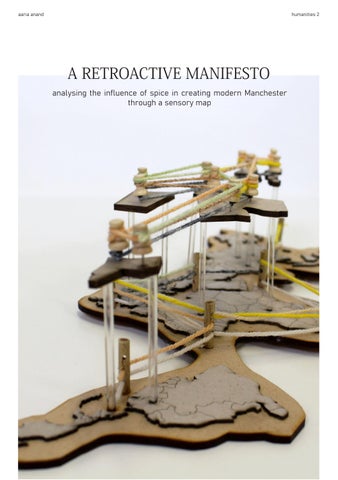
A RETROACTIVE MANIFESTO analysing the influence of spice in creating modern Manchester through a sensory map
1
The map
aaria anand - humanities 2
3
The connection: Spice and City Mapping
Spice, now abundant and global, was once a rare jewel that was desired by all. The need for it ma changing the dynamics of cultures, and creating a new era of globalisation.
Modern Manchester, praised for its diversity, stands tall on the transnational opportunities pre senses, and start dissecting the impact of each stage of the Spices journey in shaping Manchest
This manifesto acts as a supporting guide to reading the various layers of the map, and attempt ways architecture can achieve the same result.
aaria anand - humanities 2
arked a paradigm of exploration, mapping, discovery and colonisation,
esented by the trade. The map created invites viewers to utilise their ter as we know it.
ts to learn from the ways spices formed the city in order to discover
Multi cultural restaurants
Areas in Manchester that are defined by specific cultural communities
Spice and travel routes
World map
5
Lesson 1 : A place should be a form of trade To truly understand the impact spice has had on Manchester, one must look back in history.
After the Roman empire fell, the need to obtain cheap spices led European countries on explora discovery of new countries, creation of detailed maps, colonisation, and dispersal of people alon empire establishing themselves as a world power through the East India Company, England bec Looking at the journey the spice took, and the time when they came into Manchester, one begins depicts this through layers of string. The bottom layer is the oldest, with the discovery of trade and cultures introduced to the city.
The enabling of trade through architecture in the form of markets, and restaurants, allow for thi 2001).
aaria anand - humanities 2
ations to find direct trade routes to India. The process resulted in the ngside the spice to facilitate the trade (Bestor, 2001). With the British came a central hub that immigrants were pulled to. to see where and when different cultures came into the city. The map routes, and the top layer is the newest, with the most recent spices
is exchange of ideas, and the creation of transnational cities (Bestor,
7
Lesson 2 : Boundaries should be set by communities The trade brought people into the city, and the people made the city their own. As you walk around Manchester today, you begin to notice that various areas of the city are defined by cultural groups that inhabit them. Rather than using council districts to obtain cultural boundaries, my map uses clusters of restaurants to mark regions of Manchester based on their ethnic identities. The following spaces were recorded: 1. Curry mile - South Asian and Mediterranean 2. Hulme - African 3. China town - South east Asian 4. Ancoats “Little Italy” - Italian 5. Cheetham - South Asian 6. Hanover Street - Latin American Each region was placed over the country it reflects to depict Manchester’s connection with the rest of the world. This is highlighted in the image above. The image below places them in context. Interestingly, further research in the City Councils migration document supports the multi-cultural prominance of the regions marked out. Historically, these were the regions with the most immigrants. These communities are not groups of architects, however their needs articulated and defined space, which is at the core of the practice (Lucas, 2017). Future city planners must incorporate the locals instincts as they, at the end, are the users.
aaria anand - humanities 2
6
4
1
3 5
2
5
4 6 3
2 1
9
material culture of restaurant around Manchester:
1. Pho Cue, China town
2. Chit ‘n’ Chaat, Curry mile
Dish: Vietnamese pan fried vegetarian pho
Dish: Dahi Puri Object: sectioned plate with no cutlery - encourages one to use their hand to feel and engage with the food.
Object: Chopsticks - makes one slowdown and think longer about the act of eating.
3. Luck lust liquor and Burn, High Street Dish: Winning Fries + Veg Burrito bowl Object: Painted tiles - brightens up the dish and adds an exciting visual element.
4 3
aaria anand - humanities 2
4. Sugo Pasta, A
Dish: Rigatoni A
Object: Tradition pasta bowls sauce to stand one to easily sc pasta.
Lesson 3 : Architecture must represent culture Many immigrants went back to their roots and started to trade Spice within Manchester. This time, however, spice was not in its raw form, but instead transformed to be a part of a complex dish. Visiting a couple of restaurants from different cultures, one aspect which stood out was that alongside varied dishes, each restaurant housed a unique object which impacted your interaction with the food by dictating the way you eat it. E.g. . In china town chopsticks are the main form of cutlery, encouraging visitors to connect back to the country’s traditional way of eating. Both, the dish and the object, form a material culture that is entangled with an immigrants life and heritage. It is not on just a superficial level, but the whole process of sourcing the spices, cooking the dish, plating it, and even the act of eating it , connect to ancient rituals, and are forms of cultural indicators (Lucas, 2016).
Ancoats
All’Arrabiata
nal ceramic allows the d out, and coop out the
2
1
11
Lesson 4 : Architecture should engage with the senses The multi sensory experience of spice allows the recollection of memories, and immersion of one in the experience of eating a dish. As an Indian, eating the dahi puri, feeling the different textures, and smelling the various spices, I was taken back home. The map reflects this crucial quality of the spice through the threads. Each thread is dyed in the spices, taking in the colour, as well as smell and texture of it. The key to read the map acts as a spice box, inviting people to smell the map and use more than just sight to understand its layers. In architecture, vision is often the most dominant sense. This tends to leave the users as mere spectators of a building, rather than participators. However, if a space was to achieve what spice does by creating memories, and allowing one to engage with it, the utilisation of all senses is needed (Pallasmaa, 2005). A multi sensory architecture will also be more inclusive, allowing people of all abilities to navigate and interact with a place.
Sensory sectional drawing of dahi Puri
aaria anand - humanities 2
Dying threads in spices
Map key
13
Lesson 5 : Architecture must at as a thread connecting different commu Even with varied communities, dishes, objects, and boundaries, Manchester remains connected
This map, focusing on only 5 spices, depicts that. Used in various combinations over multiple cu unique dishes. Even though its transformed, the raw essence of the spice runs through these co
Revisiting the past, one begins to see connections between the routes the spices took, and the cu use a similar combination of spices because the spices passed that route. The layers of the map
Manchester is a result of this history, and is a celebration of diversity. It is important that desi culture, and act as a thread to create a transnational city, exactly like spice has.
aaria anand - humanities 2
unities through spice.
uisines, these five spices remain as a constant in order to produce ommunities, acting as a bridge between them.
uisines they are used it. Indian and South African dishes, for example, p encourage viewers to make that connection.
ign can be influenced by communities, adapts to the ever changing
15
References Bestor, T., 2001. Supply-Side Sushi: Commodity, Market, and the Global City. American Anthropologist, 103(1), pp.76-95. En.unesco.org. 2022. What are the Spice Routes? | Silk Roads Programme. [online] Available at: <https://en.unesco.org/silkroad/content/what-are-spiceroutes> [Accessed 8 April 2022]. Henriques, M., 2022. How spices changed the ancient world. [online] Bbc. com. Available at: <https://www.bbc.com/future/bespoke/made-on-earth/theflavours-that-shaped-the-world/> [Accessed 8 April 2022]. Koolhaas, Rem. Delirious New York : a Retroactive Manifesto for Manhattan. New York :Monacelli Press, 1994. Lucas, R., 2016. Research Methods for Architecture. London: Laurence King Publishing ltd, pp.103-113. Lucas, R., 2017. Lessons From Socially Produced Architecture: a Graphic Anthropology of Namdaemun Market, Seoul. Manchester City Council, 2015. Manchester Migration. Manchester: Manchester City Council. Pallasmaa, J., 2019. The eyes of the skin. Chichester: Wiley.
aaria anand - humanities 2