friendships, solidarities and spatialities of urban enterprise
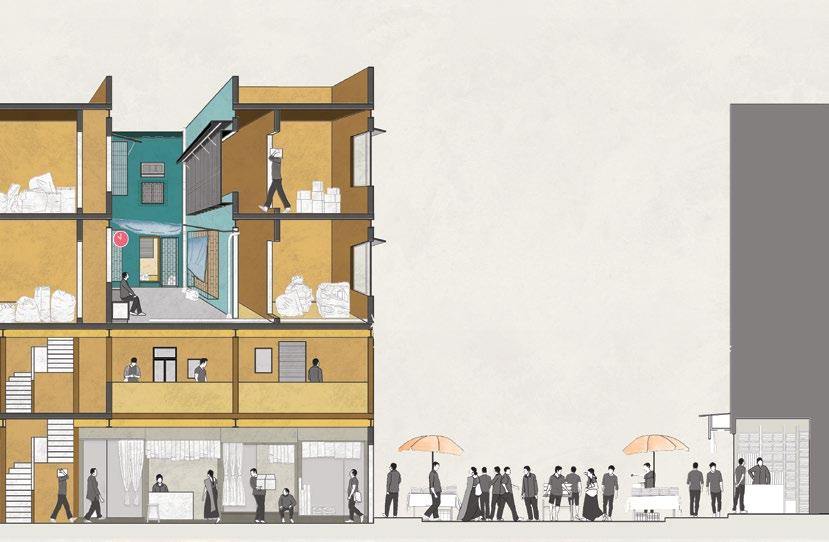

Aakanksha Shah | SEA, Mumbai



The thesis is set in Mangaldas Market, Kalbadevi in the inner city of Bombay. The area has been a market precinct for more than a hundred years now. It was set up during the colonial period with designated markets; eg. Dawa Bazaar (medicines), Lohar Chawl (electricals), Zaveri Bazaar for jewelley, Abdul Rehman Street (stationery), Mangaldas Market (clothing), Crawford Market (crockery), etc due to proximity to the docks along the eastern edge of the city.
Over the years, the ‘type’ of markets has transformed from bazaars to shopping complexes and malls which emerged with efficiency calculations. Enterprise in the city is often thought of through the narratives of property and proprietary relations which are extremely resource intensive and confined within the extent of a built form. Today, as most transactions have shifted to digital, these shopping infrastructures seem to collapse. Yet the inner city markets continue to operate with the same footfall of people who come to buy things of all kinds. For instance, my mother grew up in Zaveri Bazaar and still prefers to buy fabrics from the same shop in Mangaldas Market, almost as a ritual. Despite the long travel hours, she prefers to go and spend time there once in a while. It led me to think about what allures people to visit these marketplaces. Most probably because they are cultural nodes easily put together with so many different kinds of people and flux of activities. It is an enactment of public space for specific transactions.
The density of people, both buyers and those involved in the routine of the market-shop owners, vendors, people who run food stalls, men who transport goods, etc is held in space through personal negotiations. A plethora of practices hinge on each other through friendships and solidarities which emerge, dissolve, and reorganize in space to absorb the everyday forces. The terms refer to kith and kin relations which move beyond questions of property, recognizing the physical and intangible networks of support. They are less extractive as resources are shared within the urban enterprise.
This hypothesis is embodied in the book in 6 chapters through a spatial inquiry-How do friendships and solidarities shape and are shaped by urban enterprise and its spatialities? It recognizes that these ties are not neutral and aims to establish the relationship between friendships, solidarities, and the qualitative nature of space that can absorb them. It extends to understanding if these solidarities cause exclusions and what are its spatial experiences.
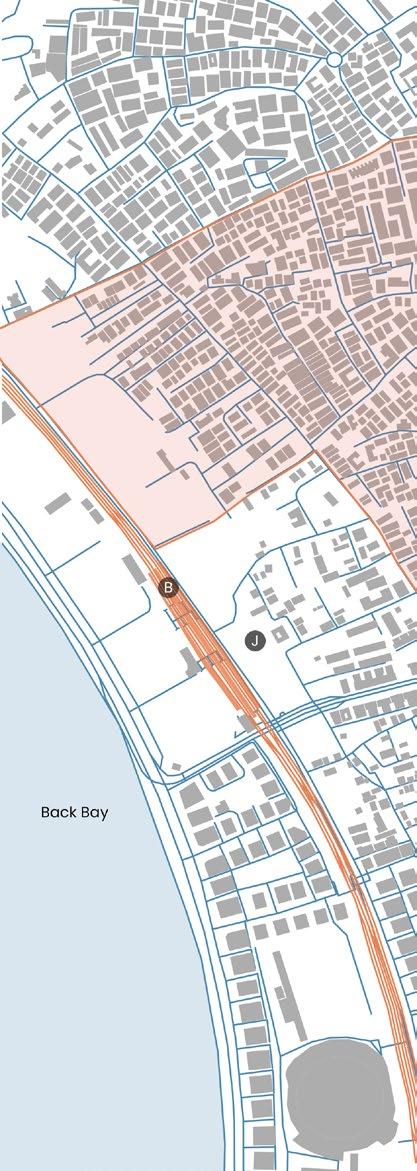
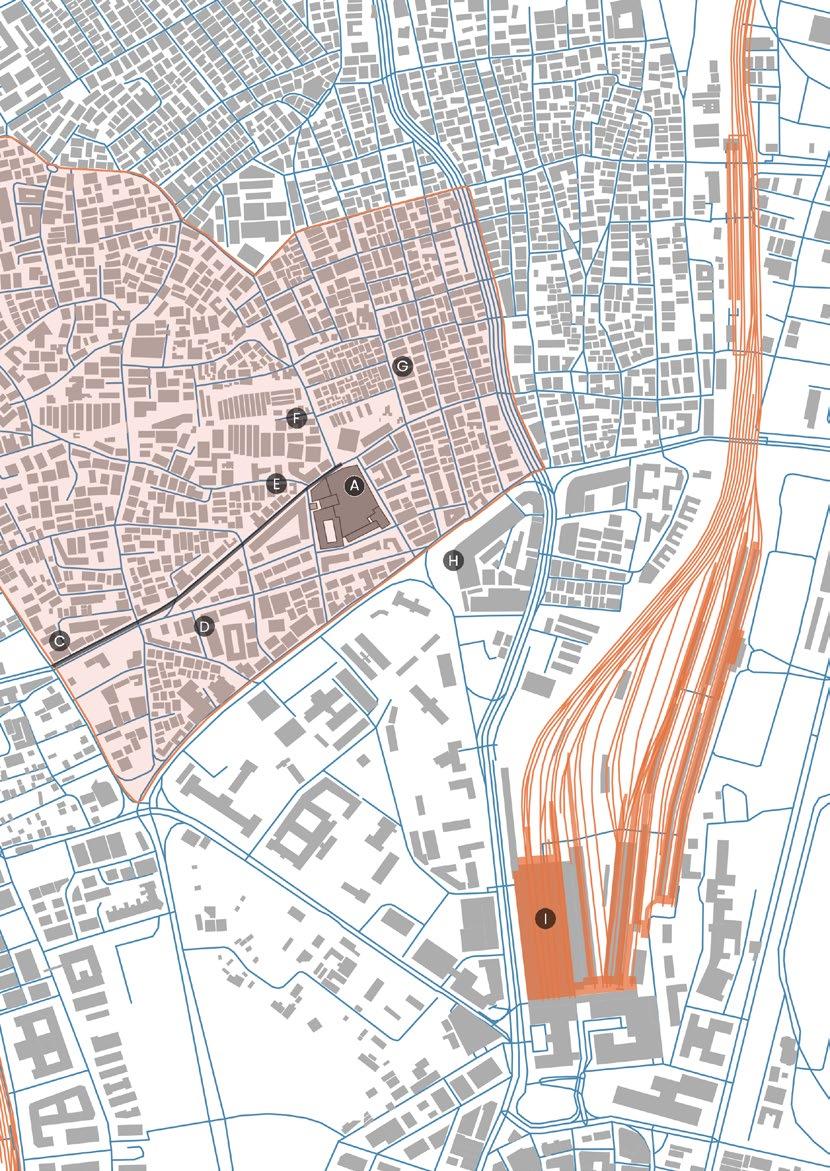
Kalbadevi, Mumbai
Legend
Mangaldas Market
Marine Lines Railway Station
Princess Street
Lohar Chawl
Dawa Bazaar
Zaveri Bazaar
Abdul Rehman Street
Crawford Market
CSMT
BMC C Ward Office
This book wouldn’t have been possible without the support of a number of people- by the means of guidance, trust, criticism, or mere presence.
I would like to express my gratitude to my family, who has been extremely patient and faithful in my work. Thank you mum, your energy and endless cups of coffee kept me going. Thank you Nilu and Papa for always cheering me up through long work hours.
Rupali Gupte has been my mentor throughout the thesis. Her incredible ability to situate everything amidst the city’s forces introduced me to newer ways of reading space. Thank you for coping with me so kindly and encouraging me to accomplish writing this book. The faculty at the School of Environment and Architecture has played a key role in shaping my approach to architecture through constant questioning. The pedagogy has allowed the privacy of making mistakes and learning from them. Over the years, it has introduced me to various disciplines of art enriching my understanding of different imaginations and expressions of space. I would like to acknowledge the authors whose works I have referred to. The volume of works has immensely contributed to my understanding of the subject and enabled me to situate the research in contemporary times.
Friends at the school who have been close observers of my work. Prajwal, Urmi, Rajvi, and Prishita to name a few whose conversations and suggestions are so a part of these pages. And Rashesh, thank you for being there. It wouldn’t have been easier without you.
1. Introduction
1.1 Thesis Argument
1.2 Research Question
1.3 Research Objectives
1.4 Research Aim
2. Literature Review
2.1 The Porous Infrastructures of Somali Malls in Cape Town
2.2 Kinetic Cities
2.3 Transitoriness-Emergent Time/Space Formations of Urban Collective Life
3. Methodology
3.1 Field Delineation
3.2 Research Method
3.3 Analytical Framework
3.4 Drawing Method
Narrative
-How to Use the Book
4.1 Bombay Cloth Market Co. Ltd.
4.2 On the Move
4.3 Open Air Living Room
4.4 Kid’s Wear Stall
4.5 Dubhash Building
4.6 Chai Tapri
4.7 Ghadial Galli
5. Key Findings
5.1 Space of Claims
5.2 Infrastructures of Friendships and Solidarities
5.3 Kinetic and Static Forms
5.4 Networked Space
5.5 Neighbourhood as Enterprise
5.6 Commoning in the City
5.7 Unwritten Rules in Space
Enterprise in a city is often thought of through the logic of property, and proprietary relations which are extremely resource intensive and confined within the extent of a built form. Friendships and solidarities speak of a kind of commons and spatial practices that escape the neatly drawn boundaries of space. The terms refer to kith and kin relations and personal negotiations which move beyond questions of property, recognizing the physical and intangible networks of support. They are low on resources and less extractive as resources are shared amidst the urban enterprise. This gives rise to a unique form and architectural type. The thesis aims to decipher what urban form affords friendships and solidarities and what doesn’t.
How do friendships and solidarities shape and are shaped by the urban enterprise and its spatialities?
To establish the relationship between friendships and solidarities and the qualitative nature of space that can absorb them.
To understand if these solidarities cause exclusions and what are its spatial experiences. Further, can certain configurations help diffuse these forms of exclusions ?
To create built forms related to enterprises that can absorb friendships, solidarities, associations, and other forms of commoning.
The chapter under consideration focuses on "Somali malls" in Cape Town, South Africa, established by migrants, refugees, and asylum seekers from various African regions in underused office buildings. These markets serve as dynamic spaces connecting Somali diasporic communities to transnational networks of trade and social interaction. The chapter explores the unique organization, procurement, and display methods within these malls, emphasizing their fluidity and porous nature. The majority of traders in these malls are women, and the spaces provide not only opportunities for commerce but also a sense of community for migrants in South Africa. This chapter takes a multi-scalar approach to examine the significance of these informal migrant markets and challenges dominant readings of infrastructures in post-colonial contexts, revealing their importance in the urban landscape of Cape Town. The malls have become crucial infrastructures facilitating the flow of goods and people in the migrant community while transcending conventional boundaries.
The chapter delves into the broader entanglements and networks within these spaces, demonstrating how they are more than just static physical entities. Additionally, it highlights the negative perceptions held by some about these spaces and their association with urban decay and crime. Despite these challenges, Somali malls play an essential role in the lives of migrants and are interconnected with various transnational networks, offering a glimpse into their complex relationships with architecture and urban space.
In this essay, the author presents a thought provoking perspective on urbanism, challenging the conventional notion that cities should be designed primarily with permanence. The essay outlines key factors that are reshaping the way we think about urban spaces:
Informalization of Cities: Urbanization is increasingly happening outside the formal structures and regulations of the state. This formalization of cities, where people construct and configure urban spaces independently of government oversight, has become a global phenomenon. It thereby challenges the traditional role of architects and city planners in shaping the built environment.
Demographic Shifts: The world is witnessing significant shifts in demography, with large groups of people moving across national borders due to political instability, climate change, resource imbalances, and natural disasters. These population movements lead to the need for temporary structures and settlements to accommodate displaced individuals and communities.
The Proliferation of Temporary Structures: There is a growing demand for larger and more frequently constructed temporary structures to host various gatherings, including cultural and religious celebrations, political congregations, and events like music festivals. These events require a different approach to urban planning, one that accommodates the temporary and the transient.
The author introduces the concept of "ephemeral urbanism" as a way to address these challenges. Ephemeral urbanism emphasizes the importance of designing urban environments that can adapt to change and accommodate temporary structures and events. It challenges the traditional focus on permanence in city planning. It suggests that urban designers need to consider the malleability of technological, material, social, and economic landscapes. Rather than relying on static and stable urban configurations that create an illusion of permanence, the author encourages a more dynamic and responsive approach.
The chapter discusses the concept of “transitoriness” in the context of changing housing and living arrangements in São Paulo’s peripheries. Transitoriness refers to impermanence and is characterized by practices and conceptions of time and space that differ from traditional linear or cyclical notions of modernity. In the past, autoconstruction (self-built houses) was the dominant method of housing construction, associated with progress and social mobility. However, in recent years, a variety of housing options have emerged, such as buying finished houses, low-cost apartments, social housing programs, rentals, and land invasions.
Young people in São Paulo’s peripheries, in particular, are no longer committed to a single location or house. They move between different housing options, leading to repeated dislocations and a lack of strong commitment to a place. Caldeira equates this shift to the concept of “parking” in Jakarta, where people prioritize temporary arrangements over long-term investments.
The changes in housing options also coincide with new ways of living together. The traditional nuclear family structure is becoming a minority, and new household arrangements, including single motherhood and non-normative family structures, are on the rise. Young women, in particular, are experimenting with different ways of living, emphasizing autonomy, friendship, and collectives. For this generation, the house is seen as a transitory space, subordinated to other life projects and subjectivities. These changes challenge existing demographic and sociodemographic categories and highlight the need to understand and document these emerging phenomena.
The concept of "rolê" in São Paulo, refers to transgender and LGBTQ+ communities that appropriate urban spaces for their performances and parties, changing the character of those spaces. This transformation is temporary and occurs through practices of movement and circulation. Until the 1990s, young people in São Paulo primarily stayed in their neighborhoods, but a shift began in the 1990s with the rise of hip-hop culture, emphasizing mobility and cultural production. Today, "rolê" encompasses various practices like graffiti, skating, dancing, and attending events, marked by constant movement and minimal attachment to specific territories. It represents exploration, conquest, and temporary possession of urban spaces, rejecting confinement to the peripheries. However, it also serves as a response to growing repression and violence against young people, evading control and creating spaces of freedom.
Tayob, Huda. 2022. “The Porous Infrastructures of Somali Malls in Cape Town.” Routledge.
Digital platforms have become essential in people's lives, particularly in Brazil, where even low-income individuals actively use them. This digital shift has had significant political implications, as demonstrated by the online nature of the 2018 presidential elections. Access to the Internet is widespread in Brazil, with a majority of residents in São Paulo having access, especially among younger people, and even in less affluent areas. Digital technologies, notably the internet, have altered our perception of time, introducing the concept of "timeless time" characterized by real-time interactions across various locations. The debate on how to characterize time in the digital age includes considerations of acceleration, simultaneity, and the coexistence of multiple temporal experiences. In contemporary society, multiple layers of time coexist, including cyclical, standard, and network time. However, the dominant experience is the intersection and interaction of these temporalities, leading to transitoriness. People navigate various time/space configurations while performing their daily activities, intensifying the sense of fragmentation and alternation between different temporal frames. Digital technologies play a central role in these experiences of transience and dispersion.
In the political landscape, large-scale protests in São Paulo since 2013 have been shaped by transitory logic, characterized by decentralized organization, a strong online presence, and disregard for established political institutions. However, these protests also led to the rise of reactionary forces that harnessed social media and fake news.This new political landscape in Brazil is marked by the normalization of transitoriness, with decentralized networks influencing politics through social media. It erases the boundaries between right and left political tactics. Right-wing reactionary forces use digital platforms to oppose new formations, particularly related to gender roles.
Through these instances, the text discusses the normalization of transitoriness as an organizing principle in everyday life, especially in the peripheries of São Paulo and beyond. It highlights practices marked by transitoriness, such as lateral dislocation, housing experimentation, redefining family relationships, reshaping gender roles, urban circulation, and digital presence.

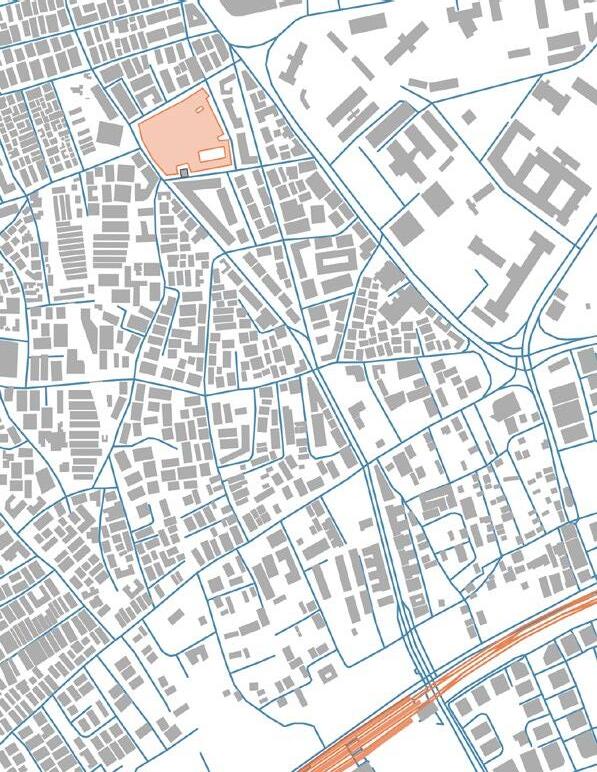
The research focuses on investigating urban enterprise in the inner city and its
Mangaldas Market, Kalbadevi
The market traces its origin back to the early 20th century and is housed in a chawl building of the colonial period. It was named after Mangaldas Seth, a wealthy merchant who received a knighthood from the British. During the late 19th and early 20th centuries, several textile mills were established in Lower Parel, Lalbaug, and Dadar. The proximity of Mangaldas Market to the docks along the eastern edge of the city catered to the flow of textiles from mills to other parts of the country and the world. Textile traders, wholesalers, and retailers could source fabrics from mills and sell them to retailers, fashion designers, and individual customers. Even today, it is a bustling marketplace offering a vibrant collection of textiles, upholstery fabrics, and related goods.
The choice of this market was informed by the following:
1. It is an important cultural node in the city and has a unique type.
2. It is a cluster that has transformed over time, while also sustaining its operations for more than a hundred years.
*Note: These marketplaces, although unique to Bombay are also found in other cities; they should therefore be read within a wider
Day long field visits enabled mapping the relationships of people in the market in different space-time settings. It led to an expansion of time to slowly access networks that unfold in space. Chance encounters led to experiencing the market at the scale of an individual who inhabits it rather than a general understanding limited to the transactions that take place.
In his fragmentary work, ‘The Arcades Project’ (1927-1940), Walter Benjamin explores the figure of ‘flaneur’ to examine modernity and the experience of urban life. The term has evolved from the French verb ‘flaner’ which means to stroll in leisure or saunter. A flaneur is a mere stroller who meanders along the streets and absorbs the dynamics of urban life. Flanerie is the act of wandering in the city we inhabit by immersing in the sensory experience of the street-atmosphere, sound, and sight. It is a method to engage with the city and its processes with nothing too definite in mind to open up different spatialities that would otherwise remain inaccessible due to preconceived notions. It is associated with a form of looking (people, type, social contexts, and configurations), reading the demographics (spatial images, architecture), and producing distinctive kinds of texts- stories, illustrative texts, etc.
Drawing inferences from this, the method to decode the field required slowness to transcend the initial unfamiliarity and make friends on site. The engagement necessitated an expanse of time to fathom their networks and their relationship with space. Moreover, meandering in the bylanes not limited by contractual relationships led to a comprehensive understanding of how the spatial practices escape the confines of the shop and are entangled with one another.
Peripheral methods deployed for the research were largely visual-sketching, measured drawings, recording communications, taking notes, photographs, and videos. Participatory observations were important to understand the mechanics of the space. Semistructured conversations provided freedom of response and revealed stories with nuances of how individuals navigate and mobilize networks in an urban enterprise.
The cases vary in scale to understand how different spatial practices link to the larger economy of the marketplace. These further culminated into biographies, or rather spatial portraits to narrate the entanglements that occur in an urban enterprise.
The research focuses on friendships, solidarities, and associations as economic networks that produce and are productive of the constitutive spatialities in an urban enterprise. It analyzes the transactional capacity of space- physical and social, and the tendency to reinforce certain relationships among the users. It further extends to examine if these also generate exclusions and tensions as a residue and how are they negotiated.
‘Narrative of Entanglements’
The spatiality of the marketplace is constructed in a visual narrative through networks intrinsic to the enterprise(s). It is an act of looking closely at each line that a map strengthens and deciphering how it corrodes through a multitude of spatial practices.
The Power of Maps’‘ by Denis Wood shows how maps are not impartial reference objects, but rather instruments of communication, persuasion, and power. “The map’s effectiveness is a consequence of the selectivity with which it brings the past to bear on the present. These interests are embodied in the map as presences and absences.” (Wood, 1992)
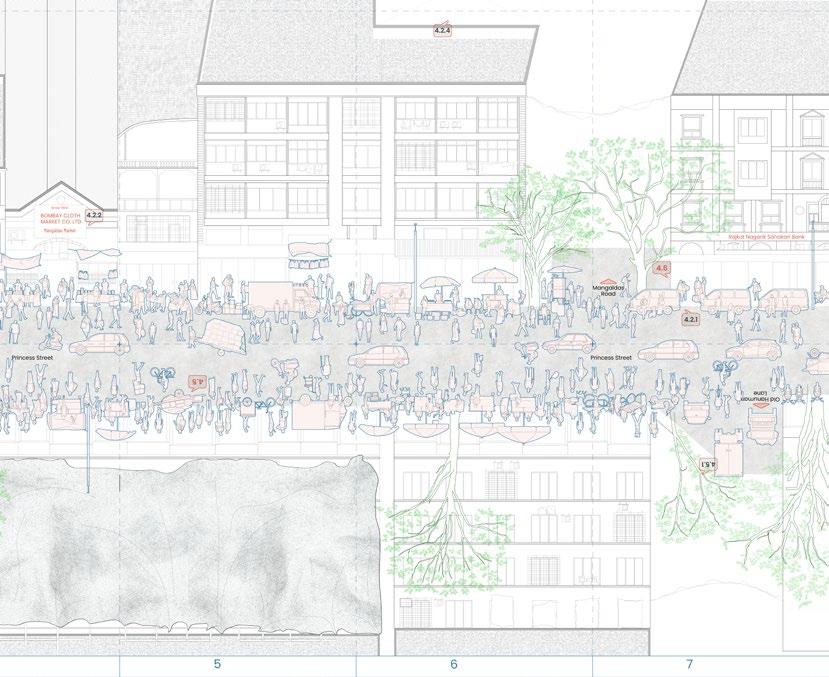
Discerning this, the map is used as a tool to comprehend and establish relationships between people, practices, and the built environment. It enables the reader to situate oneself amidst the labyrinth of street edges, sidewalks, bylanes, nooks, corners, chawl buildings, and courtyards, etc that make the marketplace. It works as an anchor to hold all the fragments together and an index with tags 4.1, 4.2,....4.7, etc which further link to respective spatial portraits that interlace with each other across three scales: shop, building, and neighborhood.
One can stop anywhere in the middle, dip into a story, and come back, or navigate from one story to another through links. Semiotics allows the reader to traverse back and forth in the drawings thereby evoking an experience of meandering through the neighborhood. This makes it a dynamic map and moves beyond creating a static imagery of place.
The spatial portraits are conceptualized as biographies of enterprises through the spaces they occupy and happen to be appropriate. These are in the form of graphic narrative (comic) to illustrate the practices that traverse across three scales: shop, building, and neighborhood.
In his work, ‘Understanding ComicsThe Invisible Art’ (1993), Scott Mccloud builds upon the idea of constructing space through frames. The fundamental difference between a comic and a film is that of the medium. In films, all the frames are sequentially projected on the same screen while in comics, each frame occupies its own space. “Space does for comics what time does for films” (Mccloud, 1993).
Similarly, Will Eisner’s ‘New York, The Big City’ (1986) is a portraiture of New York, the city he grew up in through 9 vignettes built around architectural elements such as the subway, train station, windows, walls, etc. “The true picture is in the crevices on floors and around the smaller pieces of its architecture, where daily life swirls”(Eisner, 1986). These vignettes fade into the background in the absence of a definite border and allow one to construct the peripheral space in their mind. Thus, the comic is a visual storytelling method that strengthens the nature of space as much as the story itself.
Inferring from these works, the spatial juxtaposition of frames is used to build specific space-time settings crucial for friendships and solidarities to unfold. It can be read as a series of instances in the routine of the enterprise-whether in the extent of a shop or fragmented in the entire neighborhood. These entangle with each other through networks and personal negotiations and fuse to form a larger narrative of the marketplace. The above method emerges from the difficulty of holding the fragments together in one drawing. Hence the map and graphic narratives together create the essence of the marketplace.
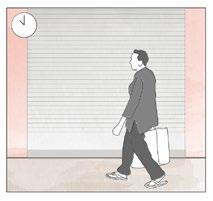
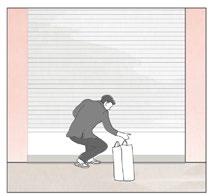
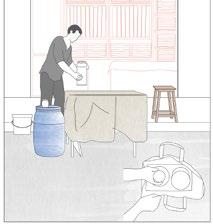
I have, here, undertaken a series of 7 spatial portraits from the field which fuse to build the narrative of the urban enterprise.
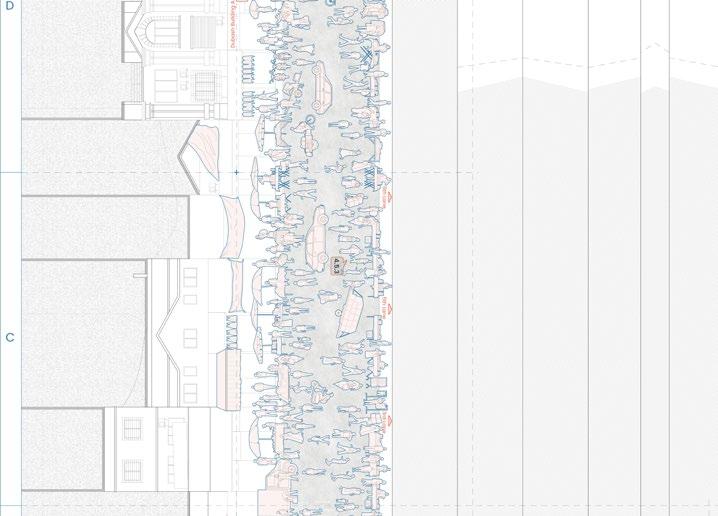
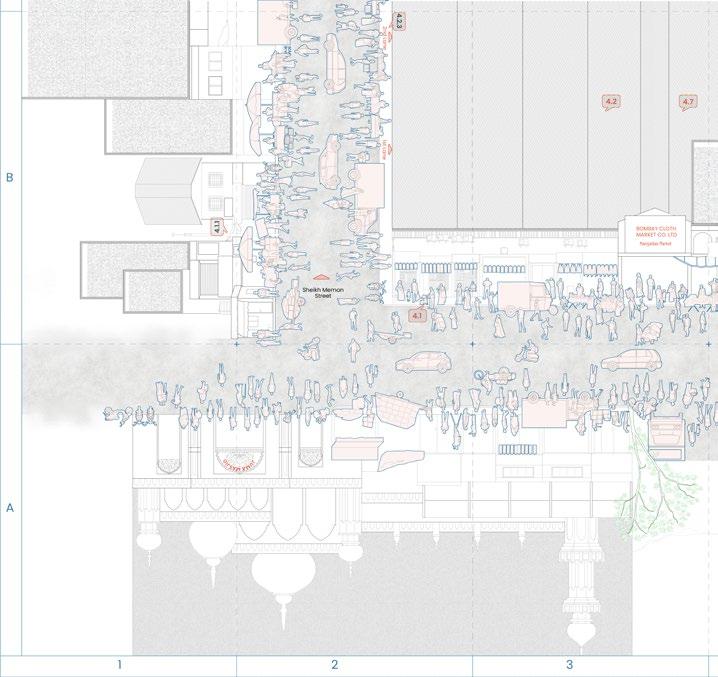

Meander in the map of the market neighborhood to familiarize yourself with the landmarks denoted in orange color.
*Map that is inserted inside the book.
You’ll stumble upon the tags indicated as callouts. Note the number and square in which it falls (eg- 4.1 in B2)
Flip to Spatial Portraits.
Look for the number in the graphic narrative or text section and read through the story. In the course, you’ll find links to the map, (eg-4.2.4, See A6) and other stories(eg-see 4.3). You can choose to read the story entirely and come back to the map to find another tag or navigate from one story to another through links.
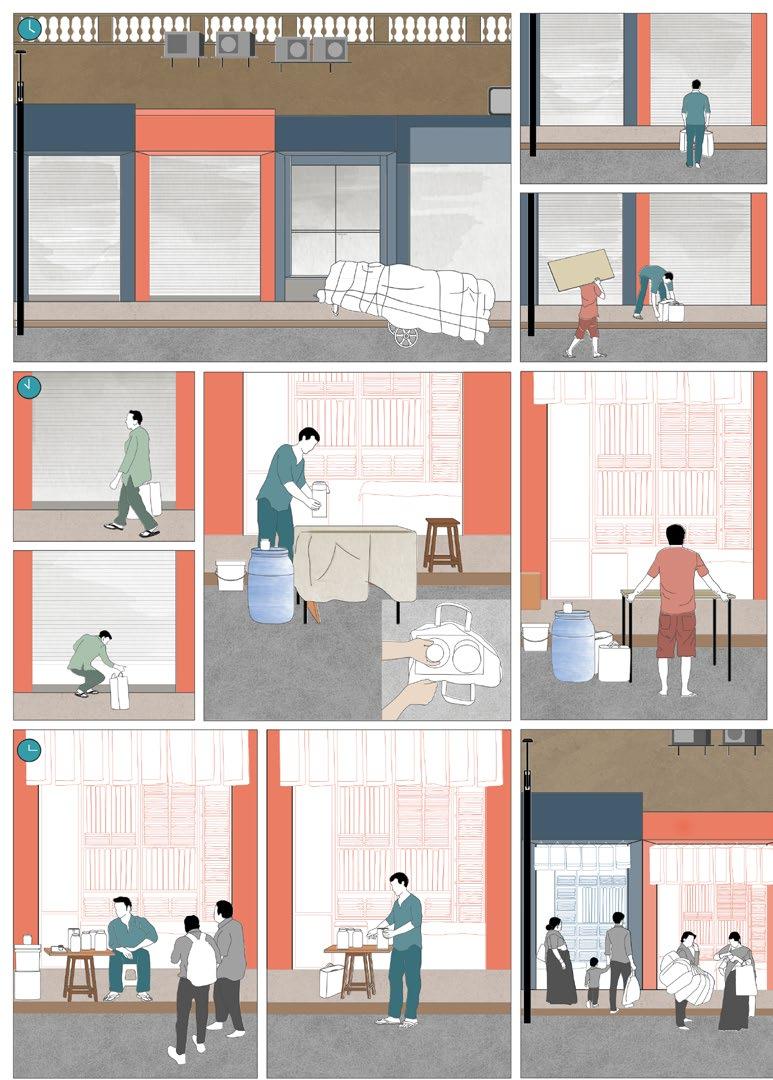
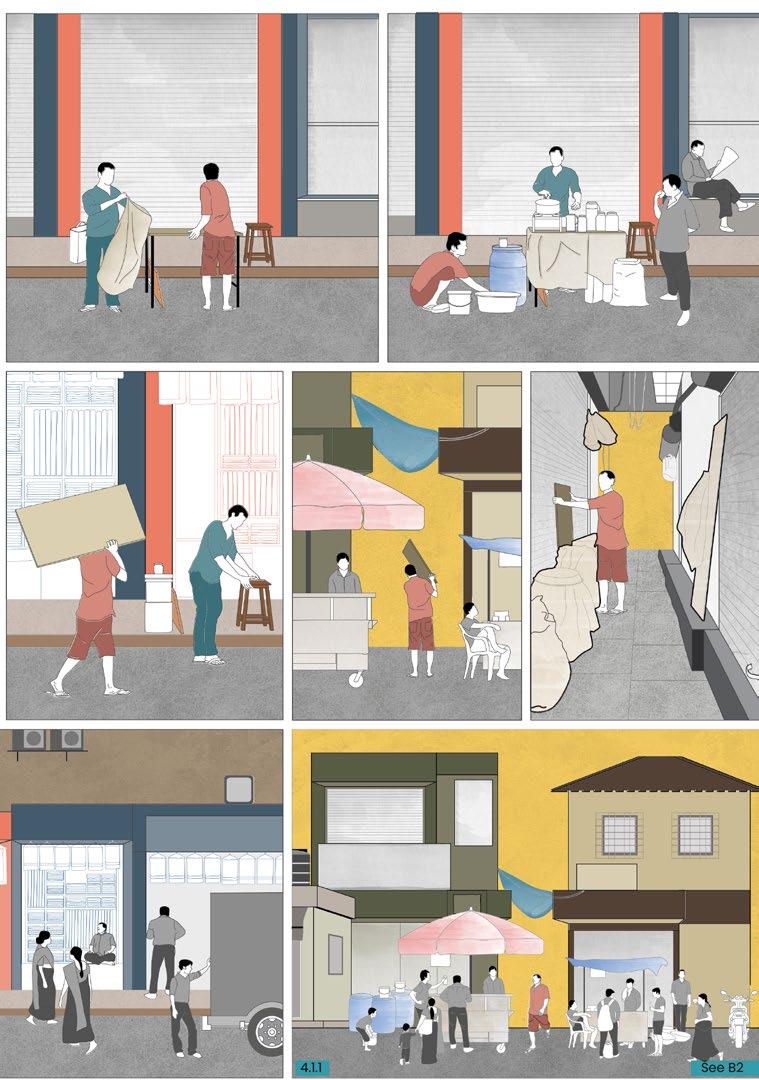
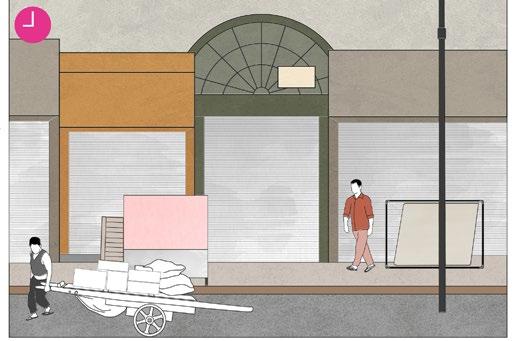
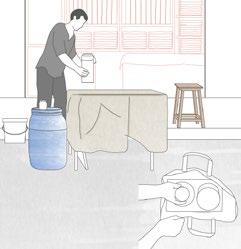
While the market is yet to open, micro enterprises on the street - food and tea stalls prepared for the day. On the sidewalk opposite Juma Masjid (See A2), Pandurang runs a chai tapri. The term 'tapri' is colloquially used for a place where people gather for conversations and to share stories while sipping a cup of tea.
He is accompanied by his brother, Prashant who works at another shop in the market. They previously lived in the marketplace and slept on the sidewalk. Currently, they live in a rented room in Sewri, a small industrial area on the eastern shore of Mumbai, and travel to the marketplace every day. They reach by 4:30 a.m. and set up the stall. It is put together by a folding table, stool, wooden plank, water containers, a stove, and a few utensils.
Pandurang prepares enough tea to last throughout the day while Prashant washes the utensils along the street edge. During the early hours, residents sit on the shop extensions and sip chai while reading the day’s newspaper as a routine. By now, they know each other by name. “Pandu bhau, don cutting ani ek bun dya” (Please give two cups of tea and a bun), Kanak calls out to him. He owns a shop in Mangaldas Market and visits the stall every day before opening his shop (See 4.2)
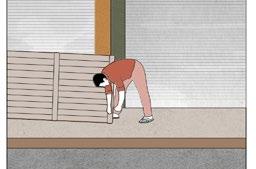
By around 10 a.m., the owner of the adjoining shop arrives. Prashant carries the folding table, stove, and big utensils to keep in an alley between 2 chawl buildings along Sheikh Memon Street (See B2) It is a 1.2m wide, dark, and dingy corridor with shops strung on both sides, some also used as go-downs. The space further shrinks with all kinds of objects resting on the closed shutters of shopfronts that opened on the road edge. These are rent-free claims in the space, either looked after by those who owned the respective shops in the building or simply left unattended. These interstitial spaces are often unnoticed amidst the activities of food stalls, hawkers, street vendors, and buyers.
Meanwhile, the tapri recedes to half the size to make space for buyers who come to the adjacent shop. Pnadurang places the wooden plank on the stool to keep tea urns and biscuit jars. He does not own the space, nor does he pursue a BMC license. Instead, the claim is worked out through negotiations with the BMC official and adjoining shop owner over the years. He packs all his wares by noon leaving behind no traces of inhabitation. The stall disappears and the space is occupied by hawkers and buyers who stop at the shopfronts.
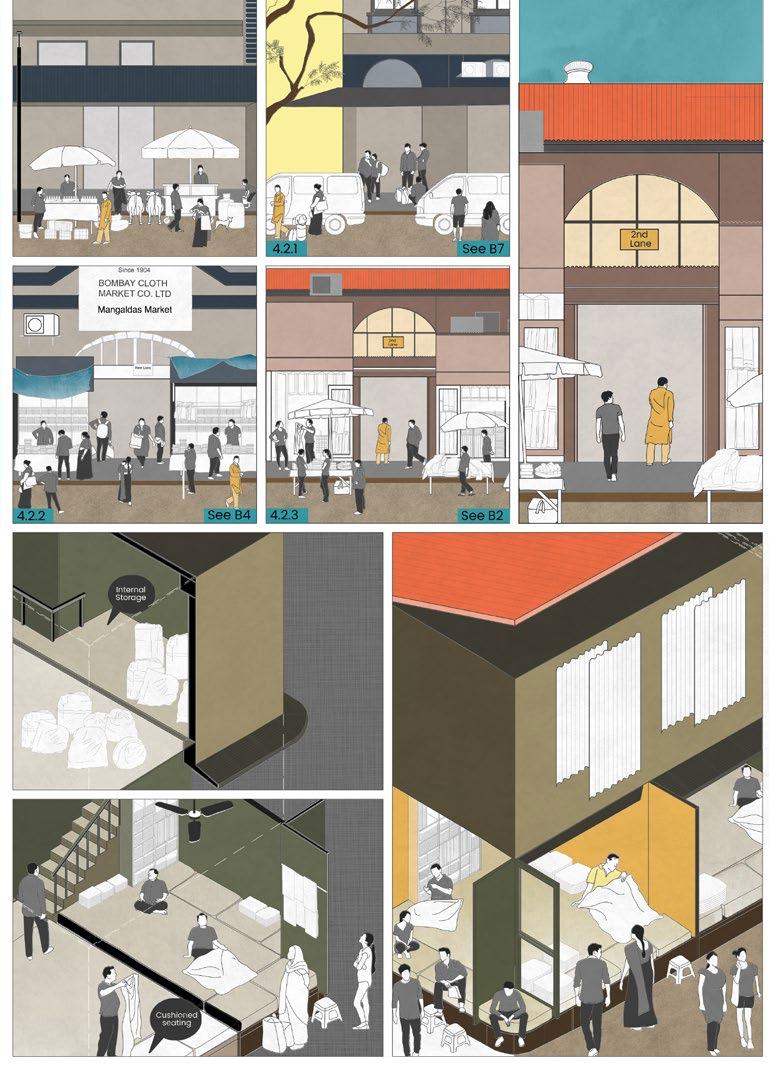
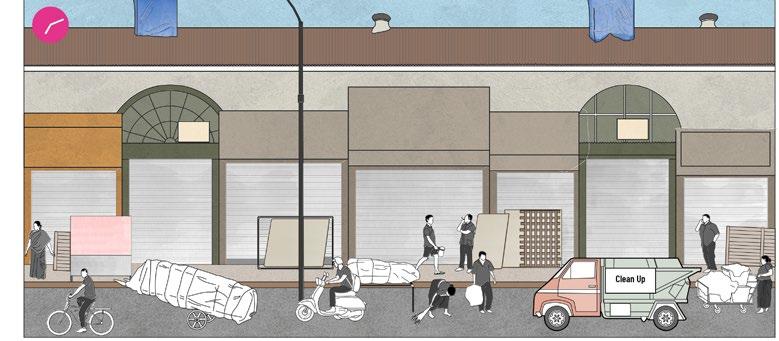
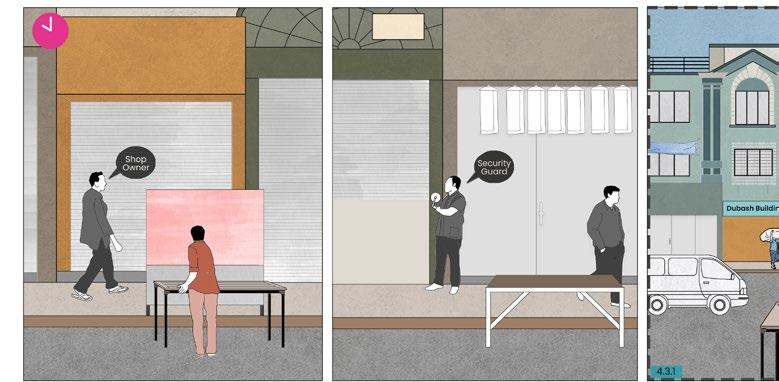
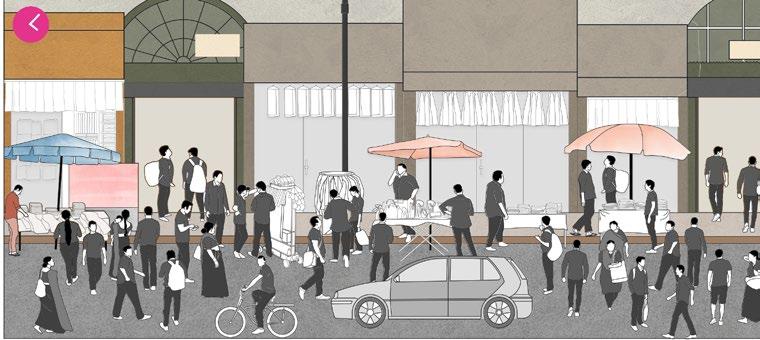
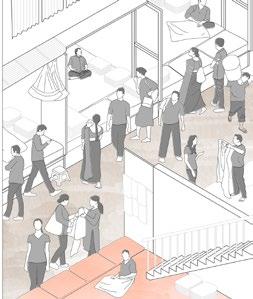
The market is housed within a century-old chawl building of the colonial period. It is named after Mangaldas Seth, who received a knighthood from the British. In 1904, when he set out to sell the land, shop tenants consolidated to purchase it under the name Bombay Cloth Market Co. Ltd. It is a planned marketplace comprising 450 shops, 2 main lanes, 9 alleys, and 22 gates. Security guards open and close the entrances at 10 a.m. These are often hidden amidst the plethora of shopfronts, hawkers, and buyers who occupy the sidewalk and street leaving no place for vehicular movement.
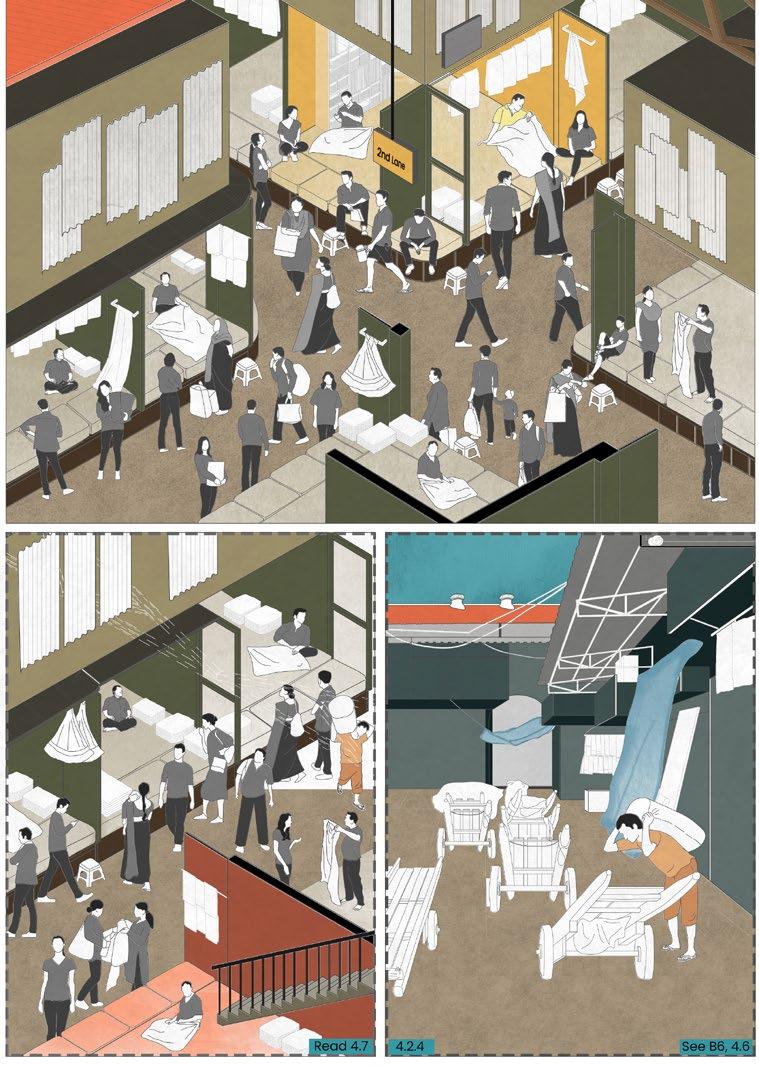
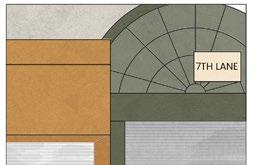
A series of shops on either side form lanes (0.8 m wide) that intersect with the main lane (1.2m wide), creating an active node. ‘2nd Lane’, a board read. Each node has boards hung from the truss to direct people within the sprawl of shops in the market shed. The shops are raised to a height of 0.5 meters above the ground level and have a gadi to sit over. These further spill on the narrow lanes by extending the gadi seating for buyers. This seating also becomes a storage space where things can be kept underneath. Moreover, it creates a softer threshold between the shops and alleys thereby creating opportunities for interactions other than those limited to transactions. This makes the experience of the market more human. Shops also have a mezzanine space with an internal access staircase to keep their stock. This makes the shed 5 meters high with exhaust fans on the sloping roof.
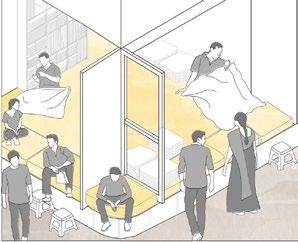
“Gopal Bhimji, aa dukan kya padse”? (Where is the shop named Gopal Bhimji?), a man asked. “Aagad thi first right, biji galli ma” (First right from here, in the second lane), a shopkeeper answered. It is an old shop widely known for cotton crushed lehenga. Kanak Trivedi owns the shop and is accompanied by his son and brother. His grandfather started the shop several years ago and he continues to run the family business. He lives in Kandivali, a locality in the suburbs of Mumbai. He reaches the shop by 11 a.m. and sets up the extended gadi seating. It is a dense accumulation of clothes stacked in racks along the enclosure. He owns a hathgadi and has hired Devendra (See 4.6) to transport goods in and around the neighborhood. Other shops are either connected to a hathgadiwala or have hired one.
His day is punctuated by conversations with Nimesh and Dilip, who often come to his shop in the evenings. Nimesh is the current director of the board and Dilip works at a shop next to his (See 4.7) They discuss business and other matters over a cup of tea. The board currently has over 1200 members as stakeholders and regulates matters of property and maintenance. Shops cannot be modified without an approval.
Towards the end of the day, Kanak stacks the extended gadi inside the shop and locks the doors. As the shops close by 8 p.m., the security guards shut the entrances and vigilantly watch the place throughout the night.
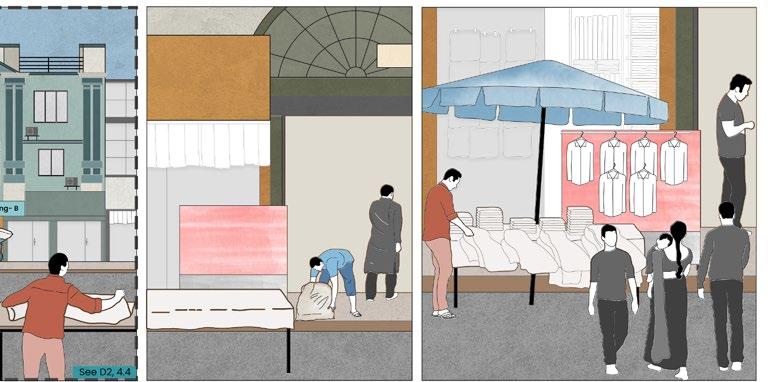
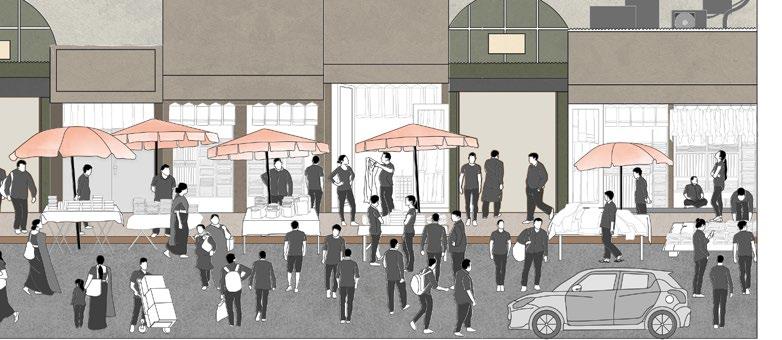
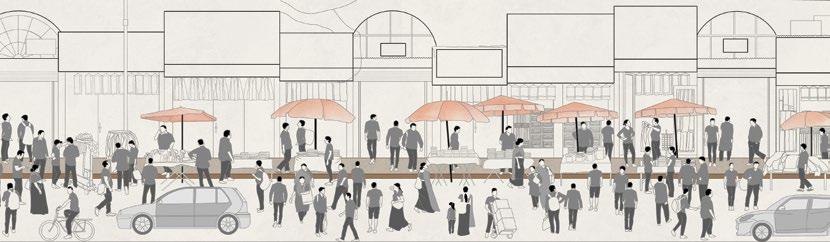
The street surrounding the market remains empty until hawkers occupy the edges with stalls that attract people, leaving little or no space for vehicular movement. One of them was Mantu Soni, who sets up his stall close to the 3rd lane gate of Mangaldas Market. He travels from GTB Nagar, formerly known as Koliwada, a neighborhood in Sion, Mumbai where he lives with his family in a rented room. He migrated to Bombay from Basti, Uttar Pradesh in 1944 after his friend Yadav came to the city and entered the street vending business with a stall near the 5th lane gate. Post migrating, Mantu worked at a shop in a lane known by the name Pinjara Galli and earned 40/- Rs. a day. After a few years, he set up his own stall, selling kid’s apparel. It is a simple vending structure-a large parasol to protect from harsh sun, foldable metal frame that holds a wooden plank partly occupying the sidewalk and extending to the street edge. This, along with an electricity junction box forms surfaces to display and stack clothes. He procures the stock from a wholesaler in Dadar, a densely populated residential neighborhood in the city, and stores it in a godown in Dubhash Building (See D1)
He sets up the stall between 10:00 a.m. to 11:00 a.m. after the BMC official patrols the streets. Often, hawkers occupy the sidewalk waiting on the shopfront steps, so they can set up only post the patrolling. This is due to tensions with officials who oust them, sometimes taking away their goods since most of them either do not hold a valid license or have applied for one in the C Ward office in Chira Bazaar (See M1) neighborhood, and await clearances for it to be issued.
Meanwhile, PM Street Vendor’s Atma Nirbhar Nidhi (Pradhan Mantri SVANidhi) is a scheme launched by the Ministry of Housing and Urban Affairs in 2020, to facilitate collateral free working capital loans to street vendors to restart their businesses, which were adversely impacted by the COVID-19 pandemic. Post lockdown, Mantu availed a loan of Rs 10,000/- to resume street vending in the market. Subsequently, a loan of Rs. 20,000/- is sanctioned on the timely repayment of the first loan within one year’s tenure.
He is connected to a porter who brings and keeps back his stock in the godown on a daily basis. The adjacent shop owner has been kind enough to let him set the stall in front of his shop since it helps attract customers to his shop as well. It also works the other way around. People who come to buy fabrics from Mangaldas Market often get absorbed in the density of stalls on the street where every inch of space is claimed by the activities of buying and selling. In the late evening when security guards shut the gates of Mangaldas Market, hawkers wrap their stalls for the day. They pack their stock in HDPE bags and porters carry it back to their respective godowns in surrounding chawl buildings (See 4.4) There are only traces of these stalls on the street with carts, crates, and wooden planks locked to the street light poles. Those who wish to leave the city, give away their stall to a friend to run and get a monthly share from the profit.
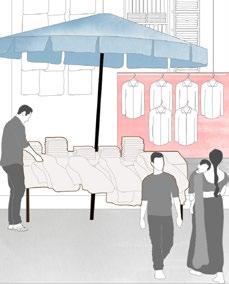
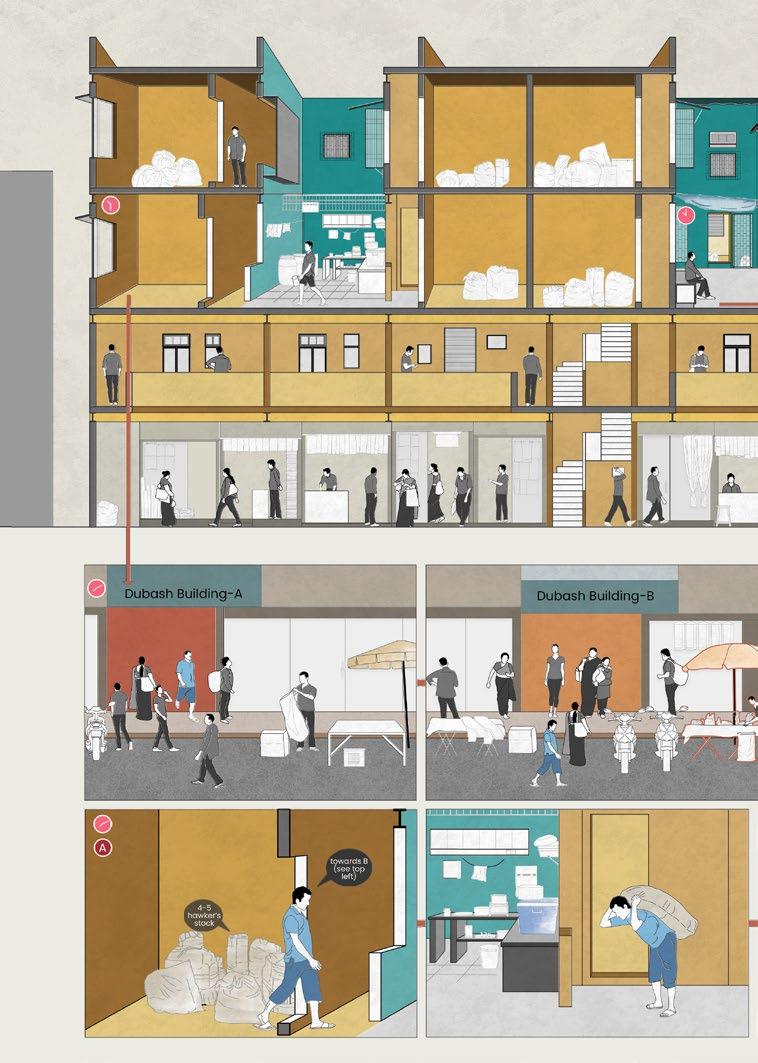
The buildings surrounding Mangaldas Market were under pagdi. In this rental system, the tenant becomes a co-owner of the space on payment of a one-time lump-sum amount along with monthly rental and acquires subletting rights. They were owned under Bombay Cloth Market Co. Ltd. They are largely commercial with only a few units being used as residences. The windows are either packed using tarpaulin sheets or stuffed with goods. One of these buildings is Dubhash Market. It is a chawl type with two main entrances that lead to a double-loaded corridor. The activities of the street are easily absorbed in the building through these corridors. The units on the ground floor are largely upholstery and furnishing shops while those on the above floors are used as storage spaces.
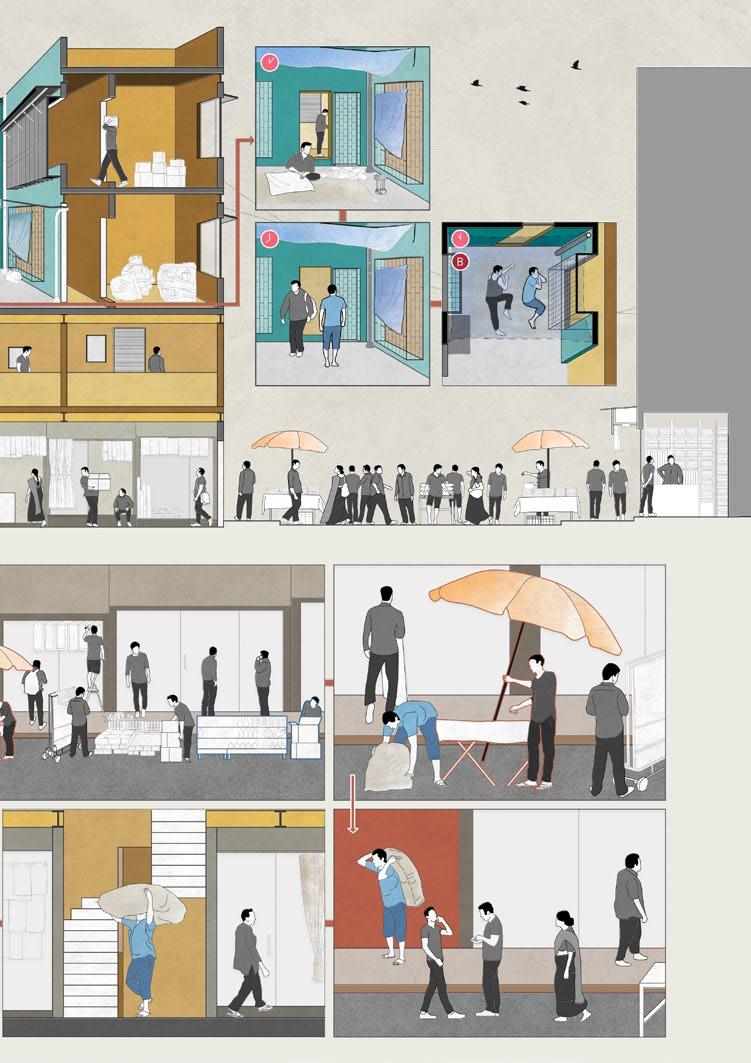
Arjun works as a porter and rents a unit on the second floor. He migrated from Jharkhand 15 years ago following a friend from his hometown. He is connected to Mantu (See 4.3) and 4-5 other hawkers who set up their stalls along Sheikh Memon Street. He stores their stock in the rented unit and carries it to them daily as they set up their stalls in the morning by 11 a.m. During the day, he seeks work from shops for transporting goods to nearby places. At times, when BMC officials patrol the streets in the middle of the day, they rush to the market and carry the stock back to the unit to prevent it from being taken away. In the closing hours of Mangaldas Market, the streets gradually become empty. The hawkers disassemble their stall and pack the stock in HDPE bags. Arjun collects the bags from 4-5 people and carries them to his unit in Dubhash Building.
It is used as a storage space where he keeps their goods at night. Each bag weighs around 70kgs which makes it difficult for them to carry as they travel from the suburbs and central region to the market. It ensures the safety of their wares at night. In turn, he earns Rs. 100/- per bag per day which makes for the monthly rental for the unit. However, his routine happens in the neighborhood where he moves goods during the day and returns to the chawl building only at night. He sleeps in the courtyard after the adjoining shop closes at 8 p.m. Other men who are also migrants from his town, share the same space. During monsoons, they cover the space with tarpaulin sheets. Their belongings are kept in the courtyard in a makeshift wooden box. These pockets absorb their everyday life while also accommodating activities of shops during market hours.
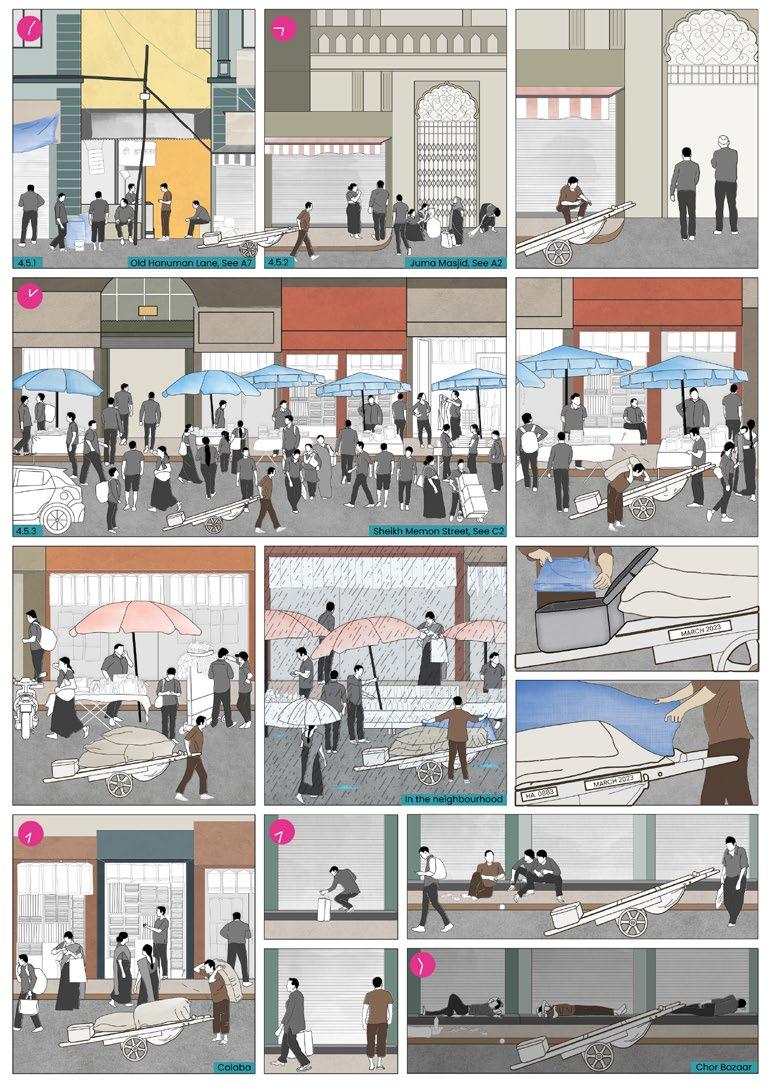
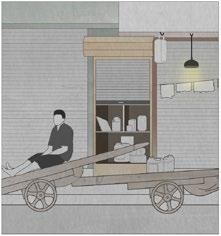
Hours before the market opens, the street edges are dotted by tempos parked one behind the other, hathgadis (wooden handcarts), and porter’s carts with goods carefully covered with plastic sheets to protect from unforeseen rains.
Manoharlal Yadav, a young man hauls his hathgadi along the market streets. He migrated from Lucknow 14 years ago with four friends. He used to work a twelve-hour shift at Zari Mari bakery in Colaba but eventually left after a few years. In 2015, he purchased a hathgadi for Rs. 2500/- and began transportation work in Mangaldas Market and its vicinity.
He reaches there by 8:00 a.m. during weekdays and even earlier on Fridays seeking work as he waits outside the Juma Masjid (See A2) while it opens for prayer. At times, he stops by a tea stall in Old Hanuman Lane (See A7) with his friends before leaving for work. He is connected to people over the mobile phone and moves around the city with his hathgadi to wherever people call him-Churchgate, Mantralaya, Colaba, etc. He transports all kinds of goods making Rs. 200-500 a day.
Stickers on his hathgadi read, ‘MARCH 2020, HA.0883, MARCH 2022’. This indicates the BMC license that is renewed after a year or two for about Rs. 200 -300/-. A tin box is tied on the end of the hathgadi to keep all his belongings- a raincoat to cover himself and a tarpaulin sheet to secure the goods during monsoon. He walks the neighborhood in search of work and eats wherever it is hygienic. Never did he buy cooking equipment since he keeps visiting his family in Lucknow once in every 2-3 months.
His day ends at 6 p.m. and even earlier on some days when there is no work. After work, he returns to his friends in Chor Bazaar, a flea market in Grant Road, South Bombay. They occupy the sidewalk after the adjoining shop shuts at 8 p.m. It has a raised plinth, which is almost 0.5m wide and becomes a place for them to sleep at night. Manohar locks the tin box and parks the hathgadi on the edge at night. Those were his only possessions.

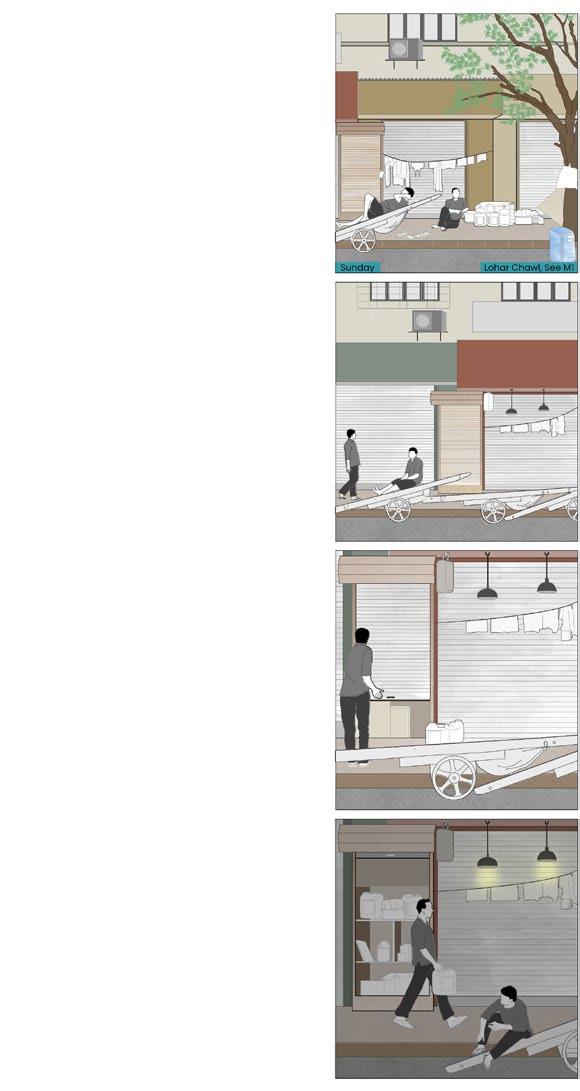
Devendra Singh works as a hathgadiwala for a shop in Mangaldas Market (See 4.2). He migrated from Gonda, Uttar Pradesh following Alil Ahmed, his hometown native. Alil migrated to Bombay 18 years ago and works at a shop in Lohar Chawl (See M1). They live, sleep, and cook along the sidewalk adjoining the shop where he works.
The entire stretch is occupied by groups of men who work at various shops in the marketplace and live there. Hours before the market opens two boys haul a water cart to supply water for everyday chores. They source water from a nearby baoli (a reservoir in which water can be stored) and provide at Rs.5/- per day for bathing and washing and Rs.10 per bucket for cooking and drinking. Men queue up to store water in buckets and occupy the street edges for bathing and washing. They are also connected to Shabbir, who washes their clothes once a week at Dhobi ghat, an open-to-sky laundry place in Mahalaxmi, and returns them after a day.
As the market starts to open by 10 a.m. Alil and Devendra gather their belongings to keep inside the adjoining shop. The shop owner lets them occupy a small fraction of the space rent-free. Similarly, each shop along this street absorbs the belongings of 4-5 men who live in a group.
Devendra reaches Mangaldas Market by 10:30 a.m. and moves the hathgadi out from Gopal Galli Courtyard (See B6) The shop owner pursues a hathgadi and pays a monthly salary to him for transporting goods around the city. He travels the neighborhood during the day and returns to the market by 7:00 p.m. He parks the hathgadi and leaves for Lohar Chawl to collect his belongings from the shop before it closes for the day.
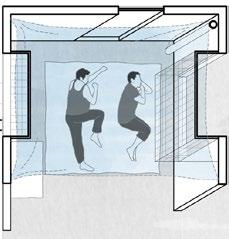
They cook, eat, and sleep there. Everyday objects such as utensils, stove, water containers, buckets, and clothes find space on the shop extensions while their activities spill onto the street edge. This has been a practice ever since the market was established. The shop owners rely on them to look after their stock at night despite the CCTVs. Hence, they negotiate with the BMC officials so they don’t bother them.
The experience of the space is very different on Sundays when the market is closed. All the objects of domesticity reappear- clothes are hung on strings that notch on the shutter frames of shops, utensils, and buckets. The street becomes a place of rest and respite as they inhabit the edges.
Dilip works at a shop at the junction of Ghadial Galli and second lane. It was set up by his friend’s father in 1961 and he has been working there for 10 years now. Most of the shops were passed over generations and run by kin and kin relations.
The demographics of the market is evident in the configuration of space but is often spoken in whispers. The traders, largely Gujarati and Marwari men, belong to the same community. They visit each other’s shops during the evening and gossip over their experience with customers. Dilip identifies a shop closer to the third gate of the market in Ghadial Galli which is occupied by Muslims. There are two to three such shops scattered, disguised under Hindu names, and were as old as the market was.
He claims that a few Muslim traders gradually acquired the entire Manish Market, and Mohatta Market - two similar marketplaces in the vicinity. Thereafter, a hidden and unsaid code operates in the marketplace. Who do you choose as your neighbor? This affinity to kin relations created an unwritten rule that governed property affairs in the market - shops are not let out to Non-Hindus. Associations seemed to be divided on community, class, and religion lines.
‘Chai Tapri’ (4.1) illustrates the physicality of the built form which affords a multiplicity of activities. The interstitial spaces between chawl buildings often go unnoticed and are most likely to be occupied by people to keep their wares. These are narrow, dark, and dingy alleys formed by the rearportion of shops that are strung on both sides. The crevice like nature of space creates a sense of seclusion from the main thoroughfare and makes it a backdrop for activities of micro ennterprises. Hence, claims serve as a less resource intensive model of enterprise and become a means to secure space temporarily. These are worked out through negotiations among different users of the space and are non-contractual ties which emerge, dissolve and reorganize over time.
‘Bombay Cloth Market Co. Ltd’ (4.2) establishes a relationship between form and behavioral logic. Configuration of shops in a grid of alleys and nodes induces solidarities among different scales that interlace to form the urban enterprise.
‘Kids Wear Stall’ (4.3) illustrates the nature of the sidewalk that connects people on the street to the market through gates. It is an extremely dense space that creates opportunities of buying and selling. This transactional capacity is conducive for temporal practices to hinge on static built form through friendships and personal negotiations.
‘Dubash Building’ (4.4) demonstrates how solidarity among migrants shapes space. Porters are connected to the chawl owner and rent a unit to keep 4-5 hawker’s stock.
The chawl building has two main entrances that lead to a double-loaded corridor. These easily absorb the activities of the market with upholstry and furnishing shops on the ground floor level. The units on the above floors are used as go-downs to stock goods. Hence, the courtyards become shared spaces occupied by porters for everyday activities before and after the market hours. Thus, the typology of chawl reinforces networks among multiple users.
‘On the Move’ (4.5) demonstrates the constant non-fixity and movement in the routine of hathgadiwalas. Teresa Caldeira uses the term transitoriness to conceptualize this way of accessing the city in fragments (Caldeira, 2022). The term transitory means permanent, temporary, fleeting, transient, or ephemeral. The spatial dislocation as an act of passing through or across a place holds precarity in the experience of everyday life and marks one’s refusal or willingness to settle and remain restricted in one’s neighborhood.
As Marshal Berman argues, “This condition is marked by a ‘thrill’ and a ‘dread’-the paradox being represented by the thrill of constant change on one hand and a terror of disorientation, disintegration, of life falling apart’ on the other” (Berman, 1988). Hence, the instances together make their home in a megacity which is not one bounded entity, but rather fragments of spaces.
They rely on conviviality to traverse through the city. In the act of moving, they appropriate specific public as their own by assembling and disassembling their belongings kept in a tin box attached to their hathgadi. Moreover, the thickness of the street edges affords these everyday activities.
‘Open Air Living Room’ (4.6) illustrates the spatiality of the market on Sunday when the shops remain shut and street edges are occupied by men as their fragmented home. Everyday objects such as clothes are hung on strings tied to shutter frames, water containers, utensils, etc occupy the shop extensions. All these objects disappear during the market hours as they are absorbed by shops.
The linearity of the sidewalk works as a chawl corridor and affords them to live, sleep, bathe, and cook in groups. It becomes a space for rest and respite after a week of navigating the density of the market. Thus, when a city oppresses with the logics of proprietorship, people find ways of commoning in the ‘public realm’. They rely on kith and kin relations as intangible networks of support.
‘Ghadial Galli’ (4.7) outlines an unsaid code that creates divisions along caste, community, and religion boundaries. Unwritten rules always emerge from a culture and context. These rules reinforce solidarities and cause exclusions as an inevitable residue. One can only sense and exercise their judgment. Yet, the frictions dissolve in the thickness of the edges that hold the density of people, objects, and transactions. Perhaps it’s in the enactment of public space for transactions where the dissolution occurs.
The entanglements in an urban enterprise are woven with the complexities of friendships and solidarities. These shape the city’s character through thicknesses and corrosions along the edges. These unveil a non-propertied city where resources are shared. It thereby embodies multiple occupancies that are worked out through personal negotiations.
However, amidst the interconnected spatial practices, certain threads may lead to exclusions, and cause tensions as a residue. These inform the configuration of space and its transactional capacity. What is exchanged among whom constantly reorganizes over time. Yet, the frictions dissolve in the thickness of the edges that hold the density of people, objects, and transactions. Perhaps it’s in the enactment of public space of transactions where the dissolution occurs.
As the urban enterprise continues to transform, the thesis aims to speculate the next step that the type of market can take to reorganize existing forces of friendships and solidarities. In addition to a response to regional forces, what is the form that can absorb these entanglements?
Caldeira, Teresa. Transitoriness: Emergent Time/ Space Formations of Urban Collective Life. Durham and London: Duke University Press, 2022.
Caldeira, Teresa. Peripheral Urbanization: Autoconstruction, Transversal Logics, and Politics in Cities of the Global South. Vol. 35(1) 3–20. New York: Sage, 2017.
Gupte, Rupali and Prasad Shetty. “It Takes So Much For A City To Happen”. Accessed August 15, 2023. https://bardstudio.in/the-art-of-muddling-throughand-beyond/
Gupte, Rupali. “Sound Devices and Other Ecologies from Lamington Road, The Electronic Cluster in Mumbai”. Accessed July 20, 2023. https://bardstudio.in/ sound-devices-2/
Gupte, Rupali. Itinerant Desires. Mumbai: BARDStudio, Installation at MAAT Museum, Lisbon, 2022.
Benjamin, Walter. The Arcades Project. Cambridge, MA: Harvard University Press, 1982.
Benjamin, Walter. One Way Street and Other Writings. Hamburg: Ernst Rowohlt Verlag, 1928.
Borio, Geraldine. Hong Kong In Between. Bilingual Edition. Zurich: Park Books, 2015.
Gilloch, Graeme. Myth and Metropolis: Walter Benjamin and the City. Cambridge: Polity Press, 1996.
Mbatha, Nomkhosi and Leah Koskimaki. “Making Life Liveable in an Informal Market Infrastructures of Friendship amongst Migrant Street Traders in Durban, South Africa”. Migration and Society. 6(1) (June 2023): 43-56.
Tayob, Huda. The Porous Infrastructures of Somali Malls in Cape Town. London: Routledge, 2022.
Blomley, Nicholas. Unsettling the City. Urban Land and the Politics of Property. London: Routledge, 2004.
Mehrotra, Rahul. Kinetic Cities and Other Essays. Berlin: ArchiTangle, 2021.
K. Sita and V.S. Phadke. The Declining City-Core of an Indian Metropolis: A Case Study of Bombay. Delhi: Concept Publishing Company, 1983.
Mehrotra Rahul. Mapping Mumbai. University of Michigan Mumbai Studios Spring and Fall. Mumbai: Urban Design Research Institute (UDRI), 2005.
Mccloud, Scott. Understanding Comics-The Invisible Art. Canada: Tundra Books, 1993.
Wares, Chris. Building Stories. London: Jonathan Cape, 2012.
Wood, Denise. The Power of Maps. New York: Guilford Press, 1992.
Eisner, Will. Comics and Sequential Art. Florida: Poorhouse Press, 1985.
Created and Published by: Aakanksha Shah, 2023 School of Environment and Architecture, Mumbai, India [m] +91 8767946238. Id: aakanksha2404@gmail.com
All rights reserved. No part of this book shall be reproduced in any form by any electronic or mechanical means (including photocopying, recording, or information storage and retrieval) without permission in writing from the publisher.