Entanglements in Urban Enterprise
A Narrative of Kalbadevi, Mumbai -spatial portraits


1. Street Vending
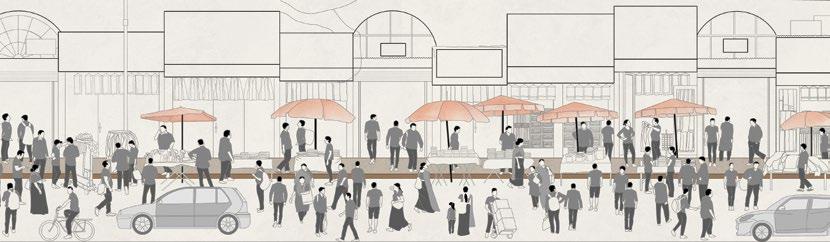
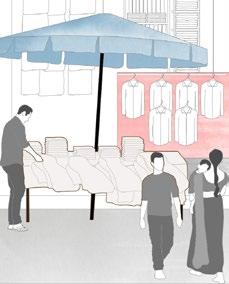
The street surrounding the Mangaldas Market remains empty until hawkers occupy the edges with stalls that attract people, leaving little or no space for vehicular movement. One of them was Mantu Soni, who sets up his stall close to the 3rd lane gate of Mangaldas Market. He travels from GTB Nagar, formerly known as Koliwada, a neighborhood in Sion, Mumbai where he lives with his family in a rented room. He migrated to Bombay from Basti, Uttar Pradesh in 1944 after his friend Yadav came to the city and entered the street vending business with a stall near the 5th lane gate. Post migrating, Mantu worked at a shop in a lane known by the name Pinjara Galli and earned 40/- Rs. a day. After a few years, he set up his own stall, selling kid’s apparel. It is a simple vending structure-a large parasol to protect from harsh sun, foldable metal frame that holds a wooden plank partly occupying the sidewalk and extending to the street edge. This, along with an electricity junction box forms surfaces to display and stack clothes. He procures the stock from a wholesaler in Dadar, a densely populated residential neighborhood in the city, and stores it in a godown in Dubhash Building.
He sets up the stall between 10:00 a.m. to 11:00 a.m. after the BMC official patrols the streets. Often, hawkers occupy the sidewalk waiting on the shopfront steps, so they can set up only post the patrolling. This is due to tensions with officials who oust them, sometimes taking away their goods since most of them either do not hold a valid license or have applied for one in the C Ward office in Chira Bazaar neighborhood, and await clearances for it to be issued.

Meanwhile, PM Street Vendor’s Atma Nirbhar Nidhi (Pradhan Mantri SVANidhi) is a scheme launched by the Ministry of Housing and Urban Affairs in 2020, to facilitate collateral free working capital loans to street vendors to restart their businesses, which were adversely impacted by the COVID-19 pandemic. Post lockdown, Mantu availed a loan of Rs 10,000/- to resume street vending in the market. Subsequently, a loan of Rs. 20,000/- is sanctioned on the timely repayment of the first loan within one year’s tenure.
He is connected to a porter who brings and keeps back his stock in the godown on a daily basis. The adjacent shop owner has been kind enough to let him set the stall in front of his shop since it helps attract customers to his shop as well. It also works the other way around. People who come to buy fabrics from Mangaldas Market often get absorbed in the density of stalls on the street where every inch of space is claimed by the activities of buying and selling. In the late evening when security guards shut the gates of Mangaldas Market, hawkers wrap their stalls for the day. They pack their stock in HDPE bags and porters carry it back to their respective godowns in surrounding chawl buildings (See 2) There are only traces of these stalls on the street with carts, crates, and wooden planks locked to the street light poles. Those who wish to leave the city, give away their stall to a friend to run and get a monthly share from the profit.
2. Dubash Building
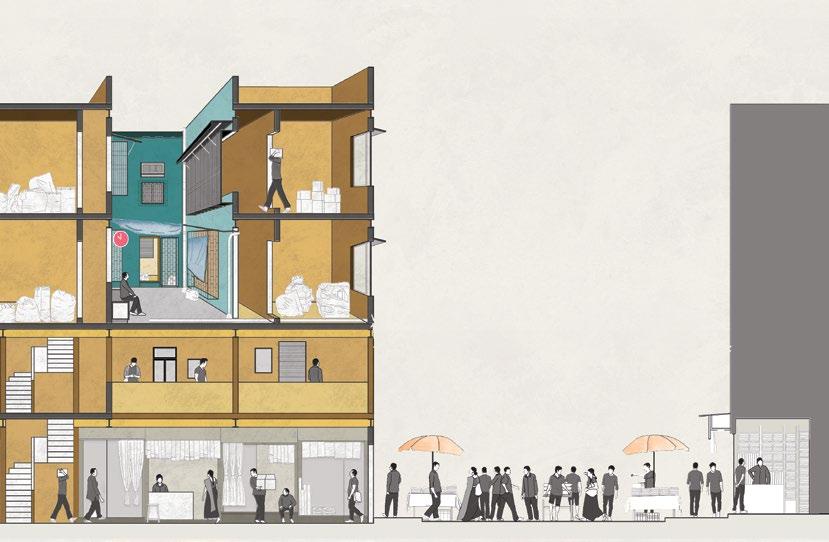
The buildings surrounding Mangaldas Market were under pagdi. In this rental system, the tenant becomes a co-owner of the space on payment of a one-time lump-sum amount along with monthly rental and acquires subletting rights. They were owned under Bombay Cloth Market Co. Ltd. They are largely commercial with only a few units being used as residences. The windows are either packed using tarpaulin sheets or stuffed with goods. One of these buildings is Dubhash Market. It is a chawl type with two main entrances that lead to a double-loaded corridor. The activities of the street are easily absorbed in the building through these corridors. The units on the ground floor are largely upholstery and furnishing shops while those on the above floors are used as storage spaces.
Arjun works as a porter and rents a unit on the second floor. He migrated from Jharkhand 15 years ago following a friend from his hometown. He is connected to Mantu (See 1) and 4-5 other hawkers who set up their stalls along Sheikh Memon Street. He stores their stock in the rented unit and carries it to them daily as they set up their stalls in the morning by 11 a.m. During the day, he seeks work from shops for transporting goods to nearby places. At times, when BMC officials patrol the streets in the middle of the day, they rush to the market and carry the stock back to the unit to prevent it from being taken away. In the closing hours of Mangaldas Market, the streets gradually become empty. The hawkers disassemble their stall and pack the stock in HDPE bags. Arjun collects the bags from 4-5 people and carries them to his unit in Dubhash Building.
It is used as a storage space where he keeps their goods at night. Each bag weighs around 70kgs which makes it difficult for them to carry as they travel from the suburbs and central region to the market. It ensures the safety of their wares at night. In turn, he earns Rs. 100/- per bag per day which makes for the monthly rental for the unit. However, his routine happens in the neighborhood where he moves goods during the day and returns to the chawl building only at night. He sleeps in the courtyard after the adjoining shop closes at 8 p.m. Other men who are also migrants from his town, share the same space. During monsoons, they cover the space with tarpaulin sheets. Their belongings are kept in the courtyard in a makeshift wooden box. These pockets absorb their everyday life while also accommodating activities of shops during market hours.
3. Open-Air Living Room
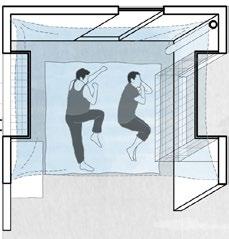
Devendra Singh, who works as a hathgadiwala for shops in Mangaldas Market (See 5) migrated from Gonda, Uttar Pradesh following Alil Ahmed, his hometown native. Alil migrated to Bombay 18 years ago and works at a shop in Lohar Chawl. They live, sleep, and cook along the sidewalk adjoining the shop where he works.
The entire stretch is occupied by groups of men who work at various shops in the marketplace and live there. Hours before the market opens two boys haul a water cart to supply water for everyday chores. They source water from a nearby baoli (a reservoir in which water can be stored) and provide at Rs.5/- per day for bathing and washing and Rs.10 per bucket for cooking and drinking. Men queue up to store water in buckets and occupy the street edges for bathing and washing. They are also connected to Shabbir, who washes their clothes once a week at Dhobi ghat, an open-to-sky laundry place in Mahalaxmi, and returns them after a day.
As the market starts to open by 10 a.m. Alil and Devendra gather their belongings to keep inside the adjoining shop. The shop owner lets them occupy a small fraction of the space rent-free. Similarly, each shop along this street absorbs the belongings of 4-5 men who live in a group.
Devendra reaches Mangaldas Market by 10:30 a.m. and moves the hathgadi out from Gopal Galli Gate Courtyard. The shop owner pursues a hathgadi and pays a monthly salary to him for transporting goods around the city. He travels the neighborhood during the day and returns to the market by 7:00 p.m. He parks the hathgadi and leaves for Lohar Chawl to collect his belongings from the shop before it closes for the day.
They cook, eat, and sleep there. Everyday objects such as utensils, stove, water containers, buckets, and clothes find space on the shop extensions while their activities spill onto the street edge. This has been a practice ever since the market was established. The shop owners rely on them to look after their stock at night despite the CCTVs. Hence, they negotiate with the BMC officials so they don’t bother them.
The experience of the space is very different on Sundays when the market is closed. All the objects of domesticity reappear- clothes are hung on strings that notch on the shutter frames of shops, utensils, and buckets. The street becomes a place of rest and respite as they inhabit the edges.
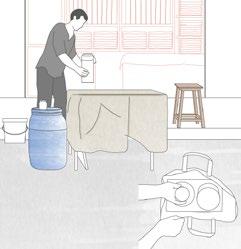
While the market is yet to open, micro enterprises on the street - food and tea stalls prepared for the day. On the sidewalk opposite Juma Masjid, Pandurang runs a chai tapri. The term 'tapri' is colloquially used for a place where people gather for conversations and to share stories while sipping a cup of tea.
He is accompanied by his brother, Prashant who works at another shop in the market. They previously lived in the marketplace and slept on the sidewalk. Currently, they live in a rented room in Sewri, a small industrial area on the eastern shore of Mumbai, and travel to the marketplace every day. They reach by 4:30 a.m. and set up the stall. It is put together by a folding table, stool, wooden plank, water containers, a stove, and a few utensils.
Pandurang prepares enough tea to last throughout the day while Prashant washes the utensils along the street edge. During the early hours, residents sit on the shop extensions and sip chai while reading the day’s newspaper as a routine. By now, they know each other by name. “Pandu bhau, don cutting ani ek bun dya” (Please give two cups of tea and a bun), Kanak calls out to him. He owns a shop in Mangaldas Market and visits the stall every day before opening his shop (See 5)
By around 10 a.m., the owner of the adjoining shop arrives. Prashant carries the folding table, stove, and big utensils to keep in an alley between 2 chawl buildings along Sheikh Memon Street. It is a 1.2m wide, dark, and dingy corridor with shops strung on both sides, some also used as go-downs. The space further shrinks with all kinds of objects resting on the closed shutters of shopfronts that opened on the road edge. These are rent-free claims in the space, either looked after by those who owned the respective shops in the building or simply left unattended. These interstitial spaces are often unnoticed amidst the activities of food stalls, hawkers, street vendors, and buyers.
Meanwhile, the tapri recedes to half the size to make space for buyers who come to the adjacent shop. Pnadurang places the wooden plank on the stool to keep tea urns and biscuit jars. He does not own the space, nor does he pursue a BMC license. Instead, the claim is worked out through negotiations with the BMC official and adjoining shop owner over the years. He packs all his wares by noon leaving behind no traces of inhabitation. The stall disappears and the space is occupied by hawkers and buyers who stop at the shopfronts.
5. Bombay Cloth Market Co. Ltd.
The market is housed within a century-old chawl building of the colonial period. It is named after Mangaldas Seth, who received a knighthood from the British. In 1904, when he set out to sell the land, shop tenants consolidated to purchase it under the name Bombay Cloth Market Co. Ltd. It is a planned marketplace comprising 450 shops, 2 main lanes, 9 alleys, and 22 gates. Security guards open and close the entrances at 10 a.m. These are often hidden amidst the plethora of shopfronts, hawkers, and buyers who occupy the sidewalk and street leaving no place for vehicular movement.
A series of shops on either side form lanes (0.8 m wide) that intersect with the main lane (1.2m wide), creating an active node. ‘2nd Lane’, a board read. Each node has boards hung from the truss to direct people within the sprawl of shops in the market shed. The shops are raised to a height of 0.5 meters above the ground level and have a gadi to sit over. These further spill on the narrow lanes by extending the gadi seating for buyers. This seating also becomes a storage space where things can be kept underneath. Moreover, it creates a softer threshold between the shops and alleys thereby creating opportunities for interactions other than those limited to transactions. This makes the experience of the market more human. Shops also have a mezzanine space with an internal access staircase to keep their stock. This makes the shed 5 meters high with exhaust fans on the sloping roof.
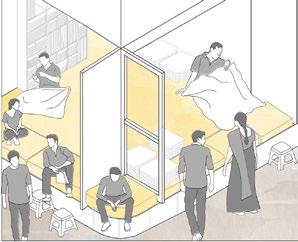
“Gopal Bhimji, aa dukan kya padse”? (Where is the shop named Gopal Bhimji?), a man asked. “Aagad thi first right, biji galli ma” (First right from here, in the second lane), a shopkeeper answered. It is an old shop widely known for cotton crushed lehenga. Kanak Trivedi owns the shop and is accompanied by his son and brother. His grandfather started the shop several years ago and he continues to run the family business. He lives in Kandivali, a locality in the suburbs of Mumbai. He reaches the shop by 11 a.m. and sets up the extended gadi seating. It is a dense accumulation of clothes stacked in racks along the enclosure. He owns a hathgadi and has hired Devendra (See 3) to transport goods in and around the neighborhood. Other shops are either connected to a hathgadiwala or have hired one.
His day is punctuated by conversations with Nimesh and Dilip, who often come to his shop in the evenings. Nimesh is the current director of the board and Dilip works at a shop next to his. They discuss business and other matters over a cup of tea. The board currently has over 1200 members as stakeholders and regulates matters of property and maintenance. Shops cannot be modified without an approval.
Towards the end of the day, Kanak stacks the extended gadi inside the shop and locks the doors. As the shops close by 8 p.m., the security guards shut the entrances and vigilantly watch the place throughout the night.
6. On the Move
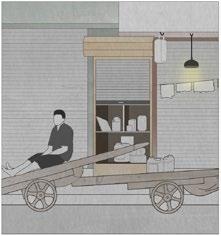
Hours before the market opens, the street edges are dotted by tempos parked one behind the other, hathgadis (wooden handcarts), and porter’s carts with goods carefully covered with plastic sheets to protect from unforeseen rains.
Manoharlal Yadav, a young man hauls his hathgadi along the market streets. He migrated from Lucknow 14 years ago with four friends. He used to work a twelve-hour shift at Zari Mari bakery in Colaba but eventually left after a few years. In 2015, he purchased a hathgadi for Rs. 2500/- and began transportation work in Mangaldas Market and its vicinity.
He reaches there by 8:00 a.m. during weekdays and even earlier on Fridays seeking work as he waits outside the Juma Masjid while it opens for prayer. At times, he stops by a tea stall in Old Hanuman Lane with his friends before leaving for work. He is connected to people over the mobile phone and moves around the city with his hathgadi to wherever people call him-Churchgate, Mantralaya, Colaba, etc. He transports all kinds of goods making Rs. 200-500 a day.
Stickers on his hathgadi read, ‘MARCH 2020, HA.0883, MARCH 2022’. This indicates the BMC license that is renewed after a year or two for about Rs. 200 -300/-. A tin box is tied on the end of the hathgadi to keep all his belongings- a raincoat to cover himself and a tarpaulin sheet to secure the goods during monsoon. He walks the neighborhood in search of work and eats wherever it is hygienic. Never did he buy cooking equipment since he keeps visiting his family in Lucknow once in every 2-3 months.
His day ends at 6 p.m. and even earlier on some days when there is no work. After work, he returns to his friends in Chor Bazaar, a flea market in Grant Road, South Bombay. They occupy the sidewalk after the adjoining shop shuts at 8 p.m. It has a raised plinth, which is almost 0.5m wide and becomes a place for them to sleep at night. Manohar locks the tin box and parks the hathgadi on the edge at night. Those were his only possessions.