SPRING 2026 aadirections.co.nz
! WIN el
Trav & more
Do our cars spy on us? Great escapes!
Captions clockwise: The Viking Star, Flam, Norway; The Nordic Spa; Wintergarden; Explorers’ Lounge.
Seven continents. Endless discoveries.
One Viking Designed for curious travellers, our ocean, river and expedition voyages bring you closer to the heart of each destination. With every detail taken care of, you can settle into the serene Scandinavian spaces on board and explore the world in unparalleled comfort. For a limited time, book now and enjoy included economy airfares up to AU$2,800pp*
SCAN FOR OFFERS
VIKING.COM *Exclusions apply. Available until sold out
The new AA app Your key to the AA Roadservice Tracker
Download today
WoF Reminder
Member Benefits
Trip Tracker
Membership Card
Get easy access to everything your AA Membership offers:
• Request a Roadservice callout and track its progress • Access your Membership card on the go • Estimate your journey’s fuel costs and emissions with Trip Tracker • Discover 45+ AA Member Benefit offers and discounts • Stay ahead with simple, timely WoF reminders
CONTENTS SPRING 2026
49 TRAVELLER
52
Charged for adventure We hit the road in a Tesla Model Y for a scenic road trip from Auckland to Taupō, unearthing culinary delights, rich local history and breathtaking geothermal landscapes along the way.
65
25
FEATURE Weathering the storm Life can throw unexpected challenges, forcing us to dig deep and find resilience in the face of adversity. We share the stories of several New Zealanders who have pivoted with positivity. IN EVERY ISSUE
37
9
MOTORING
10
40
12
Today’s vehicles are sophisticated data hubs. We investigate the line between convenience and privacy: Are our cars spying on us?
Chief Executive’s Message Letters Compass In this issue, we sit down with helicopter pilot and former NZSAS soldier Mark Law to discuss his role in the Whakaari White Island rescue mission. We also explore how to navigate road sharrows safely and round up our top spring event picks. Plus, AA Members have the chance to win incredible prizes, including a Tesla driving experience and a family trip to Waitomo Caves.
Smart mobility
44
What’s the buzz? EV uptake in New Zealand has doubled this year compared to last. We look at the pros and cons of going electric.
Lakes & lagoons From vibrant coastlines to quaint hinterland towns, every corner in Noosa boasts a distinct personality and undeniable charm.
71 AA HOME & LIVING On the ladder With a relentless work ethic, one Bay of Plenty family has turned the dream of home ownership into reality.
76
Soft focus We meet the visionary behind Lof Lighting, a Waiheke Island studio redefining the potential of wool with handcrafted pendants.
79 MY AA The AA Research Foundation is at the forefront of tackling some of New Zealand’s most pressing transport issues. We sit down with the AA Research Programme Manager to go behind the scenes of their work. Plus, we unveil fresh new looks for AA Centres and showcase a suite of new Member Benefits. SPRING 2026
7
Kids’ eyecare Find their focus with an eye test
Your child’s eyes are special. Most very young children have their eyesight assessed as part of their routine developmental checks. While these are very important, they aren’t as thorough as a complete eye test by a qualified optometrist. So we recommend that your child have their first eye test by the age of three. Testing before your son or daughter goes into full time education means that any problems that they may have are identified early, setting them up for a happy and fulfilling school life. That’s because not being able to see clearly can be confusing in a busy classroom. Poor eyesight can cause learning and behavioural problems, which might be blamed on other things. This is especially true for young children, who may find it difficult to explain the difficulties they are having with their eyesight. They may not even be aware they have a problem at all. And of course the sooner that vision problems are detected, the better the outcome. Conditions such as squint and amblyopia (lazy eye) can be treated more effectively if they are picked up earlier. And that could make a huge difference to your child. Kids’ eye tests are different from those for adults. We use specially designed charts that allow children to recognise shapes or pictures, or even to match letters, rather than the traditional charts that you may be familiar with. This means that we can test children’s eyes even if they are unable to read. Optometrists are specially trained to test children’s eyes. They know that the test room can feel a little intimidating to a young child, so
Scan to book an eye test
they will use techniques to make it feel as welcoming as possible. At Specsavers, children under the age of 16 get a free eye test*. Plus, AA Members can enjoy a free eye test every two years.^
Check out the frame range at Specsavers 2 pairs from $299 with single vision lenses BLUEY TM and BLUEY character logos TM & © Ludo Studio Pty Ltd 2018. Licensed by BBC Studios. BBC logo TM & © BBC 1996.
^Excludes contact lens examination, DL12 Eyesight Certificate and visual field checks. Limited to one per AA Member every two years. Present your AA Membership card in store to redeem. *This applies to comprehensive eye tests only, valued at $60, and excludes contact lens examinations and visual field checks.
PHOTOGRAPH BY KERI LITTLE
FROM THE TOP
Setting priorities Every year, the AA President – currently Brett Flintoff – and I have the pleasure of visiting AA District Councils spread across the country. The role of our 18 Councils is to advocate on behalf of Members on matters as diverse as local infrastructure, roading policy changes, safety and any other issue the AA takes a stand on. Our Councillors are deeply connected to their communities, contributing unique skills and perspectives, as well as demonstrating a strong commitment
to the Club. The AA wouldn't be what it is today without the enduring support of these volunteers, and I love the opportunity to regularly connect with them and discuss our advocacy priorities. One of those priorities is transport, which plays a vital role in how we live our day-to-day lives. Every election presents an opportunity to make it work better for all New Zealanders, and this year the AA has produced five practical Election Calls which have been shaped by the views of our Councillors, Members and communities. You can read details of these priorities on p.39. Building on a strong track record of real progress, the calls respond to today’s funding and delivery challenges, setting out clear actions to strengthen our transport system for the benefit of all. One of our priority calls is about putting transport maintenance first. When I'm travelling to visit AA Districts, I see firsthand how poorly maintained some of our roads are, particularly in the regions; we can and should do better. Regardless of who forms the next Government, I hope to see progress in this area and support for all our Election Calls, in the coming years. Thanks for your continued support as an AA Member. Nadine Tereora CHIEF EXECUTIVE
SPRING 2026
9
LETTERS
On the brink of summer, there is plenty to look forward to in this beautiful country of ours. This issue delivers an abundance of inspiration to take full advantage of. We talk to heroic and spirited New Zealanders, we go cycling and adventuring, we explore the world of mobility technology, get political and meet a young family thrilled to have bought their first home. That's just a taster. All up, it's a veritable feast of storytelling that has – as always – been a joy and a privilege to put together. I hope you enjoy the read.
DESIGN & ART DIRECTION BY SCG Julian Pettitt LauraGrace McFarland
HOW TO REACH US EDITORIAL AA Directions He Ngākau, Level 5, 20 Viaduct Harbour Avenue, Auckland 1010 PO Box 5, Auckland 1140 Ph: 09 966 8800 Email: editor@aa.co.nz ADVERTISING Moira Penman 021 228 5854 moira@gsjadvisory.com.au SUBSCRIPTIONS AND MEMBERSHIP ENQUIRIES Ph: 0800 500 444 ISSN 1171-0179 Published in print annually Circulation 665,731 Readership AC Nielsen 779,000
Kathryn Webster
EDITOR
Contributors
PRODUCTION BY: SCG, Auckland PRINTED BY: Webstar, Auckland
PETER REES
ON THE COVER Photograph by Alan Gibson Design by Julian Pettitt
After running his own gallery and teaching fine art and photography for many years, Peter now concentrates on producing and exhibiting his own work. Originally from the UK, he worked as a professional artist and photographer before moving to New Zealand with his wife, Elaine, in 2007. After three years living aboard their yacht Albacore, they settled on Waiheke Island in 2010, where they live with their daughter. For this issue of AA Directions he photographed Waiheke-based business, Lof Lighting. See p.76.
MEAGAN KERR
Meagan Kerr (Ngāti Kahungunu, Ngāi Tahu, Kāti Māmoe) is an Aucklandbased writer, photographer and multimedia creative storyteller, whose award-winning work has been published in Aotearoa New Zealand and internationally. Meagan combines her creative skills with her passion for connecting with community online, including bringing our AA Directions stories to life on the AA’s social media channels. When she’s not working, Meagan can be found studying te reo Māori, perfecting her tomato-growing skills or whipping up something tasty in the kitchen.
YOUR SAY NOTE: The views of contributing writers are not necessarily those of AA Directions or the AA. While AA Directions makes every effort to ensure that no misleading claims are made by advertisers, responsibility cannot be accepted by AA Directions or the AA for the failure of any product or service to give satisfaction. Inclusion of a product or service should not be construed as endorsement of it by AA Directions or by the Automobile Association.
10
aadirections.co.nz
AA to the rescue! Has the AA helped you out of a pickle, saved the day, surprised or delighted you? Do you have a story to share with other Members? Send it to AA Directions, PO Box 5, Shortland Street, Auckland 1140 or email editor@aa.co.nz
ROBERT TRATHEN
Rob’s career began in London, where he spent many years at the top of the fashion industry, shooting for titles including Vogue and GQ. Since returning to New Zealand, he has turned his lens toward the world of screen and stage – photographing actors and TV presenters, and working as a stills photographer on film and television productions. Rob is also a total car nut and is as obsessed with what's under the bonnet as what's in the frame. For this issue, he photographed Wheel Love's car and owner (on p.37).
PHOTOGRAPH BY JESSIE CASSON
Kia ora
EDITORIAL TEAM Kathryn Webster Monica Tischler Jo Percival
LETTERS
LETTERS Loving the lessons I was grateful to read the article ‘Using Flush Medians’ in the AA Directions Autumn issue. If there is one ultimate annoyance for me as a driver, it’s the misuse of median strips and in particular lazy positioning, hindering traffic and therefore rendering the purpose of the median useless. All too often I see drivers stop in the lane of moving traffic and completely avoid the median to turn into a driveway, street or carpark. So, thank you for the great article. A Fahey
HAMILTON
A trauma surgeon responds I was disappointed to read in the Autumn edition of AA Directions about what has happened to crash fatality rates over recent years and what the possible reasons for the reduction could be. At no point was there a mention of the possible role of post-crash care. Over recent years, particularly since the formation of the National Trauma Network, the mortality from major trauma (of which road trauma comprises roughly 50%) has halved and is now about 25% of what it was in the 80s. Improved post-crash response will definitely be one of the causes of reduced fatality rates after a road crash. Ian Civil
AUCKLAND
Car design for all I wonder how many women struggle with positioning their seatbelt? I can never sufficiently lower the belt (in the insertion on the side panel) so my boobs are not compressed. When I’m a passenger, I manually hold the belt for comfort. I’m pretty sure that would not be helpful in an accident. When I’m driving, I just put up with the annoyance and discomfort. Can designers please account for the different anatomies of men and women and allow for a lower belt position? P Laird OREWA
Problematic plastic It seems to me that the ‘100% Recyclable Packaging’ (that AA Directions is wrapped in for delivery) is ‘green-ish-washing’. While it may be technically correct to say that 100% of soft plastics could be recycled, only a very small proportion are. That phrase ‘100% Recyclable Packaging’ can cocoon us into feeling that this wrapping is good for the environment. The reality is that collecting, transporting and sorting soft plastics is energy and infrastructure intensive, and adds to our carbon emissions. While the recycling of such waste produces less emissions and uses less energy than creating virgin plastics, when plastic packaging is not necessary, this practice takes us further into planetary overshoot. Is avoiding the inconvenience of occasionally having to dry out a soggy magazine a good enough reason to take us further along the overshoot trajectory? At what point in our history are we going to be willing to suck it up and put up with a little inconvenience so that we live more lightly on the planet? A Baker FEILDING
Apps for EVs If internal combustion engine (ICE) drivers had no idea of how much petrol was at each station – by a factor of four or five – there would be an outcry, but we EV drivers face a big unknown every time we arrive at a new charging station. A recent example was a place in Auckland that charged a flat rate of $50 per charge, obviously not the place to go for a top up! It’s time the AA went back a century and helped its Members find the right place to refuel their vehicle like they did back in 1920, but now with 21st century technology.
37
AA Centres around New Zealand
2,000
Children’s bike lights donated by AA last year*
45+
Exclusive AA Member Benefits
481,000 AA Roadservice callouts last year*
Clifford Wright HELENSVILLE
While the AA app's Trip Tracker helps drivers locate EV charging stations, for more detailed information, including current pricing, we recommend using the ChargeNet app which is similar to the Gaspy app for petrol and diesel vehicles.
110,000+
Driving lessons last year* *2025-2026 Financial Year
The Spring issue of AA Directions is printed and also delivered in digital format. The Autumn, Winter and Summer issues are digital only. We welcome feedback and views on articles in AA Directions and on any issues affecting Members. Because of the volume we receive, letters and emails cannot be personally acknowledged. Only a selection can be published and they may be edited or abbreviated for print. By writing to the editor, you agree to the publication of your name and region.
WRITE TO: The Editor, AA Directions, PO Box 5, Auckland 1140 or email editor@aa.co.nz YOUR PRIVACY: This magazine may contain advertisements for products or services that are available through the AA. The provider may be the Association itself, a subsidiary of the Association, or a third party either under contract or a joint venture partner of the Association. Understand that any information provided by you may be used by the AA for administrative purposes and for the purpose of providing you with information relating to products and services from time to time. Where any Membership is an associate of another Membership, then products and services may be offered to both Members jointly or singly. We are always alert to opportunities for products or services to be made available as a benefit to Members, but if you prefer not to receive such personally addressed information, please write and tell us. The Association keeps a database of Members under its control and you have the right to see or correct any personal information that is held about you. If you wish to make an enquiry concerning a privacy issue, communicate with the Privacy Officer, AA, PO Box 5, Auckland, 1140.
SPRING 2026
11
COMPASS
Mark Law
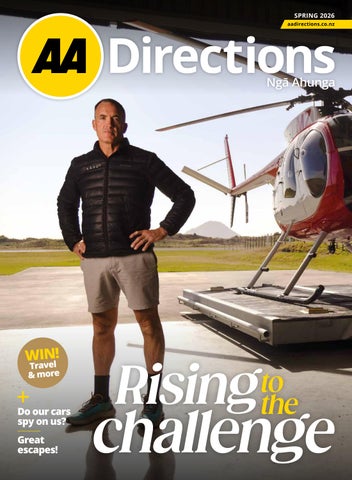
Helicopter pilot and former SAS soldier From a career in the NZSAS to his integral role in the Whakaari White Island eruption rescue, Mark Law shares his stories with Jo Percival. What made you join the military? Grandad who lived next door to us had been to WWII; my other grandfather was a prisoner of war. Neither of them was big on chit chat, but I was always trying to dig up more stories from them. All the people I met who’d been in the army seemed to have interesting stories. I always had a fascination with the Special Forces and the top end of soldiering. I thought those sorts of people were extraordinary. Where were you deployed while in the SAS? During my time with the SAS, New Zealand didn’t send any troops to war, but we did go to Australia, Malaysia and the Pacific Islands for training. A highlight was being sent to Ecuador. During SAS training the toughest environment is the jungle. Six of us went along with the English SAS who were training with the Ecuadorian special forces. The coolest thing was coming across local tribespeople, just existing in the jungle. When did you start flying? When I was growing up, Dad got into deer farming and part of that involved catching wild deer so he could build a herd, which he did with helicopter hunting. It was a small group of people doing a unique job with a huge amount of skill and risk. I was about 22 when I started flying. When I was in the regiment, we were just down the road from the flight school at Ardmore. I had a Hilux, which I sold and used the cash to pay for my pilot’s licence. What was your time like working in private security?
12
aadirections.co.nz
After the SAS I worked in private security for two years. The first year was in Angola during a full-on war supporting De Beers; I was looking after guys who were buying diamonds. We were flying cash to buying houses and bringing diamonds back. It was very lawless with lots of violence. I’d spent the previous years working with groups of really capable guys, but it was suddenly just me, some guards I never trusted and a couple of expats. It was hard going. Especially since everyone knew we were moving a lot of diamonds and a lot of cash, so we were high profile targets.
As I flew out to the island everything was grey. It looked like a ski field with a fresh dump of snow, everything was smooth. Then I spent a year in Albania, which was in turmoil. People had been oppressed for so long it was difficult for them to trust anyone. One time we were down by the Greek border, scoping in case things turned to crap and we couldn’t get our expats out by the normal channels. I was in a little café, and my translator told me that the people there were saying it was the first time they’d ever seen a Westerner. That was in 1998. What did you do when you returned to New Zealand? I worked in Albania until I had enough cash to buy my own helicopter and
come back to New Zealand. I set up the business that was initially called Bushland Helicopters, then Frontier and finally Kāhu, as it’s known today. Tell us what happened with the Whakaari White Island eruption. On the day of the eruption (December 9, 2019) I was driving down the Whakatāne coast, and I saw the dark plume. Then the phone calls started with people saying there’d been a significant eruption. Thankfully both of our bigger aircraft were in the hangar. We knew that another pilot was out on the island with a helicopter and we were initially just going to help him. As I flew out to the island everything was grey. It looked like a ski field with a fresh dump of snow, everything was smooth. I circled around the crater and thought I saw a person lying on the ground. What was your plan? I soon picked out about 20 people, mostly in one area. Once I landed, I worked my way around, checking people’s airways, putting their gas masks back on. It quickly became apparent that some people were already dead, some were dying, some were crying out for help, and there was still a lot of activity going on with the volcano. It was very loud. At that point we heard from John, another pilot flying above, that no-one else was coming to help. We managed to get 12 people off the island. We were going back for the last lot when we got stood down. There were still eight people left on the island who had passed away. We got back to Whakatāne and there were a whole bunch of helicopters and
PHOTOGRAPH BY ALAN GIBSON
COMPASS
SPRING 2026
13
COMPASS
the Air Force and you assume, being New Zealand, that these guys would go and get them. We at least thought people would talk to us to get information about where they could land on the island. But once it was determined that there was no one left alive the decision was made not to recover people. We were really upset about the whole thing. Despite being awarded the New Zealand Bravery Star for your efforts, Kāhu was subsequently investigated by WorkSafe New Zealand and fined for health and safety violations. How did that happen? Their investigation (was for a period) three years prior to December 9, 2019 to the time of the eruption but never investigated anything else. We hadn’t had anyone on the island (when it erupted), but we were still lumped in with everyone else. They came up with a charge that, somehow, we’d failed to keep our staff safe and our visitors safe. The saddest part was that the senior investigator for the aviation part of things could find no wrong with us. They submitted that, but it was overturned further up the chain. The whole thing was a travesty. Rather than pay the initial $3 million charge and risk losing your business, you opted to plead guilty in 2024 and were fined $196,000. Have you paid that? No, I haven’t. The judge gave us five years to pay it off and I still haven’t paid a cent. It’s hard case; we got fined and the next day the collections department called and asked if I was ready to make the payment, and I said, “I don’t know about you, mate, but I don’t have $200,000 sitting in my back pocket!” That’s when Ron (Crosby) came along and suggested we write a book to make some money to help pay the fine. Do you have any regrets about going to Whakaari? No. But I’ve got a big regret that I didn’t go back.
Lucky You’re Tough (Allen & Unwin, RRP $39.99) by Mark Law with Ron Crosby is available now. Be in to win one of five copies with AA Directions. Enter your details at aadirections.co.nz before November 30, 2026.
14
aadirections.co.nz
AA Directions is always thrilled to offer Members the chance to win. Whether you’re looking for escapism with a great read, an actual adventure, or an electric road trip, we have prizes that fit the bill. There's something for homebodies, too, with a beautiful wool lightshade to give away.
Time in a Tesla with GO Rentals Have you ever thought about going electric? We’re giving an AA Member the chance to experience the future of driving with a complimentary three-day Tesla rental. The winner can collect their vehicle from any GO Rentals branch in Auckland, Wellington, Christchurch or Queenstown to enjoy a scenic road trip or just zip around the city. The car must be returned to the original pick-up location. GO Rentals provides full insurance coverage for the duration of the hire, though recharging costs are not included. Entry is only open to New Zealand residents aged 25 years or over with a full driver's licence. See aadirections.co.nz for T&Cs. To be in to win, send your name and contact details to AA Directions, Tesla, PO Box 5, Shortland Street, Auckland 1140 or enter at aadirections.co.nz before November 30, 2026. Read our North Island road trip in a Tesla Model Y on p.52.
COMPASS
Lucky You’re Tough
(Allen & Unwin, RRP $39.99) by Mark Law with Ron Crosby This compelling memoir chronicles the life of helicopter pilot and SAS soldier Mark Law. Growing up in rural New Zealand, Mark’s career included a series of challenging events that toughened his resilience, before he returned home to establish a helicopter business. In December 2019, his years of service and sharpened instincts culminated in a split-second decision to do the right thing, when Whakaari White Island erupted. Mark and his colleagues flew directly to the island to rescue survivors, an act of heroism which was awarded with a medal for bravery. This is a powerful story of adventure, service, humour and courage. AA Directions has five copies to give away. To enter the draw, send your name and contact details to AA Directions, Lucky You’re Tough, PO Box 5, Shortland Street, Auckland 1140 or enter at our website aadirections.co.nz before November 30, 2026. For more on Mark's story, see the interview on page 12.
A Waitomo adventure
thanks to Discover Waitomo and Ripples Retreat One lucky family has the chance to win an unforgettable Waitomo adventure, including a Waitomo Caves experience and a two-night escape at the serene Ripples Retreat for two adults and two children. The winner can explore the magic of New Zealand’s premier glowworm destinations with a dual-cave tour of Ruakuri Cave and Waitomo Glowworm Caves (RRP $410), followed by a relaxing stay in Ripples Retreat’s charming Cascade Cabin (valued from $1,170). The Ripples Retreat stay is valid for midweek stays (Sunday to Thursday), excluding public holidays and peak periods (December 18, 2026 to February 28, 2027). See aadirections.co.nz for T&Cs. To enter, send your name and contact details to AA Directions, Waitomo Adventure, PO Box 5, Shortland Street, Auckland 1140 or enter at our website aadirections.co.nz before November 30, 2026.
A Lof light Discover the art of sustainable lighting with Lof, a Waiheke Island-based business that is redefining the potential of wool. Founded by textile designer Sophie Poelman, Lof's beautiful pendant lights blend contemporary design with unique noise softening properties, creating a cosy, natural glow. We’re giving away one stylish Lof light worth $1,000 to an AA Member to brighten their living space. To enter, send your name and contact details to AA Directions, Lof light shade, PO Box 5, Shortland Street, Auckland 1140 or enter at our website aadirections.co.nz before November 30, 2026. See p.76 for more on Lof Lighting.
SPRING 2026
15
COMPASS
Safe waters for our sea turtles
AS THE WEATHER warms and our coastal waters beckon, Auckland Zoo urges boat enthusiasts and beachgoers to help safeguard our precious sea turtles. The safety reminder comes after a Pacific green sea turtle was fatally struck by a boat in the Hauraki Gulf. Auckland Zoo’s Senior Clinical Veterinarian Dr Adam Naylor says it identified the turtle as a former patient of the Auckland Zoo Veterinary Hospital. Sea turtles are a protected species and can be spotted in the Hauraki Gulf and other coastal regions of the upper North Island. Auckland Zoo is a member of ‘Team Turtle,’ a collaborative initiative alongside Department of Conservation (DOC), SEA LIFE Kelly Tarlton’s, and local iwi. Together, they are dedicated to the rescue, treatment, and rehabilitation of sea turtles, ensuring they can be safely released back into their natural habitats. Auckland Zoo encourages New Zealanders to be mindful of wildlife beyond the water, too. It has partnered with DOC to protect New Zealand’s rarest breeding bird – tara iti (fairy tern) – which lays its eggs in low-lying coastal sandspits and beaches. If you’re exploring sand dunes or trekking through bush and farmland, remember to keep your dog on a leash and avoid areas where vulnerable species live, such as the kororā (little penguin), tara iti and kiwi.
Report turtle sightings Auckland Zoo advises that if you encounter a stranded turtle, you should act straight away. Even without visible injuries, a beached turtle is often unwell and needs expert care. Report sightings to DOC via their hotline at 0800 DOC HOT (0800 362 468). If possible, take a photo to help with identification. DOC also encourages reports of any live turtle sightings at sea, as these are invaluable for monitoring this precious taonga.
Sharing our waters responsibly
PHOTOGRAPH: AUCKLAND ZOO
• Ease off the throttle. In coastal areas of the upper North Island, slowing down is the best way to give yourself time to spot and avoid turtles. • Appoint a dedicated guardian. Nominate a crew member as a spotter who can alert the captain to any surfacing turtles. • Cut through the glare. Wearing polarised sunglasses is a simple but effective way to see beneath the surface and catch a glimpse of a turtle before it’s too late. • Add a layer of safety. Fitting a propeller guard can prevent devastating injuries, ensuring our waters remain a sanctuary for all.
Another day saved! AA ROADSERVICE saved me twice in the same day. I somehow managed to lose the key that locks and unlocks my car after parking in the city for work. Thankfully, I still had the key that actually started the car, but first I needed to get back into it. AA Roadservice arrived quickly, were incredibly friendly and had me back on the road in no time. I drove home feeling relieved and very careful not to lock the car again, given I no longer had a locking key. Then I made the mistake of telling my partner what had happened. While attempting some enthusiastic DIY troubleshooting, he locked the car and shut the door and just like that, we were locked out again! I had to call the AA a second time on the same day. Once again they arrived quickly, were kind, professional and impressively non-judgmental. Not a hint of eye rolling from anyone involved. We’re now even more grateful for those six callouts a year. The AA truly saved the day, twice, and turned a stressful situation into a story we can laugh about. Kimy T, Auckland I WAS DRIVING HOME from Rotorua when my tyre exploded. Luckily, I was able to safely make it off the motorway and call the AA for help. The Roadservice technician arrived quickly but unfortunately the tyre couldn’t be repaired because it was badly damaged, likely from being driven after the blowout. The AA arranged for a tow truck and my vehicle was towed all the way from Wiri to Glen Eden. It was a huge ordeal, but the AA absolutely saved the day and got everything sorted with no extra stress. Adel P, Auckland Share your AA Roadservice rescue story and be in to win one of four $500 Prezzy cards. See opposite page. T&Cs apply.
16
aadirections.co.nz
COMPASS
Titanic: The Human Story docks in Auckland
PHOTOGRAPHS: FEVER TITANIC PAUL MCMILLAN
THE INTERNATIONAL EXHIBITION has made its inaugural voyage to New Zealand, providing new insight into the tragedy of 1912. Through intimate stories and over 200 artefacts – ranging from handwritten letters and clothing to deck chairs and dinner plates – viewers are invited to connect with the personal experiences of the passengers and crew on the fateful night the ship sank to the bottom of the Atlantic, claiming more than 1,400 lives. The experience features a life-sized iceberg that illustrates the freezing water temperatures of that night, alongside true-to-scale recreations of the ship’s interiors.
Visitors can delve into the history through audio guides, while film enthusiasts can explore memorabilia and costumes from James Cameron’s blockbuster, including a gown worn by Kate Winslet as Rose. Produced by Musealia following years of research, the exhibition was created in partnership with Fever and Swedish historian Claes-Göran Wetterholm – a pre-eminent expert on the Titanic – to bring the ship’s story to life. Hosted within Auckland’s historic Smith & Caughey’s building, tickets are on sale until the end of October. See titanicexhibition.com/ auckland for more.
“My roadside repair skills lasted about 30 seconds. Then I called the AA.” Be in to win! T&Cs apply.
Share your rescue story and be in to win one of four $500 Prezzy cards.
Scan to share your story
SPRING 2026
17
COMPASS
Picassos in Auckland
THE ART OF PABLO PICASSO will feature in a major exhibition at Auckland Art Gallery Toi o Tāmaki this summer. Picasso: Designed by Paul Smith includes 80 paintings, sculptures, ceramics, prints and drawings from the collection of the Musée National Picasso-Paris in a show art-directed by British fashion designer, Sir Paul Smith. The exhibition traces pivotal moments across Picasso’s career, such as the Blue Period, Rose Periods and Cubism. Sir Paul Smith is one of Britain’s foremost fashion designers. For Picasso: Designed by Paul Smith, he responds to Picasso’s imagery, styles, materials, and the context of the time, drawing on their mutual sense of fun. Sir Paul Smith says: “I am looking to take visitors on a visual journey that encourages them to see Picasso’s masterpieces in a new light, in hopes to engage with younger audiences and audiences that are not very knowledgeable about the work of this great master.” Director of Auckland Art Gallery Toi o Tāmaki Dr Zara Stanhope says: “Sir Paul Smith’s imaginative exhibition design invites visitors to rediscover an artist whose impact continues to influence how we understand aspects of the twentieth-century.” Picasso: Designed by Paul Smith opens at Auckland Art Gallery Toi o Tāmaki on October 10, 2026 and runs until February 1, 2027. Tickets are on sale now. Clockwise from top left: Pablo Picasso, Buste de femme au chapeau rayé, 1939, tempera on burlap canvas, 81 x 54cm, Musée national Picasso-Paris. © Succession Picasso - Gestion droits d'auteur. © GrandPalaisRmn (Musée national Picasso-Paris) Mathieu Rabeau. Pablo Picasso, Portrait d'homme, 1902-1903, oil on canvas, Musée national Picasso-Paris. © Succession Picasso - Gestion droits d'auteur. © GrandPalaisRmn (Musée national Picasso-Paris) Mathieu Rabeau. Pablo Picasso, Femme assise aux bras croisés [Le Tremblaysur-Mauldre], 1937, oil on canvas, 81 x 60cm, Musée national Picasso-Paris. © Succession Picasso - Gestion droits d'auteur. © GrandPalaisRmn (Musée national Picasso-Paris) Mathieu Rabeau. Pablo Picasso, Le Déjeuner sur l’herbe d’après Manet, 1960, oil on canvas, 130 x 195cm, Musée national PicassoParis. © Succession Picasso - Gestion droits d'auteur. © GrandPalaisRmn (Musée national Picasso-Paris) Mathieu Rabeau.
18
aadirections.co.nz
COMPASS
Sharing with motorcycles WHETHER COMMUTING in the city or touring the countryside, riders will say motorcycles offer freedom and connection with the elements. That also means they are far more exposed than people travelling in cars; the consequences of a crash, even at lower speeds, has the potential to be much more serious. This makes awareness and consideration from other road users especially important. One of the biggest challenges for motorcyclists is being seen. AA Road Safety Spokesperson Dylan Thomsen says because motorcycles are smaller than other vehicles, can accelerate quickly and are very manoeuvrable, they can be difficult to spot in traffic. Before turning, changing lanes or pulling into traffic, motorists should take a second look and actively check for motorcycles.
“Motorcycles are easily missed with a quick glance and dangerous situations can unfold even when a driver has looked, if they fail to notice an approaching rider. “When on the road, don’t just check for the familiar silhouettes of larger vehicles. Look out for smaller, narrower shapes, always look in your wing mirrors and check blind spots,” Dylan says. Once a motorcycle has been identified, its small size and rapid acceleration can make it difficult to accurately judge its speed and distance. This increases the risk of drivers turning across a motorcycle’s path. Strong winds, uneven road surfaces and turbulence from larger vehicles can affect motorcycle stability and motorists should also be aware that riders may position themselves differently to other vehicles within a lane. This could be for a
variety of reasons – to improve visibility, or to avoid hazards like potholes, road markings or loose gravel. “A motorcycle moving within a lane is not necessarily preparing to move out of it and may just be looking for a better or safer position on the road. Providing a bit of extra space helps create a safer environment for everyone.” Ultimately, sharing the road comes down to respect and awareness, Dylan says. By watching carefully, allowing space and recognising the unique challenges faced by motorcyclists, motorists can help reduce crashes and make the roads safer for themselves, riders and other road users. “Some extra attention behind the wheel and looking twice for motorbikes could be the difference between a close call and a safe journey home,” Dylan says. SPRING 2026
19
COMPASS
ROAD RULES
What’s a sharrow?
AS ROAD ENVIRONMENTS EVOLVE, markings to support safer and more predictable interactions between motorists and cyclists are appearing. Sharrows featuring a bicycle symbol combined with chevron-style arrows indicate a shared roading environment, where cyclists and motor vehicles may use the same lane space. They are typically used where a dedicated cycle lane is not practical, but cycling remains an important and legitimate mode of transport. The purpose of sharrow markings is to communicate that the carriageway is a shared space and that cyclists may need to position themselves within the lane to travel safely. While the marking itself is advisory in nature, it reinforces expected awareness and considerate behaviour from all road users. Sharrows help: • Reinforce that the roadway is a legitimate space for cyclists. • Encourage cyclists to position themselves away from hazards such as parked vehicle door zones, kerb buildouts and stormwater grates. • Support cyclists in adopting a predictable and visible position within the lane when appropriate.
• Remind drivers that cyclists are legitimate road users and that additional care and awareness are required in shared environments. It’s important to undersand that the marking is only part of the equation; safe behaviour around cyclists is what ultimately determines safety outcomes. In sharrow-marked environments, drivers should expect cyclists to be present and adjust their driving accordingly. Cyclists may need to take a more central lane position at times to avoid hazards or
Changes to WoF FROM NOVEMBER, changes to New Zealand’s Warrant of Fitness (WoF) system come into effect, reducing the number of inspections required for some vehicles. Currently, new vehicles need inspecting to get a second WoF at three years; from November 1 the second WoF will be due at four years. Light vehicles aged four-14 years will move from annual WoF inspections to every two years. This change will be introduced in phases. Vehicles first registered on or after November 1, 2019 will move to a two-yearly WoF from November 1, 2026. Vehicles first registered between November 1, 2013 and October 31, 2019 will move to a twoyearly WoF from November 1, 2027. There is no change for light vehicles aged 14-26 years; their WoF inspections remain annual. Light vehicles aged over 26 years (registered before January 1, 2000) currently need to be warranted every
20
aadirections.co.nz
maintain safe positioning. This should be anticipated as normal road behaviour rather than treated as an exception. When travelling in these areas, drivers should: • Maintain a safe following distance and avoid pressuring cyclists to move over. • Reduce speed to suit the conditions rather than attempting to maintain normal travel speed. • Only overtake when there is sufficient space and clear visibility, and when it is safe and legal to do so. • Be alert to changes in cyclist positioning due to road conditions or hazards. In some situations, the safest option may be to wait behind cyclists until a suitable opportunity to pass becomes available. Patience and judgement are key factors in shared lane environments. Ultimately, sharrows reinforce the principle that roads are shared spaces requiring mutual awareness and respect. Safety depends not only on understanding road markings, but also on the ability of all road users to anticipate others and respond appropriately. By Mandeep Shah
For more road rules, see aadirections.co.nz
six months. From November 1, they will only need annual inspections. From November 1, motorcycles registered before January 1, 2000 will move from six-monthly to annual WoFs. Motorcycles registered on or after January 1, 2000 will remain on an annual WoF. With these changes, more responsibility is on you to keep your vehicle roadworthy until its next warrant. Remember to keep up with servicing and regular maintenance, and have your vehicle checked if something doesn’t seem right. Plus, from November 1, 2026, penalties for noncompliant wheels and tyres increase from $150 to $350, with a maximum court-imposed fine of $1,000.
The AA is here to help keep your vehicle safe and roadworthy. For more information on WoFs and car servicing, visit aa.co.nz/cars/maintenance
COMPASS
CARVING THROUGH TIME
PASSING YOUR LEARNER LICENCE is a big achievement and the first step towards safe, confident driving. Plus, right now learner drivers can go in the draw to win $500.
PHOTOGRAPH: TE PAPA
THE MUSEUM OF NEW ZEALAND Te Papa Tongarewa has unveiled a landmark exhibition celebrating the vibrant, evolving world of whakairo (Māori carving), inviting visitors to explore the rich narrative of this living artform. He Toi Whakairo: The Art of Māori Carving brings together more than 140 taonga (treasures) from Te Papa’s collections, with many being displayed publicly for the first time. It marks one of the most comprehensive presentations of Māori carving in more than four decades. From traditional stone carvings to hot-pink contemporary works, the exhibition spans seven centuries of this treasured practice. Innovative works including those by wāhine that expanded the idea of carving as a male-only art form offer a rare opportunity to experience the breadth and evolution of whakairo in one space. He Toi Whakairo runs for five years and is included with museum entry. See tepapa.govt.nz for more.
Learn, snap, share & win!
When you pass your learner theory test you’ll receive your temporary licence in an all-new AA folder. Simply snap a selfie holding the folder, share it on Instagram or Tiktok and tag the @aa_new_zealand Instagram or @aanewzealand TikTok accounts and you’ll be in the draw to win $500! T&Cs apply. See aa.co.nz/you-passed for more.
SPRING 2026
21
Save on your next trip! AA Members can enjoy special travel benefits*. 20% Thrifty car rentals
10% available fare on OFF
15% GO Rentals OFF
on Maui, Britz and 10% Apollo campervan OFF
the base rate with
OFF
in New Zealand
the daily rate with car hire
the base rate with
Hertz car rentals in 15% New Zealand OFF on selected
accommodation 10% worldwide with OFF AA Traveller
Welcome our newest partner SeaLink
the best
Interislander
the best daily price rentals
10% cruising experiences OFF selected sailing and
with Explore Group selected group tours
and short breaks 10% with Leisure OFF Time Travel
selected guided cycling and
hiking tours with Adventure 10% South NZ and walks with OFF
Great Walks of New Zealand
the best available fare
on scenic trains with 10% Great Journeys OFF New Zealand™
10% fares across all
on eligible SeaLink
OFF
SeaLink routes.
Find out how to save at aa.co.nz/member-deals
*AA Member discounts available when you provide your valid AA Membership number at the time of booking. Rental car offers exclude tax, fees, optional products and services. Terms and conditions apply for each travel offer. Visit the relevant Member Benefit Partner’s page via aa.co.nz/member-deals for more details.
COMPASS
Highlighting hearing health THE IMPORTANCE OF STAYING CONNECTED is the focus of a dementia awareness and prevention programme, run by Age Brightly and supported by AA Member Benefit partner, Bay Audiology. Age Brightly is a proactive healthcare system that helps adults aged 65+ maintain independence and wellbeing through assessments and personalised care plans. The service focuses on early detection of health changes and prevention. One such area of care highlights dementia, emphasising the power of staying connected as a critical component of awareness and prevention. This is where hearing health comes into it. “Staying connected to the people, communities and activities we love is an important part of living well
as we age, and hearing plays a vital role in making those connections possible,” says Bethney Russell, Audiologist at Bay Audiology. She says research has identified hearing loss as one of the largest modifiable risk factors for dementia, which is why early detection and treatment are so important. “As audiologists, we see every day how hearing supports our ability to stay connected to family, friends, community groups and the activities we enjoy,” Bethney says. “These connections are an important part of living well as we age, which is why looking after your hearing health and having regular hearing checks is so important.”
AA Directions
NEWS
AA DIRECTIONS is making some changes to ensure we can continue to deliver stories, advice and inspiration in more frequent and easily accessible ways. Next year, we will publish one bumper print magazine in Spring, with digital issues and more content available to read on aadirections. co.nz and emailed to Members. This shift to more online storytelling is in response to the changing ways Members are engaging with our AA digital channels (website and app), coupled with rising print and distribution costs. Look out for our next digital issue of AA Directions in December and our next print issue in Spring 2027.
Keeping dancers on their toes THE ROYAL NEW ZEALAND BALLET (RNZB) is calling for support of the Pointe Shoe Appeal – an initiative that provides dancers with the essential footwear they need to deliver world-class performances on stages across Aotearoa. Each pair of pointe shoes worn by an RNZB dancer is custom-made for the individual. They are fitted and often customised by the dancers themselves, helping them to perform at their best while supporting foot health, protecting joints and reducing the risk of injury. Yet, their life is fleeting; due to the intense demands of daily rehearsals and stage performances, pointe shoes often last only a few weeks – or sometimes just a single show – which means hundreds of replacements every year. Supporting the Pointe Shoe Appeal is one of the most practical ways to help the RNZB dancers, ensuring they have the footwear they need for daily classes, hours of rehearsals and performances around the country.
Each year the RNZB purchases more than 900 pairs of pointe shoes. As the dance company prepares to bring the fairytale magic of The Sleeping Beauty nationwide, the cost of pointe shoes, ballet flats and boots for the year will exceed $120,000. Every donation will help, whether it’s to provide a full pair of custom-fitted shoes, or the ribbons and elastics that secure them. Supporters gain exclusive, behind-the-scenes access to online studio rehearsals and insights into the world of dancers. See RNZB | Pointe Shoe Appeal for more.
RNZB Principal Ana Gallardo Lobaina. Photograph: Stephen A'Court.
The Sleeping Beauty will tour New Zealand from October 29 to December 20, 2026. AA Members enjoy a 15% discount on selected Adult and Child tickets to Royal New Zealand Ballet performances. See aa.co.nz/rnzb for more. SPRING 2026
23
AA Members save 10%*
On Great Journeys New Zealand short breaks *T&Cs apply and holiday packages.
YOUR NEXT HOLIDAY, SORTED Dreaming of alpine landscapes, gourmet flavours or a relaxing coastal escape? Discover more of Aotearoa New Zealand with our curated holiday packages, bringing together memorable rail journeys, comfortable accommodation, and hand-picked experiences - all in one easy booking.
A spectacular scenic train journey
A comfortable place to stay
A hand-picked local experience
Sit back and take in the view from Scenic Class, or upgrade to Scenic Plus for a premium experience featuring locally inspired dining and dedicated onboard service.
Relax after your journey with overnight accommodation selected to complement your destination and package.
Discover more at every stop, with a memorable activity included in most packages. Depending on your itinerary, you may also have the option to add extra experiences.
Discover more and access your exclusive AA Member Benefit discount code at: R
aa.co.nz/scenic-trains
FEATURE
When life delivers lemons, make lemonade. Be resilient, nimble, courageous in the face of difficulty. Is this a national trait, this ability to cope? To have guts? We’ve collected personal stories of New Zealanders who, when faced with a challenge, have risen to it. With determination, they’ve found solutions – changed career, opted for an alternative lifestyle, downsized expectations, tackled slightly menacing new technology… In these increasingly challenging times, a dose of inspiration is just what’s needed.
SPRING 2026
25
PHOTOGRAPH BY JESSIE CASSON
RISING TO THE CHALLENGE
26
aadirections.co.nz
FEATURE
WHEN SHAUN WINSTANLEY realised he’d been shot in the face by a gunman hiding in a central Auckland construction site, his first thoughts were of his wife and two young sons. Years of training and experience during his time working for the New Zealand Police had prepared him for the reality of volatile situations, but it was as much the force of his own personality that helped him stay calm. “I don't stress or else, when I do, my training has taught me how not to show it,” Shaun explains. He remembers signalling for his colleagues to cover him as he moved to a far corner of the room to call out for medic assistance. Shaun remained conscious and lucid as he left the building. He recalled seeing an approaching television crew and covered his face, in the hope his sons wouldn’t recognise their wounded father. The bullet that ripped through Shaun’s jaw that morning in July 2023 also caused him to inhale gunpowder and pellets into his airways, so by the time he was admitted to hospital, the decision was made to medically induce a four-day coma. Although he was able to return home just ten days after the incident, Shaun’s recovery has been a long journey.
“I'd worked every day of my life since school – getting up in the morning, going to work, coming home – so it was a massive shock to the system to lose that routine.” Beyond the often intense pain that he was experiencing, Shaun struggled with his moods. “Besides the mental stuff, when people get angry or grumpy it's usually because they're hungry, tired or sore. I had all three of those. “I was rushing to get back to work. I completed my reintegration programme, which included using firearms, and started training again with my armed offender squad colleagues. But I got to a point where I wasn't able to do my job because I was still losing bone and I was often bleeding.” Meanwhile, the main requirements of his rehabilitation process were time and further surgeries. The emphasis at home was on maintaining his calorie intake. “I got to the point where I didn't want to eat because it was just too hard… It would take me an hour to eat a mashed spud.” Limited to finely pureed food and struggling to find liquid options that weren’t too sweet, Shaun began making his own protein blends. His wife, Nicola, jokes about a moment where he sat up in a tramadol-induced
haze and stated his intention to start making his own protein coffee: “She rolled her eyes and said, ‘Yeah, you probably will,’ and that's when Firebird was born.” The brand name and logo reference a phoenix rising from the ashes. “It was a bit of a passion project. I was living off the protein coffees that I was making for myself, and thought, this is a great idea – why isn't anyone else doing this? Also, I wanted to keep myself busy and not let my brain go stale.” Although his involvement in developing the Firebird Protein Coffee business was limited by his recovery, Shaun had found a way to pivot. The change of direction also allowed him to be more hands-on at home, to support Nicola, who has recently graduated as an emergency medicine technician. “I've had to reflect on identity, particularly in the last six months, and the idea that I may not be returning to the Police. “I'm very conscious that your identity isn't a single job. It's not a single part of you. I'm a husband, a father, a coach, a friend, a police officer, a sportsperson, an entrepreneur, to name a few. I don't have to tie my identity to one of those themes. I think I've shown that you can pivot your identity; even if it wasn’t your choice, you can own it and be proud of it." Shaun describes finding strength during his recovery by being grateful that he could still care for his family and be able to spend more time with them. “I think about the day after I got out of hospital. I made my boys’ lunches. I drove them to school and picked them up afterwards, and I've done that for three years since. “That’s been a really positive outcome from what happened; taking control of what I could control.” Nicola Edmonds SPRING 2026
27
RISING TO THE CHALLENGE
TECH-MAD TEN-YEAR-OLD Harry Stewart was keen to get advice on artificial intelligence (AI) and experiment with it. His mum Mel had been wondering how best to support him, not just with access to platforms, but also navigating them safely. She had experimented with it herself, but exhausted her knowledge of AI’s capabilities and, as a single mum of three, couldn’t afford costly extracurricular tech activities. So when she stumbled across the AI Sandbox in central Nelson, she couldn’t believe her luck. It offered free advice on AI platforms, and use of them, for people to experiment and find out more. There was also a staff member on hand to support and advise those dropping in, or who had made appointments. Mel was relieved to get some time for Harry with resident assistant Jack Manson, the AI Sandbox’s Project Coordinator and technical lead. Harry was in his element. “The first time we went along they had a robot they’d programmed using AI, which was really fun,” Harry says. “I saw Jack coding scripts for it using AI and got to do some coding myself, too. I’d never seen anything like it before; it was looking around and waving at people – it was really cool. “I didn’t know much about AI before that, but I’ve been a few more times since then and learnt so much. I’ve tried ChatGPT and got much better at coding. 28
aadirections.co.nz
Jack’s really helpful. He lets me try things and if I get stuck he shows me what to do.” Nelson’s AI Sandbox is a community initiative, established by a philanthropic group, which offers people the ability to trial AI, upskill, and get advice and guidance, free of charge. It was initially the brainchild of Richard Brudvik-Lindner, a teacher at Nelson College, who saw the arrival of ChatGPT and wanted to find a way to help his students understand AI’s capabilities, and harness its good uses. His idea was quickly embraced by a group of co-founders, who helped grow it into a concept to benefit the community as a whole. “There are barriers in technology, a digital divide,” says Richard, who’d previously worked for tech giants Microsoft and Nintendo in the US. “Nelson’s already a great place to live but we wanted to help enhance the social fabric and make it more prosperous, equitable, viable and sustainable – and the knowledge and innovation economy is one way to achieve this. People can come into this space to find out more, without any barriers whatsoever.” What the founders believe to be a world-first initiative has evolved over its two years, moving to a few bases within Nelson’s city centre to maximise accessibility, most recently settling in Halifax Café, opposite the city’s library. Workshops have been added – some free and sponsored by the Rātā
Foundation and some paid-for workshops which have been popular with businesses keen to upskill staff. Jack and avid volunteer Murray Irvine – who spent four decades working in IT – recently gave a presentation to 14 members of a local Probus group, including guiding them through using ChatGPT, advising on prompting the platform to achieve the best results and working on image manipulation. The visitors also received information about safety, and using the right platforms to best suit their needs. “If people drop in but don’t have time to stay, there are now tutorials they can work through from home,” Jack says. “One couple recently called in from the West Coast and only had 15 minutes, but I directed them to our online tutorials for things we didn’t have time to cover.” Many common questions are very general, including ‘What is AI?’, Jack says. “Some have wanted to know if an AI summary on a Google search gives trustworthy information and quite a few people are keen to use it for personal projects – genealogy is a really popular one. For that it can more easily search across lots of different scattered information sources. Some people are also using AI to collate information across their life to help them write autobiographies.” Harry’s mum Mel has also made use of the café drop-in service to learn more about AI herself. “Having something like this that’s educational and free means the community isn’t going to miss out on gaining this type of knowledge,” she says. Inspired by his experiences at the Sandbox, Harry is now saving to buy his own small robot – a special ball he can programme to make technical manoeuvres. “He’s excited he’ll be able to take it along to the Sandbox and do some independent work using AI to programme it,” adds Mel. “Knowing that Jack will be able to help him though if he gets stuck is just fantastic.” Fiona Terry
PHOTOGRAPH BY TIM CUFF
FEATURE
SPRING 2026
29
IF EVER THERE WAS a man who sees the glass half full, it’s Joshua Le Mon. Given everything he has endured – from mental health struggles to the loss of his wife, and six months later his mother – you’d forgive him for viewing life differently. Instead, the 47-year-old Aucklander is rewriting the script, choosing gratitude over grief, and embracing each day with renewed purpose. “I’m incredibly lucky,” says Joshua. “Don’t get me wrong, I’ve had some very dark times. But I was lucky to have my wife Carolyn in my life for 13 years, and she has left me with her spirit of joy. I’m surrounded by an awesome support network of friends and family, I’ve got my apartment, my cat and a new career. My life’s amazing!” Carolyn passed away in February last year after an 18-month battle with pancreatic cancer. “That’s a journey that really changes who you are. I don’t feel like I have the same level of depression and anxiety that I used to because losing her put everything else into perspective. I’ve come to realise the smaller stuff just doesn’t matter.” And now Joshua has discovered a new source of joy, walking away from a lucrative but unfulfilling career to retrain as a high school teacher through The Teachers’ Institute (TTI). The one-year school-based postgraduate programme gets trainees into primary and secondary schools from day one, providing practical, apprenticeship-style training that’s helping tackle New Zealand’s teacher shortage. “After 23 years as a sparkie and an electrical engineering consultant I knew I needed to make a change. I want to be not just a productive member – but a contributing member – of my community,” explains Joshua, who is spending his TTI year based at a small predominantly Pasifika boys school. So far, he says, “it’s been phenomenal.” “I love being around a bunch of teenage boys. Teenagers get such a bad rap but they’re quite literally the future. I’ve been through a lot and I feel like I’ve got a lot to offer. I think we owe these young people the best we have.” As a trainee physics teacher, Joshua hopes his love of science will inspire curiosity and wonder in his students. “I don’t want kids to be scared of science. Everything around us that we 30
aadirections.co.nz
PHOTOGRAPHS BY JESSIE CASSON / TONY NYBERG
RISING TO THE CHALLENGE
FEATURE
love is science, and my understanding of the world through science and physics brings me so much joy. Like when I wake up in the morning and see the sunrise, and I appreciate just how rare that is on a universal scale. I may not be able to fix society, but at least I can give a bunch of kids appreciation for the world.” His only regret? That Carolyn isn’t here to see him do it. “She convinced me that I’m a good role model and she would have loved seeing me do this.” FELLOW TRAINEE Stephanie Oldham shares Joshua’s enthusiasm for all things science, swapping a global career in the pharmaceutical and biotech industry for life in the classroom. “I’m very passionate about science and wanted to share my knowledge with the next generation,” says Stephanie, who is now teaching biology at a large highperforming state school in Auckland, and gaining her teaching qualification through TTI. With a Master of Bioscience Enterprise, and years of experience working in market access and health technology assessment, the 38-year-old has a lot to offer, and she’s a big fan of TTI’s ‘boots on the ground’ training. “Other teaching courses have shorter practicums and are back in a university environment, whereas here I’m at school full time, which I felt was more appropriate for me.” She admits, “it was a bit scary to begin with,” but now she couldn’t be happier. "The transition from a corporate environment into teaching has been a thrilling and dynamic shift. You definitely hit the ground running – every day brings something new, which keeps things exciting. “While stepping into a completely new sector was initially a big adjustment, I couldn't have asked for a better environment to grow in. The teaching team around me is incredibly talented, passionate, collegial and generous with their time, which makes navigating the learning curve a fantastic experience.” With two kids under five, juggling family life with any career can prove challenging, but Stephanie says teaching is a role that aligns really well for her and her family. “I’m genuinely excited for everything this new path has ahead.”
Joshua and Stephanie are just two of a growing number of adults opting to become teachers later in life. In fact, TTI CEO Heather McRae says threequarters of the 2026 cohort are career changers from industries like law, finance, engineering, marketing and IT – and almost half of them are over 40 years old. “Many people with a raft of adventures and experiences behind them turn to teaching because of the intrinsic value it adds to their lives and the students they teach,” Heather says.
“It’s an enriching and fulfilling experience to share knowledge with young people, but there’s an even deeper purpose to teaching. We prepare our young people for life ahead. This includes imparting a sense of belonging, engaging with their cultures and deepening their resilience to change.” And as Joshua and Stephanie will both attest, when it comes to job satisfaction, that’s hard to beat. Vanessa Trethewey SPRING 2026
31
RISING TO THE CHALLENGE
32
aadirections.co.nz
housing market in Ireland, where they’d emigrated from in 2016. They’d been left with significant negative equity and were still absorbing the financial loss. The couple, now both in their 50s and loving Kiwi life, agreed the solution to buying their own home and gaining financial security was to mindfully downsize to a tiny home. They used a small inheritance towards the cost of having their own built, and made adaptations to the showhome
PHOTOGRAPHS BY TIM CUFF
THERESA KIDD LOVES COOKING up a storm. “I tend to cook like the army is about to join us,” she laughs. At a recent dinner party, places were set for eight people. Nothing unusual there you might think… until you realise her and husband Alex’s house is a 3m-by-12m tiny home. The galley kitchen is just big enough for them both – as long as their arms aren’t outstretched – and joining them in the space might also be spoodle Eiru and black cat Dixie, who often observes from the balcony above. At six foot two inches tall, Alex could easily have dismissed his wife’s idea three years ago of buying such a compact property, especially since he doesn’t like confined spaces. To her amazement though, he agreed, realising it would help relieve a significant financial burden. “I told him I’d had this mad idea, and explained the figures I’d put together,” says Theresa, an educator for a charity and former paramedic. “I couldn’t believe it when he said ‘I think you’re onto something here!’ “At the time we were renting a threebedroom house but didn’t want to stay in the rental market. The insecurity and rent increases made me feel quite unsettled, and I didn’t enjoy the intrusion of someone coming every three months for inspections. So, I looked at what it would cost if we bought an equivalent place and realised we’d still be paying off a mortgage in our 80s. In comparison, if we went for a tiny home, we’d have finished paying it off at 60, and still have an asset.” They knew downsizing would be challenging but the decision to go ahead was largely driven by being caught out financially following the collapse of the
they viewed, to make it work for them, including switching the lounge to one side rather than a central position so it could be used as a multipurpose space. In the bathroom they opted for a smaller shower so it could incorporate both a laundry and their wardrobe, rather than having it in their bedroom upstairs. Appliances were carefully chosen for low power usage, as well as the ability to fit in smaller spaces. “Ruru Tiny Homes was very flexible but one of the other things we liked about the company is that they use as many local resources as possible, including their tradespeople,” Theresa says. On their plot near Richmond in Tasman they’ve also put up a shed for overspill storage, raised veggie patches, and a deck and sunroom. They found space on which to locate the two-bedroomed, doubleglazed, fully insulated property thanks to Ruru supplying names of landowners happy to consider accommodating small dwellings. Downsizing did mean compromises. A number of Theresa’s prized plants, parts of the lounge suite and a beautiful rimu dining table and chairs all needed to be rehomed.
FEATURE
“While I was quite pragmatic about it, Alex found it tricky. He would have loved to have held on to everything, but I was of the opinion that we didn't want to pay to store things, because we wanted to use the money to clear our debt.” An added financial bonus is the reduced costs of heating and maintaining such a compact property. With a swimming hole just a stone’s throw away, and surrounded by native bush, forestry and paddocks grazed by
sheep, they’re both loving not just the surroundings, but the ability to live in their own place without the extra stress of significant debt. “People are usually surprised at how big it feels inside,” says Alex, a nurse in community mental health. “The kitchen in the place we rented before this was probably bigger than the entire footprint of our home now, but the way it’s been designed makes it feel spacious.” There’s even room for Theresa, who
works from home, to have a small office in the spare bedroom upstairs. “Sometimes it's adversity that helps you achieve goals that you never knew you had,” Theresa says. “Going through all that has made me much smarter with money and really appreciate our beautiful home; we would never have had an opportunity to live somewhere like this if we hadn’t gone through all that stress and heartache.” Fiona Terry SPRING 2026
33
RISING TO THE CHALLENGE
CHRIS HARDY HAS NEVER been short of a bright idea. The ad-man-turned-entrepreneur has thrown himself into everything from artificial intelligence and audio technology to corporate software and handcrafted stationery. He’s launched global businesses, rubbed shoulders with some of the world’s biggest talents, and his ventures have featured on the pages of Forbes and The New York Times. But coming up with the next big thing can take its toll – and after decades of late nights, long-haul travel and relentless hustle, the Auckland father of two found himself running on empty. “Mentally I was in quite a dark place and then physically I started getting sick. I’d be in the supermarket dry-retching; my doctor suggested I was heading for stomach ulcers,” Chris says. A long stint in the States doing demos and raising capital for audio start-up Wing Acoustics was the tipping point. “I’d been working massive hours for decades, was missing my family terribly and felt like I was losing my mojo. My brain and body were both telling me my time was up, so I called up my wife Deb and said, ‘Hey, I’m going to quit my job, I want to sell our home and move into an apartment.’ She was like, ‘What are you talking about?’” 34
aadirections.co.nz
In hindsight he admits he could have handled it better. “I didn’t warm her up to any of that – I just dumped it on her in one phone call.” Luckily though “she’s an amazing woman”, and after Chris returned home they put the large family home of 23 years on the market and downsized to the beach. Six weeks later he felt like a new man. “I felt this huge weight lift off my shoulders. It sounds trite but I began noticing the birds singing again, and I started playing music and cooking for the first time in ages. Deb and I had a complete role reversal. She got a fulltime job and I stayed home making the kids’ lunches and helping them with their studies. Then after four or five months I thought, ‘What am I going to do now?’” An eight-month landscaping project on a friend’s property was a game changer. “I must have planted close to 4,000 plants – working outside completely healed me.” As Chris’ physical and mental health returned, so too did his big ideas. “A mate of mine Steve Dunlop and I started our agency in the 90s, and back then we’d dabbled in writing some kids’ books but never finished them. I gave him a call and said, ‘Hey, I’m keen to have another crack at those books’ and he said, ‘Great, let’s do it!’”
They joined forces with Chris’ oldest friend, Graeme (Fid) Horne, and formed Gorilla Books Interstellar Empire Corporation Limited. So far, the trio have created about 15 children’s books, some of which they’ve launched on Amazon. “We’ve made picture books for two- to five-year-olds, rhyming books for six- to eight-year-olds and then some really crazy books for eight- to 11-year-olds.” One is an 180-page graphic novel about two boys teaming up for a school science project. One loves zoos and the other loves space, so they hitch a ride on a rocket to Mars to build a zoo. “That one’s aimed at boys who are reluctant readers. We worked on it for about 18 months and had this test group of kids who we’d send our drafts to. Kids can be pretty brutal with their feedback; we rebuilt that book from scratch maybe six times!” They’ve also recently finished Charlie Swam Across the World (a rhyming book about the adventures of a kid who swims from the North Pole to the South Pole), and another about a boy who grows a pumpkin the size of a house and it becomes his best friend. “We’ve got so many books to get out of our heads. Sometimes when the three of us get together to brainstorm, I have to shut my laptop and walk out the door because my stomach is hurting so much from laughing – and that’s a pretty radical change from where I was at three years ago. I hate to think what would have happened if I’d have just kept going.” It’s been a tough journey back but now Chris says he’s in his ‘happy place’. Turns out laughter really is the best medicine. “The whole idea behind forming Gorilla Books Interstellar Empire Corporation Limited is to make kids laugh their socks off. That’s what I did with Dr. Seuss when I was young, and that’s what my son Louie did with Captain Underpants – and that’s what got us both interested in reading. “If writing kids’ books is all I do for the rest of my life, I’ll be in heaven.” Vanessa Trethewey
PHOTOGRAPH BY TONY NYBERG
FEATURE
SPRING 2026
35
Award-winning Roadservice, and over 45 ways to save.
It's the Membership with more.
Find out how to save every day - visit aa.co.nz/memberbenefits
Wheel Love
PHOTOGRAPH BY ROBERT TRATHEN
Chris Key and his 1967 Chevrolet C10 pickup. “WHEN I WAS A KID my dad ran a business bringing classic American cars in from the States. We’d go away on family holidays in old Chevy trucks; I learned to drive in a 1961 Chevy Impala. I’d always wanted a Chevy pickup. I told Dad the exact year I wanted – 1967 – which is one of the harder ones to find. He said,‘I know where there is one, but it’s a heap of junk.’ The truck was originally in Alabama. My dad had helped ship it to New Zealand sight unseen in the early 2000s. It was owned by a guy in Te Awamutu and sure enough it needed a lot of work. The American standard of repair can be pretty dodgy; they’ll just fill holes with bog and paint the car so that it looks lovely on the internet. I bought it anyway and my dad and I spent two years completely pulling it apart in a job that my dad described as, ‘once in a lifetime because there’s no way I’m ever doing that again.’
The engine was a random 80s Chevy V8. We replaced it with a 2002 4.8L Chevy engine and upgraded the gearbox to an automatic transmission so I could drive it in Auckland and reliably sit in traffic without it exploding. Old car owners will know that you always drive around with a hint of anxiety hoping that nothing blows up or overheats. I’m proud to say that with the engine and upgrades that Dad and I did, it’s like driving a Honda Accord from the early 2000s. It’s all electronic, everything works really well. In summer I drive it to work whenever it’s sunny. I work at Radio Hauraki and on a nice day I’ll drive from West Auckland and park my very bogan Chevy pickup next to Mike Hosking’s Audi or Porsche or whatever he’s driving that week. I get a lot of attention from dudes my dad’s age. Because it’s a lefthand drive and I always drive with the windows down – as a ventilation
THIS ISSUE IN
MOTORING
39
Our election calls
What does the AA think the priorities should be for the next Government?
40
Is your car spying on you?
We take a look at the way data is used in modern vehicles.
44
Fact vs. fiction
We investigate the realities of owning an EV. thing, not a looking cool thing – people at the traffic lights are right beside me. I’ve had many a conversation with older fellas about the truck.”
SPRING 2026
37
In safe hands, every kilometre Trusted local experts for all your vehicle servicing, WoFs and repairs When it comes to your car, safety matters. At AA Auto Centre, our qualified technicians take care of everything from WoFs to servicing and repairs, so you can drive away with confidence. We’re here to keep you moving safely, kilometre after kilometre.
AA Members can also save $10 on a WoF and up to $40 on vehicle servicing.
Book online at a time that suits you. Head to aa.co.nz/auto-centre, search AA Auto Centre, or call 0800 456 654 for your nearest location.
MOTORING ADVOCACY
AA’s Election Calls
Transport underpins the way New Zealanders live, work and connect. When it works well, we barely think about it. When it doesn't, it’s impossible to ignore.
“T
ransport is about far more than getting from one place to another,” AA Chief Policy and Advocacy Officer Simon Douglas says. “It provides people with choices and opportunities, whether that’s taking a new job across town, getting the kids to sport on a Saturday morning, or visiting friends and family at the other end of the country. Just as importantly, our transport system plays a critical role in keeping people safe and helping them get home at the end of the day.” Drawing on the views of Members and the AA’s 18 District Councils around the country, the 2026 Election Calls have been developed with the aspirations of Less Politics, Smarter Spending and Safer Roads. “These calls focus on practical actions that can improve safety and make the system work better for everyone, regardless of who forms the next Government,” Simon says.
Put maintenance first. Always. The AA’s first call is for maintenance and renewals to be treated as the highest priority for transport funding. The condition of roads is consistently one of our Members’ top concerns in surveys. The failing water pipes in parts of the country show the long-term cost that can come when maintenance is put off. Prioritising maintenance would help make roads safer, more reliable and more costeffective for taxpayers.
End the stop-go approach to major projects. Long-term certainty is at the heart of the AA’s second call. The association wants New Zealand to establish a programme of major transport projects that continues regardless of changes in Government. Delays in improving transport infrastructure are costing New Zealanders their lives, draining money, and wasting time. New Zealanders are tired of hearing about new roads or public transport projects that take years to get off the ground. Covering both roads and public transport, the programme would recognise the need for a coherent and connected network that requires consistent investment over time.
Belts on. Phones down. Improving road safety remains a key focus. The AA is calling for the introduction of safety cameras capable of detecting drivers who are not wearing seatbelts or who are using mobile phones while driving. The technology is already widely used in Australia and has proven effective in targeting behaviours that contribute to deaths and serious injuries on the road.
if people do an online knowledge refresher and cheaper annual vehicle registration if someone has no traffic offences. The aim is to encourage positive behaviour while making compliance more affordable.
Make public transport easier to access. This call focuses on improving connections to public transport. The AA wants future Governments to prioritise funding that makes it easier for people to reach major public transport hubs. Better access can encourage greater use of buses, trains and other public transport services, helping people move around more efficiently. The AA has promoted these five ideas to all the major political parties as actions they could take to make transport better if they are part of the next Government. “Every election is a chance to improve New Zealand’s transport system,” Simon says. “By promoting these actions, we hope the next Government will make changes that allow New Zealanders to move around more safely, reliably and affordably.”
Reward drivers doing the right thing. The AA wants a ‘rewards for safety’ programme that would incentivise drivers to stick to the rules and keep their knowledge up to date. We want to see cheaper licence renewal
See aa.co.nz for more community initiatives, research and advocacy projects undertaken by the AA. SPRING 2026
39
MOBILITY
Is your car
SPYING on you? Jo Percival investigates data-gathering technology in our cars.
40
aadirections.co.nz
NEW TECH
T
oday’s modern vehicles come with a suite of technology designed to enhance driver safety and convenience. Think voice activation, driver-facing cameras, infotainment preferences, location services and vehicle diagnostics. If you’re using your car’s app, this can also mean providing access to your personal contact details. All this technology generates a large amount of data, not just about your vehicle, but also about you as a driver. So, what information is being collected and who can access it? Does this mean your car is spying on you? Our cars are becoming part of the cyber-physical environment. Rather than think of our vehicles simply as a mode of transport, we need to shift our perspective to view them in a similar way to our cell phones. “Vehicles are no longer just machines,” says Warren Willmott, General Manager of BYD New Zealand. “They are becoming intelligent platforms; connected, responsive and constantly improving.” Industry forecasts suggest that 95% of new vehicles sold in Australia will be internet-enabled by 2035 and New Zealand won’t be far behind. With increasing connectivity comes questions about what information is being collected, stored and transmitted, either to the vehicle manufacturer or to third parties. There are benefits to having our cars connected to the internet. Manufacturers can send updates to the operating systems over the air. This means that a vehicle’s safety systems, features and functionality can be kept up to date without you having to regularly take your car back to the dealer. “Connected car is great because it gives us the ability to send updates down to the car. With BYD, software updates are free for the life of the vehicle,” Warren says. Bruce Fowler, Polestar Brand Manager at NordEast concurs. “Polestar and Volvo both run Android operating systems. It’s no different to having a Samsung handset, or an iPhone. To anyone concerned about collection of multiple data points, my response is: look at what’s in your hand. Look at what you’re typing into every day. It is no different.
“With our connectivity, at a minimum you can know where your vehicle is, but you can also use it to control the temperature, lock and unlock the car, know the status of the car – that’s all available on your phone. People seem pretty happy with all those services. I’ve been working with connected car for eight years and have never had anyone concerned about where their data is going.” For BYD, Warren reiterates that the information generated by the vehicle generally stays within the vehicle. “As far as what data the factory can see it’s actually not a lot,” Warren says. “They don’t look at anything; they don’t track anything. All the operational data is contained in what is effectively a little black box. That’s stored for about 14 days and then it’s overwritten. It’s not sent to the factory.
“We ensure that when any data goes back to the factory it is governed by the same laws that we use in New Zealand.”
e-call technology In addition to these connected car services there is a new feature being encouraged, where vehicles can call for help if something goes wrong. As of this year, it will become more difficult to achieve a five-star ANCAP safety rating without emergency call functionality, known as ‘e-call’. In the event of a crash or a breakdown, a call goes through to a provider – in New Zealand, the AA fields many of these – to triage the situation and, if necessary, send emergency services to help. Depending on the vehicle, there are two options for these calls, Jeremy Cantley, Mobility Systems and Projects
When you flip it around, as the user, would you rather a call centre knows that you’ve had a crash in a certain location and be able to dispatch emergency services if you can’t respond? “The idea that BYD has microphones in the vehicles, yes, they do, but none of that data is going back to them. They’re not sitting there listening to you have an argument with your spouse; the cameras aren’t watching you sit there and pick your nose. It just doesn’t happen.” Shane Lawson, Ownership Experience Manager at Jaguar Land Rover New Zealand points out that customers must grant permission before any information is shared. “When a client buys a new car, they’ll need to sign a number of forms including asking whether they want to connect their car to the service. By doing that they agree to sharing their data, but they can definitely choose not to,” he explains. “We have a system called ‘In Control’ where you can do all sorts of things via your phone, like start your car remotely when it’s cold in the mornings, lock and unlock it, and it also records your journeys. The app then indicates the status of the car, showing how much fuel you’ve got and how the car is performing.
Manager at the AA explains. “One button needs to be manually pressed in case of a breakdown, the other one is Auto Crash Notification (ACN), which is activated if the airbags are deployed. “With the emergency button, calls go straight through to the agent and will usually be answered within 10 seconds. The call automatically connects so the agent can talk to the occupants of the car and, if there’s no answer, can escalate the situation if necessary.” “E-call is going to be a significant component of an ANCAP five-star safety rating,” Carla Hoorweg, Chief Executive of ANCAP explains. “It has been mandated in Europe since 2018; in some jurisdictions they brought it in as early as 2015. In Australia, 40-45% of cars in 2025 had some form of this connectivity, but the number was much smaller in New Zealand, more like 15%. New Zealand is lagging behind.” “The first vehicle we tested under the new protocols was a BMW iX3 that we did the rating for in July. That’s offering e-call in both New Zealand and Australia. SPRING 2026
41
MOBILITY
“E-call uses certain information from the car in the event of a crash,” Carla continues. “Details from vehicle sensors can be sent to a third-party call centre (like the AA), that could include the location of the vehicle, which airbags have been deployed, the seating positions that were occupied and the change in velocity.” Mark Terrell, ANCAP’s Chief Technical Officer adds that for e-call, the basic data transferred is simply that the car has had a crash and where that has happened. “There are some extra features that manufacturers can add, which we encourage, like the number of occupants and the transfer of a paired mobile number,” Mark says. “So, even if a car has had a crash serious enough to fire the airbags, the driver might be fine and has got out of the car. If the call centre connects to the car and no-one answers, it’s useful to be able to call the driver and ask if they’re OK. “This is not an invasive system,” Mark continues. “E-call is not something that is spying on you. It only sends a data packet if the car has a serious crash.” Carla points out that there needs to be a distinction made between critical
diagnostic or safety systems like e-call and connected data. “The technologies that are in the car monitoring the driver are not in any way intended to be CCTV,” she says. “Those are sensors that are looking at and responding to the driver in real time. That is in-car technology. We would be very concerned if manufacturers were recording that because it’s not the intention of those systems. “When you think about the practicality of it, that’s an enormous amount of data streaming out of every vehicle, so I think it would be noticeable if that was happening.”
The bottom line “When you flip it around, as the user, would you rather a call centre knows that you’ve had a crash in a certain location and be able to dispatch emergency services if you can’t respond?” Bruce of Polestar says. “That benefit far outweighs the risk of information being shared. Especially when that information is so minimal.” It’s important to consider the user benefits of having a connected car, Bruce continues. “We try to reassure people that
data is stored locally, it’s not ever being recorded. We’re an ethical country, we’re not corrupt; every manufacturer has to adhere to international laws for data security and privacy,” Bruce says. “The key thing to remember is that all of this data is about looking after the customer and giving them the best level of service possible.” As a third-party provider liaising with both manufacturers and drivers, the AA also ensures that stringent privacy protocols are adhered to when dealing with any customer information or data. “Manufacturers can offer reassurances that their vehicles are not, in fact, spying on us,” says Jonathan Sergel, Chief Mobility Officer at the AA. “With emergency and breakdown calling this is technology and sharing of data that promotes driver and occupant safety, so we believe it’s a step in the right direction.”
For more stories about mobility and new technology see aa.co.nz/cars
Member Benefit
AA Members
Get 15% off* in all the right places.
Find Hertz in over 40 locations around the country.
Book now at hertz.co.nz/aa
a Tkeree k a n naka ā W That Southern La Wā
42
aadirections.co.nz
*Applies to Pay Later base rate. Taxes, fees, & options excluded. T&Cs apply.
E-SCOOTER SAFETY
PROGRESS REPORT Matt Tso reveals the findings of an AA study into e-scooters.
S
ince they first hit the streets in October 2018, e-scooter schemes have established themselves as part of the urban transport system. In just six years, kilometres travelled per year by rental providers has risen from 4.7 million to 11 million in 2025. That’s an increase of 134%. While that’s less than 1% of the kilometres driven by cars on local roads each year, AA Research Foundation (AARF) Programme Manager Christopher Stachowski says e-scooters are clearly a fixture of the transport system. A new report commissioned by the AARF confirms this. “One of the early hopes for these rental schemes was they would help fill gaps in the transport network, particularly for short urban journeys and to connect people with public transport. We can’t say from this study exactly why people are riding, but the continued growth in use suggests they are providing value as a transport option. “What might have started out as a bit of a novelty has become a legitimate and increasingly common way of travelling, particularly for people aged under 35.” From the earliest days of the rental schemes one of the big questions has been around safety. Many pedestrians have anecdotes of risky riding around them but this research pulled together the best available figures on how many people are getting hurt. The data suggests a more nuanced state of affairs than public perception might indicate. While rental e-scooter trips have increased by around 134% since 2019, total ACC claims have risen by only 22%.
“That doesn’t mean e-scooters are risk-free – no form of transport is – but it suggests they are getting safer over time,” Christopher says. Researchers point to several possible reasons: operators have improved maintenance and safety systems, riders have become more familiar with the devices, and councils have refined tools such as geofencing, speed-controlled zones and parking requirements. The report also highlights a challenge in understanding exactly how safe e-scooters are. Auckland City Council incident reports represented only a fraction of ACC injury claims, suggesting many incidents never come to the attention of operators or councils. Surprisingly, the research highlights that there are no official records nationally of e-scooter incidents that result in death or severe injuries. Unlike many Australian jurisdictions, e-scooters here are not recognised as vehicles; instead, they are classified as wheeled recreational devices so there are no national helmet requirements, age restrictions or enforceable speed limits. E-scooter sales and rental companies provide safety guidelines to new riders, encourage helmet use and rentals have speed limiters built in.
Legally, e-scooters are neither vehicles nor pedestrians; this ambiguity sits at the heart of many of New Zealand’s e-scooter headaches. The report says many of the rules around e-scooters and responsibility for managing rental schemes have fallen to local councils, which have been governing use through bylaws to cover parking, speed restrictions, operating areas and helmets. Auckland, Wellington and Christchurch have all adapted and strengthened their bylaws over time, however without a national legal framework councils are limited in their ability to influence rider behaviour or enforce compliance. This ad hoc system also makes getting an overall picture of rental e-scooter use difficult, with each jurisdiction recording metrics set to different standards. “Without clear legal status, there is no consistent framework for reporting safety outcomes or use patterns. The lack of data means it’s harder to understand the true scale of the risks. And without that understanding, developing effective national rules becomes much more difficult.” As the report puts it, New Zealand risks being caught in a ‘vicious cycle’ of incomplete information, uncertain risk and patchwork regulation. The question now isn’t whether e-scooters belong on our streets, but how to manage them in a way that works for everyone. “E-scooters are here to stay – and if the rules catch up, they can keep becoming a safer and more useful part of how our cities move,” Christopher says.
Flamingo has recently been welcomed to the AA Member Benefit family. See p.83 for more.
SPRING 2026
43
MOBILITY
44
aadirections.co.nz
EV OWNERSHIP
Buying an EV? James Foster tackles the pros and cons of EV ownership.
I
magine buying a brand new fully electric car. Like the parent of a newborn, you dote over your new purchase. Parked in the driveway, you try out every feature. Nodding along to the eight-speaker sound system, you eventually nod off altogether, thanks to the heated power-adjustable seats. You show it off to friends, watching for that gasp of surprise as your EV launches from the lights. Then you go for your first long drive out of town… Staring at the dashboard in horror, you complain to whoever is listening: ‘This was supposed to do 400km per charge. I’m barely out of town and I’ve already lost 50km!’
Has reality fallen short of expectations? This year EV uptake in New Zealand has doubled compared to last year. Prompted by an increase in petrol prices, many new car buyers have chosen a car with a plug. Our reasons for choosing a car are as varied as we are. For some it’s boot size, for others, cup holder size. Perhaps it’s how the car makes us feel, while our spreadsheet-loving friend is busy calculating cost-per-kilometre. Ownership experience is also highly individual. Fortunately, we can draw from numerous EV ownership surveys published each year to get a sense of the pros and cons. The surveys consistently show high levels of satisfaction. Typically around 95% of those who bought an EV intend to stay with an EV. It’s also shown that pre-purchase worries ease with lived experience. Driving comfort tends to be rated highly. Owners report EVs are fun to drive, due to the lack of noise and vibration. With no gears to change, there is no lag back and forth, and acceleration is typically punchier than most drivers are accustomed to. Other drivers are
content with lower maintenance and running costs. But it’s apparent that going from a petrol car to electric requires some upskilling. Without this, reality may not always meet expectations.
Can you trust the numbers? An EV’s range is how far the car will go on a single charge, measured by a lab test called WLTP. The reality is you’ll only match this with mostly urban driving and in warm temperatures. Sustained highway speeds and cold weather will increase energy consumption and New Zealand’s coarse-chip roads and hilly terrain don’t help. The EV with 350km of WLTP range might only deliver 270km on the open road. That might come as a surprise when you’ve only been driving around town. Your regional road trip will require more charging stops and will take longer. Stopping to charge is not like a petrol fillup. You’ll need to plan ahead, and may need an app installed on your phone in order to access the public charger. For some, this may be a point of friction, for others, an opportunity to pause. European research shows about 60% of EV drivers use a charging stop as an excuse for coffee or a meal. Swedes like to go shopping, Germans go for a walk or have a power nap. Charging is getting faster; New Zealand’s car market is rapidly evolving with next-generation EVs offering extremely fast charging speeds and over 600km of range. But we’re also seeing more entry-level models with modest range (250-350km), best suited as city cars. This points to the need for extensive charging infrastructure across the country.
Plugging in: easy when you know how Most charging happens at home, as an EV can be charged anywhere there is a power
point. The reality check is how long it takes; charging at home is very slow. But, like your phone, you don’t stand there watching it charge. Most EVs charge overnight at offpeak rates or during the day where solar is available. This lets owners charge at low cost, which is why some motorists have switched from petrol cars. Home charging needs planning: while most EVs are supplied with a trickle charging cable, not all are. Whether buying new or used, always ask if a charging cable is supplied. If not, you’ll either need a wall-mounted charger installed, or you can buy your own charging cable from a New Zealand supplier. Many owners opt to install a wall-mounted charger due to faster charging times (35-50km of range added per hour). As more New Zealanders consider switching from petrol to electric, it’s worth acknowledging the changes that come with it. Switching from filling up at the pump to plugging in is a behavioural shift. Getting a sense of how EVs perform in urban versus open road environments is a learning curve. For many, plugging in at home is a welcome change from pumping petrol at a service station. For others, the idea of using a public charging point might be a source of anxiety (tip: do a practice run near home before embarking on your first road trip). With so many powertrain options available in New Zealand, from hybrids through to full electrics, working out what’s best for you takes a bit of homework. If you’re angling toward an EV, setting realistic expectations can go a long way to making the transition as seamless as possible.
Read more stories about EVs at aadirections.co.nz SPRING 2026
45
MROATVOERL ILNE G T R
NEW CARS TOYOTA COROLLA CROSS HYBRID
KIA EV4
As the name suggests, the Corolla Cross blends the hugely successful Toyota Corolla with the practicality of the RAV4 to create one dynamic crossover. The line-up includes seven variants, ranging from $44,990 + ORC for the entry level model and topping out at $55,990 + ORC for the seductively good-looking GR Sport. Each variant uses the same 2.0-litre petrol-hybrid engine, producing 146kW and 188Nm. The hybrid system works brilliantly and delivers quiet, seamless transitions for a claimed fuel efficiency of 4.1L/100km (depending on the variant). With both front-wheel drive (FWD) and E-Four all-wheel drive (AWD) options available, the Corolla Cross offers strong practicality with the benefits of both the Corolla and RAV4. In other words, Toyota has created a crossover that gives you the best of both worlds.
The EV4 uses a traditional sedan layout, with the drive unit up front, the cabin in the middle and a separate boot at the rear. A 150kW electric motor and an 81.4kWh battery provide an impressive, claimed range of 633km and although it may not look it, it has a relatively low drag coefficient of just 0.23 – the same as a Tesla Model 3. You can choose between the Light LR variant ($63,990 + ORC) or the GT-Line ($75,990 + ORC), which adds a few luxury touches and sportier styling, but no extra performance or range. Kia’s bold aerodynamic design and unique fastback styling makes the EV4 stand out from the crowd, while the cabin offers a comfortable ride and a spacious feel inside.
FORTHING TAIKON The Taikon is a mid-sized SUV from Chinese brand Forthing, a sub-brand of Dongfeng Motor Group. The Taikon debuts in New Zealand with both electric and plug-in super-hybrid powertrains, and the two options feel like completely different vehicles. The EV uses a 64.4kWh battery to power a 150kW rear-mounted electric motor, delivering 400km of range. The super-hybrid version uses a 1.5-litre petrol engine as a range extender to the 31.94kWh battery, offering more than 1,000km of total range. Forthing offers both powertrains in two variants, including Luxury ($39,990 + ORC for the hybrid and $42,990 for the EV) and Exclusive ($44,990 for the hybrid and $47,990 for the EV). With a good-looking design and plenty of standard features, the Taikon gives Forthing a strong opening gambit.
46
aadirections.co.nz
NEW CARS
HONDA PRELUDE After a 25-year hiatus, Honda has dusted off the Prelude badge. The two-door hybrid sports coupé stays true to the spirit of the original Prelude by blending sharp handling with driver engagement and everyday usability. While the Prelude features performance-like hardware, including adaptive dampers, dual-axis strut suspension and four-piston Brembo front brakes, the 2.0-litre i-VTEC hybrid engine prioritises efficiency. Honda’s e:HEV two-motor hybrid system delivers everyday economy, but when you want to experience some emotion from the car, the automatic e-CVT with S+ mode adds more responsive shifts and simulated exhaust sounds to mimic a performance car. Priced from $69,990 + ORC, the new Prelude is a modern interpretation of a much-loved nameplate, designed to make every drive enjoyable.
MINI COUNTRYMAN JCW ALL4 The Mini Countryman JCW ALL4 reminds us of how good we used to have it before cars became overengineered. The acceleration is harsh, the engine note is heavenly, and it manages to retain some of that hatchback charm. The 2.0-litre turbocharged petrol engine produces 221kW and 400Nm and provides a great soundtrack – complete with snaps and burbles when you change through the gears using the seven-speed dual-clutch transmission. Although the Countryman is not as ‘Mini’ as it used to be, it still delivers that small hatchback appeal on the road, with agile steering and a lively character. At $79,990 for the Classic trim and $83,990 for the Favoured, it competes strongly against its rivals with enough charm and character to attract plenty of Mini fans.
VOLKSWAGEN T-ROC The second-generation T-Roc brings more aggressive styling and features a slim front grille LED light bar, an illuminated rear VW badge option and better aerodynamics. Volkswagen offers it exclusively as a 1.5-litre eTSI mild-hybrid, producing 110kW and 250Nm. Positioned as the SUV equivalent of the Golf, the T-Roc starts at $53,990 for the base Life model and $65,490 for the R-Line, which adds sportier features, upgraded interior and illuminated front badge. The cabin uses premium-feeling materials and features a 13-inch infotainment display. Compared with the previous model, Volkswagen has reintroduced physical steeringwheel buttons (not haptic buttons) and moved the gear selector to a column-mounted twist dial. Overall, the new T-Roc feels significantly more spacious, quieter, and more technologically advanced than its predecessor.
Scan the code to read more car reviews, or go to aa.co.nz/cars/car-reviews
Fuel economy ratings are available for these models. To compare fuel economy and safety ratings across other vehicles, go to rightcar.govt.nz
Note: Costs are current at time of print and exclude On Road Costs.
SPRING 2026
47
E LEVATE
YOUR DREAM RIVER CRUISE
ENTER A WORLD OF SWEEPING PANORAMAS, AWARD-WINNING SUITES, REFINED CULINARY MOMENTS AND DEEPLY IMMERSIVE, AUTHENTIC EXCURSIONS WHERE RIVER CRUISING IS REIMAGINED AT EVERY TURN. YOU’LL NEVER LOOK BACK.
BEDS THAT FACE THE VIEW
AWARD-WINNING PANORAMA SUITESSM
FLEXIBLE DINING AND WORLD-CLASS MENUS
CHOICE OF EXCURSIONS ACTIVE, DISCOVERY OR CLASSIC
FEWER GUESTS MEANS MORE SPACE
VISIT AVALONWATERWAYS.CO.NZ | CALL 0800 000 883 | SEE YOUR TRAVEL ADVISOR
Top Spot
PHOTOGRAPH BY ANDI CROWN
Actor Morgana O’Reilly has been holidaying at Waihī Beach every summer since she was five years old. MY GRANDPARENTS were both lucky and genius enough to buy a cute little bach there. It’s still the same inside, except my grandparents inexplicably covered the amazing bamboo wallpaper in white and we were all devastated! Now, I watch my kids play with their cousins in the same living room surrounded by the same furniture I grew up with. The beach is just across the road and it’s magic. That huge, wide expanse is calming and healing. I’ve spent lots of time there with friends and family, but also on my own when I’ve needed the space to create. I developed the skeleton of my first solo show there in
a single weekend; the lead character’s voice came to me while I was simply folding towels. I’ve walked that beach many times and I love the feeling that I could keep going forever. It feels limitless – a true taonga.
Next year, Morgana O’Reilly will release a book, star in a new ABC television series and headline a highly anticipated theatre production. It follows her successful feature film Stories About My Body, and television series Small Town Scandal streaming on ThreeNow. See aadirections.co.nz for the full interview.
THIS ISSUE IN
TRAVELLER
52
An easy cruise
A road trip from Auckland to Taupō in a long range Tesla is full of surprises.
56
Mountains to sea
We tackle the Alps to Ocean cycle trail which is not, in fact, all downhill.
62
Tropical treasures
A short but sweet getaway to Vanuatu is good for the soul.
SPRING 2026
49
TRAVELLER
Somewhere
SPECIAL
W
eather is a main character in Fiordland. Depending on the moment, mountains are either visible or obscured by cloud. Big systems swirl through. These are landscapes designed by and for rain. It is raining when we arrive at Milford Sound. Nothing torrential, and I’m relieved when the chopper pilot assures us we can still take off; after driving for four hours from Queenstown, we don’t want to be thwarted at this critical juncture. Because there’s no other way to
50
aadirections.co.nz
reach Waitai Lodge in Martins Bay – it’s either helicopter or foot. No cars or boats can access this remote part of Fiordland. The pitch of the rotors increases as the chopper eases off the ground, expanding my view of one of the most famous waterways in New Zealand. Milford Sound unfurls as the raindrops scatter across the windscreen. Below is deep inky ocean, silver waterfalls and wreaths of mist. I note the change in geography as we fly north up the coast: from sheer granite
cliffs to the broccoli stalks of podocarp forest. After 15 minutes, the helicopter touches down in a deer-cropped meadow next to a safari tent where lunch is waiting for us. It’s a delectable taste of things to come for the next two days. Our small group of six tucks into flaked salmon with beetroot, chargrilled courgettes on coconut yoghurt, nectarine and prosciutto salad, all prepared by the lodge’s on-site chef. And then we walk. Jack, our enthusiastic young guide offers options: do we want
PHOTOGRAPHS BY JO PERCIVAL
Jo Percival experiences a magical escape in remote Fiordland.
FIORDLAND
2 to take a cruisy stroll, or something more intrepid? Everyone is up for a challenge, and so we forge a path up the coast, following gravel riverbeds, crashing through thick undergrowth where Jack’s axe comes in handy, and eventually boulder-hopping and pushing through enormous flax bushes to meet some of the locals. Here, lounging fat and furry on the rocks live kekeno, New Zealand fur seals. The longer we watch, the more we spot. Jack explains that they come ashore when the afternoon sea breeze protects them from the other prevalent wildlife here: sandflies. As we scuff along the stodgy white sand of Martins Bay the shower that has been gathering offshore rolls in. Rain trickles down my hands and drips off the brim of my cap, the roar of the surf muffled by my hood. But I am warm and content, breathing briny air, soaking up this remote place. At the edge of the lagoon, Andy one of the five resident staff members, waits to ferry us in the lodge’s jet boat. A technicolour triple rainbow marks the spot; our accommodation a pot of gold. Waitai Lodge is a treasure. We arrive to the sweet smell of woodsmoke from the hot tubs the staff have prepared. I peel off my wet clothes and slip gratefully into warm water, wearing a wildly unflattering mesh head net. Like an elasticated widow’s veil, it’s designed to keep the ferocious sandflies at bay. It looks ridiculous, but it works. Our group reconvenes in regular clothes by the crackling fire; picking at a pre-dinner cheese platter, sipping pinot noir and reflecting on a magical first day. Everything is so comfortable and stylish it’s astonishing to think that every single item – from furniture to food, the hot tubs and even the lodge’s tractor – was flown in by helicopter.
3
4 1. Cruising Milford Sound on board the Fiordland Jewel. 2. Admiring the coastal views at Martins Bay. 3. Waitai Lodge. 4. Ancient podocarp forest in Fiordland.
The next morning dawns crisp and clear. I scuttle up to the lodge in my pyjamas for a first coffee, leaving a trail of bare footprints on the dewy boardwalk. Fuelled with fruit and yoghurt, scrambled eggs and more coffee, Andy takes us by jet boat to the head of Lake McKerrow. In the distance the snowy tip of Mount Tūtoko gleams against the blue sky. Stepping ashore, we follow Jack into the most pristine native forest I’ve ever experienced. We stand beneath enormous rimu wrapped in huge rātā vines. The growth is so symbiotic it’s hard to tell what the main tree is. Jack points out the oldest tree in the area: an 850-year-old grandaddy bearded with epiphytes, as well as tiny fragrant Easter orchids that flower for one month each year. He hands us samples of edible natives, including piney miro berries and supplejack shoots that taste like asparagus. Overhead, kākā creak, korimako chime their bell song and kākāriki flit past in a flash of green.
Our time in this magical place is too short. Soon, we’re whisked away by the chopper, soaring above razor-like granite ridgelines and turquoise alpine lakes. We approach Milford Sound over a shoulder of hill, spotting streaks of white from tour boats, yellow kayaks and air traffic jostling for space. It’s a bluebird day and the dissonance between the staggeringly beautiful natural environment and the infrastructure set up for people to enjoy it is strong. From the helicopter we navigate the bustling ferry terminal for the last part of our adventure: exploring Milford Sound by boat. The Fiordland Jewel noses out into the black water as deep as the surrounding mountains are high. We marvel at Mitre Peak in all its glory. It’s the highest sea cliff in the world at a staggering 1,692 metres with another 300 metres below the surface of the water. As we cruise the sparkling waterway, past sheer cliffs and tumbling waterfalls, we dine on a restaurant-quality lunch, a fillet of blue cod with beurre blanc sauce; I savour a white chocolate panna cotta at the foot of the 155m Stirling Falls and spot a fur seal diving into the froth, foraging for its own lunch. Soaked in sunshine, satiated with seafood, and enriched by the majesty of this special place, we climb into the van for the drive back to Queenstown.
Thank you
The writer was hosted by Waitai Lodge, Fiordland. Get discounts on your next holiday at aa.co.nz/travel
SPRING 2026
51
TRAVELLER
2
D
riving a Tesla is like piloting an iPad on wheels. It’s my first time behind the wheel of this sleek, silent spaceship of a car. There’s nothing as old-fashioned as a gear stick here; I leave the GO Rentals depot and drive out of the city with a simple upwards finger swipe. Coasting over the Bombay Hills I join the thin trickle of traffic crossing the Hauraki Plains under a vast sky coloured pale winter blue. It’s strange not to have a display behind the steering wheel, having to flick my eyes to the left to check my speed
52
aadirections.co.nz
while learning not to get distracted by the grey blobs of ghost traffic replicated on the screen. By Paeroa, I need a break. Providence Pantry stocks an enticing range of bougie products, from truffle chips to pickles and pastries. I sip a flat white in the window, watching cheerful retirees running their morning errands. Paeroa is also home to a multitude of second-hand curios. In Just Plane Interesting, I chat to a young shopkeeper wearing a jaunty jungle helmet who assures me: “We try to live up to our name.” It’s a store cluttered with whimsy.
3 Down a side street I discover the fragrant gem that is Amberjack. Selling perfume, candles and home scents, all made on site or just down the road, I indulge my senses in a store redolent with banana toast, white sandalwood and rose crush. After Paeroa the road pinches between the craggy cliffs of the Karangahake Gorge, running parallel to the Ohinemuri River, which alternates between foamy rapids and calm emerald pools. This is a landscape blasted apart by historic goldmining; rocks shattered to extract precious minerals.
PHOTOGRAPHS BY JO PERCIVAL
Jo Percival takes a longrange Tesla Model Y for a spin on a North Island road trip.
ROAD TRIP
In te reo Māori, huka means froth. It’s hard not to be awed when witnessing the volume and power of the never-ending flow of water. Katikati is bountiful. Orchards glow in an orange haze of citrus. Synthetic green windbreaks stretch high to protect crops of juvenile avocados and ripening kiwifruit. In the centre of town, I spot a sign for the Haiku Pathway. Intrigued, I park the Tesla and explore a serene spot filled with Japanese poetry. Running alongside the Uretara Stream, the walkway is dotted with boulders etched with beautiful, succinct haiku from around the world. On my way into Tauranga, I drive alongside the sleek gleam of low tide at the Waikareao Estuary. The Mount is a punctuation point in the distance. Despite the crawling traffic to get there, downtown Tauranga is subdued. I survey the still sea over a crispy squid and chorizo salad at The Grocer. The afternoon at Mount Maunganui is golden. Unable to choose, I opt for both coffee and gelato to take to the equally golden sand, scuffing past hardy surfers to Moturiki Island. Once known as Leisure Island, Moturiki was home to the Marineland aquarium for 20 years until 1981, and then a water park with thermal pools, bumper boats and water slides until 1990. But there is no trace of this history today, with the land being reclaimed by native bush. Now, it’s a serene place for reflection and majestic sunset views back towards Mauao. Similarly repurposed, Clarence Hotel in Tauranga was once a post office. The building has been immaculately renovated while retaining traces of its history. My suite has an intriguing trapdoor in the ceiling with a wooden ladder that’s disappointedly padlocked, thwarting exploration. Returning to The Mount the next morning I experiment with the Tesla’s self-driving mode. On the multi-lane expressway, I find myself tracking alarmingly close to a large truck and am struck by the realisation that I’m trusting my life to Elon Musk. Unnerved by sitting with my hands in my lap, I snatch the steering wheel back, my heart racing.
4
5 1. A long-range Tesla Model Y is a great option for road tripping. 2. Omanawa Falls, near Tauranga. 3. Soaking at Wairakei Terraces, Taupō. 4. Huka Falls in full froth. 5. The aptly named Just Plane Insteresting shop in Paeroa.
SPRING 2026
53
TRAVELLER
Tay Street Beach Kitchen is bathed in glorious sunshine. I amplify my wellbeing with a superfood breakfast with greens and eggs and halloumi, eating surrounded by dogs and brunchers. Across the road, foil surfers zigzag across the swells on a 15° winter Wednesday morning. On the outskirts of Tauranga, Omanawa Falls was once a hidden gem… until the Instagram influencers found it. Years of increasingly perilous forays to get the perfect photo prompted the council to revamp the area. Now, a wide walking track leads down towards the falls. At the edge of the first viewing platform my stomach drops with a wave of vertigo: way, way below in the deep valley is the veil-like waterfall, tumbling into a deep, jewel-toned pool. It’s breathtaking. There is not a cloud in the sky when I arrive in Taupō. Across the wide blue expanse of the lake, Mount Ruapehu is dusted in some of the first snow of the season. What better way to appreciate such majestic views than to whack some golf balls into them? Despite having visited Taupō many times, I have never tackled the famous Hole in One Challenge. I wait for my turn at the tee while other, much more proficient golfers make it look
6
GO DISCOVER THE HIDDEN SPOTS. SAVE 15% *
off car rental nationwide when you book as an AA Member.
FIND YOUR CAR @ GORENTALS.CO.NZ/AA *15% off rental rates only (excludes insurance, fees and extras). Not combinable with other offers. Subject to availability. Standard GO Rentals T&Cs apply.
54
aadirections.co.nz
ROAD TRIP
7 6. Taking on the Taupō Hole in One Challenge 7. Moturiki Island, Mount Maunganui.
easy, cleanly slicing balls into the water next to the floating pontoon. My first attempts see me thwacking balls into the shallows and narrowly missing a swan. But then I get my eye in. With a little guidance from the attendant, I learn how to grip the club and shift my weight, hitting balls with a satisfying crack towards the snowy flanks of the maunga. Wairakei Terraces is a simmering soup of Lycra-clad humans on a crisp afternoon. A couple of young women zone out with headphones or a paperback book respectively. I sit and marinate myself in the mineral waters until my fingertips become raisins. The next morning, I plug in the car at Taupō’s Tesla supercharger, giving it a 45-minute battery boost while I eat a delicious breakfast at Taupō institution, Replete Café and Store. My last stop is at Huka Falls, a mind-boggling torrent of water emerging from the depths of Lake Taupō. In te reo Māori, huka means froth. It’s hard not to be awed when witnessing the volume and power of the never-ending flow of water. From here, the river flows north and so do I, slotting the Tesla on the road for a smooth cruise back to Auckland.
AUCKLAND
Paeroa
Katikati
TAURANGA
Get discounts on your next road trip, from rental cars to accommodation, at aa.co.nz/travel
Want time in a Tesla?
See p.14 for details on how to win a threeday rental of a Tesla with GO Rentals. AA Members can save 15% off the daily rate with GO Rentals. See aa.co.nz/membership
Use this QR code to access a full itinerary for this trip. TAUPŌ
Huka Falls
SPRING 2026
55
TRAVELLER
56
aadirections.co.nz
ALPS TO OCEAN
Life lessons There's much more than just glorious landscapes on a South Island cycle trail from mountains to sea. Kathryn Webster reports.
PHOTOGRAPHS BY KATHRYN WEBSTER
T
he name conjures a gently sloping trail from mountains to coastline. Alps to Ocean, all downhill, right? Well, no. There are climbs, bumpy bits and tight switchbacks – but all made easy for me with battery power. I was one of 14 guests shepherded by two Adventure South guides, Pete and Luke. Two cyclists were young solo travellers, the rest retired or nearing that age – and all were lovely, easy company, confirmed on the drive from Christchurch to Lake Tekapō to start the adventure. Within just a few minutes of leaving sparkly, photogenic Lake Tekapō we were juddering downhill on a back road; by the time we were at the bottom of the hill I was at home in the e-bike saddle. The riding that day and the next was comfortable, along smooth paths following canals of the Waitaki Hydro Scheme, meandering the shoreline of pretty lakes, crossing tussock land, all under a wide, open sky frilled at the edge by mountain ranges. Those ranges – the Southern Alps – created the ultimate backdrop, reflecting in lake surfaces, catching clouds amongst its peaks, gathering mist about its feet; now and then, unexpectedly, it pulled in sharp blasts of sunlight to better define its bone structure. Along the shore of Lake Pukaki we stopped many, many times for photos, trying to capture the breathtaking beauty of distant Aoraki Mount Cook. The tour provided an afternoon visit to Aoraki. Driving up the far side of Lake Pukaki, we ventured past moody, earthcoloured foothills. All around, sinewy
mountains loomed above swathes of scree, patches of green-grey matagouri, trees blown low. We walked to a view of the Tasman Glacier, sharing a path busy with other tourists. At the village we explored the excellent DOC information centre, free to visit and rich in historic, geographic, scientific and cultural material. Early on day three we rode out of Twizel along the Ōhau Canal, pulled along by the promise of a glorious day. The sky shone. Once over a small dam, we dropped down a short rocky trail to Lake Ōhau then rode a thin path through low growth, the lake glittery to our right and Ben Ōhau brightening in the morning light. Adventure South’s bus was waiting for us at a lakeside car park with morning tea arranged on a trestle complete with a gingham tablecloth. Fresh coffee, cake, biscuits, fruit, more than enough, as usual. Topped up, we rode on, following the edge of the lake – all of us well used to our bikes by then, speeding along with confidence, calling up bursts of battery juice when hilly. Soup and toasties provided the perfect fuel at Lake Ōhau Lodge, enjoyed at a long, shared table with plenty of convivial chat and laughter – some of it nervous, because: the next bit. From there, the A2O got gnarly – up and over the Tarnbrae Saddle, a 12km steady climb to 900 metres on rough, rocky surfaces – apparently worth it for views across the Mackenzie Country. I say apparently because I opted not to do it. Six of us had our bikes packed onto the trailer and were transported to
2
3 1. Views of Aoraki Mt Cook regularly stopped us in our tracks. 2. Early morning on the outskirts Omarama, warming up for a big ride over to Lake Benmore. 3. The tour guides took refreshment stops seriously, never skimping on subtance or style.
SPRING 2026
57
TRAVELLER
4
5
4. Adventure South's set-up meant we could be transported with bikes, when needed or wanted. 5. On the last night of the tour, we stayed at Burnside historic home in Windsor.
This was one of many things I appreciated about this tour, the ability to skip a difficult leg. Quailburn at the end of the Tarnbrae section. This was one of many things I appreciated about this tour, the ability to skip a difficult leg. From Quailburn we raced to Ōmarama, through more golden wide-open expanses, dusty and then smooth roads and easy rolling trails. Those who rode over the saddle found it challenging, even the youngest and most experienced. I was happy to have chosen not to push my limits, especially as I knew the next day’s riding was also going to be tough. Every day was magic but if I had to pick a favourite, it would be this day. We started with a gentle warm-up ride from Ōmarama to Sailors Cutting on the shore of Lake Benmore, on an utterly beautiful morning. Through the campground, around the lake and then up we rode – along a skinny path high above the lake, slopes falling away to the water below. Stunning scenery distracted me from the fact it was, in part, a bit scary. Battery power helped immensely, as I could maintain the momentum needed to get around steep switchbacks. Look where you want to go; that’s good advice for switchbacks and for life. Find your line, follow it, keep going. At the top of the trail we looked down on the valleys dropping into the lake and
58
aadirections.co.nz
rounded another bluff before zooming down to the dam along a thin, well-worn path. We followed the river to Aviemore Dam and lunch at a picnic spot where a few of us braved a quick, invigorating swim. It was a flying, fun ride to Kurow, up and down through farmland, to stay at the beautifully restored boutique hotel, Waitaki Braids Lodge, which exuded a welcoming vibe and loads of character exemplified by the little dog in residence. Mist rose on another calm day as we left Kurow for Windsor; the hills caught the sun in sharp, bright lines. Below the last of the eight power houses in the hydro scheme, the Waitaki River rushed, energetic and full. Through farmland and wetlands, we stopped to view Māori rock drawings, then pulled up in Duntroon for a cuppa, refuelling for the final effort. Up through crazy-shaped rock territory then on and on, up and up; it would have been hard work without a battery. At the top of a valley Pete, bless him, was waiting with lunch. Next was a tunnel. It was curved, so initially pitch dark and fearsome – but then a slight turn revealed the proverbial light. Much like life. Proceed with focus, have courage, all will be well. On to Windsor and the surprise of the day: Burnside historic home for the night.
My room had two cupboards, one hiding the toilet, one hiding the shower. In an elegant conservatory with views across a tree-filled garden, our host had left warm scones and makings for tea and coffee. A long table decorated with gladioli and roses from the garden was the setting for our farewell feast. Then we retired to the billiard room for an exchange of thanks, delivered with sincerity. From Burnside we rode past slow, sleepy cows to Ōamaru, cycling through the botanical gardens, down to the coast, to the waterfront. As we drove back to Christchurch, we crossed the braided end of the Waitaki River. I realised as I looked west toward its source that it had also travelled from the Alps to the ocean but, for the river, it was all downhill.
AA Members can get an exclusive 10% off selected Adventure South NZ guided tours. Go to aa.co.nz/adventuresouth Use this QR code to access a full itinerary for this trip.
WAITOMO CAVES
HIDDEN GEMS Monica Tischler goes beneath the surface on a family adventure to Waitomo Caves.
PHOTOGRAPHS BY MONICA TISCHLER / SUPPLIED
E
verything in the King Country feels colossal. We stand mesmerised by huge eels squirming through the shallow waters inside the Ōtorohanga Kiwi House. While the enclosure is best known as home to the elusive flightless bird, it is these long-finned, prehistoric-looking fish that have my children transfixed. A keeper drops bite-sized morsels into the frenzy, explaining how these elongated anguilliformes can live for half a century and reach weights of up to 50kg. At roughly 45 years old, these writhing logs are older than many of the onlookers at the water’s edge. We are also fortunate enough to spot one of the enclosure’s namesakes – a
2 1. The galaxy-like Waitomo Glowworm Caves. 2. Feeding the resident sheep at Ripples Retreat.
young chick – bobbing nonchalantly as it fossicks for food. We watch as it pauses, feathery bottom turned toward us; a single dropping shines like a fluorescent white pebble in the dim forest. We stifle our giggles until we’re back in the car, wondering just how rare it is to witness a kiwi poo. We’re travelling in safety and sophistication, buckled into a MercedesMercedes-Benz GLC 350 e with a burgundy exterior complementing the golden glow of the autumnal landscapes. It’s a plug-in hybrid, offering the best of both worlds: a 130km electric range and a powerful engine for the open road. Road signs alerting to potential kiwi crossings inspire an impromptu game SPRING 2026
59
TRAVELLER
See p.15 for details on how to win a family pass to Waitomo Caves and a two-night stay at Ripples Retreat.
3 of ‘I spy’, made more challenging thanks to the Merc’s sunroof providing views of towering limestone cliffs. Massive outcrops tumble from undulating farmland like giant marshmallows in a slice of rocky road as we approach Ripples Retreat in the Mangaotaki Valley, near Piopio. We’re greeted at the farm by curious sheep. The boys find a container of feed pellets on the front deck of our cabin and greet the woolly neighbours with breathless excitement. It’s just one of many welcoming touches that owners Trudy and Brendan have integrated into the two holiday cabins on their 900-hectare estate. Another is the outdoor bathtub that turns even more magical at night, cocooned under a starlit sky with the gentle white-noise lullaby of the nearby river. Earlier, the river had served as the boys’ playground; they spent an afternoon there, determined to catch eels like the ones we had seen in Ōtorohanga. When we meet with Trudy on a farm tour the following morning, she has her farmer’s hat on, but she spent 30 years as an interior designer, and her experience
60
aadirections.co.nz
4 3. Ripples Retreat overlooks lush farmland and a gentle river. 4. Towering stalactites hang overhead in Ruakuri Cave. 5. The Mercedes-Benz GLC 350 e is a stylish travel companion.
defines this retreat. Her design expertise is woven into the cabins, from the spatial planning to curated accents. Bumping along in a 4WD, Trudy shares plans for expansion, as multigenerational families want to take over the property for shared escapes. The region was famously thrust into the global spotlight during the filming of The Hobbit; the landscape where Ripples Retreat sits once hosted Hollywood film crews. While many visitors are drawn to the cinematic tours on neighbouring farms, we’re keen to experience another of the area’s wonders – the Waitomo Caves.
Descending the spiral staircase into Ruakuri Cave – one of the most renowned of the region’s 300 caverns – feels like entering an ethereal dreamscape. At the cave’s deepest point, 53 metres underground, we gaze upward at an unusually flat ceiling, an anomaly amidst the relentless drip of stalactites. Our guide explains that this smooth expanse was once the ocean floor, 25-35 million years ago. Peering closer we find the delicate, fossilised imprints of prehistoric shellfish. We also spot more contemporary relics: the fossilised shells of oysters and scallops, dating back a comparatively recent 5.5 million years!
WAITOMO CAVES
Thank you
The writer travelled courtesy of MercedesBenz New Zealand and was hosted by Ripples Retreat and Discover Waitomo. For AA Member Benefits on your next holiday go to aa.co.nz/travel
5 Over lunch at the Waitomo Homestead we share cave highlights between pizza and hot chips. Nearby, a 7.5-metre apple monument serves as a playful invitation to sample bounty from the neighbouring orchard: fresh fruit, berries and ice cream.
Our subterranean exploration continues into the afternoon with a tour of the Waitomo Glowworm Caves. Our guide clarifies that these neonblue bioluminescent beauties are, in fact, the larval stage of a fungus gnat. Rebranding them as ‘glow maggots’, while
scientifically accurate, might lack the allure for the tourism brochures, he says. I imagine the spine-tingling performance by Kiri Te Kanawa, who once sang in the cathedral. None of us take up the offer to test the chamber’s legendary acoustics. We glide out of the cave by boat, drifting silently on its still pool, flanked by towering stalagmites. The only sound is the rhythmic, crystalline drip of water from the stalactites above. Even my typically talkative children are left speechless by the galaxies of glowworms, sparkling like an underground star reserve.
Member Benefit
THIS IS
EPIC BOOK NOW
AA MEMBERS GET 20% OFF* (Parachuting isn’t bad either) *T&Cs apply.
SPRING 2026
61
TRAVELLER
A
kaleidoscope of coral unfolds beneath the crystal-blue basin of Havannah Harbour. Soft pink, violet and gold formations blossom from the sandy seabed like an underwater garden tended by thousands of iridescent tropical fish. Through my crackling snorkel I whisper an apology for intruding on this sanctuary; the residents dart into the depths of the reef as my silhouette hovers above. Even a lone stingray makes a swift getaway, seeking quieter waters. One solitary inhabitant remains and I watch, mesmerised, by its striped, feather-like fins pulsing rhythmically in the gentle current. Back on board Major Tom, Sailing Vanuatu’s 60-foot yacht, I describe the encounter to skipper Ben, who identifies it as a venomous lionfish. No wonder it was so unbothered. Christchurch-born Ben launched Vanuatu’s only dedicated sailing day tour in 2024 along with his partner Emily and
62
aadirections.co.nz
their silver Labrador Bowie, who holds the titles of Chief Safety Officer and Lunch Clean-up Manager. Excursions are run alongside a small team of local crew from communities on the surrounding Moso and Lelepa islands. We soak up distant views of other islands – verdant smudges against an endless aqua expanse – and even a sunken plane wreck. Although it didn’t crash here (locals relocated it from a nearby airport to the reef to aid coral regeneration), its submerged silhouette is a haunting sight. Sated by a feast cooked on the onboard barbecue, we step onto the white sands of Lelepa Island. Our guide explains that while the village men are out at sea on fishing expeditions, the shoreline belongs to the women. Wandering the water’s edge with hands clasped behind their backs and gazes fixed intently on the ground, they scour the tideline for shells and other coastal gems to weave into their crafts.
A short dusty path through backyards where dogs and children play leads us to a display of these handicrafts: woven bags, baskets, hand-carved trinkets, and delicate shell jewellery. I select a bowl to take home as local musicians fill the room with melodies. Vanuatu thrives on a deep connection to land, sea, community, and kastom, the traditional culture that is foundational to life here. Bislama is the national language, with expressions like ‘welkam’ and ‘tankyu tumas’ reflecting gratitude. There are over 100 different dialects spoken across Vanuatu and echoes of French linger nearly 50 years post-independence, making it one of the most linguistically diverse countries in the world. Yet the spirit of the island remains uniquely and proudly Ni-Vanuatu. This sense of community played an integral role in the recovery and rebuilding following the 2024 earthquake that rattled the island’s capital, Port Vila.
PHOTOGRAPHS BY MONICA TISCHLER / SUPPLIED
Monica Tischler discovers the unique spirit and kastom of Vanuatu.
VANUATU
Our day on the water draws to a close with more song, this time from the Singing Island Mamas, as well as a final, generous feast, and a traditional kava ceremony. Deeply embedded in Vanuatu kastom, kava serves as a ritual for connection, celebration and storytelling. Often hosted in local bars signalled by glowing roadside lanterns, these ceremonies are open invitations to community life. I wake with the morning sun and wander from my room at the Grand Hotel & Casino to the dining room for breakfast. On a leisurely stroll along the harbour, I find a local produce market coming to life, vibrant with tropical fruits and vegetables. Further on, the Mama’s Market beckons, its colourful array of handicrafts too tempting to resist. Though Club Hippique horse ranch is only a short drive from my Port Vila base, the surrounding deep jungle canopy marks it as a world apart. Any nerves about my novice riding skills disappear the moment I mount Dusty; he seems to doze off. We amble off with a gentle nudge, following our guide through the estate’s sun-dappled rainforest. This leisurely pace allows for an intimate view of the island, winding through local villages before we finally emerge onto the pristine expanse of Etmat Bay – a perfect, tranquil setting to bid farewell to both my trusty ride and this beautiful island.
2
Thank you
The writer travelled courtesy of the Vanuatu Tourism Office and Solomon Airlines, which flies direct between New Zealand and Vanuatu. It operates return flights to Port Vila from Christchurch twice weekly, joining a schedule of return flights from Auckland four times a week. See vanuatu.travel and flysolomons.com for more. Use this QR code to access a full itinerary for this trip.
A 10% discount on travel insurance is available for AA Members online at aa.co.nz/insurance
3
4 1. Major Tom offers Vanuatu's only dedicated sailing day tour. 2. Crew prepare an onboard barbecue lunch. 3. Riders cool off at Etmat Bay after a horse trek with Club Hippique. 4. Children proudly showcase a display of woven handicrafts and trickets.
SPRING 2026
63
THE ULTIMATE ADVENTURE CLOSE TO HOME
EXPLORE THE WILDS OF NEW ZEALAND AND AUSTRALIA Set sail on the ultimate Australasian adventure with Heritage Expeditions, Australasia’s only family-owned and operated expedition cruise company and Kiwi pioneers in responsible, authentic expedition travel.
KIMBERLEY EXPLORER | 11 DAYS KIMBERLEY COAST VOYAGES Discover one of Earth’s most pristine and untouched wildernesses, visiting 15 – 25 Jul 2027 Darwin – Broome KIMBERLEY COAST ADVENTURE CRUISE | 11 DAYS ancient Aboriginal rock art, natural wonders Horizontal and King George – 15 Jul 2027 Darwin, return Falls, and Montgomery and Ashmore Reefs; discover World War II history at 5SAVE UP TO 20%* Vansittart Bay and early explorer history at Colonial Bay and more on board From $16,150 $13,110 per person* our 140-guest flagship Heritage Adventurer. Deck 4 Superior Stateroom, twin share
Ashmore Reef Darwin Bigge Island
V K S an Hu wift sitta ing Ca nte Bay rt B Ge ay org Co ree r Ri Lacepede eR llie nin ver Islands ive rB g ay Ba r Broome y Osborn Islands
Includes: Transfer to ship • all on board meals & accommodation house wine, beer & soft drinks with lunch & dinner • all included shore excursions^ • lecture series by noted naturalists • transfer to airport EXPEDITION CRUISING FIORDLAND We’ve been exploring this treasured natural wonderland for more than 40 years and can’t wait to share its unique wildlife, conservation and early New Zealand history with you. Expedition cruise along remote shores, coves, inlets and waterways accessible only by sea aboard our luxurious 18-guest expedition yacht, Heritage Explorer.
FIORDLAND EXPLORED | 5 DAYS Feb, Mar, Apr & Aug 2027 Te Anau, return SOUTHERN FIORDS DISCOVERY | 7 DAYS Feb, Apr, Jul, Aug & Sep 2027 Te Anau, return SAVE UP TO 20%* From $5,665 $4,530 per person* Salvin’s Double or Twin, twin share Dagg Sound Breaksea Sound Resolution Island Dusky Sound
Includes: Transfer to ship • all on board accommodation & meals house wine, beer & soft drinks • all shore excursions • experienced expedition team • kayaks & fishing equipment • transfer to airport
BOOK NOW & SAVE UP TO 20%*
Freephone 0800 262 8873 info@heritage-expeditions.com | www.heritage-expeditions.com *T&Cs apply, limited availability or until sold out, select 2027 departures only. See website for full sale details ^Excludes optional excursions.
Doubtful Sound Deep Cove Te Anau Supper Cove
Long Sound Chalky Inlet Preservation Inlet
NOOSA
T
PHOTOGRAPHS BY KATHRYN WEBSTER / SUPPLIED
A short, packed break in Noosa leaves Kathryn Webster wanting more.
2
3 1. Coastal view from Noosa National Park. 2. Small bays near Noosa's main beach are popular, too. 3. It's Christmas all year round after dark on Hastings Street.
hree men push the boat out. Wearing waders up to their armpits, they heave against the bow to get us deep enough. The boat, carrying 30 adventurers, crosses shallow Lake Cootharaba for 15 minutes before we slip into a narrow river system, the Noosa Everglades. We tie up at a jetty and half the passengers switch to canoes. I join two others for a strenuous against-the-wind paddle five kilometres back to the lake. Because of the wind, I miss the river-of-mirrors effect the Everglades are famous for, but it’s still special, as an environment where fresh and salt water mingle. Along the banks, thickets of reeds wave dusty-green fingers and white-limbed gums scribble into the sky. Light flickers through, past wagging palms, to a wetland floor. We see many birds and keep our eyes peeled for koalas. Just a few kilometres away, as the crow flies, is scenery more usually associated with Noosa: golden sand teased by steady swells, people in swimsuits on striped towels, families strolling the boardwalk. I went straight to the main beach the day I arrived in Noosa. It was officially winter but was the temperature of a Kiwi summer and I didn’t need convincing to dive in. The beach was loaded with happy people; families splashing, toddlers sand-digging, teens carrying surfboards to and from the water’s edge. On Hastings Street, behind the main beach, beachgoers queued barefoot for tacos, burgers and ice creams. This is also where many sophisticated bars and glamorous restaurants are. I sat at Season Restaurant with a view of the beach to enjoy a seafood-loaded curry. Another day, I enjoyed handmade pasta at super-buzzy Cibaria Noosa; another was spent happily nibbling from small dishes and sipping excellent wines at Bar Rosi, a discreet and stylish spot hiding opposite the visitor centre. Even as the sun set the beach was busy, kids playing in the closing light, chasing each other across the cooling sand. Hastings Street switched on its festive fairy lights as families with wet towels and sandy sunhats assembled for the walk back to the car. Some of us stayed on to wander under the pretty, sparkly trees, window shopping, people watching, deciding on a bar or a restaurant. While this quarter may be the magnet, it’s not the only attraction here. Noosa SPRING 2026
65
TRAVELLER
4
Noosa is multifaceted, with multiple sandy beaches, lakes, lagoons, hinterland towns – each a completely different character, with its own charm. is multifaceted, with multiple sandy beaches, lakes, lagoons, hinterland towns – each a completely different character, with its own charm. My accommodation was equidistant from Hastings Street and Noosa Junction, a focus for daytime shopping and nighttime socialising. It buzzed with locals, bars overflowing into the warm night, casual and convivial. I made my way to Coya, a contemporary Peruvian restaurant. Friendly and cosy, it served divine, refined tastiness with flair. A short drive from my base was Noosaville, with a lively village vibe. Sunny cafés line the street opposite the wide lagoon where boats – yachts, jet skis, kayaks, houseboats – can be hired.
I joined WhaleSongs on a small tour boat looking for whales but only seeing dolphins. It was unusual not to see them, as they’re on the move at this time of year. I was told around 60,000 humpbacks were expected to pass by on their way to baby-appropriate feeding sites – which was heartening to hear, but also frustrating. I willed so hard! Regardless, it was worth being out at sea for views of Noosa National Park and to hear about the work done to record sightings and capture songs of whales. Sea air made me hungry. Landed, I lunched at nearby Lanai, known for its fresh, local produce with an indigenous twist – delicious, and beautifully presented on a sunny deck. I would go back just for
S TAY, D I N E A N D E X P L O R E
66
aadirections.co.nz
5 the Mooloolaba prawn sanga – although if I did, I’d be hoping the little doughnuts with plum and custard were still on the menu… While my time in Noosa wasn’t all about food, it was a highlight. Even my Allawah apartment came with treats – Forager boxes – one packed with cheese, olives, pates, pickles, dips to smear over chunks of bread and crackers – and another full of berries and fruit. I picked at these boxes over a few days, for a quick graze before leaving for the day. On my return I sat on the balcony as the day faded, Venus shining bright in a pink sky, eating berries and cheese. A large black bird flew across the view between the shining planet and the moon, like a line from a Nick Cave song.
NOOSA
I wanted to explore as much as I could of Noosa and its surrounds, so resisted the urge to relax into luxury apartment living. I could so easily have swanned about the airy, two-level, art-filled space – sunning on the balcony (one hand darting regularly to the Forager box), wandering down through the tropical gardens for a swim or a spa pool soak. But I had places to be. First thing on Sunday morning it was Noosa Farmers Market, awash with bright, freshness – fruits, flowers, honey, jars of glistening goodness. Then I drove out to the hinterland, up to Boreen Point to the historic pub, to sit with coffee in the shade as a country singer on guitar played Johnny Cash and Neil Diamond. Then to Kin Kin for a poke around an incredibly tempting homeware and gift shop, and the classic country market featuring preserves and plants, massages, crystals, crafts and surprise treasures. Also within radius of Noosa: Eumundi, an historic little town famous for its huge Saturday market, with the ubiquitous omnipresent corner pub, a mighty book shop, boutiques, pottery and leather shops and homewares. Pulled back to the coast by late afternoon, I ventured into Noosa National Park. With smooth, coastal tracks, the park is very popular with walkers and joggers. As the light turned rose gold, I walked beneath glowing, smooth-limbed gum trees rattling with noisy birds. People picnicked and posed for photos on the low tide sand, framing selfies with the sunset. Surfers hung offshore waiting in a lazy swell for something to ride. Watching for dolphins. They’re often there; I saw a pod from the hill above the bay. Walking back to town, I slowed to appreciate palm trees silhouetted dark against the sunset in postcard cliché. I could see the main beach still busy, still brimming with happy energy. Couples wandered, relaxed, or stood ankle deep in the shallows. Solo swimmers floated in the gentle waves, looking up into a sky fading into inky shades. They, too, were reluctant to leave.
6
7
8
9
For more on Noosa, see visitnoosa.com.au
AA Members can get a 10% discount on travel insurance at aa.co.nz/insurance
10 4. Foodies are spoiled for choice here. 5. Accessible walking is another attraction of Noosa. 6. Apartments on The Rise, including this one hosted by Allawah, are close to the action. 7. Nossa's Everglades are a world away. 8. Hinterlands provide great day trips. 9. Sunset, Noosa style. 10. Imposing hotels are a classic feature of Aussie's small towns.
SPRING 2026
67
Sponsored
A lifetime of tools, gone in an afternoon
“After about 10 minutes, I thought, ‘this has happened. What do we do now?’ You have to deal with the facts in front of you and work out what needs to happen next,” Joy says.
Like walking into a morgue
When Richard and Joy’s shed went up in flames, decades of tools, equipment and memories went with it. Their story shows how much meaning can be held in the everyday things we collect.
For Richard, the damage became real the next day when he returned to the shed.
It started as an ordinary morning for Richard and Joy. After breakfast, Richard walked down to the shed on their Bay of Plenty lifestyle block to check the battery on his Kubota ride-on mower. Everything looked fine, so he put away the charger, locked the shed and returned to the house.
The tools were more than equipment, they told the story of a working life. Richard began collecting tools while he was still at school. When he started his building apprenticeship, his father gave him hand saws, chisels and brace-and-bit sets for his first carpentry kit.
“It felt like I was walking into a morgue. Everything was charred and black and hanging there lifeless. That’s when it hit me. It felt like my right arm had fallen off,” he says.
“Everything was absolutely normal,” he says. The couple left for a podiatrist appointment. On the way home, shortly before midday, a neighbour called to tell them their entire shed was on fire. “We just concentrated on getting home as quickly and safely as we could. There wasn’t really time to think,” Richard says. By the time they arrived, fire crews were on the property. The shed was engulfed in flames, which had spread to 169 bales of hay stored under an adjoining caravan shelter. Joy approached a firefighter, worried the crews might not know what was inside the locked shed. “I said, ‘has anybody told you about Richard’s ride-on mower, the quad bikes and all his tools?’ The firefighter put his hand on my arm and said, ‘Joy, don’t worry. It’s all gone. It’s all melted, there’s nothing left,’” she says.
“At the time, I just thought, ‘thanks, dad.’ But as you get older, those things become far more meaningful. Dad passed away, and those were his tools that he had given to me,” he says. The collection grew through years of carpentry, house building and fitting out boats. The tools
travelled with Richard and Joy to Australia, where they spent 34 years on the Gold Coast, then came home with them to New Zealand. Inside the shed were tools for almost any job, along with carefully sorted screws, nails, plumbing fittings and other hardware. “I took it for granted that I could go down to the shed and get whatever I needed,” Richard says. That habit was hard to break. When rain threatened their motorhome, which had been damaged by the heat, Richard thought he would fetch some duct tape to secure plastic over it. “Then I remembered. There was no shed. There was no duct tape,” he says.
Remembering what was lost Once the site had been inspected, Richard and Joy began identifying what the fire had destroyed.
The couple reviewed their contents cover and increased their sum insured. They now keep receipts and a record of the tools and equipment they buy. AA Insurance’s Aaron Redmond says garages and sheds can hold a surprisingly large share of a household’s contents. “Tools, machinery and hobby equipment are often bought one item at a time, so it can be easy to lose sight of their total value. The same is true inside the home. It’s not only the television, laptop or jewellery. Everyday things such as clothing, kitchenware, bedding and books can add up quickly. “Think about what it would cost to replace everything at today’s prices. Photos, receipts, manuals and serial numbers can help show what you owned. Regularly reviewing your sum insured and policy limits can also help make sure your cover still suits you,” Aaron says.
Starting again The fire brought the local community to Richard and Joy’s gate. Volunteer firefighters from several brigades tackled the blaze. Neighbours arrived with machinery to pull apart the damaged shelter and spread the hay so crews could reach the remaining hotspots.
They carried damaged tools from the shed, laid them on the concrete and photographed each one. In some cases, the plastic casing had melted away, leaving Richard to identify a tool from its metal frame and shape.
Richard and Joy are now planning an American barn-style shed to replace the one they lost. Richard has also started rebuilding his tool collection, under Joy’s watchful eye.
“There were things only Richard could recognise. I had to sit beside him and ask, ‘What is this one?’” Joy says. Joy wrote the entire inventory by hand. The final list contained more than 280 items. Photographs and instruction manuals helped the couple identify tools that were almost unrecognisable. “We had never been through anything like this before, but AA Insurance kept in touch and explained how everything would work. The support from start to finish was phenomenal,” Joy says. The fire also prompted Richard and Joy to take stock of everything else they owned. “After the fire, we went through the house room by room and looked properly at everything we owned, from the furniture to the things tucked away in cupboards. You suddenly realise how much you have accumulated and what it would cost to replace it all,” Joy says.
“He came home with another Skil Saw, so I asked why he needed it when he had already bought one,” Joy says. “It was lighter,” Richard says. Their advice to others is simple. “Photograph and document what you have. You don’t realise what you own, or what it would cost to replace, until it’s gone,” Richard says. A new shed cannot bring back the tools passed down by his father, or the memories held in them. But it will give Richard a place to start again, one tool and one project at a time. And this time, Joy will have the receipts.
Buying a used car? Inspections help avoid lemons
Get it checked by an AA expert AA Pre-Purchase Inspections AA Members save $30 on an inspection and save $10 on an optional EV/hybrid battery test. Available to current AA Members. Membership and product terms apply. Scan the QR code for details.
aa.co.nz/cars
PHOTOGRAPHS BY ALAN GIBSON
HOME & LIVING
Home
AT LAST Is the effort to buy a home worth it? Monica Tischler asks someone who knows.
SPRING 2026
71
HOME & LIVING
FOR FIRST-HOME BUYERS Madan and Niruta Sapkota, the doors of their Tauranga house open to more than just a laid-back coastal lifestyle – they represent the end of a hard journey. Watching the joy on their son Riyan’s face during backyard cricket matches, they know that every sacrifice made to save for their first home was worth it. Madan spent years working toward a deposit, balancing multiple jobs in different cities while studying for a
72
aadirections.co.nz
business management degree, before spending several months searching for the right house. “It’s the second biggest achievement of my life following family, which is always the priority,” he says of the three-bedroom house he purchased last October. “It was a long time coming and a tough journey to get here, but it’s a beautiful house. We love it. Five minutes into the viewing, my wife and I looked at each other and said: ‘This is it.’”
Having immigrated to New Zealand from Nepal at just 19, the now 31-year-old was determined to forge a successful future here. He got his New Zealand residency and worked several jobs while continuing his studies and paying two rents. “I’d study in Auckland on Monday through to Wednesday, and then that evening I would travel to Tauranga to work Thursday, Friday, Saturday and Sunday and then drive back to Auckland again.” Through a variety of roles – including café management, call centre work, roof cleaning and kiwifruit picking – Madan grew to love Tauranga’s climate and laidback lifestyle, deciding it was the perfect environment to raise his family. “Tauranga won my heart; I felt it was the best place to start something new,” he says. Becoming a New Zealand resident meant Madan could contribute to KiwiSaver, which he describes as the biggest help to grow his savings enough for a home deposit. After four months dedicating every spare evening and weekend to open homes – a mission involving roughly 40 viewings – the couple finally settled on their 400sqm home. The property built in 2008 has three bathrooms, spacious living and dining areas, a deck, a backyard and a garage. “What drew us to this house is the unique structure. It technically has three storeys and the massive primary bedroom that we wanted.” Since moving in, Madan has made several cosmetic improvements, including installing acoustic panels in the master bedroom, updating fixtures like taps and door knobs and adding a security system. He’s purchased sun umbrellas to enjoy meals on the deck and has established a vegetable patch where the family is currently growing tomatoes, coriander and other herbs. Madan says the biggest challenge was managing the moving parts of home buying, from coordinating with real estate agents, mortgage brokers, banks and solicitors, to obtaining building inspections and LIM reports. His advice to other first-home buyers? “Take your time and do your research. Keep searching and stay open-minded about your options. Be clear on what you are willing to compromise on; create a timeline and don’t forget to take care of your current property!” Looking ahead, Madan envisions installing a pergola on the balcony to
HOME & LIVING
Take your time and do your research. Keep searching and stay open-minded about your options. Be clear on what you are willing to compromise on... create a sunroom and building a larger backyard fence – complete with a cricket pitch – where he can pass on his love for the game to his son. “Saturday mornings are for cricket with Riyan, followed by a trip to Bunnings to plan our next home project,” Madan says. “With both my wife and I
working five days a week, Sundays are our chance to relax and enjoy the house together as a family.” Reflecting on the journey, Madan says he’s immensely proud of achieving home ownership, and he is quick to credit his wife for the unwavering support that made it all possible.
Instilling the same values in Riyan is also important to Madan; he’s passionate about teaching him the importance of money from an early age. “Anyone with a five-year-old will know they come with about a thousand questions a day,” he laughs. “He often asks why both his parents have to go to work, and I tell him it’s so we can pay for our house. “Of course, he doesn’t understand what a mortgage is yet, but it feels amazing. I’m super proud, and I think anyone who knows me would say the same.”
Sort jobs around the house with AA Home. Do you have a dripping tap, a new appliance to be installed, a heat pump or air con unit that needs servicing or a hole in your fence? To find out if AA Home is available in your area and to book an AA-trusted trade professional, visit aa.co.nz/home-services SPRING 2026
73
HOME & LIVING
Monica Tischler completes a First Aid for Parents and Caregivers Course with New Zealand Red Cross.
T
he people gathered in the training room represent a range of backgrounds – parents like me, expectant couples, caregivers, nannies, babysitters and educators. We share a common objective: to build the skills and confidence to respond when an infant or young child experiences a first aid emergency, ensuring we are prepared to navigate the unthinkable. “Perhaps you’ve had your own lived experience, or it’s your worst nightmare,” says Olivia, out First Aid Instructor. Drawing on her background in surf lifesaving and paediatric nursing, Olivia highlights the course’s relevance for parents and caregivers: “It focuses on the essential facts needed in the early years of parenthood,” she says. “It’s more tailored and provides a comfortable space to ask questions.” The choking management module is a drawcard, addressing one of the biggest concerns for parents as their young children begin to explore new foods and objects by mouth. Over four hours, the course delivers a child-specific framework for managing
emergencies. Participants get handson experience including CPR, treating choking and the use of defibrillators (AEDs) alongside essential skills for handling shock, severe bleeding, seizures, fractures, burns, poisoning, asthma and anaphylaxis. The course begins by defining first aid: immediate assistance provided by the first responder at the scene. Its core pillars are to preserve life, alleviate suffering and prevent further illness or injury. Promoting recovery is the goal but knowing when to call in professionals – a doctor or emergency services – is just as vital. New Zealand emergency services can be reached even if international emergency numbers are dialled. Both 111 and the 0800 Healthline service have video calling options for better situational assessment. On the course, we move through a response framework: assess the scene for danger, check for a response from the patient, call for help and evaluate the patient’s airway. Olivia calls the breathing assessment the ‘fork in the road’. If the patient is breathing normally, they go into the recovery position; if not, CPR is the immediate
priority. While techniques vary slightly for infants and young children, the core principle of CPR remains the same: a cycle of 30 chest compressions followed by two rescue breaths. If a child is choking but can still cough effectively, encourage them to keep coughing. If they are unable to speak, cough or cry, call 111 and give up to five sharp back blows, checking after each one to see whether the obstruction has cleared. If the back blows are unsuccessful, give up to five chest thrusts, again checking after each one. Continue alternating back blows and chest thrusts while the infant or child remains responsive. If they become unresponsive and are not breathing normally, begin CPR. Practicing these life-saving techniques on infant and child CPR manikins is definitely confronting; when it gets too overwhelming we’re encouraged to take a breather. “In an ideal world, you would never need to use anything you have learned today,” Olivia concludes. Yet, as I leave the session, my trepidation has been replaced with a quiet confidence. I now have the tools in my parenting toolbox to act with clarity and purpose if they are ever required.
AA Members save 15% when booking first aid training with New Zealand Red Cross. See AA Member Benefits online or call 0800 RED CROSS (0800 733 276). The AA has also partnered with New Zealand Red Cross to create a range of vehicle, home and travel first aid kits; visit shop.aa.co.nz or your local AA Centre. AA Members receive a 10% discount on kits.
74
aadirections.co.nz
PHOTOGRAPH BY NICOLA EDMONDS
See redcross.org.nz or download the First Aid app.
HOME & LIVING
Financial expert and broadcaster Nadine Higgins is AA Life Insurance ambassador and host of personal finance podcast The Prosperity Project. Tell us about yourself. I started my career as a radio journalist, where I found a passion for business and economic news. I moved to TVNZ and then went to work for a financial advisory firm. Finance journalism and financial advice have a lot in common – listening to people, finding ways to make complex things easy to understand, solving problems, and working at pace. I love both. Were you taught about money growing up? Most things I observed or learned by osmosis. I think kids learning just by watching can risk giving them the wrong impression, though. All they really see is how people spend, not what’s going on under the hood. Do you use a budget? Each month our money gets divvied up into a bills account and each week our day-to-day account gets topped up, to ensure the regular expenses don’t blow out. I also put money into our investments each month, and I’m setting up investment accounts for our two boys.
PHOTOGRAPH SUPPLIED
How do you reward yourself ? Do you splurge, go shopping, or save up for a special treat? Once upon a time I’d buy myself a nice new dress but these days I’m far more likely to buy cute kids clothes if I feel the need to spend money! How would you advise people keen to become financially independent or improve their financial stability? My one tip is that financial success is not created by one big dramatic change, but by a series of small changes, done consistently. It’s ensuring that the weekly food, coffees and restaurants budget isn’t over by 20% every month. It’s ensuring that you put aside funds for debt reduction or investment, consistently. It’s considering the risks to
your situation and thinking about how you can mitigate them before they have the chance to pull the rug out from under your feet.
of life and living insurance makes sense. For example, if you’re single with no dependants, life insurance probably isn’t the right fit, but you will still have to pay the bills if you get ill and can’t work, so living cover might be better. Don’t be daunted – it’s simpler, and often cheaper, than you’d expect. Thinking about the problem doesn’t solve it of course, so the best way to start to get it sorted is to get it sorted!
To learn more about life and living cover, watch Nadine’s video series for AA Life Insurance at aa.co.nz/lifeambassador
New Zealanders are good at insuring their things (such as home and car) but not so good at insuring themselves – why do you think that is? I think we either believe the worst won’t happen to us, or we just don’t think through the consequences if it did. But the reality is the worst does happen, and the financial outcomes can add an extra and unnecessary layer of stress to an already stressful situation. We all know someone who has been affected by cancer, and if you or your spouse can’t work during treatment and recovery, you exhaust your financial safety net very quickly, and then you can find yourself in dire financial straits. Everything comes undone fairly quickly when you can’t work and earn money – that’s usually your biggest financial asset, which makes losing it your biggest financial risk. How would you suggest people get started on thinking about life and living insurances? Consider what your life costs, how long your savings or buffer could cover those costs, and what you’d do when those funds run out. Your circumstances will help dictate what combination SPRING 2026
75
HOME & LIVING
Meet the maker:
LOF LIGHTING WOOL IS A WONDER FIBRE. It’s sustainable, biodegradable and can be very beautiful. It’s a core raw material of New Zealand but has long been treated as a mere commodity. Waiheke Island-based Sophie Poelman is a textile designer who saw a way to elevate wool by finding a new application through design. “I spent several years overseas designing performance mountain apparel for ski and snowboard brands,” Sophie says. “I had primarily been working with synthetic and plastic fibres, and I always thought that wool was a far superior option.
76
aadirections.co.nz
“About six years ago I returned to New Zealand and took a role designing for a merino company. I was surprised to learn that the New Zealand wool industry was in despair and I didn’t understand why. My brain started ticking over. I wanted to find a design-led application for New Zealand wool, both to make it fairer for farmers, and because we have a growing environmental problem from synthetic textiles.” After five years of rigorous research and development funded by a grant from MBI, Sophie and husband Alain Brideson, an industrial designer, came up with the idea of Lof.
“We realised that because of the diffusing properties of wool, lighting was a really interesting area to explore,” Sophie explains. “Alain designed the metal and hard components. I worked on the textiles, fibre and knit – all the soft things.” Lof launched in September 2024. Producing three collections of pendant lights in different shapes and sizes, Lof designs are both beautiful and functional. “Wool naturally has acoustic softening properties,” Sophie explains. “As part of our R&D process, we worked with the University of Auckland engineering department, and they tested our lights
PHOTOGRAPHS BY PETER REES
Jo Percival chats to Sophie Poelman, founder of Lof, a sustainable lighting business on Waiheke Island.
MEET THE MAKER
for the impact they have on reducing noise. It’s invisible, but it makes a space feel so much more comfortable. “In a kitchen with lots of hard surfaces, woollen lights can absorb and soften that sound so you can have better conversations,” Sophie continues. “Many people from the hospitality industry want them; if you put several of our lights in a café it noticeably reduces the noise.” Wool is also inherently sustainable. So much so that the entire Lof model is based on minimal waste and a circular design philosophy. “Everything is grown or made in New Zealand,” Sophie explains. “The wool comes from Palliser Ridge farm in Wairarapa and gets processed in the North Island. It goes to our knitting
partner, and the components then come to our Waiheke studio where we assemble the textile on the wire frames to give the lights their form. “Our packaging is cardboard with our own wool felt protecting the lights, so everything is biodegradable although far too nice to throw away immediately! We want people to reuse everything. “Wool is such a long-lasting fibre, it’s easy to clean and its biodegradable at the end of its life,” Sophie continues. “It was also important to me that the pieces of each light are easily detachable, washable or replaceable. You can unclip the wire frame and wash the woollen textile or replace it after 10 or 15 years, which is the length of time that we think our products will look good for.”
So, what’s next for Lof ? “We’re working on new products, but still within the lighting space,” Sophie says. “I’d prefer to be a brand that does one thing really well rather than dilute what we do. “We’re also looking at bringing in some colour. We’ve been working with dyes made from native plants, using things like harakeke to create a darker brown light shade. It didn’t seem right to dye with chemicals, because then you can’t return the components to kai compost.” From sustainable production to comfortable living, Lof ticks many boxes. But Sophie’s main motivation has always been to create beautiful products with New Zealand wool. “The raw materials we grow in New Zealand have been so undervalued. We need designers to help elevate them. We have to make things beautiful. It has to be world-class design to really showcase the amazing things that we produce here. I’d like our business to be a model for that – adding design value and taking it to the world. I feel quite patriotic about it.”
AA Directions has a Lof light worth $1,000 to give away. To enter, send your name and contact details to AA Directions, Lof light shade, PO Box 5, Shortland Street, Auckland 1140. Or enter online at aadirections.co.nz before November 30, 2026. SPRING 2026
77
MY AA
Staff profile Christopher Stachowski
Research Programme Manager
PHOTOGRAPHS BY NICOLA EDMONDS
Tell us about your background. My background is in data and research. I love it. I’m a researcher by trade, but I didn’t want to be an academic, I wanted to apply it in a practical way. I’m originally from Canada but have been in New Zealand for 22 years. I live in Wellington but spent a year in Otago doing my PhD. Prior to joining the AA, I was working at Wellington City Council as head of their research and evaluation team, and before that I’d worked at another membership organisation. I really enjoyed the clarity of knowing who your customers are and I wanted to get back into that area. The AA is the Membership organisation in New Zealand; it doesn’t get much better. So, when this role came up two years ago, I jumped at the opportunity to work here. What is the AA Research Foundation? The AA set up the Research Foundation as a separate entity to the AA. We have autonomy to create and develop a library of work that sometimes may not be comfortable for the wider AA. I think that was quite brave. It gives us the mana to talk about wider transport issues beyond our Membership as objectively as possible. We have a separate board of trustees, and we are not looking to sell things. Our research needs to be robust, it needs to be independent, and it needs to contribute to the public good by improving transport in New Zealand. SPRING 2026
79
MY AA
real change. I’m really into that. As a researcher, I love doing applied research and seeing a genuine change in the world because of the work. How many projects is the AA Research Foundation currently working on? Several! When I first started in this role we had a bit of a backlog. We got to nine projects and realised that was too many because we didn’t have enough time to really absorb the work or to find opportunities to promote it. Now, we try to do four or five projects at any one time, producing about one report per quarter. What have been some of your favourite topics to work on? It sounds strange, but I love temporary traffic management: I love the road cones! I don’t want more of them; to be clear, the goal is fewer road cones, but I love the practicality of it. Right now, we’re doing a naturalistic study where we’re on a site working with experts and a road marking company. We’ve got sensors and physical observers while the roadworks are happening. The goal is to understand how drivers interact with different types of setups. The sector is moving from a prescribed approach for setting up a site to more of a risk-based approach, and this depends on judgement. That can be scary because the liability then sits with the person who made the judgement, so there’s a lot of interest in how a short-term roadworks site can be set up most effectively.
What does your role involve? I work with the trustees to come up with an overarching theme for what we’re going to research each year. The trustees establish the priorities, and then I put those into an evaluation rubric. I invite people – individual consultants or universities – to present research pitches. If the pitch is good, I triage and check it against our priorities. I’ll then take it to the next trustees meeting and we’ll decide which projects we will progress with. How do you decide what to research? When I started, research was a bit piecemeal, so we shifted to a more strategic view with core topics to focus on. Now we have a theme: ‘igniting
80
aadirections.co.nz
behaviour change through research’, and we arrange the programme around that. Most of the work we do relates to behaviour change for humans operating vehicles and moving around the transport network. Roadworks is a big, important topic right now. So is electrification of the transport network. There are some topics that are interesting, but we’re not quite ready to explore just yet, like autonomous vehicles. We think about how we might influence the behaviour of our Members to get safer, more sustainable or more efficient outcomes. What do you enjoy most about your work? I love the idea of doing practical, applied, robust studies that can be used to make
What projects have you got coming up that you’re excited about? We’re doing a piece of research about people’s attitudes towards demerit points. We want to know of those people who have received demerits, how have they reflected on it and what have they done, if anything, to change their behaviour. Demerits are an important lever for managing driver behaviour, but we want to know more about their realworld impact and effectiveness.
See p.43 for an AA Research Foundation report on e-scooter use. See aadirections.co.nz for more road safety stories.
MY AA
All aboard for island time THE HAURAKI GULF ISLANDS are now more accessible to AA Members, with SeaLink joining the AA Member Benefits family. With regular journeys from Auckland to Waiheke and Great Barrier Islands, SeaLink ferries provide an enticing option for travellers wanting to take their own vehicles. From weekend escapes to leisurely explorations, the flexibility to experience the islands by private car or motorcycle is made even more attractive with a 10% discount. That saving is available for foot passengers, too. Visit the SeaLink booking page to choose the route, travel dates and passengers, or call SeaLink on 09 300 5900 to make a booking over the phone. If booking in person, show your AA Membership card at check in to receive the discount. If booking online, use the promo code AAMEMBER10 and provide your AA Membership number when prompted. Terms and conditions apply.
See aa.co.nz/member-benefits for more information and details of more Member Benefits.
SPRING 2026
81
MY AA
AA Centres makeover The brightest buildings on the block are getting a refresh.
FOR MANY NEW ZEALANDERS, the earliest memory of learning to drive is walking through the AA’s front doors. For others, an AA Centre means getting insurance sorted, renewing a licence, or becoming a Member to put that car breakdown anxiety at ease. It’s where our 123-yearold organisation connects with communities, offering the reassurance of a face-to-face conversation with someone who knows their stuff. The openings of the refreshed Manukau and Albert Street AA Centres in Auckland and the brand new
82
aadirections.co.nz
Queenstown AA Centre share a common purpose; investing in that human connection, while reshaping the AA’s physical presence to better suit Members’ and customers’ needs. Fresh, contemporary spaces, including improved customer areas, additional service capacity and a virtual queuing system to help people understand wait times and move smoothly through their visit are all part of the mix. The Manukau AA Centre presents an opportunity as a flagship environment for learning what the next generation of
AA Centres can evolve into. Queenstown, meanwhile, reflects the value in being present in a fast-growing community, offering a complete AA presence. The Centre also supports the travel and tourism needs of the region, making it easier for locals and visitors to access services such as International Driving Permits and licence conversions. The AA is aligning its face-to-face service with the expectations of today; an environment that’s easier to navigate, modern and aesthetically pleasing, safer and more welcoming for employees, plus better equipped for future optimisation. Maintaining trusted channels where people can speak directly with someone for support, particularly for more complex transactions such as licensing and insurance, is a priority for the AA. As technology and services continue to evolve, AA Centres will continue to foster human connection, providing an environment where Members and customers can access AA services with confidence.
MY AA
SCOOT SMARTER The AA has joined forces with Flamingo to make sustainable urban travel even easier.
THIS NEW PARTNERSHIP is designed to make eco-friendly transport more accessible than ever, offering AA Members exclusive free ride credits on Flamingo’s fleet of electric scooters and bikes. Getting started is simple: by linking your AA Membership to a Flamingo account, you’ll unlock a 30-minute
welcome bonus to use within your first 30 days. Members will also enjoy 15 minutes of free ride time every month thereafter, perfect for those short cross-town hops or scenic weekend rolls. Whether you’re commuting to work, exploring a new neighbourhood, or travelling for leisure, this benefit
provides a low-emission alternative in eight key urban centres. Flamingo currently operates across Auckland, Wellington, Christchurch, Tauranga, Dunedin, Palmerston North, Porirua and Waimakariri. While the mode of transport may be modern, the commitment to safety is something both partners have championed for generations. Every Flamingo scooter is engineered for shared use, featuring turn signals, advanced braking systems and downhill speed governance. GPS-controlled speed zones and in-app education ensure riders stay responsible. As a New Zealand-owned operator, Flamingo further supports the community with a nationwide helmet delivery programme and rewards for safe riding and thoughtful parking. AA Chief Marketing Officer Jenni Ryan is thrilled to offer AA Members a benefit that aligns so closely with the vision for more sustainable mobility. “This new benefit gives our Members access to a fresh and innovative mobility option, backed by a shared commitment to safe journeys and reducing environmental impact. Road safety is at the AA’s core, so it’s great to see Flamingo place such a strong emphasis on safe and responsible scooter and cycling habits, supported by ongoing rider education,” she says. The benefit is available now to all eligible AA Members.
See aa.co.nz/member-benefits for more information and details of other Member Benefits.
A voice for local transport THE AA’S 18 DISTRICT COUNCILS represent the interests of AA Members in their local areas. District Councils meet monthly to discuss transport-related issues and work closely with local government agencies and other transport and road safety groups in their region. Each council consists of up to 10 councillors who are elected by AA Members at local AGMs. Some councillors have professional backgrounds in the transport or road
safety sectors, others have experience in Government or the legal community and some have interests in vintage car or motorsport clubs. District Councillors volunteer their time and use their knowledge and experience to act as a voice for AA Members on local transport matters. The District Councils hold their AGMs each year in November. For details on upcoming AGMs, see aa.co.nz/district-councils
SPRING 2026
83
Live a little freer AA Car Insurance
Make the switch to our award-winning car cover.
Visit your nearest AA Centre | Call 0800 500 231 | Visit aainsurance.co.nz Policies are subject to limits, exclusions, excesses, terms and conditions. Application for cover is subject to underwriting acceptance. For full policy terms and conditions, visit aainsurance.co.nz/terms. Awards: Consumer NZ People’s Choice Award Car Insurance 2025; Canstar Outstanding Value Car Insurance winner, 2024-2025. Visit aainsurance.co.nz/awards for more information.