Volume 126, Issue 4 • For a Better Davidson • The Independent Student Newspaper of Davidson College since 1914 • February 25, 2026
BridgeUSA chapter fosters student-led discussion COLIN DECKER ’27 (HE/HIM)
B
ridgeUSA became the latest addition to Davidson’s political landscape following an event with CEO Manu Meel on Thursday. Davidson’s chapter of the youth movement is dedicated to fostering political dialogue, aiming to offer an alternative to partisan groups and the Deliberative Citizenship Initiative.
SAVANNAH SORAGHAN ’27 (SHE/HER)
I
n a town like Davidson that celebrates its mom and pop shops and small town charm, the three desolate storefronts on downtown Main Street stand out like a sore thumb. At face value, the dark empty windows may seem like an inability to bring commerce to Davidson. In reality, they represent a milieu of complicated local politics. In an effort to shed light on real-world sociopolitics happenings right outside campus, the Young People’s Alliance of Davidson brought four local representatives in the Morcott Room of the Alvarez Student Union on Feb. 19 for a panel and hour of open dialogu, introducing students to some of the faces behind politics in Davidson. Students sat alongside Mayor Rusty Knox, Town Board members Connie Wessner and Steve Justus ’78 and YPA North Carolina Representative Park Inglefield in a round-table style discussion. As the four answered questions, participants were able to engage directly with the politicians and gain a deeper understanding of the Town of Davidson’s political intricacies such as athe story behind Main Street’s vacant
storefronts. YPA treasurer Shreyan Kancharla ’29 opened the long discussion about a current hot-topic in Davidson: housing affordability. Wessner responded first, citing Davidson’s small size for their unique position towards housing affordability. Her experience with the Housing Coalition has shown her the importance of community in enacting change, especially on the local level. “We have an incredibly strong and experienced nonprofit community and many of the organizations in the community are locally driven,” Wessner said. Justus echoed Wessner’s view and mentioned the town’s current affordable housing project, a project whose success he attributes to towns “long standing community care for this issue.” Knox discussed the socio-economic factors, such as gentrification, that drive Davidson’s affordability issues and what his office is going to help negate them. “We have bought seven or eight houses since I got elected mayor,” Knox said. “We’ve remodeled those and sold them back into the affordable housing program to keep them out of the hands of developers [...] But if we
can save those houses in those areas that are easy, easiest to gentrify, particularly the fragile west side, that’s so important.” According to Knox, the town implemented a one cent tax increase dedicated to Affordable Housing in addition to requiring that 12.5% of new housing developments be affordable. “You should be able to live here if you want to,” Knox said. However, working in small politics also comes with its challenges, especially in North Carolina, which is a Dillon’s Rule State. Dillon’s Rule states that local governments powers only include those granted by the state, according to RaleighForward. North Carolina banned local government-initiated-down-zoning in 2024, requiring local governments to obtain prior written consent from all affected landowners before adopting any zoning changes. In recent weeks, state lawmakers have started to consider new legislation that would limit local governments’ jurisdiction on property taxes, per WUNCNews. Tension between state and town authority is frustrating to some officials. “Municipalities don’t have full power over deciding what you can do in your
CONTINUED ON PAGE 3
CLARA OTATTI ’27 (SHE/HER)
T
he Hurt Hub served as many Davidson students’ bedrooms this past weekend for Davidson College’s Hackathon. Over 36 hours, students in teams of two to three participants scrambled to design, prototype and execute a working product that addresses specific
T
he crescent moon sighting marked the beginning of Ramadan, the holiest month in Islam. Without the crowded family tables and familiar rhythms of home, Ramadan on college campuses takes shape in quiet dorm rooms and early mornings. From dawn (Fajr) to sunset (Maghrib), Muslim students abstain from food and drink including water while continuing to navigate classes, labs, athletics and campus responsibilities. Fasting, one of the five pillars of Islam and a central component of Ramadan, entails more than simply abstaining from food and water. To Muslim students, fasting cultivates God-consciousness (taqwa), patience, self-discipline and empathy for those who experience hunger daily. Islamic law recognizes individual circumstances:
those who are ill, traveling, menstruating or breastfeeding are exempt from fasting. Rather than a temporary challenge, students said Ramadan serves as a disruption of routine that invites reflection on habits, priorities and character. It is not about achieving perfection for thirty days, but about forming sustainable practices of prayer, generosity and mindfulness. Julia Watkins, college chaplain and director of religious and spiritual life, said the month carries particular significance for campus religious life. “Muslim students who observe Ramadan on campus navigate a significantly different landscape than those they’ve typically shared with family back home,” Watkins said. “Fasting is a rigorous commitment, one that’s especially challenging to uphold as part of a small Muslim community amid the unyielding pressures of college
problems provided by the Hack@ Davidson team. The real challenge: everything teams build must be made from scratch. “You cannot work on your project before the Hackathon starts or after [it ends],” said Murtaza Nikzad ’27, president of this year’s event. “You can make changes, but in order to be eligible for winning a prize, all of your
CONTINUED ON PAGE 2
Davidson’s US House Rep. Tim Moore Visits Campus
CASEY SCHEINER ’28 (HE/HIM)
R
ep. Tim Moore (R-NC-14) touted Republican legislative victories and expressed hope for bipartisanship during an event with students on Friday in Hance Auditorium. The event was organized by Oliver Genovese ’28, who is interning in Moore’s Cornelius District office. It was hosted by conservative student groups Turning Point USA, Young Americans for Freedom and College Republicans. Moore touted the Republican House
Ramadan at Davidson: Faith, fasting on campus ZAINAB SAWANI ’28 (SHE/HER)
CONTINUED ON PAGE 2
Annual Hackathon promotes innovation
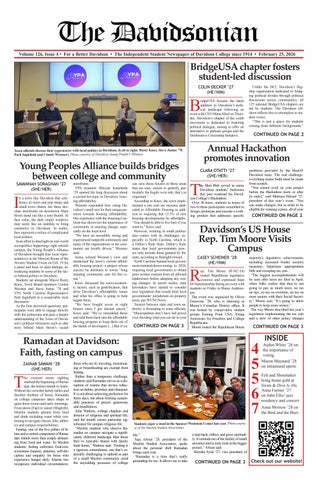
Town officials discuss their experiences with local politics in Davidson. (Left to right: Rusty Knox, Steve Justus ’78, Park Inglefield and Connie Wessner). Photo courtesy of Davidson Young People’s Alliance.
Young Peoples Alliance builds bridges between college and community
Unlike the DCI, Davidson’s flagship organization dedicated to bridging political divides through political discussions across communities, all 125 national BridgeUSA chapters are led by students. The Davidson offshoot reflects this re-orientation to student voices. “This is just a space for students coming from different backgrounds,”
majority’s legislative achievements, including increased border security measures, bipartisan appropriation bills and sweeping tax cuts. “The biggest accomplishments will be seen after taxes are filed in April, when folks realize that they’re not going to pay as much taxes, no tax on tips, no tax on overtime, no tax on most seniors with their Social Security,” Moore said. “It’s going to allow people to keep more money.” The way Moore described last year’s legislation implementing the tax cuts and a slew of other policy changes
CONTINUED ON PAGE 3
4 5 5 6 7
INSIDE
Auden White ’26 on the importance of voting Mason Maynard ’28 on intramural sports Felt and Shoemaker bring home gold at Swim & Dive A-10s Anna Farmer ’27 on John Ellis’ jazz residency and concert Anna Morrow ’28 on the Bird and the Bees
Students enjoy a meal in the Spencer-Weinstein Center last year. Photo courtesy of the Muslim Student Association.
life.” Saja Alwan ’28, president of the Muslim Student Association, spoke about the personal shift Ramadan brings each year. “Ramadan is a time that’s really grounding for me. It allows me to take
a step back, reflect, and grow spiritually. It reminds me of the futility of small anxieties and to truly look at the bigger picture,” Alwan said. Rimsha Syed ’27, vice president of
CONTINUED ON PAGE 2
Check out our website!