davidsonian.com
The PASA/OLAS house celebrates their opening with festivities
Independent Student Journalism Since 1914
April 18, 2023
Volume 121,
Issue 19
The Women’s Tennis team performs well and sees an upward trend in their performance
Living Davidson interviews students studying abroad this upcoming summer
The Yowl presents Spring Convocation awards to the student body
2 4 7 8
Dan Crocker Imagines Future of Dean Rusk Program

position became available, Crocker believed that it would be an opportunity to spend more time with her.
While Dan Crocker began his position as the Director of the Dean Rusk International Studies Program this past year, he has lasting connections to Davidson. He was born in the town of Davidson, and his father taught in the German department at the college. However, Crocker spent much of his career far from North Carolina — he has worked in Europe, Africa, and Latin America in addition to the United States. Crocker also has a diverse array of career experiences. Prior to starting his position at Davidson, he worked as an engineer, spent twenty years in the Foreign Service, and was the CEO of Veracity Worldwide, an international advisory consulting firm.
Crocker’s return to Davidson was partly rooted in professional factors. He enjoyed his most recent position at Veracity Worldwide, but had to work constantly and wanted to bring more balance to his life.
“While I loved the work, I didn’t love the idea of working 24/7,” Crocker said. “I was looking for something professional to transition into.”
While looking for new positions, Crocker was focused on “figuring out what works” and “what creates flow” in a job.
“It’s really important to identify the things that really resonate with you [in jobs],” he commented.
He went on to explain what he valued in a job and why he felt that directing the Dean Rusk program might be a good fit.
“The things that were in the flow for me were coaching, teaching, and mentoring,” Crocker said. “[Recognizing these priorities] led me to this kind of job. I’m teaching and mentoring a lot of students and trying to meet them where they are in terms of what they might do abroad.”
Returning to Davidson had personal significance, too. His mother lived in Davidson and was sick, and when the Dean Rusk
“The fact that the job opened up here at a time when I was segueing away from 24/7 consulting [...] made me think that there was some sort of bigger hand at work here,” he said.
Crocker’s diverse array of career experiences allows him to advise Davidson students with myriad backgrounds and interests.
“I’ve done a variety of things like private sector startup, public service, and consulting. I feel comfortable talking with students and trying to help them work through those things [as they navigate their potential career],” he said.
Crocker hopes that he can encourage students to explore opportunities outside of the classroom through the Dean Rusk program.
“[Davidson] is a serious academic place” where “students are really good at getting good grades and learning a lot,” he acknowledged.
“I would like to see more students really giving themselves permission to step away from the classroom, and at the same time, go abroad, build resilience, and pursue an intellectual passion.”
He hopes that students can spend their summers learning practical skills at an internship or job, immersing themselves in a new language, and expanding their perspectives.
Students have felt the impact of Crocker’s work. With Crocker’s support, Brody Bassett ‘25 secured a summer internship at the American Chamber of Commerce in Cairo, Egypt — a position that will help Bassett work towards his career aspirations.
“I want to work in foreign policy [...] and hopefully become a diplomat,” Bassett explained. “Mr. Crocker has been a great mentor and help in trying to help me achieve that goal.”
Crocker made several connections during his time in the foreign service and hoped that they could help Bassett find his internship. “I have friends at the U.S. Embassy in Cairo, and
I reached out to them first to see if they could host [Bassett],” Crocker said. Unfortunately, Crocker and Bassett soon realized that it would be impossible to do a security clearance in time for an internship at the U.S. Embassy in Cairo. After recognizing this hurdle, Crocker and Bassett pivoted and found the position at the American Chamber of Commerce. “Even through adversity, [Crocker] was really helpful and really willing to try to get me to where I wanted in my career,” Bassett reflected.
Crocker was also enthusiastic about preparing Bassett for life in Egypt. Bassett has taken Modern Standard Arabic throughout his time at Davidson, but Egyptian Arabic differs meaningfully. Crocker hoped to prepare Bassett for this new dialect by connecting him with Horse Education Group,
a personalized language instruction program. Bassett is working with a native Egyptian teacher who currently lives in Charlotte and will be in Cairo at the same time as him.
According to Olivier Giraudo, the CEO of Horse Education Group, “[Bassett] is learning completely new vocabulary and expressions in Egyptian colloquial [Arabic] that will help him integrate, make friends, and succeed in his internship from the commencement of his time in Cairo.”
Crocker’s work prepares students for their futures, and his efforts are appreciated by those he works with. “I feel very blessed that [Crocker] was able to help through high tide and help me get an internship that matched my career interests,” Bassett remarked.
Trump’s Indictment Explained— Trial Awaits
AManhattan grand jury, convened by district attorney Alvin Bragg, voted to indict Trump on Mar. 30th after several years of investigating the payments.
On April 4, former President Donald Trump pleaded not guilty to 34 felony charges related to hush-money payments to adult film star Stormy Daniels during the 2016 election. An indictment is formal charges brought against someone in a criminal investigation. Trump has not yet been convicted, so his plea of not guilty initiated preparation for a trial that will determine his culpability.
Former Trump attorney Michael Cohen paid Daniels $130,000 to prevent her from spreading information about their alleged affair in 2006. After Trump was elected, the Trump Organization reimbursed Cohen in monthly checks, listing the payments as legal expenses. While hush-money payments are legal under New York law, falsifying
business records is a misdemeanor. In order to convict Trump of a felony, Bragg and his prosecutors must prove the records resulted from an “intent to defraud” — deliberately hiding or misrepresenting information for personal gain — including an intent to conceal a second crime. While Bragg has not yet specified the nature of the second crime, the New York Times reports that he has mentioned “the election of a person to public office by unlawful means.”
Bragg and other New York officials claim the indictment proves that no one, not even the President of the United States, is above the law. His team argues that Trump needs to be held accountable for his crimes. The former president is also facing legal challenges in Georgia, where a grand jury is investigating his alleged attempts to influence the 2020 election results.
In a phone call to Georgia’s Secretary of State Brad Raffensburger on Jan. 2nd, Trump urged Raffensburger to “find” over 11,000 votes in his favor. In another legal battle, the Department of Justice is gathering
evidence to support their claims that Trump intentionally interfered with the government’s efforts to reclaim classified documents after the FBI removed over 300 documents with classifiemarkings from Trump’s home in Mara-Lago.
Despite Bragg’s confidence, people across the political spectrum are skeptical of the New York defense attorney’s case. In an interview with the New Yorker, law professor Jed Shugerman claimed that because the Federal Election Campaign Act appears to be the basis for Trump’s charges, “A case like this is for federal prosecutors on a federal question in federal courts, and it is not for state prosecutors and state courts.” Bragg, in both the indictment and the statement of facts, did not cite the specific statutes he accuses Trump of violating. This uncertainty has created doubt around the strength of the prosecutors’ evidence. The hush-money payments to Daniels occurred almost seven years ago, and the public has been aware of the events for almost as long. While the statute of limitations in New York is typically five years, the case
was subject to unavoidable delays between the Mueller Investigation, the pandemic, and other disruptions.
Since the arraignment, Trump has responded by accusing Justice Juan Merchan who will oversee the case, Bragg, and the Manhattan grand jury of “political persecution.” His team has turned the arrest into campaign material. In the first quarter of 2023, the Trump campaign and fundraising committee raised $18.8 million. In the two weeks after the indictment, Trump has raised $16.4 million, including 4 million in the 24 hours after charges were filed. Trump’s charges seem to rally support from his base.
The next hearing will not be held until Dec. 4th, and the trial will likely occur in early January. Trump’s team has already mentioned the possibility of holding the trial in a more conservative district. As the 2024 election approaches, the arrest may continue to influence Trump’s own campaign strategy, especially as Florida Governor Ron DeSantis gains traction in his own Republican campaign for the presidency.
Davidsonian
inside
The
Dan Crocker stands outside the Dana-Watson complex. Photo by Davidson College.
MADELINE RICHARD ‘26 (SHE/HER) SENIOR STAFF WRITER
ISABELLE LORAH ‘23 (SHE/HER) STAFF WRITER
Ambassador Marie Yovanovitch visits Davidson
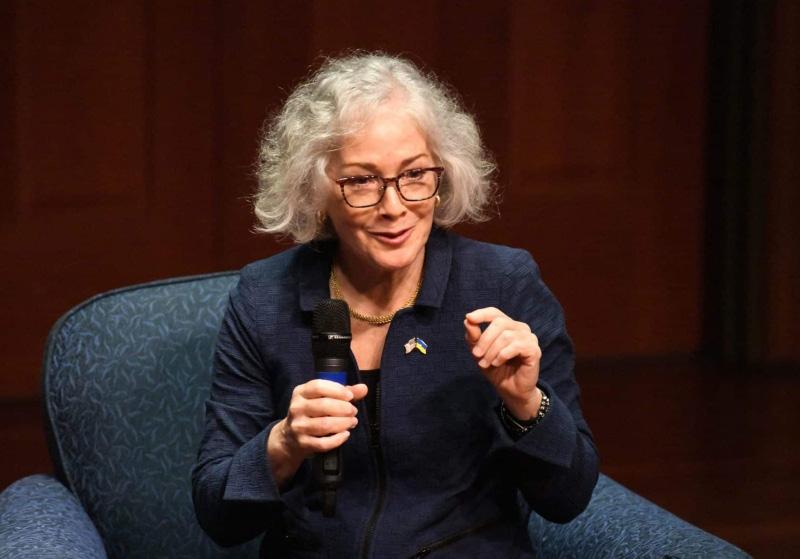
A Conversation with the Former U.S. Ambassador to Ukraine
Marie Yovanovitch is the former U.S. Ambassador to Ukraine, Armenia, and Kyrgyzstan. Her memoir Lessons from the Edge recounts her time in Ukraine and testimony during former President Trump’s 2019 impeachment. Yovanovitch discussed her family story, time in the Foreign Service, and thoughts on Russia’s invasion of Ukraine.
PB: Let’s start with a walk-through of your career.
MY: So, I started as a junior officer in Mogadishu, Somalia, and was responsible for administrative tasks. That’s not exactly what I thought my job would be as a diplomat, but I learned a lot. I didn’t have much support, so eventually I left for London, where I found my career.
I worked for three ambassadors, who made me realize you can be yourself and be successful, which was important because there weren’t many role models for women in the Foreign Service then. After London, I went to Washington, Moscow and Ottawa as a political officer, deputy on the Russia desk, and the War College. Then I ended up in Ukraine for the first time. After that, I went back to Washington and out again as Ambassador to Kyrgyzstan and Ambassador to Armenia, then Washington for several “alphabet soup” positions in the State Department. I thought about wrapping up my career, but in 2016 they needed an Ambassador to Ukraine, so I spent three years there before being pulled out.
PB: Your book explores your family’s story and your career as believing in America as an idea. How did that resonate with working in the Foreign Service?
MY: My parents were refugees who grew up in totalitarian countries and knew what it was
like to live without freedom. When my family moved to the U.S., they raised my brother and me to appreciate how fortunate we were to live with freedom. We have responsibilities because, in a democracy, everybody has to do their part to keep that democracy thriving. I took several detours but joined the Foreign Service because of my passion for history, policy, and foreign countries. My old boss once said there’s nothing better than going to work and having the American flag in the corner of your office. That stuck with me.
PB: What are your thoughts on the current state of American democracy?
MY: I still believe we are the shining city on the hill, as Ronald Reagan said. We are still an inspiration for many countries, and certainly for people in countries of the former Soviet Union. Where do people want to come for a better life and where freedoms are protected?
It’s not Russia or China. It’s the U.S..
PB: And Ukraine’s path toward democracy?
MY: In the 90s, the referendum for independence showed the whole of Ukraine wanted independence, including the Russianspeaking parts. Through several elections, and two revolutions, it was clear Ukraine was on a trajectory toward the rule of law and Western values. That became crystal clear in 2014 during the Revolution of Dignity, which led then-President Yanukovych to flee to Russia with billions of stolen dollars. Reform is demand driven by the Ukrainian people.
PB: Let’s talk about Russia, where democratization looks bleak. Do you see anything on the horizon?
MY: Putin has shut down civil society, opposition, and the free press. It’s hard to see any tender shoots of democracy growing but never say never. History goes in cycles, and Russian history has had retrograde eras followed by assassination or other events, and then suddenly periods of reform. Unintended effects from the war might create
circumstances where the Russian people can begin to move toward a more free state.
PB: There are two camps of experts on Putin. One says he became more radicalized, and the other is that Putin’s ambition was always for another Soviet Union. Which one do you fall into?
MY: I don’t think he’s changed much. He was a KGB officer. There may have been a time for things to go differently. Famously, Clinton, Bush, and Putin discussed Russia someday joining NATO. In the 1990s, we had a good partner in Russia and worked hard to bring them into the community of nations. We wanted Russia to see the benefits of the so-called international order. In the early 2000s, Putin was a new president who mostly continued that trend, and for me, there was
hope even as, from the beginning, he put down his population.
PB: How do you rate the Biden administration’s support for Ukraine?

MY: The Biden administration is doing a pretty good job. A year ago, we would never have predicted how not only the U.S. but other countries supported Ukraine. [...] This is an existential fight for Ukraine. They have three choices: become Russified, killed, or spend life in a camp. None of these are acceptable to any Ukrainian I know. They will keep on fighting, and contrary to Putin’s propaganda, Ukraine has its own people, culture, and language. If Russia succeeds, it will keep going in Ukraine or further west. That’s not in our interest or the world’s, so it’s best for us to help Ukraine successfully defeat Russia in Ukraine.
News 2
PETER BECK ‘25 (HE/HIM) STAFF WRITER
4:00-5:00 pm 4:00-5:00 pm 11 pm - 2 am 1:00 - 4:00 pm 1:00 - 4:00 pm 1:00 - 3:00 pm 1:00 - 3:00 pm 10 pm - 12 am 11 pm - 12 am 11 pm - 12 am Acapalooza FIJI House
Ambassador Yovanovitch speaks at Davidson. Photo from the Town of Davidson Website
Spring Frolics Event Calendar
UB Frolics Fanny Packs Commons Patio 4:30-7:00 pm Alpha Phi Alpha Cookout Duke Courtyard 5:00-7:00 pm 8:00 pm 11 pm - 2 am Friday Saturday NPHC Yard Show Union Ampitheater UB Spring Concert: Rico Nasty BSC Party BSC House Tropical Frolics KSig House FIJI x Turner Foam Party FIJI House Phi Delt Crawfish Boil Phi Delt House BSC Party BSC House SAE x Warner Darty Warner House Frolics Party Connor House FIJI x Lambdas Flapjacks FIJI House BSC Fish Fry Lampus
Successful Opening of the PASA/OLAS House
ARSHI HUSAIN ‘26 (SHE/HER) FEATURES EDITOR
PC House #12 officially opened as a communal space under the names of the Pan-Asian Student Association (PASA) and the Organization of Latinx American Students (OLAS) on Thursday, April 13. After a year of conversation s between the two organizations and the school administration, PASA and OLAS celebratorily opened the doors to the house.
Looking back at how the repurposing process for the old Kappa Alpha house began, a team was created from student applicants and staff across campus, representing a diversity of opinions and perspectives in fall of 2021. They relied on IdeaTrek, an idea submission and evaluation platform with parameters for submissions, comments, and feedback and a timeline for moving forward. This committee invited the campus community to give suggestions on how the space should be utilized. By the end of the semester, it had identified the OLAS/PASA house as the best possible usage.
Simultaneously, the PASA and OLAS executive boards expressed a need for the house. In a letter to the Activities Tax Council (ATC), they wrote, “We desire a place where we can form a community and leave a legacy to pave the way for future students. The house will be used for a variety of events for hundreds of students, allowing them to reconnect with their cultural roots.” These events include movie nights, information panels, cuisine socials (such as boba, Cafecito, or hotpot events), trivia, book clubs, and study halls to promote learning and inclusion.
PASA and OLAS, both equally large affinity groups on campus, have worked together for several months to talk about the nuances of the layout of the house.
“PASA and OLAS are very united, and when it comes to the house, we all work together,” said OLAS House Manager, Israel Cabeza Diaz ‘26.
They have moved through the process democratically, voting on what color the rooms should be, what kind of furniture the house needs, and how the house should be used for events.
Both affinity groups also took turns touring the Black Student Coalition (BSC) house and took guidance from BSC executive board members. Similar to the BSC, the PASA/ OLAS house will be a dry house and members will be charged a $15 fee per semester, or a $25 fee per academic year.
Other student groups may use the house as well.
“Any organization is open to use the house, but they must sign up by filling a form,” Diaz said. “OLAS and PASA take precedent over other organizations to use the house.”
The PASA/OLAS house stands as a physcial manifestation of dicersity on campus.
“Students will be given the opportunity to see ethnic and cultural representation on campus and connect with a community that allows them to nurture a vital part of their identity,” Diaz said. “It will provide a safe space for all students at Davidson who support and encourage diversity.”


ATC Chair Bryce Anthony ’23 shed light on how the ATC and administration helped facilitate the conversion of the house,
“As far as the ATC’s involvement goes, Mike Goode played a crucial role in getting the house to where it is today,” Anthony said. “He’s been there throughout the entire process and made sure that it was done in the best way possible.”
According to Anthony, the year-long wait for the house to open was necessary in ensuring that it would serve its purpose adequately.
“Technically the OLAS/PASA house could have been moved into right after they settled on the idea but [Mike Goode] kind of slowed things down and made sure that when OLAS and PASA moved into the house, that it would be done in a way where these organizations could really love everything about the space and want to/be able to use it for many years to come.”
The opening of the house marks a significant moment in the history of the college.
“This was a really unique opportunity,” Anthony said. “The only other project on campus that has been similar to this one was the construction of the Spencer Weinstein Center [for Community and Justice].”
The PASA/OLAS house will continue to grow.
“This was [only] phase one of the house,” said PASA President Audrey Meigs ’23. “It included putting in new shelves, getting the rooms painted, cleaning out the basement…”
“The big thing for the summer is putting a ramp at the front of the house for accessibility and getting the bathrooms remodeled to make them gender neutral.” Diaz added. “We want the house to become a place of unity here on campus, a space where people can be themselves.”
The house already is being utilized for events and by various organizations. The Davidson Lambdas, for instance, reserved the space for their New Member Celebration. Similarly, PASA is taking full advantage of their new space by planning Asian alumni events at the house.
Meigs further emphasizes on the need to have a space that connects different affinity groups on campus.
“The house is going to be a really important space for affinity groups to be in dialogue with each other,” Meigs said. “We need that.”
3
Crime Log Time Reported Description/Location 04/16/23 at 1044 hrs Injury to Property Offense Armfield, Further Investigation 04/15/23 at 0217 hrs Alcohol Offense: Consume under 21 Richardson, Inacctive 04/13/23 at 1220 hrs Larceny offense: Misdemeanor Larceny Belk, Inactive Features
PASA and OLAS members celebrating the opening on April 13. Photos by Sydney Schertz
The DCI and the Commitment to Freedom of Expression Perspectives
Iwould like to respond to the recent “The DCI Threatens Diversity and Justice Efforts” Perspectives piece by providing, for the first time, background on our attempts to have Chloe and Halle Bailey visit Davidson College during the spring of 2022. The duo, signed by Beyonce’s management company, are my nieces. I knew enough about their schedules to know there was a small window of opportunity to get them here as part of our “Freedom of Expression Week.”
They were not being recruited to perform, but to give students insight into how to express themselves in the face of criticism. For instance, they had to decide to either join other black artists who were boycotting the Super Bowl in Atlanta in solidarity with Colin Kaepernick, or sing before the game as planned. To make either choice would be to disappoint some in their fanbase, as well as others. Chloe has had to navigate the intense scrutiny that comes with becoming a woman on her own terms after being in the spotlight for several years as a girl. While Halle’s role in The Little Mermaid has come with great fanfare, it sparked a racist backlash. Some suggest Disney should not have cast a black woman lead.
Of course I am biased – I am a proud uncle – but there is little doubt they have a lot to offer college-age students (and others) struggling to find and own their voice in an often-confusing and unkind world. That is why we pursued them. But there were serious logistical hurdles. COVID-19 had worn out faculty, staff and students. And it would have meant a significant investment, the kind the college has only made a handful of times for high-profile speakers. Chloe and Halle rub shoulders with Beyonce and Jay-Z and the Obamas, and have been up on the Grammy’s and Oscars. They have earned that status.
A campus-wide survey showed a high percentage of Davidson students often self-silence for fear of peer reactions, as well as a need to “look smart,” which makes it less likely they will take risks and challenge themselves, and others, hampering their own educational pursuits. The greatest breakthroughs in a variety of fields are often the result of people willing to be wrong in public, to push against boundaries, to help us all see the world anew. That is less likely to happen if never upsetting peers becomes a priority for students. Chloe and Halle would not be successful had my brother Doug and sister-in-law Courtney not risked pushing their daughters beyond what we had known and experienced while growing up in South Carolina, or if Chloe and Halle self-silenced rather than pushing themselves through uncertainty.
There was another reason, mostly unspoken, that made nailing down their appearance difficult. It was clear some people were unconvinced that two young black women entertainers were the right fit to be the main draw at a free
speech, freedom of expression and academic event. They believed First Amendment lawyers, maybe a few high-profile journalists and the like, made more sense. I strongly disagreed. You know who else disagreed? James Martin.
Martin is a Davidson alumnus. He is a former faculty member. He was governor of North Carolina. And he is a member of the much-discussed Davidsonians for Freedom of Thought and Discourse. He was on board with the plan almost immediately because his goal really is about fostering a robust exchange of ideas on campus, a bedrock of any institution of higher learning whose primary goal is academic excellence.
I know this because I headed up the group that produced, at then-President Carol Quillen’s request, the “Commitment to Freedom of Expression” statement that was recently affirmed by Davidson’s faculty and Board of Trustees. That group included Political Science Professor Susan Roberts, Trustee Beadsie Woo, students Jared Herr and Varun Maheshwari, and Martin. The author of “The DCI Threatens Diversity and Justice Efforts” Perspectives piece suggested DFTD produced that statement. That is not true. Our group did.
I will not speak for other members of our group, but I can speak for myself. I would not have been involved in such an undertaking if it would bring harm to vulnerable students. I was once one of those students, a black student from a rundown segregated high school with a severe stutter sitting in the back row of a Chambers classroom surrounded by white students and a white professor. I know how difficult it is to be in such settings. I have not forgotten. I cannot forget. It informs my teaching and writing to this day. It is also why I know efforts like the statement, and what the Deliberative Citizenship Initiative does, which came under heavy criticism in that piece, is vital to Davidson’s overall mission and among the best ways to ensure the progress we have made on diversity, inclusion and equity are neither squandered nor rolled back. DCI also quickly partnered with us for Freedom of Expression Week and was onboard with bringing in Halle and Chloe, something that did not happen because it took a bit longer than we would have liked to nail down the finances and logistics.
That does not mean I do not disagree with Martin on a variety of issues, because I do. Neither do I mind saying I have vehement – passionate and deep-seated – disagreements with DFTD. Though Martin is not, some of their members are hostile to diversity and inclusion efforts. I have heard some of them say pretty nasty things about students and faculty who dare not see the world the way they do.
I support DCI. It provides a valuable service on campus. I suggest going through their training. I have. In my classes, as well as during DCI exchanges, I have seen reluctant students time and again demonstrate that they are much tougher – can handle the toughest subjects – better than many gave themselves credit, better than they believed they could. But the only way they can demonstrate that strength is to be challenged, which is
Transparency with Student Experiences
ADMITTED STUDENTS DEMONSTRATORS
Congratulations on your acceptance to Davidson College! We are so proud of you all, especially those of you who have had to overcome extra hurdles to make it to this point. Your hard work has paid off, and we hope you are celebrating your achievements. We are so excited for you and glad that you are considering Davidson as you navigate the world of college decisions.
We want you to know that if you choose Davidson, we will welcome you with open arms and support you along your way. There is so much potential here, with strong academics, brilliant professors, and a wealth of opportunities. However, we also want you to know some of the things we wish we had been told before we began our first semesters. There are some experiences you probably have not encountered in the picture of Davidson that has been painted for you so far. Please note that everyone’s experience at Davidson is different, and the stories here are in no way everyone’s story.
Davidson’s need-based financial aid sets it apart from many similar institutions and has opened the doors to Davidson’s elite academics and vast opportunities to many students who otherwise would not have accessed such experiences. We want you to be prepared for the fact that Davidson’s promise may fall short of your full need,
especially when it comes to housing, food, textbooks, healthcare, and other necessities. Many of us have found ourselves unsure of how to move forward when our need-based aid and student loans (because yes, many of us do still take out federal loans) do not stretch as far as they need to. If you choose Davidson, make sure to ask about resources like Lula Bell’s early on. Unfortunately, you will have to learn how to advocate for yourself, as guidance in many cases is difficult to find.
Another reason students are attracted to Davidson is the close-knit community formed by its nature as a residential college. Living on campus has been a positive experience for many, but it comes with numerous frustrations as well. Because Davidson continues to over-enroll, flexibility in housing has been decreasing over the past few years. You will find that many of the dorm buildings no longer have community lounges, as they have been converted into student dorm rooms. Additionally, you may find it hard to move away from roommates or hallmates who create a negative living situation. This lack of flexibility further compounds the already-existing lack of alternative housing options, such as having few single rooms, lack of accessible housing options for students with disabilities, or any gender-inclusive housing. The structure of our housing has left students feeling uncomfortable, isolated, or even unsafe at
why they need opportunities to flex those muscles. Time and again, I have seen Davidson students rise to the occasion in uncomfortable situations instead of crumbling.
That does not mean I would have set up the event the “The DCI Threatens Diversity and Justice Efforts” author excoriates in precisely the way the DCI did. That does not mean that my way would have been better, just different. That’s how true diversity and inclusion work. We must provide a multitude of ways for students to engage on serious subjects inside and outside of classes – especially on subjects where there is deepseated disagreement. That is why I also had no problem with students protesting the event, and why we made it clear in the free expression statement that robust, loud and even messy protests are part of a healthy campus environment.
But I also must be clear about my disagreements with the protesters’ rationale, that a speaker they believe has said awful things about trans people should not have been allowed to visit Davidson. If that logic was applied to me, I would not be allowed to speak on campus. I certainly could not teach the way I have. It would not be hard to dig up a few quotes of mine and paint me as a radical whose words might harm students who do not look like me. No potential speaker could withstand such scrutiny. Davidson College has a responsibility to provide a safe environment for students to learn and live. A part of that responsibility is ensuring those who differ from us – politically, ideologically, faith-wise and beyond – have a chance to be heard in a way they think best. Sometimes that means bringing in speakers I disagree with, sometimes speakers I like. DCI’s mission is to deal with complex issues in a deliberative manner. That would not be possible if they only included speakers who agree with each other.
Doubling down on the principle of free expression and speech is becoming more necessary by the day as legislators in North Carolina and in a growing number of states use their powers to pass censorship, implement book bans, and make it harder for vulnerable groups to speak and be heard. Davidson should position itself as a bulwark against that trend. We won’t be able to do that if we don’t stand firm first.
This is an institution of higher learning. The goal is not to ensure that each of us is comfortable or agree with or even like the people around us or those invited to campus. The goal is to help us become our best selves. And sometimes that means discomfort. If you leave Davidson after four years without ever having been discomforted, the institution has failed you. That would be real harm, and a real tragedy.
Isaac Bailey ‘95 is the James K. Batten Professor of Public Policy and a decorated journalist. He currently serves as the Laventhol Visiting Professor at the Columbia Journalism School. He can be reached at ikbailey@davidson.edu.

times.
You should also know that, as on any college campus, sexual violence does happen at Davidson. While the school has some resources in place to address it, such as the Title IX office and the Students Against Sexual Violence group, survivors frequently report feeling that the options are insufficient and do not meet their holistic needs. Additionally, a recent survey by SGA found a pattern of underreporting in cases of sexual violence on campus. For more information, please see the recent speech by Student Body President Ronan Towell in the previous issue of this paper.
We also want you to come to campus being aware of the history behind Davidson’s status as a predominantly white institution. The Commission on Race and Slavery did important work uncovering a basic timeline which can be found on Davidson’s website. To current students reading this, we also recommend the Davidson College Archives and Special Collections, which house invaluable information about the college’s history. The school has made important progress, and we celebrate steps such as the official apology from the institution and the inclusion of descendant communities in our planned new monument. However, there are many needs that have yet to be addressed, such as a descendant’s scholarship and the legacy box on admissions applications. The impacts of our unjust history are tangible for
many students of color as they navigate life at a PWI. If you would like to learn more about the experiences of students from minoritized backgrounds, the Davidson Microaggressions Project collected stories from 2019 to 2021 to raise awareness about microaggressions on campus, and they are available on the project website. If you choose to attend, we hope you will find community with programs such as STRIDE and affinity organizations, including (but not limited to!) BSC, OLAS, or PASA. We also hope you will join us in advocating for a more equitable and just Davidson College. We say this not to scare you from Davidson but to make you aware that, like any other institution, Davidson is flawed. While many many students have an amazing time here, we want to be transparent in saying that life for some students, particularly students from minoritized backgrounds, can come with unexpected challenges. Should you choose to become a Wildcat, we welcome you to join us in working to challenge Davidson to live up to its promises of empathy, justice, and inclusivity.
If you have any questions about the challenges we have encountered, the changes we had personally like Davidson to make, or any improvements you would like to see, we invite you to email us at davidsonresources23@gmail.com.
4
PROFESSOR ISSAC J. BAILEY
Spring Golf Recap: A-10 Championship Looms Large
VINCENT SCAUZZO ‘24 (HE/HIM) SPORTS WRITER
Just as the spring season brings the miracle of new life in the form of blossoming bright pink and yellow flowers, chirping chickadees, and the shade of green in the trees that makes you stop and take a picture, so too does it bring the burst of magnificence and wonder that is the tournament success of the Davidson College Men’s Golf Team. Every year, it seems, the archers and artists that comprise this troupe make their run in the A-10 Men’s Golf Championship with a high probability of victory. Anything besides this occurrence would be out of place, like a dogwood failing to produce its white crossshaped flowers and skipping straight to dark leaves.
This spring has been especially beautiful for this team. At the Sea Palms Invitational on St. Simon’s Islands, GA, they put up a recordbreaking 43-under par to blast any competition away by thirteen strokes. The tournament included strong individual performances from the usual suspects: Will Davis ‘25 and Josh Stewart ‘25, tied for third, each posting 11-under for the three-day event. In the prior tournament at Palmetto Golf Club in South Carolina, Brian Garrett ‘23 tied for second with a score of four under par. The driver he said he had been working on during the offseason has certainly come around to be a weapon in his bag and not a worry.

Indeed, this lack of anxiety is tangible throughout the team. Talking with Alex Heffner ‘24 and Garrett, one really starts to believe that this level of performance, this expectation of victory and rate of success, is inseparably sewn into each player’s conscious. The furrowed brow and the firm grin that frequent Heffner’s visage embody the emotions of the team all
in one look. They carry out their physical and mental preparation for the game with great severity, gravity, and intensity. However, they are not oblivious to their potential. Four of the five players competing in the championship have been there before. They know what it is like to win. They know they can do it again.
The greatest challenge facing them, then, is not one of swing mechanics or ball flight, rather, it is one of virtue. The team must embrace their confidence and use it to their advantage, but without becoming arrogant, losing their focus, and letting the competition creep up on a sleeping giant. Yet, if one spends a mere moment with one of the fine gentlemen from the team, any residual angst or apprehension will wash away. These “cool, calm, and collected” specimens of virtuous exceptionalism (Garrett likes his three C’s) all acknowledge this delicate balance they must manage to stand victorious at the end of the big weekend.
The course itself, the Reunion Resort Nicklaus Course in Kissimmee, FL—suits the multidisciplined team well. The long, wide fairways of the will receive the players’ whistling Titleists like a broken-in catcher’s mitt. The firm, fast greens, big as the ground floor of the library, will be putt on as delicately as if they were made of glass. Everything in between—every sand shot, flop shot, and sweet-spot struck seven-iron—will be executed with the precision of neurosurgeon. It is not as if the burden falls on one or a few members of the team. For instance, Will Davis ‘25 might not be the longest hitter in the field, but he knows he has got teammates who can cover him in that department, along with 13 other clubs in his bag that can more than make up the difference.
As for the competition, the primary threat remains the Virginia Commonwealth
University. The Rams of Richmond have rebuilt much of their team for this season, collecting players from Texas A&M and the University of Tennessee, to name a few big shots. They have put up some good numbers this year, but where lesser programs might dread the mere thought of running with such opposition, the focused men of the Davidson team are not the kind of people who look at the leaderboard. They know all they can do is concentrate on themselves and manage their game.
The starting five for the tournament will be seniors Brian Garrett and Ethan Hall, junior
Alex Heffner, and sophomores Will Davis and Josh Stewart. Through their exceptional performance and consistency throughout the season, these young men have earned their positions to represent our school in that great arena in central Florida.
The tournament will run from Friday, April 28th through Sunday, April 30th. Now, we can only hope that spring will continue to bear the blossoms and fruits it’s brought so far and will have the Wildcats stand victorious for the third year in a row.
Davidson Women’s Tennis Hits Its Stride
VICTOR TAYLOR ‘24 (HE/HIM) SPORTS EDITOR
Davidson Women’s Tennis has had an up and down season so far, with the team battling injuries and other obstacles on their way to a 6-12 record to conclude the regular season. However, with the team fully healthy again and hitting their stride at the right time, the conference championship will be an opportunity for the Wildcats to make some noise.
The last four matches of the season have been a big positive shift in momentum for the team. With number one singles player Josie Schaffer ‘23 working her way back into the lineup,
the ‘Cats squeezed out a 4-3 win against local foe GardnerWebb, with Linden Patterson ‘25 clinching the final match. They followed that up with a dominant 4-1 decision against George Washington to claim their first conference win of the season.
The last weekend of the season was by far the most difficult one of the year, with longtime champions VCU and a strong Richmond squad visiting the ‘Cats on home turf. Normally a steamroller in the conference, Davidson put the Rams through a dogfight, coming up just short in the last singles match of the evening. Another tough fight ensued with Richmond, with the Cats losing 1-5 to conclude the season. However, the performances put in by the team were some of the most impressive of the year, meaning the squad is trending upwards
at the right time.
A-10 Rookie of the Week Savanna Kollock ‘26 has gone 11-4 this year, leading the team in Win/Loss percentage and being a rock at the #5 singles spot. She has also gone 10-4 in doubles, playing with both Schaeffer and Patterson as they have made a consistent impact at #3 doubles.
Whatever the end result may be for this squad, the ‘Cats will have solace in knowing that they are rounding into form at the right time. If this team wins a match or two before seeing one of the top teams in the conference, it will make them ready to give every team a battle.
Sports 5 Standings
A-10 Women’s Lacrosse Standings UMass Richmond St. Joseph’s Davidson St. Bonaventure GW VCU George Mason Duquesne La Salle 7 6 6 5 3 3 2 2 1 0 0 1 1 2 4 4 5 5 6 7 W7 W2 W5 L1 W1 L2 L3 L3 W1 L7 1 1 2 4 4 5 5 6 7 Team W L Strk GB A-10 Mens Baseball Standings Saint Louis St. Louis St. Joseph’s Dayton VCU George Mason Richmond Rhode Island Fordham George Washington St. Bonaventure UMass 8 7 6 5 5 5 4 4 4 3 2 1 1 2 3 4 4 4 5 5 5 6 7 8 W5 W2 W2 W1 W1 L2 L1 L5 W2 L2 L5 L1 .889 .778 .667 .556 .556 .556 .444 .444 .444 .333 .222 .111 Team W L Strk W-Pct
Update
Ethan Hall ‘23 admires a shot. Photo by Tim Cowie
Arts and Culture 6
Senior Art Exhibit: Inside Natalie Hall’s “While You Were”
 INTERVIEW AND ART COMPILED BY KATHERINE MARSHALL ‘26 (SHE/HER) ARTS AND CULTURE EDITOR
Senior Natalie Hall ‘23 displayed her art in the Van Every Smith Galleries during the last week of March, and she was the second of three art majors to have their work displayed this spring. Hall’s exhibit, titled “While You Were” consists of several paintings that combine images from magazines or archives with text from other sources. What follows is a brief interview with Hall about her work on display.
How long was this exhibit in the works? What all goes into this component of the art major experience at Davidson?
In the fall of senior year, art majors all take their 401 capstone class. Essentially the sole purpose of the class is to make the body of work you plan to show in the spring, and this is when most of my paintings were started. I completed or started the majority of my paintings during the fall semester and spent most of the spring fine-tuning them and then creating a couple smaller works. I work really slowly, so I found myself going back into most of my pieces throughout both semesters.
How have you seen your art change in your time at Davidson, and how did this change culminate in your exhibition?
My art changes a lot depending on what medium I use, but in painting, it’s always had a handful of consistencies. One of the works in my exhibition, “While You Were,” is actually from my sophomore year painting class. I chose to include it because despite it being an outlier in terms of when I made it, I thought it had a lot of similarities to the body of work I made this year.


I think my work has become more complex as I’ve learned and grown as an artist and student, but there are definitely consistencies that I think will always appear in my work.
In your artist statement, you mentioned the challenge of navigating copyright while creating your works, navigating ownership. How do you consider ownership when it comes
think the concept of working with an image or reference until it becomes something unique is something a lot of artists do. Plus, I think after wrestling with copyright and ownership for a year, it would feel ironic to turn around and say that no one else could ever own “my” work or idea. With such intense media saturation resulting from social and digital media, I think it is going to be an increasingly common roadblock that artists must navigate around, and I’m curious to see how others will do it.
How do you see your art, and even your senior exhibit in particular, playing a role in your life postgrad?
to your own art? Do you feel like you own these works and/ or the idea behind them? How does that feel different from the ownership you mentioned that is solely in regard to the media usage of the original images?
Ownership was something I spent a lot of time navigating this year, and I wouldn’t say I fully have it figured out yet. I feel like I own my works in the sense that I physically brought them to fruition, but I by no means feel like I own the idea behind them. I
As of right now, I don’t have any concrete plans that my art will play into. I’ll likely go back to school in a year or two to pursue a masters or PhD in clinical psychology, which doesn’t seem overtly tied to my career as an artist. However, I had no intention of studying art in college, and found myself a double major. I think it’s more of my identity than I tend to give it credit for, so I’m equally curious how it’ll end up coming into play. I think the practice of working and creating with the goal of a show was unlike anything I’ve been asked to do as a student, and it’s an experience I’ll take with me wherever I go. Having people see your art and engage in their own personal dialogue with it was something I’d never experienced, and that feeling of facilitating such a personal moment between strangers felt special. So although I don’t know where I’m going next, I don’t doubt that everything I’ve learned will find its place in my life.
2023 Frolics Artist Lineup
RICO NASTY
Known for her self described “sugar trap”, Rico Nasty rose to prominance in 2018 with her singles “Smack a Bitch” and “Poppin”. Nasty’s sophomore studio album Las Ruinas was released last summer. She’s an ambassador for Rihanna’s lingerie brand Savage X Fenty and has performed with Playboi Carti and Gucci Mane among others.

TONE STITH
Tone Stith is a contemporary R&B artist, his debut alum Can We Talk came out in 2017 and his second, FWM, was released in 2021. Stith’s music has featured artists such as H.E.R, Swae Lee and Quavo.
Natalie Hall’s work and artist statement can be viewed through a virtual gallery tour on the Davidson Art Galleries website.
Bizzare Life (top), In Times of Trouble (left), Macho Man (right) Photis by Natalie Hall ‘23.
Living Davidson
Tell me about your Finals Schedule and I’ll tell you what you should do this Summer!
Happy finals season, everyone. Hopefully you’re not reading this through your tears (and if you are, don’t let the Newspaper get wet. It did nothing to deserve that treatment.), but if you are, let me ease your mind a bit by focusing on the future past finals - read on to get some advice about your summer (you’re so close, I promise!)
Let’s start simple - how many finals do you have?
A 2- Not the worst, not the best
B. 3 (but they all are really gonna suck so you think you should get the treatment as if you have 4)
C. 4…yes you have been crying a lot lately, how did I know?
D . Just 1, suckers.
Do you have to take any reviews through the exam center/in person?
A . Yes, in person in class.
B . No, you only have papers/projects.
C . Yes, more than one in the exam center.
D. No, all your reviews are take-home.
Mostly A’s: Find a new hobby - Remember the couple weeks of quarantine where you decided that you were going to uncover your secret artistic talents? And how that new hobby died before it even started? Well, it’s time to return to your roots. Maybe watch some youtube tutorials on knitting,
Mostly C’s:
Take a nap - I am dead serious. Please, just give yourself time to take a nap for as long as you need. If you wake up disoriented 6 hours after you originally fell asleep, consider it the blessing it is.
How’re you planning to procrastinate studying (oh come on, we know each other well enough now to be truthful…we both know you’re gonna do it!)
A. Pretend you’re studying and really just stare off into space and daydream (a personal favorite of this author’s)
B. Clean, do your laundry, answer emails. In other words, become the most productive person in the world when it comes to everything but your schoolwork.
C. Do daily mental breakdowns count? Because if they do, that’s your chosen fashion.
D. Binging TV (as in - you haven’t gotten out of bed for the past couple days and your roommate quietly asked how you were feeling this morning)
Mostly B’s: Take a vacation/staycation - I don’t care if you go to the beach, the mountains, to another country, or to a park in your hometown for the day, but my advice to you is to give yourself some new environment to relax in this summer.
Mostly D’s: Update your Linkedin - This may seem like a small task, but I KNOW you have been putting it off. You have no excuses over the summer, so you better do it while you have the time.
MAGGIE THRALL ‘26 (SHE/HER)
We Are Wildcats is a human-interest column that aims to share the extraordinary within the ordinary at Davidson College and to showcase the inspiring things that make each and every Wildcat unique. If you wish to be featured or know someone whose story needs to be heard, please feel free to contact saathreya@davidson.edu! Stay tuned for future stories! This interview has been edited for length and clarity.

With more than 80% of Davidson College students choosing to study abroad during their four years, there are hundreds of options available. Ranging from Prague to Jordan, students have the opportunity to dive deeper into their studies while immersing themselves into new and exciting cultures. Aidan Rose Devlin ‘26 and Carolyn Thompson ‘25 are two students who have struck at the chance to gain a new perspective. AR plans to travel to Amman, Jordan for a summer abroad learning Arabic and Carolyn to Copenhangen, Denmark for her fall semester as a junior to expand her psychology and neuroscience education.
And finally, how are you predicting your finals will go?
A. You will take the win of finishing them no matter how they actually go, if you’re being honest.
B. Probably decently - you’ve definitely worked hard enough.
C. They WILL go well, whether they want to or not.
D. You’re just aiming to pass…
Check Your Answers Below To See What You Got!
Study Abroad Interview with Aidan Rose Devlin ‘26 and Carolyn Thompson ‘25
What interests and excites you about studying abroad?
AR: I’ve always loved to travel, and being given the opportunity to both travel and pursue my studies simultaneously is something that I look forward to here at Davidson. Immersing myself in a culture different from my own is something I feel is important to understanding others and the world as a whole. I am beyond excited to spend my summer in Amman, Jordan, strengthening my Arabic skills and deepening my understanding of Arab culture. I am lucky enough to be going with my friends and I look forward to the new people I am going to meet during my abroad experience.
Carolyn: I’m very outgoing and greatly enjoy travel and new experiences. I’m especially excited to get to live with a mix of American students from all over the country and Danish students while studying in Copenhagen.
How did you learn and decide on your location and program?
AR: The program I will be attending this summer, Qasid Arabic Institute, is a highly regarded program by the Arab Studies Department at Davidson. During the beginning of my first semester, my Arabic professor encouraged our class to consider applying to study abroad for Qasid’s summer term. I spoke with many upperclassmen and other Arab Studies majors/minors about the program, and I have only heard amazing things about their experiences in Amman. I want to study abroad throughout my time at Davidson and I found that this would be a great opportunity to gain proficiency in my Arabic and experience studying abroad early.
Carolyn: I learned about the DIS Copenhagen program through my freshman roommate. Her sister graduated from Davidson in 2021 and had participated in the program during her time at Davidson. As a psychology major and neuroscience minor, the classes available to me in the DIS program fit my interests better than any other Davidson affiliated program.
Have you talked to other students about their experiences abroad? What have you heard and learned?
AR: I spoke with many Arab Studies students about their experiences at Qasid. Although Covid affected many students’ experiences traveling abroad, I have heard amazing things about Qasid and the students’ experiences in Jordan. I’ve heard that the program is very rewarding as students’ Arabic skills are notably stronger at the end of the program. Students have told me that they are given lots of free time outside of classes to explore the city of Amman on their own, and can even travel to outside countries. Hearing this is especially exciting to me because not only will I be taking classes and focusing on my academics, but I will be able to explore Jordan and surrounding areas.
Carolyn: I spent a lot of time speaking with my big about her experience abroad in Paris, both while she was there and after she returned. She encouraged me to take advantage of my opportunities to travel and see friends in different European locations during my time abroad. She also encouraged me to branch out and connect with other Davidson students in my location who I may never have gotten the opportunity to hang out with previously on campus.
Anything else you want other students to know about the process of applying?
AR: I think reaching out to upperclassmen who had previously gone abroad is very helpful because they are able to offer personal insight into the abroad experience. Going to the study abroad office is also helpful, but I found that talking to upperclassmen was the most helpful thing for me.
Carolyn: Start early and apply to more than one program! If I could go back in time, I would complete all of my applications before Christmas so that I could have a definite decision on my acceptance status before the new year.
7
Devlin ‘26 and Carolyn Thompson ‘25
Study Abroad Interview with Aidan Rose
Yowl The
Irreverent student journalism since 2004. Castigat Ridendo Mores.
yowl.com/lightup420
T&I Finally Marks All Brent Maher Emails As Spam After He Sends 100th “Student Research” Phishing Scam in the Last Week Page Extended Car Warranty
Chair Chair: Eating House Creates New E-Board Position to Address Lack of Indoor Seating Page Seat at the Table
April 19, 2023
New Career Center Tip: If a White Man Would Apply For This Job, You Should Too Page Davidsonian Arts Writer
This Year’s Spring Convocation Recipients
There’s no better way to start a weekend of binge drinking than a classic good ol’ ego stroke awarding the most kiss-ass students on campus for their mediocre accomplishments before they get immediately crushed by the real world. In addition to receiving recognition at convocation, all recipients qualify for the Who Will Unapologetically Stab You in the Back in Order to Climb the Corporate Ladder One Year From Now Award.
Agnes Sentelle Brown Award: This award goes to a student who shows outstanding promise as indicated by character, personality, and academic ability. Some random committee on campus has given this award to Angelica Samaritan ‘23. Angelica’s hobbies include feeding the homeless, tutoring penniless children, and curing cancer (every Saturday from 1112). She has a 4.999 GPA on a 3.0 scale, is an embedded tutor for every single STEM class offered at this school, and is on the e-board for 27 clubs. Angelica was docked points for accidentally dropping her plate in Commons, but made up for it by writing each employee a personal thank you note alongside a check from her dad.
Ben Callinder Award: This goes to someone on SGA. As a white, Christian male with premature balding, Brad Jacobson ‘23 has been chosen for the Ben Callinder Award since he so strongly imitates Davidson’s long history of boring cookie cutter men. Some of Brad’s accomplishments as part of the SGA include attending at least half of the meetings, reading some of the emails, and only seeking input from his buddies on what should be done.
George Gladstone Award: Goes to two rising seniors exhibiting high potential for service to mankind as indicated by leadership, service, and academic record. Ura Hore ‘24 and Eric Shun ‘24 were both chosen because they matched very vague award descriptions. Next year, they will engage in a Hunger Games-style battle in order to get the Agnes Sentelle Brown Award.
Goodwin-Exxon Awards: Yet another character and service award going to a sophomore, junior, and senior, respectively. Sophomore Cait Lin, Junior Kate Len, and Senior Cate Llyn were all given the award by occasionally posting resources on the Instagram page
for their club which doesn’t do anything.
Charles Malone Award: This award is given by the Chaplain’s Office to the student who best exemplifies the traits of organized religion and is preparing for a life in ministry. Danny Monsignor ‘23 is the recipient. As a Christian musician, he disguises hate and oppression using his soulful voice and magical fingers with ease. Oliver Pastor ‘23 was also up for this award, but, unlike many religious leaders, he has not molested anyone, disqualifying him.
James Baker Woods III Award: Given to an ROTC member. Duke Dukem ‘23 wears his military uniform even when not doing ROTC activities, only eats raw lamb testicles, and works out five times a day. He is a Second Amendment Activist and leader of the Men’s Rights Organization on campus.
Steinway Piano Gallery-Charlotte Award: Given to an outstanding musician. This year the Music Department has removed the qualification that this award goes to a pianist, however, they’ve awarded a pianist anyways–cause why leave performative statements to social justice? This award goes to Rupert Britishname ‘23.
Sandy Black Memorial Award: Given to an outstanding chemistry student. The Chemistry Department awards Madeline Carboxylicacid ‘23. Madeline was the only chemistry student to not kill a rat this year, shows deep knowledge and expertise in bongs, and is finishing up her thesis on hallucinogens.
Environmental Studies Tree Hugger Award: This award is self-explanatory. Dewie Dubey ‘23 hasn’t worn shoes in the last four years, still has his Pura Vida bracelet from 2008, and lives in a remote section of the cross country trails completely off the grid. He also hasn’t attended a single class in the last three years but the Environmental Studies professors vibe with that.
Keiser Prize in English for Classical Performance: The English department proudly awards this award to Jack Goff ‘23. Jack has shown dedication throughout the year but only showing up to class in a toga. Once when he was tripping on magic mushrooms in class, Jack performed, from memory, the parts of all four witches simultaneously in Macbeth Act 1, Scene 4, Lines 1-47.
The Hell Week Issue
Davidson Removes Mental Health Services to Teach Students to “Harden the Fuck Up.” Page #Grindset
White Smoke Coming Out of Commons
Means Davidson Has Chosen a New Nummit Trivia Chair Page Divine Right
Happy Earth Month from the Sustainability Office
After the new football field was a contentious move with students, the administration is looking to finally make some changes that will decrease Davidson’s environmental impact to even out the removal of the trees for the new building. Golf carts will now be exclusively replaced by the peddle-carts your family uses on lake or city vacations. To replace the need for these golf carts, the on campus golf course has been replaced with a giant mound of left over dirt that has been dug out to make the stadium. As a result of methane being one of the largest contributors to greenhouse gas, the herbs and spices line will cease to exist next year as a response to the gas students emit after a second helping of curry. On a similar note, and in a last-ditch effort to get students to buy a more expensive meal plan, weekly swipes will coincide with the number of flushes students can use. Cat card sensors will be installed near each toilet. Showers will be replaced with the opportunity to lather up before standing in a long line of athletes waiting to get under the sprinklers that will still be active to maintain lush Chamber’s lawn. But don’t worry! You can still be everyone’s problem—portable speakers are welcome. In terms of alcohol consumption, get ready to ditch the bottles and cans and get ready for more Davidson-backed prison wine, and putting too much trust in whatever liquid comes out of Ksig’s gatorade container. The heating of Baker pool is contrib-
How to Get Girls: A Man’s Perspective
uting to our energy consumption, so the pool will be drained for the 2023-24 school year. The swim team’s practices will be replaced with VR headsets and going through the motions on the floor. Power will be cut off at sun-down (yes, that includes wi-fi coverage). Get ready for the beauty of libs by candlelight and running down your hotspot. Typewriters and clean burning candles will be provided through Lula Bell’s academic resource center on a firstcome, first-serve basis. Frats on probation will be required to hunt, gather, and harvest food from Davidson’s woods. Heat sources in Chambers will be replaced by your class mouthbreather, and art students will be required to paint other sections of lawn green as their capstone. Nummit will reduce its straw consumption by giving your generic barista a raise to spit your drink into your mouth. In order to decrease cigarette butts on campus, juniors will be asked to stay abroad. It follows that the already insanely high textbook costs will increase to deter students from purchasing more paper. Additionally, when you return to campus next fall, Belk and Chidsey Lots will house parking exclusively for daddy’s Tesla and other B-tier electric cars. Have fun parking! Maybe the new football field will carve out more of the forest for additional spots. Good thing we’re compensating for that! Reduce Reuse Recycle!
I’ve seen enough advice columns full of bullshit that I just had to write one myself. While I choose to remain anonymous, if you knew who I was, you’d know I do well in the TTC (Talking to Chicks) Department. Anyways, I thought I’d help the fellas out and give some sound advice to keep you from walking back home from F alone.
1. Never seem too interested. They like the chase. Every now and then while they’re telling a story pull out your phone to check on your fantasy team or see how your latest bets are doing (probably bad, because you don’t have my bookie).
2. Be knowledgeable about man things. Sports, stock market, lifting. Girls aren’t going to be impressed if you can’t explain something as simple as a 2 point conversion.
3. Let them know how much you respect women. This one’s really important. Women’s equality is super these days, so make sure you’ve got a few societal standards that you just absolutely cannot stand (examples: wage gap, dress codes, household roles). Be sure to share these.
4. Let them know you’ve got female friends. You probably don’t because you’re reading this, but you’ve got to make it seem like you can get along with people of the opposite sex. Be careful with this one though; referring to a girl as a friend may come across like you’ve got a thing with her. It’s safest to refer to other women as “[insert male friend’s name here]’s chick,” or “my old lab partner,” but never refer to them by their name.
5. According to science, or actually a Twitter article I read, the more you see someone, the more likely you are to be attracted to them. Make sure you run into them constantly, passing them as they go to class, or maybe they’ll see you reading Pride and Prejudice or some other book chicks like outside the campus coffee shop. Figure out their class schedule and daily routine. If you have them on Snapchat, figuring out their next move is super easy. You can also buy one of those airtags and slip it in their backpack.
6. Once they start to see you a lot, they’ll obviously start paying more attention to you, make sure you’re doing something attractive at all times. Maybe even pick up a pair of those turtle shell rimmed glasses to wear while you do economics homework in the library - girls love those. Grab a muscle tee and start doing your workout outside, maybe on Chambers Lawn, where she’ll definitely pass you when she leaves class. You’ll look great in the afternoon sun and she’ll realize how strong and dedicated to your health you are.
7. Adding girls on social media apps is so cliche. Nowadays, you’ve got to stand out. LinkedIn is the way to go. Not only do you look stellar in your profile photo, but she’ll see that you’re professional and have a great future set out ahead of you. When she sees your past summer internship at Goldman Sachs, she’ll know you’re an investment for the future yourself.
I’d give you some more tips, but I’ve got to save some ladies for myself. Go ahead and try these out, though. You’d be surprised by how quickly you can get a girl. I’ve never actually had a girlfriend myself, but I know the girls are talking about me - I’ve even overheard them giggling when they pass me working out on Chambers lawn.
QUOTE OF THE WEEK
“Who’s Rico Nasty?”
- Everyone
•
•
•
•
•
•
Note: The Yowl is a satirical supplement to The Davidsonian Hence, nothing in it should be taken as truth.
WRITERS Raunchy Scoop Bro Yowl The
Ideas
Frolics Borg
Renaissance Name
for your
Sandro Borgicelli
Borgelilo Borgilei
Borglightenment
Michelborgelo
Borg-bonic Plague
Leonardo Borg-vinci
inside
