Our 2026 Election Calls
The Building Amendment Bill
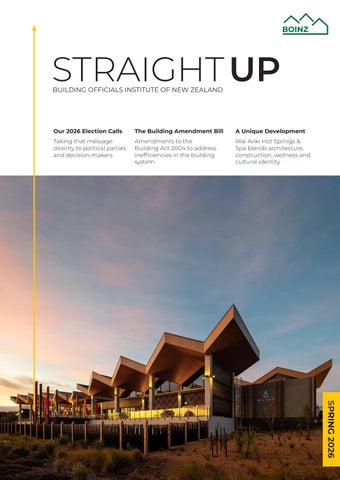
A Unique Development
Taking that message directly to political parties and decision-makers
Amendments to the Building Act 2004 to address inefficiencies in the building system
Wai Ariki Hot Springs & Spa blends architecture, construction, wellness and cultural identity
WHEN NATURAL HAZARDS
meet the
BUILDING ACT
Support for building control officers making difficult decisions in a changing environment. Nathan Speir and Jessica Easton bring a depth of experience to building control officers preparing for, managing, and recovering from natural hazard events. From advising on risk and compliance to emergency response, remediation and litigation, Meredith Connell helps councils make difficult decisions with confidence.
Nathan Speir PARTNER Local Government
Jessica Easton PARTNER Local Government
Trusted legal advisors to local government across Aotearoa.
mc.co.nz
Board President Karel Boakes Vice President Peter Sparrow
Board Members
FUTURE READY
TRACKLOK.COM TESTED AND TRUSTED
Jeff Fahrensohn Jeff Farrell Brent Goldschmidt Denise Whelan
Administration Chief Executive Nick Hill Executive Assistant Megan Miller Marketing and Events Manager Felipe Gomes
EASY COMPLIANCE
Professional Development Manager Kirsty Wallace Events and Training Administrator Jacqui Pfahlert Membership Relations Coordinator Sania Shueb Advertising/Editorial Contractors Advertising/Editorial Please contact the Building Officials Institute’s National Office via marketing@boinz.org.nz
Design & Print no9.co.nz
PROTECTS BUSINESS
ISSN 1175-9739 (print) ISSN 2230-2654 (online)
Building Officials Institute of New Zealand PO Box 11424 Manners Street, Wellington Level 12, Grand Annexe 84 Boulcott St, Wellington Phone (04) 473 6002 The information contained within this publication is of a general nature only. Building Officials Institute of New Zealand does not accept any responsibility or liability for any direct, indirect, incidental, consequential, special, exemplary or punitive damage or for any loss of profit, income or any intangible losses, or any claims, costs expenses, or damage, whether in contract, tort (including negligence), equity or otherwise arising directly or indirectly from, or connected with, your use of this publication or your reliance on information contained within this publication. The Building Officials Institute of New Zealand reserves the right to reject or accept any article or advertisement submitted for publication.
FAST AND EFFICIENT
plans@tracklok.com Distributed through all reputable building supply companies or available online at tracklok.com.
CONTENTS
10
FEATURES
2
REGULATION
INDUSTRY UPDATE
Building Amendment Bill: Proposed Changes to the Building System.... ���������������������������������������������������������������6
Structural Insulated Panels: What Building Officials Need to Know ................. ������������������������������������������������������������� 15
INDUSTRY UPDATE
INDUSTRY UPDATE
From Roadmap to Reality: The Next Step in Concrete’s Low-Carbon Journey... ��������������������������������������8
New Electric Arc Furnace Marks a New Era for New Zealand Steel........ ������������������������������������������������������������� 21
DEVELOPMENT
LEGAL
Wai Ariki Hot Springs & Spa: Building a Landmark in Rotorua ����������������������������������������������������������������������������������������10
The Disclaimer Was There, But So Was the Claim
INDUSTRY UPDATE
DEVELOPMENT
Going for Growth Means Getting the Products Right ��������������������������������������������������������������������������������������������������� 12
Opening the Door to Home Ownership in Queenstown..................... ������������������������������������������������������������29
Straight Up | Spring 2026
�������������������������������������������������������������������������������������������������������������� 22
2027 BOINZ BCA Leaders Forum & Symposium Est 1967
Cordis Hotel | Auckland 31 May - 2 Jun
PAGE 24
PAGE 06
PAGE 08
REGULARS MESSAGE FROM THE CE
A Cause Worth Leading ��������������������������������������������� 4 OPINION
“Marketing” Compliance: When Building Consent Authorities Start Chasing Customers ��������������������13 BOINZ
What Makes a Successful BOINZ Branch? ������� 20 BOINZ
PAGE 15
Share Your Ideas: Call for Papers for the 2027 BCA Leaders Forum & Symposium ��������������������� 24 BOINZ
Seeing Leadership in Action: Maryia Lackansingh on Growth, Confidence and Taking Up Space �������������26 TRAINING
PEOPLE
Leadership and Learning �����������������������������������������27 INDUSTRY UPDATES
A Truss Evolution with J-Frame: Certified and Ready for Your Truss Systems ���������������������������������31
SPOTLIGHT ON A MEMBER
Spotlight on a Member - Corinne Hamlin �������� 17
Spring 2026 | Straight Up
3
MESSAGE FROM THE CE
A Cause Worth Leading In July, I asked readers of CodeTalk to consider what professional life would look like without BOINZ. The response from members was strong. It reinforced a simple truth: BOINZ matters because, in the words of NZ Trade and Enterprise Chief Executive Peter Chrisp, “we work for a cause, not an institution”. As New Zealand approaches the General Election on 7 November, that cause, and the value BOINZ delivers on behalf of building surveyors and the wider public, deserve to be stated clearly. Our 2026 Election Calls are taking that message directly to political parties and decision-makers. They are not a wish list for the Institute. They are a practical, evidence-based programme for improving accountability, capability, quality and productivity across New Zealand’s building system.
It reinforced a simple truth: BOINZ matters The early response has been encouraging. There is growing recognition that the sector must move beyond simplistic criticism of building control and the role of Building Consent Authorities. Building surveyors do not create poor design, inadequate documentation or substandard construction. We are the professionals who identify risk, test compliance and help ensure buildings are safe, durable and fit for purpose.
The Election Calls focus attention on four priorities that can shift the dial:
•
Strengthen accountability across design, construction and consenting.
•
Build capability through qualifications, professional development and clear competence expectations.
•
Back policy with evidence so reform addresses the causes of delay, cost and rework, not just the most visible part of the system.
•
Enable quality outcomes that protect building owners, occupants and communities.
Productivity will not improve by weakening assurance or shifting risk downstream. It improves when work is done right the first time: designs are complete, practitioners are competent, responsibilities are clear, and compliance is treated as an essential input rather than a late-stage obstacle. Poor inputs drive requests for information, redesign, rework, disputes and cost. Better capability and accountability reduce them. Building surveyors see these system pressures every day. That experience gives our profession an important leadership role. We understand where processes fail, where risk accumulates and where practical changes can remove friction without compromising public safety. Our Election Calls give that frontline knowledge a national voice and present a credible pathway for reform. Advocacy is only one part of BOINZ’s value. The Institute also invests
in the professional strength and standing of every member through training, accreditation, technical resources, events, branch networks and opportunities to connect with peers. Together, these services help members make better decisions, build confidence and keep pace with a changing regulatory and technical environment. That value becomes personal when members engage. Reading an update is useful; applying the insight is better. Attending a branch meeting can introduce a trusted contact. Completing a course can strengthen a difficult decision. Joining a technical discussion can expose a new approach. Contributing experience can help another professional and can shape the position BOINZ takes to government. Membership is therefore not a passive transaction. The greatest return comes from participation. I encourage every member this quarter to take at least one deliberate step:
•
Read and share the BOINZ Election Calls with colleagues and sector partners.
•
Attend a branch meeting, webinar, course or national event.
•
Contribute evidence, case studies and practical insights to BOINZ advocacy.
•
Use the BOINZ network to test ideas, solve problems and support professional growth.
•
Champion qualifications and continuing professional development in your workplace.
OUR BOARD
Karel Boakes President
4
Peter Sparrow Vice President
Straight Up | Spring 2026
Jeff Fahrensohn Board Member
Jeff Farrell Board Member
Brent Goldschmidt Denise Whelan Board Member Board Member
Nick Hill Board Member
When members participate, BOINZ becomes stronger and more influential. Your experience gives our advocacy authority. Your commitment to learning lifts professional standards. Your connections create a more capable and resilient community. In return, you gain knowledge, confidence, visibility and access to people who understand the complexity of your work. New Zealand needs building surveyors with strong technical, operational and systems capability. BOINZ’s Training Academy, accreditation pathways and continuing professional development support members from entry level through to specialist and leadership roles. This investment is not simply about individual careers. It strengthens organisational performance, improves decision-making and reduces the cost of avoidable mistakes. The current push for faster building must not become a choice between speed and quality. Sustainable productivity comes from capable people, reliable information and disciplined systems. Building surveyors are uniquely placed to lead that conversation because we connect policy with practice and understand the consequences when it falls short.
Over the coming months, BOINZ will continue to put the Election Calls in front of those seeking to shape the next government’s building policy. We will advocate firmly, constructively and with evidence. But our influence will be greatest when it is backed by an active membership that is visible, informed and willing to contribute. This is our opportunity to lead the charge for a more productive building sector, one that values competence, accountability, evidence and quality. BOINZ will continue to advocate for that change, but our influence depends on members making use of what the Institute offers and adding their voices to the cause. Active engagement creates professional advantage for members while strengthening the sector and the communities we serve. Improving design and building productivity offers significant economic benefits for New Zealand and can save ordinary New Zealanders thousands of dollars as efficiencies improve. BOINZ is committed to driving that change by challenging mindsets and behaviours, advancing practical solutions and supporting proportional liability. It can be done, and it must be done. Every member can help carry this message
Nick Hill - Chief Executive
by making accountability, capability and professional responsibility part of every sector conversation. Building surveyors understand where the system succeeds and where it fails. We must now have the courage to lead the change. Nick Hill Chief Executive
OUR PREMIERE PARTNERS
We would like to thank our Premier Partners for their support and commitment to the Institute.
Spring 2026 | Straight Up
5
REGULATION
Building Amendment Bill: Proposed Changes to the Building System The Building Amendment Bill was introduced to Parliament at the end of June and is currently open for public submissions to the Transport and Inf rastructure Committee. The Bill proposes amendments to the Building Act 2004 to address inefficiencies in the building system that can increase costs, delay delivery and constrain performance. The proposed amendments include a clearer allocation of roles, responsibilities and risks.
BOINZ is considering the proposed changes and their implications for members and the wider building control profession. We encourage members to take the time to understand the Bill and consider how the proposed changes could affect their role, their BCA and the communities they serve. Members may have valuable insights into implementation, resourcing, competency, accountability, consenting processes and the practical operation of the proposed changes.
The Bill is part of the Government’s wider programme of building system reform and includes proposed changes of interest to building officials and Building Consent Authorities (BCAs), including:
•
liability and risk
•
professional indemnity insurance
•
residential building warranties
•
consenting timef rames
•
Project Information Memoranda
•
collaboration between BCAs
•
off-site construction and granny flats
•
building research and levy arrangements
For those working in building control, legislative change is not simply about what is written in the Act. It is about how those changes work in practice, at the consent desk, during inspections, through compliance and enforcement, and in day-to-day interactions between building officials, applicants, designers, councils and the wider industry. The practical experience of the profession therefore has an important role to play in the discussion.
6
Straight Up | Spring 2026
There is also an important timing consideration. Parliament is scheduled to dissolve on 1 October 2026, ahead of the General Election. When Parliament dissolves, the Building Amendment Bill will lapse along with other parliamentary business. Following the election, however, the incoming House may choose to reinstate the Bill. If reinstated, it would resume at its current stage before the appropriate select committee.
Public submissions will remain open and are expected to close early in the 55th Parliament if the Bill is reinstated. The new Parliament will determine the revised select committee timetable, with information published on the New Zealand Parliament website. This means that members who have views or practical experience to share should still take the opportunity to participate in the process. Information about the Building Amendment Bill and the Government’s wider building reform programme is available through Building Performance, including Building Amendment Bill introduced to Parliament and Priority work programmes. Submissions on the Bill can be made through the New Zealand Parliament website or directly to BOINZ by emailing ea@boinz.org.nz. BOINZ will be making a submission. Further information about what happens to parliamentary business following
Building Amendment Bill introduced to Parliament
dissolution is available from the Department of the Prime Minister and Cabinet. For BOINZ members, this is an opportunity to contribute to an important conversation about the future of New Zealand’s building system. The experience of those who work in building control every day can help ensure that the practical realities of the profession are understood as the proposed reforms progress.
Priority work programmes
BOINZ will continue to monitor the Bill and keep members informed as the parliamentary process develops. Article supplied by the Building Officials Institute of New Zealand (BOINZ) in collaboration with the Ministry of Business, Innovation & Employment/Hīkina Whakatutuki (MBIE).
Spring 2026 | Straight Up
7
INDUSTRY UPDATE
From Roadmap to Reality: The Next Step in Concrete’s Low-Carbon Journey The New Zealand cement and concrete industry has defined what it must achieve through its Roadmap to 2050; now, the soonto-be-published Transformation to a Low-Carbon Concrete Industry Project report sets out how it will get there.
Turning Strategy into Action Building on A Net-Zero Carbon Concrete Industry for Aotearoa New Zealand: Roadmap to 2050, the Transformation Project provides a practical implementation plan to accelerate the uptake of low-carbon concrete across New Zealand. Rather than simply identifying the pathways to net zero, it outlines the coordinated actions required from industry, government, designers, specifiers, procurers, and asset owners to deliver them. The central finding is encouraging: the transition is technically achievable, economically viable, and already underway.
Measuring Progress The 2050 Roadmap, published by Concrete NZ in 2023, committed the industry to reducing direct and electricity-related emissions by 44% by 2030, from a 2020 baseline, before achieving net zero by 2050. It also identified the seven decarbonisation levers that will enable this transition, while reinforcing the critical role concrete will continue to play in delivering resilient, durable, and sustainable infrastructure for New Zealand. Progress against the 2050 Roadmap is measured through Concrete NZ’s annual Sustainability Report for the Aotearoa New Zealand Cement and Concrete Sectors, the industry’s benchmark for tracking its journey towards net zero.
8
Straight Up | Spring 2026
Resilient and low-carbon XBlocPlus units are positioned along the Ngā Ūranga ki Pito-One section of Te Ara Tupua in Wellington. Image: NZ Transport Agency Waka Kotahi.
The 2024 report highlights continued growth in the use of supplementary cementitious materials (SCMs), increasing participation in industry sustainability reporting, advances in alternative fuels and resource efficiency, and expanded environmental reporting through Environmental Product Declarations (EPDs). These results demonstrate that emissions reductions are no longer simply a future ambition – they are already being achieved across the cement and concrete value chain.
The Next Priorities The Transformation Project identifies the next priorities needed to maintain this momentum. These include expanding the supply of lower-carbon binders, modernising
New Zealand Standards to enable greater innovation, moving towards performance-based specifications, embedding embodied carbon into procurement decisions, building industry capability through education and training, and supporting research into emerging technologies such as carbon capture and low-carbon cementitious materials.
What This Means for Building Officials For building officials, the message is clear. New Zealand's cement and concrete industry has moved beyond setting ambitious emissions reduction targets to delivering practical solutions. As developers, architects, structural engineers, and contractors increasingly specify low-carbon
concrete to meet client expectations and sustainability objectives, building officials can be confident these products are supported by a robust technical framework. The Concrete NZ Plant Audit Scheme is also evolving to accommodate low-carbon concrete while maintaining the quality assurance, performance and durability that underpin New Zealand's built environment.
Delivering the Transition These are exciting times for New Zealand’s cement and concrete industry as it turns ambition into action, demonstrating that lower-carbon concrete can be delivered without compromising the performance, durability, and resilience on which our built environment depends. Article supplied by Concrete NZ
The new Panmure Pedestrian Bridge showcases concrete's durability, elegance and contribution to sustainable urban connectivity. Image: Nasser Almesfer.
The Plant Audit Scheme audits Concrete NZ Readymix Sector Group member’s concrete plants as defined in NZS 3104:2021 Specification for Concrete Production. The Scheme provides a rigorous audit of the quality systems in place at a ready mixed concrete plant. FOR A FULL LIST OF SCHEME MEMBERS AND THEIR AUDITED READY MIXED CONCRETE PLANTS VISIT THE SCHEME WEBSITE www.rmcplantaudit.org.nz
Spring 2026 | Straight Up
9
DEVELOPMENT
Wai Ariki Hot Springs & Spa:
Building a Landmark in Rotorua Rotorua has long been recognised for its geothermal landscape, rich Māori heritage and strong connection to the natural environment. Sitting at the heart of the city’s lakefront is Wai Ariki Hot Springs & Spa, a landmark development that brings together architecture, construction, wellness and cultural identity. For the building industry, Wai Ariki provides an excellent example of how a complex modern development can respond to its environment while reflecting the history and values of the community it serves.
A Unique Development Developed by Pukeroa Oruawhata Group, with Ngāti Whakaue ownership and cultural guidance, Wai Ariki combines geothermal bathing, spa facilities and hospitality with a contemporary architectural design. The project has been carefully
10
Straight Up | Spring 2026
connected to Rotorua’s geothermal character and Te Arawa cultural narratives. Rather than treating culture and environment as separate considerations, these elements have been incorporated into the design of the development. This creates a strong sense of place and provides an experience that is distinctly Rotorua. From a construction perspective, the project also presented a range of technical challenges. Working with geothermal water, heat and moisture requires careful consideration of materials, building systems and specialist services. The development required coordination across multiple disciplines, including architecture, structural engineering, mechanical, electrical and hydraulic services.
Recognised Nationally and Internationally The quality of Wai Ariki’s design has been recognised through several significant awards.
World Architecture Festival – Finalist, 2024 Wai Ariki was shortlisted in the Completed Buildings – Hotel and Leisure category alongside innovative projects from around the world. Commercial Architecture Award – Waikato & Bay of Plenty Architecture Awards, 2024 The project was recognised for architecture that honours Te Arawa cultural narratives and the natural geothermal environment. Designers Institute of New Zealand Best Awards, 2023 Wai Ariki Spa received three accolades in a single year: a Purple Pin for Best Overall Design in the Spatial section, along with two Gold Pins in the Public, Private & Institutional and Health & Wellbeing categories. These recognitions highlight Wai Ariki not only as a significant tourism and wellness destination, but also as an
important architectural and design achievement.
What It Means for BOINZ Members Wai Ariki is a great example of the increasingly complex and innovative projects being delivered across Aotearoa. For BOINZ members, projects like this highlight the important role building officials play in supporting safe, compliant and high-quality buildings. Developments of this scale require close collaboration between developers, architects, engineers, contractors, specialist consultants, councils and building officials. Wai Ariki also demonstrates how innovation, cultural considerations and compliance can work together. It is a reminder of the expertise and collaboration required to turn ambitious designs into successful buildings that meet New Zealand’s building requirements. For those working in building control, projects like Wai Ariki provide valuable insight into the challenges and opportunities involved in delivering some of Aotearoa’s most complex developments.
A Landmark for Rotorua Wai Ariki is more than a significant building on Rotorua’s lakefront. It demonstrates how architecture and construction can respond to culture, place and environment while delivering a contemporary facility with international recognition. It showcases what can be achieved when design ambition, technical
Treat Your Team to Wai Ariki for Just $50 An exclusive BOINZ member offer. Give your team the chance to experience Wai Ariki’s award-winning geothermal bathing and wellness experience, where Māori culture, geothermal waters and extraordinary architecture come together. The Restorative Bathing experience, normally $99, is available to BOINZ members for just $50.
knowledge, cultural values and strong collaboration come together, creating a building that is not only innovative, but truly connected to Rotorua. Article supplied by the Building Officials Institute of New Zealand (BOINZ) in collaboration with Wai Ariki Hot Springs & Spa.
Limited vouchers available • Minimum purchase: 5 vouchers • Purchase: 1–20 December 2026 2 • 3-year expiry Make it a team reward, a thank-you, or simply a welldeserved opportunity to relax, restore and reconnect. Secure your vouchers early Email jtamm@waiariki.co.nz to reserve your allocation.
Spring 2026 | Straight Up
11
INDUSTRY UPDATE
Going for Growth Means Getting the Products Right As New Zealand goes for growth, the construction sector and the industries that support it are under pressure to build more, move faster and deliver better value. The Government’s growth agenda is focused on lifting productivity and making infrastructure and construction delivery more efficient. This ambition is welcome. But in the push for speed, lower costs and fewer delays, quality and compliance must not become secondary considerations. Allowing an unverified or noncompliant product into a project for convenience does not improve productivity; it simply transfers cost, delay and risk further down the construction process.
certificates for materials and that the fabricator has the appropriate quality systems, such as the Steel Fabrication Certificate (SCF). For building officials, this provides clear and readily verifiable evidence. For designers, contractors and purchasers, it reduces uncertainty before materials arrive on site. Across a project, that can mean fewer requests for clarification, rejected deliveries, substitutions, delays and costly rework.
For structural and reinforcing steel, specifiers, purchasers, contractors and building officials must be confident that the steel delivered is the steel specified and that it has been fabricated in accordance with standards. That means confirming the product meets the specified standards, is the correct grade and type, comes from the identified manufacturer and location, is fabricated in a conforming manner and satisfies the engineer’s design requirements. Independent third-party product certification provides a quick and reliable way to establish that assurance. The ACRS Product Certification Scheme is accredited by JASANZ, and its rigorous assessments are undertaken by qualified metallurgists. Certification involves regular on-site audits, independent product sampling and testing, production-data reviews, product identification and traceability. Checking certification is straightforward. ACRS certificates are issued for 12 months, and all current certificates can be verified through the ACRS website or ACRS Cloud. The scope should be checked against the specific product, standard, manufacturing or processing location and current certification status. Printed or previously downloaded certificates should not be relied upon without checking the live record. If using fabricated steel, ensure the supplier provides the appropriate ACRS 12
Straight Up | Spring 2026
Third-party certification is not another layer of red tape. Done properly, it removes friction by answering critical compliance questions once, clearly and independently, and provides the end user with confidence in the product. As New Zealand builds for growth, getting the fundamentals right remains essential. Every productive construction process starts with the specification of products that are compliant, traceable and fit for the job. We need to ensure these products are supplied and installed as per the specifications. Article supplied by Dr Andrew Wheeler, Executive Director, ACRS
OPINION
“Marketing” Compliance: When Building Consent Authorities Start Chasing Customers The conversation around building consent reform is increasingly focused on competition. More private Building Consent Authorities (BCAs), crossboundary consenting, customer choice, reduced processing times, and a market-driven approach to building control are all being promoted as solutions to the challenges facing the building sector. As someone who has spent years working within local government and the building regulatory environment, I f ind myself asking a simple question:
At what point does a regulator stop being a regulator and start becoming a competitor? And perhaps more importantly:
What happens when customer acquisition becomes a priority within a system that is supposed to be focused on public protection?
Building Control Was Never Meant to Be a Competitive Marketplace Historically, BCAs existed to perform a statutory function. Their role was not to win work, attract customers, increase market share, or outperform competitors. Their role was and still is to independently assess compliance with the Building Code and provide conf idence that building work met minimum standards. The primary customer was never really the applicant. The primary benef iciary was always the public. Building control exists because history has repeatedly demonstrated that construction defects, poor workmanship, inadequate design, and noncompliant building work create
signif icant long-term costs for homeowners and communities. The system was established to provide independent scrutiny, not commercial competition. Yet the direction of travel now appears to be taking us toward a consenting marketplace where BCAs compete for business.
The Uncomfortable Question About Marketing If BCAs are expected to compete, marketing inevitably follows. Private BCAs will understandably invest in advertising, branding, customer acquisition, business development, client relationship management, and sales functions. That's how competitive businesses operate. But building control is not a normal commercial market. The moment marketing becomes part of the conversation, we should be asking: Where is that money coming f rom? In a private BCA, the answer is relatively straightforward. The organisation is f ree to allocate revenue as it sees f it. For council BCAs, however, the picture becomes far less clear. Consent fees are collected to perform statutory functions. Property owners pay those fees expecting competent technical assessment, inspections, quality systems, accreditation compliance, and appropriately qualif ied staff.
As the sector moves further toward a competitive consenting environment, we need to have an honest discussion about whether we are creating better outcomes or simply creating better competitors.
How many applicants would willingly pay higher consent fees if they knew part of that money was being diverted into advertising campaigns designed to attract even more customers? That question becomes increasingly relevant as competition expands.
Spring 2026 | Straight Up
13
The Cross-Boundary Reality Supporters of increased competition often present council BCAs and private BCAs as though they are entering the race from the same starting line. In reality, they are not. Private BCAs possess a significant structural advantage when it comes to crossboundary consenting. A private BCA can establish centralised teams and attract work from multiple regions without carrying many of the additional obligations associated with territorial authorities. Council BCAs, on the other hand, remain embedded within broader local government structures. They continue to carry responsibilities that extend well beyond processing consents. They must maintain relationships with planning teams, infrastructure departments, local communities, compliance functions, civil defence responsibilities, elected members, and numerous other local government stakeholders. A private BCA can focus almost exclusively on processing work efficiently and attracting additional volume. A council BCA cannot. One is operating primarily as a specialist service provider. The other remains part of a wider public service organisation. Pretending those two entities compete on equal footing ignores reality.
The Risk of Market Share Becoming the Objective The greatest concern is not marketing itself. The greatest concern is what marketing represents. Marketing exists to attract customers, and competition exists to win customers. Winning customers requires being perceived as attractive. But the role of a BCA is not to be attractive; the role of a BCA is to make independent compliance decisions. Sometimes those decisions are unpopular, sometimes they delay projects, and sometimes they require costly design changes. Sometimes they uncover issues that applicants would rather not hear about.
uncomfortable tension begins to emerge between commercial success and regulatory independence.
•
Developers may benefit from increased choice.
•
Large building companies may benefit from greater flexibility.
The question nobody seems particularly eager to discuss is whether market pressures could influence regulatory behaviour.
•
Private providers may benefit from access to larger markets.
Even if they do not, public confidence may still be affected if people begin to perceive that customer retention matters as much as compliance outcomes. For a regulatory system, perception matters.
Are We Solving the Right Problem? Much of the reform discussion assumes that increased competition will automatically produce better outcomes. Perhaps it will. But where is the evidence that the major challenges facing the sector are primarily caused by a lack of competition among BCAs? The industry continues to struggle with:
• • • • •
Labour shortages.
• •
Design quality issues.
•
Productivity problems.
• • •
Safe buildings. Durable buildings. Confidence that someone independent has checked the work.
They rarely ask for a more competitive consenting marketplace. They rarely ask for additional marketing. They rarely ask for regulators to compete for business. What they want is assurance. The danger is that in the pursuit of competition, speed, and market efficiency, we slowly lose sight of the purpose of the system itself.
Conclusion
Rising construction costs.
Building control exists because risk exists. The purpose of a BCA is not to build market share, grow customer numbers, or run successful marketing campaigns. Its purpose is to provide independent assurance that buildings comply with minimum standards and that homeowners are protected.
Insurance challenges. Infrastructure funding constraints. Regulatory complexity across multiple statutes.
None of those challenges disappear because a consent application is processed by a different organisation. Yet an extraordinary amount of reform effort appears directed toward changing who performs building control rather than addressing the factors that create cost and delay throughout the wider building system. From my perspective, this feels less like a solution and more like a rearrangement of responsibilities.
Who Benefits?
Once customer attraction becomes an organisational priority, an
Who ultimately benefits from these changes?
Straight Up | Spring 2026
Homeowners generally want only three things:
Skills shortages.
That is not failure; it is regulatory oversight doing exactly what it was designed to do.
14
But what about homeowners?
The final question is perhaps the most important.
As the sector moves further toward a competitive consenting environment, we need to have an honest discussion about whether we are creating better outcomes or simply creating better competitors. Because there is a significant difference between a regulator that serves the public interest and an organisation that needs to win customers. The further we move toward the latter, the more important it becomes to ask whether we are strengthening public protection or simply commercialising it. Article supplied by Kerry Walsh (BOINZ Life Member)
INDUSTRY UPDATE
Structural Insulated Panels: What Building Officials Need to Know Structural Insulated Panels (SIPs) have been used globally since the 1930s and whilst becoming increasingly popular in New Zealand are still less than a quarter of a century old here and are now often referred as the ‘Future of Construction’. They typically consist of a rigid foam insulated core with OSB skins bonded to each face, providing the structure and the insulation in one. Compared with traditional methods SIPs generally offer:
• • • •
Better airtightness, Less thermal bridging Higher R-values, Improved structural capacity.
SIP construction is a cost effective way of delivering a high performance home, which is something New Zealand needs and is well behind on by international standards. SIPs are often misunderstood, and there is a good deal of information online that does not always reflect how the systems are designed, manufactured or consented in New Zealand. This article will help provide you with a better understanding on how SIPs should be considered in terms of certif ication and compliance. CodeMark certif ication is the only genuinely reliable compliance pathway for a SIP system, because no two SIPs systems are the same and they are not interchangeable. Performance is tested uniquely to each product, and the manufacturing process needs stringent quality control to ensure that what gets produced stays consistent with what was tested. There is no other way to guarantee that consistency. This has recently been given further weight, with the Government conf irming the building consent exemption for small standalone dwellings, commonly known as granny flats,
Example of a SIP multi-unit project in progress in Rolleston, Canterbury
will be widened to include SIP systems that hold a CodeMark certif icate. Lamination is the reason certif ication matters so much. The bond between skin and core has to hold for the life of the building, so it is not something that can be left to chance. Under a certif ied manufacturing system it is controlled by process, auditing and ongoing testing, which provides full assurance of a durable compliant product, without it, there is no way to demonstrate that the product installed matches the product tested. Fire compliance is approached in much the same way as conventional systems. The panel itself has some capacity through charring of the skins, but a genuine FRR 30/30/30 is achieved by adding layers of plasterboard, and backed by testing to AS 1530.4. Once again, only systems that have been tested are eligible to be used in a f irewall. For weathertightness, the panel itself is not a cladding, so E2 compliance comes f rom an E2 compliant cladding system installed over it, using the right
type of underlay, SIPs also provide a good substrate for temporary weather protection during construction. Airtightness brings the ventilation question with it. A well sealed envelope no longer relies on incidental leakage to move air, so ventilation has to be designed rather than assumed, and G4 is worth asking about at consent stage. Most high performance SIP homes need a balanced mechanical ventilation system, and some suppliers make it a condition of warranty. Where it has been left out, the moisture and air quality problems that follow tend to get attributed to the panel rather than to the missing ventilation. When processing building consent applications, the main thing is being satisf ied that the system is certif ied in its own right and that the specif ied system is the one that will actually be used on site. Codemarked SIP systems usually have their own Design Guide which have design parameters and performance tables, etc. It is important that the design is within the scope of the guides and is clearly demonstrated via the means of a checklist or similar.
Spring 2026 | Straight Up
15
When inspecting SIP systems on site, it helps to have a reasonable working knowledge of the system proposed, because if the design is within the scope of the guide, engineers will often not be needed to carry out inspections. Installers are usually trained by the supplier of the system being used and should hold a certif icate of competence. The things most worth watching are:
•
Hold-down anchors at the bottom plates need inspecting before the panels are stood, because once they are up the anchors are no longer visible.
•
Other items sit concealed within the panel, including LVL lintels and splines, and sometimes structural hardware and f ixings.
•
Wall and Roof panel penetrations usually have placement and size restrictions which need to be followed.
Not every bolt and nail needs inspection, but there should be reasonable conf idence that the LBP builder is following the consented documentation, and that assurance ought to come through in the record of work. It is critical that verif ication of the system being installed on site is also the same as the system that has been consented. Inspectors should look for product branding identif ication marks on the panels themselves, and check this against the relevant site documentation, including the manufacturer's Panel Layout Drawings (sometimes called shop drawings). These don't form part of the stamped consented plans, but they set out the intended methodology, so they're a useful cross check that what has gone up on site actually matches what was designed and consented. In summary, when a certif ied SIP system is correctly installed, it is no harder to consent or inspect
Scan the QR to see a video of various projects using SIPs around NZ.
than conventional construction, provided the certif ication, branding and documentation checks outlined above are followed. Article supplied by Dean Faulkner, General Manager Product and Development, Formance
We’re here for you, with much more than plasterboard. Commitment To Sustainable Practices Enabling responsible choices for future generations
Industry And Community Support Creating a better tomorrow together
Scan to learn more or visit gib.co.nz
16
Straight Up | Spring 2026
SPOTLIGHT ON A MEMBER
Spotlight on a Member Corinne Hamlin Tell us about your role and your pathway in the industry My pathway into the industry was anything but conventional. At 17, university seemed like the expected next step, but all I really wanted to do was travel. I was persuaded to stay home for a year and took a role with the Ministry of Education in Whanganui as a junior architectural draughtsperson. What started as a short-term job quickly sparked a passion for designing buildings. After 12 months, the travel bug was still strong, so I headed off to hitchhike around Australia with friends, returning to architectural draughting whenever my travel funds ran low! In those days, I was often the only woman in the drawing office and on construction sites, and they didn’t even make women’s work boots. Fortunately, I had some outstanding mentors who took me under their wing, encouraged me and helped shape my career in architectural design and project management. Over time, my career evolved from design and project management into building control and, eventually, leadership. Today, I’m the Building Unit Manager at Thames-Coromandel District Council, leading a talented team responsible for delivering building control services across the district. Looking back, what began as a desire to see the world evolved into a rewarding career across architectural design, building control and leadership. It certainly wasn’t the pathway I had planned, but it has been an incredibly rewarding one, with plenty of adventures along the way!
How long have you been working in building surveying and control? I have worked in building control since 2005. After spending 12 years overseas, we returned to New Zealand and settled on the East Coast. As the only architectural designer for miles around, I became involved in several local developments, including Wharenui and Wharekai projects, which gave me a strong connection to the communities I was serving. My move into the profession came about almost by chance when a retiring building inspector encouraged me to apply for his role. It was certainly a baptism of fire, as I started just when the Building Act 2004 and the new BCA regulations came into effect. However, it proved to be an invaluable introduction and provided a strong foundation for my career. I have been a BOINZ member ever since and have greatly valued the professional support, knowledgesharing and connections it provides. I served as Secretary of the BOINZ East Coast Branch for two years and am currently an active member of the Waikato Building Consent Group Technical Committee. It has also been rewarding to see the growth of women in the industry. Having been one of the few women in building control when I started, it’s fantastic to see more women entering the profession and stepping into leadership roles.
What has been the highlight of your career so far? One of the highlights of my career has been leading the ThamesCoromandel District Council Building
Control team since 2015. When I stepped into the role, the team had been without a manager for some time, and we faced several significant challenges. We needed to reset expectations, strengthen our quality systems, rewrite the QMS, change our consenting IT system and prepare for an IANZ assessment, all within a very short timeframe. Through a tremendous collective effort, we completed the assessment with no corrective actions (GNCs). Since then, the team has grown from 16 to 26 officers, but one of my greatest satisfactions has been watching people develop. Seeing several of our cadets’ progress into highly capable professionals and, in some cases, future leaders has been particularly rewarding. I am also incredibly proud that our team became the first council BCA to achieve Extra Low Risk status through an IANZ assessment — a status we have worked hard to maintain and continue to hold today. It reflects more than a decade of hard work, commitment and consistency from the entire team. For me, though, the real highlight has been building a strong, capable team and seeing people grow and succeed. While the achievements are
Spring 2026 | Straight Up
17
rewarding, the people and the journey matter most to me. I like to think they’ve enjoyed the journey as much as I have.
What are the biggest changes you have seen in the industry throughout your career? The biggest change is that change never stops in this industry! When I started in 2005, consent applications arrived in every format imaginable, including one memorable submission on a brick. Since then, we’ve moved from paper plans and manual processes to fully electronic processing and inspections. At the same time, regulatory requirements, customer expectations and legislative change have continued to increase. Building control has also become much more professionalised, with greater emphasis on qualifications, competency and ongoing development. What was once largely viewed as a trade-based occupation is now a recognised profession with clear career pathways and accountability. One of the biggest challenges is balancing robust regulation with an efficient and practical consenting process. There is a growing perception that building has become too hard, too slow and too expensive, with much of that frustration directed at the consenting system. Looking ahead, technology, datadriven systems and increased collaboration across the sector will continue to shape building control. If there’s one thing I’ve learned, it is that adaptability has become one of the most important skills in our profession.
What is your favourite thing about the building and construction sector? Without question, it is the people and the depth of expertise across the sector. Those who thrive in this industry are passionate about what they do and incredibly generous in sharing their knowledge, experience and practical insights. There is a real willingness to help each other and share what we know, which I think is one of the strengths of our sector. I also value knowing that, in some way, I have contributed to projects and buildings that benefit our communities. There is a real sense
18
Straight Up | Spring 2026
of purpose in that. I recently saw, by chance, a television item about a farm station in Gisborne where I had been involved in the architectural design improvements many years ago. It was a great feeling to see the finished project and think, “I was part of that.” Those moments are incredibly rewarding. And then there is the variety. No two days are ever the same. One day you might be responding to an emergency event, the next managing amusement device inspections, working through a complex building issue or representing Council in legal proceedings. It certainly keeps things interesting, and I wouldn’t have it any other way!
What advice would you give to someone just starting their career in building surveying or building control? Be adaptable, stay curious, and never stop learning. You will never know everything in this industry, and that’s part of what makes it so interesting. If you have the opportunity, spend time in a small or medium-sized BCA. It provides valuable exposure to all aspects of building control and helps you understand how the different parts of the process fit together. Seek out good mentors, learn from experienced colleagues, and don’t be afraid to ask questions. Every challenge is an opportunity to build your knowledge and experience. Technical knowledge is important, but so are communication skills, sound judgement and the ability to build strong relationships. The more open you are to learning from others, the more rewarding your career will be.
Is there anything else you would like to add? Say yes to opportunities, even when they feel daunting. Some of the most rewarding experiences in my career have come from stepping outside my comfort zone, taking on something new and discovering that I was capable of more than I thought. My door is always open to anyone looking for advice, support or simply someone to bounce an idea off. We achieve the best outcomes when we work together, share our knowledge and continue learning from one another. I think that willingness to support others and give back to the profession is important. Finally, remember to maintain balance. A fulfilling career is important, but so are family, travel, friendships and the relationships we build along the way. For me, mentorship, strong professional connections and a sense of adventure have all been key to a rewarding career. And perhaps the biggest lesson I’ve learned is not to be afraid of the unexpected. My own career certainly didn’t follow a conventional path, but saying yes to opportunities along the way has made it a far more interesting journey than I could ever have planned. Looking back, I feel incredibly fortunate. I’ve had the opportunity to travel, work with great people, contribute to meaningful projects and be part of an industry that is always evolving. If I could sum it all up in one sentence, it would be this: embrace the adventure, value the people around you and enjoy the journey. Article supplied by the Building Officials Institute of New Zealand (BOINZ) in collaboration with Corinne Hamlin
TM
Timeless Finish Enduring Quality
Driven to create surfaces that make a living environment durable, feel and look good to live in, we believe the tactile nature of plaster cladding is unrivaled. The construction process contains many facets which when combined, and applied accurately make for a shining, and durable example of the construction process - from the clients needs, the Architecture, through to the selection of products, and the professional trades people that apply their skills. At Resene Construction Systems we only promote tested & trusted products, all applied by LBP registered Plastering Professionals for each and every project. Visit our website to discover more about our exciting range of facade systems, bespoke interior finishes, and construction products.
INTEGRA lightweight concrete plaster cladding
Plastering Professional: Christian Jordan Plastering
BOINZ
What Makes a Successful BOINZ Branch? The Canterbury and Westland Branch has been fortunate to be recognised as BOINZ Branch of the Year on three occasions in the past six years, most recently in 2026. While we are incredibly proud of this achievement, there is no magic formula behind it. The short answer? Our members show up. Like many branches, we are all busy people working in a demanding profession. Workloads are high, priorities compete for attention, and finding time for professional development and networking can be challenging. Yet time and again our members make the effort to attend branch events, and that support is what keeps the branch thriving. Each year we aim to deliver around six branch events, usually a mix of online and face-to-face opportunities. We have found that variety is important. Technical presentations remain popular, but some of the most memorable events have been site and factory visits that provide a behind-thescenes look at projects and facilities that many people would otherwise never see. Over recent years our members have visited the Parakiore Metro Sports Facility, Christchurch Cathedral Reinstatement Project, Te Kaha Stadium, Tūranga Library, the Ashburton Civic Centre, Kate Valley Landfill, the hydro power station in Reefton, Queen Mary Hospital in Hanmer Springs, the Hanmer Springs Thermal Pools, and even a private racetrack and Formula One race car manufacturing facility in Waiau. We have been fortunate to have some fascinating projects taking place across our region, and our members are always keen to learn from the people delivering them. The branch is also fortunate to have strong support from local councils, organisations and project teams who are willing to host visits, presentations and networking events. Many people contribute behind the scenes to make these opportunities possible, and we are extremely grateful for that support. 20 Straight Up | Spring 2026
Just as important as the technical content is the social connection. We make a conscious effort to hold an end-of-year social event that allows members to relax, connect and have some fun together. Recent events have included several (very competitive) quizzes, lawn bowls, a visit to the International Antarctic Centre, a balloon-model building competition, and even a virtual scavenger hunt around central Christchurch. These events help build relationships across councils, organisations and disciplines, making it easier to share knowledge and support one another throughout the year. Perhaps the most rewarding aspect of the branch is the atmosphere. Whether you are a long-standing member or attending your first event, people are welcoming, engaged and always willing to share experiences. There is plenty of laughter, goodnatured banter and healthy discussion, which makes every event enjoyable as well as informative. Ultimately, our success belongs to everyone involved: the members who attend, the organisations that host us, and the branch executive who help organise events throughout the year. We have been fortunate to have great people, great projects and great support. If you have ideas, enthusiasm, or simply want to help your local branch thrive, consider getting involved with your branch executive. Being part of the team is a great way to make connections, contribute to the profession, and help shape the opportunities available to members. The more people who get involved, the stronger our branches become. And finally, the Canterbury and Westland Branch is not slowing down yet! This October, we’re heading to Kaikōura for our next branch visit, so watch this space for more photos of Canterbury and Westland members living their best BOINZ lives! Article supplied by BOINZ Canterbury and Westland Branch
Perhaps the most rewarding aspect of the branch is the atmosphere. Whether you are a longstanding member or attending your first event, people are welcoming, engaged and always willing to share experiences.
INDUSTRY UPDATE
New Electric Arc Furnace Marks a New Era for New Zealand Steel A significant milestone has been reached at Glenbrook steelworks, with the first steel produced from New Zealand’s new electric arc furnace (EAF). Located around 60km south of Auckland, the Glenbrook project represents a major investment in the future of New Zealand steelmaking and is expected to play an important role in the country’s transition towards lower-carbon construction and infrastructure.
It signals a new chapter for New Zealand steelmaking and creates opportunities for the wider built environment to access lower-carbon materials The new electric arc furnace combines locally sourced scrap steel with a highly renewable electrical grid, using advanced technology to significantly reduce the carbon emissions associated with steel production. The project is expected to eliminate up to one million tonnes of carbon emissions each year, almost halving emissions from the Glenbrook operation and removing more than 1% of New Zealand’s total annual emissions.
What does this mean for the built environment? Steel is fundamental to New Zealand’s building and construction sector, supporting everything from structural systems and infrastructure to manufacturing and agricultural applications. The availability of lower-carbon steel produced domestically could provide the sector with another important tool for reducing the embodied carbon of buildings and infrastructure projects. For building professionals, including building officials, designers, engineers, contractors and other industry stakeholders, developments such as this highlight the changing landscape of materials and construction as the industry responds to the need for more sustainable building practices.
A major project delivered while production continued The scale of the Glenbrook transformation is significant. The project involved replacing the existing oxygen steelmaking furnace and two of the four coal-fuelled kilns, with more than one million hours of construction effort invested in the project. Importantly, the work was completed while the steelworks remained fully operational. Typically producing 650,000 tonnes of steel annually, NZ Steel continued to supply to New Zealand’s infrastructure, construction, manufacturing and agricultural industries throughout the transition. The project has also brought together several major partnerships, including government co-investment, a 10-year electricity supply agreement with Contact Energy, long-term scrap steel supply agreements with Sims and GMS, and Danielli as the EAF design and supply partner.
Looking ahead The first heat from the new furnace marks more than just the completion of a major industrial project. It signals a new chapter for New Zealand steelmaking and creates opportunities for the wider built environment to access lowercarbon materials. For BOINZ members and the wider building sector, the development is a reminder of the rapid changes taking place across the construction supply chain and the increasing importance of understanding how new technologies, materials and approaches can contribute to a more sustainable built environment. BOINZ congratulates NZ Steel on this remarkable achievement and is delighted to announce that NZ Steel has agreed to offer exclusive site visits to attendees of our 60th Anniversary Symposium in May 2027, with the invitation also extended to BOINZ Auckland Branch members. This will be a unique opportunity to visit the Glenbrook steelworks and see the new electric arc furnace in operation, providing attendees with first-hand insight into the technology, innovation and significant transformation taking place at one of New Zealand’s most important industrial sites. BOINZ will continue to keep members informed about developments shaping New Zealand’s building and construction industry. Article supplied by BOINZ
Spring 2026 | Straight Up
21
LEGAL
The Disclaimer Was There, But So Was the Claim In most liability claims involving property inspectors, disclaimers and limitations of liability appear in inspection agreements and reports. However, their presence does not mean an inspector will never need to face and defend a liability claim. Disclaimers and limitations of liability can play an important role in protecting inspectors, and they are often required when arranging professional indemnity insurance. However, there can be an over-reliance on them, with an expectation that they will achieve more than they realistically can. A 2023 case illustrates the risks property inspectors face, even where they have taken steps to limit their 22 Straight Up | Spring 2026
liability. In MacFarlane v Informed House Inspections Limited (IHI) and Mark Sewell, Mr Sewell completed a property inspection for the vendor of a property. Before the inspection, he advised the vendor that a full and invasive weathertightness inspection was advisable. It appears that, despite this advice, the vendor requested a visual inspection only. Mr Sewell carried out the inspection and subsequently provided a report to the vendor. The Court noted that the report included an explicit statement that it was to be used by the vendor only and that use by third parties was prohibited. Despite this, the real estate agent engaged by the vendor provided a copy of the report to Ms MacFarlane, who was
at the time considering purchasing the property. Ms MacFarlane was concerned that the property might be a “leaky home”. After receiving the report, she phoned Mr Sewell to discuss it and the condition of the property. Mr Sewell advised the Court:
•
he did not have a conversation with [Ms MacFarlane];
•
on another occasion he said he did not “recall” a conversation with her.
The Court preferred Ms MacFarlane’s account of events. She had taken notes of the conversation at the time, recording that Mr Sewell advised her the property was:
• • •
“definitely not a leaky home”;
•
“well maintained”
“structurally sound”; “a reasonable property with minor maintenance issues”; and
In reliance on the report and verbal advice, Ms MacFarlane decided to proceed with the purchase. Soon after moving in, serious problems with the property became apparent. Ms MacFarlane obtained expert evidence, which was presented to the Court. The Court accepted that evidence and said, among other things, that “[Mr Sewell/IHI’s] report warranted the inspection was carried out in accordance with professional standards, and the cladding system was in ‘good overall condition’. Neither of these representations were correct…” The Court concluded that IHI had:
•
•
breached the Fair Trading Act, on the basis the report was misleading and deceptive. An intention to mislead or deceive is not needed for such a finding; and made a negligent misstatement.
On this basis, IHI was found liable to pay Ms MacFarlane $524,495.52 plus interest. This sum included the cost of building remediation and associated expenses. In addition, and perhaps most importantly, Mr Sewell was found personally liable for the same amount. He was the sole director and shareholder of IHI. The Court was satisfied that Mr Sewell was the alter ego of the company and held him personally liable for the shortcomings in the report and the verbal advice given.
burden of the whole loss should, for example, others become insolvent or disappear. The proposal, now a Bill before the House, is that each party will bear a proportion of the loss based on their contribution to the defective work. In conclusion, a consistent theme in defensible claims is not the presence of extensive disclaimers, but the presence of clear, structured communication. Where inspectors have identified potential weathertightness concerns and recommended further specialist investigation, claims have generally been more difficult to sustain. Where uncertainty exists, it should be made explicit, not softened through language or embedded within general commentary. For example, “no significant moisture detected” may be interpreted very differently from “moisture readings were limited to accessible areas and concealed moisture cannot be ruled out; further investigation is recommended.” Ambiguity is often revisited with the benefit of hindsight. Terms such as “appears”, “likely”, or “no obvious concerns” may provide comfort initially, but they can be interpreted differently once a defect is identified. At an industry level, consistency remains important. Through training, accreditation, and shared standards, organisations such as BOINZ help reduce variability in how inspections are carried out and recommendations are communicated. That
consistency feeds directly into how risk is assessed by insurers and how risk is reduced for inspectors. While disclaimers and limitation clauses remain an important part of the framework, they are not the determining factor many assume them to be. More often than not, the outcome turns on something simpler: what was said, what was written, and what a client reasonably understood from those two things. This article provides general information only and does not constitute legal or insurance advice. Inspectors should seek advice specific to their circumstances. Editor’s note: For accuracy, Mark Sowell has not been a BOINZ member or involved in the Accredited Building Surveyor programme. Article supplied by Luca Biuso, Senior Commercial Broker, Rothbury Insurance Brokers
About the Author Luca Biuso is a Senior Commercial Broker at Rothbury Insurance Brokers, specialising in liability and risk management solutions for commercial clients in the property and construction sectors.
As noted at the outset, limitation clauses and disclaimers do not prevent an inspector from being drawn into proceedings. By the time an inspector seeks to rely on a disclaimer or limitation of liability, the process may already be underway, and the cost of defending a claim can be significant. In weathertightness-related matters, a wide range of parties may be drawn into a claim as parties seek to share responsibility for defects in a property. In this regard, we note that the current Government has proposed a change to the law where liability is joint and several, meaning one party may need to shoulder the Spring 2026 | Straight Up
23
BOINZ
Share Your Ideas:
Call for Papers for the 2027 BCA Leaders Forum & Symposium What does the future of building control look like? We want to hear f rom the people shaping it. The building surveying and building control environment is changing rapidly. From regulatory reform and new technologies to workforce capability, innovative construction methods and changing expectations, our sector is facing both new challenges and new opportunities. As BOINZ prepares for the 2027 BCA Leaders Forum & Symposium, we are inviting professionals f rom across the industry to share their knowledge, experience and ideas. The theme for 2027 is BUILDING CONFIDENCE. It is a theme that reflects where our sector is heading and the role we all have to play in shaping that future. As BOINZ celebrates 60 years, the Forum and Symposium will provide an opportunity to
24 Straight Up | Spring 2026
look ahead, challenge current thinking and share practical ideas that can strengthen capability, trust, leadership and innovation across our profession.
What would you like the sector to know? We are looking for presentations that will inform, challenge and inspire our delegates. Perhaps you have experience implementing a new technology or approach. Maybe you have worked through a complex regulatory issue, delivered an innovative project or developed a solution that could benef it others. You may have research, technical knowledge or insights into where the industry is heading. Or perhaps you have a case study that demonstrates what worked, what didn't, and what others can learn f rom your experience.
There is no single type of presentation we are looking for. What matters is that your topic provides value to people working across building surveying and building control.
Topics we want to explore Submissions are welcome across a broad range of areas, including:
• • •
Regulation and deregulation
• • • • • •
Collaboration
Technology integration Capability and professional development Change and growth Technical updates Product innovation Case studies Thought leadership
These themes are not intended to limit submissions. If you have an idea that is relevant to the future of our sector, we want to hear it.
Why put your hand up? Presenting at the BCA Leaders Forum & Symposium is an opportunity to share your expertise with a diverse audience of BCA managers, building control off icers, regulators, architects, engineers and construction leaders. It is also an opportunity to contribute to the wider profession. The challenges facing our sector cannot be solved in isolation. Sharing experiences and practical knowledge helps others learn, avoid repeating mistakes and consider new approaches. Your presentation could spark a conversation, challenge an established way of thinking or provide another professional with a solution they can take back to their organisation.
What makes a strong submission? We are particularly interested in presentations that go beyond simply describing an issue. Tell us what you have learned, what others can take f rom your experience, and why the topic matters now. Practical examples, real-world experience, research, new ideas and lessons learned are all welcome. When submitting, please indicate whether you are proposing your presentation for the BCA Leaders Forum or Symposium, and explain why you believe the topic would be valuable to that particular audience.
How to submit To be considered, please provide: Topic heading A clear title for your proposed presentation. Abstract – up to 300 words A brief overview of your presentation, including what you will cover and why it will be valuable to those involved in Building Surveying and Control.
Please send submissions to marketing@boinz.org.nz. You will receive conf irmation once your submission has been received.
Provisional technical programme announced: Monday 1 December 2026
If you do not receive conf irmation, please contact the BOINZ off ice on 04 473 6005 or email marketing@boinz.org.nz.
As BOINZ celebrates 60 years, the 2027 BCA Leaders Forum & Symposium is an opportunity to bring the profession together and look towards the next chapter.
Key dates
Have an idea worth sharing? We want to hear f rom you.
Call for Papers closes: Monday 30 October 2026 Conf irmation of presentations: Monday 17 November 2026
Article supplied by Building Off icials Institute of Zealand (BOINZ)
Spring 2026 | Straight Up
25
BOINZ
Seeing Leadership in Action:
Maryia Lackansingh on Growth, Confidence and Taking Up Space When Maryia Lackansingh joined the BOINZ Women’s Forum from the United States, she brought more than professional expertise. She brought a clear, practical, and encouraging message about leadership: know your value, build your network, keep learning, and do not wait for permission to step forward. Maryia is a senior commercial plans examiner with Fairfax County, Virginia, and has worked across code enforcement and building safety for nearly two decades. Her career began in accessibility-focused roles with Paralyzed Veterans of America, reviewing and inspecting federal facilities, parks, monuments, and veteran hospitals to help create more accessible environments. Today, her work includes reviewing complex commercial projects and mentoring the next generation of building safety professionals. Her contribution to the sector has been widely recognised. Maryia received the 2024 Emory R. Rodgers Leadership in Building Safety Fellowship and serves as National Vice President of Women in Code Enforcement and Development (WICED). In October, she will be sworn in as President of the national WICED chapter at the International Code Council (ICC) Annual Conference, a milestone that reflects both her professional achievements and her commitment to advancing opportunities for women in the building safety profession.
Opening the Door to Yale The Emory R. Rodgers Leadership in Building Safety Fellowship supports professionals pursuing executive-level leadership development. For Maryia, it provided the opportunity to attend Yale University's Women's Leadership Programme, a choice she made intentionally because, as she told the Forum, leadership experiences for women can differ significantly from those of their male counterparts. The programme brought together women leaders from around the world to explore self-awareness, 26 Straight Up | Spring 2026
communication, influence, innovation, and positive leadership. Maryia described the experience as transformative, not only for the learning itself but also for the connections formed with women facing similar challenges across industries and cultures. A key message throughout her presentation was the importance of being intentional about personal and professional growth. She encouraged attendees to communicate with confidence, understand their value, document their achievements, and make their career aspirations visible. Opportunities, she noted, often come to those who are prepared to advocate for themselves.
Reflecting on Your Best Self One of the most powerful ideas Maryia shared was the “Reflected Best Self” exercise. Participants identify times when they have been at their best, then gather stories from colleagues, mentors, friends, and family about moments when those strengths have been visible to others. The goal is to identify genuine strengths that can be developed and applied more intentionally. For Maryia, the exercise revealed qualities and contributions she had not fully recognised in herself. Her challenge to attendees was simple: ask others what they see in you, look for common themes, and use those insights to guide future decisions and opportunities.
Practical Advice for Growth Maryia shared several practical strategies for professional development:
•
Communicate with clarity and confidence
•
Know your value before entering career or salary discussions
• •
Be open about leadership ambitions
•
Seek mentors who can help guide different aspects of your development
Build networks deliberately and maintain those connections
•
Set boundaries around work, family and wellbeing
•
Take time to reflect on lessons learned and how you can continue to grow
Her advice was direct, honest and refreshingly practical. Leadership development, she reminded the Forum, does not begin with a title. It begins with self-awareness, confidence and a willingness to step into opportunities when they arise.
"If You See Her, You Can Be Her" Maryia closed with a message that resonated strongly with attendees: representation matters. As more women enter building control, construction, inspection, and leadership roles, visible role models help others imagine new possibilities for themselves. As Maryia put it, “If you see her, you can be her.” For BOINZ members, the session was a reminder that professional development extends beyond technical expertise. It is equally about relationships, confidence, wellbeing, and creating pathways for others. Maryia Lackansingh's story demonstrates what can happen when leadership is combined with purpose, and when individual success is used to help open doors for the next generation. Article supplied by BOINZ Women’s Forum
TRAINING
Leadership and Learning BOINZ’s Vision, Mission and Strategic Pillars place strong emphasis on leadership, professionalism, training and learning. These qualities are inseparable: effective leadership and professionalism depend on a continuing commitment to learning. To shape the future, be recognised as a respected authority and trusted sector adviser, set the standard, and build capability, we must consistently demonstrate leadership and professionalism.
What does this mean for the BOINZ Training Academy? As a training team, our core role is to train and educate. To lead learning effectively, however, we must also keep learning and improving what we do and how we do it. This means responding to changing needs, regulations and industry circumstances. In response to your feedback and identif ied needs, we have reshaped
existing courses and expanded both the range of training available and the ways it is delivered. Here are two examples:
Critical non-technical training to support professionalism and leadership To support your broader professional development and learning, we recently teamed up with Skills Development Group to
Learning develops the knowledge, skills and experience that individuals and groups need to grow. Without continuous learning, leadership and professionalism remain aspirations rather than qualities demonstrated in practice.
Leaders educate and learn “The word education comes f rom the root e f rom ex, out, and duco, I lead. It means a leading out. To me education is a leading out of what is already there in the pupil’s soul.” Muriel Spark (author) “Leadership is unlocking people’s potential to become better.” Bill Bradley (politician and professional basketball player) “Leadership and learning are indispensable to each other.” John F. Kennedy (former US President)
Leadership involves educating others, as the quotations above illustrate and as the Latin roots of the word education suggest. Good leaders also take responsibility for their own learning, a principle captured in the John F. Kennedy quotation.
Spring 2026 | Straight Up
27
offer key soft-skills training. BOINZ members can now enrol at a discounted price in non-technical courses on essential topics such as Leadership, AI and Critical Analysis. These capabilities help strengthen professionalism and leadership in an industry that is constantly changing. Skills Development Group, formerly SoftEd, IMNZ and David Forman, is a leading provider of professional capability development services. It has more than 30 years of experience helping organisations build effective teams and highperformance cultures. BOINZ also offers non-technical training on topics such as Communications and Ethics. These capabilities are critical to strengthening our collective professionalism and industry leadership.
Supporting our leaders and experienced building surveying and controls professionals In September, we ran the third BOINZ and Heaney & Partners
28 Straight Up | Spring 2026
Advanced Series to enthusiastic groups of senior learners f rom across the country in both Christchurch and Tauranga. This annual event grew f rom feedback calling for more training for experienced building off icials. It combines higher-level learning with opportunities to meet peers and share professional experiences. The series is tailored to senior practitioners, with nuanced discussions about risk that require substantial experience in the f ield. This year’s programme ranged f rom scenarios about handling tricky inspections to discussions on identifying the critical areas of focus in a weathertightness alternative solution. We were very pleased to receive this feedback f rom one Building Control Manager: “Brilliant course, brilliant tutors, brilliant content, brilliant venue. I’ll be back.” We are also carefully reviewing all feedback so that we can continue improving this special event for experienced building off icials, many of whom are current or future industry leaders.
And there’s more to come… In recent times, we have added Code Fit Team Talks, Code Fit Fire, Regulatory Change Seminars and a range of new courses on topics including Section 115, Satisf ied on Reasonable Grounds and Natural Hazards. More courses are in the pipeline to ensure that your continuing learning develops the knowledge, skills and experience on which professionalism and industry leadership depend. Keep up to date with BOINZ training through our fortnightly Training Academy Update and Code Talk e-comms, and check the training calendar on our website. You are always welcome to contact us by phone or email at training@ boinz.org.nz to discuss learning needs and courses—and how we can learn together to build collective professionalism and leadership. Article supplied by Kirsty Wallace, Professional Development Manager at Building Officials Institute of New Zealand (BOINZ)
DEVELOPMENT
Five Mile Villas: Opening the Door to Home Ownership in Queenstown For years, Queenstown’s soaring property prices have placed home ownership beyond reach for many f irst-home buyers, leaving a signif icant gap in one of New Zealand’s fastest-growing communities. That’s the challenge Gibbons Co. set out to tackle with Five Mile Villas, a 226-home development in Frankton designed to bring highquality, entry-level housing to the town.
“Our vision was to deliver housing to a region that desperately required it,” says Gibbons Co. Development Manager Tom Gill. “When we acquired the site, the average house price in Queenstown was around $1.3 million and f irst-home buyers were simply priced out of the market.” The response spoke for itself, with all 226 architecturally designed f reehold homes selling, providing a new pathway into home ownership
for hundreds of locals. But bringing that vision to life was no small feat. Construction began in 2024 and, at its peak, 106 carpenters worked across the site, with tradies brought in f rom Dunedin, Wellington and Auckland to overcome the region’s labour shortage. “What really set this project apart was the speed, the quality of the materials used, and the f inished
Spring 2026 | Straight Up
29
Watching everyone collaborate to deliver something that will genuinely add value to the community has been incredibly rewarding
really closely with GIB® which allowed us to stay on track.” In fact, the project was such a success that Tom says they’ll be utilising GIB Weatherline® Rigid Air Barrier Systems for a lot more of their projects moving forward. And he is not the only fan. Global Lining’s Christian Castillo installed GIB Weatherline® across 70 homes in the Five Mile Villas development, and he is also a keen advocate.
environment,” explains Tom. “We started vertical construction in October 2024 and essentially built one home every 1.6 calendar days!”
Weatherline® supported Gibbons Co.’s early close-in methodology, enabling interior trades to start ahead of time.
Meticulous planning underpinned the rapid build programme, with material packs prepared for each housing typology and delivered to site as soon as slabs were poured, helping to minimise waste and keep construction moving.
Not only that, but thanks to the highly-regarded GIB® technical support, any potential issues were promptly solved, rather than holding up the work pipeline.
GIB Weatherline® Rigid Air Barrier Systems also played a vital role in maintaining programme eff iciency. Selected for its ease of use, as well as its bracing and passive f ire performance, GIB 30 Straight Up | Spring 2026
“The level of support the GIB® team provided was unmatched. We had a very fluid programme, with weather delays hampering our project, but towards the end we really hit our stride and managed to bring the programme forward. Our merchants were able to work
“I’ve used GIB Weatherline® on commercial projects for years, but this was the f irst time I’ve installed it in a residential development,” says Christian. “It’s a really good product to work with - I’ve never had an issue. It’s lightweight, easy to cut and tape and straightforward to install. Having the GIB® technical team available whenever we needed advice was a real benef it too.” Two years on, and Five Mile Villas is home to a thriving community of locals. Gibbons Co. couldn’t be prouder. "What I'm most proud of is bringing together a really strong team and seeing the vision become something tangible,” says Tom. “Developments of this scale involve so many moving parts, and watching everyone collaborate to deliver something that will genuinely add value to the community has been incredibly rewarding.” Article supplied by GIB®
INDUSTRY UPDATES
A Truss Evolution with J-Frame: Certified and Ready for Your Truss Systems As New Zealand's building industry demands ever-higher standards of accuracy, eff iciency, and performance f rom structural timber solutions, engineered wood products are playing an increasingly important role in modern construction. Juken New Zealand's J-Frame® LVL range has long been trusted for high-performance wall f raming applications. Along with our well-respected wall f raming solutions, it is becoming increasingly important to specif iers that J-Frame 08 and J-Frame 11 are also off icially certif ied and approved for use in prefabricated structural roof trusses. This gives truss manufacturers, builders, designers, and homeowners access to a high-performance engineered solution that delivers consistency, strength, and design flexibility.
Designed for Modern Truss Manufacturing Consistency is critical when manufacturing structural roof trusses and wall f rames. Laminated veneer lumber (LVL) is engineered to deliver reliable, predictable performance, helping manufacturers achieve greater accuracy and eff iciency on every project. J-Frame 08 and J-Frame 11 provide truss plants with an engineered alternative that integrates seamlessly into existing design and production workflows. A key advantage is their ability to replace commonly specif ied structural grades, providing greater flexibility while maintaining design integrity.
Fully Integrated into Industry Design Software To support the industry's leading truss manufacturers, both J-Frame 08 and J-Frame 11 are available within Pryda® and MiTek® design software platforms. This integration allows licensed truss and f rame manufacturers to specify J-Frame products directly within their design process, streamlining workflows and enabling the full structural benef its of J-Frame f rom design through to production. For architects and designers, it also means greater conf idence that products specif ied on plans are fully supported within the industry's established engineering and manufacturing systems.
Engineering Support That Simplif ies Specif ication Backing J-Frame specif ication and implementation is a full suite of engineering support data,
prepared by PTL Structural & Fire Engineering. The package includes comprehensive design resources covering:
• • • • • •
Beams Rafters Lintels Bearers Joists Studs
Our span tables provide practical guidance aligned with NZS 3604 residential construction requirements, and our Design and Install Guide contains current characteristic engineering Spring 2026 | Straight Up
31
properties, helping engineers, designers, builders, and manufacturers specify J-Frame with greater conf idence and eff iciency.
Certif ied for Conf idence J-Frame is CodeMark certif ied and approved for use in prefabricated structural roof trusses and f rames when licensed truss and f rame manufacturers undertake the design and manufacture. This certif ication, combined with software integration and engineering support, offers a complete solution for manufacturers looking to improve production eff iciency, increase design flexibility, and deliver a high-quality f inished product. 32 Straight Up | Spring 2026
Industry Proven Performance "We've been using J-Frame in our truss manufacturing for some time now and have been extremely pleased with the results. The consistency, reliability, and structural performance of J-Frame have helped streamline our production process while giving us conf idence in the quality of the f inished product. Having J-Frame readily available within our design software also makes specif ication and design integration simple and eff icient." Chris Hindrup, Tauranga Frame & Truss
Learn More J-Frame Beam Span Tables and Stud Tables are available on request or at jnl.co.nz. The J-Frame Design & Installation Guide is also available at jnl.co.nz. For further information, contact sales@ jnl.co.nz.
Article supplied by Juken
Build with Confidence. Build with J-Frame. P OW E RED B Y JUKEN
Looking for framing timber that’s always up to the challenge? J-Frame delivers outstanding strength, reliability, and straightness for every job — making construction faster, easier, and more precise. Made from renewable Radiata Pine and CodeMark certified, J-Frame comes in a wide range of lengths and sizes — it’s the smart choice for residential or commercial projects. Choose J-Frame and raise your build to the next level, because if you want a quality finish, you need a quality start!
Learn more at jnl.co.nz or email sales@jnl.co.nz