LOWER SCHOOL
GRADES 1-5 CURRICULUM SUMMARY I THE STEWARD SCHOOL

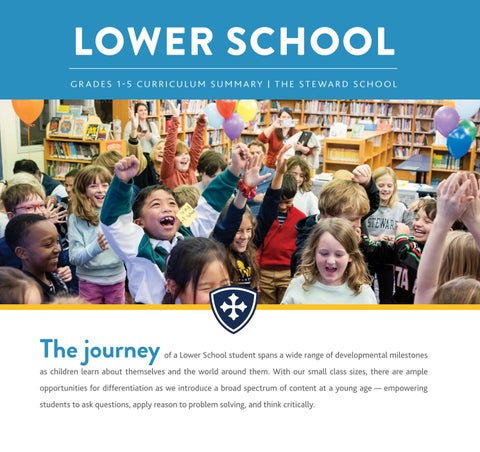
of a Lower School student spans a wide range of developmental milestones as children learn about themselves and the world around them. With our small class sizes, there are ample opportunities for differentiation as we introduce a broad spectrum of content at a young age — empowering students to ask questions, apply reason to problem solving, and think critically.
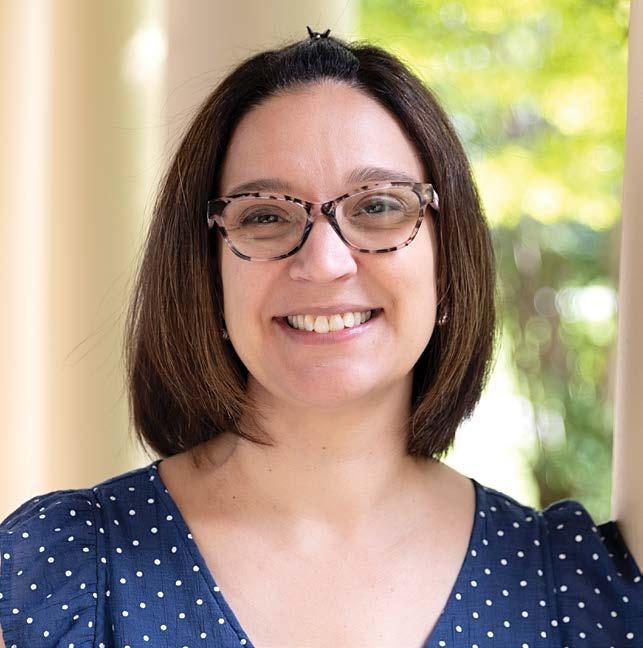
Becky Groves, who joined the Steward faculty in 2011, earned her B.A. in English education from The College of William & Mary and her M.Ed. from The University of Virginia. In addition, she earned a certification as a Structured Literacy Interventionist from the Center for Effective Reading Instruction and is a certified reading specialist. From 20152023, Mrs. Groves served as Lower School Academic Dean at Steward; she has served as Director of Lower School since 2023. Mrs. Groves is passionate about the power of play as a guidepost for early childhood education and the need for joyful learning experiences for all students.

LOWER SCHOOL VIRTUAL TOUR
ADMISSIONS HIGHLIGHTS INSPIRE THE FUTURE VIDEO

Reading and writing are the cornerstones of our Lower School language arts program. We foster an environment of choice and challenge, watching students’ early storytelling and drawing evolve into confident literacy skills.
• Language arts instruction is designed within units of study, which can be differentiated to meet students where they are in the literacy progression.
• Younger students apply newly acquired phonics skills directly to decodable text. Reading growth shifts from decodable texts to leveled readers to chapter books (often within specific genre studies).
• We prioritize student choice and “just right books,” teaching reading strategies explicitly and systematically.
• Writing workshop encourages students to see themselves as authors while teachers tailor instruction to individual needs. Units of study are genre-based, and grammar studies are incorporated throughout the writing process.
• Our word study curriculum comes from the Institute for Multi-Sensory Education (IMSE), which utilizes methods and strategies from the Orton-Gillingham framework. Students are provided instruction in phonics (matching the sounds of spoken English with individual groups of
letters) and syllabication patterns through 3rd grade and morphology (the study of prefixes, suffixes, and roots) in 4th and 5th grades. This direct, explicit, and sequential curriculum ensures a strong foundation in both phonics and vocabulary acquisition.
• Handwriting instruction is embedded within both word study lessons and writing workshop.
In Lower School, we use the enVision math curriculum (K-5), which prepares students to be independent learners, problem solvers, abstract thinkers, and accurate computers. We build strong number sense through the use of manipulatives,
math talks, problem-solving strategies, and a spiraling review of core concepts.
• Algebraic concepts, geometry, and math vocabulary are introduced early in the Lower School curriculum.
• Problem-solving activities and math talks are tools that enrich students’ mathematical understanding.
• Upper elementary math courses focus on multiplication, division, fractions, and decimals with increasingly more complex numbers.
• The Hands-On Equations program for balancing algebraic expressions enriches the fifth-grade curriculum and bridges middle-school math concepts.
Our curriculum guides students to develop an understanding of the responsibilities of good citizenship and to appreciate historical events and influences.
• Active, responsible students and citizens live, learn, and work together. Lessons include history studies (local, regional, national, and international), economics, and geography.
• Cross-curricular studies integrate social studies, science, language arts, and mathematics units where applicable.
• Field trips highlight as many aspects of the relevant topics as possible.
• Spanish instruction is part of the curriculum beginning in junior kindergarten and fosters an understanding of both the language and culture.
Curiosity is the key to our STEM curriculum. Whether exploring
earth science, biology, physics, or chemistry topics, students learn to ask questions and absorb facts.
• Interactive lessons around campus, including the Bryan Innovation Lab and its surrounding gardens, allow students to make real-world connections as they investigate principles related to the natural world.
• Children’s engineering lessons support the science curriculum through designand systems-thinking models, and the scientific method is introduced as early as first grade so that young minds are trained to think in logical steps.
Self-expression is vital to the development of young minds, and our arts program ensures every student has a creative outlet.
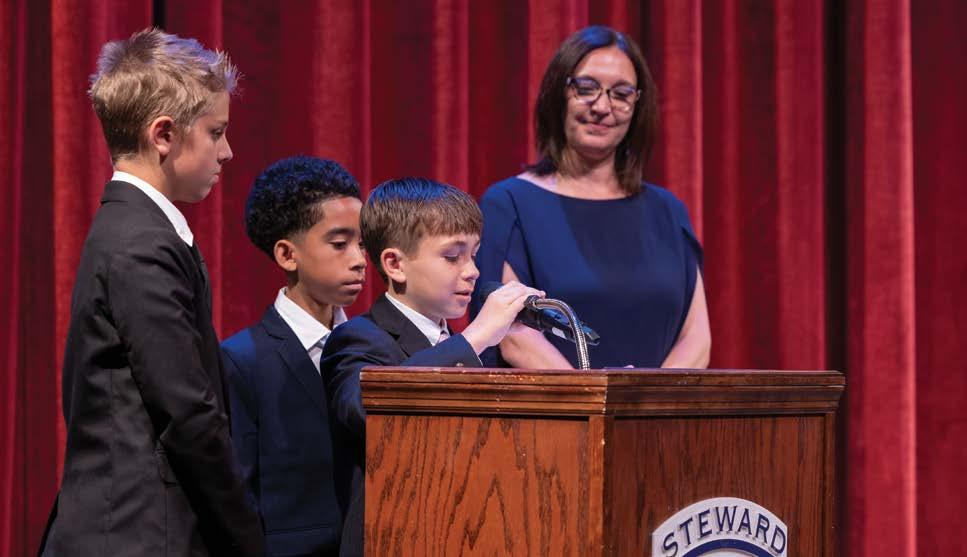
• K-5 students participate in five-week theatre sessions that culminate in grade-level plays. These plays focus on confidence in public speaking and are tied into other disciplines in each grade.
• Students explore self-expression across a wide variety of artistic mediums, establishing a foundation for the visual arts.
• Music study incorporates singing, playing instruments, and performance skills, which culminates in two mainstage Lower School productions yearly.
At Steward, we believe that all children can be leaders and productive members of our school community.
• Regular character education lessons emphasize the importance of working productively with others and provide explicit instruction in the skills necessary to do so.
• Through our Fifth Grade Leadership Program, students can self-select from available leadership roles, including serving as community stewards, program speakers, Bryan Lab ambassadors, and members of the school spirit committee.
The
thing we love most about Steward is that our daughter is engaged in the classroom in a way that makes her excited to go to school every day. The support and acceptance she feels from the school community at Steward have encouraged her to try new things and feel comfortable in her skin. Helping students THRIVE is what Steward does best!”
– STEWARD PARENT