1
www.DallasLawyersMagazine.com
Table of
CONTENTS INSIDE THIS ISSUE DALLAS LAWYERS MAGAZINE
JULY | AUGUST 2020 3 Cover Judge Monica Purdy 5 Profile Dallas Lawyer Jeff Tillison 7 Prevent Foreclosure Behind Your Mortgage 8-9 Question To Ask Your Potential Lawyers 10-11 If Arrested Know Your Rights 12-15 Debt Collection Things To Know 15-17 Eviction Process In Texas 18 Texas Domestic Violence Laws For Texas 19-20 After Car Accident 22-23 Thing To Know About Payday Loans 24-27 COVID 19 and Child Visitation Things May Have Change Will &Testament In Texas How To Get Yours
MAGAZINE
DALLAS LAWYERS MAGAZINE 1910 Pacific Ave. Suite 14220 Dallas, Texas 75201 972.975.7516 Division of The Green & Green Co.
2
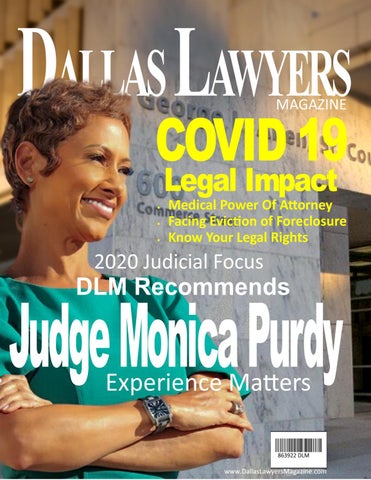
Why DLM Recommend Judge Monica Purdy
Judge Purdy is an Associate Judge in Dallas County’s Civil Courts and the Democratic nominee for the 95th State Civil District Court in the upcoming General election in November. The Tampa, Florida, native currently supports seven of the 13 State Civil District Courts in Dallas County and has served as Associate Judge since her unanimous appointment in 2013 by the elected presiding civil judges. In addition, she has consistently received amongst the highest ratings, being ranked as one of the “top two” civil judges in the yearly judicial evaluation poll, evaluating judicial performance, conducted by the Dallas Bar Association of lawyers appearing before her court. Prior to joining the County, Judge Purdy also served as an appointed Municipal Court Judge for the City of Dallas for three years. A proud graduate of Spelman College in Atlanta, Georgia, and the Thurgood Marshall School of L aw at T e xa s So u t he r n University in Houston, Texas, Judge Purdy handles a variety of
routine judicial duties including presiding over hearings on a range of motions, injunctions, temporary restraining orders, discovery disputes and both jury and bench trials. Her extensive knowledge of the law and critical decision-making skills have been put to the test during her 27-plus years practicing law, 20 of which have been in civil litigation (more than 11 years with Linebarger Goggan Blair & Sampson and eight years in private practice) and the latter 10 as a judge.
During her tenure on the bench, Judge Purdy has earned a solid reputation for presiding with an impeccable judicial temperament, integrity and an unwavering commitment to ensuring justice is served for all citizens in every case that comes before the court. Judge Monica Purdy’s commitment as a servant leader reaches far beyond the bench. When she is not carrying out her judicial duties, you can find the devoted wife and mother of two actively participating in a host of professional and community forums and events. A staunch advocate of educating citizens on their legal rights, Judge Purdy uses her platform to ensure the public is well informed about the justice system and more specifically about civil actions they may routinely face. A highly sought-after speaker and legal expert, Judge Monica Purdy has appeared as a legal commentator on KDFW FOX 4 and Heaven 97 AM. She also participates in several podcasts on relevant civil matters throughout North Texas. Recognized often for her accomplishments, in 2019, the New Roundtable honored Judge Purdy with their Influencer Award and she also received the Rising Star Award from Dallas Lawyers Magazine. Judge Purdy
is a member of the American Bar Association’s National Conference of State Trial Judges, the Judicial Council of the National Bar Association, National Association of Women Judges, Texas Bar Foundation Fellow, League of Women Voters of Texas (past board member), The Dallas Assembly, Dallas Bar Association, J.L. Turner Legal Association, Alpha Xi Omega Chapter of Alpha Kappa Alpha Sorority, Incorporated, Trinity (TX) Chapter of The Links, Incorporated, Dallas Chapter of Jack and Jill of America, Inc., and St. Luke “Community” United Methodist Church. In addition, she is founding member of The Village Giving Circle at the Texas Women’s Foundation, is currently serving by appointment to the Judicial Nominating Commission for the City of Dallas, and is an elected member to the Thurgood Marshall School of Law National Alumni Board. Judge Purdy’s campaign for the 95th State Civil District Court has been endorsed by elected officials, pastors, community leaders and Democratic groups including but not limited to: U.S. Ambassador and former Dallas Mayor Ron Kirk, Senator Royce West, Commissioner John Wylie Price, Commissioner Theresa Daniel, Tax Assessor John Ames, Pastor Michael Bowie, Pastor Freddie Haynes, Pastor David Wilson, Pastor C. Dennis Williams, Pastor Jerry Christian, Dallas AFL-CIO, Texas Democrats with Disabilities, Stonewall Democrats of Dallas and Mexican American Democrats Causa Chapter. Additionally, she has been recommended by the Committee for a Qualified Judiciary in Dallas, Texas.
3
OUR TEAM EDITOR IN CHIEF | PUBLISHER AL GREEN CONTENT MANGER NICK GREEN COPY DIRECTOR LUBONDA CHILUKUTA DESIGN MANGER MARTIN LEGGETT ADVERTISING SALES BRIANNA GREEN FINANCE MANGER/ BUSINESS SUPPORT JERRI GIBBS DISTRIBUTION MANGER DORAIN GREEN
Dallas Lawyers Magazine is published monthly by The Green & Green Co. within the Dallas Fort Worth areas. Our content is not intended to take the place of legal representation . If you need legal help please seek a lawyer,.
ADVERTISING CALL 972.975.7516 4
Attorney Profile
NCAA billion dollar prize bracket lawsuit in which he successfully obtained judgement for his client in 2017. •
•
Founding attorney Jeff Tillotson is a trial attorney. He tried five cases and spent over fifty days in trial as lead counsel or co-lead in 2017 alone, and he averages that on a yearly basis. Few trial attorneys can match that claim. He focuses on complex civil litigation including consumer class actions, fraud and securities matters. Some representative court cases include the following:
•
•
•
•
Lead trial lawyer and chief architect of the strategy leading to AT&T’s victory against • the FTC.
•
Sole counsel to insurer suing Yahoo for breach of contract regarding the
for failing to distribute the movies Monster and Love Wrecked after fraudulently keeping profits from Monster for itself.
Lead trial counsel to • Lead trial counsel to Visa AT&T / Direct Tv in its USA and Visa Internacase against the FTC for tional who, after a four dece ptive marketing week trial, prevailed in a practices in 2017. first-of-its-kind high stakes internet defamaLead counsel to victims of tion case: Zixit v. Visa a multi-million dollar oil USA. The lawsuit was and gas investment profiled by the National fraud that is currently Law Journal as the under investigation by the “Defense Wins of the FBI in 2017. Month” in 2003 and Sole trial counsel to SCA “Defense Win of the Promotions in which Year“ 2003. Tillotson prevailed in 2015 in its high stakes lawsuit • Sole Trial counsel to RDC, against famed cyclist a small company that Lance Armstrong. operated Redbird Airport, in Dallas (now Executive Sole trial counsel to Airport) in City of Dallas Nationstar Bank in which v. Redbird Development Tillotson won a favorable Company. The City jury verdict on behalf of terminated the lease, his client in November locked RDC out of the 2015. proper ty, used the termination as grounds Lead counsel to Samfor accelerating a loan the sung in a lawsuit where City had made to RDC Tillotson successfully oband then sued RDC for tained a summary judgthe balance due. After a ment on behalf of his clithree-week trial, the juent in November 2015. ry not only rejected the City’s case but awarded RDC damages on its Sole trial counsel to Media counterclaim. The case 8 productions In Media 8 was affirmed on appeal v Blockbuster Inc. preand then settled for the vailing in Media 8’s lawamount of the jury suit against Blockbuster award. 5
6
Help! I Am Behind on My Mortgage! Many people have found themselves in a scary situation where they are behind on their mortgage payments. You are not alone. When you get behind, you may not know what to do or who to turn to. For this reason, we have developed this step-by-step guide to give you the knowledge you need to move forward confidently. Step One: Evaluate Financial Situation
Your
When you are behind on your mortgage, it is important to take a moment to analyze your financial situation. You should consider why you were unable to make the payments you missed. Was there an unanticipated expense that occurred in the past few months? Has there been a change in your household’s income? Can you catch up on your past due amounts? Will you be able to make your future mortgage payments as they become due? These are some questions to think about. If you are able to bring your loan current, you should do so right away.
If you are unable to bring your account current, you need to go to Step Two. Step Two: If you want to keep your home, apply for a loss mitigation option. Once you have evaluated your financial situation, you should contact your bank immediately. A representative from your bank should be able to provide you with the options they have available to address the problems you are facing with your mortgage. Depending on your situation, some of the following options or combination of options may be available from your bank: Loan Modification: A loan modification is a long-term solution to meeting your financial needs. A loan modification will modify your current mortgage by reducing your monthly payments through a change in your interest rate and/or extending the term of your loan. Forbearance: A forbearance agreement is a short term solution to bring your mortgage account current. A
forbearance agreement is an agreement between you and your lender to reduce or suspend your month ly payments for a set amount of time. The lender will agree to delay foreclosure proceedings during this time, but you will eventually have to catch back up on the payments. Reinstatement: A reinstatement is a way for you to pay the past due balance of your mortgage and bring your account current. Once your mortgage account is reinstated and the past due balances are paid, you will continue your regular monthly mortgage payments. Repayment Plan: A repayment plan is a way for you to spread the amount you owe over a period of time. In a repayment plan, you pay your monthly mortgage payment in addition to the monthly past due amount under your plan. If you apply for a loan modification or another loss mitigation option and it was approved, great! You can get back on track.
7
Ten Questions to Ask Your Potential Lawyer Lawyers will often provide a free or very low-cost consultation to discuss the details of your situation and give you an opportunity to ask some basic questions about the attorney. This meeting should not only help you decide whether to go forward with a lawyer in general, but also whether you s h o u l d p r o c e e d with this lawyer. If you later decide to hire the lawyer, you will go into a more detailed discussion of your case and ask more specific questions along the way. Generally speaking, you'll want to have a list of questions in mind to ask during the meeting. Also, you should feel comfortable enough asking questions that relate to the lawyer's expertise, experience, fees, special knowledge, and management of the case. Below are ten questions to ask your potential lawyer. 1. How long have you practiced law? At a minimum, you'll want to know about the lawyer's expertise and whether the lawyer is a veteran or beginner attorney, for instance. Your legal issue may very well be handled by someone who is fresh out of law school, (or not). It all depends. 2. What type of cases do you generally handle? What percentage of your practice is devoted to (the practice area in question)? You'll also want to know about a lawyer's expertise and how much of the
attorney's practice is devoted to topic area your legal issue falls within. For example, if you need help with an adoption case, you may wish to seek a family law lawyer who has worked on, well, adoption cases. 3. Who is your typical client? This is an important, but often-overlooked question. For example, if you are an individual with a particular legal problem, but the attorney your meeting with represents only corporations, this may not be the best lawyer for you. Likewise, you may wish to know the financial background of some of the lawyer's clients. This is because there may be different issues a lawyer is used to factoring when working with high net-worth individuals vs college students. 4. How many cases have you represented that were similar to mine? Now is not the time to act shy. Feel free to ask about the attorney's track record, such as the number of cases won or settled, for example. 5. Other than a law degree, what kind of special training or knowledge do you have that might apply in my situation? Some cases, like DUI and patent cases, require specialized training and knowledge for effective representation. Be sure to inquire whether your case fits into that category.
6. What are your attorney fees and costs, and how are they billed? Will a portion or all of my case be handled by paralegals or legal assistants? If so, ask about reduced costs. This step is obviously an important one. You'll want to know whether you can afford the lawyer's services and how you will be required to pay. This is also the time to ask about payment options and how often, and under what circumstances, you will be billed. 7. What is your approach or philosophy to winning or representing a case? This can be important in two ways. First, if you are seeking an amicable divorce, for example, but the attorney is known to "go for the kill" in divorce cases, the attorney may not be the right one for you. Similarly, if you're looking for an aggressive attorney to handle an upcoming corporate merger, for example, you'll want someone who isn't afraid to push the envelope, so to speak. 8. Are there others ways for solving my legal problem? Go ahead. Ask the professional whether there are any alternatives for solving your legal problem, such as through arbitration or some other out-ofcourt arrangement. A good attorney will generally inform you if your case can be handled through other less expensive and time consuming means. 8
9. How will you let me know what's happening with my case? Communication is key when working with a lawyer. Ask the lawyer how often and under what circumstances you will hear from him or her. You'll want to know how your case is coming along and about other important dates. 10. What is the likely outcome in my case? Generally speaking, it is fair game to ask the attorney whether you have a good chance of winning your case. You are not looking for the "right" answer, just an honest one. For instance, if you're facing an uphill battle in, let's say, a nasty divorce situation, you'll want to know up front from the attorney so you can prepare yourself for what lies ahead. While the answers to questions you ask your lawyer will vary widely, it is important to keep in mind that nothing should be taken as a guarantee. Instead, these questions should give you general knowledge of a specific lawyer's experience and skilllevel, and whether the lawyer is a good fit for you.
9
PLEASE TAKE ADVICE.
NOTE
OF
THIS
A wide variety of people are arrested every day and the majority of the individuals make the same mistakes which make there situation even worse. Many of these reactions are understandable; however, some defy logic and reason. Nobody plans on being arrested, but you may be arrested for simply being in the wrong place at the wrong time. Share this with your colleagues, friends and family because it will come in handy for many of you. The basic rule is to simply listen to the officer and do as your told, “Put Your Hands Behind Your Back” and do NOT do any of these Ten Things: 1.
NEVER RESIST ARREST.
4.
DON’T BELIEVE THE POLICE – THEY LIE. It is perfectly legal for the
5.
NO SEARCHING.
6.
DON’T LOOK AT PLACES WHERE YOU DON’T WANT POLICE. Police are trained to watch you
DON’T RUN. I said above to listen to the officer and follow his/her instructions. If you run, not only could there be additional charges, but if the case goes to trial, then the Government may be able to get a special Jury instruction which would be read to the Jury called “consciousness of guilt” whereby the Jury is told basically “guilty people run, innocent people don’t”. Also, police become highly suspicious that someone running has a weapon and may be quick to draw their weapon.
Perhaps the most important thing not to do is touch the police officer at all! Follow what the officer says. Fight your case, not the officer. You will lose a fight against an officer. Many people attempt to bump the officer or swat an officers hands away. This often becomes over-reported by the officer and the swatting becomes hitting which falls under the assault statutes and now a minor
police to lie to get you to make an admission. In fact they are trained to lie to you to get the confession. It is called the Reid Technique where you lie about having witnesses or video tape or fingerprints or DNA. The police frequently separate two friends and tell one the other one “ratted” him/her out (i.e., told on you). Because of the lie, the other friend now rats the first friend out. Police and detectives also state that “it will be easier” to talk now…LIES!!! DON’T BELIEVE THE LIES! It will only be easier for the police to prove their case.
DON’T TALK. Do not say a word to the
officer. You have a right to remain silent – take advantage of it. I cannot stress to you the importance of this rule. Do not talk! Do not attempt to convince the officer of your innocence. Everyone is innocent, no one should be arrested and no one should be in jail and that is all the officer hears all day every day. He/she does not care generally whether you are innocent or guilty and there is nothing that he / she can do at this point. Most times, when people speak to officers they say something that makes their situation far worse. Keep your mouth shut; there will be plenty of time to talk later. 2.
3.
Do not allow the police to search anywhere! If the police officer asks, they do not have the right to search and must have your consent. If you are asked make sure you proclaim to any witnesses that “You (the police) do not have consent to search.” If they perform the search anyway, that evidence may be thrown out later. Also, if you consent to a search, the officers may find something that you had no idea you or someone else had placed there, i.e., marijuana left by a friend.
and react to you. They know that you are 10
nervous and scared and many people look to the areas that they don’t want the police to search. Do not react to the search and do not answer any questions. LOOK DOWN AND KEEP YOUR MOUT. 7.
DO NOT TALK SMACK TO THE POLICE.I don’t care if you have been
wrongly arrested and the true culprit is standing in front of you. Don’t talk smack! Police hear all day that my dad is the Governor’s Assistant’s Intern and I will have your badge for this! Police have a lot of discretion in the upcoming charges brought and how it all develops in the system. Police can add charges, change a misdemeanor to a felony, and will even talk to the prosecutor that is ultimately prosecuting you. 8.
don’t give two hoots if you are really cold or if you need to talk to your wife or husband. 10.DON’T SAY A WORD. It’s incredible how many people feel that they can convince the officer, the booking officer or a detective (if your case reaches that stature) that they are not guilty. YOUR CASE IS NOT DECIDED BY THESE PEOPLE. They have no affect on guilty or not guilty. Wait to speak to your lawyer! The courts and juries in particular give enormous weight to “confessions” during this stage. A suspect is almost NEVER released after being arrested.
IF POLICE COME TO YOUR HOME, DO NOT LET THEM IN AND DO NOT STEP OUTSIDE. If the police are confident you have committed a felony, they are coming in anyway, because they generally don’t need an arrest warrant. Make it clear to the police by stating: “No you may not come in”, or “I am comfortable talking right here”, or “You need a search warrant to enter my home.” If they return, your attorney can arrange for you to turn yourself in should that be necessary and you will spend no time in jail between the hearings.
9.
IF YOU ARE OUTSIDE YOUR HOME AND ARRESTED, DO NOT ACCEPT AN OFFER TO GO BACK IN YOUR. The officer may say to you, how about you go inside and change, freshen up, talk to your wife, husband, get a jacket, or provide you with any other reason. The police will graciously escort you in and then tear your home apart searching through it. Also, do not let them secure your car. Your car is fine. Remember they are lying to you. They
11
Know your rights against Debt Collection 15 USC 1692c § 805. Communication in connection with debt collection a. Communication with the con sumer generally Without the prior consent of the consumer given directly to the debt collector or the express permission of a court of competent jurisdiction, a debt collector may not communicate with a consumer in connection with the collection of any debt -1) at any unusual time or place or a time or place known or which should be known to be inconvenient to the consumer. In the absence of knowledge of circumstances to the contrary, a debt collector shall assume that the convenient time for communicating with a consumer is after 8 o'clock antemeridian and before 9 o'clock postmeridian, local time at the consumer's location; 2) if the debt collector knows the consumer is represented by an attorney with respect to such debt and has knowledge of, or can readily ascertain, such attorney's name and address, unless the attorney fails to respond within a reasonable period of time to a communication from the debt collector or unless the attorney consents to direct communication with the consumer; or 3) at the consumer's place of employment if the debt collector knows or has reason to know that the consumer's employer
prohibits the consumer from receiving such communication. b. Communication with third parties Except as provided in section 1692b of this title, without the prior consent of the consumer given directly to the debt collector, or the express permission of a court of competent jurisdiction, or as reasonably necessary to effectuate a postjudgment judicial remedy, a debt collector may not communicate, in connection with the collection of any debt, with any person other than the consumer, his attorney, a consumer reporting agency if otherwise permitted by law, the creditor, the attorney of the creditor, or the attorney of the debt collector.
c. Ceasing communication If a consumer notifies a debt collector in writing that the consumer refuses to pay a debt or that the consumer wishes the debt collector to cease further communication with the consumer, the debt collector shall not communicate further with the consumer with respect to such debt, except -1) to advise the consumer that the debt collector's further efforts are being terminated; 2) to notify the consumer that the debt collector or creditor may invoke specified remedies which are ordinarily invoked by such debt collector or creditor; or 3) where applicable, to notify the consumer that the debt collec-
tor or creditor intends invoke a specified remedy.
to
If such notice from the consumer is made by mail, notification shall be complete upon receipt. d “Consumer” defined For the purpose of this section, the term "consumer" includes the consumer's spouse, parent (if the consumer is a minor), guardian, executor, or administrator. 15 USC 1692d § 806. Harassment or abuse A debt collector may not engage in any conduct the natural consequence of which is to harass, oppress, or abuse any person in connection with the collection of a debt. Without limiting the general application of the foregoing, the following conduct is a violation of this section: 1) The use or threat of use of violence or other criminal means to harm the physical person, reputation, or property of any person. 2) The use of obscene or profane language or language the natural consequence of which is to abuse the hearer or reader. 3) The publication of a list of consumers who allegedly refuse to pay debts, except to a consumer reporting agency or to persons meeting the requirements of section 1681a(f) or 1681b(3)1 of this title. 12
4) The advertisement for sale of any debt to coerce payment of the debt. 5) Causing a telephone to ring or engaging any person in telephone conversation repeatedly or continuously with intent to annoy, abuse, or harass any person at the called number. 6) Except as provided in section 1692b of this title, the placement of telephone calls without meaningful disclosure of the caller's identity. 15 USC 1692e ยง 807. False or misleading representations A debt collector may not use any false, deceptive, or misleading representation or means in connection with the collection of any debt. Without limiting the general application of the foregoing, the following conduct is a violation of this section: 1) The false representation or implication that the debt collector is vouched for, bonded by, or affiliated with the United States or any State, including the use of any badge, uniform, or facsimile thereof. 2) The false representation of -a. the character, amount, or legal status of any debt; or b. any services rendered or compensation which may be lawfully received by any debt collector for the collection of a debt. 3) The false representation or implication that any individual is
an attorney or that any communication is from an attorney. 4) The representation or implication that nonpayment of any debt will result in the arrest or imprisonment of any person or the seizure, garnishment, attachment, or sale of any property or wages of any person unless such action is lawful and the debt collector or creditor intends to take such action. 5) The threat to take any action that cannot legally be taken or that is not intended to be taken. 6) The false representation or implication that a sale, referral, or other transfer of any interest in a debt shall cause the consumer to -a. lose any claim or defense to payment of the debt; or
B. become subject to any practice prohibited by this subchapter. 7) The false representation or implication that the consumer committed any crime or other conduct in order to disgrace the consumer. 8) Communicating or threatening to communicate to any person credit information which is known or which should be known to be false, including the failure to communicate that a disputed debt is disputed. 9) The use or distribution of any written communication which simulates or is falsely represented to be a document authorized, issued, or approved by any court, official, or agency of the United States or any
State, or which creates a false impression as to its source, authorization, or approval. 10) The use of any false representation or deceptive means to collect or attempt to collect any debt or to obtain information concerning a consumer. 11) The failure to disclose in the initial written communication with the consumer and, in addition, if the initial communication with the consumer is oral, in that initial oral communication, that the debt collector is attempting to collect a debt and that any information obtained will be used for that purpose, and the failure to disclose in subsequent communications that the communication is from a debt collector, except that this paragraph shall not apply to a formal pleading made in connection with a legal action. 12) The false representation or implication that accounts have been turned over to innocent purchasers for value. 13) The false representation or implication that documents are legal process. 14) The use of any business, company, or organization name other than the true name of the debt collector's business, company, or organization. 15) The false representation or implication that documents are not legal process forms or do not require action by the consumer. 1) (16) The false representation or implication that a debt collector 13
not legal process forms or do not require action by the consumer. 16) The false representation or implication that a debt collector operates or is employed by a consumer reporting agency as defined by section 1681a(f) of this title. 15 USC 1692f ยง 808. Unfair practices
A debt collector may not use unfair or unconscionable means to collect or attempt to collect any debt. Without limiting the general application of the foregoing, the following conduct is a violation of this section: 1) The collection of any amount (including any interest, fee, charge, or expense incidental to the principal obligation) unless such amount is expressly authorized by the agreement creating the debt or permitted by law. 2) The acceptance by a debt collector from any person of a check or other payment instrument postdated by more than five days unless such person is notified in writing of the debt collector's intent to deposit such check or instrument not more than ten nor less than three business days prior to such deposit. 3) The solicitation by a debt collector of any postdated check or other postdated payment instrument for the purpose of threatening or instituting criminal prosecution.
4) Depositing or threatening to deposit any postdated check or other postdated payment instrument prior to the date on such check or instrument.
5) Causing charges to be made to any person for communications by concealment of the true purpose of the communication. Such charges include, but are not limited to, collect telephone calls and telegram fees.
15 USC 1692g ยง 809. Validation of debts a,
Notice of debt; contents Within five days after the initial communication with a consumer in connection with the collection of any debt, a debt collector shall, unless the following information is contained in the initial communication or the consumer has paid the debt, send the consumer a written notice containing --
6) Taking or threatening to take any nonjudicial action to effect dispossession or disablement of property if --
1) the amount of the debt;
a. there is no present right to possession of the property claimed as collateral through an enforceable security interest;
3) a statement that unless the consumer, within thirty days after receipt of the notice, disputes the validity of the debt, or any portion thereof, the debt will be assumed to be valid by the debt collector;
b. there is no present intention to take possession of the property; or c. the property is exempt by law from such dispossession or disablement.
7) Communicating with a consumer regarding a debt by post card. 8) Using any language or symbol, other than the debt collector's address, on any envelope when communicating with a consumer by use of the mails or by telegram, except that a debt collector may use his business name if such name does not indicate that he is in the debt collection business.
2) the name of the creditor to whom the debt is owed;
4) a statement that if the consumer notifies the debt collector in writing within the thirty-day period that the debt, or any portion thereof, is disputed, the debt collector will obtain verification of the debt or a copy of a judgment against the consumer and a copy of such verification or judgment will be mailed to the consumer by the debt collector; and 5) a statement that, upon the consumer's written request within the thirty-day period, the debt collector will provide the consumer with the name and address of the original creditor, if different from the 14
b. Disputed debts If the consumer notifies the debt collector in writing within the thirty-day period described in subsection (a) of this section that the debt, or any portion thereof, is disputed, or that the consumer requests the name and address of the original creditor, the debt collector shall cease collection of the debt, or any disputed portion thereof, until the debt collector obtains verification of the debt or a copy of a judgment, or the name and address of the original creditor, and a copy of such verification or judgment, or name and address of the original creditor, is mailed to the consumer by the debt collector. Collection activities and communications that do not otherwise violate this subchapter may continue during the 30-day period referred to in subsection (a) unless the consumer has notified the debt collector in writing that the debt, or any portion of the debt, is disputed or that the consumer requests the name and address of the original creditor. Any collection activities and communication during the 30-day period may not overshadow or be inconsistent with the disclosure of the consumer’s right to dispute the debt or request the name and address of the original creditor.
The Eviction Process in Texas: Rules for Landlords and Property Managers An overview of Texas eviction rules, forms, and procedures. By Beth Dillman. In Texas, a landlord must legally terminate the tenancy before evicting a tenant. The landlord must first give the tenant a written notice, as required by state law. If the tenant does not move out after receiving this notice, then the landlord can file an eviction lawsuit (also called a forcible entry and detainer suit). Notice for Termination With Cause. In Texas, a landlord can terminate a tenancy early if the tenant does not pay rent or violates the lease or rental agreement (for example, by having a dog when none are allowed or continually throwing loud parties). Before filing an eviction lawsuit, the landlord must first give the tenant a three-day notice to vacate. The landlord does not have to give the tenant the option to fix the violation or pay the rent. If the tenant does not move out of the rental unit at the end of the three days, then the landlord can file an eviction lawsuit with the court (see Tex. Prop. Code Ann. § 24.005). Notice for Termination Without Cause. The rules for terminating a lease without cause vary depending on whether the tenancy is month-to-month or a fixed term. Month-to-Month Tenancy. If a landlord wishes to end a tenancy with a tenant who is month-tomonth, then the landlord must give the tenant a 30-day notice to move. This notice must state the
date by which the tenancy will end and that the tenant must move out of the rental unit by that time (see Tex. Prop. Code Ann. § 91.001). For more information on ending a monthto-month tenancy in Texas, see Texas Notice Requirements to Terminate a Month-to-Month Tenancy. Fixed-Term Tenancy. A landlord cannot end a tenancy early without cause if the tenancy is longer than month-to-month, or for a fixed term. The landlord must wait until the term ends before ending the tenancy and expecting the tenant to move. However, the landlord is not required to give the tenant notice at the end of the term, unless the lease or rental agreement specifically requires it. For example, if the tenant has a yearlong lease that expires in December and the tenant has not requested to renew the lease, the landlord does not need to give the tenant notice to move out of the rental unit by the end of December unless the terms of the lease require such notice. When December comes around, the landlord can expect the tenant to move out of the rental unit by the end of the month. If the tenant does not move out of the rental unit at the end of the term, then the tenant is considered a hold-over tenant, meaning the tenant is holding over in the rental unit after the tenancy has expired. If this happens, the landlord needs to give the tenant a three-day notice to vacate. If the tenant does not move out by the end of the three-day period, then the landlord can file an eviction lawsuit with the court (see Tex. Prop. Code Ann. § 24.005).
15
Dallas Lawyers Magazine | DLM AWARDS 2020
Recognizing Great. Doing Great Work Submit your nomination for Judge before September 30, 2020 Date_______________
Name of Judge ________________________________
Court________________________________________ What have they done outstanding_________________ _____________________________________________ _____________________________________________ _____________________________________________ What category best describe the candidate by placing a check mark. Judge of the year Award
Trailblazer Award
Rising Star Award
Civil Justice Award
Humanitarian Award
Publisher Award
Criminal Justice Award
Passion for Justice
Equal Justice Award
Judge of The Year
Online Form at www.DLMAWARDS.com Only one nomination per– person Mail to Dallas Lawyers Magazine 1910 Pacific Ave Suite 14220 Dallas , Texas 75201 Email to DLMAwaeds@gmail.com 972.9757516
16
Tenant Eviction Defenses. A tenant may decide to fight an eviction, which would increase the amount of time it takes to get the tenant evicted. The tenant could have several potential defenses. One of the most common defenses is that the landlord did not follow all the rules when evicting the tenant. For example, the tenant could show that the landlord improperly served a notice or the landlord did not wait long enough before filing the eviction lawsuit. Some other potential defenses are that the landlord did not maintain the rental unit according to law or that the landlord discriminated against the tenant. Tenant Defenses to Evictions in Texas has more information on tenant defenses. Removal of the Tenant. The only legal way to remove a tenant from a rental unit in Texas is for a landlord to win an eviction lawsuit, or forcible entry and detainer suit, in court. Even after winning the lawsuit, the landlord still must not try to evict the tenant. The only person who can do that is an officer of the law, authorized by the judge who allowed the eviction to occur. Texas law has made it illegal for the landlord to personally remove the tenant from the rental unit. See Illegal Eviction Procedures in Texas for more information on the topic. Rationale for the Rules. Landlords must carefully follow all the rules and procedures required by Texas law when evicting a tenant; otherwise, the eviction may not be valid. Although these rules and proce-
dures can seem burdensome to the landlord, they are there for a reason. Evictions often occur very quickly, with the end result being that the tenant has lost his or her home. The rules help ensure the eviction is justified and that the tenant has enough time to find a new place to live. How an Eviction Works in Texas. The Texas State Property Code sets out the rules and procedures a landlord must follow when evicting a tenant. First, when the landlord discovers the tenant has either failed to pay rent or violated a portion of the lease or rental agreement, the landlord must give the tenant a three-day Notice to Vacate. If the tenant does not move out within the three-day time period and chooses to fight the eviction, then the landlord will next file a complaint with the Texas Justice Court in the county where the rental unit is located. The court will set a date and time for the hearing and an officer of the law will deliver the complaint to the tenant. Upon receiving the complaint, the tenant will have fourteen days to file an answer to the complaint with the justice court (see Tex. Rules of Civ. Pro. § 502.5). The answer will detail the defenses the tenant wishes to use to fight the eviction lawsuit. The tenant must also appear at the hearing. At the hearing, the judge will decide whether the tenant can stay in the rental unit or move out, based on both the complaint and the answer. Remember that fighting an eviction is not always worth it. It can be a waste of time and money— the losing party often has to pay
all the court and attorneys' fees for the winning party, plus it can have a negative effect on your credit rating. If you only need a few more days in the rental unit before moving out, you and your landlord may be able to reach an agreement without going to court. Many communities have free or low-cost mediation services that handle landlord-tenant disputes; local resources are available through the website mediate.com and the American Arbitration Association. Overview of Texas Domestic Violence Laws.. The use of force in domestic situations that causes bodily injury, threatens to cause bodily harm, or causes any kind of physical contact the other person may regard as offensive or provocative is called domestic violence. If you are the victim of domestic violence, get to a safe place and call the National Domestic Violence Hotline at 1800-799-7233. In order to prove a case, a prosecutor must establish beyond a reasonable doubt that the defendant performed such an act intentionally or knowingly. If actual bodily injury occurred, the prosecutor may also provide evidence proving the defendant's actions were reckless and resulted in bodily injury. Texas domestic violence laws apply not only to spouses, but to those residing in the same household, individuals related by blood or affinity, including foster parents and foster children, and those in "dating relationships." See What is Domestic Violence? for a general overview of the 17
for a general overview of the subject.
Note: See Assault and Battery Defenses for some general information about defenses.
Texas Domestic Violence Laws: The Basics. Below you will see more specifics about Texas domestic violence laws, including relevant statutes, possible defenses, and where to go to find an experienced criminal defense attorney if you are charged with this crime.
Penalties. Penalties range from a "Class C" misdemeanor, which carries a penalty of up one year in jail and a fine all the way to a first degree felony, which carries a penalty of five to 99 years in prison and a fine of no more than $10,000.
Statutes Texas Penal Code, Title 5, Chapter 22, Section 22.01
The primary factors influencing which type of penalty is likely to be imposed are the following: • Victim's relationship to the
Elements of Domestic Violence/Assault. Domestic violence in Texas means an assault against a family member, household member, or a current or past dating partner including: • intentionally,
knowingly or recklessly causing bodily injury to another person
• intentionally
or knowingly threatening another person with imminent bodily injury; or
• intentionally
or knowingly causing physical contact with another that the offender knows or
• reasonably should know the
victim will find provocative or offensive. • Possible Defenses • Unintentional or mistake • Lack of knowledge • No offense occurred • Self-defense
defendant;
• Defendant's past convictions
for domestic violence, or lack thereof;
• Whether suffocation or stran-
gulation was involved
Note: If the defendant is found to have knowingly, intentionally or recklessly caused bodily injury to another (including a spouse), the defendant will be punished with a "Class A" misdemeanor.
mation available, please consult an attorney or conduct your own legal research to verify the state law(s) you are researching. Texas Domestic Violence Laws: Related Resources • Texas Statutes • Texas Legal Research • Domestic Violence: Back-
ground
Get Legal Help with a Domestic Violence Charge in Texas. Domestic violence charges are some of the most serious on the books and a conviction can impact your life in so many ways including incarceration or probation and, if you have children, it can impact your child custody orders. So, if you've been charged with violating Texas domestic violence laws, it's best to get in touch with a local criminal defense attorney today to discuss your case and learn about your options moving forward.
However, Texas law carves out various exceptions to this general rule based on specificities of the victim, the situation and the type of violence involved which may elevate or diminish the penalty depending on the circumstances. Note: State laws are always subject to change through the passage of new legislation, rulings in the higher courts (including federal decisions), ballot initiatives, and other means. While we strive to provide the most current infor18
Things You Need to Do After a Car Accident Over six million car accidents occur each year in the United States. Fortunately, most of them involve only property damage - damage to the vehicle as opposed to the occupants. But one in three accidents involve personal injury to the driver or passengers and out of that number, two out of every ten accidents lead to fatal injuries. If you are involved in an automobile accident, there are certain things you can do to protect yourself and your interests. The following is a list of the top ten things you should do if you are in an automobile accident:
1.STOP. Never drive away from the scene of an accident, even a minor one. 2.PROTECT THE SCENE. You can prevent further accidents by setting up flares, or keeping your flashers on. If it is dark and your lights don't work, you should have a flashlight to keep you safe while you wait in your disabled car or by the side of the road. 3.CALL THE POLICE. Even if there are no serious injuries, it is a good idea to call the police. You may need a police report to file a claim with your insurance company, even if it is just to make a claim for damage to your vehicle. The vehicles involved in the accident should remain where they are, unless they interfere with traffic.
4.MAKE AN ACCURATE RECORD. When the police arrive, make sure you tell the investigating officer(s) exactly what happened, to the best of your ability. If you do not know certain facts, tell that to the officer. Do not speculate, guess or misstate any of the facts. If you are asked if you are injured and you are not sure, say you are not sure, rather than no. Often, the pain and injuries from motor vehicle accidents become apparent hours after the actual collision. You should also make sure statements made by other persons involved in the accident are accurate as well. 5.TAKE PICTURES. If you happen to have a camera in your vehicle, or a cell phone equipped with a camera, you should take pictures of the vehicles if there is visible damage. If you have visible injuries, you should photograph them as well. However, you should in no way interfere with the on-going police investigation. If you cannot take pictures at the scene of the accident, take them as soon as possible after the accident. 6.E X C H A N G E INFORMATION. Typically, the investigating police officer obtains this information. However, if the police do not respond to the accident, you should obtain the name, address and telephone number of all persons involved in the accident, drivers and passengers alike. You should also obtain information
about insurance by asking to see the insurance card for all vehicles involved in the accident. If there are witnesses, you should get information from them as well so that you or your attorney can contact them in the future. If police respond to the accident, the investigating officer usually will provide all drivers with a police report number. You can use that number later to obtain the police report. If the accident occurs on a state highway, you must request the report from the state police. 7.REPORT THE ACCIDENT. Notify your insurance company as soon as possible. Many policies require immediate reporting and full cooperation. Find out if you have medical benefits as part of your insurance coverage. You pay extra for that type of coverage known as "medpay" - so you should use it. In fact, if you have medpay coverage, you are required to submit your accident-related medical bills to your insurance company. Medpay coverage is primary for accident-related medical bills. Once medpay benefits are exhausted, private health insurance becomes your primary insurer. Medpay benefits are available to all the occupants of the vehicle. Your insurance rates should not increase as a result of submitting claims for medpay coverage. 8.SEEK MEDICAL ATTENTION. Often, injuries caused by motor vehicle accidents are 19
not immediately apparent. Most of our clients report feeling the most pain a day or two following an automobile accident. Unless you are absolutely certain you were not injured, you should seek medical attention at your local emergency room or by seeing your family physician. Even in accidents involving minor impact, you can sustain a serious and permanent injury to your spinal cord. If you lost consciousness or were dazed for even a short period of time following the collision, you may have suffered a concussion or closed head injury. This can cause cognitive and behavioral changes if left untreated. 9.KEEP A FILE. Keep all your accident-related documents and information together. This information should include a claim number, the claim's adjuster who is handling the claim, names and phone numbers of all contacts, receipts for
a rental car and other expenses incurred as a result of the accident. 10.PROTECT YOUR RIGHTS. Perhaps the most important thing you should do after an accident is to consult your attorney. Your attorney can protect your rights and make sure valuable evidence is not destroyed. Often, insurance companies want to take statements immediately after an accident. It is important that you have received legal advice before providing such a statement. Your attorney can advise you on issues ranging from how to make sure you are fully compensated for your vehicle to how to make sure you are getting the best medical treatment available. Personal injury attorneys work on a contingency fee basis, which means there is no legal fee unless the attorney recovers compensation for your injuries.
20
21
Know Your Right Payday Loans Texas payday lenders face tougher standards with new federal rules. Payday loans have been criticized as a debt trap for middle and low-income Texans. With new rules from the Consumer Financial Protection Bureau, borrowers may be armed with new protections. Gordon Martinez turned to a storefront payday lender more than 10 years ago and took out a loan of $1,200. The former teacher had just moved to Dallas to start a career in sales and was struggling to make his rent. But with high fees, his debt ballooned to about $3,500 within a matter of months.
because they assert a clear standard that underwriting should be part of any credit," Baddour said. They are "underpinned by basic tenets of fair and responsible lending."
"I had no opportunity to pay back," Martinez said. "I was set up for failure."
U.S. Rep. Roger Williams, RAustin, said in a statement the new rules are "punishing vulnerable Americans." Williams, who serves as the vice chairman of the House Committee on Financial Services Subcommittee on Monetary Policy and Trade, said the rules takes away the "right to small-dollar emergency loans."
New rules passed last week by the Consumer Financial Protection Bureau put stiff restrictions on payday and auto-title loans, like those Martinez used. The rules — which are scheduled to be fully implemented in the summer of 2019 — would prohibit lending without verifying a client's ability to repay the loan. In Texas, a state where payday lending is largely unregulated, advocates for increased oversight view the new rules as a crucial step in protecting vulnerable borrowers. Ann Baddour, director of the Fair Financial Services Project at Texas Appleseed, a nonprofit advocacy and research group that pushed for increased regulation, said the rules ensure payday lenders don't go after borrowers they know cannot pay off their loans. "These rules are transformative
But others say the new rules limit underbanked Texans' access to short-term credit.
"Washington bureaucrats will never experience the financial instability that many of our hardworking families do. We must correct this system by rolling back the rule-making authority of this agency, whose decisions are guided by 'scholars' rather than industry and subject matter experts," he said. Payday loans, which are already effectively banned in 15 states, involve customers taking smallquantity loans with very high fees. Clients are expected to pay back the fees and principal amount often by their next payday. Prohibitively high fees,
however, often cause debts to roll over to the next month, which critics say causes a cycle of debt. The new federal rules cover an expanse of lending practices advocates have called predatory — firms must now verify a client's ability to pay back loans before issuing them and cannot pull money directly from a client's checking account without written notification first. The new rules also limit rollovers for overdue payments. Compared to other states, shortterm, high-payment loans like Martinez's have few restrictions in Texas, and many say they are a debt trap for middle and low-income Texans. About 8 percent of Texans have taken out payday loans, compared to the national average of 5.5 percent. More than 40 municipalities in Texas have passed ordinances restricting the expansion of short-term loan agencies. Still, statewide laws regulating payday loan practices have largely failed in the state Legislature. In 2013, a bill that would have curtailed many of the practices critics have called predatory failed as legislators could not agree on regulatory details. Rudy Aguilar, director of con22
sumer protection at the state Office of Consumer Credit Commissioner, which regulates payday lenders, said the office was still looking at the new rules and could not comment. Payday lenders say they offer services to clients denied by major banks. "While the rules announced today by the [Consumer Financial Protection Bureau] potentially impact only a small fraction of our total revenue, these rules are extremely complex for a small dollar loan and, by their own estimation, will significantly impact consumers’ already limited access to credit," Nannette Blaylock, executive administrator for Curo Financial Technologies, which operates payday lenders such as Speedy Cash in Texas, said in a written statement. Martinez, however, said the loans are not designed to help borrowers. As his payments continued to
grow, the fees eventually exceeded the bills and rent he initially needed help paying, he said. Martinez said the lender pulled money directly from his checking account, and with ballooning fees, the withdrawals eventually grew greater than his income. In order for Martinez to notify the lender that he would not be able to make the payment, he said he was instructed to call the firm two days before the scheduled withdrawal date. But he said when he would call, no one would answer. Martinez said the financial strain led to him and his wife separating. He was unable to pay rent, he said, and lost his home. Baddour said the payday loan industry is built to profit from keeping clients in debt. "That says something when a lending business complains about a standard that merely requires assessing the borrower’s ability to repay,
which should be a basic tenet of reasonable fair lending," she said. "It definitely gives one pause." Martinez called the new rules "a good first step," but said they do not place adequate caps on interest and fees, which Martinez said caused his payments to balloon out of control. Though Texas usury laws protect borrowers from annual interest rates of more than 10 percent, payday loan fees are not capped, said Kathryn Freeman, director of public policy at Christian Life Commission, which advocated for the new rules. Martinez said with "good financial planning" and support from his church, he is in "a better stead now." Still, he continues to help those caught in a debt cycle and advocates for greater regulations, he said. His experience pushed him to work with Faith in Texas, a multi-faith social justice nonprofit, to advocate for caps on interest and fees.
23
Coronavirus and Child Visitation My child is somewhere with a shelter-in-place order. Can they travel? The Texas Supreme Court issued an order [3]April 27, 2020, in effect until July 15,2020, saying that for determining a person’s right to possession of and access to a child under a court-ordered possession schedule, the existing trial court order controls in all instances. Possession of and access to a child (often called visitation) is NOT affected by any shelter-in-place order or other order restricting movement that your city or county issued because of an epidemic or pandemic like COVID-19. Many Texas shelter-in-place orders specifically state that traveling to exchange the children is not a violation of the orders. Example: Dallas County issued a shelter-in-place order [4] effective March 23, 2020. Dallas family courts have provided this joint statement [5]about the issue. Exchanging your children is an essential activity, as the Dallas shelter-in-place orders, among others, make clear. That means you would not be violating a shelter-in-place order if you can show that you are exchanging a child. The coronavirus situation is unprecedented. Your best option is to work out an agreement with the other parent. Look at TxAccess.org [6] for cooperative coparenting [7] ideas and tips. The State Supreme Court encourages working with the other parent. This video from Legal Aid of Northwest Texas [8]gives an overview of co-parenting during the coronavirus pandemic. If the other parent files a motion to enforce against you, there are several affirmative defenses [9]. They are listed in Texas Family Code 157.006(b) [10]. One defense is that the other parent voluntarily relinquished actual control and possession of the child. Texas courts have also held that an involuntary inability to follow the court orders can be a defense to a motion to enforce. If you are saying you could not comply with the visitation orders, you have to show that you were legitimately unable to comply. Get legal advice about your circumstances. Communicate with the other parent. Keep proof about why you could not send your child for visitation—if it is really not possible.
Can I keep my child from the other parent if I think someone in the family is at risk of getting coronavirus? If you do not let the kids go during their court-ordered visitation period, know that anyone who does not follow a court order takes a risk. The risk is that the other conservator might file a motion to enforce, and you could be held in contempt of court. If this happens, talk to a lawyer. Use our Legal Help Finder [11]tool. Under very limited circumstances you might have the right to a lawyer in a family law case [12]. Whatever you decide, you need to have documentation about why you did it and what you did. It might be possible to build a defense, but you should talk to a lawyer. Take a look at the Visitation Journal Template [13] for help documenting incidents. Remember, you MUST be able to prove your concerns to the judge, and this might help you do it. Things you will want to document include: the date of the scheduled visit; the time of the visitation attempt; the time police were called (if applicable); and police report number (if applicable). Write down the details about any specific things that made you worry about the person's health or ability to care for the child. Law enforcement might not send an officer for a custody dispute during this emergency; they may prefer that you make a report online or by telephone. Write down the names of third-party witnesses and how to contact them. Document what happened. Save all the child's medical records. Take screen shots of communications. Take notes during conversations and consultations. Remember that the best interest of the child [14] is the standard the court must follow when it makes court orders about custody and visitation. Also, you have a duty to protect your child. If you have concerns about your child’s health or safety, call the Child Abuse Hotline, 800-252-5400. For the latest information and resources for CPS cases, see the Texas Children's Commission's COVID-19 web site [15]. Study your court orders to make sure you understand your rights and duties as to your children’s health, safety, and welfare. TexasLawHelp's final decree of 24
divorce form [11] and orders in suit affecting the parent child relationship [16] include the typical rights and duties of a parent under the Texas Family Code. I am afraid to send my child for visitation because of COVID-19. The Texas Supreme Court's Seventh Emergency Order Regarding the COVID-19 State of Disaster [17] clarifies what to do about possession and access of children when shelter-in-place orders are in effect. Possession of and access to a child are not affected by any shelter-in-place order or other order restricting movement issued by a governmental entity that arises from a pandemic. As long as your court orders say it is OK, you and the other parent or conservator are free to agree to whatever possession and access and exchange methods works for your family. There could be many reasons you do not want your child to go with the other parent during the coronavirus crisis. Some examples: Someone in the household has been diagnosed with COVID-19; Someone in the household might have been exposed to COVID-19; Social distancing is recommended but you think the other parent’s social distancing practice is not good enough; There is someone especially vulnerable in the home, such as an elderly person or someone with a compromised immune system; or The child has been exposed to COVID-19 and might expose someone else in the other parent’s household. However, the court orders are still in effect unless you go back to court to modify them and the judge does modify them. Look at your court orders to see what rights and duties you, as a parent, have. These duties are usually the ones listed in Texas Family Code 151.001 [18] and 153.073 [19]and 153.074 [20]. There are rights and duties you have at all times, and other rights and duties that you have when the child is with you. Depending on the level of threat to the child, refusing to return the child might be a valid option if you
think the child is in imminent danger. If possible, talk to a lawyer [21] about your situation before taking any action. For general legal information, call the Access and Visitation hotline at (866) 292-4636 [22] between 1 p.m. and 5 p.m., Monday – Friday. Talk with the other parent about your concerns, and try to work out a solution that allows the child to stay safe and healthy. If talking to the parent doesn’t work and the danger to the child is immediate, call 9-1-1 (for an emergency) or CPS at (800) 252-5400 [23] (if you suspect the child is being abused or neglected). See Co-Parenting During COVID-19 - LANWT video [8]. Dallas County family courts issued an order [24] on March 23, 2020, explaining what to do under these circumstances (if you are in Dallas County). It may help you figure out how to move forward. Basically, if a parent, conservator, or child has been diagnosed with, or has reason to believe they or have been exposed to the COVID-19 virus, you must tell the other parent about the diagnosis or exposure. Then, you must discuss actions necessary to protect the child’s safety and welfare. The other parent has the child but I think it is my turn for visitation. What can I do? If you think the other parent is not going to let you see the child for visitation because of coronavirus concerns, you may want to read the following articles, bearing in mind that the coronavirus outbreak is a situation that has never occurred before and these options might not be appropriate. How to Enforce a Visitation Order [25] What to Do When a Parent Refuses to Follow a Court Order and Return a Child [26]. Call the Texas Access and Visitation Hotline [27] for more information. See also What to Do When a Parent Refuses to Follow a Court Order and Return a Child [26]. My child’s school extended its spring break or closed for the rest of the year because of coronavirus prevention measures. What does this mean? Many Texas school districts have extended their spring breaks and changed their schedules in 2020 to try to keep coronavirus disease from spreading. The Texas Supreme Court has issued an order [28], effective through July 15, 2020, clarifying that the standard possession order and originally published 25
school schedule still apply. So, for purposes of determining when a person’s right to child visitation under a court-ordered possession schedule occurs, the original published school schedule shall control in all instances. Possession and access shall not be affected by the school’s closure that arises from an epidemic or pandemic, including what is commonly referred to as the COVID-19 pandemic. The original school schedule as published should still be followed. The standard possession order, if that is what you have, is still in effect. See TexasLawHelp’s Coronavirus [29] page. Note that the Texas Family Code is unclear about this particular situation. Keep yourself up-to-date on what's going on in your county and in the school district where your child goes to school. You may need to check with the family courts in the county that issued your custody and visitation orders. You are best served by talking to a lawyer who practices in the county that issued your court orders. Most standard possession orders let parents arrange for visitation schedules that work for their families if they mutually agree. But as the Texas Supreme Court has said, you may want to consider modifying your court orders to address situations like this. See Changing a Custody, Visitation or Child Support Order [30]. TexasLawHelp does not yet have forms that contain language that applies to visitation during a pandemic. You may need to hire a lawyer to help you create appropriate orders. Consider limited scope legal representation [31]. What might happen if the other parent files a motion to enforce visitation? If the other parent files a motion to enforce visitation, you should still file an answer. See How to File an Answer in a Family Law Case [32]. To file online, go to E-File Texas [33] and follow the instructions. The other parent may ask the judge: for contempt (like fines, probation—even jail time); to be reimbursed for expenses incurred in attempting visitation that was ultimately denied; for additional parenting time/make-up parenting time to spend with the children. If you are the parent filing the motion to enforce visitation, talk to a lawyer in your jurisdiction about whether or not the court is hearing enforcements during the coronavirus crisis.
I'm supposed to see my child Thursday nights. Do shelter-in-place orders prevent that? The 6 - 8 p.m. Thursday evening visits that many parenting plans include is still legally binding. Show your orders to a lawyer to help you understand what applies in your situation. Read the Texas Supreme Court's order. You will not get in trouble for seeing your child even if there is a shelter-in-place order in effect. The Texas Supreme Court has issued an order effective March 24, 2020, expiring May 8, 2020, making it clear that shelter-in-place orders don't override your orders. The other parent or conservator and I live in different states. What do we do? Effective March 30, 2020, travelers coming by road from Louisiana to Texas were ordered by the Texas governor [34]to selfquarantine. Those orders will be lifted on May 1, 2020. See Governor Abbott Issues Executive Order Relating To Expanding Travel Without Restrictions [35]. The Department of Public Safety did issue some guidelines [36]. Quarantines may apply if you are coming to Texas from other states as well. Check the web site of the office of the governor for the latest orders [37].
However, the Texas Supreme Court ordered that the terms of your suit affecting the parent-child relationship are unaffected by shelter-in-place orders or other order restricting movement issued by a governmental entity that arises from an epidemic or pandemic [38]. That means that your court-ordered visitation terms still apply. Try to work out an agreement with the other parent. Look at TxAccess.org [6] for cooperative coparenting [7] ideas and tips. The State Supreme Court encourages working with the other parent. If you cannot come to an agreement with the other parent or conservator, talk to a lawyer. Keep a copy of your court orders with you, along with a copy of the Supreme Court's emergency orders [39] (or at least this link to it). Keep proof about why you could not send your child for visitation—if it is really not possible. Whatever you decide, you need to have documentation about why you did it and what you did. It might be possible to build a defense, but you should talk to a lawyer. Take a look at the Visitation Journal Template 26
[13] for help documenting incidents. Things you will want to document include: •
the date of the scheduled visit;
•
the time of the incident;
•
the name of law enforcement officers involved (if applicable);
•
law enfocrment report number (if applicable); andthe names of third-party witnesses and how to contact them.
Remember that the best interest of the child [14] is the standard to follow. Summer is coming up. What does this mean for visitation during a pandemic? Unless your orders say something different or have been changed by a court since the coronavirus situation came up, you still need to do what your visitation orders say. Coronavirus and shelter-in-place orders are unlikely to affect summer visitation. The Texas Supreme Court has issued an order [28], effective through July 15, 2020, clarifying that the standard possession order and originally published school schedule still apply. Show your particular orders to a lawyer to make sure you understand how
to follow it. TexasLawHelp has general information about how visitation is supposed to work here: Child Visitation & Possession Orders [40]. Keep yourself up-to-date on what's going on in your county and in the school district where your child goes to school. You may need to check with the family courts in the county that issued your custody and visitation orders. You are best served by talking to a lawyer who practices in the county that issued your court orders. Most standard possession orders let parents arrange for visitation schedules that work for their families if they mutually agree. If you are having a hard time agreeing, you may find help through TxAccess.org. Legal Aid of Northwest Texas also put together a video question-and-answer session that talks about co-parenting during the coronavirus crisis [8]. But as the Texas Supreme Court has said, you may want to consider modifying your court orders to address situations like this. See Changing a Custody, Visitation or Child Support Order [30]. TexasLawHelp does not yet have forms that contain language that applies to visitation during a pandemic. You may need to hire a lawyer to help you create appropriate, custom orders. Consider limited scope legal representation [31].
27
Disclaimer
Basic Requirements for a Last Will and Testament in Texas
A Last Will and Testament is one of the most important legal documents a person can create during his or her lifetime. If a person dies without a Will they are said to have died “intestate” and state laws will determine how and to whom the person’s assets will be distributed. If a person dies without a Will the beneficiaries can not dispute the court’s distribution of that person’s estate under the intestacy laws. Even if that person expressed different wishes verbally during their lifetime the statutes control the distribution. With a valid Will, a person can legally determine how their property will be distributed… and to whom. A Will must meet the legal requirements set forth by the state in order for it to be valid. Most states will also accept a Will that was executed in another state if the document is a valid Will under that state’s law. The general requirements for a valid Will are usually as follows: (a) the document must be written (meaning typed or printed), (b) signed by the person making the Will (usually called the “testator” or “testatrix”, and (c) signed by two witnesses who were present to witness the execution of the document by the maker and who also witnessed each other sign the document. In Texas, the laws regarding the valid execution and witnessing of a Will are set forth in the Texas Probate Code, Chapter 4 Execution and Revocation of Wills, Sections 57 through 61. In Texas, any person eighteen (18) year of age, or any married minor or minor in the Armed Forces, and of sound mind may make a Will. (See: Section 57) “Sound mind” generally means someone who has not been deemed incompetent in a prior legal proceeding.
A Will must be in writing, signed by the testator and by two witnesses. If the testator cannot physically sign his name he may direct another party to do so. Each witness must sign the Will in the testator’s presence. (See: Section 59) In Texas, a Will must be witnessed by two credible witnesses above the age of fourteen (14). (See: Section 59) Generally, it is recommended that the witnesses to the Will be “disinterested”, which means that they are not a beneficiary of the Will. In Texas the signing of a Will by an interested witness does not invalidate the Will, but if an interested witness is one of only two witnesses any gift to the witness is void. An exception is if the witness would be a beneficiary under intestacy, then the witness may take the gift up to the value of their intestate share. (See: Section 61) If a Will’s authenticity is unchallenged it may be probated in a simplified procedure if it has been selfproven. Witnesses to a self-proven Will are not required to testify in court because the court automatically accepts a self-proven Will as authentic. To selfprove a Will the testator and the witnesses must swear in an affidavit before a notary to the authenticity of the Will. The affidavit should be part of the Will or attached to it. (See: Section 59)
Speak to an Experienced Wills Attorney Today This article is intended to be helpful and informative. But even common legal matters can become complex and stressful. A qualified wills lawyer can address your particular legal needs, explain the law, and represent you in court. Take the first step now and contact a local wills attorney to discuss your specific legal situation.
Wills: An Overview
Disclaimer
Wills are legal documents that set forth how a person's property will be distributed after his or her death. They can also contain other provisions, including the appointment of a guardian for the will maker's minor children if there is no surviving parent. The person who makes the will is referred to as the testator, and they will have to follow
legal requirements as determined by each state’s laws.
Legal Requirements of a Will While each state has its own laws regarding the validity of a will, the variations for the most part are small. Some common requirements include the following: 28
Testator's Capacity In general, a person has to be at least 18 years old to create a valid will. However, some states have exceptions for individuals who are younger if they are married or in the armed forces. Additionally, the testator must be of “sound mind.” This generally means that the testator must have the knowledge that he or she is making a will, the effect that the document will have, the nature of the property that it covers and the parties that stand to benefit from it. The “sound mind” requirement is the basis of many will contests.
Disposition of Assets The will must set forth at least one provision regarding who stands to inherit his or her property.
Declaration The testator must declare that the document is his or her last will and testament. In wills that are written, a provision to this effect is usually included. However, some states also require the testator to verbally state as such in front of a witness.
Written The majority of states require a will to be in writing. A few states do permit oral wills, but these are usually only permitted if very specific circumstances arise.
Signed The will must be signed by the testator. However, if the testator is physically unable to do, some states permit the document to be signed by a witness.
Witnessed Most states require that the signing of the will be witnessed by at least two individuals, and most require that witnesses be at least 18 years old. Some states require the witnesses to be disinterested, meaning that they do not stand to benefit from the will. Because they can be called upon at a later date
to testify about their signatures and the testator's capacity, many witnesses submit an affidavit to this effect at the time the will is signed.
Executed The will must contain a provision declaring where the will was signed, the date it was signed and that it was signed in the presence of witnesses.
Reviewing and Changing a Will Testators may wish to review their wills at different points in their lives to ensure that the document properly communicates their wishes. For example, a testator may wish to add or remove heirs in the event of a later marriage or birth of a child. Or the testator may want to name a new executor in the event of the executor's death. There are a few ways that this can be accomplished. One way to change a will is to revoke it in its entirety. This requires that the testator write “Revoked” on the will, tear it, burn it, obliterate it or otherwise take action that shows his or her intent to revoke the will. This is followed by the creation of a new will. The new document should contain a provision near its top stating that all prior wills are being revoked. Another way to change a will is to make an amendment to it. The amendment is called a codicil, and it is often used to make a small change in the will, such as who will inherit a specific item. Codicils must be prepared and executed in accordance with the same state laws that apply to wills.
Speak to an Experienced Wills Attorney Today This article is intended to be helpful and informative. But even common legal matters can become complex and stressful. A qualified wills lawyer can address your particular legal needs, explain the law, and represent you in court. Take the first step now and contact a local wills attorney to discuss your specific legal situation.
29
The Eviction Process in Texas: Rules for Landlords and Property Managers An overview of Texas eviction rules, forms, and procedures. By Beth Dillman In Texas, a landlord must legally terminate the tenancy before evicting a tenant. The landlord must first give the tenant a written notice, as required by state law. If the tenant does not move out after receiving this notice, then the landlord can file an eviction lawsuit (also called a forcible entry and detainer suit).
Evictions in Texas Are Suspended During COVID-19 State of Disaster Because of the coronavirus outbreak and state of emergency, the Texas Supreme Court has ordered a hold on all evictions. No trials, hearings, or other eviction proceedings can be conducted until after April 30, 2020. All deadlines for eviction actions are also tolled until after April 30, 2020. Writs of possession can still issue, but the posting and execution of writs cannot occur while the court’s order is in effect. Similarly, new filings are being accepted by the courts, but will not proceed until after April 30, 2020. Cases where plaintiffs file a “Sworn Complaint for Forcible Detainer for Threat to Person or For Cause” are excepted from the order.
Notice for Termination With Cause In Texas, a landlord can terminate a tenancy early if the tenant does not pay rent or violates the lease or rental agreement (for example, by having a dog when none are allowed or continually throwing loud parties). Before filing an eviction lawsuit, the landlord must first give the tenant a three-day notice to vacate. The landlord does not have to give the tenant the option to fix the violation or pay the rent. If the tenant does not move out of the rental unit at the end of the three days, then the landlord can file an eviction lawsuit with the court (see Tex. Prop. Code Ann. § 24.005).
Notice for Termination Without Cause The rules for terminating a lease without cause vary depending on whether the tenancy is monthto-month or a fixed term.
Month-to-Month Tenancy If a landlord wishes to end a tenancy with a tenant who is month-to-month, then the landlord must give the tenant a 30-day notice to move. This notice must state the date by which the tenancy will end and that the tenant must move out of the rental unit by that time (see Tex. Prop. Code Ann. § 91.001). For more information on ending a month-to-month tenancy in Texas, see Texas Notice Requirements to Terminate a Month -to-Month Tenancy.
Fixed-Term Tenancy A landlord cannot end a tenancy early without cause if the tenancy is longer than month-tomonth, or for a fixed term. The landlord must wait until the term ends before ending the tenancy and expecting the tenant to move. However, the landlord is not required to give the tenant notice at the end of the term, unless the lease or rental agreement specifically requires it. For example, if the tenant has a year-long lease that expires in December and the tenant has not requested to renew the lease, the landlord does not need to give the tenant notice to move out of the rental unit by the end of December unless the terms of the lease require such notice. When December comes around, the landlord can expect the tenant to move out of the rental unit by the end of the month. If the tenant does not move out of the rental unit at the end of the term, then the tenant is considered a hold-over tenant, meaning the tenant is holding over in the rental unit after the tenancy has expired. If this happens, the landlord needs to give the tenant a three-day notice to vacate. If the tenant does not move out by the end of the threeday period, then the landlord can file an eviction lawsuit with the court (see Tex. Prop. Code Ann. § 24.005).
Tenant Eviction Defenses A tenant may decide to fight an eviction, which would increase the amount of time it takes to get 30
the tenant evicted. The tenant could have several potential defenses. One of the most common defenses is that the landlord did not follow all the rules when evicting the tenant. For example, the tenant could show that the landlord improperly served a notice or the landlord did not wait long enough before filing the eviction lawsuit. Some other potential defenses are that the landlord did not maintain the rental unit according to law or that the landlord discriminated against the tenant. Tenant Defenses to Evictions in Texas has more information on tenant defenses.
Removal of the Tenant The only legal way to remove a tenant from a rental unit in Texas is for a landlord to win an eviction lawsuit, or forcible entry and detainer suit, in court. Even after winning the lawsuit, the landlord still must not try to evict the tenant. The
only person who can do that is an officer of the law, authorized by the judge who allowed the eviction to occur. Texas law has made it illegal for the landlord to personally remove the tenant from the rental unit. See Illegal Eviction Procedures in Texas for more information on the topic.
Rationale for the Rules Landlords must carefully follow all the rules and procedures required by Texas law when evicting a tenant; otherwise, the eviction may not be valid. Although these rules and procedures can seem burdensome to the landlord, they are there for a reason. Evictions often occur very quickly, with the end result being that the tenant has lost his or her home. The rules help ensure the eviction is justified and that the tenant has enough time to find a new place to live.
Tenant Hotline TO PREVENT RENTERS FROM BEING DISPLACED AND TO PREVENT THE POTENTIAL SPREAD OF COVID-19, DALLAS COUNTY JUSTICE OF THE PEACE COURTS HAVE ORDERED: •
ALL CURRENTLY FILED AND PENDING EVICTION CASES ARE POSTPONED AND CONTINUED FOR AT LEAST 60 DAYS FROM MARCH 18, 2020 OR UNTIL MAY 18, 2020;
•
ANY EVICTION CASE FILED DURING THE 60 DAYS FOLLOWING THE DATE OF THIS ORDER SHALL NOT BE SET FOR TRIAL UNTIL THE EXPIRATION OF AT LEAST 60 DAYS FROM THE DATE OF THIS ORDER;
•
ALL WRITS OF POSSESSION CURRENTLY PENDING SHALL NOT BE ENFORCED BY ANY MEANS FOR AT LEAST 60 DAYS FROM THE DATE OF THIS ORDER; AND
•
NO WRIT OF POSSESSION SHALL ISSUE FOR ANY EVICTION CASE FOR 60 DAYS FROM THE DATE OF THIS ORDER.
Please note: Tenants engaged in criminal activity or causing an imminent threat to health and safety may be subject to eviction prior to the aforementioned date. Tenants maintain responsibility for paying their rent. Tenants are encouraged to contact their landlord and make sure they are aware when eviction moratoriums are in place. When having difficulty paying rent, tenants should attempt to make payments and/or establish a payment schedule with their landlord. With the above information in mind, if you have been evicted or notified of a pending eviction to occur prior to a Court hearing and/ or due to inability to pay rent, notify the Tenant Hotline by email or phone:
Tenanthotline@dallascounty.org 214-653-6563 or 833-743-0072
31
10 Steps to Take to Try to Prevent Your Own Eviction help yourself . By Ron Lieber If you have a mortgage and can’t afford to pay it because of fallout from the coronavirus, you may be able to push off your payments for several months, or even into next year. But if you’re struggling to pay your rent, your options are probably much more limited.
Act First If you’ve lost your job or part of your income, your instinct may be to avoid your landlord. But it’s probably better to make contact and explain what’s going on.
Local, state and federal governments have laid out a patchwork of programs to pause certain eviction proceedings, but some of those have already expired — and one eviction protection component set out in the CARES Act is scheduled to expire by July 25.
“In a couple of groups I’ve been part of where landlords have been present, they’ve complained that they’ve reached out to tenants and aren’t getting responses,” said Abigail Staudt, managing attorney of the housing practice at the Legal Aid Society of Cleveland. “Many of them — not all — are compassionate and are ready and willing to work with tenants.”
Without continued regional action or new help from Congress, a spike in evictions may soon be upon us. The Covid-19 Eviction Defense Project in Denver estimates that between 19 million and 23 million — one in five of the 110 million Americans who live in rental housing — are at risk of eviction by the end of September.
If you’re going to pay late, not pay in full or pay nothing, landlords will find that out soon enough anyway, she added. Being upfront might pay off later.
But as harrowing as eviction is, it’s a process that plays out over weeks, at a minimum. And at nearly every point along the way, it may be possible to stop it.
Often, tenants receive that first notice from a landlord, assume that there is no fixing the problem, and decide that they should pack up and move. “People often confuse the first step in the process with the last step,” said Zach Neumann, founder of the Covid-19 Eviction Defense Project.
Most people who have never experienced eviction aren’t aware of their local rules, which can be complex and differ widely from place to place. And then there’s the tangle of stopgap federal efforts that may be extended or resurrected over the course of the crisis. If you’re having trouble paying your rent, your situation might feel hopeless. It may not be — and experts have these suggestions for what to know and what to do.
Don’t Just Leave
In fact, in most areas, you don’t have to move until there has been some sort of legal finding against you and an officer of the law arrives to carry out any order of eviction. That means there may be time for you to figure out a solution that doesn’t require you to move at all.
Get Legal Help You probably do not have the right to a lawyer if a landlord brings an eviction action against you 32
(although there are a few notable exceptions, like in San Francisco and for some families in Cleveland). But you can retain one anyway, and possibly for little cost. Contacting your local Legal Aid office is a good start. An organization called Just Shelter also has a nationwide map on its website with links to other local organizations that may be able to help. Merely retaining a lawyer may make landlords more likely to negotiate. That’s because it could signal that their own legal fees are about to go up. A number of reports have pointed to improved (or at least non-worst-case-scenario) outcomes for tenants who have counsel. Even if you’re not able to fend off eviction, Ms. Staudt said, a lawyer may be able to negotiate more time for you to find a new place.
Consider the Landlord The company or person tacking notices to your door does not inspire much sympathy. Still, landlords have to pay utilities, taxes, maintenance and insurance, too. And this is one of the few areas of consumer life where you alone may be the source of a significant percentage of someone else’s income. It might help in any communication to acknowledge this. Small-scale landlords own more than half the housing stock that rents for less than $750 per month, noted Whitney Airgood-Obrycki, research associate at the Joint Center for Housing Studies of Harvard University. If they go into foreclosure or have to sell, even less sympathetic owners might replace them. “If we lose them, we risk losing a big source of af-
fordable housing,” she said. Perhaps if you acknowledge your own landlord’s contribution in this way (and your desire to keep landlords solvent, if your own seems to be in jeopardy), you could get a more sympathetic ear.
Make an Offer You do not get what you do not ask for. So talk to your landlord. There are different ways to reduce your costs: waiving rent, reducing rent or using a security deposit in lieu of your payment. A survey by Apartment List, the real estate listing site, found a bit of decent news. As of June, 39 percent of people not paying rent in full reported that their landlord had made some kind of concession. That figure had fallen from 45 percent in April, but it’s still worth asking for new terms.
Review the Rules Depending where you live and the details of the mortgage for the property you occupy, you might be protected from eviction, at least for now. Some landlords who have themselves put their mortgages into forbearance cannot evict tenants while they’re also skipping payments. A database of addresses that the National Low Income Housing Coalition created may help some renters figure out if their landlord must comply with the various federal rules. This is another area where a lawyer can help, since the rules can be complicated and some landlords don’t know them — or ignore them. Some state and local officials have put their own eviction restrictions into place. These efforts are listed on the websites for Eviction Lab and Regional Housing Legal Services. Emily Benfer, a law professor at Wake Forest 33
School of Law, has also assembled a large amount of helpful information on local actions, with the help of many law and public health students. It’s collected in a publicly available Google spreadsheet.
Seek Outside Help Rental assistance programs exist, although high demand has depleted some of them. Still, it’s worth seeking the help out if you need it. The National Low Income Housing Coalition maintains a list of programs on its website. Also, keep checking back. Any new federal relief bill could provide additional money.
Don’t Just Leave, Part 2 Things may not go your way. The Princeton sociologist Matthew Desmond, a founder of both Just Shelter and Eviction Lab, saw it happen while researching his book “Evicted.” He suggested a couple of tactics. First, make a plan for where you might go if you lose your housing. Ask family and friends for help well ahead of time. Then stay in your current home as long as you legally can. “You might as well wait for the sheriff to come and force you out,” he said.
Watch for Changes Nobody knows what will happen in Washington. Many lawmakers agree that another relief package is necessary, but what it will look like and when it will arrive are anyone’s guess. In the meantime, tenants should pay as much as they can for as long as they can — and cross their fingers that more help arrives, said Norrinda Brown Hayat, associate clinical professor of law at the Newark campus of Rutgers School of Law. “Everything is ‘If, then, but,’” she said. “People want to have certainty, but there is none. We just don’t have it yet.”
Watch Out for One Another Jaffe S. Pickett, executive director of Florida Rural Legal Services, said collecting yourself and responding quickly to the threat of eviction isn’t easy, given everything that renters may be up against right now. “People are coming home from one job, trying to get the kids to Grandma’s,” she said. “With schools and summer programs closed, it all becomes more of a burden.” This pandemic compounds poverty or causes it outright. If you know someone is in trouble, try to help
34
FHA EXTENDS FORECLOSURE AND EVICTION MORATORIUM FOR SINGLE FAMILY HOMEOWNERS FOR ADDITIONAL TWO MONTHS Extension Through 08/31/2020, Provides More Security for Homeowners Impacted by the Coronavirus Outbreak WASHINGTON - Today, the Federal Housing Administration (FHA) announced a two-month extension of its foreclosure and eviction moratorium through August 31, 2020, for homeowners with FHA-insured Single Family mortgages. This extension provides additional security and peace of mind to homeowners that they will not lose their homes while they are trying to recover financially. FHA’s Single Family foreclosure and eviction moratorium extension applies to homeowners with FHA-insured Title II Single Family forward and Home Equity Conversion (reverse) mortgages, and continues to direct mortgage servicers to: • Halt all new foreclosure actions and suspend all foreclosure actions currently in process, excluding legally vacant or abandoned properties; and • Cease all evictions of persons from FHA-insured Single Family properties, excluding actions to evict occupants of legally vacant or abandoned properties. “While the economic recovery is already underway, many American families still need more time and assistance to regain their financial footing,” said HUD Secretary Ben Carson. “Our foreclosure and eviction extension means that these families will not have to worry about losing their home as they work to recover from the financial impacts of COVID-19.” “FHA is committed to working with borrowers im-
pacted by COVID-19 and this second extension of the foreclosure and eviction moratorium is another sign of the unprecedented steps HUD is taking to assist those impacted by this terrible pandemic,” said Acting Federal Housing Commissioner Len Wolfson. Homeowners with FHA-insured mortgages should continue to make their mortgage payments during the foreclosure and eviction moratorium if they are able to do so, or seek mortgage payment forbearance pursuant to the Coronavirus Relief and Economic Security Act (CARES) Act from their mortgage servicer, if needed. Pursuant to the CARES Act, FHA requires mortgage servicers to: • Offer borrowers with FHA-insured mortgages up to a year of delayed mortgage payment forbearance when the borrower requests it. FHA does not require a lump sum payment at the end of the forbearance period • Assess borrowers who receive COVID-19 forbearance for its special COVID-19 National Emergency Standalone Partial Claim before the end of the forbearance period. The COVID-19 National Emergency Standalone Partial Claim puts all deferred mortgage payment amounts owed into a junior lien which is only repaid when the borrower sells the home, refinances the mortgage, or the mortgage is otherwise extinguished.
35
The Green & Green Co
36