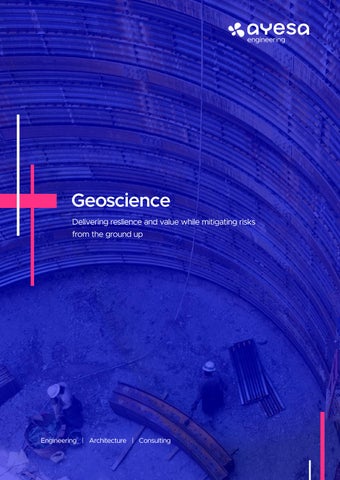
Geoscience Delivering reslience and value while mitigating risks from the ground up
Engineering | Architecture | Consulting
Contents
About Ayesa Engineering
4
Our Approach
6
Sector: Geoscience
8
Sub-sectors Urban Geotechnics
10
Infrastructure Geotechnics
22
Engineering Geology
30
Underground Spaces
38
Site Investigation
44
Land Quality and Regeneration
56
Surface Water and Groundwater Risk Assessments
62
4
Geoscience Brochure / About Ayesa Engineering
About Ayesa Engineering A global leader in engineering services
Top 50 International engineering design firm
16+ Countries (active in)
€312m+ Revenue
1966 Established
3,200+ Professionals
70+ 40+ Skill sets
11 Offices in UK and Ireland
For almost 60 years, Ayesa’s multidisciplinary teams have successfully delivered significant large-scale projects worldwide while staying true to their guiding principles of “making it happen”. Today, the company is a global provider of engineering services, specializing in over 40 disciplines and with an active presence in 16+ countries. Ayesa’s expansion into various sectors and geographic locations has played a significant role in its growth, ultimately leading to its position as one of the 50 largest engineering firms globally. In 2025, Ayesa Engineering grew to 3,200 professionals united in the shared goal of developing solutions that foster a new, improved, sustainable and digitally-oriented world.
World Rankings #45
ENR 2025 Top 225 International Engineering Design Firms
#56
ENR 2025 Top Global 150 Design Firms
#61
WA100 2026, Building Design Top Architects
#18
Geplus.co.uk Top 50 Geotechnical Consultants (UK) 2025
ENR 2025 Top International Design Firms (sector) #24 Transportation
#14 Water Supply
#20 Marine & Port
#50 Sewer & Solid Waste
#38 Oil & Gas
#35 Industrial Process
#18 Highways
#11 Rail and Mass Transit
#18 Water Treatment
Geoscience
Buildings and Cities View Sector >
Transportation View Sector >
// Urban Geotechnics // Infrastructure Geotechnics // Engineering Geology // Underground Space // Site Investigation // Land Quality & Regeneration // Surface water & Groundwater Risk Assessments
// Arts and Culture // Education // Healthcare and Research // Heritage and Conservation // Office and Commercial // Residential and Hotels // Sports and Leisure // Technology and Data Centres // Urban Planning and Landscaping
// Airports // Bridges and Structures // Highways and Roads // HSL, Railways // Land Management // Metros, LRT and Tramways // Stations and Terminals // Transportation Systems // Tunnels and Underground Spaces
Marine and Coastal
Energy
Industry
View Sector >
View Sector >
View Sector >
// Ports and Harbours // Marine Structures // Coastal Modelling and Engineering // Marinas and Waterfronts // Subsea Pipelines // Environmental Assessments and Planning // Offshores Renewables
// Solar Energy // Onshore and Offshore Wind Power // Biomass // Hydroelectric Power // Hydrogen and Renewables Gases // Energy Storage // Thermal Generation // HV Transmission and Distribution
// Logistics Plants and Distribution Centres // Metallurgical and Transformation Plants // Agri-Food Plants // Mining Facilities // Chemical and Petrochemical Plants // Yeast and Life Sciences
Water and the Environment
Oil and Gas View Sector >
View Sector >
// // // // // // // //
Environment and Sustainability Flooding and Rivers Waste Management Dams, Reservoirs and Major Water Infrastructure Drainage, Groundwater and Irrigation Water Conveyance and Distribution Water Resource Management Water Treatment and Desalination
// Liquefied Natural Gas (LNG) // Pipelines // Production Facilities // Refining Facilities // Storage and Terminals
5
6
Geoscience Brochure / Our Approach
Our Approach An End-to End Partner Lasting Positive Impacts We offer the highest standards of design, project management and stakeholder collaboration to realise optimum project solutions. Our engineering consultants are among the very best in their fields. Continuous involvement in challenging projects maintains and enhances our high standards of technical excellence.
People Centric We invest in our staff to deliver a positive, enriching, safe and empowering work experience at Ayesa. We are committed to equality, diversity and inclusion to provide a place where everyone can thrive. We invest significantly in training and development to keep our staff at the cutting edge of their industry. Our focus is on positively influencing those SDGs most applicable to us in our role as a leading engineering consultant. Everything from CO2 emissions, water reduction, social value, health and wellbeing, community engagement, apprenticeships, and safe working.
Our company is built on relationships and superior client care. We deliver on our unwavering commitment to assist our clients in achieving their desired results. We are agile and responsive and build a collaborative framework across stakeholders for project success.
Bridging the Gap We are seasoned in managing projects and supervising construction phases of projects across the project lifecycle. We help clients “bridge the gap” across all relevant stakeholders within a project. We seek to understand the needs, constraints, opportunities and to optimise solutions.
Proven Track Record We have extensive experience across a broad range of sectors. We currently sit on a number of frameworks, such as Irish Water, Port of Cork, Oil and Pipeline Agency, Waterways Ireland, Gas Networks Ireland, Irish Rail, Fusion 21 and Translink.
Utilising Relationships Getting a project off to the right start and mitigating any delays helps to keep costs down - Our team has forged close working relationships with environmental authorities and regulators throughout the regions we operate in, enabling us to expeditiously progress projects through the permitting, construction, verification and site closure.
Client Focused Our culture focuses on developing strong working relationships with clients who continue to work with us based on the value we provide. Our clients are in both the public and private sector and range from major companies and national regulatory organisations to smaller regional organisations providing optimum solutions for significant infrastructure projects and local sites.
Innovation and Sustainability
Technical Excellence
We offer innovation with a deep understanding of environmental issues such as climate change and sustainability, waste to energy, renewables to deliver maximum value to clients.
We keep our clients informed of the implications of legislative changes to their businesses and manage stakeholder engagement to help progress projects in a profitable yet environmentally compliant manner. Our proactive approach helps you to benefit from our expertise in a constantly changing regulatory environment.
Safety First
Multi-Disciplinary
We advance safety, applying rigorous processes that manage technical, environmental and social risks and hold ISO 45001:2018 – the internationally recognised standard for occupational health and safety management systems.
We provide engineering and design consultancy services across ten sectors: marine and coastal, geoscience, buildings, transportation, energy, environment, water, flooding, waste management, and conservation.
7
8
Geoscience Brochure / Geoscience
Sector: Geoscience The Full Range of Geotechnical Engineering Services across the Entire Project Lifecycle When working on a project, how construction interacts with its surrounding ecosystems and ground conditions is often the source of the most significant risks and uncertainties. Ayesa has become an acknowledged leader within this sector, analysing difficult ground conditions on both greenfield and brownfield land, solving complex geotechnical challenges by providing robust and practical solutions for various development projects, whatever the size or scale. Our geotechnical expertise can be applied effectively to projects, whether water, marine, energy, civil, buildings, rail and conservation. Our international experts in geotechnical engineering identify and mitigate ground-related risks through rigorous investigation, analysis and design. We have completed large scale schemes across all construction sectors, providing designs including foundations, retaining walls, tunnels, shafts, earthworks and slopes. We form integrated geotechnical and structural design teams capable of providing fully coordinated solutions, maximising the reliability and efficiency of our projects. We assist with determining the optimal construction sequencing and provide practical and value-driven geotechnical solutions, such as ground movement assessments, contaminated land remediation and soil-structure interaction.
Red Line - Doha Metro, Qatar
We are equipped to manage the geotechnical inputs on projects from the initial investigation phase to onsite monitoring during construction. Our experienced engineers and geologists are industry leaders in specifying and managing geotechnical investigations and interpretative reporting. Numerical modelling has developed rapidly over the past decade, and often the quality of geotechnical investigative data is the limiting aspect for developing intricate models and assessments. We undertake complex 3D modelling for projects to investigate any impact on surrounding assets due to ground and structural movements. The use of ground engineering will help improve the design of structures and can reduce asset-lifecycle costs by using the latest methods and technologies. Our staff will ensure the necessary data is captured during the investigation phase to offer clear benefits to the design and modelling phase – whether this is a city centre basement development or a large linear infrastructure project.
Top 20 ground consultants in the UK
Sub-sectors
Urban Geotechnics
→
Infrastructure Geotechnics
→
Engineering Geology
→
Underground Spaces
→
Site Investigation
→
Land Quality and Regeneration
→
Surface Water and Groundwater Risk Assessments
→
9
10
Ayesa Engineering / Geoscience / Urban Geotechnics
Urban Geotechnics Maximising constricted urban spaces with innovative underground solutions For over 20 years, Ayesa has successfully worked on urban projects across various ground conditions by supplying geotechnical engineering and below-ground design services. Our team consists of geotechnical engineers, civil engineers and engineering geologists who deliver tailored solutions to meet individual urban project and client requirements. We have extensive experience in design and construction in various ground conditions throughout cities in Ireland, the UK and the Middle East. Advising Innovative Solutions Cities worldwide are struggling with a myriad of environmental and social problems with air, water and soil pollution and crowded, ageing infrastructure. Innovative solutions are essential to combat these problems by utilising underground solutions and maximising space. Our geotechnical engineers contribute to exciting and challenging projects, many of which are major national and international schemes built within densely populated areas. In the buildings sector, we have provided foundation and basement designs for The Shard in London, the New Children’s Hospital in Dublin and the visitor centre at Titanic Belfast. Often, we apply complex 3D modelling on projects to understand the impact on surrounding assets due to potential ground and structural movements. We provide detailed earthworks and sub-structure solutions for large urban infrastructure schemes such as the Crossrail line extension in London, the Doha Metro scheme in Qatar and the M50 widening in Dublin. Our expertise covers all aspects of geotechnical and geological engineering, from planning, investigation and feasibility studies to design, construction surveillance and operations and maintenance.
The Shard, London, UK
University College London Hospitals (UCLH), UK
60 Dawson Street, Dublin, Ireland
1 Molesworth Street, Dublin, Ireland
13
Ayesa Engineering / Geoscience / Urban Geotechnics
The Shard Overview One of London’s most iconic landmarks, The Shard is a striking silhouette in the skyline. As one of the tallest buildings in Europe, The Shard reflects the ambition and vision of the City. With its location in the heart of London, any works on The Shard risked a considerable impact on its neighbours; most notably the adjacent London Bridge station, a Victorian structure and integral transport hub for the city. Our Role Ayesa was appointed as the detailed designer for the substructure, including a top down construction sequence for the triple level basement. As the project is adjacent to London Bridge station, a central hub on London’s rail network, the rail authority (Network Rail) required detailed analysis of the effect of the basement excavation on the Victorian station structure. Ayesa undertook a detailed Ground Movement Assessment and successfully satisfied Network Rail and their technical advisors, gaining approval for our design. Innovation / Value Add The solution designed by Ayesa included a secant piled wall to allow for the deep excavation, piled foundations, and plunge columns. The original foundation concept involved the piles being base grouted. Following a successful preliminary pile test to record settlements and strains, Ayesa argued that base grouting was not necessary and provided a value-based alternative. The final solution comprised 60m deep, 1.8m diameter, bored piles founded in the underlying Thanet Sand.
Location: London, UK Client: Balfour Beatty Ground Engineering Capital Value: £350m
14
Ayesa Engineering / Geoscience / Urban Geotechnics
60 Dawson Overview Project Kells (later rebranded as 60 Dawson) is a large retail and office development in Dublin City Centre at Dawson and Nassau Street. The proposed works includes the construction of a new, four to six-story high mixeduse building. As part of the redevelopment, it is proposed to complete a bulk excavation for a two level below ground deep basement. Two sides of the proposed basement are parallel to the LUAS Cross City Line, at the junction between Nassau Street and Dawson Street. The basement is approximately 3.4m to 7.1m from the nearest LUAS running rail. In the temporary case, excavations of 10.15m to 10.75m bgl are required. Our Role Ayesa worked closely with the clients (PJ Edwards) from the tender stage providing consultancy services covering design methodology, monitoring, and detailed design of the secant pile wall and temporary support to the wall during construction. To facilitate installation of drainage and services, excavation depths up to 10m and 11m bgl have been accounted for in the temporary case. The designs had to meet tight movement criteria and we proposed a real time instrumentation system, to ensure that the works had no adverse impact on adjacent sensitive structures and the live LUAS light rail line. Ayesa also completed the design of permanent works foundation piles. The installation of foundation piles was required to accommodate large compression loads where the top of bedrock was well below the basement formation level. Ayesa also completed the design of the capping beam for the temporary works to distribute the support from the temporary propping and tie back anchors along the secant pile wall.
Location: Dubin, Ireland Client: PJ Edwards & Co. Ltd. Capital Value: €58m
16
Ayesa Engineering / Geoscience / Urban Geotechnics
Project Fitzwilliam Overview The ESB head office building on Fitzwilliam Street Lower is a stunning new commercial building in the heart of Dublin city centre. The 45,000m² development comprises two commercial office buildings with the protected historic Georgian houses on Mount Street that were restored and refurbished into modern, highquality residential properties, maintaining their protected status. The 45,000 sqm space will feature sustainable technologies to reduce carbon emissions and energy costs, resulting in a near-zero energy building. With an excellent BREEAM rating, the project is one of Dublin’s most sustainable and efficient office developments. Our Role Our Geotechnical Engineering team in Dublin was involved in Project Fitzwilliam from the tender stage, assisting PJ Hegarty by developing a practical construction sequence and identifying risk mitigation measures for the demolition and subsequent basement works. On commencement of the project, Ayesa acted as specialist designer for P.J. Edwards, delivering the detailed design of the perimeter secant pile wall. The wall extended to approximately 400 linear metres and comprised over 650 piles. It was restrained with prestressed glass fibre reinforced polymer (GFRP) anchors beneath the surrounding streetscapes. GFRP anchors were selected and agreed with DCC to avoid obstructing potential future service installations beneath adjacent streets. Ayesa also produced the detailed design for 450 foundation bearing piles and 150 anti-flotation anchors to support the substructure. Throughout the project, Ayesa acted as temporary works designer for PJ Hegarty and provided assistance across a wide range of site elements.
Location: Dublin, Ireland Client: PJ Hegarty / PJ Edwards & Co. Ltd. Capital Value: €150m
18
Ayesa Engineering / Geoscience / Urban Geotechnics
Charlemount Square Overview Dublin’s Charlemont Square project marks the second phase of the Charlemont Street revitalization initiative, aiming to rejuvenate the urban landscape of Dublin 2. This ambitious €210 million mixed-use development encompassed the transformation of approximately 13,000m2 of constricted space in the city center. The project was completed between January 2018 to December 2022 and has created a vibrant central hub for the local community. To pave the way for progress, four outdated residential blocks were cleared, making room for six new multistory blocks that now house 96 top-tier apartments. The ambitious undertaking engaged a total of 203 subcontractors and became the most extensive excavation project within Dublin’s canal area. Our Role Ayesa provided a detailed design package for the construction of a contiguous pile retaining wall and a secant pile retaining wall to support the excavation of a single and double level basement for the proposed Charlemont Street development in Dublin. The retaining walls were designed to be installed using continuous flight auger (CFA) piles, with various sections of the walls being temporarily supported by propping during the short-term condition. The pile design requirements were determined in accordance with relevant codes and guidelines, and the walls were assumed to be supported by the basement and ground floor slabs in the long-term condition. The design was completed at the request of the client P.J. Edwards & Co. Ltd.
Location: Client: Capital Value:
Dublin, Ireland PJ Edwards £210m
20
Ayesa Engineering / Geoscience / Urban Geotechnics
Location: Client: Capital Value:
Cadenza Building Overview Cadenza, Earlsfort Terrace is a 13,000 m² flagship office development built for leading pension and investment company Irish Life. The Cadenza project consists of a modern office development over 8 floors with bespoke facades and sustainability deliverables of BER A3, NZEB compliance, LEED Platinum V3, WELL Gold V1, WiredScore and enhanced Smart building metering & monitoring.The building comprises six office floors above a lower ground floor and a single-level basement. Its construction includes an RC concrete frame with post-tensioned slabs, while the facade boasts a unique structural glass wall with an external tapered stone veil. Our Role Ayesa completed the secant pile wall design and temporary works support measures as part of the enabling works contract for the redevelopment of Davitt House, Earlsfort Terrace, Dublin 2 into its new incarnation as Cadenza Earlsfort Terrace. The contractor submitted a comprehensive report outlining a detailed design and certification proposal for the permanent works secant pile. The project involved several key stakeholders, including Walls Construction Ltd as the main contractor, Waterman Moylan Consulting Engineers (WM) as the engineering team, PJ Edwards & Co. Ltd (PJE) as the piling contractor appointed by the main contractor, and Ayesa acting as the pile designer on behalf of PJE. In order to facilitate the excavation of a two-level below-ground basement, a secant pile wall was installed to provide structural support. Additionally, temporary support measures were implemented in specific areas to minimize lateral movement of the wall during the excavation stage.
Dublin, Ireland PJ Edwards & Co. Ltd. and Walls Construction Undisclosed
Osberstown Rail Underpass
23
Ayesa Engineering / Geoscience / Infrastructure Geotechnics
Infrastructure Geotechnics Breaking New Ground At Ayesa, we deliver innovative, cost-efficient geotechnical solutions across major infrastructure sectors, including transportation (roads, rail, metro) and marine. Our services cover earthworks, retaining systems, foundation engineering, and asset management.
A32 Cherrymount Link, Enniskillen, UK
With growing urbanisation and the need for sustainable connectivity, understanding geotechnical risk in major transport projects is critical. We provide end-to-end support from design through construction, equipping clients with the insights needed to manage risk, reduce uncertainty, and implement effective solutions. Our multidisciplinary team works across sectors, geographies, and project scales, assessing ground risks and developing mitigation strategies throughout the lifecycle - from feasibility and planning to detailed design and delivery. We are particularly strong in Design and Build, where our construction knowledge and focus on buildability add clear value. Our experience spans diverse conditions worldwide, from soft ground road schemes in Ireland and mountainous terrain in Kosovo and Albania to seismic design for the US$5 billion New Aqaba Port. We have also supported major rail and metro projects such as London’s Crossrail and systems in Doha and Jeddah, alongside complex urban developments in Ireland.
Route 7 Motorway - Kosovo
Our consultancy services include site inspections, investigation management, geological mapping, monitoring and instrumentation, hydrogeology, geotechnical design and reporting, emergency and repair strategies, asset management, maintenance planning, temporary works design, independent checks, expert witness, and construction support.
Royal Commission Bridges, Jubail, KSA
24
Ayesa Engineering / Geoscience / Infrastructure Geotechnics
Location: Jubail, KSA Client: Royal Commission of Jubail (RJC) Capital Value: Undisclosed
Royal Commission Bridges Overview The Royal Commission in Jubail (RCJ) plans to construct two new bridges: one from Jalmudah to Al-Batinah Island (Battinah)and the other from Dareen to a nearby unnamed island (Dareen). Batinah is a 4-lane bridge proposed to replace an existing causeway to allow increased access to Abu Ali Island. Darren is a 2-lane bridge designed to replace a smaller existing bridge to link the mainland to an island with oil production facilities. Both bridges have been designed with a 60m main span to clear a 40m navigational channel to allow safe navigation of vessels up to 15m in length. Our Role Ayesa in association with FAEC was commissioned by the RCJ to undertake the detailed design of both bridges, the approach causeways, the marine works including lining the channel, protection for the piers and navigation aids. Detailed assessments included carrying out a detailed study for the form, shape and location of both bridges. The location and height of each bridge was determined considering the existing causeway and bridge remaining in operation until each was opened. Extensive geotechnical investigations were carried out to ensure the optimum piling solution was found for all piers in varying ground conditions. The long-term settlements of the approach embankments were also taken into consideration. Extensive studies were also done on the possible construction methods for constructing the pile caps and piers in the marine environment. Both bridges were designed using post-tensioned concrete box girders of uniform depth – each carrying 2 lanes of traffic, with inclined piers supporting the spans over water and vertical piers for spans over mud flats. Innovation / Value Add Ayesa utilised our multidisciplinary team to supervise the ground investigation works, as well as providing a range of specialised expertise. The bridges were designed around a principle of ‘balanced aesthetics”, combining striking design that blends seamlessly with surroundings and delivers constructability and cost-efficiency.
26
Ayesa Engineering / Geoscience / Infrastructure Geotechnics
A32 Cherrymount Link Our Role
Ayesa played a pivotal role as the civil and geotechnical designer for the contractor-designed elements (CDE) in the £13 million scheme to develop a Class A trunk road in Enniskillen, Northern Ireland. Spanning a distance of 2 kilometers, the route presented unique challenges due to its passage through areas characterized by deep, very soft ground, including peat and lacustrine clays. A key aspect of our involvement was to devise costeffective solutions to enhance the ground’s stability, ensuring the successful construction of the trunk road. Solution In tackling the soft ground challenges, Ayesa employed the ‘excavate and replace’ technique, a proven method for ground improvement. Our role involved meticulous supervision of the soft ground replacement, using engineered fill in a carefully phased manner. This approach was pivotal in preventing potential instability in the adjacent lands, ensuring both safety and project integrity. Our engagement spanned from the initial tender phase right through to construction, marking our deep involvement in the project. A testament to our innovative thinking was the development of a value-engineered soil nail solution. This creative approach was an alternative to the originally conceptualized reinforced concrete retaining structure. The result? Significant savings for our client in both time and resources. Beyond ground improvement, Ayesa’s expertise extended to the detailed design of key infrastructural components. This included a public and a private footbridge, along with their approach ramps and bank seat abutments. These structures were supported on reinforced earth embankments, showcasing our capacity to integrate aesthetic, functional, and structural elements seamlessly.
Location: Enniskillen, UK Capital Value: £13m Project Name: A32 Cherrymount Link Country: UK Client: P.T McWilliams/Mclaughlin & Harvey JV
28
Ayesa Engineering / Geoscience / Infrastructure Geotechnics
Silvertown Tunnel Overview The ambitious Silvertown Tunnel, a new 1.4 km twin bore tunnel under London’s River Thames, is a testament to modern engineering. Spearheaded by the Riverlinx CJV, a consortium of BAM Nuttall, Ferrovial Construction, and SK ecoplant, this project represents a significant advancement in urban infrastructure. Among the highcaliber team of specialists assembled by Riverlinx CJV is Ayesa, appointed as the underground structural designer. Ayesa’s responsibility spans the spectrum of temporary and permanent works, including cut and cover tunnels, TBM shafts, and other critical structures. This tunnel, linking Silvertown to Greenwich, aims to alleviate congestion from the 122-year-old Blackwall Tunnel and revitalise the surrounding areas. Adhering to the Tunnel Code of Cosstruction Practice (CoCP), the project emphasises sustainable construction practices, including river transport for materials and low-emission machinery usage.
Location: Client:
Capital Value:
London, UK TfL, Riverlinx CJV, BAM Nuttall, Wayss & Freytag, Ferrovial Agroman and SK E&C £2b
Our Role Ayesa’s role in this monumental project is multifaceted. As the underground structural designer, our expertise covers cut and cover tunnels, three complex TBM shafts, portal structures, open-cut structures, damage assessment, and instrumentation and monitoring. The excavation combines TBM and Cut and Cover methods, showcasing our adaptability in tunnel construction techniques. Innovation / Value Add Ayesa, as part of the Riverlinx CJV, collaborated closely with Ferrovial’s Engineering Services department and BAM Wayss & Freytag to develop the innovative “peanut shaft” design, which launched the largest TBM in the UK. The design was specifically created to address land rights constraints that required avoiding anchors to the ground. This led to the use of secant piles - marking the first time a peanut shaft of this kind was built in the UK. Other alternatives, such as D-walls, were unsuitable due to existing obstructions and supply chain limitations (e.g., no hydro mill available in the UK). The team conducted a thorough feasibility assessment, evaluating global solutions and adapting them for the UK context. The final design featured four 21.2m diameter shafts connected by T-shaped counterfort structures, eliminating the need for external ground treatment or anchors. Our collaborative efforts extended beyond contractual obligations, particularly with COWI, the lead geotechnical designer. This partnership, which combined expertise and streamlined workflows, was vital in overcoming pandemic-related delays. Ayesa also utilized advanced tools like 3D modeling and Plaxis 3D for shaft construction simulations, alongside 2D Plaxis for Cut and Cover North construction.
We designed temporary supports and dewatering plans for the shafts, demonstrating our commitment to delivering efficient, innovative solutions in complex urban infrastructure projects. Through this project, Ayesa underscores its dedication to innovation, collaboration, and delivering exceptional value in challenging infrastructure initiatives.Through this project, Ayesa reaffirms its dedication to innovation, collaboration, and providing exceptional value in challenging urban infrastructure projects.
Tunnel Length
Access Ramps
Economic Cost Saving
1.4km
0.6km
£10m p.a
The Gobbins Cliff Path Walkway, Islandmagee, UK
31
Ayesa Engineering / Geoscience / Engineering Geology
Engineering Geology London Gateway - Site X, London, UK
Exploring The Link Between Buildings and The Ground Engineering Geologists provide the bridge between the built and natural environment and our diverse team of geologists and civil engineers, allow us to take a holistic approach to design. Our engineers are constantly exploring innovative ways to optimise designs based on the conditions at the site, which means every design we provide is unique. Ayesa engineers are experienced in assessing earthworks for signs of distress and designing remediation solutions to stabilise structures that could be at risk of failure from stresses such as climate change, subsidence, capacity limit and ageing or nonresilient materials. During site visits, we investigate infrastructural risks associated with earthworks and recommend long-term and short-term mitigation strategies. Our engineers undertake kinematic, limit equilibrium, and finite element analyses to accurately model earthworks and deliver optimal design solutions. Our engineers work across various sectors, including rail, highway, infrastructure, and private construction.
Guildford Sands, Guildford, UK
Our rope-access trained geologists can get up close to investigate tricky and remote areas that would otherwise be inaccessible. While there, they assess hazards, tactilely inspecting, taking structural rock measurements, and logging slopes to gain a complete understanding of risks presented by earthworks. Our studies and investigations can be conducted in numerous phases of public and project projects: planning (including assessing environmental impacts), civil/structural engineering design, value engineering, construction, forensic phases and post-construction. We can provide comprehensive assessments, including geological hazard assessments, for geotechnical, material properties, stability of landslides and slopes, erosion, flooding, dewatering, and seismic investigations.
Brandon Cutting, Coventry, UK
32
Ayesa Engineering / Geoscience / Engineering Geology
Location:
The Gobbins Cliff Path Walkway Overview The original Gobbins coastal path was opened in 1901 but fell into disrepair and was closed in 1951. This reconstruction project consisted of a series of 23 footbridges and cantilevered walkways forming a 1kmlong pathway at the base of 60m-high cliffs spanning between rock outcrops and sea stacks along the Antrim Coast. The pathway follows the original route and the iconic bridges have been reconstructed to closely match the original Victorian structures with original steps and walkways retained. Our Role Ayesa acted the geotechnical designer for the bridges, cantilever anchorage systems and cable stayed anchors for the main contractor, McLaughlin & Harvey Ltd. We also carried out rockfall assessments and site investigations and developed value engineered solutions along the coastal pathway route to mitigate against unstable sections of the cliff face. We developed a rockfall management plan to assist in managing operational rockfall risks, through a systematic process of geological inspections, continual monitoring and intermittent tactile assessments.
Larne, UK
Client:
McLaughlin & Harvey Ltd.
Capital Value:
£4.5m
35
Ayesa Engineering / Geoscience / Engineering Geology
Brandon Cutting Overview Following a period of very wet weather, in February 2020, a section of cutting slope along the RBS1 line between Rugby & Coventry failed, resulting in slumping of the shallow slope material and formation of a significant back scarp. In response a temporary speed restriction was put in place and emergency works undertaken to remove the slumped material and install additional temporary support along the toe. Ayesa were engaged by J Murphy & Sons (working on behalf of Network Rail) to assess the cutting and undertake the design of both temporary and permanent solutions. The permanent solution comprised a concrete Redi-Rock™ wall and slope regrade. This arrangement was eventually extended over a length of approximately 200m of cutting slope to address other areas of concern. Our Role Following an emergency callout and weekend inspection of the slope failure, Ayesa’s initial role was to design a temporary works arrangement to make safe the failed sections. Once the cutting slope was made safe, Ayesa then undertook the detailed design of the permanent solution. During the construction stage Ayesa provided regular site attendance and additional design activities as required to ensure successful delivery of the project. Innovation / Value Add After a review of the retaining wall options to support the cutting toe, the use of pre-cast concrete “Redi-Rock” blocks was selected due to its quick construction time and engineering performance. The construction of the slope regrade above the new toe wall was completed using a combination of “Menzi” slope climbing excavator and a long reach machine. This removed the need for plant to be in the cess and hence lengthy track possessions.
Location: Capital Value: Project Name: Country: Client:
Coventry, UK £2m Brandon Cutting UK J Murphy & Sons Ltd
36
Ayesa Engineering / Geoscience / Engineering Geology
Wadhurst Cutting Ayesa in collaboration with BAM Ritchies/Nuttall, has played a pivotal role in enhancing Network Rail’s service reliability on vital routes. A standout project is the Wadhurst Cutting, a testament to our joint efforts in delivering exceptional outcomes. Through innovative value engineering, Ayesa significantly lowered costs and accelerated project timelines, while our tight-knit team promptly resolved any construction challenges. The cutting, carved over 170 years ago, has experienced numerous landslips, disrupting travel between the coast and central London. Our stabilisation efforts now promise a more dependable train service between London and Hastings, ensuring a minimum 60-year lifespan for this critical infrastructure.
Location: Capital Value: Project Name: Country: Client:
Wadhurt, London UK £3m Wadhurst Cutting UK BAM Ritchies/Network Rail
Summary: The Ayesa and BAM Ritchies team brought renewed strength and resilience to the historic Wadhurst Cutting. Employing both active and passive rock bolting, netting, and soil nails, we navigated logistical hurdles, protected local wildlife, and maintained a flawless safety record. Project: The Wadhurst Cutting, a vital section on the Tonbridge to Hastings rail line, spans approximately 300 meters between the north and south tunnel portals. Characterized by varying heights of 8 to 18 meters, the cutting’s geology comprises predominantly weathered Wadhurst Clay, underpinned by the Wadhurst Clay Formation and Ashdown Formation. Due to a series of collapses in recent years (2014, 2016, and 2019), Network Rail commissioned BAM to implement an approved design for the cutting’s restoration. The restoration was divided into two segments: initial emergency works at the country end and subsequent works at the London end. This multifaceted project incorporated a variety of geotechnical stabilization techniques typically employed in failing earthwork structures. It involved three main systems: an active soil nail system on the upper slopes with varying nail lengths (5 to 14 meters), overlaid with Greenaxe integrated mesh and erosion matting; a passive rock bolt drape net system from the tunnel portal to ground level; and an active rock bolt system around the portal’s entrance. The project installed approximately 13,000 linear meters of soil nails and over 1,000 linear meters of rock bolts, covering an area of about 15,000m2. A subsequent LiDAR survey post-vegetation clearance led to further design refinements, shortening soil nails in certain areas.
Upon reviewing the initial emergency work, BAM Ritchies identified an opportunity for significant value engineering. Partnering with Ayesa, a feasibility study was conducted to determine the scope for such enhancements. Our analysis revealed potential cost savings by strengthening the reinforcement mesh, allowing for increased spacing of soil nails (from 1 x 1.5 meters to 1.5 x 2 meters) and rock bolts (from 2.2 meters to 3 meters). These modifications proposed a 46% reduction in the linear meters of soil nails and rock bolts, cutting the project duration by 20 weeks and saving approximately £1.5 million. Network Rail approved these changes for their cost-effectiveness and adherence to safety standards and specifications, though they were only implemented at the London End due to time constraints.
Editors Award Winner: “The power of collaboration including supply chain partners, created one team focused on the project’s success.”
During the blockade at the country end in October 2021, BAM Ritchies executed emergency works including the installation of lower rock bolts and soil nails, a task previously unachievable. The team delivered an incident-free, efficient, and sustainable 7-day operation, reinforcing the earthwork’s infrastructure on the Kent and Sussex Railway. Over 450 soil nails and rock bolts were installed, totaling more than 2,200 meters. The use of HVO fuel in the three drilling rigs, as opposed to traditional diesel, resulted in a 90% reduction in carbon footprint. Our collaborative approach, leveraging the collective expertise of the project team, consistently aimed to challenge and improve outcomes, even amidst complex strata comprising Wadhurst clay over Ashdown rock formation. Initial tests with self-drilling nails indicated that the Wadhurst clay’s hardness would complicate drilling and installation. This obstacle was surmounted by integrating hydraulic drill heads with traditional air masts in a hybrid system that maintained air flush efficiency with the added speed of a hydraulic terrapin face rig, leading to production exceeding expectations and demonstrating our commitment to innovative solutions for Network Rail. Sustainability and Ecological Considerations The project emphasized sustainability, notably by simplifying design elements to prevent unnecessary complexity. Special attention was given to erosion protection, initially planning to incorporate plasticbased erosion mats in the mesh reinforcement. However, discussions with the supplier uncovered a risk of microplastic pollution due to product degradation. Consequently, BAM Ritchies and Ayesa engineers, in collaboration with our team, advocated for an environmentally friendly alternative, persuading Network Rail to approve the use of woven coir matting instead. The site also posed ecological challenges, such as accommodating a resident badger sett and Dormice habitat. Measures included obtaining a license to temporarily close the sett and creating a “dead hedge mouse highway” to reroute the Dormice from the construction area. Additionally, plans were made to plant Dormice-friendly vegetation post-project. The project team also partnered with EAVE, utilizing GEN3 ear defenders for a productive and safe work environment. The two-week trial provided valuable noise exposure data for site operations, further underscoring our commitment to ecological and workplace safety.
Benefits and Achievements Enhanced Line Stability: Over the past decade, the Wadhurst tunnel has necessitated numerous engineering interventions to address weather-related issues. The stabilization of Wadhurst cutting, achieved with 5,400 soil nails and mesh and the removal of 15,000m2 of vegetation, significantly mitigates the risk of landslips and weather-related disruptions to the railway. Swift and Efficient Emergency Work: The sevenday emergency blockade during the October half-term enabled engineers to rapidly reinforce the cutting, thereby ensuring its stability and safety in a very short time frame. Minimised Passenger Disruption: By consolidating critical work into the blockade period, the project substantially decreased the overall disruption to passengers and delivered benefits more swiftly. Improved Journey Reliability: The comprehensive stabilisation work is expected to reduce long-term delays, enhancing the reliability and overall experience of passenger journeys. Significant Cost and Time Savings: The innovative design changes led to a 46% reduction in the amount of soil nails and rock bolts used, shortening the project duration by 20 weeks and saving approximately £1.5 million, while also reducing material usage. Environmental Risk Reduction: Our team’s recommendation to use woven coir matting instead of plastic-based erosion mats significantly lessens the environmental impact, offering a more sustainable solution. Ecological Considerations: Post-project, the planting of dormice-friendly vegetation highlights our commitment to ecological sensitivity and habitat preservation. Value-Driven Engineering: The project’s value engineering approach resulted in notable cost and timeline efficiencies. The collaboration among BAM Nuttall, BAM Ritchies, and Ayesa was instrumental in overcoming construction challenges swiftly. BAM Ritchies’ contributions were key in helping Network Rail provide a more reliable and enhanced travel experience on the crucial London to Hastings route for at least the next 60 years.
Stepney Green Crossrail
39
Ayesa Engineering / Geoscience / Underground Spaces
Underground Spaces Taking Development Underground - Solving Urban Problems With Innovation Population growth, urban development and the requirement for environmental preservation have led to underground space becoming increasingly important in solving urban problems. Ayesa has been involved in a wide range of projects in the underground space sector, providing design services to clients throughout the project cycle from initial concept design through to detailed design and construction supervision to solve critical infrastructure needs. Our team of geotechnical engineers, structural engineers, engineering geologists and civil engineers deliver project and client requirements in areas such as tunnelling, deep shafts, temporary works, retaining walls in a variety of ground conditions throughout Ireland, the UK and the middle east.
Crossrail Eastern Running Tunnels
Our team of engineers are regularly involved in challenging and complex projects working directly for developers, as well as supporting contractors with design and build services. In Qatar, our role included the selection of the tunnel alignment and shaft locations and the design of permanent and temporary shafts for the Lusail Expressway. While, as part of the Elan Valley Aqueduct, we designed several TBM (tunnel boring machine) launch and work shafts including a 30m deep, 13.5m diameter permanent secant pile walldrop shaft.
Deepham’s Shaft, London, UK
As part of the New Children’s Hospital project, in Dublin, our appointment included the detailed design of close to 1km of permanent secant pile wall for the triple-level basement. Through close collaboration with our clients and technical expertise and experience in this area, we provide efficient and effective design solutions.
Newark Waste & Water Improvement Project
40
Ayesa Engineering / Geoscience / Underground Spaces
Location: London, UK Client: SPIE UK Capital Value: Undisclosed
Stepney Green Crossrail Overview The new Crossrail line in London divides at Stepney Green, with one line continuing north and one line crossing the Thames to the south. A deep shaft and large mined cavern was required at this location as TBM reception and launch and to accommodate the converging tunnels. The shaft was constructed using deep diaphragm walling techniques. The tunnel crosspassages are some of the largest ever constructed using sprayed concrete lining, being 50m long, 17m wide and 15m high. Our Role Ayesa was initially appointed by the specialist contractor SPIE UK to design and detail the diaphragm wall. This wall facilitated the enormous 35m deep excavation, with the wall panels being 1.2m thick and 50m deep. A particular challenge was the detailing of the reinforcement for the wall panels, ensuring these large cages could be safely lifted from horizontal to vertical for placement into the excavation. Each cage weighed 25 tonnes necessitating a robust temporary works design. Subsequently, the main contractor Dragados-Sisk JV appointed Ayesa to design the temporary propping to facilitate excavation of the shaft. We worked collaboratively with Dragados-Sisk to devise the value engineered construction methodology and sequencing and internal support system in order to accelerate the construction program and improve buildability. Ayesa also provided guidance on the cross-passage excavation stability and the sprayed concrete lining solution.
43
Ayesa Engineering / Geoscience / Underground Spaces
Diyar Al Muharraq Pump Station Overview As part of the sewer network upgrade in the Kingdom of Bahrain, a 23m deep pumping station was constructed on the man-made reclaimed island of Diyar Al Muharraq. To enable the construction of this pump station a 23m diameter shaft was constructed using 900mm interlocking male and female secant piles. Our Role Ayesa undertook a detailed design review and value engineering exercise for the deep shaft. This included an independent check on the process design and the structural design, a geotechnical assessment of the proposed solution along with the overall final configuration and suitability. Advice on the dewatering strategy in this aggressive marine environment was also provided, including consideration of pile overlap, drilling methodology and the degree of water cut-off that could be achieved.
Location: Diyar Al Muharraq Capital Value: Undisclosed Project Name: Diyar Al Muharraq - Pump Station Country: Bahrain Client: Undisclosed
44
Ayesa Engineering / Geoscience / Site Investigation
Site Investigation Navigating the unpredictable nature of subsurface conditions is often the most significant challenge in construction projects. A comprehensive site investigation is vital to identify and mitigate potential risks. Insufficient investigation can lead to project delays and additional measures to address issues such as contaminated soil and groundwater or reconstructing building systems. At Ayesa, our team of geologists, engineers, environmental scientists, and technicians provides value-added, risk-focused, site-specific solutions. Our field services ascertain the nature, extent, and risks associated with substances in soil, sediment, surface water, groundwater, and building systems. Our services span the full project lifecycle, from investigation and feasibility to risk assessment, monitoring, remedy selection, remedial design, site reuse, bid preparation to third-party specifications, and construction management. Our diverse clientele ranges from individual customers to major contractors and developers, including energy-from-waste facilities and peaking plant power stations. We work in demanding conditions such as soft ground, peat bogs, steep slopes requiring specialist rigs or scaffold platforms, overwater surveys in harbors, rivers, and lakes, landfills, crane lifts, and subterranean structures. We conduct investigations using internal and external resources and varied techniques to ensure highquality data, including cable percussion boring, rotary drilling, Geobor and resonance methods, dynamic sampling, static cone penetration testing (piezocone, magcone, seismic, gamma), and mechanical or handexcavated trial pits. Deliverables include the Ground Investigation Report (GIR), Geotechnical Design Report (GDR), and geoenvironmental interpretations and recommendations. We follow current British, EU, or Middle East standards and Eurocode 7, with data provided in AGS format for BIM integration.
Heathrow Airport Expansion, Heathrow, UK
Tropical Fruit Warehouse, Dublin, Ireland
Wrentham Site Investigation, Suffolk, UK
Askar Landfill Solar Farm, Bahrain
46
Ayesa Engineering / Geoscience / Site Investigation
Location: Qiddiya, Riyadh, KSA Client: Qiddiya Investment Company (QIC) Capital Value: SAR 30bn
Qiddaya Geotechnical Investigation Overview Qiddiya is set to become the Kingdom’s capital of Entertainment, Sports and the Arts to meet and satisfy the recreational, social and cultural needs of current and future generations. Located 45km west of Riyadh, Qiddiya will comprise of a Resort Core, Motion Zone, City Centre, Eco Zone Golf Community, Aerodrome and Airfield Future Development and Green Buffer development zones. Overlooking the Resort Core from its perch 200m above on the edge of the Tuwaiq escarpment, will be a City Centre mixed-use village dedicated to sports & the arts. Qiddiya’s City Centre development area covers approximately 530,000m2, allotted across 33 plots. Our Role Ayesa was appointed by the Qiddiya Investment Company, to provide geotechnical support for the proposed development in Qiddiya. Our role included identification and detailed requirements for test and investigations by plot, preparation of the required tender documents, review of technical & commercial submissions and provide any additional support. As the lead geotechnical Consultant, our scope included the provision of specifications, drawings, BOQs for pricing and monitoring works during construction, as well as GIS drawings and data. Innovation / Value Add Ayesa utilised BIM modelling by integrating Holebase SI and Civil 3D along with Autodesk Infraworks. This aided with faster revisions of the site investigation layout to reflect the masterplan layout changes.
49
Ayesa Engineering / Geoscience / Site Investigation
Brockaghboy Wind Farm Overview Situated in County L/Derry, Brockaghboy Wind Farm features 19 Vesta 3MW V90 turbines and spans 8.6 kilometers with its access tracks. Ayesa’s Belfast office served as the civil, structural, and geotechnical consultant for this project. Our role included delivering designs for crane hardstands and access tracks, enhancing and value-engineering the client’s initial tender package, as well as designing sustainable urban drainage systems (SuDS) and drainage solutions tailored for the challenging, undulating terrain of the site. Our Role In addition to our earlier contributions, we developed solutions for culvert crossings, bridge structures, and upgrades to public roads to facilitate the transport of turbines to the site. Our structural engineering team was responsible for designing the 19 wind turbine gravity bases. Ayesa conducted thorough site inspections and provided sign-offs and approvals for the turbine base formation levels, as well as the completed crane hardstands and access track surfaces. This project was initiated by ERG, a prominent Italian energy company.
Location: County Derry, Northern Ireland, UK Capital Value: £65m Project Name: Brockaghboy Wind Farm Country: UK Client: Adman Civil Projects Ltd.
50
Ayesa Engineering / Geoscience / Site Investigation
Location: Client: Capital Value:
Heathrow Airport Expansion Our Role Our team was appointed to provide enviromental assessment, permitting support for the project as well as landfill remediation and design. The Heathrow Expansion Programme is a £14bn project to construct a third runway and new taxiways linking it to the rest of the airport complex, a new terminal building and satellite, additional stand areas, new airport gateways, carparks and other associated infrastructure. It will involve rerouting the M25, diversion of rivers and substantial earthworks to achieve. Solution Our primary role was to provide advice on the remediation of three existing permitted landfill sites located along the line of the proposed new runway and to design and support the permit applications for four new landfills. The new runway is to be constructed on top of three pre-existing landfills posing complex remediation and foundational design issues. The existing leachate and landfill gas control systems needed to be replaced and a new capping system installed. The four new landflls are being designed to EU/UK standards and need to take account of their close proximity to a working airfield with associated access restrictions. Our Waste team were subcontracted to Jacobs who were appointed as lead earthworks consultant for the project. Our role in this project was multi-disciplinary with our consultants providing a full range of services; earthworks design, site investigation support, hydrogeological risk assessments, stability risk assessments, air quality assessment, design of landfill gas, leachate and odour control systems, environmental monitoring, regulatory compliance and advice on landfill tax.
Heathrow, UK Jacobs Engineering £15bn
52
Ayesa Engineering / Geoscience / Site Investigation
The Lidl Newbridge Distribution Centre Overview Lidl Newbridge Distribution Centre (DC) is a new 58,000m2 distribution centre constructed on the outskirts of Newbridge, Co. Kildare. The new Distribution Centre will serve Lidl’s network of stores in the Leinster area and create 100 full-time jobs for the area. Variable soft cohesive and loose granular materials were encountered within the initial 3m to 4m below ground level during the ground investigation. A ground improvement scheme was proposed at the site to reduce foundation costs over traditional piled/ bulk dig and replace solutions. Our Role Ayesa’s role (2016-2019) on the project was to appraise the initial ground improvement solution, prepare the earthworks and ground improvement specification, review the contractor design and build proposals and tender returns, review the ground improvement works and review the compliance reports. Following the tender process, a soil stabilisation solution of lime and cement stabilisation was selected as the most suitable solution. Ayesa ensured that the construction works were carried out in accordance with the overall project and designer’s specifications to ensure the settlement criteria would be met. This involved numerous site visits and reviewing them in situ as well as laboratory testing. Following the completion of the works, a detailed review of the compliance reports was conducted to ensure the works had been completed to the required specifications. Innovation / Value Add The innovation in this project lies in the ground improvement scheme proposed by Ayesa for the construction of Lidl’s Newbridge Distribution Centre. Instead of using traditional piled or bulk dig and replace methods, a soil stabilisation solution of lime and cement stabilisation was implemented. This innovative approach offered several benefits:
52
Location: Capital Value: Project Name: Country: Client:
Newbridge, Kildare €100m Lidl DC Ireland Lidl GMBH
Cost Reduction: The ground improvement scheme aimed to reduce foundation costs compared to conventional methods. By using lime and cement stabilisation, the need for extensive piling or bulk excavation and replacement was eliminated, resulting in cost savings for the project. Time Efficiency: The alternative ground improvement solution helped expedite the construction process. Compared to traditional methods that require more time for piling or extensive excavation, the use of lime and cement stabilisation allowed for quicker preparation of the ground, enabling faster progress on the project. Enhanced Stability: The stabilisation of variable soft cohesive and loose granular materials beneath the ground provided improved stability for the distribution centre. By treating the ground with lime and cement, the soil’s strength and load-bearing capacity were enhanced, ensuring a solid foundation for the facility. Compliance Assurance: Ayesa played a crucial role to ensure construction works were carried out in compliance with the project’s specifications. Through site visits, in-situ review, and laboratory testing, they ensured that the ground improvement works were carried out in accordance with the design requirements, meeting the settlement criteria.
54
Ayesa Engineering / Geoscience / Site Investigation
Lidl Mullingar RDC Overview The Lidl Regional Distribution Centre project in Mullingar is a 15,000m2 extension to Lidl’s existing centre in Lough Sheever Park, Mullingar. Opened in April 2023, Lidl’s new distribution centre is not only the largest on the island, totalling 62,000 sq.m, but it is also one of the most energy-efficient buildings in the country. Following an €80 million investment, the centre incorporates an impressive 1.2MWp solar array, making Lidl the country’s largest owner of rooftop solar arrays. Our Role Ayesa managed the ground investigation including part-time supervision. The scheme involved ground improvement works and upfilling of up to 3m to connect the extension with the existing structure. The Ground conditions were varied across the site with an area of Peat located in the east of the site. Following the ground investigation, Ayesa prepared the Interpretative Report detailing encountered ground conditions, geotechnical risks and geotechnical recommendations. Ayesa then assisted the Engineers for the scheme in preparing the Performance Specification, reviewed the tenderers’ technical submittals and reviewed the appointed contractor’s detailed design. The final solution involved excavating to a suitable subgrade and backfilling and compacting using ground stabilisation techniques. Ayesa subsequently carried out construction supervision. During construction, we supervised and designed temporary haul roads to facilitate the ESB plant relocating overhead pylons. Innovation / Value Add Our work leveraged advanced techniques, data-driven insights, and tailored design solutions to enhance decision-making, mitigate risks, and optimize project outcomes: Our geotechnical team specified an extensive round of Peat Probes that confirmed peat depths to allow the clients to make more informed commercial decisions regarding the proposed development. Ayesa designed temporary haul roads and platforms to facilitate the relocation of overhead pylons for the ESB plant. As part of the ground investigation, Ayesa prepared a detailed schedule of laboratory testing to enable a detailed classification of the soils and inform the appointed contractor of likely mix designs for ground stabilisation proposals.
54
Location: Mullingar, Ireland Client: Lidl GMBH Capital Value: €80m
55
Ayesa / Geoscience / Land Quality & Regeneration
Adventure Parc Snowdonia, UK
57
Ayesa Engineering / Geoscience / Land Quality & Regeneration
Land Quality & Regeneration Sustainable Development and Brownfield Site Regeneration We provide an integrated geotechnical and environmental consultancy, supporting projects from feasibility and site investigation through to remediation design, implementation and validation. Our multidisciplinary geo-environmental specialists assess natural and anthropogenic site constraints within the context of proposed or existing development.
The Sorting Office, Cardiff Lane, Dublin, Ireland
Contaminated Land and Brownfield Expertise With over 20 years’ experience in the contaminated land sector, Ayesa delivers practical, valuefocused solutions for brownfield redevelopment across the UK. We work collaboratively with clients to understand site constraints, risks and opportunities arising from historic land use and industrial legacy, supporting projects from appraisal and masterplanning through to planning condition discharge. Lifecycle Support and Regulatory Compliance We provide technical advice, risk assessment and mitigation strategies across all stages of contaminated land management — from due diligence and desk studies to investigation, remediation and verification. Our teams work proactively with regulators to achieve compliant, cost-effective solutions that minimise programme risk and development delays.
Jebel Ali Landfill, Dubai, UAE
Projects of All Scales Our consultants support developments ranging from small residential schemes to major commercial and industrial projects. Working with trusted contractors, we deliver coordinated ground investigation, remediation and earthworks programmes that satisfy planning and legislative requirements. By integrating geo-environmental, geotechnical, environmental and structural expertise, we deliver sustainable, costeffective outcomes.
Heathrow Airport Expansion, Heathrow, UK
58
Ayesa Engineering / Geoscience / Land Quality & Regeneration
The Sorting Office, Cardiff Lane Overview The Sorting Office is located in Dublin’s North Lotts and Grand Canal Dock Strategic Development Zone, a regenerated city quarter which is home to a number of international technology companies such as Facebook and Google. The development - being undertaken by Marlet Property Group - includes the construction of 56 residential units, 12,000 sq. ft. of retail space and 202,000 sq. ft. of office space across 7 storeys plus a basement. Our Role The Sorting Office development site was considerably contaminated due to former uses of the dock area. The design solution, detailed by the engineer, involved the installation of a 1m wide diaphragm cut off wall to attenuate the contamination on site in order to prevent migration off site, potentially negatively impacting the nearby River Liffey. Ayesa value engineered a bespoke design solution to reduce the construction programme and costs of constructing the cut off wall, detailing a cement-bentonite cut off wall which could be constructed using standard CFA piling techniques in a secant arrangement. Detailed testing and compliance inspections ensured the scheme was completed to the highest standards, with the required permeability and depths achieved to ensure the contamination is attenuated on site over the design life of the scheme.
Location: Capital Value: Project Name: Country: Client:
Dublin €158m The Sorting Office, Cardiff Lane Ireland PJ Edwards and Co. Ltd.
60
Ayesa Engineering / Geoscience / Land Quality & Regeneration
Adventure Parc Snowdonia Overview The centrepiece of the Adventure Parc is the Surf Snowdonia fresh water lagoon, in which artificial surf is generated. It is roughly the size of six football pitches, set in the Conwy Valley, North Wales and features a two-metre high barrelling wave that peels perfectly for more than 150 meters. The Adventure Parc also features a range of other facilities including glamping pods, a restaurant and various other indoor and outdoor leisure activities. Our Role Conwy Adventure Leisure Ltd. (CAL) and their contractors, (D Morgan) built the Surf Snowdonia facility on a former Industrial site – an aluminium rolling and casting works which closed in 2007. Before they set to work, it was a derelict, contaminated, brownfield wasteland with little prospect for development. Ayesa undertook extensive site investigations, undertook the contaminated land assessment and made recommendations for the clean-up and redevelopment of the site.
Location: Client: Capital Value:
Snowdonia, UK D Morgan plc / Conwy Adventure Leisure Ltd £12m
Grangemouth, Former Chemical Works, UK
63
Ayesa Engineering / Geoscience / Surface Water & Groundwater Risk Assessments
Surface Water & Groundwater Risk Assessments Understanding the Complex Cycle of Water
Assisting the Waste Management Industry
Surface water in streams and rivers is an essential resource, as is the groundwater stored below ground in geological strata called aquifers. Ayesa conducts complex groundwater and surface water risk assessments to guide the design and management of many public and private projects and fulfil compliance and regulatory obligations.
We complete detailed hydrogeological risk assessments for the planning and environmental permitting of new landfill sites. Our hydrogeological risk assessments ascertain the necessary pumping activities and permits needed to dewater quarry sites before commencing a new development. We complete geological and hydrogeological risk assessments to support planning applications for Energy from Waste facilities and for extractive mineral activities.
Water Flow and its Ecosystem When undertaking water-based risk assessments, we combine inputs from multiple experts (hydrogeologists, hydrologists, water and geotechnical engineers) analysing the flow and quality of water and its implications across the entire ecosystem. Our expertise within this area is evidenced by our consulting services across significant wide-ranging schemes: our hydrological and surface water risk assessments guide the design of the flood relief schemes at Arklow and Bandon Ireland; the team’s groundwater monitoring (including baseline and postremediation) of our land remediation solution at the Ineos Grangemouth Chemical Facility provided the regulatory approval and validation to help deliver the £50 million energy from waste facility. Groundwater Flow Modelling We utilise groundwater flow models to inform water resource management, schemes and planning by simulating current conditions and predicting the effects of land-based activities. Our groundwater modelling specialists develop site-specific conceptual and detailed models such as the SWAT model for surface water catchments and the WAVE Modflow and MT3D for groundwater. We model the contaminant and its impacts on receptors. The resulting applications allow us to evaluate and predict contaminant migration, dewatering, potential human health impacts, and design mitigation solutions.
Meeting Monitoring Requirements We help our clients meet the monitoring requirements set out in their environmental permits and discharge consents through monitoring programmes. Our specific water quality sampling services of groundwater and surface water combines chemical, biological and toxicological assessments to support compliance. Landfills are required by legislation to periodically review hydrogeological risks to ensure that original site risks and groundwater risk assessments are valid, and we report to the relevant authority on behalf of the client (required by UK regulators, the Environment Agency, the Scottish Environmental Protection Agency, National Resources Wales and the Northern Ireland Environment Agency.) Landfill Leachate and Surface Drainage We also provide risk assessments for discharges to surface water from landfill leachate and surface drainage. Our knowledge of leachate composition also allows us to consider, outline, and design treatment options to minimise the impact of discharges on surface water and provide long-term sustainable management solutions. Design and Mitigation Schemes We design passive treatment systems that provide long term solutions to low concentration but environmentally significant pollutants including the design of reed beds for the treatment of weak landfill leachate to complex wetland constructions that remove nitrogen from sensitive waters in chalk streams in Hampshire.
64
Ayesa Engineering / Geoscience / Surface Water & Groundwater Risk Assessments
Sohar Industrial Waste Handling And Treatment Facility (IWHTF) Overview Ayesa was appointed the lead design engineer for the Sohar Industrial Waste Handling and Treatment Facility (IWHTF), one of the world’s largest hazardous waste management facilities being developed by Oman Environmental Service Holding Company (Be’ah). The facility includes three landfill sites, which will provide 18 million m3 of void space on the complex together with a 30-hectare development platform, which will accommodate a range of waste storage and treatment facilities. The first cells of a Class I Hazardous Waste Landfill, Class II Non-Hazardous Waste Landfill and Inert Waste Landfill were was constructed as part of the Design and Build Contract. The Hazardous Landfill incorporated a double composite engineered containment lining system, a basal leachate collection system and an adjacent leachate evaporation pond. The Class II landfill was constructed with a single composite lining system and a separate evaporation pond. Our Role Our primary role was to prepare the 30 year masterplan, provide detailed designs and construction support for three new landfill cells and to design the 400,000 m3 earthworks for a 30-hectare development platform. Our brief on this Design & Build contract included tender support, site investigations, environmental monitoring, hydrogeological studies, earthworks design, geosynthetics design, surface water management design, site-based construction support (including CQA) and preparation of the operations, environmental monitoring and closure plans.
Location: Client: Capital Value:
Sohar, Oman Al Ahlia Environmental Services £20m
Talk to our experts marketing@ayesa.com
Ayesa Engineering is a global engineering services provider with 3,200 employees, 16 locations and 312 million euros in turnover. Ayesa Engineering is in the top 50 (ENR:2025) International engineering design firms of the world and a top 20 UK geotechnical consultant.
ayesa.com/en
Copyright Ayesa Engineering, 2026 All Rights Reserved.