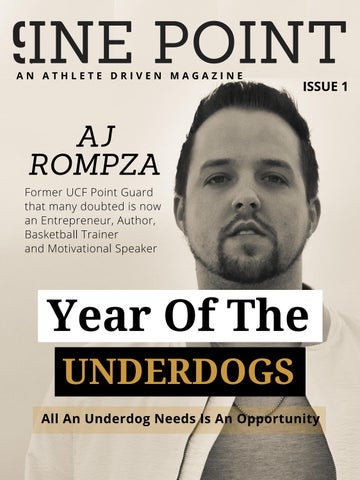
INE POINT
AN ATHLETE DRIVEN MAGAZINE
ISSUE 1
AJ ROMPZA Former UCF Point Guard that many doubted is now an Entrepreneur, Author, Basketball Trainer and Motivational Speaker
Year Of The UNDERDOGS All An Underdog Needs Is An Opportunity
IN THIS ISSUE EDITOR'S NOTE: WE ALL HAVE A LITTLE UNDERDOG IN US Deep down in all of us is a part that thrives on being doubted, misunderstood or just plain overlooked. It lights a fire in us to not just prove those who doubted us wrong but prove ourselves right. I like to call it the underdog mentality and all an underdog ever needs is an opportunity. This inaugural issue of 9INE POINT Magazine features one of the most driven athletes we have connected with so far AJ Rompza. As he says the harder he worked the luckier he got. From the blacktops in Chicago, leading the point at UCF, to know inspiring athletes to master their game; AJ embodies the underdog mentality of never giving up. I hope in this issue you can take great inspiration form AJ’s journey. With the right drive and determination, you can go out and achieve anything you set your mind to as an athlete.
UNDERDOG STORY pg 6 AJ's High School Journey
CONTINUING HIS LEGACY Katherine Shai
HI, I AM A DIII ATHLETE AND I AM pg 12 A BADASS Maggie Tabone
SPEAKER SPOTLIGHT
pg 14
Donovan Smalls II
8 WAYS JOURNALING CAN pg 17 IMPROVE PERFORMANCE Derek Thiessen
VIP OFFER
pg 24
LIFE AFTER THE GAME
pg 25
The AJ Movement
Jacolby Gilliam Founder/Publisher
pg 9
AN ATHLETE-DRIVEN MAGAZINE
PUBLISHER JACOLBY GILLIAM
DESIGN TEAM AUTHENTIC SPORTS MARKETING
PRODUCTION TEAM 9INE POINT MEDIA LLC SPECIAL THANKS TO THIS ISSUE'S INTERVIEWEES & CONTRIBUTING EDITORS AJ ROMPZA KATHERINE SHAI DONOVAN SMALLS II LIZ HEIDELBERG DEREK THIESSEN MAGGIE TABONE
9INE POINT MAGAZINE 9INEPOINTMAG.COM Click To SUBSCRIBE Inside the Mag or App Letters To The Editor Jacolby@9inepoint.com Marketing Opportunities support@9inepoint.com
VIP OFFER *** FOR 9INE POINT MAG READERS ***
exclusive, supportive community of An Exclusive An like-minded driven, ambitious Invitation to dreamchasers join 9INE POINT's A ton of resources, training, tools Private Athlete and so much more... Community for only
$1
Monthly Mentors with Experts within the World of Athletics AND Interactive Conversations to get and give help from other athletes that have gone through or going through similar situations as you
Are you ready to be apart of an athletic community like no other?
JOIN NOW
Underdog Story
THEY CAN'T MEASURE THE SIZE OF YOUR HEART
JUST A KID FROM CHICAGO THAT LOVED BASKETBALL AJ Rompza, who grew up in Chicago, became widely criticized once he chose to play basketball at Whitney M. Young Magnet, one of the top high schools in the country with fellow alumni such as former First Lady Michelle Obama, rapper Vic Mensa, and Brooklyn Nets Jahlil Okafor. “So many people get caught up in race and height,” says Rompza, who is 5’8.” “I had a lot of people laugh at me and say I’d never make the freshman B team.” AJ Rompza encourages fellow athletes never to allow the opinions of others to stop them from pursuing their dreams. “I ended up starting varsity as a freshman;” Rompza says, “people were like, who is this kid holding his own against guys like Derrick Rose and Sherron Collins?” Through life, you will come to realize that when you build your resume off of hard work and dedication, it results in proving a lot of people wrong.
As a high school senior that became one of the top point guards in the country, on one of the top-ranked high school teams in the state leading a team that would later produce seven NCAA Division I athletes such as Marcus Jordan. One would think that D1 universities would be knocking on Rompza’s door. However, that was not the case. Critics still believed AJ was not tall enough or strong enough to be a D1 point guard. But he believed differently. “I had my goals and dreams set on D1,” says Rompza. “I was not going to settle because I knew how hard I had worked.”
NEVER ALLOW THE OPINIONS OF OTHERS STOP YOU FROM PURSUING YOU DREAMS.
The hours of grinding, shooting thousands of baskets in the gym, and working when no one was watching, lead Rompza to an offer from the University of Central Florida. The point guard that everyone said was “too small,” worked his way into starting lineup as a freshman, ranked Top 10 in the country in assists as a sophomore, and led his football-centered school to a basketball national ranking for the first time in the school’s history his junior year. For AJ those four years felt like a dream. He reminisced about how his journey started as a nobody from Chicago, to becoming a fan favorite, and feeling like a celebrity as kids across the nation began to look up to him.
NOTABLE WHITNEY M. YOUNG MAGNET HIGH SCHOOL ALUMNI
AJ ROMPZA UCF Basketball Alum, business owner motivational speaker and basketball trainer
MICHELLE OBAMA Former First Lady, lawyer and community activist
KATRINA ADAMS Former professional tennis player and current President & CEO of the United States Tennis Association,
MARCUS JORDAN UCF basketball alum and owner of Trophy Room an elevated retail boutique expression, inspired by the trophy room within the Jordan family residence
JOAN HIGGINBOTHAM, Former NASA astronaut. Third African American woman to go into space
JAHLIL OKAFOR NBA player for the Brooklyn Nets and national champion with the Duke Blue Devils
VIC MENSA Rapper, singer, songwriter and record producer
CONTINUING HIS LEGACY BY KATHERINE SHAI
For me, wrestling has always been about family. My dad went to the 1956 and 1960 Olympic Games in wrestling. He created the path for my wrestling career and had the vision to push opportunity for women in the sport. My sister competed on the national team for almost a decade, and helped me see the possibilities for my own future within the sport. Our mother has been our cheerleader all the way, and is now heavily involved in supporting the growth of girls high school wrestling in the US. I had my coach, my teammate, and my cheerleader all in one place. My father was my coach since I began wrestling in elementary school, all the way through college. When I moved to the Olympic Training Center in Colorado Springs in 2010, it was a huge adjustment period. This was also around the time my father’s health took a turn for the worse. He had been dealing with congestive heart failure, longer than our family knew, and it started to take its toll. I was preparing for the 2012 Olympic Trials, and was aware of the possibility that my dad would not be able to attend due to health.
"I HADN’T HOWEVER, ANTICIPATED THAT MY SISTER AND I WOULD BE FLYING OUT TO CALIFORNIA 3 WEEKS BEFORE THE TRIALS ANTICIPATING SAY GOODBYE." The thoughts of prepping for a huge competition were set aside, and family was a priority. I knew I had done enough prep work that time off wouldn’t change a thing. They gave him 6 months. I stayed strong during this process and we supported him through tough decisions about what his life would look like in the coming months. Two months later after the prognosis, we lost him. I didn’t make the Olympic Team, and now I had lost the one person who taught me everything I had known about how to love the sport of wrestling. When you lose someone so close to you, you realize time is short. Why was I spending all my time training away from family? I knew I wasn’t ready to quit wrestling, but the sport became something else. Your love for a sport changes when you start to regret the time spent away from your family by choice.
I had competition soon after his passing, and there were a lot of expectations for me to make a World Team. I knew deep down, that I was not in a good place to not only make this team, but to train at a high enough level to compete well at the World Championships. The pain was very real, and I would have to leave practices in the middle to go cry in the locker room. I started feeling angry at wrestling. I didn’t understand why my dad had loved the sport so much. I gave it my time, energy, and sacrifice, and it felt like I got nothing in return. I spent less time with friends and family because of wrestling, so why would I give it even more of my life and energy? I starting thinking that I would be done with wrestling after the 2016 Olympics, and I could peacefully step away from the sport. I definitely didn’t think anyone would care. Wrestling and the community didn’t matter because my world of wrestling was now gone. I knew however, my temperament wouldn't allow me to just give up. I knew I had to at least be open to change, and change my feelings toward a sport that I loved. I resolved to get to know the community of wrestling at a closer level. I worked on contacting new coaches and creating relationships where I could build a trusting bond. Reaching out and depending on others besides my own family took me out of my comfort zone. It turned out to be the best thing for me, and for my career. I learned my coaches stories, and those stories began to change my opinions about why we do sport. It became apparent that it was the resiliency learned in wrestling that has prepared me for a time like this. I learned that even though they didn’t reach the pinnacle of sport, they discovered their love for wrestling expanded beyond the need to personally succeed.
Their stories changed my heart, and helped me recognize the love my own father had for wrestling. It took years of change and healing, but I gave myself that time. You never fully heal a wound when you lose someone, but you learn how to deal with the hurt one day at a time. Today, I know my re-connection with wrestling is my father speaking through me. He knew I needed to go through years of instability to discover my own path. I’m sure over his own long career wrestling and coaching, he dealt with many ups and downs. I have found my passion and that includes giving back and supporting opportunities for young wrestlers to join the sport. I also embrace the opportunities I have to speak about my father and his legacy. It gives me a sense of pride to continue sharing his life and his work with others. Any opportunity I receive to speak about his life, I do in his honor and the sport he loved.
Katherine is the founder of the sport educational site, LuchaFIT. Through LuchaFit, Katherine helps young women navigate through the physically and mentally demanding sport of wrestling. Her background and accolades include: 5x national team member, 2x college national champion, University World Champion, and 2x 3rd place finisher at the Olympic Trials. She also uses her expertise as a board member for wrestling non-profit, Wrestle Like a Girl. Wrestling has always been a family affair for Katherine. In fact, her strong passion for women in sport comes from her family, and namely her father, for being one of the original pioneering driving forces for women’s wrestling in the U.S.
KATHERINE SHAI
Athlete Dictionary
U nderdog
/ˈəndərˌdôɡ/
NOUN: an athlete that is low-key slept on. He or she competes with a chip on their shoulder because they want to prove their doubters wrong and themselves right.
HI, I AM A DIII ATHLETE AND I AM A BADASS UTICA COLLLEGE WOMEN'S BASKETBALL ALUM BY: MAGGIE TABONE
B
eing an athlete at any level takes an immense amount of skill, determination, and physical work. There are perks to being an athlete on any campus regardless of the size, but of the three NCAA divisions, there is one that tends to be under-appreciated. Yes, you guessed it- I’m talking about Division III athletes. I know because I am one. Hi, I am a Division III athlete, and I am a badass. No, extravagant recruiting trips and coaches typically aren’t making personal house calls to woo us to their school. Rather, we make an effort to reach out and meet with coaches. We choose a program that we believe will best fit us academically, socially and athletically. There are no letters of intent to sign to announce our big commitments (even though choosing where to further our education is just as important). Our family and friends do not gather in a meeting room at our high school for our big reveal, but rather post a picture on Instagram or Facebook to announce our big news. Our facilities aren’t top of the line by any stretch of the imagination. Our stadiums don’t seat thousands of screaming fans with painted chests and faces, but smaller cozy environments that make us feel at home. There are no airplanes for our mediocre away games, but rather, hour-long bus rides, with only one bathroom. Sports Illustrated is not writing big articles about us, and Erin Andrews sure as heck doesn’t wait to talk to us after competitions. We do not play in big bowl games, nor have televised national championship tournaments. But we are Division III athletes, and we are badasses.
We Chose This Lifestyle People have said to me before, “Too bad that you don’t play Division I.” Too Bad? Too bad what? Okay, so I don’t get video cameras and free sneakers at bowl games. But I do get to play the sport that I fell in love with as a child. I chose this lifestyle. Some people play sports because they can get a free ride to an education. Most of us, Division III athletes, will be in debt for years to come after our college careers come to a close. Again I say, we chose this. How easy would it be to decide not to be an athlete on campus and just focus on school? The truth is we are so passionate that we want to try and balance school and athletics, with no real scholarship motivation. We get up every day and go to practice in the rain, wind, and snow. We travel for hours and miss classes and opportunities to study. No, we don’t have a huge chunk of change encouraging us to attend 6:00 am weightlifting sessions, we simply have the burning desire to improve our game. We are students, just like Division I or Division II athletes. We put in the same amount of work in the classroom while being athletes, which is not easy. As Division III athletes we celebrate our accomplishments and suffer through our defeats. Sure, everyone has a dream to play at a high level. I don’t regret my decision to play at this level. I have played with and against some incredibly dedicated and powerful athletes. We don’t lack talent, and we aren’t inferior athletes. We are determined, and we put 100% into every practice, just like Division I athletes. We play sports for the absolute love of the game.
"MY FELLOW DIVISION III ATHLETES, DESPITE THE DECREASED PERKS AND LACK OF EXPOSURE, KNOW THAT I SALUTE YOU, BECAUSE WE ARE BADASSES, AND WE ARE IN THIS TOGETHER." - Maggie Tabone
Donovan Smalls II THE SECOND ASSIST
33 | TRIPMAG.COM
SPEAKER SPOTLIGHT
Speaker Spotlight
DONOVAN SMALLS II EDUCATOR, SPEAKER, AND CONSULTANT
SPEAKER SPOTLIGHT We don’t have to be a professional athletes to make a difference in the community or in the lives of other athletes young and old. Speaker Spotlights is a page dedicated to showcasing speakers that are using their experience and lessons to help inspire and guide our next generation of athletes. This Speaker Spotlight is about Donovan Smalls II, the founder of The Second Assist. Donovan and The Second Assist is a student-athlete development program based in New Jersey that focuses on education, athletics, and leadership. As an educator, speaker, and consultant, Donovan A. Smalls II works with athletic programs to empower student-athletes with the necessary tools needed to succeed in life after sport. By accomplishing this objective, Donovan believes that student-athletes will be better equipped for leadership roles in a global society.
CLICK THE VIDEO TO WATCH
Want to have Donovan speak to your athletes?
CONNECT WITH DONOVAN
SOME PEOPLE WILL HATE YOU JUST BECAUSE THEY SEE YOU GETTING THE SUCCESS THEY THINK THEY DESERVE FOR THE WORK THEY HAVE'T DONE
HISTORY OF JOURNALING
8 Ways Journaling Can Improve Performance
Throughout history, many other influential people and great thinkers have kept journals. Some of the most notable include Mark Twain, Oscar Wilde, Anne Frank, Ralph Waldo Emerson, and Henry David Thoreau.
When looking at famous journalers it can be difficult to pinpoint a specific reason or purpose for why they did it. For some, it
BY THE DAILY ATHLETE FOUNDER DEREK THIESSEN
gave them a chance to review their day, others may have found it as a way to relieve stress, and for many, it was a great way to plan out how they should live their lives.
As we rapidly move through the 21st century, a practice such as journaling has the tendency to feel rather dated. With the prominence of smartphones and wearable technology becoming more advanced by the minute, how is something so ancient like a journal going to make life any better?
Google does not have the answers to everything, and Instagram is certainly not going to help you perform better as an athlete. You have to rely on yourself. And of the best ways to know your “Self” is to ask it questions.
So, to answer the question you are dying to ask, here are 8 reasons every athlete should be keeping a journal:
8 BENEFITS OF 1.YOUR BRAIN MUSCLE
IS
A
Writing down your thoughts is like stretching for the brain. When it’s feeling a little stiff or tired, you need to spend some time opening it up to ensure it doesn’t get tight. Just like you warm up and cool down your muscles around training to avoid injury, you have to apply the same strategy if you want to keep your mind healthy.
2.YOUR GOALS CLEARER
BECOME
Goals by themselves are great to have. But just saying you have them or thinking about them is not enough. Through a daily journaling practice, you can create the structure for goal achievement. Every morning you can write out and plan the steps required to achieve your goals. In essence, you can create a psychological blueprint for success. By doing so you will no longer find yourself distracted by long-term goals because you know your daily actions are always moving you in the right direction.
JOURNALING FOR ATHLETES 3.IMPROVES DISCIPLINE DISCIPLINE:In the same way that completing more small tasks on a frequent basis can improve overall self-efficacy, staying disciplined with one habit can improve your discipline with other habits. If you are constantly telling yourself that you are weak, you will become weak. Vice versa, if you are regularly being reminded that you have strength, you will build it. Discipline breeds more discipline; Momentum builds on itself.eeeeee
4.IMPROVES SELFCONFIDENCE Research has found that people who use reflective journals have higher levels of self-efficacy and belief in their abilities. This increase in self-efficacy is strongly linked to task completion. When you use a journal that is based on the principle of daily tasks, you are given frequent feedback which illustrates you are on the right path. By journaling in a way that cultivates positive affirmation and activates your neural reward systems, you allow yourself to build on tiny successes, with each one being just as valuable as the last. Over time these compounding micro-successes translate into higher levels of belief in one’s self and the ability to get things done.
8 BENEFITS OF 5.TRACKS PROGRESS
JOURNALING FOR ATHLETES 6.TURNS YOU INTO A BETTER LEARNER The most successful learners know how to identify questions and problems as they reflect on what they already know, what they want and need to know, and how they will proceed to increase their understanding. Less successful learners need to develop the habits of the mind that are the underlying strategies of the learning process. A Reflective journal can create opportunities that allow people to think about their learning, their own lives, and the world around them. This process can often highlight problems, misunderstandings, and confusions, which ultimately helps determine new areas for growth.
8. CULTIVATES SELFAWARENESS When you wake up each day and stay focused on the immediate, you don’t have to worry about what is going to happen in a week, a month, or a year. Start your day with one simple question: What can be dealt with in a single day? This question is not only a lot easier to answer but encourages athletes to be more present-minded on the small tasks. Being too caught up in the past or the future is often what causes poor performances. This moment is all that matters…now this moment…and now this moment. Always present, always going forward.
When you look back on a year, it can be tough to really see how far you’ve come. This is why so many people take progress pics when they try out a new diet. The changes can be incredibly subtle and difficult to see without a direct comparison. Through a journal, you get to write down your thoughts and experiences on a daily basis. And after an entire year, you can look back and reflect on your younger self and truly see how much you’ve grown.
7. PUTS YOUR IDEAS INTO YOUR OWN WORDS When you’re getting started there is nothing wrong with looking elsewhere for inspiration. But just in the same way that you retain information better if you write it down in your own words, you should always be looking for ways to apply ideas, goals, and visions into your own life. You can have similar ideas, but at the end of the day, you should always bring things back to your own circumstances. Otherwise, you will always be trying to sort out someone else’s life, not your own. Through a journal, you can put those dreams and ideas onto paper and find ways of living that align with your own values. In addition, WORDS ARE REPRESENTATIONS OF IDEAS. By writing words onto paper, you are actively causing the mind to compose and recompose ideas. Therefore, increasing your brain’s ability to retain information.
PUT IT TO PRACTICE Now here comes the real challenge. Are you going to read this article, and say to yourself, “Wow, that was some really interesting stuff” and then go right back to doing what you do every single day? Or are you going to take some action? Journaling doesn’t have to be complicated. You don’t have to write your life story or produce a masterpiece that will live on for centuries. It can be as easy as answering a few questions to start your day, and then a couple more to review how it went. That’s it. In total it will consume no more than 10 minutes per day. Who doesn’t have time for that? If you’re not sure where to begin, try this out: Go get yourself a nice little blank notebook and then each day answer the questions below.
Morning questions: 1. What are you grateful for? 2. List three actions you can take today that will move you towards your goals… 3. What is one thing you will improve today?
Evening questions: What was your greatest challenge today? What did you learn from it?
What do you want to accomplish tomorrow?
By simply answering these questions on a daily basis you can accomplish quite a bit. First, by starting off your day with gratitude, you put yourself into a more positive state of mind. And when you can start things in a better state it translates into a more positive story that you tell yourself. And when your train of thought is positive, it leads to a more effective strategy. Remember: STATE > STORY > STRATEGY. Second, by choosing small daily actions that align with your long-term goals, you are ensuring that each day you are making steady progress. Instead of hoping you’re moving forward you know you are because you’ve taken the time to figure which actions make the biggest difference. In the words of Hall of Famer Ray Lewis, “Greatness is a lot of small things done well. Day after day, workout after workout, obedience after obedience, day after day.” Third, by spending some time each day reflecting on your biggest challenge you get a chance to put it to rest. Instead of letting it ruminate in your mind all night, you can find a positive from it and then move on. The ability to reframe your experiences into lessons and give them value is something that many of the greatest performers, athletes, leaders, and entrepreneurs will take the most pride in. Their ability to find meaning in suffering and sacrifice.
“Everything can be taken from a man but one thing: the last of the human freedoms—to choose one’s attitude in any given set of circumstances, to choose one’s own way.” ― Viktor E. Frankl Lastly, by taking the time to find the things that went well, the challenges that arose, and then planning how you could be better tomorrow, you are taking one of the essential journaling steps. You are using that past as a means of bettering the future. The normal routine for most people is to celebrate great days and forget about the rough ones. But what happens when you are having a few rough days in a row? What about a rough week? A rough month? What are you going to do when the great days are vastly outweighed by the rough ones? You can’t just purge them all from your memory. If you do, you will find yourself, like many athletes, in a state of regret, realizing that you have wasted the past week, month or year, not making any valuable progress. A journal, however, can keep you accountable each day. It gives you a chance to learn from what has happened and get better. Day by day. Journaling doesn’t have to be complicated. It can be a few minutes in the morning and a then a few more in the evening. You can make it as simple or as complicated as you want it to be. The one thing it must be is consistent.
33 | TRIPMAG.COM
Name two things you did well today? Or big wins you have today?
WRITING YOUR OWN PATH There is no worse feeling for an athlete than that of regret. Looking back on a season and knowing you didn’t give it your all. It’s painful to think about all of the days you left on the table, knowing that you can do nothing about it. To be successful, at anything, does not require you to look out the window, it only requires that you look in the mirror. And through a daily journaling practice, you get the chance to look into the mirror and ensure that not a single day goes by where you aren’t making the right moves to better yourself. Regret is always a possibility, but it’s not inevitable. Today is the day you stop wishing you were getting better, and you start writing your own path to peak performance.
ORDER YOUR DAILY ATHLETE JOURNAL Are you looking for a simplified way to make journaling part of your routine? Do you want to challenge yourself on a daily basis to be better than yesterday? Then check out The Daily Athlete Journal! And start writing your own path to peak performance. Use Promo Code 9POINT to get 10% off your first journal.
www.dailyathlete.life
Derek is former Canadian volleyball player and the founder of the athlete resource site, Daily Athlete. Through Daily Athlete, Derek helps athletes who are grinding through daily practices, the monotonous reps, the lulls in between games, the crippling back-to-back losses to develop habits to achieve their goal.
33 | TRIPMAG.COM
Derek Thiessen
VIP OFFER *** FOR 9INE POINT MAG READERS ***
exclusive, supportive community of An Exclusive An like-minded driven, ambitious Invitation to dreamchasers join 9INE POINT's A ton of resources, training, tools Private Athlete and so much more... Community for only
$1
Monthly Mentors with Experts within the World of Athletics AND Interactive Conversations to get and give help from other athletes that have gone through or going through similar situations as you
Are you ready to be apart of an athletic community like no other?
JOIN NOW
THE TRANSITION In 2012, the NCAA claimed one of Rompza’s friends was an agent giving him improper benefits, which resulted in fifteen games of suspension his senior season. Suddenly, the upset wins, game-winning shots, and school records became mere memories, and it seemed there was nothing Rompza could do about it.
INJURIES CAN HUMBLE YOU, THEY GIVE YOU A NEW PERSPECTIVE ON YOUR LIFE AND OPPORTUNITIES WHEN YOU LEAST EXPECT IT.”
When UCF didn’t make the NCAA tournament his senior season, Rompza turned his focus to preparing for the NBA. Initially, NBA scouts didn’t give AJ Rompza much credit, just like at every other point in his career. Eventually, Rompza earned a shot at a personal workout in front of an NBA scout. He wanted to showcase what he had been proving all of his life; that basketball was in his DNA. Unfortunately, there was not a happy ending for Rompza. He didn’t have the best workout of his life. He didn’t impress all of the scouts and get drafted. He broke his foot in the middle of his first and only workout, temporarily putting his career on hold. At this point in his life, it appeared all the luck had run out for Rompza. People he believed to be his real friends didn’t stick around after his injury. The support system that the former UCF star thought he had vanished. Rompza moved back in with his mom and put his dream on hold. “Injuries can humble you,” says Rompza. “They give you a new perspective on your life and opportunities when you least expect it.”
LIFE AFTER THE GAME
Life after the game is one of the hardest transitions for athletes who are used to the spotlight, private jets, and thousands of fans screaming their name. AJ Rompza is thriving through this transition with the help of loved ones, he is giving all of the energy he gave on the court back to the community. He now runs Burwood Tap and Chicago Joe, both successful restaurants in Chicago, writing an autobiography, launching a Point Guard School and starting what he calls “the A.J. Movement” to “push people to succeed in life.”
AJ ROMPZA POINT GUARD SCHOOL COMING SOON
ROMPZA.COM
"
THERE IS NO SPECIAL CEREMONY TO BECOME A LEADER. YOU EARN THAT TITLE EVERYTIME YOU CHOOSE TO DO THE RIGHT THING
LEADERS MAKE SURE THEIR TEAM IS PREPARED ON AND OFF THE COURT - AJ ROMPZA QUOTE FROM AJ's UPCOMING BOOK
rompza.com
IF YOU LOVED THE MAGAZINE AND FOUND THIS ISSUE INSPIRING HELP
SUPPORT US AND LEAVE A REVIEW!
LEAVE A REVIEW!
INE POINT AN ATHLETE DRIVEN MAGAZINE
© 9INE POINT MEDIA LLC