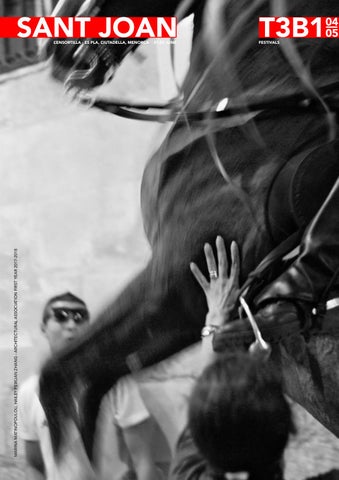
MARINA MATINOPOULOU, HAILEY PEIXUAN ZHANG - ARCHITECTURAL ASSOCIATION FIRST YEAR 2017-2018
SANT JOAN L’ENSORTILLA - ES PLA, CIUTADELLA, MENORCA - 21-25 JUNE
FESTIVALS
T3B1 04 05
HISTORY WHEN DID IT START? WHAT DOES IT MEAN?
T3 B1 FESTIVALS - SANT JOAN, CITUADELLA - HISTORY
HISTORY OF THE FESTIVAL OF SANT JOAN The Sant Joan Festival is a festivity which dates 1
2
back to the fourteenth century and has reli-
gious motivations. The beginning of the feast is associated to the Sant Joan d’Artrutx chapel, nowadays recognised as Sant Joan de Missa, situated five kilometres south of Ciutadella. John was born about six months before Jesus; consequently, the celebration of John the Baptist was established on the 24 June, six months
3
4
before Christmas Eve. This festivity day is characterised for its differentness as it is one of the very few saints’ days which celebrates the commemoration of the birth, alternatively to the death, of the saint being respected. A certificate which dates back to 1456, states that a brotherhood was related to the church of Sant Joan d’Artruix. This archive records that a religious individual, a rider belonging to the
5
6
noble families of the town, two farmers and two residents of traditional profession composed the fraternity. They had to preserve the church, gather and maintain the goods properly. Succeeding, one more member was introduced, to carry the flag of the brotherhood. Every year on Saint John’s day an expedition to the church of Sant Joan took place and their fam-
7
8
ilies and friends were invited. They were offered a refreshing drink at the aristocratic’s house. The exact thing did the clergyman on his way back to the city and participants on horseback held a type of parade through the streets of Ciutadella. Each year, the festivity became more essential where medieval equestrian games were held, so Sant Joan, has grown gradually but certainly to a
9
10
11
12
13
14
3
very extraordinary feast. Image 1: 22 June 1988, ‘Dia De Bes’. The ‘Homo des Be’, who represents the Saint Joan Baptist, walks barefoot through the streets of Ciutadella. Image 2: 22 June 1988, many people gathered at the Plaça des Born square. Image 3: 22 June 1988, 8 pm. ‘War’ of hazelnuts on Avinguda de la Constitució street. Image 4: 23 June 1988, 4 pm. Start of ‘Caragol des Born’. Image 5: 23 June 1988, 6 pm. ‘Caragol des Born’. Image 6,7,8: 24 June 1988, 10 am. Trials of ‘Jocs des Pla’ at Es Pla. Image 9: 24 June 1988, 10 am. Spectators observing the trials of ‘Jocs des Pla’ at Es Pla. Image 10: 24 June 1988, 5:00 pm. People start to grather at Es Pla to witness the medieval games - ‘Jocs des Pla’. Image 11: 24 June 1988. Caxier Capella, Priest, Caxier Pages. Image 12: 24 June 1988, 8 pm. Band performing during the ‘Jocs des Pla’. Image 13: 24 June 1988, 9 pm. Spectators observing the ‘Jocs des Pla’. Image 14: 24 June 1988, 10 pm. ‘Jocs des Pla’ L’ensortilla.
T3 B1 FESTIVALS - SANT JOAN, CITUADELLA - HISTORY
Image 15: 24 June 1988, 10 pm. ‘Jocs des Pla’ L’ensorilla, at Es Pla. Many spectators, the Caxier Capella and the Caxier Pages enjoy the games.
4
T3 B1 FESTIVALS - SANT JOAN, CITUADELLA - HISTORY LINE
The Saint John Festival has been
HISTORY LINE OF THE FESTIVAL OF SANT JOAN CIUTADELLA
changing through all these years. However, the essence of being a peasant religious festival has always main-
START of the Sant Joan Festival
14th century
MONASTERY of Sant Joan of Ermita
1301
tained the same.
Clavari, Caixer Menestral and Caixer Pages
Turkish ATTACKED Ciutadella Festival was not been celebrated since then
Image 17: 24 June. Es Pla, Ciutadella, where trials for the medival games known as ‘Jocs de Pla’ are performed.
1564
members of the Caixer Capella, Caixer
Image 16: 24 June. Cathedral of Ciutadella, where a solemn Mass of Caixers takes place.
13 31 1558
NEW COMMITTEE including the
BIRTH of Sant Joan of Obreria
Image 18: Brotherhood Committee or Committee of Caixers. They were linked to the church of Sant Joan, they started the festival.
15 77 DECISION MADE nomination of the Committee would be every 2 years
16 58
1687 5
PAGÈS into the committee; one from
the north and one from the mid-land.
1589
1611
CAXIER FADRI took charge of the flag
Introducing the SECOND CAXIER
Introducing CAXIER FADRI as a mem-
Image 19: 24 June. As soon as the morning trials finish, horses go around the streets of Ciutadella and go in some houses.
ber of the committee
ELECTION SYSTEM 3 nominates for each position and the one with the most votes wins
Image 20: 24 June. At Es Pla after the ‘Jocs de Pla’. Picture of a young spectator with a Committee member known as ‘Caixer Clavari’.
T3 B1 FESTIVALS - SANT JOAN, CITUADELLA - HISTORY LINE
STAGE when the festival was less popu-
17th century
Introducing the celebration of DIA DES BE
First draft of CUSTOMARY PROTO-
COLS
1844
1843
Image 21: 24 June. Es Pla, stage for the town councillors to witness the medieval games, ‘Jocs de Pla’.
The festival and celebration changed its form and location during the SEX-
ENIO DEMOCRÁTICO. (The six democratic or revolutionary years)
1937
Image 22: 22 June. ‘Dia des Be’ – The Day of the Lamb. L’Homo des Be (Man of the Lamb), who represents the Saint Joan Baptist.
Set up of NOBLE COMMITTEE
1868-1874
1846
The festival and celebration was cancelled during the GUERRA CIVIL
Image 23: 22 June. ‘Dia des Be’. L’Homo des Be walks barefoot through the streets of Ciutadella with a white lamb on his shoulders.
Set up of MUNICIPALITY COMMITTEE
1966 19 67
Festival was declared as a NATIONAL TOURISTIC ATTRACTION
Image 24: Close-up of the tools of the Committee member, known as ‘Fabioler’. He announces the orders with the drum and the flute.
Introduction of the FABIOL (flute player)
1975
19 84
TRADITION of festival and celebration was brought back
Image 25: 23 June. People start to gather all around the Ciutadella city in order to celebrate the festivities of Sant Joan.
6
PEOPLE THE PERFORMERS, THE PARTICIPANTS, THE SPECTATORS THE OUTFITS, THE COLOUR PALLETE, THE TOOLS
T3 B1 FESTIVALS - SANT JOAN, CITUADELLA - PEOPLE
BROTHERHOOD COMITTEE COMMITTEE OF CAIXERS The members of the brotherhood, also known as ‘Caixers’, were repeatedly elected for a duration of 2 years. Each member has a crucial part in the celebration and is dressed rigorously in formal attire, representing the ancient society of Ciutadella which is composed by: The Caixer Senyor (Nobility) He is the head of the feast. He is always the first son or the family head of one of the aristocratic families of Ciutadella. He is chosen by previous ‘Caixer Senyors’ and he has the responsibility
Image 26: 22 June 2008. L’Homo des Be wearing a lamb skin and carrying a lamb.
to assign the rest of the fraternity except of the clergyman, known as “caixer capella” or “capellana”. Caixer Capellà (Clergyman) He is a church member or a priest who contributes for the religious factors of the celebration. Caixer Menestral or Caixer Casat (Artisan) He is someone with an artisan or traditional occupation. He is always a married man and consequently can be named as “caixer casat” (married rider). He guards the flag during the two years. Caixer Pages (Farm Workers) Two individuals who have to be farmers. They can farm help or farm servant. One from the north of the municipality of Ciutadella (Caixer Pagès de Tramuntana) and the other from the south side (Caixer Pagès de Migjorn), named
Image 27: 24 June 2008. A rider, dressed as, Caxier Pages, at Es Pla during the morning trials of the ‘Jocs des Pla’.
after winds of the north and south coasts. The Caixer Pagès also have the honour of providing the ram for the Homo des Be procession, which
Black leather riding boots worn by all the Committee members
alternates each year. Caixer Fadrí, (Unmarried Rider) He can be a citizen or a farmer and he always carries the flag during the festivities. He must not be married. Flabioler (Flute Player) Black and white shorts worn by all the Committee members
He accompanies the committee of Caixers even though he does not form part of the fraternity. He is in charge of announcing the orders with the drum and flute during the festivities. L’Homo des Be (Man of the Lamb) He represents the Saint Joan Baptist. On the “Dia des Be”, he walks barefoot through the streets with a white lamb on his shoulders. 9
Image 28: 23 June 2008. The Fabioler playing the drums and the flute in order to amuse the specators during the ‘Caragol des Born’.
Sword carried by all the Committee members
T3 B1 FESTIVALS - SANT JOAN, CITUADELLA - PEOPLE
Diagram above on the right, from left to right: Flabioler, Caxier Senyor, Caxier Pages, Caxier Capella, Caxier Casat , Caxier Fadris and Homode Be.
Black Bow tie worn by the Caxier Pages
Black hat worn by all the Committee members
Skin of lamb worn by l’Homo des Be
Black and white vests worn by all the Committee members
White button-up shirt worn by all the Committee members
Black coat worn by all the Committee members
Whip carried by the Caxier Pages - Cane carried by all the members
Drums and Flute carried by all the Fabioler
Flag of Ciutadella - Sant Joan carried by the Caxier Fadris 10
T3 B1 FESTIVALS - SANT JOAN, CITUADELLA - PEOPLE
Image 29: Huge crowd of spectators witnessing and capturing moments from the ‘Jocs des Pla’, L’ensortilla.
Colour Pallete: Colours depicted from the clothes and outfits of the spectators.
THE PEOPLE Performers
Band
Town Councillors
They compose the Committee of Caixers (Flabi-
A group of musicians of all the ages who play tra-
They are higly respected people who have been
oler, Caxier Senyor, Caxier Pages, Caxier Capella,
ditional music in order to amuse the spectators
invited especially to preside the games. They
Caxier Casat, Caxier Fadris and Homode Be)
and complete the event.
have specific specific seats.
Specators
Volunteers
Local Police Officers
They may be locals or tourists. They go around
They are responsible to organize the spectators
They are responsible for the preservation of the
the city, witness the games and capture mo-
and create a necessary path where the horse will
order, the maintainance of the rules and the
ments, party, dance, drink etc.
pass by in order to avoid accidents.
avoidance of accidents.
11
T3 B1 FESTIVALS - SANT JOAN, CITUADELLA - PEOPLE
Cameras carried by spectators
Image 30: 24 June 2008. Parade of the band at Es Pla before the start of the ‘Jocs des Pla’.
Hats worn by people due to the high temperature
Specific uniform worn by the music band
Image 31: 24 June 2008. Group of volunteers try to create a path for the horse to pass by.
Trumpet carried by the music band
Formal dress code for thetown councillors
Image 32: 24 June 2008. Town Councillors located at specific seats in order to see witness the ‘Jocs des Pla’.
Yellow T-shirts worn by the volunteers in order to stand out
Uniform and tools worn by the police officials
Image 33: Group of local police officers trying to maintain the order and the rules during the festival. 12
SPACE
WHERE DOES IT HAPPEN? THE AREA, THE PERIMETER, THE ACCESSES, THE SPATIAL QUALITIES, THE PROPORTIONS, THE SPACE BEFORE AND AFTER
T3 B1 FESTIVALS - SANT JOAN, CITUADELLA - SPACE, ES PLA - BEFORE
THE SPACE ES PLA CIUTADELLA MENORCA BEFORE
34
Minorca is one of the Balearic Islands situated just off the east coast of mainland Spain, in the Mediterranean Sea. It has an area of around 694 km² and a coastline of 216 km². It has the maximum distance of 47km between the furthest points - Ciutadella and Mahon. The island of Minorca is divided into two symmetric but very different parts. The northern part is a place for an uneven and rugged coastline with poor vegetation and plenty of small islands with dark or reddish sand, whilst the southern part which is made up of the calcareous rock has plain, wavy cliffs with coves of white sand surrounded by pines.
36 15
35
T3 B1 FESTIVALS - SANT JOAN, CITUADELLA - SPACE, ES PLA - BEFORE
39 c
S3
S2 39 b
S1
38 a
37
Image 34: S1: Section of Es Pla before the Sant Joan Festival - when it is a car park. Image 35: Es Pla before the Sant Joan Festival, as a car park. Image 36: Plan of Ciutadella, Menorca, focusing on the area of Es Pla which is highlighted with red. This is where the ‘Jocs des Pla’ are performed. Image 37: Top view of Es Pla, Cituadella. Image 38: Diagram illustrating the transformation of the space from a car park (a), to the highlighted empty space where people start to gather (b), to the altered space which hosts the festival - a narrow path for the running horsers and a huge crowd of spectators all around (c) 16
T3 B1 FESTIVALS - SANT JOAN, CITUADELLA - SPACE, THE ACCESSES TO ES PLA
VIEWS FROM THE DIFFERENT ACCESSES TO ES PLA
1
4
ara
4
nta B
arb
Mussue Bastio de sa Font
2
6
t Joan e San
ig d Passe
1
2
3
17
5
5
a
ura sa M
Car re
r de
Es
Pl a
de
det
Sa
nt J
oa
8
n
Car re
r Sa
3
7
T3 B1 FESTIVALS - SANT JOAN, CITUADELLA - SPACE, THE ACCESSES TO ES PLA
6
7
8
18
T3 B1 FESTIVALS - SANT JOAN, CITUADELLA - SPACE, ES PLA - BEFORE
ES PLA CIUTADELLA AFTER
S3: Section of Es Pla during the Sant Joan Festival - ‘Jocs des Pla’ .
Image 39: Es Pla during the ‘Jocs des Pla’, focusing on the path where the horse pass by and the huge crowd of people next to it.
S2: Section of Es Pla during the Sant Joan Festival - ‘Jocs des Pla’ .
S1: Section of Es Pla during the Sant Joan Festival - ‘Jocs des Pla’ .
Image 40: Es Pla fully crowded during the ‘Jocs des Pla’. Spectators are located all around the area.
Diagram showing the spatial qualities of Es Pla 19
Image 41: Es Pla during the ‘Jocs des Pla’, focusing on the path where the horse pass by and the huge crowd of people next to it.
T3 B1 FESTIVALS - SANT JOAN, CITUADELLA - SPACE, ES PLA - BEFORE
Plan of Es Pla highlighting the areas where each group of people are located. 20
RITUAL WHAT IS THE TIMELINE? WHAT DO THEY DO? HOW DO THEY MOVE IN THE SPACE? WHAT ARE THE RULES?
T3 B1 FESTIVALS - SANT JOAN, CITUADELLA - RITUAL
FESTIVAL OF SANT JOAN RITUAL
RULES
Image 42: 24 June 2010. ‘Jocs des Pla’, L’ensortilla.
Avoid excesses of all kind; it is important to be in good conditions.
Avoid flip-flops and wear suitable footwear such as sneakers.
Both the horses and crowd are dangerous to small children, baby carriages are not allowed.
5 6
If you do not know the horses, please be prudent. The horses are very strong and they may be dangerous to who dose not know them.
1
3 4
Do not throw your bottles and cans on the ground, as this may cause the horses fall.
Respect the horses and the riders, do not touch them when they are running. Respect and move to leave a gap for the horse running track. The horses, riders and other performers are the main characters, they need to be able to pass Diagram illustrating the rules of the festival 23
2
1) 23th June, at 14:00, the fablioler visits the palace of Caixer Senyor, to start the gathering of cavallers. 2) 23th June at 18:00, one of the first mass,Caragol des Born; Horses go around the Plaça des Born with live orchestra. 3) 23th June after the mass, the battle of hazelnuts; happening on Contramurada Street. 4) Saturday and Sunday evenings, Corregudes de sa plaça(English: Run to the plaza or Parade of plaza). 5) Saturday of Sant Joan and the day of Sant Joan in the morning and evening, Caragol de Santa Clara (Mass of Snata Clara). 6) Day of Sant Joan: Caragol des Pla and Corregudes. (English: Mass of the flat and Parade)
T3 B1 FESTIVALS - SANT JOAN, CITUADELLA - RITUAL
Sunday before Sant Joan l’Homo des Be (Man of the Lamb), which represents Saint Joan Baptist, walkS barefoot through the streets of Ciutadella with a white lamb on his shoulders.
Eve of Sant Joan
In the afternoon, at approximately 20:00, there is a “war” of hazelnuts on Avinguda de la Constitució street.
At 14:00 the “fabioler” (a man with a flute and drum, mounted on a donkey), visits the home of “Caixer Senyor” to start the gathering of cavallers.
At 18:00 takes place the “Caragol des Born”, one of the first mass events at some risk for attendees: the horses go around the Plaça des Born square with the rhythm of live music played by an orchestra.
At night, the Caragol de Santa Clara, where riders and horses go around the streets of Ciutadella and enter the houses of the people.
Sant Joan Festival
At 08:00 am the “fabioler” goes to Caixer Senyor’s house to start the celebrations.
During the morning tests are performed at the same place where that same night will take part the famous “Jocs des Pla” (splanade games).
During Carotades (maks) two horsemen ride in parallel and while one of them holds a mask, the other one tries to break it with a stone.
In the Jocs de s’Ensortilla (Ring games), riders will ride at a gallop and with a spear in his hand from one end of Es Pla. The rider will try to hit with his spear the ring, a few centimeters in diameter. Orchestra plays strong music every time the rider hits the ring, and people dance as well. Farewell of the riders, performers and invited councillors, which marked the end of the festival. 24
T3 B1 FESTIVALS - SANT JOAN, CITUADELLA - RITUAL
FESTIVAL OF SANT JOAN RITUAL THE DIFFICULTY OF THE GAME - PROPOTIONS
43 44
25
T3 B1 FESTIVALS - SANT JOAN, CITUADELLA - RITUAL
45
46
47
48
49
50
51
52
Image 43: L’ensortilla. Many trials in order to get the ring. It portrays the difficulty of the game. Image 44: Diagram showing the scales and the propotions in order to illustrate the difficulty of the game. Image 45: The scale of the ring in comparison to a hand. Image 46: The scale of the ring in comparison to a head of a kid and the spear and his trial for presicion. Image 47: Portaying the high speed of the horse, an additional difficulty of the game. Image 48: The scale of the ring in comparison to a head. Image 49, 50: The huge crowd whih stands so closely to the horse, an additional difficulty of the game. Image 51: Accidents caused by the many difficulties. Image 52: Diagram showing the density of the people at Es Pla before and during the ‘Jocs des Pla’.. 26