P R O F E S S O R I A L
P R O F E S S O R I A L
Published by the University of the Western Cape
© University of the Western Cape, 2025
All rights reserved.
Foreward
Faculty of Arts and Humanities
Prof Fiona Moolla
Prof Kobus Moolman
Prof Quentin Williams
Faculty of Community and Health Sciences
Prof Maria Florence
Prof Shaheed Soeker
Prof Rina Swart
Prof Marichen van der Westhuizen
Faculty of Economic and Management Sciences
Prof Fiona Anciano
Prof Marieta du Plessis
Faculty of Education
Prof Rajendren Govender
Prof Rouaan Maarman
Faculty of Law
Prof Anthony Diala
Prof John-Mark Iyi
Faculty of Natural Sciences
Prof Tertius Kohn
Prof Megan Shaw
Prof AJ Smit
11 Page 19 Page 28 Page 33 Page 38 Page 44 Page 58 Page 68 Page 83 Page 95 Page 106 Page 119 Page 137 Page 147 Page 158 Page 2
7
At the University of the Western Cape (UWC), Professorial Inaugural
Lectures are a significant academic tradition that celebrate the achievements of newly appointed professors, serving as a formal introduction to the University community. These public lectures mark the professor's official recognition and showcase their academic journey, research interests, and the impact of their work on society, reflecting UWC's commitment to academic excellence and the advancement of knowledge in South Africa and beyond.
The primary purpose is to present scholarly work to colleagues, students, and the broader community, fostering engaging discussions on contemporary issues and challenges within their fields. Inaugural lectures promote interdisciplinary dialogue and collaboration among different faculties, reinforcing UWC's dedication to a vibrant academic environment where knowledge is shared and celebrated.
The Professorial Inaugural Lecture is a cherished tradition at UWC, reflecting the institution's ethos of academic rigor, community engagement, and the pursuit of knowledge.
ProfessorRobertJohnBalfour
Rector and Vice-Chancellor
University of the Western Cape
ProfessorFionaMoolla
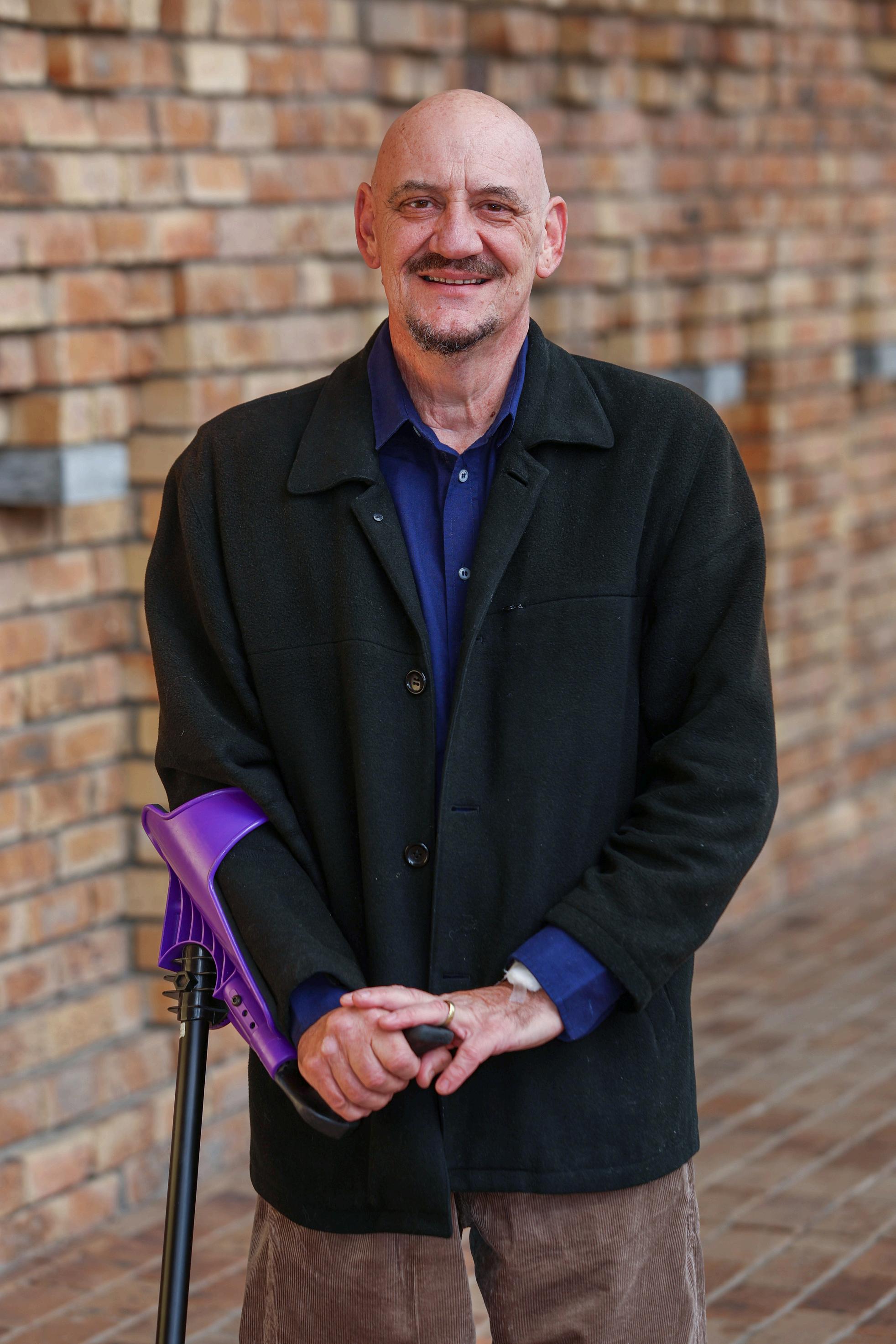
ProfessorKobusMoolman
ProfessorQuentinWilliams
ProfessorFionaMoolla
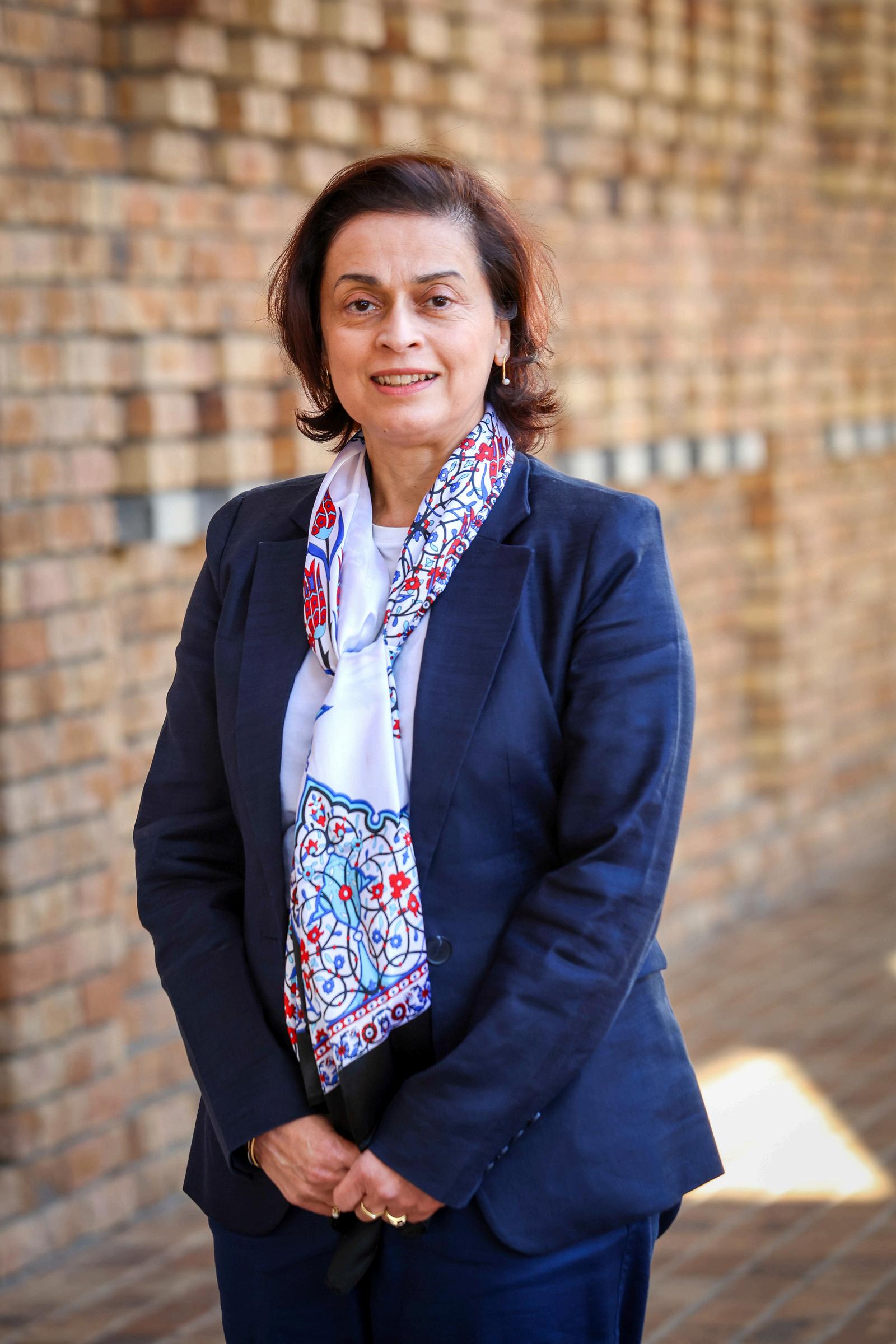
EmotionsinAfricanLiterature:AnInvitationtoStudy
BIOGRAPHY
Prof Fiona Moolla
“Emotions in African Literature” is the topic of my lecture today African literature, the novels, short stories, poetry and plays of continental Africa, is a subject in which I have been interested since my teenage years in the most turbulent decades of apartheid I may not have been at the barricades, but the mere act of reading African literature, much of which was banned, was in itself an act of resistance at that time. My interest in African literature carried through from high school to my undergraduate and postgraduate years at university where I consciously concentrated on African and South African literature in core and elective modules, and I finally ended up doing my PhD on the novels of Nuruddin Farah, a Somali diasporic writer who now is largely based in Cape Town. In all the years that I had studied African literature, I had never come across a work that was described as a love story until I wrote my thesis chapter on Farah’s novel Gifts. This novel was described by a prominent African literature scholar as a “sunny love story”. It struck me then that in “canonical” African literature, I had never before come across a novel that presented itself first and foremost as a love story. This rather startling recognition had to be held in abeyance for a number of years since I thought it was not significant, and that it was my duty to focus on more important questions in the study of African literature But things changed about eight years ago when I realized that not thinking about love (and emotions more generally) in African literature, in truth, was another duplicitous deception overdetermined by the history of colonialism. Anti-colonial struggle throughout Africa, and, in fact, anti-apartheid resistance in South Africa also, obliged a stripping away of attention to the full range of experiences that makes us human, and negated a focus on the person and the emotional experiences of the person.
It would have been great for my academic reputation if my recognition was original. But, unfortunately, it was not I discovered that the significance of emotions, and especially love, had occurred to someone much smarter than me. The late Ghanaian author, Ama Ata Aidoo, one of the canniest and most empathetically cynical African writers I have come across, recognised long before I did that she had been writing about love from the start of her career, but that love had been sublimated in her consciousness since she had been conditioned to think about it as not important enough Aidoo highlights the observation that “in the modern African novel as love story, the love story is never revealed as such … [b]ecause it is completely subsumed under ‘the more important social and political issues’ which the modern African writer (thinks [they]) need to deal with” (Introduction, African Love Stories xi) She suggests further: “I am beginning to say that love or the workings of love is also political. Even when it is a so called a-political treatment of love, if there is an apolitical of anything, it is important that one explores the nature of human relationships, … ” (Interview with Adeola James 14). In the twentieth century, however, that misrecognition and suppression of an interest in the personal and the emotional has changed in African fiction, with many African writers, especially female writers in the African diaspora, writing stories about love that suggest the ways in which ideas about love may be culture-specific, are changing, and, importantly, are political. A writer here that really stands out is the Nigerian-American writer, Chimamanda Ngozi Adichie, especially her novel Half of a Yellow Sun, which puts love relationships at the heart of the Nigerian civil war of the 1960s, or as it is known, Biafra. In the novel Americanah Adichie explores racialized experience of the African diaspora through love, and her latest novel, Dream Count also puts romantic relationships at the heart of the narrative.
The recognition that African literature in English, for the greater part of its history, suppressed open acknowledgement of the importance of love, led me to the further recognition that the scholarship of African literature has evaded the question of
emotions almost completely; and emotions are crucially important. Emotions have the power to transform worlds for the better, and, unfortunately, also for the worse Consider, for example, the ways in which the emotions of fear and hatred are mobilised by populist (or not very popular) authoritarian leaders to entrench policies that are anti-human and anti-humanitarian We see cases in point in the USA and Israel at present where Donald Trump and Binyamin Netanyahu are cultivating a politics of anger out of the politics of fear and hatred to trample on affirmative policies of diversity, equity and inclusion, to perpetrate genocide, challenge the sovereignty of independent states, and restructure regional and international geopolitics. Narrowing the lens to social experience here in Cape Town, where we find ourselves, the isolation generated by the COVID-19 pandemic, especially among young people, was experienced predominantly as a crisis of emotion that gets referred to by the catch-all phrase, “mental health”. At the University of the Western Cape, considerable energy and resources are directed at the two main sources of student insecurity, namely, funding for study and mental health – and it is probably the case that the two are connected since how you will pay for your studies and where you will find your next meal inevitably generate huge anxiety Coming out of COVID-19, we saw increasing numbers of students suffering from the consequences of the pressure cooker of lockdown in dysfunctional families, ravaged by the consequences of poverty and inequality, in communities beset by domestic abuse, drugs and gangsterism As educators, we experienced firsthand the isolation, loneliness, fear, anxiety and dark hopelessness of students that filtered through in their online submissions where they reflected on their own experience through the scholarly works and fiction we were studying. Emotions are crucially important, and emotions have major consequences in personal, social and political worlds.
I am using the term “emotion”, however, as though it is a cultural and historical universal – as though it is a name that captures a “thing” that has existed in all people at all times. I would now like to draw attention to terminology – its cultural provenance and historical locatedness In English the term “emotion” has only come to be used in its dominant modern conception since around the 19th century as a term to describe a vague category of inward experience. In Western studies of emotions, the term emotion is also distinguished from feeling, which refers to the experience before it has been named. Feeling, thus, is a concept that is individual,
but which becomes fully social once it is named as a particular emotion Both feelings and emotions are popularly understood as inner psychological concepts Feelings and emotions are, furthermore, distinguished from affect, which describes prediscursive, biological feelings and emotions – intensities, if you will. In the Western study of the history of emotions, debates rage regarding the possibility of the existence of affect as prediscursive, essential, biological or “hardwired”, but the specifics of these debates need not detain us here.
In the same way that the Western study of emotion is alert to its particular history, the study of emotion in other cultural and knowledge contexts needs to be alert to the ways in which emotion may be alternatively conceptualised in those contexts. We also need to be attentive to the ways in which emotion is carved up into specific types of emotion. Socio-anthropologists and psychologists generally agree that there are five basic emotions that are common across human societies across time. These emotions are happiness, sadness, disgust, anger and fear But there is a whole range of other emotions like shame, guilt, joy, trauma, compassion, humiliation, melancholy, and so on, that exist in the ways in which the English language comes to constitute these emotions, and comes to define them in culturally specific ways (This way of thinking about the co-constitution of language and culture defines the thinking of Ngugi wa’ Thiong’o, another giant of African literature who recently passed away.) Other cultures and other historical periods may conceptualise emotions differently and may distinguish among emotions in alternative ways that reflect their varying apprehensions of the world, compared with the assumptions about emotions and feelings that have become dominant through globalisation. Scholars who want to decolonise need to recognise the importance of emotions and how emotions may be conceptualised in different ways in different cultures.
In the development of Western Enlightenment modernity, furthermore, emotion has been contrasted with reason, in a binary that extends through other binaries, including body and soul, female and male, where emotion, body and female also are at the bottom of a hierarchy In other cultures, the inner-outer, body-soul, female-male conceptualisation of emotion may not apply since the binary or dichotomy might not emerge in other cultures where emotions may be conceptualised in different paradigms of constitution These ideas highlight the ways in which emotions have to be considered through the lens of the social Emotions are identified and produced in culture, transform over time, and often reflect relationships of power.
Emotions thus are historically produced, and themselves have a history But emotions also have the power to make or change history, a power we often do not think of because of the dominance of other explanatory models for historical change like reason, where “objective” reason and science, it is believed, will progressively lead us to the perfect society, or economic determinism, which sees material forces as being the ultimate catalyst that changes society. The power of emotion to transform society becomes especially clear in periods of authoritarianism or tyranny where dictatorships harness fear and anger to redraw national political landscapes to oppress, exclude or actually exterminate groups that thereby are othered – as we are witnessing daily on our television screens and social media in Palestine, the Sudan and elsewhere.
But emotions, especially the emotion of love, are increasingly also being recognised as having the power to unite and effect socially just change. This understanding of love increasingly informs the discourse and the politics of self-identified anarchist groups, and the left more broadly, where love is linked with revolution. Love as an emancipatory vision is especially visible in the African-American civil rights movement and US black feminism, where “black love” emerges as a distinctive liberatory vision in the work of June Jordan and bell hooks, in particular, but in the work of other writeractivists also. Two recent South African books that capture the power of a particular understanding of love to bring about social healing are Conell Loggenberg’s Love’s Revolution: Reimagining Society Through Care and Compassion: A Call to Transform Societal Norms with the Power of Love, which was launched at UWC in April this year, and Vishwas Satgar’s A Love Letter to the Many: Arguments for Transformative Left Politics in South Africa, published past year. In books like these, hopes are placed in an emotion, namely love, to connect a divided nation, and replace an ethics of selfinterest with an ethic of interconnectedness and care
If love has been recognised as central to social transformation, emotions have also been identified as constituting and promoting what we increasingly refer to as “wellbeing”. Personal flourishing is seen to rest in more than just satisfaction of material needs and physical health, but, importantly, is seen to depend on emotional health. Emotional health I think is a better way of thinking about mental health.
In the discussion so far, I have been hinting that emotions have a gendered aspect. In fact, there are also distinctly gendered reasons for the neglect of the study of
emotion in scholarly reflections on the world, society and literature – and I am going to go out on a limb and say this is universal – since emotions, feelings are generally associated with sentiment, and for that reason with weakness and femininity, rather than with the strength usually linked with masculine identities, and in a moment, I’ll try to show how this plays out in African literature also. Emotions also have a civilizational aspect as the constitution of ideas about emotions developed in a colonial, imperial and racial context. Theories developed in Europe from around the seventeen hundreds that emotions follow a teleological progressive arc, have become more refined over time and provide evidence of the different stages of development of different nations. One line of argumentation reads Western history as a history of “increasing emotional restraint” which shows the mastery of passion Slavery could thus be justified since slaves were emotional, like women, but at a lower level of emotion than European cultures, marked by a refinement of emotion – especially the refined emotion of love, developing out of courtly love or fin’amor, which literally means “refined love”. Emotions have thus played an important role in Europe’s selfrepresentation and, more significantly, in its othering of what it perceived/perceives as subordinate cultures
African studies have been slowly awakening to the importance of emotions, more so in disciplines other than literature In Political and Cultural studies, there have been a few analyses of “negative” emotions, like fear, anger, shame, and trauma that tend to dominate discussions in the context of slavery, colonialism and postcolonialism.
The work of Helene Strauss on emotions in South African protest cultures has been noteworthy, and the Southern African moral theory of ubuntu has been explored as a philosophy of care and compassion Emotions have been considered in sociology in relation to feminisms and the constructions of masculinity. Emotions have also formed a focus in religious study in analyses of African charismatic churches, for example. But, almost obviously, the most relevant work on emotions in African studies may be being conducted, albeit implicitly, in the discipline of Psychology.
Prof Nhlanhla Mkhize’s pioneering work on an African-centred psychology questions the universalism of dominant Anglo-American assumptions about the constitution of the person and personality, where the self is seen as autonomous and emotions are regarded as inward. In this reframed psychology, the self is recognised as porous, and emotions are not only socially constructed, but also inherently spiritually formed through their existence in African cosmologies.
Against this redrawn background of interest in emotions in African studies, African literature has been slow to respond. If one searches through the literature, there is a handful of articles and studies that consider emotions like shame, guilt, compassion, trauma and love, but none of them consciously reflects on their analyses and conclusions as focused, comparative studies of emotions. One exception is Ousseina Alidou’s Emotions in Muslim Hausa Women’s Fiction: More Than Just Romance which shows how emotions are mobilised in local language fiction to address and resist the injustices women writers perceive in the worlds in which they live
I am going to use the emotion of love, in particular, and its incidental representation in some canonical African literature to speculate about why emotions should have been so noticeably overlooked for conscious reflection among the most well-known “first generation” African writers; and why the neglect of the study of emotion in African literature scholarship continues till today
I have already mentioned how broadly emotions have been overlooked for serious consideration since often they have been linked with sentiment or sentimentalism, in other words, saccharine emotionalism; and in this context emotions have been seen as womanly and weak. Unfortunately, this is an attitude to emotion that has filtered into African literature also, and is captured most succinctly in the late Chinua Achebe’s well-known novel Things Fall Apart, that put African literature on the international literary map. I am sure many of you know Things Fall Apart, since even if you do not or did not study literature at university, you may have read the novel as a setwork at high school. Things Fall Apart is set in Nigeria in the early period of colonial penetration, and tells the story of Okonkwo. Okonkwo is a man for whom feelings are unmanly, and who is unable to reflect on his own emotions of frustration, anxiety and anger that stem from his fear of being like his father, whom Okonkwo sees as a complete embarrassment and failure. Okonkwo’s fears are compounded since he sees the same evidence of “weakness” in his own son, Nwoye, who prefers to sit listening to the stories of the women, rather than being out with the boys learning to be an Igbo warrior. Achebe’s narrative powerfully captures Okonkwo’s pent-up rage right from the opening lines of the novel: “[Okonkwo] was tall and huge, and his bushy eyebrows and wide nose gave him a very severe look. He breathed heavily, and it was said that, when he slept, his wives and children in their houses could hear him breathe. When he walked, his heels
hardly touched the ground and he seemed to walk on springs, as if he was going to pounce on somebody. And he did pounce on people quite often. He had a slight stammer and whenever he was angry and could not get his words out quickly enough, he would use his fists. He had no patience with unsuccessful men.
He had had no patience with his father”, and one could say also with his son. The son, Nwoye, feels deeply and is especially hurt when Okonkwo kills a young man who has become like a brother to Nwoye To feel, as Okonkwo’s son Nwoye does, is to be weak – like a woman – and although one could present Okonkwo as a caricature of masculinity in African social constructions of gender, such attitudes to emotion generally link emotion with weakness, and further deny emotion as a source of knowledge in culture. Achebe, through what I think of as the “Okonkwo complex” thus captures a general cultural attitude through the protagonist of this novel.
But I’d like to speculate about another reason why emotions have not been consciously foregrounded in African literature and have not formed a strong focus of study in the scholarship of African literature This speculation develops around the often-controversial approaches and pronouncements of another giant of African literature, the Nobel prize-winning Nigerian writer Wole Soyinka. The work and thought of Wole Soyinka represent the outcome of the complex ways in which race may discursively inflect structures of feeling, ironically sometimes to exclude feeling. (For the concept of the “structure of feeling”, I am indebted to Raymond Williams’s cultural materialism ) We see an unconscious elision of emotion at work because of Soyinka’s specific politics of aesthetics as it responds, in particular, to negritude. Negritude was a movement in African literature that reacted to European Enlightenment thinking about Africa in a way that Soyinka thought was quite problematic. The European Enlightenment identified European civilisation as existing at the apex of all world civilisations since it had revealed the light of objective reason that was going to progressively lead the world out of superstition to the ideal society In terms of the European Enlightenment hierarchy of world civilisations, Africa was the heart of irrational darkness in contrast with the European light of reason. A number of African and African diasporic writers and intellectuals responded to this representation of Africa through the philosophy of Negritude. Negritude challenged the idea of European Enlightenment reason by reactively identifying Africa with emotion. The significance of emotion in Negritude’s defence of Africa against
European stereotypes is clear from the emotional charge and power of much Negritude poetry. Abiola Irele, a very well-known scholar of African literature says that Negritude poetry creates a sense of “mystical sympathy with the universe”, which presents as a response essentially of “feeling” (518). Soyinka’s pithy retort to Negritude is well known. Soyinka first suggested in a 1966 lecture, and then later succinctly summed up his impression of negritude’s intellectual dithering in the statement: “[a] tiger does not proclaim his tigritude – he pounces” (Soyinka Oxford Essential Quotations) But negritude, in its association with emotion, indirectly may stealthily have blinded Soyinka to the importance of understanding emotions in social worlds. Soyinka’s rejection of emotion is implied in his rejection of negritude, and is supremely clear in his fiction, especially his first novel The Interpreters
The Interpreters is a novel that likely is unfamiliar to most of you unless you are a university student of African literature. This novel, unlike Things Fall Apart which is set at the beginning of the colonisation of Africa, is set in the transition period between the withdrawal of the British and the establishment of the new postcolonial political, economic and cultural elite. The novel has five main characters – all educated young men – who are the eponymous interpreter figures referred to in the title. The novel thus represents the stories of each of these young men, but it is also the story of how they are supposed to interpret the modern postcolonial world for their compatriots On the face of it, Soyinka’s rejection of emotion as a way to understand people, communities and social transition is implicit in his rejection of Negritude, the “emotional” response to colonial culture, but it is also clear from the implied association of emotion with sentiment, with syrupy ideas about love (This is ironic, however, since the novel itself is a fine study of a whole range of emotions, including anger, frustration and depression, resulting in the “madness” of one of the main characters ) In other words, what I am suggesting is that The Interpreters represents Soyinka’s repudiation of the importance of emotion, and that this misrecognition of the significance of emotion may be caused by his repudiation of Negritude
But there is something else even more interesting about the representation of emotions in Soyinka’s novel The Interpreters. The rejection of a recognition of the importance of emotions seems to be overdetermined by a rejection of a very particular emotion – and that emotion is love. But, what I would like to argue is that Soyinka misunderstands love because he takes a stereotype of romantic love to be
love without engaging what love might be in a Nigerian understanding, generally, and, more specifically, the understanding that comes out of the Soyinka’s Yoruba culture. In his parody of “love”, and his distancing himself from the “emotional”, Soyinka ends up appearing to endorse very risky and harmful ideas about the treatment of women. Because he satirises love and emotion, none of the interpreter figures presented is able to negotiate the transformations in their society through a local understanding emotions as they inform the person and the person’s relationships with others and the world
What is the idea of romantic love that Soyinka rejects in the novel? The idea of love that Soyinka rejects is the idea of love that has become dominant across the world through literature, television, films, and now also through emojis and social media. It is an idea about love where love is a frivolous escape, a fantasy of individual happiness through a temporary other that is largely an illusion of the commercialisation of love through capitalism. It is the dominant idea of the love that is symbolised by pink hearts, red roses and chocolate boxes. The love of the consumerist excesses of Valentine’s Day Soyinka’s lampooning of love is linked in the novel with courtly love of the European Middle Ages. Courtly love is connected with the transformation in personal relations that become the hallmark of European ideas about romantic love and also marriage Although many of us may not have heard the term “courtly love”, but most of us in the audience will have an intuitive understanding of what it refers to from stories and films – it’s the loves of the troubadours, King Arthur and the Knights of the Round Table for ladies in castles and towers. Soyinka presents a scurrilous parody of courtly love in postcolonial Africa that roundly rejects this conception of romantic love, but in doing so, the novel also misses a more nuanced understanding of what romantic love in postcolonial or contemporary Africa might mean – and the novel might be construed as rejecting the importance of emotion since emotion is narrowed down to the trivia of hearts and roses. This disregard or antipathy towards emotion hovers in the unconscious of The Interpreters as expressed in an observation about one of the key characters by his friend. Kola, is one of the interpreters, seeking, ineffectually, to mediate the complex postcolonial, globalised Nigeria in which he finds himself. Another character remarks about Kola: “Of course, I remember now. You like to reject kindness and … what was it you called it again?… oh yes, fluffy emotions (207)”. In the same way that Soyinka’s character
hides kindness behind attitudes of masculine bravado, Soyinka’s novel, more generally, is uncomfortable with exploring emotions overtly; however, emotions form an inescapable and important part of the narrative.
Literature, I would like to suggest, is a very good place to begin to study emotions. Literary language is always language that is conscious of itself as language, and through good writers the structures of feeling of the time and the place emerge through the culture’s literary conventions and codes. The forms of poetry, the plot structures, the narrative modes, the conventions of characterisation, the imagery, the symbols and metaphors in conjunction with the unique voice of the writer or writers produce complex re-presentations that allow the unexpected to be revealed. (The same, with some variation, is true for oral literatures and other media like film and now also digital media.) Soyinka may through one of his characters and the tenor of his writing dismiss emotions as “fluffy”, nonetheless his narrative in The Interpreters presents some of the finest representations of anxiety, anger, frustration, confusion, depression, and, yes, even love in the postcolonial nation even though the novel does not invite a social analysis through emotion The scholarship of African literature in Europhone and indigenous languages needs to focus on analyses of emotions that emerge from local literatures, from national literatures, and from transnational and diasporic African literatures to understand what emotional repertoires may be common across cultures and times, what is specific, and where globalised culture may make the distinction impossible. It is out of these focused studies that more abstract theories about emotions in Africa may develop.
In closing, I would like to return to the Ghanaian writer, Ama Ata Aidoo, who seems more alert to the significance of emotion than many other African writers. Aidoo’s novels are marked by unexpected changes of genre, mode and style that many critics say make her ahead of her time in the canon of African literature. They say that when all the other African writers were locked in a realistic style of writing, Aidoo was highly experimental If one reads her novels with a consciousness of her thinking and writing through emotion, then one could come up with another explanation for the sudden changes from prose to poetry to proverbs to dramatic dialogue and folk tales It is possible to read these transitions as moments where emotions transform so radically that that they may be contained only in a different mode or vehicle. When asked about what intensity being a writer adds to her life, Aidoo responds: “What I probably would have identified is not the intensity that being a
writer. What I am saying is that I have had to admit that I am just too sensitive to our grief, to our pain as human beings, especially as Africans, to the confusions around me. I think that now perhaps that is also very dangerous, to be so hypersensitive. … I have found that why I write is simply because I feel too much.”
I hope that this inaugural lecture may also inaugurate the study of emotions in African literature for the ways in which emotions may help us better understand ourselves and the worlds in which we live.
TheInsideCrystalofThings:ReflectionsonthePedagogyofPoeticPractice
ABSTRACT
BIOGRAPHY
Prof Kobus Moolman
There is but one beginning for him. Sitting still. Keeping to his still and stony ground. Until something he has come to recognise as a beginning starts.
And the beginning for him always starts in the necessity for not knowing. Its starts in helplessness. In the helpless necessity for ignorance.
Ignorance of knowing any What to do.
Ignorance of any knowing How to do it.
The beginning for him always begins with one small word At A Time
Here are two ways to begin with words
This one is by the American Modernist poet, known as H D From her long poem, “The Walls do not Fall”:
we know no rule of procedure,
we are voyagers, discoverers, of the notknown the unrecorded: we have no map
The second way is by the Palestinian poet, Zakaria Mohammed, who died in 2023, from his sequence entitled, “Eight poems”:
The poem starts with desire
There is no idea, word or rhythm
Only a vague nameless desire Then you climb dark stairs
As if they are not there, or are yet to appear
You climb fearing that you might trip and break your heel
But when you place your foot on the last step light emanates
As if a shut door was suddenly flung to the sun
You see the stairs you climbed the stairs you built
But here is a further way he has discovered where to begin. His own incomplete, unsteady, broken way of the body.
Beginning with his eyes. Doing what eyes do. They focus their spyglasses upon. With his ears. Doing what ears do when there are no eyes. They overhear.
Doing what the hand does when there are neither eyes nor ears. When there is only silence and darkness. The hand stretches toward. It feels for.
For it is the cold, the slow, the rusted hand, that is the He in all of any of his talking. He quotes from himself:
Then you come down happy to count the steps you made and climbed. his neck and his arm and his shoulder and his back and his knee and his foot and his mouth are all joined together at the claw
And in the old claw is a plain Bic ballpoint pen with a broken clip. Always black. There is no other colour for him now
But in the beginning it was blue All that time ago It was a fountain pen then Cheap and plastic He has the pen still It is in the top drawer of his old pine desk The desk that has followed him everywhere From when he first sat across his plain pine bed with his feet hanging over the side and his back up against the wall. The wall with the long crack in it. The crack that opened and closed. Depending on the weather. When he began. With a Croxley JD 6235 Feint and Margin / Dof en Kantlyn, 48 pages / 48 bladsye open on his lap.
Helpless. Ignorant. Not knowing.
As he put his small foot upon that first dark step. The step that was not there. Until it was there. One dark step at a time. Small broken step by broken step.
The step that is more mis-stepping, stumbling, not-stepping in the dark than triumph of will Or triumph of insight Comprehension Or anything resembling achievement
But stop Why does he talk of himself like this, as if he were a hand? Or a claw Who is this he that says he when in fact he means I?
Why does he talk in this obscure, oblique fashion? Why does he talk in circles? Is it wilful mystification? Or anti-intellectualism?
What has this got to do with Knowledge Acquisition, with Knowledge Production and Knowledge Transfer?
He stops again. I stop.
I close my eyes. I cover my eyes with the palms of my slow hands. I take a deep breath. I say.
This here. This way here. This way with my eyes covered by my two cold hands and my two hands looking down at each dark step. Looking at the not-there-then-there.
This way is the only way I know how to speak about that moment of lifting the foot
and placing it down nowhere. That moment that Paul Celan in his 1960 speech, ‘The Meridian’, called “a presence in the present”
The only way I know how to speak about what I do not know about what I do know
(Or is it the other way around?)
The only way for me to speak when I feel that strange nameless desire to speak, that Zakaria Mohammed spoke of earlier.
To speak not about Thinking. Or Thinking about Knowing. Not about Feeling even.
But about the white-hot ice-cold act of Speaking itself. About words before they become things we know
About the always in process in the present moment of language going inward, stretching toward bringing into being of things.
About poiesis
And poiesis in the Greek simply means ‘making’ To make And re-make
To make a boat, for crossing from here to there From here where I am to there where I am not yet.
To make a house, for sheltering me from the cold when I get there.
To make a bed, so that I can close my eyes and rest my aching arms and legs and dream. To make an earthen cup for drinking wine. A stringed instrument for music. A pair of black boots for climbing step by step the invisible steps.
A story even.
Even a poem
I began as a poet With a homework assignment when I was in standard six Sitting on my plain pine bed with my back up against the wall and my feet hanging over the side, and my school exercise book open on my lap. Writing a four-page poem called “The Eagle”.
I began as a poet. And although fifty years later I still do not know what a poet actually is – that as Louise Glück says, “It names an aspiration, not an occupation. In other words, that it is not a noun for a passport” – nevertheless I do make and have made many things we call poems.
I quote from myself:
I cannot do anything else. Cannot run, jump, climb, skip, hurry to the end of the sky. Barely stand without falling over. Because it is only the hand that holds me up, that holds me onto the narrow path, where there are no handholds, only deep and empty falling.
And so unavoidably it is about and it is from this elusive and incomplete, yet disciplined kind of thinking-knowing, which more often feels like the opposite of knowing, that I must speak to you here tonight.
For it is this paradoxical hands-on / hands-over-the-eyes knowing of HD’s ‘notknown’ that I bring with me into the university classroom. That I have found in the end I must make this illogical, indirect but always concrete and embodied method the basis of my pedagogy as Professor of Creative Writing in the Department of English Studies.
It is this always in practice methodology – this presence of the fleshed-out present –that I endeavour to keep alive in the classroom In room D238 of the English Department Beneath the white humming light Around the very large table – so large there is barely space for the students to pull out their chairs before they hit the wall In Lecture hall C-6 where I perch myself precariously on the first row of simple raked desks Cautious about falling yet knowing I am about to step into the notknown
It is this experience of thinking, speaking and writing from within – what Anne Carson in her book Economy of the Unlost calls “the inside crystal of things” – that I have made the signature of my daily teaching across the various levels of the creative writing modules and degrees within the arts faculty.
Carson’s “inside crystal of things” is by definition hard, in all the implications of the word. It emphasises what we could term, the Difficult Imagination, returning us through complexity and challenge – not predictability and ease – to attention and contemplation. It insists on slowness and the long way round, rather than the well-worn, short-cut. And if it shines a way then it is not the predictable Illumination or Enlightenment we are taught to expect That it is more of what DH Lawrence
called “a dark light”.
It is a complex approach, this inside, turning back from-within upon the outside approach. Rather like the paradox of a Mobius Strip. This method is made up of contradiction and instability and unpredictability. And unfathomable risk, stepped upon those ‘dark stairs’ of Zakaria Mohammed. It is defined by [the indefinite. By] in-definition. For it stands both within and without at one and the same time. It talks about the outside from the inside. And vice versa.
Am I confounding you? I am confounding myself.
For a method moved by the “inside crystal of things” accepts that it must talk in a confounding and convoluted language, but about that which has no language Or, to be more accurate, about that which is before language before it comes into language And, of course, it has to come into language Otherwise there is no thing Nothing to share as a teacher, around that large table in D238 Nothing but good intentions And good intentions have never got a writer anywhere
But perhaps I am getting ahead of myself.
Perhaps I should stop. And rewind and start again.
Start somewhere else.
“You could begin again,” Joan Metelerkamp writes in her series poem, “Points on Poems”. “You could begin again: there is not one point to a poem
it is always another point of departure Try another point of departure…
So perhaps try this one. By Jane Hirshfield. From her collection of public lectures at Newcastle university: Hiddenness / Uncertainty / Surprise:
“People go looking for one thing, and they find another perhaps for something to be found, the only thing that matters is that there be searching – certainly that is the way in the writing of poems.”
It certainly is the way in the teaching of the writing of poems. For all poems, as Hirshfield, continues, “hold a knowledge elusive and multiple, unsayable in any other way.”
But here is another point of departure. By Mary Shelley. In her ‘Author’s Introduction’ 14
to the 1831 edition of Frankenstein, not part of the original 1818 publication, Shelley described her struggle to come up with her story idea: “I thought and pondered –vainly. I felt that blank incapability of invention which is the greatest misery of authorship.”
But if this “blank incapability” is central, indispensable even, to creative writing, how then can it be taught? Especially in an institution of higher learning where we are inevitably committed to teaching graduated capability and the structured acquisition of transferable skills?
Or, to turn the challenge end up: how can the teaching of “blank incapability” in forms of creative writing, for example, teach the academy about different, generative relationships between intellectual thought and creativity? About alternative ways of Knowing Here, I’m thinking of the alternative methods of research described by poet and scholar Gabeba Baderoon as “slow maturation, indirectness, vulnerability and the unpredictable trajectory of creativity?” Methodologies and processes which disrupt established hierarchies of Knowledge and Discourse, inviting a new, transformative relationship to institutionalised languages of power, relevance and meaning
In summary, how can my particular teaching of the “inside crystal” of writing help keep alive the inner lining of the inner life (which is a definition of poetry), as we turn it inside-out in order to reveal its inner-workings to someone who wants to learn how to make it. How, “by ways seemingly more roundabout and mysterious than others” (to quote Raymond Carver), do I work with “blank incapability” in the Academy?]
We stop again. We stand still. We turn around.
We go backwards in order to go further forwards.
Creative Writing is a relatively new field in South African universities Since its nascence at the Potchefstroom campus of the University of the Free State in 1985, it has grown across a range of institutions of higher learning in our country with graduate and post-graduate courses enjoying increased student numbers and significant published outputs
This increase links South African Creative Writing to a world-wide trend which reflects its continuous growth as university subject and scholarly field. To
complement the establishment of Creative Writing as university subject, we have witnessed over the past decades a burgeoning of international professional organisations, conferences and scholarly publications on a range of aspects related to the field – from special journals to handbooks, anthologies and monographs. I myself edited the first special issue of a South African critical journal dedicated solely to the teaching of creative writing in tertiary-level study and community workshops.
More recently, following international benchmarks, South African universities have achieved (not without complication and dispute, of course) the accredited recognition by the DHET of published creative writing and related practice-based research Creative Writing, clearly, is becoming recognised as valid critical and philosophical scholarship in its own right.
Additionally, through published, often award-winning, student outputs – novels, poetry collections, short stories – Creative Writing programmes in our universities are contributing substantially to deepening and enriching the varied South African literary landscape
A little local history is called for here In the context of our young university, the establishment of UWC Creates by Meg Vandermerwe, Antjie Krog and Sindiwe Magona as a multilingual interdepartmental initiative between the Departments of English, Xhosa and Afrikaans in 2009 was a key institutional moment. The MA in Creative Writing was established in 2012 by Meg and Wendy Woodward. I joined the department in 2016, having been at UKZN since 2004, and took over teaching the writing of poetry from Wendy on her retirement.
Since all scholarship and research – indeed all writing – is built upon and actively enlarges the existing field, our MACW drew its methodology and its assessment criteria from established British models at the University of Lancaster and East Anglia Since I joined we have initiated a new PhD in English Studies through Practice-Based Methodology. This too has looked both outward and inward for its inspiration. Outward toward the institutions just mentioned. But inward, at the same time, to respond to and be enlivened by our particular student body and historical context, with its roots deep in South Africa’s racially divided past, and in the complexities of racialized identities – both past and present. And this in parallel with the multiple ways in which our young institution has, according to Fiona Moolla, “actively and consciously transformed itself and been continuously made, un-made and re-made by buffeting forces of politics, (globalised) economics and history.”
These all are significant, consequential steps upon those “dark stairs” of poetic practice, where we climb fearfully, to go back to Zakaria Mohammed.
But because of its institutional newness, the teaching of this field is still relatively under researched in our local institutions. And therefore misunderstood. In some ways, this is due to its uneasy straddling of the academic and the practical – caught between its dual incarnations as art-form and academic discipline, between what Jean McNeil from the University of East Anglia called “literary knowledge and literary practice”. It might perhaps even be because of the still latent suspicion that imaginative production cannot be taught. Despite the long established models of Fine Art, Music and Theatre, there is still that vague waft in the higher air of higher education that creative writing is the self-indulgent, overly emotional second cousin to literary and cultural studies; that it is an easy or soft option. Creative Writing, some academics seem to believe, should become more like what we can recognise already: Critical Thought, Abstract Theory, Empirical Knowledge It should become less and not more autonomous and distinct
But the inescapable, defining characteristic of Creative Writing in the university context is that it is a practice-led discipline. This means that, as Graham Mort from Lancaster University argues, “by its very compositional nature over time [it] is concerned with what is unwritten or in process”. This is a key understanding and distinction from other established academic disciplines – such as literary studies – that are not concerned with the process of writing, but with its historical end-result. It is worth standing still here a moment and allowing this crucial epistemological distinction to sink in. Allow me to quote Jean McNeil again. McNeil is the Director of the Masters in Creative Writing at the University of East Anglia, the longest established graduate degree in Creative Writing in the UK, founded in 1970.
Literary criticism, and its more expansive parent, literary theory, requires a conscious analysis of an existing text This gives us the most obvious difference between the rhetoric of creative writing and that of literary criticism: literary theory and critique is applied after the fact. Creative writing presupposes its own definition. It deals with work that is emergent, in progress. It does not yet know what it is.
Dwell on that crucial last sentence “It does not yet know what it is” Creative Writing is a knot of potentialities, experiments and explorations. And what I am increasingly interested in – as teacher, researcher and writer – is exploring (and defending) the ways in which “a knowing use of not-knowing” (the phrase belongs to Philip Gross) can be integrated into an approach to creative writing pedagogy and wider practicebased research.
As all writers and artists have experienced, to create is to follow. Not to lead. Even when we imagine we are leading. It is to follow something that does not yet exist. To follow it as it is coming into existence. To make it up as it is being made in the moment.
Here is Helene Cixous from her book Three Steps on the Ladder of Writing :
The thing that is both known and unknown, the most unknown and the best unknown, this is what we are looking for when we write We go toward the best known unknown thing, where knowing and not knowing touch, where we hope we will know what is unknown. Where we hope we will not be afraid of understanding the incomprehensible, facing the invisible, hearing the inaudible, thinking the unthinkable, …. Painting is trying to paint what you cannot paint and writing is writing what you cannot know before you have written: it is preknowing and not knowing, blindly, with words.
To teach writing, therefore, is to teach someone what it is like to follow something that wants to be some thing, but does not yet exist. So in the writing workshop, we are trying to teach a student how to follow this no thing in their writing in order to find out what their writing is trying to be.
Does this make sense? How does this makes sense? How does one do this?
It is to teach someone how to make something out of nothing when they are expected so often to already have something in front of them An argument, a thesis, a quantifiable methodology And to teach someone how to do this in the moment of writing, every second Day after day Enduring daily what Stephen Watson described as “blank beginnings, false starts, accumulations of ideas and images that seem only to increase the initial sense of mess and chaos, not to mention that feeling of being perpetually in a beginner’s class.”
Ah, you say, we are going round in circles We keep circling the same ideas, the same words. I avow instead that we are drawing nearer, by drawing further away. Always, always the associative mode of speaking. Always the elliptical, open-minded, the open-ended language and attitude.
So I stop once more. I close my eyes. I cover my eyes with the palms of my slow hands once more. I take a deep breath.
In his poem, “Always again”, Jacques Coetzee writes, “The first and last discipline … is to be empty enough to pay attention.”
Here we hear a hint of a way through the conundrum identified by Wallace Stevens: “the nothing that is not there, and the nothing that is.” The clue lies in the word ‘attention’
The etymology of the word ‘attention’ is revealing The core of the word lies in the Latin verb ‘attendere’, which implies a physical or mental stretching or directing of oneself toward something The Latin word is made up of ‘ad’ meaning ‘to’ or ‘toward’ and ‘tendere’, meaning ‘to stretch’. So what we are encountering now is how Celan’s idea of the “presence of the present” is stretching, taking a step further upon those “dark stairs” that we encountered earlier. But to and towards what?
Stop.
Before we can begin to imagine the What towards which the present is stretching, before we can imagine the Where towards which it is going, we must imagine its How. Because the How will allow us to understand the What and the Where.
I rewind to the discipline of the somatic that I had spoken of so mysteriously earlier. I rewind to the eye and the ear and the skin of the skin In his letter to Augustus Hessey in 1818, John Keats wrote: “The genius of poetry cannot be matured by law or precept, but by sensation and watchfulness ” And Jon Fosse, the Norwegian playwright and novelist, said in an interview, “I usually compare writing with listening I don’t know exactly what I’m listening for But I listen anyway ”
So the practice of teaching writing is the practice of renewing the difficult skill of attention. Attention to the sound and the shine of the “inner crystal of things”. It is teaching the act and the discipline of listening and thinking differently, because the language of literature always is an other, an otherwise language. I return to Celan, “A poem is something that listens, not without fear, to something beyond itself, beyond words.”
This approach is what Donald Hall described as “Inside person talking to inside person.” And the listening to and stretching toward these sounds from the inside, which is another way of saying that it is on the other side, is exactly the thing that can be taught. It involves being in two minds. Here and there. Inside and out. Of being indecisive – when all else around is screaming for an urgent decision. It involves always being alert to every possibility. Of being prepared to risk failure. To go back to Keats In his famous letter to his brothers in 1817, he described this state as “Negative Capability” (Remember Mary Shelley’s notion of ‘blank incapability’ ) Keats explained Negative capability as when the poet is “capable of being in uncertainties, mysteries, doubts, without any irritable reaching after fact and reason ”
But this uncertainty is not to be misinterpreted as a fear of commitment. The impulse of the double negative is not stasis. It is instead a way of preserving silence and making space for the not-known. And it is woven into the very fundamental architecture of a poem. Marianne Boruch comments on the function of the line in poetry: “There’s no other place in our literary forms where one can speak and then take back – for an instant – what was said. Nowhere but poetry, where such uncertainty is encouraged, line into room, room opening to another angle and cross angle, the actual process of human understanding and its limit made visible.”
This holding off, then, in order to listen is a way to allow the mysteries and the as-yet unrecognised, unconscious combinations of language to interrupt habit, convention and cliché, and thus to resonate more deeply I am reminded here of Viktor Shklovsky’s famed definition of art as defamiliarization “The technique of art,” Shklovsky wrote, “is to make objects ‘unfamiliar’, to make forms difficult, to increase the difficulty and length of perception ” In other words, then, to increase the reach or stretch of perception beyond the thoughtlessly habituated
The provocation here is not merely to create a different perception of the object. Which it certainly seeks to do. But it is also a provocative way of teaching a student to “listen through existing written forms”. The phrase is Kathleen Fraser’s, from her book Translating the Unspeakable: poetry and the innovative necessity. She elaborates:
In this way, the teaching of the practice of poetry can become a radical strategy for renewal. Beginning with our universities it can become a strategy for transforming institutional systems of exclusion and dominance. This transformational challenge to the curriculum and to the pedagogic practice of Creative Writing is germane, I believe, to one of the purposes of the discipline itself that must surely be, as Robert Berold argues, to “nurture and enrich South African literature”. And to do this by stimulating writing that “uses whatever forms and languages are necessary for people to recognise themselves, that traces the (increasingly) hidden connections to the sources of their exploitation, makes them take imaginative leaps away from themselves in order to get closer to themselves.”
The emphasis here is upon re-imagining the creative writing workshop as a space for individual experimentation and risk-taking that enables new, diverse modes of textual exploration and meaning-effects such as disjuncture, fragmentation, disruption, multiple perspectives and languages, the imprint of negative space and of shadows This experimental pedagogic practice,Fraser, continues, “privileges partial knowledge and fragmentary perception as valid and valued evidence, and works to resist closure, seeing uncertainty and marginality as a place from which to speak more accurately.”
Erin Mouré, the Canadian poet, in her collection of essays My Beloved Wager, stretches this idea towards a fundamental re-envisioning of what she termed “that droll old structure, the self”: “Challenging the self leads to seeing where self is constructed, recognizing where thought’s wires act as stop signs. Challenging the self is learning to walk past those wires, learning that the borders in one’s thoughts are but seams. There’s cloth past them, too, and fields, light, birds.”
The specific research value of teaching the writing of poetry, then, lies not in the knowledge contained within a poem (its putative meaning), or in the acquisition of a set of pre-determined skill sets Rather its significance lies in restoring value to words and to validating individual experience and subjectivity And urgently so in the contemporary global resistance to diversity, equity and inclusion Its value lies in the questioning, in the destabilising of binaries, borders, boundaries and definitions It lies in the value of practice as generator of new notknowns
And, finally, for me the most profound and beautiful aspect of these notknowns is that they return us to our fundamental human element. These not-knowns cannot be known by any machine intelligence. Machine intelligence is compelled to know always, everything. Its hubris is insatiable. So too is its drive toward speed, ease and efficiency. But notknowing is slow. It is disturbing. Not placatory. It is irreplaceably human. And fleshed-out. Notknowing cannot be imitated. Or commodified.
Mxolisi Nyezwa, one of my favourite poets, concludes: “Poetry is the antithesis to death, enlivening our actions and our experience of existence to achieve a sense of new meaning. It is the duty of poetry to keep everybody alive.”
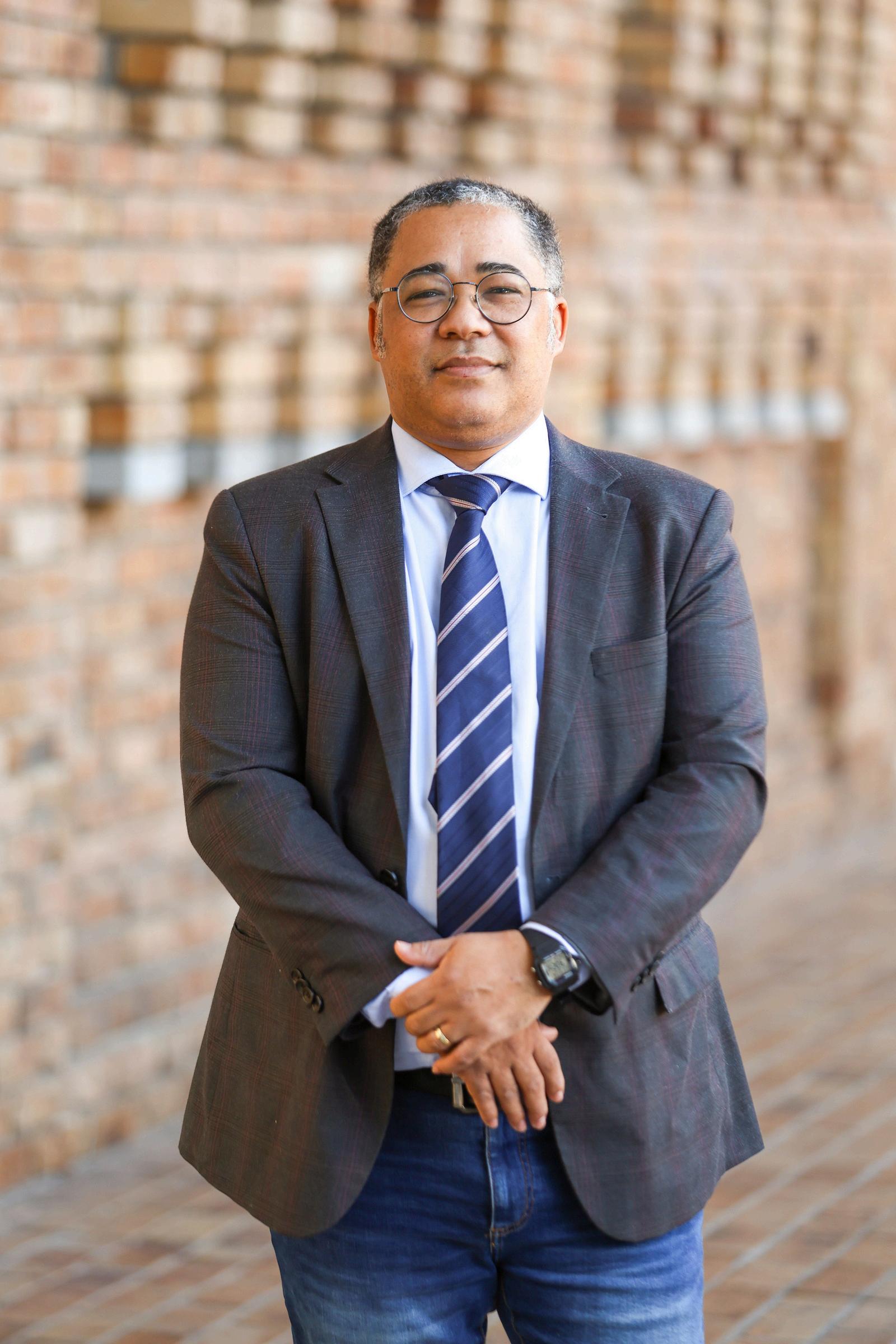
HistoricallyMarginalisedSpeakers
BIOGRAPHY
Prof Quentin Williams my Honours degree, but along the way always kept abreast of what is happening in Afrikaans and Dutch departments and Linguistics My postgraduate training at Honours and Master’s level introduced me to the complexity of multilingualism, and how the development of alternative frameworks of multilingualism could serve historically marginalized speakers.
In my PhD, supervised by Christopher Stroud, I designed a study that investigated multilingualism in popular spaces, focusing on Hip Hop culture and Tshisa-Nyama spaces. While the focus on Tshisa-Nyama spaces was straightforward, how I married that focus with Hip Hop is interesting and later, I would come to understand, important in my thinking of multilingualism and the future of historically marginalized speakers.
After searching for readings on Hip Hop in South Africa, on the restricted level 12 of UWC’s library, I came across Prof Adam Haupt’s MA thesis, Rap and the articulation of resistance: an exploration of subversive cultural production during the early 90s, with particular reference to Prophets of the City Adam’s study had a titanic effect on me, and I immediately informed my supervisor that I wanted to focus on hip hop and language in my thesis; the language that is my first language, Kaaps
Adam’s study, in part, gave me the scientific language, the theoretical vocabulary to develop and articulate my own perspective on language and multilingualism. His work took me to bell hooks’ transgressive theory and Henry Louis Gates Signifying Monkey. I felt I sat in a master class as I read page after page on how to analysis hip hop and language.
While my ideas about multilingualism was in its infancy, encountering Adam’s Master’s thesis set me on a path to develop an approach to multilingualism that could help us understand how historically marginalized speakers used language in postapartheid South Africa, how they defined language in their own way, but also what type of multilingual speakers they wanted to be and become. I read his text many times and had to ask the librarian to scan it into pdf before I destroyed it Which they did
For the next couple of decades, I set the task for myself to advance social (and to a degree cultural) approach to multilingualism that emerges from society, from speakers, but that centre speakers, their repertoires and their meaning-making practices.
Thinking Multilingual for Historically Marginalized speakers meant thinking multilingualism and marginality together, not as part of a quantitative exercise but as one where we try to figure out what is qualitatively different about the multilingualism of historically marginalized in our society today In this regard, I opted to advance a social approach to multilingualism that settled on Changing ideas of individual speakers and community defined by changing ideas of language (and vice versa)
That we found ourselves in a world that had undone limited boundaries or limited imaginings of identities
That understanding how the individual draws on language, styles, accents were as important than understanding how linguistic repertoires and bits of languages are formed and valued by individuals and communities.
That to emphasise how sets of languages perform the essential functions of communication, rather than this+that language, are actual crucial to the lived experiences of many speakers.
Multilingual resources = linguistic and semiotic resources
Just focusing on multiple languages reduces our study and analysis of the complex web of meaning-making practices of multilingual speakers and multilingual communities.
This social approach to multilingualism I fully elaborated in my first book, Remix Multilingualism This book is based on my PhD thesis, and in it I couple a social approach to multilingualism with a framing of marginality that illuminated the language practices of historically marginalized speakers
I wanted to demonstrate how marginality is still closely tied to heaviness of social, economic, political and linguistic exclusions and injustice. Of course, language was key to demonstrating how marginality was manufactured in our society. And that the marginality of language was linked to ideologies (false beliefs), on the one hand, and the voices of marginality were made through processes of social hierarchies of distinction, and not to be found.
A focus on marginality also showed that some languages were full, complete while others weak and at the bottom of a language hierarchy. Those complete languages were codified and standardised. It is with the completion of Remix Multilingualism that I understood what is required to empower historically marginalized speakers.
Proclaimed by the Journal of Sociolinguistics as the state-of-the-art text for multilingual hip hop research, I illuminate in the book the dynamics of marginal language use, how named languages such as isiXhosa, English and Afrikaans were used interchangeably with Kaaps, and what it revealed in gendered, identity practices and the performance of genres such as freestyle rap battles and braggadocio My focus on gendered identity practices was deliberate, since I wanted to demonstrate the effects that a form of toxic masculinity - toughness - via the performance of a rap genre was a dominating feature in the organisation of gendered multilingual interactions in the local Hip Hop culture
All my data came from young multilingual speakers, so I came to understand the shape, size and design of their linguistic repertoires. But at the same time, I also learned how they struggled for linguistic recognition, linguistic justice and the acknowledgement of their voices and agency. Although they were entering into debates about language and multilingualism, there were little in the way of radical concepts that could descriptively do justice to their experiences. They wanted us to highlight their multilingual diversity, lift up the history that formed their language and language inequality. At the same time, they wanted us (academics) to reconstitute language and linguistic power to achieve linguistic justice. Thinking about speaker agency and voice via multilingual practices, linguistic repertoire formations and struggles for linguistic justice was well captured in the notion of linguistic citizenship Introduced and advanced by Christopher Stroud, we were able to raise the question: what would it mean to think through a notion of linguistic citizenship for historically marginalized speakers
4. Thinking of Multilingual Voices and Agency: the path to Linguistic Citizenship Stroud defines linguistic citizenship as follows:
‘the situation where speakers themselves exercise control over their language, deciding what languages are, and what they mean, and where language issues…are discursively tied to a range of social issues – policy issues of questions of equity’.
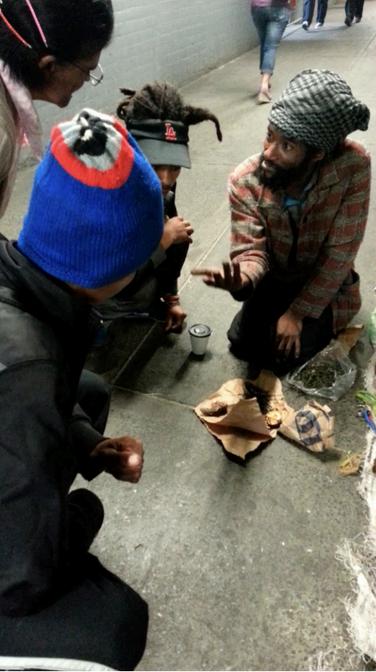
multilingual speakers were dealing with, were a feature of enduring legacy of race and racism. In the paper, Battling Race, on race in hip hop, Stroud and I explore the co-construction and coproduction of whiteness and colourednes. We unpack the complex nature of racialization, particularly where it concerns the intersection of multilingualism and the performance of racial identity
Here is a picture that I took of Rastafarians in one of the tunnels at Bellville train station – the customer wanted herbs to ward off evil spirits, and the Rastafarian gave her onomatopoeic words instead, which she thought he spoke in tongues. We all were fooled.
The elaboration and application of linguistic citizenship outside institutional contexts, in nooks and crannies, has allowed me to understand how multilingual speakers draw on their linguistic repertoires as part of an interactional strategy of persuasion. In the case of my research and description of Rastafarian multilingualism (my gloss for the complexity of language use by this group of speakers), I demonstrate how Rastafarians use words to manage interactions.
The struggle for multilingualism and the pedigree of linguistic citizenship has been taken up across the world, as evident by this volume we published. In this book, in a way, we began to link linguistic citizenship to the fight for linguistic justice.
But in many ways, the questions raised about linguistic justice were not necessarily ones raised by linguists but by community and academics in their language advocacy and activism. In the last ten years, I have pulled on a thread that lead me to advance public sociolinguistic framework that began with my reading of Adam Haupt’s thesis, my own contribution to the sociolinguistics of Hip Hop, and my quest to find ways to empower Kaaps speakers through Kaaps; speakers who speak and live out a historically marginalised language
5. Multilingualism, Hip Hop, Kaaps (Afrikaaps) Multilingual Activism
In the last decade, I have worked with linguists and Hip Hop language activists on addressing linguistic inequality for Kaaps speakers.
Throughout our endeavours, we recognise that the ongoing linguistic inequality that Kaaps speakers experience are not only a matter of language policy change, but how we view and understand the multilingualism of such speakers as they experience and are weighed down by the social and economic remains of colonialism and apartheid.
So, we agitated, advocate for ways to understand through Kaaps based multilingualism how Kaaps speakers redefine their agency and voice, and how they cultivate new forms of relationality as they reinvent their own language
But we needed to set up a community and academic programme to facilitate and study the reinvention of Kaaps as a language Here, these pictures, Adam Haupt, myself, Emile YX? from Heal the Hood project and the group, Black Noise and H Samy Alim hatched plans to support the advocacy and linguistic justice efforts for Kaaps speakers.
We created a linguistic justice for Kaaps speakers programme, through Hip Hop culture, by creating the Heal the Hood Hip Hop lecture series. This led to the publication of Neva Again which is a collection of essays by artists and activists demonstrating the power of language and culture through art, activism and education in post-apartheid South Africa.
At the completion of this study, we were faced with the inevitable question of what we ought to do next for the empowerment of Kaaps speakers We asked, how can we undo the historically racialization and marginalization of Kaaps speakers formed in colonialism and apartheid? How can we highlight the multilinguality of Kaaps speakers in such a way that we disrupt stereotypical frameworks, linguistic labels and injurious knowledge produced in the academy.
Our answer: let’s dig into history, let’s codify our language, let’s get it in schools on the curriculum, and let’s develop new knowledge about the multilingualism of Kaaps speakers
In 2021, in the heart of the pandemic, we announced the launch of the project for the Trilingual Dictionary of Kaaps. But at the same time, we also began to conduct research into the history of Kaaps, digging into the archives. We asked, what can we learn about the multilingualism of Kaaps speakers by investigating Early Kaaps? Why would it be important?
Well, for a few reasons
The first is that we know that the roots of Kaaps goes further back than the official inception of colonialism in this country When Jan van Riebeeck responded to Janz and the directors of the Dutch East Company that he wanted to be the commander to introduce colonialism, he did so with great zeal. Here, writing in 1651 from Batavia he says, he will force Dutch on the native children and the Reformed Christian Religion. For the most part, he was unsuccessful. But it was his successor, Zachiarias Wagenaer that tried to perfect Van Riebeeck’s immersion and subjugation program. Wagenaer was a racist and brutal in his handling of slaves and indigenous Khoi, even Krotoa.
For much of the 1600s and 1700s, the paper archive provides rare insight into the lexicalization of Early Kaaps. In fact, we find evidence of the process of mixture, levelling, simplification and reallocation out and restructuring of Early Kaaps, right up to the 1800s when Abu Bakr Effendi wrote his Beyan al-Din and in the Straatpraatjes columns, in the early 1900s.
In Effendi’s writing we see early Kaaps being classified as a “tussentaal”, in between Dutch and Afrikaans.
For the ensuing decades Kaaps becomes a resistant language but what we learned from this history was that Kaaps indeed an African language: African language formed out of a slave lingua franca
Used first among the Indentured indigenous and Enslaved populations in the Cape Colony
Linguistic Structure: the sound system, word formation, syntactic structure, and meaning-making character was historically formed by Cape Dutch mixed with the phonological-lexical variations of Arabic, Low and High Portuguese (also known as Malay- Portuguese), Bahasa-Malay, and Khoi and San languages in the early 1600s to 1700s.
It was later influenced by English and standard Afrikaans (and gradually marginalized) because of colonial and apartheid nationalism policies.
While we were digging into the archives to highlight the history of Kaaps, we were also working on the Trilingual Dictionary of Kaaps. This project allowed us to answer this question: What can we learn about Kaaps through the making of a dictionary and a grammar?
In our multilingual activism with the aim of empowering Kaaps speakers, we have made significant advances in the prestige (image) and corpus development of Kaaps
While Kaaps has always been written in newspapers, poetry, dramas, novels and magazines, today we find Kaaps used to translate the Bible There have been requests for translation models, the dictionary, a grammar guide, and for
fundamental change in the school curriculum where we know Kaaps-speaking learners are struggling with standard Afrikaans and English
Very soon we will have hard copies available of the Kaaps dictionary thanks to the efforts of the compilers and translators on the editorial board Since 2021, we have been working hard to produce a descriptive dictionary for the South African public And I’m grateful to the entire team
Here is the cover, created by Tanswell Jansen and some pictures of us.
Throughout the process of compiling the dictionary we have learned that Kaaps itself is multilingual, mixed in still with much variation and that some of the words have clear Arabic and Bahasa-Malay roots. But we also see learnt that Kaaps with a bry, leading us to wonder, speculate about Kaaps and its varieties.
The dictionary also provides insight for grammarians who are working on the system of Kaaps. And speaking about rules. We are currently moving ahead with our plans to produce the first Grammar Guide for Kaaps, for publication in 2026. Here is the cover
The Education of Kaaps learners
Since 2021, there has been an increase in scholarship, especially scholarship focused on including Kaaps in the basic education curriculum Such studies, from UCT, UWC, CPUT and Stellenbosch proposed that learners should be taught, learn, read and write in Kaaps.
In the CMDR, my colleague Dr Robyn Tyler, leads a bilingual learning research project that produced the first Isayensi-Yethu Grade 4 isiXhosa-English bilingual learning materials. The impact has been transformative, a true catalyst for change.
The next question we asked: What about Kaaps?
Wait, let me rephrase that. It must be taught in schools if we are to achieve linguistic justice.
And we’re working on it. But we have also come to learn that the multilingualism of Kaaps speakers can only be maintained if institutions or controlling contexts open space for Kaaps Otherwise, we defer linguistic justice
9. Kaaps in UCT’s revised Language Policy
Linguistic justice can only be achieved through the collective efforts of many, especially in the education context Acknowledging the Kaaps multilingual speaker is also about making space for such a speaker in our education context But, as I and others have demonstrated, through hard data, this should not come at the expense of other languages
It is particularly significant for Kaaps multilingual speakers that UCT, our sister institution, took the historic step of including Kaaps in the institutions revised language policy. The policy first makes provision for three official languages: isiXhosa, Afrikaans and English, but then takes a leap towards linguistic justice by including languages for development: South African Sign Language (SASL); N|uu, Khoekhoegowab and of course Kaaps.
UCT is a bellwether for other institutions in the Western Cape on how to acknowledge, include and invest in the development of historically marginalized languages.
But this aside, there is much work to be done within the academy and outside to pursue linguistic justice for Kaaps speakers
Thinking of the multilingualism of the Kaaps speakers does not stop at revising language policies, even though we know that language policies are important instruments of equality (and inequality).
Linguists, academics together with community stakeholders must produce the resources necessary to change the future of Kaaps speakers.
10. Rise the Academy of Kaaps Sciences
We are confronted as linguists who study Kaaps multilingualism and the speakers to ask firstly the right questions and to advance knowledge that will be of service to Kaaps speakers. The question of what we can learn from the multilingualism of Kaaps speakers is the focus of academics, scientists working with the Society for the Advancement of Kaaps (SAK)
At the last Kaaps Symposium, a few of us took it upon ourselves to propose the establishment of SAK
The aim of the Society is to develop and maintain scientific research and development programmes that advances Kaaps in South Africa and beyond
We have set ourselves the task to establish an archival programme and advance Kaaps in the areas of linguistics, education, literacy, literature, language policy and further codification of our language. Through our endeavors we hope to develop Kaaps fully into an academic language and a language of value for cultural practices and economic benefit to both Kaaps and non-Kaaps speakers in South Africa.
The first issue of our journal, Aweh: a journal for minoritized languages, is under review and the executive members you see here are working hard to bring the programmes into existence. Programmes that centre the bilingualism, multilingualism, linguistic repertoires and meaning-making practices of Kaaps speakers. And to produce research and knowledge that will benefit all of us.
I want to thank them for their contributions so far
We have over 120 members so far
If you want to join, please visit our website: www.sakaaps.co.za
11. Conclusion
I want to conclude and thank my friends, family and colleagues for supporting my journey to this point. I have been inspired by many of the important contributions my colleagues have made in the Linguistics Department and the Centre for Multilingualism and Diversities Research (CMDR).
For much of the time, I am motivated by my colleagues in the Linguistics Department who are leaders in their field, who have reshaped the field of sociolinguistics and multilingualism. And I have worked very hard to do at the least the same along my research trajectory. I want to thank the colleagues in the Linguistics Department for their collegiality and for providing a space to think A space where my research could thrive
I also want to thank my colleagues in the CMDR for cultivating an environment for radical thinking about multilingualism Many of us in the CMDR do academic and community work and the success we share has changed in many respects the trajectory of multilingual scholarship We agitate daily We are activists We want to bring about change I love coming to work every day because every day there I am challenged to think language, multilingualism and diversity anew I am often left with the thought, Jarre, why didn’t I think of that. So, to my colleagues in the CMDR, thank you. Keep doing what you’re doing.
I have always worked hard to achieve what I needed to achieve. Only later in life did I discover that the one person that taught me how to work hard was my mother. For much of my upbringing, she stood once kapadien, man allien, raising my three brothers and I. She taught the value of hard work. So hammie, dankie vi dai. I want to also say thank you to my brothers for always treating me like their older brother, to this day. For the mutual respect we have for each other and for cultivating a humor only we can understand.
To my family in law, thank you for welcoming me into your home and hearts I will always cherish it
Then, to Master William, thank you choose myself and your mother as your parents, for blessing us, so that we can be your blessing Thank you for teaching me that there is more to life than finishing the next sentence.
Last, but not least, I want to thank my wife for always supporting my academic endeavors and keeping me grounded. My life has always been enriched with you by side. Thank you. I am very proud of my wife. She is graduating next month with her Master’s degree (cum laude) and will soon pursue PhD studies.
Lastly, I want to thank you all for setting time aside to share with me this special honor.
Thank you.
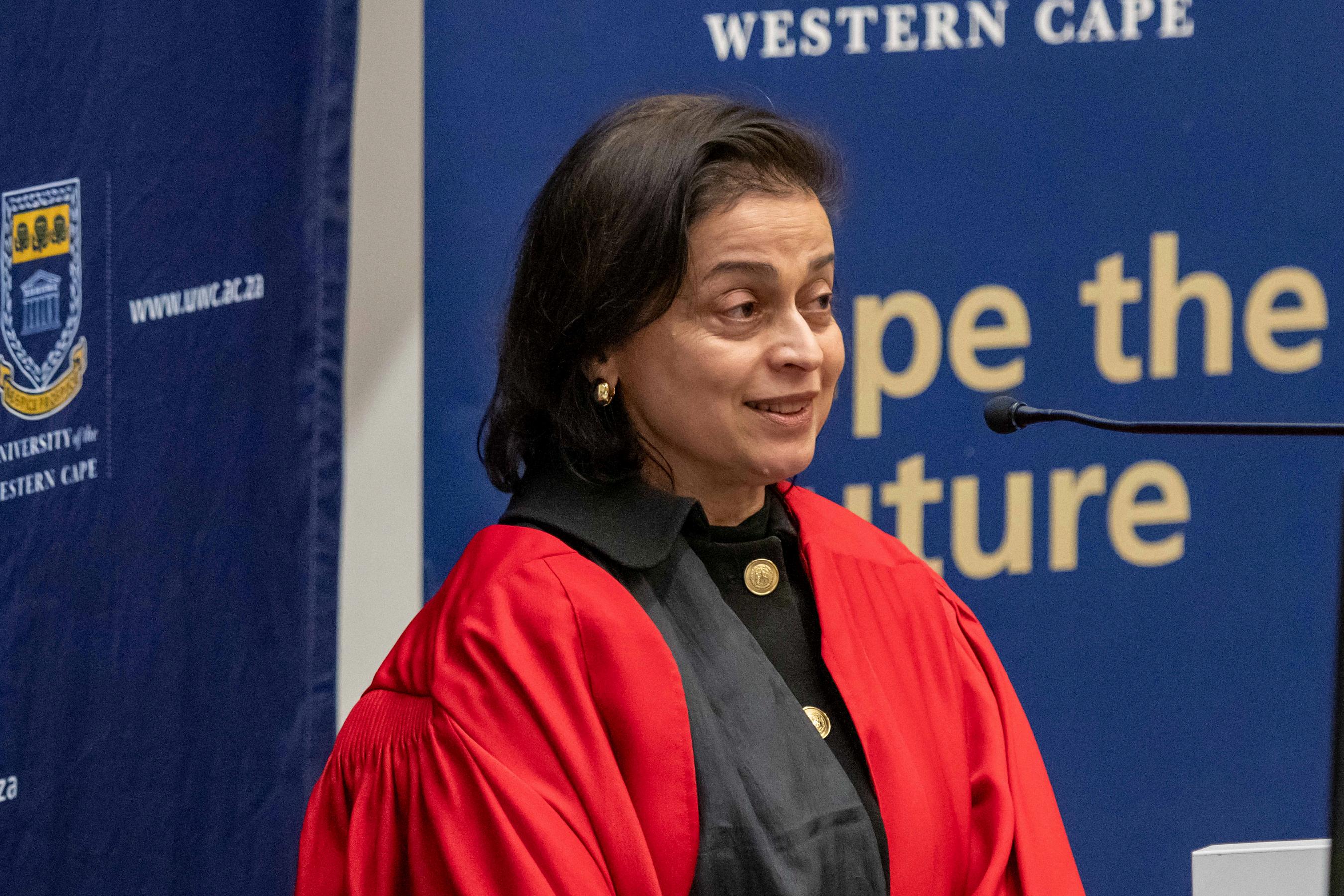
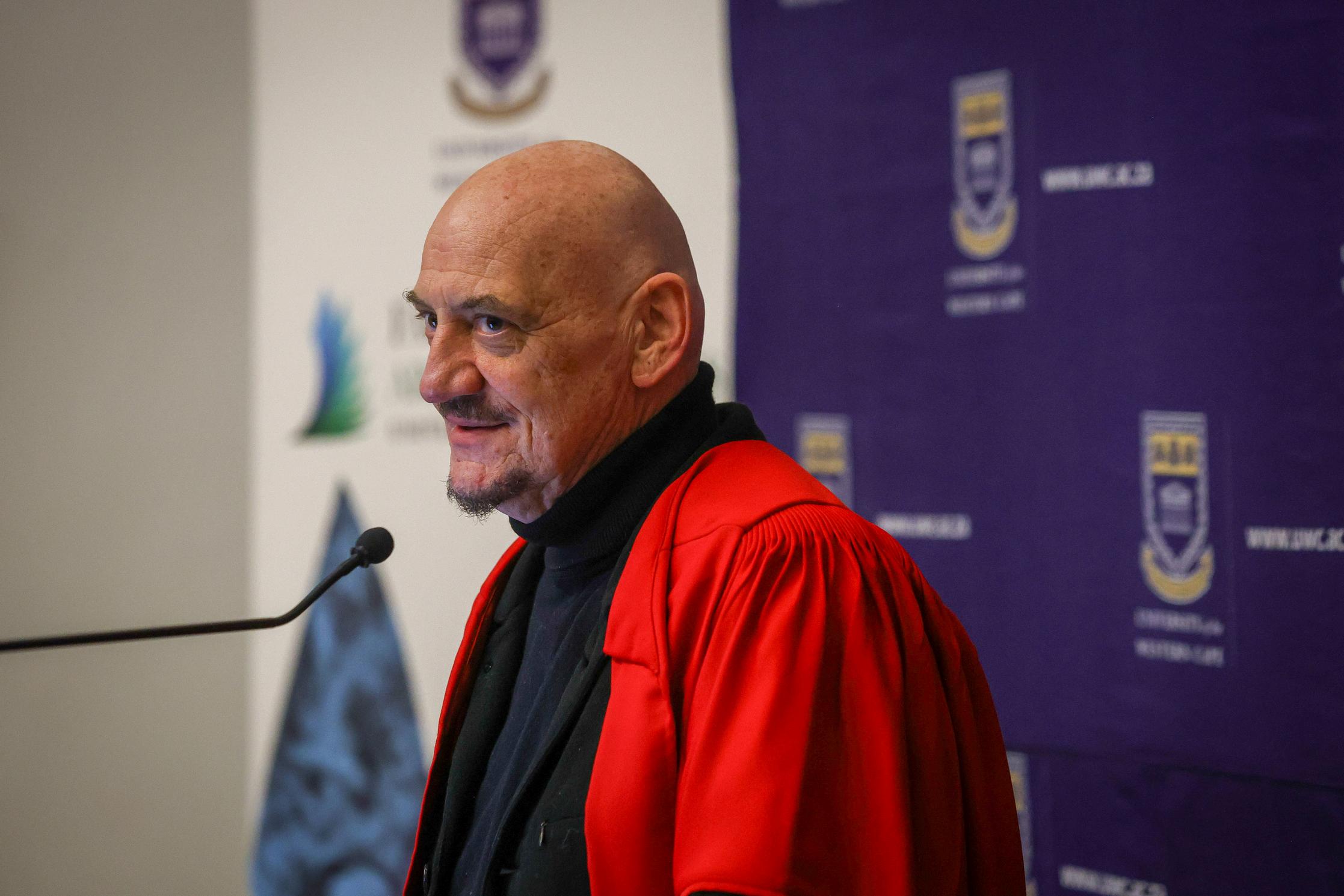
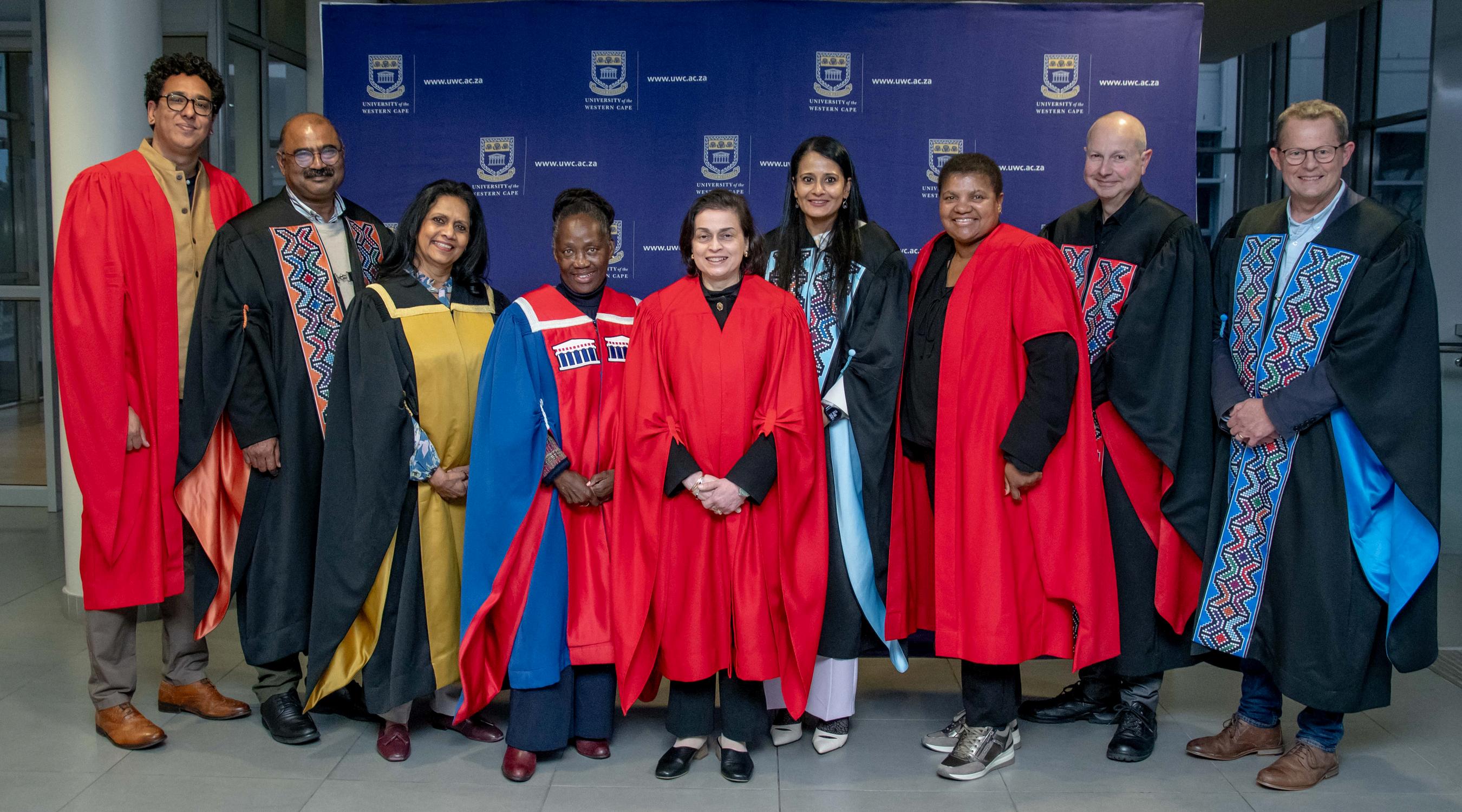

ProfessorMariaFlorence
ProfessorShaheedSoeker
ProfessorRinaSwart
ProfessorMarichenvanderWesthuizen

Prof Maria Florence
Through my research I have come to understand that substance use is a symptom of an underlying problem. If we treat only the symptom and not the underlying problem, we make the problem so much worse. This is why the recidivism rates are so high for those who do manage to access treatment which is also a small percentage of those who need it. Please hold that as my central message for this talk as I unpack it further.
The most recent global data from the United Nations Office on Drugs and Crime and the World Health Organisation confirms a growing and evolving substance use crisis. The number of people who use illicit drugs globally is rising, reaching 292 million people worldwide in 2022, a 20% increase over the previous decade Only about 1 in 11 people with a drug use disorder received treatment globally in 2022, that is 1 in 18 women, 1 in 7 men
Alcohol remains one of the world's leading risk factors for disease, contributing to 2.6 million deaths annually and imposes a particularly heavy burden on young adults. Although global consumption levels have shown a slight decline over the past decade, they remain high, and harmful patterns such as heavy episodic or binge drinking persist in many populations. This data underscore the urgent need for stronger public health measures, prevention initiatives, and treatment interventions to reduce the ongoing impact of alcohol use worldwide.
In South Africa, the crisis is driven by both alcohol and illicit drug use. Data from the South African Community Epidemiology Network on Drug Use shows that alcohol remains the most frequently reported primary substance of use among adults seeking specialist treatment Their statistics are, however, from those who do manage to access care
While we don’t have a clear sense of the extent of the problem I’ll try to give you some idea of the challenge with access to care. The estimate of South Africans that have a substance use problem is between 13 and 15%. In the first half of 2020 records show only 6000 South Africans accessed treatment across 82 facilities. A 2024 scoping review estimated that in low and lower-middle income countries (like South Africa) treatment access could be as low as 1%. It's probably not that low, but it's much lower than we want it to be.
Among illicit drugs, Cannabis, Methamphetamine, and Heroin drive most admissions, with methamphetamine being particularly dominant in the Western Cape While this data, based on treatment center statistics, gives an underrepresentation of the problem, a long-term national survey showed the prevalence of illicit drug use increased dramatically from 1.5% in 2002 to 10.0% in 2017 These community-based studies which show a more accurate picture of the problem of substance use are few and far between.
Addiction is not new in our country But, given the estimated increased rate of substance use over the last couple of decades, it has taken on new dimensions, deepened by our realities of inequality, gender-based violence, unemployment, and intergenerational trauma, among other things
The Fundamental Perspective Shift
My academic focus emerged from precisely these realities As I began my research, I realised addiction could never be understood outside its social context. It was never just about the substance; it was about relationships, environments, trauma, and survival
The core argument I want to make centers on shifting the perspective from viewing substance use as a moral failure to seeing it as a survival strategy driven by underlying mental health needs and societal context.
The central argument is that substance use and addiction should be understood not as a personal or moral failing, but as a “life jacket” - a desperate, albeit unsustainable, solution for individuals dealing with overwhelming feelings, trauma, or mental health challenges For many, self-medication is a way to numb emotions, avoid intense distress, or cope with conditions like social anxiety, hypersensitivity, intergenerational trauma or the daily stress of living in poverty
The life jacket image, I think, is a useful analogy because, while it serves the purpose of keeping the person afloat, when the dangers of using a crutch such as substances become apparent to the person using it, they often need assistance to get themselves out of the “jacket”.
The Societal Context
It's essential to recognise that substance use disorder is fundamentally a mental health issue, yet the allocation of resources for mental health support in South Africa remains tragically insufficient. The conventional, and frankly outdated, argument for this scarcity is the prioritisation of resources for ostensibly more "life-threatening" physical illnesses. However, this distinction is dangerously flawed. We cannot, in good conscience, argue that mental health issues are not life-threatening when faced with the stark reality of tragedies like the Life Esidimeni disaster in 2016, where the profound systemic neglect of mental healthcare led to the preventable deaths of over 140 psychiatric patients
Substance use is one of the most immediate and visible ways a severe mental illness can manifest as a life threatening disease, driving up risks of suicide, accidental overdose, violence, and debilitating co-morbid physical ailments. A person struggling with addiction is not merely exhibiting poor choices; they are contending with a chronic, relapsing brain disease - a direct and often fatal consequence of untreated underlying psychological distress and a lack of accessible, sustained support.
This reality demands a complete reframing of resource allocation within the entire healthcare system. Mental health, including comprehensive care for substance use disorder, must be elevated from an afterthought to a core pillar of public health strategy. Adequate funding is not just a matter of compassion; it is a critical investment in reducing the overwhelming burden on emergency services, correctional facilities, and the economy. Until resources are distributed in a way that truly reflects the life-and-death stakes of all health conditions, including mental and substance use disorders, South Africa will continue to suffer these preventable human tragedies
We must also recognise the structural and historical roots of the problem Substance use is prevalent because past and current traumas persist, driven by complex historical and social factors. The effects of historical practices, such as the now-defunct "dop system" in areas like the Western Cape, continue to impact current problems.
It's critical that we look beyond individual pathology and acknowledge the structural and historical roots of South Africa's substance use epidemic. The high prevalence of addiction isn't a random social ill; it's a direct consequence of persistent past and current traumas, driven by complex historical and deeply ingrained social factors.
The starkest example of this legacy is the devastating impact of historical practices, such as the "dop system" prevalent in agricultural regions like the Western Cape
Under this system, farm workers were systematically paid, in part or in whole, with cheap, low-quality wine This practice wasn't just exploitative labor; it was a state sanctioned, inter-generational mechanism that engineered widespread alcohol dependence within entire communities.
The effects of this engineered dependency still echo today, contributing to entrenched cycles of addiction, poverty, and family dysfunction. The sheer scale of the problem underscores the depth of this historical wound: the Western Cape alone is home to a staggering number of wine farms (a figure so vast that visiting one per weekend would take around 9.5 years to complete). This density speaks to a massive, regional industry that historically relied on, and perpetuated, the abuse of a vulnerable labor force.
Treating substance use disorder effectively requires interventions that directly address these deeply rooted historical inequities and continuous societal trauma, not just the immediate psychological symptoms.
The current lack of progress in addiction care is fundamentally driven by stigma and insufficient access to effective treatment.
Stigma, labelling, and judgment are primary barriers to recovery When we judge individuals for using substances as a crutch, we invalidate their suffering and alienate them further They are left feeling alone in their trauma when they need connection most The stigma also prevents family members from openly discussing their pain or accessing family-focused interventions, compounding the trauma for the entire unit.
There is absolutely no room for stigma in addiction care. The core need for a person in this state is connection and acceptance; shaming isolates them, but connection heals. This is especially true in the collectivist cultures represented in the communities within which we worked.
Language is an exceptionally important key in the addiction field because it directly shapes how society, health professionals, and the individual in recovery view the condition Your choice of words can either reinforce harmful stereotypes or create an environment of dignity, hope, and support Stigmatising language is a major barrier to seeking and remaining in treatment When addiction is described using judgmental words, it frames the condition as a moral failing or a personal weakness rather than a chronic, treatable health condition By using Person-First Languagesuch as "a person with an opioid use disorder" - research shows that health professionals, the legal system, and the public are more likely to:
Prescribe medical treatment rather than punitive action.
See the person as less responsible for their illness.
See a better prognosis (hope) for the individual.
The language used in treatment and by loved ones directly impacts a person's self-worth, self-efficacy, and willingness to continue the difficult work of recovery.
Stigmatising labels like "junkie" or "druggie" can become internalised as shame, leading to low self esteem and stress, which are barriers to recovery. Using positive language helps the individual reframe their internal dialogue from selfcriticism to self-compassion.
Recovery-oriented language focuses on progress, resilience, and growth. Phrases like "person in recovery" or "recovery journey" convey that healing is possible and that setbacks are part of the path, not the end of the journey This language is empowering and fosters an optimistic mindset
When family, friends, and clinicians consistently use respectful language, it creates an atmosphere where the individual feels safe, welcomed, and understood, making them more likely to seek, enter, and remain in life-saving treatment.
In essence, language is the foundation for establishing dignity and respect. When we use words that acknowledge addiction as a health issue, we stop defining a person by their diagnosis and, instead, acknowledge their full humanity and potential for healing.
My research has shown that the core question is no longer just “How do we reduce use?” but rather, “What does a good life look like for those in recovery?” and “How do we support people to get there?”. This is why a strengths-based approach with a focus on quality of life, not just abstinence, has become the lens through which we now approach this issue
To help someone move toward recovery, we must validate their journey and help them transition from the unsustainable "life jacket" to true safety:
We must harness their survival instinct: Encourage them to redirect that same survival instinct and belief in their capabilities toward dealing with stress, rather than avoiding it.
We must teach new skills to restore dignity and safety: The goal of recovery is not abstinence alone; it is about helping the person to process emotions instead of numbing them—to empower them to "swim safely" without the life jacket We must first focus on restoring a sense of safety and allowing the person to reclaim their dignity, which is essential before they can take off the crutch
The most effective long-term strategy is prevention and systemic reform. Imagine a world where addiction is no longer a dark secret or a moral failing, but a mental health issue treated with compassion and expertise. That shift starts in the education of our children to address the problem preventatively as well as through the training of professionals to address the problem curatively in the most effective way.
We are failing an entire generation by not giving them the tools they need to navigate a complex world. Our most powerful long-term strategy isn't treatment for those who are already suffering - it’s prevention and systemic reform.
Imagine a young person facing overwhelming stress or anxiety Right now, many reach for a substance as their only relief But what if, from primary school onward, their curriculum included Mental Health Literacy? What if they were taught essential, practical skills in emotion regulation and managing intense emotional states? We must integrate this foundational knowledge into every child's education This single act is how we save the next generation; it gives them an inner strength that makes a destructive coping mechanism obsolete.
We also need a focus on the people who dedicate themselves to helping. In the past, addiction care was often rooted in judgment or a misunderstanding of the person behind the diagnosis. We need to overhaul the entire field. We know of fairly recent incidents where inhumane acts took place at unregistered treatment centers that were operating illegally. These centers have to be officially registered with the Department of Social Development and the Department of Health so that they have oversight and can monitor closely.
The care system itself needs a massive training upgrade. The development of specialised qualifications, like the new PGDip in Addiction Care currently being developed within our Faculty of Community and Health Sciences, is essential This new training isn't just about qualifications on a wall; it's a commitment to seeing the human being Our team of academics is working to develop an interdisciplinary, socially responsive course that fundamentally shifts the focus to understanding addiction from the addicted person's perspective.
The core principle behind all of this work is simple, but transformative: Substance Use Disorder must be treated unequivocally as a mental health issue. When we stop treating a mental illness as a crime and start training professionals to see it as a treatable condition, we finally close the gap between crisis and true recovery. This is how we begin to heal our communities.
EnhancingtheWorkerRoleforPersonswithDisabilities:AreWeDoingEnough?
BIOGRAPHY
Prof Shaheed Soeker
1.Good evening everyone, it is an honor and privilege to do this inaugural speech here this evening. I really feel very blessed to have everyone be present here today.
2.Ladies and gentleman, I am a little bit nervous as my mother is sitting here today, I feel like she will be testing me after this talk Ladies and gentleman, the order of my presentation will be as follows I will give an overview of my background, I will talk about occupational therapy and my research focus area, I will try to provide my views on the current dilemma in rehabilitation with a particular focus on a rehabilitation model that I developed as part of my PhD, which I have be implementing in practice for many years. I will end off with some acknowledgement of individuals that has walked this journey with me.
3.Ladies and gentleman, I was born in a suburb named Athlone that is situated about 20 km from the University of the Western Cape. I am particularly proud of this suburb as in my view this community played an instrumental role in the struggle against apartheid. I attended a primary school called Heatherdale primary and Alexander Sinton Highschool. The photo at the bottom is the primary school. And an important landmark in Athlone is the Athlone Stadium where many PSL soccer tournaments are played.
4.Remember I said that I was proud of the suburb and schools earlier, important events that took place during the time that I was at primary school was the Trojan Horse massacre that occurred in 1985. For those of you who do not know that the SA police officers who served the Apartheid government planned to arrest students, they hid in boxes on a truck and shot live ammunition at the protesting students Many students were killed This was in the same road that I lived Another significant event is that Nelson Mandela was freed, and we had our first democratic election in 1994. As you can see Alexander Sinton played a significant role it was one of the first high schools that Nelson Mandela visited in Cape Town after his release from prison and his signature is still present on a mural on one of the walls of the school.
5.It was only a natural transition that I moved to UWC as a university for the people, I actually wanted to study pharmacy but it was thanks to my sister who is also an occupational therapist that I left a pathway to pharmacy to degree in occupational therapy. I obtained all my degrees at UWC. So you can say I have been at UWC since 1997 Some of you will notice the late Ingrid Miller (previous registrar) and my family at the PhD graduation
6 So we are many occupational therapists here, but for those colleagues who don’t know what OTs do, our main focus is on promoting the health of individuals, groups and communities to engage in all life occupations (i e whether it be self care, work, leisure and play) through specific occupational therapy interventions.
7.Ladies and gentleman, I want you to view a 3 minute video as this will give you perspective in terms of the areas that I work in as an occupational therapy researcher. In the video you can see that the challenge that the person with disability is experiencing relates to workplace reintegration. As an occupational therapists we develop strategies enable this type of individual to access and maintain his employment. For those of you who are familiar with the 1980 series called fame, which focuses on teaching music and performing arts to high school learners. The one common famous statement that one professor argues of all the performing arts, playing the piano is the most important of all music Chandra. Similarly, I am of the opinion that the occupation of work is the fundamental occupation that enhances the quality of life of humans. I therefore chose enhancing individuals work skills as the most important area that I would want to focus my research in
8 My masters thesis focused on understanding the difficulties experienced by individuals with LBP in RTW This study revealed that in order to develop rehabilitation programmes one needs to take multiple stakeholders into consideration namely, medical, insurance, family and workplace rehabilitation is needed to facilitate RTW.
9.With my PhD research I wanted to understand the challenges that individuals with TBI experience when RTW A vocational rehabilitation model called “The model of occupational self efficacy” that emanated from this research I will present my work in this area in the next couple of slides
10 Traumatic brain injuries have a number of direct and indirect costs It is one of the conditions that contributes to the increase in health care costs and non health care costs. In the publication from WHO they provide a very informative account of the affect of traumatic injuries on indirect costs to countries such as productivity and ultimately impacting the gross domestic product.
11.The incidence of TBIs in South Africa is slightly lower than USA, however, cognizance must be taken that the year of the references are different, the TBI’s in South Africa might be higher in 2025
12.In this slide I want to show that a TBI is an expensive condition to manage, the cost of ICU care alone at a South African hospital was estimated as being R16 million. With the mean in patient care being most expensive for individuals with severe TBI. With the RTW rate being the worst for individuals with moderate to severe brain injuries.
13 Now colleagues, when we look at policies and its influence on employment for PWD I want you think about the 3 minute video clip that I showed earlier, we actually do have could local and international policies that supports the employment of PWD Unfortunately, the huge critique linked to policy is inclusive marginalization and a lack of enforcement of our policies Certain disability groups become marginalized and that ether is a lack of political will to strictly enforce these policies. I would say it is like the protect the environment campaigns, we know it is the correct thing to do but does it make business sense, can we still make a profit?
14.So what is the current dilemma in rehabilitation specifically for individuals with TBI. What is the best approach, should we focus on improving components of function i.e. cognitive function or should we focus on compensatory techniques, in other words should we focus on strategies to help people improve their memory by using assistive devices such as memory aids (digital or manual diaries).
15.Or should the focus be on a client centred approach, where the client directs what they think is most appropriate for them in terms of rehabilitation. This is important as research has proven that a client centred approach allows that individuals with TBI to take ownership of their rehabilitation, this may ensure that they complete rehabilitation programmes
16.So what are the current approaches used, work hardening which is an interdisciplinary approach used that enable the person who was sick and injured to undergo specific work retraining under the guidance of various health professionals such as Drs, OTs, physiotherapists etc A common advance is that it allows a speedier RTW for the sick of injured person However a common critique is that the this approach is very expensive and may need specialized equipment
17.Another common approach used is supportive employment, with this approach the job coach (OT) provides training and ongoing support in the actual work environment where the person is going to be working. Although this approach has a high success rate in returning the individual to work however it is a very expensive model and requires long periods of support for the sick of injured person.
18.Now ladies and gentleman, I mentioned the previous programmes as the model that was the outcome of my PhD has elements of work hardening and supportive employment models. According to the model which based research conducted with individual who sustained a TBI. The model is described by 4 phases, namely, a strong believe in yourself- here the person who was injured undergoes a period of introspection- this is an important phase the patient or clients gets reflect on their condition and set up goals for themselves, as a TBI is of a sudden onset In phase 2-there is an intense focus on improving functional limitations such as their cognition or balance, In phase 3 there is a strong focus on improving work specific skills and in phase 4 the client works independently and can manage their own limitations. Ongoing support is given to the client for a brief period of times
19.Colleagues and ladies and gentleman in the next couple of slides I will show you how we have implemented the model in practice. In research conducted with individuals diagnosed with stroke, some key findings indicated that the Model of Occupational Self Efficacy is a useful model in facilitating RTW. However most importantly these stroke client concluded that they struggled to access vocational rehabilitation in rural areas.
20.In research conducted with individuals diagnosed with Schizophrenia, with this groups of clients the pre post intervention study concluded that the model was useful in facilitating return to work and self efficacy beliefs.
21 In using the same model with individuals diagnosed with MDRTB, an interesting finding was that research identified a lack of rehabilitation resources in public health facilities as well as a need for vocational rehabilitation programmes.
22.In a RCT conducted with individuals with TBI, the study findings reveal that the MOOSE enhances the cognitive, anxiety skills and depression.
23.In this paper as part of evaluating the usefulness of the rehab model I wanted to obtain the views of OTs employers and caregivers about the usefulness of the model. This holistic evaluation helped me understand the use of the model in practice. The findings revealed that these stakeholders found the model useful however that it takes quite long to implement. It is important to remember this point.
24.Ladies and gentleman, I am proud to indicate that the MOOSE provided more than 100 work opportunities to individuals with disability and these individuals found employment at companies such as Jive cool drinks, McDonalds and the DoH
25 Ladies and gentleman from an academic rigour perspective, I have had PhD students use the MOOSE as a framework in their PhD studies over the years
Here are some titles of their PhD studies
26 So colleagues, if I should attempt to answer the question of how we can enhance the work skills of PWD. I think that my humble research has indicated that there is a strong need for vocational rehabilitation programmes and this should be included as a fundamental part of the basket of care in health. We should not only focus on remediating symptoms but focus on return to enhancing someone’s skills to return to an occupation. We should focus on a transdisciplinary approach, that is the treating team should focus on a common occupational goal e.g. return to work as an occupation despite intervention that may be profession specific. We need to consistently apply legislature that supports the employment and maintenance of employment for PWD. These would include laws such as the employment equity act and the code of good practice that is linked to the labour law in South Africa. Remember what I said earlier that SA has good labour laws but it needs to be enforced in the workplace Then we may need to facilitate public and private partnerships to facilitate employment
27 In terms of the way forward I would like to state that as humans we have an innate drive to achieve and To Do. No matter who you are you have the right to decent work, work that provides a livable salary. And finally the above could be possible by means of public private partnerships in order to create employment opportunities to PWD and we need to see work skills services not as a charity case but rather as making economic sense (simple cost benefit analysis could be conducted)
28.Ladies and gentleman, I am extremely happy to say that we have come to the most important part of the session, which is the acknowledgements. It the slides that follow I want to paint the picture of the important individuals that shaped me for who I am today and that I must show gratitude for. Firstly, I would like to thank the almighty for giving me the health and ability to be here today
29.I would like to thank my family members, firstly my parents and then my family, my wife and three critters, just joking they looking very serious over there, Ladies and gentleman I hope that I am not diverging to far from protocol But I have to mention that something very important, I want to give a special thank you to my first teacher- which is my mother- she taught me to read and write and she still continues to be my teacher until today despite her being 82 Colleagues could we give her hand. Colleagues I have cleared this with the wife so there is no problem (laugh laugh)
30.I would like to thank my post graduate supervisors, namely Professor Lisa Wegner and Mr Blanche Pretorius (my masters degrees supervisors) and Professor Andre Travil and Dr Vicky van Rensburg (my PhD supervisors)
31.I would like to thank the deanery and all colleague in the Faculty of Community and Health Sciences. Then I would like to thank all my colleagues in the department of Occupational Therapy, some are new and some I have worked with for many years. Some of them has been my teachers and colleagues. I have just listed their names.
32.Here I have included some memorial photos of all colleagues and students over the years Some of you here will identify some colleagues in these photos
33 Then I would like to thank the individuals with TBI that shared their experiences with me In this photo, you will find a photo of one of the graduates of our vocational rehabilitation programme conducted in Khayalitsha as well as the Occupational Therapist that assisted me
34 Ladies and gentleman, I would like to end off with the quote from the Dalai Lama, which might sound simplistic but is the easiest way to solve complex dilemmas. He says: Open quote: “The best way to resolve any problem in this human world is for all sides to sit down and talk” This is applicable to any challenge whether in work skills rehabilitation or education.
35.I thank you all for lending me you ear and sharing you time with me this evening. Thank you

Prof Rina Swart
Deputy Vice-Chancellor, Professor Ralarala, members of Senior Management, Deans and Deputy Deans of Faculties, colleagues, current and former students, friends and family – both here in this venue and also those who joined online – I am honored to stand before you as a full professor of the university of the Western Cape and to share with you the story of my career and the research we do; I am truly humbled by your presence and support.
As you may have heard this event is taking place a few years after the fact of becoming a full professor, but it is actually perfect timing in my opinion. As I approach the age of retirement, it gives me the opportunity to express my appreciation to the University of the Western Cape for providing me with a home for the last (almost) 35 years and to pay tribute to the many giants in my life who afforded me the privilege of walking amongst them and learning from them Yes, I cannot believe it, but in February 2026 I also celebrate 35 years at UWC
The structure of my presentation will take a short walk down memory lane to provide you with a glimpse of who this person is who became a dietitian even though she did not like vegetables much; who ended up being a “teacher” of adults when she (as a schoolgirl) thought of becoming a kindergarten teacher and who became a doctor in Public Health after she decided not to become a medical doctor.
Then I will provide a brief overview of some of the milestones in my professional career and I will conclude the presentation with critical studies from the last ten years which informed the key messages I would like to leave with you tonight.
What are those key messages:
1.Overall quality of food (and diets) in South Africa is questionable. This is evidenced in the health and nutritional status of children and adults in the country.
2 Food choice (and thus diet quality) is not a free choice; it is carefully manipulated even if you think you are in charge of your own decisions
3 Policy actions are not part of a “nanny state” It is an attempt by the duty bearer (State) to balance the scales
I will end my presentation with a call for action to remedy the situation of poor diets that leads to stunting, micronutrient deficiencies and overweight/obesity.
I was born as the 2nd of four siblings and grew up on a sheep farm in the Northern Cape.
Whenever I think about my own life, I always conclude that I have been blessed in so many ways but primarily because I had the privilege of walking with giants. As a child I knew we were poor. (with respect to the majority of the population in South Africa, I have to admit that perceptions of poverty is relative) My dad left school after standard 6 to fend for himself. He and one assistant drilled boreholes in the Northern Cape and the southern parts of Namibia until many years later when he obtained a small piece of land, got married and settled down My parents were the first giants in my life. My dad was an engineer par excellence. There was nothing he could not fix or do. My mom was my introduction to a “working mom”. On the farm, a 100km away from the nearest town, she had to find ways to earn an income and taught herself to bake and sew. She still is a seamstress of note. At her knee I learned that food is an excellent income generator. Little did I know that in my professional life I will work in that space as well.
When I was in grade 11, my parents brought me and my sister to Stellenbosch University for aptitude tests. Thinking back I wonder who advised them on this as it was not the norm at the time – But my dad told both my sister and I that he cannot give us much but he wants to set us up to get a good education. Maybe my mom’s mother made an impression on him as legend has it that she, who was not afforded the opportunity to go to school as she had to look after the younger children and tend the goats, would regularly slam her fist on the kitchen table and say that her girls WILL MAKE MATRIC So, off we went and the counsellor told me that I should consider Medicine or any of the other health sciences.
Dietetics was mentioned and my decision was made. Even then my assignments in home economics always had a health angle. Interestingly, for several years after I matriculated there was a learner from Calvinia High School who opted to study Dietetics.
After completing my degree and Hospital diploma at Stellenbosch University (Tygerberg Hospital), I graduated on the first Friday in December 1983 and started working the next Monday at Tygerberg Hospital – in charge of the Diet kitchen in the Food Freeze main kitchen and doing student training from January the next year. Four years later I took a senior position at the National Department of Health office in Bellville. At that stage I felt completely underprepared as part of my responsibilities included Community nutrition – which was only one module as part of my training. I immediately enrolled for a part-time Hons degree in Community nutrition and found my niche.
It was during my time at the NDOH that I was asked by Mrs Mars – the founder of Dietetics at UWC – to give a guest lecture or two and, when the first Dietetics students from UWC were in their final year of study, I joined to do clinical supervision not only community nutrition, but also foodservice management and therapeutic nutrition Technically speaking, I have been part of UWC for as long as the university has graduated Dietitians Over the years UWC produced a formidable workforce that contributed towards changing the demographics of the Dietetics profession I am immensely proud of our products out there
During this focus on professional development, I helped to grow the community nutrition component of the Dietetics profession from one module in the qualification to now making up a third of the qualification. During that time I also enrolled for my MPhil (Public Health) as part of the first cohort of the newly established School of Public Health at UWC. The late prof David Sanders, another giant on my path, set a tangible example of what Public Health Nutrition is when he encouraged this young mother of a three months old baby to breastfeeding in the back of his Summerschool class.
Although I have been involved in research as part of my MPhil and with David and prof Milla McLachlan (then at the World bank) on Nutrition capacity development; the Chronic poverty study with Cobus de Swartd (a later chair of the World Economic Forum) and Andries du Toit, my real big research project was in 1999 when I (then the HOD in Dietetics) was one of the directors of the National Food Consumption
Survey It was the first Dietary intake survey of children 1-9 years in the country and informed the mandatory food fortification programme implemented by government in 2003. In 2005 the same consortium of HEIs Dietetics conducted the NFCS Fortification Baseline. Both these surveys were done under the leadership of Prof Demetre Labadarios from Stellenbosch university. I am proud to say that I managed to follow him as the PI on the National Dietary Intake study in 2022, the first national study of adult dietary intake. Again I followed the collaborative approach with 12 universities and 48 researchers as collaborators.
Between 1997 till 2017 I became more immersed in Academic administration, as HOD for Dietetics and then as Deputy Dean. I continued to be involved in research with an evaluation of the implementation of the Food Fortification programme in 2015 / 16. As of 2014 I was again priviledged to be invited to serve as the Nutrition Programme lead for the new DSTI/NRF CoE in Food Security Here my path crossed that of Prof Julian May In 2016 David and I arranged the congress of the WPHNA here at UWC, a groundbreaking event arranged without the financial contribution from industry As a sideline, I had a very real and quite a dramatic engagement with conflict of interest / corruption during my time at the National Department of Health where I observed several colleagues losing their jobs as they accepted gifts from tenderers. That was a lesson that shaped my perspective on industries’ (and in this case specifically food industries) relentless endeavours to influence decision makers, professionals, anybody who could pave their way in whichever way they saw fit.
Let me share with you the research we have done in the last ten years and which informs my key messages. When I say we, I refer to my team. We refer to ourselves as the Food Environment Research Group (Food-ER). I would also like to acknowledge the colleagues in the DSTI/NRF CoE in Food Security in South Africa, the Global Food Research Programme at the University of North Carolina, the colleagues and researchers who are part of the Food Policy Programme internationally (Chile, Brazil, Mexico, Columbia, South Africa and in more recent years Argentina, Peru, Ghana, Tanzania) as well as the various international advisory committee member They have been instrumental in shaping our research over the last ten years
Message #1: Overall quality of food (and diets) in South Africa is questionable. This is evidenced in the health and nutritional status of children and adults in the country.
South Africa is plaqued by a triple burden of malnutrition Although we made good progress and reduced both underweight and wasting among young children, stunting remains pretty much unchanged What is stunting? This is when young children consume diets that are marginally inadequate over long periods of time causing them not to grown according to their genetic potential, but to end up shorter than their expected height. In the Child Gauge of 2020 Julian May, Chantell Witten and Lori Lake referred to this as the “slow violence of malnutrition”. Currently, 27% of children under the age of six years are stunted. That is almost three out of every ten children. If you think of the long term consequences of stunting this accounts for an enormous loss of human capital as well as income for individuals, families and the country.
In addition we have widespread micronutrient malnutrition which have similar devastating effects on immunity of children and on the productivity adults.
And then we have overweight and obesity. An epidemic among adults and currently rising exponentially among children and adolescents Currently the rate of increase in obesity in South Africa outstrip most other countries in the world At least 4 in every ten women and almost 2 in ten men are obese If we add overweight then the situation becomes one where 6 out of 10 women and 4 out of 10 men are overweight and or obese Most notably and of grave concern is the rising rate in our children Over the last ten years the rate of obesity in children has increased from 1 in 20 to 1 in 8 children and if this rate continues then it is estimated that by the year 2030 at least 3 out of every 5 children will be obese. This is of particular concern for two reasons. We know that treating obesity through weight loss is extremely difficult to achieve. Maintaining such weight loss over time is even more difficult. Less than 1 out of 5 people manage to maintain weight loss for 5 years. So, in this case it is a matter of PREVENTION is really BETTER THAN CURE. We should protect our children from becoming obese. Seven out of ten overweight adolescents grow up to become obese adults. We should also protect our children from being stunted as stunted children has a greater risk of becoming obese as adults.
Changes in overweight and obesity has happened over time and is part of what is called the Nutrition transition It refers to the types of foods consumed by people, the ways in which they acquire and consume that food and the subsequent consequences in terms of ill health, disease and death
Although none of the malnutrition conditions are the result of only ONE single cause, poor dietary intake as a result of food and nutrition insecurity and resource constraints is often the most immediate cause of all three conditions we refer to as the triple burden of malnutrition
How has the South African diet changed? My generation may still remember fields planted with food; food availability dictated by seasonality and harvesting processes. But for the younger generation the supermarket shelve is probably the image they have of food sources.
The result of this is that the dietary diversity of South Africans is extremely limited. Only 1 in ten people consumed 8 or more of the different food groups and those are in the high income deciles. The highest income quantile consume 19 times more fruit and 4 times more vegetables than the lowest income decile. And note that even in the high income deciles the expenditure on fruit and vegetables is relatively low compared to the expenditure on products such as meat.
Reliance on a very narrow diversity of foods result in adequate macronutrients such as energy and carbohydrates, but in likelihood excessive intake of sugar, salt, which is often used to flavour basic staple foods and of course very little fibre is found in these foods when we purchase them commercially as they have been refined and processed. Overall, our food environment has become very Obesogenic = the sum of influences that the surroundings, opportunities, or conditions of life have on promoting obesity in individuals or populations. In addition, none of these changes are of benefit to planet health either.
A review of the food consumption of South Africans in the period between 1997 –2019 confirmed the EAT Lancet conclusions. In actual fact the consumption of fruit and vegetables which was less than 50% of the WHO recommendation to start with, reduced by a further 40% by 2019. Nut consumption is almost neglible with <1g being consumped per per per day whilst legume consumption also further reduced over this period. In contracts animal meat consumption is adequate and increased over this period In addition to the health consequences of this dietary pattern, the food we eat are also impacts negatively on the environment through the green house gas production In addition, discretional foods which should be consumed infrequently has increased exponentially For example, the amounts of sweet biscuits, salty snacks and sugar sweetened beverages consumed increased between 100% and 250% over the period 1997 -2019.
As we argued in the 2020 Child Gauge, we should consider (as a country and as individuals) what kinds of foods we want to have farmers and manufacturers produce for us; what kinds of foods do we want to see promoted to our children; what kind of information do we want to have on a product when we have to make a choice, and what kind of information on food and nutrition do we want our children to receive at places of care – such as schools. Each one of us should be empowered to vote with our feet and our purchasing power. We should use that power to shape our food environment – as individuals where you live – speak out; as part of civil society stand up for food justice for people; and hold profiteers and duty bearers accountable.
This then leads into my second key message.
Message #2: Your food choices (and thus diet quality) is not a free choice even if you think you are a rational and independent thinker
The food landscape in South Africa, as in many other countries, started changing in the 60s with even more rapid changes around the 80s It was a time when more and more women started working and their time constraints made easier options very attractive. Other sectors like food science, technology and marketing almost exploded. The outcome? What we see as food, and where we obtain that food have changed dramatically. Economists refer to this as a change from supply driven to demand driven. I beg to differ. That “demand” is a manipulated, and sometimes an exploitative outcome.
Let me give some examples from our research.
A.
Marketing of unhealthy foods and drinks is aggressive. Think of the narrow aisles at paypoints that are stuffed with snack products – mostly high in added sugar or salt. Think of the overload of advertisements for the same unhealthy product that you see during a particular event or programme on television – and then remember that researchers have found an association between what you are exposed to through adverts and what you eat and evn how long it will take you to eat after seeing the adverts. In young children this relationship is even stronger. Our assessment of television marketing on free to view and pay to view channels in South Africa shows that mostly unhealthy foods and drinks are advertised and viewers are bombarded with up to 20 food and beverage adverts per hour
Our review of breakfast cereals indicated that the products using the highest number of marketing strategies on the packages – are higher in nutrients of concern like excessive sugar and salt.
Marketing of unhealthy food choices is exploitative (infant feeding on social media) Our research highlights how BMS manufacturers have found ways on social media to market their products in a media space that is complex to regulate and where it is difficult to enforce national regulations (R991). Breastmilk is the first form of food security for newborns. The best form of nutrition for infants and should be protected and promoted
There is mostly a vacuum of marketing of healthy foods (including breastfeeding) When it happens, it is usually associated with a health day or perhaps with national nutrition week in November This week is international and national breastfeeding week At the Chris Hani Baragwanath hospital a breastfeeding room was upgraded to allow mothers (visitors and outpatients) to breastfeed in a safe space Very good you may say, but is it good when the naming and branding of this facility is clearly compromising the nutrition of young children by marketing an unhealthy fast food for young children? (I have to also add that this sponsor opened an outlet literally 2min from the entrance to this hospital this year.) Makes you think.
Is the example of portable desks for grade 1s with primary branding from the same fast food company any better?
Is the sponsoring of and marketing through sports events, like the Olympic games, but it is also prevalent at our national sports teams, university sports teams and maybe even at the sporting event where your child may be learning the enjoyment of healthy physical movement?
I have two specific media clips which I want you to view at your own time The first one demonstrates the coordinated and orchestrated “exposure” of individuals to visual and audio imagery that literally influence people so much that it was possible to predict what food choice they will make The second one is from a marketing professional who shows online how values and perceptions of the consumer is used to shape an unhealthy food advert into a product that appears not only desireable, but actually … healthy.
and I can tell you with a budget of 200 million in the hand of fast food companies to market their products, you, I and the general person in the street have very little free choice. We are led by our eyes and our ears to the doors of these food outlets.
That brings me to my 3rd key message:
Message #3: Policy actions are not part of a “nanny state”. It is an attempt by the duty bearer (State), who has a constitutional obligation to ensure access to adequate food and water (section 27) and an absolute obligation to ensure adequate nutrition for children (section 28), to balance the scales.
And these policy actions have been proven in many countries to be effective
South Africa was quite proactive to implement the Health Promotion Levy (sometimes referred to as the sugar tax) in April 2018 Using a large sample of a high-consuming, low-income population, we found large reductions in taxed beverage intake, separating the effects of behavioral change from reformulation. This reduction was partially compensated by an increase in sugar and energy from untaxed beverages. Because policies such as taxes can incentivize reformulation, our use of an up-to-date FCT that reflects a rapidly changing food supply is novel and important for evaluating policy effects on intake.
Earlier on in my presentation I referred to packaged foods. With the explosion in packaged foods, providing information on the content of these products on the package is essential for consumers to know what is inside the box/can/bottle. We conducted several projects to inform government of ways to regulate labels as well as on-package marketing. Consumers were in general in favour of easy to read labels which will inform them on products with excessive levels of sugar, salt, unhealthy fat and the presence of artificial sweeteners Warning labels were also found to be effective in conveying information accurately to consumers The findings from this project informed the draft regulation R3337 on labelling of foodstuff published by the Department of Health on 21 April 2023
These regulations will also significantly reduce the exposure of young children to on package marketing of foods high in sugar, salt, and unhealthy fat. Yet is has been two years since the promulgation and still no final regulation; partly because of the very long documents of objections submitted by industry. If you think of the constitutional obligations of State, surely you will agree with me that such regulations should be implemented sooner rather than later.
There are several other areas where policy action can improve food environments to ensure that the healthy choice is the easy choice. School food environments is one, so is the food environments at universities, and government institutions. Public procurement where government spend funds on food, whether it be for catering at functions or for feeding of patients, should support healthy eating and a healthy planet. Most of these policy actions are currently under investigation by our FoodER team
Whenever any of you may have the opportunity to contribute to improve the food environment of South Africans, whether it be through the food choice you make, speaking out in favour of actions needed or actively supporting policy action, please do so. URGENT action is needed by all stakeholders to remedy the food and nutrition situation in the country.
The Food Environment in South Africa is in need of emergency rescue.
I thank you.
Prof Marichen van der Westhuizen
Social work is both a practice-based and academic discipline directed at the empowerment of people, social cohesion and social change. In accordance with this description, this discussion reports on transdisciplinary work and research to empower individuals through artistic self-expression, and to promote social inclusion and cohesion through joint artistic activities. Joint musicmaking serves as the example to report on the outcomes of the transdisciplinary research and various student community engagement projects. These projects focused on participating students’ personal and professional development, as well as the social impact of artistic community engagement projects. Working from a hermeneutics perspective, the appreciative inquiry model is presented as a practice framework to enhance the social dimensions of joint musicmaking in learning and teaching activities These activities are intended for preparing students from various disciplines to facilitate artistic and creative community engagement projects to promote social inclusion and cohesion
Key concepts: Appreciative inquiry, arts, empowerment, hermeneutics, social dimensions of making music together, social work, transdisciplinary work and research
The intersection between the arts and social work lies in a shared interest in social change The arts, as a social activity, has been recognised for its potential to promote awareness of social issues and to advocate for social change (Nompula, 2011) Correspondingly, Gray and Webb (2008) refer to social work as art in their exploration of the social component of art Particularly focusing on the arts in community contexts, Cohen (2016) focuses on joint musicmaking, and states that it has the potential to create a platform for individual and collective expressions of social, political and cultural concerns.
Drawing a link between social work and the arts, Redcliff and Hatton (2025) advocate for the creative arts in social work as a way of breaking new ground to work towards social justice, empowerment and development.
Drama, photography, painting, storytelling, dance, creative writing, and music have been documented as forms of art (Nompula, 2011) that can contribute to innovative social work practices (Redcliff & Hatton, 2025). For the purpose of this discussion, joint musicmaking is presented as a form of social work that may contribute to creative self expressions and the fostering of social connections and cohesion (Tarr et al., 2014). This focus is supported by Camlin et al. (2016), who claim that music is a fundamental form of human expression, and shared musicmaking is an enjoyable aesthetic experience that provides an alternative language for communication
Importantly, I do not claim that shared musicmaking could solve all intra- and interpersonal problems, or that it is the only way in achieving social inclusion and cohesion and healthy, supportive relationships. In addition, I recognise that shared musical experiences can also be used to increase intolerance and to promote social injustice. But I do support MacAulay and Levy’s (2022) stance that shared musical experiences create opportunities for innovative forms of communication, and human collaborations and connections. Zhu (2025), promoting consideration for the potential value of non-verbal communication, explains that due to language, cultural and personal barriers, verbal communication may become restricted. The power of non-verbal communication, in this case through music, is that it provides diverse offerings to convey a message, to hear, and to be heard.
Making music together in social work, according to Blackburn and Bradshaw (2014), fosters shared experiences aimed at cultivating healthy, collaborative and supportive relationships. Further, by including music education in the social work curriculum, students develop competencies aimed at facilitating joint musicmaking activities that enhance social inclusion and cohesion (Van der Westhuizen & Greuel, 2021). Yet, joint musicmaking has not fully been recognised and utilised in social work education and practice (Nissen, 2017; Navarrete-Campos, 2016; Dankoff, 2011).
In response, this discussion presents a transdisciplinary approach to advance the potential of the arts in social work (Nissen, 2017). The concepts of ‘social work and the arts’ and ‘transdisciplinary research and work’ are unpacked, followed by a presentation of the theoretical foundation and practice framework proposed for social work and the arts The discussion is concluded with a report on potential outcomes of joint musicmaking in social work
As an academic and applied discipline, social work is guided by principles of respect and fundamental consideration for the inherent worth and dignity of all human beings, benign approaches, respect for diversity through inclusion, and social justice (International Federation of Social Workers [IFSW], 2014). These principles call for, among others, cultural sensitivity from social workers, which requires continuous personal and professional development (Mogorosi & Thabede, 2018)
As a practice-based profession, social workers respond to the needs of the vulnerable, marginalised and oppressed, and aim to advance intra- and interpersonal wellbeing, social change and reciprocity between people and their environments through empowerment (South African Council for Social Service Professions [SACSSP], 2018) Vulnerability is often a result of not being included and heard, and not having control or influence on aspects that impact wellbeing – being marginalised and oppressed. This, then, leads to powerlessness and hopelessness that impact the way those impacted think or see the world, their feelings and their actions.
Empowerment interventions aim to stimulate participation towards reaching potential, increasing confidence, and experiences of being valued, worthy and included (Rachmad, 2022). Through such interventions, social workers respond to the profession’s mandate to advance social inclusion and cohesion, while recognising the interconnected impact of historical, socioeconomic, spatial, political and personal factors on wellbeing and development (IFSW, 2014.
Within communities, artistic expressions and activities provide a way to address circumstantial or context-related vulnerability (Camlin & Gateshead, 2016). Through collaboration with other disciplines to ensure a holistic response to contextual challenges, particular value is placed on co-creating knowledge with the people affected by these challenges – indigenous knowledge production. As such, emphasis is placed on working with people rather than for people (IFSW, 2014). In this way, empowerment is inherently emancipating in nature (Ballantyne, 2024), and asks for interventions that advance self esteem and hope, and promote creative potential that will benefit all involved (IFSW, 2014).
The arts provide a particular structure from which creative potential can be stimulated in social work. Discussions on social work and the arts in literature include Gray and Webb (2008), who explored the concept of ‘social work as art’ from a phenomenological perspective, and recognised the potential advantage of art as an attractive method of working with social work service users. The authors refer to both social work education and practice as spaces where phenomena could be explored through artistic explorations and expressions to develop an understanding of how it is experienced by different individuals. Davis (2012) looked at the intersectionality of social work and the arts, and firstly found that artistic engagements may foster conducive environments for personal expressions and development. Secondly, the arts contribute to sustainable community development as it encourages grassroots actions where finding a common purpose and collaboration may lead to experiences of social cohesion, being valued and empowered. Thirdly, the author referred to art as social motivation, where creative personal and collective expressions can stimulate reflections on social justice, and create awareness of the need for social change.
Similarly, Nissen (2017) emphasised the collaborative possibilities throughthe intersectionality of social work and the arts Notably, Davis (2012) requested that different disciplines collaborate to produce and transfer socially relevant knowledge Looking at addressing mental health and stigmatisation, Rodgers and Varvarigou (2016) documented how participation in joint musicmaking contributes to opportunities for creative self-expression and self-growth, and experiencing validation within an inclusive and supportive environment. These authors, however, advised that particular attention is given to the role of the facilitator to ensure a “stigma-free zone” (p. 89) where participants are empowered to not only engage in joint musicmaking, but also have opportunities for performances. Confirming the abovementioned advantages of the arts in social work, Huss and Sela-Amit (2018) posited that although the arts have historically been included in social work practice, a clear description of why it is included, how it is used and the potential value thereof is lacking. Similar to Gray and Webb’s (2008) position, these authors particularly paid attention to the potential of the arts to explore the meaning behind phenomena Through artistic methods, according to Huss and Sela-Amit (2018), social work service users have a variety of options to express and explain their experiences and needs. These options contribute to reflective engagements to explore the impact of social issues on individuals, groups and communities, and to discover what is needed to effectively respond to such issues The authors argued that such explorations are particularly valuable for vulnerable populations where power relations impact their ability and willingness to express their views.
A further focus is placed in the literature on the potential of creativity through social work and the arts. Redcliffe and Hatton (2025) present the arts as a portal through which social work can promote connections and easy ways to communicate, and in this way empower individuals and groups. For example, Papouli (2017) proposes that creative artistic expressions can assist people and groups to investigate their individual and collective identities and practices of social justice, while Carey (2021) concurs that creative and artistic expressions are both different and complementary to traditional social work (cf. Huss & Sela-Amit, 2018). In this way, non-verbal artistic communication becomes an important and creative element in practice.
arts projects (Hatton et al , 2024) and theatre (Jemal, 2024) have been documented as highly effective to assist student social workers with reflections, identify formation, decision-making skills, developing skills to work with diverse groups, and dealing with own emotional responses.
Advantages of joint musicmaking for both students and service users include utilising internal resources in the community (i.e., relevance of existing artistic resources), developing expertise in facilitating musical activities (i.e., leadership skills), working with and in groups (i e , collaboration), sharing experiences that result in products (i.e., a sense of achievement), following processes that promote meaningful experiences (i.e., meaning-making), and an awareness of what is happening to individuals and between group members while engaging in shared musical activities (i.e., awareness of self and others) (Weber, 2025; Van der Westhuizen & Greuel, 2021).
A need for serious consideration of the inclusion of the arts in social work practice is highlighted by Redcliffe and Hatton (2025), who refer to the Covid-19 pandemic that challenged traditional social work practices. The authors ask that a new approach to human interaction and social work education and practice is explored. Sadly, social work and the arts remain an under-emphasised and under-implemented focus in education and practice (Redcliffe & Hatton, 2025; MacAulay & Levy, 2022). This discussion considered the questions posed by Nissen (2017) of what the arts and social work have learned and can learn from each other, how intentional work can lead to innovative and responsive praxis, and how other professions can be included in such collaborative work – pointing to a consideration for transdisciplinary work and research
In terms of including the arts in social work education, photovoice (Monteblanco & Moya, 2021), storytelling (Van Heerden, 2024), joint musicmaking (Weber, 2025), poetry (Moran, 2024), creative journaling (Wallengren-Lynch et al., 2024), creative
To explore, develop an understanding of, describe and implement social work and the arts, I benefitted from transdisciplinary work and research. Over an extended period of time, I collaborated with a music educator at the Protestant University of Applied Sciences, Rhineland-Westfalen-Lippe (RWL) in Germany and the director of the Centre of Performing Arts at the University of the Western Cape (UWC). This collaboration posed the advantage of an international and intercultural exploration of the arts and social work. The collaborative work further included insights from
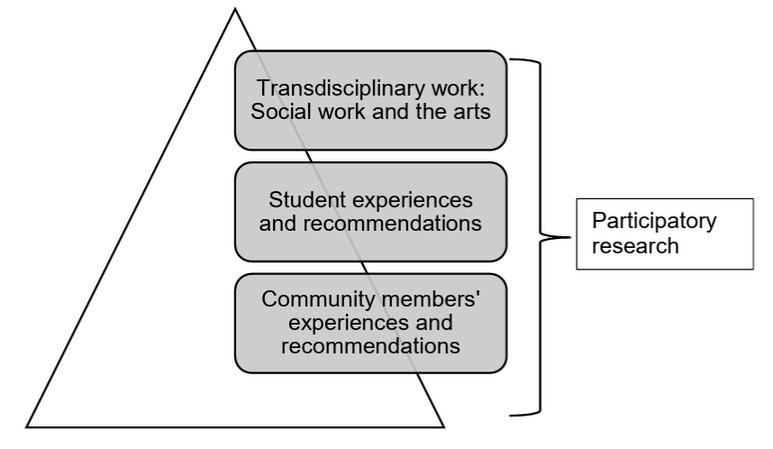
The six-steps process for transdisciplinary work proposed by Pineo et al. (2021) was followed: Firstly, co-learning took place through sharing what we know within our individual disciplines Secondly, we identified a shared interest in social inclusion and cohesion through joint musicmaking in diverse contexts, and pre-developed a joint project with this focus. As a third step, we piloted the project, and reflected on the outcomes to further refine the process to follow, the techniques to employ, and the manner in which to facilitate the project as a transdisciplinary team Fourthly, we conceptualised the project through diverse inputs, including participants’ feedback during the pilot project, to discover a relevant theoretical framework. This was followed by the implementation of the final project, and the analysis of our shared learning – including the inputs of participating students and community members. During the sixth and final step, we were able to develop a practice framework to utilise for both social work education and practice Our transdisciplinary work and research were aimed at the production of knowledge across the mentioned disciplines (Pineo et al., 2021), allowing us to connect and impact these disciplines (Loubser, 2015). We shared what we knew and the practices within our disciplines, and we gained new knowledge, insights, and skills that mirrored different viewpoints (Van der Westhuizen & Greuel, 2021) During our search for collective understanding, and working together as equals, an important component was that innovative shared knowledge production took place through the inclusion of students and communities (Ramey et al., 2015; Loubser, 2015).
We searched for a theoretical structure, required educational outcomes, and a practice framework to contribute to students’ personal and professional development, as well as the social impact of making music together in community contexts. Thus, it did not only draw a link between the disciplines involved, but also between abstract and practice-specific knowledges to inform the transdisciplinary outcome of knowledge production and social impact (Rudhumbu et al , 2017; Toomey et al , 2015; Maynard, 2013) A particular contribution of the transdisciplinary work and research was that it assisted the researchers, students and community participants to become self-aware, and to develop an understanding of each other (Loubser, 2015; Krznaric, 2014). This informed the discovery of a relevant theoretical framework.
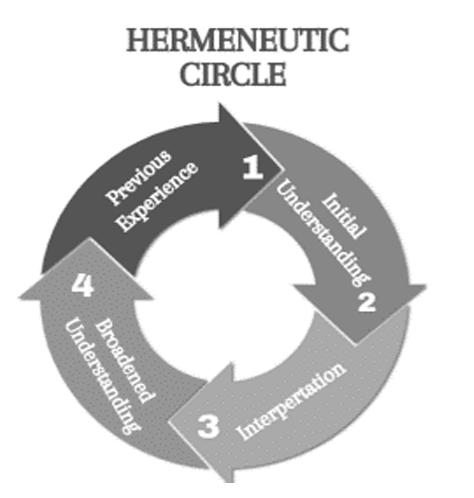
consisting of three phases that are repeated: 1) Understanding of one’s current ways of feeling, thinking and doing, 2) explaining one’s understanding to others, and 3) interpreting and reconstructing one’s understanding. Ongoing individual and collective conversations lead to a fusion of new interpretations into the way one feels, thinks and acts. The new way of feeling, thinking and acting becomes part of a new way of approaching relationships. The three phases follow each other, but participants can move between the phases to link past and present experiences and to make new interpretations. The hermeneutical loop, adopted from Joseph Campbell’s (2003) the Hero’s Journey, as described by Harris (2017) was chosen for its practical description of what happens within the hermeneutical spiral.
Figure 3: The hermeneutical loop (Source: Harris, 2017)
The hermeneutical loop describes the phases of participation in a hermeneutical project Considering joint musicmaking as such a project, participants join the musical project voluntarily as a starting point. Coming from their own diverse contexts (i.e., the known), they start to reflect on how they feel and think about themselves and others, and how this directs their actions.
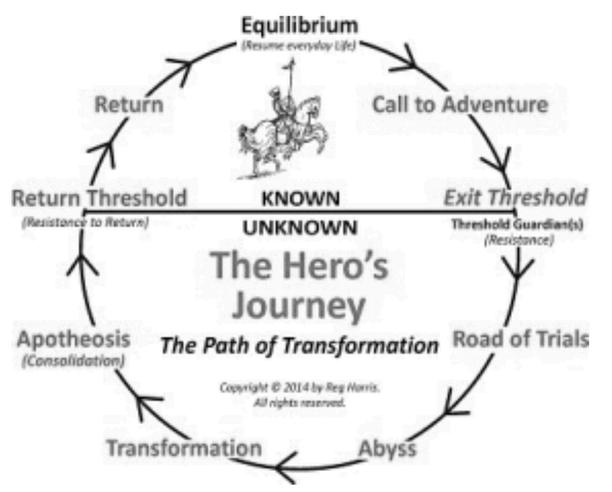
Still functioning in the known, they respond to the call to join the adventure bye making a decision to willingly and actively participate in the musical project. This phase marks some connections and a level of communication between the participants. Harris (2017) refers to the following phase as an opportunity for possible exit. Some participants, during their reflections, will be sure that they want to continue. Others will continue with the project, but will try to resist the change that it will require due to not being ready and open to change the way they feel, think and act. Some might choose not to participate further. Those who decide to continue with the project, become willing to move to an unknown experience. They start to engage in deeper conversations with other participants, explaining what they have learned through their reflections so far These conversations lead to an openness to explore options, and to find ways to better understand oneself and others. This is followed by, as Harris (2017) refers to it, a road of trials. The participants reflect individually and/or together on their shared experiences of making music together, and find explanations for their own and other’s ways of feeling, thinking and acting. They start to talk to one another about these explanations and reflect on what works well and what does not work in their efforts to change their relationships while developing a good music production. Harris (2017) refers to an abyss, where the road of trials continues. Each reflection and explanation lead to further reflections and conversations, which assist the participants to develop a deeper understanding of themselves and others This results in a phase where changes in feelings, thoughts and actions are experienced and explained, and new ways of dealing with relationships in the diverse group are identified for inclusion in the future. Changes are being consolidated through continuous practice. Considering the intra- and interpersonal changes that occurred, the participants slowly move back to what was known to them (i e , where they came from), and to integrate the changes as a new way of life and a new way of looking at diversity This phase is often characterised by a resistance to exit the process and to go back to everyday life. Therefore, at the end of the project, they can continue with the same or similar projects, and with the relationships that were formed.
The phases of the hermeneutical loop serve as a structured implementation strategy of the hermeneutical perspective The AIM was identified as a further framework from which to facilitate joint musicmaking projects in social work.
Figure 4: Appreciative Inquiry Model (Source: Cooperrider et al., 2008)
As a first step, and focusing on a particular aspect such as participating in a diverse musical group, participants are guided to explore the best of ‘what is’ at the onset of the project - discover. Secondly, they are encouraged to think about what may be –dream. This is followed by the third step, referring to delving into what could and should be –design. The fourth step requires the participants to identify and implement specific changes towards the final outcome – destiny. Key characteristics of the AIM support empowerment thought the involvement of all the role-players, encouragement of conversations and interconnectedness, and the identification and development of collective strengths (Cooperrider et al , 2008)
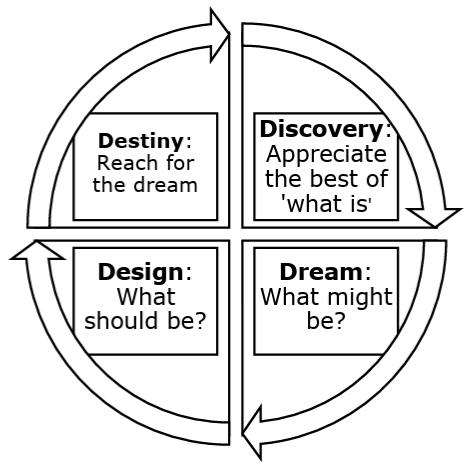
The AIM is a practical approach within a process where individual and collective inquiry is encouraged to ensure that strengths are identified and developed in the interest of all (Kessler, 2013). It is inclusive in nature, because all inputs are valued and it creates a sense of belonging, oneness and diversity with a strong emphasis on participation and collaboration. The aims of the AIM that corresponds with joint musicmaking in social work are to 1) demonstrate positive intent and trust between individuals and groups, 2) create dialogue through shared musical experiences to foster shared meanings, 3) improve communications and meaning-making, 4) create a common-ground vision for what is best for all the participants, 5) accelerate contextual learning – amplifying the strength of even the smallest victories, and 6) unite people in new, jointly envisioned relationships and work toward sustainable change (Cooperrider et al., 2008).
The aim to promote self-expression as well as social inclusion and cohesion through the hermeneutic perspective and the AIM is supported by the social dimensions of making music together as key experiences that contribute to this aim.
When diverse people come together to make music together, it is not only a musical project but also a social one (Nompula, 2011) where participants experience a social sense of being together while making music together (Van der Westhuizen & Greuel, 2021) Koelsch (2012) describes this as the social functions (i e , the purposes) of making music together in terms of social contact, communication, coordination, cooperation, co-pathy, social cognition, and social cohesion. Building on this description, Greuel (2019) identified and described the social dimensions (i.e., the components that shape the social functions) of making music together as follows: 1) Contact: Participating in a music project, people who might not come into contact with each other in day-to-day lives, meet and spend time together through creative and enjoyable musical activities (cf. Camlin et al., 2016). This type of contact can bring diverse individuals together, and create a joyful intercultural experience that provide
a chance of reducing prejudices and stereotypes (cf Narsai, 2018), as well as loneliness and exclusion.
2) Cooperation: A musical product serves as a common goal. This requires that the participants cooperate in a musical way to become aware of potential individual contributions and possible options to include in the product Importantly, every participant is essential to reach this goal (cf. Tarr et al., 2014). Nobody is more
important than the other, and therefore cooperation takes place at the same eye level.
3) Hearing: When making music together, the participants need to hear the other group members to become aware of what they are singing and playing. Through hearing the others, the participants can cooperate effectively. Hearing becomes a social activity that is a central component of making music together (cf. Nompula, 2011) In a diverse group, the participants hear each other during joint musicmaking, which also becomes an opportunity for cultural awareness
4) Synchronisation: Music happens in a time line with a common beat, pulse and groove. When hearing each other and cooperating, all the participants become guided by this time line. Here all the members are synchronising themselves with the others; a special and intense kind of contact (cf. Tarr et al. 2014). Synchronisation does, however, not mean uniformity Different contributions and different levels of musical skills can form part of such ensembles. As such, one can be different, but also has to synchronise one’s activity with the others.
5) Emotional synchronisation: If synchronisation takes place successfully, it is often not only a physical process, but also an emotional one The group members come into an emotional synchronisation, tuning into each other’s emotional experience (cf. Tarr et al., 2014) – an experience of intense bonding.
6) Equality: Making music together does not necessarily happen in competition to other groups The lack of competition results in the members being equal while creating a musical product. The participants, as a group, do not have to compete with other groups. Instead, they can enjoy the music and the experience of making music together
7) Social cohesion: Through the above social dimensions, making music together can create a feeling of belonging, and as such it can increase the social cohesion between
participants. This, then, can be the foundation for the development of new relationships (Pearce et al., 2015).
Greuel (2019) concludes that, if people come into contact with each other through joint musicmaking, cooperate together, hear each other, synchronise their actions, come into a joyful common affect, and develop social cohesion without being in competition, it resonates with social work practice.
5. OUTCOMES AND CONCLUSION
From the hermeneutical perspective, and utilising the AIM process, a practice framework for social work and the arts was developed as the outcome of the transdisciplinary work and research. In the table below, the steps of AIM (Cooperrider et al., 2008) are aligned with the actions in the hermeneutical loop (Harris, 2017) and linked with the social dimensions of making music together (Greuel, 2019).
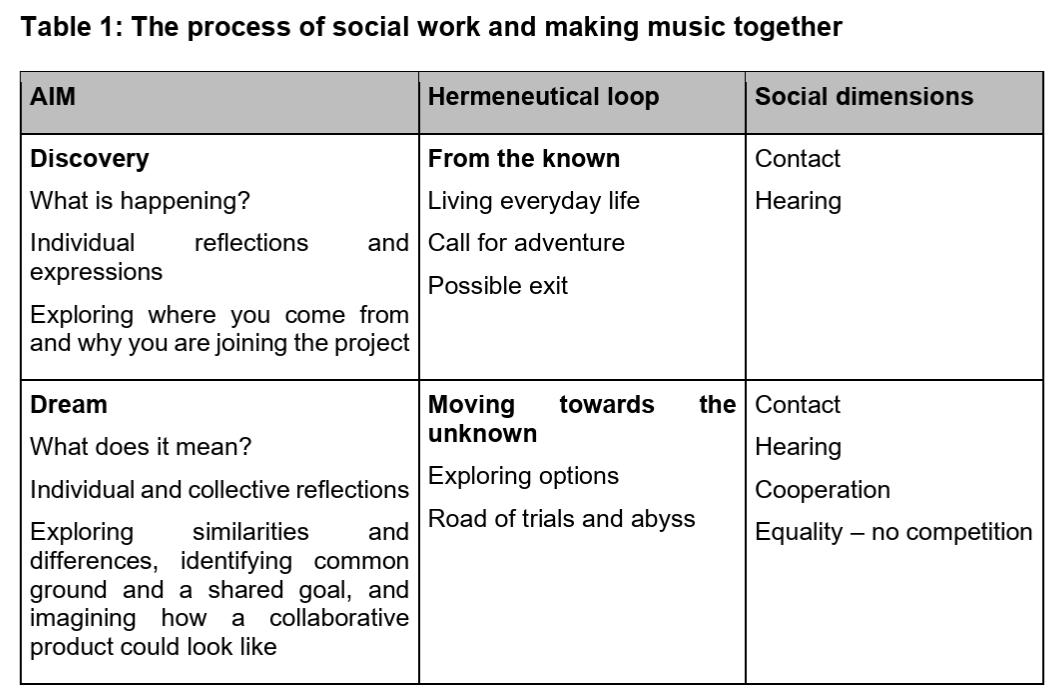
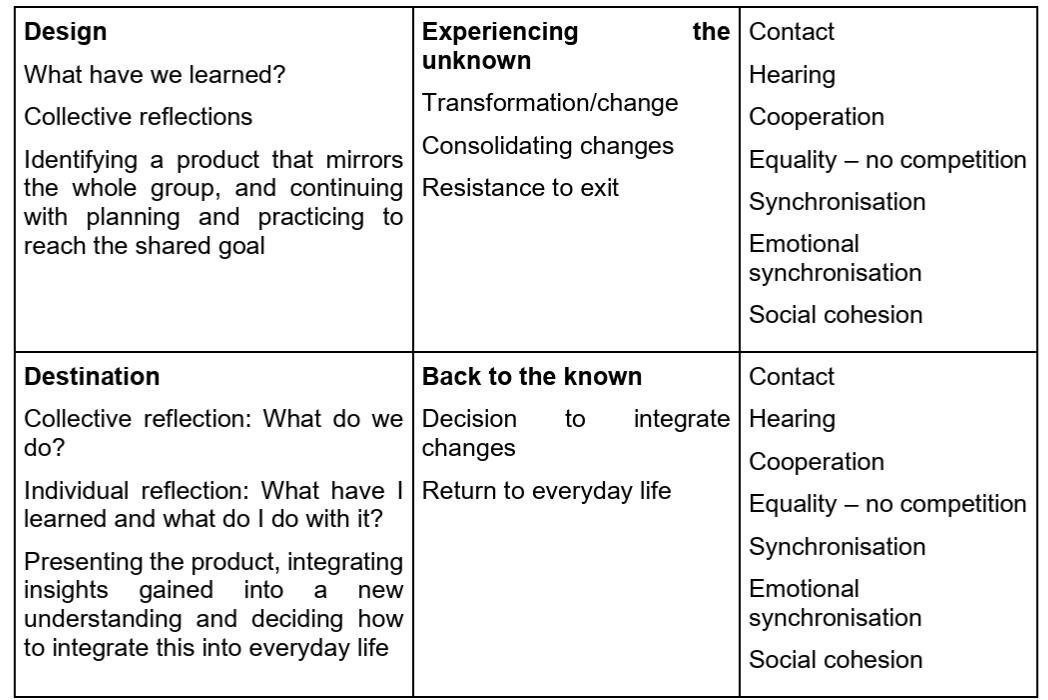
An important component of social work and the arts is that the participants engage in planned reflective activities in each of the AIM steps – individually or collaboratively –to stimulate self-awareness as well as awareness of others Participants can move between these steps, and meaning-making takes place in a circular spiral (Cole & Anderson, 2007), moving between understanding, explaining, interpreting and reconstructing.
During the course of this transdisciplinary work and research, our own experiences as well as the research findings indicated how the presence of the social dimensions of making music together expanded during the process followed, and how they became consolidated by the end of each project. In the table that follows, I present the voices of participating students at the end of the projects (i.e., as part of destiny).
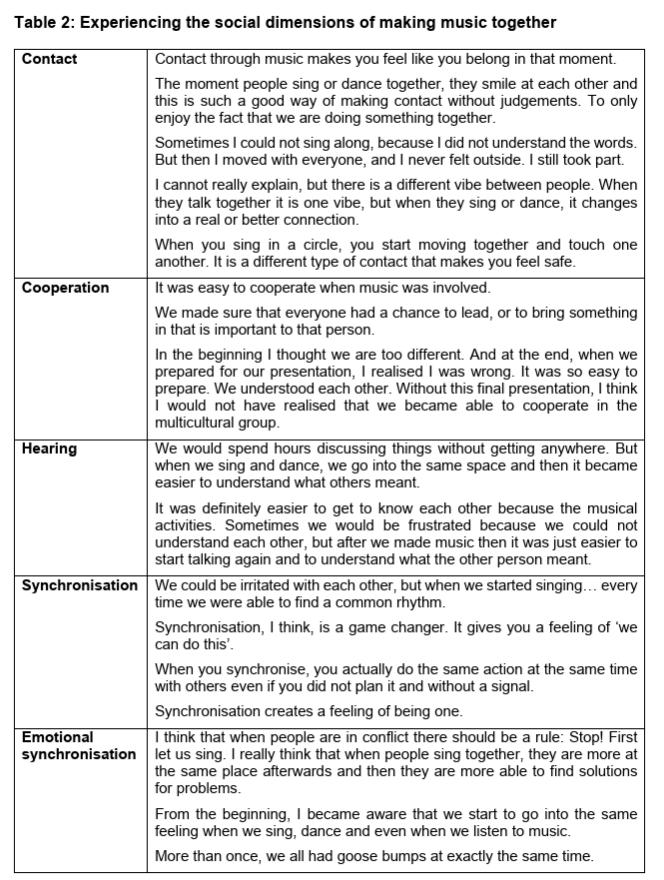
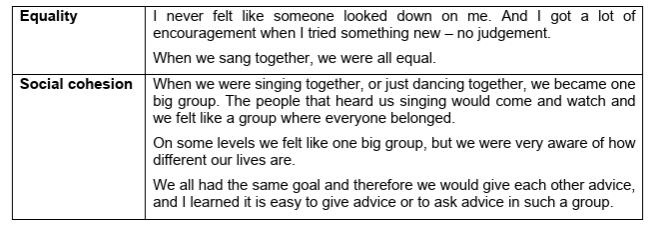
Reports on personal development that took place through their participation highlighted the development of self-awareness and awareness of others, experiences of feeling valued and having hope for a better future.
“I became self-confident.”
“I do not feel ashamed about where I come from any more. Everyone showed me respect and I feel proud that I am working to have a better future.”
“I have hope I really learned that I can solve problems, and that I can work in a group.”
““I am much more tolerant with others, but also with myself.”
“And you can be surprised. You think that someone had an easy life, and then you make music and take part in the project together, and you learn about their past and it was not so easy.”
“I had to learn that some people look like they do not want to participate, but it is because they have never had a place where they felt their opinions matter. This project showed them they matter. And also us… that we matter.”
The latter comment draws a link between personal and professional development. Professional development further included understanding of and reflecting on curriculum content, leadership and how music as a way to manage language or communication barriers
“I often could see what a BSW [Bachelor of Social Work] standard means while being in the project”
“I actually could feel or experience what social learning is ”
“One thing about leadership in this project was that the leader was free to ask for help and support. So, everyone always felt involved.”
“The best solution for dealing with communication barriers are to show people what you mean. So, with dances and music, it is easier to show what your idea is and then the children and even the older people would also show us what they wanted to do.”
Lastly, the participating students described how they learned from the community participants.
“Do not forget the ones who do not participate. We continued to invite them when they were just watching us making music, and slowly they entered the group.”
“The people must be acknowledged. What do they need? How do they feel about the activities? How do they want to participate?”
“I learned how a musical activity can help children to just participate in a relaxed manner, and then they started to express themselves After a while they will say I am sad or angry Or I need food I need a parent ”
“We had this plan and when it did not work, I was disappointed But the problem was with me and our team, not with the children Your plan must only be like a map The children must give the actual direction if you want them to benefit.”
In conclusion, through the work presented in this discussion, I concur with Greuel (2019) who explained shared music making as a form of social work Participants have opportunities for self-expression where they are being heard without judgement, and where they feel valued Apart from being heard, they also hear each other Within the group, through shared musical experiences, everyone is included and social cohesion is experienced. Importantly, Willingham (2016) asks the question of how students with artistic interests and talents could gain access to educational opportunities, how they could be supported to use artistic skills in the communities they work in, and how artistic rigour could be enhanced while “a culture of empathy, inclusivity and hospitality” (p. 60) is being cultivated. Moreover, students need education and training to facilitate musical and other artistical activities to facilitate the purpose of social work (cf. Rodgers & Varvarigou, (2016). Therefore, and aligned with the profession’s mandate to advance social inclusion and cohesion (IFSW, 2014), I ask for serious consideration of including the arts in social work education.
Special acknowledgements This discussion is framed in transdisciplinary work and research Special acknowledgement is given to Prof Dr Thomas Greuel, music educator at the Protestant University of Applied Sciences, Rhineland-Westfalen-Lippe (RWL) in Germany who was the key collaborator Valuable input was further provided by Ms Henriette Weber of the Centre of Performing Arts at the UWC, Ms Marika Van Heerden, Master of Social Work student at the UWC, and colleagues from the discipline of practical theology and religious studies - Prof Christo Thesnaar from the University of Stellenbosch, and Prof Jacques Beukes from the University of South Africa. I would like to express my sincere appreciation to the students from the UWC, Protestant University of Applied Sciences, RWL and Hugenote Kollege, Wellington, as well as community members of Darling, Paarl, Pniel, Lanquedoc and Kylemore. Without their openness, willingness to participate and share, and valuable inputs the outcomes of this project could not be achieved.
Anderson, J R (2005) Cognitive Psychology and Its Implications 6th Edition W H Freeman and Company.
Ballantyne, N. (2024). Emancipatory social science and anti-oppressive social work: The legacy of Erik Olin Wright Aotearoa New Zealand Social Work, 36(4), 31–45 http://dx.doi.org/10.11157/anzswj-vol36iss4id1203
Blackburn, R., & Bradshaw, T. (2014). Music therapy for service users with dementia: A critical review of the literature. Journal of Psychiatric and Mental Health Nursing, 21, 879–888 https://doi org/10 1111/jpm 12165
Camlin, D , & Gateshead, S (2016) Whatever you say I am, that’s what I’m not: Developing dialogical and dissensual ways of conceiving of and talking about community music. In M. L. Cohen (Ed.). Innovation and change in community music.
Proceedings of the XV International Seminar of the International Society for Music Education Commission on Community Music Activity (pp. 24-30). Edinburgh College, Edinburgh, Scotland. 19-23 July 2016.
Camlin, D., Gateshead, S., Bartleet, B., Haak-Schulenburg, M., & Cerachowitz, C. (2016) If music can be the food of love: Resonance in Making Music - The power for a human development of society. In M. L. Cohen (Ed.). Innovation and change in community music. Proceedings of the XV International Seminar of the International Society for Music Education Commission on Community Music Activity (pp 168175) Edinburgh College, Edinburgh, Scotland 19-23 July 2016
Campbell, J (2003) The Hero’s Journey®, Joseph Campbell on his life and work New World Library.
Carey, M. (2021). Trapped in discourse? Obstacles to meaningful social work education, research, and practice within the Neoliberal University. Social Work Education, 40(1), 4–17 https://doi org/10 1080/02615479 2019 170393
Cohen, M L (Ed ) (2016) Innovation and change in community music Proceedings of the XV International Seminar of the International Society for Music Education Commission on Community Music Activity. Edinburgh College, Edinburgh, Scotland. 19-23 July 2016.
Cole, M., & Avison, D. (2007). The potential of hermeneutics in information systems research. European Journal of Information Systems, 16, 820–833.
Cooperrider, D.vL., Whitney, D., & Stavros, J. M. (2008). Appreciative Inquiry Handbook: For Leaders of Change 2nd Edition Berrett-Koehler Publishers
Dankoff, J (2011) Toward a development discourse inclusive of music Alternatives: Global, Local, Political, 26(3), 257–269. https://www.jstor.org/stable/23210896
Davis, N. (2012). The intersectionality of social work and the arts: Research essay. Mangrove College
De Molli, F., & Paolino, C. (2022). Meaning making through artistic interventions: An aesthetic approach. In A. Owens, A. Passilä, N. Ponsillo, M. Biagioli, B.
Cunningham, F De Molli, & C Paolino Community and collective learning: Research in Higher Education practices (pp. 39-58). Allborg Universitetsforlag.
Gray, M., & Webb, S. A. (2008). Social work as art revisited. International Journal of Social Welfare, 17, 182-193. https://doi.org/10.1111/j.1468-2397.2008.00548.x
Greuel, T (2019). Miteinander verbunden: Soziale und gesellschaftliche Dimensionen des gemeinsamen Musizierens. Üben & Musizieren, 1, 6–11.
Harris, R. (2017). The Hermeneutic Loop: The Existential Foundation of The Hero’s Journey. Harris Communications.
Hatton, K., Maegusuku-Hewett, T., & Redcliffe, J. (2024). Co-creating experiences through the use of arts in social work education. Social Work Education, 43(8), 2291–2309. https://doi.org/10.1080/02615479.2023.2254778
Huss, E., & Sela-Amit, M. (2018). Art in social work: Do we really need it? Research on Social Work Practice, 29(6), 721-726 https://doi org/10 1177/1049731517745995
International Federation of Social Workers (IFSW) (2014) Global definition of social work. Accessed on 15 July 2025 at https://www.ifsw.org/what-is-social work/global-definition-of-social-work/
Jemal, A. (2024). Theatre in social work education (TIS WE): A pedagogy for living critical radical social work to bridge the micro-macro divide. Social Work Education, 1- 11 https://doi org/10 1080/02615479 2024 2434013
Kessler, E H (Ed ) (2013) Encyclopaedia of Management Theory Sage Publications. Koelsch, S. (2012). Brain and music. John Wiley & Sons.
Krznaric, R (2014) Empathy: A handbook for revolution Ebury Publishing Loubser, G (2015) Becoming transdisciplinary theologians: Wentzel van Huyssteen, Paul Cilliers and Constantine Stanislavski. HTS Teologiese Studies/Theological Studies, 71(3), 1–9. http://dx.doi.org/10.4102/hts.v71i3.2901
MacAulay, D., & Levy, S. (2022). Meaningful online connections during Covid-19: Reflections on using arts-based approaches in social work practice. Practice, 34, (5), 347–353. https://doi.org/10.1080/09503153.2022.2079618
Maynard, C. M. (2013). How public participation in river management improvementsis affected by scale Area, 45(2), 230–238 https://doi org/10 1111/area 12015 Michels, M (2024) Migration: A philosophical toolkit University of Groningen Mogorosi, D L , & Thabede, D G (2018) Social work and indigenisation: A South African perspective Southern African Journal of Social Work and Social Development, 30(1), 18 https://dx doi org/10 25159/2415-5829/2393
Monteblanco, A. D., & Moya, E. (2021). Photovoice: Integrating course-based research in undergraduate and graduate social work education. British Journal of Social Work, 51(2), 712–732. https://doi.org/10.1093/bjsw/bcaa154
Moran, B. (2024). Creative critical reflection through poetry and prose.” Social Work Education, 1-7. https://doi.org/10.1080/02615479.2024.2317869
Narsai, N. (2018). Music and social connection: Lessons from the past to guide the future generation. Social Dialogue Online, 19, 57-58.
Navarrete-Campos, A. (2016). Music therapy among the elderly: what social workers need to know [Master’s thesis, San Bernardino, California State University].
Nissen, L. B. (2017). Art and Social Work: History and Collaborative Possibilities for Interdisciplinary Synergy. Research on Social Work Practice, 29(6), 698- 707.
https://doi org/10 1177/1049731517733804
Nompula, Y (2011) Valorising the voice of the marginalised: Exploring the value of African music in education South African Journal of Education, 31, 369–380
https://doi org/10 15700/saje v31n3a542
Osmer, R R (2008) Practical Theology: An Introduction William B Eerdmans Publishing Company.
Papouli, E. (2017). The role of arts in raising ethical awareness and knowledge of the european refugee crisis among social work students. An example from the classroom. Social Work Education, 36(7), 775–793.
https://doi.org/10.1080/02615479.2017.1353074
Pearce, E., Launay, J., & Dunbar, R. I. M. (2015). The ice-breaker effect: singing mediates fast social bonding. Royal Society Open Science, 2, 1-9.
Pineo, H., Turnbull, E. R., Davies, M., Rowson, M., Hayward, A. C., Hart, G., & Aldridge, R. W. (2021). A new transdisciplinary research model to investigate and improve the health of the public. Health Promotion International, 36(2), 481–492. https://doi.org/10.1093/heapro/daaa125
Rachmad, Y. E. (2022). Empowerment theory. YER-E Book Publications. https://doi org/10 17605/osf io/wymnz
Ramey, S L , Schafer, P , DeClerque, J L , Lanzi, R G , Hobel, C , Shalowitz, M , ChinChilli, V , & Raju, N K (2015) The preconception stress and resiliency pathways model: a multi-level framework on maternal, paternal, and child health disparities derived by community-based participatory research. Maternal and Child Health Journal, 19(4), 707–719. https://doi.org/10.1007/s10995-014-1581-1
Redcliffe, J., & Hatton, K. (2025). Art and creativity in social work – a catalyst for change. Practice Social Work in Action, 37(2), 79-82. https://doi.org/10.1080/09503153.2025.2460760
Rodgers, D., & Varvarigou, M. (2016). Mental health and wellbeing through active music making: The Me2/Orchestra. In M. L. Cohen (Ed.). Innovation and change in community music. Proceedings of the XV International Seminar of the International Society for Music Education Commission on Community Music Activity (pp. 8998). Edinburgh College, Edinburgh, Scotland. 19-23 July 2016.
Rudhumbu, N., Zhou, L., & Nhundu, K. (2017). Transdisciplinary research in higher education: Towards a paradigm for sustainable development. Journal of Business and Management, 19(01), 13–19 http://dx doi org/10 9790/487X-1901051319
South African Council for Social Service Professions (SACSSP) (2018) Policy guidelines for course of conduct, code of ethics and the rules for social workers SACSSP
Tarr, B , Launay, J , & Dunbar, R I M (2014) Music and social bonding: “self-other” merging and neurohormonal mechanisms. Frontiers in Psychology/Auditory Cognitive Neuroscience, 5, 1–10. https://doi.org/10.3389/fpsyg.2014.01096
Toomey, A. H., Markusson, N., Adams, E., & Brockett, B. (2015). (3023, May 6). Inter and trans-disciplinary research: a critical perspective. GSDR Brief, 1–3. https://sustainabledevelopment.un.org/content/documents/612558-Inter%20and%20Trans-disciplinary%20Research%20%20A%20Critical%20Perspective.pdf
Van der Westhuizen, M. A., & Greuel, T. (2021). Making music together: A transdisciplinary approach to the development of intercultural awareness. Journal of the Musical Arts in Africa, 18(1), 39–57, https://doi.org/10.2989/18121004.2021.2020965
Van Heerden, M. (2024). Towards professional identity: The development of the self among student social workers through storytelling. Dissertation for a Master of Social Work, University of the Western Cape.
Wallengren-Lynch, M., Archer-Kuhn, B., Earls Larrison, T., Mercado Garcia, E., Henglien, L. C., Mitra Vom Berg, N., Segev, E., & Carrasco, M. B. (2024). “It’s not a book; it’s a bok”: Social work students’ experience of using creative journaling practices as a pedagogical tool to develop transformative learning during the COVID19 pandemic. Social Work Education, 43(9), 2787–2805. https://doi.org/10.1080/02615479.2023.2292127
Weber, H. W. (2025). The social dimensions of making music together towards social inclusion. Dissertation for a Master of Social Work, University of the Western Cape
Willingham, L (2016) Community music and Higher Education In M L Cohen (Ed.). Innovation and change in community music. Proceedings of the XV International Seminar of the International Society for Music Education Commission on Community Music Activity (p 60) Edinburgh College, Edinburgh, Scotland 19-23 July 2016.
Zhu, Q. Q. (2025). The art of “Silence” in interpersonal communication. Open Journal of Modern Linguistics, 15, 69-77. https://doi.org/10.4236/ojml.2025.151005
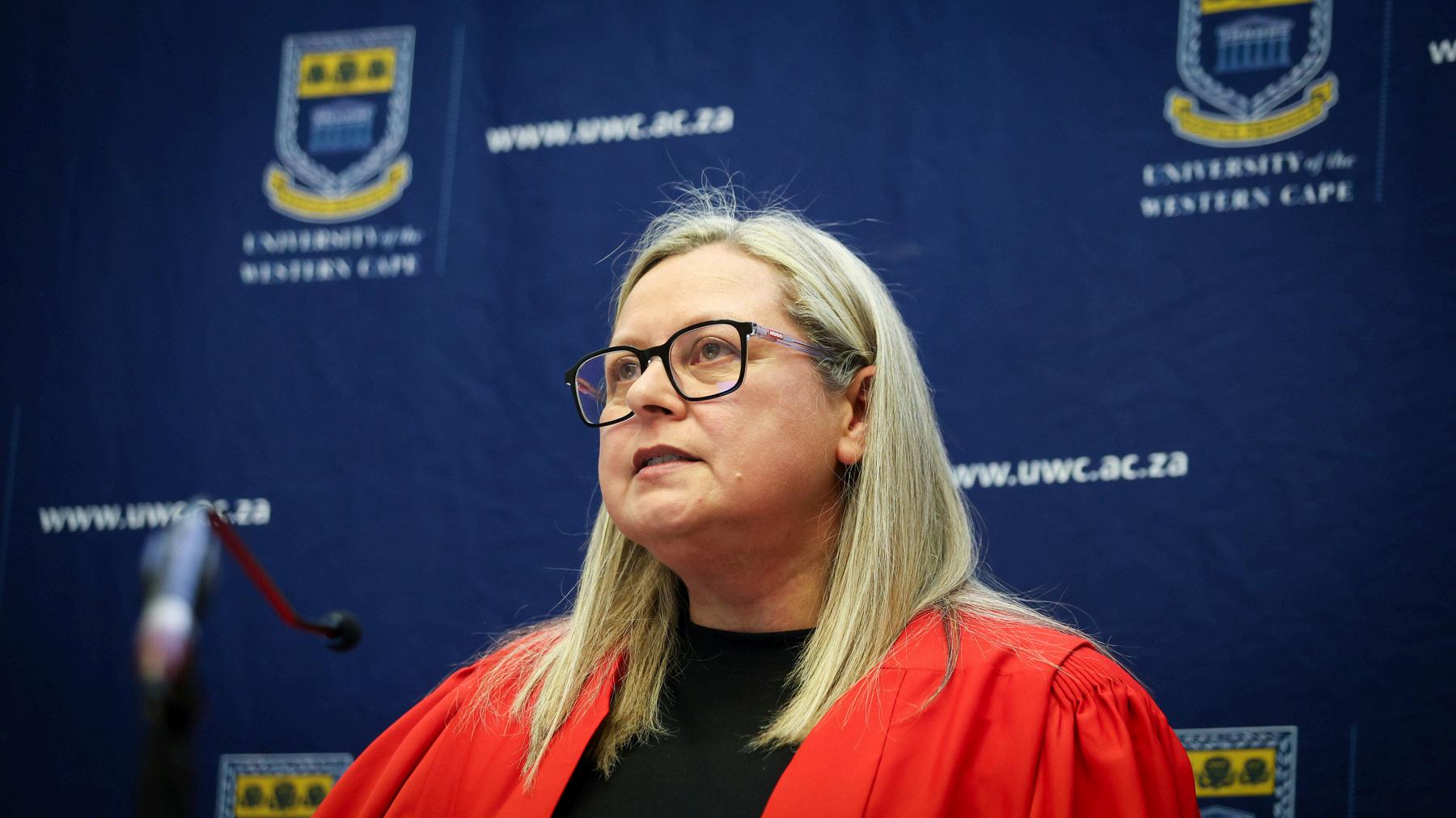
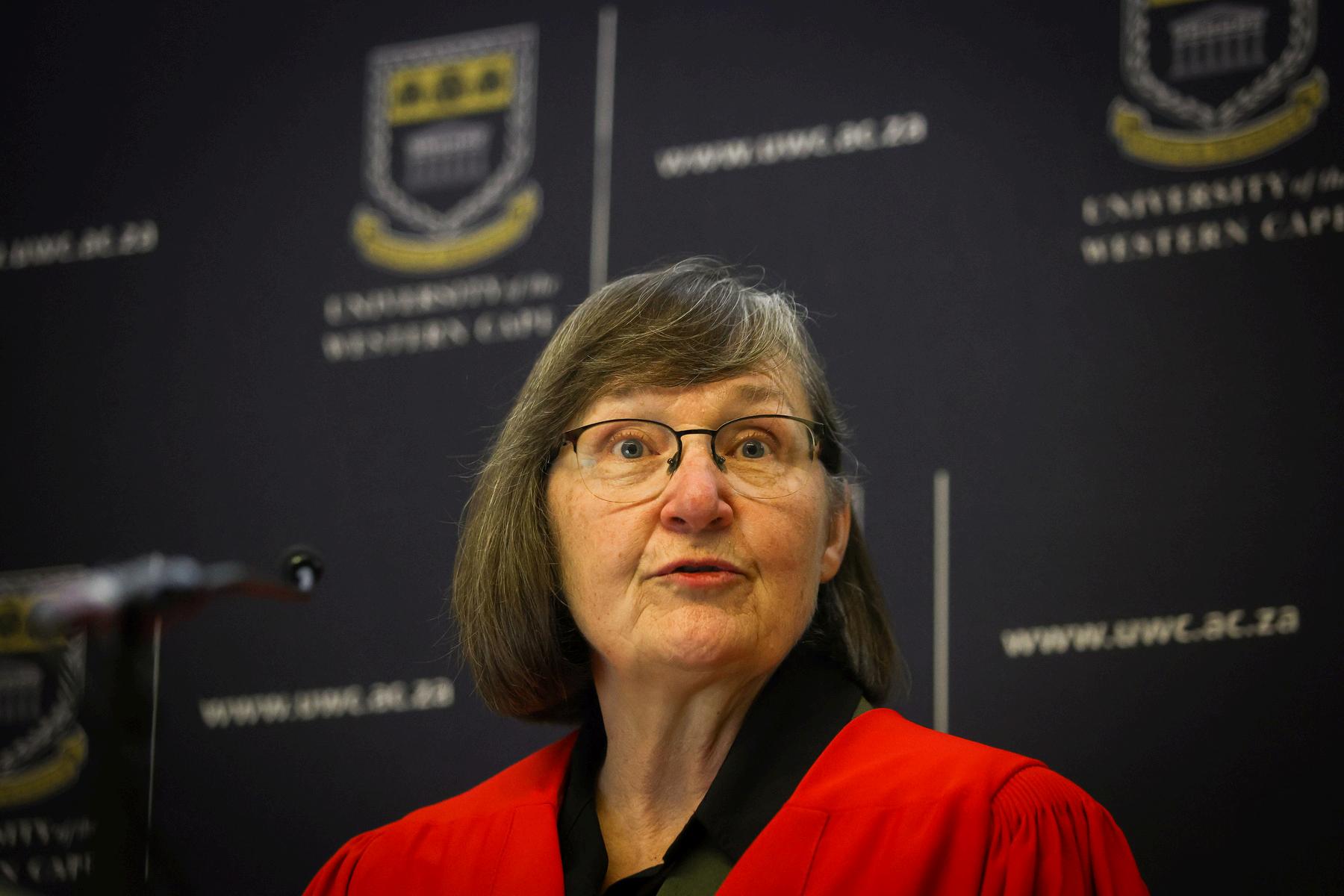
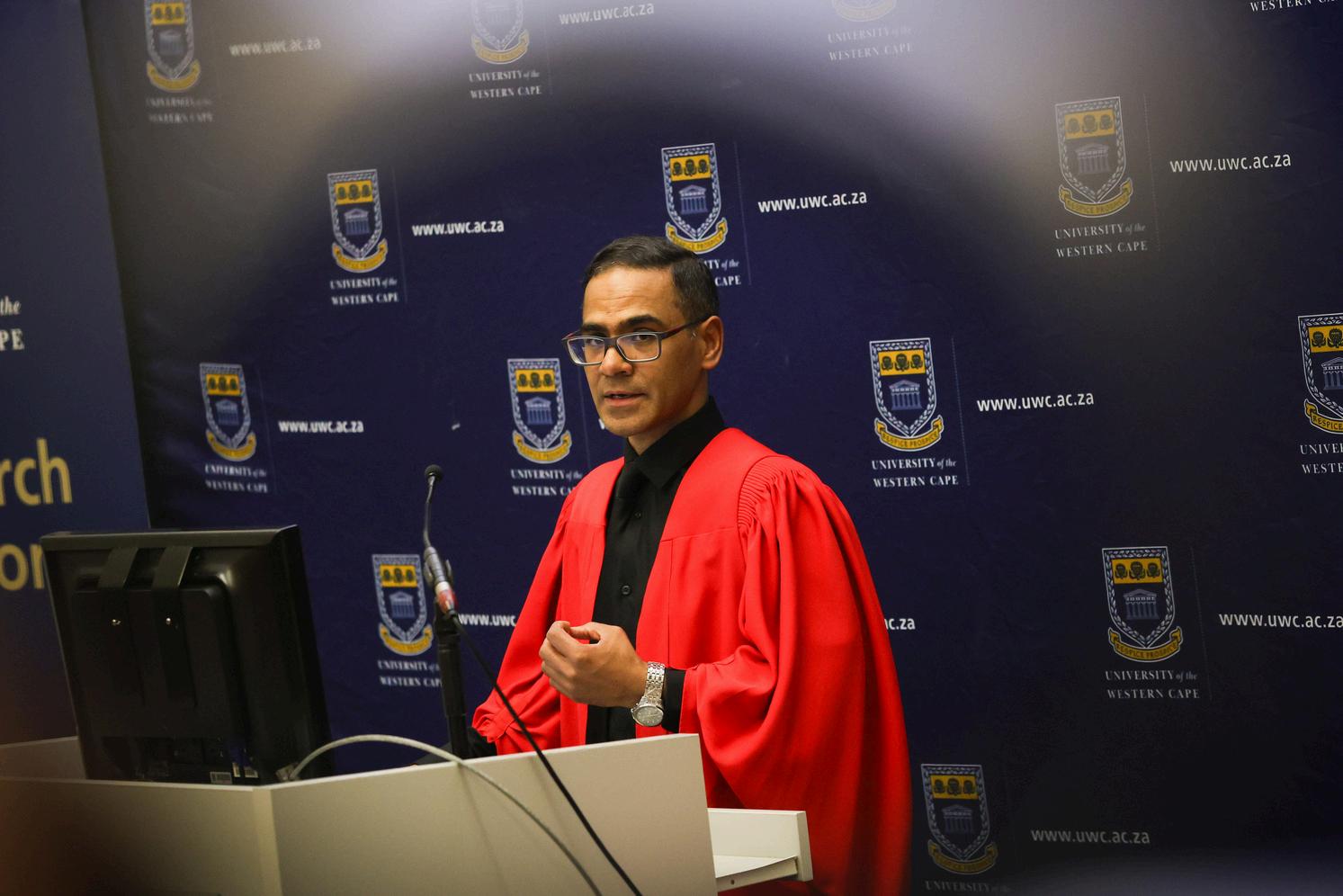

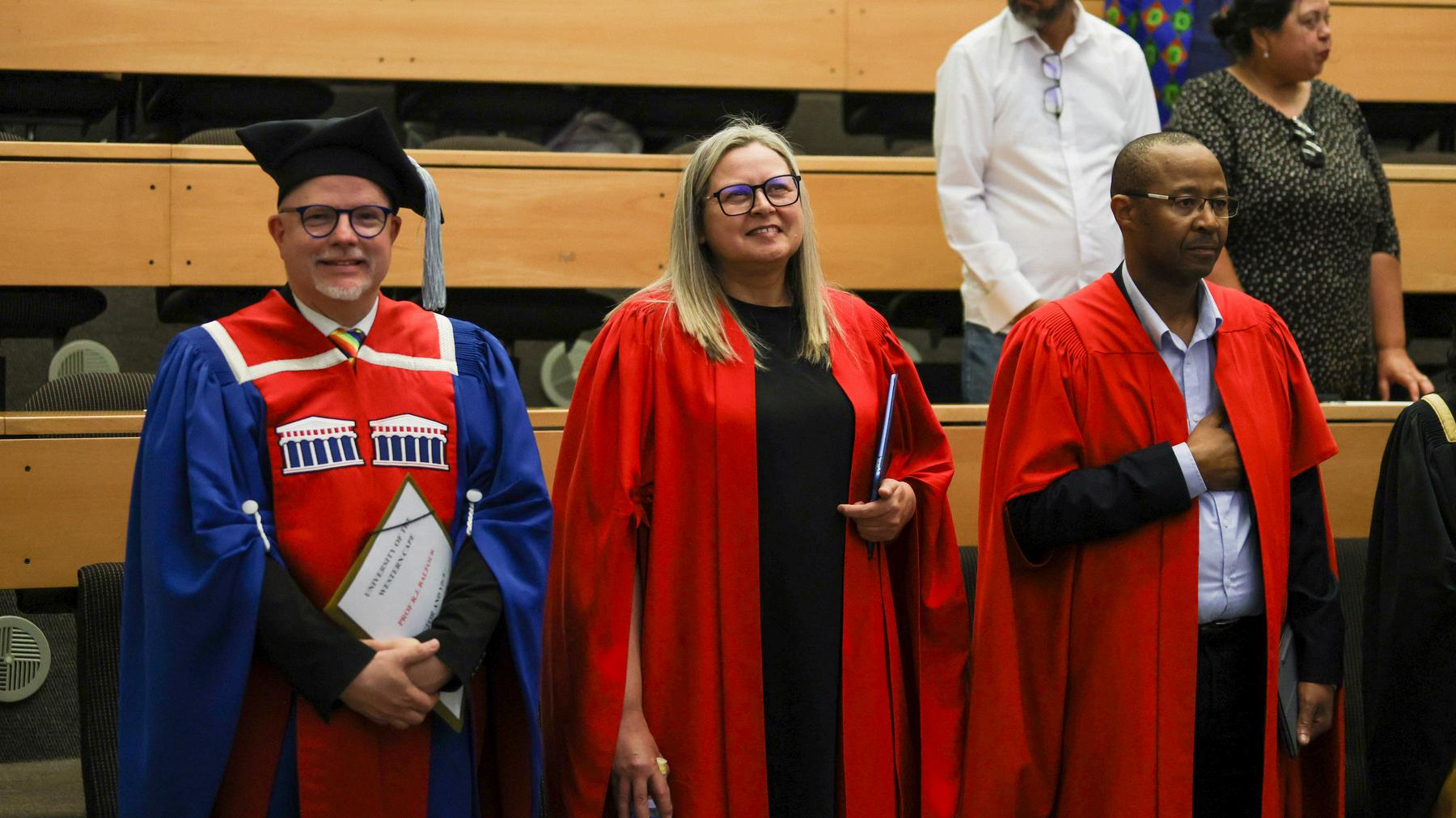
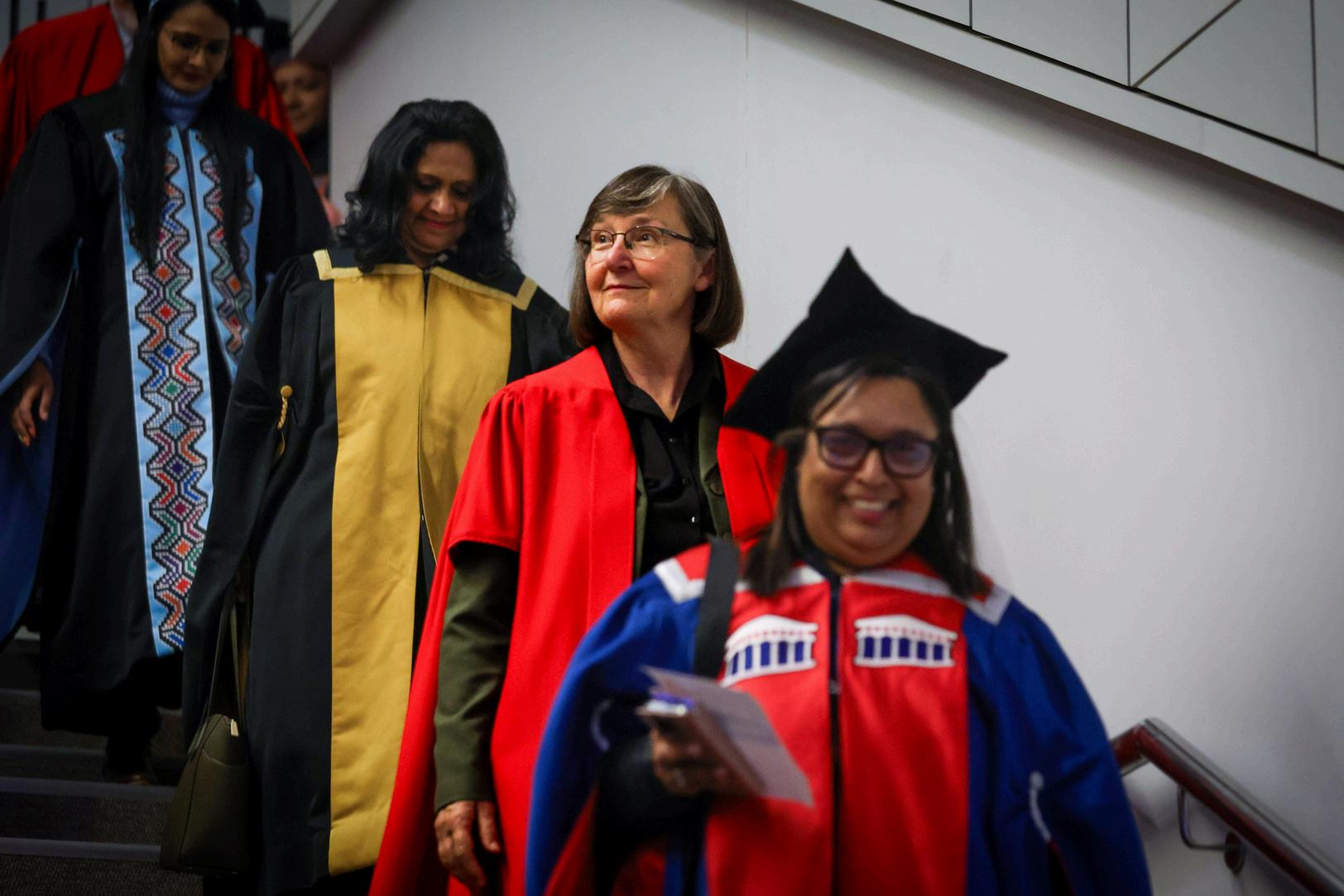
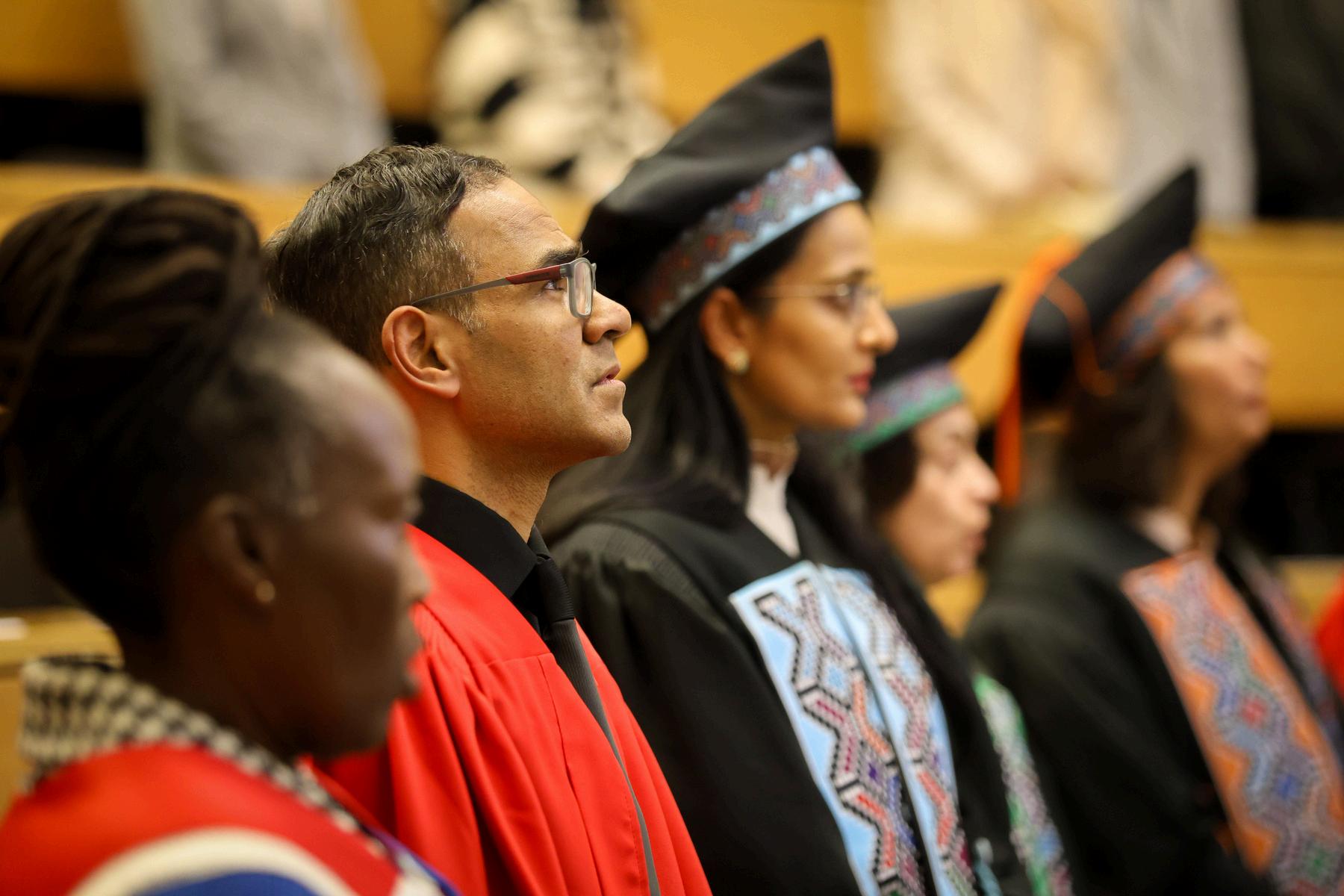

ProfessorFionaAnciano
ProfessorMarietaduPlessis
4September2025
BeyondtheBallot:RethinkingUrbanGovernanceintheShadowsofDemocracy
ABSTRACT
BIOGRAPHY
Prof Fiona Anciano
Welcome and thank-you so much for joining us here today. Today I will talk about the relationship between how cities are governed and the practices and principles of democracy. The purpose of this lecture is to spark a conversation about how we understand who holds the power to shape the city at a time when citizens feel increasingly disconnected from the outcomes of formal democratic processes
Growing up in apartheid’s shadows
My research is a product of its time, shaped by the era into which I was born. My worldview, and what I have carried into academia, is inseparable from history: I was born a year after the 1976 Soweto uprising. Growing up in Johannesburg, I attended a racially segregated government school in the 1980s, where “bomb drills” were routine; part and parcel of living under an apartheid state of emergency Yet by 1990, when I turned thirteen, a formative age for any young person, the country entered a democratic spring. It was within this spring that I discovered my passion for political studies.
I was one of a small group of Standard 5’s (now known as Grade 7) who joined an exchange program between a lower-income school in Soweto and the privileged whites’’s only school where I lived. We felt the promise of hope, an excitement to know we weren’t all that different from each other, and a sense of responsibility to build a common future I carried this memory with me several years later when I went to the University of Kwa-Zulu Natal in Pietermaritzburg. After a degree majoring in Political Studies and Law, I was registered for an LLB, but I couldn’t quite resist attending the Politics Honours classes, and, as they say the rest is history With the encouragement of the Politics Department at the end of my honours year, I applied for and received a scholarship to study a Masters’ degree at the School of Oriental and African Studies in London The Master’s was an academically enriching year, but I wanted to do real world policy research, so I returned to Johannesburg to work at the Centre for Policy Studies. It was at the Centre that I learnt very quickly about
the world of grant funding, project deadlines, and policy influence. I was fortunate to be mentored by the fierce intellect of Steven Friedman. He set a high bar for what ethical policy research should look like, and he also provided many opportunities to represent the Centre, and engage with donors and government officials Here I started to explore how civil society could strengthen democracy in times of transition In 2003 I got married and returned to London, for what I thought would be a maximum two year stay I had a lot of enthusiasm but not enough experience or networks to get a job in policy research or international development - my two areas of interest at the time. However, I was invited to do a PhD at the Institute of Commonwealth Studies - a place that once housed Albie Sachs while he was writing a draft of our Constitution. In all honesty I only did a PhD as a way to occupy my time while I looked for a ‘real’ career. I had no intention of becoming an academic.
My PhD research focussed on the relationship between social movements, as agents of civil society, and democracy in post-apartheid South Africa. I wanted to explore how actors outside of the state were influencing policy making and holding the state, at all levels - from local government to national ministries - accountable to their service delivery promises I worked with the Soweto Electricity Crisis Committee in Johannesburg and the women-led trade union Sikhula Sonke in the winelands of Stellenbosch. I fell in love with the complicated, time-consuming, boundary pushing, discomforting experience that is fieldwork. I learnt to watch and listen and question and feel out of place in parts, and with people of my country I had never known.
The key analytical take-away from my PhD was that democracy, as an ideal, and to a large extent in practice, was thriving in South Africa. Social movements were indeed keeping democratic space open and the government was tolerant of a diversity of views However this was only effective where non-state actors used what
I termed the ‘moderate flank effect’ - they protested, and threatened instability on the one hand - showing a ‘radical flank’, but behind the scenes they offered an open door to discussion and consensus- building
After my PhD and what turned out to be nearly five years in London, I returned for a brief period to the Centre for Policy Studies. Our two children were born in Johannesburg and I stepped back from full- time work for a few years, taking on part-time consultancy and lecturing. At the Ahmed Kathadra Foundation I worked on two projects looking at non-racialism and got to interview a host of fascinating leaders from Thabo Mbeki, to Helen Zille to Ahmend Kathadra himself It was at this time that I started to understand more about statecraft and see through the lens of government officials how policy making works. As part of this work I also spent time talking to young ANC branch members in Johannesburg, from Sandton to Soweto. Exploring how ANC branches actually work and their relationship to the ‘centre’, highlighted deep-seated concerns about local-level party democracy, and revealed a party fractured at the grassroots I was also teaching at the University of the Witswatersrand at the time.
Soon after I arrived at UWC, from a research perspective, I became intrigued with the idea of clientelism. Clientelism is a political practice in which leaders, patrons or political parties provide material benefits, jobs, or services to individuals or groups in exchange for political support or loyalty (Fox, 2012). This was a time where the notion of state capture (Chipkin et al, 2018) was entering our national discourse, but few people were researching what patronage looked like, and what it meant for democracy, at the local level. Using a small UWC funding grant, I started preliminary research into clientelistic relationships in areas of Cape Town. I spend time talking to politicians as well as residents of the neighbourhood, Hangberg, in Hout Bay. Sitting in the homes of poachers, or protest fishers, taught me more about South African politics than weeks behind a desk, even if I had to learn how to maintain my focus while marijuana joints were passed around. This research was then fully funded through a National Research foundation Grant and I have since been very grateful to the NRF for many more years of funding across a range of projects.
The move to Cape Town, and finding an academic home
In 2012 we moved to Cape Town and my aspiration was to find an academic job. I had realised while teaching in Johannesburg that this was where my heart was. Indeed my stepfather reminded me that as a 10 year old I had mentioned on the drive to school that I wanted to be a teacher when I grew up, I just didn’t want to teach children. He said, “well you will have to become a professor then”. As luck would have it, my previous lecturer Laurence Piper, from the University of Pietermaritzburg had just moved to the University of the Western Cape and was willing to give me a chance at some contract teaching, which ultimately turned into a permanent post when a lecturing opportunity arose.
I found my home. I absolutely loved teaching political studies, especially the theory of power, to large first and second year classes of hundreds of students Together, we interrogated the politics of race, class, gender, corruption, democracy and more. I would run up and down the auditorium with a microphone, at times feeling as though I were hosting a political version of the Jerry Springer show
Ultimately I argued that at the very local scale, patronage politics can help fulfill democratic tasks such as holding the (local) state accountable, strengthening civil and political liberties, and providing channels of access for previously marginalised groups. Clientelism can be a conscious political strategy by the ‘clients’ to get development in an area (Anciano 2017) By no means is clientelism or patronage a solution to democracy’s deficits, but what I argued was that we need to take a decolonised approach to how we study and analyse political processes (Anciano 2018). We need to meet citizens where they are at, rather than demonising all practices that don’t align with theoretically imposed Western norms that are formed in very different contexts.
The research on clientelism revealed that citizens are frustrated with democracy as a practice and its perceived outcomes. Today we are well aware of the global discussion about democratic backsliding or the crisis of democracy, but 10 years ago this was a troubling finding, given the initial euphoria over our 1994 transition. These findings prompted Laurence Piper and I to start a research project asking ‘how democratic is local rule in a city such as Cape Town?’; and ‘what forms of governance do citizens actually experience on a day-to-day basis’? Between 2016
and 2018 we conducted over fifty interviews looking at a range of governance issues in one small part of our city - Hout Bay. It is hard to find a better research site that includes multiple different types of residents, races, housing and development projects We focussed on eight areas of conflict - including housing, poaching, transport and security - and unpacked the actors and governance processes involved and how these did or indeed, did not, relate to formal democracy. From this we published the book Democracy Disconnected: Participation and Governance in a City of the South. (Anciano and Piper, 2019). We showed how dissatisfaction with democracy is endemic, despite the spread of new participatory institutions, because of the limited power of elected local officials to control key aspects of city decisionmaking. In the absence of democratic control, who has power to rule the city is dependent on a complex framework of multiple and multilevel forms of urban governance (what we called the FUG - a framework of urban governance) We showed how different forms of governance such as bureaucratic, market, developmental and informal forms of governance co-exists.
The book was a springboard for what has continued to be an abiding research interest - how does urban governance actually function, and who holds the power to shape the city, when citizens feel increasingly disconnected from the outcomes of formal democratic processes? To address this question, over the last decade, I have been involved in, and led, a number of local and international comparative studies on democracy and governance in cities in the global South, mostly with a focus on informal, or lower income, settlements. I am going to reflect on how multiple forms of governance work through two lenses: urban crisis and access to basic services.
Imizamo Yethu
What happens to residents in a city during a crisis and what governance processes drive crisis response? In March 2017 a fire ravaged through the Hout Bay settlement of Imizamo Yethu. 2194 structures were destroyed and nearly 10 000 people were displaced. A year or so after the fire myself and a colleague, SJ Cooper-Knock, started talking to community leaders and residents in Imizamo Yethu to understand how they had responded to the fire when their homes were burnt. Where had they moved to, and what factors had influenced their decisions? This was a politically
tense time In the immediate aftermath of the fire, residents of the settlement, elected politicians and officials from the City of Cape Town needed a framework to guide the provision of shelter, food, clothing and care for those who were displaced. In the following days and weeks residents and officials had to address what to do about the fire ravaged area, including dealing with how and where residents could rebuild.
Over 10 local committees in IY quickly came together and formed an umbrella body, the IY Forum, which was able to coordinate with the City of Cape Town. This structure was important but fragile, as IY had a history of committees in conflict with each other At the time, the City saw the fire as a chance to rebuild the settlement on 6m by 6m plots, with fire-retardant materials, roads, and proper amenities. To do this residents would need to move into temporary shelters while land was prepared, and then renegotiate their homes’ size and location. This caused significant apprehension. On the one hand residents did not want to lose access to the land they had had a home on, and trust in the state to deliver was low, but on the other hand the plan promised better infrastructure and jobs Ultimately the City’s rebuilding plans destabilized the community. Most committees encouraged residents to move to temporary tents and shelters, but one group supported, and encouraged, residents to start rebuilding immediately, and fiercely resisted the City’s plans for upgrading These divisions soon reshaped the settlement and produced deadlock, not development. Anger grew on both sides, culminating in the burning of the ANC branch office and ANC leaders’ homes in IY and later, related widespread protests (Anciano and Piper 2019).
Years later there has been little progress. When we returned to the site to catch up with one leader she recounted that a recent attempt to install electricity in her area had stopped when an opposing leader phoned the council and allegedly said “take your men out or I will take them out in body bags”. There are ongoing cleavages between groups. The ward councillor referred to this situation as "Urban Chiefdoms," saying, "They’ve carved that mountainside up, and it’s almost like you’ve got Earls with Barons underneath them…it’s like a pyramid scheme of patronage.”
This research showed that technical processes of urban planning cannot resolve contestation over land and access to services. Yes, the City of Cape Town provided several disaster relief options, but residents’ responses were largely determined by rivalrous local leaders who were embedded within committee structures. Each leader
vied to represent the interests of local residents and gain traction with city officials In those initial moments, and in the years that followed, what happened to housing, land and services such as electricity, in Imizamo Yethu were a physical reflection of a political struggle over informal representation (Anciano and Cooper-Knock 2025).
When Covid hit our shores in early 2020 it was clear that lockdown was a new crisis facing us, and that, how citizens and the City of Cape Town navigated this, could be researched in real time. Working with three Research Assistants, Mmeli Dube, Boitemelo Papane and Mfundo Majola, and with Dr Cooper-Knock we started the project ‘Lockdown Diaries’’ in the first week of the lockdown in March 2020. We devised a novel method - WhatsApp diaries - to ask 70 Cape Town residents, spanning gender, race, age, and income groups, how they were dealing with the lockdown in real time (Papane and Anciano 2024). Each week we designed three prompts relevant to current living conditions and regulations, and sent these to our respondents. We learnt about the burden of care placed on women in the home, about the benefit many respondents felt when alcohol was banned and about the perceived harsh and erratic treatment from police. We published the analysis of these diaries in a range of local and international news channels (Anciano et al 2020 a-j)
This work on Covid and lockdown as a crisis continued through collaborative, comparative research with Melanie Lombard at the University of Sheffield and Carlos Tovar at the Pontificia Universidad Javeriana in Cali, Colombia. Through a grant from the Urban Studies Foundation we explored how Community Based Organisations (CBOs) in two highly unequal cities, Cape Town and Cali, addressed needs relating to food, care and digital inclusion during the pandemic Our findings, based on 12 months of qualitative research in both cities, including weekly digital diaries with local residents, show how CBOs were able to supplement the state, build partnerships through ‘boundary spanning’ and act as mediators and brokers by leveraging their trust-based networks to support resilience in their neighbourhoods. We found that in contexts of vulnerability and rapidly changing conditions, CBOs are highly effective first responders in times of crisis Yet, without reliable state
partnership – in other words, hybrid governance that includes the state – their potential for longer-term systemic, equitable resilience remains limited. We developed the idea of ‘hybradizing governance’ to show how state and society interconnected, or ‘meshes’ in times of crisis (Anciano and Lombard 2025).
7 More recently we have continued this work on understanding the governance of crisis through a British Academy funded project on ‘Interrogating Urban Crisis Representation and Response’. Again we worked with CBOs to capture local communities’ experiences and understandings of urban crisis in four citiesJohannesburg and Cape Town in South Africa, and Buenaventura and Cali in Colombia. This time we used storytelling as the main method of research. Through a series of workshops, we facilitated the production of 19 collective stories produced by 45 community participants as storybooks, podcasts and videos. We also interviewed local and national government officials. We found diverse stories of how residents understood and experienced the crisis Communities emphasised economic inequality and lack of opportunities, violence, and poor service delivery as key concerns It was clear that local urban crises cannot be understood without looking at the deep connection between inequality and violence, both of which are shaped by history in specific places. These forces influence how communities and local governments can, or indeed cannot, respond effectively. Official accounts of crisis are often driven by powerful interests, framing crises as short-term disruptions to services. In contrast, community and civil society narratives reveal that crises grow out of long-standing, layered systems of violence and inequality, making them ongoing rather than temporary (Politics and Urban Governance Research Group 2025a).
At the same time, the stories from communities show a grounded sense of hope. Hope appears where people see possibilities: staying in a place and making it work, or moving elsewhere for new opportunities, finding work or creating income, or drawing on networks to organise collectively in their neighbourhood or city. We hope this research and our participants' stories will be valuable to state and civil society actors in the four cities These stories can deepen understanding of how communities experience urban crises and help improve responses at both neighbourhood and city levels
Five years ago I had no idea about the wonderful world of toilets. Like most people I just flushed and never thought about where waste went or how others, less privileged, would access sanitation or deal with their waste. I was fortunate to be invited to join a team of researchers from six countries looking at the Container Based Sanitation (CBS), or ‘off-grid’ sanitation This was a comparative study across four contexts, exploring how CBS works Cape Town, Lima, Nairobi and Cap Haitien. Sanitation systems are largely invisible, but crucial to dignity, health and wellbeing. Only 47% of the world’s urban population have safely managed sanitation; in other words, where human waste is treated before disposal Many people are instead using off-grid options for sanitation, such as pit latrines and septic tanks. Off grid solutions can only manage waste safely if the waste collection, treatment and disposal is properly considered. CBS relies on specially designed toilets that collect human excreta in sealable, removable containers which are then transported to treatment facilities for safe processing. It has been deployed by entrepreneurs, municipalities and NGOs at a pilot scale across the world, particularly in sub-Saharan Africa and Latin America (Mdee et al 2024).
CBS has potential to transform sanitation service delivery, especially in informal settlements, because it does not require permanent infrastructure at, or close to, households. The municipality of Cape Town is a world leader in the provision of CBS They provide nearly 40 000 types of CBS to residents in informal settlements Thus Cape Town is the perfect site for our study, which essentially asked, ‘should CBS be scaled up as a solution to sanitation challenges in underserviced areas’? To answer this question, alongside standard interviews, we used two additional research methods - a self-administered smartphone survey (where respondents were given a phone and answered a set of questions every week for a year) and PhotoVoice (Dube et al 2023)
Our research found that there are conflicted views in relation to CBS, which are deeply entwined with frustration at the unmet promises of the post-apartheid state. At face value, CBS in Cape Town is an acceptable and successful form of sanitation for informal settlements However, to a large extent this is an illusion Most forms of
CBS are experienced as neither a dignified nor a sustainable sanitation solution, even if portable toilets that aren’t shared with other households are better than other forms of shared sanitation. There are persistent inadequacies in the servicing CBS which reinforce experiences of indignity. The state is also only able to provide a limited number of household based CBS toilets. Even if you are able to get one it is highly unlikely you can keep it in your home, as shacks are small and toilets smell; the household will thus need to find land to build a small structure, a ‘hokie’ near their home to house the toilet or if they can’t get a toilet, negotiate access to a neighbours toilet or shared chemical toilets Negotiating access is a fraught business, with ongoing battles of who has keys and nighttime raids in some areas, where toilet cubicles are moved from one location to another (Dube et al 2023).
In light of these challenges, the City of Cape Town’s approach to sanitation provision needs to take into account that sanitation is a political issue. Technical solutions to sanitation challenges will only provide one avenue to solve the crisis of inadequate sanitation in informal settlements; it is political will and support for sanitation as a social and public good, alongside the recognition that residents are in contested battles over toilet access, that can lead to meaningful change.
Closely related to sanitation, are two other services, provided by the state: water and energy. Both of these are precarious. As we know Cape Town faced Day Zero, and other cities, such as Johannesburg, for different reasons, have regular water supply shortages. Energy access, and in particular, electricity provision, is a further challenge, with all of us having lived through years of loadshedding In 2021 I joined a project team looking at the impact of wealthier citizens going off-grid in South Africa What happens to planning and governance in municipalities when significant numbers of rate payers install boreholes and solar panels - what does this tell us about the role of the state and the social contract, when the state no longer controls, nor can provide, key services?
More recently, in follow-up work, the same team is exploring how municipalities can support a ‘just urban transition’ to sustainable water and energy provision in low income areas. Turning to informal settlements we are looking at how small enterprises - carwashes, hair salons, ECD centres and eateries, actually access energy and water and how sustainable these practices are My own focus is on how
enterprises work in a hybridizing manner with other governance actors, including, but not limited to, officials and local power holders such as gang leaders who run exploitative protection schemes.
What does this research on crisis and basic services tell us about urban governance? There are three key reflections
First it is clear that in the face of decreasing state capabilities citizens are filling the service provision gap with their own solutions To a significant extent they are ‘governing’ themselves - and notably across the socio-economic spectrum - from Khayelitsha to Bishopscourt. State substitution is increasingly a daily act for many, not only in low-income settlements but also among the wealthy. Conventionally research analyzes these types of actions through the lens of informality but in a recent paper we argue that sovereignty (the supreme authority of a state to govern itself without external interference) offers a less binary analytical lens. In other words, the ways in which citizens supplement and substitute for the state contests and (re)negotiates spaces of sovereignty. Interestingly we see that the state responds to citizen-led actions in substituting services, in various ways - from inaction to permissive negotiation and, rarely, repression The political impact of service substitution requires deeper reflection, raising questions regarding the nature of the state and the social contract (Anciano et al 2025).
Secondly, citizens are not providing their own services entirely cut off from the state While the City is not sovereign, and cannot control on its own how development, planning and service delivery will take place, local residents and committees are not all powerful either, they need the state for service delivery. This is the concept I call ‘hybridizing governance’ Hybridized governance works at multiple scales At the household level, for example, the state provides a grid and access to electricity, but if you want a reliable supply as a household you may choose to install solar power. For almost all urban residents this system needs to feed into a grid to work effectively, ensuring the hybrid governance of electricity. At the neighbourhood scale we saw in Imizamo Yethu how the City had to work with multiple committees, representing groups of residents, in order for planning to move forward after the fire This form of hybridized governance is very different from models of ‘collaborative governance’,
network governance or even co-production, often referred to in governance literature. These terms see governing arrangements as processes where multiple stakeholders work together, based on deliberative, collective decision-making to address complex issues in service delivery (Qi & Ran, 2023). The form of hybridizing governance we see in many cities of South Africa are ‘work arounds’; attempts to find a new way of accessing and delivering services, in spite of, not because of, existing policy design and implementation.
In light of the reality of hybridized governance, the third reflection is that it is vital for politicians and government officials to understand the complex politics of local neighbourhoods, particularly in informal settlements before imposing a development plan. Entering a settlement at critical moments without grasping these dynamics risks destabilizing fragile representational structures just when residents need them most. South Africa’s policy making, particularly at the urban scale, is designed around an outdated assumption, that the state is able to provide all services as legislated by the Constitution - from sanitation, to health care to water - at a dignified and acceptable level, for all citizens Unfortunately this is not the case Arguably ‘working with the grain’ (Booth 2012) and acknowledging everyday hybridized governance will support more sustainable service delivery
A crisis of governance not a crisis of democracy?
Let us now return to the theme of democracy. How does hybridized urban governance relate to democracy? The way in which the South African state governs a health crisis, or how it delivers basic services, all happen under the legal, and moral, umbrella of a democratic regime. The formal democratic structures in South Africa are largely in place; we have substantively free and fair elections, multiple opportunities to join community engagement events, an open civic space, where you can say, within Constitutional boundaries, what you want, where you want and with whomever you want (Freedom House 2025). We also have a rich set of legislated opportunities for engagement with the state, at all levels, between elections - supporting the idea of participatory democracy While these participatory spaces are too often tick box exercises that don’t translate into meaningful impact on policy making (Lemanski 2017), I would still argue that we do not have a crisis of democracy, we have a crisis
of governance The challenge is that, when transparent and accountable governance is eroded, when the state cannot deliver basic services, it hurts democracy. Citizens become disconnected from the formal democratic system. They don’t turn out to vote because they can’t see their democratic act of voting translating into accountable governance.
In practice, however, the daily acts of hybridized governance do offer the potential for a form of participatory patchwork democracy, because citizens are in essence, claiming civic space and representing their interests. Democratic processes of formal political representation in South Africa end at the level of the ward committee. Given the size and diversity of political wards in South Africa, this means that there is an institutional ‘gap’ between the ward committee and democratic representational life in neighbourhoods. This is particularly significant within informal settlements, where questions of tenure and access to basic services are often negotiated on the ground. Moving away from notions of chaos, disorder or absence, we need to highlight the significant role that committees (sometimes known in South Africa as amakomiti) play in hybridized governance at this local scale (Ngwane 2021) Committees bridge an institutional gap in formal representative politics. Committees occupy a critical space within the civic landscape and perform a potentially democratic role by representing community interests, bridging the neighbourhood and formal representative politics
Consequently, it is crucial that the multiple arms of the state engage with these committees in an honest way, not just as an act of performative participatory democracy. On the other hand, if the everyday practices of hybridized urban governance are to be moulded into long term effective service delivery strategies, they must engage with and support democratic principles Neither state-centric approaches, with their reliance on technical policy solutions, nor formal democratic processes alone will produce just and sustainable service delivery. In conclusion, we need to learn from everyday spaces of hybridized governance and informal representation, and weave them more closely into conversation with formal democratic processes. Citizens are increasingly delivering their own services and controlling the space in which they live, often unwillingling These hybradized forms of governance hold moments of democracy. They can be seen as “democratic
patches”; spaces where informal and formal systems of governing and democratic practice intersect. At times, these patches mesh with one another or connect with formal systems to provide more systematic democratic processes. At times, however, they may erode democratic principles.
Patchworking democracy: an agenda for research
It is precisely because of this interface between governance and democracy that we need to take a transdisciplinary approach to understanding, and researching, contemporary South African state-society relations. The argument I put forward today is that we need to better understand in our academic research, and in policy making practices, the relationship between spaces for democratic engagement and actual practices of how citizens and the state govern together.
To better understand the connection between everyday ‘hybridizing governance’ and informal and formal democratic practices requires new transdisciplinary research. This is an area in which, alongside students and research teams, I will continue to explore I am very grateful to lead the Politics and Urban Governance Research Group at UWC which takes a transdisciplinary approach, combining research, and engagement with policy makers and local communities, to deepen our understanding of urban governance and the protection of democratic space.
We are increasingly doing this through Participatory Action Research methods such as PhotoVoice and storytelling. These are impactful research processes not only because they support non-academics to tell their own stories but because they are very powerful tools for influencing policy making. A brief example of this is the work we have done related to sanitation. The City of Cape Town wanted to improve their servicing of informal settlements There is a perception that they favour wealthy neighbourhoods over informal settlements. The data shows however that residents in informal settlements don’t log service requests at nearly the same frequency as those in more formal suburbs (Politics and Urban Governance Research Group 2025b). We use Photovoice to show politicians and officials what the problem was, and then, after a year of research with residents, held a workshop with residents, the Mayor, and officials to support them to co-design a solution The option to improve servicing of toilets that most people in the room supported, was something the City had not thought of doing and notably different from their initial solution. This kind of praxis - bringing theory and action
democracy will continue.
I cannot conclude this lecture without the most important part - a vote of thanks. In academia we are often recognized and promoted based on an individual brand: this creates a misleading impression that the research we do, the teaching we design, our community outreach and our professional leadership is an individual effort. In truth nothing I have spoken about today, or the achievements that supported my promotion to professorship, were created on my own.
I am a product of a supportive and loving family, with parents who genuinely believed I could achieve whatever I wanted and created a nurturing environment for me to do so. I have a wonderful extended family in my siblings, and nieces and nephews, and a group of fiercely intelligent, kind and loyal friends. I have been so lucky to cross paths, and join research projects with academics across the world Thank-you to SJ Cooper-Knock, Paul Gready, Charlotte Lemanski, Melanie Lombard, Anna Mdee, and Margot Rubin amongst many others, for collaborating on the projects I have spoken about, providing academic friendship, and making work fun! At UWC I found a department that is very caring. We work together to create space for each of us to pursue our research niches, but we always put the student first I am also very grateful to the post-graduate students I have supervised and the undergraduates I have taught; the theory says I am meant to teach you, but this is a two way street and I have learnt just as much from working with all of you over the years. I am also fortunate to work in the EMS faculty - a diverse faculty that accommodates accountants and abstract political theorists in one space Thank you to my colleagues who have shared many hours of committee meetings, with an unwavering work ethic and strong social justice orientation. Three years ago we started the Politics and Urban Governance Research Group in the EMS faculty and it is so rewarding to see this group grow from strength to strength. Thank you to the team for the passion you bring to what we do. Last by not least - it is hard to find words that do justice to my nuclear family - my husband Damien and my children Ava and Ella. You are in equal parts graciously tolerant of my constant talking about work, and wise and thoughtful in your everyday reflections on what I share. I have been blessed beyond what anyone could hope to deserve. Thank you.
Anciano, F. (2017). Clientelism as civil society? Unpacking the relationship between clientelism and democracy at the local level in South Africa. Journal of Asian and African Studies, 53(4), 593–611.
Anciano, F. (2018). Decolonising clientelism: Re-centring analyses of local state–society relations in South Africa. Politikon, 45(1), 94–111.
Anciano, F , & Cooper-Knock, S J (2025) Informal representation and the democratic potential of South African Amakomiti Paper presented at the Participedia Workshop on Informal Representation, Montreal, Canada. March 2025.
Anciano, F., Cooper-Knock, S., Dube, M., Majola, M., & Papane, B. (2020a, June 22). The government is saying black lives don’t matter: Opposing state brutality in Cape Town Lockdowndiaries
Anciano, F , Cooper-Knock, S , Dube, M , Majola, M , & Papane, B (2020b, May 29) COVID-19 exposes South Africa’s unequal schooling system. LSE Blogs.
Anciano, F., Cooper-Knock, S., Dube, M., Majola, M., & Papane, B. (2020c, May 29).
A milestone or a dead-end? South Africa’s social grants in the time of Covid-19. Lockdowndiaries
Anciano, F , Cooper-Knock, S , Dube, M , Majola, M , & Papane, B (2020d, May 27) WhatsApp with the new grants? GovChat flooded by millions of messages. Daily Maverick.
Anciano, F., Cooper-Knock, S., Dube, M., Majola, M., & Papane, B. (2020e, May 27). Covid-19 and Cape Town: Frustration grows as lockdown exacerbates the city’s inequalities. Lockdowndiaries.
Anciano, F., Cooper-Knock, S., Dube, M., Majola, M., & Papane, B. (2020f, May 13). Lockdown Diaries: The politics of food parcels in Cape Town. Daily Maverick.
Anciano, F., Cooper-Knock, S., Dube, M., Majola, M., & Papane, B. (2020g, May 8).
Policing the lockdown in Cape Town Scottish Institute for Policing Research
Anciano, F , Cooper-Knock, S , Dube, M , Majola, M , & Papane, B (2020h, April 28) Everyday support in lockdown shows Cape Town is a city of many stories LSE Blogs.
Anciano, F., Cooper-Knock, S., Dube, M., Majola, M., & Papane, B. (2020i, April 24).
“We are still waiting”: Protesting under lockdown in South Africa. Open Democracy.
Anciano, F., Cooper-Knock, S., Dube, M., Majola, M., & Papane, B. (2020j, April 24).
Inside information: The political economy of Covid-19 rumours in Cape Town Corona Times
Anciano, F , Lemanski, C , Culwick Fatti, C , & Rubin, M (2025) Substituting for the state: The sovereignty impacts of diverse citizens’ off-grid infrastructure strategies in South Africa. International Journal of Urban and Regional Research.
Anciano, F., & Lombard, M. (2025). Hybridising governance for resilience in a time of crisis: Learning from community-based organisations in Cape Town and Cali. International Development Planning Review, 47(1), 41–63.
Anciano, F., & Piper, L. (2019). Democracy disconnected: Participation and governance in a city of the South. Routledge. Booth, D. (2012). Development as a collective action problem. Africa Power and Politics Programme Policy Brief, 9. https://assets.publishing.service.gov.uk/media/57a08a7040f0b652dd000722/appp-sy nth esis-rep
Chipkin, I., Swilling, M., Bhorat, H., Qobo, M., Duma, S., Mondi, L., Peter, C., Buthelezi, M., Friedenstein, H., & Prins, N. (2018). Shadow state: The politics of state capture NYU Press
Dube, M , Anciano, F , & Mdee, A (2023) The illusion of the container-based sanitation solution in Khayelitsha, South Africa Water Alternatives, 16(3) Fox, J (2012) State power and clientelism: Eight propositions for discussion In T Hilgers (Ed ), Clientelism in everyday Latin American politics Palgrave Macmillan Freedom House. (2025). Freedom in the World 2025: South Africa. https://freedomhouse.org/country/south-africa/freedom-world/2025
Lemanski, C. (2017). Unequal citizenship in unequal cities: Participatory urban governance in contemporary South Africa. International Development Planning Review, 39(1), 15–35.
Mdee, A , Ofori, A D , Barrington, D , Anciano, F , Dube, M , Hutchings, P , & Ward, C. (2025). On a journey to citywide inclusive sanitation? A political economy analysis of container-based sanitation in the fragmented informal city. Globalizations, 22(5), 875–895.
Ngwane, T. (2021). Amakomiti: Grassroots democracy in South African shack settlements. Pluto Press.
Papane, B., & Anciano, F. (2024). Digitally mediated research: WhatsApp diaries in times of crisis and beyond. Journal of Law, Society and Development, 11(1), 1–21. Politics and Urban Governance Research Group. (2025a). Exploring urban crisis through storytelling.
https://pugresearch.org.za/publications/exploring-urban-crisis-through-storytelling/ Politics and Urban Governance Research Group. (2025b). BM Section residents and city officials collaborate to improve service delivery in Khayelitsha.
https://pugresearch org za/news/bm-section-residents-and-city-officials-collaborate-t o-i mprove-service-delivery-in-khayelitsha/
Qi, H , & Ran, B (2024) Paradoxes in collaborative governance Public Management Review, 26(10), 2728-2753

Prof Marieta du Plessis
I invite you to join me on a journey one that began with questions about why some leaders inspire whilst others destroy, why some organisations flourish whilst others merely survive, and ultimately, how we can create workplaces where human beings don't just perform, but genuinely thrive.
This journey has taken me through the corridors of South African universities, into manufacturing plants, financial services organisations, and IT companies. It has led me to examine not just what leaders do, but more importantly, what happens within the hearts and minds of those they lead. What I've discovered challenges conventional wisdom about leadership and offers hope for creating more humane, effective organisations in our complex South African context.
The Evolution of Leadership Thinking: From Command to Cultivation
For much of the 20th century, leadership research was dominated by what I call the "heroic leader" paradigm the belief that exceptional individuals with the right traits or behaviours could single-handedly drive organisational success Leaders were seen as commanders, directors, controllers. This was coupled with what Meindl termed the "romance of leadership" the seductive belief that leadership is the silver bullet that fixes all organisational problems, that the right leader in the right position can transform any situation through sheer force of will and charisma.
But as we entered the 21st century, something profound shifted in our understanding. Corporate scandals, environmental crises, and growing social inequality highlighted the limitations and dangers of leadership that prioritised narrow stakeholder interests. This gave rise to thinking that fundamentally reframes the leader's role and accountability.
My research journey began during this transformative period, when scholars like Cameron, Seligman, and others were pioneering positive organisational psychology Instead of focusing solely on what goes wrong in organisations—turnover, absenteeism, burnout we began asking: What makes organisations and people flourish?
This shift led me to explore positive leadership forms: servant leadership, authentic leadership, transformational leadership. But what I discovered through rigorous empirical research would fundamentally change how I think about leadership effectiveness.
Before diving into my research findings, it's crucial to understand the context in which this work unfolded. South Africa presents unique leadership challenges that make our research particularly relevant globally.
South Africa's apartheid legacy left us with deep structural inequalities that persist in our organisations today. In our higher education institutions, we've documented what we termed "toxic leadership culture" characterised by authoritarianism, cronyism, and self-serving practices (Olabiyi, Du Plessis & Jansen van Vuuren, 2024)
Our analysis revealed four dimensions of toxic leadership behaviours: authoritarian control that stifles autonomy and innovation; in-group favouritism where allegiances trump merit; destructive criticism that provides no constructive feedback whilst demanding compliance; and self-centredness where leaders lack empathy and emotional intelligence
But here's the crucial insight: these toxic patterns are not simply the result of malicious individuals. Whilst some leaders may intentionally abuse power, many are trapped in systems that perpetuate toxicity despite their intentions. Academics are often thrust into leadership roles—such as head of department—not through careful selection and preparation, but through rotation systems where leadership is seen as "taking your turn," a duty, even a career killer. They receive little to no leadership development, operate within rigid hierarchical structures, and inherit cultures where certain behaviours have become normalised
This systemic perspective is critical We cannot simply remove "toxic leaders" and expect transformation. We must address the conditions that create toxicity: the lack of leadership development, the structural constraints that limit autonomy, the cultural norms that reward certain behaviours, the systems that fail to support those thrust into leadership positions. This is why my research focuses not on identifying and punishing toxic individuals, but on creating systemic conditions through values, practices, and behaviours that enable positive leadership to flourish and make toxic leadership impossible to sustain.
We've seen how precarious employment affects thousands of contract academics, creating cycles of insecurity and disengagement (Solomon & Du Plessis, 2024). We've witnessed the gendered impacts of organisational crises, where women academics bore disproportionate burdens during COVID-19 (Du Plessis, Ronnie & Walters, 2023)
Yet within these challenges lie opportunities South Africa's diversity, our history of transformation, and our ongoing journey towards social justice create a fertile ground for understanding how positive leadership can drive not just organisational success, but societal healing and growth.
Let me share with you the most significant discovery from my research programme: Positive leadership doesn't directly drive results. Instead, it works by cultivating psychological resources within people, who then create the outcomes we desire. This finding emerged consistently across multiple studies:
My early research on servant leadership revealed that emotional intelligence and trust were crucial antecedents to servant leadership effectiveness (Du Plessis, Wakelin & Nel, 2015) Leaders who could understand emotions and build genuine trust created conditions where followers became "healthier, wiser, freer, more autonomous" echoing Greenleaf's original vision The practical implication was clear: we can't just tell people to be servant leaders; we must develop their emotional intelligence and teach them to build trust.
Perhaps my most surprising finding came from studying authentic leadership and work engagement. Whilst authentic leadership was positively related to engagement, it was employees' psychological capital their hope, efficacy, resilience, and optimism that explained the largest proportion of variance in work engagement outcomes (Du Plessis & Boshoff, 2018).
This challenged the conventional wisdom that leadership behaviours directly drive employee performance. Instead, I found that high levels of psychological capital from employees may substitute for leadership behaviours in influencing engagement. The leader's role, it seemed, was to cultivate these psychological resources rather than to directly manage performance.
Further research on authentic leadership and organisational citizenship behaviours revealed that psychological ownership—employees' sense of possession and connection to their work— mediated the relationship between leadership and positive outcomes (Olckers, Du Plessis & Casaleggio, 2020) Again, the leader's impact was indirect, working through psychological mechanisms
When studying change-oriented leadership in manufacturing contexts, we found that psychological empowerment mediated the relationship between leadership and change oriented citizenship behaviours. Leaders who wanted to drive change needed to focus on empowering their people psychologically, not just giving them authority or incentives (Sha, Du Plessis & Abrahams, 2019).
These findings led to a fundamental paradigm shift in my thinking about leadership. Leadership is more of a contextual resource in an employee's growth and development, rather than a direct predictor of desired outcomes
This doesn't diminish the importance of leadership—it transforms it Instead of being the conductor trying to control every note, the leader becomes the gardener, creating conditions where others can grow and flourish
This insight has profound implications:
1. For Leader Development: We must shift from training leaders in behavioural
techniques to developing their ability to recognise, nurture, and mobilise psychological resources in others.
2. For Organisational Design: We must create systems that build psychological capital, ownership, and empowerment rather than just focusing on structures and processes.
3 For Performance Management: We must measure and manage psychological resources alongside traditional metrics
5. Positive Self-Leadership: The Apex of Human Flourishing at Work
The consistent finding that psychological capacities mediate leadership effectiveness led me to propose a model of positive self-leadership. If these internal resources are so crucial, why not teach people to cultivate them directly?
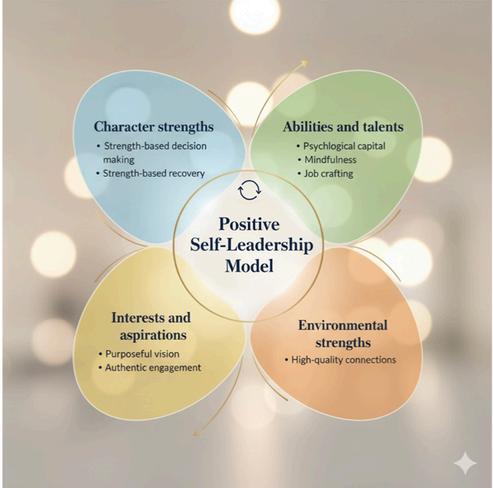
I define positive self-leadership as: "The capacity to identify and apply one's signature strengths to initiate, maintain or sustain self-influencing behaviours It involves a process of self-inspiration which is fueled by a clear, purposeful vision for one's life and the utilisation of signature strengths to achieve goals aligned to this vision "
The positive self-leadership capability model I developed (Du Plessis, 2019) explicitly combines insights from leadership literature with those from organisational and positive psychology. This model is based on the strengths-based capability framework and offers several competencies across four dynamically interacting core capabilities:
1. Character Strengths: Moving beyond problem-solving mentality towards purposeful focus on strengths and goal alignment, enabling individuals to leverage their positive attributes through strength-based decision making.
2. Interests and Aspirations: Personal interests, hopes and dreams that fuel motivation and provide meaning and purpose, creating a clear purposeful vision that aligns with eudaimonic wellbeing
3. Abilities and Talents: Including acquired skills like mindfulness, psychological capital (self-efficacy, optimism, hope, resilience), and job crafting abilities that allow individuals to reshape their roles to better suit their capabilities and preferences.
4. Environmental Strengths: The capability to draw on resources in one's environment, including relational crafting to connect with supportive colleagues and leaders, and creating high-quality connections that generate vitality and positive energy
This model recognises that positive self-leadership involves not just internal capabilities, but the ability to identify and mobilise environmental resources particularly crucial in the South African context where socio-political factors significantly influence individual and organisational development opportunities.
The theoretical model finds practical validation in our research on academic career progression (Barnes, Du Plessis & Frantz, 2022). We discovered that successful academics demonstrated eleven career competencies spanning reflective (gap analysis, self-evaluation, goal orientation), communicative (information seeking, negotiation), and behavioural dimensions (strategy alignment, control and agency, collaboration, continuous learning). Significantly, these academics took responsibility for their own development rather than waiting for institutional direction—they proactively sought information, negotiated for resources, aligned their strategies with institutional goals, and built collaborative networks This empirical evidence demonstrates that positive self-leadership isn't just theoretical; it's how successful professionals actually navigate their careers in complex organisational environments
6. Applications in Higher Education: Transformation Through Human Development
My research in higher education contexts demonstrates how these principles apply in practice. South African universities face enormous challenges: transformation pressures, funding constraints, research demands, and as we discovered, significant leadership toxicity that undermines their societal mission (Venter, Du Plessis & Stander, 2024).
Universities are inherently responsible to multiple stakeholders: students, faculty, staff, communities, and society at large. Yet our research revealed leadership practices that violated this responsibility including the toxic leadership cultures already described
To understand these dynamics more deeply, my research team conducted a systematic programme exploring leadership experiences across different hierarchical levels and institutional types within South African higher education. What emerged paints a troubling yet nuanced picture of leadership in our sector.
We began by exploring senior academics' lived experiences of leadership behaviours at South African universities (Venter, Du Plessis & Stander, 2024). These professors and associate professors individuals who carry significant responsibility for teaching, research, and institutional reputation—described a striking dichotomy. They experienced positive leadership characterised by constructive engagement (genuine dialogue rather than monologue), compassionate support (leaders who recognised their humanity), psychological safety (environments enabling risk-taking and honest voice), and enabling growth (investment in their development and flourishing)
Yet these same senior academics also recounted destructive leadership: poor communication and collaboration that left them isolated; eroding integrity and regard where promises were broken and contributions dismissed; unresolved issues that festered into toxic atmospheres; depersonalisation where they felt reduced to output metrics rather than valued as whole human beings; and overtly toxic practices including authoritarianism, cronyism, and self-serving behaviours.
Extending this research to Technical and Vocational Education and Training (TVET) institutions revealed additional complexity. When we studied senior lecturers at a TVET college (McLaren, 2023), we discovered a hierarchical dimension to the leadership experience. These senior lecturers reported predominantly positive experiences with their direct line managers—who demonstrated empowerment, authenticity, engagement, and appropriate power relationships—but negative experiences with senior management, revealing how toxic leadership often operates at institutional rather than immediate team levels
Most concerning, when we investigated junior academics' experiences at TVET colleges (Singh, Du Plessis & Stander, 2022), we found a prevalence of toxic and destructive leadership behaviours with only scattered instances of positive leadership. Themes centred on the absence of psychological safety, poor work ethics, unprofessionalism, disempowerment, and exclusion from decision-making. The pattern was clear and alarming: the more vulnerable the staff member, the more acutely they experienced leadership toxicity.
Understanding why toxic leadership is so damaging requires examining the context in which academics work. Our research reveals the precarious balance academics must maintain (Naidoo-Chetty & Du Plessis, 2021). Academics face relentless quantitative demands: publication pressure, teaching and administrative overload, and competing time demands pulling them in multiple directions.
Beyond volume, they navigate complex qualitative demands: maintaining work-home balance, supporting diverse students, navigating organisational politics, and lacking adequate mental health support in high-stress environments. Organisational demands include adapting to technology-mediated learning—accelerated by COVID-19—often without adequate training, and chronic lack of structural resources Against these demands, academics draw on limited resources: organisational resources (social support when institutional cultures permit) and personal resources (autonomy, meaningful work, personal support networks)
This creates a "high-strain" work environment where leadership becomes critical. Toxic leadership actively worsens the imbalance by increasing demands (unreasonable expectations, poor communication, chaos) whilst depleting resources (undermining autonomy, eroding social support, destroying meaningful work through depersonalisation).
Conversely, positive leadership can rebalance this equation by reducing unnecessary demands (through clear communication, efficient processes, protection from politics) and enhancing resources (building supportive cultures, fostering autonomy, ensuring structural support, connecting daily work to larger purposes). This is why cultivating psychological resources through positive leadership becomes vital—it enables academics to cope with legitimate demands whilst addressing destructive ones
The human cost of toxic leadership manifests in measurable harm Our quantitative research provides stark evidence (De Waal, Ronnie & Du Plessis, 2024): toxic leadership is positively related to burnout and negatively related to job satisfaction. Complementary research examining the full job demands-resources model across 309 academics confirmed that whilst job demands drive burnout, job resources simultaneously promote engagement and buffer against burnout (Naidoo-Chetty, Du Plessis & Becker, 2025), reinforcing that positive leadership's role is to reduce demands and enhance resources.
Academics in high-strain environments face amplified harm under toxic leadership turning manageable demands into unbearable ones, leading to exhaustion, cynicism, and departure from the profession.
This creates a destructive cycle: high demands + low resources + toxic leadership = burnout = decreased performance and turnover = higher demands on remaining staff = further burnout. Breaking this cycle requires leadership that builds resources, manages demands humanely, and creates conditions for flourishing rather than mere survival.
The implications are profound. When academics burn out and leave, we lose expertise, research programmes collapse, student supervision suffers, and the next generation goes unmentored. Toxic leadership undermines our entire higher education enterprise and, by extension, our nation's development aspirations
What makes these findings particularly significant is their consistency across institutional types (universities and TVET colleges) and hierarchical levels (senior academics, senior lecturers, junior academics) The same themes emerge repeatedly: psychological safety, empowerment, authenticity, communication, power dynamics. This suggests that the challenges aren't isolated incidents or context-specific problems, but rather systemic issues requiring comprehensive solutions.
The dichotomy these studies revealed the coexistence of practices that enable flourishing alongside those that actively undermine it demonstrates the complexity of leadership in South African higher education. It also highlights the urgent need for the kind of positive, responsible leadership I advocate in this lecture.
But we also discovered what positive, responsible leadership looks like in higher education Responsible academic leaders:
• Recognise their stewardship role in knowledge creation and transmission for societal benefit (Du Plessis et al , 2022; Jansen van Vuuren, Barnes, Du Plessis & Frantz, 2025)
• Invest in stakeholder development rather than extracting maximum performance (Barnes, Du Plessis & Frantz, 2022, 2023; Naidoo-Chetty & Du Plessis, 2021)
• Create psychological safety for the vulnerable work of teaching, learning, and research (Jasson, Du Plessis & Simons-Frantz, 2022; Walters, Ronnie, Du Plessis & Jansen, 2023)
• Address systemic inequities that prevent full stakeholder participation and contribution (Solomon & Du Plessis, 2023, 2024)
• Balance multiple stakeholder needs whilst maintaining focus on the institution's social mission (Samodien, Du Plessis & Jansen van Vuuren, 2024; Venter, Du Plessis & Stander, 2024)
When we studied academic women during COVID-19, we found that those who maintained wellbeing and productivity perceived that their leader recognised the full humanity of their colleagues, adapted to stakeholder needs, and maintained focus on long-term institutional sustainability rather than short-term performance metrics (Du Plessis, Ronnie & Walters, 2023; Ronnie, Du Plessis & Walters, 2022) This reinforced that organisational resilience comes through individual flourishing, not despite it
Our recent collaborative research on values in higher education (Jansen van Vuuren, Barnes, Du Plessis & Frantz, 2025) reveals how responsible leadership must be grounded in explicit value frameworks. We identified values that span from transcendental (trust) through universal (ethic of care, ethical conduct, equity and inclusion) to organisational (collaboration, communication, innovation) and individual levels (mindfulness, emotional intelligence, active citizenship). This hierarchical structure demonstrates that responsible leadership in higher education requires alignment between personal values, institutional values, and societal values a complex integration that cannot be achieved through traditional command-and control approaches.
These values don't exist in abstract—they must be embedded in institutional culture through specific practices and behaviours Our earlier research exploring academics' perceptions of institutional culture and career progression revealed how this integration actually works (Barnes, Du Plessis & Frantz, 2021) Academics identified three foundational values that enable career progression and, more broadly, flourishing: equity and inclusion, an ethic of care, and collaboration
Critically, these values only come alive through concrete practices: performance
management systems that develop rather than merely evaluate; comprehensive career management that supports academics throughout their journey; thorough induction and orientation that welcome newcomers into the institutional community; collaborative structures that facilitate rather than hinder teamwork; fair remuneration that recognises contribution; and provision of resources and support that enable success.
But even good values and practices can fail without appropriate behaviours.
Academics emphasised the importance of leaders articulating team values explicitly, ensuring alignment between individual and institutional values, and adopting a systemic approach that recognises the interconnectedness of all elements. This finding reinforces a central insight from my research: leadership isn't just about what leaders do individually, but about creating entire systems values, practices, behaviours—that enable flourishing.
This study demonstrates that creating enabling institutional cultures requires more than policy documents or strategic plans. It requires the painstaking work of aligning values, practices, and behaviours; of ensuring that what we profess actually manifests in daily experience; of building systems where equity, care, and collaboration aren't aspirational ideals but lived realities This is the work of responsible leadership not merely managing organisations, but cultivating cultures where human beings can flourish whilst advancing institutional missions.
Further empirical support comes from our study of transformational, transactional, and agile leadership styles in South African universities (Samodien, Du Plessis & Jansen van Vuuren, 2024). We found that transformational leadership showed the strongest correlation with institutional performance (r = 0.549). Crucially, this people-centred approach outperformed transactional leadership (r = 0.240), which relies on control and compliance mechanisms. The study demonstrates that in South Africa's transformation context, leaders who inspire commitment towards shared visions of inclusive education and social justice create more effective institutions than those who simply manage through rewards and punishments
7. The Gender Dimension: Inclusive Leadership for Comprehensive Flourishing
An important thread throughout my research has been understanding how positive
leadership affects different groups Our studies of academic women reveal that positive leadership must be intersectional recognising that people bring their whole selves to work.
Women academics during COVID-19 faced unique challenges: increased caregiving responsibilities, isolation from support networks, and additional emotional labour in their organisations (Walters, Ronnie, Du Plessis & Jansen, 2023). Good leaders didn't treat these as “women's issues” to be managed separately Instead, they recognised these realities and created psychological safety for authentic engagement.
Whilst our research on women academics revealed significant challenges during COVID-19, a critical question emerged: what happened to women who held leadership positions during the crisis? Our study of 41 women heads of academic departments across 18 South African universities revealed a troubling reality (Ronnie & Du Plessis, 2025) As one participant expressed it: “I felt like I was under siege ”
These women HoDs faced compounded pressures at the intersection of gender, leadership responsibility, and crisis conditions. They experienced heightened expectations and demands from all directions implementing rapidly changing policies, supporting distressed staff, accommodating students, whilst maintaining their own research and teaching. They grappled with wellbeing challenges for themselves and their teams, absorbing emotional labour with limited outlets for their own distress Their research productivity was disrupted often more severely than male counterparts due to additional caregiving responsibilities and expectations of greater emotional availability. The crisis foregrounded gender and role incongruities, amplifying impossible standards: be simultaneously strong and nurturing, decisive and consultative, professionally focused and family-oriented.
These findings reveal a critical insight: leadership positions do not insulate women from gendered organisational practices; in many ways, they intensify them. This has profound implications for positive leadership We cannot simply develop better leaders and expect them to transform toxic systems Even well-prepared, capable women leaders found themselves “under siege” when systemic supports failed. Positive leadership must operate at multiple levels: leaders need support to create conditions for others to flourish, but organisational systems must also create
conditions for leaders themselves to flourish Leaders are not superhuman; they too need psychological safety, resources, and enabling environments.
This insight extends beyond gender to any form of diversity. Positive leadership must create conditions where all individuals can bring their authentic selves to work and find meaning in their contributions. In the South African context, this is particularly crucial. Our history of exclusion means that truly positive leadership must be actively inclusive and transformative.
Good leaders recognise that many stakeholder challenges stem from systemic issues rather than individual deficiencies. Our research on precarious employment in universities, for example, reveals how structural conditions can undermine even wellintentioned leadership. When institutions employ people on short-term contracts with no security, it becomes difficult to build stakeholder capabilities or create sustainable value (Solomon & Du Plessis, 2023) The system itself contradicts leadership principles Therefore, leaders should work to identify and address policies, structures, and cultures that create barriers to stakeholder flourishing
8. Practical Implications: Building Flourishing Organisations
Based on this research, what should leaders actually do? Let me offer five practical principles:
1. Invest in Psychological Capital Development
Build hope, efficacy, resilience, and optimism in your people through opportunities to experience success, learn from failures, and develop confidence.
2. Foster Psychological Ownership
Involve people in decision-making, recognise their contributions, and create opportunities for them to shape their roles and environment
3. Practise Authentic Empowerment
Share decision-making authority, not just tasks, and support people when they make mistakes whilst learning
Develop your ability to understand and respond to emotions both your own and others'. Trust is the foundation for all positive leadership behaviours.
Help people tap into their own internal motivation by connecting their work to their values and strengths.
Translating
Whilst research generates knowledge, its true value emerges when that knowledge transforms lives and organisations. Over the past several years, I have had the privilege of translating the theoretical frameworks I've developed into practical leadership development programmes that have reached numerous academics across South Africa and beyond
The PEEP Programme: Cultivating Leadership Capacity
In 2022, working alongside Professor José Frantz (DVC: Research and Innovation at UWC), we launched the PEEP Research Leadership Programme a year-long initiative designed to develop mid-career researchers into the next generation of research leaders. The programme's name reflects its core architecture: Purpose, Equipping, Environment, and People.
The Purpose module, where I facilitated, focused on helping participants own their space as leaders. This involved deep work on values clarification and crafting purposeful vision statements precisely the kind of self-awareness and intentionality that my research identified as fundamental to leadership effectiveness. Through colour profiling and 360-degree feedback, participants gained insights into their signature strengths and leadership styles.
The programme's impact has been profound As one participant mentioned: “I have discovered my purpose as an academic and how it aligns with the institutional goals I feel empowered and purpose-driven ” Another participant said: “It has allowed me to discover and understand myself much better It has also allowed me to understand others much better, and in understanding people and their different personalities. Based on those differences, I now know how to motivate, approach, guide and mentor.”
These testimonies validate what my research consistently revealed: leadership effectiveness emerges not from behavioural techniques alone, but from cultivating psychological resources self-awareness, purpose clarity, and the capacity to recognise and nurture strengths in others.
On invitation, we presented the PEEP programme beyond UWC to the Central University of Technology in Bloemfontein and the University of Botswana, reaching diverse academic contexts across Southern Africa. The consistent feedback across these institutions reinforces the universality of positive leadership principles whilst respecting contextual differences.
UJ/UWC Research Leadership
Parallel to this work, I served as co-ordinator of the UJ/UWC Research Leadership Programme, a bespoke initiative aimed at developing outstanding female academics at senior lecturer, associate professor, and full professor levels towards becoming internationally recognised scholars This programme addressed a critical gap: the underrepresentation of women, particularly Black women, in research leadership positions and amongst NRF-rated scholars in South Africa
The programme combined research leadership workshops, one-on-one coaching, and professional mentorship over twelve months. Participants developed personalised two- to three-year research development plans, learning to think strategically about their careers often for the first time.
The true measure of any leadership development programme lies not in its design but in its impact on participants' lives and practice. To assess this rigorously, we conducted research exploring participants' perceptions of an academic leadership development programme (Frantz, Marais & Du Plessis, 2022). What emerged provided compelling evidence of the transformative potential of well-designed leadership development
Participants described profound impacts across four key dimensions First, their emotional responses revealed that the programme touched something deep within them this wasn't merely skills training but a journey of personal transformation. Second, they demonstrated professional application of skills, translating programme
insights into concrete changes in their leadership practice
What struck us most forcefully was that the programme had impacted both the personal and professional lives of participants. This wasn't an accident but evidence of the programme's transformative nature. When we help leaders develop psychological capital, clarify their purpose, and build authentic connections, we don't just improve their professional effectiveness we contribute to their overall flourishing as human beings. The boundaries between personal and professional development blur because we're addressing fundamental human needs: purpose, connection, competence, and growth.
This research validates a core principle of my work: leadership development cannot be reduced to skills training or behavioural modification. Effective leadership development must engage the whole person, cultivating psychological resources and creating conditions for genuine transformation When done well, such programmes don't just create better leaders—they contribute to human flourishing in its fullest sense
Extending Reach: International Engagement and Cross-Cultural Leadership
The principles of positive leadership transcend geographical and cultural boundaries, yet their application must be contextually sensitive. This understanding has guided my engagement with international networks, particularly through the LEAD Academic Network and the World Education Research Association (WERA) International Research Network on Digital Academic Leadership in the New Era.
The LEAD Academic Network brings together academic leaders from across Europe, China, Africa, and beyond, creating a platform for cross-cultural dialogue on academic leadership development. Through this network, I have delivered keynote presentations on inclusive academic leadership and the creation of psychologically safe spaces for digital academic leadership adoption These engagements have allowed me to bring a distinctly African perspective to global conversations about leadership—a perspective shaped by our unique transformation challenges, our diversity imperatives, and our understanding of ubuntu and collective flourishing
What has emerged from these cross-cultural exchanges is both reassuring and enlightening. The fundamental psychological needs that underpin effective
leadership purpose, autonomy, competence, connection appear universal. However, how these needs manifest and how leaders cultivate them varies significantly across cultural contexts. European colleagues grapple with different equity challenges than we do in South Africa; Chinese partners navigate distinct institutional structures and governance models. Yet we all seek to create environments where academics can flourish whilst advancing institutional missions.
As co-convenor of the WERA International Research Network on Digital Academic Leadership, alongside Professor Chang Zhu (Vrije Universiteit Brussel) and Professor Xuemei Yu (Shanghai University), I have focused particularly on the psychological dimensions of digital transformation in higher education. In a recent webinar, I presented on "Cultivating a Digital Mindset in Academic Leadership: Psychological Foundations for Inclusive Digital Transformation," exploring how the Unified Theory of Acceptance and Use of Technology can inform leadership practices that enhance educational access and inclusion.
This work addresses a critical gap: much discussion of digital transformation focuses on technology adoption or infrastructure development, but insufficient attention is paid to the psychological readiness and capability development required for meaningful digital leadership. Leaders cannot simply mandate digital adoption; they must cultivate digital mindsets both in themselves and in their institutions. This requires addressing psychological barriers (fear of technology, concerns about relevance, anxiety about competence), building psychological capital (confidence in one's ability to learn and adapt), and creating psychologically safe environments where experimentation and learning are encouraged rather than punished
The international dimension of this work enriches my understanding of leadership in profound ways. It challenges assumptions, reveals cultural blind spots, and demonstrates that whilst the South African context is unique, many of our challenges inequality, transformation, resource constraints, the need to balance multiple stakeholder demands resonate globally. Our solutions, grounded in positive psychology and focused on human flourishing, offer valuable insights to the international academic community. Simultaneously, exposure to diverse leadership approaches and contexts sharpens my thinking and strengthens my research. This bidirectional knowledge flow bringing African insights to global conversations and returning with enriched perspectives exemplifies the kind of academic
leadership we strive for. We are not merely consumers of leadership theories developed elsewhere; we are generators of knowledge that addresses universal human needs whilst remaining responsive to our specific contexts.
As I look to the future, I see several crucial areas for continued research and development:
How do we create human flourishing in increasingly digital work environments? This question has moved from theoretical concern to urgent practical necessity.
Our recent bibliometric analysis of digital academic leadership over the past decade (Olabiyi, Jansen van Vuuren, Du Plessis, Xue & Zhu, 2025) reveals a significant evolution in how scholars conceptualise this field. Our analysis demonstrates a paradigm shift from technology focused approaches towards holistic leadership frameworks. Keywords such as “digital transformation”, “performance”, and “innovation” dominate the field, but increasingly these are understood not as purely technical challenges but as fundamentally human and organisational ones requiring transformational leadership capabilities.
This finding validates what my broader research programme has consistently revealed: technology is never just about technology The challenge is not simply technological adoption, but cultivating what I term “digital mindsets”—the psychological readiness and capability to lead in digital environments Effective digital academic leadership requires not only technical competencies but also transformational capabilities, communication skills, and innovation management to enhance student outcomes and institutional performance. This requires addressing fundamental questions: How do we build psychological safety in virtual spaces? How do we foster authentic connection and trust when interactions are mediated by technology? How do we develop the psychological capital particularly self-efficacy and adaptability that enables leaders and their teams to navigate continuous technological change? How do we ensure digital transformation enhances rather than diminishes human flourishing?
Through the LEAD Academic Network, we are bringing cross-cultural perspectives to these questions, recognising that digital leadership must be contextually adaptive whilst maintaining focus on universal human needs. Our bibliometric research
revealed significant contributions from Pakistan, Ireland, and India, demonstrating that valuable insights emerge from diverse global contexts, not just from traditional centres of technological innovation.
As artificial intelligence capabilities advance, we face fundamental questions about the nature of leadership itself Could AI systems eventually take on leadership roles traditionally held by humans? If effective leadership is about cultivating psychological resources and creating stakeholder value, what happens when the "leader" is an algorithm?
This raises profound questions about the irreplaceable human elements of leadership empathy, moral reasoning, contextual understanding, the capacity for genuine care and connection. It challenges us to articulate what makes human leadership essential for flourishing. Can an AI system truly understand the vulnerability of a doctoral student struggling with imposter syndrome? Can it provide the kind of authentic presence that creates psychological safety? Can it exercise the moral courage required to challenge unjust systems?
These are not merely technical questions but deeply philosophical ones about human dignity, agency, and what it means to lead with purpose As we navigate this frontier, we must ensure that technology serves human flourishing rather than diminishing it
COVID-19 taught us about the importance of sense-making and adaptability in leadership. Our research on how academic leaders navigated the pandemic revealed that those who maintained focus on stakeholder wellbeing whilst adapting to rapidly changing circumstances enabled greater resilience and productivity than those who prioritised institutional reputation or short term performance metrics (Du Plessis, Ronnie & Walters, 2023; Ronnie, Du Plessis & Walters, 2022).
we build the psychological resources particularly hope and resilience that enable leaders and their stakeholders to navigate ongoing turbulence whilst maintaining wellbeing and purpose?
In the South African context, we need leaders who can navigate ongoing transformation whilst maintaining human dignity and organisational effectiveness Our recent research (Samodien, Du Plessis & Jansen van Vuuren, 2024) demonstrates that transformational leadership approaches, through vision-sharing, inspiration, and stakeholder development, show stronger correlations with institutional performance than transactional, control-based approaches.
Yet transformation is not a finite project with a clear endpoint it is an ongoing journey. How do we sustain transformational leadership over time? How do we prevent transformation fatigue whilst maintaining momentum towards greater equity, inclusion, and social justice? How do we develop the next generation of transformation leaders who can carry this work forward?
We need better ways to measure psychological resources and track their development over time Current assessment tools often fail to capture the dynamic, contextual nature of psychological capital, ownership, and empowerment We need methodologies that can assess individual capability development alongside systemic change, that can track the cultivation of psychological resources within authentic organisational contexts rather than artificial research settings
Moreover, we must develop assessment approaches that are culturally responsive, recognising that psychological constructs may manifest differently across diverse contexts. What does hope look like in a South African township versus a Chinese university versus a European research institution? How do we measure flourishing in ways that honour diverse cultural values and definitions of wellbeing?
But COVID-19 was not an isolated crisis it was a preview of an increasingly volatile, uncertain, complex, and ambiguous future. Climate change, economic instability, social upheaval, technological disruption: the pace and scale of change continue to accelerate How do we prepare leaders for this uncertain future? How do
Each of these areas represents not just research opportunities but urgent practical challenges facing higher education and organisations globally. The work continues, and I am energised by the possibilities for discovery, collaboration, and impact that lie ahead.
11. Conclusion: Leadership as a Calling to Human Flourishing
As I conclude this lecture, I want to return to the fundamental insight that has shaped my career: The ultimate purpose of leadership is human flourishing.
This isn't soft or idealistic—it's deeply practical Organisations that create conditions for human flourishing outperform those that don't They're more innovative, more resilient, more adaptable They attract and retain better people They create value for all stakeholders, not just shareholders.
But more than that, leadership that promotes human flourishing contributes to our broader social goals. In South Africa, we're still building the society we want to become. Every organisation that chooses positive leadership, every leader who invests in developing people rather than just driving results, contributes to this larger transformation.
The research journey I've shared with you today demonstrates that we don't have to choose between organisational effectiveness and human wellbeing. We can create workplaces where people don't just perform, but truly thrive. This is our calling as leaders, scholars, and human beings: to move from self to service, to cultivate the flourishing of all
Thank you
Acknowledgements
I want to thank my research collaborators, my students who have challenged and inspired me, my institution for supporting this research journey, and my family for their unwavering support. This work represents not just individual achievement, but collective commitment to understanding and improving the human experience at work. Thank you for creating an environment for me to flourish. The journey continues, and I look forward to the discoveries yet to come.
Olabiyi, O , Du Plessis, M , & Jansen van Vuuren, C D (2024) Unveiling the Toxic Leadership Culture in South African Universities: Authoritarian Behaviour, Cronyism and Self-Serving Practices. Frontiers in Education, 9, 1446935. https://doi.10.3389/feduc.2024.1446935
Olabiyi, O , Jansen van Vuuren, C D , Du Plessis, M , Xue, Y , & Zhu, C (2025) Digital Academic Leadership in Higher Education Institutions: A Bibliometric Review Based on CiteSpace Education Sciences, 15(7), 846; https://doi org/10 3390/educsci15070846
Olckers, C., Du Plessis, M., & Casaleggio, R. (2020). Authentic leadership, organisational citizenship behaviours and intention to quit: the indirect effect of psychological ownership South African Journal of Psychology, 50(3), 371–384 https://doi org/10 1177/0081246319891658
Ronnie, L. & Du Plessis, M. (in press). “I Felt Like I Was Under Siege”: Women Academic Leaders’ Journeys Through A Crisis. In A. Ibrahim (ed), Transforming Education and Leadership:Promoting Equity, Learning, and Mental Health Across Educational. Sectors Emerald
Ronnie, L , Du Plessis, M , Walters, C (2022) Women academics and the changing psychological contract during COVID-19 lockdown. Frontiers in Psychology. https://doi.org/10.3389/fpsyg.2022.940953

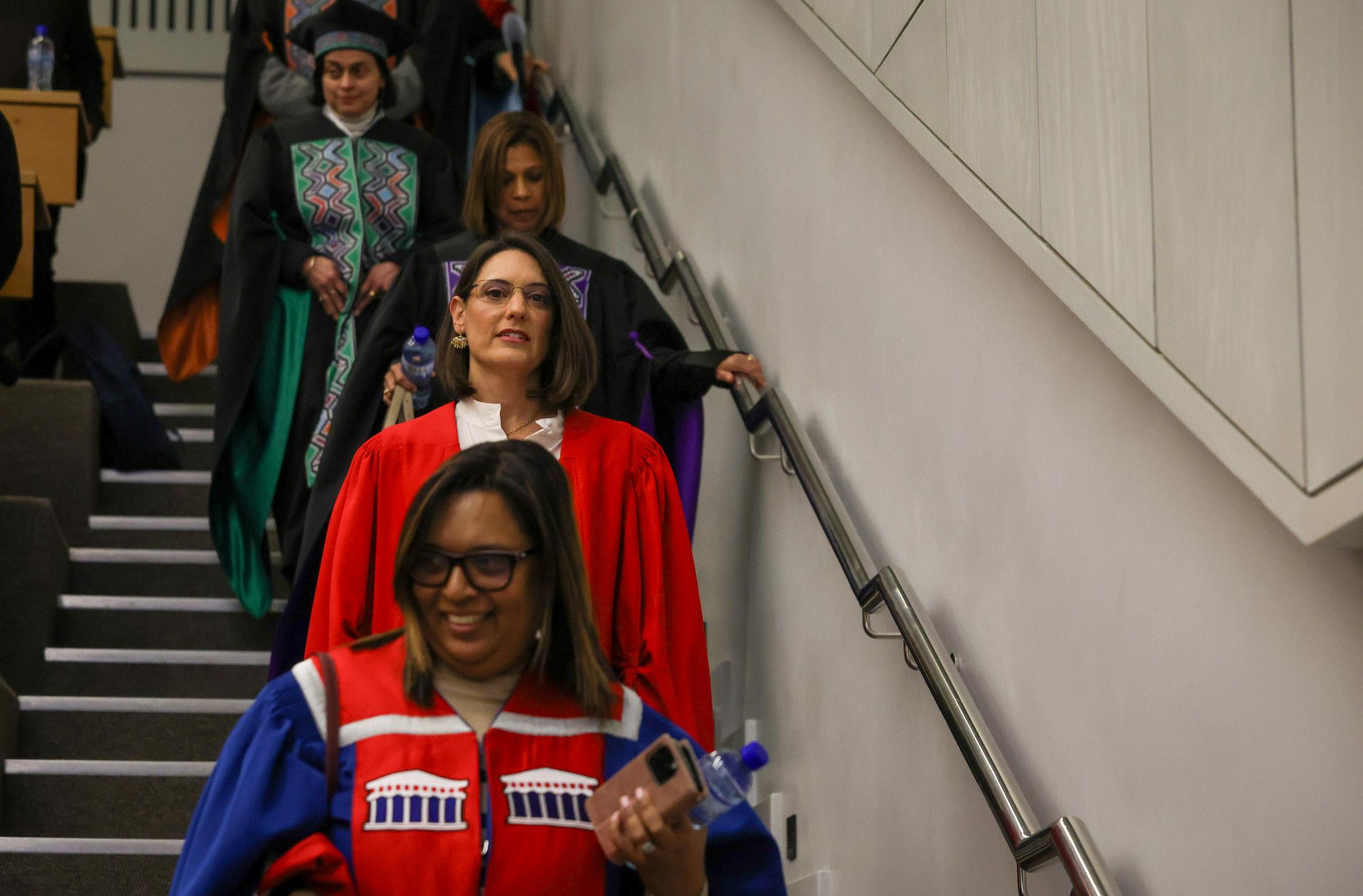
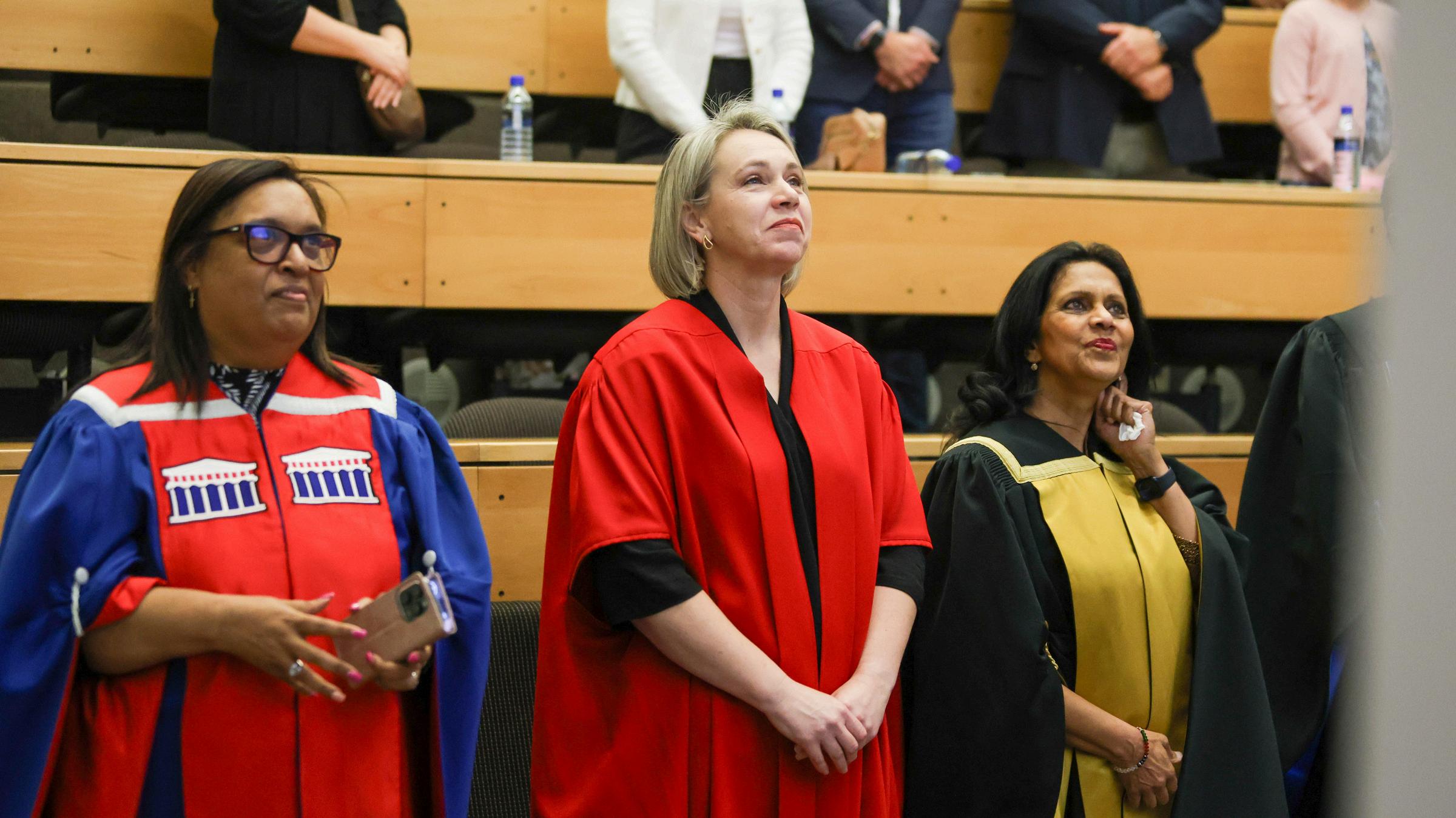
ProfessorRajendrenGovender
ProfessorRouaanMaarman
1September2025
FromtheRootsoftheSyzygiumTreetotheSummitofMathematicalThinking
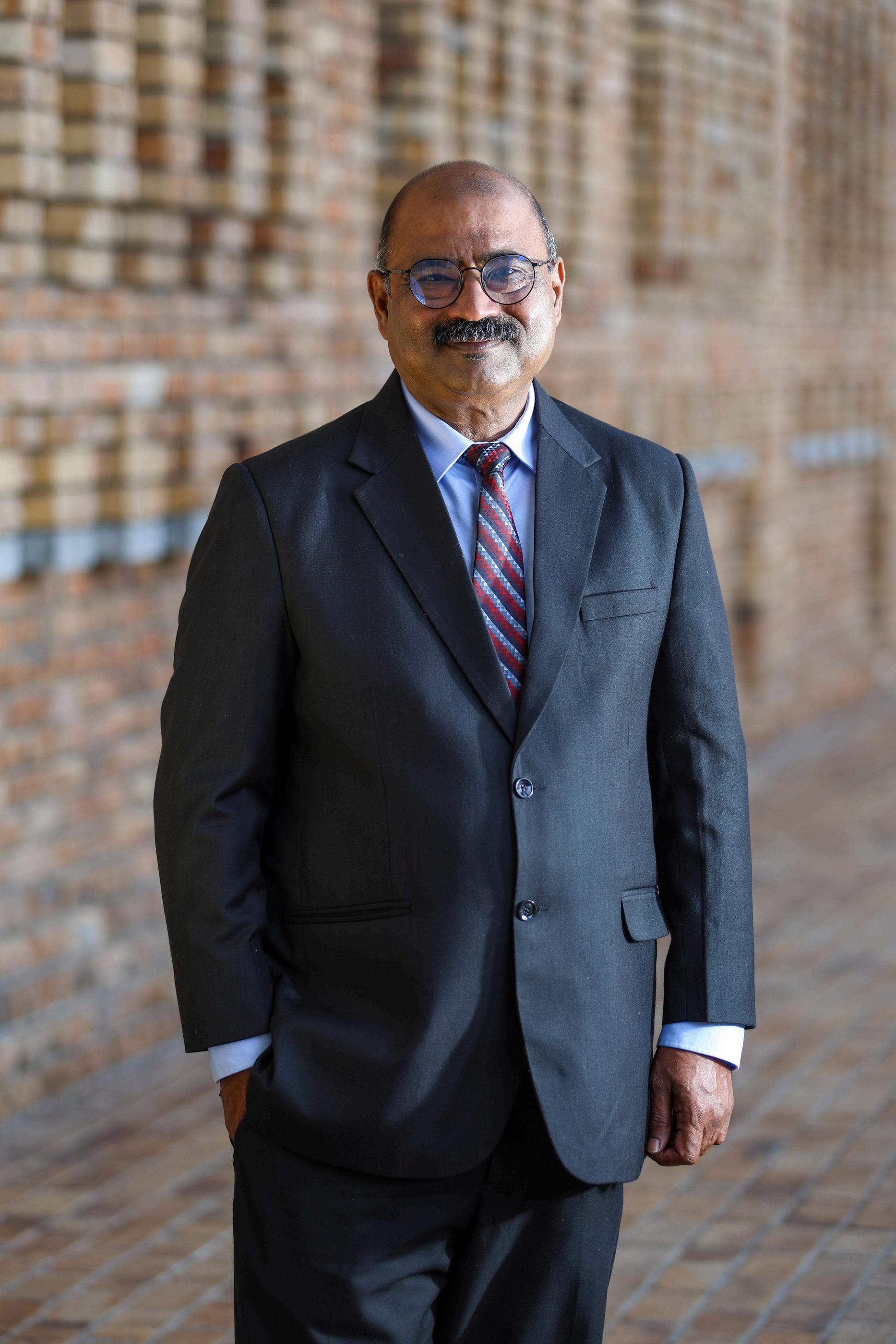
ABSTRACT
BIOGRAPHY
Prof Rajendren Govender
Abstract
In an era where the ability to think critically, flexibly, and independently is as important as content knowledge, mathematics teacher education must prioritize approaches that foster higher-order thinking, creativity, and self-directed learning (SDL). This paper employs the metaphor of the Syzygium (Water-Berry) tree to explore how mathematical modelling can serve as a pedagogical ‘growing tree’ rooted in authentic inquiry, branching into multiple perspectives, and cultivating the fruits of adaptive reasoning and reflective practice. Drawing on constructivist and developmental learning theories, case studies of pre-service mathematics teachers engaging in real-world modelling tasks (e.g., estimating the height, crown, and leaf mass of a tree) are analyzed. The findings illustrate how open-ended, context-rich modelling tasks nurture creative problem-solving, critical thinking, collaborative learning, and SDL competencies The paper highlights implications for curriculum transformation in mathematics education, assessment design, and the professional preparation of teachers who are equipped to meaningfully faciliate creativity, criticality, and adaptability in their classrooms
Keywords
Mathematical modelling, Creativity, Critical thinking, Self-directed learning, Teacher education, Syzygium metaphor
1. Introduction
Mathematics education globally is shifting beyond rote learning towards fostering higher order competencies such as creativity, problem-solving, and adaptability. In South Africa, where contextual challenges of inequality and limited resources prevail, teacher education must prepare future educators to be both resilient and innovative. The metaphor of the Syzygium tree, rooted, branching, and fruit-bearing, offers a powerful lens for rethinking teacher education: the roots symbolize foundational inquiry, the branches multiple perspectives, and the fruits creative and critical outcomes.
This paper explores how mathematical modelling serves as a catalyst for developing these competencies in pre service mathematics teachers (PMTs). It foregrounds modelling-based projects as authentic assessment tasks that stimulate inquiry, promote collaboration, and cultivate SDL.
Globally, mathematics education has entered a new era shaped by technological advances, societal demands, and the recognition that traditional rote-learning approaches are insufficient for preparing learners for an uncertain future. Teacher education has the dual responsibility of strengthening mathematical content knowledge while simultaneously equipping future educators with the pedagogical and adaptive skills to cultivate curiosity, resilience, and independent learning in their students. In the South African context, this need is especially pressing due to systemic inequalities in resources, infrastructure, and access to quality education Consequently, mathematics educators are called to innovate, using context-rich pedagogies that foster problem-solving beyond the classroom
The Syzygium tree metaphor captures this vision: the roots symbolise foundational theory and inquiry; the trunk represents the transfer of knowledge; the branches reflect diverse, exploratory strategies; and the fruits symbolise creative, critical, and self-directed outcomes. Just as the tree grows and adapts to its environment, so too must learners adapt their problem-solving processes. This introduction situates mathematical modelling within broader debates in teacher education, foregrounding its potential to bridge theoretical understanding with practical, real-world engagement.
Twenty first century mathematics education increasingly emphasizes competencies such as real-world problem solving, creative and critical thinking, and self-directed learning (OECD, 2021). Mathematical modelling has emerged as a powerful pedagogical driver for achieving these aims, as it connects mathematics to authentic contexts and positions learners as active knowledge constructors rather than passive recipients (Blum & Leiß, 2007). Within teacher education, these competencies are essential because pre-service mathematics teachers (PMTs) must be prepared to foster autonomy and adaptive reasoning in their own learners.
The literature broadly supports mathematical modelling as a means for developing conceptual and transferable problem-solving skills. Maaß (2006) defines modelling competencies as learners’ ability to translate real-life phenomena into mathematical structures through iterative cycles of understanding, mathematizing, solving, and validating Modelling tasks promote deeper cognitive processing by requiring learners to evaluate assumptions, refine representations, and justify solutions (Stillman, Brown, & Galbraith, 2010; Borromeo Ferri, 2018) When modelling is situated in meaningful lived environments, such as measuring natural and built objects in students’ communities, the result is enhanced relevance and mathematical engagement (Jablonka & Gellert, 2021).
Blum (as cited in Maaß, 2006), suggested a mathematical modelling cycle with competences and sub-competencies in an attempt to define modelling, as shown in Figure 1.
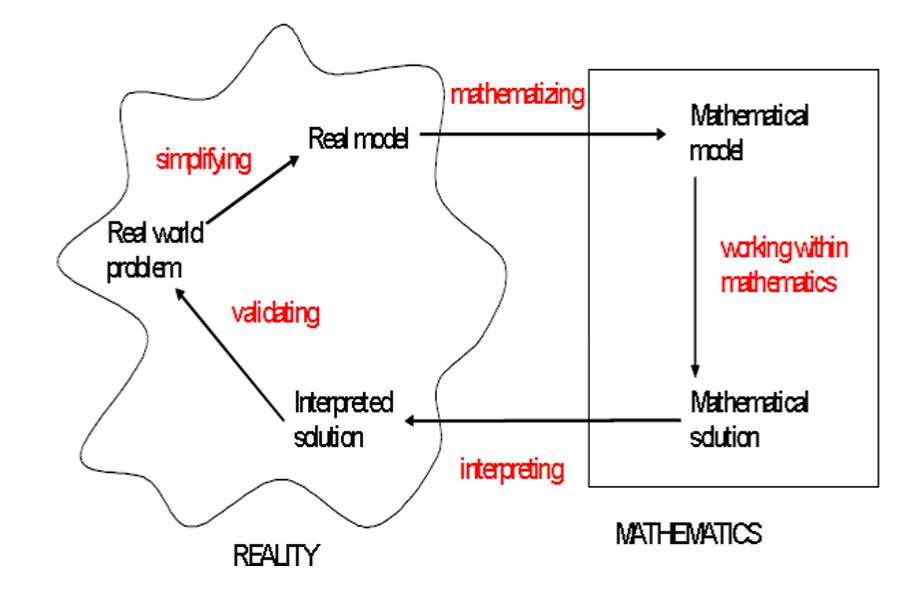
1:
(Blum, 1996, p.18, as cited in Maaß, 2006, p.115)
Creativity is increasingly recognised as a central component of mathematical competence, rather than a skill reserved for the arts or design fields (Silver, 1997; Sriraman, 2005). In mathematics, creativity involves generating original, flexible, and useful ideas when approaching unfamiliar or complex problems (Guilford, 1956). Such creative expression is strengthened when learners engage in problem posing, open-ended investigations, and divergent reasoning that allow for multiple valid approaches and outcomes (Vale & Barbosa, 2024; Leikin & Pitta-Pantazi, 2013) Williams’ (1993) taxonomy further highlights important dimensions such as fluency, flexibility, elaboration, and imagination that can be intentionally nurtured through purposeful curriculum design and classroom discourse
Critical thinking works in tandem with creativity by enabling learners to analyse, justify, and evaluate mathematical decisions (Facione, 2015; Schoenfeld, 2013). It involves questioning assumptions, validating results against evidence, and reflecting on the appropriateness of methods used. Research on mathematical modelling demonstrates that authentic, open-ended tasks can cultivate both creative and critical capacities simultaneously (Hidajat, 2021; Roberts et al , 2022) Because modelling requires students
to explore multiple strategies, use various representations, and continuously refine their reasoning, it provides a natural environment for the development of adaptive expertise (Hatano & Inagaki, 2017).
When learners are encouraged to take intellectual risks, collaborate in justification, and evaluate the plausibility of their solutions, they begin to view mathematics as a dynamic, sense-making endeavour Thus, modelling stands as a powerful pedagogical tool for developing creative confidence and critical resilience, two competencies essential for meaningful participation in 21st-century society (OECD, 2019)
Self-directed learning (SDL) frameworks are increasingly emphasized in mathematics education because autonomy and persistence are essential to becoming an effective problem solver (Zimmerman, 2002; Erdoan & Yldz, 2021). Self-directed learning (SDL) encompasses a set of metacognitive processes through which learners take increasing responsibility for their learning These processes include setting goals for what they want to achieve, monitoring their progress as they work, and evaluating the effectiveness of the strategies they have
used In mathematical modelling, these functions occur naturally as learners continually define the problem, choose appropriate methods, test and refine their assumptions, and judge whether their results are reasonable. Thus, the iterative nature of modelling closely aligns with the phases of SDL, helping learners develop autonomy, reflective habits, and confidence in directing their own learning pathways. Inquiry-rich learning environments give students authority to select strategies, gather data, and justify solution validity, thereby supporting mathematical identity development and reducing anxiety (Boaler, 2015; Bacangallo et al , 2022)
Sociocultural learning theory positions knowledge as something that is co-constructed through interaction, shared meaning-making, and participation in social practices (Vygotsky, 1978). Learning is therefore strengthened when students have opportunities to articulate their thinking, respond to peers’ ideas, and build collective understanding
through discourse. Cooperative learning structures enable this by encouraging learners to engage in explanation, critique, justification, and iterative refinement of ideas within a supportive group environment (Johnson & Johnson, 2009; Gillies, 2016).
Mathematical modelling tasks are particularly well-suited to collaborative arrangements because they require distributed cognitive effort to navigate complex, authentic, and often ambiguous situations (English, 2013). When learners work together to define problems, gather information, and evaluate competing strategies, they are exposed to multiple perspectives that broaden their conceptual understanding. Such group interactions also foster the communicative reasoning and argumentation skills necessary for constructing and defending mathematical claims (Staples & Newton, 2016; Schoenfeld, 2013) In this way, modelling not only develops learners’ mathematical competencies but also mirrors real-world problem-solving, where solutions are rarely created in isolation.
My scholarship aligns strongly with these bodies of research. My work in mathematical modelling, geometry, Activity Theory, and formative assessment practices has contributed to the design of modelling-based curricula in teacher
education that cultivate creativity, metacognition, and professional agency My leadership in assessment innovation has operationalized SDL and productive struggle in mathematics learning environments, supporting the development of confident, reflective PMTs.
Taken together, the literature establishes a robust rationale for implementing modelling centred pedagogy to foster higher-order thinking and self-directed learning within mathematics teacher education programmes.
This study is grounded in a socio-constructivist paradigm that views mathematics learning as an active process shaped by cultural tools, social participation, and reflective engagement. Four complementary theoretical pillars underpin the design, implementation, and interpretation of the modelling-based learning environment:
Constructivist Learning Theory, Activity Theory, Mathematical Modelling Theory, and Self-Directed Learning Theory
3.1 Constructivist Learning Theory
Constructivist perspectives argue that learners actively build mathematical understanding through exploration, sense-making, and the reorganisation of existing cognitive structures (Hiebert & Carpenter, 1992; Fosnot, 2013) Knowledge is not transmitted directly from teacher to learner but is constructed as students engage with meaningful problems that challenge their current ways of thinking. Real-world mathematical modelling tasks align strongly with this view because they shift the focus from memorising rules and procedures to interpreting and making sense of complex situations drawn from lived experience (Lehrer & Schauble, 2015; Lesh & Zawojewski, 2007)
During the modelling process, learners must collect and analyse data, make assumptions, justify decisions, and reflect on the reasonableness of emerging results. These activities prompt learners to question existing conceptions and refine or reconstruct their understanding based on evidence gathered from authentic contexts (Schoenfeld, 2013). The iterative nature of modelling creates productive cognitive conflict that supports conceptual change and deeper comprehension, as students test ideas, negotiate meaning, and revise strategies to achieve better alignment between their models and the real world (Piaget, 1970; English, 2013).
Thus,
mathematics learning in purposeful inquiry, encouraging learners to take ownership of knowledge construction in ways that are both intellectually rigorous and personally meaningful.
Activity Theory, grounded in the cultural-historical psychology of Vygotsky (1978) and later expanded by Engeström (1987), conceptualises learning as participation in a collective, tool-mediated activity system. Rather than viewing learning as an individual cognitive process alone, Activity Theory emphasises the dynamic interactions between the learner (subject), the goal or problem being addressed (object), the tools and resources used, and the social and cultural structures that shape participation (Cole & Engeström, 1993). In mathematical modelling tasks, students act as subjects engaging with authentic, real-world problems, transforming the object into meaningful outcomes through the use of mathematical representations, digital tools, and environmental observations (Lesh & Zawojewski, 2007).
Collaboration plays a central role within this system Learners work together within groups, negotiating roles, sharing tools, and drawing on one another’s expertise, while operating under classroom norms, curriculum expectations, and shared community purpose (Engeström et al , 1999; Goos, 2013) As they encounter contradictions or challenges such as implausible results or conflicting assumptions, these tensions become a source of learning, prompting transformation and reorganisation of the activity system (Foot, 2014). This aligns with the iterative nature of modelling, where ongoing negotiation and refinement lead to deeper conceptual and procedural understanding.
The Activity Theory lens also foregrounds the importance of cultural-historical context, material artefacts, and social practices in shaping learners’ mathematical reasoning (Roth & Lee, 2007). By situating mathematics in lived experiences and authentic inquiry, modelling tasks allow students to appropriate tools and practices that reflect how mathematics functions in everyday and professional settings. Consequently, Activity Theory provides a robust framework for examining how
mathematical understanding emerges not only from individual thinking, but through mediated, collaborative engagement with meaningful activity.
Mathematical Modelling Theory offers a conceptual framework for understanding how learners iteratively navigate between real-world situations and mathematical structures (Blum & Leiß, 2007; Maaß, 2006). Rather than treating mathematics as disconnected from lived experiences, the modelling process requires students to translate contextual information into mathematical representations, test the implications of their models, and then relate the results back to the context. This bidirectional movement fosters meaningful learning because students must continually negotiate the relationship between abstract mathematics and concrete phenomena (Stillman, Brown, & Geiger, 2017).
Key modelling principles help structure this process. Mathematizing involves identifying relevant variables and symbolically or geometrically representing the situation using mathematical tools (Borromeo Ferri, 2018) Interpretation requires giving meaning to mathematical results by analysing what they reveal about the real-world situation (Kaiser & Sriraman, 2006). Validation focuses on evaluating whether the outcomes are reasonable and whether the underlying assumptions hold true in context (Schoenfeld, 2013). Through refinement, learners adjust methods, measurements, or assumptions to improve accuracy and alignment between model and reality (Blum & Borromeo Ferri, 2009)
In this sense, modelling tasks function as metacognitive scaffolds that prompt students to plan, monitor, and reflect on their mathematical thinking, cultivating deeper conceptual reasoning and adaptive expertise (Borromeo Ferri, 2018; Lesh & Zawojewski, 2007). They also mirror the authentic practices of mathematicians, scientists, and engineers, thereby helping learners recognise mathematics as a powerful tool for sense-making in complex and uncertain problems. As such, Mathematical Modelling Theory underpins the pedagogical value of modelling in teacher education by making visible the processes through which meaningful mathematical understanding is constructed.
3.4 Self-Directed Learning (SDL) and Self-Regulated Learning (SRL)
Self-Directed Learning (SDL) and Self-Regulated Learning (SRL) theories explain how learners intentionally plan, monitor, and evaluate their learning processes as they progress toward academic goals (Zimmerman, 2002; Knowles, 1975) In mathematics education, these metacognitive competencies are essential in inquirybased environments where learners must navigate uncertainty, make informed choices, and manage their own cognitive resources (Boekaerts & Corno, 2005). Mathematical modelling tasks are inherently conducive to the development of SDL/SRL because they require learners to engage in learner-driven strategy selection, set goals, and determine which information is relevant for solving the problem at hand (Borromeo Ferri, 2018). As students iteratively work through modelling cycles, they must reflect on the accuracy and plausibility of their assumptions and solutions, adjusting and refining their approaches when discrepancies arise (Hidajat, 2021; Schoenfeld, 2013). This process encourages decision-making autonomy and nurtures a sense of agency and persistence, particularly when groups encounter challenges that demand alternative reasoning pathways (Deci & Ryan, 2000) SDL principles also serve as a foundation for formative assessment because they value growth over correctness, emphasising feedback, reflection, and continual improvement (Nicol & Macfarlane-Dick, 2006) When incorporated intentionally into teacher education, modelling tasks provide PMTs with a structure that supports metacognitive awareness and helps them cultivate the dispositions required for lifelong learning and adaptive mathematical expertise (Zimmerman & Moylan, 2009). Thus, SDL and SRL theories highlight the critical role that agency, autonomy, and self-reflection play in enabling learners to engage meaningfully and productively with authentic mathematical inquiry Synthesis of the Framework
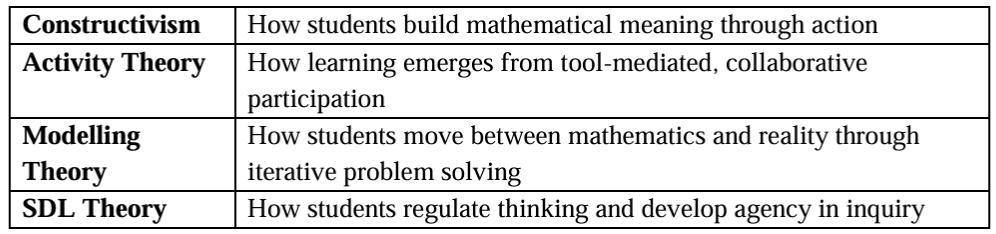
The intersecting theoretical strands are represented in Table 1: In synthesis, the framework conceptualizes mathematical modelling as a holistic learning activity that is cognitive, metacognitive, social, and contextual This enables a rigorous analysis of how PMTs learn mathematics as thinkers, problem posers, and evidence based decision-makers.
Others drew on more advanced mathematical methods, including trigonometric ratios (see example in Figure 3) and geometric constructions, to improve the accuracy and justification of their solutions. Some groups extended their reasoning into the domain of physics by incorporating ideas such as projectile motion or shadow analysis, while a few explored building plans and environmental structures to cross-check and validate their assumptions
4 Methodology
The study was conducted at the University of the Western Cape (UWC) with pre-service mathematics teachers enrolled in a method of mathematics teaching module.
The central task required groups of students to estimate various properties of a Syzygium tree on campus:
• Height of the tree
• Number of leaves
• Mass of the leaves
• Mass of the tree
• Space occupied by the crown
• Footprint area of the crown
Students engaged collaboratively, applying multiple methods (e.g., trigonometry, scaling, clinometers, shadows, projectile motion, and plan analysis).
• Group reports and reflections
• Photographs, diagrams, and measurements
• Rubrics assessing modelling, creativity, and problem-solving
Research Approach and Procedure
The research adopted a qualitative case study design, which is well-suited for in-depth investigations of complex educational phenomena within their natural settings (Merriam & Tisdell, 2016; Yin, 2018). Rooted in an interpretivist paradigm, the study sought to generate rich, contextualised insights into how pre-service mathematics teachers (PMTs) engage with modelling tasks, construct mathematical meaning, and develop key competencies through authentic inquiry (Creswell & Poth, 2018). Rather than pursuing generalisable outcomes, the intention was to illuminate participants’ learning processes and the meanings they attributed to their experiences.
Participants included final-year PMTs enrolled in a mathematics education module at the University of the Western Cape, who had been previously introduced to modelling principles as part of their teacher preparation. The instructional intervention centred on authentic real-world challenges, with the Tree Project serving as a meaningful anchor task that required interdisciplinary reasoning and engagement with the physical environment (Blum & Leiß, 2007; Stillman, Brown, & Geiger, 2017) This design supported the development of creativity, criticality, collaboration, and Self-Directed Learning (SDL), aligning with contemporary expectations for mathematics teacher education. Data were collected from multiple sources including written group reports, reflective journals, peer feedback artefacts, photographic documentation of fieldwork, and observation notes taken during group presentations. The use of methodological triangulation strengthened validity by enabling cross-verification of themes and reducing the influence of bias tied to any single data source (Denzin, 2012; Miles, Huberman, & Saldaña, 2020). A carefully designed rubric served as an analytic tool to evaluate evidence of creativity, critical thinking, mathematical reasoning, and SDL, dimensions which are widely recognised as core indicators of modelling competency and professional growth in mathematics education (Kilpatrick, Swafford, & Findell, 2001; Borromeo Ferri, 2018).
The rubric allowed for consistent interpretation and traceability of claims emerging from the qualitative data set Ethical clearance was obtained through UWC’s Faculty Research Ethics Committee
Participation was voluntary, and groups were encouraged to document both their successes and failures, acknowledging that productive struggle is an essential aspect of modelling The methodology emphasised not only the solutions generated but also the learning processes that unfolded during the activity
5 Findings and Discussion
The Tree Project revealed significant insights into the capacities of pre-service teachers to engage in higher-order thinking through modelling.
Students applied a wide range of strategies to solve the task, demonstrating creativity, adaptability, and strong problem-solving flexibility. Many groups used proportional reasoning with reference objects and figures, carefully scaling known heights, distances, or dimensions to estimate the unknown measure (see example in Figure 2).
Throughout the task, collaborative dialogue played an important role as learners debated, compared, and refined their strategies, helping them to justify their decisions more confidently. The range of methods illustrated how authentic, real-world problems stimulate innovative thinking and allow learners to draw from multiple sources of knowledge Overall, the diversity of approaches revealed not only the depth of learners’ conceptual understanding but also the value of interdisciplinary connections across mathematics, science, and everyday reasoning, ultimately resulting in rich, inquiry-driven learning that is meaningful and contextually grounded
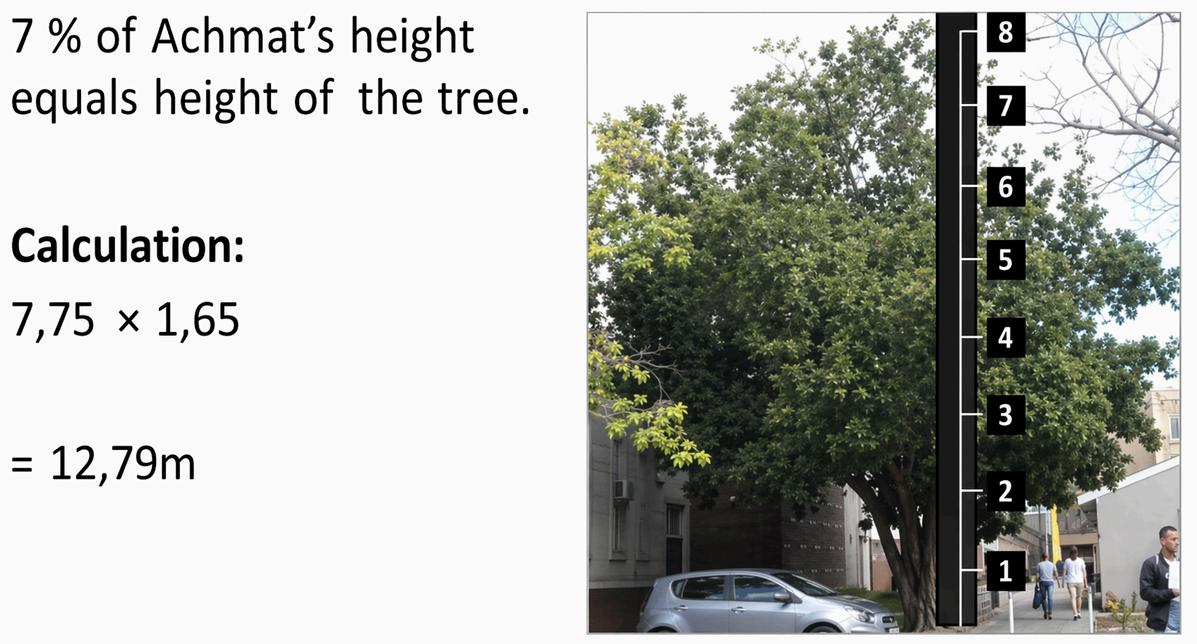
Figure 2: A case of ratio and proportion
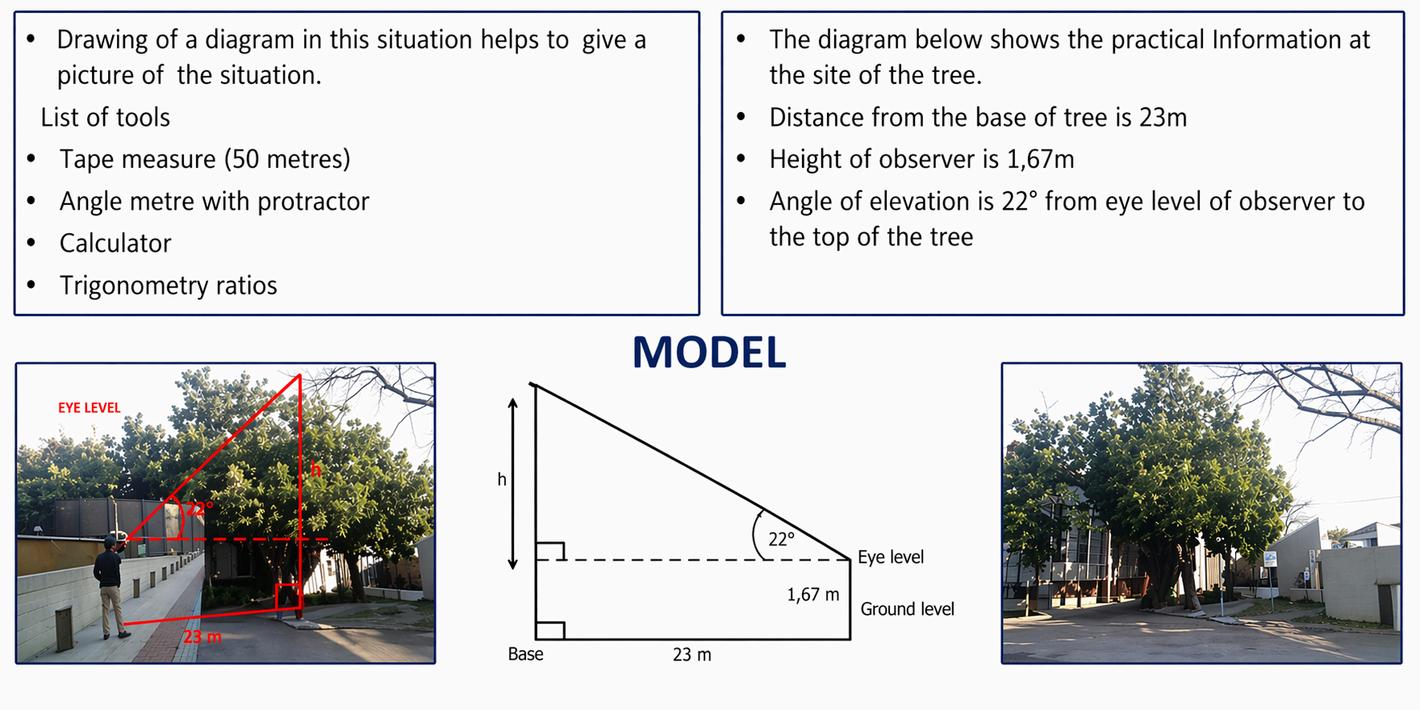
Open-ended modelling tasks encouraged originality, risk-taking, and a willingness to explore unconventional ideas. Students were not constrained by a predetermined procedure; instead, they were free to design their own solution pathways. This freedom fostered creativity as learners experimented with different tools, representations, and reasoning processes to interpret the real-life context. Their curiosity and motivation to produce meaningful results prompted them to move beyond routine methods and attempt innovative strategies that blended mathematics with observations from their environment.
Critical thinking emerged strongly as learners continually evaluated the plausibility of their outcomes and refined their models when inconsistencies surfaced For example, groups that initially produced unrealistic tree height estimates identified discrepancies by comparing their values with nearby buildings and familiar structures. This triggered revisions to their assumptions, measurements, and calculations, demonstrating persistence and intellectual humility. The process of questioning results, validating claims with evidence, and iterating through improved versions of their models reflected a deep level of reflective dialogue and mathematical reasoning. Collectively, these experiences showed how authentic modelling tasks develop students’ confidence in thinking independently, engaging in evidence-based decision-making, and applying mathematics in creative and contextually grounded ways
Self-directed learning emerged strongly as students demonstrated initiative in managing their own learning processes throughout the task. Instead of relying solely on information provided in class, groups actively sought external resources including forestry research, building plans, and other reliable environmental data to strengthen the validity of their estimates. This showed learners’ growing autonomy and awareness of the types of information needed to solve a real-world problem with confidence and accuracy.
Their persistence when faced with uncertainty further reflected a developing sense of professional agency When early results appeared unrealistic or inconsistent, learners engaged in intentional reflection, questioning both their assumptions and methods. They revised calculations, cross-checked results using multiple sources, and collaboratively discussed alternative approaches. This iterative “looking back” process highlighted their metacognitive growth, as they monitored and adjusted their thinking based on new evidence.
Overall, the authentic nature of the modelling task supported deeper ownership of learning, encouraging students to take responsibility, make informed decisions, and persist through challenges These behaviours are core indicators of Self-Directed Learning, demonstrating that students were not just completing a task but actively shaping and leading their own learning journey.
5 4 Collaborative and Authentic Learning
Collaborative and authentic learning were key strengths of the project, as students worked in teams to make sense of a meaningful, real-world problem The cooperative design promoted shared responsibility, effective communication, and oint decision-making, reinforcing the well-documented benefits of collaborative learning (Slavin, 2014; Gillies, 2016)
jBecause the task was grounded in a familiar environmental context that connected mathematics to everyday experience, learners found the activity more engaging and relevant. This real-world purpose increased their motivation to contribute actively, persevere through challenges, and value the input of their peers.
The group-based nature of the project also fostered rich dialogic teaching moments, where learners collaboratively explored ideas, negotiated interpretations, and challenged one another’s assumptions. Such interactions reflect socio-constructivist theories that view learning as a social process in which knowledge is co-constructed through communication and shared reasoning. In addition, peer support helped reduce anxiety and provided a safety net for experimentation, enabling students to take intellectual risks without fear of failure. Together, these dynamics created an inclusive environment that encouraged deeper conceptual engagement, strengthened problem-solving skills, and highlighted the collective strengths of the group
The discussion situates these findings within global calls for 21st-century skills development (OECD, 2021) The Tree Project provided evidence that authentic modelling not only builds mathematical competencies but also nurtures adaptability, resilience, and the capacity for lifelong learning all crucial for teacher identity formation.
6. Implications for Teacher Education
6.1 Curriculum Transformation
Embedding mathematical modelling tasks within teacher education curricula is essential for preparing teachers to facilitate authentic, inquiry-driven learning (Lesh & Zawojewski, 2007; Stillman et al., 2020). These experiences help PMTs recognise how modelling connects mathematics to real-world contexts and, in doing so, supports the development of 21st-century competencies such as creativity, collaboration, and critical thinking (OECD, 2019; Kilpatrick, Swafford, & Findell, 2001). Exposure to such approaches strengthens PMTs’ ability to design learning environments that are meaningful, contextualised, and relevant for diverse learners
The findings reinforce the need for a shift from traditional, summative assessment that emphasises correctness, to authentic and rhizomatic forms of assessment where growth, reasoning, and iteration are valued (Cormier, 2008; Mackness et al , 2016) Modelling oriented assessment highlights the nonlinear nature of mathematical thinking and acknowledges the importance of justification, refinement, and interdisciplinary connections (Schoenfeld, 2013). Such an approach better aligns assessment with how students construct and apply mathematical knowledge in authentic situations (CHE, 2021).
To sustain the integration of modelling in classrooms, teachers must transition from transmitters of knowledge to facilitators of inquiry and reflection (Boaler, 2016; Engelbrecht et al., 2020). This requires supporting productive struggle, guiding rather than directing decision-making, and nurturing self-directed learning (Zimmerman, 2008). Teacher educators therefore need to develop PMTs’ confidence to embrace ambiguity, scaffold exploratory thinking, and leverage dialogic interactions in ways that deepen conceptual understanding (Vygotsky, 1978; Gillies, 2016)
6 4 Professional Identity Development:
Participation in mathematical modelling fosters professional agency as PMTs collaborate, problem-solve, and engage in reflective dialogue (Goos, 2013; Jankvist & Niss, 2020) These experiences strengthen their belief in mathematics as a living and creative discipline, positioning them as teachers who can challenge passive learning cultures and embrace innovative pedagogies. Transforming teachers’ identities from content deliverers to designers of learning opportunities is essential for advancing mathematics education reform in South Africa and beyond (Department of Basic Education, 2011; Slavin, 2014)
7. Conclusion
The Syzygium tree metaphor illustrates how mathematical modelling can cultivate roots of inquiry, branches of diverse strategies, and fruits of creative, critical, and self-directed learning. The Tree Project demonstrated that pre-service mathematics
teachers can develop not only mathematical competencies but also creativity, criticality, collaboration, and SDL capacities vital for navigating complex and technology-rich classrooms. Embedding modelling in teacher education provides fertile ground for cultivating future educators who are adaptive, reflective, and transformative.
This study has shown that authentic, open-ended mathematical modelling tasks hold transformative potential for teacher education. The Syzygium tree metaphor embodies the deep interconnectedness of theory, practice, creativity, and reflection required for mathematics education in the 21st century. Through the Tree Project, preservice teachers demonstrated not only their mathematical proficiency but also creativity, criticality, collaboration, and self-directed learning. The findings have significant implications for global teacher education. Embedding modelling within curricula can act as a lever for curriculum reform, particularly in contexts like South Africa where education must both address inequities and equip learners with adaptive, future-oriented skills Moreover, the rhizomatic and authentic assessment strategies used in this study point towards new possibilities in rethinking how teacher education programmes evaluate success not by static outcomes, but by growth, adaptability, and process
Ultimately, preparing mathematics teachers as facilitators of inquiry and creativity is no longer optional but essential. The future of mathematics education lies in nurturing learners who, like the Syzygium tree, can stand rooted in foundational knowledge while branching into diverse, innovative pathways that bear the fruits of meaningful learning.
Reference List
Bacangallo, M., et al. (2022). Creative thinking and problem-solving: Can preservice teachers think creatively and solve statistics problems? Studies in Technology and Education, 1(1), 13–27.
Blum, W., & Borromeo Ferri, R. (2009). Mathematical modelling: Can it be taught and learnt? Journal of Mathematical Modelling and Application, 1(1), 45–58.
Blum, W , & Leiß, D (2007) How do students and teachers deal with mathematical modelling problems? The example “Filling up ” In C Haines, P Galbraith, W Blum,
& S. Khan (Eds.), Mathematical modelling (ICTMA 12): Education, engineering and economics (pp 222–231) Horwood
Boaler, J (2015) What’s math got to do with it? How parents and teachers can help children learn to love their least favorite subject (Updated ed ) Penguin Boaler, J (2016) Mathematical mindsets: Unleashing students’ potential through creative math, inspiring messages and innovative teaching Jossey-Bass Boekaerts, M., & Corno, L. (2005). Self-regulation in the classroom: A perspective on assessment and intervention. Applied Psychology, 54(2), 199–231.
Borromeo Ferri, R. (2018). Learning how to teach mathematical modeling in school and teacher education. In G. Stillman & G. Kaiser (Eds.), Mathematical modelling and applications: Crossing and researching boundaries in mathematics education (pp. 283– 293). Springer.
Cole, M., & Engeström, Y. (1993). A cultural-historical approach to distributed cognition. In G. Salomon (Ed.), Distributed cognitions: Psychological and educational considerations (pp. 1–46). Cambridge University Press.
Cormier, D. (2008). Rhizomatic education: Community as curriculum. Innovate: Journal of Online Education, 4(5), Article 2.
Council on Higher Education (2021) Manual for institutional audits Council on Higher Education Council on Higher Education
Creswell, J W , & Poth, C N (2018) Qualitative inquiry & research design: Choosing among five approaches (4th ed ) SAGE
Deci, E L , & Ryan, R M (2000) The “what” and “why” of goal pursuits: Human needs and the self-determination of behavior. Psychological Inquiry, 11(4), 227–268 Denzin, N. K. (2012). Triangulation 2.0. Journal of Mixed Methods Research, 6(2), 80– 88.
Department of Basic Education. (2011). Curriculum and Assessment Policy Statement (CAPS): Mathematics. Further Education and Training Phase, Grades 10–12. Department of Basic Education.
Engelbrecht, J., Borba, M. C., Llinares, S., & Kaiser, G. (2020). Will 2020 be remembered as the year in which education was changed? ZDM–Mathematics
Education, 52(5), 821–824.
Engeström, Y. (1987). Learning by expanding: An activity-theoretical approach to developmental research. Orienta-Konsultit.
Engeström, Y , Miettinen, R , & Punamäki, R -L (Eds ) (1999) Perspectives on activity theory. Cambridge University Press.
Erdoan, F., & Yldz, F. (2021). Creative thinking tendencies of middle school students in terms of various variables. Participatory Educational Research, 8(3), 120–137
Facione, P A (2015) Critical thinking: What it is and why it counts (2015 update) Measured Reasons & The California Academic Press.
Foot, K. A. (2014). Cultural-historical activity theory: Exploring a theory to inform practice and research. Journal of Human Behavior in the Social Environment, 24(3), 329–347
Fosnot, C. T. (2013). Constructivism: Theory, perspectives, and practice (2nd ed.). Teachers College Press
Gillies, R M (2016) Cooperative learning: Review of research and practice Australian Journal of Teacher Education, 41(3), 39–54.
Goos, M. (2013). Sociocultural perspectives in research on the teaching and learning of mathematics. ZDM–Mathematics Education, 45(1), 17–29.
Guilford, J P (1956) The structure of intellect Psychological Bulletin, 53(4), 267–293
Hatano, G., & Inagaki, K. (2017). Expertise and everyday understanding: Implications for school learning. In K. A. Renninger & S. E. Hidi (Eds.), The Cambridge handbook of motivation and learning (pp. 309–333). Cambridge University Press
Hiebert, J., & Carpenter, T. P. (1992). Learning and teaching with understanding. In D. A. Grouws (Ed.), Handbook of research on mathematics teaching and learning (pp 65– 97) Macmillan
Hidajat, F. A. (2021). Students’ creative thinking profile as a higher order thinking in the improvement of mathematics learning European Journal of Educational
Research, 10(3), 1247–1258.
Jablonka, E , & Gellert, U (2007) Mathematisation/demathematisation In U Gellert & E. Jablonka (Eds.), Mathematizing the world: Mathematisation as social process (pp. 1– 18). Sense.
Jankvist, U T , & Niss, M (2020) Mathematical modelling in mathematics education: A counterpoint. ZDM–Mathematics Education, 52(1), 1–13.
Johnson, D. W., & Johnson, R. T. (2009). An educational psychology success story: Social interdependence theory and cooperative learning. Educational Researcher, 38(5), 365–379
Kaiser, G , & Sriraman, B (2006) A global survey of international perspectives on modelling in mathematics education. ZDM–Mathematics Education, 38(3), 302–310.
Kilpatrick, J., Swafford, J., & Findell, B. (Eds.). (2001). Adding it up: Helping children learn mathematics. National Academy Press.
Knowles, M. S. (1975). Self-directed learning: A guide for learners and teachers. Association Press.
Leikin, R , & Pitta-Pantazi, D (2013) Creativity and mathematics education: The state of the art ZDM–Mathematics Education, 45(2), 159–166
Lehrer, R., & Schauble, L. (2015). The development of scientific thinking. In R. K. Sawyer (Ed.), The Cambridge handbook of the learning sciences (2nd ed., pp. 271–291). Cambridge University Press.
Lesh, R., & Zawojewski, J. S. (2007). Problem solving and modeling. In F. K. Lester Jr (Ed ), Second handbook of research on mathematics teaching and learning (pp 763– 804). Information Age.
Maaß, K. (2006). What are modelling competencies? ZDM–Mathematics Education, 38(2), 113–142
Mackness, J., Bell, F., & Funes, M. (2016). Rhizomatic Learning: Space Exploration in Higher Education Higher Education Research & Development, 35(1), 1–14
Merriam, S. B., & Tisdell, E. J. (2016). Qualitative research: A guide to design and implementation (4th ed.). Jossey-Bass.
Miles, M B , Huberman, A M , & Saldaña, J (2020) Qualitative data analysis: A
methods sourcebook (4th ed.). SAGE.
Nicol, D J , & Macfarlane-Dick, D (2006) Formative assessment and self regulated learning: A model and seven principles of good feedback practice. Studies in Higher Education, 31(2), 199–218.
OECD (2019) OECD future of education and skills 2030: OECD learning compass 2030 (A series of concept notes). OECD Publishing.
OECD. (2021). 21st-century readers: Developing literacy skills in a digital world (PISA). OECD Publishing.
Piaget, J (1970) Science of education and the psychology of the child Orion Press
Roberts, J , Yoon, J , & Martin, T (2022) Embodied design for mathematical creativity. Mind, Culture, and Activity, 29(3), 245–262.
Roth, W -M , & Lee, Y -J (2007) “Vygotsky’s neglected legacy”: Cultural-historical activity theory Review of Educational Research, 77(2), 186–232
Schoenfeld, A. H. (2013). Reflections on problem solving theory and practice. The Mathematics Enthusiast, 10(1–2), 9–34
Silver, E. A. (1997). Fostering creativity through instruction rich in mathematical problem solving and problem posing. ZDM–Mathematics Education, 29(3), 75–80.
Slavin, R. E. (2014). Educational psychology: Theory and practice (10th ed.). Pearson.
Sriraman, B (2005) Are giftedness and creativity synonyms in mathematics?
Journal of Secondary Gifted Education, 17(1), 20–36 Staples, M., & Newton, J. (2016). Students’ mathematical reasoning in collaborative inquiry: Moving beyond “talking to learn.” Educational Studies in Mathematics, 91(2), 151–177.
Stillman, G. A., Brown, J., & Galbraith, P. (2010). Researching applications and mathematical modelling in the real world. In R. Lesh, P. Galbraith, C. Haines, & A. Hurford (Eds ), Modeling students’ mathematical modeling competencies (pp 409–420). Springer.
Stillman, G. A., Brown, J. P., & Geiger, V. (2017). Facilitating mathematically successful modelling activities. ZDM–Mathematics Education, 49(6), 961–974.
Stillman, G., Kaiser, G., Lampen, E., Brisbane, B., & Brown, J. (Eds.). (2020). Mathematical modelling education in South Africa and abroad: Contextualized, participatory, and critical perspectives. Springer.
Vale, I., & Barbosa, A. (2024). Exploring the creative potential of mathematical tasks in teacher education. International Electronic Journal of Mathematics Education, 19(4), em0790. https://doi.org/10.29333/iejme/15075 IEJME
Vygotsky, L. S. (1978). Mind in society: The development of higher psychological processes. Harvard University Press.
Williams, F. E. (1993). Creativity assessment packet (2nd ed.). PRO-ED.
Yin, R. K. (2018). Case study research and applications: Design and methods (6th ed ) SAGE
Zimmerman, B J (2002) Becoming a self-regulated learner: An overview Theory into Practice, 41(2), 64–70
Zimmerman, B J (2008) Investigating self-regulation and motivation: Historical background, methodological developments, and future prospects American Educational Research Journal, 45(1), 166–183.
Zimmerman, B. J., & Moylan, A. R. (2009). Self-regulation: Where metacognition and motivation intersect. In D. J. Hacker, J. Dunlosky, & A. C. Graesser (Eds.), Handbook of metacognition in education (pp 299–315) Routledge
4August2025
WeCanDream:FreedomsandLifeworthinessofBasicEducationinDemocraticSouthAfrica
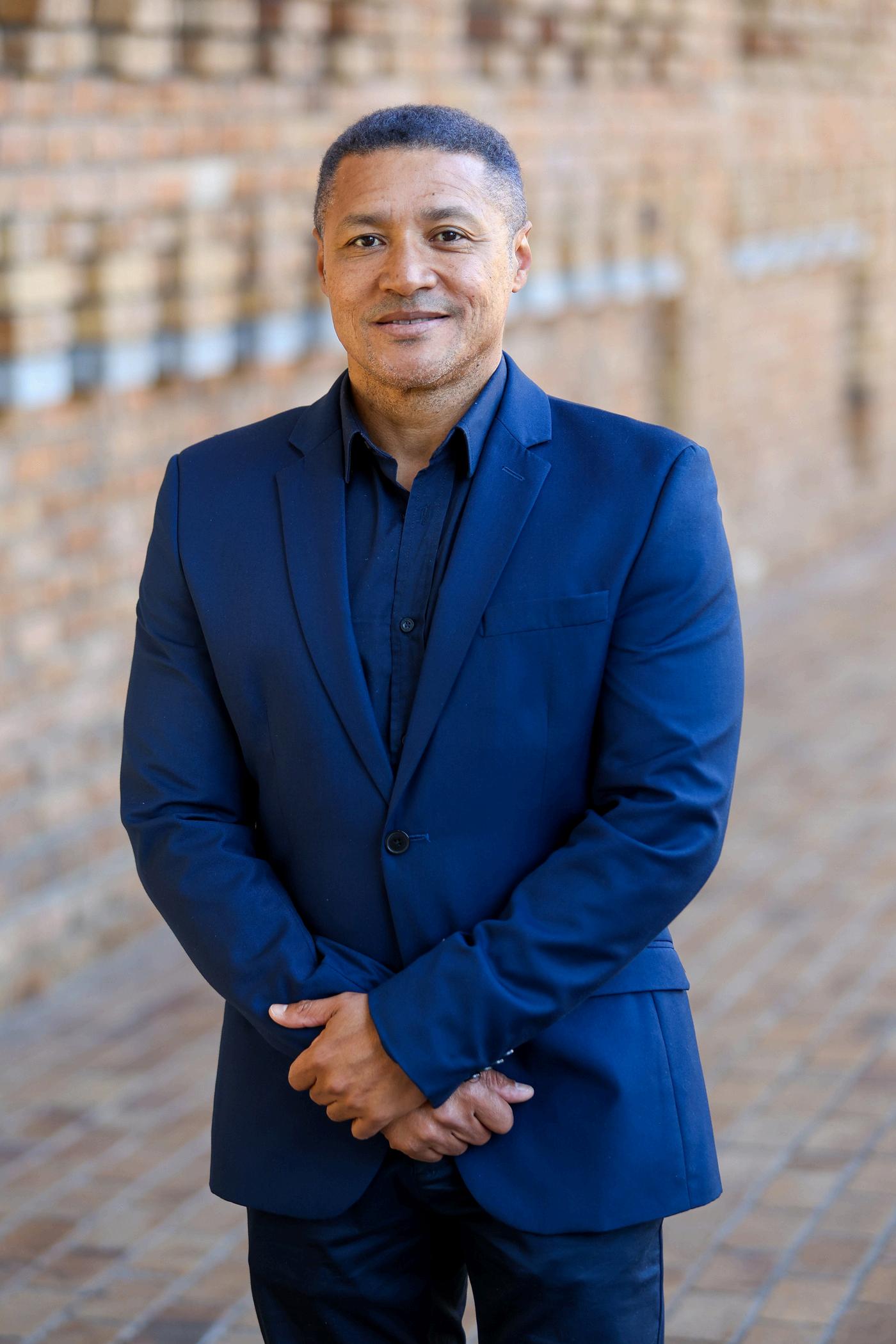
ABSTRACT
BIOGRAPHY
Prof Rouaan Maarman
Good afternoon, everybody. I didn't expect such a big crowd, given the showers of blessings we had earlier, but I'm appreciative of the moment and your efforts to brace the inclement weather and spend some time with us
Rector, thank you for your welcome. I appreciate that. I still feel that we should welcome you at UWC when we have events, your presence is appreciated Thank you to Prof Govender for introducing me and thank you to all the colleagues who are in attendance including the Deans of other faculties, I appreciate your time to share this moment with us.
I dedicate this lecture to the special people in my life, those closest to me for my whole lifetime. Especially my own core family, my wife Yolanda and my three children, who keeps me the person I am. So thank you. It's also Women's Month, month of August, so I want to add all the women of UWC to be part of this dedication
as I appreciate your efforts at UWC We have brilliant female leaders at UWC and I had the privilege of serving under two DVCs for the last 10 years, and had the opportunity to learn and grew in my role as deputy Dean, so I will forever be thankful for that.
My scholarly obsession and preoccupation is schooling in South Africa, especially in the democratic era So I grew up in the colonial and apartheid period and had to deal with the remnants of that in my young life. Currently I feel that we should keep dreaming in a democratic South Africa. We should never stop dreaming, but more importantly for me is that we should protect the dreams of our young people in our schools and this is where I'm coming from with this title. Freedoms are subjective, and each one of us interpret our freedoms differently, but
life worthiness for school children is non-negotiable In South African schools, we should ensure that our young people are exposed to an education that sets them up for a prosperous youth, prosperous early adulthood, and a prosperous life.
I want to touch on a few things; the colonial encounter as a dreamer, the affordances of my subject discipline, comparative education, confronting the neoliberal educational enterprise, the capabilities approach of Amartya Sen for interdisciplinary reasoning, and then I want to get to the thwarted promise of South African basic education and look at a few curriculum context dilemmas.
And I want to end off with life worthiness and educational agency.
This might sound a lot, but for me it is very clear My schooling ensured at a young age that everything in education is connected and whether I'm a language teacher, whether I'm a mathematics teacher, we share the same goals. Teaching at the university has opened up a world for me and in particular, the University of the Western Cape, where I was afforded opportunities to grow as a scholar and exposed to the best minds of our time. I see one sitting in the fourth row in the audience.
The colonial encounter as a dreamer.
I was exposed to the remnants of this growing up as a young child, even before going to school. I was fortunate that my parents were teachers, I believe. So I was exposed to an intellectual conversation of what it means to have intergenerational remnants of a slave history and being exposed to the hard edge of apartheid South Africa. Also, the intergenerational remnants of being exposed to a schooling of domination by others I therefore relate my title further to the magical consciousness phase of Paulo Freire, where we are all as youngsters are dreamers and in awe of
there are actually a lot of evil amongst us, and how are we now going to navigate that? That was my early life story. A point of interest here, in the middle you see the book The Super Afrikaners. That's a book that chronicles how the Afrikaner Broederbond, since the early 1920s, impacted the political direction of South Africa and therefore education in South Africa. Something very interesting, when I got to read this book, the real one, the one that you see there, I saw that in the back of the book was a list of all the signed-up Broederbonders in South Africa at the time I counted them 12, 13 pages of them. I found that my small town in rural Eastern Cape, Somerset East, has the fourth highest signatories to the Afrikaner Broederbond It was Johannesburg first, then Pretoria, then Bloemfontein, and then Somerset East. It was a shocker for sure. So if I get this back from the person I borrowed it to, I'm going to make copies and distribute it to social media so that people can believe me
However, it shaped my early thinking of what education should be as a youngster The schooling at the Cape for me was very interesting when I started to teach this at UWC many years ago and to reflect upon what is the life worthiness of schooling. So if you look at this you will see certain very important things that relates to life worthiness. Since the first official formalized schools in our country, the school curriculum was geared towards a post-school purpose This purpose was obviously the one that we know, the slave, colonial, and apartheid purpose. We all know that South Africa like commissions. We have commissions of investigation “weekly” in our country. So many years ago we had the first one in the official schooling system and the findings were very important; schooling was very poor, sporadic, fragmented and disorganized The farmers at the time and the slave owners didn't want their children to attend school because they didn't have to They are masters already Education was regarded as a private matter. And children only needed to read the Bible. These findings are important, because if we argue today about the class system in the South African society, many of these things are still true. The Great Education Act, I put that in inverted commas because it was not great, it was discriminatory was officially based on class size or school size, but under this act, schools were already organized according to racial lines. So it was not a great education act. It was just a big education act, because it did bring forth the rapid growth in school enrolment, as we can see at the bottom. That's a lot of learners enrolled in school in a short span
of years But all of this played off against the backdrop of a political system that had a sharp edge. If we look at this, this is what can happen in five years. The introduction of discriminatory laws against black South Africans to ensure that no freedoms are enhanced. To make sure that wherever you turn, there will be a law that manages you and guide you in the direction the masters have decided where you should go. This is however just a snapshot of that five year period. Of course, before that period and after that, there was a lot more discriminatory laws introduced, but I have to show that The first Carnegie Commission in South Africa was focused on white schooling, white education in South Africa and the findings brought the then apartheid government to intensify their oppressive agenda via education, the promotion of freedoms of white South Africans and the containment of freedoms of others. Few years later, we have the well-documented Eisellen Commission on Black Education, and we all know what that led to, but one of the findings, indicated that the education program was not part of the socioeconomic development plan for black South Africans. This speaks to the life worthiness of Bantu education that follows. Of course, if you have a particular philosophy of life, you have to afford your resources to that We therefore experienced the educational funding per learner in South Africa with a racial difference. If you move on a few years later, it got worse. So this led to something very interesting in South Africa, and that was the creation of white universities to accommodate these successful products of the system into higher education. So, it was the building of new universities as well as the expansion of existing white universities. I reflected upon this the other day and I thought, this is exactly where we are currently in South Africa, but in a different way So if you look at these universities and I had the privilege to visit some of them. Rand Afrikaans University, I hold a master's degree from them, I visited University of Pretoria , Nelson Mandela University, University of the Free State, I saw them all Their expansion of the 1950s, 1960s and 1970s is still visible physically in the architecture of those buildings. It was these grey concrete blocks that were used to suddenly erect buildings to accommodate white successful children into the university life
Some of these remnants of an oppressive pedagogy in our schools and our political system led to challenging experiences for learners and teachers in our schools There's a list of some, there are many others. Let me give you an example of the sanitized educational approach of mining in South Africa. My favorite subject in school was geography, and I studied mining in standard 9 and standard 10. The
geography textbook around mining was just a good story It was the story of how much mining contributed to the GDP of South Africa, how much gold we provide to the rest of the world, how much power the apartheid government could sway having all the minerals. A good story. The story did not touch on the mine workers at all. The story did not touch on the rights of the mine workers' families, the story did not touch on the mine workers' conditions of work, the story did not touch on the mine workers' conditions for example if there are earthquakes in the Witwatersrand, now called Gauteng area and the endangerment of their lives in general So, we have these remnants in ourselves as schoolchildren of the 1980s and had to make sense of it. However, we had to keep dreaming because we had to fight this and we are growing up Very soon we're entering young adulthood and needed the capacity to respond to this. One of the red highlights for me is the indicated teacher-pupil ratio which separated white and black academic performance in our schools.
This colonial encounter, in my view, stayed with me. Many years later, I published this out of my PhD, and it had to do with the processing of demographics and the processing of numbers in simple terms in an education system and surprise, surprise, in the beginning of this year I was contacted to speak about this very old article that I forgot I published, because South Africa today struggles with the processing of numbers in the education system, in particular the schooling system, but also in the university system So the colonial encounter for me is part of me I can't get rid of it However, I have to keep dreaming and respond in a certain way In my subject discipline, Comparative Education, we study education systems across the world and we do it in different ways. What you see there is a summary of the different phases of development of that discipline. My favorite will always stay phase two, even if it was decades and maybe centuries ago, the systematic data collection for analysis will always guide the comparativist to understand statistics I have to understand the trends of where basic education is going and what is changing, but mostly we nowadays operate in phase six and phase seven because we are now dealing with the complexity of life in the VUCA world. So I subscribe to the heterogeneity tradition in Comparative Education where truth in human experience is recognized I draw my inspiration from the works of the liberation heroes in my view, the people who have dared to dream under difficult circumstances. So, let's look at comparative education a little bit closer. In Comparative Education, we use the structure to look at the education system and I'm sure that all the learned people in
the room might disagree of how you should structure and organize the education system, and that is fine. The internal determinants, the historical forces that shapes an education system, what history has brought for us, the reciprocal nature of the different components and elements that we see in front of us and the educational nature are always there. That can't change. However, the external determinants are where we focus on more currently. So the philosophy of life, how the political tradition and the political dominant politics of the day, practicing of politics, and in my case, socioeconomics That is what I'm obsessed about Poverty is important for me because poverty is part of me. Poverty is important for me because it is, according to me, one of the biggest indicators of academic success in schools. So, if you look at the statistics in South Africa, we are a poor nation and if you look at the nutritional needs indicator, we are a very poor nation and hence, we have to protect the dreams of our children. In basic education, we do not have a choice.
We accept and we know in South Africa that poverty is highly racialized and we also accept how the government look at poverty. However, in Comparative Education we look at poverty very differently So for us, it's all about the human experience within these indicators. So we look at relative poverty and subjective poverty and how that changes. We accept that it is temporal and contextual and it is time-bound. So if you look at the snapshot of social grants of South Africa and there's a reason why I'm throwing certain stats out, we see that almost 20 million South Africans are on social grants in our country, also very highly racialized We have different categories of these social grants and we are adding more as time goes on. For me, in terms of basic education, some indicators tell us that things are not okay. That the life worthiness of the whole basic education experience is questionable and that our care for our youngsters within this system, where we have that mandate to do so, is problematic So yes, we are hungry and we are angry in South Africa I deem myself fortunate to work at university who doesn't run away from this reality If you look at what happened, and this will be my last statistics on poverty, if you look at what happened during the first year of the pandemic in the red highlight, the increase in basic food over just a few months, over six months in South Africa. That is despite our existing food poverty before 2020 We can argue that our poorest citizens in South Africa use these food groups to base their basic needs on.
Let's go to Amartya Sen that I'm very passionate about He affords us with a different thinking about poverty. His economic philosophy revolves around the human
condition, first and foremost, and not around welfarism or an economic system He draws from economic philosophers like Karl Marx and builds his work on that of John Rawls, an important figure in welfarism. His reading, or his work in 1971, A Theory of Justice, is the one that really sparked a global debate on welfarism and also on economic philosophy. He argues that the greatest equal liberty principle takes priority, followed by the equal opportunity principle, and finally the difference principle. Also meaning that social and economic inequalities are to be arranged so that it is of the greatest benefit of the least advantaged in society If we use his thinking, we can argue that apartheid and colonial funding means that white South Africans at the time had six times more opportunities to pursue their real freedoms. Amartya Sen in his response, although building on the Rawlsian theory, raised concerns over Rawls's emphasis on primary social goods and he argues in his work, Inequality Re-examined, that we should attend not only to distribution of primary goods, but on how effectively people are able to use those primary goods to pursue the goals they value, what's important for them, putting the person in the centre of the economic experience. He criticizes the contractarian tradition of poverty alleviation and social justice at the time These are the 1970s and late 70s Sen further criticizes Rawls' overemphasis on institutions as guarantors of justice and the lack of emphasis on human behavior within those institutions to maintain, and I want to add, to promote a just society So Armatya Sen therefore positioned himself squarely in the paradigms of rationalism and critical theory. Hence, me being a fan.
So, let's look at the capabilities approach shortly. It's a framework for assessing well-being and development by focusing on individuals' capabilities to achieve valuable beings and doings It is very personalized and individual Emphasizing the freedoms and opportunities individuals have to live the lives they value, it will thus differ from person to person, that's important to note. There's a recognition of individually valued opportunities and group valued opportunities, the recognition that needs, interests, and desires are temporal and contextual. Those are some of the intellectual tools, Sen puts forward as he applies this to argue about the transformation of societies. So, we all have capabilities, our own interests, dispositions and talents. There is however a recognition that transformation should take place somewhere to translate those into achievements and into functions and that there are capability sets to view and analyze this work for example capability sets like individually valued opportunities, spatial differences, systematic group
contrast, and so forth.
What I do or try to do, is to use effective reasoning in order to reason about what are the real freedoms that's afforded in a particular context. I also use evaluative reasoning, which refers to the development of free agency. So real freedoms and free agency in basic education is what I investigate
I want to get to the thwarted promise of South African basic education. And I'm not going to do an analysis of the CAPS curriculum, but I'm going to put the CAPS curriculum in a particular context and present the voices of the people. So, for me, there's an overall let-down of the democratic basic education system. There's disappointment We have an average of one million matriculants in the public system and 750,000 of them pass matric. The national university is around 200,000, the average TVET uptake is 240,000. So we still have an average of 560,000 young people on an annual basis completing matric without an educational direction (formal or informal) and that presents us with a problem I therefore question the life worthiness of such a system.
The other aspects relating to this thwarted promise is the racialized school performance in South Africa. None of us should be able to sleep at night while still have these 30 years after democracy. The misalignment between basic education, higher education and the economy, the two public schooling systems in one so-called democratic system, the lived experiences of learners and teachers, curriculum strength and of course the life worthiness of schooling all feed into this thwarted promise
Just some statistics on the TVET sector In the second column, we see the total number of students registered for exams for those years, but in the third column highlighted in red, we see the number of students in the TVET sector completing their studies It's around 20% to 25% If you look at the NVC level four off the third year, we see it's around 50% completions. So, although we take up around 240,000 TVET students on an annual basis, only a fraction of them complete within the time. So it leaves us once again with the question of the life worthiness of the system. In 2010 we had a commission into school dropouts in South Africa. They found the prominent in-school factors as overcrowding, the culture of the teaching and learning in those schools, the lack of extramural stimulation as significant factors. The prominent out-of-school factors, were poverty (which is my interest), poverty at home, poverty in my community, household dynamics, lack of parental supervision
and transport to school That's 15 years ago Let's look at the 2020 case We found the same trend still persisting. So, by November 2020 (acknowledging it was the start of the pandemic) potentially 300,000 primary school learners dropped out over six months of schooling, the Department of Basic Education's own statistics. A year later, still 650,000 school-going children out of the 13 million were not back in school, hence in South Africa we drop out quickly, and we drop out in big numbers. So that is a backdrop to the thwarted promise.
Let's get closer to the class issue where Amartya Sen is adamant that if we do not practice evaluative and effective reasoning when we look at freedoms, understanding free agency and real freedoms of school learners, we will find ourselves hampered to respond to the realities in the basic education sector, for example, the continuation of the two public schooling systems in “one public system” I offer these examples which are not extreme cases, but the norm in public schooling. So let's look at school X. If you are high school and you have around 1,400 learners, the Department of Basic Education will afford you 41 teachers. Line number one is easy to understand, but look at line number two. If you have money in South Africa, you can appoint your own teachers in that school up to 30% more teachers That changes the lived experiences of learners and teachers in those schools As a country, we have to decide, where do we want to go with this? Is this acceptable for a democratic country? It therefore plays into all the other lines that you see. An important one is line six, where some young people in South Africa have the opportunity and the privilege to choose between 14 subject combinations in high school and others don't These others, the school-Ys, are the 85% of young people in South Africa. We are thus not promoting their freedoms.
students (these are third year students coming out of the arts faculty with geography one and geography two), I give them a grade six map work test, a standard four map work test, posing questions like what's the name of this ocean? what's the name of this continent? what's the name of this river? what's the largest river in Africa? what's the name of the longest river in South America ? etc. It's grade four mapwork. I gave them this test every year because I know this is going to happen. They're going to fail it dismally. These were my own students, which I love very much, but I had to do this to them when they enter my classroom. What is interesting to note is that these students came from different urban and rural schools, different provinces, different races, different genders, etc a representative sample of the grade ones of 1995 to 2005 of their decades. So how is it that they are struggling with this? We then went ahead in class to problematize this phenomenon.
What might be the reasons for the dismal state of affairs? Because I was arguing with them, how can I remember my grade six map work of 35 years ago, 40 years ago, and you can't remember it, while you were in grade six just, eight years ago So, was it the teachers who taught them at that level? Were the teachers the problem?
Was it the culture of learning in their schools? Was it the heads of departments of geography in the schools?
Was it the school principals' leadership in those schools?
Was it the background of the learners?
What is the curriculum of the textbook, the geography textbook nowadays? What is the overall CAPS curriculum? Were there problems there?
Let's look at what some of the teachers are saying. The teachers are saying that they are subject to a bureaucratic testing regime in our primary and high schools, meaning that they have to survive in these schools and they therefore revert to teaching to the test more than teaching to learn. We know at university that teaching to learn is the way to go. That's what we do, but unfortunately, it's not the case in basic education It raises the question again of the life worthiness of the schooling system altogether. However, I find it strange that there are not more voices rejecting this outright, because this is what should happen.
Let's go to curriculum strength, I had the privilege at UWC to teach method of social sciences some years ago and what I did in my very first lecture when I meet the
Because it didn't make sense. How they performed in a grade four mapwork class test. I put the question to them and I gave them space to debate around this issue and surprise, surprise, some of them would say that yes, your education was better in the 1980s than ours in the democratic era, but it was them saying it, not me. I wanted to show this example because it's a real example that happened in our classrooms here at UWC and it's an example that speaks to curriculum strength of the current school curriculum
Then with some of my other classes, I would do the same I would say, reflect on your teaching practice and choose a topic to do a research proposal on in your final
year, before you go to school Most of them were running to one problem, the learners cannot read in the schools. It was given only based on their teaching practice experience, which was limited, but nonetheless, all these learners over all these years felt the same about the problem. They argued that within the reading problem, lies the solution to everything. If the learners could read, then they would be able to learn better. We posed the same questions to them, just to stimulate the intellectual conversation in class. I would ask them, Is it just the teachers who do not read with the learners every day? Teachers are given two language periods a day. It's ten a week. Ten hours a week. Is that maybe the issue? So yes, I had to go out and find out from the teachers themselves and represent their voices. Their voices matter to me as I attempt to apply effective reasoning.
In terms of our free agency developed amongst learners on how to read, how to develop reading and learning in schools, and also evaluative reasoning Is the reading curriculum taking them to real freedoms, to be able to read freely? and the teachers said, well, we have this problem, we have a dilemma in front of us It's not so easy and simple The CAPS curriculum asks from us the following; in a two-week cycle (with 10-yesr olds), we have to focus on listening and speaking, reading and comprehension, writing, exercise, and language structures, but we have to add synonyms and antonyms, punctuation, question marks, exclamation marks, inverted commas, and so on. Spelling, indirect and direct speech. Adverbs, idioms, cardinal words, ordinal words, all in the two-week cycle. So, the teachers themselves say that the sequencing of language topics in the curriculum is limiting the ability to read and to develop language skills. They prefer a different approach as they added that they are teaching this in large classes, from the foundation phase onwards, and therefore we have to resort to teaching to the test to be safe and not to be labelled. Furthermore, we sit with a progression policy, even in primary school, that states that you can only fail once in a phase, and then you have to be promoted to the next grade Then it's expected from us to attend different meetings on a monthly basis Let's pause that and let's go further What are the teachers saying about classroom factors limiting their freedoms? Applying this reasoning in my work has to do with looking at the real freedoms Going deep into the conversation to understand what is really happening in a school classroom So the teachers are saying the CAPS curriculum is too bulky, the time limitations are threatening their completion and they
teach in under-resourced classrooms Questions need to be raised about this in terms of the resource challenges and why we are accepting overcrowded classrooms in a democratic schooling system? Classroom size is the first determinant in academic performance in this province of schools. When the results of the Annual National Assessments were presented to us the Western cape Education Department themselves indicated that classroom size is the first significant determinant.
We asked the teachers what are the school factors limiting their freedoms to teach what they value They responded that there are unnecessary interruptions almost 30% of the time. There are also too many meetings which take them away from actual teaching. I want to highlight the voice of a very young teacher that we interviewed. The teacher said, “I'm already qualified at university. My head of department is enough to support me doing my work. I do not need the deputy principal, the principal, and the subject advisor to show me how to do my work That is three reporting lines too many, taking me away from my teaching, what I was supposed to do”.
Let's look at what the teachers say are the out-of-school factors limiting their freedoms to teach what they value. And this we know because we know our country. So we accept poverty is our reality, but we should not contribute to poverty creation of the youth We teach about substance abuse and literacy in schools, but we don't teach about poverty in schools. We don't teach about crime in schools. We don't teach about parental involvement in schools. We have to ask the questions, what should be included in the school curriculum to enhance its life worthiness in this context that we live, in our reality?
Therefore, we wanted to respond somehow, and we made certain attempts and yes, the uptake was very well, I must say. Whatever we said in our faculty about our views on the real freedoms in the basic education sector was taken up well by South Africans. So it is topical. It is something that people want to engage with. We have put out these 10 PhDs under my supervision using the capabilities approach to look at the real freedoms of learners and teachers in the basic education sector. These are not the titles, these are the issues that came out of it.
So the pro-poor policies, that is where you start We start with policy You would remember the first column on the structure earlier. We problematized the progression policy in schools. We looked into the gender and inclusive policies of our neighboring country. How Marxism can shape higher education, the nexus of the school leadership and teaching to learn, the national development plan and its relevance for curriculum improvements in our schools, the nature of support for TVET students, the models of mentorship for beginner teachers, the voices of teachers in the quality education discourse, the freedom of teachers to teach what they value. We are proud of that work because it has been produced in our communities, in poor communities, in Quintile I and II schools It has been produced with the teachers of those schools and the parents of those schools I regard this publication as a seminal work Post-PhD, I had to decide what do I want to do with my academic life? I decided I'm going straight into the informal settlement where I belong and look at their schooling experiences, talk to their teachers, and decided that this is the time where we have to create a voice for the learners in informal settlement schools in South Africa. Yes, it was a particular contextual area, but it had to deal with getting out what we are experiencing while most are looking the other way.
We further engaged the National Planning Commission and we executed a survey (2018) in the Western Cape Province with the grade 12 asking them a simple question: "Do you know whether South Africa has a national development plan?" Only 6% at the time were aware that their country had a national development plan while they are standing on the verge of young adulthood and leaving school. So we engaged the National Planning Commission on that, publicised the results widely and engaged the media to drive the issue during youth month of 2019. This state of affairs raises the question, of what are our learners learning in the schools in terms of citizenship? What is the curriculum affording them to create and to think about their futures?
If we look at the general aims of the CAPS, we find that it is noble We find that it is forward-thinking We found that it is liberal in nature It is really, if you read it, it is
really something that we can aspire to and what we should do However, there are some questions about this CAPS curriculum, if we apply evaluative and effective reasoning.
1) So far, it has produced racialized school performances and we are faced with this contrast. It is practiced in a rich-poor school environment, which goes against democratic principles which is the underlying philosophy of the general aims of the CAPS.
2) It is practiced in overcrowded classrooms.
3) It is practiced in an illogically sequenced layout of a teaching plan, especially in languages and in mathematics in primary schools.
4) A mark adjustment practice is applied to satisfy target setting policies of these aims.
5) There are clear curriculum strength challenges that we are all aware of
6) It is practice in a discriminatory language of teaching and learning policy because in South Africa we expect 85% of our nine-year-olds to switch to a foreign language in a year's time
7) It is practice within an overbearing testing regime
8) It is practice in a teaching to test methodology mainly.
9) It is practice in an over bureaucratic system of compliance.
So as South Africans we have to make sense of this.
We have the aims written up in the curriculum, but we have these outcomes for the majority of young people in our country. So how are our learners and teachers supposed to pursue the growth of their freedoms in such a curriculum context? This is the real curriculum space, not the one written on paper.
So let me take you to my final thoughts. I thus argue that the very aims of the caps are undermined by a political position that does not acknowledge and promote real freedoms in the very system that should promote it. That is where our young people should learn about their freedoms. That is where they should develop the confidence to build their own freedom space That is where they should generate free agency
I'm of the considered view that epistemological excess is hampered and that epistemic violence reigns in our poor school communities I argue that there is an educational quietude in terms of the impact of learners' backgrounds on their
academic growth in our schools I argue that the caps have been handed over to bureaucrats to keep order over our schooling experience and not to enhance the real freedoms of our children. Classrooms should be places of courageous intellectual encounters for all, not only the privileged few.
In the words of Amartya Sen, we are thus still stuck in a pseudo-transformation phase to realize the dreams of all our children, not only the privileged few. I therefore believe that Comparative Education provides intellectual tools to confront neoliberal constructions in education and that Sen helps us to reason deeply about real freedoms so that we in education can continue to protect and promote the dreams of our children in the wishes of Karl Marx, Frantz Fanon, Mangaliso Sobukwe, Paulo Freire and Steve Biko. Those were the dreamers before us. I want to stay dreaming with them.
In his memoirs, Amartya Sen wrote this. “When he was 18 years old, he diagnosed his own cancer. Not long after he had moved to Calcutta for college, he noticed a lump growing inside his mouth. He consulted two doctors, but they laughed away his suspicions So Sen, then a student of economics and mathematics, looked up a couple of books on cancer from a medical library. He identified the tumour, a squamous cell carcinoma and later, when a biopsy confirmed his verdict, he wondered if there were in effect, two people within his name A patient who had just been told he had cancer, but also the agent responsible for the diagnosis. I must not let the agent in me go away, Sen decided, and could not, absolutely could not, let the patient take over completely”
I thank you.
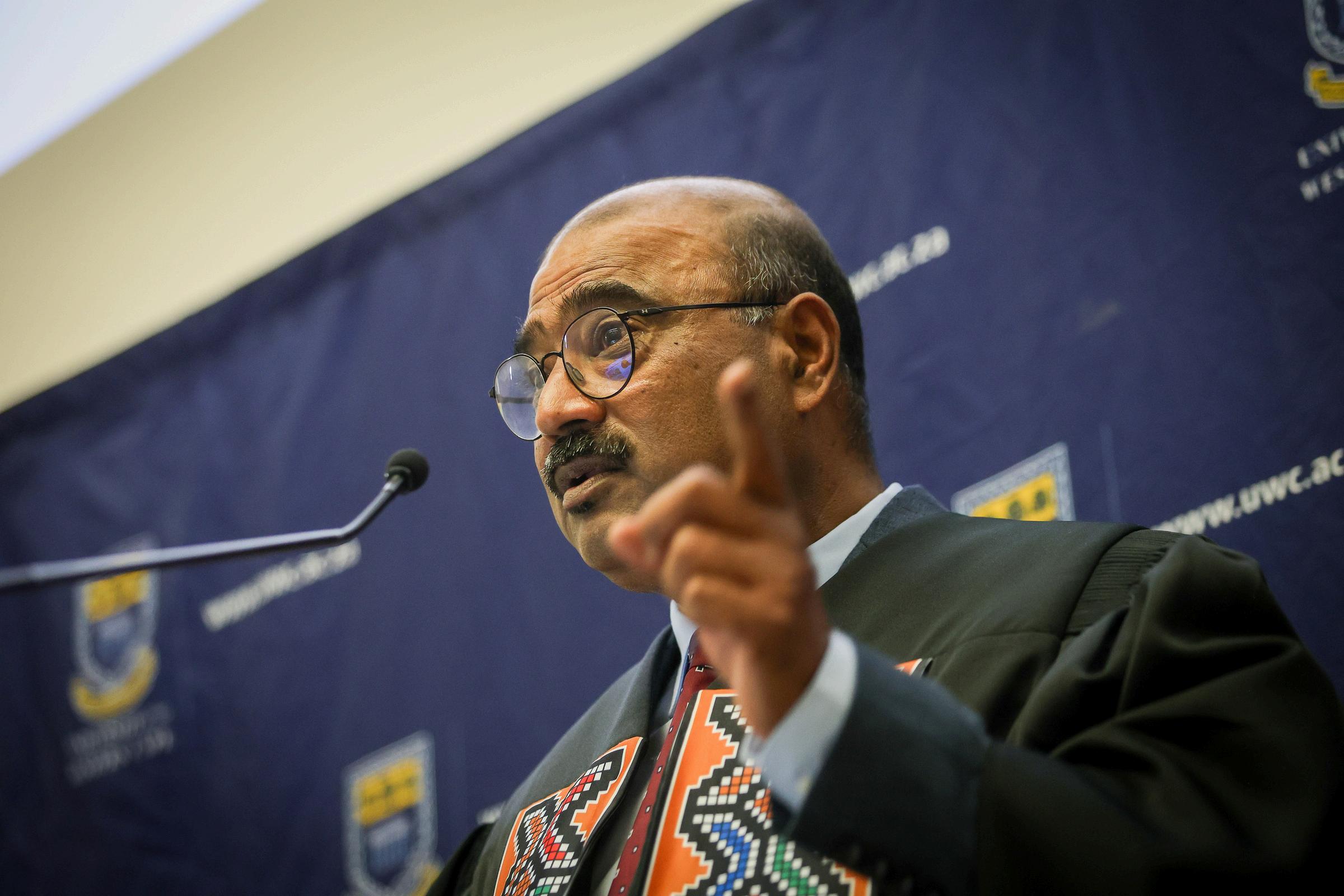
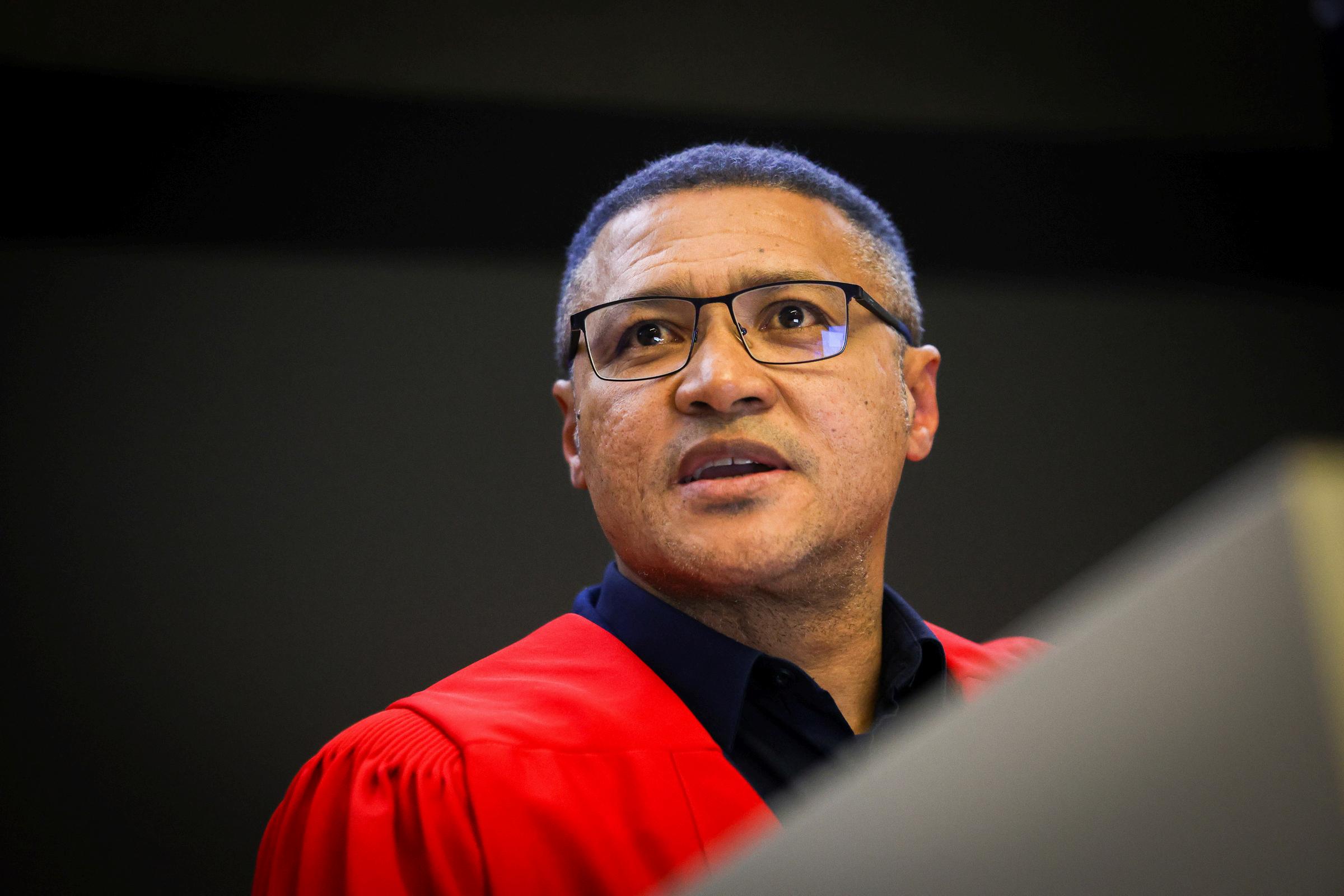
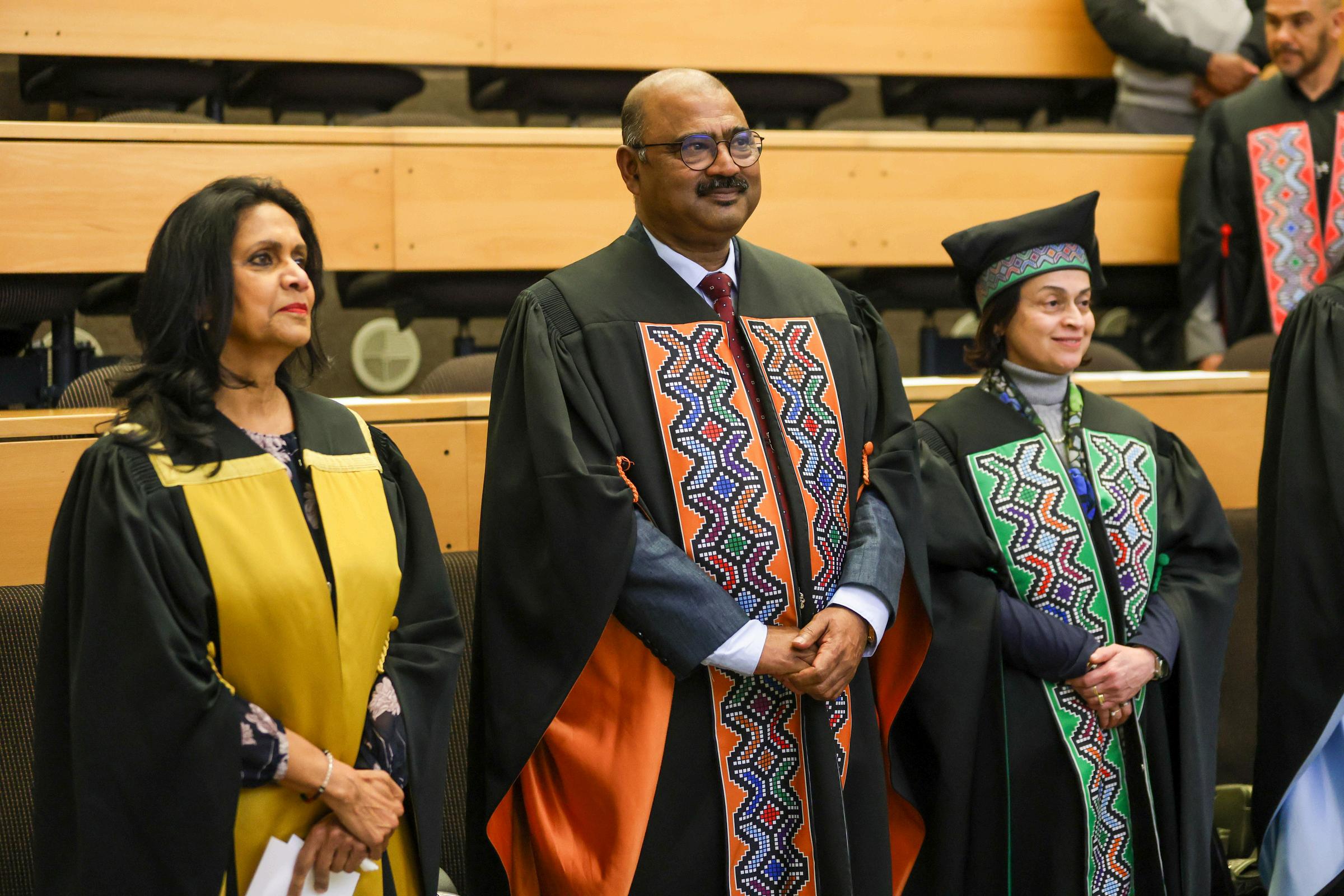
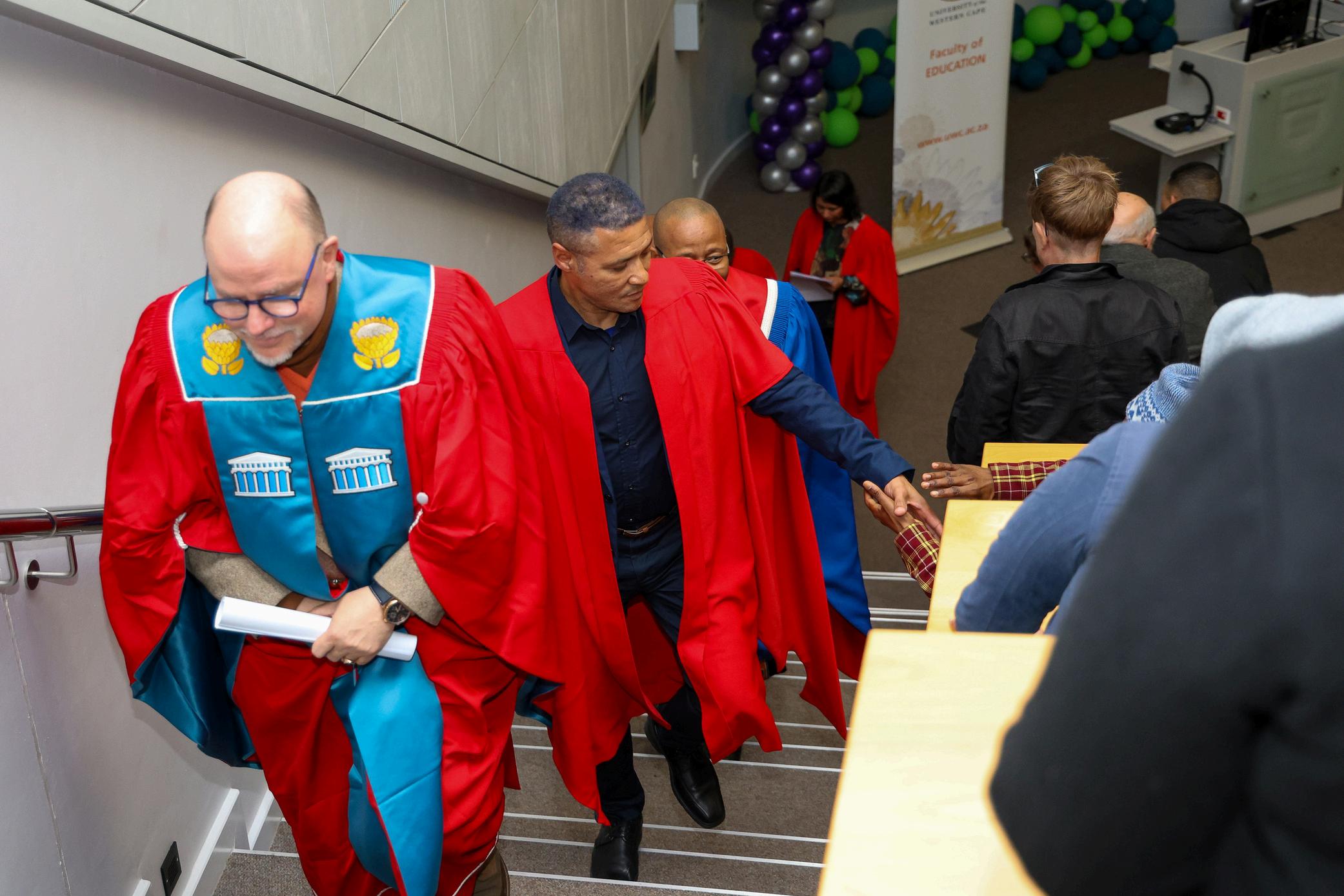
ProfessorAnthonyDiala
ProfessorJohn-MarkIyi
TheFoundationalValuesofIndigenousLawsastheFrameworkforAfricanCommonLaws
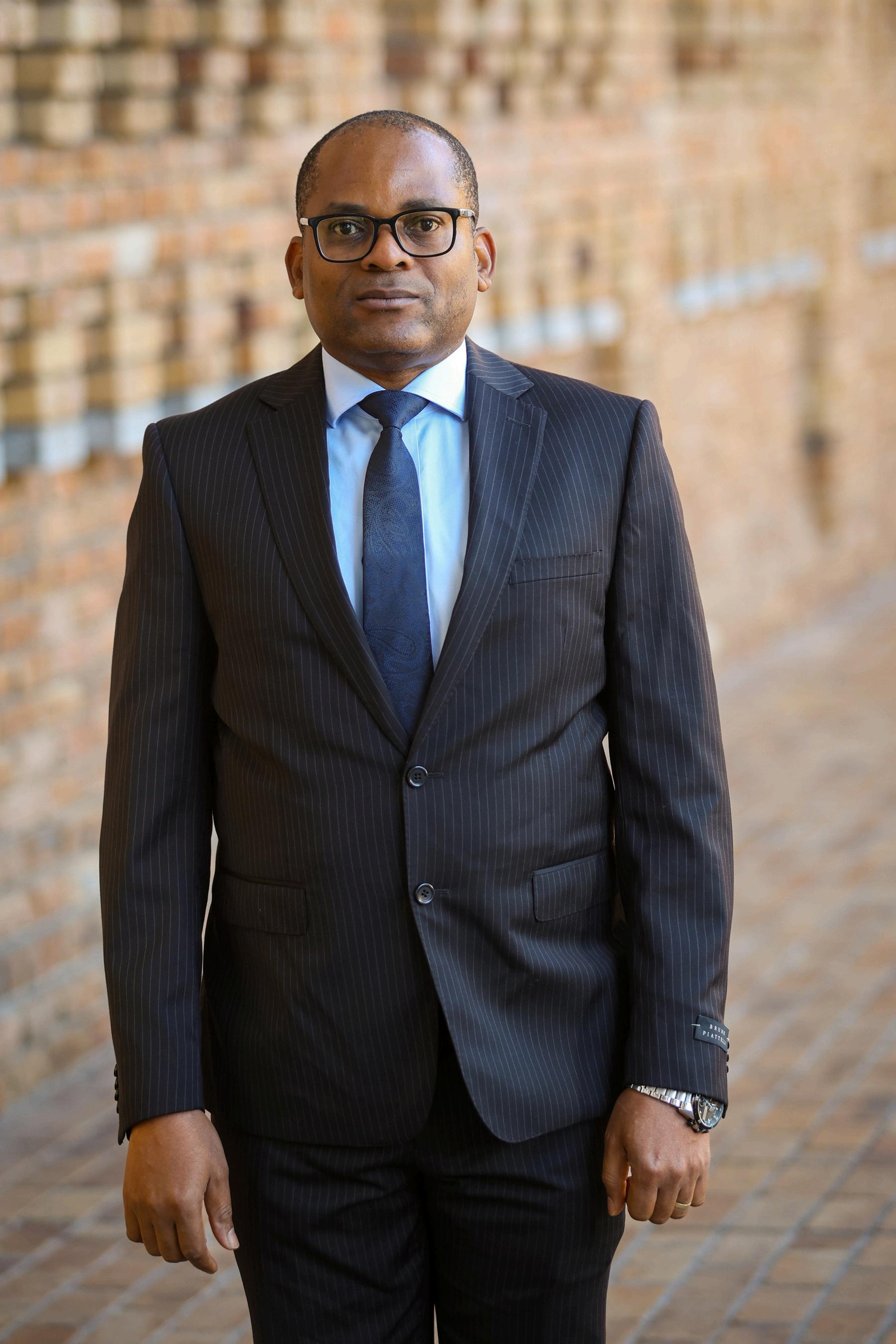
ABSTRACT
BIOGRAPHY
Prof Anthony Diala
The Deputy Vice Chancellor (Academics) Professor Monwabisi Knowledge Ralarala,
The Dean of the Faculty of Law, Professor Jacques De Ville,
The Dean, Faculty of Community and Health Sciences, Professor Maria Florence
The Dean, Faculty of Natural Sciences, Prof Fanelwa Ngece
The Dean, Faculty of Education, Professor Rouaan Maarman
The Dean, Faculty of Economic and Management Sciences, Professor Michelle
Esau The Deputy Dean (Research) Faculty of Arts, Professor Johnathan Jodamus
The Deputy Dean (Research & PG Studies), Faculty of Law, Professor Benyam
Mezmur The Acting Deputy Dean (Learning & Teaching) Faculty of Law, Professor Lea Mwambene The Head of Department, Private Law, Professor Sue-Marie Viljoen
The Head of Department, Public Law and Jurisprudence, Professor Yonatan Fessha
The Head of Department, Criminal Justice and Procedure, Professor Windell Nortje
The Head of Department, Mercantile and Labour Law, Professor Riekie Wandrag
Colleagues, students, friends, and relatives, thank you for your presence this evening
Europe’s colonisation of Africa is the most significant event in the history of African laws. Between the 15th and mid-20th centuries, European powers such as Britain, France, Germany, Portugal, Spain, Belgium, Italy, and the Netherlands imposed their way of life on Africa 1
They formalised the Scramble for Africa during the infamous Berlin Conference of 1884-1885. They officialised their own languages and marginalised the indigenous languages of Africans. They overrode indigenous legal systems with European laws and governance structures. They created new systems of work and education that privilege(d) Eurocentric worldviews. They introduced new religious beliefs and cultural practices, which centred European values. They established their own values as moral standards for judging ‘primitive’ indigenous laws. They taught African people to view their indigenous cultures as inferior to European culture. They created arbitrary borders and amalgamated disparate communities into nation-states. They alienated Africans from their indigenous knowledge, thereby creating cultural identity struggles. Despite the Universal Declaration on Human Rights and the adoption of international human rights treaties, formal colonialism continued until the end of the 1980s. 2 3 4 5 Colonialism aimed primarily to exploit Africa’s rich natural resources to fuel Europe’s economic growth following the Second Industrial Revolution While an account of 6 this motive is important for understanding the legal systems foisted on African states, I focus on the impact of colonialism on African laws The comparatively short period of colonialism left an enduring
impact in Western knowledge hegemony, economic dependency, confused cultural identities, ethnic conflicts over redrawn borders, and poor loyalty to nation building By imposing their laws, values, religion, technology, forms of education, work and economic systems, Western Europeans basically moulded Africans into their own normative image This moulding of indigenous behaviour underscores the impact of colonialism and the poverty of policy responses to conflict of law problems plaguing the interaction of legal orders in Africa. I therefore propose adaptive legal pluralism and the foundational values of indigenous laws as the framework for the 7 development of African common laws.
Following this introduction, I discuss the phenomenon of legal transplants, which is the aspect of colonialism with the most enduring impact on legal systems in Africa. I focus on how colonially imposed laws shape(d) the interaction of normative orders. Thereafter, I explain how indigenous laws are threatened by universalist ideas of ‘proper behaviour,’ which manifest in norm-killing law reforms I go on to describe the foundational values of indigenous African laws These collective beliefs about (in)appropriate conduct illumine the agrarian origins of indigenous practices and explain the incompatibility of many indigenous norms with modern conditions. I proceed to foreground these values in the theoretical framework of adaptive legal pluralism, which I offer as the panacea for conflict of law problems and dissonance between traditional and modern lifestyles I suggest that if properly ascertained, these foundational values could form the groundwork for the development of common laws in African states.
Generally, legal transplants denote the partial or complete transfer of legal rules, principles, and systems from one jurisdiction to another. Ordinarily, this transfer is supposed to be voluntary However, this was not the case with colonial legal transplants to Africa The Europeans imposed their own homogenous legal systems over indigenous African laws This is significant because Africa is a culturally very diverse continent with approximately 490 ethnic groups and over 1,500 distinct languages For example, Angola alone has 42 languages Thus, Africa is characterised by a rich tapestry of beliefs, languages, traditions, and customs.
9
Such a high level of diversity implies that norms would differ from community to community. Yet, in most parts of the continent, Western Europeans imposed one 10 of two legal systems that differed radically from indigenous systems. These two systems are briefly discussed below.
The Civil Law system has Roman-Germanic roots in the old Roman Empire, particularly the Corpus Juris Civilis compiled under Emperor Justinian. Later, imperial powers such as France, Italy, and Belgium spread it through conquests. Civil Law is primarily based on codified statutes and legal codes Examples include the Napoleonic Code in France and the German Civil Code These codes systematically outline relevant rules governing legal areas such as contracts, property, torts, and family law.
Civil Law systems often use an inquisitorial approach in court. Here, judges take an active role in investigating facts, questioning witnesses, and gathering evidence. They do not rely solely on adversarial arguments from advocates. Unlike the Common Law, which favours judicial precedents, Civil Law judges primarily apply the written law in codes, statutes, or constitutions. Precedents serve as mere guides. Judges act as investigators and interpreters of the law, applying the relevant code to
the facts of a case In comparison with Common Law judges, they have less discretion to create law, since their role is mainly to enforce codified rules. There is a sense in which the Civil Law is the most widespread legal system in the world. It is used in much of Europe, Latin America, Africa (especially Francophone), and some parts of Asia. It has significant influence in southern Africa because the Roman-Dutch Law blends elements of the Civil Law with Dutch customary law that developed in the Netherlands during the 16th to 18th centuries. The Roman-Dutch Law combines the structured, codified principles of Roman law with the customary laws of Germanic tribes and Dutch legal traditions, which people in the Dutch Republic blended with their local norms and beliefs to create customary/common laws. The Dutch then imposed these unified laws on their colonies, primarily through the Dutch East India Company and the Dutch West India
11 Company. As I show below, a similar thing occurred with the Common Law system.
Rome was the dominant power of the ancient world for over five hundred years (Jolowicz & Nicholas 1972) For 367 years of this period (AD 43 to AD 410), the Romans imposed their normative system on Britain Following the end of Roman rule in Britain around the year 410, Germanic-speakers began to infiltrate and occupy Britain from the middle of the fifth to the early seventh centuries. They eroded the influence of Roman law in favour of customary law, ultimately establishing an AngloSaxon cultural identity (Higham & Ryan 2013). After the Norman Conquest of 1066, law in Britain was a motley mass of half tribal, half feudal and often conflicting customs. Ultimately, indigenous English customs adapted to the laws imposed by the Romans and the Normans to produce the English common law. The British then exported this normative system to North America, Asia, and Africa.
Substantively, the Common Law tradition was developed by judges in England through an adversarial process in which disputes were resolved after the opposing parties presented their arguments.
This process gave law a dynamic character that adapts in response to societal changes and new circumstances. Nevertheless, the Common Law system relies heavily on the doctrine of precedent (stare decisis), where past judicial decisions guide the handling of future cases to ensure consistency and predictability in judicial interpretation. It applies in most former British colonies, many of whom eventually blended it with their indigenous laws. This blending process is crucial for understanding the emergence of African common laws.
Colonialism created the interesting marvel of legal pluralism in Africa, characterised by the co-existence of transplanted laws with indigenous laws and religious norms from Islamic and Christian influences. Scholars define legal pluralism as the interaction of normative others within a population or social group It is considered ‘deep’ or ‘strong’ when non-state normative orders do not depend on the state for recognition of their validity
12
13
According to Rautenbach, deep legal pluralism essentially means that the state does not “incorporate cultural or religious forms of non-state law into state law ” On the 14 other hand, legal pluralism is ‘weak’ when normative orders within a state’s field of jurisdiction are acknowledged and, in varying degrees, incorporated into the state legal system. Irrespective of whether it is weak or strong, legal pluralism 15 challenges the traditional idea of law as solely emanating from the state or something whose existence is dependent on the centralised authority of the state.16 Legal pluralism is special in Africa not just because customary practices feature in majority of disputes but because of how colonially imposed laws regulate(d) indigenous laws. To be clear, legal pluralism is shaped by interlinked historical phenomena. In recent order, the major ones are globalisation, European colonialism,
the transatlantic (slave) trade and religious crusades.17 Also, normative regulation was shaped by the systems of political administration imposed in African colonies For example, the British used indirect rule policy to co-opt traditional leaders into political administration while subordinating indigenous laws to the English legal system In effect, this policy allowed their subjects to keep using their own laws and dispute resolution mechanisms, subject to appeal to Western-styled courts that retained overall control over indigenous courts. The French used the doctrine of assimilation, which, rather ambitiously, aimed to replace indigenous laws with French norms. On their part, the Portuguese and the Belgians enforced highly centralised, bureaucratic legal systems with little regard for local autonomy. The double system of political administration found its way into the courts.
The colonisers set up a dual system of adjudication. At the informal level was customary or native courts presided over by local chiefs, elders, or other officials appointed by the European colonisers. These courts operated with indigenous norms, which varied widely across ethnic groups. However, their jurisdiction was confined to private or family law issues such as land, property, inheritance, succession to traditional leadership, and minor criminal offenses Their procedures were informal, oral, and community-based As much as possible, they emphasised reconciliation over punishment Appeals from these courts went to European styled courts known as magistrate courts, district commissioners’ courts, high courts and supreme courts
Together, they constitute the second layer of adjudication. This second layer comprised courts modelled on European legal systems They were staffed by trained legal professionals, who were usually Europeans or European-trained local collaborators They exercised jurisdiction over public matters – that is criminal and civil cases involving Europeans and Africans living in urban areas These formal courts applied European laws, which eventually became formalised as statutory laws Importantly, they used European values. As discussed below, these values became known as the compatibility or repugnancy test. The dual form of colonial administration created three categories of African laws.
19
The first category is statutory laws. Generally, these denote the rules enacted by national, provincial, and municipal legislatures, including governmental regulations. In Africa, statutory laws are actually remnants of colonially imposed European laws, as well as adaptations of these laws to local circumstances. They include every written law and non-indigenous legal principle ranging from constitutional bills of rights to land laws, marriage laws, commercial laws, and criminal procedure rules. The most notorious statutory law is known as the repugnancy test The repugnancy test is a judicial evaluation standard that prohibits courts from enforcing customs that contradict natural justice, equity, and good conscience, or that are incompatible with a statutory law Europeans used this test to compel indigenous behaviour to conform to
20
Western notions of justice and morality. It is criticised for using foreign standards 21 to assess indigenous laws. In any case, ‘natural justice’ and ‘morality’ are highly 22 subjective and poorly defined terms, leading to inconsistent interpretations by judges. Thus, colonial authorities abolished or delegitimised cultural practices that 23 they deemed ‘primitive’ or ‘dangerous ’24
Examples of the repugnancy test are Zambia’s Local Courts Act, Nigeria’s Evidence Act and customary court laws, and South Africa’s Law of Evidence Amendment Act
Even though South Africa has replaced the test with a 25 26 constitutional Bill of Rights, the regulatory philosophy of the repugnancy test remains. Simply put, this philosophy holds that Western values are better than indigenous values. In this context, statutory laws are the most important of the socio 27 economic changes caused by colonialism. This is because of their pervasive impact on the normative behaviour of Africans and their standardising role in liberal law reforms. I explain this claim with a brief account of the nature of indigenous laws.
Indigenous African laws are pre-colonial norms that emerged in agrarian social settings with the primary aim of promoting the welfare of the clan. Typically, these norms were (and still are largely) unwritten, transmitted orally through generations, and interpreted in a flexible and
highly contextual manner. This is in contradiction with the rigid, rule-minded way customs were interpreted by European authorities Family wealth was produced communally through group activities such as subsistence agriculture, hunting, and craftwork Property consisted of basic goods such as communal huts, mats, farm 28 implements, weapons, and items of personal adornment Importantly, indigenous laws prioritised communal rights and responsibilities over individualistic claims 29 For example, land was a communal resource available to clan members, with individuals having user rights based on their membership in the clan or lineage.30
The family head, who was usually the eldest male member of the family, performed spiritual, political, and military roles. He oversaw the use of land for the overall 31 interest of all family members. Married women were cared for within the welfare 32 system of their husbands’ houses. In the rare event of divorce, they returned to the care system of their fathers’ houses. With no individual income, there was an 33 insignificant notion of individual property and even a lesser notion of matrimonial property rights. These features are important for understanding why tensions arise 34 between indigenous practices and the human rights components of statutory laws. Colonialism changed indigenous laws by imposing European laws and values on Africans While indigenous laws govern private aspects of social life such as marriage, inheritance, and property rights, the imposed laws govern all other aspects including private laws The result is conflictual legal pluralism The primary reason 35 for these conflicts is dissonance between the origins of indigenous laws and the imposed European laws For example, indigenous laws vary
significantly across communities Given that these laws are informed by agrarian values of group welfare and barely recognise individual property rights, their application in modern conditions often clashes with universalist notions of gender equality, children’s rights and human dignity. In effect, some indigenous rules discriminate against women in inheritance and marriage rights because women did not and could not enjoy such rights in pre-colonial societies. Yet, these rules continue to apply irrespective of urbanisation, decreased extended family system, and increasing personal income. How did Africans react to these tensions?36
Faced with radical socio-economic changes, Africans sought to adapt their normative behaviour to their new socio-political realities, with their elites sometimes reinterpreting their values to fit the emergent colonial engineering. For example, 37 mock bridal abduction was branded as criminal abduction. Land was commodified, 38 contrary to its inalienable nature under indigenous tenure systems. This is 39 significant because land was considered a sacred site of worship in many pre-colonial societies European authorities replaced indigenous leadership
40
structures with political appointees who implemented their commercial agricultural policies. Furthermore, their imposition of alien laws created new power dynamics within communities, often undermining traditional leadership structures. All these processes contributed to the creation of customary laws.
2.4.3.
African customary laws are norms that emerge from the manner Africans adapt their indigenous laws to socio-economic changes, especially their colonially imposed Western systems. Like indigenous laws, most customary laws are unwritten and dynamic because they are products of societal changes over time. My conceptualisation of legal pluralism in Africa offers the clearest description of the nature of customary laws.41
My field research in Nigeria, South Africa, and Somaliland between 2014 and 2024 reveals that European colonisation is the most significant event in the evolution of African laws Given the enduring legacies of colonialism, there should be a distinction between pre-colonial norms and post-colonial norms Any pre-colonial norm that survived European contact and is applied in its ancient form is indigenous
law, while any norm that emerged after colonial contact or any norm that adapted to (post)colonial changes constitutes customary law Thus, I have defined African customary laws as “hybrid products of colonial contact, notably (Africans’) adaptations of [their] indigenous norms to economic, religious, cultural, philosophical, and technological changes.” In essence, whenever an indigenous 42 practice adapts to socio economic changes, it loses its indigenous character and becomes customary law. This argument builds on earlier work by scholars such as Ranger and Hobsbawm, who showed how ‘modernisation’ through the use of European invented traditions create customary law. Comaroff labels this creation 43 of customary law as lawfare, describing it as “the effort to conquer and control indigenous peoples by the coercive use of legal means.”44
Similarly, scholars such as Chanock, Fitzpatrick, Mann, Merry, Moore, Ranger, Roberts and Snyder showed how colonial and postcolonial interventions such as codifications and case law created a type of law different in form, content, and effect from that lived by the people prior to European colonialism. Their works affirm that colonialism is the distinguishing mark for he evolution of African laws because of its revolutionary impact One of its biggest normative impacts is the norm-destroying manner statutory laws regulate(d) indigenous laws. 45 46
As I explained in the previous section, the repugnancy test is a judicial sieve for ascertaining the validity of indigenous laws. Ultimately, it requires judges to acknowledge only customs that suit(ed) English sensibilities For example, various Nigerian laws demand that an applicable custom must not be “repugnant to natural justice, equity and good conscience, nor incompatible either directly or by necessary implication with any written law for the time being in force ” The Natal Ordinance of 1849 required that a custom must not be “repugnant to the general principles of humanity recognised throughout the whole civilised world.” The words “general principles of humanity” and “whole civilised world” affirm the universalist hue with which Europeans imposed their legal systems on their colonies. 47 48
Besides South Africa, the repugnancy test has been repealed by Zambia, Zimbabwe, Ghana, and Tanzania. However, its spirit is alive and well because 49 African states retained the social systems they inherited from their colonial masters after gaining political independence. This retention includes its neoliberal law reform paradigm, as well as its judicial structures This retention is no surprise, given that 50 the political elites were intellectually moulded in the normative image of Europeans This explains why judges and legislators oversee law reforms with the philosophy that European laws are better than indigenous laws.51
The phrase “The king is dead; long live the king!” embodies an illusion of change that preserves the status quo In Africa’s legal pluralist context, it reflects how colonial systems remained intact after independence. At first, the newly independent states used the repugnancy test. Later, they adopted universalist human rights principles in their constitutions and subjected their indigenous laws to these principles. However, these principles, most of them inspired by the Universal 52 Declaration of Human Rights, reflect European liberal values These values emphasise individual rights, capitalism, and binary gender equality The constitutional elevation of European principles and the comparative neglect of indigenous values underscores the inferior status of customary laws in African legal systems. This is the case even in South Africa, where the Constitution supposedly 53 places indigenous laws on an equal status with the Roman-Dutch Law As shown below, indigenous laws are subject to Western-inspired values of equality, human dignity, and non-discrimination.
Section 211(3) of the Constitution puts indigenous laws under the authority of “the Constitution and any legislation that specifically deals with customary law.” By subjecting customs to colonially inspired statutes, it mocks deep legal pluralism. Indeed, the framing of section 211(3) resonates with the spirit of the repugnancy test. For example, in the Transkei territories, section 38 of Proclamation 140 of 1885 gave magistrates discretion to apply customary law, provided such law was not “repugnant to justice and equity or contrary to the provisions of any statute ” By retaining the language and spirit of the repugnancy test, section 211(3) affirms indigenous laws’ status as an inferior legal order, thereby reinforcing how these laws were “disparaged and subjected to a minority ‘Western’ culture.”54
The inferior status of indigenous law is equally evident in the framing of section 39(2) of the Constitution.
Section 39(2) appears in a section titled “Interpretation of Bill of Rights.” It states as follows:
(1) When interpreting the Bill of Rights, a court, tribunal or forum (a) must promote the values that underlie an open and democratic society based on human dignity, equality and freedom; (b) must consider international law; and (c) may consider foreign law.
(2) When interpreting any legislation, and when developing the common law or customary law, every court, tribunal or forum must promote the spirit, purport and objects of the Bill of Rights
(3) The Bill of Rights does not deny the existence of any other rights or freedoms that are recognised or conferred by common law, customary law or legislation, to the extent that they are consistent with the Bill.
The key phrases in section 39(2) are “when developing the common law or customary law” and duty to “promote the spirit, purport and objects of the Bill of Rights.” There are two elements involved in these phrases, which I discuss below.
3.2. The threat to indigenous laws
Firstly, “the spirit, purport and objects of the Bill of Rights” revolve around the rights to human dignity, equality, and non-discrimination These rights have different (contextual) meanings in indigenous African laws Nonetheless, judges interpret them in a Eurocentric, individualistic, and universalist manner As evident in judicial decisions, they use values in the Bill of Rights to destroy indigenous norms. The most prominent example is the consolidated case of Bhe v. Magistrate Khayelitsha and Others. Here, the Constitutional Court was 55 asked to interpret the male primogeniture rule, which denies women and younger male children rights to inheritance. Majority of the judges invalidated the rule, holding it incompatible with the rights to equality and dignity in sections 9(3) and 10 of the Constitution.
Interestingly, statutory laws engender behavioural changes. For example, in the case of Shilubana v Nwamitwa,56 the traditional council of the Valoyi community in Limpopo passed resolutions in 1996 and 1997 giving Ms Shilubana powers to succeed her late father as Hosi (king or chief) of the Valoyi people. They justified this decision with constitutional requirements of gender equality The Constitutional Court affirmed the authority of the traditional council to ‘develop’ customary law in accordance with the right to equality
This case demonstrates the imitative relationship between state laws and indigenous laws, which underlies my scholarship on the interaction of legal systems in Africa 57 Secondly, the phrase “when developing the common law or customary law” implies that judges have power to change indigenous laws rather than simply choose a version of customs presented to them by litigants. This power has profound significance for legal pluralism.
Indeed, some scholars have raised alarm that indigenous laws are being so systematically westernised that they will eventually disappear These fears are valid.
As a former judge of the Constitutional Court admitted, “the Bill of Rights exerts a superceding (sic) effect on cultural norms, practises, and institutions, severing those
features of a culture that are in conflict with the Constitution from the body of the culture and engrafting in their place the values which the Constitution upholds ”
To ensure that indigenous laws occupy a place at the table when common laws eventually emerge in African states, I have articulated the theory of adaptive legal pluralism as the framework for incorporating the foundational values of indigenous laws into legislative and judicial reforms 58
Generally, law is adaptive because it changes in accordance with variations in human behaviour. Perceiving law as an adaptive phenomenon offers a rational 59 way of handling the “persistent patterns of power and philosophy created by colonialism,” which is otherwise referred to as coloniality. Whereas traditional approaches to law in postcolonial states focus on conflict between legal systems, adaptive legal pluralism takes a different path: it highlights the dialogue occurring between them.
60
Simply defined, adaptive legal pluralism denotes the imitative interaction of legal orders in recently colonised states.61 It is rooted in a sociological view of law, which recognises that indigenous laws constitute a dynamic system that responds to its
regulation by imitating its judicial and statutory regulators The dynamism of indigenous laws reflects the power of socio-economic forces in intersectional social fields, as well as the cultural influence exerted by globalisation. Thus, adaptive legal pluralism stresses the constructive role of acculturation in an increasingly interconnected world. Generally, it reveals how hybrid laws emerge when indigenous behaviour embraces new education, religion, technology, trade, and universalist/Western ideas of human rights. As a postcolonial notion, it enables a nuanced understanding of how indigenous legal systems respond to complex external pressures. In this context of pressure, values play a crucial role in people’s adjustments to changing conditions.
4.2. The role of foundational values
Generally, values are fundamental principles and beliefs that guide human behaviour They depict collective beliefs about (in)appropriate conduct, which act as a moral compass The foundational values of indigenous laws illumine the agrarian origins of indigenous practices 62 They therefore underscore the conflict of law dynamics in the courts when traditional and modern ideas clash While modernity champions individual welfare, indigenous laws cherish communal welfare that is rooted in philosophical principles of care.63 Although indigenous legal systems are culturally diverse, they share some core values of communality, dignity, interconnectedness, and restoration.64 In what follows, I present some of these core values, which I discovered from my multi-country field research over the past decade.
4.2.1. Ubuntu
Ubuntu is the constitution of pre-colonial African societies. The word is coined from the Sesotho saying motho ke motho ka batho ba bang and the Nguni (isiZulu) expression umuntu ngumuntu ngabantu. Both mean that a person is a person because of, or through other persons. Ubuntu is the foundational value of social organisation because it seeks the general welfare of the group Two traditional systems of governance in southern Africa demonstrate this
The first is imbizos, which are national gatherings convened by traditional leaders to solicit public views on issues of general concern. The second is indaba, which may be described as democracy by consensus. After opinions are expressed in imbizo, decisions are reached via indaba – that is consensus of community members.
Given the close-knit, communal settings in which the male primogeniture rule arose, it operated with the best interest of the family as the foundational value of inheritance. Here, the (extended) family is the fulcrum of social life, as everyone traces their identity, rights, and obligations to it. Unlike inheritance under the Civil and Common Law, heirs inherited not just the properties of deceased persons, but also their social status and their responsibilities to maintain the dependants of the deceased person.
Generally, Africans believe in life after life and a connection between the material world (on earth) and the spiritual world (beyond the earth) A prominent feature of this connected view of the universe is reverence for ancestral spirits Thus, in most traditional societies, the ancestral home is more than just a shelter. It is an important cultural and spiritual symbol that demands respect and preservation. Some communities protect it through the male primogeniture rule by entrusting its inheritance to the eldest male member of the family, who presumably has the strength, wealth, and wisdom needed to care for it. Conversely, some 65 communities like the Ngwaketse of Botswana entrust it to the youngest male child under the male ultimogeniture rule. The rationale is that he would care for the 66 ancestral home longer than everyone else.
Family influence in marriage is traceable to the agrarian origins of indigenous laws, in which wealth was produced communally. For example, bride-wealth was provided by the family to legitimate unions between families, confer paternal rights on the children of the marriage, recognise the bride’s fecundity, and replace the loss of her labour services by marrying a wife for one of her brothers. As a crucial social institution, the marriage negotiation process itself is inextricably founded on the family, from where everyone traces their identity. Other than procreation, family involvement in marriages centres on the maintenance of social harmony, to such an extent that it shaped the desire of a couple to marry Currently, various socioeconomic changes are affecting family influence in marriage. These are notably reduction in polygynous unions, promotion of nuclear families, increased age of marriage, rising freedom of courtship and spousal choices, concubinage, cohabitation, and double marriage.
Long before the fair-trade movement emerged, the principle of fairness guided indigenous trade in sub-Saharan Africa. Fairness is an English approximation of a 67 complex indigenous principle with strong metaphysical roots. It is connoted with terms such as justice, equity, uprightness, and conscience. It thrived in close-knit communities in which people knew each other and sought to promote the welfare of everyone through group notions of rights and responsibilities Fair trade was inevitable because trade occurred through the barter system
4.3.
Despite colonial disruptions and modern challenges, the foundational values of indigenous laws continue to influence contemporary behaviour in unique ways that could enrich global jurisprudence These values guide the ways people who live by indigenous laws adjust their normative behaviour to modernity
By highlighting the crucial role of these values, adaptive legal pluralism assists judges to identify when indigenous laws need to change to reflect modern realities such as urbanisation, personal income, and constitutional rights founded on individualism. Crucially, this theoretical framework prioritises dialogue between normative orders, thereby deemphasising conflict of laws. Adaptive legal pluralism offers a framework for the integration of normative orders in recently colonised states, using the core values of indigenous laws as the anchor of law reforms. This integration would be based on hybrid forms of law. By moving from conflict-oriented views of normative co-existence to dialogic interaction, adaptive legal pluralism captures the diverse, dynamic ways communities navigate new social conditions. It gives policymakers a teleological approach to managing normative co-existence. It does not just bridge disparities between the disparate origins of co-existing legal orders, but it also strikes a balance between the tendency of judges to prioritise individual welfare and the emphasis of indigenous laws on promoting group welfare
Much has been written about how European colonialism created enduring legacies in the knowledge, culture, and power structures of the Global South. Indeed, the legacies of colonialism inspired a clamour for decolonisation long after African states gained political independence While the conflict of law problem of legal pluralism is well known, there is yet no widely accepted pragmatic legal theory for handling these problems. Specifically, the mainstream scholarship fails to address how the socio-economic changes of modernity contribute to convergence between statutory and indigenous legal orders. Conscious of coloniality, I use adaptive legal pluralism to demonstrate the imitative character of legal orders in modern social fields, as well as the influence of globalisation on people’s behaviour. Although statutory laws dominate legal pluralism in Africa, these laws do not function in isolation. Rather, they operate within an interlinked sphere of social changes brought by colonialism and sustained by globalisation. In many normative fields, cultural globalisation is blurring the line between indigeneity and modernity Indeed, most contemporary laws observed in the global South were uncontemplated by precolonial societies.
Significantly, many indigenous norms have been destroyed by jurispathic interpretations, market forces, religious views, and the human rights movement. This situation, which occurs under the strong shadow of coloniality, compels Africans to adapt their indigenous behaviour and produce hybrid laws Coloniality presents a challenge for judges and legislators on how to preserve indigenous laws. I have argued that these laws will disappear unless their foundational values are integrated into the criteria for adjudicating customs and imbedded in legislative reforms Indeed, the foundational values of indigenous laws offer a basis for the integration of African legal orders because they explain why people adjust their behaviour. These values could replace constitutional bills of rights in the judicial interpretation of customs Rather than use these Eurocentric bills of rights, judges should bring in the core values of indigenous laws to better reflect the social settings in which these laws emerged
Ultimately, the quest to manage legal pluralism in Africa should recognise two things Firstly, colonial structures are so pervasive and irreversible that no pragmatic postcolonial theory should attempt to turn back the hands of time Secondly, coloniality induces convergence between modernity and indigenous behaviour Adaptive legal pluralism offers the ideal framework for managing this convergence to produce common laws in African states
BeyondCrisisandCredibilityinInternationalLegalReform:AfricaataCriticalJuncture
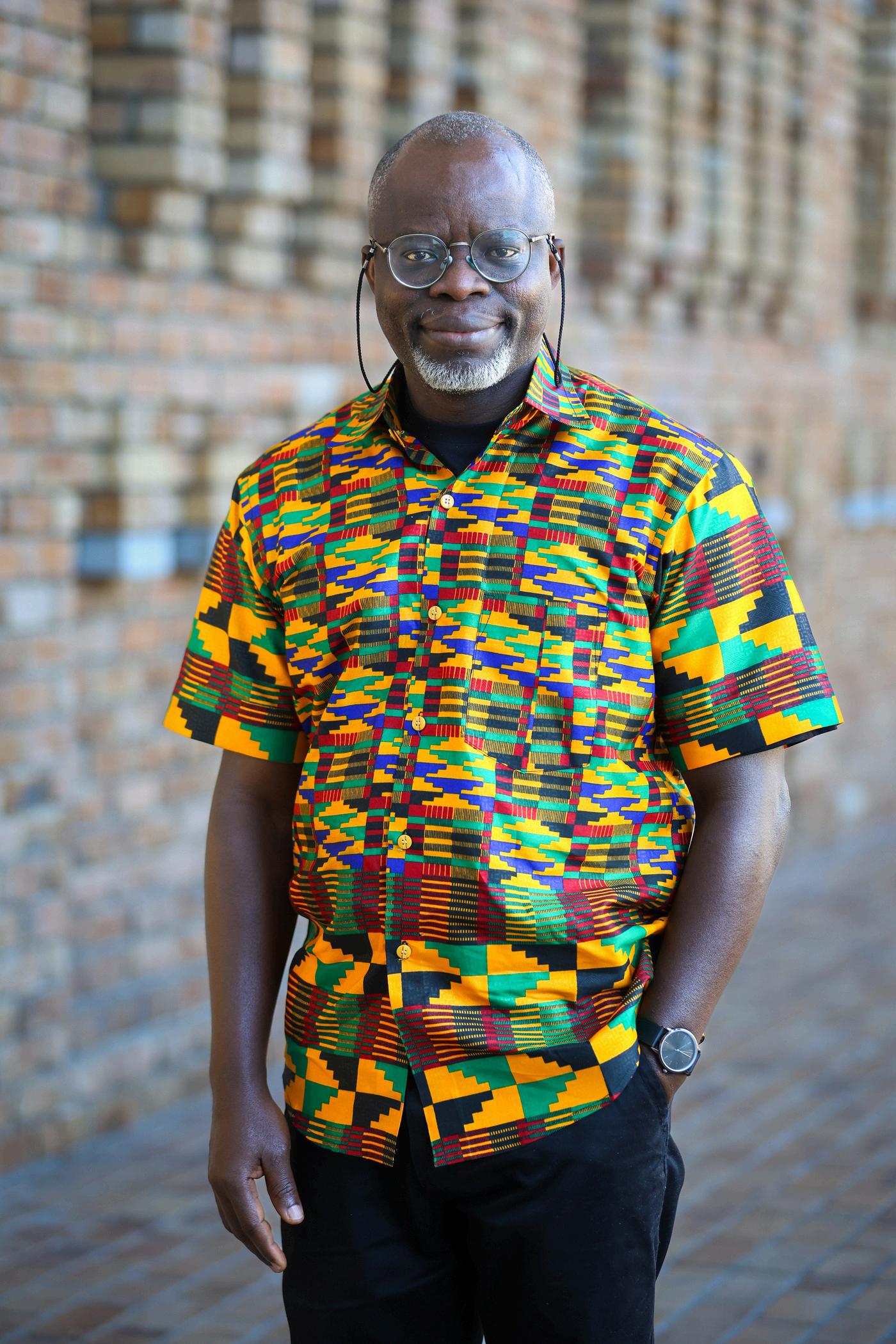
ABSTRACT
BIOGRAPHY
Prof John-Mark Iyi
The Deputy Vice Chancellor (Student Development and Support) Prof Matete Madiba, Dean of the Faculty of Law, Professor Jacques De Ville, Colleagues,
Students, Ladies and Gentlemen.
One of the paradoxes of being the last child in a large family is that sometimes, one faces both the disadvantage of parents too old to provide before one is even old enough to contemplate one’s future, and at the same time, one enjoys the privilege of taking advantage of the resources of older siblings It is on this note I pay tribute to my late sister, Mrs Ehigiegba Otabor, nee
Iyi who passed away in December 2024, as well as all my siblings She gave me education as a gift not only for personal liberation but as an instrument for empowering others, in pursuit of the advancement of the collective good, never ceasing to strive for fair, just and equal society in a world too often teetering on the precipice of catastrophe.
I was born and grew up in ancient Benin Kingdom which was one of the oldest and most developed “states” in the hinterland of the coast of West Africa. Benin has been described as one of the “lost kingdoms of Africa”.1 “Lost” not in the sense of a complete disappearance from the map, but lost in the sense of disrupted evolution of a system; lost in the sense of arrested development and lost in the sense of the truncated civilizational progress of a people.
Some of us are familiar with the Benin bronzes, which by some accounts, may be over four thousand scattered across museums mostly in Europe and North America but now a subject of
ongoing struggle for return and reparations. The international legal circumstances 2 in which those cultural objects were acquired though relevant is not the focus of this lecture. However, I raise it because it has defined my ideological orientation, shaped my intellectual identity and driven my intellectual commitment to produce a body of international law scholarship that is rooted in Afrocentrism, historically conscious of the African experience with international law and culturally grounded in the realities of the African condition in the contemporary world. My hope is that it will not only expose the historical nature of the international legal problem grappled with in this lecture, but it will emphasise its enduring effect, and the urgency of reform in international law I use the example of Benin because, perhaps, with the exception of South Africa, this brief historical background is largely true for most part of Africa The earliest recorded interaction between Benin and Europeans was in the late 1400s when the Portuguese arrived in what is today called the Niger Delta, for trade Over the next 400 years, there was commercial and diplomatic intercourse 3 between Benin and Portugal including the exchange of ambassadors based on mutual respect. The Portuguese were the first to use the expression “the Great City of Benin”. The captain of a Portuguese ship, Lourenco Pinto, observed that: 4 5
Natural law theorists of international law basically argue that just as all men are equal in nature, it follows that States, consisting of equal men, as it were, would also be equal. The conception of natural equality was introduced into the law of nations by drawing an analogy between natural persons and states as international persons. The theorists argued that:
The above excerpt was an expression, by European standards, only reserved for places like Lisbon, London, Paris, etc at the time. So, one may ask why would early European explorers describe “Benin in the middle of the African rainforest as a “city” and why and at what point did the nature of this relationship change?” Some authors argue that natural law theory influenced European early conception of international law 7
nations what was in reality a European Common Law as definitive and ‘constitutive’ of an ‘international law’. This had two implications: first it meant that 12 the original members of this exclusive club could set and determine the rules of this system. Second, it also meant that these original members could decide those to be admitted into this system of law of nations and those who stayed outside. As 13 Abdulqawi puts it, ‘two fundamental concepts were generally used to exclude others from the family of nations: constitutive recognition, which precluded a foreign State from being considered as sovereign and independent unless it received a ‘birth certificate’ from European powers, and a subjective ‘standard of civilization’, used to marginalize those states which did not belong to the same religious faith and civilization as European powers and were thus classified as barbarians and incapable of becoming proper subjects of international law’. The idea that 14 international law is the exclusive creation of a European law of nations presupposed that there were no prehistoric “international law” practices in other parts of the world outside of Europe For purposes of this lecture, I will leave aside the broader 15 debate about the existence of international law in other parts of the world prior to the Treaty of Westphalia in 1648 As a landmark treaty, Westphalia did end the 30 16 Year War and settled some of the major sources of conflict amongst European Princes at the time, but it also established the pillars of international law, at least in its Eurocentric sense sovereignty, territorial integrity, non-intervention. Thus, the conclusion of the Treaty of Westphalia effectively meant the end of the old order in Europe and marked the beginning of an international legal order based on the nation-state as a building bloc. Similarly, in the same vein, by constituting the Concert of Europe from 1814 the Great Powers of Europe at the time (Austria, France, Prussia, Russia and the United Kingdom) were able to pretty much prevent and manage areas of potential conflicts until the outbreak of World War I in 1914. Another example was the Berlin Conference from 15 November 1884 – 26 February 1885 convened by German Chancellor Otto von Bismarck to agree on how Europe could peacefully partition
empires Needless to say that it could not prevent the Second World War barely 21 20 years later
The outbreak of World War II provided Great Powers another opportunity to create a new world order under the United Nations and the major powers pretty much reconstituted themselves as the Five Permanent Members of the UN Security Council, this time, with the US, which did not join the LoN, playing a prominent role. The five permanent members of the new UNSC now excluded Italy, Japan and Germany, reflecting the new power relations in the new international order. Again, Liberia, Egypt, Ethiopia and the Union of South Africa who were at the San Francisco Conference to establish the UN did not get a permanent seat on the UNSC. So, the marginalisation of Africa in international law is a long-standing one.
Nevertheless, the architecture of the new international legal order rested on cardinal principles of the UN Charter: the non-use of force (Article 2(4)), non-interference internal affairs of member states (Article 2(7)), primary authority of the UNSC to maintain international peace and security (Article 24), compliance with UNSC decisions (Article 25), peaceful settlement of international disputes (Chapter VI), specific powers of the UNSC (VII), and importantly, relationship between the Charter and other treaties (Article 103) among others The UN Charter-based international legal order and the many institutions of global governance built upon it have been the foundation of the international system since 1945. Although the principles in the UN Charter are sometimes violated, especially by powerful states, it is generally accepted as a normative system that constrains State behaviour. Until now. The 22 UN marks its 80th anniversary this year. In all those years, only during the 1962 Cuban Missile Crisis did the world come so close to what it is facing today. It is no longer news that the current international order is eroding. What is however uncertain is the type of system that will replace it and the existing international legal order upon which it was built. But how did we get here?
but that emerging and non-western countries must be given more space. Whatever the merits of this proposition, it is at once easy to see how the proposal is phrased from the usual centre-periphery where the West, as the centre of international law-making decides the fate of the “others” as the periphery who have to “be given” in other words, mirroring what Judge Yusuf regards as the “birth certificate” analogy Not only does it strike at the heart of the supposed principle of the equality of states, it denies the agency of third world states particularly former colonies as equal participants in the construction of a future international legal order
International law-making as a consensus-building exercise that emerges from a process of negotiation and mediation, means that International law today cannot be determined by a single State, however, powerful, because this will essentially be antithetical to its name There will be areas for radical rupture—assertive continental sovereignty and there will be areas amenable to accommodation—common interest reform But at the same time, there will be areas where any hope of possibility of reform has been swept away such as International Economic Law In those instances, Africa does not have to look outwards but inwards Africa does not have to look to the East or the West but forward, as Kwame Nkrumah stated long ago. Therefore, the present crisis could be likened to a second Bandung moment in the making of a new international legal order for Africa and how it should respond to this challenge drawing on its experience of the decolonization struggle and the end of the Cold War. But what does the idea of international legal reform has to do with it?
For the most part, at least, in the last 125 years, crises have driven major changes and shape international law-making processes and African States have largely been norm-takers once the process of change and reform is completed This was true of the League of Nations era because as we have seen, colonial powers pretty much held on to their colonial territories and acquired new ones In the UN Charter-era, African States have been calling for reform of the United Nations for more than half a century without success How then should Africa bring about the much desired reform in international law? Before I address this question, let me briefly touch on reform process in international law.
States and international organisations acquire their powers and authority through their constitutive instruments or via delegation of authority International 29 law-making is usually a slow process, conventional international law and customary law is even more so. Thus, international organisations often bring about reform by expanding their powers and scope of authority incrementally. For example, by 30 reinterpreting what constitutes “threat to international peace and security” under the UN Charter, the UNSC has carved out “legislative” competence to intervene in the internal affairs of UN Member States on a variety of grounds way beyond what was contemplated in 1945 when the Charter was drafted. This includes cases of civil wars, gross violations of human rights; massive refugee outflows; repression of internal dissent and disturbances; etc. Similarly, from an original impartial peacekeeper status who only use force in self-defence, the UNSC now authorise the so-called robust mandates to missions authorised to engage in offensive use of force in internal conflicts. Under these expanded powers, UN missions have taken on increased roles of state reconstruction, state building and administration in different countries In certain circumstances, the UNSC arguably now has powers to limit the personal liberty of individuals within UN member states for example, through legislative designation of who is a terrorist for purposes of placement on the Sanctions List with very slim chances of opportunity for review Through what has been described as 31
“international organisation exceptionalism”, international organisations (IOs) sometimes arrogate “emergency powers” to themselves, powers not hitherto conferred or delegated to them, by simply appealing to the extreme and unusual circumstances in what may be called “authority leap” in IR-speak. As one author puts it: 32
What international relations scholars call “authority leap” or “international organisation exceptionalism”, international law scholars might call, to borrow from Professor Allen Buchannan, “illegal international legal reform ” At first glance, this may seem a contradiction in terms However, on a closer look, it is in fact sometimes an effective method of bringing about international legal reform, albeit, an unpleasant one especially if one takes one’s fidelity to the law commitment seriously It is for 33 this reason that international law actors who engage in illegal international reform are often accused of being lawbreakers though with normative potential to become lawmakers Simply, it refers to the act of breaking the law in order to compel changes to the law.
The thrust of the theory of illegal international legal reform (IILR) is that embedded in certain illegal international act, is the seed of a new international law rule, provided certain requirements are fulfilled. The argument for whether it is at all lawful to 34 violate certain rules of international law in order to bring about substantive reform in the content of that law is ironically not as rare in practice as it might seem. There are several cases of IILR, some overt and others less obvious. Perhaps, one of the most fundamental act of illegal international legal reform happened even before the dust of WWII had settled. The victorious Allied Powers established the Nuremberg Tribunal and the major Nazi actors were charged with committing a “crime against peace” under Article 6(a) of the Charter of the International Military Tribunal, for planning, preparing and waging a war of aggression… even e though there was no “crime against peace” in international law as at that time. This crime was created and applied retroactively in violation of the principle of nullum crimen sine lege (i.e no crime without a law) However, today, this innovation is what we now call the crime of aggression recognised in Article 8bis of the Rome Statute of the ICC Whereas this process of legal innovation is described in the literature as “victor’s justice”— which, in my view, is true by the way the act of the Allied Powers in creating Article 6(a) arguably constitutes illegal international legal reform
Secondly, through an initial act of IILR, the UNSC has improved its own voting procedures in article 27(3) of the UN Charter, when it became impossible to introduce reform through the formal processes. Other examples of IILR include the 35 redefinition of the meaning of “threat to international peace and security” as well as “enforcement action” under Chapter VII of the UN Charter. Through IILR, these 37 terms have received new interpretations and application very different from those envisaged by the Charter in 1945.
One of the criticisms against IILR is that it does not attach adequate weight to the formal international law-making processes. A second objection is that IILR is an infringement of state consent because international law is a consent-based system and changes to such normative order depends on respect for state consent for its survival and state must refrain from unilateralacts or IILR. This argument rests on two assumptions: first, that states have a moral duty to obey international law because they consented to it; secondly, that the principle of fairness demands such compliance from states as a result of the benefits states derive from the international legal order from which it is impossible to exclude such state. According to this assumption, the international legal order is a system of cooperation in which states work with one another by obeying international law in exchange for similar moral duty for compliance being expected of other states for the benefit of all. So long as states receive benefits from the international legal order by other states’ adherence to international law, then the principle of fairness demands that all states have a moral obligation to obey international law and therefore contribute to securing goals of common value This was why the African Union came under criticism when it first adopted Article 4(h) of the Constitutive Act and Article 16 and 17 of the African Union Peace and Security Council Protocol (AUPSC) in contradiction of Articles 24, 53 and 103 of the UN Charter.
In my contribution titled “The AU/ECOWAS Unilateral Humanitarian Intervention Legal Regimes and the UN Charter” (2013) 21(3) African Journal of International & Comparative Law pp. 488-519, I offered a systematic deconstruction of the legal entanglements of the two normative systems and its significance for Africa and international legal reform.
Then I took the opportunity of my 2016 contribution titled Humanitarian Intervention and the AU-ECOWAS Intervention Treaties under International Law: Towards a Theory of Regional Responsibility to Protect (2016) Springer to offer a defence of the AU and ECOWAS peace and security treaties as acts of illegal international legal reform I examined and rejected the main criticisms against unilateral acts of IILR because they sought to prioritise procedure over substance, and order over justice by paying little attention to human dignity, human rights abuses and mass atrocities rampant in many African countries. So, the phenomenon of international legal reform is still very relevant especially at critical junctures like we are facing today.
Since the decolonisation era in Africa in the 1960s, the international legal order has confronted Africa with three critical junctures each with its own implications for the international legal order These were the Cold War moment (post 1960), the Unipolar moment (post-Cold War) marking the onset of the U.S.-led unipolar world. So, what was Africa’s response to these critical junctures?
(i) The Cold War Moment:
The Cold War fractured relations between the Allied Powers immediately after WW II and produced the Non-Aligned Movement. Africa’s response (in conjunction with the rest of the Global South) was to attempt bring about reform of the post-war international economic order by calling for a New International Economic Order (NIEO).40
The NIEO demanded by Africa and others sought reform in international economic relations between the Global North and the Global South to move away from the logic of colonial extractivism.41
However, this attempt at reform was resisted and NIEO was roundly defeated. As part of this attempt at reform, Africa had championed the Right to Development (RTD) in the hope that it would produce international legal reform in economic relations Today, we read the RTD as a footnote in international human rights law 42 discourse The severe economic conditions that provided the fertile ground for the subsequent implementation of neoliberal economic policies of Structural Adjustment Programmes of the IMF and World Bank that further drove many African countries underground, in Africa, I think, was a watershed moment in the struggle for international legal reform. In my contribution titled “Democracy and the Development Crisis in Sub-Saharan Africa: Revisiting some Preconditions for a Developmental State Alternative” (2012) in Emmanuel Laryea et al (Eds) (2012), I challenged the 43 orthodoxy of neoliberalism pursued by many African States as a viable developmental model for Africa and I called on African States to consider alternatives.
The second critical juncture was the fall of the Berlin Wall which precipitated several developments in international law legal reform some good, others not so progressive. For one, the end of the Cold War fostered global realignments. For South Africa, it accelerated the dismantling of apartheid—as the so-called “communist threat” argument previously used by some states to support apartheid suddenly became obsolete. On the negative side, the radical shift in the global balance of power meant that many governments in African countries whose rise to power and survival depended on their Soviet or American patrons suddenly lost political and material support from abroad. Without legitimacy at home and no foreign support, it became increasingly difficult to maintain power through repression The situation of many of these despots became unsustainable and many plunged into full blown civil wars and some of those conflicts are still active conflicts to this day in what could be described as “Africa’s World War”. Of course, the most 44 horrendous of these tragedies being the Genocide in Rwanda in which an estimated 800,000 people were massacred In my contribution with Prof Vincent Nmenhielle titled “Nation-Building, State Reconstruction and Inclusiveness: Issues on South Sudan as a New State and Somalia as a Failed but Re-Emerging State” (2013) 5 World Bank Legal Review p483, we tracked the genesis of some of these crises using Somalia and South Sudan as entry points and recommended key steps the two States needed to take to achieve sustainable peace and development Africa’s Illegal International Legal Reform Response to the Turbulent 1990s
Africa’s response to the second critical juncture came from ECOWAS when the regional organisation embarked on several unilateral acts of interventions, first, in Liberia in 1990, and then in Sierra Leone in 1997, without seeking UNSC authorisation UNSC as required by Article 53(1) of the UN Charter. ECOWAS subsequently adopted the Mechanism for Conflict Prevention, Management, Resolution Peacekeeping and Security Protocol (MCPMRPS) Arguably, this was an act of illegal international legal reform. At the same time, in its report, the Independent Panel of Eminent Personalities of the OAU recommended the establishment of an African-owned responsive mechanism.
But how was such reform to be implemented given UNSC P5 veto powers? At the end, the AU opted for IILR by adopting Article 4(h) which gives the AU the right to intervene in member states to prevent or halt mass atrocities. In my contributions, I compare and identified some inconsistencies in the peace and security legal frameworks of the two RECs and the AU and the impact of the international legal contexts in which they will be implemented. Hence, Article 45
10 of the ECOWAS MCPMR Protocol resonates Article 16 and 17 of AUPSC Protocol because both treaties locate the authoritative agency of the use of force outside the UNSC contrary to the UN Charter. In my view, these were acts of illegal international legal reform.
To be sure, Africa was not the only region to embark on acts of illegal international IILR during this period The 78-day bombing of Belgrade by NATO in 1999 is another example. The intervention was unauthorised and therefor clearly illegal. However, according to the Independent International Commission on Kosovo, the intervention was an illegal but morally worthy cause justified by the necessities of humanity hence, the intervention was illegal but legitimate. In any case, the 46 absolute sovereignty interpretation of Article 2(7) of the UN Charter may have been fit for 1945 but it was no longer fit for a new century Over the next decade, the AU then developed and designed a repertoire of normative, institutional and legal frameworks anchored in the Constitutive Act for this new era upon which the African continent would navigate peace and security in the post-Cold War new world order.
The above illegal international acts did produce or at least, accelerate efforts to reform institutions of global governance and the underpinning international legal order Many reports were produced ranging from the Agenda for Peace by then UN Secretary General, Boutros Boutros Ghali, Report of the Independent International Commission on Kosovo, Kofi Annan’s two reports “We the Peoples” and “In Larger Freedom”, Report of the Independent Commission on Intervention and State Sovereignty (ICISS) on the Responsibility to Protect, arguably combined with other acts of illegal international legal reform to produce the World Summit Outcome Document adopted by the United Nations General Assembly in 2005 47
In my contributions in which I proposed a complementarity model to AU-UN partnership. At the peak of the Arab Spring, I revisited this issue in 2014 48 in my paper titled “Emerging Powers and the Operationalisation of R2P in Africa: The Role of South Africa in the UN Security Council” after Professor Alex Bellamy and Paul D Williams published an article in Ethics and International Affairs they titled “R2P is alive and well after Libya”. Well, my assessment at the time was that “[q]uite on the contrary, Syria shows that R2P is in a coma and no one knows whether it will come out of it alive, and even if it did, severe damage will have been done to its vital organs.” That was 2014 but I think looking at Ukraine and the genocide in Gaza, 49 that assessment is even more so in 2025. Although rejected by the dominant powers now shaping the new world order China, Russia, India and the USA, the adoption of the Rome Statute of the International Criminal Court can also be seen as part of these reform efforts in terms of accountability. Broadly, Africa’s proposal for reform is outlined in the African Common position on the reform of the United Nations and the international legal order—Ezulwini Consensus of 2005 Unfortunately most of the concerns raised by Africa including the reform of the UNSC, the issue of the veto, the marginalisation of Africa in multilateral institutions etc remain unaddressed The most recent on this list is the reform of the international criminal justice system
Although the immunity of Heads of State issue is the most well-known, there are other important aspects which reproduce marginalisation and colonial continuities in the international criminal justice system.
In my 2019 contribution in which I called for rethinking the UNSC-ICC cooperation, I examined the unholy relationship between the ICC and the UNSC by virtue of Article 13(b) of the Rome Statute and Article 2(1) of the negotiated Agreement Between the International Criminal Court and the United Nations, in which
I argued that Article 13(b) violates the principle of state consent as a requirement for the creation of binding obligations in international law as laid down in the Lotus Case, in so far as the UNSC invokes this provision to refer non-party states to the ICC. It posed a posed a legal problem of whether the ICC as an independent 51 judicial institution should be subject to a political organ like the UNSC. In the mistaken expectation that it could reform international criminal justice, Africa supported the establishment of the ICC. As we all know, Africa was the single largest regional bloc at the Rome Conference of Plenipotentiaries for the establishment of an international criminal court
African states sought the creation of a Court that could hold individuals to account for serious international crimes wherever that perpetrator might be whether in the Global North or in the Global South. It turned out that Africa got a different kind of international criminal court one which, in theory and in practice, represents the marginalisation of Africa and African peoples by international law. For example, we can look at the selectivity of the ICC: until very recently, all the defendants at the ICC were Africans. The ICC has issued arrest warrants for Omar Al Bashir of Sudan (2005, 2010), Uhuru Kenta (2007), Muammar Gadaffi of Libya (2011), Laurent Gbagbo of Cote d’Ivoire (2013). In fact Laurent Gbagbo was held in detention at the ICC from 2013 – 2020 when the charges against him were dropped. Then for the first time, the ICC issued an arrest warrant for President Vladimir Putin of Russia in 2023, Prime Minister Benjamin Netanyahu of Israel (2024), Mr Rodrigo Duterte, and former President of the Philippines in (2025). The ICC Prosecutor and judges have been sanctioned by the US and the Chief Prosecutor, Mr Karim Khan has been suspended So, we can safely conclude that African States had an 52 unrealistic expectation about the establishment of an international criminal court to hold powerful actors accountable But as TWAIL scholars have long insisted, the ICC might just be another instrument in the imperial tools box As valid grounds for raising these objections, in my paper titled “Is International Criminal Justice the Handmaiden of the Contemporary Imperial Project? A TWAIL Perspective of Some Arenas of Contestations” in Florian Jessberger et al (Eds.) Counterhegemonic International Criminal Law (2022) TM Asser Press, pp.13-37, I extrayed ICL using TWAIL theoretical lenses and I identified four arenas of contestations in the international criminal justice space establishment of institutions of international criminal justice; the supposed universality of international criminal law norms; the categories of international crimes, and the selective prosecution of international crimes.
To return to our analysis of Africa’s reaction to critical junctures since independence, Africa responded to the above situation by adopting the Protocol on Amendments to the Protocol on the Statute of the African Court of Justice and Human Rights (the Malabo Protocol) in 2014. Although the Malabo Protocol has only received one ratification (Angola), it is arguable that setting up a parallel court to the ICC is an act of illegal international legal reform and mirrors Africa’s legitimacy and credibility concerns about the ICC and the international criminal justice system it represents. I say this because, just like the African Peace and Security Architecture (APSA), the key provisions of the Malabo Protocol address some of the issues of major concern to Africa—terrorism, transnational organised crime, unconstitutional change of government, illicit exploitation of natural resources, mercinarism, piracy, trafficking in persons, trafficking in drugs, trafficking in hazardous wastes all of which do not form part of current international criminal law regime. Of course, the mere establishment of a regional court by the AU is not illegal but by vesting jurisdiction over core international crimes in the proposed court simultaneously with the ICC, the AU creates room for potential conflicts in the provisions of the Malabo Protocol and the Rome Statute in terms of the obligations of member States should the ICC decide to exercise jurisdiction over a situation that the African Criminal Court has also decided to exercise jurisdiction. In the event of such a scenario, the way in which such conflict is resolved could produce a new international legal rule and would constitute an illegal international legal reform by the African Union as a norm entrepreneur to improve the substantive provisions of international criminal justice.
Having dealt with the two critical junctures, I now turn to the third critical juncture the Ukraine moment. The invasion of Ukraine by Russia in February 2022 marked the third critical juncture in international legal reform for Africa. Unsurprisingly, it is the different responses rather than the actual invasion that has ruptured the international legal order in ways not seen since World War II. Partly in reaction to the legal debates unleashed by the Ukraine crises, in
2023, Professor John Dugard published an Editorial in the Leiden Journal of International Law in which he drew attention to the fundamental nature of the ongoing changes in the international legal order and the choice before the international community. Dugard distinguished the “Rules Based International Order” propagated by the West and International Law. Dugard laments the fact that 53 international lawyers are currently not paying adequate attention to this question and my aim in the next section of this lecture is to briefly sketch some of the key legal technologies Africa could think about in responding to the Ukraine moment and the unfolding crises in international law
By the Ukraine moment, I do not mean the act of full-scale military invasion by Russia on February 24th 2022 Rather, I am here referring to the series of events pre- and post-2022, many of which are unprecedented in scale, scope and geography, but which collectively is a culmination of the conflict and the international law violations and countermeasures. These events have exerted pressures on the international legal order in diverse ways. I guess one could go further back in time, but the 9/11 terrorist attacks and the resulting Bush Doctrine and the Global War on Terror (GWOT) might be a useful place to start. Its significance for us in this lecture is the way in which it triggered a flurry of international legal reforms in several areas of international law International Humanitarian Law (it raised questions of whether members of Non-State Armed Groups such as Al Qaeda captured in Afghanistan are entitled to prisoner of war status); in International Human Rights Law (the legality of torture as an interrogation technique in view of the Convention Against Torture); the extraterritorial use of force against NSAGs, the lawfulness of pre-emptive or anticipatory selfdenfence under the UN Charter. From the U.S invasion of Iraq to the Arab Spring and the invasion of Libya, the U.S. and Turkey attacks on Syria and the recent Israeli attack on Iran, the lawfulness of unilateral sanctions, the resort to tariffs and the rejection of the WTO framework as an arbiter of trade disputes; hostile measures and countermeasures, the denunciation of the Intermediate Range Nuclear Forces (INF) treaty, signed in 1987 by the U.S. and Russia are just some of the examples. The inability of the UNSC to respond to these crises in any meaningful way exposes the unravelling of the UN Charter-based legal order In this Ukraine 54 Moment, new
centres of power are emerging (e g BRICS+, the SCO) while the West appears to be pivoting away from international law towards what it calls a “Rules-Based International Order. As one commentator puts it
It is obvious that Africa will be part of whatever new legal order emerges but the question is how and in what capacity? Will it be as of old will Africa be on the table rather than at the table? How will Africa navigate the systemic constraints of international law? How do African leaders view or understand these developments? Do they see it as a historic opportunity or just another passing phase of the occasional global geopolitical upheavals and violations of international law? Optimistic commentators argue that it is unlikely the entire international legal order will implode. However, they project several possible scenarios in the years ahead probably resulting in a constellation of international orders that combine regionalisation with thematic coalitions and orbital zones of influence. It is remarkable that in the first likely scenario of deepened regionalised international
56 legal orders the ECOWAS and African Union practices were cited as evidence and indication of possible future trajectory. In view of current developments, there are calls on the African Union Commission to come up with an assessment of the present condition of Africa in the international legal order and to outline how Africa plans to respond and contribute to shaping the emerging world order by focusing on the implementation of previous commitments made by AU member States. I would add to the catalogue of proposals the imperatives of an African strategy for international legal reform combined with actual concrete steps to be developed by the African Union International Law Commission (AUCIL).
57 58
The AU is already taking the lead in key areas by developing regional international law. A good example is the Draft African Union Convention on the Establishment of a Credible Legal Framework for Cyber Security in Africa (the first of its kind to the best of my knowledge). The African Continental Free Trade Area is another. The African Union can draw on the blue print of its peace and security architecture bold and rooted in the African imagination and shaped by the African experience This strategy should be underpinned by three pillars: assertive continental sovereignty, extra-legal 59 international legal reform norm entrepreneurship; and a decolonised continental international legal policy Let me briefly sketch the essential elements of this proposal below
Assertive continental sovereignty: This element requires that Africa should exercise agency and self-determination at the continental level. Many factors currently align in Africa’s favour which could be leveraged to shape different legal regimes of any future international legal order Demographically, Africa has the youngest population in the world—a huge production and market potential; Africa possesses sizable proportions of the global critical minerals deposits necessary for next generation technologies; all of these factors place Africa in a position to not only challenge many of the existing unfair international legal regimes designed and imposed on colonial logic to perpetuate an unjust international economic order but to actively participate in driving and shaping the emergence of a new international legal order that takes the concerns of Africa seriously 60 61
Extra-legal international legal reform norm-entrepreneurship: This pillar requires African States to first appreciate international law as a space for normative contestations characterised by dynamic norm interactions. And secondly, to 63 recognise that such a system is bound to throw up “dormant normative tensions” from time to time. Those tensions present opportunities for norm entrepreneurs to 64 initiate international legal reforms and the emergence of new international legal rules. Some of those reforms will be possible within then prescribed and formal international law-making processes, but others will somethingn extra. It is in the latter cases that illegal international legal reform becomes an imperative. We have seen it in the development of the African Peace and Security Architecture, and it is also emerging in the international criminal law regime. As the current international legal framework is ruptured, and if, as some experts suggest, that regionalised international law is a likely outcome of the current rupture, then, illegal international legal reform might be the vehicle through which that reconstruction will be delivered by norm-entrepreneurs
62
Decolonised continental international legal policy: What does this mean? In my view, it means two things. First, it means resistance to further fragmentation (unity): A decolonised continental international legal policy must seize the ongoing reconfiguration of the international legal order to centre Africa and African concern from the onset and it can only do that if it is united Africa should not wait to speak from the margins of international legal discourse but from an authentically African identity. Secondly, it means centring Africa in the epistemology of international law, a re-orientation of the pedagogy of international law towards anti-colonial praxis. For now, wherever one looks in international legal scholarship, one finds that the current vocabulary of international law is patently unAfrican—whether it is the judgments of the International Court of Justice or the jurisprudence of the International Criminal Court In his separate opinion in the recent case of Land and Maritime Delimitation and Sovereignty over Islands (Gabon v Equatorial Guinea), Judge Yusuf Abdulqawi of the ICJ stated:
In that same opinion, Judge Yusuf indicted ICJ jurisprudence as one of the epistemic sites of colonial continuities citing the example of two colonial constructs terra nulius and intertemporality which despite decades after decolonisation, continue to constrain the legal imagination of African international law scholars. And I would argue that these two concepts, are the most formidable obstacles to Africa’s progress in its claim to reparation in the current international legal order. It is therefore imperative to arrest and disrupt these forms of colonial continuities in international law scholarship and legal education is one arena where this arrest and disruption can take place. This is important for a number of reasons it shapes how Africans view international law; secondly, it determines how we imagine issues like reparations; it could revolutionise international law vocabulary available for reparations discourse, we could use it to design methods that would advance the course of reparatory justice. Second, it means re-imagination of the African identity in international legal discourse
PART VI
In conclusion, after all is said and done, it has to be admitted that illegal international legal reform, though often morally defensible, is almost always legally questionable. Yet, it represents an opportunity for improvement in outcomes especially in a defective legal order such as the one Africa is faced with today. I started this lecture by situating my academic journey in its proper personal and historical contexts. One of the areas in which African States could show more imagination in their reading of history is with regard to the question of reparations for slavery and colonisation. The outcome of the Namibian-German Agreement of 2021 has left many disappointed.
Hopefully, the Benins will be entitled to demand not only the return of all looted artefacts, but the income generated by Britain from those artefacts over the last 125 years. Of course progress in this issue has been more or less paralysed by the orthodoxy of intertemporal principle. But I believe this is one issue that requires extralegal international legal reform norm entrepreneurship on the part of Africa. Together with colleagues, some of whom are here tonight, a consortium is being set up for the work ahead in this regard together with relevant organs of the African Union in terms of its 2025 theme of the Year: Justice for Africans and People of African Descent through Reparations. A doctoral student is currently conducting her research on this topic here at UWC. Secondly, preparing for this inaugural lecture has opened my eyes to the reality that the kind of reform we desire to see might not be possible without decolonising how we teach international law. The Third World Approach to International Law offers an alternative pedagogy even though relatively young and still limited it should be amplified in law schools across Africa.
I would like to thank God for his mercies and grace on this journey and at every critical juncture when I had to make a decision. To my wife Lydia and our children, I say thank you for your patience and understanding. I consider myself twice lucky. I owe debt of gratitude to all my siblings with whom I share a nature bond of love and without whose sacrifices, I would not be standing here this evening, I say thank you To senior colleagues, Prof Garth Abraham, Hennie Strydom and Jacques De Ville, thank you for giving me the opportunity to grow at every critical juncture. Many thanks to colleagues and fellow pilgrims I met on this journey. Thank you.
Thank you.
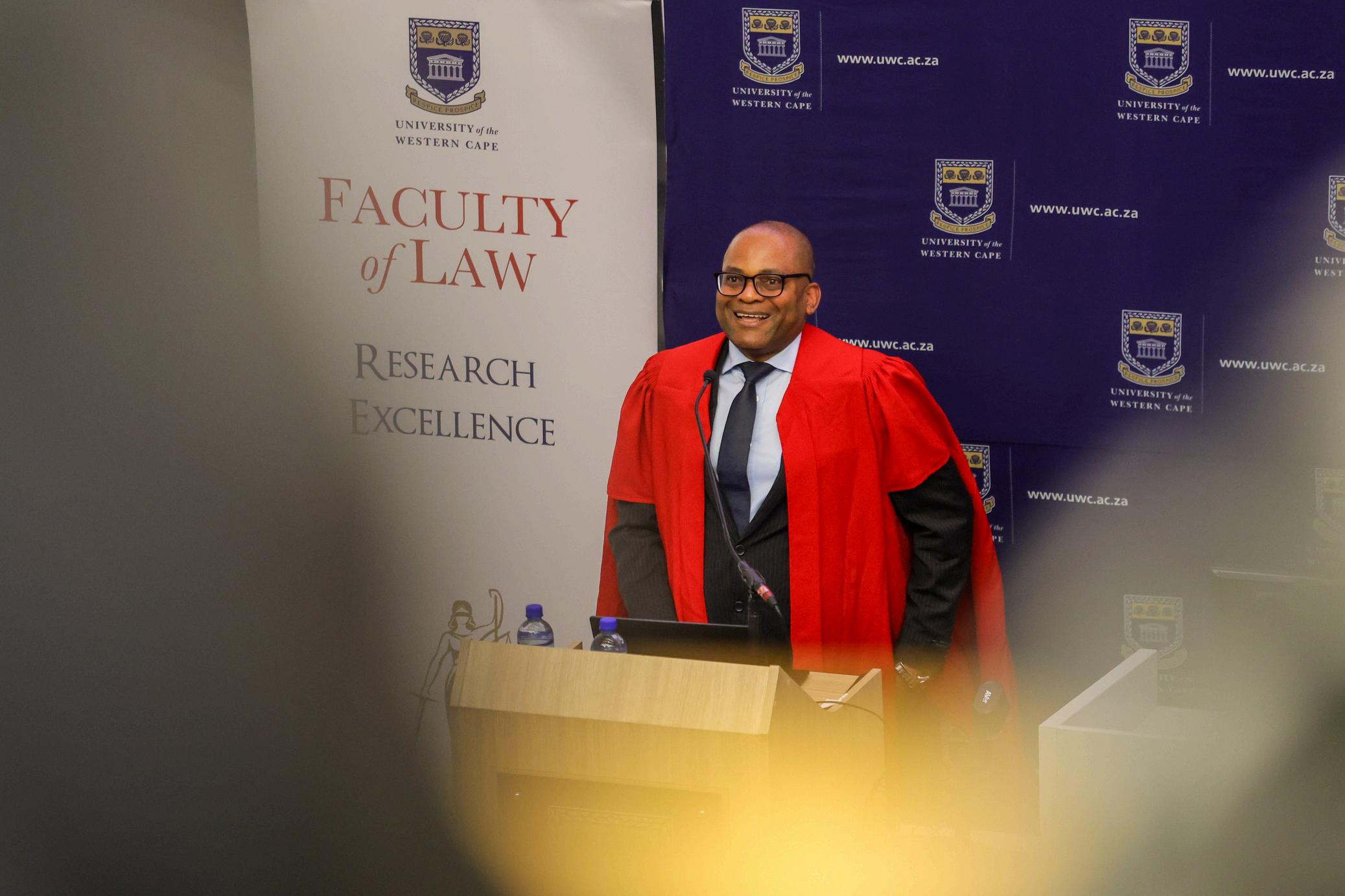
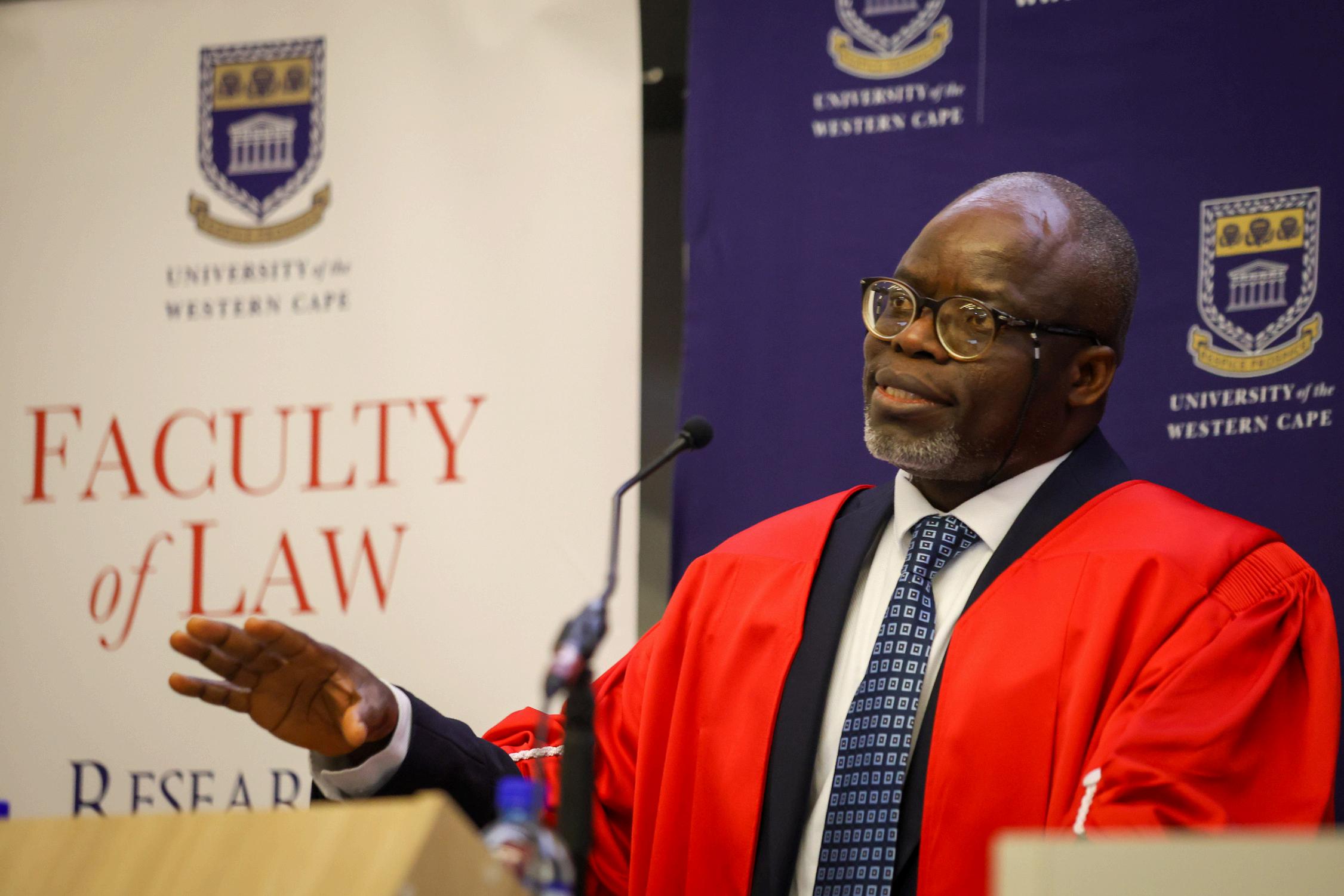
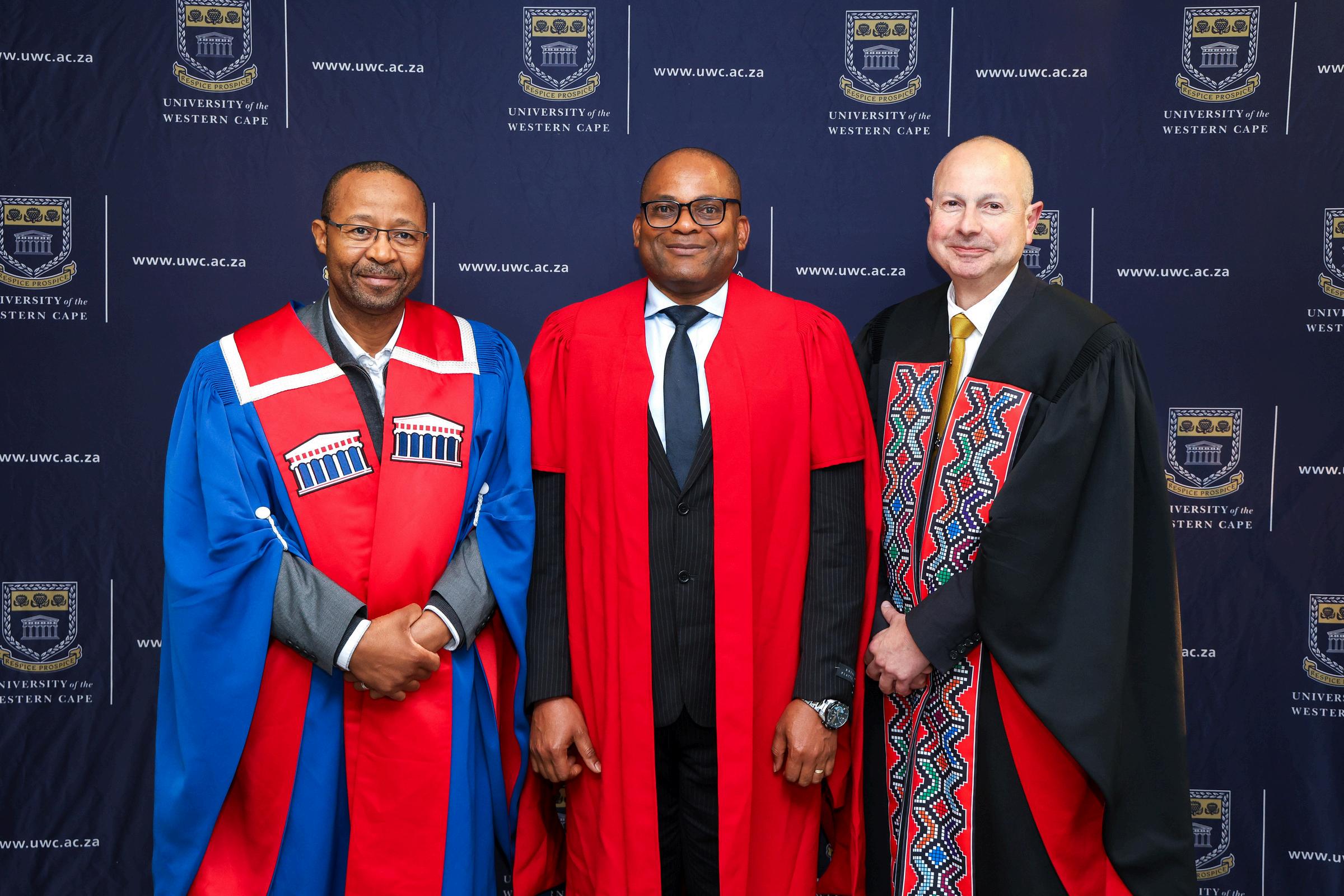
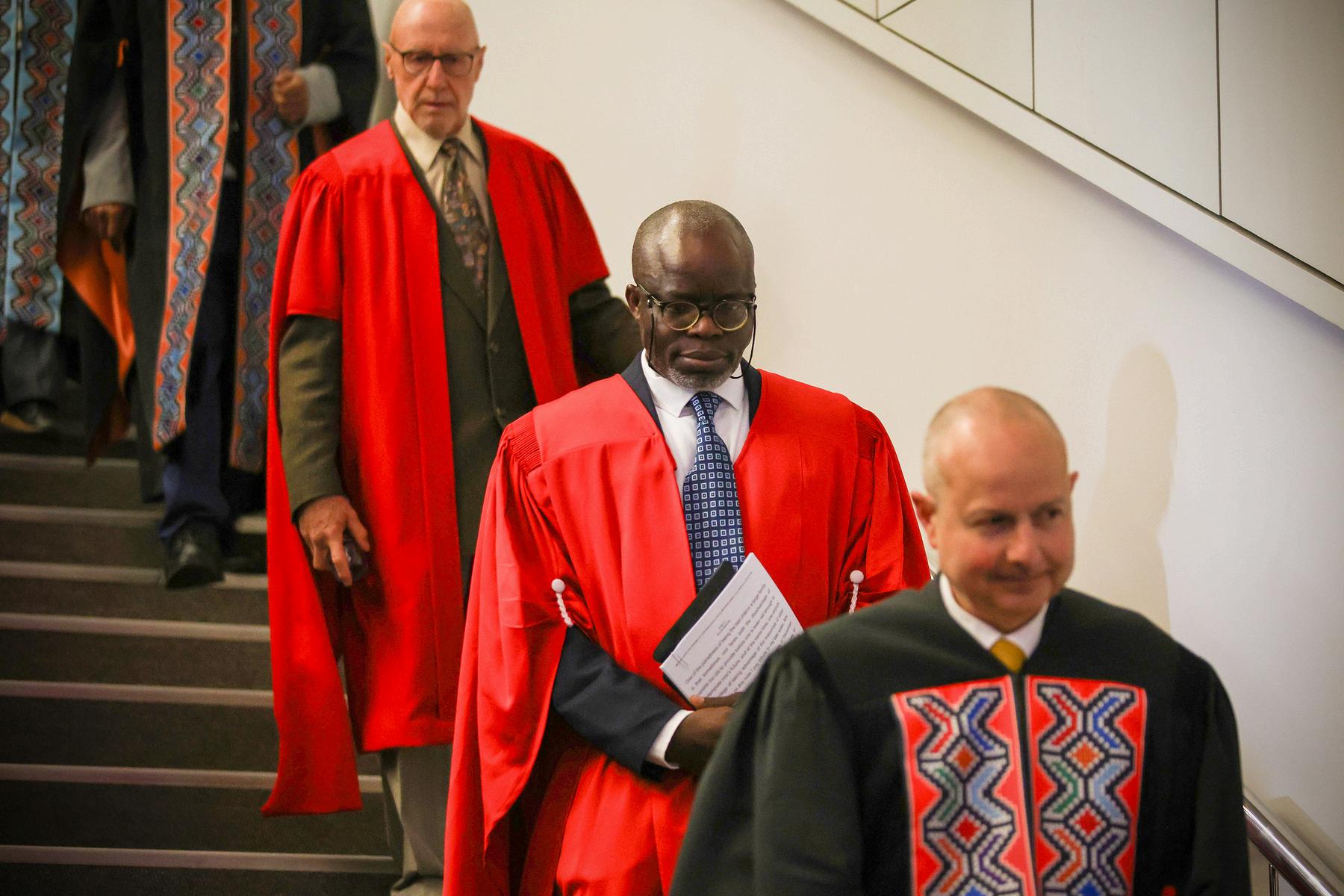

Professor Tertius Kohn
Professor Megan Shaw
Professor AJ Smit
FromMuscleFibrestoPerformance:ExploringtheBiologyofStrength,Weakness,andAdaptation

ABSTRACT
BIOGRAPHY
Prof Tertius Kohn
Deputy vice chancellor and colleagues, deans of faculty, colleagues at UWC, Department of Medical Bioscience, students, ex-students, family and friends. Welcome and it is my privilege to present to you what I've been doing for the past 30 years. And, sadly, none of my family could be here, my mom and dad and sister. So, you're my family now. And welcome to my wife and two daughters. They'll be writing a test after this seminar! And special welcome to Professor Tim Noaks and his wife Marilyn. I really appreciate it that you are here today.
What a daunting task of squeezing 30 years into an hour and 45 minutes. No, I'm kidding. It's 45 minutes. As Liana said, you might actually learn how to become faster after this lecture.
And it has been an amazing journey And this is what I want to tell the students It's about the journey It's not about the degree It's about that journey The friends that you make forever Those people that are likeminded that share your passion And I'm going to show you photographs Oh, some of it quit nostalgic, but some of them you might recognize. And I see a lot of my ex-students also sitting here. And welcome to you all.
So, as Liana said, my love and passion is skeletal muscle. It wasn't that way. I never thought I was going to stand here one day, and I don't call this a robe. I call it a cape. I always wanted to become an actor. Thank goodness I didn't. Apparently, there's no money in it. But nevertheless, the journey made me fall into this field that I'm in now. And as I mentioned, skeletal muscle was something that I didn't seek out. It became a passion the more I learned about it.
But I'm going to briefly summarize what my field of research is and then we'll delve into that nostalgia that really brings joy to my heart And when I teach the students, I also want them to see what they can achieve one day.
So this is obviously one of the biggest crises that we have currently in South Africa in the world - obesity and type 2 diabetes. We are stretching round about a billion people in the world and funny enough some of our wild animals are also becoming insulin resistant and I'll talk about that a little bit later. These are all to do with exercise and muscle. The next topic that I work on is exercise induced pathophysiology and that's basically when you're doing too much exercise at too high intensity and you're not used to it which leads to different conditions, but it also can lead to your death. Then of course muscle weakness. Muscle weakness is something that we are all going to one day have to go through. We're all getting older and we're all going to get weaker. But specifically, when we look at things like when you end up in the ICU, the absolute devastation that that does to the body is very often irreversible And we've done some work on that too and I'll show you some pictures And this is where my love for muscle actually came about; was looking at these absolute phenomenal athletes and then saying about how do they work? How is it possible that someone that looks like a cricket can run so fast? How is it that someone so small can be so strong? Then I actually didn't pursue wild animal research. I fell into it. And you'll see how that came about.
Many of you might have driven through it and didn't realize, but I was born in 1975 in a little dorpie called De Doorns in the Hex River Valley where most table grapes come from. I was part of a small family. And what you don't see is this little guy, he's wearing gum boots and it's red. But from a very young age, I loved taking things apart. This is where my name comes from, by the way. "Tertius" means third. My grandfather came from Poland who lost his whole family during World War II. And I
was the third Abraham down the line. We're trying to fix a broken lawnmower there, took it apart and that just fascinated me. And since then, I started taking things apart to find out how it worked and that's where the biology comes in with regards to muscle. I started off my education in De Doorns, matriculated in 1993 at Paarl Boys High and finished a PhD in skeletal muscle biochemistry. So I got a PhD in biochemistry in the physiology department. I am a musician as well. That's me starting to learn how to play the guitar. But from a very young age, I actually started composing music and I still do till today. So, rock on!
I am absolutely infatuated with Superman Not the new Superman, the good old Christopher Reeve Superman who could actually make you believe that you can fly Because Christopher Reeve was a hang glider, he was a sportsman So, he knew exactly how to keep his body in an aerodynamic way (So hence the suit) I always wanted to fly, but I was telling a colleague just now that in De Doorns, we only had rugby and rugby and rugby, no cricket, no tennis, a little bit of athletics here and there. So, I then ended up doing gymnastics in Worcester. So, jumping on that trampoline, flying was amazing. So that was the closest that I could get to Superman. Tim, I did try running. This is me doing a half marathon during the SAD with no training and I couldn't walk for three days. And that's when I decided, no way, running is not for me.
So, how did my journey in the tertiary education start off? Well, my dad said to me, "Please, would you consider doing medicine?" Because he did, but he passed out in his second year when he saw the dead body. He wanted me to do it because I didn't pass out from blood. But I wasn't a very good student. (Students do not listen now). So we started off with a BSc "gewoon" and I ended up majoring in biochemistry and physiology, eventually doing honours in biochemistry on a very weird topic Angora goats and that was the trigger; where we had to go to the Maitland abattoir and get some tissue and blood and that really fascinated me One of my honour’s classmates are sitting right over there today And then biochemistry didn't have a project for me.
Then I remembered this little "tannie" that was in the physiology department. She was about yay big and then she said, "Why don't you come and do a project with me," and I didn't know that Kathy Myburgh was actually South Africa's best springbuck gymnast at a time. So she enrolled me, and I was very excited and she said something along the lines that you're going to do some muscle and sporting
performance and what did I know about sport and muscle adaptation, but the thing that she did say was that I will have to go overseas and that's all I heard. But did I remember anything about muscles and exercise? Zippo! Nothing! So I had to learn everything from scratch and that was my journey from 1998 to 2005 when I got my PhD.
Well, what was the PhD about? We basically made up the PhD as we went along because that's how science works. You go for a hypothesis and then suddenly you realize, oops, we're at a dead end. We need to turn around. And probably this photograph I use quite a lot of all these great athletes, but sport has become a multi-trillion-dollar industry I mean, we just have heard of another athlete that's been suspended because of doping Now, all these sports are amazing and who doesn't like to watch gymnastics on television or Usain Bolt running that 100 meters
And then a study came out in 2000 by Bengt Saltin and his co-workers about muscles and genes. And that's not the jeans I'm wearing. It's the genes that you and I harbour, that we get from our parents. And the question was, but how do we identify and talent ID these athletes? It is still very difficult today.
This is the current world champions holding the records except sadly the current world record holder for the marathon sadly passed away - Kipchoge did break the 2-hour marathon. But what I want to show you is that if you look at the speeds these athletes are running at, that's phenomenal. If you don't know what it is, just go to a gym and put that treadmill to about 15 km/h - then we'll talk. Kipchoge can do that for two hours straight, running at 21 km/h. That is phenomenal!
Our performance capacity is determined by our intrinsic factors which are primarily our genetics like I mentioned, our parents, physiological, biochemical, anatomical and of course psychology I placed there the w w w and that's what I heard in school is the will to want to win because if you don't believe you're going to win forget it then you've given up already. As we know with science these days, we do discover more and more things and that's why I put there "other".
Then there's external factors, like exposure to a sport. You know I told you the rugby, rugby, rugby story, but I was later exposed to gymnastics and then suddenly I excelled - I was not the ball anymore. Training - the amount of training that you require is going to have an effect. Environment - we know altitude, nutrition,
socioeconomic status, technology, and AI. And then of course doping and then other.
Now, this picture I also like. You know that we're not all made for the same sport so that's where those intrinsic factors come in so I can imagine that you know if you look at these statures, each sport has their own where you will have an advantage. For example, I will never be a great basketball player, never even if I can fly. And the woman isn't far behind. These factors will identify what sport you will have an advantage for. Usain Bolt, for example, was actually very tall compared to all the other athletes.
So, how do we test human fitness? In a nutshell, we put them on a treadmill, we stick a mask on his face and then we measure his oxygen consumption and carbon dioxide that he exhales, and heart rate From that we can determine how much oxygen they use, what's their maximum capacity that they can use and what fuels they are burning Are they burning fat? Are they burning carbs? Are they producing lactate etc.
We can do the same on a single muscle fibre. And this is what makes our lab so unique in Africa: we can do all those tests that we do on a human, we can do on a single muscle fibre. To give you an idea how thick that fibre is: if you take your hair and divide it by two, that's one of the thickest fibres that we will get. And that little thing can make you run like the wind. So, for that we obviously need to take a muscle biopsy. In humans we stick a needle in your leg and then we take it out or if we do work with animals, we do an open muscle biopsy because then there's less trauma to the muscle.
Now I want to quickly recap - Kids, this is what the test will be about - How does skeletal muscle work? This is quite phenomenal By the way, those black lines that you see there, they are your sarcomere spaces Those lines - the ones between two lines - that's what make you able to walk, to write, to run So how does it work? The sarcomere, as I mentioned, those black lines, the blue ones, they're the ones who would be able to - almost like an accordion - pull towards one another when you have a fuel source. And how that happens is your brain tells the muscle you need to contract so there's a nerve impulse and that releases calcium in the muscle and for that you need ATP which is our energy source which comes from the metabolism and eventually that little muscle fibre is going to contract or that sarcomere. But it takes like microseconds - that's how quickly it can happen. And then of course, very importantly, is that if you want to relax your muscles because you cannot be in a
spasm the whole time, all the calcium is taken back up into the sarcoplasmic reticulum and for that you also require ATP. So there's a lot of energy that needs to go into the muscle to contract but also to relax. If you do not have ATP, you get a condition called rigor mortis.
This is for my formula 1 friends in the audience. I love comparing it to a car engine. (I'm not advertising any brand.) On the left you'll see the muscle fibres, and they hone down into smaller parts. Ee have the myofibrils and eventually those yellow and red parts, that's the myosin and the actin that actually makes the muscle fibre contract. Those little pink things, they are the mitochondria - very important because they're the ones that can generate ATP very efficiently And I'll show you some of that a little bit later
So, like a car engine, we all know this is an internal combustion engine We all know that the bigger the engine, the more power; and the more force it will generate With muscle, it's the same - the bigger the fibre, the more force it will generate. The type of fibre that muscle harbours is also going to have an effect and I'll talk about that a little bit later.
Then, of course, the fuel. If you've got an engine but there's no fuel, it's not going to run and that we very often see with congenital myopathies where a certain fuel cannot be used. Combine it with oxygen and those four fuels, phosphocreatine, glucose, glycogen and fat, it can supply the engine with ATP. Then of course the exhaust, very important in muscle, getting rid of the carbon dioxide and lactate otherwise it can have a negative impact on the engine itself.
And then - what do we measure in single muscle fibres? We measure force and how quickly that fibre can contract And when we combine the two, force times velocity, we get power because power is the one that we're really interested in And then of course economy I always tell the third-year students that if you want to be economical, you drive your car at 110 km/h and it would be much more fuel efficient So, those parts that we talk about now, the fuel, the metabolism, the ATP demand and the ATP supply and the exhaust - that's what this talk is going to focus on.
One day my student came to me - I was still at UCT - and she said to me "look at this" and I said I've never seen this before! This was actually ostrich muscle. She said, "Look how red these fibres are, and the other fibres are white." And I said, "Wow, that is amazing. Why is that?" And the reason for that is because some of the
muscle fibres store more myoglobin than the other fibres. Myoglobin is important to store oxygen. So, that red fibre, that's where the original fibres got their name - red oxidative fibres. And the so-called white glycolytic fibres. And that was just amazing.
These days, we use antibodies to specifically stain for the fibre types. The blue ones - seen throughout this presentation - are the type I fibres. They're the slow twitch fibres and usually what our endurance athletes have. The green ones are the IIA fibres. They are fast and they have a lot of endurance capacity. Whereas the type IIX fibres are the red ones, they give you a lot of force, but they fatigue very quickly.
I'm not going to spend too much on this, because I can already see it's becoming late in the evening, but basically we use certain markers to give us an idea of the capacity of a specific pathway In our bodies we have four fuels that we use and each of them slot into a specific pathway Think of it this way: your petrol tank and all those pipes and things that it goes through That's the metabolism that we're talking about. So, the bigger the pipe the more fuel can go through. The enzymes that we use can give us an idea of the flux. (How big is that pipe?) So, these enzymes you're going to see them later on in the talk, but I want to highlight why they're important. First of all, phosphocreatine is probably one of the most inefficient fuels around. For one phosphocreatine, you only get one ATP. And as we go down the line, you'll see that fat is actually a very efficient fuel. From one palmitic acid, you can generate 120 ATPs when it goes through the Kreb cycle. That pathway is something that our athletes really would require during running. We can stain for the mitochondria by using a simple NADH stain. So we take a histological slide, and we then stain it. You'll see that each of these fibre types have got different mitochondrial content. And that is also important especially when we talk about the wild animals.
(Kids, you're going to write a test about this table I'm kidding ) Our endurance athletes primarily have these slow oxidative type I and type IIA fibres Our sprinters usually have IIA and IIX fibres - predominance of that, but they also have type I fibres I'm just going to talk about the type 1, IIA, and IIX fibres going forward
And then a study came out by the Copenhagen group in Denmark, where they investigated the difference between Kenyan runners and Scandinavian runners. Now to not go into too much detail, the thing that stood out about this study for me was the extraordinary lactate dehydrogenase activity that these athletes had. Now, even when some of the Scandinavian runners went to altitude to train there, their lactate dehydrogenase decreased. And you'll see now why that is so important, especially
when it comes to the wild animals.
So, Kathy Myburgh said, "Off you go, you're going to Denmark, land of the cheese apparently, and the Little Mermaid." And I worked with Bengt Saltin and Jesper Anderson, and they taught me how to do these single fibre dissections. It is also the home of Lego, but it's too expensive there. So, there you have the first single fibres that were dissected in South Africa. Freeze-dried single fibres. And if you can't see them, there they are. They're like little freeze-dried two-minute noodles. You can then do experiments on them.
I think this is where the nostalgia came in This is my colleagues from when we were studying in the laboratory at Stellenbosch And then they revamped that building and then we were temporarily housed in the food science building and then we moved into our new building which I'll just show and then if you look on the bottom right slide there, you'll see the dissection kit as well as a seven decimal balance You could weigh off very, very small quantities of chemicals but also the fibres. These were the new laboratories that we moved into in 2002 and there is the small exercise group that we had during that time.
Then Kathy said, "Off you go to Uppsala, Sweden." Because we now have the single fibres, but we need to know how to measure the metabolites and the enzymes in those various fibre types. This is the first time I saw a horse on a treadmill. It is really something spectacular to see while that horse is running. For some of my colleague or students here that has undergone a muscle biopsy: That horse just had a muscle biopsy. That's that white plaster you see on its bum. And it was doing absolutely fine. And that's where my prickle came for animal research. That lady that you see in the picture, and I hope she's watching on the YouTube video, it's Birgitta Essén-Gustavsson She was my Swedish mother because she looked after me very, very well while I was there And then we have all those little fibres over there It's the first time I ever set foot in snow And believe you me, it's freaking cold Minus 25° C Hence the picture on the bottom right My hands started freezing and I had to run back inside. But it was fun. And then Kathy also came to visit.
So, what did we do? First of all, we compared runners with untrained runners because when you do science, you have to show that your model is working. So, we decided, okay, we're going to have untrained individuals and we're going to compare them with trained runners, but we wanted pretty good runners. Let's call them
sub-elite. So, but these guys were "spoeg-spat". They were really very good. We compared them with one another. As I mentioned before, we slapped a mask on them, put them on a treadmill and we made them run. We start at a very low speed and then where they cannot run anymore that will be their peak treadmill speed. And as you can see, there's a big difference between untrained and trained runners. High VO2max, high peak treadmill speed that they achieved. If you didn't get that difference, then your athletes weren't trained or they were lying.
We looked at the metabolism of our athletes and untrained individuals, especially the CS and the HAD CS is a very good marker of mitochondrial volume and content in our muscle And with endurance training, that enzyme will increase So, you will actually get more mitochondria and more of that enzyme, as well as the HAD, which is for beta oxidation And beta oxidation produces more ATP We found a significant difference which was great
Then we looked at the glycolytic capacity because, the conventional theory is that those glycolytic and lactate dehydrogenase activity will actually decrease with endurance training and we saw that it didn't. And that made us very worried. What is going on? The same with the fibre type. As I mentioned, if you're an endurance runner you gain more type I fibres over the years, but there was no difference between untrained and our trained runners - so what is going with this?
We then had to really think very hard, and we thought: okay, but what if it's genetic you know what if there's some individuals that are just more prone to have a higher type IIA fibre type content or higher glycolytic capacity. Or can it be something else? Could it be training related? We realized that actually when we recruited our athletes, we recruited them from two different clubs Basically, a coach has his own methods and will bestow training on all their athletes all at once So, whether you're doing fart legs or whether you're running in the sand, which is high intensity, or just doing long runs We decided, okay, let's break them up But it happened to be that they came from two clubs where there was a demographic difference too and there was this clustering of data points which is very important. That's one thing Kathy Myburgh taught me. "You must look at your data points!" We then divided them up into an African Runners Club and the European Runners Club. And we found that the athletes from the African runner's club had extremely high lactate dehydrogenase activity and again, made no sense, whereas the so-called European runners conformed to the conventional studies that were what we found in previously
published results. Now, you think of the Kenyan and the Scandinavian runners’ details. What we also saw was that the European runners have more type I fibres, whereas the African runners had more type IIA fibres. And then we found a very strange phenomenon: usually when you have a higher activity, you should be able to produce more of a specific product. Not in this case! The plasma lactate during exercise actually decreased, which made no sense. And when we looked at single fibre enzyme activities typed according to their type I or type IIA fibres, the African runners had actually much higher activity. So, this caused a bit of a conundrum.
What can be the reason for that? It makes no sense And this might have been indirect evidence of the so-called proposed lactate shuttle hypothesis that the third year students will be doing in my course But we didn't get that evidence or could the type of training merely have been different where our African brothers basically just trained harder because of the coach So, my athlete said more muscle biopsies? Bring it on! Let's get some needles into us.
What we decided then was we're going to train all these athletes ourselves, bring them under one roof, make all the playing fields level, and then we're going to give them super-duper "spoeg-spat" training on a treadmill because then you can control their speed. And by the way, it worked very well! Just to give you an idea: remember I mentioned 20 km/h? Our athletes trained on average at 20 km/h for about three minutes and then they only had one and a half minutes rest. They had to repeat this six times. They came in twice a week for only four weeks. What did we find? And remember these are well-trained athletes. Apologies for the poor resolution but in 2003 there wasn't very good camera quality. This is one of the athletes that were running on the treadmill. Currently, he's running at 21 km/h and found it quite easy. Just wanted to show a photograph of all the athletes that took part in that study And Tim, do you recognize one of the athletes there? It's Johan Landsman
What did we find? Well, four weeks of training and their peak treadmill speed increased with 1 km/h. That is quite significant for only four weeks of training. The VO2max didn't really change but what we did see was the following: heart rate decreased at the same running intensity, the economy improved and the plasma lactate decreased at the same intensity. What happened to the muscle fibres? If you look at the middle graph, you'll see that the type I fibres tended to decrease. And when we looked at the other fibres, the IIA's, it wasn't really different. But the hybrids, the IIAX fibres started increasing. And the hybrids are fibres that are transitioning
from becoming a IIA to a IIX So, they're actually becoming faster twitch fibres When we plotted the change between type I fibres and the speed, we showed that as the speed increase where you trained at, you actually started losing type I fibres, which is a good thing and when you do plot it against the IIAX fibres, you see a beautiful positive correlation Now, keep that in mind, please, because when we get to the wild animals, you're going to see something quite phenomenal. The fibres can produce more power, but all the fibres shrank. So, you now have smaller engines, but yet they can produce more force. And that we still don't really understand.
We then looked at this lactate dehydrogenase enzyme and we dissected a number of fibres and measured that enzyme activity again and we found that after the training it actually increased. It also increased in a fibre type specific manner and when we plotted it against the actual speed, we also saw a positive relationship. The answer is if you want to be fast, you need to increase your lactate dehydrogenase activity.
So, the take-home message from that study was different running clubs implemented different training methods It was very well that the intensity of the exercise differed To become fast, you need to train at a very high intensity You need more type IIA fibres It makes sense But the higher lactate dehydrogenase activity currently doesn't really make any sense And what I want to show you, this paper came out three weeks ago where they basically gave guidelines on how to become fast if you're an endurance runner. And they are advocating exactly the exercise intensity and the ratio that we have done in 2003.
That's the PhD. Got it. Yay. And then I wanted to go to America, live with my sister a bit, you know, America, maybe become an actor. And then she walked into my life. She's been a wonderful wife to me and we got married within almost two years. Yeah, they say when you know, you know. You know, you know. I waited long enough.
And then this was my gymnastics club that sustained me through my studies in the Strand I could at least do an L-sit And again, my journey was it's about relationships with people
got this wild animals. Let's do some research on them." So, we did. And then we also did the first ostrich study where we put pedometers on their legs to see how much exercise they do. Luckily, we got it for free from Discovery. We did research on those wild animals mostly for the meat and the export industry.
I then had to leave Stellenbosch University and very often it's very sad to leave You don't want to go but God takes you into a specific route and I had to go to UCTdidn't want to because the temperature is colder there than in Stellenbosch, but I had to and that's where I met a wonderful man by the name of Professor Edward Ojuko. He's been an amazing inspiration in my life, the two years that we were together. He introduced me to metabolic diseases, obesity, insulin resistance, type II diabetes and cellular signalling. Ed was a very quiet spoken person and when he spoke, everybody listened. We did a couple of studies together, went to America together. It was great fun and Ed actually studied under the great John Holloszy, who also was the founder of mitochondria and exercise performance.
After 2008, I started a new adventure with Professor Tom Noaks. Tim was amazing. You can walk into his office and he's like, "Come, come sit, sit." And I said, "What do I do now? My post doc is finished " He said, "No, no, you're going to stay here " I said, "All right, that's great. Can you pay me?" We'll make a plan." You know, so I said, "Okay, I'm going in faith here." And Tim said to me, you must study wild animals to better understand human muscles because we don't know a lot and you must study weakness. And that's why I got involved with Red Cross Children's Hospital and then eventually got into Tygerberg Hospital where I met Dr. Franclo Henning and then find the diseases that wild animals get that links to human health
Now that was a daunting task You know, you don't think that wildlife can actually get diseases. But lo and behold, our friends in the peninsula are currently eating themselves into type 2 diabetes. So, we did a bunch of research on these baboons that are just consuming food They fight, they will go crazy for our human carbohydrate ladled foods. And we showed that they are becoming insulin resistant and we need to do something about it.
During my time at UCT, I was also very fortunate to work on the low-carb high-fat diet and show why the low-carb high-fat diet athletes appeared to be insulin resistant. But, it was actually because they're not used to taking in sugar and we published that in the Journal Physiology. And then this was probably the key moment, that Eureka moment, where you see the link between wild animals and a
While I was doing my PhD, I also got involved with - also falling into it I call it conversations in a parking lot And where someone said, you know, that stuff you do on humans, can you do it on animals? I said, well, I can't see why not. "Yeah, we've
humans that we don't understand The athlete on the left is called Cory Stringer. He was an NFL rugby player and he died of a condition called exertional heatstroke and that condition wasn't recognized at the time and his wife sued the NFL for a lot of money and won. Because it's such a disease that you can't really recognize, studying it is very difficult and then "Tim said find a disease you know that..." is in the back of my mind and then I stumbled on this condition called capture myopathy. It was actually Eric Harley who I chatted to who just put this word out there and I had no idea what it even meant Remember I come from the "plaas" and English was a foreign language to me. I had to learn it overseas. And then, obviously, our president also is a wildlife farmer. So, he's not going to be happy if he loses a very expensive buffalo, because, sadly, once these animals present with that disease, you have to very often euthanize them. But the symptoms between these two, the exertional heat stroke that humans get and capture myopathy are very similar And from that we did some very cool research The student who trained blesbok and I'll show a video of that, is sitting at there And I think this is the sadness - that I could never have met Margaret Hofmeyer Many of you might know her. She was at BCB here in the faculty and she sadly passed away just as I arrived at UWC. She was a pioneer in this research in the 1970s and 80s with Peter Bolonje who was also quite a renowned scientist. I thought I just wanted to bring her in, in honour of her work that she did
One of the key treatments that can be used in humans when they do get exertional heatstroke and if you identify it, is by cooling them down They submerge you into ice water and wait for your body temperature to go back to normal. It's very difficult in wild animals because usually they're running around, and they want to get away from you It's a fear factor We tested that hypothesis whether cooling will actually have a difference or make an effect in our wild animals. And, I have to brag, my daughter drew all those blesbok within almost five minutes. So we have a creative artist in the house I can draw a straight stripe, that's it But what we found was that the cooling had a devastating effect on the muscle glycogen repletion after the exercise and it's now something that we are pursuing further because that could actually mean that these animals are glycogen depleted and that's what's causing the severe muscle breakdown.
This is a study that Dorothy Breet took on while 32 weeks pregnant - machine! She trained 20 blesbok in Nelspruit and then we chased them around to induce
hyperthermia and that data we're going to publish very soon But what I want to show you is the phenomenal team that took part in that study - all of them expert veterinary experts from all over the walks of life. One from Estonia, a couple from America and all that. And we came together and we were able to train and exert those animals.
When we studied muscle weakness, we had one patient that had inclusion body myositis and he basically gave up his body and said, "Do whatever you like with me. Stick things into me." which is always nice to hear from a participant. We showed that when he does do some exercise training that he does become a little bit better. Unfortunately with his advanced age it did tend to be more difficult
Then I was able to also work with Alejandro Lucia, who also was an exercise scientist and a medical doctor and specializes in McArdle's disease and we were able to do some really cool work with one another. And then professor Franclo Henning, who is the neurologist at the time at Tygerberg. I was going to chat to him to collaborate and then he said "Can I be your student?" and I was like "Oh, I didn't expect that. Okay, why not?" So, he got his PhD in contractility in inflammatory myopathies. He dissected out a lot of single fibres.
But what about exercise performance in humans? Because, that's what this talk is about. If we look at this graph and I've plotted the records over the years from 1890 right through to current and where we want to go to and those are the current world record holders of the 100 meters We see that there's this gradual exponential decay. When are we going to, and how, legally and legitimately, are we going to break those world records? That is where the wild animal performance comes in.
No one can tell me that this is not one of the most beautiful animals out there. And if you look at that speed that this animal can run at, is just phenomenal. And what you did hopefully notice is that the prey can also run that fast
So, who's faster than a human? Well, basically everything You know, you try to catch a cockroach, it always gets away. If we look at that, it's worthwhile studying these animals. And believe you me, there's so little out there about them. I did some research on how many papers are out there on wild animals (and this includes humans), about 20 mammalian species. Complete analysis where you look at the performance of the muscle, the metabolism, and the structure of the muscle, only 12 species and I thought this is fantastic - we live in South Africa we've got the big five,
we have one of the best veterinary hospitals in the world - let's start getting some work done. And over the years, from about 2005, we've been able to perform the muscle composition of about 15 different species. We've done pangolins, baboons, cheetahs, lions, caracals, etc. And each species is different, which is unbelievable. We got a couple of publications.
What I want to show you is the difference in the muscle when you just look at its structure. On the left, you have an antelope and it's got very dark red muscle. So those who love biltong, that's where your biltong comes from. It's a blesbok by the way. And on your right, you have a lion. Now you can see the difference in colour of those fibres. The one on the right is very white in colour and the one on the left is dark red in colour. One automatically will assume the one has a lot of myoglobin and endurance capacity because the one in the middle is of an endurance athlete. We'll assume that the red muscle will have a lot of type I and IIA fibres, which will go a little bit against what these animals are capable of doing And then, on the other side, we have the lion that will be predominantly IIX These are some pie charts that we drew to show you the difference And we compare it always to humans We have a distance runner and then we have a sprinter And you'll see that the distance runner has very few IIX fibres - a lot of type I and type IIA fibres, whereas the sprinter a little bit of IIX fibres. Anybody seen a sloth move before? What's that movie? Zootopia. Predominantly type I fibres. And the pangolin, funny enough also has only predominantly type I fibres. Baboon muscle is very similar to us (human) - our fibre types. Dog slightly more type IIX fibres, hence why they can run a little faster. A horse also kind of a 33% spread. And then! If we start looking at these other cats, you'll see, as they become a little bit smaller they actually have more and more type IIX fibres. But the antelopes! We thought they were going to be predominantly type I, because their muscle is so red in colour. They actually have more type IIX fibres than the lions. And that made no sense. The pictures on the left are histology sections. The one on the top is a South African top judo athlete and the fibres on the bottom is that of a cheetah, pure red basically We then go, wait a minute, what's going on in these antelopes? This is very weird So again, I'm bringing up the slide that shows you mitochondrial content in humans and the animals That is an endurance trained athlete, very dark fibres, which represents a lot of mitochondria, and that's what you want for endurance capacity And we started staining the antelope. We saw, oh my word, they actually have a lot of mitochondria, but yet
they've got a lot of IIX fibres And if we bring the lion and the caracal, we see they have very few mitochondria. And that maybe is a good thing for the prey because the lion with endurance is not something you want to mess with. So at least the antelope has some chance. They just have to run fast enough and last a bit longer. It also explains why lions and cheetahs and our cat species have to first stalk their prey because they're going to run out of fuel within 45 to 50 seconds.
But we made another discovery which was quite cool and it is a fourth fibre type, actually a fifth kind. I'm not going to talk about the fourth but it's the so-called IIX oxidative muscle fibre We haven't seen that before And the antelope has that So that means it's a fibre type that is extremely fast, that can produce a lot of power, but it has endurance, and the lions don't have that. When I published this paper, I got call from some of the east block countries. "How do I get the IIX oxidative" because and guess who the coach was? It was a boxing coach because a boxer needs strength and endurance. I said, "I don't know. I don't know how you'll do that."
I think this graph kind of summarizes what we found so far. And Lyanna, hopefully this will answer your question. To be fast, you need a lot of IIX fibres. And that's a question that we are asking Why are humans not able to just like increase their type IIX fibres by 5% and you're going to run like the wind? But maybe the answer lies in that our training is not quite optimal because remember when we trained our athletes on the treadmill first they couldn't finish it I mean they were passed out but after a while they got used to it. Their fibres started changing and maybe that's something that we need to focus on.
This was also a surprise find to me and basically it's showing that if you want to be fast you need a very high lactate dehydrogenase activity. The question is: to what capacity can we push our athletes to have that activity and yet we see that when we train our athletes with high intensity interval training that that activity does change but there's a threshold - so if you do too much low intensity, you're going to switch back to type I.
I think it's appropriate to just show you this picture. I basically build most of this stuff myself because I passed woodwork. But the point is this is the only machine in Africa where we can manipulate a muscle fibre We can give it drugs to see does it do this, does it do that on a single muscle fibre level. On the bottom, yhat is one human single fibre and you can see the striations. It's to see what can that fibre produce and we then did the first single fibre study on lion muscle and in a nutshell, if you look on
the left there's a comparison between human fibres, a coracle and a lion You'll see that it's very, very thin fibres, but yet that thin fibre can produce three times more power than a human fibre. And the question is why?
The take-home message is that we've made some very significant discoveries in the wild animal kingdom and more. We're going to have to do some more of that. But the similarities that we're finding and the questions that now arise and this is probably where things like doping might come into play, is, can humans increase their lactate dehydrogenase activity as we see this beautiful correlation? Can humans, to some point, increase their type IIX content? Why can't we?
I'm going to wrap up now, but I want to just quickly mention my journey from UCT to UWC And when I first stepped foot on this campus, I was like what is this place? This is amazing I have never seen laboratories like this This is amazing And I thought wow And if you look at that photo of the campus, it is just such a beautiful campus I arrived here in September 2019 I think it was about March 2020, they said go home and COVID hit We were in trouble because one of my other PhD students Kathryn van Boom had to finish her PhD. We decided we're going to go to Oudtshoorn and we're going to study cheetah nutrition because we don't know much about their nutritional needs. They don't only need just meat, they also need other nutrition. And then on the on the left there is Luqmaan Adamson who received his MSC suma cum laude on that same study and we've managed to publish a few papers .We also did some ICU studies at Tygerberg during COVID - it was quite daunting doing it with masks on. That was the team and I'm very grateful that I was able to work with such an amazing team of people.
We're currently doing a carbohydrate study where we want to revisit all these things that we found over the 30 years I have worked with. I'm not going to go through all of that. All those little needles or syringes that you see - that's actually finger pricks. And then we are very fortunate to have state-of-the-art brand new equipment that we can do our testing on And in the future we're going to also start looking at energy expenditure because something that we want to do is to actually predict when is someone at risk and very often we catch that diabetes, the insulin resistance, we catch it too late, then the job's done. So we're focusing on young students and I must say from what I've heard from my students, they say they're getting some really interesting results.
And then a parking lot conversation You all know Brian Maritz from BCB We had a chat about reptiles. And suddenly I asked, "What do they know about reptile muscle?" And he said, "Nothing." And I did some research. Nothing. And here's something that I didn't know. Reptiles don't stop growing. I didn't know that. Some do, but some don't. So, we're going to start looking at reptile skeletal muscle because if we can find out what keeps them growing, we could potentially extrapolate that to human research. The little lamb there is only for show.
I'm going to wrap up now. I want to thank those six people Kathy Myburgh, Bengt Saltin, Jesper Anderson, Birgitta Essén-Gustavsson, Edward Ojuka, Prof Tim Noakes. It's been amazing and it's so phenomenal to have these people part of your life. We share the same goals and dreams and thank you for that. Ed, if you're listening, thanks man And Birgitta, thank you so much And, Kathy, of course, Bengt sadly passed away just before he sent me a booklet on camel muscle To all the MyoLab peeps, I want to say thank you so much for bringing joy to our laboratory You are really phenomenal These are them over the years I really appreciate you and thank you for making my journey so pleasant To the current peeps - thank you very much and keep up the good work and don't think small, think big. And, of course, all the collaborators and friends over the years. Thank you so much. You've really made science exciting and it's so wonderful sitting around a campfire in Nelspruit where we can have a beer or a whiskey or cool drink, or whatever and just chat about what is the future going to hold.
I think I just need to mention my family that I've lost over the years. My mother, she was quite funny. But she has really pushed hard to bring the best out of me. I was, you saw that Gumboots kid, he was a very naughty child. My dad, who was this soft-spoken and very wise person, super smart! And my sister that sadly also passed away. So, I give them credit and honour them. And then my current family (and there my mother-in-law just jumped up and down). I want to thank you Joe and Linda for just being such great parents-in-law If you get married, that's what you want Great parents-in-law My wife, I love you to bits And my kids Hopefully, you're not embarrassed now Were you embarrassed by your dad?
And with that, I'd like to say thank you and to all the funding and support that we got over the years to pursue research that has been such amazing, amazing, phenomenal journey.
Thank you very much!
AdventuresinVirology:ExploringHowVirusesCauseDisease,andDiscoveringNewAntiviral Strategies

Prof Megan Shaw
Good afternoon, or evening. I'm not sure what we call this time! Thank you to the Registrar, to the Dean, and to Prof Oelofse for the kind words. Welcome to those who are in attendance, and those who may be online. And especially my family and friends who’ve probably never seen me stand up here at the front and give a lecture. Thank you also to Prof. Preiser for taking on the role as my respondent today. My plan tonight is to take you on my journey - my academic journey, and to share with you how my fascination with viruses led me to be standing here today as a full professor. I think as someone before me has said, it is an unbelievably difficult thing to try and summarize 30 years of research into one lecture. So, I'm going to pick a few highlights of my research career so far, and particularly point out the people who've been there to support me along the way and have contributed to the achievements
As Andre alluded to, I've had the privilege of being able to travel the world during my academic career, and I've called three cities home during that time: Cape Town, Glasgow, and New York I started off at UCT doing my undergrad and my honours, and then I went to the University of Glasgow to do a PhD in virology and from there I got a postdoc opportunity in New York City where I went to the Mount Sinai School of Medicine. When I started there as a postdoc I went thinking I might just spend a year there and see what it was like. Clearly I enjoyed it because I stayed for almost 17 years! During that time I climbed the so-called academic ladder and made it up to Associate Professor level. Then home was calling, and so I made my way back to Cape Town and to my new home of UWC, where I've been since 2019. So, that’s four academic institutions, and three continents over approximately 30 years. As the Registrar mentioned, I think everyone is an armchair virologist after the COVID 19 pandemic. But I thought it would still be wise to have at least one introductory slide to go over the basics of exactly what a virus is. Viruses are very,
very small. On average they are about 100 nanometers in diameter. That's indicated by that little red dot there. And here you can see in comparison how big a bacteria is in yellow, a particle of dust or pollen in blue. And here is a human hair where you can
no longer see the little virus over there. So, they are minute and the smallest ones actually only encode five to 10 proteins. Essentially they are tiny biological machines. They have a genome which can be either made up of DNA or RNA, they encode a limited number of proteins, and they might be surrounded by a lipid membrane, but that is it -they are very simple. And the other very pertinent point about viruses is that they cannot replicate, or reproduce themselves, on their own. They need to be inside a host. And so what happens if a virus infects you? It's going to find the particular cells that it likes and it likes the ones that express the receptor that will allow the virus to bind Then it enters the cell and kind of undresses itself, and delivers its genome into the cell and it takes over the cell machinery It uses all the functions of the cell to turn that cell into a factory for making many, many copies of the virus So hundreds, or thousands of virus particles can come out of these cells That's what's happening when you have a virus infection Somewhere in your body, this is exactly what's going on.
When did I first get interested in viruses? I entered my undergraduate program at UCT being interested in genetics. That's really where it started out. I was interested in genes, and for that reason I chose to major in microbiology and biochemistry and it was during a microbiology module either in second or third year that I was introduced to viruses. This was my first virology lecturer, Professor Ed Rybicki, at UCT who is one of the most enthusiastic lecturers that I ever had and I was taken in by his explanation of how these tiny, genetic machines can essentially take over a human body and, and even kill it. I was amazed, and I wanted I wanted to know more! And so it was a very easy step to know that I wanted to do an Honours in medical microbiology. I applied to that program at UCT, and was lucky enough to get in. There were three students in my class that year, so it was a very intimate setting.
the year (and I know this is not proper English), but I learned how to “read science” and “write science”. Every two weeks, or at least it felt like every two weeks, we had to write a review article. And so, I just got used to being able to collect the literature, read all the literature, interpret it, and then write a review. If you do that every two weeks, eventually you get good at it. That repetition was very important. And of course, the other highlight of the Honours year was actually working in a lab. Not just doing a practical like in undergrad, but actually working in a lab And I loved it I loved being able to work with my hands. Of course the project didn't work. It was something to do with cloning. I can't even remember what exactly, but I promise you didn't work But that wasn't the point of Honours The point was just experiencing it I loved the lab chat, even the troubleshooting, and the highs and the lows that you go through. And I wanted more of that as well. So, it was quite clear that I'd been bitten not only by the virus bug, but also by the research bug I want to point out a journal club paper that I presented in that Honours year And it's not, I think, usual that you do recall such a thing, but it really stood out for me I presented a paper on the 1918 Spanish influenza virus although I can't actually recall whether I was assigned the paper or whether I chose it. The 1918 influenza virus caused the pandemic of 1918. At the time they didn't know it was due to influenza virus as this was around the time of World War I It caused approximately 50 to 100 million deaths and so it really stands out in terms of all the pandemics that we've experienced. This paper was all about characterizing this virus and understanding, or trying to understand, what made it so virulent. And in the course of preparing for that paper, I obviously had to read a lot on influenza virus. I don't remember that we'd actually been taught that yet, so I taught myself and I was just amazed by these viruses They are actually carried by birds, water fowl usually, and they get transmitted to animals and also to humans and they have caused not only the 1918 pandemic but they've caused a number of pandemics throughout human history. I became really interested in this virus, and it is a core memory giving this journal club paper. It's amazing to now look back on that moment and realize that within six years of presenting this paper, I was actually working in the lab of a very well-known influenza virologist. And I actually got the chance to co-write a NIH grant application to fund further research on this 1918 influenza virus with Jeff Taubenberger who was the first author on this paper. So it's a little uncanny that I
distinctly remember giving this journal club, and all the other pieces just seemed to fall into place.
From my Honours year I chose to go and pursue a PhD at the University of Glasgow. They had a very uniquely focused virology institute there, and I was lucky enough to get in. I was fully funded and so I headed off to Scotland. For those of you who don't know, the University of Glasgow is the fourth oldest university in the UK. It's located in the west end of Glasgow and according to the current figures there are approximately 25,000 undergrads and 15,000 postgrads You may be looking at this lovely Gothic style building and thinking, wow she must be so lucky to work in such a building. But, hold that thought! Because I actually worked in a building that's off this picture, and this is what it looked like. This was the Institute of Virology. That picture is probably around the time that that I arrived. It’s 1960s style architecture, and you can see there are wooden framed windows that actually open, which I don't think is allowed in laboratories these days. And someone thought it was a good idea to put mosaic tiles all over the building. And you can kind of see over here there are little patches of white. This is where the mosaic tiles are slowly falling off. And every time you slammed the front door, more tiles fell off But we loved it nonetheless! It actually doesn't exist anymore, I should say, as they have a new building But anyway, this is where I spent my time as a PhD student. This institute had over 150 staff and it was unique because it was split between the university staff and the medical research council. That was actually great because we could really benefit from the expertise on both sides. At the time it was considered the largest grouping of researchers that were focused purely on viruses, human viruses It was actually very well equipped inside On this ground floor, they had a washroom and a media room that was probably staffed by five to six people. They washed all our glass wear and they made media for us. So those of us who do tissue culture, we didn't have to buy the media. It was made for us. Amazing. Absolutely amazing. This was a three-year PhD program Your funding lasted for three years and that was it, so you had to get down to work on day one. Unfortunately, they didn't have anyone studying influenza virus, so my project was on hepatitis C virus, and my supervisor was Dr. Liz McCruden who was a clinical virologist. To put into perspective HCV, which causes a chronic infection of the liver, had only been discovered 10 years earlier when I arrived. They still couldn't grow the virus in in tissue culture, so a lot of the studies were purely on a molecular level, and my PhD question was to ask whether the glycoproteins of the
genotype 3 HCV were different from those of genotype one So what are E1 and E2?
This is a picture of a hepatitis C virus particle and its genome is encapsulated in this geometrical shaped capsid, and there's a lipid membrane surrounding it. The E1 and E2 glycoproteins are inserted into the viral envelope, so they are the proteins on the outside of the virus, and they are the two proteins that I was focusing on. And what's the difference about genotype three and one? HCV comes in six different flavours. One, two, three, four, five, six. And you can see from the map the relative predominance of the genotypes around the world At that time, all the studies involved HCV1 because that seemed to be the predominant genotype, particularly in the States and in Europe. My supervisor, Liz, wanted to know if genotype 3 was any different You can see that genotype 3 is prevalent all around the world But in her clinic she was seeing IV drug users and they seemed to be infected more with genotype three than genotype one. And so that was my study - to try and understand if there were any differences My project involved cloning these genes from patient sera then comparing these genotype 3 vs genotype one proteins in terms of their sequence, their glycosylation pattern, their localization in the cell etc. I also had access to a panel of antibodies that had been raised against the proteins from genotype one, so I could see whether those antibodies were able to recognize the genotype three proteins. And in the end I concluded that there are probably conformational differences between the glycoproteins of the two different genotypes, meaning that they have slightly different shapes. That led to a publication from my PhD which is usually a goal that one has to achieve, and it meant that I could graduate Here's a bunch of very happy virologists after our graduation And it was very nice that we stayed together as a class. I know that doesn't always happen at a PhD level, but it was particularly nice. And I'm still in touch with a lot of these people now And I want to take a moment to thank and appreciate Richard Elliott, who unfortunately passed away in 2015. At that time when I was there, he was the head of the department on the university side and he was also my second supervisor. All PhD students had a second supervisor who was there to make sure that the interactions with the main supervisor were going well and look out for you. And around the time I was writing up my thesis, he came and he said, "What are your plans?" And I didn't have any plans other than write up my thesis! He said, "Well, have you thought about going to the States?" I said, "No. Would you have any suggestions?" And he gave me three names. He suggested, Peter Palese at Mount Sinai in New York. He also suggested Bob Lamb who is at Northwestern University
which is just outside Chicago And he suggested a third person who I cannot recall The reason I recall the first two is because they were both working on influenza. And I immediately thought, okay, this sounds interesting! I went and looked at what research was going on in their labs and I went back to Richard and I said, I think I'd really be interested in Peter's lab. And he said, okay, I'll make a call. And he came back and he said, okay, Peter will email you. And I was asked for my CV and that was it. I never spoke to him, and didn't have an interview, but I got offered my postdoc position 10 days after 9/11 happened I did hesitate for a second, but really it was only a second, and I thought, no, I have to take this opportunity, this sounds too good. So, thank you. I know he's not here anymore, unfortunately, but thank you very much to Richard because those conversations are so important So, I really appreciate him.
So, off I went to New York for a postdoc to Mount Sinai. I thought I'd just orientate you as to exactly where Mount Sinai is. This is a map of Manhattan. We have the Statue of Liberty down here in the harbor. This is Wall Street down here. We've got the Empire State Building, Times Square and Central Park up here And then we zoom in a little bit. And here is Mount Sinai where the star is. So, it's on the northeastern corner of Central Park. For the first half of my time in New York I lived in various different places on the Upper East Side. And then the last 8 to 9 years I was living on the Upper West Side approximately here. And my commute to work involved walking across Central Park, which I have to say is the best commute in the world! And I very much miss it This is a picture of the Mount Sinai campus So you're looking south now. Here's Central Park. Here's Fifth Avenue. This is Madison Avenue. And these are the Mount Sinai buildings. And this is the Annenberg building where I was situated on the 16th floor. So, Mount Sinai actually consists of a hospital as well as a school. When I first arrived, it was Mount Sinai School of Medicine. And then at some point while I was there, it changed its name to the Icahn School of Medicine at Mount Sinai, which is a real mouthful, due to a very hefty donation from Mr. Carl Icahn. The School has a School of Medicine for medical doctors as well as an MDPhD program and a Graduate School of Biomedical Sciences, which is for PhD students, MDPhD students, and then several um MSc programs So there are no undergrads here, only postgrads There are approximately 350 research labs and they are very, very well-funded. NIH funding for 2024 was just shy of $500 million. I'm betting that that is unfortunately less in 2025 thanks to Mr. Trump. And I was in
Department,
The research topics were you know viral pathogenesis, how viruses cause disease, developing vaccines, understanding how the immune response reacts to viruses, understanding how the host interacts with the virus, or vice versa, and developing antiviral drugs. And I was in the lab of Dr. Peter Palese. Just a word about titles in the States. Even though you're a professor, you don't use the title professor. Your title is still Dr. So across my slides, you're going to see titles of doctors and professors. You can probably consider that they're all professors. Peter is a very wellknown influenza virologist. He's made several seminal discoveries over his career and he is an absolutely fabulous mentor. He was Chair of the department for 36 years, and only stepped down two years ago. I also want to mention two other people that played a very important role in my in my training. Adolfo Garcia-Sastre and Chris Basler. In fact, they were both former postdocs of Peter's and so this sets up a wonderful kind of family structure in the department And the synergy and cross talk between the labs was amazing The three labs had joint lab meetings at 9:30AM every Monday morning where two people would present, and these were the most stimulating meetings that I remember You really got to grips with the science that was happening in the different labs, and you were able to troubleshoot and get everyone's opinions. When I became an independent PI I also joined this lab meeting.
Although I came to an influenza lab, I was not given an influenza virus project. I was given a project on Nipah virus. I thought okay, wasn't what I was expecting. But you know when you have these labs that have these multiple grants going on they assign projects where hands are needed and so you jump in with both feet and you just get on with it, and so I started to work on Nipah virus. I had never heard of this virus before so I'm sure you probably haven't heard about it either. Nipah virus is an emerging virus that belongs to the Paramyxovirus family which is the same family as measles and mumps viruses, and it is a zoonotic virus which means that it transmits from animals to humans and it was first isolated when it caused a large outbreak in Malaysia in 1999 Nipah virus is carried by bats, specifically fruit bats This is the Pteropus vampyrus bat These bats are large They're not those little tiny vampire bats They're huge bats They have six foot wingspans, and are also known as flying foxes So these animals are the natural reservoir for this virus, and the virus can be isolated from the urine collected from these bats In the outbreak in Malaysia the
virus was transmitted from bats to pigs who served as the intermediate host They developed a respiratory disease. And unfortunately, in order to stop the outbreak in Malaysia, they actually had to end up culling over a million pigs. And humans who had close contact with pigs were at risk of getting infected. And when they did get infected, they got encephalitis. So, whereas the pigs were getting a respiratory disease, in humans, the virus seemed to go to the brain and it was highly lethal. In this outbreak, there was 40% fatality. Since 1999, there have been regular outbreaks occurring in India and Bangladesh. Not on a large scale such as such as in Malaysia, but it is continually circulating, and in fact the human cases are due to having close contact with bats the Indian and Bangladeshi outbreaks.
My project was to look at how Nipah virus interacted with the host innate immune response. We often refer to this as a war of virus versus host which is exactly what is depicted in this picture here. Here are your immune cells, and here are your viruses. And they both they both have weapons When your body is infected with a virus, your immune system is fighting back and sometimes the viruses are fighting with their own weapons as well So what we imagine is happening when this battle is going on is that it's a balance between your immune response and virus replication If you have a very efficient immune response, you are going to make lots of cytokines which have antiviral activity. A key cytokine is interferon. If you make lots of interferon, that keeps the virus replication levels low and that means that you're going to be happy and healthy. However, if your immune response is not efficient, you are not making those cytokines very efficiently which allows virus replication to continue unchecked. This allows the virus to spread, and you generally get a more severe disease. So the hypothesis behind our research is that all viruses have a way to downregulate the host immune response using their weapons which are proteins that we call immune antagonist proteins. My project was to study the immune antagonist proteins of Nipah virus. This is a diagram of the genome of Nipah virus. There are only six genes and I was focused on the P gene. The P gene has the ability to express more than one protein. If it's transcribed faithfully, you get a transcript that encodes the P protein And this P protein actually has a role in virus replication But there is a sequence here in the middle of the P gene that is slippery and sometimes when the polymerase is transcribing, it slips and it accidentally inserts either one extra nucleotide or two extra nucleotides and that means that when these transcripts are translated there's a frame shift Hopefully some students
you translate this protein, the N terminal portion is the same, but because you've shifted the frame at this position, you get a different protein that's made on the end portions. So you have these three proteins P,V, and W. They have the same N terminal region shown in white, but they have unique C terminal domains shown in blue, green, and pink. I started off by cloning these genes and expressing these proteins, and I showed that V and W have the ability to inhibit the innate immune response. So that was the first publication from the study, and then we went on to try and understand how they were functioning and we discovered that in fact all three proteins can bind to a very important transcription factor called STAT1 through their common N terminal portion. STAT1 plays a very important role in allowing the cell to respond to interferon. If you don't have STAT1 functioning properly, you can't generate the appropriate antiviral response. So, by inhibiting STAT1, Nipah virus is shutting down the antiviral response of the cell I also found that the W protein has a signal in it that allows it to go to the nucleus When you look at the localization of these three proteins, you can see that P is hanging out in the cytoplasm And so is V, whereas W has moved to the nucleus and this compartmentalization can be very important for function This was a sign that there might be more going on here That lead to a publication for the STAT1 interaction, and for the nuclear localization. And then later we also investigated whether these proteins could actually block the expression of the interferon cytokine, and we found that both V and W could do this, but they did it through distinct mechanisms because that function was carried by their unique C terminal domains. So they did the same job, but they did it through two different mechanisms. This was the publication for the W protein and then this one, which came later was the publication for the V protein. When it was a student that spearheaded the study I want to acknowledge that student and also show where they are today. So this was part of Lee's PhD project and he's now at Sanofi. Another interesting question is why bats don't suffer any disease due to Nipah virus infection. Do they have a different kind of immune response? Are the V and W proteins not active in bats? What exactly is going on? We wanted to investigate this, and to do this we needed to get some bat cells There was a bat conservancy in Florida and they had these Pteropus bats and we wrote to them and asked if they ever had to euthanize a bat for any reason, would it be possible for us to get a kidney? And it worked! They sent us a kidney, and we made primary bat kidney cells and then we infected these cells with a virus in order to activate the immune
response Then we did something called mRNAseq where you sequence all the messenger RNAs in that cell. We found that, yes, there is definitely upregulation of genes that we knew were immune genes and they were very similar to what was in human cells. There were also also genes that were being upregulated that were not known to be immune genes. So those were potentially interesting. One of the problems at the time was that the bat genome had not been fully annotated. That is often a stumbling block. And so we had this information, but we literally couldn't see what we were looking at because there were no names that were assigned to these genes yet. But these cells were certainly responding as we would expect them to respond to virus infection. And the way that you often look at these data is in a heat map. If you look just at this corner at the moment, you can see that in this column are cells that did not get virus, and this column with a plus sign, are cells that did get virus. The darker the colour, the more highly upregulated that gene is. So for instance, ISG15 is being upregulated in response to this virus infection We then decided to infect these bat cells with Nipah virus This was done by a collaborator because Nipah virus is classified as a BSL4 pathogen That means you need the highest level of biosafety which we didn't have at Mount Sinai If you've seen the movies where scientists are dressed in what look like space suits, that's what BSL4 is. So a collaborator did this infection for us and we wanted to know if these genes were being upregulated in response to Nipah virus as well as a related virus called Hendra virus. Just using the ISG15 as an example you can see that there is no upregulation of this gene happening in response to the infections with Nipah virus and Hendra virus. So we concluded from the study that, yes, the V and W proteins of Nipah virus do function in bat cells, and they are also functioning to downregulate the immune response. But that doesn't really explain why the bats don't get a disease, so that remains an unanswered question. But this study led to a publication for Nicole as this was her PhD project. Nicole's now a freelance medical and science writer.
At some point I finally got to work on influenza virus! I started a project where I was interested in understanding what cellular functions were required for influenza virus to replicate This is a schematic of an influenza virus particle, and when the virus is coming out of the cell, it's quite possible that it packages some of the host proteins Whether that's specific or non-specific, we weren't sure, but we were just interested in finding out what was inside the virus particle So in order to ask that question, I
supernatant that I then had to take through various steps in order to purify the virus. This involved using pretty old school techniques of centrifugation. Because I had so much fluid to deal with, I needed to use as many different centrifuges as I could and I couldn't do that during the day because everyone else was using them. So my overriding memory of these experiments is doing an all nighter with me and my four centrifuges going non-stop, but it was the easiest way to get this job done. When I had the purified virus, I ran it on a protein gel. For the non-scientists in the in the room, this is kind of like a tape measure for measuring the size of proteins from largest to smallest. And here you can see all the influenza virus proteins that we would expect to find in this influenza virus particle. But the question is are there any cellular proteins in there as well? And so we used mass spectrometry to identify whether there were any cellular proteins in there. And yes, there were. We found 36. We then had to verify that the mass spec wasn't lying So we used western blots using specific antibodies to show that these proteins were actually there And I'm just showing you two examples here, CD9 and Annexin A2 We could also figure out whether the cellular protein was in the inside of the particle or whether it was inserted into the membrane of the of the virus particle by treating with a protease If you compare lanes three and lanes four, lane four is the sample that was treated with protease. And you can see that the CD9 signal disappears when you treat with protease whereas the Annexin A2 signal does not. And that means that the Annexin A2 is inside the virus particle because it's protected from the actions of the protease. Whereas the CD9 must be on the outside because it got chopped up by the protease. So doing this we could figure out whether the proteins were on the inside or the outside of the virus particle. And then I also got to do some electron microscopy which is a really cool technique to do. You get to stare down a microscope and see individual virus particles and we used immuno gold labeling where you have an antibody that has a gold particle on it. So where you see those black dots that's actually where the antibody is binding and so that was used to prove that CD9 as well as CD81 are actually on the surface of the virus
Around this time, I got an email from Peter that said, and I quote, "Dear Megan, I need you, PP " He always signed his emails with his initials So, I went to his office, not knowing if I was in trouble or not And he said, “Young lady, sit down” And he said that he needed my help He'd been asked to write a chapter on influenza
viruses for Fields Virology Fields Virology is THE textbook for viruses It comes in two enormous fat volumes and it's a great honour to be asked to write a chapter. Obviously, the deadline was looming, and he realized that he was running out of time and he needed help. So he asked if I would help him write it. And this was truly a dual effort. We literally split the work down the middle. And for the next month or so I was holed up in a windowless room that had been abandoned by students, surrounded by piles of every influenza paper since the beginning of time. It was a very rewarding experience, despite it being very hard work. I recall spending lots of Saturday afternoons in Peter's office reading out loud to him because that's how he liked to go through things. So, I would read what I'd written out loud to him and we'd go over it. So that was the fifth edition that was published in 2007 and then I also participated in the next edition which was not as much work because we'd already done all the hard work the first time and we just needed to update it.
These photos are to show that we also knew how to have a good time and we weren't just hard workers This is a picture from around 2003 or 2004 in our seminar room This is a typical PhD defense party Whenever a PhD student had defended, the way that it works in the States is that they do a public presentation then they go to their private defense with their examiners in a room and while they're sweating bullets, we got the party ready. And so as soon as the word came out that they'd passed, the word went out around the labs that the party is starting, and we had these wonderful parties with the whole department. This is me up here in case you haven't found me. It was a wonderful moment to celebrate the students and just get together as a department. We also participated in the New York five borough bike tour as a departmental event. This is a bike tour that goes around the five boroughs of New York City. The department would pay for our entries and pay for any bike hire that was necessary. I think I did this bike tour probably five times. I'm not sure. This is definitely a picture at the end because this is the Verrazano bridge and I remember this one because there was very low cloud cover and we actually cycled through this cloud over the bridge which links Brooklyn and Staten Island. To show you how multicultural the department was, this guy is from Ecuador This one's from Uzbekistan, Brazil, Netherlands, Scotland, Romania and USA And, of course, myself So, we were very, very multicultural and it was a great experience to get to interact with all these cultures And, of course there were lots of conferences to go to which is always fun to visit new places This might have been a Keystone
conference Again these are all people from our department, so there was a lot of camaraderie between everyone in the department, and of course there was also some time for lab high jinx like ice bucket sculptures. This was made by one of my postdocs around Christmas time.
Around the time that I was setting up my independent lab I developed a new research interest and this was in high throughput screening High throughput screening involves testing libraries of compounds, or any kind of molecule of interest. You want to test each compound to see if it has an activity in your particular assay. For high throughput screening you need to be able to set these assays up in multi-well plates. The smaller the better, such as 96-, 384-, and 1536-well plates.
You need a very easy readout, and automation is key You want to be able to use these automatic liquid handlers not a hand that's pipetting well by well My interest was being able to monitor virus replication, and so for a few years, myself as well as other people in the other labs in the department had been trying to make reporter reporter viruses or reporters that would respond to virus replication. These reporters are either fluorescent or luminescent and they give out a fluorescent signal that you can detect on a microscope or or luminescence which is a light signal. So, using these tools, it now became possible to set up these screens . At the same time, I formed a very good collaboration with Sumit Chanda which is still going to this day. I think we've now known each other for 20 years, and his expertise really meshes very well with mine because he has experience in the Pharma industry When I first met him, he was at the Genomics Institute of Novartis Research Foundation, and he's now at Calibr, which is the translational research arm at Scripps Research Institute. He has experience in systems biology and drug discovery which complements my experience in more basic virology. One of the first screens that we did together was a genome-wide RNAi screen. What is this? RNAi, or RNA interference, allows you to silence expression of a specific gene It uses these siRNAs, or small interfering RNAs, which are small double-stranded pieces of RNA that can get delivered into cells. They form a complex with the RISC factor and one strand is discarded and the other strand is then bound to its complimentary target messenger RNA based on its sequence. When that siRNA binds, it allows that target messenger RNA to be degraded So it specifically degrades the messenger RNA for whatever target it's designed against. For this project,we wanted to ask if we could use this technology to identify the cellular proteins, or the functions, that are required for influenza virus
to replicate We aimed to individually silence each protein coding gene in the human genome and ask if they are required for efficient virus replication. To do that we made use of one of our reporter viruses. This is an influenza virus that expresses a luciferase reporter. The library of siRNAs, which consisted of almost 99,000 siRNAs were arrayed in these multi-well plates. They were then transfected into human lung cells and we then infected those cells with our reporter virus. We let that virus grow for different periods of time and then we measured how much luciferase was being made and that was a function of how well the virus was replicating So the question was if we silenced gene X, would that inhibit the ability of the of the virus to replicate? If it did, that would mean that factor X was important for virus replication. In the end we were able to identify 295 host factors that are required in order for the influenza virus to replicate most efficiently. I'm really glossing over the details, as it involved a lot of different techniques that we had to use to prove that our claims about these factors having a role in influenza virus replication were correct In the end, the reward was a Nature paper and it's something that I'm probably the most proud of, also because of the environment that we were in at the time. There were three other groups who were doing the same thing at the same time, and there was fierce competition to publish first. There was a lot of rumors flying backwards and forwards over who had identified which factor and which ones were correct, and which ones were wrong, and which journal the different groups were trying to get published in. It was a real lesson for me in scientific competition. I even had a senior professor from Harvard call me up one day and try to extract information out of me! Looking back on it, it was an amazing experience and I'm very proud that we got to publish this in Nature. I also want to give acknowledgement to Silke Stertz who was a postdoc in Peter's lab at the time, and she and I worked very closely together. She's now a professor at the University of Zurich
So, of course, when you have a screening assay, it also allows you to screen libraries of compounds to try and discover new antiviral drugs And so this was the area I then turned to. Despite the fact that we do have antiviral drugs for influenza, we are constantly concerned about resistance, and so we definitely need new drugs that come onto the market. When you think about designing antiviral drugs, there are basically two antiviral strategies that people use. The first, and the most common, is to design a drug that targets the virus directly Such a drug will bind to and inhibit a virus protein, and the advantage to this approach is that it's very specific because
not going to work against coronavirus, or vice versa. They have very specific proteins. So you can achieve specificity and you also get low toxicity because these viral proteins are very different from cellular proteins. The disadvantage, as I already alluded to, is drug resistance because viruses evolve very, very quickly and it’s easy for them to select for a mutation that's going to confer resistance to that drug. The alternative strategy is to instead target a host factor that is required for that virus to replicate efficiently. So in this case, the drug is now binding to that host protein. The advantage of this approach is that there's a higher barrier to resistance, and it’s much harder for the virus to evolve away from that host protein. It can also potentially provide l broad-spectrum antiviral activity because we believe that multiple viruses may depend on that same host function. With this approach, you could develop an antiviral drug that is active against different viruses. The disadvantage is that there is more potential for toxicity because now you're targeting a host factor Of the many screens that we did, these are the studies that identified novel compounds that target influenza virus proteins directly This top study here identified a molecule that targets the PB1 protein of influenza virus This was done by Mila when she was doing her PhD in my lab She was an MD PhD student and is now a medical doctor and an Assistant Professor at NYU. And then Kris White identified two molecules, one that targets the haemagglutinin protein and one that targets the NP protein. Right now we don't have any approved antiviral drugs that target these proteins, so these are all novel targets for potential development of new antivirals. Kris stayed on at Mount Sinai and he's now an Assistant Professor and he's continued research in the antiviral space. This study is actually our first example of a compound that we found that targets a host protein, not a viral protein. This was done by Heinrich when he was a PhD student. He found a compound called A3, and what I'm showing you here below is that this compound inhibits a very wide range of viruses, an extremely broad range. In a set of very clever experiments, Heinrich figured out that this compound is targeting an enzyme in the de novo pyrimidine synthesis pathway This enzyme, called DHODH, is a dehydrogenase and it functions in the pathway that makes pyrimidines which are your CTP, TTP, and UTP Here I’m showing an enzymatic assay that measures DHODH activity and you can see that A3, which is shown in the blue line here, is able to inhibit this enzyme And so the model for how this is working
is that normally we maintain pyrimidine pools through the salvage pathway, and occasionally the de novo synthesis pathway is used for making new nucleotides. But when a virus infects the cell we believe that this is actually activating the de novo synthesis pathway and ramping up the synthesis of pyrimidnes because the virus needs large nucleotide pools in order to replicate. It needs a constant supply of new nucleotides and so when A3 comes along and shuts down this de novo synthesis pathway, this depletes the nucleotide pools and viruses can't replicate. Nucleotide pools are required by all viruses, so this is what gives A3 its extremely broad-spectrum activity.
The last antiviral story I want to present is another host directed compound, called M85. This project was done by Ryan when he was a PhD student. This compound he discovered had antiviral activity against influenza virus, hepatitis C virus and rhino virus, which are all very different viruses. It doesn't inhibit all viruses, but these are distinct viruses, so M85 can't be inhibiting a viral protein It must be going after a host function We were lucky with this compound because structurally it actually resembles a kinase inhibitor Based on that information, we did what's called a kinome scan This revealed that M85 is inhibiting two kinases, EGFR and PI3KC2B Ryan also did an experiment that told us that M85 is specifically inhibiting the entry step of the influenza virus life cycle. The model for how this compound is working is based on our knowledge of what is involved in influenza virus entry. Influenza virus binds to its receptor on the cell surface. These receptors are often located in what's called lipid raft complexes which are in the membranes of our cells. EGFR is in those same lipid raft complexes, and it was actually known already that there was some interaction between influenza virus and EGFR. So we believe that when the virus binds it activates EGFR which signals down to the PI3 kinase which then signals to something called PIP3 which is in the membrane, and that induces invagination of the membrane which allows the virus to be engulfed and enter the endocytic pathway. We think that when M85 is present, we're preventing not only this signaling to activate PI3 kinase, but also the signaling to activate PIP3. And so we're blocking virus entry at a very early step after it's attached to the cell
At the end of 2018 it was time to say goodbye to New York Bittersweet, for sure I thought I'd throw in some pictures, particularly of Central Park so you can see all the different seasons I experienced when walking through it every day This is actually the Annenberg building where I where I worked Here you can see all the lovely fall
or Autumn colours In Springtime you get the cherry blossoms Winter you might get snow. I also went to some sporting events. I went to Yankee Stadium a few times and watched some baseball games. And I particularly loved going to the US Open tennis. I saw some fabulous matches there, so those are very good memories. And of course there were some July 4th celebrations. In this one you can actually see the Empire State Building just over there. And of course, the Statue of Liberty. And this was my container that I had to pack up to come back to Cape Town. I joked, that I arrived in New York with two suitcases and I was leaving with a container and a child!
That was the end of my New York journey and I came back to Cape Town, and to a new home at UWC. Having seen all the other buildings that I've worked in, I think you will agree that this is definitely the best looking of the bunch. Hands down! I arrived in 2019 and I started with a completely empty lab so I had to build everything up again I had to apply for funding, I had to get equipment etc In January of 2020, I hired Tasnim Suliman as a postdoc, and I think her first job was to unpack boxes! Tasnim had previously worked for Prof Wolfgang Preiser at Medical Virology at Stellenbosch University, and she also had experience working in a biosafety level three laboratory That would become very important! By March of 2020 it was becoming very clear that we had a very big problem on our hands with a newly emerged virus called SARS Coronavirus 2. In those few weeks before we went into lockdown, Wolfgang and I agreed that Tasnim’s skills would be needed, so she was given a special permit to be able to work as essential personnel, and she went into the BSL3 at SU where she isolated SARS coronavirus 2 from patient samples. In fact, our group was the very first to isolate the virus from samples in South Africa. This was an amazing success, but it also formed a very important research tool that we could share with other scientists both local and international. We sent either infectious virus to or non-infectious virus to many labs to support various projects. For example when diagnostic assays for SARS COV 2 were being developed, we could send material to them so that they could use that to validate their assay. By having the ability to grow and quantify the virus, we were able to collaborate with lots of different researchers Here I'm listing three publications that have all come out of collaborations with Ros Chapman at UCT all involving developing different platforms for SARS CoV 2 vaccines We've also collaborated with Keertan Dheda’s lab at UCT looking at how much infectious virus is contained in bioaerosols that come from
patients And then we were very fortunate to get a publication in the Lancet really thanks to Wolfgang because he saw the opportunity and grabbed it with both hands. This was now during the omicron wave in South Africa and at the time different parts of the world were debating whether to offer booster vaccinations. Wolfgang was in touch with some Germans medical students who'd come to Cape Town, and they had received a booster vaccination in Germany, but they came to Cape Town and they still got infected with the omicron variant of the virus. This paper was reporting that despite the booster vaccination, you could still get infected. They didn't have severe infections, so the vaccine protects against severe disease however, the booster vaccination did not protect them from getting infected, which I think was the message that eventually came through in the media as well.
To end off, I want to touch on the ongoing projects that we have going in my lab at UWC. I still have a very strong interest in antiviral drug discovery, and I've now expanded that to include SARS CoV-2 Jihaan Adonis, who's just finishing up her PhD project, is working on another compound that targets a host factor She's working out the exact mechanism for how that compound functions and understanding the role of that host factor Then Bianca Gordon, in collaboration with Ruben Cloete at SANBI, is conducting a study looking for novel compounds that target SARS CoV 2 enzymes using an in silico screening approach and validation using a live virus assay. Ethan Adams is setting up a screening assay to look for SARS CoV 2 entry inhibitors. And Nikita Singh, who just joined us this year, is setting up a screen to look for replication inhibitors. We had a very interesting project that involved actually looking at a virus-virus interaction which is a new thing for me, and this stemmed from a collaboration with Georgia Schaefer at ICGEB in Cape Town. She had published a study on patients who carry kaposi sarcoma associated herpes virus, or KSHV for short. This is a herpes virus which can be dormant but when these patients were infected with SARS CoV 2 the herpes virus seemed to reactivate and cause resurgence of the disease. For Kayleigh’s project we wanted to see whether we could replicate this in cell culture, and she showed that yes indeed this does seem to be the case She infected cells that carry latent KSHV with SARS CoV-2 and then measured the expression of a KSHV gene that allows one to see whether the KSHV has reactivated The higher the gene expression, the more virus has reactivated and you can see in blue here that upon SARS CoV 2 expression there's higher activation of this herpes virus This is important because it now sets up
investigate
mechanism and understand
is happening. And then lastly, we're setting up a number of assays to be able to monitor antibody responses to both influenza virus and SARS CoV 2. And this is to support surveillance and vaccine studies. So Tasnim has set up an ELISA for SARS CoV-2, as well as a neutralization assay that involves live virus. Ame Daniels, who graduated with her masters last year, set up a neutralization assay for SARS CoV-2 using a pseudovirus system that can be used in a BSL2 setting i.e. in my lab here at UWC. And Junaid Jagger who started his masters this year is setting up an ELISA as well as a neutralization assay for influenza H5N1, which is an avian influenza virus and is of much interest to me lately. Before I hit the acknowledgements, I wanted to share this cartoon that I found in this paper, which basically uses the pole vault as an analogy to the various different heights you have to attain as you're going from a young researcher to an independent PI Of course, full professor would be somewhere even higher, but they didn't address that in the paper But what I thought was lovely is the statement that sometimes you need the cheering section and sometimes you are the cheering section for others And that's so true In the early part of my career, I had all my mentors cheering for me and my fellow students also cheering for me And now it is me in the cheering squad cheering for my students as they reach these different heights. So I thought that was a lovely depiction of exactly what it is to be a an academic scientist. So that leaves me to thank a tremendous number of people, a lot of whom I've tried to name but you can see that it's almost impossible. My mentors in particular - I could not have come this far without them. All the collaborators over the years - it's really rewarding being able to interact with people especially from such diverse backgrounds. And the numerous students and postocs who've come through my multiple labs, and I hope that this list will grow even further in the coming years. A special thank you also to the technical and admin support that I've received over the years These people often don't get a proper thank you, but they really keep us going in many ways. I also want to acknowledge the funders, because we can't do it without money unfortunately. And lastly, a thank you to family and friends who have been there through thick and thin You've been the steady rocks throughout the journey, and I really, really appreciate that. So I end with pictures of Shaw lab members past and present This is a picture of my lab from 2015 at Mount Sinai and this is my lab at UWC at the end of last year which is us going on our end of year lab outing. I thank you for your attention - it's been a wonderful experience. Thank you.
BetweenTwoOceans:Currents,Climate,andtheFutureofSouthAfrica'sCoasts

Prof AJ Smit
Thank you, everyone Thanks to DVC’s Deans, Deputy Deans, Heads of Departments, colleagues, and students. It’s wonderful to see such a full venue fuller than my classes tend to be, even. Welcome.
I did prepare a presentation, but apparently it’s not here. I sent it out yesterday, but it hasn’t arrived. So I’ll just talk.
I was quite reluctant to apply for promotion. I probably should have done it years ago, but as is typical of me I’m neither good at nor enthused by record-keeping and admin. For many years, I neglected to accumulate the module evaluation forms and other bits of evidence. Although I could have applied for promotion long ago based on my research, it’s only recently that I made a concerted effort to gather records of my teaching: reviews from external examiners, student feedback, and various forms of quality assurance That’s what finally made me feel secure enough to submit my application a couple of years ago And so, here I am
My next slide when it appears shows a list of students I should warn you: I’m not used to standing still when I talk. My students can attest to me pacing up and down the aisles during lectures. This slide is important because the only reason I’m able to stand here this evening is the hard work, dedication, and presence in my life of so many students, many of whom I see here today. There are former PhD students, current Masters and PhD candidates, some here, some overseas. It’s genuinely special to see so many of you.
It’s also the result of collaborations with people far brighter than me. Some of my closest international col leagues Thomas Wernberg, David Schoeman, and others have been instrumental. It’s through discussions with them that many of the ideas I’ve worked on over the years have taken shape.
It began many years ago, when I was very young You can even see in one of these photos: I’m about two years old, with a kelp plant behind me. I wasn’t studying kelp then, but it was part of my life from the start.
The most influential force in my life and the reason I nag students about reading is books. I grew up in a house filled with books about nature, and I suspect that’s one of the reasons I took the path I did. Books have always been central. One of the saddest things today is how unwilling people are to engage with anything longer than a mobile phone screen.
This is why I developed the website that Anusha mentioned. I’ve taken my pre-recorded lectures and turned them into a long-form, multi-page textbook that students can use But because of AI, they feed the entire textbook into NotebookLM and shrink it back down to PowerPoint slides It doesn’t work Students don’t read
And that’s sad, because books hold a wealth of information the lived experiences of countless people I think it’s our duty, as people who care about the natural world, to read.
My academic career really began after my PhD, during the period represented by these photographs before I came to UWC. This was when I still had hair. I spent a lot of time on beaches, in estuaries and mangroves, sampling with students at the University of KwaZulu-Natal. I worked at various sites around South Africa. Initially, as Anusha mentioned, I worked on aquaculture. I think I was one of the first if not the first in South Africa to do seaweed aquaculture research. I started with tank experiments on the coast of Qweberha, then later in Saldanha Bay, where I spent many long, unpleasant days diving.
After that, I went to Australia and Portugal and continued working with seagrasses and seaweed cultivation. But it was my time in Australia that truly expanded my horizons. For the first time since leaving South Africa, I was surrounded by people with bigger ideas than I’d ever imagined possible. They inspired me to be adventurous in my work.
Initially, I focused on seaweeds, then later seagrasses, and entered the world of stable isotope ratio mass spectrometry the figure you can see at the bottom here… Right, so, I also have a laser pointer with me which, thanks to Patrick, I can now use as I walk around. Let me apologise, as I keep drifting away from the front here. Stable isotope sorry, there I go again stable isotope ratio mass spectrometers: I spent the first five or six years of my postdoctoral life in labs like those, though to be fair, I’ve been fascinated by chemistry sets and microscopes since I was a child.
As a post-PhD scientist, I spent untold hours working in labs, on beaches, in estuaries, investigating rocky shores You can see a photo of me a bit later, with noticeably less hair—it’s how academia marks you! In Adriaan’s case, the result was grey, for me, let’s just say receding Later on, I rekindled my love for marine chemistry; that’s the laboratory I had at the University of KwaZulu-Natal, where my weekends and evenings went in pursuit of understanding seawater chemistry. There, on the bottom right (from your perspective), you can see a few of the shipboard experiments I’ve conducted though, personally, I much prefer laboratories to ships, unlike Professor Gibbons. I’m more comfortable in labs than battling seasick on deck. But I’ve also done fieldwork on beaches, rocky shores, underwater various environments.
All of that, however, was left behind when I joined UWC. Since 2014, when I came on board as an associate professor, I’ve moved into new research territory though my interest in kelp predates my time here. Years spent diving in kelp forests embedded this fascination early on. But from 2014, the climate change angle really began to take centre stage in my research
Why climate change? Partly pragmatic—suddenly, I had access to an enormous trove of free information thanks to international efforts from NOAA, NASA, the European Space Agency and others, provided you’re with an academic institution
No more needing exorbitantly equipped laboratories now, my laboratory was the ocean surrounding South Africa, open to analysis from my desk.
The Agulhas and Benguela Currents
The region around South Africa is bordered by two significant currents the Agulhas on the east coast, and the Benguela on the west. The Agulhas is warm, swift, and heat-laden; the Benguela is cold, nutrient-rich, and life-supporting. Between these, an incredible diversity of studies and research questions are possible; there are opportunities for anyone with an enquiring mind.
What I most enjoy is connecting dots from the broadest scale (thousands of kilometres out) to incredibly local scales, understanding how processes interlink.
Since joining UWC, this multi-scale, integrative perspec tive has been my main focus.
The Agulhas Current is responsible for the warm, wet, humid conditions you encounter in KwaZulu-Natal. It brings high humidity, warmer seas, plenty of rain, many estuaries, mosquitoes—patterns you won’t find along the west By contrast, the Benguela Current brings cold, arid conditions to the western coastline; it’s a complete reversal
The eastern coast, then, features high biodiversity but relatively low productivity; the western coast, in contrast, has massive productivity (supporting fisheries) but lower biodiversity. These influences trickle down not only to climate and rainfall but to the livelihoods and culture of coastal populations, especially here in the Western Cape, where coastal connections run deep in history. We’ll revisit these links between oceanography and society a bit later.
The Agulhas Current, flowing southward along the KwaZulu-Natal coast, is an example of a “western boundary current” that is, a current that borders the western edge of an ocean basin. Similar western boundary currents exist elsewhere: the Kuroshio off Japan, the East Australian Current, Brazil Current, and the Gulf Stream. These are visible in globally observed datasets—bright ribbons of energetic water along eastern coasts of continents
Within the Agulhas system, a key feature is the occurrence of ocean eddies—those spinning bodies of water, like the swirling of milk in a stirred coffee But on this scale, ocean eddies can be 200–300 km across
One major development in marine science in recent years has been the recognition and study of “marine heat waves” periods where sea surface temperatures rise above the 90th percentile and persist there for five or more days.
I collaborated with a PhD student to translate an existing Python toolkit used by oceanographers into R, releasing it on CRAN and GitHub Since 2017, this package has been cited 360 times and downloaded 51, 000 times a testament to the appetite for such tools.
What does it do? It allows analysis not just of mean temperature change in the ocean but the extremes looking at periods when temperature anomalies spike, the types of “marine heat waves” that are now regularly in the news.
In my early experiments, these tools enabled me to map the relationship between ocean eddies and marine heat waves Regions of high eddy activity where the ocean’s energetic swirls are most pronounced tend to coincide spatially with marine heat wave hotspots, not only in South Africa but around the world’s major western boundary currents There is a robust statistical correspondence in the time series energy (blue lines) and heat (pink lines) track each other closely across all these regions. While the eventual finding felt, in retro spect, almost “obvious,” the process of solving it was anything but requiring years of head-scratching and, in the end, some help from AI to untangle a particularly complex statistical rotation (the “varimax rotation”)
My approach to science is to pursue the most complex avenue to answer a straightforward question an approach shared, as Dave and others will attest, by a number of us! But this is what drives me: the challenge of connecting fine-scale processes to system-wide patterns, and using whatever new methods or data become available to do it.
For example, those marine heat waves and eddies lead to real, observable consequences along our coasts. One pattern that has emerged is the occurrence of mass fish mortalities events where fish, and even more subtropical species like manta rays and sea snakes, appear far out of their usual distribution, often suffering die-offs. What’s at work here is not only marine heat waves (warm events) but also “marine cold spells”
sudden upwelling of cold water from depth Fish caught between the advancing cold and the shore are stunned, unable to escape, and sometimes die en masse.
There is evidence, drawing from offshore and nearshore boxes (labelled SE and C1 in my slides), that around 2007 something shifted. Since then, the gradient between warm shelf-edge water and cool inshore water has markedly increased the coastal box cooling, the shelf edge warming. Such a rapid, persistent change is an example of a “regime shift” a phase transition to a differently structured ocean system. Masters research by Jesse and Chané is now digging into the consequences, using acoustic telemetry to track fish movements in relation to these temperature events.
Switching to the west coast: here, South Africa shares the Benguela upwelling system with Namibia and Angola Upwelling systems—Canary, California, Humboldt, Benguela—are “eastern boundary currents” and are famous for their high nutrient levels, enabling intense productivity by phytoplankton Though species diversity may be lower, the raw tonnage of biological production supports massive fisheries These fisheries are economically critical: the Benguela, while not as productive as in decades past, still underpins livelihoods and export economies, especially in South Africa and Namibia (the Angolan sector is, sadly, collapsed).
The intersection of the Agulhas and Benguela systems (not quite at the aquarium, despite its name!) happens across a small geographic region, producing fascinating consequences for biogeography and ecology.
Although eastern boundary upwelling systems comprise less than 1% of the world’s ocean surface area, they support roughly 20% of global ocean fisheries disproportionately important for global food security.
Our investigations focus less on commercial fisheries than on the human dimension: subsistence fishing, shipping, and changing wind patterns’ effects on the Port of Cape Town, for example The economic resilience of subsistence communities is often much less than that of large-scale fisheries, making climate impacts more acute
Fortunately, the west coast of South Africa and Namibia is comparatively insulated
from some of the worst effects of global climate change the mean temperature is not increasing as quickly, and heterogeneity in coastal cooling offers some refuge. Warming is more pronounced in the Agulhas region, and some inshore bays are, intriguingly, cooling.
My main scientific love is kelp. The coupling between kelp forests and upwellingdriven processes is strong and multifaceted. In Angola, upwelling collapse has devastated fisheries; South Africa and Namibia fare better, though the future remains uncertain. Besides support for commercial fisheries, upwelling regions sustain aquaculture, mining, shipping, tourism, and more though my views on aquaculture are increasingly negative! The socioeconomic consequences of ecosystem changes ripple through all these sectors.
Our focus is on the “hidden connections” and biological impacts: how changes in upwelling, temperature, and productivity affect kelp forests and their associated communities at multiple scales Past work (e g , with Neville Sweijd) shows that, in terms of rapidity of change, southern Africa is relatively fortunate compared to enclosed basins like the Mediterranean or the Red Sea, where climate impacts are much more severe.
Work by Amieroh Abrahams, as part of her Masters research, provided the first event-based quantification of upwelling frequency. Unlike traditional studies that look at cooling as a gross trend, she counted discrete upwelling events, showing their increase over time a method now being applied in other upwelling systems worldwide. Follow up research by Tom Hicken has linked cold extremes (which are growing colder) and warm extremes (growing warmer) to wind dynamics, thanks to availability of high-resolution wind data. Metrics such as wind stress curl and longshore wind stress emerge as critical controls.
Sea-level rise continues at about 2 7 mm yr 1 on our coasts, though with marked regional variation Not an immediate threat, but storm surges at the intersection of tides, winds, and low pressure are a growing concern Machine learning is proving
useful for advance warning systems, with current work expanding these warnings into Kenyan coastal areas. My colleague Neville Sweijd leads much of this work. Other extreme events harmful algal blooms, low oxygen events are significant. Grant Pitcher, for example, recently received the Gilchrist Memorial Award for work in this field. I don’t focus on these myself; others are more expert.
Our kelp forests, perhaps surprisingly, are stable. A major, multi-university resurvey (led by Zara Prew for her PhD, co-supervised at UCT) returned to sites first surveyed 40–45 years ago using the same methods, backed by Landsat satellite analysis. The result: kelp coverage is virtually unchanged, with only minor interannual or decadal variability not the declines observed elsewhere globally.
Other studies probe the hidden ecosystem linkages:
• Export of microscopic kelp detritus (POM) and coupling to upwelling;
• The microflora (notably diatom communities) living on kelp stipes and fronds;
• The contribution of kelp to inshore foodwebs Dave’s work suggests that up to 80% of total inshore produc tion is kelp-driven in some areas, far outstripping phytoplankton;
• Numerical models by Ross Coppen tracking kelp detritus lost from the coast to deep sinks in the ocean work we hope to “ground truth” with field data, challenging some controversial claims around blue carbon sequestration by kelp (which I do not believe holds for floating seaweeds).
Behavioural ecology of fish (Zoe’s research) examines whether kelp presence truly supports fish diversity and productivity common wisdom says yes, but empirical data is needed.
Isma-eel’s work applies advanced statistical modelling to sea turtle movements, showing these are modulated by ocean current features and regions of high primary productivity.
Akshata is exploring how social values, experiences, and livelihoods are affected by kelp forests This is a direction I’m eager to expand, having long avoided but now recognising its importance It’s enormously challenging bravo to those, like Patrick
We’re developing new instrumentation: temperature loggers attached to kelp stipes, now expanded into an integrated “robokelp” platform. The aim is near-real-time, spatially distributed ocean temperature data, tracking upwelling and kelp responses over time and space. Each logger costs about 4, 000 Rand, is locally manufactured, and can send data via satellite when exposed at low tide. The dream is to establish a network of these devices along the entire coastline, supplementing and verifying numerical models for kelp detritus export.
Since November 2022, I’ve thought a great deal about the implications of AI for teaching—pedagogically, for assessment, for student engagement I could easily deliver a separate lecture on this Suffice to say, I believe those of us not engaging deeply with AI risk being surpassed by our students We must leverage it to make difficult topics accessible, enable curiosity-driven enquiry, and free ourselves to focus on the pursuit of knowledge
None of this work would be possible without collaboration and support from students, colleagues, funding organisations, local and international institutions. The photographs I’ve shown are a small cross-section of those who’ve contributed student teams from UKZN, trips to Kenya, meetings and research across the globe.
Special thanks to my colleagues and friends, such as David Schoemann, Thomas Wernberg, Karen Fillby Dexter, Lynn Shannon, Neville Sweijd, Tommy Bornman, Henry Housekeeper, and many more who’ve inspired me. Always strive to be in rooms with people smarter than you are Thank you, everyone