Indigeneity Slavery and
nation
Edited by Hein Willemse

Edited by Hein Willemse
Indigeneity, Slavery, and Nation
Proceedings of a Jaap Durand Seminar
Edited by Hein Willemse
JDC Opinion and Review 1

© Individual authors
Publisher: The Jaap Durand Chair University of the Western Cape Robert Sobukwe Rd Bellville, South Africa
Publication date: June 2026
ISBN: 978-1-0492-9145-1
All rights reserved. No part of this publication may be reproduced or stored in any retrieval system or transmitted in any form or by any reproductive means, without the written permission of the publisher.
Editorial note: ChatGPT has been used in the standardisation of notes and bibliographies in this publication.
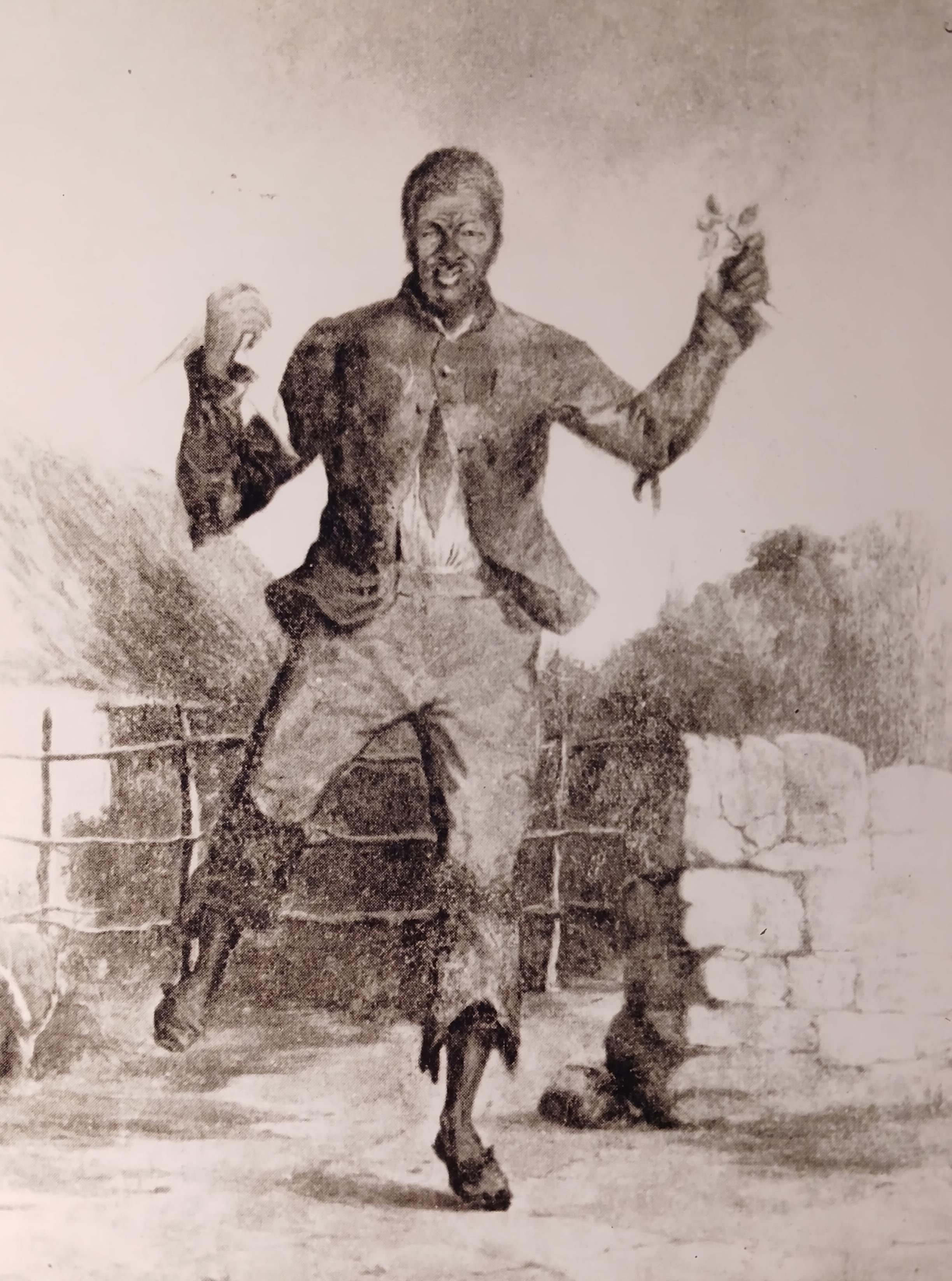
Cover: The Freed Slave (1840) by Frederick Timpson I’Ons. Permission granted by the National Library of South Africa, Cape Town.
Editing, typography and design
Set in 11 pt on 14 pt Garamond

Proceedings of a Jaap Durand Seminar
Edited by Hein Willemse
Indigeneity, Slavery and Nation brings together the proceedings of a Jaap Durand Chair Seminar held on Slave Emancipation Day, 1 December 2025, at the University of the Western Cape. The JDC Opinion and Review Series draws on concise position papers addressing topical issues, originally presented as part of the Jaap Durand Chair Seminars.
JDC Opinion and Review 2
Gangsterism and Social Dysfunction in the Western Cape
ISBN: 978-1-0492-9146-8
https://archive.org/details/gangsterism-and-social-dysfunction-2026
JDC Opinion and Review 3
South African Sport and the Nation
ISBN: 978-1-0492-9144-4
https://archive.org/details/sa-sport-nation-2026-abf
vii Contributors
1 The Invention and Production of South African Identities — Hein Willemse
11
Welcoming Address — Robert J. Balfour
15 Restorative Memory in the Crafting of Restorative Justice Contextual to Indigeneity and Slavery — Patric Tariq Mellet
38 ‘For the Nation to Live’: The Place of Cape Slavery in the National Narrative on Identity — Michael Ian Weeder
57 Khoi-San Indigeneity — Willa Boezak
64 The End of South Africa: Notes on the Azanian Philosophical Tradition and Constitutional Abolition — Ndumiso Dladla
93 Race, Ethnicity and the Politics of Non-Racialism in South Africa — Ciraj Rassool
105 Reclaiming the Power to Name not Shame — Tessa Dooms
112 Archive to Altar: The Groote Kerk as a Site of Memory and Restoration — Riaan de Villiers
120 Notes on Afrikaans Language Movements — Mogamat Kamedien
135 A Balanced Perspective of the Past, the Present and the Future — Theuns Eloff
146 Reconstructing Kaaps: From Slave Lingua Franca to a Formalised Language in Post-Apâthyt Syt Afrieka — Quentin Williams
166 Emergence or Revival?
Critical Poetic Traditions in African Languages — Siseko H. Kumalo
185 Coda: Indigeneity, Slavery and Nation in South Africa
Robert J. Balfour, BA Honours, HDE (cum laude), Rhodes; MA (cum laude) Natal; PhD, Cambridge, is Rector and Vice-Chancellor of the University of the Western Cape. He previously served as Professor of English Studies and Education at the University of KwaZulu-Natal, Registrar of St Augustine College of South Africa (2008–2010), Dean of the Faculty of Education Sciences at North-West University (2011–2017), and Deputy Vice-Chancellor: Teaching and Learning at North-West University (2017–2024). He has published extensively on multilingualism, equity, and postcolonial studies.
Willa Boezak, Dipl. Social Work, MTh (UWC); MTh (Free Univ., Amsterdam); PhD (UCT), is a researcher, writer, motivational speaker, artist, and co-producer of documentaries on the Khoi-San of Southern Africa. He is currently a member of the Hessequa Cultural Council, and the Afrikaanse Taalraad. He used to be an advisor of the National Khoi-San Council and Griqua National Conference. Earlier he served as a minister in the Dutch Reformed Mission Church, and a senior lecturer in Theological Ethics at UWC. He also taught at a private school in South Korea. He served on the Western Cape Cultural Commission, the Western Cape Premier's Honorary viii
Committee and the Commission on the Rights of Cultural, Religious and Linguistic Communities.
Riaan de Villiers is a theologian and minister in the NG Kerk, Cape Town, committed to serving church and community through restoration, justice and peace. He partners with diverse groups to build networks for an equal, free society. He helps place skills and resources at the service of the common good and cultivates spaces for dialogue that learn from oppression’s history while forging a future. He dreams of a healthier, just South Africa and world.
Ndumiso Dladla taught Jurisprudence in the Faculty of Law at the University of Pretoria until January 2026. He currently teaches Philosophy and Applied Ethics at the University of Zululand. He previously taught African Philosophy at the University of South Africa. As a visiting Global Justice Fellow at the Institute of Political Philosophy at Leiden University, he also taught Philosophy at the Leiden University College in The Hague, The Netherlands. His research focuses on constitutional theory, legal and political philosophy as well as the philosophy of South African history and forms part of a collective effort towards the systemisation of the Azanian Philosophical Tradition. He has edited several special collections spanning the fields of political and legal philosophy and South African historiography. He authored numerous scholarly articles and book chapters as well as a monograph Here is a Table: A Philosophical Essay on the History of Race/ism in South Africa, (SunMedia, 2020). He is a member of the Azanian Philosophical Society as well as the National Conference of Black Political Scientists.
Tessa Dooms, MA (Wits), is a director at the Rivonia Circle, political thinktank, and a trustee of the Kagiso Trust. She co-authored Coloured: How Classification became Culture (2023) that explores identity politics in South Africa. She is an activist, author and change maker committed to the remaking of the future of South Africa. She started her career in academia, and work thereafter in diverse sectors including government, non-profit organisational and the private sector. She has 15 years’ experience as a development worker, trainer and researcher with expertise on governance, youth development and innovation, and has worked in over ten African countries. In 2015 she was appointed to the National Planning Commission to advise the President on the implementation of the National Development Plan of South Africa.
Theuns Eloff obtained a B-degree in law, and masters and doctoral degrees in Theology at the Potchefstroom University. After six years he left the ministry in 1989 after the Dakar safari and in 1990 became head of the Consultative Business Movement. He was involved in the facilitation and planning of the National Peace Convention, headed the CODESA Secretariat and the Administration of the Multiparty Negotiation Process
Indigeneity, Slavery and Nation
(1992–1993). He became CEO of the National Business Initiative in 1995. In 2002 he became Vice-Chancellor of his alma mater, and later first ViceChancellor of the new North-West University (2004–2014). He is currently chairperson of the Dagbreektrust, the Trust for Afrikaans Education and the Trust for Afrikaans Arts, Culture and Heritage. He facilitated the 2024 Afrikaner Declaration.
Mogamat Kamedien is a cultural activist, a community archival advocacy champion, and a slave history specialist, co-editor, along with the Prof Robert Shell and Sandra Shell-Rowoldt of the publication, Bibliographies of Bondage (2007). As an independent historian, he made guest appearances on numerous history, heritage and cultural programmes, and has held various heritage advocacy portfolios. He is a founder member of the Cape Flatsbased genealogy NPO, the Cape Family Research (CFRF). Additionally, he was vice-chairperson of the Western Cape Archives Advisory Committee (April 2022 to March 2025). In 1994 he served as the Minutes Scribe of the Youth Sub-commission of the Shaykh Yusuf Tricentennary Commemoration Commission. In 2014, he was a keynote speaker of the "Rustenburg Memorial Conversations: Commemorating Emancipation Day" at the University of Cape Town. In 2021, he was designated as secundus representing the Cape Mazaar Society on the South African Heritage Resources Agency (SAHRA) task team. He was honoured with the Western Cape Cultural Affairs 2023 award for his contributions to the field.
Siseko H. Kumalo is a political theorist and higher education scholar whose work sits at the intersection of African Philosophy, decolonial critique, and feminist theory. His scholarship is anchored in a deep commitment to transforming the politics of knowledge, challenging exclusionary traditions, expanding intellectual horizons, and reimagining the university as a space of liberation. He served as the founding editor of the Journal of Decolonising Disciplines and is the visionary behind the Black Archive Project, a groundbreaking initiative that surfaces marginalised epistemic traditions and cultivates new generations of critical thinkers. His ultimate ambition is to endow a Chair in the Black Archive, ensuring the long-term institutional future of this work.
Patric Tariq Mellet, MSc (Buckingham-shire New University, UK), is an author, historian, and heritage practitioner best known for works such as The Lie of 1652 (2020), The Truth about Cape Slavery (2024), and Conversations with my Ancestral Mothers (2025). His autobiography, Cleaner’s Boy – A resistance road to a liberated life (2002) chronicles his story as a District Six, Woodstock and Salt River boy who rose up from poverty and homelessness, and was later forced into exile. An anti-apartheid activist, he went into exile in the 1970s, working in the liberation movement and press across multiple countries,
Contributors
returning to South Africa in 1990. Post-apartheid, he served in government, including as Director of Public Relations in Parliament and as a law enforcement officer, focusing on human trafficking. He served on the Governance Council of the South African Heritage Resources Agency (SAHRA), is presently serving on the board of Heritage Western Cape. He contributed to the transformation of the Iziko Slave Lodge Museum and is also founder of the Camissa Museum at the Castle of Good Hope Heritage Site. In retirement, he focuses on research, writing, and public engagement around slavery, indigenous history, and restorative justice.
Ciraj Rassool, PhD is Senior Professor in the Department of Historical Studies at the University of the Western Cape in South Africa, and director of the African Programme in Museum and Heritage Studies. He has published widely on changing old museums and making new museums, race in museums, restitution, political movements and the politics of nonracialism. He served on the boards of the District Six Museum, Iziko Museums of South Africa (and also served as chairperson for a term of both), and the South African Heritage Resources Agency, and is a member of the South African National Advisory Board for Restitution and Repatriation. He is a principal investigator on the international collaborative research projects, Action for Restitution to Africa, and Reconnecting ‘Objects’: Epistemic Plurality and Transformative Practices in and beyond Museums as well as a co-investigator of the Canadian-based international project, Thinking Through the Museum. He is a member of the panel of ‘critical friends’ of the Dutch museum transformation project Pressing Matter. He was appointed to the technical team of South Africa’s presidency of the G20, to work on preservation and restitution.
Michael Ian Weeder, BA (Hons), MA (cum laude, UWC), was ordained to the Anglican priesthood in 1985 and in the following year he served as the Secretary of the Black Clergy Association. In 1992 he was appointed to the staff of Archbishop Desmond Tutu as director of the Anglican Board of Social Responsibility (BSR). He was a founder member of December 1st, a social movement formed to work around the memory and legacy of slavery. As part of that project, he co-produced a movie, Lydia Williams, A Fervent Simplicity, an insight into slavery at the Cape. He is Archbishop Emeritus, Desmond Tutu’s representative on the Peace and Dialogue Platform: An international peace-making initiative of some Nobel Peace Prize laureates. On the 22nd of May 2011, he was installed as the Dean of the Anglican Cathedral of St George the Martyr, Cape Town. Canon Weeder retired from the stipendiary priesthood on May 2024.
Hein Willemse is Professor Emeritus of Afrikaans Literature and Literary Theory and former Head of Department at the University of Pretoria. He
Indigeneity, Slavery and Nation
has held visiting professorships at universities locally and internationally, including in Africa, Europe, and the Americas. He is the inaugural holder of the Jaap Durand Chair (2025–26) at the University of the Western Cape.
Quentin Williams is Director of the Centre for Multilingualism and Diversities Research (CMDR) and full Professor of Linguistics in the Linguistics Department at the University of the Western Cape (UWC). He is co-editor of the CMDR’s journal Multilingual Margins, founder and chairperson of the Societie virrie Advancement van Kaaps (SAK) and an editorial board member of SAK’s flagship journal, Aweh: A Journal for Minoritized Languages. His most recent co-authored book is Struggles for Multilingualism and Linguistic Citizenship. He is the editor-in-chief of Kaaps (2026), a trilingual dictionary, and the co-editor of the forthcoming Kaaps Grammar guide: The Basics (2026), the co-editor of the double volume Kaaps Chronicles: Past, Present, Futures (2026).
Hein Willemse
Welcome to this seminar, the first in a series of three exploring the historical, social and political forces that have shaped ideas of nationhood in South Africa. The seminar is convened under the auspices of the Jaap Durand Chair at the University of the Western Cape.
Jaap Durand served as Professor of Systematic Theology and Vice-Rector of the University of the Western Cape from 1973 to 1994, a period that coincided with some of the most turbulent and transformative decades in the university’s history. I first knew him as a student in the 1970s. I was enrolled in law and never had the privilege of attending his lectures; later as a staff member in the 1980s I had the honour of serving alongside him as the staff representative on the Executive Council of Senate. During his years at UWC, Durand worked closely with two rectors, Profs Richard van der Ross and Jakes Gerwel, and with the long-serving Chancellor, Archbishop Desmond Tutu, all of whom played decisive roles in shaping the university’s intellectual and institutional character. It is therefore a particular privilege to have been appointed the inaugural Visiting Professor of this university-wide Jaap Durand Chair, established by the Durand family in honour of their father.
Indigeneity, Slavery and Nation
I conceive of the Chair as a forum for critical public conversation. Its activities bring together scholars, students, community participants and public intellectuals to reflect on questions of democracy, justice, belonging and citizenship. Through seminars such as this one, the Chair seeks to contribute to the development of a just, participatory and sustainable society.
The present seminar focuses on indigeneity, slavery and nation. It asks how South Africans understand themselves, both individually and collectively, within a society shaped by centuries of conquest, dispossession, enslavement, migration, resistance and cultural exchange (including the role of religion and language in the formation of identities). The seminar is concerned not merely with the past, but with the consequences of that past for contemporary debates about belonging, recognition, citizenship and historical justice. As a point of departure for the seminar, I offer the generalised concept note that follows, which draws together and develops some of the key ideas I have shared in preparation with our presenters.
South Africa and the identities of its inhabitants were invented and produced over nearly four centuries, often through violent construction — conquest, dispossession, enslavement — intertwined with the processes of migration, resistance, adaptation and cultural exchange — and its production within resistance politics.1 It is from this history that the politically charged questions arise: who belongs, who was here first, whose histories are erased, whose voices remain unheard, and whose place in our society remains unresolved. These are the questions we set for this seminar on indigeneity, slavery and nation.
It is pertinent that this seminar was held on 1 December 2025, commemorating the emancipation of slaves stretching back to 1834 and 1838. Slavery is a foundational institution of what would become South Africa. Although Slave Emancipation Day is not formally acknowledged as a public holiday in South Africa — in itself a sign of institutional neglect and erasure — it marks a turning point in the country's history, in Robert Shell’s phrase, “Slavery changed and in changing reshaped the whole society.”2 It is therefore appropriate to view South Africa and its people through the prism of slavery and migration, adaptation and change, and the multiple manifestations of creolisation,3 a concept that captures the dynamic, often turbulent processes by which people of distinct backgrounds, languages, cultures and belief systems were brought into contact and forged something new, neither reducible to its component parts nor easily mapped onto the categories colonial administrators imposed. The blending of African, South and East Asian, and European cultures at the Cape threw human beings together under extreme conditions. Slavery connected the colony to global
Invention and Production of South African Identities
trade routes, fuelled colonial economic expansion and embedded the labour hierarchies that shaped the region's economic and social systems — yet for the most part this history was minimised in South African scholarship and popular culture — “a marginalised subscript in our national consciousness”.4 Only relatively recently have historians recognised slavery as central to the Cape's economy, social structure and culture.
Successive colonial and apartheid administrations configured and reconfigured the physical, social, cultural, religious, and economic environment through dispossession, displacement, enslavement, indentured labour and bureaucratic racial engineering. These administrations did not invent the identities of the people under their governance, but selectively codified and politicised them. Through administrative edict or neglect, existing social identities were destroyed, some were invented, and people were forced into categories that bore little relationship to how they understood themselves.
The deepest layer of this colonial experience begins with the Khoikhoi and San peoples.5 The term “indigeneity” itself is contested in the South African context, carrying contradictory histories: on the one hand it has been used, with increasing international recognition, to designate the San and Khoikhoi as the region's first peoples — those whose presence predates all subsequent migrations, whether African or European; on the other hand, apartheid deployed the related term “native” to designate Ntu-speaking Africans as indigenous, instrumentalising the concept to confine people to ethnic homelands and strip them of national citizenship.6 This ambiguity is not merely semantic. It goes to the heart of the questions this seminar raises about belonging, priority and erasure.
The Khoikhoi people's encounters with European seafarers on the African southwest coast from the end of the fifteenth century set in motion processes that would result in the dispossession of land. Precolonial polities became fragmented, and indigenous individuals were incorporated into an evolving colonial society as low-status servants. San groupings met a brutal fate, labelled "vermin", they were hunted across the interior in extermination expeditions by colonial commandos well into the 19th century.7 Slavery at the Cape emerged partly because Khoikhoi communities resisted incorporation into the labour regime of the Dutch settlement, and partly because the Vereenidge Oostindische Compagnie drew upon wider Indian Ocean systems of enslavement already integral to its colonial enterprise.8
Within this colonial order, women occupied a particularly exposed position. Enslaved women, Khoikhoi women, and the women of settler households were bound together — and set apart — by the intimate
Indigeneity, Slavery and Nation
economies of domestic and reproductive labour.9 It was largely through their bodies and their labour that the creolised society of the Cape was made: in the households where languages blended, in the kitchens where cooking traditions merged, and in the violence of sexual exploitation that produced children whose place in the colonial order was always ambivalent. The stories of these women are among the most systematically erased from the historical record, yet they are indispensable to any honest account of how South African identities were formed.
From these connections of people emerged identities that were fractured, recombined and politically weaponised. Children born of liaisons between aboriginal, enslaved and settler populations were over time absorbed into the Coloured social grouping — itself a colonial term that evolved from a catchall category into one of increasingly narrow specificity. The emergence of Coloured identity cannot be reduced to any single origin; it is an identity produced through dispossession, enslavement, the collapse of prior social structures, and deliberate divide-and-rule policies. Yet from these disparate origins, communities classified Coloured engaged in community-building and developed political self-identification, often resisting state imposition and asserting their own terms of belonging.10
European settlers arrived in successive waves — initially Dutch, German and French Huguenot, after 1806 the British, and later with mineral discoveries, East Europeans and Russian Jews, and ex-patriot Portuguese settlers following the independence of Angola and Mozambique in 1975. Under colonialism and apartheid, these immigrants were absorbed into the single category of “white”, their internal heterogeneity levelled over generations into two dominant identity streams: Afrikaners and Englishspeaking South Africans, each with their own class divisions, religious differences and internal tensions.11 Afrikaner nationalism arose amid the pressures of British imperialism in the late nineteenth and early twentieth centuries, ultimately triumphing in 1948, its claims to biological and cultural purity retrospective inventions in service of a political programme. Being “white” in South Africa was never a natural or stable category, but an ongoing political project.
The history of people from the Indian subcontinent runs in two distinct but related streams: the largely forgotten history of Indian slaves at the Cape,12 and the more extensively documented history of indentured workers brought to Natal from 1860 onwards13 — itself a colonial repetition of the logic applied to the Khoikhoi two centuries earlier, since Zulu communities similarly resisted plantation labour. A unified “Indian” identity was a product of this colonial pressure, formed in relation to the broader racial hierarchy.
The Invention and Production of South African Identities
The conception of black African identity was shaped differently again. Ntu-speaking communities migrated from western and central Africa to the southern subcontinent from at least the first five centuries of the common era, forming distinct social and linguistic communities.14 These identities were further reshaped by conflict, displacement and political reorganisation among these societies in the early nineteenth century, which significantly altered the demographic and political landscape of the interior before and during the colonial advance. The wars of dispossession that followed deepened the fragmentation of such polities and accelerated the incorporation of communities into the colonial labour economy on deeply unequal terms.15 Under apartheid, the concept of “indigeneity” acquired a very specific and coercive meaning: the descendants of ancient African migrants were bounded into separate administrative units, assigned territorial “homelands”, stripped of South African citizenship and codified into distinct “tribes” compelled to exercise political rights in fragmented Bantustans.16
Throughout this history, the imposition of colonial and apartheid structures was met with sustained resistance. From early slave revolts and the resistance of Khoikhoi and San communities, to the formation of organised political and trade union formations in the twentieth century, oppressed communities continuously organised, theorised and acted against the order that sought to define and contain them.17 Resistance was not merely reactive; it was generative, producing new solidarities, new political languages and new conceptions of identity, often based on racial redefinitions, that would shape the country's eventual democratic transition. Alongside these, competing nationalist expressions developed — African nationalism, PanAfricanism and Afrikaner nationalism among them — each articulating a different and often irreconcilable vision of belonging and entitlement.18
Over time, colonial categories of differentiation hardened into rigid racial classifications, principally through the Population Registration Act of 1950 and the many laws that followed. Although all these statutes were eventually rescinded, apartheid classifications found new life in the post-1994 era through affirmative action and black economic empowerment legislation, cementing the structural realities of a deeply unequal society.
The negotiated settlement of the early 1990s ended apartheid, and inaugurated enormous expectations of restitution, recognition, a meaningful reckoning with the past. The constitutional settlement enshrined a non-racial democratic citizenship, yet the tension between that constitutional ideal of non-racialism and the race-conscious redress policies has never been fully resolved, and remains a fault line in our political life.
Indigeneity, Slavery and Nation
The post-1994 era has affected South Africans in profoundly different ways. Democratic citizenship opened space for complex processes of identity renegotiation, among them the assertion of ethnic particularity, the recovery of indigenous and immigrant identities erased by colonialism and apartheid, the deepening of an encompassing South Africanism, and a pronounced non-racialism. These are all exercises of self-authorisation — attempts to narrate one's own history from different structural positions. They share a common feature: they are all responses to the colonial and apartheid orders that imposed identities from above, and all represent the effort to inhabit, revise or refuse those impositions. It is into this unresolved, generative tension — between erasure and recovery, between imposed category and lived identity, between the legacies of violence and the possibilities of democratic belonging — that this seminar speaks.
Imust extend a special word of thanks to all the speakers who had prepared and presented their papers at the seminar, particularly at the beginning of our vacation period in South Africa: Willa Boezak, Riaan de Villiers, Ndumiso Dladla, Tessa Dooms, Theuns Eloff, Mogamat Kamedien, Siseko H. Kumalo, Ciraj Rassool, Michael Weeder, and Quentin Williams. I offer my sincere gratitude to Patric Tariq Mellet for delivering the Jaap Durand Annual Lecture, entitled “Restorative Memory in the Crafting of Restorative Justice contextual to Indigeneity and Slavery”. I acknowledge the commitment of the rector, Prof Robert J. Balfour and the support of the Durand family, and the Jaap Durand Steering Committee under the leadership of Profs Fatima Moolla, Ernst Conradie and Lois Dippenaar. Llewellyn MacMaster, Christo van der Rheede, and Li’Tsoanelo Zwane served as gracious and informed session chairpersons, while Mischca Booysen, Marco Lara, Lee-Anne Munro, Johnmark Solomon, and Caitlin Veldsman carried out their front desk tasks dutifully. Sergio Croy from the Audio-Visual Services of the University recorded the proceedings, while Gasant Abarder, Nashira Davids, and their team expertly dealt with the communication needs of the event. Lloyd Zanna-Rex Chetty deserves particular mention. Her attention to detail was vital to the success of the seminar.
Notes
1. Benedict Anderson, Imagined Communities: Reflections on the Origin and Spread of Nationalism (London: Verso, 1991); Eric J. Hobsbawm and Terence Ranger, eds., The Invention of Tradition (Cambridge: Cambridge University Press, 1983); Terence Ranger, “Missionaries, Migrants and the Manyika: The Invention of Ethnicity in Zimbabwe,” in The Creation of Tribalism in Southern Africa, ed. Leroy Vail (London: James Currey; Berkeley: University of California Press, 1989), 118–50. On Jaap Durand’s view’s on “race theology” and Volk, see his commentary in “Die
The Invention and Production of South African Identities
hermeneutiek van ’n rasseteologie”, J. J. F. Durand, Teks binne konteks: Versmaelde opstelle oor kerk en politiek (Bellville: University of the Western Cape, n.d.), 75-87. The politics of racial affirmation, ethnic affirmation has a long history in resistance politics, see Roy H. du Pré, Separate but Unequal: The “Coloured” People of South Africa—A Political History (Johannesburg: Jonathan Ball, 1994); Tom Lodge, Black Politics in South Africa since 1945 (Johannesburg: Ravan Press, 1983); Gavin Lewis, Between the Wire and the Wall. A History of South African ‘Coloured’ Politics (Cape Town, Johannesburg: David Philip, 1987); Crain Soudien, The Cape Radicals: Intellectual and Political Thought of the New Era Fellowship, 1930s–1960s (Johannesburg: Wits University Press, 2019).
2. Robert C.-H. Shell, Children of Bondage: A Social History of the Slave Society at the Cape of Good Hope, 1652–1838 (Johannesburg: Witwatersrand University Press, 1997), xxxi.
3. Édouard Glissant, Poetics of Relation, trans. Betsy Wing (Ann Arbor: University of Michigan Press, 1997). For a local perspective on creolisation, see Achmat Davids, The Afrikaans of the Cape Muslims, edited by Hein Willemse and Suleman E. Dangor (Pretoria: Protea Book House, 2011), 33–88; Denis-Constant Martin, “A Creolising South Africa? Mixing, hybridity, and creolisation: (Re)imagining the South African experience”, International Social Science Journal 58, no. 187 (2006): 165–176, doi:10.1111/j.1468-2451.2006.00600.x.
4. Patric Tariq Mellet, The Truth about Cape Slavery: The Foundations of Colonial South Africa (Cape Town: Tafelberg, 2024), 10; Nigel Worden, Slavery in Dutch South Africa (Cambridge: Cambridge University Press, 1985); James C. Armstrong, “The Slaves, 1652–1795,” in The Shaping of South African Society, 1652–1820, ed. Richard Elphick and Hermann Giliomee (Cape Town: Longman Penguin Southern Africa, 1979), 75; Alan Mountain, An Unsung Heritage: Perspectives on Slavery (Cape Town: David Philip, 2004). Karel Schoeman, Early Slavery at the Cape of Good Hope 1652–1717 (Pretoria; Protea Book House, 2007).
5. Robert Ross, “Khoesan and Immigrants: The Emergence of Colonial Society in the Cape, 1500–1800,” in The Cambridge History of South Africa, vol. 1, From Early Times to 1885, ed. Carolyn Hamilton, Bernard K. Mbenga, and Robert Ross (Cambridge: Cambridge University Press, 2010), 168–210.
6. Mahmood Mamdani, Define and Rule: Native as Political Identity (Johannesburg: Wits University Press, 2013); Shana Almeida and Siseko H. Kumalo, “(De)coloniality through Indigeneity: Deconstructing Calls to Decolonise in the South African and Canadian University Contexts,” Education as Change 22, no. 1 (2018), https:// doi.org/10.25159/1947-9417/3023.
7. Nigel Penn, The Forgotten Frontier: Colonist and Khoisan on the Cape’s Northern Frontier in the Eighteenth Century (Cape Town: Double Storey Books, 2005); Mohamed Adhikari, The Anatomy of a South African Genocide The Extermination of the Cape San Peoples (Cape Town: UCT Press, 2014), 81.
8. Armstrong, “The Slaves, 1652–1795,” 75–115.
Indigeneity, Slavery and Nation
9. Richard Elphick and Robert Shell, “Intergroup Relations: Khoikhoi, Settlers, Slaves and Free Blacks, 1652–1795,” in The Shaping of South African Society, 1652–1820, ed. Richard Elphick and Hermann Giliomee (Cape Town: Longman Penguin Southern Africa, 1979), 126–35.
10. Shell, Children of Bondage, 40–65; Ian Goldin, Making Race: The Politics and Economics of Coloured Identity in South Africa (Cape Town: Maskew Miller Longman, 1987), 3–29; Hermann Giliomee, The Afrikaners: Biography of a People (Cape Town: Tafelberg, 2003), 503–7; Roy H. du Pré, Separate but Unequal: The “Coloured” People of South Africa—A Political History (Johannesburg: Jonathan Ball, 1994); Lewis, Between the Wire and the Wall; Soudien, The Cape Radicals.
11. Jan Burger, The Gulf Between (Cape Town: Howard Timmins, 1960); Giliomee, The Afrikaners, 448–53.
12. Mellet, The Truth about Cape Slavery, 107.
13. Rajend Mesthrie, Language in Indenture: A Sociolinguistic History of Bhojpuri-Hindi in South Africa (Johannesburg: Witwatersrand University Press, 1991), 1–40.
14. I. Hrbek, ed., General History of Africa, vol. 3, Africa from the Seventh to the Eleventh Century (Paris: UNESCO, 1992), 75–85.
15. Bernard Makhosezwe Magubane, The Political Economy of Race and Class in South Africa (New York and London: Monthly Review Press, 1979), 20–70.
16. Giliomee, The Afrikaners, 512.
17. Robert Ross, The Borders of Race in Colonial South Africa: The Kat River Settlement, 1829–1856 (Cambridge: Cambridge University Press, 2014), 1.
18. Lodge, Black Politics in South Africa since 1945; Magubane, The Political Economy of Race and Class in South Africa, 221–330; Giliomee, The Afrikaners, 355–400; Thula Simpson, History of South Africa: From 1902 to the Present (Cape Town: Penguin Books, 2021), 125–67.
Bibliography
Adhikari, Mohamed. The Anatomy of a South African Genocide The Extermination of the Cape San Peoples. Cape Town: UCT Press, 2014.
Almeida, Shana, and Siseko H. Kumalo. “(De)coloniality through Indigeneity: Deconstructing Calls to Decolonise in the South African and Canadian University Contexts.” Education as Change 22, no. 1 (2018). https://doi.org/ 10.25159/1947-9417/3023.
Anderson, Benedict. Imagined Communities: Reflections on the Origin and Spread of Nationalism. London: Verso, 1991.
Armstrong, James C. “The Slaves, 1652–1795.” In The Shaping of South African Society, 1652–1820, edited by Richard Elphick and Hermann Giliomee, 75–115. Cape Town: Longman Penguin Southern Africa, 1979.
The Invention and Production of South African Identities
Burger, Jan. The Gulf Between. Cape Town: Howard Timmins, 1960.
Davids, Achmat. The Afrikaans of the Cape Muslims, edited by Hein Willemse and Suleman E. Dangor (Pretoria: Protea Book House, 2011), 33–88.
Du Pré, Roy H. Separate but Unequal: The “Coloured” People of South Africa—A Political History. Johannesburg: Jonathan Ball, 1994.
Durand, J. F. F. Teks binne konteks: Versmaelde opstelle oor kerk en politiek. Bellville: University of the Western Cape, n.d..
Elphick, Richard, and Robert Shell. “Intergroup Relations: Khoikhoi, Settlers, Slaves and Free Blacks, 1652–1795.” In The Shaping of South African Society, 1652–1820, edited by Richard Elphick and Hermann Giliomee, 116–77. Cape Town: Longman Penguin Southern Africa, 1979.
Giliomee, Hermann. The Afrikaners: Biography of a People. Cape Town: Tafelberg, 2003.
Glissant, Édouard. Poetics of Relation. Translated by Betsy Wing. Ann Arbor: University of Michigan Press, 1997.
Goldin, Ian. Making Race: The Politics and Economics of Coloured Identity in South Africa Cape Town: Maskew Miller Longman, 1987.
Hobsbawm, Eric J., and Terence Ranger, eds. The Invention of Tradition. Cambridge: Cambridge University Press, 1983.
Hrbek, I., ed. General History of Africa. Vol. 3, Africa from the Seventh to the Eleventh Century. Paris: UNESCO, 1992.
Lewis, Gavin. Between the Wire and the Wall. A History of South African ‘Coloured’ Politics .Cape Town, Johannesburg: David Philip, 1987.
Lodge, Tom. Black Politics in South Africa since 1945. Johannesburg: Ravan Press, 1983.
Magubane, Bernard Makhosezwe. The Political Economy of Race and Class in South Africa. New York and London: Monthly Review Press, 1979.
Mamdani, Mahmood. Define and Rule: Native as Political Identity. Johannesburg: Wits University Press, 2013.
Martin, Denis-Constant Martin, “A Creolising South Africa? Mixing, hybridity, and creolisation: (Re)imagining the South African experience”, International Social Science Journal 58, no. 187 (2006): 165–176, doi: 10.1111/j.1468-2451.2006.00600.x.
Mountain, Alan, An Unsung Heritage: Perspectives on Slavery. Cape Town: David Philip, 2004.
Mellet, Patric Tariq. The Truth about Cape Slavery: The Foundations of Colonial South Africa. Cape Town: Tafelberg, 2024.
Mesthrie, Rajend. Language in Indenture: A Sociolinguistic History of Bhojpuri-Hindi in South Africa. Johannesburg: Witwatersrand University Press, 1991.
Indigeneity, Slavery and Nation
Penn, Nigel. The Forgotten Frontier: Colonist and Khoisan on the Cape’s Northern Frontier in the Eighteenth Century. Cape Town: Double Storey Books, 2005.
Ranger, Terence. “Missionaries, Migrants and the Manyika: The Invention of Ethnicity in Zimbabwe.” In The Creation of Tribalism in Southern Africa, edited by Leroy Vail, 118–50. London: James Currey; Berkeley: University of California Press, 1989.
Ross, Robert. The Borders of Race in Colonial South Africa: The Kat River Settlement, 1829–1856. Cambridge: Cambridge University Press, 2014.
———. “Khoesan and Immigrants: The Emergence of Colonial Society in the Cape, 1500–1800.” In The Cambridge History of South Africa. Vol. 1, From Early Times to 1885, edited by Carolyn Hamilton, Bernard K. Mbenga, and Robert Ross, 168–210. Cambridge: Cambridge University Press, 2010.
Schoeman, Karel. Early Slavery at the Cape of Good Hope 1652–1717. Pretoria; Protea Book House, 2007.
Shell, Robert C.-H. Children of Bondage: A Social History of the Slave Society at the Cape of Good Hope, 1652–1838. Johannesburg: Witwatersrand University Press, 1997.
Simpson, Thula. History of South Africa: From 1902 to the Present. Cape Town: Penguin Books, 2021.
Soudien, Crain. The Cape Radicals: Intellectual and Political Thought of the New Era Fellowship, 1930s–1960s. Johannesburg: Wits University Press, 2019.
Worden, Nigel. Slavery in Dutch South Africa. Cambridge: Cambridge University Press, 1985.
Good morning colleagues, guests, students, and members of our wider academic community. Welcome to the Jaap Durand Seminar on Indigeneity, Slavery, and Nation, and the Jaap Durand Annual Lecture. We meet under the Jaap Durand Chair on a Just, Participatory and Sustainable Society. This research Chair was established earlier this year in honour of the late Professor Jaap Durand, former Vice-Rector of UWC.1 Professor Durand worked tirelessly for social justice in our country and for a thoughtful intellectual culture, especially here at UWC. He believed that South Africa moves forward only when scholarship, memory, and public life are inclusive.2 This seminar continues that work, and for that we are grateful.
And so, we turn to the theme that brings us together today — belonging, voice, and memory. The programme invites us to consider important questions about who we are as a nation: Are all citizens equally recognised as South African? Whose histories and voices remain unheard?3
Indigeneity, Slavery and Nation
During the course of the day, we will trace histories of slavery, dispossession, and movement — and how these histories continue to influence access to land, opportunity, language, and cultural belonging. We know that slavery at the Cape was never isolated. It formed part of global systems of extraction and racialised labour that reach into the present.
Today is also a day of memory. It was on 1 December 1834 that enslaved people were emancipated at the Cape.4 And so, we meet on a date weighted with legacies of endurance, refusal, trauma, and cultural survival.
In our reflections today, we stand in conversation with voices who have helped the world think about truth, memory, and courage.
Many thinkers have helped us to frame this work of remembering and reimagining. For example, James Baldwin reminds us that change begins with truth — that a society cannot transform what it refuses to acknowledge.5 His work challenges us to meet history honestly, without avoidance or sentiment. And that resonates deeply with this seminar anchored in memory, slavery and belonging.
Karen Barad further reminds us that knowledge is not produced in isolation, but through entanglement — through relationships, context, material conditions and human exchange. Scholarship, in this view, is not a solitary act but a collective one, shaped by encounter and dialogue.6
With these ideas in mind, we turn to those who continue this work here — scholars and public thinkers who carry it forward, and whom we recognise among us today. I would like to acknowledge Professor Hein Willemse, who holds the Durand Chair and whose work on literature, memory, and identity continues to influence this university and this field.
We also look forward to hearing from Patric Tariq Mellet, who will deliver the Annual Lecture on Restorative Memory and Restorative Justice.7
We also welcome the scholars who will lead panels throughout the day.8
And finally, we acknowledge members of the Durand family, whose support enables the Chair and this event.
Today, we are here to listen. To think carefully. To let memory unsettle convenience — and to remember that our nation is still in formation. May today move us toward a more honest and courageous understanding of who we are — and who we could become. May it help us think South Africa again — carefully, honestly, and with intellectual courage.
Welcoming Address
Notes
1. Hein Willemse, Biographical Note—Jaap Durand Chair (University of the Western Cape / University of Pretoria, 2025).
2. Willemse, Biographical Note—Jaap Durand Chair.
3. University of the Western Cape (UWC), Jaap Durand Seminar: Indigeneity, Slavery, and Nation—and the Jaap Durand Annual Lecture (Programme), Brian O’Connell Life Sciences Building, December 1, 2025.
4. University of the Western Cape (UWC), Talking Points for the Rector’s Speech –Jaap Durand Seminar (December 1) (2025).
5. James Baldwin, “As Much Truth as One Can Bear,” New York Times Book Review, January 14, 1962, sec. T, 11.
6. Karen Barad, “Posthumanist Performativity: Toward an Understanding of How Matter Comes to Matter,” Signs 28, no. 3 (2003): 801–31, https://doi.org/ 10.1086/345321; Karen Barad, Meeting the Universe Halfway: Quantum Physics and the Entanglement of Matter and Meaning (Durham, NC: Duke University Press, 2007); Karen Barad, “Diffracting Diffraction: Cutting Together–Apart,” Parallax 20, no. 3 (2014): 168–87, https://doi.org/10.1080/13534645.2014.927623.
7. University of the Western Cape (UWC), Jaap Durand Annual Lecture Invitation: Restorative Memory in the Crafting of Restorative Justice Contextual to Indigeneity and Slavery – Patric Tariq Mellet (2025).
8. University of the Western Cape (UWC), Jaap Durand Seminar and Annual Lecture: Information and Programme Notes (2025).
Bibliography
Baldwin, James. “As Much Truth as One Can Bear.” New York Times Book Review, January 14, 1962, sec. T, 11.
Barad, Karen. “Posthumanist Performativity: Toward an Understanding of How Matter Comes to Matter.” Signs 28, no. 3 (2003): 801–31. https://doi.org/10.1086/345321.
———. Meeting the Universe Halfway: Quantum Physics and the Entanglement of Matter and Meaning. Durham, NC: Duke University Press, 2007.
———. “Diffracting Diffraction: Cutting Together–Apart.” Parallax 20, no. 3 (2014): 168–87. https://doi.org/10.1080/13534645.2014.927623.
University of the Western Cape (UWC). Jaap Durand Annual Lecture Invitation: Restorative Memory in the Crafting of Restorative Justice Contextual to Indigeneity and Slavery –Patric Tariq Mellet. 2025.
———. Jaap Durand Seminar and Annual Lecture: Information and Programme Notes. 2025.
Indigeneity, Slavery and Nation
———. Jaap Durand Seminar: Indigeneity, Slavery, and Nation—and the Jaap Durand Annual Lecture (Programme). Brian O’Connell Life Sciences Building, December 1, 2025.
———. Talking Points for the Rector’s Speech – Jaap Durand Seminar (December 1). 2025. Willemse, Hein. Biographical Note—Jaap Durand Chair. University of the Western Cape / University of Pretoria, 2025.
Iwould like to thank the esteemed Jaap Durand Professor Hein Willemse, for extending me the privilege and honour of giving the Jaap Durand Annual Lecture for 2025. I also thank you all present today who represent thought-leadership in our communities. I am nourished by the works of many of you who engage at the coalface of the vexing contemporary issues before us. I dedicate this opportunity to the memory of one of my mentors, our late Uncle Reg September, and I also pay tribute to that remarkable mensch and compatriot in struggle, the late Professor Jaap Durand.
At the outset, I must make note, on the subject of identity, that I believe that we as human beings are wired to collect identities, (plural) and discard identities, from the day we are born to the day we die, and these go way beyond notions of race, ethnicity, colour and nation. I caution that notions of identity being singular and based on race, ethnicity, colour, nation, creed and language is flawed, toxic and dangerous and has been usually propagated in anger and “othering” which has led to violence, war and genocide.1
Indigeneity, Slavery and Nation
Another important observation to note is that although I will make note of useful genetical information, we all need to be aware that genetics does not indicate identity. Years ago, we were happy to note that here was a science that disproves race and ethnic theories. But in time we have seen that once more European academics and business entrepreneurs with their stereotypical thinking have dangerously toxified a science with flawed race and ethnic overlays as well as with a skewed historical and geopolitical eye. In Africa instead of talking about DNA geolocation in southern Africa and western and central Africa, European geneticists use non-scientific and questionable terms like “Khoisan”, “Bantu” and “Coloured” DNA and employ stereotypical speculative views of early peoples. This leads to fuelling of ignorance, and misreading of science which is then used to “prove” ethno-nationalist claims and politicised nonsense.
Autosomal DNA oversimplification by commercial laboratories, who fail to also explain the snapshot limitations of DNA pictures, have become a commercial genealogical identity-industry, so much so that some scientists critique it as “genetic astrology”.2 Autosomal DNA pictures do not tell ones identity and do not give individuals more than a 50% overview of the range of localities that trace back in one’s ancient ancestry in the last 20 000–40 000 years. It is not the full genetic story and certainly has little to do with identity.
Furthermore, I will quote from the United Nations (UN), the International Labour Organisation (ILO), the African Union (AU), African Commission on Human and Peoples’ Rights (ACHPR), the Working Group of Indigenous Peoples (WGIP) and other organisational documents and from special rapporteurs, but we must be careful not to put this on a pedestal and then not employ critique. Some of the work of these bodies, again European dominated, is shoddy and uses unfortunate and questionable race, ethnic, tribe, colourist and stereotyping language and conceptualisation. As with everything we should always be critical and cautious. Apartheid is not an ancient practice, yet the notion of social groups for all time practicing apartheid “pure race or ethnicity” up to present social groups permeates and regurgitates throughout many “scientific” papers coming out of the genetic, anthropology and linguistic science arena.
At the heart of our subject today is our intertwined ancestral-cultural heritage rooted in indigene and enslaved peoples. We broach the subject in a world of controversy about indigeneity where European settlers in Israel claim to be indigenous people and are busy with forced removal and genocide of the Palestinian indigenes of Gaza and West Bank. The Israelis have set up an indigenous peoples’ embassy in Jerusalem and some of our own people (self-appointed “royals” with no evidence of indigeneity) under
Restorative Memory in the Crafting of Restorative Justice
the banner of indigeneity are involved in that project. Lies and suppressed truths lay at the heart of this aberration.
My books, The Lie of 16523 and The Truth about Cape Slavery,4 respectively highlighted that South African indigenous history does not start in the 17th century and that the story of slavery at the Cape has been caricatured and reduced to project little about the identities, contributions and reality of slavery. While most applauded these explorations of historical distortion, its content also resulted in some from the white right and some of their fellow travellers from among our own people levelling attacks, personal vilification, death threats and threats to hold mass burning of my books. When I was just 21 years old two of my publications were banned under apartheid and thus on my way to 70 years old I again experienced the shadow of apartheid ideology on my life. Restorative memory is a threat to many a vested interest.
Cape indigenous societies in all its diversity with its multi-facetted economic modes of living off the natural bounty (I prefer this expression to that of “hunter-gatherers”), as well as from large-scale cattle ranching and husbandry, and through rich agricultural endeavours was projected by the Europeans in minimalist primitivist framing. Our forebears’ cultures and technologies were branded as “uncivilised” and today this branding and depreciation continues. And we were told that Africans had no history nor civilisation before Europeans arrived. We were told that there was no multiethnic African society and that a largely empty land existed for the taking.
The roles of two indigenous historical figures – Xhore6 and Autshumao7 – who travelled abroad and were multi-lingual founders of the town and port operations of the City of Cape Town, which, according to the Netherlands Huygens Instituut database of ships logbooks,8 hosted over 1000 ships and, according to numbers on board ships per Leiden University maritime experts,9 120 000 travellers, with average stay-overs of three weeks per vessel10 before 1652 were airbrushed from history by white South African historians, so that the indigenous contributions were underrated and grossly distorted.
The over 2000-year history of the ever-changing multi-ethnic occupation of South Africa was argued away in favour of a false “Empty Land” narrative projecting a sudden invasion by so-called alien herders and agriculturalists of a South African territory said to be solely inhabited until the 14th century by what was called a sub-human exotic species of people branded as so-called “bushmen” but who according Mary Barber were given some rudimentary skills by a white lost tribe of Israel who first dwelled here but are now
Indigeneity, Slavery and Nation
extinct.11 The ideological and race-supremacist roots of proponents of “Firstism” and “Ethnic Primacy” goes back to the highly flawed BarberTheal-Holden colonial framing of South African history.
The many distortions cover our truly great and complex pre-colonial and post-1652 history and heritage in which our Cape indigene forebears and African-Asian enslaved forebears left an indelible footprint of development despite colonial erasure. Restorative memory demands that we un-erase this historical injustice. In so doing we must craft restorative justice and the necessary restitution and reparation that the post-1994 South Africa has failed to acknowledge and to realise.
In this address I will be making the case that at the heart of commemorating the resonance and echoes of African indigeneity and risingup from enslavement as African-Asian captives, “restorative memory” is vital to the crafting of “restorative justice”, and for celebrating identity and liberation.
I will also look at definitions of indigenous, ethnic-primacy or firstism, tribalism, nation and nationalism, and ask whether these colonialist and imperialist re-definitions of our past enhance or detract from celebration and commemoration of our ancestral-cultural heritage.
III
We are challenged to embrace decoloniality rather than embrace the very coloniality of our oppressors when we explore restorative memory to be able to craft a liberatory restorative justice. The Analects of Confucius12 notes, "If names be not correct, language is not in accordance with the truth of things. If language is not in accordance with the truth of things, affairs cannot be carried on to success."
Misnaming in African memory is not accidental. It is colonial and apartheid distortion, and it is repression of memory for the purpose of control, divide and rule. Mimickery of this colonial narrative rooted in repression, today poses great danger for liberation. Ignorance should never be elevated to the status of bliss.
I would like to start off by paying tribute to my own ancestral continuum who are an integral part of my syncretic faith and the life that I have lived. I know and am conscious of all my ancestors over the last 400 years and know them by name and their stories.13
I pay tribute to my 30 known enslaved African-Asian ancestors from a range of African and Asian locations and locally born creoles. I also pay tribute to my eight Cape Indigenous ancestors rooted in the /Kamisons, Cochoqua, Damasqua and Gqunukwebe Xhosa-Khoe.
Memory in the Crafting of Restorative Justice
My mother’s grandmother, Francina Dampies14 was born a direct descendant of a mixed Damasqua Khoe and Xhosa lineage and married a British man at the Philipton mission in the Kat River settlement in the Eastern Cape in 1855. This is the same Dampies lineage of our esteemed late poet and voice of conscience, Adam Small.15
I celebrate within my identity the echoes of this indigeneity and those who rose up from slavery and I am proud of it. I also pay tribute to my ancestors from seven European countries, particularly those who broke with colonial norms and crossed the colour-line in contributing to the Camissa African identities that emerged from this African-Asian-Euro mix of peoples. At the Camissa Museum16 that some of us established at the Castle of Good Hope you will be able to see the story of the 195 roots of origin that we are able to celebrate through Restorative Memory.
At root the cornerstone of our identities today as South Africans, are three African Indigene Foundation Peoples – San Aboriginal peoples, and the later migrant Khoe and migrant Kuvale-Kalundu-Urewe cultures. The oldest coming together of San-language speakers and Ntu-language speakers is manifest in Khwe-Kuvale-Kwepe genetic admixtures in ancestry dating back 2 300–3 000 years ago in Southwestern Angola.17 The western Ntu-speaker cultures are referred to as Kalundu cultures after the Kalundu Hill district of Zambia spreading southwest and south. Urewe cultures (sub-dived as Nkope and Kwale cultures) spreading westward and southward takes its name from Lake Ukurewe also known as Lake Victoria.
The slow migratory drifts and the ancient mixing of Ntu-speaker cultures, Hadzabe, Sandawe and San cultures did not first occur in modern times when Europeans arrived. They are ancient and much is likely to still emerge from research.18 Today genetic studies also show Tswana, Sotho and Xhosa people with up to 24% ancestry related to southern African early peoples associated with San and Khoe and up to 66% ancestry sub-Saharan related to Ntuspeaker Kalundu-Urewe,19 while people labelled “Coloured” who did DNA testing showed up to 20%–36% sub-Saharan readings associated with Ntuspeaker Kalundu-Urewe ancestry and up to 32%–43% southern African DNA readings associated with San. Khoe, Mbuti, Sandawe.20 Testing also shows lesser but significant South Asian, Southeast Asian, Eurasian and European lineage admixture.
Genealogy research and social history support these genetic findings. The “Coloured” testing varies regionally with the lowest San and Khoe results for the Cape Peninsula and the highest in the northern and central Cape. I sound a caution on reading this too rigidly, as testing has been done on much too small samples that are district based and thus a skewed picture can easily arise. An inter-disciplinary approach would be much sounder: A study of
Indigeneity, Slavery and Nation
census reports between 1865 and 1911, together with genealogical studies and micro-history papers dealing with important social history markers.
All the research information that we have today should caution any claims among us of being “First” or having exclusive claims to ethnic roots or of some having primacy over others. We have many more ties that bind us through our shared three African Indigenous Foundation Peoples and later admixtures, than elements of our past that divide us. This must inform all discourse about indigeneity. Our history of descendancy from African-Asian enslaved also must be integrated with our celebration of indigeneity.
What stands out in the ties that bind us, is a history as diverse indigenous African peoples (branded as “Coloured”) colonised by European imperialism and who together faced a range of adversities and traumatic experiences including ethnocide, genocide, slavery, dispossession and apartheid. What also stands out is that together we fought against adversity and rose above it. This is what our celebration of indigeneity and rising- up from slavery is really rooted in . . . not narrow ethnonationalism.
As I deliver this talk, know that this is not just an important academic exploration, for many the issues raised are also personal and collectively a personal celebration of rising-up from the adversities of colonialism and slavery – a celebration of indigeneity and the survival from overwhelmingly traumatic roots.
We need to be aware that colonial and imperial ideologies are still with us, and we are still under assault. This assault and divisive imperial strategies involve European notions of Nations, Tribes, Supremacy and Primacy, Christian Nationalist ideology that is better known by its nickname –apartheid, and all false claims to race and ethnic exclusivity, touted by various group-think platforms who wave these flags. These have no place in celebrating indigeneity and rising-up from slavery.
Liberation has nothing to do with exclusiveness and has everything to do with celebrating the “ties that bind us in our diverse make-up” as the people of Mzansi. We are the inheritors of so many common threads and the greatest common thread is the shared experience of fighting severe oppressions and surviving these. This is the cornerstone beyond ethnicity in our ancestral-cultural heritage. And as Maya Angelou21 said, “Still we rise!” This is who we are.
It is also important to emphasise and celebrate that we are Africans just as former President Thabo Mbeki once proudly proclaimed in his “I am an African” speech to Parliament on 8th May 1996.22
Restorative Memory in the Crafting of Restorative Justice
When invoking the term “African” – for the sake of restorative memory I note that the first to self-identify as Africans in the early Cape, before any other, were the mixed offspring of African-Asian enslaved and Khoe who can be traced to the progenitor of the black Orlam Afrikaner clan, Oude Ram Afrikaner in the 1690s and his sons Klaas Afrikaner, and Afrikaner Afrikaner who died in incarceration on Robben Island.23 This is the true roots of black Afrikaner or African heritage and of the Afrikaans language despite the claims by the organisation established primarily influenced by two mid-19th century Netherlands-born immigrants Arnoldus Pannevis and Casparus Hoogenhout who together with their students Stephanus and Daniël du Toit established the “Genootskap van Regte Afrikaners” in 1875.24 For restorative memory we rightly ask: “Wie was die verkeerde Afrikaners?”
(Association of True Africans? – Who were the False Africans?)
The first modern political organisation in South Africa, black or white, in 1880, which used the name Afrikaner or African in their title was the Kimberley Afrikaner (African) League,25 which was followed by the African People’s Organisation in 1902,26 both with a membership of predominantly people whose descendants from 1910 were classified as “Coloured” when this was formalised. Yes, once we were proud to call ourselves Africans. That is restorative memory.
On the international stage Alice Alexander Kinloch,27 a Camissa African woman from Kimberley, formally labelled “Coloured” from 1910, became the founding mother of the international organisation known as the African Association in 1897 and was a founder personality of the first Pan African Conference in 1898 and held in 1900. She played this role along with Advocate Henry Sylvester Williams from Trinidad and Zacharia Perigrino from Ghana, both of whom played a role in Cape politics.28 All were of multi-ethnic African ancestry. In founding the Pan African Movement its founders recognised an inclusive definition of African indigeneity that placed a common experience of people rooted in Africa who were victims of colonialism, imperialism, slavery, displacement, and a global system of white supremacism and its hierarchy of race, as the defining framework for their identity. In the African diaspora any person with at least one forebear indigenous to Africa was seen as African.
Pan African consciousness was the antithesis of European ideas of nationalism, primacy or firstism, and tribalism. This is a fundamental to understanding restorative memory.
I am reminded of the classical “double negation” philosophical concept that is simply expressed as “It is not the case that it is not raining”. Which effectively means that “it is raining”.29
Indigeneity, Slavery and Nation
In modern-day South Africa we change meanings of words and embrace false historical roots to terms, as well as double-speak, while simultaneously saying that we are opposed to the colonial oppression of our forebears. We often embrace the very colonialism that we say we reject. In so doing we negate what we have negated.
Restorative memory challenges us to look and see with different eyes. Elna Boesak in a radio programme series on “Radio sonder Grense” implored us to examine “Ons geskiedenis tussen die krake” (Our history between the cracks). We can never craft restorative justice without restorative memory. The result will be a corruption of the very justice that we seek for our people and, opportunism based on falsehood will replace any just outcome.
LVet us look at definitions and histories of terms.
Firstly, it is important to note that there is no formal or legal definition for “Indigenous People”. After attempting to come up with a binding definition for over three decades from the 1980s to 2010, the UN, ILO, AU, ACHPR and the WGIP finally concluded that given the widely different views on this term it was undesirable to have a definitive legal definition.30
However, the UN with the support of all these international bodies has in the Annexure of the United Nations Declaration on the Rights of Indigenous Peoples31 provided a clear and nuanced framework and parameters that can be used as a reference by marginalised indigenous communities and states as a tool for crafting restorative justice.
What also does exist, is a broad dictionary definition of “indigeneity” and alongside old definition there is a modern formulation that frames the challenge to be addressed. And then there is Article 1 of ILO Convention No. 16932 which does not define but instead elaborates on coverage.
The simplest traditional dictionary definition of the word “indigenous” or specifically “indigenes” (as related to people) derives from “native” and has the meaning “Indigenes or indigenous people are those or those descended from people who inhabited a place from early times, and especially of a place that was colonized”.33 This definition which the UN proceeds from has strong reference to pre- and post-European colonisation rather than distant ancient times as is elaborated on by the UN commission study on the Doctrine of Discovery – or “Empty Land” theory and who all were in a territory when Europeans imposed this doctrine.34
The modern UN emphasis however is about focus on those facing marginalisation and discrimination and while proceeding from the dictionary definition it rather focuses attention on “non-dominant societies descended
from the inhabitants of territories before the arrival of colonists”. . . as per what is referred to as the Jose Martinez-Cobo approach.35
When using the term “non-dominant” it recognises that some indigenous peoples are today minorities “who face marginalisation and discrimination by more powerful dominant societies” who may or may not be indigenous in the frame of nation states. It is important to understand this nuance when we invoke the term “indigenous” which is not about primacy of claims to territory nor othering of fellow peoples in a territory, nor about secession –concepts that are rejected and carry caution in the United Nations and other declarations, that of the African Union in particular, on defending and upholding the human rights of indigenous peoples.
The UN declaration states up front right in the beginning that affirms that in focusing on rectifying marginalisation and discrimination and right to selfdetermination of indigenes this must be founded on respect for the fact that all peoples contribute to the diversity and richness of civilisations and cultures, which constitute the common heritage of humankind.36
The AU Commission’s Working Group of Experts on Indigenous Populations/Communities on Human and People’s Rights is even more specific:
In recognising that some are in a structurally subordinate position to the dominant groups and the state and this leads to marginalisation and discrimination. . . . It is of course important that the term Indigenous Peoples is not used as a chauvinistic term with the aim of achieving rights and positions over an above other ethnic groups or members of the national community, nor as a term to nurture tribalism or ethnic strife and violence.37
The UN and ILO declarations, though they carry no legal weight, recognise that there are five groupings of societies in South Africa who are “non-dominant indigenous peoples who face marginalisation and discrimination”. These are the three San aboriginal peoples, and then the Korana, Nama, Griqua and the Cape Khoe.38 This framing informs the South African government’s position and that of the SA Human Rights Commission.
I believe there are several other societies in South Africa that can be found hidden and marginalised within dominant indigenous societies, that could have similar claim. Likewise with the broader majority underclasses of communities who I refer to as Camissa Africans. Understanding this nondoctrinaire framework to indigeneity is important to exercising restorative memory and restorative justice.
Moving on, let us examine terms like Tribes, Nations and the feudalist monarchy ideology of Kingdoms and nationalist ideology that drives use of these terms.
Indigeneity, Slavery and Nation
“Tribe” is a term which has been globally rejected as derogatory but remains vogue in South Africa in ethnonationalist circles as a relic of our colonial and apartheid past, let me quote from an excellent 2013 paper from David Wiley at the African Studies Center of Michigan State University: Tribe, is a concept that has endeared itself to Western scholars and journalists for a century, and is primarily a means to reduce the complexity of the non-Western societies of Africa, Asia, Latin America and the American plains. It is no accident that the contemporary uses of the term tribe were developed during the 19thcentury rise of evolutionary and racist theories to designate alien non-white peoples as inferior or less civilized and as having not yet evolved from a simpler, primal state.39
Tribe and exotic-primitivisation is an insulting colonial term that belittles indigenous societies. Africa has civilisations, societies and social groups like every other people of the worlds. The modern disparaging European term “tribes” hides and represses our history as Africans in South Africa where these 19th century names were given to people by British and German academics, who then repressed and covered over the many other indigenous names that existed before modern times.
Hereditary hierarchical feudal monarchy overlays on Cape indigenous peoples like the San and Khoe, is a 21st century invention, rooted in substantial speculations by European writers and academics. Titles like “Chiefs”, “Kapteyns”, “Kings” and so on were European terms, which they depended on in their paradigm of thinking, and they overlaid on indigenous people. There is no evidence of use of these terms or concepts by indigenous people. I deal with this in my books but here it suffices to show that Dr Yvette Abrahams, Bernadette Muthien and others note that San and Khoe societies had their own titles, customs, no hierarchical political structures, no patriarchal dominance, no armies and no class-system nor substantial stratification.40 Their approach was advanced and preceded Europeans embrace of democratic principles.
It is simply not true that transhumance pastoral societies, and societies living from natural bounty had different stratified classes and class-based hierarchies as per feudal-monarchy systems of kings, queens, princesses, princes, emperors and such. It is opportunistic and disparaging of indigene heritage to claim otherwise. We only can look at our neighbouring countries of Namibia and Botswana where strong social infrastructure and customary oversight still exists among San, Nama and Damara, to see the real traditional social structures, social-group names and titles.41 It is one thing to demand equal and equivalent recognition of marginalised indigenous leaders – Gaobs and Gaos/Gaotara – to that of traditional leaders’ of dominant societies who use monarchic feudal titles, but it is terribly wrong to be adopting the copying
Memory in the Crafting of Restorative Justice
of those titles and structures and in so doing killing off an important part of indigene heritage. That could be seen as self-depreciating of indigenous cultural heritage.
Nations, nationalism and popular sovereignty is an 18th century European ideological set of constructs42 deeply attached to racism and has no place in our indigenous history, heritage or belief systems.
In 1885 this paradigm of thinking was imposed on Africa by the European imperialists who carved up Africa as their colonial possessions, creating countries as nation-states at the Berlin Conference.43 The imposition of the European notion of “nations” on Africans remains the greatest insult and form of oppression to indigeneity not only in Africa but across the imperial and colonial footprint in the world.
Then there is the terminology of Primacy-Firstism which is a cousin terminology to supremacism. I will focus on South Africa, but the subject is pertinent to India and many other places too.
Primacy-Firstism in South Africa is deeply embedded in the European concept of Terra Nullius or the Empty Land doctrine.44 This doctrine emerged from the Roman Catholic Church and was also adopted by Protestantism but only became popular with European historians under British-rule in the Cape during the Eastern Cape 100 year war against the Khoe and Xhosa. It basically said that there was no people or civilisation in any territory if the “beings” found there were not Christians. This is why indigenous societies were destroyed between the hammer of colonial military conquest and the anvil of the Christian civilisation mission.
The early proponents of the ideology of “Firstism” saw indigenous peoples as sub-human – exotic creatures, part human and part beast. Mary Barber, who is an icon in the social sciences for white people as a founding figure in several academic disciplines in South Africa referred to the aboriginal San people as Bushmen, defining them as being “just one step up from their relations swinging in the trees”45 and requiring the patronage of the Europeans who she saw as having first claim to South Africa under the Terra Nullius doctrine. Among her many racist theories she introduced “Firstism” and argued that a lost tribe of white Jews were the First People who had taught skills to the client Bushmen. Historians Holden, and Theal propagated that Khoe and Xhosa were recent alien invaders who arrived in the 15th to 16th century. This is the root of distorted “Firstism” claims which has with variations continued to this day. The erroneous concept was over time cloned for use by descendants of the very people that the original developers disparaged. Today as earlier noted we know that San, Kalundu and proto-Khoe coexisted together as neighbours in the Eastern Cape for a
Indigeneity, Slavery and Nation
thousand years before the Europeans turned up, and they did not practice apartheid segregation.
“First People” is a term legitimately used globally, but different to its ethnically narrow South African usage. Abroad it has a precise meaning as “All indigenous communities, collectively, who existed in a territory before European colonial occupation and dispossession.”46 This means that not just one or two ethnicities, but all ethnicities indigenous to the USA, Canada, Australia, New Zealand, South America, the Caribbean, Asia and Africa are the “First Peoples” in terms of global meaning. This meaning is fundamental to restorative memory, especially today when the old false historical doctrines of Barber, Holden, and Theal arguing that barbarian black aliens invaded and colonised South Africa, is once more becoming popularised by Verwoerdian ethnonationalism and racism.
Today we know that both proto-Khoe and the Kalundu Ntu-speakers were in the Eastern Cape, long before the Europeans, and settled alongside the! Ga!ne (Gqanqe) from 650 CE47 after migratory drifts through South Africa over the previous 400 years from Western Zimbabwe and the Limpopo region. Likewise, the proto-Khoe had reached the Western Cape as far as Cedarberg and Kasteelberg sometime between 600 CE–1000 CE48 long before European arrival. Indigenous Africans did not practice apartheid and did not maintain pure separate ethnicities. In fact, ethnic groups evolved, changed over thousands of years and proliferated producing ever new naming identities with some also naturally dying out. It can further be shown through genetic science that several San and Khoe peoples are a mix of Ntuspeaking and San-speaking cultures that go back to at least 3 500 years ago to the Kuvale-Khwe mix in Southern Africa.49
Genetics, linguistics and archaeology today show us much more about the East African roots of proto-Khoe cultures and the West and East African roots of Kalundu-Urewe cultures that lay at the foundations of all of South Africa’s diverse African societies and that the San aborigines are the cement that binds us together in ancient history and heritage. This has ancient roots and is certainly not something that first emerged in the 15th century when the Europeans arrived in Southern Africa which was not an empty land with only one local ethnic group regarded by the Europeans as being exotic sub-human half-people.
To some degree my work, The Lie of 1652, goes into this in some detail, but already over the last five years since publication so much more has been revealed. Most in South Africa are still unfortunately locked into the colonial narrative and even express these flawed narratives as though they are progressive anti-colonial views supportive of indigeneity.
Restorative Memory in the Crafting of Restorative Justice
Through post-apartheid and post-colonial critical approaches to genetics, archaeology, palaeontology, rock art, anthropology, linguistics, social history and oral history we today have a better-informed window on our past, and this empowers Restorative Memory, with new evidence about our ancestralcultural past that challenges much of the indoctrination, that all of us suffer from.
Many liberally use the erroneous term “Khoisan” and talk of a “Khoisan” people, rather than San and Khoe. This term and concept only came into being in 1928, based on a despicable track-record earlier in 1904–1909 in the genocide in Namibia against the Nama, !Kung and Herero, by Leonhard Schultze-Jena, a man who advocated the extermination of !Kung and Nama.50 The San aboriginal people are not an appendage of the Khoe who first emerged 2000 years ago. The Schultze-Jena colonial formulation continues as an assault on restorative memory and justice to this day, even though as far back as a conference in Namibia 1996 where San representatives and the Working Group of Indigenous Minorities in Southern Africa, the Kuru Family of Organisation, and the SA San Institute gave clarity on why this word and other derogatory terms should not be used. Argument on this misrepresentation is made in the only book Voices of the San, produced by a collective of 17 San people assisted by editors.51 There was consensus that only for common interest concerns, and not as a term describing people, the term “Khoe hyphen San” followed by the word “Matters” both with capital letters could be reservedly used.
Schultze-Jena was later supported by UCT academic Isaac Schapera who promoted the term “Khoisan” who made it go viral in several social sciences and from there it became a much-abused word in ethnonationalism.
Colonialism and apartheid constructed identities are underpinned by falsities and we need to be careful that it does not distort the celebration today of the echoes in our lives of our ancestral roots. The ancestors of our evolved societies today did not practice apartheid separation and mixed freely across ethnicities. Restorative memory cannot ignore the “ties that bind us” in South Africa that have deep ancient roots to be celebrated. History does not start in 1652.
Colonial and apartheid social engineers in 1910 and 1950 reduced over 100 African societies to ten so-called linguistic “Bantu nations” and over 40 African societies into seven pseudo-ethnic classifications under an umbrella label “Coloured”. When investigated and stripped down, this social
Indigeneity, Slavery and Nation
engineering shows our suppressed real roots in indigenous African communities and African-Asian slavery.
Today public discourse forgets that nobody was specifically classified as “Coloured”. The term was a broad category encompassing multiple classifications and not a stand-alone term. Between 1950–1991 there were only three official apartheid categories – White, Coloured and Black (previously Native and then Bantu).
The actual classifications were Cape Coloured; Malay Coloured; Chinese Coloured; Indian Coloured; Griqua Coloured; Other Coloured; and Other Asiatic Coloured. What happened in 1963 when the apartheid regime accepted that the United Kingdom did no recognised British Indians, they established a South African Indian Affairs department, but the classification remained as Indian Coloured. Up until 1904 however, there were many more of these ring-fenced groups which would after 1911 be collectively labelled as “Coloured”. Besides those already mentioned these included Bushmen, Nama, Korana, Hill Damara, Cape Hottentots, Masbiekers, Turks, Manilas, Saints, Caribbeans etc. The numbers of each who self-identified and where they lived is included in the 1904 pre-Union of South Africa Census.52 We forget so much today, and we project a skewed version even of apartheid in our lifetime. Restorative memory speaks to addressing this as well.
The non-indigenous doctrines of primacy claims, race claims, nation claims, “Colouredism” claims – even sometimes dressed in primacyindigenous clothing, proceed from repressed memory and falsehoods overlayed on indigeneity and this is a threat to both restorative memory and restorative justice, as much as colonialism and apartheid was such a threat.
Our ancestral-cultural heritage rooted in African-Asian slavery and indigenous slavery at the Cape known as the inboekelingstelsel53 oor registered labour system miscast as “apprenticeship” by Anglo academia, is a huge part of our ancestral-cultural identities. Contrary to popular belief many San, Khoe and Gqunukhwebe Xhosa were enslaved at the Cape alongside other AfricanAsian enslaved.
There is so many false historical assertions about slavery at the Cape and more broadly in South Africa, including about when it really ended, the 1880s rather than the official date of 1834, which we commemorate today as 1 December, Emancipation Day. There is always a strong but erroneous assertion that indigenous Africans across South Africa were not enslaved under chattel slavery. There is also the falsehood that the form of enslavement in South Africa was mild or benevolent, and that the enslaved were Malay-slaves. There are many other skewed accounts.
The African-Asian enslaved in our ancestral-cultural heritage were from 112 locations around Africa and Madagascar, South Asia, Southeast Asia and
Memory in the Crafting of Restorative Justice
China. Of the 80 593 first generation enslaved,54 over 50 046 were from other African countries and are part of our bloodlines, as verified by the high showings of the DNA haplogroup readings associated with Ntu-speakers, where studies show just slightly lower readings than the DNA readings associated with San and Khoe, in those tested that self-identified as “Coloured”.55 There were also over 16 301 from India and 14 255 Southeast Asians and Chinese among the first generation enslaved.
The total number of enslaved due to intergenerational births and the extension of slavery in the Boer Republics reached up to 200 000 by the end of the system by 1885. This full story is seldom told. How can we really know our ancestral-cultural identity if we do not honestly approach this subject and restore what has been covered over.
In a dumbing down of the contribution of our enslaved forebears, Helen Zille frequently repeats the lie that infrastructure and technology in the Cape and South Africa is owed to the Europeans. For 170 years, when the modern-era foundational infrastructure was established, notwithstanding older technologies and economic and social infrastructure, only 1% of the European colonists were professionals and artisans and even less the labour force. Over 25% of African-Asian enslaved were professionals and skilled artisans, and most of the town and farm labour. Indigene animal husbandry was integral to the success of European livestock farming. In 1717 the VOC stopped aided immigration of Europeans, largely, according to documentation, because they were work-shy.
Restorative memory involves uncovering the roles and contributions of the enslaved. Note that I do not talk of our ancestors as slaves. This is part of the indoctrination with skewed memory. Our forebears were enslaved people.
I also do not prefix the term “enslaved” with the word or identity of Malay. No ethnic Malays or Javanese were enslaved by the Dutch, who forbade this by a legal placaat, 57 as there were delicate relations between the elite powerful Muslim societies and the Dutch in Indonesia. Most Southeast Asian enslaved brought to the Cape were from fringe indigenous societies across the smaller Indonesia Islands, China, Vietnam, Siam and elsewhere trafficked through Malakka and Java ports, particularly Batavia. Embracing of Islam by enslaved largely occurred here at the Cape.
Some of the greatest existing farms across the Drakenstein and the Cape Peninsula were not started by the French Huguenots despite the Frenchified make-overs. They were started by African-Asian Free Blacks who were formerly enslaved. Up to one third of the 66 farms across the Drakenstein before the Huguenots arrived had black roots.58 The teaching profession at the Cape is also strongly rooted among the Cape enslaved. The oldest teaching book that we have as an artefact goes back to a brilliant teacher who
Indigeneity, Slavery and Nation
was enslaved, Jan Smiesing,59 born into a family of enslaved teachers at the Cape.
There is much stereotyping of the enslaved and slavery at the Cape and denial about its spread across South Africa, and its multi-ethnicity. There is a great wealth of memory about cuisine, music, language development, apparel, antique history, architecture history, faith evolution and so much more that remains buried involving the San, Khoe, Xhosa, Sotho, Tswana roots and the hybridity between these communities who did not practice race and ethnic exclusivity and apartheid separateness. This involved integration with the African-Asian enslaved who go back to 112 communities across Africa and Asia. Without restorative memory how on earth can we even begin to craft a comprehensive approach to our ancestral-cultural heritage within a broader South African or Mzansi identity. How can we craft restorative justice?
Restorative memory as echoes of the past – indigenous and enslaved – finding resonance in solution-finding and positive expression of identity in the present is a challenge. As we exist today in the 21st century we cannot recreate living in the 6th century, 14th century, 17th century or 19th century. We are challenged to find positive ways of celebrating the resonance or echoes of our past, in word, deed and culture, in the present 21st century to leave a positive legacy for future generations. Echoes of the past in our present must be informed by restorative memory, and this would be meaningless if we do not address marginalisation, discrimination and erasure of memory experienced by descendant communities. The big question is how do we do this?
Again, only restorative memory can tell us why we have marginalisation and discrimination and the range of social deprivations, unemployment, gangsterism, substance abuse, gender-based violence, mass homelessness and generationally transmitted trauma experienced by communities today, and what must be done transformatively to realise Restorative Justice which includes restitution and reparation. This cannot be allowed to happen piecemeal and opportunistically. Our poor dispossessed communities are squeezed out of being stakeholders in every city, town, village and farm across South Africa.
We are challenged to shift from the noise of ethnonationalism, “othering”, colonial indoctrination with distorted histories, exclusivism and primacy to rather focus on
• a holistic integrated approach to indigeneity and slavery in our heritage,
• clearly articulating what marginalisation is occurring,
• clearly articulating what discrimination exists,
• clearly articulating invisibility on the South African stage for some communities,
• clearly articulating dispossession and loss of stakeholdership,
• clearly articulating history, heritage and cultural erasure, and
• clearly championing the addressing of the challenges and needs of the poorest and most traumatised in our communities.
These together constitute a liberatory approach and self-determination that demands restorative justice. This is what is muted and not being heard amidst the noises that are a detraction and distraction from celebrating of our indigeneity roots and paying tribute to our enslaved forebears who roseup against, and over, slavery. The detracting noises and distortions camouflages and wipes out our real ancestral-cultural heritage or inheritance.
If we cut off, deny or repress any of our 195 roots of origin as a modern African people today, or if we cut off the “ties that bind us” as the people of Mzansi in all of our diversity, we are selling ourselves short and we are not honouring our ancestral-cultural heritage, and we are embracing insult and colonialism rather than rejecting it. Ignorance is not bliss – it is an embracing of the antithesis of what Marcus Garvey (and later Bob Marley) urged us to do, after centuries of European colonial indoctrination: “Emancipate yourselves from mental slavery – none but ourselves can free our minds.”60 Restorative memory is vital to crafting restorative justice.
Embracing and mimicking colonial views and descriptions and practices that projects our indigenous and enslaved ancestors in a narrow paradigm is a huge mistake and particularly so when we perpetuate colonial “divide and rule” strategies that involve separatism and “othering”. We can be proud of our indigenous heritage and our African-Asian enslaved heritage without indulging in angry distortions and the “othering” of our fellow compatriots, most of whom we are related to in shared ancestral ties if we look at our comprehensive older history before colonialism came and distorted our history and memory.
A final practical picture of what happens when restorative memory does not underpin restorative justice is when forcibly uprooted District Six residents, the 70 000, and their more than half a million descendants who were victims of ethnic cleansing, were told after 1994 by government, to come forward with their title deeds to prove property ownership, if they wanted the restorative justice of restitution and reparation. Restorative memory tells us that the vast majority were tenants and not title deed landowners; so there was no restorative justice for the victims – no liberation. This but one of the many incidences where government has failed with the
Indigeneity, Slavery and Nation
transformation and redress policies and practice simply because they are working from a false historical premise. And still we rise! Ôs Is! We are! Ís ja!
Notes
1. Amin Maalouf, On Identity, trans. Barbara Bray (London: Harvill Press, 2000).
2. Jennifer Raff, “Genetic Astrology: When Ancient DNA Meets Ancestry Testing,” Forbes, April 9, 2019, www.forbes.com.
3. Patric Tariq Mellet, The Lie of 1652: A Decolonised History of Land (Cape Town: Tafelberg, 2020).
4. Patric Tariq Mellet, The Truth about Cape Slavery: The Foundations of Colonial South Africa (Cape Town: Tafelberg, 2024).
5. Patric Tariq Mellet, Cleaner’s Boy: A Resistance Road to a Liberated Life (Cape Town: Tafelberg, 2022), 96.
6. John Cope, King of the Hottentots (Cape Town: Howard Timmins, 1967).
7. Patric Tariq Mellet, “Autshumao: Between What Is Said and What Is Kept Silent,” Herri: Journal of the Africa Open Institute, no. 1 (2019), https://herri.org.za/1/patrictariq-mellet/.
8. J. R. Bruijn et al., eds., The Dutch East India Company’s Shipping between the Netherlands and Asia 1595–1795: Dutch Asiatic Shipping Database of Ships’ Log-Books (Huygens Instituut, 1987), https://resources.huygens.knaw.nl/das/voyages.
9. F. S. Gaastra and J. R. Bruijn, “The Dutch East India Company’s Shipping 1602–1795 in a Comparative Perspective,” in Ships, Sailors and Spices: East India Companies and Their Shipping in the 16th, 17th and 18th Centuries, ed. J. R. Bruijn and F. S. Gaastra (Amsterdam: NEHA, 1993), 93–120, 177–208; Robin Knox-Johnston, The Cape of Good Hope: A Maritime History (London: Hodder & Stoughton, 1989), 56.
10. F. S. Gaastra and J. R. Bruijn, “The Dutch East India Company’s Shipping 1602–1795 in a Comparative Perspective,” in Ships, Sailors and Spices, 93–120, 177–208; Robin Knox-Johnston, The Cape of Good Hope: A Maritime History (London: Hodder & Stoughton, 1989), 56; J. R. Bruijn et al., The Dutch East India Company’s Shipping between the Netherlands and Asia 1595–1795 , https:// resources.huygens.knaw.nl/das/voyages.
11. William Clifford Holden, The Past and Future of the Kaffir Races (London: The Author, 1866); Shula Marks, “South Africa: The Myth of the Empty Land,” History Today 30, no. 1 (January 1980): 7–12; Clifton Crais, “The Vacant Land: The Mythology of British Expansion in the Eastern Cape, South Africa,” Journal of Social History 25, no. 2 (1991): 255–75.
12. Confucius, The Analects of Confucius. trans. James Legge (Project Gutenberg), https://www.gutenberg.org/ebooks/3330, chap. 13, saying 3.
Restorative Memory in the Crafting of Restorative Justice
13. Patric Tariq Mellet, Conversations with My Ancestral Mothers: Anthology of Stories about the Lives of My African-Asian Enslaved and Khoe Forebears and the Europeans Impacting Their Lives (Cape Town: Dibanisa, 2025).
14. Mellet, Conversations with My Ancestral Mothers, 9–18.
15. Francois Cleophas, “Adam Small: Familiegeskiedenisse, aanlope en vroeër invloede,” Tydskrif vir Letterkunde 49, no. 1 (2012): 19–39, http:// www.scielo.org.za/.
16. Camissa Museum, Castle of Good Hope, Cape Town, https:// camissamuseum.co.za/.
17. Máire Coelho et al., “On the Edge of Bantu Expansions,” BMC Evolutionary Biology 9, no. 80 (2009), https://doi.org/10.1186/1471-2148-9-80.
18. A.-M. Fehn, B. Amorim, and J. Rocha, “The Linguistic and Genetic Landscape of Southern Africa,” Journal of Anthropological Sciences 100 (2022): 245.
19. Brigitte Pakendorf and Mark Stoneking, “The Genomic Prehistory of Peoples Speaking Khoisan Languages,” Human Molecular Genetics 30, no. R1 (2021): R53.
20. Erika Wit et al., “Genome-Wide Analysis of the South African Coloured Population in the Western Cape,” Human Genetics 128 (2010): 145–53.
21. Maya Angelou, “Still I Rise,” in And Still I Rise (New York: Random House, 1978).
22. Thabo Mbeki, “I Am an African,” speech, Cape Town, May 8, Departmental of Justice and Constitutional Development, 1996. https://www.justice.gov.za/ legislation/constitution/history/MEDIA/ANC.PDF.
23. Alf Wannenburgh, Forgotten Frontiersmen (London: Howard Timmins, 1980); “Jager Afrikaner of the Orlam Afrikaners (1760–1823),” Camissa Museum.
24. Hein Willemse, “The Hidden Histories of Afrikaans” in Whiteness, Afrikaans, Afrikaners: Addressing Post-Apartheid Legacies, Privileges and Burdens (Pretoria: Mistra, 2018), https://doi.org/10.2307/j.ctvh8qwz9.20; “Genootskap vir Regte Afrikaners,” South African History Online, https://sahistory.org.za/article/ genootskap-vir-regte-afrikanersfellowship-true-afrikaners.
25. Richard van der Ross, In Our Own Skins (Johannesburg: Jonathan Ball, 2015), 34; Gavin Lewis, Between the Wire and the Wall (Cape Town: David Philip, 1987), 10.
26. Van der Ross, In Our Own Skins, 38–118; Lewis, Between the Wire and the Wall, 17–28.
27. Ricardo de Azevedo and Tijl Vanneste, “The Very Soul Must Be Held in Bondage!” International Review of Social History 69, no. 3 (2024): 383–410.
28. Tembeka Ngcukaitobi, The Land Is Ours (Cape Town: Penguin Random House, 2018), 41–72; Lewis, Between the Wire and the Wall, 16–20.
29. Jan von Plato, Elements of Logical Reasoning (Cambridge: Cambridge University Press, 2013); Lloyd Spencer and Andrzej Krauze, Hegel for Beginners (Cambridge: Icon Books, 1996).
Indigeneity, Slavery and Nation
30. UN Department of Economic and Social Affairs, “Defining Indigenous Peoples,” UN Doc. PFII/2004/WS.1/3 (2004); United Nations, Durban Declaration and Programme of Action, UN Doc. A/CONF.189/12 (2002), 122.
31. UN General Assembly, Resolution 61/295, United Nations Declaration on the Rights of Indigenous Peoples, September 13, 2007.
32. International Labour Organization, Indigenous and Tribal Peoples Convention, 1989 (No. 169).
33. Merriam-Webster.com Dictionary, s.v. “Indigenous,” accessed November 28, 2025.
34. UN Economic and Social Council, Doctrine of Discovery Study, E/C.19/2010/13 (2010).
35. José R. Martínez Cobo, Study of the Problem of Discrimination against Indigenous Populations, UN Doc. E/CN.4/Sub.2/1986/7/Add.4 (1986); United Nations, State of the World’s Indigenous Peoples (2010); ACHPR, Report of the Working Group on Indigenous Populations (2005).
36. UN General Assembly, Resolution 61/295, https://docs.un.org/en/A/RES/ 61/295.
37. Mellet, The Lie of 1652, 287.
38. Rodolfo Stavenhagen, UN Report E/CN.4/2005/94/Add.1 (2005).
39. David Wiley, Using Tribe and Tribalism (East Lansing: Michigan State University, 2013), 1.
40. Yvette Abrahams, "Resistance, Pacification and Consciousness: A Discussion of the Historiography of Khoisan Resistance from 1972 to 1993 and Khoisan Resistance from 1652 to 1853.” Master’s thesis (UCT, 1994); Bernedette Muthien, The Khoe San and Partnership Beyond Patriarchy and Violence. Master’s thesis (Stellenbosch, 2008).
41. Alexander Gairiseb, in Manfred O. Hinz, ed., Customary Law Ascertained (Windhoek: University of Namibia Press, 2016).
42. David Miller, “The Evolution of Nationalism,” Routledge Encyclopedia of Philosophy (1998).
43. Walter Rodney, How Europe Underdeveloped Africa (London: Verso, 2018); John M. MacKenzie, The Partition of Africa (London: Methuen, 1983).
44. J. O. Nyangaga, “The Doctrine of Occupation,” Beijing Law Review 13, no. 1 (2022): 119–32.
45. Tanja Hammel, “African Farmers and Medicinal Plant Experts,” in Shaping Natural History (Cham: Palgrave Macmillan, 2019), 236–38.
46. Dictionary.com, s.v. “First Peoples.”
47. John Steele, "Revisiting Nomenclature: Early Iron Age or First MillenniumAgriculturalist or What?," Southern African Field Archaeology 10 (2001): 35–45; T. Nogwaza, ibid. 3, no. 2 (1994): 103.
Restorative Memory in the Crafting of Restorative Justice
48. François-Xavier Fauvelle-Aymar et al., "The Visibility and Invisibility of Herders’ Kraals in Southern Africa, with Reference to a Possible Early Contact Period Khoekhoe Kraal at KFS 5, Western Cape," Journal of African Archaeology 4, no. 2 (2006): 255; Karim Sadr, "The Archaeology of Herding in Southernmost Africa," in Oxford Handbook of African Archaeology
49. Karim Sadr, “Feasting on Kasteelberg?”; Fauvelle-Aymar et al., Journal of African Archaeology; Sadr, Oxford Handbook
50. David Olusoga and Casper W. Erichsen, The Kaiser’s Holocaust (London: Faber & Faber, 2010), 205.
51. Willemien Le Roux and Alison White, eds., Voices of the San (Cape Town: Kwela, 2004).
52. Cape of Good Hope, Census of 1904 (Cape Town: Government Printer, 1905).
53. Elizabeth A. Eldredge and Fred Morton, eds., Slavery in South Africa.(Boulder: Westview Press, 1994), 187.
54. Mellet, The Truth about Cape Slavery, 110.
55. Erika Wit et al., "Genome-wide analysis of the South African Coloured population in the Western Cape," Human Genetics 128, no. 2 (2010): 146.
56. Robert C.-H. Shell, Children of Bondage (Johannesburg: Wits University Press, 1997), 188.
57. Anthony Reid, “Closed and Open Slave Systems,” in Slavery in Southeast Asia (St. Lucia: University of Queensland Press, 1983), 41.
58. Patric Tariq Mellet, Erasure: The Black Roots of the Cape Vine (Cape Town: Dibanisa, 2002).
59. Joline Young, “Jan Smiesing.” South Africa History Online. https:// sahistory.org.za/people/jan-smiesing.
60. Marcus Garvey and Amy Ashwood Nnamdi, Emancipated from Mental Slavery (2019).
Bibliography
Abrahams, Yvette. "Resistance, Pacification and Consciousness: A Discussion of the Historiography of Khoisan Resistance from 1972 to 1993 and Khoisan Resistance from 1652 to 1853.” Master’s thesis, University of Cape Town, 1994.
Angelou, Maya. “Still I Rise.” In And Still I Rise. New York: Random House, 1978.
Azevedo, Ricardo de, and Tijl Vanneste. “The Very Soul Must Be Held in Bondage!” International Review of Social History 69, no. 3 (2024): 383–410.
Bruijn, J. R., et al., eds. The Dutch East India Company’s Shipping between the Netherlands and Asia 1595–1795. 1987.
Cleophas, Francois. “Adam Small familiegeskiedenisse, aanlope en vroeër invloede.”
Tydskrif vir Letterkunde 49, no. 1 (2012): 19–39.
Indigeneity, Slavery and Nation
Coelho, Máire, et al. “On the Edge of Bantu Expansions.” BMC Evolutionary Biology 9 (2009).
Cope, John. King of the Hottentots. Cape Town: Howard Timmins, 1967.
Confucius. The Analects of Confucius. trans. James Legge (Project Gutenberg), https:// www.gutenberg.org/ebooks/3330.
Eldredge, Elizabeth A., and Fred Morton, eds. Slavery in South Africa. Boulder: Westview Press, 1994.
Fehn, A.-M., B. Amorim, and J. Rocha. “The Linguistic and Genetic Landscape.”
Journal of Anthropological Sciences 100 (2022).
Gairiseb, Alexander. In Hinz, ed. Customary Law Ascertained. Windhoek, 2016.
Garvey, Marcus, and Amy Ashwood Nnamdi. Emancipated from Mental Slavery. 2019.
Gaastra, F. S., and J. R. Bruijn. “The Dutch East India Company’s Shipping.” In Ships, Sailors and Spices. Amsterdam, 1993.
“Genootskap vir Regte Afrikaners,” South African History Online, https:// sahistory.org.za/article/genootskap-vir-regte-afrikanersfellowship-true-afrikaners.
Hammel, Tanja. “African Farmers.” In Shaping Natural History. Cham, 2019.
Holden, William Clifford. The Past and Future of the Kaffir Races. London, 1866.
Le Roux, Willemien, and Alison White, eds. Voices of the San. Cape Town, 2004.
Lewis, Gavin. Between the Wire and the Wall. Cape Town, 1987.
Maalouf, Amin. On Identity. London, 2000.
Marks, Shula. “Myth of the Empty Land.” History Today 30 (1980).
Mellet, Patric Tariq. The Lie of 1652. Cape Town, 2020.
———. The Truth about Cape Slavery. Cape Town, 2024.
———. Cleaner’s Boy. Cape Town, 2022.
———. Conversations with My Ancestral Mothers. Cape Town, 2025.
———. Erasure. Cape Town, 2002.
Mbeki, Thabo. “I Am an African.” Departmental of Justice and Constitutional Development, 1996. https://www.justice.gov.za/legislation/constitution/history/ MEDIA/ANC.PDF.
Muthien, Bernadette. The Khoe San and Partnership Beyond Patriarchy and Violence.” Master’s thesis, Stellenbosch University, 2008.
Ngcukaitobi, Tembeka. The Land Is Ours. Cape Town, 2018.
Olusoga, David, and Casper W. Erichsen. The Kaiser’s Holocaust. London, 2010.
Pakendorf, Brigitte, and Mark Stoneking. “Genomic Prehistory.” Human Molecular Genetics 30 (2021).
Raff, Jennifer. “Genetic Astrology.” Forbes, 2019.
Restorative Memory in the Crafting of Restorative Justice
Reid, Anthony. “Closed and Open Slave Systems.” 1983.
Rodney, Walter. How Europe Underdeveloped Africa. London, 2018. Shell, Robert. Children of Bondage. Johannesburg, 1997.
Van der Ross, Richard. In Our Own Skins. Johannesburg, 2015.
Wannenburgh, Alf. Forgotten Frontiersmen. London, 1980.
Willemse, Hein. “The Hidden Histories of Afrikaans” in Whiteness, Afrikaans, Afrikaners: Addressing Post-Apartheid Legacies, Privileges and Burdens. Pretoria, 2018. https://doi.org/10.2307/j.ctvh8qwz9.20.
Wit, Erika, et al. “Genome-Wide Analysis.” Human Genetics 128 (2010).
Young, Joline. “Jan Smiesing.” South Africa History Online. https://sahistory.org.za/ people/jan-smiesing.
‘For the Nation to Live’: The Place of Cape Slavery in the National Narrative on Identity
Michael Ian Weeder
Dedicated to the memory of Reginald September 13 June 1923–23 November 2013
Samora Moises Machel, the inaugural president of Mozambique, sought to establish a unified nation transcending ethnocultural and linguistic divisions. He articulated this vision with the assertion, “For a nation to live, the tribe must die,”1 a rephrasing Maximilien de Robespierre’s pronouncement during the French Revolution: “For the Republic to live, Louis XVI must die.”2 This question of who constitutes the nation – and at what cost unity is achieved – has haunted African nationalist struggles across the continent. Mahmood Mamdani, in an interview with The Guardian about his book Slow Poison: Idi Amin, Yoweri Museveni, and the Making of the Ugandan State, reflects on what he calls a farewell to innocence regarding South Africa: When I went to South Africa in ’91, I was writing a book on Africa. Every chapter was written, except one chapter on South Africa, because South Africa was
The Place of Cape Slavery in the National Narrative on Identity
supposed to be the exception. Apartheid was supposed to be the exception. And after just a very little time in South Africa, I realized that I’d been totally mistaken. I’d been misled. South Africa was not an exception. I knew this beast. I had grown up under it in Uganda, although you may call it an informal version of apartheid. It was the same thing where the state used law to divide the population into different groups and privileged one section of the population at the expense of the other. I began to come to a conclusion that every modern colony was an apartheid state.3
Mamdani notes how in 2013 an organisation, the Asian African Association, was formed in Kampala, Uganda. In their opening declaration they stated: “Asian Africans are people whose past is Asian, but whose future is African. They are Africans of Asian descent.”4 The formation of this organisation was part of a much larger quest running through African nationalist struggles: Who belongs? Who is part of the nation and who is not?
For centuries, the East African Swahili Coast was the hub of international trade attracting merchants from Indonesia, India and China. Cultural exchange accompanied commerce, especially in music. Salum Abdallah, a Morogoro-based guitarist and mandolin player, embodied this syncretism as Band Master of the Cuban Marimba Band until his death in a car accident in November 1965. Abdullah, a chotara, a creole person; his father was Arab and his mother Tanzanian personified Tanzania’s musiki wa dansi. This dance-hall favourite registered, over time, an innovative syncretism of local dance styles such as the kwini, inspired by Princess Margaret’s six-week tour of East Africa in 1956, infused with the regional influences of Congolese rumba and soukous and a cultural marker of British colonial rule: ballroom dancing.
It was in this bright uhuru season of Africa that over 70 African National Congress (ANC) members travelled to Tanzania in 1969. These representatives of underground structures in South Africa and branches in exile, MK units along with members of the Indian and Coloured congresses and organised labour met at Morogoro, a town in east Tanzania located at the foot of the Uluguru Mountains. The decisions made there would have farreaching consequences in the way non-racialism would be accepted and understood in the South African struggle for liberation. For seven days, from 25 April to 1 May, the consultative conference grappled with what it termed the “policy, strategy, leadership structure and style of work of the movement”, opening a space in which long-held tensions surfaced alongside a renewed commitment to organisational clarity.5
Indigeneity, Slavery and Nation
One of the most contentious challenges facing the conference members was that of the “African image” of the ANC and the place of non-Africans in the liberation struggle. The irony of the contextual character of their meeting place with its cultural hybridity evident in the Swahili language and the ethno-diverse demographic, might have evaded the conference participants given South Africans statutory-driven isolation from each other.
Reg September, a Wynberg-born, District Six-educated member of the Coloured People’s Congress, was a delegate. He had come over from London and noted the conference as marking a critical moment in ANC history. It was for him and most those present a reunion of sorts, a gathering of the struggle diaspora. Conversations, deep into the night, would be spangled with references to home.
September was part of the view that pressured for the opening of ANC membership to all the country’s race groups. It was important that people were able to feel that they belonged: Some recognition was important. We didn’t have the right to interfere with membership at home, we respected that right. But in terms of all of us who were outside we felt that the movement should respect people who showed their support. And it seems that the people from the camps as well supported us on this question.6
The Morogoro delegates who argued for the inclusion of all South Africans into the ranks of the external mission of the ANC consistently referred to the notable presence of non-Africans within uMkhonto we Sizwe (MK, “Spear of the Nation”) – the ANC’s armed wing formed in 1961-ranks. This view was premised on the call for “unity in action between all the oppressed groups”.7
The political and morale-building significance of the Wankie Campaign was apparent. The fallen martyrs of the first decisive attempt to reach the home front were resurrected in the call for the inclusion of the communities from which they came. Basil February, who paid the ultimate sacrifice in the Wankie Campaign, was heralded by the pro-inclusion participants.8 His very surname – February – marking when an ancestor had been bought, sold, or baptised. His fellow comrade James April bore another such calendar surname. These names – February, April, September – were living reminders that MK cadres fighting and dying for liberation included descendants of enslaved peoples, those whose ancestors had been “dragged from the east” and from the East Coast of Africa, those whose very names marked the violence of colonial dispossession and the persistence of memory across generations.
The irony was profound: an MK soldier bearing slavery’s calendar names died in combat for African liberation, yet some in the movement would later question whether people with such surnames were “African enough” to represent the ANC. Basil February’s sacrifice in the Wankie Campaign became an unanswerable argument for inclusion – how could the movement honour his martyrdom while denying full membership to the community from which he came?
The Morogoro Conference resolved that ‘non-Africans’ were un-bound from the multi-racial structures of the Congress Alliance and were admitted into the external-based ANC. They could not, however, serve on the NEC.9
Significantly, the National Executive Committee appointed September as its Chief Representative in Western Europe. This decision affirmed September’s belonging and validated the non-racial principles the movement claimed to uphold. It also honoured what Basil February and James April had demonstrated in the Wankie Campaign: Camissian Africans10 comrades would fight and die for liberation alongside anyone.
But this resolution brought its own problems in the form of a dissident group led by Tennyson Makiwane. The Gang of Eight,10 as they became known, represented a narrow, chauvinistic current within the movement –one that had been rejected by the NEC and the Morogoro Conference majority, but which persisted in challenging the non-racial principles the movement had affirmed.
Often when recounting an incident with the Gang of Eight, September gives an indication of how he preferred to self-identify. At a meeting convened by O. R. Tambo, the London-based chief representative’s identity was referred to by a member of Makiwane’s faction as undermining the ANC’s ‘African image.’ “We all know that Reggie’s not an African.” Reg’s tart response – “So, am I Chinese or French?” – suggests his confidence in his place in the movement and his denunciation of his non-anything status.
The bitter irony of the Gang of Eight’s challenge becomes sharper when we understand what might have shaped Reg’s consciousness in the years immediately preceding Morogoro. His surname itself – September – was a calendar name associated with slavery, marking when an ancestor was bought, sold, or baptised. These calendar surnames were acts of colonial dispossession, severing enslaved people from their genealogies, their clans, their ancestral names. Yet the name also functioned as counter-archive: It kept slavery visible even as it concealed the specifics of origin. As one close observer noted: “It was this feature of Reg’s personality that especially
Indigeneity, Slavery and Nation
attracted me to him: His questioning spirit and then there was his perennial yearning to find out more about his roots especially the slavery aspects.”11
An incident three years before Morogoro reveals how profoundly slavery informed Reg’s political imagination. In 1966 he had been part of an ANC delegation attending the Tricontinental Conference in Havana, Cuba. On one occasion the South Africans accompanied Fidel Castro into the mountains to visit a trading school and college. Reg remembers how young people “lined the streets with flags and bunting, waiting for Castro, calling out, ‘Fidel, Fidel, Fidel’. He met with the young students after the formalities of his visit had been honoured. They gathered in a field, a huge bonfire was lit and the discussion went on till about four o’clock.”12
Later in the week there was “another episode worth remembering”. The locale, a huge parade centre, reminded Reg of Cape Town’s Grand Parade. Fidel was about to address the crowd. Once the army section had passed the crowd then just surged forward. I had a flash of Cape Town in that moment. I saw these people of various shades of brown and black and everything in between surging towards the platform; so typical of my hometown, free and easy. The way people danced at a cultural event.13
It was reminiscent of the dancing at the Cape’s Tweede Nuwejaar Karnival: “We share with the Cubans a similar slave background except they were taken out of Africa whereas we were dragged from the east. Of course, there is also our origin from the East Coast of Africa.”14
This testimony is remarkable. Reg wasn’t seeing Cubans as exotic others –he was recognising kin across the ocean. The “various shades of brown and black and everything in between” described both Havana and Cape Town because both populations were forged in the crucible of slavery’s forced mixing. When Reg observed “we share with the Cubans a similar slave background,” he was identifying slavery – not race, not ethnicity, not census categories – as the basis of solidarity.
His formulation is precise: “they were taken out of Africa whereas we were dragged from the east”. The violence of both trajectories is acknowledged (“taken”, “dragged”), but so too are the different oceanic routes. Cape slavery drew primarily from the Indian Ocean rim –Mozambique, Madagascar, India, Indonesia, Malaysia – while Cuban slavery drew primarily from West and Central Africa across the Atlantic. Then Reg adds the crucial amendment: “Of course there is also our origin from the East Coast of Africa” – recognising that some Cape enslaved came from Mozambique and the East African coast, creating a double oceanic connection.
What September understood in Havana was something the Gang of Eight at Morogoro could not grasp: That slavery created new forms of African
The Place of Cape Slavery in the National Narrative on Identity
identity across the oceans, that being “dragged from the east” was as African as any continental origin, that the descendants of enslaved peoples belonged fully to Africa’s story. He centred slavery as the basis of identity, claimed “the east” as origin alongside Africa, and recognised cultural practice – the carnival, the dancing, the “free and easy” social energy – as the living archive of this history.
September had articulated a theory of African identity that recognised oceanic connections and honoured slavery’s central role in South African formation. But Makiwane and his allies clung to a narrow definition of “African” that accepted apartheid’s racial categories as natural, ignored the Western Cape’s specific history, and denied slavery’s constitutive role.
In the early 1930s, a wooden shed in the backyard of the La Guma family at No 2 Roger Street, District Six became the birthplace of a new political vision. There, members of an informal study group known as the “Group of Fifteen” gathered to discuss the formation of an organisation that would unite local struggles with broader democratic demands – the abolition of the colour bar, poll taxes, and pass laws. Among them were Johnny Gomas of the Communist Party, Chris Ziervogel, author of Brown South Africa and curator and librarian at the Hyman Lieberman institute, and James La Guma. These conversations crystallised in December 1935 with the founding of the National Liberation League of South Africa. Cissie Gool assumed the presidency, with Jimmy La Guma serving as general secretary.15 The latter, along with Johnny Gomas, was also the composer of the league’s anthem, “Dark Folks Arise” (see appendices), which was sung at NLL meetings.
The league consciously located itself within the South African slave story. Its emblem featured a slave who had broken free of his chains, holding a flaming torch aloft with the chains still manacled to his wrist – a powerful symbol of partial emancipation and ongoing struggle. The image appeared on NLL letterhead and publications throughout the organisation’s existence. This emblem was not merely symbolic. It named a historical reality: That the descendants of Cape slavery – the survivors of wrecks. the children of enslaved Mozambicans, Malagasy, Indians, and Southeast Asians – were still bearing the weight of that past even as they fought for freedom. The National Liberation League understood what Morogoro would have to rediscover three decades later: That non-racialism was not a concession to non-Africans but a recognition that the category “African” itself had been forged in the crucible of slavery, colonialism, and creolisation at the Cape. The same waters that brought the enslaved to Cape Town’s shores connected
Indigeneity, Slavery and Nation
them to a wider Indian Ocean and Atlantic world. The same violence that shackled them produced communities whose very existence challenged neat racial categories.
The shoreline off Camps Bay bears witness to this history. In 1794, the São José Paquete de Africa, a Portuguese slave ship carrying over 400 enslaved Mozambicans destined for Brazil, struck rocks and sank in the cold Atlantic waters. Over 200 people drowned, shackled in the hold. The survivors – approximately 200 men, women, and children – were brought ashore not as rescued human beings but as salvaged property. Following standard VOC practice, they were taken into custody by colonial authorities and sold at Cape Town’s slave markets. These Mozambican survivors were absorbed into the existing enslaved population at the Cape, joining those already brought from East Africa, Madagascar, India, and Southeast Asia. Their dark complexion gave rise to the creole term Masbieker – an often discriminatory reference that long persisted in local memory.
Today, consideration should be given to renaming Clifton as Maasbikiri Bay, acknowledging the Mozambican presence that shaped the Cape’s coastal communities and honouring those who survived the wreck only to be sold into bondage.
The wreck lay undiscovered for over two centuries until the Slave Wrecks Project brought it to light,16 recovering iron ballast, wooden rig- ging elements, and shackles – the material evidence of a catastrophe the colonial archive barely recorded. The survivors’ individual names were never recorded in the auction ledgers, their stories submerged beneath the official transactions of the VOC. Yet they became part of the living fabric of the Cape, their descendants among the communities that would later be classified as “Coloured” under apartheid’s racial taxonomy.
Derek Walcott, the Caribbean poet, wrote that “the sea is history”.17 His insight was that the ocean holds the memories that official archives refuse to record – the bones, salt, and drowned voices of those taken from Mozambique, Madagascar, and the East African coast. The sea becomes a place where the past is not merely recalled but made present, where the unnamed and unburied are held in a vast, uncurated memory.
But if the sea is history, then the kitchen is its continuation – the place where oceanic memory rises again in steam, spice, and story. The poem “Padkos for Those Coloured by History” by Michael Weeder (see appendices) locates historical memory not in VOC ledgers or slave auction records, but in the survival practices of the table: green-bean bredie, mngqusho,
The Place of Cape Slavery in the National Narrative on Identity
turmeric rice, pens-en-pootjies. These are not merely dishes but edible documents, each ingredient carrying the sediment of forced migration across the very waters where the São José sank.
The poem’s opening – “We were black enough” – immediately situates coloured identity within the racial calculus of apartheid while simultaneously asserting abundance: “to earn enough to splurge”. The answer to “where is your history?” is in the “three-course banquet”, in the “mystery of cloves and peppercorns”, in the spices that travelled in the dark bellies of slave ships alongside shackled Mozambican bodies. In the hold of the São José, before it sank, these very spices – cardamom, cloves, cinnamon – surrounded the enslaved as cargo. The same cardamom scent that filled the ship’s suffocating darkness reappears centuries later in the poem’s “bowl of sago”, transformed from instrument of empire into instrument of survival and pleasure.
When the São José struck rocks off Camps Bay in 1794, approximately 200 Mozambicans drowned in shackles. The 200 survivors were brought ashore as salvaged property, sold at Cape Town’s slave markets alongside the ship’s other cargo.18 These survivors entered Cape Town’s enslaved community, bringing with them the culinary knowledge, spiritual practices, and survival strategies of the East African coast. They contributed to the creole kitchen that the poem maps: the fusion of African staples (mngqusho), Asian spices (turmeric, cardamom), Malay techniques (bredie), and Cape Coloured innovations (pens-en-pootjies – offal transformed into delicacy).
This culinary mixture parallels exactly what September recognised in Havana when he saw Cubans dancing. Both places produced creole cultures forged in slavery’s aftermath. When the poem references “the way people danced” and September recalls the dancing at Tweede Nuwejaar, they’re describing the same phenomenon: post-emancipation creole culture that is neither purely African, purely European, nor purely Asian, but distinctly new.
This poem refuses to romanticise this mixture. Its most searing turn –“coloured / like blood on the gallows steps” – names the violence that underwrote the making of these communities at the Cape, in the Caribbean, and across the Indian Ocean islands. The São José survivors entered a society where the gallows on the Parade served as spectacle and warning. The poem’s “heavy chain of time” is both literal – the chains that bound the São José’s drowned – and metaphorical, “dragging through the thickening concrete” of the present like an anchor through silt.
Yet even here, the poem insists on the spiritual and sensory richness that persisted. The spiritual imagery – “church bells”, “the ache of the athaan”, “Barakat at Eid,” “kifyaat kos,” “gedatmelk” – maps the religious mixture that emerged from the hold of slave ships. In the belly of the São José, before it sank, In the belly of the São José, before it sank, enslaved Muslims might
Indigeneity, Slavery and Nation
have chanted the adhān in the dark, foul-smelling belly of the ship, while above in the soft, breezy sunlight of the dawn, the ship’s captain read his Bible. The same terrible conjunction – sacred texts above and below, violence and devotion sharing the same vessel – reappears in the poem’s Cape Town, where church bells and the adhān sound over the same city.
Under slavery at the Cape, the space of Islamic gathering was not the formal mosque but the remote corners of fields where enslaved Muslims prayed before the slave bell summoned them to labour, or the hidden moments after dusk when work ceased. These were spaces organised not by colonial statute or imperial edict but by the rhythms of Islamic devotion –the five daily prayers that colonial authorities could neither prevent nor fully control. Arabic functioned not as the native language of most Cape Muslims but as the sacred language of liturgy – the Qur’an recited by Javanese, Bengali, and Mozambican Muslims who shared Islam even when they couldn’t converse in their mother tongues. These gatherings, whether in fields or later in makeshift prayer spaces and eventually in mosques, created solidarities based on the ummah – the global community of believers – rather than on the racial and territorial categories that colonial administrators imposed. The colonial regime could count bodies and assign categories, but it could neither see nor control the bonds forged through shared prayer, through the teaching of Qur’an to children in secret, through the preservation of Islamic law and custom that connected Cape Town to Mecca, to Java, to Bengal, across oceanic distances.
The poem’s movement from Sunday abundance (“three-course banquet”) to Monday leftovers (“leftover beef on baked bread”) mirrors the oscillation between feast and scarcity that shaped generations of coloured families. Yet even in scarcity, there is dignity – the “happy certainty” of enoughness, the belly-comfort of offcuts transformed into nourishment. This is what the poet calls the theology of the pot: A form of communion where the past is made present through taste.
The closing image – “a saffron sun slips / over Signal Hill” – is a benediction. Saffron, the spice that travelled the same routes as the enslaved, that coloured the rice on Sunday tables, now colours the sky itself. The ocean brought the enslaved; the kitchen transformed their cargo into a creole inheritance; the sun blesses it all. Where the colonial archive records rations and punishments, the poem records taste, texture, scent, and the communal rituals of survival. The poem’s padkos – food for the traveller – is not only sustenance for the road; it is a portable inheritance, a quiet insistence that we carry our people with us, that the descendants of the São José survivors still carry the ocean’s memory on their tongues.
The Place of Cape Slavery in the National Narrative on Identity
The Martinican writer Suzanne Césaire asked: “Who will overcome this nostalgia?”19 She described how “Africa is still there, present, that she waits, undulating,” how “the nostalgia for earthly spaces lives on in the hearts of these islanders.” She was writing about Caribbean people’s longing for Africa, for a homeland across the water.
“Padkos for those Coloured by History” offers a Camissian African answer to this Caribbean question – not by overcoming nostalgia, but by transforming it into sustenance. Where Césaire imagines Africa as waiting “across the Atlantic,” the poem insists that Africa did not wait – it crossed.20 It came in the bodies of the enslaved, in the spices packed alongside shackled Mozambicans in the São José’s hold, in the culinary knowledge carried from Madagascar and East Africa, in the call to prayer sung in the belly of slave ships.
This is precisely what September understood in Havana: not nostalgia for a distant Africa, but recognition of Africa’s transformation through oceanic displacement. When he saw Cubans dancing and thought of Tweede Nuwejaar, he wasn’t longing for a pure origin – he was recognising that both festivals were African in their creole newness, African precisely because they emerged from slavery’s forced mixtures.
The Martinican theorist Édouard Glissant wrote about what he called “rhizomatic” identity – like plant roots that spread horizontally, creating unexpected connections, rather than a single taproot diving down to one origin.21 In Poetics of Relation, Glissant distinguishes between root identity (identité-racine) – single, vertical, exclusive root going down to one origin – and rhizome identity22 (identité-rhizome) – multiple, horizontal, inclusive roots spreading in all directions.
Camissian African identity is rhizomatic in this sense: it spreads across the Indian Ocean to Java, to Bengal, to Madagascar, to Mozambique; it connects to Mecca through Arabic liturgy; it links to the Caribbean through shared histories of slavery; it reaches back to Khoi and San communities at the Cape. There is no single root to dig down to, no pure origin waiting to be recovered. Instead, there are multiple connections, oceanic routes that created something new.
In the phrase, “Coloured / like blood on the gallows steps” – there is no dancing away the violence, no drumbeat that can drown out the crack of the whip or the creak of the gallows. The poem knows that the Africa enslaved people carried with them was not a pure origin but a ruptured inheritance, transformed irrevocably by the Middle Passage.
Yet, the poem also insists on joy. Not the ecstatic joy of drums and dancing hips, but the quieter joy of “the happy certainty” of Monday
Indigeneity, Slavery and Nation
leftovers, the “belly-comfort” of shared food, the sweetness of gedatmelk “as a saffron sun slips / over Signal Hill”. This is what it means to create something new in the wake of catastrophe: not a return to Africa but the creation of African life at the southern tip of the continent.
Césaire ask “who will overcome this nostalgia?” The poem’s answer: those who understand that the question itself is wrong. The task is not to overcome nostalgia for Africa but to recognise that Africa is already here – in the pot, in the spice, in the call to prayer, in the dance in the food carried for the journey. The São José survivors who were sold at Cape Town’s markets in 1794 did not spend their lives pining for Mozambique. They cooked, they prayed, they sang, they loved, they fed their children, they transformed their captors’ kitchens into sites of cultural persistence.
To be Camissian is not to be mixed, diluted, less-than-African. It is to bear the mark of slavery and its transformation, to carry oceanic memo-ry on the tongue, to be the living archive of what crossed the water and took root in new soil.
This is what Reg September knew in 1966 when he watched Cubans dance in Havana. He didn’t overcome nostalgia for Africa – he recognised that he was already African, that his calendar surname marking slavery’s violence was itself the proof, that the “free and easy” culture of Cape Town’s streets was as authentically African as anything on the continent. When told three years later at Morogoro that he wasn’t African, he was being asked to deny what he’d witnessed in Havana: that slavery created new African identities across the oceans, that “drag-ged from the east” was as African as “taken out of Africa,” that the chains on the wrist didn’t negate the torch held aloft.
The enslaved who arrived at the Cape were not merely bodies conscripted into labour but bearers of intricate knowledge systems – agricultural, artisanal, maritime, linguistic, and culinary – that travelled with them across the water. Over time, these inherited skills intertwined with those acquired under bondage, producing a creolised repertoire that quietly underwrote the colony’s economy. In their hands, the fields, kitchens, workshops, and shorelines of the Cape became sites of innovation and adaptation.
This was world-making under condition of constraint. The National Liberation League’s emblem captures the paradox that persisted from colonial times through the apartheid era: A slave who had broken free of his chains, holding a flaming torch aloft, but with the chains still manacled to his wrist. The hands that held that torch were the same hands that built the
Place of Cape Slavery in the National Narrative on Identity
Cape, that seasoned its pots, that called the adhān from remote corners of fields before the slave bell rang, that called it later from minarets. These were hands that created value through their labour and ingenuity, even as the colony extracted, constrained, and dispossessed.
Emancipation in 1838 did not drop the chains; nor did the Union in 1910; nor did the decades of organised resistance through the National Liberation League and the liberation movements that followed. The torch remained aloft – in the struggles of the 1930s, through the apartheid nightmare, into the streets that sang freedom songs in the 1980s – but the manacles adapted, renamed themselves: indenture became the colour bar became influx control became Bantu Education became forced removals.
The census itself was a form of manacle – forcing oceanic, multilingual, religiously diverse peoples into fixed categories (Cape Malay, Coloured, Bantu) that served administrative control rather than reflecting lived realities. These categories became the very terms of debate at Morogoro when delegates asked who counted as “African”. The Gang of Eight had internalised the census logic, accepting as natural what was in fact a colonial imposition designed to divide and rule.
Then came 1994, and what some called the Madiba Camelot Era – those hopeful early years when it seemed the chains might finally fall away entirely. The torch burned bright in those days: in the Truth and Reconciliation Commission’s attempt at healing, in the rainbow nation rhetoric, in Thabo Mbeki’s “I am an African” speech that finally, officially, acknowledged “the blood of the Malay slaves” as constitutive of South African identity.
Yet, the afterlife persists. The manacles have been renamed again: Spatial apartheid that survives in suburb and township, economic dispossession that concentrates wealth still along racial lines, educational inequality that maps onto old colonial hierarchies. The hands that hold the torch aloft today – in Khayelitsha, in Mitchell’s Plain, in Lavender Hill – are still the hands descended from those who built the Cape. They still cook the bredie, still carry the padkos, still sing the call to prayer and hear the church bells. They still make beauty from brokenness, still innovate from offcuts, still nourish despite scarcity.
Yet, they do so under new forms of violence that belong to the same historical continuum. The organised crime that ravages the Cape Flats – the gangs, the drugs, the murders that turn playgrounds into killing fields – is not an aberration but a continuation of the structural violence inaugurated with colonialism. The Cape Flats becomes a laboratory of neglect, where the descendants of the enslaved are abandoned to predatory economies that mirror the extraction and disposability of the slave economy itself.
Indigeneity, Slavery and Nation
Reg September’s journey from Wynberg to Morogoro, from the offices of the National Liberation League to the councils of the ANC in exile, from Havana’s Grand Parade to Morogoro’s conference halls, embodies this continuing struggle to answer the question: who belongs? His calendar surname marking his ancestors’ enslavement, his yearning to understand his slavery roots, his recognition of kinship with dancing Cubans, his claim that “we were dragged from the east” alongside “our origin from the East Coast of Africa” – all of this constituted a theory of belonging that refused narrow categories.
His insistence – “So, am I Chinese or French?” – when told he was not African enough, reveals how deeply the census categories had penetrated nationalist consciousness. What Reg practiced – centring slavery as the basis of solidarity across oceans, claiming cultural practices like carnival as legitimate archives, insisting on his right to belong without erasing his “eastern” origins – was a way of moving beyond these categories. He didn’t wait for official permission to claim his place. He simply recognised himself in Havana’s crowds, understood that the calendar-name marking his enslavement connected him to everyone else whose ancestors crossed water in chains.
President Thabo Mbeki, in his “I am an African” speech, acknowledged this: I owe my being to the Khoi and the San whose desolate souls haunt the great expanses of the beautiful Cape . . . I am formed of the migrants who left Europe to find a new home on our native land. Whatever their own actions, they remain still, part of me. In my veins courses the blood of the Malay slaves who came from the East. Their proud dignity informs my bearing, their culture a part of my essence. The stripes they bore on their bodies from the lash of the slave master are reminders embossed on my consciousness of what should not be done.23
Mbeki’s invocation of “the blood of the Malay slaves” places slavery at the centre of what it means to be South African. Yet, this acknowledgment was hard-won, fought for in the streets of Morogoro, in the offices of the National Liberation League, in Reg September’s quiet insistence on claiming his slavery heritage decades before it became officially acceptable.
To write the Cape into the national narrative, then, is to recognise that its history is oceanic. The shoreline at Mouille Point, the curve of Granger Bay, the reefs off Robben Island and Camps Bay – these are not scenic peripheries but thresholds of memory. They bind the Cape to Zanzibar, to the Antilles, to the Mascarenes, to the Indian subcontinent, to Havana’s Grand Parade where Reg September saw himself reflected in dancing crowds. They remind us that the question of who belongs in South Africa cannot be answered without listening to the sea’s long testimony, without honouring the
kitchen’s counter-archive, without recognising that census categories were colonial impositions rather than natural facts.
For the nation to live, the question is not which tribes must die, but which memories must be honoured, which histories must be told, and whose belonging must finally, fully, be recognised. If the sea is history, then the kitchen is its echo, the place where submerged memory rises again in steam, spice, and story. If Reg September could recognise himself in Havana’s crowds, if he could claim both “the east” and “the East Coast of Africa” as origins, if he could centre slavery rather than hide it, then perhaps the nation can finally embrace what he understood in 1966: that “we share with the Cubans a similar slave background”, that oceanic identities refuse the census’s fixed categories, that being “dragged from the east” is as African as any continental origin.
This is the Cape as it truly is – a people who have made beauty from brokenness, who carry the ocean’s memory on their tongues, who hold the torch aloft even as they bear the weight of chains not yet fully shed. A people whose surnames mark slavery’s violence (September, January, February, April), whose kitchens preserve what archives omit, whose mosques and kramāt create sacred geographies that refuse colonial logic, whose carnivals claim public space through embodied joy. The nation cannot fully live until it recognises that these descendants of the enslaved – classified, divided, and controlled by census categories from colonial times through apartheid – were never “non-African” but were always central to what Africa became when it crossed the water and took root at the southern tip of the continent.
Dark Folk Arise
Johnny Gomas and Jimmy La Guma Anthem of the National Liberation League (1930s–40s)
Dark folks Arise! The long, long night is over. Faint in the East, behold the day appear, Out of your evil dream of toil and sorrow, Arise ye dark folks, for the day is here.
From each wretched slum, let the loud cry come, Arise! ye dark folks, for the day is here. By your young children’s eyes so red with weeping. By their wan faces, filled with want and fear.
By the dark alleys, where your babes are creeping. Naked of joy and all that makes life dear.
From each wretched slum, let the loud cry come, Arise! ye dark folks, for the day is here.
Indigeneity, Slavery and Nation
Forth then, ye heroes, patriots and lovers. Brothers of danger, poverty and scorn. Mighty in Faith of Freedom your great Mother.
Giants refreshed in Joy’s new rising morn. Come and swell the song, silent now so long. Dark folks are risen! and the day is here.24
Padkos for those Coloured by History
Michael Ian Weeder
We were black enough to earn enough to splurge on the three-course banquet of green-bean bredie. Sunday heaven in a mystery of cloves and peppercorns. Mngqusho on the side25
and turmeric-yellowed rice, cardamon scent in a bowl of sago or a choice of jelly and custard. The happy certainty of Monday leftover beef on baked bread, red with beet-root salad, or,
the belly-comfort of pens-en-pootjies; curried silt in a history of run-aways to the walk-aways at Aunty Meisie’s fiftieth wedding anniversary bid-uur where it was so well with our souls
that we never gave thought of who we were in the lull of the skuins le between the long, late lunch and afternoon tea. The heavy chain of time, dragging through the thickening concrete of
last night’s babalaas, knowing from the calm of a storm-blue Indian Ocean, that we were coloured like blood on the gallows steps named in the song of church bells, refrained in the ache of the athaan remembered like Barakat at Eid and kifyaat kos, in the sweetness of gedatmelk as a saffron sun slips over Signal Hill.26
Notes
1. Samora Machel, "Educate Man to Win the War, Create a New Society and Develop our Country," speech at the Second Conference of the Department of Education and Culture, September 1970, in Mozambique: Sowing the Seeds of Revolution (Mozambique, 1970), 37–45.
2. Samora Machel, “Educate man to win the war, create a new society and develop our country”, Sept. 1970. Marxists Internet Archive. https://www.marxists.org/ subject/africa/machel/1970/educate-win-war.htm.
The Place of Cape Slavery in the National Narrative on Identity
3. Wong, Julia Carrie. "Mahmood Mamdani on Zohran, Uganda and Forced Expulsion: 'Who Is Part of the Nation and Who Is Not?'" The Guardian, November 18, 2025. https://www.theguardian.com/us-news/ng-interactive/ 2025/nov/18/mahmood-mamdani-father-interview-zohran.
4. Wong, “Mahmood Mamdani”.
5. ANC Archives. University of Fort Hare, Alice. Morogoro Papers, Box 6.
6. Interview with Reg September, Friday 23rd March 2007.
7. African National Congress. “1st National Consultative Conference”, 1969, Morogoro, Tanzania. African National Congress. https://www.anc1912.org.za/ national-consultative-conference_1969/.
8. Basil February, a member of the Luthuli Detachment, was killed during the joint ANC–ZAPU incursion into Rhodesia in 1967, known as the Wankie Campaign.
9. African National Congress. “Morogoro Conference Resolutions.” Morogoro, Tanzania, 25 April–1 May 1969. African National Congress Archives. University of Fort Hare, Alice. Morogoro Papers, Box 6.
10. “Camissa African” names a creolised Cape identity, grounded in the interwoven ancestries of Indigenous Khoi and San, enslaved Africans and Asians, and later African migrants, a decolonial self-definition developed by Patric Tariq Mellet and supported by Ciraj Rassool’s work on creolisation, memory, and the politics of naming.
11. Bernard Magubane, My Life and Times (Scottsville: University of KwaZulu-Natal Press, 2010), 155.
12. Michael Weeder interview with Gonda Perez, Cape Town.
13. Michael Weeder interview with Reg September, Cape Town.
14. Weeder interview with September.
15. D. Musson, Johnny Gomas: Voice of the Working Class (Cape Town: South African History Online, 2012).
16. Slave Wrecks Project. Partnership between Iziko Museums of South Africa, National Museum of African American History and Culture (Smithsonian), and George Washington University. Slave Wrecks Project. https://slavewrecksproject.org/.
17. Derek Walcott, Selected Poems. Edited by Edward Baugh. (New York: Farrar, Straus and Giroux, 2007).
18. Bruno Werz and Jaco Boshoff, “Diving for Slave Ships: Archaeology and Public Awareness. Heritage in Africa.” News & Notes from the Getty Conservation Institute (2014): 3–7.
19. Césaire, Suzanne. The Great Camouflage: Writings of Dissent (1941-1945). Edited by Daniel Maximin. Translated by Keith L. Walker. (Middletown, CT: Wesleyan University Press, 2012).
Indigeneity, Slavery and Nation
20. “Dark Folk Arise” and “Padkos for those Coloured by History” engage with Cape slavery and coloured identity through distinct modes of recuperative historiography. Together, these texts illustrate the dual temporal strategies central to Camissa Africa’s intervention in the national narrative: the forward-facing politics of solidarity and the backward-reaching archaeology of particular, lived experience. They demonstrate that recuperating Cape slavery’s place in South African identity requires both the anthem’s insistence on collective arising and the poem’s insistence on remembering what sustained communities through “the long, long night”.
21. Glissant, Édouard. Poetics of Relation. Translated by B. Wing. (Ann Arbor: University of Michigan Press, 1997).
22. The rhizome concept is borrowed from Gilles Deleuze and Félix Guattari’s A Thousand Plateaus (1980), but Glissant applies it specifically to Caribbean and diasporic identity.
23. Mbeki, Thabo. “I am an African.” Statement of Deputy President Thabo Mbeki, on behalf of the African National Congress, on the occasion of the adoption of the Constitutional Assembly of “The Republic Of South Africa Constitution Bill 1996”: Cape Town, May 8, 1996. Department of Justice and Constitutional Development. https://www.justice.gov.za/legislation/constitution/history/ MEDIA/ANC.PDF.
24. Johnny Gomas and Jimmy La Guma’s “Dark Folk Arise” served as the anthem of the National Liberation League in the 1930s–40s, articulating a unified “dark folk” consciousness that predated apartheid’s formalised racial classifications. Sung at rallies, it functioned as both political mobilisation and archival creativity –creating oral/musical record for communities systematically excluded from textual history.
25. Green-bean bredie – bean stew; mngqusho – samp and beans, Xhosa/African staple; turmeric rice – Cape Malay spiced rice; pens-en-pootjies – tripe and trotters; sago (with cardamom); cloves and peppercorns – spices from the spice trade; cardamom, cloves, cinnamon – spices that travelled on slave ships; gedatmelk – Afrikaans: condensed milk – was and remains a staple in Cape working-class households, used in tea, coffee, and desserts, a symbol of making sweetness from affordable ingredients; kifyaat kos from Arabic kifāyah (sufficiency) + Afrikaans kos (food) – is a Cape Malay/Cape Muslim term meaning “enough food” or “sufficient provisions,” reflecting Islamic values of gratitude for sustenance and the concept of barakah (blessing) in having enough rather than excess. Both terms carry the weight of making do, of contentment with sufficiency, of sweetness and sustenance amid scarcity. The poem’s food and spiritual terminology carries specific cultural weight.
26. Michael Weeder’s contemporary “Padkos for those Coloured by History” engages the aftermath of colonial classification through embodied memory and culinary archive. Where the anthem looks forward to liberation (“the day is here”),
The Place of Cape Slavery in the National Narrative on Identity
Weeder’s poem looks backward and inward, retrieving creolised cultural practice –mngqusho, bredie, the athaan – as evidence of identities that survived through and despite violent categorical impositions.
Bibliography
African National Congress. “Morogoro Conference Resolutions.” Morogoro, Tanzania, April 25–May 1, 1969. African National Congress Archives. University of Fort Hare, Alice. Morogoro Papers, Box 6.
———. ““1st National Consultative Conference”, 1969, Morogoro, Tanzania. African National Congress. https://www.anc1912.org.za/national-consultativeconference_1969/.
Césaire, Suzanne. The Great Camouflage: Writings of Dissent (1941–1945). Edited by Daniel Maximin. Translated by Keith L. Walker. Middletown, CT: Wesleyan University Press, 2012.
Glissant, Édouard. Poetics of Relation. Translated by Betsy Wing. Ann Arbor: University of Michigan Press, 1997.
Machel, Samora. “Educate Man to Win the War, Create a New Society and Develop Our Country.” Speech at the Second Conference of the Department of Education and Culture, September 1970. In Mozambique: Sowing the Seeds of Revolution, 37–45. Mozambique, 1970.
———. “Educate Man to Win the War, Create a New Society and Develop Our Country.” September 1970. Marxists Internet Archive. https://www.marxists.org/ subject/africa/machel/1970/educate-win-war.htm.
Magubane, Bernard. My Life and Times. Scottsville: University of KwaZulu-Natal Press, 2010.
Mbeki, Thabo. “I Am an African.” Statement of Deputy President Thabo Mbeki, on behalf of the African National Congress, on the occasion of the adoption of the Constitutional Assembly of “The Republic Of South Africa Constitution Bill 1996”: Cape Town, May 8, 1996. Department of Justice and Constitutional Development. https://www.justice.gov.za/legislation/constitution/history/MEDIA/ANC.PDF
Musson, D. Johnny Gomas: Voice of the Working Class. Cape Town: South African History Online, 2012.
Slave Wrecks Project. Partnership between Iziko Museums of South Africa, National Museum of African American History and Culture (Smithsonian), and George Washington University. Slave Wrecks Project. https://slavewrecksproject.org/.
Walcott, Derek. Selected Poems. Edited by Edward Baugh. New York: Farrar, Straus and Giroux, 2007.
Werz, Bruno, and Jaco Boshoff. “Diving for Slave Ships: Archaeology and Public Awareness.” Heritage in Africa: News & Notes from the Getty Conservation Institute (2014): 3–7.
Indigeneity, Slavery and Nation
Wong, Julia Carrie. "Mahmood Mamdani on Zohran, Uganda and Forced Expulsion: 'Who Is Part of the Nation and Who Is Not?'" The Guardian, November 18, 2025. https://www.theguardian.com/us-news/ng-interactive/2025/nov/18/mahmoodmamdani-father-interview-zohran.
Did John the Baptist not dwell in a wilderness, clothed with a leather girdle, feed on locusts and wild honey? Therefore, was he not a Bushman?
Despite two initial wars of resistance against the colonial Dutch East India Company (1659–1660; 1673–1677), the ensuing land dispossession left the Cape Khoi with much less grazing land and later the Bushmen with virtually no hunting grounds. European individualism eroded the African communal values while colonialism intensified cultural and racial animosities in a land where a premium had been put on the common southern African derivation.1 In 1713 a devastating smallpox epidemic broke out, killing some of the en-slaved population and Europeans, but mainly Khoi-San Africans – followed by similar outbreaks in 1755 and 1767.2
Violent encroachment on the Bushmen’s hunting grounds led to clashes with the Koerikei’s Ubiqua clan in the Boland, spreading rapidly to the hinterland. During the 1700s San/Bushmen were hunted down on a scale that constituted genocide, as examined by Mohamed Adhikari. According to a
Indigeneity, Slavery and Nation
resolution in 1792 all colonists (trekboers) would be rewarded 15 rixdollars for every Bushman captured. An example of the colonisers’ intent of total extermination occurred in 1795 when the Northern Cape /Xam stole 6000 sheep and 250 cows from trekboers. The commandos’ response was to oblit-erate two camps, killing 546 Bushmen including women and children. Consider the fact that it happened in /Xamka !Au – Bushmanland – their ancient territory where those strangers hunted wild animals– the Bushmen’s food – with impunity.3 Therefore, to talk today about an Afrikaner genocide, is to trivialise that grim actuality and the San’s collective memory.
Archaeologists Hilary and Janette Deacon state that the Khoi-San undoubtedly originated in southern Africa.4 Geneticists Peter Forster and Shuichi Matsumura determined that the Khoikhoi and San/Bushmen stem from the same genetic stock: “Subsequent early colonization within Africa is supported by old genetic mtDNA and Y-chromosome branches in the Bushmen or Khoisan of the Kalahari Desert…”5 Carina Schlebusch mentions that the San, as homo sapiens “have extended far beyond southern Africa”.6 Historians Richard Elphick and Hermann Giliomee point out that the amalgam was derived from names they had called themselves, namely, Khoikhoi (genuine people) and Sãn (gatherers), reflecting their respective economic lifestyles of stockkeeping and hunter-gathering.7 Ethnographer Alan Barnard refers to the Khoikhoi as Late Stone Age pastoralists who then migrated from Eastern Africa to South Africa about 2,000 years ago, signalling genetic continuity. 8
Historian J. S. Krüger, evaluates the spirituality of Stone Age Bushmen. Gravitating to southern and eastern Africa, those pre-colonial hunter-gatherers’ “religion was an effort to penetrate to the mysterious depths of nature and make contact with its sustaining power.” Their belief in N!adima (the Supreme Being) was mirrored in their dances of healing and rainmaking. They constructed an all-encompassing spirituality, including the mysticism of trance states, affirming their belief in the interconnectedness and “interdepedence of all things”. He concludes that the two groupings not only share the same genetic stock, but also “the structural uniformity of Khoisan religions”.9
If it wasn’t for /Xam rebels who were incarcerated in Cape Town’s Breakwater Prison in 1870, namely /Kabbo, /A!Kunta, medicinal doctor Diäkwain and a few others, we would never have been able to grasp the spiritual depth of many rock paintings and engravings, found in every province. They had shared their wisdom with Dr Wilhelm Bleek, assisted by
Khoi-San Indigeneity
his daughter, Dorothea, and Dr Lucy Lloyd, filling thousands of pages with age-old customs, indigenous knowledge, stories and poetry. The eland is frequently depicted as a symbol of power, reflecting the healer’s reliance on the Creator’s power. That divine n/um is then mediated through a special class of trained or gifted individuals – the !gei aogu, namely, mediators, priests, healers, shamans.10 Our rock art reminds me of the Biblical verse: “the stones will start shouting” (Luke 19:40).
The Khoikhoi’s name for the Creator, Tsui//Goab, literally meaning “wounded knee”, rests on an ancient myth of a medieval struggle with the Evil being, Gaunab, in which God was wounded but triumphed. It’s the theological foundation of our belief that God, as the Wounded One, knows and empathises with our pain and daily struggles. Colonialism brought with it racist, prejudicial missionaries who regarded the indigenous peoples as godless, barbaric heathens, rejecting indigenous culture in toto. Historian Henry Bredekamp argues that even when the first missionary, Georg Schmidt (1737–1743), had learned that the Hessequa indeed believed in a Supreme Being, he still clung to those Eurocentric views.11 Our ancestors had to accept Christian Western Civilisation as a package at a time when they were landless and would be jailed as vagrants if a fixed address, such as a mission station, was not evidenced. Bear in mind that the missionaries’ stance was far removed from the Pauline principle of sola fide – drilled into my head by Prof Jaap Durand – not faith plus European culture equals Christianity.
Although the term people of colour had been coined by the British colonial regime, it was the National Party that refined racial categories. The apartheid regime (1948) substituted the Khoi-San’s right to self-identification and passed the Population Registration Act in 1950 with a confusing list of socalled races: Cape Coloureds, Other Coloureds, Malays, among others. The Griquas were the only Khoi-San community listed, which constituted a blatant denial of the indigeneity of the other four major groupings, that is, the San/Bushmen, Nama, Korana and Cape Khoi.
One of the Constitution’s founding provisions is non-racialism (Act 108 of 1996), wherein the term “Coloured” is not mentioned at all. And yet, the ruling African National Congress re-introduced a category for so-called Coloureds in the Broad-Based Economic Employment Act (No. 53, amended 10 years later). A quota of 9%, based on the national demographic,
Indigeneity, Slavery and Nation
determines their economic potential and livelihood. The ANC’s preferential policy is clear: for black people in general and Africans in particular. The critical question is: who qualifies as African?
Former President Thabo Mbeki stated in 1996 that, among others, he owed his being to the Khoi and San who . . . were the first to lose their lives in the struggle to defend our freedom . . . I am formed of the migrants who left Europe to find a new home on our native land. I come from those who were transported from India and China . . . Being part of all these people, and in the knowledge that none dare contest that assertion, I shall claim that – I am an African.12
I doubt if Mbeki’s political home today shares his all-comprehensive notion of Africanness, or what Allan Boesak calls “an authentic Afroplurality”. He reminds us that Biko’s philosophy of Black Consciousness transcends skin colour. It’s a state of mind. Boesak affirms Ames Dhai’s observation: “Pigmentation differences have re-emerged to erode the black solidarity and freedom that Steve Biko died for.” 13 That’s why I support Glen Snyman’s movement People Against Race Classification (PARC).
Alongside the concerns of the International Labour Organization (ILO Convention No. 169), the United Nations Committee on the Elimination of Racial Discrimination (2006), the African Commission on Human and Peoples’ Rights and the United Nations’ Declaration on the Rights of Indigenous Peoples (2007), the SAHRC concluded in 2016: As a result of colonisation and apartheid, the Khoi-San in South Africa became virtually invisible as a distinct group, forcibly assimilated into other ethnic groups and classified as “Coloured”. These peoples were systematically denied recognition as a people of equal worth and value, and thus were essentially denied the right to their existence as a distinct group. Notwithstanding the historic significance of the country’s transition to a democracy founded on dignity, equality and freedom, the Commission has recognised as a serious concern, the continued failure to officially recognise the Khoi-San peoples in the current democratic dispensation, with their continued categorisation as “Coloured”. After centuries of forced assimilation; discrimination and dehumanisation, this official recognition forms an imperative component in the ability of the Khoi-San peoples to live a life of dignity and respect.14
Although Act 3 of 2019 was promulgated so that Khoi-San leaders and their communities be recognised constitutionally, not a single one has been as yet. Also unresolved is their insistence to be recognised as South Africa’s first nation. The right of self-identification pertains to culture and ethnicity, and not race. Acts 17: 26: “God has made of one blood all peoples of the earth”.
Khoi-San Indigeneity
We must therefore accept the truly non-racial identity of many Generation Alpha and Beta children born today, like my grandson, Fezile Michael Ryder Ntsane.
Notes
1. W. Boezak, God’s Wrathful Children: Political Oppression and Christian Ethics (Grand Rapids, MI: Wm. B. Eerdmans Publishing Company, 1995), 9–13; W. Boezak, “The Cultural Heritage of South Africa’s Khoisan,” in Indigenous Peoples’ Cultural Heritage, ed. Alexandra Xanthaki (Cheltenham: Edward Elgar Publishing, 2017), 253–72.
2. R. Richards, Bastards or Humans: The Unspoken Heritage of Coloured People (Cape Town: Formsxpress, 2017), 90–93.
3. Mohamed Adhikari, “A Total Extinction Confidently Hoped For: The Destruction of Cape San Society under Dutch Colonial Rule, 1700–1795,” Journal of Genocide Research 12, nos. 1–2 (March–June 2010): 19–44.
4. Hilary Deacon and Janette Deacon, Human Beginnings in South Africa: Uncovering the Secrets of the Stone Age (Cape Town: David Philip, 2003), 129, 171.
5. Peter Forster and Shinichi Matsumura, “Did Early Humans Go North or South?” Science 308, no. 5724 (May 13, 2005): 965–66; Peter Forster et al., “The Y Chromosome Consortium: A Nomenclature System for the Tree of Human Y-Chromosomal Binary Haplogroups,” Genome Research 12 (2002): 339–48.
6. Carina Schlebusch, “Khoe-San Genomes Reveal Unique Variation and Confirm the Deepest Population Divergence in Homo sapiens,” Molecular Biology and Evolution 37, no. 10 (2020): 2944–54, advance access published July 22, 2020.
7. Richard Elphick and Hermann Giliomee, The Shaping of South African Society, 1652–1840 (Cape Town: Wesleyan University Press, 1989), 4–7.
8. Alan Barnard, Hunters and Herders from Southern Africa: A Comparative Ethnography of the Khoisan Peoples (Cambridge: Cambridge University Press, 1992), 35–36.
9. J. S. Krüger, Along Edges: Bushman, Christian, Buddhist (Pretoria: Unisa Press, 1995), 222, 297.
10. J. David Lewis-Williams and Thomas Dowson, Images of Power: Understanding Bushman Rock Art (Johannesburg: Southern Book Publishers, 1989).
11. J. C. Bredekamp, “Construction and Collapse of a Herrnhut Mission Community at the Cape, 1737–1743,” Journal of Cape History 24 (November 1997): 46–61.
12. Adrian Hadland and Jovial Rantao, The Life and Times of Thabo Mbeki (Rivonia: Zebra Press, 1999), 153–58.
Indigeneity, Slavery and Nation
13. Allan Boesak, Selfless Revolutionaries: Biko, Black Consciousness, Black Theology, and a Global Ethic of Solidarity and Resistance (Stellenbosch: African Sun Media, 2021), 21.
14. South African Human Rights Commission, Report of the South African Human Rights Commission, 2015–2016: National Hearing Relating to the Human Rights Situation of the Khoi-San in South Africa (Johannesburg: South African Human Rights Commission, 2016); United Nations Declaration of the Rights of Indigenous Peoples. www.undrip.org. https://www.un.org/development/desa/ indigenouspeoples/wp-content/uploads/sites/19/2018/11/UNDRIP_E_web.pdf.
Bibliography
Adhikari, Mohamed. “A Total Extinction Confidently Hoped For: The Destruction of Cape San Society under Dutch Colonial Rule, 1700–1795.” Journal of Genocide Research 12, nos. 1–2 (March–June 2010): 19–44.
Barnard, Alan. Hunters and Herders from Southern Africa: A Comparative Ethnography of the Khoisan Peoples. Cambridge: Cambridge University Press, 1992.
Boesak, Allan. Selfless Revolutionaries: Biko, Black Consciousness, Black Theology, and a Global Ethic of Solidarity and Resistance. Stellenbosch: African Sun Media, 2021.
Boezak, W. God’s Wrathful Children: Political Oppression and Christian Ethics. Grand Rapids, MI: Wm. B. Eerdmans Publishing Company, 1995.
———. “The Cultural Heritage of South Africa’s Khoisan.” In Indigenous Peoples’ Cultural Heritage, edited by Alexandra Xanthaki, 253–72. Cheltenham: Edward Elgar Publishing, 2017.
Bredekamp, J. C. “Construction and Collapse of a Herrnhut Mission Community at the Cape, 1737–1743.” Journal of Cape History 24 (November 1997): 46–61.
Deacon, Hilary, and Janette Deacon. Human Beginnings in South Africa: Uncovering the Secrets of the Stone Age. Cape Town: David Philip, 2003.
Elphick, Richard, and Hermann Giliomee. The Shaping of South African Society, 1652–1840. Cape Town: Wesleyan University Press, 1989.
Forster, Peter, et al. “The Y Chromosome Consortium: A Nomenclature System for the Tree of Human Y-Chromosomal Binary Haplogroups.” Genome Research 12 (2002): 339–48.
Forster, Peter, and Shinichi Matsumura. “Did Early Humans Go North or South?” Science 308, no. 5724 (May 13, 2005): 965–66.
Hadland, Adrian, and Jovial Rantao. The Life and Times of Thabo Mbeki. Rivonia: Zebra Press, 1999.
Krüger, J. S. Along Edges: Bushman, Christian, Buddhist. Pretoria: Unisa Press, 1995.
Khoi-San Indigeneity
Lewis-Williams, J. David, and Thomas Dowson. Images of Power: Understanding Bushman Rock Art. Johannesburg: Southern Book Publishers, 1989.
Richards, R. Bastards or Humans: The Unspoken Heritage of Coloured People. Cape Town: Formsxpress, 2017.
Schlebusch, Carina. “Khoe-San Genomes Reveal Unique Variation and Confirm the Deepest Population Divergence in Homo sapiens.” Molecular Biology and Evolution 37, no. 10 (2020): 2944–54.
South African Human Rights Commission. Report of the South African Human Rights Commission, 2015–2016: National Hearing Relating to the Human Rights Situation of the Khoi-San in South Africa. Johannesburg: South African Human Rights Commission, 2016.
United Nations Declaration of the Rights of Indigenous Peoples. www.undrip.org. https:// www.un.org/development/desa/indigenouspeoples/wp-content/uploads/sites/ 19/2018/11/UNDRIP_E_web.pdf.
Introduction
TNdumiso Dladla
he main title of this work “The End of South Africa” uses the word
“end” in two different but interrelated ways. The first connotation of “end” is meant to denote an abstract noun, the telos, final cause or ultimate purpose of conqueror South Africa. It means to delimit the historical political fact of the constitution (verbal noun) of Union of South Africa established as compact between two European conquerors – the so-called Afrikaners and the English – upon the basis of white supremacy buttressed upon conquest of the indigenous peoples of the territory known as South Africa in the unjust wars of colonisation, to the exclusion of its indigenous peoples and at their expense. This interpretation of the constitution is according to the political philosophy of the Azanian Tradition. The usurpation of their title to the territory and the imposition of tyrannical sovereignty upon them formed the basis of their conversion in some instances to the condition of slavery as well as in others their invention as Blacks.
Notes on the Azanian Philosophical Tradition and Constitutional Abolition
The second connotation of “end” we mean to invoke is verbal and describes termination or, better still in the language of the praxis of the Azanian Philosophical Tradition, the abolition of conqueror South Africa. Taken together then these two interrelated meanings of ‘end’ as used here make up part of the philo-praxis of the Azanian Tradition and disclose important aspects of both its analytic and pragmatic dimensions.
Our argument in this article will defend the thesis that there is a firm and unbroken continuity between the constitution of the Union of South Africa established juridically by the South Africa Act 1909 of British Parliament and the present constitution of South Africa Act 108 of 1996 of conqueror South Africa’s parliament. This is so because the conquest of the indigenous peoples in the unjust wars of colonisation which the Union Act was based upon has yet to be repudiated. This is to say that title to the territory of South Africa as well as sovereignty over its indigenous peoples still lie in the hands of the successors in title to conquest who may and shall be, owing to this fact be hereinafter referred to as the conqueror. The disproportionate vulnerability to death and dying experienced by the indigenous conquered people is a direct result of the design and foundation of its constitution.
The article serves as a general introduction to the philo-praxis of the Azanian philosophical tradition and its conceptual lexicon and will be written in the form of a series of notes in the form of various theses divided into four sections which will be treated in more detail in a forthcoming book length study. The first section will discuss conquest; the second section will introduce the Azanian Philosophical Tradition by counterposing it to its much more well-known counterpart the Congress/Charterist/South African tradition. The third section will discuss non-racialism; while the fourth and final section will introduce constitutional abolition.
The concept of conquest occupies a central part of the vocabulary of the legal and political philosophy of the Azanian Philosophical Tradition. Although its detailed treatment in the Azanian Philosophical Tradition’s academic enterprise is owed to the extensive treatment of conquest in the work of the Azanian philosopher Mogobe Ramose.2 It is a term which appears prominently also in the thought of Mangaliso Sobukwe, especially in his treatment of race and title to territory in the 1950s.3 Conquest is also treated in the political philosophy of countless Western philosophers including Niccolo Machiavelli, Thomas Hobbes, Hugo Grotius, John Locke, Jean-Jacques Rousseau and Carl von Clausewitz among others. For the purpose of our discussion in these notes, we will draw a conceptual
Indigeneity, Slavery and Nation
distinction between the fact of conquest on the one hand and the right of conquest on the other.
While in colloquial language conquest simply describes the fact of the overcoming of one party by another by the use of force. In the theory of Carl von Clausewitz, conquest describes the very objective of war – it describes the imposition of the will of one belligerent upon another so that the defeated or bettered party does not have its own will but submits to that of the victor.4 Clarifying the precise and specialised meaning of conquest, Thomas Hobbes is at pains to stress that conquest does not describe a mere defeat, it cannot be applied to describe a situation in which the enemy is slain or even captured or imprisoned.5 Instead, Hobbes writes that conquest can only be spoken of when the enemy now faced with a superior and mortal force surrenders his will in exchange for his life to now be commanded and do the will of the victor. In a strange way then according to this view, conquest is contingent upon a species of consent in terms of which at the pains of death the vanquished party ‘agrees’ to become the subject of the victor. Slavery itself arises from precisely such an agreement, it consists of an ontological event in terms of which a person becomes a thing out of the fear of death.
The right of conquest by distinction to the fact described in the foregoing section is a doctrine in Western political thought and in the theory of international law in terms of which legal consequences (rights) are thought to arise as a result of the fact.
Although Hobbes is famous for his thought experiment for the foundation of sovereignty in the Leviathan which he calls “sovereignty by institution,” in terms of which men, out of their mutual fear of one another in the state of nature, establish a legal order and create a sovereign who alone had the use of legitimate violence as guardian to their interests. The Leviathan also discusses another type of sovereignty, what Hobbes describes as “sovereignty by acquisition”.6 The latter is differentiated from the former in that it is not out of mutual fear of one another but out of their shared fear for another that they submit to his will thereby granting him sovereignty over themselves.
It is sovereignty by acquisition that took on the name of the right of conquest in the international relations between the West and other regions of the world including conqueror South Africa since the seventeenth century. In terms of the formalised version of this doctrine, victory in just war entitled
Notes on the Azanian Philosophical Tradition and Constitutional Abolition
the victor/conqueror to two entitlements. The first being title to territory of the defeated indigenous peoples of that land. Van Riebeeck likely invoked his fellow Dutchman, philosopher Hugo Grotius’ doctrine to the Khoikhoi in the Cape when they sued for peace.7 The second entitlement was the exercise of sovereignty over them – that is more precisely the right to command them by law – this is the root of the “implantation” of Roman-Dutch Law on the soil of Azania.
The first entitlement (the acquisition of title to territory) referred to above is the foundation of the so-called land question. It was further intensified and formalised by the exercise of the second entitlement (sovereignty over the indigenous peoples) by legislation such as the Native Land Act of 1913 which reserved 93 % of the land upon the territory for the conqueror and left only 7% for use by the indigenous conquered peoples.
The basic point to be drawn from this discussion of the right of conquest and its entitlements is that it created the conditions for the conversion of the indigenous peoples into slaves and Blacks.
Both these categories of dehumanised persons owe their being to the loss of title to territory and sovereignty over themselves to the use of deadly violence and the threat of death.
To be sure not all the Western philosophers are in agreement about the capacity of violent coercion to form right defensible by law. Both Locke and Rousseau objected just like some of the indigenous people who would later develop the Azanian Tradition. Locke argued that if the war in which the title to territory was acquired and sovereignty was established were unjust then the conquered and their descendants reserved a limitless right to resist and make war against the conqueror once they judged themselves in a position to do so.8 Rousseau for his part doubted the soundness of a contract entered into by coercion and rejected the reasoning of his predecessors for upholding the beastly right of the strongest.9
The conquerors of South Africa were also alive to the political risk which an explicit reliance on the right of conquest opened their new conqueror order to. If the only basis upon which one relies to rule and extract wealth is the force of arms that one holds over the vanquished, one inadvertently challenges their subjects to gather and build the necessary strength and arms to overwhelm them. As a result, conquerors, including those of South Africa, have tended to deny the right of conquest as the basis for their right to rule and enjoy the wealth of the country. Towards the end of perfecting their conquest they have tended to erase it through the disfigurement of history and the installation of white supremacy as cultural and even scientific norm.
Indigeneity, Slavery and Nation
It is this tendency which was responsible for the famous abuse of history of Apartheid South Africa10 in terms of which it was taught among other things that either (i) Blacks were not indigenous to South Africa and the land was empty upon their arrival and even that these Blacks were responsible for the genocide of the Khoikhoi and San (now mischievously inscribed as both not Black and also the true indigenous people.11 (ii) Blacks were themselves racially inferior subhumans who like animals had no sovereignty or title to territory to speak of, this doctrine is what we call white supremacy.
What is the South African (or Congress Movement) Tradition?
The Congress Movement or South African Tradition describes a set of political and civic organisations which trace their origins back to the 1912 formation of the South African Natives National Congress (later, since 1923, the African National Congress). Its partners in various coalitions have also included the South African Coloured Peoples Organisation, the South African Indian Congress, the South African Congress of Democrats, the South African Congress of Trade Unions and the South African Communist Party. These organisations, with the exception of the last of them listed above, all participated in cooperation in a collective congress, called “the Congress of the People” in 1955 which adopted the Freedom Charter.
The most important of these Congresses and the largest in numbers by population of membership then and now is the African National Congress. All these organisations as the reader will notice described themselves as “South African”. Beyond a simple identification of the country in which they were formed and acted, there is a philosophical rationale to this identification. This point is that there is a silent prefix which comes before South Africa in the names of these organisations which must properly be called the Conqueror South Africa Congresses.
From the perspective of political philosophy and history it is not controversial that the South Africa they existed and continue to exist in was formed through the conquest of the indigenous peoples in the unjust wars of colonisation.
Rather than quarrelling with the sovereign credentials of the conqueror and his title to the territory, these organisations have their foundation in the accession to the right of conquest. Their various objectives consisted in negotiating a liveable situation for their constituencies in a polity established upon the basis of Conquest. This approach to the theory and practice of “struggle” is hardly the only tendency which can be found in South African
Notes on the Azanian Philosophical Tradition and Constitutional Abolition
history and must contend with the Azanian Tradition which sought instead liberation understood as resistance to the right of conquest.
The Congress Movement is not and was never a Liberation Movement
We have elsewhere made the point before12 that the ANC and indeed the entire Congress Movement may not be considered either now or earlier in its history as a liberation movement. This insight is shared with the PAC theoretician and politician Mostoko Pheko, who argued that the ANC must instead be considered a Civil and Political Rights Movement.13 This has been the case since its inception and continued through to the negotiations for a “new” South Africa at the Convention for Democratic South Africa (1990–1993). Because our claim must contend with the dogma which informs South African education and commonsense, we do hereunder treat some bodies of evidence in support of our thesis in the early 20th century shortly after the establishment of the SANNC as well as in the mid-20th century when the Freedom Charter was adopted at the Congress of the People leading to the final departure of the Africanists/Azanians who were until then an unwelcome faction within the Congress Movement.
Petition to George V: ex injuria jus oritur
In 1914, a little more than a year after the promulgation of the Native Land Act No.27 of 1913. The South African Natives Natal National Congress wrote a petition to King George V of Britain, which discloses various important but often overlooked dimensions of its political philosophy. They wrote as follows:
[we] are Your Majesty’s most loyal and humble subjects, who have always been loyal to Your Majesty’s throne and person, and still desire to continue being loyal to Your Majesty’s throne and person. That petitioners, in their capacity as representatives of the SANNC, which is again the representative body of the natives of the union of South Africa, most humbly approach Your Majesty as their King, their father and protector and say: . . . The petitioners are descendants of a race which when their forebears were conquered by Your Majesty’s might, and their land taken from them, their laws and customs mangled and their military and other institutions brought to nought, loyally and cheerfully submitted to Your Majesty’s sway in full belief that they would be allowed to possess their land as British subjects, and would be given the full benefits of British rule like all other British subjects.
. . . That the petitioners say that when their forebears submitted themselves to the rule of the British government and paid homage to them, they fully accepted the Sovereignty of Great Britain and no other, but fully believed that their land would be reserved for them, and that they would have the full right of British subjects, more especially with regard to possession of land and all the right incident thereto.14
Indigeneity, Slavery and Nation
For our purposes here what is important to bear in mind is the following:
(a) The learned authors of the petition recognised that the British Crown’s sovereignty and title to territory were rooted in the right of conquest established after the “defeat of the race from which they are descended”.
(b) The learned authors had no wish to quarrel with the so-called right of conquest, but instead conceded that it gave the conqueror two entitlements: (a) “the sovereignty of Great Britain and no other” –they were after all the loyal and humble subjects of their Majesty whom they continued to be loyal to and (b) title to territory – the title to which they were here appealing as British subjects.
(c) Their quarrel was with the denial of the civil right to acquire private property from the Crown like other subjects for whom the sovereignty of the Crown was established by what Hobbes called institution. To this end, they did point out elsewhere in the petition that their plea was that the “natives should be put in possession of land in proportion to their numbers, and on the same terms as the white race.”15 The learned petitioners did not take issue with the sovereignty of the Crown over them or its title to the territory.
There may be some who object to the introduction of the above document into evidence either on the basis that it is an isolated instance in the early history of the Congress which should not be taken as a definitive statement of its political philosophy, or that the Natal Congress was speaking on behalf of a mere fraction of the Congress in the Natal region. Without examining the merits of these arguments themselves we turn, in response to them, to a document much less contested as giving expression to the Congress’ political philosophy, namely the Freedom Charter, once dubbed by Pan Africanist thinker Motsoko Pheko as the ‘Freedom Cheater’.
Much can and must be said about the authorship of the Charter, which Azanians have always insisted was not (contrary to considerable historical revisionism) the product of Africans and their political thought but rather an imposition from the members of the all-white South African Congress of Democrats.16 In fact, so great was their insistence on the alien authorship of the Charter as well its alienating consequences on the liberation of Africans that they decided to depart from the ANC itself following its adoption. Soon after their departure, they declared in 1959 at the inaugural congress of the PAC that the ANC effectively exited the struggle for liberation by adopting the Freedom Charter. We of course do not share this judgment based upon
Notes on the Azanian Philosophical Tradition and Constitutional Abolition
our argument in the previous section. We instead reckon that the ANC was never a liberation movement, and that it was the Azanians/Africanists who joined the liberation struggle following their departure from the ANC.
We will in respect of the Charter confine ourselves only to a philosophical reading of the first statement contained in it. It reads as follows: “We the People of South Africa declare for all our country and the world to know that South Africa belongs to all who live in it black and white . . .”17
It is our interpretation of the above statement from the Charter that it is philosophically consistent with the 1914 petition written by the SANNC written more than four decades prior.
If the signifier “black” in the above quotation refers to the indigenous peoples conquered in the unjust wars of colonisation and the signifier “white” refers to the conqueror of the indigenous peoples in the unjust wars of colonisation, as well as his successors in title to that conquest, then the statement may be taken wholly as a concession to the right of conquest.
The point is that if the principle of natural justice ex injuria jus non oritur (that is unlawful acts may not give rise to rights), then the only way in which whites could come to have South Africa belong to them together with Blacks is if the justice of the wars during which the conquest was accomplished was uncontroversial or if it had become just and thereby legally defensible through the passage of time (extinctive prescription). This would be contrary to a foundational principle of African jurisprudence icala aliboli (that is literally a crime does not decay and more precisely – the passage of time cannot extinguish an injustice).
We will use an example to demonstrate in more concrete terms. If “defeat in the unjust wars of colonisation lead to the victor claiming the right of conquest over the vanquished” was applied to the setting of a household it would look as follows. The conqueror arrives at my multi-roomed mansion and through the force of violence and after committing some murders drives the vanquished out of the rooms of the house into the garden to work the land to feed the new occupiers of the household (the conqueror). The effect of the Freedom Charter is a declaration after the passage of time by descendants of the owners who were driven out that the house belongs now to both themselves as well as the current forcible occupiers. If combined with the reasoning of the 1914 petition to King George V quoted above, the claim of the descendants of the conquered peoples is also that they should be entitled to rooms proportional to their numbers in relation to the numbers of the unlawful occupiers.
The Africanists who left the ANC following the adoption of the Charter relied on reasoning comparable to ours above and concluded that the ANC
Indigeneity, Slavery and Nation
had now left the liberation struggle. In the “Manifesto of the Africanist Movement” they wrote:
Following the capture of a portion of the black leadership of South Africa by a section of the white ruling class, the masses of our people are in danger of being deceived into losing sight of the objectives of our struggle. The captured leadership claims to be fighting for freedom when it is in truth fighting to perpetuate the tutelage of African people . . . It has completely abandoned the objective of freedom. It has joined the ranks of reactionary forces. It is no longer within the ranks of the liberation movement. . . . These leaders consider South Africa and its wealth to belong to all who live in it, the alien dispossessors and the indigenous dispossessed, the alien robbers and their indigenous victims. They regard as equals the foreign master and his indigenous slave . . . They are too incredibly naïve and too fantastically unrealistic to see that the interests of the subject peoples who are criminally oppressed, ruthlessly exploited and inhumanly degraded are in sharp conflict and pointed contradiction with those of the white ruling class.18
It was upon this basis that they (the Azanians) found it necessary on this basis to establish a new political vehicle to pursue the struggle for liberation from colonial conquest. That is a struggle towards the restoration of title to territory of to South Africa and unencumbered sovereignty over it.
We now turn to a discussion of the Azanian Philosophical Tradition.
The Azanian Philosophical Tradition
In this section we will provide an outline of the basic characteristics of the Azanian Philosophical tradition and the organisations which have historically made it up before turning to some specific dimensions of its historical experience which we will use to draw out its political philosophical peculiarities.
Kwame Nkrumah introduced the term ‘Azania’ into the political lexicon of the liberation struggle in Southern Africa. During the All African Peoples Convention attended by some Africanists in 1958, a year before the PAC was formed, Nkrumah suggested it as a more suitable name for a post-conquest polity in the southernmost tip of the African continent. Azania is the name of a precolonial polity that thrived in the region.19 The PAC itself only changed its name to the PAC of Azania in 1965 during its exile period. Although several members of the ANC objected to the use of “Azania” for a liberated South Africa20 in a 1977 publication which we discuss elsewhere.21 It is only necessary to state at this point that this rejection had scientific and ethical pretentions which not were not unanimously persuasive to liberation movements. This is attested to by the fact that the PAC of Azania did not change its name to PAC of “South Africa” after the 1977 article was published. In addition to this, numerous other political formations were established after this publication that took Azania as both part of their
Notes on the Azanian Philosophical Tradition and Constitutional Abolition
organisations’ names as well as a name for future liberated “South Africa.” Their formation placed them within the ranks of other pre-existing bodies. The Azanian People’s Liberation Army (APLA) in 1968, The Azanian People’s Organisation (AZAPO) in 1978, the Azanian Students’ Organisation (AZASO) in 1979, the Azanian Student Movement (AZASM) in 1983, the Pan Africanist Students’ Organisation of Azania (PASO) in 1989 which changed name to Pan African Student Movement of Azania (PASMA) in 1997), and finally the Azanian Students’ Convention (AZASCO) in 1990.
The ANC was nevertheless to emerge “victorious” in “South Africa’s” 1994 elections while the Azanian parties fared quite poorly in those elections and every national democratic election thereafter.22 Despite all of this, Azania has recently made a popular come back within the national scene especially among the youth often popularly, but mistakenly, described as “born frees”. Various aspects of the Azanian tradition’s political programme have also been superficially adopted by the ANC to some extent in recent times because of their wide resonance among the general population.23 To be sure Azania has not been entirely absent from post-1994 popular culture. It has continued its life on the fringes among a small population of artists, intellectuals and activists partial to the Black Consciousness and Pan Africanist tradition.24 In our time the establishment of the Economic Freedom Fighters has also played a considerable role in popularising the name and some of its associated ideas within the national public discourse. Formed in 2013, the EFF was initially a fusion of expelled ANC Youth League members as well as the Black Consciousness formation September National Imbizo (SNI).25 The EFF’s various songs, slogans and symbols have made use of the concept of Azania, just as their political programme has drawn heavily on the Azanian tradition (even as they tried to fuse it with Charterist symbols and ideology.26 Even after the expulsion by the EFF of the leader of the BCM faction within it, Andile Mngxitama in 2015, they still retained several of the songs, symbols and rhetoric only removing the references to Fanon in the description of the EFF’s official ideology marking a transition from Marxist-Leninist-Fanonian to Marxism-Leninism. Talk of “Sankarism” also came to an end at the time of Mngxitama’s and the SNI contingent’s exit.
The Rhodes Must Fall Movement in 2015 also had a considerable component of PASMA aligned founders and in this way their ideological orientation drew on the Azanian tradition. This was one fundamental distinction between it and the later Fees Must Fall although there is a popular conflation of the movements in recent popular and academic writing which prefers to subsume the former under the banner of the latter. In addition to the appearance of the Azanian tradition’s symbols, slogans and rhetoric was the naming of Azania House (a building officially known as the Bremner Law
Indigeneity, Slavery and Nation
Building at the University of Cape Town which was occupied by the group for several weeks and used as its headquarters during the height of the protests).27
2017 also saw the departure of some philosophers from the Philosophical Society of Southern Africa and the establishment of the Azanian Philosophical Society.28 Even the ANC government without providing reasons for its change of heart or mind has recently considered the changing of the country’s name to Azania.29 In light of all of this it is important that we consider seriously whether there is any basis in logic, history, language and ethics to change the name of the country.
The parties subscribing to the Azanian Philosophical Tradition are sometimes called the BCPA (Black Consciousness and Pan Africanist) organisations. This is so since members of these organisations have long enjoyed affinity arising from the family resemblance underpinning their ideological orientations. Affirming this descent Biko himself wrote in that Black Consciousness was established by the Africanists who left the Congress Movement to form the PAC:
Very few black organisations were not under white direction. True to their image, the white liberals always knew what was good for the blacks and told them so . . . It was only at the end of the 50s [here referring to the exit of the Africanists from the infiltrated ANC] that blacks started demanding to be their own guardians.30
As a philosophical tendency the Azanian Tradition forms part of what the late Kenyan philosopher Henry Odera Oruka called the nationalicideologistic tendency31 in contemporary African philosophy. By the Azanian Philosophical Tradition, we mean to describe the contemporary theoretical and praxiological activity that has its foundation in the historical activities and thinking of the previously mentioned political organisations. It includes a sustained study of the work of intellectuals who continued to write after 1994, some in the academy and others outside of it. Although these figures are not all academic philosophers, it is the principles upon which their work is predicated that are instrumentalised and developed in Azanian critical philosophy.
The basic characteristics of the ideology of the Azanian Philosophical Tradition which inform its philo-praxis are captured in the following six principles (not exhaustive):
(a) The demand by Azanians that the objective of the liberation struggle was, and still is, the recovery of unencumbered sovereign title to territory complemented by the attainment of civil and political rights. To some, the current 1996 constitution of conqueror South Africa answers to the demand for civil and political rights. For the Azanians, however, the answer is
Notes on the Azanian Philosophical Tradition and Constitutional Abolition
incomplete because it is given without corresponding economic emancipation, thus intensifying the bondage of ethically unjustifiable debt on the indigenous peoples conquered in the unjust wars of colonisation. Epistemic freedom is a necessary complement to this.
(b) The insistence that the title to territory itself belongs exclusively to the indigenous peoples conquered in the unjust wars of colonisation.
(c) The rejection of multi-racialism. This includes incredulity to the tenability of what we discuss elsewhere as ‘non-racialism as a means’ and upholding it only as an end achievable only once the title to territory had been restored to the indigenous conquered peoples.32
(d) The recognition of ‘South Africa’ as a polity and idea inextricably bound to the imagination, will, and interests of the conqueror, that is, conqueror South Africa, an ethically untenable reality, demanding state succession by a liberated polity.
(e) This yet-to-be-born Azanian polity would then become an equal and full member of the community of African states. This is against the background of the political history of ‘South Africa’ having constructed its identity as distinctly European and bearing no cultural resemblance and relationship with ‘the rest of the continent’.
(f) Vigilant awareness that the quest for Azania shall have consequences for world politics.33
Hereunder we begin by a brief discussion of the PAC’s theory and policy of (non-)race, thereby giving some contextual substance to principle 3 above before we turn to a discussion of two episodes from the political and legal history of South Africa which adumbrate the quality of the Azanian Philosophical Tradition from the South African Tradition by establishing concrete instantiations of the other principles enumerated above. The first focusses on domestic legal order (and gives expression to principle 1 and 2), the second on the international legal and political order (gives expression to principle 4, 5 and 6).
We will avoid a detailed and thoroughly historical discussion of nonracialism here which we have done elsewhere.34 Our point of
Indigeneity, Slavery and Nation
departure, however, is that although “non-racialism” is much used in public, academic and juridical discourse in South Africa, the conceptual history of the term reveals more than one genealogy for the term which gave rise to at least two species without consanguine relationship.
We refer to the first species of non-racialism as “South African” in accordance with the typology established in this chapter distinguishing between a set of organisations based upon concession to the right of conquest and the legitimacy of conqueror South Africa on the one hand and a set of other organisations espousing a political philosophy based upon rejection and calling into question the existence of such a right.
The contingency of South African history has unfolded in such a way that it is the South African Tradition which developed into the ruling episteme and political order, even becoming entrenched in the contemporary constitutional order of the country. The non-racialism enshrined in the South African constitution is an expression of South African /liberal non-racialism.
The colonial and apartheid regimes established by the colonial conqueror were governed on the basis of white supremacy. They assembled a social and political order of hierarchised populations (races). Whites/Europeans occupied the zenith of the hierarchical order and were by law and custom entitled to a better quality of life, including education, and the exercise of political and civil rights. They were followed in the vertically assembled order of human populations by Indians and then so-called coloured people and finally the so-called Natives at the nadir end (later reclassified as Bantus to avoid the political and legal implications of conceding indigeneity to them which was eventually erased from their identification to represent them rather than the Western conqueror as invading settlers). This racial policy which formed the bedrock of the rationale for separate development was sometimes called the Four Nations Thesis. According to Neville Alexander the Four Nations thesis forms part of the intellectual and political heritage of Classical Liberalism, it is according to him a view which Reifies the phenomenal [that is the perceptible] aspect of the South African social formation [and] has deep roots among all layers and classes. It has been prompted by a spectrum of political tendencies and organisations ranging from the old United Party [1934–1948] through the Progressive Party [1959–present] where it’s become the Democratic Alliance], the Liberal Party [1953–1968] to the Congress Alliance [1912–present].35
The Congress/South African movement accepted the Four Nations thesis and upheld a version of it in the late 1940s in its Youth League. They rejected only the inferior place, which was given to the African people within it,
Notes on the Azanian Philosophical Tradition and Constitutional Abolition
arguing that the Natives were not inferiors but equal human beings to be given their fair share of South Africa’s economic and social goods in proportion to their number. It was, in part their acceptance of the Four Nations thesis that led the Azanians to denounce the Congress’s policy as “racialism multiplied”.
On the basis of their own version of the Four Nations thesis the ANC participated in political actions with all the “other races” and formed alliances with their racial representative organisations as for example during the Congress of the People discussed above which adopted the Freedom Charter in concert with the South African Congress of Coloured people, South African Indian Congress and the (white) Congress of Democrats. They also devised campaigns such as the Defiance Campaign of 1952: “the first largescale, multi-racial political mobilisation against apartheid laws under a common leadership.”36
Jon Soske in his study of non-racialism37 makes the important observation that the ANC correctly referred to its own doctrine of race relations as multiracialism prior to the criticisms of it by the PAC after which it surreptitiously changed its name to non-racialism but without changing its actual substance, form and praxis. Even if we concede the name “non-racialism” to doctrine of the activists of the South African Tradition we may do so only if permitted to specify strictly that theirs is a “‘non-racialism’ as a means rather than an end”.
The Azanian thinker and Black Consciousness theoretician Bantubonke Biko criticising the tenability of this approach wrote as thus:
For liberals the thesis is apartheid, the anti-thesis is non-racialism, but the synthesis is very feebly defined. They want to tell blacks that they see integration as the ideal solution. Black Consciousness defines the situation differently. The thesis is a strong white racism and therefore the antithesis must, ipso facto be a strong solidarity amongst blacks on whom this white racism seeks to prey.38
He concludes: “Out of these two situations we can hope to reach some kind of balance- a true humanity where power politics will have no place”.39
The Azanians (both in the PAC and BCM) rejected the Four Nations thesis quite squarely, choosing to define the situation in South Africa upon their own liberatory terms. For the PAC, drawing on the most advanced discoveries of the biological sciences at the time, there existed no races as such, but only the human race (singular). This was not naïveté or ignorance on the part of Sobukwe, as often mistaken by modern readers. It was not a denial of the materiality of racism itself the existence of the deleterious
Indigeneity, Slavery and Nation
policies of white supremacy but precisely their recognition as a human-made evil based upon a fiction with hollow scientific pretensions.
Instead of using phenotypes, national spirit or civilisational distinctions to describe human populations, the PAC advanced a political ontology of race in terms of which there were three population groups differentiated by their relative interest and history to the right of conquest. That is in relation to the histories of their title to territory and legitimate sovereignty. The Europeans Sobukwe simply described as those who could trace their descent to the conquerors and usurpers of title to territory and sovereignty over South Africa. They were unlawful occupiers who did have legitimate title to territory and sovereignty, but over Europe rather than the Africa they forcibly occupied and governed. The second group, the Indians, he characterised as owing their presence in South Africa to the indentured labour importation policies of the British, they were aliens to the territory brought by the force of circumstances to Africa but having their title to territory over their own country India. The final group he called Africans (rather than Black or Coloured) this was because what was important about them politically was their title to the territory and entitlement to sovereignty over it lost after their conquest in the unjust wars of colonisation.
For Biko and the BCM, too, there existed no Four Nations but instead two political groups – Black and White. The BCM rejected the reference to Africans, Indians and so-called Coloured people as non-Europeans or nonwhites, insisting instead that they were Black. As human beings in their own right, it was for the BCM unjustifiable to describe them by negation (that is as what they were not). It was an injustice rooted in the historical and scientific myth of setting up Europeans as the zenith end of human excellence against which other peoples were to be graded. For Biko, Black described not a phenotype or morphology of the body it instead described those who were by the conventions and laws of South Africa discriminated against being able to live the fully human life they were entitled to. Whites, on the other hand, described those favoured by these same laws and conventions and who were given an unnatural and politically engineered superiority by access to better standards of living and life chances.
Both the PAC and BCM which are mistakenly and mischievously classified by liberals and the proponents of multi-racialism as “Black racists” or “reverse racists” insisted on the necessity of exclusive organisations by the oppressed. Their argument for this relied on two basic premises. On the one hand Biko suggested that participating in the same organisation with Whites undermined Black self-sufficiency, agency and confidence. It made, for example, the speaking of English a necessity since whites spoke no indigenous languages by and large and thereby set the terms of discourse in
Notes on the Azanian Philosophical Tradition and Constitutional Abolition
ways that disadvantaged the oppressed even in organisations established for their liberation. It was thus necessary for them to do things and most importantly think things for themselves and give them unadulterated and uncompromised expression in the opposition to white supremacy. The other premise was that it would make no sense for example for workers fighting against exploitation at the workplace to include the capitalists within their union. The capitalist had the power to make changes to the exploitation already, his involvement in the struggle for just work would be a contradiction in terms if he already possessed the means and proximity to make changes.
Sobukwe and Biko, while they both recognised the possibility of the existence of non-racist whites, were concerned that the elevation of white interests within the body of liberatory organisations would have the impact of modifying the zeal and thrust of the energy of struggle to tend to white fears and concerns. They insisted that those whites who were indeed progressive would better be more helpful to the struggle if they applied their energy in the challenge of white society. That they should rather fight against their parents and neighbours the owners of capital and apartheid policy makers who they already had proximity and access to.
For the Azanians, then, non-racialism was the end rather than the means. It was not the method of organisation which would itself lead to the abolition of racism. Instead, non-racialism was the material and historical ideal which could find expression only once white supremacy had been destroyed.
In practical terms this meant the repudiation of the right of conquest itself. Only once the title to territory was returned to the indigenous conquered people and sovereignty over it relinquished by the conqueror would the conditions exist for genuine liberatory non-racialism.40
Following the events often described mistakenly as the Sharpeville Massacre during which members of the community of Sharpeville were gunned down by the colonial conqueror’s police force for making a principled stand against the state of conquest and its dehumanising effects. Robert Mangaliso Sobukwe and his comrades were charged with two charges the first of which was “‘incitement of persons’ to commit an offence by way of protest against a law or in support of any campaign for the repeal or modification of any law and the second of which was “violation of the pass laws”.41
Important to note is that they did not seek the services of any lawyers in their defence and chose instead to represent themselves. Once a plea was sought by the magistrate, Sobukwe said to the court, “Your Worship, it will
Indigeneity, Slavery and Nation
be remembered that when this case began, we refused to plead, because we felt no moral obligation whatsoever to obey laws which, are made exclusively by a white minority . . .”
The philosophical significance of his posture and approach cannot be overstated. What Sobukwe is here challenging is no less than the quality of sovereignty established by conquest in an unjust war. One of the entitlements thought to arise on the basis of conquest by proponents or conceders to the right of conquest is sovereignty, which should for the purpose of domestic legal order be understood in the terms of Jean Bodin as the power to make law which is morally binding. A sovereign is characterised not simply by the possession of the necessary force to coerce compliance with its commands but also the right to command and be obeyed (legitimacy). Sobukwe’s statement that he recognises no moral obligation to plead called into doubt the legitimacy of the South African legal order itself. He also pointed out its tyrannical nature when he stated clearly that the judge was called to interpret and enforce a law of Sobukwe of which he by the necessity of white settler minority rule has no say in making given that the indigenous conquered people were not permitted by law to participate in elections.
The refusal to plead performed the function of exposing the fact that the magistrate, while he may have possessed force had no right. As such it is doubtful that Sobukwe and his comrades were the ones who had a case to answer, that is to be tested for guilt or innocence. Instead, Sobukwe accused the magistrate and the regime he represented of being the forcible occupiers.
This event is an expression of the Azanian jurisprudential maxim icala aliboli, it is a refusal to concede that there exists a right of conquest, and to suggest instead that all that there exists is the naked force of the wrong of conquest. This must be counterposed with the ANC’s much more famous Rivonia Trial four years later where after a long speech by Mandela42 about his admiration of the Westminster system and his willingness to die for liberal democracy, he nevertheless pleads ‘not guilty’ and is defended by an esteemed legal team made up exclusively of descendants of the colonial conqueror including Bram Fischer, George Bizos as well as the future chief justice of the constitutional court Arthur Chaskalson.
This section will be brief and rather than an extended exposition of the PAC’s international relations policy and practice will instead isolate a single event in the international history of the liberation movements that demonstrates an important point about the position of the PAC in relation to the legitimacy of the sovereignty of conqueror South Africa.
Notes on the Azanian Philosophical Tradition and Constitutional Abolition
In his important book The Betrayal of a Colonised People (1990) Motsoko Pheko makes several points in relation to our theme which we will capture below before analysing:
(a) The South African Communist Party (Congress Alliance) members Benjamin Turok and Brian Bunting were according to Pheko among the first people in South Africa to denounce the PAC military wing POQO’s military campaigns against conqueror South Africa as “‘Murders’, ‘crimes’ and ‘terrorism’”.43 Elsewhere he makes the point that the SACP writers described the struggle in South Africa as a “civil war”.44
(b) Pheko quotes the political scientist Tom Lodge’s Black Politics in South Africa after 1945 (1983) in which Lodge writes “In 1974 PAC lobbyists succeeded in obtaining the expulsion of South Africa from the United Nations General Assembly and in 1975 the Organisation of African Unity Kampala meeting adopted as official policy a long document prepared by the PAC arguing the case for the illegality of South Africa’s international status.”45
We wish to draw the reader’s attention to the significance of the above quotations from Pheko’s book. In relation to the first quotation (a), it provides us with further evidence that according to some of the Congress Movement’s leading theoreticians, it was not indeed a movement for national liberation. POQO, the military arm of the PAC, understood itself as participating in a war for national liberation against conqueror South Africa, an unlawfully occupying and criminal power. For a fuller sense of the PAC’s military theory, we turn to the testimony of one of its generals Letlapha Mphahlele’s testimony at the Truth and Reconciliation Commission in 1994, he said in terms echoing Sobukwe’s words refusing to enter a plea once charged:
We did not attack white civilians, but we destroyed European invaders, dispossessors, criminals, because here you want to create a situation whereby our struggle is as recent as the PAC [1959] and that is not the case. Our struggle against colonialism is as old as when the colonialists set their foot here [1652] and showed their sinister motives of dispossessing our forefathers of the land and the whole struggle, the whole armed struggle was the continuation of that. Actually, we can draw the ancient wisdom from our forefathers when Dingaan said to the Zulu warriors, “Bulalani abathakathi!” What did he mean? He meant that those dispossessors, Abathakathi! . . . The Zulu warriors did not ask among themselves who were the abahakathi, who were the wizards, but they knew who the wizards were and they were Whites. When Moshweshwe, King Moshweshwe of Basuto, in his wisdom, said “Ditsheu aditshwani” meaning that the Whites will always have solidarity in oppressing the Africans, he drew that from experience, from the practical experience that was going on and, I dare say, that the TRC is more
Indigeneity, Slavery and Nation
concerned with the White life, because even the questions are being feted by a man who benefitted hugely from the dispossession of our people, because, as far as I am concerned, he who benefits by crime is guilty of that crime and every White person in this country benefitted from the crime of dispossession, benefitted from the crime of colonialism, benefitted from the crime of apartheid, but now you want to extract yourself from this crime and it is so displeasing that the grandsons and daughters of Moshweshwe, of Chaka, of Sekukuene are now bearing the burden of their abusers, because you are the abusers and you cannot deny that. And I dare say this whole farce is doomed for failure! (to applause).46
For Bunting to refer to the soldiers of POQO as “murderers” or “criminals”47 and Turok48 to describe the antagonism as a civil war suggests that their interpretation took for granted the legitimacy of conqueror South Africa’s sovereignty. It is only when there is no war to speak of that murder arises as a legal possibility in the judgment of the deadly violence of one belligerent against an enemy as a crime. War itself is protected under international law and by necessity is violent and often deadly. The definition of civil war which describes a violent conflict between contending groups within a single sovereign state also relies on the assumption which the Azanians didn’t take for granted namely that South Africa was indeed a sovereign state. They themselves participated in the war on behalf of the sovereignty of the indigenous peoples conquered in the unjust wars of colonisation which they understood as still ongoing and which they had a right to resist. War is after all a matter between sovereigns. This point further strengthens our charge then that the ANC was not a movement for national liberation but instead a civil and political rights movement, if it did not recognise a just cause for war, it was because its declaration of armed struggle in 1960 was in fact a hollow declaration of armed civil protest.
The second point (b) also further strengthens our argument in showing that the ANC did not on its own initiative dare to challenge the legitimacy of the credentials of conqueror South Africa at the United Nations General Assembly. One can only assume it is precisely because as the Congress Movement had pleaded in their 1914 petition, they recognised the conqueror as their legitimate sovereign and protector. The Azanians however did not then and continue now to reject conqueror sovereignty even in its latest guise of constitutional democracy.
Constitutional abolition forms part of the praxic arm of the Azanian Philosophical Tradition. It is based on the thesis that the latest constitution of South Africa Act 108 of 1996 is defective from the point of view of African jurisprudence since rather than recognise and repudiate the injustice of conquest in the unjust wars of colonisation it upheld the right of
Notes on the Azanian Philosophical Tradition and Constitutional Abolition
conquest and constitutionalised it. We have advanced this argument in several articles including – and so will not here rehearse the argument at length or provide a discussion for its of its evidence but invite the reader to study these texts.49
The past decade has seen numerous efforts at Congress Movement inspired historical revisionism which have was initiated beginning with recent constitutional court acting judge, celebrity lawyer and amateur historian
Tembeka Ngcukaitobi’s bestselling The Land is Ours: South Africa’s First Black Lawyers and the Birth of Constitutionalism (2018),50 André Odendaal’s (with editorial contributions by former Constitutional Court judge Albie Sachs)
Dear Comrade President: Oliver Tambo and the Foundations of South Africa’s Constitution (2022)51 and other popular paperbacks. The purpose of these books and scores of articles which have relied upon them, has been twofold. First to create the discursive impression against the growing thrust of constitutional abolition that the latest constitution is on the one hand the result of the intellectual and political efforts of the indigenous peoples conquered in the unjust wars of Western colonisation in South Africa. Secondly, to make the argument that the constitution is liberatory, even revolutionary and contains the potential for the resolution of the problems of historical injustice and the material inequality that underlies it – lacking only a capable and good government to give effect to this potential revolution. These books and the supportive reviews and discursive propaganda which has attended to them means to indirectly answer the growing popularity and spread of constitutional abolition. The books do indirectly respond to its critiques, but this has been treated in numerous of our essays and we will not spend any of the remaining space dealing with them. Instead, we note them before briefly setting out the content of the abolitionist enterprise.
We have throughout the article already defended the thesis that “South Africa” was constituted historically by the right of conquest and that the ANC despite being popularly hailed as the oldest liberation movement on the African continent in fact conceded to this right throughout its history. Our aim here is to support the additional claim that the negotiated settlement itself consisted in a further preservation of the right of conquest. In “Who Conquered South Africa”52 we showed that the negotiation strategies of the conqueror’s representative both in the form of the so-called Liberals (then represented by the Democratic Party, a descendant of the Progressive Party,
Indigeneity, Slavery and Nation
which transmutated in the “new” South Africa into the Democratic Alliance and the conservatives, represented by the Nationalist Party, and even perhaps surprisingly the Marxists, represented by the Congress Alliance member, the South African Communist Party, were all united in their successful will to preserve the force of the right of conquest. Each of them defended both entitlements of the right, namely title to territory and sovereignty over South Africa, and managed to have it constitutionalised in the latest constitution. The former was accomplished by the constitutionalising of the right to private property whereas the latter was accomplished in the abolition of parliamentary supremacy until then the basis of South Africa’s constitutional system. The aim was very clearly to take away the law-making power which the conqueror had used to pass the Native Land Act among others by simple parliamentary majority decision from the indigenous conquered people on the eve of their reception of the right to vote.
Izwe Elethu: Violence, Parliamentary Sovereignty and State Succession
Defenders of the negotiated settlement often praise it as a miracle and remark at the expected transitional violence of civil war which was avoided. For the Azanian Philosophical Tradition however, this argument is not persuasive. That South Africa remains among the most violent and deadly countries in the world, being cited often for having the highest rates of murder and rape “in a place outside of war”. It is not unrelated to its status as one of the most unequal societies on planet Earth, a fact itself related directly to the right of conquest which was the basis of establishing its structural inequality and the negotiations themselves which constitutionalised it.
The Azanians call for three conditions towards the abolition of conqueror South Africa and the birth of Azania. Namely,
(a) the reversion to parliamentary supremacy in order to actualise fully the popular sovereignty currently encumbered by De Klerk’s constitution and state succession rather than the option for government succession which was chosen through the transition;
(b) the initiation of state succession will have the impact of freeing the country from all the debts incurred by the conqueror. These include not simply the loans taken from international financial institutions but also annulment of the unlawful alienation of the country’s wealth to private corporations which occurred throughout the history of the conqueror state. The effect of these unlawful alienations of the country’s natural wealth and the reduction of its peoples to raw labour is the artificial and
Notes on the Azanian Philosophical Tradition and Constitutional Abolition
unnecessary impoverishment of a wealthy state whose majority does not benefit from its gods’ given wealth which is enjoyed by a few beneficiaries as private property. Restoring access to its true wealth then will make possible the addressing of the severe poverty of the many and unconscionable wealth of the few which is responsible for its status as an unequal and violent polity.53
(c) Restitution and reparations for the crimes of conquest in an unjust war, the enslavement and colonisation and the establishment of Apartheid against the the indigenous peoples ( resulting in the suffering of incalculable damages including pain and suffering and leading to both a loss of property, freedom and life as well as the unjustified enrichment of the conqueror and its allies and “trading partners”).
This was the true meaning of the slogan Izwe Lethu (The Land is Ours!) of the Pan Africanist Congress of Azania. If the indigenous conquered peoples were full and free human beings at the time of conquest, bearers of the sovereign title to territory over South Africa, then historical justice requires a corrective not only to the contemporary unjust suffering they experience but also the addressing of its historical possibility conditions. The abolition of the constitution of conqueror South Africa by repudiation of the right of conquest and the exacting of restitution and reparations is the possibility condition for the emergence of Azania.54
Notes
1. Ndumiso Dladla, “The Invention of Blacks: Notes on Fear, Conquest and Time,” in Decolonisation: Revolution and Evolution, ed. Omar A. and David Boucher (London: Rowman & Littlefield, 2023), 37–40.
2. Mogobe Ramose, “I Conquer, Therefore I Am the Sovereign: Reflections upon Sovereignty, Constitutionalism and Democracy in Zimbabwe and South Africa,” in The African Philosophy Reader, ed. Pieter Coetzee and A. P. J. Roux (Cape Town: Oxford University Press, 2003), 543–89.
3. Mangaliso Sobukwe and Pan Africanist Congress of Azania, Speeches of Mangaliso Sobukwe from 1949–1959 and Other Documents of the Pan-Africanist Congress of Azania (New York: P.A.C. of Azania Office of the Chief Representative to the UN, 1978).
4. Carl von Clausewitz, On War (Ware: Wordsworth Editions, 1997).
5. Thomas Hobbes, Leviathan, rev. student ed., ed. Richard Tuck (Cambridge: Cambridge University Press, 1996).
Indigeneity, Slavery and Nation
6. Hobbes, Leviathan.
7. Freda Troup, South Africa: An Historical Introduction (Harmondsworth: Penguin, 1975).
8. John Locke, Two Treatises of Government, ed. Peter Laslett (Cambridge: Cambridge University Press, 1970), 403–5.
9. Jean-Jacques Rousseau, The Social Contract, trans. Maurice Cranston (London: Penguin, 1968), bk. 1, chaps. 3–4.
10. Marc Ferro, The Uses and Abuses of History; or, How the Past Is Taught to Children (London: Routledge, 1984), 1–20.
11. Ndumiso Dladla, “The Invention of Blacks: Notes on Fear, Conquest and Time,” in Decolonisation: Revolution and Evolution, ed. Omar A. and David Boucher (Johannesburg: Wits University Press, 2023), 27–55.
12. Ndumiso Dladla and Anjuli Webster, “Who Conquered South Africa?: Neocolonialism and Economic Sovereignty,” African Economic History 52, no. 1 (2024): 7–38.
13. Motsoko Pheko, The Betrayal of a Colonised People: Issues in International Human Rights Law (London: ISAL Publications, 1990).
14. South African Native National Congress, “Petition to King George V, from the South African Native National Congress, July 20, 1914,” in From Protest to Challenge: A Documentary History of African Politics in South Africa, 1882–1964, vol. 1, ed. Thomas Karis and Gwendolen M. Carter (Stanford: Hoover Institution Press, n.d.), 125–27.
15. Karis and Carter, From Protest to Challenge, 125–27.
16. Rusty Bernstein, Memory Against Forgetting: Memoirs from a Life in South African Politics, 1938–1964 (Johannesburg: Wits University Press, 2017), 153–60.
17. “The Freedom Charter,” adopted at the Congress of the People, Kliptown, June 26, 1955, accessed May 24, 2026, https://www.anc1912.org.za/the-freedomcharter-2/, emphasis added.
18. Pan Africanist Congress, “The Manifesto of the Africanist Movement (Ratified at the PAC Inaugural Convention, Orlando Johannesburg, 4–6 April 1959),” in Sobukwe and Pan Africanist Congress of Azania, Speeches of Mangaliso Sobukwe from 1949–1959, 39–47.
19. Felix Chami, The Unity of African Ancient History 3000 BC to AD 500 (Dar es Salaam: E&D Limited, 2006).
20. “The Real Meaning of ‘Azania’—Time for an End to the Myth,” Sechaba 11, no. 3 (1977).
21. Ndumiso Dladla, Not Yet Ubuntu: Towards an African Critical Philosophy of Race (LLD diss., University of Pretoria, 2021).
22. Parliamentary Monitoring Group, “Election Results and Allocation of Seats in Parliament (National Assembly) and Provincial Legislatures: 2024,” accessed May 24, 2026, https://pmg.org.za/blog/.
Notes on the Azanian Philosophical Tradition and Constitutional Abolition
23. ANC Statements, “ANC Remembers Steven Bantubonke Biko,” African National Congress, September 12, 2023, accessed May 24, 2026, https:// www.anc1912.org.za/anc-remembers-steven-bantubonke-biko/.
24. Discogs, “Azania,” accessed May 17, 2026, https://www.discogs.com/ composition/39467903-f4e3-4ba9-a3d7-c09fe88471bf-Azania; Rudeboy Paul, “Uganga Ngengane (Azanian Pulse Mix),” YouTube video, accessed May 17, 2026, https://www.youtube.com/watch?v=3o0o4QNx5Mo.
25. Hashi K. Tafira, Steve Biko Returns: The Persistence of Black Consciousness in Azania (South Africa) (PhD diss., University of the Witwatersrand, 2013), 88.
26. “Economic Freedom Fighters,” Encyclopaedia Britannica, accessed May 24, 2026, https://www.britannica.com/topic/Economic-Freedom-Fighters; “uMkhonto weSizwe,” Wikipedia, accessed May 24, 2026, https://en.wikipedia.org/wiki/ UMkhonto_weSizwe; “Flags Online,” accessed May 24, 2026, https:// flagsonline.co.za/store/anc-desktop-flags; “Azanian People’s Organisation,” Flags of the World, accessed May 24, 2026, https://www.fotw.info/flags/ za%7Dazapo.html.
27. Khumo Sebambo, “Azania House as a Symbol of Black Imagination,” Salon 9, no. 34 (2014): 108–10, https://studentsnotcustomers.wordpress.com/wpcontent/uploads/2014/11/vfinal_vol9_book.pdf.
28. “First African Philosophy Society in SA Launched at Unisa Humanities Conference,” University of South Africa, accessed May 24, 2026, https:// www.unisa.ac.za/sites/corporate/default/Colleges/Human-Sciences/News-&events/Articles/First-African-philosophy-society-in-SA-launched-at-UnisaHumanities-Conference.
29. Bongani Hans, “Mthethwa on Drive to Rename SA,” IOL, June 13, 2017, https://iol.co.za/news/politics/2017-06-13-mthethwa-on-drive-to-rename-sa/.
30. Steve Biko, I Write What I Like, ed. Aelred Stubbs (Johannesburg: Picador Africa, 2004), 21.
31. H. Odera Oruka, “Four Trends in Current African Philosophy,” in Philosophy from Africa: A Text with Readings, ed. Pieter Coetzee and A. P. J. Roux (Cape Town: Oxford University Press, 2002), 120–24.
32. Ndumiso Dladla, “The Azanian Philosophical Tradition Today,” Theoria 68, no. 168 (2021): 1–11, https://doi.org/10.3167/th.2021.6816801.
33. Dladla, “The Azanian Philosophical Tradition Today.”
34. Ndumiso Dladla, “Contested Memory: Retrieving the Africanist (Liberatory) Conception of Non-Racialism,” Theoria 64, no. 153 (2017): 101–27, https:// doi.org/10.3167/th.2017.6415307.
35. Neville Alexander, An Ordinary Country: Issues in the Transition from Apartheid to Democracy in South Africa (Pietermaritzburg: University of Natal Press, 2002).
Indigeneity, Slavery and Nation
36. South African History Online, “The Defiance Campaign 1952,” accessed May 17, 2026, https://sahistory.org.za/article/defiance-campaign-1952.
37. Jon Soske, “The Impossible Concept: Settler Liberalism, Pan-Africanism and the Language of Non-Racialism,” African Historical Review 47, no. 2 (2015): 1–36, https://doi.org/10.1080/17532523.2015.1130188.
38. Biko, I Write What I Like, 99.
39. Biko, I Write What I Like, 99.
40. Ndumiso Dladla, Here Is a Table: A Philosophical Essay on History and Race (Stellenbosch: African Sun Media, 2020), 117–51, https://www.jstor.org/stable/ j.ctv1nzfzr3.
41. Derek Hook and Leswin Laubscher, eds., Darkest Before Dawn: Writings, Testimonies and Correspondence from the Life of Robert Mangaliso Sobukwe (Johannesburg: Wits University Press, 2024), 194, https://doi.org/10.18772/22024108561.
42. Nelson Mandela, “Statement by Nelson Mandela from the Dock at the Opening of the Defence Case in the Rivonia Trial, Pretoria Supreme Court,” April 20, 1964, accessed May 17, 2026, http://www.mandela.gov.za/mandela_speeches/ before/640420_trial.htm.
43. Motsoko Pheko, The Betrayal of a Colonised People, 97; Brian Bunting, The Rise of the South African Reich (London: IDAF, 1986), 222–24.
44. Pheko, The Betrayal of a Colonised People, 101.
45. Pheko, The Betrayal of a Colonised People, 39.
46. Letlapha Mphahlele, cited in Ndumiso Dladla, “Not Yet Ubuntu: A Philosophical Essay on the History of Government and the (ab)use of Ubuntu in ConquerorSouth Africa,” in Beyond Mimicry, ed. Ali Moussa Iye and Augustin F. C. Holl (Berlin and Boston: De Gruyter, 2023), 166–67, https://www.degruyterbrill.com/ document/doi/10.1515/9783111425160-009/html.
47. Bunting, The Rise of the South African Reich, 222–24.
48. Ben Turok, Nothing but the Truth: Behind the ANC’s Struggle Politics (Johannesburg: Jonathan Ball, 2003).
49. Ramose, “I Conquer, Therefore I Am the Sovereign,” 543–89; Ndumiso Dladla, “The Liberation of History and the End of South Africa: Some Notes Towards an Azanian Historiography in South Africa,” South African Journal on Human Rights 34, no. 3 (2018): 415–40, https://doi.org/10.1080/02587203.2018.1550940; Sanele Sibanda and Ngwako Rabotshakga, “A Question of Underlying Interests: Economic Justice, Constitutional History and the Capture of the South African State by White Economic Interests,” Law, Democracy and Development 27 (2023): 539–70; Dladla and Webster, “Who Conquered South Africa?”; Anjuli Webster, “South African Social Science and the Azanian Philosophical Tradition,” Theoria 68, no. 168 (2021): 111–35, https://doi.org/10.3167/th.2021.6816806; A. M.
Notes on the Azanian Philosophical Tradition and Constitutional Abolition
Joja, “Jafta Masemola’s Master Key: Experimental Notes on Azanian Aesthetic Theory,” Theoria 68, no. 168 (2021): 160–95; Joel Modiri, “Azanian Political Thought and the Undoing of South African Knowledges,” Theoria 68, no. 168 (2021): 42–85, https://doi.org/10.3167/th.2021.6816804; Terblanche Delport, “Erasing the Nation: The Historiography of African Nationalism in Conqueror South Africa,” Theoria 68, no. 168 (2021): 136–59, https://www.berghahnjournals.com/view/ journals/theoria/68/168/theoria.68.issue-168.xml.
50. Tembeka Ngcukaitobi, The Land Is Ours: South Africa’s First Black Lawyers and the Birth of Constitutionalism (Cape Town: Penguin Books, 2018).
51. André Odendaal, Dear Comrade President: Oliver Tambo and the Foundations of South Africa’s Constitution (Cape Town: Penguin Books, 2022).
52. Dladla and Webster, “Who Conquered South Africa?”
53. Yilma Makonnen, International Law and the New States of Africa (Addis Ababa: UNESCO, 1983); Mohammed Bedjaoui, “Fifth Report on the Succession of States in Respect of Matters Other than Treaties,” document A/CN/4/259, in Yearbook of the International Law Commission, 1972, vol. 2, 60–69, accessed May 24, 2026, https://www.un-ilibrary.org/content/books/9789213623459.
54. Ndumiso Dladla, “Not Yet Ubuntu,” 159–84.
Bibliography
Alexander, Neville. An Ordinary Country: Issues in the Transition from Apartheid to Democracy in South Africa. Pietermaritzburg: University of Natal Press, 2002.
ANC Statements. “ANC Remembers Steven Bantubonke Biko.” African National Congress. September 12, 2023. Accessed May 24, 2026. https:// www.anc1912.org.za/anc-remembers-steven-bantubonke-biko/.
“Azanian People’s Organisation,” Flags of the World, accessed May 24, 2026, https:// www.fotw.info/flags/za%7Dazapo.html.
Bedjaoui, Mohammed. “Fifth Report on the Succession of States in Respect of Matters Other than Treaties.” Document A/CN/4/259. In Yearbook of the International Law Commission. Vol. 2, 60–69. 1972. Accessed May 24, 2026. https:// www.un-ilibrary.org/content/books/9789213623459.
Bernstein, Rusty. Memory Against Forgetting: Memoirs from a Life in South African Politics, 1938–1964. Johannesburg: Wits University Press, 2017.
Biko, Steve. I Write What I Like. Edited by Aelred Stubbs. Johannesburg: Picador Africa, 2004. Bongani, Hans. “Mthethwa on Drive to Rename SA.” IOL, June 13, 2017. https:// iol.co.za/news/politics/2017-06-13-mthethwa-on-drive-to-rename-sa/.
Bunting, Brian. The Rise of the South African Reich. London: IDAF, 1986.
Chami, Felix. The Unity of African Ancient History 3000 BC to AD 500. Dar es Salaam: E&D Limited, 2006.
Indigeneity, Slavery and Nation
Clausewitz, Carl von. On War. Ware: Wordsworth Editions, 1997. Discogs. “Azania.” Accessed May 17, 2026. https://www.discogs.com/composition/ 39467903-f4e3-4ba9-a3d7-c09fe88471bf-Azania.
Dladla, Ndumiso. Here Is a Table: A Philosophical Essay on History and Race. Stellenbosch: African Sun Media, 2020. https://www.jstor.org/stable/j.ctv1nzfzr3.
———. “Contested Memory: Retrieving the Africanist (Liberatory) Conception of Non-Racialism.” Theoria 64, no. 153 (2017): 101–27. https://doi.org/10.3167/ th.2017.6415307.
———. “Not Yet Ubuntu: A Philosophical Essay on the History of Government and the (ab)use of Ubuntu in Conqueror-South Africa.” In Beyond Mimicry, edited by Ali Moussa Iye and Augustin F. C. Holl, 166–67. Berlin and Boston: De Gruyter, 2023. https://www.degruyterbrill.com/document/doi/10.1515/9783111425160-009/html.
———. Not Yet Ubuntu: Towards an African Critical Philosophy of Race. LLD diss., University of Pretoria, 2021.
———. “The Azanian Philosophical Tradition Today.” Theoria 68, no. 168 (2021): 1–11. https://doi.org/10.3167/th.2021.6816801.
———. “The Invention of Blacks: Notes on Fear, Conquest and Time.” In Decolonisation: Revolution and Evolution, edited by Omar A. and David Boucher, 27–55. Johannesburg: Wits University Press, 2023.
———. “The Liberation of History and the End of South Africa: Some Notes Towards an Azanian Historiography in South Africa.” South African Journal on Human Rights 34, no. 3 (2018): 415–40. https://doi.org/10.1080/02587203.2018.1550940.
Dladla, Ndumiso, and Anjuli Webster. “Who Conquered South Africa?: Neocolonialism and Economic Sovereignty.” African Economic History 52, no. 1 (2024): 7–38.
Economic Freedom Fighters. Encyclopaedia Britannica. Accessed May 24, 2026. https://www.britannica.com/topic/Economic-Freedom-Fighters.
Ferro, Marc. The Uses and Abuses of History; or, How the Past Is Taught to Children. London: Routledge, 1984.
“First African Philosophy Society in SA Launched at Unisa Humanities Conference.” University of South Africa. Accessed May 24, 2026. https://www.unisa.ac.za/sites/ corporate/default/Colleges/Human-Sciences/News-&-events/Articles/First-Africanphilosophy-society-in-SA-launched-at-Unisa-Humanities-Conference.
“Flags Online.” Accessed May 24, 2026. https://flagsonline.co.za/store/ancdesktop-flags.
“The Freedom Charter.” Adopted at the Congress of the People, Kliptown, June 26, 1955. Accessed May 24, 2026. https://www.anc1912.org.za/the-freedom-charter-2/.
Notes on the Azanian Philosophical Tradition and Constitutional Abolition
Hook, Derek, and Leswin Laubscher, eds. Darkest Before Dawn: Writings, Testimonies and Correspondence from the Life of Robert Mangaliso Sobukwe. Johannesburg: Wits University Press, 2024. https://doi.org/10.18772/22024108561.
Hobbes, Thomas. Leviathan. Revised student edition. Edited by Richard Tuck. Cambridge: Cambridge University Press, 1996.
Joja, A. M. “Jafta Masemola’s Master Key: Experimental Notes on Azanian Aesthetic Theory.” Theoria 68, no. 168 (2021): 160–95.
Karis, Thomas, and Gwendolen M. Carter, eds. From Protest to Challenge: A Documentary History of African Politics in South Africa, 1882–1964. Vol. 1. Stanford: Hoover Institution Press, n.d.
Locke, John. Two Treatises of Government. Edited by Peter Laslett. Cambridge: Cambridge University Press, 1970.
Makonnen, Yilma. International Law and the New States of Africa. Addis Ababa: UNESCO, 1983.
Mandela, Nelson. “Statement by Nelson Mandela from the Dock at the Opening of the Defence Case in the Rivonia Trial, Pretoria Supreme Court.” April 20, 1964. Accessed May 17, 2026. http://www.mandela.gov.za/mandela_speeches/before/ 640420_trial.htm.
Modiri, Joel. “Azanian Political Thought and the Undoing of South African Knowledges.” Theoria 68, no. 168 (2021): 42–85. https://doi.org/10.3167/ th.2021.6816804.
Ngcukaitobi, Tembeka. The Land Is Ours: South Africa’s First Black Lawyers and the Birth of Constitutionalism. Cape Town: Penguin Books, 2018.
Odendaal, André. Dear Comrade President: Oliver Tambo and the Foundations of South Africa’s Constitution. Cape Town: Penguin Books, 2022.
Oruka, H. Odera. “Four Trends in Current African Philosophy.” In Philosophy from Africa: A Text with Readings, edited by Pieter Coetzee and A. P. J. Roux, 120–24. Cape Town: Oxford University Press, 2002.
Pan Africanist Congress. “The Manifesto of the Africanist Movement (Ratified at the PAC Inaugural Convention, Orlando Johannesburg, 4–6 April 1959).” In Speeches of Mangaliso Sobukwe from 1949–1959 and Other Documents of the Pan-Africanist Congress of Azania, 39–47. New York: P.A.C. of Azania Office of the Chief Representative to the UN, 1978.
Parliamentary Monitoring Group. “Election Results and Allocation of Seats in Parliament (National Assembly) and Provincial Legislatures: 2024.” Accessed May 24, 2026. https://pmg.org.za/blog/.
Pheko, Motsoko. The Betrayal of a Colonised People: Issues in International Human Rights Law. London: ISAL Publications, 1990.
Indigeneity, Slavery and Nation
Ramose, Mogobe. “I Conquer, Therefore I Am the Sovereign: Reflections upon Sovereignty, Constitutionalism and Democracy in Zimbabwe and South Africa.” In The African Philosophy Reader, edited by Pieter Coetzee and A. P. J. Roux, 543–89. Cape Town: Oxford University Press, 2003.
Rousseau, Jean-Jacques. The Social Contract. Translated by Maurice Cranston. London: Penguin, 1968.
Rudeboy Paul. “Uganga Ngengane (Azanian Pulse Mix).” YouTube video. Accessed May 17, 2026. https://www.youtube.com/watch?v=3o0o4QNx5Mo.
Sebambo, Khumo. “Azania House as a Symbol of Black Imagination.” Salon 9, no. 34 (2014): 108–10. https://studentsnotcustomers.wordpress.com/wp-content/uploads/ 2014/11/vfinal_vol9_book.pdf.
“The Real Meaning of ‘Azania’—Time for an End to the Myth.” Sechaba 11, no. 3 (1977).
Sibanda, Sanele, and Ngwako Rabotshakga. “A Question of Underlying Interests: Economic Justice, Constitutional History and the Capture of the South African State by White Economic Interests.” Law, Democracy and Development 27 (2023): 539–70.
Sobukwe, Mangaliso, and Pan Africanist Congress of Azania. Speeches of Mangaliso Sobukwe from 1949–1959 and Other Documents of the Pan-Africanist Congress of Azania. New York: P.A.C. of Azania Office of the Chief Representative to the UN, 1978.
Soske, Jon. “The Impossible Concept: Settler Liberalism, Pan-Africanism and the Language of Non-Racialism.” African Historical Review 47, no. 2 (2015): 1–36. https:// doi.org/10.1080/17532523.2015.1130188.
South African History Online. “The Defiance Campaign 1952.” Accessed May 17, 2026. https://sahistory.org.za/article/defiance-campaign-1952.
South African Native National Congress. “Petition to King George V, from the South African Native National Congress, July 20, 1914.” In From Protest to Challenge: A Documentary History of African Politics in South Africa, 1882–1964. Edited by Thomas Karis and Gwendolen M. Carter, 125–27. Vol. 1. Stanford: Hoover Institution Press, n.d.
Tafira, Hashi K. Steve Biko Returns: The Persistence of Black Consciousness in Azania (South Africa). PhD diss., University of the Witwatersrand, 2013.
Troup, Freda. South Africa: An Historical Introduction. Harmondsworth: Penguin, 1975.
Turok, Ben. Nothing but the Truth: Behind the ANC’s Struggle Politics. Johannesburg: Jonathan Ball, 2003. uMkhonto weSizwe. Wikipedia. Accessed May 24, 2026. https://en.wikipedia.org/ wiki/UMkhonto_weSizwe.
Webster, Anjuli. “South African Social Science and the Azanian Philosophical Tradition.” Theoria 68, no. 168 (2021): 111–35. https://doi.org/10.3167/ th.2021.6816806.
Ciraj Rassool
In recognising that people in South Africa have experienced long histories of racialisation, of enracement, deracement and reracement, as well as processes of entribement and retribement, this paper revisits the politics of non-racialism. It argues that non-racialism holds far more radical possibilities for social transformation than have hitherto been appreciated. Sections of the liberation movement in South Africa that emerged during the twentieth century developed a substantial body of thinking about non-racialism and anti-racism, especially during the period between the 1930s and the 1980s. This article examines some of the thinking, debates and contests over race and ethnicity, especially those that have occurred as the society has sought to overcome legacies of coloniality, racism, tribalism and apartheid in all facets of public life.
As much as race was made through structures and systems of rule, it was also produced through arguments and contests within different sections of the broad liberation movement, notwithstanding their avowed anti-racism. Working with South Africa as case study, this short article grapples with the
Indigeneity, Slavery and Nation
history and cultural politics of the idea of non-racialism, of the notion of building a society where it is possible to live “not as races but as people”1
In this understanding, non-racialism was not merely a politics of racial equality, of equal treatment for people deemed of different “races”. It is also not a simplistic, opportunistic politics of “colorblindness,” post-racialism or democracia racial, which in South Africa and other racial formations2 such as the United States and Brazil, emerged as a means of defending inherited racial advantages against ameliorative demands for affirmative action and social inclusion. Non-racialism is also not merely a call for the recognition of diversity, as a way of tempering racial privilege. Neither is it mere racial equality. Instead, non-racialism is a politics of race that calls for attention to histories of how races and racial systems were made in legislative, social and epistemic terms.
Some have also assumed that the anti-apartheid struggle was also simultaneously anti-tribal, a struggle against tribe or ethnicity, understood to be a colonial structure of native administration. Yet in South Africa after the end of apartheid, race and ethnicity have continued to have meaning as important elements of the social structure and in assertions of identity and belonging. The idea of discrete races and ethnic groups somehow came to be present in the politics of accommodation and reconciliation that gave birth to post-apartheid South Africa in 1994.
A conception of race and racial categories was required for installing transformation policies of affirmative action and black economic empowerment, as a means of challenging apartheid’s white privilege. What came to be adopted as seemingly the natural order of South Africa’s population data, were the racial categories of apartheid. While post-apartheid South Africa might have been spoken about as non-racial, instead it was really framed as a multiracial nation, with South Africans framed as a “rainbow nation” marked by diversity and “many cultures”.3
Here I argue that these understandings of race and race categories derived not only from those of colonialism, segregation and apartheid but also from the racial ideas that manifested themselves in the social analysis of liberation movements, despite the fact that these were always contested. Twenty-five years after the end of apartheid, these race categories have gone on to have new life, with race-based claims framed around the distinction between indigeneity and settler foreignness, with a politics of land expropriation, seen as able to reverse long histories of racialised land dispossession, and racialised understandings of alleged racial hierarchies of suffering. Here I want to argue that the concept of nonracialism should be revisited, in order to understand debates about race and nonracialism within the liberation movement.
Race, Ethnicity and the Politics of Non-Racialism in South Africa
In its first emergence in the nineteenth century, the category of “coloured” or gekleurd (of colour), like the early usage of black as in “free black,” was a reference to all people who were deemed not to be European or Native. It was the category used for formerly enslaved and Khoesan people who had been Christianised and incorporated into the colonial economy, as well as the Muslim and Christian communities of mixed slave and Khoesan origin, often with European and/or Asian ancestry as well. During the nineteenth century, this wider meaning of “coloured” included immigrants to the Cape, such as African Americans, Caribbeans and West Africans, as well as late nineteenth century Muslim trader immigrants who arrived as “passenger Indians”.
One important addition to this mixed population were “Mozbiekers”, descendants of Mozambican slaves and later those enslaved through Mozambique Island, and brought to the Cape and indentured as “Prize Negroes”. Some may have been of Makua-speaking Muslims of northern Mozambican origin.4 They were seen as people of mixed race or as people who were not Native, much like people with origins in West Africa and Nyasaland also came to be seen.
By the twentieth century, the category of “coloured” seemed to harden into a more restricted meaning of a mixed, creole, mainly Afrikaans-speaking population, hemmed in as people had been by race classification, and apartheid laws on group areas, education and amenities. Nevertheless, it is important to emphasise the extent to which it this category was significantly made by people of African origin, and not merely the mixed offshoots of European ancestors, an element that has instead tended to be highlighted. “Coloured” has also remained an inherently unstable category because it incorporated people of every origin into its ambit.
Under the Population Registration Act, the category “coloured” included subcategories such as Cape Coloured, Cape Malay, Griqua and “Other Coloured”. “Cape Malay” became the sub-category used to classify “coloureds” who were Muslim, and, perhaps derived from the Indian Ocean trade language, Melayu-Portuguese, rather than a narrow, direct diasporic origin. It was the subject of deliberate creation, partly involving the intercession and attempts at “preservation” by linguistic anthropologist, and Commissioner for Coloured Affairs, I. D. du Plessis. Du Plessis “journeyed amongst” Cape Muslims and “attempted to reinvent them as a specific ethnic unit fixed in space and time” as part of the promotion of the “coloured” people. In constructing an argument of a “neat transplantation” of Islam from Java to Cape Town, Du Plessis turned a complex history of slavery of people of varied African and Asian origins into a well-ordered story of a pure ethnic history.5
Indigeneity, Slavery and Nation
Likewise, while some have understood Afrikaners to be transplanted Dutch,6 and to have always been white people, others have shown how Afrikaners only became white in the aftermath of their defeat by the British in the South African war.7 As part of the production and reproduction of whiteness, one its founding contradictions in South African socio-political life found its resolution at the turn of the twentieth century, through the constitution of the “fossil complex”, and the collection and preservation of the living fossils of the cycad, the coelacanth and the bushman. This “gave the new nation a sense of science, discovery, and nativization of the while settler through claiming the national sovereignty of preservation”.8
As South African whites, the self-descriptor used originally to designate an origin and a belonging to a civilisation narrative, “European”, began to be avoided from the 1960s, because it signalled foreignness, and no connection with the land. Despite the origins of Afrikaans as a coastal African creole language spoken by slaves in a colonial port city, and first written in Arabic script9 the language was adopted as the vehicle of Afrikaner nationalism and repositioned through language planning and the search for and adoption of vocabulary through a process of Europeanisation.10 In the Afrikaans language, the terms for African, namely “Afrikaans” and “Afrikaner”, were already allocated, thus leaving no word in that language to name African people politically.
Without a political category of recognition, in the nineteenth and twentieth centuries, African people from polities conquered in the nineteenth century were together described anthropologically (and racially), as “native” and “Bantu”, and made subject to native administration and Bantustan policies. Within these racialised frames of ethnicity, African people were administered as tribal people, with tribes recognised and made knowable through the survey work of government ethnologist, Nicolaas Jacobus van Warmelo.11
Long-term, dynamic indigenous histories of incorporation, amalgamation, co-operation and hybridity were halted by the intrusion of colonial pressure through violence, the demands of labour recruitment and the “civilising” work of missionaries. It was colonialism that turned African people into tribesmen, driven by “apolitical, customs-determined phenomena”. And this history of the “tribal idea” and “the tendency to tribalize South Africa’s past” went back to at least the late eighteenth and early nineteenth centuries.12
In South Africa, colonialism thus saw changing rural social formations turned into “Native” or “Bantu” tribes, frozen into administrative social units to be governed by chiefs and paramountcies, as part of native administration. African people were turned into tribes without histories, part of the
classificatory order of government of the land, the people and things. Tribe or ethnicity also formed the basis of the creation of Bantustans named as tribal homelands, but which were really dumping grounds of unfertile land for people deemed to be surplus to economic requirements.13 The extension of the Bantustan strategy into colonial South West Africa by the South African administration saw “Bushmanland” and “Namaland” also incorporated as homelands, with Khoesan people administered as “Bantu”.
It was this problematic of tribe and government that formed the basis of the discourse on Bantu Studies, which was given a scholarly existence through the creation of an academic infrastructure of centres and institutes for studying African people mainly at the universities of Cape Town (UCT), the Witwatersrand (Wits), Stellenbosch and Pretoria. Here African people were studied through the disciplines of anthropology, Native Administration and African languages, and these settings were also connected to political projects of domination and regulation, or liberal tutelage. Along with Pretoria, Stellenbosch was the intellectual home of Volkekunde, where Werner Eiselen, one of its major proponents, came to hold a professorship in Bantologie. UCT and Wits were the settings for the development of Social Anthropology, which concerned itself with recording the social structures and cultural features of South African tribes as projects of preservation, especially at a time of encroaching “modernisation” and urbanisation.14
It was this conjoining of liberal trusteeship with anthropological research on African ethnic cultures and other research areas such as native administration, agriculture, urbanisation and education that produced the discourse on Bantu Studies. If social anthropology was the discipline of the “Bantu” tribes, then physical anthropology was the discipline of the bushman as racial type, and even as primitive evolutionary type.
For the most part, South African history came to be framed through conceptions of evolution and settlement, and these constructions segregated the historical experiences of the “Bushman” hunter-gatherers, “Hottentot” herders and “Bantu” farmers, which were placed in an evolutionary story of sequential and segregated archaeologies and ethnologies, with all these features reproduced in later frames of archaeological and historical research on the “peopling of southern Africa”, this time with the nomenclature changed to San, Khoe and African iron age farmers.
With the Kalahari debate one of the key subjects of southern African studies, where the idea of the San as hunter-gatherer as distinct from Khoe herder was asserted, more critical scholarship has shown how interconnected the economic activities of hunting and herding were.15 While the category “Khoisan” (today “Khoesan”) was first invoked by German scholar, Schultze in 1928 as a racial category and deployed by anthropologist Isaac Schapera
Indigeneity, Slavery and Nation
shortly thereafter,16 its use also later became part of a refusal to separate these interconnected histories of social life and dispossession.
In the late nineteenth and early twentieth centuries, the bushmen were reinvented by physical anthropologists as a timeless, primitive race which had miraculously survived as ‘living fossils’, but which was in danger of extinction. This concentration on ‘living fossils’ in research and museum documentation and collecting also fuelled the South Africanisation of science, and the development of the ‘empire of the museum’ in South Africa itself.17
It was significant that in renaming itself in 1923, the ANC adopted the political descriptor, “African” which granted Bantu-speaking people a sense of history and politics. While the origins of “African” were never racial, it was nonetheless used in this more limited sense. If “African” was an expression of political affirmation, then the concept of “non-European” from the campaigns of the 1930s and 1940s, and as deployed in the mobilising campaigns of the Non-European United Front and the NonEuropean Unity Movement (NEUM) conveyed the most strategic approach to unity until then.18
Through an analysis of power in society and the conditions of resistance and collaboration, within the structures and spaces of the NEUM, a system of representation was created, complete with its own vocabulary, framing categories, concepts and procedures through which the nation was defined, the “enemy” conceptualised, and through which a moral code of behaviour was counter-posed to that of the enemy. This was an entire programme in public education, with its own pedagogy, through which the nation was “taken to school”. At the same time, this was a field of identity formation, within which black people, figured through the unifying categories of “African” and “non-European” were invited to become proto-citizens in a supra-organisation, the NEUM.19
The NEUM was structured self-consciously along “federal” lines, as a microcosm of a new nation in formation, understood as the product of historical progress. The discursive construction of the subject in these spaces of knowledge production had implications for the constitution of persons and the narration of personhood. And it was here where the subjectivity and identification of the non-racial subject was produced as belonging to the “indivisible” experience of oppression and the unifying yearnings of a new nation that was being imagined through discourse.20
Within the thinking of the ANC and its allies on the “national question”, struggles against racism did not lead to the questioning of the category of race, and instead were premised on the idea of the equality of racial groups, and practices of racial alliance. Non-racialism here was not a disavowal of
Race, Ethnicity and the Politics of Non-Racialism in South Africa
race, but a political practice of “join[ing] forces with others of all races and social backgrounds committed to change ‘from below.’” This brand of nonracialism as the organised alliance of national organisations arranged on a racial basis was even proclaimed and celebrated as an ‘unbreakable thread’ of resistance, and it was this conceptualisation that provided “the broad framework” for the process of national reconciliation in the 1990s.21 As much as race was made through colonialism, slavery, segregation and apartheid, it was also produced and sustained through practices of resistance.
After the banning of the ANC and the PAC, and the flight of these movements into exile, it is interesting to note that in its organisational policy, the ANC’s membership remained exclusively “African” until its Morogoro conference in 1969. Until then, it was not possible for “non-Africans” to be admitted as members, restricted as they were to their own racial congresses, while “non-Africans” were only able to assume leadership positions after the ANC’s Kabwe conference in 1985.22
Rather than a racial designation, “black” was inaugurated as an antiracist political subjectivity, an embracement of unity of the oppressed, to be inhabited as an alternative to the racial categories that the state had imposed and that had marked people’s lives. Moreover, as a positive designation of unity, blackness was a refusal to be categorised in the negative as “nonwhite”, and to grant “whiteness” the position of being the standard. By then the older categories of political unity, such as “non-European” had become outmoded, and those who had already embraced a critique of their enracement through the adoption of the prefix “so-called”, as in “so-called coloured”, or by placing race in inverted commas, as in “coloured”, found in “black” a positive self-designator of political empowerment that was simultaneously a critique of race. Blackness was also being made through political imprisonment on Robben Island, through the comradeships that came from being incarcerated together, notwithstanding the racial ordering of prison diets and uniforms.
From about the 1970s, this anti-racist, positive meaning of blackness became generalised beyond Black Consciousness, but also came to acquire a similar, but entirely distinct meaning, of blackness that embraced those who were either African, coloured or Indian. In this usage, blackness was no longer an anti-racist, even non-racial, designation, but was a grouping together of apartheid’s oppressed races that also reproduced the racial designations of apartheid. This was the concept of black that entered the policy formulations within the ANC on membership and leadership, that was expressed as giving primacy to ‘Africans in particular and blacks in general.”23
Indigeneity, Slavery and Nation
It was a re-racialised meaning of blackness that had entered the new South Africa in 1994, and which became the basis for the development of affirmative action policies and broad-based black economic empowerment. Democracy also had further consequences for re-enracement, because as a democracy, South Africa had also become more securely and unambiguously an African country, and thus all of its people became African. With all South Africans having become African, this shifted the category “black” to designate those previously classified as “native”, “Bantu” or self-designated as “African”.
These two meanings of “black” have continued to co-exist, and the loss of the raceless meaning of blackness has enabled the apartheid racial categories of “coloured” and “Indian” to be rehabilitated, to take on new life after apartheid, and to acquire seemingly naturalised meanings in a postapartheid society. Now no longer a measure of official classification from birth, race has entered a realm of self-classification, and of categorisation by education institutions and employment bodies, involving classification by assumed physiognomic signs, as if race was obvious and natural and simply a neutral reading of the body.
And if race was reborn in South Africa after apartheid, ethnicity also went on to have new life. Just as before, with processes of the “tribing”24 and “retribing” of African people through government researchers and commissions on culture, new processes of retribement have been under way through attempts to rediscover indigeneities that colonialism could not destroy, and through the implementation of the findings of the Nhlapo Commission of Enquiry into Traditional Leadership Disputes and Claims.25
Drawing on the ethnic platforms of Bantustan politics, ethnicity also took on new life as traditional leadership, a branch of government at the local level that has also been understood as a reclamation of indigeneity. Also those who had been removed from their Khoesan pasts and turned into racial type before being consigned to colouredness, sought to lay claim to ethnicity through the restoration of traditional leadership and claims to first people status.26 Ethnicity had become detached from its colonial origins and its reworking through apartheid’s Bantu Authorities, and turned into a domain of rediscovering indigenous cultures. Indeed, race and ethnicity were reborn as part of post-apartheid freedom.
Notes
1. Ciraj Rassool and Sandra Prosalendis, eds., Recalling Community in Cape Town: Creating and Curating the District Six Museum (Cape Town: District Six Museum, 2001), vi.
Race,
2. Michael Omi and Howard Winant, Racial Formation in the United States: From the 1960s to the 1980s (New York: Routledge & Kegan Paul, 1986); Daniel Martinez HoSang, Oneka LaBennett, and Laura Pulido, eds., Racial Formation in the TwentyFirst Century (Berkeley: University of California Press, 2012).
3. Leslie Witz, Gary Minkley, and Ciraj Rassool, Unsettled History: Making South African Public Pasts (Ann Arbor: University of Michigan Press, 2017), 77–98.
4. Patrick Harries, “Culture and Classification: A History of the Mozbieker Community at the Cape.” Social Dynamics 26, no. 2 (2000): 29–54. Sindre Bangstad, “Among the Many: Muslim Cosmopolitanism in the Western Cape,” in South African Keywords: The Uses and Abuses of Political Concepts, ed. Steven Robins (Cape Town: David Philip, 2007), 74.
5. Shamil Jeppie, “Historical Process and the Constitution of Subjects: I. D. du Plessis and the Reinvention of the Malay.” BA honours thesis, University of Cape Town, 1987.
6. Martine Gosselink, Maria Holtrop and Robert Ross (eds), Good Hope: South Africa and the Netherlands from 1600, exhibition catalogue (Amsterdam: Rijksmuseum, Amsterdam and Nijmegen: Rijksmuseum and Uitgeverij Vantilt, 2017).
7. Witz, Minkley, and Rassool, Unsettled History, 160–76.
8. Witz, Minkley, and Rassool, Unsettled History, 185.
9. Davids, Achmat. The Afrikaans of the Cape Muslims from 1815 to 1915, edited by Hein Willemse and Suleman E. Dangor (Pretoria: Protea Book House, 2011).
10. Isabel Hofmeyr, “Building a Nation from Words: Afrikaans Language, Literature and Ethnic Identity, 1902–1924,” in The Politics of Race, Class and Nationalism in Twentieth-Century South Africa, ed. Shula Marks and Stanley Trapido (London: Longman, 1987); Zackie Achmat. 1996. Die Skerpioen onder die Klip: Afrikaans van Kolonialisme tot Demokrasie (Documentary Film). Cape Town: Idol Pictures.
11. Nicolaas Jacobus van Warmelo, A Preliminary Survey of the Bantu Tribes of South Africa (Pretoria: Government Printer, 1935).
12. Paul S. Landau, Popular Politics in the History of South Africa, 1400–1948 (Cambridge: Cambridge University Press, 2010), 1–2.
13. Frank Molteno, “The Historical Significance of the Bantustan Strategy,” Social Dynamics 3, no. 2 (1977): 15–33.
14. Isaac Schapera, The Bantu-Speaking Tribes of South Africa: An Ethnographical Survey (London: Routledge & Kegan Paul, 1937).
15. Edwin Wilmsen, Land Filled with Flies: A Political Economy of the Kalahari (Chicago: University of Chicago Press, 1989); Robert J. Gordon, The Bushman Myth: The Making of a Namibian Underclass (Boulder, CO: Westview Press, 1992).
Indigeneity, Slavery and Nation
16. Leonhard Schultze, Zur Kenntnis des Körpers der Hottentotten und Buschmänner (Jena: Gustav Fischer, 1928); Isaac Schapera, The Khoisan Peoples of South Africa: Bushmen and Hottentots (London: Routledge, 1930).
17. Ciraj Rassool, “Re-storing the Skeletons of Empire: Return, Reburial and Rehumanisation in Southern Africa”, Journal of Southern African Studies, 41, 3, June 2015, 653–70.
18. Ciraj Rassool, The Individual, Auto/biography, and History in South Africa. PhD diss., University of the Western Cape, 2004.
19. Rassool, The Individual.
20. Rassool, The Individual.
21. Julie Frederikse, The Unbreakable Thread: Non-Racialism in South Africa (Bloomington: Indiana University Press, 1990), 6; back cover.
22. Mapungubwe Institute for Strategic Reflection (MISTRA), Nation Formation and Social Cohesion: An Enquiry in the Hopes and Aspirations of South Africa. (Johannesburg: Real African, 2014).
23. MISTRA, The National Question in South Africa, 67.
24. Carolyn Hamilton and Nessa Leibhammer, eds., Tribing and Untribing the Archive: Identity and Material Record in Southern KwaZulu-Natal in the Late Independent and Colonial Periods (2 volumes) (Pietermaritzburg: University of KwaZulu-Natal Press, 2016.
25. Luvuyo Ndzuzo, “Revisiting Mhlontlo and His Legacy”, MA mini-thesis, University of the Western Cape, 2017.
26. Ciraj Rassool, “Ethnography and Indigeneity in Post-Apartheid South Africa: Continuities and Contestations of Culture”, in Danielle de Lame and Ciraj Rassool (eds), Popular Snapshots and Tracks to the Past: Cape Town, Nairobi, Lubumbashi (Studies in Social Sciences and Humanities series Volume 171; Tervuren: Royal Museum of Central Africa, 2010), 262–76.
Bibliography
Achmat, Zackie. Die Skerpioen onder die Klip: Afrikaans van Kolonialisme tot Demokrasie (Documentary Film). Cape Town: Idol Pictures, 1996.
Bangstad, Sindre. Global Flows, Local Appropriations: Facets of Secularisation and ReIslamization among Contemporary Cape Muslims. Amsterdam: University of Amsterdam Press, 2007.
Davids, Achmat. The Afrikaans of the Cape Muslims from 1815 to 1915. Edited by Hein Willemse and Suleman E. Dangor. Pretoria: Protea Book House, 2011.
Frederikse, Julie. The Unbreakable Thread: Non-Racialism in South Africa. Bloomington: Indiana University Press, 1990.
Gordon, Robert J. The Bushman Myth: The Making of a Namibian Underclass. Boulder, CO: Westview Press, 1992.
Gosselink, Martine, Maria Holtrop and Robert Ross (eds). Good Hope: South Africa and the Netherlands from 1600. Exhibition catalogue. Amsterdam: Rijksmuseum, Amsterdam and Nijmegen: Rijksmuseum and Uitgeverij Vantilt, 2017.
Hamilton, Carolyn, and Nessa Leibhammer, eds. Tribing and Untribing the Archive: Identity and Material Record in Southern KwaZulu-Natal in the Late Independent and Colonial Periods (2 volumes). Pietermaritzburg: University of KwaZulu-Natal Press, 2016.
Harries, Patrick. “Culture and Classification: A History of the Mozbieker Community at the Cape.” Social Dynamics 26, no. 2: 29–54.
Hofmeyr, Isabel. “Building a Nation from Words: Afrikaans Language, Literature and Ethnic Identity, 1902–1924.” In The Politics of Race, Class and Nationalism in TwentiethCentury South Africa, edited by Shula Marks and Stanley Trapido. London: Longman, 1987, 95–123.
HoSang, Daniel Martinez, Oneka LaBennett, and Laura Pulido, eds. Racial Formation in the Twenty-First Century. Berkeley: University of California Press, 2012.
Jeppie, Shamil. “Historical Process and the Constitution of Subjects: I. D. du Plessis and the Reinvention of the Malay.” BA honours thesis, University of Cape Town, 1987.
Landau, Paul S. Popular Politics in the History of South Africa, 1400–1948. Cambridge: Cambridge University Press, 2010.
MISTRA (Mapungubwe Institute for Strategic Reflection). Nation Formation and Social Cohesion: An Enquiry in the Hopes and Aspirations of South Africa. Johannesburg: Real African, 2014.
Molteno, Frank. “The Historical Significance of the Bantustan Strategy.” Social Dynamics 3, no. 2 (1977): 15–33.
Ndzuzo, Luvuyo. “Revisiting Mhlontlo and His Legacy.” MA mini-thesis, University of the Western Cape, 2017.
Omi, Michael, and Howard Winant. Racial Formation in the United States: From the 1960s to the 1980s. New York: Routledge & Kegan Paul, 1986.
Rassool Ciraj. The Individual, Auto/biography, and History in South Africa. PhD diss., University of the Western Cape, 2004.
———. “Ethnography and Indigeneity in Post-Apartheid South Africa: Continuities and Contestations of Culture”, in Danielle de Lame and Ciraj Rassool (eds), Popular Snapshots and Tracks to the Past: Cape Town, Nairobi, Lubumbashi (Studies in Social Sciences and Humanities series Volume 171; Tervuren: Royal Museum of Central Africa, 2010), 262–76.
———. “Re-storing the Skeletons of Empire: Return, Reburial and Rehumanisation in Southern Africa”, Journal of Southern African Studies, 41, no. 3 ( 2015): 653–70.
Indigeneity, Slavery and Nation
Rassool, Ciraj, and Sandra Prosalendis, eds. Recalling Community in Cape Town: Creating and Curating the District Six Museum. Cape Town: District Six Museum, 2001.
Schapera, Isaac. The Khoisan Peoples of South Africa: Bushmen and Hottentots. London: Routledge & Kegan ———. The Bantu - Speaking Tribes of South Africa: An Ethnographical Survey. London: Routledge & Kegan Paul, 1937.
Schultze, Leonhard. Zur Kenntnis des Körpers der Hottentotten und Buschmänner. Jena: Gustav Fischer, 1928.
Van Warmelo, Nicolaas Jacobus. A Preliminary Survey of the Bantu Tribes of South Africa
Pretoria: Government Printer, 1935.
Wilmsen, Edwin. Land Filled with Flies: A Political Economy of the Kalahari. Chicago: University of Chicago Press, 1989.
Witz, Leslie, Gary Minkley, and Ciraj Rassool. Unsettled History: Making South African Public Pasts. Ann Arbor: University of Michigan Press, 2017.
Thank you so much for the opportunity to be here. Thank you so much for facilitating me being here in person. These are the kinds of conversations you want to have face to face, eyeball to eyeball. I think it's really important. I also find myself circling back in many ways to about 20 years ago. I started off my career as a sociologist and particularly in the field of the sociology of religion. The most unknown fact about me is how I started off my work in the context of religion and theology. I say that as a reminder that trying to remake a society like ours will be difficult, if we do not have links between culture, politics, the economy and religion. Religion is one of the fundamental things that shapes a lot of the ways in which people think about themselves, sometimes overtly but a lot of times very covertly. So it's very important to have Departments of Religion and Theology that are deeply invested in questions of social, economic and political change. So, that is why for me this is a bit of a full circle moment.
Iwant to start with the question, “Who am I?”
I find it difficult that we ask other people who we are. One of the things
Indigeneity, Slavery and Nation
that white supremacy – race and racism – has done to us collectively is that it made us believe that the agency to name ourselves lies with somebody else and not with us. So, we are waiting for somebody else to tell us who we are, and how we are to be, as opposed to taking the power to name ourselves. I appreciate Patric Mellet's work because he is helping us to understand who we are in the context of history, but we also have to take the responsibility of telling everybody who we are in the context of our contemporary realities, as well. So, the question who I am, posed to somebody else, is part of what we have to deal with in South Africa and we're going to shape a different future. We have to give each other the power, the opportunity and the legitimacy to have the agency to name ourselves.
When Lynsey Ebony Chutel and I wrote Coloured: How Classification became Culture, 1 one of the things that became very apparent, other than the deeply emotive sense that we got that people were really triggered in good ways and in bad ways by the conversations that we were having about Coloured identity. One constant theme in all of the engagements we had was that people were living under a constant sense, even in democracy, that we were playing the role of the Classification Officer in each other's lives. We were asking each other what does your hair mean? What does your skin mean? What does this mean? What does that mean? And what does that tell you tell me about who you are? The role of the Classification Officer was to take away our power to say who we were, gave it to somebody else to determine who we were based on what they saw or what they knew. So, the first thing is for us to understand that we have to dismantle that way of thinking, that we have to say the power to name lies with us not with somebody else.
The second thing then is legitimacy, the legitimacy to name ourselves. That legitimacy cannot come from the answer that I give you being palatable to you. There needs to be a growing empathy and curiosity about how people name themselves. So, when we titled the book we said Coloured: How Classification became Culture. I deal with the first part of the subtitle –classification – and the complexities that Mellet named in his presentation are not lost in that. When we talk about a classification, besides the disempowerment that I’ve spoken about already, the problem with classification is that it limits the question of identity to the word and then stops us from having conversation about the people behind the word and the lived experiences behind the word. When we limit our conversation to what the classification was, what the naming convention is and what the naming convention means in legal terms particularly, then we forget that there are people behind that who have depth, who have stories, who have lives and who have ways of being, what we commonly call culture that backs them up, and that culture is both historical and contemporaneous. So, we said how
Reclaiming the Power to Name not Shame
“classification became culture” and that's also an important part of the subtitle because we didn't say a culture because it takes away the very complex nature of the politics of our lives and the politics of the identities that we hold.
It’s also not cultures, meaning that we don't have to have this set thing that we are. It doesn't have to, especially in terms of how I identify, in terms of the way I live my life. That it doesn't have to be a set singular thing that we all share in common for it to be legitimate. Culture is an ongoing practice of living your life as a human being. And so when I say “classification became culture”, I do not mean to tie all people who identify with the word “Coloured” either actively, because they want to or because they've been given that name at some point, and try to tie us all into the same kind of person who does the same kind of thing. But just to recognise that behind the classifications that society has given us are real, people living real lives in real ways that has meaning to them. It is to humanise Coloured people that we say when “classification became culture” because part of the project of racism is to dehumanise. Part of the project of classification is to dehumanise, to turn us into these naming conventions and architects. We are more than the naming conventions that people have given us.
Everybody knows who Tyla, you’re not too old to know who Tyla is! So, Tyla says to the world, “I am Coloured.”2 What is she doing in that moment? What I read Tyla to be doing is she was trying to explain herself rather than name herself. She was trying to be substantive and descriptive rather than nominal. When a woman says, “I’m pregnant”, we have pictures in our minds of the reading of her body. Being substantive, Tyla is trying to tell us about her language, her accent, her hair. Tyla is trying to tell us the reason why my hair is the way it is, not the texture, but the style, because I come from a particular place with a particular kind of people. The reason why my accent is not accidental; it comes from somewhere. The reason why I'm singing music that is a combination of amapiano3 – African beats and R&B – is, because I come from somewhere. Now Tyla's use of the word Coloured should not stop us from understanding her meaning and asking her with curiosity rather than judgment. “What do you mean when you say you're Coloured?” And I implore us to do that in all instances. When somebody says, "I am X or Y”, then instead of limiting ourselves to our understanding of the word, ask them theirs. Let's get substantive and descriptive about what these identity markers are. We may find that people are trying to tell us more than we think we know about them.
So, who am I? I'm Tessa Dooms, I’m a child of Eldorado Park. That's the first thing that I know about myself. I'm a Dooms child. That's something I know about myself. I am politically black. That's something I know about
Indigeneity, Slavery and Nation
myself. I am culturally Coloured. That's something I know about myself. Now, all of those things – I'm sure you don't know who the Doomses are unless you've read my book – you will ask with curiosity what that might mean. If I say I'm a woman, somehow you assume what I mean as opposed to respond with curiosity. When I say I'm Coloured, you assume you to know what I mean as opposed to respond with curiosity. So, I'm making a call to us to respond to the ways in which people name themselves with a curiosity about what the substance is behind what people mean, because you may find that there's more similarity in meaning that you have with people that is being obstructed by the differences we have in how we code each other, what we think about the words people are using.
Today, on 1 December 2025, the Patriotic Alliance has called for a “Coloured Lives Matter” protest4 or Day of Memory. It is the call for Coloured Lives Matter that was the genesis of Lynsey and I writing the book. This was a few years back in 2020 when a young man – Nathaniel Julies.5 – in Eldorado Park was murdered by the police. It was the first time really the phrase “Coloured Lives Matter” got some kind of traction. I point this out because the word “Coloured” while highly contested still has meaning to people in our society. It is part of our responsibility to understand what that meaning is and why it still has traction and that's why we wrote the book. We wrote the book also to give meaning to the fact that below that word, what are we talking about when we say this community of people? I worry about the fact that when we say the word “Coloured communities”, besides the fact that we are obscured by classification that the lived experience is largely reduced to struggle and the negative stereotypes. We wrote the book in order to give a much fuller version of the experiences of contemporary communities that have been made Coloured or identify as Coloured so that the people behind those words have a bigger face than the kind of negative stereotypes. What we found in doing that is a very emotional response, and this brings me to the memory part of my talk.
John Mbiti, the theologian speaks about African ancestry and he says that the way in which African ancestors get to exist is through memory; African ancestors are the living dead. They only get to live through memory.6 Somebody has to remember me in order for me to live as an ancestor and that when no-one remembers me and Mbiti says I suffer a second death. I die but then I die again because I know no longer am the living dead. I’m now dead because no-one remembers me.
The power of memorialising, if you're using Mbiti's frame, is the power to give life to people to create a memory and to evoke a memory is to give life to people. There's a nice story about koeksisters7 in our book, about a song
Reclaiming the Power to Name not Shame
called “Hey Ouens”,8 people know when I say these things. In telling these stories and going around the country and speaking to people, we found so many tears where people in other communities were saying that they felt seen and heard. They were drawn to what we were saying because they felt seen and heard. I didn't realise how erased people in my community felt that when people are saying the anger around slogans like “Not black enough, not white enough”. Those slogans come from a feeling of not being in the collective memory of the country. People do not feel seen or heard. They may as well not be here. So not just be the living. They are now the living dead, and for some people they feel like the dead.
The condition in the communities that were created through the violence of apartheid. It is the violence of the apartheid that killed history; it erased people’s sense of self, their connectedness, their legitimacy, then created communities that are now also being rejected as real. We have to contemplate what it means to be told by a system that your history is not real and to have your history and your name removed. I tell the story about my father losing his name through classification.9 But we must also contend with what it means for the name you now know and have given some meaning to yourself to also be removed from you.
So, when we ask Coloured communities to stop using the word “Coloured”, I also ask us to have that conversation with a high degree of empathy. Empathy for the fact that I was born in 1984. The person who told me I was Coloured was not Verwoerd, it was my mother. The community that gave meaning to what it meant to be Coloured was not the apartheid government, it was Eldorado Park. When my niece and my grandchildren are saying “Coloured”, when Tyla is saying it, they're saying it from a place that has meaning and sentimental value and community embedded in it. To stop using the word can feel as violent as the use of the word does particularly to people who live through it. I'm not saying you don't have the conversation, but I'm saying you're going to have the conversation with a lot more empathy because people have also given life to the communities that were formed, formed environments, have created things. Created things that have given them life, creative things that need to be valued and seen, created things, that no matter what you call them, are real. Coloured as a term may not be real but the communities it represents are absolutely real and they need to have a space to be able to know that they are seen, heard and valued.
The last thing that I will say, is this question about the ongoing politics that we need to do. That was another part of our journey in taking around our book. Many Coloured communities have not had the
Indigeneity, Slavery and Nation
conversations about identity and what it means to be Coloured because there has been a lot of shame associated with those conversations for those. People have not wanted to talk about it because they fear that they will be shouted down and told that this is not the conversation you should be having. There's a lot of legitimacy for that. One of them is other black communities who say your community benefited from apartheid, so you keep quiet and you sit in the corner. There's a justification to that in many ways because we know how complex all of this was particularly in the apartheid period in terms of how Coloured communities formed.
The shame has kept us from having conversations not only that affirm who we are but also get us to talk about the problems we have created through the way we have formed our communities. The internalised racism we've created, the shame we've created, the things that we've created, the violence that we have normalised. We don't get to have those conversations because people are too ashamed to talk about identity at all. So, when the Patriotic Alliance or the National Coloured Congress or the First Nation movement come along and says, "We're going to open up space to be able to talk about this in a way that you won't have to feel shame", people step into that regardless of how limited the conversations are, problematic they may be, how toxic the outcomes may be, but people are looking for a place where they can without shame.
I'm not saying because there's nothing to be ashamed about, but we have to create places. We talk about safe spaces. If there's ever a community that has needed a safe space, it is mine. Because if we want to undo the harm that we have done and the harm that has been done to us, everybody needs to be able to participate in the conversation without feeling that they are not legitimate to speak. And then hopefully that the opportunity not only to take back our political agency to name ourselves, but to take back our political agency, to rethink what our communities look like going into the future, to find empowering terms, to find empowering practices, to find ways that we connect outside of ourselves to other marginalised groups of people. That agency to make ourselves is the recrimination project that I believe we have been called to, not only in our community as Coloureds in Eldorado Park but as South Africa, as a community.
How do we move forward? The first step is to know that it's not the ANC or somebody else who has the power to determine who we are. We need to unleash that power on everyone and have very difficult conversations about who we were, who we are, and who we will be. Because ultimately, the story of who we are right now, is as important as our forebearer stories. And we have to ask ourselves, what are people going to write about these communities, the contemporary situation in 10, 20, 100 years from now? It
Reclaiming the Power to Name not Shame
cannot only be that we found out who we were. It must also be that we determined who we would be and we did so intentionally on our terms.
Notes
1. Lynsey Ebony Chutel and Tessa Dooms, Coloured: How Classification Became Culture (Cape Town: Jonathan Ball, 2023).
2. Danai Nesta Kupemba, “Tyla’s Racial Identity: South African Singer Sparks Culture War,” BBC News, accessed May 23, 2026, https://www.bbc.com/news/world-africa-67505674.
3. BBC News Africa, “This Is Amapiano (Documentary),” YouTube, August 2022, https://youtu.be/ou0luMrf1mU?si=D_Wc_gx8GoljJPqU.
4. Tracy-Lynn Ruiters, “Coloured Lives Matter Campaign Highlights Violence and Marginalisation in South Africa,” Weekend Argus, December 4, 2025, https:// iol.co.za/weekend-argus/2025-12-04-coloured-lives-matter-campaign-highlightsviolence-and-marginalisation-in-south-africa/.
5. Ziyanda Stuurman, “Police Brutality in South Africa Exposed Once Again,” Mail & Guardian , August 28, 2020, https://mg.co.za/thought-leader/opinion/ 2020-08-28-police-brutality-in-south-africa-exposed-once-again/.
6. John S. Mbiti, African Religions and Philosophy (New York: Doubleday & Company, 1970), 199, 204, 208, 211–12.
7. Chutel and Dooms, Coloured, 71–74.
8. Chutel and Dooms, Coloured, 65–66; T.R.O., “Hey Ouens Whatkind,” YouTube, March 9, 2009, https://youtu.be/W_nR0MUzbjE?si=AcJ9CWSLsovbxont.
9. Chutel and Dooms, Coloured, 5–13.
Bibliography
BBC News Africa. “This Is Amapiano (Documentary).” YouTube, August 2022. https://youtu.be/ou0luMrf1mU?si=D_Wc_gx8GoljJPqU.
Chutel, Lynsey Ebony, and Tessa Dooms. Coloured: How Classification Became Culture. Cape Town: Jonathan Ball, 2023.
Kupemba, Danai Nesta. “Tyla’s Racial Identity: South African Singer Sparks Culture War.” BBC News. Accessed May 23, 2026. https://www.bbc.com/news/world-africa-67505674.
Mbiti, John S. African Religions and Philosophy. New York: Doubleday & Company, 1970. Ruiters, Tracy-Lynn. “Coloured Lives Matter Campaign Highlights Violence and Marginalisation in South Africa.” Weekend Argus, December 4, 2025. https:// iol.co.za/weekend-argus/2025-12-04-coloured-lives-matter-campaign-highlightsviolence-and-marginalisation-in-south-africa/.
Stuurman, Ziyanda. “Police Brutality in South Africa Exposed Once Again.” Mail & Guardian, August 28, 2020. https://mg.co.za/thought-leader/opinion/2020-08-28police-brutality-in-south-africa-exposed-once-again/.
T.R.O. “Hey Ouens Whatkind.” YouTube, March 9, 2009. https://youtu.be/ W_nR0MUzbjE?si=AcJ9CWSLsovbxont.
Riaan de Villiers
Thank you for the invitation to share some of my experience as dominee of the Groote Kerk for the past decade. I stand therefore here not as academic but as minister in a space that have had a significant impact in the shaping of our society over the past 360 years, but also as a minister that seek to bring the gospel into conversation with what is happening on my doorstep. I try therefore, as Karl Barth famously said, to hold the Bible in one hand, and the newspaper and archival sources, written and oral, in the other hand. There are many questions to ask, and many lenses on history to discern from.
Who are we that inhabit the building? How have we been shaped and how is the building and its history shaping us? What does this building mean for everyone that is confronted by it? What does it signify? What does it symbolise? How do we speak about it? The oldest place of worship? Really? The oldest place of Protestant worship? The burial site of Simon van der Stel and Krotoa? The baptismal site of many South Africans: enslaved and free. Marriages. Celebrations. Synods. Funerals – state and private. Space of oppression and prophetic witness against oppression. In the words of
The Groote Kerk as a Site of Memory
theologian Miroslav Volf: “place of exclusion and embrace”.1As church council we asked ourselves how we are present in this building, space, place, city, country and time? How do we remember and relearn our story or rather stories? What does it mean to worship here? What does it mean to follow Christ amidst the trauma of history and the hope in search of healing and a shared future? What does it mean to seek His kingdom among the pain and ruins of many who have sought their own kingdom and power and destroyed many lives, futures, dreams and communities? How do we build on what has been laid down for us to build on?
“Life is lived forward but understood backward”, a quote ascribed to Kierkegaard, became wisdom for our journey of memory and restoration through archival material and community dialogue. We had to clearly articulate the values we wanted and needed to embody as congregation: Leerbaar. Diensbaar. Helend. (Teachable, servant-hearted, healing presence). Who do we need to speak to, listen to, engage with? How and with whom do we walk, learn and grow alongside?
With a history mostly charted by Western imperial theology, the Confession of Belhar2 became for us a crucial interpretive lens to look at our story and context and a guide to help navigate the way forward.
My thesis: a historic church can become a workshop of public repair when it makes its altar accountable to its archive. If theology helped build the room, theology must help rebuild it.3
I want to begin at the door.
The space the Groote Kerk occupies in the city centre was identified for worship in the 1680’s; 4 the original building completed and consecrated in 1704. Our neighbour, the Slave Lodge. Thirty or so metres from our threshold stood the Slave Tree, a marketplace where enslaved women, men and children were priced, inspected and sold as property. For nearly two centuries, a congregation walked through this door to sing of grace, and worship a God that leads us from slavery to freedom while walking past a market where people were bought and sold – Sunday after Sunday. Did someone in the congregation question this? Challenged it? Today I cannot stand on these steps without asking: What injustice is (still) happening right in front of us that we do not question or challenge? What dehumanising systems, structures and forces are at work on our daily doorstep? That question is the hinge of my talk. “Archive to altar” is a way of bringing the documents, narratives, objects and spaces in conversation with the gospel and community, changing and shaping our liturgy, worship and lives.
Indigeneity, Slavery and Nation
Two scholars helped me navigate the space. Thandi Gamedze proposes that a church is a classroom.5 It has an overt curriculum e.g. sermons, catechism, programmes and a hidden curriculum, e.g. who holds keys and microphones, which languages are audible, who is pictured on plaques, how money flows, who makes the decisions. Gamedze argues that when the two contradict, the hidden curriculum wins. In other words, the room teaches, but it has been mainly shaped by ideology, power, tradition, culture and different interpretive lenses.6
Lereko Qhobela adds a further lens.7 She calls the church “a dilemmatic space”, a complicated historical building, a room where history “enters” through walls, plaques, furniture and seating. Everything tells a story, perhaps more than one story. Curated with honesty, such a room can become a therapeutic place, not therapy that avoids politics, but healing that tells the truth about power and harm, and builds the courage to live differently. Her rule of method is: stay with the discomfort, keep the conversation multivoiced, and aim dialogue at repair.
With these two companions, let me take you on a short pilgrimage of our neighbourhood. Because in Cape Town, the city itself is our classroom.
Church Square. We start among the granite blocks of the memorial to the enslaved people of Cape Town. The stones carry names, some only a single name, many unnamed. Here the archive speaks in absence The Slave Lodge. Across the road, the rooms where the Company lodged those it owned. We remember a hard detail at our 1752 baptismal font: at the Cape, baptism did not automatically free an enslaved person; for many private owners baptism complicated sale and imposed obligations.8 The market catechised the church. It is an indictment of a Christian moral economy that chose profit over discipleship. If the room teaches, then law and money once trained the church to avert its eyes at the door.
A corner in District Six. We walk ten minutes and the city tells the rest. Dispossession. Bulldozers. Families scattered, removed, displaced. I hear the echo of 1982, when Rev Herbie Brandt of St Stephen’s Church preached from the Groote Kerk pulpit: If the congregation have ignored the injustice at our doorstep, perhaps we should stop speaking about barmhartigheid (empathy).9 Some worshippers walked out. Pulpit exchanges were suspended. What we learned that day is what Gamedze insists: the hidden curriculum –who and what pain is allowed to be named in a sacred space – overruled the sermon.
The Groote Kerk as a Site of Memory and Restoration
Al-Azhar Mosque. We step into District Six’s oldest mosque and remember another chapter. In the early 19th century members of Groote Kerk encourage their slaves to become Muslims as a way to secure the value of their property.10 In 1986 a church synod called Islam a “false religion” and “a threat”.11 Protests followed. And yet, recently, in 2025 Sheikh Ishmael Keraan, born in District Six, stood in the Groote Kerk pulpit and called for justice and an end to apartheid and genocide in Palestine.12 Qhobela would name that a moment where the church became a therapeutic stage – not because everyone agreed on politics, but because the room changed what it permitted.13 Boundary-policing gave way to the discipline of listening across faiths for the sake of the city.
The Desmond and Leah Tutu Centre. We enter an exhibition where the church’s struggle against apartheid is documented with names, photos, and the grammar of public confession and non-violent protest. We relearn the order of things: truth before reconciliation, justice before peace. A reminder to recover the courage to act when the room’s habits are against the Gospel.
Back to the Groote Kerk. We end under the Anreith pulpit (1789),14 a symbol of power and authority that sanctified many of the evils of slavery, colonialism and apartheid, but also a place of protest and struggle. We hold the oldest communion cup in South Africa, dated 1689, and we reflect on who has drank from the cup and how this sacrament celebrating unity in Christ have been used to divide rather than heal. It is also from this chalice that a racially diverse group of leaders and congregants drank in 1986 as the NG Kerk denounced apartheid in its Kerk en samelewing synod held in Cape Town.15
“ Archive to altar” also means naming a long braid that shaped this room.
For much of the eighteenth and nineteenth centuries the civil authority paid stipends, approved calls, and placed political commissioners in synod and church councils who could stall decisions until the Governor had weighed in.16 Ministers sometimes pushed back – Abraham Faure among them – but the default setting fused church and state.
Then 1857. In this city, the synod resolved that while Scripture teaches one table, “the weakness of some” might be accommodated so that people “enjoy their Christian privileges in a separate building.”17 Whatever the intentions, the decision moved separation from pastoral difficulty to structural permission. It taught the room that division could be sanctified for the sake of “peace”. That permission hardened, over decades, into architecture, seating, mission structures and habits of mind.
Indigeneity, Slavery and Nation
By 1948, when political power required a theological defence of race separation,18 our liturgy and governance had already trained our bodies. The overt curriculum could speak of love; the hidden curriculum kept the keys and access segregated.
To speak of indigeneity in this precinct is also to speak of Krotoa/Eva.
Interpreter, mediator, baptised in 1662, later banished, dead by 1674. Her story has been rewritten across centuries.
The church’s task is to seek to understand what actually shaped and structured her life and society: power, oppression, abuse, trauma, perseverance etc. If the Groote Kerk now holds the ambition to be a Krotoa Centre for Dialogue and Peace,19 then our method must be multi-voiced truth. We must let First Nations elders, District Six descendants, Khoi and San scholars, archivists and artists teach us how to read her life in a way that refuses tidy endings.20 Her story, trauma, pain, courage and tragedy becomes also for us an interpretive lens for the present day struggles we inherited through centuries of injustice and trauma experienced by our ancestors and our people.
So what would it mean, on a day named “Indigeneity, Slavery and Nation”, to say that the Groote Kerk can be a site of memory and restoration?
During 2024 we commemorated 350 years since Krotoa’s death and burial at the church. The church council commissioned an artwork depicting an interpretation of Krotoa’s life. 33-year-old Paarl artist, Dieuwke-Jean Linee created an historic impression of Krotoa from extensive oral and archival research and the artist’s interpretation of her life and story.21
Linee created an art piece named, Herverbeeld | Reimagined: ’n Portret van ‘Krotoa-Eva’ that is exhibited permanently on the 1704 church tower. In the painting there are two persons. Krotoa, and Eva – as she was baptised by the church in 1663. Krotoa is strong, young, confident and dressed in her traditional dress look forward towards the viewer. Next to her is Eva with her back towards the viewer, clothed in a long deep red colonial dress of the time – the dress depicting the blood of those who have suffered and died at the hands of the many atrocities in our history, a tear is running from her eye as she looks back over her shoulder towards the viewer with a sad facial expression. Between Krotoa and Eva is a small 17th century ship with a Dutch flag sailing away on rough and stormy seas, with a ray of sunshine breaking through the clouds. Symbolising that as colonialism is departing from our shores, there is storms abound as we struggle to restore and reclaim our true identity, and throw of the shackles of the identity forced upon us.
The Groote Kerk as a Site of Memory and Restoration
This is only possible through true and honest listening, confession and reformation.
It would mean that we treat our archives – the registers, minutes, letters, plaques –and the stories and people it chose to exclude as teachers. It would mean that our altar – the table, the pulpit, the font – allows those teachers to change how we pray and who we are. It would mean that our front door becomes the first sermon each week, listening more than we speak, letting the city set our agenda. It would also mean, quite simply, that we learn to recognise one another again: First Nations custodians, descendants of the enslaved, Christians in many traditions, Muslims and Jews, the undocumented and the overdocumented, the poor and the comfortable, the young asking important questions and the old carrying important memories. If a church cannot hold that conversation, it is not because the Gospel has failed; it is because the room has forgotten how to be a room that allows to be transformed by the Gospel.
Notes
1. Miroslav Volf, Exclusion and Embrace: A Theological Exploration of Identity, Otherness, and Reconciliation (Nashville: Abingdon Press, 1996).
2. The Confession of Belhar (1986), Kerkargief (NG Kerk Argief), https:// kerkargief.co.za/doks/bely/CF_Belhar.pdf.
3. Thandi Gamedze, The Church as Classroom: Ideological Reproduction and Resistance in the Western Cape (PhD diss., University of Johannesburg, 2024), https:// hdl.handle.net/10210/511769.
4. H. C. Hopkins, Die Moeder van ons Almal: Geskiedenis van die Gemeente Kaapstad 1665–1965, met medewerking van P. J. le Grange (Kaapstad en Pretoria: N.G. Kerk-Uitgewers en -Boekhandel, 1965).
5. Gamedze, The Church as Classroom.
6. Gamedze, The Church as Classroom
7. Lizeko Qhobela, “Embracing Dialogue as Breathing: Exploring Drama Therapy as a Tool for Facilitating Uncomfortable Historical Conversations,” Drama Therapy Review 9, no. 1 (April 2023): 9–22, https://doi.org/10.1386/dtr_00117_1.
8. Jaco Beyers, “Beyond Denial and Exclusion: The History of Relations between Christians and Muslims in the Cape Colony during the 17th–18th Centuries with Lessons for a Postcolonial Theology of Religions,” HTS Theological Studies 72, no. 1 (2016), https://doi.org/10.4102/hts.v72i1.3117.
9. “Ds. Brand en sy Damaskus-pad: Eers vir apartheid, en nou die uitstap,” Rapport, August 21, 1988.
Indigeneity, Slavery and Nation
10. Beyers, “Beyond Denial and Exclusion.”
11. Michael Parks, “S. Africa Police, Muslims Clash After Church Criticizes Islam,” Los Angeles Times, November 2, 1986, https://www.latimes.com.
12. Yaseen Bardien, “South Africans Have Key Role in the Struggle against Apartheid Israel + [Videos],” Muslim Views, October 27, 2025; updated October 30, 2025.
13. Qhobela, “Embracing Dialogue as Breathing.”
14. Hopkins, Die Moeder van ons Almal.
15. “Geskiedkundige Nagmaal in die Groote Kerk,” Die Groote Kerk Nuus: Maandblad van die Ned. Geref. Gemeente Kaapstad, December 1986.
16. Hopkins, Die Moeder van ons Almal
17. Gideon van der Watt, “Van 1619 na 1857 en 1986: ’n Lyn van Dordt na Belhar?” Studia Historiae Ecclesiasticae 45, no. 3 (2019), https://doi.org/ 10.25159/2412-4265/6437.
18. Robert R. Vosloo, “The Bible and the Justification of Apartheid in Reformed Circles in the 1940s in South Africa: Some Historical, Hermeneutical and Theological Remarks,” Stellenbosch Theological Journal 1, no. 2 (2015), https:// doi.org/10.17570/STJ.2015.V1N2.A09.
19. Le Roux Schoeman, “Historiese Gemeente wil ‘Huis van Vrede’ wees,” Kerkbode, February 9, 2021.
20. “Krotoa (Eva) van die Kaap,” AVReQ (Centre for the Study of the Afterlife of Violence and the Reparative Quest), Stellenbosch University, February 2022, https://avreq.sun.ac.za/krotoa-eva-van-de-kaap/.
21. “Paarliet huldig Krotoa met kwas,” Paarl Post, August 2, 2024, https:// paarlpost.co.za/paarliet-huldig-krotoa-met-kwas-20240731-2/.
Bibliography
Bardien, Yaseen. “South Africans Have Key Role in the Struggle against Apartheid Israel + [Videos].” Muslim Views, October 27, 2025. Updated October 30, 2025.
Beyers, Jaco. “Beyond Denial and Exclusion: The History of Relations between Christians and Muslims in the Cape Colony during the Seventeenth and Eighteenth Centuries, with Lessons for a Postcolonial Theology of Religions.” HTS Theological Studies 72, no. 1 (2016). https://doi.org/10.4102/hts.v72i1.3117. The Confession of Belhar. 1986. Kerkargief (NG Kerk Argief). https://kerkargief.co.za/ doks/bely/CF_Belhar.pdf.
Gamedze, Thandi. The Church as Classroom: Ideological Reproduction and Resistance in the Western Cape. PhD diss., University of Johannesburg, 2024. https://hdl.handle.net/ 10210/511769.
The
Groote Kerk as a Site of Memory and Restoration
“Geskiedkundige Nagmaal in die Groote Kerk.” Die Groote Kerk Nuus: Maandblad van die Ned. Geref. Gemeente Kaapstad, December 1986.
Hopkins, H. C. Die Moeder van ons Almal: Geskiedenis van die Gemeente Kaapstad 1665–1965. Met medewerking van P. J. le Grange. Kaapstad en Pretoria: N.G. KerkUitgewers en -Boekhandel, 1965.
“Krotoa (Eva) van die Kaap.” AVReQ (Centre for the Study of the Afterlife of Violence and the Reparative Quest), Stellenbosch University. February 2022. https:// avreq.sun.ac.za/krotoa-eva-van-de-kaap/.
“Paarliet huldig Krotoa met kwas.” Paarl Post , August 2, 2024. https:// paarlpost.co.za/paarliet-huldig-krotoa-met-kwas-20240731-2/.
Parks, Michael. “S. Africa Police, Muslims Clash After Church Criticizes Islam.” Los Angeles Times, November 2, 1986. https://www.latimes.com.
Qhobela, Lizeko. “Embracing Dialogue as Breathing: Exploring Drama Therapy as a Tool for Facilitating Uncomfortable Historical Conversations.” Drama Therapy Review 9, no. 1 (April 2023): 9–22. https://doi.org/10.1386/dtr_00117_1.
Rapport. “Ds. Brand en sy Damaskus-pad: Eers vir apartheid, en nou die uitstap.” August 21, 1988.
Schoeman, Le Roux. “Historiese Gemeente wil ‘Huis van Vrede’ wees.” Kerkbode, February 9, 2021.
Van der Watt, Gideon. “Van 1619 na 1857 en 1986: ’n Lyn van Dordt na Belhar?” Studia Historiae Ecclesiasticae 45, no. 3 (2019). https://doi.org/10.25159/2412-4265/6437.
Vosloo, Robert R. “The Bible and the Justification of Apartheid in Reformed Circles in the 1940s in South Africa: Some Historical, Hermeneutical and Theological Remarks.” Stellenbosch Theological Journal 1, no. 2 (2015). https://doi.org/10.17570/ STJ.2015.V1N2.A09.
Volf, Miroslav. Exclusion and Embrace: A Theological Exploration of Identity, Otherness, and Reconciliation. Nashville: Abingdon Press, 1996.
(a) Some language revival activists1 sees the expression of Afrikaaps or Kaaps as a continuum, more as predecessors of the Afrikaans of 1875 which became mainstream through a parliamentary statutory act recognising it as national language in 1925.
(b) Other language activists see these two terms as mutually inclusive, but distinct at times, whilst remaining to be complementary in sharing common “lived linguistic experiences” most of the time. A concern has been expressed in some quarters regarding the admixture of dialects such as sabela, the prisoners’ slang.2
(c) Another school of thought, a case or the position of particularism (simply mutually exclusiveness) concerning the difference made in respect of Kaaps as standalone vernacular, based on the centrality of religion where the high frequency of faith-driven linguistic terms such as inshallaah, mashallaah, al-gamdullilaah, etc. has shaped
the interactions of its mother tongue speakers as members of faith based cultural linguistic group.3
(d) Finally, there are the proponents of interchangeability, whereby Afrikaaps is simply a substitute term or flipping the search for the same expression in Kaaps. These two terms, Afrikaaps and Kaaps have become loaded and the author finds himself in the quagmire of misconstrued labelling, if not mislabelling at times in preparing these notes.
(a) Pniel Museum: The ringing of the bells at 11:00. Reminder of the resilience and strength of those who came before us, the enslaved forebears who had contributed to this language variant, Kaaps which was born in turbulence during the Dutch period of forced labour migration.4
(b) This presentation was presented and delivered on Monday, 1 December 2025 at the University of the Western Cape. Now the published article reminds us of local institutions of memory such the District Six Museum (D6) and the Pniel Museum. The District Six Museum previously presented and planned a (Remembrance) “Walk in the Night” commemoration street procession, a remembrance march across the inner city, the central business district, at night,5 whilst the Pniel Museum and the local congregation planned a 1st December Day commemoration programme known annually as Slawedag. Likewise, another mission station at Elim, also, held a similar Slawedag.6 commemoration programme.
(c) The author, a community heritage activist, is compelled to remind the audience at the Jaap Durand Chair seminar on 1 December 2025 that the looming British Commonwealth Emancipation Bicentennial Celebration in 2034–2038 will be global celebratory years of Slave Commemorative events.7 The pertinent question is, where does South Africa fit into this worldwide commemoration programme? Will it slot in with fellow British Commonwealth member states — former English colonies subjected to the British Crown — who share the same legacy of the abolition of slavery. How will our national Department of Arts, Culture and Sport commemorate this event, in conjunction with fellow African Union member states, and nations in the Caribbean Islands subscribing to
Indigeneity, Slavery and Nation
Pan Africanism. This topic is highlighted against the subaltern enslaved labouring class who impacted on the evolution of Afrikaans, which is claimed to be youngest language on the African continent.
(a) This subheading is a tribute to the Achmat Davids who earlier gave Afrikaans deeper slave roots. His master’s thesis was published as The Afrikaans of the Cape Muslims (2011) and later republished as the Arabic Afrikaans Writing Tradition, 1815 to 1915 (2023).8 Davids repositioned Afrikaans as language of liberation beyond the 1976 Soweto uprising baggage. At the same time, readers’ attention is drawn to a pivotal article (later republished as chapter 2 in The Afrikaans of the Cape Muslims), entitled “The Words the Slaves made”. This article is most likely the inspiration for the publication The Cape Muslim Vernacular (2023) by Mogamat Alexander and his earlier Dictionary of Loanwords in the Cape Muslim Vernacular (2022).9
(a) Mainstream Afrikaans has retained these Malay loanwords in the following categories, according to an independent Cape genealogy scholar, André van Rensburg:10 food: piesang (banana), blatjang (chutney), sambal (relish), sosatie (satay), and piering (saucer); punishment: sjambok (whip), rottang (cane); soebat (pleading for mercy), tronk (Portuguese for “prison”); shelter and accommodation: pondok (hut/shack ), lokasie (a separate reserve for people of colour), and kampong (labour camp). These words are indicative of the atrocious living conditions of the enslaved subaltern labouring class at the Cape of Good Hope.
(b) Thus, the enslaved subaltern labouring class were subject to these Dutch VOC realities at the Cape of being ruled by fear. The survival of the extant Malay loanwords in Standard Afrikaans has a limited footprint in the Handwoordeboek van die Afrikaanse Taal (HAT)11 or even the Woordeboek van die Afrikaanse Taal, the most comprehensive Afrikaans dictionary, which is a reflection of power exclusion or rather a structural indicator of under-representation in our standard registries and in the national media across the Republic.12
Notes on Afrikaans Language Movements
(a) Already from 1671, early travellers observed the drifting away from Dutch which some called Cape Dutch and others would later label Kombuis-Hollands (Kitchen Dutch). One observer, François Valentijn,13 an 18th-century Dutch traveller, minister, and naturalist, visited the Cape between 1724 and 1726 and noted the evolving Cape Dutch language. In his monumental work, Oud en Nieuw OostIndiën (Old and New East Indies, 1724–1726), Valentijn observed that the Dutch spoken by enslaved people, labourers, and even some colonists had shifted into a distinct, slightly unintelligible dialect what we call Afrikaans today. He didn’t explicitly label it “Cape Dutch,” but described the language as a “poor dialect of Malay” used in daily interactions, diverging from “proper Dutch”.14 Valentijn’s account highlights how VOC’s multilingual environment (Dutch, Malay, Khoikhoi) shaped this creole, simultaneously used as by slaves and colonists.
(b) Dutch travellers often noticed the use of Khoi loanwords being part of this worker lingua franca at the Cape which the slave masters and their knechts (foremen) on farms and other workplace environments were compelled to use when instructing the enslaved labour force on their farms at the time.15 It can reasonably be presumed that slave masters or their knechts. In the urban context, they (the slave owners and their knechts) were forced to converse in this vernacular whenever they were giving instructions to artisan slaves in studio workshops across town.
(c) Interestingly, a New Zealand newspaper, The Western Star in 1886 reported that another vernacular called “Hottentot Dutch”,16 other than what became known as the Oosgrens Afrikaans variant and its counterpart, Nama-Afrikaans variant on the West Coast and the Northern Cape, was the creole native tongue of Cape Corps soldiers, attached most likely to the Cape Mounted Rifles regiment, and their families housed at British military barracks in Kaffaria and most likely at Eastern Cape mission stations such as the Kat River Valley settlements were conversing in this distinct, undocumented vernacular spoken in the Eastern Cape and Border regions mentioned by the Cape colonial based unknown news reporter.
Indigeneity, Slavery and Nation
(a) The primary focus in discussions on the Afrikaans language is normally on the Eerste taalbewing (First Language Movement, 1875–1899),17 but many readers are less familiar about the fact that these Afrikaans language champions were compelled to gather in secret for meetings. In addition, these language pioneers had to use aliases, in response to British hegemony since the second occupation of 1806 as well as the fact that some were employed by publishing or printing houses whose economic lifeblood, and, therefore, their own livelihood as employees were largely dependent on Dutch publications. This ought to be viewed as a counterpolitical language movement, or rather a partisan factional response to the assimilation of the anglicised urban Afrikaners becoming anglophiles: The Tweede taalbeweging18 from 1905 was firstly, a direct response to post-Anglo-Boer War reconstruction conditions, and secondly another counter political language as a second factional response to pro-Dutch language purists as opposition forces. The heavy reaction of the dominant, majority pro-Dutch language purists can be illustrated by two incidents:19 The first Afrikaans sermon delivered in the NG Groote Kerk, in Adderley Street whereafter prominent Cape Afrikaner families, and congregants walked out in protest, and the Dutch language purists who opposed the Parliamentary Bill in favour of Afrikaans as a national state administrative language.
(a) In the post-1994 South African landscape, the modern Derde taalbeweging20 is normally construed as a real concern of classroom or mainstream Afrikaans regarding its national status. Afrikaans is no longer enjoying state support as a premier nor as a prestigious national language. The state bureaucracy has reserved English, the other national vernacular as the primary official language of correspondence in engaging with its citizens and other inhabitants.
(b) Many readers, however, is unaware of an earlier, undocumented older Derde taalbeweging which emerged in Bokaap and District Six, developing as the Cape Muslim Vernacular of these working-class communities. In a Muslim Views article, I wrote the following:
Due to the social exclusion policies of the colonial authorities, Bokaap and District Six became social laboratories or rather the main language incubators whereby the Cape Muslim Afrikaans vernacular evolved with its own
Notes on Afrikaans Language Movements
corresponding Arabic Afrikaans writing script tradition. With forced removals under the Group Areas Act, this innovative Afrikaans variant became a common vernacular because of the later shared economic struggle experiences in the face of socio-political oppression that forced thousands of urban dwellers away from the inner-city urban centre and unto the sandy wasteland of the Cape Flats.21
(c) It should be noted that advocates and lobbyists of the post-1994 Derde taalbeweging, ought to view themselves instead as “Fourth Afrikaans Language Movement". In the post-apartheid South African language landscape where standard Afrikaans — classroom Afrikaans without state sponsorship — must compete in the South African multi-language, free market for its preservation amongst its core, traditional native speakers (regardless of racial or ethnic markers), and must attract second language Afrikaans speakers.
(a) According to Davids, and other scholars this “Third Language Movement” of Bokaap and District Six is largely undocumented in terms of scattered ajami manuscripts known as Arabic Afrikaans, nowadays known as Tulis Afrikaans (a written literary tradition). Apart from Abu Bakr Effendi and his Bayān ud-Dīn, only a few of its Arab-Hollandse writing practitioners:22 Shaigh Abdallah Taha Gamildien, Sayyid Abdur-Raghim, Imam Abu Bakr Abderouf, Shaykh Aburagmaan Gamildien, Imaam Ismail Ganief Edwards, Shaigh Mohammad Saleeg Salim, Imaam Achmat Gafieldien.
(b) These Derde taalbeweging pioneers are largely known to a handful Afrikaans scholarly language specialists within the confines of the mainstream academic community. From a decolonised perspective, it can be speculated that adopting the modified Arabic alphabet, either by accident or by design allowed the native Cape Muslim Vernacular writers to “encode” and their readers to “decode” their correspondence in the Arabic Afrikaans writing tradition. The unintended result was no-one outside the linguistic community, including the colonial ruling elite or the English settler community in early 1800s, were privy to the written thoughts or exchanges of this Bokaap and District Six intelligentsia.
(c) Therefore, their writing was not subject to the “colonial gaze” by outsiders, nor strictly “under surveillance” by the local Cape authorities. Thus, many contemporary Afrikaans language historians, were similarly, also, unable to readily recognise these
Indigeneity, Slavery and Nation
extant Arabic Afrikaans texts as the earliest form of written Afrikaans. Even members of Kalkbay Cape Muslim community, took these invaluable Africana writing to the Arabian Peninsula, whilst on pilgrimage to Mecca, and even Gulf States Arab scholars could not assist them with the translations.
(d) Another dimension of this Derde taalbeweging, is that the colonial administrators could have mistakenly, out of ignorance, concluded that they were dealing with functionally illiterate non-European community in both Bokaap and District Six, since many of these Arab-Hollandse writing practitioners did not attend the normal curriculum of colonial schools, some were, however, may have been graduates of the community-focussed madressah education system, originally started by Tuan Guru, the master teacher.
(e) Fallou Ngom, a professor at Boston University, discovered several ajami scripts, using modified Arabic alphabet, in a box amongst his late father's papers. Ngom's father was, by the standards of the state, if not by definition of the earlier colonial authorities, considered to be illiterate because he could not read nor write in the country's official language, French.23
(f) Davids whose seminal work in published book form, according to Mogamat Kamedien,
is, also, a testimony to the 19th century Cape Muslim intellectual leadership who were compelled to engineer the Arabic-Afrikaans script (nowadays labeled Tulis Afrikaans) that allowed advanced fiqh philosophies from Tuan Guru's teachings to be communicated to the slaves. This innovative linguistic intellectual project promoted the growth of Islam in the face of the European colonial missionary project that sought to Christianise the local “heathen” and black oceanic slaves.24
(a) In the Straatpraatjes column, these District Six dialogues were regularly documented in direct, volksmond or native tongue “phonic form” such as Februarij (closer, natural sound as spelling norm which is different to Februarie in standard Afrikaans) by the APO newspaper editor, Dr Abdullah Abdurahman. The published Straatpraatjes column series is evidence of an earlier District Six social laboratory.25 Martin Greshoff in his coffee table book District Six Memories,Thoughts & Images (2021) recorded numerous Cape Muslim Vernacular expressions which he coined Kombuis Afrikaans and two other equivalent descriptions in his editor's note26 which were “used by many . . . a spoken language rarely
used in written form” that were documented recently by many of the “Life Stories” chapter contributors for the period 1950s to 1980s (thus a more modern language vernacular laboratory).
(a) The role of the malboet gives us an insight into the social context and social linguistic process of the early door-to-door messaging system in Cape Muslim communities.27 The malboet refers to the town or community crier whose role was to make public announcements. A similar practice was shouting out aloud the news headlines on the town square of Stellenbosch. He advised the communities of deaths by making door-to-door bereavement announcements, relay invitations to social events, such as gedats (special occasions), engagement parties, providing single-source information with messages repeated without distortion to each household. It was the forerunner for public available telephones, directories or contemporary cellphones and missed calls. The malboet would use white chalk to mark a cross on front door should the family or household not be at home, and neighbours would inform the occupants of malboet’s visit and purpose. Today the role of the malboet has been replaced by community radio stations, and social media platforms as messaging methods.
(b) In Cape Muslim Vernacular, a term like malboet serves as shorthand, encapsulating complex social processes and cultural practices within the community. These words and phrases carry significant cultural and historical context, conveying nuanced meanings and understandings that are unique to the community. They are windows into the community's values, traditions, and ways of life.
(a) There is a new parochial Bokaap socio-linguistic practice known as passang.28 This creolised colloquial term has evolved since the early 1980s in Bokaap, indicating the replacement of the malboet’s earlier traditional door-to-door announcements. Modern public announcement systems broadcast funeral announcements, reflecting the community's adaptation to changing times while preserving the essence of their cultural traditions.
(b) So passang is both a noun (proclamation / announcement) and a verb and process (rising above the day-to-day din, cessation of
Indigeneity, Slavery and Nation
mundane busyness). In the Bokaap context, passang indeed functions as both a noun and a verb. As a noun, it refers to the funeral announcement or proclamation. As a verb, it implies the act of rising above the daily routine, signalling a pause in mundane activities to acknowledge and respect the passing of a community member. This dual meaning underscores the significance of the lexicon term of passang as an interwoven part of Bokaap's cultural fabric. (This differs from the application of pasang in Bahasa Indonesian, meaning hanging or pitching a framed picture high up against a wall, or a rising incoming tide at shore).
(c) From a sociolinguistic perspective, peculiar Bokaap social processes are attached to this cultural practice. Upon the funeral announcer, the officiating bilal, alerting the community or neighbourhood, the Bokaap community respond by passing on the news through a public funeral announcement over the PA system of the Leeuwen Street Mosque. The women will immediately cease their food preparation, and make their way to the stoep, while the children playing on the cobbled streets, will stop their games, and shoppers will pause their sales transaction.
(a) The Cape Muslim Vernacular idiomatic expression or cultural linguistic term, known as kapetel or kapetil, is a formal, distilled, decorative speech style in official settings or social engagements. Mogamat Alexander defines one dimension as to “convey a long message or say something formally. It is, also, the opening address to invite someone to one's wedding or a formal greeting or message you deliver when departing on gadj or umrah.”29
(b) Dipping into a historic Wynberg language archive. The wedding invitation by the groom or bride as sample social etiquette conversation threads. Herewith, three illustrations drawn from the Wynberg linguistic incubator.
(c) Kapetel sample 1: Ebrahim Abrahams:30
Assalamu alaykum, my mummy en daddy stuur baie krieslaam. As Allah hu ta Aallah my vergin, trou ek die 16de February. Ek oenang al die mans vir die nikkah by masjitul quds 10 o' clock die oggend en dan vir almal na my tafel 5 o' clock die aand.
Notes on Afrikaans Language Movements
(d) Kapetel sample 2: Boeta Achmat Abrahams:31
Mita Amie en tietie, ek Kom bekent maak as Allah my virgen, trou.ek.vandag.oor agt dae, ek oenang die mans en die mans se seuns vir die troue by Iman Manie se masiet om10 uur, vroue en die vrou en haar dogters om 3 uur vir die bruids tafel by die Vigilance hall. Baie tramakasie.
(e) Kapetel sample 3: Zeid Baker:32
Ek maak bekend dat ek gaan trou op die 20ste Desember. Ek oenang almal die mans vir die Nikaah 10 o'clock by Yusufeyah se masiet en dan vir n koppie tee by die huis. Die hele familie is ge-oenang vir die reception, 5 uur by die Wynberg Town Hall.
a) This writer, like Patric Tariq Mellet in The Truth About Cape Slavery, makes a call to the South African creative arts writers and community at large to take up the challenge to transform these extant loanwords and idiomatic expressions as part of meaningful dialogues as a restorative memory project. To revive and preserve the Cape Muslim Vernacular will require “cultural imagineering and political will”.33 Furthermore, it will require strategic support from non-creatives in leadership positions such as publishers like Kwela Books who recently published the Kaaps short story collection Een voet innie Kabr (2024) by Gaireyah Fredericks.34
(a) The Genadendal Museum posted an on-going topical issue on the Genadendal melting pot concerning non-racial ethos of cultural identity, community cohesion, group social solidarity over racial division and ethnic categorisation very much driven nowadays by racially defined Verwoerdian colour-coded tick boxes for the statutory redress purposes within the context of rainbow nationbuilding.
(b) Extract:
As a melting pot, Genadendal mainly has three blood lines that can be traced to Africa, West Europe, and Asia. Most inhabitants reject the terms “coloured”, “black” and “white", because a cultural group is not determined by pigmentation, but rather by factors like language, religion, and their daily customs. As an Afrikaans speaking Christian community, daily customs are acquired through acculturation from the above-mentioned pedigree lines. Miscegenation which took place over centuries, made Genadendal a close knitted community. In this article, I (the Genadendal poster) want to focus only on our African roots . . . (no skin colour tick boxes, no ethnic labels, an
Indigeneity, Slavery and Nation
organic community based on a common vernacular, shared values & beliefs, and a rich cultural way of life, with meaningful customs and traditions.)35
(c) Achmat Davids, similarly, employs the cultural label, “Cape Muslim” (instead of the Cape Malay [marker], which is of linguistic origins) as the more correct and sober term . . . which cuts across artificial barriers, and more accurately describes the origin of their culture, and their religion”. Furthermore, Davids observes [that] “One wonders if Afrikaans, as a national language, would have developed without their input or . . . would have developed without their . . . cultural contribution.”36
(d) In a nutshell, both the Genadendal Museum social commentator and Davids support the sociolinguistic perspective that culture and language have shaped their collective identities of both Bokaap Afrikaans and Khoi Afrikaans native tongue speakers. These are the viewpoints of the middle-class intelligentsia, your progressive ideologues and the mainstream academics, but not necessarily endorsed as shared sentiments by majority of the working-class at grassroots level.37
Notes
1. The writer had a telephonic conversation with the short story writer and poet Gaireyah Fredericks, which he found most fruitful and insightful. This analytical overview, however, remains entirely his own interpretation.
2. “The Sabela Dictionary: The 26, 27, 28 Gangster Language,” Cape Coloured Culture, 18 January 2025. https://capecolouredculture.co.za/vocabulary/thesabela-dictionary/. Mogamat Alexander in an informal conversation with Mogamat Kamedien considered sabela slang and not an internal part of Kaaps.
3. See Mogamat Alexander, The Cape Muslim Vernacular (self-published, 2023), 25–27. Alexander’s views are representative of those of his fellow Cape Muslim revivalists in advancing this narrow particularism.
4. Janine Myburgh, personal communication on the Pniel Museum’s Slave Day commemoration programme 2025, WhatsApp message, 25 November 2025.
5. “Emancipation Day ‘Walk in the Night’,” District Six Museum 25 Years, 30 November 2019. https://www.districtsix.co.za/event/emancipation-day-walk-inthe-night/.
6. Amanda Cloete, personal communication on the Elim Slave Emancipation Day commemoration.
7. Michael D. Bennett and James S. Dawkins, “Planning for the Bicentenary of the Abolition and African Emancipation in 2033–38,” History and Policy. https://
Notes on Afrikaans Language Movements
historyandpolicy.org/policy-papers/papers/planning-for-the-bicentenary-of-theabolition-of-slavery-and-african-emancipation-in-2033-38/
8. Achmat Davids, The Afrikaans of the Cape Muslims, ed. Hein Willemse and Suleman E. Dangor (Pretoria: Protea Book House, 2011); Achmat Davids, The Arabic-Afrikaans Writing Tradition 1815–1915, ed. Hein Willemse and Suleman E. Dangor (Johannesburg: Jacana Media, 2023).
9. Mogamat Alexander, Dictionary of Loanwords in the Cape Muslim Vernacular (selfpublished, 2022); Alexander, The Cape Muslim Vernacular
10. André van Rensburg, “The Slave Influence on (the) Afrikaans Language,” eGSSA, 14 March 2010. https://www.stamouers.com/people-of-south-africa/ slaves/674-let-them-speak-slave-stamouers.
11. F. F. Odendal and R. H. Gouws, eds., HAT Verklarende Handwoordeboek van die Afrikaanse Taal (Cape Town: Pearson Education Longman, 2005).
12. Woordeboek van die Afrikaanse Taal , https://www.wat.co.za; https:// woordeboek.co.za.
13. Francois Valentijn, Oud en Nieuw Oost-Indiën (Dordrecht and Amsterdam: Joannes van Braam and Gerard onder de Linde, 1824). https://archive.org/details/ oudennieuwoostin01vale/mode/2up.
14. Valentijn, Oud en Nieuw Oost-Indiën; François Valentijn, Beschryvinge van de Kaap der Goede Hoope met de zaken daar toe behoorende (Cape Town: Van Riebeeck Society, 1971), accessed June 8, 2026, DBNL Digital Library for Dutch Literature.
15. This observation is based on reading across a variety of historical material.
16. Jason Patrick Hanslo, personal communication on a Khoi-Dutch variant in the Eastern Cape and the Western Star newspaper clipping (1886).
17. “Afrikaanse Taalbeweging,” Wikipedia , accessed via http://share.google/ iLk9AxEbTfyp21rMn
18. Zeralda Esterhuizen, “Afrikaanse Taalbewegings,” WEET. http://weet.co.za/ taal/afrikaanse-taalbewegings.
19. Mogamat Kamedien and Yusuf Omar, “The Afrikaans of the Cape Muslims,” Muslim Views, 29 July 2011, 50.
20. “Afrikaanse Taalbeweging,” Wikipedia . https://af.wikipedia.org/wiki/ Afrikaanse_Taalbeweging.
21. Kamedien and Omar, “The Afrikaans of the Cape Muslims,” 50.
22. L. T. du Plessis, Afrikaans in beweging (Bloemfontein: Patmos, 1986); Alexander, Cape Muslim Vernacular, 172–194.
23. “The Lost Script,” Boston Globe , 10 January 2010. http://boston.com/ bostonglobe/ideas/articles/2010/01/10/the_lost_script/
Indigeneity, Slavery and Nation
24. Kamedien and Omar, “The Afrikaans of the Cape Muslims,” 50.
25. Mohamed Adhikari, ed., Straatpraatjes: Language, Politics and Popular Culture in Cape Town, 1909–1922 (Pretoria: J. L. van Schaik; Cape Town: buchu books, 1996).
26. Martin Greshoff, ed., District Six: Memories, Thoughts and Images, 1st ed. (Cape Town: Attic Press, 2021), viii.
27. Alexander, Cape Muslim Vernacular, 103.
28. Yumnah Davids, former Bo-Kaap resident, personal communication on the colloquial term passang and its use in funeral announcements broadcast from the Leeuwen Street Mosque. See pasang in Davids, The Arabic-Afrikaans Writing Tradition, 231.
29. Alexander, Cape Muslim Vernacular, 96.
30. Ebrahim Abrahams, principal of Wynberg Muhammadiyah School, personal communication via WhatsApp, 11 September 2025.
31. Achmat Abrahams, oral history interview, Wynberg East, 10 September 2025.
32. Zeid Baker, retired principal of South Peninsula High School, personal communication via WhatsApp, 19 October 2025.
33. Patric Tariq Mellet, The Truth About Cape Slavery: The Foundations of Colonial South Africa (Cape Town: Tafelberg, 2024).
34. Gaireyah Fredericks, Een voet innie Kabr (Cape Town: Kwela, 2024).
35. Genadendal Mission Museum, “The Origin of a Genadendaller,” Facebook post, 28 August 2020, https://www.facebook.com/GenadendalMissionMuseum/ photos/as-a-melting-pot-genadendal-mainly-has-three-blood-lines-that-one-cantrace-to-a/3418224711569240/?set=a.517091566879527
36. Achmat Davids, The Mosques of the Bo-Kaap: A Social History of Islam at the Cape (Athlone, Cape Town: The South African Institute of Arabic and Islamic Research, 1980), 8.
37. Mogamat Alexander, “Cape Malay Afrikaans – The Words They Left Behind” (manuscript), section on “Community Perspectives on Terminological Discourse.”
Bibliography
Adhikari, Mohamed, ed. Straatpraatjes: Language, Politics and Popular Culture in Cape Town, 1909–1922. Pretoria: J. L. van Schaik; Cape Town: buchu books, 1996.
“Afrikaanse Taalbeweging.” Wikipedia http://share.google/iLk9AxEbTfyp21rMn
Alexander, Mogamat. Dictionary of Loanwords in the Cape Muslim Vernacular. Selfpublished, 2022.
———. The Cape Muslim Vernacular. Self-published, 2023.
Notes on Afrikaans Language Movements
———. “Cape Malay Afrikaans – The Words They Left Behind.” Manuscript.
Bennett, Michael D., and James S. Dawkins. “Planning for the Bicentenary of the Abolition and African Emancipation in 2033–38.” History and Policy. https:// historyandpolicy.org/policy-papers/papers/planning-for-the-bicentenary-of-theabolition-of-slavery-and-african-emancipation-in-2033-38/.
Cloete, Amanda. Personal communication. Undated.
Davids, Achmat. The Afrikaans of the Cape Muslims. Edited by Hein Willemse and Suleman E. Dangor. Pretoria: Protea Book House, 2011.
———. The Arabic-Afrikaans Writing Tradition 1815–1915. Edited by Hein Willemse and Suleman E. Dangor. Johannesburg: Jacana Media, 2023.
———. The Mosques of the Bo-Kaap: A Social History of Islam at the Cape. Athlone, Cape Town: The South African Institute of Arabic and Islamic Research, 1980. Du Plessis, L. T. Afrikaans in beweging. Bloemfontein: Patmos, 1986.
“Emancipation Day ‘Walk in the Night’.” District Six Museum 25 Years, 30 November 2019. https://www.districtsix.co.za/event/emancipation-day-walk-in-the-night/. Esterhuizen, Zeralda. “Afrikaanse Taalbewegings.” WEET. http://weet.co.za/taal/ afrikaanse-taalbewegings.
Fredericks, Gaireyah. Een voet innie Kabr. Cape Town: Kwela, 2024. Genadendal Mission Museum. “The Origin of a Genadendaller.” Facebook, 28 August 2020. https://www.facebook.com/GenadendalMissionMuseum/photos/asa-melting-pot-genadendal-mainly-has-three-blood-lines-that-one-can-trace-to-a/ 3418224711569240/?set=a.517091566879527.
Greshoff, Martin, ed. District Six: Memories, Thoughts and Images. 1st ed. Cape Town: Attic Press, 2021.
Hanslo, Jason Patrick. Personal communication. Undated.
Kamedien, Mogamat, and Yusuf Omar. “The Afrikaans of the Cape Muslims.” Muslim Views, 29 July 2011.
Mellet, Patric Tariq. The Truth About Cape Slavery: The Foundations of Colonial South Africa. Cape Town: Tafelberg, 2024.
Myburgh, Janine. Personal communication. WhatsApp message, 25 November 2025.
Odendal, F. F., and R. H. Gouws, eds. HAT Verklarende Handwoordeboek van die Afrikaanse Taal. Cape Town: Pearson Education Longman, 2005.
“The Sabela Dictionary: The 26, 27, 28 Gangster Language.” Cape Coloured Culture, 18 January 2025. https://capecolouredculture.co.za/vocabulary/the-sabela-dictionary/
“The Lost Script.” Boston Globe, 10 January 2010. http://boston.com/bostonglobe/ ideas/articles/2010/01/10/the_lost_script/.
Indigeneity, Slavery and Nation
Valentijn, Francois. Oud en Nieuw Oost-Indiën. Dordrecht and Amsterdam: Joannes van Braam and Gerard onder de Linde, 1824. Accessed June 8, 2026. https:// archive.org/details/oudennieuwoostin01vale/mode/2up.
Valentijn, François. Beschryvinge van de Kaap der Goede Hoope met de zaken daar toe behoorende. Cape Town: Van Riebeeck Society, 1971. Accessed June 8, 2026. DBNL Digital Library for Dutch Literature.
Van Rensburg, André. “The Slave Influence on (the) Afrikaans Language.” eGSSA, 14 March 2010. https://www.stamouers.com/people-of-south-africa/slaves/674-letthem-speak-slave-stamouers.
Woordeboek van die Afrikaanse Taal. https://www.wat.co.za. https://woordeboek.co.za.
The subtitle of this portion of the conference is “Reconstruction, Revival and Futures”. In line with that, the paper essentially will be forwardlooking and future-orientated. First, however, factors that will influence the future must be dealt with. These are the terms indigeneity, the United Nations Declaration on the Rights of Indigenous People, a-historicism, identity and the concepts of self-help, self-determination and nation.
The concept of indigeneity is a relatively modern one. The MerriamWebster Dictionary defines it as “the fact, state, or experience of being Indigenous, especially with reference to the history and effects of settler colonialism”. “Indigenous” is defined broadly as something or someone “produced, growing, living, or occurring natively or naturally in a particular region or environment”.1 It is therefore also used of people or groups, especially in terms of the relatively recent history of colonialism and (in South Africa) apartheid. The subtext is clearly that those indigenous groups
Indigeneity, Slavery and Nation
have a pre-colonial right to be in a specific place before that place was occupied, stolen or conquered.
More than 60 years after the last colonies were handed back to those who were there before the colonists (in this case Africa), the question becomes relevant again. Who is indigenous, and who is “more” indigenous than others? In the South African context, this question can be raised with regard to the Khoi-San vis-à-vis the African tribes coming from the north, as well as the white Voortrekkers and English and German settlers who originally came from Europe. The answers to these questions are not simple and depends on many factors, inter alia a specific interpretation of history, ideological frameworks and political views (often shaped by today’s political imperatives).
Another vexing question in this regard is how long it takes to become indigenous. Depending on the answer to this question, countries may have competing indigenous groups with competing rights. If, for instance, the first San presence in southern Africa can be traced back tens of thousands of years, and the Khoi “only” 2000–3000 years, would the ancestors of the San have stronger rights today than the Khoi? The first signs of Bantu migration into Southern Africa dates back respectively to 1500 to 1800 years ago (present day Limpopo), 1600 tot 1500 years ago (present day KwaZuluNatal) and 1200 to 1400 years ago (present day Eastern Cape).2 Against the background of these time lines, would Africans have lesser rights than the San, the Khoi and (by definition) what is known today as “Coloured” people?
In South Africa’s 1996 Constitution these questions are resolved at a legal level: all South Africans (and those who live here) have equal rights (section 9).3 That, however, does not resolve the ideological and political battles still raging in this regard.
The question of time and indigeneity is a reminder that slavery as a phenomenon is centuries old, almost as old as human history. That Jews were brought as slaves to Babylonia in 597 BCE and the Roman Empire’s custom to make slaves out of subjugated people around 70 BCE, are just two examples that show that, for thousands of years, this practice was commonplace. Between 1492 and 1860 the slave trade in Africa flourished, again brought about by conquerors. This time the slaves were (black) Africans. When the concept of slavery is mentioned today, it is almost always referred to as white versus black, but this was not always the case.4
What is astonishing, is that according to the World Population Review (2026) there still exists in 2026 forms of modern slavery.5 They include in this definition “slavery by ownership (“chattel” slavery), government conscription (forced military service or government labor), forced prison
A Balanced Perspective of the Past, the Present and the Future
labor, forced migrant labor, debt bondage (slavery until debts are paid), sexual slavery, forced marriage/child marriage, child labour, and forced begging”. According to the website, there are still today more than 20 million slaves between India, China, North Korea, Pakistan and Russia.
In most democratic countries where the rule of law is accepted and practised, all individuals are judged to be equal before the law. As stated above, this does not answer all the questions and resolve the difficulties and challenges that indigenous groups (whether in racial, language, cultural or religious terms) face.
The United Nations has therefore accepted a declaration on the rights of indigenous people (UNDRIP).6 It is instructive to consider some of the rights in this 29-page document, with its 46 articles.
Amongst these are the usual human rights clauses, like freedom and equality. But there are others that, if accepted by governments, and implemented, might have far-reaching societal effects. Consider the following against a South African background. An indigenous people has the right to “self-determination (implying self-identification) and self-government in ‘own affairs’”. They have the right to their “own distinct political, legal, economic, social and cultural institutions”, and the “right to establish and control their own educational systems and institutions providing education in their own languages”. Furthermore, they have the right to assistance and/or redress from the state”, implying that these institutions may even be public institutions. If these rights of, for example, the Khoi/San as an accepted indigenous group are implemented with the state’s assistance, it would have a radical and positive impact.
Two other rights stand out in the context of the seminar. Indigenous groups also have the right to “protection against forced assimilation or destruction of their culture” (think of learners forced to accept English as a language of tuition) and the “right to revitalise, use, develop and transmit to future generations their histories, languages, oral traditions and philosophies.”
The question whether Afrikaners could be considered as an indigenous group, is obviously a difficult and vexed one. If a timeline of few hundred years as a distinct language and cultural group is accepted, and the historic baggage of apartheid could be dealt with decisively, Afrikaners could well benefit from the UNDRIP.
On the other hand, despite the possible far-reaching consequences of the well-meant intention of the UNDRIP’s rights of indigenous groups, it is, unfortunately, not legally enforceable.
Indigeneity, Slavery and Nation
Indigenous groups (and other religious, cultural and language communities) have the universal right to self-identify as such. This brings the concept of “identity” to the fore. In the context of peoples or groups’ identities, the Oxford dictionary defines it as “the characteristics, feelings or beliefs that make people different from others”.7
In this context the concept of self-identification has become prominent. A group of individuals can have the same collective cultural or language or religious identity, without having a narrow set of definitions that would necessitate a tick-box exercise and thereby exclude anyone that does not tick all the boxes. Obviously, self-identification can also mean self-exclusion.
Identities, and specifically cultural, language and religious identities of groups, are usually closely linked to their historical situation. In terms of indigenous groups, it usually speaks to their situation in pre-colonial or preoccupational times, but in modern times it can refer to their more immediate past, the present and the future.
The most balanced way to view the concept of individual identity is that it is multi-dimensional. An individual always has more than one identity. This should be seen as concentric circles, ranging for the outer circle, where one has a bond with the largest number of people, to the smallest inner circle where one has a bond with the smallest number of people. The writer can therefore identify simultaneously as a human (the species), a Christian (the religion), a male (gender), an African (geography), a South African (nationality), an Afrikaans mother-tongue speaker (language), an Afrikaner (culture), and an Eloff (family). These identities are not and should not be in contradiction. If any one of these is absolutised, the result is a narrow and often dangerous view of a human being. Identity and self-identification should be balanced, and the emphasis should be chosen depending on the situation and relevance.
An interesting question arises about whether race should be part of one’s identity. Many South Africans understandably prefer not categorise themselves according to race, as that was the building block of the apartheid system. Some of the laws of the country, however, apparently in an effort to address racial injustices of the past, still use it.
In an effort to arrive at a forward-looking view on “Reconstruction, Revival and Futures” it is helpful to consider the example of Afrikaners during the past 130 years. After the South African war that ended in 1901, Afrikaners (or “Boere”) were by and large destitute, poor and mostly landless.
A Balanced Perspective of the Past, the Present and the Future
The effects of the war itself, but also the “scorched earth policy” of Lord Kitchener, the commander of the British forces, trying to cut off the supply of food to the Boere was a main factor. “About 30 000 Boer farmhouses and more than 40 towns were destroyed. He also had animals like horses, cattle and sheep, killed”8 “Children, women and black people were put in concentration camps . . . 40 camps housing 116 000 white women and children, with another 60 camps housing 115 000 black people”. The conditions in these camps were poor, with overcrowding and poor food. “26 370 white women and children died in the concentration camps, 81% of the casualties were children. It is estimated that more than 15 000 black people also died in the separate black concentration camps”.
After the war ended, Boer soldiers and those who were in concentration camps in Ceylon and Bermuda, returned to their former homes and farms, only to find them totally destroyed, with no animals left. And many lost their wives and children in the concentration camps.
When the Union of South Africa was formed in 1910, some Afrikaners played a role, but the majority remained poor and destitute and sought their salvation in the cities and the mines – belonging to the English and British companies. The Union was formed at the exclusion of indigenous South Africans, basically an agreement between white Afrikaners and white English people. In the decade that followed, various coalition governments grappled with the problems of the country, and the Carnegie Foundation of the United States of America funded a large-scale research report on the “poor white” problem (1932). This led to some subsidies from the various coalition governments, but it was of little use to help build up destroyed farms.
In 1937, more than thirty years after the South African War, a group of Afrikaners (without any help from the government) formed Volkskas Bank. In 1939 a volkskongres was held under the auspices of Sanlam (an Afrikaner insurance company) and the Afrikaner Broederbond. One of the results of this was the formation of Federale Volksbeleggings, an investment group. Later Avbob (a burial organisation) and Saambou (a building society) were formed. All of these initiatives were the result of private citizens organising themselves as Afrikaners, with literally no help from the government of the day.9 These were the first signals of self-help. It was only after 1948, when the National Party started to govern, that Afrikaners (and other white groups) had active and systematic help from the (apartheid) state. After 1994, this not only ceased, but Afrikaners experienced a total turn-around in the state’s sentiment and actions toward them. The notion of self-help had to be started again, by building institutions such as own universities, own radio stations, own technical colleges, own welfare organisations, and the like.
Indigeneity, Slavery and Nation
The point is that, if other indigenous groups in South Africa today want to revive themselves, they will have to do it themselves. The government of the day, even though the UNDRIP allows it and the Constitution mandates it, neither has the political will nor the resources to assist indigenous groups.
Another case study is that of the Afrikaans community’s goal to remember, record and share their culture, arts and heritage. The Trust vir Afrikaans Kuns, Kultuur en Erfenis (Trust for Arts, Culture and Heritage) was formed in 2019 with the goal to fund organisations that are active in the Afrikaans arts (including drama and music), Afrikaans culture and Afrikaans heritage. This trust has not ever received any state funding, and its resources came from the (Afrikaans) private sector.10
The reason this trust had to be formed is that during the last 30 years, the state has largely abdicated its responsibility to support various heritage organisations from different cultures and languages. Again, the Afrikaans community had to come forward to address this vacuum. State-owned institutions that are supposed to support heritage work, are by and large dysfunctional, with buildings often derelict with no maintenance done over the last two decades. There is no management and widespread benevolent neglect. This is the case with many local and metropolitan museums and the national archives. The National Afrikaans Literary Museum in Bloemfontein (NALN which includes a Sesotho section) is being neglected by the Free State Provincial government to such an extent that it is a fire risk and has no adequate staff left. The two known exceptions where a monument has government oversight, is the Afrikaanse Taalmuseum and Monument in Paarl and the War Museum in Bloemfontein. But this functionality is despite the state, not because of the state.
To address this situation of history literally vanishing, the Afrikaans community has again resorted to self-help. Die Erfenisstigting (Heritage Foundation) was formed and oversees the running of two large monuments, the Voortrekker monument in Pretoria and the museum at the site of the battle of Blood River. The Foundation also assists with the maintenance of various local monuments and museums across the country. However, funding remains a perpetual problem. The Voortrekker monument has a budget of around R20m per year, mostly sourced from donations, but also from income generated by events and visitors, the latter counting about 200 000 per year.11 Next to the Voortrekker Monument, there is the state funded Freedom Park, receiving around R110m from the state12 and with a number of only 37 729
A
visitors for the 2024/25 financial year.13 The differences in efficiencies could not be starker.
The question therefore is: Can indigenous groups rely on state institutions to support them in remembering, recording and sharing of their histories? The answer is “no”.
To be able to look at the possibilities of reconstruction, revival and futures for indigenous groups in South Africa, a number of factors have to be discounted.
Firstly, the past must be put into a proper perspective. It happens too often that today’s intellectuals judge people and leaders living centuries ago by today’s values and human rights. Values change as societies evolve and people who lived 300 years ago, did not have the human rights framework that is today part of most of the world’s democracies. Frankly, to be ahistoric, and failing to discount the differences between societies living centuries and even decades apart, may make one feel morally superior and satisfied, but it does not help one to deal with the past, the present and the future. It makes closure on the past and progress into a better future impossible.
Of course, this does not mean that one cannot and should not be critical about the acts and mistakes of those who came before us. The light of democracy, human rights and today’s values must be shone on the past, in order not to make the same mistakes again. But historical figures and nations must ultimately be judged by the values and frameworks that they lived by and should have lived by. The well-known Søren Kierkegaard quote is relevant: “Life can only be understood backwards, but it must be lived forward”.
Secondly, from a theological and philosophical perspective, the popular notion of a group’s or nation’s “collective guilt” must be rejected. Christianity (both reformed theology and Roman Catholicism) does not recognise collective guilt as a valid concept. Old Testament Israel and Juda were indeed treated by the prophets as collectives, but the New Testament message is one of individual salvation, based on individual conversion, and followed by individual responsibility. There is no group salvation or group condemnation, based on guilt by association (or race, ethnicity or language). At the most, the New Testament church is given a collective moral responsibility toward the poor, the weak and the down-trodden. In addition, no legal framework in the democratic world recognises collective guilt as a valid concept, only individual
Indigeneity, Slavery and Nation
responsibility and culpability. Even the notion of “crime against humanity” refers only to the object of actions, not to the perpetrators. In a quest to restructure from the past and change the future, it is therefore not valid or helpful to demonise groups or nations as if they acted in complete unison. Naturally, individuals who have transgressed can and must be brought to justice – but then as individuals and not groups associated by some external factors (such as race, ethnicity or language).
Thirdly, it must be borne in mind that the ANC has, in its policy documents (especially the Strategy and Tactics document) nice-sounding phrases about cultural diversity, multilingualism and indigenous groups, but in practice it has paid mere lip-service to the needs and aspirations of these groups over the past 30 years. In its September 2025 policy paper ahead of the National General Council meeting in December 2025, it mentions the support of cross-cultural sports and art programmes to “intensify social cohesion programmes”.14 Later it even speaks about investing in community sports leagues and arts/cultural centres and promoting indigenous games and cultural exchange programmes.15 But the exposition of the National Democratic Revolution (NDR). and the framing of the historic task of the ANC as a liberation movement, makes it clear that it is a class-driven project, wherein ethnicity and (minority) indigenous groups are necessary evils that must be used in the struggle to establish the (eventual) national democratic society. The motive forces are the working class, the middle strata, the rural masses, women, youth and those who own capital.16
In its actions, the ANC has shown its disregard for the promotion of concepts important to indigenous groups. The first is multilingualism. The Pan-South African Language Board (PANSALB) is a mere shell of what this constitutional mandated body is supposed to do. Another gross example of neglect is mother-tongue education; despite overwhelming international evidence of its importance up to at least grade 10, it is only after 30 years of pushing a colonial language down the throats of African children and reaping the bitter fruits in poor educational results, that the Department of Basic Education is considering introducing mother-tongue education on a limited scale. The way the ANC has treated traditional African leaders and especially Khoi/San groups, is well-known – give them status and money, but no support for their languages, culture or traditions. Those must eventually disappear in the one South African national democratic society.
In a nutshell, indigenous groups should, in their quest to restructure, revive and create futures, not depend on the ANC-led government for any real support. As the example of the Afrikaners and Afrikaans-speakers show, it is best to depend on one self and embark on self-help programmes.
A Balanced Perspective of the Past, the Present and the Future
Indigenous groups on this journey should strive to have a balance between the past, the present and the future. Being a-historical does not take any indigenous group forward – it is merely an emotional reaction that can not lead to dealing with the past, living constructively in the present and creating a better future. The past is not the starting point, it is only a reference point from which can be learnt. A proper balance between past, present and future revolves around how our actions can be characterised today, and that can place an indelible mark on the future.
Secondly, indigenous groups should develop a sense of self-responsibility. When people blame (only) external factors for their present predicament, it does not lead to solutions. Having an external locus of control creates perpetual victims and leads to immobility. Another important factor is to develop a common sense of purpose: what needs to be done first and how can it be achieved?
Thirdly, and following on the above, indigenous groups should establish their own institutions. This does not necessarily mean own schools or universities or commercial organisations, but at least institutions that can forge unity and organise initiatives in relevant areas. In South Africa, the state should assist, but probably won’t, notwithstanding the fact that the country is a signatory to the UNDRIP. Partnerships with like-minded other organisations could point to a way forward. There are also business people who are part of or come from indigenous groups who can be approached for help.
One promising fact is that in at least the case of Afrikaans-speaking and Afrikaans-related communities there is growing sense of common purpose, starting with the protection and promotion of the Afrikaans language and mother-tongue education.
Looked at closely, revival is starting to happen, especially in the ranks of first peoples. Even amongst African intellectuals from South Africa, there is a growing realisation of the importance of preserving heritage and language. Afrikaners and Afrikaans-speaking South Africans have been early starters in this process, faced with the democratic changes in 1994 and the loss of political power and state assistance.
The recent past has shown that reconstruction can be planned, although it is a long and often expensive process. But the longer it is delayed, the longer it would take to show success.
Indigeneity, Slavery and Nation
Futures for indigenous peoples are therefore possible. The South African Constitution allows it (even though it is neglected by the government of the day). The international framework allows it, especially through UNDRIP. The sad and harsh truth is that if indigenous people want to create better futures, they will have to do it themselves – in partnerships with like-minded groups outside the state.
Notes
1. Merriam-Webster Dictionary , s.v. “identity,” 2026. https://www.merriamwebster.com/identity.
2. South African History Online, “General South African History Timeline: Pre-1500,” 2026, https://sahistory.org.za/article/general-south-african-history-timelinepre-1500.
3. Republic of South Africa, Constitution of the Republic of South Africa (Pretoria: Government Printer, 1996), https://www.gov.za/documents/constitution/ constitution-republic-south-africa-1996-04-feb-1997.
4. World History Encyclopedia, “Timeline: Slavery,” 2026, https://www.worldhistory.org/ timeline/Slavery/.
5. World Population Review, “Countries That Still Have Slavery,” 2026, https:// worldpopulationreview.com/country-rankings/countries-that-still-have-slavery.
6. United Nations General Assembly, United Nations Declaration on the Rights of Indigenous Peoples, Resolution adopted September 13, 2007 (New York: United Nations, 2007).
7. Oxford Learner’s Dictionaries, s.v. “identity,” 2026. https://www.oxfordlearnersdictionaries.com/definition/english/identity.
8. South African History Online, “South African War, 1899–1902,” 2026, https:// sahistory.org.za/article/south-african-war-1899-1902.
9. Fransjohan Pretorius, ed., Geskiedenis van Suid-Afrika: Van voortye tot vandag (Cape Town: Tafelberg, 2012).
10. Takke, Trust vir Afrikaanse Kuns, Kultuur en Erfenis, https://takke.co.za/
11. Voortrekker Monument, Annual Report 2025 (Pretoria: Voortrekker Monument, 2025).
12. Vulekamali, SA Online Budget Data: Freedom Park (National Treasury of South Africa, 2026), https://vulekamali.gov.za/.
13. Freedom Park, Annual Report 2024/25 (Pretoria: Freedom Park, 2025), https:// www.freedompark.co.za/.
14. African National Congress, “Strategy and Tactics Document,” Umrabulo, National General Council Special Edition, September 2025, par. 131.
15. African National Congress, “Strategy and Tactics Document,” par. 175.
16. African National Congress, “Strategy and Tactics Document,” pars. 8, 9, 22 and especially 70 onwards.
Bibliography
A Balanced Perspective of the Past, the Present and the Future
African National Congress. “Strategy and Tactics Document.” Umrabulo, National General Council Special Edition, September 2025. https://www.anc1912.org.za/ umrabulo-2/.
Dagbreek Trust. Dagbreek Trust. 2026. https://dagbreektrust.com/.
Freedom Park. Annual Report 2024/25. Pretoria: Freedom Park, 2025. https:// www.freedompark.co.za/.
Merriam-Webster Dictionary. “Identity.” 2026. https://www.merriam-webster.com/ identity.
Oxford Learner’s Dictionaries. “Identity.” 2026. https:// www.oxfordlearnersdictionaries.com/definition/english/identity.
Pretorius, Fransjohan, ed. Geskiedenis van Suid-Afrika: Van voortye tot vandag. Cape Town: Tafelberg, 2012.
Republic of South Africa. Constitution of the Republic of South Africa. Pretoria: Government Printer, 1996. Republic of South Africa, Constitution of the Republic of South Africa (Pretoria: Government Printer, 1996), https://www.gov.za/documents/ constitution/constitution-republic-south-africa-1996-04-feb-1997.
South African History Online. “General South African History Timeline: Pre-1500.” 2026. https://sahistory.org.za/article/general-south-african-history-timeline-pre-1500.
South African History Online. “South African War, 1899–1902.” 2026. https:// sahistory.org.za/article/south-african-war-1899-1902.
Takke. Trust vir Afrikaanse Kuns, Kultuur en Erfenis. https://takke.co.za/.
United Nations General Assembly. United Nations Declaration on the Rights of Indigenous Peoples. New York: United Nations, 2007. https://www.un.org/development/desa/ indigenouspeoples/wp-content/uploads/sites/19/2018/11/UNDRIP_E_web.pdf.
Vulekamali. SA Online Budget Data: Freedom Park. Pretoria: National Treasury of South Africa, 2026. https://vulekamali.gov.za/.
Voortrekker Monument. Annual Report 2025. Pretoria: Voortrekker Monument, 2025.
World History Encyclopedia. “Timeline: Slavery.” 2026. https://www.worldhistory.org/ timeline/Slavery/.
World Population Review. “Countries That Still Have Slavery.” 2026. https:// worldpopulationreview.com/country-rankings/countries-that-still-have-slavery.
Quentin Williams
Introduction
Iwant to thank Hein Willemse for the invitation. He asked me specifically to talk about the Kaaps Woriboek project and the research around it.1 Over the last four-and-a-half years, we have been writing up the Kaaps Woriboek (2026) and documenting the history of the our language from an enslaved lingua franca and its development into a formalised language in a democratic, free South Africa. The Kaaps Woriboek is a historic reference resource that takes a step towards realising equality and justice for Kaaps speakers.
I also want to thank Hein specifically for pointing us to the archives where we dug up many texts to support our research and verify the contemporary words we use with historical evidence. I will refer to such evidence later in this paper. In this respect, I also want to thank Jeremy Vearey who also supported the project by pointing us towards evidence to support our work, especially in the 1980s and late apartheid days. Both had been helpful and at some point, showed why we should stop reading linguists working on Afrikaans for insight into the history and future of Kaaps. We looked to historians of slavery instead.2 In this respect, I want to acknowledge the work
of Susan Newton-King.3 We relied on primary sources, in particular ego documents that revealed the development of Kaaps into a koine4 from the 1500s to 1800s, in particular, by studying and analysing diaries, letters, biblical texts and so on. We've learned a lot about Kaaps, its history, and its future.
In this paper, I focus on the linguistic reconstruction Kaaps and its formalisation following a diachronic and synchronic perspective. In the first part, I want to address the challenges presented by pitching the oral archive against the paper archive in providing legitimate claims and of evidence for the origins and development of Kaaps. This I do by reflecting briefly on how we should approach defining Kaaps as a koine before I move onto its use in the 1600s onwards, under conditions of colonialism. In the second part of the paper, I discuss the process of linguistic remaking through the codification of Kaaps in the Kaaps Woriboek and Kaaps Grammar Guide: the basics.5 I reflect on what we have done in terms of the compilation of the dictionary and how our documentation is a near-accurate reflection of how Kaaps learners write Kaaps in school and that when they do so they are not committing spelling and writing errors but they are working out the agreed up on rules for how to write in Kaaps. The Kaaps Woriboek provides the blueprint for spelling in Kaaps and Kaaps Grammar Guide: the basics, as I will demonstrate below, provide not only insight into the design features of Kaaps but how to construct Kaaps sentences. I conclude the paper by introducing a cyclical theoretical model of the linguistic reconstruction of Kaaps by arguing that such a model, which I am currently testing, is suitable for the formalisation of Kaaps than the standardisation framework introduced by Einar Haugen.6
One thing that I have learned over the years of conducting historical research for the Kaaps Woriboek is that the paper archive does not necessarily hold supreme over the evidence from the oral archive. We know that already by the 1500s, a Kaaps koine had the beginnings of formation, from its early pidgin formation through contact with the Khoe, Portuguese, Dutch and later English. As Kaaps Woriboek makers, we were of course interested in early Kaaps words from this period, if any, that we could identity historically, but this led us to also ask: What do our primary sources tell us about the Khoekhoe’s interaction with seafarer sojourns, the likely linguistic ecology that caused contact-induced changes in the lexicon and grammar of Khoe speakers and in turn influenced Dutch interlocutors as they negotiated at the pidgin stage, the trade of goods? In other words, what
Indigeneity, Slavery and Nation
was the process of koineization of early Kaaps at this time stage follow, that is, the process of “mixing, leveling, simplification and reallocation”7 that led to its formations and of course its linguistic construction (in pre- and early colonialism) and “system reorganization” over time?
As compilers of the dictionary, we learned that the primary source evidence (in the paper archive) that we dug up supports the construction of a Kaaps koine that underwent a process of mixture, levelling out and reconstruction in the pre-colonial and colonial stage of South Africa. This was driven by narratives that describe how the Khoekhoe, our first nation people, defended their livelihoods against invading Portuguese traders and later the colonialism introduced by the Dutch and English. The Khoekhoe were the first to pioneer a pidgin form of Khoe Dutch and who Jan van Riebeeck describes in his diaries as a group who learnt to communicate “by means of signs and many broken Dutch and English words” picked up by accident.8 This small revelation by van Riebeeck helped us to understand that indeed the Khoekhoe did pick up, learn, mixed their language with Dutch, English and of course Portuguese.
By 1510, when Dom Francisco de Almeida and his men met their death, it is plausible that the Khoe picked up Portuguese words.9 But beyond encounters with the Portuguese, the Khoekhoe had regular contact with the Dutch and English in the 1500s too, since they owned the first coastal economy.10 We know from ship manifests that the Khoe had exchanged and learned some Dutch words.11 It is also highly plausible, from a language contact and change perspective, that there were attempts to convert the indigenous population to Christianity (a modus operandi) that fed into the negotiation of the exchange of goods at the Cape. In such exchanges, not only were goods exchanged but also language. For example, those ministers who pastored on Dutch ships, with the myth of the savage on the dark continent in front of them, would likely have used a vernacular language bible such as De Delfste Bijbel or the Leuvense (Louvain) Bible (among others) published by Nicolaas van Winghe in 154812 (seen as the vernacular BrabantDutch Catholic bible of the day).13 In the Leuvense Bijbel, for example, the word ‘vrint’ is frequently used “. . . soo seydt sulck toonende sulcken brief, dats die hant van mijnen vrint”.14
By 1649 when Captain Leenders Janz N. Poort submitted his report to the VOC directors, entitled A short exposition on the advantages to be derived by the company from a Fort and Garden at the Cape of Good Hope, 15 the Statenbijbel was the authoritative religion and scriptural text for the Dutch and by extension the VOC. It was used as part of the colonising mission to transfer Dutch literacy on the sea and land. This mission was most clearly articulated by van Riebeeck who responded to Poort’s report, stating that while it was good to
set up a Fort (the Castle of Good Hope today) and a Garden, the Dutch should seek to colonise the land, people with the Dutch language and religion:
Wat aengaet ‘t Sr Leendert Janz: shrijfft van dat d’ Inwooders ofte hunne kinderen onse Nederlantse tale souden cunnen leeren, is considerable, ende niet min een geode saecke, maer ingevolge noch beter de voorplantinge onser gereformeerde Christelijcke religie daer denselven meede hope toe schijnt te hebben ende in welcke saecke een goet leeraer de besete dienst soude cunnen doen, als U Ed.16
The historical socio-linguistic research revealed the origins and diversity of Kaaps, including the many languages that gave shape to it as a koine. Both the oral and paper archive give equal weight and legitimacy to our arguments for mapping Kaaps as a koine (diachronically) and as a language (in contemporary South Africa). I argued that when you privilege the paper archive, you erase the oral archive of, for example the Khoekhoe. Although Kaaps has faced erasure for hundreds of years, it continues to develop as an African language that was later fully formed out of a slave lingua franca used among the indentured indigenous and enslaved populations in the Cape Colony. As I have already indicated above, the Khoekhoe would already have mixed into their trade speech Portuguese, and then vernacular forms of Dutch (which likely led to Khoe Dutch) and English.17 This of course was for the most part the pidgin stage that led to the mixing of lexical items and not a change in the linguistic system for either the Khoe or the European language seafarers.
By the 1600s, early Kaaps began to emerge as through the process of koineization its linguistic structure was a mixture of creole Portuguese,18 Bahasa-Malay, Arabic and various other dialects from Indonesia and Africa in the early 1600s to 1700s: namely, Javanese, Buginese/Bouginese, Hokkien Chinese, Balinese, Ambonese, Boni, Veonouw, Lampoender, Bima, Samauwe, Tamora, Taye, Sanger, Malagasy, Singhalese. In this time, by 1775, enslaved Caaps (the original glossonym) speakers were socialised (forced) into learning Dutch in formal settings (schools and church), learning from the Statenbijbel and other learning non-vernacular resources, and for much of this period endured forced linguistic assimilation into the Dutch language.19 This was followed by English under British colonial rule and then standard Afrikaans under Afrikaner nationalism, with philologists and linguists (in part) providing the intellectual blueprint on how to control and marginalise early Kaaps speakers.20
The koineization of Kaaps in the early 1600 to 1700s under the mixing of the various languages and dialects mentioned above led to the formation of a slave lingua franca.21 This is quite plausible and accurate given the evidence and the sociological reconstruction of the lives of the enslaved, the close
Indigeneity, Slavery and Nation
distances at which enslaved individuals lived with each other and their slave masters and family, and the reduction and simplification of one or another African or Indonesian dialect acting as a lexifiers to the Dutch base of Caaps. Once distance was compromised through breaking apart families and communities and forced assimilation into Dutch, and later English, it was unlikely that creole Portuguese (even the variant of the Masbiekers from Mozambique in the 1800s),22 or Hokkien Chinese would survive.23 Remarkably, our archival research confirms, and here we agree with Davids,24 that Kaaps has not changed for hundreds and hundreds of years in its lexical and phonological character.25
In the period from the 1700s, we focused on who, where and how early Kaaps was used. We turned our attention on the use of early by the enslaved and the masters. We were interested to understand how enslaved children were assimilated into Dutch through control of their lives and that of their parents. The existing literature reflects on how they learnt and could speak Dutch without distinction from their white enslaver’s children. We know this because on his visit to the slave lodge in the 1700s, Baron van Reede in the 1600s remarked how the enslaved children were speaking “krom-Hollands”, “gebroken spraek” and less “bastaard-Portugees” that their parents spoke as Johan Franken reports in his Taalhistoriese bydraes (1953). Quite a remarkable observation.
In as little as a hundred and fifty years, Kaaps fully develops as a koine with a Dutch linguistic system as base and with an increase in enslaved labour, convicts and indentured workers from Africa it remained a mixed dialect of Dutch in a multilingual landscape. At one point in our colonial history, the enslaved outnumbered the enslavers, as is clear from documented records of the slave lodge.26 Of course, personal letters of the enslaved were few, including evidence of their ability to read and write, but there are reports of the enslaved use of creole Portuguese with Bahasa-Malay (the two dialects that survived beyond the 1700s).
The late 1700s and 1800s was profoundly reshaped by British colonialism. The lives and languages of the enslaved was legislated into a new regime of governmentality. Between 1820 and 1830, the British colonial government introduced several Proclamations and Ordinances legislated to control the religious instruction, schooling, interaction in markets and family lives27 of the enslaved population and specifically the Muslims (heathens, Mohammedens who also owned slaves). By 1826–27, close to 300 000 slaves held in chains privately were set free, including about 120 000 enslaved held in bondage by the British government set free in one day.28 This loss in human property must have been devastating to the economy of the Dutch and English
enslavers of the day, leading to the inevitable struggles and uprisings by the Afrikaners against the British government.
In this context, decades later, Abu Bakr Effendi (Khashnawi) would arrive with his assistant O. L. Effendi at the Cape producing his important instructions on Islamic rituals.29 Unfortunately, he would find division under a new Muslim “clerical class” and imams who abused their position which eventually erupted in “endless disputes” that not even the Cape Supreme Court of the day was able to resolve.30
In the 1800s, Cape Muslims recognised that the Holy Land was under rule by the Osmanli Caliphate, and those who went on pilgrimage (to Aijaz) recognised the need to request help from the caliph. Although Cape Muslims were ruled by the British colonial government, and they could freely practice their religion, they nevertheless wrote a letter that Mr de Roubaix, a Cape parliamentarian and Ottoman ambassador, petition the Cape governor and Queen Victoria for the purchase of religious books, an Islamic scholar and generally better assistance for the Muslims of the Cape. The letter read:
As it is well known, 85 years ago some of Javanese islands fell into the hands of the Dutch government. Our fathers were all tied up in chains, enslaved and brought here. We were afflicted with suffering and problems; the Honourable British Empire set us free from the slavery of the previous government and gave us liberty. . . . But we forgot our language of origin, the language of Javanese, the books and treatises are all written in that language and therefore we obviously need a teacher to read and teach them. Since the situation is like this it is requested to bring a scholar-teacher from a Muslim country in order to teach and train us.”
16 Shawwâl 1278 (16th April 1862) Signature Muslim people Cape of Good Hope.31
At the order of the Sultan, Effendi left Turkey and came to the Cape via Sardinia, France and London.
Effendi first began an analysis of the social structure of the Muslim community at the Cape, in order to take stock of the disputes. He proceeded then to explore the core of the issues and disputes to prepare a response. For this he explored the lifestyles and sociality of Muslims at the Cape, taking stock of the weather and vegetation that the climate offered. He also reflected on the colonial structure and structuring at the Cape and its architecture. But he also soon demonstrated how varied the languages, lifestyles, beliefs and other social aspects were amongst the Cape Muslims. While he was a deeply respected scholar, Effendi was not without controversy. Some imams fell into conflict with him, with, say, for example, eating crayfish (whether it was haram or not). Some opened their own mosques, to compete with Effendi’s teachings of Islam. The timing of Effendi’s arrival to the Cape was propitious because he later established not
Indigeneity, Slavery and Nation
only an Islamic school and mosque, still standing at the corner of Wale and Bree Streets in the central business district of Cape Town. He also became the first scholar to write down Cape-Dutch, the way he understood it and heard it with Arabic characters.32 As he put it:
I started by opening a Theological School beginning with books written in my own hand, dividing them into eight books on the different aspects of the religion. I wrote the text in Arabic and the explanations in Cape Dutch. I then began teaching the Koran to those followers with some education. In time, I succeeded in training some of the more intelligent among them in the Arabic language, and in the essentials necessary for the proper observance of the Muslim religion.33
Effendi’s book, the Beyan al- Din34 (An Explanation the Religion of Islam) was written in 1869 and published in 1877, endorsed by the authority of the Sultan and a gift to the Muslims at the Cape. About 1500 copies of the book were printed, which also includes the Merasid ud-Din (Observations on Islam) with the following table of contents:
Beyan al-Din
• ritual cleansing (pp. 2–66),
• ritual prayer (pp. 66–219),
• religious tax (pp. 219–258),
• fasting (pp. 258–284);
Merasid ud-Din
• slaughtering of livestock (pp. 284–302),
• religious prohibitions (pp. 302–344),
• drink (pp. 344–349),
• hunting (pp. 349–354).
Adrianus van Selms35 unearthed the text in the Netherlands to highlight the unique writing style, but it was discovered that the text was not quite Dutch or Afrikaans, but in-between. His student, Mia Brandel-Syrier, who studied the Beyan al-Din translated it from the Arabic-Cape Dutch to English in 1956.36 And in the Turkish translation by Effendi’s grandson, Abu Bakr Effendi provides the rationale for the book and what he did linguistically for the Muslims of the Cape. It is worth quoting him at length:
The majority of the Muslim inhabitants of Cape Town, D’algoa Bay and the neighboring towns were not conversant with the Arabic language, exceptions being a very few who were Arab immigrants and those who were of Arab descent. I realized that in order to make myself understood, I would have to master the language…spoken by the majority and I therefore set myself the great task of learning “Cape Dutch” to enable me to explain to them the Qur’aan and the meaning of the Arabic idioms necessary to carry out the basic rules of the religion, to translate the text and teach these people in their own language the true Islamic religion . . .37
From
The Beyan al-Din has three introductions: in Turkish, Arabic and Afrikaans. The Turkish version was for the Sultan, the Arabic for the Mozambicans and Mauritanians, and the Cape-Dutch (Kaaps) for the Cape Muslims. It is written in an accessible style, aimed at students of Islam, and when it was printed in Turkey (since there were no printing press at the Cape that could print in Arabic script), Afrikaner nationalism was beginning to consolidate the intellectual, linguistic, educational, economic, political and systemic marginalisation of Kaaps speakers and their language well in the 1800s. A new phase of construction, assimilation and marginality of the formerly enslaved who spoke an enslaved lingua franca began, and it intensified through spatial (land), legal, economic and political regulations creating a class and race-linguistic structure well into the late 1800s and mid-1900s.
The history of Kaaps koineization discussed in the previous section does not minimise the fact that enslaved Kaaps speakers did not have agency. There are accounts of protest and radical pushback against the colonial government38 that provide a glimpse into the contested lives of the enslaved and newly freed speakers. Although the apartheid state too tried to suppress and erase the linguistic practices of Kaaps speakers, it failed because ultimately Kaaps has been maintained in the community till today. In postapartheid South Africa, there has been a significant movement to recognise and empower Kaaps speakers. While the constitution guarantees rights to language of choice, the interpretive language that finds expression in language policies of Chapter 9 Institutions such as the Pan South African Language Board (PanSALB) do not capture such choice for Kaaps speakers. Despite this constriction, the recent publication of the Kaaps Woriboek (2026) and the forthcoming Kaaps Grammar Guide: The Basics form part of the reimaging and remaking of Kaaps to open the way for status planning to be realised by PanSALB as part of a Heritage Language Board (HLB) that must be mandated to restore the linguistic rights and linguistic citizenship of formerly enslaved and indigenous languages.
The Kaaps Woriboek, published by the Societie virrie Advancement van Kaaps (SAK), is a catalytic project in the development of Kaaps. Complementing this initiative, the Kaaps Grammar Guide: The Basics serves as a practical resource for both Kaaps and non-Kaaps speakers by providing guidance on how to write in the language. The grammar guide specifically will teach willing learners the grammatical rules of Kaaps, including how to understand the system and rules for ordering words in Kaaps. Both products
Indigeneity, Slavery and Nation
have relied on historical Kaaps linguistic documents from the oral and paper archive to authenticate and verify the spelling of Kaaps, and consequently it has led to developing the orthography captured in the dictionary. By way of example, I illustrate for comparison early Kaaps words from the works of Abu Bakr Effendi written in 1869 and that of Wilhelm Viljoen published in 1896.39
Kaaps Spelling by Abu Bakr Effendi (1869)
If you read Abu Bakr’s Beyan al-Din and the Merasid ud-Din, it is clear that the Kaaps words used then hardly evolved significantly in its vowel character: for example, words such as gegief, oep,40 fir sieker, fir ons oem te wiet, gelier, kin, wort, ien dag , oepenbaar, gegloof, gebelêt, and diesie. Similarly in phrases such as:
Altewie alien: alien es ien paart an baal altewie alien;
Bieter: die set hal es mier bieter aas wais ien de sataan;
Nitsoe: nitsoe ien paart fan laif raak; and
Wietie: het afghabariek die wietie fan
When his manuscript was discovered by van Selms, the conclusion was that “Well it's not Afrikaans, it’s not Dutch, it's a sort of tussentaal,” an inbetween-language.41 Clearly, it was Kaaps.
Kaaps Grammar – insights from Viljoen (1896)
The first Grammar Guide that compared Kaaps with Dutch and Afrikaans was entitled Caps-Holländisch written by Wilhelm Jacob Viljoen in 1896. This document provides strong evidence that Kaaps was influenced by a form of Dutch, in contact situations, form “somewhere else”: such as Noordhollandisch (Northern Dutch), and the everyday speech in Amsterdam in 1896, which not only influenced the speech of early Kaaps speakers but also that of the slave masters. The words given below (on the left) are still in use today with little variation in spelling (as illustrated on the right).
Consonants in Noord-Hollandisch to Kaaps:
eider > aidi (=aida)
eiman> iemant (=imant)
biki > biki (=bieki)
bitji> biechie bett > bet, kooi
datelijk > daatlik> daatlik > datilik furka > firka (=firki).
Everyday speech in Amsterdam to Kaaps:
teyken > tykin
seste, sewenste, sevenste > seste, siewinste pampier > pampie
From
Words ending in –t:
Hangt (hant) > hant (=han)
Gelegentheijt > gilienthyt
In the Kaaps Woriboek, we have focused on the linguistic reconstruction of the vowel and consonant system to reflect authentically its diachronic and synchronic use, following the principles of orthographic development. In this linguistic reconstruction process, we have retained Kaaps variation at the lexical level and kept intact the words (and their variation) produced by mainstream and non-mainstream (creative and non-creative) authors of Kaaps. This meant we have included works by Adam Small and Peter Snyders and we have gone further back to check the spelling against our historical sources. Importantly, the Kaaps Woriboek demonstrates the important, consistent and authentic use of the vowels /i/ and /a/. The letter /i/ is used to indicate the sound often manifested by the letter /e/, which now is represented as /i/ in giroek. The letter /a/ is used in some words that should end in a higher vowel (i-sound) to highlight the historical manifestation, the musicality of the word or the influence of the preceding letter /r/ or /s/, for example, agtimirrag (=agtimirrig), biesag. Further examples are of the use of /i/ and /a/ vowels in words such as limoen and lamoen found in dictionaries of Malay in the 1800s but also documents that describe everyday speech on the street.
There is further explication of these two vowels in the “How to read the Dictionary” section of the Kaaps Woriboek (2026, 80) but in supporting this development we have authenticated this spelling convention with historical evidence but also present-day examples from Kaaps learners writing in Kaaps in our basic education system. But what about vowels shifts? The long esound and o-sound are represented as /ie-/ or /oe/, respectively, for example in words such as afbiene, giroekiry.
The use of the circumflex characterises the work of Gaireyah Fredericks, Nathan Trantraal and Adam Small. In the dictionary, we highlight how the /ê/ as in giwêk marks the effect manifested by the deletion of the /r-/sound. The e-sound is elevated as a result of deleting the r-sound which would be in a neutral position if the r-sound is pronounced.
There are other forms that has sustained the linguistic vitality of Kaaps: the speakers have retained words that end in /-t/ for all these hundreds of years and in many instances realise the dipthongs /ai/, /ui/, and /oi/ as a long /-y/. The same goes for the allophone. Moreover, in Kaaps the diminutive “chie”
Indigeneity, Slavery and Nation
is used in line with the ch- sound found in English and Dutch. See gangstichie, instead of “tjie".
Homophonic words have been distinguished by the caron (ˇ) and macron ( ) diacritic symbols. A perfect example follows below (as cited in the “How to read section” of the Kaaps Woriboek):42
The number four (vie) – without a caron or macron: vie (têlwot) nômmi na drie: Êk tēl drie hoenis. Tēl djy vie? vier (telwoord) nommer na drie: Ek tel drie hoenders. Tel jy vier? four (numeral) number after three: I count three chickens. Do you count four?
The action of sweeping (viē) – with a macron: biesim (sēlfstannigi naamwot) i lang hout ôf plestic stôk ini plat pât mêt hâri hari ôm ti viē: Nai, hammie hêt gisê djy moerie biesim vat ên viē, nie êkkinie. besem (selfstandige naamwoord) ’n lang hout of plastiek stok in ’n plat gedeelte met harde hare om te vee: Nee, mammie het gesê jy moet die besem neem en vee, nie ek nie broom (noun) a long wooden or plastic stick in a flat part with hard bristles for sweeping: No, mommy said you must take the broom and sweep, not me . . .
Making a fire (viě) – with a caron: ghellie (=ghēllie) (sēlfstannigi naamwot) viě inni ghēllieblik ôm mênsi warim ti hou: Kan die hitte van die ghellie teen my bene voel. [Brian Fredericks. Hou jou oë oop. 2020]. vuur (selfstandige naamwoord) iets wat brand (dikwels om mense warm te hou): Kan die hitte van die vuur teen my bene voel. fire (noun) something that burns (often to keep people warm): I can feel the heat of the fire against my legs.
Other homophonic examples also include the long /e/ sound that is realised as /ie/ in Kaaps that we have reconstructed with a macron and in a special case we have employed the accent marker to distinguish the neutral yji (egg) from owning something /ýji/, as in the following examples: /iē/:
liēti (sēlfstannigi naamwot) i measuring enhyt; viwys nari volume van liquid ôf gas wat ini houldi kan gan: Koep nêti liēti mēlk liter (selfstandige naamwoord) ’n maateenheid; verwys na ’n volume van vloeistof of gas wat ’n houer kan hou: Koop net ’n liter melk. litre (noun) a unit of measurement; refers to a volume of liquid or gas that a container can hold: Buy only a litre of milk.
From
/yji/ (neutral):
watsi (vonaamwot) wôt gabryk ôm o iets ti vra: Watsi ýjis is die? Watter (voornaamwoord) word gebruik om oor iets te vra: Watter soort eiers is hierdie? what (which) (pronoun) used to ask about something: What kind of eggs are these?
/ýji/ (accent marker):
Djirri (sēlfstannigi naamwot) Gôt innie Christiliki galoef: Djirri, rêt jou main ou vinant van sy ýji demons! Here (selfstandige naamwoord) God in die Christelike geloof: Here, red jou belangrike mens vanaand van sy eie demone! Lord (noun) God in the Christian faith: Lord, save your main man tonight from his own demons!
Finally, the dictionary and grammar guide demonstrates that Kaaps speakers apply a unique rule of attaching the particle /gi-/ to English words, owing to the influence of the English language. Theo Rodrigues43 introduced the concept of “Kaapsilisation” or “Kaapsifications”, i.e. a process by which the Kaaps speaker replaces or adapts English lexis in written form either through localised lexical and grammatical forms and/or borrowing from Islamic languages by Kaaps speakers, while retaining the English ground word. For example, gi-charge or gi-toast
The Kaaps Woriboek, next to the Kaaps Grammar Guide: the basics, are not instruments of standardisation nor is its aim in essence to standardise Kaaps, as understood in a framework of standardisation as elaborated in the work of Haugen44 where an elite group select their way of speaking, codifies it in a dictionary and grammar, promotes it for acceptance and elaborates it in all controlling domains of power (schools, churches, government institutions, and so on). While it may seem that the production of the Kaaps Woriboek and Kaaps Grammar Guide: the basics can be taken to be a step into that directions, a number of factors challenges Haugen’s framework: for one, Kaaps speakers have never been an elite group with the means of production, or at any point in history established a nationalist group with the goal of advancing one identity and one language as part of a nation; and two, while there has been over the last decades or so image (prestige) development and corpus development (like the Kaaps Woriboek and Grammar guide, new works of poetry and short stories that are taking up the dictionary, translation of the bible, and so on) there remain several status planning obstacles in place that ultimately works against (at least temporarily) the full empowerment of Kaaps speakers.
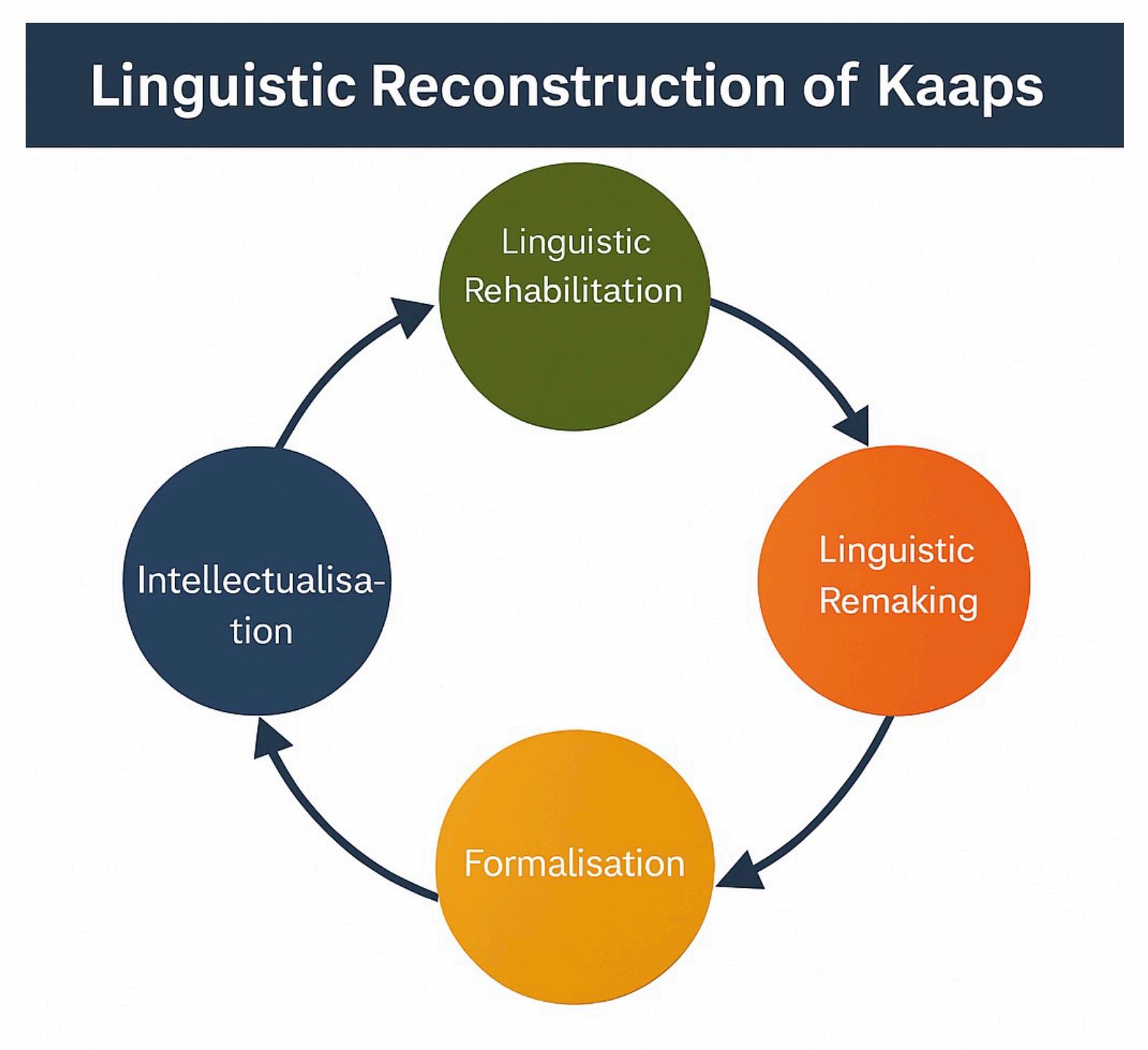
What is the alternative to Haugen’s standardisation model then? Our aim in the Kaaps Woriboek is to retain variation in the spelling and pronunciation and to such a degree we have developed the orthography but have also done so to retain the variation of Kaaps in a non-exhaustive way. In this respect, our focus has been to develop the vowel system in Kaaps. We have added to the longused circumflex, the caron, macron and an accent diacritic to advance the formalisation of Kaaps spelling. Of course, meta-theoretically some could argue that as dictionary makers we have begun to standardise the orthography of our language, but my counter-argument is that we have begun to realise and implement a linguistic reconstruction model we (remakers of Kaaps and Kaaps Studies scientists) argue is suitable for a language such as Kaaps, given its long history of construction through the frameworks of colonial and apartheid linguistics,45 captured in the cyclical model of linguistic reconstruction below. The model treats Kaaps words, grammar, sounds, the history of the language and social rules as its essence.46 It is a recursive cyclical theoretical model that involves the following processes: Linguistic Rehabilitation (an adequate corpus driven diachronic and synchronic evidencing of Kaaps); Linguistic Remaking (an adequate alignment of words, grammar and sounds with diachronic and synchronic evidencing of Kaaps); Formalisation (a corpus driven re-codification of Kaaps textualised for all controlling domains) and Intellectualisation (a corpus driven codification of Kaaps scientific and human sciences terminology for STEM and STEAM knowledges). In order to
From Slave Lingua Franca to a Formalised Language in Post-Apâthyt Syt Afrieka
demonstrate this model, we draw on Kaaps speech data from several largescale qualitative research projects to demonstrate and analyse how the stylisation and enregisterment of Kaaps is rapidly leading to a rise in (1) critical Kaaps language awareness, (2) the recognition, prestige and inclusion of Kaaps in educational domains, and (3) its continued contestation in South African publics. This Linguistic Reconstruction model is recursive and takes seriously the history and the future of Kaaps in controlling domains (not just school or churches). This model is inspired by perspectives of the non-racial democratic ideal: that this once enslaved lingua becomes the accepted (and officialised) heritage language of Kaaps speakers and a lingua franca for all South Africans.
Notes
1. This chapter is a reworked version of the talk I delivered at the Jaap Durand Seminar on Indigeneity, Slavery, and Nation. It speaks to debates by Kaaps Studies scientists about the historical formation of Kaaps and the sociolinguistics of the enslaved ancestor of Kaaps speakers. It contributes to expanding the field of Kaaps Studies, the inter-/transdisciplinary study of Kaaps and its speakers from the perspective of linguistics and cognate fields. See Quentin Williams and Theo(dore) Rodrigues, eds., Kaaps Chronicles: Pasts, Present, Future (Cape Town: CASAS Publications, forthcoming).
2. Nigel Worden, ed., Cape Town between East and West: Social Identities in a Dutch Colonial Town (Auckland Park, South Africa: Jacana, 2012).
3. Susan Newton-King, “Family, Friendship and Survival among Freed Slaves,” in Cape Town between East and West: Social Identities in a Dutch Colonial Town, ed. Nigel Worden (Auckland Park, South Africa: Jacana, 2012), 153–75.
4. A koine is defined as “the stabilized result of mixing of linguistic subsystems such as regional or literary dialects.” Jeff Siegel, “Koines and Koineization,” Language in Society 14 (1985): 363. https://doi.org/10.1017/S0047404500011313.
5. Updates of the Kaaps grammar guide: the basics can be found at the Societie virrie Advancement of Kaaps’s (SAK) website: https://sakaaps.co.za/. See Loena Claasen, “Repositioning Kaaps in the Primary School Classroom: Translanguaging as a Pathway for Educational Advancement,” in Kaaps Chronicles: Pasts, Present, Future, ed. Quentin Williams and Theo(dore) Rodrigues (Cape Town: CASAS Publications, forthcoming); Leona Claasen, Exploring Learners’ Language Ideologies towards the use of Kaaps in Classrooms: Insights from Two Studies in Cape Town Primary Schools (forthcoming); Veronique Williams, Investigating Kaaps Multimodal Literacy Interactions at a Township Primary School in Cape Town, South Africa (Bellville: University of the Western Cape, 2024).
6. Einar Haugen, “Dialect, Language, Nation,” American Anthropologist 68, no. 4 (1966): 922–35, https://doi.org/10.1525/aa.1966.68.4.02a00040.
7. Paul Kerswill, “Koineization and Accommodation,” in The Handbook of Language
Indigeneity, Slavery and Nation
Variation and Change, ed. J. K. Chambers, Peter Trudgill, and Natalie SchillingEstes (Oxford: Blackwell, 2002).
8. Karel Schoeman, Seven Khoi Lives (Cape Town: Protea Book House, 2009), 99.
9. David Johnson, “Remembering the Khoikhoi Victory over Dom Francisco Almeida at the Cape in 1510,” Postcolonial Studies 12, no. 1 (2009): 70–130, https:// doi.org/10.1080/13688790802657427; see also for a fuller discussion Quentin Williams et al., eds., Kaaps: Woriboek (Cape Town: Societie virrie Advancement van Kaaps [SAK], 2026), 55–80.
10. “Five Stories”, Camissa People , Accessed 20 May 2006 https:// camissapeople.wordpress.com/profiles/.
11. Ralph Elphick, “The Khoisan to c. 1770,” in The Shaping of South African Society: 1652–1820, ed. Ralph Elphick and Herman Giliomee (London: Longman, 1979), 3–40.
12. Bartholomeus van Graue, Den gheheelen Bybel, inhoudende het oude ende nieuwe Testament, met grooter naersticheyt ende arbeyt nv corts in duytsche van nyews ouerghestelt wt den Latijnschen ouden text, die ouer duysent iaren in die heylighe Roomsche kersten kercke ghehouden is gheweest, onlancs te Loeuen by sekeren gheleerde wt beuel der Keyserlijcker Maiesteyt ghecorrigeert ende aldaer ghedruct (Leuvense bijbel 1548), www.dbnl.org. accessed 25 May 2026 https://www.dbnl.org/tekst/_ghe005gheh01_01/ colofon.php.
13. Wim François, “Het voorwoord bij de ‘Leuvense bijbel’ van Nicholaus van Winghe (1548): Over Schrift, Traditie en volkstalige bijbellezing,” Ons Geestelijk Erf 79, no. 1 (2008): 7–50, https://doi.org/10.2143/OGE.79.1.2028819.
14. François, van Winghe, 14; Quentin Williams, Not Language Enough: The Making and Reconstruction of Kaaps (Oxford: Oxford University Press, under consideration). It is thus not implausible to argue, in the absence of paper evidence that Dutch East Indian Company ships used for much of the 1500s a Bible with vernacular language (Brabant-Dutch), for example, in an attempt to convert the Khoekhoe they encountered at the Cape. From a historical socio-linguistic point of view, they also likely mixed in the trade speech of Khoe speakers with the dental stop / t/, as we see this form not only realized in the word ‘vrint’ but also ‘hant’. Today, these words are still commonly used amongst Kaaps speakers.
15. H. C. V. Leibbrandt, Precis of the Archives of the Cape of Good Hope, pt. 1 (Cape Town: Saul Solomon and Company, 1898).
16. Translation: “The Statement that the natives or their children are able to learn the Dutch language is important and a very good thing, but of greater moment is the furtherance of our Reformed Christian Religion, about which he appears to be sanguine.” See Leibbrandt, Precis of the Archives of the Cape of Good Hope, reply.
17. Christo van Rensburg, “Two Significant Moments in the History of Kaaps,” Multilingual Margins: A Journal of Multilingualism from the Periphery 3, no. 2 (2016): 53–61, https://doi.org/10.14426/mm.v3i2.248.
From Slave Lingua Franca to a Formalised Language in Post-Apâthyt Syt Afrieka
18. It is important that we revisit and take seriously the points raised by Marius F. Valkhoff in his critique of historical linguists who study Afrikaans, who (through albocentric behaviour) has maligned his analysis of creole Portuguese as a dialect mixed with Bahasa-Malay (and vice versa) and his legitimate critique that there is no construction such as Malayu-Portuguese, as proposed by Dirk C. Hesseling in his Het Afrikaansch (Dirk C. Hesseling, Het Afrikaansch: Bijdrage tot de geschiedenis der Nederlandsche taal in Zuid-Afrika (Leiden: E. J. Brill, 1899). Valkhoff in Studies in Portuguese and Creole with special reference to South Africa ((Johannesburg: Wits University Press, 1966) who was a respected historical linguist argues that you can't talk about Malay or Portuguese under one glossonym or presumably as one linguistic system because Bahasa-Malay, the language of Malay, and creole Portuguese are different linguistic systems with their own dialects.
19. In a forthcoming chapter, Paul Roberge reports that Kaaps first received its glossonym in 1775. He reports on correspondence by a young man writing to his father located in the Netherlands as follows: “I’m trying to practice my Caaps.” This is paper evidence that Kaaps precedes the Afrikaans glossonym, not only in name but in linguistic system (as I have so far tried to demonstrate). See Paul Roberge, “Kaaps as Glossonym,” in Kaaps Chronicles: Pasts, Present, Future, ed. Quentin Williams and Theo(dore) Rodrigues (Cape Town: CASAS Publications, forthcoming).
20. Early Kaaps speakers did not own the means of material production, land, or the technology of the day (guns, ships or horses). We must therefore account for both linguistic and non-linguistic factors and conditions that gave rise to its koinezation. This means accounting for the enslaved lived social, economic and political experiences under colonialism.
21. Robert C. Shell, Children of Bondage: A Social History of the Slave Society at the Cape of Good Hope, 1652–1838 (Hanover, NH: University Press of New England, 1994).
22. Patric Mellet, The Truth about Cape Slavery (Cape Town: Jonathan Ball Publishers, 2024).
23. Although Khoe and San languages also acted as lexifiers in the koineization of Kaaps, distance is key to understanding why the speakers of those languages did not easily assimilate into learning Dutch or any of the enslaved languages.
24. Achmat Davids, “The Social Impact of Language: The ‘Coloured’ Image of Afrikaans in Nineteenth Century Cape Town,” accessed 2025, Herri Archive. https://herri.org.za/5/achmat-davids/.
25. I disagree with Davids that it was called Cape Afrikaans, as I have clearly demonstrated thus far it was variously referred to as Caaps or Kaaps-Hollands (KaapsHollandisch)
26. L. Duvenhage, Nigel Worden, and H. Vollgraaff, Slave Lodge Register (Cape Town: University of Cape Town, 2000), record held by the Western Cape Archives and Records Service.
Indigeneity, Slavery and Nation
27. William Wright, Slavery at the Cape of Good Hope (New York: Negro University Press, 1831). Proclamation of 1823, Ordinance No. 19 (1826), Ordinance No. 75 (1830), Ordinance No. 76 (1830) and the Consolidated Order in Council (1830) should be studied closely to learn more about the regulation of the lives of the enslaved, which included language, under British colonial rule.
28. Wright, Slavery at the Cape of Good Hope, 62.
29. Mia Brandel-Syrier, The Religious Duties of Islam as Taught and Explained by Abu Bakr Effendi: A Translation from the Original Arabic and Afrikaans, Edited with an Introduction and Notes (Leiden: Brill, 1960); Adrianus van Selms, Abu Bakr se ‘Uiteensetting van die Godsdiens’, ’n Arabies-Afrikaanse Teks uit die Jaar 1869 (Amsterdam: NorthHolland Publishing Company, 1979); Achmat Davids, The Afrikaans of the Cape Muslims, ed. Hein Willemse and Suleman E. Dangor (Pretoria: Protea Book House, 2011).
30. Compare Shafiq Morton, The Crescent at the Cape: The True Story of Shaykh AbuBakr Effendi, 1814–1880 (Cape Town: National Awqaf Foundation of South Africa [SWAQAF SA] and IRCICA, 2022).
31. Cited in Halim Gençoğlu, Abu Bakr Effendi: A Report on the Activities and Challenges of an Ottoman Muslim Theologian in the Cape of Good Hope (master’s thesis, University of Cape Town, 2013), 63, emphasis added.
32. Davids, The Afrikaans of the Cape Muslims.
33. Cited in Gençoğlu, Abu Bakr Effendi, 86.
34. The spelling of Beyan al-Din and Merasid ud-Din follows Gençoğlu, an authority on Islam. Gençoğlu, Abu Bakr Effendi, 101.
35. Van Selms, Abu Bakr se ‘Uiteensetting van die Godsdiens’; Brandel-Syrier, The Religious Duties of Islam as Taught and Explained by Abu Bakr Effendi.
36. Brandel-Syrier, The Religious Duties of Islam as Taught and Explained by Abu Bakr Effendi.
37. Cited in Gençoğlu, Abu Bakr Effendi, 99.
38. Mellet, The Truth about Cape Slavery.
39. Van Selms, Abu Bakr se ‘Uiteensetting van die Godsdiens’; Wilhelm J. Viljoen, Allgemeine Einleitung zur Geschichte des Cap-Holländischen (Strassburg: Verlag von Karl J. Trübner, 1896).
40. The word “oep” was one of the words the philologists and linguists who supported the Afrikaner nationalists deemed as worthy of erasure because it bastardised the form of Dutch of the day. See G. R. von Wielligh, Eerste Skrijwers, Laaste Stem uit die Genootskap van Regte Afrikaners. Pretoria: van Schaik, 1918.
41. Brandel-Syrier, The Religious Duties of Islam as Taught and Explained by Abu Bakr Effendi.
42. Williams et al., eds., Kaaps: Woriboek, 80.
43. Theo(dore) Rodrigues, Scaffolding Reading Comprehension for Engineering Students at the Cape Peninsula University of Technology – A Translanguaging Framework (PhD diss., University of the Western Cape, 2023); Theo(dore) Rodrigues, “Creating Student-
From Slave Lingua Franca to a Formalised Language in Post-Apâthyt Syt Afrieka
Authored Learning Material – A Case of Kaaps-Speaking Engineering Students,” Language Matters 55, no. 3 (2024): 126–48, https://doi.org/ 10.1080/10228195.2024.2407107.
44. Haugen, “Dialect, Language, Nation”.
45. Quentin Williams, “Thinking Multilingualism for the Future of Historically Marginalised Speakers,” professorial inaugural lecture presented at the University of the Western Cape, August 25, 2025, YouTube. https://www.youtube.com/ watch?v=ivKV5fR4KLg.
46. Williams, Not Language Enough.
Bibliography
Primary Sources
Brandel-Syrier, Mia. The Religious Duties of Islam as Taught and Explained by Abu Bakr Effendi: A Translation from the Original Arabic and Afrikaans, Edited with an Introduction and Notes. Leiden: Brill, 1960.
Duvenhage, L., Nigel Worden, and H. Vollgraaff. Slave Lodge Register. Cape Town: University of Cape Town, 2000. Record held by the Western Cape Archives and Records Service.
Franken, Johan. L.M. Taalhistoriese bydraes. Kaapstad: Balkema, 1953.
Gençoğlu, Halim. Abu Bakr Effendi: A Report on the Activities and Challenges of an Ottoman Muslim Theologian in the Cape of Good Hope. Master’s thesis, University of Cape Town, 2013.
Leibbrandt, H. C. V. Precis of the Archives of the Cape of Good Hope. Part 1. Cape Town: Saul Solomon and Company, 1898.
Van Graue, Bartholomeus. Den gheheelen Bybel, inhoudende het oude ende nieuwe Testament, met grooter naersticheyt ende arbeyt nv corts in duytsche van nyews ouerghestelt wt den Latijnschen ouden text, die ouer duysent iaren in die heylighe Roomsche kersten kercke ghehouden is gheweest, onlancs te Loeuen by sekeren gheleerde wt beuel der Keyserlijcker Maiesteyt ghecorrigeert ende aldaer ghedruct (Leuvense bijbel 1548), ww.dbnl.org. accessed 25 May 2026 https:// www.dbnl.org/tekst/_ghe005gheh01_01/colofon.php.
Von Wielligh, G. R. Eerste Skrijwers, Laaste Stem uit die Genootskap van Regte Afrikaners Pretoria: van Schaik, 1918.
Viljoen, Wilhelm J. Allgemeine Einleitung zur Geschichte des Cap-Holländischen. Strassburg: Verlag von Karl J. Trübner, 1896.
Williams, Quentin, Theo(dore) Rodrigues, Tara-Leigh Adams, Leona Claasen, Sherylene Cupido, Gaireyah Fredericks, Robyn Gelant, Dmitri Jegels, Carla Lindt, Chevãn Van Rooi, Mooniq Shaikjee, Shaquile Southgate, Tyron de Villiers, Pejamauro Visagie, and Veronique Williams, eds. Kaaps: Woriboek. Cape Town: Societie virrie Advancement van Kaaps (SAK), 2026.
Indigeneity, Slavery and Nation
Secondary Sources
Claasen, Loena. “Repositioning Kaaps in the Primary School Classroom: Translanguaging as a Pathway for Educational Advancement.” In Kaaps Chronicles: Pasts, Present, Future, edited by Quentin Williams and Theo(dore) Rodrigues. Cape Town: CASAS Publications, forthcoming.
Claasen, Leona. Exploring Learners’ Language Ideologies towards the use of Kaaps in Classrooms: Insights from Two Studies in Cape Town Primary Schools. Forthcoming.
Davids, Achmat. “The Social Impact of Language: The ‘Coloured’ Image of Afrikaans in Nineteenth Century Cape Town.” Accessed 2025. HERRI Archive. https://herri.org.za/5/achmat-davids/.
Davids, Achmat. The Afrikaans of the Cape Muslims. Edited by Hein Willemse and Suleman E. Dangor. Johannesburg: Protea Book House, 2011.
Elphick, Ralph. “The Khoisan to c. 1770.” In The Shaping of South African Society: 1652–1820, edited by Ralph Elphick and Herman Giliomee, 3–40. London: Longman, 1979.
François, Wim. “Het voorwoord bij de ‘Leuvense bijbel’ van Nicholaus van Winghe (1548): Over Schrift, Traditie en volkstalige bijbellezing.” Ons Geestelijk Erf 79, no. 1 (2008): 7–50. https://doi.org/10.2143/OGE.79.1.2028819.
Haugen, Einar. “Dialect, Language, Nation.” American Anthropologist 68, no. 4 (1966): 922–35. https://doi.org/10.1525/aa.1966.68.4.02a00040.
Hesseling, Dirk C. Het Afrikaansch: Bijdrage tot de geschiedenis der Nederlandsche taal in Zuid-Afrika. Leiden: E. J. Brill, 1899.
Johnson, David. “Remembering the Khoikhoi Victory over Dom Francisco Almeida at the Cape in 1510.” Postcolonial Studies 12, no. 1 (2009): 70–130. https://doi.org/ 10.1080/13688790802657427.
Kerswill, Paul. “Koineization and Accommodation.” In The Handbook of Language Variation and Change, edited by J. K. Chambers, Peter Trudgill, and Natalie SchillingEstes. Oxford: Blackwell, 2002.
Mellet, Patric. The Truth about Cape Slavery. Cape Town: Jonathan Ball Publishers, 2024.
Morton, Shafiq. The Crescent at the Cape: The True Story of Shaykh Abu-Bakr Effendi, 1814–1880. Cape Town: National Awqaf Foundation of South Africa (SWAQAF SA) and IRCICA, 2022.
Newton-King, Susan. “Family, Friendship and Survival among Freed Slaves.” In Cape Town between East and West: Social Identities in a Dutch Colonial Town, edited by Nigel Worden, 153–75. Auckland Park, South Africa: Jacana, 2012.
Roberge, Paul. “Kaaps as Glossonym.” In Kaaps Chronicles: Pasts, Present, Future, edited by Quentin Williams and Theo(dore) Rodrigues. Cape Town: CASAS Publications, forthcoming.
From Slave Lingua Franca to a Formalised Language in Post-Apâthyt Syt Afrieka
Rodrigues, Theo(dore). “Creating Student-Authored Learning Material – A Case of Kaaps-Speaking Engineering Students.” Language Matters 55, no. 3 (2024): 126–48. https://doi.org/10.1080/10228195.2024.2407107.
Rodrigues, Theo(dore). Scaffolding Reading Comprehension for Engineering Students at the Cape Peninsula University of Technology – A Translanguaging Framework. PhD diss., University of the Western Cape, 2023.
Schoeman, Karel. Seven Khoi Lives. Cape Town: Protea Book House, 2009.
Shell, Robert C. Children of Bondage: A Social History of the Slave Society at the Cape of Good Hope, 1652–1838. Hanover, NH: University Press of New England, 1994.
Siegel, Jeff. “Koines and Koineization.” Language in Society 14 (1985): 357–78. https:// doi.org/10.1017/S0047404500011313.
Valkhoff, Marius F. Studies in Portuguese and Creole: With Special Reference to South Africa Johannesburg: Wits University Press, 1966.
Van Rensburg, Christo. “Two Significant Moments in the History of Kaaps.” Multilingual Margins: A Journal of Multilingualism from the Periphery 3, no. 2 (2016): 53–61. https://doi.org/10.14426/mm.v3i2.248.
Van Selms, Adrianus. Abu Bakr se ‘Uiteensetting van die Godsdiens’, ’n Arabies-Afrikaanse Teks uit die Jaar 1869. Amsterdam: North-Holland Publishing Company, 1979.
Williams, Quentin. Not Language Enough: The Making and Reconstruction of Kaaps Oxford: Oxford University Press, under consideration.
Williams, Quentin. “Thinking Multilingualism for the Future of Historically Marginalised Speakers.” Professorial inaugural lecture presented at the University of the Western Cape, August 25, 2025. YouTube. https://www.youtube.com/watch? v=ivKV5fR4KLg.
Williams, Quentin, and Theo(dore) Rodrigues, eds. Kaaps Chronicles: Pasts, Present, Future. Cape Town: CASAS Publications, forthcoming.
Williams, Veronique. Investigating Kaaps Multimodal Literacy Interactions at a Township Primary School in Cape Town, South Africa. Bellville: University of the Western Cape, 2024.
Worden, Nigel, ed. Cape Town between East and West: Social Identities in a Dutch Colonial Town. Auckland Park, South Africa: Jacana, 2012.
Wright, William. Slavery at the Cape of Good Hope. New York: Negro University Press, 1831.
Siseko H. Kumalo
Introduction
South African indigenous poetry traditions have historically been used to contest social realities. Dating back to the pre-print era,1 wherein Imbongi/ Inyosi (the poet) would critically confront systems of governance and modalities of life while recording events of historical significance through processes of naming, oracy (competency in orature) functioned to challenge and legitimate social reality. In this sense, the tradition of ukuhaya inkonondlo must be understood not merely as aesthetic expression but as a mode of public philosophy. Imbongi historically occupied the role of political interlocutor within communal life, interrogating authority, narrating ethical crises, and constituting a public sphere through oral deliberation. Long before the institutionalisation of philosophy within colonial universities, African societies cultivated philosophical traditions in public through language, poetry, performance, and communal critique. The contemporary resurgence of these practices, therefore, demonstrates that philosophy in Africa has never been confined to formal academic institutions; rather, it has historically existed within the social body itself.
The tradition of ukuhaya inkondlo, then, is re-emerging across society in the country – and, I argue, is being used as a method of democratic deliberation and consolidation in a time when democracy is questioned. To claim that the validity of democracy is under scrutiny is premised on the scholarship of thinkers like Joel Modiri,2 who argue that post-apartheid constitutionalism did not signify a rupture with ‘colonial conquest’ and white supremacy. Modiri argues that, in the new age, the country witnessed the preservation of the underlying structures through the language of liberal constitutionalism, reconciliation, and non-racial democracy. Modiri’s argument claims that South African constitutionalism rests upon a profound historical contradiction: a democratic transition that presented itself as revolutionary and emancipatory, yet did not materially undo conquest and its effects. Modiri should not be read, however, as outrightly rejecting democracy — as an institution — rather, his analysis interrogates a particular liberal constitutional form, i.e., the negotiated constitutional settlement grounded in reconciliation, rights discourse, formal equality and procedural legitimacy, while substantive historical justice remains unresolved. Against this backdrop, the resurgence of inkondlo in public life can be read not merely as an aesthetic expression but as part of a broader search for alternative modes of political speech that go beyond the limits of liberal constitutionalism.
Examining this re-emergence, the chapter poses two questions. First, tracing the historical development of this tradition, I consider whether the phenomenon of public deliberation using the art form of ukuhaya inkondlo is a revival or a new emergence. This consideration will demonstrate how alternative traditions enable us to reimagine our social realities and respond to the exclusions faced by those who have existed at the margins of society. Colonial modernity attempted not merely to dominate African political life but to displace the epistemic and deliberative traditions through which African societies understood themselves. In suppressing Indigenous languages, oral traditions and communal political forms, colonialism sought to interrupt the public philosophical traditions that structured social critique and democratic participation. The contemporary return of inkondlo into public life must therefore be understood as more than an artistic revival; it signals the reassertion of intellectual and political traditions that survived attempts at erasure.
Taking this question further, my reasoning suggests that, in a global era in which democracy is under threat, these modes of public deliberation facilitate global democratic innovations. The significance of this claim lies in the reality that contemporary democratic crises increasingly reveal the inadequacy of formal liberal institutions to sustain meaningful participation, particularly for those communities historically relegated to the margins of political life. What
Indigeneity, Slavery and Nation
traditions such as ukuhaya inkondlo reveal, however, is that democratic participation has never been exhausted by parliamentary procedure, juridical inclusion, or institutional representation alone. Rather, African public traditions demonstrate that political deliberation can emerge through aesthetic performance, oral critique, communal narration, and dialogical encounter. The indigenous4 poetic tradition constitutes a mode of public philosophy through which ethical questions, social crises, historical memory, and political legitimacy are negotiated. If public political philosophy takes alternative traditions seriously when thinking about contemporary social realities, what is to be learned from this tradition by the political philosopher?
As early as the time of Mazisi Kunene, one of the leading poets of the South African indigenous literary tradition, the public poem tradition in the indigenous languages has been very popular. To frame the poetry of isiZulu and isiXhosa as indigenous is predicated on the reality that it emerges from what J. M. Coetzee5 terms an “Adamic language” and what Lewis Nkosi6 terms an “African Vocabulary”. Coetzee’s invocation of an Adamic language in its gesture toward a mode of linguistic relation in which the distance between language, land, and being has not yet been ruptured by colonial abstraction is philosophically significant. The Adamic language ought not to be read merely as a theological metaphor for origins, purity, or primordial naming. Rather, within the context of this argument, it is read as signifying a linguistic ontology in which speech remains intimately bound to the material, historical, and existential conditions from which it emerges. What is at stake in Coetzee’s formulation, then, is the possibility of a language capable of expressing Africa from within her own epistemic and ontological conditions rather than through imposed colonial grammars that estrange the speaker from the world being described.
The significance of this conception becomes clearer when read alongside Nkosi’s notion of an African Vocabulary. Both formulations point to the search for linguistic forms adequate to African historical experience and social reality. The Adamic quality of isiZulu and isiXhosa, therefore, lies not in any romantic notion of untouched linguistic purity but in their capacity to preserve relations between naming, memory, land and ancestry that colonial languages frequently mediate through abstraction and distance. Within these languages, naming itself performs ontological work; language does not merely describe the world externally but participates in constituting the world relationally. Inkondlo, praise poetry, clan names, and oral narration, therefore,
carry historical, ethical, and political densities that exceed the representational function often assigned to language within the liberal aesthetic traditions.
Read in this way, the concept of the Adamic language also provides a theoretical basis for understanding why aesthetics within the Indigenous poetic tradition cannot be separated from political life. If language itself emerges from an intimate relation with land, history, and communal existence, then poetic speech necessarily carries with it questions of belonging, legitimacy, memory and collective life. The aesthetic object ceases to function merely as detached artistic contemplation and instead becomes a mode of world disclosure through which a people narrate themselves into political existence. It is precisely this relation between language and worldmaking that allows ukuhaya inkondlo to function simultaneously as an aesthetic practice, a historical archive, and a public philosophy. This ontological relation is what informs and defines Coetzee’s understanding of the Adamic language.
This classification designates indigenous languages, in which there is no difference between the ‘signifier and the signified’, in accordance with Coetzee’s (1988) search for an Adamic language, a concept in which Africa expresses herself not with an imposed language but with a language indigenous to her own context. I come, then, to the consideration of these traditions with the intention of framing what nation emerges when we allow said language to define the culture of the nation. Can the traditions that exist within this conception of indigeneity coalesce to give the nation a conception of nationhood that is inclusive and non-exclusionary, symptomatic of the non-racialism that we aspire to, under the auspices of a democratic society?
Kunene’s7 contribution to this debate addressed whether the epic tradition existed in African languages (and, if so, how). This question is considered without contrasting the traditions of the African with the Euromodern conceptions that emerge from Renaissance conceptions of aesthetics. Kunene’s contribution distinguished the African oral tradition from the European tradition. He argues that the African aesthetic must contend with the reality that “. . . literature must not merely entertain but must primarily teach social values and serious philosophical concepts”.8 Kunene’s formulation is significant precisely because it refuses the separation between philosophy and public life. What emerges within the indigenous poetic tradition is a conception of thought that is lived publicly rather than confined to disciplinary abstraction. Poetry, in this sense, becomes a vehicle for communities to deliberate over ethical obligations, political legitimacy, historical memory, and social futures. The public poem, in the form of inkondlo, therefore functions simultaneously as an aesthetic form and a philosophical intervention.
Indigeneity, Slavery and Nation
For literature — a conception of poetry in this instance — to take on such a responsibility, there must be a shift from the idealist contention of framing the aesthetic as purely an aesthetic object in and of itself into a tool that carries with it values and political impetus. This framing comes from my earlier work that the aesthetic object in the South African context has always been political.9 I make this claim as a mode of resisting the depoliticisation of aesthesis in the formal disciplines after the dawn of democracy. My thinking in this respect is substantiated by the question posed in the Council on Higher Education’s (CHE) analysis that demonstrates that this move to an apolitical discipline is rooted in the desire to eschew the historical imbrications that often defined the South African discipline.10 In this instance, I am, along with the CHE, not alone, for we are reminded of this historical critique even in Mafeje’s corpus, by Bongani Nyoka’s analysis of Mafeje’s thinking.11
I make this observation — of the necessary political impetus of aesthetics — in light of the reality that, in South Africa, aside from the work of Gordimer and Coetzee,12 the prevailing view among white circles is that literature is useful insofar as it serves a literary function in and of itself. To be sure, my contribution should not be read as an instrumentalisation of the aesthetic object, merely as a confrontation of the political that is always embedded in the aesthetic, that is often styled as apolitical, and only artistic. My distinction aims to offer an analysis that appreciates the historical function of aesthetics in our country, in which Black and white writers have always grappled with how the aesthetic object frames nationhood and national culture, let alone belonging.
In their thinking and contributions, the writers who grapple with nationhood in our country surface the competing aesthetic regimes and foreground the question of the political. What we witness in the thinking of Gordimer and Coetzee is a wrestling with the notion of art for art’s sake, what can be framed as a liberal aesthetic sense of autonomy, which competes with the reality of an indigenous claim captured in the work and thinking of scholars like Kunene13 who showcase — through their scholarship — the relationship that expresses political-aesthetic unity. In his search for an African vocabulary, what Coetzee can be understood to be after, is this very unity.
In this tension, the reader is confronted with the question of whether the aesthetic is autonomous or constitutive of the political. This consideration matters insofar as it expresses the reality that, if aesthetics is political, apolitical exclusion persists invisibly, while — in contrast — if aesthetics is political, it becomes a site of democratic participation. This democratic participation is not merely symbolic. Across contemporary South African
Critical Poetic Traditions in African Languages
campuses and public formations, poetic performance has increasingly become a vehicle through which students and marginalised communities articulate political critique, historical inquiry, and alternative futures. What is often described as activism is, in turn, a philosophical practice, as these performances deliberate questions of justice, freedom, legitimacy, and collective existence in public. Student movements, spoken-word collectives, and indigenous language poetic circles, therefore, continue a much older African tradition in which philosophy emerges through communal speech and aesthetic confrontation.
In this sense, within the realm of culture, two competing ontologies of the aesthetic and the political are at play in defining the kinds of contributions aesthetics can make to shaping the political. On the one hand, the liberal conception of aesthetics seeks to preserve the autonomy of the aesthetic object by insulating it from political life, thereby framing art as detached contemplation. On the other hand, the indigenous politicalaesthetic tradition under consideration refuses this separation by positioning aesthetics as constitutive of public life itself. Within this latter tradition, the aesthetic does not merely represent the world; it participates in the making and remaking of the world. This distinction becomes particularly important in societies marked by the historical realities of slavery, colonial domination, and racial capitalism, where aesthetics historically functioned in the service of power through the regulation of visibility, humanity and belonging.
What I14 detail in the case of Magubane in posing the question, “How then was uMagubane perceived, if he was praised for his childlike innocence and purity? Ingabamnyama, yeza nomdlakazi!” is revealing of the concept of belonging and its contestation. To say that belonging is contested is premised on the work of Rogers Smith15 who demonstrates that the process of nation constitution, i.e., the formation of the nation, is always defined by exclusions and inclusion, where some historical conceptions of the nation are left out of what defines the nation, while others are defined as crucial to the story of who and what the nation are. The reader, then, gains insight into this contestation by recognising the nation-building function as predicated on processes of inclusion and exclusion, which could only be articulated in the public realm by Inyosi. In the general sense, the public could question even the process of nation-building by subjecting such processes to critical scrutiny in public deliberation. This reality challenges the notion that there was no active engagement with the social realities that defined the nation. I continue and write, “Dare taint the innocence, the purity, the
Indigeneity, Slavery and Nation
childlike nature of his spirit, surely that will be a force which will come with destruction.16 In the process of nation-building, uMagubane . . . along with his successors and those loyal to his nation-building project – suppressed voices of dissent, ngabe izikhali babezithathephi?”17
Moreover, this formulation captures the reality that the contemporary practice of ukuhaya inkondlo is neither a simple revival nor a wholly new emergence; rather, it is a rearticulation of an enduring political-aesthetic tradition under new democratic conditions. Under these new conditions, it functions as a mode of public deliberation that enables forms of freedom, otherwise foreclosed in formal institutions. Importantly, these forms of deliberation emerge precisely where formal democratic institutions often fail to hear those at the margins adequately. Inkondlo creates an alternative public sphere in which excluded voices can appear politically through performance, critique and collective recognition. The contemporary proliferation of these traditions among young people suggests that indigenous poetic forms continue to provide conceptual resources for democratic life at a moment when liberal institutions increasingly struggle to sustain meaningful participation.
At this juncture, the distinction between revival and emergence requires clarification. To describe the contemporary proliferation of ukuhaya inkondlo merely as a revival risks styling this form as the simple return of an unchanged historical form from a static past into the present. Such a formulation would inadequately account for the radically transformed social, political, and technological conditions within which these practices now circulate. Yet to describe the phenomenon solely as a new emergence would equally obscure the deep historical continuities that connect contemporary poetic practices to older traditions of Indigenous public deliberation, political critique, and communal reasoning.
The phenomenon under consideration is therefore neither a pure revival nor an entirely new novel emergence. Rather, it is more accurately understood as a historical rearticulation of an enduring political-aesthetic tradition under altered democratic conditions. What survives into the present is not the unchanged institutional structure of the precolonial polity itself, but the deliberative impulse embedded within the tradition, i.e., the use of public speech, poetic confrontation, ethical critique, and communal narration as mechanisms for negotiating political life. The contemporary resurgence of inkondlo among students, artists and public formations demonstrates that these traditions were never fully extinguished by colonial modernity, despite sustained attempts to subordinate indigenous languages, epistemologies, and modes of public reasoning.
At the same time, the tradition has necessarily transformed. Contemporary forms of ukuhaya inkondlo now emerge within universities, protest movements, digital platforms, spoken-word spaces, and democratic publics, all fundamentally shaped by colonialism, apartheid, urbanisation, and liberal constitutionalism. The tradition, therefore, does not return unchanged. It adapts itself to new historical contradictions and contemporary crises of participation, legitimacy, and belonging. The contemporary moment reveals the persistence of an Indigenous democratic grammar that reappears whenever formal institutions prove incapable of adequately hearing those relegated to the margins of political life. The significance of this distinction lies precisely in the fact that the contemporary practice of inkondlo demonstrates that traditions survive not through static preservation but through continued reinterpretation under changing historical conditions. What is inherited is therefore not merely form but a political orientation toward public reasoning, collective critique, and democratic participation. The contemporary resurgence of inkondlo consequently signals the continued vitality of an African public philosophical tradition capable of generating new political vocabularies.
This very fact is witnessed in the challenge staked by Gordimer when she outlines the political nature of the aesthetic, insofar as “[it] is certain that political pressures, in the form of a deep sense of injustice and inhumanity existing within [a writers’] society, can cause certain writers to question the luxury . . . of writing at all, within a country like South Africa.”18 This reality, which must be confronted in the era of democracy, where the assumption is that freedom has been obtained, while mystifying the historical and systematic differentiations found in Hannah Arendt’s (1966) “Liberation and Freedom”. 19 To be clear, by confronting this reality, I argue that the current socio-political conditions demonstrate that liberation has been achieved, without freedom, for freedom is liberation from life’s necessity à la Arendt. Keeping with the Arendtian analysis, liberation surfaces a reality defined by the absence of constraints, released from oppression and domination — a negative condition defined by the removal of impediments. It is the end of something, in this case, apartheid as one example, the collapse of tyranny, the cessation of coercion, the lifting of externally imposed limits. Freedom, contrary to this narrow conception of liberation, is not simply what remains after constraint disappears.
It is a positive, generative condition tied to political action, the capacity to begin and participate in a shared public world. Freedom emerges only where people act together, speak, deliberate, and constitute a political space. In a historical framing, the nature of deliberation and public consultation on how the nation is constituted is witnessed in Maqoma’s court, which is detailed by
Indigeneity, Slavery and Nation
S. E. K. Mqhayi when he writes, “Kwinkundla ka Maqoma akuko ludidi bekungafunwa luvo nalizwi lalo, – kulapo ke kanye ubuciko bake bebulele kona.”20 He continues
Abantu abapántsi uluvo lwabo beluya lukútshululwe, xa kuko umtètó, okanye ityala elinzima; abafazi bebexelelwa into ekukuyo, kufuneke banike uluvo; amakwénkwe apo kudityenwe nawo kona ebeya abaliselwe imbáli efana nalomteto kukuwo, alinganiselwe, kuti kanti kuyacuntsulwa uluto nakuwo 21
What Maqoma’s court, and its deployment here, affords me philosophically is to concretise the claim that aesthetics, deliberation, political and public philosophy were historically unified within African political life before colonial interruption. It further allows me to move beyond abstraction by showing that, in the Arendtian sense, freedom already existed in African political formations through practices of collective speech, participation, and public reasoning. Put in another way, the deployment of Maqoma’s court is a positive, generative condition tied to political action, the capacity to begin and participate in a shared public world. Freedom, in this sense, emerges only where people act together, speak, deliberate, and constitute a political space. In a historical framing, the nature of deliberation and public consultation regarding how the nation is constituted is evident in Maqoma’s court.
What emerges in Mqhayi’s narration of Maqoma’s court is not merely a description of juridical procedure, but an articulation of an alternative democratic imaginary grounded in public participation, communal reasoning, and relational deliberation. The significance of the court lies precisely in the reality that no social category was excluded from participation within the deliberative process. Ordinary people, women, and even young boys were drawn into processes of public reasoning concerning law, dispute and governance. The court, therefore, functioned not simply as a site of judgment but as a pedagogical and political institution through which the polity collectively constituted itself through speech and participation.
Read through Arendt’s distinction between liberation and freedom, Maqoma’s court reveals that freedom is not reducible to the mere absence of domination. Rather, freedom emerges through the existence of spaces in which people can appear publicly before one another as speaking and reasoning beings. In this sense, Maqoma’s court exemplifies a form of political life in which freedom was enacted through deliberation itself. Importantly, this historical example unsettles colonial assumptions that democratic participation and public reason arrive in Africa through European liberal modernity. What Mqhayi preserves instead is the memory of an indigenous political order in which collective speech, consultation, and public accountability already structured social life.
The deployment of Maqoma’s court in this argument is therefore crucial, as it demonstrates that the tradition of ukuhaya inkondlo does not emerge from a political vacuum. Rather, it belongs to a broader indigenous politicalaesthetic order in which public speech carried ethical and juridical significance. The poetic tradition inherits this deliberative function insofar as it creates spaces in which political grievances, ethical tensions and social contradictions can be publicly confronted. Inkondlo, therefore, extends the court’s democratic logic into the aesthetic realm. Through performance, critique, naming, and public confrontation, imbongi enables the continuation of a participatory political tradition otherwise fragmented by colonial modernity.
The significance of Mqhayi within this argument extends beyond his role as chronicler of Maqoma’s court. Mqhayi was widely regarded as Imbongi yesizwe — the people’s poet — a designation philosophically important for understanding the relationship between aesthetics and political life within the Indigenous tradition. The designation of “people’s poet” did not merely refer to literary popularity; it rather indexed a public intellectual function grounded in communal representation, historical preservation, ethical critique, and political narration. Mqhayi occupied a position in which poetry became a vehicle for preserving and publicly articulating the people’s historical consciousness.
This classification becomes significant because it reveals that imbongi historically occupied a role analogous to what contemporary political theory might call the public philosopher. The poet was not detached from society as a neutral observer concerned solely with aesthetic autonomy. Rather, the poet functioned as an interlocutor between history, ethics, governance, and communal life. In narrating Maqoma’s court, Mqhayi is therefore doing more than preserving historical memory; he is reconstructing an Indigenous democratic archive that contests colonial representations of African political incapacity. His narration performs precisely the function that this chapter attributes to aesthetics more broadly: the work of curating political memory while simultaneously imagining alternative futures.
Mqhayi’s contribution is therefore doubly important. First, he preserves the memory of Indigenous democratic deliberation through his narration of Maqom’a court. Second, through the very act of poetic narration itself, he demonstrates how aesthetics functions politically as a mode of public philosophy. The poet becomes the custodian of collective memory, the critic of social life, and the curator of political possibility. It is precisely this
Indigeneity, Slavery and Nation
tradition that contemporary practices of ukuhaya inkondlo inherit and rearticulate under democratic conditions in South Africa today. It is this relationship between public speech, collective participation, and the constitution of a shared political world that renders Mqhayi’s account philosophically significant for the present argument. The deliberative function preserved within the tradition of inkondlo reveals that freedom is neither reducible to juridical emancipation nor exhausted by the mere removal of domination. Rather, what emerges from these traditions is a conception of freedom rooted in a people's capacity to appear publicly before one another as speaking, reasoning, and world-making beings.
This conception of collective appearance, participation, and public reasoning allows Mqhayi’s narration to be read not merely as cultural memory but as a theory of political life itself. What is preserved in the tradition of inkondlo is therefore not simply aesthetic expression, but an account of freedom grounded in a people's capacity to constitute themselves publicly through speech, deliberation, and relational participation.
In this instance, Arendt insists that liberation is the precondition of freedom but that this precondition does not guarantee it. She traces this argument using the Magnus Ordo seaculorum taken from Virgil’s Fourth Eclogue (Magnus ab integro seaculorum nascitur ordo) — the great cycle of periods that begins anew — the divine child distinction in which the fact of natality always portends the start of something new because we are beginnings, we are therefore beginners, who can create a new world from our beginnings. In simple terms, the two categories cannot and should not be conflated. Liberation is the removal of domination; freedom is the institution and practice of political action. A people may therefore be liberated in the sense of no longer being oppressed, while remaining unfree if they cannot act, speak, and participate in a shared political world. A society that treats the aesthetic object as apolitical seeks to validate the racialised differences that persist for those who are liberated but do not enjoy freedom, creating an interregnum where the old refuses to die. At the same time, the new cannot be born. The burden of life’s necessities is witnessed in the inability of the majority to adequately participate in the public sphere in ways that would otherwise define the conception of freedom found in Amartya Sen’s Development as Freedom 22
It is within precisely these conditions of constrained participation and incomplete freedom that the political significance of aesthetics re-emerges most forcefully. Where formal democratic institutions fail to facilitate public appearance and collective reasoning adequately, aesthetic practices increasingly serve as alternative spaces through which excluded subjects narrate grievances, contest social realities, and re-enter political life.
In view of my classification of aesthetics as always political, Zoë Wicomb suggests that the privilege of writing, in a country like ours, is always interrupted by the violence of inequality, poverty and racial divides that were socially engineered to create our society.23 That is to say that the luxury of writing in a deeply politicised country cannot ignore the politics within which it exists. In ignoring said politics, writing styles the nation as already both liberated and free, without the social conditions in which “the many are made to bear the burden of the few, so that at least a few can be free.”24 My conceptual framing of the aesthetic object as political is evidenced in the work of young poets, who confront the conditions of unfreedom, challenge its silencing and erasure and invite us to witness the socio-political conditions that define our country. Their interventions reveal that the struggle for freedom in post-apartheid South Africa is not solely material or juridical, but epistemic and cultural. To speak publicly in indigenous poetic forms is itself a refusal of colonial linguistic hierarchies and an insistence that African languages remain capable of theorising the political world. The revival of these traditions, therefore, represents not nostalgia for a lost past, but the continuation of intellectual traditions that colonialism attempted to subordinate to European modes of thought and public reasoning.
The contemporary resurgence of these practices must therefore be situated within a much longer historical genealogy of poetic confrontation and political critique. The relationship between aesthetics and democratic contestation did not emerge in the post-apartheid moment itself; rather, contemporary poetic interventions inherit older traditions through which public speech functioned as a mechanism for confronting domination, social contradiction and political exclusion.
The tradition analysed in this chapter, in its historical and contemporary manifestations, takes up this clarion call and challenges the realities of South Africa, a country ravaged by violence. In its historical proliferation, it carried that angst of the social condition of existential dread. Existing under a context where life was determined by a draconian state, Nompumelelo Zondi in her work, Bahlabelelani? makes the case for the inversions of power and the structures that govern society using public poetry, which coalesce with the act of ukuhaya inkondlo. 25 The practice of ukuhaya inkondlo differs from the music Zondi writes about. To mention the two together is deliberate, insofar as they both serve the same purpose: the inversion of power and the capacity for social dynamics to be challenged and critiqued by those defined as having little or no social power. It is precisely this inversion that makes the tradition philosophically significant. Public poetry allows those excluded from formal authority to interrogate power through a language of ethical and political accountability. In this respect, imbongi performs a democratic function
Indigeneity, Slavery and Nation
analogous to that of the public intellectual yet remains rooted in indigenous modes of deliberation rather than in liberal institutional traditions. The practice, therefore, unsettles the assumption that philosophical and democratic critique belong primarily to the university or the formal public sphere of the modern state.
To our western friends, this can be understood as the bard's function. While this classification can be useful, it does not appreciate the social realities that facilitate this confrontation and inversion of power. In simple terms, the bard speaks from a singular point, individuated as a response that captures the social conditions and expresses them to power. The practice of ukuhaya inkondlo, as a function of social critique, contrary to this, is defined by a multiplicity of iimbongi, or izimbongi, who can themselves contest the assertions of the various speakers. The significance of this multiplicity lies in the reality that a singular authoritative voice does not monopolise political truth within the tradition but emerges dialogically through contestation, response, and communal engagement/ the ethical force of inkondlo therefore derives precisely from its public and relational character. The tradition, insofar as it advances the critique of social structures, is of crucial political import. This is because the space of inkondlo is not regulated by the same social norms that regulate social life. It rather relies on the innovation of prose and aesthetics, which gives rise to the feminist position taken by Drucilla Cornell (1995), in which she aligns the ethical with aesthetics.26 To frame the debate as reliant on the aesthetic object of inkondlo, which aligns ethics with aesthetics, stems from observations about the domain of ethics, which I use to denote the political. What emerges from this alignment is a conception of political life in which aesthetics becomes inseparable from democratic practice.
The contemporary resurgence of inkondlo must therefore be understood neither as simple cultural preservation nor as artistic novelty but as the continued life of an African public philosophical tradition. Its persistence demonstrates that the intellectual worlds colonialists attempted to suppress were never fully extinguished. Rather, they continue to reappear within new historical conditions, offering alternative ways of imagining participation, freedom, and collective existence beyond the limitations of formal liberal institutions.
If the preceding discussion has sought to demonstrate that ukuhaya inkondlo belongs to a longer tradition of Indigenous democratic deliberation, public critique, and political-aesthetic world-making; then the question
necessarily follows concerns the contemporary significance of this tradition. Put differently, what does the present moment learn from the continued existence and resurgence of ukuhaya inkondlo? To ask this question is to move beyond treating the tradition as a mere cultural artefact preserved from a disappearing past. Rather, it requires taking seriously the possibility that these traditions continue to offer conceptual, ethical, and democratic resources for societies confronting crises of participation, legitimacy, memory, and freedom in the contemporary world.
The significance of ukuhaya inkondlo in the present moment lies precisely in its capacity to restore forms of public speech and collective deliberation increasingly foreclosed within liberal democratic life. At a time marked globally by democratic erosion, political alienation, epistemic fragmentation, and institutional distrust, the tradition foregrounds the importance of spaces where communities can publicly narrate grievances, contest power, preserve historical consciousness, and collectively imagine alternative futures. What the tradition reveals, therefore, is that democracy cannot be sustained solely through procedural institutions detached from the cultural and epistemic lives of the people who inhabit them. Rather, democratic life depends upon practices that allow communities to appear before one another as speaking and reasoning subjects capable of shaping the world they share.
Ukuhaya inkondlo thus teaches the contemporary political philosopher at least three important lessons. First, it reveals that philosophy is not exhausted by institutional or textual practices but may emerge publicly through performance, orature, poetic confrontation, and communal critique. Second, it demonstrates that aesthetics is not external to politics but constitutive of political life, shaping visibility, memory, belonging, and the imagination of freedom itself. Third, it reveals that democratic participation is fundamentally relational, requiring spaces in which even those historically excluded from formal institutions may enter public life as legitimate interlocutors. In this respect, the resurgence of inkondlo among contemporary students, artists, and public formations signals not nostalgia for a lost past, but the continued life of an African tradition of public philosophy capable of speaking to the crises of democracy in the present.
Notes
1. This claim is premised on the documented history found in my previous analysis, wherein I trace how the press arrived on the southernmost tip of the African continent in 1823. See Siseko H. Kumalo, “Can Iqaba Possess Ontological Legitimacy?” Critical Philosophy of Race 11, no. 2 (2023): 378–407. https://doi.org/ 10.5325/critphilrace.11.2.0378.
Indigeneity, Slavery and Nation
2. Siseko H. Kumalo, “Developing an Inclusive National Identity in South Africa through an Examination of Belonging Using W. W. Gqoba and S. E. K. Mqhayi” (PhD diss., University of Pretoria, 2024), 42, writes: “The Lovedale Press was first established in 1923 – three years after the arrival of the British colonial settlers, whose arrival was memorialised – to this day – through the establishment of the 1820 Settler’s Monument in Makhanda (formerly known as Grahamstown), Eastern Cape South Africa. This first Press was set-up at the Missionary Station in Tyhume Valley, 5 km east of the University of Fort Hare, which was to be another one of South Africa’s and Africa’s proud and longstanding institutions serving the educational desires of the Indigenous populations of the country and the continent; producing leaders like Kenneth Kaunda, Nelson Mandela, Gatsha [Mangosuthu] Buthelezi and many more.” What is most important in my analysis is the documentation of the challenges that came with the setting up of the Press, which was destroyed several times in the colonial frontier wars. My argument demonstrates the point that the Indigenous populations were interested in preserving this world of orature, which they viewed as being under threat with the introduction of the press. The press, resultantly, was destroyed in 1834, and reestablished in 1839. It was once again destroyed in 1846–7 and was reestablished in 1861. The destruction of the press points to the challenge that is identified in Mokoena’s study when she makes apparent the reality that literature was always a public affair. See Hlonipha Mokoena, “An Assembly of Readers: Magema Fuze and His Ilanga lase Natal Readers,” Journal of Southern African Studies 35, no. 3 (2009): 595–607, https:// doi.org/10.1080/03057070903101839 This thinking is corroborated by Mazisi Kunene who also decries the privatisation of literature, in his theoretical critique. See Mazisi Kunene, “Problems in African Literature,” Research in African Literatures 23, no. 1 (1992): 27–44. The criticism that we find in contemporary scholarship of literary critics is rooted in the historical events of the destruction of the press, because of the fear that the press would alter the world of Indigeneity.
3. Joel M. Modiri. “Conquest and Constitutionalism: First Thoughts on an Alternative Jurisprudence.” South African Journal of Human Rights 34, no. 3 (2018): 300–325, https://doi.org/10.1080/02587203.2018.1550939.
4. In this chapter, and in my scholarship more generally, I use the concept of “indigeneity” and “Blackness” relationally and, at times, interchangeably within the South African context. I do so consciously, aware that contemporary indigeneity studies have often sought to distinguish Indigenous identity from racial categories produced through colonial modernity. However, the South African historical condition presents a particular configuration that complicates any easy separation between the Indigenous and the Black subject. My use of Blackness here does not merely denote a racial category produced through the taxonomies of colonial conquest and apartheid classification. Rather, it signifies the historical condition of the conquered native subject whose modes of being, relation to land, epistemic traditions, and political existence were disrupted through settler colonialism. Importantly, many of the historical figures and
writers that I engage in my oeuvre did not themselves initially speak in the language of “Blackness” as it emerged through 20th century anti-colonial and anti-apartheid struggle. They referred to themselves variously as natives, Africans, or through colonial categories imposed upon them, including the derogatory nomenclature of the colonial state itself. The later emergence of Blackness within South African political discourse therefore represented not simply the adoption of a racial identity but the political consolidation of those subjected to conquest, dispossession, and epistemic subordination. Blackness becomes inseparable from the historical condition of indigeneity in South Africa, insofar as it names those peoples whose existence preceded colonial settlement and whose political, linguistic, and ontological worlds were subjected to colonial interruption. My deployment of indigeneity is therefore not intended as an essentialist claim to racial purity or autochthony but rather as an ontological and historical orientation toward land, memory, and belonging. It signifies forms of life that emerge from the earth itself – ways of being constituted relationally through language, custom, ancestry, and place – rather than identities reducible solely to the racial abstractions of capitalism and colonial administration. In this respect my usage aligns with broader currents within global indigeneity studies that understand Indigenous identity not merely as a juridical category but as a relation to land, historical continuity, and alternative modes of world-making that persist despite colonial modernity.
5. J. M. Coetzee, White Writing: On the Culture of Letters in South Africa (Johannesburg: Viking Publishers, 1988).
6. Lewis Nkosi, review of White Writing, by J. M. Coetzee, Third World Quarterly 11, no. 1 (1989): 157–61.
7. Mazisi Kunene, “The Epic in Africa: Toward a Practice of the Oral Performance by Isidore Okpewho,” Research in African Literatures 11, no. 4 (1980): 552–59.
8. Kunene, “The Epic in Africa”, 554.
9. Siseko H. Kumalo, “Aesthetics as Political? Analysing Objections to the Politicisation of the Arts,” Critical African Studies (2026), https://doi.org/ 10.1080/21681392.2026.2672690.
10. Council on Higher Education, “From Complexity to Context: Rethinking the South African Academic Discipline Beyond Apartheid,” Briefly Speaking 35 (2025): 1–14, https://www.che.ac.za/publications/monitoring/brieflyspeaking-no-35complexity-context-rethinking-south-african-academic.
11. Bunyon Nyoka, The Social and Political Thought of Archie Mafeje (Johannesburg: Wits University Press, 2020).
12. Nadine Gordimer, “English Language Literature and Politics in South Africa,” Journal of Southern African Studies 2, no. 2 (1976): 131–50; Coetzee, White Writing.
13. Kunene, “The Epic in Africa”.
14. Siseko H. Kumalo, “Defining an African Vocabulary for the Exploration of Possibilities in Higher Education,” Alternation 23 (2018), 206, emphasis in the original.
Indigeneity, Slavery and Nation
15. Rogers M. Smith, Stories of Peoplehood: The Politics and Morals of Political Membership (Cambridge: Cambridge University Press, 2003).
16. Kumalo, “Defining an African Vocabulary”, 206.
17. A word on the italicization is important. As the reader will note, where Kumalo uses isiZulu, the text is italicized expressing the reality that indigenous languages are still viewed as outside the formal institutional forms of knowledge development.
18. Gordimer, “English Language Literature”, 135.
19. Hannah Arendt, “Revolution and Freedom,” (The Hannah Arendt Papers at the Library of Congress, 1966 –1967; repr., Cadernos de Filosofia Alemã 21, no. 3 (1976): 165–86.
20. S. E. K. Mqhayi, “U-Maqoma/Maqoma,” in Abantu Besizwe: Historical and Biographical Writings, 1902–1944 (1917), ed. Jeff Opland (Johannesburg: Wits University Press, 2009), 129. Trans. “At Maqoma’s court no opinion or voice was barred – that is the essence of his skill as a speaker.”
21. Mqhayi, “U-Maqoma/Maqoma,” 129. Trans. “The opinion of poor people was encouraged, if there was a law, or if a case proved difficult; women were informed of the situation, and their opinion was sought; boys who were involved would be told a story resembling the relevant point of law to use as an example, so that some opinion could be drawn from them as well.”
22. Amartya Sen, Development as Freedom (Oxford: Oxford University Press, 1999).
23. Zoë Wicomb, Race, Nation, Translation: South African Essays, 1990–2013, ed. André van der Vlies (New Haven and London: Yale University Press, 2018).
24. Arendt, “Revolution and Freedom”.
25. Nompumelelo B. Zondi, Bahlabelelelani — Why Do They Sing? Gender and Power in Contemporary Women’s Songs (London and New York: Routledge, 2023).
26. Drucilla Cornell, “What Is Ethical Feminism?” in Feminist Contentions: A Philosophical Exchange, ed. Seyla Benhabib, Judith Butler, and Nancy Fraser (New York: Routledge, 1995), 75–106. I rely on the work of Kumalo and Gama to expand what this intends. See Siseko H. Kumalo and L. B. Gama, “Interrogating Conceptions of Manhood, Sexuality and Cultural Identity,” Image & Text 32 (2018): 1–19. The alignment of “the ethical with aesthetics” suggests that the political conditions of possibility permit all modes of life to exist. In the context that Kumalo and Gama use it, the concept seeks to undergird and affirm the existence of queer and non-gender-conforming persons. To bring this into consideration on a debate that examines how the tradition of inkondlo challenges social norms seeks to demonstrate the point that the desire to align the ethical with aesthetics works to radically challenge and undermine beliefs that we would define as determinants of the rigidity of society.
Bibliography
Arendt, Hannah. “Revolution and Freedom.” Cadernos de Filosofia Alemã 21, no. 3 (1976): 165–86.
Critical Poetic Traditions in African Languages
Coetzee, J. M. White Writing: On the Culture of Letters in South Africa. Johannesburg: Viking Publishers, 1988.
Cornell, Drucilla. “What Is Ethical Feminism?” In Feminist Contentions: A Philosophical Exchange, edited by Seyla Benhabib, Judith Butler, and Nancy Fraser, 75–106. New York: Routledge, 1995.
Council on Higher Education. “From Complexity to Context: Rethinking the South African Academic Discipline Beyond Apartheid.” Briefly Speaking 35 (2025): 1–14. https://www.che.ac.za/publications/monitoring/brieflyspeaking-no-35-complexitycontext-rethinking-south-african-academic.
Gordimer, Nadine. “English Language Literature and Politics in South Africa.” Journal of Southern African Studies 2, no. 2 (1976): 131–50.
Kumalo, Siseko H. “Aesthetics as Political? Analysing Objections to the Politicisation of the Arts.” Critical African Studies (2026). https://doi.org/ 10.1080/21681392.2026.2672690.
———. “Can Iqaba Possess Ontological Legitimacy?” Critical Philosophy of Race 11, no. 2 (2023): 378–407. https://doi.org/10.5325/critphilrace.11.2.0378.
———. “Defining an African Vocabulary for the Exploration of Possibilities in Higher Education.” Alternation 23 (2018): 193–214.
———. “Developing an Inclusive National Identity in South Africa through an Examination of Belonging Using W. W. Gqoba and S. E. K. Mqhayi.” PhD diss., University of Pretoria, 2024.
Kumalo, Siseko H., and L. B. Gama. “Interrogating Conceptions of Manhood, Sexuality and Cultural Identity.” Image & Text 32 (2018): 1–19.
Kunene, Mazisi. “The Epic in Africa: Toward a Practice of the Oral Performance by Isidore Okpewho.” Research in African Literatures 11, no. 4 (1980): 552–59.
———. “Problems in African Literature.” Research in African Literatures 23, no. 1 (1992): 27–44.
Mokoena, Hlonipha. “An Assembly of Readers: Magema Fuze and His Ilanga lase Natal Readers.” Journal of Southern African Studies 35, no. 3 (2009): 595–607. https:// doi.org/10.1080/03057070903101839.
Modiri, Joel M. “Conquest and Constitutionalism: First Thoughts on an Alternative Jurisprudence.” South African Journal of Human Rights 34, no. 3 (2018): 300–325. https://doi.org/10.1080/02587203.2018.1550939.
Mqhayi, S. E. K. “U-Maqoma/Maqoma.” In Abantu Besizwe: Historical and Biographical Writings, 1902–1944, edited by Jeff Opland, 127–33. Johannesburg: Wits University Press, 2009.
Nkosi, Lewis. Review of White Writing: On the Culture of Letters in South Africa, by J. M. Coetzee. Third World Quarterly 11, no. 1 (1989): 157–61.
Indigeneity, Slavery and Nation
Nyoka, Bunyon. The Social and Political Thought of Archie Mafeje. Johannesburg: Wits University Press, 2020.
Sen, Amartya. Development as Freedom. Oxford: Oxford University Press, 1999.
Smith, Rogers M. Stories of Peoplehood: The Politics and Morals of Political Membership. Cambridge: Cambridge University Press, 2003.
Wicomb, Zoë. Race, Nation, Translation: South African Essays, 1990–2013. Edited by André van der Vlies. New Haven and London: Yale University Press, 2018.
Zondi, Nompumelelo B. Bahlabelelelani — Why Do They Sing? Gender and Power in Contemporary Women’s Songs. London and New York: Routledge, 2023.
The collection of articles gathered in Indigeneity, Slavery, and Nation constitutes a rich and multidimensional engagement with some of the pressing issues facing post-apartheid South Africa: who belongs, who has been forgotten, how the past continues to shape the present, and what genuine transformation might require. This multifaceted interrogation of South African identity, memory, indigeneity, slavery, language, justice, and nationhood emerge from different intellectual traditions, be it history, theology, philosophy, cultural studies, linguistics, and political theory.
Read together, the contributions form a sustained conversation with recurring preoccupations cutting across these disciplines, methodologies, and political traditions. The themes of restorative memory, identity and its construction, the afterlives of slavery and colonialism, language as heritage, and the contested meanings of non-racialism and justice emerge repeatedly, though the authors approach them from different angles and sometimes arrive at strikingly different conclusions.
Contributors share a common concern with the unfinished consequences of colonialism, slavery, apartheid, and the ways these histories continue to
Indigeneity, Slavery and Nation
shape contemporary South Africa. Across the collection, memory emerges not as a passive recollection of the past but as an active political, ethical, and cultural process through which communities seek recognition, justice, and belonging.
Perhaps the most pervasive theme across the collection is the insistence that recovering suppressed, distorted, or neglected histories is not merely an academic exercise but a moral and political imperative. Patric Tariq Mellet in his Jaap Durand Annual Lecture frames this most explicitly through the concept of “restorative memory”, arguing that restorative justice cannot be achieved without first restoring historical truth. For Mellet, the deliberate erasure of indigenous and enslaved histories by colonial and apartheid systems created a society built on foundational lies, and meaningful restitution requires dismantling those lies before material transformation can follow. This position finds strong resonance in Michael Weeder’s essay on Cape slavery, which argues that the descendants of enslaved people have been central to the making of South Africa and that their exclusion from the national narrative perpetuates a form of historical violence.
Riaan de Villiers approaches the same obligation from within institutional religion. His meditation on the Groote Kerk advances the striking proposition that a historic church becomes a workshop of public repair when it makes its altar accountable to its archive. Here memory is not merely commemorative but transformative: honest engagement with the church's complicity in slavery, segregation, and apartheid is presented as the necessary condition for its integrity as a site of worship and healing.
Tessa Dooms reaches a parallel conclusion from the perspective of community identity, drawing on the concept of “the living dead” to argue that remembering neglected communities and histories is an act of restoration, while forgetting inflicts a second death. Mogamat Kamedien and Quentin Williams extend this logic into the domain of language, treating the recovery and formalisation of Kaaps as an act of restorative justice that seeks to return dignity and historical recognition to communities whose linguistic contributions have been systematically excluded from dominant narratives.
What unites these contributions is the conviction that the official archive — whether of history, theology, language, or national identity — has been structured by power in ways that require active challenge. All of the authors agree that uncritical acceptance of inherited narratives reproduces colonial distortions, and all regard the recovery of suppressed knowledge as both intellectually necessary and politically urgent. Where they begin to diverge is in how they imagine this
Coda:
Indigeneity, Slavery and Nation
recovery translating into institutional change, legal transformation, or political practice.
Asecond major theme is the historical construction of racial, ethnic, and cultural identities, and the political consequences of accepting or challenging those constructions. Ciraj Rassool's contribution is the most theoretically focused on this question, demonstrating how categories such as “Coloured,” “Cape Malay,” “African,” and “white” were historically produced rather than naturally given. These categories are products of colonial administration, scientific racism, and apartheid classification. He further shows that even traditions of resistance inadvertently reproduced racial categories by organising politically through them, so that post-apartheid South Africa became multiracial rather than genuinely non-racial. Apartheid racial classifications were rehabilitated through transformation policies such as affirmative action and Black Economic Empowerment, giving categories like African, Coloured, and Indian new administrative life under democratic governance.
Mellet shares Rassool's critical orientation toward fixed identities, arguing against ethnic exclusivity and the misuse of genetics to naturalise racial boundaries. Although he supports the recognition of indigenous histories Mellett cautions against forms of ethnic exclusivity that separate indigeneity from slavery and broader histories of interaction, migration, and mixing that characterise southern African history.
Willa Boezak approaches identity differently, defending the specific historical claims of Khoi-San peoples to indigenous recognition while simultaneously rejecting narrow racial definitions. He draws on Thabo Mbeki's vision of inclusive Africanness and Allan Boesak's concept of Afroplurality to argue that recognising Khoi-San indigeneity need not produce ethnic exclusivism but can enrich a broader understanding of South African belonging.
Dooms navigates these questions in identity from the inside, grappling with the significance that the term “Coloured” has acquired for communities who have lived within it across generations. She resists both the apartheid-era reduction of the term to a mere administrative label and contemporary demands that the term be simply abandoned. For Dooms, classifications imposed from outside have been transformed over time into lived cultures, and any responsible politics of identity must acknowledge the emotional, familial, and communal meanings that have accumulated around such terms. For her identity is formed through an ongoing cultural practice rather than a
Indigeneity, Slavery and Nation
fixed essence, while Theuns Eloff highlights the multiplicity of identities that individuals simultaneously inhabit. These positions stand in productive tension with Rassool's more structural critique, which is less concerned with the subjective meanings communities attach to inherited categories than with the political effects of reproducing those categories at all.
Ndumiso Dladla offers the most radical intervention in these debates. He does not simply challenge how identity is constructed but contests the legitimacy of the entire political formation within which these identity debates occur. For Dladla, South Africa itself is a conqueror's state, and the categories through which its subjects understand themselves — including the very terms of belonging to South Africa — are products of colonial conquest. The Azanian tradition he defends insists that genuine non-racialism cannot be achieved through reform of existing institutions but only through the abolition of a constitutional order founded on the usurpation of indigenous sovereignty.
This position places Dladla at considerable distance from the other contributors, most of whom work within the framework of South African democracy and its constitutional promises, seeking to deepen, extend, or more honestly inhabit those promises. Yet his contribution raises questions that none of the others can entirely evade: whether the post-apartheid settlement has genuinely addressed the foundational injustice of colonial conquest, or whether it has instead secured the structural gains of conquest while granting formal political rights to the previously excluded majority.
Athird theme concerns the relationship between indigenous and enslaved histories, which several contributors argue have been artificially separated in ways that distort both. Mellet, Weeder, Kamedien, Williams, and Rassool all insist that slavery must be understood as foundational to South African society rather than as a marginal historical episode. They challenge nationalist narratives that centre European settlement or African ethnic histories while neglecting the role of enslaved people in shaping culture, language, religion, cuisine, labour systems, and identities. The descendants of enslaved people emerge not as peripheral actors but as central participants in the making of South Africa. This shared emphasis suggests a significant historiographical shift towards integrating slavery into national narratives.
Mellet is insistent that these histories are deeply intertwined: Cape slavery involved people drawn from more than a hundred locations across Africa and Asia, indigenous people themselves were subjected to enslavement and
Coda:
Indigeneity, Slavery and Nation
dispossession, and contemporary communities — particularly those classified as Coloured — are heirs to both lineages simultaneously. Treating one history without the other, he contends, reproduces colonial distortions rather than correcting them.
Weeder pursues this interconnection through the concept of creolisation, drawing on Caribbean thinkers such as Édouard Glissant to argue for an oceanic understanding of identity rooted not in a single origin but in multiple routes, crossings, and connections. The descendants of Cape slavery embody what he calls a rhizomatic identity, linking Africa, Asia, and the wider world through histories of movement, encounter, and cultural creation. Weeder’s framework resonates with Kamedien's and Williams's accounts of Kaaps as a koine that emerged from precisely such encounters among Khoekhoe communities, enslaved Africans, Southeast Asians, Portuguese sailors, Dutch settlers, and Muslim scholars.
Boezak, however, maintains the distinctiveness of Khoi-San indigeneity even while acknowledging its connections to enslaved histories. His concern is that the specificity of indigenous claims — to land, sovereignty, cultural continuity, and political recognition — risks being absorbed into broader narratives of creolisation or shared suffering. The tension between these positions — between an emphasis on interconnection and hybridity on one side, and an insistence on specific indigenous claims and identities on the other — is one of the most productive unresolved debates in the collection, and one that maps onto important contemporary political disagreements about land, recognition, and restitution.
Kamedien and Williams make a distinctive contribution to the collection by grounding questions of memory, identity, and justice in the specific history of a language. Their shared argument — that Kaaps is not a degraded form of Afrikaans but a historically rich linguistic tradition forged through slavery, indigenous interaction, and Cape Muslim culture — participates in the broader decolonial project of recovering suppressed contributions. But it does so with a degree of empirical and linguistic specificity that complements the more overtly theoretical contributions.
Siseko Kumalo's essay on African language poetic traditions extends this concern into the domain of oral literature and public philosophy. His argument that ukuhaya inkondlo — public poetic performance — represents a living tradition of democratic deliberation and communal critique challenges colonial assumptions that public reason and political participation arrived in Africa only through European modernity. By recovering the figure of the
Indigeneity, Slavery and Nation
imbongi as a public intellectual and critic of power, Kumalo connects the recovery of linguistic and literary traditions to broader questions about the nature of democracy and the forms of knowledge that democratic societies should cultivate.
Together, these contributions suggest that language is not peripheral to the questions of identity, memory, and justice that preoccupy the collection but is in fact one of their most concrete expressions. Language becomes a site of identity formation, political resistance, cultural preservation, and intellectual production. The suppression of Kaaps from formal institutions and the marginalisation of African poetic traditions from academic philosophy are not incidental failures but symptoms of the same colonial logic that erased indigenous histories, misrepresented enslaved communities, and constructed racial categories to serve systems of domination.
Despite their differences in emphasis and method, the contributions share several fundamental commitments. All reject the view that South Africa's colonial and apartheid histories can be set aside as finished business. All insist that meaningful transformation requires honest engagement with historical truth. All challenge the dominant narratives through which colonial and apartheid societies legitimised themselves, whether through the Empty Land thesis, the myth of Afrikaans as an exclusively white language, the erasure of enslaved contributions from national memory, or the construction of fixed racial and ethnic categories. And all, in different ways, seek to recover the agency, creativity, and intellectual traditions of communities that have been marginalised or rendered invisible.
The most significant points of tension concern the relationship between particularity and universality in identity politics, and the question of how radical a transformation is required. Boezak and Dladla, from very different perspectives, insist on the specificity and distinctiveness of particular communities' claims — Dladla on the sovereignty rights of indigenous peoples as prior occupants of the land, Boezak on the recognition of KhoiSan indigeneity as something more than absorption into a general category of the oppressed. Mellet and Weeder by contrast, tend toward a more creolised and relational understanding of identity that emphasises connection and shared history over distinctiveness and priority.
Eloff's contribution stands somewhat apart from the others in its political orientation, offering a perspective more focused on community self-reliance and cultural reconstruction than on structural transformation or historical reckoning. His use of Afrikaner self-help history as a model for indigenous
and minority communities may have struck some contributors as deeply ambivalent, given that historically Afrikaners are among the principle beneficiaries of apartheid. Yet Eloff’s argument that communities cannot depend exclusively on state action for cultural revival, and that selfdetermination requires institutional capacity-building, contains observations that may resonate even for communities with very different histories and political contexts.
This body of works points toward several productive directions for future scholarship. The relationship between restorative memory and material restitution deserves sustained attention. Most contributors make a strong case for historical truth-telling and the recovery of suppressed narratives, but the precise mechanisms through which restorative memory translates into concrete restitution — land redistribution, reparations, institutional reform — remain underspecified. The gap between historical recognition and material transformation is one that demands interdisciplinary engagement between historians, legal scholars, economists, and policymakers.
One of the key conclusions of the collected papers is that memory itself has become a central terrain of political struggle. Whether discussing slavery, indigeneity, race, language, religion, or nationhood, the contributors repeatedly return to questions of who gets remembered, who is forgotten, and who has the authority to narrate the past. Historical memory is not merely retrospective; it shapes claims to recognition, rights, belonging, and justice in the present.
The collection also opens important questions about non-racialism. Rassool’s historical reconstruction, Dladla’s critique, and Dooms’s reflections on self-identification suggest the need for renewed theoretical work on the meaning of non-racialism in a society where racial categories continue to structure policy, identity, and social life. Related research could explore how younger generations understand race, belonging, and identity in postapartheid South Africa.
The tension between creolised and indigenous frameworks of identity warrants further exploration. Boezak, Mellet, and Weeder approach questions of belonging and recognition from perspectives that are not always easily reconciled. Much work remains to be done on how indigenous and enslaved histories interacted in shaping contemporary communities. Developing a political and philosophical framework capable of acknowledging both the interconnected histories that produced hybrid communities and the specific
Indigeneity, Slavery and Nation
land and sovereignty claims of indigenous peoples represents an important and unfinished intellectual task.
An area of interest, often under-recognised is the afterlives of slavery. Several authors identify the continuing effects of slavery in patterns of poverty, exclusion, and spatial inequality, but more systematic research could examine these connections empirically.
The comparative dimension opened by several contributors also invites further development. Weeder, Kamedien, Williams, and Mellet all point toward transoceanic connections linking southern Africa with the Indian Ocean and Atlantic worlds. The connections drawn between Cape slavery and Caribbean histories of creolisation, between South African liberation politics and Cuban revolutionary traditions, and between Khoi-San spiritual thought and broader African theological traditions suggest rich possibilities for comparative research that neither universalises nor isolates South African experiences. Research involving the Caribbean, Indian Ocean islands, Latin America, and southern Africa could deepen understandings of creole identities and post-slavery societies.
Kumalo's recovery of indigenous traditions of democratic deliberation through the imbongi (pl. izibongo) could be placed in productive dialogue with scholarship on analogous traditions across the continent, such as that of the griot in West Africa, the mawaki among Hausa speakers, or the Lunsi, the “speaking” drummers of the Dagomba people.
The articles raise important questions about the politics of language and education, and language and the intellectual traditions that remain underexplored. The formalisation of Kaaps, the reclamation of the ArabicAfrikaans scribal tradition, and Kumalo’s work on inkondlo all point to the need for broader investigations into marginalised archives of knowledge, philosophy, and cultural production. Such studies could significantly expand understandings of South Africa’s intellectual history.
Williams's model of linguistic reconstruction — moving from rehabilitation through remaking and formalisation to intellectualisation — offers a framework that could be tested and elaborated through detailed educational policy research, sociolinguistic fieldwork, and engagement with other linguistic communities about how they wish their languages to be recognised and developed. The broader question of what a genuinely multilingual, decolonised educational culture in South Africa might look like, and what institutional preconditions it would require, represents one of the more urgent but least adequately answered questions that the volume raises.
Indigeneity, Slavery, and Nation demonstrates that notwithstanding their different vantage points, the contributors share an implicit conclusion: South Africa’s social and political future needs active participation. Whether the
Coda: Indigeneity, Slavery and Nation
desired outcome is restorative justice, non-racialism, indigenous recognition, cultural revival, linguistic reconstruction, institutional repair, or constitutional transformation, they all insist that the past remains unfinished. The challenge is not simply to remember history, but to determine how these memories can be mobilised to create more just, inclusive, and humane futures. The country’s unfinished transformation requires not only political will and institutional reform but a sustained intellectual reckoning with the histories that continue to shape its present. The contributors share the conviction that such reckoning is both possible and necessary — and that it begins with the willingness to remember differently, to listen to suppressed voices, and to take seriously the full complexity of a past that remains very much alive.
The collection of articles gathered in Indigeneity, Slavery, and Nation constitutes a rich and multidimensional engagement with some of the pressing issues facing post-apartheid South Africa: who belongs, who has been forgotten, how the past continues to shape the present, and what genuine transformation might require. This multifaceted interrogation of South African identity, memory, indigeneity, slavery, language, justice, and nationhood emerge from different intellectual traditions, be it history, theology, philosophy, cultural studies, linguistics, and political theory.
Read together, the contributions form a sustained conversation with recurring preoccupations cutting across these disciplines, methodologies, and political traditions. The themes of restorative memory, identity and its construction, the afterlives of slavery and colonialism, language as heritage, and the contested meanings of nonracialism and justice emerge repeatedly, though the authors approach them from different angles and sometimes arrive at strikingly different conclusions.
The contributors share a common concern with the unfinished consequences of colonialism, slavery, apartheid, and the ways these histories continue to shape contemporary South Africa. Across the collection, memory emerges not as a passive recollection of the past but as an active political, ethical, and cultural process through which communities seek recognition, justice, and belonging.
Notwithstanding their different vantage points, the contributors share the conviction that in the public debate the willingness should be inculcated to remember differently, to listen to suppressed voices, and to take seriously the full complexity of a past that remains very much alive.