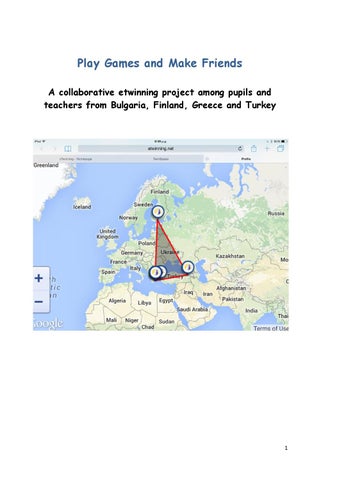
Play Games and Make Friends A collaborative etwinning project among pupils and teachers from Bulgaria, Finland, Greece and Turkey
1
2
3
Contents
Introduction
5
Outdoor games
8
Board games
15
Digital games
18
Reflections
21
4
Introduction
Life must be lived as play. Plato Greek philosopher 427-347 BCE This is the aim of our project, to live our life as play. Through a number of outdoor, board games and digital activities, we have tried to spend the past year in an enjoyable, entertaining, educating way and make friends in our own school as well as beyond the borders of our country. Modern communication technology has enabled the realization of this project, which has brought together pupils and teachers from Greece, Turkey, Finland and Bulgaria. We encourage anyone who may be interested in living life as play to try some or all of the activities presented in the following pages of this booklet, which is the outcome of the collaborative work of all us!
5
Activities to introduce ourselves
Play is our brain's favorite way of learning. Diane Ackerman Contemporary American author
Google Tour Builder Learning about countries through Geography coursebooks might be a bit boring for some students. Google Earth, however, has come to totally change the way we virtually travel to places and with the help of Google Tour Builder, we can create a tour of our neighbourhood, our city or our country. On this link you can travel around the neighbourhood of the 12 Primary School of Galatsi, Athens, Greece and view the school, the local park, the town hall and the local church.
th
You can create your own tour with https://tourbuilder.withgoogle.com/builder
the
help
of
Smilebox Smilebox on http://www.smilebox.com/ is an application which allows anyone to create amazing greeting cards, scrapbooks, slideshows, birthday cards, and more using their photos, videos and music. The pupils of the 12 Primary School - C1’ class have created a newsletter about carnival time in Greece, which can be viewed here. th
6
Edu Buncee Buncee on https://www.edu.buncee.com/home is a fun and easy web tool for educators and students to create and share engaging multimedia presentations, interactive lessons and digital stories. The pupils from Bulgaria have created a beautiful presentation to introduce themselves, as well as their class, school and projects here.
Padlet Padlet on https://padlet.com/ is another useful application to create presentations and collaborate online. The pupils of the 12 Primary School – E2’ class have presented themselves on a padlet wall here. th
Vimeo Vimeo on https://vimeo.com/ is the home for the creation of high quality video and people who enjoy the art of video creating. The pupils of the 12 Primary School – B1’ class have presented themselves and their interests through this tool here. th
7
Outdoor games With the help of an extraordinary application Glogster, the Bulgarian partners in the project have presented a number of popular outdoor activities, which can be viewed here.
Dodgeball
8
Dodgeball is a game in which players of two teams try to throw balls at each other while avoiding being hit themselves. In Bulgaria, the game is typically played among children 6-12 in elementary school. However, internationally, the sport has also emerged as a popular middle school, high school and college sport. It is also popular in informal settings and is often played in a playground, in a gym, or in organized recreational leagues. There are many variations of the game, but generally the main objective of each team is to eliminate all members of the opposing team by hitting them with thrown balls, catching a ball thrown by a member of the opposing team, or forcing them to move outside the court boundaries when a ball is thrown at them. Our Bulgarian partners have presented the game here.
Pots
9
Game participants stand in two rounds – inner and outer ones. The players from the outer circle are standing upright, and from the inner circle – sitting (they are potties). Who leads the game (a buyer) stops in front of one of the upright players and asks: ‘Granny (or grandpa) are you selling your pot?’ Requested answer: ‘I give it, bet it, but never to you!’ Both hit their hands and run opposite outside the circle in opposite directions. The task of each runner is to go around the circle and to take first the vacant pot. Whoever is left without a pot, they go on the game (become a buyer), asking the next player the same question: ‘Granny, are you selling your pot?’ Our Bulgarian partners have presented the game here. The tool they have used for their beautiful presentation is Glogster on http://glogsteredu.edu.glogster.com/ .
Dropping a handkerchief Children make a circle and sit. One of them goes around the circle with a handkerchief in his hand and everyone sings: ‘I’m dropping, dropping a handkerchief and the doggie is pulling it…’ The player, who goes around, chooses one of the children in the circle and drops the handkerchief behind him. Then he runs and the sitting player stands up, takes the dropped handkerchief and chases the circling player. If the second player catches him, then he sits again on his place and the first player has another try to drop the handkerchief 10
behind somebody else’s back. If not, then the second player starts going around the circle with a handkerchief and tries to drop it behind the other sitting player. Our Bulgarian partners of the project show how this game is played here.
Abariza
Abariza is played in the playground or anywhere outdoors. Kids are divided in two teams, for example “boys” and “girls”. Each team chooses a wall or a tree for ‘home’. A kid from one team exits their ‘home’ and shouts Abariza. Another kid from the other team exits, too, and shouts Abariza. They chase each other and when one 11
of the kids catches the other team’s member, s/he puts her/him to jail, the ‘home’. Next more kids exit their ‘home’ and, shouting “Abariza” they chase each other with the aim of catching members of the opponent team and putting them to jail. The winner is the team that manages to catch all the members of the opponent team and put them to jail, their ‘home’. A lovely presentation of the game can be found here by the E2 pupils from Greece. For its creation they have used a user-friendly app called Snapguide on https://snapguide.com/.
The “scarf”
With a piece of chalk, children draw a circle on the ground and they put a scarf in it. They form two teams and each team stands opposite the other. A number is given to each member of each team – one kid in one team has been given the same number as one kid from the other team. The teacher calls out a number in random and the two kids from the opponent teams with the same number run to catch the scarf. Their aim is to catch the scarf and run back to their team without being caught by the opponent player because then the opponent team will get a point. The game ends when all
12
numbers (players) have been called out and the winner is the team that has gathered most points.
You can watch a video presentation of the game here. was presented by the pupils of B1’ class from Greece.
The game
The “sack” race
13
The sack race is a popular game played by Greek pupils in schools or outdoor places. Children have to race in sacks and can compete individually or in groups. Children form two teams. A member from each team enters a sack. Each player tries to move in the sack and reach a point which they have already arranged to be the end of the route. When they have reached the end of the route, they have to came back to their group in the sack. The group who manages to finish first is the winner. Watch a nice presentation of the game prepared with love by the young pupils of C1’ class from Greece for their new friends. You can view the presentation here.
14
Board games Board games is another type of games that can be played in the classroom by students or at home by siblings or friends. Puzzles
15
The pupils of C1’ class from Greece have created a puzzle using a poster with healthy and unhealthy eating habits with the help of www.jigsawplanet.com which is a useful application for creating and playing online puzzles. You can watch it here.
Snakes and Ladders
Snakes and Ladders is an ancient Indian board game regarded today as a worldwide classic. It is played between two or more players on a gameboard having numbered, gridded squares. A number of "ladders" and "snakes" are pictured on the board, each connecting two specific board squares. The object of the game is to navigate one's game piece, according to die rolls, from the start (bottom square) to the finish (top square), helped or hindered by ladders and snakes respectively. The game is a simple race contest based on sheer luck, and is popular with young children. The game is beautifully presented by the pupils of B1’ class from Greece. You can watch a slideshow with their game here. 16
Fruit Salad
Pupils from the English class in Finland like to play “Fruit salad”. They first choose a theme, for example “fruit”. Everybody chooses one fruit and nobody tells it to the others. They form a circle with chairs and everybody sits on a chair except one who is in the middle. He starts saying out loud names of fruits. Every time someone hears the fruit that he has chosen, he must stand up, leave the chair and try to find a new empty one. The person in the middle tries to go and sit on a free chair. A new person who stays in the middle must start saying names of fruits until he finds himself a chair again. So, if the person in the middle says “Banana!”, everybody that has “banana” in mind has to move from his chair. If he says “Fruit salad!”, everybody must move at the same time. You are not allowed to go back to the same place you just left. You can also choose another topic, for example, clothes. Everybody chooses a piece of clothing from a list of words, and when you hear “Clothes!”, everybody has to move. The presentation of this game by Finland can be viewed here.
17
Digital games
Digital games are a form of the most modern way to play games nowadays. There is a large variety of applications that can be used in order to create any game one can think of with a view to entertaining, educating and sharing.
Jigsawplanet puzzles www.jigsawplanet.com offers the opportunity to create online puzzles with photos, pictures or drawings and then share them on the web for others to play. The application was successfully used by the B1’ pupils from Greece, who have taken a picture of their class making a wish for their partners. Their puzzle can be viewed and played here.
Kahoot Another application to create online games is Kahoot. The pupils of E2’ class from Greece have created a quiz about Greece which you can also play here. You just need to copy and paste the given link to your browser. Don’t forget to write the game-pin given in order to enter the game. You can join using any kind of mobile devices from anywhere in the world.
18
LearningApps http://learningapps.org is a Web 2.0 application, to support learning and teaching processes with small interactive modules. Those modules can be used directly in learning materials, but also for self studying. The aim is to collect reusable building blocks and make them available to everyone. Blocks (called Apps) include no specific framework or a specific learning scenario. The blocks must be embedded in an appropriate teaching scenario. Our partners from Bulgaria have used this application to create a matching activity which you can enjoy here.
Classtools.net Classtools.net offers a wide selection of activities that can be created and shared among partners. Our Bulgarian friends have created a puzzle with the Independence Days of our countries here. It is so interesting to know about each country’s independence days through an activity like this instead of just reading history books.
Scratch Scratch is a wonderful application for pupils and teachers who want to create their own interactive content on almost any subject. C1' class from Greece have learned and practised colours and numbers in English. Here is a simple game created with Scratch, which you can play and revise colours in English, too! 19
Press on the green flag, then read the questions and answer by typing the correct number and clicking on the v.
20
Reflections
On the whole, the project “Play Games and Make Friends� has been a great opportunity for both pupils and teachers to come in touch with games and activities enjoyed by people from different countries. Etwinning has allowed us an online space to work, collaborate and share experiences on and through games we have actually made new friends! We hope that the friendships we have made here will last through time and we wish that we can actually meet each other sometime in the future!
21