Quarterly Rebalance Update
May 2026

May 2026
Perhaps the most reassuring feature of the year so far is what didn’t happen. Investors stayed invested, bond markets remained stable, and losses were limited to specific areas rather than across the board. If recent months have shown anything, it’s that markets are very good at walking and chewing gum at the same time.
There’s been a lot of news. Iran has dominated headlines, oil prices have swung sharply, artificial intelligence continues to excite (and unsettle), and inflation has started to climb (again).
And yet, when you zoom out, markets have behaved in a surprisingly calm and pragmatic way. The FTSE 100 Index is up around 4% year to date and has delivered close to 20% over the past year. That resilience is reflected more broadly, with all major equity markets rising in 2026.
Iran is the obvious place to start. The conflict caused alarm, given its proximity to critical global resources. Markets reacted quickly - oil prices jumped, inflation fears resurfaced, and investors briefly questioned whether this could become another 2022 style shock. But just as quickly, things cooled.
Oil remains higher than it was at the start of the year. Brent – the benchmark for oil from the Middle East – rose from around $66 in January to well over $110 at times in April, but it is still a long way from historic extremes in real terms. More importantly, investors appear to be treating the situation as a risk to be monitored rather than a disaster to be priced permanently.
Divergent paths within equity markets have also shaped returns. Energy has benefited, whilst software companies have stumbled. More traditional sectors, focused on delivering profits today rather than tomorrow, have also benefited from renewed support. That’s not markets turning defensive. It’s markets becoming choosier.
Artificial intelligence remains a key theme, but recent months have been a reminder that not every company with an “AI angle” warrants the same valuation. Questions around who benefits, how quickly, and at what cost are starting to matter again.
In many ways, 2026 is reinforcing a familiar lesson: markets can cope with bad news. What they struggle with is uncertainty over whether the rules have changed. So far, they don’t seem convinced that they have.
Once again, markets show they don’t need perfect conditions to function… ...just clarity over time.
Massive hype online. Huge price increases. An increase in crime. Bafflement among traditional investors.
Nope, we’re not talking about crypto. We’re talking Pokémon.
Would you pay, let’s say, £100 for a slip of cardboard with a drawing of an imaginary electric mouse on? Nope.
And yet, that card sold for £1 million about a month ago and another sold for £12.2 million 2 months ago. Moreover, an index which tracks the value of about 10,000 different Pokémon cards is up 180% over the past year – six or seven times the return of the FTSE 100 or S&P 500 over the same period (Source: CardLadder).
It’s this sort of ‘Pokémon-ey’ that is getting people interested – even to the point where collectible card shops across the UK have been robbed recently.
Now, we’ve seen this before. Beanie Babies and stamps and (four hundred years ago) tulips. The psychological factors at play with collectibles are incredibly strong. People get sucked in, and suddenly there’s a market, then a bubble, then a burst bubble.
First, it grabs attention. Our brains notice contrasts. Pokémon and £1 million pounds?! Click.
Secondly, there are no fundamentals. Pokémon cards don’t generate income, dividends or cashflows. There’s no maths you can do. So prices are driven almost entirely by what the next person is willing to pay… based on how they feel. And feelings are shaped by stories (no one comes over all emotional about an Excel file). Collectibles are especially powerful here. It’s a childhood memory, paired with the idea of scarcity. “If you want to own a slice of your own history, you’d better hurry up!”
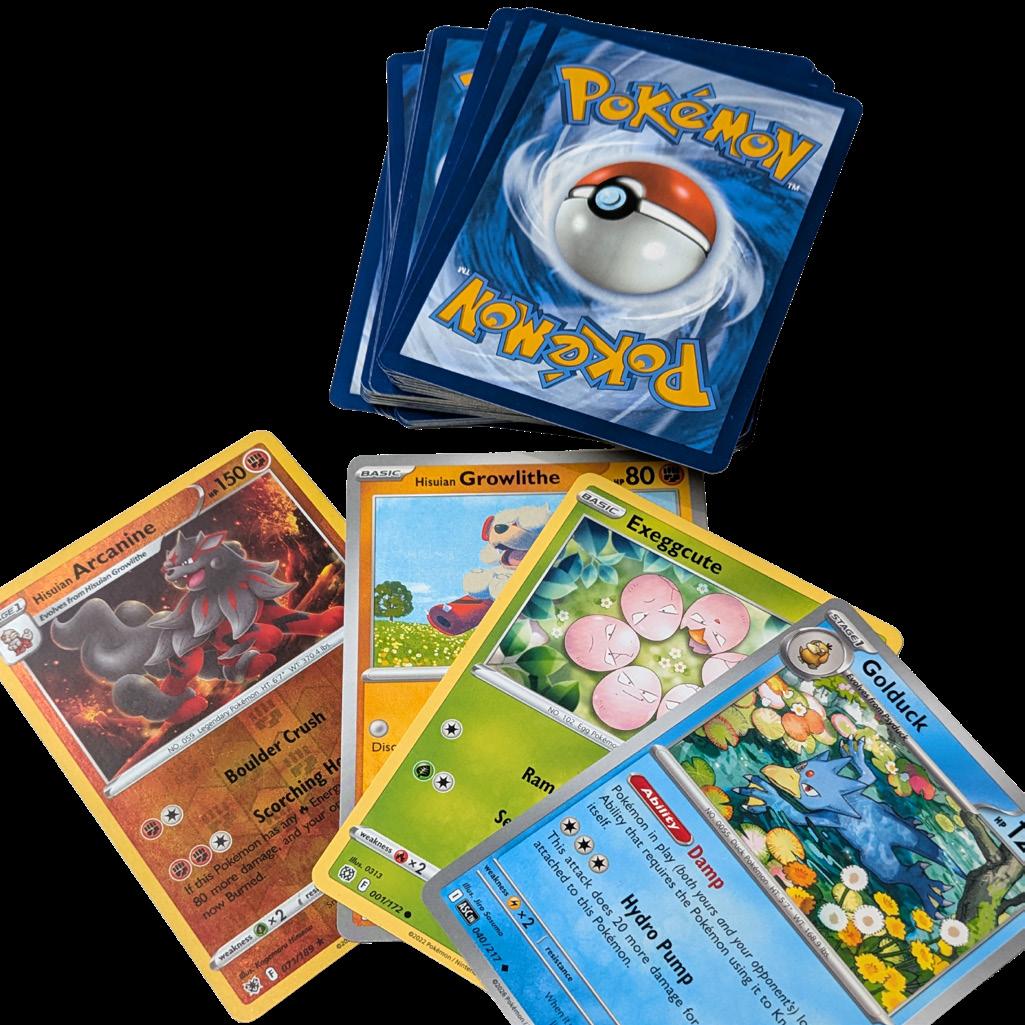
Finally, there’s the powerful urge to complete the set (Gotta catch’em all!).
Psychologists have been studying this for years – from stamp collectors to vinyl fans to World Cup sticker albums. Once you’ve got most of a set, the last few items become massively important. You pay up.
None of this makes Pokémon card collecting stupid. It doesn’t even make the prices people are paying wrong. But it’s worth noting that in a market ruled by stories, status and social identity, there’s no way to know what happens next.
Whether that’s tulips, cards or crypto, something based only on stories, status and social identity isn’t an investment. It’s a hobby.
• The 2026 FIFA World Cup Kicks off in June. Will we see a successful home nation for the first time in 60 years?
• A week of Monetary Policy committee meetings commences on the 15th June, with the Bank of England, European Central Bank and the US Federal Reserve all meeting. This will be a key indication of what the future path for interest rates may look like against a backdrop of inflationary pressures and evolving economic growth concerns.
• July marks the beginning of Q2 earnings season. After a bumpier Q1 earnings season, will equities maintain their momentum despite the noise?

Ben Kumar Head of Strategy – Wealth, Public Policy & Investment
All portfolios are underpinned by 7IM’s Strategic Asset Allocation, which seeks to diversify investments across a broad range of asset classes and global regions and is reviewed annually. Portfolios with tactical management will see 7IM adjust these long-term allocations to take advantage of opportunities and help navigate market conditions.
Equity - we slightly increased our equity exposure
Minimum Weight
Maximum Weight
We have made a modest increase to our equity allocation but remain in what we would classify as ‘neutral’. The reason being that, despite ongoing geopolitical tensions, growth has remained resilient and sentiment supportive. That said, whilst GDP growth appears strong, unless it translates into jobs, growth may stall.
Fixed Income - our fixed income exposure remains close to neutral
Minimum Weight
Maximum Weight
We continue to hold a neutral position in fixed income. With central banks needing to balance slower growth against persistent inflation, the outlook for interest rates remains uncertain and near term cuts look unlikely. As a result, we are not taking an active view on bond duration.
The 7IM Responsible Portfolios invest in companies and funds that score strongly on ESG factors while avoiding exposure to controversial activities such as armaments, tobacco and thermal coal. They also seek investments that can deliver long-term positive environmental and social impact, drawing on 7IM’s extensive experience in sustainable multi asset investing.
Portfolio Themes
The COVID crisis has shown how important healthcare is. Healthcare is becoming increasingly important as Europe’s population ages, with over half of new drugs targeting the over 65s .
ESG Transition Leaders
Companies are cleaning up their business models (even if not helping directly with climate change), such as when a bank cuts the use of paper, or an airline goes lower carbon.
Companies looking to design their products around consumption that fits health and wellness, the circular economy, travel and experiences and consumer lifestyles.
Climate change poses a major global risk, driving investment into clean energy such as solar, wind and hydropower, as governments seek greater control over energy supplies.
Companies are designing products/solutions which improve processing, connectivity and production and help clean up the world. Think AI, electric cars, food chain technology and supply chain management.
Impact investments are those that lead to a material and measurable improvement in environmental and social problems. Examples global corporate bond funds that invest in both ESG-labelled bonds (green and social bonds.
To bring extra diversification into tactically managed portfolios, 7IM researches and implements long-term allocations to the following evidence-backed diversifying strategies.
This allocation buys an equal amount of each of the 500 companies in the S&P 500 Index. This increases exposure to medium-sized companies when compared to a market-cap weighted strategy. It’s a simple way to maintain exposure to US companies, without over-exposure to the huge technology stocks.
Another diversifying strategy focused on generating income through selling put options on the S&P 500 Index. It aims for stable returns with less exposure to equity volatility.
This is a diversified basket of strategies which aren’t correlated to bonds or equities. It continues to deliver returns above the interest rates on cash. It will tend to perform best during dislocations.
Diversified Sustainable Leaders:
Companies leading in environmental innovation, social progress, and governance best practice are central to driving economic growth and supporting a more sustainable global economy. This also includes responsible companies that are currently underappreciated by the market. Targeting these leaders enables the portfolio to capture opportunities across multiple sustainability themes, combining financial performance with positive contributions to sustainable development.
7IM monitors the funds in our portfolios and make changes when we feel we can achieve better outcomes for our customers. This table shows the funds that were new additions in the rebalance and ones that have been completely sold.
Fund Strategies
ManHighYield Opportunities
AmundiUS TreasuryBond LongDated
HSBCGlobal EmergingMarket GovtBondIndex
Sold: Bought:
Thisfundhasbeenintroducedtoportfolios becauseitprovidespotentialforenhanced performancerelativetothecurrentholding.
Thisfundhasbeenaddedtoportfoliosdueto itscompetitivepricing,offeringacostefficientwaytomaintainthedesiredmarket exposure.
Fund Strategies Rationale PictetJapanese EquitySelection Income
iShares$ TreasuryBond 20+yrETF
iSharesEmerging MarketsGovt Bond
Thisfundhasbeenaddedtoportfoliosdueto itscompetitivepricing,offeringacostefficientwaytomaintainthedesiredmarket exposure.
Thisfundhasbeenremovedfromportfolios, withproceedsreallocatedtoa higher-convictionfund.
Thisfundhasbeenremovedfromportfolios afteridentifyingalower-costvehiclethat providesthesameexposuremoreefficiently.
Thisfundhasbeenremovedfromportfolios afteridentifyingalower-costvehiclethat providesthesameexposuremoreefficiently.
Seven Investment Management (7IM) was established in 2002 by seven founders who set out to build a firm they could trust with their own families’ money.
Since then, we have partnered closely with financial advisers and planners - delivering not only cost effective investment but an unrivalled service experience built around responsiveness, clarity, and genuine partnership. Every interaction is designed to make advisers’ lives easier and to help them deliver outstanding outcomes for their clients.
Today, we are entrusted with over 24 billion pounds of clients’ hard-earned assets, and our values remain unchanged:
• A commitment to putting clients and advisers first
• A transparent and disciplined approach to risk management
• A focus on clarity, partnership, and exceptional service
While we continue to evolve, our purpose endures: to support advisers and their clients with robust investment solutions and an unwavering dedication to service excellence.
Please note: All of the comments in this document refer to the models we run on the 7IM platform, but the models are also available on a range of other platforms. As much as possible, we try to replicate the models we run of the 7IM platform across all platforms, but due to differing security availability, not all of the points outlined in this document may be relevant across these platforms. If you are unsure whether certain changes apply to models on a specific platform, please reach out to a member of the team.
The past performance of investments is not a guide to future performance. The value of investments can go down as well as up and you may get back less than you originally invested. Any reference to specific investments are included for information purposes only and are not intended to provide stock recommendation or investment recommendations to individual investors
Seven Investment Management LLP is authorised and regulated by the Financial Conduct Authority. Member of the London Stock Exchange. Registered office: 1 Angel Court, London EC2R 7HJ. Registered in England and Wales number OC378740. 05.26