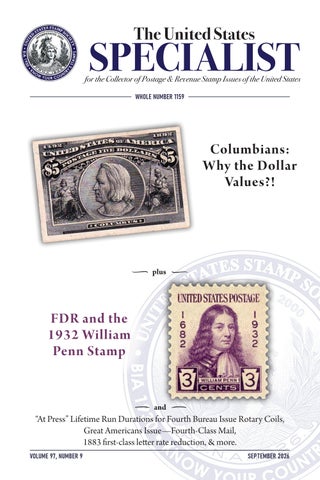
The United States
SPECIALIST
for the Collector of Postage & Revenue Stamp Issues of the United States WHOLE NUMBER 1159
Columbians: Why the Dollar Values?!
s plus e
FDR and the 1932 William Penn Stamp
c and j
“At Press” Lifetime Run Durations for Fourth Bureau Issue Rotary Coils, Great Americans Issue—Fourth-Class Mail, 1883 first-class letter rate reduction, & more. VOLUME 97, NUMBER 9
September 2026
United States Stamp Society
Publications
Encyclopedia of United States Stamps and Stamp Collecting Second Edition Edited by Rodney A. Juell, Lynn R. Batdorf and Steven J. Rod
Hardbound, 769 pages. $35 members, $40 nonmembers. Visit the website for shipping costs.
Order from: USSS, P.O. Box 1602, Hockessin, DE 19707-5602 or online at: www.usstamps.org/store/
The United States
SPECIALIST the journal of the United States Stamp Society
VOLUME 97, NUMBER 9
September 2026
WHOLE NUMBER 1159
An association of collectors to promote the study of all postage and revenue stamps and stamped paper of the United States and US-administered areas produced by the Bureau of Engraving and Printing and other contract printers. American Philatelic Society Affiliate No. 150
387 Important Announcement: The United States Specialist 389 In Memoriam: Jeffrey Shapiro 391 Columbians: Why the Dollar Values?! by Rev. Stephen Knapp 403 Great Americans Issue Part XXVIII— Fourth-Class Mail by Jay Stotts
429 October 1, 1883: The Domestic Letter Rate Decreases by One-Third by Stephen L. Suffet 431 Report of the Executive Secretary by Robert Rufe 432 Classified Advertising 432 Index of Advertisers
410 Vintage Photo of the Month by Rodney A. Juell 412 Determining “At Press” Lifetime Run Durations for Fourth Bureau Issue Rotary Coils by Nancy Robinson, PhD, and James Robinson 419 FDR and the 1932 William Penn Stamp by Paul M. Holland
Andrew S. Kelley, Editor 9038 East 25th Drive Denver, CO 80238 email: editor@usstamps.org
Hockessin, DE 19707-5602. Membership in the United States $25. North America $40; all others $65. Single copy $2. Periodical postage paid at Hockessin, DE, and at additional entry offices. Printed in USA.
www.usstamps.org
Copyright ©2026 United States Stamp Society, Inc. All rights reserved. Opinions expressed by authors are their own and do not necessarily reflect those of the United States Stamp Society, its officers, or staff.
Manuscr ipts, publications for rev iew, and all advertising including classifieds, should be sent to t h e Ed i to r at t h e ad d ress ab ove. Forms close on the 20th of the second month preceding the month of publication, as February 20 for the April edition. The United States Specialist (ISSN 0164-923X) is published monthly January through December by the United States Stamp Society, Inc., P.O. Box 1602,
Correspondence concerning business affairs of the Society, including membership and changes in address, should be addressed to the Executive Secretary, PO Box 1602, Hockessin, DE 19707-5602. Postmaster: Send address changes to U.S.S.S., P.O. Box 1602, Hockessin, DE 19707-5602.
386
THE UNITED STATES SPECIALIST BOOKLETS & BOOKLET PANES
The United States Specialist Founded 1930 as The Bureau Specialist
EDITOR ANDREW S. KELLEY 9038 East 25th Drive Denver, CO 80238 email: editor@usstamps.org
United States Stamp Society Bureau Issues Association, Inc. P.O. Box 1602 Hockessin, DE 19707-5602 CHAIRMAN
Roger S. Brody
Peter Martin
P.O. Box 1194, Rainier, OR 97048 email: MOPerry@mac.com
P.O. Box 6074, Fredericksburg, VA 22403 email: pmartin2525@yahoo.com
DURLAND EDITOR
SECOND BUREAU ISSUE
Kim D. Johnson
Nicholas Lombardi
310 E N 3rd Street, Georgetown, IL 61846
P.O. Box 1005, Mountainside, NJ 07092
email: westhome1@aol.com ESSAY-PROOF
James Patterson 1850 North Central Avenue, No. 1400 Phoenix, AZ 85004 email: jhpatterson@yahoo.com EXHIBIT PDFs
10703 Kings Riding Way, Unit T-1 Rockville, MD 20852-5420 email: cohenji@comcast.net TREASURER Keith Palevsky 3273 Ridge Pointe Dr. Forest Grove, OR 97116-1000 email: kapalevs@gmail.com GOVERNORS
Lynn Batdorf Kim Johnson Mike Lampson Leonard Piszkiewicz James Robinson Robert Rose Rod Juell Gregory Shoults David Steidley Jay Stotts Steven Unkrich EXECUTIVE SECRETARY
FARLEY ERA
Paul M. Holland
Jay B. Stotts email: stottsjd@swbell.net LIBERTY SERIES
email: RAustin13@aol.com MARGINAL MARKINGS
Chris Steenerson P.O. Box 1818 Westminster, CO 80038-1818 email: Chris@RxStamps.com MODERN POSTAL HISTORY
Douglas B. Quine 59 Taylor Rd., Bethel CT 06801 email: usss2010@quine.org PLATE NUMBER & CHECKLIST SERVICE
Kim D. Johnson 310 E N 3rd Street, Georgetown, IL 61846 email: westhome1@aol.com PRECANCELS
Lynn R. Batdorf 6005 Kingsford Road, Bethesda, MD 20817
P.O. Box 1602 Hockessin, DE 19707-5602 email: execsecretary@usstamps.org
email: hollykids@comcast.net
AWARDS
Denise Stotts
email: stottsjd@swbell.net
Andrew S. Kelley 9038 East 25th Dr, Denver, CO 80238 email: stamps@andrewkelley.net WEBMASTER
Mike Lampson P.O. Box 652 Matthews, NC 28106 email: lampson@usstamps.org
Roland Austin P.O. Box 38 Stillwater, OK 74076-0038
Robert Rufe
— Committees —
WASHINGTON-FRANKLIN HEAD ISSUES (Co-Chairmen)
Greg Shoults
FOURTH BUREAU ISSUE
Joel Cohen
email: djryterband@fwcook.com
11248 Frederick Lane Twinsburg, OH 44087 email: coilcollector@hotmail.com
email: pholland.thorleaf@gmail.com
SECRETARY
Dan Ryterband 40 Carolyn Place, Chappaqua, NY 10514
P.O. Box 1818 Westminster, CO 80038-1818 email: Chris@RxStamps.com
PRESIDENT
P.O. Box 1005 Mountainside, NJ 07092 email: 8605@comcast.net
VENDING AND AFFIXING MACHINE PERFORATIONS
Chris Steenerson
P.O. Box 5836 Somerset, NJ 08875-5836 email: brody@usstamps.org
Nicholas Lombardi
REVENUE ISSUES
Michael O. Perry
— Study Groups — DUMMY STAMPS
Terry R. Scott P.O. Box 10406, Napa, CA 94581 email: terryrscott@comcast.net FIRST BUREAU ISSUE [open] LUMINESCENCE
Wayne L. Youngblood 705 Forest Glen Circle, Prairie du Sac WI 53578 email: wystamps@gmail.com OVERRUN COUNTRIES SERIES
Thomas Schilling P.O. Box 432, New Lisbon, NJ 08064-0432 email: cbtkschilling@yahoo.com PROMINENT AMERICANS AND AMERICANA SERIES
Ron Blanks
PRESIDENTIAL ERA
P.O. Box 9282, Chesapeake VA 23321 email: rblanks_stamps@yahoo.com
vacant
REGISTERED MAIL
RECRUITING
Steven Crippe P.O. Box 117001, Carrollton, TX 75011 email: scrippe@gmail.com
Mike Ludeman P.O. Box 2024, Denton, TX 76202-2024 email: mike@ludeman.net
September 2026
387
Society News
Important Announcement: The United States Specialist
Beginning January 2027, the publication schedule of The United States Specialist will change from monthly to bimonthly. At the USSS Board of Governors Annual Meeting held at Boston 2026 World Expo on May 25, the Governors addressed the deteriorating finances of the Society and the possibility of increasing the annual dues and/or publishing The Specialist on a bimonthly basis. Even after increasing the 2026 annual dues from $25 to $30, the first increase in over three decades, our annual operating deficit is unsustainable. As background, the Society’s annual losses for the years 2023, 2024, and 2025 were $29,989, $62,518, and $17,097. The 2024 loss included our $25,000 contribution to support the Boston 2026 show. Thus, our operating assets (Investment & Checking) have fallen from $326,937 in 2023 to $283,722 in 2024, and $273,740 at 2025 year-end. At our current operating rate, we will deplete our operating assets in the next 10 to 11 years. The reason for the current condition stems from several factors. Though we have enjoyed a high level of annual member donations, above the annual dues, and a few generous bequests, our journal production costs and especially escalating mailing expenses have far outstripped our annual dues and donations income. For example, mailing costs, over which we have no control, are increasing on a yearly basis. In 2025, The Specialist print production, mailing cost, and Editor’s fee, after advertising income, totaled $63,951 or $52 per member. To address this situation, several alternatives were presented at the Board meeting. Under consideration were proposals to increase the annual dues, change the production schedule of The Specialist from monthly to an expanded bimonthly, or a combination of both. Two scenarios, summarized below, were presented in the 2027 USSS Budget Proposal: • Annual Dues remain at $30, and Monthly Specialist Publication: Est. P&L ($26,940) • Annual Dues remain at $30, Bimonthly Specialist Publication: Est. P&L $8,040
388
THE UNITED STATES SPECIALIST
USSS membership is the best bargain in US philately. Several philatelic societies whose annual dues are equal to those of the USSS don’t even publish a journal. In addition to the Durland Standard Plate Number Catalog, we have published and wish to continue to provide specialized books basically at cost to promote philatelic knowledge. But we can no longer keep the dues and journal publication status quo. The American Philatelic Society has annual memberships of $45 that include a print version of the American Philatelist, or a $35 membership with a digital journal copy. The USSS already offers a downloadable and searchable monthly Specialist issue on the Society’s website. Raising the annual dues will not solve our annual deficit. Based on the analysis presented to the Board, we would have to establish $50 annual dues to break even. It does not appear that a two-tiered membership anywhere near our current dues level will solve our financial problem. The Governors, in consultation with the journal Editor, have decided to keep the current annual dues at $30 and begin publishing The Specialist on a bimonthly basis beginning in 2027. The Specialist Editor will endeavor to increase the size of the bimonthly editions to ensure that no manuscripts are omitted due to the switch to bimonthly production. This year marks the 100th Anniversary of our Society, established in 1926 as the Philatelic Plate Number Association. A decade later, the name was changed to the Bureau Issues Association. In 2000, the society name was again changed to the United States Stamp Society in recognition that the Bureau of Engraving and Printing would no longer be the nation’s stamp printer. We hope you will continue to support the United States Stamp Society, as we look forward to our second century. —Nick Lombardi, President —Roger S. Brody, Chairman
September 2026
389
Memorial
In Memoriam: Jeffrey Shapiro
Jeffrey Shapiro, a devoted philatelist, passed away on Monday, August 3, 2026, with his loving wife of 52 years, Susan (Schiff ) Shapiro, by his side. Born in Cleveland, Ohio, he was the son of the late Jack and Ethel (Berman) Shapiro. Jeff—as he was called by his friends—was known for a gentle curiosity, a ready laugh, and an encyclopedic knowledge of stamps and postal history. His life was shaped by a love of learning, connection, and preserJeff Shapiro. vation—whether of rare postal covers or of the friendships he formed over decades. Jeff ’s interest in stamps began in childhood when a small collection gifted by a relative sparked a lifelong passion. That early hobby quickly deepened into a serious pursuit: he specialized in mid-twentieth-century North American issues and patriotic covers, but his interests were broad, encompassing classic issues from around the world, postal stationery, and the social history captured in airmail and transit markings. He delighted in the stories behind each piece of paper—the routes they had traveled, the people who had written the letters inside, and the changing technologies and designs that reflected the eras from which they came. A dedicated collector, Jeff was an active presence in the philatelic community for more than 40 years. He dutifully belonged to and served as Vice President of the United States Stamp Society and an officer of the American Philatelic Society. He served as an accredited judge of exhibits and appraiser for other collectors during stamp shows. At his local stamp club, he took on leadership and volunteer roles, mentored new collectors, and organized educational talks and exhibit nights. Jeff was a familiar face at regional and national shows. Colleagues and friends recall his patience when explaining cataloging systems, his meticulous attention to conservation, and his willingness to lend stamps or expertise to help others complete a set or mount an exhibit. He believed the hobby’s
390
THE UNITED STATES SPECIALIST
real value lay not only in rare items but in the shared enthusiasm and knowledge that build across generations. Family and friendship were central to Jeff ’s life. He treasured time spent with close family members and friends at holiday gatherings, backyard barbecues, and quiet afternoons cataloging new acquisitions over coffee. He was a patient listener, generous with time and advice, and took pleasure in seeing younger family members and new collectors discover their own passions. His presence at club meetings, community events, and informal get-togethers will be deeply missed. Jeff ’s contributions extended beyond collecting. He volunteered his time and expertise to local historical projects, helping to identify and preserve postal artifacts. He supported local schools’ history and reading programs and encouraged students’ curiosity about geography, art, and communication. Generous and thoughtful, Jeff often suggested educational books and small grants be directed toward youth programming that reflected his belief in lifelong learning. Professionally, Jeff approached his work as he did his collecting: methodically, honestly, and with a strong sense of responsibility. Outside of philately and work, Jeff enjoyed woodworking, local history, and walking, where he was known by many for his friendly demeanor and habit of stopping to chat. Jeff had lived in Marlborough, Massachusetts, for 41 years. He traveled often for work, living in many places like Huron, Ohio, Syracuse, New York, Vermont, and New York City. Jeffrey graduated from Boston University in 1972 with his Bachelor of Science and from New York University in 1974 with his Master of Public Administration. He was a manager for nonprofit agencies for 30 years, specializing in services for vulnerable communities affected by drug and alcohol abuse, retiring in 2008. When Jeff was able to, he would unwind with romantic classical music like the compositions of Gustav Mahler. He appreciated being able to spend his life alongside his loving wife, Susan. Together they built a beautiful life devoted to their joys and traveling. In addition to his wife, Jeffrey is survived by his siblings, Stephen Shapiro and his wife Deborah of Orlando, Florida, and Marilyn Hazen and her husband Jack of New Smyrna Beach, Florida, his in-laws Barry and Pam Schiff of Cranston, Rhode Island, his nephew Bennett Schiff, as well as his other seven nieces and nephews. Graveside services were held Thursday, August 6, 2026, at the Sons of Israel and David Cemetery in Providence, Rhode Island. Contributions in his memory may be made to the World Central Kitchen, Inc., P.O. Box 96538, Washington, D.C. 20090. Friends and fellow collectors are encouraged to share stories, exhibit items, or volunteer at upcoming club events in his name, continuing the spirit of community and mentorship he championed.
September 2026
391
The Columbian Commemoratives
Columbians: Why the Dollar Values?! by Rev. Stephen Knapp
USSS #8716 | m saknapp@comcast.net
Figure 1.
Though printed by the same banknote company as the stamps which came before and alongside them, philatelists have long disassociated the Columbians (Scott 230–245) from the rest of the Banknote issues, instead regarding them per se as the first commemorative stamp issue. In appearance, the Columbians differ, not only in size but also insofar as their color scheme, from the contemporary small Banknotes which were referenced as “the ordinaries” in official correspondence. The Columbians were produced by the American Bank Note Company under the contract of 1890, but issued for the year 1893 only. At the same time, the reduced-size series introduced in 1890 (Figure 2) continued in full production alongside the Columbians as regularly issued stamps. However, the set of Columbians included five values rated in dollars, which exacted a huge toll on those collecting them.
392
THE UNITED STATES SPECIALIST
Figure 2. Small Banknote high values of 1890.
Practically from the outset, philatelic sentiment has maintained that the sudden unanticipated appearance of five denominations valued in dollars was both excessive and abusive on the part of the Post Office Department. In 1893, the mean American annual salary was approximately $400–$500 and the wages of a common laborer ranged from $8 to $10 for a 60-hour work week (less than 15¢ per hour). The five dollar-value Columbians alone required an outlay of $15, completely eclipsing the $1.34 combined total for the other 11 stamps in the set. What was the necessity for such excessive denominations if it was not merely profiteering by the government preying on the collecting public? What are the facts? Against the implication of misguided profiteering, we can now show that, in accord with the body of correspondence in the Travers Papers, the appearance of five stamps each priced at a dollar or more appears to have been part of an experiment by the POD in response to a formal request and informal requests within the ranks of certain postmasters and other groups. The first request had come in long before 1892, but had not been well handled, owing to the exigencies of party politics. This is that story.
Why the Columbians? What the Columbians were intended to be and what they became are somewhat different propositions. Initially, in August of 1891, Postmaster General Wanamaker received a suggestion from the Postmaster then at New York to the effect that in anticipation of the ensuing commemoration of the work of Columbus, “…the Department [issue] a set of postage stamps bearing special designs relating to that event- …” [suggestions followed]. That October the New York City Stamp agent seconded the thought, but since no plans for such a celebration had yet arisen in government circles, the POD officials in Washington did not take up the matter. Finally, on April 2, 1892, the Third Assistant PMG, A.D. Hazen (Figure 4a), forwarded a recommendation to the stamp contractor, the American Bank Note Company (ABNCo), for a special series of stamps honoring the forthcoming Columbian Exposition in Chicago to be held the next year. Apart from subject matter, nothing was said about the desired appearance of these stamps, so presumably they would await the suggestion of the contractor. At that time, the ABNCo president, James Macdonough, was away in Europe, but upon his return in June 1892, Macdonough responded to Hazen’s suggestion with three pages of notes. While commenting on the theme of portraying incidents in the life of the explorer, Macdonough observed, “…there is only room for eleven subjects; therefore, I select…” at which point he suggested a theme for each stamp of the denominations then
September 2026
393
in use, namely 1¢–90¢ only. These he envisioned in the same size range as the Banknote issues had been when in use before 1890 (Figure 3). In response, he heard nothing immediately, but began preparing essay design elements in anticipation.
Figure 3. Large Banknote high values of 1889.
September 29 When the Columbian subject had first come up earlier that April, the Post Office Department officialdom appears to have been thinking of the new stamps roughly along the same lines as the ABNCo officials had voiced. But by September things had changed. About September 29 the Department needed to commit to a specific plan, and in their discussions with the contract holders they suddenly revealed their intention to have three billion double-wide stamps prepared to include denominations ranging well beyond the usual high of 90¢. Under new terms, the Columbian series would (1) introduce a 50¢ stamp displacing the 90¢, and (2) extend the range to include dollar values from $1 all the way up to $5 per stamp. This announcement took the stamp producers by surprise, and, given the unexpected need for introducing one denomination, dismissing another, and designing five entirely new stamps of unprecedented high value as well, they sought to renegotiate the terms of the contract pertaining to these new specifics. What had happened that caused the Department to demand adding a selection of such unprecedented high-value stamps in the commemorative series they had been planning up to now? It is not clear that the ABNCo officials were told why the high values were needed. However, embedded in the published report of the PMG for 1892 there is a cryptic statement: The denominations are the same as those in the present series, except that the 50-cent stamp is substituted for the 90-cent, and additions are made of 1,2,3,4,5 dollars, such high denominations having been heretofore called for by some of the principal post offices. (emphasis added)
The basis for the claim that high denominations had been “called for” is found in the Travers Papers for correspondence exchanged with the office of the PMG four years earlier in 1888. This was during the interval when the principal appointed Post Office Department offices were held by Democrats, and Henry R. Harris, a member of the House of Representatives from Georgia, had been named as the Third Assistant PMG who oversaw stamp production (Figure 4b). In view of what ultimately transpired, this requires a bit of analytical comment. Despite the formation of the Democratic Party under Andrew Jackson in 1829, from the election of Abraham Lincoln in 1860 until the
394
THE UNITED STATES SPECIALIST
election of Democrat Grover Cleveland in 1885, all the elected Presidents were affiliated with the Republican Party in one way or another. Party patronage was a major factor in determining who worked in government offices and who did not. Employment in the Post Office Department, as it was then called, was very much subject to this reality.
Figure 4a. Portrait of A.D. Hazen about 1885.
Figure 4b. Henry R. Harris as a representative from Georgia.
Fairly early in the period of Republican domination, during the administration of President Johnson in 1866, a young Republican Party stalwart by the name of Abraham D. Hazen (Figure 4a) was appointed to a first-class clerkship in the Post Office Department. By 1870 he had achieved an appointment as “Acting Chief of the Stamp Division,” which became formalized by Congress as “Chief of the Stamps Division” in 1874. Ultimately, he was elevated to Third Assistant Postmaster General in 1877, and comfortably served as such under the Republicans. However, seven years later, in the Republican effort to get Chester Arthur re-elected in 1884, Hazen distinguished himself as a party stalwart by the publication of a pamphlet entitled “The Post Office Before and Since 1860 Under Democratic and Republican Administrations.” According to the New York Times, “[u]pon nearly every page of the pamphlet the Democratic Party was charged with incompetency and dishonesty.” This earned Hazen the unending ire of the Democrats who finally won the presidency in 1885. They wasted no time in installing their people as replacements in the existing POD offices, in particular the office of Postmaster General and his assistants. However, in Hazen’s case, a glitch had developed. The Democrats had selected Henry R. Harris, a Democrat from Georgia, to be the new Third Assistant Postmaster General who would replace Hazen. However, Harris had just been re-elected to the House of Representatives, so he would not be able to begin serving as Third Assistant PMG for at least two years. Could the Democrats sustain a vacancy in that office for that length of time? The postage stamp contract formally adopted for 1885 had specified that, for the first time, all printing of postage stamps was to be done only on steam-driven presses. This
September 2026
395
meant that stamp production was about to enter a shake-down phase for a new technology which would radically affect the way stamps were produced. No one in Washington, on either side of the political divide, was in a better position to oversee such a transition than Hazen, who had been working with matters of stamp production since the middle 1860s. Facing that exigency, the Democrats determined to bite the bullet and allow this Republican stalwart to carry on business as the Third Assistant Postmaster General for the two years that Harris would be unavailable. In view of certain difficulties adapting to fully automated production, including the need to redesign the 1¢ stamp, it proved to be a wise decision. But as soon as the two years were up, Harris was quickly installed in March 1887, and Hazen was shown the door. He would not be allowed to introduce the new stamp he had walked through the stages of development. (Figure 5) That honor became the first official act by Harris, who demonstrated in his later PMG report contribution that he knew little about the stamp he had introduced.
Figure 5. 1¢ ultramarine of 1887—Hazen’s 1¢ that got away.
Figure 6. Color changes under Harris 1887–1888.
Harris busied himself with altering the colors of select denominations of stamps and postal stationery according to his “Dixie” preferences (Figure 6) but otherwise did not much impact the production of postage stamps for the two years he was in office. However, one matter that received some attention has a bearing on the later development of the Columbians. It begins with a bit of correspondence alluded to above dated August 2, 1888, directed to Third Assistant PMG H.R. Harris from H.G. Pearson, Postmaster in New York City: The steady increase in the exchange of corporate securities between this country and the various trans-Atlantic monetary centers, nearly all of which is conducted through the mails under registration, leads me to suggest to you the propriety of providing postage stamps of larger denominations than those now issued. An average of over three hundred letters requiring postage in excess of two dollars and fifty cents are mailed in this office weekly, fully one half of said number requiring postage above seven dollars and fifty cents each.”… “My experience is that stamps of… [recommends stamps of 2.50, 5, 7.50, and 10] would fully satisfy all requirements. The use of these stamps would probably be confined to a few offices, hardly expending beyond Baltimore,
396
THE UNITED STATES SPECIALIST
Boston, New York, and Philadelphia.” [He then provides a list of seven foreign countries and their maximum postage-rate stamps (all above US maximum).]
In this letter, the New York Postmaster was acting as principal correspondent with the Post Office Department officials on behalf of the interests of bankers in his jurisdiction vis-à-vis a set of new denominations above the 90¢. As he tells it, the need for stamps valued above one dollar was considerable. At his base rate of $2.50 for 150 letters per week, and $7.50 for another 150 letters per week, his office’s annual need for “banker” postage amounted to more than $132,000 to cover the costs in New York alone. That corresponds to 1,200 sheets of 90¢ stamps for one post office. Apparently, this concern by the bankers struck a chord with Harris, for on August 8, 1888, he replied: …If the Department should resolve to introduce only two additional denominations, which of the four suggested ones would it, in your opinion, be proper to adopt.
Pearson replied: August 9, 1888: If, however, in your opinion two only should be provided, I would recommend the two dollar and fifty cent, and five dollar stamps, both because of their wider application and the fact that the other two stamps suggested are multiples of same.
At this point the correspondence with Harris on this topic ends. Nothing more is recorded on the subject for the duration of his tenure of the office. That November, the Democrats lost the presidential election, and in March 1889, two weeks after the inauguration of President Benjamin Harrison, the new President very promptly restored Hazen to the office of Third Assistant Postmaster General. Of this the Pittsburgh Dispatch observed, “Mr. Hazen did not seek the office, nor was he urged for it by his friends. The tender of it came to him entirely unsolicited, and he was urged to accept the office by Postmaster General Wanamaker and Mr. Clarkson who desired Mr. Hazen’s assistance because of his well-known ability to discharge the duties of the place.” Hazen’s return to office was just in time to prepare for bidding on a new stamp production contract. In his earliest days back in office, Hazen seems to have been determined to undo the innovations of Harris and restore order as he saw it. For bidding the new contract, the Department was considering reducing the size of postage stamps in order to get more revenue per full-sized sheet. In addition, after the alterations to the stamp color scheme introduced by the Democrats in 1887 and 1888, the new Postmaster General, John Wanamaker, also wanted to regularize the color scheme of the stamp series irrespective of a change in size. Hazen was to work with the prospective bidders to resolve the Department’s questions. His solution was to specify colors for each denomination of stamps in two size alternatives, and attach color samples for each of two distinct color schemes to the bidding prospectus. He called upon the incumbent contractor, the American Bank Note Company, to prepare a host of color samples, first as numbered die proofs, then in pages of strips overprinted “SAMPLE” for stamps of larger size and “SAMPLE A” for stamps of smaller size (Figure 7).
September 2026
397
Figure 7. Color samples in strips of five were overprinted and affixed to specification pages to demonstrate the schemes for “large” and “small” stamp sizes.
Hazen might well have been inclined to dismiss any correspondence associated with his Democratic Party counterpart that had proposed altered production. But the grand scheme of introducing a stamp size reduction and its altered color scheme had the advantage of completely overwriting all the alterations that Harris had introduced while on the way to improving production efficiency. However, there is in all of that no indication that Hazen then had any awareness of the discussion Harris had been having with a group of New York bankers regarding high-value stamps denominated in dollars. Nonetheless, four months after his return to the office, that situation was about to change. The complaint from New York to the Third Assistant Postmaster General’s office was persistent, and so Hazen received correspondence July 8, 1889, from C. Van Cott, Postmaster, New York: I have the honor to hand you herewith copies of correspondence had with your office in August last relative to the supplying of postage stamps of higher denomination than those now in use. … If the statements made in the correspondence are thought to be insufficient, I am assured by the leading bond and stock bankers that a petition will be signed by all interested, and at once sent you requesting that stamps of higher denominations be provided.
After reviewing the earlier correspondence as it had been provided, no doubt Hazen was convinced by the rightness of the cause and the determination of the New Yorkers who had enlisted their Postmaster as an intermediary. Once the size reduction of the new definitives was settled in February of 1890, he was able to turn attention to this old concern calling for higher denominations, which was a new concern for him. Hazen did not attend to the request immediately. Much of the month of July was devoted to considering which 10 scenes from the story of Columbus should appear on the stamps being considered for the series of denominations then in use, as well as their costs of production. On July 28, a formal proposal from James Macdonough was sent to the PMG to manufacture the new stamps at 18 ¾¢ per thousand. However, the very next day Macdonough received a letter of a fundamentally different sort, which he immediately forwarded to the Third Assistant
398
THE UNITED STATES SPECIALIST
Postmaster General. On the 28th a letter was sent by a Mr. C.B. Corwin, executive manager of the Export Department of G.C. Flint & Co. in New York City, to Macdonough offering a few suggestions for consideration in the creation of a stamp series for the “Columbian series.” His concerns were not focused on the stamp designs. Paragraph two begins: The present series of stamps consists of the following:1¢ 2¢, 3¢, 4¢, 5¢, 6¢, 10¢, 15¢, 30¢, and 90¢—10 in all: I would suggest a series of 12 values, as follows:1¢ 2¢, 3¢, 4¢, 5¢, 6¢, 10¢, 12¢, 15¢, 25¢, 50¢ and $1.00.
After pointing out the comparative differences of the two lists of denominations he presents an argument for adding a 12¢ stamp for domestic registered letters in a single stamp. His next paragraph calls for the abolition of the 30¢ and 90¢ denominations on the ground that “..19/20 of all foreign letters carry total postages which are multiples of 5¢, …” which he claims complicates the selection of stamps for postage rates as they were then calculated. He claims that rate calculations with denominations 25¢, 50¢, and $1.00 would hasten handling of high mail volumes. Then Corwin attends to his biggest suggestion. “We mail a great many letters to foreign countries on which the postage is from $1.00 to $5.00, and you can see how easy it is for a boy to make a mistake in a letter involving the rate of, say, $3.30.” He works his illustration and then notes: “The point is that it is much easier to reckon stamps of 25¢ and 50¢ and $1.00 than it is to reckon those of 30¢ and 90¢.” He concludes: I offer these suggestions to you, in the hope that they will be duly considered by those in power, and I assure you that, if they are adopted by the government, the mercantile community will be in a much more satisfied frame of mind concerning our postal issues than they are at present.
In short order Hazen acknowledged receipt of the letter, but was focused upon the task of determining the subjects to be portrayed for the various denominations. By way of reply on July 29 via Macdonough, and not to the writer, he merely commented, “We also enclose a letter received this morning, containing suggestions in regard to the proposed new issue, from Mr. Chas. B. Corwin.” The bulk of the surviving correspondence shows that through August and most of September, Hazen’s attention overwhelmingly was given to selecting the stamp imagery for the series, particularly attending to the portraiture. As late as September 22, 1892, a letter from Alan Shepherd to Hazen specified terms for a contract to produce “double-wide” stamps in honor of Columbus commemoratively, but limited to the denominations in current use. This was approved the next day. On September 27, these details were affirmed by A.D. Hazen in a memorandum to James Tyner, the Assistant Attorney General. Nothing in all this prepares us for what came next.
September 2026
399
September 29 (Redux) We have earlier reported that on September 29, despite the contractual affirmations of September 27, the POD called for an unexpected rearrangement of the terms of the stamp contract involving the production of the Columbians. The specific details surrounding the change in direction on that date are not to be found in the Travers Papers. They are derived from the 1892 POD report itself as noted earlier. Under new terms the Columbian series would (1) introduce a 50¢ stamp displacing the 90¢, and (2) extend the range to include dollar values from $1 all the way up to $5 per stamp. In view of the radical changes in the September 29 order for stamps honoring Columbus, it would appear that the Department was about to attend to the requests by the bankers and others. But Hazen and his associates were not ready to institute the changes called for without some investigation of its own. Evidence for the need of the new high values was subject to investigation by the Department. Little to nothing was being said to the public. In a letter of October 17 to A.D. Hazen, Mr. Theodore A.H. Hay, a dry goods merchant in Easton, Pennsylvania, who also served as a federal Postage Stamp Agent, wrote: In reply to yours of the 11th. I would state that I have had several conferences with Mr. Macdonough who tells me they now have six stamps ready to submit to you for your final approval in a very short time. He will send you proofs of the 2¢ and 5¢ and balance will follow shortly after. I have looked over two of them and think they are superb. All we want to do now is to make sure to get good colors to bring out the various plates.
Despite the fact that the writer was a stamp agent in a small city in Pennsylvania, it remains surprising that such a letter would be going directly to the Third Assistant PMG in response to an earlier letter from Hazen directed to that same writer. That he would be offering comment on proofs/essays for a series of unissued stamps he has examined, borders on the extraordinary. Input from stamp agents in small towns outside New York on matters of new stamp development does not usually appear in the record. Something about this case is exceptional. Could it be that the writer inadvertently entered 2¢, and 5¢, when he meant to write $2 and $5? The timing of events surrounding this letter hints that this is precisely what happened. As we have observed earlier, during the month of July Hazen had encountered more than one call for adding dollar value stamps to the roster of regular issues. One such voice came via the collective voice of Postmasters in New York City renewing an appeal from a few years earlier. At least one other voice is known from an import/export merchant (see above). Both presented suggestions from collective voices of concerned groups who had serious concerns about the handling of postage stamps on valuable mail matter. Yet again in mid-October 1892, as we see here, Hazen appears to have been in correspondence with yet another of those commercial voices. Were steps being taken?
Progressive Action During Hazen’s temporary absence in early October, via a letter on the 20th to Madison Davis, acting Third Assistant PMG, Macdonough at ABNCo matter-of-factly reports:
400
THE UNITED STATES SPECIALIST
I would like to be advised of the return of the Postmaster General and General Hazen, as I shall be ready to submit proofs of some five or six denominations of stamps early next week. Every available man in our force of engravers is steadily at work and our progress is very rapid, as of necessity it must be. Important changes in our building—made necessary by the new work—are nearly completed, and some of our new presses ordered over three months ago in anticipation of the work, will be in their places within two weeks. It is very important that a subject be found for the 50¢ stamp. I can find nothing here, and the Department should select it from the material at hand in Washington—promptly.
The reference to a 50¢ denomination, as well as new proofing for five or six denominations, all but confirms that by October 20 the POD had determined via the Columbian issue to introduce the use of stamps denominated in dollars and replace/revalue the 90¢ which remained in the run of regular issues at the same time. On October 26, Macdonough wrote to Hazen: I hope you will have settled the whole line of stamp colors with Mr. Freeland this morning. I send herewith a model of $5, this arrangement seems to give better result for the single head and being the last stamp of the series, and highest value, I think it ought to be adopted to advantage. I am endeavoring to find a picture painted by Leutzo, of Columbus in Chains.
The wording of a telegram from October 27 is unequivocal: “The one dollar stamp is almost finished can you not arrange with P M General to have Isabella Pledging jewels remain for one dollar and arrest of Columbus allotted for fifty cents.” (T. H. Freeland, secretary) The dollar values generally specified in the POD demands of September 29 are being fleshed out in October and November.
Cui Bono? The question which must have been foremost in Hazen’s mind concerned what set of higher-value denominations would better fit the need for the widest body of postal patrons. Because the Columbian series was intended as a one-year special issue,
Figure 8. New regular high values after the Columbians (images by Robert Siegel Auction Galleries. Used by permission).
September 2026
401
it afforded a better level of control and a time-limited opportunity to test the utility of any new denomination without imposing exploratory changes upon the usual set of definitives. Hence the call for 1893 was to issue a sampler of stamps valued $1 to $5 incrementally and observe how they fared among postal patrons, but only among the highly distinctive Columbians which would cease production near the end of the fiscal year. When the fiscal year for 1893–1894 was up, the Department would have a chance to revisit the question of preferred high-value denominations. John Luff in 1902 shows us a table of the final results on page 176 of The Postage Stamps of the United States. Here is an edited extract from that table for the dollar-value stamps showing the deliveries to local postmasters across the country, reflecting country-wide demand: Dec 31, 1892–
Sept 30, 1893–
June 30, 1893
June 30, 1894
$1
33,827
$2
17,526
Denomination
Total number
Total revenue
22,273
56,100
$56,100
29,074
46,600
$93,200
$3
14,988
13,712
28,700
$86,100
$4
13,786
13,614
27,400
$109,600
$5
13,782
14,618
28,400
$142,000
Based upon the original set of suggestions from the investment bankers and the results of the sales numbers for the five denominations of dollar-denominated Columbians, the greatest utility would be found among the $1, $2, and $5 high-value stamps. In the next contract period, these denominations were added to the series of definitives (Figure 8), but not by ABNCo. Prior to the beginning of the next contract period in July 1894, the Democrats succeeded in returning S. Grover Cleveland to the White House. At this, Hazen elected to resign his post as Third Assistant PMG and left public service for his law practice. The newly appointed Postmaster General, Wilson Bissell, entered into an agreement with the newly appointed Secretary of the Treasury John G. Carlisle, in which it was determined that the contract for stamp production should no longer be put out for bids to private companies but come under direct control of the government through the Treasury Department production agency, the Bureau of Engraving and Printing. The importance of the experimentation with the high-value Columbians is perhaps best revealed by the fact that for nearly a full century after the adoption of the $1, $2, and $5 denominations in 1894, in the hands of the BEP these three served as the high values for every series of US definitive stamps through the Americana Series of 1981.
Great Collections have ONE NAME in common
Bleckwenn
Eubanks
Walske
Kramer
Gross
Mooz
Siegel offers unparalleled expertise, a worldwide client base, financial reliability, intelligent marketing, and the best internet resources of any philatelic auction house. Contact us today to learn more about consigning with Siegel and ensuring your legacy.
21 West 38th Street, 7th Floor New York, N.Y. 10018 Phone (212) 753-6421 Email: stamps@siegelauctions.com
September 2026
403
The Great Americans
Great Americans Issue Part XXVIII— Fourth-Class Mail by Jay Stotts
USSS #10921 | m stottsjd@swbell.net
Figure 1. An envelope that was taped to a package to serve as a Parcel Post mailing label.
Fourth-Class mail in the United States dates back to 1879 when the United States Post Office Department (USPOD) started carrying packages weighing no more than four pounds for a penny per ounce. Private express and package carriers dominated this type of mail until 1913, when the USPOD introduced its Parcel Post mail service. Parcel Post started in January 1913 with a limit of 11 pounds, but that soon increased to 20 pounds, then to 70 pounds by 1918. The USPOD structured a rate system based on both weight and distance mailed. The distance was defined by domestic Parcel Post zones that radiated out from the mailer’s post office to the farthest distances that defined domestic destinations. There were eight Parcel Post zones in addition to local mail. For a discussion on the Parcel Post zones, refer to the article “The Parcel Post Zone Structure,” The United States Specialist 68, no. 5 (May 1997): 221–28.
404
THE UNITED STATES SPECIALIST
Parcel Post of the Great Americans (GA) Era The weight and distance matrix approach proved to be quite successful, so it was continued into the era of the Great Americans. The weight increments were by pound, and there were multiple rate changes throughout the two decades of service of the GA, so it is impractical, in this article, to create tables to cover all of the rates for each weight, each zone, and each rate increase. The best published source of these rates appears on pages 217 to 239 of the reference U.S. Domestic Postal Rates, 1872–2011, 3rd ed., by Beecher and Wawrukiewicz. On page 220 of their book, they do a nice job of explaining what happened at the start of the GA period: Beginning March 22, 1981, Parcel Post rates are determined in a complex manner, with rates depending upon whether: (a) the parcel travels between locations in 2 different bulk mailing centers (BMC) or auxiliary service facilities (ASF) service areas (inter-BMC/ASF) or (b) the parcel travels between addresses inside the area served by one bulk mailing center or one auxiliary service facility (intra-BMC/ASF).
Collectible Parcel Post items are most commonly available in the form of tags, labels, portions of cardboard boxes, or paper wrappers and sometimes as envelopes that were attached to boxes. Ideally, a collectible item will include the postage with appropriate postal markings to cancel the stamps and addresses for both the mailer and the addressee so the distance can be determined. Figure 1 shows an envelope that was taped to a package to serve as a label. We know that this was a Parcel Post item because the postal service identified it as such with a handstamp marking. Pieces of transparent tape exist along the edges of the envelope, indicating that it was attached to the outside of the packaging to serve as a label. The item was mailed from Kerkhoven, Minnesota, to San Francisco and posted on June 4,
Figure 2. A portion of the packaging from a parcel.
September 2026
405
1987. The distance falls within Parcel Post Zone 7 and was an inter-BMC/ASF mailing. Consulting the charts in the “Beecher” book indicates that the total franking, $2.25, was the proper rate for a Parcel Post mailing weighing up to two pounds. Figure 2 shows a portion of the packaging saved from a Parcel Post mailing from April 21, 1993. The item was mailed from Fern Park, Florida, to Houston, Texas, a mailing to the fifth Parcel Post zone. A Wendell Willkie 75¢ stamp paid a portion of the $2.75 affixed to the package that weighed up to two pounds. The correct fee was $2.74, so the mailer chose to overpay the rate by a penny. This approach is often called a convenience franking—it was easier to slightly overpay the correct fee than to wrangle the combination of stamps needed to exactly total $2.74.
Figure 3. A tag used to mail a parcel between two businesses.
Figure 3 shows a tag used to mail a Parcel Post item between two businesses. The package was mailed on November 6, 1991, and was sent from Clarkton, North Carolina, to Henderson, North Carolina, and the distance required a Zone 2 rate. The package weighed 11 pounds. The fee was $2.81 because this was an intra-BMC/ASF mailing. If it had been an inter-BMC/ASF mailing, the charge would have been 27¢ more. Fourth-Class mail was redesignated as Standard Mail (B) by the United States Postal Service (USPS) effective April 11, 1996, so most pieces of mail that were previously marked “Parcel Post,” such as the items shown in Figures 1 and 2, were now marked as “Standard Mail.”
Fourth-Class Book Rate In 1938, President Franklin Delano Roosevelt signed a proclamation creating a special rate for mailing books. The thought was that books were significant to the promotion of American growth, culture, and education, so they should be readily accessible and affordable, including mailing costs. Qualifying books were defined as made up wholly of reading material and void of advertising other than promotions of other books by the publisher.
406
THE UNITED STATES SPECIALIST Additional lb.
Up to
Additional lb. up
1 lb.
to 7 lbs. total
22 Mar. 1981
63¢
23¢
14¢
17 Feb. 1985
69¢
25¢
15¢
3 Apr. 1988
90¢
35¢
20¢
3 Feb. 1991
$1.05
43¢
25¢
10 Jan. 1995
$1.24
50¢
31¢
Start of Rate Period
between 7 and 70 lbs.
Table 1. Single-piece book rate.
A special book rate structure was still in place during the Great Americans tenure and Table 1 lists the fees for single-piece mailings. Presorting discounted rates were available for bulk mailings of the same book, but we have not included these in the table. Businesses that made such bulk mailings were most likely to meter their mail. We have not seen any such mailings sent using Great Americans postage stamps.
Figure 4. Envelope from a book mailing in 1992.
Figure 4 illustrates a portion of an envelope that was used to mail a book in 1992. The marking “Special 4th Cl. Rate” was a common handstamp that the postal service used to indicate the book rate. This was a book weighing under a pound, so postage was $1.05. A five-pound book mailing from 1996 is shown in Figure 5. This is a trimmed scan of a large corrugated cardboard piece that was a side of the mailing box. The rate was $1.24 for the first pound and 50¢ for each of the next four pounds. The total postage was $3.24.
September 2026
407
Figure 5. A five-pound book mailing in 1996.
Over time, the book rate encompassed more than just books. Audio and visual recordings were included in the form of vinyl discs, tapes, etc. Today, such items can be mailed by Media Mail, a designation that was introduced shortly after the period of strong GA usage, on January 7, 2001. Collectors can find wrappers and such marked “Media Mail” with GA stamps, but typically, they are mixed with later stamp issues to make the total postage payment.
Library Rates The library rate provided a special rate for libraries and other such institutions to mail loaned material to patrons. The patrons were then allowed to use the library rate to return the material. Quite often, the mailers used packaging that could be reused to return the item. In most cases, when the item was sent out, the mailer included a label or card to be affixed to return the item. These labels and cards often carried the disclaimer “Library Rate.” Table 2 lists the library rates in effect during the Great Americans period.
408
THE UNITED STATES SPECIALIST Additional lb.
Up to
Additional lb. up
1 lb.
to 7 lbs. total
22 Mar. 1981
21¢
8¢
5¢
6 July 1981
25¢
9¢
6¢
1 Nov. 1981
24¢
9¢
6¢
10 Jan. 1982
32¢
11¢
7¢
6 July 1982
35¢
12¢
7¢
28 July 1982
32¢
11¢
7¢
9 Jan. 1983
35¢
12¢
7¢
17 Feb. 1985
40¢
14¢
8¢
1 Jan. 1986
50¢
17¢
9¢
9 Mar. 1986
55¢
19¢
10¢
20 Apr. 1986
54¢
19¢
10¢
3 Apr. 1988
64¢
23¢
12¢
3 Feb. 1991
65¢
24¢
12¢
11 Nov. 1993
66¢
24¢
12¢
1 Jan. 1995
$1.12
41¢
20¢
4 Oct. 1998
$1.12
42¢
22¢
Start of Rate Period
10 Jan. 1999
between 7 and 70 lbs.
Rates reverted to Book Rate
Table 2. Library rate.
Figure 6 shows a label from a one-pound mailing to Bible Believers Cassettes, Inc. The 1992 mailing required 65¢ in postage, so the Hap Arnold stamp fit the bill nicely. Figure 7 shows both sides of a double-sided mailing card that apparently slipped into a pouch in a reusable mailing container. One side was used to mail out loaned library material by Washington County Cooperative Library Services in Aloha, Oregon. The mailer used a postage meter machine and paid $1.33 in November 1989. The postage indicates
Figure 6. A label from a one-pound Library Rate mailing.
September 2026
409
that the package weighed four pounds. At the library rate, the first pound required 64¢ and the next three pounds were charged at 23¢ each, accounting for the $1.33 charge.
Figure 7. A double-sided mailing card.
When the recipient was ready to return the loaned material to the library, they flipped the card over and affixed $1.33 postage in Great Americans stamps, and their local post office applied the cancel. The flip side of the card was already preprinted to ensure that the proper library name and address appeared and that the postal clerks were aware that the library rate applied.
2026 HEBERT’S All New and Revised Mint and Used Plate Number Single Catalogue $52.50 postpaid American Plate Number Single Expanded pricing, back-of-the-book, Society tag/paper varieties, (www.apnss.org) PN/ZIP/ME types
Rick Burdsall / APNSS P.O. Box 1023 Palatine, IL 60078-1023
410
THE UNITED STATES SPECIALIST
Vintage Photo of the Month
by Rodney A . Juell
USSS # 13852 | P.O. Box 3508, Joliet, IL 60434
This month’s photo shows a woman in Pennsylvania in 1939 purchasing groceries with “original” Food Stamps. In a precursor to modern Food Stamps (now SNAP), the original US Food Stamp Program, which was in effect from 1939 until 1942, enabled low-income families to purchase orange “Food Order” stamps, representing their normal food spending, which could be used to purchase any food items. Participants also received, at no additional cost, blue “Surplus Food Order” stamps, which could be used to obtain designated surplus food like dairy or eggs. Shown nearby are examples of the “orange” and “blue” Food Order stamps.
September 2026
411
412
THE UNITED STATES SPECIALIST
Coil Stamps
Determining “At Press” Lifetime Run Durations for Fourth Bureau Issue Rotary Coils by Nancy Robinson, PhD, and James Robinson USSS #12386 ( James Robinson) | m jsr.new2019@gmail.com
Abstract: How Many Days “At Press” Were Too Long? In a recent article, determination of rotary-coil “plate life” (maximum impression capacity) established limits and statistical averages governing lifetime printing capacity for un-chromed rotary coil plates of Fourth Bureau Issue (FBI) coils.1 In addition to calculating an aggregate average plate life for the issues, separate data demonstrated that plate life was color-dependent, which allowed values to be calculated by coil denomination.2 As a next step in the research, this article builds upon the plate life study. Each plate life data point represented a lifetime count of impressions printed for one rotary coil plate. Now, the same data points will be re-analyzed from the perspective of their correlation to a count of lifetime workdays on press, as determined by rotary press mapping.3 Given that rotary coil presses were identical, a goal of relatively standard daily output was a reasonable expectation by senior staff of the Bureau of Engraving and Printing (BEP). In the earliest era, comparative daily rotary press output could be roughly approximated by the number of perforator rolls delivered by each press crew. Years later, daily output began to be measured precisely by automatic “on-press” impression counters. Acknowledging that plate life was color-dependent, it follows that for plates run at the same speeds, red 2¢ plates averaging 90,000 impressions should not stay on press for as many days as 1¢ plates averaging 122,000 impressions (26% differential). Can proof of variability in run durations be shown? Yes, this article further defines aspects of rotary production outputs via a statistical study of coil-plate average lifetime days on press. Average expected run durations and potential causes of longer run variations are explored. The question, “How long at press was too long?” will be answered.
September 2026
413
Why is run duration important? Using parameters previously derived for lifetime plate impression capacity, and combining the data with workdays on press from this article, it becomes possible to develop a linear regression model describing the number of impressions printed per workday per plate. Because there were always two rotary plates mounted on a press, printing at the same time as a pair, doubling the “per plate per day” value then results in total impressions per workday per press, better known as “Rotary Press Speed.”
Lifetime Run Duration: Background Information for Calculating Workdays on Press The “To Press” date ranges listed in the BEP print histories for each rotary printing plate are logs of the time that the plates were signed out of the BEP Plate Vault and into the Rotary Press Printing Section.4 The date ranges do not represent the precise number of workdays that plates produced impressions. For the first six years of rotary coil production from early 1914 until late September 1920, there were at most three coil presses available each day to print eight different denominations and/or formats. To optimize press production, fresh plates were sent early to the press section in anticipation of an ongoing press run nearing its end. The early arrivals resulted in days at the start of the recorded “to press” period while the plates waited to be mounted on an available press (see Figure 1). There were also nonworking days within the ranges (Sundays and holidays) during which the plates did not produce impressions.5 “Press maps” allow calculation of the actual number of workdays that the plates were actively printing impressions. However, it is important to note that to create a press map, plates are assigned following a set of standardized criteria.6 No BEP records exist listing actual press assignments for each plate in order to verify press mapping. Thus, even using set criteria for mapping, alternative assignment choices were at times possible. JANUARY 1924
FEBRUARY 1924
Line MTWT F S S MTWT F S S MTWT F S S MTWT F S S MTWT F S S MTWT F S S MTWT F S S MTWT F S S MTWT F S S MT # 31
1 2 3 4 5 6 7 8 9
1
2
3
4
5
6
7
8
9
10 11 12 13 14 15 16 17 18 19 20 21 22 23 24 25 26 27 28 29 30 31
D
1
2
3
4
5
6
7
8
9
10 11 12 13 14 15 16 17 18 19 20 21 22 23 24 25 26 27 28 29
1
2
3
D F
F B
B E
E A
A D
D F
F B
B E
Line # Value Scott # 2¢ 599 1 2¢ 599 2 2¢ 599 3 2¢ 599 4 1¢ 597 5 2¢ 599 6 2¢ 599 7 2¢ 599 8 2¢ 599 9 * WD = Workdays
E
Plate Pair To Press Period 14970 & 15004 12/31/1923 1/26/1924 14971 & 15003 1/4/1924 1/30/1924 14980 & 15016 1/7/1924 2/2/1924 15034 & 15051 1/22/1924 2/12/1924 14619 & 14633 1/24/1924 3/3/1924 15015 & 15052 15033 & 15142 15392 & 15393 15141 & 15406
1/25/1924 1/26/1924 1/29/1924 2/1/1924
2/27/1924 2/16/1924 2/19/1924 2/29/1924
WD* on Press 17 19 19 18 29 26 15 14 14
Figure 1. Press map snippet showing rotary coil press utilization for nine plate pairs in the Rotary Press Section between December 31, 1923 and March 3, 1924. The bar color identifies the stamp value: green = 1¢, red = 2¢. Other color codes: lighter red or green depicts the wait time for an open press; white shading indicates Sundays; and black indicates holidays.
4
414
THE UNITED STATES SPECIALIST
Figure 1 illustrates a rotary coil press map snippet for nine plate pairs in the Rotary Press Section from December 31, 1923, through March 3, 1924. On-press rotary impression counters had been in use for less than two months. As January began, their use was still being refined. New BEP Director W. W. Kirby assumed office during this interval. These FBI coil plates were not chromed, and the nine press runs mapped were all “one and done.” That is, each pair ran only once, with both plates destroyed afterward. As an example of how to interpret the data, the workdays on press for the nine plate pairs are given in Figure 1. The on-press time ranged from 14 to 29 workdays. During this very short early period of impression-counting, the eight 2¢ runs (red) averaged 17.8 days. The 1¢ run (green) was 29 days, a 63% increase over the 2¢ average.
Potential Data Variability in Counting Workdays The primary caveat is that, over more than a decade of mapped production, certain press assignments may not accurately reflect the true plate utilization for every plate. As more and more presses were installed, periods occurred when several runs ended in a very short time. In those instances, several pairs of replacement plates could be logged into the BEP Rotary Press Section concurrently, making the final press assignments less obvious. Therefore, a degree of data uncertainty exists in the number of workdays that some plate pairs were mounted on a press. The uncertainty inherent in press mapping is greatest when analyzing a specific press pair. It decreases when analyzing press workdays over large groups of press runs. In other words, excluding any maintenance downtime, each press could print for 306 days annually in a non-leap-year (365 days of 6-day workweeks with 52 Sundays and seven national holidays). When a mapping assignment for a set of plates was not obvious, if waiting plate-pair A did not go on the press, then waiting plate-pair B did. One day’s worth of impressions was printed regardless. But zooming in to study each pair individually, plate-pair B’s total run duration might now be a day or two greater than was actual, and likewise, plate-pair A’s duration shortened by an equivalent amount. The small uncertainty may cause minor variations in the data, but macro totals are not impacted. As a final qualifier, by definition, a workday is a 24-hour calendar day. When there is no overtime or shift work occurring, the 24-hour workday only includes 8 hours of production. When there are two or possibly three shifts working (which occurred at the BEP during WWI and for a time afterward),7 one workday could represent more than 8 hours of production. For example, the lifetime workdays on press to reach plate capacity would be expected to be, on average, 50% shorter if two 8-hour shifts per calendar-day were operating, versus only one shift. However, all data given in this study-section represents single-shift work. By Fiscal Year (FY) 1924, the evidence suggests that printing of coil stamps was accomplished in a single 8-hour shift. The BEP had been adding rotary coil presses, one per year, starting in FY 1921, with the seventh press added at the start of February in FY 1924.8 In addition, the BEP Director reports for FY 1924 and FY 1925 do not mention shiftwork or overtime. Although the FY 1926 annual report lists eight hours of overtime work for coil making by the Postage Stamp Division during the previous year (FY 1925), there was no overtime for this activity in FY 1926. “Making coils” and printing were distinct processes. The same report makes no mention of overtime for the printing of postage
September 2026
415
stamps for either FY 1925 or FY 1926.9 In conclusion, the data analyzed in the next section and presented in Table 1 and Figure 2 reflect regular production using an 8-hour workday.
Average Workdays on Press Per Plate Pair Table 1 illustrates the “average workdays on press” for the 1¢ and 2¢ un-chromed side-coil plate pairs that ran in FY 1924 through FY 1926 for which total impression counts were recorded. To be included in the analysis, both plates within each pair must have impression counts in agreement or within one impression. The “plus one impression” allowance is due to the fact that the cylinder could stop at a “half-revolution.” Data for the 1½¢ side-coil, which instantly became high-demand upon first issuance in April 1925, is not included in the analysis. The reason for omission is that determination of press output speeds (appearing in the next article in this series) revealed a brief period of significant shiftwork occurred for the initial print runs of the 1½¢ side-coil due to extreme time constraints. The story behind its blisteringly fast initial production, with data analysis supporting the conclusion, will be presented in future articles in this study series. The analysis includes a rationale for why the BEP Director would not need to report “overtime press hours” during FY 1925. Table 1 shows that the overall average lifetime run duration for 1¢ and 2¢ side-coil # of
Average
STD* of
Data
Workdays
Workdays
Points
on Press
on Press
1¢ Side-Coil
24
29
2¢ Side-Coil
136
1¢ & 2¢ Side-Coils
160
Data Set
Maximum
Minimum
Value
Value
10
51
13
22
7
45
4
23
8
51
4
* STD = Standard Deviation
Table 1. Lifetime average number of workdays on press for plate pairs prior to chroming.
plate pairs was 23 workdays. Separated by denomination, the 2¢ side-coil, representing the majority of the data points, has a lower average of 22 workdays. The 1¢ average is notably higher at 29 workdays. The individual data points are fairly widely distributed around the mean, with standard deviations of 34% and 32% of the average value for the 1¢ and 2¢ plates, respectively. Figure 2 shows box and whisker plots of the 1¢ and 2¢ data, providing a visual representation of the scatter in the data sets. For readers unfamiliar with this method of graphical analysis, please see the full description of plot parameters found in Determining Average “Plate Life” for Fourth Bureau Issue Rotary Coils.10 The scatter in the data summarized by Table 1 can be readily seen in Figure 2. The 1¢ plates, on average, remained on press seven days longer than the 2¢ side-coil plates, and the differential is statistically significant.11 Lifetime run duration is thus shown to be ink-dependent. In the rotary plate-life study, the total number of lifetime impressions that a plate could print was also shown to be ink-dependent.12 Table 1 supports that finding. With
416
THE UNITED STATES SPECIALIST
60
Workdays on Press
50
40
30
20
10
0 1¢ Side-Coil
2¢ Side-Coil
Figure 2. Box and whisker plot of workdays on press for the 1¢ and 2¢ side-coil data sets.
presses running at approximately the same uniform speed, a plate that could print more impressions due to reduced impact of ink-wear (1¢ plates) could therefore run for more days on press than a plate subjected to faster ink-wear (2¢ plates). On average, 1¢ plates printed 122,000 impressions, while 2¢ plates averaged 90,000 impressions (approximating both to even 1,000s). The differential of 32,000 impressions is 26.2% [(122,000-90,000)/122,000]. The press-run duration differential correlates to the plate life differential.
Question Answered: How Long is Too Long? The tops of the whiskers in Figure 2 represent the highest number of days on press which are not outliers. “Too long” outliers are defined as any points located at a distance of more than 1.5 times the height of the box, measured from the top of the box. Outliers (and sometimes near-outliers) clearly identify data points worth further investigation.
September 2026
417
The top of the whisker is not usually the outlier limit. For the 1¢ duration plot in Figure 2, the outlier value is 60 workdays and above. The whisker top happens to be 51 workdays, no doubt a very long run, but the data for that plot point is within statistically expected variation. However, it is interesting historically that the 1¢ plate pair represented by that data point was the very first coil pair ever to be mechanically counted.13 The run might be experimental and was unusually long, yet not statistically “too long.” In Figure 2, there is only one statistical outlier in the data plots. It occurs in the 2¢ side-coil data set for plate pair 17827/17878. 2¢ outliers occur at 41 days and above, and this pairing was at press for 45 days, statistically “too long.” It should not be surprising that the same two plates were also outliers for the total “impressions per plate” in the 2¢ side-coil data set, each printing 205,568 total impressions, very high for un-chromed 2¢ side-coil plates. In this 2¢ case, the authors suspect that the two plates were among the earliest chromed plates, although they were not noted as chromed by Cleland in the BEP plate records and print histories.14 The suspicion is based on press mapping that shows the pair at press concurrent to when reported 2¢ chromed plates first appeared on the coil presses, and when it is evident that experimentation with the plate life of chromed plates was conducted.15 Even if not chromed, a second possibility is that one press crew was directed to experimentally run a “control,” printing a set of un-chromed plates beyond useful life, until the surface had been “ground down” past the farthest point of burnishing and re-touching. Recall that the BEP had never had such an accurate measure of on-press counting capability in the past. There was a lot to be learned.
Conclusion and Forward-look With data sets describing rotary coil-plate capacities and lifetime print-run durations now available, the next article in this study will derive actual production “Press Speeds” and outputs for the Stickney rotary coil press during the FBI era. References 1. Nancy Robinson and James Robinson “Determining Average ‘Plate Life’ for Fourth Bureau Rotary Coils” The United States Specialist, 1157, no. 7, (2026): 314–327. 2. Nancy Robinson and James Robinson “BEP Rotary Coil Production: The Impact of Printing Inks on Plate Life” The United States Specialist, 1158, no. 8, (2026): 367–377. 3. Nancy Robinson and James Robinson, “New Perspectives on Rotary Coil Stamp Production Via ‘Press Maps’” (BEP Fiscal Years 1914–1925), Part I” The United States Specialist 96, no. 3, (2025): 125–128. 4. W. Wallace Cleland, comp., “Printing History of Coil Plates, Series 1922” B.I.A. Research Paper #14 (United States Stamp Society [formerly BIA], May 1997). 5. Nancy Robinson and James Robinson, “New Perspectives on Rotary Coil Stamp Production Via “Press Maps” (BEP Fiscal Years 1914–1925), Part II,” The United States Specialist 96, no. 4 (2025): 157. 6. Robinson and Robinson, “New Perspectives on Rotary Coil Stamp Production Via Press Maps” Part I,” 125–128. 7. Nancy Robinson and James Robinson, “Government Coil Stamp Supply and Demand: BEP Fiscal Years 1908 through 1925 Part III: FY 1916: Low-Demand Coils Transition from Flat-Plate to Rotary Press Printing & FY 1917–FY 1925: Full Rotary Coil Stamp Production” The United States Specialist 97, no. 2, (2026): 91–93. 8. Robinson and Robinson, “New Perspectives on Rotary Coil Stamp Production Via Press Maps” Part II,” 151.
418
THE UNITED STATES SPECIALIST
9. U.S. Bureau of Engraving and Printing, Annual Reports of the Director of the Bureau of Engraving and Printing: 1919–1931 (Washington, D.C.: Government Printing Office) Annual reports for FY 1924, FY 1925 and FY 1926: 4, 6. https://books.google.com/books?id=0t8bzINuf LcC&printsec=frontcover&source=gbs_ge_summary_r&cad=0#v=onepage&q&f=false. 10. Robinson and Robinson “Determining Average Plate Life for Fourth Bureau Rotary Coils,” 318. 11. Statistical significance was demonstrated using Excel T-test function: Two-sample unequal variance, 2-tailed. The probability (p-value) = 0.00151, p-values less than 0.05 indicate statistical significance. 12. Robinson and Robinson “BEP Rotary Coil Production: “The Impact of Printing Inks on Plate Life.” 13. Cleland, “Printing History of Coil Plates, Series 1922”. 14. Ibid. 15. Authors’ unpublished data, to be included in a future article describing early chrome plate experimentation.
Revenues . S . U We maintain a wide selection of quality material. View our complete up-to-date price list online.
• All Scott-listed revenue stamps • Revenue Proofs and Essays • Taxpaid Revenues • Telegraph Stamps
• Revenue Stamped & Embossed Paper • Revenue Stamps used on Document
Richard Friedberg
310 Chestnut Street • Meadville, PA 16335 (814) 724-5824 • richard@friedbergstamps.com
www.Friedbergstamps.com
September 2026
419
FDR Era Stamps
FDR and the 1932 William Penn Stamp
by Paul M. Holland
USSS #16849 | m pholland.thorleaf@gmail.com
The origin of the colony of Pennsylvania was a massive 1681 grant of land by King Charles II, who named the 45,000-square-mile territory “Pennsylvania” (meaning “Penn’s Woods”) in honor of William Penn’s late father, Admiral Sir William Penn. Penn had been a key supporter during the restoration of Charles II as king in 1660, following the execution of the king’s father Charles I in 1649 by Parliament and the interregnum Commonwealth of England established under Oliver Cromwell, a complex story beyond the scope of this article. In any case, following the land grant, the son William Penn came to America and sailed up the Delaware River, where he founded the city of Philadelphia in 1682. An influential Quaker, William Penn was a strong advocate of religious freedom who soon established amicable relations with Native American tribes.
420
THE UNITED STATES SPECIALIST
Although a special request for a stamp commemorating William Penn’s role in colonizing Pennsylvania had been made as early as 1925 by the editor of a stamp column, President Coolidge’s Postmaster General (PMG) Harry S. New had rejected it as untimely. However, as the 250th anniversary of Penn’s 1682 landing approached, a resolution requesting such a stamp was put forward by the Historical Society of Pennsylvania on January 26, 1931.1 When no action was taken, a petition signed by more than 80 historical societies in Pennsylvania was presented to President Herbert Hoover’s PMG Walter Brown the following year. The request was again denied, on the basis that the Bureau of Engraving and Printing (BEP) was too busy printing the Washington Bicentennial Issue and preparing designs for the Olympic and Arbor Day stamps. However, following protests by Senator James J. Davis of Pennsylvania, a conference with Post Office Department officials was arranged, and shortly after this meeting it was announced that a William Penn stamp would be issued in October 1932.1 The only verified portrait of William Penn, one from 1666 at the age of 22 wearing a suit of armor, is shown in Figure 1. Using this as the basis for a stamp led to concern among those in the Quaker community that the stamp would violate the spirit of their religion and mocking their veneration of William Penn. However, following the BEP’s painful experience when questions were raised about the historical accuracy of later paintings depicting the life of George Washington, the use of this authentic portrait was viewed as necessary since it was the only such portrait available. Preliminary designs for the William Penn stamp were prepared at the BEP by Victor Figure 1. William Penn wearing a suit of armor at the age of S. McCloskey, Jr. and Alvin R. 22. Meissner. These are shown in Figure 2. Features of the earlier essays were then combined to produce the essay shown in Figure 3. This included alterations to enclose the value in “keystone” tablets, symbolizing Pennsylvania as the “Keystone State” based on its central location among the original American colonies and its crucial role in the founding of the United States. Note also the use of an overhead banner for “United States Postage.”
September 2026
421
Figure 2. Preliminary designs for the William Penn stamp.1
The final design of the William Penn stamp incorporated the best features of these essays, using a larger portrait head, year dates on both sides, with keystone value tablets. The vignette was engraved by John Eissler, with the lettering and frame by Edward M. Hall. The die proof was approved by PMG Brown on September 23, 1932.1 A small die proof, believed to be the one from FDR’s collection based on its somewhat trapezoidal shape (closely matching the image in the 1946 Harmer catalog), is shown in Figure 4. FDR’s collection included the only small and large die proofs of the William Penn stamp known at the time of the February 1946 H. R. Harmer auction along with two photo essays, see Figure 5. FDR’s “unique” large die proof (lot 60) on India paper sunk on card has the BEP control number 334294 stamped on the back, although three examples are now reported to exist. Note that FDR’s small die proof (Figure 4) is listed as the only example known.2 The first printing plates for the William Penn stamp were approved on October 3, 1932, and put to press later that same day, as shown by the plate proof in Figure 6.3 A total of 12 printing plates (21064–21075) were used. Interestingly, in producing flat plate printing plates for this stamp the design from the roller die was rocked in from top to bottom, instead of bottom to top, resulting in some “shifted transfers” that are especially visible at the lower left of plate 21066 (not shown here).1 Four first day cities were designated for the William Penn stamp: Philadelphia and Chester in Pennsylvania, New Castle Figure 3. Essay for the William Penn stamp.1
422
THE UNITED STATES SPECIALIST
Figure 4. Small die proof believed to be from FDR’s collection.
Figure 5. FDR’s own die proof of William Penn stamp along with 1946 H. R. Harmer auction descriptions and later auction image.
September 2026
423
Figure 6. Plate proof for the William Penn stamp approved October 3, 1932 (Smithsonian National Postal Museum).
in Delaware, and Washington, D.C., with the stamp first issued on October 24, 1932. I’m fortunate in having the hand-drawn and painted first day cover (FDC) sent to FDR as governor of New York that is shown in Figure 7. The “Keystone” theme is in three colors and it’s franked with a pair of William Penn stamps. The return address on the back shows that this was sent to Governor Roosevelt by S. E. Hutnick, M.D., a prominent philatelic cachet maker and naval cover collector who was based in West Philadelphia, Pennsylvania. Later, Hutnick sent many covers to FDR while he was president, especially naval covers, and I have a number of these in my collection, this being the earliest example. Shown in Figure 8 is another of my FDCs sent to FDR using the William Penn stamp. The printed cachet on this cover is from The Philadelphia Record Stamp Club, a philatelic group sponsored by The Philadelphia Record newspaper in the early 1930s. This is perhaps
424
THE UNITED STATES SPECIALIST
Figure 7. Hand-painted FDC sent to FDR by S. E. Hutnick, M.D., franked with a pair of William Penn stamps.
the most notable of the FDC cachets from this organization (Mellone 724-2), commemorating the 1932 William Penn issue using a “keystone” design. Note that “Personal” has been typed below the address.
Figure 8. William Penn FDC sent to FDR with printed cachet from The Philadelphia Record Stamp Club.
September 2026
425
Of special interest, the William Penn stamp was issued during the 1932 presidential campaign, where George W. Linn strongly promoted FDR with a number of “A Stamp Collector for President” items.4 In Figure 9, I show my example of usage of the William Penn stamp on a two-color Adam K. Bert cacheted Linprint cover bearing two examples of Linn’s “A Stamp Collector for President” labels, including one in blue with a “socked on the nose” cancellation from Milwaukee, Wisconsin. This was mailed on Saturday, November 5, 1932, only three days before the election, and is the latest 1932 presidential campaign usage that I have in my collection. The enclosed letter opens with “Dear Brother” and continues “Here I send the cover that we were speaking about.” Note that this cacheted envelope was originally developed to use for first day covers of the William Penn stamp (Mellone 724-24).
Figure 9. Cacheted cover franked with William Penn stamp and “A Stamp Collector for President” labels sent during the presidential campaign on November 5, 1932.
426
THE UNITED STATES SPECIALIST
That FDR was aware of George Linn’s “A Stamp Collector for President” campaign is now well documented. For example, in Figure 10, I show my examples of “A Stamp Collector for President” labels from FDR’s own collection. The H. R. Harmer backstamps on these are applied in a way that indicates that they originally came from full sheets of labels, apparently from lot 461 of the February sale.3 Such labels were issued in sheets of 20, perforated 12, in four colors: brown, red orange, green, and dark blue. They were designed for stamp collectors to use on their outgoing mail, and to encourage their use, Linn offered them at prices “far below our standard figures for similar items.” Prices began at 12 sheets (240 stamps) postpaid at 25¢. I’m fortunate in having full sheets of all of these in my collection. Stamps from each of the 20 different positions on these sheets can be plated based on small flaws and other features. The labels shown in Figure 10 are from plate positions 1 and 10, respectively. This philatelic complexity is likely because the labels were rushed into production after the Democratic Convention ended, with little time for careful inspection.
Figure 10. Two of FDR’s own “A Stamp Collector for President” labels.
Envelopes with printed “A Stamp Collector for President” cachets were also prepared. They were offered in either one or two colors, with postpaid prices for 50 envelopes being 25¢ for the one-color type, and 45¢ for the slightly larger two-color size. The first direct evidence I’ve found for such cacheted covers being in FDR’s stamp collection is my set of ten covers from H. R. Harmer auction lot 400 of the December 1946 sale.3 All were canceled on election day, November 8, 1932, from various towns around the United States named Roosevelt. These ten covers came in a single large H. R. Harmer auction folder (Figure 11) along with three additional election-day covers with Roosevelt cancellations bearing an FDR portrait cachet instead. The sale date “Dec 18 1946” is stamped on the folder with the lot number “400” written in blue crayon. The lot description is also shown. Each of these ten covers has a two-color “A Stamp Collector for President” cachet with added “A Stamp Collector for President” label. Harmer auction authentication handstamps are applied on the front of each cover, and all are franked with William Penn stamps. These were presumably a gift sent to FDR by a fellow stamp collector, and I show examples of four of these with labels printed in each of four different colors in Figure 12. Note the cancellations in different Roosevelt-named towns in Washington State, Oregon, Missouri, and Wisconsin. The labels themselves are from plate positions 7, 12, 7, and 12, respectively. Others in my set of ten have Roosevelt cancellations from Arkansas, Michigan, Oklahoma, Louisiana, Texas, and New York (not shown here).
September 2026
Figure 11. Portion of large 1946 H. R. Harmer auction folder from December sale with auction lot description.
Figure 12. Four of FDR’s ten “A Stamp Collector for President” election-day covers with labels, all canceled in different Roosevelt-named towns.
427
428
THE UNITED STATES SPECIALIST
To summarize, William Penn stamps commemorating the 250th anniversary of the founding of Pennsylvania marked a key event in the history of the United States. Curiously, the unusual design of the William Penn stamp met with such an enthusiastic reception by the public that the Post Office Department requested that the BEP prepare a similar design for the 1933 Georgia Bicentennial stamp, but that is another story … Furthermore, the William Penn commemoration also occurred in the midst of the 1932 presidential campaign and so unsurprisingly, these stamps were used on covers as part of George Linn’s “A Stamp Collector for President” campaign on behalf of FDR’s candidacy. I’m fortunate in having a number of examples of such covers, including a substantial run of election-day covers that came from FDR’s own stamp collection. References 1. Max G. Johl, The United States Commemorative Postage Stamps of the Twentieth Century: Volume I, 1901–1935 (New York: H. L. Lindquist, 1947), 227–29. 2. The President Franklin D. Roosevelt Collection (New York: H. R. Harmer, Inc.), Parts One through Four (February, April, July, and December 1946). 3. B. I. A. Plate Number Checklist: Plates 20000–41303, rev. ed. (United States Stamp Society, 1990). 4. Paul M. Holland, “A Stamp Collector for President: George Linn, FDR and the 1932 Election,” The American Philatelist, May 2016, 620–23.
Quality United States Stamps (1847-1945) Singles (mint and used) Plate Blocks Booklet Panes plus Complete Booklets Price lists-$2.00 each category Price lists free on web: www.mountainsidestampsandcoins.com
We also buy quality U.S. and foreign stamps
Mountainside Stamps, Coins and Currency P. O. Box 1116 Mountainside, NJ 07092 Tel: 908-232-0539 or 908-419-9751 E-mail: tjacks@verizon.net Tom Jacks, owner Member APS, ASDA, USSS
USatFACE.com
If you collect Plate Blocks, Booklets, Coils, or Sheets, the above website, with hundreds of sets at Face Value, will be a great savings to you. Enjoy the hobby. Armen Hovsepian (APS 150170) P. O. Box 24222 Overland Park, KS 66283 info@USatFACE.com
September 2026
429
Postal History
October 1, 1883: The Domestic Letter Rate Decreases by One-Third by Stephen L. Suffet
USSS #11381 | m ssuffet@nyc.rr.com
Figure 1. First day of 2 cents per half ounce letter rate. October 1, 1883.
We have become so accustomed to frequent postal rate increases, sometimes occurring twice within the same year, that it often surprises non-philatelists to learn that, except for a brief period from 1815 to 1816, postal rates in the United States tended to fall throughout the nineteenth century. One such rate decrease went into effect on Monday, October 1, 1883, when the basic cost for mailing a non-local domestic letter fell by onethird, from 3¢ to 2¢ per half ounce. The new 2¢ rate matched what was charged for mailing a local letter within a city that had carrier service. Figure 1 shows a cover postmarked in Newport News, Virginia, on the first day of the new rate. A receiving mark on the reverse, which does not scan well enough to illustrate, indicates that the cover arrived in Denver, Colorado, on October 6, a mere five days later. Even in our age of modern jet transportation, no one would be surprised if it now took the US Postal Service longer than that to deliver a letter from Newport News to Denver.
430
THE UNITED STATES SPECIALIST
Along with the rate reduction, the US Post Office Department issued a new 2¢ stamp and a first-ever 4¢ stamp to cover the single- and double-letter rates, respectively. The Scott Catalogue lists them as numbers 210 and 211. Examples of each stamp are known to have been used on October 1, 1883, and such usages are highly prized by collectors of classic first-day covers. The cover illustrated, however, does not bear one of the new red-brown 2¢ stamps that pictures George Washington. The postage was paid with a vermilion 2-cent stamp of the previous issue, which pictures Andrew Jackson. Some collector lightly penciled “1870 issue” beneath the stamp, but then that person or someone else changed it to “1873 issue,” correctly identifying it as the soft paper variety produced by the American Bank Note Company beginning in 1873, Scott 183. Other pencil notations on the cover include “292 Arap” in the lower left corner. I believe that was added by someone in the Denver post office to indicate that the delivery address for the addressee Lucian Duke, Esq., was 292 Arapahoe Street. That street can be found on Denver maps from the 1870s and 1880s, and it still exists today. In the lower right corner someone wrote “1.25” in pencil. I am certain that means the asking price for this cover was once a dollar and a quarter. No, I am not the lucky purchaser. I paid $60 plus sales tax and a shipping fee. That was in 2024, and I believe I still got a bargain. Effective July 1, 1885, the weight unit changed from the half ounce to the full ounce, so the domestic letter rate became 2 cents per ounce. This amounted to a rate reduction for letters weighing more than half an ounce. The 2¢ rate remained in effect until November 2, 1917, when the rate for non-local letters temporarily rose to 3¢ per ounce, with the additional cent amounting to a tax used to pay for expenses related to the First World War. The 2¢ rate was restored on July 1, 1919. Figure 2 pictures a 2-cent Circular Die stamped envelope postmarked in Bristol, Connecticut, on November 1, 1917, the last day before the wartime rate increase. It is addressed to Worcester, Massachusetts.
Figure 2. Last day of 2 cents per ounce letter rate. November 1, 1917.
September 2026
431
Report of the Executive Secretary APPLICATIONS RECEIVED FOR JULY 2026 17682
Jeff Saulich, Tallahassee, FL APPLICATIONS PENDING
17679–17681 NEW MEMBERS 17671–17678 REINSTATED 16449
Steven Heaney DECEASED
14494
Jeffrey N. Shapiro
TOTAL MEMBERSHIP June 30, 2026 ADDITIONS: New members Reinstated
1229
Total SUBTRACTIONS: Deceased
+9
Total
-1
NET CHANGE TOTAL MEMBERSHIP July 31, 2026
+8
8 1
1
1237
USSS WELCOMES DISCOUNT POSTAGE
At the USSS booth at Boston 2026 recently, several members commented that they would be pleased to donate surplus postage for society mailings, and some were surprised to hear that we provide donation acknowledgment letters for such donations. We prefer higher denomination stamps, since mailing replacement copies of The United States Specialist costs $2.85 per issue—at the “large envelope” First Class USPS rate for 5 oz. For any membership questions and email or snail-mail address changes, please contact Bob Rufe at: execsecretary@usstamps.org
432
THE UNITED STATES SPECIALIST
Classified Advertising USSS MEMBERS are entitled to two free ads of up to 40 words each year. Other ads are 10¢ a word, payable in advance. For 6 insertions, take a 5% discount; for 12 insertions, take a 10% discount. Ads with [1159] at the end expire with this issue. Make checks payable to USSS. Send copy and check to The United States Specialist, 9038 E. 25th Dr., Denver, CO 80238. The Editor strongly prefers to receive ad copy by email: editor@usstamps.org. Emailing ads saves substantial time for you and the Editor and avoids errors. WANTED WANTED TO PURCHASE #1053 HAMILTON $5 Commercial Usages. Especially need use to foreign destination. Also doing a survey so scans appreciated. Doug Weisz weiszcovers@gmail.com, 773-9144332. 4547 E Kentucky Cir., Denver CO 80246. www.douglasweisz.com [1168] WANTED - NAMW TEXAS POSTMARKED covers. Member APS, IPDA, USSS, APNSS. Email: htputney@gmail.com [1162] WANTED FOR MY COLLECTION: SCOTT #102 to #111, 1869 Special Printings (re-issues). Please— only nice examples without major faults. Must be face-up bright and attractive. PF or PSE Certs only! Strong buyer—Rob Lehmann (240)422-0118 or diecasttoys@yahoo.com [1163] WANTED #279 PLATE NUMBER STRIPS FOR specialized collection/study of 1898 1¢ Franklin, plate #’s 1459 & 1470 (any position), 1411(bottom). 279a plate #’s 1206, 1207, 1315, 1376, 1379. Len McMaster, 304-856-1118 or lenmcmaster@gmail.com [1168] WANTED: M-BAG TAGS FOR PERIODICALS s ent to foreign destinations; Autogiro mail; Nineteenth century typewriter advertising and Washington, D.C., hotels; Uses of 952, 966, 1047, 1084, 1205, 3774, especially to foreign destinations; Zunks covers; $5 stamp uses. E-mail: pmartin2525@yahoo.com, POB 6074, Fredericksburg, VA 22403. [1159] WANTED: AIR MAIL COMPLETE BOOKLETS with major EFOs. Large miscuts, incorrect booklet assembly, printing errors, extra covers, etc. Focus is on booklet cover errors, not the stamps. Send photo and description to alanmoll@verizon.net [1160] WANTED BUY/TR ADE : MNH BURE AU precancels. Definitive sheet stamps, coils—1923 through Americana series, Scott 581//1816. No Christmas, airmails, transportation, or later. Singles, blocks, plate blocks, sheets, coil pairs, line pairs, rolls. Herman Axelrod, POB 3161, Boulder, CO 80307 hermanax@comcast.net 303-499-9264 (no texting) [1160]
FOR SALE IF MY STAMPS ARE NOT VF/XF, SUPERB, I sell in packets. Upgrade now at low prices. U.S.A. and Norway with no faults, centered and clean. Request list—Reed Roholt, P.O. Box 1006, Beaver, UT 84713. Satisfaction guaranteed. [1160] SET OF THE BURE AU/US SPECIALIST, Volumes 1–94. Earl Gibson 817-266-9280 [1159] UNITED STATES IS ALL WE STOCK!! WHAT are you looking for? See our Marvelous Website: www.MALACK.com. MINT, USED, GRADED, BOOKLETS, PLATE BLOCKS (Huge CE2 stock), EFOs, CLASSIC SHEETS, and MORE! Steve Malack, P.O. Box 5628, Endicott, NY 13763 607-862-9441 Steve@Malack.com [1160]
Precancel Stamp Society Interested in learning more about precancels? Request an electronic sample copy of PSS Forum, our monthly journal, from Joe Walsh at promo@precancels.com www.precancels.com
Index of Advertisers Armen Hovsepian (www.USatFACE.com) ������������������������������������������ 428 American Plate Number Single Society (www.apnss.org) �����������������������������������������������������409 Mountainside Stamps, Coins and Currency (www.mountainsidestampsandcoins.com) ������� 428 Precancel Stamp Society (www.precancels.com) ������������������������������������������ 432 Richard Friedberg (www.friedbergstamps.com) ���������������������������������418 Robert A. Siegel Auction Galleries (www.siegelauctions.com) ������������������������������������402 Scott A. Shaulis (www.shaulisstamps.com) ������������������������������������ 428 The United States Stamp Society (www.usstamps.org) ���������������������������������������� Covers
United States Possessions: Postage Due Stamps and Covers presents the story of Postage Due stamps used in the major possessions or territories of the United States. Written from a stamp collector’s perspective, the authors address the challenge of identifying the myriad of Possession Postage Due stamps by concentrating on stamp identification while also covering the Postage Due issues of Cuba, the Danish West Indies, Puerto Rico, the Panama Canal Zone, the Philippines and more. In addition to the text, the monograph contains over 300 illustrations and five appendices which provide information to supplement and further explain key points. In many cases, the information presented is new or, if previously reported, organized in a new manner to help the reader understand the complexity of the Possession Postage Dues.
United States Possessions: Postage Due Stamps and Covers
Hard cover, 352 pages, 6-in × 9-in. Member Price: $39 US postpaid Non-Member Price: $43 US postpaid Purchased online at: www.usstamps.org/store/ or by mail to: Executive Secretary, P.O. Box 1602, Hockessin, DE 19707-5602
UNITED STATES STAMP SOCIETY P.O. BOX 1602 HOCKESSIN, DE 19707-5602
United States Stamp Society
2026 Durland Standard Plate Number Catalog
09-2026
New
!
The new 2026 edition of the Durland Standard Plate Number Catalog provides the most comprehensive research source for plate number information on United States postage and revenue stamps, including tax-paid revenue stamps, with listings for overprinted Possessions postage, Allied Military government stamps, and other back-of-the-book stamps, dummy and test stamps, MDI “Blue Cover” booklets and partial plate numbers on booklet and coil stamps. 2026 Edition of the Durland Standard Plate Number Catalog Available in Perfect and Spiral Bound format. Member Price: $40 Non-Member Price: $45
Order Online at: www.usstamps.org/store