The United States
SPECIALIST
for the Collector of Postage & Revenue Stamp Issues of the United States WHOLE NUMBER 1161
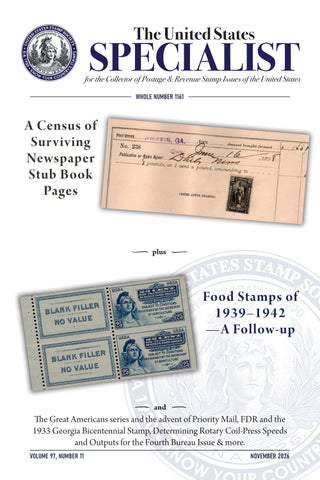
A Census of Surviving Newspaper Stub Book Pages
s plus e
Food Stamps of 1939–1942 —A Follow-up
c and j
The Great Americans series and the advent of Priority Mail, FDR and the 1933 Georgia Bicentennial Stamp, Determining Rotary Coil-Press Speeds and Outputs for the Fourth Bureau Issue & more. VOLUME 97, NUMBER 11
November 2026
United States Stamp Society
Publications
Encyclopedia of United States Stamps and Stamp Collecting Second Edition Edited by Rodney A. Juell, Lynn R. Batdorf and Steven J. Rod
Hardbound, 769 pages. $35 members, $40 nonmembers. Visit the website for shipping costs.
Order from: USSS, P.O. Box 1602, Hockessin, DE 19707-5602 or online at: www.usstamps.org/store/
The United States
SPECIALIST the journal of the United States Stamp Society
VOLUME 97, NUMBER 11
November 2026
WHOLE NUMBER 1161
An association of collectors to promote the study of all postage and revenue stamps and stamped paper of the United States and US-administered areas produced by the Bureau of Engraving and Printing and other contract printers. American Philatelic Society Affiliate No. 150
484 The Pages from Griffin by Chris Jenkins
525 Report of the Executive Secretary by Robert Rufe
495 Food Stamps of 1939–1942— A Follow-up by John M. Hotchner
526 Plate Number Report compiled by Kim D. Johnson
499 Great Americans Issue Part XXX— Priority Mail by Jay Stotts
528 Classified Advertising 528 Index of Advertisers
504 Vintage Photo of the Month by Rodney A. Juell 506 FDR and the 1933 Georgia Bicentennial Stamp by Paul M. Holland 516 Determining Rotary Coil-Press Speeds and Outputs for the Fourth Bureau Issue by Nancy Robinson, PhD, and James Robinson
Andrew S. Kelley, Editor 9038 East 25th Drive Denver, CO 80238 email: editor@usstamps.org
Hockessin, DE 19707-5602. Membership in the United States $25; North America $40; all others $65. Single copy $2. Periodical postage paid at Hockessin, DE, and at additional entry offices. Printed in USA.
www.usstamps.org
Copyright ©2026 United States Stamp Society, Inc. All rights reserved. Opinions expressed by authors are their own and do not necessarily reflect those of the United States Stamp Society, its officers, or staff.
Manuscr ipts, publications for rev iew, and all advertising including classifieds, should be sent to t h e Ed i to r at t h e ad d ress ab ove. Forms close on the 20th of the second month preceding the month of publication, as February 20 for the April edition. The United States Specialist (ISSN 0164-923X) is published monthly January through December by the United States Stamp Society, Inc., PO Box 1602,
Correspondence concerning business affairs of the Society, including membership and changes in address, should be addressed to the Executive Secretary, PO Box 1602, Hockessin, DE 19707-5602. Postmaster: Send address changes to USSS, PO Box 1602, Hockessin, DE 19707-5602.
482
THE UNITED STATES SPECIALIST — Committees —
Peter Martin
email: stottsjd@swbell.net
P.O. Box 6074, Fredericksburg, VA 22403 email: pmartin2525@yahoo.com
Denise Stotts BOOKLETS & BOOKLET PANES
Michael O. Perry
The United States Specialist Founded 1930 as The Bureau Specialist
EDITOR ANDREW S. KELLEY 9038 East 25th Drive Denver, CO 80238 email: editor@usstamps.org
United States Stamp Society Bureau Issues Association, Inc. P.O. Box 1602 Hockessin, DE 19707-5602 CHAIRMAN
Roger S. Brody
P.O. Box 5836 Somerset, NJ 08875-5836 email: brody@usstamps.org PRESIDENT
Nicholas Lombardi
P.O. Box 1005 Mountainside, NJ 07092 email: 8605@comcast.net VICE PRESIDENT
Jeffrey Shapiro
P.O. Box 3211 Fayville, MA 01745-3211 email: coverlover@gmail.com SECRETARY
Joel Cohen
REVENUE ISSUES
AWARDS
SECOND BUREAU ISSUE
Nicholas Lombardi
P.O. Box 1194, Rainier, OR 97048 email: MOPerry@mac.com
P.O. Box 1005, Mountainside, NJ 07092
DURLAND EDITOR
Kim D. Johnson
VENDING AND AFFIXING MACHINE PERFORATIONS
310 E N 3rd Street, Georgetown, IL 61846 email: westhome1@aol.com
40 Carolyn Place, Chappaqua, NY 10514
ESSAY-PROOF
James Patterson 1850 North Central Avenue, No. 1400 Phoenix, AZ 85004 email: jhpatterson@yahoo.com EXHIBIT PDFs
Chris Steenerson P.O. Box 1818 Westminster, CO 80038-1818 email: Chris@RxStamps.com FARLEY ERA
Paul M. Holland
Dan Ryterband email: djryterband@fwcook.com WASHINGTON-FRANKLIN HEAD ISSUES (Co-Chairmen)
Greg Shoults 11248 Frederick Lane Twinsburg, OH 44087 email: coilcollector@hotmail.com
Andrew S. Kelley 9038 East 25th Dr, Denver, CO 80238 email: stamps@andrewkelley.net WEBMASTER
email: pholland.thorleaf@gmail.com
Mike Lampson
FOURTH BUREAU ISSUE
P.O. Box 652 Matthews, NC 28106 email: lampson@usstamps.org
Jay B. Stotts
email: stottsjd@swbell.net LIBERTY SERIES
Roland Austin
— Study Groups —
P.O. Box 38 Stillwater, OK 74076-0038 email: RAustin13@aol.com
DUMMY STAMPS
MARGINAL MARKINGS
P.O. Box 10406, Napa, CA 94581 email: terryrscott@comcast.net
Chris Steenerson
Terry R. Scott
10703 Kings Riding Way, Unit T-1 Rockville, MD 20852-5420 email: cohenji@comcast.net
P.O. Box 1818 Westminster, CO 80038-1818 email: Chris@RxStamps.com
TREASURER
MODERN POSTAL HISTORY
Douglas B. Quine
Wayne L. Youngblood
1740 Mission Hills Rd., #311 Northbrook, IL 60062-5744 email: david14501681@gmail.com
72 Strawberry Hill Rd, Madison, CT 06443 email: usss2010@quine.org
705 Forest Glen Circle, Prairie du Sac, WI 53578 email: wystamps@gmail.com
David S. Sugar
GOVERNORS
Lynn Batdorf Kim Johnson Mike Lampson Leonard Piszkiewicz James Robinson Robert Rose Rod Juell Gregory Shoults David Steidley Jay Stotts Steven Unkrich EXECUTIVE SECRETARY
Robert Rufe
P.O. Box 1602 Hockessin, DE 19707-5602 email: execsecretary@usstamps.org
PLATE NUMBER & CHECKLIST SERVICE
Kim D. Johnson 310 E N 3rd Street, Georgetown, IL 61846 email: westhome1@aol.com PRECANCELS
Lynn R. Batdorf 6005 Kingsford Road, Bethesda, MD 20817 email: hollykids@comcast.net
FIRST BUREAU ISSUE [open] LUMINESCENCE
OVERRUN COUNTRIES SERIES
Thomas Schilling P.O. Box 432, New Lisbon, NJ 08064-0432 email: cbtkschilling@yahoo.com PROMINENT AMERICANS AND AMERICANA SERIES
Ron Blanks
PRESIDENTIAL ERA
Jeffrey Shapiro
P.O. Box 9282, Chesapeake VA 23321 email: rblanks_stamps@yahoo.com
P.O. Box 3211, Fayville, MA 01745-3211
REGISTERED MAIL
RECRUITING
Steven Crippe P.O. Box 117001, Carrollton, TX 75011 email: scrippe@gmail.com
Mike Ludeman P.O. Box 2024, Denton, TX 76202-2024 email: mike@ludeman.net
Great Collections have ONE NAME in common
Bleckwenn
Eubanks
Walske
Kramer
Gross
Mooz
Siegel offers unparalleled expertise, a worldwide client base, financial reliability, intelligent marketing, and the best internet resources of any philatelic auction house. Contact us today to learn more about consigning with Siegel and ensuring your legacy.
21 West 38th Street, 7th Floor New York, N.Y. 10018 Phone (212) 753-6421 Email: stamps@siegelauctions.com
484
THE UNITED STATES SPECIALIST
Newspaper Stamps
The Pages from Griffin by Chris Jenkins USSS #16951
This is the story of an unusual philatelic discovery made more than 80 years ago. The find produced the largest known single source of United States newspaper stamp stub book pages. Intact stub book pages are uncommon and show how United States newspaper and periodical stamps were used in the late nineteenth century. Griffin, Georgia, is a city some 40 miles southwest of Atlanta and the seat of Spalding County. Griffin was once home to dentist Doc Holliday of Wild West fame and wellknown philatelist Raynor Hubbell. Neither of them, however, plays a part in this article. Remington’s Newspaper Directory of 1901 recorded the city’s population as 6,587 and listed four newspapers: The Call, The Echo, The News & Sun, and The Farmer. In early August of 1941, a woman from Griffin wrote to the Post Office Department in Washington, D.C., asking for information about some old stamps she had found. Within a few days, she received a lengthy, courteous reply from Third Assistant Postmaster General Ramsey S. Black, along with her stamps. Black explained that the stamps dated from the 1890s and had been used to mail newspapers and periodicals. A copy of the first page of Black’s letter is reproduced in Figure 1. Black had received uncanceled newspaper stamps, probably still affixed to pieces of the original post office stub pages. In his reply, Black quoted catalog values from the Scott Standard Postage Stamp Catalogue for the 1¢, 5¢, 10¢, and 25¢ stamps she had submitted. In 1940, the Scott Catalogue values for those newspaper stamps were the same in used and unused condition.
November 2026
485
Figure 1. The first page of the letter from Third Assistant Postmaster General Ramsey S. Black.
Miscommunication Newspaper stamp collectors owe the woman a debt of gratitude for not discarding what she had discovered. They weren’t merely stamps; they were stamps on intact newspaper stamp stub book pages! It is likely, although not certain, that all of the surviving Griffin pages are from her discovery. These pages are sometimes called ledger pages or receipt book pages. I will use the term “stub book” pages to be consistent with Post Office practice of the 1890s. The woman from Griffin was most certainly not a philatelist, so
486
THE UNITED STATES SPECIALIST
when she mailed examples of her stamps to the Post Office Department, she did what any non-collector might do with stamps—she ripped them from the stub book, along with small pieces of adhering paper. The holes in the pages remain. Figure 2 shows one of the pages with two stamps torn out, probably the 1¢ and 25¢ values she sent to Washington. The Post Office Department, for its part, received only stamps with bits of paper attached, so it apparently did not recognize that the sender had found complete stub pages. Nineteenth-century Post Office rules mandated that local postmasters return stubs to Washington for accounting and destruction. Most surviving stub pages were cut into pieces, and the stamps were soaked free for collectors. Images of a few of the surviving Griffin pages have been published over the years.
Figure 2. Two of the stamps mailed to the Post Office Department in 1941 were probably removed from this page.
November 2026
Figure 3. The Griffin stub book cover.
Figure 4. The inside of the Griffin newspaper stub book cover.
487
488
THE UNITED STATES SPECIALIST
Newspaper stub books were produced in several formats. The books used in Griffin in mid-1898 held stubs for three transactions on the left of each page. On the right side of each stub was a receipt that was given to the publisher or news agent at the time of mailing. Stamps were used only on the left (stub) side of the page and remained at the post office. The Griffin find was more significant than intact stub pages alone, because it also included a stub book cover. It may be the only surviving stub book cover page from the newspaper stamp era. Figure 3 shows the cover and Figure 4 shows the instructions printed on the inside of the cover.
The Griffin Pages Over the years, the Griffin stub pages have found their way into several collections, including that of the late Bill Mooz. His newspaper stamp collection, auctioned by R. A. Siegel in March 2023, contained an accumulation of Griffin stub pages accompanied by Black’s letter. The Mooz material included 16 Griffin stub pages bearing stamps and 25 without stamps. The pages are dated from May 5 through June 30, 1898, and include those reflecting the cessation of newspaper stamp use effective July 1, 1898. Each of the entries in the stub book carries an identifying transaction number (Figure 5). The May and June mailings in Griffin ranged from 4 pounds to 50 pounds. At the then-current rate for newspapers and periodicals of 1¢ per pound, the highest-denomination stamp used was 25¢. Mooz wrote several excellent articles on US newspaper stamps. His article in the November 2013 issue of The Chronicle included an example of a Griffin page and an 1898 letter to the former Griffin postmaster requesting return of the stubs. Perhaps because of a change in postmasters in Griffin, some of the stub book pages were never returned to Washington.
Other Pages from Griffin In addition to those in the Mooz collection, a few other Griffin pages have appeared at auctions or in magazine articles over the past 35 years. For example, the Lynne WarmGriffiths collection, auctioned by Christie’s in December 1990, contained three Griffin, Georgia, pages from April 1898. Lynne Warm-Griffiths created an outstanding exhibit of newspaper stamps and included examples of the Griffin pages. The American Philatelic Society has preserved a black-and-white copy of that exhibit. In addition, two Griffin stub pages, at least one of which carried an April 1898 date, were part of the Jim Kotanchik collection sold by Matthew Bennett in February 2004. Their provenance was reported as Warm-Griffiths. David Straight, writing in the April 2008 issue of the American Philatelist, included an illustration of an April 1898 Griffin page with stubs Nos. 4–6. Straight’s article also contains some excellent information on each of the newspapers published in Griffin.
Cancellations? Post Office Department regulations required newspaper stamps to be canceled when used and placed on the stubs. That regulation was not observed in Griffin, with all the stamps remaining in uncanceled condition.
November 2026
489
Figure 5. A typical Griffin page showing three numbered transactions.
Last Days of the Newspaper Stamps On June 14, 1898, the Postmaster General ordered that the use of newspaper stamps be discontinued after June 30. This followed a long debate about the value of newspaper stamps in fraud prevention. It was concluded that the burden imposed by the cumbersome accounting system associated with the stamps greatly outweighed their value as a means of financial control. Fortunately, the Griffin pages include those through the end of June 1898, and thus we have a record of newspaper stamp use as the end drew near. Griffin apparently lacked sufficient stamps to match amounts paid for newspaper postage. As a result, many of the stubs have either no stamps or stamps in an amount that did not match the transaction.
490
THE UNITED STATES SPECIALIST
The last day stamps were used in Griffin was June 16, 1898, and thereafter the stubs bear no stamps (Figure 6). Close examination of the pages shows no traces of stamp removal other than those torn out and sent to the Post Office Department in Washington, D.C. Figure 7 shows the stub page from June 30, 1898, the last day newspaper stamps could be used in the United States. No stamps were used in Griffin that day.
Figure 6. June 16, 1898, was the last day newspaper stamps were used in Griffin.
November 2026
491
Figure 7. The stub book page for June 30, 1898.
An Informal Census Based on published sources, the help of Doc M. Pepper, and items from the Mooz collection, I compiled an informal census of the surviving Griffin pages. The results are summarized in Table 1. Please note that while news agents are shown on a few stubs, the agents’ names are not included in the table due to the difficulty of reading the handwritten entries. The May 31 page containing transaction 262 also contains an unused blank for transaction 263, and June 1 transaction 264. Also, the names of the publications were not always written on the stubs in a complete manner. For example, the Daily News may simply have been entered as News, making it impossible to distinguish from the Weekly News. In the table I have shown the publications as they appear on the stubs, so some publication names appear incomplete.
492
THE UNITED STATES SPECIALIST Earliest Date on Page
Transaction Number
Number of Stamps on Page
1-Apr
1–3
12
News Daily, Daily Call, Daily News
2-Apr
4–6
12
Daily Call, Echo, Daily News
7-Apr
??
??
??
Newspapers
8-Apr
22–24
12
Daily News, Daily Call
10-Apr
25–27
12
Daily News, Daily Call
17-Apr
43–45
11
Echo
23-Apr
55–57
9
Daily Call, Echo, Daily News
26-Apr
61–63
12
Daily Call, Daily News
28-Apr
64–66
16
Weekly News, Weekly Call, Daily News
28-Apr
67–69
12
Daily Call, Daily News
1-May
193–195
10
Echo, Call, News
5-May
199–201
9
News, News, Call
5-May
202–204
8
News, Call, News
8-May
208–210
8
Call
10-May
211–213
9
News, Call, Echo
10-May
214–216
7
News, Call
12-May
217–219
0
Call, News Weekly
13-May
220–222
0
News, Call
14-May
223–225
0
News, Call
15-May
226–228
0
News, Call
17-May
229–231
0
News, Call
19-May
232–234
0
News Weekly, Call
19-May
235–237
0
Call, Daily News, Call
21-May
238–240
0
Echo, News, Call
22-May
241–243
0
Daily News, Call
24-May
244–246
0
Daily News, Call, News
25-May
247–249
0
Call, News, Call
26-May
250–252
0
Daily News, Weekly Call, News
26-May
253–255
0
Call, News
28-May
256–258
0
News, Call
29-May
259–261
0
Call
31-May
262–264
2
News
1-Jun
208–210
6
Weekly News, Daily Call, Weekly Call
2-Jun
211–213
2
Daily News, Daily Call
3-Jun
214–216
2
Daily News, Daily Call
November 2026
493
5-Jun
217–219
3
Echo, Daily News, Daily Call
7-Jun
220–222
3
Daily News, Daily Call
8-Jun
223–225
2
Daily Call, Daily News
10-Jun
226–228
2
Daily News, Daily Call
11-Jun
229–231
2
Daily Call, Daily News
13-Jun
232–234
2
Daily News
14-Jun
235–237
2
Daily Call, Daily News
16-Jun
238–240
5
Daily News, Daily Call, Weekly News
17-Jun
241–243
0
Weekly Call, Daily News, Daily Call
18-Jun
244–246
0
Daily News, Daily Call, Echo
19-Jun
247–249
0
Daily Call, Daily News
21-Jun
250–252
0
Daily Call, Daily News
23-Jun
253–255
0
Daily Call, Weekly News, Weekly Call
24-Jun
256–258
0
Daily Call, Daily News
25-Jun
259–261
0
Daily Call, Daily News
26-Jun
262–264
0
Daily Call, Daily News
29-Jun
265–267
0
Daily News, Daily Call
30-Jun
268–270
0
Daily Call, Weekly News, Weekly Call
Table 1. Known surviving Griffin, Georgia, stub book pages, April, May, and June 1898.
Except for the pages covering transactions 196–198 and 205–207, a complete run of May transactions survives on 22 pages. Although these pages are not marked “Griffin” at the top, they contain entries only for newspapers published in Griffin. A complete run of June pages also survives: 63 transactions on 21 pages, all marked “Griffin” at the top. Although only one stub book cover is known, the surviving pages must come from at least two books, because the May and June transaction numbers overlap. The last May page includes transaction 264, dated June 1, yet a June page carries its own transaction 264, dated June 26. Similarly, the May pages reached transaction 262 by May 31, while the main June sequence begins on June 1 with transaction 208. The April pages may represent a third book. April’s surviving pages end with transaction 69, and the May pages begin with transaction 193. If the April and June pages came from the same book, nearly 140 transactions would have been recorded in it during May. That is about twice the roughly 70 recorded in April or in June, and about twice the number on the surviving May pages themselves. Many of the most attractive surviving pages are those from April 1898. All 10 of the pages I have identified have stamps. None of the April pages came from the Mooz collection; they are in other private collections. The April pages span dates from April 1 to April 28, but the transaction numbers are incomplete. That means there may be more April pages in existence, perhaps buried in dormant collections.
494
THE UNITED STATES SPECIALIST
Conclusion While the total number of surviving Griffin pages is unknown, evidence suggests that they may represent parts of three stub books. In addition to pages from Griffin, pages or partial pages from other locations occasionally surface, including Hannibal, Missouri; Allentown, New Jersey; Hardin, Illinois; and Savannah, New York. Also, fragments of stubs, with source identification possible from cancellations, can be found. Hopefully, additional stub pages will surface someday. They remain of great interest to philatelists. Much more information on newspaper stamps and proofs can be found in Doc M. Pepper’s excellent series of books. References 1. Luff, John. Postage Stamps of the United States. New York: Scott Stamp & Coin Co., Ltd., 1902, 243. 2. Straight, David. “More on Newspaper Stamps.” American Philatelist (April 2008): 318. 3. Standard Postage Stamp Catalogue 1940. New York: Scott Stamp & Coin Co., Ltd., 33. 4. Letter from Ramsey S. Black, Third Assistant Postmaster General, August 15, 1941. 5. Christie’s Robson Lowe. The Lynne Warm-Griffiths Collections of United States Bureau Issues and United States Newspaper and Periodical Stamps. New York, 1990, 48–49. 6. Mooz, William E. “Newspaper and Periodical Stamps: Canceled, Uncanceled, and Unused.” The Chronicle (November 2013): 371–372. 7. Pepper, Doc M. United States Newspaper Stamps 1865–1895: The Regulars. 2015, 19. 8. Matthew Bennett International, The Jim Kotanchik Collection of Newspaper and Periodical Stamps, Sale 271. New York, February 6, 2004, 62.
November 2026
495
Food Stamps
Food Stamps of 1939–1942 —A Follow-up by John M. Hotchner
USSS #6569 | m jmhstamp@verizon.net
Figure 1. Federal Surplus Commodities Corporation stamps.
As a fan of Rod Juell’s writings, I was happy to see his treatment of the 1939–1942 Food Stamps in his “Vintage Photo of the Month” feature in the September 2026 issue of The United States Specialist. My own collection of these stamps is only random finds: neither comprehensive nor spectacular. But I’m happy to be able to present here some additional material. These stamps are listed in Drummond’s Catalog of Philatelic Miscellany, Part 1: A–L (first edition, 2016). The information that follows is from that reference and items from my collection. The FSCC-inscribed stamps were the first to be issued—in 1939. FSCC stands for the Federal Surplus Commodities Corporation. The USDA stamps (referring to the US Department of Agriculture) were produced in 1941. Both the 1939 and 1941 stamps were released in orange and blue. See Figure 1 for the FSCC versions. In the dark label with white text at upper right, the orange stamps are said to be for “Food Order,” while the blue stamps are for “Surplus Food Order.”
496
THE UNITED STATES SPECIALIST
Figure 2. Booklet pane of FSCC stamps.
They were issued in booklets with panes of four (see Figure 2), and varying numbers of panes. Note that these stamps are horizontally imperforate, but fully perforated examples exist. Sometime in the 1950s, the USDA designs were resurrected with the idea they could be issued in coil format. All known examples have various forms of “specimen” overprints. My one example is shown in Figure 3. In order for retailers to be reimbursed, food stamps they accepted were put on a “Food Stamp Card (To be used by retailers for food order stamps).” An example 3. Coil format FSCC stamp with $4.50 in orange USDA stamps is shown in Figure 5 Figure with specimen overprint. on the facing page. Finally, anything with perforations, and some things without, might find their way onto US mail. In Figure 4, we have a 1954 attempt to use a 25¢ orange USDA Food Stamp to pay for 3¢ of First Class postage plus the 20¢ Special Delivery fee. The Brooklyn Post Office returned the letter for proper postage.
Figure 4. Attempted illegal use of Food Stamp to pay postage.
November 2026
Figure 5. Food Stamp Card used by retailers to obtain reimbursement for food order stamps.
497
November 2026
499
The Great Americans
Great Americans Issue Part XXX— Priority Mail by Jay Stotts
USSS #10921 | m stottsjd@swbell.net
Figure 1. Priority Mail posted in May 1987.
The United States Post Office Department (USPOD) was conceptualizing what it called a “Priority Mail Program” as early as 1965. They wrote, “This program envisions a single-class of preferential mail transported by surface or by air, as necessary to provide the most expeditious service.” At the time, first-class mail could be sent by either surface or airmail, but at different prices. Today, sources report that Priority Mail in the United States commenced on January 7, 1968, but at the time it was not specifically called “Priority Mail.” Public Law 90-206,
500
THE UNITED STATES SPECIALIST
aka the Postal Revenue and Federal Salary Act of 1967, initiated the postal structure that today we call Priority Mail. This law indicated that airmail was the chosen expedient form of transport for this service and that a new rate structure would be implemented for heavier items (13 ounces and over) that would be more competitive than the per-ounce airmail rate for first-class letters. The early Priority Mail scheme used the weight of the item, in half-pound increments above the first pound and up through five pounds, and the number of parcel post zones traversed to determine the postage fee. Beyond five pounds, the weight divisions were by the pound or fraction thereof.
Priority Mail of the Great Americans (GA) Era The rate approach was basically the same until 1985, when the weight structure dropped the half-pound increments. The period weight and fee tables are too extensive for us to list completely in this article, so readers are referred to U.S. Domestic Postal Rates, 1872–2011, Third Edition, by Henry W. Beecher and Anthony S. Wawrukiewicz. They cover Priority Mail in chapter 7, pages 58–82. Priority Mail, for most of us who use the service today, has a different feel than during most of the GA period. Today, we are used to using Flat Rate envelopes and boxes. The flat rate approach uses a specific envelope or box configuration that can be mailed for a specific rate regardless of distance or weight. With the removal of the distance and weight restrictions, the service is now much simpler to use than during the Great Americans period. Flat rate envelopes were introduced in 1991, so they encompass a portion of the GA period, but flat rate boxes came later, in 2004, so they didn’t help simplify contemporary GA rates. Special-purpose Priority Mail stamps were marketed beginning in July 1989, when the $2.40 Moon Landing stamp was released (Scott 2419). This stamp paid the up-to-twopound rate for all distance zones. The Great Americans stamps continued to be available to pay Priority Mail services even after the special service stamps were introduced. Figure 1 shows an envelope that was mailed by Priority Mail in 1987. The franking was $2.40, the same as the first Priority Mail stamp as indicated above. A pair of 10¢ Richard Russell stamps was added to a block of ten 22¢ Flag over Capitol Dome stamps. The $2.40 rate was implemented on February 17, 1985, for a parcel weighing up to two pounds, regardless of the distance mailed. Rates varying by distance still applied for the rate structure initiated on February 17, but only for mailings weighing three pounds or more. Figure 2 shows a No. 10 business envelope that was used for a Priority Mail piece posted in 1991 after the basic one- and two-pound rate was increased from $2.40 to $2.90. Note the red Priority Mail etiquette label that was applied to the front of the envelope. The integral instructions are to peel and affix to the back of the envelope. This mailer placed labels on both the front and back of the envelope to increase the chances of receiving the desired service. The vast majority of surviving Priority Mail pieces available to collectors are envelopes that weighed just one or two pounds. Figure 3 shows a portion of a two-day Priority Mail envelope that contained between three and four pounds of paperwork. The rate for a four-pound Priority Mail envelope at this time was $5.00, perfect for a solo use of the $5 .00 Bret Harte stamp.
November 2026
Figure 2. Mailing at the $2.90 Priority Mail rate.
Figure 3. A four-pound Priority Mail piece posted in 1996.
501
502
THE UNITED STATES SPECIALIST
Revenues . S . U We maintain a wide selection of quality material. View our complete up-to-date price list online.
• All Scott-listed revenue stamps • Revenue Proofs and Essays • Taxpaid Revenues • Telegraph Stamps
• Revenue Stamped & Embossed Paper • Revenue Stamps used on Document
Richard Friedberg
310 Chestnut Street • Meadville, PA 16335 (814) 724-5824 • richard@friedbergstamps.com
www.Friedbergstamps.com Statement of ownership, management, and circulation from PS Form 3526 (as required by 39 U.S.C. 3685): 1. The United States Specialist 2. 0164923X 3. October 18, 2026 4. Monthly 5. 12 6. $25 7. The United States Specialist, PO Box 1602, Hockessin, DE 19707-5602 8. PO Box 1602, Hockessin, DE 19707-5602. 9. Publisher United States Stamp Society, PO Box 1602, Hockessin, DE 19707-5602—Editor Andrew S. Kelley, 9038 East 25th Drive, Denver CO 80238 10. United States Stamp Society, Inc., The United States Specialist, PO Box 1602, Hockessin, DE 19707 11. None 12. Has not changed in preceding 12 months 14. September 1, 2026 15b(1). 1192:1168 15b(2). 0:0 15b(3). 0:0 15b(4). 25:24 15c. 1217:1192 15d(1). 13:13 15d(2). 0:0 15d(3). 0:0 15d(4). 0:0 15e. 13:13 15f. 1230:1205 15g. 81:81 15h. 1311:1286 15i. 98.94%:98.92% 16a. 10:10 16b. 1227:1202 16c. 1240:1215 16d. 98.95%:98.93% 17. November 1, 2026 18. Andrew S. Kelley, Editor
2026 HEBERT’S All New and Revised Mint and Used Plate Number Single Catalogue $52.50 postpaid American Plate Number Single Expanded pricing, back-of-the-book, Society tag/paper varieties, PN/ZIP/ME types (www.apnss.org)
Rick Burdsall / APNSS P.O. Box 1023 Palatine, IL 60078-1023
504
THE UNITED STATES SPECIALIST
Vintage Photo of the Month
by Rodney A . Juell
USSS #13852 | P.O. Box 3508, Joliet, IL 60434
This month’s photo pictures speakers at the first day ceremony for the 1966 5¢ Mary Cassatt commemorative (Adelyn Breeskin and Assistant Postmaster General Ralph Nicholson). The ceremony took place on November 17 in the National Gallery of Art, where the painting The Boating Party is displayed. Shown nearby is the Post Office Department announcement of the new stamp.
November 2026
505
506
THE UNITED STATES SPECIALIST
Stamps of the FDR Era
FDR and the 1933 Georgia Bicentennial Stamp by Paul M. Holland
USSS #16849 | m pholland.thorleaf@gmail.com
Georgia, named after King George II, was the last of the original 13 colonies to be established in America, with James Oglethorpe founding the city of Savannah on February 12, 1733. As with William Penn in Pennsylvania, Oglethorpe quickly established good relations with Native American tribes. The colony had originally been envisioned as an agrarian society of yeoman farmers, but this vision was interrupted by the War of Jenkins’ Ear, during which Oglethorpe led British troops against Spanish forces in Florida. According to the account published in Benjamin Franklin’s Pennsylvania Gazette of October 7, 1731, the conflict originated when a Spanish officer, while searching for contraband aboard the ship of British sea captain Robert Jenkins, cut off his left ear and gave it back “bidding him to carry it to his Magesty King George.”1 The provocation proved to be too much for the British, and by the summer of 1739, after all diplomatic efforts had failed, King George II directed reprisals against Spain. As part of this effort, General Oglethorpe led a failed 1740 attack on the Spanish fort at St. Augustine, Florida,
November 2026
507
then successfully repelled a Spanish invasion of Georgia in 1742. Perhaps the most significant action during the war was the failed British attack in 1741 on Cartagena, the fortified harbor from which treasure fleets from the New World departed for Spain. Several requests for stamps commemorating the bicentennial of the founding of Georgia were made in 1932, including requests for a special set with a 5¢ stamp for international postage and an 8¢ airmail value, in addition to a 3¢ stamp. This made little headway with Postmaster General (PMG) Walter Brown, who felt that a decision on such stamps should be left to the incoming Franklin D. Roosevelt (FDR) administration. Finally, on January 20, 1933, the entire Georgia congressio- Figure 1. Portrait of General Oglethorpe in a suit nal delegation called upon PMG Brown of armor, by Simon François Ravenet. and obtained his approval for a Georgia Bicentennial stamp.2 This left very little time to develop a new stamp design. Because the unusual design of the William Penn stamp had met with such an enthusiastic reception by the public a few months earlier, the Post Office Department (POD) requested that the Bureau of Engraving and Printing (BEP) prepare a similar design for the 1933 Georgia Bicentennial stamp. Curiously, as in the case of William Penn, the painting of General Oglethorpe by Simon François Ravenet used for the new stamp’s design depicted the subject wearing a suit of armor, as shown in Figure 1. Also, this was the only surviving contemporary portrait of Oglethorpe, as the painting of Oglethorpe by Sir Joshua Reynolds had been destroyed in a fire some years previously.2 Several essays were prepared at the BEP for the Georgia Bicentennial stamp, all with the outer frame line omitted, as on the William Penn stamp. These included the designs by A. B. Meissner and V. S. McCloskey, Jr., shown in Figure 2. Finally, it was the design for the Georgia Bicentennial stamp by C. A. Huston shown in Figure 3 that was Figure 2. Essays by A. B. Meissner and V. S. McCloskey, Jr.
508
THE UNITED STATES SPECIALIST
accepted after modifications. These included simplifying the dates on the sides to better match the style of the William Penn stamp. The vignette was engraved by John Eissler, with the lettering by Edward M. Hall.2 FDR was an avid stamp collector, and, interestingly, his collection included all three photo essays along with the only small and large die proofs of the Georgia Bicentennial stamp known at the time of the February 1946 H. R. Harmer auction.3 A small die proof believed to be the one from FDR’s collection (based on its match to the somewhat trapezoidal shape of the image shown in the 1946 Harmer catalog) and his large die proof, both from later auction images, are shown in Figure 4. Note that the BEP control number Figure 3. Essay by C. A. Huston. 334421 is stamped on the back of the large die proof. Also shown are the H. R. Harmer auction lot descriptions. The first flat-plate printing plates for the Georgia Bicentennial stamps were approved on February 1, 1933, as shown by the plate proof in Figure 5, and these were put to press later that same day.4 A total of 16 printing plates (21096–21111) were used. Note especially the “C.S.” printed in the top-right margin of the plate, shown enlarged in the close-up. This unusual marking was designed to indicate that “chromed steel” was used for these plates.2 This “C.S.” printed in the top-right margin of the plate presented a dilemma for plate block collectors, who at the time typically collected blocks of six with the plate number in the middle. Collecting options included blocks of six with “C.S.” on the left and the plate number on the right, as in my example of the Georgia Bicentennial stamp plate block shown in Figure 6, or blocks of ten (5×2). Dedicated collectors of plate position blocks also needed to collect blocks from the upper left of the plate showing the absence of the “C.S.” inscription. Since “C.S.” appeared at only one position on the printing plate, and thus on only one in four post office panes of 100 stamps, the demand for upperright plate blocks with the inscription became such a nuisance to post offices that it was decided to simply omit any such “C.S.” markings in the future.2 It had originally been announced that the Georgia Bicentennial stamp would be issued on Monday, February 13, 1933, since “Founder’s Day” occurred on Sunday, February 12. However, on February 3, shortly before the stamp’s release date, the Information Service of the POD announced that special arrangements had been made for the stamp to be issued instead in Savannah on February 12, 1933, the “true anniversary of the founding of the Georgia Colony by General Oglethorpe.”2 I’m fortunate to have the special photo card first day cover (FDC) sent to FDR in Warm Springs, Georgia, compliments of the Savannah Camera Company. The photograph, shown in Figure 7, depicts the Oglethorpe Monument in Chippewa Square, Savannah, Georgia. Note the cancellation dated February 12, 1933.
November 2026
Figure 4. Die proofs for the Georgia Bicentennial stamp from FDR’s collection.
509
510
THE UNITED STATES SPECIALIST
Figure 5. Plate proof (above) and enlarged detail (below) for the Georgia Bicentennial stamp approved February 1, 1933 (Smithsonian National Postal Museum).
November 2026
511
Figure 6. Example of a Georgia Bicentennial stamp plate block showing the “C.S.” inscription.
Figure 7. Photo card FDC of the Georgia Bicentennial stamp sent to FDR.
512
THE UNITED STATES SPECIALIST
Figure 8. FDC for the Georgia Bicentennial stamp with a two-color printed Ioor cachet (Malone 726–1).
A variety of cacheted FDCs for the Georgia Bicentennial stamp were also produced for collectors. In Figure 8, I show my example with a two-color printed Ioor cachet (Malone 726–1) that shows a portrait of Oglethorpe and a map, stating that Georgia was the “last of the original thirteen English colonial settlements in North America.”
Figure 9. Cover sent to FDR with the Georgia Bicentennial stamp commemorating the laying of the cornerstone for the new post office building in Flushing, New York.
November 2026
513
Certainly the most interesting of my covers sent to FDR franked with the Georgia Bicentennial stamp is the one shown in Figure 9 from Flushing, New York, February 25, 1933. Sent only a week before FDR’s presidential inauguration, it is addressed to FDR as “The President” at the White House in Washington, D.C., and it clearly reached him, as indicated by the H. R. Harmer auction backstamp. The cachet itself celebrates the laying of the cornerstone for the new Flushing, New York, post office building, bears a number of signatures, and apparently was sponsored by the St. Johns Stamp Club. The new US Post Office building at Flushing, New York, was designed and built between 1932 and 1934. Of special interest, the interior features numerous large oil-oncanvas murals painted in 1933–34 by Vincent Aderente under one of FDR’s special New Deal programs to help support artists during the Great Depression.5 The Flushing post office is shown in a modern-day photograph in Figure 10.
Figure 10. Photograph of the United States Post Office building in Flushing, New York.
The murals themselves depict historical scenes of the various communities in Queens served by the Flushing post office, including Flushing, Little Neck, Whitestone, Forest Hills, Douglaston, Bayside, Corona, Elmhurst, Jackson Heights, College Point, Maspeth, and Woodside, with examples shown in Figure 11. The Georgia Bicentennial stamp was the last postage stamp issued before FDR formally took office on March 4, 1933, and so it’s not surprising that it was used on presidential inauguration covers. My favorites are the covers produced by George W. Linn as the culmination of his “A Stamp Collector for President” campaign. These have a two-color printed cachet with the words “Inauguration, March 4, 1933” printed in red at the top, as shown by my examples in Figures 12 and 13. Note that the one in Figure 12 shows “early usage”: it was canceled with a slogan cancel in Washington, D.C., on Friday, March 3, 1933, the day before FDR was sworn in as president. Shown in Figure 13 is my example with the Georgia Bicentennial stamp properly canceled on March 4, 1933. Of special note, this cover also has an example of a very scarce rouletted “A Stamp Collector for President” label on the back. I’m fortunate to have full sheets of these rouletted labels in red-orange and light blue.6 Interestingly, the printing of these precisely matches that of the perforated labels, except for the addition of vertical
514
THE UNITED STATES SPECIALIST
Figure 11. New Deal murals in Flushing, New York, post office painted in 1933–34 by Vincent Aderente.
Figure 12. Early usage of an “A Stamp Collector for President” inauguration cover franked with the Georgia Bicentennial stamp on March 3, 1933.
November 2026
515
dashed lines between rows of stamps. My study of the small printing flaws on these labels allows them to be plated, this example being from plate position #4 (small dot over “R” of Roosevelt).
Figure 13. “A Stamp Collector for President” inauguration cover franked with the Georgia Bicentennial stamp on March 4, 1933, showing a scarce rouletted label on the back.
George Linn likely produced the rouletted “A Stamp Collector for President” labels because, in the sheets of 20 as originally issued, 70% of the perforated labels had straight edges and only 30% were perforated all around. Perhaps some purchasers of perforated labels complained about this, leading to the alternative rouletted type printed on whiter paper. After years of looking, I’ve seen only three of these rouletted labels used on cover, two on inauguration covers dated March 4, 1933, and another used on April 30, 1933, whereas I have more than 25 examples of perforated label usage on cover (in all four colors) beginning on August 1, 1932, in my collection, and have seen many others. These observations clearly indicate that rouletted labels were produced well after the perforated versions. Franklin D. Roosevelt’s inauguration as president was itself a transformative event for stamp collectors in the United States. His great enthusiasm for the hobby, coupled with the active cooperation of his Postmaster General, James A. Farley, led to the development of new and innovative stamp designs, ushering in what many consider to be “a Golden Age of Stamp Collecting.” References 1. Pennsylvania Gazette, October 7, 1731. 2. Max G. Johl, The United States Commemorative Postage Stamps of the Twentieth Century: Volume I, 1901–1935 (New York: H. L. Lindquist, 1947), 227–29. 3. The President Franklin D. Roosevelt Collection, Parts One through Four (New York: H. R. Harmer, Inc., February, April, July, and December 1946).
4. B.I.A. Plate Number Checklist: Plates 20000– 41303, rev. ed. (United States Stamp Society, 1990). 5. Paul M. Holland, “F.D.R. Would Have Loved the Post Office Mural Stamps,” The American Philatelist (May 2019): 446–49. 6. Paul M. Holland, “A Stamp Collector for President: George Linn, FDR and the 1932 Election,” The American Philatelist (May 2016): 620–23.
516
THE UNITED STATES SPECIALIST
Coil Stamps
Determining Rotary Coil-Press Speeds and Outputs for the Fourth Bureau Issue by Nancy Robinson, PhD, and James Robinson USSS #12386 ( James Robinson) | m jsr.new2019@gmail.com
Rotary Coil-Press “Speeds”: Impressions Printed per Eight-Hour Workday per Press The lifetime impression count of rotary coil plates,1,2 and the total lifetime workdays required to print those impressions,3 allow the number of impressions printed per workday to be determined. Figure 1 is a scatter plot showing the total workdays on press versus the total impressions made per plate for high-demand 1¢ and 2¢ Fourth Bureau Issue (FBI) rotary coil plates. The data set was modeled using linear regression analysis.4 Modeling the data in this manner gives the best solution for impressions per workday per plate because linear regression minimizes the overall error between the observed and the modeled values. A similar analysis for the initial printings of the 1 ½¢ side-coil plates indicated workdays longer than the standard eight hours, so the data was excluded from Figure 1. The 1 ½¢ FBI data will be presented and the impact of overtime/shift work on press speed discussed in the next two articles.
November 2026
517
Figure 1. Scatter plot of total workdays on press versus total impressions printed per plate. The dashed blue line is the trendline developed using linear regression analysis. The linear regression model parameters set the intercept at 0 workdays and 0 impressions. The slope of the trendline equation, 4,144, is the press speed per plate for the aggregate data set.
The FBI-Era Stickney Coil-Press Pre-Chrome “Output Speed”: 8,288 Sheets per Day The trendline from the linear regression analysis shown in Figure 1 yields a slope of 4,144 impressions per workday per plate, or a total of 8,288 impressions per workday per press (since there are two plates mounted on the press). The R2 value for the model is 0.977, indicating a good fit of the model to the data.5 However, we have shown that there was a statistically significant difference between the 1¢ and 2¢ side-coils for both the total number of impressions made6 and the total workdays on press.7 The differences can be identified in Figure 2, which plots the same data from the 1¢ and 2¢ side-coils in different colors: green for the 1¢ and red for the 2¢. The two linear regression trendlines for the individual data sets are shown in this figure. The 1¢ green circles in Figure 2 are the major contributors to the higher numbers of impressions (150,000 or greater) and workdays (40 or more). However, the slopes of the trendlines are similar: 4,107 versus 4,156 impressions per workday per plate for the 1¢ and 2¢ side-coils, respectively. The close agreement confirms that the presses ran at similar speeds for 1¢ and 2¢ side-coil plates. Therefore, the aggregate trendline combining the two data sets is used to define a standardized press speed of 8,288 impressions per
518
THE UNITED STATES SPECIALIST
workday per press (4,144 impressions per workday per plate × 2 plates per press) for the 1¢ and 2¢ FBI side-coils.
Figure 2. Scatter plot for total workdays on press versus total impressions printed per plate for 2¢ (red circles) and 1¢ (green circles) side-coil plates. The red and green dashed lines are the trendlines developed using linear regression analysis for the 2¢ and the 1¢ side-coil plates, respectively. The linear regression model parameters set the intercepts at 0 workdays and 0 impressions.
Data Variability Due to Press Mapping of Individual Print Runs Figure 2 identifies seven data points in the black rectangles that fall outside the 95% prediction interval for the model. Six of the points are below the trendline, indicating that the impressions per workday per plate for those plates were lower than predicted by the model. One data point is above the trendline, indicating the impressions per workday per plate were higher than expected. The most likely explanation for specific points deviating from the trendline prediction interval is that the count of workdays on press for those specific plates, determined by press mapping, is not accurate. The potential sources of error when press mapping have been previously discussed.8,9 As an example, press map analysis relies on the plates being transferred back to the vault by the end of the last day they are removed from the press. If, instead, the next waiting set of plates (set B) was mounted, but it then took additional days before the previous set (set A) was logged back into the plate vault, the number of printing days for set B would be reduced, leading to an apparently greater
November 2026
519
number of impressions per workday. This may be the explanation for the 2¢ data point above the trendline. Another example of plates not actively making impressions but remaining in the press room is plate pair 6856/6857. These plates will be familiar to many readers as the first Washington-Franklin (W-F) issue 2¢ pair to produce rotary side-coils in 1914. The print run was logged as lasting 213 workdays. If we theorize that the press ran at an output speed similar to that derived for the FBI era (4,144 impressions per plate per workday), the resulting astounding outlier, if added to Figure 2 for comparison, would not fit on the plot, nor perhaps even on the same page of this journal. Lowther10 tells us that there were still problems with perfecting operations of the only coil rotary press available during the time the first 2¢ side-coil plates were at press, suggesting that the plates were inactive as refinements to the printing process were made. Cleland11 addressed a similar overlong at-press period for the first set of 1¢ W-F rotary sheet plates (10151/10152). His interpretation was that the nine-month-long period was “experimental work to get the press printing properly.” The authors concur, and Figures 1 and 2 support Lowther’s and Cleland’s insights, unless these unchromed 2¢ side-coil plates somehow ran over nine times longer than the FBI-era standard and printed over 882,000 impressions each. A final example of data variability is when a press required maintenance or repairs, and instead of demounting the plates and returning them to the plate vault, the plates remained on the press or in the press room during the downtime. Although the plates would not record impressions during the press downtime, the inactive period would be included in the total days on press determined by press mapping. Therefore, the impressions per day for such plates will appear to be lower than the norm, due to the extra days of inactivity within the recorded date range for the run. These various occurrences described above happened infrequently enough to be labeled as “rare,” but instances did occur.
Fully Defining the 8,288-Sheet-per-Day Press Output Speed Summarizing the linear regression analysis data, 96% of the data points (153 of 160) fall within the 95% prediction interval for the model. The R2 values around 0.98 in all instances indicate excellent “data fit.” The model is an accurate representation of the majority of the data. During the early years of the FBI era, the average daily operating “Press Speed” of Bureau of Engraving and Printing (BEP) rotary coil presses was a printing rate of 8,288 counted and reported sheets per day per press, regardless of ink color. It is important to emphasize that the printing rate represents the total “raw” number of impressions counted per day. Adjustments downward by the rotary register clerk in his written log for certain types of spoilage,12 as well as subsequent adjustment due to spoilage during manufacturing, result in a different net quantity of deliverable impressions. In a previous article, the average spoilage differential between counted lifetime plate impressions for an issue and deliverable sheets of the issue was calculated to be 6.7%.13 Therefore, a daily press output speed of 8,288 counted sheets per day leads to a net production output projection of approximately 7,733 deliverable sheets manufactured into finished coils and shipped to the Post Office Department (POD).
520
THE UNITED STATES SPECIALIST
Daily Press Output Speed vs. Press Motor Speed: What Is an Eight-Hour Workday? One variable remains that impacts the meaning and understanding of output speed calculations, and that is the eight-hour workday stipulation. As noted in our previous article,14 shift work or overtime periods that result in more than eight hours of production work during a 24-hour calendar day must be separately analyzed. But what is a “standard eight-hour workday”? All output calculations in this series of articles are based on an uninterrupted eight-hour workday per calendar day, making no allowance for starts and stops during the eight-hour work period. In other words, the 8,288 sheets per day as an “output speed” reflect one calendar day that covers eight 60-minute hours, or 480 minutes of nonstop printing. In practice, this was never possible. Due to various production protocols, rotary presses made scheduled stops multiple times each day, as well as unscheduled stops due to web breaks or minor “in-production” maintenance chores. As a result, the press motors had to run faster, and the cylinders spun at higher rpm. The easiest way to consider the situation is this: While presses printed 8,288 gross sheets per day making multiple stops, how much faster did the press motors actually run while printing, in order to compensate for the time lost due to stops? An upcoming article will examine the impacts of necessary stops during daily production, in order to allow a review of coil press motor speed specifications and cylinder rpm relative to the known output speed. For now, the takeaway for readers is that past published citations of optimum Stickney press specification motor speeds, cylinder rpm, and belt web speeds cannot be directly converted into actual daily press outputs of printed stamps, which are the values of greatest interest and utility to collectors. Attempts to convert specification speeds directly into stamp sheet outputs will dramatically overestimate the actual BEP production outputs.
An Alternative Method to Calculate and Verify Press Output Speeds: BEP Annual Report Information The BEP director’s annual reports for 1927 through 1931 (Director Alvin W. Hall) reveal another method to calculate the average coil impressions made per workday per press during the FBI era.15 In the fiscal year (FY) 1927 annual report, the total postage impressions made on the rotary intaglio web presses for the fiscal years 1926 and 1927 are stated as 34,350,662 and 55,324,193, respectively. However, these impressions are an aggregate number of impressions made using all rotary coil and all rotary sheet presses. In order to calculate the impressions from just the coil presses, more information is needed. Fortunately, in another part of the report, we are told that 16,267,622 and 33,813,134 sheets were perforated by the Rotary Perforating Section in FY 1926 and 1927, respectively. According to Schmeckebier, the Rotary Perforating Section perforated all 200-subject, 360-subject, or 400-subject work printed and gummed on the rotary presses.16 Note that the three formats mentioned above all represent sheet-work perforated in two directions on the Stickney two-way perforators. In other words, the Rotary Perforating Section did not perforate the 170-subject and 150-subject rotary coil impressions perforated in only one direction on Potter bar-cylinder coil perforators. Traditionally, that work was
November 2026
521
performed by the Book & Coil Division (which later was a part of the Postage Stamp Division). Thus, the number of rotary coil impressions can be calculated by subtracting the rotary sheets “perforated by the Rotary Perforating Section” from the “total rotary postage impressions printed” according to BEP Director Hall. From the total impressions printed on the rotary coil presses in a fiscal year, the average number of impressions printed per workday per press can then be calculated by dividing the total impressions by the workdays in a fiscal year (306 or 307 for a leap year) times the number of presses in operation in that fiscal year. For example, in FY 1926, there were seven coil presses operating all year. In FY 1927, Director Hall states that two more coil presses were installed, for a total of nine. Press mapping for FY 1927 revealed that the two presses were added to the manufacturing floor on October 5, 1926, and November 5, 1926. Taking into account the partial-year fractions that the two new presses were in operation, there were 8.39 presses making impressions during FY 1927. Hall’s annual reports continued to provide the required information to calculate the impressions made per press (as described above) through FY 1931. Table 1 summarizes the calculated impressions per workday per press for FY 1926 through FY 1931. FY 1931 is the final year for which the full BEP director’s annual report could be obtained. After FY 1931, Hugh Southgate tells us that the economic state of the country prevented the printing of the Annual Report of the Director of the Bureau of Engraving and Printing.17 As a service to US collectors, the information contained in the appendices of the reports, detailing deliveries of stamps to the post office, was reproduced in The Bureau Specialist for the years after 1931. However, the additional discussion and details that Hall had previously provided were not included. Therefore, the information needed to perform the impressions per workday per press analysis is not available after FY 1931. A
B
FY
Total Rotary Stamp Impressions
Perforated by the Rotary Perforating Section
C
D
E
Coil Presses in Operation
Impressions per Workday per Coil Press [Column C ÷ (WD† per FY × Column D)]
Coil Impressions [Column A– Column B]
Total Sheets of Coil Stamps Delivered
1926*
34,350,662
16,267,622
1927
55,324,193
33,813,134
18,083,040
7
8,442
17,558,760
21,511,059
8.39
8,379
18,564,884
1928
61,479,069
38,941,731
22,537,338
9
8,157
20,052,098
1929
60,480,602
38,415,402
22,065,200
9
8,012
20,533,495
1930
61,691,488
38,933,643
22,757,845
9
8,264
19,610,739
1931
60,072,978
37,722,082
22,350,896
9
8,116
18,527,598
* Numbers differ in the FY 1926 report. In 1926, sheets are stated as delivered by the perforating section. For 1927 and afterward, nomenclature changes to total sheets perforated. Therefore, the FY 1927 report value for FY 1926 is used. † WD per FY = 306 except for FY 1928, which is a leap year (307).
Table 1. FY 1926–1931 coil sheet impressions per workday per press calculated from information given in BEP Annual Reports FY 1927–1931.
522
THE UNITED STATES SPECIALIST
Hall made no mention of additional coil presses added to the production floor after FY 1927. Schmeckebier confirms that in 1929 there were a total of 11 “small” rotary presses.18 Two of the small presses were used exclusively by another section of the Plate Printing Division to print internal revenue stamps19 and the remaining nine were used to print coil postage stamps. Analysis of the delivery of coils for FY 1927 through FY 1931 (Table 1, last column) reveals that fairly stable demand for coil stamps did not warrant the purchase of any additional coil presses through FY 1931. Repeta confirms that by 1931 there were 20 large and 9 small rotary postage stamp presses (the two small presses exclusively used for revenue stamps were not included in this count).20 The calculated numbers of impressions per workday per press in Table 1 range from 8,012 to 8,442 sheets per day. Aggregating all the impressions and dividing by all the workdays yielded an overall speed of 8,218 impressions per workday per press for the years 1926–1931. This calculated overall speed shows excellent agreement (< 1% difference) with the 8,288 impressions per workday per press determined by modeling the counted plate impression versus workdays on press information for FY 1924 through FY 1926. From Table 1 it should now be evident that daily output was not one fixed number. A press crew that reached 8,288 sheets at 3:17 PM did not turn off the press and go home early. The annual daily outputs in the table show the potential for some variation. On the other hand, the relatively low variations through years of production support the conjecture regarding the relative standardization of press speeds and printing hours to attain an expected daily target-range. In short, crews that could regularly produce only 5,000 sheets per day would not hold their jobs for long. There is a final new and important finding from this data. Surface chrome plating of rotary coil plates began before midyear in FY 1926, and the vast majority of the data in Table 1 is represented by chromed coil plates. Therefore, while chroming allowed plates to make more lifetime impressions, the data suggests that the printing-press rate of production was not impacted by chroming. Chromes printed at the same press speed as the earlier steel-surface plates. In a future article, an analytical study of chromed plates will confirm this finding.
Progress Summary to Date and a Look Forward After November 1923, BEP coil presses produced gross average daily impression counts between 8,200 and 8,300 impressions per day. The quantities represent the mechanically counted total number of printed impressions from a press. After subtractions from the count by the register clerk due to “press spoilage,” the remainder of the counted impressions ended up on the spooled 12-inch-diameter “perforator rolls” of material, wound gum-side out, that were sent to the seasoning room before continuing to the coil perforating section of the Book & Coil Division (later part of the Postage Stamp Division). Allowing for further spoilage in the subsequent manufacturing steps, finished FBI “Deliverables” ultimately sent to the POD in coil format were produced at an average annual daily output rate of approximately 7,700 sheets per day per press. But what about the earliest days of rotary coil production? The next two articles in this series will use data presented herein to allow further new insights into press speeds and daily impression counts. They explore the impacts of overtime, or shift work, within
November 2026
523
the Rotary Press Section at the BEP. The baseline data is derived from the counted and reported production of the FBI 1 ½¢ Harding “profile” coil of 1925. Once the ability to identify periods of shift work is established, the impact of heavy shift work on W-F production, as reported by BEP Directors during World War I and its aftermath, can then be studied. When the first coils of the FBI definitive series appeared in January 1923, daily rotary coil production had been underway and undergoing continual refinement for nine years, having begun with only one coil press in 1914. A question still unanswered is whether, and to what degree, W-F coil production differed from FBI production. Using the standardized FBI-era production specifications as the basis for comparison, and allowing for shift work, subsequent articles in this series will begin an in-depth exploration of the entire W-F era of rotary production before it was possible to make precise direct counts of impressions taken from the presses. References 1. Nancy Robinson and James Robinson, “Determining Average ‘Plate Life’ for Fourth Bureau Rotary Coils,” The United States Specialist 97, no. 7 (2026): 314–327. 2. Nancy Robinson and James Robinson, “BEP Rotary Coil Production: The Impact of Printing Inks on Plate Life,” The United States Specialist 97, no. 8 (2026): 367–377. 3. Nancy Robinson and James Robinson, “Determining ‘At Press’ Lifetime Run Durations for Fourth Bureau Issue Rotary Coil,” The United States Specialist 97, no. 9 (2026): 412–418. 4. Linear regression analysis was performed in Excel to generate plots and trendlines. 95% prediction interval was determined using an online calculator (https://www.statskingdom.com/linear-regression-calculator.html). 5. The R2 (sometimes called the “goodness-of-fit”) value can range from 0 to 1. The higher the R2, the better the regression model fits the observations. As a rule of thumb, an R2 ≥ 0.8 means the model (that is, the equation of the trend line) is a good representation of the data set. 6. Robinson and Robinson, “BEP Rotary Coil Production: The Impact of Printing Inks on Plate Life,” 369. 7. Robinson and Robinson, “Determining ‘At Press’ Lifetime Run Durations for Fourth Bureau Issue Rotary Coils,” 415. 8. Nancy Robinson and James Robinson, “New Perspectives on Rotary Coil Stamp Production Via ‘Press Maps’ (BEP Fiscal Years 1914–1925), Part I,” The United States Specialist 96, no. 3 (2025): 110–111. 9. Robinson and Robinson, “Determining ‘At Press’ Lifetime Run Durations for Fourth Bureau Issue Rotary Coil,” 414–415. 10. Kevin G. Lowther, “Scott No. 459 Update: BEP Files Reveal Imperforate Coil’s Problematic Genesis as First Stamp Printed on Rotary Press,” The United States Specialist 87, no. 12 (2016): 544. 11. W. Wallace Cleland, “Rotary Press Sheet Production, 1919–24,” The United States Specialist 61, no. 1 (1990): 34. 12. Louis E. Repeta, “The Stickney Rotary Printing Press Part 4,” The United States Specialist 67, no. 5 (1996): 211. 13. Robinson and Robinson, “Determining Average ‘Plate Life’ for Fourth Bureau Rotary Coils,” 323–25. 14. Robinson and Robinson, “Determining ‘At Press’ Lifetime Run Durations for Fourth Bureau Issue Rotary Coil,” 414. 15. U.S. Bureau of Engraving and Printing, Annual Reports of the Director of the Bureau of Engraving and Printing: 1919–1931 (Washington, D.C.: Government Printing Office). Annual reports for FY
524
THE UNITED STATES SPECIALIST
1927: 5 & 7; FY 1928: 17 & 23; FY 1929: 19 & 26; FY 1930: 20 & 26; FY 1931: 22 & 28. Collated volume can be viewed at https://books.google.com/books?id=0t8bzINuf LcC. 16. Laurence F. Schmeckebier, The Bureau of Engraving and Printing: Its History, Activities and Organization (Baltimore, MD: The Johns Hopkins Press, 1929), 44, https://www.google.com/ books/edition/The_Bureau_of_Engraving_and_Printing/vu4tAAAAYAAJ. 17. H. M. Southgate, “Report of the Bureau of Engraving and Printing Fiscal Year 1931–32,” The Bureau Specialist 4, no. 2 (1933): 9. 18. Schmeckebier, The Bureau of Engraving and Printing: Its History, Activities and Organization, 39. 19. U.S. Bureau of Engraving and Printing, Annual Reports of the Director of the Bureau of Engraving and Printing: 1902–1918 (Washington, D.C.: Government Printing Office). FY 1915 report: 6, https://books.google.com/books?id=3Cpdf_aZdHMC. 20. Louis E. Repeta, “The Stickney Rotary Printing Press Part 1,” The United States Specialist 67, no. 2 (1996): 61.
Quality United States Stamps (1847-1945) Singles (mint and used) Plate Blocks Booklet Panes plus Complete Booklets Price lists-$2.00 each category Price lists free on web: www.mountainsidestampsandcoins.com
USatFACE.com
If you collect Plate Blocks, Booklets, Coils, or Sheets, the above website, with hundreds of sets at Face Value, will be a great savings to you. Enjoy the hobby. Armen Hovsepian (APS 150170) P. O. Box 24222 Overland Park, KS 66283 info@USatFACE.com
We also buy quality U.S. and foreign stamps
Mountainside Stamps, Coins and Currency P. O. Box 1116 Mountainside, NJ 07092 Tel: 908-232-0539 or 908-419-9751 E-mail: tjacks@verizon.net Tom Jacks, owner Member APS, ASDA, USSS
The U.S. Philatelic Classics Society is a not-for-profit collector organization exclusively devoted to 19th century United States stamps and postal history. Our quarterly Chronicle is widely recognized for presenting new scholarship and discoveries. For membership information and much more, find us at:
www.uspcs.org.
November 2026
525
Report of the Executive Secretary APPLICATIONS RECEIVED FOR SEPTEMBER 2026 17685 17686
Peter Demma, Rio Verde, AZ Eric Neville, N. Dighton, MA APPLICATIONS PENDING
17683–4 NEW MEMBER 17682 REINSTATED 17610
Matthew Carlson
TOTAL MEMBERSHIP August 31, 2026 ADDITIONS: New members Reinstated
1241 1 1
Total
+2
SUBTRACTIONS: Resigned Deceased
2 1
Total
-3
NET CHANGE
-1
RESIGNED 14848 17080
Werner P. Meyer Rob Schoenmaker DECEASED
15473
David W. Lentz
TOTAL MEMBERSHIP September 30, 2026
1240
Annual Dues Renewal
Dues notices for your 2027 membership renewal are in the mail. Please consider renewing online if possible—it is more efficient for USSS if you pay your dues online by PayPal. Simply log into your account at USStamps.org and click the membership renewal link (https://www.usstamps.org/renew/). Don’t forget to conclude the PayPal session by clicking their “Continue” button! Payment prior to the December 31 deadline will save expense to the Society, and will ensure your uninterrupted receipt of The United States Specialist. Questions? E-Mail: execsecretary@usstamps.org
526
THE UNITED STATES SPECIALIST
Plate Number Report
compiled by Kim D. Johnson USSS #7335 | m westhome1@aol.com
3
#???? U.S. Coast Guard B11111 ‡ ‡ LL 3r x 2c 1,2,3,4,5,6*
LR
3
#???? ($1.75) Winter Wreath P111111 UL UR LL 3r x 3c 1,2,3,4,5,6,7,8,9*
LR
Christmas Cookies Booklet 3#???? B1111
November 2026
527
3
#???? Linda McCartney P1111 ‡ ‡ LL 3r x 2c 1,2,3,4,5,6*
LR
3
#???? P1111
Squirrels & Chipmunks in Winter Booklet
COORDINATORS: Members are invited to report their findings to the appropriate coordinator. Kim D. Johnson All issues 310 E N 3rd Street through 1980 Georgetown, IL 61846 Jim Cochrane Sheet stamps P.O. Box 2009 after 1980 Great Bend, KS 67530
Jill Ambrose Coil stamps P.O. Box 54622 after 1980 Cincinnati, OH 45254 Michael O. Perry Booklet stamps after P.O. Box 1194 1980 Rainier, OR 97048
This monthly report is used to update the Durland Standard Plate Number Catalog.
528
THE UNITED STATES SPECIALIST
Classified Advertising USSS MEMBERS are entitled to two free ads of up to 40 words each year. Other ads are 10¢ a word, payable in advance. For 6 insertions, take a 5% discount; for 12 insertions, take a 10% discount. Ads with [1161] at the end expire with this issue. Make checks payable to USSS. Send copy and check to The United States Specialist, 9038 E. 25th Dr., Denver, CO 80238. The Editor strongly prefers to receive ad copy by email: editor@usstamps.org. Emailing ads saves substantial time for you and the Editor and avoids errors. WANTED WANTED TO PURCHASE #1053 HAMILTON $5 Commercial Usages. Especially need use to foreign destination. Also doing a survey so scans appreciated. Doug Weisz weiszcovers@gmail.com, 773-9144332. 4547 E Kentucky Cir., Denver CO 80246. www.douglasweisz.com [1168]
FOR SALE PLATE BLOCKS FOR SALE OR TRADE. HAVE duplicates of 1930 to 1971 issues. Commemoratives and regular issues. Reasonable prices. Lifetime collector. Contact Mark Ittner markittner@gmail.com (Please note corrected contact info —Ed.) [1164] UPDATED AND EXPANDED E-BOOK . “A Philatelic Economic and Business History of the United States.” $9 for USSS members at: https:// leanpub.com/economic-philatelic/usss [1163]
Precancel Stamp Society Interested in learning more about precancels? Request an electronic sample copy of PSS Forum, our monthly journal, from Joe Walsh at
WANTED - NAMW TEXAS POSTMARKED covers. Member APS, IPDA, USSS, APNSS. Email: htputney@gmail.com [1162]
promo@precancels.com www.precancels.com
WANTED FOR MY COLLECTION: SCOTT #102 to #111, 1869 Special Printings (re-issues). Please— only nice examples without major faults. Must be face-up bright and attractive. PF or PSE Certs only! Strong buyer—Rob Lehmann (240)422-0118 or diecasttoys@yahoo.com [1163]
Index of Advertisers
WANTED #279 PLATE NUMBER STRIPS FOR specialized collection/study of 1898 1¢ Franklin, plate #’s 1459 & 1470 (any position), 1411(bottom). 279a plate #’s 1206, 1207, 1315, 1376, 1379. Len McMaster, 304-856-1118 or lenmcmaster@gmail.com [1168] WANTED BY EXHIBITOR : OUT OF THE mail usages during the prexie era. Send scans and pricing to Robertaschles@gmail.com [1161] WA N T E D # 1 3 6 1 1 9 6 8 T R U M B U L L 6 ¢ commercial usages. Also unusual cachets (esp. Dryer, Fluegel, Maul, Ulrich, Mahdeen) and FDoI materials. Jacob Klerman KlermanStamps@gmail.com [1163] WANTED = ONE COMPLETELY IMPERF BLOCK OF FOUR Scott #1509c 10¢ Crossed flags. Please contact sd40gma@aol.com [1163] BUYING/TRADING UNFOLDED BOOKLET panes MNH exchange list. Need most unfolded Fishing Flies 2549a panes w ith marginal markings. 2718a Xmas Toys pl#112211; 2806b AIDS with cut mark Please help. Abu Amanullah, Frederick, MD abuaman@gmail.com [1163]
American Plate Number Single Society (www.apnss.org) ����������������������������������������������������� 502 Armen Hovsepian (www.USatFACE.com) ������������������������������������������ 524 Gerald Forsythe (grf@iess.net) ����������������������������������������������������������494 Mountainside Stamps, Coins and Currency (www.mountainsidestampsandcoins.com) ������� 524 Precancel Stamp Society (www.precancels.com) ������������������������������������������ 528 Richard Friedberg (www.friedbergstamps.com) �������������������������������� 502 Robert A. Siegel Auction Galleries (www.siegelauctions.com) ������������������������������������ 483 Scott A. Shaulis (www.shaulisstamps.com) ������������������������������������ 524 The United States Stamp Society (www.usstamps.org) ���������������������������������������� Covers U.S. Philatelic Classics Society (www.uspcs.org) ����������������������������������������������������� 524
United States Possessions: Postage Due Stamps and Covers presents the story of Postage Due stamps used in the major possessions or territories of the United States. Written from a stamp collector’s perspective, the authors address the challenge of identifying the myriad of Possession Postage Due stamps by concentrating on stamp identification while also covering the Postage Due issues of Cuba, the Danish West Indies, Puerto Rico, the Panama Canal Zone, the Philippines, and more. In addition to the text, the monograph contains over 300 illustrations and five appendices, which provide information to supplement and further explain key points. In many cases, the information presented is new or, if previously reported, organized in a new manner to help the reader understand the complexity of the Possession Postage Dues.
United States Possessions: Postage Due Stamps and Covers
Hard cover, 352 pages, 6-in × 9-in. Member Price: $39 US postpaid Non-Member Price: $43 US postpaid Purchase online at: www.usstamps.org/store/ or by mail to: Executive Secretary, P.O. Box 1602, Hockessin, DE 19707-5602
UNITED STATES STAMP SOCIETY P.O. BOX 1602 HOCKESSIN, DE 19707-5602
United States Stamp Society
2026 Durland Standard Plate Number Catalog
11-2026
New
!
The new 2026 edition of the Durland Standard Plate Number Catalog provides the most comprehensive research source for plate number information on United States postage and revenue stamps, including tax-paid revenue stamps, with listings for overprinted Possessions postage, Allied Military government stamps, and other back-of-the-book stamps, dummy and test stamps, MDI “Blue Cover” booklets, and partial plate numbers on booklet and coil stamps. 2026 Edition of the Durland Standard Plate Number Catalog Available in Perfect and Spiral Bound formats. Member Price: $40 Non-Member Price: $45
Order Online at: www.usstamps.org/store