
The United States SPECIALIST
WHOLE NUMBER 1157
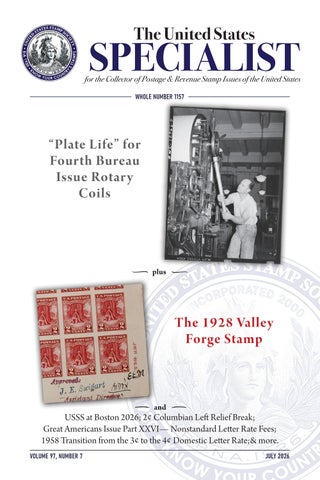
“Plate Life” for Fourth Bureau Issue Rotary Coils
for the Collector of Postage & Revenue Stamp Issues of the United States s plus e c and j
The 1928 Valley Forge Stamp
USSS at Boston 2026; 2¢ Columbian Left Relief Break; Great Americans Issue Part XXVI— Nonstandard Letter Rate Fees; 1958 Transition from the 3¢ to the 4¢ Domestic Letter Rate;& more.

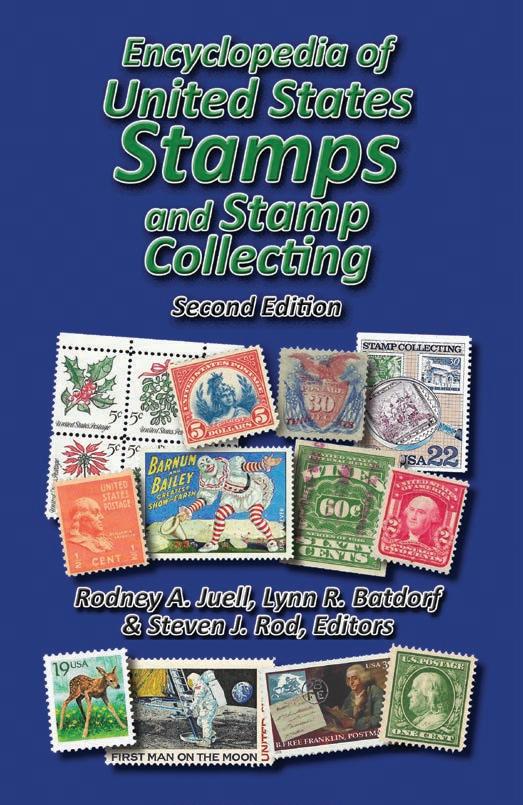

Order from: USSS, P.O. Box 1602, Hockessin, DE 19707-5602 or online at: www.usstamps.org/store/ Hardbound, 769 pages. $35 members, $40 nonmembers. Visit the website for shipping costs.

The United States SPECIALIST
the journal of the United States Stamp Society
VOLUME 97, NUMBER 7 J ULy 2026
WHOLE NUMBER 1157
An association of collectors to promote the study of all postage and revenue stamps and stamped paper of the United States and US-administered areas produced by the Bureau of Engraving and Printing and other contract printers. American Philatelic Society Affiliate No. 150
291 United States Stamp Society at Boston 2026 World Expo by Roger Brody
295 Great Americans Issue Part XXVI— Nonstandard Letter Rate Fees by Jay Stotts
298 The 1928 Valley Forge Stamp by Paul M. Holland
Andrew S. Kelley, Editor 9038 East 25th Drive Denver, CO 80238
email: editor@usstamps.org
www.usstamps.org
Manuscripts, publications for review, and all advertising including classifieds, should be sent to the Editor at the address above.
Forms close on the 20th of the second month preceding the month of publication, as February 20 for the April edition.
The United States Specialist (ISSN 0164-923X) is published monthly January through December by the United States Stamp Society, Inc., P.O. Box 1602,
307 July 31/August 1, 1958: Transition from the 3¢ to the 4¢ Domestic Letter Rate by Stephen L. Suffet
312 Vintage Photo of the Month by Rodney A. Juell
314 Determining Average “Plate Life” for Fourth Bureau Issue Rotary Coils by Nancy Robinson, PhD, and James Robinson
328 2¢ Columbian Stamp: Left Relief by David W. Mayo
332 Plate Number Report compiled by Kim D. Johnson
335 Report of the Executive Secretary by Robert Rufe
336 Classified Advertising
336 Index of Advertisers
Hockessin, DE 19707-5602. Membership in the United States $25. North America $40; all others $65. Single copy $2. Periodical postage paid at Hockessin, DE, and at additional entry offices. Printed in USA.
Copyright ©2026 United States Stamp Society, Inc. All rights reserved. Opinions expressed by authors are their own and do not necessarily reflect those of the United States Stamp Society, its officers, or staff.
Correspondence concerning business affairs of the Society, including membership and changes in address, should be addressed to the Executive Secretary, PO Box 1602, Hockessin, DE 19707-5602.
Postmaster: Send address changes to U.S.S.S., P.O. Box 1602, Hockessin, DE 19707-5602.

The United States Specialist
Founded 1930 as The Bureau Specialist
EDITOR
ANDREW S. KELLEY
9038 East 25th Drive Denver, CO 80238 email: editor@usstamps.org
United States Stamp Society Bureau Issues Association, Inc.
P.O. Box 1602 Hockessin, DE 19707-5602
CHAIRMAN
Roger S. Brody
P.O. Box 5836 Somerset, NJ 08875-5836 email: brody@usstamps.org
PRESIDENT
Nicholas Lombardi
P.O. Box 1005 Mountainside, NJ 07092 email: 8605@comcast.net
VICE PRESIDENT
Jeffrey Shapiro
P.O. Box 3211 Fayville, MA 01745-3211 email: coverlover@gmail.com
SECRETARY
Joel Cohen
10703 Kings Riding Way, Unit T-1 Rockville, MD 20852-5420 email: cohenji@comcast.net
TREASURER
David S. Sugar 1740 Mission Hills Rd., #311 Northbrook, IL 60062-5744 email: david14501681@gmail.com
GOVERNORS
Lynn Batdorf
Kim Johnson
Mike Lampson
Leonard Piszkiewicz
James Robinson
Robert Rose
Rod Juell
Gregory Shoults
David Steidley
Jay Stotts
Steven Unkrich
EXECUTIVE SECRETARY
Robert Rufe
P.O. Box 1602
Hockessin, DE 19707-5602
email: execsecretary@usstamps.org
— Committees — AWARDS
Denise Stotts
email: stottsjd@swbell.net
BOOKLETS & BOOKLET PANES
Michael O. Perry
P.O. Box 1194, Rainier, OR 97048 email: MOPerry@mac.com
DURLAND EDITOR
Kim D. Johnson
310 E N 3rd Street, Georgetown, IL 61846 email: westhome1@aol.com
ESSAY-PROOF
James Patterson
1850 North Central Avenue, No. 1400 Phoenix, AZ 85004 email: jhpatterson@yahoo.com
EXHIBIT PDFs
Chris Steenerson
P.O. Box 1818
Westminster, CO 80038-1818
email: Chris@RxStamps.com
FARLEY ERA
Paul M. Holland email: pholland.thorleaf@gmail.com
FOURTH BUREAU ISSUE
Jay B. Stotts email: stottsjd@swbell.net
LIBERTY SERIES
Roland Austin
P.O. Box 38 Stillwater, OK 74076-0038 email: RAustin13@aol.com
MARGINAL MARKINGS
Chris Steenerson
P.O. Box 1818 Westminster, CO 80038-1818 email: Chris@RxStamps.com
MODERN POSTAL HISTORY
Douglas B. Quine 59 Taylor Rd., Bethel CT 06801 email: usss2010@quine.org
PLATE NUMBER & CHECKLIST SERVICE
Kim D. Johnson
310 E N 3rd Street, Georgetown, IL 61846 email: westhome1@aol.com
PRECANCELS
Lynn R. Batdorf 6005 Kingsford Road, Bethesda, MD 20817 email: hollykids@comcast.net
PRESIDENTIAL ERA
Jeffrey Shapiro
P.O. Box 3211, Fayville, MA 01745-3211
RECRUITING
Steven Crippe
P.O. Box 117001, Carrollton, TX 75011 email: scrippe@gmail.com
REVENUE ISSUES
Peter Martin
P.O. Box 6074, Fredericksburg, VA 22403 email: pmartin2525@yahoo.com
SECOND BUREAU ISSUE
Nicholas Lombardi
P.O. Box 1005, Mountainside, NJ 07092
VENDING AND AFFIXING MACHINE PERFORATIONS
Dan Ryterband 40 Carolyn Place, Chappaqua, NY 10514 email: djryterband@fwcook.com
WASHINGTON-FRANKLIN
HEAD ISSUES (Co-Chairmen) Greg Shoults 11248 Frederick Lane Twinsburg, OH 44087 email: coilcollector@hotmail.com
Andrew S. Kelley 9038 East 25th Dr, Denver, CO 80238 email: stamps@andrewkelley.net
WEBMASTER
Mike Lampson
P.O. Box 652 Matthews, NC 28106 email: lampson@usstamps.org
— Study Groups — DUMMY STAMPS
Terry R. Scott
P.O. Box 10406, Napa, CA 94581 email: terryrscott@comcast.net
FIRST BUREAU ISSUE [open]
LUMINESCENCE
Wayne L. Youngblood 705 Forest Glen Circle, Prairie du Sac WI 53578 email: wystamps@gmail.com
OVERRUN COUNTRIES SERIES
Thomas Schilling
P.O. Box 432, New Lisbon, NJ 08064-0432 email: cbtkschilling@yahoo.com
PROMINENT AMERICANS AND AMERICANA SERIES
Ron Blanks
P.O. Box 9282, Chesapeake VA 23321 email: rblanks_stamps@yahoo.com
REGISTERED MAIL
Mike Ludeman
P.O. Box 2024, Denton, TX 76202-2024 email: mike@ludeman.net

United States Stamp Society at Boston 2026 World Expo
by Roger Brody

The United States Stamp Society was well represented at the Boston 2026 World Stamp Exposition held at the Thomas M. Menino Convention & Exhibition Center May 23–30, 2026. As the 12th international philatelic exhibition of the United States, this oncein-a-decade event coincided with celebrations of America’s Semiquincentennial (250th anniversary of independence). The event featured the unveiling of USPS Revolutionaryera Forever Stamps, 4,000 exhibit frames, hundreds of global dealers and postal offices, daily cancellation ceremonies, and free public activities.
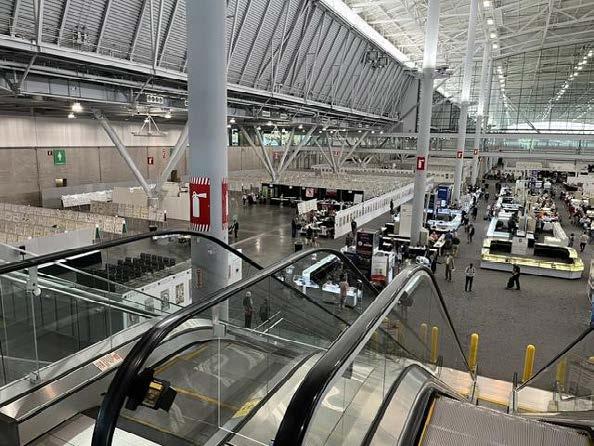
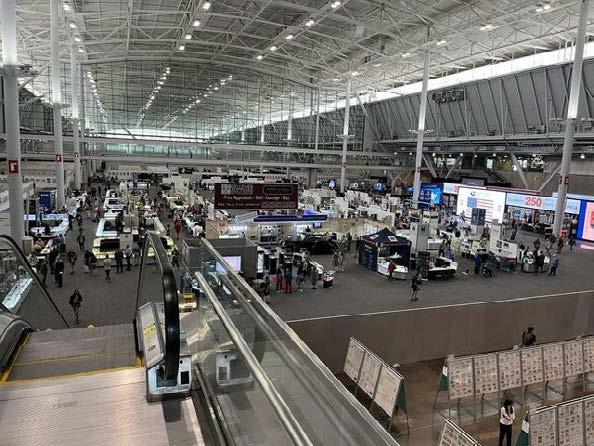
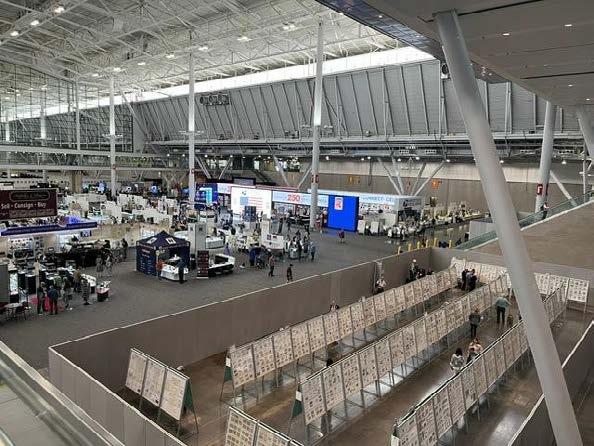
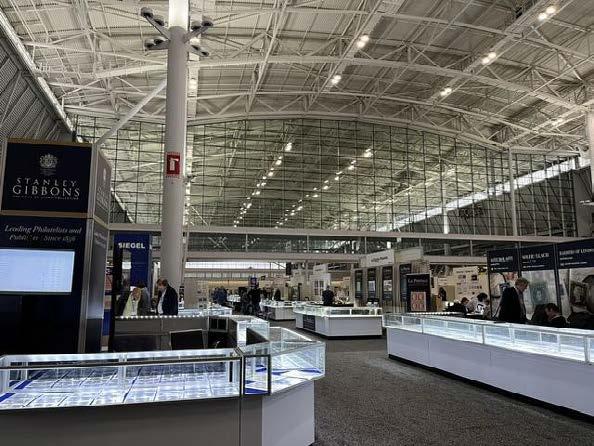
Top Left: Entrance to Expo with European exhibition frames at left, Top Right: Show floor, dealer booths, Lower Left: USPS display and stamp counters, Center and Court of Honor Exhibits, Lower Right: Dealer booths.
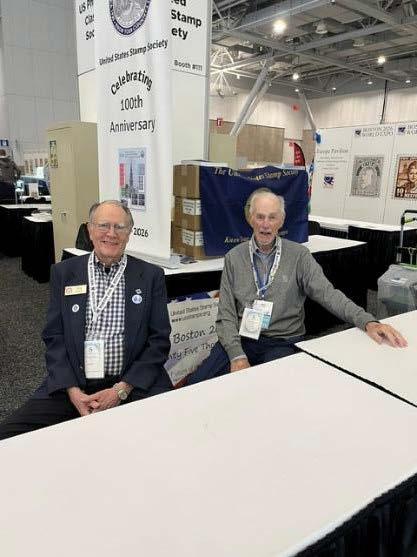
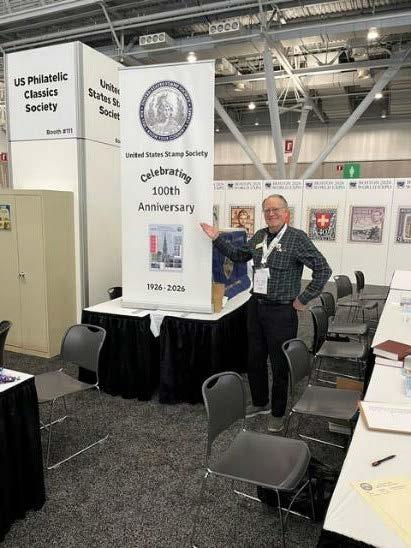
For the eight-day span of the show The United States Stamp Society (USSS) was represented in super Booth 111, comfortably shared with the NY Collectors Club, US Philatelic Classics Society and the Philatelic Foundation. Hundreds of collectors stopped by the USSS booth, and over 100 members signed the show register.
The Society celebrated its 100th anniversary, having been established as the Philatelic Plate Number Association (PPNA) in 1926.
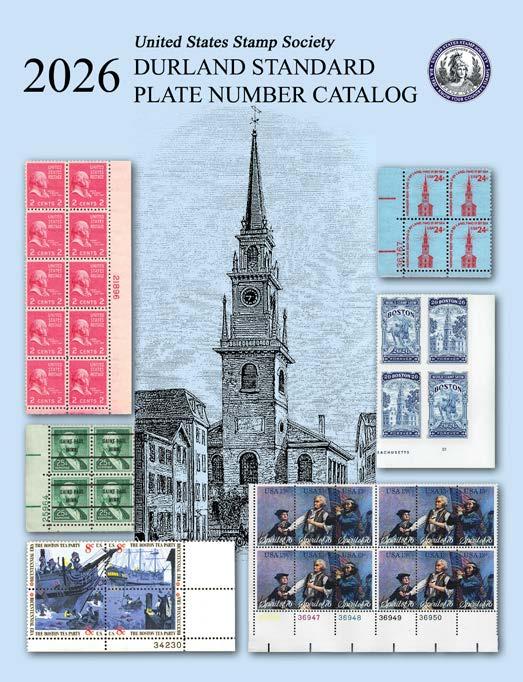
2026 Durland Standard Plate Number Catalog
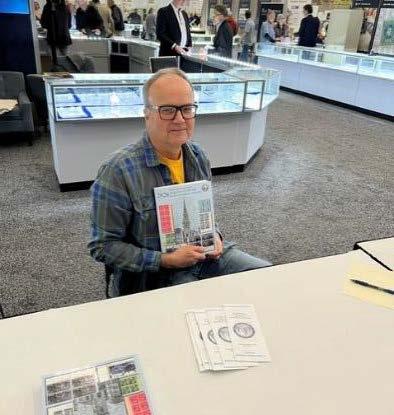
The 2026 edition of the Durland Standard Plate Number Catalog was officially introduced at the show, and sales almost exhausted the 100 copies available.
The USSS Board of Governors met on Monday, May 25 at 11:00 AM. At the meeting, reports were presented by the Chairman, President, and Executive Secretary. At the end of this past year, David Sugar stepped down as Treasurer, having served the Society for 30 years. Our new Treasurer, Keith Palevsky of Forest Grove, Oregon, reviewed our 2025 Financial Statement and budget for 2026.
Over the past decade, the finances of the Society have been seriously impacted by the production and mailing costs to produce our monthly journal, The United States Specialist. Presently, mailing costs alone are equal to 43% of membership dues. After over 25 years, membership annual dues were increased this year to
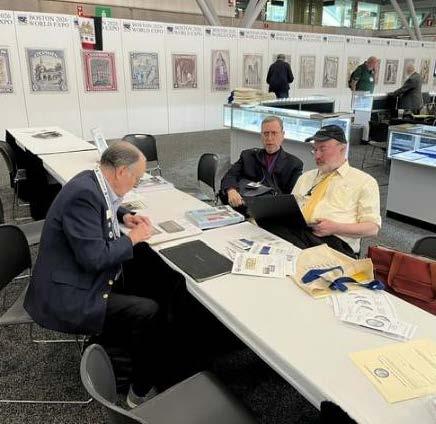
Left: Executive Secretary Bob Rufe and Chairman Roger Brody at the USSS booth.
Right: Secretary Bob Rufe with USSS 100th Anniversary poster.
Executive Secretary Bob Rufe with members at the USSS booth.
$30. Even with the generosity of members donating above their basic membership, the $44 per member annual cost to produce the journal has become unsustainable. The Board has therefore decided to change the production schedule of the journal from a monthly publication to a bimonthly schedule beginning in 2027. We expect the quality and quantity of published philatelic information will continue and carry us well into the future. The Society will be represented at the NOJEX show to be held at Hasbrouck Heights, New Jersey, in October. The next Annual Meeting is scheduled for St. Louis Stamp Expo. At the General Membership meeting held at 1:00 PM, President, Treasurer, and Executive Secretary reports were presented. The introduction of the 2026 Durland Catalog was formally announced along with the proceedings of the Board Meeting. Anniversary 15-, 25-, and 50-year membership pins were given to members present. Thank you to the following members for visiting our booth and saying hello:
Murray A. Abramson
Kurt W. Alstede
Thomas Altshuler
Henry David Arking
Lynn R. Batdorf
Richard L. Beecher
Torbjorn Bjork
Keith Bloss
Kim Brickman
Robert Brilliant
Roger S. Brody
Rick Burdsall
Michael F. Burke
Alfred Carroccia
Vincent Centonze
Michael Cortese
Charles Deaton
Bill Di Paolo
Karl Edelmann
Craig A. Eggleston
Brian R. Engler Sr.
Nathan Esbeck
Gary Flanagan
Mark Flynn
Guy Gasser
R.B. Geary
Dave Gill
Stuart Gitlow MD
Lawrence Haber
Vicky & Mick Hadley
Marc Hasselbrack
David E. Hess
W. Earl Hess Jr.
Philip J. Hughes
Douglas A. Iams
Michael Jaffe
Terrence Jensen
William J. Johnson
Rodney A. Juell
2026 Durland Standard Plate Number Catalog.
Sale of first copy of the 2026 Durland Catalog at the show.
Andrew S. Kelley
Jacob Klerman
Dieter Kohler
Clifford Krinsky
James H. Kulwicki
Mike Lampson
Philip Leber
Benjamin Y. Lee
Ryan Lee
Peter Leffler
Mike Ley
James T. Lindemuth
Robert Loeffler
Gary Wayne Loew
Kevin G. Lowther
Robert Maddox
Larry Mann
David Mayo
Gary W. McClarran
Thomas P. McFarland
Barry McGuire
James McKinzie
Leonard McMaster
Ray Memmel
Ralph H. Nafziger
Glen Norman
Gary Olson
Richard A. Pederson
Scott A. Pendleton
George Perkins
Richard Peterson
Daniel A. Piazza
Gene Pica
Chris Principe
Michael A. Puzio
Leif C. Ratliff
Peter Rogge
Raymond Rossi
Robert G. Rufe
Ralph J. Rust
Craig Ruyle
Jose Sanchez
Mike Schadle
Editor’s Note: a few members reported that, due to an error at the printer, their copies of the June Specialist had missing, duplicate, or mis-ordered pages. If your June edition was affected and you would like a replacement, please contact the Editor at editor@usstamps.org. We apologize for any inconvenience.
Precancel Stamp Society
Interested in Learning More about Precancels? Request a copy of “Th e ABCs of Precancel Collecting” and also receive a sample copy of the PSS Forum, the Precancel Stamp Society’s monthly journal. Contact: Frank Bird III, 1095 Pinellas Point Dr South, Apt 352, St. Petersburg, FL 33705-6377. Email: promo@precancels.com.
Allan Schefer
Kim R. Schroeder
Bill Schultz
Marjory J. Sente
J. Dale Shively
Greg Shoults
Frank Silveira
William Slaninko
Dennis Solheim
Ronald J. Stauber
Peter Tuteur
Timothy G. Wait
Jack Wall
John Walter
Patrick A. Walters
Alan Warren Whitefeather
Michael Wilson
Steven Worsham
Kenneth Zierer
John Zwyer
Quality
United States Stamps (1847-1945)
Singles (mint and used)
Plate Blocks
Booklet Panes plus Complete Booklets
Price lists-$2.00 each category
Price lists free on web: www.mountainsidestampsandcoins.com
We also buy quality U.S. and foreign stamps
Mountainside Stamps, Coins and Currency
P. O. Box 1116
Mountainside, NJ 07092
Tel: 908-232-0539 or 908-419-9751
E-mail: tjacks@verizon.net
Tom Jacks, owner
Member APS, ASDA, USSS
Great Americans Issue Part XXVI— Nonstandard Letter Rate Fees
by Jay Stotts USSS #10921 | m stottsjd@swbell.net
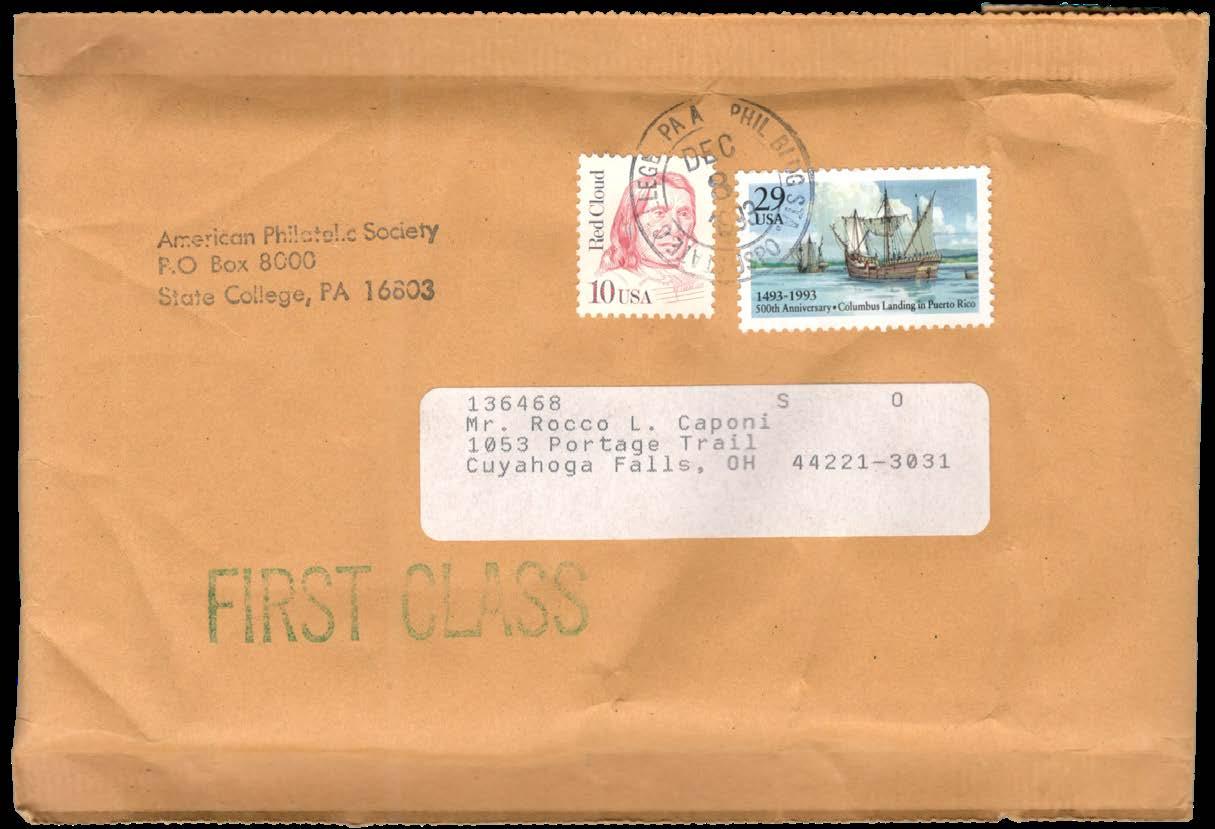
First-class domestic letters came in all sizes and shapes, and the United States Postal Service (USPS) tolerated the situation without extra charges or fees until July 15, 1979, when it introduced a 7¢ fee for these so-called nonstandard letters.
Undoubtedly, the trend toward automated mail-handling machines was inhibited by these oddly shaped and sized pieces of mail. There were all sorts of sizes and shapes of mail, so the USPS targeted single-ounce domestic first-class letters. It felt that heavier letters that paid at least the double-weight (two ounce) postage rate were entitled to be a little longer or taller than “normal,” so only single-weight letters were subject to the new charge.
So, what exactly defined normal? Letters that exceeded 11 ½ inches long, 6 ⅛ inches high, or ¼ inch thick were singled out. There was also a proportional relationship between
The Great Americans
Figure 1. A padded envelope that exceeded the ¼ inch thickness standard.
length and height, called the aspect ratio. If an item was exceedingly long compared to its height or exceedingly tall compared to its length, then the nonstandard fee, quite often called a surcharge, was applied. The aspect ratio (length divided by height) had to fall somewhere between 1.3 and 2.5. Shape mattered as well. Anything that was not rectangular was considered nonstandard.
Surcharge Fees
Each fee is referred to as a surcharge because it was a single fee added to the postage required to mail a single-ounce first-class domestic letter. Table 1 shows the surcharge increased from 7¢ to 11¢ during the period of the Great Americans (GA) usage.
Figure 1 shows a small, lightweight padded envelope that held its contents, making it thicker than the ¼-inch standard allowed thickness, so this mailing was subject to the nonstandard surcharge of 10¢, applicable when the mailing was made in December 1993. A 10¢ Red Cloud stamp was applied alongside the 29¢ commemorative stamp.
Table 1. GA period nonstandard letter rate fees.
Figure 2 pictures a homemade envelope made by taping all four sides of two pieces of paper together. We assume the envelope was sized to match the contents being mailed when posted on February 12, 1986. The envelope measures 8 ½ inches long by 7 inches tall. The height is a violation of the standard, and the aspect ratio (8 ½ divided by 7) of 1.21 is also below the minimum required length-to-height ratio. A 10¢ Richard Russell stamp was affixed to pay the surcharge.
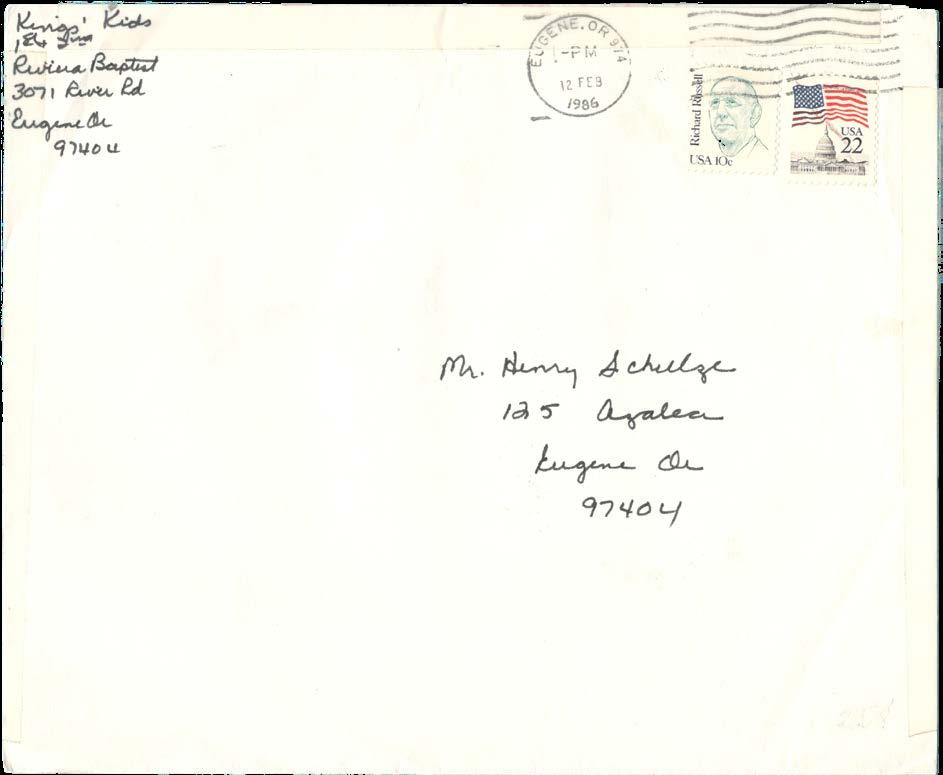
Figure 2. A homemade envelope was too tall and also failed the width to height ratio requirement.
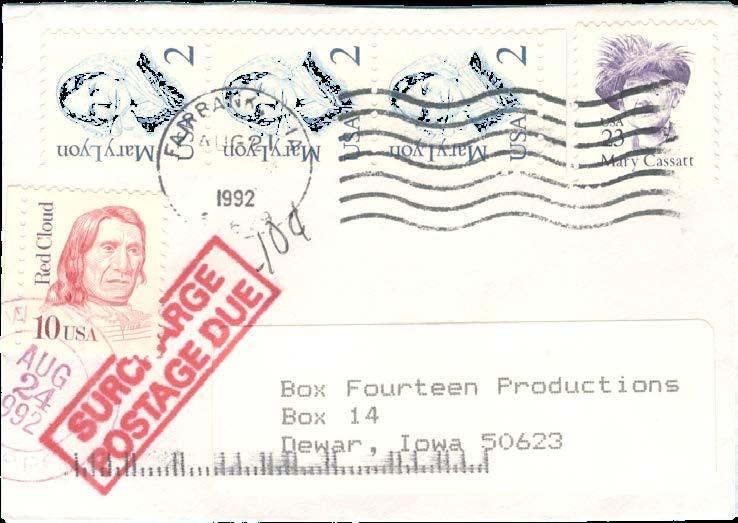
Figure 3 shows an undersized envelope. The minimum length requirement was 5 inches, and the minimum height was 3 ½ inches. This envelope met neither dimensional requirement, being 4 ⅜ inches long by 3 ⅛ inches tall. The mailer, apparently unfamiliar with the dimensional limitations, sent the letter with only the 29¢ postage paid. The USPS caught the envelope and applied the surcharge marking. Once the 10¢ surcharge was paid, a 10¢ Red Cloud stamp was applied on top of the surcharge marking and was tied with a postmark.
Our final example, shown in Figure 4, vio lates the nonrectangular shape requirement. It is a promotional card mailed to solicit business for an upcoming training seminar scheduled for November 14, 1997, in Houston, Texas. The mail er’s training agenda included topics such as “deal ing with physical natural gas in an unregulated marketplace.”
To grab the addressee’s attention, the card was die-cut in the shape of a drop of liquid, measuring approximately 8 by 6 inches wide. Most likely, if turned sideways, its dimensions would meet the standard dimensional range, but clearly, the shape is not rectangular. We believe the mailer did its homework, contacting the USPS and being told of the surcharge required. The card was mailed on October 27, 1997, when the letter rate was 32¢, and the nonstandard surcharge was 11¢, totaling 43¢. A 40¢ Claire Chennault stamp paid the bulk of the total.

Figure 3. An undersized envelope was also subject to the nonstandard fees.
Figure 4. A drip-shaped card violated the USPS rectangular shape rules.
The 1928 Valley Forge Stamp
by Paul M. Holland
USSS #16849 | m pholland.thorleaf@gmail.com
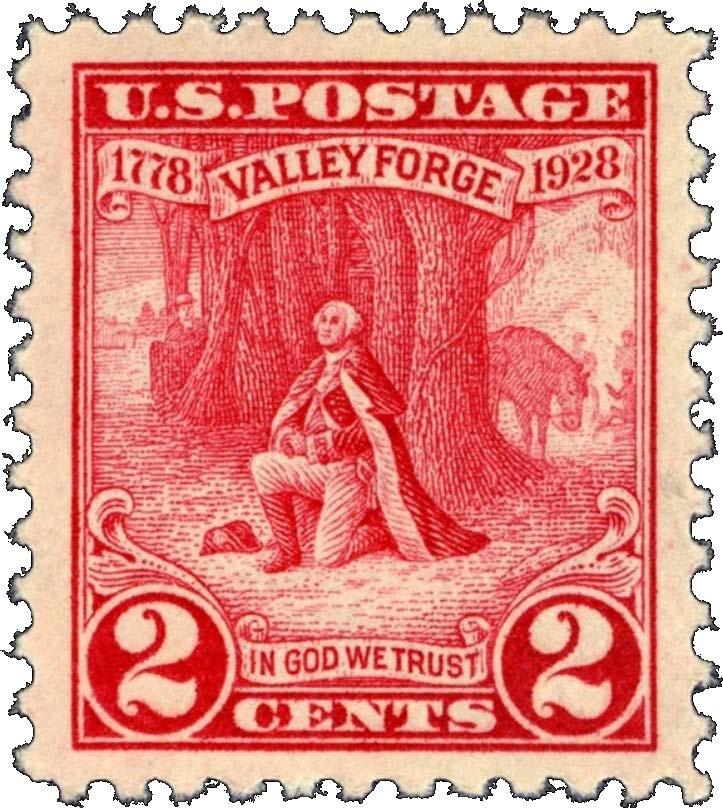
The winter spent at Valley Forge in 1778 was in many ways a turning point of America’s Revolutionary War. During this encampment under harsh conditions, Washington’s army began transitioning from what was essentially a collection of state militias into a regular army. This was aided by a rigorous training program conducted by Baron Friedrich von Steuben, a Prussian drillmaster who had recently arrived from Europe. Furthermore, Washington and his soldiers shared the privations of Valley Forge, thereby cementing a strong bond.
In May 1927, Senator Reed of Pennsylvania wrote to the Post Office Department (POD) to request that a stamp commemorating the 150th anniversary of the Valley Forge encampment be issued, but the POD was initially reluctant. Later Representative Watson, also of Pennsylvania, introduced a bill in the House in February 1928. Although it initially seemed doomed to failure, he persisted, and by May Postmaster General (PMG) Harry S. New had authorized such a stamp.1
The Valley Forge stamp was designed at the Bureau of Engraving and Printing (BEP) by C. A. Huston, closely based on an 1866 engraving by John C. McRae of George Washington praying at Valley Forge, itself after a painting by Henry Brueckner. This engraving is shown in Figure 1.
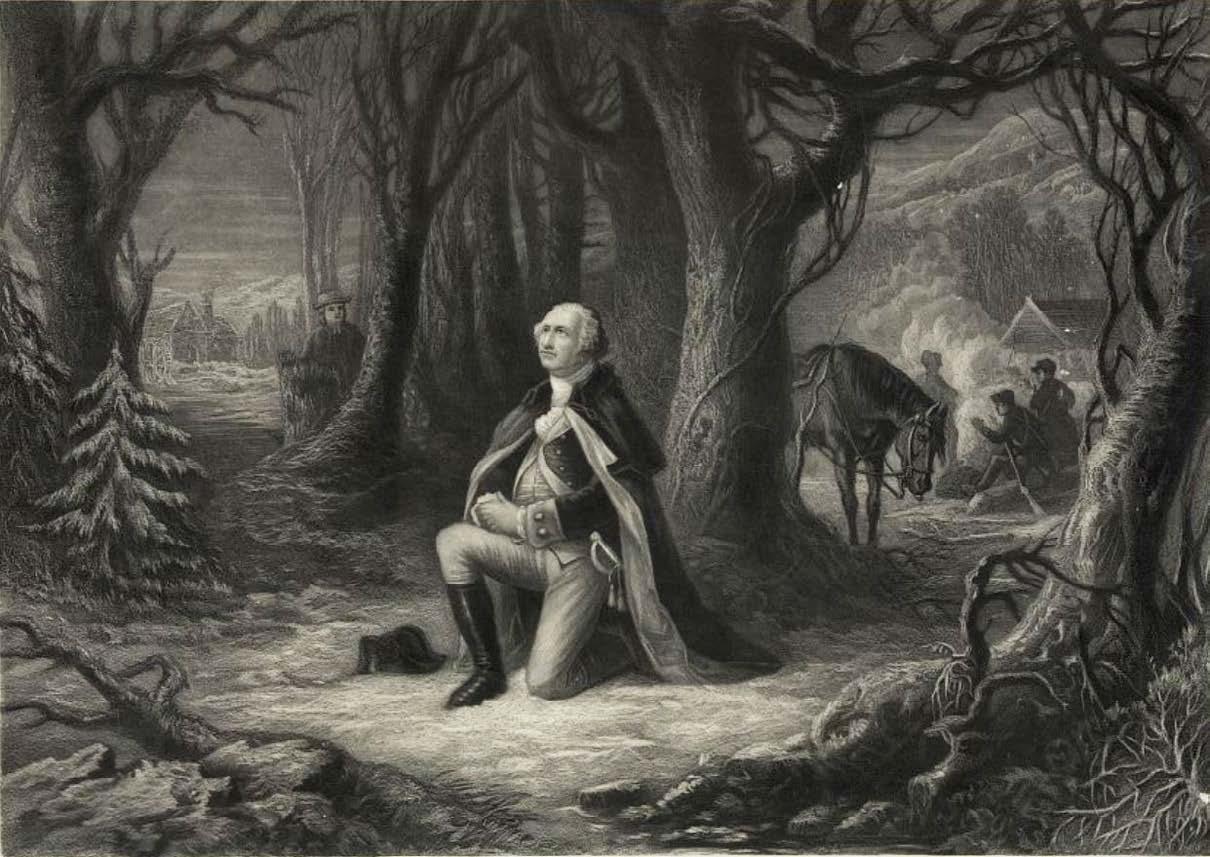
Curiously, the source for this incident is the first biography of George Washington written shortly after Washington’s death on December 14, 1799, by Mason Locke Weems (1759–1825). Parson Weems was an evangelical preacher, bookseller, and author, whose various editions of The Life of George Washington; with Curious Anecdotes, Equally Honorable to Himself, and Exemplary to his Young Countrymen were widely popular and influential during the 19th century. His book seemed to be especially designed to depict Washington’s virtues and provide morally instructive tales to guide the youth of the young nation. For example, it is in Weems’ book that the apocryphal tale about George Washington and the cherry tree first appears, along with an account of a man named Isaac Potts observing Washington in prayer at Valley Forge. Note that in both McRae’s engraving and on the stamp, the figure of Potts is depicted behind the
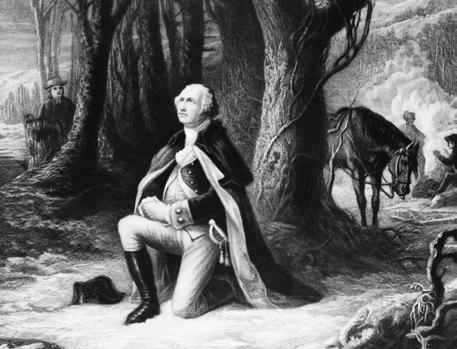
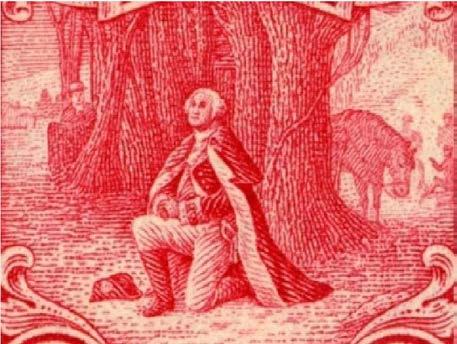
Figure 1. Engraving by John C. McRae showing George Washington praying at Valley Forge (Library of Congress).
Figure 2. Comparison of image from McRae’s 1866 engraving with 1928 Valley Forge stamp.
George Washington and Freemasonry
While Freemasonry itself had no formal role in the American Revolution, like other important figures among the Founding Fathers, especially Benjamin Franklin, Washington was a Freemason. Besides promoting Enlightenment concepts, Freemasonry provided an alternative to the strict religious orthodoxy of the time, with its “Great Architect of the Universe” providing a universal expression for a divine being. George Washington himself joined the Masonic Lodge at
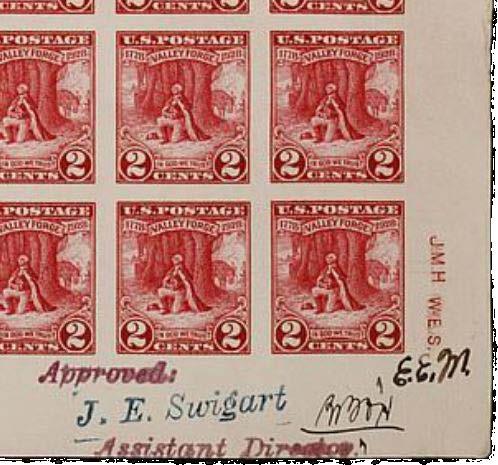
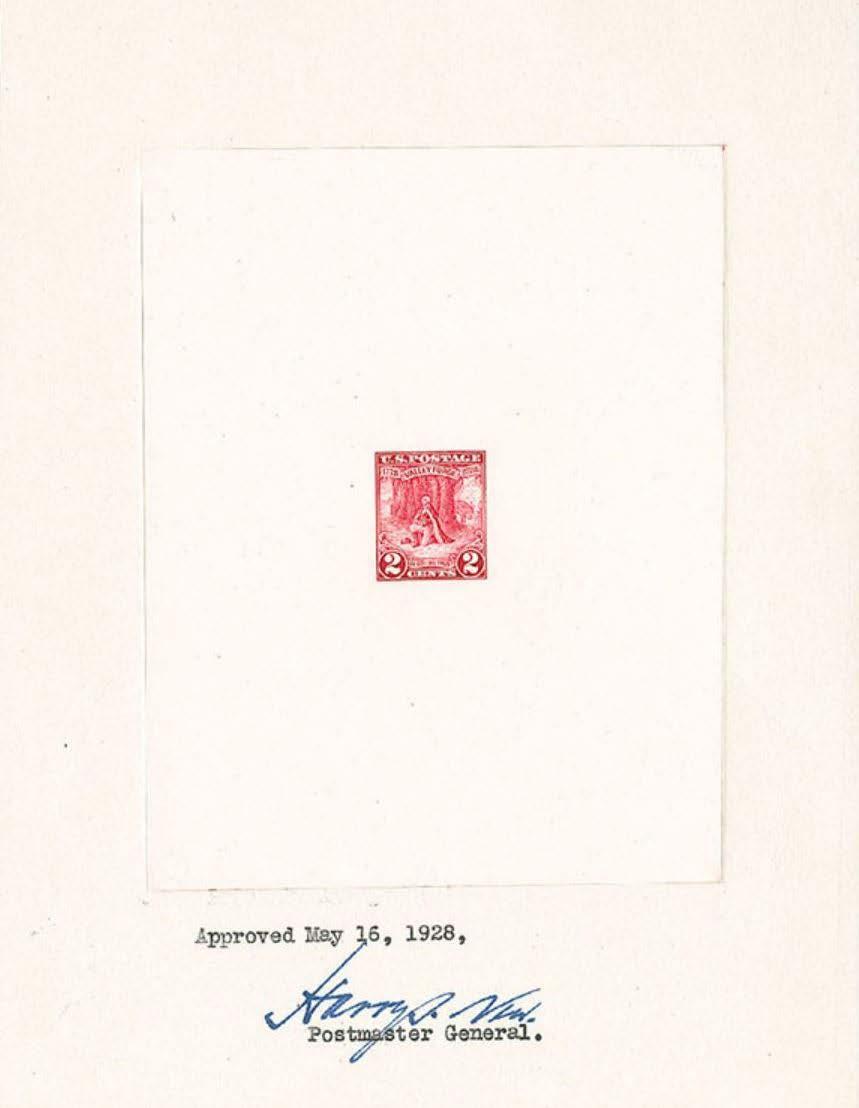
Figure 3. PMG Harry S. New’s approval of large die proof of Valley Forge stamp.
Fredericksburg, Virginia, in 1752, becoming a Master Mason the following year, and he eventually served as the Masonic “Acting Master” when presiding over the ceremonial laying of the cornerstone of the United States Capitol Building on September 18, 1793.
In fact, a 1794 pastel portrait by William J. Williams of George Washington from life in his Masonic Lodge regalia was employed for the nine-cent Washington Bicentennial Series stamp, after all traces of the regalia were removed.2 The BEP’s decision to use contemporary portraits of Washington for these stamps arose from serious questions about the historical accuracy of later paintings and artworks that supposedly depicted events in George Washington’s life.
This original portrait of Washington in full Masonic Lodge regalia is shown at right, along with the reverse of The Great Seal of the United States from my Series 1935A One Dollar Silver Certificate. The Great Seal was originally designed in 1782, and depicts an unfinished pyramid with thirteen courses of stone representing the thirteen original states with the date 1776, surmounted by the Eye of Providence in a triangle. The Latin motto “Annuit cœptis” over the eye can be translated as “Providence favors our undertakings,” and “Novus ordo seclorum” from Virgil translates as “New order of the ages.” Interestingly, the “Eye of Providence” has long been associated with Freemasonry in the United States, although such usage only became common following the creation of the Great Seal.
Curiously, it was President Franklin D. Roosevelt (FDR), himself a Freemason, who approved the redesign of the reverse of the dollar bill in 1935 that for the first time incorporated the Great Seal on United States currency. By long-standing tradition, the obverse of this 1935 note bears only two authorized signatures, the Treasurer of the United States, William Julian; and FDR’s Secretary of the Treasury, Henry Morgenthau, Jr. Note that the motto “In God We Trust” was not added until 1957, during the Eisenhower administration.
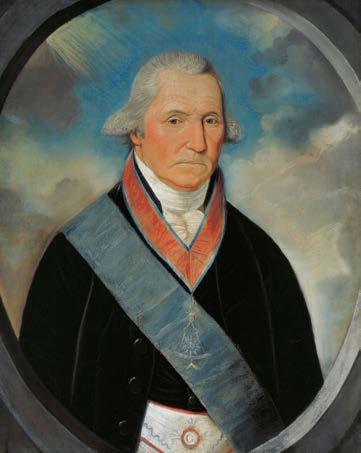
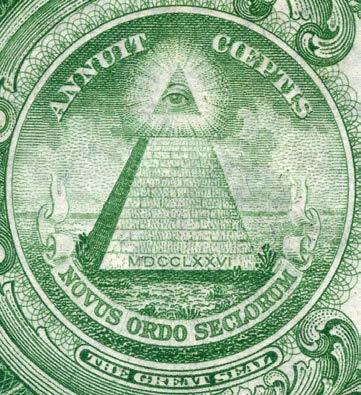
1794 portrait of George Washington in his Masonic Lodge regalia and close-up showing reverse of The Great Seal of the United States from a Series 1935A One Dollar Silver Certificate.
George Washington himself firmly rejected allowing his image to be used on United States currency in any form, because he strongly opposed the royal tradition of depicting kings and queens on money. He viewed this as being completely incompatible with the new democratic republic the Founding Fathers were establishing. In fact, Washington’s portrait did not appear on United States paper money until 1869, long after his death, and on circulating quarter dollar coins only in 1932, at the time of the bicentennial of his birth.
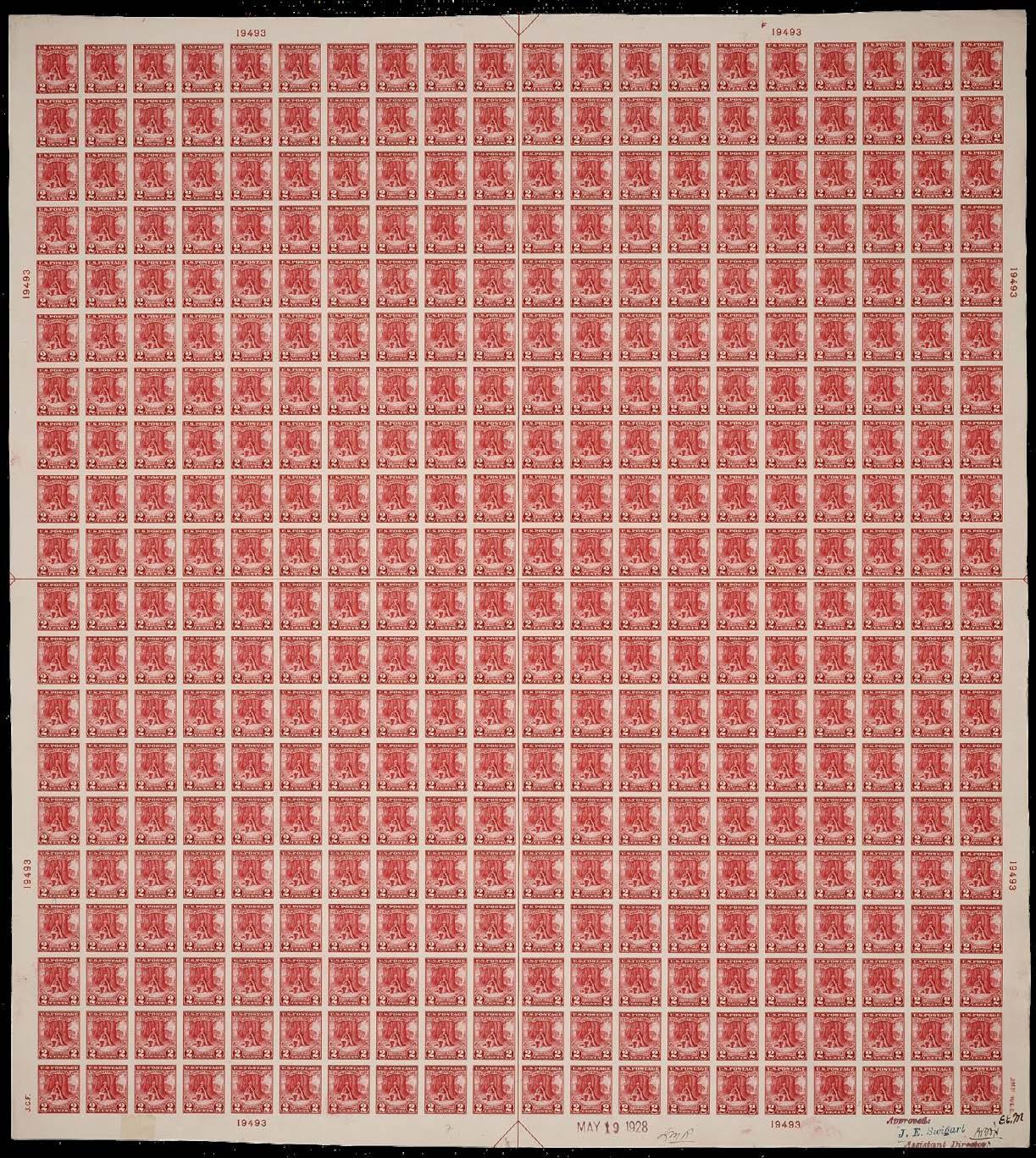
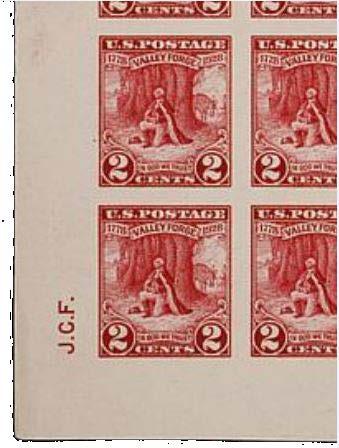
Figure 4. Plate proof 19493 for the Valley Forge stamp approved May 19, 1928, with close-up details shown below (Smithsonian National Postal Museum).
tree at the left. It is almost certain that this tableau arose from the fertile imagination of Weems. It should be noted that although George Washington was undoubtedly a pious man, he was not a evangelical Christian and furthermore was a Freemason, whose core values included the separation of church and state, the equality of men, and freedom of speech.
In Huston’s Valley Forge stamp design, the vignette duplicates a portion of McRae’s 1866 engraving almost exactly as shown by the cropped images in Figure 2. The stamp was engraved by L. S. Schofield, J. Eissler, E. M. Hall, and E. Hein at the BEP 1 PMG Harry S. New approved the large die proof on India paper shown in Figure 3 on May 16, 1928. Interestingly, as an avid stamp collector, FDR later had one of the four known copies of the large die proof (BEP control number 333035) and the only known example of the small die proof in his personal stamp collection. These were sold at the 1946 H. R. Harmer auction (lots 39 and 114).3
Printing plates for the 1928 Valley Forge stamp deserve special mention, as these were the last commemorative stamps to have both siderographer and plate finisher initials in the plate margins. Siderographers were skilled technicians at the BEP who “laid out” printing plates for both stamps and paper money, using a transfer press and roller dies to transfer the design into each position on the plate. Their initials typically appear at the bottom of the left margin of the stamp printing plate, reading upwards. Plate finishers then “clean up” the printing plates by removing loose pieces of metal, pressure ridges created by the use of roller dies, or scratches, with their initials appearing in the bottom of the right margin of the plate, reading downwards. These can be seen on the plate proof numbered 19493 in Figure 4, where close-up details are also shown. Note that the siderographer initials J.C.F. are for James C. Fulgate. Curiously, there are two sets of plate finisher initials, J.M.H. and W.E.S., for John M. Hackley and Walter E. Spring, respectively. This plate was certified on May 19 and first used for printing stamps on May 21, 1928. Of the 13 printing plates produced for the Valley Forge stamp, only eight were used for printing stamps.4
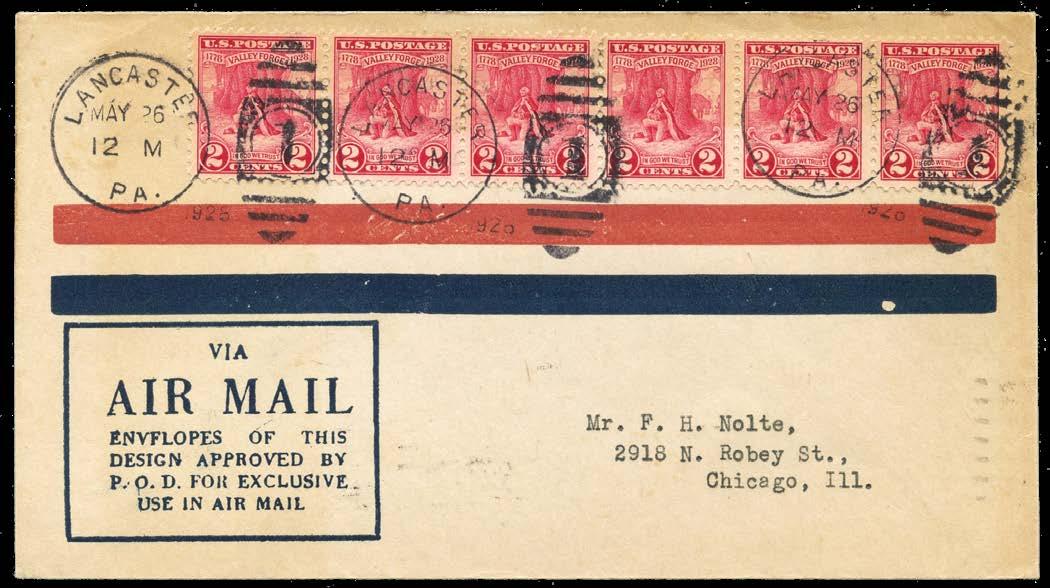
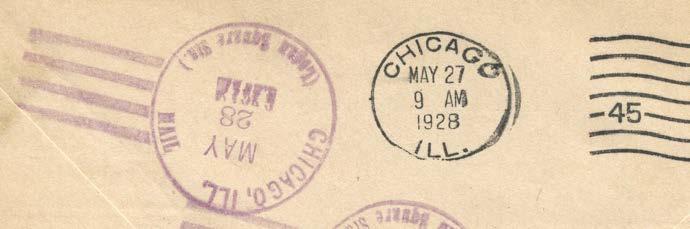
Figure 5. Airmail FDC Valley Forge stamps from Lancaster, Pennsylvania.
A surprisingly large number of different cities were selected for the first day of issue on May 26, 1928. These included Valley Forge, Philadelphia, Lancaster, Norristown, and West Chester in Pennsylvania, along with Cleveland, Ohio, where the Midwestern Philatelic Exhibition was being held. While Valley Forge and Philadelphia were obvious choices, Norristown was the home of Congressman Watson, who led the effort to issue the Valley Forge stamp, and West Chester the home of Congressman Butler, who had aided in the fight. Lancaster turned out to be the hometown of both Third Assistant Postmaster General Robert S. Regar and Congressman Griest, Chairman of the Committee on the Post Office and Post Roads.1 So I guess philatelically speaking, it pays to have influential friends.
My first day airmail cover (FDC) from Lancaster, Pennsylvania, slightly over-franked with a strip of six Valley Forge stamps, is shown in Figure 5. Backstamps show arrival in Chicago the following day.
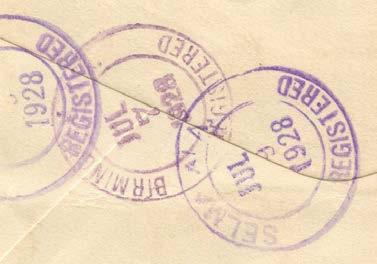
Shown in Figure 6 is my registered mail cover bearing a plate block of six Valley Forge stamps, on a type 1 postal stationery envelope (U522), with an added six-cent stamp to make up the rate. Mailed from Birmingham to nearby Selma, Alabama, on Saturday, July 7, 1928, backstamps show that it was processed on Monday. This century-old postal stationery envelope celebrates the 150th anniversary of American independence.
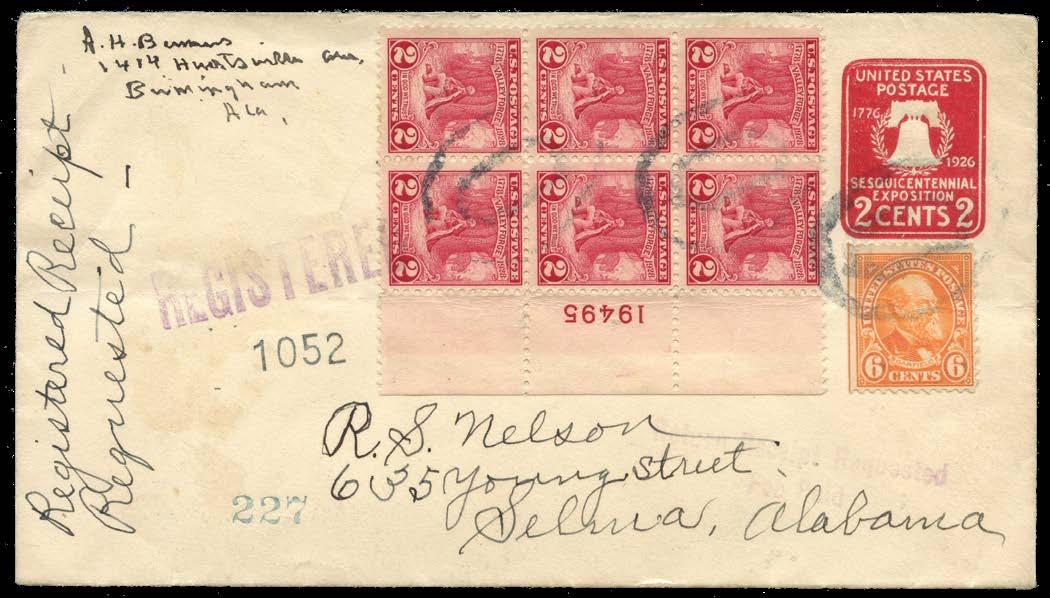
Figure 6. Registered mail cover with plate block of Valley Forge stamps.
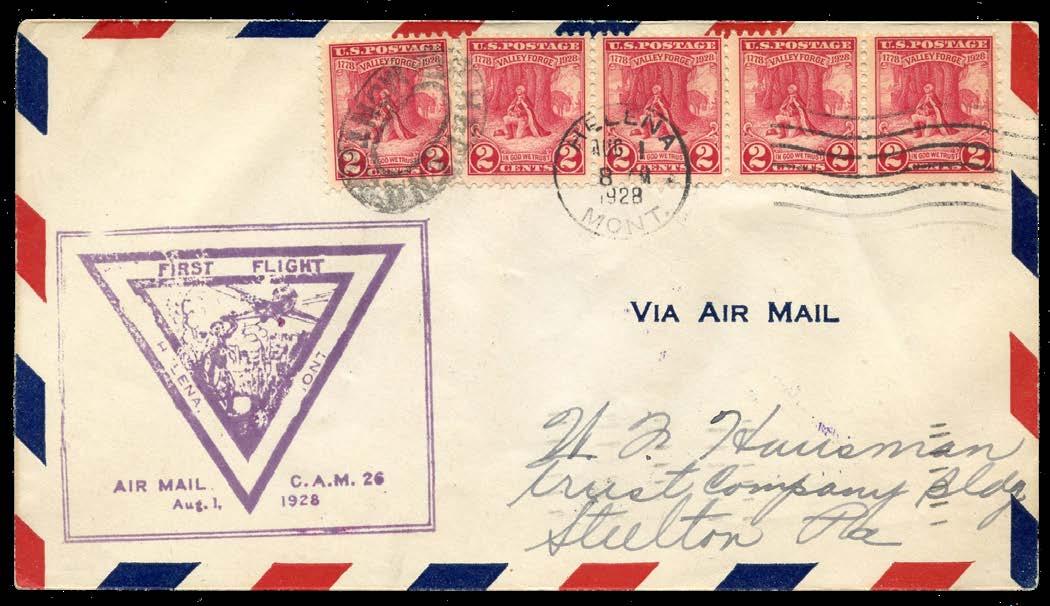
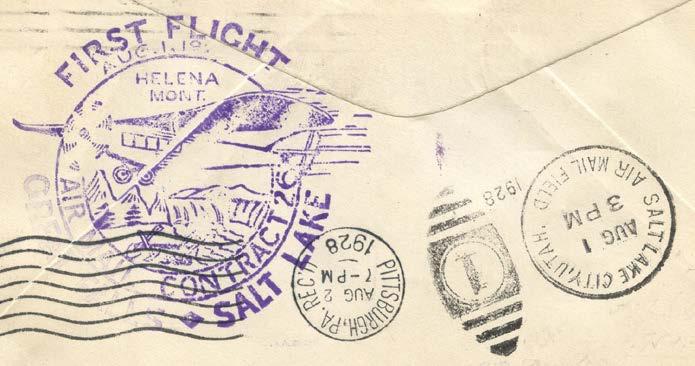
Another of my airmail covers with Valley Forge stamps is shown in Figure 7. This is a CAM-26 first flight cover sent from Helena, Montana, to Pennsylvania, via Salt Lake City on August 1, 1928. Note that further routing is through Pittsburgh the following day. The cover is correctly franked with a single and a horizontal strip of four Valley Forge stamps. Finally, in Figure 8, I show my unusual cover sent to FDR by Reuben Aretz from Lake Waconia, Minnesota, during FDR’s presidential campaign on Columbus Day, October 12, 1932. This has a Valley Forge stamp added to a one-cent Washington Bicentennial postal stationery envelope (U523). Also present is one of George W. Linn’s “A Stamp
Collector for President” campaign labels, tied to the cover by a distinctive flag cancellation. A handstamped cachet describes Lake Waconia as “The Paradise of the Northwest,” and there is a multiply signed Columbus Day message from the Knights of Columbus Council #2506. Also, a typed note to FDR was enclosed with the cover, reading in part “As you are both a stamp and cover collector, kindly accept this historically interesting cover, of which but six are being mailed.” Aretz goes on to say that he is editing a new stamp magazine, and to ask FDR if he would like other
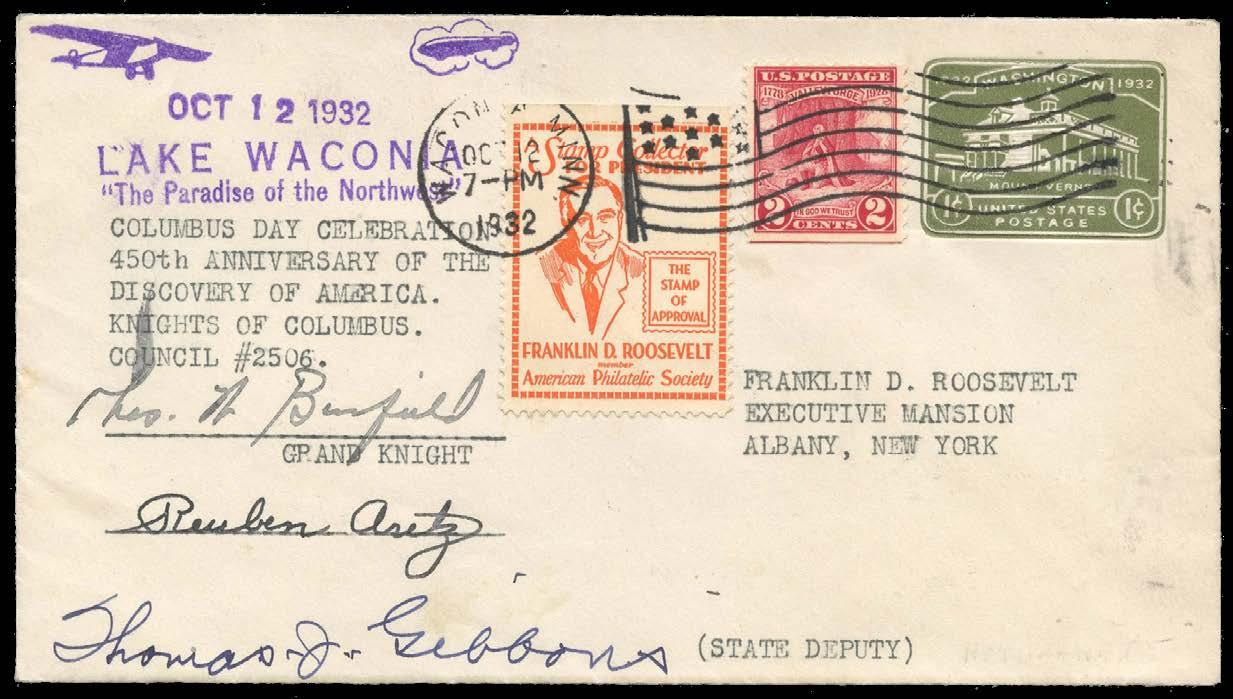
Figure 7. CAM-26 first flight airmail cover with Valley Forge stamps.
Figure 8. Unusual cover sent to FDR during FDR’s presidential campaign on Columbus Day.
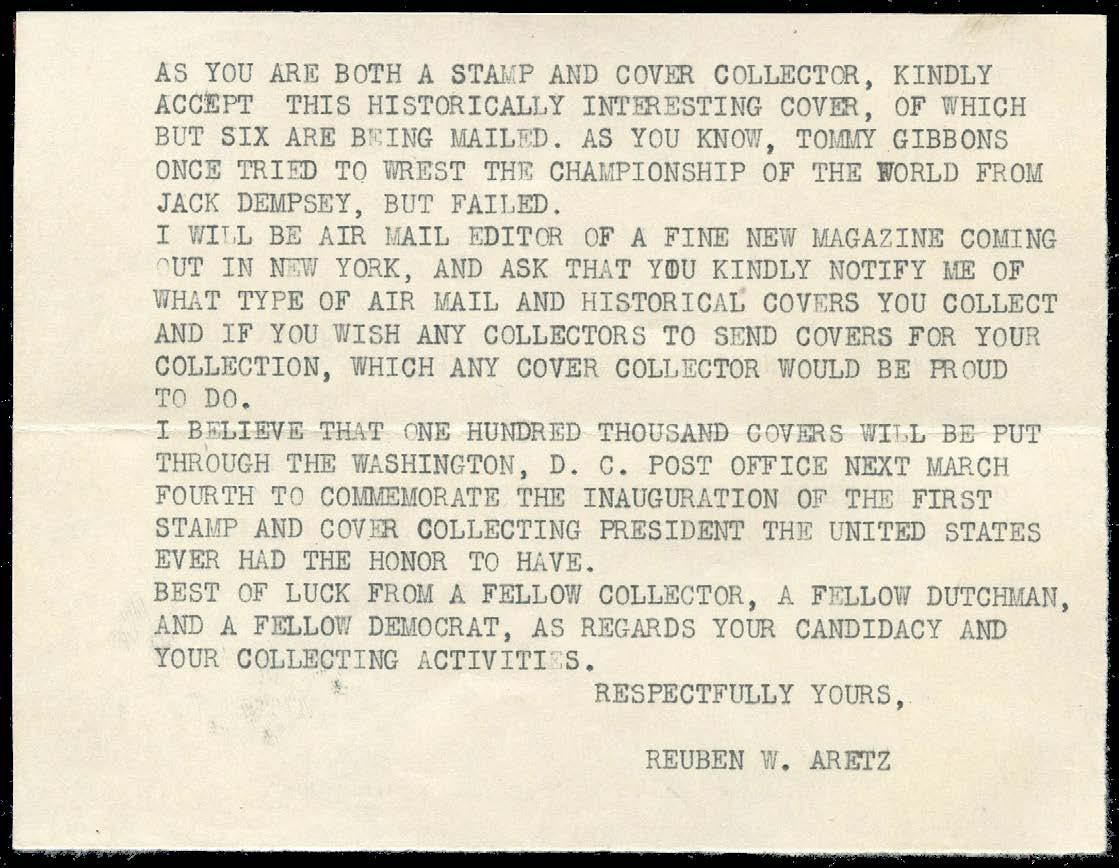
Figure 9. Enclosure from Figure 8.
collectors to send him covers for his collection. The note concludes: “I believe that one hundred thousand covers will be put through the Washington, D. C. Post Office next March to commemorate the inauguration of the first stamp and cover collecting president the United States ever had the honor to have. Best of luck from a fellow collector, a fellow Dutchman, and a fellow Democrat, as regards your candidacy and your collecting activities.
Respectfully Yours, Reuben W. Aretz.”
While the Parson Weems-inspired image of George Washington in prayer depicted on the Valley Forge stamp is apocryphal, it should be mentioned that it has been widely employed as a symbol of faith, including on a 1977 Christmas stamp (Scott 1729). The image has also been incorporated into a stained-glass window in the Congressional Prayer Room near the rotunda of the United States Capitol. As we celebrate our Nation’s 250th Birthday, don’t be surprised to see more of this iconic but apocryphal image of George Washington used to promote viewpoints inconsistent with his personal values.
References
1. Max G. Johl, The United States Commemorative Postage Stamps of the Twentieth Century: Volume I, 1901–1935 (New York: H. L. Lindquist, 1947), 119–121.
2. Paul M. Holland, “FDR and the 1932 Washington Bicentennial Series, Part I,” The United States Specialist 95, no. 9 (September 2024): 388–404.
3.“The President Franklin D. Roosevelt Collection,” sale catalog (New York: H. R. Harmer, Inc., Part One, February 1946), lots 39 and 114.
4. W. Wallace Cleland, comp., B.I.A. Plate Number Checklist: Plates 1–20,000, rev. ed. (United States Stamp Society, 1990), https://www.usstamps.org/download/bia-plate-number-checklist-1-20000/.
July 31/August 1, 1958: Transition from the 3¢ to the 4¢ Domestic Letter Rate
by Stephen L. Suffet USSS #11381| m ssuffet@nyc.rr.com
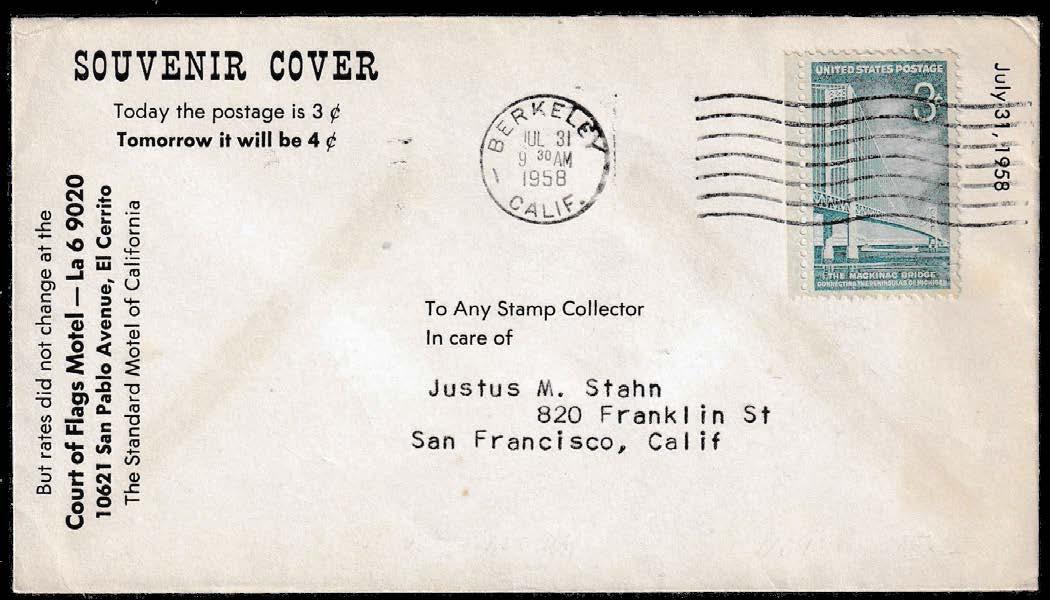
For a period of more than a quarter century, extending from July 6, 1932, through July 31, 1958, the basic nonlocal United States domestic first-class letter rate remained at 3¢ per ounce. From July 6, 1932, through June 30, 1933, and again from March 26, 1944, through July 31, 1958, this 3¢ rate also applied to local letters mailed within a town or city with carrier delivery service. The rate survived changes in several other postal rates, including two decreases and two increases in the domestic air mail letter rate, one increase in the domestic postcard and postal card rate, and one increase in the local rate for letters mailed for pickup at post offices without carrier delivery service.
At the request of the United States Post Office Department, Congress passed Public Law 85-426 on May 27, 1958, which, among other things, increased many postal rates. President Eisenhower signed the act into law that same day, and the first notice of the
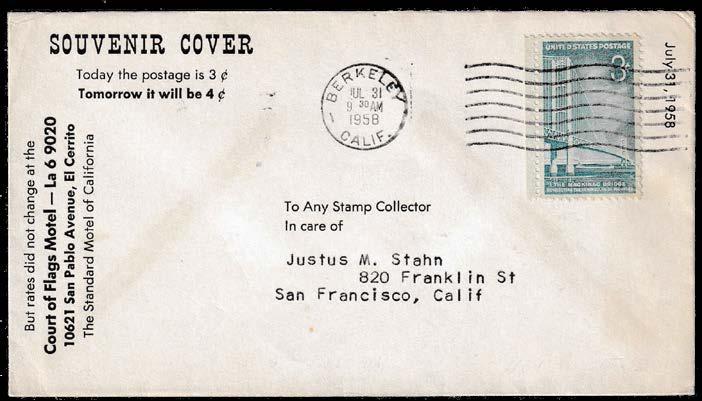
Figure 1. Last day of 3¢ rate on souvenir advertising cover. July 31, 1958.
new rates appeared in a special issue of The Postal Bulletin, just two days later, on May 29 (PB 20087). Most of the new rates were scheduled to go into effect on August 1, 1958, while others would be phased in over the period from January 1, 1959, to January 1, 1961.
As part of this general revision of postal rates, the basic domestic first-class letter rate finally increased to 4¢ per ounce on August 1, 1958, making July 31 of that year the last day for the 3¢ rate that had been in effect for 26 years. Because of the enormous volume of commercial mail, as well as the great number of philatelists who sought to document the rate change, first-day-of-rate and last-day-of-rate covers are fairly plentiful. The five covers illustrated herein, however, are especially noteworthy, as explained.
Figure 1, for example, pictures a souvenir advertising cover from the Court of Flags Motel in El Cerrito, California. It was used from nearby Berkeley to San Francisco across the Bay on the last day of the 3¢ letter rate, July 31, 1958. There is still a motel at 10621 San Pablo Avenue in El Cerrito, the return address on the cover, but it is now a Budget Inn. The Court of Flags hotel brand has apparently not been used anywhere in the United States since 1991.
The cover shown in Figure 2 was used locally within Pittsburgh on the last day of the 3¢ letter rate. What makes it unusual is that it was postmarked twice: first at 11:30 PM on July 31, 1958, and again at 1:00 AM on August 1, 1958. Two different canceling machines struck the two postmarks. I am guessing that after having been put through the first machine, the cover was mistakenly mixed in with some mail that had not yet been postmarked. Such oddities are fairly common, though one spanning this pair of rate-change dates could well be unique.
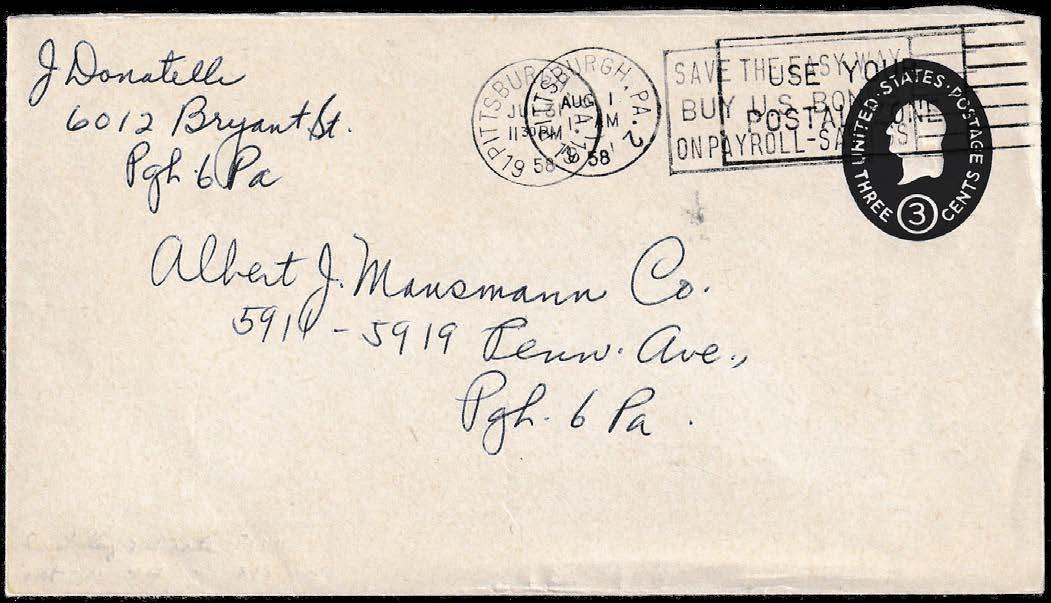
Figure 2. Last day of 3¢ rate. Postmarked 11:30 PM on July 31, 1958; then postmarked again at 1:00 AM on August 1, 1958.
Figure 3 shows a cover postmarked in Tacoma, Washington, on August 1, 1958, the first day of the 4¢ letter rate. However, the postage was paid at the previous rate with a solo 3¢ Liberty Series stamp, so 1¢ postage due was collected from the addressee in Chicago three days later.
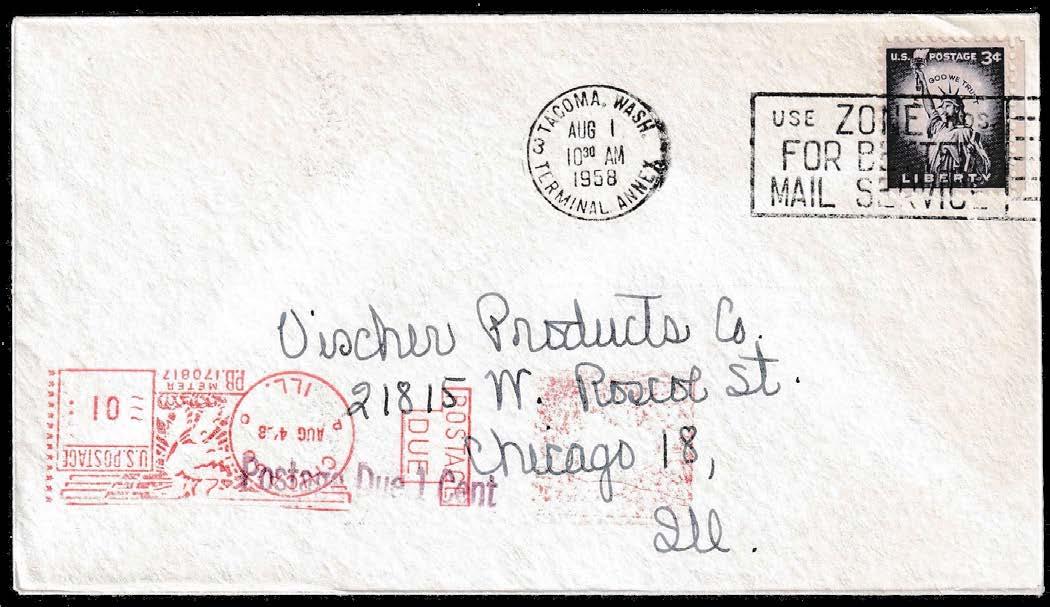
Figure 3. First day of 4¢ rate, 1¢ underpaid and thus charged postage due. August 1, 1958.
The cover in Figure 4 is a 3¢ stamped envelope with a 1¢ Liberty Series stamp added to make up the new 4¢ letter rate on its first day, August 1, 1958. What makes the cover out of the ordinary is that the 1¢ stamp bears the “WIS” initials, used by Wisconsin state agencies to discourage pilferage and misuse of stamps purchased for official business. In this case, the cover was sent by the Wisconsin Conservation Department from Ladysmith, a small city in the southwest-central part of the state, to St. Paul, about 130 miles to the west in neighboring Minnesota.
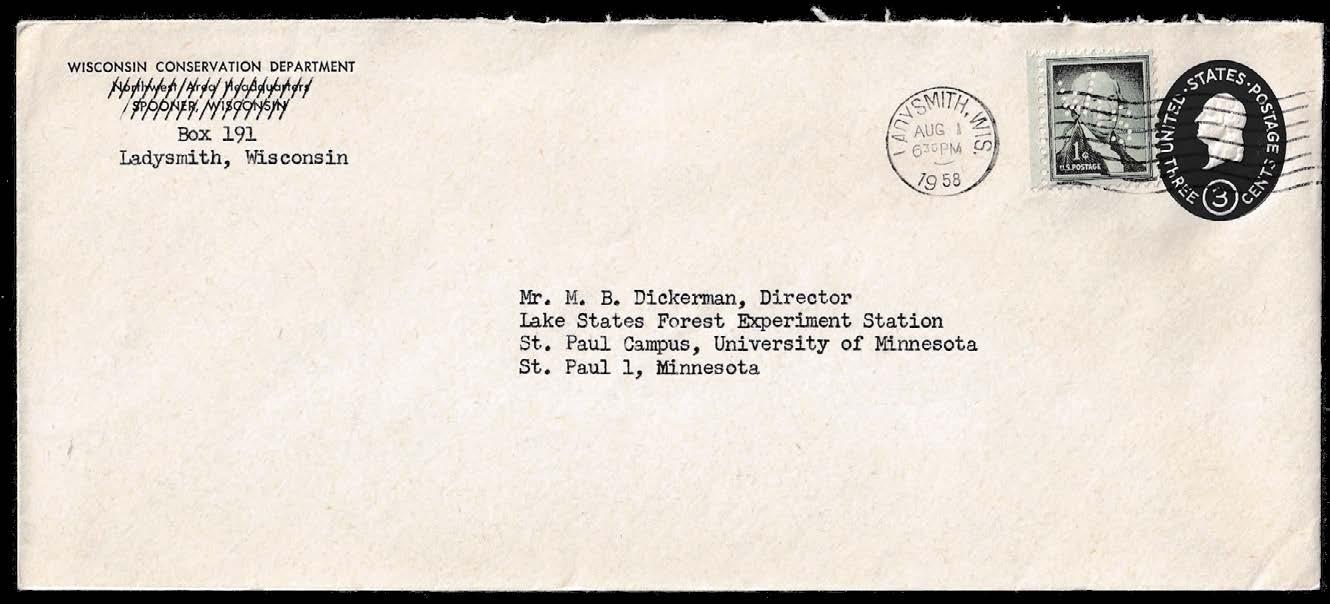
Figure 4. First day of 4¢ rate. Used by the Wisconsin Conservation Department. The 1¢ Liberty Series stamp added to the 3¢ stamped envelope has “WIS” perforated initials. August 1, 1958.
Figure 5 pictures a 3¢ stamped envelope revalued to 4¢ by the Post Office Department and used from Berkeley, California, on the first day of the 4¢ rate, August 1, 1958. That is also the earliest date on which such revalued envelopes have been documented as
being used. Since this is a window envelope with its contents missing and no receiving postmark on the reverse, the destination cannot be determined.
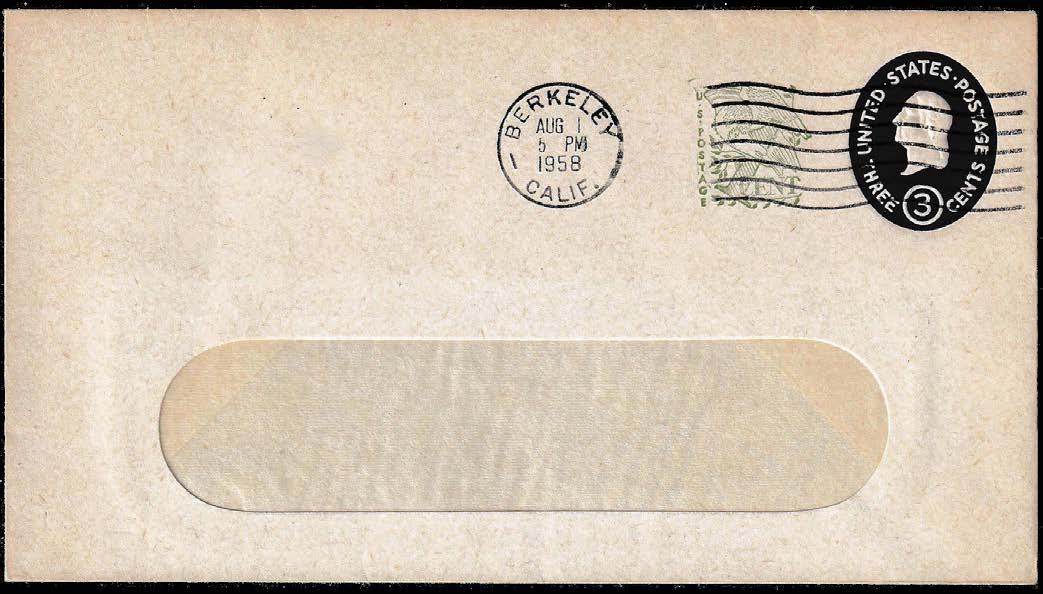
Figure 5. First day of 4¢ rate, and earliest documented use of a 3¢ stamped envelope revalued to 4¢. August 1, 1958.
Please note that, in addition to domestic rates, the 3¢ and 4¢ per-ounce rates also applied to letters sent to Canada or Mexico. Despite searching since the 1980s, I have not been able to find any examples of the last day of the 3¢ rate or the first day of the 4¢ rate used for either destination. If you know of one, please email me at ssuffet@nyc.rr.com with a copy to the Editor of this journal. Thank you.
Editor’s Note: A portion of this article appeared in the Winter 2016 issue (#72) of The Prexie Era, the newsletter of the United States Stamp Society Presidential Era Committee. This is the second in a series of occasional “show and tell” articles exploring the first and/ or last day of postal rates.
References
1. The information about the postal rates and their respective dates can be found in Henry W. Beecher and Anthony S. Wawrukiewicz, U.S. Domestic Postal Rates, 1872–2011, 3rd ed. (Bellefonte, PA: American Philatelic Society, 2011).
2. The legal citation for Public Law 85-426 is Act of May 27, 1958, Pub. L. No. 85-426, 72 Stat. 134. That means the law has been published in United States Statutes at Large, Volume 72, beginning on page 134. It can be found online at https://www.congress.gov/85/statute/STATUTE-72/STATUTE72-Pg134.pdf.
3. A detailed history of how the rate increase of 1958 came about, including the debate leading to Public Law 85-426, can be found in James I. Campbell Jr., Study on Universal Postal Service and the Postal Monopoly, app. B, Universal Service Obligation: History and Development of Laws Relating to the Provision of Universal Postal Services (Arlington, VA: George Mason University School of Public Policy, November 2008), 81–111, https://mars.gmu.edu/server/api/core/ bitstreams/06bd06a5-babc-42d1-a864-b54f87f339bf/content.
4. For documentation of earliest documented use (earliest reported postmark) of a 3¢ stamped envelope revalued to 4¢, go to the United Postal Stationery Society webpage for searching by Scott catalog number and enter U540c: http://www.upss.org/erp/searchscott.php.
Siegel offers unparalleled expertise, a worldwide client base, financial reliability, intelligent marketing, and the best internet resources of any philatelic auction house. Contact us today to learn more about consigning with Siegel and ensuring your legacy.

21 West 38th Street, 7th Floor
Phone (212) 753-6421
Email: stamps@siegelauctions.com

by Rodney A. Juell USSS # 13852
| P.O. Box 3508, Joliet, IL 60434
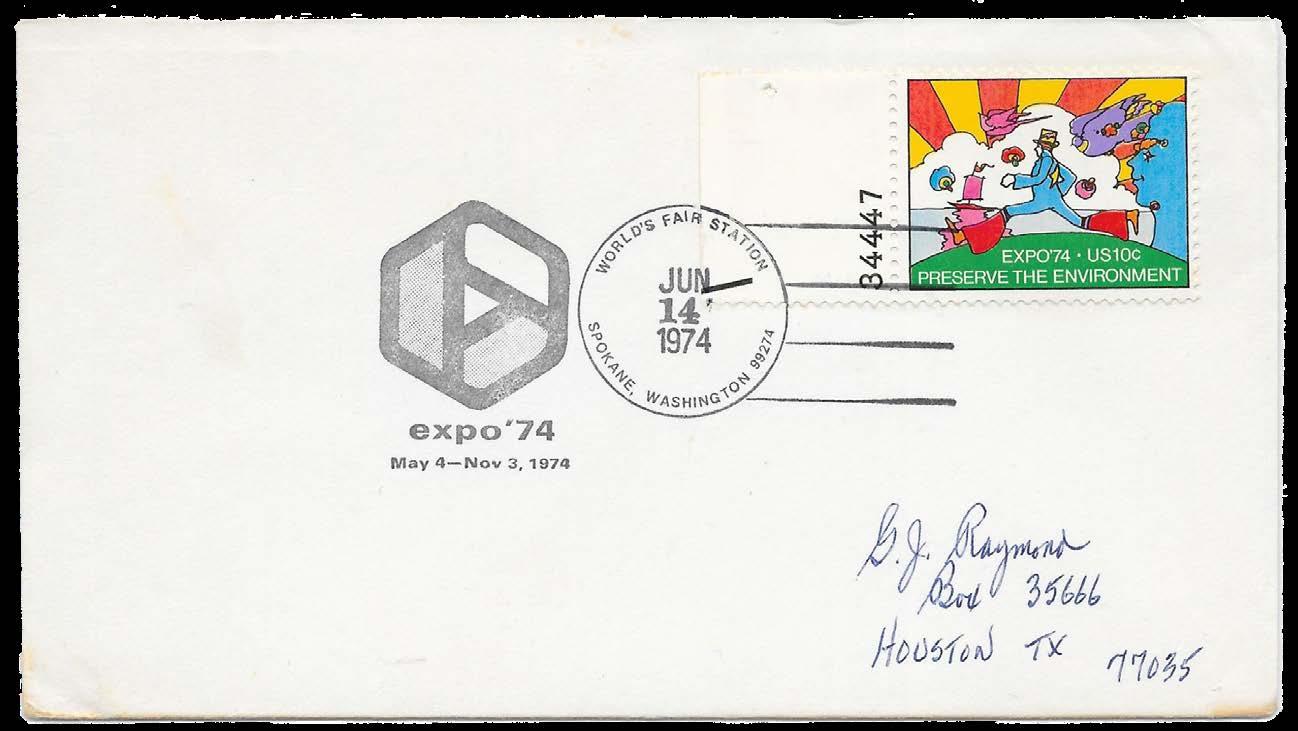
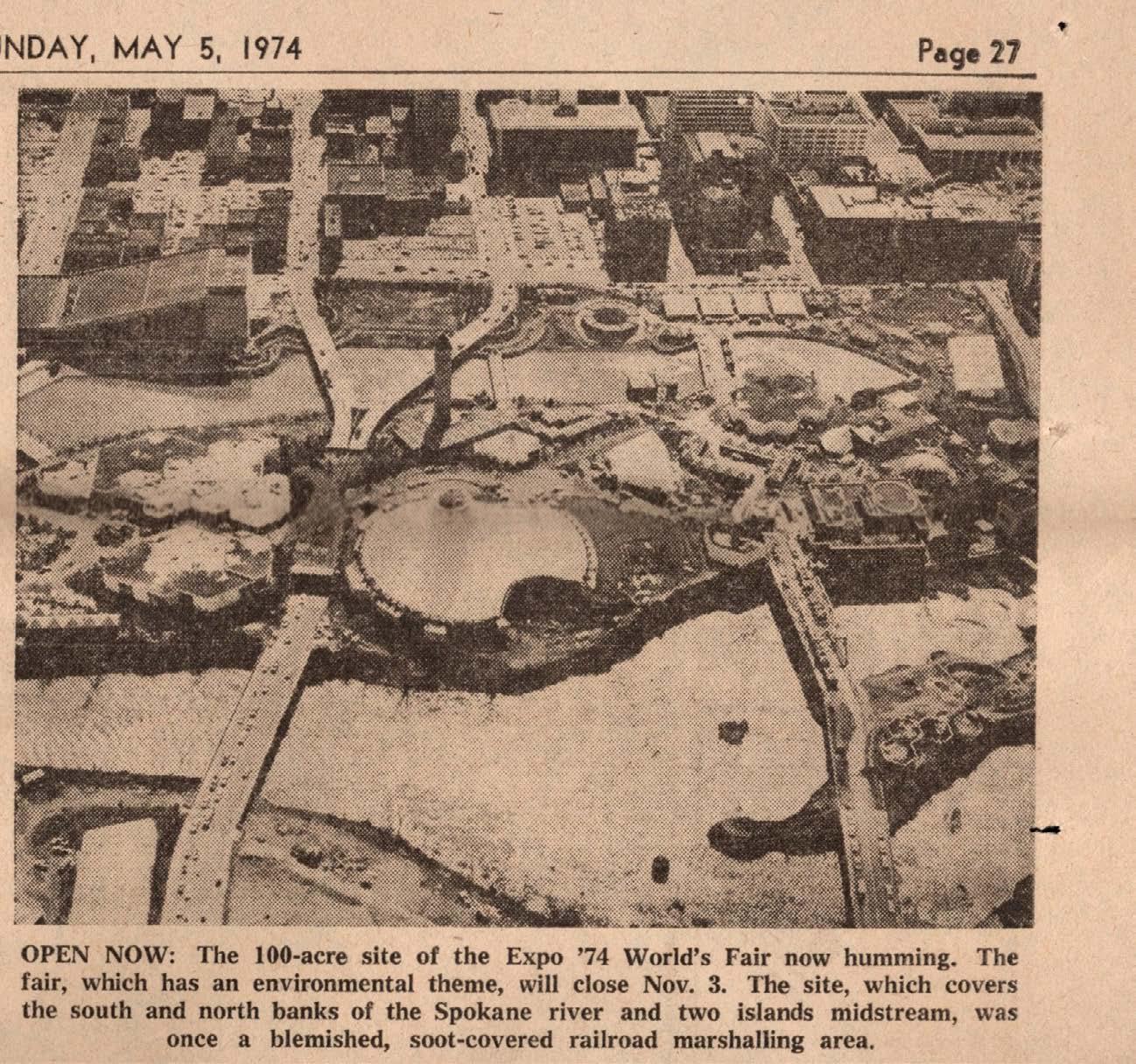
This month’s photo is an aerial view of EXPO ’74, the World’s Fair held in Spokane, Washington. The photo is cropped from the May 5, 1974, issue of the Long Island Daily Press. Scott 1527 was issued on April 18 to celebrate the fair. Shown nearby is a cover franked with the EXPO ’74 stamp, postmarked at the special postal station set up on the fairgrounds.
Vintage Photo of the Month

Determining Average “Plate Life” for Fourth Bureau Issue Rotary Coils
by Nancy Robinson, P h D, and James Robinson USSS #12386 (James Robinson) | m jsr.new2019@gmail.com
This article examines rotary coil printing-plate impression capacity, or “plate life.” Bureau of Engraving and Printing (BEP) reports of individual rotary plate impressions do not appear in official records until late 1923, during BEP fiscal year (FY) 1924. By necessity, this study begins with a focus on the coils of the Fourth Bureau Issue (FBI) definitive series, which was the issue in production when on-press rotary impression counting began. However, Washington-Franklin (W-F) collectors may want to track this study. The specifications and procedures used to manufacture W-F rotary coil plates did not change as the issue was replaced by its FBI successor series. Therefore, in subsequent articles, the FBI data analyzed herein will be applied as a baseline and springboard for a study of earlier W-F rotary coil plate life.
Why is plate life important? Plate life and BEP counted impression records represent two of three principal factors describing the relationships between various sets of BEP rotary production data available in, or derivable from, the USSS Research Papers detailing plate print history:
Lifetime Total Impressions / Lifetime Days at Press = Impressions Per Day or “Press Speed.”
By the end of this multipart study, “plate life,” average press run lifetime duration, and reliable production performance characteristics (press output speed) of the Stickney rotary printing presses between 1914 and 1926 will, for the first time, be available to researchers.
Coil Stamps
History: Plate Life was not a Primary Concern at the BEP Prior to 1923
What was the expected “plate life” (impression capacity) of an un-chromed rotary coil plate? Wallace Cleland noted, “From 40,000 to 80,000 was a … common range for flat plate impressions,” and added that rotary “…plates often gave more than 100,000 impressions…”1 His data source was uncited, but was almost certainly based upon personal observations from his years of study compiling BEP records. But no statistical treatment has ever been presented to detail actual aggregate rotary plate life.
As the early rotary coil era began circa 1914, the combination of rotary printing, web perforating, and coiling machines reduced the labor and expense of manufacturing coils to such a degree that the number of impressions taken from an individual plate was a very minor concern. Flat-plate press crews still represented the majority of postage stamp printing at the BEP. Each morning, each flat-press crew was issued counted stacks of individual sheets of seasoned (pre-wetted) paper. Each sheet was pre-sized depending on stamp format to permit one plate impression. At the end of the workday, every sheet of paper issued in the morning was either returned unprinted, counted as a printed sheet, or identified and tallied as a sheet spoiled during production.2 Printed stamps are a form of US government currency. At the end of each eight-hour work period, no personnel left the building until the daily accounting was complete, and the Bureau prided itself on “to the stamp” accounting.
Determining the number of impressions printed by a single flat plate or set of plates each day was thus a simple matter of counting the individual printed paper sheets. If a determination of total plate life was desired, the paper sheets printed each day by the same plates could be tallied throughout the press run of the plate set. But apparently, even for flat plate work, setting a standard flat-plate impression capacity was not a matter of interest. Cleland’s general 40,000 to 80,000 lifetime flat-plate impression range does not suggest tight control.
The B.I.A. Plate Number Checklist Plates 1–20,000 includes impression records for a run of flat plates in the 6000/7000 series between #6007 and #7395. Printing of these plates took place between mid-1912 and October 1915. The impressions were recorded in the “Record Book of Postage Stamp Plates” compiled in late 1918, which contained “secondary records of plates.” “Plate record cards” are listed as another primary resource, with the added notation that “later” cards included impressions.3 At the entry for plate #7396, Cleland writes, “Impressions are not known for plates after #7395, except for those canceled in 1924 and later.”
In the interest of accuracy, the actual next impression of any kind recorded after #7395 was for flat plate #14058 sent to press 9/30/1922. In summary, there was data for fewer than 1,388 plates of the 14,058 in the records to that point (under 9.87%). This sparsity of official records strongly suggests that plate life projections were not a central BEP concern during the earliest years of rotary coil production. It is especially important to note that the first seven pairs of W-F rotary coil plates fall within the range of plates #6007–#7395 (for which impressions were typically recorded), yet none of the 14 rotary plates shows an impression count.
In order to maintain the BEP “to the stamp” accounting policy upon the advent of rotary coil production in FY 1914, the “by the paper sheet” tallying method no longer applied. An alternative accounting system was needed. BEP Annual Reports of the era
detailed rotary coil deliverables in three formats: “coils,” “sheets,” and “stamps.” Knowing total rotary quantities shipped and/or stored in the vault, and by summing all associated internal expenditures on labor, materials, etc., accountants could arrive at an accurate total production cost to allow “cents per thousand” cost estimating for rotary deliverables. By this method, any spoilage was absorbed in the process costs. Quantity citations in reports and correspondence focused on deliverables. No detailed early records showing precise tallies of rotary coil plate capacity or daily rotary coil press capacity have been discovered. The entire first ten years of BEP rotary coil and sheet work was uncounted on an exact “per plate,” “per press,” and “per day” basis.
Impression counters were first added to the BEP rotary presses in early November 1923 (FY 1924). Active-duty US Army Major Wallace W. Kirby, appointed interim BEP Director by temporary Congressional assignment, wrote in his BEP Director’s Annual Report for FY 1924 (July 1, 1923 through June 30, 1924) “An accurate system of recording and checking the number of impressions printed from each plate has permitted the bureau definitely to ascertain the life of plates.”4 Kirby’s statement in conjunction with the decade-long absence of historic records further argues that BEP staff prior to Kirby’s term had no definitive means to measure useful capacity.
While the idea that rotary counting took so long to implement may seem astonishing, it also means that by the date of the first rotary impression-count recorded, production of W-F rotary coils and rotary sheet-stamps had ceased forever. Thus, during the early rotary coil era before the advent of chrome plating, only Fourth Bureau Issue (FBI) rotary stamp impressions were ever counted by a method attributable to each individual press or plate-set.
What Counts as an Impression?

Figure 1. Excerpt from September 27, 1922, letter from BEP Director Louis A. Hill to Third Assistant Postmaster General W. Irving Glover. (Courtesy National Archives).
Note that the lack of precise counting methods did not in any way stop BEP staff from making claims about rotary production. Output claims regarding Stickney press production had been touted by multiple BEP Directors as well as Benjamin Stickney, the inventor, since 1910. For reference, Stickney’s oft-cited initial coil press speed claims published in May 1913 amounted to 27,000 to 34,000 sheets per day per press. The equivalent for one plate of the plate-pair was 13,500 to 17,000 sheets per day. At that production rate, Cleland’s 100,000-impression plate life would be reached in only seven to eight days of printing. But in truth, Cleland’s records of rotary press runs were rarely that short, and when they were, it usually indicated a broken plate, or a bad plate pairing that could not run together successfully. In fact, rotary coil plate pairs that were sent to press only one time before being canceled were printing stamps for an average of 24.8 days in FY 1922.5 The question posed is: “Should we believe Cleland’s carefully compiled records of
full-scale production representing years of coil manufacturing process refinement, along with the analysis via press-mapping of BEP rotary production date-ranges, or Stickney’s early “sales pitch claims?”
Figure 1 shows an excerpt from an unpublished letter written by BEP Director Louis Hill nine years later to Third Assistant Postmaster General Irving Glover on September 27, 1922.6 It was a business letter between a supplier and his customer discussing the costs, specifications, and merits of the BEP’s rotary presses. On that date, rotary side-coil stamps had been in regular daily production for over seven years. Six rotary presses were printing side-coil stamps on the day Hill penned his letter.7
Hill’s second specification (for plates with 170 stamps) generalizes that the “plate life” of a rotary side-coil plate was 129,412 impressions (22,000,000 stamps/170 stamps per sheet), and for rotary sheet-press plates 150,000. The Hill number is closer to Cleland’s data, but still represents a wide variance. Hill was likely not the original source of the information. He had spent his career in the Engraving Division (formerly as Assistant Chief of Division), and had held the BEP Director’s job for less than six months on the date of the letter. On-press impression counting for individual rotary plates was still a year in the future. Clearly, someone inside the BEP had worked out approximations regarding rotary plate life over time, but they are best viewed as “ballpark numbers,” since the actual source of Hill’s data is unknown, and unfortunately the average “stamps per plate” is undefined from a production perspective. The quantity can represent at least three possibilities:
• Total “printed” press impressions including press spoilage, imperfect production work, and coil waste.
• Actual “deliverable” finished stamps.
• A “best case” optimum specification infrequently achieved.
Years later, more details of BEP internal accounting and the function of the mechanical impression counters appear in The Bureau of Engraving and Printing, its History, Activities and Organization, a 1929 research report. “The Press Register Division is one of the links in the chain for safeguarding the printing of money and other paper of value. Each press doing work of this character is equipped with a device which registers the number of impressions. These registers are read daily by the staff of the Press Register Division, and for every impression by the press there must be a sheet of finished work, a spoiled sheet, or a proof.”8
Emphasizing the point, the total daily counted impressions per plate as of November 1923, included not only the number of printed impressions that ultimately were delivered to the Post Office Department (POD) as finished stamps (including coil waste sheets in 1923 and 1924), but also all impressions which were destroyed, either because they were judged “imperfect,” were damaged during manufacturing, or in rare cases were ultimately never delivered due to lack of demand. In short, if 9,000 press impressions were recorded on the factory floor, fewer than 9,000 sheets of stamps ended up as deliverable product. There was a measurable differential (detailed analysis appears below).
How the Counters Worked
Per Louis Repeta, “The output of the Stickney rotary press was monitored with a tamperproof recorder that registered two counts for each revolution of the plate cylinder.
The counting mechanism was automatically engaged when the impression cylinder was moved against the plate cylinder to apply printing pressure.” Counting began with inked paper.
“When the press was stopped the plate cylinder did not stop exactly on top or bottom dead center, that is at the joint line, and a partial sheet of stamps was printed. Each time the press was restarted the counting mechanism was engaged, and a partial sheet was printed.”9 Two unusable impressions were counted with each start/stop sequence. He adds regarding stopping the press, “The standard procedure each time was to raise the impression cylinder and notify the register clerk. Each press was equipped with a 2-inch diameter 3-foot long (sic) pipe. The pipe was used to increase the leverage exerted by the plate printer to pull down on the hand wheel when applying force to the pressure cylinder. The pipe was also used to bang on the press each time the pressure was released to alert and summon the register clerk.”10 Counting stopped as the pressure cylinder lifted, thus all counted impressions involve ink on paper. White paper advancing through the press was not counted.
When the stoppage was due to a web break, “the web was cut and severed pieces were gathered by the register clerk to be salvaged and justify the count. If impressions were made on the blanket surface they were cleaned to prevent setoffs on the back of the web. The plate cylinder count was adjusted accordingly.”11 For clarity, the authors suggest this means that the clerk adjusted his recorded tally of “removed or salvaged materials.” He did not adjust the “tamperproof” mechanical counting device. Impressions printed on the press blanket until the press halted were also impressions, with regard to ascertaining plate life.
The continuous roll of wiping material could also tear, rendering the press unusable. “When the roll of wiping material broke, the liberally ink-coated rotating printing plates would splatter the press. The press was stopped, the ink broadcast on the press was cleaned, and the wiping material was rethreaded. The damaged web was gathered by the register clerk for salvage, and the press rethreaded.”12
In practice, the process likely began with the rethreading. The “damaged web” from completely unwiped plates would be heavily ink-smeared, still wet with both water and ink, and useless as any kind of salvage. Rather than “removing it and rethreading,” instead the clean white paper following the smeared and ruined prints would be advanced fully through the press with the web still intact, thus rethreading. This would also dry all the ink and allow the good prints immediately preceding the damaged section to be gummed and finished. It seems doubtful that the register clerk wanted to handle or attempt to cut away or count long, heavily inked, wet pieces of web with completely undried ink. When new white paper reached the delivery end of the press, the register clerk could then designate how many smeared (but now dry) impressions were to be removed (unspooled) from the delivery roll. He would adjust his count record to allow for the sheets removed. Rather than “salvage,” these smeared impressions deducted from the overall count became part of the daily spoilage. By this slight modification to the sequence as described by Repeta, the web could be quickly and mechanically rethreaded, and the white paper advanced to the delivery end now needed to be advanced only a foot or two more to start a new delivery roll.
When starting the press, Repeta explained that, “…the amount of spoilage generated as the press came up to speed created a length of paper discard, called printer’s waste. This discard could consist of blank paper, gummed blank paper, or dry and wet-printed impressions on gummed or ungummed paper.”13
Note that any portion of this material that showed ink meant that the impression cylinder had been engaged, starting a count. The inked “start-up spoilage” material (Figure 2) was part of the register count with regard to plate life. By the same reasoning, blank and/or gummed white paper was uncounted.
Finally, another type of unusable press spoilage material was created at shift-end, or any time it became necessary during the workday to clean plates showing loss of definition due to semi-dry caked ink. The plates were cleaned with solvent, after which, “…the web ran through the press to absorb the ink and solvent residue.”14
Typical examples of this spoilage seen by collectors are fainter than normal stamps. The ink has a “watered-down” appearance, and the impression is invariably smeared, though still recognizable (Figure 3). In the philatelic marketplace, this “shutdown and clean-up” material also falls under the generic moniker “printer’s waste.” Shut-down spoilage is the more common of the types reported. Again, with the impression cylinder engaged in order for the paper to pick up the solvent-diluted ink, the material was counted.
For the record, note that the material in Figures 2 and 3 is sheetpress material, but the sheet and coil presses were operated in the same manner with regard to the start-up
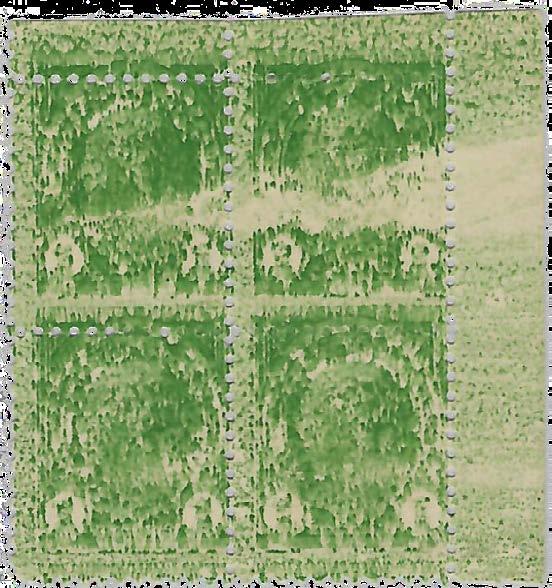
2. FBI Rotary sheet-stamp “start-up spoilage,” over-wetted paper, plate wipers inactive, ungummed; perforated later on the Stickney two-way perforator while still on the web roll.
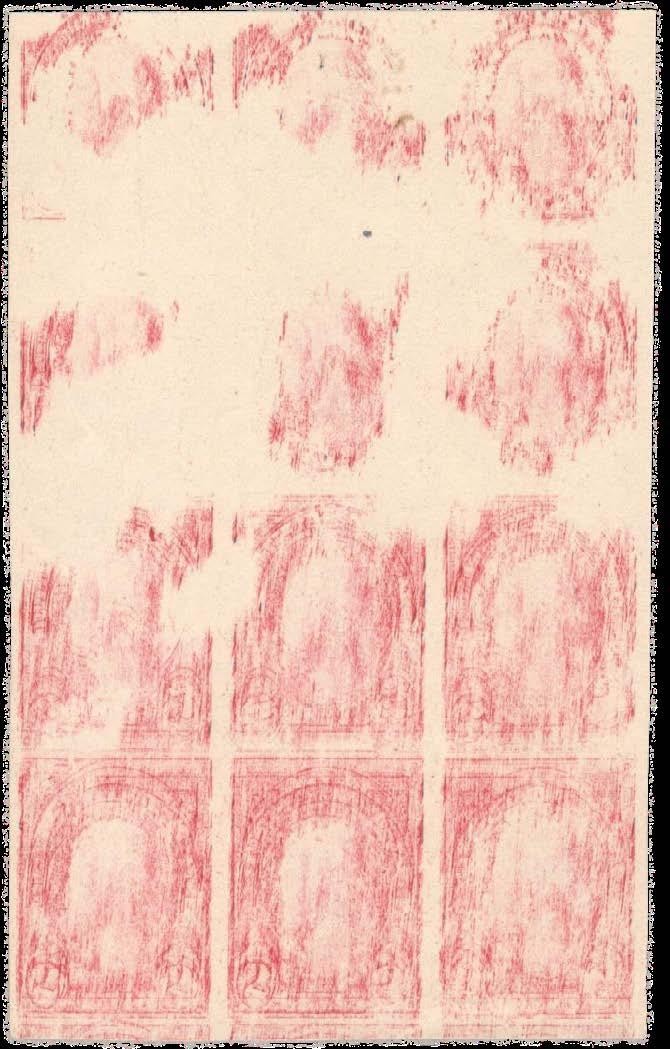
3. FBI Rotary sheet stamp “clean-up spoilage,” plate wipers still engaged, solvent-diluted ink, often gummed, unreported perforated. (Courtesy Jay Stotts).
Figure
Figure
and shutdown sequences. Repeta described the processes as encompassing the rotary presses in general, illustrated by similar material.
The Start of On-Press Rotary Counting in November 1923
The vast majority of FBI coil production was for the 1¢, 2¢, and 1 ½¢ denominations and generally ran around 100,000 impressions per plate (see Table 1). The initial impression counts recorded were higher than this average as outlined below:
The first rotary coil-plate pairing with recorded impressions was FBI 1¢ side-coil (Scott #597) pair 14600/14601. This pair was logged at press 11/23/23–1/28/24 and credited with 195,199 impressions per plate.
For broader perspective, the first rotary sheet-stamp pairing with impressions counted was also the first plate pair of any rotary plate format to be counted. The FBI 1¢ rotary sheet-stamp pairing (Scott #581) 14382/14643 at press 11/10/23–1/24/24 was credited with 97,487 impressions per plate, less than half the coil plates’ count. Note, however, that a 400-subject sheet plate making 97,487 impressions produced 17.5% more total stamps than a 170-subject coil plate making 195,199 impressions.
The first FBI 2¢ side-coil tallied was pair 14958/14959 at press 11/26/23–1/4/24 making 140,295 impressions per plate, or about midway between the initial 1¢ coil and 1¢ sheet counts.
At the time Wallace Kirby assumed the BEP Directorship in February 1924, less than a dozen counted coil press runs had taken place, with tallies varying between 66,546 and 195,200 impressions per plate. For the BEP to make an accurate assessment of “plate life” or “plate capacity” as he described, statistical data analysis encompassing the counts from hundreds of press-runs was now possible. Unfortunately for stamp collectors, little has been reported indicating to what extent the BEP studied the new data.
Only 12 months later by the end of 1924, surface chrome-plating of plates became viable. Over the subsequent two years, rotary impression counting became foremost a method to track the spans between re-chroming. Later official commentary suggests that very little relevance was attached to “looking backward” and trying to determine precisely how rotary plates in the early era had performed. The future was what mattered. In 1928, BEP Director Alvin Hall stated in his Annual Report, “It was found by a comparison of wearing qualities that case-hardened rotary plates were unfit for further use after the printing of 42,000 impressions, while chromed plates showed little signs of wear until they reached 60,000 impressions.”15 In 1939, Baxter seems to echo Hall when he states, “…even though tempered, plates used in printing postage stamps seldom yield more than 40,000 impressions, with a possible average of about 20,000 sheets.”16 Since the earliest rotary impression counts discussed above (non-chromed) all exceeded 60,000 impressions and ranged to almost 200,000, calling plate impressions made in excess of 42,000 “unfit” seems to badly overstate the facts. Recall Louis Hill’s W-F 129,000 impression per plate estimate in 1922. If Hall’s 1928 statement had been accurate, well above half of all W-F coils and early FBI coils were “unfit impressions” by 1928 standards. However, like Hill in 1922, Hall was generalizing. His real point was simply that surface chroming was an enormous advance in plate-wear prevention. How did he know? Finally, in FY 1924, the counters had begun to provide data to allow determination of an un-chromed plate’s capacity as a baseline comparison. Nonetheless, for a century,
collectors have been left guessing about rotary press output. Do we rely on Stickney, Hill, Hall, Cleland, or some other philatelic source? The statistical analysis that follows below determines the BEP standard rotary plate capacity from the point of the 1923 transition from the W-F to FBI issues and through the final years of “old-style” rotary production before chrome surfacing was introduced.
BEP
Plate Record Impression-Counts FY 1924-FY 1926: the 100,000 Impressions-per-plate Standard “Plate Life” for Non-chromed
Rotary Plates
This study concentrates on the period from 1924 through the approximate midpoint of FY 1926, with a stipulation that the data set ends with the advent of extensive plate-chroming, which ultimately allowed plates to exceed a million impressions. A few un-chromed plates in the data set analyzed ran as late as FY 1927. BEP impression records available during the early era begin in November, 1923 (FY 1924), and the data set includes all non-chromed plates of the high-demand denominations, the 1¢, 2¢, and 1 ½¢ side-coil plates.17
The high-demand issues represented 96% of total coil production.18 In all cases, the counts represent “lifetime” impressions taken from the plate from first day at press to the date of its cancellation and destruction. Data was analyzed as a production aggregate in order to calculate the average and the range in plate capacity.
Where there was a large discrepancy in the total impressions recorded between plates paired on the press, both plates were excluded because it was unclear which impression total was correct (Cleland noted these discrepancies in the print histories). 2¢ plate #17903 was also excluded as “likely chromed” because the print history indicates its partner #17975 was chromed, and the impression count was a statistical outlier for non-chromed plates. Table 1 presents the descriptive statistics for the data set.
* STD = Standard Deviation
Table 1. Early-era recorded plate impressions for FBI 1¢, 2¢, and 1 ½¢ rotary side-coil plates.
The aggregate average for the 1¢, 2¢, and 1 ½¢ rotary coil plates before chroming is just under 100,000 total impressions (99,957). Note that the aggregate average approaching 100,000 is a significant reduction from Louis Hill’s 129,000+ “ballpark” in 1922. It is far more than Hall’s 42,000. Wallace Cleland’s 1991 estimate was closest to the mark. It is reasonable to apply the total impression data obtained in 1924–1926 to that of earlier rotary coil plates. The authors are not aware of substantive changes to the press or to plate-making technology that would affect the impression capacity of rotary coil plates until the advent of chrome plating. Without a method to quantify plate life with pinpoint accuracy in 1922, experienced individuals estimated plate life for Director Hill. Hill’s intent was to sell his product to the POD, and maximum value in the data table
confirms that 129,000 impressions from a plate was frequently possible. But as an accurate overall figure for rotary plate life representing the majority of his production, his ballpark was 30% high. In addition, an important caveat is that the 100,000-impression aggregate average includes spoilage (see “Spoilage Differential” section below). Delivered stamps from a plate were even less, pushing Hill’s overestimate to between 30 and 40% too high. The overestimate is understandable. The data points are fairly widely distributed around the mean (a wide bell-shaped curve) with a standard deviation (STD) representing 36% of the average value. But the final conclusion is that 100,000 impressions was a more realistic citation of aggregate rotary coil “plate life” during large-scale constant rotary-press printing.
Sources of Variation in Plate Life Arising from Manufacturing and Production
The scatter in the data can be readily seen in Figure 4 which shows a “box and whisker plot” for the aggregate 1¢, 2¢, and 1 ½¢ data set. Each data point within the set is represented by a circle. The “x” in the box identifies the average value. The line within the box denotes the median value, or the split between the upper and lower halves of the data set. In other words, 50% of the individual data points are located above the line and the remaining 50% reside below the line. The bottom and the top of the box divide the data set into quarters or quartiles, so that 25% of the data points are located in the bottom of the box and 25% in the top of the box. The lowest 25% of points in the data set fall below the box, and the highest 25% of the points occur above the box. The whiskers (lines extending immediately above and below the box) show the maximum and minimum values of the data set which are not considered outliers. Outliers are defined as data points that extend greater than 1.5 times the length of the box when measured from the closest end of the box. Thus, outliers are the data points plotted above or below the ends of the whiskers.
Plate life was determined by the relative rate of deterioration or wear as the plates produced
Figure 4. Box and whisker plot of impression data.
impressions. According to Repeta, “The factors that contributed most to plate wear were the coarsegrained ink, a poor-quality extender, and fibers and inclusions in the paper.”19 Variation in the total number of impressions produced is also due to a number of additional factors including:
The variation in surface hardness values achieved when the plates were heated for curving and then quenched.20
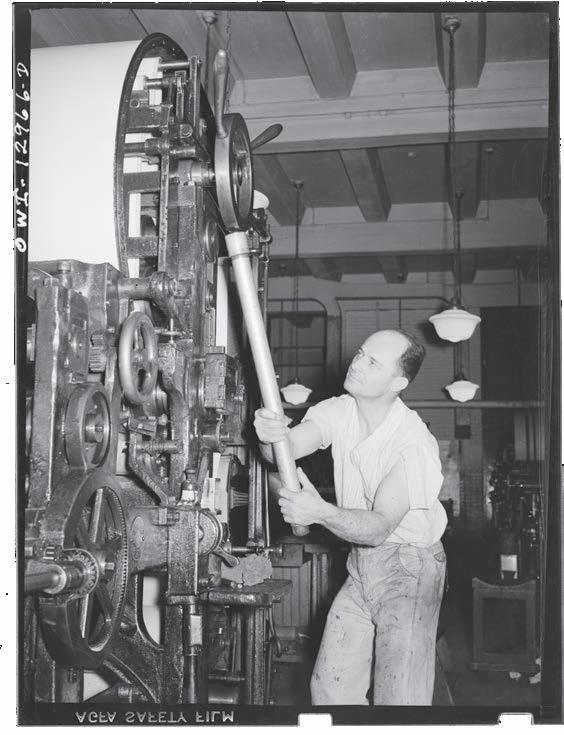
Variable pressure exerted by the pressman on the impression cylinder. A length of pipe provided leverage. Pressure control was as much art as science.21 (See Figure 5).
Damage during plate handling and transport between departments.22
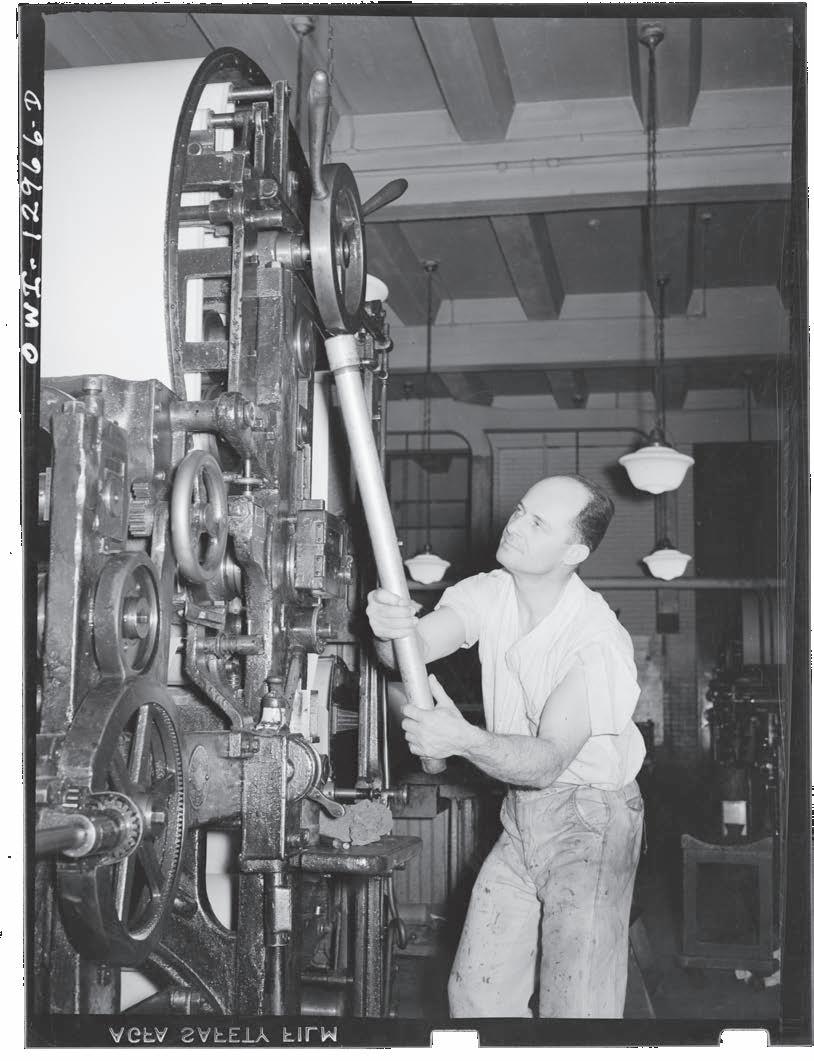
located about 7’ above the factory floor. (Courtesy Library of Congress: https://www.loc.gov/pictures/item/2017764860/ ).
While the data analysis proves that un-chromed plates on average made about 100,000 total impressions, it was possible to produce over 200,000 or fewer than 9,000 impressions. Very low numbers of impressions are likely the result of damage to the plate during handling and printing, while the highest values are probably due to a fortuitous combination of gentle treatment during printing and an ideal hardening process.
Impressions Printed and Counted versus Stamps Delivered; “Spoilage Differential”
As discussed in the section What Counts as an Impression, the recorded impression counts included not only the number of printed impressions that ultimately were delivered to the POD, but also all impressions which were destroyed. Thus, rotary-press gross output can be further defined by separation into “Deliverables” and a “Spoilage Differential.” The print records collated by Cleland list the total impressions made by essentially every rotary plate after the registers were added to the presses.23,24 To calculate the percentage of rotary coil-press impressions delivered, versus those that were spoiled and destroyed, the total lifetime impressions recorded for each of six individual
Figure 5. Photo showing a pressman using a length of pipe to provide leverage to the pressure-cylinder spoked control wheel
issues were tabulated and compared to the total number of stamps delivered to the POD over the lifetime of each issue.25,26 Only new issues (either denominations or designs) printed for the first time after the registers were installed were eligible for the analysis. All six rotary issues analyzed in Table 2 were introduced by FY 1933. The total deliverables amounted to over 10.7 billion stamps.
In selecting the issues for study, evaluation of the available data eliminated two potential candidates. The first was the FBI series of 1922 5¢ coil because the impressions made by one pair of plates, 17947 and 17948, were not recorded. The second elimination was the FBI 10¢ coil, due to what appeared to be a mistake in the excerpts from the BEP directors’ annual reports as published annually by Hugh Southgate in The Bureau Specialist starting in FY 1932.27 The FY 1942 report listed 15.74 million 10¢ FBI stamps as coils delivered (the final year of deliveries), while for the previous three FYs, the number of 10¢ coil stamps delivered was less than 2.9 million annually. Including the large “demand spike” aberration resulted in a nearly impossible total spoilage of only 0.6% over the almost 18-year lifetime production of the issue. The 1942 recorded quantity was likely off by a factor of 10 (simply one too many zeroes entered), since 1.57 million helps correct the problem, but the issue was excluded from Table 2.
The selection parameters left the series of 1922 3¢ and 6¢ coils, the series of 1925 1 ½¢ coils (side and end), the series of 1930 (full-face new designs) 1 ½¢ and 4¢ coils, and the series of 1932 3¢ coils (the Gilbert Stuart Washington; side- and end-coils). Table 2 presents the results for each individual issue as well as the collated total information for all six issues. In each individual case, over 90% of the impressions printed were ultimately delivered as stamps. The aggregate average was 93.3%. The 6.7% spoilage differential of printed coil stamps never delivered was, as detailed above, a combination of spoiled printer’s waste sheets, imperfectly printed or perforated stamps, stamps damaged during cutting, pasting, and coiling, and any finished coil stamps that were never delivered due to lack of demand.
To the authors’ knowledge, the 6.7% spoilage differential calculated above is the first time an overall spoilage rate for early-era coil stamp production has been published. This overall rate fits in well with the reported 3% waste attributed solely to the printing process.28 It is of interest that the rotary coil composite spoilage rate is much lower than that for the rotary sheet stamps, which Repeta tells us could be as high as 25% just for the perforating step.29 Repeta goes on to explain that through perforating machine innovations, such as the electric eye, the sheet-work perforating spoilage was reduced to less than 3% by 1940. The authors’ data for overall sheet spoilage for FBI rotary sheet stamps, calculated using the same method as described above for the rotary coil stamps, is around 17–18%.30 This overall rotary sheet spoilage rate correlates with Repeta’s information.
Conclusion and Summary
This article’s analysis demonstrates that rotary coil-plate lifetime capacity prior to chroming was, on average, about 100,000 impressions. Of these 100,000 impressions, approximately 93,300 were delivered to the POD for sale as coils, and the remaining 6,700 were discarded. The discarded material was imperfectly printed, either due to production issues or as a normal result of the press being started and stopped throughout the workday.
* Summation of lifetime impressions per issue recorded in the Print Records multiplied by the number of subjects per impression. When the print record indicated a slight disagreement between impressions printed for plates, the individual values were used since it was not possible to determine which value was correct. Series of 1925 1½¢ Plates #19322 & #19326 show a difference of 23,999 impressions. Series of 1932 3¢ Plate #20947 only recorded the first of two known print runs.
† Summation of stamps delivered taken from the BEP annual reports (through 1931) or later extracts published in The Bureau Specialist.
^ The impressions for the end- and side-coils were summed individually and multiplied by 150 subjects per impression for the end-coils and 170 subjects per impression for the side-coils. The end- and side-coils stamps were added together because the extracts from the BEP annual reports gave the composite number of side- and end-coil stamps delivered, rather than as separate quantities.
Table 2. Spoilage differential: calculation of the percentage of stamps printed that were ultimately delivered to post offices.
Further refinement of the data is possible. The average of 100,000 impressions was calculated from a broad data set which aggregated the impression totals for the high-demand FBI 1¢, 2¢, and 1 ½¢ rotary side-coil plates. However, when the data for the FBI 1¢, 2¢, and 1 ½¢ rotary side-coil plates were analyzed separately (versus as an aggregate data set), a statistically significant difference emerged in the lifetime impressions produced between the various denominations. In other words, in addition to plate manufacturing and production impacts, projected plate life was ink-color dependent. This surprising result is explored in our next article, which shows that the ink color used for printing has a profound effect on the total impression count printed by an un-chromed rotary coil plate.
Acknowledgment
The authors want to offer special thanks to Jay Stotts, who reviewed most of the articles in these rotary coil production studies and provided invaluable consultation and input.
References
1. W. Wallace Cleland, “Chrome Plating and the First Million-Impression Plates,” The United States Specialist 62, no. 9 (1991): 503, 504.
2. James H. Baxter, Printing Postage Stamps by Line Engraving (The American Philatelic Society, 1939), 124.
3. W. Wallace Cleland, comp., B.I.A. Plate Number Checklist: Plates 1–20,000, rev. ed. (United States Stamp Society, 1990), https://www.usstamps.org/download/bia-plate-number-checklist-1-20000/, explanatory notes: 7–8.
4. U.S. Bureau of Engraving and Printing, Annual Reports of the Director of the Bureau of Engraving and Printing: 1919–1931 (Washington, D.C.: Government Printing Office), Annual report for FY 1924: 4.
5. Nancy Robinson and James Robinson, “New Perspectives on Rotary Coil Stamp Production Via ‘Press Maps’ (BEP Fiscal Years 1914–1925), Part II,” The United States Specialist 96, no. 4 (2025): 157.
6. Letter written by BEP Director Louis Hill to Third Assistant Postmaster General Irving Glover on September 27, 1922, National Archives.
7. Robinson and Robinson, “New Perspectives on Rotary Coil Stamp Production Via ‘Press Maps,’ Part II,” 149–151.
8. Laurence F. Schmeckebier, The Bureau of Engraving and Printing: Its History, Activities and Organization (The Brookings Institution, 1929), 54.
9. Louis E. Repeta, “The Stickney Rotary Printing Press Part 4,” The United States Specialist 67, no. 5 (1996): 209.
10. Ibid.
11. Repeta, “The Stickney Rotary Printing Press Part 4,” 211.
12. Ibid.
13. Louis E. Repeta, “The Stickney Rotary Printing Press Part 1,” The United States Specialist 67, no. 2 (1996): 63.
14. Louis E. Repeta, “The Stickney Rotary Printing Press Part 3,” The United States Specialist 67, no. 4 (1996): 161.
15. U.S. Bureau of Engraving and Printing, Annual Reports of the Director of the Bureau of Engraving and Printing: 1919–1931, FY 1928 Annual Report: 16.
16. Baxter, Printing Postage Stamps by Line Engraving, 105.
17. W. Wallace Cleland, comp., “Printing History of Coil Plates, Series 1922,” B.I.A. Research Paper #14 (United States Stamp Society [formerly BIA], May 1997).
18. Nancy Robinson and James Robinson, “Government Coil Stamp Supply and Demand: BEP Fiscal Years 1908 through 1925 Part IV: FY 1917 – FY 1925: End- Versus Side-Coils Delivered & 2¢ Side-Coil Transition to the Fourth Bureau Issue,” The United States Specialist 97, no. 3 (2026): 120.
19. Repeta, “The Stickney Rotary Printing Press Part 3,” 159.
20. Baxter, Printing Postage Stamps by Line Engraving, 105.
21. Repeta, “The Stickney Rotary Printing Press Part 4,” 204.
22. Baxter, Printing Postage Stamps by Line Engraving, 80.
23. Cleland, comp., “Printing History of Coil Plates, Series 1922.”
If you collect Plate Blocks, Booklets, Coils, or Sheets, the above website, with hundreds of sets at Face Value, will be a great savings to you. Enjoy the hobby.

Armen Hovsepian (APS 150170)
P. O. Box 24222 Overland Park, KS 66283 info@USatFACE.com


24. W. Wallace Cleland, comp., “Printing History of the 3¢ Stuart Coil Plates Series 1932,” B.I.A. Research Paper #17 (United States Stamp Society [formerly BIA], June 1999).
25. U.S. Bureau of Engraving and Printing, Annual Reports of the Director of the Bureau of Engraving and Printing: 1919–1931, Reports for FY 1924–1931.
26. M. Southgate, Extracts from the Annual Reports of the Bureau of Engraving and Printing for FY 1932 – FY 1944, The United States Specialist:
pp. 1932 4, 2, 1933, 9-10 1933 5, 5, 1934, 52 1934 6, 2, 1935, 9-10 1935 7, 3, 1936, 44 1936 8, 3, 1937, 32 1937 9, 3, 1938, 23 1938 10, 2, 1939, 28 1939 11, 4, 1940, 58-59 1940 12, 7, 1941, 88 1941 13, 8, 1942, 82 1942 14, 5, 1943, 37 1943 15, 11, 1944, 106-107 1944 16, 9, 1945, 128
27. Ibid.
28. George W. Brett, “The 1924 POD-BEP Committee Report on Early Rotary Press Problems and the Start of Regular Bureau Precancels,” The United States Specialist 55, no. 1 (1984): 30–31.
29. Louis E. Repeta, “The Stickney Rotary 11 × 10-½ Bar and Wheel Perforator,” The United States Specialist 63, no. 4 (1992): 165. Authors’ unpublished data to be included in future articles discussing early rotary sheet

2¢ Columbian Stamp: Left Relief
by David W. Mayo USSS # 11953 | m dmayo@paulweiss.com
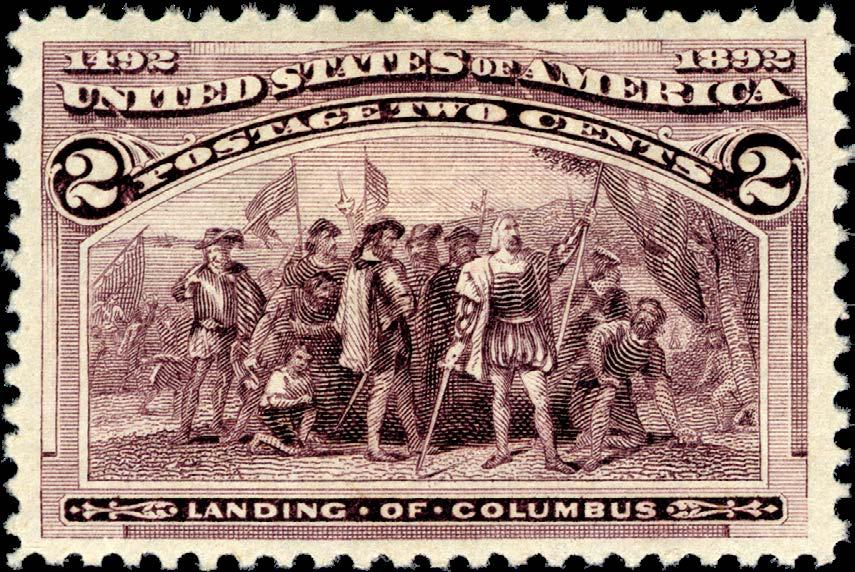
In 1962, L.H. Copeland published the last of three articles in the American Philatelist1 focusing principally on the transfer reliefs that were pulled from the single engraved die and used to lay out the 135 printing plates used to print the 2¢ Columbian. This article will provide previously unpublished information regarding the early stage of the “Left Frame” transfer relief used to lay out several of those printing plates.
The first step in creating the printing plates for a line engraved stamp, such as the 2¢ Columbian, is to engrave a die, with a reverse image of the final stamp. Transfer reliefs, with a positive impression of the stamp image, are then pulled from the die. The steel transfer reliefs stand proud of the transfer roll on which they were entered. The transfer reliefs are then used to lay out the printing plates. Copeland identified 15 transfer reliefs (plus one or more transfer reliefs that created the broken hat) that were used to lay out the 2¢ Columbian plates. These reliefs can be identified from constant flaws (typically small breaks in the frame lines) on the printed stamps. The flaws were caused by small bits of the transfer relief breaking off as it was used, resulting in gaps in the engraved image on the printing plate.
The Columbian Commemoratives
2¢ Columbian. (Courtesy Smithsonian National Postal Museum).
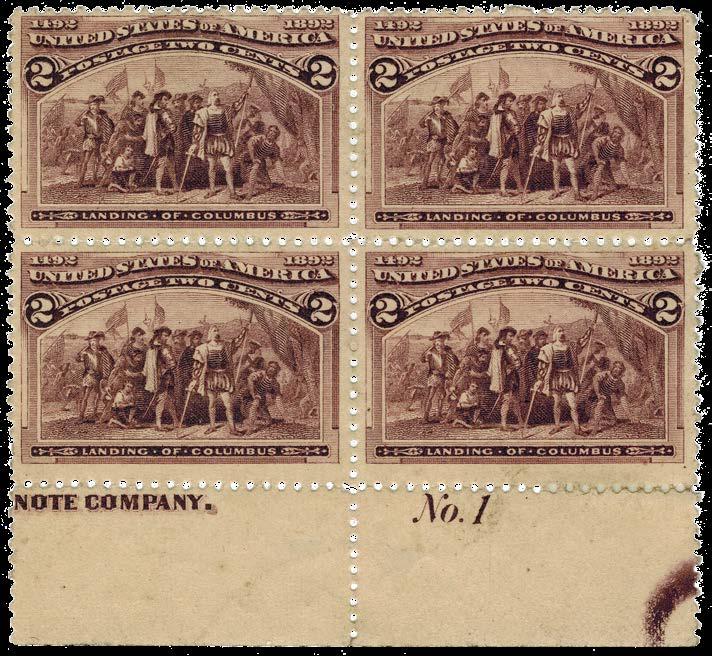
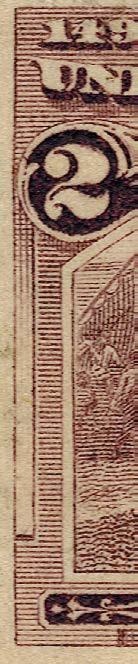
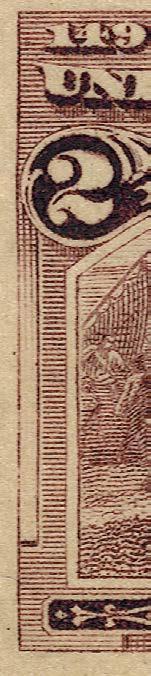
Figure 1. Block from Plate A1, made with the “Left Frame” relief. The bottom two stamps (Figure 1A) show the fourth stage of the relief break, and the upper right stamp (Figure 1B) shows the fifth stage.
The Left Frame relief is characterized by breaks in the left vertical frameline of the stamp. Like each of the other transfer reliefs, the Left Frame relief is progressive, with more or larger breaks appearing in each of the seven identified stages of the relief. This transfer relief was used to lay out the 2¢ Columbian plate numbered A1 (Figure 1). The stamps in Figure 1 show the fourth (bottom two stamps) and fifth (upper right stamp) stages of the relief.
The upper left plate strip from plate A5 is shown in Figure 2. The left-most stamp in the strip (position 2 of plate A5) does not have any breaks in the left vertical frameline. The third stamp (position 3) shows the first two breaks that are characteristic of the Left Frame relief. In his 1962 article, Copeland included a chart showing the transfer reliefs for many of the plates used to print the 2¢ Columbian. Information regarding plate A5 stated that it was a Left Frame relief but did not state that there was no break in position 2,
Figure 1B.
Figure 1A.
so this is the first published report that the Left Frame relief can first be identified at position 3 of plate A5. (This strip, along with the position piece shown in Figure 1, also show that the printing plates for the 2¢ Columbian were not numbered in the order in which they were entered.)2
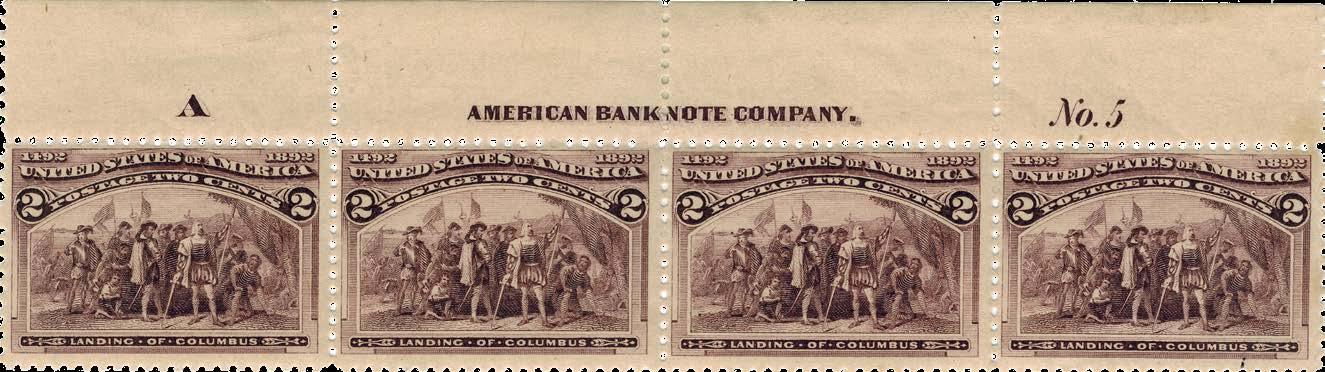
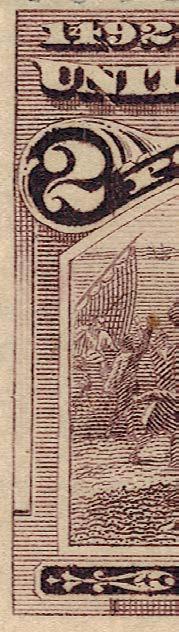
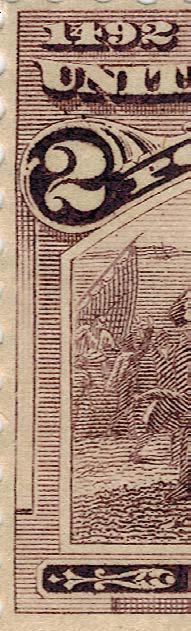
References
Figure 2. Block from Plate A5. The left subject has no break in the left frameline relief, while the second subject does, demonstrating that the relief break began on this plate.
1. L.H. Copeland, “20 Added Years of Research on the Two-Cent Columbian,” American Philatelist 75, no. 9 (June 1962): 669.
2. See also David W. Mayo, “2¢ Columbian Stamp: Broken Frameline Transfer Reliefs,” Chronicle 77, no. 4 (2025): 361. (showing that the same conclusion can be drawn from the progressive nature of other transfer reliefs).

Requesting Replacement Copies
To replace a missing or damaged copy of The U.S. Specialist, you may request a replacement by emailing Robert Rufe, USSS executive secretary at execsecretary@usstamps.org.


compiled by Kim D. Johnson
Plate Number Report 3 #???? $11.95 Crab Nebula
#???? Route 66
Bald Eagle
#???? Mr. Rogers (reissue) B1111 ‡ ‡ LL LR 2r x 2c 1,2,3,4*
3
#???? American Bison P1111 ‡ ‡ LL LR 3r x 3c 1,2,3,4,5,6,7,8,9*
3 #???? ($1.70) Postcrossing P1111 ‡ ‡ LL LR 2r x 4c 1,2,3,4,5,6,7,8*

3
#???? International Peace P1111 ‡ ‡ LL LR 3r x 3c 1,2,3,4,5,6,7,8,9*
3
#???? North American Soccer B111111 UL UR LL LR 3r x 2c 1,2,3,4,5,6*
COORDINATORS: Members are invited to report their findings to the appropriate coordinator.
All issues through 1980
Sheet stamps after 1980
Kim D. Johnson
310 E N 3rd Street
Georgetown, IL 61846
Jim Cochrane P.O. Box 2009
Great Bend, KS 67530
Coil stamps after 1980
Booklet stamps after 1980
Jill Ambrose P.O. Box 54622 Cincinnati, OH 45254
Michael O. Perry P.O. Box 1194
Rainier, OR 97048
This monthly report is used to update the Durland Standard Plate Number Catalog.

Report of the Executive Secretary
APPLICATIONS
17671 Hugh Delaney, South Salem, NY 17672 Dale Goeller, Liberty, MO 17673 Phil Beckman, Everett, WA 17674 David Field, Longview, WA 17675 Mark Stockburger, Rush City, MN 17676 Richard Reber, Lawrence, KS 17677 Jeffrey Rome, Boston, MA 17678 Whitefeather, Springville, CA
New Members from Boston 2026
Boston 2026 was a smashing success! Hundreds of visitors stopped by our booth, and many picked up sample copies of The United States Specialist. We know several signed up for membership as a follow-up, and we hope many more will also sign up. Please recruit at your local shows and clubs. Request your own updated PDF “quadrafold” Membership Application via email from Bob Rufe: execsecretary@usstamps.org.
Classified Advertising
USSS MEMBERS are entitled to two free ads of up to 40 words each year. Other ads are 10¢ a word, payable in advance. For 6 insertions, take a 5% discount; for 12 insertions, take a 10% discount. Ads with [1157] at the end expire with this issue. Make checks payable to USSS. Send copy and check to The United States Specialist, 9038 E. 25th Dr., Denver, CO 80238. The Editor strongly prefers to receive ad copy by email: editor@usstamps.org. Emailing ads saves substantial time for you and the Editor and avoids errors.
WANTED
WANTED TO PURCHASE #1053 HAMILTON $5 Commercial Usages. Especially need use to foreign destination. Also doing a survey so scans appreciated. Doug Weisz weiszcovers@gmail.com, 773-9144332. 33 W Ontario St. #48A Chicago, IL 60654. www.douglasweisz.com [1168]
SEEKING USS INDEPENDENCE STAMP similar to Scott #4703 USS Constitution stamp. Bernard Wojnowski; 64 Mariner Rd., Vineyard Haven, MA 02568. [1157]
WANTED - NAMW TEXAS POSTMARKED covers. Member APS, IPDA, USSS, APNSS. Email: htputney@gmail.com [1162]
WANTED FOR MY COLLECTION: SCOTT #102 to #111, 1869 Special Printings (re-issues). Please— only nice examples without major faults. Must be face-up bright and attractive. PF or PSE Certs only! Strong buyer—Rob Lehmann (240)422-0118 or diecasttoys@yahoo.com [1163]
WANTED #279 PLATE NUMBER STRIPS FOR specialized collection/study of 1898 1¢ Franklin, plate #’s 1459 & 1470 (any position), 1411(bottom). 279a plate #’s 1206, 1207, 1315, 1376, 1379. Len McMaster, 304-856-1118 or lenmcmaster@gmail.com [1168]
WANTED: US REVENUE CAMP STAMPS (SCOTT# RVC 1-10) issued by US Forest Service, 1985-88. Look like labels. Specifically looking for RVC6 ($1 Red) and RVC10 ($10 Gold). Also associated fee envelopes, pamphlets or documents. J. Dale Shively, 512.947.1401, jdshively@icloud.com. [1158]
WANTED: M-BAG TAGS FOR PERIODICALS sent to foreign destinations; Autogiro mail; Nineteenth century typewriter advertising and Washington, D.C., hotels; Uses of 952, 966, 1047, 1084, 1205, 3774, especially to foreign destinations; Zunks covers; $5 stamp uses. E-mail: pmartin2525@yahoo.com, POB 6074, Fredericksburg, VA 22403. [1159]
WANTED-MAY 29, 1964 POSTMARKS OF 5¢ John Kennedy 1246 on cover. Searching for small town postmarks for this stamp on cover. This was a nationwide first day. Henry Scheuer, PO Box 533, Madison Square Station, New York, NY 10159. [1158] FOR SALE
IF MY STAMPS ARE NOT VF/XF, SUPERB, I sell in packets. Upgrade now at low prices. U.S.A. and Norway with no faults, centered and clean. Request list—Reed Roholt, P.O. Box 1006, Beaver, UT 84713. Satisfaction guaranteed. [1160]
2026 HEBERT’S
All New and Revised Mint and Used Plate Number Single Catalogue $52.50 postpaid
American Plate Number Single Society www.apnss.org
Expanded pricing, back-of-the-book, tag/paper varieties, PN/ZIP/ME types
Rick Burdsall / APNSS P.O. Box 1023 Palatine, IL 60078-1023
Index of Advertisers
American Plate Number Single Society (www.apnss.org) ..................................................... 336 Armen Hovsepian (www.USatFACE.com) 326 Mountainside Stamps, Coins and Currency (www.mountainsidestampsandcoins.com) ....... 294
Precancel Stamp Society (www.precancels.com) 294
Richard Friedberg (www.friedbergstamps.com) ................................ 327
Robert A. Siegel Auction Galleries (www.siegelauctions.com) ..................................... 311
Scott A. Shaulis (www.shaulisstamps.com) 326
The United States Stamp Society (www.usstamps.org)......................................... Covers
United States Possessions: Postage Due Stamps and Covers presents the story of Postage Due stamps used in the major possessions or territories of the United States. Written from a stamp collector’s perspective, the authors address the challenge of identifying the myriad of Possession Postage Due stamps by concentrating on stamp identification while also covering the Postage Due issues of Cuba, the Danish West Indies, Puerto Rico, the Panama Canal Zone, the Philippines and more.
In addition to the text, the monograph contains over 300 illustrations and five appendices which provide information to supplement and further explain key points. In many cases, the information presented is new or, if previously reported, organized in a new manner to help the reader understand the complexity of the Possession Postage Dues.

United States Possessions: Postage Due Stamps and Covers
Hard cover, 352 pages, 6-in × 9-in.
Member Price: $39 US postpaid Non-Member Price: $43 US postpaid Purchased online at: www.usstamps.org/store/ or by mail to: Executive Secretary, P.O. Box 1602, Hockessin, DE 19707-5602


States Stamp Society
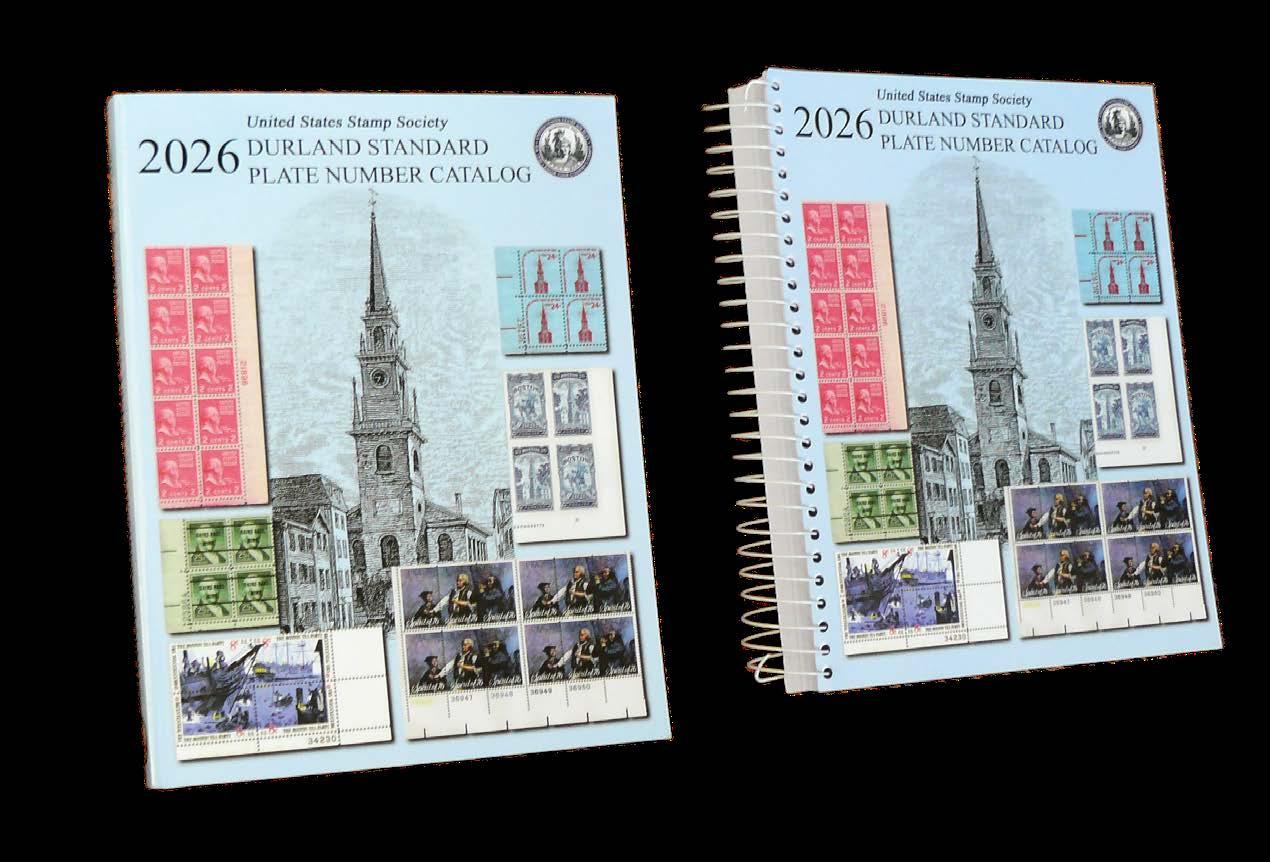
The new 2026 edition of the Durland Standard Plate Number Catalog provides the most comprehensive research source for plate number information on United States postage and revenue stamps, including tax-paid revenue stamps, with listings for overprinted Possessions postage, Allied Military government stamps, and other back-of-the-book stamps, dummy and test stamps, MDI “Blue Cover” booklets and partial plate numbers on booklet and coil stamps.
2026 Edition of the Durland Standard Plate Number Catalog