
The United States SPECIALIST
for the Collector of Postage & Revenue Stamp Issues of the United States
WHOLE NUMBER 1158
s plus e
Great Americans
Third Class Rates
Resumption of Mail Service to Germany After World War I
c and j
The impact of printing inks on plate life of rotary press plates; The 1936 Susan B. Anthony Stamp; Transition to the 3¢ letter rate in 1932, & more.


Order from: USSS, P.O. Box 1602, Hockessin, DE 19707-5602 or online at: www.usstamps.org/store/ Hardbound, 769 pages. $35 members, $40 nonmembers. Visit the website for shipping costs.

The United States SPECIALIST
the journal of the United States Stamp Society
VOLUME 97, NUMBER 8 AUgUst 2026
WHOLE NUMBER 1158
An association of collectors to promote the study of all postage and revenue stamps and stamped paper of the United States and US-administered areas produced by the Bureau of Engraving and Printing and other contract printers. American Philatelic Society Affiliate No. 150
339 Resumption of US Mail to Germany after WWI by Jacob Alex Klerman
347 FDR, Farley, and the 1936 Susan B. Anthony Stamp by Paul M. Holland
356 Vintage Photo of the Month by Rodney A. Juell
359 July 5 / July 6, 1932: Transition from the 2¢ to the 3¢ Domestic Letter Rate by Stephen L. Suffet
362 Great Americans Issue Part XXVII— Third-Class Mail by Jay Stotts
367 BEP Rotary Coil Production: The Impact of Printing Inks on Plate Life by Nancy Robinson, PhD, and James Robinson
Andrew S. Kelley, Editor 9038 East 25th Drive Denver, CO 80238
email: editor@usstamps.org
www.usstamps.org
Manuscripts, publications for review, and all advertising including classifieds, should be sent to the Editor at the address above.
Forms close on the 20th of the second month preceding the month of publication, as February 20 for the April edition.
The United States Specialist (ISSN 0164-923X) is published monthly January through December by the United States Stamp Society, Inc., P.O. Box 1602,
379 Plate Number Report compiled by Kim D. Johnson
383 Report of the Executive Secretary by Robert Rufe
384 Classified Advertising
384 Index of Advertisers
Hockessin, DE 19707-5602. Membership in the United States $25. North America $40; all others $65. Single copy $2. Periodical postage paid at Hockessin, DE, and at additional entry offices. Printed in USA.
Copyright ©2026 United States Stamp Society, Inc. All rights reserved. Opinions expressed by authors are their own and do not necessarily reflect those of the United States Stamp Society, its officers, or staff.
Correspondence concerning business affairs of the Society, including membership and changes in address, should be addressed to the Executive Secretary, PO Box 1602, Hockessin, DE 19707-5602.
Postmaster: Send address changes to U.S.S.S., P.O. Box 1602, Hockessin, DE 19707-5602.

The United States Specialist
Founded 1930 as The Bureau Specialist
EDITOR
ANDREW S. KELLEY
9038 East 25th Drive Denver, CO 80238 email: editor@usstamps.org
United States Stamp Society Bureau Issues Association, Inc.
P.O. Box 1602 Hockessin, DE 19707-5602
CHAIRMAN
Roger S. Brody
P.O. Box 5836 Somerset, NJ 08875-5836 email: brody@usstamps.org
PRESIDENT
Nicholas Lombardi
P.O. Box 1005 Mountainside, NJ 07092 email: 8605@comcast.net
VICE PRESIDENT
Jeffrey Shapiro
P.O. Box 3211 Fayville, MA 01745-3211 email: coverlover@gmail.com
SECRETARY
Joel Cohen
10703 Kings Riding Way, Unit T-1 Rockville, MD 20852-5420 email: cohenji@comcast.net
TREASURER
David S. Sugar 1740 Mission Hills Rd., #311 Northbrook, IL 60062-5744 email: david14501681@gmail.com
GOVERNORS
Lynn Batdorf
Kim Johnson
Mike Lampson
Leonard Piszkiewicz
James Robinson
Robert Rose
Rod Juell
Gregory Shoults
David Steidley
Jay Stotts
Steven Unkrich
EXECUTIVE SECRETARY
Robert Rufe
P.O. Box 1602
Hockessin, DE 19707-5602
email: execsecretary@usstamps.org
— Committees — AWARDS
Denise Stotts
email: stottsjd@swbell.net
BOOKLETS & BOOKLET PANES
Michael O. Perry
P.O. Box 1194, Rainier, OR 97048 email: MOPerry@mac.com
DURLAND EDITOR
Kim D. Johnson
310 E N 3rd Street, Georgetown, IL 61846 email: westhome1@aol.com
ESSAY-PROOF
James Patterson
1850 North Central Avenue, No. 1400 Phoenix, AZ 85004 email: jhpatterson@yahoo.com
EXHIBIT PDFs
Chris Steenerson
P.O. Box 1818
Westminster, CO 80038-1818
email: Chris@RxStamps.com
FARLEY ERA
Paul M. Holland email: pholland.thorleaf@gmail.com
FOURTH BUREAU ISSUE
Jay B. Stotts email: stottsjd@swbell.net
LIBERTY SERIES
Roland Austin
P.O. Box 38 Stillwater, OK 74076-0038 email: RAustin13@aol.com
MARGINAL MARKINGS
Chris Steenerson
P.O. Box 1818 Westminster, CO 80038-1818 email: Chris@RxStamps.com
MODERN POSTAL HISTORY
Douglas B. Quine 59 Taylor Rd., Bethel CT 06801 email: usss2010@quine.org
PLATE NUMBER & CHECKLIST SERVICE
Kim D. Johnson
310 E N 3rd Street, Georgetown, IL 61846 email: westhome1@aol.com
PRECANCELS
Lynn R. Batdorf 6005 Kingsford Road, Bethesda, MD 20817 email: hollykids@comcast.net
PRESIDENTIAL ERA
Jeffrey Shapiro
P.O. Box 3211, Fayville, MA 01745-3211
RECRUITING
Steven Crippe
P.O. Box 117001, Carrollton, TX 75011 email: scrippe@gmail.com
REVENUE ISSUES
Peter Martin
P.O. Box 6074, Fredericksburg, VA 22403 email: pmartin2525@yahoo.com
SECOND BUREAU ISSUE
Nicholas Lombardi
P.O. Box 1005, Mountainside, NJ 07092
VENDING AND AFFIXING MACHINE PERFORATIONS
Dan Ryterband 40 Carolyn Place, Chappaqua, NY 10514 email: djryterband@fwcook.com
WASHINGTON-FRANKLIN
HEAD ISSUES (Co-Chairmen) Greg Shoults 11248 Frederick Lane Twinsburg, OH 44087 email: coilcollector@hotmail.com
Andrew S. Kelley 9038 East 25th Dr, Denver, CO 80238 email: stamps@andrewkelley.net
WEBMASTER
Mike Lampson
P.O. Box 652 Matthews, NC 28106 email: lampson@usstamps.org
— Study Groups — DUMMY STAMPS
Terry R. Scott
P.O. Box 10406, Napa, CA 94581 email: terryrscott@comcast.net
FIRST BUREAU ISSUE [open]
LUMINESCENCE
Wayne L. Youngblood 705 Forest Glen Circle, Prairie du Sac WI 53578 email: wystamps@gmail.com
OVERRUN COUNTRIES SERIES
Thomas Schilling
P.O. Box 432, New Lisbon, NJ 08064-0432 email: cbtkschilling@yahoo.com
PROMINENT AMERICANS AND AMERICANA SERIES
Ron Blanks
P.O. Box 9282, Chesapeake VA 23321 email: rblanks_stamps@yahoo.com
REGISTERED MAIL
Mike Ludeman
P.O. Box 2024, Denton, TX 76202-2024 email: mike@ludeman.net

Resumption of US Mail to Germany after WWI
by Jacob Alex Klerman USSS # 2213324 | m KlermanStamps@gmail.com
This article considers and displays covers from the post-World War I resumption of US mail to Germany. The first section provides some historical and postal history context. The second section states official policy and reviews newspaper evidence. That analysis suggests a two-phase resumption of mail service to Germany: (i) to areas occupied by the victorious Allies as of April 11, 1919, and (ii) to all of Germany as of July 15, 1919.1 The third and fourth sections display covers from these two periods. The fifth section concludes.
1. Historical and Postal History Context
World War I broke slowly in Europe over the summer of 1914. By mid-August of that year, much of the continent was involved in massive and bloody trench warfare. The US tried to remain neutral, avoiding loss of life and reaping profits. Mail service from the US to Germany continued until late-January 1917. At that time, the German resumption of unrestricted submarine warfare stopped all shipping, caused the suspension of diplomatic relations, and ultimately a US Declaration of War and suspension of mail service (April 7, 1917; see Figure 1). Klerman (2018, 2025) discusses the last mail to go through and markings on mail posted thereafter.
From late-January 1917, almost no mail went through. Consistent with the Hague Convention (IV, 1907, Annex, Article 16), prisoner of war mail and internee mail did go through (see Winter, 2008, on internee mail). Klerman (2025) discusses a civilian exception.
By late 1918, the German army was clearly in collapse. In response, Germany and the Entente completed an armistice at 11 am, November 11, 1918. Crucially, however, the trench lines were all in Belgium and France; no part of Germany was occupied. Pursuant to the Armistice agreement, the Germans withdrew past the pre-war border to east of the Rhine. By December 1918, the Allies occupied the Rhineland. Figure 1 maps which countries occupied which areas.
The Allies never occupied all of Germany, and the Treaty of Versailles—ending WWI—would not be signed until June 28, 1919. Until the end, negotiations were contentious. To keep pressure on the Germans, the blockade continued, with only limited
World War I Postal History
Figure 1. Areas of Allied Occupation (from Makowicki and Neumann, 2022).
exceptions for food (and, even for food, starting only in March 1919).2 In addition, British postal censorship of transit mail continued through June 29, 1919 (Mark, 2000, 26–27), though the US appears to have stopped censorship slightly earlier (Mark, 2000, 105).
2. Postal Policy
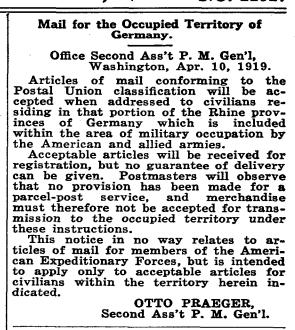
The April 11, 1919, Postal Bulletin (#11927) included an announcement dated the previous day resuming postal service “when addressed to civilians residing in the portion of the Rhine provinces of Germany which is included in the military occupation of American and allied armies” (see Figure 2). The notice explicitly included registered mail, but excluded parcel post. Exactly which areas were included was not stated.
Two weeks later (April 23, 1919; #11937), a follow-up item in the Postal Bulletin clarified: “information can not be furnished as to all the territory occupied, it being known, however, that certain places are occupied by the troops from the United States and Great Britain …” A Figure 2. Postal Bulletin April 11, 1919 (#11927).
list of locations, few with large populations, followed. Notably absent was any list of places occupied by the Belgians and the French. Yet another follow-up item in the Postal Bulletin, a few days later (April 29, 1919; #11942), added lists of places occupied by the Belgians and French. In general, the New York Times covered mail and transportation issues closely. Nevertheless, I can find no reference to this partial resumption of mail service to Germany.
Three months later (July 17, 1919), the Postal Bulletin (#12007) printed Order No. 3327 (of two days earlier): “effective at once, it is ordered that mail originating in the United States or its possessions destined for Germany shall be accepted …” (see Figure 3).3 That order revoked Order No. 211 of April 7, 1917, that had suspended postal relations with Germany. Evidently, this order included parcel post.
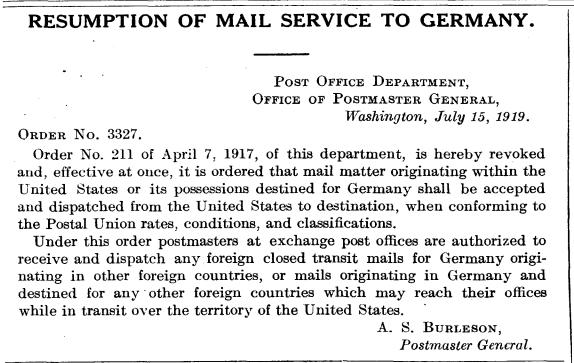
Figure 3. Postal Bulletin July 17, 1919 (#12007).
While this statement was not published in the Postal Bulletin until July 17, the July 16 New York Times carried a news item—dated the previous day—with the news. Evidently, the news traveled slowly. The July 19, 1919, New York Times carried a story dated the previous day with the comment: “Up to last night, forty-eight hours after the order was issued that mails would be carried to Germany, very few letters and parcel packages bearing addresses east of the Rhine [i.e., not included in the orders of April 1919; jak] had been received by the New York Post Office.” Finally, a July 20, 1919, New York Times story reported considerable challenges and delays in reestablishing train and mail service in Germany, concluding: “Even after ratification of the treaty, it will probably be a long time before speedy communication [rail and mail; jak] can be arranged with Germany, because of the general disorganization.”
The July 21, 1919 (New York) Evening World (“First Uncensored Mail for Germany is Loaded,” p. 3; see Lowther 2024) states that the first uncensored mail to Germany would be carried on the Scandinavian America Line United States leaving New York on July 22, 1919, for Copenhagen, Denmark (presumably, mail to be forwarded from there to Germany by rail). By noon July 21, there were 44 sacks of letters, 55 sacks of
newspapers, and 5,000 pieces of registered mail. Another ship, sailing July 23, took more than 150 sacks of parcel post.
3. Philatelic Evidence for Resumption of Mail to “Occupied Territory”
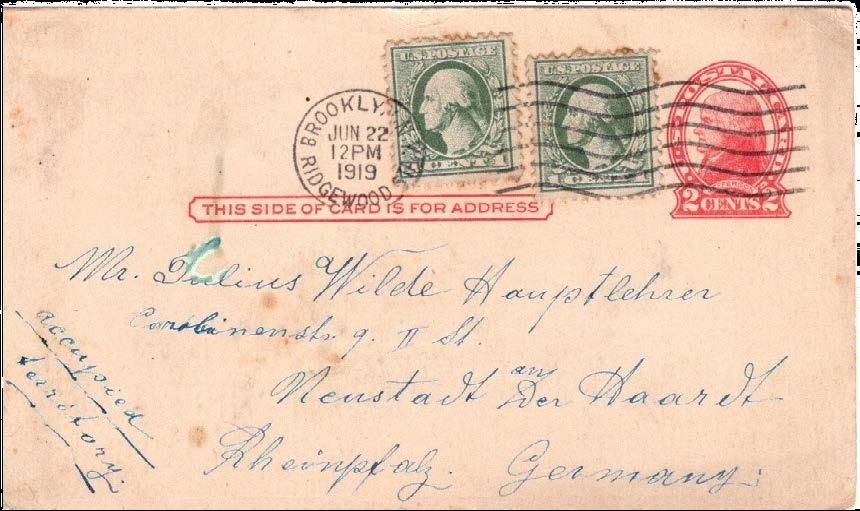
This section shows two covers mailed between the resumption of mail to occupied Germany and the resumption of mail to all of Germany; that is, during the slightly more than three months between April 11, 1919, and July 15, 1919. Figure 4 shows a Jefferson (2¢, international rate) postal card.4 The postal card is postmarked Ridgewood Station of Brooklyn, New York, to Mr. Julius Wiele, Hauptlehrer (head teacher or senior schoolteacher), and Comb. Landsch. g. II Kl. The last line appears to indicate membership in a German reserve unit (Landsturm), likely home-defense.
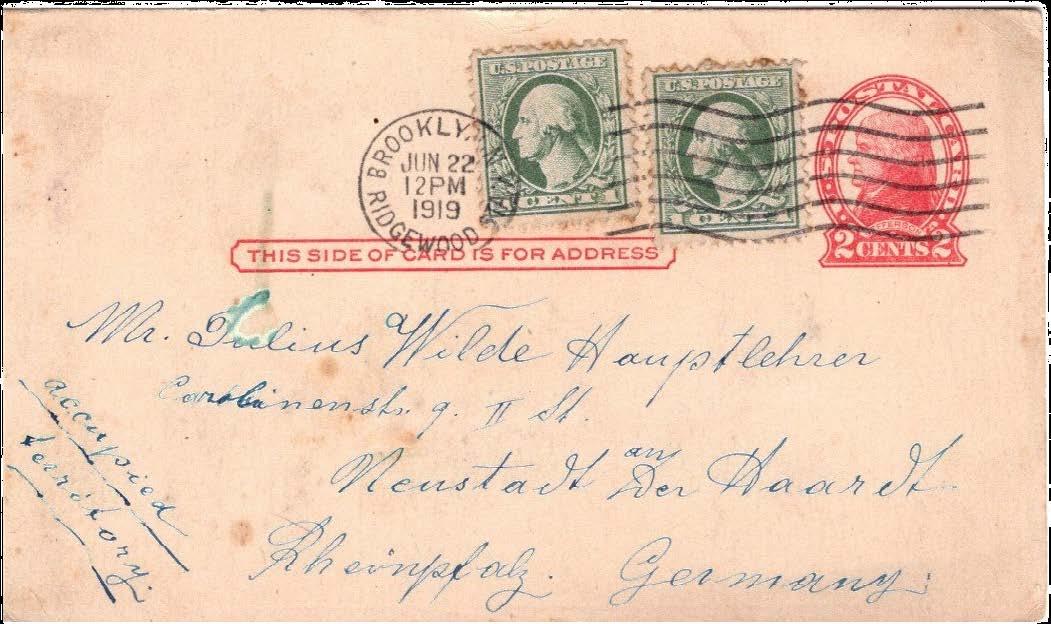
Figure 4. Brooklyn, New York, to Neustadt an der Haardt (French Occupied Germany), June 22, 1919 (see “occupied territory” annotation at the lower left).
The card is addressed Neustadt an der Haardt (today, Neustadt an der Weinstraße), Rheinpfalz, Germany, and postmarked June 22, 1919. Crucially, Neustadt an der Haardt is to the west of the Rhine, in the French Occupation Zone. Finally, note the text at the bottom left: “occupied territory.” I infer that the sender knew the rules and wanted to emphasize that, while there was no mail service to most of Germany, there was mail service to this town.
Figure 5 shows a 3¢ Washington circle entire, uprated with a 10¢ Franklin, and a “ 2 CENT 2” Washington, paying the UPU registered rate. The cover has a conventional post-1911 Type 1 registered handstamp in purple. The letter was mailed July 11, 1919, from Monson, Massachusetts (about 80 miles west of Boston), with conventional Monson double oval mute cancels. It passed through the New York registry (two double oval handstamps on back; both dates unreadable), to Höchst am Main, Germany. The reverse has a German August 7, 1919, received mark. The ocean voyage should have taken well under two weeks, so—consistent with the New York Times story—there were considerable delays somewhere (perhaps in the next sailing to Europe, perhaps in occupied Germany).
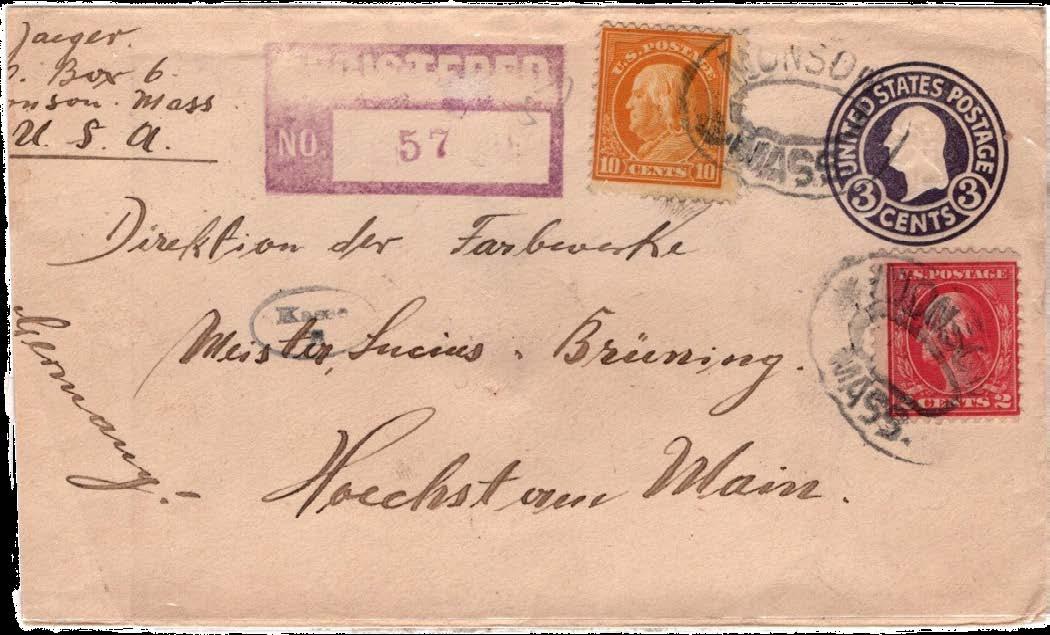
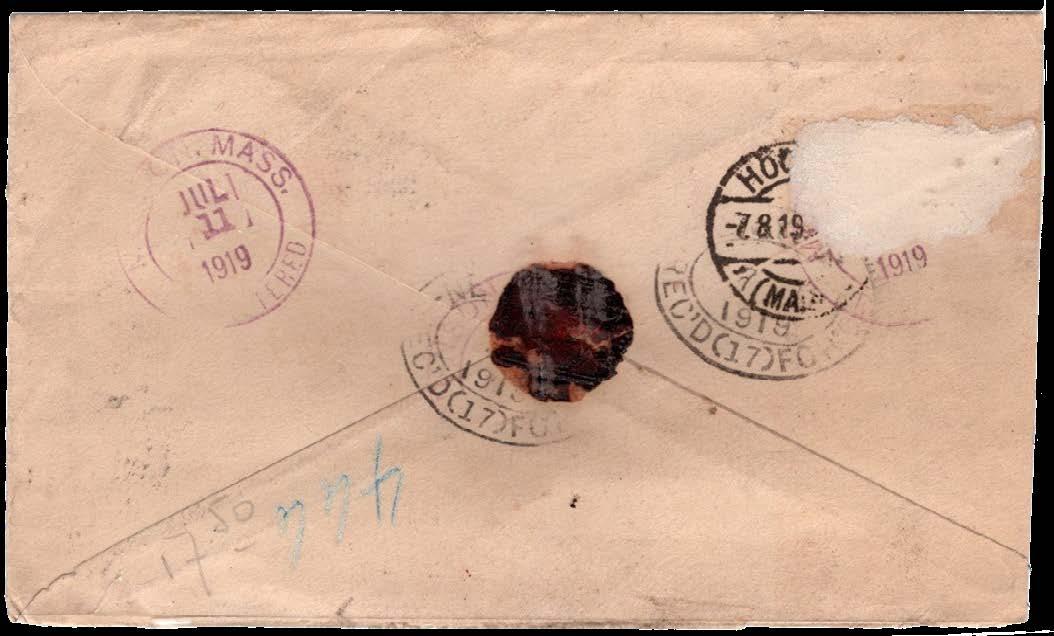
Höchst am Main is on the western outskirts of Frankfurt (see Figure 1, towards the lower right). This is on the east side of the Rhine, but in the “Mainz bridgehead,” included in the French Occupation Zone.
Finally, note that there is no evidence of censorship—not British, nor French, nor American. This seems inconsistent with the language of the Evening World, that the first uncensored mail went out July 22.
4. Philatelic Evidence for Full Resumption of Mail Service
This section shows three covers mailed shortly after the resumption of mail service to the balance of Germany on July 15, 1919. Figure 6 shows a 1¢ entire mailed from City Hall Station, New York to Erfurt, Germany, with “Germany” inserted using a handstamp at 6 pm July 15, 1919. Note that the addressee is a business “Herren Haage & Schmidt.” The 1¢ entire paid the UPU printed matter rate. The reverse of the cover has a return address “C. Regenhardt’s Agency, 21 Park Row, New York.”
This letter was mailed late on the day of the USPOD announcement of resumption of service to all of Germany. I infer that the envelope contained some sort of printed
Figure 5. Monson, Massachusetts, to Höchst am Main (French Occupied Germany), July 11, 1919.
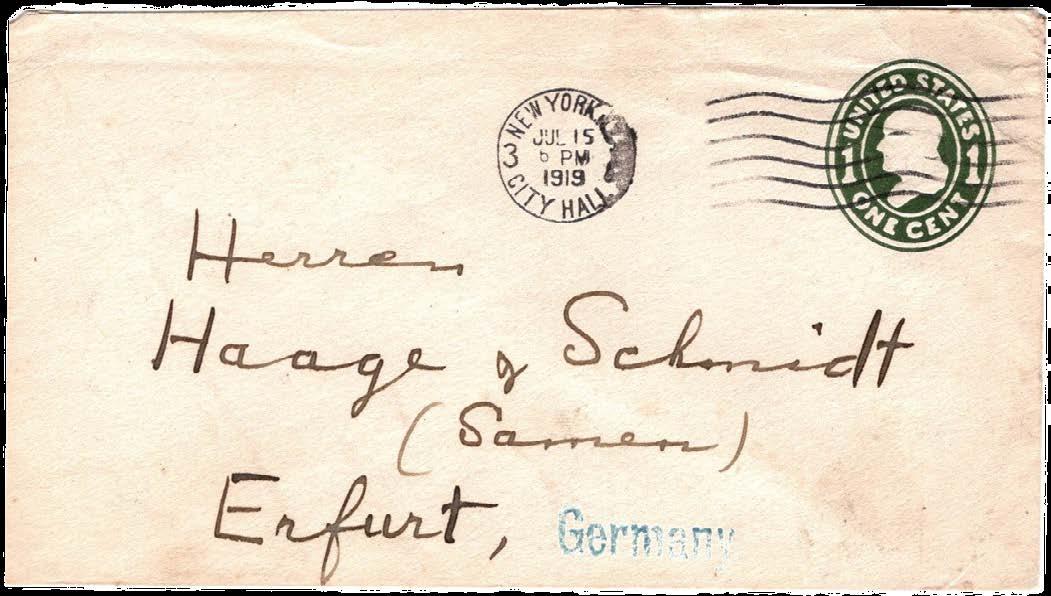
advertisement trying to sell goods in Germany. Erfurt is not in the Occupied Zone. Instead, correctly, suspecting that resumption of mail service was imminent, the sender had appropriate circulars printed and stuffed. He then monitored USPOD statements closely—to get a jump on business.
Figure 7 shows a letter from Hudson Terminal Station, New York, to Reichenbach, Germany, postmarked July 17, 1919. Consistent with the news story in the Evening World, the letter has a directive “PSS. ‘UNITED STATES.’” Note, however, that as of July 17, there were multiple earlier sailings through Allied countries; i.e., Great Britain and France.
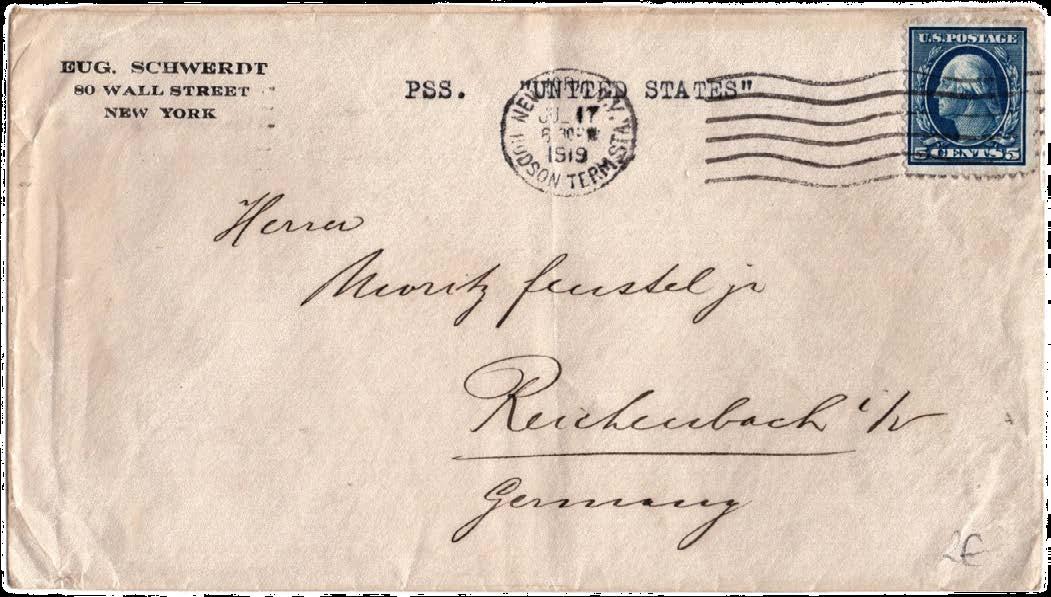
Hudson Terminal Station, New York, to Reichenbach, Saxony, Germany, July 17, 1919, with directive for Scandinavian America Line steamer SS United States.
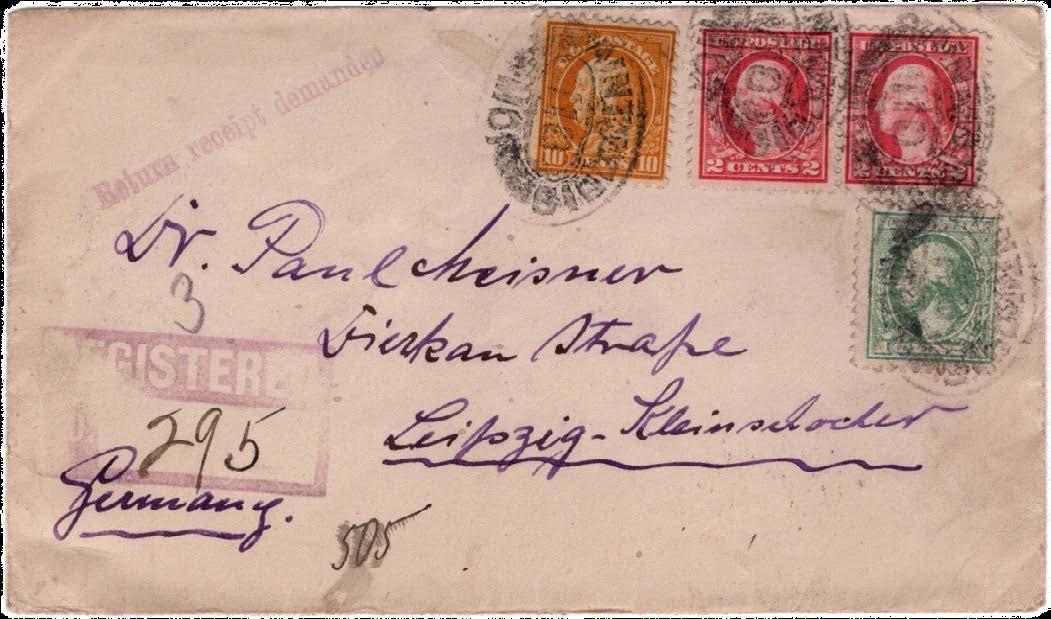
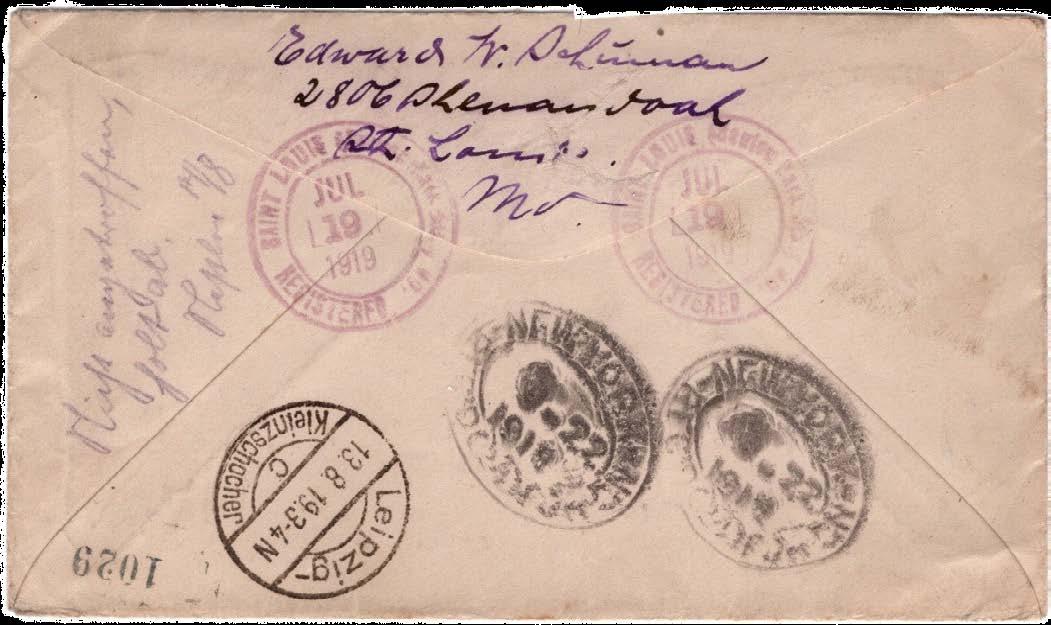
Figure 8 displays a registered cover from Center Park Station, St. Louis, Missouri, to Leipzig, Germany, mailed July 19, 1919. It passed through the New York Foreign Mail office July 22, 1919, and arrived in Leipzig August 13. Leipzig was not in the Occupied
Figure 6. City Hall Station, New York, New York, to Erfurt, Germany, July 15, 1919.
Figure 7.
Zone. This is a long transit time of nearly four weeks. Franking of 15¢—10¢ Franklin, two “2 CENTS 2” Washington, and a “1 CENT 1” Washington—is appropriate for a UPU registered single. Finally, the envelope has a post-1911 Type 1 registered handstamp in magenta and a “Return receipt demanded” handstamp also in magenta.
I own several other items from late July 1919. None of them shows any evidence of censoring.
5. Discussion
With limited exceptions, US mail to Germany, de facto, ended in late-January 1917. This article has reviewed USPOD announcements, newspaper stories, and philatelic evidence of a two-phase resumption of mail service to Germany: to areas occupied by the victorious Allies. I am building a census of covers to Germany from the suspension of
Figure 8. Center Park Station, St. Louis, Missouri, to Leipzig, Germany, July 19, 1919.
mail service in late-January 1917 through the first month of resumed service in mid-August 1919. Those with relevant covers or other insights are urged to contact me.
Acknowledgments: Kevin Lowther, Mike Ludeman, and Graham Mark provided useful comments. ChatGPT helped with deciphering some of the addresses and translating some of the text.
Endnotes
1. Appendix 4 (“Suspended and Interrupted Mail Service”; pp. 390ff) of Wawrukiewicz and Beecher (1996) lists “Resume registered and ordinary mail service to occupied Germany” (emphasis added), but does not list the restoration of service to all of Germany. Conversely, Lowther (2024) discusses the restoration of mail service to all of Germany, but does not mention the earlier resumption of mail service to the Occupied Zones.
2. Vincent (1985) discusses the blockade, its continuation after the Armistice, how it came to an end, and its effects.
3. An apparently identical notice appeared the next day (July 18, 1919, #12008). I cannot explain the duplication. Perhaps the Order was considered to be so important that it was run again.
4. The postal card is uprated with two “1 CENT 1” stamps. I cannot explain why. One explanation would be that the extra stamps pay the supplementary mail fee. There are two arguments against that. First, the fee is usually—but not always—paid at dockside (see Piszkiewicz, 2007), but Ridgewood Station, Brooklyn, NY is not dockside. Second, my review of the New York Times Sailing and Mails column for Saturday June 21 and Sunday June 22 does not identify a sailing for which supplementary mail might have been appropriate.
References
1. Jacob Alex Klerman, “World War I Suspension of Mail to Germany,” The United States Specialist, no. 1056 (2018): 69–74.
2. Jacob Alex Klerman, “A First World War Triply Censored Cover from the US to Germany, after the US Suspended Mail Service,” CCSG Bulletin 52, no. 1 (January 2025): 4–8.
3. Jacob Alex Klerman, “World War I Suspension of Mail to Germany: An Update,” The United States Specialist, no. 1141 (2025): 113–119.
4. Kevin Lowther, “Tracking Post-War I Mail to Germany: USPOD Had Little Guidance for Postmasters,” American Stamp Collector and Dealer (March 2024).
5. Shane D. Makowicki and Brian F. Neumann, The U.S. Army Campaigns of World War I: Occupation and Demobilization, 1918–1923 (Washington, DC: Center of Military History, United States Army, 2019), PDF, archived from the original January 25, 2022, accessed January 5, 2026.
6. G. Mark, British Censorship of Civil Mails during World War I, 1914–1919 (Stuart Rossiter Trust Fund, 2000).
7. Leonard Piszkiewicz, “U.S. Supplementary Mail—Part II: Anonymous Supplementary
Mail,” The United States Specialist, no. 926 (2007): 174–183.
8. C. P. Vincent, The Politics of Hunger: Allied Blockade of Germany, 1915–1919 (Athens, OH: Ohio University Press, 1985).
9. A. Wawrukiewicz and H. W. Beecher, U.S. International Postal Rates, 1872–1996 (Portland, OR: Cama Publishing Company, 1996).
10. Richard Winter, “Hot Springs, North Carolina—A World War I Internment Camp,” North Carolina Postal History Society Postal Historian 26, no. 4 (Winter 2008): 4–13.
If you collect Plate Blocks, Booklets, Coils, or Sheets, the above website, with hundreds of sets at Face Value, will be a great savings to you. Enjoy the hobby.

Armen Hovsepian (APS 150170)
P. O. Box 24222 Overland Park, KS 66283 info@USatFACE.com

From The Farley Era
Committee
by Paul M. Holland USSS #16849 | m pholland.thorleaf@gmail.com
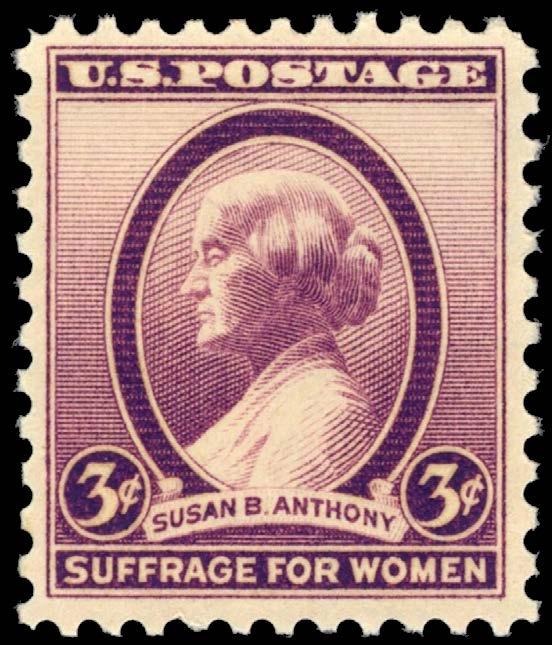
I take pleasure in sending you this letter bearing the special three-cent postage stamp issued as a memorial to Susan B. Anthony, in conjunction with the 16th anniversary of the ratification of the Women’s Suffrage Amendment to the Constitution of the United States.
There is depicted on the stamp the likeness of Susan B. Anthony, pioneer leader in the movement for equal rights for women.
This letter is being mailed through the Washington, D. C., post office, which was authorized to have the first day sale of the new stamp.
FDR, Farley, and the 1936 Susan B. Anthony Stamp ”
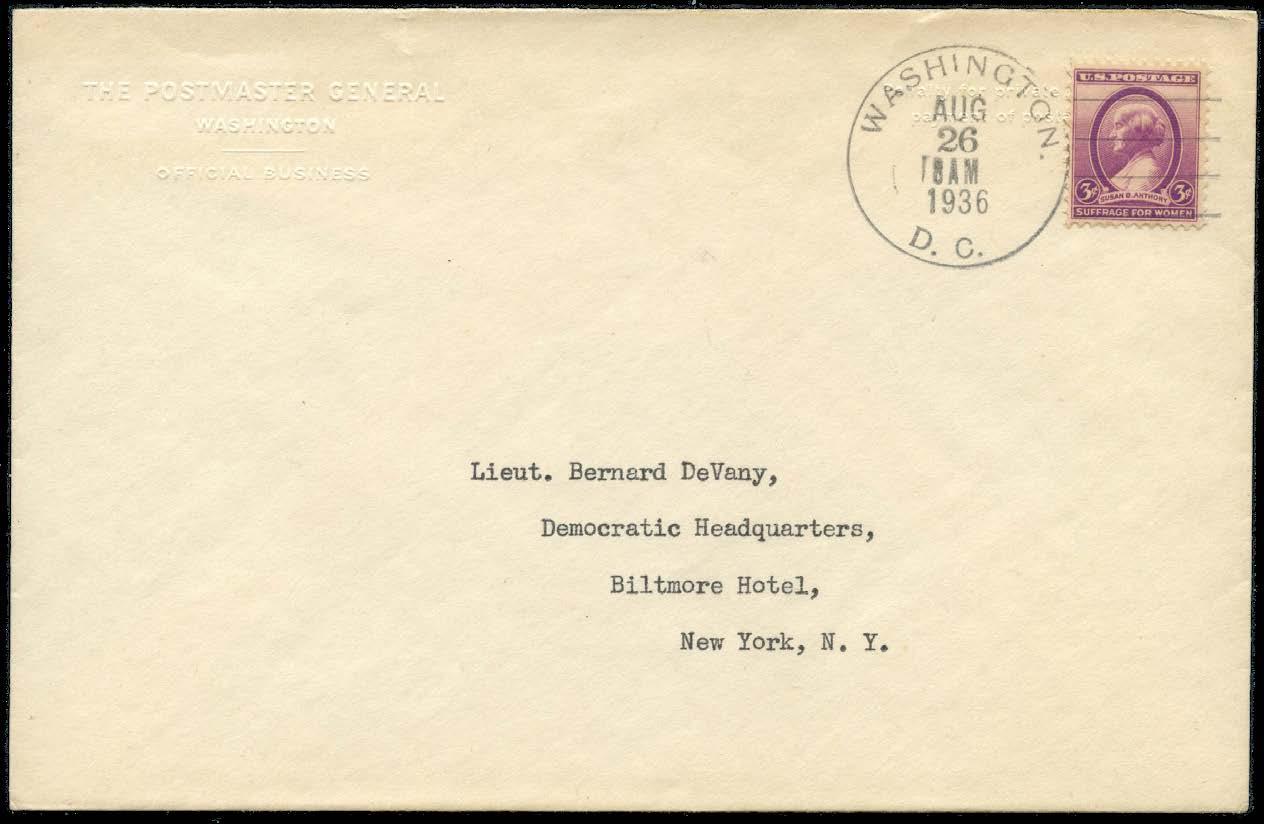
—From a signed August 26, 1936, letter with a Favor First Day Cover of the 3¢ Susan B. Anthony stamp sent to Lieutenant Bernard DeVany at the Democratic Headquarters, Biltmore Hotel in New York City by FDR’s Postmaster General James A. Farley. See Figure 6.
The issuance of a Susan B. Anthony postage stamp celebrating the 16th anniversary of women winning the right to vote with the Nineteenth Amendment to the Constitution seems to be a curious choice, with politics likely involved. For example, the traditional gift for a 16th wedding anniversary is wax (as in candles), and public commemorations seldom mark 16th anniversaries at all. When the Susan B. Anthony stamp was first announced, the philatelic press greeted the news with some skepticism. In humorous comments by George B. Sloane in August 1936 in Stamps magazine under the title “James Aloysius Courts Women,” Sloane writes, “Our Postmaster-General, ever on the alert, recognizes the value of the women’s goodwill, and with Presidential balloting nigh at hand, suddenly announces a stamp to honor the memory of Susan B. Anthony, the pioneer woman suffragette and advocate of Equal Rights. ‘Thar’s votes in them thar wimmin,’ reasons Cavalier Shamus O’Farley, with innate shrewdness…”1 There was certainly some measure of truth in this, since besides serving as FDR’s Postmaster General from 1933 to 1940, Farley remained Chairman of the Democratic National Committee (DNC) and managed FDR’s 1936 re-election campaign.
Nonetheless, there had also been an ongoing campaign for such a stamp by various women’s groups. Near the end of January 1935, a delegation from the National Women’s Party asked Postmaster General (PMG) James Aloysius Farley for a postage stamp honoring Susan B. Anthony, although they received little encouragement.2 Furthermore, the Susan B. Anthony Memorial Committee of New Jersey had long been advocating for such a stamp. Finally, it’s been reported that in 1936 a contingent of women met with Third Assistant PMG Eilenberger, suggesting that the bust of Susan B. Anthony by Adelaide Johnson, a close friend of Anthony’s, be used for the stamp, with one member virtually demanding it. It is said that when the matter was placed before President Franklin D. Roosevelt (FDR), he exclaimed: “By all means authorize the stamp immediately before those ardent ladies reach the White House.”3
In any case, work on a Susan B. Anthony stamp began at the Bureau of Engraving and Printing (BEP) based on a photograph of the marble bust sculpted by Adelaide Johnson, who was a feminist and the artist known as the “sculptress of the Woman’s Rights Movement.” A close-up of this original bust, now at the Smithsonian, is shown in Figure 1.

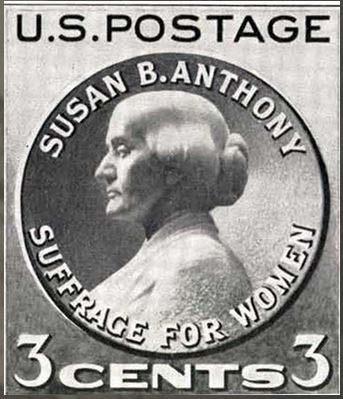
From a left-facing photograph of the bust, two designs for the Susan B. Anthony stamp were prepared and submitted to the Post Office Department (POD) for approval. The rejected design is shown in Figure 2.
Figure 1. Marble bust of Susan B. Anthony by Adelaide Johnson (Smithsonian National Museum of American History).
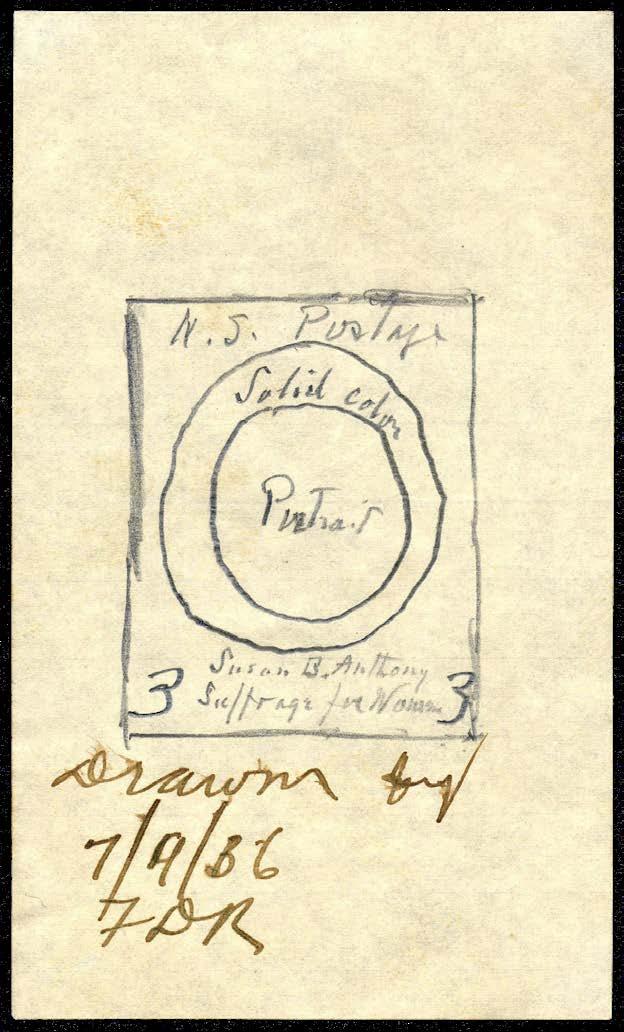
While the other submitted design closely resembled the final version of the stamp, FDR reviewed it in early July and sketched out a few changes. In particular, FDR wanted a bold, solid color surrounding the portrait to set it off. FDR’s original pencil sketch is shown in Figure 3. Note that he then signed it in ink with the notation “Drawn by FDR 7/9/36.”4
On July 30, the final design by Victor S. McCloskey, Jr., was formally approved by President Roosevelt. Carl T. Arlt engraved the vignette, and E. M. Hall the frame and lettering.2 A small die proof is shown in Figure 4.
Regarding plate layout, due to previous complaints by some stamp collectors that a 2 millimeter (mm) spacing between the stamp frame line and plate number sometimes resulted in perforations passing through plate numbers, thereby “spoiling plate blocks,” beginning with the Susan B. Anthony stamps, the spacing of plate numbers from stamp frame lines was increased to 4 mm. This is shown by the plate proof in Figure 5, with close-ups comparing the 4 mm spacing on Susan B. Anthony stamps with the 2 mm spacing on the preceding Oregon Territory stamps. A total of four printing plates (21588–21591)
Figure 2. Rejected design of the Susan B. Anthony stamp.
Figure 3. FDR’s signed sketch for the Susan B. Anthony stamp (Smithsonian National Postal Museum).
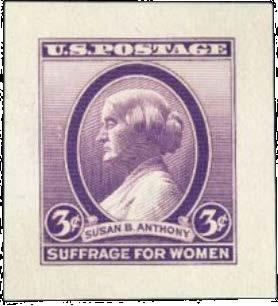
Figure 4. Small die proof of Susan B. Anthony stamp.
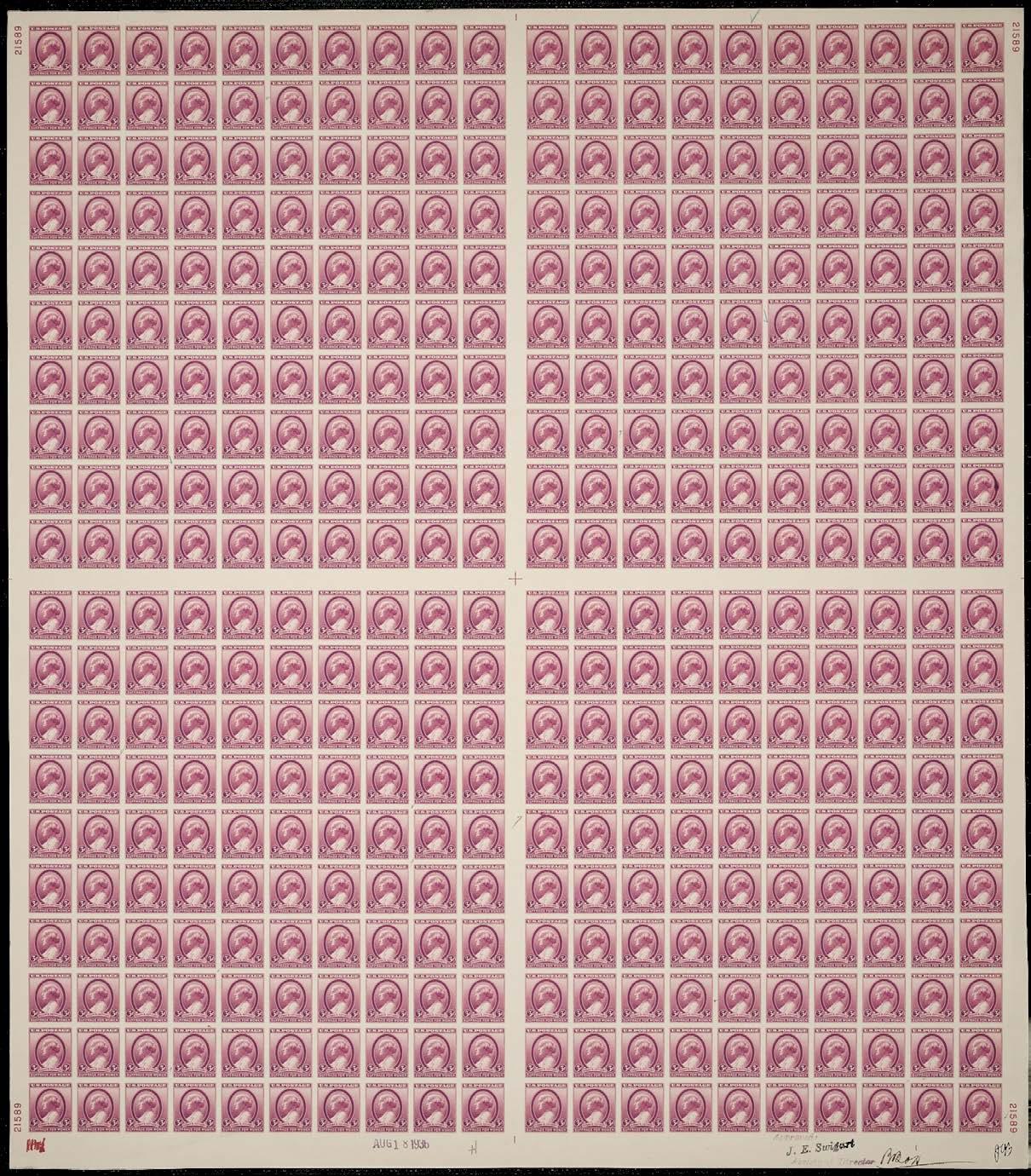
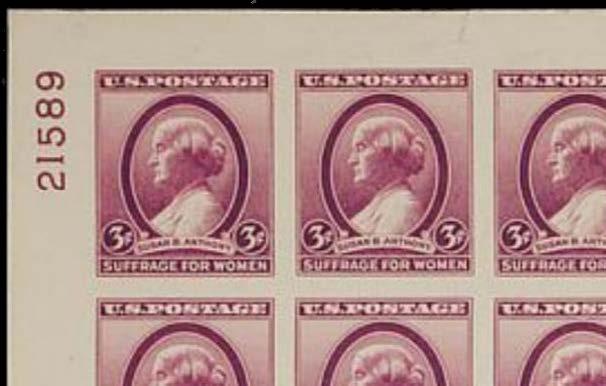
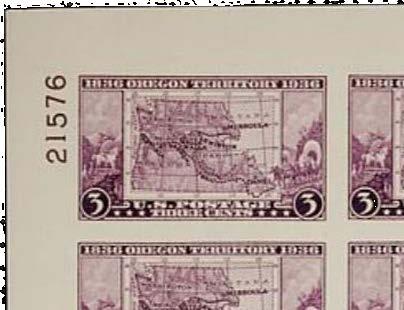
Figure 5. Plate proof of Susan B. Anthony stamp with close-ups showing change in plate number spacing from stamp (Smithsonian National Postal Museum).
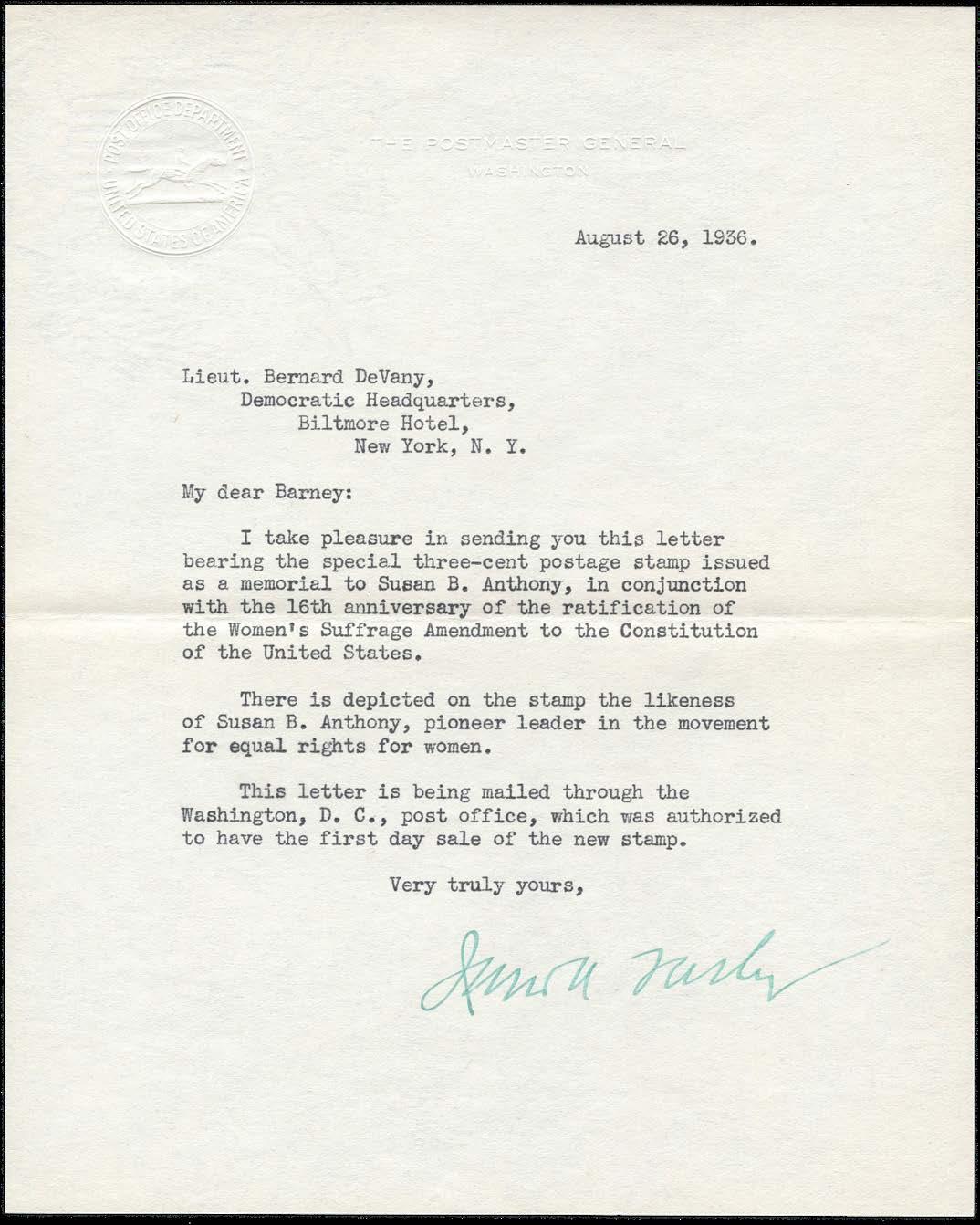
Figure 6. Favor FDC with letter for the Susan B. Anthony stamp sent to Democratic Headquarters by PMG Farley.
were prepared for the Susan B. Anthony stamp, with the first certified on August 18, 1936.5 Rotary press printing began the same day, although a ceremonial “initial printing” was later held on August 20.1
On the first day the stamp was issued, August 26, 1936, an elaborate ceremony was held at the BEP, with Third Assistant Postmaster General Clinton B. Eilenberger turning over a full pane of the Susan B. Anthony stamps to Mrs. Florence Hilles, President of the National Women’s Party. Among the guests present were Adelaide Johnson, the artist whose bust of Susan B. Anthony was used for the stamp, along with representatives of numerous women’s organizations. Government officials included Alvin W. Hall, Director of the BEP, and Deputy Third Assistant Postmaster General Roy North of the POD.1
Postmaster General James A. Farley also sent out favor first day covers with signed letters for the Susan B. Anthony stamp. In keeping with a political theme, I’ll show my example sent by Farley to Lieutenant Bernard DeVany at the national Democratic Headquarters in New York City in Figure 6. Note that the accompanying letter has the salutation “My dear Barney” and is signed James A. Farley in his trademark green ink. I also have similar favor FDCs with signed letters for the Susan B. Anthony stamp in my collection, sent to Dennis Cardinal Dougherty and Master Eddie White (not shown here).
Interestingly, Republican Congressman Charles D. Millard of New York also employed first day covers using the Susan B. Anthony stamp, in this case to renew his attacks on James A. Farley over the brouhaha that came to be known as “Farley’s Follies.” I
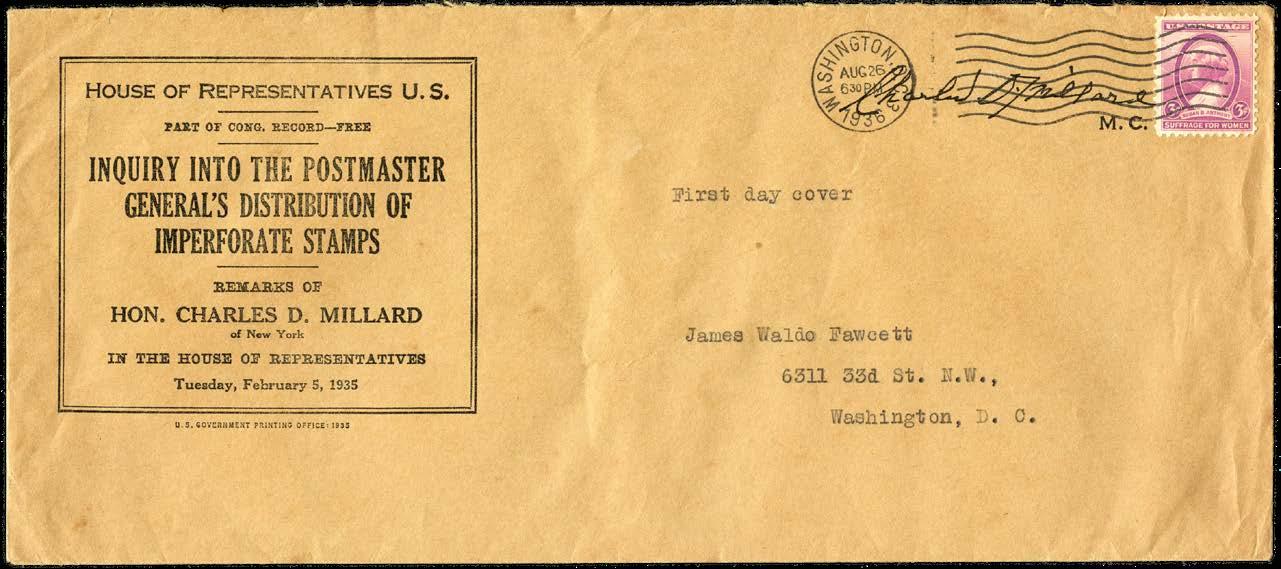
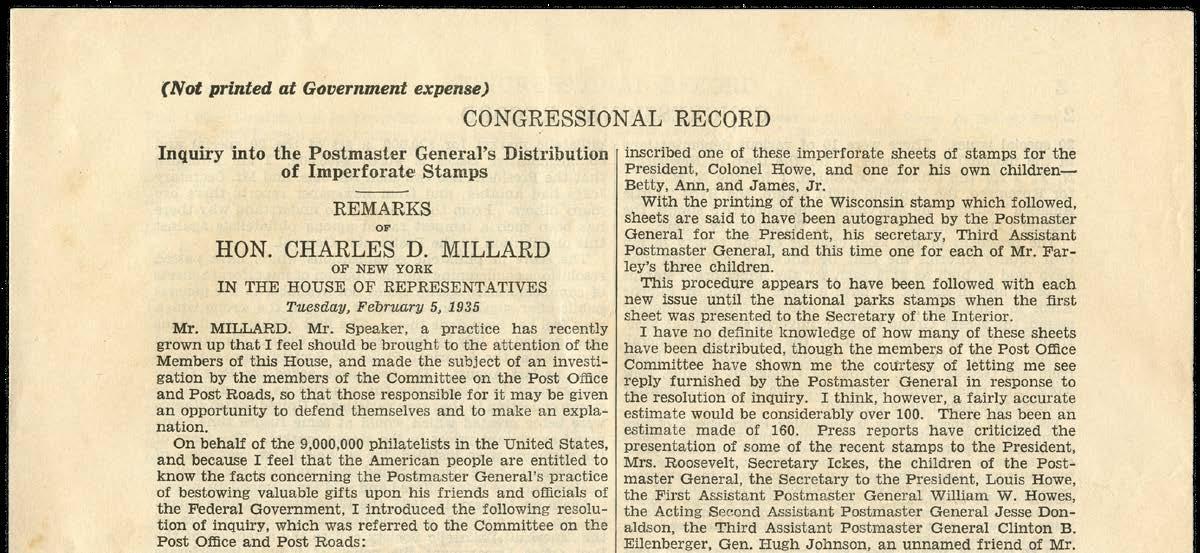
Figure 7. Congressman Millard’s FDC for the Susan B. Anthony stamp on official stationery.
have two examples of these FDCs, one of which is shown in Figure 7. They are on Millard’s official Congressional stationery from the House of Representatives, with the stamp pasted over his Congressional free frank signature. Millard’s reason for sending out this FDC is revealed by the cover’s printed cachet, showing that it’s related to an “Inquiry into the Postmaster General’s Distribution of Imperforate Stamps.” This refers to Farley’s purchase of some full uncut sheets of stamps when they first came off the press for distribution to a favored few, including FDR .
Instead of a letter, a four-page printed enclosure was included inside Millard’s FDC, the top portion of which is shown in Figure 7. This reproduces remarks by Rep. Millard about the scandal from February 5, 1935, as published in the Congressional Record. Note the curious timing of Millard’s FDC, more than a year and a half after his Congressional remarks; this date seems to match up much better with the beginning of Millard’s own 1936 re-election campaign.
In the face of these political attacks, Farley seemed unperturbed. After all, in response to the criticism, he had promptly arranged for special printings of full uncut sheets of the stamps in question to be made available to collectors at face value beginning March 15, 1935—so this was no longer a current political issue. In his memoir, Farley cheerfully acknowledges his earlier mistake (he was not a stamp collector) and notes that the special-issue stamps, few of which were ever used for postage, brought in nearly 1.5 million dollars in extra income to the Post Office. These stamps remain favorites among collectors today.
Regarding the 1936 election, Farley was campaign manager for FDR’s 1936 re-election effort. A master politician, he ultimately presided over FDR’s great landslide victory over Alf Landon, who carried only two states, leading Farley to coin the phrase “as goes Maine, so goes Vermont,” parodying the earlier aphorism that in presidential politics “as goes Maine, so goes the Nation.” As for Millard, he did win re-election to his House of Representatives seat, but resigned less than a year later to accept a judicial position
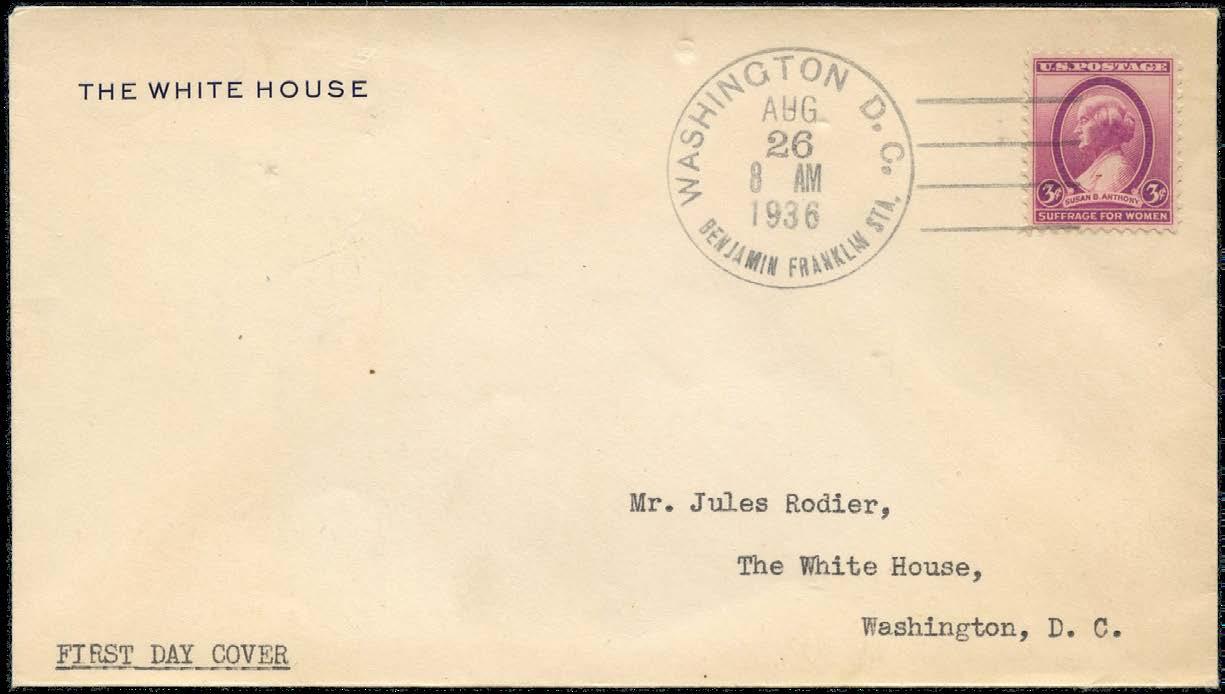
Figure 8. FDC of Susan B. Anthony stamp sent to Jules Rodier on White House stationery.
as Surrogate of Westchester County, New York. Perhaps Millard found that serving as a Republican in a House where the Democrats now held more than 75 percent of the seats was not so appealing after all.
FDCs of the Susan B. Anthony stamp on official White House stationery also exist. Shown in Figure 8 is my example sent to Jules Rodier, a white-haired telegraph operator who had been in the White House since the days of William McKinley. FDR must have liked him, since in 1941 he issued Executive Order 8903 titled “Exemption of Jules A. Rodier From Compulsory Retirement for Age.”
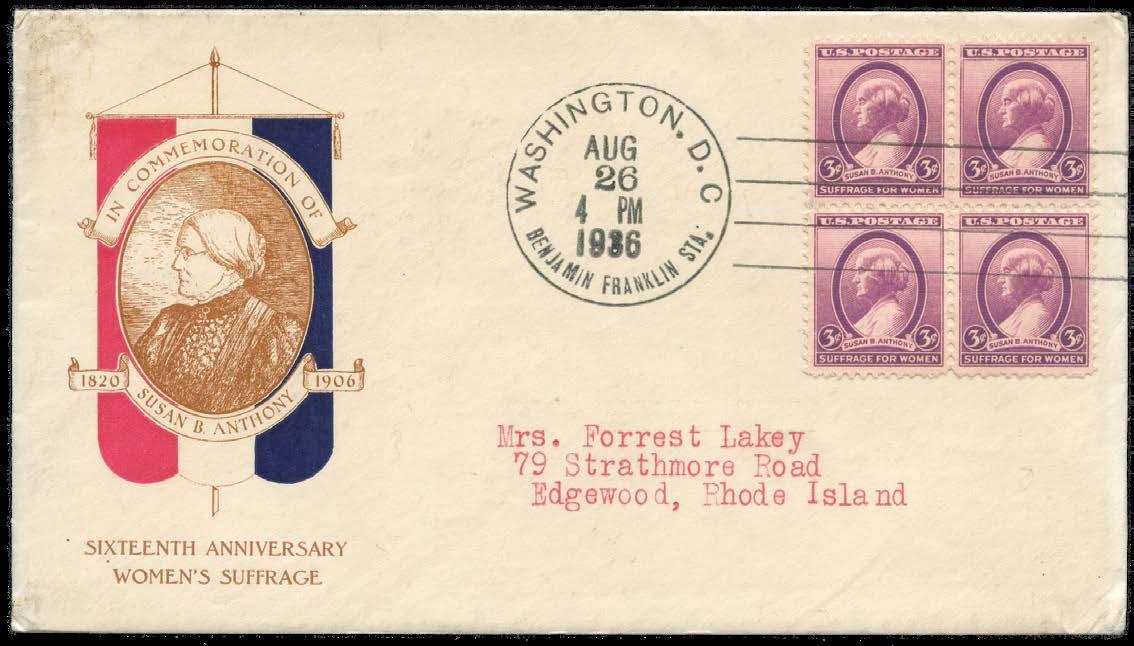
Unsurprisingly, cacheted FDCs for the Susan B. Anthony stamp were also produced for collectors. In Figure 9, I show my example with a three-color printed Plimpton cachet (Mellone 784-19) franked with a block of four.
Finally, in Figure 10, I show the use of the Susan B. Anthony stamp on a Trial Flight airmail cover sent to FDR from Stillwater, Oklahoma, on March 12, 1938. Clearly, this was a practice flight in preparation for National Air Mail Week (NAMW) held two months later from May 15–21, 1938. Besides this example, I’m fortunate in having another, also sent to FDR on the same date but franked by a winged globe airmail stamp (not shown here). Note that the cachet, sponsored by the Stillwater Chamber of Commerce, touts Stillwater as the “Agricultural Capital of Oklahoma” and the “Home of Oklahoma A&M College” (now Oklahoma State University). Interestingly, this identical cachet was also employed during NAMW, as shown by the Drabyk listing below.6
While the 1936 release of this stamp during an important re-election year for President Roosevelt seemed designed especially to appeal to women voters, Susan B. Anthony, the suffragette and tireless worker for equal rights for women, certainly deserved to be acknowledged on a postage stamp. As demonstrated by his signed sketch in Figure 3, FDR himself took a personal interest in its success. Furthermore, FDR is noted for his support of women’s rights, including appointing the first woman ever to a
Figure 9. FDC for the Susan B. Anthony stamp with a three-color printed Plimpton cachet (Mellone 784-19).
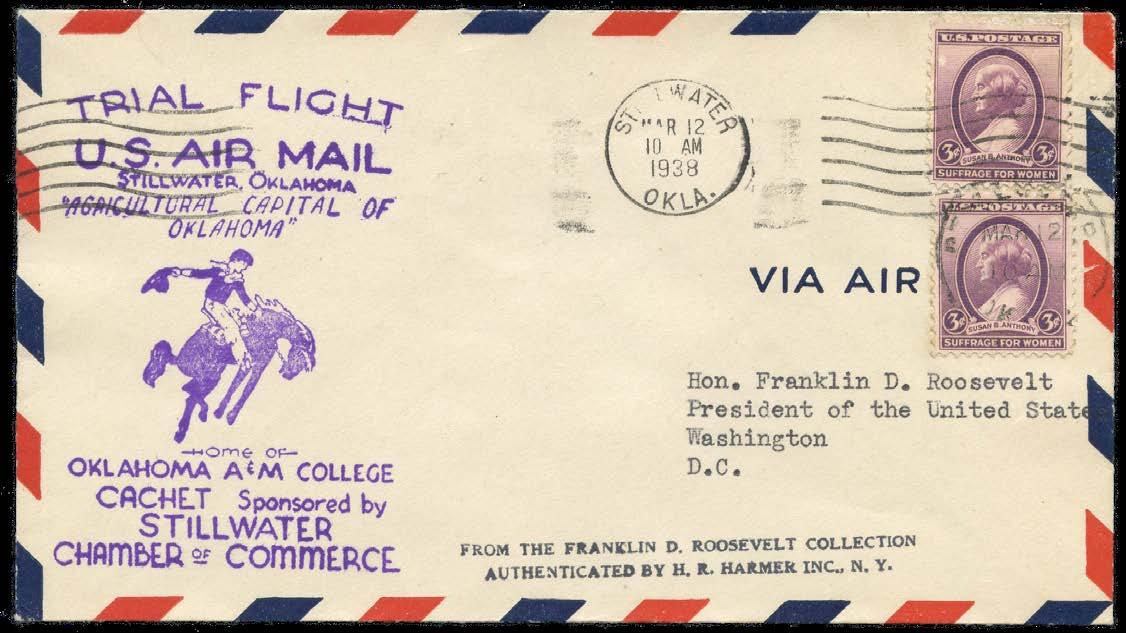
Figure 10. Trial Flight airmail cover franked with Susan B. Anthony stamps sent to FDR from Stillwater, Oklahoma, on March 12, 1938, with Drabyk NAMW listing below.
Presidential Cabinet, Frances Perkins, his Secretary of Labor. This was certainly not a “window-dressing” appointment, as Frances Perkins was one of FDR’s key advisors on New Deal legislation, especially Social Security, perhaps the most important New Deal program in our lives today.
References
1. Max G. Johl, The United States Postage Stamps of the Twentieth Century: Volume IV, 1933–1937 (New York: H. L. Lindquist, 1938), 211–16.
2. Max G. Johl, The United States Commemorative Postage Stamps of the Twentieth Century: Volume II, 1925–1947 (New York: H. L. Lindquist, 1947), 119–22.
3. Brian C. Baur, Franklin D. Roosevelt and the Stamps of the United States, 1933–45 (Sidney, OH: Linn’s Stamp News, 1993), 111–14.
4. Cheryl R. Ganz and Daniel Piazza with M. R. Sheahan, Delivering Hope: FDR & Stamps of the Great Depression (Washington, DC: Smithsonian National Postal Museum, 2009).
5. B.I.A. Plate Number Checklist: Plates 20000–41303, rev. ed. (United States Stamp Society, 1990).
6. (Piscataway, NJ: National Air
The U.S. Philatelic Classics Society is a not-for-profit collector organization exclusively devoted to 19th century United States stamps and postal history. Our quarterly Chronicle is widely recognized for presenting new scholarship and discoveries. For membership information and much more, find us at: www.uspcs.org.
by Rodney A. Juell USSS # 13852 | P.O. Box 3508, Joliet, IL 60434
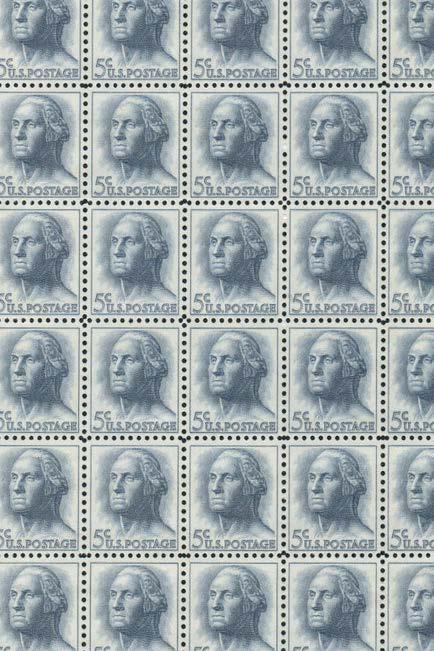
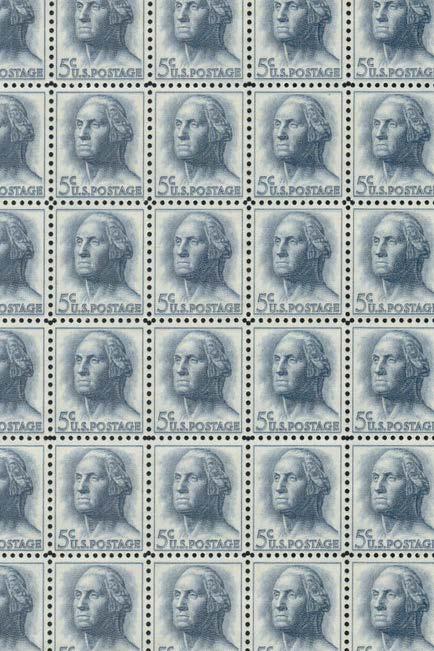
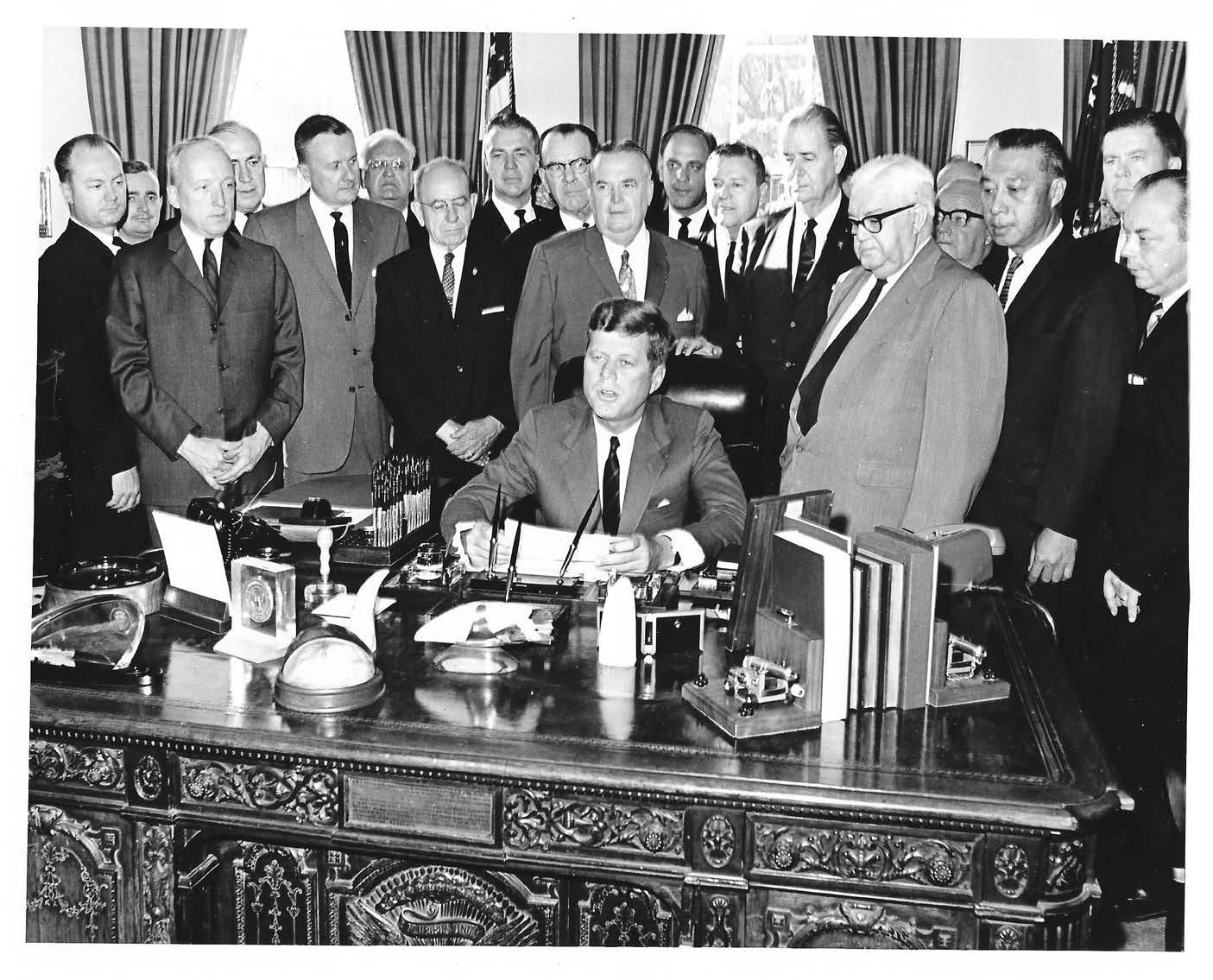
This month’s photo shows President John Kennedy in the Oval Office signing the postage rate bill of October 11, 1962. The legislation increased the cost of a firstclass letter from 4¢ to 5¢, effective January 7, 1963. Other rates were also increased, with a goal of raising money for improved postal salaries.
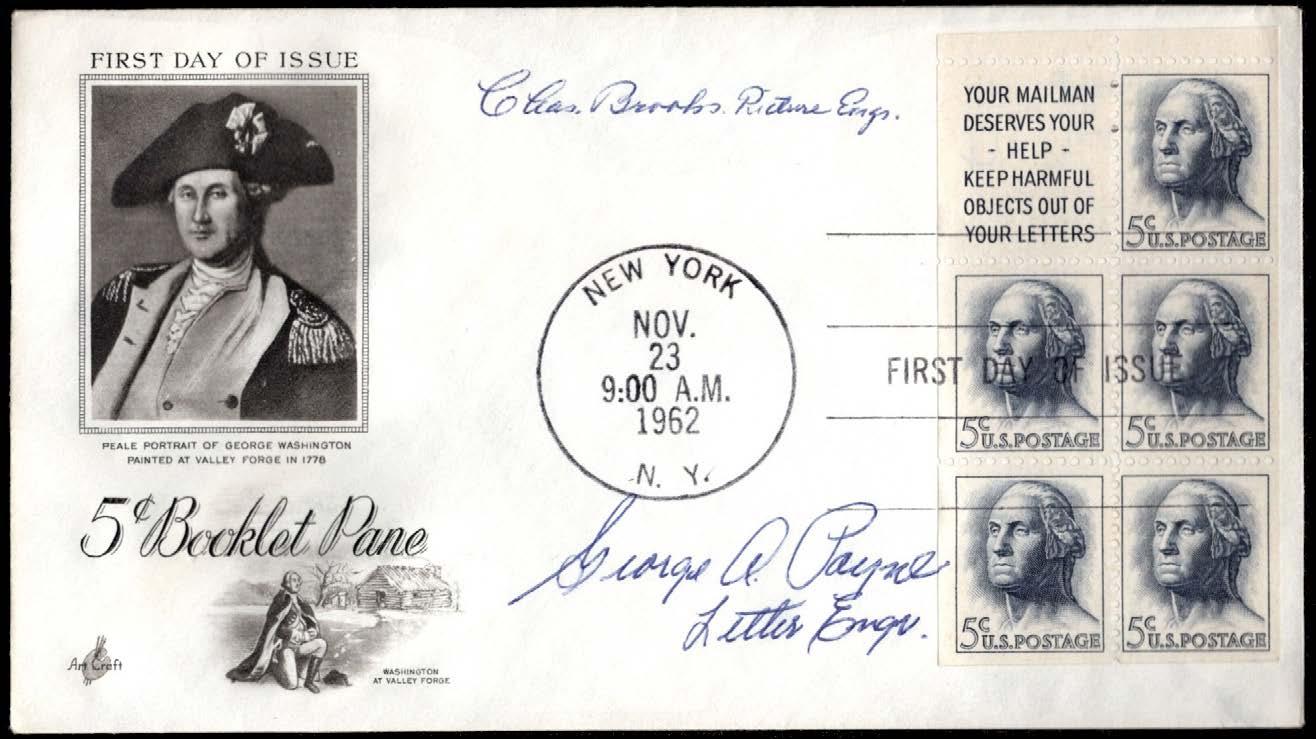
Shown nearby is a first day cover of the new definitive stamp booklet pane, issued on November 23, 1962 to meet the new rate. Note it is signed by the engravers of the stamp’s die.
Vintage Photo of the Month
KramerGrossMooz
Siegel offers unparalleled expertise, a worldwide client base, financial reliability, intelligent marketing, and the best internet resources of any philatelic auction house. Contact us today to learn more about consigning with Siegel and ensuring your legacy.

Phone (212) 753-6421
Email: stamps@siegelauctions.com
July 5 / July 6,
1932: Transition from the 2¢ to the 3¢ Domestic Letter Rate
by Stephen L. Suffet USSS #11381 | m ssuffet@nyc.rr.com
Among its many other provisions, the Revenue Act of 1932, passed by Congress on June 6 of that year and quickly signed into law by President Herbert Hoover, significantly increased personal and corporate income taxes, doubled the estate tax, and imposed a federal gift tax for the first time. In addition, the Revenue Act, also known as Public Law 72–154, placed excise taxes on a panoply of goods, ranging from chewing gum to furs and jewelry. It also increased many postage rates, including the basic domestic firstclass letter rate, which jumped 50 percent from 2¢ to 3¢ per ounce, effective July 6, 1932.1
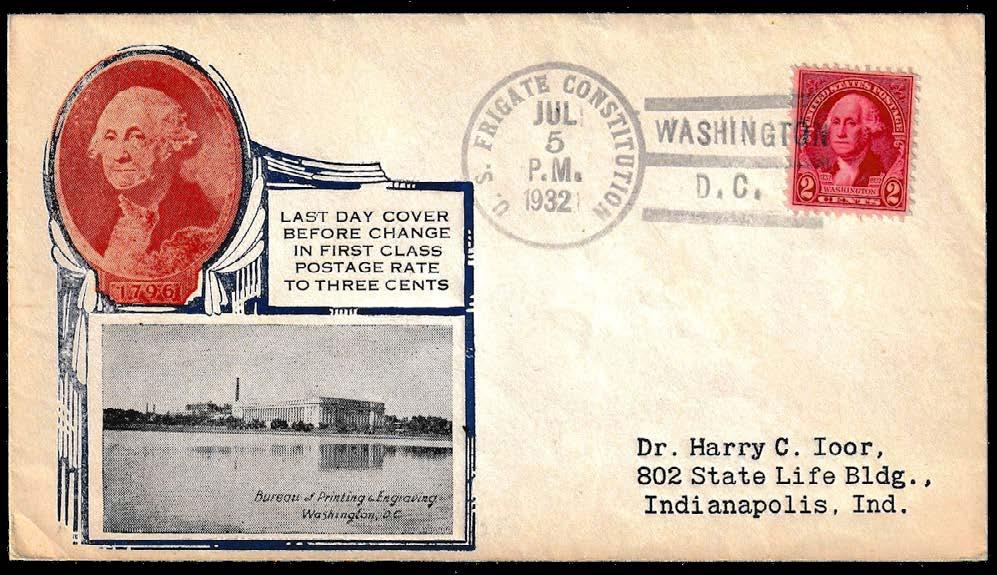
Figure 1. Last day of 2¢ rate on cover postmarked aboard the US Frigate Constitution. July 5, 1932.
The new 3¢ rate applied to non-local letters, as well as to local letters mailed at post offices that provided carrier delivery service. It did not, however, extend to local letters that were addressed for pickup at a post office that did not have any carrier service whatsoever. The rate for such so-called non-carrier office drop letters would remain 1¢ per ounce.
Experienced collectors of twentieth-century United States postal history know that there is no shortage of covers that document the 1932 rate change. Covers showing the last day of the 2¢ rate or the first day of the 3¢ rate are easy enough to find, even after more than nine decades. As I write, several such covers are being offered on eBay at “Buy It Now” prices ranging from $3.00 to $29.99. The latter is for a dual-franked cover that shows both the last day and the first day rates.
Here are three covers from my own collection that I find particularly noteworthy.
Figure 1 pictures a cover with a Washington Bicentennial stamp paying the 2¢ rate on July 5, 1932. It is addressed to Dr. Harry C. Ioor, the cachet maker who designed and published the cachet on the cover. Aside from the Ioor cachet, what makes the cover especially interesting to me is that it was postmarked aboard the United States Frigate Constitution, the wooden-hulled, three-masted sailing vessel that was then and now the oldest commissioned ship of the US Navy. At the time, the Constitution was docked in Washington, D.C., while on a three-year tour that brought it to more than 70 ports along the Atlantic, Gulf, and Pacific coasts. Since 1934, “Old Ironsides,” as she is affectionately called, has been home-ported at the Charlestown Navy Yard in Boston, Massachusetts.2
Figure 2 shows a 2¢ Washington Bicentennial stamped envelope used on July 6, 1932, with half of a bisected 2¢ Washington Bicentennial stamp affixed in an attempt to make up the new 3¢ letter rate. Since mutilated stamps are not valid for postage, the cover was rated and charged 1¢ postage due.
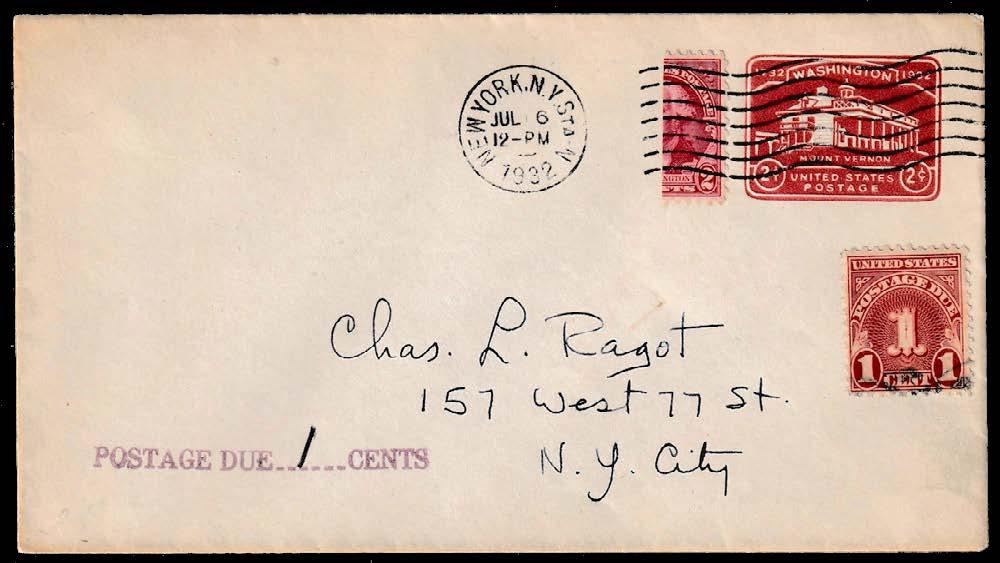
Figure 2. Unsuccessful attempt to use half of a 2¢ stamp to pay the 1¢ increase on the first day of the 3¢ rate. July 6, 1932.
The cover shown in Figure 3 was used from Balboa Heights in the Panama Canal Zone to Washington, D.C., on the first day of the 3¢ rate, with a stamp of the Fourth Bureau Issue overprinted “CANAL ZONE” paying the postage. Although it had its own
postal administration that issued its own stamps and postal stationery, ordinary mail between the Canal Zone and the United States proper, or between the Canal Zone and other US possessions, was subject to domestic rates of postage since its founding in 1904. 3 The rate increase of July 6, 1932, thus applied to the Canal Zone.
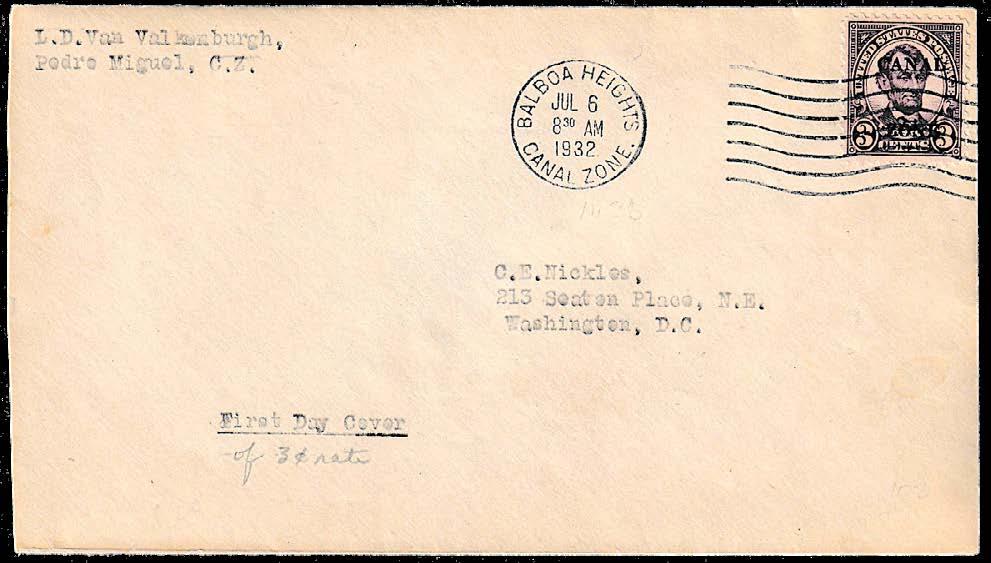
Figure 3. First day of 3¢ rate, used from the Canal Zone. July 6, 1932. A Fourth Bureau Issue stamp overprinted “CANAL ZONE” paid the postage.
Please note that the cover is addressed to pioneer first day cover servicer C. E. Nickles, and I suspect that he arranged for a contact in the Canal Zone to mail it to him.
The US domestic 3¢ letter rate of 1932 to 1958 is one of several areas of postal history that I currently exhibit. So far, the Canal Zone is the only US possession for which I have been able to find a first-day-of-rate cover. If you know of any others that are available, please feel free to contact me via the email address at the top of this article.
Thank you.
References:
1. Public Law 72–154, 47 Stat. 169. The law is published in United States Statutes at Large, vol. 47, beginning on p. 169.
2. USS Constitution Museum, https://ussconstitutionmuseum.org/item-category/national-cruise/ (accessed April 9, 2025). The website provides a link to a downloadable PDF that contains a full list of the ports-of-call and dates of the 1931–1934 cruise.
3. Postmaster General’s Order No. 1440, published in The Daily Postal Bulletin, no. 7571 (December 30, 1904), states in part, “All mail matter originating in the ‘Possessions of the United States’ … for transmission to the United States, or from one to another of those possessions, shall be subject to the United States domestic classification, conditions and rates of postage.” The order goes on to list the Canal Zone as one of those possessions.

Great Americans Issue Part XXVII— Third-Class Mail
by Jay Stotts USSS #10921 | m stottsjd@swbell.net
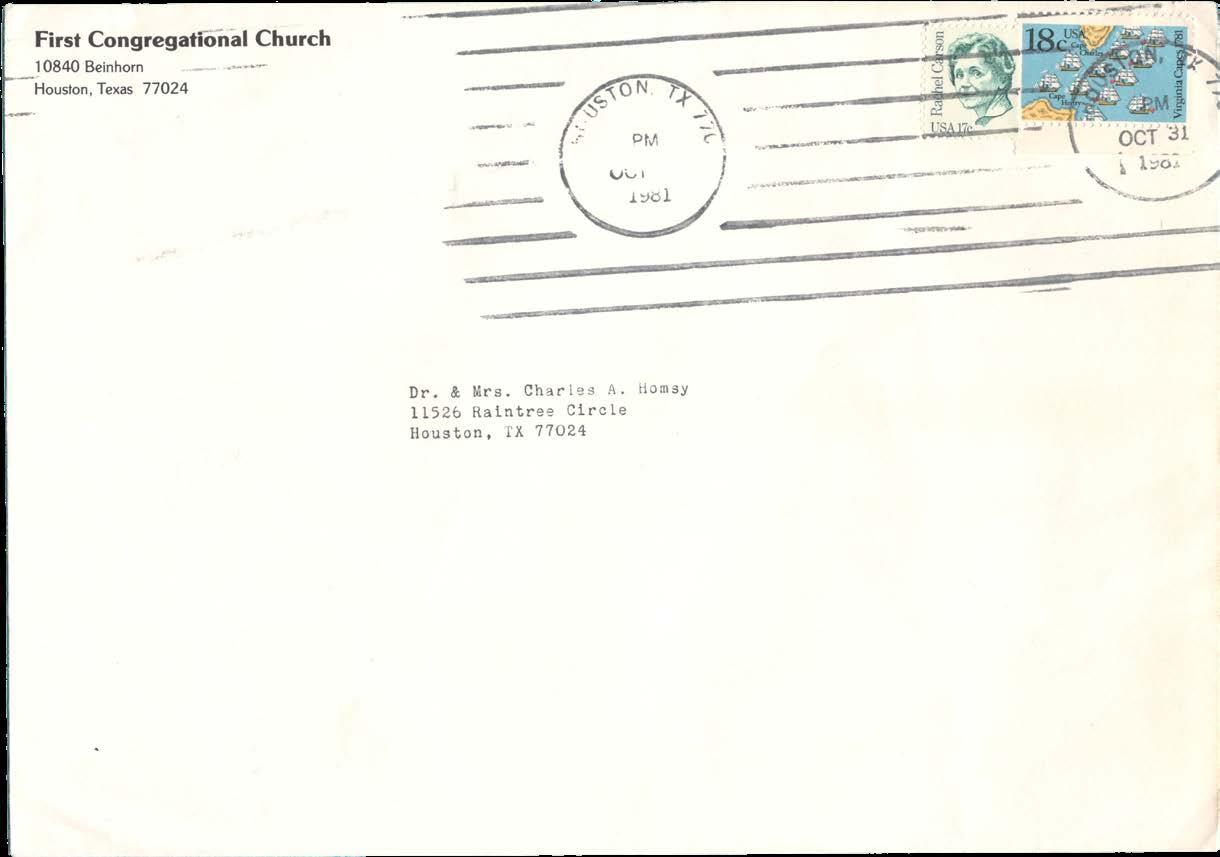
Figure 1. Two-ounce mailing posted on October 31, 1981.
In previous parts of this series, we have covered domestic First-Class mail rates paid with the Great Americans (GA) postage stamps of 1980–99. In this installment, we’ll discuss domestic Third-Class mail, but first, a word about domestic Second-Class mail.
Second-Class Mail—Periodicals
Most of our readers who collect postal history are familiar with the term “SecondClass mail,” but it is worth offering a brief discussion here before moving on to ThirdClass mail.
The Great Americans
22 Mar.
1 Nov. 1981
17 Feb. 1985 Service discontinued
Table 1. Transient Second-Class Mail.
Second-Class mail existed for more than a century (created in 1863) as a class of mail for sending periodicals, such as newspapers and magazines, to subscribers. There were several guidelines, and we’ll touch on just a couple. The periodical had to be mailed on a recurring schedule at least four times per year to the dedicated subscriber list, and the content had to be primarily non-advertising.
Traditionally, postage stamps were not affixed to individual pieces of Second-Class mail. The publisher paid quarterly or annual fees to cover the cost of postage.
On July 1, 1996, toward the end of the GA era, the United States Postal Service (USPS) abolished the category of Second-Class mail and renamed it Periodicals. The only category of Second-Class mail during the GA era that could be posted with stamps was Transient Second-Class Mail. This was an option in which the recipient of a magazine or periodical could forward the item to an acquaintance by supplying a forwarding address and affixing the stamps at the rate shown in Table 1. Effective February 17, 1985, this service was abolished, and such mail was then handled as Third-Class mail. We have no examples of Transient Second-Class mail from the Great Americans era, and we have never seen such a piece with a GA franking.
Third-Class Mail—Standard Mail (A)
Third-Class mail also dates from 1863. Third-Class mail traditionally includes printed matter and advertising mail not falling into the first two classes of domestic mail and not weighing enough to be categorized as Fourth-Class mail. Today, many postal patrons call some of this mail “junk mail.” Third-Class mail traditionally could be sent at lower postage rates than First-Class mail because mailers often sent the same type of mail to many potential customers and needed relief from those rates given the volume they sent. Throughout history, the United States Post Office Department (USPOD), predecessor of the USPS, and the USPS have offered volume discounts to mailers who made bulk mailings and presorted this type of mail before posting. This practice was so prevalent by the early 1980s that the USPS created a new definitive set of stamps, the Transportation Series in coil formats, with fractional values to meet myriad discount Third-Class postage rates. For our study of Great Americans uses, we’ll focus here on the rate structure that evolved for single-piece Third-Class mailings. In 1996, at the same time the USPS renamed Second-Class mail, it also changed the name of Third-Class mail to “Standard Mail (A).”
Table 2 lists the Third-Class single-piece rates based on weight. Items weighing over 16 ounces were generally classified as Fourth-Class mail matter. Our table shows the rates for items weighing up to eight ounces, which will address most items found in the marketplace today.
22
1
1
Table 2. Single-piece third-class mail.
If you study this table closely, you will notice that rates throughout the period mimicked domestic First-Class letter rates through four ounces of weight. The Postal Service charged exactly the same rate for any piece of Third-Class mail weighing up to four ounces as for an equivalent First-Class letter. Mailers, since they had to pay the going First-Class letter rate on the vast majority of single-piece Third-Class mailings, got in the habit of marking such items as “First-Class Mail.” Collectors today will struggle to positively identify any mailing weighing four ounces or less as either clearly First-Class or Third-Class mail.
Figure 1 provides an example. This envelope was part of a mass mailing from the First Congregational Church of Houston, Texas, that was postmarked on October 31, 1981. We know this was a mass mailing of identical pieces because we once held several pieces from this mailing in our collection. This item demonstrates several hallmarks of a Third-Class mailing. The address on the envelope was added by a mimeograph machine, quite typical of those in many larger church offices in the early 1980s. Mimeograph machines could quickly address a group of envelopes for a mass mailing. It is clear from examining other items in the same-day mass mailing that the church was distributing the same printed information to members of its congregation.
But the postage in each case, hand-applied copies of the 18¢ Battle of Yorktown or 18¢ Battle of the Virginia Capes bicentennial commemorative stamps with a 17¢ Rachel Carson Great Americans stamp, combined to pay 35¢. This total was good for either a two-ounce First-Class or a two-ounce Third-Class mailing. In this case, the church did not apply a “First-Class” indication on the front of the envelope, so, for our purposes, we’ll call it a Third-Class mailing. However, anyone could argue that, because of the franking, it could or should be collected as a piece of First-Class domestic mail.
Figure 2 shows a magazine cover from Izalco News, a publication dedicated to news about El Salvador. The June 1994 issue was mailed from Miami, Florida, to an addressee in The Woodlands, Texas. A piece of tape was placed midway up the open side of the magazine to keep it closed during mailing. A 75¢ Willkie and a 23¢ Cassatt were added to pay postage. Clearly, this was a Third-Class mailing, but the 98¢ postage paid either the four-ounce First-Class or Third-Class rate.
One way to distinguish Third-Class mail is by the mailer’s “Return Postage Guaranteed” inscription on an envelope or package. With this inscription, the mailer promised to pay the additional return postage if a piece of Third-Class mail couldn’t be

delivered. This allowed the mailer to keep up with changes to its mailing lists to some extent.
Figure 3 shows a portion of a cardboard mailer posted in 1988. The mailing label contains the inscription “Return Postage Guaranteed,” indicating that the contents were a Third-Class mailing. The 45¢ postage, paid with a Dr. Cushing stamp, indicates the package weighed two ounces.
Mail pieces were occasionally marked with a rubber stamp or a manuscript description to help Postal Service employees understand the type of service desired. Collectors may see “Third Class” or “Printed Matter” auxiliary markings on such pieces of mail prior to 1996 and “Standard Mail” after 1996.
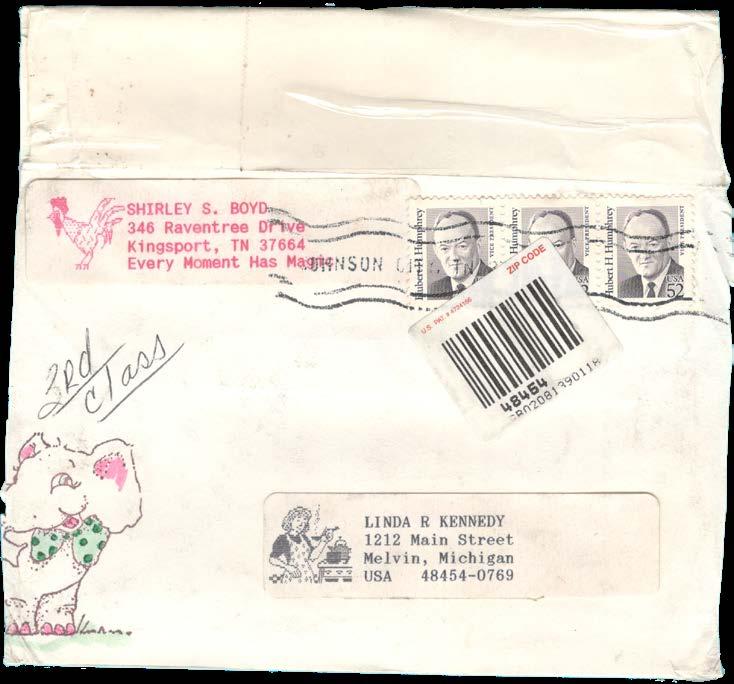
Figure 4 illustrates an example where the sender marked “3rd class” on an envelope that was taped and slit at the ends to serve as a wrapper. The mailing, sent between February 1991 and January 1995, weighed between 10 and 12 ounces, requiring $1.56 for a Third-Class mailing. The fee was conveniently paid by a strip of three Hubert Humphrey 52¢ stamps. A First-Class mailing during this period would have cost the mailer $2.35.
Figure 2. A magazine posted in 1994 with 98¢ postage.
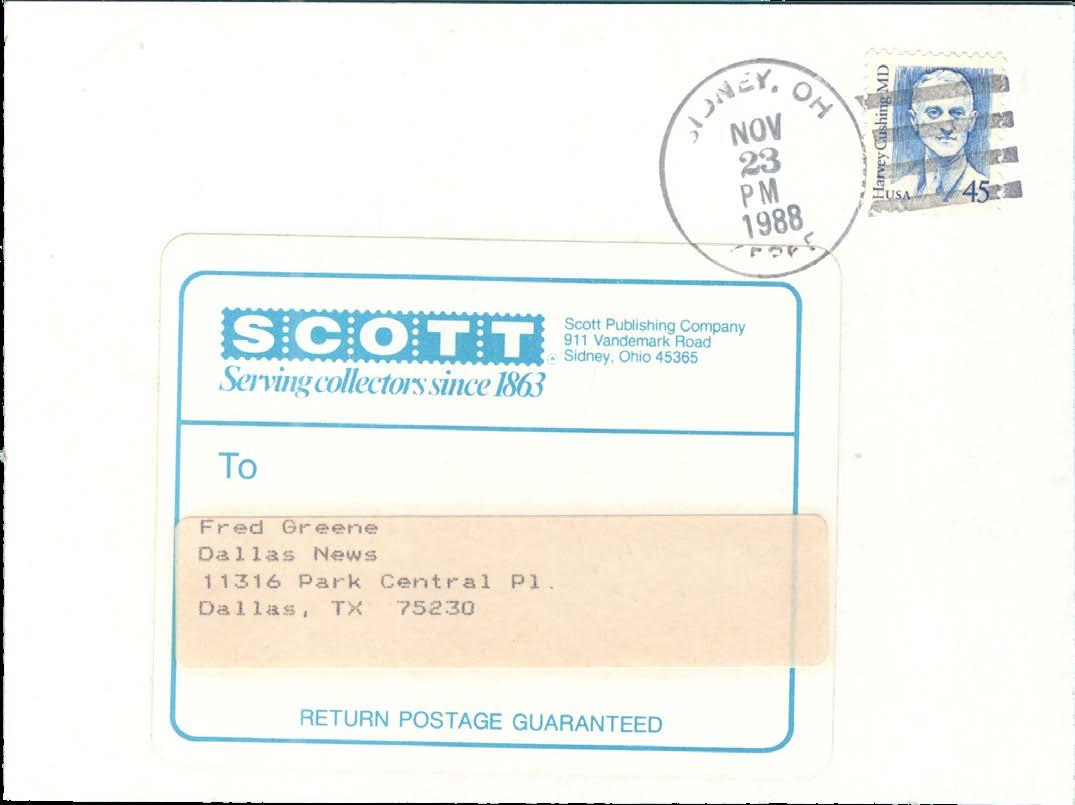
Figure 3. Mailing with a Return Postage Guaranteed inscription.
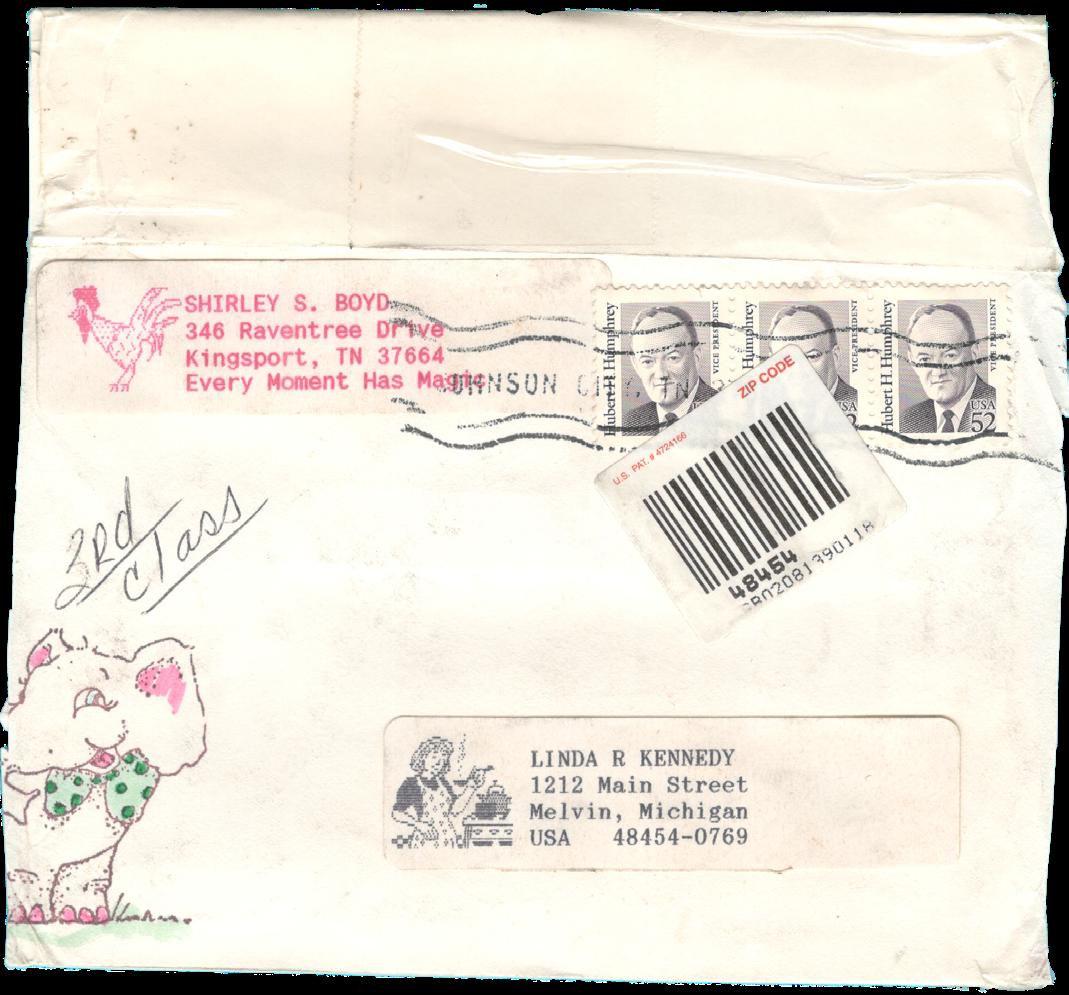
Figure 4. An envelope converted to a mailing wrapper for a Third-Class mailing.
BEP Rotary Coil Production:
The Impact of Printing Inks on Plate Life
by Nancy Robinson, P h D, and James Robinson USSS #12386 (James Robinson) | m jsr.new2019@gmail.com
In this article, the authors expand their study of rotary coil plate life by evaluating the impact of printing ink formulation on the total number of impressions the plates produced. In the previous article in this study, the aggregate average plate life for the 1¢, 2¢, and 1 ½¢ Fourth Bureau Issue (FBI) rotary side-coil plates before chroming was shown to be just under 100,000 total impressions (99,957 “Combined” data set shown in Table 1). However, when the data set is instead broken down and analyzed by denomination, rather than in aggregate, statistically significant color-specific differences in average plate life are uncovered. The implications of this surprising result are explored herein.
BEP Plate Record Impression-Counts FY 1924–FY 1926: Plate Life is Denomination Specific
* STD = Standard Deviation
Table 1. Recorded plate impressions for un-chromed FBI 1¢, 2¢, and 1 ½¢ rotary side-coil plates.
The aggregate average for the 1¢, 2¢, and 1 ½¢ rotary coil plates before chroming (“Combined” data set in Table 1) is just under 100,000 total impressions (99,957). The 2¢
Coil Stamps
side-coil, which represents the majority of the data points (76%), has the lowest average, 90,019 impressions, while the 1 ½¢ has the highest average at 144,335 impressions.
The scatter in the denomination data sets can be readily seen in Figure 1, which shows “box and whisker plots” for the 1¢, 2¢, and 1 ½¢ data sets. Each data point within a set is represented by a circle. The “x” in each box identifies the average value. The line within the box denotes the median value, or the split between the upper and lower halves of the data set. In other words, 50% of the individual data points are located above the line and the remaining 50% reside below the line. The bottom and the top of the box divide the data set into quarters or quartiles, so that 25% of the data points are located in the bottom of the box and 25% in the top of the box. The lowest 25% of points in the data set fall below the box, and the highest 25% of the points occur above the box. The whiskers (lines extending immediately above and below the box) show the maximum and minimum values of the data set that are not considered outliers. Outliers are defined as data points that extend greater than 1.5 times the length of the box when measured from the closest end of the box. Thus, outliers are the data points plotted above or below the ends of the whiskers. The box and whisker plots show similar scatter around the mean value in the data regardless of the denomination being printed.
Figure 1. Box and whisker plot of impression data for un-chromed plates.
A surprising discovery is that the data sets show statistically significant differences in the plate capacity for the different denominations.1 The 2¢ side-coil plates printed, on average, 26.3% and 37.6% fewer impressions than the 1¢ and 1 ½¢ side-coil plates, respectively. The 1¢ side-coil printed impression average was 15.4% lower than that of the 1 ½¢ side-coil plates.
From a purely mechanical printing standpoint, it does not at first seem reasonable that the maximum number of impressions made would differ between denominations. The plates are made using the same techniques and material, and the rotary intaglio printing process is the same, regardless of denomination. However, the three denominations required different ink color formulations. The coarseness of the different pigments and the extenders in an ink formula are both sources of variable wear. Ink properties are the likeliest constant source for the “wear differential” between denominations.
The impact of printing inks on plate wear is discussed in many instances in the literature. Baxter describes plate scratches caused during printing “due to a gritty substance either becoming mixed with the printing ink or in some manner coming into contact with the engraving. Such a coarse particle will ‘dig’ into the plate during the wiping operation and will produce a scratch varying in depth and length in a degree corresponding to the pressure applied to the wiping cloth and the distance the extraneous particle was moved across the face of the plate.”2 Repeta tells us that the use of inferior ink filler or extender (used to increase the ink volume without significant loss of color) during World War I caused rapid intaglio plate wear.3
Kaolin is a common example of a printing-ink extender. Before World War I, Great Britain was a leading global supplier of high-quality kaolin. However, wartime disruptions to shipping by U-boats halted the transatlantic supply, since kaolin held low “military” priority. The kaolin mining and refining industry in the US state of Georgia, today one of the world’s leading high-quality kaolin producers, was then in its infancy. The Georgia product supplied at the time was inferior to the UK’s, until the US domestic industry developed improved refining methods and machinery postwar.4
As a side note regarding kaolin, researcher Harry Brittain clearly demonstrates using X-ray Diffraction (XRD) that the paper used during the World War I era did not contain kaolin.5 It is important to recognize that Brittain’s analysis was conducted on the unprinted margins of the stamps “so that any XRD from the ink components would not be manifest in the patterns.”6 What was being referred to by Repeta as a factor in plate life was the use of kaolin as an ink extender, not a paper additive.
Taking a broad perspective, certain ink-related contributions impact wear generally, regardless of the color. For example, the intent of the “extender” was to decrease the ink cost while maintaining a strong color. Although some ink colors could be extended further than others, to detect a relatively small percentage difference in the quantity of extender within the mix might require data on thousands of plates in order to show statistical significance. But other aspects of ink formulation affecting plate wear were clearly color-specific. In particular, ink coarseness and grittiness were dependent upon the type of pigment used. Ink-specific differences in plate wear were not limited to the 1910s and 1920s. Even late in the 20th century, plate surface-wear variability due to inks remained a concern, as demonstrated by a 1987 official technical report entitled Wear
Due to Printing Inks that was prepared for the BEP by the National Bureau of Standards Metallurgy Division of the Institute for Material Science and Engineering.7
1987 Government-Sponsored Testing of BEP Plate Wear
This government-sponsored study was conducted to develop test methods replicating plate wear known to occur when printing currency and stamps at the BEP using chromium-surfaced printing plates. Three different intaglio stamp inks were selected for testing purposes because the “service performance” of the three was known to differ significantly. While the 1987 research paper did not specifically compare red and green pigmented inks, it did indicate that SICPA Lockwood Green was found to be the most abrasive among the intaglio stamp inks selected for testing. The study also noted that BEP Brown was the least abrasive of the three. Abrasivity is highly dependent on the source of the pigment selected for the formulation of an ink color.
The 1987 ink study matters here because it proves that ink formulation variably affects plate life, with abrasivity indicated as a primary cause, thus supporting the early rotary era ink-dependent wear findings illustrated in Figure 1. But the 1987 study’s relevant conclusions were also far-reaching. The plates studied were modern, chromium-plated intaglio printing-plates. Softer, early-era steel plates prior to chroming would have been at least as susceptible to ink-specific plate-wear by identical pigments, and it seems fair to suggest that the amount of wear and rate of degradation would be significantly worsened.
The Plate-Wear Characteristics of Printing Inks
There is no doubt that stamp collectors would heartily welcome a list of official BEP ink colors, pigment sources, mix-recipes, extenders, and records of relative abrasivity and other performance characteristics. Unfortunately, all BEP colors during the early rotary era were proprietary, hand-mixed formulations. Fairly viscous, coarse-grained ink was manufactured in-house at the BEP with an eye toward producing a homogeneous and creamy (like toothpaste) consistency.8 Printing ink formulations for negotiable revenue paper were closely guarded secrets; thus, the ink mix-designs (recipes) are unreported. Historically, however, commercial print inks of the 1900s and into the early 20th century typically relied on a variety of pigments derived from ores and minerals as well as organic pigments from sources like plants and animals.9 Synthetic pigments were also seeing wider use during the 20th century. Common pigments like iron oxides and/ or those containing other metals (derivatives of lead, chromium, selenium, mercury, copper) had a highly abrasive quality due to their hardness and particle size. Such pigments were especially valued by the BEP because the abrasive characteristics provided resilience against ink-wear (“rub-off”) once stamps were printed and during use. The fact that the metallic inks did not easily rub off made them highly desirable for bonds, currency, and postage stamps that received a great deal of handling. Given these properties, many BEP metallic-derivative pigments were likely highly abrasive.
Plate wear attributable to ink generally stems from the relative Mohs hardness and crush resistance of the pigments and extenders, increasing the difficulty of fine grinding. In printing, coarser pigments with larger particle sizes cause greater abrasion and/or gouging to printing plates and rollers. Pigments with more crystalline structures are also more likely to scratch or damage surfaces. For example, a common red pigment is sourced
from the iron oxide “Hematite” (often called “Jeweler’s Rouge”). Jeweler’s Rouge is also used as a polishing agent for precious metals and gems, attesting to its abrasive nature. Carbon blacks (organic black pigments) are traditionally sourced from charring organic materials such as wood or bone. Just as they resist rub-off when printed on paper, the carbon blacks also provide beneficial abrasion resistance when used as additives in rubber automobile tires. Carbon black particles increase both the rubber’s strength and ability to withstand wear and tear from friction with the road surface. This is particularly important for the tire tread, which experiences continuous abrasive forces during operation.
In addition to abrasive “mechanical” damage and wear to plates, chemical damage was another factor. The preferred black ink pigments are carbon blacks that have been acid-oxidized, changing the inherent surface chemistry. Chemically bonded oxygen on the surface enhances performance characteristics. However, acid-oxidizing leaves residual acidity, which can produce added detrimental effects like staining and pitting, even on chromed printing plates.
Did Early Era Plate Chroming Alter the Ink’s Influence on Plate Life?
It is clear that chroming of printing plates greatly extended plate life. The cost-savings afforded by chroming a rotary coil plate and then repeatedly stripping and re-chroming the same plate were enormous. According to BEP Director Hall in his FY 1926 report, “After a large number of impressions have been printed from a plate the chromium may be stripped from the plate and the plate rechromed at about 25 per cent of the cost of a new plate. As a result there was a reduction of 10 in the number of siderographers employed during the year.”10 In his FY 1928 report, Hall gives additional details concerning the process developed for periodic re-chroming of rotary plates. “A change in the procedure of chroming rotary steel plates, which improved the wear qualities, was effected. It was found by a comparison of wear qualities that case-hardened rotary plates were unfit for further use after printing 42,000 impressions while chromed plates showed little signs of wear until they reached 60,000 impressions. As a consequence an electrolytic alkaline stripping solution which removes chromium from the rotary steel plates without causing the metal to etch after 60,000 impressions have been taken was effected. The plate is then rechromed and another 60,000 impressions printed. This operation can be repeated indefinitely. A number of sets of plates at press have printed more than a million impressions.”11
The development of a process for repeatedly re-chroming plates was a significant achievement. During the advent of plate chroming, for 2¢ side-coil chromed plates between plate numbers 17999 and 19050 that went to press for the first time in July of 1926 or afterward, and were canceled no later than December 1929 (66 plates total),12 the average lifetime impressions increased over fivefold, from about 90,000 impressions per plate to around 494,500. The first 2¢ side-coil plate in this data set with greater than 1,000,000 lifetime impressions was plate 18245, which went to press for the first time on April 26, 1927. This plate was sent to the presses a total of 16 times and ran with two companion plates.
Ink Impacts on Plate Life During the Early Chroming Era
As shown in Table 1, 2¢ side-coil plates had the lowest average plate impression counts prior to the advent of chroming. An unanswered question was whether 2¢ plates had a shorter lifetime compared to the 1¢ or 1 ½¢ plates after all plates were routinely being chromed. For this analysis, the time frame selected only included chromed plates sent to press for the first time during or after July of 1926 and canceled no later than December 1929.13 Because the data set was much larger for the 2¢ side-coil plates, data analyzed only extended through plate number 19050. Figure 2 shows the box and whisker plots for the data, and Table 2 lists the descriptive statistics.
Figure 2. Box and whisker plot of impression data for chromed plates at press between July 1926 and December 1929.
STD = Standard Deviation
Table 2. Plate impressions for FBI 1¢, 2¢, and 1 ½¢ rotary side-coil chromed plates at press between July 1926 and December 1929.
This data needs to be interpreted with caution. The chroming and re-chroming methodology allowed the plates to be sent to press many times. For 1¢ plates, limiting the time frame biased the data by excluding plates that ran a much higher number of impressions, because the high-output plates were not canceled until after December of 1929, one of the selection parameters. When the third-class and postcard rates were raised in April 1925 to 1 ½¢ and 2¢, respectively, 1¢ coil demand suffered a sharp decline. The data indicates that 1¢ plates afterward were not being run to their maximum renewable capacity. Later, when new 1¢ third-class bulk mail rates and a return to 1¢ postcard rates were established in July 1928, demand began to revive. If, instead, the 1¢ data set is expanded to include plates that were not canceled until July 2, 1935, the average number of 1¢ impressions increases to 401,944, very similar to that of the 2¢ and 1 ½¢ chromed plates listed in Table 2.
Setting aside the 1¢ data, the analysis above shows no statistical difference between the higher-demand 1 ½¢ and the 2¢ chromed rotary side-coil plates sent to press for the first time after July 1926 and canceled by December 1929.14 This result is significant, because prior to chroming the plate life for the 1 ½¢ side-coil plates was on average 1.6 times longer than that of the 2¢ side-coil plates (see Table 1). With the advent of chroming, there was no longer a statistical difference between the lifetime average for these two side-coil values. And over time, once faced with similar high demand, 1¢ side-coil plates reverted to similar impression numbers.
However, that is not to say that ink impacts on plate life disappeared. The authors believe that wear differentials during the chroming era are simply numerically masked by the process of continued re-chroming before wear becomes significant. Apparently, for example, the increased hardness of the chrome plating tempered the worst abrasive impact of the red ink through about 60,000 impressions, according to Director Hall. Nonetheless, the 1987 report confirmed that there were still ink-related differences in chrome plate service life in 1984 through 1986, the years given for the study’s duration. Statistically, for the 2¢ red and 1 ½¢ brown inks used for printing the FBI between 1926 and 1929, the practice of chroming and re-chroming to extend plate life masks the numerical ink impact on plate life. In theory, the period between re-chroming should have been variable according to the ink pigment used. In other words, highly abrasive inks should have required re-chroming at shorter intervals. But in order to calculate differentials, plate record cards showing all the impression count intervals between all re-chroming for all the plates would be necessary.
Figure 3 shows the front of a plate record card for 1¢ rotary side-coil plate #16053, which made 460,994 impressions over its lifetime. The plate first went to press unchromed on March 3, 1925, for two days during which no impressions were taken. The plate was returned to the plate vault, where it sat unused for six years until October 1930. During the long wait, it was chromed on August 17, 1926. The plate then ran at press 13 times with multiple partners through February 1936.15
Figures 4 and 5 show the stripping and re-chroming sequences and impression intervals for this plate. Table 3 collates the press run information with the stripping and re-chroming information given in Figures 4 and 5.
It is unclear what determined the amount of wear required to re-chrome. From the plate card for #16053 it appears that after the plate was taken off the press after each
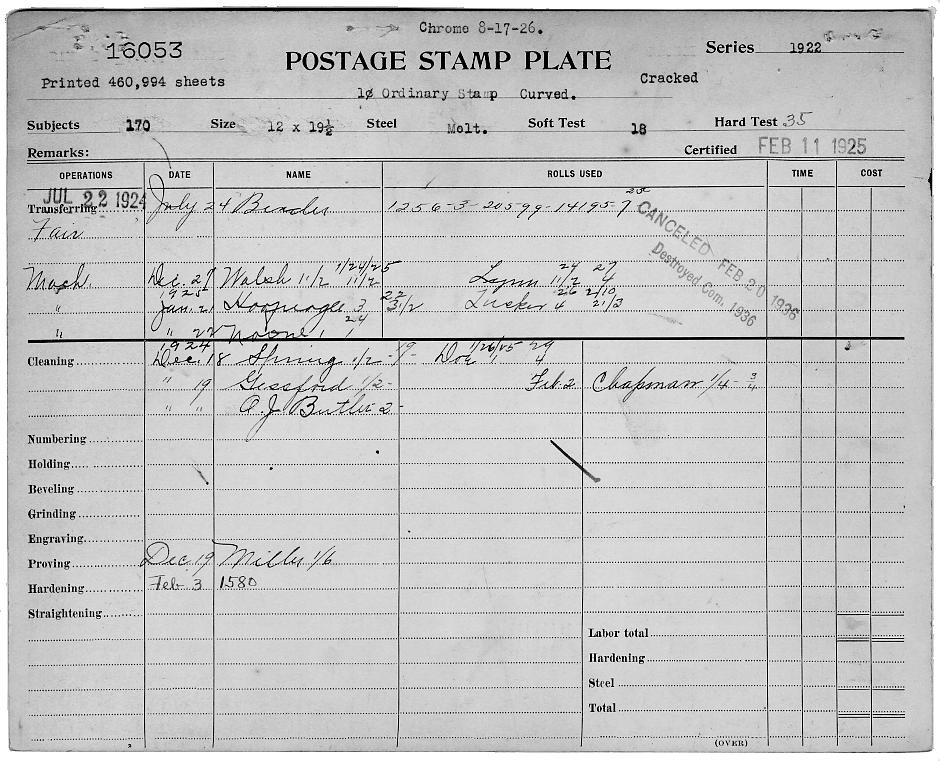
3. BEP plate record card front for 1¢ rotary side-coil plate #16053 (courtesy BEP Archives).
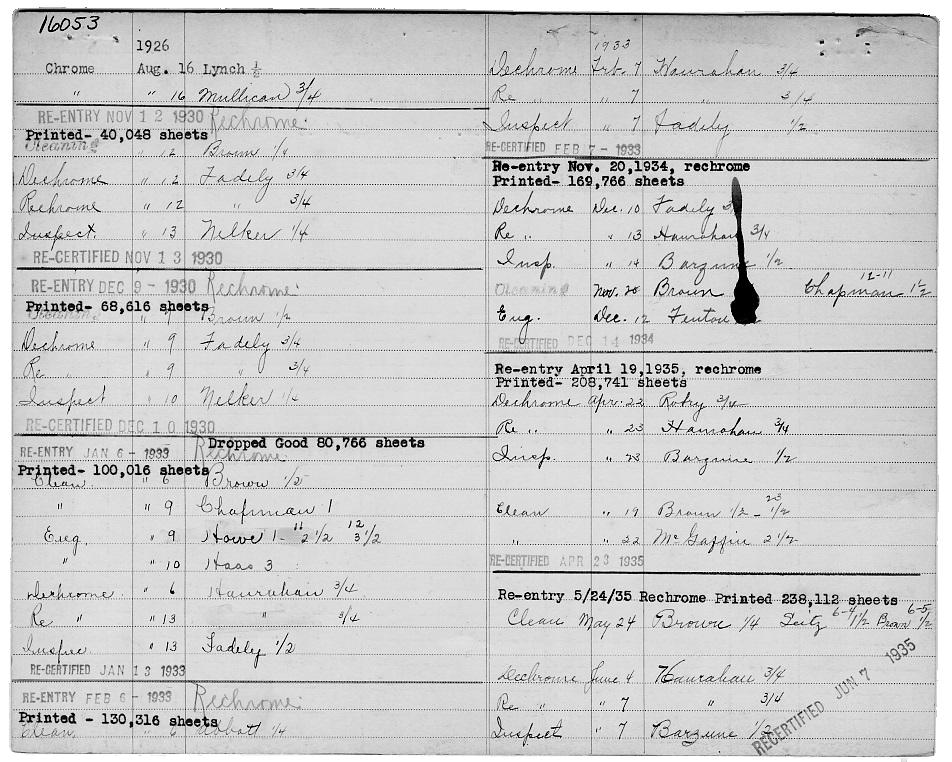
4. BEP plate record card back for 1¢ rotary side-coil plate #16053.
Figure
Figure
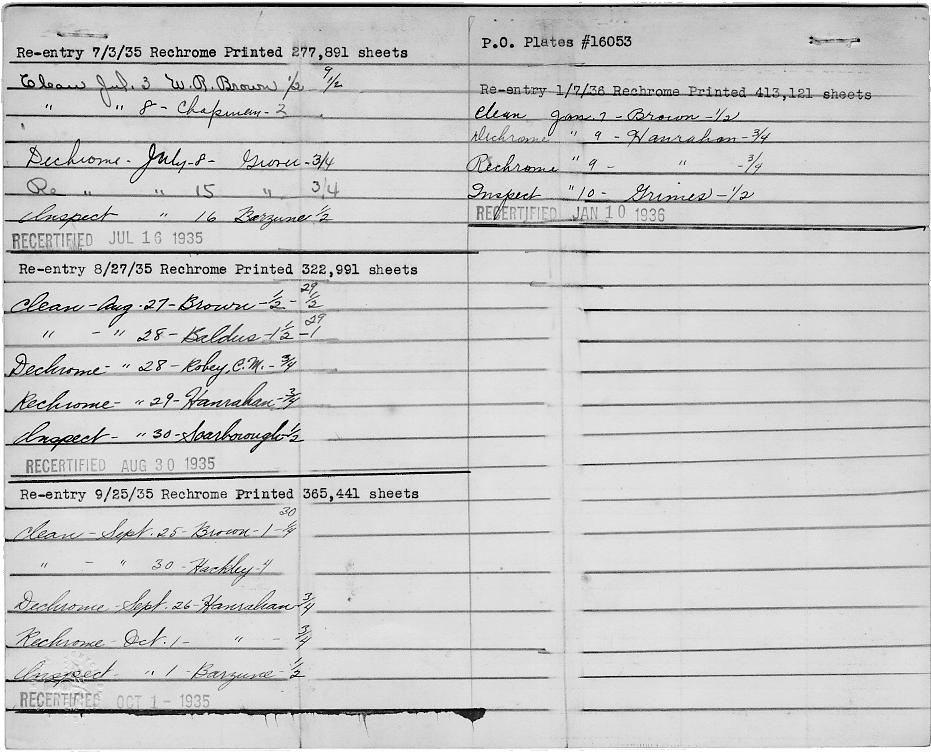
Figure 5. BEP plate record card #2 for 1¢ rotary side-coil plate #16053.
N/A† Plate judged “good.” 4
10 hours of engraving prior to re-chroming. 5
Engraved prior to re-chroming. 7
* Imp. = Impressions
† N/A = Not Applicable
Canceled 2/20/1936.
Table 3. Collation of plate #16053 press runs with re-chroming data from the plate record cards.
press run it was inspected. In one instance (Table 3, row 3) the plate was deemed “good” and not re-chromed. The variability in the data suggests there was a high degree of subjectivity regarding the impression quality that the plate was producing prior to each re-chroming. For plate #16053 the number of impressions between chroming ranged from 28,568 to 47,873, with an average of 38,416 impressions between re-chroming events. Note that at no point did the interval between chroming events reach Hall’s “ballpark” 60,000 impressions.
Due to the wide variability evidenced in the plate card chroming interval for #16053, attempting to compile similar archival cards and data for a large sampling of plates of several denominations fell far beyond the scope of proving the basic point of this section: chroming masked any differentials and eliminated simple or obvious differences in plate life between individual inks.
Summary and Conclusion
Determination of rotary-coil plate life establishes limits and statistical averages for capacity projections for plates at press prior to plate chroming. Looking ahead, each data point in the pre-chrome era is also associated with a known period of workdays on press, as determined by rotary press mapping.16 Recognizing that the rotary coil presses were identical, a goal of relatively standard daily output would have been expected by the BEP administration. Daily rotary press output could be measured in the earliest era (Washington-Franklin Issues) by the number of perforator rolls delivered, and later by on-press mechanically counted impressions printed. Due to color differentiation in plate life, when run at the same speeds, red 2¢ plates averaging 90,000 impressions prior to chroming should not stay on press for as many days as 1¢ plates averaging 122,000 impressions (26% differential). The next article in this series will present an analytical look at days on press and any variations that may occur. Ultimately, by combining the plate-life and run-duration data sets, average “impressions per workday,” better known as “Press Speeds,” will be established.
References
1. Statistical significance was demonstrated using a Kruskal-Wallis analysis of variance (ANOVA), nonparametric test using an online calculator (https://www.statskingdom.com/kruskal-wallis-calculator.html). The probability (p value) was < 0.001. P values < 0.05 are statistically significant. The Kruskal-Wallis ANOVA was used to determine if there was a statistical difference between the means rather than a standard ANOVA because the data sets’ variances were unequal. Using the same calculator, a post hoc Dunn’s test was performed to determine which data sets were different from the others.
2. James H. Baxter, Printing Postage Stamps by Line Engraving (American Philatelic Society, 1939), 81.
3. Louis E. Repeta, “The Stickney Rotary Printing Press Part 3,” The United States Specialist 67, no. 4 (1996): 158.
4. City of Sandersville, GA, “Kaolin Capital of the World,” https://www.sandersvillega.org/kaolincapitaloftheworld.cfm.
5. Harry G. Brittain, “The Coming and Going of China Clay in BEP Printing Paper: Kaolin Content in the 2¢ Stamps of the First, Second, Third and Fourth Issues,” The United States Specialist 96, no. 6 (2025): 277.
6. Harry G. Brittain, “X-ray Diffraction Study of the Paper Used by the Bureau of Engraving and Printing to Produce 1¢ and 2¢ Stamps between 1894 and 1913,” The United States Specialist 87, no. 8 (2016): 346.
7. L. K. Ives, M. Peterson, A. W. Ruff, J. S. Harris, and P. A. Boyer, “Wear Due to Printing Inks,” US Department of Commerce, NBSIR 87-3574 (May 1987): 26, https://doi.org/10.6028/NBS. IR.87-3574.
8. Repeta, “The Stickney Rotary Printing Press Part 3,” 157.
9. Information provided in this article regarding printing ink pigments was collated from various Google internet searches. Individual sources are not cited but can readily be found using a search engine.
10. US Bureau of Engraving and Printing, Annual Reports of the Director of the Bureau of Engraving and Printing: 1919–1931 (Washington, D.C.: Government Printing Office), annual report for FY 1926: 14, https://books.google.com/books?id=0t8bzINufLcC&printsec=frontcover&source=gbs_ge_ summary_r&cad=0#v=onepage&q&f=false.
11. U. S. Bureau of Engraving and Printing, Annual Reports of the Director of the Bureau of Engraving and Printing: 1919–1931, annual report for 1928: 16.
12. W. Wallace Cleland, comp., “Printing History of Coil Plates, Series 1922,” B.I.A. Research Paper no. 14 (United States Stamp Society [formerly BIA], May 1997).
13. Ibid.
14. Lack of statistical significance was demonstrated using Excel T-test function: Two-sample unequal variance, 2-tailed. The probability (p-value) = 0.07. P-values greater than or equal to 0.05 indicate there is not a statistically significant difference.
15. Cleland, comp., “Printing History of Coil Plates, Series 1922.”
16. Nancy Robinson and James Robinson, “New Perspectives on Rotary Coil Stamp Production Via ‘Press Maps’ (BEP Fiscal Years 1914–1925), Part I,” The United States Specialist 96, no. 3 (2025): 125–128.
Quality
United States Stamps (1847-1945)
Singles (mint and used)
Plate Blocks
Booklet Panes plus Complete Booklets
Price lists-$2.00 each category
Price lists free on web: www.mountainsidestampsandcoins.com
We also buy quality U.S. and foreign stamps
Mountainside Stamps, Coins and Currency
P. O. Box 1116
Mountainside, NJ 07092
Tel: 908-232-0539 or 908-419-9751
E-mail: tjacks@verizon.net
Tom Jacks, owner
Member APS, ASDA, USSS
2026 HEBERT’S
All New and Revised Mint and Used Plate Number
Single Catalogue $52.50 postpaid
American Plate Number Single Society (www.apnss.org)
Expanded pricing, back-of-the-book, tag/paper varieties, PN/ZIP/ME types
Rick Burdsall / APNSS
P.O. Box 1023
Palatine, IL 60078-1023
Precancel Stamp Society
Interested in learning more about precancels? Request an electronic sample copy of PSS Forum, our monthly journal, from Joe Walsh at promo@precancels.com www.precancels.com


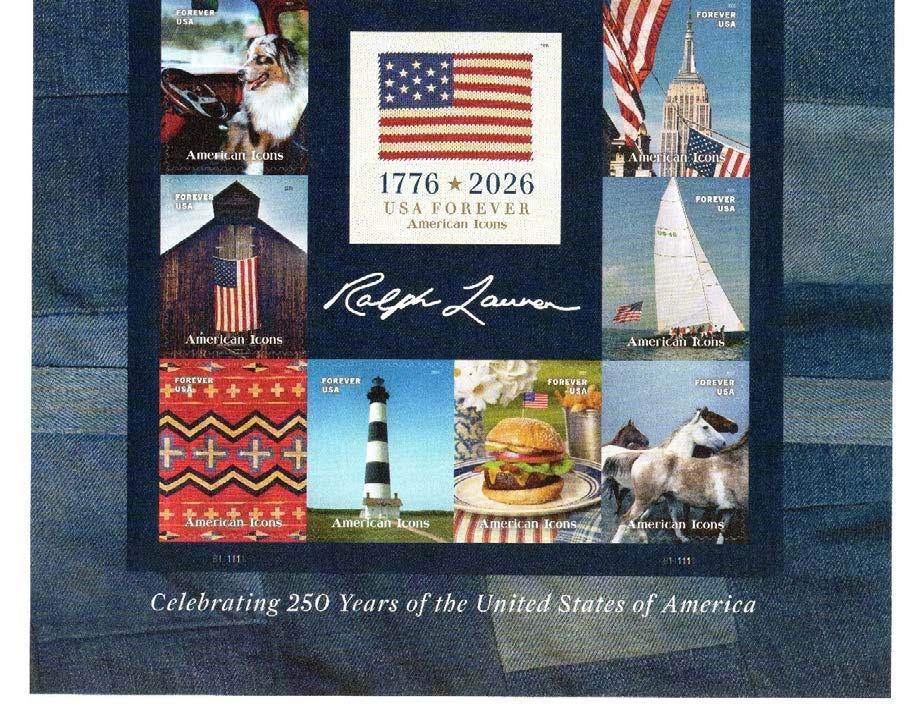
3 #???? Mr. Rogers 2026 year date

3 #???? Mr. Rogers Souvenir Sheet
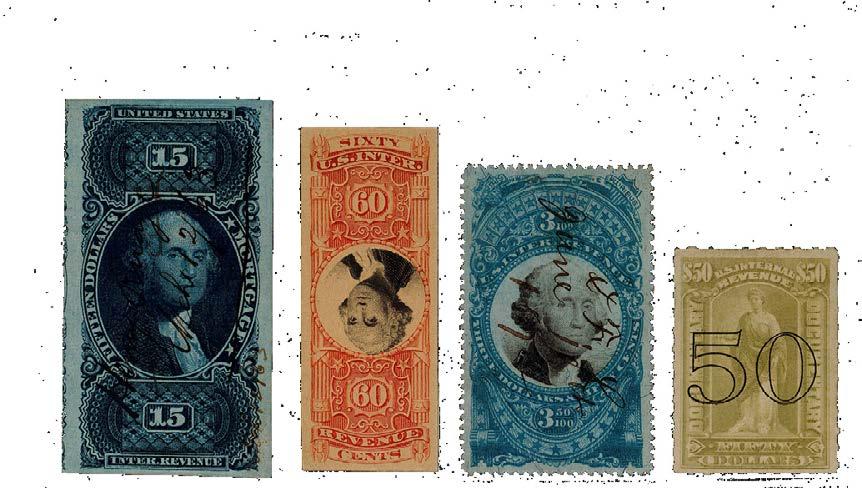
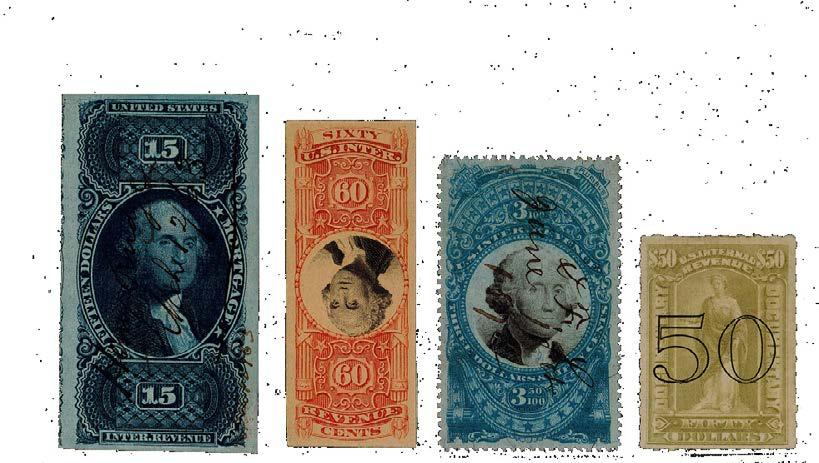

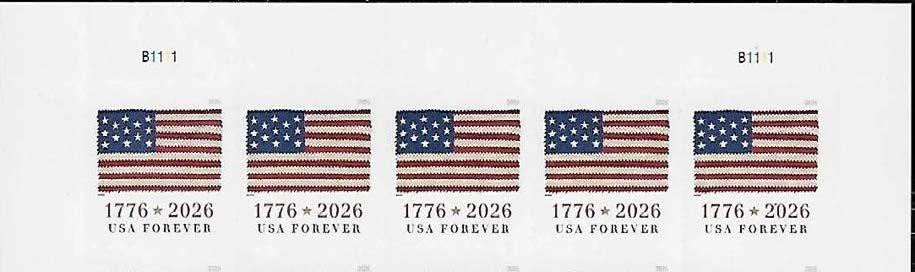
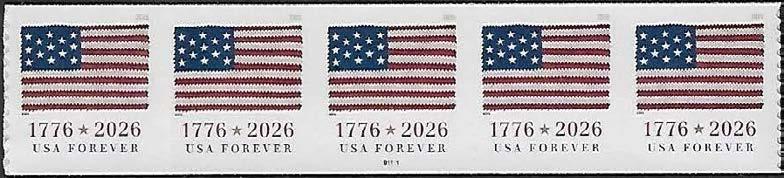
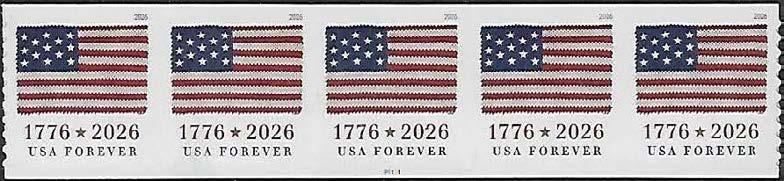
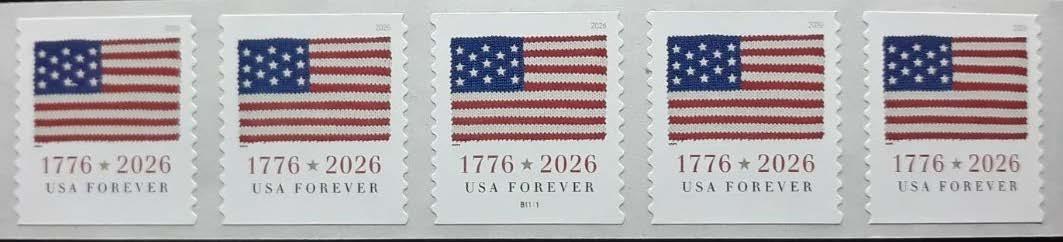
COORDINATORS: Members are invited to report their findings to the appropriate coordinator. This monthly report is
All issues through 1980
Sheet stamps after 1980
Kim D. Johnson
310 E N 3rd Street
Georgetown, IL 61846
Jim Cochrane P.O. Box 2009
Great Bend, KS 67530
Coil stamps after 1980
Booklet stamps after 1980
Jill Ambrose P.O. Box 54622
Cincinnati, OH 45254
Michael O. Perry P.O. Box 1194
Rainier, OR 97048


APPLICATIONS RECEIVED FOR JUNE 2026
17679 John Kofranek, Alameda, CA 17680 David Plouffe, West Covina, CA 17681 Jan Hofmeyr, Victoria, BC, Canada APPLICATIONS PENDING
(received outside of annual dues
Leslie Butler Joseph Kelley
Update Your Profile
If you have had a change in your mailing address for receiving The United States Specialist, or have a new e-mail preferred address, members can log into www. usstamps.org, click on “Your Profile” and update this information. For delivery “issues” please contact Bob Rufe at: execsecretary@usstamps.org
Classified Advertising
USSS MEMBERS are entitled to two free ads of up to 40 words each year. Other ads are 10¢ a word, payable in advance. For 6 insertions, take a 5% discount; for 12 insertions, take a 10% discount. Ads with [1158] at the end expire with this issue. Make checks payable to USSS. Send copy and check to The United States Specialist, 9038 E. 25th Dr., Denver, CO 80238. The Editor strongly prefers to receive ad copy by email: editor@usstamps.org. Emailing ads saves substantial time for you and the Editor and avoids errors.
WANTED
WANTED TO PURCHASE #1053 HAMILTON $5 Commercial Usages. Especially need use to foreign destination. Also doing a survey so scans appreciated. Doug Weisz weiszcovers@gmail.com, 773-9144332. 4547 E Kentucky Cir., Denver CO, 80246. www.douglasweisz.com [1168]
WANTED - NAMW TEXAS POSTMARKED covers. Member APS, IPDA, USSS, APNSS. Email: htputney@gmail.com [1162]
WANTED FOR MY COLLECTION: SCOTT #102 to #111, 1869 Special Printings (re-issues). Please— only nice examples without major faults. Must be face-up bright and attractive. PF or PSE Certs only! Strong buyer—Rob Lehmann (240)422-0118 or diecasttoys@yahoo.com [1163]
WANTED #279 PLATE NUMBER STRIPS FOR specialized collection/study of 1898 1¢ Franklin, plate #’s 1459 & 1470 (any position), 1411(bottom). 279a plate #’s 1206, 1207, 1315, 1376, 1379. Len McMaster, 304-856-1118 or lenmcmaster@gmail.com [1168]
WANTED: US REVENUE CAMP STAMPS (SCOTT# RVC 1-10) issued by US Forest Service, 1985-88. Look like labels. Specifically looking for RVC6 ($1 Red) and RVC10 ($10 Gold). Also associated fee envelopes, pamphlets or documents. J. Dale Shively, 512.947.1401, jdshively@icloud.com. [1158]
WANTED: M-BAG TAGS FOR PERIODICALS sent to foreign destinations; Autogiro mail; Nineteenth century typewriter advertising and Washington, D.C., hotels; Uses of 952, 966, 1047, 1084, 1205, 3774, especially to foreign destinations; Zunks covers; $5 stamp uses. E-mail: pmartin2525@yahoo.com, POB 6074, Fredericksburg, VA 22403. [1159]
WANTED-MAY 29, 1964 POSTMARKS OF 5¢
John Kennedy 1246 on cover. Searching for small town postmarks for this stamp on cover. This was a nationwide first day. Henry Scheuer, PO Box 533, Madison Square Station, New York, NY 10159. [1158]
WANTED: AIR MAIL COMPLETE BOOKLETS with major EFOs. Large miscuts, incorrect booklet assembly, printing errors, extra covers, etc. Focus is on booklet cover errors, not the stamps. Send photo and description to alanmoll@verizon.net [1160]
FOR SALE
IF MY STAMPS ARE NOT VF/XF, SUPERB, I sell in packets. Upgrade now at low prices. U.S.A. and Norway with no faults, centered and clean. Request list—Reed Roholt, P.O. Box 1006, Beaver, UT 84713. Satisfaction guaranteed. [1160]
SET OF THE BUREAU/US SPECIALIST, Volumes 1-94. Earl Gibson 817-266-9280 [1159]

Index of Advertisers
American Plate Number Single Society (www.apnss.org) ..................................................... 377
Armen Hovsepian (www.USatFACE.com) 346
Mountainside Stamps, Coins and Currency (www.mountainsidestampsandcoins.com) ....... 377
Precancel Stamp Society (www.precancels.com) 377
Richard Friedberg (www.friedbergstamps.com) ................................ 380
Robert A. Siegel Auction Galleries (www.siegelauctions.com) .................................... 358
Scott A. Shaulis (www.shaulisstamps.com) .................................... 361
The United States Stamp Society (www.usstamps.org)............... 378, 382, 284, Covers
U.S. Philatelic Classics Society (www.uspcs.org) 355
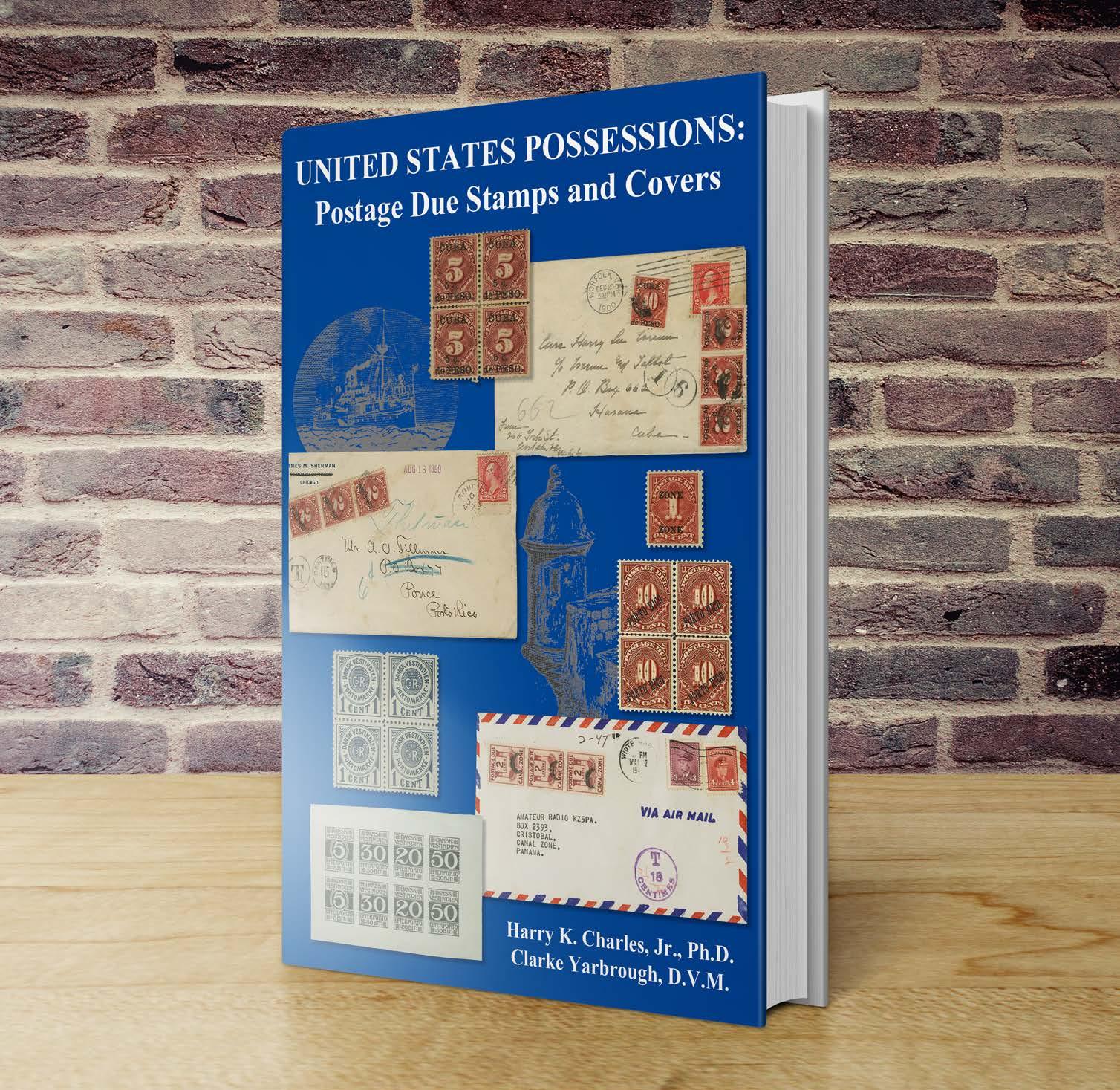
United States Possessions: Postage Due Stamps and Covers presents the story of Postage Due stamps used in the major possessions or territories of the United States. Written from a stamp collector’s perspective, the authors address the challenge of identifying the myriad of Possession Postage Due stamps by concentrating on stamp identification while also covering the Postage Due issues of Cuba, the Danish West Indies, Puerto Rico, the Panama Canal Zone, the Philippines and more.
In addition to the text, the monograph contains over 300 illustrations and five appendices which provide information to supplement and further explain key points. In many cases, the information presented is new or, if previously reported, organized in a new manner to help the reader understand the complexity of the Possession Postage Dues.

United States Possessions: Postage Due Stamps and Covers
Hard cover, 352 pages, 6-in × 9-in.
Member Price: $39 US postpaid Non-Member Price: $43 US postpaid Purchased online at: www.usstamps.org/store/ or by mail to: Executive Secretary, P.O. Box 1602, Hockessin, DE 19707-5602


States Stamp Society
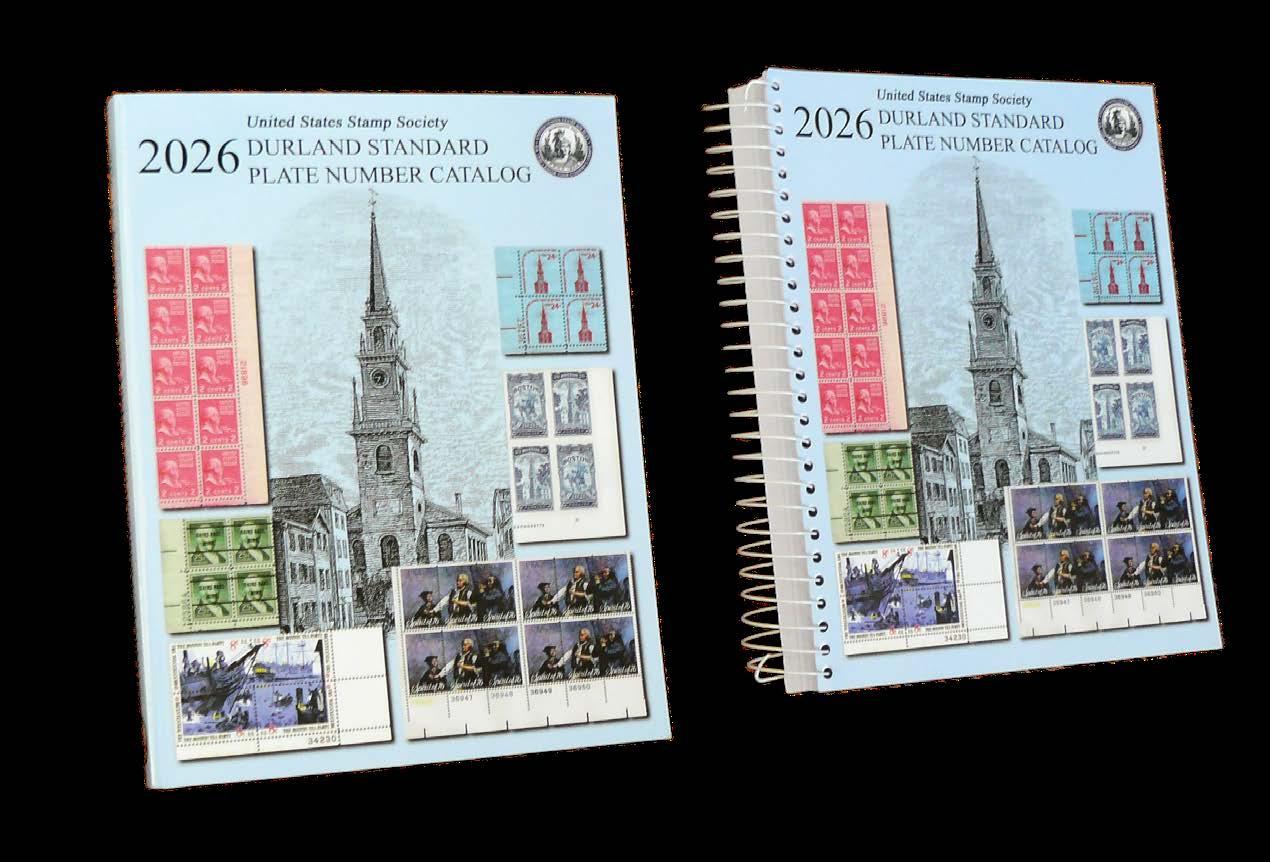
The new 2026 edition of the Durland Standard Plate Number Catalog provides the most comprehensive research source for plate number information on United States postage and revenue stamps, including tax-paid revenue stamps, with listings for overprinted Possessions postage, Allied Military government stamps, and other back-of-the-book stamps, dummy and test stamps, MDI “Blue Cover” booklets and partial plate numbers on booklet and coil stamps.
2026 Edition of the Durland Standard Plate Number Catalog