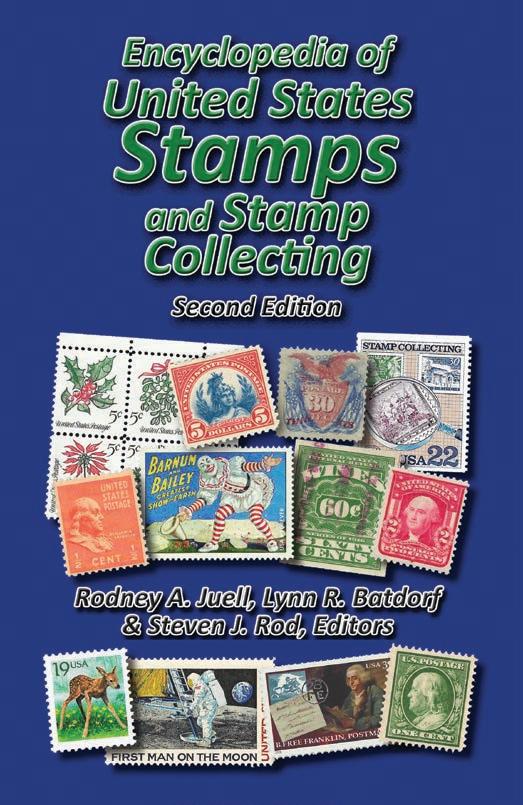

Order from: USSS, P.O. Box 1602, Hockessin, DE 19707-5602 or online at: www.usstamps.org/store/ Hardbound, 769 pages. $35 members, $40 nonmembers. Visit the website for shipping costs.
Order from: USSS, P.O. Box 1602, Hockessin, DE 19707-5602 or online at: www.usstamps.org/store/ Hardbound, 769 pages. $35 members, $40 nonmembers. Visit the website for shipping costs.
the journal of the United States Stamp Society
VOLUME 97, NUMBER 6 J UNE 2026
WHOLE NUMBER 1156
An association of collectors to promote the study of all postage and revenue stamps and stamped paper of the United States and US-administered areas produced by the Bureau of Engraving and Printing and other contract printers. American Philatelic Society Affiliate No. 150
243 Recent Winners of USSS Medals
244 The Monthly Random Booklet: BK231 Fall Flowers by Dieter R. Kohler, PhD
254 Vintage Photo of the Month by Rodney A. Juell
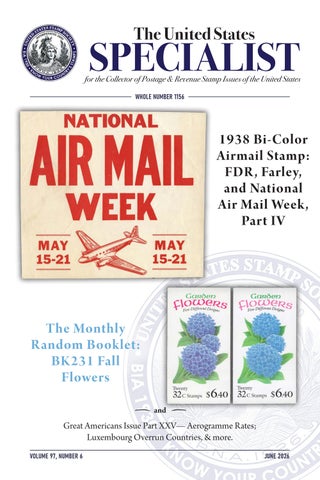
256 1938 Bi-Color Airmail Stamp: FDR, Farley, and National Air Mail Week, Part IV by Paul M. Holland
279 Great Americans Issue Part XXV— Aerogramme Rates by Jay Stotts
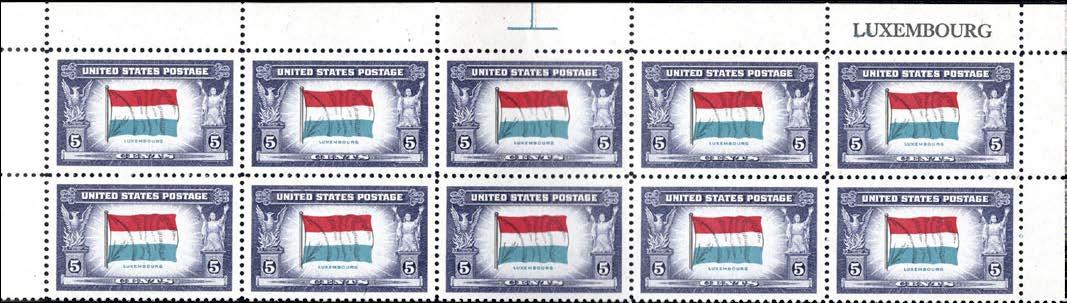
283 Margin Name Varieties on the Luxembourg Overrun Countries Stamps by Keith Lichtman
285 Plate Number Report compiled by Kim D. Johnson
287 Report of the Executive Secretary by Robert Rufe
288 Classified Advertising
288 Index of Advertisers
Andrew S. Kelley, Editor 9038 East 25th Drive Denver, CO 80238
email: editor@usstamps.org www.usstamps.org
Manuscripts, publications for review, and all advertising including classifieds, should be sent to the Editor at the address above.
Forms close on the 20th of the second month preceding the month of publication, as February 20 for the April edition.
The United States Specialist (ISSN 0164-923X) is published monthly January through December by the United States Stamp Society, Inc., P.O. Box 1602,
Hockessin, DE 19707-5602. Membership in the United States $25. North America $40; all others $65. Single copy $2. Periodical postage paid at Hockessin, DE, and at additional entry offices. Printed in USA.
Copyright ©2026 United States Stamp Society, Inc. All rights reserved. Opinions expressed by authors are their own and do not necessarily reflect those of the United States Stamp Society, its officers, or staff.
Correspondence concerning business affairs of the Society, including membership and changes in address, should be addressed to the Executive Secretary, PO Box 1602, Hockessin, DE 19707-5602.
Postmaster: Send address changes to U.S.S.S., P.O. Box 1602, Hockessin, DE 19707-5602.
The United States Specialist
Founded 1930 as The Bureau Specialist
EDITOR
ANDREW S. KELLEY
9038 East 25th Drive Denver, CO 80238 email: editor@usstamps.org
United States Stamp Society Bureau Issues Association, Inc.
P.O. Box 1602 Hockessin, DE 19707-5602
CHAIRMAN
Roger S. Brody
P.O. Box 5836 Somerset, NJ 08875-5836 email: brody@usstamps.org
PRESIDENT
Nicholas Lombardi
P.O. Box 1005 Mountainside, NJ 07092 email: 8605@comcast.net
VICE PRESIDENT
Jeffrey Shapiro
P.O. Box 3211 Fayville, MA 01745-3211 email: coverlover@gmail.com
SECRETARY
Joel Cohen
10703 Kings Riding Way, Unit T-1 Rockville, MD 20852-5420 email: cohenji@comcast.net
TREASURER
David S. Sugar 1740 Mission Hills Rd., #311 Northbrook, IL 60062-5744 email: david14501681@gmail.com
GOVERNORS
Lynn Batdorf
Kim Johnson
Mike Lampson
Leonard Piszkiewicz
James Robinson
Robert Rose
Rod Juell
Gregory Shoults
David Steidley
Jay Stotts
Steven Unkrich
EXECUTIVE SECRETARY
Robert Rufe
P.O. Box 1602
Hockessin, DE 19707-5602
email: execsecretary@usstamps.org
— Committees — AWARDS
Denise Stotts
email: stottsjd@swbell.net
BOOKLETS & BOOKLET PANES
Michael O. Perry
P.O. Box 1194, Rainier, OR 97048 email: MOPerry@mac.com
DURLAND EDITOR
Kim D. Johnson
310 E N 3rd Street, Georgetown, IL 61846 email: westhome1@aol.com
ESSAY-PROOF
James Patterson
1850 North Central Avenue, No. 1400 Phoenix, AZ 85004 email: jhpatterson@yahoo.com
EXHIBIT PDFs
Chris Steenerson
P.O. Box 1818
Westminster, CO 80038-1818
email: Chris@RxStamps.com
FARLEY ERA
Paul M. Holland
email: pholland.thorleaf@gmail.com
FOURTH BUREAU ISSUE
Jay B. Stotts email: stottsjd@swbell.net
LIBERTY SERIES
Roland Austin
P.O. Box 38 Stillwater, OK 74076-0038 email: RAustin13@aol.com
MARGINAL MARKINGS
Chris Steenerson
P.O. Box 1818 Westminster, CO 80038-1818 email: Chris@RxStamps.com
MODERN POSTAL HISTORY
Douglas B. Quine 59 Taylor Rd., Bethel CT 06801 email: usss2010@quine.org
PLATE NUMBER & CHECKLIST SERVICE
Kim D. Johnson
310 E N 3rd Street, Georgetown, IL 61846 email: westhome1@aol.com
PRECANCELS
Lynn R. Batdorf 6005 Kingsford Road, Bethesda, MD 20817 email: hollykids@comcast.net
PRESIDENTIAL ERA
Jeffrey Shapiro
P.O. Box 3211, Fayville, MA 01745-3211
RECRUITING
Steven Crippe
P.O. Box 117001, Carrollton, TX 75011 email: scrippe@gmail.com
REVENUE ISSUES
Peter Martin
P.O. Box 6074, Fredericksburg, VA 22403 email: pmartin2525@yahoo.com
SECOND BUREAU ISSUE
Nicholas Lombardi
P.O. Box 1005, Mountainside, NJ 07092
VENDING AND AFFIXING MACHINE PERFORATIONS
Dan Ryterband 40 Carolyn Place, Chappaqua, NY 10514 email: djryterband@fwcook.com
WASHINGTON-FRANKLIN
HEAD ISSUES (Co-Chairmen) Greg Shoults 11248 Frederick Lane Twinsburg, OH 44087 email: coilcollector@hotmail.com
Andrew S. Kelley 9038 East 25th Dr, Denver, CO 80238 email: stamps@andrewkelley.net
WEBMASTER
Mike Lampson
P.O. Box 652 Matthews, NC 28106 email: lampson@usstamps.org
— Study Groups — DUMMY STAMPS
Terry R. Scott
P.O. Box 10406, Napa, CA 94581 email: terryrscott@comcast.net
FIRST BUREAU ISSUE [open]
LUMINESCENCE
Wayne L. Youngblood 705 Forest Glen Circle, Prairie du Sac WI 53578 email: wystamps@gmail.com
OVERRUN COUNTRIES SERIES
Thomas Schilling
P.O. Box 432, New Lisbon, NJ 08064-0432 email: cbtkschilling@yahoo.com
PROMINENT AMERICANS AND AMERICANA SERIES
Ron Blanks
P.O. Box 9282, Chesapeake VA 23321 email: rblanks_stamps@yahoo.com
REGISTERED MAIL
Mike Ludeman
P.O. Box 2024, Denton, TX 76202-2024 email: mike@ludeman.net
United States Stamp Society medal winners that have been reported from recent shows:
Show Winner Exhibit
Sarasota N.S.E. (FL) David Mayo U.S. 2¢ Columbians of 1893
Southeast Stamp Expo (GA)
Charles O’Brien III U.S. Sesquicentennial Exposition 1926
San Diego S.S. (CA) Bill DiPaolo The Prexy Coils
St. Louis S.E. (MO) Vicky Hadley
G.P. March Party (OH) John Lighthouse
The Kansas–Nebraska Overprints
Using the Documents of Commerce to Fund the Civil War, 1862–1872
Show Winner Exhibit
Toledo S.E. (OH) Jack R. Perry
A Study of the US 3-cent Washington Stamp of 1861–1868
Rockford 2-3-4 S.E. (IL) Bob Crossman John Butterfield’s Overland Mail Company
Springpex (VA) Gannon Sugimura Echoes of a Vanished Country Kazoopex (MI) Steve Chaffin U.S. Postal Markings 1851–1861
Show Awards Chairs, please note: The USSS Gold Statue of Freedom Medal is sent automatically to all APS World Series of Philately (WSP) shows. The USSS Silver President’s Award medal is available upon request to all local and regional shows.
For more information, to request an award or if you have won a USSS award and have not seen it listed in The United States Specialist, please write to Denise Stotts, P.O. Box 690042, Houston, TX 77269-0042, or e-mail stottsjd@swbell.net. (Some shows fail to send in the follow-up report.)
by Dieter R. Kohler, P h D USSS # 12538
Introduction
The previous article described the first issue in a series of four booklets featuring seasonal garden flowers. Most of the features discussed for the spring flowers issue also apply to the fall flowers issue, so they don’t need to be repeated in this article. However, as with many other booklet issues, the Bureau of Engraving and Printing (BEP) added a few quirks to this booklet, whether intentional or not. Some of the quirks require a magnifying glass to detect, and some require a UV lamp. As always, it is up to the collector whether to hunt for those obscure varieties in search of the “I want the full experience,” or keep it as simple as possible without the feeling of “I’m missing something.”
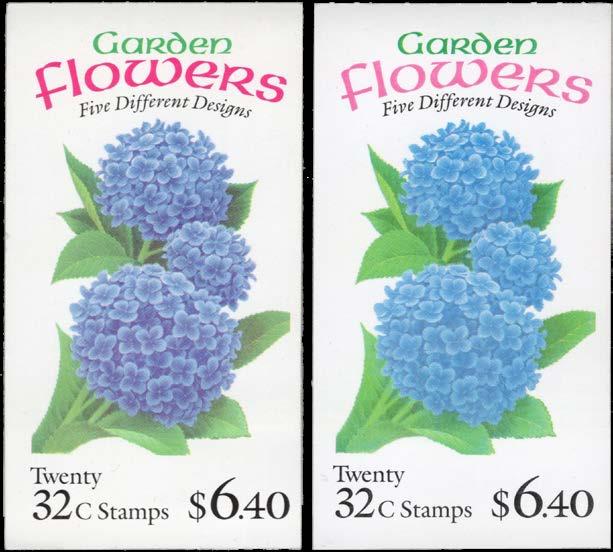
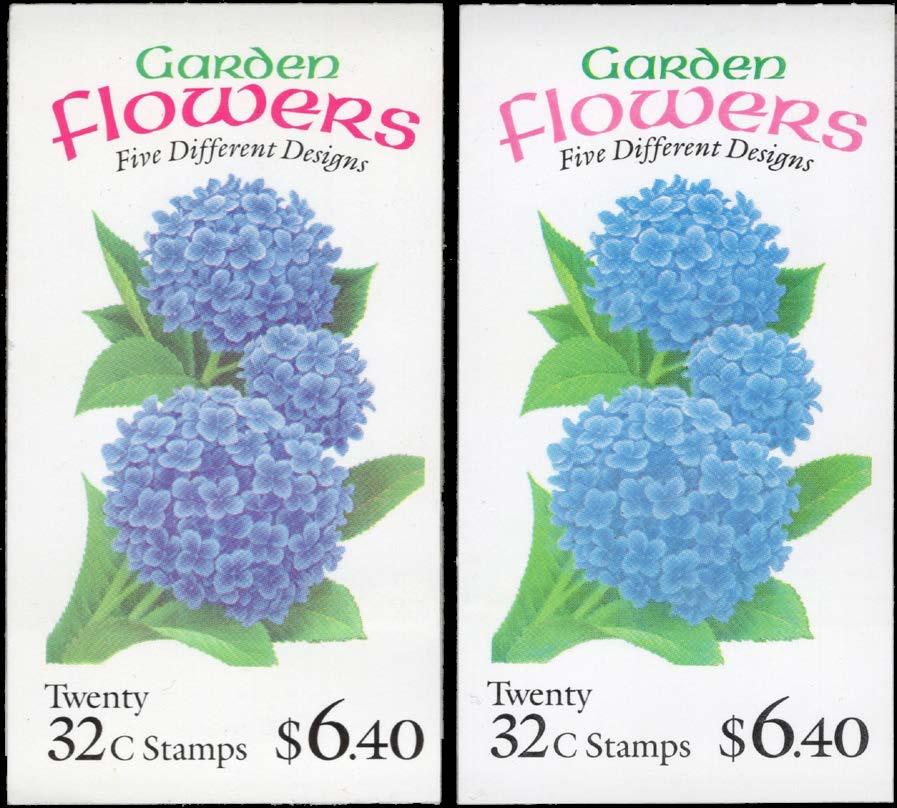
The cover of BK231 features a colorful arrangement of garden flowers blossoming in the fall. As with the spring flowers booklet, there are dark and light blue cover varieties. Looking under a microscope, several changes were made to the “dark” printing by exchanging the red printing plate. There are no longer red dots in the green leaves, and the size and number of red dots are greatly reduced in the blue areas.
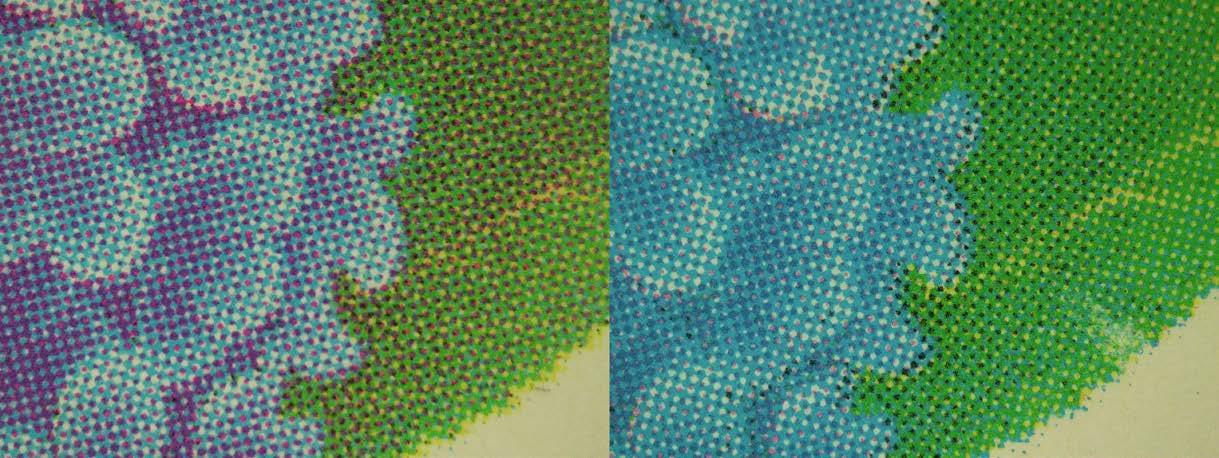
The dark covers are considerably more difficult to find, so the change happened early in the printing process. The change was likely made so that the color of the hydrangea on the cover is the same blue hue as on all booklet panes.
Only plate number 2 has ever been found. Unlike in the Christmas tree booklet BK181, which was documented only with plate 1211 until a small number of booklets with plate 1111 surfaced a few years ago, a plate 1 fall flower pane or booklet has not been recorded.
As with the previous two flower issues, the panes were printed on the BEP’s 902-D offset-intaglio press in five colors. The plate layout is mostly identical to the layout of the spring flowers plate.1 The thick CRL (Cross Register Line) in the third column and the thin CRL in the fourth column were not entered as they served no purpose. An offset black “Bobst triangle” was added to the 11th pane row in column 2, so all 12 booklets A to L have a different combination of tab marks. Booklets were assembled the same way as the other garden flowers booklet issues.
Unlike with the spring and summer garden flowers booklets, the BEP was supplied with prephosphored stamp paper, so no tagging mats were used. Therefore, the panes will not show any tagging gaps along any sides. The addition of the offset black triangle differentiates booklets J from K. The removal of the thick CRL makes it far easier to see any tab marks on the third pane inside a complete booklet.
Column 2 of the plates contained all the quality and alignment control features from various designs like Bobst triangles, CC1 squares, and BEP features like the register crosses on pane 30.3 The key pane is position 30, which has a complex register mark used to match the various plates with great accuracy.
Book Panes*
Identifying marks Plate 2
A 4–1 Top CRL gaps on bottom pane □
B 8–5 Black & Red triangles in tab of third pane □
C 12–9 Red triangle in tab of third pane □
D 16–13 Blue & Yellow triangles in tab of third pane □
E 20–17 Black triangle in top of the tab of third pane □
F 24–21 Tick mark at LL corner in tab of fourth pane □
G 28–25 Tick mark at UL corner in tab of fourth pane □
H 32–29 Register crosses in tab of third pane □
I 36–33 Five “CC1” squares in tab of third pane □
J 40–37 Third pane plain; unbroken CRL on rest □
K 44–41 Black triangle in center of the tab of third pane □
L 48–45 Bottom CRL gaps on bottom pane □
Table 1. All the possible regular booklet combinations for BK231. * Pane positions from a plate are numbered from left to right, top to bottom.
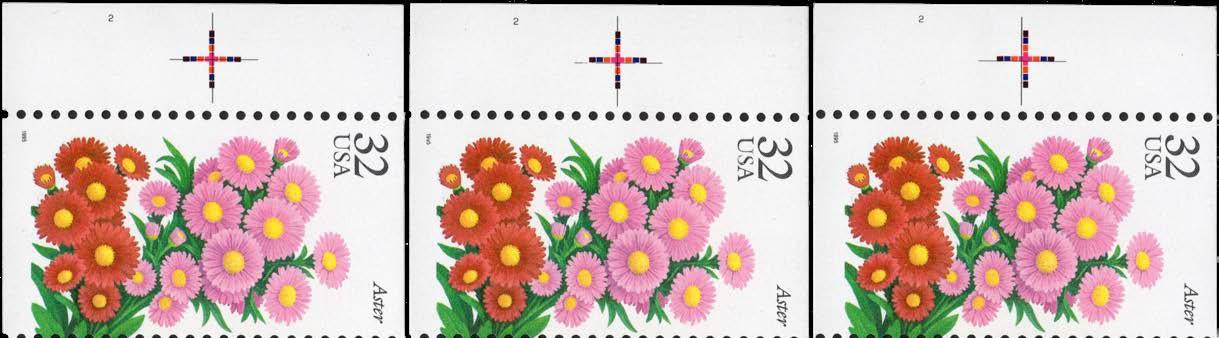
Figure 3 shows three panes where the intaglio black cross has wandered around a little. The register crosses allow us to determine the order in which the five colors were printed. The color cross also demonstrates the extreme precision of how well the offset plates were aligned. The sequence of colors is explained in Figure 4.

The first color plate sets the reference point for all subsequent plates. In the case of the fall flowers, it is offset yellow. Four symmetric rectangles build an initial cross, and pane 34 gets its first CC1 square in yellow.
The next color is offset red. No less than 12 rectangles and a “Swiss cross” build a new, large cross centered over the yellow cross. The result is a large red cross with four orange rectangles next to the Swiss cross (as red and yellow are mixed into orange). A red CC1 square is entered above the yellow one on pane 34.
The next color is offset black. Four rectangles are placed centered on the outermost four red rectangles of the cross, which turn (mostly) black. A black CC1 square is entered to the left of the yellow square on pane 34.
The next color is offset blue. Four rectangles are placed centered on the remaining four pure red rectangles of the cross, which turn (mostly) blue. A blue CC1 square is entered above the black and to the left of the red square on pane 34.
5, 9, 13, 17, 29, 33, 37, 41 CRL without gap
7, 11, 15, 19, 23, 27, 31, 35, 39, 43 Plain tab with plate 2 near perforations
8, 12, 16, 20, 24, 28, 32, 36, 40, 44
21 Tip of “+” register mark in LL corner of tab
22, 26, 38 Plain tab with plate 2 at top edge of tab
Tip of “+” register mark in LR corner of pane
Tip of “+” register mark in UL corner of tab
Tip of “+” register mark in UR corner of pane
Offset & intaglio “+” color registration cross
Five small solid color “CC1” squares in the tab
Offset Black triangle near center of tab
45, 93*
46, 94*
47, 95*
48, 96*
Table 2. All the possible pane marks.
CRL with gap at bottom, deformed plate number 2
Plain tab, narrow deformed plate 2 at top edge of tab
Plain tab with deformed plate 2 halfway in tab
LRM in tab, no CRL, deformed plate number 2
*plate number not deformed on panes 93 to 96.
The final color is intaglio black. A large but thin cross is entered centered on the color cross. The switch from the offset print unit to the intaglio print unit in the printer might cause some minor misalignment of the two crosses, as shown in Figure 3. Pane 34 gets an intaglio black CC1 square to the left of the blue one.
Table 2 lists all the possible pane varieties, excluding varieties that could only have happened if the panes resulted from web miscuts that included small bits of marks from a neighboring pane or from a side margin element. Technically, Table 2 should be shorter than for the previous garden flowers booklets due to the lack of tagging mats, which would have produced gaps. Hence, many pane positions would no longer have a signature tagging gap to differentiate them from ordinary positions.
Position 1–4 panes can show seam lines along the top edge, while position 45–48 panes can show seam lines along the bottom edge. The seam lines are very faint and might only show as small pieces along the edge. For unknown reasons, the BEP goofed around with the positions and shapes of the plate numbers on some pane positions, making it possible to recognize positions 45 to 48 even if they don’t show the LRM gap at the bottom due to a miscut of the panes.

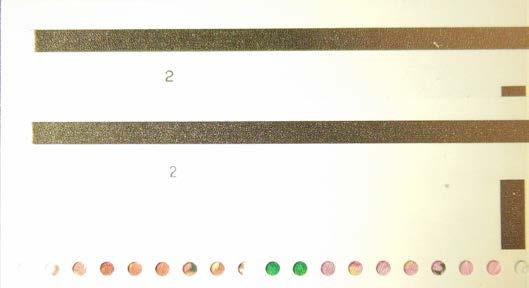
Figure 5. At left: Plate numbers, as seen under a digital microscope. At right: Position 93 at top, position 45 at bottom.
Figure 5 shows the three types of plate number “2” that can be found on tabs. Most have the “clean 2” shown at left. Position 45–48 panes might show a slanted, deformed plate number as shown at right in Figure 5. If the plate number is not slanted, then the pane is located on the other half of the intaglio sleeve (positions 93–96). The “2” in the middle of Figure 5 is narrower than a normal “2” and slightly deformed, but not slanted. It can be found on position 46 panes. It looks like those plate number entries were missing on the sleeve and were entered by hand when the mistake was discovered.
The intaglio sleeve was twice as high as the offset plates. That means 24 panes high by 4 panes wide. The upper half and the lower half of the sleeve have identical layout marks, so there are no additional pane tab varieties. At least, in theory. The following note can be found in Michael O. Perry’s Folded-Style Booklet Checklist:2
It may be possible to identify each of the sets of intaglio markings (that appear to be identical) by minor differences. Plate numbers on position 45, 46, 47, and 48 (or position 93, 94, 95, & 96) panes are deformed.
The “or” in the citation must be understood as “exclusive or,” either the top or the bottom half of the intaglio sleeve contained the deformed plate numbers. The designations “top” (positions 1–48) and “bottom” (positions 49–96) are arbitrarily chosen as the plate proof of the intaglio sleeve has not been inspected. Since we are dealing with an intaglio sleeve problem, we have to disregard any location differences coming from the offset plates.
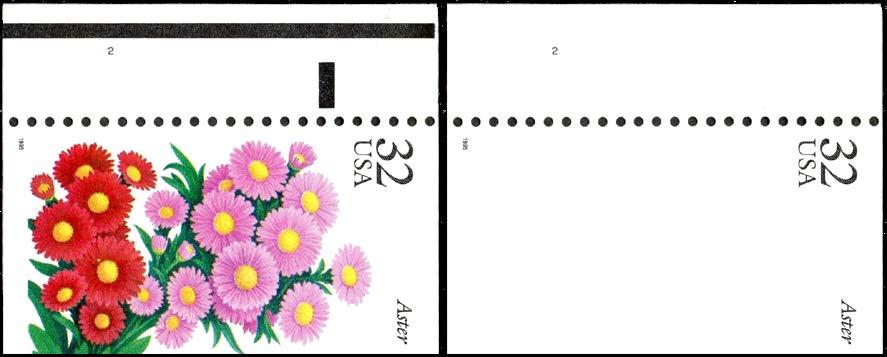
Figure 6. Intaglio structures on a booklet pane.
Figure 6 at right shows all the intaglio elements of the pane at left. Any differences in the tab marks from the top or bottom half of the sleeve must come from some change(s) in the relative positions of those elements.
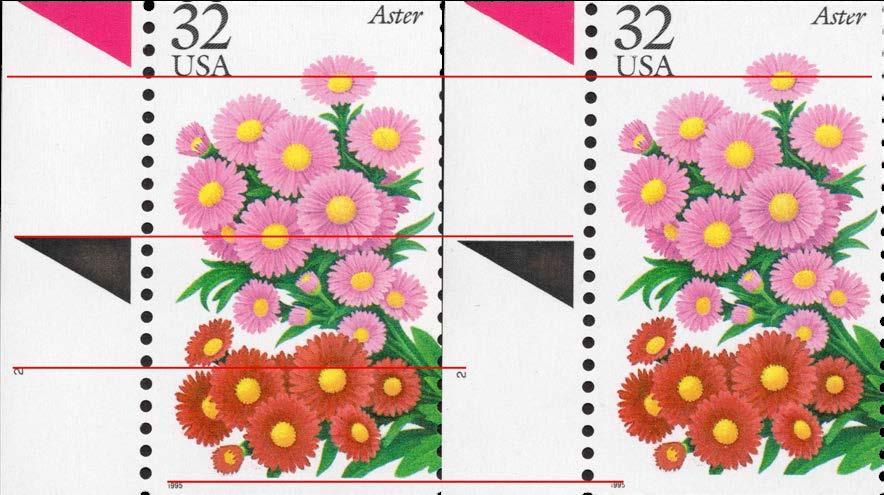
Figure 7. Position 6 and 54 panes.
Position 6 or 54 panes are the “easy” entry points as the tab contains an intaglio Bobst triangle. A red baseline is defined in Figure 7; it touches the bottom of the intaglio “USA.” This baseline must be used for any pane from any position. Looking at positions 6 and 54, we note:
• The intaglio triangle and the plate number are slightly farther away from the baseline on position 54 panes.
• The “1995” date is at the same distance in both positions. Figure 8 shows the comparison between a position 62 and a position 14 pane. The baseline is again defined, touching the intaglio “USA.” The comparison reveals that the plate number is lower on position 62, and the “1995” is at the same distance from the
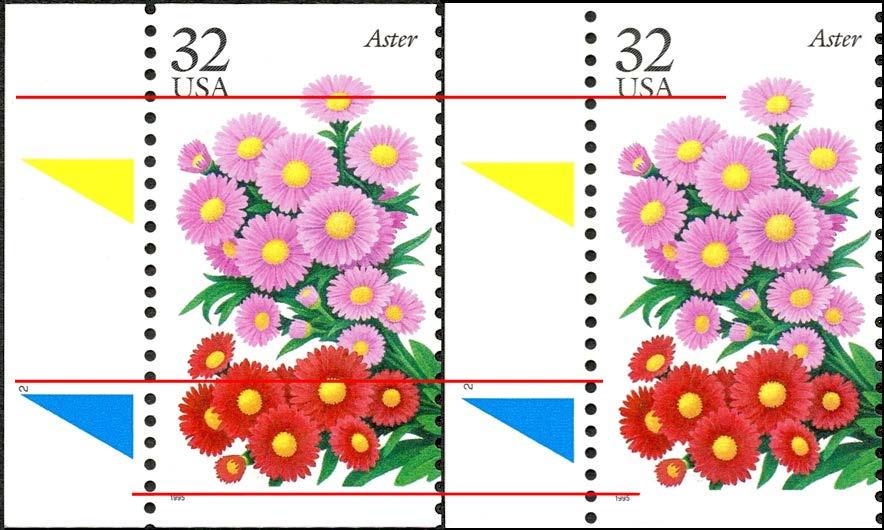
baseline for both panes. If the offset plates are well aligned (which they usually are), the difference in sleeve position can easily be seen by the distance of the plate number to the blue Bobst triangle.
Positions 22 and 70 have the fewest of all intaglio marks in the tab. A comparison shows that again, the plate number on position 70 is lower than on position 22 panes. The position of the plate number is the smoking gun in the fall flower issue to differentiate between the upper and lower halves of the intaglio sleeve.
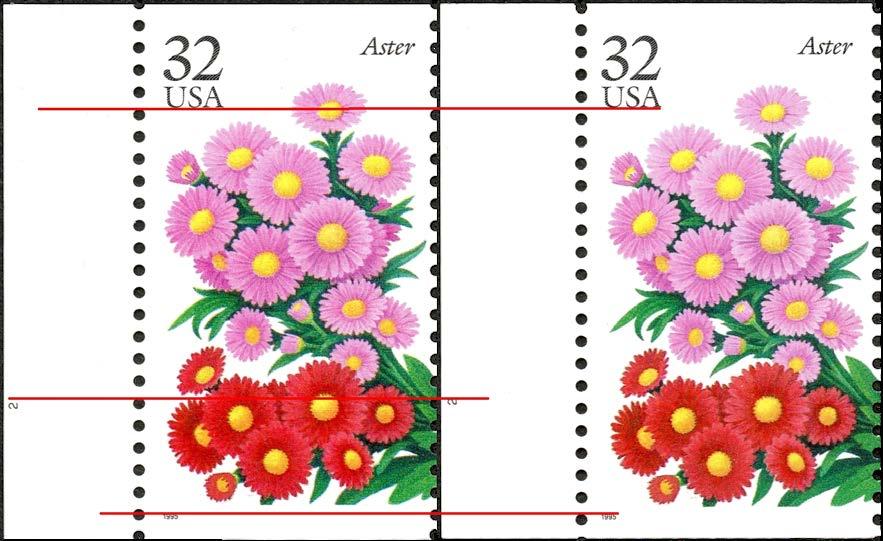
As can be seen, the difference is very minute and often requires a magnifying glass. When one has only one pane, it is often impossible to decide which half of the intaglio plate the pane came from.
Booklet covers contain brighteners and are coated on the outside. The coating absorbs some long-wave and most of the short-wave UV light. The covers appear dull
violet under short-wave UV and show a white glow from the brightener under long-wave UV.
A new quirk appears when looking at the panes under long-wave UV light. Apparently, web rolls with different papers were supplied to the BEP, and some contained significant amounts of an optical brightener. This also happened with the paper supplied for the winter garden flowers issue.
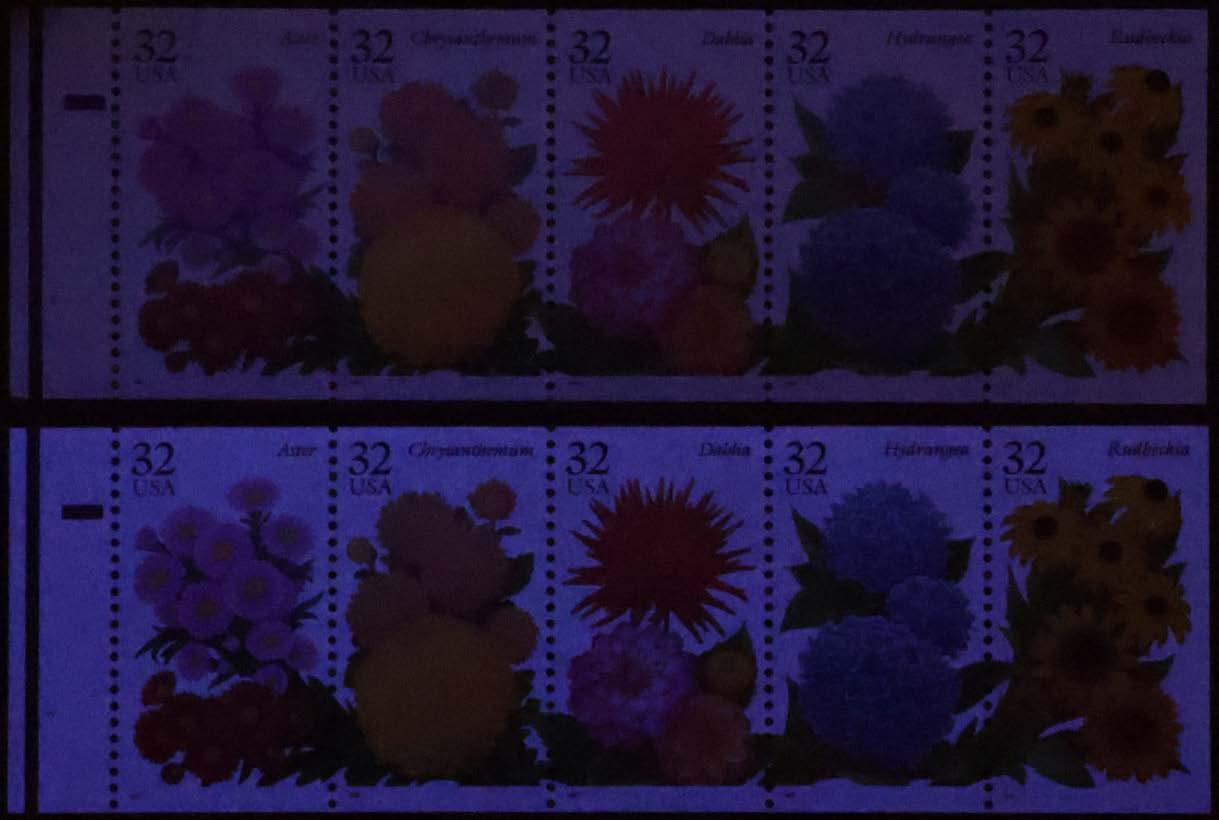
Dead web stock does not respond to long-wave UV and appears dull violet, while paper containing a brightener shows a bright, whitish glow.
As with most issues using combination printers, freaks are known where the intaglio section was misaligned. These panes are almost always described as misperforated, but
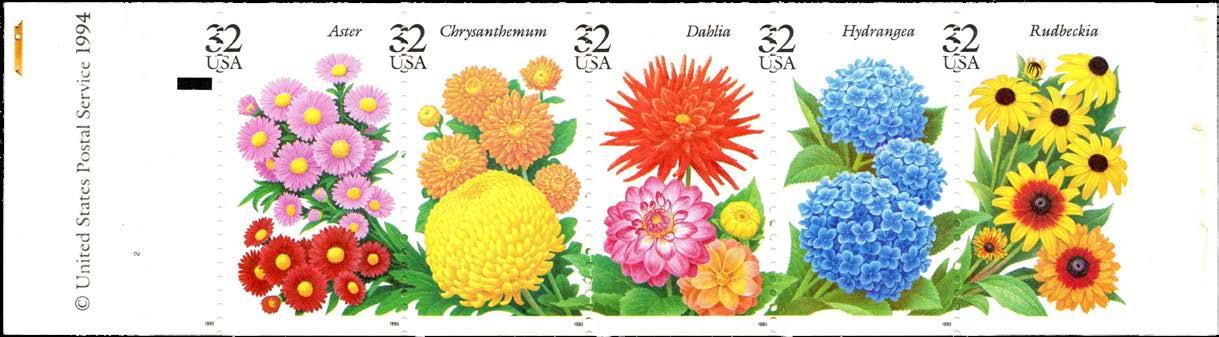
they are misaligned intaglio printings. The positions of the perforations are perfectly normal.
Missing intaglio black panes and imperforate booklet panes are known, but very rare. It took almost 20 years before the first missing intaglio black pane was reported.
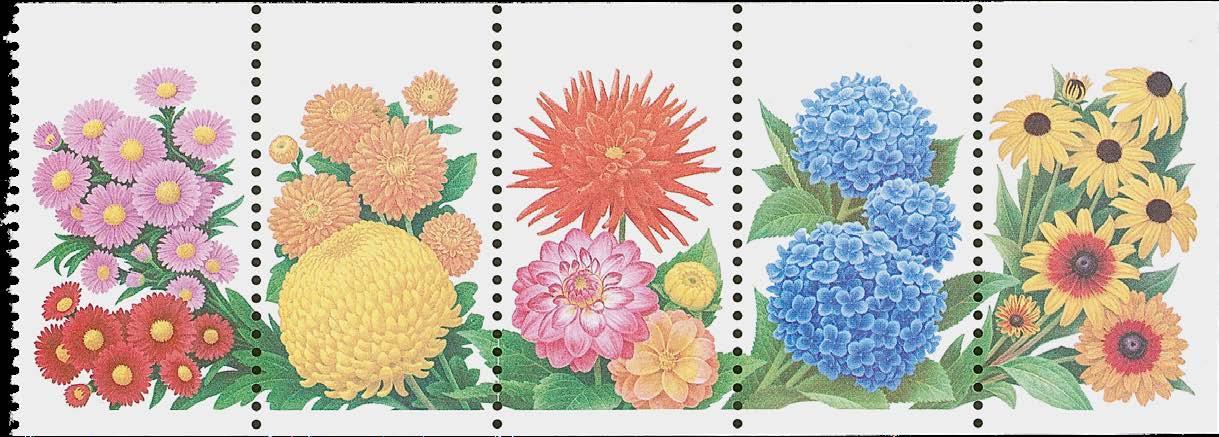
Figure 12. Rare 2997c missing intaglio black pane (removed from a booklet).4
The four garden flowers issues were very popular with the public due to their colorful and nature-oriented designs. For the booklet collector, they offer a wide range of varieties to collect. Searching for all the additional odd varieties, the booklet specialists will certainly be busy for years.
References
1. Dieter R. Kohler, “The Monthly Random Booklet: BK208 Spring Flowers,” The United States Specialist 97, no. 5 (May 2026).
2. Michael O. Perry, Folded-Style Booklet Checklist, Research Paper no. 2 (United States Stamp Society), https://www.usstamps.org/download/research-paper-2-folded-style-bookletchecklist/.
3. Robert Kitson, The Interleaf 11, no. 1 (March 1994).
4. Robert A. Siegel Auction Galleries, sale 1359, lot 606.
Interested in Learning More about Precancels? Request a copy of “Th e ABCs of Precancel Collecting” and also receive a sample copy of the PSS Forum, the Precancel Stamp Society’s monthly journal. Contact: Frank Bird III, 1095 Pinellas Point Dr South, Apt 352, St. Petersburg, FL 33705-6377. Email: promo@precancels.com.
Singles (mint and used)
Plate Blocks
Booklet Panes plus Complete Booklets
Price lists-$2.00 each category
Price lists free on web: www.mountainsidestampsandcoins.com
We also buy quality U.S. and foreign stamps
Mountainside Stamps, Coins and Currency
P. O. Box 1116 Mountainside, NJ 07092
Tel: 908-232-0539 or 908-419-9751
E-mail: tjacks@verizon.net
Tom Jacks, owner
Member APS, ASDA, USSS
Siegel offers unparalleled expertise, a worldwide client base, financial reliability, intelligent marketing, and the best internet resources of any philatelic auction house. Contact us today to learn more about consigning with Siegel and ensuring your legacy.
21 West 38th Street, 7th Floor
Phone (212) 753-6421
Email: stamps@siegelauctions.com
by Rodney A. Juell USSS # 13852 | P.O. Box 3508, Joliet, IL 60434
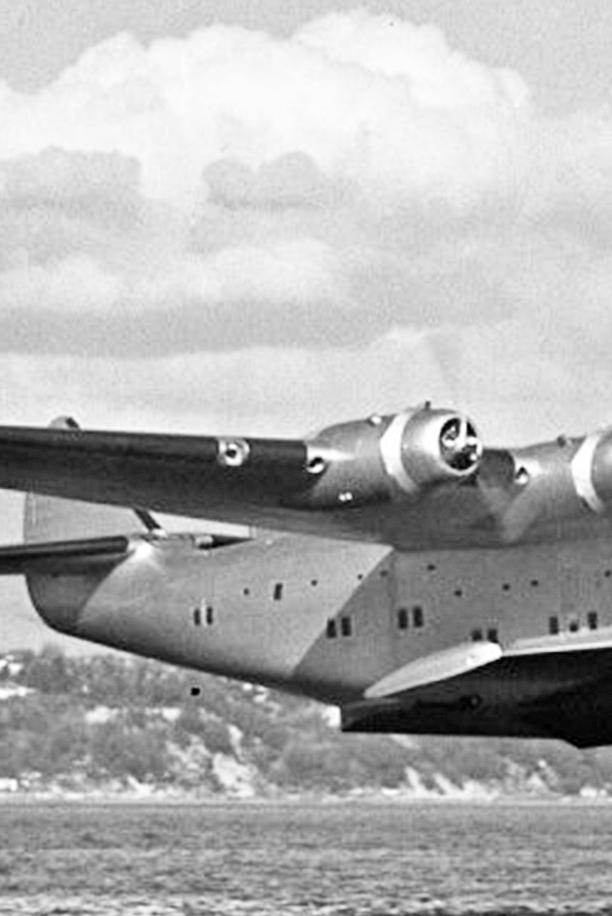
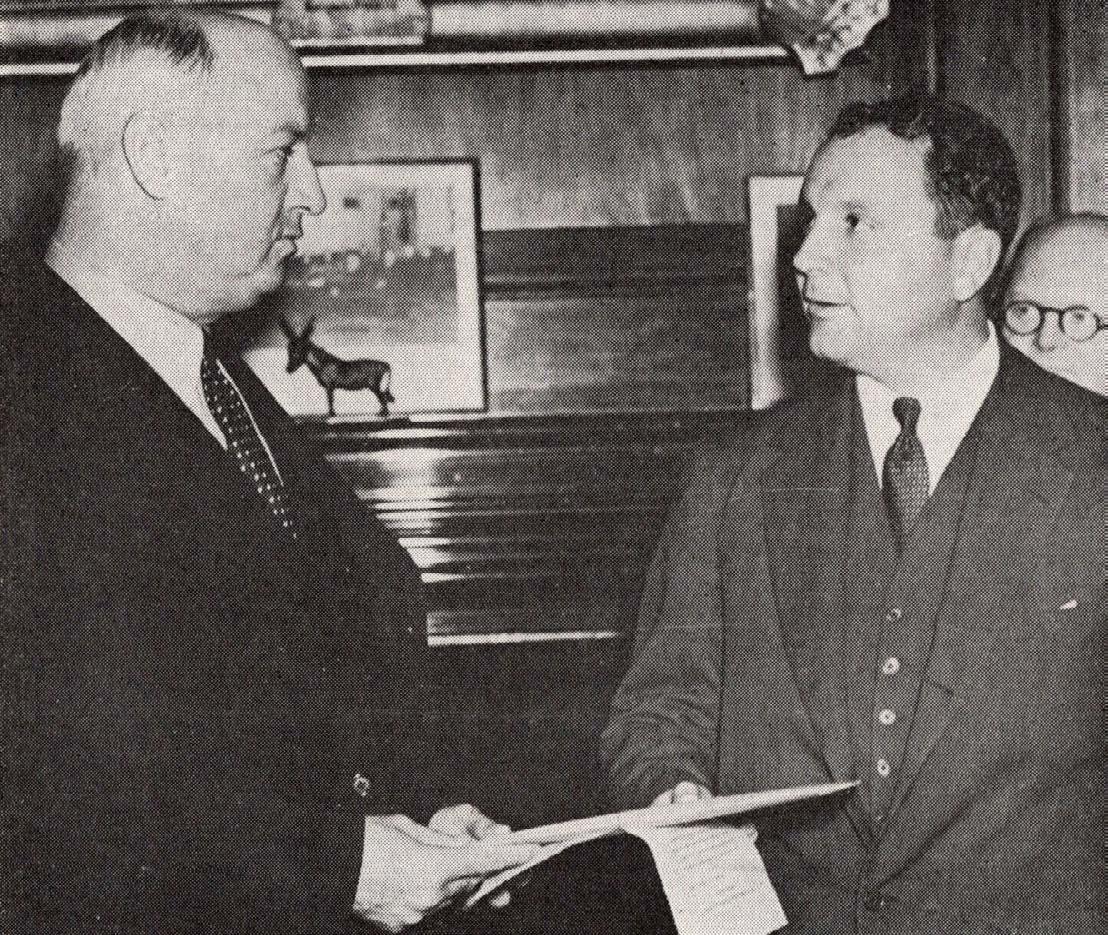
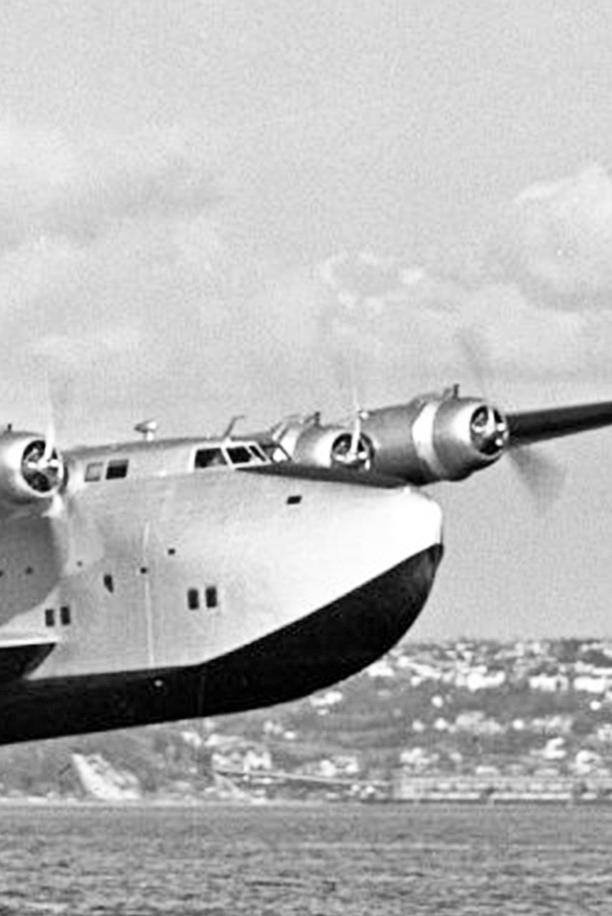
This month’s photo, from 1934, shows Juan Trippe, the president of Pan American Airways, presenting to Postmaster General James Farley his proposal to begin a trans-Pacific air mail route.
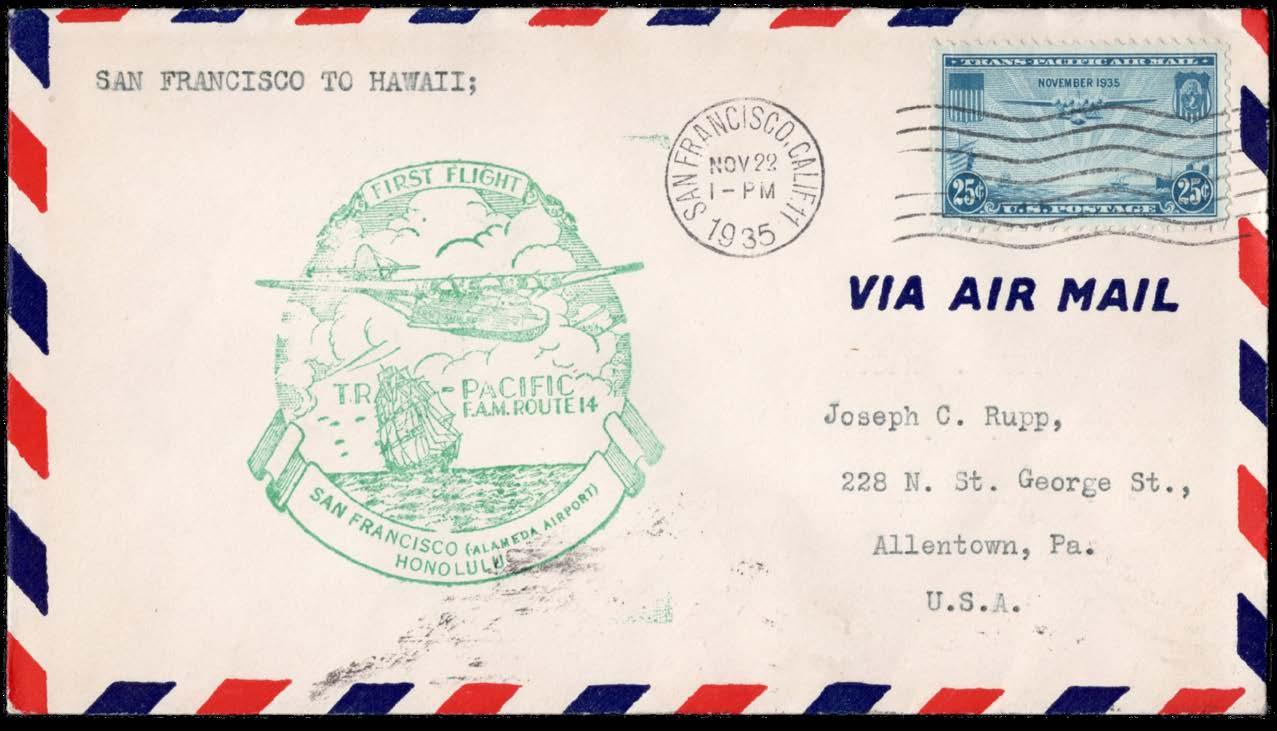
On November 22, 1935, the first regularly scheduled trans-Pacific air mail service was inaugurated by Pan-Am. Shown nearby is a first-flight cover from a segment of that trip. Note the cover is franked with an airmail stamp issued for use on the trans-Pacific route.
by Paul M. Holland USSS #16849 | m pholland.thorleaf@gmail.com
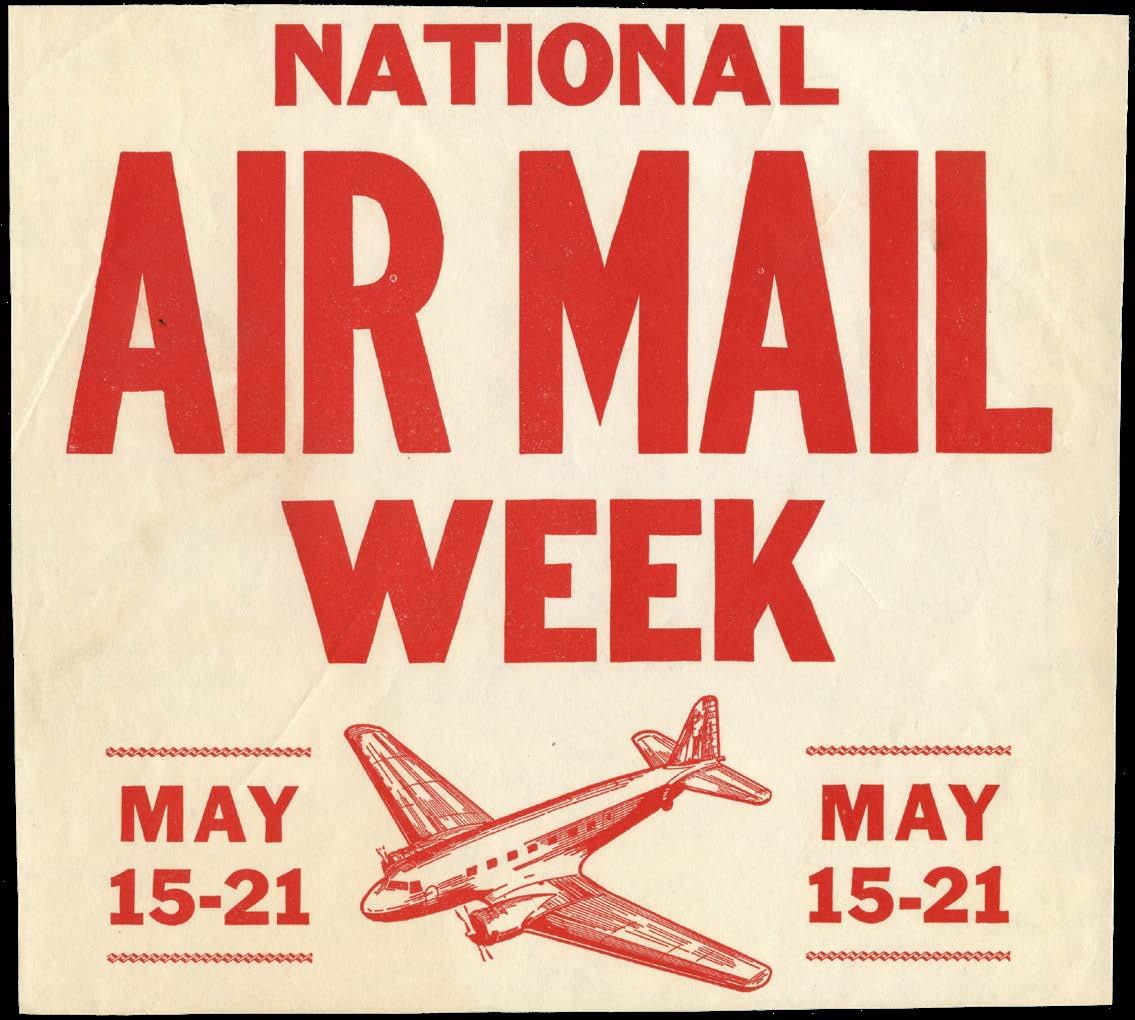
I continue to be fascinated by the broad scope of National Air Mail Week (NAMW), and how President Franklin D. Roosevelt (FDR) and his Postmaster General (PMG) James A. Farley came up with the idea to both celebrate the 20th anniversary of US airmail service and promote a special week (May 15–21, 1938) for the nationwide use of airmail using a new bi-color airmail stamp. This launched the largest philatelic event of the FDR era, with Farley challenging every city, town, and hamlet in the country to create a distinctive NAMW cachet that tells something interesting about their community. Since local postmasters were political appointees at the time, there was a strong response,
and thousands of different types were produced, often exhibiting distinctive designs by a wide range of local volunteers and civic organizations. In my opinion, such NAMW cachets represent genuine Americana. The majority of my newly acquired NAMW covers are from Thursday, May 19, a day designed to provide a tantalizing glimpse of future airmail service with special airmail flights flown by volunteer pilots utilizing local airports, farmers’ fields, or blocked-off portions of country roads, where necessary.
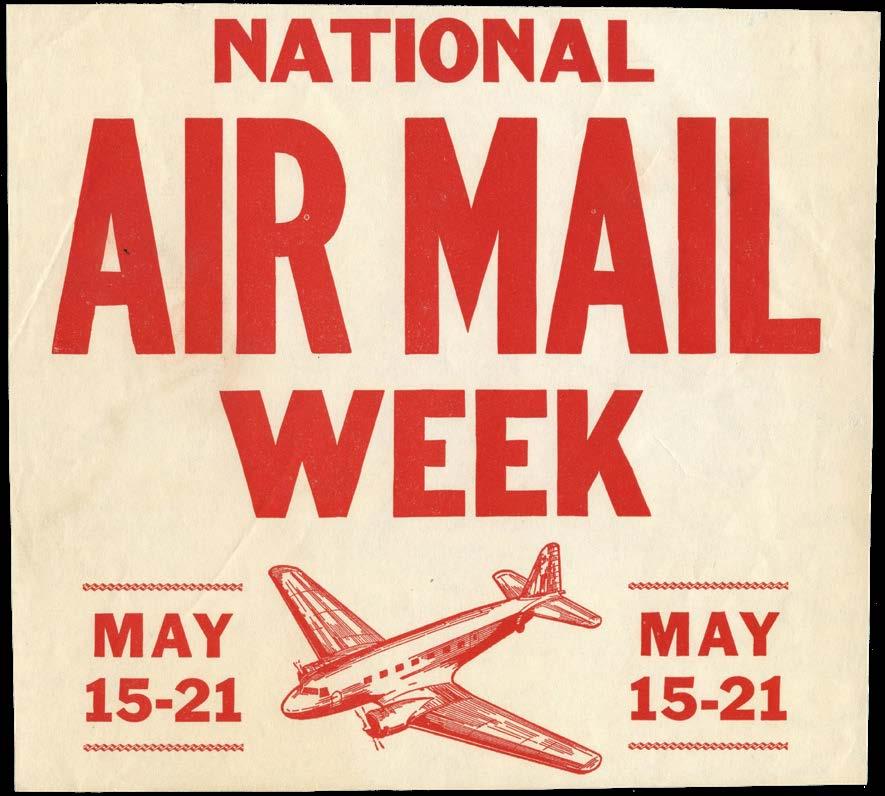
Following my previous articles,1-3 I hadn’t planned to revisit NAMW so soon, but my accumulation of NAMW covers sent to PMG Farley and FDR has grown substantially, and important additional information on collecting NAMW covers has come my way. I’ll begin with a large portion of the original National Air Mail Week poster shown as the frontispiece to this article. Such posters would have been displayed in post offices all around the country to encourage patrons to use airmail during this special promotional week. This example was sent to me by fellow society member Dalton Hoffman (USSS #5361), a specialist collector of material related to Fort Worth, Texas.
Regarding NAMW cover collecting, I was also contacted by another society member, David DuBois (USSS #16096), who kindly provided me with important new information on the Drabyk catalog. In particular, he alerted me to the greatly expanded listings in the final 2012 DVD version. Organized by state, this compendium is designed to include all possible NAMW communities with a structural database of 50,000+ communities, for which NAMW covers have been documented for some 12,800+ cities and towns. It also now includes covers from the James A. Farley collection at the National Postal Museum, as indicated by an asterisk in the listings. Reference images of more than 7,000 cachets and collateral material are provided, many of these in color, with Drabyk estimating that more than 9,200 different cachets were designed.4 It should be noted that while many of these cachets are unique, others were customized for specific towns using various generic NAMW types. Drabyk’s Rarity Factors for NAMW covers range from 1 to 5+++++ for the most common to the rarest. In this article, the population figures used are taken from the 1940 census.
Perhaps the best way for me to proceed is to show a portion of the updated 2012 Drabyk listing, along with one of my newly acquired NAMW covers sent to FDR in Figure 1. This NAMW cover was mailed to FDR by the postmaster of Springfield, Vermont, on May 19, 1938. It has a boldly printed cachet sponsored by the Springfield Chamber of Commerce that touts Springfield as “The Industrial Center of Vermont.” Interestingly, Springfield was in the center of the Precision Valley region, home of Vermont’s machine tool industry. Signed by the postmaster, this cover used a roller cancellation (between stamps on the block) and is franked by a top plate number “arrow” block. This block shows TOP marginal imprints and alignment marks, with plate numbers bearing the prefix letter F, indicating that it came from the upper left pane of the press sheet. Shown below are listings for Springfield in the 2012 Drabyk catalog, together with a few other communities in this alphabetical listing.
My cover in Figure 1 corresponds to the second Springfield, Vermont, entry under VT585, with a printed (PTD) cachet in blue (BLU) mailed on 19-May with INDUSTRIAL CENTER cachet, rated at rarity 2+. Other varieties with rubber-stamped (RS) cachets in various colors and dates of mailing are indicated by lower-case letters appended to the main catalog number. To put things in context, the town of Springfield had a population of
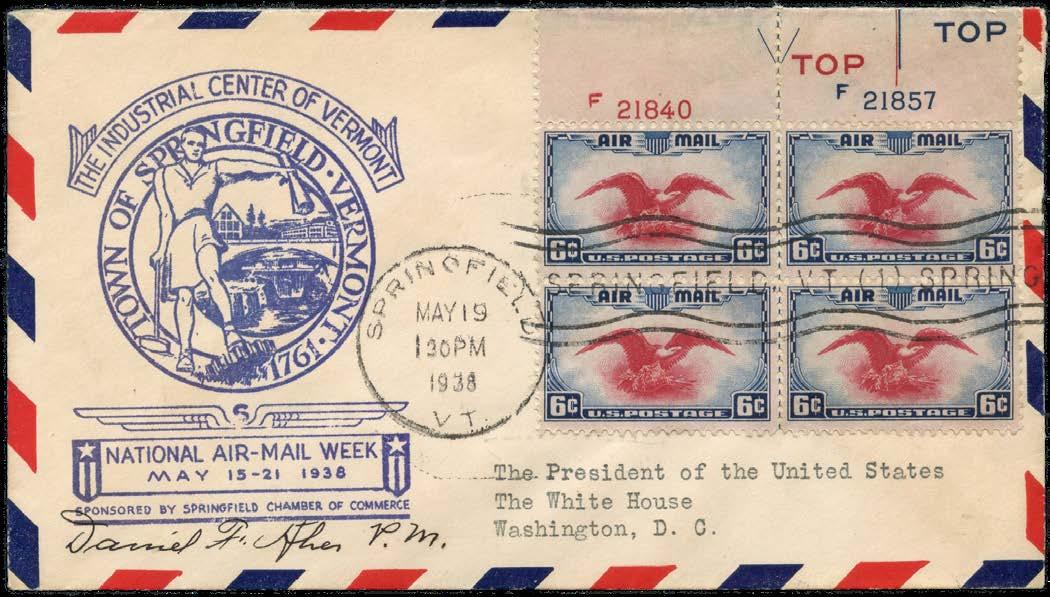
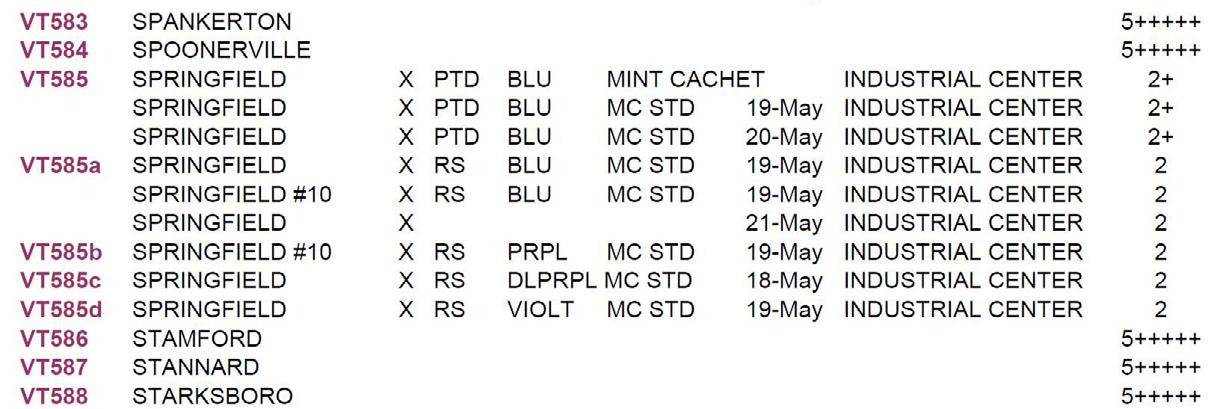
Figure 1. Postmaster-signed NAMW cover sent to FDR from Springfield, Vermont, along with listings from the 2012 Drabyk catalog.
7,720. Newly added to the 2012 version of the Drabyk catalog are separate line entries for all possible post offices, even if no (uncacheted) airmail covers sent during NAMW are known. In effect, this makes the catalog a “checklist” for airmail covers to look for, with such covers being given a default rarity factor of 5+++++. Spankerton and Spoonerville, listed above Springfield, must have been very small at the time, with Spoonerville now being described simply as a residential neighborhood located within the town of Springfield. Stamford, Stannard, and Starksboro were also much smaller than Springfield, with populations of 418, 140, and 744 in the 1940 census.
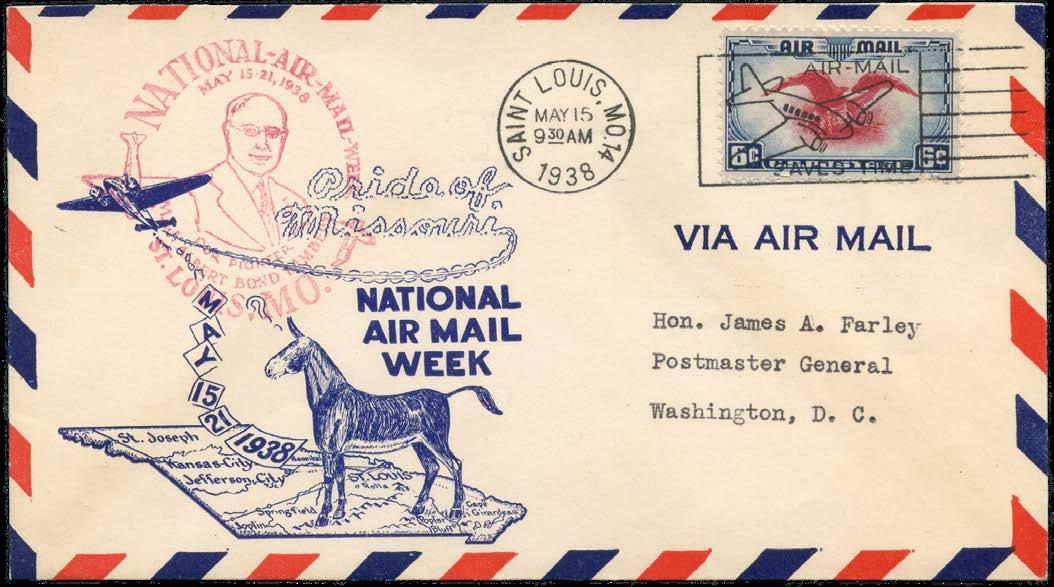
I’ve also added a substantial number of Farley NAMW covers to my reference collection. I’ll begin with my cover sent to PMG Farley from St. Louis, Missouri, on the first day of NAMW, May 15, 1938. Shown in Figure 2, the printed NAMW cachet displays an airplane with contrail spelling out “Pride of Missouri,” along with a state map and a “Missouri mule.” A second rubber-stamped cachet bears a portrait of Major Albert Bond Lambert, a prominent St. Louis businessman, aviator, and benefactor. Note that the slogan cancellation itself features an airplane.
Another of my Farley NAMW covers with printed cachet, this time from Paducah, Kentucky, on May 19, is shown in Figure 3. The cachet touts four different “Million Dollar Industries” located in Paducah. These include Aroma strawberries (a special patented
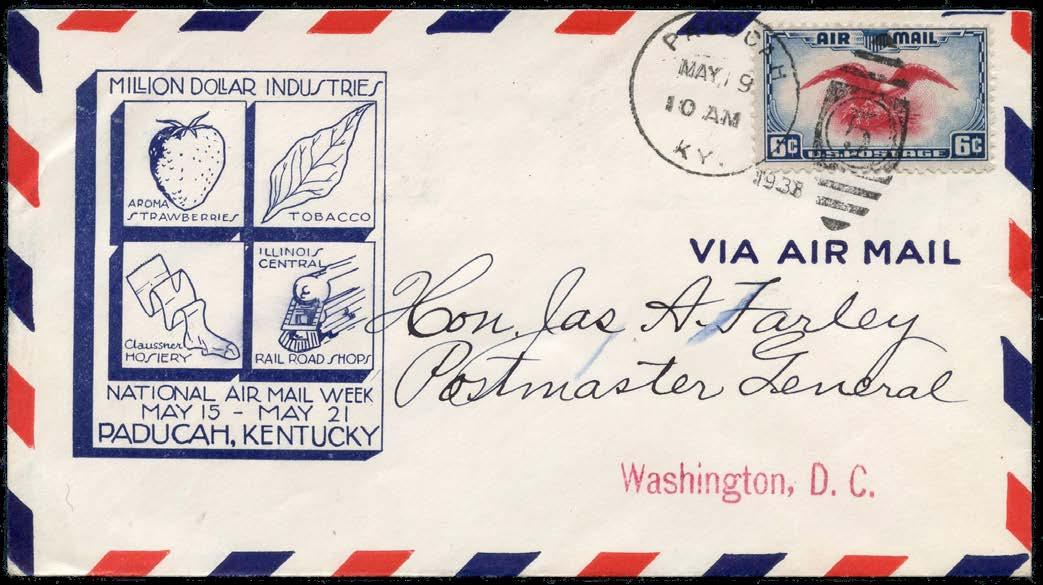
variety), leaf tobacco, Claussner ladies Nylon hosiery, and Railroad Shops for the Illinois Central, a massive repair facility for steam locomotives.
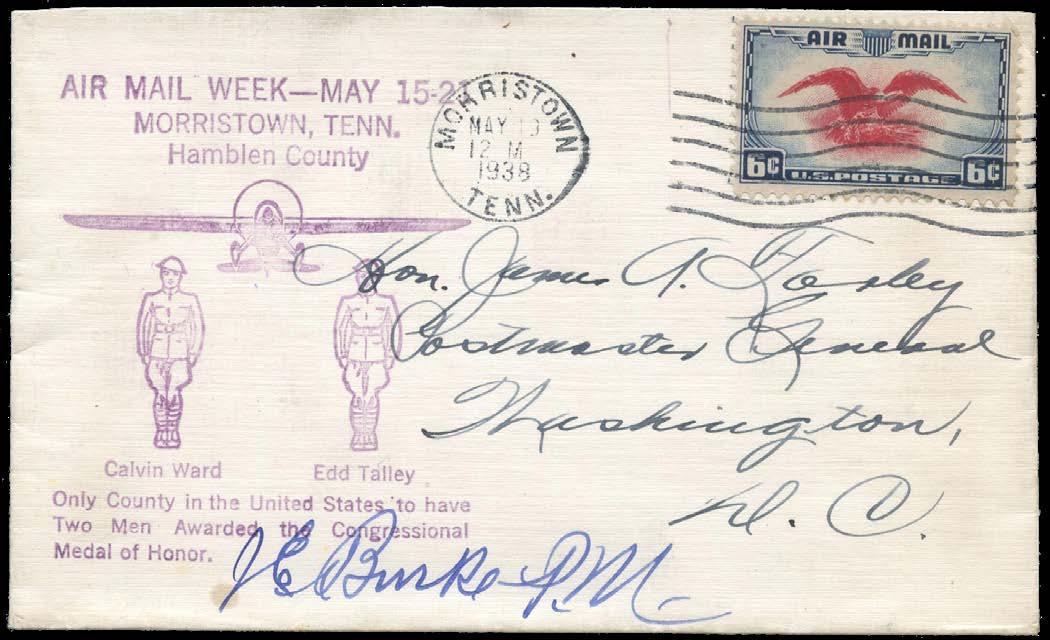
In Figure 4, I show my postmaster-signed NAMW cover sent to Farley from Morristown, Tennessee. The rubber-stamped cachet touts Hamblen County as the “Only County in the United States to have Two Men Awarded the Congressional Medal of Honor.” Both were awarded the medal for actions in World War I in 1918. This cover is rated as rarity 5 in Drabyk, and interestingly, there is no asterisk in the Drabyk listing indicating that there is a NAMW cover from the Farley collection at the National Postal Museum.
Another of my Farley NAMW covers with a printed cachet is shown in Figure 5. From Norwalk, Connecticut, the cachet touts that Norwalk is only “Fifty-six Minutes from Grand Central” Station in New York City. There is also a red handstamp that this was the “First Air Mail Flight From Norwalk, Conn. May 19, 1938.” Curiously, the printed NAMW cachet on this cover displaying the Connecticut state seal was apparently customized for
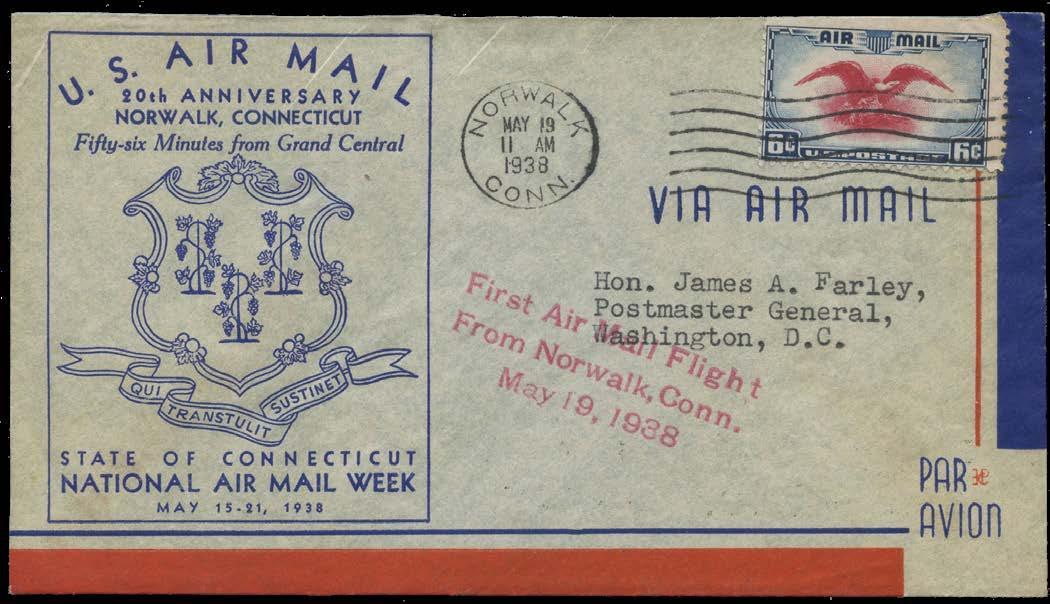
Norwalk, as I’ve seen a number of others using the same design with the names of different cities and slogans substituted. This NAMW cover is rated 4+ in Drabyk.
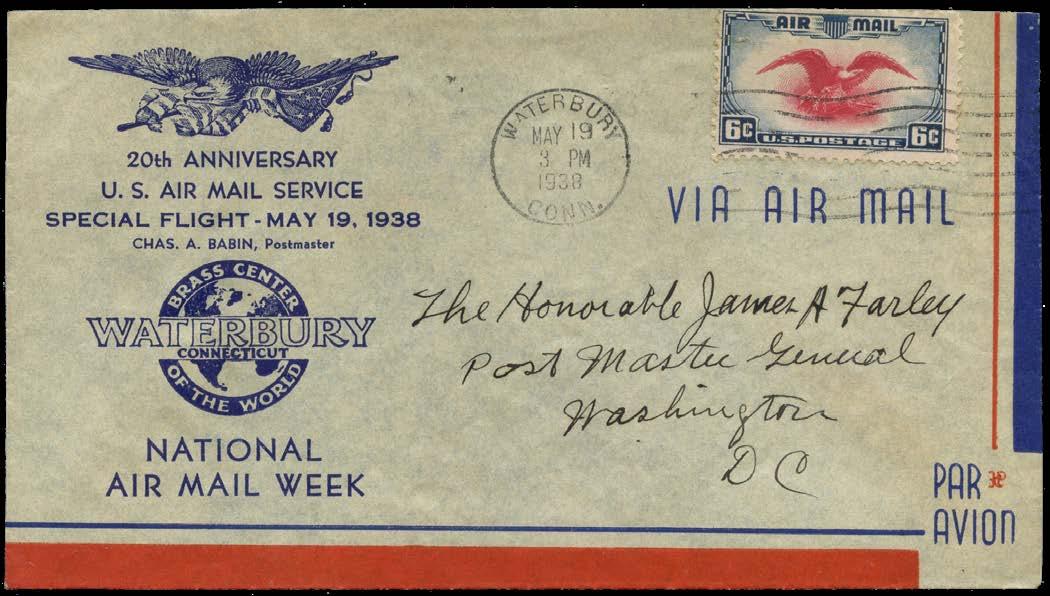
Shown in Figure 6 is another of my Farley NAMW printed cachet covers, this time from the postmaster of Waterbury, Connecticut. The cachet touts Waterbury as the “Brass Center of the World,” although as stamp collectors, it’s the fabulous “fancy cancels” by a much earlier Waterbury postmaster that we especially prize. This cover is rated as rarity 1+ in Drabyk.
Another of my Farley NAMW covers is one sent from Bridgeport, Connecticut, on May 17, 1938. Bridgeport is the state’s largest city and is often regarded as the “Industrial Capital of Connecticut.” The printed cachet shows the city’s seal and main post office, as seen in Figure 7.
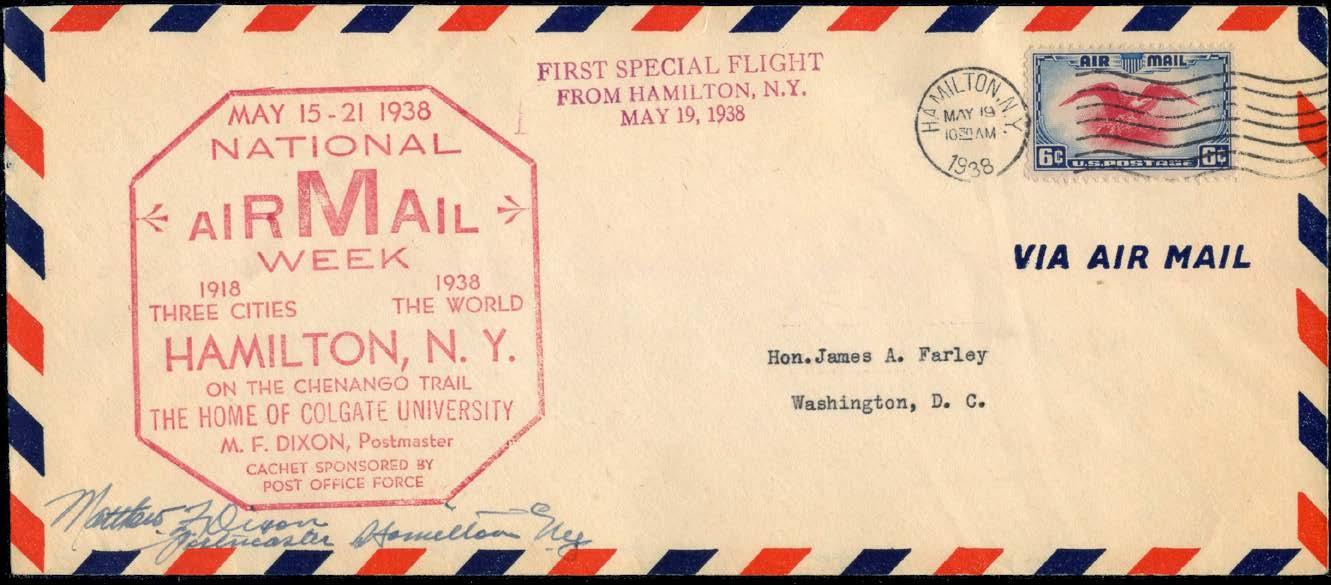
Shown in Figure 8 is my postmaster-signed Farley NAMW cover from Hamilton, New York. The rubber-stamped cachet touts Hamilton as being on the Chenango
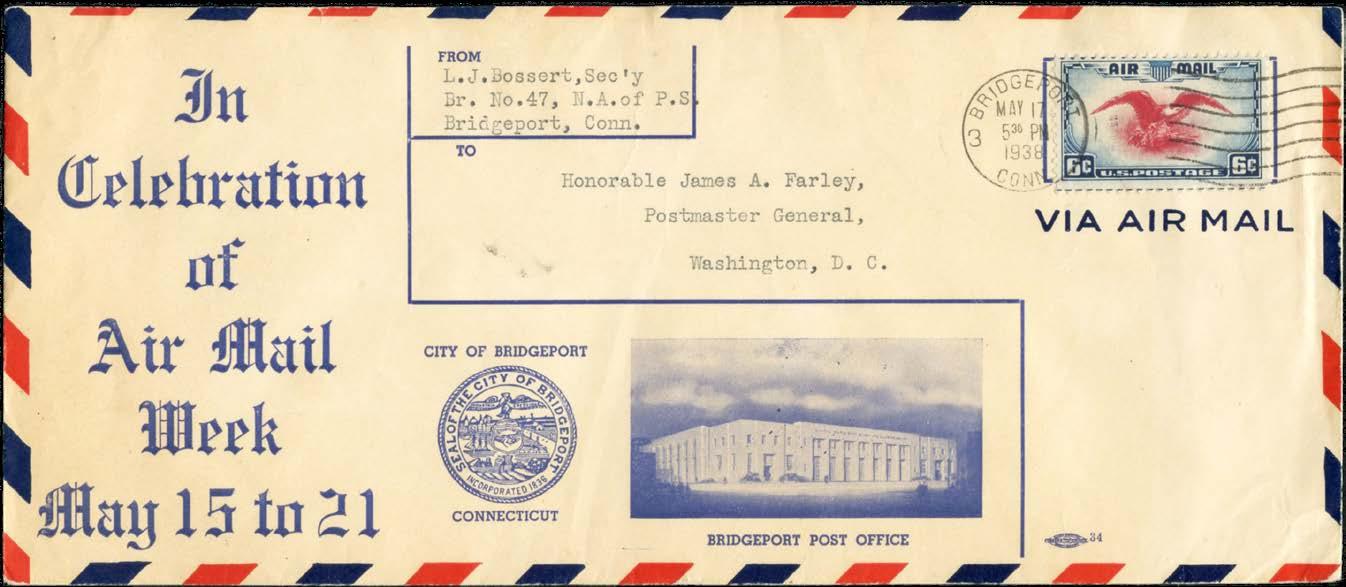
Trail and as the “Home of Colgate University.” An additional handstamp shows that it was sent on the “First Special Flight From Hamilton, N.Y. May 19, 1938.” At the time, the population of Hamilton was 3,618, with a Drabyk rarity factor of 2 for this cover.
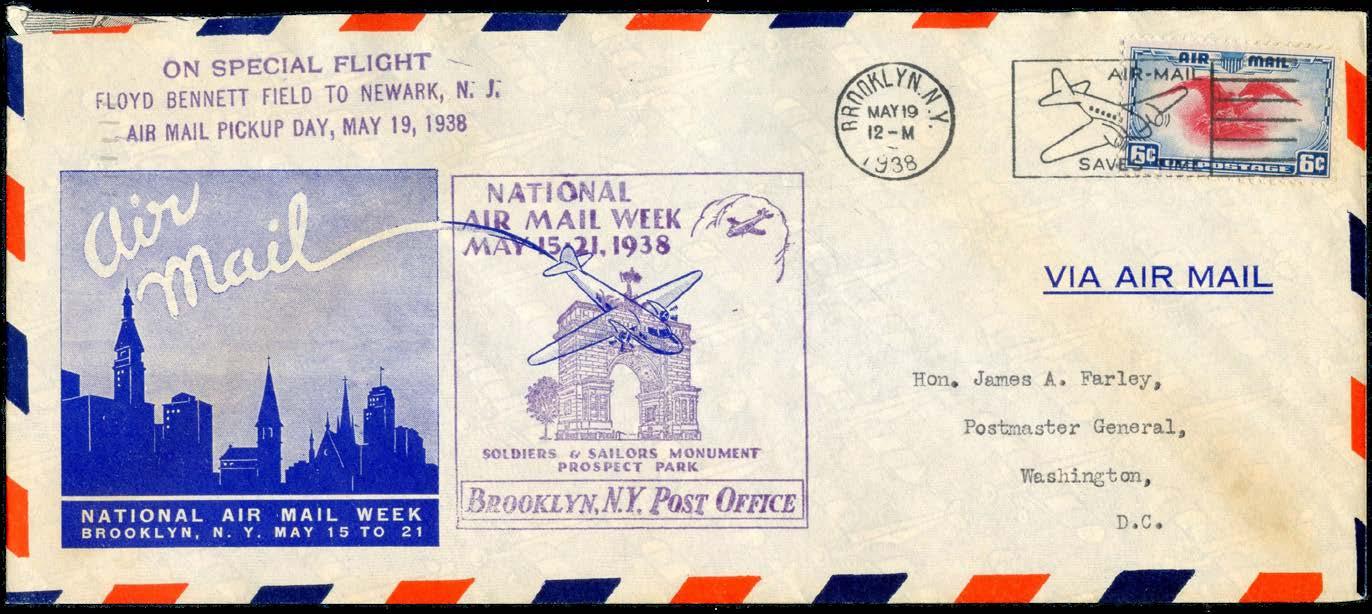
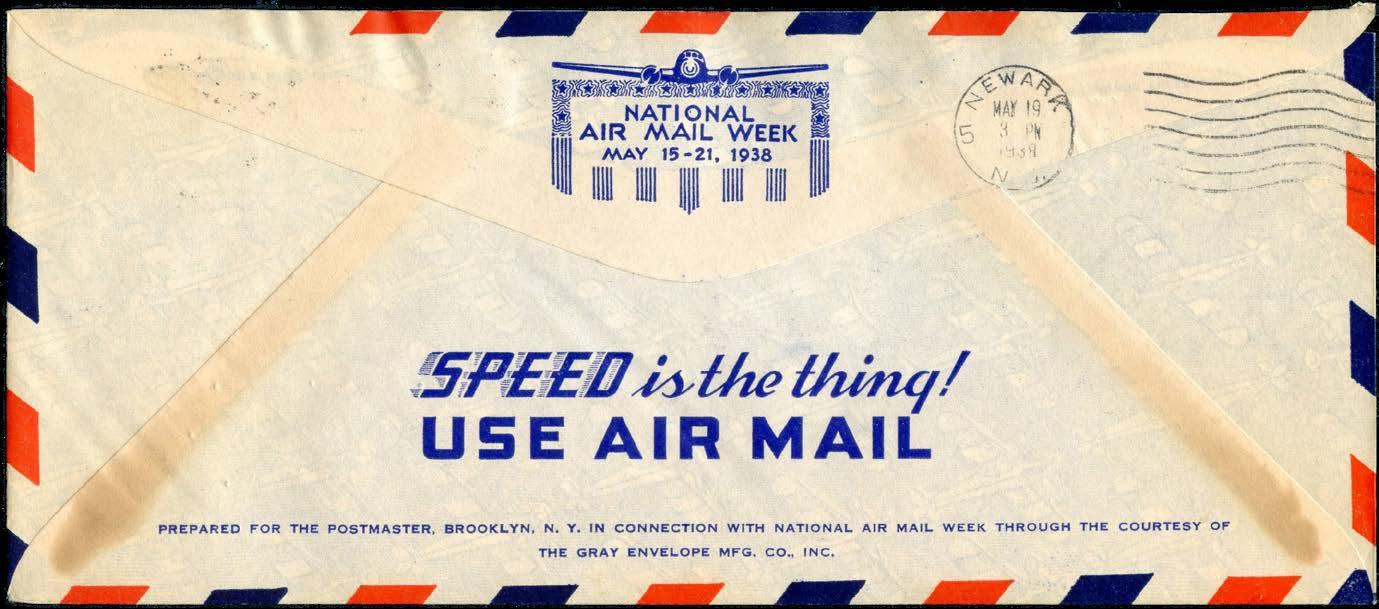
I have a number of other Farley NAMW covers from New York. These include the cover sent from Floyd Bennett Field, Brooklyn, New York, with a stop in Newark, New Jersey, on May 19, 1938. Shown in Figure 9, this special cover, courtesy of the Gray Envelope Mfg. Co., Inc., has a printed NAMW cachet showing the skyline of Brooklyn with an airplane. A second rubber-stamped cachet showing the Soldiers & Sailors Monument in Prospect Park has been added. The back of the envelope also touts National Air Mail Week with the slogan “SPEED is the thing! Use Air Mail.” One of the five boroughs of New York, Brooklyn’s population was 2,698,285, so not surprisingly, this cachet is relatively common with a rarity factor of 1+ in Drabyk.
My Farley NAMW cover from Watertown, New York, is shown in Figure 10. Watertown is near the Canadian border, and the rubber-stamped cachet pictures the 1000 Islands
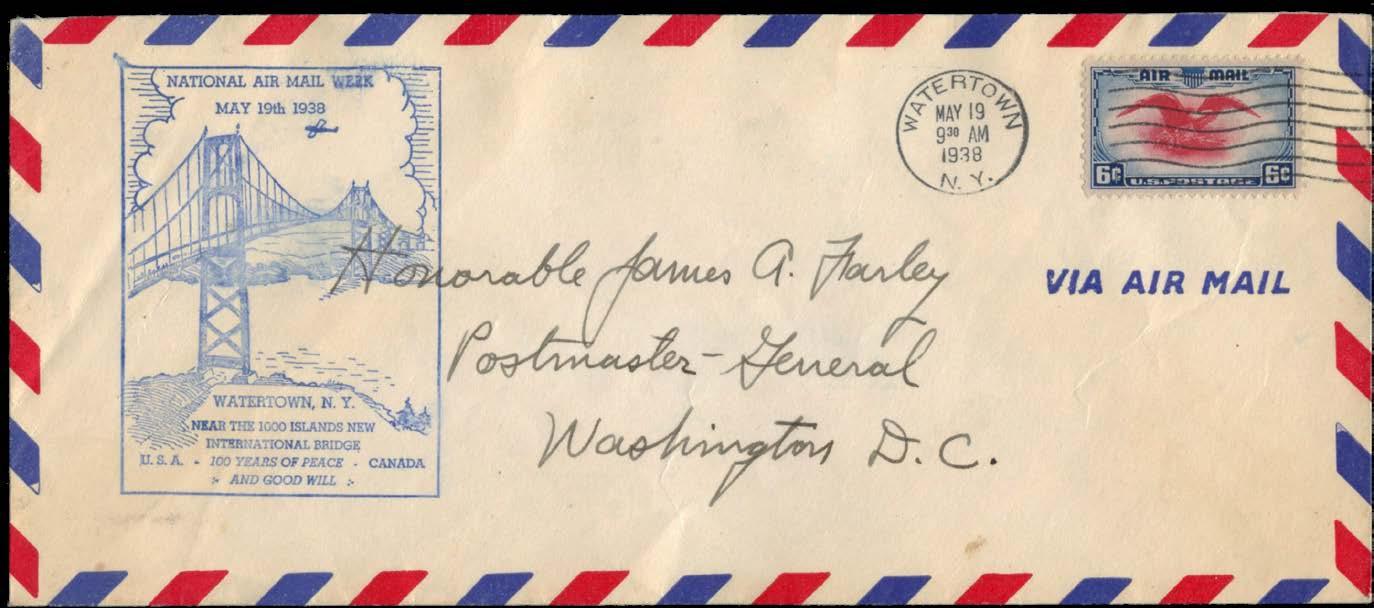
New International Bridge, which spans the St. Lawrence River and was constructed in 1937. The cachet also celebrates “100 years of Peace and Good Will” between the United States and Canada. Watertown’s population at the time was 33,385, with this cover having a Drabyk rarity rating of 2.
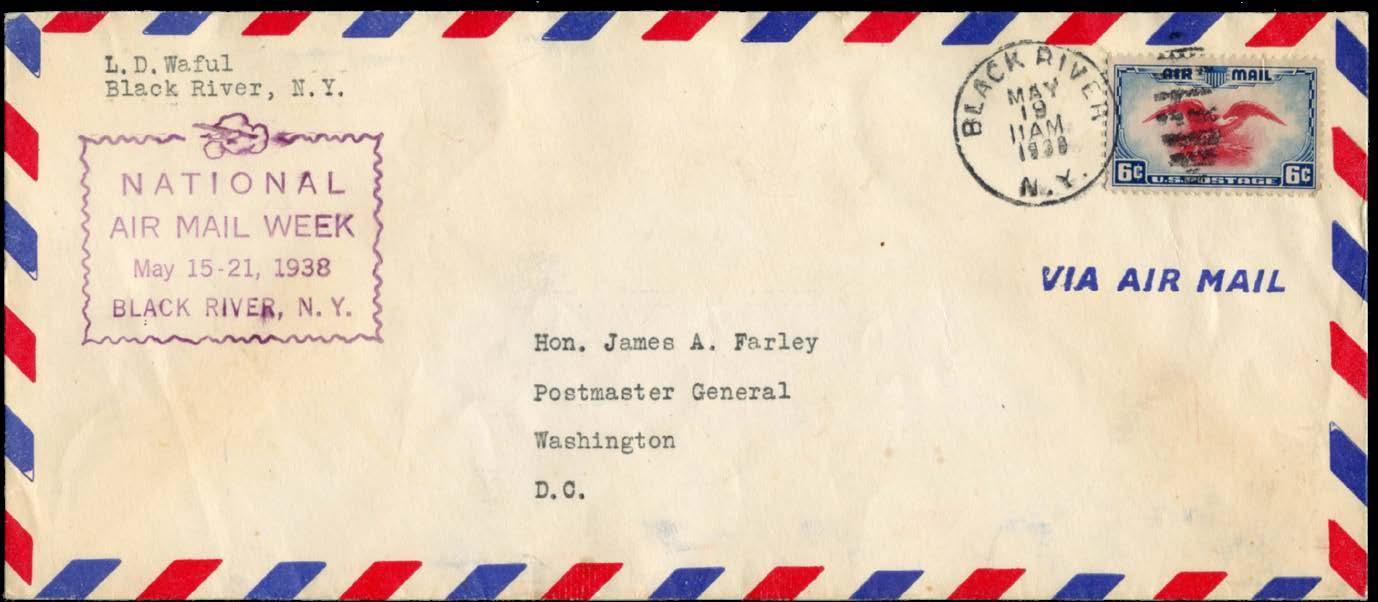
Next, I show my Farley NAMW cover from Black River, New York, a nearby village just east of Watertown with a population of 897. Shown in Figure 11 with a simplified NAMW cachet, this cover is rated as rarity 5 in Drabyk. Curiously, the asterisk in the Drabyk listing below suggests that my cover addressed to Farley is apparently a duplicate of the NAMW cover in the National Postal Museum’s collection.
A postmaster-signed NAMW cover sent to PMG Farley from Canton, New York, is shown in Figure 12. This has an unusual printed cachet in the form of a six-pointed star enclosing a nicely engraved image of the local post office. Also touted for this village of 3,018 in upstate New York is its status as the home of Silas Wright, governor of New York in 1845–46, St. Lawrence University, and the State School of Agriculture. Drabyk rates this NAMW cover as 2+.
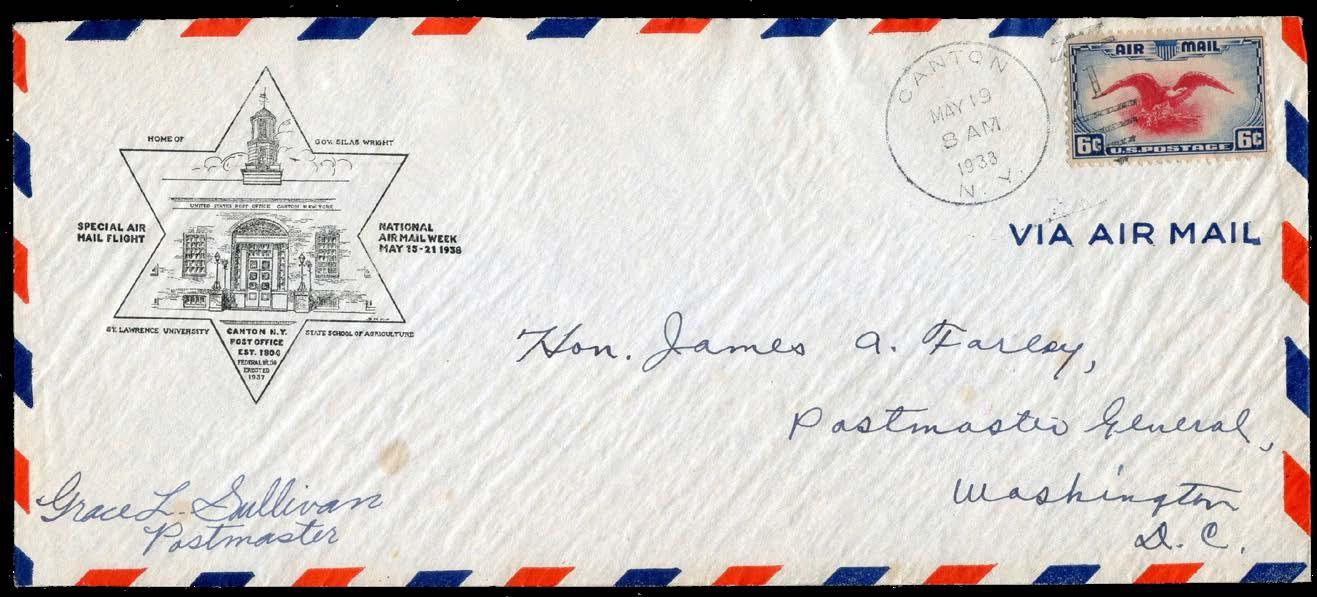
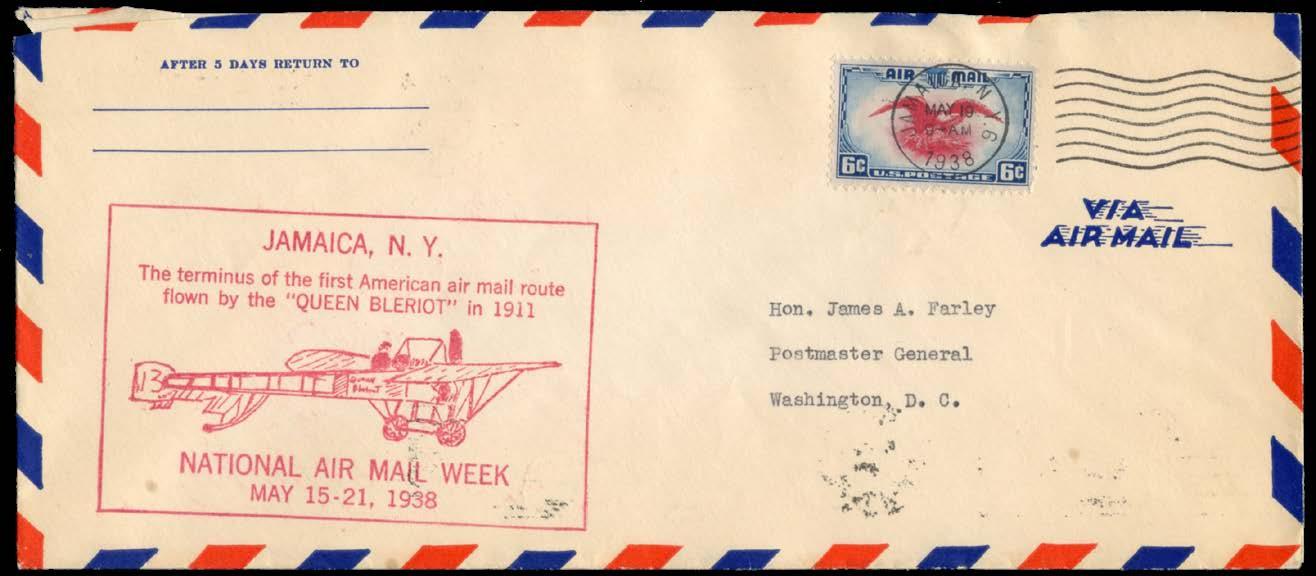
Figure 13 shows my Farley NAMW cover from Jamaica, New York, a neighborhood in the borough of Queens. The cachet shows an early airplane in flight, celebrating Jamaica, NY as “The terminus of the first American air mail route flown by the ‘Queen Bleriot’ in 1911.” The Queen-Bleriot was an American-built aircraft based on the famous French Blériot XI monoplane, the same type used for the first flight across the English Channel in 1909. This first airmail flight was piloted by Earle Ovington on September 23, 1911. The Drabyk rating is 2.
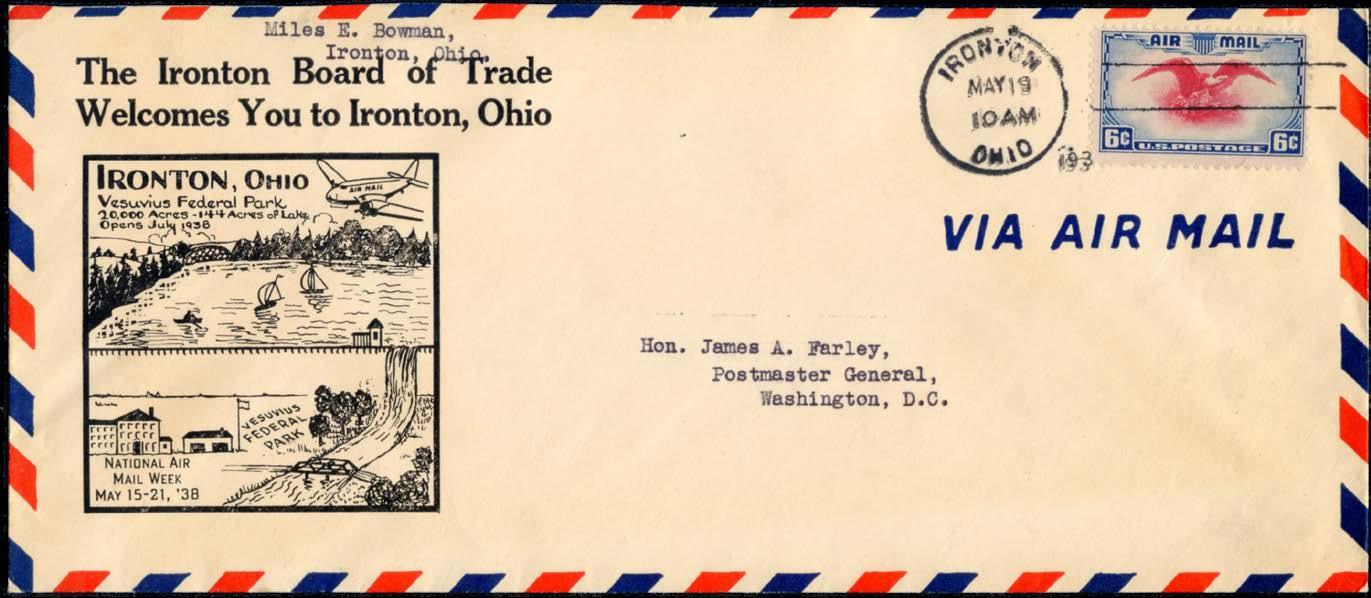
My Farley NAMW cover from Ironton, Ohio, is shown in Figure 14. Ironton is located on the Ohio River and, between 1850 and 1890, was one of the world’s top producers of iron, supplying the iron used to build the USS Monitor, the Union’s Civil War ironclad warship. However, in the 1890s as demand shifted to steel, Ironton languished. The printed NAMW cachet from the Ironton Board of Trade depicts Vesuvius Federal Park, due to open in July 1938. Named after the Vesuvius Iron Furnace, it is now known as the Lake Vesuvius Recreation Area, located in the Wayne National Forest. Ironton’s population in 1940 was 15,851, and this NAMW cover is rated by Drabyk as 5+++++.
Shown in Figure 15 is my Farley NAMW cover from the postmaster of Normal, Illinois, population 6,983. The printed cachet shows the new post office building dedicated March 1, 1936, presumably built by the Public Works Administration under FDR’s New Deal. Also mentioned is the Illinois State Normal University, founded in 1857 as a normal
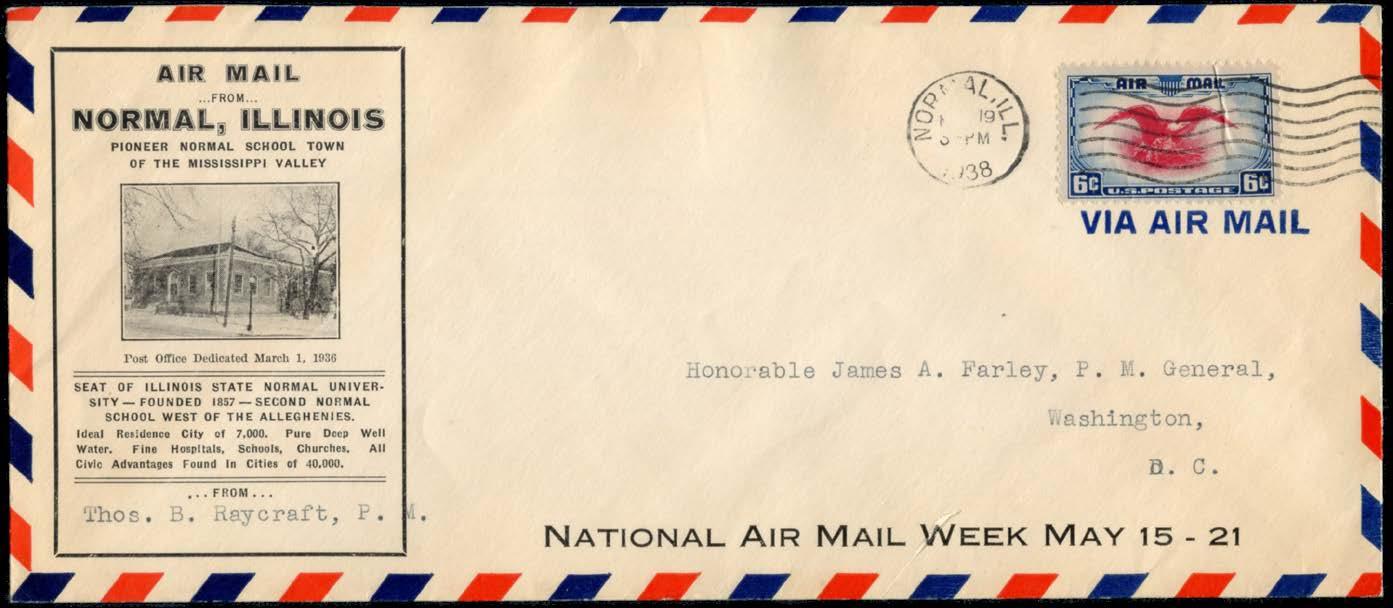
school for teacher-training. Normal is touted as an “Ideal Residence City of 7,000. Pure Deep Well Water. Fine Hospitals, Schools, Churches. All Civic Advantages Found in Cities of 40,000.”
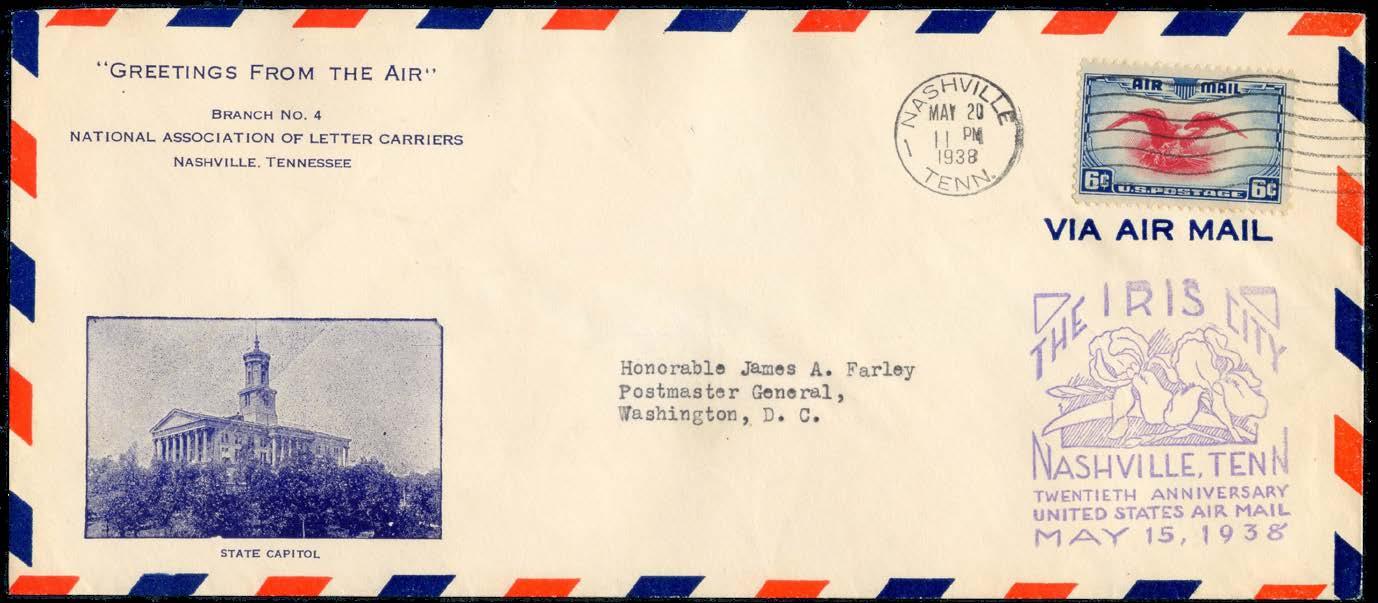
Shown in Figure 16 is my final example of a Farley NAMW cover, sent to him by Branch No. 4 of the National Association of Letter Carriers from Nashville, Tennessee, on May 20, 1938. The printed cachet shows “Greetings From the Air” with a photograph of the State Capitol. There is also a rubber-stamped cachet touting Nashville as “The Iris City.” This NAMW cachet combination is not shown for Nashville in the Drabyk catalog.
Among the substantial number of my newly acquired NAMW covers sent to FDR is the unusual postmaster-signed cover shown in Figure 17. Sent on May 15, this cover uses re-purposed official Treasury Department stationery and is signed in the corner card by
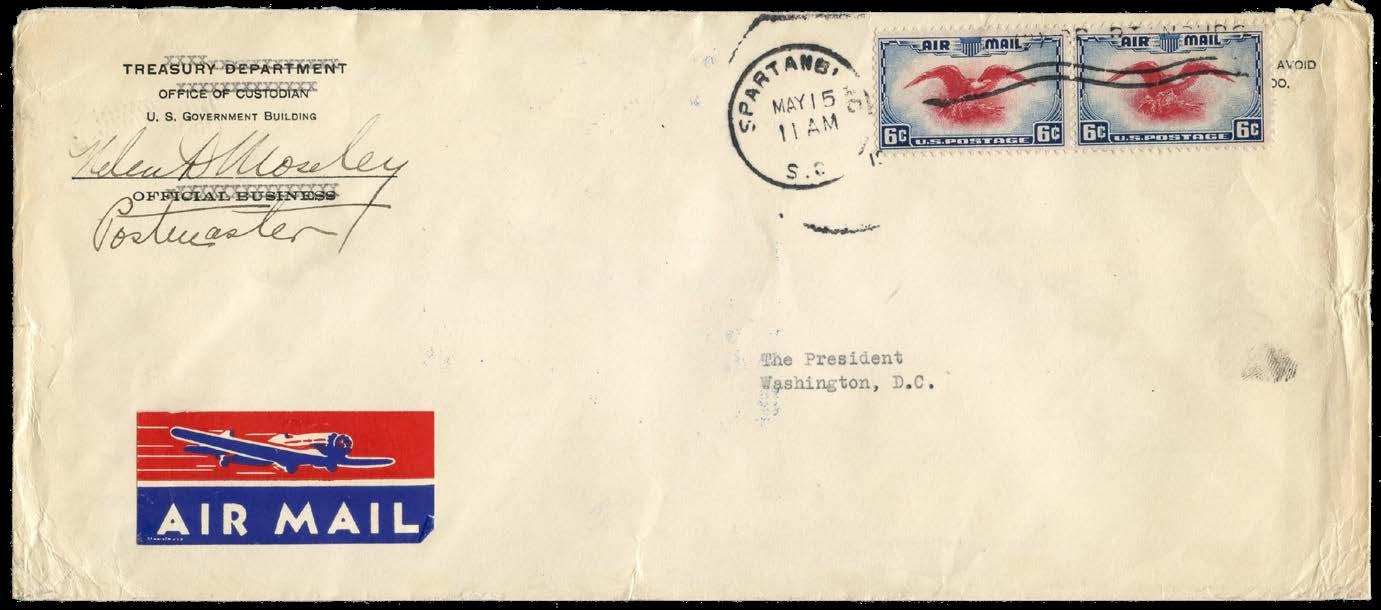
the postmaster of Spartanburg, South Carolina. The H. R. Harmer auction backstamp clearly shows that this was retained in the President’s personal stamp collection.
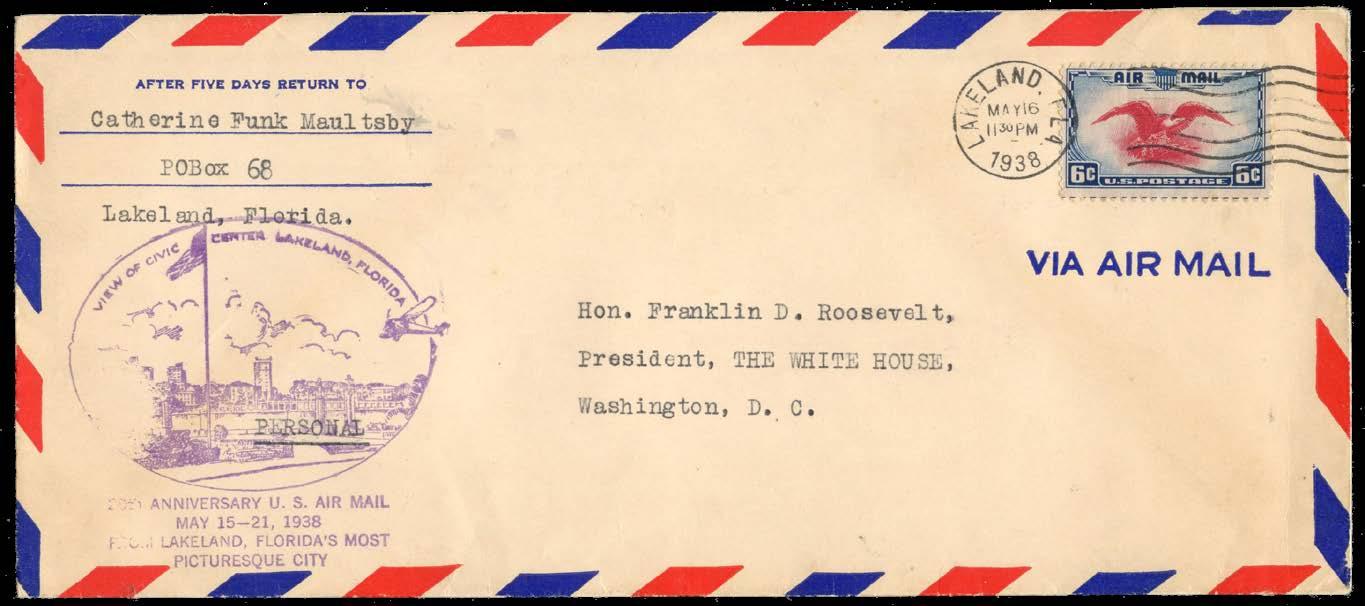
Shown in Figure 18 is my NAMW cover sent to FDR from Lakeland, Florida, on May 16, 1938. This has a rubber-stamped cachet showing a view of the Civic Center, and is marked “Personal” by the sender. At the time, Lakeland had a population of 22,068.
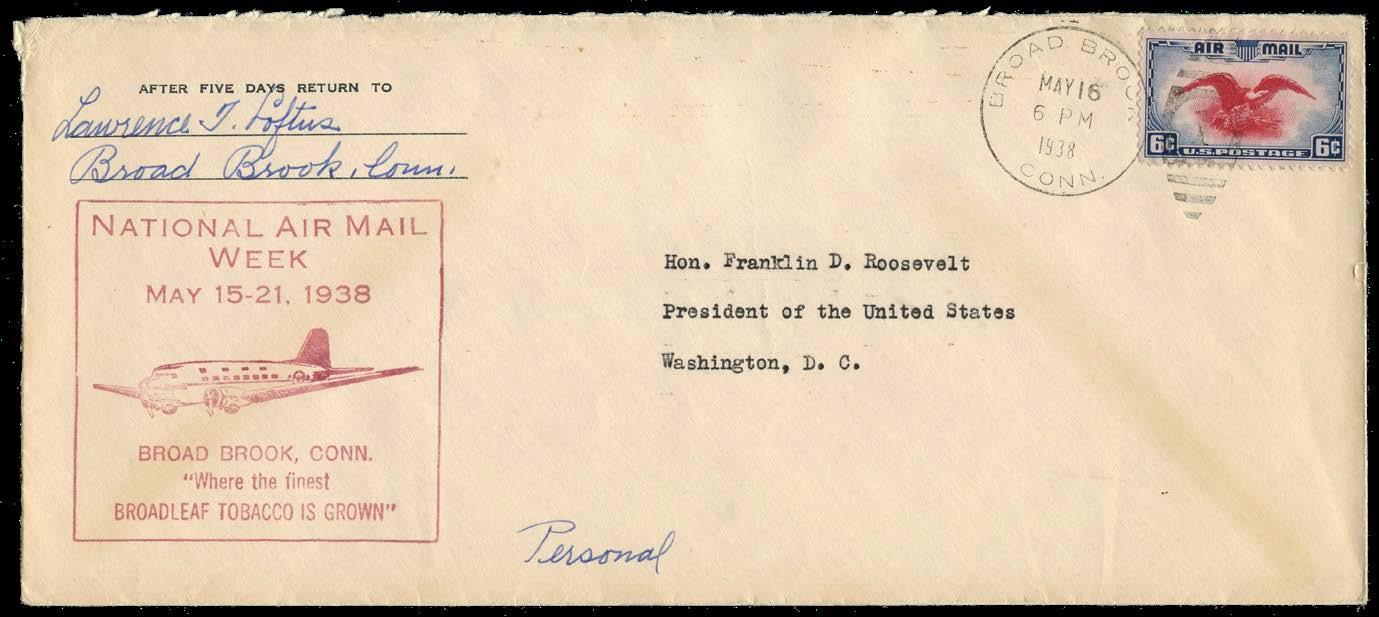
Broad Brook, Connecticut, is a neighborhood in East Windsor (population 3,967). This illustrates how sometimes even very small communities within a larger entity produced their own NAMW cachets. My NAMW cover from here sent to FDR is shown in Figure 19. The cachet touts Broad Brook as being “Where the finest Broadleaf Tobacco is Grown.” Note that this NAMW cover is marked “Personal,” with a Drabyk rarity of 4.
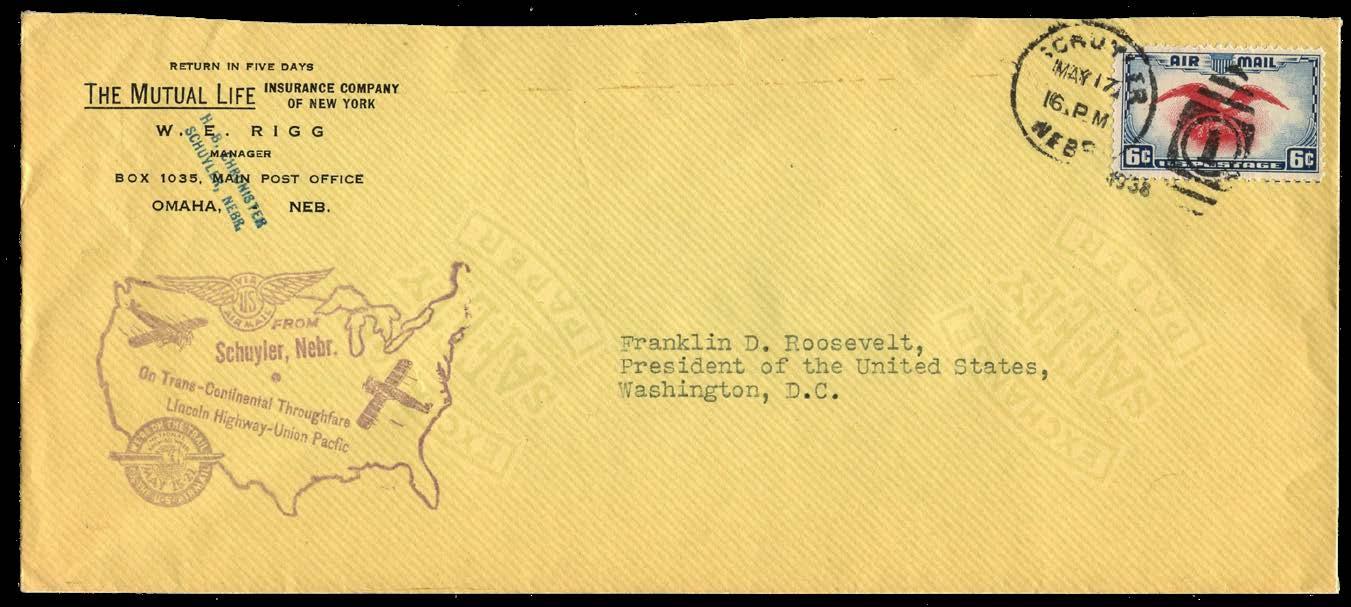
In Figure 20, I show my NAMW cover sent to FDR from Schuyler, Nebraska, on May 17, 1938. This has a rubber-stamped cachet showing a map of the United States that has been customized for Schuyler with the slogan “On Trans-Continental Thoroughfare Lincoln Highway-Union Pacific.” I know of many other similar NAMW “map” cachets, such as the one sent to FDR from Rushville, Nebraska, shown in Figure 15 of my NAMW Part II article.2 The population of Schuyler was 2,808, and interestingly, this cover is on printed stationery of the Omaha office of the Mutual Life Insurance Company of New York.
My postmaster-signed NAMW cover sent to FDR from Visalia, California, known as the “Gateway to the Sequoias” is shown in Figure 21. This has a printed cachet showing a 1938 airplane flying over an 1851 stagecoach among giant California redwoods touted as the “Largest Trees in the World.” There are rubber stamps showing that this was included on the First Flight of airmail sent from Visalia on May 19, 1938. The cover is franked by
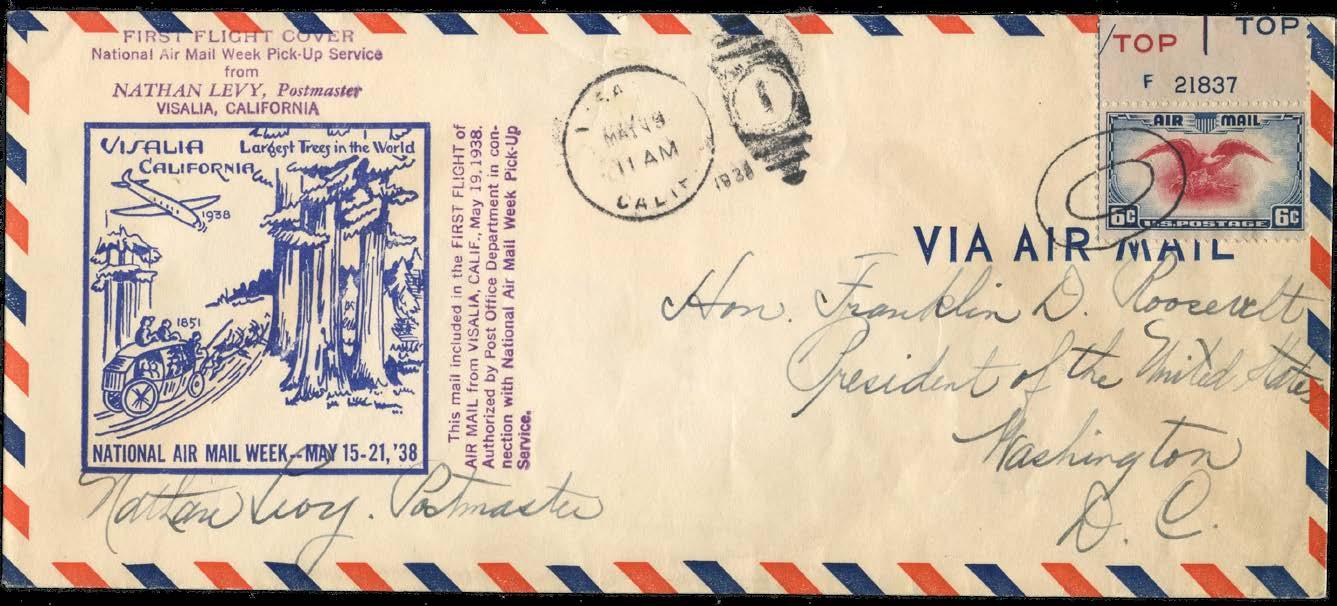
a top margin, plate number single that shows both TOP markings along with the arrow, making it an especially attractive NAMW cover. At the time, Visalia’s population was 8,904, and this cover is rated 4+ by Drabyk.
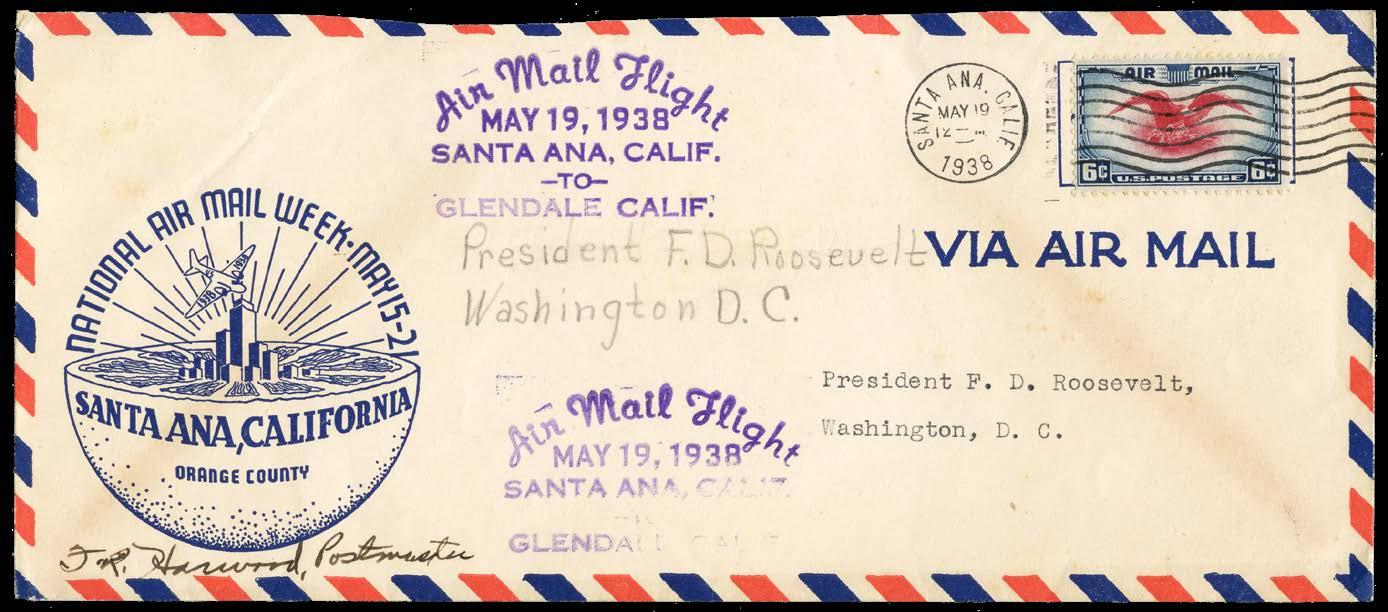
In Figure 22, I show my postmaster-signed NAMW cover sent to FDR from Santa Ana, California. Interestingly, this cover duplicates the one shown in Figure 18 of my NAMW Part III article.3 As with Farley NAMW covers, careful study indicates that duplication occurs among FDR covers, since during NAMW such covers would have been sent to both men by local postmasters, post office workers, and private citizens caught up in the enthusiasm of NAMW. I’ll point out that besides the printed cachet and postmaster signature on this cover, there are additional handstamps showing this cover was carried on a special air mail flight from Santa Ana to Glendale on May 19, 1938. This combination of a printed NAMW cachet with a flight handstamp does not appear to be listed in Drabyk.
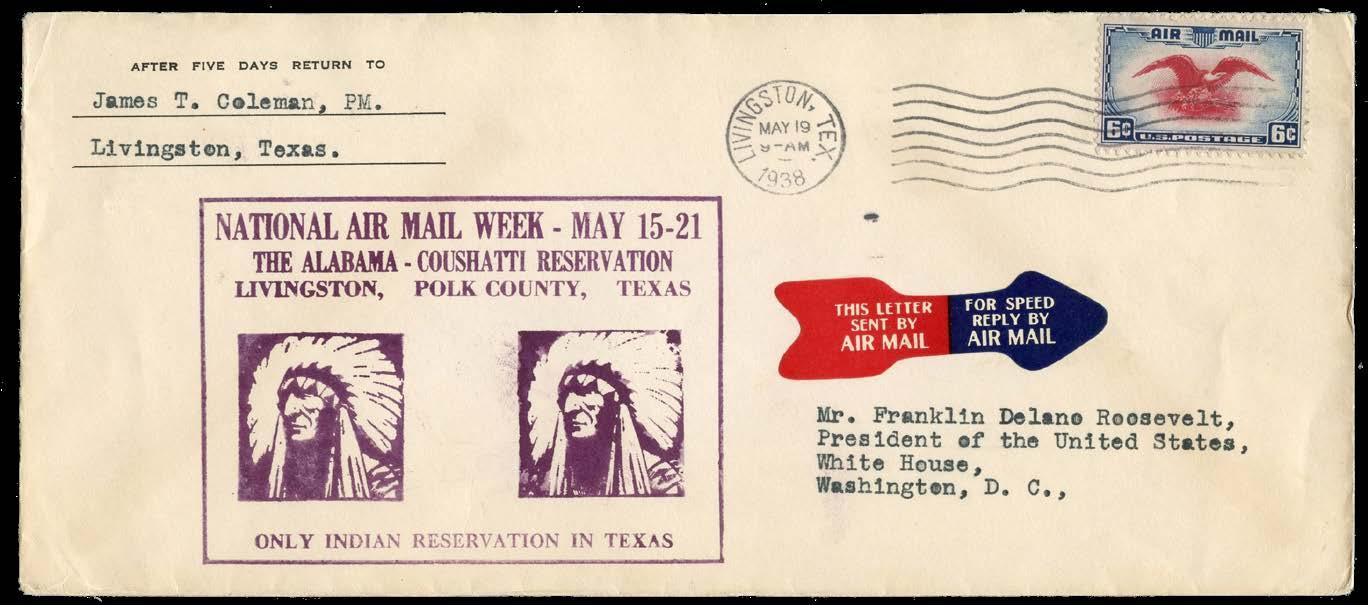
Shown in Figure 23 is my NAMW cover sent to FDR by the postmaster of Livingston, Texas. The nicely printed cachet highlights the Alabama-Coushatta Indian Reservation located east of Livingston, touting it as the “Only Indian Reservation in Texas.” At the time, Livingston’s population was 1,851, and Drabyk rates this NAMW cover as 5+++++.
An unusual NAMW cover sent to FDR from the local branch of the National Federation of Post Office Clerks from Meridian, Mississippi, is shown in Figure 24. The hand-stamped cachet focuses on the achievement of the Key brothers in setting a “World Endurance Flight Record” out of the Meridian airport. Fred and Al Key were aviators concerned about the likely closure of their airport and came up with a plan to generate publicity by breaking the existing flight endurance record of 23 days. At the time, air-to-air refueling was especially dangerous due to the possible ignition of spilled gasoline. With the help of a local inventor, they came up with a spill-free mid-air fueling
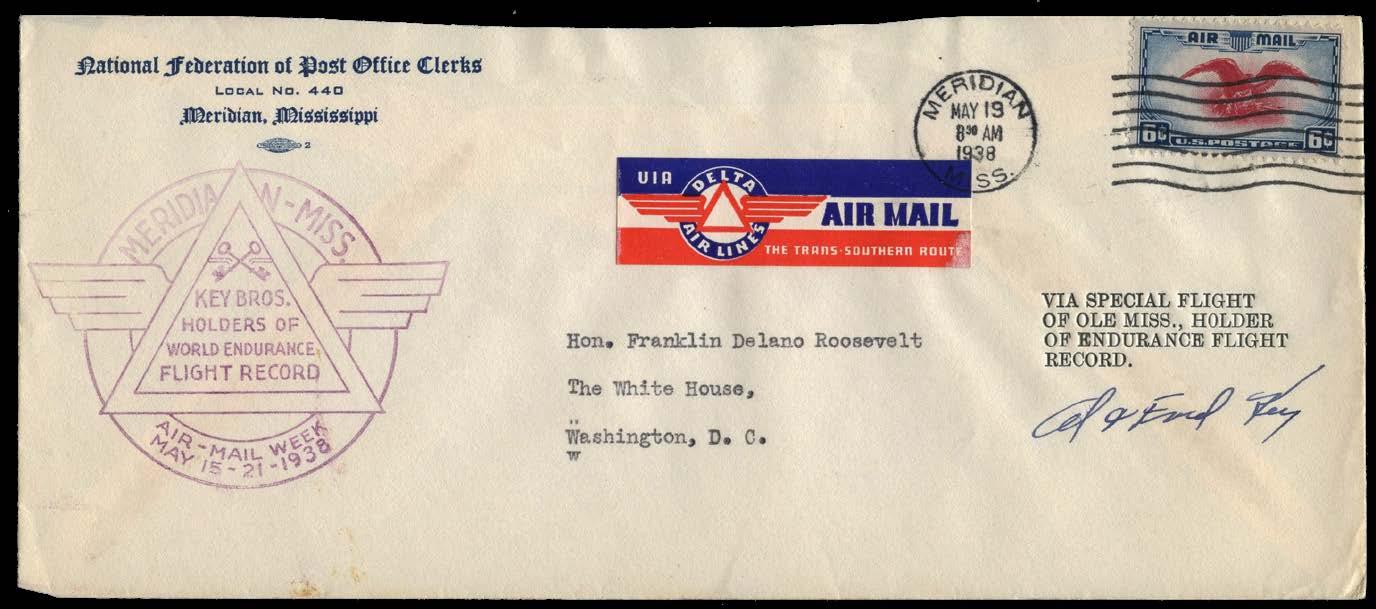
scheme in which a valve on the end of a fueling nozzle was opened by a probe in the neck of the fuel tank. Using this approach, the Key brothers set a new flight endurance record of 653 hours and 34 minutes (more than 27 days) in a Curtiss Robin monoplane named Ole Miss in June 1935, which is now permanently displayed at the National Air and Space Museum in Washington, D.C. After this historic flight, the airport in Meridian was renamed Key Field in the brothers’ honor. Their mid-air refueling approach was later adopted by the US Army Air Corps, and with modifications, is still in use today. Interestingly, this NAMW cover sent to FDR appears to have been autographed by the Key brothers and has a 4++++ rating in Drabyk.
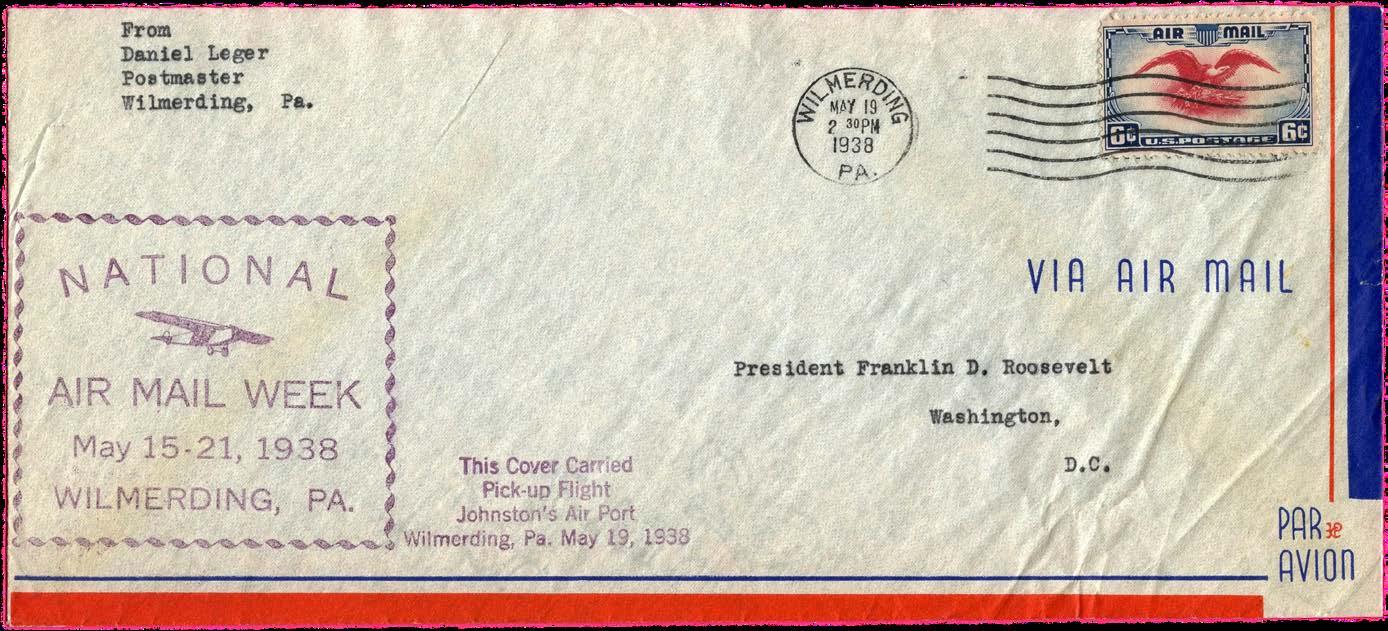
Another of my NAMW covers sent to FDR by a local postmaster, this time from Wilmerding, Pennsylvania, is shown in Figure 25. This has a relatively simple rubber-stamped NAMW cachet showing that this cover was carried by a Pick-up Flight from Johnston’s Air Port on May 19, 1938. At the time, the population was 5,662, and this cover is rated as 3 in Drabyk.
Shown in Figure 26 is my cover sent to FDR from Waynesboro, Pennsylvania. This has a more interesting locally designed rubber-stamped cachet showing the “First School House” in Waynesboro. First settled in the mid-1700s, this cachet apparently depicts the one-room schoolhouse built by the Bittinger family around 1814. In 1940, the population of Waynesboro was 10,231, and this NAMW cover has a Drabyk rating of 2.
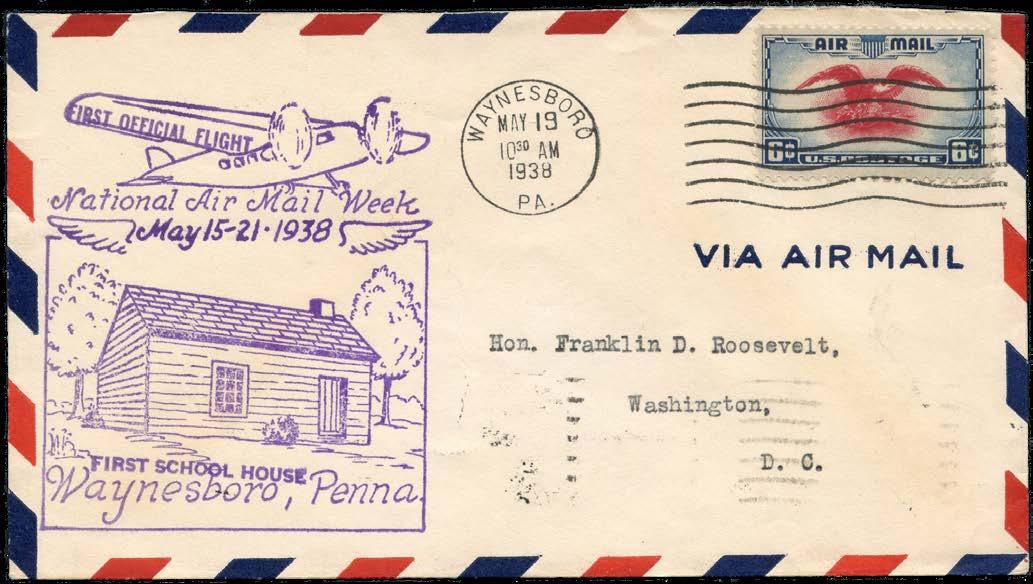
Pennsylvania.
Among my NAMW covers sent to FDR by postmasters, the one from the tiny community of South Kinloch Park, Missouri, is shown in Figure 27. This is on printed airmail stationery from the Chicago & Southern Air Lines. With a slogan of “The Valley Level Route,” it is rated by Drabyk as 5+++++, with the only listed example being from the PMG Farley collection at the National Postal Museum, as shown in the Drabyk listing below. This example was sent to FDR .
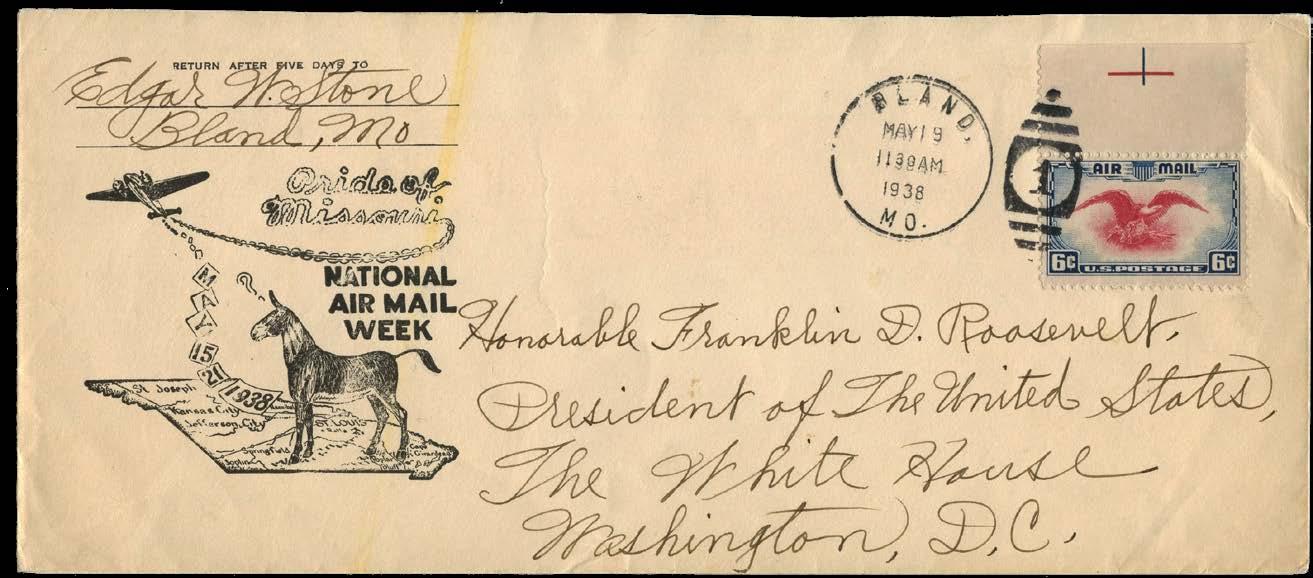
Another of my NAMW covers sent to FDR , this time from Bland, Missouri (population 565), is shown in Figure 28. The rubber-stamped cachet in black has the same Missouri Mule shown in the printed cachet of Figure 2, and this cachet type for Bland
is unlisted in Drabyk. Note that it is franked by an upper margin single copy of the 6¢ bi-color airmail stamp that clearly shows the bi-colored cross used to help ensure against inverted printing of these stamps.
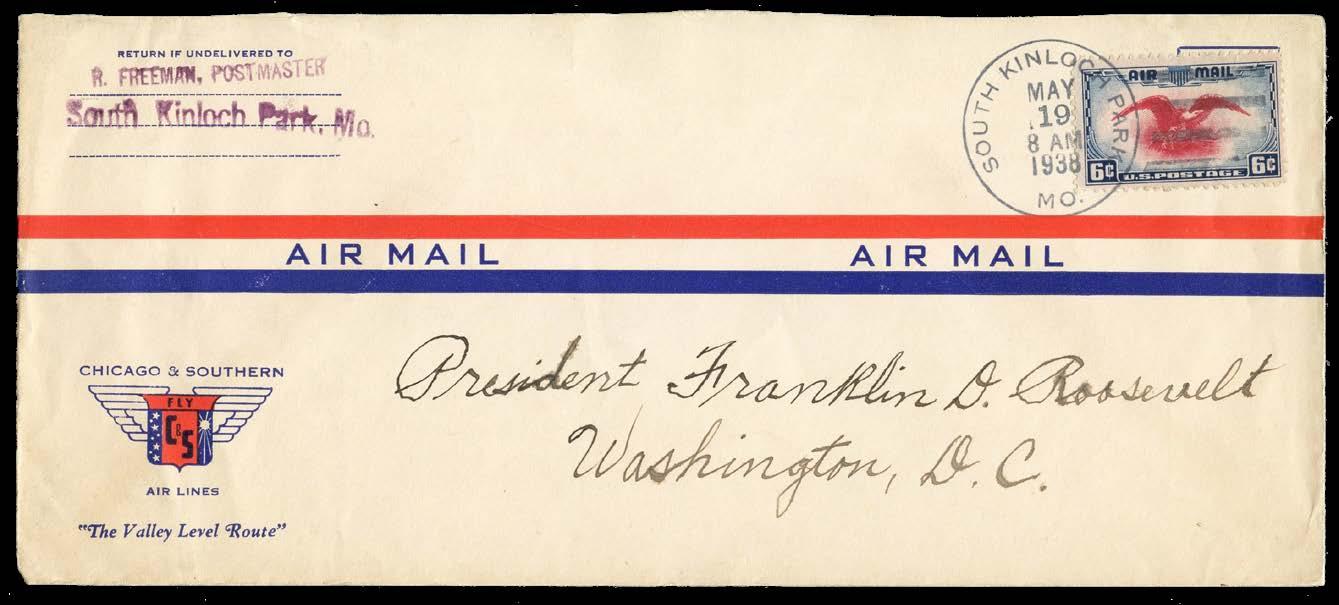
Missouri.
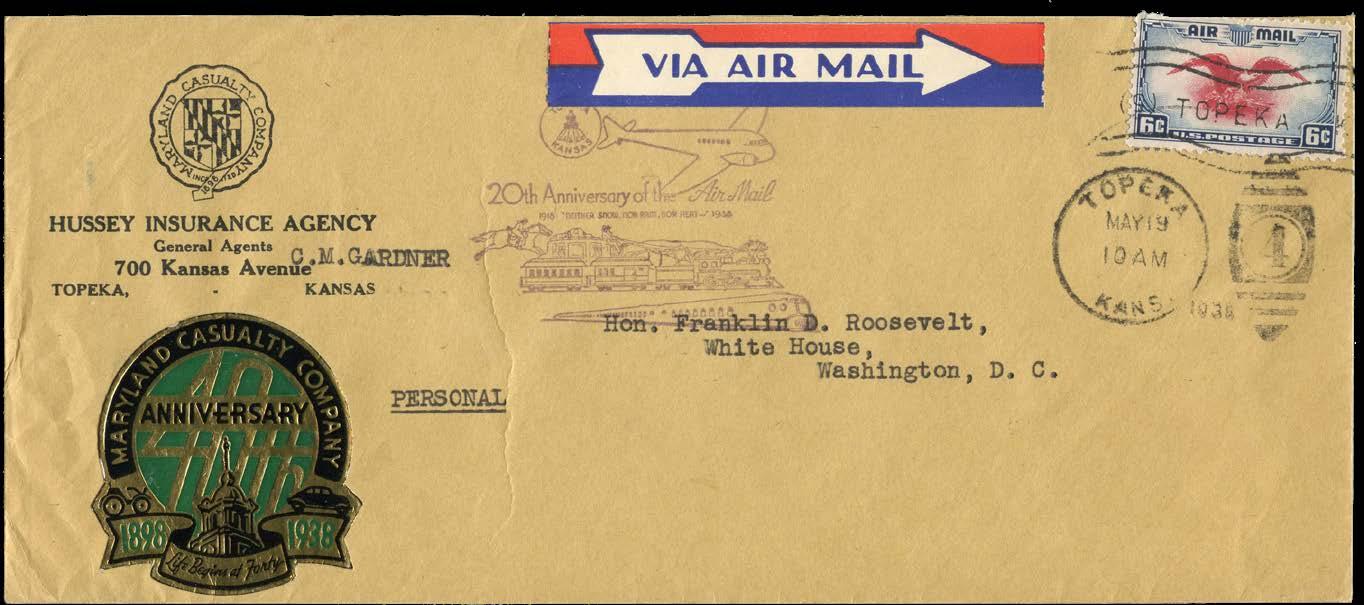
Another of my NAMW covers sent to FDR on insurance company stationery, this time from Topeka, Kansas, is shown in Figure 29. Above the address, there is a small rubber-stamped NAMW cachet depicting an airplane flying overhead, with a dispatch rider, stage coach, steam locomotive, and ultramodern train below. Between these is the “20th Anniversary of the Air Mail” and the tiny slogan “1918 Neither Snow, nor Rain, nor Heat 1938.” This NAMW cover, marked “Personal,” is on printed stationery of
the Hussey Insurance Agency and has both a foil label and airmail etiquette attached. It has a Drabyk rating of 2.
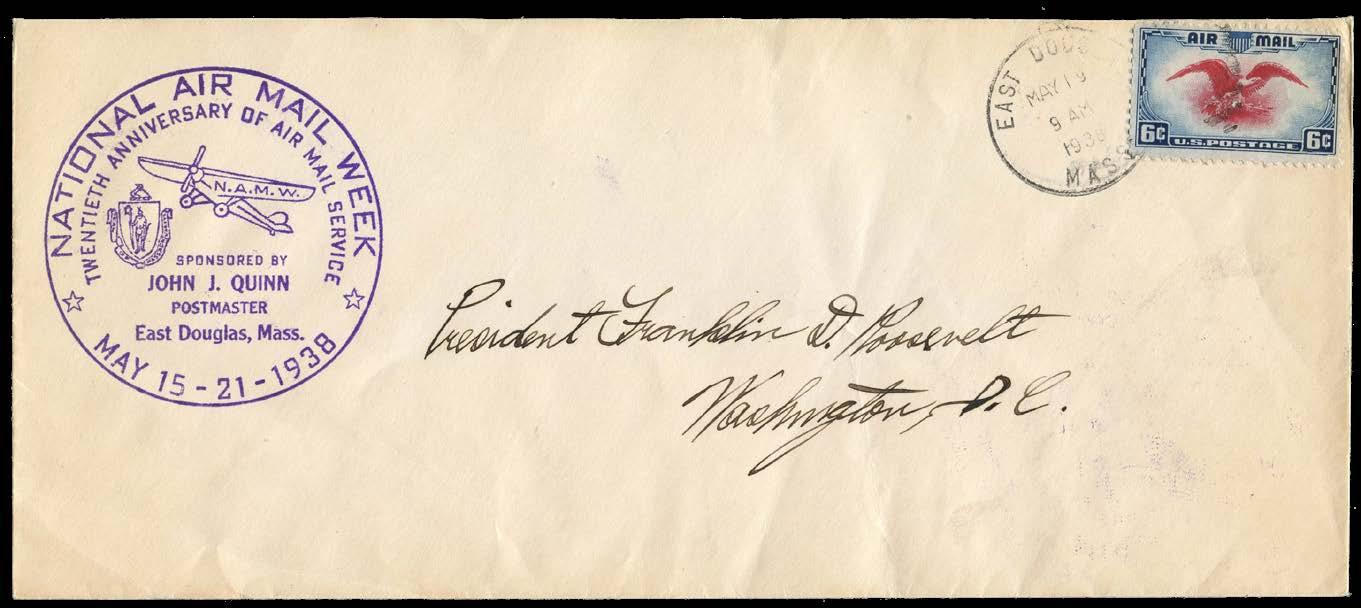
Shown in Figure 30 is my NAMW cover sent to FDR from East Douglas, Massachusetts. It has a sharply printed rubber-stamped cachet sponsored by John J. Quinn, the postmaster. Unlisted by Drabyk on a #10 envelope, it otherwise has a rarity rating of 5+++++. Note that this cachet is of a generic type where a small emblem and the name of a sponsor can be inserted (see for example Figure 17 in my NAMW Part II article.2) I’ve seen many examples of this type.
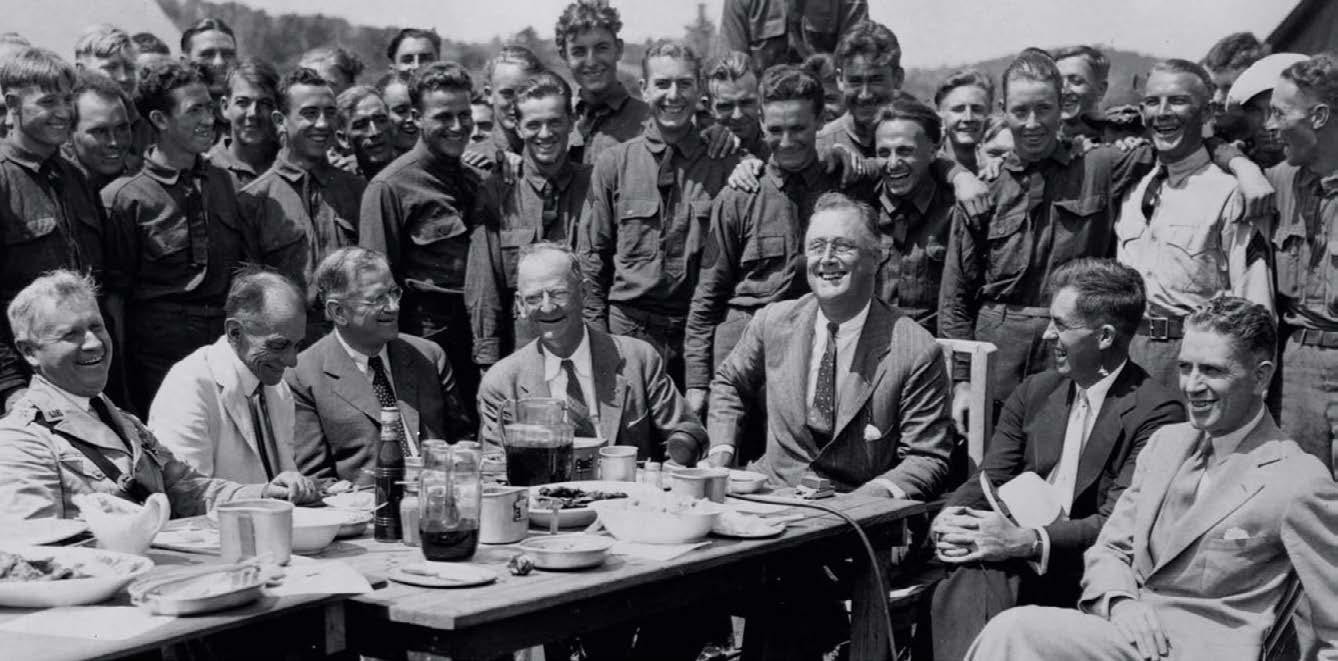
The Civilian Conservation Corps (CCC) was an especially important New Deal program, conceived of by FDR himself, and passed during the “First Hundred Days” of his presidency. It was a work-relief program for young men that provided conservation
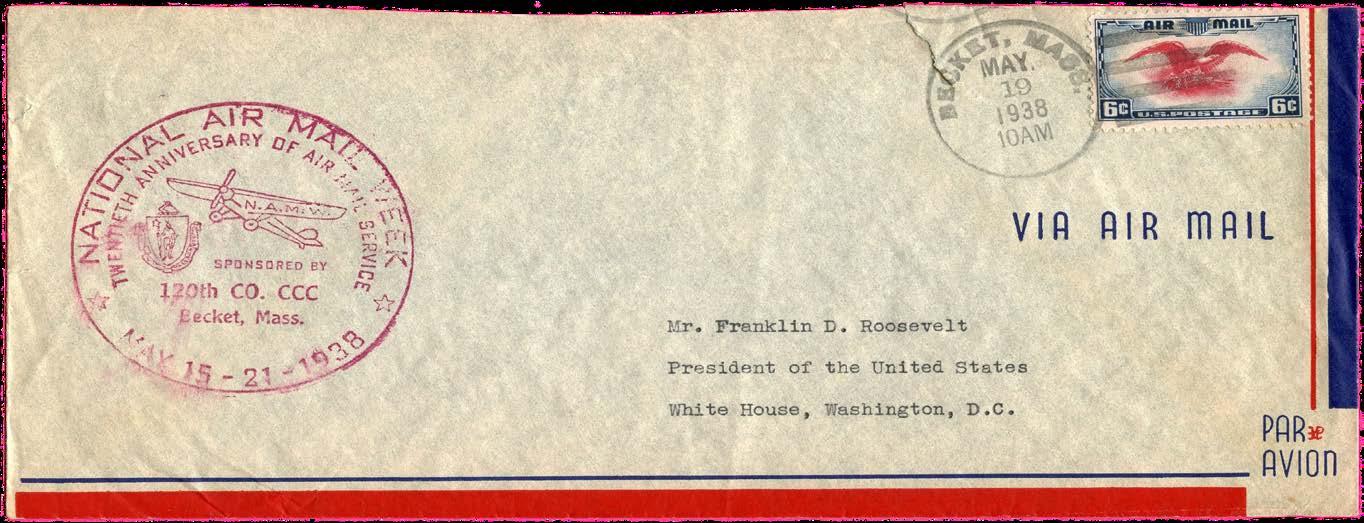
work in National Parks, forestry, erosion control, etc., and soon became one of the most popular of all New Deal programs. Curiously, the cachet on my NAMW cover sent to FDR from Becket, Massachusetts, shown in Figure 31, was sponsored by the 120th Company of the Civilian Conservation Corps. Based in Camp S-52 located four miles west of Becket, they mainly worked in the October Mountain State Forest, the largest state forest in Massachusetts. This NAMW cover type is rated 3 by Drabyk, and in Figure 32 I show FDR visiting a CCC camp during the summer of 1933.
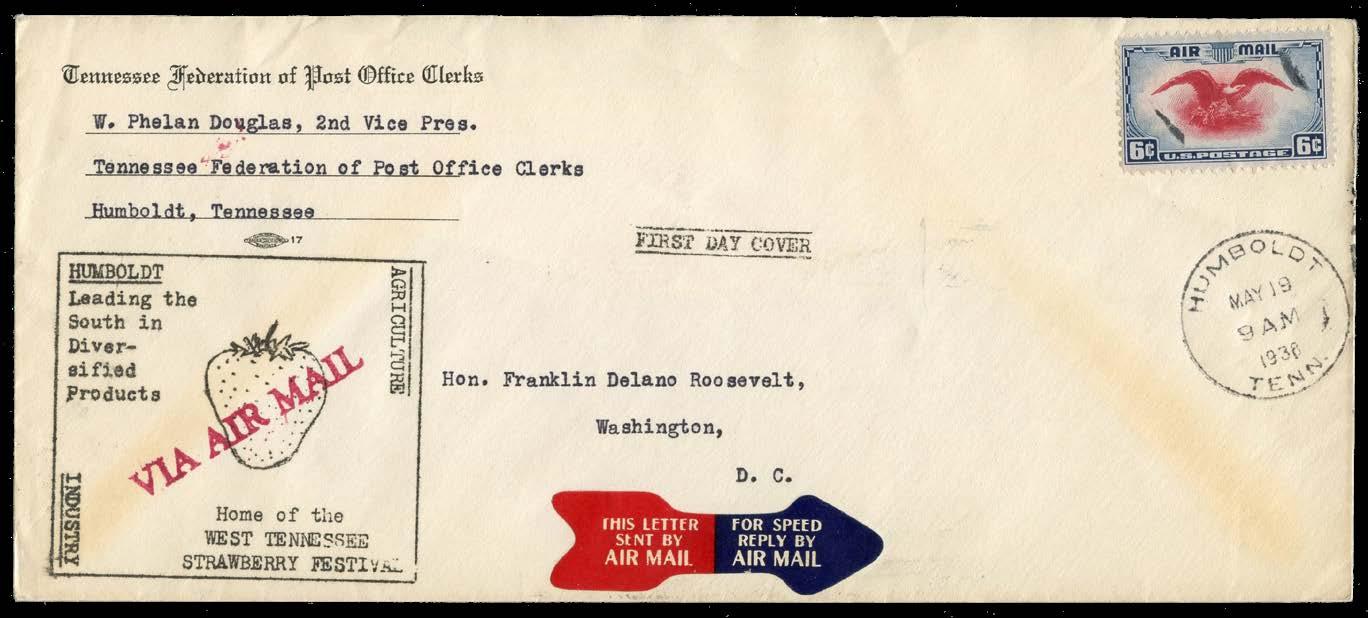
In Figure 33, I show my NAMW cover sent to FDR on Tennessee Federation of Post Office Clerks stationery from Humboldt, Tennessee, a small city of 5,160. The locally produced cachet touts Humboldt as “Leading the South in Diversified Products” and as “Home of the West Tennessee Strawberry Festival.” Drabyk rates the rarity of this NAMW cover as 5+++++, and it is only known on #10 envelopes.
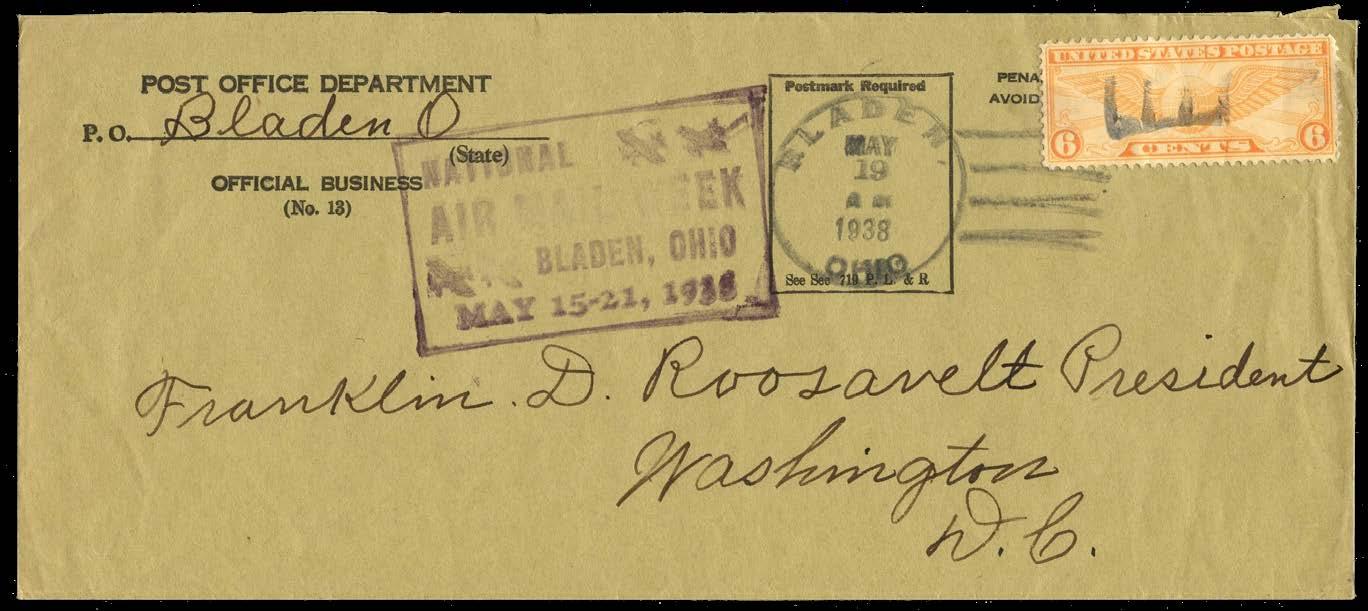
My NAMW cover sent to FDR on re-purposed official Post Office Department (POD) stationery from Bladen, Ohio, is shown in Figure 34. Note the relatively crude NAMW hand-stamped cachet, phonetic “Roosavelt” spelling, and the use of a winged globe airmail stamp. Bladen was a very small community on the Ohio River, downriver from Gallipolis.
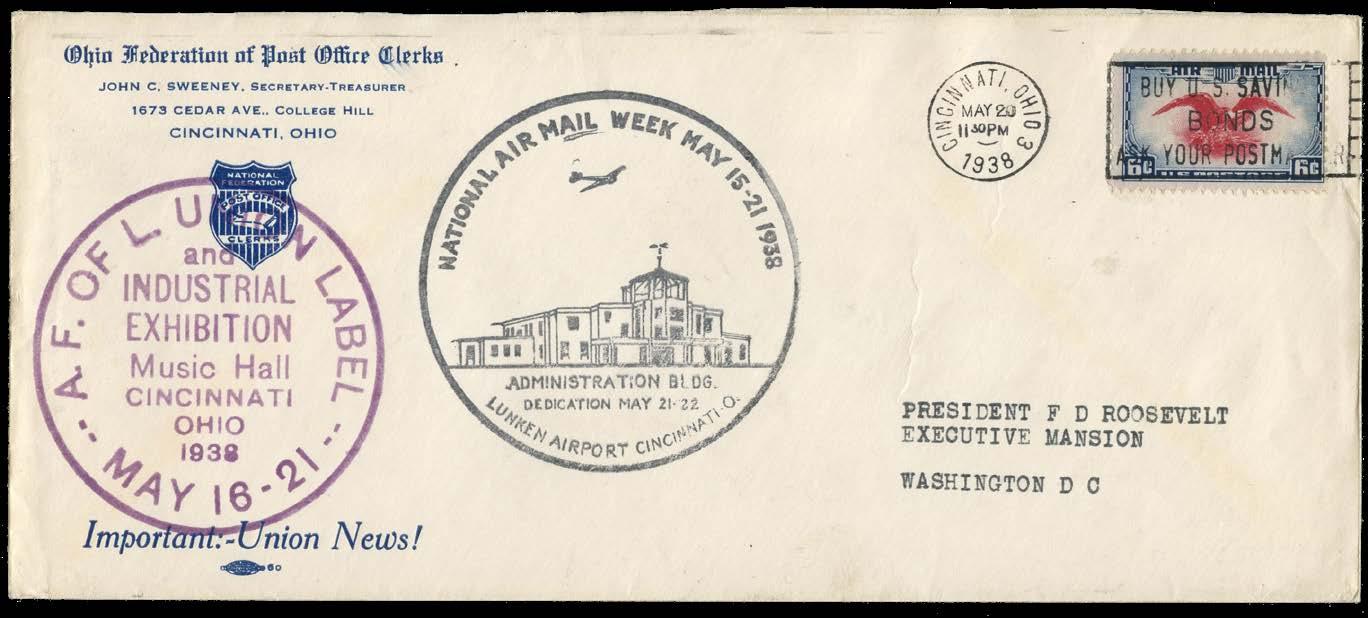
Another of my NAMW covers sent to FDR by postal clerks, this time from Cincinnati, Ohio, is shown in Figure 35. On official Ohio Federation of Post Office Clerks stationery emblazoned with “Important:- Union News!” it has both a rubber-stamped NAMW cachet showing the dedication of the Administration Building at Cincinnati’s airport at the end of NAMW and a cachet for an American Federation of Labor-sponsored industrial exhibition at the Cincinnati Music Hall. Note that this was mailed to FDR on May 20, 1938.
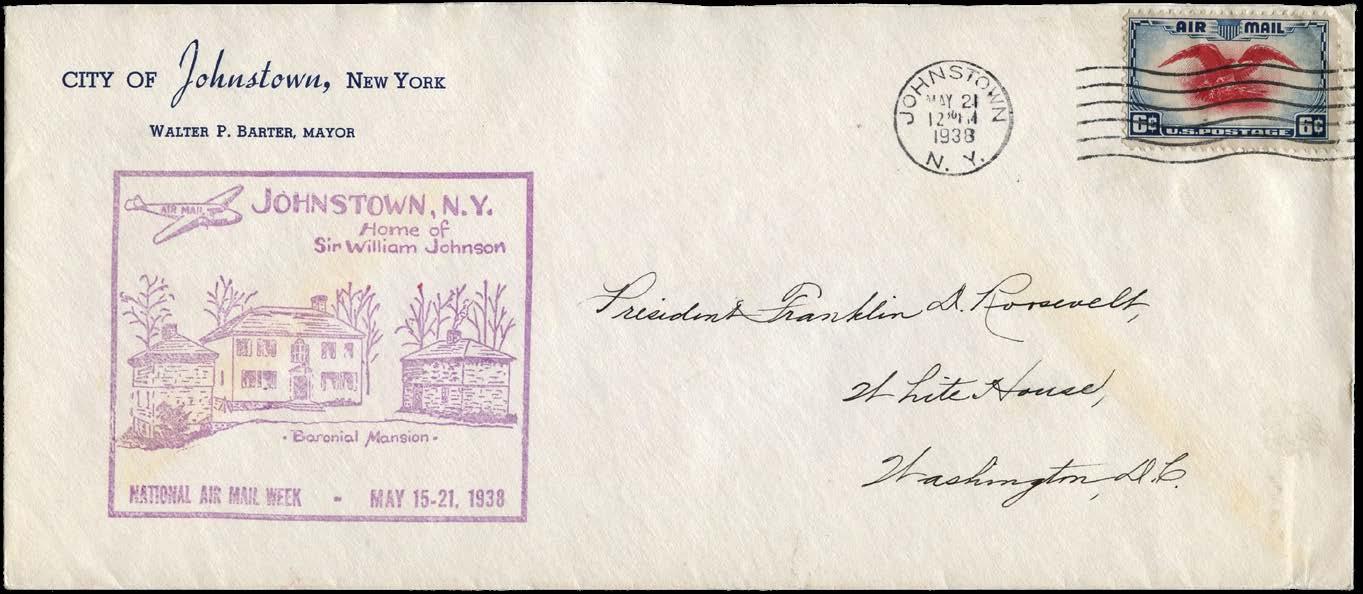
In Figure 36, I show my NAMW cover sent to FDR from Johnstown, New York. On official printed stationery of the mayor of Johnstown, it bears a locally designed rubber-stamped cachet depicting the “Home of Sir William Johnson,” its colonial founder. Sir William was the Superintendent of Indian Affairs for Great Britain in the colony of New York, and a major general during the Seven Years’ War in North America. Note that this was sent on the last day of NAMW, May 21, 1938. Drabyk rates this as a 4, and does not list it as existing on a #10 envelope for this date.
York.
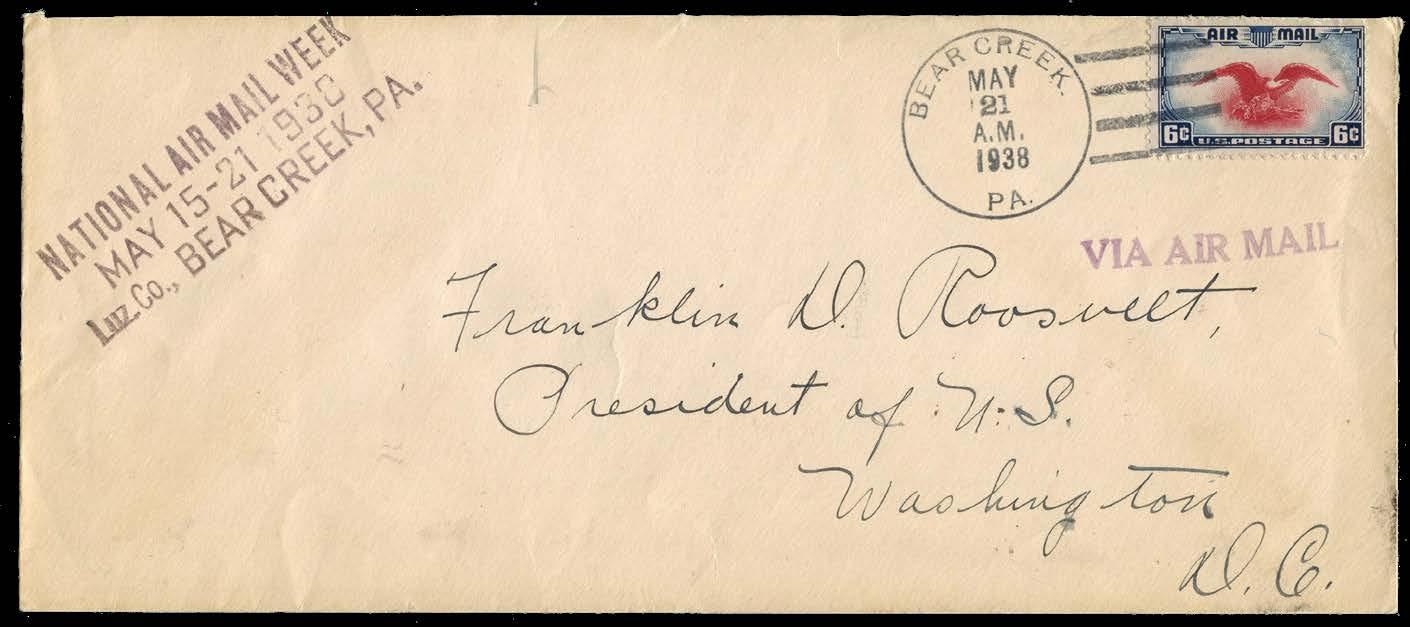
Finally, in Figure 37 I show what is perhaps the rarest of my cacheted NAMW covers sent to FDR . This has a simple rubber-stamped NAMW cachet and was sent to FDR from Bear Creek, Pennsylvania, on May 21, 1938. Bear Creek is a township in Luzerne County that was known for producing lumber. While Bear Creek is shown as a possible NAMW town in Drabyk under PA114, no NAMW cover of any sort, even without cachet, is listed, giving it by default a rarity rating of 5+++++.
Along with the numerous NAMW covers sent to Farley and FDR that I’ve shown previously, the additional examples in this article illustrate the wide variety of cachet artwork produced. Together they provide a representative sampling of the wide scope of NAMW, and when coupled with the detailed information and numerous illustrations
in the 2012 version of the Drabyk catalog4 provide a great resource for collectors interested in NAMW covers.
So how comprehensive is the 2012 Drabyk catalog itself? To begin with, previously unlisted NAMW covers donated by PMG James A. Farley, now in the collection at the Smithsonian’s National Postal Museum in Washington, D.C., have been added. These come from 35 binders of NAMW material, and such Farley items are designated by an asterisk and footnote in the 2012 Drabyk listings. This is a very substantial upgrade. Nonetheless, although the 2012 Drabyk catalog is the most comprehensive that is available, it is clearly not complete. For example, of the 74 NAMW covers sent to FDR in my collection that I’ve shown in The United States Specialist, four are from towns that do not show any confirmed NAMW cover listings in the 2012 Drabyk, even without cachet. This includes one shown in Part II from Memphis, Texas (Figure 31), that uses an advertising cachet.2 There are also two shown in Part III, one from Girdletree, Maryland (Figure 4) that has a cachet from Salisbury, and another from Canoga Park (Figure 8) that uses a 1939 World’s Fair cachet.3 Finally, my example from Bear Creek, Pennsylvania, shown here in Figure 37, has a simple but unique cachet. In other words, 4 of 74, or 5.4%, of my NAMW covers sent to FDR are unlisted in the 2012 version of Drabyk, suggesting that, despite its excellent coverage, gaps remain and discoveries likely await the diligent collector. Note that this overview analysis does not extend to the many other varieties listed in Drabyk, such as different cancellation types and dates, cachet variants, envelope sizes, or NAMW covers without cachets. This additional level of detail offers further layers of complexity for the specialist collector.
Finally, with the slogan “Receive Tomorrow’s Mail Today,” National Air Mail Week was a great success, with more than 16.2 million items being sent during the week of May 15–21, 1938. Perhaps more importantly, this resulted in an outpouring of authentic Americana in the form of cachet artwork that celebrated local attractions, products, and historical events linked to the numerous cities and towns participating in NAMW. This provides collectors today with fascinating mementos of a bygone era.
The author would like to thank fellow United States Stamp Society members Dalton Hoffman for sending me NAMW material and David DuBois for kindly providing much help with the 2012 Drabyk catalog.
References
1. Paul M. Holland, “1938 Bi-Color Airmail Stamp: FDR, Farley and National Air Mail Week, Part I,” The United States Specialist, 95, no. 3 (March 2024): 115–126.
2. Paul M. Holland, “1938 Bi-Color Airmail Stamp: FDR, Farley and National Air Mail Week, Part II,” The United States Specialist, 95, no. 4 (April 2024): 170–188.
3. Paul M. Holland, “1938 Bi-Color Airmail Stamp: FDR, Farley and National Air Mail Week, Part III,”
4. (Piscataway, NJ: National Air

by Jay Stotts
USSS #10921 | m stottsjd@swbell.net
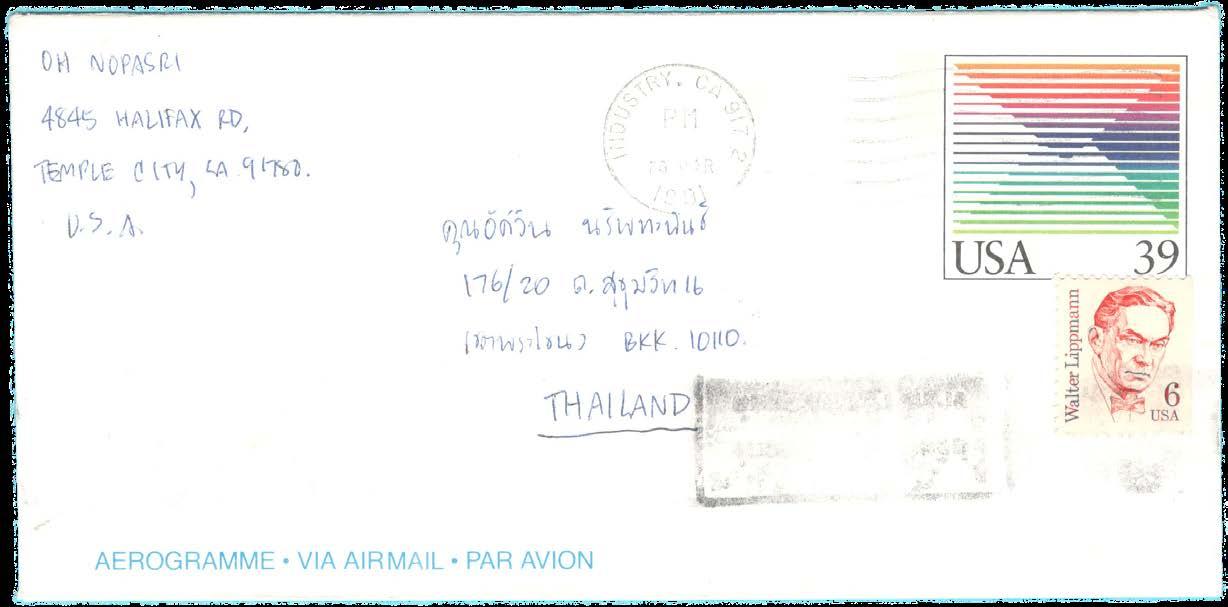
Aerogrammes are a form of airmail communication that is classified at lower postage rates than airmail letters. Aerogrammes evolved after World War II. They are typically all-inclusive, using a lightweight paper on which the sender writes a letter, then folds and seals it along the edges with gum. US government-produced aerogrammes during the Great Americans (GA) era also included a printed indicium (imprinted stamp) indicating the amount of postage required to meet the current aerogramme rate.
The mailing cost for aerogrammes was somewhat lower than that for an international letter, making them a popular alternative. For instance, in 1981, at the inception of the GA Series, the international airmail letter rate was 35¢ per half ounce to Western Hemisphere destinations or 40¢ for the same weight to the rest of the world, but an aerogramme to either cost only 30¢. Aerogrammes could not contain anything other than the sender’s written message and any added postage.
So, if the indicium, or imprinted stamp, provided the equivalent of the postage fee on aerogrammes, where is the tie-in for the Great Americans stamps?
As with other forms of postal communication, the Postal Service occasionally increased postage rates, and aerogrammes were no exception. Multiple times during the run of the Great Americans Series, the aerogramme rate was increased by a few cents, and GA stamps became convenient add-on frankings to uprate an aerogramme to a new rate.
Table 1 lists the aerogramme rates for the period, as well as the incremental changes each time the rate increased. Also included are the Great Americans values available to meet the incremental rate increases. If you compare the incremental increases in the aerogramme rates with the GA stamps available to meet those needs, it is clear that the United States Postal Service was not focused on providing GA low values just to meet those needs.
But we are collectors, so it is enjoyable to search for Great Americans used to fulfill such a need. Figure 1 shows a 6¢ Walter Lippmann stamp applied to meet the incremental aerogramme rate increase to 45¢, effective in February 1991. The 39¢ aerogramme shown is Scott UC61.
Figure 2 shows an earlier opportunity when a Lippmann stamp would have
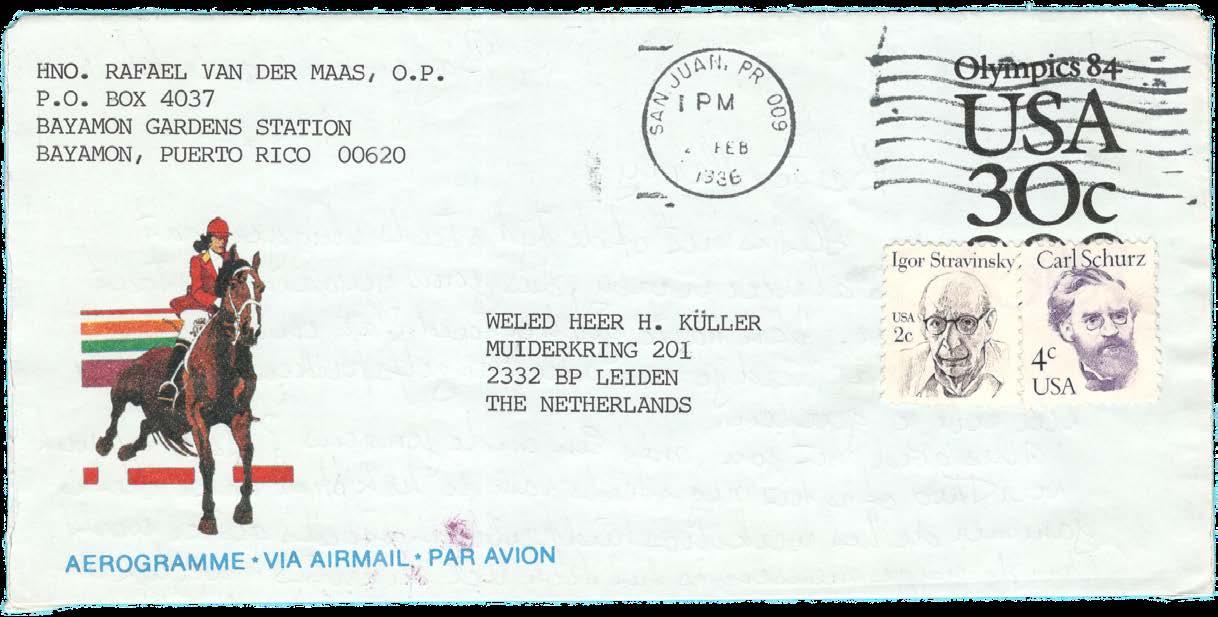
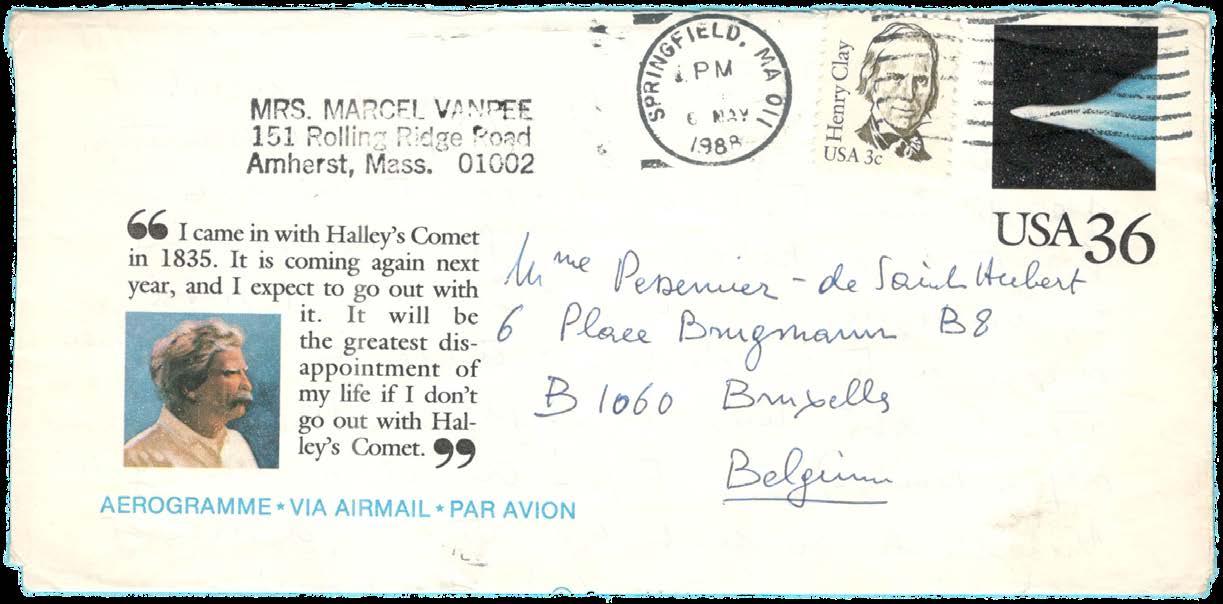
covered the 6¢ rate increase in 1985, when the aerogramme fee went from 30¢ to 36¢, but in this case, the sender used a combination of two other Great Americans stamps to pay the increase. The base aerogramme is Scott UC57. There were two convenient choices in 1988 when a new 39¢ aerogramme rate superseded the 36¢ Halley’s Comet aerogramme (Scott UC60). The mailer of the aerogramme shown in Figure 3 chose to use a 3¢ Henry Clay stamp instead of a 3¢ Dr. Paul Dudley White stamp to pay the increase.
rate.
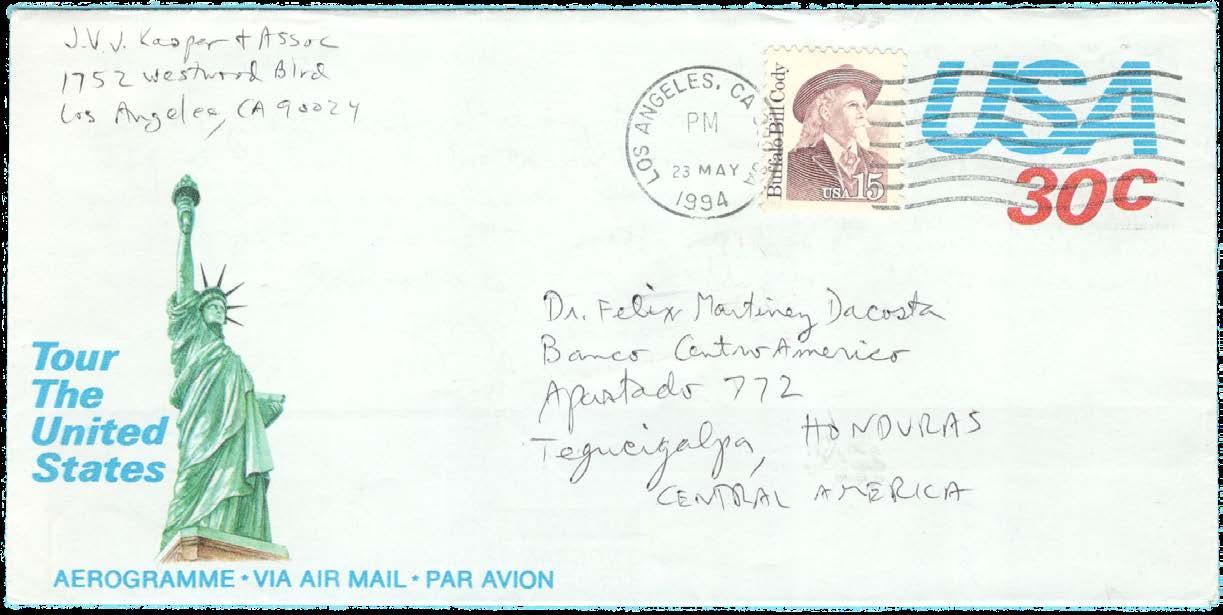
Of course, sometimes mailers had aerogrammes that were more than one rate increase out of date. Figure 4 shows an example where the mailer used a 30¢ aerogramme (Scott UC54, circa 1981), but posted it in 1994 when the rate had increased to 45¢. The sender used a 15¢ Cody stamp to pay the increase.
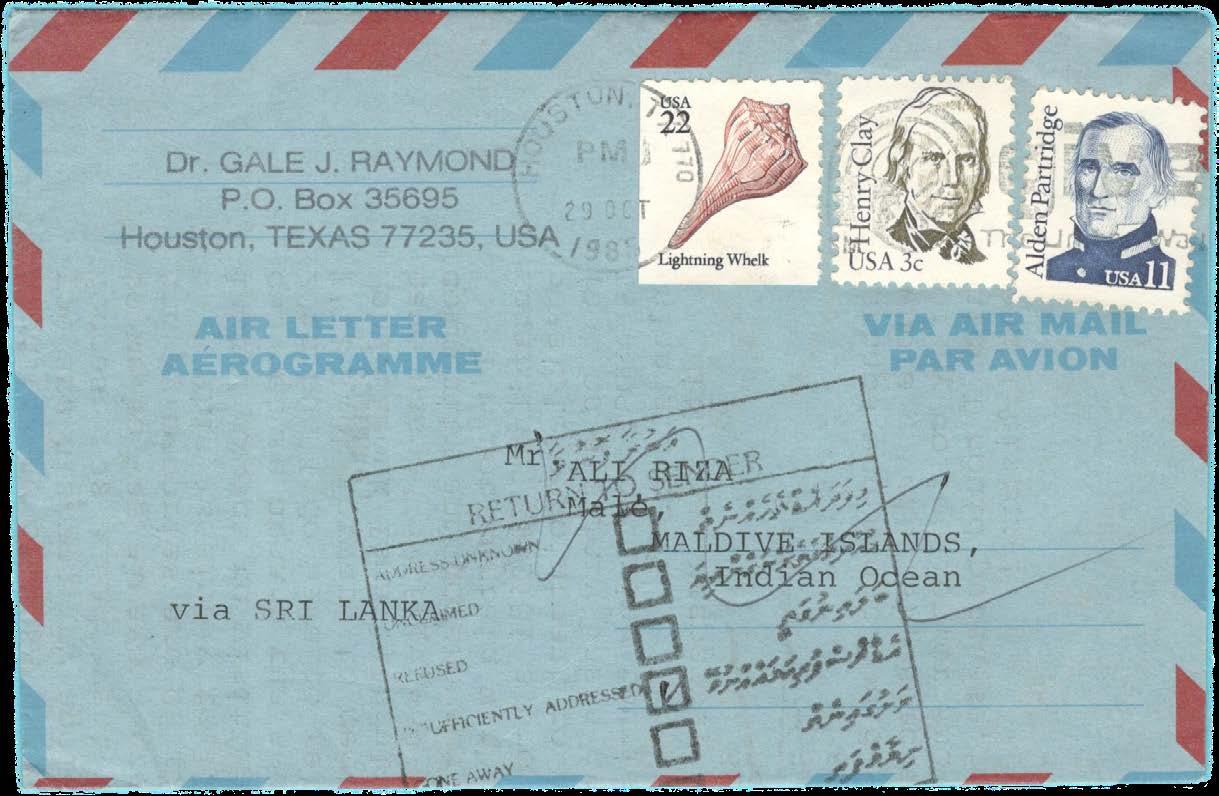
Although most stamp collectors are familiar with government-printed aerogrammes, the private sector also printed and distributed aerogrammes, or “air letter” sheets. Since these aerogrammes were privately issued, they could not include an indicium to represent postage being prepaid. In such cases, the entire fee had to be paid by affixed postage. Figure 5 shows an example. In this case, the aerogramme was distributed by Pan Am Airlines. The item was posted on October 29, 1985, to the Maldive Islands. At the time, the aerogramme rate was 36¢. To meet the rate, a 22¢ seashell definitive was combined with Clay and Partridge GA stamps for 36¢ in postage.
If you collect Plate Blocks, Booklets, Coils, or Sheets, the above website, with hundreds of sets at Face Value, will be a great savings to you. Enjoy the hobby.

Armen Hovsepian (APS 150170)
P. O. Box 24222 Overland Park, KS 66283 info@USatFACE.com
by Keith Lichtman
USSS # 14279 | m stampmankeith@gmail.com
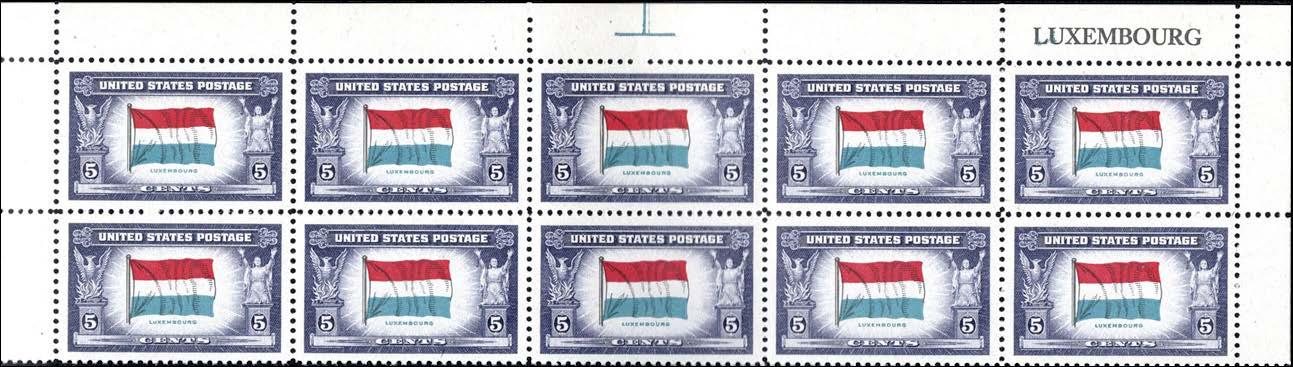
The Overrun Countries series was printed under contract by the American Bank Note Company. Instead of using a plate number, each pane was printed with the name of the honored nation in the pane’s top right margin. The Luxembourg stamp was printed in a sheet of 200 with the Netherlands stamp, the top two panes of 50 with the Luxembourg stamps and the bottom two panes of 50 with the Netherlands.
Most of the stamps in this series have the margin names in shades of black to light gray. The Luxembourg stamps appear as a shade of gray that resembles the slate-blue frame around the flag, but under magnification, they are black. It is surprisingly consistent throughout the run.
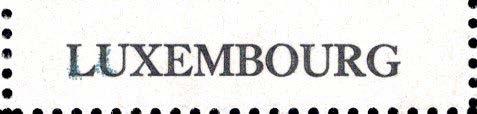
On the Luxembourg stamps, some of the margin names will have splatters of the blue ink that is used in the flag through some of the letters. None of the splatters are a plate variety; they are just a freak or oddity. See Figure 1 for an example.
In order to identify any of the plate varieties, you must identify the type of “L” used. See Figure 2.
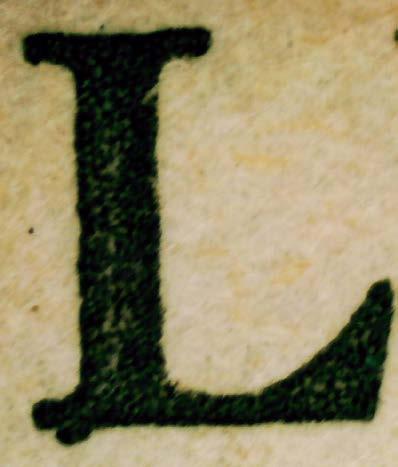
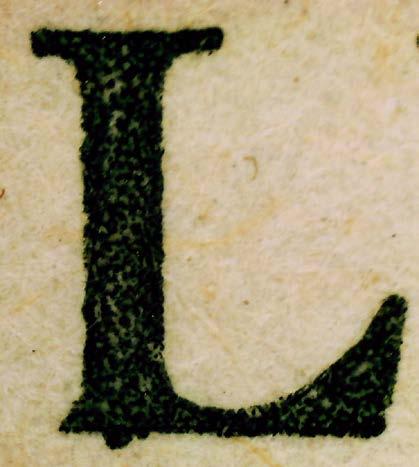
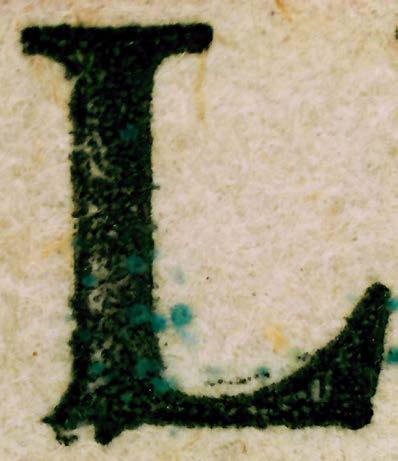
Type L1 has the lower left serif long and rounded with a nub protruding under the L, closer to the left side of the vertical line. Type L2 has the lower left serif short and pointed with the nub closer to the center of the vertical line. Type L3 is similar to Type L2 but with an extra nub below the pointed serif.
There are five plate varieties found on Luxembourg.
Type 1 has a long L with one nub. The U and X are touching at the top. Found on upper right panes.
Type 2 has a short L with one nub. Found on upper left panes.
Type 2a has a short L with one nub. The U and X are touching at the top. Found on upper left panes.
Type 2b has a short L with one nub. The U and X are touching at the top and the X and E are touching at the bottom. Found on upper left panes.
Type 3 has a short L with two nubs. The U and X are touching at the top and the X and E are touching at the bottom. Found on upper left panes.


3¢ Washington Coil Schermack III
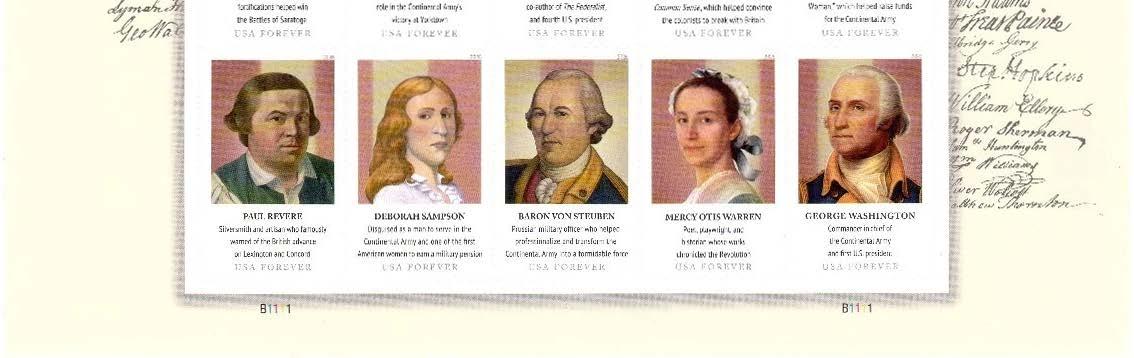
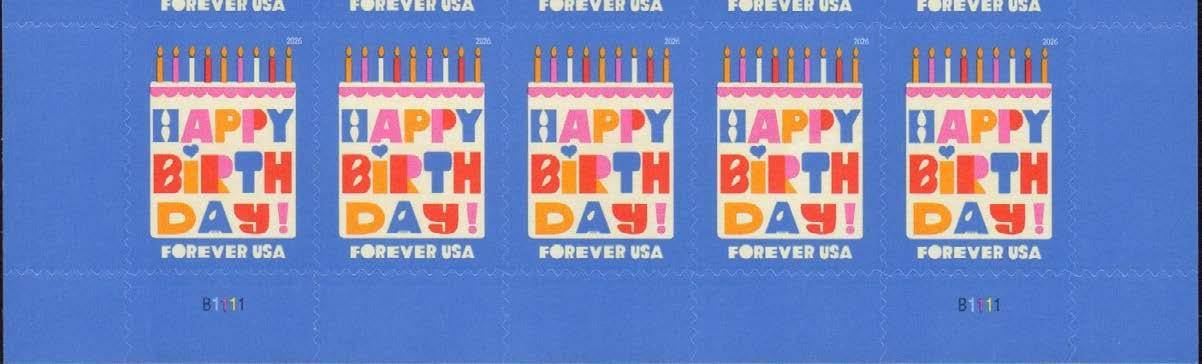

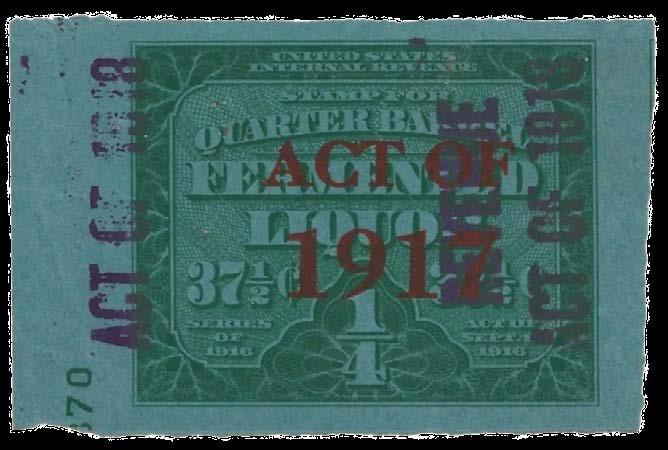
#REA139 37 ½¢ Beer Stamp 1918 Overprint ???70 L
COORDINATORS: Members are invited to report their findings to the appropriate coordinator.
All issues through 1980
Sheet stamps after 1980
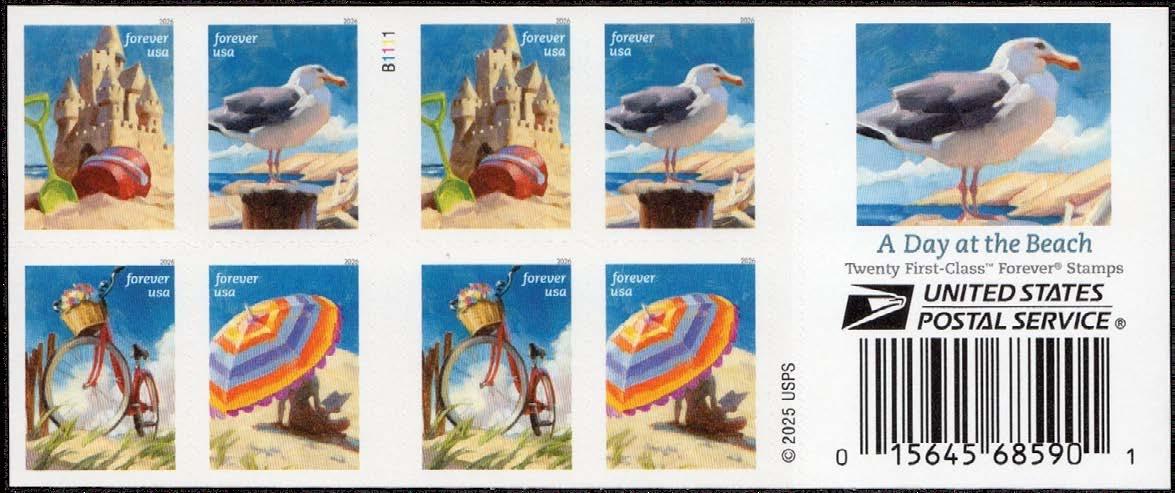
This monthly report is used to update the Durland Standard Plate Number Catalog. 3 #???? A Day at the Beach Booklet B1111
Kim D. Johnson
310 E N 3rd Street
Georgetown, IL 61846
Jim Cochrane P.O. Box 2009
Great Bend, KS 67530
Coil stamps after 1980 Jill Ambrose P.O. Box 54622 Cincinnati, OH 45254
Booklet stamps after 1980
Michael O. Perry P.O. Box 1194
Rainier, OR 97048
APPLICATIONS RECEIVED FOR APRIL 2026
17666 Paul Daniel, Burtonsville, MD 17667 Jose Quinones, Plantation, FL 17668 Alan Winkenhofer, Elizabethtown, KY 17669 Chip Reahard, Williamson, GA 17670 Robert Walto, South Plainfield, NJ
APPLICATIONS PENDING
17660–17665
17654–17659
USSS Membership Recruiting
We hope that many of you stopped by our booth at BOSTON 2026! Help us convert Boston 2026 attendees to members. Request your own updated PDF “quadrafold” Membership Application via email from Bob Rufe: execsecretary@usstamps.org or USSS, Box 1602, Hockessin, DE 19707-5602.
USSS MEMBERS are entitled to two free ads of up to 40 words each year. Other ads are 10¢ a word, payable in advance. For 6 insertions, take a 5% discount; for 12 insertions, take a 10% discount. Ads with [1156] at the end expire with this issue. Make checks payable to USSS. Send copy and check to The United States Specialist, 9038 E. 25th Dr., Denver, CO 80238. The Editor strongly prefers to receive ad copy by email: editor@usstamps.org. Emailing ads saves substantial time for you and the Editor and avoids errors.
WANTED TO PURCHASE #1053 HAMILTON $5 Commercial Usages. Especially need use to foreign destination. Also doing a survey so scans appreciated. Doug Weisz weiszcovers@gmail.com, 773-9144332. 33 W Ontario St. #48A Chicago, IL 60654. www.douglasweisz.com [1168]
SEEKING USS INDEPENDENCE STAMP similar to Scott #4703 USS Constitution stamp. Bernard Wojnowski; 64 Mariner Rd., Vineyard Haven, MA 02568. [1157]
WANTED - NAMW TEXAS POSTMARKED covers. Member APS, IPDA, USSS, APNSS. Email: htputney@gmail.com [1162]
WANTED FOR MY COLLECTION: SCOTT #102 to #111, 1869 Special Printings (re-issues). Please— only nice examples without major faults. Must be face-up bright and attractive. PF or PSE Certs only! Strong buyer—Rob Lehmann (240)422-0118 or diecasttoys@yahoo.com [1163]
WANTED #279 PLATE NUMBER STRIPS FOR specialized collection/study of 1898 1¢ Franklin, plate #’s 1459 & 1470 (any position), 1411(bottom). 279a plate #’s 1206, 1207, 1315, 1376, 1379. Len McMaster, 304-856-1118 or lenmcmaster@gmail.com [1168]
WANTED: US REVENUE CAMP STAMPS (SCOTT# RVC 1-10) issued by US Forest Service, 1985-88. Look like labels. Specifically looking for RVC6 ($1 Red) and RVC10 ($10 Gold). Also associated fee envelopes, pamphlets or documents. J. Dale Shively, 512.947.1401, jdshively@icloud.com. [1158]
FOR SALE
IF MY STAMPS ARE NOT VF/XF, SUPERB, I sell in packets. Upgrade now at low prices. U.S.A. and Norway with no faults, centered and clean. Request list—Reed Roholt, P.O. Box 1006, Beaver, UT 84713. Satisfaction guaranteed. [1160]
GET A COMPLETE SET OF U.S.A. OVERRUN Countries Scott Catalog numbers 909 through 921. That’s 13 stamps. All are XF/SUP MNH nicely centered no faults. Catalog value is $3.75+, but in hoping to find more customers, I am selling for $1.00+SASE. Along with your stamps you will receive a price list of mint and used stamps at same savings. Reed Roholt, P.O. Box 1006, Beaver, UT 84713 [1156]
GRAND AWARD SINGLE FRAME 4TH BUREAU
Issue gum breaker exhibit. All 17 known breaker configurations included. Scans available. See my coauthored “Gum Breaker” chapter in Griffith/Stotts book for details. Louis Fiset, lfiset@outlook.com [1156]
All New and Revised Mint and Used Plate Number Single Catalogue $52.50 postpaid
American Plate Number Single Society www.apnss.org
Expanded pricing, back-of-the-book, tag/paper varieties, PN/ZIP/ME types
Rick Burdsall / APNSS P.O. Box 1023
Palatine, IL 60078-1023
American Plate Number Single Society (www.apnss.org) ..................................................... 288 Armen Hovsepian (www.USatFACE.com) 282
Mountainside Stamps, Coins and Currency (www.mountainsidestampsandcoins.com) ....... 252 Precancel Stamp Society (www.precancels.com) 252 Richard Friedberg (www.friedbergstamps.com) ................................ 278
Robert A. Siegel Auction Galleries (www.siegelauctions.com) .................................... 253
Scott A. Shaulis (www.shaulisstamps.com) 282
The United States Stamp Society (www.usstamps.org)......................................... Covers U.S. Philatelic Classics Society (www.uspcs.org) 278
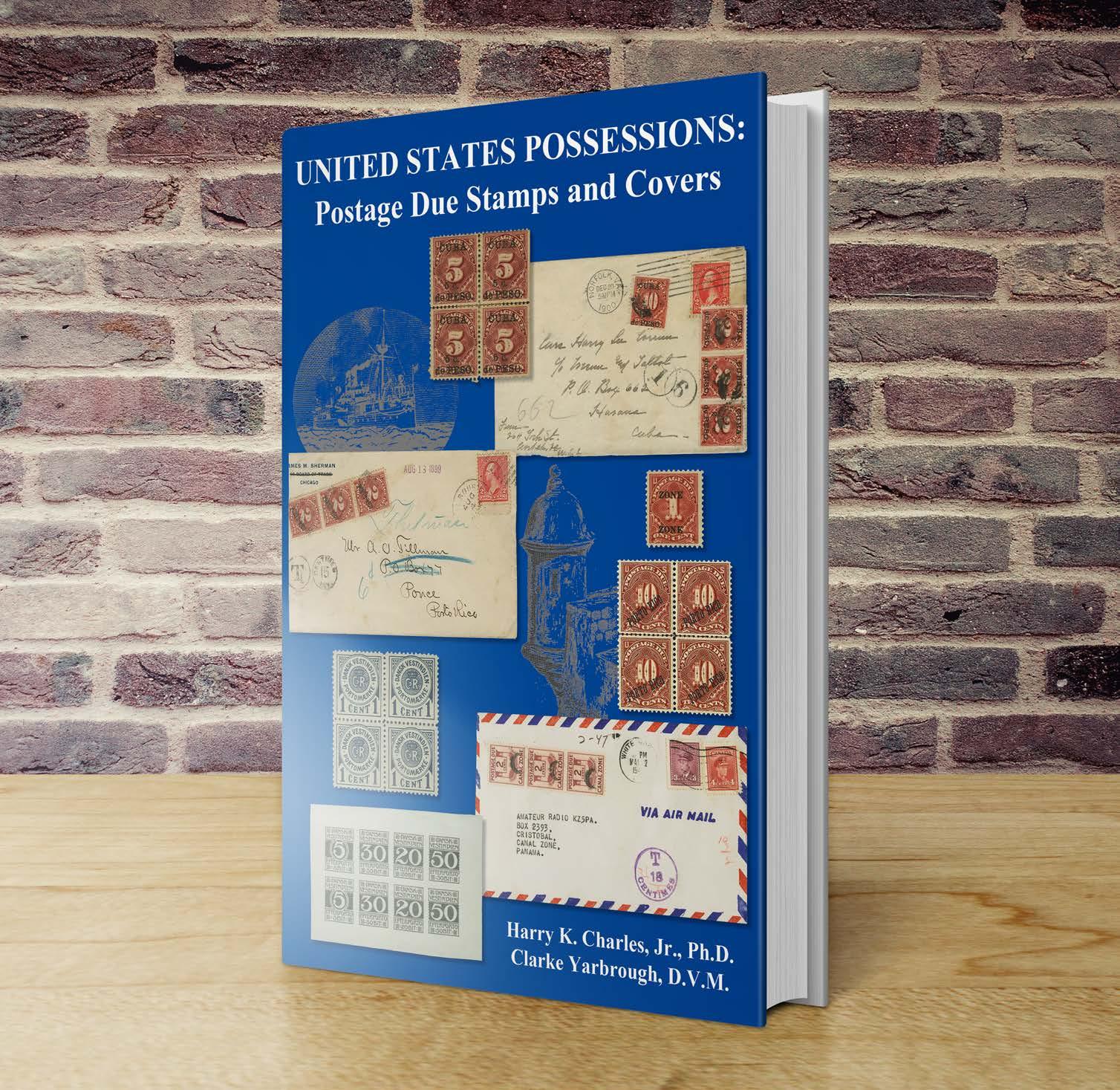
United States Possessions: Postage Due Stamps and Covers presents the story of Postage Due stamps used in the major possessions or territories of the United States. Written from a stamp collector’s perspective, the authors address the challenge of identifying the myriad of Possession Postage Due stamps by concentrating on stamp identification while also covering the Postage Due issues of Cuba, the Danish West Indies, Puerto Rico, the Panama Canal Zone, the Philippines and more.
In addition to the text, the monograph contains over 300 illustrations and five appendices which provide information to supplement and further explain key points. In many cases, the information presented is new or, if previously reported, organized in a new manner to help the reader understand the complexity of the Possession Postage Dues.
United States Possessions: Postage Due Stamps and Covers
Hard cover, 352 pages, 6-in × 9-in.
Member Price: $39 US postpaid Non-Member Price: $43 US postpaid Purchased online at: www.usstamps.org/store/ or by mail to: Executive Secretary, P.O. Box 1602, Hockessin, DE 19707-5602
States Stamp Society
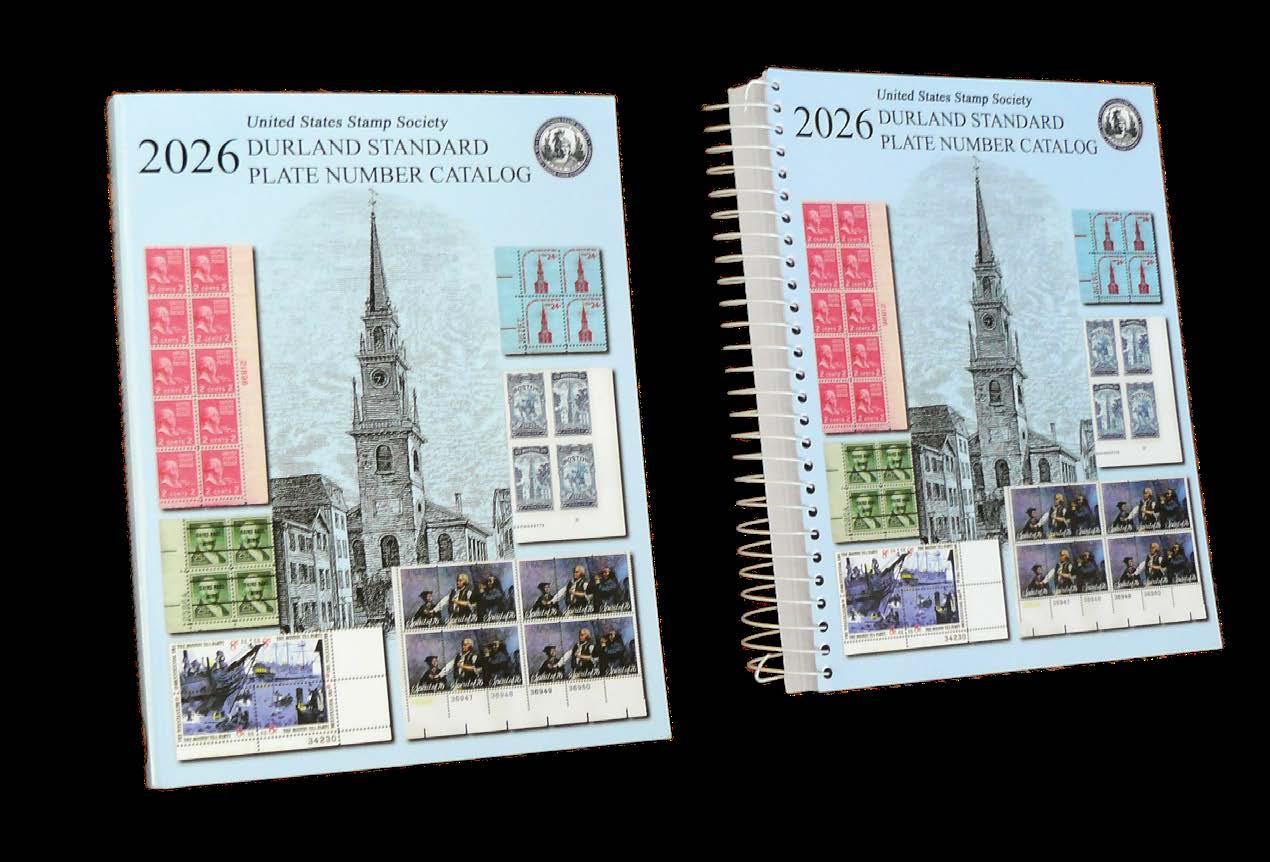
The new 2026 edition of the Durland Standard Plate Number Catalog provides the most comprehensive research source for plate number information on United States postage and revenue stamps, including tax-paid revenue stamps, with listings for overprinted Possessions postage, Allied Military government stamps, and other back-of-the-book stamps, dummy and test stamps, MDI “Blue Cover” booklets and partial plate numbers on booklet and coil stamps.
2026 Edition of the Durland Standard Plate Number Catalog