The United States
SPECIALIST
for the Collector of Postage & Revenue Stamp Issues of the United States WHOLE NUMBER 1160
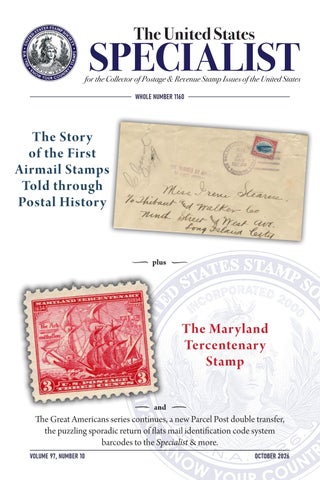
The Story of the First Airmail Stamps Told through Postal History
s plus e
The Maryland Tercentenary Stamp c and j
The Great Americans series continues, a new Parcel Post double transfer, the puzzling sporadic return of flats mail identification code system barcodes to the Specialist & more. VOLUME 97, NUMBER 10
October 2026
United States Stamp Society
Publications
Encyclopedia of United States Stamps and Stamp Collecting Second Edition Edited by Rodney A. Juell, Lynn R. Batdorf and Steven J. Rod
Hardbound, 769 pages. $35 members, $40 nonmembers. Visit the website for shipping costs.
Order from: USSS, P.O. Box 1602, Hockessin, DE 19707-5602 or online at: www.usstamps.org/store/
The United States
SPECIALIST the journal of the United States Stamp Society
VOLUME 97, NUMBER 10
October 2026
WHOLE NUMBER 1160
An association of collectors to promote the study of all postage and revenue stamps and stamped paper of the United States and US-administered areas produced by the Bureau of Engraving and Printing and other contract printers. American Philatelic Society Affiliate No. 150
435 Recent Winners of USSS Medals 436 Letters to the Editor 439 FDR, Farley, and the 1934 Maryland Tercentenary Stamp by Paul M. Holland 451 A Newly Discovered US Q9 Double Transfer by Peter H. Adams 453 Puzzling Sporadic Return of Flats Mail Identification Code System Barcodes to US Specialist Including a Blank (Albino) Label by Douglas B. Quine, PhD
467 The Story of US Airmail Stamps as Told by Postal History Covers. Part I. The First Airmail Series of 1918 by Harry G. Brittain, PhD 477 Report of the Executive Secretary by Robert Rufe 478 Plate Number Report compiled by Kim D. Johnson 480 Classified Advertising 480 Index of Advertisers
456 Vintage Photo of the Month by Rodney A. Juell 459 Great Americans Issue Part XXIX— International Printed Matter Mail by Jay Stotts
Andrew S. Kelley, Editor 9038 East 25th Drive Denver, CO 80238 email: editor@usstamps.org
Hockessin, DE 19707-5602. Membership in the United States $25; North America $40; all others $65. Single copy $2. Periodical postage paid at Hockessin, DE, and at additional entry offices. Printed in USA.
www.usstamps.org
Copyright ©2026 United States Stamp Society, Inc. All rights reserved. Opinions expressed by authors are their own and do not necessarily reflect those of the United States Stamp Society, its officers, or staff.
Manuscr ipts, publications for rev iew, and all advertising including classifieds, should be sent to t h e Ed i to r at t h e ad d ress ab ove. Forms close on the 20th of the second month preceding the month of publication, as February 20 for the April edition. The United States Specialist (ISSN 0164-923X) is published monthly January through December by the United States Stamp Society, Inc., P.O. Box 1602,
Correspondence concerning business affairs of the Society, including membership and changes in address, should be addressed to the Executive Secretary, PO Box 1602, Hockessin, DE 19707-5602. Postmaster: Send address changes to USSS, PO Box 1602, Hockessin, DE 19707-5602.
434
THE UNITED STATES SPECIALIST — Committees —
Peter Martin
email: stottsjd@swbell.net
P.O. Box 6074, Fredericksburg, VA 22403 email: pmartin2525@yahoo.com
Denise Stotts BOOKLETS & BOOKLET PANES
Michael O. Perry
The United States Specialist Founded 1930 as The Bureau Specialist
EDITOR ANDREW S. KELLEY 9038 East 25th Drive Denver, CO 80238 email: editor@usstamps.org
United States Stamp Society Bureau Issues Association, Inc. P.O. Box 1602 Hockessin, DE 19707-5602 CHAIRMAN
Roger S. Brody
P.O. Box 5836 Somerset, NJ 08875-5836 email: brody@usstamps.org PRESIDENT
Nicholas Lombardi
P.O. Box 1005 Mountainside, NJ 07092 email: 8605@comcast.net VICE PRESIDENT
Jeffrey Shapiro
P.O. Box 3211 Fayville, MA 01745-3211 email: coverlover@gmail.com SECRETARY
Joel Cohen
REVENUE ISSUES
AWARDS
SECOND BUREAU ISSUE
Nicholas Lombardi
P.O. Box 1194, Rainier, OR 97048 email: MOPerry@mac.com
P.O. Box 1005, Mountainside, NJ 07092
DURLAND EDITOR
Kim D. Johnson
VENDING AND AFFIXING MACHINE PERFORATIONS
310 E N 3rd Street, Georgetown, IL 61846 email: westhome1@aol.com
40 Carolyn Place, Chappaqua, NY 10514
ESSAY-PROOF
James Patterson 1850 North Central Avenue, No. 1400 Phoenix, AZ 85004 email: jhpatterson@yahoo.com EXHIBIT PDFs
Chris Steenerson P.O. Box 1818 Westminster, CO 80038-1818 email: Chris@RxStamps.com FARLEY ERA
Paul M. Holland
Dan Ryterband email: djryterband@fwcook.com WASHINGTON-FRANKLIN HEAD ISSUES (Co-Chairmen)
Greg Shoults 11248 Frederick Lane Twinsburg, OH 44087 email: coilcollector@hotmail.com
Andrew S. Kelley 9038 East 25th Dr, Denver, CO 80238 email: stamps@andrewkelley.net WEBMASTER
email: pholland.thorleaf@gmail.com
Mike Lampson
FOURTH BUREAU ISSUE
P.O. Box 652 Matthews, NC 28106 email: lampson@usstamps.org
Jay B. Stotts
email: stottsjd@swbell.net LIBERTY SERIES
Roland Austin
— Study Groups —
P.O. Box 38 Stillwater, OK 74076-0038 email: RAustin13@aol.com
DUMMY STAMPS
MARGINAL MARKINGS
P.O. Box 10406, Napa, CA 94581 email: terryrscott@comcast.net
Chris Steenerson
Terry R. Scott
10703 Kings Riding Way, Unit T-1 Rockville, MD 20852-5420 email: cohenji@comcast.net
P.O. Box 1818 Westminster, CO 80038-1818 email: Chris@RxStamps.com
TREASURER
MODERN POSTAL HISTORY
Douglas B. Quine
Wayne L. Youngblood
1740 Mission Hills Rd., #311 Northbrook, IL 60062-5744 email: david14501681@gmail.com
72 Strawberry Hill Rd, Madison, CT 06443 email: usss2010@quine.org
705 Forest Glen Circle, Prairie du Sac, WI 53578 email: wystamps@gmail.com
David S. Sugar
GOVERNORS
Lynn Batdorf Kim Johnson Mike Lampson Leonard Piszkiewicz James Robinson Robert Rose Rod Juell Gregory Shoults David Steidley Jay Stotts Steven Unkrich EXECUTIVE SECRETARY
Robert Rufe
P.O. Box 1602 Hockessin, DE 19707-5602 email: execsecretary@usstamps.org
PLATE NUMBER & CHECKLIST SERVICE
Kim D. Johnson 310 E N 3rd Street, Georgetown, IL 61846 email: westhome1@aol.com PRECANCELS
Lynn R. Batdorf 6005 Kingsford Road, Bethesda, MD 20817 email: hollykids@comcast.net
FIRST BUREAU ISSUE [open] LUMINESCENCE
OVERRUN COUNTRIES SERIES
Thomas Schilling P.O. Box 432, New Lisbon, NJ 08064-0432 email: cbtkschilling@yahoo.com PROMINENT AMERICANS AND AMERICANA SERIES
Ron Blanks
PRESIDENTIAL ERA
Jeffrey Shapiro
P.O. Box 9282, Chesapeake VA 23321 email: rblanks_stamps@yahoo.com
P.O. Box 3211, Fayville, MA 01745-3211
REGISTERED MAIL
RECRUITING
Steven Crippe P.O. Box 117001, Carrollton, TX 75011 email: scrippe@gmail.com
Mike Ludeman P.O. Box 2024, Denton, TX 76202-2024 email: mike@ludeman.net
October 2026
435
Recent Winners of USSS Medals United States Stamp Society medal winners that have been reported from recent shows:
Statue of Freedom Awards (WSP Shows) Show
Winner
Westpex (CA)
Richard Taschenberg
Usage History of the “Pumpkin” Envelopes—How and Where They Were Used
Exhibit
Pipex (OR)
Lloyd Ferrell
Transition to War: Pearl Harbor Ships Before and After December 7, 1941
Rocky Mtn. SS (CO)
Gregory Shoults
Washington and Franklin Coils: The Development of the Third Bureau Flat Plate and Coil Waste Issues of 1908–1915
Okpex (OK)
Robert Thompson
25¢ Honeybee From Design To Postal Usage
Min. SE (MN)
John Hotchner
The U.S. CIPEX Souvenir Sheet of 1947
Balpex (MD)
Mark Schwartz
Napex (VA)
Mark Schwartz
Independent Mail and Express Company Operations at Boston 1843-1845 The New York Postmaster Provisionals of 1845
President’s Awards (Local and Regional Shows) Show
Winner
Exhibit
Sopex (OR)
Bill Poulter
U.S. Air Mail Special Delivery
Scopex (PA)
Anonymous
The Documentary Revenue Issue of 1871–1872
Show Awards Chairs, please note: The USSS Gold Statue of Freedom Medal is sent automatically to all APS World Series of Philately (WSP) shows. The USSS Silver President’s Award medal is available upon request to all local and regional shows. For more information, to request an award or if you have won a USSS award and have not seen it listed in The United States Specialist, please write to Denise Stotts, stottsjd@swbell.net. (Some shows fail to send in the follow-up report.)
436
THE UNITED STATES SPECIALIST
Letters to the Editor
Correction My article on the domestic letter rate decrease of 1883 that appears in the September 2026 edition of The United States Specialist contains one howler of a mistake. The stamp on the cover pictured on page 429 is indeed the 2¢ American Bank Note Company soft paper variety,Scott 183. However, it was issued in 1879, not 1873. It appears that both I and the person who penciled “1873 issue” beneath the stamp made the same mistake. I apologize for not doing a better job of fact checking. Sincerely, Stephen L. Suffet Woodside, NY
Advertise in The United States Specialist Size Cost Per Issue (inches)
B&W 1 issue
B&W 12 issues
Color 1 issue
Color 12 issues
Inside Cover
4.8 × 8.1
—
—
$345
$300
Back Cover
4.8 × 6.5
—
—
$345
$300
Full Page
4.8 × 8.1
$140
$120
$230
$200
Half Page
4.8 × 4.0
$75
$65
$125
$110
Quarter Page
2.32 × 4.0
$42
$35
$70
$60
Eighth Page
2.32 × 1.9
$24
$20
$40
$35
Deadline for ad copy is the 20th of the second month preceding the month of publication, as April 20 for the June issue. There is a 5% discount for payment in advance or with copy. To place an ad or for help with ad design, contact the Editor, Andrew Kelley, at (720) 839-5848 or editor@usstamps.org.
October 2026
437
Revenues . S . U We maintain a wide selection of quality material. View our complete up-to-date price list online.
• All Scott-listed revenue stamps • Revenue Proofs and Essays • Taxpaid Revenues • Telegraph Stamps
• Revenue Stamped & Embossed Paper • Revenue Stamps used on Document
Richard Friedberg
310 Chestnut Street • Meadville, PA 16335 (814) 724-5824 • richard@friedbergstamps.com
www.Friedbergstamps.com
USatFACE.com
If you collect Plate Blocks, Booklets, Coils, or Sheets, the above website, with hundreds of sets at Face Value, will be a great savings to you. Enjoy the hobby. Armen Hovsepian (APS 150170) P. O. Box 24222 Overland Park, KS 66283 info@USatFACE.com
Great Collections have ONE NAME in common
Bleckwenn
Eubanks
Walske
Kramer
Gross
Mooz
Siegel offers unparalleled expertise, a worldwide client base, financial reliability, intelligent marketing, and the best internet resources of any philatelic auction house. Contact us today to learn more about consigning with Siegel and ensuring your legacy.
21 West 38th Street, 7th Floor New York, N.Y. 10018 Phone (212) 753-6421 Email: stamps@siegelauctions.com
October 2026
439
From the Farley Era Committee
FDR , Farley, and the 1934 Maryland Tercentenary Stamp by Paul M. Holland
USSS #16849 | m pholland.thorleaf@gmail.com
“
The special stamp affixed to this letter commemorates the three hundredth anniversary of the founding of Maryland. The central design of the stamp depicts “The Ark and the Dove,” vessels on which the colonists sailed from England. It was at Saint Marys City, Maryland, where this letter is being mailed, that this resolute band set forth to create a new commonwealth dedicated to the principles of political and religious freedom to all men. Not Maryland alone, but the entire Nation can well be proud of these rich heritages of the past. In consideration of these things, it has been my high privilege to authorize the issuance of this stamp for the Maryland Tercentenary anniversary.
”
—From a signed March 23, 1934, letter from Postmaster General James A. Farley sent with a favor first day cover of the Maryland Tercentenary stamp
440
THE UNITED STATES SPECIALIST
King Charles I granted the original charter for a Maryland colony in North America in 1632 to George Calvert, 1st Baron Baltimore, but after he died that same year, it passed to his son, Cecil Calvert. In 1634, colonists aboard two ships, the Ark and the Dove, arrived at what is now Saint Mary’s City on the Potomac River to settle the new colony, founded to provide a religious haven for Catholics being persecuted in England. The city of Baltimore was later named after Cecil Calvert, the 2nd Baron Baltimore. Commemoration of the tercentenary of Maryland’s founding was planned well in advance, with the General Assembly of the state of Maryland approving the appointment of a Maryland Tercentenary Commission on April 11, 1929. The following month, Michael L. Miller, a prominent Baltimore collector, recommended that the Commission issue a special stamp to commemorate the tercentenary, and he was appointed its Stamp Consultant. Later in August 1933, Maryland’s Governor Albert C. Ritchie made a formal request to Postmaster General (PMG) James A. Farley for such a stamp, but despite further requests by Maryland’s Tercentenary Commission and congressional representatives, little progress seems to have been made.1 However, Miller continued his efforts for such a stamp and, behind the scenes, President Franklin D. Roosevelt (FDR) wrote a January 24, 1934, memo to PMG Farley stating, “I am inclined to think that the Maryland Tercentenary is worthy of a special stamp. After all, this is a state celebration of its founding and also the founding of religious liberty in America.”2 Later, Michael Miller received a personal letter dated February 2, 1934, from FDR himself saying, “I have told the Postmaster General that I approve the issuance of the Tercentenary Stamp for Maryland.”1 The Bureau of Engraving and Printing (BEP) was ordered to design a Maryland stamp on February 6, 1934. As a starting point, Michael L. Miller had already submitted several potential stamp designs with his petition for the Maryland stamp. Two of these are shown in Figure 1.1 The one on the left depicts Cecil Calvert; the one on the right depicts the State House in Annapolis, Maryland. Its construction dates to 1772 and it’s the oldest state capitol in continuous legislative use. This included serving as capitol
Figure 1. Essays by Michael L. Miller submitted with his petition for the Maryland stamp.1
October 2026
of the Confederation in 1783–1784, where the Treaty of Paris that formally ended the American Revolution was ratified. Note that both of these essays are denominated as 2¢ stamps, and so were clearly prepared by Miller before the first-class letter rate increased to 3¢ on July 6, 1932. Perhaps a more important inspiration for the Maryland Tercentenary stamp was the image on the brochure Edwin Tunis prepared for the Maryland Tercentenary Commission. Shown in Figure 2, the brochure shows the Ark and Dove under sail. Based on this, Edwin Tunis prepared the stamp design shown in Figure 3. This essay depicts the Ark and Dove under sail along with Maryland’s coat of arms, and was included by Michael L. Miller in his petition for a Maryland Tercentenary stamp.
441
Figure 2. Brochure for Maryland’s Tercentenary showing the Ark and Dove.
Figure 3. Stamp essay by Edwin Tunis depicting the Ark and Dove.1
442
THE UNITED STATES SPECIALIST
Figure 4. Stamp design for Maryland Tercentenary stamp prepared by Victor S. McCloskey Jr.
At the BEP, Victor S. McCloskey Jr. prepared the alternative stamp design shown in Figure 4. This is based on the mural Barter with the Indians by C. Y. Turner. While this might have made for an attractive stamp, it was not to be.1 The final selected design was by the BEP’s A. R. Meissner, as shown in Figure 5. J. C. Benzing engraved the vignette, and E. M. Hall engraved the frame and lettering. Although clearly based on Edwin Tunis’s artwork, Meissner changed the relative position of the two ships, significantly enhancing the stamp’s beauty. Note also how Maryland’s coat of arms has been retained in the background at the upper right, as in the Tunis design. PMG Farley approved Meissner’s
Figure 5. Details of the final Maryland Tercentenary stamp design.
October 2026
443
design on February 27, 1934, and the die proof was approved by Acting PMG W. W. Howes on March 10, 1934.1 Also of interest is the unusual red color selected for this stamp. The origin of this is revealed in a March 10, 1934, internal White House memo to the President from Marvin H. McIntyre, which says: The Post Office Department is very anxious to have these stamps issued immediately. They have arranged with the Bureau of Engraving and Printing to start Monday morning. They would be grateful if the President would indicate his preference as to the color so that the work may proceed.
At the bottom, Roosevelt has scrawled “I like the Red, FDR.”2 Previously, 2¢ stamps had been printed in red and 3¢ stamps in various shades of violet. As a result, shortly after the Maryland Tercentenary stamp was issued in carmine rose, postal clerks were confused, and occasionally letters mailed with the Maryland
Figure 6. Plate proof for Maryland Tercentenary stamps (Smithsonian National Postal Museum).
444
THE UNITED STATES SPECIALIST
Tercentenary stamp were marked 1¢ postage due.1 Interestingly, rare color variations in lake and carmine lake are known for the stamp (Scott 736b and 736c). FDR also famously favored unconventional color choices for some later stamps issued during his administration, including dark blue (instead of red orange) for the 6¢ Crater Lake stamp in the National Parks series, and henna brown (instead of purple) for the 3¢ Pony Express stamp. The BEP was ordered to print the Maryland Tercentenary stamps on Monday, March 12, 1934, and first (flat-plate) printing began on Wednesday the 14th. Only plates 21188 and 21191 were initially available, although a total of eight plates were ultimately used to print these stamps (21188–21191 and 21196–21199).3 A proof of plate 21198 from the collection of the Smithsonian National Postal Museum is shown in Figure 6. Note that this plate proof was approved on March 20, 1934. A special ceremony was held at the BEP for the initial printing of the Maryland Tercentenary stamp as shown in Figure 7. Here, PMG James A. Farley is shown at the right, along with L. W. Robert, Assistant Secretary of the Treasury, and David Winebrenner, Maryland’s Secretary of State.4
Figure 7. PMG Farley examining a sheet at the first printing of the Maryland stamp.4
Shown in Figure 8 is a full pane of the 1934 Maryland Tercentenary postage stamps signed in the top margin by President Franklin D. Roosevelt, Vice President John Nance Garner, and all ten members of FDR’s Cabinet. Cabinet members’ signatures include those of George H. Dern, Secretary of War; Cordell Hull, Secretary of State; Claude A. Swanson, Secretary of the Navy; Henry A. Wallace, Secretary of Agriculture; Frances Perkins, Secretary of Labor; Henry Morgenthau Jr., Secretary of the Treasury; Harold L. Ickes, Secretary of the Interior; Homer S. Cummings, Attorney General; Daniel C.
October 2026
445
Figure 8. Pane of Maryland Tercentenary postage stamps signed in the top margin by FDR, his Vice President, and members of his Cabinet (Smithsonian National Postal Museum).
Roper, Secretary of Commerce; and James A. Farley, Postmaster General. This was almost certainly passed around for signing at the 2 pm Cabinet meeting held at the White House on March 23, 1934. This signed pane came from Franklin D. Roosevelt’s personal stamp collection, which was sold in the February 1946 H. R. Harmer auction as lot 153, and is now at the Smithsonian National Postal Museum. While a few earlier stamp panes, such as the 1933 Peace and 1933 Century of Progress stamps, were also signed by FDR and members of his Cabinet, later panes were typically only signed by FDR and his Secretary of the Treasury, Henry Morgenthau Jr.,5 such as my signed example for the 1935 Connecticut Tercentenary stamps.6 Saint Mary’s City, Maryland, site of the original landing in 1634, was selected as the first day city, and Postmaster General James A. Farley sent out favor first day covers (FDCs) using this postmark, along with signed letters for the Maryland Tercentenary stamp. In Figure 9, I show my example sent to the Honorable George Hofferbert of Baltimore. At the time, Hofferbert was a Democratic member of the House of Delegates, Baltimore City, and later the US Collector of Internal Revenue for the District of Maryland.
446
THE UNITED STATES SPECIALIST
Figure 9. Favor FDC with signed letter for the Maryland Tercentenary stamp sent by PMG Farley.
October 2026
447
Figure 10. Farley-signed favor FDC for the Maryland Tercentenary stamp.
Another of my favor FDCs on official PMG stationery for the Maryland Tercentenary stamp is shown in Figure 10. Without letter, this is signed by Farley on the corner card using his trademark green ink.
Figure 11. FDC for Maryland Tercentenary stamp with two-color Linprint cachet.
Ordinary cacheted FDCs were also widely prepared for the Maryland Tercentenary stamp. My example with a two-color Linprint cachet (Mellone 736-15) is shown in Figure 11. This depicts Cecil Calvert and a sailing vessel, apparently the Ark, approaching a shoreline populated by Native Americans.
448
THE UNITED STATES SPECIALIST
Perhaps the most interesting of my covers sent to FDR bearing the Maryland Tercentenary stamp is the one shown in Figure 12, mailed from Lake Village, Arkansas, on June 14, 1934. Besides being addressed to “Franklin D. Roosevelt, Stamp Collector” at the White House, it has a hand-drawn cachet commemorating Charles Lindbergh’s first night flight. It is franked with an additional 5¢ winged globe stamp to pay the 8¢ airmail rate. Not surprisingly, this cover was preserved in FDR’s personal stamp collection, as confirmed by the H. R. Harmer auction authentication handstamp on the front.
Figure 12. Airmail cover with hand-drawn Lindbergh cachet and Maryland Tercentenary stamp sent to FDR.
The story behind this unusual event is that in April 1923, during a flight between Mississippi and Houston, Texas, Lindbergh had landed his plane on a golf course at the lakeside resort of Lake Village, Arkansas. The keeper of the clubhouse kindly invited him to stay. When Lindbergh noticed the bright full moon and clear sky that evening, he realized that it was “an ideal night for flying,” and so took his host along for a brief but memorable moonlight flight over Lake Village and the Mississippi River. This later became a celebrated event in Lake Village history, and an obelisk by the shores of Lake Chicot commemorating Lindbergh’s night flight was dedicated on June 14, 1934. Carefully drawn by Margaret Trisham, the cachet highlights Courage, Endurance, and Thoroughness. Four years following Lindbergh’s first night flight at Lake Village, night-flying skills proved to be important to him in the first nonstop solo flight across the Atlantic in May 1927. Another of my airmail covers sent to FDR bearing a Maryland Tercentenary stamp is shown in Figure 13. Signed by the local postmaster and others, including the cachet designer, this celebrates the dedication of the Modesto, California, airport on July 4, 1934. Unusually, this airmail cover has been addressed to “President F. D. Roosevelt, Honolulu, Hawaii.” You see, at the time FDR was away from the White House on his well-publicized, month-long 1934 Presidential Cruise to Hawaii aboard the USS Houston that began on July 1 at Annapolis, Maryland. On the day this cover was posted, FDR was about to arrive at Cap-Haïtien in Haiti. After traveling through the Panama Canal, FDR arrived in Honolulu on July 26, and eventually received this cover as documented by the H. R.
October 2026
449
Figure 13. Airmail cover sent to FDR with Maryland Tercentenary stamp addressed to him in Honolulu, Hawaii.
Harmer auction authentication handstamp. Note that to make up the nominal 6¢ airmail rate, a 1¢ Century of Progress stamp has been added, along with a pair of 1¢ WashingtonFranklin stamps from the bottom of a Third Bureau booklet pane (Scott 498e). Finally, I show my example use of a block of four Maryland Tercentenary stamps for an event in my hometown of Santa Barbara, California, on August 23, 1934 (Figure 14). This cover marks the first day of the 11th Annual Fiesta, or “Old Spanish Days,” with a three-color printed cachet noting that this occurred “in the full of the moon in August.”
Figure 14. 1934 cacheted cover for Santa Barbara’s Fiesta with block of four Maryland Tercentenary stamps.
450
THE UNITED STATES SPECIALIST
The Maryland Tercentenary stamp was the first commemorative celebrating a state’s founding that was issued during FDR’s presidential administration. Over a dozen more would follow between 1934 and 1945. Also, with the District of Columbia itself largely embedded within the state of Maryland, FDR necessarily had close ties to the state. For example, in 1942, when German U-boats made travel on the presidential yacht especially perilous during World War II, FDR repurposed a camp in Catoctin Mountain Park, Maryland, originally built by the Works Progress Administration (WPA) for federal workers, into a presidential retreat. Located about 60 miles northwest of Washington, D.C., FDR named the camp Shangri-La after the popular novel Lost Horizon by James Hilton (note: it was renamed Camp David in 1953). Interestingly, FDR hosted British Prime Minister Winston Churchill here on May 14, 1943. In his memoirs, Churchill famously recalls FDR working on his stamp collection with the words: The President had been looking forward to a few hours with his stamp collection. General “Pa” Watson, his personal aide, brought him several large albums and a number of envelopes full of specimens he had long desired. I watched him with much interest and in silence for perhaps half an hour as he stuck them in, each in its proper place, and so forgot the cares of State.7
Acknowledgment The author would like to acknowledge Roger Kirby for helpful discussions on essays of the Maryland Tercentenary stamp. References 1. Max G. Johl, The United States Commemorative Stamps of the Twentieth Century: Volume I 1901–1935 (New York: H. L. Lindquist, 1947), 271–274. 2. Brian C. Bauer, Franklin D. Roosevelt and the Stamps of the United States 1933–45 (Sidney, Ohio: Linn’s Stamp News, 1993), 32–35. 3. B. I. A. Plate Number Checklist: Plates 20000–41303, rev. ed. (United States Stamp Society, 1990). 4. Max G. Johl, The United States Postage Stamps of the Twentieth Century: Volume IV 1933–1937 (New York: H. L. Lindquist, 1938), 10. 5. The President Franklin D. Roosevelt Collection, Part One (New York: H. R. Harmer, Inc., February 1946), 41. 6. Paul M. Holland, “Franklin D. Roosevelt as a Stamp Collector,” The American Philatelist, October 2020, 902–913. 7. Winston S. Churchill, The Second World War: The Hinge of Fate (Boston: Houghton Mifflin Company, 1950), 797.
October 2026
451
Plate Varieties
A Newly Discovered US Q9 Double Transfer by Peter H. Adams
USSS #17212 | m adams.peterh@gmail.com
Figure 1. Parcel Post stamp, Scott Q9, with double transfer.
This article documents the first known example of a double transfer on the 25¢ United States Parcel Post stamp, Scott Q9. I discovered this stamp in a collection that I purchased from the Western Philatelic Library. The double transfer affects the entire left side of the design. This article includes two images of the double transfer with two images of a normal Q9 for comparison. I was unable to locate this variety in a published reference.1 Wayne Youngblood and Charles di Como did not recall seeing such an example. In an email, Youngblood stated, “I’ve never seen it before, but I would call it a minor double transfer.” As shown in Figure 1, the stamp is in excellent condition. The light box cancellation likely originated in Attleboro, Massachusetts. The stamp also exhibits a plate flaw
452
THE UNITED STATES SPECIALIST
unrelated to the double transfer, consisting of a diagonal line extending from the upper left corner, through the “R” in Parcel, and continuing to approximately the middle of the right side of the stamp. Figure 2 compares the stamp with the double transfer to the normal.
Figure 2. Comparison of stamp with double transfer (left two images) with normal (right two images).
I welcome additional reports of this variety, as well as reports of other double transfers on Parcel Post stamps. Notes 1. The variety is not listed in the Scott Specialized Catalogue of United States Stamps and Covers or in Loran C. French’s Encyclopedia of Plate Varieties on U.S. Bureau-Printed Postage Stamps. Additionally, I could find no reference to it in the online David Straight Philatelic Union Catalog.
October 2026
453
From the Modern Postal History Committee
Puzzling Sporadic Return of Flats Mail Identification Code System Barcodes to US Specialist Including a Blank (Albino) Label by Douglas B. Quine, PhD
USSS # 10762 | m drquine@gmail.com
Figure 1. FICS barcode May 2025.
In April 2025, I reported on my study of 30 years of United States Specialist mailing labels and the postal evolution they illustrated (Quine, 2025). I also reported that USPS had been placing Flats Mail Identification Code System (FICS) four-state barcodes on our journal as early as April 2005. This was just a year after they were launched and 19 years before the first paper discussing these unique identifier barcodes was published (Quine, 2024). FICS barcodes continued to appear from time to time until April 2023. By the end of my study in March 2025, the FICS barcoded labels seemed fully retired. It was surprising they continued so late.
454
THE UNITED STATES SPECIALIST
The Specialist mailing labels started encoding 11-digit ZIP codes, which represented the delivery point of our mailboxes, in May 2008. Our mailing labels migrated to the new required Intelligent Mail Barcodes (IMB) four-state barcodes (full, ascending, descending, track) in February 2011. The IMB barcodes also encode the full 11-digit delivery point of our mailboxes and add mailer information. Automation equipment can use either of these barcodes for all sortation processes until delivery. The IMB barcodes also advise USPS that “Full Address Correction Service (ACS)” is requested if recipients move (as I effectively did in October 2025 when I closed my expensive PO Box). The use of FICS barcodes after May 2008 when our mailing labels started encoding the 11-digit ZIP codes is puzzling. FICS barcodes are “unique identifiers;” they assign an arbitrary serial number to each mail piece. The sorting machine must read these barcodes and look them up in a database to obtain the 11-digit delivery point ZIP code, which is already plainly encoded in the barcode on our mailing labels! Two years after the last observation on my mail, I was quite surprised to see a FICS barcode label on Michael Clark’s copy of the May 2025 United States Specialist (Figure 1). His Pound Ridge, New York, mail was processed in the same processing center (ADC 105) as my Bethel, Connecticut, mail. As an unexpected early Christmas present, I received a blank (albino) FICS barcode on my December 2025 United States Specialist (Figure 2). I see no trace of ink on the label. Apparently, the barcode inkjet printer wasn’t working. Although I am familiar with blank labels being used to cover incorrect printed barcodes in the past, I had not seen a blank FICS label before.
Figure 2. Blank (albino) FICS barcode label December 2025.
Finally, a third FICS label appeared in the 18 monthly issues since my original paper. This time, the label appeared on the face of the journal (Figure 3). I’m guessing the journal was misfed into the automation equipment with the address side facing away from the camera so the FICS unique identifier barcode was affixed on the cover to be linked to the address label data when the journal was turned over and reprocessed later. I would have thought the USPS processing center near the printer would be very familiar with the obvious orientation of address labels on our journal even if many other journals place their mailing labels on the front cover of the journal. Over the years, I’ve observed that 8% (3 of 37) of the FICS labels have been affixed to the front cover of our journal. In conclusion, I’ve observed two FICS labels on my latest 16 United States Specialist issues (through September 2026) as well as one on a friend’s issue (the only one of his issues I’ve seen). The continued use of FICS barcodes on rigorously addressed and barcoded mail is surprising.
October 2026
455
Figure 3. FICS barcode on face of the journal, February 2026.
References 1. Douglas B. Quine, “Puzzling Barcode on Flats Since 2004 Finally Explained,” American Philatelist (February 2024): 68–70. 2. Douglas B. Quine, “Thirty Years of US Specialist Mailing Labels Show Postal Evolution and an Unexpected Surprise,” The United States Specialist 96, no. 4 (2025): 161–167.
2026 HEBERT’S All New and Revised Mint and Used Plate Number Single Catalogue $52.50 postpaid American Plate Number Single Expanded pricing, back-of-the-book, Society tag/paper varieties, (www.apnss.org) PN/ZIP/ME types
Rick Burdsall / APNSS P.O. Box 1023 Palatine, IL 60078-1023
456
THE UNITED STATES SPECIALIST
Vintage Photo of the Month
by Rodney A . Juell
USSS #13852 | P.O. Box 3508, Joliet, IL 60434
Around the turn of the last century, some large cities used pneumatic tubes to move mail between railroad stations and post offices. The goal was to avoid the congestion of city streets. This month’s photo shows pneumatic tube equipment in the Philadelphia post office, circa 1900. While vast quantities of mail moved through the pneumatic tube system, only a very small number of covers show any evidence that the system ever existed. One that does is shown nearby. This cover was damaged while in a pneumatic tube (note the grease stain), and the damage was explained by an auxiliary marking.
October 2026
457
October 2026
459
The Great Americans
Great Americans Issue Part XXIX— International Printed Matter Mail by Jay Stotts
USSS #10921 | m stottsjd@swbell.net
Figure 1. A surface-rate printed matter mailing to England.
In the previous two installments of this series, we discussed domestic Third- and Fourth-Class mail, predominantly the mailing of printed advertising and published works such as books. Internationally, such publications are called “printed matter,” and the Universal Postal Union (UPU) and the United States Postal Service (USPS) created several classifications for carrying such mail abroad.
Surface Printed Matter Mail Printed matter could be sent overseas by either surface or airmail transport during the Great Americans (GA) era. Surface transport was slower, but if the mail was not time-sensitive, the sender could save on postal expenses by choosing this lower-cost
460
THE UNITED STATES SPECIALIST Start of Rate Period 1 Jan. 1981
1st oz. 23¢
1 to
2 to
3 to
4 to
6 to
2 oz.
3 oz.
4 oz.
6 oz.
8 oz.
33¢
43¢
53¢
72¢
92¢
17 Feb. 1985
29¢
47¢
65¢
83¢
$1.02
$1.21
3 Apr. 1988
40¢
60¢
80¢
$1.00
$1.28
$1.56
3 Feb. 1991
48¢
70¢
92¢
$1.14
$1.45
$1.80
9 July 1995
50¢
80¢
$1.00
$1.21
$1.63
$2.05
7 Jan. 2001
Surface rates discontinued
Table 1. International printed matter rates by surface transport.
alternative. Table 1 shows surface rates for sending single-piece printed matter to foreign destinations. Note that surface printed matter rates were discontinued in 2001. The table includes weights of up to eight ounces, which will suffice for most items available to collectors, even though the rates continued for heavier items. Some printed matter rates to Canada and Mexico were lower than those to other international destinations, and collectors can find rates to these two destinations in U.S. International Postal Rates, 1872–1996, by Anthony S. Wawrukiewicz and Henry W. Beecher. Figure 1 shows a surface rate printed matter item sent to England. The mailer used a “3rd Class Mail” hand stamp to identify to postal employees that this was printed matter rather than a letter of correspondence. The postage of 47¢ paid the surface printed matter rate for between one and two ounces.
Airmail Printed Matter Rates The drawback of surface-transported printed matter service was the much slower transit time compared to the airmail alternative. Collectors will find that surface printed matter is much less common than airmail printed matter. Mailers were willing to pay a premium for faster transport, so it was used more often; finally, in January 2001, the postal service removed the surface option, most likely because mailers used it less. The airmail service for printed matter and other non-correspondence items (autres objets or other objects in French) carried the name “A.O. Mail.” This was the popular alternative to surface-transported printed matter during the Great Americans era. Table 2 gives the A.O. Mail rates. Figure 2 shows a 3.5-ounce package mailed from California to West Germany on July 25, 1988. Table 2 shows that the rate during the mailing period for this A.O. Mail was 83¢ for the first ounce and 49¢ for the next three ounces, so the total postage was $2.30. As with surface printed matter rates, Canada and Mexico also had independent air carriage rates. In the interest of space constraints, we have not provided tables for these rates, but readers can find them in U.S. International Postal Rates, 1872–1996. An example to Canada is shown in Figure 3. This was a single-ounce mailing posted on February 6, 1995, at the rate of 38¢, effective from February 3, 1991, through July 8, 1995.
October 2026
461
Start of Rate Period
1st oz.
per add’l ounce up to 4 oz.
per add’l 2 oz. up to 32 oz.
each ½ lb. above 2 lb.
Mail to North and Central America 1 Jan. 1981
50¢
26¢
26¢
$1.04
17 Feb. 1985
58¢
31¢
31¢
$1.22
3 Apr. 1988
69¢
37¢
37¢
$1.40
Mail to South America, Europe (except USSR), North Africa 1 Jan. 1981
60¢
36¢
46¢
$1.84
17 Feb. 1985
70¢
42¢
54¢
$2.16
3 Apr. 1988
83¢
49¢
64¢
$2.50
Rest of the World 1 Jan. 1981
70¢
46¢
66¢
$2.64
17 Feb. 1985
82¢
53¢
77¢
$3.10
3 Apr. 1988
90¢
64¢
91¢
$3.55
Western Hemisphere 3 Feb. 1991
70¢
37¢
37¢
$1.40
9 July 1995
75¢
32¢
64¢
$1.20
3 Feb. 1991
85¢
50¢
66¢
$2.50
9 July 1995
90¢
42¢
84¢
$2.40
Europe
Asia and Africa 3 Feb. 1991
93¢
64¢
91¢
$3.55
9 July 1995
98¢
50¢
$1.00
$3.20
Pacific Rim 3 Feb. 1991
95¢
66¢
92¢
$3.60
9 July 1995
$1.00
55¢
$1.10
$3.60
Table 2. A.O. rates.
Publishers’ Periodicals Another printed matter category provided postage cost relief to publishers mailing their publications worldwide, called Publishers’ Periodicals. The category included such things as books, catalogs, sheet music, and samples. Table 3 shows surface rates for up to a pound. The periodical mailing shown in Figure 4 was a 16-ounce magazine mailed by the publisher at the $1.36 rate effective between February 3, 1991, and July 8, 1995. The postmark year in the machine cancel is unreadable, probably because of the publication’s thickness.
462
Figure 2. A package mailed using the A.O. service.
Figure 3. An A.O. mailing to Canada.
THE UNITED STATES SPECIALIST
October 2026
463
Figure 4. A 16-ounce publisher’s periodical mailed for $1.36. Start of
1st
1 to
2 to
3 to
4 to
6 to
8 to
10 to
12 to
14 to
Rate
oz.
2 oz.
3 oz.
4 oz.
6 oz.
8 oz.
10 oz.
12 oz.
14 oz.
16 oz.
1 Jan. 1981
12¢
17¢
22¢
27¢
36¢
46¢
55¢
65¢
74¢
83¢
17 Feb. 1985
15¢
22¢
29¢
36¢
46¢
56¢
66¢
76¢
86¢
96¢
3 Apr. 1988
20¢
30¢
40¢
50¢
64¢
78¢
92¢
$1.06
$1.20
$1.32
3 Feb. 1991
30¢
38¢
46¢
54¢
68¢
82¢
96¢
$1.10
$1.24
$1.36
9 July 1995
32¢
40¢
52¢
60¢
76¢
92¢
$1.08
$1.24
$1.40
$1.56
Table 3. Publishers’ Periodicals, surface rates.
M-Bags Effective April 1, 1959, the postal service offered an option to send large quantities of publications to a single addressee. The postal service designated this type of mailing as an M-Bag. During the GA era, mailers could send up to 66 pounds of printed matter to one recipient. The French term même destinataire means “same recipient,” and this term is the origin of the “M” in M-Bag. Senders could mail as few as just one publication using this system, but the minimum weight for fees was set at 15 pounds during most of the GA era. The M-Bag fee was a charge-by-the-pound approach. All material intended for a single mailing could be packaged as the mailer desired, but the package was then inserted into a mail bag, and the sender filled out a special tag (PS Tag 158). The tag was tied to the mail bag, and the bag was sent on its way. Fees were set by the pound, starting at the minimum for 15 pounds. The minimum poundage for
464
THE UNITED STATES SPECIALIST
charging fees was lowered to 11 pounds, effective with the rate structure of July 9, 1995. Table 4 shows the M-Bag rates for surface mail carriage, and Table 5 shows the M-Bag rates for airmail carriage. Printed Matter
Start of
Publishers’ Periodicals
Rate Period
Canada
Mexico
World
Canada
Mexico
World
1 Jan. 1981
86¢
86¢
86¢
43¢
43¢
43¢
17 Feb. 1985
87¢
87¢
$1.10
55¢
55¢
55¢
3 Apr. 1988
96¢
$1.20
$1.20
72¢
72¢
72¢
3 Feb. 1991
96¢
$1.20
$1.32
72¢
72¢
72¢
9 July 1995
$1.06
$1.32
$1.45
64¢
72¢
79¢
Table 4. M-Bag rates for surface carriage (all rates are per pound or fraction).
Start of Rate
Canada
Mexico
North & Central America
S. America, Europe, N. Africa
Rest of the World
1 Jan. 1981
*
$1.87
$1.87
$3.31
$4.75
17 Feb. 1985
97¢
97¢
$2.20
$3.89
$5.58
3 Apr. 1988
99¢
$1.28
$2.24
$4.00
$5.68
Canada
Mexico
3 Feb. 1991
$1.28
$1.36
$2.24
$4.00
$5.68
$5.76
9 July 1995
$1.41
$1.50
$2.47
$4.41
$6.27
$6.35
Western Hemisphere
Europe
Asia & Africa
Pacific Rim
* For Canada, mail was to be processed as letter rate for air mail carriage.
Table 5. M-Bag rates for air carriage (all rates are per pound or fraction).
Figure 5 shows both sides of a tag for mailing an M-Bag from Intermediate Technology Development Group of North America (ITDG/NA) to its associate in London. The single bag of published matter weighed 41 pounds and was mailed at the surface rate for Publishers’ Periodicals on June 19, 1989. It is franked with $29.52, which paid the Publishers’ Periodicals M-Bag rate of 72¢ per pound. Figure 6 shows a heavy cardboard label used to mail 47 pounds of books from a publisher in Payson, Arizona, to a single addressee in West Germany. The mailer used the same 72¢ per pound Publishers’ Periodicals M-Bag rate to post this package on March 7, 1989. It is unclear if the mailer also had to use an official M-Bag tag (PS Tag 158) or if this label was sufficient for the mailing. The franking was $33.84, all paid by Great Americans stamps.
October 2026
465
Figure 5. Both sides of an M-Bag tag for mailing publications to England.
Figure 6. Label prepared for mailing books to West Germany at the Publisher’s Periodicals M-Bag rate to Germany.
October 2026
467
Airmail
The Story of US Airmail Stamps as Told by Postal History Covers. Part I. The First Airmail Series of 1918 by Harry G. Brittain, PhD
USSS #16446 | m hgbrittain@gmail.com
Figure 1. Plate-numbered singles illustrating the stamps constituting the Airmail Series of 1918. From left to right: Scott C1, Scott C2, Scott C3 (plate number for frame), and Scott C3 (plate number for vignette).
Before I became engrossed with the ink and paper characterization of US postage stamps using forensic methods of analysis, I was an avid collector of US airmail stamps and covers. As might be expected, my collection featured as many unique plate-numbered stamps as I could acquire, but I also accumulated a very large number of covers bearing airmail stamps. Many of these were first day covers, but an equally large number were postal event covers. Inspired by the excellent papers written by Paul Holland, I realized I could tell the story of early US airmail stamps using some of the covers I had collected. Most of the historical information that I will use in this and forthcoming papers is derived from Chapter III of the 1935 publication of Max Johl, The United States Postage Stamps of the Twentieth Century, Volume III.1 This comprehensive chapter includes copies of all relevant communications issued by the various postmasters, providing the full story behind the various airmail stamps.
468
THE UNITED STATES SPECIALIST
What makes the story of US airmail issues so interesting is the large number of rate changes associated with the development of the service. While postal rates for regular issue and commemorative stamps stayed constant for long periods (at least until recently), airmail rates changed frequently. I plan to use postal history covers to illustrate these rate changes.
Background Between 1911 and 1918, a number of pioneer flights carried mail by airplane. These early flights showed the public that aviation could be a viable way to move mail. The Pioneer Period is considered to have ended on November 3, 1916, when Victor Carlstrom proved the feasibility of carrying mail by air by completing a flight from Chicago to New York and bringing mail with him. This, in turn, led Post Office Department (POD) officials to develop plans for regularly scheduled airmail service. Ultimately, this understanding led the United States Congress to authorize the POD to carry mail via airplane. Congress passed the authorization bill on May 6, 1918, and on May 11, 1918, President Woodrow Wilson signed it into law. The United States Army initially managed the infrastructure for the airmail service, providing the airplanes, ground crews, and pilots needed for the flights. The first flights began on May 15, 1918, connecting Washington, D.C., with New York City. The first flights had to be routed through Philadelphia because the planes could not fly between New York and Washington without stopping to refuel. The Army relinquished control of the airmail service to the Post Office Department in August 1918, and the POD recruited its own pilots after that. Three stamps constituted the Airmail Series of 1918, which have been identified as Scott C1, C2, and C3. But as a consequence of the POD postal rates, they were actually issued in reverse-Scott order. Plate-numbered singles of the three issues are shown in Figure 1. The image used for the vignette was derived from a photo depicting one of the Curtiss Jenny army planes that would be used to carry the mail.
C3: 24¢ Carmine Rose and Blue The congressional authorization bill fixed the airmail postage rate at 24¢ per ounce, which included a fee for Special Delivery service. Consequently, the POD created a new, distinctive stamp for this purpose. This stamp is identified as Scott C3, even though it was the POD’s first airmail stamp. The final design used carmine rose ink for the frame and blue ink for the vignette. Only two plates were used for printing: plate number 8492 for the stamp frames, and plate number 8493 for the vignettes on sheets where the frames had already been printed. The “inverted Jenny” stamps resulted from frame sheets being fed upside down into the press to add the vignettes. The frame plate was sent to the press on May 10, even though the master was not approved until the following day. On May 11, the vignette plate was placed into service to complete the printing process. Sheets of the new stamps were issued to the postmasters on May 13, and they were immediately placed on sale. Covers dated May 13 or May 14 are known, but these are extremely rare. Needless to say, I have not been able to collect one of these.
October 2026
469
The first flights of the new Washington-New York airmail service began on May 15, although some of the flight legs were accompanied by difficulties. Covers postmarked on this day with an appropriate postmark are known as first flight covers. Such covers canceled on May 15, 1918, can also be classified as “Earliest Date of Use” (EDU) covers. I have an example of a May 15 first flight cover, shown in Figure 2. There was no return address on either side of the cover, but it was addressed to “Miss Irene Stearns” of Long Island City, New York.
Figure 2. An EDU first flight cover dated May 15, 1918, which flew out of Washington, D.C., on the 10 AM flight.
Most C3 covers in my collection use plain ordinary envelopes, but one particular cover stands out. Figure 3 shows a C3 cover flown on June 1, 1918, that used stationery sourced from the Congress Hall Hotel. This hotel on Capitol Hill was a home away from home for hundreds of congressmen and senators from 1907 to 1930.2 The hotel was located on New Jersey Avenue SE, at Independence Avenue. Hotel residents often took votes that divided their constituents and riled up other members. Despite this, peers who favored different courses of action apparently tolerated their mutual differences. The atmosphere of the Congress Hall Hotel was special, since it brought together members with sharply different views, and somehow, camaraderie usually prevailed. The hotel was torn down in 1930 to make room for the Longworth House Office Building. Being the only airmail stamp available to pay the 24¢ postal rate, the C3 Jenny stamp was exclusively used for that postage until the rate was changed. Since the new rate went into effect on July 15, 1918, a “Last Date of Use” (LDU) cover would have been postmarked on July 14. I have not been able to collect a true C3 LDU cover, but I do have a cover postmarked on July 3, 1918, making it an “almost-LDU” cover. This cover is shown in Figure 4, and was addressed to Mrs. H. F. A. Kleinschmidt of Stoneham, Massachusetts.
470
THE UNITED STATES SPECIALIST
Figure 3. An afternoon C3 airmail cover dated June 1, 1918, which used stationery from the Congress Hall Hotel.
Figure 4. An almost-LDU cover dated July 3, 1918, which originated from Washington, D.C.
C2: 16¢ Green The Postmaster General issued Order Number 1617 on June 26, 1918, which reduced the airmail rate to 16¢ per ounce. This rate change went into effect on July 15, thus requiring the development of a new airmail stamp. The same frame/vignette design as had been used for the 24¢ issue was used, but the stamp was issued in the single color of green. The 16¢ stamp paid for both the airmail postage as well as the Special Delivery service. The die was officially approved on July 5, and the plate went to the press on July 8. All C2 stamps were printed using a single plate numbered 8900. The new stamps were shipped
October 2026
471
to postmasters on July 11 when they immediately went on sale. Covers postmarked on this date would therefore be classified as first day covers, but once again, such covers are very rare. The first flights of covers bearing the new reduced rate began on July 15, and as such are classified as both first flight and EDU covers. An example of a July 15 first flight cover is shown in Figure 5. This particular cover (and others like it in my collection) was acquired from a collector who objected to the length of a legal-size envelope and trimmed it down to a more displayable size. As evidenced by the pasted return address, the cover was sent by the Aerial League of America. This organization was formed to promote the use of airmail service. The recipient of the cover was Mr. Dante Barretta, a resident of New York City.
Figure 5. An EDU first flight cover dated July 15, 1918.
Once the Washington-Philadelphia-New York airmail route had been running regularly, the POD investigated the possibility of establishing routes to more distant locations. On September 5, 1918, a mail-carrying experimental flight was made from New York to Chicago, via Lock Haven, Pennsylvania, Cleveland, Ohio, and Bryan, Ohio. The return trip was finally completed on September 10, establishing the beginning of regular service. Figure 6 shows an example of a September 5 first flight cover addressed to Mr. and Mrs. Jas. Lawrence Onderdonk of Evanston, Illinois. As with the C3 Jenny stamp, the C2 Jenny stamp was widely used until the rate was changed once again. Since this newest rate went into effect on December 15, 1918, a true “Last Date of Use” (LDU) cover would have been postmarked on December 14. Here I have not been able to collect such a C2 LDU cover, but I do have a cover postmarked on September 30, 1918. Figure 7 shows this cover, which I am arbitrarily classifying as an “almost-LDU” cover. The postmark on this cover indicates that it was initially flown on the Washington-Philadelphia-New York route; it was addressed to Mr. K. Roewade of
472
THE UNITED STATES SPECIALIST
Chicago. The cover also bears the amusing stamped message, “Send a letter by airplane, especially to one ‘over there’, it will be a real treat.” Since the cover was postmarked in 1918, the reference to “over there” is a general reference to World War I.
Figure 6. A First Flight cover dated September 5, 1918, flown on the first experimental service linking New York City and Chicago, Illinois.
Figure 7. An almost-LDU cover dated September 30, 1918.
C1: 6¢ Orange The third rate change of the 1918 airmail series came about when the Postmaster General issued Order Number 2415 on November 30, 1918. This Order further reduced the airmail rate to 6¢ per ounce, and also removed the Special Delivery feature. This rate change took effect on December 15, once again requiring the development of another
October 2026
473
Figure 8. An EDU (for the rate) first flight cover dated December 18, 1918, corresponding to the still experimental service linking New York City and Chicago, Illinois.
Figure 9. An EDU (for the rate) first flight cover dated December 18, 1918, corresponding to the new experimental service linking New York City and California.
airmail stamp. As with the C3 and C2 stamps, the same frame/vignette design was used, and this time the stamp was issued in a single color: orange. The die was hardened on December 3, and the plate went to the press on December 5, even though the die proof had not yet been approved. The die proof was officially approved on December 6, allowing printing and distribution to proceed. All C1 stamps were printed using a single plate numbered 9155. The C1 stamps were shipped to postmasters on December 9, and went on sale on December 10. As with the two earlier airmail stamps of this series, covers postmarked on this date would be classified as first day covers, but as before, such covers are very rare.
474
THE UNITED STATES SPECIALIST
By now, the POD had expanded beyond the two routes mentioned above to include a new service connecting New York with San Francisco, California. The first flights on this route began on December 18, 1918. A cover from the New York-Chicago route is shown in Figure 8, and a cover from the New York-California route is shown in Figure 9. But what if the sender wanted to use the Special Delivery service that was part of the 24¢ and 16¢ rates, but not the 6¢ rate paid by the C1 stamp? Figure 10 shows the answer: the cover flew the Chicago-New York route but was postmarked on December 18, 1918. In this case, the postage needed to accommodate both features was paid with a C2 stamp.
Figure 10. A first flight cover bearing a C2 stamp and dated December 18, 1918. This cover made the reverse flight from Chicago to New York City.
Figure 11. A late-use cover bearing a C1 stamp that was dated August 16, 1920, and which flew on a leg of the Chicago-New York route.
October 2026
475
The C1 Jenny stamp was widely used for both airmail and regular mailings for quite some time after the rate was changed again in 1923. Accordingly, a “Last Date of Use” cover is difficult to define, and hence I will not do so. However, Figure 11 shows a “Late Use” cover that was postmarked on August 16, 1920, and which flew on a leg of the New York-Chicago route. I cannot leave the story of the First Airmail Series of 1918 without commenting on the color change that is seen on many C1 stamps. Although the stamps were printed in colors described as orange or deep orange, the printing ink proved susceptible to environmental degradation. As shown in Figure 12, the initial orange color progresses from orange to brown as the degree of environmental degradation increases.
No degradation
Weak degradation
Moderate degradation
Strong degradation
Figure 12. Darkening of C1 stamps that exhibit increasing degrees of environmental degradation.
Because it is scientifically impossible to understand a degradation pathway without first identifying the susceptible pigment, I used my forensic tools, Fourier-transform infrared (FTIR) spectroscopy and x-ray diffraction (XRD), to accomplish this purpose. One might have expected the pigment to be chromate-based, but the forensic results conclusively ruled out that possibility. Ultimately, I identified the pigment used to print C1 stamps as Hansa Yellow. Developed in Germany in 1909 by the Hoechst AG chemical company, Hansa Yellow (chemical name: 2-[(2,5-dichloro-4-nitrophenyl)diazenyl]-3-oxo-N-phenylbutanamide) was the first permanent synthetic organic yellow pigment.3 It revolutionized the pigment industry by providing a bright, affordable, and less toxic alternative to traditional heavy-metal pigments containing cadmium or chromium. The pigment was patented in 1915 and became commercially available soon after that. Clearly, the novelty of this new pigment attracted the interest of the ink formulators in the BEP, who used it in the ink formulation they developed for the C1 stamps. Unfortunately, they did not seem to be aware that Hansa Yellow would discolor when heated at elevated temperatures. One often hears the terms “oxidation” or “sulfurization” loosely used to describe the mechanism that caused a particular degraded stamp to be in the state it is in. While a scientific meaning can be applied to those terms, one cannot rationally invoke either term without first having identified the susceptible pigment and what can happen to it. When the mechanism is unknown, I prefer to use the term “environmental degradation.” However, in this instance of C1 stamp degradation, this is unnecessary. The color darkening evident in the stamps in Figure 12 is clearly due to exposure to elevated temperatures. Hence, the proper term that should be used to describe this phenomenon is “thermal degradation.” The use of any other terminology in conjunction with C1 stamps should be purged from the literature.
476
THE UNITED STATES SPECIALIST
References 1. Max G. Johl, chap. III in The United States Postage Stamps of the Twentieth Century, Volume III, 1922–1935 (New York: H. L. Lindquist, 1935). 2. Paul A. London, “The Old Congress Hall Hotel: A ‘School of Practical Politics’ That We Desperately Need Today,” The Hill, January 22, 2020, https://thehill.com/blogs/congress-blog/politics/479469the-old-congress-hall-hotel-a-school-of-practical-politics-that/ (accessed June 22, 2026). 3. E. E. Jaffe, “Pigments, Organic,” in Kirk-Othmer Encyclopedia of Chemical Technology, 4th ed., vol. 19 (New York: Wiley-Interscience, 1996), 41–78.
Quality United States Stamps (1847-1945) Singles (mint and used) Plate Blocks Booklet Panes plus Complete Booklets Price lists-$2.00 each category Price lists free on web: www.mountainsidestampsandcoins.com
We also buy quality U.S. and foreign stamps
Mountainside Stamps, Coins and Currency P. O. Box 1116 Mountainside, NJ 07092 Tel: 908-232-0539 or 908-419-9751 E-mail: tjacks@verizon.net Tom Jacks, owner Member APS, ASDA, USSS
The U.S. Philatelic Classics Society is a not-for-profit collector organization exclusively devoted to 19th century United States stamps and postal history. Our quarterly Chronicle is widely recognized for presenting new scholarship and discoveries. For membership information and much more, find us at:
www.uspcs.org.
Requesting Replacement Copies To replace a missing or damaged copy of The US Specialist, you may request a replacement by emailing Robert Rufe, USSS executive secretary, at execsecretary@usstamps.org.
October 2026
477
Report of the Executive Secretary APPLICATIONS RECEIVED FOR AUGUST 2026 17683 17684
DJ Young, Attleboro, MA Keith Cherniak, Maple City, MI APPLICATIONS PENDING
17682 NEW MEMBERS 17679–17681 REINSTATED 17035
Richard St. Clair RESIGNED
15092
Pietjan Zwaag
TOTAL MEMBERSHIP July 31, 2026 ADDITIONS: New members Reinstated
1238 3 1
Total
+4
SUBTRACTIONS: Resigned
1
Total
-1
NET CHANGE
+3
TOTAL MEMBERSHIP August 31, 2026
1241
USSS Membership Recruiting
I just returned from a well-attended NAPEX show in Washington—the site of our USSS Annual Meeting next year, June 4–6, 2027. I distributed 25 back issues of The US Specialist, and included a membership application form with each copy. I am hopeful a few of these applications will be returned by attendees seeking USSS membership! Please help us promote USSS membership—request your own updated PDF “quadrafold” membership application via email: execsecretary@usstamps.org.
478
THE UNITED STATES SPECIALIST
Plate Number Report
compiled by Kim D. Johnson USSS #7335 | m westhome1@aol.com
3
#???? P1111
Summer Sunset Coil Nonprofit rate
3
#???? Declaration of Independence B111 ‡ ‡ LL LR 3r x 2c 1,2,3,4,5,6*
October 2026
479
3
#???? Barbie Doll B1111 ‡ ‡ 2r x 2c 1,2,3,4*
LL
LR
3
#????
($1.40) Sarah Orne Jewett 3 oz. rate P11111 UL UR LL LR 2r x 3c 1,2,3,4,5,6*
COORDINATORS: Members are invited to report their findings to the appropriate coordinator. Kim D. Johnson All issues 310 E N 3rd Street through 1980 Georgetown, IL 61846 Jim Cochrane Sheet stamps P.O. Box 2009 after 1980 Great Bend, KS 67530
Jill Ambrose Coil stamps P.O. Box 54622 after 1980 Cincinnati, OH 45254 Michael O. Perry Booklet stamps after P.O. Box 1194 1980 Rainier, OR 97048
This monthly report is used to update the Durland Standard Plate Number Catalog.
480
THE UNITED STATES SPECIALIST
Classified Advertising USSS MEMBERS are entitled to two free ads of up to 40 words each year. Other ads are 10¢ a word, payable in advance. For 6 insertions, take a 5% discount; for 12 insertions, take a 10% discount. Ads with [1160] at the end expire with this issue. Make checks payable to USSS. Send copy and check to The United States Specialist, 9038 E. 25th Dr., Denver, CO 80238. The Editor strongly prefers to receive ad copy by email: editor@usstamps.org. Emailing ads saves substantial time for you and the Editor and avoids errors. WANTED WANTED TO PURCHASE #1053 HAMILTON $5 Commercial Usages. Especially need use to foreign destination. Also doing a survey so scans appreciated. Doug Weisz weiszcovers@gmail.com, 773-9144332. 4547 E Kentucky Cir., Denver CO 80246. www.douglasweisz.com [1168] WANTED - NAMW TEXAS POSTMARKED covers. Member APS, IPDA, USSS, APNSS. Email: htputney@gmail.com [1162] WANTED FOR MY COLLECTION: SCOTT #102 to #111, 1869 Special Printings (re-issues). Please— only nice examples without major faults. Must be face-up bright and attractive. PF or PSE Certs only! Strong buyer—Rob Lehmann (240)422-0118 or diecasttoys@yahoo.com [1163] WANTED #279 PLATE NUMBER STRIPS FOR specialized collection/study of 1898 1¢ Franklin, plate #’s 1459 & 1470 (any position), 1411(bottom). 279a plate #’s 1206, 1207, 1315, 1376, 1379. Len McMaster, 304-856-1118 or lenmcmaster@gmail.com [1168] WANTED: AIR MAIL COMPLETE BOOKLETS with major EFOs. Large miscuts, incorrect booklet assembly, printing errors, extra covers, etc. Focus is on booklet cover errors, not the stamps. Send photo and description to alanmoll@verizon.net [1160] WA N T E D B U Y / S E L L : M N H B U R E AU precancels. Definitive sheet stamps, coils—1923 through Americana series, Scott 581//1816. No Christmas, airmails, transportation, or later. Singles, blocks, plate blocks, sheets, coil pairs, line pairs, rolls. Herman Axelrod, POB 3161, Boulder, CO 80307 hermanax@comcast.net 303-499-9264 (no texting) [1160] WANTED BY EXHIBITOR: OUT OF THE mail usages during the prexie era. Send scans and pricing to Robertaschles@gmail.com [1161] FOR SALE IF MY STAMPS ARE NOT VF/XF, SUPERB, I sell in packets. Upgrade now at low prices. U.S.A. and Norway with no faults, centered and clean. Request list—Reed Roholt, P.O. Box 1006, Beaver, UT 84713.
Satisfaction guaranteed.
[1160]
UNITED STATES IS ALL WE STOCK!! WHAT are you looking for? See our Marvelous Website: www.MALACK.com. MINT, USED, GRADED, BOOKLETS, PLATE BLOCKS (Huge CE2 stock), EFOs, CLASSIC SHEETS, and MORE! Steve Malack, P.O. Box 5628, Endicott, NY 13763 607-862-9441 Steve@Malack.com [1160] PLATE BLOCKS FOR SALE OR TRADE. HAVE duplicates of 1930 to 1971 issues. Commemoratives and regular issues. Reasonable prices. Lietime collector. Contact Mark Itner markitner@gmail.com [1162]
Precancel Stamp Society Interested in learning more about precancels? Request an electronic sample copy of PSS Forum, our monthly journal, from Joe Walsh at promo@precancels.com www.precancels.com
Index of Advertisers American Plate Number Single Society (www.apnss.org) ����������������������������������������������������� 455 Armen Hovsepian (www.USatFACE.com) ������������������������������������������ 437 Mountainside Stamps, Coins and Currency (www.mountainsidestampsandcoins.com) ������� 476 Precancel Stamp Society (www.precancels.com) ������������������������������������������480 Richard Friedberg (www.friedbergstamps.com) �������������������������������� 437 Robert A. Siegel Auction Galleries (www.siegelauctions.com) ������������������������������������ 438 Scott A. Shaulis (www.shaulisstamps.com) ������������������������������������ 437 The United States Stamp Society (www.usstamps.org) ���������������������� Covers, 458, 466 U.S. Philatelic Classics Society (www.uspcs.org) ����������������������������������������������������� 476
United States Possessions: Postage Due Stamps and Covers presents the story of Postage Due stamps used in the major possessions or territories of the United States. Written from a stamp collector’s perspective, the authors address the challenge of identifying the myriad of Possession Postage Due stamps by concentrating on stamp identification while also covering the Postage Due issues of Cuba, the Danish West Indies, Puerto Rico, the Panama Canal Zone, the Philippines, and more. In addition to the text, the monograph contains over 300 illustrations and five appendices, which provide information to supplement and further explain key points. In many cases, the information presented is new or, if previously reported, organized in a new manner to help the reader understand the complexity of the Possession Postage Dues.
United States Possessions: Postage Due Stamps and Covers
Hard cover, 352 pages, 6-in × 9-in. Member Price: $39 US postpaid Non-Member Price: $43 US postpaid Purchase online at: www.usstamps.org/store/ or by mail to: Executive Secretary, P.O. Box 1602, Hockessin, DE 19707-5602
UNITED STATES STAMP SOCIETY P.O. BOX 1602 HOCKESSIN, DE 19707-5602
United States Stamp Society
2026 Durland Standard Plate Number Catalog
10-2026
New
!
The new 2026 edition of the Durland Standard Plate Number Catalog provides the most comprehensive research source for plate number information on United States postage and revenue stamps, including tax-paid revenue stamps, with listings for overprinted Possessions postage, Allied Military government stamps, and other back-of-the-book stamps, dummy and test stamps, MDI “Blue Cover” booklets, and partial plate numbers on booklet and coil stamps. 2026 Edition of the Durland Standard Plate Number Catalog Available in Perfect and Spiral Bound formats. Member Price: $40 Non-Member Price: $45
Order Online at: www.usstamps.org/store