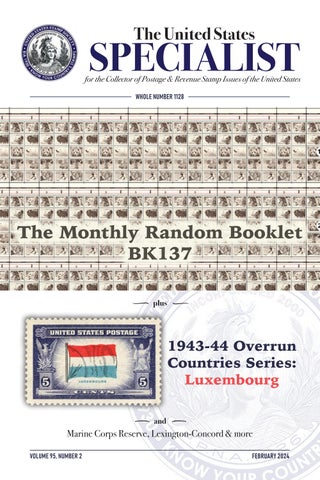
The United States
SPECIALIST
for the Collector of Postage & Revenue Stamp Issues of the United States WHOLE NUMBER 1128
The Monthly Random Booklet BK137 s plus e
1943-44 Overrun Countries Series: Luxembourg c and j
Marine Corps Reserve, Lexington-Concord & more VOLUME 95, NUMBER 2
The US Specialist - February 2024 - 1128.indb 1
FEBRUARY 2024
1/18/24 1:58 PM
United States Stamp Society
Publications
Encyclopedia of United States Stamps and Stamp Collecting Second Edition
United States Savings Stamps by Harry K. Charles, Jr.
Edited by Rodney A. Juell, Lynn R. Batdorf and Steven J. Rod
A presentation of the United States Postal and Treasury Savings Stamp Systems, the stamps and their closely associated collection cards and booklets, and Official Mail stamps and stationery.
Hardbound, 769 pages. $35 members, $40 nonmembers. Visit the website for shipping costs.
Softbound, 253 pages. Postpaid: $25 members, $28 nonmembers. Visit the website for shipping costs.
Order from: USSS, P.O. Box 1602, Hockessin, DE 19707-5602 or online at: www.usstamps.org/store/
The US Specialist - February 2024 - 1128.indb 2
1/18/24 1:58 PM
The United States
SPECIALIST the journal of the United States Stamp Society
VOLUME 95, NUMBER 2
FEBRUARY 2024
WHOLE NUMBER 1128
An association of collectors to promote the study of all postage and revenue stamps and stamped paper of the United States and US-administered areas produced by the Bureau of Engraving and Printing and other contract printers. American Philatelic Society Affiliate No. 150
Prologue 50 Leadership & Committees 52 Closed Albums 54 Vintage Photo of the Month by Rodney A. Juell 56 Society News
Features 58 1943-44 Overrun Countries Series: Luxembourg by Paul M. Holland 68 Modern Postal History: Curious Information by Carlin Gregory 69 The Monthly Random Booklet: BK137 by Dieter R. Kohler, Ph.D. 82 And Then There Were Three by Dieter R. Kohler, Ph.D. 85 The Lexington-Concord Issue by Martin Kent Miller
Epilogue 94 Executive Secretary’s Report by Robert Rufe 95 Classified Advertising 96 Index of Advertisers
89 How a Village Post Office in Northern Vermont Produced Two 10¢ Brown-Yellow Usages in 1909 by Kevin G. Lowther 92 Stamps in Scarce Lake Shade Discovered on 1930 Flight Anniversary Cover by Robert D. Brilliant
Martin Kent Miller, Editor 1361 W. Wade Hampton Blvd, Suite F - #102 Greer, SC 29650-1146 (864) 322-6847 email: editor@usstamps.org www.usstamps.org Manuscr ipts, publications for rev iew, and all advertising including classifieds, should be s e n t to t h e ed i to r at t h e ad d re s s ab ove.
the United States Stamp Society, Inc., P.O. Box 1602, Hockessin, DE 19707-5602. Membership in the United States $25. North America $40; all others $65. Single copy $2. Periodical postage paid at Hockessin, DE, and at additional entry offices. Printed in USA. Copyright ©2024 United States Stamp Society, Inc. All rights reserved. Opinions expressed by authors are their own and do not necessarily reflect those of the United States Stamp Society, its officers, or staff.
Forms close on the 20th of the second month preceding the month of publication, as February 20 for the April edition.
Correspondence concerning business affairs of the Society, including membership and changes in address, should be addressed to the Executive Secretary, PO Box 1602, Hockessin, DE 19707-5602.
The United States Specialist (ISSN 0164-923X) is published monthly January through December by
Postmaster: Send address changes to U.S.S.S., P.O. Box 1602, Hockessin, DE 19707-5602.
The US Specialist - February 2024 - 1128.indb 49
1/18/24 1:59 PM
50
THE UNITED STATES SPECIALIST — Committees — AWARDS
Denise Stotts P.O. Box 690042, Houston, TX 77269 email: stottsjd@swbell.net BOOKLETS & BOOKLET PANES
Michael O. Perry
The United States Specialist Founded 1930 as The Bureau Specialist
P.O. Box 1194, Rainier, OR 97048 email: MOPerry@mac.com
DURLAND EDITOR EDITOR Kim D. Johnson MARTIN KENT MILLER 1361 W. Wade Hampton Blvd, STE F - #102 310 E N 3rd Street, Georgetown, IL 61846 Greer, SC 29650-1146 email: westhome1@aol.com email: editor@usstamps.org
United States Stamp Society Bureau Issues Association, Inc. P.O. Box 1602 Hockessin, DE 19707-5602 CHAIRMAN
Roger S. Brody
P.O. Box 5836 Somerset, NJ 08875-5836 email: brody@usstamps.org PRESIDENT
Nicholas Lombardi
P.O. Box 1005 Mountainside, NJ 07092 email: 8605@comcast.net VICE PRESIDENT
Jeffrey Shapiro
EXHIBIT PDFs
email: stamps@andrewkelley.net
FARLEY ERA
P.O. Box 471963, Charlotte, NC 28247 email: lampson@usstamps.org
Paul M. Holland email: pholland.thorleaf@gmail.com FOURTH BUREAU ISSUE
Jay B. Stotts
P.O. Box 690042, Houston, TX 77269 LIBERTY SERIES
MODERN POSTAL HISTORY
4045 N. Harvard Ave. Arlington Heights, IL 60004 email: david-sugar@wsdd.com
P.O. Box 153, Bethel, CT 06801-0153 email: usss2010@quine.org
The US Specialist - February 2024 - 1128.indb 50
Andrew S. Kelley
P.O. Box 1818 Westminster, CO 80038-1818 email: Chris@RxStamps.com
TREASURER
P.O. Box 1602 Hockessin, DE 19707-5602 email: execsecretary@usstamps.org
Greg Shoults
9038 E 25th Dr, Denver, CO 80238
P.O. Box 1818 Westminster, CO 80038-1818 email: Chris@RxStamps.com
Robert Rufe
email: djryterband@fwcook.com
Chris Steenerson
10703 Kings Riding Way, Unit T-1 Rockville, MD 20852-5420 email: cohenji@comcast.net
EXECUTIVE SECRETARY
Dan Ryterband 40 Carolyn Place, Chappaqua, NY 10514
11248 Frederick Lane Twinsburg, OH 44087 email: coilcollector@hotmail.com
James Patterson
MARGINAL MARKINGS
Lynn Batdorf Kim Johnson Mike Lampson Leonard Piszkiewicz James Robinson Robert Rose Rod Juell Gregory Shoults David Steidley Jay Stotts Steven Unkrich
Nicholas Lombardi P.O. Box 1005, Mountainside, NJ 07092 VENDING AND AFFIXING MACHINE PERFORATIONS
1850 North Central Avenue, No. 1400 Phoenix, AZ 85004 email: jhpatterson@yahoo.com
SECRETARY
GOVERNORS
SECOND BUREAU ISSUE
WASHINGTON-FRANKLIN HEAD ISSUES (Co-Chairmen)
P.O. Box 2641, Stillwater, OK 74076-2641 email: RAustin13@aol.com
David S. Sugar
Peter Martin P.O. Box 6074, Fredericksburg, VA 22403 email: pmartin2525@yahoo.com
ESSAY-PROOF
P.O. Box 3211 Fayville, MA 01745-3211 email: coverlover@gmail.com
Joel Cohen
REVENUE ISSUES
Roland Austin
Chris Steenerson
Douglas B. Quine
PLATE NUMBER & CHECKLIST SERVICE
Kim D. Johnson 310 E N 3rd Street, Georgetown, IL 61846 email: westhome1@aol.com PRECANCELS
WEBMASTER
Mike Lampson
— Study Groups — DUMMY STAMPS
Terry R. Scott P.O. Box 10406, Napa, CA 94581 email: terryrscott@comcast.net FIRST BUREAU ISSUE
Kent Wilson 1005 Toole Circle, Billings, MT 59105 email: turgon96@bresnan.net LUMINESCENCE
Wayne L. Youngblood 705 Forest Glen Circle, Prairie du Sac WI 53578 email: wystamps@gmail.com OVERRUN COUNTRIES SERIES
Thomas Schilling P.O. Box 432, New Lisbon, NJ 08064-0432 email: cbtkschilling@yahoo.com PROMINENT AMERICANS AND AMERICANA SERIES
Ron Blanks
Lynn R. Batdorf
email: rblanks_stamps@yahoo.com
6005 Kingsford Road, Bethesda, MD 20817 email: hollykids@comcast.net
REGISTERED MAIL
PRESIDENTIAL ERA
Jeffrey Shapiro
Mike Ludeman P.O. Box 2024, Denton, Texas 76202-2024
P.O. Box 3211, Fayville, MA 01745-3211
— Affiliates —
RECRUITING
POSTAL LABEL STUDY GROUP
Steven Crippe
Arthur H Groten M.D.
P.O. Box 308, Palmer, TX 75152 email: scrippe@gmail.com
PO Box 3366, Poughkeepsie, NY 12603 email: artgroten@optonline.net
1/18/24 1:59 PM
US Specialist-2018-01.qxp_USspecialist_FP 12/16/17 1:47 PM Page 1
Is it time for your own single-owner Siegel sale? Building your collection has given you great joy and feelings of accomplishment. Do you remember the beginning, when each acquisition brought new knowledge? Or, how frustrated you felt when you were outbid for a key item? And, having once been the newcomer, you are now considered the authority? The stages of serious collecting are something we at Siegel understand well. We also understand the concerns of serious collectors who are ready to sell. Will your collection be presented with cutting-edge research and quality images? Does the firm have expert staff, the right clientele and a strong web presence? Is the auctioneer a longtime professional with skills and experience? Will you be paid on time—or at all? If the time has come to sell your collection, please call 212-753-6421 to speak with Scott Trepel. We will address all of your concerns and create a customized sale plan designed to maximize results. The Siegel firm is the world leader in sales of United States stamps, and the reason is simple. We understand collectors.
AUCTION GALLERIES, INC.
The US Specialist - February 2024 - 1128.indb 51
6 WEST 48TH STREET, 9TH FLOOR NEW YORK, N.Y. 10036 Phone (212) 753-6421 siegelauctions.com
1/18/24 1:59 PM
52
THE UNITED STATES SPECIALIST
Closed Album
Joann Ruth Lenz 1936 - 2023
Joann Ruth Lenz
A valued partner in the leadership of the United States Stamp Society, Joann Lenz, passed away on November 19, 2023. She served as the Society’s Secretary for two decades, from 1995 through 2015. The Board of Governors awarded Joann the USSS George W. Brett Century of Service Award, which was presented at the General Membership Meeting held at the St. Louis Stamp Expo on February 28, 2009. The text of the citation accompanying the Award read:
Joann Lenz, a collector of United States stamps and postal history, has done ground-breaking research covering a variety of unusual philatelic topics. Prominent among her varied collections is Plate Number Coils. Within two years of joining the Society she chaired the BIA Plate Number Coils committee. In 1995 Joann was elected to the Board of Governors. She was elected Secretary to the Board and has served the Society in that capacity continuously for thirteen years. In addition to activities with the USSS and the Plate Number Coil Collectors Club, Joann’s service to philately has expanded to the American Philatelic Society when, in 2007, she was elected Director-at-Large. Joann’s philatelic research is reflected in her exhibits that have been awarded Gold and Grand awards in national competition. Joann is a proponent and researcher of modern philatelic studies, and she generously shares her eclectic interests, research, and discoveries with fellow collectors via her website. Joann Lenz’s philanthropic research and service bring honor to the Society worthy of special recognition. The Board of Governors recognizes Joann Lenz, #12199, for her extraordinary dedication to the USSS as the recipient of the George W. Brett Century of Service Award. She was born on June 1, 1938, in Detroit and grew up in East Detroit. After graduating high school, Joann went on to earn a bachelor’s degree in education from Valparaiso University. While at Valparaiso, she met Kurt Lenz, the man who would become her husband. They were married for 60 years, until his death in 2021. Joann and Kurt, both
The US Specialist - February 2024 - 1128.indb 52
1/18/24 1:59 PM
FEBRUARY 2024
53
serious philatelists, enjoyed traveling to stamp conventions throughout the United States. Joann was always identified at stamp shows dressed in purple, her favorite color. One of the great joys of Joann’s life was being a teacher. Joann taught for Utica Community Schools for more than 30 years, teaching at DeKeyser and Graebner Elementary Schools in Sterling Heights. Her son Mark attended the same high school as students who went to DeKeyser and recalls that upon learning his last name, many shared that his mother had been their favorite teacher. Joann was a member of Hope Lutheran Church where she was an organist. Later, she became an active member at Joann and Kurt Lenz Peace Presbyterian Church, singing in the choir and playing the organ. Joann is predeceased by her daughter Michele Huggins and survived by her son Mark (Beth) Lenz, her son-in-law Matt Huggins, and her grandchildren Shawn Huggins, Catie (Sean) Dolin, Lauren Lenz, Rachel Lenz, and Kristen Lenz.
Quality United States Stamps (1847-1945) Singles (mint and used) Plate Blocks Booklet Panes plus Complete Booklets Price lists-$2.00 each category Price lists free on web: www.mountainsidestampsandcoins.com
We also buy quality US and foreign stamps
Mountainside Stamps, Coins and Currency
P. O. Box 1116 Mountainside, NJ 07092 Tel: 908-232-0539 or 908-419-9751 E-mail: tjacks@verizon.net Tom Jacks, owner Member APS, ASDA, USSS
The US Specialist - February 2024 - 1128.indb 53
1/18/24 1:59 PM
54
THE UNITED STATES SPECIALIST
Vintage Photo of the Month
Marine Corps Reserve by Rodney A . Juell
USSS #13852 | P.O. Box 3508, Joliet, IL 60434
The US Specialist - February 2024 - 1128.indb 54
1/18/24 1:59 PM
FEBRUARY 2024
55
Printing of the Marine Corps Reserve stamp began at the Bureau of Engraving and Printing (BEP) on July 18, 1966. However, a few days previous, on July 12, a “trial run” was conducted for the benefit of the Marine Corps commandant, General Wallace M. Greene, Jr., who is shown on the left in this month’s photo inspecting a sheet of stamps. Standing next to him is BEP director Henry J Holtzclaw. On the right is Brig. Gen. Clifford B. Drake of the Marine Corps Reserve. Shown on the previous page is a Post Office Department announcement of the new stamp, which was issued on August 29, 1966. The stamp exists both in tagged and untagged versions.
The US Specialist - February 2024 - 1128.indb 55
1/18/24 1:59 PM
56
THE UNITED STATES SPECIALIST
Society News
Andrew S. Kelley Wins the 2023 Hopkinson Memorial Literature Award
Congratulations to Andrew Kelley for being selected as the Walter W. Hopkinson Memorial Literature Award recipient for the best article or series of articles published in The United States Specialist during 2023. The award is presented annually and consists of an engraved plaque and honorarium. Kelly’s research paper, “Authenticating Scott 530c — Triple Impression on the Three Cent Offset,” was published in the May issue of The United States Specialist. This Important, well-organized, and clearly presented Andrew S. Kelley example of philatelic scholarship convincingly demonstrates that the three leading philatelic expertizing organizations, each of whom examined one of the three stamps submitted as an example of a Scott 530c triple impressions, erroneously certified these stamps as genuine they were actually double impressions, Scott 530a. Members of the Award selection committee praised Kelly for his outstanding original research and his use of modern analytical techniques to facilitate his examination of this heretofore little-understood Washington-Franklin variety. Also of note are Kelly’s excellent illustrations, outstanding attribution and bibliography, and, most importantly, his clear, well-supported, and illustrated presentation of an empirical methodology for differentiating the two multiple impression types. The Hopkinson Memorial Literature Award selection committee typically consists of the award winners for the past three years. Serving as chairman this year was Steven Altman, the 2020 winner for “Al Fluegel and the Missing ‘68s” and “‘Expertizing’ a Unique Fluegel First Day Cover.” Also serving on the committee were Greg Ajamian, Robert Rufe and Harry Brittain, who The United States shared the 2021 award for their six-part series, “Scott SPECIALIST #C23c – The Whole Story.” The remaining member of the committee was James Robinson, the 2022 winner for “A New Earliest Date of Use? The 1923 Fourth Bureau 2 Flat Plate Booklet Pane,” published in last May’s issue of The United States Specialist. Triple Impression on the The award has been presented since 1954 in honor Three Cent Offset of Walter W. Hopkinson, a longtime supporter of the Society and specialist in plate numbers. His wife, Mrs. 2¢ Navy Stamp of the Constance B. Hopkinson, established the award based Army-Navy Series on her husband’s appreciation of philatelic scholarship. A list of previous winners of the award is posted on the Society’s website. for the Collector of Postage & Revenue Stamp Issues of the United States WHOLE NUMBER 1119
s plus e
c and j
Vending and Affixing Machine Perforations & much more
VOLUME 94, NUMBER 5
The US Specialist - May 2023 - 1119.indb 1
The US Specialist - February 2024 - 1128.indb 56
MAY 2023
4/16/23 4:02 PM
1/18/24 1:59 PM
The Twelfth International Philatelic Exhibition of the United States proudly presented by
Boston 2026 World Stamp Show, Inc.
May 23–30, 2026 at the Boston Convention & Exhibition Center at the Boston Seaport
• The Boston Convention and Exhibition Center is located fifteen minutes from Boston Logan International Airport. It is ten minutes from South Station and Amtrak Acela Express to New York City and Washington DC. • All show hotels will be within walking distance.
Boston 2026 Major Society Sponsor
Boston 2026 Seed Funding Provider
Boston 2026 Major Society Sponsor
Boston 2026 Society Sponsor
Scan Our QR Code
• In a 352,000 square foot contiguous exhibition area, BOSTON 2026 WORLD EXPO will be hosting a large dealer and postal administration bourse, as well as a large society presence and hundreds of meetings/events. • There will be a competitive exhibition of approximately 3,500 frames, plus other special/court of honor exhibits, as well as a large literature competition. Stay Up-to-Date on All the Show News, by visiting
www.Boston2026.org Contact us at Boston 2026 World Stamp Show, Inc. P.O. Box 904, Sudbury, MA 01776
See You in Boston! The US Specialist - February 2024 - 1128.indb 57
1/18/24 1:59 PM
58
THE UNITED STATES SPECIALIST
Overrun Countries
1943-44 Overrun Countries Series: Luxembourg by Paul M. Holland
USSS #16849 | Santa Barbara, CA 93111 m pholland.thorleaf@gmail.com
The envelope carrying this letter bears the commemorative postage stamp issued for Luxembourg, which was first placed on sale today at Washington, D. C. This is the fourth in our series of stamps for the Overrun and Occupied Countries of Europe. It is a pleasure for me to send you this cover which also bears the autograph of the Minister of Luxembourg. I had the added pleasure of selling the first sheet of stamps to the President. — From a signed August 10, 1943 letter sent with a Favor First Day Cover of the 5¢ Luxembourg stamp of the 1943-44 Overrun Countries Series sent to Marvin McIntyre at the White House by Deputy Third Assistant Postmaster General Roy M. North.
The US Specialist - February 2024 - 1128.indb 58
1/18/24 1:59 PM
FEBRUARY 2024
59
Luxembourg is a very small country sitting at the crossroads of Europe between the great powers. This is perhaps epitomized by the first stamps of Luxembourg issued in 1852 that were curiously denominated in two different currencies, Silbergroschen (Prussian currency) for letters going across the border into the German postal system, or Centimes for Figure 1. In 1852, the first stamps of Luxembourg appeared in two different currencies. local usage and letters going elsewhere. Examples of these from my representative worldwide stamp collection are shown in Figure 1. Note also that the portrait depicted on these stamps is that of King William III of the Netherlands, who was also the Grand Duke of Luxembourg. Curiously, when William III of the Netherlands died in 1890, the succession to the Grand Dutchy of Luxembourg was bound by the 1783 Nassau Family Pact. As a result, the crown of Luxembourg passed to a male heir of another branch of the House of Nassau rather than William III’s daughter, Wilhelmina, who became Queen of the Netherlands. However, in 1907, a law was passed allowing female succession for Luxembourg in the absence of any remaining dynastic males of the House of Nassau, leading to the grand duchy’s first reigning female monarch, who, upon her abdication in 1919, was succeeded by her 23-year old younger sister Charlotte. Grand Duchess Charlotte of Luxembourg then ruled for more than 45 years, from January 1919 until November 1964.
Figure 2. FDR purchasing the first sheet of the Luxembourg Overrun Countries stamps from Roy North in the White House with Hugues Le Gallais, the minister of Luxembourg looking on.
The US Specialist - February 2024 - 1128.indb 59
1/18/24 1:59 PM
60
THE UNITED STATES SPECIALIST
When the Germans invaded in the early morning hours of May 10, 1940, the Grand Duchess Charlotte fled along with her government to France. Luxembourg had been a neutral country, as in World War I, but again, Germany violated Luxembourg’s neutrality. On the day of the invasion, the capital, Luxembourg City, was occupied by noon, and most of the rest of the country was occupied by that evening. The die proof for the Luxembourg Overrun Countries stamp was approved on July 10, 1943, by Postmaster General (PMG) Frank C. Walker. Four colors were used in printing this stamp: blue violet for the outer engraved frame, with color offset printing of the flag in dark rose, light blue, and black. Plate proofs show that The American Banknote Company employed a “shared” layout for full sheets of 200 during the printing of Overrun Countries stamps for Luxembourg, with the top two panes of 50 for Luxembourg and the bottom two for the Netherlands.1 The first day ceremony on August 10, 1943, was held at the White House, with Deputy Third Assistant PMG Roy North selling the first sheet of stamps to President Franklin D. Roosevelt in the presence of Hugues Le Gallais, minister of Luxembourg. This event is shown in Figure 2. Interestingly, this original sheet of Luxembourg Overrun Countries stamps sold to FDR by Roy North and preserved in his stamp collection is shown in Figure 3. Note that in the auction image, the stamp sheet has been signed by both FDR and his Treasury Secretary Henry Morgenthau, Jr., in the left margin. During the original 1946 sale of FDR’s stamp collection, this was listed as Lot 252.2 I’m fortunate to have a similar autographed sheet for the 1935 Connecticut Tercentenary stamp.3 Deputy Third Assistant PMG Roy North explicity mentions selling the first sheet of Luxembourg stamps to FDR in the letter and favor FDC he sent to Marvin McIntyre at the White House. These are Figure 3. First sheet of Luxembourg stamps sold, shown in Figure 4. Note that North also got later signed by the FDR and Henry Morgenthau, Hugues Le Gallais, the minister of LuxemJr. in the left margin (image courtesy Heritage bourg, to autograph the cover. Auctions). I also have another Deputy Third Assistant PMG favor FDC sent to Henry A. Wallace, Vice President of the United States. Like other favor FDCs in my collection, those addressed to Henry Wallace as Vice President typically lack enclosed letters (suggesting these were removed and filed). In contrast, those sent to him as Secretary of Agriculture generally include the signed letters. This cover, addressed to Wallace at the United States Senate, is shown in Figure 5. However in lieu of a letter, I have another contemporary item related to Wallace in my collection. In early 1943, Vice President Wallace was dispatched by FDR on a
The US Specialist - February 2024 - 1128.indb 60
1/18/24 1:59 PM
FEBRUARY 2024
61
Figure 4. Deputy Third Assistant PMG favor FDC signed by Hugues Le Gallais, the minister of Luxembourg, with letter from Roy North sent to Marvin McIntyre at the White House.
The US Specialist - February 2024 - 1128.indb 61
1/18/24 1:59 PM
62
THE UNITED STATES SPECIALIST
Figure 5. Favor FDC sent by Roy North sent to Vice President Henry Wallace at the US Senate.
Figure 6. Airmail stamp from FDR’s stamp collection commemorating Vice President Henry A. Wallace’s visit to Ecuador on April 15, 1943.
wartime goodwill tour of Latin America, making twenty-four stops across Central and South America. Wallace visited Ecuador on April 15th, receiving a warm welcome due in part to his ability to deliver speeches in Spanish. This visit was commemorated by special airmail stamps of Ecuador overprinted “Bienvenido - Wallace Abril 15 - 1943”, one of which (Scott C103) from FDR’s own stamp collection is shown in Figure 6.2 This was mounted on a special card from the Gimbels Stamp Department under Jacques Minkus and has an authentication stamp on the back (not shown).
The US Specialist - February 2024 - 1128.indb 62
1/18/24 1:59 PM
FEBRUARY 2024
63
Postmaster General Frank C. Walker did not send out nearly as many favor FDCs with signed letters as his predecessor PMG James A. Farley, frequently opting to send favor FDCs on official PMG stationery with enclosed printed notices about the stamp instead. For example, I have a complete set of fourteen favor FDCs for Overrun Countries stamps sent to Mrs. W. W. Howes, wife of the former First Assistant Postmaster General William W. Howes, all with printed notices from the Post Office Department. The one for the Netherlands is shown in Figure 7.
Figure 7. Favor FDC for the Netherlands stamp sent by PMG Walker to Mrs. W. W. Howes.
Figure 8. FDC on official White House stationery for the Luxembourg stamp.
The US Specialist - February 2024 - 1128.indb 63
1/18/24 1:59 PM
64
THE UNITED STATES SPECIALIST
FDCs on official White House stationery were also created for stamps of the Overrun Countries Series. An example from my collection of the Luxembourg stamp is shown in Figure 8. This was sent to Miss Dorothy Shanley who served in the White House during both the FDR and Truman administrations. A printed Dorothy Knapp cacheted cover for the Luxembourg stamp is shown in Figure 9. Note the spear and raised sword forming a V for victory, flag and the slogan “A Nation Small Will Risk Its All For Liberty.”
Figure 9. Printed Dorothy Knapp cachet on FDC for the Luxembourg Overrun Countries stamp.
Luxembourg is indeed a small country, the smallest of all those honored in the Overrun Countries series. As a result, in my substantial collection of worldwide covers sent to FDR, I have only the June 1, 1933 cover mailed to FDR from Remick in the Moselle region of Luxembourg, shown in Figure 10. It is franked by Scott 185, which depicts Grand Duchess Charlotte and pays the international surface rate. When the Grand Duchess Charlotte fled the May 1940 German invasion, she took up residence at the Château de Montastruc in south-western France. Then French military resistance collapsed and following the formal capitulation of France in July, the Grand Duchess with her government-in-exile then escaped to London in August 1940. In the meantime, the Germans proposed to restore the Grand Duchess to her functions, but Charlotte refused, and she began making radio broadcasts to her homeland. With the occupation, Nazification and Germanisation of Luxembourg began. German became the official language, with the use of French being banned in August 1940. By early 1941, the Nuremberg Laws had been introduced, French-sounding names were Germanised, and even the wearing of berets was forbidden. German definitive postage stamps were overprinted for use in Luxembourg on October 1, 1940. By this time, the German Reichsmark had been declared legal tender in Luxembourg. Then, on December 5, 1940, existing stocks of Luxembourg stamps were re-valued in German Reichspfennings, and these were used until August 1942, when Luxembourg was annexed and directly incorporated into the German Reich, as had been the case for Austria. Luxembourg then became part of Gau Moselland, the Moselle district in
The US Specialist - February 2024 - 1128.indb 64
1/18/24 1:59 PM
FEBRUARY 2024
65
Figure 10. June 1, 1933, cover sent to FDR from Remick, Luxembourg.
Germany. Luxembourgers were subject to being conscripted into the German army, and German postage stamps were used. While I have complete sets of occupation stamps issued for Luxembourg in my representative worldwide stamp collection (Scott N1-N32), a single example of each type is shown in Figure 11. The “Luxemburg” overprint occurred on German definitive issues depicting Hindenburg, and the re-valued Luxembourg stamp shown depicts the Grand Duchess Charlotte. Luxembourg’s government-in-exile was established in London, with the Grand Duchess and her family moving to Canada, where they settled in Montreal. Grand Duchess Charlotte also traveled about the United States, strongly supporting FDR’s efforts against isolationism before the Pearl Harbor attack, then as a wartime ally, with the Grand Duchess staying at the FDR White House on several occasions. Among her wartime speeches were the words “I am happy to be among the people of the United States who, under the enlightened leadership of President Roosevelt, have become the guardians of freedom and justice. President Roosevelt’s statement that the United States will never recognize territorial changes brought about by violence is a strong comfort to the small and weak.”
The US Specialist - February 2024 - 1128.indb 65
Figure 11. The 1940 occupation stamps of Luxembourg were in German currency.
1/18/24 1:59 PM
66
THE UNITED STATES SPECIALIST
The Grand Duchess Charlotte’s son Jean volunteered for the British Army in 1942. He participated in the landings in Normandy, the Battle of Caen, and the liberation of both Brussels and Luxembourg. Although Luxembourg was nominally liberated on September 10, 1944, it suffered significant damage during the mid-December 1944 German counter-offense known as the “Battle of the Bulge.” Wartime usage of one of the Luxembourg Overrun Countries stamps is shown on the airmail cover in Figure 12. This was sent from Pittsburgh, PA, to Syracuse, NY, on April 16, 1945, with the additional 3¢ in postage paid by the 1944 Philippines Resistance stamp, a stamp produced as part of an effort to recognize countries overrun by Japan in the Pacific.4 Following World War II, a special memorial souvenir sheet was produced in remembrance of the late President Roosevelt to aid the war victims of Luxembourg City. Figure 13 shows a map, flags and images of FDR with the Grand Duchess Charlotte, over the words “Don’t worry my dear child, I’ll take you home again” spoken by President Roosevelt in Washington, DC. Below this, it states, “This great humanitarian kept his word. The Luxembourg nation owes him an eternal debt of gratitude.” The souvenir sheet itself is franked with new Luxembourg definitive stamps depicting the Grand Duchess (Scott 223 and 227) that were issued after the liberation and canceled on September 10, 1945. On April 30, 1963, Grand Duchess Charlotte paid yet another visit to the White House, this time for a state dinner with President John F. Kennedy, accompanied by her son Prince Jean of Luxembourg. In JFK’s remarks, he recalled the gallant role the duchess had “played in 1940 when your country was overrun,” along with the distinguished military role of her son during World War II. In November 1964, Grand Duchess Charlotte abdicated in favor of her son, Jean who then ruled as the Grand Duke of Luxembourg until the year 2000.
Figure 12. April 16, 1945 airmail cover with Luxembourg stamp.
The US Specialist - February 2024 - 1128.indb 66
1/18/24 1:59 PM
FEBRUARY 2024
67
Figure 13. September 1945 memorial souvenir sheet in honor of FDR.
This article completes the series for the twelve Overrun Countries of Europe beginning with Poland in the April 2021 issue of The United States Specialist. The author wants to especially thank the editor for his skill in helping to bring these fascinating stories to life. References 1. Max G. Johl, The United States Commemorative Postage Stamps of the Twentieth Century: Volume II 19351947, H. L. Lindquist: New York, 1947, pages 229-230. 2. The President Franklin D. Roosevelt Collection: H. R. Harmer, Inc., New York, Part One February 1946. 3. Paul M. Holland, “FDR and the 1935 Connecticut Tercentenary Stamp,” The United States Specialist, November 2020, pages 489-495. 4. Paul M. Holland, “The 1944 Philippines Resistance Stamp,” The United States Specialist, May 2020, pages 228-231.
The US Specialist - February 2024 - 1128.indb 67
1/18/24 1:59 PM
68
THE UNITED STATES SPECIALIST
Modern Postal History
Curious Information by Carlin Gregory
Figure 1.
Pictured in Figure 1 is a Christmas card envelope returned to me this past December. When I mailed the envelope, I went to the local post office to ensure I had the correct postage due to it being over 1 ounce. The Postmaster checked the envelope for weight, and it was under 1 ounce, but due to the size, 6-3/8” x 8-5/8” required extra postage. I took some old Christmas stamps from my inventory to compensate for the extra postage. I don’t remember the exact amount, but I told the Postmaster I would put two 20-cent stamps, and she confirmed that was plenty. I was surprised when I got it back, and, as seen, someone stamped the envelope and said it was a 2-ounce Large Envelope Rate. I would like to know anyone’s thoughts on this. The Postmaster weighed and sized the envelope before sending it, so I assumed the postage I applied was sufficient. The stamp “Stamps void when coated, covered, defaced, or reused, return for postage” also seems strange. Why did someone else say the weight was over 1 ounce? And why was it returned for two reasons: insufficient postage and something wrong with the stamps?
The US Specialist - February 2024 - 1128.indb 68
1/18/24 1:59 PM
FEBRUARY 2024
69
from the Booklets & Booklet Panes Committee
Figure 1. The (minor) cover varieties of BK137. Dark green (on the left) and yellow green cover fronts (without and with ground streak, shown in detail).
The Monthly Random Booklet BK137 by Dieter R . Kohler, Ph.D.
USSS #12538 | Basel, Switzerland
442
THE UNITED STATES SPECIALIST
Introduction Over 40 years ago, John Gulka1 introduced the readers of this journal to the 18¢ Wildlife booklets of 1981. Much time has passed since and more information has come to light, and not the least was color introduced to the journal. This allows us to refresh the collective memory and clarify some points made in the original article about BK137. This article has something for every collector, starting with entry grade 1 and ending with the “flyspecker” grade 4. For more information on the collector grading scale, please see “The Monthly Random Booklet” on page 442 of the October 2022 edition of The United States Specialist.
The US Specialist - February 2024 - 1128.indb 69
from the Booklets & Booklet Panes Committee
The Monthly Random Booklet by Dieter R . Kohler, Ph.D.
USSS #12538 | Basel, Switzerland
Booklet collectors come in many shades. For simplicity, I will categorize them into four grades: Grade
Booklet Level
1 2 3 4
Casual Beginner Specialist Flyspecker
Collecting Interest Wants only one pane/booklet Wants every booklet mentioned in the catalog Wants every collectible variety of a booklet Wants everything under the sun
At the start, the general stamp collector wants just a booklet because some issues are only available in booklet format. The next level is the collector who wants every booklet that the Scott Specialized Catalog mentions, sometimes supplemented with a number denoting how many different varieties of that booklet exist, without really telling what these varieties actually are. The third level is the specialist, who also wants all the collectible varieties not mentioned in the catalog. The last category is the annoying specialist at any stamp show who usually blocks the only comfortable chair at a dealer table and thoroughly examines every item with every piece of equipment at their disposal - also known as “flyspeckers” (of whom, admittedly, the author is one). This series of articles picks up on old (and possibly long forgotten) booklet information from the 1970s to 1980s period, picking a random issue and adding new or correcting wrong information given decades ago. As knowledge accumulates over time, certain things held for granted turn out to be incomplete or (in rarer cases) even wrong, as has happened with regular stamps as well. But before we start with our first “booklet review,” there is a problem to overcome.
It glows – It must be interesting One particular area in booklet collecting is paper/cover luminescence and tagging varieties in booklets. The former area is not mentioned in catalogs at all, while the latter is only mentioned if something went wrong. Detecting luminescence on US booklet covers and panes is relatively straightforward, using a short-wave (UVC) ultraviolet-emitting device. Best known are those cheap (in quality, not in price) plastic hand-helds (see Figure 1).
1/18/24 1:59 PM
70
THE UNITED STATES SPECIALIST
Getting Through the Grades, One At a Time The Wildlife booklet BK137 was one of the first booklets to adapt to the new plate numbering system. Other than printing the actual plate number (over 39000 plates had been made by the BEP (Bureau of Engraving and Printing) when these stamps were issued), the BEP used a single, large plate number digit to show up on the top pane in a booklet—starting with 1 for the first plate used, and counting upward by 1 for every new plate that went into production. A single digit was a reasonable decision as booklet panes with multiple colors would have led to an unwieldy string of digits on the panes had original numbers been used as before. No plate numbers at all was the other option, but this might have made accounting and tracking printing problems difficult, not knowing the plate the error came from. Only one cover layout was used. A minor difference can be detected at the center left edge of the front cover, where an additional brown “ground streak” may be found. Figure 1 shows the two front covers and the streak position (noted in the red circles). Cover colors are either yellow-green/brown or (less common) dark green/gray-brown. If the brown color is shifted to the left by 3-4mm, the ground streak can appear on the opposite edge on a cover. Table 1. Grade 1 level of collecting BK137 Yellow green / Brown cover
Dark green / Gray brown cover
Any plate number 1 – 16
Table 1 gives us the first look at the minimum collectible varieties. Disregarding the minor cover streak difference and the plate numbers on the top pane, only two booklets fulfill grade 1 collecting. From the plate impression data, we can roughly estimate the relative scarcities of the sixteen plate numbers (spoilage is never mentioned in the BEP records). Table 2. Approximate scarcities of plate numbers 1-16 Plate numbers
On press
Impressions
Percentage (each plate)
1 and 2 3 and 4 5 and 6 7 and 8 9 and 10 11 and 12 13 and 14 15 and 16
May 4, 1981 May 11, 1981 May 20, 1981 June 29, 1981 July 11, 1981 August 3, 1981 August 27, 1981 August 27, 1981
1044764 411405 280570 625813 514343 176646 106923 106206
16.0% 6.3% 4.3% 9.6% 7.9% 2.7% 1.6% 1.6%
Soon after the booklets were issued, collectors noticed a difference in the cover cardboard stock when viewed under long wave (365nm) UV light. On one end, a few covers clearly react with an extremely bright glow, while on the other, many do not react. In between, a large span of covers somewhat respond to UV light, either with a
The US Specialist - February 2024 - 1128.indb 70
1/18/24 1:59 PM
FEBRUARY 2024
71
slightly brighter whitish or bluish glow (usually a sign that paper contains a brightener that fluoresces under UV light).
Figure 2. Cover reactions to long-wave UV light (with some ambient light present).
Figure 2 shows the different covers. The difference between “Dead” and “Some Glow” is much smaller than the difference to a cover whose paper contains a brightener. The medium cover stock probably stems from unintended minor contamination with paper brighteners at the mill. While the BEP rejected all stamp paper that contained brighteners (which could misfire detector units during the perforation process), the glowing cover stock was not a problem. Table 3. Grades 2 (one random plate) and grade 3 (all 16 plates) level of collecting BK137 (neglecting cover streak differences) Plate numbers 1-16
Dead or Medium cover stock
High-Bright cover stock*
Yellow green / Brown cover Dark green / Gray brown cover *The same is true for the booklet panes. They can also contain paper brightener that shines whitish-blue under long-wave UV.
The next collecting grade introduces us to joint lines. Booklet pane collectors know that when two plates are joined together on the printing cylinder, a small gap exists between the plates at either joint. Due to plate wiping side effects, these gaps can quickly fill with ink during printing and deposit a line on booklet panes along either edge, called a “Joint Line.” Depending on the size of the gap and ink spill, the lines can be very prominent or barely visible. What is true for the panes is also true for the covers, to a lesser degree. Usually, the cutting knife misses the line ever so slightly, so the line ends up on a pane or cover along one of its edges. Since we have two cover colors, we can have a multitude of joint lines on the covers. These olive and/or brown joint lines can appear at either edge of the cover, on the front,
The US Specialist - February 2024 - 1128.indb 71
1/18/24 1:59 PM
72
THE UNITED STATES SPECIALIST
back, or both sides and often are only partially visible along the edges (all varieties are hard to find). Figure 3 shows some partial joint lines on the front and the back cover.
Figure 3. Partial green joint lines at left (on the front cover) and brown (on the back cover)
Every field in table 3 has to be multiplied with all the joint line combinations one can possibly find. This gives us Table 4. Table 4. Grade 4 level of collecting BK137 (neglecting cover color differences and brightener contamination) Plate number on top pane Dead/Medium cover stock Hi-Bright cover stock* Plates 1...16 Plain cover Cover Joint line Plain cover Cover Joint line
Plain panes Electric eye bar at left on bottom tab Joint lines at left, plain bottom tab Both JL and EEye bar at left Electric eye bar at right on bottom tab Joint lines at right, plain bottom tab Both JL and EEye bar at right *The same is true for the booklet panes. They can also contain paper brightener that shines whitish-blue under long-wave UV.
Theoretically, over 1500 varieties are possible if all combinations of cover and pane varieties are taken into account. Collecting every variety would obviously be a humongous task.
Plate Layout Or Sheet Layout? In the introduction section for booklets, the Scott Specialized Catalog lists the various plate formats booklet stamps were printed with. The panes are numbered in ascending order from left to right and from top row to bottom row. Notice the plate numbers are readable, so the illustrations are proof sheet layouts, not plate layouts. For most collectors, this distinction might be purely academical, but we should remember that plates and printed sheets are mirror images of one another. In keeping with the
The US Specialist - February 2024 - 1128.indb 72
1/18/24 1:59 PM
FEBRUARY 2024
73
Scott numbering system, this series of articles uses the Scott numbering convention in all articles. Unfortunately, some older articles in the US Specialist (and checklists floating around) used a different numbering system3, which, in hindsight, wasn’t necessary.
Sheet Layout for BK137 The sheet layout in Figure 4 shows that the 480 stamps were arranged in 4 rows of 12 booklet panes. Two plates were wound around a cylinder; each plate covered half the cylinder. For efficient booklet production, an even number of rows was required. As the cylinder was not tall enough for four rows of booklet panes with regular sized stamps, the stamp design was reduced so that the panes could fit. These “tiny stamps” (like the Dolly Madison sheet stamp in the extremest case) were unpopular with the public. After only a few issues, booklet production moved to new, larger Goebel printing presses that could handle four rows of regular sized stamps. Notice the plate layout no longer required a tête-bêche configuration shown in the BK131 article4 as the feeding mechanism for the web roll was changed. Also, notice that when the web is cut in half, the top web strip contains a two-pane strip with the plate number panes at the bottom, while the bottom two-pane strip contains the plate number panes at the top.
Figure 4. Sheet layout from a Wildlife plate 39690, showing where the sheets were perforated and cut into panes. Some pane positions along the sides are marked by numbers.
The US Specialist - February 2024 - 1128.indb 73
1/18/24 1:59 PM
74
THE UNITED STATES SPECIALIST
There are two small electric eye dashes, one over the top left stamp of pane 1 and one over the top right stamp of pane 12. The sheet’s top and bottom half were separately processed into booklets containing two panes. In all booklets, the bottom pane has no plate number so it originated from row 1 or row 4. The top pane with the plate number originated from row 2 (paired with row 1) or row 3 (paired with row 4). Layout lines marked in red in Figure 4 usually are not visible on booklet panes and are discussed in the “flyspecker” part towards the end of the article. What can also be seen is the fact that the vertical perforation holes do not continuously run through the entire height of the web roll. Of the 48 booklet panes in a sheet, only very few can be plated with certainty. The identification depends on the distance between the horizontal Cross Register Line (CRL) that runs horizontally through the tabs along the web roll and the tab’s top edge (where the knife cut the sheet into strips of booklet panes). The features on a bottom pane should always be figured out by holding the opened booklet in front of an intense light, not by trying to pull on the top pane to try and peek into the bottom pane’s tab. The following list gives an overview and the requirements for positive identification: Position 1: Pane without plate number. Partially untagged top of tab without perforation hole. Joint line along the left border. An electric eye bar centered above the left stamp may show if the tab is sufficiently large. Position 12: Pane without plate number. Partially untagged top of tab without perforation hole. Joint line along the right border. An electric eye bar centered above the right stamp may show if the tab is sufficiently large. Position 13: Pane with a plate number and fully tagged tab. Joint line along the left border. No horizontal layout line through tab. Position 24: Pane with a plate number and fully tagged tab. Joint line along the right border. No horizontal layout line through tab. Position 25: Same as position 13 but with a horizontal layout line in the tab. Position 36: Same as position 24 but with a horizontal layout line in the tab. Position 37: Pane without plate number and fully tagged tab with a perforation hole. Joint line along the left border. Position 48: Pane without plate number and fully tagged tab with a perforation hole. Joint line along the right border. The joint line at left or right along a pane may not always show, depending on where the knife cut the web roll into sheets. Some panes can only be plated if they are still in a complete booklet.
Figure 5. Position 12 (bottom) and 24 (top) panes in a plate number 3 booklet. The electric eye mark at the top right on the bottom pane shines through the top pane.
The US Specialist - February 2024 - 1128.indb 74
1/18/24 1:59 PM
FEBRUARY 2024
75
Figure 5 shows an enlargement of the tab area in a booklet. The top pane has a partial perforation hole at the top center, while the bottom pane has an electric eye bar at the top over the right stamp (and no perforation hole). We can definitely conclude these are pane positions 24 and 12 (though none of the panes show a joint line at right). Note that “the hole criterion” depends on which row the pane came from as well as where the horizontal knife cut separated a sheet into booklet pane strips. These separation cuts were not precise and can vary by as much as 1.5mm.
Tagging freaks Panes from the bottom row of a sheet often show freak tagging features due to excessive tagging mat degradation. The panes in BK137 are overall tagged, meaning the panes are entirely covered with taggant. The tagging mats were slightly smaller than the plates, though. The top area of the tabs from the top row is partly untagged, some almost entirely, and some above the CRL only. Any wandering around of the tagging mats did not create any freaks or errors. However, due to overextended use of the tagging mats, tagging shows degradation with successive impressions. Many panes show untagged areas inside smaller and larger spots, thin or thick lines, or simply look “crazy” under short-wave UV irradiation. Reported panes with untagged stamps might be panes with a large untagged spot that, by chance, completely covered a single stamp.
Figure 6. Tagging mat deterioration in a plate number 12 booklet. At the top is the bottom pane (from row 4) showing tagging mat cracks at bottom. At the bottom is the top pane (from row 3) with the almost untagged tab and top stamp row.
Figure 6 shows the panes in a booklet with an almost untagged tab and top stamp row on the top pane. The bottom pane shows typical signs of overextended use of a tagging mat. Rubber mats usually started to crumble along the edges, forming multiple cracks as the rubber became less and less flexible over time. Similar cracks formed along the top edge, which would show in the tab area of panes from the top row of sheets.
The US Specialist - February 2024 - 1128.indb 75
1/18/24 1:59 PM
76
THE UNITED STATES SPECIALIST
Figure 7. At left: Bottom pane with missing tagging in the top third of the pane. Middle and right: Plate 4 booklet with badly deteriorated tagging mat.
At the left in Figure 7, a pane from the top row of the sheet shows large areas of missing taggant. At the right are the bottom and top panes in a plate 4 booklet from the top half of the sheet that shows the result of a badly deteriorated tagging mat. The damage goes right through the bottom pane (which would be positioned along the top of the uncut sheet) into the tab of the top pane. The top pane also shows a thin arc through the right stamp column, mimicking a layout arc. Under normal lighting, this arc does not show. Since the tagging was applied last, after the stamps were printed, the arc is a fine tagging mat crack, not the image of a true layout arc on the plate.
Odds and ends Things get a little tedious for the “flyspeck” booklet specialist on grade level 4. In the plate layout diagram in Figure 4, finely dotted lines are included, illustrated in red. Before entering any design elements, a siderographer would place very fine layout lines, arcs and dots onto the virgin steel plate as orientation points where stamps and markings like plate numbers, CRLs and LRMs were to be impressed into the plate. In the end, it was the plate finisher’s job to burnish away those faint marks (unless they happened to be part of the design, in which case no action was needed). Sometimes, some marks survived and can be detected on the printed panes.
The US Specialist - February 2024 - 1128.indb 76
1/18/24 1:59 PM
FEBRUARY 2024
77
There is a central horizontal layout line for the Wildlife booklet panes, and each booklet pane has two layout lines that helped correctly position the LRM and the plate number.
Figure 8. The center layout line is approximately 4mm above the Cross Register Line.
Figure 8 shows a center layout line that was not completely removed before printing the panes. The line is almost complete, about 4mm above the CRL (Cross Register Line). This pane is from row 3 in a sheet.
Figure 9. Multiple layout lines and (likely) layout dots. Vertical layout remains are marked with arrows at the right.
Figure 9 shows two horizontal layout lines on the top pane with plate 1. A center layout line and another partial horizontal layout line are right below the CRL (Cross Register Line). Also, likely a layout dot at the bottom left of the LRM (length register mark) and possibly a layout dot in the partial layout line at the right. At the right, on a pane with plate 8, some faint remains of vertical layout lines can be detected, which were not entirely removed by the plate finisher. There is also a (possible) layout dot at the lower right of the LRM. Often, what appears to be layout dots are simply color splotches, which can often be found on this issue. So a circular dot should be in a “logical” place to be an actual layout dot that helped the siderographer place a design element. When looking for layout markings, care has to be taken as the booklets were sometimes closed before the ink had completely dried on the panes. So, set-offs from stamp designs can transfer to unprinted areas, which might look like layout markings. Other possible residual layout marks are mentioned in an article by Bruce Mosher,3 but none have been detected in the author’s extensive BK137 collection.
Figure 10. Miscut pane with oversized tab (right), and a top plate 1 pane with misplaced perforation hole.
The US Specialist - February 2024 - 1128.indb 77
1/18/24 1:59 PM
78
THE UNITED STATES SPECIALIST
Figure 10 shows two interesting booklet panes. The left pane is miscut so wide that the tab shows a good part of the two bottom stamps from the pane above. Notice the vertical perforation holes are missing on the partial stamps. This means the pane above was not only miscut but also lacked (at least) the vertical perforations. Imperforated panes are known and are printer’s waste. The BEP should have destroyed this pane but it somehow escaped into the collector community. The (partial) perforation hole in the tab of the right pane seen at the bottom of Figure 10 is shifted halfway to the left, which means that the pane above (and likely the entire top half of the sheet) was misperforated through the middle of the left stamp column on each pane. Quality control caught most misperforated panes, but some booklets escaped into the collector community. All are uncommon.
Figure 11. Plate 7 booklet. The bottom pane shows a small tick mark at the top edge, centered above the left stamp.
In Figure 11, a black arrow points to a small tick mark on the bottom pane (from row 4 due to the perforation hole present), where a position 1 pane would show the Electric Eye mark. While the tick mark appears like a scribe mark, its position on a row 4 pane likely excludes this simple explanation. It could be a piece of a vertical layout line not burnished out. A common curiosity of this booklet issue, for most plate numbers, is the observation that the stamps in the right column are often entered a little higher than the left stamps, as is illustrated in Figure 12.
Figure 12. The right stamp is entered higher than the left stamp. (From a plate 4 pane).
In Figure 13, the entire brown design on the back cover appears doubled, slightly shifted to the bottom right. This is most likely a “Kiss-print“ due to the movement of the printing mat.
The US Specialist - February 2024 - 1128.indb 78
1/18/24 1:59 PM
FEBRUARY 2024
79
How Many is too Many? The American Wildlife booklet BK137 is one of the issues that looks simple at first sight but quickly explodes in varieties due to the many plates used to print the issue. Even die-hard booklet specialists must draw a line to limit the shelf space this issue requires and define their own Figure 13. “Kiss-print” of the brown design on the back cover. “complete” collectible criteria. Things could have gone even worse if the printing operators had not kept tight control over production. There are no booklets with the plate number on the bottom pane instead of the top pane. This required an extra step when the top web strip was used up, and the bottom web strip was fed into the Goebel booklet-forming machine. Things did get worse with another wildlife issue, the Bighorn Sheep booklet BK142. Not only were more plates involved with that booklet issue, but an occasional production slip caused the existence of booklets with the plate number showing on the bottom pane.
The big plate number mystery At the start of this article, the large plate numbers were explicitly mentioned. You might ask yourself: What is the deal with “large”? The answer concerns the automatic perforator system that looked for the LRMs (Length Register Marks) over the right stamp on the booklet panes. In a nutshell, the electric eye system is a device that shines a light spot onto the web and measures the intensity of the reflected light. The transmitter usually is a small infrared diode, and the receiver is a small photodiode. Figure 14 shows what happens when a piece of the printed web roll passes under the fixed detection unit, moving to the left: A red dot is used to visualize what the detector sees in case of a pane without a plate number, an orange dot is used for a pane with plate number. The two cases are schematically drawn in Figure 14. The colors and spot sizes are chosen for illustration purposes only. The red S and orange S signals show what the detector sees while the strips pass under it (some electronic noise is always present). An electronic circuit looks for a steep drop of the signal (illustrated as slanted green lines) and fires a nice pulse (“1” in Figure 14) to the perforator if it thinks it detected an LRM. Due to the noise present (and possibly arcane electronic components involved, and leaving aside the requirement that clean power lines were required), the circuit might fire several pulses in rapid succession. So the perforator reacts only to the first pulse and then ignores anything for a preset time, called “Dead time.” This Dead time should be much shorter than the time passing between the passage of two successive LRMs.
The US Specialist - February 2024 - 1128.indb 79
1/18/24 1:59 PM
80
THE UNITED STATES SPECIALIST
In the case of a strip of panes w ithout p l ate numbers, the perforator only receives nice (drawn in red) pulses from the LRMs and the perforator operates like a charm. In the case of a strip of Figure 14. Basic principle of a simple LRM detection. panes with large plate numbers, we might have a problem. The dark brown area of the plate number might be so large (depending on the actual number) that the detected signal drops noticeably, mimicking the signal of an LRM rectangle. So the electronic circuit fires the (drawn in orange) pulse, and the perforator perforates the web strip too early, leading to panes that are misperforated or even imperforated between. The circuit then fires again, detecting the true LRM, and the perforator may or may not react due to the preset “Dead time.” The whole system may recover (as shown towards the right edge of Figure 14) if the signal drop is too weak when another plate number passes the sensor. So we might end up with a short segment of the web that is misperforated (and may go unnoticed by quality controls) or a massive web segment of misperforated panes that will be detected and sorted out as printer’s waste. The BEP constantly fought to tweak its system settings due to this misperforation problem. Most prominently, collectors saw it in the first issue with large plate numbers, Scott 1893a, the 6¢/18c Flag issue (as shown by John Hotchner in Linn’s June 24, 2022 article). A large number of imperforated between panes (estimated over 1000) escaped destruction and showed up in collectors’ hands. Hence the immediate solution for future booklet production was to switch to tiny plate numbers that barely moved the signal needle when they passed the LRM detector. As an additional remark, replacing the infrared light source and detector with a UV light source and detector could be (and actually was) used to detect missing tagging. Modern systems nowadays use image recognition techniques thanks to powerful computer technology, where a CCD camera takes pictures of what it sees and compares it with an internally stored image of how the web should look. Plate numbers of any size or shape no longer fool this system. References 1. John Gulka, The 18c Wildlife and 20c Bighorn Sheep Booklets, The U.S. Specialist, Vol 53 No 5, May 1982. 2. For the grades, see the introduction in Dieter R. Kohler, The Monthly Random Booklet, The U.S. Specialist, Vol 93 No 10, Oct. 2022. 3. Bruce H. Mosher, Discovering US Rotary Printed Booklet Pane Varieties, The U.S. Specialist, Vol 53 No 6, June 1982. 4. Dieter R. Kohler, The Monthly Random Booklet BK131, The U.S. Specialist, Vol 93 No 11, Nov. 2022.
The US Specialist - February 2024 - 1128.indb 80
1/18/24 1:59 PM
Great American
Stamp Show Hartford, Connecticut August 15 – 18, 2024
Connecticut Convention Center, 100 Columbus Blvd., Hartford, CT 06103
Show Highlights
• 100+ Dealer & Society Booths • First Day Ceremonies • Live Auction • 800+ frames of Stamp exhibits & rarities • Youth Activities/Boy Scout Merit Badge Workshop • Federal Duck Stamp Art Display • Seminars & Social Gatherings
Plan Now
Reserve your hotel rooms – special show rate $159/night + tax Sign-up information is now available for Dealers, Exhibitors, Society Booths, and Meetings/Seminars
Sponsored by the United States Postal Service Hosted by the APS, AFDCS and ATA
Visit www.stamps.org/GASS for current information
The US Specialist - February 2024 - 1128.indb 81
1/18/24 1:59 PM
82
THE UNITED STATES SPECIALIST
from the Booklets & Booklet Panes Committee
And Then There Were Three by Dieter R . Kohler, Ph.D.
USSS #12538 | Basel, Switzerland
Figure 1. Scott 583a rotary plate booklet pane, position C with a partial arrow at upper left. At right: The top left corner of the pane, scanned at 12,600dpi.
The US Specialist - February 2024 - 1128.indb 82
1/18/24 1:59 PM
FEBRUARY 2024
Introduction In the June 2022 issue of this journal, Ken Zierer told the story of the rediscovery of the stolen Scott 583a “Bristol pane.” In the article, he writes: Stamp collecting doesn’t usually lend itself to outward displays of excitement and celebration that we customarily associate with sports. There are few opportunities for fist pumps, high-fives, or celebratory photo ops in the end zone. Nevertheless, there are moments in this hobby that can manifest unbridled joy for a collector worthy of a victory dance and Gatorade bath.
83 262
THE UNITED STATES SPECIALIST
Fourth Bureau Issue The United States Stamp Society’s Fourth Bureau Issue Committee is currently preparing a 100th Anniversary Book on the Fourth Bureau Issue which debuted on October 4, 1922. The book is planned for release in the fall of 2022 and will present an in-depth history of the Issue including its planning, development and production at the Bureau of Engraving and Printing. See page 273 for details.
Figure 1. The Wurtland, Kentucky cover.
And Then There Were Two
Long rumored to exist, an elusive booklet pane is finally discovered by Ken Zierer
USSS #12533 | m kenzierer@yahoo.com
Specialists, who focus on one specific area of philately, often spend years or even decades learning the intricacies of their chosen field. When forming their collection, they inevitably discover which items are common, which ones are scarce and which ones are profoundly rare or even unique. It is those rare items that are usually most coveted, perhaps because a collector sometimes searches for years until one presents itself for purchase. Part of the allure of being a specialist is the thrill of the hunt and the skill in recognizing minor differences which elevate a seemingly common appearing item into a truly rare and valuable one. Most specialists can recount items they purchased for small amounts that were worth far more due to subtle variations only they recognized. This has happened to me innumerable times in my 30 years as a specialist in US booklet panes.
Here is the author’s victory dance... Figure 1 shows the new discovery, a position C pane with a partial arrow at the top left. Just like the Bristol panes, it is miscut to the right, so the vertical layout line along the left edge of the pane does not show. The line fully shows on the Bristol panes along the right edge, and it would fully show on the adjacent position B pane if that pane ever surfaces. Also, both the Bristol panes and the position C pane are slightly cut at an angle, maybe even the same angle. This pane might have slumbered in many collections and dealer stocks, the small bit in the upper left corner unnoticed or mistaken for a Scott 554c pane. The US Specialist - June 2022.indb 262
5/18/22 9:15 AM
Genuine or not? With such a great booklet pane rarity, there is always the danger of running into a faked pane. If one had to choose how to fabricate a flat plate guide line into a rotary plate Scott 583a pane, one would be tempted to create a pane just like the one shown in Figure 1, as it requires minimal effort. A simple streak with a red pen on top left, and there we are. So, we must closely examine the pane to verify it is genuine. Scans were performed with a calibrated Epson Perfection V600 Photo scanner at 4800 dpi and 12,600 dpi. 1. The first and obvious step is to ensure we have a Scott 583a pane and not a Scott 554c position C pane. This is the easy part, as the pane is perforated 10, has the correct gum breaker ridges on the back, and the right stamp sizes, identical to standard Scott 583a rotary plate panes. 2. The second step is to ensure the line doesn’t glow under UV light exposure. Modern dyes often contain a component that reacts under short- or long-wave ultraviolet light. The pane in Figure 1 does not react to any UV light, including the partial arrow at the top left.
The US Specialist - February 2024 - 1128.indb 83
1/18/24 1:59 PM
84
THE UNITED STATES SPECIALIST
3.
The last step is to closely examine the arrow’s structure at the top left. Particularly if its color matches the color of the stamps and the line structure matches the line structure of any other line in the stamp designs. A line later drawn with a red pen would show significantly different characteristics than any of the regular lines in the design. Lacking expensive spectroscopic equipment, a “poor man’s version” of spectroscopy was done by measuring the color spread of the red color at the partial arrow and comparing it with a random vertical line segment in a stamp design area. In Figure 2, we can see that the characteristics of the red ink, measured for the partial arrow and some random vertical line in the pane, closely match. Both histograms show two peaks at the same red RGB pixel value. This again indicates the arrow is not a pen line drawn into the pane. So, around 70 years after Tom Bristol found the first two rotary booklet panes with flat plate markings, this pane marks the discovery of a third pane previously unknown. References 1. Ken Zierer, And Then There Were Two, The U.S. Specialist, Vol 93 No 6, June 2022.
USatFACE.com
If you collect Plate Blocks, Booklets, Coils, or Sheets, the above website, with hundreds of sets at Face Value, will be a great savings to you. Enjoy the hobby. Armen Hovsepian (APS 150170) P. O. Box 24222 Overland Park, KS 66283 info@USatFACE.com
The US Specialist - February 2024 - 1128.indb 84
1/18/24 1:59 PM
FEBRUARY 2024
85
101 Years Ago
The Lexington-Concord Issue The Minute Man Stamp by Martin Kent Miller USSS #17013 | Greer, SC
m martin@philatelicpress.com
The Battles of Lexington and Concord The Battles of Lexington and Concord, both of which occurred on April 19, 1775, marked pivotal moments in the lead-up to the American Revolutionary War. Often considered the first military engagement between the American colonists and British forces, the clashes set the stage for the broader conflict that would ultimately lead to the independence of the Thirteen Colonies. Tensions between the American colonists and the British government had been escalating for years due to a series of oppressive measures imposed by the Crown. The Stamp Act, the Townshend Acts, and the Coercive Acts had fueled resentment among the colo- William Dawes, like Paul Revere, was part of a network of riders spreading the alarm about nists, who increasingly sought autonomy and British troop movements.
The US Specialist - February 2024 - 1128.indb 85
1/18/24 1:59 PM
86
THE UNITED STATES SPECIALIST
25¢ Paul Revere issue, Scott 1059a.
the preservation of their rights. As the situation reached a boiling point, the British authorities sought to assert control and enforce their will over the colonies. In the early morning hours of April 19, 1775, British troops received orders to march from Boston to the nearby towns of Lexington and Concord. Their mission was to seize and destroy military supplies reportedly stockpiled by the colonial militia. However, the Patriots had received intelligence about the British plans, and a network of riders, including Paul Revere and William Dawes, spread the alarm throughout the countryside. As the British Redcoats approached Lexington, they encountered a small group of colonial militia, commonly known as minutemen, assembled on the village green. The leader of the British forces, Major John Pitcairn, ordered the militiamen to disperse, but the situation quickly escalated. The exact details of what transpired next remain the subject of historical debate, but within moments, shots were fired, and the skirmish at Lexington began. The exchange of gunfire at Lexington marked the first open conflict between the American colonists and British regulars. The inexperienced and outnumbered colonial militia could not withstand the disciplined firepower of the British troops. Several colonists were killed, and the rest scattered, unable to mount a substantial defense. This initial confrontation, however brief, symbolized the breach between the colonies and the British Crown. Following the clash at Lexington, the British forces continued their march to Concord. The Patriots, rallying in greater numbers, engaged the British again at the North Bridge, where a confrontation between the colonial militia and British soldiers escalated into open conflict. This skirmish marked a significant turning point, as it symbolized the colonists' resolve to stand up against British oppression. The shots fired at Concord echoed far beyond the Massachusetts countryside, resonating as a call to arms for a burgeoning movement for independence. The Battle of Concord also highlighted the effectiveness of guerilla tactics employed by the colonial forces. The British, realizing the extent of colonial resistance, eventually
The US Specialist - February 2024 - 1128.indb 86
1/18/24 1:59 PM
FEBRUARY 2024
87
withdrew towards Boston. However, they faced relentless harassment from local militias using hit-and-run tactics. The open fields and wooded areas provided ample cover for the American forces, who capitalized on their knowledge of the terrain to mount a successful resistance against the highly trained British army. The entire day of April 19, 1775, witnessed a series of confrontations that collectively became known as the Battles of Lexington and Concord. The aftermath of the Battles of Lexington and Concord reverberated throughout the thirteen colonies. News of the skirmishes spread like wildfire, rallying more colonists to the cause of independence. The conflict served as a catalyst for the convening of the Second Continental Congress, where delegates grappled with the question of how to respond to the mounting hostilities. It was during this congress that the decision to form the Continental Army and appoint George Washington as its commander-in-chief was made, solidifying the commitment to armed resistance against British rule. In retrospect, the Battles of Lexington and Concord were a critical moment that set the stage for the broader conflict that would unfold over the following years. The encounters demonstrated the colonists' determination to defend their liberties and paved the way for the formal declaration of independence in 1776. The events shaped the narrative of the American Revolutionary War, inspiring generations to come with the spirit of resistance and the pursuit of freedom. As we reflect on this historic battle, we recognize its significance in the annals of American history—a moment when a small skirmish in a Massachusetts town ignited the flames of revolution and forever changed the course of a nation.
About the Stamp The design of the 5¢ Lexington-Concord stamp (Scott 619) was a meticulous process that aimed to encapsulate the essence of the events it commemorated. The stamp featured a central vignette depicting the Minutemen statue in Concord, Massachusetts. The Minutemen were colonial militia members who played a crucial role in the early stages of the Revolution, epitomizing the spirit of American resistance. Surrounding the central image were intricate details, including depictions of crossed muskets and powder horns and text from Concord Hymn by Ralph Waldo Emerson. Each element was carefully chosen to represent different facets of the Battles of Lexington and Concord while representing the bravery and tremendous significance of those who fought for American independence. The stamp was officially released on April 4, 1925, coinciding with the 150th anniversary of the Battles of Lexington and Concord. This strategic timing added an extra layer of significance to the stamp, making it a sought-after collector's item from the moment of its release. The 5¢ stamp was the third in an issue that included 1-cent and 2-cent stamps, Scott 617 and 618, respectively. The stamp quickly gained popularity among both philatelists and the general public. Collectors
The US Specialist - February 2024 - 1128.indb 87
1/18/24 1:59 PM
88
THE UNITED STATES SPECIALIST
The Lexington-Concord Stamp issue included (from left) the 1¢ Washington at Cambridge (Scott 617), the 2¢ Birth of Liberty (Scott 618) and the 5¢ Minute Man (Scott 619) stamps.
appreciated the historical significance and artistic merit of the design, while the broader population recognized it as a tangible connection to America's revolutionary past. The Lexington-Concord stamp issue became a symbol of national pride and a reminder of the sacrifices made by those who fought for the country's independence. The legacy of the Lexington-Concord stamp endures through its continued presence in the philatelic community. Collectors avidly seek out well-preserved specimens of this stamp, contributing to its status as a prized item in philatelic collections. The historical importance and artistic quality of the stamp ensure its enduring appeal, transcending time to connect collectors with a crucial chapter in American history. 1
Malden
Revere and Dawes reach Lexington before British leave Lechmere Point. Dr. Prescott joins them after they leave for Concord.
Buckman Tavern
db
ur
y
k
to
ife
Alew
Conco
Old North Church
rd
CAMBRIDGE
Lechmere Point
Boston ER
British patrol stops Revere, Dawes, and Prescott. Revere is captured, Dawes flees back to Lexington, and Prescott escapes to continue to Concord and beyond.
Cambridge Bridge
LE AR
Flint Pond Walden Pond
route oo
route
Meriam's Corner
South Bridge
Su
Pierce's Hill
MYSTIC RIVER
route
Revere avoids British patrols
CH
Pre
ish
Br
Co er
Riv
tt's
o sc
Brit
RIV
nc
ord t
be
sa
As
Old Manse
s
LEXINGTON Meriam House
CONCORD
Winnisimmet
River
e'
North Bridge
Mystic (Medford)
er
MENOTOMY (Arlington)
Munroe Tavern
Barrett's Farm
c
sti
My
ev
r
e Riv
Mystic Lakes
R
Hancock-Clarke House Harrington House
S
0 km
Ba Boston ck Neck Ba y
Lincoln
Riv
er
Watertown er
Riv
Waltham
Dawes' Brookline
Roxbury
route
Charles
A US National Park Service map showing the routes of the initial Patriot messengers and of the British expedition.
Conclusion The events of that day in 1775 had profound implications. News of the clashes spread rapidly throughout the colonies, galvanizing support for the cause of independence. The spark at Lexington ignited a flame that fueled the formation of the Continental Army and the broader revolutionary movement. The famous rallying cry, "the shot heard 'round the world," encapsulates the idea that the events at Lexington had far-reaching consequences, resonating not only in the American colonies but across the globe as a symbol of resistance against tyranny. Consequently, the Lexington-Concord stamp issue of 1925 stands as a testament to the intersection of history, design, and production in the world of philately. Through its carefully crafted design and meticulous production process, this stamp captures the spirit of the Battles of Lexington and Concord, immortalizing a pivotal moment in American history on a small piece of postal art.
The US Specialist - February 2024 - 1128.indb 88
1/18/24 1:59 PM
FEBRUARY 2024
89
Postal History
How a Village Post Office in Northern Vermont Produced Two 10¢ Brown-Yellow Usages in 1909 by Kevin G. Lowther
USSS #14367 | m klowther5@gmail.com
Figure 1. If this registered cover, franked with a 10¢ Washington-Franklin on February 2, 1909, had been submitted for authentication prior to 1995, it would have become the EDU for the first U. S. postage stamp printed in yellow since Scott 116 in the 1869 Pictorial Series.
In January 1909, as postmasters across the country opened shipments of the new Third Bureau Issue, they would have been struck by the 10¢ stamp printed in yellow. The color had been used only once before to print postage stamps, briefly on the 10¢ denomination (Scott 116) in the 1869 Pictorial Series. Figure 1 shows an early use of Scott 338, the new 10¢ Washington-Franklin, to meet the 8¢ registry fee and the 2¢ letter rate. It was postmarked on February 2, 1909, in Asotin. Washington. If the cover had been submitted for authentication, even as late as 1995, it would have qualified as the earliest documented use. In 1996, APEX certified a registered cover (Figure 2) mailed a day earlier in Northfield, Vermont. Scott listed it as the EDU until it was supplanted by a January 18, 1909 usage.
The US Specialist - February 2024 - 1128.indb 89
1/18/24 1:59 PM
90
THE UNITED STATES SPECIALIST
Figure 2. A registered cover postmarked on February 1, 1909, in Northfield, Vermont, was certified by APEX in 1996 as the EDU for Scott 338. The cover is no longer the earliest known use. However, APEX in 2023 certified the stamp as Scott 338a, the 10¢ the brown-yellow variety.
Figure 3. Two years after the cover in Figure 2 was posted in Northfield, Vermont, this cover was mailed from the same post office on January 16, 1911. This is the “discovery” cover for the thenunlisted brown-yellow shade for Scott 338. APEX issued the cert in 2021.
The US Specialist - February 2024 - 1128.indb 90
1/18/24 1:59 PM
FEBRUARY 2024
91
Quite by chance, I recently acquired both the Asotin and Northfield covers. They show that the Bureau of Engraving and Printing in January 1909 had produced Scott 338 in contrasting yellow and brown-yellow shades. Perhaps George H. Richmond, who had been postmaster in Northfield since 1898, had heard the rumor that the Post Office Department planned to issue the new 10¢ stamp printed experimentally in brown on yellow paper. He might have wondered if the pane of brown-yellow 10¢ stamps he received was an unannounced variation on that theme. Earlier, I had seen another brownish-yellow example of Scott 338 (Figure 3), also used in Northfield, on January 16, 1911. USSS member Harry G. Brittain, a forensic chemist, analyzed the ink under 150x magnification. He detected a globulized layer of ink (Figure 4) typically found among other 10¢ brown-yellow Washington-Franklins. APEX certified the brown-yellow shade on cover in 2021. It subsequently certified the February 1, 1909 cover as brown-yellow, as well.
Figure 4. Forensic chemist Harry G. Brittain, a USSS member, analyzed the ink used to print the stamp shown in Figure 2. Under high magnification, he found a layer of globulized ink (at right), which resulted in the brown-yellow shade. The left panel shows the normal yellow ink used for Scott 338.
Northfield was then a small village in north-central Vermont and would have had limited use for 10¢ stamps. Did the two stamps, used two years apart, come from the same pane received by George Richmond in January 1909? The two Northfield covers show that the BEP produced brown-yellow stamps early in the printing history of the Washington-Franklins. Collectors of Vermont postal history should examine covers franked with early printings of Scott 338. There could be a third example of the Northfield brown-yellow 10¢ stamp awaiting discovery.
ONLINE EXCLUSIVE USSS Members can log into the society's website (www.usstamps.org) and download the digital version of
The Airmail Special Delivery Stamps of The United States by Ralph L. Sloat
The US Specialist - February 2024 - 1128.indb 91
1/18/24 1:59 PM
92
THE UNITED STATES SPECIALIST
Philatelic Discoveries
Stamps in Scarce Lake Shade Discovered on 1930 Flight Anniversary Cover by Robert D. Brilliant
USSS # 17323 | San Mateo, CA 94403 m rbprodx@comcast.net
Figure 1. The 681A flight cover.
A flight anniversary cover from 1930 franked with a pair of Scott #681A, the Ohio River Canalization commemorative of 1929 in the rare lake shade, was recently discovered in Northern California. As far as can now be determined, this cover has the only known examples of 681A used and on cover. The color shade called “lake” is a distinctly darker, almost blackish red that’s strikingly different from the carmine rose shade commonly used to print 681 and other stamps of the era. The color’s name is derived from “lac,” the reddish secretion of an Indian wood insect used for dyeing cloth at one time. Lac has the same root as the word lacquer and comes originally from the Hindi word “lakh.” The Ohio River Canalization is among a group of other US stamps from the late 1920s-early 1930s (Scott 645A, 654A, 657A, 689B, 703A, 703B, 716A, 736B) that are
The US Specialist - February 2024 - 1128.indb 92
1/18/24 1:59 PM
FEBRUARY 2024
93
Figure 2. Close-up of the pair of 681As on cover with 681 in normal carmine rose shade superimposed to show color difference.
found in the lake shade variety. It’s been speculated that the lake shade ink, possibly the carmine rose shade contaminated with black ink, was mistakenly used in very limited quantities when printing these issues. The flight cover commemorates the first anniversary of Baltimore-based airmail service. It carries a special cachet and is postmarked Baltimore MD May 6, 1930. A 1-cent Kansas overprint (Scott 658) completes the required 5 cents postage. Scott 681 commemorates the canalization of the Ohio River that saw the US government’s construction of over 50 dams and locks along the Ohio River system between 1885 and 1929. The final design of the stamp was based on a photograph of Lock No. 5 on the Monongahela River with the steamer H.D. Williams passing through. The stamp was issued on October 19, 1929, to coincide with the start of a six-day celebration honoring the project’s completion. Almost 33 million 681s were printed in the intended carmine rose shade. The number printed in lake is unknown, but it was undoubtedly very small. Only five examples of 681A, including this cover, have been certified as genuine by the Figure 3. Scott 681. Philatelic Foundation. Mint NH examples are listed at $650 in the 2024 Scott U.S. Specialized Catalogue with used unlisted (as indicated by a dash.) A mint NH plate block of 6 sold at Kelleher’s March 2021 sale #755 for $6,000, not including their 18% buyer’s premium. The market value of this cover has yet to be determined, but it could be substantial, especially if no other genuine 681A covers turn up. If you can shed any light on this intriguing cover, please contact me directly at RBProdx@comcast.net. Thank you.
The US Specialist - February 2024 - 1128.indb 93
1/18/24 1:59 PM
94
THE UNITED STATES SPECIALIST
Report of the Executive Secretary APPLICATIONS RECEIVED FOR DECEMBER 2023 17518 17519 17520 17521 17522 17523 17524 17525 17526
Ron Westerman, Santa Barbara, CA John Mariani Suffolk, United Kingdom Tom Dang, Westminster, CA Glen Bessette, Blandford, MA Barbara Cooper, Fayetteville, GA Lamar Lewis, E. Chicago, IL Patrick Ford, Redwood City, CA David Rueppel, Enola, PA Gary Sommer, White City, OR
8
APPLICATIONS PENDING
17512-17517
8
NEW MEMBERS
17507-17511
15129 17141
8
REINSTATED
Patrick Lemon Steven Schultz
8
RESIGNED
15176 16659 17099 17346
Stephen Gavula Thomas Ringenbach Ken Sawyer Bart Fletcher
8
DECEASED
16813
Jim Drummond
8
TOTAL MEMBERSHIP
November 30, 2023
1438
ADDITIONS: New members Reinstated Total
5 2 7
SUBTRACTIONS: Resigned Deceased Total
4 1 5
NET CHANGE
+2
TOTAL MEMBERSHIP Decmber 31, 2023
1440
Have You Renewed?
Have you renewed your membership for 2024? If not, this is the last issue of The Specialist you will receive. Renew today at usstamps.org. Annual Dues Renewal Dues notices for your 2024 membership have been mailed. Have you renewed your membership for 2024? If not, please complete your renewal soon. If you prefer to renew online using PayPal, go to usstamps.org.
www.USStamps.org
The US Specialist - February 2024 - 1128.indb 94
1/18/24 1:59 PM
FEBRUARY 2024
Classified Advertising
ABOUT CLASSIFIED ADVERTISING USSS MEMBERS are entitled to two free ads of up to 40 words each year. Other ads are 10 cents a word, payable in advance. For six insertions, take a 5 percent discount; for 12 insertions, take a 10 percent discount. Ads with [1128] at the end expire with this issue. Make checks payable to USSS. Send copy and check to The United States Specialist, 1361 W. Wade Hampton Blvd., Suite F - #102, Greer, SC 29650. Free member ads can be emailed to: editor@usstamps.org. WANTED
BUYING IMPERF FARLEYS WITH GUM. All offers welcome! Frank P Geiger Senior - APS Life since 1968 and ASDA since 1974. Phone: 787-689-6879 – FrankPGeigerSr@gmail.com – PO Box 3442 – Pinehurst, NC 28374. [1138] WANTED – PAYING TOP DOLLAR FOR C-13, C-14 and C-15 singles, both mint/used. Also interested in multiples, flight covers, Zeppelinrelated posters, advertisements, etc. Graf Zeppelin specialist. Rob Lehmann email: diecasttoys@ [1150] yahoo.com or call: 240-422-0118. WANTED: MAIL ROBBERY POSTAL history and covers. DrStevenJBerlin2916@ [1128] gmail.com. WANTED BY EXHIBITOR : COVER S franked with Scott 306 - 8¢ M. Washington. Send scan and price to RobertASchles@gmail. com. [1128] BUYER RUSSIAN STAMPS 1857-1958. Stuart Levene, 1317 Highland Drive, Baltimore, MD 21239-1441. (410) 274-9789. Also mail US price list (inventory). [1128] WA N T E D T O B U Y : 1 9 3 6 T E X A S Centennial Scott 776 FDCs. Please reply to: RonWest76@hotmail.com with description/ images. [1129] WANTED U.S. CL ASSICS MINT AND Used, NH or LH, VF or better, prefer Certs. Irv Miller, PO Box 1011, Niantic, CT 06357, 860908-6200, send pics to stamps@millerstamps. [1128] com, please mention this ad. KOREAN WAR POSTAL HISTORY wanted. Also US postal counterfeits. 1934, 1935, and 1939 Christmas Seals tied covers. John Hotchner, P.O. Box 1125, Falls Church, VA 22041-0125 or [1128] JMHstamp@verizon.net. WANTED: ROTARY PRESS BOOKLET panes with plate numbers of marginal markings. Buy or trade. c.stabler@comcast.net [1128]
The US Specialist - February 2024 - 1128.indb 95
95
WANTED - 30C GLOBE (C-24) POSTAL history. Unusual destinations, routings, rates, censorship, suspension; through December 1942. Scans, info, and prices to Louis Fiset email: lfiset@outlook.com [1129]
WA N T E D : U. S. # 997 C A L I F O R N I A statehood FDC and non-FD covers to foreign destinations, unusual postal usages, EFO items, perfins, socked-on-the-nose machine postmarks and any #997 exhibit showpieces. Hideo Yokota, 10 Anita Court, Belmont, CA 94002-2012. [1128] hryokora@hotmail.com. WANTED: U.S. SOCKED-ON-THE-NOSE pictorial first day medallions struck on single stamps (on or off cover) for commemoratives #1100-1197, 1324, regulars #1031A, 1034, 1037, 1054A and airmails C54-C59, C76. Hideo Yokota, 10 Anita Court, Belmont, CA 94002[1128] 2012. hryokora@hotmail.com. WANTED: 1280C PANES WITH PARTIAL plate numbers. “Dry gum” panes only. Buy or [1128] trade. c.stabler@comcast.net FOR SALE PLATE BLOCKS, BOOKLETS, SHEETS and coil, only MNH, at face value or above. www.USatFACE.com, also postal cards and envelopes. ArmenStamp, PO Box 24222, Overland Park, KS 66223. Email:info@ ArmenStamps.com. [1128] FOR SALE: PLATE BLOCKS FOR SALE or trade. Have numerous 3¢ through 6¢ commemorative duplicates. Reasonable prices. Contact Mark Ittner at markittner@gmail. com or text 310-612-2368. APS and USSS member. [1128]
2018 HEBERT’S All New and Revised Mint and Used Plate Number Single Catalogue $36 postpaid Expanded pricing, back-of-the-book, tag/paper varieties, PN/ZIP/ME types
Rick Burdsall / APNSS P.O. Box 1023 Palatine, IL 60078-1023
1/18/24 1:59 PM
96
THE UNITED STATES SPECIALIST
UN DE ALER’S ESTATE ITEMS 1-345 singles, blocks, sheets, fdc and S Card items for sale or trade forUS or foreign stamps. Also Geneva & Vienna. Let me know what you have & need. Wear, james.wear@gmail.com. [1128] COLLECTIONS IN SCHAUBEK ALBUMS Austria, Argentina, Belgium, Czech, France, Germany, Hungary, Italy, Indonesia, Poland, Portugal, Romania, Russia, Spain, Yugoslavia dates 1850-1966 to sell or trade for US material. Details can be sent Wear, james.wear@gmail.com.[1128]
FOR TRADE EXCHANGE NEW FRENCH COLONIES for old VF U.S. equal Scott value French Poly, St. Pierre, New Caledonia, French Antarctic. Dave Becker, 4449 SW Wood Pkwy, Portland, OR 97219. Radio97228@gmail.com. [1128] TRADE PLATE BLOCKS? MY J88 26292 UR for your 26292 LL. Others for trade, especailly dull gums. TVanParys@aol.com. [1128] PHIL ATELIC LITERATURE THE EXPERT’S BOOK, PAUL W. SCHMIDT, 210 pgs. New copies (two available).$155.00 postpaid. Call (573)474-7254 or email: jemarquardt@hotmail.com. [1128] RESOURCES SEE THE NEW ONLINE DATABA SE showing images of more than 9,000 different cancels on proprietary revenue stamps at www. [1128] battleship-revenues.com.
Index of Advertisers American Plate Number Single Society (www.apnss.org).......................................................95 Barney’s Stamps (www.barneysstamps.com).................................... 53 Boston2026 (www.Boston2026.org)...........................................57 Great American Stamp Show (www.Stamps.org)....................................................81 Armen Hovsepian (USatFACE.com) ..............................................84 Mountainside Stamps, Coins and Currency (www.mountainsidestampsandcoins.com).......... 53 Precancel Stamp Society (www.precancels.com)........................................... 96 Robert A. Siegel Auction Galleries (www.siegelauctions.com)..................................... 51 Scott A. Shaulis (www.shaulisstamps.com)......................................84 United States Stamp Society (www.usstamps.org)....................................... Covers
Precancel Stamp Society Interested in Learning More about Precancels? Request a copy of “The ABCs of Precancel Collecting” and also receive a sample copy of the PSS Forum, the Precancel Stamp Society’s monthly journal. Contact: Frank Bird III, 1095 Pinellas Point Dr South, Apt 352, St. Petersburg, FL 33705-6377. Email: promo@precancels.com.
Requesting Replacement Copies To replace a missing or damaged copy of The U.S. Specialist, you may request a replacement by emailing Robert Rufe, USSS executive secretary at execsecretary@usstamps.org. The U.S. Philatelic Classics Society is a not-for-profit collector organization exclusively devoted to 19th century United States stamps and postal history. Our quarterly Chronicle is widely recognized for presenting new scholarship and discoveries. For membership information and much more, find us at:
www.uspcs.org.
The US Specialist - February 2024 - 1128.indb 96
1/18/24 1:59 PM
United States Possessions: Postage Due Stamps and Covers presents the story of Postage Due stamps used in the major possessions or territories of the United States. Written from a stamp collector’s perspective, the authors address the challenge of identifying the myriad of Possession Postage Due stamps by concentrating on stamp identification while also covering the Postage Due issues of Cuba, the Danish West Indies, Puerto Rico, the Panama Canal Zone, the Philippines and more. In addition to the text, the monograph contains over 300 illustrations and five appendices which provide information to supplement and further explain key points. In many cases, the information presented is new or, if previously reported, organized in a new manner to help the reader understand the complexity of the Possession Postage Dues.
United States Possessions: Postage Due Stamps and Covers
Hard cover, 352 pages, 6-in x 9-in. Member Price: $39 U.S. postpaid Non-Member Price: $43 U.S. postpaid Purchased online at: www.usstamps.org/store/ or by mail to: Executive Secretary, P.O. Box 1602, Hockessin, DE 19707-5602
The US Specialist - February 2024 - 1128.indb 3
1/18/24 1:59 PM
UNITED STATES STAMP SOCIETY P.O. BOX 1602 HOCKESSIN, DE 19707-5602
02-2024
United States Stamp Society
2020 Durland Standard Plate Number Catalog
The 2020 edition the Durland Standard Plate Number Catalog provides the most comprehensive research source for plate number information on United States postage and revenue stamps, including tax-paid revenue stamps, with listings for overprinted Possessions postage, Allied Military government stamps and other back-of-the-book stamps, dummy and test stamps, MDI "Blue Cover" booklets and partial plate numbers on booklet and coil stamps. 2020 Edition of the Durland Standard Plate Number Catalog
448 pages available in Perfect Bound or Spiral Bound format. Member Price: $26 U.S. plus shipping Non-Member Price: $30 U.S. plus shipping Purchased online at: www.usstamps.org/store/ or by mail to: Executive Secretary, P.O. Box 1602, Hockessin, DE 19707-5602. Order Online at: www.usstamps.org/store
The US Specialist - February 2024 - 1128.indb 4
1/18/24 1:59 PM