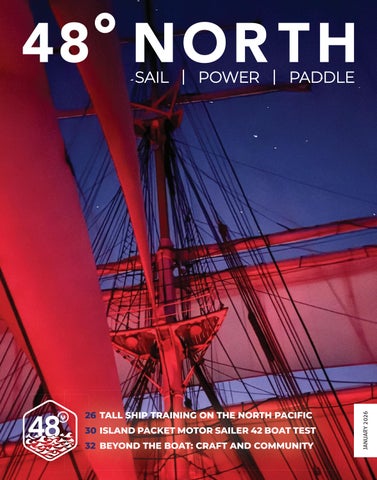
30 ISLAND PACKET MOTOR SAILER 42 BOAT TEST 32 BEYOND THE BOAT: CRAFT AND COMMUNITY
JANUARY 2026
26 TALL SHIP TRAINING ON THE NORTH PACIFIC
48º NORTH
2
JANUARY 2026
ASA 114 Cruising Catamaran Course aboard our Excess 11 out of Anacortes WA!
What better way to gain Catamaran skills than aboard this sailor’s Catamaran in the San Juans?! • $1,495.00 per person. • We can take up to 5 students per course so sign up your entire team at a group rate! • Sail for 3 days/2 nights aboard our Excess 11, a sporty, performance catamaran with a luxurious cabin and cockpit. • Sail in style!
Get ready to cruise in international catamaran cruising waters! Start local and build your skills right at home! BOAT SHOW SPECIALS:
• $100.00 coupon towards any course signed up during show. • ASA101 signups get ASA102 FREE! • 104/114 5-day CruiseNLearns $1895 (normally 2295).
• Sign up for our ASA 101,102,103,104,103/104 combo,105,106,114,104/114 combo and 118 courses for the 2026 season! • Register for American Boating 101-104 to build up your power boating skills! • Call us to design your ASA 201-206 IQC instructor clinics with us this season. • Talk to us about our SailTime/PowerTime membership options. 3116 V Place, Anacortes, WA 98221 • 206-351-8661 beth@seattleyachts.com • www.sailtime.com/location/anacortes Call us to schedule or schedule online.
48º NORTH
3
JANUARY 2026
GPSMAP 15x3 Series ®
15.4" Ultrawide Control. One Powerful Display. The new GPSMAP® 15x3 series delivers a bold 15.4" hybrid display, combining high-visibility sonar, detailed Garmin Navionics+™ mapping, and seamless integration with your onboard systems. Available in standard key-assisted touchscreen, GPSMAP 1523. Or enhanced with preloaded coastal and inland maps, GPSMAP 1543.
Key Features: C 15.4” keyed-assist hybrid display
C NMEA 2000® & OneHelm™ support
C Built-in CHIRP, ClearVü™, SideVü™
C Wi-Fi®, smart notifications, radar & camera ready
C Preloaded Garmin Navionics+™ with Auto Guidance+™
Call us 800.426.6930 48º NORTH
C Compatible with Panoptix™ & LiveScope™
FisheriesSupply.com
4
1900 N. Northlake Way, Seattle JANUARY 2026
JANUARY 2026 26
FEATURES Tall Ship Trainees on the Statsraad Lehmkuhl PNW sailors help bring the century-old barque to San Francisco. By Kate Schnippering
48º NORTH
Boat Test: Island Packet Motor Sailer 42
A unique new design, uniquely well-suited to PNW cruising. By Joe Cline
32
Beyond the Boat
The magic of wood, from craft to community. By Leroy Lewis
38
Charting the Course
A cruise to Blake Island sets the stage for future adventures. By Charlie Boddie
20
COLUMNS Tech Talk with SeaBits: Analog in a Digital World 48° North's technology columnist returns with a fresh perspective. By Steve Mitchell
22
Diesel Deep Dive: Repairs Over the Airwaves A remote fix for an unusual transmission problem. By Meredith Anderson
24
Shifting Gears: Fresh Eyes on Fishing
A neighbor sparks fondness for a new on-the-water pursuit. By Dennis Bottemiller
42
RACING CYC Turkey Bowl 2025
44
Winter Vashon: My Favorite Race
46
Northwest Maivens Impress at LEMWOD
Big wind and serious fun at this intergenerational event. A longtime racer shares the story after an overall victory. Talented local sailors take on the Linda Elias Women's Regatta.
ON THE COVER: Twilight views aloft aboard the 100-year-old Norwegian tall ship, Statsraad Lehmkuhl. For two savvy PNW cruisers and R2AK finishers, a training passage in the North Pacific is an experience filled with learning, discovery, and connection. Photo by Kate Schnippering.
5
Background photo courtesy of Dennis Pearce.
CONTENTS
30
JANUARY 2026
6
Editor 2026: A 'LET'S DO IT' YEAR
Who doesn’t love the fresh start of a new year? Boat folk certainly do, and I always join the chorus. Winter may persist for months to come, but the days are already getting longer, and there’s no better time to make plans. Maybe it’s the year to buy your next boat, or your first. Perhaps it’s gear upgrades, repairs to make, or new knowledge you’ll pursue that will define the coming season. It could be your year to sail away for a long while… or for good! The promise of a year on the water in the Pacific Northwest awaits, and what joy to dwell and dream and chart out the possibilities. This is the year. This is your year. And in the immortal words of the voice of skiing, Warren Miller, who was an accomplished and passionate Orcas Island sailor as well, “If you don’t do it this year, you’ll be one year older when you do.” 2026 is a ‘let’s do it’ kind of year. I’m legitimately stoked about some of 48° North’s resolutions for the coming year. There’s a lot of big new stuff in the works—from a burgeoning video initiative to a couple new supplemental publications we hope will engage, serve, and grow our audience. These efforts simultaneously renew our commitment to all the things you’ve come to expect and rely on from 48° North. From our monthly print flagship filled with stories that inform, inspire, and entertain; to our digital presence at 48north.com and our weekly e-newsletter; to the SARC that’s enclosed in this issue, something I’m more proud of each year; to the planning of another terrific cruising rally with our readers (Aug 2-7, 2026, registration opens January 9). While my excitement is genuine and I sincerely mean everything I said in the paragraph above, work-related resolutions inevitably risk ringing a little hollow. Typically, resonant resolutions are found in the realm of the personal. I guess by sharing this, I’m inviting you to be accountability partners… Why not? Here are a couple waypoints in my personal navigation software for 2026. Take a cruise, even a short one, with my family. Bringing my three-year-old sailing for the first time was a standalone highlight of 2025, and I want more. I hope to have more daytrip experiences with both of my kids this year, but I have this lingering vision of waking up on a boat with our littles—of having a lazy family morning aboard. Our now-four-year-old daughter still talks about “our cabin” from a simple two-night trip to a mountain VRBO last winter. At this time next year, I hope she’s talking about “our boat” in the same way. To top it off, my wife’s parents recently moved to the area, and my father-in-law has suggested in no uncertain terms that he would like me to take everyone cruising. Let’s do it. This is the year. Re-join a regular race team. Since we had our second child in April of 2024, I’ve disavowed commitments of every stripe—other than those to family and my job—including long-term positions with race programs I have loved. It’s been an indescribably special time, and has felt completely right for this phase. But this phase is evolving, and I miss racing and the community of a team. Will it be the J/70 fleet that’s been dosing me with hallucinogenic levels of FOMO (fear of missing out) since it exploded on almost exactly the timeline of my paternal hiatus from racing? Or maybe it’s the J/105s, a fleet I'll see you on the water, that’s also growing with new energy as they build toward a North American Championship this fall? Distance? Buoys? Or perhaps just an earnest effort to sail more regularly with old friends? There’s no wrong answer, and I guess I’m a free agent. But I’m in. It’s time, and I’m excited. Whatever your plans, preparations, or premonitions, Joe Cline I’ll be your cheerleader for this new year on the water. Managing Editor, 48° North You got this. Go chase it. This is your year. 48º NORTH
6
48º North
Volume XLV, Number 6, January 2026 (206) 789-7350 info@48north.com | www.48north.com
Publisher Northwest Maritime Managing Editor Joe Cline joe@48north.com Editor Andy Cross andy@48north.com Designer Rainier Powers rainier@48north.com Advertising Sales Ryan Carson ryan@48north.com Classifieds classads48@48north.com 48° North is published as a project of Northwest Maritime in Port Townsend, WA – a 501(c)3 non-profit organization whose mission is to engage and educate people of all generations in traditional and contemporary maritime life, in a spirit of adventure and discovery. Northwest Maritime Center: 431 Water St, Port Townsend, WA 98368 (360) 385-3628 48° North encourages letters, photographs, manuscripts, burgees, and bribes. Emailed manuscripts and high quality digital images are best! We are not responsible for unsolicited materials. Articles express the author’s thoughts and may not reflect the opinions of the magazine. Reprinting in whole or part is expressly forbidden except by permission from the editor. SUBSCRIPTION OPTIONS FOR 2026 $39/Year For The Magazine $100/Year For Premium (perks!) www.48north.com/subscribe for details. Prices vary for international or first class.
Proud members:
JANUARY 2026
E l l i ot t B ay y ac h t S a l E S SailboatS 50’ Solaris ’21 ..................................$730,000 50’ S&S Classic ’70........................ $250,000 50’ Santa Cruz ’84 ..........................$135,000 46’ Beneteau 46.1 ’22....................$495,000 44’ Worldcruiser Schooner ’79....... $99,500 42’ J/42 ’98...................................... $129,000 41’ Sweden Yachts ’81...................... $69,500 40’ J Boats J/120 ’96......................$120,000 40’ Catalina ’95................................. $99,500 39’ Fast Passage ’80 .........................$98,500 38’ Ericson 38-200 ’88 ....................$62,500 36’ J Boats J/112e ’21.....................$349,000 36’ C&C 110 ’04............................... $99,000 50’ S&S Classic
50’ Santa Cruz
98’ Queenship
PowerboatS 98’ Queenship ’93....................... $2,950,000 44’ Hinckley Talaria ’01..................$525,000 42’ Sabre Salon Express ’16..........$675,000 42’ Grand Banks ’90....................... $199,000 42‘ Grand Banks ‘85........................$115,000 38’ True North ’02.......................... $200,000 35’ SAFE Boats 33 ’05................... $219,000 34’ Pursuit OS 345’14.....................$295,000 34’ Glacier Bay 3470 ’06 ............. $179,500 32’ Ribcraft ’17 ..................................$167,500 28’ Duckworth ’18 ...........................$249,000 27’Boston Whaler Vigilant ’98........ $69,500
46’ Beneteau
brokerage team
42’ Sabre
34’ Glacier Bay
Paul Jenkins 206.793.3529
Bill O’Brien 206.849.8497
Mark Lindeman 253.851.4497
Scott Whittaker 206.660.9741
Elliott Bay Marina 2601 West Marina Place, Suite D Seattle, Washington 98199
44’ Hinckley Talaria “Rose”
Phone: 206.285.9563 Email: info@elliottbayyachtsales.com Web: www.elliottbayyachtsales.com 48º NORTH
7
JANUARY 2026
COMING NEX GEN GEN IIII SERIES SERIES COMING IN 2026 THE NEX INTRODUCING 359 AND AND459 459 INTRODUCING THE IP 359 Owned, Built in in the theUSA USA Owned, Designed and Built
IslandPacket PacketYachts Yachts||1979 1979 Wild Wild Acres Acres Road, Largo, Island Largo, FL FL 33771 33771||(727)535-6431 (727)535-6431||info@ipy.com info@ipy.com
48º NORTH
8
JANUARY 2026
48º NORTH
9
JANUARY 2026
News from Northwest Maritime 48° North has been published by the nonprofit Northwest Maritime since 2018. We are continually amazed and inspired by the important work of our colleagues and organization, and dedicate these pages to sharing more about these activities with you.
IT'S A VERY HAPPY NEW YEAR IN THE NORTHWEST MARITIME BOATSHOP, WITH A FULL SEASON OF GREAT WORKSHOPS RECENTLY ANNOUNCED Joel pointed to a donated 1951 Lightning sitting outside the Northwest Maritime shop, the rain running right though its rotten hull. I was not tempted. Then he found another candidate, Cindy, a woman with sound building experience. In the fall of 2024, we acquired the boat, started taking it apart, brought the mast, boom, and benches into the shop, and set to work on evenings and weekends. We were hooked. The following March, the hull came into the shop. The bottom planks and sections of the chine needed to be replaced, a complex and fascinating job. Thanks to the creativity and expertise of the staff and the many hands of volunteers, our Lightning, Firefly, was launched in July and on exhibit at the 2025 Wooden Boat Festival. Especially if you've never done something like this before—you might assume you need a lifetime of training to build something from scratch, let alone restore a boat that was separated from its last functional sail by many years of neglect and decay. Turns out... you don't. With the guidance and friendship I found in the Northwest Maritime Boatshop, I've done more since that first New Year's resolution than I ever thought possible. ~ Carol M., Northwest Maritime Boatshop student
Have you dreamed about getting out on the water on a small craft that’s just right for you? How about building a contemporary wooden boat designed right here in the Pacific Northwest? Or perhaps you've considered an old boat with good bones that needs of some love and care? To me, a standup paddleboard seemed like the easiest way to get out on the water, so I bought a Chesapeake Light Craft kit to build a sweet, shiny one out of wood. The kit collecting dust in my garage was embarrassing, but less bothersome than boards on sawhorses taking up space. The simple tools listed in the construction manual were unfamiliar. In high school, wood shop had been closed to me; as a girl, I was shunted into home economics class. With some fresh New Year's resolve I took action, and Northwest Maritime came to the rescue with their offerings of classes and personalized instruction. Under the guidance of Boatshop Manager Joel Arrington, I toiled away in the warm shop. After a couple of weeks, I carried my SUP down to the water and paddled it toward home. Long before summer, I was back in the shop for a class. Each of us completed a locally-designed dinghy, working long days into dark evenings. With vessels that I could store, maintain, and launch myself, I was set for several summers. I didn’t want to build a new boat, especially when so many old ones were catching my eye, but the shop continued to call to me.
2026 BOATSHOP WEEKEND WORKSHOPS AT NW MARITIME These classes fill quickly, plan ahead. Varying length of workshop and cost. Jan 17–18 Get A Handle On It: Paddle Making 101 Feb 14–16 Wooden Boat Lettering with Gold Leaf and Carving Mar 14 Demystifying Marine Finish Apr 11 Steambending Wood For Boats May 9 Outboard Maintenance June 20 Trailering, Transporting, and a Lesson In Boat Ramp Etiquette July 11 Longboats of the Northwest: History, Use, & Care Aug 8 Fishing and Foraging the Salish Sea Sept 26–27 Sticky Business: Epoxy 101 Oct 10 Winterizing Your Boat Nov 14–15 Handtools: Use, Care, Sharpening Dec 5–6 Deck The Hulls With Boatshop Offcuts Dec 12–13 Deck The Hulls With Boatshop Offcuts » www.nwmaritime.org/boatshop-2026
MARITIME HIGH SCHOOL ENROLLMENT OPEN THROUGH JAN 31, 2026 For students interested in enrolling in Seattle's Maritime High School (MHS), the time to take action is now! MHS is open to any student intrigued by Maritime Studies, whether they live Highline Public Schools boundaries or not. Space is limited. A lottery system may be used if applications exceed capacity. » maritime.highlineschools.org/admissions
Northwest Maritime 48º NORTH
Wooden Boat Festival
RACE TO ALASKA
10
48° North
Swan Hotel JANUARY 2026
Photo: Richard Marshall
Photo: Richard Marshall
Professional Rigging Partner Offshore sailing - Racing - Cruising
•
360-385-6330
Full Service Rigging Shop
PTR Built Rod & Wire Standing Rigging • Full Service Rigging• Shop
Info@PortTownsendRigging.com • Mast & Spar Repair • PTR Built Rod & Wire Standing Rigging PortTownsendRigging.com • Mast & Spar Repair• PTR Custom Built Masts, Booms, Poles
• PTR Custom Built Masts, Booms, Poles 360-385-6330 • Info@PortTownsendRigging.com • PortTownsendRigging.com 48º NORTH
11
JANUARY 2026
48º NORTH
12
JANUARY 2026
low tides » News & Events SEATTLE BOAT SHOW ANNOUNCES 144 FREE BOATING & FISHING SEMINARS FOR 2026 For boaters looking to grow their skills, confidence, and on-the-water know-how, the Seattle Boat Show is the place to be Friday, January 30– Saturday, February 7. This year’s show celebrates one of its most beloved traditions: a rich lineup of seminars designed to help every boater learn something new. With 144 free seminars—106 boating and 38 fishing—and 28 new topics, plus 36 deeper-dive classes through Boat Show University, the show offers countless ways to elevate your boating life. The seminars cover everything from cruising, sailing, and navigation to marine systems, fishing techniques, and family boating adventures. This year’s show features 28 brand-new seminars, adding fresh voices, new perspectives, and timely topics for boaters and anglers of all experience levels. HIGHLIGHTS OF NEW 2026 SEMINARS The 2026 lineup introduces an exciting range of new topics, including aspirational travelogues, hands-on learning, skill-building workshops, and expert insights. New additions include: • Cruising Gems in BC – Wendy Hinman
• We Took Our Kids Cruising… and You Can Too! – Elizabeth Brown-Shaw
• The Coconut Milk Run: Island Hopping through the South Pacific – Nathan Zahrt & Vivian Vuong
• From Passenger to Partner: Building Confidence and Competence On Board – Jennifer Silva Redmond
• Make the Most of Your New Boat: Save Money, Gain Friends & Explore! – John Seger
• The Skipper’s Mindset: Less Stress & More Fun with Family & Friends – Tracy Sarich & Shirline Wilson
• Exploring the Northwest Passage by Sailboat – Mike Beemer
• Boating Safety: Lessons from Recent Incidents – Margaret Pommert
• Galley Organization & Provisioning – Nathan Zahrt & Vivian Vuong
• Man Overboard Rescue Seminar – John Neal & Margaret Pommert
• Expert Tuna Fishing Panel – Tommy Donlin
• Sail Fiji – Adam Wade
• Inspiring Women Working at Sea Through the Ages – Margaret Willson
• Lessons Learned: Docking & Anchoring a Catamaran from Seattle to Alaska – Ken Parker
• PNW Weather – Phyllis Woolwine
• Cruising to Haida Gwaii & Glacier Bay on a Catamaran – Ken Parker
These new sessions join an established lineup of crowd favorites, taught by some of the Pacific Northwest’s most respected experts, cruisers, captains, anglers, and educators.
BOAT SHOW UNIVERSITY: IN-DEPTH LEARNING FOR SERIOUS CRUISERS Using Navionics Apps for Navigation with Linda Lewis— maximize one of the most popular tools for PNW cruisers. Diesel Troubleshooting with Matt Mardesich and Electrical Troubleshooting with Mike Beemer—gain confidence in managing key vessel systems. BSU classes often include take-home materials boaters can incorporate into their onboard standard operating procedures. As one of the nation’s leading boating education programs, Boat Show University is an invaluable resource for anyone seeking safer, more enjoyable cruising.
For attendees seeking more advanced training, Boat Show University (BSU)—organized by Waggoner Media—returns with an expanded schedule of 36 90-minute, fee-based classes focused on the skills, strategies, and systems essential to confident cruising in the Pacific Northwest and beyond. BSU offers a curated range of technical and advanced topics such as offshore cruising preparation, electrical system design, weather forecasting, navigation tools, diesel and electrical troubleshooting, and cruising routes north of Seattle. All BSU classes are $49, require advance online registration at www.SeattleBoatShow.com, include show admission, and often fill quickly, so early sign-up is encouraged. Classes are taught by nationally recognized experts including Mark Bunzel, Mike Beemer, Matt Mardesich, Linda Lewis, Phyllis Woolwine, Carolyn “Ace” Spragg and others. Practical examples include: Anchoring Techniques with Carolyn “Ace” Spragg—learn foolproof methods for secure anchoring in remote coves along the Inside Passage. Marine Weather for Cruisers with Mark Bunzel—understand how to interpret forecasts and make informed go/no-go decisions. 48º NORTH
SEATTLE BOAT SHOW TICKET INFORMATION
• Adult Ticket - $20.00, 9-Day Pass - $40.00 • 4 The Fun Of It! (25% Off – Must purchase online) • Buy 6, Bring Your Picks! (25% Off – Must purchase online) • Kids 17 & Under - Free • Boat Show University - $49 per class, includes admission, must purchase online. • Check out » www.SeattleBoatShow.com for the full schedule of free boating and fishing seminars and BSU classes.
13
JANUARY 2026
low tides » News & Events SKAGIT VALLEY COLLEGE LAUNCHES NEW MARINE SURVEYING PROGRAM
Skagit Valley College is launching a new nine-week professional course this winter to prepare students for careers as professional marine surveyors. The program, Marine Surveying: Yachts and Small Craft, is in-person and runs February 23 through April 24, 2026, at the SVC Marine Technology Center in Anacortes. With training in vessel inspection, valuation, and reporting, and blending technical knowledge with hands-on experience, students will gain the skills and industry certifications needed to conduct professional condition and valuation surveys for vessels up to 65 feet in length. “Marine surveying is an essential function in the boating industry, requiring a mix of technical expertise, attention to detail, and professional integrity,” said Mike Reese, the course instructor and a 30-year marine industry veteran. “This course gives students both the knowledge and practical experience to take the next steps in becoming skilled surveyors.” This full-time course will meet Monday through Friday from 9 a.m. to 4 p.m. and includes classroom instruction, lab exercises, and both instructor-led and independent vessel surveys. The program is for individuals with prior experience in the marine industry, such as boat builders, mechanics, engineers, and professional mariners seeking to expand their expertise into a professional surveying role. 48º NORTH
Students can expect interactive learning with hands-on training aboard vessels. They’ll cover both the technical and business aspects of marine surveying, including ethics and client relations. Upon successful completion, graduates will earn an SVC Certificate of Completion along with three American Boat and Yacht Council (ABYC) certifications in Marine Standards, Marine Systems, and Marine Electrical — qualifying them for the ABYC Master Advisor designation.
14
Graduates will be prepared to join industry organizations and enter the workforce as independent marine surveyors. The program’s tuition is $8,500. Students who pay in full by Dec. 31 will receive a $425 early payment discount. To learn more, interested students are invited to attend an online information session on Dec. 11 at 5:30 p.m. For more details about the program or to apply, visit » cruiserscollege.org/marine-survey-course/
JANUARY 2026
SEA SAFETY AND SURVIVAL, AND FISHERMEN FIRST AID AND SAFETY TRAINING COMING TO SEATTLE
Washington Sea Grant is holding a combined Sea Safety and Survival (Drill Instructor) and Fishermen First Aid and Safety Training (FFAST) in Seattle January 22-24, 2026. The Coast Guard-approved Sea Safety and Survival course meets the training requirements of the Commercial Fishing Safety Act to conduct drills. Coursework combines lectures and handson experience with the safety and survival equipment that is now required for commercial fishing vessels. Participants will learn about emergency procedures and will be trained to develop appropriate emergency drills for their own vessels. The Fisherman First Aid and Safety Training was built to help commercial fishermen prevent and treat injuries they may encounter at sea. It takes into account the small crews, common injuries, vessel environments, cold water, rough seas, and delayed emergency response times typical to Pacific Northwest fisheries. Successful completion of this course will fulfill the Coast Guard requirements for CPR and AED basic first aid. Captains and boat owners are encouraged to bring their whole crew! When: January 22-24. 8:30 a.m.–4:30 p.m. Where: Nordby Conference Center at Fishermen’s Terminal, 3919 18th Avenue West, Seattle Fee: $200 ($100 for commercial fishermen) Pre-registration is required. For more details, including scholarship information, contact Robert Maw, » rmaw@uw.edu. 48º NORTH
Details and discount tickets at seattleboatshow.com
Mobile Fuel Polishing Serving The Entire Pacific Northwest • 360-808-0505
Fuel Filtering...Tank Cleaning
(Water, Algae, Sludge and Particle Removal Service) Changing filters often? Don't let bad fuel or dirty tanks ruin your next cruise! Whether you're cruising the Pacific Northwest, heading for Alaska, Mexico or around the world, now is the time to filter your fuel & tank ... before trouble finds you ... out there!
Seventh Wave Marine
www.seventhwavemarine.com
15
seventhwavemarine@olypen.com JANUARY 2026
16
CROSSWORD AND TRIVIA
1
2
3
4
5
6
7
DID YOU KNOW?
8
by Bryan Henry
9
To remember the Great Lakes in the order of their size, just think SHMEO: Superior, Huron, Michigan, Erie, Ontario.
10 11 13
14
15
12
Lake Ontario’s name is thought to come from an Iroquois word meaning “beautiful lake.”
16 17
18
19
20
Chesapeake Bay, the largest bay on the Atlantic Coast, is one of the world’s largest rias, or “drowned rivers.” It’s the drowned mouth of the Susquehanna River.
21
22 23
24
25 28
26 29
31
27 30 32
33
34 35
1
The Mississippi River system drains more than 40 percent of the contiguous U.S. and parts of southern Canada.
36
ACROSS Island in the Pacific Northwest where Friday Harbor is based, 2 words
5 Pacific Northwest island
named after some whales
DOWN 1
Fit to safely sail at sea
2 Navigator’s dir., abbr. 3 Submarine vessel from WW
II, 2 words
5 One way to cook eggs, 2
10 Gauges for recording the
6 Throw out a fishing line
speed and direction of wind 11 Label 13 Lubricant
words
The 1899 Rivers and Harbors Act first legislated U.S. control of water pollutants.
7 Expression of dismay 8 Ocean color, 2 words 12 Marketing medium
15 Steering lever on a boat
14 Weight measurements, abbr.
16 Physician’s title, abbr.
17 Playful sea creatures
18 Like walruses
19 Study of the environment
21 On dry land 22 Company head, abbr. 23 Color of some leaves during
the fall 26 Navigation system, abbr. 28 Snake that squeezes 30 Engine power measure,
abbr.
20 Morning moisture 24 Nearby resident 25 Freight weight 27 Frighten 28 Secure tightly 29 Mellowed like some wines 31 It’s fresh at sea
Technically, an estuary is that part of a river where its current meets the sea and becomes influenced by the tides. It comes from the Latin aestuarium, tidal channel, from aestus, tide.
» See solution on page 51
When we go to a beach and put our towel or blanket down, we’re in the supratidal zone, which is the area above the intertidal zone, up to the sand dunes.
abbr.
36 Nightfall 48º NORTH
Lagoa dos Patos (Lagoon of Ducks), covering 3,900 square miles in southern Brazil, is the world’s largest coastal lagoon.
33 State that borders Canada,
32 Lithium-___ battery 35 Passed along a message
The southeast part of the Caribbean island of Dominica receives up to 250 inches of rain a year. The world’s windiest place is Commonwealth Bay, George V Land, in Antarctica, where wind speeds of 200 mph have been recorded.
31 Securing a vessel in place 34 Silent agreement gesture
More than 200 million acres of wetlands existed in the lower 48 states 200 years ago. Today, less than half remain. Airports serving New Orleans, Boston, and New York City cover former wetlands. A third of U.S. threatened and endangered species depend on wetlands.
4 Pine tree dropping
9 Reply to a captain
A bayou is a marshy creek or swampy backwater of a river or a lake that’s shallow and heavily wooded. Derived from a Choctaw word, that meant river or creek.
16
JANUARY 2026
17
LETTERS
All the Power You Need
Update to Hot Springs Cove Information from Michael Boyd’s “Hikes For Boaters” Column in the December 2025 Issue Hi Michael, Karen, and 48° North Crew, Thanks for your fine article on hiking on the southwest corner of Vancouver Island. I have one correction for you, which is—sadly—that the boardwalk to Hot Springs Cove, with its lovely old boards, hand carved with boat names, is no more. It has been replaced with a new boardwalk, albeit one that’s very strong and well built, but with none of the charm of the original. My wife and I were there this past summer, and I definitely missed those great old boards. In fact, when I proposed to her some 12 years ago, I based it on one of the boards I’d seen on an earlier, solo trip I’d taken to Hot Springs by kayak. Of all the boards, the one that most caught my eye was one that said: “Clara Richardson will you marry me?” Maybe the coolest marriage proposal ever!
Model Shown Beta 38
Engineered to be Serviced Easily!
Beta Marine West (Distributor) 400 Harbor Dr, Sausalito, CA 94965 415-332-3507
Pacific Northwest Dealer Network Emerald Marine
Anacortes, WA • 360-293-4161 www.emeraldmarine.com
Carl Davis S/V Monty
Oregon Marine Industries
Portland, OR • 503-702-0123 info@betamarineoregon.com
Access Marine
Seattle, WA • 206-819-2439 info@betamarineengines.com www.betamarineengines.com
Sea Marine
Port Townsend, WA • 360-385-4000 info@betamarinepnw.com www.betamarinepnw.com
Recent Social Media Responses
Deer Harbor Boatworks
To Mark Aberle’s Kayak Cruising story from Dec 2025: Kristina Southard: Beautifully written. Such a fabulous perspective. Thank you Mark. You just made my morning.
Deer Harbor, WA • 844-792-2382 customersupport@betamarinenw.com www.betamarinenw.com
To Max Fleischfresser’s article about Cruising Desolation Sound with a Toddler from the November 2025 issue: Terri Starkman: Wow, Max, what a great and amazing narrative of your trip with Theo and Collin. I truly enjoyed it and I know others will too!
6701 Seaview Ave NW, Seattle WA 98117 206-789-8496 auxiliaryeng@gmail.com
48º NORTH
Auxiliary Engine
17
JANUARY 2026
low tides » Products News » SPINLOCK RIG-SENSE TENSION GAUGE Achieving and maintaining the correct rig tension is critical for performance and safety on racing and cruising sailboats. Tension gauges provide an accurate, repeatable method for measuring the tension in wire and rod rigging, ensuring optimal sail shape, mast stability, and overall rig longevity. Spinlocks new Rig-Sense Tension Gauge makes keeping your rig tuned properly an easy task. Rig-Sense is simple to use, as it supports itself on the rig while measuring the tension, and can be operated one-handed. There are two versions now available, which accommodate a diameter range of 2-5mm and 5-8mm. Working in conjunction with the Rig-Sense app, its compact size, stainless steel contact points, and composite calibrated leaf spring make it incredibly accurate and versatile for a range of boats. Each Rig-Sense gauge comes with a carrying bag included. Price: $185/$324 » www.spinlock.co.uk
» BURNBUSTER FIRE SAFETY PACK Fire on a boat is one of the scariest and most deadly situations that mariners can encounter, and having the tools to fight one if it should arise is critical. The BurnBuster Fire Safety Pack is a compact, all-in-one solution designed for the unique fire risks faced on boats. Lithium-ion battery fires, GPS units and handheld electronics are becoming increasingly common on the water, and traditional extinguishers often struggle to control them if they are ablaze. The two BurnBuster aerosol extinguishers deploy a fast-acting, non-corrosive gel that smothers flames and cools hotspots instantly—making it ideal for engine compartments, cabins, galleys, and tight spaces where seconds matter. The safety pack includes two aerosol extinguishers (3-year warranty), two fire sachets (18-month warranty), and two fire blankets (unlimited warranty). Price: $139.99 » www.burnbuster.com
» COMMODORE TWIST FLUSH ELECTRIC HEAD If you’re looking to upgrade your boat’s old manual head, the new commodore CM2RMT Electric Marine Toilet might be what you’re looking for. Combining quiet performance, durable construction, and powerful flushing for dependable onboard sanitation, its integrated flush pump delivers a strong 18.9 LPM rinse, while the built-in macerator with a stainless steel chopper plate grinds waste efficiently for smooth discharge. Designed with a corrosion-resistant ceramic bowl and soft-close seat, it provides household comfort in marine environments. The permanent magnet motor ensures quiet operation and long service life, while flexible installation options allow use above or below the waterline with left- or right-hand compatibility. Built to withstand saltwater conditions, the CM2RMT is an ideal upgrade from manual heads, offering reliable 12V or 24V operation, low maintenance, and modern twist-flush convenience. Price: $391.99 » www.commodoreproducts.com
48º NORTH
18
JANUARY 2026
Breathtaking Breathtaking setting, set ting , spectacular spectacular day! day! REE Ships F S! UP Ground
INSTALL 5hp – 2000hp
Ceremonies Ceremonies on soft mounts needs total freedom of Receptions Receptions Business or Pleasure, AquaDrive will make movement from its propshaft if noise Rehearsals Rehearsals your boat smoother, quieter and vibration free. and vibration are not to be transmitted to Contact Contact us today us today The AquaDrive system solves a the hull. The AquaDrive provides just venuerentals@nwmaritime.org venuerentals@nwmaritime.org problem nearly a century old; the fact that marine engines are installed on soft engine mounts and attached almost rigidly to the propeller shaft. The very logic of AquaDrive is inescapable. An engine that is vibrating
NORTHWEST MARITIME CENTER 431 Water Street Port Townsend, WA 98368
this freedom of movement. Tests proved that the AquaDrive with its softer engine mountings can reduce vibration by 95% and structure borne noise by 50% or more. For information, call Drivelines NW today.
“A‑Northwest Legend for Over 25 Years” 311 S. Brandon St, Seattle, WA 98108 • (206) 622-8760
Visit Our Web Site: www.aquadrive.net
Training • Cruising • Adventure
ULLMAN SAILS Pacific Northwest
Sail Training Expeditions
Liveaboard ocean sail training expeditions that prepare you for bluewater cruising
Flotillas
Expert guided remote cruising adventures
Ullman Sails
Led by Gio & Julie Cappelli
Sailors, instructors, and mentors for the next generation of ocean voyagers
(360) 504-6640 Pnw.ullmansails.com
www.PelagicBlueCruising.com 48º NORTH
19
JANUARY 2026
20
TECH TALK WITH SEABITS
ANALOG IN A TECH WORLD After a couple-year hiatus, 48° North’s technology columnist is making a return, and we’re so excited to welcome Steve back. It’s the same great SeaBits style, but he’s made a boat upgrade to a cool steel trawler, and has some exciting and fresh perspective to share since he’s left the corporate tech world and is now working on boats full-time.
I
’m pretty well known for being a tech nerd in all parts of my life, including aboard the boat. If there is a new gadget or piece of software, I have probably tried to figure out a way to use it while cruising. I love technology and automation and what it brings to our world, how it makes things easier in our everyday lives, and the visibility and information it allows us to enjoy. So you might be surprised to find out that I prefer simple, analog systems for some pretty core parts of my boat. WHY ANALOG? Digital technology has changed the world in so many good ways, and of course a bunch of really not-so-good ways, but let’s try to be positive today! I have made a career out of technology and wouldn’t change that for anything. But there’s something to be said for simple, analog systems that are easy to use, easy to fix, and work more reliably in a harsh environment. Particularly on the boat, digital technology has allowed for modern conveniences such as fully integrated power systems, smart home features, integrated electronics that help with 48º NORTH
navigation and anchoring, and much more. It has improved the quality of life and safety of being out on the water, but it does require marine-grade components designed to withstand the vibration and salt water environment, needs to be configured and integrated appropriately, and requires maintenance and likely upgrades throughout its life. These systems are great when they work, and provide visibility and utility in areas you just can’t get with analog. However, having something you can fix with just your hands and some tools— that requires only simple DC power and has been used by mariners for years—is something expert cruisers will tell you is the preference for anything that they rely on. ENGINE One of the most important bits on a boat is the engine, and I absolutely prefer to have as analog a system as possible when it comes to propulsion. This includes super basic key-based starting using standard parts you can get in an auto parts store, basic alarms and shutdowns governed by voltage-carrying wires and relays, and simple temperature
20
by Steve Mitchell and pressure senders driving analog or very simple modern gauges. This might seem contradictory to articles I’ve written about digitizing engine instruments, but this is where the analog and digital worlds collide. I love having more visibility, better alarms, and deeper data on any system aboard the boat. That’s what digitizing engine instruments gets you—the ability to see that data on small displays, chartplotters, or mobile devices, and also the ability to record and analyze data later on. Where I draw the line is in replacing the entire control system for the engine. I still want physical wired or pressure controls to my throttle and transmission, simple wires to a starter, and other basic ways to start and stop the engine and get alarms. The digital side is an added benefit, but doesn’t replace the simplicity and reliability of the analog world. For modern boats, or if you repower, this can be difficult to do given the emissions requirements, and the tendency for modern engines to be heavily digital. However, if you have the opportunity to choose manufacturers, look for those that have simpler control systems, and those that offer clear documentation and easier parts to source to ensure you are not reliant on tons of computers for your engine. JANUARY 2026
DC wiring, per the author's preference.
DC VS AC POWER Inverters and their related power systems have become more reliable in the last 20 years, and many of our household conveniences are more usable aboard a boat with advances in battery technology and charging. However, I still prefer as much of my critical and daily-use systems on DC power whenever possible. Even with more reliability and wider spread adoption, an AC inverter system is more complicated. Not only do you have the inverter itself, but often you will have a control system, associated cabling, software, and more. In lithium battery systems, you’ll also have a battery management system, or BMS, and potentially other pieces of technology that can freak-out at the worst moment. There are also losses in converting DC power from your battery to AC inverted power, so whenever possible, trying to move things to DC power helps save energy in the long run. Key systems I always like to see on DC include the entire navigation system, including PCs and screens, and the internet setup. These are targets in a lot of upgrades or new installations to include AC power both for convenience and due to equipment choices, and I try to avoid them whenever possible. Having them on DC offers much better reliability, and is relatively easy to do using DC-DC converters or even directly connecting them to DC power without much other work involved. BILGE Bilge pumps and the associated high water alarms are another area I love digitizing with products like BRNKL, Siren Marine, and Maretron, but I still want them to be as analog as possible. Having a high quality float switch like the Ultra Safety Systems Pump Switch Senior with 48º NORTH
a built-in high water alarm and extremely well designed float that rarely gets stuck is where I would spend most of my time and money in any bilge. This ensures I have a reliable, analog way of starting and stopping a bilge pump, and also getting an alarm if something has gone wrong. Adding an additional analog high water alarm is even a better idea to ensure you have redundancy. Pairing this analog foundation with a digital system like the Maretron RIM100 to monitor breaker status, pump run status, and count the times a pump has run is super useful, too. It allows you to get notifications when away from the boat, see trends and potentially identify a slow leak, and generally get better visibility into things. But it’s not as critical as the base system working—all analog. TANKS To be happy and safe aboard the boat, it’s essential to keep your fuel and water tanks full, and your waste tank managed. Having tank sensors is one great way of doing this, but they are often fiddly and problematic, even the newer ultrasonic, pressure, or radar-based technologies. The easier solution is to choose a sight gauge, which rarely fails, is easy to see and interpret, and provides instant information about the fluid level in your tank. AUTOPILOT vs WINDVANE I’m the first person who will admit that autopilots are a huge benefit aboard the boat. As a singlehanded mariner, I rely on mine to help me stay rested and focused while underway. But even the best autopilot has issues. This system is the top one I get calls about with problems ranging from compass calibration issues to complete system failures. A better analog system for a sailboat
Simple analog engine connections.
21
An analog tank sight gauge. would be a windvane self-steering system that consumes zero electricity, is generally all in one place and visible for inspections and troubleshooting, and provides a very reliable way of steering. They can often be fixed with just tools, and jury-rigged to continue running, where an autopilot system may require a new electronic component that is hard to find out at sea. I wish there was an equivalent system for a trawler or powerboat! When looking at your key boat systems, think about what you would have to troubleshoot if you were in a remote location, and how complicated you want that process to be. That will help you prioritize systems that should be streamlined as possible, and you can start thinking about moving those to a more analog approach. While digital and tech systems have a place on the boat today more than ever, relying on key analog systems (or key systems that use analog parts) can really benefit your time on the water, and your safety and sanity in the long run. Steve Mitchell is a year-round Pacific Northwest cruiser aboard his 54-foot steel trawler Aruna and a lifelong boater with experience in both sail and power. With decades in the technology industry and over 20 years of hands-on experience designing and installing marine electronics, electrical systems, he blends technical expertise with real-world cruising insight. As founder of SeaBits, he tests, reviews, and consults on the latest marine technology, and contributes to numerous boating publications. JANUARY 2026
22
DIESEL DEEP DIVE
REPAIRS OVER THE AIRWAVES: A FIX FROM AFAR
A
by Meredith Anderson
s a marine mechanic, I find myself traveling all over to fix diesel engines, but there are also a lot of repairs that I help with from the comforts of my boat. Sometimes, travel is out of the question for various reasons, or my clients find themselves stuck in a place that I can’t get to easily or quickly. In this case, I find myself spending time walking them through a repair over the phone. Recently, a couple of friends reached out for help from Mexico with a rather dramatic, yet manageable, issue at hand. Between their resourcefulness and a little bit of aid on my part (mostly motivational speaking), they were able to make the repair and continue on with their adventure. This kind of assistance and success for clients has always been important to me, professionally and personally. In the nine years I’ve run my own business, I’ve been guided by the foundational concept and desire to help people by teaching them to help themselves when it comes to boat repair; not just jumping on and effecting a repair myself. Mariners of all stripes value and require self-reliance, so it’s an understandable focus that most boaters share. There isn’t always help nearby, and that can put the vessel at risk, sometimes even posing a danger to its crew. When something goes wrong, having enough knowledge to fix the problem so you can get home is very important. There’s a reason I preach about that so much in this column. While I don’t expect average boaters to be full-blown mechanics, it’s important to me that everyone understands where certain parts are and how they work, so if they are out 48º NORTH
on their own and need help they can reach out and identify what they are seeing. Michael and Melissa are great examples of this. Over the years, they’ve been friends, customers, and even helpful “employees” when I needed assistance getting to work due to some health issues. We were dockmates in Olympia, and I watched as they prepped their boat for cruising far and wide. Both of them were extremely diligent in preparing the boat for safety, and joined many classes and seminars to learn as much as they could before leaving the dock. Little did they know, this would pay off immensely for them. Off they sailed and, though it was bittersweet to watch friends go, I was very happy they were chasing this big dream. They’ve been out cruising for a couple of years and I got a call from Michael the other day after work. I was excited to hear from him, but I immediately picked-up the concerning tone in his voice. “We’ve kind of got a major issue, our transmission has separated from the engine,” he told me. After a few deep breaths and a deeper conversation trying to understand and diagnose the problem, they sent me several photographs and I was able to get an idea of what had actually happened. Their 47-foot Olympic Adventure center cockpit ketch, Galapagos, has a Beta 4-cylinder marine diesel engine as her main propulsion. The issue at hand was a rare and very odd one at best. Beta uses a Twin Disc reverse gear. This gear housing had separated
22
JANUARY 2026
from the bell housing because the mounting bolts had loosened and backed themselves out. The gear housing is bolted to the marine gear with four to six bolts, depending on make and model. In this case, the four bolts on Michael and Melissa’s engine were completely dislodged and the entire housing had moved aft away from the engine by approximately an inch. The engine is only a few years old and came from the factory with this reverse gear and adapter plate installed, so it appeared to have been a factory defect that maybe wasn’t double checked prior to delivery to the customer. Without removing the reverse gear and bell housing, no one could’ve seen this coming; nor is it something most boaters need to worry about, since these bolts should typically be installed with Loctite or something similar. Michael informed me that they were anchored in a quiet location in the Sea of Cortez where not many other cruisers visit often. They were also far enough away from any sort of yard that it would’ve been difficult to try and get towed in. Luckily, they were in a protected area and the boat was safe. Due to their diligence in preparing the boat so well, not only did they have the tools required to pull the engine apart, but they also had a bottle jack to lift the rear end of the engine off the motor mounts to separate the reverse gear from the engine block. Michael got the job done in less than a day and sent me updates of his success. I was impressed and relieved, though my relief paled in comparison to theirs. The engine was up and running the next day, and both of them were able to rest easy after a job well done. In a situation that could have ranged from inconvenient to expensive to dangerous, this was an example of a repair done on the fly that went well due to Micheal and Melissa’s efforts to prep the boat properly and educate themselves on the basics of the engine and its surrounding parts. Thanks to their thoughtful preparation, they were able to describe exactly what was going on over the phone to me. I was then able to explain how I would approach the repair and they could confirm with pictures whether what I was suggesting would work or not. Their layers of preparation also contributed to their confidence to tackle the project themselves, instead of simply giving up and calling for a tow to a boatyard. Stuff like this makes my heart happy—I really didn’t have to do much, and was able to watch them succeed from afar while they were in a remote location without mechanical assistance nearby. It’s a story that aligns with the goals I have for many of my customers and friends, that they are able to self-help themselves when needed. In a world where boats are as connected to the digital world as the owner desires, it’s ever easier for me to be a phone call or email away, but I can’t always physically be there. When cruising, these basic make-or-break skillsets, tools, and bits of knowledge are always worthy to pursue and cherish. They can truly save lives or the vessel when it comes to crunch time.
A photo sent to Meredith from Michael and Melissa. They circled the bolt threads.
Another photo with Michael and Melissa's modifications to illuminate the situation for Meredith. Note the informed vocabulary in their description.
The problematic installation of this adapter plate appeared, to Meredith, to be a factory defect—not something the average owner needs to worry about.
Meredith Anderson is the owner of Madame Diesel, LLC, where she operates a mobile mechanic service and teaches hands-on marine diesel classes to groups and in private classes aboard clients’ own vessels. 48º NORTH
23
JANUARY 2026
24
SHIFTING GEARS
FRESH EYES
ON FISHING
by Dennis Bottemiller
E
A FRIENDLY NEIGHBOR SPARKS A FONDNESS FOR FISHING AND MORE DAYS ON THE WATER
Recently this has changed, representing yet another “gear ver since we began boating on the Salish Sea, we have encountered crowds of boats in certain seasons and shift” in my life on the water. When we purchased our C-Dory locations chasing salmon. We love salmon, both as a 22 cruiser, Sea Lab, from her third owner in Oregon—as with scrumptious meal and for the huge role they play in our native most pre-owned boats—it came with boxes of all kinds of stuff, including two Scotty downriggers. I actually offered environment and Pacific Northwest culture. them to my brother-in-law, but they were manual Growing up here, I know many people who downriggers and he wanted electric ones. Oh absolutely live for fishing and spend a lot The author's well, into the basement they went, where of their time and resources pursuing this friend Alan reels in they gathered dust for four years. activity, and even a few who get a little his catch of the day. Then we moved our homeport to Fair wild-eyed and seem slightly crazy if you Harbor Marina in Grapeview on Case ask them, “How’s fishing been?” Inlet and my fishing interest needle As a kid, my buddies and I used to ride shifted. I met a neighbor right away our bikes down to the public fishing who stopped by because he had noticed pier in Des Moines to catch flounders Sea Lab on the trailer at our house and and sculpins. We wished that we could wanted to know if I liked fishing. His get a salmon on the line, but of course name was Mark and his next question was, we never did. I’ve been a casual fisherman “You want to go out right now?” I said sure, most of my life and never got very serious and we met at his house down the street in a about getting better at it. I tried trolling half-hour and dinghied out to his 17-foot fishing behind our sailboats a few times with zero boat tied to the mooring ball in front of his place. We success. Plus, cruising on small boats is crowded in the first place and bringing fishing gear along takes up valuable motored off into Pickering Passage then out into Case Inlet. It space on board. To top it off, I imagined that if I were to catch a turns out he was a retired fisheries biologist whose absolute fish things would become messy very quickly, so I haven’t put favorite activity is fishing, and he would be happy to teach me how to go about it. How lucky is that? much effort into the activity. 48º NORTH
24
JANUARY 2026
A great day for the author to take his 90-year-old dad fishing.
Fishing has given the author new inspiration to keep the boat in the water and use it all year round.
One thing about fishing these waters is that it is not really intuitive or straight forward, at least not for me. There is a dizzying array of equipment and regulations that are daunting to wade through, so having a fishing mentor nearby is a big help. Mark taught me how to use the downriggers and how to tie up flashers and dodgers, herring and hoochies, and lots of other little gizmos and tricks. Before I knew it, I hooked what I now know as a resident Chinook. It was a little too small to keep but it was exciting! I’m not quite sure who hooked who. After a few more trips out with Mark, I dug those downriggers out of the basement and dusted them off, clicked them into the mounts on Sea Lab and headed out to see if I could remember what to do. Mark had all the gear on his boat, so I didn’t have to think about what to use or where it came from, we just went out and started fishing right away. I had a couple poles and a mixed assortment of tackle that I had accumulated over the years, varying from things still in packages to things caked in rust. I decided maybe a trip to Bass Pro Shop would be interesting. Upon my arrival in the fishing department, I tried to imagine going out fishing with Mark and what we use to catch salmon. If I didn’t have a pretty good idea about what to start with, I probably would have given up and gone home. Holy buckets, there is a lot of fishing gear! My next surprise came at the cash register. Those downrigger balls are expensive, and all the tiny hardware adds up to real money. Well, I thought, if you want to play the game you have to pay the dues, so I whipped out my card and paid the man. When all the planets aligned, figuratively speaking, I called my trusty friends Al and Rob and we headed out to see if we could make it work. We tied everything together and got it in the water and started dragging it around in the places Mark had told me were good. We caught several little fish, but not the salmon we were looking for. There are lots of sea-run cutthroat trout in the waters of the South Sound and they were fairly aggressive toward what we were offering. Nice fish and probably good for dinner, but they have been catch-and48º NORTH
release only for a long time so we let them go. These are interesting and beautiful fish, and they became a protected species in the 1990s. Everything I can find on the internet about them indicates they have made a tremendous recovery since being listed. Until a few years ago I did not know there were trout other than steelhead that migrated from their freshwater home stream to saltwater and then went back to spawn, but these fish do that. Unlike steelhead, they stay close to home in the saltwater and don’t head all the way out to the ocean. Another thing that I learned since Mark has been my fishing mentor is that there is a population of salmon known as resident Chinook whose life-cycle is similar to the sea-run cutthroat. They begin in the streams and migrate into the Salish Sea, but apparently there is enough forage for them that they don’t travel out the Strait of Juan de Fuca and into the Pacific, but stay in the southern reaches of the South Sound. This has led to a significant population of Chinook salmon there that has resulted in the Washington Department of Fish and Wildlife establishing a year-round open season for this particular fish, which are sometimes known as “Black Mouth” because of their obvious black gumline. In the summer months, they are keepers at 20-inches and, in the winter months, the keeper size moves up to 22-inches. The only area where this year-round season for Chinook fishing exists is in area 13, which is all the Salish Sea south of the Tacoma Narrows bridge. My first steps into the world of fishing have been as rewarding as the learning curve is steep. It makes me a happy fisherman to know that I have another good reason to leave Sea Lab in the water and available to use more days of the year. This has been a good year on Sea Lab. We’ve been aboard 40 days so far and, because of my newly rekindled interest resulting from a new friend, we’ll have several more days before the end of the year, and that feels pretty darn good. Dennis, Tekla, and Tim Tim the sailor dog recently changed their home cruising waters from Tacoma to Case Inlet.
25
JANUARY 2026
TALL SHIP TRAINEES ON THE
STATSRAAD LEHMKUHL SEATTLE TO SAN FRANCISCO
by Kate Schnippering
S
“
Å SMÅTT!” The person at the front of the line calls to eight behind them, who echo back the command. They take one step forward in unison to ease the line without releasing it, as it is unwound from the belaying pin and all prepare to share the load. There’s shouting in Norwegian, a whistle blows, and all begin to haul hand-over-hand with their full body weight. “ONE-TWOHEAVE! ONE-TWO-HEAVE!” For a week, Sean and I are trainees on Norway’s century-old, three-masted barque, Statsraad Lehmkuhl of Bergen, joining a leg of the One Ocean Expedition from Seattle to San Francisco with Maritime Blue and a group of oceanographers from the University of Washington. We’re both avid sailors—boat owners who live aboard in Seattle, we’ve cruised the West Coast as far south as the Sea of Cortez and as far north as Glacier Bay, and we’re R2AK finishers—but this is a very different experience. We’re both eager to learn tall ship sailing. I work on a smaller expedition sailboat in the Southern Ocean, and this is my idea of a vacation. Sean is a member of Maritime Blue’s partnership network, and he’s excited for conversations on coastal stewardship. We’re sailing with a lean crew for the experience to be comfortable—about 25 people awake at a time, in three watches of four hours: Red, White, Blue. All this muscle is required for sailing, as several maneuvers require a minimum of 15 hands. In charge of the White Watch (4-8 a.m. and p.m.) trainees is our drill sergeant, Nanna, who trains us in tasks, teaches us Norwegian sailing commands (with a Danish accent), and reminds us of the many rules we must follow. Anyone who is late to muster will be holding up about 40 other people. “HOY!” We report our attendance. During each watch, every trainee takes one hour at a physical post. Lookout on bow; buoy watch on stern; fire watch
48º NORTH
26
JANUARY 2026
Sailing away from home is always exciting. Photo by Sean Kolk.
safety rounds; and helm. A bell is used to communicate anything sighted from lookout to helm, to the officer navigating in the charthouse. Fire watch must ring in the time each 30 minutes on the half-deck bell. The ship operates like clockwork—-shift and post changes; when meals are served and finished. Throughout the week, one learns more of the quiet routines, peeking into some of the hidden labyrinths of the ship, though the engine room remains a mystery and the engineers work overtime. We have lessons by blackboard, learning each square sail, their parts and lines. None are labeled, and all the synthetic hemp lines look identical criss-crossing high up into the rigging, but there is logic to locating them. The farther aft, the higher up the mast. Course; Lower Topsail; Upper Topsail; Topgallant; Royal. With very little daylight during our watch hours, we learn the coiling techniques appropriate for working versus lazy lines in the dark (if we can identify them, that is). Before dawn most mornings, we work together to swab the deck, from fo’c’sle to main deck to half deck, requiring a hosing team, soap team, scrubbing team, and squeegee team. Nanna tries to teach us how to swab efficiently in unison as it’s key to teambuilding, but we lose the glue as soon as she steps away. Off watch, when not eating, socializing, attending talks, doing science, working out in the sail locker (which mustn’t be called a gym), or being recruited to polish bronze, we rest in our hammocks. Forty trainees share the aft banjer, and twenty the fore banjer which is also our mess hall where we dine. A hammock with a camping mat in it is surprisingly comfortable because it gimbals in the waves. I read Elif Shafak’s “There Are Rivers in the Sky” which takes on the perspective of water, chronicling three lives entangled by the Thames and the Tigris rivers, exploring themes of climate change and displacement. Of our group, there is a broad range of experience in sailing and at sea. It’s fascinating to talk with the undergraduate oceanography students who have a strong understanding of how the ocean and weather systems work, but are just starting to find their sea-legs for the first time, and have many questions about how decision-making happens in sailing and how all of the theory is used in practice. They are enthralled with the everchanging ocean and get to experience all its moods throughout the week. We have relatively calm, sunny conditions through Puget Sound. The pilot disembarks off Port Angeles and we circle at the exit of the Strait of Juan de Fuca waiting for a low to pass and the 48º NORTH
Learning the parts and lines of an unfamiliar boat is a challenge, especially if the watch schedule has you on deck mostly in the dark. Photo by the author.
A hammock is surprisingly comfortable and gimbals in the waves. Photo by Sean Kolk.
27
JANUARY 2026
On the yard. Photo by the author.
Violin and mandolin duet with Molly Grear. Photo by Devon Thorsell. 48º NORTH
sea state to improve. As we turn out past Neah Bay, I’m standing lookout in sideways rain. By the time we’re back up at 4 a.m., we have 15 foot swells on the beam and most people are feeling quite nauseous. I too must offer back my dinner to the sea. The gutters are cleansed as waves wash back and forth over the main deck and we all huddle on the half-deck bracing ourselves. Staysails try to steady the ride. Eventually good sailing conditions come. Flying square sails, we enjoy the vibrant contrast to the earlier horrors. We assemble a motley band of guitars, mandolin, and violin. Molly (on mandolin) and I had met in college on the East Coast 15 years ago and, running into each other here by coincidence, now found ourselves playing Bach and the Pirates of the Caribbean theme song somewhere in the North Pacific. I picked up the violin only a few months ago, as a former cellist who needed to adapt to boat life, and this was my first time playing in public. We brace aback, pointing the rigs towards each other to make a science stop and drop the rosette 1,000 meters down to collect samples from the water column. The Lehmkuhl is also collecting continuous data as we sail (that will later be made publicly available) from hull and mast sensors. If we manage to pass the Pull Up Test (one pull up plus a 10 second body weight hang) we earn the option to go aloft. I’m grateful my recent bench press training has paid off. We learn how to enter the rig (calling it “climbing” is verboten). We follow rat-lines out to the yards, and by the end of the week have learned how to furl and unfurl the square sails each time one must come in or out. Tight-rope walking with a safety line behind the calves, with stomach over the yard; coordinating rolls of the huge sails with a small team. One member of White Watch sailed on the Lehmkuhl 53 years ago as a teen, and he reported that no one used safety harnesses in the 1970s. No sailors were injured, however a crew member who daringly balanced on the top of the mast was reprimanded for the stunt. We descend the rig into a sea shanty chorus, led by Captain Marcus Seidl. The journey closes with “Leave Her, Johnny” the night before we arrive in San Francisco. Farallones and their telltale whale spouts are now in the distance. One final jibe for White Watch, which takes a couple of hours. Center the main yards (five of them) to help the turn. Brace main yards starboard to port. Douse mizzen staysail. Douse fore course. Brace fore yards starboard to port. Set fore course. Now coil every line.
28
JANUARY 2026
If able to pass the Pull Up Test, a sailor may "enter the rig." Photo by Devon Thorsell.
Author Kate (right) and her husband Sean have added tall ship training to their impressive sailing resumes.
The last time Sean and I sailed under the Golden Gate Bridge was in 2021, as we hooked a left down the California coast to Mexico with our Catalina 36, Petrichor. Since we’d shipped Petrichor up to the Salish Sea on a cargo ship in 2023, we finally got a chance to complete our missing leg of the Pacific, albeit in a bit more comfort, despite it being November in the North Pacific. We step ashore on the Embarcadero, and back into 2025. Kate Schnippering and Sean Kolk live aboard their Catalina 36 Petrichor in Seattle. Half the year, Kate is a crew member with Pelagic Expeditions on the 77-foot schooner Amundsen. Sean is co-founder of Astraeus Ocean Systems, a maritime environmental intelligence company that helps communities effectively steward local waters.
BUOY RACING iS DUMB
racing TO ALASKA IS DUMBER Some races go in circles. This one goes to Alaska. No committee boat, no protests, no trophy polishing. Just you, 750 miles of water, and whatever it takes to get there. $10,000 cash to the winner.
r2ak.com/apply
48º NORTH
29
JANUARY 2026
48° NORTH BOAT TEST
ISLAND PACKET
MOTOR SAILER 42
by Joe Cline
I
sland Packet Yachts is building toward a nearly 50-year legacy. Founded by naval architect Bob Johnson in 1979 and growing to notoriety as one of the prominent American sailboat builders, Island Packet has ushered in a new era since longtime San Diego-area Island Packet dealer, Darrell Allen, and his wife, Leslie, assumed ownership in 2017. In this recent chapter, they’re honing the niche as one of the last remaining manufacturers of full-size, semi-custom sailing yachts in the United States. Yes, this is a boat test article, yet both the company’s history and Darrell and Leslie’s specific influence are important to the story of Island Packet’s new 42-foot Motor Sailer. This boat is, in a variety of ways, indicative of the Florida-based builder’s evolution, and is aligned with their philosophies and priorities from design to construction process, and as well as the finishing and outfitting details. Darrell’s fingerprints are all over the Motor Sailer project, but so is his priority to adapt and execute the design to clients’ specific desires thoughtfully as a part of the build. Let me put it this way: I’ve never crawled around an engine room with the president of a sailboat company before, let alone heard their informed description of the decision calculus of which components should go where and why, and what slight alterations and upgrades they’re already eying for future builds. That is, until I had that experience with Darrell on the Motor Sailer 42. I recently had the good fortune to go sailing on hull #1 of Island Packet’s Motor Sailer 42, which is happily homeported on Bainbridge Island. Of course, all types of boats have all types of fans in these waters, but there are certain categories with similarities—one such significant category is the stout weatherready vessel that provides unique comfort for year-round enjoyment and thrives logging long miles in the Inside Passage’s fickle conditions. Since our cruising grounds can be seldom48º NORTH
summery or less windy than sailors would hope (or both) the sturdy trawler has been the default choice in this category. The Motor Sailer 42 should definitely draw the eye of boaters to whom this approach appeals. Of course, its superpower is that it’s also a sailboat, and a solid one at that. Over the years, other motorsailer designs have done well in the Pacific Northwest, but I don’t think any offer the new Island Packet’s combination of space and modern creature comforts. This is a well-considered design whose greatest strength is that it doesn’t try to do everything, no matter how contradictory that might sound in light of its dual-purpose name. I’m actually relieved that Darrell and the Island Packet team didn’t try to load this thing up on power to make it a souped-up speedboat (which would require a lighter build). I’m glad they didn’t chase top-end sailing performance at the expense of this Motor Sailer’s gentle motion in waves. The Island Packet Motor Sailer 42 is steady, stable, comfortably livable, and ready to do some distance—we could have motored from Bainbridge to Ketchikan without refueling! This is a big boat in pretty much every dimension, but it doesn’t have the top-heavy look of many trawlers of similar length. It won’t be mistaken for a low-freeboard thoroughbred either, but its styling reads clearly as a sailboat. Its length overall, including the sprit and swimstep, stretches to 44 feet, while keeping some slightly more classic lines with its 34.75foot waterline. The beam of 13 feet feels luxurious when moving around the boat, but was noticeable when leveraged at steeper heeling angles sailing upwind. Perhaps the Motor Sailer 42’s most noteworthy dimension is its heft, displacing 33,000 pounds. Darrell is the first to promote that they doubled(!) the ballast from Island Packet’s closest design cousin (a motorsailer of similar length debuted in 2007), which only had 5,000 pounds of ballast to the Motor Sailer 42’s 10,000 pounds in the keel. The boat feels incredibly stiff and sturdy as a result of these choices. It has a predictable, settled way through the water. It was noticeable the moment we turned into Puget Sound chop with a northerly pumping in the mid-to-high teens. Inside the house with the heater on, everything was warm, comfy, and smooth. I normally leave interior discussions to the end of an on-the-water article, but the interior liveability is so paramount to this design, it deserves top billing. Stepping aboard the Motor Sailer 42 is most easily done through the cockpit due to the boat’s massive freeboard. For a boat of this size, the cockpit is fairly compact and utilitarian. Hull #1’s owners opted to forego built furniture in the cockpit other than one fold-down seat on the forward bulkhead and a small, varnished fold-up table aft. They brought out the ergonomic folding chairs they use instead from the gigantic storage lockers under the sole. Stowable chairs are a sensible choice in a rainy climate. Though fairly small, I’m certain the cockpit is still where the happiest hours of a cruise will be wiled away. Island Packet’s new Motor Sailer boasts single-level living between the cockpit and the main pilothouse salon, and the door separating the two is high-end and strong. Heading into the salon, there’s a slightly-raised U-shaped settee to port with the thoughtfully-constructed electrical panel aft. The
30
JANUARY 2026
primary helm station is to starboard, forward of the linear galley. Engine controls and navigation displays are arranged around the helm station, and the sail controls—including the electric three-speed primary winch—extend just to the port side of the gently-angled companionway stairs that go down to the living quarters. Visibility to the mainsail is excellent, through an overhead pair of matched athwartships hatches in the forward portion of the salon. Headroom is an impressive 6’6” and combined with brilliant 360-degree views through the large windows—the salon experience is all space, comfort, and luxury. Stepping forward down the stairs using the nicely placed handrail, there’s a midship double berth (my personal favorite) to port where the washer/dryer is also kept. A head with separate shower is to starboard before you arrive in the owner’s V-berth cabin with a centered queen bed and its own private head. All of this interior functionality made this boat feel move-in ready, for living aboard or long distance cruising. It’s elegant but not overdone. To me, it begs to be used and is sure to be appreciated by owners and guests alike. We were ready to put the boat through its paces under sail. Like a lot of sailing purists, I neither expected, nor expected to like, the single pushbutton system in the pilothouse that unfurled the main. Pretty slick! On days when you’re traveling through a lot of pockets of intermittent geographic-influenced winds, I doubt there’s an easier system for furling and unfurling. The Motor Sailer 42 employs a solent-style rig with a self-tacking jib on the inner forestay and a 170% reacher on the forward masthead forestay that tacks to the end of the boat’s minimalist sprit. Unfurling and sheeting the reacher are the only sail handling operations that would require you to leave the comfort of the pilothouse, and even then it’s out into the boat’s completely covered aft cockpit. Your foulies might only get their workout in the dinghy to shore! We started sailing upwind. I’m glad we sailed upwind first, because there was a bit of expectation adjustment. Flashy upwind performance was never going to be this stout full-keel design’s goal, but still we chugged along making 3.5-5 knots pushing apparent wind angles to the high 30s. Even with its freeboard, some spray found its way to the forward-facing house windows, but wipers restored visibility with ease. Sail tweaker that I am, I wanted to play with many elements of the set-up, but I didn’t find a lot of gold to mine in the fullest upwind mode. Moreover, sail adjustments producing heel of more than 15 degrees was a quality of life reduction in the 48º NORTH
cabin that spans nearly the boat’s full 13-foot beam. Cracking off to a close reach with full main and jib, however, the boat came to life—speeds topped 6 knots, the heel moderated, and I saw firsthand what may have been predictable all along… If your course is dead into the wind on a motorsailer, there’s a good chance you’re going to use the motor. If the course breaks away from close-hauled, the sailing becomes both more effective and more enjoyable. We happily threw in some tacks, which required no more action from us than turning the wheel. Soon we beared away farther and tried out the reacher. It’s a huge, powerful sail, and scooted us effortlessly along just off a beam reach with speed pushing above 7 knots and motion smooth enough to set your coffee cup down without worrying. I was eager to test out what the boat could do under power with its 110 horsepower Yanmar. There were no big surprises here, just solid, reliable performance. The cruising speed is likely to be in the neighborhood of 7 knots—a knot or two slower than many trawlers—but the Motor Sailer 42 will sip fuel by comparison and use even less diesel if you sail some of the time. Recommended cruising RPM were between 2,200 and 2,400 and, pushing just above that range, we were chugging along pleasantly at 6.6 knots upwind into 20 knots, windwaves, and a waning flood. In this mode, we were consuming about 2.5 gallons per hour, and I measured the cabin noise level at 74 decibels of what I found to be a pleasing engine hum. Given its fuel capacity of 233 gallons, the Motor Sailer 42's realistic range is around 700 miles. That’s a lot of miles! As someone who is pretty captivated by sailing performance, and has even dabbled with engineless sailing, it’s probably not surprising that I’m not the market for the Motor Sailer 42, at least not right now. But sometimes testing a boat like this, which isn't quite right for my sailing dreams, is actually the richest experience; because it illuminates all the things I still appreciate about a design I might not personally choose. I think Island Packet’s Motor Sailer 42 will be perfect for a lot of folks in this region, especially those who want to explore the remote corners of the Inside Passage and Alaska with all the creature comforts and the ability to go sailing when conditions allow. It’s spacious, livable, and high quality—all in all, an exciting prospect indeed. Joe Cline has been Managing Editor of 48° North since 2014. Special thanks to Darrell Allen of Island Packet Yachts and the owners of hull #1 for taking me sailing.
31
JANUARY 2026
BEYOND THE BOAT THE MAGIC OF WOOD, FROM CRAFT TO COMMUNITY
by Leroy Lewis 48º NORTH
32
JANUARY 2026
I
t all began with a single question on a sunny afternoon at the Classic Yacht Association Show in June 2025. I was standing next to my 1970 Alaskan 46, Arianna, when a friend who’s also a boat broker asked. “Do you mind if I send a few people your way? They’re considering buying a boat, but they hesitate when they hear it’s made of wood.” That short conversation stuck with me. He wanted those buyers to talk with me because I have stood where they were. When I first began looking at boats, I assumed wooden ones were far harder to maintain than fiberglass—endless sanding, creeping rot, constant vigilance. But over time, I learned that if you’re comparing boats with the same amount of brightwork, the upkeep isn’t wildly different. There are differences when you’re looking at wooden boats. With wood, you can’t fall behind. You stay ahead—fresh varnish, sealed paint, tight seams to keep moisture out. Every wooden boat owner learns this early. And yes, there’s that nagging fear that something expensive might be hiding below decks. But I eventually realized that worry isn’t really about wood; it’s about boats in general. The unknowns come with the territory, not the material. Maybe that’s why the question stayed with me. At first, I imagined the conversation would be all about the practical realities—the work, the worries, the questions every new buyer has. I understood those parts; I’d lived them. But the longer I thought about it, the more I realized my experience had grown into something beyond the practical. What I found wasn’t a cautionary tale; it was simply the truth. If you stay on top of routine work, a wooden boat doesn’t hide more trouble than anything else afloat. Because the real story of owning a wooden boat isn’t about extra work. It’s about the relationship that forms through that work—the way attention deepens connection. Wooden boats ask more of you, but they give something back: a sense of stewardship, accomplishment, continuity, and belonging to something bigger than yourself. Every wooden boat carries a backstory. A lineage of builders, owners, yards, repairs, and waters crossed. Around these boats, a community forms: owners you meet on the dock, shipwrights who pass by on their craft, and the clubs and institutions that keep the knowledge alive. If I were to talk with a prospective wooden boat buyer, I’d want them to understand the breadth of wooden boat ownership that I had come to realize. Not just the maintenance, but the meaning. The work isn’t endless toil; it’s steady care. But there was more—something harder to explain, but important to include. Owning a wooden boat isn’t just about keeping a vessel afloat. It’s about keeping something alive: a tradition, a craft, a way of being connected. With a good wooden boat, you’re never really the final owner. You’re the next steward in a long, unfolding story. That moment got me wondering: Was my experience unique? Or did other owners feel this same mix of pride, responsibility, and quiet satisfaction? I began asking around—talking with owners, shipwrights, and brokers—and what I heard surprised me. These weren’t just boats. They were lifelines, 48º NORTH
Arianna gently swinging on the hook in peaceful Watson Cove, Broughtons, British Columbia.
It was love at first sight for the author when he first stepped into Arianna's wheelhouse.
family members, adventures, heirlooms, heartbreaks, and homecomings. To understand why wooden boats matter to so many, I had to start with my own story. Arianna taught me a lot about voyaging, upkeep, community, and even myself. Reflecting on that experience, I began to get a glimpse into a larger world—a world I’d soon discover through the stories of others. THE PULL I began my love of boating in sailboats. Even before my teens, I was sailing out on lakes, learning the feel of wind and water. My first boat was a sailboat, and for years that rhythm shaped how I understood the world afloat. As I got older, I found myself
33
JANUARY 2026
Learning to make repairs on a wooden boat takes time, but is worth the effort.
Sanding, sanding, and more sanding is a key to good brightwork.
drawn to trawlers. The pace wasn’t so different—still a slow, steady motion through the water—and the mindset felt familiar. Navigation was the same puzzle I’d always enjoyed: reading currents, timing passages, planning ahead. And the seamanship I’d learned under sail—docking, anchoring, lines, knots—carried over naturally. What changed wasn’t the water or the skills, but how I wanted to move through that world: steadier, more comfortably, and with a warm wheelhouse in Pacific Northwest weather. Still, something from those sailing years stayed with me: a connection to tradition, to boats with a sense of history. Even though my sailboats were fiberglass, the way they worked felt ancient—wind, hull, balance, the same physics sailors have lived with for thousands of years. And in an unexpected way, trawlers echoed some of that. Their steady, purposeful motion felt rooted in the same values that first drew me to the water. So when I began shopping again, I assumed I’d end up with a fiberglass pilothouse trawler—practical, well-suited to our local climate, and comfortably enclosed. But most were larger than I needed or priced out of reach. I found myself drawn instead to the traditional tri-cabin designs with their timeless lines and generous interiors, especially those with a cockpit stern that made boarding—especially for our dogs— so much easier. One listing kept resurfacing: a 1970 Grand Banks Alaskan 46, built of wood by American Marine. Each time I saw it, I’d scroll past. “Wooden,” I’d think, and move on. Still, something about that boat kept tugging at me. I’d scroll past her, then circle back, as if some quiet current wanted me to look again. Maybe it was her lines, or her name, or simply the way she carried her age. But looking back, it was something deeper too—something I couldn’t have explained then. Wooden boats don’t just connect to tradition in how they move; they connect to it in how they’re made. Shaped planks, caulked seams, human joinery—you can feel the craft in the structure itself, even before you know why it matters. Then I climbed aboard. Twenty tons felt right for her length. The covered stern seemed made for Northwest rain. Inside, the teak interior felt warm and alive— cabinetry fitted by human hands, bronze hardware with a patina earned over decades. In the pilothouse, the day berth and purposeful layout felt like a mariner’s decisions, not a stylist’s. Instead of suspicion, I felt something else: trust. I’d heard the warnings all my life—rot, varnish, money pit—but the lines, the joinery, the way wood holds light and sound pushed back. Wooden boats felt alive, not just because the material once grew, but because you can still sense the makers in the work. My certainty slipped. I made the appointment. THE LEAP At some point, curiosity becomes commitment. I’d been searching for months, reading everything I could find about wooden-boat ownership. What I discovered, though, were mostly books on building or restoring wooden boats— not what I was after. I wasn’t looking for a project. I wanted a boat that was already sound, something I could care for, not rebuild. So, I set out to learn how to tell the difference. As a woodworker, I had a sense of what rot looked like, but on a boat like Arianna, much of the structure was hidden. I knew to watch for soft wood beneath paint, rusted fasteners, or moisture trapped where it didn’t belong. But I also noticed the good: the tight joinery in the cabinetry, dovetail drawers,
A quiet and serene morning in Tod Inlet, British Columbia.
48º NORTH
34
JANUARY 2026
inlays, and the carefully placed bungs that covered every screw head. These weren’t just signs of craftsmanship, they were signs that someone had paid attention. The condition of the boat wasn’t the only thing that mattered, so did the people behind it. I paid close attention to how the current owner spoke about her. Was there pride in his voice? Did he know her history, her quirks, her care? The answer was yes, and it showed. The interior was immaculate. Every item had its place. Every surface was clean but not sterile, well-kept, lived with. He hadn’t just owned the boat; he had cruised it, relied on it, and adapted it thoughtfully over time. He had chosen lighting and plumbing fixtures that matched the boat’s character, not just whatever was available. He’d kept the systems simple and reliable, in keeping with the era she was built—a time when boats favored straightforward, serviceable design over complexity. There were no flashy upgrades for the sake of resale, only choices that respected the boat’s design and purpose. I came away with the sense that this was a boat with continuity, one that had been passed along, not passed over. That made a difference to me. Because in the end, it wasn’t just about inspecting wood or estimating future repairs, it was about sensing the integrity of the boat and the care it had received. That’s what tipped the balance from hesitation to trust. Still, I wanted certainty. I hired a broker to represent me and a surveyor who specialized in wooden boats. We went over every inch, camera in hand. As we moved through the compartments, the surveyor pointed out details to me, “see this plywood edge? That’s where problems usually start, but this one’s solid.” Each comment like that felt like a small vote of confidence. A few minor issues surfaced, and we adjusted the price accordingly. A second surveyor checked the mechanical systems, which were old but sound. Everything worked. Slowly, the columns on my list shifted: risk gave way to reward. I built a simple table— must-do before launch, should-do in year one, nice-to-do when time allows—and filled it in. Numbers turned into choices, and choices into calm. In the end, the decision wasn’t about logic alone. It was about trust, both in the boat and in myself. On a quiet afternoon, pen in hand and a small knot in my stomach, I signed the papers.
Identifying trouble spots on wooden boats is crucial when hauled out.
it, but because of it. Arianna didn’t just sit pretty at the dock. She carried me— and my family—safely, patiently. First, hesitantly, into the Gulf Islands and Desolation Sound. Then through Johnstone Strait to the Broughtons. And finally, around Cape Caution to Southeast Alaska. With each mile, I learned to stay calmer at the helm, more deliberate with weather windows, humbler with tide gates. She was steady even when I wasn’t. I didn’t rush. She let me earn every new destination. Some fjords felt like sailing through Yosemite; whales surfacing with the quiet gravity of planets; a day with two wolf packs, one trotting along the beach within a hundred feet, another swimming through an inlet across our dinghy’s bow. The voyage north had its challenges: a tough crossing that dislodged a sensor and caused the bilge pumps to chatter until a nearby boater in a desolate cove came aboard to help; a medical detour where the kindness of the Canadian Coast Guard and Bella Bella’s hospital turned a problem into a story; and, in familiar waters, the day I learned for the thousandth time that charts deserve respect. Even with all that, it wasn’t just the scenery that stayed with me, it was the feel of being at sea on a wooden boat. They move differently. There’s a softness to the motion, a quieter rhythm as the hull works with the water rather than against it. The boat feels alive, not mechanical. You can build a vessel from a dozen materials and make it strong, fast, and dry, but a wooden boat has a character that can’t be replicated. The difference is subtle, but you sense it in the way she rides a swell or settles
THE REWARD Sanding, painting, varnishing, there’s no avoiding the work. All of those tasks require time, patience, and a willingness to accept the results of your own effort. But there’s a rhythm to it. You think differently with a brush in hand. You notice light, dust, wind; you learn to leave a good thing alone. There’s also a deep sense of accomplishment, whether you take it on yourself or work alongside someone more skilled to carry out the work with intention. Some owners do most of the work. Others focus where they can and leave the rest to trusted hands. Either way, it’s not about doing everything—it’s about staying engaged, learning what matters, and shaping the boat to your needs. In return, the boat shapes something in you. This last varnish cycle reminded me I’m older now. The work felt heavier, but still just as rewarding. There’s a different kind of meaning that comes with effort as the years go on, not despite 48º NORTH
35
JANUARY 2026
when someone’s craft kept my boat safe. After a decade aboard Arianna, I realized that woodenboat ownership isn’t just a personal adventure, it’s a culture. Everywhere I went, from boatyards to marinas, I met people with stories that rivaled my own: restorations rescued from near ruin, family legacies kept alive plank by plank, voyages made possible by craftsmanship and nerve, quiet acts of care that only wood seems to demand. Each conversation felt like opening another logbook. Some owners shared stories of the history within their planks; others talked of friendships built over varnish pots and tidal gates. That’s when I realized my story was only one chapter in a much larger narrative—one that spans generations, harbors, and oceans. If you’ve ever hesitated at the word “wood,” I understand. Start with the right questions. Talk to those who’ve done it. Listen to the stories on the docks. They’re the real reason wooden boats endure. In the end, the best part of owning a wooden boat isn’t just the boat—it’s the lives that intertwine and experiences that unfold when you step aboard.
Spotting wildlife while underway is one of the joys of cruising in the Pacific Northwest.
at anchor—like the difference between fine leather boots and rubber ones. Both keep you dry, but only one seems to be yours. Out on the docks, that effort and those stories never go unnoticed. Wooden boats draw people in. They stop, point, and ask questions. Some bring memories: “My father had one just like this.” Others spark curiosity: “How much work is it, really?” The right conversation can turn into friendship. More than once, I was asked whether Arianna was related to Fleming Yachts — maybe a backstory to investigate? I finally wrote to Tony Fleming himself. To my surprise, he replied, from his Venture anchored in Alaska. He’d been at American Marine in Hong Kong when the Alaskan 46s were built, designed by Arthur DeFever, with later Alaskan 49s by Bob Dorris. When he founded Fleming Yachts in 1985, the Alaskan was an inspiration for the concept, but the actual design and engineering are entirely different. The connection wasn’t genetic, but spiritual—a lineage of purpose and design. If the dock is where stories are told, the boatyard is where they’re kept alive—where the hands of shipwrights, painters, and varnishers maintain the vessels, and thus their stories. I’ve watched a shipwright caulk a seam with the quiet confidence of a surgeon: oakum fed into the gap, the mallet’s tap-tap-tap driving the iron, the hull stitched together. Painters who can tape a sheer by eye. Varnishers who flow a brushstroke so clean you wonder if gravity works differently for them. I’ll admit, my early days in the yard were awkward. I had questions I didn’t know how to ask and opinions I hadn’t earned. Over time, I learned to watch more, talk less, and say thank you 48º NORTH
Leroy Lewis lives in Port Orchard, WA. The realizations he discusses in this article became the spark for Beyond the Boat, a podcast he hosts sharing the stories of wooden-boat ownership through the voices of those who live them—owners, shipwrights, and brokers alike. Of the podcast, he says, “We talk about beginnings and boats, yes, but mostly about people: what drew them in, what keeps them sanding and sailing, and why it’s worth it. Some guests chase history; others chase freedom, beauty, or belonging. Their boats vary in size and pedigree, but their reasons share a familiar heartbeat—the joy, pride, and humility that come from caring for something built by hand. Beyond the Boat isn’t about perfect varnish or museum finishes. It’s about the living connection between people and their boats—the same connection that drew me to Arianna and keeps me listening for more stories.”
36
Arianna's trusty diesel has pushed her countless miles along the Inside Passage. JANUARY 2026
Northwest Maritime 40’ Catamaran Ferry
Buy A Boat, Live Your Dream, Support NW Maritime Pacific Seacraft 25 $12,000
$65,000
Year Built: 1978 Length: 25’ Beam: 8’ Draft: approx. 2’ board up Estimated weight: 4500lbs
Year Built: 1992 Length: 39.5’ Breadth: 15.5’ Draft: 36”
Thomas Colvin Schooner
Catalina 250 $8,500
Price Negotiable
Year Built: 2002 Length: 25’
Length: 36’ on deck, 42’ overall
Contact David White • david@nwmaritime.org • 360-379-5807
Cruise the San Juan Islands!
Evergreen-studded islands, abundant wildlife and peaceful anchorages. Experienced or new to boating, we can help you discover the joys of cruising the beautiful San Juan Islands! Beginner to advanced liveaboard courses. Sailboat and powerboat bareboat charters. Guided flotillas too!
INSTRUCTION • BAREBOAT CHARTER • BROKERAGE
sanjuansailing.com • 360-671-4300 48º NORTH
37
JANUARY 2026
CHARTING THE COURSE A TRIP TO BLAKE ISLAND SETS THE STAGE FOR FUTURE ADVENTURES
by Charlie Boddie
F
A sailor never knows how formative early experiences afloat may be.
rom the very beginning, I had a plan for sailing to become a way to adventure with my partner, Bianca. When I casually floated the idea of taking US Sailing’s Basic Keelboat course together in 2021, it was in my mind that cruising could become something bigger in our life if she enjoyed it. Five years on, it’s striking both how far we’ve come, and how resonant those early experiences remain. IN MY GENES My appetite for exploring the Pacific Northwest has always felt insatiable. And while Bianca has experienced some of the region's most challenging and rugged backpacking trails, with and without me, being immersed in nature is not something she pines for the way that I do. One or two nights is usually plenty for her, before the bugs, the poor sleep, and the trowel in place of a flush toilet lose their novelty. Modern sailboats, however, have creature comforts: kitchen appliances, 48º NORTH
mattresses, hot water, etc. With these tools as part of the experience, longer adventures seemed possible, and I started to dream. We’d fall into a new daily rhythm. We could follow the tides and sunny weather to beaches and small coastal communities. When the rain and wind blew over, we could be tucked into tranquil coves or harbors and draped in nature until the foul weather exhausted itself. We would swoon for the wildlife— the eagles, orcas, otters—and slowly, fall in love with the Salish Sea’s hidden
38
places. My grand plan was ambitious, since neither of us knew anything about sailing. In fact, I had never been aboard a sailboat, even though my dad had sailed in his youth and owned boats with friends. He and his buddies had competed in local races like Swiftsure and partied their way through 1970s summers around the southern Gulf Islands. The location of our family home on Active Pass was a result of those years, and a promise my dad had made and nurtured to someday own land JANUARY 2026
Bianca developing her own appreciation for life under sail.
A memorable meal on Blake Island.
there. Growing up, we spent more time watching the traffic transiting Active Pass than on the water ourselves; but once or twice a summer, often when we had guests and wanted to roll out the red carpet, my dad would day-charter an older 20-foot speed boat from a friend’s rental shop at Montague Harbour. We would visit the Saturday crafts market at Ganges—the largest among those islands—or have wood fire pizza at Fernwood Point. From my dad, I learned to find navigational aids and to plot them onto our charts to be sure we knew where we were. He explained how I should exaggerate motions to signal to attentive skippers how we intended to pass them. I experienced the thrill each of us knows, of taking the wheel for the very first time, with him on one of those boats. And I’m sure he had had similar moments with his dad. My grandfather—who was always “Papa” to me—was never a sailor, but a mariner who lived his entire life on our coast. He was a Royal Navy Reservist 48º NORTH
and an avid fisherman who earned his professional chops as a refrigeration engineer in the canning industry—a lifeblood of the northern British Columbia port town where he’d grown up. He and my Nana owned many boats, and phrases from my father’s childhood became part of my family’s lexicon: “It’s just like living on a boat,” which translated to, “Tidy up and put your things away.” Boating remained an important hobby for both my father and Papa for a number of years—albeit one that brings significant costs of time and money. They had enjoyed their proverbial “second best day” of boat ownership long before my older siblings and I were born. TIME TO LEARN Reflecting on my family’s history and its divergence from my own experience to date, I couldn’t help but wonder how far this new beginning might take us. Bianca and I enrolled in our sailing course. Our first day will sound familiar to those with deeper experience in sailing and sailing instruction. We had less than 10 knots of wind, but it was steady. John,
39
our instructor, led us through attaching the halyard shackle to the head of the mainsail, hoisting and filling the sail, and turning off the motor. Almost without realizing it, the serenity of sailing began to captivate Bianca and me. We learned to tack and to jibe—intentionally and not. We were taught figure-eight maneuvers to collect fenders that had “fallen overboard” and required prompt rescue from the dangerously cold waters. In the classroom, we discussed tides, currents, sailing vernacular, and emergency procedures. Eventually, we passed our exams and became certified by our sailing club to sail one of the six Catalina 22s in its livery on our own. So we did, in April 2021. A MEMORABLE MAIDEN VOYAGE Under a brooding sky, Munchkin II—and her crew of two—made for Blake Island Marine State Park. Bianca and I wore wool sweaters under our foul weather gear. It wasn’t raining but it was cold and, with no cockpit protection, we were prepared for the wind, rain, and spray. Springtime weather in the Pacific Northwest can JANUARY 2026
feel like a coin toss between winter and summer, and that day’s coin turned winter-side up. The modest northerly breeze coming down the Sound filled our main and jib and helped us along on a deep broad reach—that calm, confidence-inspiring point of sail. The sea state was mild as we slid southwest in concert with both the surface winds and the flooding tide: trillions of gallons of sea water rushing into Puget Sound from the Pacific Ocean. Approaching Blake Island, we watched its silhouette grow on the horizon, and the abstract lines and numbers on the chart became real. We stowed our sails, slipped into the marina, tied up somewhat triumphantly,
and enjoyed a beautiful day in each other’s company. The park was virtually empty of visitors. The residents of the island—yellow goslings, fallow deer, and other fauna—were recruited as apprehensive photography subjects. The rain picked up along with our appetites, and we shared steaming hot peppers and sausages before strolling down the island’s lone service road in a light rain. We walked among old growth groves of Douglas fir mixed with redwood Cedar and Arbutus along the waterfront edges. I marveled at how this timbered gem, in such close proximity to ever-growing Seattle, was spared from development, while her neighbors boast ostentatious homes and almost always a
Bianca and Charlie, proud new owners of a Hunter Passage 42. 48º NORTH
40
bridge for vehicle traffic. When it was time to leave the island, the most vivid part of that day was our departure from the marina. Boating is often loudly punctuated by lessons and, after casting off the lines from the dock, we got one. I lost control of Munchkin II—steering, shifting, and throttling my way towards learning that sufficient water needs to flow over a rudder in order to have steerage. We were slipping ever closer to the marina’s breakwater. While I was entirely focused on stopping our drift towards the rocks, people who were near but previously out of sight had begun to emerge. Some unseen signal of slow-speed vessel distress was broadcast to nearby skippers and they began to congregate on the docks or the decks of their boats. My futile shifting between forward and reverse continued and Bianca’s confusion evolved into a moderate panic. I finally had a ‘go for broke’ moment and revved hard in forward and kept the throttle wide open for long enough to finally gain some steerage. As we puttered off toward the exit with more control but a little less dignity, we left some soft clapping and shaking heads in our wake. Onboard Munchkin II, the crew was silent, reflective. Bianca and I think back on that day a lot. We reminisce about that warm feeling of accomplishment: slipping out of Shilshole Bay Marina on our own for the first time, landing at a wonderful park so close to home but previously inaccessible to us, and returning back safely some hours and nautical miles later. Our very first outing confirmed my hope that sailing could open up a world of exploration for me and Bianca around the PNW’s vast coastlines. We were also shown unequivocally that the marine environment is challenging, something that has rung true ever since. There is always something to learn, some component of the vessel to break down, or a mistake to be made and toll exacted. Our logs of days underway in the years since include less time overcoming problems of our own making. Still, the parade of challenges marches on, particularly as we continue to push the boundary on how far we cruise and for how long. Thankfully in most instances, JANUARY 2026
the fees are paid primarily in stress and time, and any struggles pale in comparison to the joys and rewards we find in adventuring on the water together. For me, the daily cycle of seamanship and boat maintenance remains an addictive intoxicant: observing, diagnosing, problem solving, and hopefully improving. Bianca accepts the challenges of cruising with a slightly more utilitarian spirit, but my plan did work. She is not immune to the absolute magic of cruising these waters. We enjoy spending the day outside and working with our hands, together. As of April, we now sail doublehanded on Wind Song, a capable Hunter Passage 42 we proudly call our own. This past summer, we spent over a month out cruising, sailing between Seattle and the northern reaches of the Discovery Islands. Next year, perhaps Alaska?
From the humble beginnings of basic instruction and small, but meaningful accomplishments, this cruising couple's horizons are ever broader.
Charlie and Bianca Boddie were born and raised in the Pacific Northwest. They are prepping their Hunter Passage 42 Wind Song for more ambitious cruising this coming season.
WE’RE HIRING!
SEASONAL CAPTAIN (April - Early October 2026)
This position is perfect for those passionate about maritime education and adventure! Engage with participants of all ages—from elementary students in school programs to adults in sailing classes. Bring your current 25-ton (or greater) USCG Captain’s license, current US Sailing Keelboat Instructor Certification (or ability to obtain), and maritime education experience... and join the team!
SEATTLE’S NEW
Support the next generation of maritime professionals nwmaritime.org/MHS 48º NORTH
nwmaritime.org/about/our-organization/work-here
41
JANUARY 2026
WET, WINDY, AND
WONDERFUL CYC TURKEY BOWL 2025
48º NORTH
42
JANUARY 2026
E
ach year on the weekend before Thanksgiving, Corinthian Yacht Club of Seattle (CYC) invites the small-boat faithful to brave some November weather, have a bunch of competitive fun, and bask in the warm glow of a unique and wonderful community. The tradition is Turkey Bowl, and this year it hit high notes in each one of its goals. Turkey Bowl is on a pretty short list of enthusiastically intergenerational regattas. For racers, organizers, and observers alike, it’s special to see the next generation of Pacific Northwest sailors sharing the water and interacting with the current generations. The youth contingent was well represented with 18 Optimist sailors, and a number of other young sailors throughout the ILCA fleets of various sizes, as well as some FJs and C420s. Over two days, a total of 80 boats were on the water—an extraordinary turnout, and a clear sign of the vibrance of this community and the joys of dinghy sailing. The conditions certainly did their part. Hefty southerlies greeted the fleet, setting the table for some rip-roaring planing, white knuckle excitement, and a few epic wipeouts. Small boat sailors don’t love what a capsize does to their race results, but it always seems there’s a spirit of fun when one gets to test out the wetsuit and recovery skills. With varying conditions and holiday responsibilities, a few sailors only competed on one day instead of both, so the top of the leaderboards were occupied by those with consistent results and the ability to sail on Saturday and Sunday. The hard-fought Opti podium went to Daniel Bonaci in first, Benjamin Kirby in second, and Calvin Agnetta third. Sebastian Samano took home top honors in the ILCA 4.7, ahead of Siri Biswas and Max Watson. In the ILCA Radials, it was Derek
48º NORTH
Stanger taking the win, with a close battle between Lydia Carscaddon in second and Max McCredy in third. Accomplished sailor Andrew Holdsworth took home the ILCA full rig trophy with consistent firsts or seconds in each race, ahead of Mark Ross and Frank Hart. The weekend’s top FJ was sailed by Odin Bjorklund and Eloise Herrera, who shared the podium with the teams of Lillian Ward and Mae Eberhard in second, and Benjamin Bird and Oliver Bak in third. Cove Vandervort and Phoebe Howe won the C420, besting Alan Timms and Sebastian LeRoy. A good number of RS Aeros were out, and David Brink’s final race bullet secured his victory, edging out Dan Falk in second and Keith Hammer in third. Derek DeCouteau and Jamie Stewart were top of the class in the venerable Star after a great battle with Dave Watt and Andrew de Andrade in second, and Bill Siemers and Keegan Na in third. And the highly decorated Tasar sailors were feeling that holiday spirit for sure, mixing it up with five different boats taking race wins in just eight races. Ultimately past Tasar World Champions Jay and Lisa Renehan stood atop the podium, with Michael and Molly Karas coming second and Jonathan and Libby McKee finishing third. Since all boats come out of the water at a dinghy regatta, it’s customary to have a shoreside community debrief and celebration in the dry yard and parking lot. Turkey Bowl 2025 was no exception, and the dock, ramp, and yard were packed and buzzing with energy across the generations—a harbinger of very good things for the sailing scene in Seattle. Turkey Bowl really is a great event. Tip of the cap to all the sailors, the committee, and the volunteers who make this such a great tradition. Full results at www.cycseattle.org Photos by Dennis Pearce.
43
JANUARY 2026
WINTER VASHON 2025
Photo by Jan Anderson.
T
MY FAVORITE RACE by Dean Conti
hose of us who race sailboats on the Salish Sea know how fickle the weather gods can be. We invest countless hours and dollars hoping for kind enough wind and weather to complete the race course in a reasonable time frame, without unreasonable discomfort. Too frequently, we get a complete absence of wind, too little warmth, and too much rain—luckily most sailors have a selective memory bank to sweep these races under the proverbial carpet. Sometimes, though, you get a day like we had for Tacoma Yacht Club’s (TYC) Winter Vashon 2025, the first installment of this season’s Southern Sound Series, and all the effort and investment makes sense. We have been racing the Winter Vashon since the late 1980s, first on our S2 9.1 Chinook and now on our Jeanneau SO 519 Equus—we’ve been on the start line north of 30 times. In that history are memories of pea soup fog, playing cards at the TYC dock waiting for the abandonment signal, and drifting slowly north for hours in Colvos Passage. Fortunately, Winter Vashon usually offers a high probability of exciting and challenging conditions. Without a doubt, it has become our favorite race of the season, and 2025 was a great edition. The early weather predictions did not look too promising,
Equus and others in PHRF 3 engaged in an exciting start sequence. Photo by Jan Anderson.
48º NORTH
showing calmer conditions between two passing low fronts. By mid-week, however, it had solidified into a promising forecast. So we reconsidered sail selection and loaded up with the heavy weights. Before leaving the dock in Des Moines for the Saturday morning delivery, we were registering sustained winds in the mid-20s with gusts up to 37 knots. One of the roughest locations in the South Sound is the exit of the Des Moines Marina and the crossing over to Point Robinson. Several other boats from Three Tree Point Yacht Club (TTPYC) were turned back. Not a problem for us, though it was slow going. With the wind from the southwest, it would be a typically challenging start—close to shore and the hills to the south. This produces puffy conditions with wind angles rotating unpredictably. The Race Committee (RC) had problems with the pin end of the line dragging so the race rib was forced to hold position. We kept monitoring the forecast and conditions, trying to decide which sails to start with. Winds were extremely variable from 12 to 30 knots with angles all over the place. Since it was a reach, we opted for a full main and our J2 with a 120% overlap. The Non-PHRF and Cruising classes started and departed the area. With full sails, they quickly covered the distance to the entrance of Colvos Passage before hoisting spinnakers. The PHRF and ORC boats started about a half-hour later, and the RC sequenced through this fleet of 44 in seven classes. We aren’t always on top of the signals and flags, however, this year my wife Shelley had binoculars on the RC boat so our timing was spot on… nearly. We would have had a fine start close to the pin, except Equus kept accelerating with a gust and we realized we were probably going to be over early. Traveling at 9+ knots on a beam reach, I slammed the helm over to almost execute a full tack to starboard, ending up heading southeast along the start line with the jib backwinded. The entire maneuver happened fast, only lasting a few seconds until the start signal, so we had enough momentum to flop back to port. The crew didn’t even have enough time to adjust sails so we pointed back towards Colvos and got back up to speed as quickly as possible. It was definitely not pretty, but we still managed to get the best
44
JANUARY 2026
start of our class. With the strong wind, it was a straight shot across to the southwest corner of Vashon Island. In light winds you have to give it a very wide berth, but that was not necessary this year. Equus weighs approximately 34,000 pounds, so our downwind strategy was to sail as deep as possible. We can’t play the reaching game that the light boats use effectively because we don’t gain enough speed to make up for the greater distances traveled. Even though our spinnakers are asymmetric, we still use a pole to get the sail out from behind the main. We also have to use our reaching strut when starting to pull back the pole—if we don’t, we bend the stanchions. Plus maneuvers take time, especially when traveling at 10+ knots and with a ton of load on the lines. Since many of our crew are “highly experienced” (older) we can’t afford to waste the limited stored muscle power. We entered Colvos Passage as close to Vashon as the wind would allow to minimize those pesky jibes. The goal was to keep the apparent wind angle at 165 to 175 degrees without ever sailing by the lee. The boat was bouncing around, and the wind angle and velocity varied enough to make this a significant challenge. Fortunately by this time, the fleet was spread out so it was easy to keep an eye on the other boats and avoid them. Being on port tack, we didn’t want to get caught up in any conflict. With the wind angle slightly southwest in Colvos, we only had to jibe one time, north of Command Point. We maintained a steady 9.5 to 10.5 knots with winds in the 2030 knot range. The majority of the fleet flew a spinnaker, and (mostly) kept them under control. We were mid-channel as we came abreast of Southworth Point and could finally see the ferry boat and noticed that she was just starting to back out of her slip. We know her normal course, so we expected her to keep turning after they started to go forward. We were going 10 knots and were preparing to turn up and away from her to stay clear by going behind. But instead, she decided to go behind us, and kept pointing directly at us as we continued north and she kept turning and following us. No radio calls, no horns. With a friendly wave between the boats, she passed close behind us and then by our starboard side and was gone. All was fine until we got hit with her wake and the big wind hole she created. The sails went into total pandemonium. Once things finally settled down, the boom had crash jibed to starboard and the spinnaker was filling on the port side, by the lee. What a mess. With full wind strength back, it took a little while to get things untangled, cleaned up, and back to full speed. Once settled, we were late in our preparations to round the north mark. Again, there were no boats nearby, which reduced confusion. We raised the jib just as we got to the mark but we were struggling to drag in the spinnaker and trim in the jib with no respite from the wind. All things considered, the rounding went much better than we had any right to expect. It was somewhere around 12:15, though we were too busy at the time to really notice. As usual, the wind at the north end was very fluky with both angles and velocities all over the place. Depending on the luck of the draw, you can make big gains or losses relative to the 48º NORTH
The Equus team zips downwind through Colvos Passage, sailing deep to minimize jibes.
other boats nearby. We ended up better than the boats in front but worse than the boats behind, though no major damage or gain. During the spinnaker run, we decided to stay with our J2 as the forecast showed the wind decreasing over time. Starting to head south, we saw winds down to 9 knots, which then quickly built to 30-plus knots, back to the mid-teens, and then 20s. Each gust produced a big lift with an equally big header following close on its heels, 30 degree wind angle shifts were the norm. Our track must have looked like a drunken sailor. We were seriously overpowered in the big gusts, but there were only a few of those and they didn’t last long. Watching the wind patterns on the water to the south, we decided it looked most consistent in the center. We tried to minimize tacks to preserve crew strength, but did keep an eye on the faster boats behind us that were catching up. We did some tacks to cover them but still stayed more in the center then those either side. One extra tack cleared the shipping lane for a tug and a freighter near Tango Bravo. The sea state moderated slightly at Point Robinson and the wind settled down to a more consistent range in the mid-20s, which produced only a small amount of weather helm for us. Port tack was close to the finish line, so we only had four more tacks to the finish. At this point it had started to rain, which obscured the finish until we were close—but we made it through cleanly. Best of all, no broken crew or boat parts. Repairs not required! We tied up at the TYC docks to fold sails and shared our traditional chilled Kraken Rum shots with the crew. Then, into the clubhouse we went to have a quick debrief and another refreshment while we complained about our very sore muscles. We were thrilled that Equus corrected out first overall among this excellent group of sailors. Around the fleet, other class topping performances went to C&C 34 Jolly Rumbalow, C&C 38 Atet, Aerodyne 38 Kahuna, Melges 24 Take Off!, Burns 49 Schooner Sir Isaac, Cal 33 Cherokee, Cal 40 White Squall, and Sydney 38 Mako. A big thank you to the volunteer crew at Tacoma Yacht Club for a well-run race. Winter Vashon 2025 is definitely one of the races that I will remember. It was a clear example of why this is my favorite race and I hope the rest of the fleet feels the same. Full results at www.ssssclub.com.
45
JANUARY 2026
NORTHWEST MAIVENS 2.0 by The Northwest Maivens Feature photo by Bruce Crary.
The ever-growing set of battle flags on the Maivens' Catalina 37. Photo by Vikki Fennell.
48º NORTH
I
PUTTING SLOOP TAVERN YACHT CLUB “ON THE MAP” AT THE LINDA ELIAS MEMORIAL WOMEN’S INVITATIONAL
n 2024, a group of Puget Sound sailors compiled a team and submitted a request for invitation to the Linda Elias Memorial Women’s One-Design Challenge (LEMWOD), the premiere invitational women’s one-design regatta on the West Coast, often drawing All Americans, Yachtswoman of the Year recipients, and members of the US Sailing Team. Hosted by Long Beach Yacht Club (LBYC) and raced in the matched fleet of 10 Catalina 37s, the event consists of crews of about 10 women on each boat, racing in competitive windward-leeward courses over two days. Under the Sloop Tavern Yacht Club (STYC) burgee, the Northwest Maivens were selected in 2024 to compete based on our sailing resumes and past participation of team members Molly Howe, Taylor Joosten, Elishia Van Luven, and Vikki Fennell. These gals have sailed all over the charts, racking up tens of thousands of nautical miles under their collective keels, racing and cruising. The
46
2024 STYC Team put up a respectable sixth place showing, right behind Alli Bell (the first woman to win the Transpac). When US Women’s Match Racing Champion Allie Blecher was looking at the entry list she asked, “What’s Sloop Tavern Yacht Club?” not knowing some of us Maivens were standing nearby, and Molly piped up, “It’s a bar.” More specifically, it’s a bar with a sailing addiction and a fun-loving community. Considering the competition hailed from elite yacht clubs like St. Francis and San Diego, the Sloop Tavern team showed the rest of the fleet that the only thing Puget Sound sailors take more seriously than racing is having a good time. The Northwest Maivens endeared themselves on the race course and back at the dock well enough to earn a spot at the 2025 edition of the LEMWOD Regatta. In October, we Maivens made our way south to LBYC, and the indomitable Molly Howe was once again our fearless captain at the helm. The rest of the 2025 crew, from stern to bow was: AnaLucia JANUARY 2026
A three-way photo finish, with the Maivens in the middle. Photo by Bruce Crary.
The brain trust scoping out conditions. Photo by Vikki Fennell.
Clarkson, Taylor Joosten, JJ Hoag, Kate Hearsey, Hayley Rawden, Kelly Moon, Genevieve Fisher, Elishia Van Luven, and Vikki Fennell—each with notable racing accomplishments in their own right. Going into the weekend, the returning crew knew what to expect from the event and their teammates from the previous year. For the new crew members, the practice day on Friday offered a good taste of the weekend ahead. Tactician AnaLucia Clarkson shared her thoughts on team dynamics. “I have never been part of a team where everyone was so trusting of each other in their roles. I was nervous going into the event because
48º NORTH
10 people is the biggest team I’ve sailed on and it was my first regatta on a boat where the tactician does not have another role. The support and trust from these amazing women made my job easy. The team meshed incredibly and everyone owned their job, their learning, and their mistakes. It was an amazing experience.” In true Northwest fashion, we Maivens made and hoisted battle flags for the transit back to the dock. As the weekend went on, more battle flags were created and flown with Pacific Northwest pride. We pumped ourselves up with a playlist of crew-specific “walk up” songs on the way out the race course.
47
We got out of the gate on Saturday taking third in the first race. It put the team in a good place mentally, knowing that we could start well and hold decent boatspeed. The mark roundings were solid and the communications on board were collaborative and productive. From the mast, Elishia noticed throughout the day that, “There was constructive talk that we acted on. Everyone was open to trying different methods and receptive to input.” Skipper Molly Howe, appreciated “...tons of constructive talk on the rail to keep the boat going fast, specifically while in close situations and trying to
JANUARY 2026
Rapid improvement in boat handling and starts brought the Maivens into a tie for third at the end of the regatta. Photo by Bruce Crary.
sail out from under another team. And AnaLucia’s decisive tactical calls.” The rest of Saturday saw fair to middling results. Starting proved a particular challenge. In the competitive fleet of accomplished skippers—many of whom had sailed these boats at this event regularly for years or even decades—finding a clear lane with clean air was no easy feat. The crew work and boat handling got better every race and, combined with boat speed, this kept the team fast and optimistic. There were calls for “Tits Up!” both when the pole tip needed to be raised while the kite was flying, and to remind each member of our crew to stay positive and uplifted in the few moments we were feeling discouraged. AnaLucia absolutely owned the tactician role, constantly evaluating, taking in and processing information, and providing clear, decisive calls. Importantly, she held herself accountable for the calls that didn’t materialize in the results she wanted. The crew valued that AnaLucia was expertly “flitting around the boat,” managing weight placement, roll tacks and jibes, and communicating with the entire crew about anticipated maneuvers. At the end-of-day debrief, the brain trust of AnaLucia, Molly, and Taylor offered positive feedback for the whole group: the corners and boat handling were good and getting better, and dialing in the starts was the work for day two. Our team’s efforts were rewarded when we returned to the rental house to find that the pool guy had accidentally heated the entire pool to a balmy 95 degrees, creating a giant hot tub that we delighted in for the rest of the evening. When the Maivens assembled for 48º NORTH
The Northwest Maivens from STYC aboard their Catalina 37, which they lovingly named Blanche.
the second day of racing on Sunday, we started out reviewing notes from day one and making tweaks to squeak out even more boat speed. We were fired up for more racing and flying ever more battle flags. We made a plan for the start and executed the strategy with assertive precision, absolutely nailing the start in the Sunday’s first race. With the plan of “get ahead a stay ahead” in play, Pit Boss Kelly shared that her highlight of the weekend on the water was “the weather mark rounding in race five.” She continued, “We got the kite up and filled and were off and running while boats behind were slow to fill their kites rounding behind us—it just gave us such an opportunity to get launched and increase the lead.” We Sloop Tavern Maivens secured a commanding win in the first race of the final day of the regatta. The next race involved executing a similar strategy, and we finished second. In the last race of the regatta, we were aggressive in the pre-start and wound up OCS. Vikki called the over early from the bow and AnaLucia and Molly made a plan to bail quickly and restart. Our team had figured out boat handling, roundings, and fleet management and battled back to finish third. Molly said that the comeback after the OCS on the last race was one of her many highlights from the weekend, “That was epic.” Taylor did the math and realized that we had won the day by three points and had tied for third overall! While our consistent day two performance wasn’t quite enough to win the tiebreaker and get on the podium, it undeniably put Puget Sound sailors on the map as a force to keep on the radar. The Northwest Maivens represented STYC
48
with distinction in both our results and by “winning” the social events. We are extremely proud of our hard-fought fourth place finish, and excited to do it all under the Sloop Tavern banner. We were up against some formidable competition, edging out fellow sailors for whom our team has enormous respect, like San Diego Yacht Club’s Alli Bell (who all of us Maivens had been fan-girling over, and who graciously offered her camaraderie and support to the Maivens throughout the weekend) and longtime Catalina 37 racer from Southwestern Yacht Club Summer Greene. Knowing that we were off the hook for getting called up during the awards ceremony, we Maivens jumped in the pool for the best viewing in the house, getting snacks and margaritas delivered pool side by teammates and new friends, and cheering rambunctiously for the competitors that sailed so well and got to stand on the podium. We cheered especially loud for Lucy Wilmot and our friends on the crew from San Francisco Yacht Club that took the win—many of whom joined us in the pool after the hardware had been handed out. Elishia and trimmer JJ summed up a truly great weekend with their highlights of “sailing with a kickass group of women” that had “the perfect balance of competitive and focused, yet fun, attitudes.” AnaLucia speaks for the entire crew when she says that the Northwest Maivens “can’t wait to come back next year and give the podium another shot! It was one of the most positive team experiences and also one of the most fun!” Full results at: www.sailwave.com/ result /2025LindaElias_Oct_11-12.htm JANUARY 2026
CLASSIFIEDS BOATS FOR SALE
$
25
,99
BOATS FOR SALE
9 $
45
,0 0
0 $
1973 '41 CORONADO KETCH
1974 FISHER 30 KETCH
Spacious and loved. New polycarbonate dodger elements for center cockpit. Heavy duty fiberglass hull. New hull paint, keel maintenance, and zincs on 10-25. Dinghy and davits. Recently rebuilt Perkins diesel engine - 164 hrs. New spinnaker, roller furling Hasse and Petrich genoa, medium and storm jib, main and mizzen sails in great condition. Two 8D battery bank. » Contact Emilia Kallock • (207) 303-9615 • emiliakallock@gmail.com • $25,999
British classic. Vancouver Island vet, stout and seaworthy. Current survey. Upgrades since 2020: Volvo 40HP (596 hrs), standing and running rigging, Ballard sails, primary wiring, B&G electronics, additional tankage, 200 watts solar, dinghy davits, cushions, upholstery, and more. More photos and info available. » Contact Matt Herinckx • (360) 943-9752 • herinckxmj@yahoo.com • $45,000
$
6
0 4 ,0
0
$
135
BOATS FOR SALE
,0 0
0
Plume is among the final hulls built to Lyle Hess’s legendary pocket-cruiser design. Meticulously crafted and maintained in Bristol condition, with low engine hours and outfitted for offshore sailing, she is offered by her original owners with a 2009 TriAxle Special Pacific trailer. Listing, inventory, photos can be found at https://plume.flupes.org/listing. » Contact Cecile Peraire • plume@flupes.org • $64,000
$
15 ,
00
6 METER OSLO II Built by Anchor and Jensen 1926, for Prince Olav, maintained, cruised and raced by Giese family since 1937, with help from Anchor Jensen. Original mast, dry stored for many decades, varnished annually. Hauled out November 2025. Winner of Sir Thomas Lipton Cup four times, raced throughout Puget Sound and B.C. » Contact Peter Giese • (206) 604-5766 • peterg4@comcast.net • $15,000
48º NORTH
0
Beautifully appointed and well maintained with many upgrades LOA: 45’ Beam: 13’ 6” Draft: 4’ 6” . Engines: Twin Perkins ST 6.354M , 215 hp each. Refabricated Engine Intake exhaust and Heat Exchange system Port and Starboard 2023 (Multi Cooler). Rebuilt Turbo Charges 2019. New Seawater pump and flange gasket (Port and Starboard) 2019. New turbo exhaust elbows 2019. » Contact Christine J. Nelson • (206) 819-9781 • nelson367@comcast.net • $95,000
138
,0 0
0
2003 JEANNEAU SUN ODYSSEY 40
1941 ED MONK SR. 47' CUSTOM KETCH
Amazing performance cruiser for Salish Sea or offshore. Blue water vet: Mexico, Hawaii and Alaska. Excellent condition with all the gear: near new Yanmar 4JH57 (160 hrs) direct drive; aux fuel tank; MAX prop; watermaker; ESPAR hydronic heat; RADAR; AIS; power winch for main, etc. Does it all with ease: single handed, with crew or family. Contact for full listing info. » Contact Dave Stromquist • (360) 606-9043 • dstromquist@comcast.net • $135,000
Recently restored custom ketch built in Seattle, WA. Very sea-kindly and easy to single hand, she has been a live-aboard her entire life. Located in Vancouver, BC, Canada in a legal, live-aboard co-operative marina. Option to purchase a share in this marina to continue living-aboard (lets you skip the 12-year waitlist!) » Contact Nancy Frosst • (604) 765-7768 • marinerboatforsale@gmail.com • $138,000
,0 0 $ 47
0
,0 0
1982 PT EUROPA 41' PERFORMANCE TRAWLER
$
2002 NOR’SEA 27
95
0
$
20
9, 9
00
30' CAT YAWL WILLOW
2012 40’ GARTSIDE YAWL LA VIE EN ROSE
A shallow draft, leeboard cat-yawl, launched in 1990. Construction is conventional carvel (cedar over oak). Yanmar 3GM30F diesel (3500 hours) and new full boat cover. An uncomplicated design with sprit booms and free-standing masts, a gravity-feed kerosene heater, alcohol stove, portable toilet, tiller pilot with remote for inside steering, etc. Sailed to Alaska. » Contact Art Johnson • (360) 584-2259 • bakerandjohnson@comcast.net • $47,000
This gorgeous Bermudian Double Ended Yawl was designed by Paul Gartside, built by Jespersen Boat Builders in B.C., Canada and launched in 2012. The Hull is cold-molded with Western Red Cedar, Douglas Fir, Fiberglass and West Systems Epoxy. The boat is beautiful, incredibly well-built and ready to sail for any horizon! View article: https://www.woodenboat.com/onlineexclusives/la-vie-en-rose » Contact (360) 316-9370 • Rob@PortTownsendBoatCo.com • $209,900
49
JANUARY 2026
BOATS FOR SALE $
49
, 90
MARINE EQUIPMENT
0 $
30' YANKEE ONE SLOOP SAILBOAT Master Mariner award winning, designed by William Starling Burgess/Stone built. Wooden hull. Roller furler. Flame totally restored in 2015. Complete survey in 2023 available. “A Sailor’s Sailboat”. Located in Richmond, CA. Classic wood racing sloop. » Contact Bob • stefroche916@gmail.com • $49,900
25
0
EQUIPMENT FOR SALE 200’ 1¼” 3strand, nylon anchor rode (never used) $250. Sailomat 536 Servo-Pendulum self-steering devise with universal mount (used once) $1,500. » Contact Andrew Tufts • (503) 781-2825 • captain_andy@hotmail.com
MOORAGE $
1 ,1 2
PROFESSIONAL SERVICES
0 5 ,0
SAMS® - Accredited pre-purchase, insurance, or damage marine surveys. Puget Sound and beyond. (360) 559-2613 • www.takomarine.com
info@takomarine.com
V E SS E L M OV I N G
0
No ocean too big, no trip too small, no ship too large, no mast too tall, sail or power, we move them all!!!
When you are ready, give us a call. Professional service since 1967. CappyTom@aol.com • (206) 390-1596
Full service rig shop serving Puget Sound
MAKANI KAI MARINA, KANEOHE BAY, HAWAII Escape PNW cold! Makani Kai Marina unit 35 townhouse includes a 44’ deeded slip. Enjoy warm, year-round sailing on Kāne‘ohe Bay and beyond. No drysuits.. EVER! SEA››HNL and on your boat the same day. Warm water, steady tradewinds. End-unit with koa floors in a gated marina community. Minutes to H-3 and beaches. Vacant and easy to show. Let’s go sailing! » Contact John Climaldi • (808) 687-1890 • jc@oceanregroup.com • $1,125,000
Cliff Hennen
(360) 207-5016 • (206) 718-5582 www.evergreenrigging.com
LIBERTY BAY MARINA
BYR
40’ – 48’ – 60’ slips. Great location in Poulsbo, WA Restrooms, Showers.
Ballard Yacht Rigging
Call the Marina Manager for availability and waitlist options: 360-779-7762
Standing Rigging • Running Rigging • Electronics Splicing • Furlers • Lifelines • Inspections • Plumbing Hydraulics • Troubleshooting • Power Boats, Too
MARINE EQUIPMENT
Tim Huse 206-354-9039 tim@ballardyachtrigging.com
YAGER SAILS & CANVAS
The Systems Specialists
NW Sail and Canvas Makers
YAGERSAILS.COM
FLYINGSAILS.NET
509.928.1964 Asymetrical drifters & spinnakers Classic Sails (Gaff, Sprit & Lugs) Performance furling & G-SpinnTM Sails
Based at Elliott Bay Marina
Light Air Sails
Please contact us to arrange a visit: 206-285-3632 E-mail: info@emharbor.com Electronics E-mail: larry@emharbor.com
we design & make custom sails in washington state!
48º NORTH
www.emharbor.com 50
JANUARY 2026
CLUBS
INSTRUCTION
American Sailing Association courses Basic Keelboat 101 through Advanced Coastal 206 Based in Beautiful Anacortes, WA sailtime.com/location/anacortes/sailing-school
info@seattleyachts.com 206-351-8661
PLEASE SUPPORT THE ADVERTISERS WHO BRING YOU 48° NORTH Ballard Sails & Yacht Repair ........... 47 Beta Marine West .............................. 17 CMP Group - Martyr Anodes ........... 12 CSR Marine ......................................... 47
Fractional Membership makes boating affordable & easy! Your boat is ready when you are!
SHEARWATER
https://sailtime.com/location/anacortes
UNIVERSITY.COM
Elliott Bay Yacht Sales.........................7
Maritime Education
Fisheries Supply ...................................4
Sailing • Powerboating Kayaking • Navigation
info@seattleyachts.com 360-299-0777
Best Practices in Maritime meet Best Practices in Education TRAIN ON-WATER & ONLINE Custom & Certification Training Any Boat - Any Size - Any Level
For even more photos and listings check out 48north.com/classifieds
Drivelines NW .................................... 19
Island Packet Yachts ............................8 Iverson's Design ................................ 41 Marine Servicenter ........................... 56 NMTA Seattle Boat Show ................. 15 Northwest Maritime: Boats For Sale.... 37
CROSSWORD SOLUTION 1
S
A
E
10
A O
N I
R
18
T Y
31
A
U E
R
E
M
L
N
C
T
K L
L
A
19
E
22
H
M I 20
E
O
W
Y
E L E
D
R
G A
5
N T
28
E
L 21
25
T
B
O
I
N
N D
R
E
R
R
A
O
O V
D
C
O
4
E
L
A E
O 15
L
24
U
A
14
S
3
B
O
I
35
J
B
H
23
N N
W
13
2
E
Y 29
R H 26
G
S
11
17
O L P
30
A Y
12
U
S E A G
D
R
16
E R 27
E N
S P
I
O
N
O
S
K
34
E
8
A
H
32
G D
A
7
D
A
36
9
C
T
A S
6
Northwest Martime: Hiring ............ 41 Pelagic Blue Cruising ....................... 19 Port of Brownsville ........................... 37 Port of Port Townsend ........................9 Port Townsend Rigging .................... 11 Port Townsend Shipwrights Co-op ...... 29 San Juan Sailing ................................ 37 Seattle Yachts .......................................2 Seattle Yachts Sailing Academy .......3 Seventh Wave Marine ...................... 15 Signature Yachts................................ 55 33
Swiftsure Yachts ................................ 54
D
Ullman Sails ....................................... 19
N
Waterline Boats ................................. 53 Yachtfinders/ Windseakers ............. 52
48º NORTH
51
JANUARY 2026
Professionally staffed!
Open 6 days, Sun by appt.
(619) 224-2349 • Fax (619) 224-4692 • 2330 Shelter Island Dr. #207 San Diego, CA 92106 www.yachtfinders.biz • info@yachtfinders.biz
A Leader in Brokerage Sales on the West Coast 66’ GORBON 66 ’97 .................... $425,000 54’ ROBERTS 54 ’79 ............$225,000 43’ J BOATS J/133 ’04 ..........$179,000 “SPIRIT” Rugged bluewater vessel “G FORCE” Be competitive in races or designed for comfort and safety. Nicely de-tune for pleasurable cruising. This upgraded. Certified up to 42 passengers. vessel does both well. LLC-owned.
“MAJESTIC” With electric winches in the cockpit, a Leisure Furl boom and bow thruster, she is easily handled by a couple. LLC-owned.
46’ TAYANA 460 PILOTHOUSE ’02 ...$269,000 40’ CATALINA 400 MK II ’08 ...$184,500
“PEREGRINE” Masterfully engineered and custom built. Definitely priced to sell. All offers seriously considered by motivated seller.
“SUN BIRD” One-owner, well-maintained “RIGHT ACTION” Lightly used, well yacht. Enclosed pilothouse with inside maintained. Great deck design with twin steering stations. Spacious owner’s cabin. helm. Ideal for all-weather sailing. LI NE ST W IN G
46’ TAYANA 460 PILOTHOUSE ’02 .................... $295,000
LI NE ST W IN G
58’ TAYANA 58 DECK SALON ’06 .................... $467,900
LI NE ST W IN G
“BAJAVENTO” A luxurious performance vessel that can easily be sailed shorthanded. Professionally maintained. Cruise in style and comfort.
THINKING OF SELLING YOUR BOAT? LET US HELP!
45’ ISLAND PACKET 45 ’99 ....$169,000
Power or Sail, we have buyers waiting! Call: 619.224.2349 or email: info@yachtfinders.biz
“WILD BLUE” This yacht has benefitted from continuous care and shows real pride of ownership. Many recent upgrades
First Fed is a Proud Sponsor of Northwest Maritime! First Fed enthusiastically supports the events, activities, and initiatives of Northwest Maritime through its ongoing sponsorship of the local 501(c)(3) non-profit. First Fed is here for this community in so many ways, and is honored to help uplift others whose endeavors also contribute to the common good!
s more people First Fed help the sea! connect with
ourfirstfed.com | 800.800.1577 | Member FDIC 48º NORTH
52
JANUARY 2026
WLB
WLB Brokerage -
boatshedseattle . boatshedtacoma boatshedeverett . boatshedporttownsend
our entire inventory of boats for sale at W A T E R L I N E B O A T S View waterlineboats.com homeport for helmsman trawlers W A T E R L I N E B O A T S . C O M | S E A T T L E 2 0 6 2 8 2 0 110 | E V E R E T T 4 2 5 2 7 8 9 8 4 6 | P O R T T O W N S E N D 5 6 4 2 18 5 2 0 1
1986 Reduced Cheoy Lee Pedrick 55
2008 Reduced Bracewell Pacesetter 540
1978 Spencer 53 PH Ketch
1983 DeFever 49 Raised PH
2004 Reduced Westcoast Express 46
2001 Reduced Elling E3 Luxury MY
2025 Helmsman Trawlers 43E
1985 Nauticat 38 Pilothouse
1999 Nordic Tugs 32 Trawler
2022 Reduced Ranger Tugs R-29 S
WATERLINE BOATS Northwest dealer for DMS MagnusMaster anti-roll stabilization View an operating display model at our WLB Port Townsend location! dms.stabilizers@waterlineboats.com
Helmsman t r a w l e r s
®
superbly crafted surprisingly affordable - top quality means safe comfortable cruising
46 - Designed for long-range cruising! This expedition pilothouse trawler features a full beam salon, a variety of two and three stateroom configurations, spacious engine room and large flybridge/boat deck. s
46 43E 43S 38E 38S 48º NORTH
hel msmantraw l ers.com 53
+1 206 282 0110 JANUARY 2026
QUALITY YACHTS FROM SWIFTSUREYACHTS.COM Designed by renowned naval architect Carl Schumacher and built to the highest standards, Journey Home, an Outbound 44, is capable of carrying you comfortably across any ocean. Her solid fiberglass hull provides the displacement needed for a smooth, forgiving motion, while her design elements – a long waterline, moderate beam, high righting moment, balanced weight distribution, and efficient foils ensure excellent performance. Below deck, her elegant, handcrafted interior and semi-raised salon fill the cabin with natural light FEATU RE D LISTI NG
Journey Home Outbound 44 2000 • $329,000
and offer comfortable accommodations and exceptional load-carrying capacity, whether you’re setting out for an evening sail or a long ocean passage. Journey Home is in exceptional condition and shows as a much newer boat in terms of both her systems and cosmetics. Her gelcoat is shiny, canvas is clean and running rigging updated. Below decks, her upholstery appears as new and lockers and storage spaces are clean and tidy. Much care has been lavished upon her by her present owners who have touched nearly every system over the past five years. She is well prepared for cruising the Pacific Northwest or beyond.
Lavranos 43 • 2006/2010 • $395,000
Solaris 50 • 2023 • $1,335,000
Able Apogee 50 • 1995 • $399,000
Amel 55 • 2018 • $1,100,000
Amel (Mango) 52 • 1978 • $239,000
Dudley Dix 43 • 2004 • $339,000
J Boats J/120 • 1998 • $149,000
Jeanneau 410 • 2022 • $395,000
Perry 61 • 1997 • $485,000
70 Wylie 65 Swan 651 55 Waterline 50 Farr 49 Burns Schooner 48 Sprague Custom 48 Saga 46 Waterline 46 Outbound 44 J Boats J/44 42 Sabre 426 42 Ocean Alexander 41 Finngulf
1993 $244,000 1983 $370,000 2003 Inquire 1985 $99,000 2007 $175,000 2006 $495,000 2003 $249,000 2001 $395,000 2007 $385,000 1990 $109,000 2004 $280,000 1989 $99,500 2003 $170,000
40 Sabre 402 1999 $169,000 40 Liberty 1987 $150,000 37 Hallberg-Rassy 372 2016 $399,000 36 Catalina 36 1993 $43,000 36 C&C 110 2005 Inquire 36 Sabre 362 1998 $155,000 35 Saga 2002 $99,000 32 Catalina 320 2005 $75,000 www.swiftsureyachts.com 32 Grand Banks 1982 $89,000 32 Sydney 2002 $69,000 206.378.1110 | info@swiftsureyachts.com 2540 Westlake Ave. N., Ste. A 31 Hallberg-Rassy 310 2020 Inquire Seattle, WA 98109 31 Ranger Tug 2013 $229,000
SwiftsureYachts facebook.com/swiftsureyachts
SWIF TSURE LOC ATIONS
Seattle & Pacific Northwest San Francisco Bay San Diego Rhode Island With brokers on both west and east coasts, Swiftsure Yachts is dedicated to providing premium service to sailors buying or selling quality yachts.
NEW YACHTS FOR WORLD CRUISING 48º NORTH
54
JANUARY 2026
EM
EM
IN STOCK
RIC
EM
I NG
AT THE SHOW
OP
RIC
I NG
HOW HE S AT T
I NG
OP
HOW HE S AT T
RIC
POWER & SAIL
100% 100% 2476 WESTLAKE N #101 98109X Shore206-284-9004 X Shore 1 - Top SEATTLE, WA Eelex 8000 Electric AVE Electric IN STOCK
206-284-9004 WWW.SIGNATURE-YACHTS.COM
HO
ES
HO
ES
Come see us at the
IN STOCK
100% ELECTRIC
TH
100% ELECTRIC
AT
IN STOCK
TH
100% ELECTRIC
AT
W
W
100% Electric X Shore 1 - Open 2476 WESTLAKE AVE N #101 SEATTLE, WA 98109
OP
PRE-OWNED LISTINGS WANTED 2024 BENETEAU SWIFT TRAWLER 41 FLY QUALITY LISTINGS 2024 BENETEAU FIRST 36 NEW BOATS IN STOCK & READY IN
K
en t
en t
en t
en t
ced
OC
in t m
du
ST
ppo
QUALITY LISTINGS WANTED Re
CK
By A
IN STOCK
in t m
in t m
At the show!
ppo
ppo
in t m
TO
By A
By A
ppo
PRE-OWNED LISTINGS
By A
At the show!
IN STOCK
INISTOCK NS
2023 X SHORE EELEX 8000
2024 X SHORE 1 - OPEN VERSION
2024 X SHORE 1 - TOP VERSION
AT
2011Nordhavn68 . . . . . . . . . . . . . . . $3,195,000 2022Beneteau46.1 . . . . . . . . . . . . . . . $549,900 1989C&C37+/40 . . . . . . . . . . . . . . . . $68,500 Hunter45DS . . . . . . . . . . . . . . . $224,500 2006Hunter36 1962Custom2024 CheoyLeeBENETEAU . . . . . . . . . . . . . . . OCEANIS $299,000 2008 . . . . . . . . . . . . . . . . $89,900 51.1 2023Oceanis BENETEAU Beneteau First 30 Beneteau 34.1OCEANIS 46.1 2018Sense57 . . . . . . . . . . . . . . . $549,900 2007IslandPacket440 . . . . . . . . . . . . . . . $424,000 1989Catalina36 . . . . . . . . . . . . . . . . $54,900 1994 Catalina42000 45'. . .Hunter . . . . . . . . .45. . .DS $109, 900 2021 2006Beneteau 473 . . .0.00 .IN . . . . .I.N.STOCK .45' . .STCustom $299,9Cheoy 00 Lee Beneteau 35. 1 426 '06....................$289, .I. .N. . .S. .T. . . . . . . . $225, At the IN000 STOCK 473 '06.............$189, 48' Beneteau 48 '16................$399,000 47' Beneteau '62.......$299, '08..............$199, 42' Sabre 900000 OC OC show! K K . . . . . . . . . . . . . . . $94,900 2005Beneteau423 2005Beneteau473 . . . . . . . . . . . . . . . $195,000 1998Hunter410 . . . . . . . . . . . . . . . . $149,000 2019Beneteau46.1 . . . . . . . . . . . . . . . $495,000 2003IslandPacket380 . . . . . . . . . . . . . . . $179,950 2004Catalina34 MkII . . . . . . . . . . . . . . . . $99,000 1978Aphrodite101 . . . . . . . . . . . . . . . . $29,500 At the E TH
OW
SH
At
Ou
Ou
rD
OP
R
s
DE M
s
R IC
ock
2024 BENETEAU FIRST 27
ock
OP
rD
s
s
DE M
e
ock
ock
R IC
Beneteau Oceanis 46.1
WHAT’S HAPPENING
2024 BENETEAU OCEANIS 40.1
OP
At
rD
rD
show!
r ad rT
Ou
Ou
DE M
Ou
At
At
Beneteau Oceanis 37.1
AT
AT
ICIN ING 35 SalePending AT THE ‘24BeneteauSwiftTrawer ‘I2N2GBeneteau51.1 IN STOCK SalePending ‘91Hunter Passage42 SOLD SHOW G ‘06Beneteau373 SOLD ‘24Beneteau34.1 SalePending ‘20Beneteau41.1 SOLD 100% 100% 100% X Shore 1 - Open Shore - Top X Shore 8000 ‘24BeneteauElectric 37.1 900 Sale Pending 41'Electric Hunter 410 '98..................$81,900 41' Beneteau 41 '14................$209, 40' XBeneteau Oceanis1 40.1 '22...$399,000 40' BeneteauElectric Oceanis 40.1 '22...$399, 000 Eelex 39' Beneteau 393 '06.............$124,000 W
W
HO
HO
ES
ES
TH
TH
Ou By Ap
du
po
d
me
ce
in t
ced
e r ad r T nt
Re
in t
du
po
en t intmment
Ap
QUALITY LISTINGS WANTED Re
By
ppo
IN STOCK
PRE-OWNED LISTINGS
B
t
48' Beneteau 48 '16................ $399,000
By A
ent t intmen p p o oin t m B y A y A pp
B
cemden d u in t R e y A ppo
WWW. SIGNATURE-YACHTS. C2024 OM BENETEAU PRE-OWNED LISTINGS QUALITY LISTINGS WANTED 2024 BENETEAU SWIFT TRAWLER 41 FLY FIRST 36
At
At
At
At
.............................. $549,900 2011Nordhavn68 ............................. $3,195,000 2022Beneteau46.1 1989C&C37+/40 ............................... $68,500 2008Hunter45DS .............................. $224,500 1962CustomCheoyLee ............................. $299,000 2006Hunter36 ............................... $89,900 2007IslandPacket440 .............................. $424,000 2018Sense57 ............................. $549,900 1989Catalina36 ............................... $54,900 1994 Catalina 42 2006Beneteau 473 $189,000 ............................. $299,900 2021Beneteau ............................... $289,900 $225,000 47' Beneteau 473 '06 ............. 45' Custom Cheoy Lee '62....... $299,000 45'.............................. Hunter 45 DS $109,900 '08 .............. $199,000 42'35.1 Sabre 426 '06.................... 1998Hunter410 .............................. $94,900 2005Beneteau473 ............................. $195,000 2005Beneteau423 ............................... $149,000 2003IslandPacket380 .............................. $179,950 2019Beneteau46.1 ............................. $495,000 2004Catalina34 MkII ............................... $99,000 1978Aphrodite101 ............................... $29,500 At the
Ou
rD
oc
ks
ks SOLD
‘20Beneteau41.1
SOLD
ra rT
en t
de
36' Catalina 36 '89.................. $54,900
Ou
in t m
35' Hunter 356 '02.................. $76,500
34' Benetau Oceanis 34.1 '23...$249,900
nt
d
me
ce
in t
nt
me
s
in t
du
po
po
s
d
ce
en t
Ap
Re
in t m
By
Ap
ock
By
ock
WWW.SIGNATURE-YACHTS.COM
39' Beneteau 393 '06 ............. $124,000
ppo
40' Beneteau Oceanis 40.1 '22...$399,000
By A
‘91HunterPassage42
ppo
rD
rD
du
37' Beneteau Oceanis 37 '17 .. $174,950
By A
Ou
Ou
SalePending Sale PendingOceanis 40.1 '22...$399,000 40' Beneteau
At
At
Re
37' C&C 37/40+ '89................ $64,950
oc
de
ks
ks
‘24BeneteauSwiftTrawer35 SalePending ‘06Beneteau373 SOLD
SalePending
‘24Beneteau34.1 ‘24Beneteau$209,900 37.1 41' Beneteau 41 '14................
rD
WHAT’S HAPPENING
oc
oc
41' Hunter 410 '98.................. $81,900
ra rT
rD
rD
‘22Beneteau51.1
Ou
Ou
Ou
Ou
37' C&C 37/40+ '89................$64,950 37' Beneteau Oceanis 37 '17..$174,950 show! 36' Catalina 36 '89..................$54,900 35' Hunter 356 '02..................$76,500 34' Benetau Oceanis 34.1 '23...$249,900
By
Ap me nt
nt
ks
me
oc
ks
in t
oc
in t
po
rD
rD
po
Ap
Ou
Ou
WHAT'S HAPPENING
By
At
At
34' Beneteau 343 '07.............$89,900 30' Nonsuch Ultra 30 '89........$49,950 30' Beneteau Oceanis 30.1 '24...$210,000 68' Nordhaven 68 '11.........$2,995,000
Aphrodite 101 '78........................ $25,900 Union 36 '81 ....................... Sale Pending Catalina 28 MKII '24 .......................SOLD 34' Beneteau 343 '07 ............. $89,900 30' Nonsuch Ultra 30 '89 ........ $49,950 30'Beneteau Beneteau Oceanis 30.130.1 '24...$210,000 Nordhaven 68 '11Christian ......... $2,995,000 Hans 38 '78 .....................SOLD Oceanis '24... Sale 68' Pending Beneteau Oecanis 35.1 '21 Sale Pending MKII '2431.......................SOLD 36 '81 473 ....................... Sale Pending Catalina Marlow28 Hunter '18......................SOLD Beneteau '05............................SOLD Seascape 18 '16......................... WHAT'S HAPPENING$39,000 Aphrodite 101 '78 ........................ $25,900 Union Beneteau Oceanis 30.1 '24... Sale Pending Hans Christian 38 '78 .....................SOLD Oecanis 35.1 '21 Sale Pending Hunter473 31 ''18 ......................SOLD Beneteau 05............................SOLD Beneteau473311'05............................SOLD '04............................SOLDMarlow Beneteau 18 First'1625S '14 ...............$39,000 $49,990 Beneteau Island Packet 440 '07.......... Sale PendingBeneteau Seascape ......................... Beneteau First 25S '14 ............... $49,990 Island Packet 440 '07.......... Sale Pending Beneteau 311 '04............................SOLD Beneteau 473 '05............................SOLD
48º NORTH
55
JANUARY 2026
MARINE SERVICENTER
Yacht Sales - Since 1977 Yacht Sales - Since 1977
Seattle Bellingham Los Angeles San Diego Seattle Ave. N 1801 Roeder Bellingham Los Angeles SanIsland DiegoDr., #160 2442 Westlake Ave. #128 4655 Admiralty Way, #208 955 Harbor 2442206.323.2405 Westlake Ave. N 1801 360.770.0180 Roeder Ave. #128 4655 Admiralty Way, #208 955 Harbor Island Dr., #160 310.963.3750 619.733.0559 206.323.2405 360.770.0180 310.963.3750 619.733.0559
SHOW SPECIAL! SHOW SPECIAL! SAVE $92,801 SAVE $92,801
info@marinesc.com info@marinesc.com
• •
www.marinesc.com www.marinesc.com
5-Time North American 5-Time North American Dealer of the Year Dealer of the Year
CLEARANCE SALE! CLEARANCE SALE! SAVE $41,000 SAVE $41,000
Indoors + Afloat Indoors + Afloat Pre Show Specials Pre Show Specials Available Now! Available Now!
2025 Jeanneau 440 #78982: $579,868 2025 Jeanneau 440 #78982: $579,868
NEW 2024 Catalina 355 #182: $329,634 NEW 2024 Catalina 355 #182: $329,634
SHOW SPECIAL! In Stock! SHOW In Stock! SAVESPECIAL! $59,618 SAVE $59,618
ARRIVES MARCH! Just Arrived! ARRIVES MARCH! Just Arrived! SAVE $20,000 SAVE $20,000
SHOW SPECIAL! Just Arrived! SHOW SPECIAL! Just Arrived! SAVE $45,540 SAVE $45,540
2025 Jeanneau 380 #78981: $399,890 2025 Jeanneau 380 #78981: $399,890
SHOW SPECIAL! Just Arrived! SHOW SPECIAL! Just Arrived! Arrived! Just SAVE $43,165 Just Arrived! SAVE $43,165
2025 Jeanneau 350 #78984: $299,953 2025 Jeanneau 350 #78984: $299,953
2026 Jeanneau 415 #79978: $498,795 2026 Jeanneau 415 #79978: $498,795
2026 Jeanneau 410 #79196: $479,867 2026 Jeanneau 410 #79196: $479,867
NEW 2024 LaMare Modern 11 #442: $349,866 NEW 2024 LaMare Modern 11 #442: $349,866
NEW 2024 Lagoon 42 #835: $748,612 NEW 2024 Lagoon 42 #835: $748,612
CLEARANCE Just Arrived! SALE! CLEARANCE SALE! Just Arrived! SAVE $38,000 SAVE $38,000
CLEARANCE In SALE! Stock! CLEARANCE In SALE! Stock! SAVE $179,595 SAVE $179,595
LA MARE LA MARE C R O S S O V E R HOUSEBOATS HOUSEBOATS C R O S S O V E R Reduced Reduced
2007 Jeanneau 54DS • $319,000 2007 Jeanneau 54DS • $319,000
2022 Bali 4.6 Catamaran • $1,098,000 2022 Bali 4.6 Catamaran • $1,098,000
Reduced New Listing Reduced New Listing
New Listing New Listing
2021 Jeanneau 440 • $394,500 $394,500 2021 Jeanneau 440 • $389,000 2021 Jeanneau 440 • $389,000
2015 Beneteau Oceanis • $339,500 2013 Jeanneau 44DS 45 • $254,000 2015 Beneteau Oceanis • $339,500 2013 Jeanneau 44DS 45 • $254,000
2004 Cabo Rico 42PH • $322,000 2004 Cabo Rico 42PH • $322,000
2021 Jeanneau 410p • $389,000 2021 Jeanneau 410p • $389,000
2008 Jeanneau 39i • $139,500 2008 Jeanneau 39i • $139,500
2024 Catalina 385 • $494,500 2024 Catalina 385 • $494,500
Choose from 2! Choose from 2!
New Listing New Listing
Reduced Reduced
2013 Jeanneau 379 • $169,000 2013 Jeanneau 379 • $169,000
48º NORTH
New Listing Reduced New Listing Reduced
2015 Beneteau 45 • $298,500 2015 Beneteau 45 • $298,500
Choose from 2! Choose from 2!
2022 Jeanneau 349 • $209,500 2022 Jeanneau 349 • $149,000 $209,500 2016 2016 Jeanneau 349 • $149,000
J/111 $204,950 20112011 Dufour 525•GL • $385,000 J/111 $204,950 20112011 Dufour 525•GL • $385,000
56
LISTINGS WANTED! • WE GET RESULTS! LISTINGS WANTED! • WE+GET RESULTS! See Your Boat in 48° North 6 Online MLS!
SeeBeneteau Your Boat50in‘9748°............................ North + 6 Online MLS! 50' $129,950 50' ‘97 ............................ $129,950 49' Beneteau Bavaria 4950 ‘03...................................... SOLD 49' Jeanneau Bavaria 49 Sun ‘03...................................... SOLD 44' Magic 44 ‘90 .......... $97,500 44' Elan Jeanneau Sun Magic 44 ‘90 ..........$179,500 $97,500 43’ 434 ‘07.................................... 43’ Nauticat Elan 434 ‘07.................................... $179,500 43' 43 PH ‘83......................... $189,000 43' Catalina Nauticat 42 43 MkII PH ‘83......................... $189,000 42' ‘03............................ SOLD 42' Catalina ‘03............................ SOLD 42' Catalina 42 42 MkII ‘90 .......... Reduced ..... $79,000 42' .......... Reduced Reduced ..... ..... $44,900 $79,000 42' Catalina Cascade42 42‘90 ‘87......... 42' Jeanneau Cascade 42 ‘87......... Reduced .....Pending $44,900 42' 42DS ‘11 ................Sale 42' ‘11 ................Sale Pending 41' Jeanneau Tartan 410042DS ‘99 .......................Sale Pending 41' Jeanneau Tartan 4100409 ‘99‘14...................Sale .......................Sale Pending Pending 40’ 40’ Nautitech Jeanneau 40 409Catamaran ‘14...................Sale Pending 40' ‘16.Sale Pending 40' Dehler Nautitech Catamaran ‘16.Sale Pending 37' 37240 ‘85.................................. $59,900 37' Island DehlerPacket 372 ‘85.................................. $59,900 35' 35 ‘94........................ $89,000 35' Island Packet 35 ‘94........................Pending $89,000 35' Catalina 350 ‘04......................Sale 35' Pending 34' Catalina True North350 34‘04......................Sale OE ‘24 .. Clearance Clearance....$631,581 $631,581 34' North 34 OE......... ‘24 .. Clearance Clearance.. ..$631,581 $631,581 28' True XO DFNDR 9 ‘24 Clearance..$393,784 28' XO DFNDR 9 ‘24 ......... Clearance..$393,784
Dan Krier Dan Krier
Dean Iwata Dean Iwata
Bryan Rhodes Bryan Rhodes
Todd Heckel Todd Heckel
Don Smith Don Smith
Jon Knowles Jon Knowles
JANUARY 2026