M AG A Z I N E N OV E M B E R 2 0 2 6
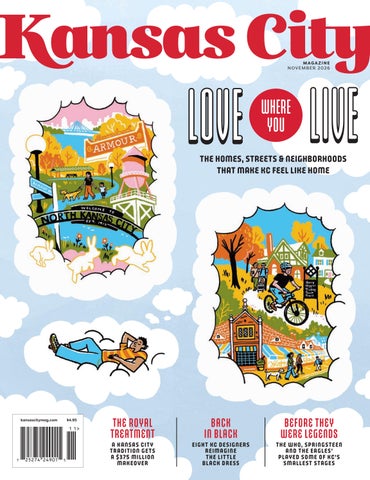
The homes, streets & neighborhoods that make KC feel like home
kansascitymag.com
$4.95
The Royal Treatment
A Kansas City tradition gets a $375 million makeover
Back in Black
Eight KC designers reimagine the little black dress
Before They Were Legends
The Who, Springsteen and the Eagles' played some of KC’s smallest stages
Big Belly Laughs Grandkid Cuddles
Pop-pop’s Movie Night
Cherish More Memories
Kansas City’s expert brain and spine care. Hidden within the intricate folds of your brain are the pathways that lead to your thoughts, memories and dreams — the very essence of your human spirit. At the AdventHealth Neuroscience Institute, our experts are dedicated to protecting those pathways. With state-of-the-art technology and groundbreaking treatments, we care for the most complex neurological conditions, so you can keep moving, keep dreaming and keep being your whole self.
Find peace of mind today. NeuroExpertsKC.com
AVAILABLE AT
20 E . LOCH LLOYD PARKWAY LOCH LLOYD $1,350,000
5512 ME ADOW L AKE STREE T RISS L AKE ME ADOWS $475,000
20104 W. 90TH STREE T WOODL ANDRESER VE $1,085,000
54 4 4 W. 129TH TERRACE CARRIAGE CROSSING $7 99,00
14105 NICKL AUS DRIVE LOCH LLOYD $1,450,000
9924 SKYVIE W L ANE FALCON VALLE Y $899,000
10308 W. 142ND STREE T E AGLE POINT $875,000
HOME
GRATITUDE STARTS AT
KRISTIN MALFER | REALTOR | CEO FOUNDING PARTNER COMPASS KC 9 13.800.1812 | MALFERKC.COM 16755 S. VILL AGE DRIVE LOCH LLOYD $915,000
AS NOVEMBER ARRIVES, OUR HEARTS AND HOMES OPEN TO FAMILY, FRIENDS, AND TRADITIONS WE HOLD DEAR. FROM CROWDED DINNER TABLES TO QUIET EVENINGS BY THE FIRE, HOME IS WHERE MOMENTS OF THANKS LIVE. WHETHER YOU’RE PREPARING TO HOST THIS SEASON OR LOOKING FOR A NEW HOME TO GATHER NEXT YEAR, WE’RE DEDICATED TO HELPING YOU FIND THE SETTING FOR THOSE MOMENTS, BECAUSE HAPPINESS LIVES AT HOME.
people.
AT MALFER & ASSOCIATES WE KNOW THAT REAL ESTATE ISN’T JUST THE PROPERTY, IT’S THE TO LEARN MORE ABOUT THESE PROPERTIES, PLEASE VISIT MALFERKC.COM.
Malfer & Associates is a team of real estate agents affiliated with Compass Realty Group, a licensed real estate broker and abides by Equal Housing Opportunity laws. All material presented herein is intended for informational purposes only. Information is compiled from sources deemed reliable but is subject to errors, omissions, changes in price, condition, sale, or withdrawal without notice. Photos may be virtually staged or digitally enhanced and may not reflect actual property conditions.
OUR MISSION
Kansas City is our beat. As the city’s definitive magazine, we bring Kansas City to life with dynamic storytelling, unforgettable photography and design that pops. We’re the metro’s trusted, modern guide—celebrating what works, questioning what doesn’t, spotlighting innovation and curating the very best in culture, food, fashion and city life.
EDITOR-IN-CHIEF
Dawnya Bartsch ART DIRECTOR
Wesley Hamilton OPERATIONS AND SOCIAL MEDIA MANAGER
Madison McMillen
ARTS AND ENTERTAINMENT EDITOR
Nina Cherry
CONTRIBUTING EDITOR
Nicole Kinning FOOD CRITIC
Tyler Shane ADVERTISING SALES
Angie Henshaw and Brett Miller GRAPHIC DESIGNER AND PRODUCTION MANAGER
Alexia Tupa Vondrachek COPY EDITOR
Kelsie Schrader WEB COORDINATOR
Madison Russell
NEWSSTAND CONSULTANT
Joe. J. Luca & Triva Bridges JK Associates, jkassoc.net WRITERS
Katie Baldwin, Nina Cherry, Shauna Gilden, David Hodes, Nicole Kinning, Ryan Reed, Ian Ritter, Tyler Shane, Jill Silva and Susie Whitfield. DESIGNERS, PHOTOGRAPHERS AND ILLUSTRATORS
Zach Bauman, Alyssa Broadus, Cydney Cherepak, Laura Morsman, Ian Simmons, Jake Wickersham and K. Wroten
SUBSCRIPTIONS
kansascitymag.com/subscribe or call (913) 469-6700 Scan here to subscribe to our newsletter and magazine.
Kansas City magazine is published monthly by KC Publishing, LLC. No part of this publication can be reprinted or reproduced without the publisher’s permission. Kansas City magazine assumes no responsibility for unsolicited materials. Kansas City magazine adheres to American Society of Magazine Editors guidelines, which requires a clear distinction between editorial content and paid advertising or marketing messages.
INQUIRIES
KC Publishing, LLC 605 W. 47th St., Suite 200 Kansas City, MO 64112 (913) 469-6700 @kansascitymag KANSASCITYMAG.COM
6
Kansas City November 2026
@kansascitymagazine
CHOCTAW CASINO
•
Five-minute shuttle to casino (24/7 )
•
Laundry facilities
•
Spacious pull-through sites
•
Pool, playground, and game room
•
Clean, hot showers
•
Free Wi-Fi
HWY 75 | DURANT, OK choctawcasinos.com/durant
46 Cover Story
LOVELY LOCALES A dozen of the hottest neighborhoods throughout the metro area
ROCK ON
HOUSE PROUD
THE NEW BLACK
Kansas City has a storied history of hosting legendary rock ‘n’ rollers in unlikely venues, from high school gyms to hippie hangouts
From charming bungalows to industrial lofts, eight home styles that have captured Kansas City’s heart
A century after Chanel, Kansas City designers give the iconic LBD a bold reboot
62
57
36
8
Kansas City November 2026
PHOTO BY IAN SIMMONS
N OV E M B E R 2 0 2 6
nov
IN THIS ISSUE
loop 15
WESTWARD EXPANSION
19
MORE THAN A GAME
The first phase of the American Royal’s new 80-acre KCK campus is complete
15
A Kansas City filmmaker follows a soccer team of young refugees—and finds a story much bigger than sports
beat 21
ALL TOGETHER NOW
Local soul band The Freedom Affair is ready to bring down the house on Thanksgiving Eve
21
28
BAH HUMBUG!
Meet the local actor taking over the lead role of Ebenezer Scrooge in KCRep’s production of A Christmas Carol 30
BACKBEAT
Latin rock band Making Movies’ new album marks a metamorphosis
current 33
COLORFUL COOKWARE
A lifestyle boutique in the East Crossroads is a one-stop shop for bold homewares 35
33
A FAMILY AFFAIR
A forthcoming documentary chronicles a family of serial killers who tyrannized the Flint Hills in the 1870s 37
SOCIAL STUDIES
Now on view at The Museum of Kansas City, eight local designers put their spin on the classic little black dress 38
COWBOY COUTURE
Sam Vasta, an Italian shoemaker who has been fascinated with the American West since he was a child, is crafting custom cowboy boots in rural Kansas 40
71
BUILT TO LAST
Inside a charming Hyde Park Victorian home dubbed “dollhouse” by its owner
savor 71
ON A ROLL
73
MODERN YET MUDDLED
A British-style pop-up is winning over Midwesterners with its sausage rolls IN EVERY ISSUE M AG A Z I N E N OV E M B E R 2026
Taking over the former Corvino space, a gluten-free upscale restaurant struggles to stand out 78
The homes, streets & neighborhoods that make KC feel like home
12 13 22 84
Editor’s Letter Up Front Calendar Surreal Estate
PERFECT DAY
With a passion for local food culture, chef Jeffrey Workman is crafting Green Dirt on Oak’s creative farm-to-table menu 77
NEAT, PLEASE
80
’CUE CARD
Holladay Distillery’s latest bourbon release is a decade in the making Local vegan Jeff Adair is advocating for more plant-based barbecue options
kansascitymag.com
$4.95
The Royal Treatment
A Kansas City tradition gets a $375 million makeover
10
Back in Black
Eight KC designers reimagine the little black dress
Before They Were Legends
The Who, Springsteen and the Eagles' played some of KC’s smallest stages
ON THE COVER:
COVER ILLUSTRATIONS BY CYDNEY CHEREPAK
Kansas City November 2026
82
NEWSFEED
The latest in KC food news
this month on kansascity mag.com
Proud Sponsor of Super Bowl LVII & LVIII Champions
Same Day Service at all Locations!
PHOTO PROVIDED BY THE SHUCKERS UNION
Prairie Village 3975 W 83rd St, 66208
only online AW, SHUCKS! A new East Crossroads oyster bar is putting a fresh spin on the art of shucking, sipping and socializing.
Brandon Hayden, a certified oyster ambassador, is now opening a raw bar in the East Crossroads. Currently, all of Kansas City’s raw oyster bars are part of a larger restaurant, like Earl’s Premier, Farina or The Parker Hollow, where Hayden currently runs the raw bar as the restaurant’s sous chef. The Shuckers Union (1739 Oak St., KCMO), however, will be just an oyster and cocktail bar. Scan here to learn more.
Leawood 13420 Roe Ave, 66209 Overland Park 7575 W 150th St, 66223 6904 W 135th St, 66223
20% Off
Dry Cleaning Code: C H AMPS20DC
Valid only when coupon is presented at drop-off. Not valid on laundry, leather, household items, wedding dresses, or alterations. Cannot be combined with other discounts. One discount per household. Expires 12/31/26.
kansascitymag.com November 2026
11
F R O M T H E E D I TO R
T
There’s No Place Like Home THERE’S SOMETHING ABOUT coming home.
Maybe it’s pulling into your driveway after a long trip, knowing exactly which floorboard creaks or where the afternoon sun falls through the windows. Maybe it’s your favorite coffee shop, the neighbors who wave or the familiar streets you’ve traveled a thousand times. It’s more than four walls and a roof. It’s a feeling. And if we’re lucky, that feeling extends well beyond our front doors. That’s what I kept thinking about as we put together this issue of Kansas City magazine. Our feature on 12 Kansas City neighborhoods is, on the surface, about places to live. But it’s really about the personalities of the places we call home. From Brookside’s leafy streets and grand old Hyde Park houses to the small-town charm of Parkville and the reinvention of North Kansas City, each neighborhood has its own story to tell. And each has fiercely loyal residents who wouldn’t dream of living anywhere else. I get it. After spending 25 years in Southern California, I moved to Kansas City. And while I was excited about a new chapter, leaving a place where you’ve spent a quarter century building a life isn’t easy. Suddenly, I needed Waze to get just about anywhere. On one of my first trips to the neighborhood grocery store, Waze sent me onto the freeway. It wasn’t until weeks later that I discovered the store was literally just a few blocks from my house. Clearly, I had some learning to do. But finding your way around is the easy part. When you leave a place you’ve called home for decades, you’re also leaving behind friends, favorite haunts, familiar routines and a whole lot of memories. Those aren’t things you can simply pack into a moving truck. I’ve since discovered that making a new home is about more than unpacking boxes. It’s learning the shortcuts (and finally ditching Waze), finding favorite restaurants, making new friends and gradually realizing that, somewhere along the way, an unfamiliar place has become your place. In a way, the American Royal is going through something similar. In this issue, writer Ian Ritter takes a look at the American Royal’s next phase. After more than a century in the West Bottoms, the Kansas City institution has pulled up stakes and moved to a sprawling new campus in KCK. That’s a lot of history to leave behind. Generations of families have made memories at the Royal, whether showing livestock, competing in barbecue or simply taking part in one of the city’s most enduring traditions. Its first World Series of Barbecue at the new location was both a milestone and a reminder that traditions don’t have to stay rooted in one place. The buildings may be new, but the people, memories and spirit of the American Royal have come along for the ride. And maybe that’s the thing about home. It isn’t necessarily one address, one building or even one neighborhood. It’s the places we love, the traditions we carry with us and, most importantly, the people who make us feel like we belong. Dawnya Bartsch, editor-in-chief dawnya@kansascitymag.com
12
Kansas City November 2026
CONTRIBUTORS
Anna Petrow Photographer and writer Anna Petrow is a Kansas City-based photographer specializing in culinary, interior and travel photography. For this issue’s home feature, Petrow returned to her photographic roots, capturing a Kansas City home on 35mm film. The project is part of her exploration of film photography, bringing a nostalgic, artful perspective to the spaces she documents. Follow her work on Instagram @annapetrow and @portraitsofaplace.
Cydney Cherepak Illustrator Cydney Cherepak is a Kansas City-based illustrator and comic artist. For this issue, she created the illustrations for our story featuring some of KC’s most loved neighborhoods. When Cherepak is not creating artwork in her studio, she’s inspiring the next generation of artists as an assistant professor of illustration at the Kansas City Art Institute. Follow Cherepak on Instagram @cydney_cherepak_art.
David Hodes Editor and writer Writer, editor and Kansas Citian David Hodes’ work has appeared in both regional and national publications. In this issue, he explores Kansas City’s place in rock music history.
UPFRONT
FEEDBACK
SAY WHAT?
TIME WARP October’s story on a local production of The Rocky Horror Show, which paid tribute to late actor Tim Curry, garnered a lot of attention. Each October for the past decade, Tony Awardwinning producer Nick Padgett directs and produces the show—and slips into his fishnets to play the leading role of Frank-N-Furter.
Going to this show has become a tradition for my wife and I. The outdoor show at The Black Box was always fun, but the weather is much nicer inside Crown Center.
“I was amazed that of all the places I could have landed, [the Flint Hills] turned out to be about as cowboy as it gets. Texans will probably argue that.” —Sam Vasta, an Italian craftsman who makes custom boots in rural Kansas
NUMBERS FROM THIS ISSUE
$8,000 The amount of money needed to purchase one of builder Napoleon W. Dible’s 1,500-square-foot Tudor Revival homes in the 1920s. PAGE 46
2011 The year KC band Making Movies opened for legendary Latin rock group Los Lobos. PAGE 30
11 The number of victims (at minimum) that were murdered in Victorianera Kansas by a family of serial killers known as the Bloody Benders.
It was my wife and I’s first show. Absolutely loved it! It was such a beautiful tribute as well!
PAGE 37
—Eligah Leek
—Lance Draper He was fabulous!!!!!! —Lindsey Kate Smith I was there this year and [it’s] my favorite theater company. My fourth Rocky Horror production and a favorite recent tradition for October. —Leon Luker
CONTACT US SHOUT OUT
KC Publishing, LLC 605 W. 47th St., Suite 200 Kansas City, MO 64112 (913) 469-6700
EMAIL editor@kansascitymag.com
Scan the QR code to check out Kansas City magazine online.
A big thank you to photographer Jake Wickersham for making a fivehour round-trip trek to the Flint Hills to capture bootmaker Sam Vasta in action. kansascitymag.com November 2026
13
loop
L EAD ING T HE CONVERSAT ION IN KA NSAS C I T Y
PHOTO BY IAN RIT TER
A Royal Reboot
Big barns, bigger ambitions and plenty of barbecue mark a new era for the American Royal and one of Kansas City’s most beloved traditions By Ian Ritter
(Continued on next page) kansascitymag.com November 2026
15
LO O P
BBQ HQ
(Continued from page 15)
ILLUSTR ATION BY WESLEY HAMILTON
AFTER MORE THAN A CENTURY in Kansas City’s West
16
Bottoms, the American Royal has a new home—and the barn doors are officially open. The first phase of the organization’s sprawling new $375 million KCK campus is open and hosted its first events in September. But perhaps its biggest test came in early October, when hundreds of competitive barbecue teams, judges and hungry spectators descended on the grounds for a full weekend of BBQ at the American Royal World Series of Barbecue. The annual barbecue competition, a KC tradition that debuted in 1980 and has grown into a nationally recognized event, was one of the new facility’s first major tests, and American Royal CEO Pat Macy was a little anxious. However, by Saturday morning, Macy was feeling considerably more relaxed than 24 hours earlier. The competition’s opening night’s festivities were, in his words, “wildly successful.” But heading into Friday, he wasn’t quite so confident. “Now, if you had asked me [how I thought the barbecue competition was going to go] at this time yesterday,” says Macy, who took the reins of the 127-year-old nonprofit at the beginning of 2026, “I would have said, ‘Let’s get through Friday night.’” The KCK facility marks a major milestone for an organization long synonymous with the West Bottoms, where it still operates Hale Arena for livestock shows. The first phase of the new 80-acre campus includes five livestock barns and nearly 400,000 square feet of exhibition and event space. Construction will continue in phases, with the full $375 million project expected to be completed in late 2028 or early 2029. For the American Royal, which hosts livestock shows, rodeos, equine competitions and educational programs promoting food and agriculture, the new campus offers room to grow. And its location near Kansas Speedway, Legends Outlets and the stadiums of Sporting Kansas City and the Kansas City Monarchs puts it in the middle of one of the metro’s busiest entertainment districts. More development is on the horizon, including the Kansas City Chiefs’ proposed $3 billion stadium, expected to open in 2031, and a Buc-ees travel center also planned for the area.
Kansas City November 2026
Macy sees opportunities in that growth. “That’s more people spending dollars in the area,” says Macy, noting that the American Royal selected its site well before those developments were announced. “It will bring different events that would commingle with our facilities and allow us to do some things in conjunction with the Chiefs during their schedule, such as concerts and trade shows.” But on this particular Saturday, barbecue was the main attraction. Inside the new barns, signage from the previous night’s sponsor parties still hung as more than 400 judges arrived to tackle the serious business of barbecue tasting. By noon, they were sampling entries in four categories: brisket, chicken, pork ribs and pork shoulder. Outside, the parking lots had transformed into a sprawling barbecue tailgate. Smokers of every shape and size, hauled in by competitors from across the country, filled the air with the unmistakable aroma of slow-cooked meat. For the World Series of Barbecue, the new location represents something more than a change of scenery. After outgrowing its original American Royal West Bottoms home in 2014, the competition has spent most of the following years at Kansas Speedway, aside from a one-time stop at Arrowhead Stadium. That arrangement meant working around NASCAR’s calendar. Now, the World Series has a permanent home—and, organizers hope, a permanent place on competitors’ calendars. Rod Gray, CEO of the Kansas City Barbeque Society, which provides the competition’s judges and judging standards, knows the event well. A competitor for 20 years, he’s enthusiastic about the new digs, particularly the additional space for judges inside the livestock barns and the ability to once again have a predictable date. For competitors who travel from across the country, knowing when the competition will be held is huge. “A lot of people in their line of work have to put in for their vacation for the first of the year,” Gray says. “Now people can go back to saying, ‘I need the first weekend in October off because I’m at the American Royal.’” After more than a century of Kansas City history, the American Royal is settling into its new home, bringing back tradition and making room for the future.
ChristmasSale
• Top quality jewelry at wholesale prices • All loose diamonds, natural and lab grown, only 20% over cost • Sale items up to 50% off
REGISTER TO WIN A $1,000 SHOPPING SPREE WHY PAY RETAIL? REMEMBER. DON’T BUY TIL YOU SEE
“THE DIAMOND GUY”
ROB ROBERTSON
“The Diamond Guy” 45 YEARS EXPERIENCE 14882 METCALF AVE. OVERLAND PARK, KS 66223
(913) 851-9999
THANK YOU FOR MAKING US OVERLAND PARK'S #1 SOURCE FOR DIAMONDS
PERSONALITIES
PHOTO BY JAKE WICKERSHAM
LO O P
Chasing the Big Screen
Filmmaker Josh Gloer talks about making Chasing Goals, a documentary following a Kansas City youth soccer team of refugees, the search for a distributor and some unexpected advice from a 9-year-old By Ian Ritter
JOSH GLOER DOESN’T NEED TO WORRY about how audiences
will respond to Chasing Goals. The documentary, which follows Global FC, a youth soccer team made up of boys from war-torn countries living in Kansas City’s Historic Northeast, packs an emotional punch. Many of the boys grew up in African refugee camps, where food was scarce, living conditions were crowded and soccer offered a rare escape. Life in Kansas City also brings challenges for them, including poverty and gun violence. “When opportunities come, you have to grasp on to them just like how you grasp onto your last breath if you
were drowning,” says Donat, 15, who is originally from Tanzania. His words were among several moments that drew audible gasps during the film’s September world premiere at the Gem Theater. But Chasing Goals isn’t all heartbreak. The film follows the team as it prepares for and competes in the USA Cup, the nation’s largest youth soccer tournament, in Minneapolis. There are thrilling moments on the field, plenty of laughs and a reminder that teenage boys, no
(continued on page 20) kansascitymag.com November 2026
19
LO O P
PERSONALITIES
(continued from page 19)
soccer with this team. I wasn’t a soccer guy. My daughter played soccer. She’s a goalkeeper.
matter where they’re from, can be universally awkward and hilarious. At one point in the film we learn that a few of the boys want Gloer’s journey to Global FC began in 2023. Moved by to return to their native countries. Even though some were the plight of Afghan refugees following the U.S. withdrawal from war zones and refugee camps, the East Side’s crime and from Afghanistan, the four-time Emmy-nominated film- gun violence frightens them. Was that an awakening? Their maker began volunteering with Jewish Vocational Services. parents were the ones who left the war zones, and the kids There, he learned about Global FC and its upcoming trip grew up in refugee camps. Some of them told me the camps to the USA Cup. Soon, he was filming the team around were great. “I loved it, and I want to go back because I just the Historic Northeast and at walked with my friends and we practices at East High School. would just walk for hours and A Kansas City native and hours.” I was silent. We actually Liberty resident, Gloer, 47, dubbed my voice in because I spent 15 years working in the was shocked that anyone would Los Angeles film and televisay anything about wanting to sion industry before returning go home, to the point where I home. His industry connections was like: “You would rather go helped bring some major playback and eat once a day than ers aboard, including comedian live here?” And he said, “Yeah.” Trevor Noah’s production comMy wife didn’t want me to All the boys loved it. It pany, the Kansas City Chiefs’ keep doing this because we changed my life and Foolish Club Studios and could hear so much violence award-winning creative studio happening around us during career in a way that I did Wavelength. practices. But for some reason, not expect, and all I cared Despite that star power—and this field that we practiced on about was whether they a promotional boost during was this little oasis where we Kansas City’s World Cup feswould like it.” never even saw the people. But a tivities—Gloer and his team are block away, you could hear peostill searching for a distributor ple shooting at each other. And to bring Chasing Goals to theI would drive the kids home out aters and streaming platforms. As it turns out, making a of the oasis and there’d be people in the middle of the street, great film is only half the battle. and you’d have to stop and kind of hope they don’t hassle you. For now, audiences can watch an extended trailer at chasinggoalsfilm.com. You took months off from your commercially funded work We caught up with Gloer between assignments for the to film this. How different was it from your paying gigs? I History Channel to talk about making the film, the boys was doing tons of true crime. I had this moment when my who inspired it and what comes next. daughter walked in and I had to minimize my monitors, and I’ve got my script that I don’t even want her to read, and Is it fair to say you’ve made an unintentional sports film? For I realized I couldn’t show her what I was doing. I started me, it was about finding a completely overlooked subject, talking to her, and she was probably 9 at the time. I said, “I and we used sports as a hanger to put that on. I started don’t really like this.” And she just immediately says, “Well, volunteering because of some anger that I started har- why don’t you do something you like?” And I [thought], boring for people being very anti-refugee. And that’s not “That’s great. Why didn’t I think of this?” cool. I truly believe we’re all the same, and you can’t help where you’re born or how you’re born. The real motivation You obviously want as many people to see the film as was showing them. There are people here you don’t know possible. Are you impatient with the process of finding an about, who you can give your old soccer cleats to, and it audience? It was an attempt to do something that I actually would make their year. I worked with the resettlement wanted to do, and it was well worth it. We don’t have distriagencies, setting up houses. I used to cover the front desk, bution yet and are working on it. We have powerful entities and I saw kids translating for parents who knew no English behind us, so I’m not concerned about it. We watched it as and people who came in to only get three little stacks of friends and family before the premiere, on that giant screen diapers a month or something. I’m trying to help these at the Current’s stadium, and my daughter leaned over and people without speaking any of their languages. I don’t says, “This is awesome.” And I [thought], “Boom! Totally know what I’m doing and realize: This is something my worth it.” And all the boys loved it. It changed my life and daughter should see. Her dad’s struggling to try to talk to career in a way that I did not expect, and all I cared about these people who are just people trying to make it and are was whether they would like it. I want it to be somewhere literally needing everything. Someone suggested we go play where they can get it for free and show their friends.
20 Kansas City November 2026
PHOTO PROVIDED BY THE FREEDOM AFFAIR
W H E R E YO U WA N T TO B E I N N O V E M B E R
Looking for Thanksgiving Eve Plans? Dance the night away with The Freedom Affair By Nina Cherry FOR YEARS, I SPENT THE NIGHT BEFORE THANKSGIVING stationed at the kitchen
island—slicing, dicing and crimping pie crusts alongside my mom. Now, I have a new tradition: dancing the night away at The Ship. For the fourth year, local soul band The Freedom Affair will headline this West Bottoms venue on Thanksgiving Eve. Fronted by
singers Seyko Groves, Paula Saunders and blues, rock ‘n’ roll, jazz and more. Shon Ruffin, the nine-piece outfit delivers There’s definitely no shortage of things to messages of love, unity and justice with do Thanksgiving Eve. It’s historically one of tight, three-part harmonies, a screaming the busiest nights of the year for bars (a close Hammond B-3 organ and funky rival to New Year’s Eve), but I know horn lines. where I’ll be: at The Ship sipping a GO: Formed by musicians of varydraught beer and listening to one The Freedom Affair. ing backgrounds, the band is a of the best bands on KC’s music November 25. 8 pm. tantalizing cocktail of gospel, scene. See you there. The Ship.
↓
kansascitymag.com November 2026
21
nov B E AT
W H AT YOU WANT TO DO TH I S MO NTH BY N IN A CH ERRY
3
5
The Jonas Brothers rose to meteoric fame in 2008 after starring in Disney Channel movie Camp Rock alongside Demi Lovato. Although the group split in 2013 to focus on their individual careers, the family band got back together in 2019, and they’ve continued to mature and evolve alongside their millennial fanbase. On the The Burning Up Tour All Over Again, the group weaves together some of their biggest hits with new material. Franklin Jonas, the youngest of the brothers, joins the band’s latest iteration. November 3.
This all-ages book fair celebrates storytelling and literacy with drinks, food, live music and, of course, plenty of books. A collaboration with Rainy Day Books, the event supports Lead to Read KC, a nonprofit organization that supports young readers through mentorship and community. November 5. 3 pm.
7:30 pm. T-Mobile Center.
In 2017, genre-bending band Tank and the Bangas broke through to a national audience after unanimously winning NPR’s annual Tiny Desk Contest. Led by singer Tarriona “Tank” Ball, the group weaves together hip-hop, funk and R&B with their unmistakable New Orleans flair. The band stops in KC in support of their latest album, The Last Balloon, joined by Zeus and Ariel J.
Jonas Brothers
4–15
KC Book Fair
Park 39.
5
Tank and the Bangas
6
Karrin Allyson With the University of Nebraska Omaha Jazz Orchestra Jazz singer and pianist Karrin Allyson is no stranger to Kansas City. The musician was born in central Kansas and raised in Omaha, and she cut her teeth in KC’s jazz scene in the ’80s. Now residing in New York, the fivetime Grammy nominee returns to the heartland, performing alongside her alma mater’s jazz orchestra in the city that helped shape her career. November 6. 7:30 pm. Gem Theater.
6&7
7
Troost United Fest Local nonprofit Reconciliation Services hosts this free familyfriendly festival. At Troost United Fest, enjoy a lineup of live music headlined by pop artist AY Young, food from Thelma’s Kitchen, giveaways, hands-on activities and more. Plus, browse the historical display that chronicles 200 years of the Troost corridor. November 7. 11 am. Reconciliation Services.
7
Compositions and Reflections Featuring Carolina Calvache
Times vary. Ruby Room at Crown
Colombian-American composer and pianist Carolina Calvache has long been a gem of NYC’s music scene. Last year, she was named assistant professor at Warrensburg’s University of Central Missouri and, much to listeners’ delight,she’s enmeshed herself in KC’s music community. Flawlessly weaving together jazz, classical and folkloric music of Latin America, Calvache delivers a world-class performance alongside musicians from KC chamber music group Ensemble Iberica. November 7.
Center.
7 pm. 1900 Building.
Free Fallin’: The Music of Tom Petty & Bob Dylan Music Theater Heritage celebrates American folk and rock with a musical review spanning the vast discographies of Tom Petty and Bob Dylan. The show features poetic hits like Petty’s “Learning to Fly” and Dylan’s “The Times They Are A-Changin’.” November 4–15.
22 Kansas City November 2026
November 5. 8 pm. The Truman.
Garth Brooks Garth Brooks has sold out T-Mobile Center (formerly the Sprint Center) a whopping 16 times and is gearing up to do it again on the Blame It All On My Roots Tour. Best known for ’90s hits like “Friends in Low Places” and “The Thunder Rolls,” the multi-platinum country legend will perform fan favorites from his decades-long career. November 6 & 7. 8 pm. T-Mobile Center.
C A L E N DA R
7
Milestones: The Music of Miles Davis and John Coltrane This year marks the 100th birthday of two jazz giants: trumpeter Miles Davis and saxophonist John Coltrane. Each with their own distinct styles, both pioneers changed the genre forever with modal jazz albums like Davis’ Birth of the Cool and Coltrane’s A Love Supreme. Featuring selections from those records and beyond, the Kansas City Jazz Orchestra premieres tailor-made arrangements for this tribute performance. November 7. 7 pm. Gem Theater.
7
Making Movies Making Movies’ frontman Enrique Chi has one overarching goal with his music: to unite audiences. Braiding together traditions from Chi’s native Panama with those of his upbringing in Kansas City, Making Movies celebrates its latest release, Una Vida, a project three years in the making that includes singles like “This Is a Photograph (bajo el sol de Panamá)” and “Déjala.” November 7. 7:30 pm.
PHOTO PROVIDED BY LYRIC OPER A OF KC
Folly Theater.
11
Adam Grant Presents Vibe Rainy Day Books brings New York Times bestselling author Adam Grant to KC to present his latest book, Vibe. A manifesto on closeness and connection, Grant examines loneliness in the digital age and how to combat it. November 11. 7 pm. Unity Temple on the Plaza.
7, 13 & 15
Lyric Opera of Kansas City Presents The Marriage of Figaro Dress to the nines and head to Wolfgang Amadeus Mozart’s classic comic opera, The Marriage of Figaro. Set in Seville, Spain, this four-act spectacle—which takes place over the course of one eventful day of romantic schemes—follows servants Figaro and Susanna as their employer tries to thwart their plans to marry. As is the case with all Lyric Opera of Kansas City productions, the detailed set design is built entirely in-house. November 7, 13 & 15. Times vary. Muriel Kauffman Theatre.
12
Silent Concert: Cosmic Wonder The Kemper Museum’s silent concert series pairs a current exhibition with a curated set of electronic music. This free upcoming installation is prompted by Barbara Takenaga’s career retrospective Awestruck, a collection of the artist’s abstract dot paintings and print work from the past 25 years. Grab a set of
headphones, groove to music from DJ Joe, also known as The Mad Scientist, and roam the museum. November 12. 6 pm. Kemper Museum of Contemporary Art.
12–14
to appear on the program well into adulthood. That served as the launchpad for gueststar roles in hits like New Girl and Modern Family—and a career in stand-up. After a successful run on America’s Got Talent, Rhodes brings her observational comedy to KC. November 12–14. Times vary. The Comedy Club of Kansas City.
Erica Rhodes
Erica Rhodes landed her first professional role at age 10 on the radio variety show A Prairie Home Companion, continuing kansascitymag.com November 2026
23
Holiday Kickoff TREE LIGHTING CEREMONY AT SUMMIT FAIR THURSDAY, NOVEMBER 19 | 5:30 – 7:30 PM 840 NW BLUE PKWY, LEE'S SUMMIT, MO
HOLIDAY FESTIVITIES, HOT COCOA & PHOTO OPPS
HOLIDAY SPECIALS & GIVEAWAYS
TREE LIGHTING AT 6:00 PM WITH SPECIAL GUEST APPEARANCES FROM MAYOR BETO LOPEZ & MORE
FOLLOW @SUMMITFAIR FOR MORE INFO!
B E AT
14
Fables & Fairy Tales At this all-ages comedy show, members of The Bird Comedy Theater Players improvise a fairy tale-inspired musical. Recommendations from audience members shape the show as the improv troupe crafts “songs that have never been heard before and will never be heard again.” November 14. 6 pm. The Bird Comedy Theater.
14
Maletas: An Immigrant Story When trumpeter Alberto Racanati was 21, he packed his bags and left his hometown of Bari, Italy, in pursuit of his dream. He wasn’t sure what was in store but felt compelled to go. Now, the KC-based artist presents a one-night-only production, Maletas, which is the Spanish word for suitcases. The original multimedia show—inspired by his journey and those of many other immigrants—features poetry, visual design and music. November 14. 7 pm. Greenwood Social Hall.
14
Blind Boys of Alabama: ‘Songs in the Key of Life’ The Blind Boys of Alabama— originally formed in 1939 by students at the Alabama Institute for Deaf and Blind— may be a legacy band now, but the group continues to stay true to its gospel roots almost nine decades later. This fall, the legendary group hits the road to celebrate the 50th anniversary of Stevie Wonder’s iconic album, Songs in the Key of Life. Expect tight harmonies and jubilant renditions of
C A L E N DA R
timeless hits like “I Wish” and “Sir Duke.” November 14. 7:30 pm. Yardley Hall.
14
The Music of Studio Ghibli If you grew up enamored with Studio Ghibli films like Spirited Away and Kiki’s Delivery Service, Hayao Miyazaki’s hand-drawn, realist animations are likely top of mind. But the music, scored by Joe Hisaishi, is equally integral to the animation studio’s whimsical vibe. The Kansas City Symphony pays tribute to Hisaishi’s sweeping orchestral arrangements with this enchanting, nostalgic evening. November 14. 8 pm. Helzberg Hall.
20–22
The Kansas City Symphony Presents Brahms’ German Requiem With a runtime of approximately 70 minutes, Johannes Brahms’ German Requiem is a tour de force. Scored for orchestra and a large chorus with soloists, the seven-movement masterwork was composed over the course of 11 years as Brahms grappled with the loss of his mother and devoted friend Robert Schumann. The Kansas City Symphony performs Brahms’ magnum opus—which was written for those mourning rather than the departed— under the direction of music director Matthias Pintscher and newly hired chorus director Betsy Burleigh. November 20–22. Times vary. Helzberg Hall.
19–Jan. 3, 2027
Festival of Lights
Enjoy the beauty of Powell Gardens amid a dazzling lights display. At Festival of Lights, an annual tradition that made its debut in 2017, take in the botanical gardens’ fresh, crisp air while strolling through the mile-long lighted path. Beyond the display, attendees can enjoy seasonal fare, take a holiday train ride and browse a marketplace featuring local goods and poinsettias grown by the garden. November 19–January 3, 2027. Times vary. Powell Gardens.
21
21
Worried about the literacy crisis? Buy your loved ones a book this holiday season. Hosted by the Mid-Continent Public Library’s Story Center, the Local Author Fair brings together 50 authors from the KC metro. With titles spanning from whimsical children’s books to adult mystery novels, the event—now in its 13th year—offers attendees a chance to buy directly from the authors. November 21. 1 pm.
Musical theater icon Bernadette Peters has been in show biz nearly all her life—since she was 3 years old. Seven decades later, Peters’ extensive list of Broadway credits include originating Into the Woods’ The Witch and a Tony Awardwinning portrayal of the titular role in Annie Get Your Gun (just to name a couple). But with prominent roles in box office hits like The Longest Yard and Silent Movie, her legacy spans far beyond the stage. As part of the Folly Theater’s annual fundraiser, Peters comes to KC for an evening of song.
Local Author Fair
Bernadette Peters
Mid-Continent Public Library Woodneath Library Center.
21
November 21. 8 pm. Folly Theater.
TAKE3: Where Rock Meets Bach TAKE3, a performance group that has been likened to a miniature Trans-Siberian Orchestra, is known for its highenergy string arrangements. Led by singer and violinist Lindsay Deutsch, whose playing can be heard on TV shows like The Witcher and All About Pam, the ensemble performs classics in a variety of genres, from Ben E. King’s “Stand By Me” to AC/ DC’s “Thunderstuck.” November 21. 7:30 pm. Yardley Hall.
21 & 22 Holiday Swing at Union Station
Curated by indie craft fair Strawberry Swing, this openair, European-style market returns to Union Station for its 16th year. Everything from unique ceramics and holiday treats to cozy crocheted items and ornaments can be had, so get your holiday shopping done with local handmade goods. November 21 & 22. 10 am. Union Station.
kansascitymag.com November 2026
25
YOUR KC HOLIDAY HEADQUARTERS From gift-worthy finds and festive dining to everyday favorites. Find what you’re looking for and a little more at Town Center.
IT‘S ALL HERE IN TOWN CENTER:
B E AT
C A L E N DA R
28–Dec. 24
The Nutcracker The Kansas City Ballet’s annual production of The Nutcracker is back. Although the classic ballet made its debut in 1892, this local production has been reimagined with choreography from Artistic Director Devon Carney. From the “Dance of the Sugar Plum Fairy” to “Waltz of the Flowers,” Peter Tchaikovsky’s magical score is brought to life by musicians of the Kansas City Symphony. November 28–December 24. Times vary. Muriel Kauffman Theatre.
21–Dec. 24 A Christmas Carol
This timeless holiday classic returns to the KCRep stage. A stage adaptation of Charles Dickens’ 19th-century novella, A Christmas Carol tells the tale of the wealthy Ebenezer Scrooge as he receives a series of haunting visits from his former business partner and the Ghosts of Christmas Past, Present and Future. Following the retirement of KCRep’s longtime Scrooge actor Gary Neal Johnson, Mark Robbins steps into the role of the cranky miser. November 21–December 24. Times
PHOTO PROVIDED BY KC BALLET
vary. Spencer Theatre.
22
Brandi Carlile: Burn the Setlist (The All Request Tour) Almost 20 years ago, songstress Brandi Carlile released her breakthrough rock ballad, “The Story.” Now, with
11 Grammy Awards and nine studio albums under her belt, Carlile isn’t drafting any setlists for her latest tour. Instead, fans will decide, in the moment, what the artist performs that night. A stripped-back and immersive evening, Carlile appears alongside her longtime collaborators Phil and Tim Hanseroth. November 22. 8 pm. Uptown Theater.
27
Plaza Lighting Ceremony It’s been 101 years since Charles “Pete” Pitrat, a maintenance supervisor for the Nichols Company, hung a small string of lights on the Plaza’s Mill Creek Building. By 1929, the first official lighting ceremony was held on Thanksgiving, outlining five Spanish-inspired buildings. The display has grown drastically over the past century, now featuring over 200,000 lights (approximately
80 miles’ worth) to illuminate 15 city blocks. After polishing off a slice of pie, head to this quintessential KC tradition— although the ceremony kicks off at 6 pm with live entertainment, the switch officially flips at 7:55 pm and is followed by a fireworks display. November 27. 6 pm. Country Club Plaza.
27–Dec. 20
Hallmark Christmas Experience The Hallmark Christmas Experience returns for its third year. Held across four weekends, the free event transforms Crown Center into a holiday village with dazzling light displays, an artisan market, appearances from Hallmark stars, festive treats and more. Tie it in with a visit to the shopping center’s outdoor ice terrace, a KC staple (and the city’s largest rink) since 1973.
28
Danielle Nicole Blues rocker Danielle Nicole has been captivating KC audiences since she was a teenager, delivering growling vocals and holding down bass lines in family band Trampled Under Foot. But in 2015, after that band had dissolved, a solo career seemed like the natural next step. By 2018, her sophomore studio album, Cry No More, earned the musician a Grammy nomination and a spot atop the Billboard Blues Chart. Now, amid a busy touring schedule, Nicole performs in her hometown with singer and guitarist Brandon Miller. November 28. 7 pm. Uptown Theater.
November 27–December 20. Weekends only. Crown Center. kansascitymag.com November 2026
27
PHOTO BY DON IPOCK
B E AT
28 Kansas City November 2026
I N T E RV I E W
I take the role, work on it, try to do the best I can and, once I’ve completed the assignment, I move on to something else.
New Scrooge on the Block Mark Robbins talks about his new role helming KC Rep’s holiday production By Ryan Reed THIS HOLIDAY SEASON, MARK ROBBINS TAKES OVER
the lead role of Ebenezer Scrooge from Gary Neal Johnson in the KCRep’s long-running production of A Christmas Carol. Robbins has performed various roles in the annual production for more than two decades. Last season, he worked as an understudy to Johnson and performed the role of Scrooge for the theater company’s student performances. Robbins is a founding member of the Kansas City Actors Theatre and has an impressive list of acting and directing credits to his name. You’ve had a long career with many roles. Where does Scrooge fall among them? It’s a bit of a milestone in
my own estimation. I’ve been around this production for pretty much all of my professional life, and it has played a huge part in my life and my work. Of course, one imagines oneself eventually moving up the ranks and playing Scrooge someday, but I didn’t really invest a lot of hope in that. I have never enjoyed playing a role more in my whole career. How do you replicate the novelty of reacting over the course of so many productions? I’m not very worried about
that. It’s still a pretty new experience to me, and I look forward to it so much. Now, when we get into the thick of it—10-show weeks, six-show weekends—my body might betray me. My exhaustion level might come into play and make it harder to enjoy it as much as I have.
How does being a director help you when you’re on stage as an actor being directed? It further hones my sense of
the structure of a story, what works and what doesn’t. That is very handy to have as an actor. What do you think is the enduring appeal of A Christmas Carol for Kansas City? [A Christmas Carol] is a magnificent
story that is good for the mind and for the soul. It inspires you, touches you and makes you consider the world anew and your role in it. And also, it’s Christmas! It’s perfect for the time of year, being a story of redemption and generosity of spirit. It brings people together in a real way. What does it feel like to take the helm of such a beloved holiday tradition? I’ve always fancied myself kind of a blue-collar
actor. I take the role, work on it, try to do the best I can and, once I’ve completed the assignment, I move on to something else. I try not to engage my ego any more than absolutely necessary. This role brings a sense of responsibility to do a really good job and make every single performance meaningful. There is also the awareness that if you blow it, it would be terrible. So there are equal parts dread, fear, excitement, and acceptance, which is quite a panoply of emotions that come to the surface just thinking about doing the play. Is there anything you feel you’ll miss by being front and center in A Christmas Carol? My free time. When Scrooge
goes on stage at the top of the show, he stays there. He never leaves because it’s his story.
After all these years, does your body just remember where to be in the play? Muscle memory is my friend in this
Is there a specific scene or moment that speaks to you the most? For a variety of reasons it’s the “Candlelight Carol.”
show. It gives me a level of confidence that I’m not going to lose my place or suddenly be at sea about what comes next. With that sense of familiarity and confidence in the story and how it progresses, I can actually relax a little more into the moment.
There’s a moment in the middle of the play where we all sing a hymn. It’s a moment when the music is incredibly moving, the situation is moving, and Scrooge, at the center of it, is just gobsmacked. You can see his mind and his soul opening up in that moment, supported by the music, and it’s all directed right out to the audience. It’s a profoundly communal moment in the course of the play and the show. It gets me every single time.
How did you first get the acting bug? Oh gosh. High school
drama club. Applause. That’s really all it took.
kansascitymag.com November 2026
29
30 Kansas City November 2026
PHOTOS PROVIDED BY MAKING MOVIES
B E AT
B AC K B E AT
One Life
On Una Vida, Enrique Chi’s band Making Movies reckons with change, growth and loss By Nina Cherry
ENRIQUE CHI REMEMBERS THE FIRST TIME his band, Making Movies, opened
for a national act. At the time, he thought it would be his big break. But it wasn’t. “I learned a hard lesson: When bands are on tour, the last thing they’re worried about is the local band that’s opening their show— that’s their time to go get dinner, shower or relax,” Chi says. “That was a humbling realization.” So in 2011, when the Kansas City group was tapped to open for renowned Latin rock band Los Lobos at Knuckleheads, Chi says he had already learned to “taper his expectations.” From the tour bus, Los Lobos member Steve Berlin heard something—what he thought was just a record playing over the sound system—that caught his attention. He was surprised to find that the unique blend of psychedelic rock and Afro-Caribbean rhythms was coming from the local opening act. By the end of the night, after Making Movies had jammed on Los Lobos’ encore, Berlin extended an offer to produce the KC band’s album. With no other producers in his phone book, Chi eagerly took Berlin up on his offer. “That night really changed my life,” Chi says. In the 15 years since, Making Movies has continued to refine its signature sound, weaving poetic lyricism and distorted, reverberant guitar effects with energetic rhythms like cumbia and son cubano, as well as folkloric instruments from Chi’s native
Panama, like the mejorana (a hand-crafted group but still contribute prominently in five-string instrument akin to a guitar). With the new album. “We had to make some difa lengthy list of accomplishments, the group ficult decisions as a tribe,” Chi says. “What has released a plethora of music, been feadoes it mean to move forward? All of these tured on NPR’s Tiny Desk Concert series transitions, this growth and change—it really and garnered a Latin Grammy nomination. reframed the record.” Late last month, Making Movies released That shift opened a new window. For the its fifth studio album, Una Vida, following first time in Making Movies’ history, Chi their 2022 release XOPA. On November 7, is credited as a producer on the record. while on a tour that reaches from Panama Berlin, however, is still an integral part of to Canada, the psychedelic rock group will the group’s creative process, credited as a celebrate its new record with local fans at producer on “Déjala,” a song that Chi says the Folly Theater. For the homecoming peralmost didn’t make it to the finish line. “He’s formance, the band will share the stage with a spiritual band member,” Chi says of Berlin. Mariachi Los Reales de Kansas City and local Una Vida also took shape in the wake dance troupe El Grupo Folklorico Atotonilco. of Chi’s grandparents’ deaths, prompting Like salsa, a genre born in New York City several trips to Panama. There, he spent dance halls that blends Afro-Caribbean time in his hometown and road-tripped rhythms with jazz, Making Movies’ style throughout the small Central American fuses the traditions of Chi’s homeland with country, collaborating with folkloric musithose of his upbringing in the United States. cians like percussionist Milagros Blades and Born in Santiago, Panama, the musician was Chi’s mejorana teacher José Augusto Broce raised in Kansas City. Although he isn’t MexBultrón. Both appear on the album. While ican-American, his mother previously lived looking through family photos on his grandin Veracruz, and Chi grew up immersed in father’s front porch, Chi got the idea for the KC’s Chicano community. album’s lead single: a bilingual reimagining Una Vida, which translates to “one life,” of KC musician Kevin Morby’s “This Is a is a labor of love three years in the making Photograph.” and marks a change—in more “It was like closing a chapter than one way—for the group. Two of time in Santiago, where my longtime band members—percusfamily’s roots on both sides come GO: Making Movies sionist Juan-Carlos Chaurand and from—I saw [Panama] and myself presents Una Vida. Enrique’s brother Diego Chi— in a different light,” Chi says. “It November 7. 7:30 pm. have taken a step back from the Folly Theater. was an awakening.”
↓
kansascitymag.com November 2026
31
CURAT ING A BE AU T I FU L L I FE
PHOTO BY ALYSSA BROADUS
Quirky Kitchenware
This boutique in the East Crossroads is a one-stop shop for unique gifts By Nina Cherry
(Continued on next page)
kansascitymag.com November 2026
33
CURRENT
ECLECTIC COLLECTION
(Continued from page 35) W I T H T H E H O L I DAY S E AS O N QU I C K LY APPROACHING, it’s time to start brainstorm-
PHOTOS BY ALYSSA BROADUS
ing gift ideas for the person who seemingly has everything, and Kansas City magazine has a few suggestions. What about a pedestal platter with pink glassblown prawns? A trivet shaped like a tomato vine or coupe glasses dotted with tiny multicolored embellishments akin to pom-poms? Duet, an East Crossroads boutique, specializes in quirky pieces like these. At the eclectic shop, you’ll find kitchenware from labels like Australian glassware designer Maison Balzac, French-American artist Sophie Lou Jacobsen and NYC’s Fredericks and Mae, a company that manufactures colorful cutting boards out of recycled materials. “I like to buy things that feel special, things you can’t get everywhere, things that feel like they could be used for a ceremony,” says owner Sasha Santillan. “Beautiful servingware makes me happy.” A one-stop shop for unique gifts, the lifestyle boutique also stocks a plethora of self-care products, bedding, funky hair clips, bold stationary and beyond. Above all, Santillan says she’s passionate about promoting artists, and her philosophy shines through in the boutique’s artfully curated collection. “I love and believe in the artists and designers that I have in my store,” she says. Browse Duet’s collection in-person at 517 E. 18th St., KCMO or online at shop-duet.com.
34 Kansas City November 2026
CURRENT
KANSAS KILLERS
Chris Kahler as Pa Bender
Another Kind of Little House on the Prairie Murder on the plains: the Bloody Benders By Susie Whitfield
PHOTO PROVIDED BY NICHOL AS NIC ASTRO
THE VICTORIAN AGE IS OFTEN SEEN as a
rather quaint time, with its starched collars, tight corsets and rigid etiquette—but there was also the wild, lawless frontier side. In the 1870s, a family of serial killers known as the Bloody Benders brutally murdered at least 11 or 12 and possibly as many as 22 people near Cherryvale, Kansas. They were never caught. Author and director Nicholas Nicastro, who wrote about the Benders in his true crime novel, Hell’s Half-Acre, is currently producing a full-length movie about the notorious family. “The tagline for the movie is ‘Another Kind of Little House on the Prairie,’” he says. Nicastro, who is from Virgina, began filming in the Flint Hills near Cottonwood Falls, Kansas, in September and has since gone home. “We’ve completed 65 to 70% of the movie,” he says. Nicastro will return to the Flint Hills as time and weather permit to finish. “Our hope is that we will be finished by November of 2027. Fall is always the optimal time to release a horror film.” Nicastro produced a short film about the Benders called Hell’s Half-Acre: Sojourn in 2025, based on his novel of the same name. That year, the film won Best Indie Short at the LA Indie Shorts Festival, Best Narrative at the Toronto Indie Shorts, an Award of Merit at the IndieFEST Film Awards and
the UK’s Freewheeling Film Award for Best Actress. It has also been selected for Panic Fest 2026, a prominent horror-themed festival. Nicastro finds murderers such as the Benders fascinating because their disappearance is mysterious. “I really like stories such as theirs that are open-ended,” Nicastro says, “They give me the latitude to create endings that are historically plausible and also intriguing. No one knows what happened to them, but they tend to live on in peoples’ imaginations.” In 2010, Nicastro wrote a historical fiction book about Jack the Ripper, another serial killer who vanished into history. In Nicastro’s book, The Passion of the Ripper, he examines not only the killer’s psychology but also the societal dysfunction of the 1880s. In the turbulent aftermath of the Civil War, violence and superstition in rural Kansas were common. The Benders, like Jack the Ripper, killed people and were never caught, possibly because their cabin was 8 miles away from Cherryvale, the nearest town. “I’ve always been interested in isolated families and their dynamics,” Nicastro says. Nicastro theorizes that the Benders may not have been an actual family at all. The origins of the group, who may have come from Germany, are uncertain, as are their relationships to each other. John Bender and
Almira Bender, who may have been married, spoke little English and seldom interacted with the community. Their possible son, John Jr., seemed friendly and spoke English with a German accent. The “family” also included a young woman named Kate, who could have either been a sister or a wife to John Jr., or no relative at all. Kate, who advertised herself as a psychic and gave seances, seems to have had a charismatic personality. “The Bender case is compelling not only in its depravity but also in its female focus,” Nicastro says. “This is one of only a few cases of serial murder with a woman at its center.” Nicastro chose to film the majority of the movie in the Flint Hills. “I wanted to find a setting that resembled the prairie of the 1870s,” Nicastro says. “The Benders’ homestead near Cherryvale, Kansas, is now a farmer’s field. I stood there and looked at it, realizing that the land had changed significantly from when the Benders lived there. “Our crew built the exterior of the Benders’ cabin on a ranch near Cottonwood Falls, Kansas,” Nicastro continues. “The nearby Tallgrass Prairie Preserve has a lovely schoolhouse that I’ve used as the combination schoolhouse/church like the one in the Benders’ community at the time. We (Continued on next page) kansascitymag.com November 2026
35
KANSAS KILLERS
(Continued from page 35) had previously finished filming the cabin’s interior scenes on my property in Virginia.” Major casting has been completed, Nicastro says. “I am excited to be working with Grainger Hines and Bill Moseley.” Hines has starred in movies such as Lincoln and The Ballad of Buster Scruggs as well as in television series such as True Blood, Hell on Wheels and The Knick. Moseley is well known in the horror film community for such roles as Chop Top in The Texas Chainsaw Massacre Part 2, as Otis B. Driftwood in House of 1000 Corpses and its sequel The Devil’s Rejects, and as Possum in the HBO television series Carnivale. The movie includes information about the Benders based on public records, Nicastro says. In 1870, the Bender family settled on 160 acres of land and built a cabin near Cherryvale along the Great Osage Trail that led from Franklin, Missouri, westward into southeastern Kansas. According to Library of Congress records, the Osage Trail “was an easy place to disappear” because much of Kansas was still sparsely settled. The Benders’ cabin was divided by a canvas wagon cover into a front room that served as a dry goods store and kitchen and a small back room that served as their living quarters. Advertisements told travelers on the trail they could have meals with the Benders and spend the night. The Benders murdered at least 11 of those travelers. “Obviously, one motive for their crimes was robbery,” Nicastro says. “Also, when the cabin was ransacked for souvenirs, there were supernatural markings and carvings on the walls. It is possible that there were occult functions there. Some people may believe that the Benders were devil worshippers, but the use of charms and incantations was very popular at the time. There were rumors that cows were being milked from a distance, that guns wouldn’t shoot straight, that clocks wouldn’t keep time. There was a strong belief in the supernatural in the community.” According to a Library of Congress Blog, several high-profile disappearances led to the discovery of the Benders’ crimes. In 1873, George Longcor, who was traveling with his young daughter, disappeared somewhere along the Great Osage Trail. His friend Dr. William York decided to travel the same route to find out what happened to the Longcor family. Then Dr. York disappeared too. Dr. York’s brother, Col. Alexander M. York, a Kansas state senator, searched along
36 Kansas City November 2026
JoHannah James as Kate Bender
the trail but could find no evidence that front pages in 1880 when two people conhis brother had gone any farther than the fessed to the crimes, but they were found to Benders’ cabin. Col. York then hired Osage be imposters. More sensational news items Township Deputy Sheriff Leroy Dick and regarding the Benders appeared. A Pennsyldetective Thomas Beers to investigate. vania newspaper claimed that the Benders According to a May 1873 had been executed in 1873. Emporia News article, Anonymous letter writers when these men went to claimed to have witnessed A Killer Collection the homestead, they found the execution. The Cherryvale Historical it abandoned, but they saw In 1889, two women Museum displays a collection of “a queer depression in the in Niles, Michigan, were artifacts found at the Benders’ soil and, suspecting somearrested and accused of cabin that includes three thing wrong, dug down.” being the Bender women. hammers believed to have been They found William Charges against them were used in their crimes. York’s body in a shallow dismissed when they were The Kansas Museum of History grave. Soon, 10 other vicproved to have been living in Topeka has a knife with tims were discovered on in Michigan at the time of reddish-brown stains that is the property. Evidence the murders. associated with the murders suggested that the Benders’ Laura Ingalls Wilder’s and a sign advertising the victims would be seated at book Little House on the Benders’ cabin as an inn. the kitchen table in a chair Prairie recounts her life in A historical marker telling the in front of the canvas room a cabin close to Indepenstory of “The Bloody Benders” divider. The Bender men dence, Kansas, which is 11 was once placed close to the would be hiding behind miles from Cherryvale. In junction of U.S Route 400 and the canvas with hammers 1937, she gave a lecture in 169 north of Cherryvale; and then suddenly attack, Detroit, telling her audiit has since been bludgeoning their victims. ence that her father had permanently removed. The Bender women would been part of a group of cut the victims’ throats and vigilantes that had hunted dump the bodies into the the Benders. She also said basement through a trap that he had told her “they door under the table. The Benders then will never be found.” However, an article in would wait to sell the victims’ valuables the Christian Science Monitor states that and explain them away as “traded for dry Wilder’s family had left their cabin by 1871. goods.” Although the Benders were eventuArcheological research students from the ally suspected in the disappearance of 22 University of Kansas have done field studies people, no other bodies were ever found. of the Bender homestead, finding broken News of the gruesome nature of their glass, pieces of china, wagon parts and other crimes drew crowds; the Benders’ cabin items that were probably used to build the was torn apart by souvenir hunters who cabin. They did not find any graves. The site even took the bricks that lined the basement. is now owned by Bob Miller, who encouraged Senator York offered a $1,000 reward for the investigation. the Benders’ arrest. Rumors of their whereWhat happened to the Benders? Nicastro abouts ran wild: The Benders had fled to says that they might have split up, they might Texas, to Missouri, to Oklahoma. No one have been hung by vigilantes, but that “the ever claimed the reward. movie will have a very plausible, very excitThe Benders made the Chicago Tribune’s ing ending to the Bender story,” he says.
PHOTO PROVIDED BY NICHOL AS NIC ASTRO
CURRENT
CURRENT
SOCIAL STUDIES
A Little Black Magic
Eight Kansas City designers put a bold new spin on fashion’s most enduring wardrobe staple By Shauna Gilden
ion’s most iconic wardrobe staple a little hometown attitude. From daring microminis to deconstructed leather creations and extravagant gowns, eight local designers have put their own spin on the Little Black Dress—proving that even after 100 years, this fashion classic still has a few surprises up its sleeve. The designs were created for The Lon-
gest Fashion Table: Celebrating 100 Years of Chanel’s Little Black Dress, a two-part September event presented by Fashion Group International of Kansas City. The eight interpretations were unveiled at the Cascade Hotel before becoming part of an exhibition at The Museum of Kansas City. The celebration paid tribute to Coco Chanel, who helped transform black from a color associated with mourning into a symbol of
Èlon Kebede, founder and designer of fashion house ÈLU, took the LBD in a playful and daring direction with a micro-mini inspired by her own wedding bouquet. Organza wraps around the body while handmade flowers, feathers, pearls and rhinestones create dimension at the bust. The result is feminine, flirtatious and personal, reflecting Kebede’s belief that today’s LBD can be multidimensional.
Whitney Manney brought her signature streetwear perspective. Her piece, “Made It Thru The Nite,” drew inspiration from female rappers of the 1990s and early 2000s who embraced Chanel while creating their own visual language. Manney constructed an outer dress from a thrifted $14 genuine leather coat and incorporated a mesh underdress and painted pattern to create depth and optical illusion.
PHOTOS BY CINDER AND IVORY
KANSAS CITY DESIGNERS are giving fash-
modern fashion a century ago. For Danielle Huppe, membership chair of FGI Kansas City, the creative challenge was about seeing just how far designers could push an idea that has already spent 100 years evolving. “I did not want to see eight versions of a shift dress,” Huppe says. “I also didn’t want them all to be little or short nor the same material. I specifically wanted to see how far the envelope could be pushed.” That freedom resulted in designs that looked nothing alike—which was exactly the point. “I see it as The Little Black Number,” Huppe says, imagining the phrase as a broader definition for the black suit, the go-to dress or whatever black piece makes a woman feel like herself. FGI member Paul Gutiérrez, the deputy director of visitor experience and public engagement at The Museum of Kansas City, collaborated with the participating designers to bring their work into a museum exhibition. For Huppe, that sense of community is part of what drew her to FGI after moving from New York to Kansas City. “Attending my first FGI event, I felt like I found my people,” she says. That feeling is one FGI hopes to extend to designers and creative professionals throughout Kansas City. The organization provides opportunities for members to build relationships, gain exposure and collaborate with other creatives.
And then there was clothing and costume designer April Madden’s interpretation: an extravagant evening gown built from a 1960s cocktail dress, 100-year-old moiré ribbon, vintage lace, antique collars, crinoline and horsehair. Madden described the experience as a rare full-circle moment of wearing a work of art she had created entirely just for herself.
kansascitymag.com November 2026
37
PHOTO BY JAKE WICKERSHAM
38 Kansas City November 2026
CURRENT
TREND
The Sole of the West
Italian bootmaker Sam Vasta is crafting cowboy culture in the heart of the Flint Hills By Ryan Reed
ILLUSTR ATION BY WESLEY HAMILTON
YOU WOULDN’T EXPECT TO FIND an Italian
craftsman cobbling bespoke footwear in a Midwest city with a population under 2,500, but that is exactly what Sam Vasta is doing in Eureka, Kansas. However, Vasta will tell you that it was almost inevitable. “I don’t want to take any credit,” he says, “but I share a name with a very similar story.” That story belongs to Salvatore “Sam” Lucchese, the Italian immigrant who learned shoemaking in the old country before landing in Texas in the 1880s and founding what would become one of America’s most legendary boot brands, the Lucchese Boot Company. Vasta’s path is almost identical: born in Italy, an apprenticeship in shoemaking, an ocean crossing and the name Salvatore, after his grandfather, who also went by Sam. Growing up in Italy, Vasta’s impression of America came almost entirely from movies and comic books, particularly “Tex,” an Italian comic about a Texas ranger’s Wild West adventures. Vasta devoured the books as a kid. “Although I didn’t live in America, I was already kind of imbued with the West,” he says. “You die with your boots on, right? That’s the expression.” After his family settled in New York, Vasta earned a master’s degree in history before an apprenticeship opportunity pulled him back to Italy to train as a shoemaker. When he brought the trade back to the states and set up shop in New York state, the market
called for dress shoes. It wasn’t until later, after moves to Vermont and then to Kansas, that he found himself making the boots he’d always wanted to make. How does one get from studying history books to making boots by hand? For Vasta, the craft was never purely practical. He sees objects like a pair of hand-stitched boots as a way of touching history directly in a way books can’t replicate. That inclination even led him to Civil War reenactments after he returned to the States, where he began handmaking historically accurate footwear for the era. “There are moments,” he says, “where you feel transported by imagining someone, back in the day, doing exactly the same thing with their hands.” Like many Kansans, Vasta was unaware of the prominence of the Flint Hills in cowboy traditions. “I was amazed that of all the places I could have landed, this turned out to be about as cowboy as it gets,” Vasta says. “Texans will probably argue that.” He found out firsthand after selling a pair of boots to a member of the Hoy family, who are prominent ranchers near Emporia. He was handed a copy of a book by the late Jim Hoy, the Emporia State professor who spent decades chronicling Flint Hills cowboy culture. Ask Vasta why cowboy culture has traveled so far, from the Flint Hills to spaghetti Westerns to Kurosawa films, and he points to something simpler than nostalgia: individuality and self-reliance. It is the idea of the
pioneer remaking himself in a new place. It’s not so different, he notes, from the swagger baked into Italian bespoke style—or from what every immigrant, cowboy or otherwise, has always had to do: reinvent themselves and start over. “If you were religious,” he says, “you could call it being born again.” Vasta’s boots start at $3,000 and can run considerably higher, reflecting not just the hours to craft a single pair but the decades of training behind them. Calling the process “bespoke” doesn’t really do it justice. When someone buys a pair of custom boots from him, Vasta travels to the customer for a precise measurement of their feet. From there, he creates a mock-up of the boot to size and build his pattern upon. Then, he makes the boot. “I don’t work from old patterns,” Vasta says. “Each pair of boots are one of a kind.” The price may seem high, but in the range of expert bootmakers out there, Vasta resides in the lower-middle price band. Custom boots by masters such as Howard H. Knight run up to six figures, and Scott Wayne Emmerich makes $80,000 boots for folks like Arnold Schwarzenegger, Reba McEntire and Kevin Costner. For a craftsman who has spent his career working on the same object, the price tag on a pair of his boots is really a price tag on a piece of history and tradition crafted in the heart of the Flint Hills. For more information on Vasta and his work, visit bootmaker-samvasta.com. kansascitymag.com November 2026
39
CURRENT
40 Kansas City November 2026
HOME
Craftsmanship and personal style shine in this charming Hyde Park Victorian home
M
By Anna Petrow
y Portraits of a Place project, a photoseries that captures the heart of a home on film, was born out of a desire to capture the feeling of being in my favorite places. To me, 35mm film does that in a way that digital doesn’t quite capture. Call it the nostalgia of flipping through family photo albums or the whimsy of not quite knowing how the photos will turn out— the results always feel a bit like magic. It’s the perfect medium for capturing a home as unique as Hannah Parker’s Hyde Park residence, which she and her friends have lovingly called the “Doll House” since Parker purchased the property 10 years ago. Restoring the charming Victorian built in 1909 to its glory has been a labor of love for Parker. As any oldhome owner knows, things break, but to Parker, the bones are worth saving.
kansascitymag.com November 2026
41
CURRENT
MADE TO LAST When the original hardwood floors underwent refinishing, Parker learned the ground floor was all oak while the upstairs was pine—a common building practice at the time, as pine was less expensive. The first-floor oak was used to impress visitors. The Doll House’s oak floors are high-quality and could last another 100 years. The groundfloor signature apron pattern shines with the natural oak stain. All of the windows facing the street are original, including the grand picture window in the room Parker selected for her nursery. Working with an expert in historic windows to ensure the long-term survival of the signature wavy glass, Parker learned that—similar to the hardwood floors—the windows could last another 200 years if they remain well-maintained. “The maintenance is a lot, but the bones are built to last,” Parker says.
GLOW-UP When Parker purchased the home, the exterior was painted a bright orange. After researching more classic colors for Victorians of that era, she repainted the home in purple- and pink-toned greys to restore it to something approximating its original look.
42 Kansas City November 2026
HOME
OUTDOOR OASIS When it came to landscaping, Parker opted for native varieties from City Roots Nursery and Soil Service Garden Center. Parker tore down a large deck to make way for an entertaining area that includes a patio, fireplace and pergola that feel more in tune with the home, she says. Her goal was to carve out an outdoor oasis in the city.
kansascitymag.com November 2026
43
SEC CTUIR ORNE N T
COMPOSITION AND COLOR Parker’s approach to design lets texture guide the way. From textiles to sheepskins to rugs, the various materials move through the space, complementing the home’s bold paint tones. This is where form meets function, as the layered fabrics help with the draftiness. Large antiques acquired from scouring Facebook Marketplace and the halls of local dealers like Urban Mining anchor the space.
44 Kansas City November 2026
I N T E RV I E W
I N T E RV I E W
S E CHTOI O MN E
THE OLD AND THE NEW Parker’s art collection began with family originals. Her grandpa, Ike Parker, was a well-known painter in Clinton, a small Missouri town located about an hour southeast of the KC metro. Stationed on the USS Rainier during World War II, he painted the image of the ship at sea that hangs in the dining room. Displayed alongside more modern pieces, like Merlot Striped Birds by Alex King (of Fayetteville, Arkansas), Parker’s philosophy is simple: “Find art you like and build your home around it.” Rather than solely sticking to antiques, she collects art from different periods. The result is a beautifully layered home that honors its history alongside a modern love for design and color. “It doesn’t have to be matchy; it’s more interesting when it’s not,” Parker says.
Learn more about Anna Petrow’s 35mm film project on Instagram @portraitsofaplace or visit annapetrow.com.
kansascitymag.com November 2026
45
Love thy Neighb 46 Kansas City November 2026
borhood From historic hideaways to reinvented urban districts, 12 Kansas City neighborhoods with character, charm and personality all their own By David Hodes Illustrations by Cydney Cherepak kansascitymag.com November 2026
47
48 Kansas City November 2026
ANSAS CITY HAS NEVER BEEN a one-size-fits-all kind
of town. And nowhere is that more apparent than in its neighborhoods. Are you a Brookside bungalow person or more of a River Market loft dweller? Do you dream of a grand Victorian in Hyde Park, a Saturday morning stroll through downtown Parkville or a neighborhood bar where everybody knows your name in Waldo? From leafy, century-old neighborhoods to bustling urban districts and reimagined suburban downtowns, every corner of the metro has its own personality—and its own fiercely loyal following. Some neighborhoods are steeped in history, where generations of families have put down
Brookside Best for Classic KC T R E E - L I N E D ST R E ETS, C E N T U RY- O L D HOMES and neighbors who actually know
each other’s names: Brookside is classic Kansas City with just enough modern energy to keep things interesting. Just south of the Plaza, this sought-after neighborhood mixes stately Tudors, charming bungalows and newer homes. Its thriving shopping district dates to 1919, making it one of the city’s earliest outdoor retail destinations—even older than the
roots and front porches are practically a social institution. Others are finding new energy, trading sleepy streets and empty storefronts for lively gathering places, new restaurants and a fresh sense of community. And some are managing to do a little of both. So what makes a great neighborhood? That depends on whom you ask. For some, it’s walkability and a great coffee shop around the corner. For others, it’s good schools, beautiful architecture, a lively downtown or simply neighbors who look out for one another. We took a closer look at 12 Kansas City neighborhoods, each with its own particular appeal. Some are familiar favorites. Others might surprise you. All offer a different way to call Kansas City home.
Country Club Plaza. Today, Brookside’s shops, restaurants, neighborhood bars and two longtime grocery stores give residents plenty of reasons to stay close to home. New businesses come and go, but the neighborhood’s old-school charm remains. Brookside is especially popular with families. Kids still play in front yards, neighbors chat on sidewalks and, after a good snowfall, Brookside Hill becomes a sledding free-for-all. Picture a Norman Rockwell painting, only with better coffee shops. It’s a neighborhood that feels comfortably settled without being stuck in the past. And that’s a big part of its appeal.
THE LOWDOWN Typical home: 1920s–1940s Tudor Revival, Colonial Revival and American Georgian Housing: $507K median Commute: 10–15 minutes to downtown KC; 5 minutes to the Plaza Walkability: High Don’t miss: Brookside shops and restaurants, winter sledding, and the spring art fair Saturday morning: Coffee and pastries at Heirloom Bakery & Hearth followed by a stroll through Loose Park The vibe: Classic, leafy, neighborly, established and quietly stylish
kansascitymag.com November 2026
49
Hyde Park Best for Architecture IF HOUSES COULD TALK, Hyde Park would
have some of Kansas City’s best stories. Once among the city’s most fashionable addresses, Hyde Park remains an architectural showpiece. Its roots date to the late 1880s, when the area began developing around a private park. By the early 1900s, its streets were being filled with grand Victorians, stately Colonial Revivals and classic Kansas City shirtwaists—many of which still stand today. The neighborhood sits between downtown and the Plaza, offering easy access to the city’s cultural attractions while maintaining a distinctly residential feel. New restaurants and bars along Armour Bou-
levard and nearby 31st Street are adding fresh energy to the historic surroundings. The real stars, though, are the houses. Nowhere is that more apparent than Janssen Place, a historic enclave of 19 grand mansions that recalls Kansas City’s early wealth and architectural ambition. Preservation is practically a neighborhood pastime. The Hyde Park Neighborhood Association works to protect the area’s historic character, and its popular homes tour has been a tradition since 1977. But Hyde Park isn’t simply a collection of beautiful old buildings. It’s a living neighborhood where longtime residents share sidewalks with young families. “A lot of families are raising their kids here, right next to people who have lived here for half a century,” longtime resident Andrew Johnson told KSHB. “And so it’s a place that a lot of people care about.”
THE LOWDOWN Typical home: Victorian, Kansas City shirtwaist, Queen Anne, Colonial Revival and neoclassical Housing: $535K median in central Hyde Park; $303K in north and south Hyde Park Commute: 10 minutes to downtown; 10 minutes to the Plaza Walkability: High Don’t miss: Historic boulevards, parks and Janssen Place Saturday morning: An architecture walk followed by breakfast at Billie’s Grocery The vibe: Grand, historic, leafy, artistic and proudly preserved
Downtown Lee’s Summit THE LOWDOWN Typical home: Ranches, split-levels and newer two-story suburban homes Housing: $395K median Commute: 25–30 minutes to downtown KC; Amtrak access downtown Walkability: Medium Don’t miss: Historic Downtown Lee’s Summit Saturday morning: Green Street farmers market, coffee at Whistle Stop and a little window shopping The vibe: Hometown, growing, convenient, historic and suburban
50 Kansas City November 2026
Best of Both Worlds LEE’S SUMMIT HAS COME A LONG WAY
from its sleepy small-town roots. These days, it’s a booming suburb with a downtown that knows how to put on a show. Once closely tied to the Western Electric assembly plant, Lee’s Summit has evolved into one of the metro’s fastest-growing communities. Its revitalized historic downtown is now packed with shops, restaurants and gathering spots, blending old-fashioned Main Street charm with a distinctly modern energy. The transformation has earned national attention, including recognition from the National Trust for Historic Preservation in 2010. And the city isn’t slowing down. The
new three-acre Green Street development and farmers market are adding another gathering place downtown. Meanwhile, economic development projects totaling nearly $1 billion are planned through 2030, including a $250 million sports and entertainment complex. The massive $900 million Discovery Park development promises another mix of housing, recreation, retail and green space. Beyond downtown, residents have access to six recreational lakes, 31 public parks and three highly ranked high schools. For all its growth, Lee’s Summit still manages to hold on to its hometown personality. That’s no small feat for a city thinking this big.
Westside Best for Urban Character COLORFUL HOUSES, generations-old fam-
ily businesses and some of the city’s best Mexican food: Kansas City’s Westside has character to spare. Just west of downtown, this historic neighborhood grew from the communities of railroad and stockyard workers who helped build the city. Its deep Hispanic and Latino roots remain central to its identity, reflected in its architecture, restaurants, businesses and family traditions. Today, the Westside is a lively mix of old and new. Modest early 20th-century homes sit alongside renovated properties and contemporary infill while independent businesses continue to give the neighborhood its distinctive flavor. Its location is another advantage. Downtown, the Crossroads and West Bottoms are all close by, making the Westside an appealing option for residents who want urban convenience without living in a high-rise. But change has brought challenges, too. Rising interest in the neighborhood has sparked new investment, redevelopment and concerns about preserving its historic character. “It’s a mixed bag of who’s coming in and buying,” says Katrina Rojas Vincent, president of the Westside Neighborhood Association. “There are rehabbers and resellers and those who are buying lots and selling homes. There’s a lot of homes here that need to be rehabbed because they were built in the early 1900s.” Efforts to reconnect the neighborhood with surrounding districts, including a federally funded planning initiative, could help address some of the barriers created by past highway construction. For neighborhood advocates, the challenge is making room for change without losing what makes the Westside special. As Rojas Vincent puts it, residents must keep fighting for their community to remain “a neighborhood, not a condo-hood.”
THE LOWDOWN Typical home: Historic cottages, Victorians and contemporary infill Housing: $199K median; $500K–$1.2M along the northeastern edge Commute: 5–10 minutes to downtown KC Walkability: High Don’t miss: Southwest Boulevard’s Mexican restaurants, cultural shops and Summit Street destinations Saturday morning: Brunch at Los Alamos Cocina and conversations with neighborhood shop owners The vibe: Historic, eclectic, urban, culturally rich and evolving
kansascitymag.com November 2026
51
52 Kansas City November 2026
North Kansas City Best Reinvention FOR YEARS, NORTH KANSAS CITY was
the little city across the river that too many people overlooked. Not anymore. Known affectionately as North Town, this independent municipality has reinvented itself as one of the metro’s liveliest pockets for dining, drinking and entertainment. Its compact downtown is packed with restaurants, breweries, boutiques and the beloved Screenland movie theater. Add a growing apartment scene, and North Kansas City has become an appealing alternative to downtown living. “The small-town feel here is kind of refreshing,” says Richard Groves, executive director of the North Kansas City Business Council. “You don’t see too much of that in
the Kansas City area, especially in a location that’s so central.” That location is a big advantage. Just across the Missouri River from downtown KC, North Kansas City offers quick access to the urban core without giving up its own identity. The population has grown from roughly 4,500 to nearly 6,000 in recent years, Groves says, fueled partly by new apartments and an influx of young professionals. More residential development is planned, and discussions about extending the streetcar across the Heart of America Bridge have added to the sense of possibility. North Town may be small, but it’s thinking big—and having a pretty good time along the way.
THE LOWDOWN Typical home: Older bungalows and ranches, newer single-family homes and apartments Housing: $387K median Commute: 5–10 minutes to downtown KC Walkability: Medium Don’t miss: North Kansas City’s restaurant and entertainment district Saturday morning: Breakfast sandwiches at District Biskuits followed by browsing local shops The vibe: Independent, compact, energetic, reinvented and accessible
Lenexa City Center Best New Urbanism WHO SAYS SUBURBAN LIVING has to
THE LOWDOWN Typical home: Older suburban ranches and Cape Cods Housing: $333K median Commute: 10–15 minutes to downtown KC Walkability: Medium-high Don’t miss: Mission’s Johnson Drive shops and Mission Mart Saturday morning: Quiche and a cappuccino at Urban Prairie Coffee followed by a leisurely drive through nearby Mission Hills The vibe: Compact, central, local, evolving and approachable
mean getting in the car for everything? Lenexa is challenging that idea with City Center, a 200-acre district designed to bring a little urban buzz to the suburbs. For decades, Lenexa’s appeal was straightforward: good schools, comfortable neighborhoods and convenient highway access. Those advantages haven’t disappeared. But City Center has given residents something new—a walkable downtown with restaurants, apartments, entertainment and public gathering spaces. Located near I-435 and 87th Street, the district brings together City Hall, a public market, a library, a recreation center and restaurants including Grand Street, Jack Stack and Tupelo Honey. Central Green Park adds trails, ponds
and open space while events such as Food Truck Frenzy, the Lenexa Art Fair and City Center Live keep the calendar busy. “We’re known as a city of festivals,” says Assistant City Manager Mike Nolan. “We have dozens every year. We like to have a lot of these community-focused events for no other reason than just to bring people together to have fun.” More development is on the way. The recently approved Rise project at 87th Street and Renner Boulevard will bring an 11-story building with apartments for adults 55 and older, office space and a rooftop restaurant and bar. The result is a suburban community where a Saturday morning might mean walking to coffee, browsing the market or catching an outdoor event—all without moving the car.
kansascitymag.com November 2026
53
SECTION
I N T E RV I E W
Mission Best Little City SMALL FOOTPRINT, BIG PERSONALITY:
Mission has made an art of being close to everything without feeling swallowed by the city around it. Just minutes from downtown Kansas City, this compact Johnson County community has long appealed to first-time buyers, young families and empty nesters looking for a central location and manageable homes. Its older ranches, Cape Cods and mod-
est residential streets offer a different kind of suburban living—less sprawling, more connected. Walkability is another selling point. Mission’s Johnson Drive corridor is lined with restaurants, bars and locally owned businesses, giving residents plenty of reasons to venture out. And the city continues to evolve. The planned Mission Beverly development near Martway Street and Beverly Avenue will bring new residential and retail space just south of the downtown commercial corridor. Mission isn’t trying to compete with the shiny new developments farther west. Its appeal is simpler: established neighborhoods, local character and a location that’s hard to beat.
THE LOWDOWN Typical home: Apartments, condos, townhouses and mixeduse urban housing Housing: $480K median citywide; $2K–$3K monthly for City Center apartments; mid-$200K–$950K for townhomes Commute: 20–25 minutes to downtown KC Walkability: High Don’t miss: City Center’s public spaces, market and community events Saturday morning: Donuts at Mr. D’s Coffee followed by a City Center event The vibe: Modern, polished, planned, social and convenient
Parkville Best Small-Town Escape THE LOWDOWN Typical home: Historic cottages, traditional suburban houses and luxury golf course and lake homes Housing: $591K median; $700K– $3M for luxury homes Commute: 20–25 minutes to downtown KC; 13 minutes to KCI Walkability: Medium Don’t miss: English Landing Park and downtown restaurants and shops Saturday morning: Breakfast at The Market at Prima Facie followed by a riverfront walk The vibe: Historic, scenic, relaxed, hilly and small-town
54 Kansas City November 2026
WITH HILLSIDE HOMES, a postcard-worthy
downtown and the Missouri River practically at your doorstep, Parkville feels like a weekend getaway—even if you live there. Tucked into the northwest corner of the metro, this historic river town has built its appeal around natural beauty, local businesses and a strong sense of community. Downtown Parkville is made for wandering. Antique stores, boutiques, restaurants and coffee shops line its streets, and nearby English Landing Park offers miles of riverfront scenery. “You could spend a morning walking along the river, enjoy lunch or breakfast downtown and meet friends at a neighborhood restaurant,” says Ed Linnebur, executive director of the Parkville Economic Development Council. “I think it gives you
that pedestrian feel.” But Parkville is more than its charming downtown. The community offers a mix of established neighborhoods, newer subdivisions and luxury homes, along with convenient access to KCI and the growing Creekside development. The surrounding hills and wooded landscape give the area a character that feels distinctly different from much of suburban Kansas City. Come fall, the scenery becomes an attraction of its own. “As you’re walking along the river, you really do get a feel for not only the size and power of that river but also the beauty around it,” Linnebur says. Parkville’s real draw, though, may be its pace. Life here feels just a little less hurried—and that’s exactly how residents like it.
I N T E RV I E W
SECTION
Pendleton Heights Best Historic Sleeper THE LOWDOWN Typical home: Victorian, Queen Anne, Kansas City shirtwaist and Craftsman bungalow Housing: $246K median Commute: 5–10 minutes to downtown KC Walkability: Medium-high Don’t miss: Cliff Drive and the Museum of Kansas City Saturday morning: Walk or bike along scenic Cliff Drive, then admire the neighborhood’s historic architecture The vibe: Historic, grand, wooded, intriguing and rediscovered
P E N D L ETO N H E I G H TS M I G H T B E one
of Kansas City’s best-kept neighborhood secrets with its Victorian mansions, wooded trails and even a waterfall nearby. Just northeast of downtown, this historic enclave dates to the late 1880s, when a 200-acre farm began its transformation into one of the city’s earliest residential neighborhoods. Today, its streets showcase some of Kansas City’s most striking Victorian architecture. Turrets, wraparound porches, intricate woodwork and grand old homes recall an era when the neighborhood attracted the city’s wealthy and influential residents. A walk down Pendleton Avenue feels like stepping into another century. But there’s more to discover beyond the architecture.
Nearby Kessler Park and Cliff Drive offer roughly four miles of scenic routes for walking, biking and exploring. Along the way, adventurous visitors can discover Kessler Waterfall and even a rock-climbing wall. The Museum of Kansas City, housed in lumber baron Robert Long’s former BeauxArts mansion, is another nearby treasure. Its extensive collection and restored interiors offer a glimpse into the city’s past. And for those looking for a little nightlife, J. Rieger & Co. and Knuckleheads are just a short drive away. Pendleton Heights is a neighborhood where preservation and reinvestment go hand in hand. Its historic homes may be the first thing you notice, but the setting—and the sense of discovery—make it memorable.
Prairie Village Best Suburb That Doesn’t Feel Suburban PRAIRIE VILLAGE HAS THE LEAFY STREETS, tidy lawns and neighborhood
schools of a classic suburb. But spend a little time here, and you’ll discover a community with a personality all its own. Founded in the postwar boom, Prairie Village has evolved from a haven for young families into one of Johnson County’s most desirable addresses. Its established neighborhoods, popular shopping centers and strong community ties give it a Brookside-like feel with the convenience of suburban living. “People fall in love with Prairie Village for its seamless blend of timeless charm and vibrant neighborhood life,” says realtor Kristin Malfer of Malfer and Associates. “From morning strolls down quiet, treelined streets to meeting friends at the Village Shops or Corinth Square, life feels
connected and effortless.” Residents seem to agree. In a 2026 citizen survey, 96% rated Prairie Village favorably as a place to live and raise children while 94% gave high marks for their overall feeling of safety. Community traditions are part of the appeal, from the Lancer Day parade to VillageFest and family-friendly events throughout the year. But popularity comes at a price. Housing costs have climbed sharply, and many modest 1950s ranches are being replaced by larger, more expensive homes. “We’re so popular, we’re in such high demand, everybody wants to be here,” says Mayor Eric Mikkelson. Even as the houses get bigger and prices climb, Prairie Village continues to trade on something money can’t easily buy: a strong sense of neighborhood.
THE LOWDOWN Typical home: Colonial, ranch and Cape Cod Housing: $496K median; $1.4M–$2.5M for rebuilds Commute: 15–20 minutes to downtown KC Walkability: Medium Don’t miss: The Village Shops and Corinth Square Saturday morning: Brunch at French Market, a little shopping and catching up with neighbors The vibe: Leafy, comfortable, established, social and evolving
kansascitymag.com November 2026
55
SECTION
I N T E RV I E W
Waldo Best for Keeping It Casual WALDO ISN’T FANCY. And that’s exactly
why people love it. This laid-back neighborhood has long been a favorite of Kansas Citians who prefer neighborhood bars to velvet ropes, local businesses to big chains and houses with a little character. Originally part of Dr. David Waldo’s farm, the area has evolved into a lively residential and commercial district filled with modest cottages, Craftsman bungalows and Tudor-style homes. Waldo’s independent spirit runs deep. Of its roughly 600 businesses, about 60% are locally owned, giving the neighborhood a distinctly homegrown personality. “Waldo definitely has more of an urban feel than Brookside does,” says Kyle Talbot,
a real estate agent and former honorary mayor of Waldo. “It’s all walks of life, all people, accepted here. It’s embraced a kind of eclectic vibe.” That easygoing attitude extends to its residential streets, where neighbors wave from front porches and impromptu sidewalk conversations are part of daily life. Waldo is changing, too. New apartment developments along Wornall Road and 75th Street are bringing more residents and energy to the area. Pedestrian improvements and the Trolley Track Trail make it easier to get around. For young professionals, Waldo can be an entry point into south Kansas City living. For longtime residents, it’s simply home. Either way, the dress code is casual.
THE LOWDOWN Typical home: Craftsman bungalows, Tudor cottages and Colonial Revival Housing: $230K median Commute: 15–20 minutes to downtown KC Walkability: High Don’t miss: Neighborhood bars and restaurants near 75th and Wornall Saturday morning: Breakfast at Hemma Hemma followed by a stroll along the Harry Wiggins Trolley Track Trail The vibe: Casual, local, friendly, unpretentious and lively
River Market Best for Car-Light Living WANT TO LIVE IN KANSAS CITY without
THE LOWDOWN Typical home: Lofts and condos Housing: $275K median; luxury lofts $700K–$2M Commute: Five minutes to downtown; about 25 minutes to the Plaza via the streetcar Walkability: High Don’t miss: City Market Saturday morning: Browse the farmers market, then walk the Riverfront Heritage Trail The vibe: Urban, energetic, historic, convenient and social
56 Kansas City November 2026
spending half your life behind the wheel? The River Market makes a pretty convincing case. One of the city’s oldest neighborhoods, dating to 1838, the River Market has reinvented its historic warehouses and commercial buildings as lofts, restaurants, shops and gathering places. Today, it’s one of downtown’s most walkable districts, with easy streetcar access and an ever-growing mix of residents, businesses and attractions. The neighborhood’s heartbeat is City Market, where farmers, food vendors and small businesses create a lively mix of sights, sounds and flavors. On busy weekends, as many as 20,000 visitors browse produce stands, specialty shops and food stalls.
“The businesses here are very small, usually one-family operations,” says Sue Patterson, the market’s director of marketing and communications. “They are scrappy. We’ve been through the pandemic and survived.” The market’s cultural diversity is another draw, reflected in its international food offerings and events such as Asian Glow Fest. New development near CPKC Stadium has brought additional energy to the riverfront, and the streetcar connects residents to destinations well beyond the neighborhood. For urban dwellers who want restaurants, entertainment, fresh produce and public transportation within easy reach, the River Market checks a lot of boxes.
From storybook Tudors to sleek modern designs, a look at the architectural styles that define KC’s neighborhoods By Ryan Reed Photos by Ian Simmons
Kansas City’s neighborhoods tell a story—one house at a time. From the ornate Victorians of the city’s early boom years to the charming bungalows of its streetcar suburbs and the sprawling ranches of the postwar era, the metro’s homes reflect generations of changing tastes, lifestyles and ambitions. Some styles are distinctly KC while others put a local spin on national design trends. Whether you’re drawn to historic charm, mid-century simplicity or contemporary cool, here’s a look at eight home styles that have helped shape the way Kansas City looks and lives.
The More, the Merrier: Victorian Turrets, gingerbread trim and wraparound porches made these ornate homes the ultimate status symbols of Kansas City’s early boom years The elaborate and ornate design of Victorian houses stands out with its complex rooflines, asymmetrical layouts and wraparound front porches. Turrets, spindles and gingerbread trim worked with narrow windows and stained-glass accents to replicate the styles popular during Queen Victoria’s reign. Arriving in Kansas City after the Civil War, when a new class of wealth was getting established, Victorian-style houses were a sign of wealth and prosperity in the rapidly growing city. With the 1869 construction of the Hannibal Bridge across the Missouri River, Kansas City became a major rail hub in the rapid expansion west. Livestock, grain and meatpacking industries boomed, and with them, the city’s population exploded in just a few decades. New homes were needed for Kansas City’s wealthy class of businessmen and professionals. The railroads delivered mass-produced, factory-milled lumber and trim. Elaborate detail that once required a skilled hand could now be ordered, so even middle-class homes were able to show off Victorian ornament.
Where to find them: Pendleton Heights and Old Northeast
kansascitymag.com November 2026
57
The Art of Simple Living: Craftsman Bungalow With welcoming porches, handcrafted details and cozy proportions, these Craftsman bungalows are favorites and prove that good design never goes out of style Bungalows are typically small, one- or oneand-a-half-story houses built mostly between 1910 and 1930. They have low pitched roofs and a horizontal shape. Tapered porch columns, wide roof overhangs with exposed rafter tails and lots of windows give them the charm that homeowners have come to adore. The Craftsman adjective references the architecture and furnishings of the American Arts and Crafts movement. It comes from The Craftsman magazine that was published by Gustav Stickley and named after Stickley’s upstate New York design company, Craftsman Workshops. Stickley
promoted his version of the British Arts and Crafts movement which stressed hand-crafted elements over extensive machining. He favored smaller, more practical homes like the bungalow. In reaction to industrial mass production, the Craftsman style emphasized quality, natural materials and a connection to nature. The
departure from Victorian ornamentation leads some to consider the style to be a precursor of modernism to come. Look for low-pitched rooflines, covered front porches and exposed structural detail in streetcar-era neighborhoods like Waldo, Brookside and Midtown built just before the automobile took over in force.
Where to find them: Waldo, Brookside and Midtown
Discov
ROUTE 66
INTERACTIVE ART like NOWHERE ELSE Along Joplin’s Mother Road are 29 Route 66-Themed Interactive 3D Street Paintings
World’s Largest Collection in Three Galleries
SCAN HERE TO LEARN MORE
visitjoplinmo.com
58 Kansas City November 2026
Dressed to Impress: Kansas City Shirtwaist A distinctly Kansas City classic, these two-toned homes borrowed their name from women’s fashion and became a local architectural signature The Kansas City shirtwaist emerged around 1910 in the American Progressive Era. People wanted to buy simple, comfortable homes. Napoleon W. Dible first employed this style, which he called “The Midwest.” But the houses got their shirtwaist nickname from illustrations of the “Gibson Girl,” which were all the rage during this era. Drawn by magazine artist Charles Dana Gibson, the sporty icon wore a blouse with a skirt of a different material and color. These homes were favored across economic demographics and housed both laborers and office workers alike. Using stone or brick for only the lower level saved
both time and money in construction, as the masons didn’t have to build too tall or use as many resources. The stone they used came from the limestone quarries in nearby hillsides and construction sites. Above the eponymous shirtwaist, the upper levels were wood-framed and covered in clapboard, shingles or stucco. Exterior features such as decorative brackets, dentil molding and leaded glass windows added accents to the low-cost builds. The shirtwaist fell out of fashion after World War I, when the Tudor Revival’s English cottage style became all the rage.
Where to find them: Hyde Park and Northeast
Storybook Charm: Tudor Revival Steep gables, English cottage details and a little old-world romance give these Tudor Revival classics their fairytale appeal One of the most visually appealing styles, Tudor Revival homes evoke quaint, English cottage charm with their steep gables, decorative halftimbering and storybook details. The sharp, angular roofs, which descend across multiple stories, are a dead giveaway. Often favored by more affluent families, the style became most popular in the early 20th century and came to Kansas City in the 1920s, when builder Napoleon W. Dible used mass-produced materials and limited layouts to bring the home style to middleclass families. The homes that Dible created were
smaller, about 1,500 square feet, and cost about $8,000 ($150,000 in 2026 dollars). Built when the Model T was revolutionizing the way people moved and traveled, Tudor Revival homes were some of the first to include a detached garage and side porch tucked away from the sights and sounds of the cars that had started rumbling up and down the roads. The Tudor Revival’s old-world aesthetic was made even more popular in this new modern world due to the popular Disney fairytale movies playing on the big screen, such as Sleeping Beauty.
Where to find them: Brookside and Mission Hills
The American Dream, One Story at a Time: Ranch Long, low and built for family living, the ranch house helped define Kansas City’s postwar suburban boom Ranch style homes are easily recognized by their long, single level design, usually with an attached garage. Not so easily seen from the street, the emphasis on the backyard and a focus on private entertaining defined the design almost as much as its lot-spanning length. As homebuilding ramped up after World War II, builders took advantage of large suburban lots,
emphasizing lawns and gardens with sliding glass doors and huge picture windows. Arguably the only true American architectural home style and the foundation for which later styles developed, the ranch home boomed with popularity in the post-World War II years. Millions of returning soldiers wanted to settle down and start families, and federal loans from the Veterans
Administration gave them the means to do exactly that. Even more interesting is the fact that many of the ranch’s parameters were actually designed in response to VA loan requirements. For example, the loans only applied to homes less than 2,000 square feet, influencing design choices, such as open kitchen and living rooms and the removal of unnecessary foyers and hallways.
Where to find them: Prairie Village and Overland Park
kansascitymag.com November 2026
59
THE WINNERS ARE IN
M AG A Z I N E J U N E 2 02 6
06.2026 W O R L D C U P / B O K C 2 0 2 6 / M O R T O N A M P H I T H E AT E R
kansascitymag.com
$4.95
FUTBOL FEVER
The World Cup Comes to KC kansascitymag.com
RIVERSIDE’S MORTON AMPHITHEATER OPENS
Is your favorite bar or restaurant SAFE? Sexual Assault Free Environment Learn more & request a free training: MOCSA.org/Safe
Modern Love: Mid-century Modern Clean lines, open spaces and a seamless connection to the outdoors brought a bold new look to Kansas City’s postwar neighborhoods Although it’s more of a design philosophy than a housing style, elements of the mid-century modern movement can be seen in the evolution of the ranch-style house. Built between 1945 and 1970 as the postwar ranch style became ubiquitous in the interstate-accessed suburbs, modernist builders and designers embraced simplicity, function, honest materials and a
connection between indoors and outdoors. New building products made this affordable, including large sheets of glass, laminated and plywood products, and improved heating and cooling. The single-story ranches became split and “bi-levels” on sloping lots, maintaining the simple rooflines and lack of ornamentation.
Inside, the modernist styles stood out with built-in cabinetry, panelling, slate entries and atomic-age light fixtures and colors. The work of famous architects and designers like Frank Lloyd Wright took the basic concepts of the ranch and elevated it with deliberate intention to create art in the places where people lived.
Where to find them: Prairie Village, parts of Johnson County and Broadmoor Ranch House Historic District
From Grit to Glam: Loft Warehouse Conversion Once home to factories and warehouses, these industrial spaces found new life as some of downtown’s most sought-after addresses In the late 1970s and early 1980s, artists and small businesses began informally occupying cheap, vacant warehouses in the Crossroads and part of the River Market as live/work spaces. From this, the Crossroads arts scene was born. In the 1990s, developers started converting these warehouse spaces into apartments and condos, capitalizing on federal historic building tax credits. Late in the 1990s, Missouri created a state historic tax credit, which, paired with the federal credit, made the conversions far more profitable. As city leadership pushed for downtown living in the early 2000s and the area was revitalized with projects in the Power
& Light District (and later, the introduction of the streetcar), luxury warehouse and loft spaces were filled by young professionals and empty nesters seeking a walkable alternative to suburban living. The inside aesthetic mixed the old and the new. Exposed brick walls, heavy post-andbeam framing and cast-iron columns left room for large tall windows to cast natural light on modern kitchens and finishes against the rough and storied industrial background. Modern perspectives gave a new impression to concrete and old, heavy wood floors, freight elevators and open floorplans.
Where to find them: Crossroads and River Market
The New Kids on the Block: Contemporary Infill Sleek lines, modern materials and fresh construction are reshaping the look of Kansas City’s established neighborhoods Renovating older homes can be much more expensive than starting from scratch. Builders, eager to supply residential options for folks looking for a more walkable and urban home, are capitalizing on lots across the metro that can be easily torn down or cleared for new construction. Across a number of urban neighborhoods in Kansas City, new structures are erected, often using simpler designs and cheaper materials to mimic the existing bungalow,
Victorian or Foursquare homes. While lacking a grand unifying design aesthetic, contemporary infill construction usually shares a simplified form relying on combinations of fiber-cement or composite panels. Building on narrow lots require two- and three-story homes, often with a garage in the rear accessed via an alley. Often, these residences include black-framed windows and dark or neutral palettes.
Where to find them: Westside, Prairie Village and Leawood
kansascitymag.com November 2026
61
62 Kansas City November 2026
SOME OF MUSIC’S BIGGEST NAMES PLAYED KANSAS CITY’S HIGH SCHOOL GYMS, CONVERTED BALLROOMS AND HIPPIE HANGOUTS BY DAVID HODES
kansascitymag.com November 2026
63
BEFORE THE WHO WERE ROCK LEGENDS, they
were getting kicked off the stage at a suburban Kansas City high school. It was November 1967, and the British rockers were the opening act for The Buckinghams at the brand-new Shawnee Mission South High School. But when the band launched into its equipment-smashing finale during “My Generation,” the principal apparently had seen enough. The show was over. Welcome to Kansas City in the late ’60s and early ’70s, when rock ‘n’ roll was loud, the rules were loose and some of music’s biggest future stars were playing in the most unlikely places. From smoky Midtown coffeehouses and makeshift hippie hangouts to sprawling ballrooms and free concerts in city parks, Kansas City was an unlikely stop on the road to rock stardom. The Who, The Byrds, Bruce Springsteen, Linda Ronstadt and countless others passed through town, sometimes playing to crowds that were as unpredictable as the performers themselves. It was a brief, wild chapter in Kansas City’s music history—one filled with legendary performances, questionable decisions and stories that have only gotten better with age.
A Whole Lot of Rock ‘n’ Roll Consider The Who’s return to Kansas City in July 1970, this time at the Freedom Palace, a short-lived rock venue in the former Pla-Mor
Ballroom at 31st and Main streets. It was a sweltering summer day, with temperatures topping 90 degrees. The venue had no air conditioning, and an estimated 5,000 fans had crammed into a space designed for 3,000. “There were people flooding in through the fire escape,” says Mike Loschke, whose older brothers,\ Jimmy and John, helped run the venue. “Somebody had forged tickets, so there were a lot of fake tickets coming in.” Then the fire department arrived for an inspection. Amid the chaos, organizers were cited for a burned-out light bulb above an exit sign, and the venue’s president was hauled off to jail. Meanwhile, The Who kept blowing electrical circuits during their performance, and frontman Roger Daltrey was losing patience. “He was yelling quite a bit,” Loschke says. “He goes: ‘This all sucks. It’s so damn hot in here.’” The organizers came up with an unconventional solution: ice. Volunteers began dumping ice from a small balcony onto the overheated crowd below. “It was quite chaotic, but The Who did finish their set, and everybody went home happy,” Loschke says. The next day, 13-year-old Loschke helped clean up the aftermath. “There was a lot of stuff a young kid like me shouldn’t have seen down there,” he says. “Like pipes, joints, whole bags of weed, bottles
Here are the hippest places to find live music in KC right now By Nina Cherry
The Ship
1221 Union Ave., KCMO For those looking to tap into KC’s vibrant local music scene, start at The Ship. Tuesday nights reliably feature honky-tonk bands (with lots of two steppin’) while Thursday nights often host jazz acts in an intimate lounge setting. On the weekends, the club features music on two stages, spanning anything and everything from funk to hyperpop to punk.
In The Lowest Ferns
1105 Hickory St., KCMO
This hi-fi cocktail lounge in the West Bottoms opened its doors almost three years ago and has since built a reputation as one of the city’s hottest nightlife hubs. But aside from the fashionable, plant-filled space, you’ll find meticulously curated performances with concert series like Global Groove and R&B artist Living Room by Hailes.
64 Kansas City November 2026
From High School Gyms to Hippie Hangouts The Freedom Palace wasn’t the only unlikely place to catch a future rock legend. Three years before that sweltering The Who concert, Shawnee Mission South junior Paul Clark had been given an enviable assignment: chauffeur The Who around Kansas City in his 1964 GTO convertible. The band spent part of the day playing miniature golf near Glenwood Manor at 92nd Street and Metcalf Avenue before heading to their now-infamous high school concert. At the time, The Who were still building their American audience. Their single “I Can See for Miles” had reached No. 9 on the Billboard Hot 100 while headliners The Buckinghams were riding a wave of five Top 40 hits, including the chart-topping “Kind of a Drag.” Two years later, in April 1969, another legendary band, The Byrds, performed in the same high school
ILLUSTR ATION BY K . WROTEN
of whiskey. You name it.” Such was life at the Freedom Palace, which opened in May 1970 and lasted just seven months. The Freedom Palace occupied the former Pla-Mor Ballroom, which in its heyday had been a sprawling entertainment complex with a 14,000-square-foot dance floor, bowling alleys, an ice rink and a swimming pool. The Pla-Mor had hosted some of the biggest names in American music, including Louis Armstrong, Frank Sinatra and Ella Fitzgerald. During the Freedom Palace’s brief run, the venue hosted an impressive lineup of rock acts, including Canned Heat, fresh off its Woodstock appearance, and Grand Funk Railroad. Pink Floyd was reportedly scheduled to open for Grand Funk, but the band’s equipment had been stolen the night before at another venue. The Palace’s history is something Loschke has spent years trying to piece together. His brother Jimmy, then 21, was the venue’s vice president, while 19-year-old John served as general manager. “I’ve been trying to compile as much as I can about the venue,” Loschke says. “Unfortunately, that was 50-plus years ago, and there were lots of drugs involved, so memories have faded.”
gymnasium. Elsewhere around the city, the scene was considerably less supervised. Volker Park (now Theis Park) and Loose Park became gathering places for Kansas City’s counterculture, hosting free concerts that occasionally got out of hand. At a 1968 “love-in” at Loose Park, police reportedly moved in after marijuana smoke became too much to ignore. Officers drove across the park’s grassy hills in pursuit of concertgoers, some of whom jumped into the lagoon and sought refuge on its small island. Kansas City had officially entered its hippie era.
Ted’s Taproom PHOTOS BY JAKE WICKERSHAM
1829 McGee St., KCMO If you’d prefer to focus on the band instead of small talk, head to Ted’s Taproom. This new-ish jazz club in the Crossroads opened its doors in May and prides itself on being a listening room. The venue, which is open Tuesday through Saturday, kicks off its week with a jazz jam and features three acts each Friday and Saturday night.
Hillsiders
403 N. Fifth St., KCK For a casual vibe, visit this Strawberry Hill neighborhood bar. Hillsiders features a considerable number of country and folk acts, but don’t be surprised if you stumble upon some free jazz, hip-hop or pop-punk here, too. kansascitymag.com November 2026
65
The Ballroom That Put KC on the Map If the Freedom Palace represented the chaos of the era, Cowtown Ballroom became its defining venue. Located on the second floor of a building at 31st Street and Gillham Road, Cowtown opened in July 1971 under the direction of music promoter Stan Plesser, who had already helped establish Kansas City’s emerging folk and rock scene. The space had a colorful past. It was originally the El Torreon dance hall, where jazz greats such as Cab Calloway performed, before becoming an indoor roller-skating rink. By the early ’70s, it had been transformed into a 2,000-capacity rock venue, complete with fake-grass carpeting and a three-foothigh stage built from recycled wood salvaged from the Pla-Mor’s bowling alleys. There were no plush seats or fancy amenities. Concertgoers simply sat—or stretched out—on the floor. “As soon as the lights went down, everyone just lit up,” says Joe Heyen, a UMKC film instructor who wrote and directed the 2009 documentary Sweet Jesus about Cowtown Ballroom. The shows were alcohol-free and open to all ages. “People brought their toddlers in the early days and let them crawl around on the floor,” Heyen says. “Then they realized they were getting high from all the marijuana smoke in the air, so they had to get babysitters.” Despite—or perhaps partly because of— its unconventional atmosphere, Cowtown developed a national reputation. Bruce Springsteen, B.B. King, Blue Öyster Cult, Arlo Guthrie, Charlie Daniels and Foghat were among the acts that performed there, according to Concert Archives, a fan-built database of historic concerts. The Nitty Gritty Dirt Band played the
venue roughly 10 times, often with a young comedian named Steve Martin opening the show. Martin, who was developing his stand-up career, also learned the finer points of banjo playing from band member and high school friend John McEuen. In 1972, Linda Ronstadt took the Cowtown stage with two musicians in her band who would eventually become rock royalty too: Glenn Frey and Don Henley. The pair had also played on Ronstadt’s third solo album before heading out on their own with Bernie Leadon and Randy Meisner as the Eagles. For fans lucky enough to be in the room, these were the kinds of performances that became lifelong bragging rights. Cowtown’s reach extended well beyond Kansas City, thanks in part to the Lee Jeans Living Rock Concert radio show, which broadcast performances to audiences across the country and even overseas. “The radio show went out to all 40 markets plus London,” Heyen says. “A lot of people knew about it.”
The Local Connection Cowtown wasn’t just a stop for touring acts. It also gave local musicians a chance to share the stage with performers on their way to national fame. “Cowtown is where the local and national groups were put together,” says Kansas City music historian and KCUR jazz show producer Chuck Haddix. “The organizers gave these local groups a leg up.” Kansas City music legend Danny Cox opened for numerous acts at Cowtown. Cox, who had previously toured with Neil Young, was also connected to the creation of folk duo Brewer and Shipley’s counterculture anthem “One Toke Over the Line,” according to the Center for Recorded Music. Brewer and Shipley were frequent Cowtown
Greenwood Social Hall 1750 Belleview Ave., KCMO
Musician Calvin Arsenia opens up his home, Greenwood Social Hall, for a cozy and intimate listening experience in the Westside. Plop down on one of the couches and you may just discover your new favorite singer-songwriter.
recordBar
1520 Grand Blvd., KCMO
Your favorite indie artist may stop at recordBar on their national tour, but the Crossroads venue is also a reliable spot to catch KC bands. Keep an eye out for local album release shows, tribute bands and genre-diverse bills.
66 Kansas City November 2026
PHOTO PROVIDED BY MISSOURI VALLEY SPECIAL COLLEC TIONS
performers themselves. Another local talent who benefited from the scene was Nicolette Larson, who grew up in Kansas City and attended UMKC. Larson would eventually find national success with her rendition of Neil Young’s “Lotta Love,” but Cowtown was among the places where her career began taking shape. “She came out of nowhere,” Haddix says. “Nobody in Kansas City really knew who she was. Then after Cowtown, there she is getting national airplay on Warner Brothers.”
Before Cowtown, There Was Coffee Kansas City’s rock revolution didn’t happen overnight. Its roots were in the folk clubs and coffeehouses that helped nurture the city’s emerging counterculture. Among the most influential was the Vanguard Coffee House on Main Street, a beatnik gathering place that was opened in 1963 by Prairie Village resident and music promoter Stan Plesser. The Vanguard attracted folk musicians, aspiring performers and unconventional acts, including the young Martin, who became a regular presence in the late 1960s. Nearby, the Castaway Lounge was another important stop for local and national musicians. Gene Clark performed there in the early 1960s before going on to be a founding member of The Byrds. These relatively modest venues helped lay the groundwork for the much larger rock shows that followed. “The Cowtown Ballroom and Freedom Palace were outgrowths of the success of the Vanguard and Castaway,” Haddix says.
Why Kansas City? So how did a Midwestern city better known for jazz, barbecue and stockyards become a
El Torreon Dance Hall in 1989
destination for emerging rock bands? Geography certainly helped. Kansas City’s central location and transportation connections made it a logical stop for touring musicians crossing the country. But the city’s musical heritage was probably just as important. KC had already earned an international reputation through jazz legends such as Charlie Parker and Count Basie. Their influence reached far beyond jazz clubs, shaping the musicians who would eventually redefine rock ‘n’ roll. “I mean, the Yardbirds took their name from Charlie ‘Bird’ Parker,” Haddix says. “All these musicians were hip to the Kansas City jazz scene.” For bands steeped in blues, jazz and American roots music, Kansas City carried a certain musical credibility. “Kansas City has
a certain cachet,” Haddix says. “The city has a reputation as a music center, along with Nashville, New York City and Los Angeles.” By September 1974, Cowtown Ballroom had closed, joining the Freedom Palace, Pla-Mor and the Vanguard as another casualty of a fast-changing music scene. The building later briefly returned to its El Torreon name as a punk, ska and metal venue in the early 2000s before being renovated into an event space. But the stories have endured. The Who smashing equipment in a high school gym. Future Eagles playing backup for Linda Ronstadt. Concertgoers sprawled across fake grass carpeting while some of rock’s biggest future stars played just a few feet away. Despite an ever-evolving music scene, Kansas City seems to always be a part of the show.
miniBar
3810 Broadway Blvd., KCMO recordBar’s sister venue in Midtown is, as its name implies, rather compact. With a well-rounded mix of local groups and under-the-radar touring acts, miniBar is an ideal spot for an intimate night of music.
Gnarly Hussle
6317 Raytown Road, Raytown If your ideal weekend plans involve scouring for vintage wares and catching a concert, then kill two birds with one stone at Gnarly Hussle. Half bar and half thrift store, the Raytown establishment regularly hosts concerts on Saturday nights, spanning country, jazz, indie-rock and beyond.
kansascitymag.com November 2026
67
Title Sponsor
Supporting Sponsors
Arvin Gottlieb Charitable Foundation
The Living in Vitality Conference would not be possible without the generous support of our sponsors. Thank you for your commitment to empowering women through education, inspiration, and wellness. Your partnership helps create an unforgettable experience that equips women with the knowledge, resources, and encouragement to prioritize their health and wellbeing. Together, we are helping women LIV Their Mark—making a lasting impact on their health, their families, and our community. We are truly grateful for your support.
VIP Reception Sponsor
LivinginVitalityKC.com Gift Sponsors
Media Sponsors
LIV Dental Fund Sponsor
William T. Kemper Foundation, Commerce Bank -Trustee
Lanyard Sponsor
Feature Sponsor Snack Sponsor
AV Sponsor Mother’s Room Sponsor
Sustaining Sponsor
Photo Booth Sponsor
Swag Bag Sponsor
Exhibit Space Sponsor
Center Piece Sponsor
Medical Staff
Kickoff Breakfast Sponsor
AGING WELL
A
SPONSORED CONTENT
DISCOVER SENIOR LIVING COMMUNITIES FOR YOU OR YOUR LOVED ONES
ging well can take on different things to different people in life. It’s been shown that how we think about getting older profoundly impacts how we age. The physical, emotional and social choices we make every day play a significant role. Among the decisions to be made are where do you plan to live during your senior years? The Kansas City community offers a variety of accommodations that range from independent living, assisted living to continuing care retirement communities.
Make Your Retirement Even More Extraordinary At Tallgrass Creek® in Overland Park, you’ll find everything you need for a vibrant retirement. The 62+ active community offers stylish, maintenance-free senior residences in a gated, resort-style environment. Glass-enclosed, climate-controlled walkways connect the resort’s amenities, dining venues, and on-site
Tallgrass Creek in Overland Park
care, making everything accessible to residents. The stylish residences are offered in one or two-bedroom floor plans with balconies, patios, bay windows and screened-in porches among the options you can choose.
connected lifestyle. Their vibrant community combines luxury with compassion, offering maintenance-free living and a supportive environment. Residents enjoy beautifully designed spaces in studio, one and two-
Tallgrass Creek offers more than a stylish, maintenance-free residence, they provide amenities like the fitness center, pool and on-site restaurants. You’ll also have peace of mind with an on-site medical center and additional levels of care should your needs change. Spend retirement exactly the way you want, with a fulltime maintenance team handling all repairs, so you don’t have to. Call 1-800-614-1246 or visit TallgrassCreek.com to learn more.
The Joy of Aging Well Some things never grow old: the thrill of live music, laughter with friends, the anticipation of an evening out. Aging well means continuing to enjoy what you love and staying open to new experiences. The Ashton on the Plaza can fulfill every aspect of your senior journey. The Spanish-inspired architecture, elegant fountains, and boutique-style amenities create an inviting senior living experience located in the heart of Kansas City. The Ashton’s assisted living and memory care services are designed to enhance comfort, safety, and independence while fostering an engaging,
The Ashton on the Plaza
bedroom apartments with thoughtful floor plans and built-in safety features. You or a loved one can also benefit from a wide variety of programs, and the convenience of being close to the cultural and entertainment opportunities of Kansas City. For more information, call 816608-7820 to schedule a tour or visit them online at sonidaseniorliving.com.
More Than 10,000 Pieces of Sports Memorabilia
People visit Chappell’s to see the sports memorabilia but always come back for the food - Jim Chappell. Named one of the nation's best sports bars - Sports Illustrated.
Chappell's Restaurant and Sports Museum 323 Armour Rd, North Kansas City, MO 64116 ❙ 816.421.0002 ❙ chappellskc.com
savor PHOTO BY ALYSSA BROADUS
EATING AND DRINKING WELL IN KANSAS CITY
Brit Boy Street Food Is on a Roll—a Sausage Roll, That Is By Tyler Shane
(Continued on next page)
kansascitymag.com November 2026
71
S AVO R
TA K E A N D B A K E
(Continued from page 71) a British-style restaurant company,” says Chris Thomas, reminiscing about feeding the England soccer team this summer during their World Cup KC stay. In less than two years, Thomas’s savory pie and sausage roll pop-up, Brit Boy Street Food, has gone from a small local operation to feeding England soccer team captain Harry Kane a sausage roll—and earning a “divine” review from the hosts of BBC podcast Football Daily. Still, as the only British restaurant operation in Kansas City, Thomas is out to impress the locals, especially those who might have some preconceived notions about his motherland’s fare. One taste of his food and Thomas says any stereotypes of British food being “bland” go out the window. Brit Boy’s menu consists of a few English classics, like steak, mushroom and ale pie and pork sausage rolls wrapped in a flaky pastry crust. He describes his pies as “shepherd’s pie-esque” in that none of them have crust; they’re all savory and finished with a hefty layer of buttery potatoes (even the flavors like birria and Philly cheesesteak). His pies are also sold frozen and meant to serve a similar purpose as, say, frozen pizza. On a night when you don’t want to cook or do dishes, you can throw a Brit Boy pie in the oven for an easy, quality, protein-heavy meal. “Ultimately, I think we’re leaning on the staples of the Midwest,” says Thomas. “It’s meat and potatoes done right.” Although Brit Boy’s menu relies heavily on pies, the traditional and spicy sausage rolls are becoming a standout. The USDA recently gave Brit Boy the seal of approval to sell meat products in grocery stores, opening the door to wider retail distribution, meaning you could soon find their products in your local grocery store. Thomas pops up at farmers markets and festivals, but you can also place an order online (britboystreetfood.com) and then head to any of their 10 freezer pick-up locations around the city. As the cold weather approaches, don’t forget to place your pre-order for a shepherd’s pie, which Thomas says usually sells out quickly this holiday season.
72
Kansas City November 2026
PHOTOS BY ALYSSA BROADUS
“WE PICKED THE PERFECT TIME to start
S AVO R
REVIEW
The Awkward Fold The Fold has taken over the former Corvino space with a gluten-free menu and an ambitious but awkward take on modern American dining By Tyler Shane Photos by Zach Baumann
It is difficult to describe The Fold, the modern American restaurant that has made its home in the shadow of Corvino Supper Club, a spot formerly renowned for its haute cuisine that closed at the very end of last year. And yes, I’ve wondered if that comparison took up too much space in my mind while writing this review.
kansascitymag.com November 2026
73
S AVO R
74
Kansas City November 2026
REVIEW
S AVO R
REVIEW
CORVINO WAS SHAPED by an undeniable chef’s vision, and Michael
and Christina Corvino no doubt took on a lofty task when serving chicken-fried snails in crystal glassware and portions of sea urchins over buckeye beans not much bigger than the size of a silver dollar. Its tasting room was a full-throttle gastronomic experience in our city’s oft-lacking fine dining scene, and I respected the restaurant. However, during its last few years in operation, it was not among my favorites in the city. After a few particularly flat yet costly visits, I made the difficult decision to leave it out of Kansas City magazine’s 30 Best KC Restaurants feature in January of 2025. It could seem that The Fold has big shoes to fill—but in my mind, it really doesn’t. Owned by Todd Richards, Amanda Accurso and Brandon Sharp, who also operate the more casual Roots Seasonal Cuisine in Lee’s Summit, The Fold stands out among other modern American restaurants in Kansas City for its entirely gluten-free menu, though it doesn’t advertise this loudly. The Fold doesn’t seem to lean in or hang its hat on this feat, and that’s just one awkward element. As far as “big shoes to fill,” that phrase more appropriately refers to the restaurant’s physical space, a whopping 6,072 square feet. With 112 seats to fill, The Fold seems to be trying to appeal to the varied diner, but there’s little through-line, and between the ambiance and the food, dinner feels clunky, not refined. The dining room is washed in dark paint and decorated with chandeliers while the menu serves chef-driven modern American fare with prices to match (entrees average around $50, and the ribeye, currently the most expensive item, is $70). Two TVs hang above the large 14-seat bar, where shelves of spirits now conceal the former open kitchen from Corvino’s days. As Kansas City aims to generate more fanfare around its growing sports teams, catering to jersey-donning dudes could seem pragmatic, but the menu isn’t designed for casual bar eats. I suppose if you’ve come to The Fold to watch Patrick Mahomes, Travis Kelce or Taylor Swift on a Thursday evening, the Caesar salad with focaccia
I suppose if you’ve come to The Fold to watch Patrick Mahomes, Travis Kelce or Taylor Swift on a Thursday evening, the Caesar salad with focaccia croutons could pair with this experience.
kansascitymag.com November 2026
75
S AVO R
REVIEW
croutons could pair with this experience— lemon-basil oil—a sort of caprese take on maybe even the seafood chowder or $50 the pasta. As for the entrees, the Cornish braised short rib served over turnip-potato hen was well-cooked, though I’m not sure puree with spiced carrots and red wine demieach bit of the mango-mandarin whiskey glaze. On the other hand, if you’re there for glaze, coconut curry polenta, cashew coconut a date night, those modern renditions like cream and cilantro oil (see what I’m getting beef tartare and gnocchi with balsamic pearls at here?) had a chance to make its case. simply fall short. To pair with your dinner are eight house The tartare is traditional, made of chunky cocktails that are pretty in presentation and beef tenderloin dices, capers and horseradish do their job fine, or a seriously extensive and served in oyster shells, a nod to its incorwine list with bottles averaging around $50. porated oyster cream. It lacked that deliciously Richards is the bar manager at Roots, and rich yet sharp harmony the raw beef dish is there’s no denying the intention of offering known for, and with plenty of great tartare something for everyone. If you have cash in the city, it’s hard to rave about The Fold’s. burning a hole in your pockets, options on Another raw starter is the tuna crudo served the higher end include a $233 bottle of with a scoop of yuzu-coconut milk sorbet, and Champagne Palmer Blanc de Blancs and a while both components are fine on their own, $560 bottle of “The Beast” Cabernet Sauneither complemented the other. vignon from Napa Valley. Throughout the rest of the menu, the As for dessert, I’d skip the Thai lemon ingredients listed under each item’s name meringue in favor of the towering layered feel long-winded, especially when the dishes miso chocolate cake with brown butter banana don’t shine. The shrimp-served-two-ways ganache, tahini semifreddo and black sesame appetizer was one of the more brittle. The former is a bizarre flainspiring starters, with one varivor combination consisting of green ation being a mousse served over tea meringue the consistency of sad squares of crispy rice and finmarshmallow fluff, lemon curd, GO: 1830 Walnut St., KCMO. ished with cucumber-mint slaw salted honey cashews and Thai basil thefoldkc.com. and candied peppers. Strips of ice cream. The after-dinner ports The Fold is open potato gnocchi were soggy and are more interesting, with a sweet Saturday–Tuesday, 3 pm–10 pm. Happy lackluster in their cacio e pepe dessert wine from the historic Tokaj Hour is offered butter and mozzarella sauce region of Hungary and a pricey 1994 Tuesday–Friday, with marinated tomatoes and 3 pm–6 pm. D’Oliveiras Malvasia Madeira forti-
↓
76
Kansas City November 2026
fied wine from Portugal. Another lesser-known part of The Fold (though Richards says he and his team are working on this) is The Den, the craft cocktail lounge on the southeast side of the building where things are more straightforward. There, you can grab classic cocktails, even a Long Island iced tea, and some playful bar snacks like cacio e pepe popcorn, house-made beef jerky and Japanese street food-inspired mashed potato fries. Everything here is gluten-free as well. By not leaning more fully into its identity as a gluten-free upscale restaurant, The Fold is too easily compared to other modern American restaurants in the city, like The Antler Room, Room 39 and Novel. And if you want a new rendition on squash soup or rigatoni Bolognese, these places are doing it better—and in dining rooms that make more sense. Richards, however, says he’s heard the feedback, and they're working on tweaking the menu and the overall operations in their new venture. On each of my visits, I walked through the restaurant’s waiting area glancing at a life-size figure of a woman with her head serving as a lampshade and one of those LED cursive signs that every influencer was taking a picture in front of around 2020, reading “Step into the fold.” When seated, the menu, to be fair, sets the mood with a disclaimer: “We thank you for your support while we work out the kinks!”
S AVO R
DRINK
Worth the Wait
After 10 years in the barrel, Holladay Distillery’s new pour is something special By Dawnya Bartsch SOME THINGS ARE WORTH WAITING FOR.
Good bourbon, for one. And when you've been making spirits for 170 years, a decade is just a drop in the bucket (pun intended). Just 30 minutes north of Kansas City, Holladay Distillery in Weston is marking its 170th anniversary with Ben Holladay 10-Year Bourbon, a limited-edition release that's been a decade in the making. Founded in 1856, Holladay is the oldest distillery west of the Mississippi still operating at its original location. Its newest bourbon, released October 17, is the oldest produced during the distillery's modern era. Made with Holladay's original bourbon mash bill, it spent 10 years aging in ironclad rickhouses, where Missouri's unpredictable seasons worked their magic. Master Distiller Kyle Merklein hand-selected the barrels, settling on a robust 111 proof. "At 111 proof, we felt like we found the sweet spot where you can really experience what those 10 years gave us," Merklein says. This is one bourbon that doesn't need dressing up. Skip the mixers and fancy garnishes. Enjoy it neat, and let those 10 years in the barrel do the talking. Better yet, make an afternoon of it. With its historic downtown, antique shops and fall scenery, Weston is an easy autumn escape. Throw in a distillery tour and tasting, and you've got yourself a pretty spirited day trip. Visit holladaydistillery.com for tour and tasting information.
kansascitymag.com November 2026
77
PHOTOS BY LAURA MORSMAN
78
Kansas City November 2026
S AVO R
P E R F E C T DAY
Fancy Midwestern
Jeffrey Workman’s training is fine dining, but his inspiration is Midwestern By Tyler Shane
JEFFREY “CHEFFREY” WORKMAN HAS HELMED THE KITCHENS at some of our city’s most distinguished
spots, like Corvino Supper Club, The Campground, Tailleur and, for the past year, Green Dirt on Oak. His dishes often look like works of art—a crumbly acorn squash tart popping with bits of green sage is reminiscent of a Pollock painting while a sweet potato dish with smoked figs is covered in a canopy of the yam’s leaves. Yet for all his plated mastery, it was his potato salad that first put him on my radar. I ordered the Midwestern side dish at The Campground in 2024, and it came to my table presented like a deconstructed work of art. The potatoes were thinly sliced, au gratin-style, tossed with a punchy vinegary dressing and topped with sprigs of forest-green dill. It wasn’t pretentious, though; it felt like a reexamination and celebration of each of the salad’s ingredients. I was not surprised when Workman received a nomination in the Emerging Chef category from the James Beard Foundation later that year. I would later go on to rave about his duck dish at Tailleur. Now he’s cooking at a restaurant fueled by a sheep farm just an hour away in Weston, making Green Dirt on Oak feel like a particularly fitting home for his passion for local food culture. Whole lamb, sheep’s milk, sheep’s cheese, sheep whey—these are the main ingredients being delivered from Green Dirt’s Weston farm to its Crossroads restaurant. Workman and his team build the brunch and dinner menus around them, turning sheep’s buttermilk into biscuits and gravy, whey into a martini brine and Green Dirt’s Prairie Tomme cheese into an aioli for fries and, of course, there’s roasted lamb. Green Dirt’s cheeses have earned more than 90 awards from the American Cheese Society, making them exceptional ingredients for Workman to build around. But working so closely with a farm also means planning his menus a year in advance and working around its rhythms, from breeding and milking seasons to cheese and milk inventories. This direct relationship with the farm is an added layer to an already notoriously difficult job, but it couldn’t come at a better time for Workman. Workman recently attended the James Beard Foundation’s Chef Bootcamp for Policy and Change along with 15 other notable chefs. The program teaches chefs how to engage in food policy and advocate for issues affecting farmers, food workers and the broader food system. Workman says discussing federal policy, the Farm Bill and programs like SNAP was “empowering” and made him realize why chefs are in a unique posi-
tion to advocate for such issues. Using native pawpaws in the restaurant’s cheesecake and wild spicebush berries for the au poivre steak sauce, both from the small-scale Kearney-based Prairie Birthday Farms, isn’t just about supporting local farmers—it’s about showing diners the depth and diversity of the region’s foodways. “Once you get into big-box providers, they become all the same, and it kind of kills the creativity in our industry as well, so I think it’s important to keep [the local systems] alive,” Workman says. Workman grew up in a military family but has spent much of his life in Kansas and Missouri. Outside of Green Dirt on Oak, he also runs a food pop-up (@workmanskc on Instagram) dedicated to serving the good-ol’ classic Midwestern dishes he grew up with. In fact, Workman says it was the potato salad I had a couple years back that marked the beginning of his love for reimagined classics. “It wasn't until The Campground that I started to develop my own cooking style,” he says. “I found I was enjoying dishes that were inspired by classic Midwestern casseroles, Salisbury steak—very homey, comforting things. Once I started figuring that out, that’s what I leaned into with some of the techniques I’ve learned from fine dining.” Think tuna noodle casserole, meatloaf and funeral potatoes—but confit tuna instead of canned and meatloaf sitting atop a creamed aioli. The integrity of comfort in these dishes is still there (there’s still plenty of sour cream and cornflakes in the potatoes), but quality ingredients and some refined techniques make them, well, just as good as, if not better than, your grandma’s. “It’s fun to serve people meatloaf that’s made with intention and a lot of thought,” Workman says. “Food is getting more expensive, dining out is becoming more expensive, and the whole idea of Midwestern food is very humble ingredients. From a cost perspective, it makes a lot of sense, and you can deliver more value while still providing an experience. [My pop-up] experience is based on more nostalgia and comfort versus having uni flown in from Santa Barbara.”
JEFFREY “CHEFFREY” WORKMAN’S P E R F E C T D AY I N KC Morning Fuel Sleeping is the priority, then it’s a late breakfast at Dagwood’s with my wife. I’m ordering the Country Benedict. Then we’ll head to Flex Fitness Gym up north. Broth Run We’ll stop at Pho Lan in the River Market. The beef stew is the way to go. Straight from the kitchen, it’s one of the best broths in the city. Pasta la Vista We’ve been going to Bacaro Primo lately. We always get at least one of the pastas, maybe a pizza. The chef, Sam Hall—I love that guy. Dessert Duty When Novel has the pistachio cream pie, we’re making a stop. But I’m also a sucker for High Hopes’ toasted rice flavor. Nightcap For cocktails, we’ll go to Varsity Club. They need to bring back the Vanilla Coke. Maybe Jade Jaguar for a margarita or paloma, or Barbacoa for Madeline Buechter’s salt-and-lime cocktail. I also love her carnitas-fat-washed shot.
kansascitymag.com November 2026
79
PHOTOS BY ZACH BAUMAN
80 Kansas City November 2026
S AVO R
’CUE CARD
Plants on Fire
A vegan advocates for more vegetable options at barbecue restaurants By Jill Wendholt Silva JEFF ADAIR WANTS TO REMAKE the average
backyard barbecue. After his father died of a heart attack at age 47, Adair began to zero in on ways to improve his own longevity by using nutrition to control his health risk factors. When he was the owner of New Grass Bison Company from 2001 to 2015, Adair introduced Kansas Citians to a naturally lean meat low in fat, calories and cholesterol. The bison products, including burgers, steaks, roasts, sausage, jerky and meat snacks, were available in local grocery stores and on farmto-table restaurant menus. "Nobody here really knew about bison meat or grass-fed meat, so it was a big leap," Adair says. But by his 60th birthday, Adair had slightly elevated blood pressure and cholesterol, prompting him to adopt a whole-food, plantbased diet, which he describes as "vegan but without the politics, mostly." The diet sidesteps highly processed convenience foods such as meat substitutes and vegan cheese. A recent survey by Rutgers School of Public Health found that touting the health benefits of plant-based diets, rather than
the environmental concerns associated with meat production, is the more effective way to encourage people to eat less meat. But if Kansas Citians dramatically reduce their meat consumption, where does that leave Kansas City barbecue? "I figured if I was going to be eating more plants, I needed to cook more plants, but you don't have to quit grilling just because you stop eating meat," says Adair, who made the switch in his diet over the last three years. Adair already had a kamado-style ceramic charcoal cooker on his Brookside patio. He added a live-fire Santa Maria-style grill and started the Plants On Fire! website, Instagram and YouTube channel to share his journey. Using live-fire cooking as his hook, Adair advocates beans as a starting point. He uses a Colombian-made La Chamba black clay pot and recommends Rancho Gordo Beans' heirloom beans, which Adair sells on his website. Mushrooms and sliced root vegetables also offer "a meat kinda vibe," like a breakfast sandwich featuring portobello with a slice of tofu and sulphury black salt. He's proud of his vegetable paella, a Span-
ish form of live-fire cooking that traditionally includes chicken and rabbit or seafood. "There is a group of people where meat is the only thing just because they have a lack of experience and knowledge,” he says. “There are so many plants that we're just not used to eating.” Joe's Kansas City's portobello mushroom sandwich and Char Bar's jackfruit sandwich have been longtime options for KC vegans and vegetarians. But Adair wants to light a fire under his fellow pitmasters to offer plant-based preparations that go beyond the traditional side of baked beans swimming in ketchup, molasses and brown sugar. He found inspiration during a trip to Stateline Road Smokehouse in Napa Valley, run by chef and pitmaster Darryl Bell, a Kansas City native who has a cherry woodsmoked maitake mushroom and greens salad with crisped heirloom rice and marinated black garbanzo beans. "Why can't more barbecue restaurants put something on the menu that's more than just baked beans?” Adair says. “Why can't they create something unique enough to be more center of the plate?" kansascitymag.com November 2026
81
S AVO R
Newsfeed
What’s new in Kansas City food and drink By Tyler Shane
Tiki Taco
Openings
PHOTO KANSAS CITY MAGA ZINE ARCHIVE
Tilly’s in Trimble If you’ve never traveled 25 miles north of the city to Trimble, Missouri, now you have a reason. Chef and master butcher Chad Tillman recently opened Tilly’s Rise and Shine, a breakfast and lunch restaurant (101 US-169, Trimble, MO). Tillman previously opened Norcini, a pizza, sandwich and charcuterie restaurant inside Strang Hall, where he showcased his nose-to-tail butchering expertise. The chef keeps things casual at his new restaurant, which he officially opened last month with his wife, Lauren. Located along US-169, across the highway from Paradise Locker Meats, Tilly’s caters to early risers and truck drivers with ham and egg breakfast sandwiches, biscuits and
82 Kansas City November 2026
gravy, sandwiches ranging from French dips to Italian subs, coffee and dirty sodas. Tilly’s is open daily from 4:30 am to 3 pm.
Tiki Taco Continues Sweeping KC Kansas City-based fast-casual restaurant Tiki Taco continues to expand across the metro. The local Cali-inspired chain known for its street tacos, burritos and bowls opened its seventh location in the Crossroads last month (412 E. 18th St., KCMO). According to a press release, three more locations are currently in the works.
Donutology Sets up Shop at Crown Center Donutology, the donut shop known for dirty
Donutology
sodas and small-batch experimental flavors, celebrated its 10th anniversary with a move to Crown Center (2450 Grand Blvd., Suite 121, KCMO). The shop formerly operated in Westport and now occupies the space previously home to Einstein Bros. Bagels in Crown Center. As at its former location, customers can watch their donuts being made on-site.
Two New Brews in North Kansas City North Kansas City is getting more caffeinated with the opening of two new coffee shops: one with a mission and the other with competition-level coffee. Latte Life opened in mid-October off Armour Road under the local nonprofit Life Unlimited (318 Armour Road, North KC). The coffee shop will employ adults
BITES
with disabilities, training them as baristas while helping them build job skills. The menu features standard cafe fare, with pastries and coffee beans supplied by recently opened Provis Coffee Roasters and Northlandia Coffee Roasting Co. Provis Coffee Roasters opened in late September in a two-story, 200-seat space (2914 Buchanan St., North KC). The cafe aims to elevate both its atmosphere— with dark walls, leather chairs and a fireplace—and its coffee program. Owners Ronni Kurtz and Josh Brown offer pour-overs made with beans sourced from competition-level farmers in Ethiopia and Colombia. The menu also includes familiar espresso-based drinks, from lattes and drip coffee to Americanos.
ILLUSTR ATION BY WESLEY HAMILTON
Green Lady Lounge Plans December Return After a rooftop HVAC fire caused water damage to the building, one of Kansas City’s favorite jazz spots, Green Lady Lounge, has been closed for repairs (1809 Grand Blvd., KCMO). After months of waiting, the venue has finally announced plans to reopen in December. In a social media post, the jazz club said it hopes to welcome guests back by Dec. 1, adding, “we look forward to seeing you before the end of the year.”
Closings Midtown Costco Closes, With a Business-Centered Future Let’s pour one out for Midtown’s Costco—as
we knew it, that is. Much to the disappointment of city officials and Midtown residents, the store officially closed Oct. 1 to begin its transformation into a Costco Business Center, with plans to reopen in spring 2027 (241 Linwood Blvd., KCMO). The revamped store will primarily cater to local businesses, offering products and services geared toward commercial customers. Shoppers will still be able to find fresh and frozen produce, along with pharmacy services.
Le Champion Closes, Izakaya Moves In
Le Champion, a small-plates restaurant in the heart of Westport, had big shoes to fill when it opened in the former French bistro Ca Va space (4149 Pennsylvania Ave., KCMO). The restaurant and cafe, helmed by Amante Domingo of The Russell and Noka, has closed after just over a year in business. Taking its place is Blurred Bar, an izakaya-style bar specializing in ramen. Owners Gerald Pittman and Bryan Hilgemann plan to outfit the space with anime references and will receive guidance from Domingo as they launch their first restaurant. Blurred Bard is expected to open on Halloween.
Other News Erin McDowell Brings Cookbook Tour to KC With the late-September release of her fourth cookbook, Bake Anything, Lawrence native Erin Jeanne McDowell is hitting the road for a book tour. The book explores two ideas: foundational baking recipes and the many ways they can be adapted. One of
today’s most influential baking educators, McDowell has built a following through food media, including her former role as resident baker at Food52 and her work as a columnist for NYT Cooking. Bake Anything reflects her teaching style, encouraging readers to understand the techniques behind baking so they can develop their own creativity. McDowell will wrap up her tour with two metro-area stops: André’s Confiserie Suisse on Nov. 19 and The Raven in Lawrence on Nov. 28. Event details have yet to be announced, so keep an eye on her Instagram, @emcdowell, or her website, erinjeannemcdowell.com, for updates.
Dear Donna Adds Dinner Service At the corner of Gillis and Pacific streets in Columbus Park, chefs Johnny and Helen Jo Leach made a splash when they announced they would take over the beloved Happy Gillis (549 Gillis St., KCMO). Their new restaurant, Dear Donna, has since settled into its breakfast and lunch service well, earning a positive review from me in July. Now, the restaurant is expanding its hours to include dinner. Dear Donna currently serves dinner Thursday through Saturday until 9 pm. The menu keeps things casual but delicious, with options like half a chicken with fried potatoes, a bone-in pork chop and garganelli with zucchini. Whatever you order, don't skip one of Helen Jo's desserts.
Cafe Trio Becomes Louie's Reserve The W. VinZant Restaurant Group continues to make headlines with its takeover of longtime Kansas City establishments, including Bo Lings, Waldo Pizza and, most recently, Cafe Trio. The group acquired the beloved Country Club Plaza restaurant last year and rebranded it in August as Louie's Reserve Restaurant & Wine (4558 Main St., KCMO). According to a press release, the new concept is intended to be “the next generation of Louie's Wine Dive,” the group's first restaurant. Louie's Reserve will feature a full bar, wine boards and a made-from-scratch food menu. kansascitymag.com November 2026
83
T H E S TO R I E S B E H I N D K A N S A S C I T Y ' S M O S T E Y E- C ATC H I N G S T R U C T U R E S
PHOTO BY IAN SIMMONS
surreal estate
Plane Sight
How a rare aviation artifact made its way from Paris to a KC backyard By Nicole Kinning BLINK AND YOU’LL MISS IT: the nose of
an airplane sitting inside a glass case in the backyard of a home on Ward Parkway. But this isn’t just any airplane nose; it’s the tip of a Concorde, a plane that could travel twice the speed of sound. The display belongs to Farhad Azima, an aviation entrepreneur whose career began in the 1970s transporting cattle by air from the U.S. to the Middle East. In the 1980s, Azima moved into passenger aviation, founding ALG Transportation, an aircraft-leasing company, according to his official biography. In a 2019 story for Flatland KC, Azima said he purchased the nose at a London auction in the 1990s. When asked why he wanted it, he said: “I want to be buried in it.”
84 Kansas City November 2026
(Kansas City magazine reached out to Azima for comment but didn’t receive a response.) According to Paul Evans, founder of the International Concorde Tour Group, the piece came from Air France Concorde F-BVFD, nicknamed “Fox Delta.” The plane was retired after Air France discontinued its Paris-Dakar-Rio route, and it also had some structural damage following a hard landing in Dakar, Senegal, in November 1977. “The touchdown rate was recorded at 14 feet per second, exceeding the standard 10 feet per second limit, resulting in damage to the rear tail bumper wheel.” After spending 12 years out of service, the plane was dismantled at Paris’ Charles de Gaulle Airport in 1994. “By that time, extensive outdoor storage had resulted in significant corrosion throughout the airframe,” Evans says. Records show that on March 16, 1995, the nose assembly sold to a private American buyer for 300,000 French francs, equivalent to approximately $57,000 at the time. The rest of the Concorde was moved to Dugny, France, near Le Bourget Airport, where parts of the aircraft can still be seen.
Only 20 Concordes were built, and 14 entered commercial service, according to the Smithsonian National Air and Space Museum. Capable of flying twice the speed of sound, the supersonic jets could cross the Atlantic in less than four hours. Commercial Concorde service ended in 2003. For most collectors, preserving pieces of aviation history is not unlike collecting art or vintage cars. According to Ted Huetter, senior public relations and promotion manager at the Museum of Flight in Seattle, “I don't see it much different than any other passion for collecting,” he says. “It's just that the artifacts are usually bigger and expensive.” The Museum of Flight's collection includes everything from aircraft parts and instruments to uniforms and personal memorabilia. Many objects are kept in storage for research, loans or future display, according to the museum. The Concorde nose on Ward Parkway, meanwhile, has its own permanent display: a glass enclosure in a backyard, preserving an important part of supersonic aviation history.
M A KE YO UR RE TI R E ME NT E VEN MO RE
Extraordinary
Tallgrass Creek® has everything you need for vibrant senior living. • Gain time and freedom from house maintenance. • Enjoy stylish residences and exciting amenities. • Benefit from a safety net of on-site support.
“This is everything we need. We enjoy a much easier, more relaxing lifestyle.” —Patti R., a Community Resident
Call 1-800-614-1246 for your free brochure.
3003300
Overland Park TallgrassCreek.com
The INFINITI QX80
The luxury of having it all. Sophisticated style, first-class comfort, and room for everything life brings your way.
I-35 & 67th Street | ElevatedAutomotive.com | (816) 941-0770