
AI and Graduate Students: An Exploratory Analysis of GenAI Use in The Midwest
KEY FINDINGS FROM MIDWEST GRADUATE STUDENTS

ATMAE
Distance Learning, Teaching Innovation, and Artificial Intelligence Division
Luis E. Orozco. Ball State University
Regina Giraldo-García. Ball State University
Fred Kitchens. Ball State University
THE RESEARCH
The research examines qualitative and quantitative insights into the experiences of graduate students using AI in higher education.
Overarching Research Question: How do graduate students in the Midwest use AI to support their academic journey?
WHY THIS STUDY
Generative AI has become ubiquitous in higher education. However, evidence on graduate-level usage still remains limited. The researchers designed this survey to provide a data-driven understanding of how graduate students in the Midwest perceive, use, and are challenged by AI. Higher education institutions (HEIs) and faculty can use this information to support graduate students in their academic journey, helping them use AI effectively and responsibly.
PURPOSE
This exploratory study examined how graduate students in Midwestern programs use GenAI to support their academic journey. The findings are intended to advance several goals: teaching AI-supported academic literacy, cultivating problem-solving and critical thinking, among other soft skills, in AIsupported learning environments, and developing clear guidelines for the ethical and responsible use of AI in class.
SCOPE
Midwest universities and postsecondary institutions.
DESIGN AND INSTRUMENT
Data were collected using an online IRBapproved survey. The survey included both closed-ended and open-ended questions to analyze how graduate students use GenAI. The survey was active during the 2024-2025 academic year. The survey contained 8 sections:
- Demographics and Academic Profile
- AI Usage Frequency and Context
- Confidence and Purpose
- Access and Equity
- Students' Experiences
- Skills Development
- Institutional Policies
- Concerns and Reflections

THE STUDY
The study included selected survey responses from 50 graduate students enrolled in academic programs in the Midwest.
TOTAL RESPONDENTS
GRADUATE STUDENTS’ RESPONDENT COMPOSITION
GRADUATE STUDENTS’ AGES
GRADUATE
BY THE NUMBERS
86% of respondents feel “extremely”, or “moderately” confident using AI.
MAIN REASONS TO USE AI
92% of graduate students use ChatGPT.
66% of respondents use only free AI tools.
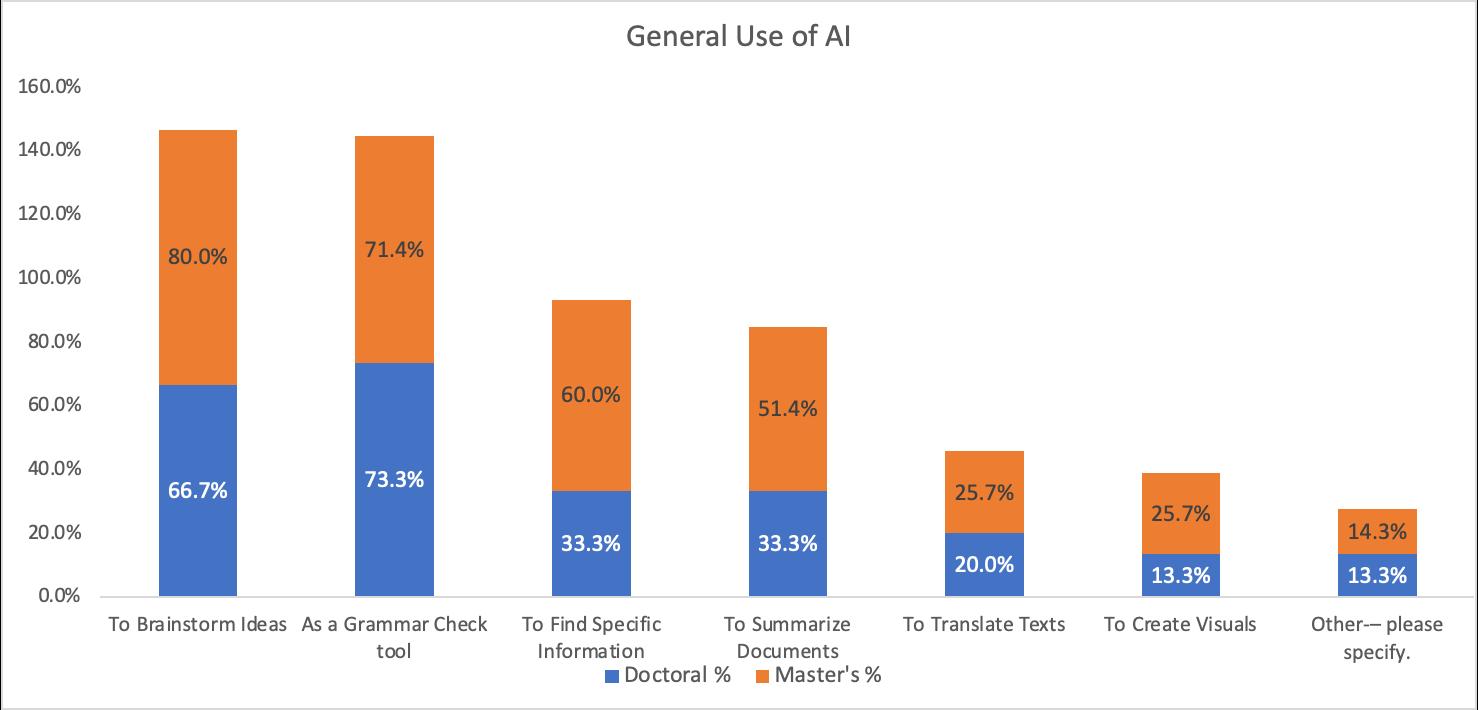
MOST PREFERRED LOCATION TO ACCESS AI TOOLS
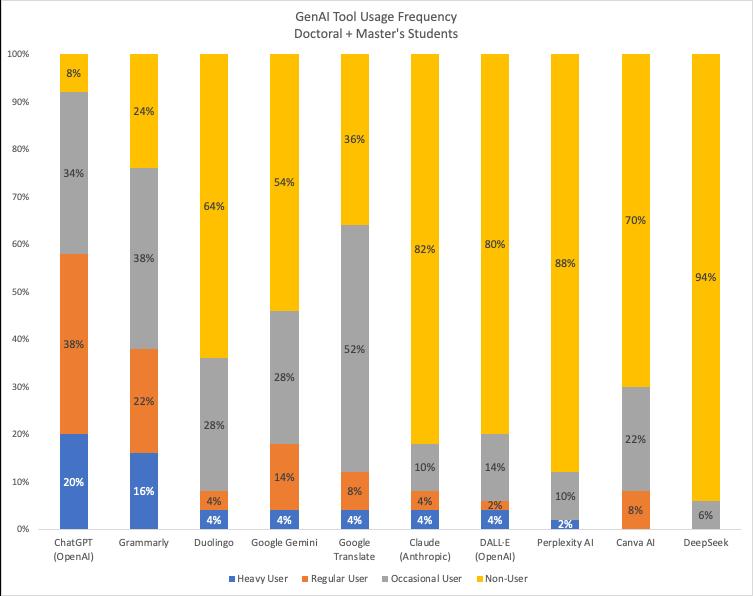
FREQUENCY OF USE OF AI TOOLS FOR ALL GRADUATE STUDENTS
PERCEIVED
AI
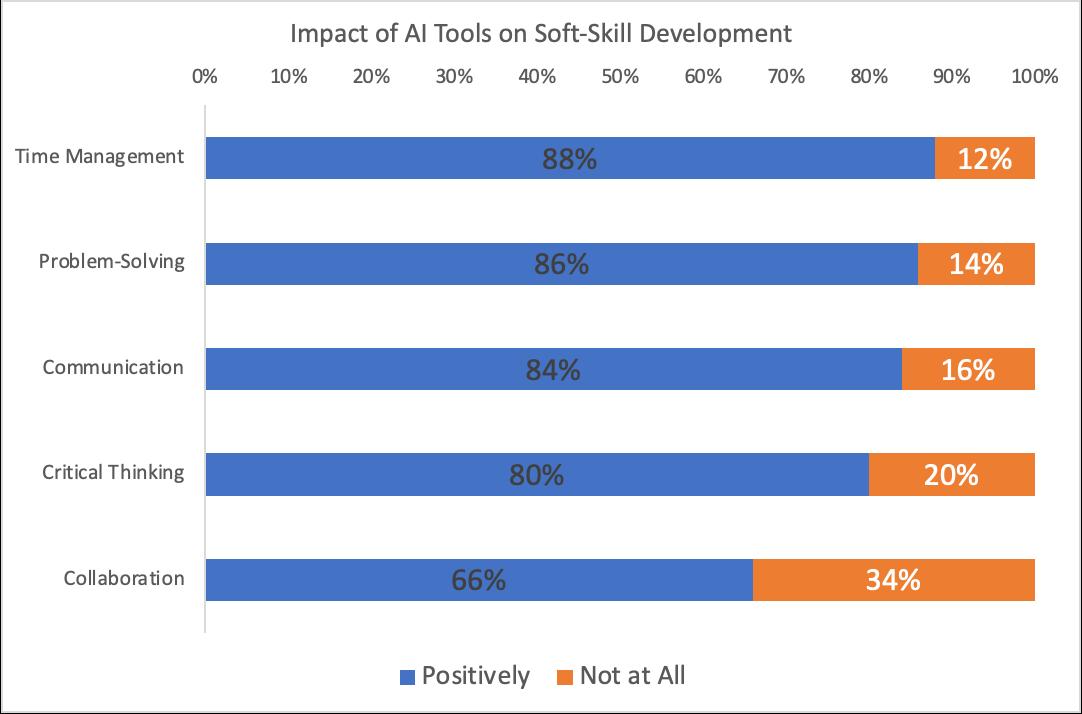
IMPACT ON SOFT SKILLS
et al. (2026). AI and Graduate Students – ATMAE 2026
Orozco
KEY FINDINGS

KEY FINDINGS
FINDING 1
The majority of respondents (86%) reported feeling either extremely or moderately confident in their ability to use AI.
FINDING 2
ChatGPT is widely used among graduate students, with 92% reporting its use.
FINDING 3
Two-thirds of respondents (66%) rely exclusively on free AI tools, indicating that cost and limited knowledge of extra features remain significant factors in AI adoption.
FINDING 4
Master's students consistently reported higher use of AI across most categories than doctoral students.
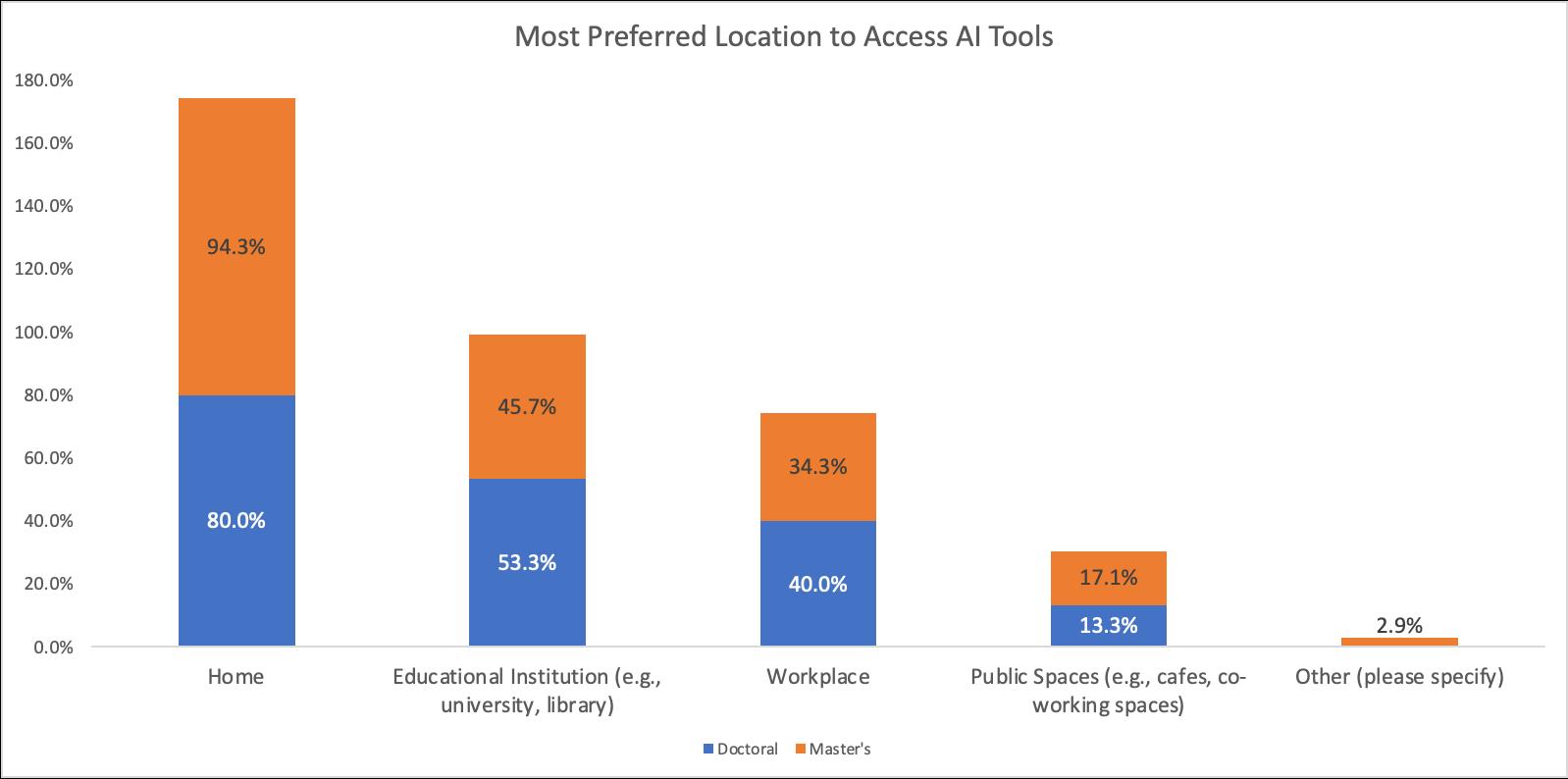
The largest gaps were in To Find Specific Information (master's 60% vs. doctoral 33%) and To Summarize Documents (master's 51%
vs. doctoral 33%). Both groups used AI most frequently for brainstorming ideas (master's 80%, doctoral 67%) and as a Grammar-Check tool (master's 71%, doctoral 73%), with doctoral students slightly higher.
The smallest usage for both groups was To Create Visuals (master's: 26%; doctoral: 13%) and Other purposes (~14% each).
Overall, master's students appear to leverage AI for a broader range of academic tasks, while doctoral students focus more narrowly on brainstorming and grammar checking.
FINDING 5
Both doctoral and master's students most commonly use AI at home, with master's students reporting notably higher usage (94%) compared to doctoral students (80%).
Educational institutions (e.g., university,
library) are the second most common location for both groups, though doctoral students use them slightly more (53% vs. 46%).
Workplaces are a location for AI use among 40% of doctoral students and 34% of master's students. Public spaces (cafes, co-working spaces) are the least common locations for both groups (doctoral: 13%; master's: 17%).
FINDING 6
Across both doctoral and master's students, ChatGPT is the most widely adopted generative AI tool, with the vast majority (over 80%) using it regularly or occasionally, and very few (around 11%) never using it. Grammarly also shows strong adoption, though slightly lower than ChatGPT, with roughly two-thirds of students using it at least occasionally.
Google Translate is used regularly or occasionally by a majority of students (about 58%), while Duolingo sees moderate use (approximately 34% regular/occasional). The remaining tools DALL-E, Claude, Perplexity AI, Canva AI, and DeepSeek have much lower adoption rates, with most students (typically 70–90%) never using them. Among these, Canva AI has the highest occasional use (around 33%), while DeepSeek has the lowest (about 6%).
FINDING 7
Graduate students perceive a strong positive impact of AI tools on several key soft skills. The highest reported impact is on Time Management, with 88% of respondents indicating that AI tools help them manage their time more effectively. ProblemSolving follows closely at 86%, suggesting that
AI supports students in approaching complex tasks. Communication skills are also seen as benefiting from AI use, with 84% agreement. Critical Thinking shows a positive impact for 80% of respondents, indicating that AI tools may enhance analytical reasoning. Collaboration receives the lowest percentage among the listed skills (66%), suggesting that AI tools are perceived as somewhat less supportive of teamwork compared to individual skills.
FINDING 8
Strongest correlations among soft skills: Problem-Solving and Critical Thinking (r = 0.750), Collaboration and Critical Thinking (r = 0.656). All skill pairs were significantly positively correlated.
Frequency, confidence, and tool diversity were all significantly correlated with overall AI skill development (rs ≈ 0.50–0.56, p < .001). Problem-Solving and Critical Thinking showed the strongest individual correlations.
Regression results (R² = 0.526, p < .001) identified GenAI Tool Diversity (β = 0.422, p < .001) and Confidence (β = 0.287, p = .036) as the only significant unique predictors of AI skill development. Frequency of use, training received, and degree level were not significant.
Implication: Building students’ exposure to a variety of AI tools and their confidence matters more than simply increasing how often they use AI or providing generic training.
GRADUATE STUDENT VOICES
GenAI as a Supporting Tool
“Do not solely use AI and make sure you actually understand and engage with the material.”
Graduate Student, Business
Critical Evaluation of GenAI Output
“Always think critically about the feedback you receive and double check any information that is presented as a fact.”
Graduate Student, Education
Develop Prompting as a Skill “Learn prompting, it's necessary to get the best out of AI.”
Graduate Student, CIS
RECOMMENDATIONS

RECOMMENDATIONS
Integrate AI Literacy into Coursework
• Integrate AI literacy modules into coursework that cover evaluating AI outputs, detecting hallucinations, and verifying sources against references.
• Provide discipline-specific examples of appropriate and inappropriate AI use.
• Offer explicit instruction on prompt engineering.
• Develop clear, consistent AI attribution guidelines across programs.
Foster Problem-Solving and Critical Thinking in AI-Supported Environments
• Design assignments where GenAI is used for early-stage ideation, followed by student-generated analysis, critique, or synthesis to strengthen critical thinking.
• Incorporate reflective checkpoints such as asking students to articulate how AI shaped their thinking to prevent passive acceptance of AI outputs.
• Use AI-assisted tasks to model expert problem-solving processes and show students how to move from AI-generated ideas to rigorous academic work.
• Encourage students to compare AI outputs with peer-reviewed sources to build evaluative judgment and information literacy.
Establish a Clear, Tiered AI Use Policy

Encouraged
Brainstorming, grammar checking, literature searches, summarization, outlining, creating study guides


Permitted with Attribution

Discouraged
Data analysis support and similar tasks where AI assists but does not replace student judgment
Completion exams, writing full papers, drafting conclusions or reflective writing that requires original student voice
Address Equity in GenAI Tool Access
• Evaluate institutional licensing options for leading GenAI platforms to provide equal access to graduate students across degree levels.
• Include access to AI tools as part of broader digital equity and graduate support initiatives.
RESEARCHERS
Dr. Luis Orozco.
Assistant Professor of CICS
President, ATMAE- Distance Learning, Teaching Innovation, and Artificial Intelligence Division.
Center for Information and Communication Sciences (CICS)
College of Communication, Information, and Media (CCIM)
Ball State University
Dr. Regina Giraldo-García
Associate Professor of Research Methods
Teachers College
Ball State University
Dr. Fred Kitchens
Associate Professor
Information System and Operations Management (ISOM)
Miller College of Business
Ball State University
How to cite this work:
Orozco, L. E., Giraldo-García, R., & Kitchens, F. (2026). Graduate Students and Generative AI: A Survey of Usage Frequency, Academic Purposes, and Perceived Challenges. Paper presented at the ATMAE Conference, New Orleans, LA, United States.
Orozco
(2026).