WATCH // EXPLORE // CRAVE
Photos courtesy of Florida State Parks
“The park sits in an area referred to as the “Cody Escarpment”—or ‘Cody Scarp’—which roughly translates to an ancient shoreline from when sea levels were much higher than they are now,” says Andrea. “This area is the largest continuous landscape break in Florida, and every river that crosses the Cody Scarp
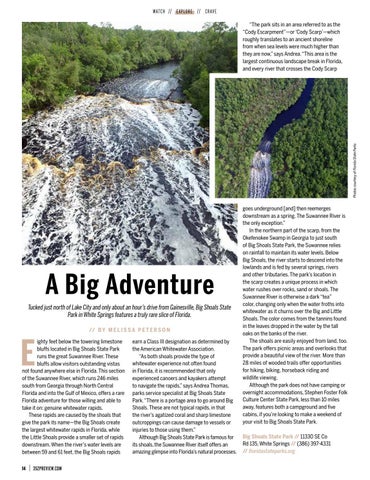
A Big Adventure Tucked just north of Lake City and only about an hour’s drive from Gainesville, Big Shoals State Park in White Springs features a truly rare slice of Florida.
E
// B Y M E L I S S A P E T E R S O N
ighty feet below the towering limestone bluffs located in Big Shoals State Park runs the great Suwannee River. These bluffs allow visitors outstanding vistas not found anywhere else in Florida. This section of the Suwannee River, which runs 246 miles south from Georgia through North Central Florida and into the Gulf of Mexico, offers a rare Florida adventure for those willing and able to take it on: genuine whitewater rapids. These rapids are caused by the shoals that give the park its name—the Big Shoals create the largest whitewater rapids in Florida, while the Little Shoals provide a smaller set of rapids downstream. When the river’s water levels are between 59 and 61 feet, the Big Shoals rapids 14
352PREVIEW.COM
earn a Class III designation as determined by the American Whitewater Association. “As both shoals provide the type of whitewater experience not often found in Florida, it is recommended that only experienced canoers and kayakers attempt to navigate the rapids,” says Andrea Thomas, parks service specialist at Big Shoals State Park. “There is a portage area to go around Big Shoals. These are not typical rapids, in that the river’s agatized coral and sharp limestone outcroppings can cause damage to vessels or injuries to those using them.” Although Big Shoals State Park is famous for its shoals, the Suwannee River itself offers an amazing glimpse into Florida’s natural processes.
goes underground [and] then reemerges downstream as a spring. The Suwannee River is the only exception.” In the northern part of the scarp, from the Okefenokee Swamp in Georgia to just south of Big Shoals State Park, the Suwannee relies on rainfall to maintain its water levels. Below Big Shoals, the river starts to descend into the lowlands and is fed by several springs, rivers and other tributaries. The park’s location in the scarp creates a unique process in which water rushes over rocks, sand or shoals. The Suwannee River is otherwise a dark “tea” color, changing only when the water froths into whitewater as it churns over the Big and Little Shoals. The color comes from the tannins found in the leaves dropped in the water by the tall oaks on the banks of the river. The shoals are easily enjoyed from land, too. The park offers picnic areas and overlooks that provide a beautiful view of the river. More than 28 miles of wooded trails offer opportunities for hiking, biking, horseback riding and wildlife viewing. Although the park does not have camping or overnight accommodations, Stephen Foster Folk Culture Center State Park, less than 10 miles away, features both a campground and five cabins, if you’re looking to make a weekend of your visit to Big Shoals State Park. Big Shoals State Park // 11330 SE Co Rd 135, White Springs // (386) 397-4331 // floridastateparks.org