OCTOBER 2026
Inside the Pennopticon PG. 24
Kenn Krawchuck’s Crusade
PG. 12
Opening the Books PG. 16
2
34 T H ST R E E T MAGAZ I N E
12
22 32
Ken Krawchuk’s Crusade The Libertarian candidate for governor is mad as hell, and he wants to let the whole state know.
16
Opening the Books Penn Libraries United is fighting for benefits and equitable pay. The University is on a different page.
Sound and Fury When did the protest song lose its hopeful edge?
Inside Penn’s Conservative Student Awakening The campus conservatives have taken one big step right. Now, they want to start calling the shots.
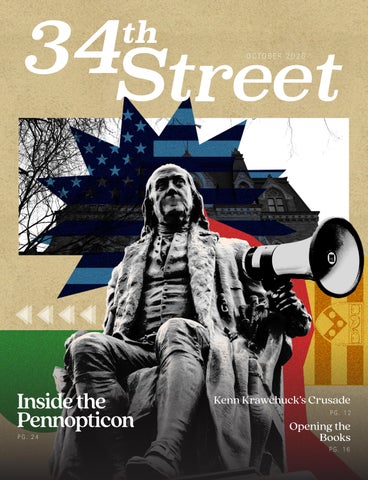
ON THE COVER Eunice Choi The cover represents its featured articles on the 2026 PA gubernatorial candidates, freedom of speech, and other political issues on campus that, as mindful individuals, we should stay informed about.
O C TO B ER 2026
3
LET TER FROM THE EDITOR
Mitt Romney and Me
I
also contain a profile of the most interesting candidate in the upcoming Pennsylvania gubernatorial race, a personality quiz that’ll tell you how you ought to vote in the upcoming midterms, and, of course, a crossword. It’s easy to shy away from judgments when it feels like politics is a TV show you can tune in and out of whenever you feel inclined. When it comes to the issues closer to home, however, that kind of hedging comes apart at the seams. How should we fight against the erosion of free speech rights on Penn’s campus? How can we fix an economy that serves the interests of the few at the expense of the many? How can we as individuals do anything at all to solve problems at the level of the collective? While you won’t find clear answers in this magazine, you will get some useful hints as to how to settle these questions for yourself. In the pages that follow, Street has interpreted the world—your job, reader, is to change it. H
t was 2012 when I experienced my first political thought. Iwas watching the Obama– Romney debates in the living room with my parents, wholly engrossed as I watched the only two politicians I had ever heard of duke it out before the American people. They were in the middle of a discourse on immigration when I heard former President Barack Obama say that then–United States Sen. Mitt Romney wanted to send the children of immigrants back to their countries. He was talking about DACA recipients, of course, but I immediately burst into tears. Would I have to go back to India? The last time I visited, I’d gotten a stomach virus! While I didn’t really know who Obama was, I knew that Romney had to lose. There’s a reason we don’t let children vote, I guess. But at least 7– year–old me had some kind of poli- SSSF, cy position. Could you say the same about most Americans? The problem, it seems, is not just a lack of political faith, but a surplus of political apathy. That’s where we come in. Don’t know who to vote for? Don’t know why you’re voting? Don’t really know what politics is? This issue has you covered, with urgent dispatches on goings–on at the federal, state, and campus levels. Features Editors Sadie Daniel and Ethan Sun pounded the pavement hard this month, speaking to insiders about the conservative student movement and open expression on Penn’s campus. You’ll also find plenty on the unionization wave washing over Penn’s campus, as well as a peek into the inner life of the most powerful man in Penn’s Undergraduate Assembly. It’s not all so serious—the coming pages
EXECUTIVE BOARD Nishanth Bhargava, Editor-in-Chief Samantha Hsiung, Print Managing Editor Kate Ahn, Design Editor Sophia Mirabal, Digital Managing Editor Jackson Zuercher, Assignments Editor THIS ISSUE’S TEAM Executive editor Jasmine Ni Copy editors Prashant Bhattarai, Jessica Huang Street Photo editor Connie Zhao Deputy Design editors Kiki Choi, Chenyao Liu, Amy Luo, Andy Mei, Alex Nagler, Julia Wang Design associates Catherine Garcia, Camila Leon Bolivar, Maggie Wang, Tiffany Zheng SECTION EDITORS Sadie Daniel, Features Ethan Sun, Features Diemmy Dang, Focus Henry Metz, Film & TV Aaron Tokay, Music Laura Gao, Arts Jessica Tobes, Style Fiona Herzog, Ego STAFF Features writers Isabella Guzman–Gallego, Maria Joyce– Johnson, Zoe Lachter, Vasanna Persaud, Kayden Zhong Focus beats Zoe Belknap, Lara Elmanzalawi, Jack Lamey, Carina Thomas Film & TV beats Jaden Gardiola, Shannon Katzenberger, Sophia Leong, Chenyao Liu, Elan Martin– Prashad Music beats Mason Asakura, Cailey Chin, Isabella Fife, Jackson Ford, Julia Girgenti, Michael Hopkins, Danielle Jason, Brady Woodhouse Style beats Orli Frank, South Fulweiler, Jekeun Jung, Emma Ong, Saanvi Ram Arts beats Jingyi Cao, Landis Hershey, Demi Marhule, Lynn Yi Ego beats Alexandra Dimitriou, Alexis Boland, Jaya Parsa, Sophia Shen Staff writers Roberto Bailey, Grace Burke, Shreya Darji, Penelope Gray, Emma Katz, Milena Mataac, Rachel Oh, Joonho Rider–Lee, Nadia Salamon, Ananya Yadati LAND ACKNOWLEDGEMENT The Land on which the office of The Daily Pennsylvanian stands is a part of the homeland and territory of the Lenni— Lenape people. We affirm Indigenous sovereignty and will work to hold the DP and the University of Pennsylvania more accountable to the needs of Indigenous people. CONTACTING 34 th STRE E T M AGA Z IN E If you have questions, comments, complaints, or letters to the editor, email Nishanth Bhargava, editor–in–chief, at streeteic@34st.com. You can also call us at (215) 422–4640. www.34st.com © 2026 34th Street Magazine, The Daily Pennsylvanian, Inc. No part may be reproduced in whole or in part without the express, written consent of the editors. All rights reserved.
4
34 T H ST R E E T MAGAZ I N E
PIGGY
Just Out of Frame On student journalism, protest photography, and the politics of staying objective.
BY CHENYAO LIU DESIGN BY ALEX NAGLER
A
t half past five on Friday, May 10, 2024, I wake up to five missed calls from the then–editor– in–chief of The Daily Pennsylvanian. I can’t find my glasses, but I fumble my way over to my phone, praying I won’t wake my roommate on the other side of our KCECH apartment. I already knew why he was calling. There was only one reason he would call me at that ungodly hour, especially after I had spent the previous two weeks walking out of Van Pelt–Dietrich at around 1 a.m. and waking up to head back there at 6 a.m. The police were lined up outside College Green. The Gaza Solidarity Encampment, which had occupied
the lawn since April 25 that year, was about to be cleared. Students, faculty, and community members were going to be forcibly removed. I grabbed my camera, tripped over my shoes, and ran out of my room before I could even grab my press pass. HHH I was the editor–in–chief of my high school newspaper. I loved editing. I loved picking through old issues and highlighting every single grammatical error or spacing mistake. I spent my free time thinking of timely angles and the photos that would go along with them. It’s funny—despite all the time and energy I poured into that newspaper, I always knew I wasn’t cut out to be a journalist. I just hated talking to people. I could do an interview and write an article, but I hated meeting strangers and making
phone calls. I could never think quickly enough to come up with the snappy follow–up that makes an interview sound interesting and investigative instead of a shitty interrogation from a nervous teenager. I could take pictures, though. And I could take them pretty well. So, when I arrived at Penn, joining the photo department at the DP was the obvious first thing to do. The newsroom was hectic and chaotic and occasionally held together by sheer willpower, but I wasn’t particularly organized myself, so who was I to judge? HHH About a month into my freshman year, Penn hosted the three–day Palestine Writes festival. At the time, it barely registered in my day–to–day life. I knew it had made national news, but most of the programming was in Irvine Auditorium, and I don’t even remember walking past it. Two weeks later, Oct. 7 happened. Looking back, it’s strange how quickly my life at Penn changed. I went from wondering whether I should apply for a dual degree at the Wharton School— it was never going to happen, but my parents were really hoping—to impa-
O C TO B E R 2026
5
tiently waiting for the next protest to happen. HHH One of the first things you learn in a journalism class is objectivity. If journalists want the public to trust them, they have to be impartial, unbiased, neutral reporters of the truth. I didn’t think much about that idea when I was younger. It seemed very obvious to me that objectivity was crucial, especially when covering politics. To me, politics was what happened in Congress, at local councils, in marches in the streets. Journalism was supposed to sit somewhere outside it all—watching, recording, and documenting. But
reporter could choose a quote, a fact, a lede. But a photograph? It was what you saw. It was what was there. Obviously, I was very wrong. The photographer still chooses where they stand, what to point their camera at, whom to photograph, when to click the shutter, and which frame to submit out of the hundreds (or, eventually, thousands) sitting on their memory card. I also found that I didn’t just want to take pictures of protests. I wanted to take good pictures. I wanted action and feeling, dramatic compositions and beautiful light. I wanted photos that would make someone stop scroll-
ty Life. All who did would be referred to the Center for Community Standards and Accountability. While some of my fellow student reporters chose to remain, I left. And at the end of the day, Penn, like many schools, did not distinguish between the students protesting its actions and the students trying to document their protest. That spring, two Dartmouth reporters were arrested while covering a protest despite wearing press identification. Four Daily Bruin reporters were assaulted by counterprotesters while covering the UCLA encampment. Very little separates “student” from “journalist.” The rest of that academic year gave
I quickly realized that journalism has its own politics. Deciding what is news, whose voice gets quoted, which photograph runs and which one stays on the SD card aren’t decisions that happen in a vacuum. In high school, a friend of mine was doxxed and received hate mail after writing a simple article about changes to our social studies curriculum. The point of objectivity, I suppose, is to make sure a journalist’s politics don’t decide what is true. Death threats can certainly make that difficult. I used to think photojournalism had an advantage. Words can be twisted. A
ing. I wanted the kind of photo that could tell you everything you needed to know to know before you even read the caption. HHH Striving for perfect photos did not make me any better as a journalist. In November 2023, I covered the Freedom School for Palestine as they occupied part of Houston Hall for a multi– day teach–in. Around midnight on the first day, any remaining students were asked to turn over their PennCards to Penn Police officers and staff from the Office of the Vice Provost for Universi-
me plenty of work to do. The University City Townhomes were demolished, Liz Magill resigned, and there was always something happening. I spent every Wednesday evening working on the photos for the weekly print issue. Ask me what was happening on campus and I could probably tell you. Of course, I wasn’t actually involved in any of it. On April 25, 2024, everything changed. A crowd of students, faculty, and community members marched from City Hall and set up tents across College Green. The Gaza Solidarity Encampment, established and main-
6
34 T H ST R E E T MAGAZ I N E
tained by members of the Penn comunity, demanded transparency from the University and an end to the ongoing genocide in Gaza. The encampment took over my life. Every morning I would wake up, grab my camera and whatever batteries I had managed to charge overnight, and walk toward College Green. I got very good at figuring out where I would not be noticed. I also got very good at pretending I didn’t know or care about anyone. I knew plenty of people inside the encampment—people whose names I recognized, whom I’d spoken to in class, whom I’d eaten lunch with. But I worried that even looking too familiar with someone could be enough for a counterprotester to use it to discredit the DP’s coverage. I became minutely aware of every movement I made, every smile I flashed, and whether I was tapping my foot too much to the rhythmic chants. So, I took a lot of pictures. There were often other photographers around— professionals with bigger cameras,
journalists who had been doing this for longer than I had been alive, and people who seemed to know exactly whom to talk to and what to say. Sometimes, there were several students with me. Other times, I was the only one there. The newsroom had to move quickly, but after the first three days, the photo team decided to slow down. Our first cohesive piece of coverage was a photo essay documenting the first 100 hours of the encampment. It was the exact opposite of breaking news. But we did our best to look for what could disappear into the chaos if nobody took a picture or wrote it down. People made art, lots and lots of art. There were lectures and poetry readings and sleeping bags and food, collections of signs taped to fences and hung up between hundred–year–old trees. There was a lot of talking and students walking in and out and going to class and peace and quiet that was interrupted every now and then by a particularly loud counterprotester or a man with a knife. Overall, however, it was quite calm.
But that calm wouldn’t last. On May 10, 2024, at around 6 a.m., Penn and Philadelphia Police officers began dismantling the encampment. They overturned tents and pulled apart protesters who had linked arms and sat around the Benjamin Franklin statue. They handcuffed people and picked them up and put them into vans. It was raining and I was freezing. I couldn’t feel my fingers, and I thought it was a miracle that my shitty old camera was still working. I remember trying to stick to our policies by not photographing people’s faces. I wondered how much that would matter if they got processed and charged and put in jail. After the students were taken away, Penn employees and K–9 units began going through the remains of the encampment, which now looked like a ghost town. They took tents, signs, and personal belongings toward one of the three trash trucks brought onto Locust Walk. A staff member from Van Pelt came outside and asked whether
O C TO B ER 2026
7
we thought he could save any of the signs. “It’s a piece of history,” he said. I watched as the trash trucks shredded the belongings of everyone who had been staying on College Green. I told him he could try. HHH After an action–packed start to my college career, I thought a lot harder about objectivity. During the encampment and in the months afterward, the DP developed new guidelines for covering protests. I helped write some of the photography ones. They were quite easy to follow: Don’t try to doxx someone, don’t intentionally identify anyone who hasn’t identified themselves, don’t shove a camera in someone’s face. One standard in particular became central very quickly—reporters could not participate publicly in activities that could be seen as taking a position on something they were covering. After all, objective journalism is less about what a reporter actually thinks and more about how they’re seen by their readers. A free press only works if the public believes that the people holding the cameras and writing the stories are doing their jobs honestly. But it’s difficult to appear politically neutral when the work itself is so deeply connected to politics. We were documenting demonstrations about who had power at Penn, who was allowed to protest, whose speech was protected, whose speech was condemned, and what a university owed its students. Every investigation and report and article we wrote was, in its own way, a political act. HHH When the semester finally ended, I didn’t feel relieved. I had spent weeks sleeping badly, watching police lines and protest crowds and emergency Slack messages rearrange the rhythm of my life. I had caught a glimpse of what a normal Penn might have looked like during freshman year, before campus politics became something impossible
8
34 T H ST R E E T MAGAZ I N E
to ignore. Then, I went home. For the first time in months, I woke up without checking my phone for breaking news. I didn’t wonder about who was on College Green. I didn’t have to charge three Nikon batteries before bed. I didn’t sit on a bench and pretend not to know the people I was photographing. I also didn’t take a break. I spent most of my sophomore year even more committed to news photography. I started training other photographers on our new protest guidelines, went to demonstrations and marches and political rallies, and kept finding reasons to bring my camera with me. I can’t remember a single thing about my final exams during my first year. What I can remember is almost getting kettled in Center City and getting pulled away by my fellow reporter before the police closed around us. I barely remember the fun rehearsals I had when I started getting into theater. I do remember my heart pounding when a familiar–looking Penn Police officer pulled up to our walkshifting table and told us we were trespassing, despite having reserved the space with the Office of Student Affairs. I love being in the newsroom and sitting around a table with dozens of people arguing about what needs to be done. I love the adrenaline rush of breaking news and the pressure to capture what’s unfolding through my viewfinder. I love the people I met, and it’s thrilling to watch them go on to write incredible features and report for national publications. But more and more, I couldn’t find the energy to walk out onto the street with a camera. Instead, I sat in the DP office, check-
ing caption formats or the spacing between words on a page layout. For a long time, I thought the problem was that I wasn’t made for journalism. But that doesn’t change the fact that a fundamental part of my Penn experience was protests, rallies, police lines, and the next assignment. It was pure chaos, but it was also really worth it. Maybe I was never a very good journalist, but it was good to be there.H
Hometown
Redmond, Wash. ————————————————————————————
Field of Study
Major in philosophy, politics, and economics, minor in legal studies and history ————————————————————————————
EOTM
Activities
Undergraduate Assembly, Penn Debate Society, Muslim Student Association,
P
erched in a chair outside the Undergraduate Assembly president’s door, I felt what can only be described as “child–outside– the–principal’s–office” anticipation. I wasn’t facing any sanctions, mind you; this was just where Musab Chummun (C ’27) had suggested we meet for this interview. Imagining what lies behind the wooden door, I conjured up images of a harsh, sterile space: fluorescent lights, an intimidating wooden desk, barren walls. What I found instead was more reminiscent of a living room. The walls were full of pictures and notes from ghosts of UA past, and the only seating options were two cozy chairs next to the windows. Sitting alongside Musab in these very chairs, I found my expectations challenged in a similar way: Instead of the formal exterior I’ve come to associate with his presidency, he’s just a regular student with a strong love for advocacy, Penn, and Chess. com. What prompted you to get and stay involved with the UA? I’ve always been involved in student government. I’ve been doing student government since I was in sixth grade, and all throughout high school. Once I came to Penn, I realized that there is such an opportunity for change not
Musab Chummun Undergraduate Assembly, Penn Debate Society, Muslim Student Association, Sphinx Senior Society BY ALEXIS BOLAND Photos by Connie Zhao
this interview has been edited and condensed for clarity .
O C TO B ER 2026
9
only within the University, but also within Philadelphia and the United States. I saw the UA as a platform to tangibly create that change. When I started in UA as a freshman, I felt as though the UA’s structure, ability, and members were capable of doing so much more. Then my junior year came along, and the president at the time and I were thinking that there needed to be a reframing of the UA. We wanted to get students into the room where the decisions were being made. The goal this year is to not only be in the room, but to be the ones making the decisions. How do you make sure you’re taken seriously by both students and faculty? With students, engagement with the UA’s work starts with awareness. Our job is not only to make them aware of issues facing the school, but to make them care. Sometimes that’s platforming large issues, or just explaining why their voice matters and what they can do. A very prominent example of this is the recent issues we’ve had with open expression. The average Penn student doesn’t care about open expression, mostly because they weren’t here during the encampments, but also because on a day–to–day basis, they’re not thinking about it. So our job is to make them care about the issues, and that goes hand in hand with them caring about what the UA actually does. With faculty, one of the guiding principles that I hold is that there are values that we should always be advocating for, whether that’s the idea that open expression needs to be truly open, that students need to feel protected on campus, or that we want a campus that is true to its educational values and mission. I’ll advocate for those, and I think the administration understands and respects that motivation. They know what it’s like to be a 21–year–old leading a group, and I think they recognize that we’re a se-
10
34 T H ST R E E T MAGAZ I N E
rious group that can actually create change on campus. They respect us and entertain our ideas. What was the biggest issue you inherited as president of UA and what have you done to resolve it? A mindset of apathy, both within the University and within the UA itself. My freshman year, probably about 5–10% of the people in the University knew what the UA was. Fast forward to now, and I’d say it’s probably 80–90%. We made these changes by creating a communications committee, rolling out a lot of media, shifting our comms strategy, and thinking more about why we’re doing what we do as an assembly. I think I inherited a UA that wanted to focus on the small things and not set larger goals for what we could be doing. Partially, I think this is because it’s very difficult to break precedent when you jump into something that’s existed for 50 years. You think, “Okay, this is how things have always been done. Surely there’s a reason for it.” But that’s obviously a fallacy, right? If you can’t justify why something’s being done, then you probably don’t have a good reason to be doing it. Also, there’s always external pressures on what people think the UA should be like. The protests that marked my freshman year put a cage around what was possible. The broader Penn community, both students and faculty alike, saw the UA as one small student government group that couldn’t really be taken that seriously. Now, Moe [Mansour (C ’27)] and I have been able to break through that ceiling by turning the UA into something bigger. How do you balance all your commitments, academic or otherwise? I always think of the Eileen Gu quote: “Doing one thing is a break from another thing.” Doing UA is a break from my academics (although
maybe I’ve been taking too many academic breaks), and doing academic work is a break from extracurriculars. Of course, I’ve been very lucky to find people who will always be there for me, whether that’s my roommates, who I can come home and talk to late at night, or my family, who I can call and catch up with. The other thing is that I have a very positive mindset towards the workload. I only take classes I’m passionate about, I only do extracurriculars I’m passionate about, and I only hang out with people I’m passionate about and interested in. It’s very hard to get burnt out or disillusioned when this is exactly what I wanted to do. What’s the hardest lesson you’ve learned in the past four years? I’ve had to get good at being comfortable with uncertainty. I came into Penn and I was like, “I’m gonna be a human rights lawyer. At this age, I’m gonna be doing this.” I was so confident in the path ahead. And then I did a full 180, not because I got disillusioned with pursuing an ambitious goal, but because I thought that human rights law specifically was not the most effective. So the question came to me: “Okay, this is not the best way to change the world. What is then?” And I still have no clue. But I think tying yourself down too fast is definitely a big mistake. I forget who said it, but there’s a quote that goes, “Knowing what you want prevents you from finding out what you want.” Penn is such a unique place in that it’s dominated by such a conformist culture. I’ve seen so many kids who give up on their dreams, and I think one of my biggest gripes with the school is that people here shoot too short. I’ve seen so many friends from New Student Orientation freshman year who had these grand ideas about what they wanted to pursue—fast forward three years later, those ideas are completely gone. Obviously, a lot of it is valid and born of externalities and other
concerns. But at the same time, it has taken so much belief in myself to be able to turn my back and take a non– traditional path. It’s not out of ego or arrogance; I don’t think I’m better for doing this. I just had to rationalize it to myself and commit to what I know is best for me. What does leadership mean to you? How has that definition shifted? I think leadership is best described as genuine love and cold intelligence. In any leadership position, you have a decision–making responsibility. But you have to make those decisions by translating your passions into the best logistical outcome. Externally facing leadership is a means of galvanizing others, being able to motivate and inspire other people to achieve a certain task, whether that’s at the smallest level in a group project or at the highest level when you’re leading an entire institution. I used to think that there was one kind of personality that was conducive to leadership, but now I think the characteristics required to be a strong leader are different for every single person. I definitely have realized that leadership requires you to deal with people with very disparate interests, who sometimes come into decision–making like it’s a negotiation where they need to win. Having to navigate those interpersonal relationships has taught me how to deal with other people better, like knowing when to be more understanding and when to hold a harder line when it comes to my principles. I’ve also had to adapt to much higher stakes. In high school, a lot of the leadership work is really cool, but you still have significant support and a safety net. Now, if I screw up, 90 people rely on me. $3 million might go to waste. Ten thousand people who are represented by us will be affected. It’s a different level of pressure, but I’m very glad to have that pressure. It’s definitely a privilege.
When talking about leadership, you used the term “patient decisiveness.” How do you define that? Patient decisiveness is a core part of leadership that you face when you need to make a decision. The question then is: “Is this a decision that you have to make at this moment, or can you make it some other time?” Especially when you’re younger, you want to rush things—but then you fall into the trap of thinking that because something is a problem right now, you need to figure it out right now. I think having the ability to deal with some degree of uncertainty is important, and then being able to table issues and return when you can make a more informed decision is just as important. It’s especially necessary to get as much information as you can when the decisions have a lot of weight to them, and they’re affecting how people will act and live and work. What are your long–term aspirations? It’s simply to create the most amount of positive change in the world, whether that’s institutionally in human rights, or politically, or in any other way. I’m very, very unsure of how that’ll happen or how I’ll have to get there, but that’s a problem for later. I think the best way to live life and create the most change is to have this north star, which for me is that I want to change the world for the better. I want to create the most amount of justice. I want to uplift people around the world, and I don’t need a specific path there. I just need to know the next few steps, and for me, the next few steps are going to law school, maybe doing a fellowship, maybe focusing on some relevant extracurriculars, and the rest just comes. There’s a nice quote from Muhammad Ali when a reporter asked him, “What do you want your legacy to be?” This guy is a famous boxer. He’s an amazing civil rights activist. You would think that he would want his legacy to be as the best boxer or the
best civil rights orator ever. But, all he said was, “I just want to be someone who spreads kindness.” I definitely resonate with that. I don’t need a building named after me. I don’t need people to remember any big things I did. I just hope that I’ll have left people feeling as though they’ve been bettered by either my own character or my service. Legacy itself is something that I’m not too worried about. I also don’t think it is something to worry about. There’s more ego in legacy than there is honor in it. H
Rapid Fire Least favorite spot on Penn’s campus: Williams Hall. It’s so dusty, depressing, and grey. ————————————————————————
Favorite New York Times game: Connections.
————————————————————————
Favorite way to unwind? Watching Instagram Reels in bed.
————————————————————————
Something no one would expect about you: I played lacrosse for five years before coming to Penn. ————————————————————————
There are two types of people at Penn … Those who play Chess.com in class and those who don’t. ————————————————————————
And you are … Obviously, the former.
O C TO B ER 2026
11
Ken Krawchuk’s Crusade
The Libertarian candidate for governor is mad as hell, and he wants to let the whole state know. BY NISHANTH BHARGAVA AND DIEMMY DANG DESIGN BY CHENYAO LIU AND CATHERINE GARCIA
12
34 T H ST R E E T MAGAZ I N E
O
n Nov. 3, citizens across Pennsylvania will head to the polls to pull the lever and elect their next governor. The top two contenders in the race need no introduction—Democrat Josh Shapiro, defending his record as an incumbent, and Republican Stacy Garrity, who seeks to leverage her position as state treasurer to earn a seat in the governor’s mansion. But lurking at the bottom of the ballot is a candidate far less familiar to the ill–informed voter: Ken Krawchuk, Libertarian. When he sits down to talk to Street, Krawchuk hardly comes off like a politician. That’s a good thing, in his book—he despises being compared to the people he’s dedicated his life to throwing out of office. “When people call me a politician, I say, ‘No, no. I haven’t broken a promise yet,’” Krawchuk says. “Once I break a promise, then you can call me a politician. I promise you.” Shirking the stiff, rehearsed demeanor of a career bureaucrat, Krawchuk is loose and off–the–cuff, coasting from idea to idea with grace and poise. He agitates for the privatization of the entire public school system, he pitches a new kind of currency to combat inflation in Pennsylvania, and he even waxes poetic about his borderline agentic Cybertruck. But although his discourse is often diffuse and sprawling, it eventually converges around a single point: the value of individual liberty. Krawchuk used to be a Democrat—that is, until he started his first business. “I was flooded with all this nonsense that the government wants me to do,” Krawchuk says. “You’re subject to this. You got that tax. This other thing. You got to do this. You got to do that. You got to file this. You got to post this.” Eventually, Krawchuk founded a firm—Amendment 16 Limited— designed to help people just as frus-
trated as him get around having to deal with the IRS. Call his hotline (the pithy 1–800–THAT–IRS), and he’ll act as a middleman on your invoices, taking in payments from vendors and sending you the full sum minus taxes so he can pay the feds on your behalf. It was Amendment 16 that would first bring him into the Libertarian Party. When one of his coworkers introduced him to an acquaintance familiar with the movement, he quickly came to admire the principles the party organized itself around. After attending a few meetings and soul– searching for a while, Krawchuk finally bit the bullet and registered as a Libertarian in 1993. “We’re the party of principle. Every law we support or oppose goes back to one idea,” he says. “Your life, your way, as long as you respect others. [It’s] the golden rule on a political level.” Krawchuk has had a long career in Pennsylvania politics. Alongside his day job running an information technology firm, he’s run for governor three times before in 1998, 2002, and 2018. Along the way, he’s assembled a murderer’s row of ex–governors as political opponents. The first he recalls is Milton Shapp in the ’70s (“I didn’t pronounce his name properly, let’s put it like that”)—more recently, he’s squared off against Tom Ridge (“Didn’t like Ridge”), Ed Rendell (“Rendell was nice to me”), and “Big Bad” Tom Wolf (“Man, what he did to Pennsylvania … ”). In each race, his share of the vote has hovered around just 1%—but this run, he says, is going to be different. That’s because this time, he’s angry. “The big difference in the other [races] was … I’m an IT guy. Problem solution, problem solution. Here’s the problem, here’s the solution. Problem solution. It wasn’t resonating,” Krawchuk explains. “This time it’s like—No! No! Yeah, we got problems. I’m mad as hell and I’m not going to take it anymore!” Krawchuk is mad about a lot of things, from the Federal Reserve’s
endless money– printing to the expansion of the American surveillance state. But the main issues fueling his run for governor are education and taxation—and for him, the two are closely intertwined. His proposal to fix declining youth literacy rates? Privatizing all public schools and getting rid of the property taxes that fund them. Krawchuk describes the current model of public education as inefficient, quoting statistics that paint a dreary picture of Pennsylvania schools. Less than half of elementary students in the state can read proficiently—even fewer are meeting the benchmarks for their grade level in math. Rather than fixing a public school system that he believes has failed its youth, Krawchuk wants to get rid of the system entirely. He proposes taking the money that the state would typically spend on its public schools and giving it directly to families—$11,500 per child—to pay for private school education. “The big thing is, since we’re not funding the school districts, we shut them down. Since the school districts are what are charging the property tax, [the] property tax vanishes,” he explains. The free market, Krawchuk argues, is the only agent capable of ensuring that schools and educators are properly incentivized to give Pennsylvania children the kind of quality education they deserve. With parents able to make choices about where to send their kids, high–achieving schools are bound to see an influx of students, while worse institutions will shrivel up and shut their doors. “The best teachers are going to get paid the most and go to the best schools,” Krawchuk says. “Bad teachers—well, McDonald’s is hiring, I hear.”
Krawchuk believes that the public school system in Pennsylvania is so bad that it’s unconstitutional. He says he plans to sue the state of Pennsylvania to force them to privatize the entire public education system. “The constitution says, ‘There should be a fair and efficient means of public education.’ They’re not doing that,” he says. In the event that he wins the case, he hopes to instate a citizen–elected board to set school curriculum requirements. Krawchuk is specifically suing the Pennsylvania governor as well as the head of the Pennsylvania State Senate and House of Representatives. “They’re our employees, and they’re screwed up. We’re the bosses. We’re going to talk to them and say, ‘You guys, you’re out of here. Enough is enough,’” he says. But Krawchuk’s campaign to put your money back in your pocket doesn’t end there. While getting rid of taxes is all well and good, it doesn’t solve the national issue—the Federal Reserve’s endless printing of fiat money whose value isn’t backed by a commodity like gold. Now, he says, the American dollar has lost almost all of its old value, hitting consumers in the pocket and letting inflation run rampant. Krawchuk knows he can’t end the Fed as the governor of Pennsylvania. Thankfully, he’s found a clever workaround in the Constitution. Article 1 of the Constitution forbids states to “make any Thing but gold and silver Coin a Tender in Payment of Debts.” So why not mint some coins? O C TO B ER 2026
13
Krawchuk is proposing the creation of a parallel currency of silver coins within the state called “A Silvan Penny” (a clever anagram of “Pennsylvania”). These coins, he says, will retain their value better than American dollars because they are—quite literally—worth their weight in silver. Business owners will then have the free choice to accept or reject the Silvan Penny as a valid form of payment. “The individual merchants can decide for themselves: Am I going to take silver?” Krawchuk explains. “Well, duh, of course I’d take silver, you know? We just have to give them the opportunity to do that.” Krawchuk’s campaign strategy is as unorthodox as his ideas. He’s poured quite a bit of time into creating a series of song parodies designed to disseminate his small–government message among the masses. Perhaps the most interesting is “The Flocked Up Blues,” an anti–surveillance ballad sung by a jazz singer Krawchuk knew from his time as a radio anchor. Its music video, a minimalistic slideshow edited on Movie Maker, opens on a shot of Krawchuk flipping the bird at a Flock camera somewhere in suburban Pennsylvania. His musical crusade shows no sign of stopping—the candidate has a slate of parodies lined up for release over the next few weeks, all centering around education reform. Pennsylvania voters will soon be treated to subversive renditions of classic tunes from John Lennon (“Imagine there’s no school districts”), The Rolling Stones (“I can’t get no / Education”) and The Beatles (“You say you want an education…”). Of course, no amount of online work can replace the retail politicking essential to any successful campaign. Krawchuk recently engaged in an eight–day pub crawl across Pennsylvania, meeting his supporters at any local watering hole willing to accommodate him. But without the budget for a campaign bus or a private chauffeur, Krawchuk had to get around the state the only way he knew how—in
14
34 T H ST R E E T MAGAZ I N E
his Cybertruck. Krawchuk loves his Cybertruck. It saved his life once, he says. He was coming back from a late–night party with his wife in New Jersey, driving back towards his home in Abington, Pa. The last thing he remembers is being on the freeway about to cross the Delaware River back into Pennsylvania. “Next thing I know, I’m in the middle of the Walt Whitman Bridge, and the car is beeping at me, saying, ‘Wake up, idiot! Wake up!’” Krawchuk says. “I fell asleep at the wheel. The car saved my life, me, and my wife.” It should come as no surprise that he also idolizes the man behind the vehicle—Elon Musk (C, W ’97). Krawchuk speaks about Musk with a reverence often reserved for the Apostles, brimming with excitement as he gushes over the tech billionaire’s numerous ventures. In his youth, Krawchuk worked in naval intelligence, where he would pore over periodicals detailing the latest innovations in aeronautics and spaceflight. It was around 2002 when he started to read buzz about the upstart Musk, who had just founded SpaceX as a concept–test of commercial spaceflight. “He said, ‘I’m going to start rockets.’ Everybody’s like, ‘You’re an idiot. It’s all going to blow up,’ and everything like that.” Krawchuk recalls. “And I’m watching, like, ‘This guy is amazing. He knows what he’s doing. He knows what he’s talking about.’” As a self–proclaimed “geek” with a background in technology, Krawchuk has also found a new intellectual sparring partner in Grok, Musk’s proprietary chatbot. He spoke to it at length, he says, about the potential effects of abolishing the Federal Reserve. He turned to it for legal advice when filing his lawsuit against the state. He even relied on it to pilot his Cybertruck from bar to bar after knocking back a few West Coast IPAs on his pub crawl. He always fact checks what it says, he assures us—but to him, Grok’s excellence is just further proof that Musk
is driving humanity into a brighter future. “The guy is letting the blind see, letting the cripple walk. The guy’s rewiring his own mechanical arm. How can you hate the man? He’s getting us off the planet. He’s putting data centers in space, right? Instead of on Earth, put them in space where they’re not going to bother anybody,” Krawchuk says. “Everything that he is doing, he’s doing it’s all for the good of humanity. Somebody says, ‘Oh, he’s a trillionaire.’ Well, yeah, he deserves every penny! Look what he’s doing for us.” HHH Although today Krawchuk can’t be seen as anything other than outspoken, he describes his start in politics as shaky, diminished by his early lack of public speaking abilities. During his first debate, he says, he “felt like Alice on the wrong side of the looking glass.” When he ran for township commissioner in 1997, he found going door to door to speak to constituents was easier. Of course, one–on–ones with voters could be difficult in their own way. “You knock on somebody’s door: ‘Hi, I’m Ken.’ … I said, ‘I’m a Libertarian.’ And she says, ‘Oh, that’s nice. I’m Presbyterian.’” Today, however, Krawchuk seems capable of speaking about virtually any topic on the fly. He credits his success to Toastmasters, a nonprofit organization dedicated to helping members build their communication and public speaking skills. Now serving as leader of the Drexel Toastmasters club, Krawchuk is hardly the same nervous introvert he was when he first entered politics. His gregarious and sometimes confrontational style has led him to take his politics beyond the debate stage, agitating for individual freedoms on the airwaves and in the streets. In 2020, during the rollout of COVID–19 social distancing regulations, he organized a series of rallies which involved going to the homes of every Pennsylvania legislator who voted in favor of the lockdowns. “One, he’s yelling at me: ‘Wait,
you should have made an appointment. Come to my office,’” Krawchuk says. “Like, dude, your office is closed. You know, where else are we going to go? So, we’re coming to your house.” HHH Krawchuk’s crusade rests on some relatively simple electoral math. Many voters, he observes, are content to sit out of off–year elections. Almost 1 million fewer Pennsylvania voters participated in the 2018 gubernatorial race than the 2020 presidential—2 million fewer voted in 2022 than in 2024. One out of six voters, he claims, aren’t registered with either major party—all it’ll take for a Krawchuk victory is winning out among independents and peeling off some Republicans disaffected with Garrity.
“We all thought he was going to be the next Ocean Vuong, but now he’s at BlackRock.”
“You crunch the numbers, you find that all it takes for me to win is to attract the vote of one out of six voting– age Pennsylvanians,” Krawchuk says with a grin. “One out of six can stop their tricks.” To jump from 1% of votes to one in six might seem idealistic, but Krawchuk is deadly serious about his work. He points out that even if he doesn’t win, he’ll have succeeded just by offering Pennsylvanians a different path forward. As one man, Krawchuk knows he can only do so much with his own choices. But to choose for others? Well, that wouldn’t be very Libertarian. “I’m not looking for a legacy,” Krawchuk says. “I’m aiming to do the best I can for the most people without being a dictator.” “I come not to seize power, but to bury it.” H
Check out The Rotunda’s website for October 2026 events! TheRotundaPhilly The_Rotunda_Philly
4014 Walnut St. | TheRotunda.org O C TO B ER 2026
15
g n i n s e k p O Boo e h t
is d e nit s and rsity U s fit ive e i r ra bene e Un . b i L for . Th ge n a n Pe hting e pay ent p fig uitabl differ IUNG S q H a A e on TH MAN A S s i ND NG A A MY D LUO M E I Y BY D Y AM B N G DESI
16
34 T H ST R E E T MAGAZ I N E
M
ost Penn students have probably spent more time at Van Pelt–Dietrich Library than they’d like to admit. You’ve been annoyed by the fact that the third elevator has been out of service for at least a month. You were likely elated when the library got rid of their bag check policy. You might even be upset that the fifth floor is under construction, since it’s your favorite floor to study on. What is often lost when students encounter the library system’s vast sea of books and archives is the labor that goes into making it all possible. There are the archivists who make sure Penn’s rare manuscripts and letters are organized and preserved, the research librarians who are almost always on call to help you find just the right book for your research papers, and the security guards who keep watch at Van Pelt’s front desk from morning to nightfall. Despite the importance of their labor, however, those workers have lacked representation to directly bargain with the administration for better job security and benefits. In recent months, Penn Libraries United has fought to change that. Library workers have spent the past 19 months negotiating their first union contract with Penn; the University’s staunch anti–union stance, however, has proved to be a major obstacle. Since 2023, Penn’s campus has been home to a wide range of union organizing efforts. The University’s resident advisors voted overwhelmingly to unionize in September 2023; they were quickly followed by Penn’s graduate workers, who voted to unionize under the banner of the United Auto Workers in 2024. This academic year has seen further progress in the struggle for workers’
rights; the union representing Penn’s research associates and postdocs is in the midst of negotiating their first contract with the University, while Penn Live Arts staff voted unanimously to unionize in April. Penn Libraries United is a part of this broader push for union representation. After unionizing in 2024, PLU joined Local 590 of the American Federation of State, County and Municipal Employees. Local 590 has represented “support staff ”—a separate group of Penn library employees whose
heading into negotiations, says AFSCME District Council 47 negotiator Sarah Shaw. Some librarians had remained employed for 15 to 20 years without clear paths toward professional advancement. At the same time, pay rates were “all over the place”—workers who have been employed for 10 years, Shaw says, might make less than a new hire at the same employee level. Thus far, the union has negotiated an agreement on a step system to address existing pay inequities and agreed to evaluate every bargaining unit position for possible reclassification at least once every two years. “We’ve already achieved a lot in our agreement with the university,” Shaw says. Benefits were another major concern earlier in the process. Shaw says that the union was initially worried that Penn would reduce or eliminate certain existing benefits—such as health insurance and paid time off—over the term of the contract, but the University eventually agreed to PLU’s demands. Employee benefits have, in the past, been a concern for Penn Libraries workers as well as for workers across other divisions. In April 2026, Penn introduced a $100 monthly “working partner premium” for employees whose spouses choose Penn’s health insurance despite having coverage jobs don’t require higher level options through their own emdegrees—for decades. The two ployers. In a statement to The groups are part of the same local Daily Pennsylvanian, Shaw debut have separate contracts. The scribed the move as a longstanding support staff voted to ratify its new contract last week. PLU, on the other hand, is still negotiating its first contract. Transparency regarding promotions and more equitable pay were among PLU’s main priorities
“I think this is a precarious time across higher education, and I think it’s an important time for workers to be organized and unionized.”
O C TO B ER 2026
17
“red flag” that signaled threats of possible further reductions to healthcare, retirement, and PTO. In a social media post, organizers representing Penn Libraries and Penn Museum workers “sounded the alarm” against such decisions. Though Penn has agreed not to cut health insurance or PTO benefits for library workers, the working partner premium remains an issue. Despite the progress that’s been made, workers remain concerned about the University’s stance at the bargaining table. Over several sessions, Penn Libraries’ negotiators had discussed formal proposals for a one–time lump– sum payment of $1,200 before the University suddenly rejected the proposal,
according to Shaw. In response, the union filed an unfair labor practice charge with the National Labor Relations Board on Sept. 24. The filing alleged that Penn engaged in bad–faith bargaining by withdrawing the payment without an “equivalent replacement” and sent representatives who lacked authority to reach an agreement with the union. The University’s choice to withdraw the lump–sum payment sparked further outrage in light of news that its endowment had grown by a
18
34 T H ST R E E T MAGAZ I N E
staggering $6.3 billion in the 2026 fiscal year. A federal mediator is scheduled to join the next bargaining session on Sept. 30, and Shaw hopes mediation will get them “over the finish line.” The labor charge, however, may take longer to resolve. “In the short term, our hope is that it brings more attention to, and more scrutiny on, these bad faith tactics that Penn is using in negotiating with labor unions on campus,” Shaw says. Shaw believes that the University’s decision was not driven by operational concerns—instead, it reflects the administration’s strong
from the University. Official recognition hasn’t stopped the University from continuing to undercut organizing efforts. Just this August, Penn filed an action in federal court attempting to challenge the eligibility of certain first– and second–year graduate workers for union membership. That pattern of behavior, Shaw alleges, has continued with the administration’s stance in negotiations with PLU. “It is pretty overtly just to discourage unions on campus … to send a message that it doesn’t benefit employees to be part of a union,” Shaw says. “We know that that's not the case.” For some librarians, union benefits extend beyond tangible rewards like salary increases or health insurance. Heather Hughes—a library employee who manages Penn’s Middle Eastern Studies Collection—says that though her main motivation for joining the union was a desire for transparency and pay equity, another benefit was the opportunity to be in solidarity with workers across Penn. “I think this is a precarious time across higher education, and I think it’s an important time for workers to be organized and unionized," Hughes says. anti–union posture. One group that has often apIt wouldn’t be the first time that peared alongside library workers the administration has sought to at rallies is the Penn Dining workblock a major on–campus union- ers, who are currently negotiating ization effort. It took graduate a separate contract. After their workers more than 23 years after contract expired on July 31, uniontheir first attempt to unionize in ized Penn Dining employees have 2001 to finally gain offibeen fighting cial recognition
“We want to make it clear that we’re not just going to lie down and take it.”
for a new collective bargaining agreement. Just as with PLU, fair pay is one of the group’s primary concerns. Penn’s administration has stood its ground against the union, but Penn’s workers have some powerful friends within state and city government that may tip the scales in their favor. In a video posted to her Facebook page on Aug. 13, Philadelphia City Councilmember Jamie Gauthier can be seen rallying on Penn’s campus in support of employees at both Penn Libraries and Penn Dining. “My message to Penn is very simple: You cannot claim to be a world–class institution if you are not treating your workers in a world–class way,” Gauthier declares through her megaphone. Gauthier then begins demanding
that the University give its employees a fair wage, asserting City Council’s support for Penn Libraries and Penn Dining staff currently negotiating their contracts. “I think that for library workers, we’re really committed to our students and to the communities that we support, and we also hope that you know our wins are going to be good for the services we provide,” Hughes says. She also stresses that student support is crucial for the workers who look after the Penn community every day. Students can keep an eye out for campus events where students can show support, she says, or simply talk with library workers donning union buttons or stickers to learn more. There’s a long road ahead for Penn’s library workers in their
Catering • Delivery • Takeout 4040 Locust St. pattayarestaurant.com
fight for a fair contract. And while that fight is sure to be difficult, the importance of their work— and their dignity—means that giving up is not an option. “We want to make it clear that we’re not just going to lie down and take it,” Shaw says. “The [PLU] is a message to the university that we’re ready to fight them on this.” H
Your Voice Your vote Your Drink WE DELIVER 2206 WASHINGTON AVE (215) 546-7301 O C TO B ER 2026
19
Your Mail–In Ballot
Don’t know how to vote in the midterms? Fill out the questions below to find out. BY NISHANTH BHARGAVA DESIGN BY CHENYAO LIU
1.
2.
20
It’s your first day of classes! What drink are you bringing to your 8:30 a.m.? A B
Black coffee
C D
Instant coffee
3.
It’s your first day of work! What poster are you hanging up in your cubicle?
A
B
C
D
Pumpkin spice latte Herbal tea
It’s time to get a haircut—what style fits you best? A B C
Crew cut
D
Baby bangs
Mullet Shaved head or balding
34 T H ST R E E T MAGAZ I N E
4.
Choose a musician who peaked in the 2010s. A B C D
5.
Ed Sheeran Taylor Swift Kanye West Macklemore
You just got set up on a hot date. Where are you taking them? A
Rodin Museum
B
The Franklin Institute
C
Six Flags Great Adventure
D
6.
7.
8.
Clark Park Farmer's Market
It’s the second date, and they want to watch a movie. What are you watching? A B
When Harry Met Sally
C D
Ferris Bueller’s Day Off
Whatever you did, it worked—you’re getting married! Choose a location for your wedding. A B
Church
C
My attorney's office
D
Anywhere that can fit my polycule
A
Austin
Braydyn, Ashlynn, Oaklee Fiona, Nico, Kieran
B
Rustic farmhouse
Time to settle down for good— where do you want to live? A B C D
9.
Pick a name (or three) for your first kid.
C
Washington, Ron, Paul Moss, Faze, Dirt
D
10.
You just died. How do you want your body to be handled? A B
New York San Francisco Chicago
C D
Buried Donated to medical research Cremated Turned into fertilizer
Eternal Sunshine of the Spotless Mind Lady Bird
O C TO B ER 2026
21
Sound and Fury
When did the protest song lose its hopeful edge? BY AARON TOKAY DESIGN BY KIKI CHOI AND JULIA WANG
W
hat comes to mind when you think of a “resistance musician”? Pete Seeger, maybe? Bob Dylan? Try to think of a modern example, however, and you’re likely to draw a blank. With the nation—and the world—engulfed in crisis after crisis, there’s certainly no dearth of tragic news for musicians to write about. And yet the idea of a “radical musician” feels like a relic of the past. A single song could once hold a movement together, moving through a crowd like a shared breath—and while music still shares an important role in building cohesion at protests, every song still sung by radicals was written by the bards of movements past. Music once played an important role in turning individual fear into collective hope. So, what happened to that music? And more importantly, what happened to that hope? During the Albany Movement in Georgia, Reverend Martin Luther King Jr. said that protest songs “give the people new courage and a sense of unity.” During the Civil Rights Movement, singing together was important to “keep alive a faith, a radiant hope in the future, particularly in our most trying hours.” Songs opposing segre22
34 T H ST R E E T MAGAZ I N E
gation were written to be performed in groups—words like “we” in the gospel standard “We Shall Overcome,” the unofficial anthem of the movement, were important in reinforcing group identity. The songs of this era took inspiration from church choir music. The faith they invoked, however, was not in a particular God. It was in liberation. This unwavering faith has long been an essential cornerstone of political messaging. Especially in the 1960s, artists used the prophetic present–future tense to draw a contrast between the suffering of today and the promise of justice tomorrow. In Sam Cooke’s 1964 masterpiece “A Change is Gonna Come,” for instance, the central phrase “is gonna” presents change as a kind of historical inevitability. The gospel and soul sounds of the Civil Rights Movement were only one form of protest song popular in the mid–20th century. The early 1960s brought folk and blues music opposing the Vietnam War to the center of the musical landscape. In the 1960s and 1970s, the looming threat of nuclear war and the persistence of American imperialism created stark divides between the people and the state. Al-
though they were cultivated in an environment of terror and violence, many of these songs expressed a kind of unflagging hope for the future. In the majority of these folk resistance songs, the focus is shifted away from the individual and towards the community. Mainstream pop had its role to play, as well. One of the most prominent examples is the 1985 song “We Are the World,” which featured performances from more than 45 singers, including Michael Jackson, Diana Ross, Stevie Wonder, and Cyndi Lauper. The song was produced to raise money and awareness for the 1983–1985 famine in Ethiopia, and it became the eighth best–selling single of all time. The song raised over $80 million and sent 90% of its funds to Africa—the other 10% went towards aid for hungry and homeless communities in the United States. Compare the overwhelming success of “We Are the World” to the reception of Gal Gadot’s COVID–19–era cover of John Lennon’s “Imagine.” The song (which also featured appearances from almost two dozen other celebrities) was met with immediate backlash and quickly became symbolic of the out–of–touch naivety inherent to
celebrity culture. It’s easy to explain away the song’s negative reception by gesturing at the patronizing elitism it revealed, but the lyrics of the Lennon song itself may also have had a role to play. While the repeated chorus of Lennon’s song (“You may say I’m a dreamer / But I’m not the only one / I hope someday you’ll join us / And the world will live as one”) maintains the tradition of political songs’ use of the first– person plural (“us”), it casts change as a kind of unobtainable hypothetical. The song asks you to “imagine,” to think of “someday,” to dream rather than do. There is no promise of change—just a vague idea that maybe, somehow, theoretically, possibly, change might happen if you try. There are few examples from recent years that represent a return to the atmosphere of hope cultivated in mid–century protest music. A Tribe
Called Quest’s “We The People....” is angry, frustrated, and scared. It turns the American constitution’s language on its head, like an inverted national flag, to highlight the ways in which the American state has betrayed its people. Bad Bunny’s “LO QUE LE PASÓ A HAWAII” is a warning about gentrification and the loss of cultural identity, calling for resistance and preservation. The strong, belligerent tone these songs take reveals a cynical turn in our pop cultural artifacts—the hope of yesterday is nowhere to be found. The active hope of the 1960s, seen in the gospel and folk ballads that drove the Civil Rights Movement and domestic anti–war campaigns, has collapsed in two directions. One branch of modern “protest song” has leaned into anger and combativeness, calling for the people to fight for a better world while refusing to accept the premise that that world was inevitable. The other,
exemplified by Lennon’s “Imagine,” engages only in a kind of idle theorizing, imagining the world that may one day be without actually trying to bring it into existence. It’s clear that the protest song in general hasn’t gone anywhere. But the particular kind of hopeful tune that animated past social movements has all but disappeared from the scene. Maybe the death of hopeful political music isn’t really about music at all, but about what we’ve stopped believing is possible together. Protest songs worked because they assumed a “we” worth singing to, a community that could sing, hear, and resist all at the same time. We haven’t lost the will to imagine a better world. We’ve lost the shared space that can help realize it. Until we find our way back to that kind of community, we may keep waiting for a change that could only maybe come. H
O C TO B ER 2026
23
In the wake of the University’s proposed Guidelines on Open Expression, students and faculty fear being silenced. The administration isn’t talking either. BY SADIE DANIEL DESIGN BY ALEX NAGLER
24
34 T H ST R E E T MAGAZ I N E
O
n a humid, rainy day, I meet Alexis in the lounge of Gutmann College House. Now a senior, Alexis, who was granted anonymity for fear of retribution from the University, recalls their participation in the Gaza Solidarity Encampment—the flashpoint for the University’s latest crackdown on campus speech. “As a student, it felt very existential,” they say. “When you’re sitting there debating whether or not your actions and the cause that you’re fighting for is going to cost you your enrollment in the school, whether it’s going to land you in prison … it forced me to really question what my values were, and that was caused by the response that the University had to a protest against a genocide.” The force employed by the Philadelphia Police Department to sweep College Green and arrest protestors left Alexis and other activists involved traumatized to this day. But the University’s campaign to suppress dissident speech wasn’t limited to crushing the encampment. On June 6, 2024, the University announced a new set of Temporary Standards and Procedures for Campus Events and Demonstrations, which contain a plethora of guidelines designed to limit the scope of acceptable on–campus speech. Two–and–a–half years later, these guidelines remain in force. From faculty to students to those on the Committee on Open Expression, members of the Penn community lament the rapidly deteriorating state of free speech on Penn’s campus. HHH In 1968, in response to student protests against the Vietnam War, Penn’s administration formed the first iteration of the Committee on
Open Expression. Composed of students and faculty, the COE had “ultimate power to interpret the proposed guidelines and to resolve all disputes arising under them.” The committee implemented the first Guidelines on Open Expression the following year at the behest of a student referendum. In a 1970 report, then–Penn President Gaylord Harnwell described the changes as a “shift in the power balance” away from “hierarchical and authoritarian patterns” and “toward shared responsibility for the institutional good.” In June of 2023, however, the COE’s position was revised to render it an advisory body to the Vice Provost for University Life, giving the VPUL total authority over determining whether the guidelines were violated by a member of the University. The erosion of the committee’s power didn’t stop there. The University proposed a new set of guidelines on March 31, 2026, without clear input from the committee. The University did not give the Penn community notice that they were being created in the first place. The proposed guidelines define speech and expression as including “talking, writing, expressing views digitally or on signs, engaging in artistic expression, demonstrating, protesting, holding vigils, and other ways of making one’s views known peacefully.” The “Principles” are divided into the following four sections: Committee on Open Expression: Charge, Composition, and Procedures; Open Expression Observer Program; Open Expression Procedures and Referrals; and Inviting Speakers to Campus. The Principles spell out the composition of and powers held by the Committee on Open Expression, most notably by emphasizing its
purely advisory role. They also make clear that only the provost, after consulting the Faculty Senate tri–chairs, Council of Deans, and the University president, “may approve any amendments to—or repeal of—the Principles.” The COE is not listed as a necessary source of approval. For on–campus non–academic events, the proposed guidelines require community members to register their events with University Life staff seven business days in advance. The amendment acknowledges that some events may require more immediate attention and notes that “special requests for shorter notice will be considered on a case–by–case basis, and every effort will be made to support open expression without regard to viewpoint or content.” No event requiring a “security assessment” from the Division of Public Safety, however, will be given to an expedited timeline. The most important amendments within the proposed guidelines are connected to University surveillance. The Principles extend to community members’ social media usage, which it says is “circumscribed by principles of respect, University policy, and local, state, or federal law.” Further, the guidelines establish a faculty–composed Open Expression Observer program, which would allow the University to send faculty “moderators” to any event they deem to be potentially disruptive. Opposition to the proposed guidelines was immediate and widespread, leading to heated petitions against the new rules from both student and faculty leaders. Listening sessions were scheduled for April—neither of those sessions were attended by Penn administrators. Jessa Lingel, president of Penn’s
O C TO B ER 2026
25
American Association of University Professors chapter, says that the proposed guidelines are intentionally open–ended, granting the administration wide–ranging controls over on–campus speech. “The language is so vague that really any event could potentially fall under the auspices of open expression,” she says. “I literally mean anything, from the frisbee team decid[ing] to have an unscheduled picnic to a study group for organic chemistry.” Lingel says this opacity is “by design,” utilizing “strategic ambiguity” to allow the University to “ban anything they want.” The proposed creation of an admin–composed “Special Review Board,” which will require professors to clear all visiting speakers for admission onto campus, was another concern for AAUP members, who described the guidelines as infringing on faculty autonomy. AAUP members emphasize that the proposed guidelines concentrate all power over campus speech in the Office of the Provost alone. Lingel argues that this combination of ambiguity and power concentration will allow the administration to “[crack] down on the ability of students to do what students have always done, which is express their political views.” AAUP–Penn has placed themselves at the forefront of the fight over open expression. On Sept. 16, the group hosted an unregistered “Open Expression Meet–Up” in front of the LOVE statue, inviting student organizations, the graduate student union Graduate Employees Together — University of Pennsylvania, and interested faculty members to prepare a collective response to the release of the new guidelines. “The University doesn’t run without us as a collective,” one indi-
26
34 T H ST R E E T MAGAZ I N E
vidual argues. Another speaker argues that while the University seems willing to throw students or non–tenured faculty under the bus, they can hardly do the same to the whole Penn community. Student organizers from a variety of clubs have expressed similar concerns about the proposed guidelines’ impact on campus speech. For Simon Thomas (W ’28), president of the Asian Pacific Student Coalition, the biggest threat comes from the expanded powers of surveillance granted to the University
by the new guidelines. For APSC, that means private member discussions on politics and identity may be conducted under the watchful eye of an Open Expression Observer. “A lot of the conversations we have are very hard conversations,” Simon says. “Having a [moderator] present in that room immediately shuts that down.” He recounts an event from last semester, when representatives
from the 7B met for a “Penn in Dialogue” event where they discussed the University’s responses to immigration and other burning political questions. If that discussion was to be held with a “moderator” present, Simon says, “all of a sudden, no one wants to be in that room sharing those things.” For the leaders of the Penn Association for Gender Equity and Penn Reproductive Justice, the proposed guidelines’ rules on online speech have also raised alarm bells. The section’s vague references to limitations on free speech rights has left student leaders afraid of what they may actually be disciplined for. Ashley Kim (C ’27), chair of PAGE, has begun to shift the organization’s online presence in response. “[We’re] trying to be a little bit more careful [with] who we follow,” Ashley explains. For the moment, PAGE follows the Young Democratic Socialists of America due to the general political alignment between the two groups. Ashley worries, however, that continuing to do so could put her and PAGE’s board under further scrutiny from the administration. PRJ co–Presidents Kimb Liu (C ’28) and Michelle Shi (C ’27) express similar fears about being policed, particularly in regard to their “strict pro–Palestinian stance” and their support of the pro–Palestinian United States House of Representatives candidate Chris Rabb. “Everything kind of connects in a way, and some people might think that we’re overthinking things,” Kimb explains, “If we can make those connections ourselves, of course we’re gonna worry that somebody else is gonna make those connections and use that against us.” What is most concerning for Kimb and Michelle is the lack of protections that the proposed
guidelines provide for political expression. Last spring, Michelle explains, the group was putting together an oral history on the state of abortion access in other countries to compare against the United States. Increasing federal crackdowns over political speech by college students, however, led one international student to leave the committee for fear of government retaliation. Without an explicit statement of support for international students to express their beliefs openly, the pair is worried that international students will continue to avoid political organizing. “There is definitely something going on with all the bureaucratic changes that Penn is making all of a sudden,” Ashley says. “I’m pretty sure part of it’s in reaction to what’s going on politically. I think Penn is trying to do too much, change too many structures all at once.” “All of this has to be connected with Penn bureaucracy,” she contends. HHH While student and faculty protests against the proposed guidelines have been persistent and loud, they’ve largely been met with silence from the COE itself. Many current and former members of the COE have declined to provide comment to Street, citing the organization’s strict confidentiality policies surrounding its discussions. This confidentiality plays a role in the larger lack of a democratic process surrounding the Guidelines on Open Expression. Committee members are not elected by the groups they are said to represent, nor do they report back to those groups on the internal process of the COE deliberations. The wall of silence that surrounds the COE, while perhaps meant to insulate the group from outside political pressures, renders the body exempt
from public oversight. Under the proposed guidelines, Vice Provost of University Life Karu Kozuma holds ultimate authority over the rules’ implementation. “The VPUL works collaboratively with students, faculty, staff, and campus partners to facilitate dialogue, address concerns, communicate expectations, and support the fair and consistent application of the Guidelines,” Kozuma wrote in a statement to Street. Sources inside the committee, however, allege that faculty and students are less partners and
“The wall of silence that surrounds the COE, while perhaps meant to insulate the group from outside political pressures, renders the body exempt from public oversight.” more subordinates when it comes to the COE’s internal deliberations. Since the encampments, they allege, the administration has largely steamrolled over dissent within the committee, shaping the guidelines as they see fit. In fall 2024, the Office of the Provost established a faculty–led task force tasked with reviewing the guidelines. The task force made recommendations for the “structure, standards, and processes” of the guidelines and reviewed the parties enforcing it.
However, sources within the 2025–26 committee claim that the recommendations made by the task force carried no real weight. This functional inefficacy mirrors that of the COE’s, underscoring the administration’s unwillingness to take the advice of the Penn community. Sources within the 2025–26 committee claim that the temporary guidelines were the University’s way of telling pro–Palestinian members of the Penn community to—essentially—put a sock in it. They claim that despite the hope for a better set of guidelines, the proposed guidelines in the spring only reinforced that sentiment. The 2025–26 COE did not meet until after the current draft proposal was released. From then on, they consistently held meetings for the rest of the year. Sources within the 2025–26 committee note that the sentiment within spring 2026 meetings were far from positive— one faculty member even left the committee in the spring due to dissatisfaction. Ben Woods (C ’27)—the former director of the Undergraduate Assembly’s Academic Initiatives Committee—sat on the 2025–26 COE and says that the role of the committee is “completely advisory.” Woods says that meetings are home to disagreement and debate over policies, “but that doesn’t really have much connection at all to how they will be.” In the fall, the Undergraduate Assembly was told they could appoint one member to the COE, so they put Ben’s name forward. They didn’t hear back until late in the spring semester. Ben says that both he and the representative before him were left in the dark for the majority of the school year. The proposed guidelines had already been released by the time
O C TO B ER 2026
27
Ben joined, and conversations calling for a revision were already happening. He explains that he didn’t feel that there was “a strong direction to the meetings, because there’s not anything that the COE could really do outside of advisory input.” There’s a lot that Ben doesn’t know about the situation. During his semester in the dark, he assumed the COE was meeting regardless of his presence; in reality, they weren’t meeting at all. When asked what he thinks the overall administrative goal is, he replies that he doesn’t think he could “hazard a guess.” He is unsure as to why admin wasn’t present at the listening sessions. But one part of the proposed guidelines, Ben says, is particularly disturbing—the creation of the position of the Executive Director of Open Expression. The EDOE, who is appointed by the provost, is “the one that actually has authority on deciding whether something is a violation of the university’s rules on open expression,” Ben says. “They’re kind of the end of the appeals process.” According to the proposed guidelines, the EDOE serves as a “non–voting ex officio member of the committee.” Whoever holds this position ultimately makes decisions on who gets referrals to the Office of the Provost and who doesn’t through their personally appointed group of OEOs—members of the Open Expression Observer program that the EDOE manages. Although community members can challenge the validity of an OEO’s decision by requesting an advisory opinion from the COE, the final outcome is at the discretion of the COE chair and the EDOE. When push comes to shove, it is the EDOE who has the final say: The guidelines make clear that
28
34 T H ST R E E T MAGAZ I N E
“the COE’s advisory opinion shall not unreasonably delay any disciplinary process.” Lingel refers to the EDOE as a “czar of open expression,” and finds the position to be the “most nefarious” part of the guidelines. “Who is that person and how are they appointed? How much transparency will there be about their role?” she asks. In past years, the COE held a larger undergraduate membership than the two currently available positions. While Ben was unaware of the reduction in undergraduate membership, he concludes that student representation is of little importance. “Doesn’t really matter if you have more sway in a committee that has no sway,” Ben says. HHH Regardless of the hypothetical content of future guidelines, the administration’s reign of terror over faculty and student expression has not stopped since the PPD swept College Green. The most outrageous instance occurred on Oct. 18, 2024, when the University executed a search warrant at the home of pro–Palestinian student organizers. According to Penn Against the Occupation, students living in the home were held at gunpoint by Penn Police and PPD officers in riot gear who refused to show the students the warrant they claimed to be serving. Bassil Kublaoui, professor of Clinical Pediatrics in the Perelman School of Medicine, was on the front lines of Penn’s fight for Palestine. A key member of Penn Faculty and Staff for Justice in Palestine, he helped organize the “die–in” protest in late January 2024, in which he and a group of other faculty members laid as though they were dead in front of College Hall. Since the 2023–24 school year, Kublaoui
recounts the University’s endless hunt of pro–Palestinian faculty. In the fall of 2023, Kublaoui and his wife, then a Ph.D. student, met with the Office of the Provost to express their support for Palestine and fear of being persecuted in some way for it. “They listened to us, he listened to us, but there was no follow up. There was no follow through,” he says. The ongoing repression, Kablaoui argues, has been “very specific to Palestine.” Today, Kublaoui feels like “the University is no longer functioning like an institution of higher learning … they’re functioning like a corporation that responds to pressure from people with money, on its Board of Trustees and otherwise.” He cites a recent moment at the Children’s Hospital of Philadelphia—whose pediatric department is a part of the University—where a pediatrician, in Kublaoui’s words, said that Israel has the right to respond how they see fit, even if their response results in the deaths of innocent Gazan children. He says that the professor got “a slap on the wrist,” whereas pro–Palestinian faculty were coerced into resigning simply for their pro–Palestinian social media posts (CHOP did not respond to requests for comment). “I want to have the freedom and the comfort within the University to be able to say free Palestine without fear for my job or fear from persecution of any kind,” he says. For Harun Küçük, professor of History and Sociology of Science, the 2023–24 school year fundamentally broke the social fabric of campus. “It was a very challenging time,” he says. “I think we’re still in very challenging times.” He emphasizes the absolute importance of free speech to the strength of the United States—today, however, he believes “people have completely given up” on that
core value. Penn’s campus, he argues, functions as a microcosm of that broader conflict. Küçük believes that many people find comfort in attributing the University’s repression of on–campus speech to pressure from the Trump administration. However, “a lot of this is a hangover from the Biden era,” he says, citing the reforms proposed by pro–Israel University Trustee and billionaire Mark Rowan before Trump. Those proposals “have been enormously influential in setting the current administration’s education policy,” he claims. “I think Trump is not as important. I think the problems are internal to the Penn community, and they precede Trump,” Küçük contends. “I think we’re in a long–term process of change for Penn.” Thinking back to the hours before the encampment, Küçük remembers the final listening session between current Penn President Larry Jameson and the Penn community. One student approached him, telling Jameson, “you have been listening, [and] you have done
nothing.” The empty “listening” strategy admin adopted to quell campus dissent did nothing in 2024—in the face of dissent today, Penn has opted to take the same approach. HHH As AAUP continues to organize its coalition of voices for open expression, Jessa Lingel challenges the Penn community to “take a minute to think about what this university would look like” without open expression. She explains that the Weingarten Center, ADA regulations, the LGBT Center, the Penn Women’s Center, and many other key University institutions came out of student protest. An attack on open expression, she argues, poses an existential threat not only to freedom of speech, but to the University itself. Outside of the proposed timeline of the release and implementation of the revised guidelines, the future remains uncertain. To many in the Penn community, however, it seems abundantly clear that things will become much worse before substantive change occurs. To Küçük, the repressive speech climate of Penn today is unlikely
to be improved by a new federal administration alone. He contends that at any given time, the University’s structures shape life at Penn independently of federal influence. Be it due to the administration’s internal politics or the student body’s, Penn showed itself to be capable of—and willing to—repress its own community before Trump’s reentry to the Oval Office. There is no indication it will stop doing so once he leaves. The University’s progressive centralization of power continues to sideline student and faculty voices. For many, the most important question is not what specific clauses the next draft contains, but how much power it gives faculty and students to control the fate of the University. Drawing upon their experiences since the encampment, Alexis remains “hesitant to believe that any win on open expression in itself means anything fundamental.” “When push comes to shove, whatever guidelines are written,” they say, “the University will use whatever tool it has in its disposal to repress that.” H
O C TO B ER 2026
29
Greener Pastures Months after being kicked off the ballot, Green Party gubernatorial candidate Tony Dastra is still keeping the faith. BY NISHANTH BHARGAVA DESIGN BY KIKI CHOI AND KATE AHN
T
ony Dastra just turned 30. It’s a bittersweet moment for him—as the Green Party’s candidate for Pennsylvania governor looks back on the last decade of his life, he recalls a few triumphs and many setbacks. A native of Lancaster, Dastra lost two mayoral races in 2017 and 2025. He did make it onto the committee to reform the city’s Home Rule Charter—only to fail to drag his proposed reforms across the line. Just a few months ago, the state dealt him the latest blow when he was removed from the gubernatorial ballot for failing to gather enough signatures. I speak to Dastra while he cooks dinner—one of the perks of being kicked off the ballot, he says, is that he gets to save money eating at home. Though he maintains his trademark sense of optimism, he admits that losing his ballot line cut deep. “It didn’t register with me up front,” Dastra says. “But as I went through the last, like, month or so, I realized it did really hurt my core being.” You couldn’t read it on his face. The young Lancaster activist has stayed on the warpath since his disqualification, leading Lancaster Residents Against Glut and Exhaust in a campaign opposing data center development across the region. If you see
30
34 T H ST R E E T MAGAZ I N E
him at a zoning board hearing, you’ll find him wearing his trademark emerald–green suit and the same broad smile that lights up his campaign photos. What keeps the man going? Is it a blind conviction in his ideals? Can he just not imagine living any other way? Perhaps it’s a mix of both: At the core of Dastra’s being is a heart that beats for change, regardless of the odds. In these wilderness months, Dastra’s found inspiration in some pretty strange places: most notably, the anime One Piece. When the protagonist’s powers awaken, he says, the “Drums of Liberation” begin to sound: a joyful, pounding rhythm that represents the strength of pirate captain Monkey D. Luffy’s passion. “There were times that, especially at that low point recently, I listened to the soundtrack … and the drums of liberation come out, and the joy that it’s bringing the people, the hope it’s bringing the people,” Dastra says. It’s hard not to see Dastra as a kind of independent swashbuckler in his own right—especially since he and Luffy wear similar beige hats everywhere they go. His first involvement in politics came when he confronted the city’s former mayor at a public meeting to demand transparency in city business.
“I was like, ‘You should live broadcast government meetings’—she was like, ‘Well, we’re not going to do that,’—and I said, ‘Fine, then I will.’” Throughout his years of involvement in Lancaster politics, Dastra has established himself as an outsider in every sense of the word. The candidate’s gubernatorial campaign platform can be broadly qualified as “progressive”—he supports an end to healthcare monopolies, the reduction of working–class property taxes, and, of course, an immediate pause on data center development in the state. But Dastra has no interest in affiliating with any particular political tribe—that mentality, he says, is precisely what has led today’s leaders to betray the people. “If this is a government of the people, by the people, for the people, skip the political affiliation!” Dastra says. “At the end of the day, I joined the Green Party because I was just looking to be with a group of people that supported me for who I am and not what they wanted out of me.” Of course, being an independent in American politics comes with a whole host of problems. The electoral and financial machinery that governs state and national politics often stacks the deck against candidates without a “D” or “R” next to their
names, Dastra concedes. To support his campaign’s get–out–the–vote efforts and legal fees, Dastra himself poured thousands of dollars into the campaign, leaving him deep in the hole when the campaign failed. “Is it more challenging? Absolutely,” Dastra admits. “But because of the zero–sum game that Democrats and Republicans are playing with our politics, our economy, our lives, we have to keep fighting regardless. So I don’t care if it’s harder in this way; we have to keep standing up.” The political life of an independent can often seem Sisyphean. As he looks back on his life, Dastra muses on how his personal goals align with the mission of justice he’s dedicated his life to. “I hope I can find someone who wants to, like, be my life partner, and spouse or something … but in such a toxic political environment, it’s hard
to have that,” Dastra says. “Yo, can you imagine being on Tinder and being like, ‘Swipe right if you like governors’ candidates?’” It’s hard for any citizen to find alignment between their public and private personas—it’s even harder for a politician. Dastra describes his real self—who he calls “Core Tony”— as a pretty “lax, chill guy.” When he’s in his suit and tie representing his community, however, he feels like a knight in his “battle armor,” giving every issue—and every voter—the serious attention they deserve. But beneath both of those layers, there’s something deeper to Dastra. Though he was born in Lancaster, he only returned to the city as a young man to care for his great–grandmother and his blind older cousin, Ralph. Caring for both of them and helping others in his community escape risky housing situations taught
the candidate about just how fragile the social structures supporting our nation’s vulnerable truly are. What keeps Dastra going is the conviction that human dignity is something worth fighting for—after all, he hopes to one day be afforded that dignity himself. “I’ve seen the system continue to fall apart around us. I’ve seen people continue to have to do more and more just to get the bare minimum to survive,” he says. “And if I want to be so lucky as to live to be Ralph’s age … and not be living in poverty, waiting for somebody to give me table scraps because I put enough complaining out there, then I need to fight for the country I want to live in now.” The road ahead will be hard. Dastra knows that. But for now, the Drums of Liberation still ring heavy in his ears. And that may be all he needs. H
O C TO B ER 2026
31
Insid e Pen n’s Cons ervat ive Stud ent A wake ning The cam pus c onse rvati ves h ave t BY ETH aken AN SUN DESIGN one BY CHE big NYAO LIU
32
34 T H ST R E E T MAGAZ I N E
step righ t.
T
he line in front of Penn Museum winds around the block, and it’s unlike anything I’ve ever seen. MBA students in full business formal wait next to fluffy–haired undergrads in T– shirts and cargo shorts; there are button–ups, polos, and lots and lots of baseball caps. Behind me, a tall, blond man is talking on the phone at full volume. To my right, a pair of middle–aged women in lilac and pear–green blazers take walking footage of the crowd, beaming with pride. Across the street, protesters clad in black N95 masks, neck garters, and keffiyehs gather at the edge of a small wooded park, carrying a large speaker and a megaphone. They’re all here for Ben Shapiro’s talk, titled “Why Capitalism Makes America Great.” For the first time since the assassination of Charlie Kirk at Utah Valley University on Sept. 10, 2025, the conservative pundit has agreed to speak at a college campus again. It’s uncharacteristically warm for mid–April and, even 40 minutes before the event starts, there is a buzz of excitement in the summery air. While they wait in line, students chat about the modern right’s hot–button issues: whether (and how much) Americans ought to value themselves over foreigners, if Judeo–Christian values truly align, and how President Donald Trump (W ’68), but also prediction markets, should have handled the decapitation strikes against Iran. Around the time the protesters start blasting “WAP” from their position on the roadside, I’m ushered through the security check. In the museum lobby, staff members and volunteers—many of them Penn students—mill about, and everywhere there is a sense of camaraderie. Men in Brooks Brothers and women in full Mar–a–Lago makeup exchange pleasantries over tables laden with conservative mer-
chandise. Provided by the event’s co–organizers, the Adam Smith Society and the Young America’s Foundation, they include booklets with titles like “3 Reasons to Be Proud of George Washington” and “Quotes to Inspire Conservative Activists,” as well as laptop stickers of the “Don’t Tread on Me” flag. In this case, the rattlesnake is replaced by the silhouette of a late–term fetus. Over 600 enthusiastic audience members pack into the massive, domed auditorium, which resembles an Art Deco dungeon. I’m told an estimated 500 more are turned away at the door—tickets are sold out, and a quick look around makes it clear the venue is at capacity. Before the evening begins, I’m joined by the founder of Penn’s relatively small Turning Point USA chapter, Chloe Mastour (C ’26). Just three weeks prior to Shapiro’s event, she’d won a hard–fought battle to bring far–right blogger and computer scientist Curtis Yarvin on campus. As the third–year history major prepares to graduate early this semester, the event represents something of a crowning achievement for her to look back on. Indeed, it’s been an astonishingly productive semester for Penn’s conservatives. From March 23 to 27, four separate speaker events were either held or announced, all inviting conservative commentators to the University. Each seemed more astounding than the last. There was the planned debate between Penn professor Jonathan Zimmerman and conservative streamer Steven Crowder; the talk with Shapiro to come on campus; the private address by a Palantir senior counselor about “the challenge to save the west”; and finally, the sit–down with Yarvin, whose views often flirt with bald–faced fascism. Those not in the know were bewildered— since when did Penn have such an active right wing? In reality, the events were hosted
by several separate organizations, and while some individuals helped out with multiple talks, there was no elaborate conspiracy to MAGA– fy Penn. On the contrary, the conservatives felt stymied at every turn. Chloe, for example, had originally planned the Yarvin event for February. It would be a chance for liberal students to expose themselves to new ideas, she thought, and for closet Republicans to come out and feel welcome at the University. But gaining approval to host Yarvin felt “as difficult as rolling a boulder up [Mount] Everest,” she says. Despite her consistent follow–ups, both online and in person, she suspects the University Life Space and Events office had tried to sabotage her. Less than a week before the event was originally supposed to take place, she made one last appeal to the Space and Events administrators. “I spoke to a manager in that office. And I said, ‘So, in your opinion, how likely is it that my event will take place this week?’” she recalls. “And I was just met with the most like … obnoxious smirk and most childless behavior I’ve ever encountered.” According to her, the manager suggested she should look into venues off campus. The University Life Space and Events office did not respond to requests for comment. Chloe was close to throwing in the towel, and it was only with the help of William Pallan (C ’27), vice president of Penn College Republicans, that the event took place. The pair cooked up the idea this past summer when they interned together at the White House. While Chloe was the driving force behind the event, William delivered the final push to book a venue and set things back on course for late March. “I [had] been dragged along in O C TO B ER 2026
33
this process for far too long,” Chloe says. “William took it over eventually, and without him, the event wouldn’t have been possible.” As to whether this treatment was a direct result of her political affiliations, Chloe tells me that “had I hosted Yarvin under the banner of ‘The Progressive Students for Transgender Jihad,’ this event would have taken place no problem.” Not all four conservative speaker events made it out of the procedural flytrap—Crowder’s team pulled out of his upcoming debate at the last minute, citing Penn’s refusal to let him livestream the event. When Zimmerman discovered this, the would–be debater expressed his frustration with the University. While Crowder, a manosphere podcaster who has mocked gay and transgender people on his platform and insinuated that the 2020 presidential election was stolen, certainly holds some disagreeable opinions, Zimmerman maintained that they “could have learned from each other.” He connected Penn’s cancellation of the event with a larger crackdown on free speech following the Gaza Solidarity Encampment two years prior, and wrote that the University had “lost the plot on open expression.” Before he introduces Shapiro, Colin Duffy, a second–year Wharton MBA student and pres-
ident of the Adam Smith Society, brings up a similar grievance. “For months, our team went through bureaucratic delays, shifting requirements, and more roadblocks than should ever stand in the way of a student group trying to host a nationally acclaimed speaker on a college campus,” he says. “At times, it felt like this event was being intentionally slow–walked by [the] Penn administration, rather than supported. But our team stuck with it.” “Good for him,” mutters Chloe. Indeed, the batch of Penn students who’ve shown up for Shapiro is ready and eager to see what he has to say. After Colin has said his piece on the administration’s partisan red tape and thanked their co–sponsor, YAF (pronounced like “gaffe” with a “y”), he asks the audience to “please welcome me in joining” Shapiro. At least half the auditorium rises from their chairs, and before he’s even said a word, the pundit receives a 23–second standing ovation. Though Penn’s preprofessional environment and Wharton–centrism can make the University feel comically libertarian, it’s generally understood that the institution and its student body lean left. In a 2024 poll conducted by The Daily Pennsylvanian, almost 80% of surveyed students
planned to vote for Kamala Harris. Since 2024, members of the University Board of Trustees have given $2.7 million in political donations, 90% of which went to Democratic causes. Since 2023, 99.1% of faculty donations have gone to Democrats. To Penn’s conservatives, this political bias is stifling. As is the case on many college campuses, they report a baseline level of self–censorship that is necessary to avoid social death at the University, or at least notoriety in classes and online discourse. But over the past two years, that liberal hegemony has begun to show its cracks. According to William, the campus “vibe shift” began with the reelection of Trump in 2024, which softened taboos around expressing conservative viewpoints and made the recent surge in organizing possible. “I think we’re still kind of riding the coattails of that,” he says. Beyond the ascendancy of a Republican president, William thinks this shift was hallmarked by a nationwide decline in “woke” ideology and all associated forms of language policing or equity–forward etiquette. To him, this translated into a “general openness to conservative ideas” on campus. “People don’t feel pressure to put their pronouns in their LinkedIn profile anymore,” he says. “And I think that vibe shift just makes it easier for conservatives to organize events and not face protesters.” Indeed, while the left–wing activist group Labor Jawn held a noise demonstration to protest Shapiro as an “anti– union, anti–immigrant, bigoted leader of the far–right,” it was not particularly disruptive. Inside the auditorium, the extended question and answer session remained civil, if not deferential. In addition
to serving as vice president of College Republicans, William is currently starting a shooting club at Penn. The multigenerational South Indian Catholic is extremely committed to his faith, taking many political views from his religion— he’s pro–life, believes in traditional marriage, and maintains that “some defining Anglo–Christian American identity” is inherent to the country. As we walk along the lower Quad green, he practices his golf swing with a metal water bottle. “The conservative infrastructure at Penn is growing quickly,” he tells me. “Especially over the last year.” In his sophomore year, William explains, the 2024 election ended in a decisive victory for Trump, and spelled bad news for Penn. The following months were marked by several threatened—and realized— funding cuts, stemming from the University’s socially conscious research projects and its past support for transgender swimmer Lia Thomas (C ’22). The University stripped Thomas of many of her records and scrubbed pro–DEI language from its programming, signaling defeat in what William calls “a just war” on higher education. “If I had to be critical, I don’t think they’re going far enough,” he says. At the same time that conservatism has gained traction on the ground, moneyed right–wing organizations are continuing their efforts to court young Republicans. According to political historian and Penn scholar in residence Brian Rosenwald, organizations like Turning Point USA and YAF have made overtures to conservative and conservative–leaning youth for as long as he can remember. Rosenwald explains that, beginning as a Penn student during the 2004 election, he noticed each new voting cohort of 18– to 22–year– olds became more liberal than the
last—“until 2024,” he notes, when the youth vote shifted right. He continues that “there were people on the Right who realized, ‘well, oh shit … if we keep losing every new cohort of young voters, eventually, as old voters die off, our party is screwed.’” Now, Rosenwald explains, a slew of conservative groups have streamlined the process for student organizers to bring speakers on campus and “helped to raise the issue for donors and others who can pump money” into student organizations across the country.
“What’s going on on Penn’s campus is— I think it’s fair to describe it as an insurgency.” The professor, who has extensively researched the Republican Party and wrote a book on its media tactics, also notes that on college campuses, conservative media hold strong sway over the handful of students who do identify with their ideologies. “Even if you only have 20% who are conservatives,” he explains, “if they’re aggrieved, if they feel alienated and isolated, they’re looking for a clubhouse—and somebody like Shapiro and his outlet … give them that sense of community and belonging.” It’s with the help of this well– oiled conservative machine that Penn students are carving out their campus niche, and obtaining the funds to do so. When the Universi-
ty required Colin’s team to pay for their own event security, including metal detectors and police officers, it was through YAF and the Manhattan Institute, which funds the Adam Smith Society, that the organizers footed a $10,000 security bill, on top of Shapiro’s $100,000 to $200,000 speaker fee and other associated costs. Colin hopes that, with the success of the Shapiro event, it will be easier to get future right–wing speakers approved. “We’re going to say, ‘last year we brought Ben Shapiro. We had over 600 people in the auditorium, another 500 lined up ready to go, and everyone was respectful … so what is your actual concern about this event?’” “And that’s what will get to the brass tacks,” he says. The MBA Office of Student Life did not respond to requests for comment. I meet Chloe again several days after Shapiro’s event, at the Starbucks on 34th and Walnut streets. We sit in a lofted area which, Chloe explains, might “allow us to segregate ourselves from any surrounding rabble.” The junior history major lies somewhat outside of Penn’s conservative apparatus, and represents the extreme of the University’s organized right. Among other things, she’s concerned that the country is too “feminized,” that leftists control the major power structures around her, and that fecund, Democratic–voting immigrants are leading America to devolve from its superior Western heritage. On the last point, she notes that “our native birth rate is collapsing, and these people reproduce at a rate just exponentially faster than we do.” Chloe’s own Turning Point USA chapter never quite took off, and she’s not a regular participant in Penn’s other conservative clubs. However, her familiarity with several organizers offers something of a third–party vantage point to obO C TO B ER 2026
35
serve their evolution. “I do think that [the] current generation of College Republicans has become more brazen,” she tells me. “Just having known a few of its members in my freshman year, they struck me as very classically liberal and not necessarily right–wing. And even if they were right–wing, I don’t think they would be confident to say so outwardly.” Chloe explains that, especially throughout Trump’s second term, the College Republicans’ shifting politics has mirrored those of the national party. “The College Republicans are very explicitly pro– Trump,” she says. “Which is great. That’s really, I think, all that matters.” On the other hand, this move toward greater partisanship has estranged more moderate members who sought out a capacious, center–right organization. Pro–Life @ Penn President Emma McClure (C ’27), for instance, came upon the College Republicans during New Student Orientation. As a moderate conservative who doesn’t identify as Republican, she was excited to have a place to work out internecine debates within conservative thought. She explains that, in her freshman year, the discussion topics centered around conflicting values within conservative politics. As she recalls, “we had a debate on abortion; we had a debate on the death penalty; and then subsequently a debate on ‘is it inconsistent to be pro–death penalty and anti–abortion,’ which was really interesting.” “I really appreciated those debates that were a little bit more timeless,” she says. In Emma’s sophomore year, her schedule didn’t align with the College Republicans’ meetings. When she was able to attend again, however, she found the club’s topics of discussion had changed drastically. “This year, it’s a lot more social
36
34 T H ST R E E T MAGAZ I N E
stuff, a lot more Trump–oriented things,” she says. “I’m gonna be honest, anytime I show up … I think I know what the major issues are and I don't know a thing about any of the stuff that they’re debating.” These days, she reports, the College Republicans are interested in discussing everything from Bad Bunny’s Super Bowl halftime show to rumors of satanism at the Paris Olympics to Florida gubernatorial candidate James Fishback, who has allied himself with white supremacist podcaster Nick Fuentes and once told a Black protester that he ought to be “lynched.” While she doesn’t have a problem with more conservative organizing, or with more acutely right–wing speakers coming to campus, Emma worries that “if there’s very little heterogeneity or diversity within the existing Republican organizations on campus … there is the risk of alienating moderates.” I’m told an essential part of the College Republicans’ rightward shift has been its change in leadership. Mia Antonacci (C ’26), the club’s former president, admits openly that these days, she would be called a “RINO” (Republican in name only) by her ex–constituents. “It’s fine,” she follows up. “I’m, like, very big on the fact that I don’t think it’s offensive.” She is ambivalent about Trump’s presidency and identifies broadly with Mitt Romney. She explains that when she was president, her primary goal was to “make it explicitly clear that there are very, very right people here, and there are very, very center [people] with, like, one thing that makes them conservative.” “I did a lot of the coffee chats my junior year, especially for the girls. I would very much emphasize [that] there’s a spot for your type of conservatism, Republicanism, in the club,” she says.
The current president, however, is significantly more right–wing. While he wouldn’t talk to me for this article, Mia tells me “that’s 100%. I’ll admit that, too. He’ll admit that, too.” While she’s not against the idea of having a more MAGA successor, she notes that “if you start alienating people that are Republican, but feel like you’re too extreme for them, that’s a problem. That’s a really big problem.” “A few of the more moderate people in CRs have expressed that concern to me too,” she says. “That sometimes the more intense people are a little scary.” Late into the evening, when the lower Quad green is emptying out and William’s face is just a shadow against the lamplight, he articulates a more ambitious vision for conservative organizing at Penn. “I spend a lot of time thinking about institutional capture,” he says. “And conservatives control virtually none of the dominant institutions in American public life.” He cites the largely Democratic makeup of Hollywood, Fortune 100 CEOs, and Anthropic employees as evidence for this belief; between 2018 and 2022, 85% of political donation dollars from Fortune 100 CEOs actually went to Republicans. “If conservatives really want to turn back the clock and take back power in America,” he explains, “we’re going to have to cultivate a conservative counter–elite.” William claims that “compared to other universities, Penn has probably had the least robust conservative institutions.” He contrasts our “very decentralized” collection of student organizations, from College Republicans to Turning Point USA to the Adam Smith Society, with other prestigious universities’ more unified, well–resourced equivalents—Yale’s Buckley Institute, Stanford’s Hoover Institution, and Princ-
eton’s James Madison Program in American Ideals and Institutions come to mind. “I have a vision for creating … an external organization, kind of akin to the Buckley Institute at Yale, that hosts conservative speakers; organizes, recruits, [and] supports conservative students at Penn,” he says. Elites, William argues, go on to exercise outsized influence over systems of power—and conservatives have long groomed new generations of them at top schools. “The character of campus conservatism at Penn is fundamentally different than that at most colleges across America,” he tells me. “The students from an elite institution like Penn are going to go on to staff future presidential administrations. They’re going to run the investment banks, the big tech companies, et cetera.” To back up his thinking, he details the overturning of Roe v. Wade, possible only through a decades–long effort orchestrated by the Federalist Society, a conservative legal advocacy group founded at Yale. Even though the majority of Americans were and remain pro–choice, he explains that Republicans achieved
that victory, allowing states to instate harsh, sweeping abortion bans, by “creating a conservative legal movement which consisted of almost solely elites.” “It was about changing the judiciary, which isn’t something that’s done necessarily democratically,” he says. When I ask Chloe for her thoughts on this bold, shadowy plan, she’s all for it. “It’s elites who drive mass movements,” she says. “You know, it’s the 20% who decide the future for the 80%.” When I asked Colin, he told me “that’d be awesome. I mean, to build a Hoover Institute at Penn.” “Maybe one day I’ll make enough money to be able to endow that,” he adds. Perhaps because it’s getting late
and I’ve caught William in a showy mood, or perhaps because he’s really got an astounding amount of self–belief, the intrepid organizer pushes on. “Conservative students are rising up,” he tells me. “We’re gonna keep organizing, we’re gonna keep, you know, fighting in this liberal echo chamber, and we’re gonna make progress.” “What’s going on [at] Penn’s campus is—I think it’s fair to describe it as an insurgency.” H
O C TO B ER 2026
37 37
I Want Want YOU BY NIRA GOYAL DESIGN BY ANDY MEI
To Do This Puzzle 9/24/26, 11:18 PM
1/1
B I T V A N C E M I N E R A L S O D E UM I N A P I N C H T E A S E D A R E D A G E R A R E T H R E E A MO E C G S E E O S T E V E U R K E L R AW N I H E T S M P S O D E R H O T A J P E I N A S O R A E X P R E S S I O N R I M A M I E T A R B A R G E T A C T I S M P L E A S S K I R T S A I L I N T O E E R I E O N B U T T O N S T E A M S M S Print
38
34 T H ST R E E T MAGAZ I N E
9
10
11
3
12
4 13
5
6
7
16
17
18
22
19
20
23
25
21
24
26
27
28
29
30
31
32
33
34
35
38
39
40
41
8
14
15
42
43
44
45
47 51
49
52 54
55
59 61
36
37
46
48
7 John of Say Anything and Serendipity 8 Arise 9 2026 election, for one 1 “___ of 10 Piked up, as Frankenstein,” 1935 leaves James Whale film 11 Restricts 2 McKellen who 12 Heaviest fencing https://puzzleme.amuselabs.com/pmm/crossword-pdf plays Magneto blade 3 Say Yes to the Dress 13 “For ___!” and 90 Day Fiancé 19 Office for and network, abbr. Gavin Newsom and 4 What you should Josh Shapiro do on Nov. 3 21 Sch. class for 5 Suffix for Gator or some future United lemon States citizens 6 Closer 23 People against
Down
9/24/26, 11:18 PM
1 Small piece 4 Possible couch fucker? 9 Contents of some supplements 14 Ancient Greek theater 15 If need be 16 Rib 17 Goaded someone into acting 18 “You never ask a woman her ___” 20 Way to cook a steak 22 This many is a crowd 23 “Te ___” (I love you) 24 Med. tests measuring electrical signals from the heart 25 Fair-hiring agcy. 26 Character
undergoing scrutiny 46 Periphery 47 Female friend, in Paris 48 ___ and feather, as a Loyalist 49 Forcefully enter, with “in” 51 Skill in talking to others 52 Suffix for Republican and Libertarian, but not Democrat 53 Innocent and guilty, for example 54 Mini or midi 56 Enter a harbor, as a cruise ship 59 Spooky 60 Something pressed for power? 61 Iron emission 62 Sys. used to send texts
2
50
53 56
57
58
60 62
https://puzzleme.amuselabs.com/pmm/crossword-pdf
Across
famous for saying “Did I do that?” 29 Flagship World Wrestling Entertainment series 30 Fed. medical research org. 31 Visitors at Roswell, N.M. perhaps 32 British counterparts of Congressmen, abbr. 33 Poem honoring a person 34 Alpha Chi ___ 35 ___ Mahal, tourist attraction in Agra, India 38 ___-Wei, fast casual Chinese food chain 39 Rapper Lil ___ X 40 Singer Rita 41 With “open,” Penn guidelines currently
1
higher powers? 26 A classic die has six of them 27 Hawke of the “Before” trilogy 28 Mil. entertainment orgs. 30 2022 Jordan Peele film 35 Downpour 36 “Domo ___, Mr. Roboto” 37 Campus leader with the same name as a whiskey brand 41 Consume 42 Times for gifts, slangily 43 A scab crosses
this line 44 Stop working 45 Playground retort 49 Pretty okay grade 50 Struck a match, in archaic past tense 52 Juicy pairing featured in TMZ 1/1 55 Estuary, en Uruguay 57 Resp. on an exam 58 Outdated computer co.
OPEN LATE & LATE NITE DELIVERY
Domino’s
TM
SUN-THURS: 10AM - 2AM • FRI & SAT 10AM - 3AM
WE MAKE ORDERING EASY!
CALL DIRECT OR CHOOSE YOUR ONLINE OR MOBILE DEVICE
215-662-1400 4438 Chestnut St.
215-557-0940 401 N. 21st St.
O C TO B ER 2026
39
40
34 T H ST R E E T MAGAZ I N E