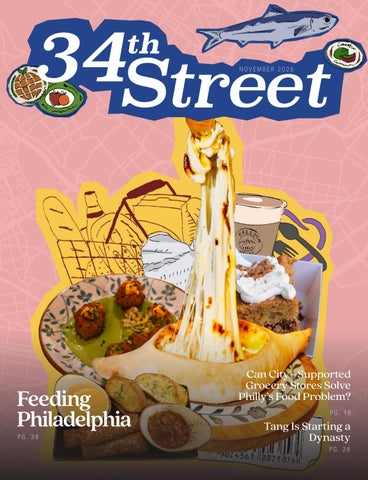
NOVEMBER 2026
Feeding Philadelphia PG. 38
Can City–Supported Grocery Stores Solve Philly’s Food Problem? PG. 16
Tang Is Starting a Dynasty PG. 28
S H OPSATPE N N .COM
Taste the World From savory spices to decadent delights, discover a world of flavor in the Shop Penn Retail District. Whether you’re in the mood for something bold, comforting, or exotic, each dish offers a delicious journey across cultures. Let your taste buds travel and visit Shop Penn today!
Shop Local. Shop Penn. #S HOPPE N N @S HOPSATPE N N
2
34 T H ST R E E T MAGAZ I N E
Souvlaki Salsa + Sushi
05 FROM THE GROUNDS UP 13
DEAR GRANDPA, I AM TAKING CARE OF MYSELF
On how to communicate across different dimensions
Freedom Coffee House pours its energy into building community and fighting for a cause.
Untangling the City Council’s latest initiative to combat food insecurity
28 30
FEATURE
16
CAN CITY– SUPPORTED GROCERY STORES SOLVE PHILLY’S FOOD PROBLEM?
FEEDING PHILADELPHIA Amid federal funding cuts, Penn’s community outreach programs are shifting their focus.
38
TANG IS STARTING A DYNASTY
ON THE COVER
For this queer Asian couple, Tang’s Bakery is a passion project, and they want to keep it small.
Leilei Lin
BLUE WARBLER SPREADS ITS WINGS
A vibrant collage on a map of Philadelphia: a khachapuri cheese– pull takes center stage, and surrounding it are hand-drawn illustrations of dishes all across Philadelphia.
This Chestnut Hill restaurant offers bites for all seasons. N O V E MB ER 2026
3
LET TER FROM THE EDITOR
On the Art of Dairy–Free Dining
T
he day I found out I was lactose intolerant was the day my life ended. Chai lattes, string cheese, strawberry pastries, and cafeteria chocolate milk became distant memories of the past. All of a sudden, everything I’d ever eaten seemed to contain dairy, and 12–year–old me had no idea what to do with myself. I began checking ingredient lists, paying a dollar extra for oat milk, and calculating whether a stomachache would be worth another bite of cheesecake. If there’s one thing I’ve learned about my complicated relationship with dairy, it’s that—fortunately—Lactaid can solve all of my problems. But if there’s a second thing I’ve learned about dairy, it’s that the food we eat goes beyond just its ingredients. For me, I think of all the times my father bought the more expensive lactose– free milk from Costco instead of regular milk to accommodate me; the nights my mother spent researching how I could build a stronger tolerance to lactose; and how they both perfected a recipe for lactose–free milk tea after I complained one too many times about my cravings. Sometimes, understanding what makes a dish special means looking beyond the food itself—from the history behind a recipe to the people who prepare it. In this year’s Dining Guide, our writers explore just that, taking you from places near campus to hidden gems in Center City and West Philadelphia. Along the way, we uncover the histories behind beloved dishes, the thoughtful design choices that make restaurants feel like home, and the people, culture, and communities that make Philadelphia’s food scene what it is. Keep your eyes peeled for a sit– down interview with the sexiest chef
4
34 T H ST R E E T MAGAZ I N E
on campus, who has had his hands in more salads than you’ve eaten in your entire life. We also investigate the food nutrition programs in West Philadelphia and the ways they’re supporting and educating local high school students. And because no Dining Guide is complete without a bit of controversy, we’ve rounded up the worst dining hall foods, with the help of some generous Penn students who were kind enough to offer us their opinions. Whether you’re looking for your next hidden spot or just searching for an excuse to eat, you’ll find something that resonates within each of these pages. As for me, I’ll resonate with whichever cafes make cheap drinks without dairy—so if anyone knows where to find a chai latte with oat milk that doesn’t cost an extra dollar, let me know.. a SSSF,
EXECUTIVE BOARD Nishanth Bhargava, Editor-in-Chief Samantha Hsiung, Print Managing Editor Kate Ahn, Design Editor Sophia Mirabal, Digital Managing Editor Jackson Zuercher, Assignments Editor THIS ISSUE’S TEAM Executive editor Jasmine Ni Copy editors Prashant Bhattarai, Jessica Huang Street Photo editor Connie Zhao Deputy Design editors Kiki Choi, Chenyao Liu, Amy Luo, Andy Mei, Alex Nagler, Julia Wang Design associates Catherine Garcia, Camila Leon Bolivar, Maggie Wang, Tiffany Zheng SECTION EDITORS Sadie Daniel, Features Ethan Sun, Features Diemmy Dang, Focus Henry Metz, Film & TV Aaron Tokay, Music Laura Gao, Arts Jessica Tobes, Style Fiona Herzog, Ego STAFF Features writers Isabella Guzman–Gallego, Maria Joyce– Johnson, Zoe Lachter, Vasanna Persaud, Kayden Zhong Focus beats Lara Elmanzalawi, Shannon Katzenberger, Jack Lamey, Carina Thomas Film & TV beats Zoe Belknap, Jaden Gardiola, Sophia Leong, Chenyao Liu, Elan Martin–Prashad Music beats Mason Asakura, Cailey Chin, Isabella Fife, Jackson Ford, Julia Girgenti, Michael Hopkins, Danielle Jason, Brady Woodhouse Style beats Orli Frank, South Fulweiler, Jekeun Jung, Emma Ong, Saanvi Ram Arts beats Jingyi Cao, Landis Hershey, Demi Marhule, Lynn Yi Ego beats Alexandra Dimitriou, Alexis Boland, Jaya Parsa, Sophia Shen Staff writers Roberto Bailey, Grace Burke, Shreya Darji, Penelope Gray, Emma Katz, Milena Mataac, Rachel Oh, Joonho Rider–Lee, Ananya Yadati LAND ACKNOWLEDGEMENT The Land on which the office of The Daily Pennsylvanian stands is a part of the homeland and territory of the Lenni–Lenape people. We affirm Indigenous sovereignty and will work to hold the DP and the University of Pennsylvania more accountable to the needs of Indigenous people. CONTACTING 34 th STRE E T M AGA Z IN E If you have questions, comments, complaints, or letters to the editor, email Nishanth Bhargava, editor–in–chief, at streeteic@34st.com. You can also call us at (215) 422–4640. www.34st.com © 2026 34th Street Magazine, The Daily Pennsylvanian, Inc. No part may be reproduced in whole or in part without the express, written consent of the editors. All rights reserved.
CHOPPED
Dear Grandpa, I Am Taking Care of Myself On how to communicate across different dimensions BY KATE AHN DESIGN BY KATE AHN
T
his is a story about Chuseok. This is also a story about coffee. It is, also, a story of neither. Chuseok is most commonly translated into “Korean Thanksgiving”— and in many ways, it’s simpler to think of it that way. Like American Thanksgiving, it centers around family gathering during the season of harvest; it too involves many foods that rely on the all–sanctifying power of frying in fat, be it perilla oil or butter; and it,
too, is about gratitude. Unlike American Thanksgiving, however, Chuseok is not about expressing gratitude after a bountiful harvest. It’s supposed to happen before it: a hopeful thank–you to your ancestors with the first grains of the season, before you take in the fruits and vegetables. It was at once a wish for a plentiful harvest, and an invitation to celebrate between the less forgiving months of summer and winter. Food is offered—first to the
ancestral spirits, then to the living in a ceremony of charye. One of my earliest memories of Chuseok rests in that hazy space between actual remembering and the illusion of it through family photos: on my grandfather’s knee in my hanbok and matching cap, tearing frantically into a grilled skewer, or handing my mother a jujube from the charye table with my sticky six–year–old hands. Memories of relatives, who I remem-
N O V E MB ER 2026
5
ber mostly as very tall, waiting to greet my cousins and I near the front door. They would all call me by name, pinch my cheek, and ask if I remembered them. I mostly remember bursting into tears: How were there so many people? And how did they all know who I was? Chuseok is also very particular, like a dance. The dishes must be offered in a specific way on the charye table: the fruits must be lined up first, with the direction they’re placed dictated by whether they’re red or white. When you offer up your ancestors a bit of liquor, it is poured, swirled, and disposed of in a series of fluid, intentional motions. It was my grandfather who was always next to me as I learned how to follow that dance: how to observe as the men would raise a glass or a white flake of fish. How to bow, and when, and how many times. I would glance up to my mother for encouragement across the room: I hadn’t realized it then, but I was the only girl in that wood–paneled living room. The charye was historically a male tradition—but my grandfather had passed it down to me. aaa My grandfather is a force of nature: straight–boned, with a big laugh and an expressive face. When I would call him over the phone, he would say my name like it in itself was a delightful surprise. He was the first of his family to attend college, then pass the bar, then become a lawyer. He read voraciously. He wrote poetry. Besides observing the charye, he also taught me history, bits of evolutionary biology, and how to play Go. He loved oxtail soup and golf and the occasional pint of Binggrae Together Vanilla Ice Cream. The jesa is a bigger umbrella beyond the charye, which holds more festive connotations. The jesa is much more solemn. There are many different kinds of jesa, at different occasions, but its primary purpose is to honor
6
34 T H ST R E E T MAGAZ I N E
and mourn the dead. I am 19 years old when I bow before my grandfather at his funeral. I try to remember how I learned how to bow properly beside him, how to offer liquor. I try to keep my posture straight. I do not think it is enough.
Food, I realize, has always had a way of transcending certain distances. aaa My grandfather was not a coffee person, but I am told he grew fond of it in the hospital. He particularly enjoyed instant coffee mix, the kind that’s gentle and rich with creamer and sugars. On the last day of his funeral rites, my great–aunt dreamt of her brother—my grandfather—sitting with his family. “Why haven’t you gone yet?” she implored him. “I would like a cup of coffee before I go,” he replied. The next day, they raised a cup of coffee for him during the funerary rites. As they picked their way back down from the temple, my grandmother recalled how peaceful it felt as they bade fare-
well. Back on campus a semester later, I call my parents less than I should. Outwardly, it’s because I’m too busy. Privately, it’s also because I feel that all my big and small worries as a college student are sometimes better left unshared. I want to regale them with good grades and adventure, not that I was trudging through my afternoon lectures with a half–eaten Pret A Manger wrap and an untouched collection of multivitamins I kept forgetting to take. Instead, I text pictures of my most put–together meals. Stir–fried eggplant and mushrooms over rice. Pork belly in a miso sauce. Cookies I stress– baked for my roommates. Here is me eating well (or better than you probably think). Here is me taking care of myself. Food, I realize, has always had a way of transcending certain distances. Between countries when I don’t have all the words to say, I’ll take care of myself. Between hazier borders between the living and the spiritual when there is no other way to say, “We miss you. We hope you’re doing well.” These days, I am learning to use that as much as I am learning to verbalize it, too. I try to call my grandmother more often now. She always worries that I spend too much time studying and reminds me to eat well. Yesterday, she was telling me about the first persimmons of the season. “Your grandfather loved persimmons, do you remember?” she asked me. “I’m thinking of bringing some to him.” And I do remember, then: my grandfather and I, scooping out the jammy insides with a spoon. The sheen of frost glittering on the red skin. My grandfather’s straight posture in the wooden rocking chair in the living room. His laugh. I couldn’t participate in the charye ceremony this year. I would like to offer this story in lieu of a persimmon, or a cup of coffee. I am taking care of myself. I miss you dearly. a
Hometown
Philadelphia, Pennsylvania
————————————————————————————
Field of Study
Anthropology, minor in Russian and East European Studies
————————————————————————————
Activities
Line cook, political organizer, Young Democratic Socialists of America
EOTM
S
ome of us are still figuring out how to feed ourselves, and some of us can make a Caesar salad in 30 seconds. Henry Planet (C ’27) belongs firmly in the latter camp. A politically engaged Penn student by day and a garde–manger line cook by night, Henry has learned to navigate the frantic rhythms of a professional kitchen—to him, fighting through pickle juice disasters and surviving never–ending shifts are all part of the hidden magic that goes into every dish. The kitchens behind gourmet restaurants have taught him some invaluable lessons: the skill of discipline, the complexities of kitchen culture, and what it’s like to see Penn from the other side of the serving counter. Let’s start from the very beginning: How did you get into cooking in the first place? Both my parents are pretty good cooks. My dad’s side of the family is Chilean and part Belgian, so I’ve always been familiar with multicultural food at family meals. As a child, I would enjoy eating out at
Henry Planet In Henry Planet’s world, running out of broccoli is the worst thing that could possibly happen. BY ALEXANDRA DIMITRIOU Photo by Catherine Fan Design by Kiki Choi and Chenyao Liu
this interview has been edited and condensed for clarity .
N O V E MB ER 2026
7
nice places, which was a privilege. I would always stay up late watching food channels with my parents, so in a way, I’ve always been surrounded with the idea of cooking. It’s always mattered to me that food is represented well. Am I the best cook ever? Probably not—certainly not. But do I really care about it? Yeah. I think one of the things that attracts me to cooking as a job is the reaction that other people have when I cook something. It really fills me with such a sense of accomplishment, and as a chef, you get to permeate this physical barrier between the kitchen and the dining room. Walk me through your journey as a line cook. My first job as a line cook must have been when I was 17 in high school, where I worked at a restaurant called Zahav. It’s owned by this Israeli guy, Mike Solomonov, and it was really interesting. It was my first time working in a well–known, fancy restaurant—I was surprised I got the job. I started off doing menial little assignments, like grinding up spices and basic knife–work tasks, and I think that’s where I started to enjoy being physical with my work. I currently work as a line cook at the Fitler Club on Mondays and Tuesdays, which is hard to balance with classes. But it’s also really fulfilling to have a place where I can put physical effort in my work. I work on a station called garde– manger, which is basically cold salads and raw appetizers. It can be a very easy station, but it can also be very challenging because you have to move fast. The expectation is that a salad should be done in two minutes. I can make a Caesar salad in 30 seconds. I once cooked for a party and made 40 Caesar salads in four minutes. You just mix it up, and
8
34 T H ST R E E T MAGAZ I N E
then bam, bam, bam—the pres- migrant coworkers in the kitchens, sure’s on, but I’m happy at my sta- and that can be a difficulty sometion. times due to language barriers. But at the same time, people know Tell me about a kitchen disaster. the basic curse words in each othHonestly, every shift is a series er’s languages—everybody knows of little disasters. There’s always chefs are potty mouths. We tend something that goes wrong, which to be very immature when we’re is one of the things that also excites working, so I think cursing is a unime about the job—there’s always versal language in its own right. an aspect of improvisation. Like, what? Oh my God, I ran out of broc- Do you feel like there’s a certain coli! So now I need to make brocco- hierarchy in the kitchen? li appear somehow. It depends on the kitchen. I’m My sophomore summer, I worked the only one who works my station at Osteria, an Italian restaurant, when I’m on it, and that’s typically as a line cook doing cold side ap- how the Fitler Club works, because petizers. And that was fucking in- we don’t have that high a volume tense—I’m gonna curse because of customers. There’s often two hiwe curse in the kitchen. One night erarchies that exist alongside each I fucked up so, so miserably. I was other: There’s the management making a mess everywhere: I acci- side and the cooking side. There’s a dentally opened up a bag of pick- military–esque structure to it. One ling liquid and spilled it all over of my line–cook coworkers made the walk–in refrigerator. My man- an analogy to the navy: The ship ager was like, “Henry, you’ve made will sink if you don’t work together enough of a mess. Get the fuck out to keep it afloat. of here. Clock out!” And I cried the There are also these informal entire time. I think people don’t re- hierarchies of seniority and expealize how much chefs can really de- rience. Recently, I’ve been able to stroy you sometimes. It’s these little give new workers advice. I’ve had jabs that make you feel like less of a the feeling of being a teacher, being person. It’s not funny like it is when a mentor, and being able to shape Gordon Ramsay does it. someone’s experience. How would you describe the cooking community? I’m an anthropology major, so I sometimes think of these things very anthropologically. Cooks form their own societies in a way, and they have their own culture. At Osteria, for instance, it felt like a competition. Cooks would say terrible things and make you feel like you were less than them. That sucked, but it was also just a cultural thing in that particular restaurant. And, you know, I don’t want to overstate things, but this is just how a lot of restaurants are. I will say that I really get along with my coworkers at the Fitler Club. I have a lot of im-
When you lived on campus, what were your favorite places to eat? They’re all terrible. I’m gonna say something controversial—I think Lauder really sucks. I thought Houston Hall was the best option that existed, even though it was expensive. I always found that with Lauder there were never enough options, and even the featured entree was kind of just slop. But I want to say this on the record—Penn, pay your fucking workers. The reason that the dining hall food sucks is because the conditions aren’t great and the quality of the food they’re purchasing isn’t great. You want better food on this
campus? Pay your workers, give them better benefits, and make their shifts less hellish—that will improve the quality. Do you see Penn through a different lens because of your work as a cook? Yes. I think it’s complicated. On the one hand, my work involves passion for cooking, but on the other hand, it involves a lot of discipline and being able to move fast. A kitchen is the kind of workplace that I think a lot of Penn students will never experience. It’s a manual job, and one that requires an understanding of the service sector. I think of the dining hall workers a lot, actually, and how pissed off students will act about them. They’ll say, “Oh, the Commons workers are so annoying” or whatever, but come on—walk a mile in another person’s shoes. Even though I feel like I’ve only started to walk the first couple yards, working in a kitchen has really exposed me to the fact that many students do not understand what it’s like outside of the academic grind bubble. I get it—it’s hard to be a student. I don’t want to say that one struggle is harder than the other, but I will say that I think it’s been very valuable to be able to look at the world not just as a student, but as a service worker. And I think that we could use a lot less of the dismissive Penn attitude that a lot of students have. Working in a kitchen is really hard. When I come home, sometimes my body is just done. I’m sore. I have nerve pain in my back. I don’t want to complain too much, but you’ve got to get through it for all those hours as well. The strain runs through you, and by the end of the night, you’re like, “Oh my God.” So, I think a lot of Penn students could reflect more on the lives of the people that they typically brush off. a
RAPID FIRE If you were a type of food, what food would you be and why:..................................................................... $ An asparagus. It’s the best vegetable. Favorite chef phrase:................................................ $ “86.” When you’re out of something, you’re like, “I’m 86 on tuna” or whatever. What is your food–related guilty pleasure:........... $ I like sour cream. A lot. I’ll put sour cream on pasta. And that’s completely terrifying and disgusting. But I’ll do it. If you were stuck on a desert island with one food, what would it be:....................................................... $ A halal cart. Purely on a survival basis. But I’d get fucking bored of it pretty fast. Dream chef to work with:.......................................... $ Chef Michael at the Fitler Club. I really would like to see him go places. There are two kinds of people at Penn:.................. $ People who organize food neatly on their plate, and people who just kind of pile that shit on. And you are? ............................................................. $ Someone who organizes it all very neatly on my plate.
N O V E MB ER 2026
9
The Hart of the Philly Food Scene Kevin Hart’s business, The Hart of Catering, shows us that one good meal can save the world. BY SHANNON KATZENBERGER DESIGN BY CHENYAO LIU
P
hilly is a major epicenter of the country’s growing opioid crisis. To address the problem, the city relies on a diverse network of support, ranging from harm reduction centers that provide materials for safe use to addiction recovery centers for those ready to take the next step toward rehabilitation. Community centers have also made a significant difference by providing meals and housing to those in need regardless of their addiction status. While harm reduction centers, addiction recovery centers, and community centers may be among 10
34 T H ST R E E T MAGAZ I N E
the more common ways of combating Philly’s opioid crisis, local caterer Kevin Hart is taking a fundamentally different approach through his organization, The Hart of Catering. The Hart of Catering—open since April 2022—is a traditional catering business providing services to corporate clients like KPMG and GEICO, as well as private events including weddings and bar and bat mitzvahs. Beyond its catering business, The Hart of Catering also operates a cafe at 21st and Sansom streets. Hart, the founder of The Hart of
Catering, was raised in the restaurant industry and worked several different jobs ranging from front– of–house to management. The Hart of Catering and its sister organization, The Hart of Recovery, were inspired by Hart and his business and life partner, Tim Judge. The couple drew from their personal struggles with substance use disorders to create a business model that sustains their own recovery while supporting their community’s sobriety goals. Much of the work they do, from feeding the unhoused community to opening recovery homes, fills
a gap that was present during their journey of homelessness, incarceration, and addiction. Their mission is to connect others through food and provide care for the community. But even with that busy schedule, they don’t stop there. Hart and Judge hold a community dinner weekly at their storefront location, in addition to providing food to other community dinners throughout the week. They constantly offer up their space as a meeting spot for community and recovery groups and also hire those in recovery for their business. When asked about what drew him specifically to catering, Hart cites the ways that catering allows him to do what he loves while also adhering to his recovery goals. “It lends a little bit more to a quote–unquote normal schedule,” Hart says. “That more normal schedule is more con-
ducive to trying to stay sober.” Another aspect of catering that Hart loves is the chance to see people on the best days of their lives, while also enhancing the day–to– day of more regular customers. For those he caters to daily, Hart builds relationships beyond the caterer– client dynamic. “I can plan an event with someone I’ve known in a corporate setting with the same price tag as a wedding, but we plan it in like three text messages,” Hart says. One of The Hart of Catering’s biggest strengths is its flexibility. Its 15–page event menu includes everything under the sun, from passed hors d’oeuvres to mashed potato bars to poke, and Hart says that they’re willing to serve anything the guest wants. “Of course, we’re here to guide through our experience,” Hart adds. Hart and his operations man-
ager, Al Fuchs, emphasize that The Hart of Catering and its sister charity, The Hart of Recovery, always strive to put people first. I think [what] we’re really good at is listening,” Fuchs says. “We listen to what our clients [want] and what is needed, and through our expertise in the areas, we’re able to … develop that level of service and experience that you know is aboveboard." The Hart of Recovery was founded at the same time as the catering business to pursue Hart and Judge’s shared passions for food service and helping others. It helps individuals achieve sobriety and then provide the long–term structure for them to stay sober—and one way it achieves this is by providing employment opportunities and job training, especially through The Hart of Catering.
LO CA L , S EA S O NA L , SUSTA I NA B LE
3420 Sansom Street • 215.386.9224 • whitedog.com WDUC_Daily Penn Dining Guide 10.22.25.indd 1
10/22/2025 7:29:06 PM
N O V E MB ER 2026
11
“We’ve all had challenges, and we’ve all faced different things,” Fuchs adds. “Everybody deserves an opportunity.” Hart says that many recovery centers aim to fit as many people as possible within their doors—a practice that he believes can be counterproductive. Hart says these kinds of recovery centers, which choose to maximize profit over helping the individual, are a “money grab” and don’t help people nearly as much as they should. “It was always kind of a dream of ours to do things a little bit different,” Hart says. “Just having a balance and a sense of serenity and calm and peace.” Hart attributes much of his motivation to the shared hardships that he and Judge endured in their early years. When they met, Hart and Judge were both in active addiction, and they remained that way for the
first six years of their relationship. Nine months after they first met, they lost their home. “Me and Tim have been homeless on the streets together … we’ve been in jail together … we’ve been at the lowest lows together,” Hart says. “And it wasn’t always pretty, but to be out on the other side of it makes it that much more powerful.” Hart sees his personal experience with addiction as a strength—one that gives him insight into how best to support people facing the same issue. Hart says that nobody wakes up and decides that they want to become a drug addict. “It can be really hard to walk that line of showing [someone] that you’re there for them and enabling them … you can’t force someone to get help,” he explains. The Hart of Catering, as Fuchs puts it, is a “yes company.” Whether
you’re looking for a good place for breakfast or lunch (Fuchs says the Brinton wrap is his favorite item at the cafe) or want to take that next step in recovery, The Hart of Catering has a place for you. But both Hart and Fuchs say that the best is yet to come. The Hart of Catering is only four years old, and while its impact is already clear, its story is just beginning. “I’m always looking for more ways and new ways to give back and be of service,” Hart says. They say he who saves one life saves the entire world. Hart and his team at The Hart of Catering are a prime example of that. By focusing on the individual and what the team can do to improve their life— whether by setting them on a path to recovery or by providing them lunch every day—Hart is building up Philly one day, one life, and one mouth at a time. a
• 3611 WALNUT STREET • 267.805.8585 • @LOUIELOUIEPHL •
DailyPenn HalfPage 10.22.25.indd 1
12
34 T H ST R E E T MAGAZ I N E
10/27/2026 3:18:25 PM
From the Grounds Up Freedom Coffee House pours its energy into building community and fighting for a cause.
BY ALEXIS BOLAND DESIGN BY CATHERINE GARCIA AND CHENYAO LIU
T
ucked onto Old York Road up north in Logan is a cafe that seems like any other. Walk past in too much of a hurry, and it might blur into the restaurants and row houses that surround it. Step inside, however, and you’ll
discover it’s anything but ordinary. Freedom Coffee House was opened in January 2025 by husband and wife duo Eugene Gilyard and Najwa Anderson. Any day you stop by, one of the pair will greet you from the reg-
ister, and the other will craft your drink of choice behind the counter (including one of North Philadelphia’s best matchas, I’ve been told). The two both studied business with the intention of one day N O V E MB ER 2026
13
starting one of their own. The question of what kind of shop to open had only one answer. “We just love coffee. We decided to open a coffee shop because there was none in our neighborhood,” Gilyard says. The two of them have spent dozens of hours in coffee shops across the city in recent years, using them not only as spaces to eat and drink, but also places to study, brainstorm, or relax. To the couple, coffee shops are the pinnacle of community space—a kind of space their own community was deprived of. “It’s bigger than coffee, right?” Gilyard says. “It’s giving a space to the community to be able to come and enjoy coffee, and read a book, or work on a laptop, or have meaningful conversations. Food brings people together.” When asked what their favorite part of running the shop was, both Gilyard and Anderson give me the same answer: “Community.” Working behind the same counter every day allows them to learn the names, faces, and orders of everyone they see morning after morning. As locals to the area they serve, the neighborhood is familiar, and their sincerity works to make the people familiar, too. Their cafe has become a second home for many, with its owners acting as their regulars’ second family. “People say, ‘Hello, family. How are you today?’” Anderson recalls. “If we went on vacation or close early for an event, people come back the next day asking, ‘Where was y’all at yesterday?’” “We know our regulars’ names. They know our names. They come in, they socialize with us. A lot of them confide in my wife,” Gilyard says. The care they pour into their people does not go unreciprocated. “A lot of marketing is done by our customers. Customers will 14
34 T H ST R E E T MAGAZ I N E
come in and say, ‘Hey, I saw you guys on TikTok.’ We don’t know nothing about TikTok,” Gilyard says. “There might be customers that come in and say, ‘My husband’s always in here. He comes home raving and rambling about how good you are, so I wanted to stop by.’” Ironically, the pair also says that the hardest part of launching a small business is building rapport with clients, especially in a tight–knit community like Logan. They built that relationship on a foundation of consistency. “You’re not just gonna open a business and have people right in the door,” Gilyard says. “People gotta learn about your existence, and learn to love your existence. That takes time. We made sure to show up every day, and show them we’re not just here for the money.” This community is not something Gilyard takes for granted— he went much of his life deprived of it. At just 18 years old, Gilyard was sentenced to life in prison for a 1995 murder he did not commit. He spent the better part of two decades behind bars—while incarcerated, he sent his appeal to the Pennsylvania Innocence Project before finally being exonerated in 2013. While he doesn’t want his story to be at the center of the cafe, it’s embedded into certain aspects, including the word “Freedom” in its name. “We wanted the shop to be indicative of that,” Gilyard says. “That was the reason for the name and, more specifically, the logo.” The logo in question is a black– and–white outline of a mountain range circumscribed by the shop’s name. Gilyard reveals that Anderson, the logo’s designer, chose mountains to represent both Gilyard’s past and the shop. “Prisons are strategically put away from society, often on
mountains. When my wife would come visit me, she would literally have to ride up a mountain,” Gilyard explains. “So, it’s indicative of that, and it kind of coincides with coffee as well. When people think of coffee, they think of mountains.” The subtle nods to Gilyard’s past are intentional, designed to prompt questions without shouting the answer in your face. Gilyard doesn’t keep his past under wraps; it’s not something he hides from, but it’s also not something he displays front and center. When it’s brought into his work or his life, he focuses on looking forward rather than back. “We wanted [the coffee house] to be a representation of my past. We’re not running away from it, but I’m not advertising it, right?” Gilyard says. “It’s a conversation that may come about or it may not.” Unfortunately, his story is not an uncommon one—Gilyard says he hopes to bring awareness to the issue of wrongful conviction that plagues our nation. By telling his story, he hopes to make people aware that “innocent people can be convicted. A lot of people have faith in the justice system. We think it’s perfect. It doesn’t err. But yes, people can be convicted for a crime they didn’t do.” Gilyard stays connected with organizations such as Penn’s own Quattrone Center for the Fair Administration of Justice, embedding advocacy and policy projects surrounding wrongful convictions with his perspective. He doesn’t consider himself a universal spokesperson, and he and his wife try to keep themselves away from the limelight. Rather than chasing headlines and cameras, they spend their days doing what brings them joy: making coffee and small talk with the people they love. a
Your Holiday Cravings, All in One Corner 39th and Chestnut
Contact us for Catering!
www.bonchon.com
www.carterspizzaandbeer.com
www.teadocafe.com
www.parisbaguette.com
N O V E MB ER 2026
15
Can City–Supported Grocery Stores Solve Philly’s Food Problem? Untangling the City Council’s latest initiative to combat food insecurity insecurity. BY LARA ELMANZALAWI AND JACK LAMEY DESIGN BY LEILEI LIN AND CHENYAO LIU 16
34 T H ST R E E T MAGAZ I N E
H
ow do we decide what to eat? Different heuristics—including quality, accessibility, or affordability—guide this decision for different people. For students with a fast–paced collegiate lifestyle, having a quick Grommons meal or Trader Joe’s snack can often seem like the optimal decision. With abundant grab–and–go options in close proximity, many on Penn’s campus can find nourishment conveniently. Many in the broader Philadelphia community do not share this luxury. Food insecurity—defined by the Department of Agriculture as “a household–level condition of limited access to food”—plagues nearly 14% of local residents, most notably in neighborhoods such as Kensington and Hunting Park. These concentrations of food–insecure families also reveal the issue’s connection to problems of structural racism. For many Black and Hispanic families, wage gaps in employment and disparities in education can make it more difficult to access affordable, healthy food options. With the One Big Beautiful Bill Act slashing Supplemental Nutrition Assistance Program benefits for over 5 million Americans—including 98,000 Philadelphians—new solutions have become necessary to address the needs of underserved communities. Within Philadelphia, various strategies have been attempted to alleviate local food scarcity. In 2022, Alexandre Imbot (C ’20) and Eli Moraru (C ’22) founded The Community Grocer, a store providing weekly $75 grocery credits to neighbors for organic produce. Networks like the Share Food Program have organized volunteer–based distributions of fresh fruits and vegetables to homes across the city. Pennsylvania’s Summer Meals Program has distributed meals at community centers, extending free breakfast services to students outside the regular school year. While these ef-
forts have improved equity in meal distribution, the issue of food insecurity continues to loom over Philadelphia. The City Council is exploring other initiatives designed to combat the problem—including the establishment of city–supported grocery stores. Introduced by Council President Kenyatta Johnson on Thursday, Oct. 8, the Philly Food Affordability Act proposes the establishment of an Office of Food and Nutrition Security and an advisory commission. The act also involves evaluating the feasibility of grocery stores supported by the city through public– private partnerships. The proposal comes amid a long–term spike in food costs that has only been exacerbated by recent inflation nationwide. According to data from the Bureau of Labor Statistics, prices in Philadelphia metropolitan area grocery stores increased by approximately 35% between December 2019 and June 2026. Experts, however, are skeptical that the proposed stores will be effective in ameliorating food insecurity. To Sophia Hua, an assistant professor of Medical Ethics and Health Policy at the Perelman School of Medicine, the proposal’s tactic for reform is incomplete—it expands accessibility but ignores the underlying problem of affordability. “A grocery store gives you [the opportunity] to buy food, but if you do not have the money to buy it, it will not help you,” she says. “Unless these grocery stores are extremely affordable, I can’t imagine how it will impact food security.” For George Matysik, the executive director of the Share Food Program, expanding access to grocery stores must similarly function in conjunction with strengthening financial assistance for residents, especially as federal cuts to SNAP benefits reduce their purchasing power. “It’s great to be able to add grocery stores in, but it needs to be done in
tandem with getting more resources for the folks that shop at those grocery stores,” Matysik says, “particularly those who are coming from food–insecure backgrounds.” The Share Food Program runs food distribution networks across Philadelphia and the surrounding region. Matysik also co–chairs the city’s Food and Nutrition Security Task Force, which released new recommendations for addressing the city’s food insecurity back in June. “The work that we do is incredibly important, but it is meant to be supplemental, not primary,” Matysik says, explaining that food banks were never intended to serve as households’ sole food sources. Beyond questions of affordability, there are also logistical questions about how city–supported grocery stores would operate. Traditional grocery stores operate on narrow profit margins, making it difficult to offer discounted groceries while covering costs and paying adequate wages. Instead of running the stores directly, future hearings will explore different ways the city could adopt public–private partnerships, in which the city would provide funding to external organizations to run stores. “[The] long–term financial stability of a model like this is something that I think everybody in the space is trying to collectively figure out,” Matysik says. Volunteers at Penn’s Operation Meal Forward encounter food insecurity through direct engagement with communities in the city. Members of the student group prepare meals for residents of local shelters—including the Bethesda Project—using food supplied by food rescue organization Sharing Excess. At the end of each semester, the student group also collects unopened and unexpired food donations from students and redistributes them to shelters and food pantries. Through this work, OMF President Dhivya Sampath (C ’27) has ob N O V E MB ER 2026
17
served firsthand how food insecurity extends beyond grocery prices. In neighborhoods where it is easier to access corner stores or fast–food restaurants, fresh produce can be hard to find. For those without cars, residents working long hours, or individuals with disabilities, there are additional obstacles to reaching grocery stores and food pantries. Although Dhivya supports the proposed initiative, she recognizes its potential limitations. “It’s more of a Band–Aid than kind of an end–all, be–all solution,” she says. Dhivya says that lowering grocery prices does not completely address the poverty that can prevent households from purchasing food, even at discounted prices. Working to raise wages and improve the financial resources of residents, she suggests, must be part of broader conversations on combating food insecuri-
ty. “Right now … the Pennsylvania minimum wage, which is the actual legal standard, is only $7.25,” Dhivya says. “Like I said before, [even] if a melon’s $1, that’s still one–seventh of what you’re making in an hour.” She also emphasizes that existing community–led food initiatives, such as the Mariposa Food Co–op in West Philadelphia and the South Philly Food Co–op, deserve continued support. Beyond grocery stores, the Philly Food Affordability Act also proposes creating a permanent Office of Food and Nutrition Security to help coordinate food access programs across city departments and community organizations. If approved by the City Council, the proposed charter amendment would be voted on by Philadelphia residents in May 2027. For Matysik, the establishment of a long–term commitment to fight-
ing food insecurity is vital, given how priorities can change between mayoral administrations. “To me, it’s less about any one single policy decision that I might think [of], and more about what are the policy decisions that the food–insecure residents of the city of Philadelphia want to see happen?” he says. “And how do we make sure that that does happen in the future?” As the city considers its next steps, city–supported grocery stores could offer one route for improving access to nutritious food. Those on the front lines of fighting food insecurity, however, say that increasing availability may not necessarily improve affordability. Philadelphia’s city–supported grocery stores, they say, must be more than a Band–Aid on a bullet hole—they must make healthy groceries affordable to residents from all walks of life. a
Order a traditional holiday dinner for pickup, or make a reservation in the dining room for a prix fixe dinner with all the traditional holiday favorites — vegan options included.
20 S. 33 St. 215-387-1400 18
34 T H ST R E E T MAGAZ I N E
Lock in your plans at coopphilly.com/thanksgiving
OPEN LATE & LATE NITE DELIVERY
Domino’s
TM
SUN-THURS: 10AM - 2AM • FRI & SAT 10AM - 3AM
WE MAKE ORDERING EASY!
CALL DIRECT OR CHOOSE YOUR ONLINE OR MOBILE DEVICE
215-662-1400 4438 Chestnut St.
215-557-0940 401 N. 21st St.
N O V E MB ER 2026
19
The Worst Foods at Dining Halls Follow Style writer Orli Frank as she tries out the worst foods from each campus dining hall. BY ORLI FRANK ILLUSTRATION BY AKSHAY GUPTA DESIGN BY ALEX NAGLER
Penn food sucks—and that is a well–known fact. But how bad can it truly suck? To find out, I spent a week going to various dining halls on campus, asking students to identify the worst item on the menu and putting those crowd–sourced reviews to the ultimate taste test. I’ve documented my experience for our magazine readers.
Tuesday Lunch: Houston Hall After three straight hours in David Rittenhouse Laboratory, I was excited to finally get some food. Thankfully, Milena Mataas (E ’30) was willing to give me my first recommendation—the soup from 34th Street Carvery in Houston Market. Tuesday’s soup was the vegan tomato and basil soup. The first thing I noticed was its unique texture, which reminded me of a more liquid version of marinara sauce. I attempted to keep an open mind, but one bite confirmed my worst fears: It tasted like marinara sauce, too, or watered–down marinara sauce. Was I drinking straight marinara sauce? That’s when I remembered that I hate tomatoes—except on pizza. This soup was sadly not on pizza, so I set it aside and cleansed my palate with some water. My friend asked if I would eat it if someone gave it to me for free. The answer: probably not. Overall rating: 3/10 20
34 T H ST R E E T MAGAZ I N E
Wednesday Lunch: 1920 Commons After NSO, I made a promise to myself never to willingly set foot in Commons again. But I’d do anything for journalism, I guess. We approached Habeeba Bamba (C ’29) and Isabella Wang (C ’29), who graciously curated a meal for me: soup and raw mushrooms. I was so thrilled to have soup again; the one yesterday was so yummy! There were two flavors that day: chicken noodle and corn chowder. For the sake of integrity, I tried out both. I started with the chicken noodle soup, thinking that it would be the best item of the week. But letting my guard down was my first mistake. I noticed almost immediately that the noodles looked melted. The broth tasted overwhelmingly of salty celery, even though there was only one piece of celery in it. After one bite, I was done. Overall rating: 2/10 Soon, it came time for the grand finale: raw mushrooms from the back of the salad bar. I was not excited, but I had to commit to the bit. So, I stared into my roommate’s eyes and took a nibble—a grave mistake. Water began spurting from the mushrooms into my mouth, accompanied by a haunting aftertaste that I can still feel to this day. I started tearing up a little bit. I’m not exaggerating when I say this was the worst thing I’ve ever eaten. Overall rating: –1,000/10
Wednesday Dinner: Lauder College House That night, I could just feel that something horrible was going to happen at the dining hall in Lauder. And I was right. As soon as I walked in, I somehow knocked over ten ceramic bowls. And I was wearing open–toed shoes. I felt so bad (and a bit humiliated), but the staff was incredibly kind about cleaning it up, asked if I was okay, and kept telling me not to apologize. I love Penn Dining staff—there are angels among them. After that public humiliation, I wasn’t feeling very excited about ambushing people to ask them about their dining hall recommendations. However, with encouragement from my friend, I finally went up to three individuals, who all declined to be named in this article. Their recommendations included both carrots and chard. The chard tasted like spinach and had a little kick of spice to it. It wasn’t bad, but it wasn’t that great, either. On the other hand, the carrots were strangely bitter. It was an interesting healthy combo. Overall rating: 4/10
Thursday Lunch: Kings Court English House After another three straight hours in DRL, I was eager to go to the dining hall in Kings Court English House. In my opinion, it’s one of the top dining halls on campus. Unfortunately, Joann Hobeika (E ’30) ruined the experience for me with her recommendation: raw salad and the gluten– free, dairy–free, and nut–free plastic–wrapped brownie. Life is too short to make healthy decisions, so I began with dessert. The brownie had a strange aftertaste that coated my entire mouth, but it had a rich chocolate flavor. It was sweet—like a regular brownie should be— and for all the ingredients that it lacked (gluten, dairy, and nuts), it still tasted like a brownie. Overall rating: 5/10 The raw salad was disgusting. I felt like I was crunching on bitter water. If this is what healthy eating is (it definitely isn’t), count me out. Overall rating: 1/10 N O V E MB ER 2026
21
(Dining) Hall of Sham Oysters @ Hill
Raw lettuce @ Commons
Meatloaf @ any dining hall
Gross! “Korean–inspired” anything @ any dining hall
Scrambled eggs @ any dining hall
22
34 T H ST R E E T MAGAZ I N E
Vegan blueberry tarts @ Commons
me
to Penn s e o g e n o y Ever d, right? o o f e h t r o f
High–risk Sushi @ McClelland Cookie Monster ice cream @ Lauder, KCECH
Yummy! PB&J @ Gourmet Grocer Strawberries @ Hill
Low–risk
Chicken bowl @ McClelland
Chicken wrap @ Hillel
N O V E MB ER 2026
23
Street presents...
Dining Guide 26 Recipe Philly
28
Has Dinner at Home
Tang Is Starting a Dynasty
32 Kinto
Brings Georgia to Girard
24
34 T H ST R E E T MAGAZ I N E
3W0 arbleirngs
Blueds Its W a e r p S
34 Loretta’s:
More than a Coffee Chat
36 e Your
Tak at Time into Cafe T
N O V E MB ER 2026
25
Recipe Philly I Has Dinner at Home This innovative Center City restaurant redefines what it means to eat. BY JESSICA TOBES DESIGN BY LEILEI LIN
26
34 T H ST R E E T MAGAZ I N E
t’s half past five on a Thursday night when Andy Revella offers me a tour around Recipe Philly, the new restaurant that opened in August 2026 where he serves as executive chef. A colorful array of plates line each of the massive columns in the space, and a painting of Philly’s Italian Market is painted on the wall of the bar at its center. Floor–to–ceiling windows capture the sun beginning to set behind City Hall to my left, while the lights of the Pennsylvania Convention Center sparkle behind me. “I like to say that this particular corner of North Broad and Arch Street—because of the Masonic Temple and City Hall—is the past connected to the future,” Revella explains as he points to the Convention Center close by. “There’s no place in the city [that] has that,” Revella gushes. Motioning to the restaurant before us, he greets Street Photo Editor Connie Zhao as we enter the space. “Welcome home.” “Home” encapsulates the ethos of Recipe Philly, from its design to what’s on the menu. Every home has their own quirks, and this Center City restaurant is no exception. Despite being steps across the street from the Pennsylvania Convention Center, this is anything but your conventional restaurant. If reality TV and food had a baby, Recipe Philly would be its firstborn. Before it opened, the restaurant hosted a contest inviting home chefs to submit their best recipes and compete to add them to the restaurant’s upcoming menu. The opportunity of adding one’s own recipe to a restaurant’s incoming cuisine was the ultimate reward— along with cash prizes, of course. There’s only one stipulation to compete—be a local. This ensures that Recipe Philly maintains its local ethos, with the food reflecting the families and cultures who make
up the city’s culinary landscape. Teaming up with a production crew and recruiting Senior Casting Director of American Idol Josh Randall as host, Revella and Recipe Philly founder Ed Baumstein—also the founder of consulting firm SolomonEdwards—released a casting call for their show in 2025. By the time it closed, a thousand Philly–based home cooks had submitted their family recipes for a chance to compete. After Revella whittled the pool down to 100 contestants—weighing recipes on factors like restaurant quality and ease to cook in a commercial kitchen— the competition began. The eight–episode season documenting the contest shines a light on the local faces behind Recipe Philly’s chosen dishes. Filming for the competition ended in July 2026, but finalizing the menu was only one part of the journey. The next hurdle—one that’s characteristic of Revella’s culinary ethics—sat behind the kitchen doors. Leading Connie and I to tour the “first green kitchen in America,” Revella demonstrates what the future of food service could look like. We weave between sous chefs plating the next table’s meal and line cooks frying on the stove. All the while, there’s not a single kitchen hood in sight. Revella points to the stoves and explains how the kitchen utilizes induction cooking—essentially, cooking with magnets. It ensures there’s no smoke or grease in the air, a standard that holds throughout the kitchen with its hoodless ovens and grease removal devices. “Everything I’ve done for the last 20 years is to make the employees’ environment safer,” Revella says. “It’s not only clean there, but it’s clean and safe.” “That’s a standard that you establish. You either live by it or not,” Revella explains of his ethos. “One
of the things we said from day one is we’re going to make it tour quality. You can tour the kitchen anytime … so Saturday night at 8 p.m., when we’re packed and everybody’s running around, that kitchen will look just like it’s looking right now.” In this way, he lives up to being the “Greenest Chef in America,” a title bestowed upon him by Ted Turner and the Captain Planet Foundation in 2009. We’re led back to the dining room where portraits of the winning contestants hang on the wall, overlooking us as we sample their homemade recipes. Dinner is served on mismatched plates to mirror the way different dishes make their way to a family potluck. At Recipe Philly, customers shouldn’t only feel comfortable—they should feel at home. The energy of a cozy, home– cooked meal emanates from the cosmopolitan spread of food on the table. I dip my fork into the ceramic cup holding the Thai Curry Noodle Soup—I’m afraid when I smell the spice rise with the steam, but I’m willing to sprinkle some chili oil atop my noodles at Revella’s recommendation. The creamy texture precedes a subtle tang, and I reach for “Claudia’s New Year’s Day Soup” to cool my tongue. The mild taste from its tomato–Prosecco broth leaves a sweet flavor lingering on my tongue. Connie and I rearrange our plates to split the Smoked Gouda and Chicken Arancini. The soft interior of the arancini contrasts with its outer crunch, and the smoked gouda melts in my mouth, reminding me of a fried mac and cheese ball. Above it on the plate rests the most distinctive sample of the spread—one of “Niya’s Philly Cheesesteak Egg Rolls.” Filled with shaved steak, onions, peppers, and melted cheese, this rich twist on a Philly classic tempts me to ask Revella for another roll. The spread reminds me of the
ethos behind Recipe Philly—food which reflects the city and the people who give it life. The menu transcends a simple list of ingredients to tell the story of the many cultural traditions that make up the City of Brotherly Love. Revella wants to turn this limited–time run into a full length series—think Recipe Chicago or Recipe Miami, building more restaurants to showcase the melting pot of cuisines present within every city. But before any of that, he wants to cement Recipe Philly as a local landmark. Ultimately, Revella hopes to define what makes Philly, well, Philly. Through opening this restaurant, he’s inching closer and closer toward this goal. “There’s the Liberty Bell. There’s the Rocky steps,” he says with a smirk, “and then there’s Recipe Philly.” a
TL;DR A restaurant as seen on TV—you might come for the concept, but you’ll stay for the local cuisine.
LOCATION 1401 Arch St.
PRICE
$$ HOURS Monday–Thursday 4–10 p.m. Friday 4–11 p.m. Saturday 11 a.m.–11 p.m. Sunday 11 a.m.–10 p.m.
N O V E MB ER 2026
27
Tang Is Starting a Dynasty For this queer Asian couple, Tang’s Bakery is a passion project, and they want to keep it small.
BY LAURA GAO PHOTOS BY JOCELYN VARGAS DESIGN BY KATE AHN
T
he walk up North Second Street features electric lines dangling over storefronts and five different people walking their dogs. Mid–century modern buildings are placed next to classical brick facades, and pavement cracks run up and down the road. From a block down the street, I notice the growing line in front of STUMP: Northern Liberties, filled with students and older adults alike. Ahead of 28
34 T H ST R E E T MAGAZ I N E
me in line, a tall, middle–aged guy in a baseball cap is getting ready to order six cakes and three puddings. Two college–aged girls behind me chat about which dessert they most want to sample. They’re all here for the monthly popup of Tang’s Bakery. When we get to the front, founders David Thai (C ’18) and Howe Wang are busy packing a customer’s order while wearing red
baseball caps adorned with the bakery logo. A menu explains the four desserts on sale this time—there’s rice pudding, pound cake, carrot cake, and jujube toffee. The desserts, prepacked in clear–cased containers, are displayed enticingly on the table. Wang had loved baking all throughout high school, but when he went gluten–free in 2020 due to a food allergy, he struggled to bake with this new di-
etary restriction. It wasn’t long before he realized he missed the hobby and became determined to get back into it. “I started to experiment with different kinds of flours that I could use as a substitute,” he tells me, “and just started making random things for myself and for David and our friends.” Their friends kept planting the idea of a bakery, and so, on a drive up to the Poconos in November 2024, David and Howe began drawing up the plans. For six months, the couple ironed out branding details and conducted recipe tests in focus groups. A dozen of their friends got together at Old City Coffee and were asked to sample and rate a bunch of treats on four criteria: presentation, taste, texture, and pricing. The business, named after a combination of the founders’ surnames, was then launched with a “conservative approach.” An informal event was held where the couple “invited a ton of people over and had a whole spread of treats out.” Gradually, Tang’s grew as they partnered with more and more small businesses, hosting popups in various neighborhoods around Philly. “It’s very very supportive, the small business community here,” David says. “It’s a mutual benefit. We bring treats and we bring foot traffic, and then they also provide the space, often free of charge.” Now, four desserts are served at every popup, with Howe as the primary baker while David handles the operational side. The selection is curated every month, and new items are always being experimented with and added to the menu. This time, they’ve saved some treats for me. David hands me the big paper bag, with a red Tang’s sticker adorning the front. My bakery co–goer—Street Photo Editor Connie Zhao—and I find a nearby cafe and lay out the sweets underneath the shade. The first thing I notice about the carrot halwa cake is how delightfully moist it is. Two layers of pastry sandwich a creamy carrot paste in the mid-
dle. Pistachio and cashew crumble litter the top, creating a rich juxtaposition between the soft and the crunchy. With each bite, a bold cinnamon spice punctures through, creating an enveloping autumn feel—though it was quite a bit more potent than I’d expected for a carrot cake. Next up is the biko rice pudding. The caramel envelops the rice in a sweet and glutinous feel, while toasted coconut bits provide a crunch and a soothing aftertaste. I’m not the best person to review this dish because I’ve historically not been the biggest consumer of rice pudding—I’ve always associated rice with savory entrees, and rice dessert feels somewhat wrong to me. I enjoyed every bite of this treat, but I don’t see myself reaching for it in the future. Finally, we dig into the pandan pound cake. I didn’t know what to expect because the cake was bright green. Upon taking my first bite, though, the pandan was quite the opposite—the flavor, known as the vanilla of Southeast Asia, felt generically sweet. Compared to the carrot cake, this one was a little drier and more crumbly. Nonetheless, a few bites (and intense focusing) later, I revised my first impression—there were some complex, lingering notes that I can only describe as nutty. It was subtle, barely there; I would’ve liked to taste a bit more of the unique flavor. Each treat was a solid dessert that delivers what it’s promised, and it’s even more impressive that they’ve done it gluten–free. It’s amazing how they’ve experimented to bring Asian flavors to the gluten–free realm. On popup days, Howe wakes up “around any time between 3 a.m. to 6 a.m.” Between when he wakes up and noon, he “bakes nonstop.” It gets more intense “when the sun comes up” because, he says, “We’re always rushing and packing things and putting things away … 15, 20 minutes before we leave.” These Saturday mornings, despite the hard work, are special to Howe. “But I really do enjoy it, and especially when it’s still dark out,” he says. “There’s
no one moving, no one doing anything. I just have my headphones on, listening to music. I’m in the zone, I’m going.” I recommend Tang’s to anyone who enjoys novelty and feeling the personal touches in food. Even for a frequenter of Asian bakeries, Tang’s contains flavor combinations I’ve never tried before. Defined by delicate notes, they taste like they were baked with love. In addition, these desserts leave you satiated without being overbearing. The joy of a Tang’s treat is just as much in the aftertaste—a rare sight in the modern landscape of hard–hitting sweetness that doesn’t last beyond the first three bites. While a brick and mortar sounds quite “romantic,” David and Howe don’t envision setting one up. At the end of the day, they’re in it because it’s a passion project, and scaling up would require a greater level of resource and commitment that might interfere with that joy. “We just enjoy being able to go with the flow,” David says. “We’re our own bosses. We can pause. We can keep going. We can go really hard on it.” a
TL;DR This well–loved popup bakery combines classic Chinese and Vietnamese flavors with a gluten–free twist.
LOCATION Different each month.
PRICE
$ HOURS Once a month, Saturday at 12:30 p.m.
N O V E MB ER 2026
29
Blue Warbler Spreads Its Wings Feeling peckish? This Chestnut Hill locale is serving up an eclectic menu. BY AARON TOKAY PHOTOS BY JACOB HOFFBERG DESIGN BY EMMA ONG
L
isten closely inside The Blue Warbler and you’ll hear its song. The brick–walled dining room of the Chestnut Hill restaurant is filled with friends catching up, strangers trading recommendations, and diners excited to try something new. Nestled in the corner of Germantown and West Willow Grove Avenue and just a short walk from St. Martins station, the restaurant welcomes customers with a host stand between the cafe/bar 30
34 T H ST R E E T MAGAZ I N E
and a shelf holding board games. Bartenders are mixing cocktails in front of an espresso machine, waiters are passing out share– plates, and each chair is designed like a corner seat with cozy privacy. I sit on a half–level platform across from a large window that welcomes in the warm glow of the street lamps outside. A short curtain drawn across the window’s lower half shields diners from the gaze of passersby, preserving
the feeling of being comfortably at home. Behind me, the beat of soft house music wafts out from the bar. From the kitchen, tucked away behind a sunset orange wall, comes the quiet hiss and crackle of hot pans. There’s something for everyone—and every meal—on the menu. The restaurant’s many vegetarian options reinvent familiar flavors with creative twists: patrons can order vegetarian meatloaf with harissa glaze and fries,
salt–cod croquettes with lemon relish, or a number of other dishes that combine global cuisines. The drink menu features non– alcoholic beers and wines, various seasonal cocktails, and local Philly breweries on draft. Our table splits the seasons. The “You Say Tomato, I Say Martini” drink holds on to summer, bright and fresh with notes of lemon, olive, and pepper. The Pumpkin Espresso Martini leans fully into fall, , with a mellowcrème pumpkin at the base of the glass and fluffy foam dusted with autumn spice—a sip reminds one of the crackling leaves on the cobblestones outside. When the waitress returns to take our order, my mind is still on the salt–cod croquettes. And the moment they arrive and touch my tongue, they’re all I can think about. A crisp exterior breaks into soft, supple cod, met by cool dill yogurt and a bright lift of lemon relish and chives. It’s Spanish bacalao at heart, with tzatziki harmonizing in the background. The dish is served on a rustic plate, its red clay rim mirroring the russet crust of each croquette. Next comes the “First Dates.” Before the waitress has even placed the bowl by the small, glowing candle in the center of the table , I smell the sweet perfume of pan– seared dates stuffed with squidgy halloumi. The blistered medjool date skins take up the flavor of a white wine beurre blanc whose richness is cut through with mint. The bite is tender and succulent, with its jammy body given texture with warm dukkah and crunchy celery. On the tines of just one fork, you can stack the flavors of lush marmalade, toasted nuts, fresh herbs, and velvety sauce, making for a bite that coats your mouth’s every taste bud. The Chesco skewers arrive next,
ribboned portobellos glazed with date molasses that picks up the smokiness of the grill. They arrive atop a fluffy walnut spread and are topped with pickled chile that brings in a tangy heat. It’s a perfect shareable plate, coming with two skewers and a hefty amount of nutty dip. It’s also the perfect transition between our supple and sweet beginnings to the savory entree soon to come. I finish my drink just in time for the cherry tomatoes to return on our “plate to share,” alongside a smoked eggplant schnitzel paired with a black garlic aioli. The eggplant is perfectly cooked inside a crispy shell that’s easy to cut and beautifully soft. It’s a light bite with the tomato and thai basil salad that sits on top. With the crunch of crispy shallots and sesame seeds, global flavors mix together in a dish that’s easy to eat and great to share with friends. The texture of the eggplant is almost like supple fish—even for non–vegetarians, the dish provides a great umami taste and a satisfying chorus of flavors. Without any meat on the menu, every protein on The Blue Warbler’s menu is either vegetable or fish. I don’t miss poultry or red meats, however, because the menu is well–crafted to hit every flavor profile without the toughness of beef or heartiness of pork. The seasonal flavors are bright and vibrant, just like the atmosphere of the restaurant. We sit next to a party of six who are laughing throughout the night. The crowd ranges from young students to older couples, and the waitress mentions that many of the staff are artists. The Blue Warbler crowd is not made up of diners looking for quick grub in a rush. Instead, it’s friends ready to spend hours at the table sharing food, experiencing
together, and taking the time to savor every taste and every moment. The sun has set by now, its last orange glow fading to match the wall across the room. Outside, only the streetlamps light the cobblestones—but inside, the bar is full and a line of hopeful diners stretches out the door. Beside us, the party of six is packing up leftovers for tomorrow. On her way out, one of the women stops at our table to ask what we’ve been drinking and how we liked it. When she hears about the Pumpkin Espresso Martini, she promises to order one next time. I like her plan, and I make one of my own: to come back for another long evening and work my way through the rest of the menu. a
TL;DR Inventive meatless share plates, seasonal cocktails, and a warm atmosphere open for all
LOCATION 8001 Germantown Ave.
PRICE
$$ HOURS 9:00 a.m.—9:00 p.m Sunday 7:00 a.m.—2:00 p.m. Monday/Tuesday 7:00 a.m.—9:00 p.m. Wednesday/Thursday 7:00 a.m.—10:00 p.m., Friday 9:00 a.m.—10:00 p.m. Saturday
N O V E MB ER 2026
31
Kinto Brings Georgia to Girard A heartwarming visit to 19th–20th–century Georgia might be what you need in this cold front. BY CAILEY CHIN PHOTO BY JACKSON FORD DESIGN BY LEILEI LIN AND KATE AHN
32
34 T H ST R E E T MAGAZ I N E
W
ith beautiful balconies inspired by the architecture of Tbilisi adorning the walls and furniture in 19th– and 20th–century Georgian styles filling the dining room, entering Fishtown’s Kinto feels more like entering your grandma’s house than entering a restaurant. As the ‘‘first authentic” Georgian spot to open in Fishtown, Kinto aims to cultivate a welcoming experience for those unfamiliar with Georgian cuisine and culture—and from someone who has never tried Georgian cuisine, it proved to be the perfect introduction. Co–owner Lasha Kikvidze says that most of his customers have never tried Georgian cuisine before. He opened Kinto as a way to introduce Georgian cuisine to more people, welcoming everyone to take a bite straight from his home. Lasha has always been deeply involved in the restaurant and entertainment industry. After immigrating to the U.S. from Georgia in 2001, he worked as a server for 12 years—he’s also owned multiple other establishments, including Golden Gates and Fabrika. Both of those restaurants place a heavy emphasis on live music, performances, and cabaret–style staging. Lasha says that his goal in opening Kinto was simply to “see how far [he] can go.” Kinto’s menu is 100% halal, and most of the dishes on offer are vegan or vegetarian. Lasha tells me that Georgian food—particularly in Western Georgia—is often vegan–friendly because of the region’s historical geography and economic conditions. “Eastern Georgia, they do more meat dishes. They have sheep, they have cows,” Lasha explains. “But Western Georgia, because people were poor, they were eating everything in mountains, [like] pkhali and dips.” Kinto’s dishes are remarkably simple in ingredients, but complex in taste. I begin the meal with appetizers and was greeted with three pkhali—a chilled dish of minced vegetables with
walnut and garlic—and eggplant rolls. The pkhali balls are filled with spinach, beet, and carrot, and I was immediately surprised by the amount of flavor a dish with so few ingredients could contain. The eggplant roll combines a creamy walnut flavor alongside garlic, onions, coriander, cilantro, and pomegranates, creating a warm savory taste. I wouldn’t consider myself a fan of eggplant—or any vegetables, for that matter—but I found myself eating away regardless. Lasha explains to me that the menu is a lesson on how to “make great food without meat.” Though I’m still not a fan of vegetables, I have to admit that the dishes were both well crafted and well executed. The star of the show is a staple of Georgian culture—adjaruli khachapuri. The khachapuri, a melty cheese served with egg yolk, is nothing short of a dream in a bowl of bread. It comes piping hot with utensils for you to mix in the cheesy delight and marvel in its glory. After fully mixing the cheese and yolk, I tear a piece of bread apart from the bowl and immerse it in the gooey cheese. Words cannot describe the aromatic dish and its most beautiful cheese pull—you’ll have to try it yourself if you’re curious about its grandeur. The glory keeps coming with khinkali, a Georgian–style soup dumpling whose 18 to 20 folds symbolize the rays of the sun. Biting into a dumpling, flipping it over, and sucking out the tender meats, cheese, and mushrooms is similar to stepping into these sunrays: it warms the stomach and soothes the soul. Next up are the shkmeruli and beans. The chicken from the shkmeruli (which also comes in a vegan–friendly mushroom form) is perfectly tender, piping hot, and drenched in the creamiest of garlic sauces. The slow–cooked beans are flavorful and serve as a perfect non–meat dish. Both are served with a side of bread and either vegetables or herbs. Before I depart, I’m given a classic Napoleon cake: it consists of layers of
decadent puff pastry filled with milky, gooey vanilla custard. Dessert can feel like an afterthought at many restaurants, but Kinto makes it clear that this is not the case. Beyond Napoleon cake, its dessert menu is filled with many unique, traditional Georgian options to choose from, including pelamushi (a beloved grape–filled Georgian dessert), Kinto Bliss (a hot sweet–cheese dumpling served in cherry sauce), and Kinto cheese rolls. I order a drink as well—the Georgian soda Tarkhuna— which tastes just like licorice and complements the dessert perfectly. Lasha also tells customers to “bring your favorite wine,” as Kinto is BYOB. He personally recommends Khvanchkara, a semisweet Georgian wine, or Sun Wine, a dry amber wine. Kinto, in Lasha’s opinion, isn’t meant to be “too fancy”—it’s just a place to sit down and have a hearty meal with great conversation. Kinto is the perfect place to discover Georgia’s rich history and heritage. a
TL;DR Kinto feels like walking into your grandma’s house and sitting down for a hearty meal.
LOCATION 1144 Frankford Ave.
PRICE
$$$ HOURS 4–10 p.m. Monday–Thursday 4–11 p.m. Friday 11 a.m.–11 p.m. Saturday 11 a.m.–10 p.m. Sunday
N O V E MB ER 2026
33
Loretta’s: More Than a Coffee Chat
Is the line worth it? Society Hill’s busiest cafe makes a case. BY PENELOPE GRAY PHOTO BY CONNIE ZHAO DESIGN BY ALEX NAGLER
A
s I walk down the brick sidewalk on Second Street to Loretta’s on the first true fall day in weeks, the first thing I notice is the lovely fall display in the cafe’s periwinkle window. The second thing I’m struck by is the line down the block. It’s a day so cold that my feet feel numb in my shoes, yet people are filing out of the store with iced
34
34 T H ST R E E T MAGAZ I N E
lattes in hand. Then I remember, of course, that all of this commotion can be traced back to the virality of Loretta’s monthly iced lattes. The specialty drink attracting today’s crowd is October’s Boo–nana Bread Latte, a banana iced latte topped with pretzel marshmallow whip and a chocolate–covered pretzel stick that looked like both a mummy and a
ghost. While waiting, I stand in line with all of the other patrons. I watch as people walk out of the store and snap pictures of their drinks in front of the store’s cherry red door. The line moves pretty quickly, and before I know it, I’m in the cafe’s vestibule, looking down at the colorful honeycomb tiles beneath my feet. The entry-
way perfectly sets the tone for the nostalgic atmosphere of the cafe as a whole. The interior of the cafe itself is quite small, with a cozy set of fully occupied tables and an orderly line of customers wrapping around the counter. The chalkboards inside are thoughtfully designed with illustrations of menu items, and the cafe’s renowned pastries seem to glow with temptation behind the counter glass. Since Loretta’s establishment in Society Hill’s Headhouse Square in the fall of 2024, the lines outside their store have grown significantly. In the fall of 2025, Loretta’s rolled out their signature line of monthly lattes, which have since gone viral and attracted a customer base that travels from far beyond the neighborhood limits to try them. The first latte was created in anticipation of the release of Taylor Swift’s The Life of a Showgirl. Later that winter, Loretta’s collaborated with Pilates studio Together Athletics on a Christmas drink. It was around then that Loretta’s Director of Operations Zoe Tanner and owner Kelsey Bush realized that building local connections like these could be a way of giving back to their community. Now Loretta’s collaborates with a different charitable organization every month, which gets one dollar from the sale of every specialty latte. This month, it’s Twist Out Cancer, a Philadelphia–based organization that provides social and emotional support to anyone impacted by cancer through creative arts programming. “We’re trying to keep it local so that we’re still having that small community impact,” Tanner notes. Amidst the viral hubbub surrounding Loretta’s, the cafe has found ways to maintain its community focus. In a city where, as Tanner put it, “we support our sports teams pretty heavily,” Lo-
retta’s delivers pastries to the Philadelphia Eagles on the mornings of home games. In the store, there are donuts and pop–tarts adorned with green icing for fans of Loretta’s and the Eagles. The cafe has a truly remarkable way of harmonizing the potentially impersonal nature of social media virality with a continued focus on the city of Philadelphia itself. When Tanner finally gets a chance to take a break from coffee pouring and sandwich making to sit down outside of the cafe, she tells me more about the cafe’s balancing act between the local and the viral. “You’re coming on a funny day, because you’re seeing the duality of our cafe,” she says. The cafe’s lines are most prominent on the weekends, when people who learned about the cafe through Instagram have the time to make the drive across town. Although the rush can clearly be stressful, Tanner points out that “nobody’s complaining, ’cause all that money is getting donated somewhere, which is really cool.” After tasting the Boo–nana Bread Latte, I can confidently say that it holds its own and was worth not only a wait in line, but an Uber ride out of University City. The banana flavor was nothing like the artificial Laffy Taffy undertone you’ll find in the similarly marketed Stommons latte, and the unique marshmallow pretzel cold foam provided a perfect, slightly salty complement to the coffee. The chocolate–covered pretzel stick was both delicious and a perfect tool to stir everything together. Tanner also brought us the crowd–favorite Betty breakfast sandwich, a salted maple latte, and a house–made cosmic brownie. The Betty is a bacon, egg, and pimento cheese sandwich on a soft seeded roll. For
a lover of both pimento cheese and a BEC, this sandwich is a dream. The salted maple coffee was genuinely amazing, and the maple component had a similar natural deliciousness to the banana latte base. Lastly, the cosmic brownie was incredibly rich and fudgy, perhaps even better than the nostalgia of the one you can buy in a grocery store. Loretta’s is absolutely worth a trip outside of the Penn bubble. As Tanner puts it, “If you’re not venturing to this side of the city, you’re missing a pretty important part of Philadelphia.” So, this fall, grab some friends and dare to venture outside of University City and Rittenhouse Square. You might have to stand in a line, but the experience is well worth the wait. a
TL;DR Loretta’s monthly viral lattes bring the crowds—but its nostalgic neighborhood warmth is what makes the line worth standing in.
LOCATION 410 S. Second St.
PRICE
$ HOURS Monday to Friday 7:30 a.m. – 3 p.m. Saturday and Sunday 8 a.m. – 3 p.m.
N O V E MB ER 2026
35
Take Your Time at Cafe Tinto
Cafe Tinto offers Colombian coffee in a homestyle atmosphere. BY AARON TOKAY PHOTO BY JUSTIN ABENOJA DESIGN BY CHENYAO LIU
B
efore she has any idea who we are, Cafe Tinto owner Gisselle Poveda meets us outside her coffee shop with a smile and a small black cup in her hand. To her, we’re just two more people who wandered by off Front Street—still, she opens the door with a smile as bright as the yellow wall behind her. Cafe Tinto is the name of the Latina–owned Fishtown cafe, but it also names the Colombian drink steam36
34 T H ST R E E T MAGAZ I N E
ing in Poveda’s small mug. “A big misconception is that people think it’s an espresso shot, but in reality it’s the exact opposite,” Poveda says of the drink. It’s a tinto: a little cup of drip coffee poured all day long in Colombia. “Anytime you go to someone’s house or go to someone’s business, you’re always being offered a cafe tinto,” Poveda explains. “You’re always being offered a small Colombian coffee, and not water.”
The whole cafe is built around that basic gesture of hospitality. The decor inside is warm and bright, inviting patrons in before the staff can. There’s a wallpaper illustrated with fruits behind the counter, a shelf with children’s games and succulents, and a hand–drawn picture of the special that “represent what we are, which is happiness,” Poveda says. The cafe interior, which she decorated herself, “screams ‘Hi, hello,’ and that’s just who we are.”
One stretch of wall is papered with images of bananas and tropical fruit. Another is stacked floor to ceiling with an array of coffee, fruits, and Colombian pantry staples for anyone who needs a taste of home to go. Behind the pastry case, baristas pull drinks between smiles. A few of them sneak out their phones to photograph Poveda mid–interview, grinning with the pride of a family helping a loved one achieve their dreams. That pride runs deep. Cafe Tinto started as a family bakery on Wyoming Avenue in Feltonville, baking from recipes Poveda’s grandfather brought with him from Colombia. “I practically grew up behind the counter since I was 16 years old,” Poveda says. The original shop is takeout only, so every exchange is “very warm, very welcoming, but very quick,” she says. In 2023, Poveda and her partner, chef Daniela Garcia, went looking for somewhere people could stay a while. They chose a place in Fishtown, the first neighborhood Poveda lived in on her own. What they found at 1701 N. Front St. was a “vanilla space” on the ground floor of a new apartment building: a bathroom, a few Sheetrock walls, and nothing else. This blank slate became the perfect opportunity—now, every texture and color in the room is theirs. The pair’s initial plan ground to a halt, however, when Poveda was diagnosed with breast cancer in 2025. But after she finished chemotherapy, the cafe opened its doors with a bang in June. The plan was to have a quiet soft opening—but with the World Cup taking over Philadelphia at the same time, “it was mayhem,” Poveda says with a laugh. The first month was a blur of new equipment, a new team, and lines of visitors. By the second month, she could finally exhale. “All that effort, all that work, all that stress that we went through is now worth it,” she says. “I’m very honored to be alive.” When we step outside to photograph Poveda and her chefs, a cus-
tomer passing by stops to watch and compliment them, beaming at the sight of a cafe run by women. The kitchen shares that mix of tradition and nerve. Most of Cafe Tinto’s baked goods are made in–house, and the guava turnovers in the pastry case are hard to walk past, their red jam glistening as sun pours in through the large windows. But the plates are where Garcia really gets playful. October’s special is a pernil sandwich. The pork is slow–cooked and tender, piled onto house–made pan sobao that is soft inside and pressed crisp and flaky on the outside. A chipotle–guava barbecue sauce lands sweet first, then smoky, then warm— it’s just one of the perfect sauces that Garcia specializes in. The pickled onion cuts through all that richness with a bright, sharp snap. The next dish we try is the chilaquiles, Garcia’s love letter to Mexican cooking. “She loves Mexican cuisine,” Poveda says, “so with this dish, which is a traditional Mexican dish, we Colombianized it.” Crisp chips soak up the sauce under crumbles of Colombian chorizo, a fresh egg, slices of avocado, and crisp onion. Get a bite with everything, and the flavors lift each other perfectly, making it a great lunch or shareable plate. Then comes the dish that started a fight online. Pandebono, Colombia’s cheesy bread, is made with yuca starch, which makes it naturally gluten–free. Garcia pressed the traditional dish into a waffle iron and showcased it on Fox during Dine Latino Restaurant Week. “Some purists believe that we should never turn a pandebono into anything other than what it is,” Poveda says, “but others appreciate the fact that we got a little creative.” By my first bite, I’m on the side of the waffle. The crisp grid gives way to a chewy, cheesy center. Panela butter melts into every square with a deep sugarcane sweetness, and a blackberry
reduction adds a jammy tartness. To drink, I order the cafe campesino—a Colombian drip coffee sweetened with house–made panela syrup. It tastes like a slower, cozier cousin of the tinto that greeted us: the kind of cup meant for lingering. The cafe has filled in around us. One guest works, another is on a date, and another comes in with their whole family for lunch. Poveda says the restaurant’s mission is “to be the home for not just Colombians, but South America through the lens of Colombia.” From the look of the room, it’s working. Nobody here is rushing. “Most importantly,” she says, “they feel the love that we put behind Cafe Tinto.” When Poveda first moved out on her own, Fishtown was where she went, and she knew even then that her coffee shop belonged there. “It just so happened that it took a decade for that to happen,” she says. In a bright yellow room full of strangers who are starting to feel like regulars, the wait seems worth every year. a
TL;DR Cafe Tinto offers Colombian coffee, pastries, and inventive breakfast plates in a sunny Front Street cafe that feels like being welcomed into someone’s home.
LOCATION 1701 N. Front St.
PRICE
$
HOURS Monday to Friday 6 a.m. – 6 p.m., Saturday 6 a.m. – 3 p.m.
N O V E MB ER 2026
37
Feeding Philadelphia
Amid federal funding cuts, Penn’s community outreach programs are shifting their focus. BY MARIA JOYCE–JOHNSON ILLUSTRATION BY NATALIA GARMENT DESIGN BY ALEX NAGLER 38
34 T H ST R E E T MAGAZ I N E
A
ndrew Hamilton School, a Cobbs Creek public elementary school that works closely with Penn’s Netter Center for Community Partnerships, is home to a space that you wouldn’t expect to find at an ordinary school: a farm. The farm—known to community members as a “food forest”— contains a wide variety of edible and medicinal plants that replicate ecosystems found in nature, providing the surrounding community with healthy produce and green space. Hamilton’s food forest is one of many food–producing green spaces in University–Assisted Community Schools across West Philadelphia where stu-
dents grow food and learn about urban agriculture. The organization behind it all is the Netter Center’s Agatston Urban Nutrition Initiative. Founded by Penn anthropology professor Francis Johnston in 1991, AUNI was pioneered through an Academically Based Community Service class as a way to improve access to healthy foods and teach communities about nutrition. For more than 30 years, the Penn program has offered important nutrition programs to city residents at no cost thanks to funding from the Supplemental Nutrition Assistance Program Education. But recent federal funding changes are pushing the program to its end.
In the summer of 2025, President Donald Trump (W ’68) signed the One Big Beautiful Bill Act into law, effectively eliminating federal funding for several social welfare programs—including SNAP–Ed, which funds AUNI. Since the cuts, AUNI has had to streamline its operations and shift its focus—but staff members say the organization’s programming isn’t going anywhere. Jarrett Stein (C ’09, SP2 ’17), a longtime Netter Center staff member, says that when he first started working with AUNI over 17 years ago, funding from SNAP–Ed was critical to the program’s functioning. In its absence, AUNI has been forced to
Hungry for something new? From chef demos to global bites, Penn Dining events bring food, flavor, and community to campus. Join foodie events all semester long: • Quaker Kitchen Culinary Sessions • Penn Cooks – Culture, Community and Cuisine • Chef’s Signature Series • Culinary Labs • Dine Well, Eat Smart – Nutrition and Wellness Series Don’t miss what’s cooking—check out the calendar at bit.ly/PennDiningEvents.
N O V E MB ER 2026
39
adapt to working with a smaller budget. “We’ve had to really focus our work in the UACS schools, whereas before we had a broader mandate to support more [schools] and senior centers,” Stein remarks. “We’ve had to shift our staffing model, and that has meant less full–time staff and more part–time staff to run our programs.” AUNI nutrition education was formerly available at over 15 schools across Philadelphia. A smaller staff, however, means that the organization now focuses on just six UACSs—three high schools and three K–8 schools. As a nutrition mentor for AUNI in the summer of 2025, Alexis Bienstock (C ’27) worked alongside a high school teacher to help educate high school interns on nutrition–related topics, including how to read nutrition fact labels, how to put together a balanced plate, and how to cook nutritious meals. Once a week, Alexis also accompanied the student interns to an elementary school, where they helped incorporate healthier food—like fruits, vegetables, and smoothies—into younger students’ lunches. The interns were paid for their services through stipends from AUNI. “If they were just being provided with education without that stipend, I think it would be a lot harder to actually be able to carry out a healthy diet without the funding behind it,” Alexis says. Even after the federal funding cuts, Pennsylvania was able to continue its federally funded nutrition program until the beginning of the 2026–27 school year. Now, however, these programs are facing a “new funding reality.” “We are very much adapting 40
34 T H ST R E E T MAGAZ I N E
our program,” Stein explains, “and [the funding cut] has had significant impacts on the resources that we’re able to connect to nutrition education.” Budget cuts have also made it harder for AUNI to support its Adult Senior Nutrition Program. Across the city, 22% of residents are food–insecure, and one–third of residents are SNAP recipients. ASNP is a no–cost opportunity for adults to receive nutrition ed-
AUNI’s task is not simply to teach students to make healthier choices—it is to create the conditions in which those choices are possible. ucation through one–hour classes that include physical activity and a hands–on cooking workshop where participants can take home recipes to compile into a custom healthy–eating cookbook. All of these programs are meant to channel the spirit of AUNI’s recipe motto: “Think AHEAD (Affordable, Healthy, Easy, Accessible, and Delicious).” Through these programs, community members gain
access to free produce, instruction on how to make healthy meals, opportunities to grow and harvest locally, and—for AUNI’s high school student interns—stipends that can be used to support a healthier lifestyle. But with the elimination of SNAP–Ed funding, these opportunities—opportunities that have been growing and improving for more than 30 years—might not be as widely accessible as they were before. But not all hope is lost—even as federal funds dry up, AUNI has no plans to stop implementing new programs. Fruit Stand, a newer AUNI program providing healthy snacks to K–12 students, has been “modified significantly based on the funding environment,” Stein says. “It’s different, it’s better, and we’re getting great feedback on it.” High school interns grow and harvest fresh produce, which the program then sells to the community at low cost. The opportunity provides these students—many of whom are working their first jobs—with a way to gain critical business and sales experience. As of right now, AUNI is going “full speed ahead on doing our best to connect kids to bringing food, cooking food, opportunities to share food with their peers and their communities,” Stein says. The work being done through the initiative has made a notable difference in the West Philadelphia community. Ultimately, AUNI’s task is not simply to teach students to make healthier choices—it is to create the conditions in which those choices are possible, while sustaining the staff, partnerships, and resources required to do so. “We know, based on evidence and direct experience, that these programs are impactful and needed,” Stein says. “And we’re doing the best with what we have.” a
Welcome Welcome
Get Springfield delivered for your next group BYO
CLASS OF Exp.2/23/12 4/11/12 Exp.
CLASS OF
2016
For Fast Delivery Call 215-386-1941 Exp. Exp.2/23/12 4/11/12
2016
For Fast Delivery4004 Call 215-386-1941 chestnut street | (215) 386-1941 Exp.2/23/12 4/11/12 Exp.
All You Can 4004 Eat Buffet chestnut street | (215) 386-1941 Every Day!
For Fast Delivery Call 215-386-1941
ALL YOU CAN EAT Welcome All You Can Eat Buffet $4 beer! shots! ForTAKE Fast10% Delivery Call 215-386-1941 OFF EVERYwine! BUFFET We Deliver! with your PennCard CLASS OF Every Day! For Fast Delivery Call 215-386-1941 DAY Exp.2/23/12 4/11/12 Exp.
Seltzers, craft beers, sodas & more
Exp.2/23/12 4/11/12 Exp.
2016Welcome
order online @ newdehliweb.com | closed mondays
TAKE 10% beer! shots! wine! TAKE 10% OFFOFF$4WITH Exp.2/23/12 4/11/12 Exp.
CLASS OF
YOUR PENNCARD We Deliver! Exp.2/23/12 4/11/12 For Fast Delivery Call 215-386-1941 Exp. with your PennCard 4004 CHESTNUT STREET | (215) 386-1941 order online @newdehliweb.com mondays Call 215-386-1941 For| closed Fast Delivery 4004 Chestnut Street | (215) 386-1941
2016
order online @ newdehliweb.com | closed mondays ORDER ONLINE @newdehliweb.com | closed Mondays
WE DELIVER
2206 WASHINGTON AVE (215) 546-7301
Exp.2/23/12 4/11/12 Exp.
For Fast Delivery Call 215-386-1941
N O V E MB ER 2026
41
Food for Thought Work your way through this puzzle, bite by bite. BY CAMRON BALDWIN AND NIRA GOYAL DESIGN BY ANDY MEI
ACROSS 1 Have a slice of humble pie? 8 AWOLNATION hit 12 What students did over fall break, perhaps? 13 Spear from the Middle Ages 14 Like an irritated person’s teeth, according to an idiom 15 Carded at a bar, familiarly 16 Clump 17 Shock and ___ 18 Co. that makes Mickey go boating 20 6–Down, in olden times 22 Denali or Whitney, abbr.
10/27/26, 10:14 PM
23 Babies can start eating these at 6 months 27 Sans ___ 29 Measurements taken at a doctor’s office in addition to lbs., abbr. 31 On a ship 32 Base of the neck 34 Go from third to fourth on a car 36 Annihilate 39 Offerings from professors after a cheating scandal 40 Specific to a time period 41 Division on a guitar neck 42 Yearns for 43 Tater ___ 45 Achieve, as a goal 49 Intersection of x and y?
1
2
3
4
5
6
7
8
12
20
21
27
17
18
22
23
28 32
29
30
33
34
38
24
25
26
46
47
48
19
31 35
39
40
41
42
43
49
50
58
59
44 51
54 57
11
15
16
37
10
13
14
36
9
45 52
53
55 60
64
65
66
67
61
56 62
63
https://puzzleme.amuselabs.com/pmm/crossword-pdf
E A T C R OW S A I L C AME HOME P I K E S E T ON E DG E I D E D WA D AWE D C L EG A D M T N S O L I D S S E R I F H T S A T S E A N A P E U P S H I F T B E R I DO F R E T E S T S O F A N E R A F R E T L ONG S T O T R E A C H OR I G I N C H A A C L U U N I T E L T A N A C A I GN AW I NGON T E N D H A V E B E E F E S T E T H E B I GO Print
34 T H ST R E E T MAGAZ I N E
8 Spread some A– list gossip, slangily 9 Help out 10 Big nickname in 1 What one might 1950s politics do after reading 11 Directed toward this Street issue? 12 ___ Rapids, Ohio 2 “I love,” in Buenos amusement park Aires 14 A wise guy 3 Prime time for 16 Scream director https://puzzleme.amuselabs.com/pmm/crossword-pdf a Pret run before Craven class 19 Six Flags 4 Have a gab sesh, attraction, say informally 5 A squirrel or a 21 This issue beaver of Street … or a 6 Texter’s outburst description of 7 Gardener’s the shaded clues, vexations literally
DOWN
10/27/26, 10:14 PM
1/1
42
51 When doubled, a dance you do real smooth? 53 Org. defending people’s rights 54 Cambridge or Oxford, familiarly 55 Business card, abbr. 56 Some beachgoers’ goal 57 Classic “superfruit” 60 Chewing, as a carrot 64 Inclined, with “to” 65 Dispute with someone, slangily 66 This, in Valencia 67 Climax after a long night’s work, familiarly?
24 Osiris’ sister 25 Clever 26 Penn hopefuls’ admissions exams 28 Appears slowly, as in a PowerPoint 30 Browse some sites, say 33 SPAN 0100 preposition 35 Part of MPH 36 Wild West tie type 37 “___ everyone,” as in video game ratings 38 Raja’s wife 44 Musical octet 46 ___ God, like a natural disaster
47 MacKenzie or Wu–Tang 48 Attila, for example 50 Word before cap or club 52 Crook’s courtroom cover 57 What 7 did to 9, in a playground 1/1 pun 58 “These,” in Paris 59 Tiny hill denizen 61 “No way!” 62 Like a relieving hosp. test result 63 Earthy prefix
OPEN LATE & LATE NITE DELIVERY
Domino’s
TM
SUN-THURS: 10AM - 2AM • FRI & SAT 10AM - 3AM
WE MAKE ORDERING EASY!
CALL DIRECT OR CHOOSE YOUR ONLINE OR MOBILE DEVICE
215-662-1400 4438 Chestnut St.
215-557-0940 401 N. 21st St. N O V E MB ER 2026
43
44
34 T H ST R E E T MAGAZ I N E