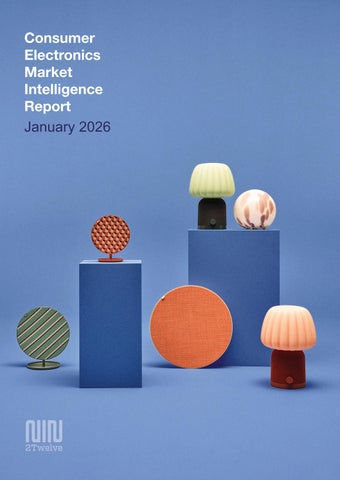
Consumer Electronics Market Intelligence Report January 2026
1
Front Page IKEA’s collaboration with Swedish colourist Tekla Evelina Severin (“Teklan”) Back Page Loewe over ear headphones
2
Contents 1 Technology & Innovation
4
2 Artificial Intelligence & Automation
16
3 Product Spotlights
18
4 Connected Living & IoT
62
5 Wearables & Immersive Technologies
74
6 Automotive & Mobility Solutions
86
7 Retail & Consumer Experience
100
8 Market Intelligence & Sustainability
116
9 Industry Events & Strategic Insights
130
10 About 2Twelve
132
3
1
Technology & Innovation CES Nvidia, AMD and Intel all had important chip and AI platform announcements on the first day of CES 2026, but all audiences wanted to see more of was Star Wars and Jensen Huang’s little robot buddies.
CES is a huge opportunity annually for companies both large and small to parade products they plan to put on shelves this year. As predicted, artificial intelligence was anchored in nearly everything as tech firms continue to look for AI products that will attract customers.
4
A look at the new technology announced at CES 2026
Nvidia gets physical The biggest buzzword in the air at CES is “physical AI,” Nvidia’s term for AI models that are trained in a virtual environment using computer generated, “synthetic” data, then deployed as physical machines once they’ve mastered their purpose. CEO Jensen Huang showed off Cosmos, an AI foundation model trained on massive datasets, capable of simulating environments governed by actual physics. He also announced Alpamayo, an AI model specifically designed for autonomous driving. Huang revealed that Nvidia’s next generation AI superchip platform, dubbed Vera Rubin, is in full production, and that Nvidia has a new partnership with Siemens. All of this shows Nvidia is going to fight increased competition to retain its reputation as the backbone of the AI industry. But once Huang called for two little, waddling, chirping robots to join him on stage, that’s all the audience wanted to see more of.
The chips are back in town AMD CEO Lisa Su announced a new line of its famed Ryzen AI processors as the company continues to expand its footprint in the world of AI-powered personal computers. For gamers, AMD also showed off the latest version of its gaming-focused processor, the AMD Ryzen 7 9850X3D. Meanwhile, Intel announced its new AI chip for laptops, Panther Lake (also known as the Intel Core Ultra Series 3), and said the company has plans to launch a new platform to address a growing market for handheld video gaming machines.
5
Intel, a Silicon Valley pioneer that enjoyed decades of growth as its processors powered the personal computer boom, fell into a slump after missing the shift to the mobile computing era unleashed by the iPhone. It fell further behind after the AI boom propelled Nvidia into the spotlight. President Donald Trump’s administration stepped in recently to secure a 10% stake in the company, making the government one of Intel’s biggest shareholders. Federal officials said they invested in Intel to support U.S. technology and domestic manufacturing.
Uber dives back into the robotaxi game Uber is giving the public a first look at their robotaxi at CES this week. Uber, along with luxury electric vehicle manufacturer Lucid Motors and vehicle tech company Nuro, introduced an autonomous vehicle with an Uber-designed in-cabin experience. Uber calls it the most luxurious robotaxi yet. It features cameras, sensors and radars that provide 360-degree perception and a low-profile roof “halo” with integrated LEDs that will display riders’ initials to help them spot their car and track their ride status. Inside, riders can personalize everything from climate and seat heating to music, while real-time visuals show exactly what the vehicle is seeing on the road and the route it plans to take.
6
Autonomous on-road testing began last month in San Francisco, led by Nuro, marking a major step toward what the companies said is a planned launch before the end of the year. Star Wars and Lego announce a new partnership When Lucasfilm chief creative officer David Filoni brought out an array of X-Wing pilots, Chewbacca, R2D2 and C-3PO, he won the Star Wars fandom for Lego. Lego announced its Lego Smart Play platform on Monday, which introduces new smart bricks, tags and special minifigs for your collection. The new bricks contain sensors that enable them to sense light and distance, and to provide an array of responses, essentially lights and sounds, when they are used in unison. Combine this with a newly announced partnership with the Star Wars franchise and now you can create your own interactive space battles and light-saber duels.
LG reveals a new robot to help around the home File this one under intrigued, for now. The Korean tech giant gave the media a glimpse Monday of its humanoid robot that is designed to handle household chores such as folding laundry and fetching food. Although many companies have robots on display at CES, LG certainly
7
is one of the biggest tech companies to promise to put a service robot in homes. It will be on display beginning Tuesday, so we’ll have more to report soon. What’s new with lollipops? Music you can taste was on display Monday at CES: Lollipop Star unveiled a candy that plays music while you eat it. The company says it uses something called “bone induction technology,” which lets you hear songs — like tracks from Ice Spice and Akon — through the lollipop as you lick it or bite it in the back of your mouth, according to spokesperson Cassie Lawrence. The musical lollipops will go on sale after CES on Lollipop Star’s website for $8.99 each. And if that wasn’t enough star power, Akon was expected to visit the company’s booth Tuesday when CES opens to the public. Atlas holds up Hyundai’s (manufacturing) world Hyundai-owned Boston Dynamics publicly demonstrated its humanoid robot Atlas for the first time at the CES tech showcase, ratcheting up a competition with Tesla and other rivals to build robots that look like people and do things that people do. The company said a version of the robot that will help assemble cars is already in production and will be deployed by 2028 at Hyundai’s electric vehicle manufacturing facility near Savannah, Georgia. Delta gets spherical Delta Air Lines is taking entertainment to new heights as the “official airline” of the Sphere in Las Vegas. The airline announced a new multiyear partnership with Sphere Entertainment Co. that it says will deliver premium experiences to the venue, including a Delta SKY360° Club lounge. The carrier said SkyMiles members can unlock exclusive access to other experiences at the Sphere, starting during the final weekend of the Backstreet Boys’ residency in February with features including private suite seating, food and beverages. The partnership brings Delta branding to the Sphere’s massive exterior LED screen. Delta says more exclusive SkyMiles experiences will roll out in 2026 and beyond.
8
2026 Trends
The 10 Consumer Tech Trends Of 2026 You Can’t Ignore
As enterprise technology leaders, it’s tempting to dismiss consumer tech as mere gadgets and gizmos. But history teaches us otherwise. The smartphone revolution, cloud storage adoption, and touchscreen interfaces all entered the enterprise through the consumer door, often carried in by employees who demanded the same intuitive experiences they enjoyed at home.
The consumer technology trends of 2026 aren’t just about shopping lists and entertainment systems. They’re preview indicators of the capabilities, expectations, and workplace demands your organization will face over the next 2-3 years. Understanding these trends now allows enterprise leaders to anticipate infrastructure needs, prepare security frameworks, and develop policies before these technologies appear uninvited in your workplace.
9
Here are 10 consumer tech trends that will reshape enterprise technology, whether you’re prepared or not. 1. From Smart Home To Intelligent Home What’s the difference? Well, smart home devices have been with us for a while, and often they aren’t really that smart—they’re just connected (think of lightbulbs, heating systems and kitchen appliances we can control over the internet). Truly intelligent homes, however, utilize AI to “think” and make decisions for us. This means AI assistants acting as virtual housekeepers, coordinating the activity of smart appliances, entertainment and security devices. What consumers experience as “intelligent homes” today becomes tomorrow’s “intelligent workplace.” The same AI orchestration consumers use to manage home appliances will soon coordinate enterprise IoT ecosystems, from HVAC optimization to automated conference room preparation. 2. Human-Centric Features In Consumer Tech This can include screens that resemble works of art, designed to blend aesthetically into home environments, and speakers taking visual cues from sculpture. It also covers sensory control systems, allowing us to interface with technology in more human ways, like the neural controls developed by Meta for its next-gen glasses and haptic gloves, allowing users to feel objects in VR. Representing a combination of psychology and aesthetics, technology reminding us humans are in control, and it should exist and interact with us on our terms, will be a defining consumer tech trend in 2026. 3. Domestic Robots And Drones At CES 2025, numerous robotic and autonomous devices designed to help with tasks from stacking dishwashers, conducting security patrols and even providing companionship were on display. In 2026, these could begin to receive mainstream adoption as we look to technology to help us manage increasingly busy lives. The consumer market is training your future workforce in human-robot collaboration while normalizing autonomous systems that enterprises are rapidly deploying for warehouses, security, and hazardous environments. 4. Next-Gen TVs In recent years, TVs have become bigger and brighter, and that trend looks set to continue with the arrival of the latest micro-LED models. While this technology has been around for a while, manufacturing costs are dropping to levels that make sense for mainstream consumer brands like Sony and Samsung to include them in their 2026 ranges. The fact that they’re cheaper to build at super-size than current OLED screens means that screens measuring over 100 inches will become an increasingly common sight in homes. And Dolby Vision 2, expected to launch on next year’s top-end models, promises sharper and brighter images than ever before. 5. Smart Cars We’re still waiting for fully self-driving cars to eventually become a realistic proposition. But that isn’t stopping car makers from cramming their latest models with semi-autonomous
10
and smart features. We can expect more vehicles with self-parking and advanced driverassist features like hands-free, collision-avoidance, driver fatigue detection and in-car AI assistants in 2026. 6. Smart Glasses 2.0 Following some high-profile false starts, device manufacturers including Google and Meta are hoping 2026 will be the year smart glasses successfully crack the mainstream. What’s changed since Google canceled its original Glass project 10 years ago? Well, displays have gotten smaller and lighter, and batteries have improved, but most importantly, AI has matured to the point where features like in-line language translations, augmented reality navigation, and hands-free access to AI assistants are a more viable proposition. 7. Wellness Tech Devices and associated online services designed to provide actionable insights into the state of our physical and mental health will continue to be big business over the coming year. New developments which could become common sights in our homes include smart mirrors that can measure heart rate and mental states while also reminding us to take medication, and mattresses that analyze sleeping position and breathing patterns in order to optimize firmness and improve the quality of rest. 8. More Screens Long ago, office-bound workers discovered that having multiple computer displays can boost productivity. Today, those who prefer a less tethered, nomadic existence can benefit too, as dual and multi-screen laptops become increasingly fashionable. Laptop manufacturers, including Lenovo and Asus, will bring affordable models to the market. Phone makers aren’t being left behind either; dual-screen phones have been growing in popularity, and Samsung will reportedly join Huawei in offering a tri-screen model before the start of the year. 9. Dumb Phones Proving that it isn’t always about chasing after newer and more capable technology, the market for scaled-down dumb phones, with pared-back functionality restricted to making calls and sending texts, is expected to grow in 2026. These are the perfect antidote for those who feel that modern smartphones encourage mind-numbing “doom scrolling” and other pointless mobile activities. Don’t think of it as a rejection of technology, though—it’s more about rejecting ultimately negative and potentially harmful behaviors and habits. 10. Wireless Power With the proliferation of wi-fi and Bluetooth technology throughout our homes, power is the last holdout for cables in the home. But even these could soon be a thing of the past. Today’s wireless charges require contact between charger and device, but scientists in Japan have used machine learning to develop the first wireless power transfer (WPT) system capable of transmitting power through the air. While it may be a few years before this one is truly consumer-ready, it’s a technology we’re likely to hear more about in 2026.
11
Stream Unlimited StreamUnlimited, the system integration leader for connected audio solutions, has announced an end-to-end immersive streaming audio reference system that debuted at CES 2026. The reference platform presents a complete soundbar-based streaming audio system powered by Dolby Atmos® FlexConnect™ – a simpler, more flexible Dolby Atmos® sound experience to enjoy your favorite music or movies. The system is also using NXP Trimension™ ultra-wideband (UWB) for accurate, quick, and automatic speaker mapping during initial setup, enabling the renderer to generate the Dolby Atmos experience for the actual speaker layout.
“Immersive audio is no longer just about sound quality; it’s about intelligence, adaptability, and removing setup friction,” said Markus Rutz, CTO of StreamUnlimited. “We’ve architected this platform to give brands maximum freedom in system design. The result is a highly adaptable and fully deployable solution for brands to take the next step in immersive audio.” Key Highlights - Dolby Atmos FlexConnect Dolby Atmos FlexConnect delivers the simplest and most flexible way
12
StreamUnlimited Brings Dolby Atmos FlexConnect to a Production-Ready Flexible Rendering Platform at CES 2026
to bring immersive Dolby Atmos sound to your favorite big screen. Enjoy astonishing audio that makes every explosion more intense, every song more life-like, every game day more electrifying, and every moment more memorable. Setup has never been easier—place your speakers anywhere, and audio is flexible and intelligently tuned to your environment. Sweet Spot & Speaker Tracking with UWB: The reference platform supports NXP Trimension™ ultra-wideband (UWB) to enable quick and automatic speaker mapping during installation, accurately capturing system geometry in a single step. This allows the Dolby Atmos FlexConnect renderer to adapt immediately to the real speaker layout with minimal user interaction. UWB-radar-based sweet spot position measurement is also available as a fully configurable option, and may be disabled or omitted entirely to align with privacy expectations, regional compliance, or brand positioning. Comprehensive streaming support: Powered by StreamUnlimited’s StreamSDK, the platform natively supports every major music service and protocol. It handles Spotify Connect (including the new 24-bit/44.1 kHz lossless tier), Qobuz Connect, Amazon HD, TIDAL, Deezer, AirPlay Audio, and ArtistConnection. Additionally, all leading immersive formats are rendered seamlessly: Dolby Atmos, DTS:X, Sony 360 Reality Audio, MPEG-H, Auro-3D, etc., are all supported end-to-end from music streaming services or from the TV. No matter the service or format, the system plays it back with immersive fidelity. DAB
DAB+ becomes a statement
You would think that radio has a hard time in an age of downloads, streams and apps. Music is a widely used content and is available everywhere online.
However, a new digitization report published by the media authorities shows that digital radio in the DAB+ transmission standard is enjoying increasing popularity in Germany. On average, we Germans listen to the radio for around three hours a day. 13
There is still some catching up to do in cars, as manufacturers often still charge extremely high prices for pre-installed digital radios. The result: Of the 46 million registered vehicles, only just over 600.000 have a digital radio. Pure, a British manufacturer of digital radios, wants to change that.
“The digital radio is now becoming a statement,” says Nadja Miller, Country Manager at Pure. Since the vehicles on the road are on average over nine years old, the need for practical retrofit options is extremely high. The British company offers in-car audio adapters for digital radio reception and Bluetooth streaming that are quick to install and save space. Pairing with a smartphone is possible, as is hands-free calling. Prices start at under 130 euros. If you want to know more about digital radio reception on four wheels, you can find more information at pure.com/highway. Because DAB+ is now becoming a statement…
14
15
2
Artificial Intelligence & Automation Memory Chip Shortage A SK Hynix Inc. 12-layer HBM3E memory chip displayed at the Semiconductor Exhibition in Seoul, South Korea. Chipmakers and analysts are warning of a memory chip shortage that could hit the consumer electronics and automotive industries next year, as companies prioritize massive demand from the artificial intelligence boom.
CEO of Semiconductor Manufacturing International Corp, China’s largest contract chipmaker, said that fears of a memory chip shortage were prompting its customers to hold back orders for other types of chips used in their products. “Everyone is hesitant to place too many orders or ship too much in the first quarter of next year because they don’t know how many mobile phones, cars, or other products [the memory chip industry] can supply,” said Zhao Haijun, SMIC’s co-CEO, according to a Google translation. 16
AI boom is fueling a memory chip shortage that could hit cars and phones
Analysts say these supply constraint concerns come as chip manufacturers focus on advanced memory chips used in artificial intelligence computing, with less focus on production needed for consumer products. “The AI build-out is absolutely eating up a lot of the available chip supply, and 2026 looks to be far bigger than this year in terms of overall demand,” Dan Nystedt, vice president of research at TriOrient, told CNBC. AI servers primarily run on processors from chip designers like Nvidia. These AI processors heavily rely on a type of memory known as High-Bandwidth Memory or HBM, which has proven extremely lucrative for memory companies like SK Hynix and Micron to pursue. Memory suppliers have been chasing as much of this AI demand as possible thanks to typically high margins, Nystedt said, noting that AI server companies are willing to pay top dollar for premium chips. “It could be very bad for PCs, laptops, consumer electronics and automotive, which depend on cheap memory chips,” he said. Perhaps a bigger issue, however, is that the memory industry suffered some severe downturns in 2023 and part of 2024, leading to under-investment in the industry. “They’re building new capacity now, but it will take time to get running.” Broader impacts In the face of supply constraints, memory companies have reportedly been raising prices of their chips. Just last month, Reuters reported that Samsung Electronics had quietly raised prices on select memory chips by as much as 60% compared to September. Samsung didn’t immediately respond to a request for comment. “With memory prices rising and availability shrinking, concerns about production bottlenecks are gaining traction,” M.S. Hwang, research director at Counterpoint Research, told CNBC. “Supply tightness is already hitting low-end smartphones and set-top boxes, but we think the risk could broaden,” he added. China is “feeling the pinch more acutely” due to high reliance on low-cost devices, but Hwang cautioned that the supply constraints were a global problem. In the meantime, consumers could pay the price of memory shortages. In a report on Monday, tech-focused market intelligence and consulting firm TrendForce predicted that the memory industry has begun a “robust upward pricing cycle,” which could force downstream brands to hike retail prices, adding pressure on the consumer market.
17
3
Product Spotlights Amazon Having announced the upgraded Alexa+ AI assistant earlier this year, Amazon has now revealed four shiny new Echo speakers to take advantage of it: the Echo Dot Max, the Echo Show (in 8-inch and 11-inch sizes), and the Echo Studio. All four of these models are upgrades on existing speakers, with faster processors, more memory, and advanced sensing capabilities intended to deliver “ambient AI experiences that fade into the background of daily life” – think reminders that you hear when you walk into a room, for example. First up, the Echo Dot Max, a new take on the 5th-gen Echo Dot that brings with it a new design, 3x the bass power, two internal speakers, plus all the internal upgrades. It’s yours for $99.99 / £99.99 / AU$199.
18
Amazon just unveiled 4 new AI-powered, Echo speakers – here’s the full lineup and how much they cost
Then we have the new $219.99 / £219.99 / AU$429 Echo Studio, replacing the old Echo Studio. It’s 40% smaller, looks a lot like the Echo Dot Max, and includes a high-excursion woofer and three full-range drivers. Spatial audio and Dolby Atmos are supported, and like its predecessor, it’s one for the audiophiles out there. As an added bonus, Amazon says you can easily set up a maximum of five Echo Studio and Echo Dot Max devices as a surround sound system for your Fire TV. This was possible with the existing hardware, but the limit was a 2.1 channel system. Preorders are open now, with availability on October 29. Show me the speakers Next there are the two new Echo Show models, with 8-inch and 11-inch screens. The design has been revamped from the older versions, and they now have a more modern look and improved touchscreens. There’s a 13-megapixel camera that can recognize you, and personalize the information (like calendar schedules) shown on screen. With two front-facing speakers and a custom woofer, Amazon promises superior sound from these units as well. The on-board software has been reconfigured too, to surface more information and information that’s more relevant – across entertainment, shopping, and the smart home. You can also now connect your Oura account to get health and wellness data up on your Echo Show screen, with more partners to come. These two speakers are available from November 12, though you can preorder them now. The 8-inch model costs $179.99 / £179.99 / AU$349, while the 11-inch model – actually a new screen size for the series – is $219.99 / £219.99 / AU$429. All of these new products come with Alexa+ out of the box, Amazon says, which means you get the smarter, more conversational, more natural AI assistant at your disposal – something more like Google Gemini rather than Google Assistant.
19
B&O Beosound Premiere is positioned between Beosound Stage and Theatre as a new soundbar that can stand alone or be integrated into a larger B&O setup. The soundbar features 10 speaker drivers, including front-, side- and upward-firing units for Dolby Atmos. They are powered by 10 amplifiers with a total output of 580 Watts. “At the center of Beosound Premiere is one of its most striking design elements: the upward-firing driver. It is not just a technical necessity – it symbolizes Bang & Olufsen’s engineering craftsmanship. The top is perforated with 1925 precision-milled holes, which serve both as an acoustic opening and as an aesthetic signature – a tribute to the year Bang & Olufsen was founded,” explained Bang & Olufsen. The company says it uses its proprietary ‘Wide Stage Technology’ to expand the soundstage in both height and width. An integrated Dolby Atmos 7.1.4 decoder is built in.
Upgradeable Beosound Premiere functions as a standalone soundbar that can be connected to your TV via HDMI eARC. It can also play music via AirPlay, Bluetooth, Spotify Connect and Beolink Multiroom.
20
B&O launches its new soundbar: Beosound Premiere
Alternatively, the soundbar can be part of a larger Beolink Surround system, allowing wireless addition of extra speakers or subwoofers for a full Dolby Atmos movie experience. The same is possible with Sonos speakers but Bang & Olufsen offers a highly flexible system supporting many different types of speakers. All Dolby audio formats are supported, but DTS decoding is not supported in any form. Instead, DTS must be decoded on the player or TV and sent to the soundbar as multichannel PCM up to 7.1 channels. It is ‘Cradle to Cradle Certified Bronze,’ which “means the product is not only designed to perform but also to be repairable, upgradeable and recyclable”, the company noted. A premium price But you have to pay dearly for luxury. With a price tag of $5,800 / £3,900 / €4,900, Beosound Premiere costs almost twice as much as Beosound Stage – B&O’s least expensive soundbar.
Still, it is significantly cheaper than the company’s most premium soundbar, the Beosound Theatre. Beosound Premiere will be available in Natural Aluminium, with Gold Tone
21
and Black Anthracite variants to follow in spring 2026. Front covers in oak or fabric are optional at extra cost. The soundbar can also be used “raw” without a front cover. Bose
Bose is making its SoundTouch smart speakers dumb – and won’t compensate customers
If you own a Bose SoundTouch speaker, we have some bad news. The US firm will discontinue support for its SoundTouch wireless tech from February 2026, effectively turning models in the range into very expensive Bluetooth speakers. SoundTouch enables certain Bose speakers to work in multi-room setups and to stream music from streaming services – a bit like Sonos. Models include the SoundTouch 10 and 20, the 300 soundbar, and the Series III devices.
Once the big switch-off has happened on 18th February, the speakers will lose all multi-room support as well as the ability to stream music from the likes of Spotify and TuneIn.
22
But they won’t be completely bricked. “[I]f your SoundTouch product supports Bluetooth, Aux, or HDMI, you’ll still be able to enjoy high-quality audio playback from connected devices,” Bose writes on its support page. The devices will also no longer receive security updates. Bose has no plans to support SoundTouch products through any other app. SoundTouch launched in 2013. Bose says it’s “no longer able to sustain the development and support of the cloud infrastructure that powers this older generation of products.” It adds: “We remain committed to creating new listening experiences for our customers built on modern technologies.” That’s all well and good, but with no mention of a trade-in scheme or compensation of any kind, customers could be excused for feeling more than a little bit cheesed off at the move. In fact, we have been contacted by a reader who is exceptionally upset, having spent around £2000 on SoundTouch products specifically for their multi-room abilities. He is now looking at having to replace his entire system. his has echoes of what Sonos did in 2020, when it decided to leave some legacy products behind when it moved to its newer ‘S2’ platform. However, those products continue to work as they always did via the older Sonos S1 app. They were left behind, but not hobbled, which is what Bose has essentially announced it’s doing to its SoundTouch devices. Sonos also offered a trade-in scheme. Nevertheless, there was a huge furore around the Sonos decision in 2020, and what Bose is doing seems significantly more egregious. Bowers & Wilkins
Bowers & Wilkins Expands McLaren Partnership With New Edition Px8 S2 Wireless Headphones
Bowers & Wilkins have unveiled a new version its Px8 S2 wireless headphones, developed in collaboration with McLaren Automotive and the McLaren Formula 1 Team. The new headphones integrate the McLaren Papaya finish with Anthracite Grey, as well as the McLaren Speedmark on the headband and earcups. 23
24
The Px8 S2 McLaren Edition features upgraded bespoke 40mm Carbon Cone drive units, which utilize a redesigned and improved chassis, voice coil, suspension and magnet, and are angled to the listener’s ears to ensure a consistent distance from every point across the surface of each driver to each ear for better imaging and stereo spaciousness. The headphone also features Qualcomm’s aptXTM Adaptive 24/96 wireless technology and aptX Lossless plus Bowers & Wilkins-developed DSP to deliver 24-bit / 96kHz sound quality. Users can configure and control the headphones using the B&W Music app. Listeners can now opt to fine-tune the sound through an adjustable five-band EQ, complete with the option to store their preferred settings as easily accessible presets. Bowers & Wilkins claims the new edition features a 30 hour battery life, with 15-minute quick recharge providing up to seven hours of listening time. The Px8 S2 McLaren Edition wireless headphones are available now for $849. Cambridge Audio
Cambridge Audio’s L/R Series Delivers High-Fidelity Sound for Every Room
In a market saturated with smart speakers and soundbars that prioritize convenience over clarity, Cambridge Audio has released a lineup that bridges both worlds—delivering premium, room-appropriate sound without sacrificing ease of use. The L/R Series, featuring three models at various sizes and price points, offers a scalable solution for every listening environment—from compact offices to expansive living rooms. The new lineup confirms Cambridge Audio’s continued commitment to performance, innovation, and user-friendly design. With proprietary Torus tweeters, built-in streaming support, and power ratings up to 800 watts, the L/R S, L/R M, and L/R X collectively represent a true all-in-one wireless hi-fi solution for 2026 and beyond. A Size for Every Soundstage The L/R Series consists of three models: L/R S ($599): A compact, bookshelf-sized speaker with 100W of power, ideal for offices or smaller rooms. L/R M ($1,599): A mid-sized option offering 300W of power in a more compact chassis, perfect for bedrooms or apartment living.
25
L/R X ($2,299–$2,399): The flagship model, delivering 800W of Class D amplification, dual 5-inch woofers, dual 6-inch force-cancelling passive radiators, and a 28mm Torus tweeter. Each model has been thoughtfully designed to serve a specific purpose while maintaining the sonic integrity Cambridge Audio is known for. Whether you’re spinning vinyl or casting a playlist via Google Cast, each speaker delivers clarity, punch, and presence that outpaces the typical multi-room speaker systems available today. Engineered for Seamless Streaming Both the L/R M and L/R X are equipped with Cambridge Audio’s StreamMagic Gen 4 platform, allowing Wi-Fi streaming from popular services and support for multi-room playback. AirPlay 2, Bluetooth, and Google Cast are built-in, providing native access for both Apple and Android ecosystems. Whether you prefer Spotify, Tidal, Qobuz, or your own digital library, the L/R Series makes high-quality audio effortlessly accessible. The inclusion of HDMI eARC on the flagship L/R X also places it firmly in the home theater conversation. With TV passthrough and multi-source compatibility, the L/R X becomes a legitimate alternative to a soundbar and subwoofer combo— without the need for additional boxes or wiring clutter. High-End Audio Meets Smart Integration Cambridge Audio’s latest Torus tweeter technology is featured across all three
26
models, engineered to reduce distortion and widen the soundstage. This acoustic design advancement ensures consistent performance across speaker sizes. For vinyl enthusiasts, the L/R X also includes a moving-magnet phono stage, allowing direct connection to turntables without needing an external preamp. The ability to switch between sources—Bluetooth, Wi-Fi, phono, and HDMI— makes these speakers more than just wireless speakers. They’re comprehensive audio hubs, able to anchor a living room setup, supplement a studio, or elevate casual listening in a home office.
27
Devialet Phantom Ultimate embodies the acoustic excellence that has made the brand world-renowned For more than a decade, Devialet has redefined what high-end audio can be. Now, the French luxury audio house is raising the bar again with the debut of its Phantom Ultimate collection—a next-generation line of loudspeakers that fuses radical acoustic innovation with Parisian design artistry. The Phantom Ultimate collection features two models—the flagship 108 dB ($3,800) and the compact 98 dB ($1,900)—available in three distinctive finishes. This new evolution delivers fully immersive sound experiences, expanded connectivity, and a sleek, timeless design.
28
Devialet Launches Phantom Ultimate: A New Benchmark In Luxury Audio
“We are reaffirming our status as a luxury pioneer in audio with this launch,” said Jacques Demont, CEO of Devialet. “We invite listeners to experience sound with unprecedented intensity, clarity, and depth, coupled with our visionary approach to design.” Created in Paris, Engineered for Immersion Designed by Devialet’s engineers in Paris, Phantom Ultimate embodies the acoustic excellence that has made the brand worldrenowned. Its radically singular silhouette is instantly recognizable, yet it’s the sound that truly sets it apart: vivid, immersive, full-body audio that turns listening into a physical sensation. This is Devialet’s most seamless immersive experience yet—offering
29
even greater precision, impact, and connectivity. Whether recreating a live performance or a studio recording, Phantom Ultimate brings music to life in the home. Proprietary Technology at the Core Devialet has built its reputation on more than 250 patents, and Phantom Ultimate incorporates its most advanced suite yet: • ADH® New Gen (Analog Digital Hybrid): combines analog warmth with digital efficiency for distortion-free highs up to 35 kHz. • SAM® (Speaker Active Matching): adapts in real time for faithful sound wave reproduction. • HBI® (Heart Bass Implosion): delivers ultra-low frequencies down to 14 Hz. • AVL™ (Adaptive Volume Level): auto-adjusts volume for optimized playback across content types. • Next-Gen Processor: powered by an NXP i.MX 8M Nano chip for improved performance and energy efficiency. Together, these innovations create a sound experience that feels as physical as it does auditory. Two Models, Distinct Appeal Phantom Ultimate 108 dB ($3,800): The flagship model with 1,100W of power and a frequency range from 14 Hz to 35 kHz. Refined drivers, WiFi 6, Bluetooth 5.3, AirPlay, Google Cast, and Roon Ready support make it an uncompromising centerpiece. Phantom Ultimate 98 dB ($1,900): A compact powerhouse offering 400W of amplification, a range from 18 Hz to 25 kHz, and a co-spherical driver for expansive sound.
30
Both models work as solo, stereo, or multi-room systems, providing flexibility for a wide range of homes and lifestyles. Finishes That Elevate Phantom Ultimate is available in three finishes: Deep Forest (dark green with black chrome), Light Pearl (matte off-white), and the striking Opéra de Paris edition, hand-gilded with 22-carat gold. Continuing the Opéra de Paris Partnership Since 2017, Devialet has partnered with the Opéra national de Paris, celebrating a shared vision of excellence and deep ties to France’s musical heritage. The Phantom Ultimate | Opéra de Paris editions are the latest expression of this collaboration—a rare encounter between cutting-edge technology and traditional craftsmanship. Each gold-adorned edition is handcrafted by the master gilders at Ateliers Gohard, the same workshop entrusted with restoring the Palais Garnier. Using the centuries-old feuille perdue technique, artisans apply 22-carat gold leaf by hand, leaf by leaf, to the speaker’s side panels. This partnership not only elevates Devialet’s products into works of art but also helps fund artistic creation at one of France’s most prestigious cultural institutions. Why It Matters for Retailers For retailers and integrators, Phantom Ultimate offers more than just another high-end audio line. It’s a luxury anchor product that combines design, performance, and brand prestige—perfect for drawing discerning customers into showrooms. Its pricing strategy provides tiered opportunities: • The 98 dB model as an entry point for aspirational buyers. • The 108 dB flagship as the ultimate statement piece. • The Opéra de Paris editions as true collector’s items. • Seamless streaming compatibility—including Spotify Connect, Tidal Connect, AirPlay, Google Cast, UPnP, and Roon—and ongoing software updates through the Devialet App further strengthen its long-term value proposition.
31
Availability The Phantom Ultimate 98 dB is available now through Devialet stores, select premium audio dealers, and online. The Phantom Ultimate 108 dB is open for pre-orders, with deliveries expected later this year. A New Benchmark in Luxury Audio Devialet Phantom Ultimate isn’t just a speaker—it’s a fusion of French engineering, cultural heritage, and contemporary design. By combining unrivaled sound performance with the artistry of Parisian craftsmanship, Devialet has created an object that is as striking to behold as it is to hear. For the luxury audio market, Phantom Ultimate sets a new benchmark— delivering not only sound but a total immersive experience that redefines what high-end listening can be. Fender
Fender Audio Steps Into Consumer Market with ELIE Bluetooth Speakers and MIX Wireless Headphones
Fender is stepping beyond guitars and amplifiers, unveiling its first massmarket consumer audio products at CES 2026.
Under its Fender Audio brand, the iconic instrument maker has announced two portable Bluetooth speakers and a pair of wireless headphones, marking a significant push into the crowded personal audio market. The new range arrives as Fender celebrates its 80th anniversary and will be showcased in Las Vegas in January. While Fender has long dabbled in pro-focused audio gear, this is its clearest attempt yet to take on lifestyle brands like Marshall, JBL and Sony. 32
Headlining the launch is the ELIE (Extremely Loud Infinitely Expressive) portable speaker series, available in two sizes: the ELIE E6 and the larger ELIE E12.
Both models feature built-in subwoofers and what Fender describes as a “world-first” Waves system-on-a-chip design, combining DSP and amplification to deliver higher volume with lower distortion. The ELIE E6 outputs up to 60W and promises up to 18 hours of battery life, while the more powerful ELIE E12 doubles the output to 120W with a slightly reduced 15-hour battery rating. Pricing starts at US$299 for the E6 and US$399 for the E12 (Australian pricing is yet to be confirmed). What sets the ELIE speakers apart is flexibility. Each unit can handle up to four audio sources at once, mixing Bluetooth audio with wired inputs via XLR or ¼-inch connections, plus additional wireless channels using Fender accessories. Multiple speakers can also be paired in stereo or synced together for larger spaces. Alongside the speakers, Fender Audio has unveiled the MIX over-ear wireless headphones. Featuring 40mm graphene drivers, hybrid active noise cancellation and spatial audio, the MIX headphones target premium rivals at the US$299 price point. An included USB-C wireless transmitter enables lossless, low-latency and Auracast audio modes, while battery life is rated at up to an eye-catching 100 hours with ANC off. 33
The MIX headphones also lean into sustainability and longevity with a modular design, allowing parts to be replaced rather than the entire headset discarded. Focal Focal has introduced the Mu-so Hekla, a premium all-in-one soundbar designed to deliver Dolby Atmos surround sound along with high-fidelity music playback. The system debuts today at Focal’s Seoul flagship store and will launch first in South Korea and China, followed by a global rollout in Q1 2026. North American availability is slated for March, with demos planned for CES 2026 (January 6–9) and ISE 2026 (February 3–6). The Mu-so Hekla combines 15 drivers and 660 watts of amplification in a single cabinet that Focal says can fill rooms up to 430 square feet. The system uses beamforming and crosstalk cancellation to create immersive audio effects, and includes proprietary Sphere modes for music and movies. Focal’s ADAPT room calibration automatically tunes the speaker to your space.
34
Focal unveils Mu-so Hekla: Immersive Sound Reinvented
For connectivity, you get HDMI eARC and optical inputs, plus an RCA subwoofer output if you want to add extra bass. Streaming is handled via AirPlay, Chromecast, Bluetooth, and UPnP, with native support for Tidal, Qobuz, Spotify, and QQ Music. The Focal & Naim app manages everything from setup to multiroom audio, and the system works with voice assistants and smart-home platforms. There’s also a physical volume dial on top of the unit. The Mu-so Hekla runs on Naim’s Pulse platform and features an aluminum chassis with a perforated grille and a distinctive finned heatsink borrowed from Naim’s amplifier designs. The Mu-so Hekla will be priced at $3,600 (U.S.) and $4,000 (Canada), available exclusively through Focal Powered by Naim retailers.
35
JBL JBL continues to double down on its strategy of creating soundbar ecosystems rather than standalone products. Its nextgeneration Bar Series - refreshed for 2025 - reinforces JBL’s belief that consumers increasingly want full surround experiences in one purchase, without the complexity of traditional AV receivers.
JBL’s NextGen Bar Series: The Rise of the Complete Surround “Ecosystem” The standout models include detachable wireless rear speakers, Soundbar large subwoofers, and improved Dolby Atmos performance delivered through upfiring drivers and expanded processing capabilities. This represents JBL’s attempt to occupy the middle ground between entry-level all-in-one bars and premium systems.
What’s notable is that JBL is no longer positioning these bars merely as TV accessories but as home entertainment systems, capable of filling a living room with cinema-grade audio using only a standard HDMI connection. This is a deliberate move to compete with Samsung, LG, and Sony — but with a unique twist: portability. The detachable rear speakers are batterypowered, cable-free, and can be positioned anywhere. That flexibility remains a key differentiator in the mid-range soundbar segment. Recent retail and Black Friday promotional activity shows that JBL is willing to be aggressive on price, often offering bars with rears and subs at the cost of premium bar-only units from Sonos or Bose. Retail partners highlight a strong value perception, especially for buyers upgrading older TVs who don’t want complex setup processes.
36
For brands, JBL’s approach is a helpful benchmark. The market is clearly moving toward all-in-one Atmos solutions, and buyers increasingly expect rear speakers included. The days of a single horizontal bar being considered “premium” are fading. Customers now want height channels, directional immersion, and a sense of theatre — even in smaller rooms. JBL’s Bar Series illustrates a broader industry truth: soundbars are evolving into full ecosystem products, and brands that fail to incorporate subwoofers, rears, or spatial processing risk falling behind. Loewe
Loewe Announces Global Expansion, Starting With U.S. Market Entry In 2026
Luxury German consumer electronics brand Loewe has announced its official expansion into the US market. The company will dedicate its focus to building the brand across the region in 2026, reaffirming its presence at CEDIA, and be part of CES in Las Vegas alongside further engagements in design and lifestyle arenas.
37
“This U.S. debut marks not just an expansion, but the beginning of a long-term commitment to growth, innovation, and customer experience in one of the world’s most dynamic markets,” said Aslan Khabliev, Owner & CEO of Loewe. Additionally, Loewe has appointed Jeff Costello as General Manager, North America, who entered this role at the beginning of September 2025. With more than 20 years of experience in the U.S. consumer electronics industry, Costello has a strong track record in sales growth, distribution, and premium brand development, positioning him as the ideal leader for this milestone in Loewe’s history. His deep expertise in channel strategy and dealer partnerships will be instrumental in both establishing and cultivating the brand’s presence in the Americas. “Loewe’s dedication to quality and longevity is what drew me to this opportunity,” said Costello. “I am thrilled to introduce this unique offering to discerning US consumers and am confident we will establish a strong and lasting presence.” Officially set to launch operations in January 2026, Loewe is using Q4 of 2025 to ensure the brand will commence trading seamlessly to meet the expectations of the premium US market. IKEA x Teklan For years, the home-audio market has been dominated by a predictable visual formula: black rectangles, grey fabric wraps, and minimal industrial design. IKEA’s newly announced collaboration with Swedish colourist Tekla Evelina Severin (“Teklan”) is a deliberate departure from that approach, signalling a shift toward audio products that function as decorative objects first, and electronics second. The new line centres on two product types: SOLSKYDD, a circular Bluetooth speaker available in multiple sizes, and KULGLASS, a sculptural lamp-speaker hybrid. Both ranges arrive in a palette of rich, retro-inspired tones — ochre, dusty rose, deep green and mustard with a strong emphasis on how the items complement interior spaces. Teklan’s involvement ensures the colour science is precise: she is known for saturated, cinematic palettes that feel both nostalgic and modern.
38
Colour-First Bluetooth Audio
What makes this important is not merely the aesthetic shift, but the strategic positioning. After years of success with the IKEA-Sonos SYMFONISK line (which focused on hiding speakers inside lamps, picture frames, and wall shelves), IKEA is now exploring the opposite philosophy: audio devices you intentionally display. This taps directly into the broader consumer trend of “warm tech” - devices that integrate emotionally and visually with a home, not just functionally. Functionally, the speakers offer Bluetooth playback, multi-speaker linking, and Spotify Tap compatibility. Although not designed to compete with high-end brands on sound quality, IKEA is clearly targeting the design-conscious mass market: customers who care more about ambiance, colour, and affordability than advanced acoustic engineering.
39
For brands, this collection is a valuable case study. It suggests that there is significant commercial opportunity in the intersection of home décor and personal audio, especially in mid-tier price points. It’s not about outperforming Sonos or JBL - it’s about creating objects that people buy for the same reasons they buy rugs, lamps, or vases. In short, IKEA’s Teklan collaboration marks the emergence of the “decor speaker” as a legitimate subcategory, and one with enormous potential for brands willing to prioritise aesthetics as much as audio performance. KEF At $999/pair KEF’s Coda W wireless speakers feature Uni-Q drivers, built-in amps, MM phono preamp, and aptX Lossless, but lack support for AirPlay 2 and Spotify Connect.
KEF Unveils Coda W: Bluetooth Speakers with aptX Lossless, KEF isn’t exactly new to the wireless game — the British brand has spent the past decade reminding everyone that great sound doesn’t But No Wi-Fi? need a mess of cables or a rack full of gear. After the runaway success of the LS50 Wireless, LS50 Wireless II, LSX, and LSX II, KEF is now turning its attention to something a little more compact (and possibly more attainable) with the Coda W.
40
Building on the legacy of its classic passive Coda models; like the Coda 7 and 9.2, the new Coda W is a refined all-in-one wireless speaker that blends KEF’s signature design, built-in amplification, and flexible wired and wireless connectivity. In typical KEF fashion, it looks sharp, promises precision, and aims to make you forget your amp ever existed. “Our goal has always been to deliver the most authentic sound possible – the kind that forges an emotional connection. We designed the Coda W for those of us who love the ritual of vinyl – the magic of dropping a needle on a record, that moment of anticipation. With Coda W, you can get completely immersed in the depth of your records, appreciating the richness and nuance in every note, then switch to streaming a new track seamlessly. It’s about rediscovering your favourite songs like never before,” explained Grace Lo, President and Head of Global Marketing, KEF KEF Coda W Overview The KEF Coda W system includes two speakers, with the main unit acting as the powered hub — handling all connectivity, amplification, and signal distribution for both channels. There’s no need for an external amplifier, stereo, or home theater receiver; everything’s built in. The secondary speaker connects to the main unit via a 3-meter interspeaker cable, and KEF smartly offers an optional 8-meter C-Link cable for those whose rooms don’t follow the “perfect setup” blueprint. Even better, the wired connection between the two speakers supports up to 24-bit/96kHz PCM audio, which is more than enough resolution for 99% of what’s available from today’s major streaming services. It’s a thoughtful balance of audiophile performance and real-world practicality. Uni-Q: To optimize the listening experience, each speaker includes KEF’s 12th Generation Uni-Q driver array, which combines a 25mm (1-inch) aluminum dome tweeter with a 130mm (5.25-
41
inch) magnesium/aluminum alloy cone woofer. This setup delivers the focused imaging, clarity, and wide dispersion that have made Uni-Q a hallmark of KEF’s design philosophy. Music Integrity Engine: This KEF feature uses advanced signalprocessing algorithms to correct timing errors, ensuring the Uni-Q drivers in the Coda W deliver precise imaging and tighter sound without unwanted artifacts. Amplification: The Coda W wireless system delivers a total power output of 200 watts, with separate amplifiers for the woofer and tweeter in each speaker, managed by precision crossovers. The system’s frequency response ranges from 41Hz to 47kHz, depending on EQ settings, ensuring balanced, full-range sound. Pro Tip: Each speaker features a rear-mounted port to enhance lowfrequency extension, delivering deeper, more impactful bass. Be mindful of the distance between the wall and the back of the cabinet, as positioning too close can affect bass performance.
42
Subwoofer Output: The Coda W includes a subwoofer preamp output for those looking to extend low-frequency performance — particularly useful for movie watching. Any powered subwoofer can be used, with the KEF KC62 as a space-saving option. For even greater placement flexibility, the optional KW1 wireless subwoofer adapter kit provides a clean, wireless connection, eliminating cable clutter. Bluetooth Support: The Coda W lets you stream music wirelessly from a phone, tablet, or laptop, providing a simple pairing process and the freedom to play audio instantly. It supports Bluetooth Version 5.4 with aptX and aptX Lossless. aptX Adaptive ensures low-latency audio for seamless listening with excellent clarity and reliability, while aptX Lossless delivers CD-quality resolution up to 16-bit/44.1kHz. Wi-Fi? Neither Wi-Fi or network (wired Ethernet) connectivity is included, which means no support for Google Cast, Apple AirPlay 2, Spotify Connect, TIDAL Connect, or Qobuz Connect. Also, since Apple devices are not compatible with aptX, they’ll be limited to the lowest bandwidth Bluetooth quality. KEF Coda W Physical Source Connectivity: Wired Inputs, MM Phono Preamp, and HDMI ARC Beyond wireless streaming, the Coda W offers a wide array of wired connections for maximum flexibility. This includes HDMI ARC, Digital Optical, and USB-C inputs, allowing direct connection to TVs, CD/ DVD/Blu-ray players, game consoles, and more. • Digital Optical Audio: Supports PCM up to 24-bit/96kHz • USB-C: Supports PCM up to 24-bit/192kHz for high-resolution computer audio • HDMI ARC: Supports PCM up to 1.411 Mbps, making TV and home theater integration seamless For vinyl enthusiasts, the Coda W features a dedicated MM-compatible phono input with an integrated phono preamp, allowing almost any turntable to connect directly without extra equipment. Turntables with built-in preamps can use the RCA (LINE) input, providing flexibility for all types of analog sources. With this mix of HDMI ARC, USB-C, optical, and RCA inputs, the Coda W functions as a versatile audio hub, easily accommodating modern and legacy devices while delivering high-resolution audio across every connection. Control Options The Coda W features intuitive top-panel buttons for quick access 43
to essential functions and source switching. KEF’s Connect app (iOS, Android) provides more control, including EQ settings, and access to select streaming services. KEF Coda W Cabinet Design: Minimalist Aesthetic, Timeless Silhouette, and Five Elegant Finishes The Coda W speakers feature a minimalist design reminiscent of KEF’s Q-Series Meta speakers, with clean, rectilinear lines and subtle detailing that create a timeless silhouette. This refined aesthetic blends vintage charm with modern sophistication, making the speakers at home in a living room, home studio, study, or reading nook. The Coda W is available in Dark Titanium, Nickel Grey, Vintage Burgundy, Moss Green, and Midnight Blue, giving you options to match a variety of interiors while maintaining that understated elegance KEF is known for. The Bottom Line The KEF Coda W is a thoughtful addition to KEF’s wireless speaker lineup, blending high-end compact audio technology with a minimalist, Q-META-inspired aesthetic. At $999, it matches the LSX II LT in price but opts for straight edges and a more traditional look rather than the curved, modern styling of KEF’s other compact wireless models. Technically, it packs the essentials: 12th Generation Uni-Q drivers, built-in amplification, MM phono preamp, subwoofer output, and aptX/aptX Lossless Bluetooth streaming. Where the Coda W stands apart — and raises questions — is its lack of Wi-Fi or Ethernet connectivity. Unlike the LS50 Wireless II or LSX II, this system relies solely on Bluetooth for streaming, and while you can control the speakers through the KEF Connect App, the absence of a network connection and WiFi support means Spotify Connect, AirPlay 2 or Google Cast support is off the table. For vinyl lovers and those who prioritize clean, wired or Bluetooth setups, the Coda W delivers on performance and flexibility. For those who lean on networked streaming or smarthome integration, the missing Wi-Fi is a notable limitation. Price & Availability KEF Coda W is available for $999/pair at Crutchfield. The Coda W can be paired with the optional SQ1 floor stands (offered in Grey or White), The stands provide a stable platform for elevated positioning and optimal listening height ($399 pair through KEF) 44
Loewe
David Guetta is lending his face — and ear — to a new campaign with luxury German electronics maker Loewe.
The French DJ is the new global ambassador for Loewe, helping to launch their first-ever pair of over-ear headphones, dubbed the “Loewe leo” The celebrated DJ has been announced as the new global ambassador for Loewe, helping to launch their first-ever pair of over-ear headphones, dubbed the “Loewe leo.” Guetta was on hand to kick off the partnership at a party in Ibiza this week, with journalists and friends of the brand invited to watch the DJ perform at his long-running Monday night residency at island hotspot, Ushuaïa, in addition to a private lunch and product demo with Loewe audio engineer, Bear Clark. The two were joined by Guetta’s longtime business partner Raphaël Aflalo, Loewe CEO Aslan Khabliev and other VIP guests at the events.
Loewe says Guetta actively consulted on the new headphones launch, drawing on his decades of experience with headphones not just on stage, but in his everyday life. To wit, the Loewe leo merges audiophile-quality sound with a contemporary, fashionforward design that should make it a hit with listeners and luxury aficionados alike. 45
The new headphones deliver HiFi sound with support for Dolby Atmos and spatial audio technology, for a more immersive and wide-ranging soundstage. During a hands-on testing session in Ibiza, users commented on the incredible balance of hi, mid and low range sounds, with impeccably clarity throughout. While bass is powerful — as befitting a pair of headphones used by a top DJ and dance producer — the low-end is taut and punchy without dominating the track (Users can also customize audio settings through the accompanying Loewe app to best enhance the genre of music they’re listening to). Loewe calls the leo headphones a “standalone HiFi audio solution,” integrating a high-end DAC, amplifier and 50mm drivers into its fine-tuned acoustic housing. The driver features a diaphragm crafted from OCE (Olefin Composite Elastomer), a type of synthetic fiber designed for sound. “With its fast response and natural damping,” a press release explains, “OCE delivers clear vocals, detailed highs, and smooth, controlled bass, ensuring a balanced and immersive listening experience.” In addition to the audio features, the new Loewe headphones offer adaptive noise cancellation as well as transparency mode. Smart features like voice assistant support and real-time AI translation makes these cups as forwardthinking as they are practical. Battery life is excellent, with up to 65 hours of playtime on a single charge. And everything is housed inside a chic aluminum frame with sleek and ergonomic leather earpads. Still, the focus is always on the music, and Guetta says Loewe — which has been a leader in the audio-visual space for more than a century — delivers on all fronts. “For me, sound is everything — it’s how I express myself and connect with others,” he says. “Loewe leo delivers sound so pure and immersive that it feels like coming home, no matter where I am.” Guetta isn’t the only celebrity ambassador for the new campaign. Loewe also tapped global soccer superstar Kylian Mbappé, who has worked with the brand since 2024. While Guetta is seen with the new leo headphones in the “moonlight beige” colorway, the French athlete sports them in a “midnight blue.” In a press release, Loewe says the new collaboration “unites two extraordinary talents: one inspiring millions with every move on the pitch, the other creating rhythm for millions across the globe. While their worlds differ, they share a deep connection — sound as the ultimate expression of energy and emotion. “With Loewe leo, we’ve created more than just headphones,” adds Aslan Khabliev, CEO & Owner of Loewe Technology. “David and Kylian embody the spirit of Travel Beyond Sound: moving through the world while being transported by the immersive, precise sound of Loewe. Their stories show how music and performance merge into a single, powerful journey.” The new Loewe leo headphones retail for $1,499 46
47
Lamborghini Now here’s something you don’t see every day: a £35,000 sound system built from a real Lamborghini supercar exhaust. The iXOOST ESAVOX isn’t a concept or a marketing gimmick. It’s a fully functional Bluetooth sound system handcrafted in Italy from genuine Lamborghini components, complete with a working start/stop button that powers on the system, much as it would fire up an Aventador.
Weighing in at a hefty 63kg, each one of the 63 limited-edition units is finished in a selection of authentic Lamborghini colours including Green Gea, Gray Keres Matte, and Red Epona. Each one of the 63 limited-edition units is crafted by hand, and finished in a selection of authentic Lamborghini colours… A Lambo for the living room The ESAVOX chassis is formed from autoclave-cured carbon fibre, the same as that used in supercar manufacturing, and houses the unmistakable hexagonal exhaust from a Lamborghini Aventador. The frame’s sharp, angular lines echo the car’s iconic silhouette, while the integrated diffuser and visible metallic accents leave no doubt about its origin. Under the bonnet, so to speak, the ESAVOX packs serious audio 48
Introducing the incredible £35,000 Bluetooth speaker built from a real Lamborghini exhaust
muscle. Inside its sculpted cabinet is a 640 watt system comprising two 25.4mm tweeters, dual 6.5-inch mid-bass drivers, and a 10-inch downward-firing subwoofer. The system uses Bluetooth 5.0 for wireless playback, alongside RCA inputs for traditional wired components. Now, let’s be honest – no one actually needs a £35,000 Bluetooth speaker. But that’s hardly the point. You’ll not buy this beautifully crafted but undoubtedly bonkers statement audio piece for sonic neutrality or priceto-performance ratio. You’ll buy it because it makes you grin every time you use it – and perhaps because it’ll really impress guests who’ve already seen your wine cellar. The iXOOST ESAVOX is exclusive to Harrods, priced at £34,999. Onkyo
Onkyo celebrates its 80th anniversary with all-new Muse streaming amplifiers
Onkyo is kicking off the new year with a bang. Not only is the Japanese brand celebrating its 80th anniversary this year, it has also announced a new series of hi-fi products at CES 2026. The Onkyo Muse series consists of two streaming amplifiers, the Y-50 and Y-40, which combine amplification, network streaming, DAC and connectivity in one unit – you just need to add speakers. The Muse series aims to be a “vibrant entertainment hub for today’s streaming music lovers” while also delivering “a new benchmark for uncompromising hi-fi” in a compact design.
49
Both models feature Class D amplification and fully digital circuits, aiming to deliver fast, precise and powerful sound with an immersive soundstage. Along with wi-fi and wired Ethernet, the Muse series supports Spotify Connect, Tidal Connect, Qobuz Connect, Chromecast and AirPlay 2 to handle your streaming needs. On both units, a 5.46-inch colour LCD display screen dominates the aluminium front panel, which allows you to browse all your connected streaming services, serves up track information and metadata, and can also display VU meters for that retroanalogue touch. The minimalist chassis is available in black or silver, has heat vents on top that feature a traditional Japanese “San Kuzushi” pattern, and features an all-new volume control design. The Muse Y-50 boasts 250W per channel into 4 ohms, and includes Onkyo’s built-in Room EQ room calibration technology to optimise the amp’s sound to your space. Onkyo claims the Y-50 delivers “a dynamic, detailed soundstage that faithfully conveys the artist’s intent” and has enough grunt to drive speakers “of any size”. Physical connections include three pairs of RCA line-level inputs, a digital coaxial input, HDMI ARC input, and subwoofer output. It also has a built-in phono stage compatible with moving magnet and moving coil cartridges, and a 6.3mm headphone jack. 50
The Muse Y-40, meanwhile, offers 150W per channel into 4 ohms, and inputs include three RCA, coax, phono and HDMI ARC. It has the same streaming features as its bigger sibling and a 6.3mm headphone jack, but lacks the built-in Room EQ feature. But that’s not all – to mark eight decades of Onkyo and its “rebirth”, there will also be a special limited edition Muse model available. Inspired by the design of the classic, high-end Onkyo M-588 stereo power amplifier, this 80th anniversary Muse streaming amplifier edition (pictured above) features a champagne-gold aluminium chassis with real-wood walnut veneer side panels. This limited edition model is “positioned as a flagship expression of Onkyo’s past and future”. We’re told that 1000 units of the Muse 80th is expected to be available worldwide. We don’t have details on price yet, but we’re told that it will be launching in summer 2026.
51
Pure Pure has expanded its Classic range with three fresh additions that blend vintage aesthetics with contemporary audio features. The new products – the Classic H6 stereo radio, Classic C-D4 CD player/radio, and Classic Stereo Mini micro hi-fi system – join the recently launched Classic Aura speaker to complete the manufacturer’s retro-inspired audio collection.
The Classic lineup pairs traditional wood-effect finishes with modern connectivity options, with each model available in either Cotton White and Oak or Coffee Brown and Walnut colour options. Kicking off with the £150 Classic H6 (pictured above), it delivers 30W total output via dual 3-inch full-range drivers, each powered by a dedicated 15W amplifier.
52
Pure adds affordable stereo radio, CD player, and micro hi-fi to Classic lineup
The stereo radio supports DAB+ and FM broadcasts, with capacity for 80 station presets split evenly between both bands. Bluetooth 5.3 handles wireless streaming, while USB-A and 3.5mm auxiliary inputs provide wired connection options. A 2.4-inch colour TFT display also serves up album artwork and station information, and a remote control is supplied for good measure. Elsewhere, Pure has incorporated dual alarms, a sleep timer, and kitchen-timer functionality into the unit, which also features a telescopic antenna for reception. At the same price point, the Classic C-D4 combines CD playback with DAB+/FM radio in a space-conscious design. The all-in-one speaker houses a single upward-facing 3-inch driver delivering 15W output in mono configuration. Like the H6, it offers 80 radio presets (40 DAB+, 40 FM), and includes Bluetooth 5.3, USB and aux connectivity.
The range-topping Classic Stereo Mini (£280) steps up to true stereo separation with twin 20W speakers incorporating 4-inch woofers. The micro hi-fi system handles CD playback alongside DAB+/FM radio, offering 20 presets per band, rather than the 40 found on its siblings. Bluetooth 5.3 streaming joins USB and auxiliary inputs, with a headphone output unlocking private listening sessions. The system also includes an equaliser with presets, and shares the 2.4-inch colour display and remote control found across the range.
53
Rega Solis & Mercury
British Hi-Fi At a time when wireless speakers dominate the market, it’s tempting Engineering Still to think that traditional separates are becoming obsolete. Rega’s Has a Place new Solis power amplifier and Mercury pre-amplifier prove otherwise.
These are not mass-market products — they are aimed firmly at hifi enthusiasts who value transparency, detail, and zero-compromise analogue engineering. The Solis uses a fully symmetrical circuit design with triple high-current output stages, enabling it to drive demanding loudspeakers with ease. Inside are dual toroidal transformers, each meticulously hand-wound in the UK. The Mercury pre-amp complements it with precise switching, extremely low noise floors and a layout optimised for purist analogue paths.
What’s important, especially for your reporting, is that Rega is demonstrating how hi-fi brands can remain relevant in a streaming world. Their strategy is not to compete with Sonos or Apple HomePod; it’s to serve the listener who wants the highest possible fidelity and still enjoys the ritual of physical components. For product developers, Rega’s release cycle is a reminder that not all customers want convergence — some want purity. And those customers are often the most loyal and brand-engaged buyers a company can have. 54
WiiM At $299, the WiiM Sound features room correction, Wi-Fi 6E, stereo pairing and 5.1 setups, but lacks AirPlay, HDMI-ARC, and a phono input Since bursting onto the scene in 2021, WiiM has been shaking up the music streaming market with affordable gear that punches well above its price—starting at just $100. Their followers have only grown as each new product lands. At the 2025 High-End Munich show, they unveiled their first smart speaker, the WiiM Sound, a full-stack unit that combines streaming, amplification, and speakers in one tidy package. Building on their streaming expertise—and the award-winning Ultra, Amp Ultra, Vibelink, and WiiM Amp Pro WiiM is staking its claim as a one-stop source for smart, room-corrected audio, even if AirPlay fans will have to look elsewhere.
Smart Speaker with Room Correction and All-in-One Streaming WiiM Sound — Premium Smart Audio, Without the Premium Price The WiiM Sound packs the kind of advanced features you’d expect from a high-end smart speaker — yet it comes in at just $299. High-Resolution Wireless Streaming: Experience music, podcasts, Smart Presets, and radio in stunning 24-bit / 192 kHz quality. Enjoy top-tier sound without needing to keep your phone connected. 55
WiiM Sound Smart Speaker Launches with Room Correction, No AirPlay Support
Comprehensive Connectivity: Equipped with Wi-Fi 6E, Ethernet, and Bluetooth, plus a 3.5 mm analog stereo input for wired sources, the WiiM Sound connects seamlessly to just about anything. Room Correction (AIRoomFit): WiiM’s intelligent AIRoomFit system analyzes your listening environment and automatically adjusts the sound for optimal performance. Advanced Sound Customization: Go beyond room correction with 24 EQ presets, a 10-band graphic EQ, and a parametric EQ — giving you full control to shape your sound exactly as you like it. Stereo Pairing: Pair two WiiM Sound speakers to create a true left/right stereo setup for a wider, more immersive soundstage.
56
Subwoofer Pairing: Add extra depth by connecting to the upcoming WiiM Sub Pro, delivering tighter, more powerful bass. Home Theater Integration: Use the WiiM Sound as a surround or center channel in a Dolby 5.1 setup for a cinematic home-audio experience. Universal Casting Support: Stream directly from your favorite apps using Chromecast, Spotify Connect, TIDAL Connect, DLNA, or Alexa Cast. Touch Display: A 1.8-inch round touch display shows album art, track info, EQ status, room fit updates, and even serves as a clock with alarm functionality. WiiM Ecosystem Integration: Through the WiiM Home App, you get full control over streaming, voice commands, EQ settings, stereo/surround configuration, and multi-room playback. In short, the WiiM Sound delivers flagship-grade audio features, flexibility, and design — all at a price that redefines what a smart speaker can be. The WiiM Sound Smart Speaker packs an impressive suite of practical features at $299, delivering high-resolution streaming, analog input support, room correction, and Wi-Fi 6E/Ethernet connectivity that even some $999 wireless speakers, like the KEF Coda W, don’t offer. It can serve as a stereo or 5.1 channel surround speaker, but three notable omissions; AirPlay, a dedicated phono input, and HDMI-ARC, limit its appeal for some setups. Compared with the Denon Home 150, which includes AirPlay for $199, the WiiM Sound lacks Apple ecosystem compatibility, though both can be used as single or stereo pairs. The Denon is also part of the growing number of wireless speakers and AVRs that support the HEOS wireless ecosystem. Despite these gaps, WiiM’s aggressive approach and growing ecosystem including award-winning products like the Amp Ultra, Vibelink, and WiiM Pro Plus—position it as a practical, affordable contender that could challenge Sonos, HEOS, DTS Play-Fi, MusicCast, and Bluesound’s BluOS in the wireless streaming space. Price & Availability The WiiM Sound Smart Speaker is priced at $299 and will be available on Amazon starting October 28, 2025. U.S. shoppers, though, will have to wait a bit longer: the rollout has been delayed thanks to factors beyond WiiM’s control—namely, FCC clearance getting held up by the ongoing government shutdown. International markets are already seeing shipments, but here in the States, the feds apparently need a little more time to approve a smart speaker while the lights are flickering in Washington.
57
Samsung
Watch out, Sonos - Samsung’s new wireless speakers look very cool, and directly challenge the Era models
Two new speakers, with a very minimalist design At CES 2026, Samsung has revealed two new wireless speakers, right at the same time as it revealed its next two flagship Dolby Atmos soundbars for 2026. These speakers are called the Samsung Music Studio 5 and Music Studio 7, respectively, and I was immediately struck by their looks. They’re available in black or white, and their simple form with the concave ‘dish’ shape and dot at the center looks fantastic to me – they make me think of the classic industrial design work of Dieter Rams (most notably at Braun), which inspired a lot of Apple’s design, including the iPod. I think you can see a specific shared DNA in the larger Music Studio 7, especially. Samsung states: “Each model shares a timeless dot concept by
58
renowned designer Erwan Bouroullec, inspired by a universal symbol in music and art — and grounded in the Samsung signature aesthetic.” Bouroullec has worked with Samsung before on the handsome Serif TV. However, the configurations inside the speakers will be of interest to people looking for a new option among the best wireless speakers, because they quite closely match what Sonos has been doing in its Era speakers. First is the Music Studio 5 (also known more formally as the LS50H), which features a four-inch woofer and two tweeters. This is the same basic speaker configuration as the Sonos Era 100, and actually is also what you’ll find in the Sonos Move 2 and the Wiim Sound. It’s the smaller of the two Samsung speakers, but features plenty of tech, including AI Dynamic Bass Control that “deepens low
59
frequencies without distortion,” plus support for streaming to it over Wi-Fi, streaming directly to it from music services, and playing to it via Bluetooth.
Notably absent from the list is Hi-Res Audio support, which the other speaker supports, so let’s get into that one. The Samsung Music Studio 7 (AKA the LS70H) is a beefier option and has what Samsung describes as a 3.1.1 speaker configuration. What this means is that it has left, front, right, and upfiring drivers for “spatial sound”, and presumably some kind of woofer system for bass (since that’s what one of the ‘.1’ numbers there means, but Samsung didn’t specify this). I don’t want to shock you here, but that’s more or less the exact same configuration as the Sonos Era 300 – I told you Samsung was really gunning for Sonos with these. However, I think this is much better looking than the Era 300. Samsung says this model supports Hi-Res Audio (up to 24-bit/96kHz), and again features AI Dynamic Bass Control, plus casting and streaming over Wi-Fi – though Samsung doesn’t mention Bluetooth support.
60
It’s also oddly vague about exactly what “spatial audio” support to expect; the Sonos Era 300 works with Dolby Atmos, but that’s not mentioned here at all. However, Samsung mentions that the Music Studio 7 can be used as surround speakers for Samsung soundbars and TVs that support Q-Symphony (most of them). This presumably will support Dolby Atmos, and Samsung says that you can have up to five speakers connected to a TV now (no soundbar needed, if you prefer). We’ll probably have to wait for more details to be revealed at CES, and that includes the price, though I have to assume Samsung will be aiming to keep it close to the price of the Sonos speakers these compete with. The Sonos Era 100 originally launched at $249 / £249 / AU$399, though it has since come down in price, while the Sonos Era 300 cost $449 / £449 / AU$749 at launch.
61
4
Connected Living & IoT IKEA Ikea is known for many things: its cafeteria meatballs, assembly instructions that drive you to madness, and now, it’s venturing into smart home. While the home goods purveyor is mostly known for its affordable, assemble-it-yourself furniture, is branching out into tech, specifically smart home. Ikea is launching a collection of 21 new smart home devices centered on lighting, sensors, and controls. All of the devices will be Matter-over-Thread, meaning that they speak the universal smart home language so they can work with your Apple HomePods and Google Homes.
Ikea is known for its affordability, and they’re staying true to that as they expand their smart home collection. “Until now, smart home technology hasn’t been easy enough to use for most people — or affordable enough for many to consider. This launch brings us closer to helping everyone feel ready and confident to get started,” says David Granath, Range Manager at Ikea of Sweden. 62
Ikea is venturing into smart home tech with 21 new Matter-overThread devices
This isn’t actually Ikea’s first foray into smart home. Previously, its tech came in the form of sneaky built in appliances like air purifiers built into side tables or speakers that blend into book shelves. But this is the first line with Matter certified products. Matter is a system developed by the Connectivity Standards Alliance, to allow any smart home device to speak to another, regardless of what brand makes the device. This means your Google Home can connect to your new Ikea lightbulbs, and you don’t need a new smart home hub to control them. Ikea’s devices will also be Thread connected. Thread is another away of connecting devices, similar to how many devices connect via WiFi. What’s coming to Ikea’s Matter-over-Thread collection? Ikea has broken down its collection into three categories: lighting, sensors and controls. The lighting will include a new line-up of light bulbs as well as sensors that monitor your homes well-being. No release date or pricing has been provided for the products as it will vary between markets. Here are all the new smart home products coming soon.
63
Neo Home You can pre-order this charming Neo Home Robot today to do all your chores, but there’s a big catch… I want one now! The dream or nightmare of a humanoid home robot is inching closer to reality. 1X Neo Home robot, a cleaning, dancing, listening, talking, and potentially helpful home assistant, is now on preorder, ready to march into your home and even plug itself into a wall outlet when necessary. A little more than a year after unveiling the Neo Beta, and nine months after introducing the Neo Gamma, 1X introduced its Neo Home Robot.
64
You can pre-order this charming Neo Home Robot today to do all your chores, but there’s a big catch… I want one now!
Visually, Neo has come a long way – from the slightly creepy, maybe too grabby Neo Beta (they showed it with a gangly arm draped over a female companion) – to the Neo Home robot, a soft-fabric-covered, gentle-faced (though mouthless), 5ft, 6-inch, 66lb automaton. It wears soft, stylish sneakers that might be at home on the feet of any All Birds sneaker fan. On the head are a pair of circular LED lights that help signify the robot’s intention. But it could also do that by talking to you. According to 1X and the launch video, Neo Home Robot can hear via its four on-board microphones and talk through its three
65
speakers. It’s running a custom Redwood AI that’s powered by Nvidia silicon. According to 1X, Redwood AI is “a vision-language transformer tailored for the humanoid form factor and capable of performing end-to-end mobile manipulation tasks like retrieving objects for users, opening doors, and navigating around the home.” Put another way, it’s an AI algorithm custom-built for the home. Play the video: https://youtu.be/LTYMWadOW7c As depicted in the video, Neo Home robot can accomplish various home maintenance tasks or chores. It’s shown doing laundry, emptying the dishwasher, and vacuuming floors. There are things it cannot do, like mow the lawn; the robot is not intended for outdoor use. It can’t cook (yet). The rubberized, articulated hands are waterproof, but the rest of the washable, fabric-covered body is not. In the FAQ, 1X jokes, “Should your NEO get wet, an automatic order will be placed for a child-sized plastic swimming pool and 100 kgs of Basmati rice*. * Not really, but please don’t get NEO wet.” Very clever, 1X. But the robot, which is set to arrive in homes in 2026, costs some serious money. You can pay $20,000 outright or sign up for a $499-a-month subscription fee. That’s not a payment plan. You simply pay until you want to return the robot. The California-based 1X promises autonomous operation, using AI to analyze its environment and engage in conversations that include, in one launch video scene, helping you find your lost glasses (they’re hanging from your shirt, of course!). However, for all those household chores, you’ll be using the app. “For scheduled or recurring tasks, users can use the 1X mobile app to plan Neo’s household chores,” notes the FAQ. Neo connects to the internet via 5G or Wi-Fi, though 1X recommends Wi-Fi. Not every chore or task is covered, and for new ones, you might need 1X’s assistance. The company can, on request, let an X1 employee tap into your Neo Home robot and guide it through the task, basically training it for the next time (they promise not to save any of the personal data collected during the training process). At least it can handle stairs, though, 1X only mentions walking up stairs and not down. I wonder if you’ll have to carry it back to ground level. The robot is expected to run four hours on a charge, and when power gets low, it can walk over to a standard wall outlet and plug itself in (if only we could do the same).
66
As for safety, 1X depicts the robot interacting and dancing with its owners, but I noticed that there are no longer videos of it touching humans. “Safety has guided every step of NEO’s design to ensure it can operate amongst humans,” writes 1X in the FAQ. “This includes a host of passive and active safety features. NEO should be used only as intended. Users should remain attentive during operation and must always follow product safety instructions and guidelines when operating NEO, especially when in the presence of children, vulnerable people or pets.” Aside from the warnings about children and pets, the comments about remaining attentive during operation are notable because the video clearly touts you leaving your home during Neo Home Robot’s cleaning activities. It’s not clear what happens if the robot gets stuck, falls, or accidentally knocks over something. The good news is that you can always connect via the app and see what Neo sees through its dual 8MP fisheye camera eyes, though I imagine watching it do the chores you’ve been trying to avoid might get old pretty fast. This is far from the first home chore robot we’ve heard about this year. A few weeks ago, Figure AI unveiled Figure 03, another home helper bot that likes to do laundry. Unlike Neo Home Robot, Figure 03 is not on the fast track to your abode., Instead, the initial Figure O3 release won’t even be ready for home use. On the other hand, Figure AI may get to sit back in 2026 and watch how well or poorly Neo does in the home before releasing its own humanoid home helper.
67
Gemini It’s a good time to consider your Google smart home bundle options After years of hints, Google unveiled its latest smart home overhaul in early October: Gemini for Home. As the name suggests, the new service infuses Gemini’s generative AI tools directly into the Google Home ecosystem. While Gemini had limited compatibility with Google Home before, Gemini for Home is a complete replacement for Google Assistant across its smart home lineup.
Gemini for Home also comes with a bevy of changes to the Google smart home: new tech, a redesigned Google Home app and a Google Home Premium subscription. Let’s examine how these updates may impact retailers. What is Gemini for Home? There are two notable differences between Gemini for Home and Google Assistant. All of Google’s other smart home updates support these two goals. First, Gemini for Home has enhanced language processing that listens and speaks more naturally than Google Assistant. For example, Google claims that you can ask Gemini to add ingredients to a shopping list using just the name of the dish—
68
How Gemini For Home Could Affect Your Retail Strategy
e.g., cheeseburgers—instead of listing individual ingredients. Gemini then walks you through the ingredient list to account for dietary needs and what you already have on hand. This experience also extends to media and smart home controls—Gemini can now help create custom home automations and describe a security camera clip instead of sending a basic notification.
Gemini for Home’s second major upgrade is Gemini Live, which will be available exclusively to customers paying for the Google Home Premium subscription—provided they have compatible smart home devices. Although Google Home Premium is a rebadged Nest Aware, complete with cloud video storage for security cameras, Gemini Live focuses on users having conversations with Gemini without constant wake word repetition. Supposedly, the main benefit of Gemini Live is that users won’t have to wait for the assistant to finish speaking or worry that it will lose track of a conversation’s context. While it remains to be seen if customers will pay $10 to $20 monthly just for Gemini Live, Google’s decision to bundle it with an existing security camera plan helps explain a recent price hike. This is a similar strategy to the competing Amazon Alexa+, which is available as a standalone plan, but most customers will use it only because it comes with an Amazon Prime subscription.
69
Google’s latest smart devices Google announced four new smart home devices alongside the reveal of Gemini for Home. Three new Nest Cam models are available now—Nest Cam Outdoor (2nd gen), Nest Cam Indoor (3rd gen), and Nest Doorbell (3rd gen)—are the company’s first foray into 2K video resolution. This helps Google regain some ground in the market, as many competitors adopted 2K video years ago. Notably, these updated models require a power cord as none have a battery-powered version yet. This is likely because the additional Gemini for Home capabilities require a constant power supply to maintain an internet connection. The Google Home Speaker, which leaked during an event in August, also made an appearance, though it won’t be available until Spring 2026. Its main upgrade over the Google Nest Audio, beyond Gemini for Home, is 360º audio that seems to compete directly with the Apple HomePod Mini and Amazon Echo Dot Max. Crucially, it’s Google’s first device that can pair with a Google TV Streamer for home theater audio—another area where Apple and Amazon have a comfortable lead. What retailers need to know From a retail perspective, Google’s decision to bring Gemini for Home to all of its existing speakers and displays likely won’t increase sales on its own, but it is a good hook for the holidays. Likewise, it’s an opportunity to connect with first-time buyers and customers wanting upgraded tech that brings out the best of Gemini for Home. Google threw a curveball into the security camera market by announcing a partnership with Walmart, which will sell compatible smart devices for Google Home Premium. This mirrors Apple’s playbook for HomeKit Secure Video, which provides video storage for multiple camera brands. Both services aim to solve the smart home subscription problem, where many security camera companies sell proprietary plans that fragment the market. Manufacturers and retailers should take note. Since Google Home Premium won’t be exclusive to Google’s midto high-end security camera range, budget brands can leverage its broad appeal to attract new customers. Leveraging these new Google Home APIs is a chance for developers to jump into the smart home security market without needing to create expensive systems of their own. It also stands to reason that manufacturers will get a share in the subscription revenue when their customers choose Google Home Premium. Overall, it’s a good time to consider your Google smart home bundle options.
70
Google Google recently treated us to new Nest smart home devices ahead of the arrival of its new Gemini for Home assistant in late October – and now the company has started rolling out firmware updates for its existing Nest Audio and Mini smart speakers. As 9to5Google reports, Google has rolled out new coloured lights to the above smart speakers to users in Google’s Preview Program (version 3.77.500695). When you use the command ‘Hey Google’, the four-dot light on your Nest speaker will swiftly flash rainbow colours before displaying its traditional white light, which is reminiscent of Gemini’s branding palette.
It’s a very subtle difference, one which was first spotted in action by a user on X. Google Nest owners on Reddit have also shared a look at the new upgrade, with many commenting that they weren’t aware that their speaker could even display coloured lights. While the update is merely decorative, it shows that Google hasn’t totally forgotten about its existing lineup of smart speakers. In fact, Google has promised to bring Gemini (in some form) to every smart home device it’s released in the last decade.
71
Google Is Rolling Out An Unexpected Update For Nest Mini And Audio Smart Speakers – And It’s All Thanks To Gemini
As mentioned, it’s only being rolled out to users with early access, but you can always sign up to Google’s Program Preview if you’re intrigued. It’s not too long before Google rolls out Gemini for Home to its Nest devices publicly, but this will be US-only to start with. What else is coming soon? With that said, this unexpected upgrade isn’t the only new thing that’s on the way for Google’s smart home speakers. Along with its new AI-powered Nest doorbells and security cameras, Google is reviving its flagship smart speaker with a new model simply named the Google Home Speaker– dropping the Nest name. It’s not coming out until spring 2026, but Google is already preparing us for its launch. As well as sporting 360-degree audio, it’ll be Google’s first flagship speaker to pack Gemini’s smarts, where you’ll be able to make use of its extensive capabilities. Not only will you be able to ask topical questions and control other smart home devices, Gemini for Home promises to offer more natural, conversational-based responses. Gemini for Home is also coming to every Google smart home device, which includes the Nest Audio and Mini. Though Gemini for Home will come with basic functions, you’ll need a Google Home Premium subscription to take advantage of its more-advanced features, which will cost you $10 a month or $100 a year for the Standard tier, and $20 a month or $200 a year for the Advanced tier.
72
73
5
Wearables & Immersive Technologies Vital Belt VITAL BELT is the world’s first belt wearable that can sense biometrics through clothing Japan’s D.O.N Co., Ltd. , the company behind the innerdown specialist brand TAION, has announced VITAL BELT, the world’ s first abdominal belt-type sensing wearable device. VITAL BELT combines concepts cultivated through years of apparel development with millimeter-wave sensing technology, introducing an entirely new approach to daily health monitoring.
74
The World’s First Belt-Type Wearable Debuts At CES 2026
Unlike conventional smartwatches or ring-type wearables, VITAL BELT does not require direct contact with the skin. Even when worn over clothing, it can measure breathing, pulse, and body movement. This new approach enables the visualization of physiological data that has traditionally been difficult to capture. By cross-analyzing data from wrist- or finger-based wearables with breathing and motion data captured by VITAL BELT, there is potential to unlock more precise health management. The device aims to detect subtle changes such as breathing patterns, early signs of stress, and postural imbalance. Looking ahead, the abdominal sensing position opens possibilities for future applications, including: Observation related to fetal activity and gut conditions Cellular activation through frequency-based approaches that raise deep body temperature. VITAL BELT features an intuitive user interface and a naturally fitting attachment system utilizing neodymium magnets. The buckle can be removed independently for charging, while the belt itself can continue to be worn as a regular belt. In addition, the belt section can be customized by changing its design, material, and color, allowing users to enjoy it like an accessory. Upon accessing the app, users complete authentication and calibration to enable data collection optimized for each individual. In addition to health management using breathing, pulse, and sleep data, accumulated data can be used to provide recommendations and behavioral insights. Examples of breathing-based applications include: Health & wellness: yoga breathing, beauty breathing, meditation breathing; Business & productivity: focus-enhancing breathing, stress-reduction breathing, emotion analysis. The system can also detect environmental conditions and body movement, enabling real-time safety support for example, detecting stair use by elderly users and issuing alerts when necessary. VITAL BELT is scheduled for a 2027 release, and will be available in black and silver options at a price of ¥30,000 ‒ ¥50,000 Chinese AI-Powered Glasses Makers
Smart glasses sector set for rapid growth
Shipments from Chinese AI-powered glass makers crossed 1m units in H1, accounting for 26.6 percent of global total Artificial intelligence-powered glasses will experience rapid growth next year as the fast-evolving smart wearable devices become a key gateway for next-generation human-machine interaction and inject new vitality into the global consumer electronics market, experts said. Driven by the technological iteration and broad application of large language models, these intelligent and lightweight gadgets boast advanced features such as semantic understanding, voice interaction, image recognition and search functions, allowing users to access information more conveniently and interact with their surroundings in real time, they added.
75
Data from market research company International Data Corp show that global smart glasses shipments will reach 12.8 million units in 2025, up 26 percent year-on-year. Shipments from the Chinese market alone are projected to exceed 2.75 million units, surging 107 percent year-onyear and ranking first worldwide. In the first half, shipments from Chinese smart glasses manufacturers surpassed 1 million units, accounting for 26.6 percent of the global total. The compound annual growth rate of China’s smart glasses shipments is estimated to reach 55.6 percent between 2024 and 2029, taking the top spot globally, according to IDC. Leading Chinese tech companies are racing to make smart glasses the next mass-market device after smartphones. Alibaba Group recently launched its new series of Quark AI glasses, which
76
are equipped with the company’s AI model Qwen and its newly launched AI application Qwen App, to compete with United Statesbased tech company Meta’s smart glasses. This launch marks another significant step in Alibaba’s efforts to turn its advanced AI technologies into real-life applications in the consumer AI market, positioning Qwen as the intelligent core of its expanding consumer ecosystem. Powered by Qwen, the Quark AI glasses provide intelligent, hands-free assistance for everyday life by combining voice and vision recognition to enable real-time AI interactions. They boast an array of functions, such as instant price recognition, AI-powered Q&A, translation, navigation, AIgenerated meeting notes, smart reminders and a live teleprompter. Users can utilize the gadget to take photos, record videos and listen to music. The glasses have also been deeply integrated with Alibaba’s ecosystem, including Alipay, Amap, Taobao, Fliggy, as well as leading music streaming platforms like QQ Music and NetEase Cloud Music. Wu Jia, vice-president of Alibaba Group, said the Quark AI glasses enable Qwen to connect more deeply with the physical world and that Qwen will be integrated into more intelligent terminal devices. “AI glasses are a uniquely powerful wearable as they consist of everything we envision for an AI assistant,” Wu said. “Looking ahead, AI glasses open the door to a revolutionary way of connecting and interacting with computers in the AI era.” Launched in 2016 as a Web browser incubated within Alibaba Group, Quark has become a leading AI-powered information services platform, with over 200 million users in China.
77
The growth of AI glasses in China. Rokid, a Hangzhou, Zhejiang province-based smart glasses manufacturer, has unveiled lightweight AI-powered eyewear in partnership with domestic eyewear brand Bolon. The new device integrates leading Chinese AI models, including Alibaba’s Qwen, DeepSeek and ByteDance’s Doubao, to offer a voice-activated digital assistant capable of recording videos, taking photos, playing music and providing navigation. Zhu Mingming, founder and CEO of Rokid, predicts that within the next three to five years, AI-enabled glasses will undergo dramatic changes, with more interactions shifting to smart glasses, while smartphones serve as terminal devices for communication, computing and storage. The company aims to sell more than 1 million units of AI glasses next year, with shipments expected to reach 2 to 3 million units by 2027, and surpass 10 million units by 2028, he said, adding, “AI glasses are approaching their iPhone moment.” In addition, the company plans to invest heavily in developing its own ecosystem, with third-party developers already designing accessories for its glasses. AI glasses witnessed explosive growth in sales during this year’s Singles Day shopping carnival. Data from e-commerce platform Tmall show that the turnover of smart glasses surged 2,500 percent year-on-year, while JD said the transaction volume of smart glasses surged 346 percent from a year earlier, making it the fastest-growing category among all digital products. Ye Qingqing, an analyst at IDC China, said the integration of AI models with lightweight hardware devices will give rise to a new human-machine interaction platform, adding that the AI glasses market is poised for robust growth in 2026. “Continuous breakthroughs in multimodal AI perception and semantic understanding technologies, coupled with customized AI services based on massive data from user behaviors, will accelerate the development of the smart glasses industry and the integration of such devices into people’s daily lives,” she said. Ye estimates that Chinese smart glasses shipments will exceed 4.9 million units next year, driven by technological advancements, improved user experience and a decline in prices.
78
“Integrating intelligence into everyday glasses has the potential to transform the way we experience daily life,” said Jason Low, research director at Omdia. “Unlike wrist-worn wearable band devices, AI glasses encounter challenges such as privacy concerns from built-in cameras and microphones, as well as social resistance to all-day wear. These factors may hinder widespread adoption beyond early enthusiasts in the short term.” AI glasses vendors are increasingly seeking to keep users locked into their own ecosystems and AI platforms. “A truly platform and deviceagnostic AI could transform AI glasses into an essential everyday tool. But to achieve this, AI must accompany users everywhere, a major business and technical challenge for vendors,” Low added. Smart Glasses Market The wearables market is experiencing a shift as new smart glasses technology emerges. According to the Global Wearables Market Outlook 2025 report from Futuresource Consulting, the new wave of smart glasses is reshaping how consumers think about connected wearable ecosystems.
79
Smart Glasses Drive Wearables Market Forward
New information from the report reveals that wrist-worn wearables are forecast to experience a global rise of 4.8% by the end of this year, achieving nearly 210 million units with retail value climbing 5.2%. Other form factors, will be driving the category forward. “The story in 2025 is one of nuanced evolution, not frenetic explosion,” says Nikolaos Tzoumerkas, Lead Analyst at Futuresource Consulting. “Smartwatches and sports watches are still part of the equation, but smart glasses are redefining what a wearable can be. They’re merging lifestyle, health and connectivity in entirely new ways, and consumers are sitting up and paying attention.” Futuresource expects smart glasses to ship 2.6 million units in 2025, up from 1.6 million the year before, marking one of the fastest-growing segments in consumer electronics. Led by Meta’s partnerships with Ray-Ban and Oakley, success lies in pairing fashion with function. The category is being reshaped, with lightweight eyewear that integrates cameras, AI assistants and connectivity to deliver real-time, hands-free interaction with style. Smartwatches is still the largest wearable category by some way, accounting for 94 million units in 2024 and continuing steady growth at around 8% annually. Apple leads, with 48% of the global market, bolstered by the success of the Series 11 and Ultra 3, as well as new FDA-cleared health features such as hypertension alerts. Meanwhile, sports watches are finding their footing with AI-driven adaptive coaching, using real-time biometric feedback to tailor training and recovery recommendations. As Chinese brands such as Huawei, Xiaomi and Amazfit are consolidating their reach in developing markets, Garmin, Suunto and Polar continue to dominate the performance segment in the West. With the evolution of wearables, integration across devices is becoming seamless. Smartwatches, glasses and mobile devices are converging into a connected ecosystem that supports real-time interaction and personalised insights. The rise of on-device AI processing is also transforming user experiences, enabling faster responses, improved privacy and lower power consumption. Meta’s Smart Glasses
Mark Zuckerberg unveils Meta’s newest AIpowered smart glasses
CEO Mark Zuckerberg took the stage on Wednesday to unveil the company’s next-generation artificial intelligence-powered wearable device: a pair of smart glasses with a tiny display inside the lens. The Meta Ray-Bans Display glasses represent the company’s next step toward a future where we all spend less time looking down at a phone screen. Rather, we could interact with Meta’s AI technology — as well as
80
our messages, photos and the rest of our online lives — via glasses not totally unlike regular prescription lenses or sunglasses. The Displays and other new wearables are part of the company’s bid to make its AI technology a bigger part of users’ everyday lives as it competes with other big industry players to create the most advanced and widely used models. “Glasses are the ideal form factor for personal super intelligence because they let you stay present in the moment while getting access to all of these AI capabilities to make you smarter, help you communicate better, improve your memory, improve your senses,” Zuckerberg said. Zuckerberg announced the new products during the keynote at Meta’s annual Connect event — where it outlines new AI, virtual and augmented reality and wearable technologies — from its Menlo Park, California, headquarters on Wednesday. Meta also showed off the latest version of its more basic Ray-Ban smart glasses, the Gen 2 and new sport glasses, the Meta Oakley Vanguard; and new experiences
81
on its Quest 3 virtual reality headsets, including games and a new entertainment app and partnership with Disney+ for Horizon, Meta’s immersive “metaverse” experience. Smart glasses remain a relatively niche product, but consumer adoption is growing fast. Meta’s partner, Ray-Ban parent EssilorLuxottica, said in Julythat revenue from its Meta glasses more than tripled year-over-year. And the company is seeking to produce 10 million pairs of Meta glasses each year starting in 2026. The Meta Ray-Ban Display glasses are key to reaching that goal, Essilor Luxottica’s Chief Wearables Officer Rocco Basilico said in an interview with CNN. “You can wear the glasses and feel good in your favorite brands, but if you actually need, like, some super-powers, some immediate information, that could be delivered through audio or through the display,” Basilico said, calling the new display offering “the biggest launch that we have done so far.” Zuckerberg said on Wednesday that the sales trajectory for Meta’s smart glasses are “similar to some of the most popular consumer electronics of all time.” While Meta was early to making smart glasses that consumers actually want to buy, it faces growing competition from Google, Samsung, Snap and potentially Amazon, raising the stakes for the new technology it’s rolling out starting Wednesday.
82
Meta Ray-Ban Display Meta has long described its Ray-Bans as smart glasses that can “see what you see and hear what you hear.” Now, with the Meta Ray-Bans Display, users will also have some visual feedback that makes it possible to interact with the device in new ways. The Displays feature a tiny display screen on the inside right corner of the right lens. The display looks as though it’s projected several feet in front of the user’s surrounding environment. That display makes it possible to do a variety of things one might previously have done on their phone screen: view and send messages, capture and review photos and videos, watch Instagram Reels and take video calls where users will see the person on the other end. “We have been working on glasses for more than 10 years, and this is one of those special moments where we get to show you something that we poured a lot of our lives into,” Zuckerberg said, “and that I just think is different from anything that I’ve seen.” There’s also a navigation feature that shows where a user is on a map in real-time, so they could walk somewhere without staring at a maps app on their phone. And live captioning and translation lets users see what a conversation partner is saying in real-time. (Captioned conversations will also save as a transcript in the Meta AI app - a feature journalists at least will find very useful!)
83
Users can also ask the Meta AI assistant questions and it will respond with information panels on the display, in addition to giving an audio answer. Whereas users could interact with previous versions of Meta Ray-Bans using only voice commands, the Meta Ray-Ban Displays work with a “neural” wristband that lets users navigate the display using subtle hand gestures. Tapping your thumb and index finger, for example, acts as a select function to press play on music. Only the wearer can see the display screen. That’s by design to protect the privacy of the user’s messages, photos and other content. But it could also lead to some awkward moments if people don’t realize Meta Ray-Ban Display users are actually reading incoming texts in the middle of a conversation. However, users can turn the display screen off when they’re not using it — and use the spectacles just like regular glasses. “When we’re designing the hardware and software, we focus on giving you access to very powerful tools when you want them, and then just having them fade into the background” when you’re not, Zuckerberg said. Meta isn’t the first to try to make a device like this. Google launched an early version of glasses with a display in the lens called Google Glass in 2013, but flopped with consumers. But the technology to power smart glasses — like processors, batteries and cameras — has improved (and shrunk) significantly over the past decade. The Displays look and feel just slightly heavier and chunkier than non-techy glasses. The Displays work for six hours on a single charge, with the case providing up to 30 hours of additional power. The wristband has 18 hours of battery life and is water-resistant. The Meta Ray-Ban Displays will be available starting on September 30 for $799, at limited brick-and-mortar retail stores in the United States, including some Verizon, Lens Crafter, RayBan and Best Buy locations. Ran-Ban Meta Gen 2 The Ray-Ban Meta Gen 2, priced at $379, looks similar to predecessors but has updated colours, battery life and camera. The battery life has doubled to eight hours, and the charging case provides an additional 48 hours of power. The glasses can now also capture higher-quality 3K video. In updates set for later this fall, they’ll be able to take slow-motion and hyperlapse videos, too. Meta says a new, opt-in “conversation focus” feature will make it easier for Meta Ray-Ban wearers to hear someone during an in-person conversation, even in a loud area. The tool uses the glasses’ “open-ear speakers to amplify” the other person amid background noise. An imperfect live demo at Connect served as a reminder that despite the advancements, this technology is still in its fairly early stages. The company attempted to show a chef using Meta AI on the Gen 2s to get audio directions to follow a recipe. When the assistant failed to
84
generate an intelligible response, Zuckerberg blamed it on the Wi-Fi. Similarly, in a demo of the Meta Ray-Ban Displays, Zuckerberg struggled to answer a video call from Chief Technology Officer Andrew Bosworth because the button to accept the call didn’t show up on the display. “We’ll debug that later,” Bosworth said.
85
6
Automotive & Mobility Solutions BYD As the largest maker of electric vehicles in the United States, Tesla suffered more than other carmakers from the elimination of federal incentives. Tesla has lost its status as the world’s biggest seller of electric vehicles after Congress and President Trump eliminated the federal tax credits that had encouraged Americans to buy those cars.
The company’s car sales declined 16 percent in the last three months of 2025, And its sales for the full year declined 9 percent even as other automakers notched gains. In 2025, for the first year ever, the company sold fewer electric cars than China’s leading automaker, BYD.
86
China’s BYD Surpasses Tesla as World Leader in Electric Car Sales
The sales figures released on Friday highlighted how far Tesla has turned away from its onetime goal of becoming the largest carmaker in the world. It once set a target of selling 20 million cars a year by 2030 — or about twice as much as what Toyota does now. Elon Musk, Tesla’s chief executive, has instead bet the company’s future on self-driving cars and humanoid robots, developing technologies that do not yet generate much revenue and where there is significant competition. Tesla remains the largest American maker of electric vehicles, but its slumping sales suggest that a wider slowdown is in store in the United States for a technology seen as an important tool against climate change and urban air pollution. Last year, Mr. Trump and Republicans in Congress eliminated tax credits of up to $7,500 for people who bought or leased electric vehicles. And the Trump administration began an effort last month to gut clean air regulations that have pushed automakers to produce more battery-powered models. The 180-degree shift in federal policy has had a particularly strong impact on Tesla, which accounts for 45 percent of the U.S. electric vehicle market and has been the biggest beneficiary of federal policies supporting those cars. Mr. Musk was one of Mr. Trump’s biggest supporters during the 2024 presidential election, but that did not restrain Republicans from favoring the fossil fuel industry after they regained control of Congress and the White House. The carmaker said Friday that it had delivered 1.64 million cars worldwide during 2025, down from almost 1.8 million in 2024. Deliveries in the fourth quarter, which were hit the hardest by the tax credit elimination at the end of September, fell to 418,000 from 496,000 a year earlier. On Thursday, BYD said it sold 2.26 million electric cars globally last year, up 28 percent from 2024. A growing proportion of those sales took place outside China, primarily in Asia, Europe and Latin America. Chinese electric cars are effectively banned from the United States by high tariffs. Industry analysts expect U.S. electric vehicle sales for all manufacturers to be tepid in 2026. But they also expect sales to pick up again in 2027 when automakers begin offering more electric vehicles for $30,000 or less, including a midsize Ford pickup. Many electric vehicles available now are much more expensive than similar gasoline models.
87
“Once those come to market, I think you’ll see the market start to grow,” said Kevin Roberts, director of economic and market intelligence at CarGurus, an online car shopping site. But he added that “2026 could be a tough year.” Part of Tesla’s decline in the fourth quarter reflected a rush by American electric car buyers in the previous quarter to take advantage of the tax credit before it expired. Sales of all electric vehicle brands in November, the second month without incentives, plunged more than 40 percent from a year earlier, according to Cox Automotive. The demise of incentives has already prompted carmakers to cut prices, expanding the number electric vehicles that are sold for less than $40,000. Examples include the Chevrolet Equinox EV, the Hyundai Ioniq 5 and the Nissan Leaf. In October, Tesla began selling a stripped-down version of its Model 3 sedan for $37,000. The car uses cheaper interior materials, lacks an FM radio and cannot travel as far on a charge as versions selling for $42,500 or more. Prices of electric vehicles are expected to fall more over time, eventually becoming less expensive than comparable gasoline models. Batteries are becoming cheaper while offering faster charging times and greater driving range. “The economics will eventually be there with battery prices going down,” said Stephanie Valdez Streaty, director of industry insights at Cox Automotive. Ms. Valdez Streaty, who specializes in electric vehicles, expects them to account for 8.5 percent of the U.S. new car market in 2026, rebounding from 5.4 percent in November. She expects their market share to reach 17 percent or more by 2030. Growth will be fastest in states that offer residents incentives to buy battery-powered vehicles, like California, Colorado and New York. And the charging network will expand despite lackluster federal support, Ms. Valdez Streaty said, with more chargers added to apartment complexes and workplaces, making it easier for renters and other people who cannot charge vehicles at home. Sales of hybrid vehicles continue to grow strongly, a sign that buyers are interested in electric transportation but worried about charging. Hybrids have internal combustion engines and electric motors and can travel short distances on battery power. They are typically less expensive than new E.V.s and only modestly more expensive than cars that run solely on fossil fuels.
88
There is also strong demand for used electric vehicles, which are often as affordable as comparable gasoline cars. The decline in Tesla sales is not just the result of shifting U.S. policy. The company’s car sales peaked in 2023, when it delivered 1.8 million vehicles, even though total sales of electric vehicles have grown rapidly over the past two years in most countries, especially in Asia and Europe. In addition to BYD and other Chinese automakers, Tesla is losing ground to established automakers. In Europe, Tesla now sells fewer electric cars than Volkswagen. Tesla vehicles also appear increasingly dated. The company has not made substantial updates to its best-selling model, the Model Y sport utility vehicle, which first went on sale in 2020. The only new model that Tesla has introduced since then is the Cybertruck, which has sold poorly. “Since they haven’t had any new products, their share has dwindled,” Ms. Valdez Streaty said. Tesla’s sales have also been hurt by Mr. Musk’s public support for rightwing causes. He has been less strident recently, and he spends less time in Washington than he did in the early months of the second Trump administration. But Mr. Musk continues to put off many liberals, the biggest buyers of electric vehicles, particularly in Germany and France, where Tesla sales plummeted after he endorsed far-right politicians. In 2026 Tesla could benefit from less competition as General Motors, Ford Motor and other automakers slow rollouts of new electric models, said Tom Narayan, an analyst at RBC Capital Markets in London. In a note to clients Friday, he pointed out that BYD and other Chinese automakers will also receive less help from their government. “Government initiatives to end the price war and help domestic suppliers could help Tesla,” Mr. Narayan said. Wall Street has largely shrugged off Tesla’s flagging car sales. The company’s stock has been trading near record levels because investors believe that Tesla will dominate the emerging market for self-driving taxis. Tesla’s Robotaxi service operates in Austin, Texas, and San Francisco, but the cars have human monitors inside who can intervene if there are problems. Mr. Musk had said Tesla taxis would operate in Austin without human monitors by the end of 2025, but appeared to have missed that target. Waymo, a division of Alphabet, Google’s parent company, has about 2,500 autonomous taxis without human monitors in Austin, San Francisco and three other cities. It plans to expand to 20 more in 2026.
89
Bentley When Bentley unveiled its recent Supersports model and announced it was postponing its first full EV launch, it was interesting to see how many were quick to paint the move as “anti-woke” – a two-fingers up salute to the EV revolution.
But from the perspective of an outsider looking in, the Supersports launch isn’t a rejection of EVs per se (Bentley has plans for the world’s first all-electric luxury urban SUV). Rather, it’s a loud and proud reminder of Bentley’s legacy, executed at a pivotal moment in automotive history. Think of it not as Bentley trying to reinvent itself but Bentley doubling down on what the brand’s all about: performance, luxury and the emotive thrill of driving. It also talks to a much broader narrative around the future of supercars in an electric era – an era that threatens to reduce or eradicate everything that makes a luxury sports car so desirable. Why EVs represent an existential threat to supercars In the luxury space of high-performance supercars, people want a statement and an experience. Something outrageous and nonconformist. Typically, that was rooted in power – best brought to life by exhilarating acceleration and blistering speed. But the new EV era has upended all this. When the lights turn green, a mid-priced family EV sedan can give the fastest supercar a run for its money. The supercar’s most famous point of difference – speed – has disappeared; they’re being bested at what made them ‘super’ in the first place. So what’s a supercar brand to do? They could go electric, but evidence suggests even with impeccable performance credentials, they’d struggle.
90
How Bentley’s brand is creating business advantage in disruptive times
Reframing brand relevance: looking back to move forward The opportunity for supercars is rooted in the intrinsic nature of the EV driving experience. While it may be fast, near silent and perfectly smooth, it’s also, in the vein of many modern experiences, physically and emotionally frictionless, sanitised. What cars at the sporty end need to do is go back to their roots and reinforce what made them famous in the first place: the supercar experience. Which is both psychological and physical: a feeling of transgression, outrageousness and wilful norm defying, a leaning into the sensoriality of the experience. It’s the acutely unconventional looks and styling, the throaty purr unleashed into a roar, the jolt of acceleration and kick of gear shifts. The vibration, the noise, the spectacle. And the best way to currently deliver all that is with petrol power. This is what the new Bentley Supersports is built to deliver. It embraces the visceral, multi-sensory, theatrical experience of driving – unapologetically loud, powerful and immersive in a way no EV can match. With its launch, Bentley has pulled the ace from its sleeve: delivering an emotional, sensory driving experience that its customers are looking for. Why smart branding creates business advantage in disruptive times The broader takeaway for brands: first, always have a clear idea of why people buy you. For Bentley, brand heritage and the product story both play a part. But it also knows that its audience of Supersports enthusiasts craves the thrill of the drive as much as the high-spec interiors. Every business should know what real need it fulfils, beyond basic product utility – and, crucially, what this experience looks like. Second: remember what made you famous, and don’t be afraid to lean into that legacy to stay relevant. Markets and technologies will evolve, but, as Bentley has shown, reinterpreting your heritage is more powerful than discarding it. This new Supersports takes the brand’s 100-year-old performance ethos and reimagines it in a slick, no-holds-barred Bentley package. It feels contemporary and exclusive, but unmistakably Bentley. And guaranteed to cast a halo over the rest of its motoring portfolio. Rather than a two-fingers-up to EVs, Bentley’s car launch is a masterclass in using brand to navigate disruption. It’s turned its legacy into a competitive asset for the EV era, reinforcing why customers fell in love with its cars to begin with. In the context of automotive disruption, it chose to amplify its core essence instead of downplaying it. And far from being left behind, it demonstrates that in the race towards an electric future, a confident brand position may prove the strongest advantage of all.
91
EV Brands Battery-electric vehicles (BEVs) led plug-in hybrids (PHEVs) in the electric vehicle (EV) mix nine months into 2025. But which brands and models led the global market? Autovista24 editor Tom Geggus explores the data. The global EV market recorded 15,183,434 sales between January and September, according to the latest data from EV Volumes. This equated to a year-on-year increase of 30%.
This was helped by a 23.2% uptick in September when 2,122,838 plug-in units were delivered. As a result, the market stabilised after February’s 51.6% increase was followed by six months of shrinking sales growth.
92
Which EV models and brands have been successful so far in 2025?
Across the first nine months of 2025, EV growth and volumes have been driven by BEVs. The powertrain recorded 9,755,151 sales in the period, up 33.3% year on year. Meanwhile, PHEVs saw a delivery increase of 24.6% with 5,428,283 models hitting the roads. BEV sales grew by 30.6% in September alone, with the powertrain’s biggest volume month of 2025 so far. This helped to pull up the overall EV market. Meanwhile, the PHEV performance continued to slide, with a 10.5% increase recorded in September, the lowest result for the powertrain so far in 2025. The monthly BEV delivery total has cleared one million sales every month since March. PHEVs, on the other hand, broke the 700,000-volume mark for the first time in 2025 during September. All-electric cars represented 64.2% of the EV market between January and September, up 1.5 percentage points (pp) year on year.
Battle of the brands BYD enjoyed a wide lead in the global EV market across the first nine months of 2025. It accounted for 19.3% of all plug-in vehicle sales as its volumes grew by 15.3% to 2,928,446 units. It took more than twice the market share of its next closest competitor, Tesla. However, this is not a straightforward success story for the Chinese carmaker. As the market becomes increasingly competitive, BYD’s share shrank by 2.5pp compared with the first nine months of 2024.
93
BYD does offer a huge number of both BEVs and PHEVs, which have consistently placed high up the rankings. The brand offers seven of the top 10 best-selling PHEVs between January and September. The BYD Song Plus, also known as the Seal U, came first in the PHEV table three quarters into 2025. It recorded 262,445 sales and took a 4.8% share. It was followed by the BYD Qin Plus with a 3.5% share and 192,479 sales. The Song Pro was next with 175,263 deliveries and 3.2% of the market. Then came the Seal 6 in fourth with a 3.1% share and 167,577 sales. The Qin L was sixth with 132,794 sales and 2.4% of the market. The Destroyer 05, also known as the Seal 05, finished seventh with a 2.2% share and 120,790 sales. The Song L came eighth with 2% of the PHEV market thanks to 110,129 deliveries.
BYD’s BEV bump
94
While capturing fewer spaces in the global BEV top 10, BYD still held more spots than any other brand. Between January and September, it took four positions in the table. The BYD Seagull, also known as the Dolphin Surf, was the world’s fourth most popular all-electric model. It recorded 292,579 sales with a 3% market share. The Yuan Plus, also known as the Atto 3, came seventh with a 1.9% share after selling 184,300 units. The Yuan Up, otherwise known as the Atto 2, came eighth with a 1.8% share and 174,137 deliveries. The Dolphin sat in ninth with 162,744 sales, capturing 1.7% of the global BEV market. BYD’s powertrain split between January and September was well balanced, with PHEVs making up 50.2% of its EV sales. Accordingly, its two leading models were the Seagull BEV and the Song Plus PHEV. The former accounted for 10% of its EV sales, while the latter made up 9%.
A Contrasting Brand The second-best-selling EV brand could not be more of a contrast with BYD. Instead of selling a wide range of models, evenly split across electric powertrains, Tesla offers only a handful of BEVs. The Model Y continues to lead the carmaker’s sales figures, making up 66.4% of its deliveries in the first nine months of 2025. The Model 3 followed not far behind, accounting for nearly a third of its sales at 30.4%. Meanwhile, the Cybertruck, Model X and Model S contributed a fraction towards the brand’s total.
95
Tesla controlled the top two positions in the global BEV market nine months into 2025. The Model Y accounted for an unchallenged 8.3% of all-electric car sales, with 808,173 units delivered between January and September. Meanwhile, Model 3 followed in a distant second with a 3.8% hold and 369,756 sales. Led by these popular BEVs, Tesla sold 1,216,655 units in the first nine months of 2025. This meant the BEV-only brand made up 8% of the global EV market, staying ahead of its competitors. However, it also saw increasing competition as its share dropped by 3.1pp compared to one year prior. Third for Geely BYD and Tesla’s market share was eroded by the likes of Geely in the first three quarters. The brand’s results, which include Galaxy, put it third in the global EV ranking between January and September. The carmaker took a 5.6% share of the market, up by 3.5pp from the same period in 2024. Geely has enjoyed triple-digit growth in every quarter so far this year. With 844,630 units delivered between January and September, this equated to a sales increase of 238% year on year. However, this was slightly lower than the year-to-date growth of 286.3% recorded in June and 274.6% in March.
96
The brand’s results leant more heavily towards all-electric propulsion, as 69.8% of its EV sales were of BEV models. Much of this was down to the Geely Gerome Xinguan, which took third in the BEV top 10. It recorded 343,514 deliveries, making up 3.5% of the market. The all-electric car also accounted for 40.7% of the brand’s overall EV sales. The Galaxy Starship 7 took 10th in the PHEV table in the first nine months of the year. It accounted for 1.8% of the market and 11.8% of the brand’s total deliveries. Only two models in the PHEV top 10 did not come from BYD or Geely. The Aito M8 finished in ninth, recording 104,327 sales and capturing 1.9% of the market. Above it, the Li Auto L6 took fifth with 135,068 sales and a 2.5% market share. The brand took 10th in the overall ranking, delivering 312,167 EVs, down 13.8% year on year. Its grip weakened by 1pp accordingly. So, which brands captured the rest of the top 10 EV brand table across the first three quarters of 2025? The BEVs building global brands Wuling, including Baojun, sold the fourth largest volume of EVs between January and September. This meant a market share of 3.8%, up by 0.3pp. This was thanks to 576,134 EV sales, up 42.8. Its Wuling Mini took fifth in the global BEV rankings with a 2.9% hold and 287,082 deliveries.
97
The model was followed by the Xiaomi SU7 in sixth with 2.3% of the BEV market, recording 219,810 deliveries. With a 1.4% share, the Xpeng MO3 climbed to 10th with 131,812 sales. The model has climbed the table since first recording sales in August last year. This allowed Xpeng to take ninth in the overall EV ranking as it sold 313,258 units overall, up 215.4% year on year. The carmaker saw the second largest increase in market share in the table, up 1.2pp to 2.1%. Just 0.4pp ahead in eighth was Leapmotor with a 2.5% share and 386,141 sales, up 126.5%. In seventh was another Chinese brand, Chery, having recorded 388,142 deliveries, equating to a year-in-year increase of 132.6%. Its grip on the EV market tightened by 1.2pp to 2.6%. It drew up close to one of two European brands in the table. In sixth, BMW accounted for 2.6% of all plug-in sales across the world, down 0.8pp. Its sales were only up by 1.9%, with 399,163 EVs delivered. The only other European brand to land a top 10 spot was Volkswagen in fifth. It claimed 2.8% of the market, up from 2.7% at the same point last year. With sales up by 32% to 419,882 units, it enjoyed slightly better growth than its German competitor. Alongside BYD, Tesla and Li Auto, these brands will need to pull out all the stops to keep their market share from slipping further towards the end of 2025.
98
99
7
Retail & Consumer Experience Retail Sales December marked the worst set of total monthly sales figures since November 2024, with sales volumes across the crucial ‘Golden Quarter’ “significantly down” on the same period in 2024. That’s according to the latest High Street Sales Tracker from accountancy and business advisory firm BDO, which says high street stores suffered a sales decline of 0.5% in December 2025 compared to the same month in the previous year. Inflation and the cost of living have been cited for the sales slide.
100
‘Golden Quarter’ falls flat as December fails to boost retail sales
Total retail sales across discretionary spend categories fell by 1.4% in December, compared to the same month in 2024, while in-store sales fell by 0.5% and online sales by 0.6 as sales volumes declined across channels. That followed disappointing sales figures in October and November 2025, when high street stores recorded below inflation sales figures. December marked the worst set of total monthly sales figures since November 2024, with sales volumes across the crucial ‘Golden Quarter’ “significantly down” on the same period in 2024. That’s according to the latest High Street Sales Tracker from accountancy and business advisory firm BDO, which says high street stores suffered a sales decline of 0.5% in December 2025 compared to the same month in the previous year. Inflation and the cost of living have been cited for the sales slide. Total retail sales across discretionary spend categories fell by 1.4% in December, compared to the same month in 2024, while in-store sales fell by 0.5% and online sales by 0.6 as sales volumes declined across channels. That followed disappointing sales figures in October and November 2025, when high street stores recorded below inflation sales figures.
101
Sophie Michael, Head of Retail and Wholesale at BDO, said: “After a challenging year, retailers were very much hoping for a strong end to 2025. Instead, we’ve seen a downward trend since early in the year and the worst monthly performance since November 2024. “With a late Budget bringing economic uncertainty, the sector saw a disappointing October and November. Retailers were expecting some of the lost sales to be made up in the final weeks leading to Christmas, but December failed to generate some much needed festive cheer. “Due to persistent food inflation and high living costs, consumers reduced their discretionary spending over the Christmas period, focusing on festive food, drinks and experiences instead of products. Continued economic uncertainty and low consumer confidence were also driving down spending. “This creates further concerns for retailers as we move into 2026. Many will still have significant volumes of leftover stock but if they discount too heavily, they risk destroying their already squeezed margins. “With balance sheets already feeling the pressure after a poor Christmas and the increases to cost bases announced in previous Budgets, it will be difficult to provide the necessary investment in new product lines going forward. “This leaves little cause for optimism for this year, but despite the hurdles the sector has historically faced, resilience prevails. Once again, 2026 will see retailers having to continue to adapt and find new ways to attract customers to loosen the purse strings Wireless Headphones
The 5 Most Reliable Wireless Headphones Brands, According To Consumer Reports
Buying wireless headphones can be a daunting task, especially if you’re not a tech-savvy person who knows what to look for in a pair. You may opt for the highest-priced models, mistaking expensiveness for quality, and you may regret your decision later – expensive doesn’t always mean excellent quality. Although there are many aspects to look out for when buying a pair of wireless headphones, brand reliability should be at the top of your list. Knowing which brands are the most reliable can save you from buyer’s remorse down the line because it tells a story about the company, including the quality of its products. It’ll also help you filter out newer or unknown brands, making your purchase decision much easier. But knowing which brand is reliable and which is not is yet another challenge.
102
Fortunately, Consumer Reports has done all the hard work on your behalf by ranking companies that make wireless headphones based on how their products hold up in the long run. Because you shouldn’t just buy a pair that sounds good — it should also be sturdy enough to serve you for a while — brand reliability is as important as ever, especially now with headphones getting more expensive every year. So before you splurge on one of the top-rated headphones, be sure it comes from a reliable brand. Audio-Technica Audio-Technica is one of the most well-known brands in the audio equipment space. Part of the reason why it’s well-known is that it has been around for over 60 years since its founding in 1962. The company sells a variety of audio equipment, ranging from turntables to microphones, cartridges, headphones, and earbuds. For headphones, the company has a wide range of options in its portfolio, including studio models like the Audio-Technica ATH-M50x, which have been well-received by reviewers as great options for audiophiles and even for professional use. While its wireless headphones, like the Audio-Technica ATH-M50xBT2 (a wireless version of its beloved ATH-M50x headphones), don’t rank as high as other models in some areas, they are described as “well-
103
built” by RTings. The more budget ATH-S300BT has also been praised for offering a robust build by Tom’s Guide, and even Audio-Technica’s cheap headphones don’t compromise on quality. Sure enough, Audio-Technica is the highest-ranking brand when it comes to reliability, according to the latest data from Consumer Reports. That means the company’s products hold up well for long-term use compared to other wireless headphone brands on the market. That’s a clear indicator that the company doesn’t take shortcuts when it comes to build quality. Sennheiser If you’re an audiophile, you probably know Sennheiser as one of the most recognizable brands for highfidelity headphones. In fact, internet listicles of the best headphones for audiophiles rarely fail to include a model from Sennheiser. For example, as of this writing, RTings’ list of the best audiophile headphones includes three models from the company (Sennheiser HD 800 S, HD 490 PRO, and HD 560S) out of a total of six. That shows you how respected the brand is in the headphones space. Outside of its audiophile-grade HD series headphones, Sennheiser’s high-end Momentum series and budgetfriendly Accentum series are great picks if you want a
104
wireless set of headphones from the company. The Sennheiser Momentum 4, Accentum Wireless, and Accentum Plus have solid owner satisfaction ratings, per Consumer Reports, and all three have an excellent score on sound quality. The Momentum 4 Wireless headphones are so good that they rival Sony’s 2025 WH1000XM6 in sound quality, even though they launched in 2022. According to Consumer Reports, Sennheiser is second only to AudioTechnica in reliability, although it has the same rating as Bowers & Wilkins. Bowers & Wilkins
Bowers & Wilkins (B&W) is a headphone brand that was founded in the U.K. and has been around for decades. The company’s soundbars, headphones, earbuds, and speakers target the high-end segment of the market or those who prioritize excellent audio quality and premium builds above all else. The company sells both over-ear headphones and earbuds, but only has two distinct product lineups: Px for headphones and Pi for earbuds. The company’s latest flagship Px8 S2, for example, is described as classylooking and feels luxurious with premium materials and a design to match, according to What Hi-Fi. The site adds that the Px8 S2 feels even more premium than flagships from Sony and Bose. That shows you how the company pays attention to creating headphones with premium quality. Because of its focus on premium design and high-fidelity sound, its headphones and earbuds don’t come cheap — as of this writing, its cheapest headphone models are the Px7 S2e, which cost $399. Despite the price tag, if you’re someone who likes to have both excellent sound and build quality, you can’t go wrong with the Px7 S2e, as they’re one of the best headphones for audiophiles. And as Consumer Reports’ reliability ratings reveal, the brand pays great attention to the longevity of its products. B&W ties with Sennheiser in the second spot in reliability.
105
Bose Bose was founded in 1964 and is best known for pioneering noisecanceling technology intended for use when flying. Interestingly, Bose still sells aviation headphones to date. The company was also the first to introduce noise-canceling technology in consumer headphones.
The company has a wide selection of audio equipment in its portfolio, ranging from speakers to soundbars and home theater systems. Bose also has a portfolio of wireless headphones and earbuds. The company’s latest flagship wireless headphone is the second-gen QuietComfort Ultra, which has been praised for its remarkable battery life and noisecanceling capabilities. In fact, many reviewers consider the Bose QuietComfort Ultra to be one of the best noise-canceling headphone models that you can buy. If the latest figures from Consumer Reports are anything to go by, Bose is quite reliable. Bose is the third-highest-rated headphone brand on the list and is just a few points off Bowers & Wilkins and Sennheiser in reliability rankings.
106
Sony Sony is a Japanese conglomerate that makes and sells various kinds of consumer electronic products. In the audio segment, the company sells different products, including soundbars, earbuds, speakers, and headphones. It’s a well-known brand in the headphones category thanks to its ability to pump out quality products in the premium segment with its WH-1000XM series. The company launched its first pair of headphones in 1964 and continues to release new models.
In fact, it has grown to become one of the go-to brands for anyone who wants quality headphones in terms of overall build and sound quality. Just take the recently launched Sony WH-1000XM6 as an example. As follow-ups to the 2022 WH-1000XM5, they were well received among reviewers and users alike, with CNET describing them as “pretty much the complete package when it comes to noise-canceling headphones.” It also earned a perfect 5/5 score in What Hi-Fi’s review on all the key aspects that actually matter in day-to-day use (sound quality, available features, and comfort). According to Consumer Reports, Sony ranks among the highest-rated wireless headphone brands — it’s also one of the most reliable smart TV brands per the site’s experts.
107
Black Friday Black Friday, and the holiday shopping season in general, may be more important than ever for retailers in 2025. But the event has evolved dramatically in recent years. “The Black Friday that we have come to know and love has changed,” Circana’s Chief Retail Advisor Marshal Cohen told Retail Dive.
Headed into the shopping event this year, consumers were dealing with hits to federally funded support programs and continued inflation as retailers faced dropping consumer sentiment, despite continued spending.
108
Online discounts were flat year over year. However, some retailers won with exclusive giveaways that enticed customers into stores.
“We’ve kind of put ourselves in an interesting position of making Black Friday very important, but not as engaged and not a frenzy and not as much of a purchase urgency that we’ve seen in years past,” Cohen added. While the term “Black Friday” sounds focused on a singular day, the shopping event has ultimately become more of a multiday event of savings. To that point, it may be too early to tell how much consumers shopped based on early numbers, CI&T Global Director of Retail Strategy and Insights Melissa Minkow said. “I think it’s too fluid and too confusing at this point to limit Black Friday to just one day given how frequently consumers are being offered deals,” Minkow told Retail Dive. A clearer picture will emerge as numbers come out from the full Thanksgiving week and Cyber Monday period. Broadly speaking, however, year over year comparisons may be hard to do at the end of 2025 as well, given that 2024 was an election period and such years have historically dampened retail sales. U.S. e-commerce sales hit $11.8 billion on Black Friday, marking a 9.1% yearover-year increase, per Adobe Analytics data. Meanwhile, Salesforce data found that online Black Friday U.S. sales grew 3% to $18 billion. Shopify’s offline sales data collected from its point of sale channelsaw 26% growth year over year in the U.S. Top line sales growth online and in store rarely tells the full story, though. There are already insights to glean, with the biggest Black Friday loser emerging: the consumer. Here are the highs and lows from Black Friday so far. 109
Winners Artificial intelligence usage AI traffic to U.S. retail websites grew 805% compared to 2024 on Black Friday, per Adobe’s data. AI tools were used the most for the video games, appliances, electronics, toys, personal care and baby product categories. Adobe also found that shoppers who landed on a U.S. retail site from an AI service were 38% more likely to convert to a sale, versus coming from a non-AI traffic source. Salesforce data found that traffic from third-party AI agent channels increased 300% in the first half of Black Friday compared to last year both globally and in the U.S. Additionally, $3 billion in U.S. online sales were driven by AI and agents during the day. For customer service, agentic service conversations on Black Friday grew 42% compared to Thanksgiving, per Salesforce. Retailers with exclusive store perks With many retailers offering similar discounts on similar products, differentiation for consumers is harder to come by. Companies who offered exclusive gifts and freebies in store may have succeeded at giving shoppers a reason to make the trek to their stores versus others. “What we saw [Friday] was the only stores that were really busy early in the morning, was basically Target,” Circana’s Cohen said. The mass retailer offered a free limited-edition tote bag filled with giveaways to the first 100 guests in line at stores on Friday. Meanwhile, Lowe’s gave away a bucket with products to the first 50 customers along with a chance to win an in-stock appliance up to $2,000. A lack of merchandising newness may have dampened the interest and excitement from shoppers on Black Friday as many of the hottest products are similar to last year’s, Cohen said. Losers Online order volume Online order volume in the U.S. dropped 1% year over year on Black Friday while average selling prices increased 7%, per Salesforce data. “Black Friday delivered an important signal for the U.S. economy,” Caila Schwartz, director of consumer insights at Salesforce, said in
110
a statement. “On the surface, sales were strong, hitting $18 billion, a 3% jump year-over-year. But with the average selling price for goods climbing 7%, U.S. shoppers continued to feel the bite of inflation.” Additionally, units per transaction dropped 2% year over year according to Salesforce. Flat online discounts for consumers Online discount rates remained flat on Black Friday compared to 2024, Salesforce found, with average discount rates peaking at 28% in the U.S. and 27% globally. “Most of the affordable specialty apparel retailers offered the same large percentage off deals for the 2025 Black Friday weekend as they did in 2024,” Gartner Analyst Brad Jashinsky said in emailed comments. “The non-discounted prices of some products have increased, but the overall discount messaging has been consistent for many retailers.” In the electronics category, peak discounts online Friday in the U.S. hit 29% off the listed price compared to a peak of 30.1% in 2024, per Adobe data. Meanwhile, toys discounts peaked at 30% versus 28% last year, televisions were nearly flat at 24.3% versus 24.2%, and furniture was flat at 19%. “It’s pretty much the deal levels and discount levels that retailers have been offering on various products throughout the year,” CI&T’s Minkow noted. Buy now, pay later … sort of Consumers looking to short-term financing is both good and bad. Retailers benefit from consumers making purchases during the holidays, even if it means taking on credit. However, it can have consequences later on if those consumers struggle to make payments. Buy now, pay later usage on Black Friday was up 8.9% year over year, driving $747.5 million in online spend, per Adobe Analytics. “There may not be as many gifts, but they’re going to spend as much as they can possibly spend, and worry about it in 2026,” Circana’s Cohen told Retail Dive. “That’s to be continued at another time. That’s the big story of what’s going to happen post holiday as the consumer has to navigate all of this extended credit that they’ve utilized.” The financing option was most utilized when shopping on mobile devices according to Adobe, which found mobile drove an 80.7% share usage versus desktop yesterday.
111
Honourable Mention Store traffic Measuring store traffic can sometimes be a tricky business, but some early numbers are showing it was a mixed bag on Friday. Early data from RetailNext — which is collected from tens of thousands of U.S. stores across hundreds of brands operating on its smart store platform — found that in-store traffic on Black Friday was down 3.6% compared to 2024. “The headline isn’t the drop in traffic, it’s what it confirms,”Joe Shasteen, RetailNext’s global manager of advanced analytics, said in emailed comments. “The era of the impulse holiday spree is ending. Consumers are in control, and they’re treating Black Friday as one data point in a much longer hunt for value.” Data from AI retail insights company Passby found that the U.S. market saw a 1.17% year over year increase in store traffic based on 53 million analyzed visits. The technology group found that the health and beauty sector specifically saw a drop in visits while department stores thrived. Refurbished Tech
Beyond New: The Refurbished Tech Opportunity. How data, sustainability, and consumer behaviour are redefining the ecosystem
How data, sustainability, and consumer behaviour are redefining the ecosystem • The refurbished tech market is no longer a niche—it’s a fastscaling, data-rich opportunity reshaping the T&D landscape. • With sustainability, consumer demand, and pricing pressure converging, manufacturers, retailers, operators and distributors must rethink their strategies to stay competitive. The rise of refurbished tech: A market in motion The refurbished devices market is undergoing transformation. Once seen as a secondary option, refurbished smartphones, tablets, and laptops are now central to consumer choice and brand strategy. Consumer Behavior: The new digital pragmatist Today’s tech consumer is value-driven, eco-conscious, and digitally savvy. They’re not just looking for the latest model— they’re looking for the smartest investment.
112
• Sustainability matters: Refurbished devices reduce e-waste and carbon footprints. • Affordability wins: Refurbs offer significant savings without compromising quality. • Quality assurance is key: Certified refurbishments, warranties, and new accessories are now standard to expectations. Retailers, manufacturers and operators must align with these values or risk losing relevance. Why T&D players can’t ignore refurbished anymore The refurbished market is no longer a side hustle—it’s a strategic growth signaling of deeper shifts in consumer values, regulatory landscapes, and competitive dynamics. For leaders in the T&D space, this is a moment to rethink legacy models and embrace a more circular, data-driven future. • Consumer expectations are evolving: Value, sustainability, and trust are now core to purchase decisions. • Regulatory momentum is building: Policies like the EU’s “Right to Repair” are accelerating the shift toward longer product lifecycles.
113
• The competitive landscape is changing: New players and platforms are capturing share by meeting demand for high-quality, affordable alternatives. Refurbished isn’t a side channel—it’s a strategic growth lever. The question isn’t whether to engage, but how fast you can adapt.
Future-proofing your strategy: what’s next As the EU’s “Right to Repair” legislation gains traction—and with similar initiatives emerging globally—the refurbished tech market is poised to become a cornerstone of the circular economy. This shift is not just regulatory; it reflects a broader transformation in how consumers, governments, and businesses view product value and lifecycle. For T&D leaders, this is a call to evolve. For example, in 2025, refurbished smartphones captured 19% of online revenue share across Germany during Jan-Feb, with an average item price of €443—a compelling value proposition in a market where 71% of consumers are replacing phones older than three years. This aligns with broader economic pressures: global GDP growth has been downgraded to 2.8% (IMF, April 2025), and inflation remains above target, prompting more intentional consumer spending. Integrating refurbished devices into your core product strategy is no longer optional—it’s essential. Leveraging granular data to fine-tune pricing, promotions, and assortment planning will be key to staying competitive. Strategic partnerships with refurbishers, marketplaces, and logistics providers will unlock new revenue streams and operational efficiencies. And perhaps most importantly, aligning with circular business models will future-proof your brand in a world where sustainability is becoming a baseline expectation.
114
The time to act is now The refurbished tech market is not a passing trend—it’s a structural shift in the Tech & Durables landscape. It’s reshaping consumer expectations, redefining value, and redrawing the competitive map. For manufacturers, retailers, and distributors, the opportunity is clear: those who embrace this evolution will lead the next wave of growth. Those who hesitate risk falling behind. With the right insights, tools, and strategic mindset, T&D players can not only participate in the refurbished revolution—they can shape it.
115
8
Market Intelligence & Sustainability Chip Shortage The current chip shortage is mostly about legacy tightness, which is affecting low-priced consumer electronics products like budget smartphones using LPDDR4. “The bigger risk on the horizon is with advanced memory as NVIDIA’s recent pivot to LPDDR means it is a customer on the scale of a major smartphone maker — a seismic shift for the supply chain which can’t easily absorb this scale of demand,” said Hwang.
Traditionally, servers have relied on DDR memory with error correcting code (ECC) for reliability, but NVIDIA is pivoting to LPDDR for lower power consumption and handling error correction at the CPU level rather than relying on DDR5 ECC. Accordingly, Counterpoint forecasts a 2x increase in DRAM module prices for DDR5 64GB RDIMM across Q1 2025 to the end of 2026 in a highly constrained scenario. The current shortage is being felt mainly in the lower end of the smartphone market, hitting budget smartphone makers. “But the pain could spread across the broader smartphone and
116
Advanced Memory Prices Likely to Double as DRAM Crunch Spreads on NVIDIA Pivot, Structural Factors
consumer electronics ecosystem,” said Senior Analyst Ivan Lam. “We are talking here about big increases to smartphone BoMs – upwards of 15% in the case of some models – across the key mid-to-high-end segments, eating into margins or affecting growth. It will probably be both.” All this will be framed by macro risks – from tariffs and geopolitics to employment trends – which add another layer of uncertainty. The industry now faces a volatile mix of constrained capacity and surging prices, which will force painful trade-offs for suppliers and manufacturers alike. Hong Kong Electronics Fair The 45th Hong Kong Electronics Fair (Autumn Edition) and the 28th electronicAsia wrapped up another successful year at the Hong Kong Convention and Exhibition Centre, drawing close to 60,000 buyers from 142 countries and regions. The four-day twin events, organized by the Hong Kong Trade Development Council (HKTDC) and MMI Asia Pte Ltd, reaffirmed Hong Kong’s standing as a vital global hub for technology sourcing and collaboration.
For manufacturers, distributors, and retailers in consumer electronics and appliances, the fairs showcased a forward-looking picture of where the industry is headed — and how artificial intelligence and robotics are redefining innovation, production, and customer experience.
117
AI and Robotics Take Center Stage This year’s theme focused on AI and Robotics Technology, Digital Entertainment, and the Silver Economy, aligning with Hong Kong’s broader strategy to establish AI as a core industry. On the show floor, cutting-edge robotics and automation technologies demonstrated the growing role of AI in both consumer and industrial applications.
The new RoboPark area drew crowds with over 30 live robot demonstrations from companies including Unitree Robotics, Booster Robotics, and Hong Kong-based startup SOTA Robotics, which launched its humanoid performer CURI Gen2. Another standout was Ascentiz, which introduced the world’s first modular exoskeleton designed to improve mobility for the elderly — a product that underscores how robotics are supporting the fast-growing silver economy. Mainland innovators made their presence known. Tech firms like Deep Robotics, BrainCo, DIGIT, PaXini, and LimX—collectively part of China’s “Six Little Dragons” and “Eight Great Guardians” of embodied intelligence—showcased how robotics and AI are reshaping industries from healthcare to high-end manufacturing. BrainCo’s Revo2 bionic dexterous hand, capable of mimicking natural hand movements, turned heads as a symbol of how robotics is blending human function and machine precision.
118
HKTDC Reinforces Hong Kong’s Global Role Jenny Koo, Deputy Executive Director of the HKTDC, said the fairs highlight Hong Kong’s strategic position as a bridge between China’s innovation engine and the global marketplace. “Amid the recent unstable global trade environment, the HKTDC has been proactively helping companies with business transformation and new market exploration,” Koo said. “As a stage for showcasing the latest electronic products and innovations, the Autumn Electronics Fair and electronic Asia continue to connect enterprises and drive global collaboration.”
More than 3,200 exhibitors from 20 countries and regions participated, supported by 120 buyer delegations from 61 markets. The increase in buyers from Spain, Japan, Brazil, and Australia reflected the fairs’ growing international influence and Hong Kong’s continued appeal as a global convention and exhibition hub. Generative AI Reshapes the Industry A survey conducted by an independent agency for HKTDC revealed that 44% of exhibitors and buyers are already exploring or integrating Generative AI technologies into their businesses. The top applications include product design and development (60%), customer service and support (40%), and marketing and advertising (35%).
119
The study also revealed strong optimism for global sales, with 51% of respondents expecting revenue growth over the next 12 to 24 months. Notably, the most promising markets cited were the Middle East (77%), Korea (70%), India (69%), and ASEAN countries (69%) — signalling significant opportunities for brands and manufacturers seeking growth beyond traditional markets. Deals, Leads, and Market Momentum Beyond technology showcases, business was brisk. Exhibitors reported new orders and strategic partnerships forged during the event. PaXini Technology, one of Shenzhen’s “Eight Great Guardians of Embodied Intelligence,” secured intended orders worth tens of millions of renminbi following discussions with buyers from Southeast Asia, Europe, and the U.S. The company’s co-founder, Xiangru Nie, said the fair offered “greater possibilities in technological globalization,” helping them connect with highend manufacturing sectors in Germany and the U.K. Shanghai Hi-dolphin Robot Technology Co. closed an onsite sale for 10 COFE+ Robot Coffee Kiosks, totaling US$450,000, with a Turkish buyer, while also generating 200 new leads from across Asia and the U.S. Even overseas exhibitors viewed the fair as a key entry point into Asia’s dynamic market. Michael Obrecht, Director of Siborg Systems Inc. from Canada, said, “Participating in electronicAsia allowed us to explore new opportunities and connect with buyers from at least eight countries — a gateway we couldn’t replicate elsewhere.” Emerging Markets Show Strong Sourcing Demand Buyers from emerging markets also made a strong showing, with robust purchasing intentions reported. Hanafiah Yussof, CEO of Malaysia’s Robopreneur Sdn. Bhd., said he expected to spend around US$2 million annually after meeting multiple suppliers for AI-powered robots.
120
From the Middle East, Neelesh Bhatia, CEO of Alraja Trading FZC LLC in the UAE, cited Hong Kong’s strategic role in connecting buyers to Mainland manufacturers. His company anticipates purchases of up to US$1.5 million annually, fueled by growing regional demand for electronics ranging from automotive touch panels to beauty tech devices. A Platform for Ideas and Collaboration The fairs also hosted more than 100 seminars, forums, and showcases, covering topics such as AI-powered monitoring in construction, advanced battery technology, and smart logistics. The 10th Symposium on Innovation and Technology, themed “Advancing Innovation Through Collaboration: Robotics Across Land, Sea, and Sky,” explored how interdisciplinary cooperation is fueling robotics development across multiple sectors. E-commerce was another major discussion point. Leading platforms, including JD.com, Lazada, and Pepita Group, shared strategies for navigating the evolving online marketplace across Eurasia. Hybrid Business Model Extends the Experience To maintain engagement beyond the physical event, participants were encouraged to use the Click2Match smart business matching platform under the EXHIBITION+ hybrid model. The system allows buyers and sellers to continue networking and holding online meetings through October 23, extending the fair’s value well beyond the show floor.
121
A Global Marketplace for the Future From cutting-edge robotics and generative AI to next-generation components and immersive entertainment, the 2025 Hong Kong Electronics Fair once again proved why it remains one of the world’s most influential electronics trade events. For U.S. and global industry players, Hong Kong continues to serve as a bridge between innovation and opportunity — connecting markets, accelerating partnerships, and offering a window into the technologies that will define the next era of consumer electronics and appliances. Loudspeakers A loudspeaker unit is the core transducer component that converts electrical audio signals into sound, serving as the foundation of virtually every audio system. From consumer electronics and smart home devices to automotive infotainment and professional sound equipment, these units remain indispensable in delivering high-quality audio experiences. The market’s trajectory underlines its strategic importance. The global loudspeaker unit industry was valued at USD 10.11 billion in 2024 and is projected to grow to USD 10.51 billion in 2025, USD 10.93 billion in 2026, and further expand to USD 14.97 billion by 2034, reflecting a sustained 4% growth rate during 2025–2034. This steady expansion highlights the industry’s resilience, driven by strong demand in home entertainment, automotive technology, and smart devices. Segment analysis provides deeper visibility into the market’s structure. By type, cone loudspeakers command 52% of demand, reflecting their widespread use in mass-market applications. Dome loudspeakers account for 22%, primarily in compact and premium systems, while flat panel units hold 15%, gaining ground in modern televisions and design-focused devices. The remaining 11% is distributed among niche categories such as ribbon and horn loudspeakers. In terms of applications, home audio leads with a 36% share, supported by rising adoption of smart speakers and wireless home theaters. Televisions represent 28%, underscoring the importance of integrated sound in next-generation smart displays. The automotive sector contributes 23%, reflecting the role of connected and electric vehicles in reshaping in-car audio systems. Meanwhile, professional audio and other applications represent 13%, capturing specialized demand across industries. For investors, these figures demonstrate both market maturity and diversification. While traditional demand in home and television audio ensures stability, growth vectors are increasingly tied to automotive innovation, smart connectivity, and premium sound systems. The market’s consistent performance signals a sector well-positioned for steady longterm returns.
122
The Top 17 List of Loudspeaker Unit Companies 2025
USA Growing Loudspeaker Unit Market The United States represents one of the most dynamic regions in the global loudspeaker unit industry, combining strong consumer demand with a deep innovation ecosystem. In 2025, the U.S. is expected to account for roughly 22% of the global market share, underscoring its role as both a technology hub and a major consumer base. Several factors are driving this growth trajectory. The first is the home entertainment sector, where the shift toward smart televisions, streaming platforms, and wireless home audio systems is creating sustained demand for high-quality loudspeaker units. U.S. households continue to prioritize immersive audio, and this preference translates directly into higher unit adoption. The second growth pillar lies in automotive integration. With the U.S. leading in connected car adoption and electric vehicle innovation, demand for premium in-car audio systems has accelerated. Loudspeaker units are increasingly embedded in infotainment and driver-assist interfaces, with manufacturers investing heavily in advanced sound design to differentiate their offerings. By 2025, automotive applications account for nearly a quarter of U.S. demand, reflecting the strong crossover between audio and mobility technologies. Another critical driver is the smart device ecosystem. The U.S. remains a frontrunner in smart speakers and IoT-enabled devices, where voice assistants, home automation, and wireless sound are reshaping consumer expectations. This ecosystem has positioned loudspeaker units not only as consumer products but also as enablers of the broader digital lifestyle economy. For investors, the U.S. market presents a unique combination of maturity and innovation. The maturity comes from stable demand in established categories like televisions and home audio, while innovation is driven by automotive and IoT adoption. This dual dynamic makes the region less volatile while still offering long-term value creation opportunities. In summary, the U.S. loudspeaker unit market is not simply growing in size but in strategic significance. Companies that can deliver premium sound quality, seamless device integration, and automotivegrade innovation are positioned to capture a disproportionate share of value in this evolving landscape. How Big is the Loudspeaker Unit Industry in 2025? By 2025, the global loudspeaker unit industry is set to reach USD 10.51 billion, marking another year of consistent expansion. While
123
the growth rate remains steady rather than explosive, what stands out is the resilience and breadth of demand across industries and geographies. Unlike markets heavily dependent on a single application, the loudspeaker unit sector is diversified across consumer, automotive, and professional segments, giving it a balanced growth profile that appeals to long-term investors. Breaking down the global structure, Asia-Pacific leads with around 45% market share, reflecting its dominance in large-scale manufacturing, cost efficiency, and expanding consumer base. China and Japan in particular continue to drive both production and innovation. North America follows with 22%, benefiting from strong consumer electronics adoption and leadership in smart device ecosystems. Europe accounts for 18%, where premium audio demand and advanced automotive integration are the key growth drivers. The rest of the world contributes 15%, with emerging economies gradually expanding their share as affordability improves and urban lifestyles evolve. In terms of applications, the industry’s size is underpinned by stability in home audio systems and televisions, which together account for nearly two-thirds of global demand. However, what makes 2025 especially interesting is the rising share of automotive audio, where electric vehicles and connected cars are reshaping expectations for in-cabin sound. Professional and portable applications, though smaller in volume, add further diversity to the revenue streams. For investors, the numbers tell a reassuring story: this is a USD 10.51 billion industry in 2025, positioned on a clear upward trajectory. With its balanced mix of stable demand and new growth vectors, the loudspeaker unit market demonstrates the kind of consistency that can support portfolio diversification and steady return generation over the next decade. Global Distribution of Loudspeaker Unit Manufacturers by Country in 2025
Apple today debuted the all-new iPhone Air, the thinnest iPhone ever made, and the first to officially feature a titanium 3D printed component. Like some of its predecessors, the new Apple Watch 11 also features a fully 3D printed titanium case, demonstrating that the use of AM to mass produce consumer electronics is here to stay and – if anything – will Oakthorpe, Peterborough, Google Nest products are now available nationwide for all new Kier Living homes. Regional Loudspeaker Unit Market Share & Opportunities By 2025, the loudspeaker unit industry shows a geographically balanced distribution, where each region contributes both scale and specialization. This balance creates opportunities not
124
just for manufacturers, but also for investors seeking exposure to diverse end markets. Asia-Pacific leads with a commanding 45% market share, underscoring its dominance in both manufacturing scale and consumption demand. China’s role as the global production hub is undeniable, supported by Japan’s leadership in high-quality innovations and South Korea’s contribution in premium consumer electronics. The region’s opportunity lies in cost-effective production capacity coupled with fast adoption of smart devices and electric vehicles, making it a core growth driver over the next decade. North America holds 22% of the global market, with the United States at the center of demand. This share reflects the region’s strength in smart speakers, connected home ecosystems, and automotive infotainment systems. Investors should note that North America’s opportunity is not just volume-based, but also value-driven, as U.S. consumers increasingly prioritize premium audio experiences across multiple device categories. Europe accounts for 18%, driven by Germany, the United Kingdom, and France. The region’s market is characterized by high-fidelity home audio systems, integration into premium automotive brands, and strong sustainability trends. Europe’s opportunity lies in the premiumization of audio experiences, where manufacturers can capture higher margins rather than compete on volume. The Rest of the World contributes 15%, including Latin America, the Middle East, and Africa. While smaller in scale, these regions are becoming important emerging markets as urbanization, rising incomes, and demand for affordable consumer electronics expand the base of potential buyers. For investors, these markets represent early-stage opportunities, particularly in the midto low-cost audio segment. In sum, the regional market shares highlight a dual investment theme: Asia-Pacific delivers scale and efficiency, while North America and Europe generate value through innovation and premium positioning. Emerging economies, meanwhile, provide the long-term upside of market penetration. This balance ensures that the loudspeaker unit industry remains resilient and strategically attractive across geographies. Global Growth Insights unveils the top List Global Loudspeaker Unit Companies:
Latest Updates in 2025 – Loudspeaker Unit Companies The year 2025 marks a period of steady innovation and strategic repositioning for leading loudspeaker unit companies. As the market expands to USD 10.51 billion, manufacturers
125
are sharpening their focus on automotive integration, smart devices, and premium home audio, while strengthening geographic presence. Below are some of the key developments shaping the competitive landscape this year: • Panasonic expanded its partnerships with global electric vehicle manufacturers, introducing advanced automotive loudspeaker systems tailored for next-generation infotainment platforms. This move strengthens Panasonic’s position in the rapidly growing EV audio segment. • FOSTER unveiled AI-enhanced compact speaker drivers, designed to optimize sound quality in smart speakers and wearables. This innovation aligns with the increasing consumer demand for intelligent and connected audio devices. • GGEC (Guangzhou Guanghong Electric Co.) ramped up exports to North America and Europe, leveraging its cost-efficient production base in China. The company’s scale-driven advantage continues to position it as a key supplier for global consumer electronics brands. • ESTEC expanded its supply partnerships with telecom equipment manufacturers, integrating miniaturized speaker units into smart communication devices. Its ability to adapt to compact form factors is proving to be a competitive edge. • SONAVOX deepened its OEM relationships with Chinese automotive manufacturers, focusing on mid-range and entry-level car audio systems, reflecting the company’s strategy to capture mass-market volume. • Alpine introduced immersive 3D sound systems for connected and electric vehicles, setting new benchmarks for in-cabin audio experiences. The launch supports Alpine’s stronghold in the premium automotive segment. • Eastech diversified its product lines by investing in wireless home theater systems, responding to consumer demand for simplified yet high-performance home entertainment solutions. • Pioneer strengthened its home theater portfolio with a new range of premium loudspeakers, while also expanding into hybrid smart-audio solutions for televisions and connected devices. • P.Audio reinforced its position in the professional entertainment industry, launching high-power loudspeaker units designed for concert halls and live performance venues. • Jiefu, Jingli, and MEILOON continued to support OEM supply chains for mid-tier consumer electronics, with Jingli notably expanding exports into Southeast Asia. • Hosiden Corporation focused on compact loudspeaker solutions for wearables and IoT devices, capitalizing on miniaturization trends.
126
• HSAE expanded collaborations with global EV manufacturers, delivering tailored in-car loudspeakers for connected mobility platforms. • Hornsonic introduced a specialized line of horn loudspeakers for industrial and outdoor applications, targeting niche but high-margin markets. • Wavecor gained traction in Europe and North America by strengthening its distribution network for high-performance speaker drivers, appealing to premium audio enthusiasts. • Saiway continued to serve as a reliable cost-efficient OEM supplier, expanding its reach into Latin America and Africa, regions where affordability is driving adoption. Loudspeaker Unit Opportunities for Startups & Emerging Players While established brands dominate the global loudspeaker unit market, the sector in 2025 continues to present unique entry points for startups and emerging players. With the industry valued at USD 10.51 billion, the steady demand across applications offers new companies the chance to carve out competitive niches without directly confronting larger incumbents. One of the most promising opportunities lies in the smart device ecosystem. Loudspeakers are increasingly embedded in wearables, IoT-enabled gadgets, and voice-assisted devices, where miniaturization, power efficiency, and intelligent sound processing matter as much as raw output. Startups that can deliver compact, AI-driven audio solutions stand to benefit as consumers seek seamless sound integration across their connected lifestyles. Another growth vector is in the electric vehicle (EV) market. Traditional automakers are partnering with premium brands for in-car audio, but there remains a gap in mid-range and affordable EVs, particularly in Asia-Pacific and Latin America. Startups that can provide cost-effective yet high-quality automotive loudspeaker solutions will find strong demand from manufacturers competing in mass-market EV adoption. Sustainability and materials innovation also present an opening. With rising consumer and regulatory focus on eco-friendly components, companies experimenting with recycled materials, lightweight composites, or energyefficient designs can capture attention from both consumers and B2B buyers seeking greener supply chains. In the home entertainment space, demand is shifting toward wireless, modular, and space-saving speaker systems. Emerging players can differentiate by developing design- ed products that merge aesthetics with performance, catering to the younger demographic prioritizing both sound quality and modern design. Regional opportunities are equally compelling. While Asia-Pacific and North America dominate global share, emerging economies in Africa, Latin America,
127
and Southeast Asia are still underserved by premium audio brands. Startups positioned with affordable, entry-level loudspeakers tailored for these regions can benefit from volume-driven growth as disposable incomes rise and digital lifestyles spread. For investors, this startup landscape signals an industry that is not closed off to new entrants. While incumbents hold scale advantages, agility, specialization, and innovation remain powerful levers for smaller players. Whether in AI-enabled sound processing, EV-focused audio solutions, or sustainable materials, startups that align with global consumer and industry trends are well-positioned to disrupt traditional supply chains and secure long-term growth. Future Outlook of the Loudspeaker Unit Market (2025–2033) The loudspeaker unit market, valued at USD 10.51 billion in 2025, is projected to expand steadily over the next decade, reaching approximately USD 14.97 billion by 2034. This represents a 4% compound annual growth trajectory, reflecting the market’s balance between stable consumer demand and emerging growth drivers. Between 2025 and 2033, the industry will evolve across three major dimensions: technology innovation, regional expansion, and application diversification. Technology innovation will remain at the center of competitive differentiation. The shift toward AI-driven sound optimization, immersive 3D audio, and smart connectivity will redefine expectations in both home and automotive audio. Loudspeaker units will no longer be judged solely on sound quality but also on their ability to integrate with voice assistants, adapt to environments, and deliver personalized soundscapes. Startups and established players alike will compete on innovation speed, with miniaturization and wireless performance being critical areas of focus. On the regional front, Asia-Pacific will sustain its leadership, supported by China’s manufacturing dominance and Japan’s innovation in premium systems. However, North America will see accelerated growth, driven by connected homes, smart devices, and EV adoption. Europe’s trajectory will be shaped by premiumization and sustainability, as regulatory and consumer focus increasingly shift toward ecofriendly designs and materials. Meanwhile, emerging markets in Latin America, Africa, and Southeast Asia will open new growth corridors, especially for affordable loudspeaker solutions tailored to first-time digital consumers. In terms of applications, the future outlook reveals a clear shift toward automotive and smart ecosystem. By 2033, the automotive segment is expected to command a significantly larger share as electric and connected vehicles transform in-cabin audio into a differentiator for carmakers. Simultaneously, the proliferation of smart homes and IoTenabled devices will expand the role of loudspeaker units beyond 128
entertainment, embedding them into everyday living experiences. Traditional segments like televisions and home audio will remain important, but their share will gradually be complemented by these new growth pillars. For investors, the outlook between 2025 and 2033 suggests a market characterized by consistent, low-volatility growth with opportunities to capture upside through innovation-driven niches. Companies with the ability to adapt to smart connectivity, sustainable design, and automotive integration will outperform peers, while those relying solely on traditional volume markets may face margin pressure. In summary, the loudspeaker unit industry will not only grow in size but also in strategic importance, moving from a commodity component to a key enabler of connected lifestyles and mobility experiences. The next decade offers investors a chance to align with companies driving this transformation, positioning the sector as a steady yet innovative growth story.
129
9
Strategic Insights & Industry Events Currency 2026: Interest Rates Set Market Tone by Medlock & Thames GBP/EUR: Sterling’s Advantage Narrows Sterling enters 2026 trading at elevated levels against the euro as GBP benefited from higher interest rates throughout 2025. That support is set to fade as the Bank of England’s easing phase gathers pace. While the UK economy has held up better than much of the eurozone, markets are increasingly focused on whether looser UK policy erodes the pounds relative appeal. At the same time, the ECB’s earlier rate cuts are beginning to stabilise economic activity across the single-currency bloc. Political risk remains a drag on the euro, particularly in France, but sentiment is no longer uniformly negative. As a result, GBP/EUR in 2026 appears more likely to consolidate than trend higher - with future moves dependent on the economic performance of both the EU and UK. GBP/USD: The Dollar Still Sets the Tone The pound remains on the back foot against the dollar as US economic resilience continues to underpin a strong greenback. The Federal Reserve’s ability to keep policy restrictive for longer than expected has reinforced the dollar’s yield and safe-haven appeal. By contrast, BoE rate cuts have left sterling vulnerable, increasingly viewed by markets as a funding currency rather than a growth play. Valuation support offered only limited relief in 2025, with rallies in GBP/USD proving short-lived. Unless US economic data stalls, expect USD demand to remain high throughout 2026 with some softening should risk-appetite return to global markets. EUR/USD: Recovery Depends on Politics as Much as Policy The euro enters 2026 under less intense pressure than a year earlier but structural challenges persist. ECB easing has helped cushion economic downturn, yet wider growth is fragile and EUR confidence remains closely tied to geo-political risk. Investors are watching for signs of a more expansionary fiscal stance in Germany and progress in resolving France’s legislative gridlock. Any improvement could help stabilise the euro, however the ongoing conflict in Ukraine could also weigh sentiment. With US economic policy still firmly expansive and the Fed in no rush to cut interest
130
rates aggressively, EUR/USD faces an uphill battle. Sub-parity moves remain a risk during bouts of volatility, however an outright collapse in the first part of 2026 remains unlikely. Bank Predictions
Summary GBP: Sterling is no longer enjoying the clear yield advantage that powered its late-2025 gains - leaving the pound more sensitive to domestic rate cuts and growth risks. USD: Dollar strength looks set to continue in the early part of 2026 - supported by resilient US economic growth, restrictive Federal Reserve policy and its safe-haven status in an uncertain geopolitical and trade environment. Christopher Gutfreund is the Founder | Medlock & Thames and can be contacted at: cg@ medlockandthames.com 131
10
About 2Twelve With more than 20 years of experience in the consumer With expertise electronics sector, 2Twelve has successfully managed and across design, developed numerous audio brands. In recent years, we have concentrated on supporting thirdparty brands with their industrial design, mechanical, electronic, and software engineering needs, creating innovative, industryleading products that drive business growth and delight customers. • Our Services Include • Strategic Business Planning • Product Road-mapping • New Product Development & Industrial Design • Proof of Concept Prototyping • Packaging Design Solutions • Regulatory Compliance & Certification • Market Research & Insights • Product Optimization & Refinement • Production & Supply Chain Coordination • RFQ Evaluation & Manufacturer Selection • User Manual & Quick Start Guide Creation Our holistic approach steers projects from ideation to production. With a small team in the UK and Hong Kong, we excel at identifying market opportunities and developing distinctive products, all while navigating the challenges of launching in a competitive marketplace. Developing Products Is Not Easy! We assist in selecting the right manufacturer for the project and manage the entire development process to ensure the delivery of fully tested and certified products. We help establish robust quality management processes and support the transition from pilot runs to mass production. Our expertise extends to market analysis and over the years and we have published hundreds of market intelligence reports.
132
technology, and manufacturing, 2Twelve supports partners in bringing new audio products to life.
133
134