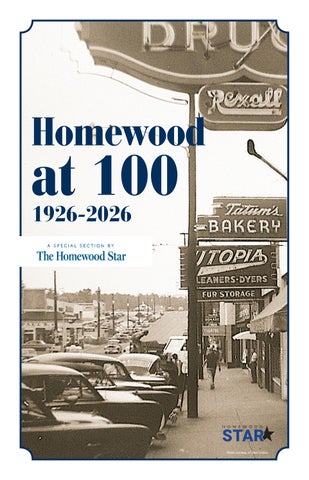
Homewood
at 100 1926-2026
Photo courtesy of Jake Collins.
The vote that made Homewood The founding compromise that still shapes the city 100 years later By KARIM SHAMSI-BASHA In September 1926, residents south of Red Mountain went to the polls to decide whether their towns would continue to exist. The question was a merger: whether Edgewood, Rosedale and Grove Park would dissolve themselves into a single new city in Shades Valley. Within months, on October 29, 1926, Homewood existed. That was the point. Red Mountain separated Shades Valley from Birmingham, and in the early 20th century that separation was the valley’s whole identity. Birmingham was the fastest-growing industrial city in the South. The valley was the other side of the ridge in every sense: green where Birmingham was gray, quiet where Birmingham was loud. “By joining together, these communities have been able to provide the city services that Homewood residents enjoy today including its award-winning school system and its library,” said Eddie Griffith, chairman of the Homewood Historic Preservation Commission. “We also benefit from its outstanding police, fire, public works, and parks and recreation departments. All contribute to the desire to live in the ‘City of Happy Homes,’ as it was called in that era.” The three communities arrived by different roads. Rosedale came first, platted in the 1880s and sold cheaply to Black buyers after the railroad meant to serve it failed. By the 1900 census, 95% of its residents owned their homes free and clear. Edgewood had an electric railway across the mountain by 1911 and an artificial lake by 1915. Grove Park was the smallest and is the least documented: a residential enclave with almost nothing about its founding surviving in the public record. By the mid-1920s the three towns shared a valley, a streetcar line and a set of problems none could solve alone. Roads needed paving. Water and sewer service was a patchwork. Three small governments maintained three of everything, and none could afford one of anything done well. Charles Rice, a local attorney called the Father of Homewood, started a movement to merge the communities, and within months he had it on a ballot. One city could deliver what three towns could not: shared infrastructure, a real tax base, schools everyone wanted for their children. But a second argument ran underneath the first, and it would define Homewood politics for the next 50 years: Birmingham. The giant across the mountain grew by annexing, and the valley had watched it happen. Everyone in Shades Valley knew what had occurred when Birmingham absorbed nine surrounding towns at once. A scattering of small towns south of the mountain made easy targets. One incorporated city of respectable size could stand on its own.
The Edgewood Electric Railway in the 1920s. Photo courtesy of Eddie Griffith.
The merger of 1926 was, among other things, a defensive act. Homewood was founded in part to not be Birmingham. The compromise that made the merger possible was the name itself. None of the three would lend its name to the new city. A new name gave every resident equal claim on the new identity. It is worth pausing on what was surrendered. A town’s name is its memory of itself. The people of Edgewood had built a business district and a lakefront under that name. Rosedale’s name was carried by families who had bought land nobody else wanted and raised churches on it. Folding those identities into an invented word took a level of civic trust that is easy to miss at a century’s distance. The founders hedged the bet wisely. The old names never left. A hundred years later they are still on the map. Homewood kept its founding communities as neighborhoods, which is why the city has always felt like a collection of small towns that happen to share a government. “Homewood is a unique community, where our residents recognize our strengths and our
Edgewood in 1959 looked different than it does now. Photo courtesy of Eddie Griffith.
B2 • October 2026
Oak Grove Dairy operated in one of the three founding communities of Homewood. Photo courtesy of Eddie Griffith.
individuality,” Homewood Mayor Jennifer Andress said. “At the same time, I have seen a shift toward regional cooperation. We need a strong Jefferson County that attracts economic investment and retains an educated workforce. I strongly believe that when appropriate, it benefits Jefferson County as a whole to work together to address regional issues.” The Homewood of 1926 was a few thousand residents, a patchwork of paved and unpaved roads and a bet that a valley could govern itself. In 1929 the Spanish Colonial development of Hollywood voted to be annexed into Homewood. The city survived the Depression, a polio epidemic and the recurring question of whether Homewood would remain Homewood at all. It did remain, and Homewood became the city where everyone wants to live. “I think people choose to live in Homewood because they recognize that our diversity is our
HOMEWOOD AT 100
strength,” Mayor Andress said. “Our community has texture, history and authenticity. It’s organic. It is what makes Homewood so incredibly special, from Forest Brook to Patriot Park, from Edgewood to Rosedale, from Mayfair to Hollywood and every special neighborhood in between.” What’s next for Homewood is on the minds of everyone as the city celebrates its 100-year anniversary. Mayor Andress sums it up this way: “We do need to be intentional about protecting what makes Homewood so special. I have been on the council for 10 years, and we have not rezoned one parcel of Neighborhood Preservation District in that time. We have a group of councilors and planning commissioners who work to protect our history, and that needs to continue. Our community in the Valley is so unique, and we must listen to one another and hold each other accountable to keep it so!”
The Homewood Star
CENTENNIAL SALUTE
Brandino Brass loves being in Homewood and honors the city’s centennial Homewood is a lovely town, known for its safe, friendly neighborhoods, tree-lined streets, historic homes, marvelous parks, and many recreation and cultural amenities. The city, which is celebrating its centennial in 2026, also has a very walkable, shopper-friendly downtown and a reputation for nurturing small businesses. Those small businesses in Homewood include Brandino Brass, a respected, family-owned company that is known throughout the Southeast as a go-to destination for designers, contractors, architects and homeowners seeking top-quality decorative and architectural hardware. Founded in Birmingham in 1948, the company has operated its showroom in Homewood since 2009. It’s no surprise that the co-owners of Brandino Brass, which is located on Central Avenue, have a lot of nice things to say about the city. “I like Homewood,” says co-owner Jessie Isom. “The community itself is unique in many ways. It’s a tight-knit community that is somewhat diversified. I’ve met many people over the years that moved to Homewood after visiting or passing through and fell in love with the vibe here.” Co-owner Renee Genereux has fond memories of her childhood in Homewood. “My days in Homewood began in 1979 when my family moved here from Hartford, Connecticut,” she says. “Although we went to church at Our Lady of the Valley, my older brothers and I attended school at Our Lady of Sorrows. I have fond memories of going
The hardware room at Brandino Brass. Photos courtesy of Brandino Brass.
Co-owners Renee Genereux, Eric Brandino, and Jessie Isom.
to Homewood Park as a child. Climbing the caterpillar was such a scare as a little one, but I had to keep up with my brothers! Who knew that I would return to Central Avenue as an adult?” The Brandino co-owners are also thrilled to see Homewood celebrate its 100th anniversary. “I’m glad to be part of that history, and we are glad to be here,” Eric Brandino says. It’s been almost 17 years, and we hope we’re here for a lot longer.” “It’s another milestone for the city and a testament to the determination of the community to continue thriving,” Isom says.
TheHomewoodStar.com
“Homewood thriving equates to success for the local businesses including Brandino Brass.” Genereux shares praise for Charles Rice, the local attorney who led the effort to combine Rosedale, Edgewood, Hollywood and Grove Park into one city in 1926 and is dubbed “The Father of Homewood.” Rice was “a pioneer,” Genereux says, adding that she “is proud of this milestone for all neighbors, companies and local governments to come together as one.” Eric Brandino is certainly proud of his family’s legacy and heritage at Brandino Brass. “I am the third generation,” says Brandino,
who opened the Homewood showroom with his father, Buster Brandino. Buster retired in 2022, and Eric was joined as co-owner by Isom and Genereux, both of whom had long ties to the business. “We are a small company that is big on service, and we are really glad to be in Homewood, which is a good fit for us,” Brandino says. “We like being a part of the community in Homewood. We’ve gained good customers and employees because of that. The city has been very good to us.” “I like to think we’ve become a staple in the community, and we do our best to give back on an annual basis and support the community
HOMEWOOD AT 100
in different ways,” Isom says. “I’m extremely proud to be a small part of Brandino Brass’s legacy,” Genereux says. “So many from Birmingham, Homewood and surrounding cities have trusted us to enter their homes for practical items as well as beautification of their homes. I love that residences in Homewood want to honor the age of their home but also bring in modern technology.” Homewood has been a great place to run a business, all of the co-owners say. “I think the city works diligently to improve the environment around local businesses,” Isom says. “When issues arise, they listen to their community and respond accordingly. It’s centrally located making it easy for a lot of people to get to us without much hassle.” “Homewood is a great place for a business,” Genereux says. “The Homewood community is an amazing mix of residential and commercial blending together to live and exist as one.” “I think the city focuses on smaller businesses, and that has been very nice,” Brandino says. “They have a great Chamber of Commerce, and the whole feel of Homewood has been good. It is a walking community. They walk by the store and come in because they are curious. We are not downtown but we are close. We are two blocks away. We are glad to be local for our customers who want to come into the showroom, and Homewood is a very accessible city.” It is a city that honors both its past and its future.” Genereux says. “Homewood doesn’t forget their roots yet looks forward to the future. Homewood offers so many amazing restaurants, shops yet keeps a small hometown feel. Cheers to 100 years!” Brandino Brass 2824 Central Ave., #100, Homewood 205-978-8900 brandinobrass.com Instagram: @brandinobrass
October 2026 • B3
THEN AND NOW: Homewood through the lens Homewood has changed dramatically over a century, yet pockets of the past remain visible if you know where to look. This photo spread pairs images from Homewood’s history with contemporary photographs of the same locations today. The historic photographs were sourced from Eddie Griffith, chairman of the Homewood Historic Preservation Commission, and Jake Collins, a Homewood High School history teacher. What emerges is a portrait of continuity and
change: some buildings still stand, transformed by time; others have vanished entirely, replaced by new developments. Together, these images tell the story of a city that has held onto its character while moving forward. Jake Collins has spent two decades documenting Homewood’s visual story. He grew up on Roxbury Road, graduating from Shades Cahaba in 2001, and has published two books capturing the city’s past, including “Homewood Images of America” and
“Homewood Past and Present,” which launches October 29 at homewoodpastandpresent.com. “I grew up with Dino’s hot dogs, Doug’s Coin and Jewelry, baseball cards, and games like Spotlight and Capture the Flag. At a young age, I recognized how unique this place is.” Collins hopes his work will help residents see the city anew. “When people look at these photographs and walk through downtown Homewood, I want them to see the hard work people did to keep this place alive. Homewood has seen so much change, but what matters has endured: the wonderful and diverse people who live here.”
The Homewood Theater in the 1930s. Photo courtesy of Jake Collins.
Nadeau Furniture has replaced The Homewood Theater. Photo by Karim Shamsi-Basha.
Union Missionary Baptist Church in Rosedale - 1890. Photo courtesy of Jake Collins.
Union Missionary Baptist Church in Rosedale in 2026. Photo by Karim Shamsi-Basha.
The Curve in the 1950s. Photo courtesy of Eddie Griffith.
The Curve today. Photo by Karim Shamsi-Basha.
B4 • October 2026
HOMEWOOD AT 100
The Homewood Star
Manhattan Street used to be tracks for The Edgewood Electric Railway in 1910. Photo courtesy of Jake Collins.
Manhattan Street. Photo by Karim Shamsi-Basha.
Downtown Homewood in the 1930s. Photo courtesy of Jake Collins.
Downtown Homewood in 2026. Photo by Karim Shamsi-Basha.
Edgewood Pharmacy in 1924. Photo courtesy of Jake Collins.
Escape Day Spa has replaced Edgewood Pharmacy. Photo by Karim Shamsi-Basha.
Hall-Kent Elementary, West Homewood, late 1930s. Photo courtesy of Eddie Griffith.
Hall-Kent Elementary. Photo by Karim Shamsi-Basha.
TheHomewoodStar.com
HOMEWOOD AT 100
October 2026 • B5
The six-vote annexation that nearly ended Homewood A 1964 vote to dissolve Homewood into Birmingham passed by six ballots — then unraveled By KARIM SHAMSI-BASHA Six votes to end a city. In 1964, Homewood voters went to the polls to decide whether to dissolve their city into Birmingham. Annexation won by six votes. Current Homewood Mayor Jennifer Andress points to the importance of voting. “It is vitally important for Homewood citizens to show up at the polls, whether it is a municipal election or a special called election, like the one we had in 2024 to change our form of government to a Council-Manager form of government. It is a privilege to exercise our right to be heard through our votes, and our city is stronger with an engaged and informed citizenry,” Mayor Andress said. Since the 1950s, Birmingham had been courting the over-the-mountain suburbs. The families who moved south of Red Mountain still worked downtown, shopped downtown and built their prosperity on Birmingham’s economy, while paying their taxes to Homewood, Mountain Brook and Vestavia Hills. Annexation would recapture the tax base. Seen from Homewood, the same arithmetic ran in reverse. An earlier Birmingham bid in 1959 had been turned back, and everyone understood there would be another. The 1964 attempt moved fast. Within weeks, a petition signed by more than 50 qualified Homewood electors reached the City Council. The council called the election a month before the ballots were cast. That notice would matter more than anyone expected. Morris N. Bouldin was a Homewood resident and taxpayer, and by his own account, he was mostly worried about his tax bill. Homewood’s rate was lower than Birmingham’s, which also levied a sales tax that Homewood did not. Bouldin sued to void the election, and his argument had nothing to do with how anyone voted. State law required 60 days’ notice before a special election of this kind. Homewood had given roughly half that. Birmingham’s answer was, in effect, that everybody already knew. The merger had been argued in the newspapers for months; formal notice was a technicality. The Alabama Supreme Court did not agree. General publicity through the news media could not substitute for the notice the statute demanded. The requirement was mandatory, not a suggestion. The trial court declared the election void within a year, and the state supreme court affirmed shortly after.
The Hollywood Town Hall in 1927. Photo courtesy of Eddie Griffith.
For a little more than two years, the city of Homewood existed mainly as an argument. Birmingham had not waited for the courts. After the 1964 vote, the city began collecting taxes in Homewood at Birmingham’s higher rate. When the courts finally ruled, a companion decision ordered that money returned to the people who paid it. For two years, in other words, Homewood was a city whose existence depended on which document you were reading. But the court’s ruling did not settle the question; it reset it. A new election was called, and this time the campaign ran with the full legal notice and no ambiguity about what was at stake. Homewood voters rejected annexation decisively — roughly 65% chose to remain independent. Turnout climbed significantly, more than a quarter higher than in 1964. Eddie Griffith, chairman of the Homewood Historic Preservation Commission, moved to Homewood in 1986, and he lives on Hollywood Boulevard. The commission is working on an app with TravelStorys that will offer a walking tour of Homewood. “That vote was two decades before we moved to Homewood. I was 34 when we moved here, and we loved everything about this unique place,” Griffith said. “You knew your
Homewood Mayor Jennifer Andress. Photo by Karim Shamsi-Basha.
Eddie Griffith at his home in Hollywood. Photo by Karim Shamsi-Basha.
neighbors back then, but today, everyone’s in a hurry. We also love the diversity. We wanted our kids to grow up in a diverse community.” Historians still argue about what drove overthe-mountain independence — civic identity, local control, taxes and the racial politics of the era were braided together in ways residents themselves described differently at the time. Griffith, an architect, reads the appeal in the housing stock itself.
“There were many reasons for Homewood wanting independence,” Griffith said. “Speaking as an architect, these reasons included houses built to the same scale and lot size. Welcoming front porches. Sidewalks. Front porches invite a friendlier neighborhood, which in turn makes a community prosper and grow.” What is not in dispute is the outcome. The second vote hardened Homewood’s sense of itself as a city that had chosen its own name. When Homewood built its own school system years later, the confidence to do it traced straight back to the annexation fight. A city that had voted to exist felt some obligation to act like one. Every centennial invites a counterfactual, and Homewood’s is unusually sharp. Flip a few ballots in 1964, let the result stand, and this town would not exist. The school system would not exist. Homewood would be a neighborhood inside Birmingham. Griffith describes the appeal in the terms many residents do. “Everything is a few minutes away, the grocery store, the community center, the schools. You still see kids walking home from school. Not many places can say that. It’s like the fifties when I was growing up.” Six votes held the line in 1964. A hundred years on, Homewood is still walking home from school.
Despite the battle for independence, downtown Homewood has thrived throughout the centuries. Photo courtesy of Eddie Griffith.
B6 • October 2026
HOMEWOOD AT 100
The Homewood Star
CENTENNIAL SALUTE
Making the customer #1 A soldier came home from Vietnam with a love of motorcycles. A Homewood institution came home with him. In 1971, Joe Belmont came home from Vietnam and did something that would outlast him: He opened a motorcycle shop. The decision was rooted in something simple: Joe loved motorcycles. He was an avid weekend dirt bike racer and always knew he wanted to work for himself, and if he was going to put 100% into a business, he wanted it to be something he was passionate about. He called it Big #1. In business Joe was decisive and confident. But he was a family man at heart, calling his mother every night to check on her, being a Boy Scout Troop 105 Scoutmaster for his two children when needed, and being a devoted husband to his wife and business partner Paula Jean for over 50 years. Joe always had faith that his business could succeed and become a top motorsports dealership, so he wanted to name it appropriately. A shop finds its home Joe started the business in 1971 at 1813 29th Ave. S. In those years the shop included small bike brands that no longer exist, like Penton, Hodaka, Ossa and Bultaco. In 1976, the store moved just across the street to a larger location at 1829 29th Ave. S. The following year brought another significant change: a Yamaha franchise and the name Big #1 Yamaha. After a brief period at the Palisades Shopping Center, Joe bought property at 227 West Valley Ave. in 1992 and expanded the dealership to Big #1 Motorsports with brands like Suzuki, Polaris, Canam, Seadoo and Ducati. After more than 20 years at that location, the business eventually resided at its current location on Cobb Street off of I-65, where it added premium brands like BMW and Indian. In the decades since, Homewood grew up around it. When Big #1 opened, the city itself was barely fifty, still building the schools and the identity it celebrates at this centennial. The dealership on Cobb Street became one of the constants: the same family, the same business, through every version of Homewood that has come and gone since. The word customers keep using Read what Big #1’s customers write about the place, thousands of them over the years, and one word surfaces again and again, unprompted: family. Not as a slogan. As a description of how it felt to buy a first bike, a kid’s four-wheeler, a retirement Gold Wing. For the Belmont family, that reputation traces directly back to Joe and how he felt a customer should be treated by a business. “Joe believed in customer service above all else,” Mindi Belmont, treasurer at Big #1 Motorsports, said. Success and growth mattered, she said, but Joe believed the most powerful advertisement was what customers told people when they left the shop. “He always felt word of mouth was the best type of advertising,” Belmont said. “If we
TheHomewoodStar.com
treated our customers like family, they would return and send their friends.” That philosophy remains central to the business today. Even after a recent overhaul of the dealership’s exterior and interior, the family says there is one thing they do not want to ever change: the feeling customers get when they walk through the door. Their goal is to look and operate like one of the Southeast’s top dealerships while maintaining the personal experience that helped Big #1 build its reputation in the first place. “We will greet each and every customer with a smile and do our best to give each one a memorable experience,” Belmont said. The next generation Joe’s sons, Joey and Johnny, grew up in the business and watched it grow from one location with a handful of motorcycle brands into a major powersports dealership. The family business is now positioning for a third generation. Johnny’s sons are both currently attending Samford University and are expected to take over the dealership in the future. The family story is, in many ways, a story of steady growth rather than one dramatic leap. Each new location created more room. Each new franchise expanded what Big #1 could offer. And as powersports products became larger and more diverse, the business continued adapting to meet those changes.
Today, that evolution continues. The dealership recently underwent a complete overhaul of its exterior and interior, as well as its sales and service areas. The family is willing to change how the dealership looks and operates. What it will not change is the way customers are treated. Big #1’s reach extends well beyond Homewood. That reputation has a radius. Riders drive in from Georgia, Tennessee and Louisiana, passing dealer after dealer, to buy from the shop on Cobb Street. Mindi Belmont attributes that loyalty to two things: customer service and selection. “If you are treated like family, the drive is worth it,” she said. However, customer service is only part of the equation. When it comes to powersports, customers usually have very specific ideas of what they want, and keeping up with the industry means having the right inventory available. For Big #1, that means keeping up with trends, understanding what customers want and making sure that the dealership has a broad enough selection to serve them. The result is a business that has grown far beyond its original neighborhood while keeping its roots firmly planted in Homewood. Big #1 could have moved anywhere in 55 years. Bigger highways, cheaper land, flashier corridors all beckoned. It stayed.
HOMEWOOD AT 100
Homewood provides Big #1 with a central location in the Birmingham metro area that is easily accessible to a wide range of customers. But accessibility is not the only reason the family has remained in Homewood. “It is the city itself that has always treated us right,” Belmont said. The city has allowed the dealership to move several times and provided enough room to stock the selection customers need, especially since powersport products have gotten larger. Big #1 also makes a point of opening its events to the community, with food trucks, grill-outs and entertainment. “It’s always open to our Homewood neighbors,” Belmont said. The Homewood Police Department has also been there to assist the dealership countless times in the middle of the night, whether responding to a false alarm or a real incident. Officers have also assisted with demo rides and bike nights. For 55 years, through a city’s transformation and a family’s two generations, Big #1 has stayed exactly where it started, treating the people who walk in the way the name always promised. In a city built by people who bet on staying, that is as Homewood as it gets. Big #1 Motorsports 505 Cobb St. 205-942-3313 bignumber1.com
October 2026 • B7
Rosedale: The neighborhood Homewood’s oldest neighborhood tells the story of a community that refused to disappear By KARIM SHAMSI-BASHA Red clay and creek water. The smell of rich earth after rain, rising from unpaved streets where children played. Front porches where the world slowed, where time moved differently than it did across the mountain. This is the Rosedale that came first, the neighborhood that built itself. 90-year-old Josephine Jerald was born and raised in Rosedale. “We walked everywhere. Our streets were not paved, and when it rained, our shoes got muddy, and we changed into clean shoes at church. Later, I would walk to Hollywood and clean houses for $2.50 a day, then go downtown and get ice cream cones at the Homewood Creamery. Life was simple back then,” Josephine Jerald said. She remembers her father buying the house she still lives in and adding onto it himself, room by room, year by year. Homewood’s centennial in 2026 marks 100 years since three communities merged to form the city. But Rosedale was already here. It was born first, in 1886, when the Clifton Land Company deemed the red clay acres unsuitable for white buyers and sold the land cheap to Black buyers who saw possibility. Benjamin F. Roden of the Clifton Land Company sold the first parcels to a nurseryman named Theodore Smith. Alexander Johnson bought some of the earliest lots. By 1900, the census showed what these buyers had built: a neighborhood where 95% of residents owned their homes free and clear. Laborers and craftsmen, furnace workers and merchants, teachers and tradespeople who had bought land for $20 or $30 an acre, who had built houses and expanded them over decades, holding the land the way you hold something you mean to keep. B.M. Montgomery arrived in the 1920s as Rosedale’s school principal. He stayed for 42 years, until 1967. Under his leadership, Rosedale School became the first school in Jefferson County to teach Black students above the junior high level. It was a quiet revolution, one classroom at a time, in a neighborhood where education was understood as the thing that would last. It was a neighborhood built on proximity and knowing. Dennis Bush is gym supervisor at the Lee Community Center. He grew up in Rosedale. “It was one of the best places. Everybody knew everybody. Strong sense of family community. It’s still that way. People cared about one another back then, and they do now. The people of Rosedale love Rosedale,” Bush said. This sense of community survived displacement and threat. In September 1963, the same month the 16th Street Baptist Church was bombed in downtown Birmingham, a bombing took place on Central Avenue in Rosedale. No arrests were documented. In the mid-1960s, the Red Mountain Expressway widened and split Rosedale in two. What had been one continuous neighborhood was suddenly interrupted by concrete and speed. The three founding neighborhoods of Homewood, supposedly equal partners in 1926, did not experience this displacement equally. Rosedale bore the burden. Rosedale started with 110 acres. Fewer than 30 acres of houses remain. In 1968, Afton M. Lee Sr. became Homewood’s first Black council member. Decades later, his daughter Adrienne Lee founded the Rosedale Community Development Corporation. In 1988, the CDC built the first two Habitat for Humanity homes in the neighborhood.
B8 • October 2026
Josephine Jerald has lived in the house she grew up in for decades. Photo by Karim Shamsi-Basha.
HOMEWOOD AT 100
The Homewood Star
that came before Homewood
Dennis Bush and Annalise DeVries take a walk through Rosedale. Photo by Karim Shamsi-Basha.
The work of rebuilding, of remembering, of staying, continued quietly, house by house. In 2004, both Rosedale districts were placed on the National Register of Historic Places. The recognition was significant. It did not, however, include a preservation ordinance. Without legal protection, what remains is vulnerable to development pressure, to the kind of erasure that comes not from a single dramatic act but from the slow accumulation of choices made elsewhere, in offices and zoning meetings by people who do not live in Rosedale and do not walk its streets. Annalise DeVries, an associate professor of history at Samford University, began working with the Rosedale community in 2019 on what would become the Rosedale Memory Project. Her digital history students proposed digitizing the neighborhood’s artifacts and stories. The archive grew to include oral histories and community documents, creating what she describes as a richer understanding of Homewood’s overlooked past. “We wanted to preserve this history without taking the artifacts away from the community,” DeVries said. “For Rosedale, which lost so much of its identity in the sixties, making this history available and accessible matters.” The project continues to grow at rosedalememoryproject.omeka.net, where rotating groups of students digitize archival materials, preserving neighborhood memory for future generations. The creek still runs. The red clay remains, holding memory in its grain, and the families who stayed wrote their stories into this ground. Rosedale was already here, and something of that presence lingers still.
TheHomewoodStar.com
Josephine Jerald at her Rosedale house with food pantry volunteers Kelly and Bobby Patrick. Photo by Karim Shamsi-Basha.
HOMEWOOD AT 100
October 2026 • B9
The city that chose itself A Homewood timeline, 1926 – 2026 Decade by decade through Homewood’s first century, from an 83–45 vote in 1926 to the time capsule going into the ground this October By KARIM SHAMSI-BASHA
1. Edgewood Lake
1
5. Rosedale High School Band
9. Downtown Homewood
6
1926–1936
The founding decade
On Sept. 20, 1926, Edgewood voted 83–45 to merge with Rosedale and Grove Park under a new name. Charles S. Rice, the attorney who led the consolidation, would be remembered as the Father of Homewood. The state recognized the city on Oct. 29. That same year, Clyde Nelson began selling lots along Hollywood Boulevard under the slogan “Out of the Smoke Zone, Into the Ozone.” Hollywood was its own town then. It joined Homewood in 1929.
2
War changes everything Birmingham’s wartime mills needed workers, and the workers needed homes beyond the smoke. Homewood’s population grew roughly 74% between 1940 and 1950, the fastest stretch in its history. In 1946, Jefferson County drained Edgewood Lake, the valley’s social heart since 1913, for dam repairs that never came. A hundred acres of dry lakebed passed to Howard College.
3
The boom
1956–1966
The college and the fight
Howard College opened its new campus beside the drained lakebed with 1,825 students, its largest enrollment yet, and became Samford University on Nov. 9, 1965. Then Birmingham came calling. Homewood voters turned back annexation in 1959. A second referendum on Aug. 11, 1964, appeared to pass by six votes, 2,423 to 2,417, but the election was challenged for inadequate legal notice, and the Alabama Supreme Court declared it void on Sept. 9, 1966. That Dec. 13, Homewood voted 4,015 to 2,149 to remain itself. No decade did more to guarantee there would be a centennial to celebrate.
5
1996–2006 Homewood built itself a new downtown. Excavation began in May 2004 on a full block of 18th Street, and by 2005 SoHo Square stood there: $55 million, a new City Hall over ground-floor retail, and 76 condominiums above, all sold before the building opened. The year before, the Rosedale Historic District joined the National Register, 143 buildings across 250 acres built by and for Black families since the 1880s. One block was new. The other had been there the whole time.
9
2006–2016
Downtown becomes a destination
Homewood sold its old City Hall in 2007, and on April 2, 2009, a 111-room Aloft hotel opened on the site, a $20 million building aimed at young professionals who wanted to walk to dinner. It worked. Downtown began filling with people who did not live here, and the restaurants along 18th Street noticed. The Homewood Star launched in April 2011.
10 2016–2026 One hundred
1966–1976
A city builds its schools
Under federal court order, Homewood’s schools integrated in 1968–69. Former principal Bill Gross later said it went smoothly because Rosedale children and white children already knew one another. Rosedale educator Mamie Foster sat with Mayor Bob Waldrop and Gross to plan a school system of Homewood’s own, which needed federal approval. The city created it in 1970. Homewood High opened in December 1972, and the Patriot Band formed the same year in the tricorn hats and red-whiteand-blue uniforms it still wears.
B10 • October 2026
A church becomes a library
SoHo Square
Subdivisions replaced pastures, and the Edgewood and downtown districts became the city’s commercial spines. Homewood annexed Oak Grove, west of Green Springs, whose Zelosophian Academy had been teaching children since 1892, 34 years before there was a Homewood to teach them in.
4
1986–1996
The Homewood Public Library opened at 1721 Oxmoor Road in the former Homewood Church of Christ, bought by the city in 1984. The library had begun in 1941 in a single room at City Hall, when Homewood counted 7,397 residents. It has been growing since, expanded again in 2020. In 1992 the city adopted a plan for 18th Street: wider sidewalks, trees and a sign ordinance so the storefronts stopped shouting over each other.
8
1946–1956
Downtown holds on
The mall came for Homewood’s main street and did not get it. Brookwood Village opened in 1973, and 18th Street kept filling with businesses that meant to stay: Little Professor, O’Carr’s, Shaia’s. On Lakeshore Drive, the old Hollywood Country Club came back to life in 1979 as Brothers Music Hall, drawing touring rock acts and crowds the mayor called a headache. It burned in 1984.
7
1936–1946
1976–1986
The city approached its centennial doing the things that built it: filling its schools, packing Central Park, arguing lovingly about parking. Then it changed how it governs itself. On Sept. 24, 2024, residents voted 1,787 to 1,565 to adopt a council-manager government, the largest structural change at City Hall since incorporation; the new council took office Nov. 3, 2025. On Oct. 29, 2026, Homewood turns one hundred and buries a time capsule for the residents of 2126, who will open it in a city that exists because 83 people said yes on a September Monday in 1926.
HOMEWOOD AT 100
The Homewood Star
CENTENNIAL SALUTE
Lakeshore Foundation celebrates its long, rich history in Homewood at city’s centennial
More than 13,000 members and guests visit Lakeshore each month to exercise, connect with community and participate in inclusive programs. Photos courtesy of Lakeshore Foundation.
The Lakeshore Foundation and the city of Homewood have a shared history that goes back for a century. The Foundation has been a part of Homewood since it opened on Lakeshore Drive in 1925 as the Jefferson Tuberculosis Sanatorium. In fact, the Foundation recently celebrated its centennial, and the city of Homewood – founded in 1926 – is currently celebrating its own centennial. The Lakeshore Foundation is “excited to celebrate Homewood’s centennial and proud to be part of a community with which Lakeshore shares such a long history,” says Cathy Miller, the Foundation’s Chief Operating & Financial Officer. “Having celebrated our own 100th anniversary in 2025, we look forward to celebrating Homewood’s while continuing to grow together in the years ahead.” There’s been “a long and meaningful relationship between Lakeshore and Homewood,” says Jen Allred, Chief of Programs & Special Projects at the Lakeshore Foundation. “Lakeshore is extremely proud to be part of the Homewood community and to share such a long history with the city,” Miller says. “We’re proud of our history here, grateful for the support we’ve received and excited about what the future holds as both Lakeshore and Homewood continue to grow,” Allred says. In 1973, the old sanitarium became Lakeshore Rehabilitation Hospital, and in 1984, the facility became the Lakeshore Foundation. The Foundation has become an internationally renowned organization and is especially well-known for its research and advocacy for individuals with physical disabilities. “We’re the only U.S. Olympic and Paralympic training site in the Southeast and one of
only a few such sites in the entire country,” Allred says. “Each year, countless Olympic and Paralympic athletes train and prepare for the highest levels of sport right here in Homewood.” Lakeshore is the only organization in the United States that is home to three USA teams: USA Wheelchair Rugby, Boccia United States, and USA Para Powerlifting. “That distinction reflects not only the strength of our programs, but also the strength of the Homewood community that has helped shape us for generations,” Allred says. Homewood has been a good place for the Lakeshore Foundation to operate all these years. “Its central location in the Birmingham metro area makes our campus convenient and accessible for members who participate in our programs regularly,” Miller says. “We value the strong sense of community in Homewood and are grateful to have grown our mission here the past century,” she says. The community of Homewood has been important to Lakeshore’s success in countless ways. “Hundreds of Homewood residents have been members of our daily fitness, aquatics, recreation and athletic programs,” Allred says. “Over the years, they’ve participated as athletes on many of our 27 different national championship teams for children and adults, and some have competed at the highest level, representing Team USA at the Paralympic Games in sports such as cycling, tennis and wheelchair rugby. That kind of impact is possible because Lakeshore has grown within a community that understands the value of our mission.”
USA Wheelchair Rugby is one of three national Paralympic teams based at Lakeshore. The team just won the WWR World Championship and will head to LA28 as world champions. Photo courtesy of Melanie Butez.
TheHomewoodStar.com
In 1973, the old sanitarium became Lakeshore Rehabilitation Hospital, and in 1984, the facility became the Lakeshore Foundation.
Many of the Foundation’s leaders and staffers have lived in Homewood through the years, including the organization’s first CEO, Jeff Underwood. “Jeff’s leadership was instrumental in building the strong relationship between Lakeshore and the city,” Allred says. That bond between Lakeshore and the city continues under the leadership of the current CEO, John D. Kemp. “Both leaders appreciate that for Lakeshore to be truly successful as a mission-driven organization, we must be connected to and engaged with the community in which we’re proud to be located,“ Allred says. “That connection has helped us remain focused on meeting real needs and ensuring that people with physical disabilities have access to the programs and facilities they deserve.” Homewood city leaders have also stood beside Lakeshore during “some of the most meaningful moments” in the organization’s history, according to Allred. “They’ve helped us welcome the world to our community through international sports events and partnered with us when we had the opportunity to host President George H. W. Bush,” she says. Homewood embraced Lakeshore’s commitment to service members and veterans when the Foundation launched Lima Foxtrot, an injured military initiative, in 2007. “In true Homewood fashion — and fittingly in the home of the Patriots — the city helped us celebrate our nation’s injured veterans with a parade through the heart of the community,” Allred said. “That support meant a great deal to Lakeshore and to the service members and
HOMEWOOD AT 100
families involved.” Looking ahead, Lakeshore Foundation expects to receive positive media attention in 2028 during the Los Angeles Olympics and the LA28 Paralympic Games. “When Homewood residents watch athletes compete on the world stage in 2028, we hope they’ll feel a deep sense of pride knowing their city has played a meaningful role in that journey,” Allred said. “For many athletes, that journey begins long before the opening ceremonies. It begins in training sessions, community programs, daily practices and, so often, it begins right here in Homewood.” Lakeshore Foundation has big plans for its future in Homewood. “Lakeshore’s 45-acre campus includes land opportunities for future development,” Miller says. “As we look ahead, we will evaluate the use of our campus strategically in order to strengthen and expand our mission.” The Foundation and the city of Homewood will continue to build a great relationship that has lasted for a century. “At our core, Lakeshore is here to support the citizens of Homewood,” Allred says. “Together, we can continue building a city that’s accessible and welcoming for everyone who wants to live, work, worship, play, train and compete here. We are deeply proud to call Homewood home, and we look forward to continuing that partnership for generations to come.” Lakeshore Foundation 4000 Ridgeway Drive, Homewood 205-313-7400 lakeshore.org
October 2026 • B11
Reader memories from Homewood From the corner stores to the front porches, the voices that built the city
By KARIM SHAMSI-BASHA Our readers remember the Homewood of their youth: the neighborhoods they knew block by block, the schools and stores and streets that made belonging possible. Memory captures not just what happened but what it felt like to live through it and what it meant. As Homewood celebrates 100 years, these reader memories offer something the official record cannot: the lived experience of a community, told by the people who built it, year by year, generation by generation. Their stories are Homewood’s heartbeat.
1. Lynette Mantooth has watched Homewood from behind the counter of Mantooth Interiors since 1973. She has seen the neighborhood thrive on foot traffic, weddings, parent weekends and customers from across the state who frequent the store. “If it snows, I’m walking to the store. That’s how I know this is the right place to be. I’ve spent more time here than anywhere else, and I wouldn’t have it any other way.” “Every holiday is a memory — the Fourth of July fireworks with customers invited to watch, Christmas open houses, a winter wonderland feeling. In 2014, when the snow came, everyone slept here. We’re mom and pop, and we help one another. It takes a village.”
2. Dora Cothren Sarris has spent 32 years in her store that she loves, Theodora, and living in the same house where she grew up in Hollywood. She has watched Homewood grow, yet the community bonds she treasures remain. “We walked downtown for homecoming dresses, to the hobby shop, to the shoe stores. Before the malls came, everybody shopped here. Dino’s hotdogs, Outtakes restaurant — those were our gathering places.”
B12 • October 2026
“What I know about Homewood is community. I’ve watched three generations come through the store at 13, and I’m now watching their children go to college and have kids of their own.”
3. Dennis Bush grew up in Rosedale. He works as the gym supervisor at the Lee Community Center, and the way he got that job makes him smile every time. “I was 14 and playing basketball when the director at the time, Norman Dill, put the whistle around my neck and asked if I could watch the gym for an hour. I did, and I have done it since that day, and I absolutely love it.” “Rosedale is one of the best places on earth. Everyone knows everyone, and there is a strong sense of community and family. This job is my calling. It keeps me connected to the neighborhood, and the kids who come every day are wonderful.”
4. Sue Graphos has owned Sam’s Super Sandwiches since 1970. She remembers weekends with her friends, nickels for movies, the simple pleasures of a neighborhood where everyone knew your name. “Saturday mornings, we’d ride bikes downtown and watch a movie for 15 cents. Then we’d buy a Coke and popcorn, get an all-day sucker from the machine, then head to Grants Five & Dime after the show. It was a full day for practically nothing.” “I still walk my dog around home and the store, and that’s how I meet people. That’s how community happens.” 5. David Chapman lived and taught in Homewood from 1990 to 2020, spending 30 years at Samford University while raising his family. When his grandkids moved out, so did he — but the Homewood he loved lingers in his memory. “It takes your grandkids moving to take you out of Homewood. You could buy a small house for a reasonable price. It was affordable, filled with teachers and people who valued community. That’s what drew us here.”
“I taught English at Samford University for three decades, and both the faculty and the students love and appreciate being in Homewood.”
6. Margaret Ann Shumace grew up going to Elmore’s Five and Dime store. Her childhood was Homewood itself: walking downtown from Our Lady of Sorrows church, eating breakfast or lunch, then riding bikes to the pool where everyone gathered in the summer. “We’d walk from church and stop for a hot dog or an egg sandwich. Then we’d ride our bikes to the pool, and it was always standing room only. We knew someone on every street. That was Homewood.” “Now we’re celebrating the store’s 75th anniversary, and my grandparents’ legacy continues. But I see how the neighborhood is changing. The world we grew up in — where everyone belonged — that’s what we’re trying to hold onto.”
7. Jessica Brasfield Mackin was born and raised in Homewood. She opened Nadeau Furniture in what used to be the movie theater in downtown Homewood, working with contractors to preserve its past: original ceilings, original doors and a balcony built during segregation that once served the African American community. “Working to preserve what’s left of the history, because it matters. We found the original ceiling, the balcony that was built for Black customers. This building tells the whole story.” “I remember going to school at Shades Cahaba, the YMCA, all of it made Homewood special. As the city gets larger and changes, we have to protect what remains — especially Rosedale. That’s where it all began. Our diversity is so important.”
HOMEWOOD AT 100
8. Janice Jackson has lived her entire life in Rosedale, growing up on 26th Avenue South in a neighborhood where church, school and community were woven together. She and her husband, Alprentice Jackson, raised their family there, and though the kids have moved away, Rosedale remains the place they call home. “I loved going to school in our neighborhood. We’d go to Sunday school at Baptist Union Missionary Church and eat breakfast. We loved Rosedale, and Rosedale took care of us.” “When someone moved in, everyone helped. When someone needed anything, we showed up. That’s Rosedale. That’s what it means to belong to a place, to let a place belong to you.” These memories are Homewood’s true record — the lived experience of a community told in the voices of those who built it, who stayed, who knew their neighbors block by block. They capture not just what happened but what it felt like to be home and what it means to build a place worth remembering.
9. Victor and Blanca Trejo own La Hacienda Supermarket off Green Springs Highway in West Homewood. The couple has lived and worked here for 20 years, and their three children attend Homewood City Schools. “We live here because the schools are so good, and our kids love it,” Blanca Trejo said. “And the people of Homewood have supported our store for a long time. We absolutely love it here. I wouldn’t live anywhere else.” Victor Trejo said the store is also a way of bringing something with them: “We are proud to represent our home of Mexico here in Homewood.”
HOW HOMEWOOD TURNS 100
Centennial Gala, October 15. Centennial Brunch, October 16, Homewood Recreation Center. Picnic in Central Park, October 17. Time Capsule Burial, October 29, the city’s 100th birthday. Photos by Karim Shamsi-Basha
The Homewood Star
TheHomewoodStar.com
HOMEWOOD AT 100
October 2026 • B13
A kindergarten class at Hall-Kent Elementary School in West Homewood during the school’s early years. Photo courtesy of Eddie Griffith.
Homewood High School principal Joel Henneke, right, with history teacher Frankie McKeown. Photo by Karim Shamsi-Basha.
The Homewood Way How a community built a school system that strives for excellence By KARIM SHAMSI-BASHA There is something intangible about Homewood’s schools, something that lives in the halls and classrooms. Teachers feel it when they walk through the doors for the first time, and students breathe in without quite knowing it’s there. It has no name on any document. It isn’t written into any curriculum. But everyone who lives it knows it exists. It is the reason teachers stay and the reason students exceed what they thought possible. It is also the reason a century of families chose to live in Homewood for the schools. Joel Henneke, principal at Homewood High School, calls it “The Homewood Way.” He speaks of it with something like reverence, knowing how difficult it is to describe something so fundamental yet so ethereal. “We call it The Homewood Way,” Henneke said. “When we hire teachers, they find out quickly about this Homewood Way that no one can identify. It’s what has defined us for a long time.” The Homewood school system includes Edgewood Elementary School, Shades Cahaba Elementary, Hall-Kent Elementary, Homewood Middle School and Homewood High School. Each school carries the same DNA. Each one asks the same question of every student: What can we do to help you become who you’re meant to be? Henneke has been principal at Homewood High School for 20 years. He speaks about his job with gratitude. “I’m thankful for what I get to do,” he said. “The community has high expectations, real community engagement and a partnership between education and the city government. And we are student-centered.” He has watched the school system evolve, but one thing has remained constant: genuine care that shows in high graduation rates, in students who feel known, in families who stay because they trust that their children are regarded and respected. “I see us continuing to improve,” Henneke said. “Our commitment is to prepare the students for what comes next. We don’t just have you pass a test. We help you go after your passions.” Those passions show up in athletics at the high school, where games are more than competition. Student athletes learn to push beyond what they thought possible, while the whole city shows up on Friday nights. Coaches demand excellence in both performance and character — a commitment that has defined Homewood.
B14 • October 2026
Hall-Kent Elementary in West Homewood was founded in 1928. It has expanded since then. Photo courtesy of Eddie Griffith.
The Rosedale High School band in 1947. Photo courtesy of Eddie Griffith.
Homewood schools regularly rank near the top in Alabama. Photo by Karim Shamsi-Basha.
“It goes back to leadership,” said Rick Baguley, the high school athletic director. “From superintendent to coaches, we invest in students and guide them to achieve their goals. We honor Homewood’s tradition while pushing to new heights. In my 27 years, the community support has been extraordinary. They show up. Always.” Passions also show up in the performing arts and music. Band Director Chris Cooper has worked with The Homewood Patriot Band for decades. “People ask me all the time about retiring. Why would I retire? This is a dream job. I have wonderful students and staff and amazing administrators.” Under his direction, the band has traveled to extraordinary places. They performed in the Rose Parade. They performed in Macy’s Thanksgiving Day Parade. Next year, they will travel to the Netherlands for the Corso Zundert flower parade. And his teaching philosophy reflects the essence of what makes Homewood’s schools
The Homewood High School Patriot Band. Photo courtesy of Chris Cooper.
some of the best in Alabama. “The students are our audience, and we always try to find out what is best for our kids and our community. There’s a difference between success and excellence. We want excellence.” Former band director Ron Pence now works part time with the students. “Homewood is a place where if you can dream it, you can do it,” he said. “Being part of a living, breathing group, ever changing, always growing but still holding the tradition of the Homewood Patriot Band. Working here for 33 years fills my heart with joy and pride. Go Homewood Patriot Band. Live the dream!” The band relies on students like Anna Peterson, the current drum major of the Homewood High School Patriot Band. She cried when selected. “This was a dream of mine,” she said. The position carries weight: standing in front of 300 musicians, commanding their respect, representing the community. Peterson understood the gravity of it.
HOMEWOOD AT 100
“I want to leave behind a great legacy,” Peterson said. “It’s an honor to showcase what this community does for us. And I want to carry on that legacy.” Peterson credits the leaders who came before her. “The leaders I saw in the past inspired me,” she said. “As a freshman, I was insecure and quiet. They pushed me out of my comfort zone and gave me confidence.” From academics to the arts to the band to athletics, the Homewood Way continues to unfold across generations. It appears in classrooms where teachers stay because they belong, in football fields where entire communities gather, in band rooms where young people discover what they are capable of becoming. It is the reason families choose to live in Homewood, the reason they stay, the reason they come back. The Homewood Way is absolutely real. It is the reason the city built its schools, and the reason, a hundred years later, the schools continue to build the city.
The Homewood Star
TheHomewoodStar.com
HOMEWOOD AT 100
October 2026 • B15
Congratulations
HOMEWOOD ON 100 YEARS.
Some places are more than a location. They are a community. A gathering place. A source of belonging. For 100 years, Homewood has been all of these and more. As one of Homewood’s longest-standing institutions, Samford University is honored to celebrate this milestone alongside the city we proudly call home. Together, we have helped faithfully educate leaders, serve our neighbors, strengthen our community and shape generations of lives. Thank you, Homewood, for a century of vision, character and community. Here’s to the next 100 years.
samford.edu
2026-27 Marketing Homewood Star 100 years ad_FINAL.indd 1
9/11/26 9:55 AM