Bulletin BIRMINGHAM BAR ASSOCIATION
Vol. 47, Issue 3 | Fall 2026
Save the Date: Annual Meeting & Holiday Party. 6
Trust But Verify: An AI Reminder from the Federal Bench. 14
AIM Board of Directors
All Lawyers
KNOW WHO MANAGES YOUR INSURANCE COMPANY.
AIM Staff Members
Local & Experienced
WHEN YOU'RE INSURED WITH AIM, YOU KNOW WHO’S ON YOUR TEAM. Formed out of the Alabama State Bar, AIM’s mission is to provide unparalleled customer service, unmatched claims defense, and high-quality legal malpractice insurance to lawyers in Alabama, Georgia, and Tennessee.
2
Get a Quote Today: 205.980.0009 info@attorneysinsurancemutual.com www.attorneysinsurancemutual.com
Birmingham Bar Association
Fall 2026
3
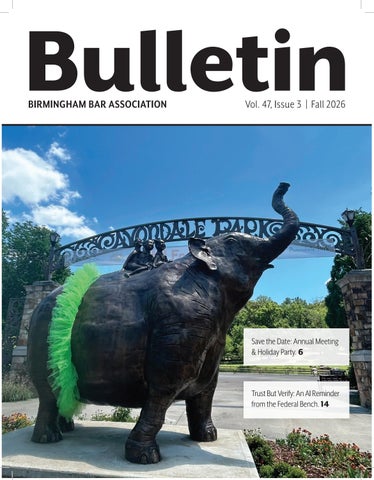
In This Issue Executive Director’s Message .............................................................................................................6 President’s Message ............................................................................................................................8 Annual Picnic .....................................................................................................................................10 Skeet Shoot ........................................................................................................................................ 12 Trust But Verify: An AI Reminder from the Federal Bench .............................................................. 14 Coffee with the Judges ...................................................................................................................... 18 Member Activities.............................................................................................................................. 20 Thank You, Donors!............................................................................................................................22 To Serve and Assist: BBA Grievance Committee.............................................................................25 Early Dispute Resolution as an Alternative to Traditional Mediation...........................................26 Honoring Excellence in Leadership, Professionalism, and Service.............................................. 28 Privilege, Work Product, and Generative AI: Emerging Issues Practitioners Need to Know.......29 Honoring Our History, Advancing Our Future............................................................................... 30 When Directors Let AI Do It: Governance Questions for the Modern Board................................ 31 Save the Date: Miss Nina Miglionico Paving the Way Award Ceremony Honoring Leila Watson..................................................................................................................32 Investing In Justice: Legacy in Motion ............................................................................................. 34 Attorneys in the News ...................................................................................................................... 38 ON THE COVER: Miss Fancy statue in Avondale Park. Photo by Christopher Nelson.
4
Birmingham Bar Association
WALK INTO YOUR DEPO WITH JUST YOUR LAPTOP
STREAMLINE d e p o s i t i o n s ELIMINATE PAPER B U I LT LT B Y A C O U R T R E P O R T E R . Designed to flow like paper. (We are not an AI company.)
www.exhibitsuite.com
Fall 2026
5
Message from the Executive Director Greetings, everyone…I hope you all had a great summer! The Birmingham Bar Association has been busy the last few months, and in this Fall issue of the Bulletin, we highlight some of the signature events hosted by the BBA during the late spring and summer months, including Law Day, Coffee with the Judges, the Annual Skeet Shoot, and the Annual Picnic. We also have some great reads from the BBA’s Business Law Section, Diversity & Inclusion Committee, and In-house/Corporate Committee along with an informative article on A.I. from Judge Harold Mooty III.
Enjoying some social time with my colleague and friend Mandy Peterson-Tice
Thank you to all the BBA members — because of you, the Association continues to grow and thrive, and we appreciate your support! We are here to serve, so please share any ideas you may have to help us improve the Bar’s services and programs and share with us your stories so we can continue to highlight our incredible members (please email me at jwilson@ birminghambar.org). Also, please check the Bar calendar often at https://birminghambar.org/ events/event_list.asp to keep up to date on what the BBA has planned for you this Fall. I look forward to seeing you soon!
The Birmingham Bar Association invites you to attend the
2026 Annual Meeting & Holiday Party Annual Meeting at 4:00 pm: Presiding Judge Elisabeth French’s Courtroom Holiday Party at 5:00 pm: Holy Trinity + Holy Cross Greek Orthodox Cathedral
6
EXECUTIVE COMMITTEE Stanley E. Blackmon Jennifer Tombrello Cohn Darius Crayton Ben Goldman Sidney Jackson Katie M. Kimbrell Julie E. McMakin Denzel Okinedo Brandy Robertson Laura S. Winston Jon Lewis, A.D.R. Section Wes Bulgarella, Bankruptcy/Commercial Law Section Griff Waters, Business Law Section Michelle Spiker, Criminal Justice Section Adam Plant, Federal Practice Section Thad Davis, Probate Section Pooja Chawla, Solo/Small Firm Section Hannah Stokes, Women Lawyers Section Kris Burbank, Workers’ Compensation Section Robby Anderson, Young Lawyers Section Ashley Peinhardt, ASB Commissioner Clinton Richardson, Magic City Bar Association BIRMINGHAM BAR ASSOCIATION 2001 Park Place N., Ste 430 Birmingham, AL 35203 205-251-8006 birminghambar.org jwilson@birminghambar.org
Jim H. Wilson Executive Director
Dec. 11, 2026
President Rebecca Beers President-Elect Leslie Rubio Secretary-Treasurer Virginia Miller Immediate Past President Robert E. “Bob” Battle Executive Director Jim H. Wilson
Please join us to recap 2026, learn the election results, celebrate with award winners and preview what's in store for 2027.
PUBLISHED BY STARNES MEDIA For information about this publication and/or advertising rates, email Dan Starnes at dan@starnesmedia.com or call 205-313-1780. Starnes Media produces six monthly newspapers in the Birmingham metro area: 280 Living, Cahaba Sun (Trussville), Homewood Star, Hoover Sun, Vestavia Voice and Village Living (Mountain Brook). Starnes Media also produces other magazines and business marketing materials. Starnes Media. All rights reserved. Reproduction or use of editorial or graphic content without prior permission is prohibited.
Birmingham Bar Association
Fall 2026
7
From the President The past three months have been an exciting time at the Birmingham Bar, and we are working hard to provide valuable and fulfilling programming for our members and to facilitate opportunities for us to serve and support our community at large. I am proud of the work that we have done (so far!) to fulfill my theme for the year, “Birmingham Lawyers: We Lead, We Serve, We Inspire.” Our CLE, social, and networking events have been absolutely top-notch, and I am so grateful for all of our EC members, committee and section leaders, and overall volunteers who have helped make this year fantastic so far. I look forward to seeing what the rest of the year holds! First, I am thrilled to report that your Birmingham Bar is growing and thriving in 2026. With more than 3,100 members (and growing each day), the BBA has expanded its membership to its largest size since prior to the pandemic. This is a particularly exciting accomplishment, as membership in organizations like voluntary bars has dropped nationwide, but our membership has grown significantly over the last two years. Huge accolades go to last year’s president Bob Battle for setting a high standard and putting the tools into place to make this year’s growth possible, but we couldn’t have made the progress we’ve made this year without our amazing BBA staff (Jim Wilson, Ginny Thomas, and most of all to Alexis Jackson, our hardworking and dedicated Membership Engagement and Communications Manager) and our BBA Membership Committee, led by Tempe Smith and Sydney Everett. Most importantly, thank YOU for renewing your membership or for joining for the first time. If we can serve you better in any way, please do not hesitate to reach out. On July 8, the Young Lawyers held their annual Golf Tournament and had one of the most fun and well-attended events in years. YLS fielded 18 full teams, and a great time was had by all. Then, just a few days later, on June 12, our amazing Entertainment Committee with their fearless leader Nick Callahan at
8
Law Day 2026 the helm served more than 400 members of the BBA with an outstanding homemade meal at the BBA Annual Picnic. And, Price Evans and Martin Evans helmed the annual Skeet Shoot that morning to raise money for the Bar Foundation. We are so lucky to have these hardworking volunteers who show up every year to put on top-notch events and serve their fellow bar members. Thank you for all of your hard work, Entertainment Committee! We can’t wait to enjoy the fruits of your labor again in December at the Annual Holiday Party on December 11. On June 30, we continued our “History of Birmingham Lawyers” CLE series, this time featuring Women Trailblazer Lawyers. More than 130 BBA members and guests were in attendance to hear the personal stories and words of wisdom from five trailblazer lawyers – Hon. Sharon Blackburn, Hon. Elizabeth French, former BBA President Maibeth Porter, Hon. Caryl Privett, and Hon. Carole Smitherman. It was a truly inspiring discussion moderated by former BBA President Leila Watson, a true trailblazer in her own right. Our final two sessions of the “History of Birmingham Lawyers” CLE series will be held later this fall – our session on Black Trailblazer Lawyers will be on September 23, and our final session on Birmingham Lawyers at the U.S. Supreme Court will be scheduled thereafter. A
reminder that these and other of our outstanding programs are being recorded, saved to YouTube, and made available on our BBA website – be sure to check out past programs you may have missed! In July, we served our members with two fun socials. First, on July 9, the BBA caught World Cup fever and hosted a social at Cahaba Brewery to enjoy a quarterfinals match. There, we also introduced and celebrated our newest class of the BBA Future Leaders Forum. After a successful FLF Alumni social in the spring, we welcomed one of our largest classes in many years – 19 new future leaders will be participating in the program this fall, led by our chairs Ken Boyles, Judge Javan Patton Crayton, and Carmen Weite. We are looking forward to seeing how this year’s class grows and thrives. The members include John Banks, Ben Brown, Hannah Cassady, John Collier, Turner Collins, Porcha Davis, Kara Duplechin, Amelia Haston, Tatum Jackson, Tamora Jefferson, Allison Krist, Jayme Leadmon, Aaliyah Locke, Gianna Mandich, Mary Parish McCracken, Nicole Bracey Norwood, Julie Potts, DeMario Thorton, and Gabe Tucker. On July 30, we hosted a social event for the entire family – including furry and human children – at Good Dog, a covered dog park located on the Rotary Trail on 1st Avenue
Birmingham Bar Association
Leslie Rubio, Judge Tiffanie Agee, and Rebecca Beers
Rebecca Beers and Justice Will Parker
South. Human children (and their parents!) enjoyed Big Spoon Creamery, lawyer parents enjoyed cold adult beverages from Good Dog’s bar, and all the good boys and good girls enjoyed playing at the dog park. In addition to facilitating the growth and engagement of new and emerging leaders through the Future Leaders Forum, our Mentoring Committee (led by J.R. Thomas, Judge Kechia Davis, and Hope Marshall) has kicked off a meaningful and engaging Mentoring program for 2026. This group is working to ensure that this year’s class of lawyer mentees, who are seeking guidance, advice, and wisdom from some of our most dedicated bar volunteers, really grow and mature in their practices. In July, we also partnered with the MCBA and the BBF to serve our Birmingham community by raising funds and gathering in-kind donations to support second grade classrooms throughout Birmingham City Schools. We are honored and proud to partner with District Attorney Danny Carr and his Helping Families Initiative to support these classrooms through our annual schools supplies drive. This year, we raised more than $15,000 and will be providing school supplies to second grade classrooms across our great City. The BBA has also hosted fantastic Coffee with the Judges events all summer long. We had HUGE crowds in Judge French’s courtroom in June and July, welcoming law students and law clerks as well as our lawyers and judges to these fun summer get-togethers. Thank you to the ASB Young Lawyers, Balch, Bradley, LawyerUp, Marsh Rickard, and Starnes for hosting us in June and July. And, in August, we went back to federal court for Coffee with the Federal
Judges. Special thanks to the Northern District for hosting us in the beautiful Vance Building. Our CLE offerings continue to be firstrate, with our CLE Committee (led by Jennifer Bates, Judge Monica Agee, and Hilary Williamson) leading the charge and with additional programming from many of our sections and committees, including CLEs and social opportunities from the Solo/Small Firm Section, the Criminal Justice Section, the Women Lawyers Section, the In-House/Corporate Counsel committee, and the Federal Practice section. Be on the lookout for even more great programs to come, including sessions from the Young Lawyers and the Court Liaison Committee. We also have even more great events on the horizon. I hope to see you at one or more of these coming up! › Next iteration of the “Taste of the City” Series featuring James Beard and Michelin-recognized restaurants and bars. Be on the lookout for information about our next stop at Pizza Grace, with more to come. › Presiding Judge Elisabeth French and Courtney French will welcome the Young Lawyers Section and the BBA EC back to their home for a great party on September 10. Thank you so much for your generosity and hospitality, Judge French and Courtney! › Coffee with the Judges – September 25 in the criminal courthouse, October 23 in Judge French’s courtroom, and our last CWTJ of the year in Judge French’s courtroom on November 13. › Our next community service opportunity will be at The Community Food Bank
Fall 2026
on October 2 beginning at 9:00 a.m. Be on the lookout for volunteer signups. › The Young Lawyers Section will be hosting their annual Charity Trivia Night on October 8, benefiting Three Hots and A Cot, an organization formed by veterans to help veterans. This is always a fun event for an even better cause! Also, if you’re looking for an additional team member, know that your BBA president is a former state Scholar’s Bowl champion and is on the lookout for an NIL that best rewards her trivia skills. Now accepting offers . . . › This year’s Students Today | Lawyers Tomorrow program will be held on October 15. We are grateful to former BBA President Marcus Maples for continuing to work to make this program a success. › Also on October 15, the Birmingham Connection Committee, Women Lawyers, and Young Lawyers will be co-hosting a New Admittee Social. Please spread the word to all of the newly barred lawyers in your life. We look forward to welcoming them into the BBA! › We will celebrate our 50+ Year Bar Members at Galley & Garden on October 28. Special thanks to Ed Hardin for hosting us! › On November 12, we will honor our military veterans and active military personnel with a luncheon generously hosted at Maynard Nexsen. More info to come. We have even more great events and programming on the horizon, and I cannot wait to share those plans with you soon. Serving as your president this year has been rewarding and fun for me, and I hope it has resulted in meaningful service, leadership, and learning opportunities for you. If not, please let me know what we can do better. Our goal is to serve our profession, our community, and most importantly – YOU. Working with and alongside each of you has truly been a gift and an honor, and I am thrilled to serve out the remainder of this year with you. I hope you’ve had the best summer and are looking forward to the fall; I know I am! All the best, Rebecca Beers Your 2026 BBA President
9
Annual Picnic 2026 Each summer begins with one of the BBA’s most anticipated traditions, the Annual Picnic, where members gather to reconnect and celebrate the season. This year’s event welcomed more than 400 BBA members, making it another memorable celebration of our legal community. A special thank you to the BBA Entertainment Committee for organizing such a fantastic gathering and continuing this cherished tradition. Be sure to check out the photo collage below to relive the highlights from this year’s picnic!
10
Birmingham Bar Association
Fall 2026
11
Hitting the Mark: Fellowship, Competition, and Giving Back The Birmingham Bar Association’s Annual Skeet Shoot once again proved to be a day of camaraderie, competition, and giving back. Held on June 12 at the Southern Skeet & Trap Club and hosted by Price & Martin Evans, the event welcomed participants of all skill levels—from first-time shooters to seasoned marksmen—for an enjoyable morning on the range. Beyond the friendly competition, the Skeet Shoot serves a meaningful purpose, with proceeds benefiting the Birmingham Bar Foundation and supporting its important mission and community programs. The BBA extends its sincere appreciation to Simmons Sporting Goods of Bessemer, Alabama, for its generous sponsorship, and to everyone who participated in making this year’s event a success. We look forward to seeing you on the range again next year!
12
Birmingham Bar Association
Fall 2026
13
Trust But Verify: An A.I. Reminder from the Federal Bench By JUDGE HAROLD D. MOOTY III INTRODUCTION It was the phone call no one ever wants to receive from a parent: on the evening of January 12, 2026, my mother told me that my father had been diagnosed with Stage IV cancer. He needed to see the best available oncologist immediately, so I grabbed my iPad and went to work on three parallel research tracks. First, I asked ChatGPT Pro1 to identify possible specialists and generate appropriate questions to ask them. Second, while the A.I. model processed my request in the background, I sent several text messages to medical professionals across the state asking for their recommendations. Third, I accessed UAB, Vanderbilt, and Emory’s websites and began analyzing the credentials of all oncologists with the requisite specialization. After about an hour, all three research methods pointed to the same oncologist at UAB. The significant point is not that an A.I. model produced a name, but, rather, that the name survived independent verification through human experts and primary-source research. I sent the oncologist’s name to my parents, and my father was admitted to UAB around forty-eight hours later.
In 2026, no one should rely solely on A.I. for advice, and certainly not medical or legal guidance. Although models such as ChatGPT have improved dramatically, they continue to “creat[e] outputs that are nonsensical or altogether inaccurate,”2 a phenomenon known as “hallucinating.” While it may be tempting to trust a particular A.I. model that is an “A+ law student,”3 the results must still be verified. Before I took the bench on October 22, 2025, I trusted the quality of my litigation associates’ work product to varying degrees based on their levels of experience, but, before my signature appeared on a filing, it was my duty to verify the work that we presented to the court and opposing counsel. Our professional obligations require nothing less. If, before taking the bench, I believed our state’s bar had gotten the message over A.I. hallucinations from sanctions orders such as Judge Manasco’s in Johnson v. Dunn,4 the first of its kind in Alabama federal courts, I quickly learned otherwise. As of this article, I have entered three show-cause orders stemming from attorneys’ suspected misuse of A.I., despite having taken the bench a mere seven months ago.5 The point is not that attorneys should never use A.I., but, rather, that attorneys may not outsource their own professional judgment to it. A tool such as ChatGPT Pro can suggest, summarize, organize, translate, and brainstorm, but it cannot certify a filing or satisfy Rule 11 or discharge an attorney’s duty of candor or be the “person” whom the court trusts when an attorney signs a pleading, motion, or brief.
Therefore, to both increase awareness of this problem and decrease its frequency in courts across this state, my peers on the bench asked me to write this article. WHAT SHOULD WE TRUST? The oncologist turned out to have precisely the specialization, institutional support, and professional reputation we needed. The trust he instilled in my family is hard-earned and multifaceted, although his credentials speak for themselves: he leads the group at UAB that treats this specific cancer and his peers in the medical community highly recommended him. But, most importantly, he instilled a high level of confidence when my family met with him face-to-face to discuss my father’s treatment, something A.I. is fundamentally unable to do. Generally, we can and should trust the advice of someone in a particular field—whether medicine or law—based on their training, education, and experience. An A.I. chatbot, on the other hand, is not a credentialed expert. It cannot stand in an office with a patient or a client and convey a similar sense of confidence. Trusting A.I.’s recommendation in selecting an expert is one thing. Trusting A.I.’s advice in lieu of an expert is a different, far more dangerous, proposition. A.I. tools such as OpenAI’s ChatGPT, Anthropic’s Claude, Google’s Gemini, and Microsoft’s Copilot are not experts and should not be treated as such. They have hallucinated in the past and will continue to do so in the future, often in a foundational effort to please or satisfy the user.6 There are too many recent examples of sycophantic behavior to illustrate,7
1 Before taking the bench, I upgraded my personal subscription to OpenAI’s ChatGPT from the “Plus” to the “Pro” version after publishing an article on A.I. See Hal Mooty, A.I. in Modern Law Practice: Past the Point of No Return, 41 ALA. DEF. LAWS. ASS’N 1 (2025). 2 What Are AI Hallucinations?, IBM, https://www.ibm.com/think/topics/ai-hallucinations (last visited May 6, 2026). 3 Karen Sloan, Artificial Intelligence is Now an A+ Law Student, Study Finds, REUTERS (June 5, 2025, 12:49 PM), https://www.reuters.com/ legal/legalindustry/artificial-intelligence-is-now-an-law-student-study-finds-2025-06-05/; ANDREW BLAIR-STANEK ET AL., AI GETS ITS FIRST LAW SCHOOL A+S (UNIV. OF MD. SCH. OF L. 2025). 4 792 F. Supp. 3d 1241 (N.D. Ala. 2025). 5 Dokhanian v. Kamrani, et al., No. 5:25-cv-232 (N.D. Ala. May 19, 2026); Miller v. Regions Bank, No. 2:24-cv-1324 (N.D. Ala. Apr. 10, 2026); State Nat’l Ins. Co., Inc. v. Treadwell, No. 2:24-cv-1424 (N.D. Ala. Mar. 17, 2026). 6 See e.g., Varun Magesh et al., Hallucination-Free? Assessing the Reliability of Leading AI Legal Research Tools, 22 J. EMPIRICAL LEGAL STUD. 216 (2025) (finding that leading legal A.I. research tools hallucinated between 17% and 33% of the time, notwithstanding lower hallucination rates than general-purpose A.I. chatbots). 7 See Expanding on What We Missed with Sycophancy, OPENAI (May 2, 2025), https://openai.com/index/expanding-on-sycophancy/;
14
Birmingham Bar Association
but make no mistake: A.I., with all of its strengths and weaknesses, is here to stay. Just like any other tool, it can be incredibly powerful if used correctly:8 for example, a recent study conducted by Northwestern University revealed that 60% of federal judges use A.I. in their judicial work to some degree.9 To be clear, no one in my chambers is permitted to use generative A.I. to draft an order or opinion because of the obvious risks involved,10 but that does not mean that A.I. cannot help explain obscure or unfamiliar legal concepts. For instance, I never practiced admiralty law before taking the bench, yet I feel comfortable having ChatGPT Pro explain certain admiralty terms of art to me in the car after dropping the kids off at school. I never trust the explanation; I merely use it as a frame of reference to inform my own independent research. As Chief Justice Roberts has observed, judging requires “quintessentially human functions.”11 A.I. may inform those functions, but it cannot perform them. The same is true on the other side of the bench, as clients do not hire attorneys merely for A.I. to do the work. Attorneys and doctors have the privilege of serving their clients and patients in an environment grounded in trust. Based on a licensed attorney’s signature alone, courts should be able to trust the accuracy of all filings in our state and federal courts. Indeed, Rule 11 of both the Federal Rules of Civil Procedure and the Alabama Rules of Civil Procedure states
that an attorney’s signature functions as a certification that he or she has conducted a reasonable inquiry into the contents of the filing and finds they are all warranted by extant facts and law.12 Rule 11 should be a sufficient gatekeeper, meaning it should be unnecessary for judges to require attorneys to separately certify that they have verified the accuracy of any A.I.-generated citations, no matter the technological advancements attorneys employ to better serve their clients. That is because “[t]o maintain the requisite knowledge and skill, a lawyer should keep abreast of changes in the law and its practice, including the benefits and risks associated with relevant technology, [and] engage in continuing study and education.”13 HOW DO WE VERIFY? My father’s oncologist recommended an aggressive form of chemotherapy, with the first round beginning the following day. While I trusted the expert’s recommendation, it was still important to verify his advice. Therefore, I personally reviewed the written materials he provided concerning the chemotherapy and independently researched the specific protocol while ChatGPT Pro did likewise on a parallel track. My family also consulted with other oncologists and former patients to verify the effectiveness of the treatment plan. In the practice of law, a similar verification process occurs every day:
lawyers consult one another to draw on each other’s experience, associates help review and edit each other’s work product, and savvy clients often take the initiative to consult with other lawyers inside and outside the firm on the recommended approach. This verification process can be challenging for solo practitioners and pro se parties who lack some of the resources of larger firms, but, in 2026, even multinational law firms fall prey to the hallucination dilemma.14 Law school teaches us the old-fashioned way of verifying our work. Pull the cases. Read them. Make sure each citation in your draft is correct. Confirm that every quotation in your draft is consistent with the case. Most importantly, make sure the case stands for the proposition you are representing to the court. This is the tried-and-true method to avoid nearly all the A.I. hallucination issues that plague us today. An attorney who uses A.I. should be able to answer six questions before filing any document: (1) Does every cited authority exist? (2) Did I pull the authority from a reliable legal database or official source? (3) Does the quoted language appear exactly as quoted at the pincite? (4) Does the cited authority support the proposition asserted? (5) Is the authority still good law? (6) Have I removed or corrected any A.I.-generated statements that overstate the record, the holding, or the procedural posture? If the answer to any of those questions is “no,” the filing
Sycophancy in GPT-4o: What Happened and What We’re Doing About It, OPENAI (Apr. 29, 2025), https://openai.com/index/sycophancy-in-gpt-4o/. 8 See JOHN G. ROBERTS, JR., 2023 Year-End Report on the Federal Judiciary 5–7 (2023) (recognizing A.I.’s potential to increase access to information while warning that A.I. use requires “caution and humility”); ABA Comm. on Ethics & Pro. Resp., Formal Op. 512 (2024). 9 Anika Jaitley et al., Artificial Intelligence in Federal Courts: A Random-Sample Survey of Judges, 27 SEDONA CONF. J. _____ (forthcoming 2026); Karen Sloan, Majority of US Federal Judges Are Using AI, Study Finds, REUTERS (Mar. 30, 2026, 3:48 PM), https://www.reuters.com/ legal/government/majority-us-federal-judges-are-using-ai-study-finds-2026-03-30/. 10 See, e.g., Daniel Wu, Federal Judges Using AI Filed Court Orders With False Quotes, Fake Names, WASH. POST (Oct. 29, 2025), https:// www.washingtonpost.com/nation/2025/10/29/federal-judges-ai-court-orders/. 11 Roberts, supra note 8, at 6. 12 Fed. R. Civ. P. 11(b) (providing that by “signing, filing, submitting, or later advocating” a pleading, written motion, or other paper, an attorney certifies that the representations are formed “after an inquiry reasonable under the circumstances”); Ala. R. Civ. P. 11(a) (“The signature of an attorney constitutes a certificate by the attorney that the attorney has read the pleading, motion, or other paper; that to the best of the attorney’s knowledge, information, and belief there is good ground to support it; and that it is not interposed for delay.”). 13 ALA. R. PRO. CONDUCT 1.1; ALA R. PRO. CONDUCT 3.3(a)(1); ALA R. PRO. CONDUCT 5.1; ALA R. PRO. CONDUCT 5.3; ABA Comm. on Ethics & Pro. Resp., Formal Op. 512 (2024). 14 See Karen Freifeld & Mike Scarcella, Sullivan & Cromwell Law Firm Apologies for A.I. “Hallucinations” in Court Filing, REUTERS (Apr. 21, 2026, 11:50 AM), https://www.reuters.com/legal/litigation/sullivan-cromwell-law-firm-apologizes-ai-hallucinations-court-filing-2026-04-21/.
Fall 2026
15
is not ready. It is perhaps noteworthy that any partner in any firm in the nation could ask these questions after receiving a draft from an associate: although A.I. is new, the commonsense safeguards for avoiding its misuses are as old as the legal profession itself. For lawyers who want additional guardrails, modern legal research platforms now provide tools that make this recurring problem even less excusable. Westlaw’s Quick Check, for example, can review a draft brief for cited authority, quotation accuracy, KeyCite warnings, and potentially omitted authority. Other legal research platforms offer, or are developing, similar cite-checking and drafting-assistance tools. The brand name is not the point. What matters is that lawyers now have both old tools and new tools to prevent fake or misleading citations from reaching the courthouse. Let me be clear: there is zero—zero—excuse for any attorney to ever file anything with A.I.-induced flaws. The newer problem is subtler than the wholly fabricated case name. Sometimes the case exists, but the quotation does not. Sometimes the quotation exists, but not at the pincite. Sometimes the quoted language is an accurate statement of law, but the case does not support the proposition for which counsel cites it. Those errors are harder for a busy court to catch and easier for a busy attorney to rationalize. They are also exactly the kind of errors that ordinary cite-checking is designed to prevent. WHAT ARE THE RISKS OF NOT VERIFYING? It is unfathomable that a licensed oncologist would rely on an A.I. chatbot to determine an appropriate treatment
for my father’s cancer, as the risks of not verifying medical advice are obvious and potentially life threatening. Indeed, consider the documented hazards of relying on an A.I. chatbot instead of a doctor for medical advice.15 While the risk of not verifying legal work product could be life threatening in some situations, such a failure can also destroy a client’s business, livelihood, and valuable rights. Ask yourself: if your life or liberty were at stake, and you retained the services of an attorney, would you be satisfied if the attorney simply regurgitated whatever an A.I. chatbot said? Of course not. In either scenario, the professional would be at risk of losing his or her license and rightly so. Attorneys must never forget that they are officers of the court. If we normalize the unverified A.I. “slop”16 that is reaching courts’ dockets, more individuals will forego retaining an attorney altogether and instead choose to litigate their disputes pro se. The Northern District of Alabama saw a significant increase in civil pro se filings in 2025, a period that also saw the widespread public adoption of generative A.I. tools.17 Many of the pro se filings we see on the bench are submitted—unedited— straight from the party’s chatbot of choice. If attorneys are increasingly caught filing A.I. hallucinated cases, quotations, or arguments, it impacts the public perception of the entire legal profession. As Judge Manasco held in Johnson: There is potential harm to the reputation of judges and courts whose names are falsely invoked as authors of the bogus opinions and to the reputation of a party attributed with fictional conduct. It promotes cynicism about the legal profession and the American judicial system. And a future litigant
may be tempted to defy a judicial ruling by disingenuously claiming doubt about its authenticity.18 Put differently, “[m]embers of the bar should treat the corpus juris as a shared, common good that we are all obligated to keep pristine and healthy. Hallucinated cases lurk as ghosts at the gate, and attorneys must serve as gatekeepers.”19 If an A.I.-generated error reaches the docket, silence, evasion, or, worse yet, an outright lie are all unacceptable. Counsel should promptly notify opposing counsel, file a corrected paper or notice of correction, identify the affected authorities, withdraw or revise any argument built on the error, and explain the steps taken to prevent recurrence. Courts can distinguish an honest mistake promptly corrected from a professional failure compounded by concealment. The latter is far more likely to produce sanctions, referrals, and reputational harm. Hallucination is not the only A.I. risk. Lawyers must also understand what information they are placing into a tool, whether that information may be retained or used for training, who may access it, and whether the client has authorized that use. The duty of technological competence is not limited to knowing that A.I. can hallucinate. It also requires knowing enough about the tool to avoid compromising confidential client information. Finally, a partner cannot avoid responsibility by saying that an associate, paralegal, contractor, or vendor used the tool. For better or worse, the attorney who signs or submits the filing owns the filing. CONCLUSION A.I.’s transformative impact on both the medical and legal professions cannot be
15 Michael Peel, AI Chatbots Misdiagnose in Over 80% of Early Medical Cases, Study Finds, FIN. TIMES (Apr. 14, 2026), https://www.ft.com/ content/b10002fc-5fff-4e4d-bf64-0502b2d09bb1?syn-25a6b1a6=1. 16 Word of the Year 2025: Slop, MERRIAM-WEBSTER, https://www.merriam-webster.com/wordplay/word-of-the-year (last updated Dec. 14, 2025) (defining “slop” as “digital content of low quality that is produced usually in quantity by means of artificial intelligence”). 17 Data compiled from civil case-opening statistics for the Northern District of Alabama. Civil pro se filings averaged 351 cases over the prior ten years and 365 cases over the prior five years. In 2025, civil pro se filings totaled 486 cases, approximately 33% above the five-year average and 38% above the ten-year average. 18 Johnson, 792 F. Supp. 3d at 1257 (N.D. Ala. 2025) (quoting Mata v. Avianca, Inc., 678 F. Supp. 3d 443, 448–49 (S.D.N.Y. 2023)). 19 Christina M. Frohock, Ghosts at the Gate: A Call for Vigilance Against AI-Generated Case Hallucinations, 130 PENN STATE L. REV. 1, 2 (2025).
16
Birmingham Bar Association
overstated. Nor can courts simply wait for A.I. models to improve until hallucinations disappear.20 The problem before us is not technologically complicated. It is the blocking-and-tackling portion of an attorney’s duty to the client and the court: check your work. Pull the case. Read the case. Verify the quote. Confirm the pincite. Shepardize or KeyCite the authority. Make sure the case says what you represent it says. I do not speak for the entire federal
bench in Alabama, but I will say this with confidence: judges are concerned with this recurring problem. Attorneys who continue to file unverified A.I.generated authorities should expect to face consequences; their clients should be informed of the risks associated with careless use of A.I. Each lawyer has an ethical obligation to the client, to the court, and to the credibility of our justice system. In the immortal words of Coach Nick Saban: “Do your job.”21
Judge Harold (Hal) D. Mooty III
20 Following the sanctions order in Johnson v. Dunn, which Judge Manasaco issued on July 23, 2025, there have been at least ten orders entered in Alabama federal courts stemming from A.I. misuse. See Adams et al. v. 3M Co., No. 4:24-cv-832 (N.D. Ala. Apr. 20, 2026); Pleasant v. Burns, No. 2:25-cv-1658, 2026 WL 948793 (N.D. Ala. Apr. 8, 2026); Rivera v. Triad Props. Corp., --- F. Supp. 3d ----, 2026 WL 915744 (N.D. Ala. Mar. 31, 2026); State Nat’l Ins. Co., Inc. v. Treadwell, --- F. Supp. 3d ---, 2026 WL 861076 (N.D. Ala. Mar. 27, 2026); Martin v. Redstone Fed. Credit Union, No. 5:25-cv-548, 2025 WL 2690449 (N.D. Ala. Sept. 19, 2025); Heimkes v. Fairhope Motorcoach Resort Condo. Owners Ass’n, Inc., --- F. Supp. 3d ----, 2026 WL 883120 (S.D. Ala. Mar. 31, 2026); Devita v. Midtown Motors, No. 1:25-cv-435, 2026 WL 821818 (M.D. Ala. Mar. 25, 2026); In re Jackson Hospital & Clinic, Inc., No. 25-30256, 2025 WL 3251167 (Bankr. M.D. Ala. Nov. 20, 2025); Foster v. Author Success Publ’g, No. 2:25-cv545, 2025 WL 3022296 (M.D. Ala. Oct. 29, 2025); United States v. McGee, 806 F. Supp. 3d 1264 (S.D. Ala. Oct. 10, 2025). 21 A generative A.I. system did not draft this article. I wrote the article, conducted independent research, and personally reviewed the cited source material. I used ChatGPT Pro only after preparing a draft to identify possible supplemental sources and editing issues, then used Westlaw Precision to verify and format legal citations.
Fall 2026
17
Building Connections, One Conversation at a Time: Coffee with the Judges This summer, the Birmingham Bar Association welcomed members of the bench and the next generation of legal professionals for two successful Coffee with the Judges events, creating meaningful opportunities for connection, mentorship, and professional growth. Bringing together summer interns, law clerks, judges, and BBA members in a warm and welcoming setting, the gatherings offered aspiring attorneys a unique opportunity to engage with members of the judiciary beyond the courtroom. Conversations ranged from career journeys and courtroom experiences to practical advice on professionalism, leadership, and navigating the legal profession. These events exemplified the Birmingham Bar Association’s commitment to fostering relationships across all stages of the legal community. By encouraging open dialogue and personal connections, Coffee with the Judges continues to strengthen the ties between the bench and bar while inspiring those preparing to enter the profession. The Birmingham Bar Association extends its sincere appreciation to our generous summer sponsors, whose support made these events possible: › ASB Young Lawyers Section › Balch & Bingham LLP › Bradley Arant Boult Cummings LLP › LawyerUp, LLC › Marsh, Rickard & Bryan, P.C. › Starnes Davis Florie LLP
18
Birmingham Bar Association
Fall 2026
19
Connect Beyond the Courtroom: Join the Birmingham Bar Association’s signature social events.
No matter your interests, the BBA’s diverse lineup of events offers countless opportunities to connect, engage, and have fun.
We had an incredible turnout for our Women Trailblazers CLE! With 170 attendees, it was an inspiring afternoon celebrating the remarkable women who have shaped Birmingham’s legal community.
Congratulations, Ms. Charmayne Jackson, on this well-deserved achievement!
Family matters. Senator Rodger Smitherman, Crystal Smitherman, Judge Carole Smitherman, and Naomi Smitherman.
Members enjoyed an evening of networking at the BBA Happy Hour Social at Cahaba Brewing.
Thank you to YLS’s Olivia Perdue for hosting a successful wine tasting social!
20
Jim Stanley and Caroline Douglas address attendees at the Birmingham Land Bank CLE.
Legal Aid Society honored former Executive Director, Jequette Edmond Noland, with a beautiful resolution celebrating Noland’s years of service and the profound impact of her tenure.
Birmingham Bar Association
Too cute! BBA President, Rebecca Beers, Lady Beers, and Nick Callahan.
Judge Sharon L. Blackburn and Sharon Stewart.
Future Leaders Forum Class of 2026 members joined the BBA for a World Cup Happy Hour Social.
Daisy Holder, Judge Brendette Brown Green, Abby van Alstyne, Georgia Haggerty, and Mandy Peterson-Tice.
Judge Javan Crayton, Judge Kechia Davis, and Judge Tiara Hudson.
Members enjoyed the perfect summer evening catching up with colleagues.
Fall 2026
Wenonah High School Principal Dr. Willie Goldsmith with Glenda Freeman and Chris Burrell on Law Day.
21
Thank you for donating to the School Supplies Drive Hon. Monica Agee Karen Allen Cindy Anderson Averie Armstead Bill Athanas Leslie Barineau Jennifer Buettner Bates Bob Battle Rebecca Beers Greg Biddle Brett M. Bloomston Thomas Buck Caitlyn & Jake Burchfield Robin Burrell Joel Caldwell | in honor of Veloria Henderson Todd Carlisle Audrey Channell John Clark
22
Fred Clarke Molly Clinton Hon. Bill Cole Kathleen Collier Natalie Cox Hon. Javan Crayton Deborah Danneman Valerie Delgado Angela Denton Elise Driskill Starr Drum Ahrian Dudley John Durward Melody Eagan Mark Ezell Samuel Fisher J. Ben Ford Elise Frohsin Wesley Gilchrist
Birmingham Bar Association
Genevra Gimenez Hope Marshall Benjamin Goldman Stephanie H. Mays Hon. Brendette Brown Green | in Terrence McCarthy honor of Leila G. Brown Candis McGowan Gaile Pugh Gratton Greene Julie McMakin Georgia Haggerty Michael Morris Hon. Madeline Haikala Sylvion Moss Nicole Hardee Amy Myers Tyner Helms Jack Neal Elizabeth Henderson Lana Olson Elizabeth Hutchins Dennis & Libby Pantazis Sidney Jackson D.G. Pantazis, Jr. John Johnson Matthew Penfield Hon. Tamara Harris Johnson Mandy Peterson-Tice Leigh Kaylor Hon. Laura Petro | in honor Katie Kimbrell of Hon. Teresa Pulliam Chris King Hon. Kandice Pickett Rachel Lary Julie Potts Jon Lewis Maxwell Pulliam Warren Lightfoot Jonathan Raulston Thomas Logan Hollie Reed Misty Reynolds
Fall 2026
23
Pagie Risley Lisa Singer & Tim Davis Brandy Robertson Malera Traylor-Wright Leslie Rubio Abby van Alstyne John Sewell Dennis Vann Deborah Smith Leila Watson Kathleen Snowden | in honor of Meade Whitaker Charles Denaburg Traci & Greg Wiggins Hon. Patricia Stephens-Moss Sara Williams Sharon Stuart Edward K. Wood Peter Tepley
Firms/Organizations: Balch & Bingham, LLP Leitman Siegal & Payne, P.C. Marsh Rickard Bryan, LLC The Smith Scholarship Foundation, Inc. Wallace Jordan Ratliff & Brandt, LLC White Arnold Dowd, P.C. Thank you for donating to the School Supplies Drive!
24
Birmingham Bar Association
A word with the BBA Committees: Grievance By R. SCOTT WILLIAMS The Grievance Committee serves to assist the Alabama State Bar in investigating most, but not all, grievances filed against lawyers within its jurisdiction. The Committee consists of a Chair (currently R. Scott Williams), Co-Chair (currently Julie McMakin) and three “Groups” of lawyers. Each year, the BBA President selects and appoints attorneys to serve staggered three-year terms as “investigators” who are then assigned to a Group. Each Group consists of approximately 13 lawyers and has a Group Chair. When a grievance is assigned to the BBA Grievance Committee through the State Bar, the Chair forwards it to one of the Group Chairs to appoint an investigator. That investigator will then review, investigate, and produce a report regarding the charges against the involved lawyer. This investigation includes talking to the parties involved, examining pertinent documents, interviewing witnesses, etc., with the goal of finding whether or not there is “probable cause” as to a violation of any of the
Chair: R. Scott Williams
Co-chair: Julie McMakin
Alabama Rules Of Professional Conduct. At the conclusion of the investigation, the assigned lawyer will report his or her findings to the Group which will then vote as to whether there is probable cause as to any or all of the allegations. The Group has the opportunity to ask questions of the investigator and debate among its membership the merits of an allegation. Upon a finding of probable cause as to any allegation, the Group will look at the lawyer’s disciplinary history and make recommendations to the BBA Executive Committee as to appropriate discipline
to be imposed. The investigator will then again report the findings to the Executive Committee, who, in turn, will consider, discuss, and vote on those findings and recommendations of discipline and forward them to the State Bar for further action. An additional important role with which the Grievance Committee is charged is to review petitions for reinstatement to practice filed by lawyers who have either been suspended or disbarred. When this happens, the Co-Chair of the Grievance Committee will assign the petition to a panel of three investigators from the Committee to investigate the request for reinstatement and make recommendations to the State Bar to make a final determination with regard to the request. This important Committee takes its responsibilities seriously. It owes an obligation to serve to both the bar and the public at large. Grievance Committee members embrace their very important responsibility to maintain the integrity of our profession and to provide a very important service to both the bar and our community.
Affordable, Quality Legal Education Become an attorney on your own time. Weeknight and Saturday programs. It’s never too early to apply for fall 2027! Executive JD Program now available.
Birmingham School of Law 231 22nd St S. Birmingham, AL 35233 (205) 322-6122
www.bsol.com
Fall 2026
25
Early Dispute Resolution as an Alternative to Traditional Mediation By JAMES W. FUHRMEISTER1 Most litigators have mediated cases and typically there is posturing and the “dance” that takes place before serious negotiations begin. These are time consuming and ultimately can result in a very long, exhausting mediation session. There is another more structured mediation method that offers fast and less costly resolution of disputes. Whether or not it gains widespread use remains to be seen. In 2022 the American Bar Association began looking at Early Dispute Resolution (“EDR”) as one of the tools for helping courts, attorneys and parties deal with overcrowded dockets.2 In 2024 the ABA House of Delegates formally adopted a resolution urging attorneys and parties to use EDR. 3 Recently, the American Arbitration Association introduced a panel specializing in EDR mediation. Training is offered through the non-profit EDR Institute.4 EDR is a structured mediation process designed for resolving disputes prelitigation or just after litigation has commenced. If litigation has commenced, the parties can use it before the parties have incurred significant expenses in discovery and motion practice. It is centered around EDR Guidelines (f/k/a Protocols). They include a four step process that provides the mediator, attorneys and parties the opportunity to simplify the dispute from many
overlapping claims and counterclaims down to the core dispute(s), exchange key documents for case evaluation, engage in risk evaluation and negotiate a mutually acceptable settlement over a span of several weeks. In many cases a backstop in-person mediation is scheduled at the outset for use in the event the matter is not resolved or terminated through the telephone/videoconferencing negotiations. The mediator is much more involved in the pre-mediation sessions than he or she is in a traditional mediation. EDR takes place before litigation discovery so it requires good faith participation by the parties and attorneys from the outset and it is not unusual for them to sign a good faith certification that may be incorporated into a subsequent agreement. If an opposing party later finds that exculpatory or other key documents were hidden or withheld, that party may be able to resort to a court for remedy. Obviously, this requires a different mindset for litigators who are accustomed to wanting all the information, documents and depositions before engaging in substantial settlement negotiations. The value to the client is EDR can substantially reduce the cost of resolving the dispute in terms of time and money. The value to the attorney is the file is closed earlier and he or she has the appreciation of the client for conserving resources of time and money. That may be a possible reputation enhancement
available to counsel. Confidentiality remains a core part of EDR just like traditional mediation. The first step in the EDR process is case evaluation. Typically, the mediator will hold a telephone/videoconference call with all the attorneys and parties jointly to explain the process, encourage good faith participation, go over necessary disclosures and discuss any other matters or questions that may arise. During this initial call, the mediator and attorneys/ parties will try to simplify the dispute down to the core issues. Of course, the mediator will want to know each side’s view of the dispute and whether there have been any prior efforts at settlement. If the mediator requests position statements, he or she may request that they be shared between the parties and supplemented to the mediator with any confidential material the attorneys/parties want to share with the mediator only. Step two of the mediation is sharing of key documents between the sides. The mediator will request a short list of key documents needed by each side for case evaluation. Again, litigators will have trouble with this because the mediator is going to encourage the list to be tight and pointed only to the key issues for the purpose of case evaluation. This is not discovery, it is evaluation. After the lists have been independently finalized with the mediator, the parties will exchange the documents with copies to the mediator according to a pre-established schedule. In extreme but necessary circumstances, the parties and mediator may agree that witness statements can be taken (on or off the record) and experts employed. If an expert is required, the mediator will
1 Jim Fuhrmeister served as Judge of Probate with general equity jurisdiction and as Special Circuit Judge for Shelby County, Alabama for 10 years prior to retiring. Before that, he was in private practice for 30 years and has been a member of the Alabama State Bar for nearly 50 years, as well as the Birmingham Bar Association and the American Bar Association. He is trained in EDR and general civil mediation. He is the owner of Eastern Shore Mediation serving high stakes probate, fiduciary disputes and complex civil matters. He can be reached through his website easternshoremediation.com 2 See e.g., Tim G. Warner, Crisis in the Courts Paves the Way for Early Dispute Resolution, Just Resolutions Newsletter, American Bar Association, August 31, 2022 3 Felicia Harris Hoss and Ellie K. Vilendrer, “ABA Unanimously Adopts Policy Encouraging Early Dispute Resolution”, Just Resolutions Newsletter, American Bar Association, May 29, 2024 4 https://www.edrinstitute.org/
26
Birmingham Bar Association
suggest that the parties agree on a joint expert to opine on the issue and share the cost. The format for the witness interviews will be agreed to by the parties and often the mediator will ask pre-arranged questions with input from the attorneys. The EDR can be suspended at any time if a party determines that it needs resolution by a judge or arbitrator of a central legal issue such as a statute of limitations defense. It is hoped that this will be the exception because it will slow down the EDR process and add to the costs to the parties. Once the information exchange is complete, the process moves to the third stage of risk analysis of each side’s case. This stage is primarily in confidential caucus with the mediator and involves a concept of risk analysis that is not in wide use among litigators and will require a learning curve. The mediator will work with each side independently to develop a decision tree that produces a risk adjusted value of the dispute. This takes into account incurred costs, projected costs if the case goes to trial (and, perhaps, appeal), other forward looking costs, and the litigator’s best judgment of success on the claim(s) and/or counterclaim(s). The litigator should also consider extraneous facts such as the history of the judge or jury of the locale in similar cases and a weighted estimate of the high, low and midpoint recovery (or loss in the case of a defendant without counterclaims). In the end, the decision tree will produce a probability based risk adjusted value (RAV) of the case. The RAV is not meant to be the absolute value of the case, it is a reality check on expectations and is useful in formulating a negotiating strategy for resolution of the dispute without further litigation. The decision tree is not fixed in stone. Inputs can always be adjusted as new information is gathered or opinions change but it can be very useful in evaluating a dispute so long as good, honest information is fed into the model. The attorneys and parties must be careful to input information that is grounded
This simple example decision tree shows the plaintiff has a claim for breach of fiduciary duty and has incurred $50,000 in fees and costs to litigate the claim. In her attorney’s judgement, there is a 60% chance of winning the case and if they win, the high award estimate is $250,000, the low is $100,000 with a midpoint, most likely recovery, of $175,000 (60% probability of this recovery if they win). The decision tree has calculated that there is a 36% probability of the plaintiff’s net recovery $125,000 after deducting fees and expenses. Taking into account the fees and expenses incurred and the probabilities for success the RAV for this case is $64,000. In a more realistic decision tree, the mediator and attorney may include chance nodes (yellow) for summary judgment motions, affirmative defenses, and project the litigation costs to the plaintiff at each stage to arrive at the RAV.5
on truth, experience and best judgment for the decision tree to be of value. The RAV can also be a useful way for the litigator to reality check his or her client’s unjustified expectations. Each side keeps its own decision tree which is shared only with the mediator. Additionally, each side may wish to develop a decision tree of its best idea of its opponent’s decision tree to further inform its negotiation strategy. Of course, that tree will be a “best guess” because it will not be based on the information in possession of the opponent. The mediator will have the true decision trees of each side in confidence and will use them to help steer negotiations to a fair settlement that is hopefully reflected by overlaps in the respective decision trees. Once the RAV has been established, the parties move into the fourth and final
stage of negotiations. There is nothing unique about the negotiations other than the fact that the parties are armed with their respective RAV (and possibly their estimate of the opponent’s RAV). By this point the mediator should have a good idea if the case can settle and it may be that the mediator terminates the mediation without stated reason because he or she has determined that proceeding will be a waste of time, effort and money. If negotiations continue, there is a good chance the dispute will be resolved before the parties have expended a huge amount of time and money. If the case still does not settle after the negotiations, it moves to the prescheduled in-person mediation session. If the dispute does not settle at mediation the parties have still gained information and perspective about their own and their
5 A free open source widely used decision tree application is available at https://silverdecisions.pl/
Fall 2026
27
opponent’s case. Litigation discovery can be more tailored to the case and not the all encompassing discovery requests commonly employed. Furthermore, the parties will have a much more informed view of the relative merits of each claim and/or counterclaim. Most litigators are not accustomed to evaluating their cases using decision
trees. The hardcore proponents of EDR claim it can be used in any case, but each litigator and his or her client will have to decide if it is appropriate for their dispute. Like mediation in general, it is totally voluntary so it will not be employed unless all sides to the dispute, including the mediator, agree. The reality is there is a learning curve to EDR so
many litigators may not have the time or inclination to employ it. But, EDR can benefit the clients with a tangible result of much lower litigation costs and time and effort expended. And, like regular mediation, it is confidential so reputations may be preserved and perhaps family relationships can be restored.
A word with the BBA Committees: Awards The Birmingham Bar Association has a long tradition of recognizing lawyers whose leadership, professionalism, and public service reflect the highest ideals of our profession. The Awards Committee plays an important role in carrying forward that tradition by bringing together active BBA attorneys and judges to consider and recommend deserving recipients each year for the L. Burton Barnes III Public Service Award and the BBA Lifetime Achievement Award. Through these awards, the BBA honors members who have given generously of their time, talent, and energy to strengthen the Bar, serve the public,
and improve the broader community. The work of the Awards Committee helps ensure that the BBA pauses each year to celebrate those whose careers and service set a meaningful example for others. By recognizing lawyers and judges who lead with integrity, humility, and a commitment to service, the BBA reinforces the values that sustain our profession and inspire continued engagement within the Birmingham legal community. To see past award recipients, please visit the BBA’s website at: https://www.birminghambar.org/ About_awards.
Chair: Melody Eagan
YOUR REAL ESTATE. Our Expertise.
New Leases | Renewals | Expansions Subleases | Lease Restructuring Acquisitions | Dispositions Relocations | Site Selection Build-To-Suits | Development Property Management | Consulting
egsinc.com 2026 BAR AD.indd 2
28
2/13/2026 2:56:40 PM
Birmingham Bar Association
A word with the BBA Sections: Business
Privilege, Work Product, and Generative AI: Emerging Issues that Practitioners Need to Know By TODD PRESNELL AND MARLEE SACKS Todd Presnell and Marlee Sacks are lawyers in Bradley Arant Boult Cummings LLP’s Nashville office. Generative AI tools like ChatGPT, Claude, and Gemini have become ubiquitous, and non-lawyers now use them in ways that directly intersect with litigation and place GenAI at the center of discovery disputes. Consider two scenarios. An individual anticipating a lawsuit uses a publicly available GenAI tool to organize facts or develop legal theories. Or a company’s non-lawyer employees use GenAI tools in their daily work, and the company later faces litigation. In both cases, the adversary seeks the non-lawyer’s prompts, grounding data (or materials input to a GenAI tool), and AI-generated outputs through discovery. Can the attorney– client privilege or the work-product doctrine protect those materials from disclosure? Courts have begun grappling with that question, and emerging case law offers insight into how practitioners can anticipate courts’ treatment of novel issues at the intersection of GenAI use and discovery. The attorney-client privilege generally protects confidential communications between a client and attorney made for the purpose of obtaining or rendering legal advice. For the attorney-client privilege to attach, the privilege’s proponent must establish an attorneyclient relationship and a confidential communication seeking legal advice within that relationship. When a nonlawyer independently uses a GenAI tool—without an attorney’s involvement— these elements may not exist, at least in their traditional sense, and the privilege may not attach. A GenAI tool is not an attorney, no attorney-client relationship
Fall 2026
exists between the non-lawyer user and the GenAI tool, and the user is not seeking legal advice from a lawyer. Unless the non-lawyer acts at an attorney’s direction, serves as the attorney’s agent, or uses the tool to obtain legal advice from an attorney, the burden of proving the attorney-client privilege’s requisite elements becomes difficult. The work-product doctrine presents an easier case. Unlike the attorney-client privilege, the work-product doctrine does not require an attorney-client relationship for its protection to attach. Federal Rule of Civil Procedure 26(b)(3)—and its Alabama equivalent, Ala. R. Civ. P. 26(b)(4)—protects documents and tangible things that a party or its representative prepares in anticipation of litigation. A non-lawyer preparing for anticipated litigation, or a corporate employee assembling materials because of litigation, for example, may claim work-product protection. A party waives that protection by disclosing material directly to a litigation adversary or by substantially increasing an adversary’s opportunity to obtain it. The critical question in GenAI discovery disputes concerns whether inputting litigation-preparation material into a publicly available AI platform destroys work-product protections. United States v. Heppner, 820 F. Supp. 3d 292 (S.D.N.Y. 2026) stands as the first major decision addressing the issue. Heppner suspected he had become a criminal investigation target and used Claude to prepare reports for his anticipated defense. A grand jury later indicted him, and the FBI seized his devices containing his prompts and Claude’s outputs. The court rejected both Heppner’s attorneyclient privilege and work product claims. His attorney-client privilege claim failed because the prompts and outputs did not constitute communications between Heppner and his counsel—Claude is
not a lawyer, and no attorney-client relationship existed. The court further concluded that Heppner could have no reasonable expectation of confidentiality in his Claude engagement because the platform’s privacy policy establishes user consent to data collection and disclosure. The court’s treatment of Claude as a “person” or interlocutor to whom Heppner had “communicated” confidential information, rather than as a tool akin to cloud storage or word processing software, has drawn significant criticism, including from Bridget Mary McCormack and Shlomo Klapper in The Machine Isn’t the Interlocutor: Why United States v. Heppner Gets Privilege Wrong, 27 The Sedona Conference Journal (2026). Heppner’s work-product argument likewise failed. Because Heppner engaged with Claude on his own volition, the court concluded the materials were not “prepared by or at the behest of counsel,” and did not “reflect defense counsel’s strategy.” Notably, the Heppner court did not evaluate the work-product doctrine under the Rule 26(b)(3) framework, which supplies work-product protection to party-created documents in addition to lawyer-created materials. Because Heppner arose in a criminal proceeding, its analysis of a civil discovery rule fits awkwardly in context, and subsequent civil courts have relied on that distinction to decline to follow it. A few civil decisions have rejected Heppner’s reasoning. In Morgan v. V2X, Inc., No. 25-CV-01991 (D. Colo. 2026), the court ruled that the work-product doctrine protected a pro se plaintiff’s engagements with a GenAI tool and held that using publicly available GenAI tools “does not eliminate all expectations of privacy or automatically waive protections” like work product, reasoning that “routing information through a third-party system does not forfeit all
29
privacy.” In Tate Group Automotive, LLC v. Legacy Automotive Capital, LLC, No. 25-BC11B-0020 (Texas Bus. Ct. 2026), the court held that a non-lawyer corporate officer did not necessarily waive workproduct protection by using a publicly available GenAI tool to prepare litigation materials. And in Assini v. Hayward, No. 607683/2024 (N.Y. Sup. Ct. 2026), the court quashed a subpoena to OpenAI seeking a party’s prompts and outputs, expressly distinguishing Heppner as a criminal case and rejecting its rationale. All three courts treated GenAI tools as tools—not as third-party communicants that destroy confidentiality. For practitioners handling discovery
disputes over a non-lawyer’s GenAI prompts, grounding data, and outputs, the takeaway remains clear: the attorneyclient privilege may protect a non-lawyer’s GenAI use if the privilege’s essential elements exist, which likely requires some lawyer involvement. The work-product doctrine, however, offers more achievable protection when a party prepares materials in anticipation of litigation. Authority addressing the question suggests that routing information through a publicly available AI platform does not, by itself, waive the work-product doctrine. But practitioners should remain mindful of a GenAI provider’s terms of use, as terms permitting disclosure of
prompts and outputs may undercut a confidentiality claim.
Griff Waters BBA Business Section Chair
A word with the BBA Committees: Diversity & Inclusion Birmingham has a complicated but meaningful history when it comes to questions of diversity and inclusion. As the birthplace of much of the Civil Rights Movement, this city carries both Chair: Jordan Cade the weight of its past and the promise of the progress that has followed. Nowhere is that progress more evident, and more important to sustain, than in the legal profession. The Birmingham Bar Association’s Diversity & Inclusion Committee exists to honor that history and help carry that progress forward within our own community of lawyers. The composition of the Birmingham legal community has changed significantly over the past few decades. Attorneys of different backgrounds, experiences, and perspectives now occupy positions across the bench, the bar, and the broader legal landscape in ways that would have been difficult to imagine a generation ago. That growth is worth acknowledging — not as a reason to be satisfied but as evidence that sustained, intentional effort can move the needle.
30
Organizations like the Magic City Bar Association, founded in 1984 by nine attorneys in Birmingham, have played a vital role in this evolution. Through its scholarship programs supporting minority students at the Birmingham School of Law, Cumberland School of Law at Samford University, Miles Law School, and The University of Alabama School of Law, the MCBA has helped build a more representative pipeline into the profession. Similarly, the Black Women Lawyers Association of Alabama, founded in 2020, has provided a dedicated network and platform for Black women attorneys across the state, addressing gaps in representation that go beyond race alone. These organizations are partners in our shared work, and the BBA is proud of the relationships we have developed with them. At the state level, the Alabama State Bar’s Diversity in the Profession Committee has continued its efforts to create pathways for underrepresented students, including through its Annual College Minority Conferences, held this past year in both Birmingham and Montgomery. These conferences bring college students face to face with attorneys and judges, offering an early look at what a legal career can look like and how to pursue it. The BBA has been proud to support and encourage
participation in those events. Within the BBA itself, our Diversity & Inclusion Committee has focused this year on facilitating dialogue and programming that help our members better understand the value of a more representative legal community — not only as a matter of fairness but as a matter of professional strength. Clients are best served by lawyers who understand their circumstances and their communities. Institutions are stronger when the people within them reflect a broad range of experiences and viewpoints. These are not merely abstract principles; they are practical realities that shape the quality of legal representation across Birmingham every day. One area of continued focus for the Committee is supporting the pipeline of diverse talent into the profession. This means being present at law school events, engaging with student bar associations, and encouraging BBA members to serve as mentors to law students who may not yet have a robust professional network to draw upon. It also means paying attention to the experiences of attorneys already practicing in Birmingham and being responsive to the challenges they face in terms of access, advancement, and opportunity. Looking ahead, the future of the
Birmingham Bar Association
Birmingham legal community is genuinely bright. The next generation of attorneys coming through our law schools is more diverse than any before it, and the profession is better positioned than ever to reflect the full breadth of the community it serves. That is an exciting prospect, and one that this Committee takes seriously as both a responsibility and an opportunity. Much of that optimism is grounded in the leadership guiding the BBA right now. Our President, Rebecca Beers, has brought tremendous energy, vision, and dedication
to this organization. With more than 12 years of service to the BBA, including roles on the Executive Committee, the Grievance, Nominating, and Membership Committees, and as President of the Young Lawyers Section, Rebecca has long been one of the most committed voices in our bar. Under her leadership this year, guided by the theme “We Lead, We Serve, We Inspire,” the BBA has continued to move forward with purpose. Her commitment to community outreach, member service, and elevating the role of Birmingham attorneys in the life
of this city has set a tone that strengthens everything this Committee is working toward. We are grateful for her support and proud to be doing this work alongside her. The work of building a more inclusive legal profession is not finished — it never truly is. But the direction is clear, the momentum is real, and the people leading the way give every reason for confidence. This Committee remains committed to that work, and we look forward to what the Birmingham legal community will continue to accomplish together.
A word with the BBA Committees: In-house/Corporate Committee
When Directors Let AI Do It: Governance Questions for the Modern Board By JACK SHARMAN Lightfoot, Franklin & White, LLC Chief legal officers have a new headache: How do we govern directors’ use of artificial intelligence in the discharge of their board duties while simultaneously allowing directors the latitude to use these powerful tools? Consider a hypothetical director’s burden. Faced with a bulky board book, that report of internal investigation by outside counsel looks awfully long; to decrypt the CFO’s massive section would require the skills of a Talmudic scholar with a quantum computer; and those disclosure forms are a pain to fill out. The beleaguered director’s solution? Let AI do it. Most likely, he or she will use a model they believe is “confidential” because it is at the twenty-dollar-a-month, one-levelabove-free status. The reality is different. Cases are unsettled as to whether sharing privileged material with a third-party AI waives the privilege; the discoverability of “prompts” is an ongoing issue; and providing
Fall 2026
sensitive board information to a third party’s platform runs the risk of breach and disclosure. Directors know the familiar Caremark/ Stone v. Ritter/Marchand/Boeing fiduciary duties of care and loyalty, which include a duty of oversight. Although there are cases and commentary regarding the potential liability of directors for AI failures by the company, there is little discussion— and apparently no reported cases— addressing directors’ liability for their use of artificial intelligence in discharging their duties (in a sense, oversight of themselves). Given the uncertain legal landscape and the speed with which artificial intelligence evolves, internal counsel should ask questions and then design a workflow to ensure that those questions are answered. Does my board need an AI-use policy at all? As noted in some versions of the Hippocratic oath, “First, do no harm.” It may be that your board is tiny, deals with matters that rarely, if ever, engender legal exposure, or is populated by directors who would no more use AI than jump on a Blue Origin flight to Mars. In those circumstances, an AI-governance policy for the board could cause more problems than it resolves. Who has “jurisdiction”? For a board policy to work, someone must be accountable for it. Within most board structures, a policy that addresses
directors’ use of AI would likely fall to the governance committee or the audit committee. A small working group could draft a policy and present it to the relevant committee. Internal counsel should be involved at each step. What are the high-level concepts? › Sharing confidential organization information with chatbots is prohibited until it has been confirmed that the AI model will not train on the material or leak the material to the AI’s human employees. › Avoid using AI tools to record and summarize meetings. › Prompts and chats may be discoverable. What about humans? There must always be a “human in the loop.” Artificial intelligence is a wonderful and sometimes transformational tool, but humans must work with other humans and articulate the governance of those relationships accordingly.
Jack Sharman
31
YOU ARE CORDIALLY INVITED TO
A Night of Celebration FOR
Leila Watson 2026 RECIPIENT PAVING THE WAY AWARD & SUSAN B. LIVINGSTON AWARD
NOVEMBER TUESDAY
10
AT 5:30 PM
2026
CORY WATSON, P.C. 2131 MAGNOLIA AVE S BIRMINGHAM, AL 35205
PRESENTED BY BIRMINGHAM BAR ASSOCIATION - WOMEN LAWYERS SECTION & ALABAMA STATE BAR - WOMEN’S SECTION
32
Birmingham Bar Association
Fall 2026
33
INVESTING IN JUSTICE: LEGACY IN MOTION The Birmingham Bar Foundation is committed to investing in the Birmingham community to support access to justice through programs and services. Below are highlights of some of the Foundation’s programs and services: Oral Arguments: Beginning in 2005, the Foundation partnered with Cumberland School of Law to bring the Alabama Supreme Court and Appellate Courts to Birmingham. High school students get to observe a real-life civics lesson, inspiring the next generation of legal professionals. Resolve2Solve: Thanks to a generous grant from the Alabama Law Foundation, the BBF is updating the curriculum for this program to meet students where they are today. This program gives students the necessary tools to handle conflict with peers and adults, to better control their impulses and hone social skills, and to reduce disciplinary infractions in schools. Fellows Grants: Through the Foundation’s Fellows Program, an endowment has been established which provides funding for our annual Fellows Grants. These grants provide the necessary funding for local nonprofits advancing justice in our community. Our 2026 awardees include Books to Prisons, ¡HICA!, Youth Leadership Birmingham, One Place, and Redemption Earned. The BBF is proud to support the work and mission of these organizations. Memorial Scholarship Fund: Our Memorial Scholarship Fund honors those who have advanced the legal profession while opening doors for the next generation. Each year, the fund is available to students pursuing law at an Alabama university. The foundation believes in prioritizing and investing in legal talent right here in our own backyard. Annual Fundraisers: The BBF hosts annual fundraisers such as Rock the Bar, Fellows Gala, Michael D. Freeman Bocce Ball Tournament, and BBA Skeet Shoot, supporting our programs and fulfilling our mission.
Skeet Shoot
Oral Arguments
SchoolSupply SupplyDrive Driveby byBBA BBAand MCBA School MCBA benefitting benefittingD.A. D.A.Danny DannyCarr's Carr’s Helping Families Initiative Helping Families Initiative
Your support invests in our mission and creates a brighter tomorrow for our community. For more information on how you can support what we do email info@bbfound.org or visit www.bbfound.org to make your gift today!
34
Birmingham Bar Association
Spotlight on the Horizon: Resolve 2 Solve
The Birmingham Bar Foundation, in partnership with our pilot program at Tarrant Middle School, developed Resolve2Solve to help students build healthy conflict resolution skills, improving communication, and reducing disciplinary infractions. Through generous support from the Alabama Law Foundation, the BBF has engaged a team from Auburn University to lead a curriculum update. The new curriculum will modernize the program incorperating current research and reflecting the challenges that students face today. By providing this program in Birmingham middle schools, student’s classroom behavior is improved, and students are better equipped to deal with conflict effectively. If you would like to inquire about volunteering for this program contact info@bbfound.org. Investing in Justice: Legacy in motion
17th Annual Micheal D. Freeman
Bocce Ball Tournament
Save the date: September 24, 2026, 3PM Location: Kress Building 301 19th Street N Birmingham, AL 35203
Contact us: 205-201-1757
17 M on ot yp e C or si va M on ot yp e C or si va M on ot yp e C or si va M o n o t y p e C o r s i v a
Roll for a reason!
It’s time to face off in the annual Bocce Ball Tournament benefitting the Birmingham Bar Foundation, Legal Aid Birmingham, and Volunteer Lawyers Birmingham!
More information at: bocceball.swell.gives
As we celebrate the life and legacy of Michael D. Freeman, we invite you to join us in our annual Bocce Ball Tournament. The First Annual Bocce Ball Tournament was held in 2007, at Wiggins Childs Pantazis Fisher & Goldfarb, benefitting the BBF, Legal Aid Society of Birmingham, and Volunteer Lawyers Birmingham. Mr. Freeman served as the President of the Birmingham Bar Foundation in 2011, and after his passing in 2014, the tournament was named in his memory. 17 M on ot yp e C or si va M on ot yp e C or si va M on ot yp e C or si va M o n o t y p e C o r s i v a
Mr. Micheal D. Freeman
This event will be held on September 24, at 3:00 PM at the historic Kress building. Thank you to our annual advocate sponsors, Balch & Bingham, Cory Watson, and Hand Arendall Harrison Sale, as well as host sponsor Wiggins Childs Pantazis Fisher & Goldfarb, for making this event possible. If you would like to sponsor this event, or host a team, please scan the QR code below or visit https://bocceball.swell.gives. We look forward to seeing you there.
Mr. Freeman pictured alongside Mr. Barry Ragsdale.
Fall 2026
Mr. Freeman pictured alongside Mr. Joe Fawal and Mr. Lee Thurston.
Scan for More information, tickets, and team registration!
35
36
Birmingham Bar Association
Baby Supplies Drive Benefiting families served by the Legal Aid Society of Birmingham
Please help collect essential baby supplies for local families in need.
Items Requested • • • •
Diapers — all sizes welcome Diaper bags Baby wipes Baby bath toiletries — shampoo, wash, lotion, and related care items
Drop-Off Locations Legal Aid Society of Birmingham, Main office 2001 Park Place, Suite 430 Birmingham, AL 35203 Jefferson County Family Court, Birmingham Division 120 2nd Court North Birmingham, AL 35204 Jefferson County Family Court, Bessemer Division 1801 3rd Avenue North, Suite 570 Bessemer, AL 35020
Contact: Tina Bracy: Phone: 205-451-8373 or tbracy@legalaidbirmingham.com Thank you for helping support babies and families in our community.
Fall 2026
37
Attorneys in the News Congratulations to Judge David Hobdy on being sworn in as the National Bar Association’s Judicial Council Chair and the State Circuit Court J u d g e s’ President. Judge David Hobdy Hand Arendall Harrison Sale is happy to announce Chase Lacy has joined the firm as an Associate handling a broad range of matters including liability defense Chase Lacy in personal injury, construction defect, contractual disputes, trucking and insurance coverage. Bradley has added Rita L. Hullett as a member of the Bankruptcy & Creditors’ Rights Practice Group. Huie, Fernambucq & Stewart, LLP is pleased to announce that Crawford Rita Hullett McCullers has joined the firm as an associate attorney. Hand Arendall Harrison Sale is delighted to announce Joe Duncan has joined the firm as a Member where his practice consists of the defense of claims relating to personal Joe Duncan injur y, product liability, construction defect, contractual disputes, trucking and insurance coverage. Clark May Price is proud to announce that it has elevated attorney
38
Have news to share? Send your news and a headshot to Alexis Jackson at ajackson@birminghambar.org
Justin H. Nolen to the firm’s partnership. Burr & Forman is proud to announce that Partner Derek Meek has been selected to serve a three-year term on the Board of Regents Justin Nolen for the American College of Bankruptcy. As Regent for the 11th Circuit, which covers Alabama, Georgia, and Florida, Derek will also serve as Chair of the 11th Circuit Admissions Council for the College. Derek serves as chair of Burr’s Creditors’ Rights & Bankruptcy practice group, focusing his practice on bankruptcy and commercial litigation Derek Meek matters. Alabama Personal Injury Lawyers, LLC has welcomed Keren McElvy to its team. McElvy brings more than a decade of experience in both criminal and civil law. A graduate of the University of Alabama School of Law, she currently Keren McElvy serves as Chair-Elect of the Birmingham Bar Association Women Lawyers Section. Bradley is pleased to announce that Julia Bernstein, a partner in the firm, has been elected as a Fellow of the American Bar Foundation (ABF). Hand Arendall Harrison Sale LLC is pleased to announce that Julia Bernstein
April Danielson
Laren Brasher
attorneys April Danielson and Lauren Brasher have recently joined the firm. Burr & Forman is pleased announce that Sam Grimes has joined the firm as a partner in the Corporate & Tax practice group. Huie, Fernambucq & Stewart, LLP welcomes new associate, attorney Maggie Waldrop. Maggie joins the f i r m’s Product Liability, Automotive Litigation, and Employment Litigation groups. Bradley is pleased to announce that Edward S. Sledge Maggie Waldrop IV, a partner in the firm, has been appointed to serve on the International Association of Defense Counsel (IADC) Board of Directors. Mr. Sledge’s board term runs through 2029. Burr & Forman is pleased to announce that Partner Rik Tozzi has been named the firm’s Head of Litigation, a newly created leadership position designed to further strengthen the firm’s approach to high-stakes disputes, trial readiness, and client service across its Rik Tozzi footprint. As Head of Litigation, Tozzi will oversee matters proceeding toward trial and provide strategic leadership on litigation staffing,
Birmingham Bar Association
trial preparation, client service, and coordination across practice groups and offices. Ogletree Deakins is pleased to welcome Brooke Nixon to the firm as a shareholder. Nixon joins from Constangy, Brooks, Smith & Prophete, LLP, where she was a partner. Bradley is pleased to announce that partner D. Butler Sparks has been named a recipient of The M&A Advisor’s 17th Annual Emerging Brooke Nixon Leaders Awards. The M&A Advisor established the Emerging Leaders Awards program to recognize D. Butler Sparks distinguished rising stars shaping the future of mergers and acquisitions, restructuring, and corporate finance. Robert Baxley joined Baker Donelson’s firm as a shareholder in the firm’s commercial litigation group. Bressler, Amery & Ross, P.C. is happy to announce that Benjamin Nye has returned to the firm as Counsel in the Private Client Practice Group, where he will lead the firm’s Trust & Estates practice. Benjamin Nye
Serving Your Bonding Needs for Birmingham Businesses and Individuals Since 1963 ALL YOUR BONDING NEEDS IN ONE PLACE:
Lee Headrick, CPIA, CISR 205-518-8923 leeheadrick@BatesIA.com
APPEAL
FIDELITY
SURETY
COURT
PERFORMANCE
TRO
CONTRACT
PROBATE
TRUST
DETINUE
REDEMPTION
UTILITY
SUPERSEDEAS
1812 SIXTH AVENUE SOUTH, BIRMINGHAM, AL 35210 • 205-956-0563 • BATESIA.COM
Fall 2026
39
Diana S. Knight, CPA, CVA Jeff W. Maze, CPA, MA
• Income tax planning and compliance • Audit, compilation and review services • Estate tax planning and compliance • Business valuations • Tax compliance–non-profit organizations • Trustee and elder care services • Employee benefit plan audits
Count on us Two Chase Corporate Drive, Suite 40 Birmingham, Alabama 35244
sovereigncpa.com