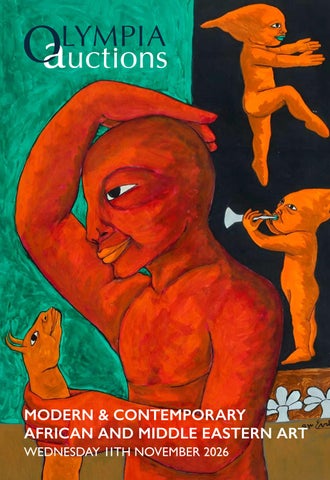
MODERN & CONTEMPORARY AFRICAN AND MIDDLE EASTERN ART WEDNESDAY 11TH NOVEMBER 2026
Lot 54 Front Cover: Lot 25 Back Cover: Lot 12
MODERN & CONTEMPORARY AFRICAN AND MIDDLE EASTERN ART TO BE SOLD BY AUCTION: 25 Blythe Road, London W14 0PD AUCTION: Wednesday 11th November 2026, 12pm, precisely PUBLIC EXHIBITION: Sunday 8th November, 12pm to 4pm Monday 9th November, 10am to 8pm (Drinks 5pm to 8pm) Tuesday 10th November, 10am to 5pm SALE NUMBER OA0189 CODE HARMONY ENQUIRIES: Janet Rady, Head of Sale janet.rady@olympiaauctions.com FREE LIVE ONLINE BIDDING
Elikem Logan, Consultant elikem.logan@olympiaauctions.com Mimi Preston, Administrator mimi.preston@olympiaauctions.com +44 (0)20 7806 5541 pictures@olympiaauctions.com ONLINE CATALOGUE AND LIVE INTERNET BIDDING AVAILABLE THROUGH: www.olympiaauctions.com www.the-saleroom.com www.invaluable.com www.drouotonline.com
This auction is conducted by Olympia Auctions in accordance with our Conditions of Business printed in the back of this catalogue.
EGYPT
Lot 4 (detail)
Property of a Private Collector, London 1 SEIF WANLY (EGYPTIAN 1906-1979) FATHY ANIS signed Seif lower right gouache on board 34.3 x 29.8cm (42.8 x 36cm framed) Provenance Purchased in Cairo by the present owner circa 2003-2006 Born in Alexandria, Seif Wanly was raised in a French-speaking Turkish aristocratic family and was privately tutored in his family house. Seif Wanly and his brother, Adham (see lot 8) started developing an interest in painting and art. They attended Italian painter Ottorino Becchi’s new studio in Alexandria, Egypt. Becchi introduced them to avant-garde movements like Futurism and Cubism; these two techniques formed the basis from which Wanly developed his personal style defined by angular lines, bright shades and colourful geometric shapes. Becchi left Egypt and the Wanly brothers set up their own studio in Alexandria in the 1940s, in collaboration with filmmaker Mohammed Bayoumid. Their studio is frequently credited with bringing attention to the art of the region. The brothers travelled extensively after the Second World War, particularly during the 1950s to France, Italy and Spain, where they sketched and painted scenes of ballet, opera, theatre performances and landscapes. In 1957, Seif travelled to Nubia to create
He caught my eye since I saw him on the first day I joined the job. I assumed him to be a high official....., and how surprised I was when I discovered that he was the clerk of the secretarial entry. Al Maraia (The Mirrors) Naguib Mahfuz
4
a collection of paintings and drawings depicting life in Upper Egypt. This project was initiated by the government to document the culture and conditions of the area before the relocation necessary for the construction of the Aswan High Dam. During this project Seif Wanly worked with other well-known artists of their generation, including Tahia Halim and Hussein Bikar. The Wanly brothers were close both in life and work and, after Adham died in 1959, Seif ’s grief was reflected heavily in his art. The brothers were pioneers in introducing modern pictorial trends to Alexandria, depicting international subjects, and moving away from the folklorist style of their contemporaries. Fathy Anis was a character in the Egyptian author Naguib Mahfuz’s celebrated novel Al Maraia (The Mirrors). ‘He caught my eye since I saw him on the first day I joined the job. I assumed him to be a high official, or a scion of an old family, and how surprised I was when I discovered that he was the clerk of the secretarial entry. He was thirty years old, a primary school certificate, a salary of eight pounds, married, and the father of five children, but he was tall, graceful, and of great features....’. See lot 25, Olympia Auctions, Sale of Modern & contemporary African and Middle Eastern art, 11 May 2023 for another version of this work. ⊕ £3,000-5,000
Property of a Private Collector, London 2 SEIF WANLY (EGYPTIAN 1906-1979) BOTH UNTITLED each signed Seif lower right each gouache on paper (i) 33.7 x 33.8cm (48.1 x 48.1cm framed); (ii) 32 x 32cm (48.1 x 48.1cm framed) (2) Provenance Purchased in Cairo by the present owner circa 2003-2006 see note to lot 1 ⊕ £4,000-6,000
5
Property from a Private Collection, London 3 SEIF WANLY (EGYPTIAN 1906-1979) BALLERINAS signed Seif lower right oil on board 34 x 49.8cm (44.8 x 61.4cm framed) Provenance Purchased in Cairo by the present owner circa 2003-2006 see note to lot 1 ⊕ £6,000-9,000
6
Seif Wanly
© Mathaf Encyclopedia of Modern Art and the Arab World
Property of a Lady, London 4 CHANT AVEDISSIAN (EGYPTIAN 1951-2018) UNTITLED oil and metallic pigment on canvas 50.5 x 50.5cm each; (50.5 x 203.2cm together) unframed (4) Executed circa late 1970s - early 1980s Provenance Acquired directly from the artist by a Private Collection, Egypt Thence by descent to the present owner Chant Avedissian was born to a family of Armenian refugees in Boulaq, a poor suburb of Cairo, Egypt. In 1967 he graduated from the Kalousdian Armenian school. After studying fine art at the School of Art and Design in Montreal and applied arts at the National Higher School of Decorative Arts in Paris during the 1970s, Avedissian returned to Egypt. His work frequently addressed questions of national identity, traditions, and culture, fusing techniques, concepts and cosmopolitan experiences acquired abroad with the heritage of his Armenian-Egyptian background to produce striking commentaries on the world around him. Through his collaboration with the Aga Khan Foundation and noted Egyptian architect Hassan Fathy (1900-1989), Avedissian developed an interest in traditional art forms and local materials, which informed his approach to exploring his own identity. Avedissian began working with Hassan Fathy in 1981, managing his archives, cataloguing drawings, plans, and theoretical texts, a partnership that continued until Fathy’s death in 1989. During this time, he travelled the length and breadth of Egypt, photographing Fathi’s extant buildings for a book published by the Aga Khan Foundation. Fathy’s perspectives on the importance of integrating genuine Egyptian art with craft revival efforts - as well as his view that combining ancient and modern art should avoid external influences - significantly influenced Avedissian’s artistic development. Many works produced by Avedissian during the 1980s reflect methods and content shaped by this association, notably he produced numerous paintings of agrarian Egypt, including sketches and studies, such as the present lot. His work is in very prominent public collections such as The British Museum (UK), Mathaf Museum of Modern Art (Qatar), National Museum of African Art - Smithsonian Institution (USA), the British Airways Collection (UK) and National Museum of Scotland, amongst others.
£4,000-6,000
7
“I don’t do art. I do fighting against influences. I paint, it’s not political art, but it’s an attitude.”
8
Property from a Private Collection, Edenbridge, Kent 5 CHANT AVEDISSIAN (EGYPTIAN 1951-2018) UM KULTHUM signed CHANT AVEDISSIAN lower middle; inscribed Al-Qāhirah in Arabic lower middle gouache, stencil and metallic paint on card 47.3 x 67.2cm (60.6 x 80.6cm framed) Provenance Acquired from the artist’s studio by the present owner in 2006 see note to lot 4 The master of Egyptian Pop Art, Chant Avedissian fuses commercial popular Chant Avedissian culture and traditional arts in his iconic commentaries on the world around Courtesy AGBU Egypt him. Avedissian was born in Cairo to an Armenian refugee family. After studying abroad at the School of Art and Design in Montreal and applied arts at the National Higher School of Decorative Arts in Paris, the artist begun a career in costume and textiles. However, in 1991, a friend commissioned him to create a portrait of renowned Egyptian singer Um Kalthoum (his most celebrated work). To the world, Um Kulthum is Kawkab el-Sharq (the Star of the East) her voice a force that once brought whole nations to a standstill on the first Thursday of every month. This inspired his Icons of the Nile series, which sought to capture the culture, romance and glamour of mid-twentieth century cosmopolitan Egypt through portraits of influential Egyptian figures. Sourced from popular magazine imagery, Avedissian combined his stencils with a cultural and historical traditional visual language including Ottoman patterns and hieroglyphics alongside local imagery including bus tickets and birds and worked exclusively in local materials such as Egyptian corrugated cardboard. Avedissian’s devotion to handicraft, tradition and everyday experience in his artistic depictions of the cult of celebrity and the media-age sets his works distinctly apart from the aesthetics of mass-production which characterised American Pop Art. Avedissian repeats the process, yet no two prints are identical. The technique echoes modern pop art, but its heart belongs entirely to the Nile. By transforming the grand diva into a repeated stencil, he isn’t diminishing her power; he is democratising her legacy. He turns a national monument into a living symbol, a nostalgic icon, bridging the gap between Egypt’s majestic past and its restless present.
£7,000-9,000
9
10
Property from the Zulficar Family Collection, Alexandria 6 ADEL EL SIWI (EGYPTIAN/ITALIAN B.1952) FACES (A PAIR) both signed and dated Siwi 07 lower left each mixed media on paper both 48 x 64cm (84 x 64cm framed) (2) Adel El Siwi is primarily recognised for his monumental figurative paintings, a style that bridges the clinical precision of his medical background with a deep fascination for historical Egyptian aesthetics. His work is characterised by a “hieratic” quality-a formal, stiff, and sacred stillness reminiscent of Pharaonic art and Coptic icons. He frequently focuses on the human face, rendering it on an oversized scale that strips away individual identity to explore more universal, psychological archetypes. While his medical training informs his understanding of human anatomy, his execution is rarely realistic. Instead, he treats his subjects with a sense of “Oriental Regality,” often elongating features and placing them in a silent, static space. These works part of a limited series bringing together features of African masks and pharaonic faces. The face is presented as a powerful stream, it becomes the space rather than inhabiting the space. El Siwi started working on this theme in the 1990s all the way into the 2000s. It is an attempt at emancipating the shadow, the viewer oscillates between a mask, a head, a shadow. Technically, El Siwi’s style is defined by a sophisticated use of a limited, often earthy palette. He avoids excessive ornamentation, preferring to build depth through layers of paint that create a subtle interior radiance. The mood of his work is often described as somber or melancholic, lacking in celebration but rich in psychological weight. This approach allows him to navigate between the whimsical and the profound, using traditional mediums to maintain a dialogue with the past while addressing contemporary displacement and memory. Adel El Siwi (b. 1952, Behera) is a Cairo-based artist whose work is shaped by a background in medicine and a decade spent living in Europe. Although he trained as a doctor at Cairo University between 1970 and 1976, he simultaneously pursued independent studies at the Faculty of Fine Arts from 1974 to 1975. In 1980, he relocated to Milan, Italy, where he practiced for ten years before returning to Cairo to establish his permanent studio. El Siwi’s professional record includes numerous solo exhibitions across the Middle East and Europe, including shows in Egypt, Lebanon, Syria, Tunisia, Italy, France, England, Bahrain, and Dubai. He has been a frequent participant in major international biennials, representing his work at the Cairo Biennale (1996, 2008), the Sharjah Biennale (1997) and the Biennale di Venezia (2009). His participation in group exhibitions includes notable surveys such as Rencontres Africaines (1994) and Oum Kalsoum: La Quatrième Pyramide (2008) at the Institut du Monde Arabe in Paris; Modernities and Memories at the 1997 Biennale di Venezia and Word into Art in Dubai in 2008. Additionally, his work has been featured in urban projection projects organised by Le Laboratoire: Sculpture Urbaine, which displayed his imagery on historical buildings in Rio de Janeiro, Grenoble, and Algiers. Beyond his studio practice, El Siwi contributes to Arabic art scholarship through his work as a translator. He has translated several foundational art historical texts into Arabic, including writings by Leonardo da Vinci and Paul Klee. ⊕ ‡ £5,000-7,000
Adel El Siwi
11
12
I am neither from Egypt, nor from Brittany, nor from Paris, neither a Nabi nor a Cubist. I am a painter of East and West, a man of Africa, the Levant, and Europe, a Mediterranean in love with light and life. GHS 1920–1925
Property from a Private Collection, Dubai 7 GEORGES HANNA SABBAGH (EGYPTIAN 1887-1951) PORTRAIT D’AGNES HUMBERT studio stamped on the reverse oil on canvas 40.7 x 32.5cm unframed Provenance Sale, Millon, Salons du Trocadero, 16th May 2024, Lot 71 Purchased at the above sale by the present owner Georges Hanna Sabbagh was an Egyptian-born French visual artist of Syrian and Lebanese descent. Born in Alexandria, Egypt, he moved to Paris to study art, attending the Ecole du Louvre and learning under renowned masters like Paul Sérusier, Félix Vallotton, and Maurice Denis at the Académie Ranson. Sabbagh integrated avant-garde influences from the Nabis, Fauves, and Cubists to develop a unique style characterised by sculptural forms and profound psychological depth. In January 1916, Sabbagh married fellow artist and art historian Agnès Humbert. Together they had two sons, Jean and Pierre, and spent a significant portion of their creative lives working from their studio in Brittany. Sabbagh was highly regarded in the interwar Parisian art scene, receiving the prestigious Chevalier Legion D’honneur award in 1928. Following his divorce from Humbert in 1934, he returned to Egypt in 1936, where his artistic focus shifted toward Egyptian landscapes and themes before his death in Paris in 1951. Georges Hanna Sabbagh’s portraits of his first wife, Agnès Humbert, executed in varying compositions throughout their marriage, stand as masterful intersections of personal intimacy and Post-Impressionist modernist experimentation. Rather than capturing a mere physical likeness, Sabbagh’s portraiture prioritised the psychological and intellectual reality of his subjects. In his depictions of Humbert, Sabbagh uses a bold, structural approach heavily influenced by his exposure to Cubism and the robust, earth-toned textures of the Brittany landscape where they lived and worked. The compositions utilise deliberate, geometric modeling and a grave, muted color palette that echoes the solidity of granite. By opting for dense forms and structural weight over delicate romanticism, Sabbagh captures Humbert not just as a traditional muse, but as an intellectual peer, reflecting her own formidable presence as an art historian and independent thinker. His portraits remains a powerful testament to the “sacrificed generation” of interwar European modernists, beautifully blending the emotional gravity of a spouse with the avant-garde sensibilities of the School of Paris. The currently presented 1935 version occupies a deeply poignant and unique place in the artist’s body of work. Painted exactly one year after the couple’s bitter divorce in 1934, this work shifts dramatically away from the sweeping family portraits and large-scale canvases that defined their earlier years in Brittany. Executed during a turbulent transitional phase, just before Sabbagh closed his studio in Brittany and returned permanently to Egypt in 1936, the 1935 portrait functions as an intimate, retrospective study of his former wife and longtime artistic companion. Unlike his earlier depictions (such as La robe brune in 1931), the 1935 painting is a smaller, more focused rendering. Painted from memory or late studies following their legal separation, the work is stripped of domestic ornamentation, emphasising the profound distance, shared history, and mutual grief of a fractured partnership. ‡ £2,600-3,600
13
8 ADHAM WANLY (EGYPTIAN 1908-1959) PORTRAIT OF BAIRAM EL TOUNSY signed Wanly lower left oil on paper 50 x 37cm (71 x 57cm framed) Adham Wanly and Bairam El-Tounsi were deeply connected through 20th century Alexandria’s cosmopolitan, revolutionary streets. Despite very different social backgrounds, they shared a devotion to Egyptian national identity and the city’s thriving performing arts scene. Both were shaped by Alexandria, but from opposite ends of society. Wanly, the aristocrat, was born into a wealthy family of Turkish and Caucasian elite lineage in upscale Muharram Bey, surrounded by luxury, classical art, and European influences. El-Tounsi, the working-class hero, came from a modest family of Tunisian roots in working-class Al-Anfoushi; he worked in a grocery store and learned poetry from the zajal (colloquial Arabic poetry) heard in the city’s cafes. Print media and caricature formed a direct professional bridge between them. El-Tounsi, a master of political satire, launched sharp-witted magazines like Al-Masalla and El-Khazouq mocking the ruling 14
elite and British occupation. Wanly, also a gifted, sought-after caricaturist, contributed regularly to major periodicals, notably Rose El-Youssef, which often celebrated nationalist poets like El-Tounsi. Their greatest creative overlap was a fixation on the stage. El-Tounsi pioneered Arabic lyrical theatre, working closely with Sayed Darwish and writing iconic musical plays, radio series, and songs, including legendary tracks for Umm Kulthum. Wanly and his brother Seif spent decades documenting rehearsals, productions, and characters at the Theatre Mohamed Ali and the Opera. Wanly’s iconic portrait of El-Tounsi was more than a painting of a famous writer; it was an intimate tribute to a fellow Alexandrian who gave voice to the streets, theatres, and cafes Wanly painted daily. The Wanly brothers’ studio in Alexandria and Cairo served as an open salon for leading intellectuals, where intellectuals, writers, poets, and artists. Both men belonged to the same mid-century Egyptian cultural renaissance celebrating folkloric and theatrical life, cementing their legacy alongside figures like Bayram al-Tunisi pioneered colloquial poetry. ‡ £3,000-5,000
Property from the Zulficar Family Collection, Alexandria 9 SAMIR RAFI (EGYPTIAN 1926-2004) ADAM AND EVE signed S. RAFI lower left watercolour and oil on paper 62 x 47cm (87.5 x 73cm framed) Painted circa 1980 Born in Cairo to a multi-confessional family, Samir Rafi received early artistic training under Hussein Youssef Amin before attending the School of Fine Arts, where he developed a distinct style apart from Western academic art. His originality gained support from educators and led to a graduation project inspired by surrealism. After earning honours in 1948 and completing further studies at Ain Shams University, Rafi taught in several schools and became a professor at Cairo University. In 1954, he moved to Paris on a scholarship, studying modern art and museology, and pursuing his PhD at La Sorbonne. There, he engaged with major artists but ultimately travelled to Algeria in 1964, where he was briefly imprisoned, later teaching art history in Algiers before settling back in France.
Rafi’s career emerged during Egypt’s turbulent 1930s and ‘40s, interacting with movements like Art and Liberty, which opposed Fascism and embraced Surrealism. While influenced by these groups, Rafi co-founded the Contemporary Art Group, focusing on local Egyptian themes rather than Western or colonial art. His works often highlighted everyday people and integrated mystical elements rooted in Egyptian folk culture. Rafi also referenced ancient Egyptian art and traditions, fusing them with modern techniques. His artistic legacy lies in blending symbolic imagery from Egypt’s past with contemporary issues, making him a key figure in modern Egyptian art. Samir Rafi died in Paris in 2004. ⊕ ‡ £3,000-5,000
15
Property from the Zulficar Family Collection, Alexandria 10 SALAH TAHER (EGYPTIAN 1911-2006) ABSTRACT COMPOSITION signed S. Taher lower left; signed and dated Salah Taher 97 in Arabic lower left oil on cardboard 34 x 48cm (54 x 69cm framed) Salah Taher played a significant role in Egyptian modernism, contributing to the development of the nation’s artistic identity. Born in Cairo, Taher began his career within the framework of academic realism, earning recognition as a portraitist among Egypt’s elite. A visit to the United States in the 1950s influenced his subsequent shift in style. Throughout his career, Taher’s art evolved from realism to figurative symbolism and later to contemporary abstraction. He moved from using brushes to palette knives, layering paint to create what he termed a universal language, a rhythmic, chromatic approach that aimed to cross cultural and linguistic boundaries. His work in abstraction influenced the direction of Egyptian modern art. Outside of painting, Taher was active in Egypt’s cultural scene. He graduated from Cairo’s Academy of Fine Art in 1934 and lectured there until 1954. He held several leadership positions, including Director of the Museum of Modern Art in Cairo, General Director of the Cairo Opera House, and head of the Society of Advocates of Fine Arts in the 1980s. He also worked as an artistic consultant for the Al-Ahram newspaper. Taher produced an estimated 15,000 paintings and held over 80 solo exhibitions internationally. His accomplishments include the Guggenheim Awards in 1959 and 1961, Mubarak Award in 2002, the State Incentive Award, and the Alexandria Biennale Award. His work has been shown in exhibitions across Egypt, Venice, New York City, San Francisco, Geneva, Beirut, Kuwait, and Jeddah. His paintings are included in collections such as the White House and the Mathaf: Arab Museum of Modern Art, establishing his place in the history of modern art. ‡ £2,600-3,600
16
Property from a Private Collection, Dubai 11 WISSA WASSEF ART CENTER TAMR HENNA (TAMARIND) titled and dated Tamr Henna 2021 in Arabic lower right woven tapestry 116 x 123cm Established in 1951 by the architect Ramses Wissa Wassef and his art teacher wife Sophie, the Ramses Wissa Wassef Art Center in Harrania, Egypt began as a cooperative school and training sanctuary for local village children. Driven by a desire to preserve traditional Egyptian crafts from oblivion, Ramses designed the center’s mud-brick workshops using climate-adapted vaulted and domed roofs inspired by Nubian architecture. His underlying philosophy treated every young person as a natural creator, fostering artistic growth by entirely forbidding templates, museum visits, criticism, or outside artistic influences. Instead, children were given the space to weave tapestries entirely from their own imaginations, emphasising personal development and the creative journey over the final product. Over the decades, the center expanded its artisanal scope to include traditional batik textile dyeing and pottery, using natural raw materials and mineral or plant-based dyes prepared by the artists themselves. Following Ramses’s passing in 1974, leadership of the cooperative was carried forward by his daughters Johanna and Suzanne alongside Ikram. What began as a local village workshop eventually gained international acclaim, leading to global exhibitions and permanently securing the unique, colorful tapestries of Harrania in cultural institutions such as the Metropolitan Museum of Modern Art, the British Museum, the Victoria & Albert Museum, the Musée des Arts Décoratifs, Paris, the American University Cairo, US Embassy Cairo, Cairo Opera House and Presidential Banquet Room, and the Södertälje Konsthall (Södertälje, Sweden). The latter is currently hosting a prominent international legacy exhibition titled In the Memory of the Weave, which displays major vibrant landscape tapestries running through December 6, 2026. This handwoven wool tapestry stands as a testament to what its founders called “instinctive creativity.” The vibrant botanical scene was brought to life entirely without preliminary sketches, templates, or cartoon drafts. Working strictly from memory and intuition, the master weaver composed the intricate layers of desert flora, blossoming stalks, and nesting birds directly onto the loom, thread by individual thread. Every leaf, shadow, and wing represents an unrepeatable moment of spontaneous artistic choice. This connection to the natural world runs much deeper than the imagery itself. The rich, earthy palette, from the deep indigo sky to the warm pinks and sun-streaked greens, is achieved using pure local wool dyed on-site. The center utilises historical organic pigments cultivated directly from their own gardens, including madder roots and reseda plants. Through this holistic process, each individual piece serves as a living, physical record of the Egyptian countryside, reflecting a legacy of pure imagination preserved since 1951. ‡ £2,000-2,500
Wissa Wassef Art Center 17
Property from a Private Collection, Alexandria 12 MAHMOUD MOUSSA (EGYPTIAN 1913-2003) LITTLE GIRL SEATED WITH FLOWING HAIR signed M. Moussa in Arabic on the reverse posthumous cast in artificial stone height: 30cm edition 2/6 The authenticity of this work has been confirmed by the family of the artist
18
Provenance Artist’s studio Thence by descent to the current owner Mahmoud Moussa was a leading second-generation Egyptian sculptor whose work bridged ancient Egyptian visual traditions with modern, intimate scenes of everyday life. Born in Alexandria, Moussa began sculpting at 13 through façade decoration and marble tombstone work. He studied in evening art classes, was mentored by sculptor Mahmoud Mokhtar, moving to Cairo in 1933. From 1940 onward, he focused on independent artistic production and later taught direct stone carving at Alexandria’s Faculty of Fine Arts. Moussa’s oeuvre drew inspiration from Ancient Egyptian art and aligned with the Neo-Pharaonic art movement. This kind of art involved the first generation of modern Egyptian artists merging Western artistic traditions, learned while studying in Europe, with elements from Ancient Egypt in order to rethink its aesthetic and form a new national style. Mahmoud Moukhtar, together with other artists like Mohamed Naghi (1888-1956) and Mahmoud Said (1897-1964), laid the groundwork for the Neo-Pharaonic aesthetic in the 1920s. In the constant search of the true representation of Egypt, they intermingled the iconography of Ancient Egypt with realist representations of contemporary rurality. The peasant figure became a pivotal subject in this search, since it was perceived as impermeable to change over time. It embodied the modern idea of connecting the past with the present. Using materials like granite, marble, gypsum, clay, terracotta wood and artificial stone, Moussa’s sculptures are known for their compact forms, restrained expressiveness, and influences from ancient Egyptian techniques. His recurring subjects include families, children, farmers, cats, goats, and other aspects of folk and domestic life. Moussa received major recognition, including a Ministry of Culture sabbatical grant, first prize in the Egyptian section of the 1963 Alexandria Biennale, and a prize at the 2001 Aswan International Symposium. He represented Egypt internationally, including at the Venice Biennale, and created prominent public works in Egypt, Italy, and former Yugoslavia. His work is held by institutions in Egypt, Qatar, Lebanon, and the UAE, and has been sold through Christie’s, Sotheby’s, and Bonhams. ‡ £8,000-12,000
Tamr Henna
Courtesy of the artist’s estate
19
20
Property from a Private Collection, Paris 13 GEORGE BAHGOURY (EGYPTIAN/FRENCH B.1932) UNTITLED signed and dated BAHGORY / 2010 lower right; signed Bahgoury in Arabic lower right mixed media on canvas 100.2 x 100.2cm (107.4 x 107.4cm framed) Provenance Purchased from the artist’s studio by the previous owner Acquired from the above by the present owner George Bahgoury is an internationally celebrated Egyptian-French artist, widely revered as the “Grandfather of Egyptian Caricature” and the “Picasso of Egypt.” Born in 1932 in Upper Egypt, he moved to Cairo in 1951 to study fine arts under the legendary painter Hussein Bikar. By 1953, he had launched a formidable career as a political cartoonist, using a signature continuous one-line drawing style to inject sharp wit and satire into iconic publications like Rose El Youssef. In 1970, Bahgoury relocated to France to study at the Academy of Fine Arts in Paris, eventually transitioning from commercial cartooning to full-time fine art. Over a multi-decade career spanning painting, sculpture, and literature, he developed a unique visual language that brilliantly fuses Western Cubism and Expressionism with Coptic heritage, Fayoum portraits, and Egyptian popular culture. His vibrant canvases frequently pay homage to cultural icons like Umm Kulthum, preserving a nostalgic collective memory of his homeland. Awarded Egypt’s prestigious Prix d’Etat d’Excellence in 2006, Bahgoury has exhibited his work worldwide, including at the Louvre. Today, he divides his time between Paris and Cairo, continuing to build on a lifetime of visual storytelling documented in over 1,000 personal sketchbooks. ⊕ ‡ £18,000-22,000
“All my paintings are special to my heart. Each one of my paintings represents an incident or a special memory. It does not take long for me to finish my drawings; as soon as I feel like drawing, I draw, it is as simple as that” George Bahgoury 21
22
Property of a Distinguished Private Collector, London 14 TAHIA HALIM (EGYPTIAN b.1919-d.2003) (I) CROSS-LEGGED FEMALE FIGURE; (II) FEMALE FIGURE each signed T. Halim lower left each gouache on paper (i) 39.5 x 29.5cm (56.6 x 45.7cm framed); (ii) 40.5 x 29.2cm (56.7 x 45.8cm framed) Provenance Acquired from a private collection in Cairo in the 1980s Tahia Halim was born in Dongola, Sudan. From an early age, she demonstrated a strong interest in art while her father served as chamberlain to King Fouad (1868-1936) in Cairo. After completing her secondary education privately within the royal palace, Halim enrolled at Cairo’s Academy of Fine Arts. During her post-secondary education, Halim was mainly exposed to academic and impressionist styles. This was due to the Euro-centric curriculum at the Academy and the influence of her instructors. She later trained under the Lebanese painter Youssef al-Traboulsi and the Greek artist Alecco Jerome. In 1940, Halim met the avant-garde artist Hamed Abdalla (1917-1985). The two married five years later and, in 1949, moved to Paris, where they both attended the Academie Julian. Halim returned to Cairo in 1951. A significant turning point in her artistic journey came in 1959, when she was sent to Nubia - the land of her birth - to document the process of building the Aswan High Dam on the Nile, which flooded much of Nubia and forced the relocation of over 100,000 people. There, she became fascinated by the rural way of life and the authentic character of the Nubians, whom she viewed as embodying centuries-old traditions of the land. Her paintings serve as visual diaries, preserving daily life through vivid colours, earth tones, bold figuration, and impasto techniques inspired by both Coptic and Ancient Egyptian styles. These simple, evocative forms encapsulate the beauty and vibrancy of the Southern Nile. Her works capture routine scenes with artistic exaggeration and emphasise harmonious composition over strict proportion, celebrating Nubia’s rich history and Halim’s innovative approach. Her emphasis on Nubian subjects reflected a broader movement among Egyptian artists to reclaim cultural identity during the post-colonial era, which resonated with audiences seeking national pride. Halim’s artistic choices were also shaped by the political environment of the time, as Egyptians sought to distance themselves from colonial authority. Her celebrated career includes having works in several international collections. Notably, she became the first woman to be awarded the Guggenheim International Prize in 1958, an honour that highlights her significant contribution to Egyptian art and her lasting legacy.
£10,000-16,000
23
24
Property from a Private Collection, London 15 QUEEN FARIDA OF EGYPT (EGYPTIAN 1921-1988) FIGURES IN THE DARK mixed media on canvas 61 x 47.8cm (73.3 x 61.1cm framed) The authenticity has been confirmed by a member of the artist’s family, and will be included in the forthcoming Catalogue Rainsonné Provenance Dr Mohammed Said Farsi Acquired from the above by the present owner in 2013 In the tapestry of 20th century Egyptian history, the life of Queen Farida, born Safinaz Zulficar, unfolds as a poignant transformation from a captive icon of royalty to a liberated voice of the avant-garde. While her marriage to King Farouk in 1938 cast her as the “Emerald of the East” in the public eye, it was her divorce and subsequent exile that allowed her to polish a far more enduring facet of her soul: her identity as a painter. Her artistic journey was never a mere hobby of the leisure class; it was a psychological sanctuary. Under the early tutelage of her uncle, the legendary Egyptian master Mahmoud Sa’id, Farida developed a sensibility that married the grandeur of her upbringing with a raw, introspective humanity. When the 1952 Revolution finally dismantled the monarchy, she traded the stifling etiquette of the Abdeen Palace for the bohemian studios of Paris and Beirut. It was here, stripped of her crown but draped in the vibrant colours of her heritage, that Farida truly found her kingdom. Her prose on canvas was written in light and shadow. Her work leaned heavily into a lyrical Impressionism, characterised by a profound sense of longing. She often painted the Egyptian landscape from memory, her brushstrokes capturing the hazy, golden humidity of the Nile and the rhythmic geometry of Sufi dervishes in mid-whirl. These subjects were not just cultural motifs; they were manifestations of her own search for spiritual equilibrium and a way to bridge the distance between her European exile and the soil that remained her greatest muse. In her later years, Farida’s return to Cairo signaled a quiet triumph. She was no longer viewed through the lens of political tragedy, but as a respected peer among Egypt’s artistic elite. Her legacy remains a testament to the idea that title and status are temporary, but the creative spirit, once unburdened, is sovereign. She died in 1988, leaving behind a body of work that serves as a vivid, colorful bridge between the vanishing world of the pashas and the enduring heartbeat of modern Egyptian art. Queen Farida’s works have been shown in numerous exhibitions, most recently at Liwan Gallery in Cairo in 2025 with her granddaughter Yasmine Perreten. The artist has entered the collections of Mathaf: Arab Museum of Modern Art (Doha, Qatar), Queen Farida Museum / Al-Shumu’a Gallery (Maadi, Cairo), Alexandria Museum of Fine Arts (Alexandria, Egypt), National Museum of Egyptian Civilization (Cairo, Egypt), Royal Jewelry Museum (Alexandria, Egypt), the private collection of Janet Gaynor and Paul Gregory (United States) and various private collections (Paris, Zurich, and Beirut).
£7,000-9,000
Queen Farida
25
Property from a Private Collection, Edenbridge, Kent 16 ANNA BOGHIGUIAN (EGYPTIAN/CANADIAN B.1946) UNTITLED (FROM THE ALEXANDRIA SERIES) signed and dated a Boghiguian 006 lower right oil on canvas 29.2 x 29.2cm (46.7 x 46.3cm framed) Provenance Safarkhan Gallery, Zamalek Acquired from the above by the present owner in 2005/6
Anna Boghiguian
Boghiguian has travelled all her life. The daughter of an Armenian clockmaker, she studied political science and art in Cairo, Egypt in the 1960s and arts and music in Montreal, Canada in the early 1970s. While keeping her studio and home in Cairo, Boghiguian travels extensively, bringing direct knowledge of world cultures and politics into her work. A close observer of the human condition, Boghiguian proposes a unique and diverse interpretation of contemporary life. She draws equally on the past and the present, poetry and politics, joyfulness and a critique of the modern world. Travelling in time, she often uses the poems of the great Alexandrian Constantin V. Cavafy, recalling the notable cosmopolitan mediterranean city that once stood home for many cultures and civilisations. Boghiguian’s work has been exhibited internationally, including the Istanbul Biennial (2009), Sharjah Biennial (2011), DOCUMENTA(13) (2012), Castello di Rivoli Museo d’Arte Contemporanea, Sharjah Art Foundation (2017-18), TATE St Ives (2019), and Turner Contemporary, Margate (2025). She received the Golden Lion at the 2015 Venice Biennale and in 2024, she was awarded the prestigious Wolfgang Hahn Prize in Germany.
£5,000-7,000 26
Property from a Private Collection, London 17 MOHAMMED HASSAN MAHMOUD AL-QABBANI (EGYPTIAN 1938-2005) STATUE BY THE SEA signed Qabbani in Arabic lower right; dated 91 in English lower right oil on board 73.6 x 60cm (81.3 x 67.8cm framed) Provenance Dr Mohammed Said Farsi Acquired from the above by the present owner Mohammed Hassan Mahmoud Al-Qabbani was a distinguished Egyptian fine artist whose evocative oil paintings captured the soul, culture, and coastal landscapes of mid-to-late 20th-century Egypt. Born in 1938, Al-Qabbani dedicated his life to documenting the human experience and the distinct architecture of the Middle East and North Africa (MENA) region. He developed a signature style that seamlessly blended modern artistic sensibilities with traditional Egyptian themes, leaving behind a legacy that continues to be celebrated by global art collectors. Throughout his career, Al-Qabbani was deeply inspired by daily life, family intimacy, and the scenic beauty of Egypt’s Mediterranean coast, executing his vision through the prism of statuesque figures laden with complex symbolism.
£3,000-4,000 27
28
Property of a Lady, London 18 GUIRGUIS LOTFY (EGYPTIAN B.1955) EL MOULED (BIRTH) signed Guirguis Lotfy in Arabic; dated 2004 in English lower right oil and gold leaf on panel 120.5 x 100.8cm (128.5 x 107cm framed) Provenance Founder of Art D’Egypte Acquired from the above by the present owner Graduating from the Alexandria Faculty of Fine Arts with a masters in Coptic painting in 1980, Guirguis Lotfy was influenced by the Neo-Coptic artistic revival of the mid-late twentieth century. Under the influence of Pope Cyril VI who encouraged the importance of learning from Coptic arts, Neo-Coptic revivalists sought to employ the traditional iconographies from early Egypt, Byzantine and Greco-Roman Christian art in modern religious painting. The movement was pioneered by iconographer, scholar and theologist Isaac Fanous who chaired the Institute of Coptic Studies in Cairo and helped to promote the city as an integral centre of Coptic art. Lotfy employs the traditions of Coptic art in his own unique reinterpretations. His stylised figures have large heads and eyes and small mouths which signified a devotion to prayer and spiritual relationship to God in Coptic iconography. Flat planes of gold and ultramarine rendered using the ancient painting medium egg tempera combined with patterns and symbols to emulate mosaic transport the viewer to the aesthetics of the past. In doing so, his works embody a distinct spiritual dimension, as Coptic art was used to communicate Christian stories and doctrine to largely illiterate audiences. However, unlike Neo-Coptic revivalists, Lotfy applies this visual language to a secular context. His icons are not saints but local characters, assembled in familiar settings amongst animals and everyday objects, to form striking images capturing the essence of contemporary Egyptian life. His use of Coptic iconography and traditional media enliven the antiquated, diverse and spiritual history of Egypt to create a new symbolic visual language for the richness of the quotidian.
£12,000-15,000
29
Property from a Private Collection, Dubai 19 ANTOINE MALLIARAKIS (MAYO) (EGYPTIAN 1905-1990) UN SAUT DANS LA NUIT (A LEAP INTO THE NIGHT) signed Mayo lower right; signed and dated un saut dans la nuit / mayo / Rome 71 on the reverse oil on canvas 73.6 x 92.1cm (78.3 x 97.1cm framed) Provenance The Artist, Paris/Rome Acquired directly from the above by a private collection, Italy Sale, Sotheby’s, London, 30 April 2019, lot 74 Sale, Sotheby’s, London, 25 April 2023, Testimony of a Journey: The Al Zayani Collection, lot 59 Purchased at the above sale by the present owner Exhibited Paris, Musée des Arts Decoratifs, Mayo, 6 October - 3 November 1986 Athens, Titanium Gallery, (Title unknown), 1991 Paris, Galerie Alain Blondel, Mayo, 1992 Literature Venice, Evelyne Yeatman-Eiffel, Mayo, 2012, p. 263 (illustrated) 30
Born in Port Said, Egypt, to a Greek father and a French mother, Antoine Malliarakis – universally known as Mayo, spent his life bridging cultures and artistic movements. He moved to Paris in 1923 to study architecture but was quickly drawn into the avant-garde circle of Montparnasse. There, he forged close ties with figures like Man Ray, Tristan Tzara, Francis Picabia, and Giorgio de Chirico. Though deeply connected to the Surrealists, Mayo fiercely guarded his independence, rejecting formal group labels in favour of a personal, expressive style that wove together dreamlike imagery, mythology, and poetic realism. Throughout his career, Mayo’s artistic footprint expanded across mediums and borders. He was affiliated with the anti-fascist Art et Liberté surrealist collective in Cairo and carved out a distinguished career in French cinema and theatre, famously designing costumes for Marcel Carné’s masterpiece Les Enfants du Paradis (1945). Moving to Rome in the 1960s, he entered a celebrated “Roman Period” marked by paintings of classical architecture and Mediterranean light. Even after losing his sight in his final years, Mayo remained an influential figure in European art until his death in 1990, leaving behind works that now hang in major institutions such as the Centre Pompidou and Mathaf. ⊕ £7,000-9,000
Property from a Private Collection, London 20 EL HUSSEIN FAWZI (EGYPTIAN 1905-1996) STILL LIFE signed El Hussein Fawzi in Arabic lower left oil on board 84.5 x 58cm (104 x 78cm framed) Provenance Dr Mohammed Said Farsi Acquired from the above by the present owner in 2013 Literature Dr. Sobhy Al Sharouny, A Museum in a Book: Selections From Dr Mohammed Said Farsi’s Art Collection, Cairo, 1998, no. 11/35, pp. 146, 148, illustrated El Hussein Fawzi was a central figure in the evolution of Egyptian modern art, celebrated as a pioneer of journalistic graphic arts and an academic leader. Born in the Helmia district of Cairo, he began his formal education in 1922 at the School of Fine Arts, where he initially focused on oil painting. His early talent earned him a prestigious fellowship to study in Paris, where he spent several years refining his craft. During this European period, he earned diplomas in lithography and decorative arts, and his skill was recognised internationally when he received an honorary degree at the French Salon in 1939. Upon returning to Egypt, Fawzi dedicated himself to both education and institutional development. He founded the Department of Graphic Arts at the Faculty of Fine Arts and served as its director for many years. His influence extended to the southern reaches of the country, where he supervised the fine arts studio in Luxor from 1954 to 1960. As a practitioner, Fawzi was remarkably versatile. While he was a master of classical oil painting, highlighted by his masterpiece El Dalalah, which is widely regarded as one of the most beautiful works in Egyptian art history. He was equally influential as an illustrator. He collaborated with the Nobel laureate Naguib Mahfouz, creating illustrations for his stories in the Al Ahram newspaper, and spent years documenting Egypt’s historic mosques through intricate watercolours and drawings. His international prestige was further cemented when he became one of only four Egyptian artists selected to have their designs engraved on crystal by the Steuben Glass factory in New York. Throughout his long career, Fawzi received numerous accolades, including the State Prize and the Order of Sciences and Arts in 1963, as well as the State Prize of Merit in 1989, leaving behind a legacy that bridged the gap between traditional fine art and the modern graphic press.
£6,000-8,000
31
32
Property from a Private Collection, Dubai 21A MOSTAFA ABDEL MOITY (EGYPTIAN B.1938) UNTITLED signed and dated M.A.MOITY 21 lower left; signed in Arabic lower left oil on board 120 x 79.9cm (122.7 x 82.6cm framed) Born in Alexandria, Moity received his degree from the Academy of Fine Arts in Alexandria (Department of Painting) in 1962. After his graduation, Moity immediately began teaching as a faculty member at the Academy and has continued ever since. He received a scholarship from the Egyptian Government for studies on Upper Egypt and curated an exhibition which was held in Alexandria in 1966 and 1968 on the subject of the Aswan Big Dam. Whilst Moity’s early works touch on the figurative and the familiar, his style developed mainly into abstract paintings and sculptures, defined by his signature use of harsh bold lines and blocks of colour, as well as shapes and geometrical patterns suggestive of outer space. Over the years, he has held many positions including Vice President of the World Congress of Contemporary Art in Venice in 1985 and Head of the Egyptian Academy in Rome in 1988. He has had over thirty shows in Egypt, Italy, and Spain, and participated in upwards of twenty international group exhibitions. He is also one of the founders of the Experimental Group, established in 1958 whose members included Mahmoud Abdalla and Said Al Adwi. He has received awards such as The Nile Award for the Arts in 2021.
£7,000-9,000
33
Property from the Zulficar Family Collection, Alexandria 22 EFFAT NAGUI (EGYPTIAN 1905-1994) KERDASA signed, dated and titled Kerdasa / Effat Nagui / 90 in Arabic lower left textile, yarn, paper, charcoal and chalk collage on cardboard 99 x 68cm (102 x 71cm framed) Effat Nagui, born into an aristocratic family in Alexandria and sister to artist Mohammed Naghi, developed a passion for art during her travels across Egypt. She studied sculpture, fresco painting and decorative arts at Rome’s Accademia Di Belle Arti from 1947 to 1950, which greatly influenced her work. Returning to Egypt, Nagui pursued a distinctive nationalistic artistic style, depicting peasant life and folkloric celebrations. Her early works reflected Fauvist and European influences, shaped further by private tutoring and travels with her father and elder brother. These experiences deepened her appreciation of Egypt’s ancient heritage and in 1937 she was awarded a Ministry of Culture scholarship, enabling deeper immersion into the subject. Early on in her career, Nagui exhibited Fauvist-inspired pieces in Alexandria, focusing on rural scenes. From the 1960s, her art evolved as she researched history extensively at the Great Library of Cairo, drawing inspiration from various eras and disciplines. She moved away from academic linear perspectives early in her career. She instead championed a heavily textured primitive abstraction that directly drew inspiration from local Egyptian folklore, ancient artifacts, and traditional crafts. Kerdasa, the title of this work, is a well-known historic town in Giza, Egypt, highly celebrated for its traditional textile weaving, embroidery, and artisanal garment craft. The piece relies on bold, geometric segments of contrasting colours with deep greens, blues, vivid reds, and stark blacks. The jagged colour planes are linked together visually by meticulous rows of white and red “X” shaped patterns. This motif strongly mimics handmade embroidery stitching, serving as a direct homage to the textile culture of Kerdasa. Effat was a uniquely creative figure of her time, finding myriad ways to celebrate the richness of Egyptian heritage through art. Following her death in 1994, her house and workshop in the Alexandrian neighbourhood of Moharram Bey were tragically demolished. However, as stipulated in her will, The Ministry of Culture converted Effat and her husband, Saad El Khadem’s house in Cairo’s Zeytoun district into an art museum dedicated to the couple’s memory. The museum displays 198 works by the couple, as well as folk pottery and a library, preserving their crucial roles in Egyptian popular art and scholarship. ‡ £8,000-10,000
34
Property from a Private Collection, Dubai 23 AHMED NAWAR (EGYPTIAN B.1945) UNTITLED signed and dated A NAWAR 1973 lower left oil on board 91.8 x 73.4cm (94.6 x 75.8cm framed) Provenance Ansorena Auctions, October 2024, lot 744 Ahmed Nawar is a definitive figure in the history of contemporary Egyptian art, recognised for a career that balances rigorous technical execution with high-level cultural leadership. His body of work is characterised by an analytical approach to form, a trait developed through his formal training at the Faculty of Fine Arts in Cairo and later at the San Fernando Royal Academy of Fine Arts in Madrid. This academic foundation was uniquely tempered by his service as a sniper during the War of Attrition, an experience that introduced a distinct “optical precision” into his aesthetic, where the themes of surveillance, distance, and the mechanical anatomy of objects predominate. Throughout his professional life, Nawar has functioned as both a creator and a strategist for the Egyptian arts. His early output focused heavily on graphic arts, where his etchings and drawings displayed a preoccupation with geometric order and the deconstruction of the human and industrial form. Over time, his practice expanded into painting, shifting from monochromatic discipline to a sophisticated use of colour and abstraction. Regardless of the medium, his work consistently examines the tension between organic life and structural rigidity, often reflecting on national identity and the concept of human endurance. Beyond the studio, Nawar’s influence is cemented by his extensive contributions to Egypt’s cultural infrastructure. As a former Dean of the Faculty of Fine Arts at Minia University and the longtime Head of the Fine Arts Sector at the Ministry of Culture, he was instrumental in professionalising the regional art scene. Most notably, his role in founding the Cairo International Biennale in 1984 provided a vital platform for cross-cultural exchange between the Middle East and the global art community. His works are currently held in major international collections, including the Metropolitan Museum of Art in New York and the Museum of Modern Art in Cairo, marking him as a pivotal architect of Egypt’s modern visual identity. ‡ £4,000-6,000
35
36
24 EVELYN ASHAMALLAH (EGYPTIAN B.1948) HARMONY OF BEINGS signed and dated Ashamallah 88 in Arabic lower centre oil on canvas 100 x 100cm (103 x 103cm framed) Sold with a Certificate of Authenticity issued by Easel & Camera Gallery, signed by the artist Provenance Acquired directly from the artist’s studio by the present owner Evelyn Ashamallah is a prominent Egyptian contemporary painter and curator whose career spans over five decades. Born in Desouk in 1948, she graduated with a Bachelor of Fine Arts from Alexandria University in 1973. Following her graduation, she worked as a journalist for the progressive weekly magazine Rose El Youssef and later relocated to Algeria for a period during the 1980s. As a core figure of the influential 1970s post-war generation of Egyptian artists, Ashamallah contributed to a pivotal cultural shift, steering the local art scene away from rigid social realism toward a distinct form of Egyptian surrealism. Beyond her studio practice, she has been a vital institutional leader, serving as the director of the Mohammed Nagy Museum (1993-1995) and the Egyptian Museum of Modern Art (2000-2002). Her enduring impact on regional modernism was honoured in 2024 with a major lifetime retrospective titled The Harvest of a Lifetime at Cairo’s Azad Art Gallery. Her creative process intentionally rejects rigid definitions and predefined blueprints, beginning each canvas without a formal layout to paint with absolute freedom. This methodology allows a single spark of imagination to dictate where the brush travels, resulting in a visual narrative where reality and fantasy freely blur. Ashamallah draws heavily from the landscape of her memory, the rich folk traditions of her upbringing in Desouk, Coptic iconography, and the vibrant communal rituals of Egyptian street celebrations like the Mawlid and Sham El-Nessim. Through vibrant colours, distorted proportions, and stacked compositions, she builds worlds where humans, plants, and animals hybridise. For her, art functions as an unceasing emotional response to life, populating her canvases with playful, magical beings that explore recurring themes of motherhood, femininity, and childhood innocence juxtaposed with the satire of adulthood. Through these painted stories, viewers are invited to decode her personal mythologies and reconstruct the narrative through the lens of their own perceptions. ‡ £5,000-7,000
37
25 EVELYN ASHAMALLAH (EGYPTIAN B.1948) LURING THE UNFAMILIAR signed and dated Ashamallah 93 in Arabic lower right acrylic on paper 67 x 47cm (82.5 x 62.5cm framed) Sold with a Certificate of Authenticity issued by Easel & Camera Gallery, signed by the artist Provenance Acquired directly from the artist’s studio by the present owner see note to lot 24 ‡ £1,800-2,200
38
Lot 33
40
SAUDI ARABIA
Property of a Lady, Madrid, Spain 26 ABDULHALIM RADWI (SAUDI ARABIAN 1939-2006) UNTITLED (CITY SCENE) signed and dated Redwi / 96 lower left; signed and dated Radwi / 1417 in Arabic lower right watercolour on paper 45.8 x 32.2cm (49 x 35cm mounted) unframed The authenticity of this work has been confirmed by the family of the artist Provenance Faustino Moreno Villalba Collection, Spain Gifted from the above to the present owner Abdulhalim Radwi, born in Mecca, Saudi Arabia, was a prominent sculptor, curator, and poet whose artistic practice was shaped by both his cultural heritage and modernist influences. Radwi significantly contributed to the advancement of Saudi modernism, drawing upon his experience as one of the Kingdom’s pioneering artists to pursue studies abroad. He earned his Fine Arts degree in Rome between 1961 and 1968, a period during which his work evolved from realism towards abstraction. Upon returning to Saudi Arabia, he began teaching, which reinforced his reputation within the local arts community and inspired emerging artists such as Taha Al Sabban and, later, Ahmed Mater. Although deeply engaged with Western art movements, Radwi remained committed to his roots, integrating elements of Arab heritage into Cubist and Expressionist frameworks, which distinguished his work from that of his peers. In the 1970s, Radwi served as Action Director of the Association for Arab Artists in Madrid and completed his studies at the Royal Arts Academy in 1979. That same year, he was awarded a professorship and taught in Madrid until 1984. Throughout his prolific career, Radwi produced thousands of artworks and held leadership roles in numerous art organisations, including serving as director of Jeddah’s Centre for Fine Arts. His works have been exhibited throughout the Middle East and Europe, notably receiving third prize at the Ibiza Biennale in 1968. Radwi’s body of work exemplifies a sophisticated synthesis of tradition and innovation, and his integration of regional themes with contemporary techniques paved the way for the development of modern Saudi art. ‡ £4,000-6,000
Abdulhalim Radwi 41
42
Property of a Lady, Madrid, Spain 27 ABDULHALIM RADWI (SAUDI ARABIAN 1939-2006) UNTITLED (BOAT) watercolour on paper 45.8 x 32.1cm (49.1 x 35.1cm mounted) unframed The authenticity of this work has been confirmed by the family of the artist Provenance Faustino Moreno Villalba Collection, Spain Gifted from the above to the present owner see note to lot 26 ‡ £4,000-6,000
43
44
Property of a Lady, Madrid, Spain 28 ABDULHALIM RADWI (SAUDI ARABIAN 1939-2006) ARTIST’S SKETCHBOOK sketchbook with five watercolour and pen works on Guarro paper 32.8 x 46.5cm unframed Executed circa 1990s The authenticity of this work has been confirmed by the family of the artist Provenance Faustino Moreno Villalba Collection, Spain Gifted from the above to the present owner see note to lot 26 ‡ £5,000-8,000
45
Lot 34
IRAQ Property from a Private Collection, The Netherlands 29 ARDASH KAKAFIAN (IRAQI 1941-2000) UNTITLED acrylic on canvas 170 x 216cm unframed Executed circa 1990 The Estate of Ardash Kakafian has confirmed the authenticity of the work Provenance Acquired directly from the artist’s studio by the present owner Ardash Kakafian was an Iraqi artist of Armenian heritage whose work served as a bridge between the mid-century modern art movements of Baghdad and the European avant-garde scene. Born on December 15, 1940, in Mosul, Iraq, Kakafian grew up during a period of profound cultural renaissance in the region. Showing an exceptional aptitude for painting early in life, he pursued formal artistic training at the Higher Institute of Fine Arts in Baghdad. His talent was recognised early, earning him the distinction of becoming the youngest member accepted into the landmark Baghdad Modern Art Group. This pioneering movement sought to forge a distinct national modern art identity by synthesising traditional Iraqi heritage (turath) with Western modernist techniques. Much of his work is influenced by his personal experiences as well as Impressionism, described by the Egyptian artist Ahmed Morsi as an ‘explorer of a self-diaspora’ and ‘an eloquent mesh of personal architecture and poetry’. In 1960, seeking to expand his creative horizons, Kakafian relocated to Paris, where he studied and established his studio practice. For the rest of his life, he lived and worked primarily in France, occasionally signing works under the pseudonym Ardashis, while maintaining a strong creative connection to his Middle Eastern roots. Working across acrylic, ink, and oil on canvas, Kakafian developed a expressive style that merged figuration with abstract forms, defined by vibrant colour palettes and striking line work. His compositions frequently explored deep human themes: exile, memory, identity, and the sense of alienation experienced when living between different cultures and worlds. Kakafian exhibited extensively throughout his career, showcasing his paintings in prominent solo and group exhibitions in both Paris and Baghdad. He passed away in Paris on January 6, 2000, at the age of 59. Today, his paintings are held in prominent regional institutions such as the AlSharekh Art Collection and regularly feature in international modern Middle Eastern art auctions at major houses. ⊕ ‡ £8,000-10,000
48
Property from a Private Collection, The Netherlands 30 ARDASH KAKAFIAN (IRAQI 1941-2000) UNTITLED acrylic on canvas 157 x 197cm (157.5 x 197.5cm framed) Executed circa 1990 The Estate of Ardash Kakafian has confirmed the authenticity of the work Provenance Acquired directly from the artist’s studio by the present owner see note to lot 29 ⊕ ‡ £6,000-8,000
Ardash Kakafian
Courtesy of the Ardash Kakafian Estate
49
Property from a Private Collection, London 31 NURI AL-RAWI (IRAQI 1925-2014) RAWI CITY signed and dated Nuri / Al Rawi1993 in Arabic lower left oil on canvas 44.6 x 55.2cm unframed Born in the riverside town of Rawa, Iraq, Nuri al-Rawi grew up to become one of the nation’s most influential modern artists, critics, and cultural stewards. After completing his education at the Teachers’ College in Baghdad in 1941, he initially embarked on a teaching career while cultivating a deep-seated passion for literature, art history, and journalism. Early on, he immersed himself in global art movements, publishing columns and delivering lectures that championed modern art across the Arab world. As his artistic and public profile expanded, al-Rawi became a central figure in the Iraqi art scene. He helped shape the prominent al-Ruwad (the Pioneers Group) and earned a painting diploma from the Institute of Fine Arts in Baghdad in 1959. His commitment to public arts education and cultural 50
commentary drove him to establish pioneering platforms, including the influential Dunya al-Fann (The World of Art) newspaper column in 1951 and several pioneering television programmes dedicated to modern art, such as Zawiyat al-Fann (Art Corners). Al-Rawi’s leadership extended deep into institutional management when he successfully persuaded the government to establish the National Museum of Modern Art in Baghdad, serving as its director from 1962 to 1974. Alongside his administrative and critical achievements, including co-founding the Art Critics Association in Iraq, he maintained a prolific creative practice. His early works drew heavily on childhood memories of Rawa’s whitewashed houses, dunes, and riverbanks. Over the decades, his style evolved from Impressionist-influenced landscapes into lyrical abstraction and metaphysical symbolism, frequently weaving together geometric forms, Arabic calligraphy, and folkloric motifs like al-Buraq. Remembered as a pioneer of Iraqi modernism, al-Rawi died in Baghdad on May 13, 2014, leaving behind a profound legacy as both an evocative painter and a foundational architect of Iraqi art criticism.
£2,000-3,000
Property of a Private Collection, London 32 SADIQ AHMED (IRAQI 1915-1997) MOUNTAIN LANDSCAPE WITH SHEEP signed Sadiq Ahmed in Arabic lower right oil on canvas 78.4 x 88cm (84.3 x 94.3cm framed) Born in Iraq’s Nineveh Governorate, Sadiq Ahmed grew up with an early passion for art, inspired by his elementary school Armenian art teacher, Sarkis, and encouraged by his high school friend and fellow artist, Assem Hafez. Though he initially enrolled in the Institute of Fine Arts in Baghdad in 1932, illness forced him to step away from his studies. He instead pivoted to education, graduating from the Primary Teachers’ Training College in 1934 and taking up a teaching post in Kirkuk. Seeking a different path, Ahmed entered the Military College in Baghdad in 1938, graduating as a lieutenant a year later and eventually retiring as a brigadier general in 1963. Despite his military career, his dedication to the arts never waned. During the vibrant cultural boom of Kirkuk in the 1950s, fueled by a thriving international community centered around
the local oil fields, Ahmed co-founded the influential Kirkuk Artists Group in 1953 alongside Mahmoud Al-Obaidi and Sinan Saeed. Throughout the decades, Ahmed became a fixture of the Iraqi art scene. He exhibited widely across Iraq and internationally, participating in numerous group exhibitions with the Kirkuk Artists Group and the Iraqi Plastic Artists Association, as well as showcases in Baghdad, Amman, Erbil, and Italy. His contributions were formally honoured by the Iraqi Ministry of Culture and Information with a retrospective exhibition at the National Museum of Modern Art in 1982. Ahmed continued to paint and exhibit into his later years, holding his final exhibition at the Fine Arts Department Hall in 1997 before passing away in Baghdad at the age of eighty-two. His enduring legacy has continued to be celebrated through posthumous memorial exhibitions in Iraq and Jordan.
£1,500-2,600
51
Property from a Private Collection, London 33 ISSAM AL-SAID (IRAQI 1938-1988) UNTITLED inscribed Yunus in Arabic centre right; signed and dated Issam Al-Said 1962 in Arabic on the reverse mixed media on canvas 76.1 x 63.1cm (82.2 x 69.5cm framed) Provenance HRH Princess Badiya Bint Ali bin Al Hussein Sloane Street Auctions Acquired from the above in 2024 by the present owner Exhibited Woodstock Gallery, London, 1962 Issam El-Said (born Baghdad) was the son of Sabah Nuri El-Said and Esmat Fahmi, and grandson of Iraqi Prime Minister Nuri El-Said Pasha, both of whom died during the Iraqi Revolution of 1958. He earned a BA in Architecture from Cambridge in 1961, studied art in London, and began a PhD on geometric proportioning in Islamic architecture at Newcastle-upon-Tyne, which remained unfinished at the time of his death. Key sections of his thesis were later published by the Issam El-Said Foundation under the title Islamic Art and Architecture: The System of Geometric Design in 1993. El-Said co-authored books and contributed articles on Islamic art and architecture for international audiences. His creative pursuits, spanning painting, sculpture, calligraphy, design (including lamps, carpets, tiles, furniture), and architecture, etc reflected his dedication to Islamic cultural identity. The artist was also part of the Hurufiyya movement; by incorporating Kufi scripts into his creation, he addressed the traditional calligraphy from the perspective of Iraqi modern art. The present work from the 1960s illustrates the story of Yunus or Jonah and the whale, found in the Qur’an and Bible. The thick black loop can be identified as the body of the whale; whilst the black burst at the top-right is the tail and the big yellow oval in the middle is Jonah inside - or the light inside the belly of the whale. El-Said’s works at the time were heavily influenced by verses from the Qur’an and were treated in a painterly technique, often with brightly coloured compositions or calligraphy set within spheres as seen in the present lot. Issam El-Said’s artworks are held in private and public collections worldwide including the British Museum, Victoria and Albert Museum, London; Museum of Modern Art, New York; National Museum of Modern Art, Baghdad; the National Museum of Modern Art, Amman, the Darat al Funun - The Khalid Shoman Foundation (Amman, Jordan), the Dalloul Art Foundation, Beirut and the Barjeel Art Foundation, Sharjah.
£3,000-5,000
52
Property from a Private Collection, Texas 34 AMER AL OBAIDI (IRAQI B.1943) HORSEMEN oil on canvas 77 x 67cm (84.9 x 74.6cm framed) Provenance Acquired directly from the artist by Michael William Palmer Thence by descent to the present owner Michael William Palmer was an American civil engineer working for Acres International, a Canadian engineering firm, when he received the assignment to travel to Iraq in 1976. During his four years as an expatriate, he primarily oversaw construction of electrical substations and transmission lines across Iraq, including Khor Al Zubair, Al Diwaniyah, Baghdad, and Al-Qa’im. While working in Iraq, Mr Palmer became greatly impressed with the skill and inspiration of Iraqi artists. He attended many art exhibitions and numerous studios, developing personal friendships with the artists whose works he acquired. He carefully documented all the works in his collection and kept notes of his personal encounters with the artists he collected, which provide a valuable insight into the history of the collection. Amer Al Obaidi is a prominent Iraqi-born painter known for blending Arabian folklore with modern themes. Born in Najaf into a large, wealthy, Muslim family, his talent was recognised in childhood, leading him to earn a BA in Fine Arts from Baghdad University in 1969. He gained international acclaim early, winning first place at a festival in Ibiza, Spain, at age 22. Throughout his career, Al Obaidi was a key figure in the Iraqi art scene as a member of the influential group Al-Mujadidin (The Innovationists) whose notable members included Salman Abbas, Salim al-Dabbagh, Salem al-Jumai’e, Faeq Hassan, Nida Kadhim and Talib Makk. He held several high-ranking administrative roles, serving as the Director of the National Museum of Modern Art in Baghdad (1973-1983) and later as Iraq’s General Director of Fine Arts. During a three-year stint teaching in Saudi Arabia, he also designed a major wall carpet for the King Abdulaziz International Airport. He now resides in Iowa, United States. Al Obaidi’s work places a great deal of emphasis on Arabian folklore in general, and Iraqi tradition in particular. A recurring element in his paintings is the Arabian horse. He also paints works depicting his personal experiences of life in a war-torn land in an effort to alert audiences to the suffering endured by local people under the hands of the foreign occupiers. ‡ £4,000-6,000
53
Property from a Private Collection, Texas 35 AMER AL OBAIDI (IRAQI B.1943) SOUTHERN FARMERS oil on canvas 77.8 x 76.6cm (85.5 x 75.3cm framed) Provenance Acquired directly from the artist by Michael William Palmer Thence by descent to the present owner see note to lot 34 ‡ £4,000-6,000
54
Property of a Lady, London 36 DIA AL AZZAWI (BRITISH / IRAQI B.1939) MU’ALLAQA OF LABID IBN RABIA (FROM THE SEVEN GOLDEN ODES) signed and dated Dia Al Azzawi 1978 lower right in pencil; numbered 52/60 lower left; inscribed Note: an intem in the sale lower centre lithograph on paper 90 x 64.6cm (plate); 104.3 x 72.2cm (sheet); (99.9 x 77.8cm framed) Provenance Acquired from a gallery in Amman, Jordan Al Azzawi began creating art at a young age, drawing illustration reproductions from magazines and scenes from his family life. This natural talent was encouraged and developed through his time at al-Markaziyyah high school from which he graduated in 1958. He then attended the College of Arts, Baghdad, completing his degree in archaeology in 1962. While there, al-Azzawi was encouraged by friends in the al-Marsam al-Hurr group (the Free Studio) to attend night classes at the Institute of Fine Art to continue his art studies, which he completed in 1964. His early work drew from many sources of inspiration, including the Sumerian figurine, visual motifs from popular culture and everyday life, and legends and folklore such as Gilgamesh and Imam Hussain. After Al Azzawi moved to London in 1976 to expand his practice and escape the increasingly oppressive Ba’thist state, he moved towards exploring the interaction of visuals and the written word through experimentations with poetry, such as the al-qaseedah al-marsumah or ‘drawn poem’. The current lot comes from his celebrated depiction of the Mu’allaqat, or the Hanging Odes. In the eighth century, an Iraqi poetry reciter named Hammad al-Rawiya compiled seven famous pre-Islamic poems into a collection called the Mu’allaqat, or the Hanging Odes. Hammad was famous in Damascus and Baghdad for memorising and reciting these verses, which he had learned directly from Bedouin tribes in the Arabian desert. According to sixth-century legend, these poems were honoured during the Sacred Months of Peace. During this time, desert tribes paused their conflicts to attend an annual pilgrimage and market at the ‘Ukaz fairgrounds near Mecca. Rival clans gathered to trade, feast, and listen to poets perform. The legend states that the seven winning poems were written in gold ink on Egyptian linen and hung from the Ka’ba in Mecca as trophies. While historians debate the truth of this story, the image of pre-Islamic poetry hanging from the holy shrine connects ancient desert traditions with later Islamic history. The seven poets became legendary figures, each remembered by a distinct moniker - the one written by Labid (“the Man with the Crooked Staff ”), is highly revered for its calm, serene philosophy, distinct lack of bitter political allusions, and magnificent descriptions of nature and Bedouin life. Among the Mu’allaqat poets, Labid is unique because he is the only one who lived long into the Islamic era and accepted Islam. Following his conversion, he famously stopped composing poetry altogether, stating that the majesty of the Qur’an had replaced it for him. Azzawi’s illustrated depiction of the Muallaqat is one of the most vibrant and complex examples of the artist’s depiction of Iraq and the Arab world’s pre-Islamic history and its influence on contemporary visual culture. ⊕ £2,000-3,000
55
Property from a Private Collection, London 37 RAKAN DABDOUB (IRAQI 1941-2017) UNTITLED (ONE THOUSAND AND ONE NIGHTS) signed and dated 1992 / R DABDOUB lower left; signed Rakan Dabdoub in Arabic lower left oil on board 85.3 x 109cm (97.1 x 120.9cm framed) Sold with a Certificate of Authenticity signed by the Artist’s son Rakan Dabdoub was a prominent figure in Iraqi Modernism whose career was defined by a rigorous exploration of form and a deep engagement with regional heritage. Educated at the Institute of Fine Arts in Baghdad and the Academy of Fine Arts in Rome, his style evolved from classical figuration into a sophisticated, structural abstraction. Throughout his decades of practice, Dabdoub maintained a balance between technical precision and a rhythmic, almost lyrical approach to the canvas, earning him international recognition and numerous technical accolades. A significant portion of Dabdoub’s work was dedicated to the interpretation of folklore and 56
literary tradition, most notably through his depictions of Scheherazade and King Shahryar from the One Thousand and One Nights as depicted in the current lot. In these series, he utilised his signature geometric style to reimagine the power dynamics of the narrative. Rather than relying on literal illustration, Dabdoub distilled these figures into symbolic forms, using layered textures and a controlled palette to evoke the atmosphere of the tales. His portrayal of Scheherazade, in particular, often emphasised a sense of structural grace, positioning her as a central pillar of intelligence and survival. In his later period, his work moved toward a more minimalist abstraction. He treated the canvas with a tactile sensibility, often employing thick impasto and rhythmic perforations to create surfaces that felt physical and enduring. These compositions moved beyond mere representation, focusing instead on the interplay of light, shadow, and patterned repetition. By the end of his life, Dabdoub had established a visual language that was both highly personal and broadly resonant, securing his legacy as a master of form and a vital contributor to 20th century art.
£7,000-9,000
Lot 40
58
SYRIA
Property from a Private Collection, Bath 38 MARWAN KASSAB-BACHI (SYRIAN/GERMAN 1934-2016) KOPF signed and dated Marwan Sep 12 / 99 on the reverse watercolour on paper 39.8 x 29.8cm unframed Provenance Acquired from the artist’s studio by Fen Art, Berlin Acquired from the above by the present owner in 2008/9 The late Syrian-German artist Marwan Kassab-Bachi, known by his first name Marwan, has been attracting attention from German and Middle Eastern institutions for many years, who are drawn to his expressive style of figuration. Born in Damascus into a wealthy family, Marwan studied Arabic literature at Damascus University from 1955 to 1957. Already an amateur painter he, like many of his contemporaries, was curious to explore European literary and artistic culture. In 1957 he travelled to Paris with the purpose of engaging with the existentialist intelligentsia of the city, but almost by chance, ended up instead in Berlin. Here he studied painting under Hann Trier at the Hochschule für Bildende Künste. His fellow students at the time were the late Georg Baselitz and Eugen Schönebeck and for a few years, these three painters were close friends and experimenters. Together they liberated their painting from the tragedy of the post war period and instead rediscovered the potency of the human figure. It was this obsession with the human figure which was to last throughout the rest of Marwan’s life. From the early 70s his focus shifted and narrowed into depicting more intimate human heads – his inner self-portrait. In 1973 Marwan achieved his life-long ambition and lived for a year in Paris on a scholarship from the Cité des Arts. It was at this time that his distinctive splashily deconstructed style also emerged. Still engaged almost exclusively with figuration, his obsession with self-portrait heads became augmented in the 1980s with a marionette he was given, which became his trusted model. The complexity behind these later compositions is exemplified by the artist’s technique. He applies layer after layer with great patience and intensity, which acts metaphorically to highlight the multi-layered human psyche. Simultaneously portraying proximity and distance, as one moves closer to the image, it gradually blurs, morphing into a shimmering radiant field of colour that offers an exemplary insight into the inner workings of Marwan’s mind. Oscillating between ‘Orient’ and ‘Occident’, political and spiritual, his deeply personal focus on the human figure for him became a way of expressing the dramatic depth of life and consequently a universal message for all humanity. Internationally, his work has been featured in the 57th Venice Biennale in 2017 in Christine Marcel’s The Pavilion of Joys and Fears, as well as the exhibition of the Sharjah based Barjeel Foundation’s collection at the Whitechapel Art Gallery in London in 2016. His career has been the subject of solo exhibitions at the Mosaic Rooms in London in 2015, and the Serralves Museum of Contemporary Art, Portugal in 2014 (curated by Catherine David). He has two works in Tate Modern’s collection as well as featuring in the collections of the British Museum, Bibliothèque Nationale de France, Paris, Centre Georges Pompidou, Paris, the Museum of Contemporary Art, Chicago and the Carnegie Museum of Art, Pittsburgh. ⊕ £8,000-12,000
59
60
Property from a Private Collection, Bath 39 MARWAN KASSAB-BACHI (SYRIAN/GERMAN 1934-2016) KOPF signed and dated Marwan 07 lower left; signed and dated 12.6.07 / Marwan on the reverse watercolour on paper 27.8 x 34.1cm unframed Provenance Acquired directly from the artist’s studio by Fen Art, Berlin Acquired from the above in 2008/9 by the present owner see note to lot 38 ⊕ £5,000-8,000
61
62
40 FATEH MOUDARRES (SYRIAN 1922-1999) UNTITLED signed and dated Moudarres 1996 lower right; signed Moudarres in Arabic lower right mixed media on card 50 x 35cm (72.2 x 57cm framed) Sold with a Certificate of Authenticity issued by the Estate of Fateh Moudarres A seminal figure in Syrian art, Fateh Moudarres is a pioneer of modern painting in his country, integrating elements of Assyrian art with Christian iconography and European modernism. Born in Aleppo, Moudarres studied at the Accademia delle Belle Arti in Rome and later at the Ecole des Beaux Arts in Paris (1972) where he was deeply influenced by Christian symbolism as well as Surrealism and abstraction. Moudarres’ artistry lies in his masterful blending of personal memory with deep-rooted Syrian heritage and tradition. His work shines a poignant spotlight on the hardships of Syria’s rural working class, particularly agricultural labourers. Executed in a rich, earthy colour palette with thick, sweeping brushstrokes, his rural landscapes are populated by mournful figures. As they toil, these silhouettes create a visual testament to their intrinsic bond with the land. Though their features are heavily abstracted, the subjects’ characteristically wide faces remain deeply expressive, radiating a tangible sense of sorrow, reflection, and raw emotion. Moudarres’ works have been acquired by highly prestigious institutions, including: the British Museum; Mathaf: Arab Museum of Modern Art, Doha; the National Museum, Damascus; the Syrian Ministry of Culture; the Dummar Museum, Damascus; the Dalloul Art Foundation, Beirut; the Jalanbo Collection; and the Ibrahimi Collection, Jordan. Moudarres’ first solo show took place at the Liwa Club in Aleppo in 1950. In his lifetime, his work was exhibited regularly in solo shows in both Aleppo and Damascus, and in Beirut often at Gallery One. He went on to show in solo and group exhibitions worldwide. Among these, were several high-profile biennales, including events in Venice, Cairo, São Paulo, Brazil (where he won the Medal of Honor in 1963 and 1977), Alexandria and Seoul, alongside the New York International Art Fair. Towards the end of his career, Moudarres moved to Syria where he was a lecturer at the University of Damascus until his death. In 2019, the artist was the subject of the major retrospective Fateh al-Moudarres: Colour, Extensity and Sense held in the Arab Museum of Modern Art in Doha. ‡ £7,000-9,000
Fateh Moudarres
Courtesy of the Fateh Moudarres Estate
63
64
Property of a Private Collector, Beirut 41 YOUSSEF ABDELKE (SYRIAN B.1951) UNTITLED (FISH) charcoal on paper 100 x 100cm (104 x 104cm framed) Sold with a Certificate of Authenticity signed by the artist Executed in 2020 Born in Qameshli, Syria, in 1951, Youssef Abdelke grew up in a family of political dissidents, a heritage which deeply shaped his life and artistic vision. After studying etching in Damascus, his involvement with the League for Communist Action led to his arrest in 1979 under Hafez Al-Assad’s regime. Following two years in prison, he was forced into exile in Paris, where he completed his arts education, including a doctorate from the University of Paris VIII in 1989. In France, Abdelke’s style turned expressionist. Influenced by German artists like Otto Dix and George Grosz, he created his Figures series – pastel and collage works featuring austere, moustache-clad authority figures that evoked the lingering trauma of his imprisonment. By 1995, he shifted exclusively to a stark black-and-white palette using charcoal and etching, creating meticulous still lifes of sharp objects, plants, and dead animals and fish, such as the current example, as metaphors for exile and the suffering of his homeland. After 25 years of exile, Abdelke returned to Damascus in 2005. He continued to face government persecution, including passport confiscation in 2010 and a brief re-arrest in 2013 under Bashar Al-Assad’s regime. Despite political upheaval and debate, he remains permanently based in Syria. Youssef Abdelke’s works are held in prominent international museums, institutions, and private collections worldwide, including The British Museum (London, United Kingdom), Institut du Monde Arabe (Paris, France), Dalloul Art Foundation (Beirut, Lebanon), Amman Museum of Modern Art / Jordan National Gallery of Fine Arts (Amman, Jordan), National Museum of Kuwait (Kuwait City, Kuwait), and the Abdul Hameed Shoman Foundation (Amman, Jordan). ‡ £20,000-30,000
65
66
Property of a Private Collector, Beirut 42 YOUSSEF ABDELKE (SYRIAN B.1951) UNTITLED (BIRD) charcoal on paper 100 x 100cm (104 x 104cm framed) Sold with a Certificate of Authenticity signed by the artist Executed in 2020 see note to lot 41 ‡ £20,000-30,000
67
JORDAN
Property from a Private Collection, London 43 MOHANNA DURRA (JORDANIAN 1938-2021) UNTITLED signed Durra lower left charcoal on paper 36.8 x 27.8cm (68.6 x 57.7cm framed) The Estate of Mohanna Durra has confirmed the authenticity of the work Provenance Acquired by descent from the artist The portrait is one of Mohanna Durra’s more traditional pieces. The artist’s fondness for depicting Bedouin and Arab subjects is clearly evident in this portrait, rendered in his characteristically loose style. Mohanna Durra was a Jordanian painter whose profound influence shaped not only the visual language of Jordanian modern art, but also the institutional foundation of art education in the region. Over a career spanning several decades, Durra introduced abstraction, expressionism and cubism to Jordan, and was celebrated for his bold manipulation of form and colour compositions recognised for their expressive brushwork, cubist geometries, and intimate interplay of light. 68
Durra established the Fine Arts Section at the Department of Culture and Art in Amman, as well as Jordan’s first art studio for the professional training of local artists. His international stature grew through major exhibitions across Europe, the United States, Russia, and the Middle East, with notable shows at prestigious venues such as the Palazzo Venezia and the Venice Biennale in Italy, the National Museum of Fine Arts in Valletta, Malta, and the Central Hall of the Austrian Parliament in Vienna. His works were also displayed in Saint Petersburg, Russia, and exhibited at the Pera Museum in Istanbul. Among reputable private collectors, David Rockefeller personally added a painting by Durra to his collection following a visit to Amman in the 1970s. In addition, King Hussein of Jordan was a longtime patron, frequently presenting Durra’s works as official diplomatic gifts during state visit. His legacy endures as an artistic pioneer, educator, and ambassador for the advancement of Arab art. ⊕ £2,000-3,000
LEBANON
Property of a Private Collector, Beirut 44 ANNIE KURKDJIAN (LEBANESE B.1972) UNTITLED acrylic on canvas 100 x 100cm (104 x 104cm framed) Sold with a Certificate of Authenticity from Lebanese Talents Born 1972 in Beirut, Annie Kurkdjian’s life and art are profoundly shaped by trauma. Her family carries the intergenerational scars of the Armenian genocide, and she spent the first sixteen years of her life enduring the terrifying daily realities of the Lebanese Civil War. A critical turning point occurred at age 12, when her father was violently murdered just as the family was preparing to flee the conflict for France. Kurkdjian holds a BA in Fine Arts and Psychology at the Lebanese University, followed by Theology at St. Joseph’s University. Her paintings have been
presented in solo and group exhibitions in London, Beirut, Paris, Lyon, Dubai, and Munich, alongside winning “Johayna Baddoura Prize” in 2012. At first glance, Kurkdjian’s paintings appear sober and humorous, yet they convey a powerful message, displaying stylised beings contorted into tortured and unsettling postures. Sometimes these grotesque figures fixate on the beholder, with a numb eye and vaulted shoulders, as if harassed or lost. The monstrous subjects of these works are intended to be dissected and analysed, producing poignant images with a confrontational and potent impact on their observer. Breathing tragedy, her surrealistic canvases interrogate life, and compel the viewer to contemplate the process of creation and the unsettling syntax of human suffering and resilience. ‡ £4,000-6,000
69
Property from a Private Collection, Beirut 45 HUSSEIN MADI (LEBANESE 1938-2024) ROUGE, 2022 inscribed Madi 96 lower right; signed, numbered and dated 1/11 MADI 2021 lower left pigmented Giclee print on Hahnemuhle canvas 99.9 x 107.4cm (104.2 x 111.1cm framed) Sold with a Certificate of Authenticity from TEAL Editions Born in the village of Chebaa, Lebanon, Hussein Madi embarked on an artistic journey that would bridge cultures, centuries, and visual philosophies. His formal training began at the Lebanese Academy of Fine Arts (ALBA) in Beirut, but it was in Rome, where he lived for twenty-two years while studying at the Accademia di Belle Arti and the Accademia San Giacomo, that his distinct aesthetic voice took root. Returning permanently to Lebanon in 1987, Madi brought back a deeply refined synthesis of Western modernism and Eastern heritage. At the heart of Madi’s masterworks is a joyful, relentless experiment in colour and form. His body of work establishes an intuitive dialogue with European modernists like Henri Matisse and Pablo Picasso, echoing their bold contours, expressive shapes, and 70
flattened perspectives. Yet, this European sensibility is seamlessly woven with the principles of divine harmony, geometric structure, and rhythmic repetition that underpin abstract Islamic art. The result is an intensely personal fusion, one that confronts the viewer with a presence both arresting in its immediacy and subtle in its spiritual depth. Madi’s creative process balanced profound precision with vibrant sensuality. While his fluid lines appear to sing with spontaneous freedom, they are anchored by meticulous planning and exacting mathematical calculations invested in every stroke, curve, and sculpture. Whether working as a painter, sculptor, printmaker, or designer, he brought a craftsman’s rigour to every medium he touched. From his first major showcase in 1965 until his death, Madi presented more than fifty solo exhibitions across Lebanon and around the globe. These showcases cemented his reputation as one of the region’s most prolific and transformative modern masters, an artist whose legacy continues to resonate through the timeless harmony of his line and form. ⊕ † £2,600-3,600
Property from a Private Collection, London 46 EMMANUEL GUIRAGOSSIAN (LEBANESE B.1954) UNTITLED signed Emmanuel Guiragossian lower right oil on canvas 79.9 x 59.8cm (86.9 x 67.1cm framed) Provenance Acquired in the early 1980s Thence by descent to the present owner Emmanuel Guiragossian is a celebrated Lebanese-German painter, sculptor, and multi-disciplinary artist of Armenian descent. Born into a legendary six-generation lineage of iconographers and painters, he is the eldest son of the master painter Paul Guiragossian. His childhood was deeply shaped by his grandmother’s harrowing first-hand accounts of surviving the Armenian Genocide, instilling an early sense of drama and
urgency in his creative consciousness. After studying fine arts at the Académie des Beaux-Arts in Paris, he became a professor in Beirut, founded the contemporary art space and publishing house EMMAGOSS, and curated his family’s museum legacy. Today, he lives and works between Lebanon and Germany. Guiragossian’s work uses a highly emotive figurative style to explore personal trauma, collective history, and human resilience. His canvases frequently feature simplified, silhouetted human figures and majestic horses that lean into and intertwine with one another, symbolising a vital need for mutual support, solace, and survival. Balancing structural turbulence with a vibrant, pulsating colour palette, Guiragossian transforms historical tragedy into a universal celebration of the enduring human spirit.
£2,000-3,000 71
Lot 47
THE DINKSFÃSTAN PRIVATE COLLECTION (LOTS 47-55) Introduction by the curator Sebastian Schwägele - Curator, The DinksFãStan Private Collection
Collecting a few bits of lovely art can be fun curating a substantial inherited art collection is an entirely different story. We are all no more than mere custodians of art no matter how we wish to approach this idea. We have tried, with some difficulty over time, to limit the importance of the financial value of each art piece to be as fair as possible as beautiful art is just that – irrespective of the financial value. One must look back nearly two centuries ago to unravel the passion and love that entwines what is the core base of The DinksFãStan Private Collection today. It all started with an epic and enchanting love story involving a Norwegian whaler who was temporarily stationed in Knysna, South Africa on a whaling boat and a young local Afrikaner maiden that caught his eye and fancy (we still refer to her lovingly as our own Knysna HULDRA). Distraught at the potential loss of this love he bravely abandoned ship, literally by jumping overboard as the whaling ship was departing through the famous Knysna Heads and safely swimming back to the harbour itself - that was the start of a new life, a happy marriage, and a brood of children. His second oldest daughter Mable Elfreda Olsen was my grandmother who eventually settled into her own new life on High Level Road, Sea Point in 1926, she in turn had two sons, one being my late father. And finally me – the end of the family line. In 1990 it was decided to start a Family Trust to ensure preservation, and conservation and to cultivate artistic awareness, especially for what is known as “Cape Impressionism” as well as building a knowledgeable network with certain artists over decades who we had the great fortune to have come to know personally, such as David Botha, Conrad Theys, François Krige, Gregoir Boonzaier, Peter Clarke, Johannes Meintjes, Amos Langdown to name just a few. The significance of South African art preservation with this personal interactive knowledge cannot be overstated especially as art is a living testament to human creativity, cultural evolution, and the shared experiences of humanity. Each hung painting is a story beyond just the visual image, there is 74
the story of the artist as well. The same is said for sculptures. My late mother always wished she could author a book of just stories against the wall, I think Sigmund Freud or Carl Jung would have had a field day analysing this had they been alive. Like many collectors, our collective family have simply enjoyed the hustle and bustle of the art community. We genuinely love and value the pieces that have been acquired during the generations of this founding selection even though we desire to live with all this art and appreciate it regularly, the collection has grown substantially to over 300 bespoke pieces and there has had to be some sensible restructuring on how to move forward after immersing ourselves in the beauty and expression of these creative works. In 2000 my spouse and I made a conscientious decision to guide the collection in a way that would honour our mothers, namely Maria da Encarnação Fã and Aldeth Olive “Dinks” Strutt (née Penwarden) and try as best as possible to emphasise the historical importance of regularly unfairly overlooked female artists especially in the South African male-dominated historical context as a conscious effort to protect their echoes of South African history. Names such as Amy Beatrice Hazel, Nell Kaye, Laura Rautenbach, Lady Anne Lindsay Barnard, Noria Mabasa (née Luvhimbi), Rosa Hope, Barbara Pike, Dorothy Kay, Cynthia Zukas (OBE), Allina Ndebele (née Khumalo) and Frida Blumbenberg are just some to be justifiably mentioned. Slowly moving away from stalwart male artworks within the collection by the likes of Walter Whall Battiss, Moses Kottler, Jacobus Hendrik Pierneef, Frans Oerder, Marthinus De Jongh, Hugo Naude and Jan Ernst Abraham Volschenk has been a complex task. One should never forget that all white South African artists have their genetic origin from Europe, most “incorporated” into the annals of history as South African artists when in fact the most famous ones we refer to as South African were not even born there. Historically, 99% were men (for “convenient” and highly inaccurate historical purposes).
As custodians of art in any form or value, we all play a pivotal role in the protection, curation, and promotion of artworks and collections. We have a responsibility to ensure that these artistic expressions remain intact for future generations a role extending beyond mere preservation. Making South African art accessible as well as fostering an understanding of its historical and cultural context is incredibly important for us. South African art is undoubtedly an exquisite tapestry woven with the threads of culture, history, and human expression, holds a profound significance in our collection narrative.
Be it the intrinsic or inherent value of South African art, pertaining to its symbolic quality, the social value of art or the assumed commercial value The DinksFãStan Private Collection recommend considering all art to be worth what it is worth to the viewer - irrespective of financial cost. Sometimes sentimental value is priceless, be it an artwork with a small investment cost or a large financial cost - it is to the viewer, owner, or custodian. Enjoy the beauty of what you have acquired irrespective of price or assumed fiscal value. Love your art as much as the artist loved creating it.
Tinus-de-Jongh
David Botha
Jean Welz
Jacob Hendrik Pierneef
Frans Oerder
Gregoir Boonzaier
75
SOUTH AFRICA
Property from a Private Collection, Cambridge 47 TINUS DE JONGH (SOUTH AFRICAN 1885-1942) BISHOPS COURT signed Titus de Jongh lower right oil on canvas 24.8 x 31.2cm (43.4 x 49.5cm framed) Provenance Acquired directly from the artist by the previous owner Sale, Ashbys Galler Fine Art Auctioneers Purchased from the above by The DinksFãStan Private Collection, Cambridge, UK
£1,500-2,000
76
Property from a Private Collection, Cambridge 48 DAVID BOTHA (SOUTH AFRICAN 1921-1995) DIE PIENK HUIS (THE PINK HOUSE) signed and dated David Botha ‘70 lower left acrylic on board 52.3 x 77.5cm (69 x 94.5cm framed) Provenance Acquired directly from the artist Thence by descent to the previous owner Acquired from the above by The DinksFãStan Private Collection, Cambridge, UK David Johannes Botha was a second-generation Cape Impressionist painter and graphic artist known for capturing the unique atmosphere of the Western Cape. Born in Graaff-Reinet in December 1921, he qualified as an art teacher from the Cape Town Teachers Training College in 1941, was first married to artist Nerine Desmond, and taught art at various high schools in Paarl from 1946 to 1979. He studied at the Camberwell School of Art in London from 1950 to 1952, travelling through France, Italy, and Spain and later traveled to Europe and the Middle East in 1967. Botha became celebrated for his evocative paintings of historic Cape architecture, white-walled houses, and rural cottages. Often set against moody overcast skies, wet streets, and gnarled winter trees, his signature house scenes preserved the heritage of typical rural Cape towns with a quiet, nostalgic quality. As noted by Esmé Berman in her seminal biography of South African artists, his works preserve a record of this quietly aging atmosphere and enjoy extensive patronage, particularly in his home province, alongside more than 50 solo exhibitions and holdings in major institutional collections such as the Iziko South African National Gallery.
£2,600-3,000
77
Property from a Private Collection, Cambridge 49 GREGOIRE JOHANNES BOONZAIER (SOUTH AFRICAN 1909-2005) SOUTH AFRICAN FARM signed Gregoire lower right oil on panel 39.5 x 29.5cm (45.9 x 35.9cm framed) Provenance Sale, Bill Hood & Sons Arts & Antiques Auctions, Delray Beach, FL, USA Purchased from the above by The DinksFãStan Private Collection, Cambridge, UK To be sold to benefit the Runwenzori Foundation Gregoire Johannes Boonzaier was born in Cape Town on 31 July 1909, the son of the political cartoonist Daniël Cornelis Boonzaier. His father opposed formal art training, so Gregoire learned from Cape Impressionist painters such as Kottler and Nita Spilhaus. He started young. His oil paintings were first exhibited in Cape Town when he was 14, and he held his first solo show two years later. Over a career of more than eighty years he went on to hold more than 100 solo exhibitions. In 1935 he went to London to study at Heatherley’s School of Art and later at the Central School of Arts and Crafts. While in Europe he took in the influence of artists such as Van Gogh, Cézanne and Braque. He came home in 1937 and became a founder member and the first chairman of the New Group. For nearly fifteen years the group gave younger artists a break from South Africa’s conservative art scene and brought their work to audiences across the country. He also helped found the SAAA, served as a Trustee of the SA National Gallery, and in 1948 was one of 44 South African artists shown at the Tate Gallery in London. From his base in Cape Town, Boonzaier’s work often carried social commentary. This is clearest in the hundreds of paintings he made of District Six and the Bo-Kaap, which preserved a record of those communities long after they were gone. Late in his career he grew frustrated that buyers wanted only his District Six scenes. In response he put together “Variations on different themes,” a non-selling exhibition of 100 works that showed how widely his subjects and styles ranged. He died on 22 April 2005, a few months before his 96th birthday, after a lifetime of mentoring generations of South African artists.
£1,500-2,000
78
Property from a Private Collection, Cambridge 50 JEAN WELZ (SOUTH AFRICAN 1900-1975) PREGNANT NUDE signed and dated Jeanne Welz 45 upper left oil on panel 38 x 28cm (54.8 x 47.6cm framed) Provenance Acquired by the artist’s son, Stefan Welz Sale, Bonhams London, South Africa sale, 2011 Purchased from the above by The DinksFãStan Private Collection, Cambridge, UK Exhibited Johannesburg, The Pieter Wenning Gallery, Jean Welz Memorial Exhibition, 1977 Johann Max Friedrich Welz was born in Salzburg, Austria, in 1900, into a family in the picture-framing and gilding trade. Called Hans in his youth, he studied art and architecture, and in 1925 travelled to Paris, and worked with prominent modern architects producing a handful of villas of his own until 1937. It was during this period that he adopted the name Jean. In 1937 Welz emigrated to South Africa with his wife the Danish journalist, Inger Christensen, and their young son, and began work as an architect at the University of the Witwatersrand, where he designed the entrance foyer of the Great Hall and the Institute for Geophysical Research. In 1939 he became ill with tuberculosis and moved with his family to Barrydale in the Little Karoo, where he and his family operated a tea-room. In 1941 Welz became principal of the Hugo Naudé Art Centre in Worcester, Western Cape, remaining in Worcester for 28 years. He held his first exhibitions in Stellenbosch and Cape Town in 1942, and the same year became a member of the New Group of South African artists, a loose association of mostly younger artists. Welz was a successful and influential artist until he again became ill in 1968. His health deteriorated and he died in 1975. One of his sons, Martin Welz, is a well-known South African investigative journalist. Another, Stephan Welz, was an art dealer.
Jean Welz
£5,000-6,000
79
Property from a Private Collection, Cambridge 51 JACOB HENDRIK PIERNEEF (SOUTH AFRICAN 1886-1957) DAR EL SALEM [SIC] titled and dated DARES SALEM Feb. 18. 1926 lower left pencil and watercolour on paper 24.4 x 34.3cm (48.3 x 57.3cm framed) Provenance Acquired by the artist’s daughter, Marita Pierneef-Bailey Acquired from the above by Dr CL Botha Sale, Strauss and Co Fine Art Auctioneers Acquired from the above by The DinksFãStan Private Collection, Cambridge, UK Jacobus Hendrik Pierneef was born on 13 August 1886 in Pretoria from Dutch parents. Pierneef started his high school career at the Staatsmodelschool in Pretoria, and it was here that he started his art classes. With the war of 1900 between the Boers and the English, the Pierneef family decided to move back to the Netherlands in 1901 where Hendrik continued his schooling. This experience brought Pierneef into contact with the works of the old masters and it had a lasting impression on him. He studied part time at the Rotterdamse Kunsakademie. He was a changed man when he returned to South Africa at the age of 18. Back in Pretoria the young artist crossed paths with other already established artists like Anton van Wouw, Hugo Naude, Frans Oerder, and also the Irish artist George Smithard who played an important role in the teaching of the graphic mediums like etching and linocuts. On 12 January 1926, Pierneef and his newly married second wife Marian Frances Schoop sailed on a cargo freighter, SS Toba, to South Africa via Port Said down the east coast. On this honeymoon trip he painted a number of his most spontaneous impressionistic pictures recorded. As the SS Toba remained docked in Dar es Salaam in the third week of February 1926 for several days, Pierneef was able to sketch several atmospheric views of the old town, whether from the steamer’s deck or on shore. They were the only two passengers on board which allowed Pierneef to set up his easel and use his sketchbook to capture the exotic vernacular architecture and harbour scenes of Dar es Salaam en plein air. Together with lot 51, these waterolours further highlight his fascination with tropical light, palm trees, and coastal streetscapes, presenting an extremely rare departure from his more usual depiction South African scenery into East African urban and coastal subjects.
£4,500-6,500
Property from a Private Collection; Cambridge 52 JACOB HENDRIK PIERNEEF (SOUTH AFRICAN 1886-1957) PORT SUDAN titled, signed and dated Port Sudan / Feb 6 1926 / Pierneef lower left pencil and watercolour on paper 32.3 x 42.3cm (58.1 x 65.1cm framed) Provenance Acquired by the artist’s daughter, Marita Pierneef-Bailey Acquired from the above by Dr CL Botha (Pretoria) Sale, Strauss and Co Fine Art Auctioneers (sale and lot number?) Purchased from the above by The DinksFãStan Private Collection, Cambridge, UK see note to lot 51
£4,500-6,500 80
51
52 81
Property from a Private Collection, Cambridge 53 FRANS OERDER (SOUTH AFRICAN 1867-1944) TWEE KINDERIN BIJ WATERPUT (TWO GIRLS AT A WELL) signed Frans Oerder lower right oil on board 27.8 x 36.2cm (40.9 x 50.6cm framed) Provenance Acquired by Antoine Joseph Graafland, Brother-in-Law of the artist’s wife Acquired from the above by a Private Estate, 1926 Thence by descent to a Private Collection, Amsterdam Acquired from the above by The DinksFãStan Private Collection, Cambridge, UK Frans Oerder, born in the Netherlands, studied at the Rotterdam Academy between 1880 and 1885. He was awarded the King William III Gold Medal and Bursary, which allowed him to tour Italy and study in Brussels with Ernest Blanc-Garin. In 1890, Oerder emigrated to South Africa, where he became one of only three professionally trained artists at the time. He taught at the Staatsmeisjesskool (later Pretoria High School for Girls), rented a studio, and earned a living through newspaper cartoons and assisting artist Anton van Wouw. Oerder played a significant role in nurturing local talent. His studio attracted aspiring artists, including J H Pierneef, who would later become notable
82
in his own right. Facing difficulties after the war, Oerder returned to the Netherlands in 1908. He married the still life painter Gerda Pitlo in Amsterdam in 1910, whose nieces, it is believed, form the subject of the present lot. After suffering from pneumonia, Oerder died in Pretoria in 1944. Oerder’s style bridges traditional European academic realism and Impressionistic observation, reflecting his formal Dutch training and his adoption of the expansive South African landscape. Throughout his life, he balanced his work between landscape, portrait, and still-life painting, remaining faithful to the Dutch painterly traditions which inspired his practice. Rooted in the techniques of the Rotterdam Academy, Oerder possessed a disciplined draftsmanship and a structured approach to composition. Rather than abandoning European tradition upon moving to South Africa in the late 19th century, he adapted classic Dutch sensibilities, particularly a keen sensitivity to light, shadow, and texture, to a dramatically different set of natural surroundings.
£2,500-3,000
Property from a Private Collection, Cambridge 54 ALEXIS PRELLER (SOUTH AFRICAN 1911-1975) STUDY FOR URN HEAD signed Preller lower right pencil and gouache on paper 29.3 x 24.1cm (50.9 x 48.8cm framed) Provenance Guna Massyn Estate Sale, Strauss and Co, Johannesburg Purchased from the above by The DinksFãStan Private Collection Born in Pretoria in 1911, Alexis Preller left a clerical career to study at the Westminster School of Art, London (1934), and the Académie de la Grande Chaumière, Paris (1937). A voracious reader and inveterate traveller, he drew on ancient Egyptian, Greek and Etruscan art, the early Italian Renaissance and the cultures of southern and central Africa, forging an idiom that was neither traditionally European nor avant-garde Modernist, but wholly his own.
His mature style fused nature with African masks and art, as in Basuto Allegory (1947), while visits to Ndebele settlements introduced the ‘Mapogga’ women and their geometric murals into his work. The influence of Piero della Francesca and Egyptian murals is evident in Hieratic Women (1956), and his later work grew increasingly abstract, inspired by space travel and the universal. Often likened to Expressionism and Surrealism, a label he rejected, and described as South Africa’s Gauguin, Preller resisted easy categorisation and remains a significant presence in the South African art market. Preller died on 13 December 1975 and was buried at Dombeya, his estate designed by Norman Eaton. Days later his partner and studio assistant, Guna Massyn, was killed in a motor accident while arranging the funeral. As Massyn died intestate, Preller’s estate, including a substantial archive of his work, passed to Massyn’s mother, who released the collection to the market. The present work was formerly in the Guna Massyn Estate.
£2,000-3,000
83
84
Property from a Private Collection, Cambridge 55 WILLIAM KENTRIDGE (SOUTH AFRICAN B.1955) THE LULU PLAYS, ACT III SCENE I & II signed W Kentridge lower right in pencil; numbered Ev 1/20 lower left silkscreen on paper 30.1 x 44.7cm (plate); 43.3 x 58cm (sheet); (68.7 x 84.2cm framed) Provenance Acquired by David Carr Fine Art, South Africa Purchased from the above The DinksFãStan Private Collection William Kentridge is a renowned South African artist known for his prints, drawings and animated films. He is best known for a series of hand-drawn animations from the 1990s. To make them, he filmed a single drawing, erased or changed part of it, and filmed it again, giving each change between a quarter of a second and two seconds of screen time until the scene was finished. The drawings left behind, layered like palimpsests, are shown alongside the films as artworks in their own right. His practice also reaches into theatre and opera, where he has worked as art director and overall director, collaborating with puppeteers and other artists on productions that combine drawing and multimedia. Drawing and printmaking have been the foundation of his work since the mid-1970s. Two early groups of prints established his artistic identity: the “Pit” series of monotypes from 1979, and the roughly fifty small etchings of the “Domestic Scenes” from 1980. In 1986, he made charcoal and pastel drawings loosely based on Watteau’s The Embarkation for Cythera. These depicted a ruined, dystopian urban landscape and showed him moving towards a freer use of space and movement. His 1996-97 portfolio Ubu Tells the Truth drew on Alfred Jarry’s Ubu Roi and on South Africa’s post-apartheid Truth and Reconciliation Commission. Later, his 2012 Norton Lectures at Harvard, Six Drawing Lessons, examined the studio as a place where meaning is made. Alongside these he produced large Indian-ink drawings of southern African trees on torn and reassembled encyclopaedia pages, pieced together like puzzles. Kentridge has said his marks must come from “something out there in the world,” and he sees printmaking as letting the hand lead the brain. The Lulu works grew out of his staging and projection designs for Alban Berg’s expressionist opera Lulu, which is based on the German playwright, Frank Wedekind’s original plays. That imagery, drawn over dictionary and encyclopaedia pages, recalls the silent cinema of the 1920s and 1930s. In 2015 he worked with Arion Press on the artist’s book The Lulu Plays, which contains 67 offset lithographs and separate suites of linocuts. That project led to later standalone print editions and hand-coloured linocuts, including this one.
£3,600-4,600
William Kentridge 85
Lot 57 (part)
PROPERTY FROM AN IMPORTANT INTERNATIONAL COLLECTION (LOTS 56-65) NIGERIA Property from an Important International Collection 56 ABE ODEDINA (NIGERIAN B.1960) STIR IT UP, 2018 acrylic on plywood 76 x 51cm (78 x 53cm framed) Painted in 2018 Provenance Acquired by Ed Cross Fine Art Purchased from the above by the present owner Exhibitions Zeitz Mocca | When We See Us | November 2022 - September 2023 Literature Emily Watkins, “Painterly Paradise “, Harper’s Bazaar, Spring 2018 Katherine Finerty, David Remfry RA, Adjoa Armah, Emily Watkins, Ed Cross, “Abe Odedina: Love and Hate, Paintings 2013-2020”, Ed Cross Books, 2020 Art Africa, “Africa First! Serge Tiroche”, Jul 21, 2022 Zeitz Mocca, “When We See Us- A Century of Black Figuration in Painting”, British Library Cataloguing, 19 November, 2022 Abe Odedina was born in 1960 in Ibadan, Nigeria, entering a world charged with the febrile cultural energy of a newly independent nation. As a young man, he moved to Britain to train as an architect, built a successful career, and eventually settled into a life between the bustling creative landscape of south London and the historic, spiritually vibrant streets of Salvador de Bahia, Brazil. Although he spent decades shaping physical structures, a pivotal trip to Brazil in 2007 radically transformed his trajectory. In Salvador, amidst the ceremonial fairs of Candomblé, Odedina found himself profoundly reacquainted with the Orishas and the rich, syncretic folklore that modernism had cast aside in his native Nigeria. Inspired by this rush of public devotion, street murals, and sacred art, he put down his architectural drafting tools and taught himself to paint. Today, Odedina works from his south London home in his signature blue overalls and spectacular spectacles, crafting a practice that defies easy categorization. Though he frequently describes himself as a “folk artist,” he uses his work to actively interrogate the limitations of that very label. His distinct visual voice has garnered international acclaim, earning him the prestigious Ellsworth Kelly Award in 2017 and leading to commissions by director Danny Boyle for The Children’s Monologues at Carnegie Hall. His vibrant works are housed in prominent permanent collections worldwide, including the British Government Art Collection and the Jorge Pérez Collection. In Recife, Salvador, São Paulo and Rio de Janeiro, Yoruba philosophy, art, music, cuisine and ritual bear witness to the resilience of the Orishas, the deities of the Yoruba pantheon. Surviving the Middle Passage, they flourished in the New World, strengthened through association with the Catholic saints and venerated within Candomblé, the Afro-Brazilian religion of righteous living. Among the most formidable to endure were Eshu, Ifa, Ogun, Oya, Shango, Yemoja, Oshun and Orisha Oko, whose worship, through syncretism, spread across the West Indies and the Americas. The present work portrays Oya as a young woman. Spirit of the whirlwind, sorceress, mistress of lightning and guardian of the underworld, she rules from palaces beneath the River Niger; when she dances, tornadoes follow. Her winds of change destroy yet renew, and she attends every great transition, death included, standing at the gates of burial grounds and worshipped alongside the Egungun ancestor cult. Favourite wife of Shango, she rode before him into battle as lightning precedes thunder. The most feared of the river and rain divinities, she endures across the diaspora: as Queen of hurricanes and cemeteries in Cuban Santería, as Iyansã, syncretised with Saint Barbara, in Brazilian Candomblé, and as Ti Kita in Haitian Vodou. ⊕ ‡ £4,000-6,000
89
90
SUDAN Property from an Important International Collection 57 SALAH ELMUR (SUDANESE B.1966) (I) UNTITLED XIV; (II) UNTITLED XVII each mixed media on paper (i) 24.2 x 32.3cm; (ii) 24 x 32cm both unframed (2) (i) Painted in 1998 (ii) Painted in 1999 Provenance Acquired from Circle Art Agency, Nairobi, Kenya Acquired from the above by a Private Collection, Nairobi, Kenya Literature Danda Jaroljmek, “THE EARLY YEARS IN NAIROBI: Salah Elmur Interview”, Circle Art Gallery, October 7, 2020 Born in Khartoum, Salah Elmur is a prominent Sudanese painter, filmmaker, and illustrator whose art acts as a vivid repository for his homeland’s collective memory. Growing up along the banks of the Blue Nile, his imagination was shaped by the rich multiculturalism of Sudan, his mother’s delicate handicrafts, and the formal geometry of his father’s photography studio and hand-drawn maps. After studying graphic design at Sudan University, Elmur’s career took a sharp turn in the 1990s when his political cartoons led to his arrest and subsequent exile. Moving first to Kenya and later settling in Cairo, he has spent decades channelling the textures of the Sudanese landscape into a universally acclaimed practice. Today, as active conflict debases his home country and limits his return, his studio serves as a sanctuary where he archives a Sudan that is simultaneously historical, pastoral, and deeply personal. His work can be found in major collections worldwide, such as the Museum of Modern Art (New York, NY), the Smithsonian National Museum of African Art (Washington D.C), the Musée National d’Art Moderne, Centre Pompidou (Paris, France), the Minneapolis Institute of Art (Minneapolis, MN), the Zeitz MOCAA (Cape Town, South Africa), the Sharjah Art Museum (Sharjah, UAE), the Gandur Foundation for Art (Geneva, Switzerland), the Museum of African Contemporary Art Al Maaden (Marrakech, Morocco) and the North Dakota Museum of Art (Grand Forks, ND). The artist’s solo exhibition Just as the Heart of a Mango is a Stone is currently taking place at the Jameel Arts Centre, Dubai. ‡ £2,400-3,400
“My mind is a collection of small boxes, each guarding an image, a feeling, or a fragment of time captured from my childhood along the Nile. My work is not a passive window into the past, but an active, surreal rewriting of memory.” Salah Elmur
91
92
SOUTH AFRICA
Property from an Important International Collection 58 MPHO FENI (SOUTH AFRICAN B.1995) ULONWABO, 2023 acrylic on canvas 120 x 100cm (124 x 104cm framed) Painted in 2023 Provenance Acquired directly from the artist by the present owner Mpho Feni is a Cape Town-based contemporary painter whose celebratory figurative works document modern African identity. After graduating with an Advanced Diploma in Public Administration from the Cape Peninsula University of Technology in 2020, Feni broke away from traditional career expectations to pursue a lifelong calling on the canvas. His rise within the contemporary art world includes critically acclaimed solo exhibitions and showcases at prominent South African institutions, including WORLDART, Eclectica Contemporary, and the Christopher Moller Gallery. Grounded in the collective philosophy of Ubuntu, the belief that our humanity is intrinsically linked to others, his paintings actively capture family milestones and everyday communal joy. In Ulonwabo, Feni showcases his signature, poetic departure from traditional representation. By intentionally rendering his human forms in soft, dreamlike shades of pink rather than natural skin tones, he moves beyond identity politics to explore a universal human essence. Set against his characteristic, minimalist white background, this striking use of pink creates a threshold of absolute stillness, inviting viewers to transcend societal categories and slow down to appreciate the shared memories that unite us all. ‡ £2,400-3,400
93
94
ZIMBABWE
Property from an Important International Collection 59 MAVIS TAUZENI (ZIMBABWEAN B.1985) VISIONARIES PART 5, 2019 acrylic, ink, stitching, spray paint and collage on canvas 146 x 109cm (150 x 113cm framed) Painted in 2019 Provenance Acquired by First Floor Gallery, Harare, Zimbabwe Exhibitions AKAA Art & Design Fair 2019, Paris, AKAA Art & Design Fair 2019, First Floor Gallery, November 2019 Mavis Tauzeni is a contemporary Zimbabwean mixed-media artist whose evocative work explores the intersections of identity, womanhood, and societal expectation. Born in the rural, deeply traditional district of Mutoko, Zimbabwe, Tauzeni moved to Harare as a teenager. This transition from a landscape immersed in nature and ancestral traditions to a bustling urban centre profoundly shaped her personal and artistic worldview. Driven by a fierce determination to carve out an independent life, Tauzeni fought hard against conservative family dynamics that traditionally relegated single women to the roles of adjunct family caregivers. She pursued her studies at the National Gallery of Zimbabwe Visual Art Studio, graduating in 2009 with a specialisation in printmaking and painting. Over the years, her practice has expanded dynamically to incorporate stitching and intricate fabric collage on canvas. As a prominent voice of a new generation of Zimbabwean women, Tauzeni asserts the right to self-determination with quiet confidence and gentle poetry The present work revisits the artist’s Visionaries series of 2014-2015, in which she examined contemporary urban Zimbabwean women and the idea of social and cultural ambition in the context of identity and aspiration. Visionaries 2019 developed out of the artist’s research into women in urban centres across Africa, from Lagos to Durban, Dakar, Johannesburg and Harare. These are proto-portraits: idea-driven depictions not of individuals but of the idea of a woman, based on what women do, how they are perceived socially, what is expected of them and how that shapes the way they present themselves. The works are made on unstretched canvases and incorporate a complex combination of images and techniques, which work together to build the narrative of each piece. Stitching, collage, card-print, painting, ink pouring and drawing combine to build images that enable the viewer to zoom in on elements of their choice, opening a conversation about priorities in image-making, both in art and in life. ‡ £2,400-3,400
95
96
Property from an Important International Collection 60 TAFADZWA TEGA (ZIMBABWEAN B.1985) MUFUNDISI mixed media on canvas 130 x 70cm (134 x 174cm framed) Executed in 2022 Provenance Purchased directly from the artist by the present owner Exhibited Commissioned for Africa First x JD Malat, London Tafadzwa Tega is a prominent contemporary Zimbabwean visual artist whose vibrant, symbol-laden figurative paintings explore themes of migration, human dignity, and the diasporic experience. Born Harare, Tega Tafadzwa descends from a long line of artists. He earned a Fine Art Diploma from the National Gallery of Zimbabwe in 2008 before economic and political instability prompted his relocation to Cape Town, South Africa. This personal journey of forced displacement deeply shapes his creative trajectory. Using an exuberant, contemporary Fauvist style, Tega places his subjects in proud, theatrical poses to reclaim their grandiosity and value in the face of alienation. His saturated, contrasting colour palette conveys joy and hope, directly juxtaposing the harsh realities of the immigrant experience. A signature element in his work is the patterned background featuring Zumbani leaves (from the fever tree), a botanical motif representing Zimbabwean ancestry, healing, and spiritual protection. Tega has exhibited globally with notable solo shows in London, Cape Town, and Lausanne, alongside features at major art fairs like The Armory Show and Art Paris. His celebrated artworks are held in major international collections, including the Spier Arts Trust, the University of Cape Town, and the Nando’s Collection. ‡ £3,000-5,000
97
98
Property from an Important International Collection 61 TAFADZWA MASUDI (ZIMBABWEAN B.1988) BOOK WORM acrylic and oil on canvas 60 x 60cm (62 x 62cm framed) Painted in 2023 Provenance Acquired directly from the artist by the present owner Tafadzwa Masudi is a Zimbabwean contemporary artist whose vibrant, pattern-rich paintings explore the inner landscapes, resilience, and dignity of the global migrant experience. Born in Harare in 1988, Masudi’s creative roots trace back to his youth in Mbare and his family’s textile traditions. In 2010, he relocated to South Africa, spending a decade in Cape Town navigating migrant labour before a 2020 pandemic layoff catalysed his transition to full-time painting. Book Worm is one of Tafadzwa Masudi’s most definitive explorations of the sanctuary found in reading. It features his trademark vibrant palette, flat graphic space and intricate patterned backgrounds, elements shaped by his family’s textile heritage and his years working in a Cape Town clothing factory. True to his wider artistic vocabulary, the piece layers hidden depth beneath a bright, accessible surface. While much of Masudi’s work addresses the hyper-visibility, labour and systemic alienation of the migrant worker, Book Worm offers a deliberate counternarrative. Reading is framed as a quiet luxury and an act of resistance: a rare moment in which a displaced person tunes out the noise of the outside world to inhabit their own thoughts. Here the “bookworm” is not an anti-social figure but someone reclaiming their space and autonomy, finding in text a universal psychological shelter from the burdens of foreign environments. ‡ £2,400-3,400
99
100
Property from an Important International Collection 62 TAFADZWA MASUDI (ZIMBABWEAN B.1988) READ BETWEEN THE LINES acrylic and oil on canvas 60 x 60cm (62 x 62cm framed) Painted in 2023 Provenance Acquired directly from the artist by the present owner see note to lot 61 ‡ £2,400-3,400
101
102
Property from an Important International Collection 63 MOSTAFF MUCHAWAYA (ZIMBABWEAN B.1981) UNTITLED signed and dated Mostoff / 2020 lower right inscribed and dated Untitled 2018 on the reverse acrylic and mixed media on canvas 65.5 x 56cm (67.5 x 58cm framed) Executed in 2020 Provenance Patrick Halliday Acquired from the above by the present owner Mostaff Muchawaya is a prominent contemporary Zimbabwean painter whose heavily textured portraits explore the fragile, cyclical nature of human memory. Born in Nyazura, in Zimbabwe’s Manicaland province, he grew up on a white-owned tobacco farm where his parents worked. At twelve, inspired by watching the farm owner’s daughter paint and lacking art supplies, he began moulding clay toys and sketching the farm animals. From 2002 to 2003, Muchawaya studied at the National Gallery of Zimbabwe School of Visual Arts and Design in Harare, where he connected with figures including his mentor Misheck Masamvu, who helped shape his visual language. Now based in Harare, he has gained significant international recognition, with solo presentations at SMAC Gallery in Cape Town, exhibitions with Duende Art Projects in Europe, inclusion in the 22nd Biennale of Sydney and work in the permanent collection of Zeitz MOCAA. Mostaff Muchawaya creates multi-layered landscapes and portraits of people drawn from memories of his upbringing. Muchawaya’s portraits are a complex confluence of portraiture and self-portraiture, autobiography, and fiction. In his work, the artist expresses a deep connection to his memories and experiences, which are inseparable from ‘his people’ and surroundings. He continuously refers to his rural upbringing; his art serves as a safe space, and a home he continually reverts to. ‡ £2,000-3,000
103
104
Property from an Important International Collection 64 OPTION DZIKAMAI NYAHUNZVI (ZIMBABWEAN B.1992) MYSTICAL PACKAGE acrylic and paper collage on canvas 110 x 91cm (112 x 93cm framed) Executed in 2020 Provenance Acquired directly from the artist by the present owner Option Dzikamai Nyahunzvi (born in Harare, Zimbabwe) is a contemporary visual artist whose multidisciplinary practice bridges painting, printmaking, and paper collage. A graduate of the National Gallery School of Visual Arts and Design in Harare, Nyahunzvi explores Shona cultural values, ancestral identity, and the spiritual framework of hunhu (ubuntu) within modern urban life. His work functions as a dialogue between the physical and spiritual realms, viewing history not as nostalgia, but as a fluid force shaping the present. Visually, Nyahunzvi counterbalances technical elegance with continuous textured depth. He builds his compositions by layering Fabriano paper onto canvas, painting with oil and acrylic, and then meticulously peeling strips away to reveal deep etching lines beneath. This physical excavation mirrors the human need to shed societal burdens and post-colonial fractures to evolve. Within these colour-blocked landscapes, ghostly apparitions emerge, representing ancestral guidance, his clan totem (Mbizi/Zebra), and unseen spiritual energies. By blending sacred iconography, like the traditional mbira, with contemporary forms, he reclaims sacred origins and honours the rituals of everyday Zimbabwean life. Nyahunzvi has exhibited extensively worldwide, with notable solo exhibitions including Kwatinobva Kunoyera (Sacred Origins) at Unit London (2021) and Zvatiri (Who We Are) at the National Gallery of Zimbabwe (2026). A recipient of the 2026 Tyburn Foundation Affiliated Fellowship at the Civitella Ranieri Foundation in Italy, he lives and works in Harare. ‡ £5,000-7,000
105
106
BOTSWANA
Property from an Important International Collection 65 KUTLO MABUA (BOTSWANAN B.1992) FLUKE aluminium foil, ink, coloured pencil and thread on Fabriano 38 x 38cm (40 x 40cm framed) Painted in 2022 Provenance Acquired directly from the artist by the present owner Kutlo Mabua (born in Mahalapye, Botswana) is a self-taught contemporary visual artist whose multidisciplinary practice spans ink pointillism, acrylics, hand embroidery, and charcoal. Guided by early mentorship from veteran Motswana artist Wilson Ngoni, Mabua explores human relationships, memory, and the fluid evolution of identity, often positioning portraits of African children as anchors of hope. His artistic practice functions as an intuitive exploration of internal emotional landscapes. As an African Pointillist, he employs a painstaking, meditative stippling technique, viewing the act of placing individual dots as an intentional commitment where each fragment represents a specific memory or passing feeling. By layering these minute points of ink with the organic texture of hand-stitched thread, he creates a quiet space of introspection regarding how time, distance, and reconnection shape who we become. Mabua’s work has been showcased across major regional platforms and digital spaces, including exhibitions with Latitudes Online and the Association for Visual Arts Gallery. An alumnus of residency programmes at the Bag Factory Artist Studios in Johannesburg and the Rele Young Art Contemporaries, he continues to create highly personal compositions driven by the energy of his community. ‡ £2,000-3,000
107
108
NIGERIA
Property of a Private Collector, London 66 JOHNSON OCHEJA (NIGERIAN B.1993) LADY WITH THE BRANCHES signed and dated Johnson Ocheja / 2022 lower right oil on canvas 152.4 x 132.1cm unframed Provenance Private sale, Phillips, London, 2022 Purchased at the above sale by the present owner Exhibited London, Phillips, HIRÆTH, 2022 Johnson Ocheja is a self-taught artist born in Kogi State, Nigeria, a culturally rich region marked by the confluence of the Benue and Niger rivers, situated between Abuja and Lagos. This dynamic area is also the heartland of the Igala ethnic community, to which Ocheja belongs. At three years old, Ocheja moved to Kaduna State. He later graduated from Kogi State University with a Bachelor’s degree in Statistics. Having lived in two distinct regions, each with its own history, culture, and complex political, religious, and ethnic dynamics, he draws directly from these environments to explore how these societal issues impact his community. Ocheja uniquely depicts his iconic Black figures using blue pigment. Altering his sitters’ skin colour allows him to challenge and expand the rigid category of “Blackness,” shifting the focus toward the rich diversity of their individual identities, ethnicities, and backgrounds. His signature impasto technique creates a textured surface on the skin, referencing traditional scarification practices found in various African societies, including Nigeria. Through this approach, works like the present lot bridge global dialogues on Black identity with local Nigerian traditions, seamlessly blending deep cultural symbolism with a contemporary exploration of belonging. Johnson Ocheja currently lives and works in Kaduna State. † £6,000-8,000
Johnson Ocheja 109
GHANA Property of a Private Collector, London 67 THEOPHILUS TETTEH (GHANAIAN B.1991) WHEN YOU’RE WEAK, I AM STRONG signed Nii Odoi lower right acrylic on canvas 190.5 x 142.2cm unframed Provenance Acquired from KO Art & Acquired from the above in 2022 by the present owner Theophilus Tetteh, who works under the name Nii Odoi, is a Ghanaian figurative painter living and working in Accra. He studied Graphic Design and Painting at Marimus Art School, whilst continuing to experiment with different media. After finding solace in the pictorial possibilities that Expressionism offered, he found figurative paintings the most effective vehicle to explore the emotive qualities of life. His figures which often appear static and singular, are in fact dynamic entities of the local culture. Using raw, near-primary colour and swift, impastoed brushwork to convey the psychological tensions of his subjects, Tetteh condenses the internal sentiments and tensions of his characters and focuses them, using the eyes as the outlet for expression. In this way his subjects become independent bodies, bold and daring. By examining the psychological conditions we as humans are prone to experience, and then exhibiting them through physiological manifestations of that experience, Tetteh’s work is processual in nature, approaching each personality with care and consideration. His experiments are not only in content but in form, colour, and texture, manipulating paint through swift brush strokes and thick impasto. Tetteh has participated in solo shows and group projects across Ghana, notably the Kente Design Project for Kejetia Market (Kumasi, 2017) and National Theatre of Ghana (Accra, 2018). He was recently awarded Artist of the Year (2021) by the BE OPEN Foundation and is also a member of the Ghana Association of Visual Artists (GAVA). † £2,400-3,400
110
Lot 70 (part)
CAMEROON
Property of a Private Collection, Beirut 68 ANJEL (BORIS ANJE TABUFOR) (CAMEROONIAN B. 1993) UNTITLED signed and dated Anjel / 20 lower right acrylic on canvas 129.2 x 99.8cm unframed Provenance Out of Africa Gallery, Barcelona Purchased from the above by the present owner in 2020
112
Boris Anjé Tabufor, known as Anjel, is part of a new generation of Cameroonian painters whose work explores the intersection of identity, aspiration, and global consumer culture. A graduate of the Institut des Beaux-Arts de Foumban, Anjel lives and works in Douala, drawing inspiration from the aesthetics of urban youth and the visual codes of luxury branding.
£1,500-2,600
Property of a Private Collector, Hertfordshire 69 TADESSE MESFIN (ETHIOPIAN B.1953) WOMAN IN PINK (FROM THE PILLARS OF LIFE SERIES) signed and dated T Mesfin 2013 lower right; signed and dated on the reverse oil on canvas 128 × 139.5cm unframed Provenance Acquired directly from the artist’s studio 2013 As a pioneering figure of Ethiopian modernism, Tadesse Mesfin has dedicated decades to shaping contemporary art, mentoring generations of painters at the Alle School of Fine Art and Design in Addis Ababa, where he served as a professor from 1984-2019. Born in Woldia, northern Ethiopia, in 1953, Mesfin’s artistic journey began early, scratching white lines onto his hands and feet as a child, before formally training at Addis Ababa’s School of Fine Arts under Haile Selassie. Following monumental work in theatrical set design, a prestigious Soviet scholarship took him to the Repin St. Petersburg Academy
Institute of Painting, Sculpture and Architecture in 1977, where he immersed himself in epic realist traditions and social narrative. Upon returning to Ethiopia in 1984, Mesfin synthesised these rigorous academic foundations with indigenous Coptic icons, West African sculptural forms, and the vibrant hues of his homeland. His signature focus crystallised around the bustling guleet (markets) of Ethiopia, immortalising women carrying wares with architectural grace. Rather than transient snapshots, these crowded compositions possess a sculptural stillness, balancing a flat overall perspective with deeply expressive, individual faces under the equatorial sun. Free from external movements and at the height of his mature vision, Mesfin’s canvases remain a profound celebration of modern Ethiopian resilience, rhythm, and enduring visual culture. His work has been featured in numerous solo and group exhibitions in London, Addis Ababa, New York, Stockholm, Lagos, Dubai, and Johannesburg.
£9,000-14,000
113
Property of a Private Collector, Hertfordshire 70 DAWIT ABEBE (ETHIOPIAN B.1978) (I)-(IV) BACKGROUND I SERIES each signed and dated Dawit ABEBE / 2006 (i)-(ii) acrylic on canvas; (iii)-(iv) mixed media on canvas each 33.2 x 33.1cm all unframed (4) Provenance Acquired in Addis Ababa in 2013 Dawit Abebe (born in Addis Ababa, Ethiopia) is a contemporary artist exploring modernization, human behaviour, identity, and changing social history. A graduate of Addis Ababa University’s Alle School of Fine Art and Design, he uses mixed media, acrylics, and collage to examine how globalisation and digital technology reshape human relationships. His acclaimed Background 1 series debuted at Lela Gallery in Addis Ababa in 2014 and later expanded into Background 2. Inspired by discarded schoolbooks and newspapers found in a market, it considers how collective memory and historical “facts” evolve or disappear as younger generations embrace pop culture and digital communication. In Background 1, figures turn their backs to the viewer and face walls layered with text and fragments of old schoolbooks. Rather than signalling detachment, they carry their history, echoing the Amharic word gerba, meaning history or background. The series links personal journeys with national identity and asks viewers to confront the past to understand the present. His solo exhibition history spans major institutions across Europe, the US, and Africa, featuring acclaimed presentations such as Blackbox at the AKKA Project in Venice, Barefoot ( ) at the Kristin Hjellegjerde Gallery in Berlin, and Hands Matter and The Balance of Things in London, alongside earlier foundational shows like Mutual Identity in Addis Ababa. His work has also been featured in major biennials, museum surveys, and fairs worldwide, including the touring Insistent Presence collection across American universities, the Karachi Biennial, Kubatana in Norway, Pangaea II at the Saatchi Gallery, and regular appearances at Art Dubai and the 1-54 Contemporary African Art Fair. Abebe’s critical acclaim is underscored by his recognition as a Chevalier de l’Ordre des Arts et des Lettres, a First Place Award from the Ethiopian Ministry of Culture, inclusion in Phaidon’s African Artists: From 1882 to Now, and representation in prestigious permanent collections such as the Chazen Museum of Art, the Barjeel Art Foundation, and the Saatchi Collection.
£6,000-9,000
114
INDEX ABDELKE, YOUSSEF
41, 42
KURKDJIAN, ANNIE
44
ABEBE, DAWIT
70
LOTFY, GUIRGUIS
18
AHMED, SADIQ
32
MABUA, KUTLO
65
AL AZZAWI, DIA
36
MADI, HUSSEIN
45
AL OBAIDI, AMER
34, 35
MALLIARAKIS (MAYO), ANTOINE
19
MASUDI, TAFADZWA
AL-QABBANI, MOHAMMED
61, 62
HASSAN MAHMOUD
17
MESFIN, TADESSE
69
AL-RAWI, NURI
31
MOITY, MOSTAFA ABDEL
21
AL-SAID, ISSAM
33
MOUDARRES, FATEH
40
(BORIS ANJE TABUFOR), ANJEL
68
MOUSSA, MAHMOUD
12
MUCHAWAYA, MOSTAFF
63
ASHAMALLAH, EVELYN
24, 25
AVEDISSIAN, CHANT
4, 5
NAGUI, EFFAT
22
BAHGOURY, GEORGE
13
NAWAR, AHMED
23
BOGHIGUIAN, ANNA
16
OCHEJA, JOHNSON
66
BOTHA, DAVID
48
ODEDINA, ABE
56
DABDOUB, RAKAN
37
OERDER, FRANS
53
DE JONGH, TINUS
47
OF EGYPT, QUEEN FARIDA
15
DURRA, MOHANNA
43
PIERNEEF, JACOB HENDRIK
51, 52
DZIKAMAI NYAHUNZVI, OPTION 64
PRELLER, ALEXIS
ELMUR, SALAH
57
RADWI, ABDULHALIM
FAWZI, EL HUSSEIN
20
RAFI, SAMIR
9
FENI, MPHO
58
SIWI, ADEL EL
6
GUIRAGOSSIAN, EMMANUEL
46
TAHER, SALAH
10
HALIM, TAHIA
14
TAUZENI, MAVIS
59
HANNA SABBAGH, GEORGES
7
TEGA, TAFADZWA
60
TETTEH, THEOPHILUS
67
WANLY, ADHAM
8
JOHANNES BOONZAIER, GREGOIRE
49
54 26, 27, 28
KAKAFIAN, ARDASH
29, 30
WANLY, SEIF
1, 2, 3
KASSAB-BACHI, MARWAN
38, 39
WELZ, JEAN
50
WISSA WASSEF ART CENTER
11
KENTRIDGE, WILLIAM
55
115
IMPORTANT INFORMATION FOR BUYERS SECTION A 1. INTRODUCTION The following notes are intended to assist Bidders and Buyers, particularly those who are inexperienced or new to our saleroom. The sale of goods at our auctions are governed by our Terms of Sale (for Live Auctions or Online Auctions as applicable), our Privacy Policy, the Important Information for Buyers, and any notices that are displayed in our saleroom or announced by the Auctioneer (in the case of a Live Auction) or displayed on any Listing for a Lot in our Online Auction catalogue (in the case of an Online Auction) (collectively, the “Terms and Conditions of Business”). The Terms and Conditions of Business are available for inspection on our Website and at our saleroom on request. Our staff will be happy to help you if there is anything in our Terms and Conditions of Business that you do not fully understand. Please make sure that you read the applicable Terms of Sale carefully before bidding. If your bid is successful, you will be obliged to comply with our Terms of Sale.
2. AGENCY As Auctioneers we usually act on behalf of the Seller whose identity, for reasons of confidentiality, is not normally disclosed. If you buy at auction your Contract for your purchase of the goods is with the Seller, not with us as Auctioneer.
3. ESTIMATES Estimates are designed to help you gauge what sort of sum might be involved for the purchase of a particular Lot. Estimates may change and should not be thought of as the Lot’s value or predicted sale price. The lower Estimate may represent the Reserve price (the minimum price for which a Lot may be sold) and will not be below the Reserve price. Estimates do not include the Buyer’s Premium or VAT (where chargeable). Estimates are prepared some time before the auction and may be altered by a saleroom notice or announcement by the Auctioneer before the auction of the Lot (for Live Auctions), or on the Listing for a Lot in our Online Auction catalogue before the auction of the Lot (for Online Auctions). They represent a matter of opinion and are not definitive.
4 BUYER’S PREMIUM The Terms of Sale oblige you to pay a Buyer’s Premium at 25% on the Hammer Price of each Lot purchased. The Buyer’s Premium is subject to VAT at the standard rate (currently 20%).
5.VAT The following paragraphs are intended to give general advice on VAT for items purchased at auction. We have covered the common situations, and this may not be comprehensive. We are unable to offer Tax advice and we suggest you seek independent advice if you require clarifications or further information.
116
5.1 Items in our catalogue may be marked in the following ways: (a) (†) indicates that VAT is payable by the Buyer on both the Hammer Price and the Buyer’s Premium.VAT will be chargeable at the standard rate (presently 20%) for most Lots. Qualifying books will be charged at 0%. This imposition of VAT is likely to be because the Seller is registered for VAT within the UK and is not operating the Dealers’ Margin Scheme on their consignment to us. (b) (‡) indicates that the Lot has been imported from outside the UK using customs Temporary Admissions procedures. Import VAT of 5% (reduced rate due to nature of the Lot) is due on the Hammer Price and an amount in lieu of VAT at 20% will be included in the Buyer’s Premium. This VAT on the Buyer’s Premium cannot be itemised separately on our invoices. The successful Bidder and therefore Buyer of the Lot will become its importer. (c) (Ω) indicates that the Lot has been imported from outside the UK using customs Temporary Admissions procedures. Import VAT of 20% (higher rate) is due on the Hammer Price and an amount in lieu of VAT at 20% will be included in the Buyer’s Premium. This VAT on the Buyer’s Premium cannot be itemised separately on our invoices. The successful Bidder and therefore Buyer of the Lot will become its importer. (d) Lots which do not display one of the above symbols (referred to herein as unmarked Lots) have no VAT payable on the Hammer Price. This is because such Lots are sold using the Auctioneers’ Margin Scheme. Therefore, an amount in lieu of VAT at the standard rate is included within the Premium and will not be shown separately on our invoice or be recoverable as input Tax. 5.2 For the items marked (‡) or (Ω), Buyers registered for VAT in the UK should notify us as soon as possible after the sale so that we can correctly instruct our shipping agents to complete the import into the UK under the Buyer’s VAT registration and HMRC can issue a form C79. The charge on our invoice for the import VAT is not sufficient evidence to make a claim for the import VAT.
6. REFUNDS OF VAT 6.1 For Buyers from outside the UK, the VAT charged on the Hammer Price and Buyer’s Premium or included in lieu of VAT in the Buyer’s Premium can be refunded so long as the Buyer has: (a) registered to bid with an address outside the UK; and (b) discussed with us the proof of export we require and the timeframes to complete the export. 6.2 Once we are satisfied that the requirements referred to in Clause 1.6.1 have been met, and with the proof of export provided, the following VAT will be refunded: (a) For Lots marked (†): The VAT on the Hammer Price and on the Buyer’s Premium. (b) For Lots marked (‡) and (Ω): the import VAT and, the VAT in lieu in the Buyer’s Premium.
(c) For unmarked Lots: the amount in lieu of VAT in the Buyer’s Premium. 6.3 To enable us to refund the VAT charged correctly we normally require the use of our international shippers to assist with the required paperwork. For private Buyers, we will only be able to refund the VAT if our shippers are used for the export of the Lot outside the UK.
7. REINVOICING SALES For unmarked Lots, you can request a Lot to be reinvoiced outside the Auctioneers’ Margin Scheme.VAT at 20% will be charged on the Hammer Price and the VAT on the Buyer’s Premium will be itemised separately on our invoice. This will enable a VAT registered business to reclaim all the VAT. Please note that the item will no longer be eligible to be sold in the Margin Scheme. We recommend you seek advice before proceeding. Requests must be made within 6 months of the sale and certain conditions apply.
8. INSPECTION OF GOODS BY THE BUYER As we act on behalf of the Seller, we are dependent on information provided by the Seller about their goods. We may inspect Lots and will act reasonably in taking a general view about them. However, we are normally unable to carry out detailed examinations of Lots to check their condition in the way a Buyer would do.You will have the opportunity to inspect the goods (upon request). Where a Lot is made available for inspection, we strongly recommend that you inspect any Lots that you are interested in prior to bidding at the auction. Please carefully note the exclusion of liability for the condition of Lots set out in the Terms of Sale for Online Auctions at Clause 22.5 and the Terms of Sale for Live Auctions at Clause 18.5.
9. GOODS WITH ELECTRICAL COMPONENTS These are sold as “antiques” for their historical and decorative attributes, and for collection and display only. They are not intended for use. If you buy goods with electrical components and intend to use them, you must ask a qualified electrician to check them for compliance with safety regulations before you use them.
10. ENDANGERED SPECIES If you intend to buy goods which contain endangered species, you need to find out if there is a prohibition on the purchase of goods of that character. For goods containing elephant ivory, you also need to satisfy yourself that they have been correctly registered or certified and meet the exemption conditions under applicable legislation.
11. EXPORT OF GOODS If you intend to export goods you must find out: 11.1 whether an export licence is needed; and 11.2 if there is a prohibition on exporting goods of that character outside of the UK or on importing goods of that character in your intended country of import such as because the goods contain prohibited materials such as elephant ivory or other protected flora and fauna.
12. BIDDING Bidders will be required to register with us before the auction starts. We Reserve the right to impose a deadline prior to the auction by which you must register or by which we must receive a commission bid. If you wish to bid on high value Lots this deadline may be several days before the auction in order to allow us sufficient time to carry out the necessary checks. Lots will be invoiced to the name and address on the registration form. Please enquire in advance about our arrangements for telephone or online bidding.You will need to provide us with proof of your identity in a form acceptable to us and such other information as we may require. Please note that we may refuse to register you if you do not provide us with all the information and documentation that we ask for or at our discretion.
13. BIDDING PLATFORMS We offer free online bidding directly through our Website (www.olympiaauctions.com).You may also bid using an independent Bidding Platform. Bidders using an independent Bidding Platform or service should note that the platform may impose an additional fee or charge, which will be added to the total amount payable in the event your bid is successful. Please refer to the terms and conditions on the relevant independent platform for rates.
14. FINANCIAL CHECKS As Auctioneers we may have to conduct various checks into our customers under the Money Laundering Legislation, under sanctions legislation and other related legislation. Unless we confirm we already have this information, on registration to bid you will be required to provide the following: (a) For individuals, official photo identification (driving licence, passport or equivalent) and proof of address (if this is not included in your ID document). (b) For corporate entities, the certificate of incorporation (or equivalent) with the entity’s official name, registered number (if any) and registered address, as well as details and ID documentation for directors and beneficial owners of the entity. (c) For trusts and estates, details and ID documentation for executors/trustees and details of beneficiaries: please contact us for further information. 14.1 You may be asked for further information if we deem this necessary. 14.2 If you are bidding for another person (your Principal) you will be required to provide the above information for yourself and your Principal, along with a signed letter from your Principal authorising you to bid on his/her behalf. 14.3 If you require further information about ID requirements, please contact enquiries@olympiaauctions.com. If we deem that you have not provided sufficient information for us to complete our anti-money laundering, terrorist financing and sanctions checks to our satisfaction, we may refuse to register you to bid and we may postpone completion of or cancel any Contract made by you and the Seller in the event you have made a successful bid.
117
15. COMMISSION BIDDING You may leave commission bids with us indicating the maximum amount to be bid against a Lot (excluding the Buyer’s Premium and/or any applicable VAT). We will execute commission bids as cheaply as possible having regard to the Reserve (if any) and competing bids. If two Buyers submit identical commission bids, we may prefer the first bid received (where this can be reasonably ascertained). Please enquire in advance about our arrangements for the leaving of commission bids by telephone or fax/email or via our Website or online Bidding Platform.
16.4 Cheque: Usually any cheques will need to be cleared before you can take the goods away. We require seven days to clear sterling cheques unless special arrangements have been made in advance of the sale. 16.5 Cash: £6,000 and “card holder not present” payments above £2,000 cannot be accepted. 16.6 Credit Card payments in person: Payments above £6,000 cannot be accepted. 16.7 Debit card payments in person: Payments are without limit.
16. METHODS OF PAYMENT
17. COLLECTION AND STORAGE
Olympia Auctions welcomes the following methods of payment, most of which will facilitate immediate release of your purchases.
Please note what the applicable Terms of Sale say about collection and storage (see Clause 13 of the Terms of Sale for Live Auctions and Clause 15 of the Terms of Sale for Online Auctions). It is important that you pay for and collect goods promptly. Any delay may involve you having to pay storage charges.You (or your agent) must bring photographic ID for collection. Please note that collection may be made during working hours only, usually Monday to Friday 09:30 to 17:00.
16.1 Online: www.OlympiaAuctions.com/payments 16.2 Bank Transfer: Payments must be received from a bank account held in the name of the person or entity named on the invoice for the Lot. HSBC Bank Plc, 38 High Street, Dartford, Kent, DA1 1DG IBAN No: GB39HBUK40190422033119 BIC: HBUKGB4B Sort Code: 401904 Account No: 22033119 Account Name: Olympia Auctions Ltd 16.3 Sterling Bankers Draft: Drawn on a recognised UK bank.
18. POTENTIAL CANCELLATION RIGHTS If you purchase a Lot in an Online Auction as a Consumer in the UK or EU from a Seller who is a Trader, you may have a right to cancel your purchase of that Lot from the day of the auction up to the day which is 14 days after the date on which you take possession of the Lot.You may also have the right to cancel Services provided by us. Further information is set out in the Terms of Sale for Online Auctions.
CATALOGUING PRACTICE SECTION B 1. Please note that all measurements are approximate and that illustrations are not to scale. The condition of a Lot is not usually included in catalogue descriptions, and no assumptions should be made in the absence of this information. Condition reports are available on request.
2. CERAMICS Obvious faults may be recorded in italics at the end of a description for ceramics.
3.CLOCKS AND WATCHES All Lots are sold “as is” and the absence of any reference to the condition of a clock or watch does not imply that the Lot is in good condition and without defects, repairs or restorations. Most clocks and watches have been repaired in the course of their normal lifetime and may now incorporate parts not original to them. Furthermore, we make no representation or warranty that any clock or watch is in working order. As clocks and watches often contain fine and complex mechanisms, the Bidder should be aware that a general service, change of battery or further repair work, for which the Buyer is solely responsible, may be necessary. The
118
Bidder should be aware that the importation of watches such as Rolex, Frank Muller and Corum into the United States is highly restricted. These watches may not be shipped to the USA and can only be imported personally.
4. DISPLAY ACCESSORIES Please note that armour stands and many of the display mounts used in the catalogue(s) and the sale exhibition(s) do not form part of the Lot unless stated in the catalogue, though they may be made available to the successful Buyer of the relevant Lot(s). Please contact us for prices and further details.
5. FIREARMS Please note that all bore sizes are approximate.
6. JEWELLERY It is common practice for many gemstones to be treated by a variety of methods to enhance their appearance and the international jewellery trade has generally accepted these methods. Although heat enhancement of colour is usually permanent, in some cases this could affect the durability of a gemstone. Oiled gemstones may need re-oiling after a
certain period. If no gemmological report is published in the catalogue, prospective Buyers should be aware that the gemstones or pearls could have been enhanced by some method.
7. PHOTOGRAPHS In addition to the explanations set out below regarding categorising terms for works, please note the following. The date given is that of the image (negative). Where no further date is given, this indicates that the photographic print is vintage (the term “vintage” may also be included in the Lot description). A vintage photograph is one which was made within approximately 5–10 years of the negative. Where a second, later date appears, this refers to the date of printing. Where the exact printing date is not known, but understood to be printed later, "printed later" will appear in the Lot description. Unless otherwise specified, dimensions given are those of the piece of paper on which the image is printed, including any margins. Some photographs may appear in the catalogue without the margins illustrated. All photographs are sold unframed unless stated otherwise in the Lot description.
8. PICTURES A work catalogued with the name(s) or recognised designation of an artist, without any qualification, is, in our opinion, a work by the artist. In other cases, the following expressions with the following meanings are used: (a) “Attributed to”: means in our opinion it is probably a work by the artist in whole or in part. (b) “Studio of ” or "workshop of ”: means in our opinion a work executed in the studio or workshop of the artist, possibly under his supervision. (c) “Circle of ”: means in our opinion a work of the period of the artist and showing his influence. (d) “Follower of ”: means in our opinion a work executed in the artist's style but not necessarily by a pupil. (e) “Manner of ”: means in our opinion a work executed in the artist's style but of a later date. (f) “After”: means in our opinion a copy (of any date) of a work of the artist. (g) “Signed”, “dated”, “inscribed”: means in our opinion the work has been signed, dated or inscribed by the artist. The addition of a question mark (?) adds an element of doubt. (h) “Bears signature”, “bears date”, “bears inscription”: means in our opinion the signature, date, inscription or stamp is by a hand other than that of the artist.
9. SILVER, GOLD AND PRECIOUS METALS Weights may only be accurate to within 5 grams. Weights shown as “(* oz)” are in troy ounces and usually rounded down to the full ounce.
10. THE FOLLOWING SYMBOLS MAY BE USED IN OUR AUCTION CATALOGUES: (a) () indicates a Lot with no Reserve. (b) (✧) indicates a “Premium Lot”. For Premium Lots, you must complete the required Premium Lot preregistration application and deliver to us such necessary financial references, guarantees, deposits and/or such other security as we may in our absolute discretion require, as security for your bid. Our decision as to whether to accept any pre-registration application shall be final. (c) (◉) indicates items that have been identified at the time of cataloguing as containing organic material which may be subject to restrictions regarding import or export, such as a CITES certificate. The absence of the symbol is not a warranty that there are no restrictions regarding import or export of the item. We accept no liability for any Lots which may be subject to restrictions but have not been identified as such. Please refer to section A, paragraph 10 above. (d) (⊕) indicates a Lot that may be subject to Artist’s Resale Right.
○
(e) ( ) indicates “Guaranteed Property”. The seller of lots with this symbol has been guaranteed a minimum price from one auction or a series of auctions. This guarantee may be provided by Olympia Auctions or jointly by Olympia Auctions and a third party. Olympia Auctions and any third parties providing a guarantee jointly with Olympia Auctions benefit financially if a guaranteed lot is sold successfully and may incur a loss if the sale is not successful. A third party providing a guarantee jointly with Olympia Auctions may provide an irrevocable bid, or otherwise bid, on the guaranteed property. If the Guaranteed Property symbol for a lot is not included in the printed or pdf auction catalogue (where applicable), then Olympia Auctions will notify bidders that there is a guarantee on the lot by one or more of the following means: the lot’s specific webpage will be updated to include the guaranteed property symbol, a notice will be added to the Olympia Auctions webpage for the auction, or a pre-sale or pre-lot announcement will be made indicating that there is a guarantee on the lot. If every lot in a sale is guaranteed, a Special Notice will be included to this effect and this symbol will not be used for each lot. (f) (∏) indicates “Monumental”. Lots with this symbol may, in our opinion, require special handling or shipping services due to size or other physical considerations. Buyers are advised to inspect the lot and to contact Olympia Auctions prior to the sale to discuss any specific shipping requirements. (g) (W) indicates property stored and to be collected from off-site storage. Please note that property can only be released once payment has been received in full and cleared funds. If you are sending your own authorised agent to collect property from Olympia Auctions on your behalf, please provide a letter of authorisation, a copy of your paid invoice and photographic ID. (h) (#) Book sales. Although these items are not free from VAT, Olympia Auctions is able to use the margin scheme and VAT will not normally be charged on the hammer price. Olympia Auctions must bear VAT on the buyer’s premium and hence will charge an amount in lieu of VAT at the standard rate on this premium. This amount will form part of the buyer’s premium on our invoice and will not be separately identified.
119
Autumn / Winter 2026 Modern & Contemporary African & Middle Eastern Art Live Sale: Wednesday 11th November Viewing: Sunday 8th, Monday 9th & Tuesday 10th November
Modern & Contemporary African & Middle Eastern Art Timed sale: ends Sunday 15th November Viewing: Sunday 8th, Monday 9th & Tuesday 10th November
European Works of Art, Objects & Silver Live Sale: Wednesday 18th November Viewing: Sunday 15th, Monday 16th & Tuesday 17th November
Jewellery & Watches Live Sale: Thursday 19th November Viewing: Sunday 15th, Monday 16th & Tuesday 17th November
Indian, Islamic, Himalayan and South-East Asian Art Live Sale: Wednesday 25th November Viewing: Sunday 22nd, Monday 23rd & Tuesday 24th November
Fine Antique Arms, Armour and Militaria Live Sale: Wednesday 2nd December Viewing: Sunday 29th & Monday 30th November and Tuesday 1st December
Antique Arms, Armour and Militaria Timed sale: ends Sunday 6th December Viewing: Sunday 29th & Monday 30th November and Tuesday 1st December
Fine Paintings, Works on Paper and Sculpture Live Sale: Wednesday 9th December Viewing: Sunday 6th, Monday 7th & Tuesday 8th December Please note sale dates are subject to change Please see our website for up-to-date information
enquiries@olympiaauctions.com | www.olympiaauctions.com 25 Blythe Road, London WI4 0PD
Lot 58
25 Blythe Road, London W14 0PD +44 (0)20 7806 5541 | pictures@olympiaauctions.com | www.olympiaauctions.com