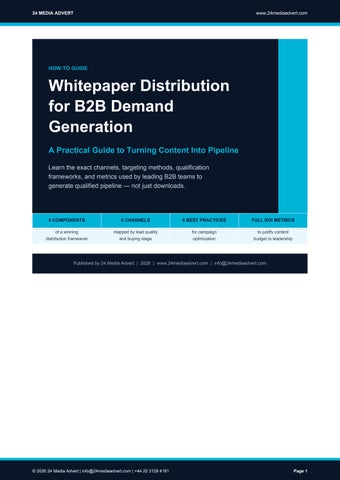
A Practical Guide to Turning Content Into Pipeline
Whitepaper distribution for B2B demand generation means placing your content in front of qualified decision-makers at the right stage of the buying journey — not just hosting it on a landing page and hoping people find it. The difference between a whitepaper that drives pipeline and one that sits unread comes down to channel selection, audience targeting, and how leads are qualified after the download.
Introduction
Publishing a whitepaper is the easy part. Most B2B marketing teams spend weeks getting the research right, the design polished, and the messaging aligned — then send one email, post twice on LinkedIn, and call it distributed.
That approach does not generate demand. It generates download counts, which are a different thing entirely.
This guide covers how to build a whitepaper distribution strategy that connects directly to pipeline — what channels to use, how to qualify leads after the download, and how to measure whether any of it is working.
1. What Is Whitepaper Distribution for B2B Demand Generation?
Whitepaper distribution for demand generation is the process of placing your content in front of specific decision-makers at a defined point in their buying journey — with the goal of creating qualified pipeline, not just awareness.
The distinction matters. Content distribution is about reach. Demand generation is about revenue. A whitepaper that gets 2,000 downloads from the wrong audience produces nothing useful for sales. One that gets 200 downloads from the right accounts, properly qualified and handed off with context, can influence millions in pipeline.
A distribution framework built for demand generation has four components:
• A defined ICP and buyer persona before any channel is activated
• Channel selection mapped to where your buyers are at each stage
• Qualification filters that separate browsers from buyers
• A structured sales handoff with enough context to start a real conversation
2. Why Most Whitepaper Distribution Campaigns Fail
The same mistakes appear across SaaS and IT services organizations. They are worth naming directly because they are easy to miss until the contract renewal conversation arrives.
Over-Reliance on Low-Intent Channels
Syndicated campaigns can produce high lead volumes at a low cost per lead. The problem is that volume and intent are not the same thing. High CPL channels with genuine intent outperform low CPL channels with weak intent every time.
Targeting Without Firmographic Filters
Distributing without filtering by industry, company size, seniority level, and job function is casting a wide net in the wrong lake. The form and the channel need to filter for decision-makers, not entry-level researchers.
Gating Without Qualifying
A basic form that asks for a name and email creates a contact, not a lead. Progressive profiling — adding role-based questions, company size filters, and intent signals across multiple touchpoints — is what separates a list of contacts from a list of qualified prospects.
No Alignment with Sales
When marketing measures success by download volume and sales measures success by closed revenue, the whitepaper gets celebrated internally and ignored commercially. The MQL criteria, the handoff process, and the follow-up timing need to be agreed on before the campaign launches.
Measuring Downloads Instead of Pipeline
Download counts are a vanity metric. The metrics that matter are cost per qualified lead (CPQL), MQL to SQL conversion rate, and pipeline influenced.
3. Whitepaper Distribution Channels That Work
Channel selection directly determines lead quality. These are the channels that consistently perform for mature demand generation teams — and what each one is good for.
Channel
Email (House List)
LinkedIn Organic
LinkedIn Ads
Content Syndication
Partner Newsletters
Nurturing existing contacts and activating dormant accounts
Thought leadership and brand reach via executive content
Targeting decision-makers by role, company, deal size
Top-of-funnel reach beyond owned channels
Reaching warm audiences through trusted third parties
High
Moderate to High
High when targeted
Variable
High
List fatigue if over-sent
Slow to scale without paid support
CPL expensive without tight targeting
Quality drops without firmographic filters
Limited scale by partner reach
No single channel carries a full demand generation program. The strongest campaigns blend two or three channels — typically email plus LinkedIn plus one syndication partner — with consistent qualification criteria applied across all of them.
4. How Whitepaper Distribution Drives Demand, Not Just Downloads
A whitepaper does not generate demand on its own. It generates a signal. What you do with that signal is what determines whether it becomes pipeline.
1 Step 1: Engagement Tracking
Track activity across multiple touchpoints to identify which accounts are showing consistent interest — not just who clicked once.
2 Step 2: Lead Scoring
Score based on both fit and behaviour. Someone who downloaded the whitepaper, visited the pricing page, and opened two follow-up emails is a different conversation than someone who downloaded and went quiet.
3 Step 3: Automated Nurture
Sequences
Keep prospects warm between the download and the sales conversation, building enough context that the first call does not start from zero.
4 Step 4: Multi-Touch Attribution
Connect content engagement to pipeline influence. That connection is what justifies the investment to leadership and separates demand generation from content marketing.
5. Measuring the ROI of Whitepaper Distribution
Revenue leaders need clarity on what is working before they can confidently allocate budget. These are the metrics worth tracking — and what each one actually tells you.
Metric
Cost Per Lead (CPL)
Cost Per Qualified Lead (CPQL)
MQL to SQL Conversion Rate
Pipeline Influenced
Sales Feedback Quality
What It Measures
Total spend / total leads
Total spend / qualified leads only
How many marketing leads become sales leads
Revenue opportunities connected to whitepaper engagement
Qualitative input from sales on lead quality
Why It Matters
Channel comparison benchmark — not a quality indicator
The real measure of targeting and form effectiveness
Indicator of marketing/sales alignment
The metric leadership actually cares about
Refines targeting over time — often overlooked
Build dashboards around CPQL and pipeline influence — not download counts. Teams that shift to these metrics make better budget decisions and build more trust with sales.
6. In-House vs Outsourced Whitepaper Distribution
Whether to run distribution internally or through a partner depends on where your team is right now — not where you want to be.
CRM and marketing automation in place
Defined ICP and buyer personas Strong fit
Limited internal bandwidth
Supplement with data partnerships
Risk of underperformance Strong fit
Need faster pipeline results Slower ramp
Access to proprietary distribution networks
Strong fit
Unlikely without investment Core advantage of a partner
7. Best Practices for Whitepaper Distribution
01
Define Your ICP First
Define your ICP before building the distribution plan — not after. Channel decisions, form design, and messaging all flow from this.
02 Match Channels to Buying Stage
Top-of-funnel buyers need awareness content. Mid-funnel buyers need proof. Match your channel mix to where your audience actually is.
03 Use Progressive Profiling
Qualify leads over multiple touchpoints. Collecting intent signals, company size, and role data across interactions separates prospects from browsers.
04 Align Automation with Sales
Align marketing automation timing with sales outreach sequences. Leads that go cold between download and first contact convert at a fraction of the rate of leads followed up within 24 hours.
05 Review CPQL Monthly
Review CPQL and SQL conversion rates monthly — not quarterly. What works in Q1 may not work in Q3. Continuous testing is what compounds performance.
06 Test Messaging Continuously
Rotate subject lines, CTAs, and audience segments. Distribution performance improves with iteration, not with set-and-forget campaigns.
Key Takeaways
✓ Whitepaper distribution is a defined growth initiative, not a post-production task.
✓ The goal is qualified pipeline, not download volume.
✓ Channel selection, firmographic filtering, and lead qualification are the three levers that determine campaign quality.
✓ CPQL and pipeline influenced are the metrics that matter — not CPL or download counts.
✓ Distribution performs best when marketing and sales agree on qualification criteria before the campaign launches.
✓ Whether you run distribution in-house or through a partner depends on your current bandwidth, infrastructure, and speed requirements.
Conclusion
A whitepaper that sits on a landing page with one promotional email behind it is not a demand generation asset. It is a PDF.
The difference between a whitepaper that drives revenue and one that gets archived comes down to the distribution strategy behind it — the channels, the targeting, the qualification process, and the sales handoff.
Get those four things right and the content pays for itself. Skip them and the content budget is hard to justify next quarter.
If your current whitepaper campaigns are generating leads but not pipeline, the problem is almost never the content. It is the distribution.
Ready to Turn Your Whitepaper Into Pipeline?
24 Media Advert helps B2B brands distribute content to qualified decision-makers using intent-based targeting, firmographic filtering, and sales-ready lead qualification. www.24mediaadvert.com | info@24mediaadvert.com