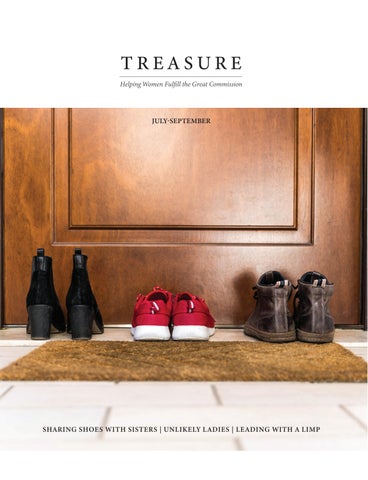
TREASURE Helping Women Fulfill the Great Commission
JULY-SEPTEMBER
SHARING SHOES WITH SISTERS | UNLIKELY L ADIES | LEADING WITH A LIMP J U LY - S E P T E M B E R
1
TREASURE Volume VII, Issue 3 | July-September 2026 | WNAC.ORG
5
11
BIBLE STUDIES
FEATURES
TRE ASURE
Elisabeth: Sharing Shoes With Sisters................................... 5
The Heart of Hosting.............. 10
ISSN 8960038 Volume VII, Issue 3
Carol Reid explores Elisabeth’s journey into pregnancy. Learn about Elisabeth’s character, acceptance, hospitality, affirmation, and blessing.
Steps Along the Path................ 20
Unlikely Ladies..........................11
Eunice Edwards........................ 17 Behind The Scenes...................28 Threads of Hope.......................30
IN EVERY ISSUE
Jennifer Thomsen uses Pheobe, Lydia, and Priscilla as biblical examples of women wielded by God.
Let’s Talk...................................... 4
Leading With a Limp...............22
A Slice of Life............................ 31
Giggles........................................16
Rachelle Burchett compares Naomi’s journey through pain, loss, and redemption to our own stories.
TREASURE (ISSN 8960038) is produced quarterly by Women Nationally Active for Christ of the National Association of Free Will Baptists, Inc., 5233 Mount View Road, Antioch, TN 37013-2306. Copyright privileges reserved. A 2026 Member of the Evangelical Press Association. Mail questions or comments to: Treasure, PO Box 5002, Antioch, TN 37011-5002
22
Editorial Staff Kristi Johnson, Director Tori Matlock, Design WNAC Board Ashley Alphin, Ohio Rachelle Burchett, Kentucky Sharon Dickey, Texas Jessica Edwards, Tennessee Angie Frasier, Florida Tracy Payne, Arkansas Katie Postlewaite, North Carolina LeeAnn Wilfong, Missouri Column Contributors Tracy Payne, Arkansas Sarah Sargent, Ohio Kristi Johnson, Tennessee
Treasure Bible Study Guide is a partner publication with ONE Magazine and PULP1T Magazine.
wnac@nafwb.org | wnac.org | @WNACFWB J U LY - S E P T E M B E R
3
Let’s Talk By Tr ac y Pay ne
About the Writer: Tracy Payne serves with her husband, Russell, in Springdale, Arkansas. She is the mother of five and “Chick” to one grandson. She loves women’s ministry, especially Bible study, and can often be found in a local thrift store.
I have always loved color and a lot of it. Purple, yellow, red, and tur-
quoise are my favorites. My life has not been plain but always bursting with color. While describing my neighborhood to a friend, the “color” literally drained from her face. She said, “I would be scared to death to live there,” to which I replied, “Oh no! It is so exciting and interesting. It’s just so colorful!” Throughout life our parents exposed us to a low din, and in that colorful noise and neighborhood, we found a melody—a melody composed of love, respect, personal investment, and the Holy Spirit. We found rail riders on our front porch asking for a meal. We found the second-grade boy who came barefoot to school. We found the mentally challenged girl who sang in the youth choir. We found the homeless teenager with no place to go. We found the little boy with a basketball always in his hand. We found the gang member whom we prayed over on the sidewalk. We found the six-year-old twins whose mother was murdered in their presence, and too many others to list. Psalm 33:16-18 gives perfect advice for us as we immerse ourselves in the unexpected, the unfamiliar, and the colorful. “There is no king saved by the multitude of an host: a mighty man is not delivered by much strength. An horse is a vain thing for safety: neither shall he deliver any by his great strength. Behold, the eye of the LORD is upon them that fear him, upon them that hope in his mercy.” What have we missed because it was irregular or irrational or too colorful to us? Appointments from God are everywhere. Though they may be unnatural or unique, God places us in them. Let’s get out our red, yellow, purple and turquoise and go where God leads.
4
TREASURE
July
J U LY - S E P T E M B E R
5
God designed us to need other people. As
courageous and independent as you see yourself, and no matter how introverted you feel, you need people. You need family and friends to help you and hear you and know you. And this is especially true when you’re pregnant.
Other major life events pump up our need for others. Think about the pack of teen girls when they are discovering womanhood, the cadre of bridesmaids who support the bride-to-be, the cluster of mom friends who talk out their parenting struggles, and the huddle of women who laugh and shop and eat together as empty nesters. But when you are pregnant — especially when you are pregnant for the first time — you need other women. You ask your mother questions. You compare notes with friends who have recently given birth. You make friends with the nurses at your doctor’s office. Because your husband simply cannot answer these kinds of questions. If it seems like everyone at your church or at your work gets pregnant at the same time, maybe it’s because of this shared need for a friend — a sister — on the journey. That’s one of the best features of the brief glimpse we have of Elisabeth in Luke 1. She is mentioned nowhere else in Scripture, so we could never say she was a major character in God’s Word. But she has much to teach us about being a spiritual sister when someone is walking through unusual circumstances.
Elisabeth’s Character Elisabeth was the daughter of a priest, and the wife of a priest (Zacharias). She had lifelong advantages (and disadvantages) of knowing the inner workings of the Temple. This knowledge made her comfortable with religious routines and demands. But her faith was not an “occupational” faith. She and her husband were righteous and blameless, walking in all the commandments (Luke 1:6).
6
TREASURE
Imagine having that written on your tombstone! What a testimony of her obedience to God and His Word. According to Scripture, Elisabeth was “advanced” in years. (Maybe we, too, should start saying, “I’m not old; I’m advanced!”) She had never given birth, and no doubt she deeply felt the cultural disgrace that came with her infertility. She must have wrestled with the idea, “If children are a blessing from God, why do we continue to wait and wait for them? Why is He withholding them from me?” Perhaps Elisabeth and Zacharias had worked through all of these questions. At their advanced ages, they had relinquished the dream of children and found contentment in serving in other ways. Zacharias took his turn to serve in the temple. Here was “advanced” Zacharias, alone in the Temple, the first person in 400 years to hear directly from God, and what he heard was an impossible promise. Zacharias didn’t just nod at the angel’s announcement. He asked questions; he wanted a sign. He took in the angel’s message: the child would bring joy and gladness; he would follow the Nazirite vow, even before birth; he would be filled with the Holy Spirit and serve as the forerunner for the Messiah. The angel cut off Zacharias’ words of doubt, and he could not speak for the next nine months! No other choice but to believe. Notice what happened next. Zacharias did not rush from the Temple to “sign” the news of the angel’s pronouncement. He delayed. He didn’t depart for home to tell Elisabeth the news. No, he finished his duties. He talked to God and listened to God and continued in faithful obedience to God. He accepted the mission to be the father of John, the man who would be the voice of one crying in the wilderness to make a way for the Messiah (John 1:23).
Elisabeth’s Acceptance The angel didn’t appear to Elisabeth. Denied the luxury of the divine “pronouncement,” she heard the message second-hand from her husband, who was mute! Still, Elisabeth was faithful to the angel’s instructions, and God was faithful to give her a baby. The Messiah was coming, and Elisabeth’s long-awaited son would have a role in His ministry and kingdom! Though unknown to her, this “role” would be costly for her son and for her. Happily, Elisabeth said yes, just like Mary did, to the promises of God. But perhaps even more difficult, Elisabeth said yes to her husband’s words. Because she allowed Zacharias’ voiceless declaration to direct their family,
she accepted the name for the baby, the word from God, and the future that was to be theirs. What complete faith in her husband!
Elisabeth’s Hospitality For the first five months of her pregnancy, Elisabeth stayed home. She cloistered herself. Why? Some think she was protecting this “geriatric pregnancy.” (Of course, that just means she was 35 or older, but she might have really been geriatric!) Others have said she was extremely observant of the Nazirite restrictions on the baby — even before his birth. Or maybe she was embarrassed or oversensitive about her pregnancy as an older woman. Whatever the reason, in her sixth month, she was ready to welcome Mary.
THE TEMPLE When Zacharias took his turn to serve as “incense tender,” he entered the inner section of the Temple (where only priests could enter). This room had an altar for continually burning incense as a symbol of praise to God. While in this holy room, alone, with the congregation praying outside, an angel came to Zacharias with the announcement a baby would be born to him and Elisabeth. An answer to his prayer, the angel said. J U LY - S E P T E M B E R
7
Mary was a relative. Some translations choose “cousin” which is probably correct. They lived a good distance apart. Elisabeth opened her home to Mary as a safe place. She welcomed her needy loved one when she was no doubt struggling with the promises of God.
Elisabeth’s Affirmation The Bible doesn’t tell us about any communication before Mary arrived at the home of Zacharias and Elisabeth. We assume this visit was expected. We assume Elisabeth had heard about Mary’s pregnancy and Mary had heard about Elisabeth’s. However, these few verses in Luke leave some questions unanswered. What we do know is Elisabeth met Mary with affirmation. Luke 1:42 tells us Elisabeth spoke with a loud voice. (Remember, her husband wasn’t talking at all, so maybe she was speaking for both of them!) With delight she flung open the door to greet her relative and blessed her immediately! Mary’s pregnancy was not yet obvious, but even the baby in Elisabeth’s womb jumped with joy to recognize Jesus. After possibly hearing many words of doubt and skepticism and reproach, Mary heard from Elisabeth only blessing and assurance. They shared “twin miracles” from God. In their meeting, Elisabeth commended and confirmed Mary’s faith. Nothing is impossible for God, the women agreed. Mary’s response is among the most beautiful hymns in Scripture. Elisabeth’s blessing opened Mary’s heart to praise’ together they worshiped. Elisabeth and Mary were together for three months — the last trimester of Elisabeth’s pregnancy. Perhaps they sat together stitching baby clothes, laughing with joy as they shared notes about their changing bodies. Maybe they dreamed about the future of their sons and prayed together for the coming days they could not begin to understand. We can almost feel the bond created
8
TREASURE
between them. We don’t know if Mary left before John’s birth (verse 56) or if Luke was just wrapping up her part of the story before describing John’s arrival. Either way, these women shared critical moments of mutual encouragement, blessing one another with understanding, compassion, sympathy, and care. They helped one another to trust God, even when His ways were hard to comprehend. Elisabeth was an outstanding mentor for the younger woman, and God blessed their interactions.
Elisabeth’s Blessings “Thus hath the Lord dealt with me” (Luke 1:25). Elisabeth counted her blessings. “This is what God did!” she said. “He took away my reproach.” Suddenly the social stigma and the accusations of moral failure were dropped, and she rejoiced in the birth of a healthy son and safely surviving the pregnancy. Her neighbors and kinsfolk rejoiced with her (verse 58). Remember, with no ultrasounds back then, neighbors were not sure the prophecy would be completely fulfilled. What if Elisabeth had a daughter instead of a son? Perhaps Elisabeth never doubted, confident God would give a son as He promised. After some discussion about the baby’s name, Zacharias suddenly received his voice, and his first words were another hymn of praise and prophecy. (Can’t you imagine this little boy’s parents often sang this hymn to him — every morning as he woke, every evening as they tucked him in bed — to remind him of God’s purpose for his life?) What a blessing John was to his parents! What a blessing John was to the public! What a blessing to grow into the purpose of preparing for the Messiah’s arrival! That’s all we know. We don’t know if John and Jesus met up at Temple celebrations. We don’t know if Elisabeth was able to see the nomad life her son chose — dressed in camel’s hair and eating
honey and locust in the desert. We don’t know if John sent word about Jesus’ baptism in the Jordan River. We don’t know if Elisabeth lived to see her son imprisoned and beheaded for his testimony of the kingdom of God. We don’t know about the sacrifice and prayers and heartache that would be hers as the mother of John the Baptist. We do know Elisabeth was faithful in releasing her son, God’s gift to her, to serve God at His command. And because of that faithfulness, God blessed her and all of us.
INFERTILITY & PREGNANCY
About the Writer:
2. Here is Scripture’s instruction for those struggling with infertility: pray. Remember Hannah (1 Samual 1:27) and Isaac (Genesis 25:21). God might not answer your prayer the way you are asking, but He loves you and invites you to come to Him with the desires of your heart.
Carol Reid lives near Nashville, Tennessee, and stays busy with teaching the toddler-nursery class at The Donelson Fellowship, attending Sew Much More life group, studying at a Thursday night women’s Bible study, and keeping up with five grandchildren (plus one in-law) and their parents. She welcomed great-grandbaby Elowyn Kate in April. Carol loves bargain shopping, crafts, and audiobooks. She would like to say she is a quilter, but is mostly a fabric collector with good intentions.
1. W hile our society is not as accusing, critical, or suspicious of infertility as people in Elisabeth’s day, many women struggle with the same questions. Statistics say 12 to 15% of couples are unable to have children. Infertility is painful. Couples feel the physical, emotional, and financial stresses of trying, hoping, and longing for a baby. They hear the words, “Childless is not ‘less,’” but they still feel the void.
3. Even in the United States, generations ago when a “good girl” was pregnant but unmarried, she was sent away to relatives. Perhaps Mary’s family sought to protect her (and their own) reputation by relocating Mary to a trusted older relative’s home. Or, perhaps she traveled to be a help to who was carrying a child late in life.
J U LY - S E P T E M B E R
9
T H E H E A RT O F H O ST I N G Minis t r y f r o m t he P r o v ision Cl o se t We caught up with Dana Portell, IM missionary to International Students, to hear about how the WNAC Provision Closet has been a part of their ministry with students in Champaign, Illinois. Dana’s heart for hosting people in her home has been a huge part of their family’s ministry for many years. She’s served croissants in France, mint tea in Morocco, and bubble tea in Taiwan. But her ministry is different because now she is teaching international students to make foods from her home country. To help this ministry, Dana was able to get baking items from the Provision Closet. She states, “I wanted to send a picture of all the baking and cooking
supplies. Thank you so much for the gift card and for always being a place where we can reach out for help with our ministries. We’re grateful for the Provision Closet.” WNAC not only impacts missionaries, but also the people they minister to. Dana tells the story of one of her Taiwanese students who learned to cook American food so she could share it with her family when they came to the States to visit her. Unsure of her family’s future plans for where they will live, the student is soaking in all the cultural things here. Dana says, “Thank you for helping me reach a student so she in turn, can reach the world!”
The Por t e ll s’ R e ce n t Minis t r y We had a packed month of ministry, and it was spectacular! We have several students leaving Champaign after graduation, so we’ve been taking advantage of the time with them. Many of the students who are leaving are part of our English Corner leadership team, so it feels like a big loss to have them moving on.
semester with a cookout at the Penns’ house with delicious food and time to just hang out with our students. Tyler Penn announced multiple times that it was time to load up the vehicles and head back to campus, but our students just kept hanging around; honestly, the evening felt so special that I found myself very sad that it was coming to an end.
We’ve had several students join for only this semester, and they’ve already become good friends. This past week we celebrated students who are leaving us at our Thursday night gathering, and it was a sweet time of honoring them. We wrapped up our
This ministry has a lot of bittersweet moments. Please pray for our students that are moving on that God would place someone in their lives to carry on the work that He began in them here.
10
TREASURE
August
J U LY - S E P T E M B E R
11
Have you ever felt you have nothing to offer God? Maybe you aren’t a pastor’s wife or missionary, can’t sing or play the piano, didn’t attend a Christian college, became a Christian later in life, or have hidden struggles in your life. You may even wonder if God could ever use someone like you. In the biblical stories of Lydia, Phoebe, and Priscilla, we see examples of three little-known ladies and how they served God. Their stories offer hope that God can use anyone, including you and me, in mighty and amazing ways.
Lydia (Acts 16:11-40) We find the story of Lydia in Acts 16:11-40, though only four of these verses describe her. Paul heard about a group that gathered on the Sabbath. I wonder if Paul knew it was only ladies or was surprised when he arrived to be surrounded by women. Whatever his reaction, he spoke to the women. Verse 14 (ESV ) “One who heard us was a woman named Lydia, from the city of Thyatira, a seller of purple goods, who was a worshiper of God. The Lord opened her heart to pay attention to what was said by Paul.” Thyatira was a prosperous city in Asia Minor located on a popular trade route. Lydia was a successful businesswoman, selling purple textiles (purple cloth created from dye originating from sea mollusks) to the wealthy. Not only was Lydia’s heart opened to the gospel, but she was baptized, along with her whole household. In verse 15, she said to Paul, “If ye have judged me to be faithful to the Lord, come into my house, and abide there. And she constrained us.” Sounds as though Lydia was not taking “no” for an answer. She insisted Paul and his companions stay in her home. And, in verse 40, after Paul and Silas were released from prison, they returned to visit Lydia. These short verses tell us a lot about Lydia. As a successful businesswoman, it is clear Lydia held profound influence over her family. I don’t know whether her family was with her when Paul shared
12
TREASURE
the gospel, or if she shared her own conversion testimony with them. Either way, they were soon converted and baptized as well. Lydia also had the gift of hospitality. She invited Paul and his traveling friends to come into her home. Her kindness made quite an impression for they returned to her house after being released from prison.
Phoebe (Romans 16:1-2) Scripture tells us little about Phoebe — only a single verse. In Romans 16:1, Paul wrote, “I commend unto you Phebe our sister, which is a servant of the church which is at Cenchrea.” This word servant also can be translated deaconess. In verse 2, Paul went on to describe Phoebe as “a patron of many and of myself as well” (ESV ). The term patron describes a person who provides financial or other support to a person, organization, cause, or activity. Not only was Phoebe a benefactor to Paul but also to “many.” What do we learn from these brief sentences? Phoebe was a sister in Christ. She was active in her church. She was wealthy but did not hoard her money for she gave generously to Paul and others.
Priscilla (Acts 18; Romans 16: 2-3; 1 Corinthians 16:19; 2 Timothy 4:19) When I think of Priscilla, I immediately remember her as a good friend of Paul. Of the three ladies, Priscilla is mentioned more times than Lydia and Phoebe combined. Acts 18:2 offers the first description: “And found a certain Jew named Aquila, born in Pontus, lately come from Italy, with his wife Priscilla; (because that Claudius had commanded all Jews to depart from Rome:) and came unto them.” Priscilla and Aquila had been forced from their home because of their Jewish heritage. They moved to Corinth, and we learn in verse three, they were tentmakers like Paul. Paul not only worked with them in their trade, but he also
stayed with them while in Corinth. Certainly, this must have been a great friendship, because in verse 18 of the same chapter, we learn Priscilla and Aquila set sail with Paul to Syria. Perhaps you have heard of someone being a “tentmaker” today. Not a person who makes tents for camping, but someone who is bi-vocational in ministry. These individuals take little (or no) salary from the church and work another job to support their family so they can minister. This concept stems from the ministry of Paul, Priscilla, and Aquila. Their unique ministry model is described in verse 26. “And he (Apollos) began to speak boldly in the synagogue: whom when Aquila and Priscilla had heard, they took him unto them, and expounded unto him the way of God more perfectly.” Priscilla and Aquila were willing to address a wrong and help Apollos. Notice, they did not confront their fellow worker in public — they took him aside. Confrontation is never a pleasant experience, whether confronting or being confronted. But, sometimes, it is necessary. Priscilla and Aquila must have accomplished it the correct way because we learn in the following verses Apollos went on to Achaia where “He mightily convinced the Jews, and that publickly, shewing by the scriptures that Jesus was Christ.” Priscilla and Aquilla provided correction, and accepting it, Apollos went on to enjoy a fruitful ministry. I hate to think what might have happened if he had not been corrected. In 1 Corinthians 16:19, we also learn Aquila and Priscilla hosted a church meeting in their home while in Corinth. Bible scholars believe this faithful couple hosted house churches in their homes in Corinth, Ephesus, and Rome. In Romans 16:3-4, immediately following Paul’s mention of Phoebe, he also described Prisca (Priscilla) and Aquila. Paul referred to them as “my helpers in Christ Jesus: who have for my life laid
down their own necks: unto whom not only I give thanks, but also all the churches of the Gentiles.” Priscilla and Aquila laid their own lives on the line to save Paul, and by doing so, they helped spread the gospel to the Gentiles. This obviously was a treasured friendship. Paul used the names Priscilla and Prisca interchangeably. Prisca was her formal name; Priscilla was more like a nickname. Paul obviously didn’t feel the need to call her by her official name. Many believe 2 Timothy was the last book that Paul wrote. In his final greeting in chapter four, the apostle mentioned Priscilla and Aquila one last time (verse 19). Paul remembered their friendship fondly towards the end of his life. We learn so many things about Priscilla. (I’m using her nickname because I think we could be friends.) In order that she and her husband could minister to others, this ordinary lady worked hard at her profession. Through her gift of hospitality, she provided for Paul. Priscilla knew when to confront others for the sake of the gospel. Her home became a house church. She even risked her life for Paul. She was faithful to Paul and, more importantly, to God.
To Sum It Up What do we learn from these unlikely ladies? • They came from a range of economic backgrounds. Phoebe was rich. Lydia was likely in the middle, and Priscilla came from the working class. God can use people from across the economic spectrum. If you have money, be generous to support others in their ministry. Many years ago, I was a member of a WAC group in a rural area. The group consisted mostly of older women, and I wouldn’t describe any of them as wealthy. But, every month, the amount of money they gave to missionaries and their projects was astounding. They gave freely and generously, and I am so thrilled I saw their example. May we also be generous in supporting our pastors and their J U LY - S E P T E M B E R
13
families, missionaries, and other ministries as God directs us. • Lydia was an example to her family. You, too, can be an example to your family. Be the one who shares the gospel with your children, grandchildren, and extended family. Take them to church so your Bible stories and teaching will be reinforced. Celebrate the spiritual milestones: salvation, baptisms, dedications, and perhaps even ordination or commissioning services as they follow God’s will for their lives. • Lydia and Priscilla had the gift of hospitality. They opened their homes to Paul, and Priscilla’s home became a house church in more than one city. Some people have the gift of hospitality naturally. Some of us must work on it a little more. Hospitality is rarely convenient, but when we give His blessings back to God, we allow His blessings to be used in a greater way. I’m not saying it will be easy — you just might end up with chocolate in
Lydia was an example to her family. You, too, can be an example to your family.
14
TREASURE
your white carpet — but it always will be worth it. • Priscilla was willing to confront when needed. She confronted in the correct manner and spirit, in private and in a way that didn’t hurt or embarrass Apollos. When the Spirit leads us to confront someone, let’s confront carefully so as not to break the spirit or harm the ministry of the person we are helping. Remember, we want the individual to change the problematic behavior and have a thriving ministry as a result. • You never know where friendship will lead. Priscilla and Aquila’s friendship with Paul led to them working together, hosting house church, risking their lives, traveling together, and in the end, being blessed by their long-term friendship. You can make a difference for friends ministering around the globe. Encourage them, visit them, and pray for them. You never know how a simple act of encouragement can make a difference. Everyone can be a good friend and encourager.
• A ll three women were active in ministry. They
you fill your role and determine to be an example
In conclusion, God can and wants to use you. You don’t need wealth or a high-paying, influential job. He simply wants you to minister to those within your sphere of influence. God wants to use the beautifully and wonderfully made person He created. That’s you! So, be willing and ready to be used by God in ways you could never imagine.
to everyone you meet.
About the Writer:
• W hile we know at least one was married (Pris-
Jennifer Thomsen and her husband Eric live in Joelton, Tennessee, with their flop-eared, mischievous mutt Honey. Their daughter Victoria and her husband Cody live in Oklahoma with their son Caisson. Jennifer’s favorite hobbies are spoiling Caisson, baking, and shell hunting on Lido Key, Florida.
shared the gospel. Phoebe was active in her church. Lydia reached her family. Priscilla was in ministry with her husband and a co-worker with Paul. God gives us all a role to fill: people we can reach and family that needs God. Ask God to help
cilla), we don’t know about the others. The good news is God can use you whether single or married. You do not have to be married to serve God, but on the flip side, God can use a married couple in mighty ways.
To order, scan the QR code.
Spend a year in God’s Word with the lifetime writings of Dr. Mary Ruth Wisehart. Each day, encounter Dr. Mary’s unique perspective on life drawn from Scripture.
J U LY - S E P T E M B E R
15
Giggles B y S A R A H S A R GEN T About the Writer: Sarah Sargent loves to laugh and make others laugh even more. She is a thirdgeneration member and leader in Free Will Baptist Women’s Ministries. She currently serves as president of the women’s ministry at Reynoldsburg Free Will Baptist Church and president of Ohio Free Will Baptist Women’s Ministries.
Have you ever gotten the “church giggles” at church camp? If
you have attended church camp, then, no doubt, you have had the church giggles. It pairs with camp as much as friendships and mosquito bites. As a camper, some of my favorite memories of church camp were the games we played throughout the week. As a church camp counselor, one of the most stressful parts was coming up with those memorable games and putting them together. Every year it often felt like they had to be bigger and better than the previous summer. Several years ago, my Aunt Patty was putting together a couple of games for camp (this was before social media, or the Internet could be researched). She read about a game in a book that sounded like fun. She gathered a ton of newspapers, a roll of yarn, and a couple of bags of balloons. The game suggested the newspapers be rolled like a rod. Then the balloons were blown up, and using the yarn, one balloon was tied to the waist of each kid. Each participant had a newspaper “bat,” to be used to pop the balloon tied to the backs of the other players. The winner was the last kid whose balloon was still intact. On paper this sounds like a simple entertaining game. In reality it was less entertaining and more like carnage in a field. Without a visual demonstrating the newspaper bats, my aunt just rolled them as tight as possible. This meant each child was armed with a three-foot one-inch club. Aunt Patty also didn’t realize the tiny water balloons she bought were a terrible idea. Smaller balloons meant smaller targets. And smaller targets meant kids were hit more often than balloons popped. A few minutes into the game, she quickly realized this wasn’t working as anticipated. The game ended when an older teen, holding the arm of a smaller teen, chased him and caned him in an attempt to pop his small balloon. The kids with newspaper welts weren’t laughing back then, but now our church family gets the giggles when we think about the church camp game fail.
16
TREASURE
J U LY - S E P T E M B E R
17
At the age of 24, Eunice Edwards began a
journey that would forever change her life. Some Christian women from a nearby Free Will Baptist church came to visit her and asked if they could pray with her. “I was glad, because I had been searching to learn how to be saved,” Eunice said. At that time, she knew almost nothing about the Bible. After her salvation experience, God’s Word became very precious to her.
Her husband was also saved, and for three years she enjoyed what she said was “one of the happiest times of my life.” When her husband broke his vows to God and to his family and left the home, Eunice was forced to take their four children, move in with her parents, and go to work. Some may have thought her life a failure at this point, but God was certainly not done with Eunice Edwards! Early in her Christian experience, Eunice had the privilege of attending the Christian Workers’ Institute in Monett, Missouri. From those classes she derived two important truths: First, she caught a vision of the lost world. From then on, Sister Edwards was known as a prayer warrior... for lost souls, for the needs of others, for missions and missionaries. One wall in her dining room was covered with prayer cards of missionary friends for whose needs and requests she prayed daily. Scattered on the end table beside her chair were their letters and updates. They were never far from her thoughts. Second, she discovered God had a place of service for her. In her words, she “counted it all joy from that day on to serve Him.” And just how did she serve? I mean, really... what could a woman and, on top of that, a single mom do? Check out this list: • In 1946 she pastored a nearby Free Will Baptist church for nine years. • At this point, Eunice found herself working especially with the women. She served as local, district, and state President of the Woman’s Auxiliary (now known as Women Active for Christ).
18
TREASURE
• She became involved in the Women’s National Auxiliary convention work, serving as President from 1943-1946. • In 1951 she was put in charge of enlistment and promotion. Her duties included field work and the preparation of manuscripts. • In 1953 she served as Personal Service Chairman for two years. • In 1955 she became Literature Chairman, and during her term both the Executive Secretary and Promotional Chairman resigned, and Eunice was asked to move to Nashville. • From 1956-1963 Eunice served as Executive Secretary/Treasurer for WNAC (Women Nationally Active for Christ) which was, at that time, a “one woman operation.” During her term, she saw the “birth” of Co-Laborer magazine, the introduction of the missionary Provision Closet, and $10,000 raised for the Ivory Coast project. • In 1963 Eunice returned to Missouri and after working 18 years at the State Hospital, she formally retired. Did this mean that God was done with her? No way! She continued to work for the Lord wherever He placed her: • Behind a pulpit, sharing her heart and all God had taught her with women from all walks of life, many states, and with various needs. • Seated at a women’s meeting or missions prayer group meeting, sharing various missionaries’ needs and prayer requests. • Standing before a Sunday School class with women who felt the very presence of God during the time of teaching. • At her table writing letters of encouragement to friends worldwide. • In her bed in the wee hours of the morning, praying for those who were serving the Lord in “hard places.”
• In her “easy chair” with tape recorder at her side — sharing the burdens of her heart, the abundance God taught her through life, the glorious tidbits of insight into God’s Word — to be shared in printed form with women across our denomination.
What are some things you can learn from the life
• In her living room — talking, laughing, crying, praying, encouraging — with all who passed by and needed a friend
been hesitant?
Eunice Edwards could have stopped serving the Lord when her husband left her with four young children to raise. As a woman in a culture dominated by men in leadership, she could have said “no” when God said “go.” When Parkinson’s Disease took over her body, Eunice could have called it quits. But this warrior for the Lord was faithful to the end. Carlisle Hanna, missionary to India, once said, “Be faithful wherever God has placed you.” As you have journeyed through the life of Eunice Edwards, you have probably been reminded of that same word — faithfulness. In the easy and hard places, in the comfortable times as well as the trials, surrounded by love and acceptance as well as criticism and ridicule … “wherever,” she remained faithful. May we all press toward that mark!
of Eunice Edwards? Do you need to have a better prayer life? Is there something else you could do to help missionaries or to promote missions? Is there a place where God wants you to serve and you’ve About the Writer: Becky (Fry) Gwartney serves alongside her husband, Curt, at Fellowship Free Will Baptist Church in Park Hills, Missouri. She’s “Grammy” to six incredible young men of God and mom to two adult children: Darin, a physician in Oklahoma and deacon at Locust Grove Free Will Baptist Church and Casey, a pastor’s wife at Rejoice Free Will Baptist Church in Columbia, Missouri. Becky works as an independent researcher, a freelance writer, and at her “fun job” at Chick-fil-A . Becky loves the Lord, ministry, all ages of people, music, leading Bible studies, writing, decorating, organizing, table games, and sweet tea. She gathered this information about Eunice Edwards from spending seven years as her “scribe.”
In the easy and hard places, in the comfortable times as well as the trials, surrounded by love and acceptance as well as criticism and ridicule, remain faithful.
J U LY - S E P T E M B E R
19
20
TREASURE
How do we know when God is calling us to do
something? What if God calls me to do something, and I miss the signs? How am to know what I am supposed to do for the Lord?
My husband Cody and I work for North American Ministries at Beacon Church. We live in Ardmore, Oklahoma. How did we know God wanted us here? We simply followed the steps along God’s path for our lives. Psalm 37:4 reminds us, “Delight thyself also in the Lord; and he shall give thee the desires of thine heart.” Since we married, Cody and I have both wanted to be involved in children’s or youth ministry. We had been to three churches looking into positions available. We prayed about each but never had peace about accepting any of them. Six years ago, we had an opportunity to move to Florida. What started as a temporary job situation turned into two years. During that time, our pastor approached us about teaching Sunday school. We joyously agreed. This was the opportunity we had been waiting for! Then, my husband received a call from a friend about a church in Oklahoma. The church needed youth workers. Cody told them we would “pray about it.” We did pray about it, but neither of us wanted to leave the wonderful Christian family we had in Florida. Yet, as we prayed, God allowed things happen. We received a check to help purchase a car. Our business sold. Our church offered their missionary housing while we traveled to raise necessary funds to work as church planters. Now, we have been in Ardmore three years. What started as a part-time ministry has grown into a full-time position. I coordinate music now, and Cody serves as the associate pastor. Step by little step led us to where we are. Here are some Scriptures to help in your journey of following God’s will. • J eremiah 29:11. “For I know the plans I have for you,” declares the Lord, “plans to prosper you and not to harm you, plans to give you hope and a future” (NIV). God already has a plan for you. His plan is not something to fear but a good plan created by a loving God. • Proverbs 3:5-6. “Trust in the LORD with all thine heart; and lean not unto thine own understanding. In all thy ways acknowledge him, and he shall direct thy
paths.” God will guide you as you trust and lean on Him. He is already there clearing the way forward. • Romans 12:2. “And be not conformed to this world: but be ye transformed by the renewing of your mind, that ye may prove what is that good, and acceptable, and perfect, will of God.” Stay away from the ways of the world. The world will try to lead you from the path God has set before you. • Psalm 119:105. “Thy word is a lamp unto my feet, and a light unto my path.” Stay rooted in God’s Word. His Word will help you traverse this life. Use it! • 1 Thessalonians 5:16-18. “Rejoice evermore. Pray without ceasing. In everything give thanks: for this is the will of God in Christ Jesus concerning you.” Pray! Pray! Pray! It’s easier to hear someone when you are communicating already. Are you having a constant conversation with the One who knows where you are headed in life? • Hebrews 10:24-25. “And let us consider how to stir up one another to love and good works, not neglecting to meet together, as is the habit of some, but encouraging one another, and all the more as you see the Day drawing near” (ESV). Encourage others. Surround yourself with Christian friends. Lift up other Christians.
Three Takeaways God’s will has been written in Scripture for us. We need to be praying, reading the Bible, avoiding the wickedness in the world, and trusting God. God already revealed His will. He sent His Son to die to save us, and He desires a relationship with us. Encourage other believers. I find it very meaningful when someone asks how she can pray for us. It lifts me up every time. I have been blessed to receive cards in the mail, signed by Sunday school classes who prayed for me. It is an encouragement. Follow God’s Word, pray without ceasing, trust and lean on Him, lift others up, and renew your mind. This is God’s will for believers. Don’t be afraid or hesitant and let God lead you down the steps in your own path to carrying out His will. About the Writer: Tori Matlock lives in Ardmore, Oklahoma, with her husband Cody and their son Caisson. Tori enjoys baking, books, and music. Tori and her husband serve in Beacon FWB Church. J U LY - S E P T E M B E R
21
September
March 22
TREASURE
When I was first asked to write about Nao-
mi, I hesitated. I wasn’t sure I could relate to her. Naomi’s story is one of deep loss, bitterness, and redemption, a woman who went from fullness to emptiness and back again. I’ve known loss, yes, but bitterness has never taken root in me. My faith has often trembled, yet I’ve never turned away from the One who steadies me. As I sat with Naomi’s journey, I began to see how her limp and mine, though different, both tell a story of God’s providence in the dark. Naomi’s story begins with famine, not only the kind that empties fields, but the kind that empties hearts. She lost her husband, then her sons. Each loss stripped away another layer of her identity until she could no longer recognize herself. When she finally returned to Bethlehem, the women barely knew her. “Is this Naomi?” they asked (Ruth 1:19). And she replied, “Do not call me Naomi; call me Mara, for the Almighty has dealt very bitterly with me. I went away full, and the Lord has brought me back empty” (Ruth 1:20–21, ESV ). Naomi’s descent wasn’t just about death — it was about loss of self. That’s what pain does. It reshapes you. It dulls the familiar, steals the sparkle, replaces hope with habit, and turns dreams into survival. I know that kind of emptiness, though mine looked different. My hardest season came through my son’s addiction, a battle that stretched over thirteen long years. Robberies, overdoses (three of them), and countless rehabs. Each one left me emptier and more exhausted than before. I made it my mission to keep him alive, and though I sought God, I see now I made his survival my idol. In trying to rescue one son, I neglected what mattered most, my husband and our two other boys, who became collateral damage in my desperate fight against a relentless enemy. Even though my son remained alive, the boy I had
raised was taken captive by the ruthless power of addiction. It was devastating to watch the little boy who once dreamed big, loved deeply, and laughed easily become motivated only by his next “high.” His behavior changed first, then his heart, and eventually even his body, like something had used his frame as a shell and reshaped it to fit like a glove. The light in his eyes dimmed, and the life I’d known in him faded behind a darkness I couldn’t touch. Court dates, felonies, probation hearings, jail pat-downs, and an unending consequence kept hope gasping for air. Then, after years of drug addiction, he traded one substance for another. Leaving heroin and pills behind, he picked up the bottle instead. “It’s socially acceptable,” he told me. But the truth was, addiction simply changed costumes. It was still the same thief, still stealing, still destroying. I imagine Naomi felt something similar when she buried her sons, that eerie silence where once there had been laughter. The difference between us was her sons were gone, while mine was still breathing, yet both of us faced a kind of death. Hers was final; mine was ongoing.
Addiction doesn’t just take a person; it holds them hostage in plain sight. I had days when I felt like I was living in a bad dream. Days when my prayers felt unheard. Like Naomi, I wanted to believe God still had a plan, but some nights my faith felt thin, stretched between what I knew of His goodness and what I saw in front of me. Like Naomi, on the road back to Bethlehem, I kept walking. One weary step after another, trusting God. One night, while pouring my soul out to God, he spoke to my heart with clarity: “You can’t keep him alive.” Those words shook me to my core. He was right, there was nothing I could do to keep him alive. Those words showed me something I hadn’t realized before — I saw all that I’d been neglecting, all that I’d lost in my attempt to control J U LY - S E P T E M B E R
23
what only God could redeem. From that night on, I had peace, but not the kind that guaranteed my son would live, but the kind that comes when you finally relinquish what was never yours to carry. However, surrender is rarely a one-time act. The temptation to pick it back up followed me daily. Then came the morning the phone rang. He had overdosed. Paramedics were working, but there were no guarantees. I remember the weather that day — gray, heavy rain, the sky mirroring my heart. As I ran to my car, those same words thundered again inside me: “You can’t keep him alive.” And right there, with tears streaming down, I lifted my voice in praise. I told God, “Whether he lives or whether he dies, I will give You praise. I will cling to You. The enemy will not write the headline of this story.” So, I praised Him loudly because even in that moment, I knew He was worthy and no matter what, I wanted Him to have the glory. Naomi’s limp came from loss; mine came from surrender. Hers turned her heart inward before God turned it outward again through Ruth’s love. My limp turned my heart heavenward, but not without tears, not without questions.
God was teaching me real faith doesn’t mean pretending the pain doesn’t exist; it means trusting Him while you limp through it. When Naomi turned her face toward Bethlehem, she expected to walk alone. She had nothing left to offer. Her future, as far as she could see, was barren soil. But Ruth refused to leave. “Whither thou goest, I will go; and where thou lodgest, I will lodge: thy people shall be my people, and thy God my God” (Ruth 1:16). That single declaration changed both of their stories. Naomi didn’t lead Ruth through speeches or strategies, but she led her through presence, through simple steps of wisdom. It wasn’t leadership born from strength; it was mentorship born
24
TREASURE
from brokenness. And somehow, that was enough. Naomi’s limp didn’t make her useless. It made her real. Her faith, scarred but still active, became the soil where Ruth’s hope could grow. In the years of my son’s addiction, there wasn’t a single day I felt strong enough to lead anyone, not my family and sometimes not even myself. Yet somehow, people were watching me and how I was living through this whirlwind. My husband and our two other sons watched how I prayed, how I fought to love, how I kept showing up even when life didn’t make sense. Not realizing it then, I was still influencing not through answers, but through endurance. Naomi showed Ruth what resilience looked like. I wanted to show my family what trust looked like, and that faith isn’t the absence of pain, but the presence of God in it.
I couldn’t fix the storm, but I could model stillness inside it. I couldn’t heal my son, but I could keep hope alive in the house where addiction tried to silence it. And I couldn’t see the whole plan, but I could keep my eyes on the One who wrote it. Yet, I would be dishonest if I said there weren’t lingering wounds. Even today, bitterness still holds small pieces of my sons’ hearts. They carry the scars of years when all my attention and energy were consumed by their brother’s chaos. They didn’t understand why I wouldn’t give up, why I kept showing up, why I sacrificed so much for one who seemed to want so little for himself. I still pray for healing of those quiet fractures only grace can mend. Naomi taught Ruth how to live in faith, and Ruth’s faith in return reignited Naomi’s. I’ve found that same rhythm when God often restores us through the people we least expect. Sometimes through the child who’s fighting his way back, sometimes through the ones who waited for your eyes to lift
again, sometimes through family and friends who never stopped believing with you. Faith and hope are rarely rebuilt in one grand moment; they’re restored one obedient step at a time. Naomi’s wisdom guided Ruth to Boaz’s field through a simple act of survival that turned into a story of redemption (Ruth 2:3). And that’s what God keeps teaching me: just take the next step. Go back to Bethlehem. Walk toward grace. Gather what’s left and trust Him to make it enough. One of the most beautiful things about Naomi’s story is that God’s name is rarely spoken, yet His presence fills every scene. While Naomi laments,
while Ruth gleans, while Boaz just “happens” to arrive at the field that day, God is orchestrating redemption behind the curtain. Providence is never loud; it’s steady, weaving mercy through the mundane. That same quiet providence has carried me. When I was twelve, my parents bought me my first Bible. On the inside cover my dad wrote these words that have anchored me ever since: “We conquer by continuing.” At twelve, I didn’t fully understand it. But now I know those words were a prophecy over my life and over my son’s. ( Years later my son tattooed the same phrase across his arms: one reading, “We conquer,” the other, “by J U LY - S E P T E M B E R
25
continuing.” When his arms are folded together, the message is complete.) Every morning of my hardest years, I remembered that message. Days when my strength was gone, my hope thin, and my faith weary, I knew if I refused to let my feet touch the floor, I was giving the enemy exactly what he wanted. So, I got up. I continued.
Obedience, not loud, not triumphant, but faithful. While I was simply surviving, God was silently working. Like Naomi returning to Bethlehem with empty hands, He was already aligning provision, people, and purpose I couldn’t yet see. I only knew I had to keep walking. Looking back, I see His fingerprints everywhere: in the nights I thought were wasted but became prayers, in the friends who showed up at just the right time, in the moments when peace arrived without explanation. God’s hand never left. Sometimes the miracle isn’t in what changes, but in what doesn’t and that we keep standing, keep believing, keep loving, keep praising. That is how we conquer: by continuing. When Naomi first held Obed in her arms, the women of Bethlehem gathered around her, celebrating the child who would one day carry the lineage of David. They said, “Blessed be the LORD, which hath not left thee this day without a kinsman, that his name may be famous in Israel” (Ruth 4:14).
line. There have been victories and setbacks, hope and heartbreak. But through it all, God has been writing a story far greater than mine to control. Like Naomi, I’ve learned to stop clinging to what I lost and start holding onto Whom I’ve found. Every time I see my son’s arms crossed, “We conquer” on one, “by continuing” on the other, I’m reminded redemption is still unfolding. The phrase that came from my dad’s words years ago, has become the legacy of three generations: a dad who believed, a daughter who endured, and a son who’s still fighting, continuing. Naomi’s redemption came through a baby in Bethlehem. Mine has come through a Savior born there, and the Redeemer who meets us in our limp and makes beauty from ashes. The older I get, the more I realize hope isn’t found in the absence of pain, but in the presence of purpose. God wastes nothing, not a tear, not a prayer, not even the nights you thought would break you. Every scar, every limp, every loss has become a testimony of grace. When we realize it is through our most agonizing stories that God gets the glory. Isn’t that what we truly want? Living lives that lead others to Him, and if my life can whisper one truth, it’s this:
We conquer by continuing! Not because we are strong, but because He is faithful.
Naomi’s arms, once empty, were full again. Her laughter returned. Her story, once bitter, became beautiful. But the Bible never says Naomi’s pain disappeared. She still carried her memories, her losses, her limp. Restoration didn’t erase her past; it redeemed it. I’ve learned that restoration doesn’t always mean everything looks whole again. Sometimes it simply means you are whole again.
Naomi’s story shows faith and hope can be restored through God’s plan and so does mine. Naomi walked back to Bethlehem empty; I walked back to peace through surrender. She held a grandchild who carried promise; I hold a promise that carries generations. And both stories point to the same truth: God’s providence is not always seen in the moment, but it is always at work.
In my life, restoration has come through peace, the kind that doesn’t depend on outcomes. My son’s journey through addiction has not been a straight
So even with a limp, even with tears, even with unfinished prayers — keep walking. Because we conquer, by continuing.
26
TREASURE
For Thought and Discussion: 1. I n seasons of loss, what do you tend to question most — God’s presence, God’s purpose, or your own identity? 2. H ow has a personal limp (wound, loss, story) shaped your leadership? 3. D o you believe leaders can be influential without appearing strong? Why or why not? 4. W here in your life do you need to “continue” today, even while limping? 5. H ow can your own limp become a leadership tool to strengthen others?
About the Writer: Rachelle Burchett serves as System Director of Organizational Development and Education for Appalachian Regional Healthcare and is the founder of The Communication Trainer, where she develops leaders through emotional intelligence, personality-based communication, and culture-building strategy. Alongside her corporate leadership work, she leads women’s ministry with a vulnerable, application-focused approach that draws from real-life experience to inspire spiritual hunger and deeper intimacy with God. An author of three books, Rachelle is committed to equipping both leaders and women to grow in maturity, confidence, and calling. Her work bridges practical leadership and authentic faith in a way that resonates across diverse audiences.
I couldn’t fix the storm, but I could model stillness inside it. I couldn’t heal my son, but I could keep hope alive. Mine has come through a Savior born there, and the Redeemer who meets us in our limp and makes beauty from ashes.
J U LY - S E P T E M B E R
27
28
TREASURE
Have you ever been to a play or been involved in a play? Even a simple children’s Christmas
play is complicated, and most of that “complication” is behind the scenes. Those crew members backstage are making sure everyone gets in place and on time. They cue script lines and draw the curtains between acts as scenery and atmosphere are changed. Their role is very important! But I found my “wheelhouse” in front of the curtain when I played “Aunt Eller” in the Official 35th Anniversary Production of Oklahoma! at my high school. As an actor I depended on the stage crew to make sure “the surrey with the fringe on top” appeared on stage. I had the easy part, just act on cue. I had no responsibility for the details I could not see behind the curtain, but what a disaster if I had been in charge of all that happened backstage. Our lives demonstrate that same parallel. The backstage of life has things I cannot see—the place where God is working “all things work together for good” (Romans 8:28). If left to me, no doubt I would change things. Remember the story of Abraham and Sarah and how they went “backstage” to help God fulfill His promise to them? (Genesis 16). Their “help” complicated their lives. Nevertheless, God accomplished His will in spite of them, and the long-awaited baby, Isaac, was born. Over twenty-two years ago a child was born to a teenage girl, who was a friend of our oldest daughter and a member of our church youth group. Four years previously, her mother had died from cancer, so she lived with her grandparents. When she was discharged from the hospital, our daughter was there to pick up this girl and her tiny newborn. Afraid of the response from her grandfather, the new mother requested to come to our house, and we agreed. My husband Russell and I were the first to see and hold the baby girl outside the hospital. We adored her. During the next two years, we welcomed her two little sisters into our world. These three girls spent countless weekends with us. When we moved to another city, they spent time with us each summer. The years we spent building an emotional bond with these girls were crucial, and God knew. While we just continued engaging in what God placed on the stage of our lives, He was behind the scenes orchestrating something huge. Nine years later we received a devastating phone call about “abuse and neglect.” We heard stories (from well-meaning teachers) of children questioning them at school. Our hearts were broken. Russell said, “Let’s go get them.” The girls were in the custody of the state, so it was impossible to “just go get them.” The Sunday night after that phone call, we prayed together then wrote an email to the Director of DHS (Department of Human Services) in that county. Although we had never fostered, we claimed “emotional kinship,” and within one week, the girls arrived in our home. Behind the scenes, God was preparing a forever home for three little girls who were not yet born, and those three little girls completed our family. Trust God as He works behind the scenes in your life. Trust Him for He sees the completion. “And I am sure of this, that he who began a good work in you will bring it to completion at the day of Jesus Christ” (Philippians 1:6 ESV ).
About the Writer: Tracy Payne serves with her husband, Russell, in Springdale, Arkansas. She is mother of five and “Chick” to one grandson. She loves women’s ministry, especially Bible Study, and can often be found in a local thrift store.
J U LY - S E P T E M B E R
29
THREADS OF HOPE Fr o m A fr ic a t o A l pe d r e t e
The hot sun in West Africa beats down on the women as they repeatedly dip fabrics into barrels of indigo dye until the deep blue shades come alive. The dyed fabrics are then hung, dried, carefully folded, and prepared to be sewn into clothing. Some of these fabrics are purchased by two sisters who attend the Alpedrete Church in Spain. They craft the beautiful fabric, tinted with indigo, into designs that appeal to the highest couture in Europe. Dresses, skirts, pant suits, and even fabric-covered shoes and agendas will be placed in the window of their boutique store in Navacerrada, Spain, where weekend shoppers will be delighted. The women who purchase these designs will never know the journey the fabrics traveled to get to them. Laura and Maica opened their quaint store with God’s hand on their hearts. They wanted to share the Gospel by using their designing talents. They found women in Ghana, Mali, Senegal and other West African countries whose talents could tell a story. And they have been telling that story for 27 years through the La Galería de Mamah Africa. These two women were first exposed to the Gospel through their mother’s influence. A faithful woman, she took them to church, prayed over them, and made sure they knew the truth of Scripture. Years passed, they each married and started families, and their careers in design and marketing took off. When the Alpedrete Church was founded — right
30
TREASURE
in the town where they lived — their Christian upbringing was renewed, and they became a vital part of the church. These sisters had a love for God and for African culture which led them to many West African markets, where they’ve seen how women work so diligently to make sure fabrics are tinted in not just indigo colors, but in bright reds, vibrant oranges, deep browns, and all with a myriad of patterns that stem from each country’s cultural heritage. Laura and Maica have created friendships with these women, helping them by creating business opportunities while also supplying the demand of the products in their boutique in Spain. They reached into the hearts of women from Ghana, Mali, Senegal…and they not only gave them financial freedom, but they showed how God can make them free in Christ. Today La Galería de Mamah Africa stands as a beacon in a small town nestled into the mountains just to the north of Madrid. Fragrant hibiscus tea welcomes shoppers in, beautiful hand-made African products fill the racks and shelves, and God’s love beams from the owners as they tell how God’s story began with a love for Africa and extended from their hearts to each person who stops by to shop. “Come and hear, all ye that fear God, and I will declare what he hath done for my soul” (Psalm 66:16).
Each morning as I sit at my desk in the WNAC (Women Active
for Christ) office, the sunshine spills in through the windows. Its warmth reminds me of God’s goodness during this season – the past three months I have spent getting to know WNAC from the inside. What I’ve learned is WNAC is a powerful ministry with an impact that extends much farther than the office here in Antioch, Tennessee. Unfortunately, during these same months, I have also learned the operating expenses of WNAC are severely underfunded. Our heartbeat – helping women fulfill the Great Commission at home and abroad – needs to be stabilized immediately. We have cut staff and expenses to a bare minimum, and we are watching every line item in our budget. Through emails, social media, and state meetings, we have also alerted our denomination of our financial crisis. Many of you have offered your help during this transition of leadership for WNAC. Will you become part of “The Giving Tree,” where your regular monthly gifts can consistently make a difference? Each gift gives new breath and life back to Free Will Baptist women’s ministry. It helps teens who attend the Shine Conference! hear about how they can find freedom in Christ. It helps women connect and find friendships in the midst of their busy and stressful lives. It helps church planters and missionaries minister in some of the hardest places around the world. Women across the denomination have heard this plea and have answered. Notes, phone calls, emails, and texts tell me people are praying. Numerous WAC (Women Active for Christ) groups are planning to give even more each month to help WNAC meet our financial needs. One local church here in Nashville has begun partnering with us to help with office tasks and other projects that need to be completed.
About the Writer: Kristi Johnson began serving as Executive Director of WNAC in January 2026. Along with her husband, Tim, she invested nearly 25 years as an IM missionary in Spain. Kristi has a deep passion for walking alongside women through friendship and discipleship. Her heart for ministry and her love for coffee keep her fueled and ready to take on the incredible task of leading WNAC with vision and hope into the future.
The sunshine of God’s grace continues to radiate through the ministry of WNAC, giving women across the denomination a place to discover how they can be a part of the Great Commission.
J U LY - S E P T E M B E R
31
Thank you to every WNAC group that has faithfully supported the
32
TREASURE
YOUR PARTNERSHIP THROUGH PRAYERS AND GIVING ARE REACHING PEOPLE AROUND THE WORLD WITH THE GOOD NEWS!