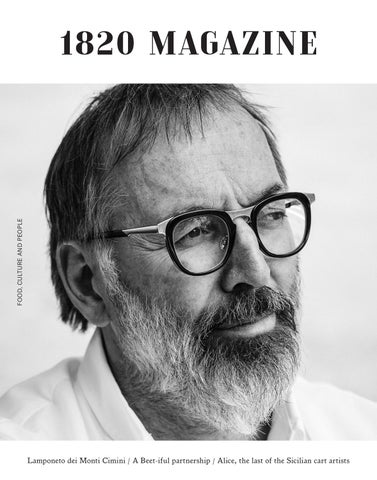
FOOD, CULTURE AND PEOPLE
Lamponeto dei Monti Cimini / A Beet-iful partnership / Alice, the last of the Sicilian cart artists
1820 MAGAZINE
SPRING—SUMMER 2019
Food, culture, and people
Season
EDITOR IN CHIEF
ABOUT US
Marco Paone
SUB EDITOR & CONTENT COORDINATOR Gino De Blasio
ENGLISH CONTENT & TRANSLATIONS Gino De Blasio
ADVERTISING MANAGER Marco Paone
MARKETING, SALES & COMMUNICATION Gino De Blasio
GRAPHIC DESIGN BBDB Studio
1820 MAGAZINE Postbus 4341 6202 VA Maastricht The Netherlands
WEBSITE 1820magazine.com
EMAIL info@1820magazine.com
Our vision 1820 Magazine is about the REAL Italy. It doesn’t hold back on bringing you the stories of a nation that is universally loved and yet still undiscovered. Italy is vibrant, unique and filled with a history that deserves a real understanding and not one that is limited to small soundbites or pop culture references. 1820 wants to show that there is more to Italy and Italian culture. Together with our team of writers, investigators, cultural gastronomes and food lovers our mission is simple; give you stories about Italy that you may have never heard of, or provide greater depth into what makes the nation we call home, different. What started as an ode to the Italian palette, gastronomy of the highest quarters we evolved into something bigger, something different. To know Italy is to know food, people and the stories that bring together a nation that is still finding its unified identity to this very day. It is no coincidence that our magazine is called 1820. It is, in honour of the grandfather of Italian cooking, Pellegrino Artusi. (Artusi was born in 1820) His vision to create what was Italy’s first recipe book became more of a thesis into the Italian psyche. An understanding of culture, of people and the unique appreciation of how things can change quickly from one space to another. This was the first real documenting of Italy and it is something we are carrying on with our publication. So, we evolved. Like our magazine, like our readers, we want to talk about real things, not stereotypes. That is why 1820 Magazine is committed to bringing real stories, real ideas and real views about Italy. It is the only Italian magazine that does so in the English language. Our aim is to make you discover a real Italy. One you may have seen yourself, or one you may have never known. 1820 is about food, culture, people.
ISSUE № 3
THEME
Biannual Publication
The Colour Red
CONTRIBUTORS
Alice Valenti Angela Fallea BBDB Studio Dorieke Schreurs Gino De Blasio Giulia Ubaldi Jaclyn DeGiorgio Luisa Santangelo Sara Rania
@1820mag
FACEBOOK 1820mag
TWITTER @1820Mag
PARTNERS OF 1820 MAGAZINE ALMA La Scuola Internazionale di Cucina Italiana CasaArtusi Pepe in Grani — AUTHENTICA, Franco Pepe Soup Opera
COPYRIGHT © 2019 — All rights reserved. 1820 Magazine is owned and published by Peacock Productions in The Netherlands. No part of the printed publication, its website or social media - except Tagging or Like & Share - may be reproduced, distributed, or transmitted in any form or by any means (as your own), including photocopying, recording, or other electronic or mechanical methods, without the prior written permission of the Publisher. The articles published reflect the opinions of the respective authors, and do not necessarily represent the views of the publication and editorial team. We disclaim any and all liability and responsibility to any person or party, be they a purchaser, reader, advertiser or consumer of 1820 Magazine, its website or social media. For permission requests you can contact our team on the following e-mail address: info@1820magazine.com
IN COVER Norbert Niederkofler
TABLE OF CONTENTS
EDITOR'S WORD
Text Marco Paone
7
LAMPONETO DEI MONTI CIMINI
Text Giulia Ubaldi Photography Marco Paone
8
THE SCILIO CELLARS AND WINES FROM THE ETNA
Text Luisa Santangelo Photography Davide Dutto
32
BOLOGNA — LA CITTÁ ROSSA
Text Gino De Blasio
39
RED SAUCE DISTRICT
Text & photography Jackie De Giorgio
40
A BEET—IFUL PARTNERSHIP
Text Gino De Blasio Photography Francesca Romana Gaglione
44
THE RED DIARY
Text & photography Giulia Ubaldi
66
NAPLES IN RED
Text Sara Rania
RED SICILY
Text Angela Fallea Photo courtesy of Resturant Crocefisso
ALICE, THE LAST OF THE SICILIAN CART ARTISTS
Text Luisa Santangelo Photography Davide Dutto
GIORGIO RACCA
Text & photography Giorgio Racca
BARBAROSSA, THE WINE MAN FROM COVINO
Text Gino De Blasio Photography Marco Paone & Gino De Blasio
ART OF COLOUR
Text Dorieke Schreurs Photography Marco Paone
70
72
76
90
94
100
6
∙
EDITOR’S WORD
7
Dear readers, Welcome to this third edition of 1820 Magazine. Our third edition is all about the color RED, a celebration of this tonality in our culture, kitchen, impetus and history. Red, the color that goes with everything and nothing at the same time, the exaltation of power, fear, danger and blood. Red, it’s on the Italian flag. It’s the colour of Ferrari, Italy’s stone work, famous wines, even more famous sauces. Red, it is a colour that unites a nation, this nation even in the subliminal. Red is in Italy’s DNA. We are celebrating Italy through celebrating this colour, in all of its guises, blushes and tones. But the third issue is a step towards something different, something new. As you will have noticed, the Red issue is a digital download, you’re probably reading this on your phone, tablet, computer or all three. Our choice to bring you what we do, what we are passionate about in a format that looks to bring Italy to a modern choice, even if we still love paper we know that your screen is a gateway to another world and we are grateful for having you join ours. Red is the colour of change for 1820 Magazine, and each story in this exclusive third edition mirrors that in it’s own uncanny twist. Welcome to the digital edition of 1820 Magazine. Sit back and enjoy, let your screen transport you to our world.
Marco Paone Editor in Chief
LAMPONETO DEI MONTI CIMINI
TEXT GIULIA UBALDI
PHOTOGRAPHY MARCO PAONE
10
2
LAMPONETO DEI MONTI CIMINI
11
Text Giulia Ubaldi
Even when you’ve tried to make all of your dreams come true, sometimes your back garden can hold the key to your success. In short, this is the story of Massimiliano Biaggioli, a rebel skater, lover of the mountains and known to everyone as, Mammo. Born and raised in Viterbo, his life, like the city, has not lacked in the ups and downs. He dreamt of becoming a snowboard master, he found himself studying economics and commerce. He soon gave up. He set up a successful I.T business, and then like everything before that, he chose another path. From barman to weekend mountain guide, he moved to London where, his future would take shape. It was his experience in London when he truly understood what it was he wanted to do: he began studying everything you could study about raspberries. There was an affinity between the two and one that equally shared his love for the mountains. Did he really have to go through so many life changing decisions to arrive at this somewhat bizarre conclusion? In effect yes.Things took an even funnier twist in 2012 when he turned up to his parents home with 500 raspberry plants to stick in the back garden.
12
“At the start they took me for a crazy man, but in my family there is no such thing as mine or yours, just ours” Over time his business grew and continues to grow to this very day where now, he has over 5000 plants, each keeping to the high standards that his commercial activities are known for. In the meantime however, the transformation between raw material and end product has become his business calling card. Everything he produces has a streak of the rebel, naturally. He is self-taught and in some ways self-disciplined. There aren’t any recipes from his nonna, moreover this is a modern and researched approach to fruit. Even Mammo is surprised at the products he creates with his own raspberry orchard: there are products he has made with ginger, lemon, lavender, hazelnut, cardamom, vanilla, chilli pepper; he has created salts, crystals, juices, powders, herbal teas and even soaps! This is art meeting science, and gastronomy in one crushing blow after another. From dehydration to flavour combinations, Mammo is the most important producer and revolutionist of raspberries in Italy; it’s no coincidence that you can find his products in Japan, Austria, Germany, Spain and, of course, England, where everything started. Closer to home, his products are classed as ‘products of excellence’ where you can find them being used in cocktails by master mixologist, Manfredi Samperi (Al Settantasette) and in the world famous Sardinian pecorino by the Pira family.
13
3
14
But Mammo’s raspberries also make it onto the dishes of Tiberio Proietti of the Rosso Vignale di Canepina restaurant, known for its high quality and minimal intervention dishes, devoted to ingredients of the area. Such as the colour red, which runs through the menu: from antipasti made from sardines, pecorino and raspberries and marinated Coregone (a local fish from Lago di Bolsena) in apple cider vinegar, and pistachios. The whole menu in fact is an ode to Mammo’s raspberries, from first dishes through to the dessert. Perhaps, it is Mammo’s latest creation that we should talk about most, a product of the future and definitely one that takes on the establishment, if one ever could. Raspberry flour, ideal for pizzas and cakes where, even whilst they are cooking they continue to give off a strong fruit smell, challenging our own thoughts and ideas and playing with our senses all throughout. It was an idea that came together with Fabrizio Storaro, son of Vittorio Storaro, Oscar winning director of photography for Apocalypse Now, Reds and the Last Emperor. Film talk aside, it is here where Jude Law spent days at the Papi di Viterbo B&B, one of the most illustrious residences of Tuscia, home to Mammo. This is a land, a stone’s throw from Rome which has a cinematic beauty, one where creativity abounds, and one where the colour is red, just like raspberries. It is where dreams, even in the back garden can come true.
15
4
FOCUS The Pira family have their own, unique and wonderful story dating back to 1959 — when Giuliana and Carmelo Pira met. It wasn’t until early 2000 that they decided to use their goats milk and make cheese. Together with their son, their creative son, Tonino they have mastered the art of inventive flavour combinations, and one in particular with Mammo and his raspberries. Their dramatic creation is an award winning pecorino dusted in raspberry powder. Like Mammo, they have taken steps to be outliers of the norm, creating a symbiosis between unique flavours and their intensely powerful cheese.
16
5
17
6
18
7
19
8
20
21
9
22
10
23
11
24
12
25
13
VISUAL SUMMARY
OPENING IMAGE One of the raspberries plants of the Massimiliano Biaggioli’s field.
2
3
4
Massimiliano Biaggioli AKA Mammo.
The Crowning of A Raspberry King.
Goat cheese with raspberries powder, Ancient recipe by the Pira Family.
5
6
7
8
High quality raspberries, the result of passion and hard work.
The famous Pira’s goat ham.
Carmelo and Giuliana Pira.
Atonino Pira.
9
10
11
Sweet & sour pork tenderloin with a foam of mashed potatoes and raspberries.
Tiberio Proietti at work.
Ravioli filled with cheese and pepper, raspberries and red beetroot.
12
13
Coregone marinated in apple vinegar, raspberries, hazelnuts and aromatic herbs.
Tuscia — Bolsena’s lake.
30
∙
THE SCILIO CELLARS AND WINES FROM THE ETNA TEXT LUISA SANTANGELO
PHOTOGRAPHY DAVIDE DUTTO
BOLOGNA — LA CITTÁ ROSSA TEXT GINO DE BLASIO
RED SAUCE DISTRICT TEXT & PHOTOGRAPHY JACKIE DE GIORGIO
32
THE SCILIO CELLARS AND WINES FROM THE ETNA TEXT LUISA SANTANGELO
PHOTOGRAPHY DAVIDE DUTTO
Childhood memories are transformed into wine, a love story that bounces between vines, an active volcano that contemporaneously gives life and takes it away. There is a couple that lives on the the Etna, in Sicily, on an estate that is part cellar and part agritourism. The later, a small innovation that continues in the traditions and in the family name, Scilio, present since 1815.
1
34
Scilio, a name that Giovanni is born into and one that his wife, Elizabeth, has acquired. Elisa, (as she is known) his part English, part Maltese wife have been married for fifty years. Giovanni, eighty-two, Elisa, seventy met “when the towns twinned. Mine was in Malta, his was in Catania. Can’t you hear it in his voice?”, laughs Elisa. Hers is a voice that is distinctly different. Whilst she may have been in Linguaglossa (less than six thousand inhabitants and 35 kilometres from the capital of the province) for most of her life, she has retained a distinctly, aristocratic British accent. “My mother had a bad back, she couldn’t go to the meal”, continues Elisa, describing the elegant and high-class event in the 1960s. “I was young and so I took her place. Giovanni and I were the only bachelors present. That’s where we met.” I asked how long it was until they married, the answer was as sweet as you could imagine, holding hands Elisa answered, “less than a year.” From Valletta to Catania to the slopes of the the Etna, the transition between each was fast.
A one-way journey that included a wedding, ending at Cantine Scilio which historically guaranteed little if any yield; nothing like the products that it has to this day, a global exporter of the finest wines. “When I took over the vineyard from my father I made small investments and increased the production,” Giovanni tells me, “we have made wine here for five generations.We want to respect traditions but also try new things.” Today, this once humble winemaker now has an agritourism with a swimming pool facing the slopes and modernised solar panels for heating and electricity, whilst on the other side of the resort there are the vines; cultivated biologically and production facilities of handmade goods. The first yield of new grapes is picked by women, a tradition in the family. “We are the heart and soul of this business,” adds Elisa. It shows. The manager of the newly built agritourism is Luisa, the only woman out of their three children.
2
35
3
Even that of the first pass of these deep, red grapes made on the the Etna, is a story that has to do with a woman. “It is something we used to do, even when I was a child” Giovanni tells me,“how a grape smells under the sun, and the taste of that wine that needed so much work, and so much grape, it is something that I have taken with me and something that I have tried to recreate when, after my father, the business was passed down to me.” There are many “family secrets” to make their wine. The amount of grapes through to the precise recipe, all done by memory and with the aid of an enologist. Even now, however, at 650 meters above sea level, on the north-eastern slope of the Etna, the grapes are left to dry in the sun, on a bed of bamboo canes, after a late harvest that is completed only towards the end of September. It takes thirty days because in every berry the liquids are almost completely dry, then the grapes go to fermentation and, finally, to ageing in barrels. “How many years have we been doing it this way? I can no longer remember, it must be about fifteen to twenty years.” Only after the Scilio family started
creating these wines came other producers, some more recently, all leading to a recent boom that has led to the Etna becoming a sort of wine homeland. All thanks to volcanic ash and lavafied earth, two calamities that have gifted the land with minerals that are otherwise difficult to even imagine creating. “It all begins at the Etna” – concludes Giovanni – even the label of one of our wines tells our story best. “We chose to print it on a piece of lava stone that we hung in front of our house: it is a very simple incision, with just a date, 1815.” A very clear and motionless number for over a century. Which comes from the blackest black that there is (the stone) and the brightest and most scary red (the lava). IMAGE SUMMARY 1 2 3 4, 5
Nerello Mascalese grapes. Elizabeth Scilio, co-owner together with her husband Giovani at Scilio Wines The Scilio’s vineyard The relationship between the Red Scilio wine and the lava stone, trought Davide Dutto's eyes.
36
4
37
5
38
∙
BOLOGNA — LA CITTÁ ROSSA TEXT GINO DE BLASIO
There is a saying in Bologna, “Bologna la dotta, la grassa, la rossa,” which, literally translated it means, “Bologna, the university, the fatty, the red.” La Dotta is Europe’s oldest University, no matter what the French tell you. Without context, “the fatty,” can be harder to dig your way out of, nonetheless, a few hours in the capital of Emilia Romagna and you understand why Italians are wax lyrical about a city that isn’t their own; here, you eat well… very well. The “red” is however a tale of two perspectives. The first and most common is that of politics. In fact, for many to identify as anything other than left wing – nay, even communist – in this ancient medieval city would be something of a break from the norm. Bologna and its modern history of embracing that particular political ideology is synonymous in not only the national psyche, but international as well. The educator in me wants to talk to you about the student protests of 1977 and how the PCI (the Italian communist party) didn’t support the students. Instead they sided with the establishment, leading ultimately to their demise, but I would be wasting valuable time in talking to you about the other red of Bologna. The roofs, the walls, the arcades, the ragu. You can stare at the two towers in the centre, you can even climb the 498 wooden stairs that take you to the top of the higher one - Torre degli Asinelli, if you so wished. Here you will see a city that is doused in red. A unique red, one that is tinged with the hue of yellow, and burnt umber and here, this high, you will see la Cittá Rossa. This is Italy’s ancient high-rise city, where once there stood 180 towers punching into the skyline in ancient times, there now rests 21, you can and you should tour them. This is a place where there are over 30 miles of covered arcades, portici as they known to
the locals - to walk through comfortably, sheltered from that immense micro climate only Emilia-Romagna can create, thick, cold fog in winter, dry, arid air in the summer. A city of the arts, where those brave enough to congrue in Piazza Verdi can hear Dalla played on records and guitarists recreating David Gilmour, Comfortably Numb solos. Where punk meets Opera and everything in between. An experiment in musical dichotomy that works. And this is a city where the evenings are peppered with the mix of old and new; There are, as my friend Michelangelo pointed out when I last visited, “high-society ladies to stylishly scruffy students” arguing politics and sipping on spritzes. From Via Zamboni to Via del Pratello,student bars and more upscale speakeasies humm with an air of glamour that is typically Italian and, typically, Bolognese. A city that is a living pantry, where fish, meat, salumi, bread and even your tortellini are all bought together; in one place, in the streets where they are made, cured, or put on ice. It is a smell and sensation particular to the city, one that fills a gastronomes heart. This is where the word, Osteria means something. You can tour them, there are guides, actual businesses created to take you round each one over a week and make you eat like a king. The “fatty” is a reality, but what a way to go! You don’t want Michelin, you crave for an old school cook with old school ways. Someone who loads your plate with a fresh pasta and ragu that you gleefully mop up with bread, filling your cheeks with more, “anti-californian” carbohydrate, whilst chomping on a side order of vegetables that alone would have been enough to feed you for a week. This is Bologna, a beating heart of Emilia Romagna, where cool is a multiple of things and where the colour red is all around. This is la Cittá Rossa.
39
40
RED SAUCE DISTRICT TEXT & PHOTOGRAPHY JACKIE DE GIORGIO
The restaurant gods have shined a light on Milan, bestowing upon the Lombard capital tantalizing incarnations of just about every type of Italian regional cuisine possible.Despite the bounty of la cucina italiana at my disposal in the motherland, I still look forward to the comfort of Italian-American nosh every time I’m back in the States. Twirling forkful after forkful of spaghetti with baseball-sized meatballs buried under a blanket of freshly grated parmesan cheese. Splitting a mozzarella stick in half and pulling it apart until the gooey white center stretches so thin that it breaks, and--since I don’t double dip--subsequently treating myself to two dunks into the accompanying marinara sauce. Slicing my knife through the crispy coating of a tender chicken cutlet, partially concealed by a browned slice of melted parmesan and topped with a delightfully thick red sauce. The“red sauce”cooking that comprises the Italian-American canon evolved from Old World traditions that Southern Italian immigrants incorporated into-what for them was--an unprecedented abundance of ingredients at their disposal in the New World. So, although the recipes have Italian roots, I just can’t find this stuff here. Thankfully, I’m from New York--another city in the good graces of the restaurant gods--, which boasts a particularly strong showing of red sauce joints. Here’s where to fill up on this hearty comfort food in all five boroughs.
Staten Island A League of its Own. Yes, the 25-minute ferry ride across New York Harbor can seem daunting, but it’s really not that bad. While posting a pic of the Manhattan skyline as seen from the water will no doubt boost your Instagram engagement, the unrivaled city view is not the only reason to hop on board. Staten Island is home to a diverse food scene in which pizza stands front and center. The vodka sauce is an excellent topper for the pies at Joe & Pat’s, known for its exceptionally thin, crispy crust. Also, don’t miss Reggiano’s and Denino’s, both of which serve clam pies atop a perfectly browned crackly crust and a brininess so glorious that it just might bring you ot a higher level consciousness. At the latter, the Garbage Pie topped with sausage, meatballs, pepperoni, mushrooms and onions is also a must. Note: Joe & Pat’s and Denino’s do have Manhattan outposts, but the originals are worth the schlep. While you’re on that side of the harbor, check out the cottage where Garibaldi himself resided during exile.
Brooklyn The nostalgic borough. Though nowadays associated with all things cool and hip, Brooklyn is teeming with some nostalgic old-fashioned haunts. Bamonte’s has been a Williamsburg mainstay since 1900 and its tuxedo-clad waitstaff and Italian-American classics have kept it on the map. You’ll also fare well--and perhaps even a little better--at Frost, a beloved local institution since 1959. As foreseen by the spicy grilled peppers served beside the bread basket, Frost’s seafood-centric offerings pack lots of heat. Get anything and everything bathed in the fiery fra Diavolo sauce. L&B Spumoni Gardens near Bensonhurst began as an ice and spumoni stand in 1939, then started serving thick
Sicilian-style square slices in the 1950s. Over the decades, the repertoire has expanded to include standard round pizza pies and plenty of pasta. Select your noodle and its sauce: meatballs, marinara, vodka sauce, carbonara and more. Weather permitting, dine al fresco. And don’t forget to finish your meal with a cup of the namesake dessert!
Manhattan Little Italy. Although Little Italy’s heyday came and went, the neighborhood--which nowadays caters mostly to tourists--does lay claim to a few diamonds in the rough. The chicken parmesan sandwich at the original outpost of Parm just might change your life, and you’ll find yourself dreaming about swishing those mozzarella sticks into the marinara sauce for days to come. Having opened in 2010, Rubirosa was a welcome addition to this neck of the Manhattan woods. Here AJ Pappalardo tapped into his roots by preparing pizza in the style made famous by his father, Joe (of Joe & Pat’s in Staten Island). AJ tragically passed away in 2015, but the restaurant and his legacy live on. In addition, the swoon-worthy selection of red sauce classics--the spaghetti and meatballs in particular--all warrant a visit. Of the older locales, Emilio’s Ballato and Il Cortile never disappoint.
Harlem The icon. Although inaugurated in 1896, Rao’s didn’t actually become the red sauce mecca it is today until the 1970s. A table at the Pellegrino family’s iconic Harlem stalwart is hands down the city’s most exclusive. If you don’t have “rights” to one of the ten nightly table reservations--or know someone or even know someone who knows someone who does--the odds aren’t in your favor. But don’t let that stop you from
41
42
Queens
trying... drop in for a drink and see what happens! Dinner arrives at the table on family-style platters of Rao’s signatures to which you help The perpetual melting pot. yourself: baked clams, penne alla vodka,lemon Thankfully, Queens has maintained its chicken, those ginormously epic meatballs and reputation as a veritable melting pot despite the more. borough’s increasing gentrification, which means that red sauce joints as well as other ethnic cuisines all triumph in this borough. Whether you order from the menu or opt for a special, you won’t be able to wipe the smile off your face at The real Little Italy. Trattoria L’Incontro in Astoria. Chef Rocco SacAll New Yorkers know that “The Real ramone’s red sauce is good... really, really good. Little Italy” can be found on and around Arthur Despite the Long Island City renaisAvenue in the Bronx, the beating heart of the sance- of-sorts that occurred over the last decity’s Italian-American culture. cade, Manducatis has been going strong since Of particular note here is Emilia’s, 1977. Vincenzo and Ida Cerbone run the show Mario’s and Dominick’s as well as my person- along with their son Anthony. al favorite: Trattoria Tra di Noi where AbruIda does the cooking, and her signature zzo native Marco Coletta works thrilling red shrimp alla Ida sit atop a bed of linguine bathed sauce magic that is consistently crowd-pleas- in a silky garlic sauce. Don Peppe lay further ing. Among his specialties are house-made gn- east in Ozone Park, just minutes from JFK airocchi, lasagna bolognese, linguine with lobster port. Here, you order off a chalkboard in lieu of claws and trippa alla romana. Plus, endearing a menu. Bring cash because they don’t accept red-and-white checkered tablecloths outfit the credit cards, and make sure someone in your tables, which--needless to stay--make an exqui- party orders the linguine with white clam sauce. site backdrop for #foodporn.
Bronx
IMAGE SUMMARY 1
Parms’s, bar interior
FOCUS Worth the splurge: Carbone. If you feel like splurging for a special occasion or just because, Carbone specializes in upscale Italian-American from chefs Rich Torrisi and Mario Carbone. Savor top-notch versions of chicken scarpariello, veal parmesan, rigatoni in spicy vodka sauce amid a cozily elegant backdrop with a retro flair that--for better or for worse--just might make you feel like you’re in Goodfellas. Just take care not to do anything “outta order”.
1
A BEET-IFUL PARTNERSHIP
TEXT GINO DE BLASIO
PHOTOGRAPHY FRANCESCA ROMANA GAGLIONE
46
2
A BEET-IFUL PARTNERSHIP
47
Text Gino De Blasio
“Born in the town of Lutago, in the heart of the Dolomites, chef Norbert Niederkofler grew up as a mountain boy in love with the wild berries and freshwater fish of the region.” This is how the Michelin guide describes one of Italy’s 3 Michelin star chefs. He is one of ten. Understatement or not, there is something that strikes you about a chef who searches for that bit of different. After all, he is the “Cook in the Mountain” a philosophy that draws on his home village, where he works, and where he has studied turning him into one of the most respected chefs of his generation.
Under the tutelage of Eckart Witzigmann, known for treating every ingredient as something special, something with a meaning,experiences across Europe and America saw Norbert return to Italy. In what was meant to be a hotel that served pizza, here, at Rosa Alpina Hotel & Spa in San Cassiano there now lies a restaurant plucking at the heartstrings of epicurean philosophers and gastronomic journeymen alike. His restaurant, St Hubertus plays with the dishes he grew with. Ideas and manifestations that delve into the psyche of a true gourmet; Italian & Austrian dishes are engineered with twists and turns, utilising what nature, the mountains and streams have given. A conceptual storytelling that respects what is around and what should be. For the red issue we approached Norbert, we wanted to know what the colour red meant to him; his homage came in the form of one ingredient, beetroot.
3
50
4
51
5
52
6
What does beetroot mean to you?
53
Well, I think beetroot is one of the most important vegetables we can find in a mountain culture. There are a lot of different types of beetroot, different types of colours, different types of tastes and probably the most beautiful one is still the red one. We have a really nice colour, very very tough and we can use it in a lot of different ways. We use it to do risotto, we use it to do some juice, we use it for cooking, cooked in salt or maybe on the grill. We can say it is an ingredient that is very muti-culture and we can use it in a lot of different ways in a lot of different products. You can combine it with venison, you can combine it with fish. It is very particular because it depends on how you use it: sometimes it is a little bit too sweet so you have to be careful how you use it. But it is very strong, and has a clear taste and this is what I like about beetroot.
What are your first memories of beetroot? The first memories are of when I was a kid, very very young, so my grandma and also my mum made some dumplings and it was one of the traditions to use it with beetroot, and also dumplings with poppyseeds. It was quite interesting, very interesting now, and I really loved to eat it so that’s why we very often had it at home and it makes me remember my childhood with parents and with my grandmother.
7
8
58
How have you honoured this ingredient?
Well I think one day we did a whole menu with beetroot and it was a fantastic experience because we used it right from the appetisers to dessert. We started with a carpaccio of beetroot with different types of freshwater fish and we did a kind of a poached beetroot, beetroot gnocchi, we did risotto with beetroot, for the main course we did venison with beetroot, a dehydrated beetroot and finally, for dessert with did some beetroot cannelloni with a yoghurt mouse inside. It was quite an interesting thing to do, a great way to show what you could do with beetroot and how wide open the range is to work with beetroot.
What’s the position of beetroot in modern gastronomy? Beetroot is very important in gastronomy now, especially because you can use it in so many different ways but I think that this is the most important thing of beetroot because we are really have a wide open range. We are mainly talking about the red beetroot but there are around forty to fifty types of beetroot and so you also have a lot of changes when working with them in different ways and different seasons, times of the year and thus giving you the range to use from appetisers to the main course. There are a lot of people who use it and work it in different ways. Daniel Patterson in America, he did a fantastic dish with beetroot, Jobson Freil in Australia made a beetroot look like a rose - with a special spicy pepper.
59
9
VISUAL SUMMARY
OPENING IMAGE Norbert Niederkofler at work in his kitchen.
2
3
Chef Norbert Niederkofler.
Hard work and passion keep Norbert smiling even during the service.
4
5
Eel with smoked soup.
Lamb ham from Val di Isarco.
10
11
The red beetroot, Niederkofler’s favourites.
Mise en place of beetroot gnocchi.
12 Beetroot gnocchi, beer soil and daikon cream.
13 Rosa Alpina’s brigade.
64
∙
THE RED DIARY TEXT & PHOTOGRAPHY GIULIA UBALDI
NAPLES IN RED TEXT SARA RANIA
RED SICILY TEXT ANGELA FALLEA
PHOTOGRAPHY COURTESY OF RESTAURANT CROCIFISSO
66
THE RED DIARY TEXT & PHOTOGRAPHY GIULIA UBALDI
If we think of Falcone and Borsellino only as two heroes, we risk forgetting that the two magistrates were also and above all human beings, albeit in the highest sense of the term, with a life like everyone else. A life that, however, they chose to put into public service in the search for truth and justice, fighting with courage, and risking everything against a mafia that would eventually kill them. Falcone died in a car massacre on the 23rd of May, 1992 in Capaci, together with his wife Francesca Morvillo and his protection service members, Vito Schifani, Rocco Di Cillo and Antonio
down what he was uncovering about the pact between the State and the Mafia after Falcone’s death. “I need to do this quickly” he used to say, “because now, I’m the target”. Yet, in knowing his fate, he never wavered in searching for the truth, in fact, on the 23rd of June, 1992 he declared that he had important information, and was waiting to be called in; evidently however, no one was interested in the truth. “It wasn’t the mafia that killed him, of which he didn’t fear, but his colleagues and others that allowed it to happen” he told his wife, Agnese.
“I am certain that the diary still exists today” says Agnese, Paolo’s wife “but the man who has stolen it from Paolo’s bag knows that I will not give him respite. No Italian must give him respite”. The colour is a mere coincidence. Chosen by the Carabineri as their own diary colour, the contents and the details inside this particular diary doesn’t however change. Few people know that on that same day and always at the hands of the mafia, a namesake, another Paolo Borsellino died because he had refused to pay il pizzo, protection money. (A story that was later told in a book
“The red diary is my greatest pain.” Montinaro. Borsellino in an explosion via D’Amelio in Palermo the 19th of July that same year. It was his eldest sister’s (Adele) birthday. He died together with voluntary protection agents Vincenzo Li Muli, Agostino Catalano, Claudio Traina Eddie Walter Cosina and Emanuela Loi. Emanuela was little over twenty years old and was the first female agent to be killed at the hands of the mafia. In the 57 days that separated their deaths, Paolo Borsellino decided to annotate everything into a new diary, a red one, one which never left his side. In fact he already had another two, a brown one and a grey one but he decided to buy another to write
That explosion in Via D’Amelio was also done to destroy that diary, because killing him without destroying that was a futile task. In that very book were names of repenters such as Salvatore Cancemi; names like Silvio Berlusconi and Marcello Dell’Utri, alongside many others that were put in during his last investigative questioning. But on that day, the 19th of July, 1992, even after the explosion where his bag was found fully intact with all of his personal objects, that diary was gone. To this day, that diary remains a powerful instrument to bribe someone, perhaps someone in that very diary, someone that had colluded with organised crime.
called, “Until the last day of my life”.) After Paolo had died, family members started quickly getting together a legal team and denouncing the disappearance of the diary, each knowing the importance of it. Paolo’s daughter, Lucia was quickly dubbed as crazy, someone in need of “urgent care”. Others however disputed it was never with him that day, and some even disputed its actual existence! A real crime when you spend time thinking about it, even when you consider that there are multiple pieces of evidence with the judge holding that diary in his hands. For 13 years not one thing was done about this missing agenda, not one investigation and, as the judge
67 had predicted, no one was interested in finding it. Borsellino’s family chose different ways to seek justice: Rita, who passed last August 2018, had gone from timid to a gritty presence when her brother died. Paolo’s brother, Salvatore initially turned to work and then retreated into an apparent silence. Apparent because in reality, after many difficult years, he began to exploit the potential of the web, in finding people, to feeling less alone in its search for truth because, Salvatore knew that everything was in that red diary. Salvatore Borsellino was always very different to his brother, who couldn’t forgive him for having left Palermo to go north, even if, as he says “I never truly left Palermo”. Paolo would always ask his mother, “who do you love more?” and his mother would always respond: “a mother loves her children the same way, you because you are here, him because he is so far away.” Salvatore finds the first people to join in the fight to find the truth on a forum run by Marco Travaglio, which
which contained the red agenda and that was repeatedly brought back and forth immediately after the massacre, whilst the car in the planned explosion was still on fire.In some statements by the former magistrate Giuseppe Ayala, he is an officer in uniform, perhaps Rosario Farinella, to openthe door, to extract the leather bag and to give him the diary, which he refuses to take in hand because he is aware that he no longer has the task, that is to be a former magistrate. In other stories, there is no longer the certainty that it was an officer in uniform to open the door to extract the bag, while in others it still seems to have been directly Francesco Paolo Maggi, agent of the State Police. In some statements by the former magistrate Giuseppe Ayala, it was a uniformed officer, perhaps Rosario Farinella, that opened the door and took the leather bag to give him the diary, which he refuses to take because he is aware that he no longer has the task, that is to be a former magistrate.
explosion. Yet even the only surviving agent of the massacre, Antonio Vullo, has repeatedly said he saw the red diary just before getting into the car, resting between the back seat and the front seat, as well as Paolo’s wife and children all declaring several times to have seen it while putting it in the leather bag before leaving his home of Villagrazia Carini. Moreover, from there he had not made any stops until via D’Amelio (where his sister lived, and not his mother as it is commonly mis-reported), when he went to pick up his mother and accompany her to the cardiologist. Following these conclusions, the thirst for justice begins to spread and a grassroots movement begins. Citizens gather around the figure of his brother Salvatore Borsellino, who in 2007 wrote a letter entitled “July 19, 1992: a massacre of state”, in which he denounced the agreement between the exponents of the State and Cosa Nostra as the main reason for his brother’s death; a website is also created www.19luglio1992.it,
“First of all I wanted this to become home” can be identified as the initial nucleus of what will be the Movement of the Red Diary, destined to grow spontaneously and vertiginously into the upper echelons of public discourse. Until 2005, when an anonymous phone call to the editorial staff of the magazine “AntimafiaDuemila” show the existence of a photo depicting a plain clothes carabiniere, Giovanni Arcangioli, at the time, a captain of the Carabinieri, wandering towards the exit of via D’Amelio with the leather bag in which Paolo had the red diary. Thus began the most absurd and paradoxical investigation in the history of the judiciary, with statements and versions that have constantly contradicted themselves, all around this leather bag
In other stories, there is no longer the certainty that it was an uniformed officer that took the bag, while in others it still seems to have been directly Francesco Paolo Maggi, agent of the State Police. In Arcangioli’s deposition, he claims that he and Ayala take the bag from someone in plain clothes and examine it together, even if Arcangioli declares to have put the bag back into the car; the question remains why would you put the bag back in a burning vehicle? Perhaps they had taken the agenda? But the paradox lies in the conclusions of Judge Scotto: given the contradictoriness of the statements, this red agenda must not have been in the judge’s bag at the time of the
active to this day. Even though it has no founders, the Red Diary Movement is born: “in reality the Red Diary Movement is born of anger towards a state that let my brother Paolo die. And anger, as well as love, do not have units of measure. I tried them all together in a precise moment, when I left for Santiago De Campostela, on July 19th and once I reached the nineteenth kilometer I burst into tears that I had been carrying inside for years”. This is why the Movement does not take any state funding, not even compensation for the victims of the mafia; it is neither political nor apolitical, but declares itself to be non-party, ie without any political position. If a member wants to support a party, they can of course
68 do so, but not in any way linking it to the Movement, which must remain neutral, cultural and open to all, without membership or membership. To become part of it, to feel it and that is how you become part of the red diary movement. Over time it has spread widely in almost every Italian city and every day new accessions are born; there have been marriages amongst the red agenda brigade, that is amongst those known thanks to this common belonging. The heart of this initiative is every year in Palermo on July 19th starting 2009, when all the red diarists find themselves in this incessant search for truth about the massacre of via D’Amelio. And every time that Salvatore sees all the meetings with the red agenda in hand, held up, towards the sky, he is moved; because the red agenda has become the symbol of resistance and the search for truth; just think of the thirst for justice in Palermo, where we only know the names of the streets thanks to those who were killed there. In recent years, Salvatore has decided to resume and restructure the old family pharmacy where they were born and raised in the district of Kalsa in Palermo; for years it had all been abandoned, although still owned by the Borsellino family. “I wanted this to become a home first and foremost”. And so it was in July 2015, in place of the former Pharmacy, they opened the “Casa di Paolo”, where they are welcomed by their niece Roberta Gatani, daughter of Adele, the elder sister. In reality for Roberta, Paolo was like a father, having lost her own father at a young age. “When Paolo came home he always had a smile and we ran away because he gave us a lot of bites! To think that today his son Manfredi, he does it with my children”. Paolo always said he did not have only three children (Lucia, Manfredi, Fiammetta), but ten, including the seven of his sister, Adele. After having completed a painful and profound inner journey, it is Roberta who goes to Casa di Paolo every day, to tell everyone about the history of the red diary, even though in reality the house remains a different activity from
the Movement. At Casa di Paolo all volunteers like Daniele and Rossella work; there is the after-school, the art workshops, the kitchen for the homeless, English and computer courses, eight beds for those who stop on pilgrimage to Francigena; they do not talk about mafia or politics, because children know that it exists and know about them personally, but they try to transmit and make a living doing things legally, working to respect the rules, trying to offer an alternative to the children of the neediest families, whilst paying respect to others, which remains fundamental to their teachings, beyond any subject. This year two boys have also had the opportunity to go to England with volunteers from the house, which continues to have that role that the pharmacy once had, when the Borsellino family was the reference of the district and gave milk powder to those who could not afford it. Roberta told us that Paolo always “woke up at five”, because he said “he had to fuck the world two hours before the alarm.” Also on the morning of 19 July 1992 he woke up very early and wrote a letter to a teacher from Padua explaining why he had not been able to respond to the invitation at his school, since he had accused him of getting too big for his boots. Instead, the reason was obviously another: after Falcone’s death, he was going through exhausting days, for all he was discovering and noting in that red diary. But he still answered the ten questions he had asked himself, writing: “I am optimistic, because I see that the feelings towards the Mafia by young Sicilians now have a very different attention, from the guilty indifference that I kept up to forty years.” Roberta Gatani says goodbye telling us, “if on the day he knew he was going to be killed, Paolo invites us to be optimistic, how can we not be?”
IMAGE SUMMARY 1
Paolo Borsellino (right) Giovanni Falcono (left).
1
70
NAPLES IN RED TEXT SARA RANIA
We’re in the heart of Naples, in an area that brings together the cities of Herculaneum and Pompei. A land dense with life, that is full of busy people, unusual objects, sounds and intense aromas. Our guide in this fascinating and difficult land is one of the colours that best characterises the area; lifeblood red. A tint that is as far away from compromises as possible. A chromatic symbol of Naples, daughter of the Parthenope mermaid who, having failed to bewitch Ulysses with her bewitching song, threw herself into the sea swollen with disappointment. Her beautiful, relaxed body that reaches the coast and embraces shore, fleshy pulp, pulsating with life and death. A stunning metaphor of a violent existence which is the essence of daily life for Neapolitans; tied between the coast and the beach, in
continuous being, cradled by a simple, fragrant and tasty cuisine. Gastronomy that comforts and brings together. It is the red seen through the eyes of a Neapolitan expat, a marvellous red, that dresses to impress. A red that protects and tempts, like a constant threat, a red that keeps calling back its citizens. A restless people, full of life and terribly fascinating. A red that I always carry around and that flows into me. Because it is not a simple case of homesickness, for those that leave Naples it is depriving your soul of so much more. The Neapolitan abroad (and when I say Neapolitan abroad, I talk about those from the region of Campania) is afflicted with a forgoing sense of abandonment. A lacerating feeling that is only partially consoled by feeding on symbols, remembering and recounting.
Red tomato Pompeii’s red A red to wear. Red is a colour to show off. A colour of opulence, which recalls the beautiful purple bands of togas worn in ancient Rome by members of the senatorial and equestrian order. A red that brings us back to the murals of Pompei, a red that has not lost its allure despite some recent discoveries which let us think that this is a nuance born of an oxidation phenomenon linked to the eruption of 79 AD (a date presumed and repeatedly questioned in recent times), and not of a decorative color, so widespread at the time. A red that is synonymous with health for the school of Salerno and that remains, in the local custom, as the noble colour of the beauty. Red is the symbol of passing away, but also of life that continues obstinately, far beyond death. Red wine, the ritual of blood that liquefies and protects, in the popular ceremony devoted to the cult of San Gennaro, but also red in the pledge of love…
Red coral The superstitious test of love. To protect themselves from the small inconveniences of everyday life, the people of Campania love to bring with them a small emblematic object. This is the famous coral horn. A marine red, which passes down the ancient art of coral processing, well established in the city of Herculaneum and with its nerve centre in Torre del Greco. If local the economy once thrived on the fisherman’s lives, catching octopus and other exotic marine life, they could count on the red jewellery, a symbol of real artisan craft.
The red that bewitches the palate. The red on the Neapolitan’s tables is an immediate reference to the tomato. An ingredient that nourishes and feeds on the bond with the earth. A precious and savoury fruit that takes us on the slopes of Vesuvius, where the piennolo cherry tomato grows. A beautiful and turgid tomato, which comes together in bunches and resists for months. A set of beautiful pearls to be seen, which with the passage of time take on more and more mineral scents and, souring slightly, they approach the taste of those who prefer strong flavours.
Red lava The great fear. And it is precisely to the earth that we return with the fourth shade of red. A volcanic red, which has the glow of glowing lava. The red that is linked to the fire and to the intrinsic religiousness of the inhabitants of Campania. An intimate affection made of rites, processions and prayers whispered and handed down. Fidelity to the patron saint who stops the casting of 1855 and is celebrated every year with the Festa della lava, held May 19 in that of San Giorgio a Cremano, a town located in the province of Naples, obviously.
71
RED SICILY
PART I: MY LAND
72
TEXT ANGELA FALLEA
PHOTO COURTESY OF RESTAURANT CROCIFISSO
A “journey in red” to discover my land, Sicily. Red, the colour of my flag, the colour of blood left behind from conflicts, the colour of its products and of its characteristic beauty. It’s a journey that has taken me to towns and cities, to touch with my own hands traditions that are still alive to this day, and to connect with nature, smells, people and even sunsets that make this island completely unique. Tasting and learning, this was my mantra, my self-disciplined code. I started in Ribera, a town in the province of Agrigento, a cradle town in the “Valley of the Temples”, a UNESCO archaeological site thanks to its humanitarian patrimony. It is here, between Ribera “City of Oranges” and Sciacca, a maritime town known for its carnivals and ceramics that tiny, and delicious strawberries are grown. I am told that the first seedlings were collected in the undergrowth of the Alps and brought to Sicily by veterans, returning from the Great War. Grown under lemon and orange trees, this unique ecosystem in the Verdura valley can however be easily compromised. One strong gust of wind, one overly hot period and the crop, the entire crop can be destroyed. To pick, to cultivate can be extremely hard work. All done by hand, all carefully watched over. They can be easily mistreated as well. This is more than fruit picking, it is safeguarding history and culture, they can only be picked by those that know how; for this reason, it is why this variety of small strawberry is also included in the Slow Food movement of Italian producers.
I move on and my journey in red does not stop here and I end up in Trapani, Paceco to be precise, where in the hamlet of Núbia they grow a variety of garlic, red in colour. Red garlic is now a registered ingredient of traditional Italian food products. With an intense flavor and aroma and it's hard to see how it couldn’t be. I am surprised, again, at the level of dedication in cultivating this one product. Only a knowing hand, an artisan approach would know how to braid these bulbs, so commonly found around homes in Sicily. My journey continues, the first part of my story designed to explore areas I have always wanted to see and experience and so I move forwards, now to Catania. After having visited the Duomo and the cathedral, eaten the cannoli I search, tirelessly to discover the taste and beauty of the blood red orange. Their skin is orange, but the flesh a deep red, only ever varying based on when they are picked. They are a sight, a true symbol of Sicilian production, a marker of what Sicily is and can also be… gastronomically speaking that is. A journey as everyone knows is a time consuming passion, a desire to explore with infinite curiosity, and this is why the first part of my journey ends here, in Noto, Capital of Barocco, I chose this not just because of its beauty, but because through sheer coincidence I discovered another story, one of my land that I also wanted to tell you; one which carries the original intention of my journey - a real journey in red, one which needs a human figure as well to make this all, more Sicilian.
1
PART II: THE PEOPLE
74
You notice him instantly. Red shoes, green jacket and a his trademark cigar he never goes without. It is Chef Marco Baglieri, heart and mind of Restaurant “Crocifisso.” Class of ‘71, born in Noto, raised in Germany until he was 11, he returned his home in Sicily and qualified with a diploma as a land surveyor. His passion though was always in the kitchen. Thanks to his aunty, a butcher, he began to understand and learn all about different cuts of meat, so much so that he even had a favourite from a young age, lamb. He confesses that when
to this store - here they would prepare typical Sicilian dishes. This shop fast became a trattoria. His mother and brother, Gio’, manage a restaurant to this very day. Embarrassingly I call out to Marco in a familiar tone, as if I have always known him. This is a man who was born a winner, something you can tell when you speak to him. There are no filters which is talking through, and it is here where you discover that he has been fundamentally gripped by his love of gastronomy.
he visits a restaurant he checks the menu to see if they have meat and if they have lamb; he does this because he believes, wholeheartedly that if a restaurant has this cut on the menu, they must know what they’re doing - it’s so easy to get it wrong. It was his family however, that really gave birth to his curiosity in the kitchen. When they returned to Noto, they decided to open a “wine shop.” Quickly, his mother, a pioneer in some ways, decided to add a kitchen
He told me that he felt that he was “struck by lightning” when he discovered 2 star Michelin Chef, Ciccio Sultano - patron of “Il Duomo” and “I Banchi” in Ragusa, here he knew that he had to bring this kind of culinary concept back to Noto. “In my house you don’t participate to play, you do it to win” he tells me whilst talking about his journey into high end gastronomy. The training, the sacrifices, the willingness to learn at each and every turn.
2
Today, his restaurant is home to some of the most refined Sicilian dishes. A way to “cook” starting with the prime ingredients which are so easily found on the island, in his territory. Every morning he visits his suppliers, looking for food and having a coffee. With their products he creates dishes of the area done in a contemporary way. It tells me, and possibly you, what kind of man this is. Someone who, no matter the accolade has remained humble and true to his origins with every single dish. You also notice this when you visit his restaurant. A mixture of essential and simplicity. Nothing is left to chance, from the chairs to the sofas, from the mise-en-place to the wine list, so much so that his was the first restaurant in Noto to have a wine list between 25 and 1000 euro price tag for a bottle. What leaves you most taken aback however is how this restaurant makes you feel at home, like a warm embrace, the kind you only get from somewhere you know. In the kitchen, his chefs aren’t divided between roles, he believes that his team need to know how to do everything. “Mine are the words that matter, my team need to know how to do eachothers job, at the end of the day, the restaurant has my name on it.” There are two ingredients that his kitchen is never without: fennel seeds and capers. Intense tastes and smells of Sicily. This intensity is not only in his dishes, they are found in the man himself. Yes, take off the chef’s whites and underneath there is a man. Frank, passionate, charming and stubborn. This is Marco. A man who has had to make many life decisions, all coloured red in some way.
This isn’t just his passion for Formula 1 and Ferrari, but also that of hurt and pain for a loss that changed his life. Even with his sly smile, his eyes are curious and his jokes in Sicilian dialect don’t hide his human side, a side which renders him even more out there from the norm. A man who loves pasta with sardines and one that when asked to think of a dish that comes to mind he tells me, “fusilli, butter and ketchup.” When I told him, “When I wanted you to be part of journey, that of Sicily, the tastes, the culture, the people, I even said to my father ‘even if he says no, I believe this man deserves a Michelin star” he got emotional. He understood that there are those who believe in his message and his food. Tasting his food, I am not wrong. He puts Sicily on a plate, in every mouthful. He imagines a future full of satisfaction, but at the same time he wants to also enjoy that moment when he can put on some slippers and watch some TV. In life however, there are priorities, and you make decisions that mean something gets left behind. He tells me something very interesting about life in the kitchen, “you should only do it if you truly love it. The kitchen can give you lots of things, but it can also take from you.” My journey ends here, in Baglieri’s, Noto. A perfect union of tradition and evolution. When you start a journey you set off with lots of different ideas, sometimes you risk overlooking what matters, missing the learning points and other times you find comfort and solace in the people you meet. This was my journey, a journey in red, a journey of my Sicily.
IMAGE SUMMARY 1 2
Chef Marco Baglieri. Restaurant Crocifisso interiors.
75
ALICE, THE LAST OF THE SICILIAN CART ARTISTS
TEXT LUISA SANTANGELO
PHOTOGRAPHY DAVIDE DUTTO
78
2
ALICE, THE LAST OF THE SICILIAN CART ARTISTS
79
Text Luisa Santangelo
With her legs crossed, and sat comfortably on the ground, Alice Valenti talks to us about her library that the old carpenter masters of Aci Trezza have created. Here, sits a small desk and antique chair, both painted in red. Whilst she talks, a surprising noise rings out from under the table, “boo”. Alice’s son greets us, holding a toy car as red as the furniture, he sees his mum and runs into her open and welcoming arms. “The truce is over.Who knows what magic mothers have performed to keep their children from interrupting whilst we spoke.”“Do children like that exist?” I ask. “From time to time, I’ve heard of such stories, do you think they make them up?” Possibly, yes, would by my answer. Ironically, on this occasion her son remained watchful and listened to his mother’s conversation without saying a word, playing with the toy car on the tables that Alice has finished painting and asking, just once, if he could have a glass of water.
80
3
81
4
82
In this house-studio, a few minutes walk from the historic centre of Catania, everything is about art. Starting with a mixture of the rustic, contemporary and vintage that characterises every angle in the home. There is the family-sized liqueur bottle of a historic island brand, of which Alice Valenti is an ambassador as well as the paintings that fill an entire wall. The tables are made ad hoc by a locksmith, which can be dismantled and become serving trays. “For a period of time I used to paint very heavy pieces of furniture, I wanted something more lightweight in the home.” Her portfolio includes, an antique table which was transformed through her art into resembling a sicilian cassata, and to go with that, her inimitable style when it comes to decorating objects using a Sicilian cart as her ever powerful inspiration. “I was trying to find my own personal style of expressing myself Alice explained, whilst adjusting her red hair behind her ear - I found an old book at my parents house all about the masters behind Sicilian cart design and art.” In those pages she found her grandfather, a man who had built the original wooden style, but of which she knew nothing about. “I asked my father about this and I discovered that the very last shop of a master cart painter was left in the small town of Aci Sant’Antonio, near his house.” It was Domenico Di Mauro, of which she would be his last student. “He was a difficult person to please. He was gentle, always very interested but always very jealous and weary of his work.” It would take a lot of time to gain his trust and find herself working in the “studio”, working with others. Years punctuated by long silences and many hours observing: how the colour was mixed, how the drawings were made, learning that every province of Sicily had its themes, its colours, its characters.“It was not easy: when you see a cart, the first thing you notice is how ‘loud’ it appears.” Seeing the bright red background and all the amazing decorations. “Each one makes sense, it makes for a more complicated narration.” It is telling you the story of day-to-day life and that of exceptional ones, both living at the same time, each with common and noble iconography. When her teacher died, just a few years ago it would mean that Alice was the last of these great artists. “I’m not only the last one - she specifies - but I’m the last one to have had an extraordinary opportunity to learn from a teacher that taught me the secrets of this job.” The same it could be said, was how it happened with the master carpenters of Aci Trezza, the historic builders of wooden boats of which Giovanni Verga wrote in I Malavoglia. “I understood after starting down this path that this would have been my way: starting from tradition, bringing my roots to the surface and using them, studying them, understanding them to the end to then, send them on.” “I want people to be able to see many different worlds in my art Alice explained - universes that speak of everything, a bit like the elderly - in their Sicilian way, but that tell you stories of the future of this island.”
83
5
6
VISUAL SUMMARY
OPENING IMAGE Alice Valenti.
2 Alice holding a wooden head depicting a typical character of the Sicilian puppet theater.
3
4
Alice inside one of her creations.
Alice’s tables takes inspiration from the tipical Sicilian carts wheels.
5 Alice Valenti in the beautiful set-up of photographer Davide Dutto.
6 ‘A Lancitedda’ the typical Sicilian fishing boat.
88
∙
GIORGIO RACCA TEXT & PHOTOGRAPHY GIORGIO RACCA
BARBAROSSA, THE WINE MAN FROM COVINO TEXT GINO DE BLASIO
PHOTOGRAPHY MACO PAONE & GINO DE BLASIO
ART OF COLOUR TEXT DORIEKE SCHREURS
PHOTOGRAPHY MARCO PAONE
90
GIORGIO RACCA TEXT & PHOTOGRAPHY GIORGIO RACCA
My parents were both born in 1931. I like to think that even my photographs were born then. I think of Edward Hopper’s Hotel Room, Alice of Balthus, Gui-Mulin’s ballerina by Georges Simenon and poems by Pessoa. My photography has been defined by a period of my life which went from 0 to 6, living marginalised from the female world of my family. Over subsequent years I opened and closed my wounds.
At 10 I was a musician, 16, a poet. At 20, I begun to photograph. A few years later, I put the camera away, I stopped writing, I didn’t play music. For my art I chose, silence. A few years ago, when I no longer had time to waste, I decided that I was going to stop hiding. Today, all I need is to photograph. I see a world without men, without a project, without an idea, just a stage of my fantasies and my dreams. That which I do not know, I need to have, that which I do not know, I learn how to do. I use my initial thoughts, their impact and bring women to exhibit their bodies and offer themselves to their own looks. Delicate and raw. In some cases the commissioning art is the result of improvisation. I start thinking about photograph when I arrive in a place which I do not know, with a woman I’ve never, listened to or talked with. I’ve never even seen her move. I use natural light which tells me about the season and what the camera can also capture. I’m never still. Constantly moving, growing, adapting. It’s like Free Jazz. A micro set up to confuse the model. In other instances, the
scenes I create are reflections on past photography, other ideas and films I may have come across. An abandoned swimming pool is from, the day after by Helmut Newton; the ‘white hotel room’ where women come and go at all hours of the night is a form of voyeurism, for a sexual encounter that will never happen. The red room of an apartment in the 1700s is a place where slaves were bought and sold. Photography, my photography is only photography when other people see it. I want to see female reactions. When a woman falls into my world and finds herself there, admitting that she was aroused, I am appeased. My models, their bodies become virtual bodies with whom I then combine with other women. If art is a scam, then I am scamming myself. If you were to say that my art is a justification for other pleasures, I can tell you that that camera allows you intimate scenarios that are not the same as that of sex or love. It takes these images to make you look inwards and reflect, all with the aim of making you understand if you are hearing an angel, or a devil.
IMAGE SUMMARY 1, 2
Racca’s editorial pictures shot inside the “Red room of the slave trade” (dated 1700).
91
92
1
93
2
94
BARBAROSSA, THE WINE MAN FROM COVINO TEXT GINO DE BLASIO
My first foray into an enoteca was poorly judged. I had, as warned not to, underdressed. In Italy, there are many things which you can be told you’re sinning in, but in reality, there is just a handful, not dressing properly or for the season can leave you being judged rather harshly. I had turned up in purple trousers. Duped by a sales lady who had smiled and flirted ever so casually, I had also paired these “plum”- as they were sold to me - leg coverers with a pair of scuffed and dirty white Air Jordan’s and a shirt that looked like a psychedelic trip in Ginger Baker’s mind at the height of Cream fame.
PHOTOGRAPHY MACO PAONE & GINO DE BLASIO
Naturally, it didn’t go unnoticed. “It’s a good thing people are drinking in here” I was reassuringly told by one of my friends. Come to the end of the evening, and way too much Barolo, Aglianico and Falanghina, I mixed, I had to find a way to get home. A journey on winding Italian hillside. “It will be fine”, they told me, “there’s no police on the roads after 9pm, none that will breathalyse you anyway.” I remembered, this was Italy and drink driving didn’t have that heady sense of, ‘you’re going to kill yourself or someone’ like I had been brought up on in the UK.
95
1
I chose to walk, my conscience not allowing me behind the wheel. And besides, Air Jordans are remarkably comfy. What was I saying? Ah yes, that’s it, the enoteca. It’s an institution in Italy. Whilst I may survive in the UK without a glass of wine for months on end, the pricey bottles and fascination with new world that makes me want to avoid ever purchasing a trip to New Zealand for a wine tasting experience. Naturally, I would need to win the lottery, immeasurably harder when you don’t even buy a ticket. Things are however changing. Let me introduce you to Covino. A wine bar
turned restaurant in the heart of a former Roman city, Chester. Together they are a piece of a historic and present telling of Italian culture; the city the past, Covino the present. The brainchild of Chris Ladler, or, Barbarossa as I have now fondly christened him. You can’t miss Chris, and nor would you want to. A student of viticulture and oenology - wine to you and me - his smile, his charm and his casual, laid back style transports you to il Bel Paese all in one quick exchange. His hair, albeit red, is even Italian-esque.
96
2
97
3
98
“I travelled around Piedmont, an experience fraught with drinking and driving.” “Naturally”, I said, “it wouldn’t have been an Italian experience without it.” A summers tour of one of Italy’s finest wine producing areas provided inspiration for a future set to conquer his own unique path. “I went to enoteche in Barbaresco, Barolo and Nerve, it helped shape the idea of what I wanted to create in the UK.” What he created was Chester’s new enoteca. His first incarnation was the literal size of a shoe box, but here is where magic can also happen. Here is where the idea for Supper Clubs started. “They were new to Chester, but not to London” he reassures me that he was not the inventor and thus should not be treated as such. In that small space, with that many people, chefs would turn up, use a space no bigger than a small sink area and lay on a full six-course tasting menu.“The idea was to showcase how food and wine can pair. Small plates, exciting combinations and together, challenge and stimulate my dream of owning a restaurant at some point.” Fast forward some 15 months later, and Covino has evolved. What was, at a push a 14 seat wine bar is now, a 30 seat small dish restaurant and wine bar with a private downstairs dining area. “We didn’t plan to have a child at the same time of turning our enoteca into Covino V2” he assures me, though, through his red beard lies the smile of a man who, for want of a better word, looks relieved. “We were meant to open sooner but thanks to a mixture of some inexperience and misfortune we opened late.”
In this new space, there is a kitchen, run by a chef called Keith. Keith Keiller to be precise, and here is where we have “modern European cooking.” I notice gnocchi is on the menu, we exchange notes and I even ‘threaten’ Chef with a visit, he accepts and sends me back to Chris. We swiftly move on to all things wine. “I wanted to create a space that rewarded what wine is. A social place where you can drink, eat and relax. I wanted to capture a sense of Italy, without forgetting what also makes the UK great, that blend of variety and culture.” Brexit is not discussed. And so here is a man that is embracing his inner Italian. His red trousers, something which I still tell myself that I can pull off, he does with effortless aplomb. His love of wine, food and even his own car, a red Cinquecento could all fit into “things that make an Italian stereotype” and yet he does it with class, and with his own style. Whilst you could see the stereotype, I see respect, a tip of the cap to a nation that he could easily, and fondly fit into. I tell Chris of my first experience in an enoteca, he looks at me and shakes his head, “I won’t allow those trousers here, Gino.” He’d be right not to, this is a corner of Italy if they won’t there, then why should he here?
IMAGE SUMMARY 1 2 3
Main entrance at Covino Chester, 118 Northgate St, Chester, UK. Chris Ladler co-owner at Covino Chester. Chris showcasing his wine.
FOCUS Barbarossa recommends Cossetti Barbera. “It’s a wine that is now rather old, especially for wine-making. What that means is that it will produce a smaller yield, but the flavour is incredible. Unlike other Barbera D’Asti’s which can be bigger in flavour, this is one that is lighter, a little fruitier as well. The result a wine that has more depth and concentration overall. The other reason why I like it is thanks to the very little intervention it receives, a balanced product overall.”
99
∙
100
ART OF COLOUR TEXT DORIEKE SCHREURS
PHOTOGRAPHY MARCO PAONE
Colour is everywhere, it’s in everything that surrounds us...nature, landscapes, cities, buildings, cars, fashion, art, and of course our food... Most of the time it is so obvious that we don’t even take notice, but sometimes, unintentionally or deliberately, colour can suddenly enter our consciousness, makes us see, think, feel, react... If there is one colour that we somehow react to the most, it must be RED.
1
102
...blood, warmth, life, death, passion, love, lust, power, danger, fertility, dominance, danger, warning, erotic, aggressive, leadership, femininity, energy, sensual, romance, fire, stop, seduction, violence, anger, determination, strength, heart...
The most strong, vivid, statement colour of the spectrum, a colour so full of meaning that it has become symbolical and part of human history, human psyche in every culture in the world. If any colour can stake a claim to be the oldest, it is red. We’ve been seeing red since our Neolithic days, one of the first pigments1 found and therefore one of the oldest colour used by humans to express themselves. On the earliest cave paintings, made by our remote human ancestors, red stole the show. In the caves of Lascaux in France, or Pinnacle Point in South Africa, there are paintings in an earthy, dusty red. Red is ancient indeed. Throughout history, the colour red has been used as a symbol for leadership, power, elite, authority, courage as we can clearly see by the use of it in art, costumes and cultural expressions. In ancient Roman mythology red was the colour of the god of war, Mars. Roman soldiers wore red tunics, while gladiators were adorned in red. Red was the colour of suffering and blood – but blood was not only seen as a symbol of death, but also as a symbol of life – of fertility, lust and love.
It is almost as if we recognize this colour as a symbol of existence itself, as part of us, connected with our inner character, as if it is in our genes...and maybe it is...The very blood in our veins is red because of the iron in the haemoglobin. All organisms on Earth ride upon a “ferrous wheel” made of different forms of iron that are essential for life. The Greek called iron “Sideros”, meaning from a star...the same root as desire. The Sumerians called it “an bar”, skyfire; referring to heaven sent iron in the form of meteoric flash. The Eskimo simply call it “Woman” This brings me back to our relationship with this intense colour, the meaning, the symbolism, the emotion, why do we “feel” this colour so deeply, why is it so interwoven with human life, culture, rituals and history? Is it because we have somehow always recognized this colour as a mirror of human blood, a mirror of life itself? As an artist, I am fascinated with (human) life and the world that surrounds us...and especially the world of natural colour...The most beautiful natural inorganic red pigments come
from the earth, our soil, the source and destination of all life...Mother Nature...Terra Madre. Earth is life and death, a beautiful inorganic red, an iron oxide, Fe2O3, hematite, red ochre, blood stone or blood earth as some call it, is so powerful because it carries the history of everything. Looking at Italian red pigments throughout history in art and cultural expressions, we see diversity and locality, often referring to geographical origin of the colours; Venetian red, burnt Siena, Ercolano red, Verona red, Pozzuoli, Sardinese red earth, to name a few...but they all share the same natural origin, Earth. They are all variations of iron oxide. If there is one colour that speaks to me the most in this article’s context it is Pozzuoli, the aspect of origin is even more present in this vibrant red earth pigment. Pozzuoli is a red iron oxide from volcanic origin, found in the region of the Solfatara Volcano2. So this powerful warm red is literally coming from deep within the earth, the womb, earth-blood, life, pure ancient volcanic red bliss! When it comes to working with these natural treasures as an artist, I believe it is very similar to creating food with what nature has to offer; everything starts with the way you look at things. Once you open your eyes to the potential of natural resources, you will see colour, or ingredients for that matter, everywhere. My materials come from the earth. In that sense, nature is my capital. Just like nature is our nutritional capital. I have spent a great deal of time observ-
ing and reading about processes in nature. And what I have learned is that there is no beginning and no end—nature is a circle...and working with nature, makes you very much aware of the importance of respecting this continuous form, of the need not to break it. So as an artist, I figuratively and literally dig deeper. The relationship between human, nature, and sustainability are recurring themes in my work. I find beauty in simplicity, in the rough, pure burlap, the homemade gesso, the natural pigments. I cherish these materials, the craftsmanship, and the cradle-to-cradle way of thinking and working because for me, image and content should strengthen each other, not contradict. Art that explores a theme like sustainability but is made with non- sustainable materials is, in my opinion, a contradiction in terms and a paragon of hypocrisy. Just like good food, good art cannot be made without love, knowledge, good materials, ingredients, craftsmanship and passion! My work, my research and art, is about trying to bridge that gap of consciousness, about re-connecting with nature and reviving that sense of wonder and care for all that surrounds us. Finding colour in nature and turning raw material into beautiful pigments to make natural, biodegradable yet conservable paint with, makes me feel very humble and grateful, part of a bigger whole... I am nature. We are nature, earth, soil. Everything is connected. Nothing in life is permanent. Be Humble!
NOTES
IMAGE SUMMARY
1
A pigment is a material that reflects colour and is found in organic (plants & animals) but mostly inorganic (minerals, earth, soil) resources. It is the material that gives colour to paint.
2
Solfatara is a shallow volcanic crater at Pozzuoli, near Naples, part of the Phlegraean Fields volcanic area. It is a dormant volcano, which still emits jets of steam with sulfurousfumes. The name comes from the Latin, Sulpha terra, “land of sulfur”, or “sulfur earth”.
1
Dorieke Schreurs.
103
1820 MAGAZINE Stories about food, culture, people We are available in printed and digital version. WRITE US 1820 Magazine, Postbus 4341, 6202 VA Maastricht, The Netherlands or via email to info@1820magazine.com FOLLOW US Instagram @1820mag Facebook 1820mag Twitter @1820Mag VISIT US 1820magazine.com SHOP 1820magazine.com/shop
SUBSCRIBE! Help us keeping 1820 Magazine independent and advertising-free. You can enjoy 1820 Magazine on our website or on issuu. The print edition is also available for purchase in our webshop and in selected independent bookstores worldwide. Subscribe to our annual plan and get unlimited access to our online content and two printed issues of choice of 1820 Magazine.
Look out for our Kickstarter (04|19) and support our magazine
“Red is the ultimate cure for sadness�
IN THIS ISSUE 8
LAMPONETO DEI MONTI CIMINI
32
39 40
50
A BEET—IFUL PARTNERSHIP
72 76 78
82
ALICE, THE LAST OF THE SICILIAN CART ARTISTS
96 100
104
ABOUT US 1820 Magazine is about the REAL Italy. It doesn’t hold back on bringing you the stories of a nation that is universally loved and yet still undiscovered. Italy is vibrant, unique and filled with a history that deserves a real understanding and not one that is limited to small soundbites or pop culture references. 1820 wants to show that there is more to Italy and Italian culture.
THE SCILIO CELLARS AND WINES FROM THE ETNA BOLOGNA — LA CITTÁ ROSSA RED SAUCE DISTRICT THE RED DIARY NAPLES IN RED RED SICILY GIORGIO RACCA BARBAROSSA, THE WINE MAN FROM COVINO ART OF COLOUR