

From the CEO’s Desk
Amanda Rae
Money has a way of getting our attention.
For small business owners, it shows up in almost every decision we make. What should I charge? Can I afford to invest in help? Am I setting enough aside for taxes? Is this client profitable? Why does the bank balance look fine, but the business still feels tight?
This month’s issue of The Journey is about money, but not in a cold or complicated way. It is about clarity. It is about understanding what your numbers are trying to tell you, so you can lead your business with more confidence and less guesswork.
Inside these pages, you will find honest conversations about discounting, pricing, money mindset, payment schedules, getting paid on time, and the real cost of doing everything manually. You will also find practical guidance on bookkeeping reports, cash flow, business records, and the simple habits that help you see what is really happening behind the scenes.
Because here is the truth: better money management is not about becoming a “numbers person.” It is about becoming a more informed business owner.
When you know your overhead, your revenue goals, your profit margin, and what is still owed, you make different decisions. You stop pricing from fear. You stop waiting until tax season to understand your business. You stop carrying every financial question in your head and start building systems that support you.
That is what I hope this issue gives you: not pressure, but perspective.
Take your time with it. Read the stories. Look at the examples. Choose one number, one report, one process, or one money habit to improve this month.
Small steps count. Clarity builds. And the more clearly you understand your money, the more confidently you can build the business you actually want.
Onwards and upwards,
Amanda Rae CEO, 17hats
Sips & Snippets News from 17hats HQ
Feature Updates
Feature Update:
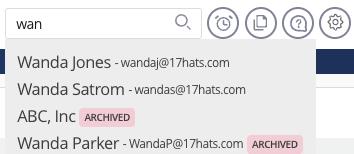
Archived Contacts in Search
Finding active contacts just got easier! Archived Contacts will now appear at the bottom of your Contact Search results and are clearly labeled as Archived, helping keep your searches cleaner and more organized.
New Feature:
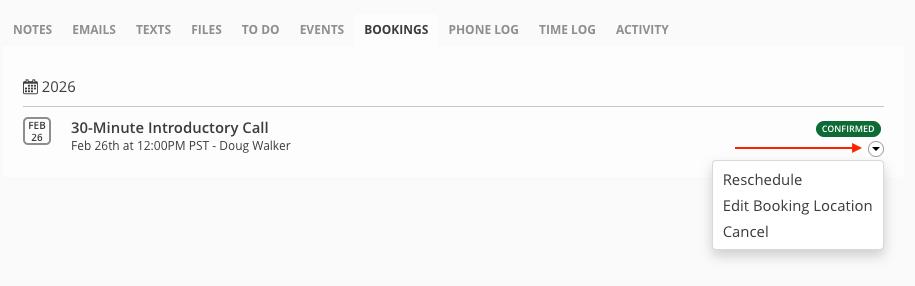
Edit Locations for Online Scheduling Bookings
Need to change a meeting spot? You can now edit the location of an Online Scheduling booking directly from the Project → Bookings tab. Any updates will update the calendar event, future Online Scheduling location tokens, and Project details. — keeping everything accurate and up to date.
New Feature:
Export Questionnaire Responses to CSV
Need to analyze or share questionnaire data outside of 17hats? You can now export completed Questionnaires to a CSV file, including responses from branched questions, file uploads, checkboxes, and Project Details. It’s an easy way to organize, review, and work with your client data however you need.
Feature Update:
Automate with Questionnaire Responses
Questionnaires just got even more powerful! Checkbox questions can now automatically apply Project Tags based on your client’s responses, helping you trigger Workflows, move Projects into Pipelines, and automate your process with less manual work.
Feature Update: SMS Usage Tracking & Alerts
Stay on top of your texting usage with new SMS segment tracking! You can now see how many segments each message uses, plus receive Dashboard alerts if you exceed your monthly allotment— giving you better visibility into your SMS activity and billing.
Feature Update: Edit Invoice Issue Dates
You now have more flexibility when creating invoices! Invoice Issue Dates can now be edited to a past or future date without affecting due dates or payment schedules, making it easier to match your billing timeline and workflow.
Feature Update:
Additional Formatting Options in Questionnaire Questions
We’ve upgraded the text editor in Questionnaires! You’ll now have more formatting options when customizing “Text” in Questionnaires — giving you greater flexibility in how you communicate with clients.
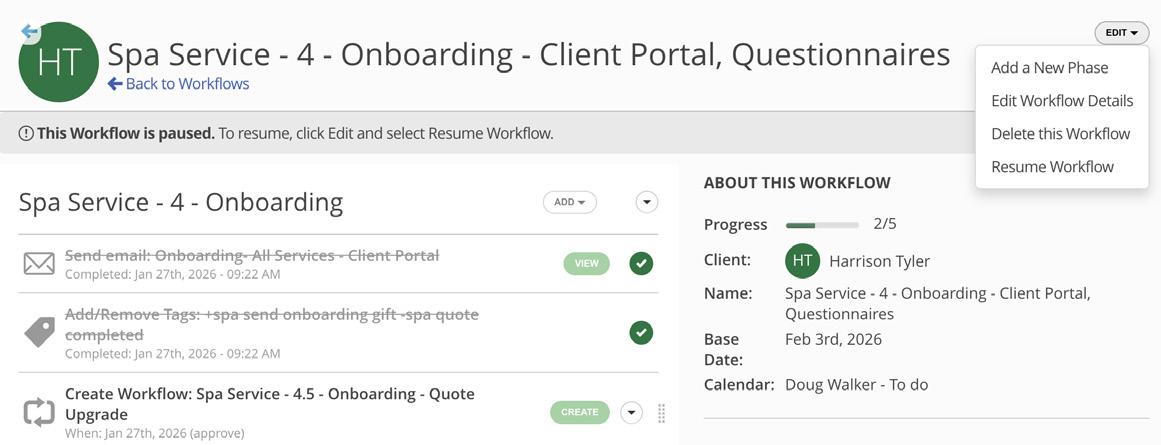
Feature Update: Pause and Resume Workflows
You can now pause and resume active Workflows with ease! This gives you more control over timing without deleting or rebuilding steps, and temporarily removes related notifications until you’re ready to pick things back up.
$topDiscounting
Do This Instead.
The question shows up in every small business group, usually on a slow Tuesday: "Should I run a sale?" The honest answer is almost always no.
Discounting feels like a strategy. It looks like action. But in most cases, it costs more than the revenue it generates.
What A Discount Actually Says
When you drop your price, you're not just making a number smaller. You're sending a message about what your work is worth.
Clients remember the discounted rate. They tell their friends about it. The next person who hires you at full price either never heard about the sale or missed it — and the client who got the deal will wonder why they should pay more next time.
There's also the psychology of it. Services that go on sale feel like commodities. Commodities get compared on price because there's nothing else to compare. If your work competes on price, you're in a race you can't win. Someone will always be cheaper, and they'll find a way to go cheaper still.
The Real Problem Discounting Is Trying To Solve
Most business owners reach for a discount when one of a few things is happening: bookings have slowed, a prospect pushed back on the price, or there's a quiet stretch that feels alarming.
But in each of those cases, cutting the price usually isn't the fix — it's a workaround for something else. Slow bookings often point to a visibility problem. Price objections from prospects often point to a value communication problem. A quiet stretch might mean it's time to revisit your lead sources or follow up with past clients, not slash your rates and hope someone bites.
Before you discount, ask yourself: what is this actually solving? If you can't answer that clearly, you probably shouldn't do it.
What Works Instead
Add value without reducing price. If a prospect is hesitating, consider what you could add to make the offer more compelling — an extra deliverable, a faster turnaround, or
an extended follow-up. This preserves the price while addressing the perception that it's not quite worth it. It also gives you useful information: if the added value closes the deal, you'll know what to lead with next time.
Offer a smaller entry point. Rather than discounting your main service, create a lowercost option that leads into it. A 60-minute consultation before a full engagement. A smaller project before a retainer. The client experiences your work at lower risk, and you get a foot in the door without undermining your core pricing.
Use real scarcity. "Book this month and save 10%" is arbitrary. But "I have two openings left before the holidays" is real. Scarcity tied to genuine capacity is a legitimate reason to act now — and it doesn't require you to drop a dollar.
Have the conversation. When a prospect says your price is too high, ask what they were expecting to pay. Sometimes the gap is smaller than it seems. Sometimes they're comparing you to someone who doesn't do what you do. Sometimes they're the wrong client. You can't know until you ask.
Fix the positioning. If price objections are frequent, the problem probably isn't the price — it's how you're communicating the value. The strongest response to a discount request is a clear answer to "why should I hire you specifically?" When that answer is compelling, price matters less.
When Discounts Are Fine
This isn't a blanket prohibition. A reduced rate for a referral, a longtime client, or a situation where you genuinely want to help makes sense. Promotional pricing tied to a specific, meaningful event — a launch, a milestone, a partnership — can work too. The difference is intention. You decide the terms in advance, for a reason, with a clear end date. That's a different animal than panicking in a slow week and cutting your rate to see what happens.
The Real Cost
Every time you discount without a good reason, you're not just losing revenue on that booking. You're training yourself to see your rates as negotiable. That's a harder habit to break than a slow week.
Your rates exist because your time has value. Defend them like it.

4 Steps To A Better Money Mindset
Why is having a good money mindset important? If you don’t believe in yourself and see the value of the service you offer, you cannot expect others to believe it either. When you see competitors charging more and booking confidently, you need to know that the same is possible for you. There is room for everyone to make money. These four steps can help you improve your money mindset and avoid the opposite effect: burnout.
1. Raise your Prices No really, raise them.
Sounds easier said than done, right? But what would happen if you increased pricing right now? Could you raise $100? Even $10? What are you afraid of?
Most people immediately think, “I’m afraid of losing clients.”
The negative talk of assuming clients cannot afford us must stop. We cannot build a sustainable business around fear. If you want clients to value your work, you must value it first.

As a photographer who went from $40 sessions (yes, 4-0) to now having an average of $3,000 per client, I understand the struggle and the nerves that come with it.
Your pricing should reflect your time, experience, talent, service, and final product. Constantly undercharging does not just lose you money, it creates resentment and burnout.
2. Know Your Ideal Client Who is your ideal client anyway?
You cannot expect to dance into the perfect market if you do not truly know who you are trying to sell to. Your homework is to make a list of who your ideal client really is.
Be honest. Is your ideal client looking for budget-friendly? Probably not.
Think about high-end stores you have been in before. Did they have sale signs all over the store? Definitely not. So why are you doing that?
Sales on Facebook, buy-one-get-one offers, and discounts galore may be sending the wrong message if your
goal is to attract clients who value the full experience. When thinking about money mindset, we do not want to give everything away. Clients can and should pay for your talent and expertise.
Back to your ideal client: Do they invest in travel, designer items, technology, family time, convenience, quality, or experiences?
After you make this list, ask where you could naturally network with these clients: galas, school functions, boutiques, salons, local businesses, coffee shops? Or ask what collaborations could place you inside their circle?
The takeaway here is that there is always someone who can afford you. Your job is to figure out who they are.
3. Automate and outsource
If you’ve been in business longer than five minutes, you know many business tasks are not especially fun.
If you have a long list of tasks that are continually being procrastinated, it is time to look at what could be automated or outsourced. A quick way to burn out is by letting those tasks pile up until they feel impossible to manage.
Fortunately, 17hats makes this easier for us, business owners. Features such as online scheduling, workflows, automatic emails, and even bookkeeping can all be accomplished from within the software! Need to take it a step further? You can even use their Marketplace Services to have someone set it up for you. Overwhelmed by pipelines? Outsource it. Dreading email marketing? Outsource it. Avoiding bookkeeping, website updates,
or any other task that drains you? Find someone who can do it well and finish the job.
Knowing when to invest in yourself is a major key to a better money mindset. Make a list of the tasks you dislike and find ways to lessen the burden so you can focus on the parts of business that make you money.
4. It’s You vs. You
We’ve all heard the phrase “Comparison is the thief of joy.” Nothing kills momentum faster than feeling good about your business, but then seeing a competitor and questioning everything.
Then the voices start. “Why can’t I get that kind of client?” or “What are they doing that I’m not?”
A good money mindset is about more than affirmations. Once you have a solid foundation in place, it is time to stop measuring your success against someone else’s highlight reel. Imposter syndrome is real, and it can quickly rob you of your confidence.
Block the haters. Then unfollow anyone who makes you feel less than, even if they are not doing anything wrong. A good rule of thumb for social media is this: do they inspire you more than they fuel negative thoughts? If the answer
is yes, keep following. Positive role models in your industry are a good thing! But if you constantly feel pressure or self-doubt when you see their content, take a break.

No one is watching your follow list. Protect your mindset because it shows up in how you lead, sell, and serve your clients.
Final Thoughts
These four tips can help you build a better money mindset and avoid burnout. Look honestly at your pricing, ideal clients, systems, and self-confidence.
There IS room for you to make money. Your value starts with you.

About The Author
Tori Bornholdt is a high school senior photographer based in Eureka, Missouri, known for creating a full-service portrait experience that feels personal, polished, and worth investing in. She helps clients feel confident from planning to final artwork while also educating photographers on pricing, sales, and sustainable business. Connect at www. toribornholdtphotography.com.

Numbers Every Small Business Owner Should Know by Heart
Most business owners can tell you what they charged their last client. Fewer can tell you whether that number actually worked for them. These six figures are the difference between running your business and just reacting to it. The best part is that you don't need an accounting degree to track them.
Monthly Revenue Target
This is the number your entire business should be built around, and most people don't have one.
Your monthly revenue target isn't just a wish — it's a calculation. Add up your overhead, your owner's pay, your savings goal, and your tax set-aside. That total is the minimum your business needs to bring in each month to actually be working.
Without it, every month starts without a finish line. You're taking clients, sending invoices, and hoping it adds up. Sometimes it does. Often it doesn't — and you won't know until it's already a problem.
Start here. Everything else in this list feeds into this number.
Monthly Overhead
Before you earn anything, the business already owes money. Software subscriptions, insurance, a business phone line, your website, any tools or equipment you maintain — that's your overhead. The fixed cost of keeping the doors open.
Most business owners guess this number low. Pull your last three months of business expenses, average them, and separate anything personal. The real figure is probably higher than you think, and knowing it is the only way to know whether a project is actually profitable.
Tax Set-Aside Percentage
This one is less about business strategy and more about not getting blindsided in April.
When you're self-employed, taxes don't get withheld automatically. Every payment that hits your account includes money that isn't yours to spend. A common starting point is setting aside 25 to 30 percent of every payment into a separate account before anything else gets touched. A tax professional can give you a more accurate figure based on your income and location.
Treat it like a line item. Build it into your pricing if you haven't already. The bill comes regardless of whether you've planned for it.
Profit Margin
Revenue is what comes in. Profit is what stays. They're not the same number, and confusing them is one of the most common ways a fully booked business still ends up broke.
Your profit margin is what's left after expenses, expressed as a percentage of revenue. The formula: revenue minus expenses, divided by revenue, multiplied by 100. For most service-based businesses, a healthy margin falls somewhere between 20 and 30 percent — though that varies depending on your industry and cost structure.
If your margin is lower than that, the fix might be pricing. But it might also be scope creep, unpaid revision rounds, or overhead you've stopped questioning. The number tells you something's off. You have to dig to find out what.
17hats tip: In 17hats, you can assign expense transactions directly to a specific project in bookkeeping. Once you do, that project's page shows a mini profit and loss breakdown so you can see exactly what each job actually made you. That's a different conversation than looking at your bank balance and guessing.
Average Project Value
Take your revenue from the last 12 months and divide it by the number of projects you completed. That's your average project value.
Pair it with your monthly revenue target and the math gets very clear: divide your target by your average project value and you know exactly how many clients you need each month to hit your goals. No more guessing.
Small pricing adjustments, tighter packages, or simply reducing the unpaid extras you've been absorbing — any of these can move your average project value up in ways that compound fast.
17hats tip: The Client Sales Report in 17hats calculates your average sale automatically. Set a date range, pull the report, and it'll show you the total invoiced, number of invoices, and average sale per client — no spreadsheet required. It's a fast way to see where your revenue is actually coming from.
Effective Hourly Rate
This is the one most business owners are afraid to calculate. It's also the most useful.
Your effective hourly rate is your actual earnings divided by your actual hours — and "actual hours" means everything. Client calls, emails, revisions, admin, prep work. Not just the hours you billed for.
For most people, the real number is significantly lower than the rate they think they're charging. That's not a reason to panic. It's a reason to look at where the time is going and decide whether that's where it should be going.
Knowing this number makes pricing conversations easier. It makes scope conversations easier. It makes the decision to raise your rates easier — because you're not guessing anymore.
You don't have to track all six of these at once. Start with the one that feels most unfamiliar — that's usually the one doing the most damage. Once you've got it, the others start to make more sense. The numbers are already in your invoices and bank account. They just need to be pulled out and looked at.

WRITTEN BY KINÉ CORDER
Being a small business owner is complex whether you have a team or you are a solopreneur. When you decided to photograph weddings, walk dogs, teach yoga, or bake specialty cakes you probably did not realize how many hats you would have to wear. And you never stopped to think about how the most stressful hat, managing money, would affect your business success. That's because most business owners don't realize you had beliefs about money long before you ever made your first dollar.
Someone triggered your money story, and it wasn't you. That story was handed to you by society, your family, your community, even social media. Most business owners are still living that story and calling it their financial
situation. I know you've read content about your money story before, but it's usually only designed to reach your conscious brain. It's helpful to get you to think differently about money and that happens in the conscious brain. This article goes deeper. Your Money Mentality lives in the subconscious and that is the difference between knowing better and actually doing better.
As a Financial Hypnotherapist I have spent years watching this show up in real businesses in ways that have nothing to do with spreadsheets and everything to do with the story underneath them. For example, I'm currently working with a man who owns a chain of spas. He keeps forgetting to pay bills. Not because he does not have the money, but
because his grandmother taught him to sit down one day a week and handle everything personally.
That worked for his grandmother who owned one hair salon. And it even worked for him when he had one location. It does not work when you own three spas and you've hired an accounting and bookkeeping team that you're not letting do their job. Every week he would become frustrated, looking at the spreadsheet, and feel like the spreadsheets and the accounting team had betrayed him.
The spreadsheet was not the problem, nor was the accounting team. The problem was he felt like he would be betraying his grandmother if he changed the system she taught him. His grandmother's voice was running his business finances, even though it wasn't working anymore.
It took real emotional work for him to honor what she taught him and still build a system that actually served his growing business. His conscious brain knew exactly what to do. His subconscious was listening to grandma. It wasn't his fault and grandma wasn't wrong. But it was time for him to take responsibility for his current situation and make adjustments.
What if your situation is not your fault? What if the problem is not the spreadsheet but the emotion driving the decision about the spreadsheet? We think we are making logical decisions. In reality we are having emotional reactions. Like my client, your Money Emotions are not your fault, but it is your responsibility
to examine them. Not all emotions are bad. But the only way you know what is working is to look deeper.
There are 5 categories of Money Emotions. Four of them are where most business owners are operating right now without realizing it. These Money Emotion categories are Fear, Lack, Lust, and Lonely. The fifth is more positive, where my system takes you. That is Mission-Based Money Emotions. This is what we as business owners aspire to.
These Money Emotion categories are connected. Some emotions lead to others and certain money personalities experience them more intensely than others. Fear-Based Emotions are the most common and likely the origin of all the rest. The only fear we are born with is the fear of the unknown. That is what being afraid of the dark actually is. You do not know what is in the darkness that could harm you so your brain protects you by making you afraid.
In business there are a lot of unknowns. When you are not confident about your numbers, Fear-Based Emotions become louder. Fear of making a mistake, fear of being taken advantage of, fear that as the money grows it will somehow disappear or be taken away.
Those fears can trigger Lack-Based Emotions. Suddenly you do not have enough, know enough, or do enough. You look at other business owners and feel inadequate even when your business is thriving. You cannot see the accomplishment because all you see is what is missing. What did not get done,
what got missed, what the business could not afford this month. Lack-Based Emotions can keep even the most savvy business owner from making the move that would change everything. The brain decides they cannot afford it, even when the business can.
Lust-Based Emotions move in the opposite direction. These business owners do not compare themselves to others, they compete. They make the business look beautiful on the outside while it hemorrhages on the inside. They know the burn rate but they ignore it. Lust-Based Emotions are where greed hides and too much greed can lead to shame and guilt. Just ask Andrew Carnegie. He accumulated one of the greatest fortunes in history and though he was known for his ambition, shame eventually moved in. He knew something had to change. That shift changed him in time for him to change his legacy.
The Money Emotions I see most often are Lonely-Based. Even though Fear and Lack are more common they tend to make people freeze. Lonely-Based Emotions create urgency. These business owners feel isolated, unappreciated, and misunderstood. They are tired of not fitting in and are looking for a place where standing out is ok. They have had enough of the adrenaline, dopamine, and cortisol that a fluctuating business brings. They are not looking for more hustle. They are looking for peace and connection.
This is when they join mastermind groups or find a Financial Hypnotherapist like me. And that search is what opens the door to MissionBased Emotions.
When you run a service based business your product is often you. Many service based business owners do not go into it purely for money. They go in for love, passion, and purpose. For some it feels like a calling. You see the vision and you want it to come to life so you set out on a mission.
Then a pandemic happens. A fire breaks out in the kitchen. The building your office is in gets sold and the rent increases. A child gets sick for weeks and you can't run the business properly. When all of the normal mishaps of business and life happen, you get worn down. You lose sight of not only the vision, but the mission itself.
But it's still inside of you. That mission is what gets you up in the morning and keeps you up at night. When the hustle is quiet enough for you to hear the roar in your belly you find your way back. Back to the honor you feel with every client. The belief you have in your service promise. The accomplishments you force yourself to celebrate. These are MissionBased Emotions. And they are the destination.
Your vision may get blurred by spreadsheets, cash flow problems, and rising vendor costs. But one day you awaken and the vision is clear again. The mission is still burning in your belly and something sparks the fire to grow again. You stop letting your grandmother's advice or social media guide your decision making. You stop reacting and you start following the numbers because you've conquered your old money story and you know the why behind the numbers.

You may never love spreadsheets, but by examining your Money Emotions you overcome the Fear, the Lack, the Lust, and that Lonely feeling that used to drive your decisions. You are taking responsibility for your money story and taking action to shift it.
If you are open to taking the first step, start by examining your money story and emotions today.
Become aware of which Money Emotions you feel most often. Think about how often it happens and what action you usually take when the feeling arrives. Those are your patterns. You do not have to change them today. Just notice them.
One easy way to go deeper is to identify your dominant Money Mentality type. Your money mentality is based on what Money Emotions you feel most often. Once you have clarity you can begin taking action on shifting away from Fear, Lack, Lust, and Lonely Based emotions and move toward Mission-Based Emotions.
Once you know your type you will have even more clarity around the emotions you feel, the patterns they trigger, and you can make a decision on exactly what you’d like to do to shift.
I want you to know, you are not alone. I know it feels like it, but I work with business owners who feel this exact same one. The first thing a lot of them did was take the Money Mentality quiz, because sometimes just having a little more clarity makes the emotions go away. You are not the only business owner feeling confused about your numbers.
Running a business can be a heavy lift. But when your money emotions become intact you become a stronger leader and your money hat feels more like a crown.

About The Author
Kiné Corder, known simply as Kiné, is a Financial Hypnotherapist and the creator of the SelfSync System. With nearly three decades of experience researching the intersection of money and mental health, she helps business owners identify the subconscious patterns driving their financial decisions and replace them with clarity, confidence, and purpose. Over 6,000 people have taken her Control the Controllable meditation course.
PaymentSchedules Everybody Wins With
WRITTEN BY JEBB GRAFF
There’s a good chance your business has experienced cash flow issues at times and the same applies to your potential clients. Offering a payment schedule can help clients say yes when they otherwise would have moved on to a different business that’s more in their “right now” budget and it lets you meet clients where they are without taking on more financial risk than you're comfortable with.
Payment schedules benefit both you and your clients. Clients are less likely to walk away when they're looking at spreading out the cost of your service in payments instead of one large number. That reduced sticker shock can mean more conversions and when a client isn't stretched by a lump-sum payment, they often find more room in their budget to consider premium packages or add-ons they'd have otherwise skipped.
On your end, structured payments keep money coming in. Instead of waiting until a long project wraps to see any revenue, milestones bring income in throughout the work. An upfront retainer fee (sometimes nonrefundable depending on your service offering) also secures the client's commitment before you've invested significant time or work which lowers the risk of nonpayment once the work is done.
In addition to these practicalities, offering flexibility communicates that you understand your clients'
financial realities and shows goodwill and empathy which is great for relationship building.
Choosing the Right Structure
The right payment structure depends on how your projects are scoped, your own business needs, and your clients’ individual situations. Milestone-based payments make sense for fixed-scope work with clear phases like design projects, writing services with drafts, video packages, etc. You're tying payments to deliverables, which keeps both sides accountable and gives the client a natural sense of progress. A common starting point is 25-50% due at quote acceptance, with the remainder split across one or two later milestones, but you can adjust those percentages to fit your business’ process and your client's situation.
For longer engagements without hard phases or for clients who need predictability, equal monthly payments may be easier to sell. There's no gray area about when or how much is due and it's the same amount on the same schedule.
Regardless of the types of products and services you offer, you can choose the type of payment schedule that works best for your business. From your client's perspective, the experience is clean regardless of which structure you use. They get one invoice, the payment schedule appears at the bottom of that invoice, and
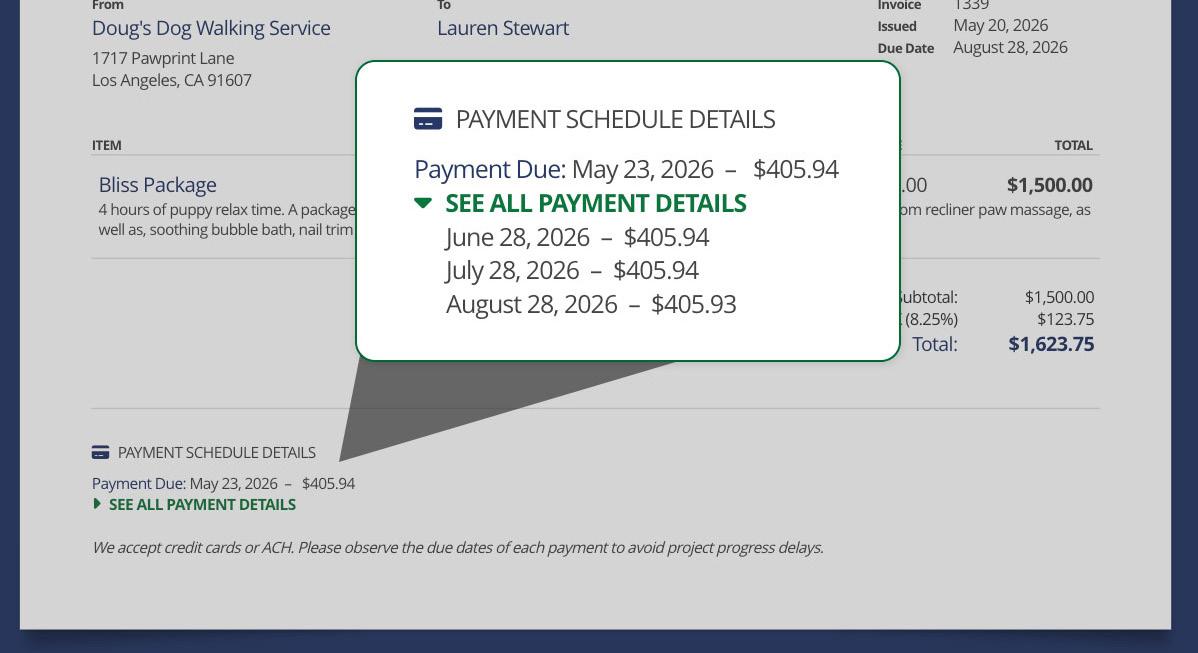
because the URL stays the same, they can check it anytime to see what's been paid and what's due next. They won’t have to search through emails to figure out which invoice went with what payment.
Note: Payment schedules are not the same as recurring invoices. A recurring invoice bills the same amount on a repeating cycle as separate invoices while a payment schedule takes a single project total and divides it into installments that all add up to the original amount. Recurring invoices are great for subscription based services like maintenance plans and service retainers.
When you connect your 17hats account to Stripe, you have the option to allow clients to opt in to save their card info and have future payments charged automatically. It’s convenient for them and keeps you from turning your business into a part-time collections agency.
How to Do It in 17hats
Open a quote or invoice that has at least one line item, then check the Payment Schedule box.
Choose between two options, Equal Payment Schedule or Custom Payment Schedule. An Equal Payment Schedule splits the total evenly. Set a start date, number of payments (up to 12), and frequency, and
17hats does the math. This works well for monthly billing arrangements where consistency is the priority.
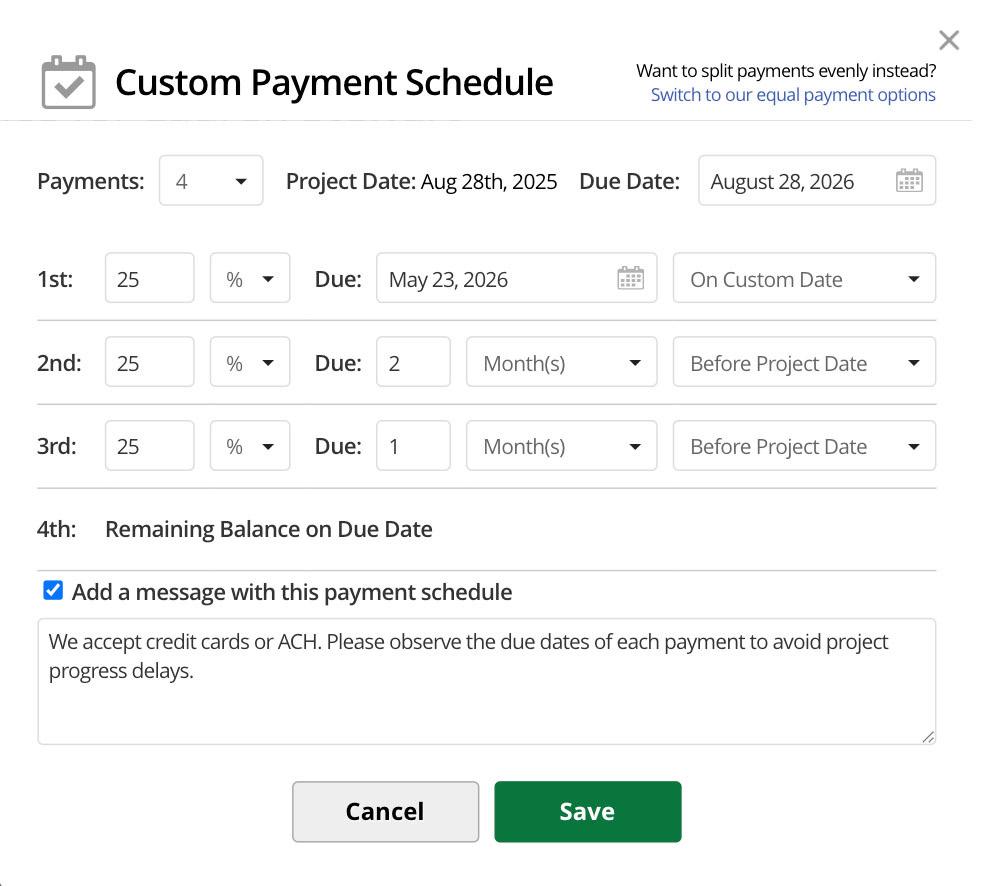
Custom Payment Schedules give you full control. Set the number of payments (up to 12), assign each one a due date (based on when the invoice is received, the project date, the final due date, or a specific date of your choosing), and enter each amount as a dollar figure or a percentage. This is a great fit for milestone-based projects and services where each payment corresponds to a phase of the project. The final payment always falls on the invoice due date set at the top of the settings window.
You can attach a short message to the schedule which is useful for clarifying your preferred payment method or reminding clients of your late payment policy in context right when they're looking at the schedule itself. You can edit or remove the schedule anytime in the Quote or Invoice editor.
Reminder: Invoices with payment schedules can't also be set up as recurring invoices, so you’ll want to determine which is more appropriate for your service before creating the quote or invoice.
Why Getting Paid the Wrong Way Is Costing You Money Right Now
You're getting paid. Maybe not always on time, and not always in the way you'd prefer, but the money is coming in. So the payment side of your business is probably fine, right?
Not necessarily. How you get paid might be working against you — slowing cash flow, creating friction with clients, and leaving real money on the table. The fix isn't complicated, but you have to know where to look.
Accepting cards isn't a luxury. It's a baseline.
When you send an invoice with a payment link or give clients a way to pay by card, you're signaling something: you run a real business. One that takes client convenience seriously and handles transactions the way every other professional does.
Yes, you'll pay a processing fee. That's normal. A payment processor typically charges somewhere between 2.5% and 3.5% per transaction, depending on card type and how the payment is submitted. That's a cost of doing business, the same way software subscriptions and phone bills are costs of doing business. You factor it into your pricing and move on.
What you don't want is to be caught off guard. Know your rate. Know whether you're on a flat fee or a tiered structure. Know if there's a monthly platform fee on top of your per-transaction cost. None of this needs to keep you up at night. But your fees should be accounted for in your pricing — not discovered after the fact.

Slow collection is a cash flow problem, not a client problem.
Timing is a bigger issue than fees.
There's a gap between the moment you finish the work and the moment money hits your account. How wide that gap is depends almost entirely on your payment setup. If you're invoicing days after the job wraps, giving clients a 30-day window,

sending one reminder, and following up manually — that gap gets long fast. And your expenses don't pause while you wait.
Slow invoicing creates slow payment, which creates cash flow pressure that has nothing to do with how busy you are. If you're billing $8,000 a month and consistently collecting 45 days late, you're effectively running without a
cushion. If anything unexpected hits — a slow stretch, a big expense, a client dispute — there's no buffer.
The fix is straightforward: invoice immediately, make payment easy, and follow up on a set schedule. The sooner money comes in, the more control you have.
If paying you is inconvenient, clients notice.
A PDF invoice with no payment link, a Venmo handle they have to track down, a check-only policy — these aren't just small annoyances. They slow down payment and signal that working with you is more complicated than it needs to be.
Ease of payment is part of the client experience. A client who clicks a link and pays in two minutes feels differently about working with you than one who has to find their checkbook. The first one is more likely to come back. The second one might shop around next time.
Make it easy to pay you. One link, one click, done.
No deposit means no leverage.
Collecting nothing upfront is not only a financial risk, but a structural problem as well. When you do the work first and invoice after, all the leverage sits with the client. A deposit changes that. It confirms commitment, covers your initial time, and means that if something falls apart before the project ends, you're not absorbing the full loss.
This isn't about distrust. A deposit is a standard business practice, and most clients expect it.
Start with an audit.
Take ten minutes and look at your current payment setup. What does it actually cost you to get paid? How long does it typically take from invoice to deposit? Those two numbers will tell you a lot about where your setup is working for you — and where it isn't.
If you're ready to clean it up, 17hats integrates directly with Stripe so you can send invoices with a built-in payment link, collect deposits, and track what's been paid, all in one place. It's a setup that handles the mechanics so you can stay focused on the work.
WRITTEN BY SONJA N. BARISIC, APR
At the end of 2023, I was wrapping up the most successful year of my career.
Financially, my solo public relations and writing business had never been stronger. I had meaningful clients, exciting projects and the satisfaction of seeing the business I had founded in 2020 continue to grow.
Then, shortly after the new year began, my husband told me he wanted a divorce after 28 years of marriage.
Personally, I was devastated. Professionally, I found myself floundering, but the business still needed me to show up. When you’re a solo business owner, no one else is watching the business for you. No one else is making sure projects are completed, invoices are sent, payments are tracked, and future work is lined up.
I consider myself a fairly organized person and thought I had my records under control. But the stress of divorce revealed the difference between having records and truly understanding my numbers. I wasn’t making nearly as much use of 17hats as I could. I still scrambled at tax time to fill in some of the blanks. While I could see what I had billed, I wasn’t thinking far enough ahead about cash flow or future work.
For a while, I had been fortunate to have a large client on retainer. That steady income gave me a sense of security. But a few months after my marriage ended, that client relationship ended, too. At least that decision was mutual.
Financial clarity means knowing where your business has been, where it stands, and where it may be headed.
Your records aren’t just for tax time
For many small business owners, records become most urgent when a tax deadline approaches. We gather income reports, sort expenses, wonder where we stashed that receipt for coffee with a client and promise ourselves we’ll do better next year.
Clean records matter long before tax time. They help you answer essential questions:
• How much money has come in?
• How much is still owed?
• What expenses are recurring?
• What leads could turn into future income?
I had tried to set up financial systems in the past, but abandoned them quickly because they felt too complicated. I told myself I was a word person, not a numbers person. I needed to be both.
I follow the “Profit First” method, described in the book Profit First by Mike Michalowicz, which encourages business owners to separate income into accounts for owner’s pay, taxes, operating expenses and profit. The bookkeeping function in 17hats helps me track those accounts and transactions in one place instead of reconstructing everything later.
Cash flow deserves more attention than I gave it
One of my biggest lessons was that revenue and cash flow are not the same thing.
A business can have a good year and still experience stressful gaps. Work can be completed but not yet invoiced, or invoiced but not yet paid. When life is stable, those gaps feel manageable. When your personal life suddenly changes, they feel much scarier.
I began paying closer attention to what money was actually coming in, what invoices were outstanding and what work was ahead. Clarity is more comfortable than a vague sense of “I hope things are OK.”
Pipelines showed me what was next
Although I had used 17hats for years, I wasn’t using Pipelines. I was intimidated by them. I thought they might become another overly complicated project management tool I would set up with good intentions and then avoid eye contact with forever.
Then I made time to build Pipelines tailored to my business and the way I think.
In my work ss a writer and PR consultant, my projects range from one-time articles to ongoing communications campaigns. Setting up custom Pipelines helped me organize those moving pieces in a way that made sense to me. I could easily see which projects were leads, active, in need of follow-up or completed.
Financial organization is self-protection
I used to think of business administration as something I had to do so I could get back to my “real” work.
Now I see that better records, invoice tracking, cashflow awareness and organized client work are forms of self-protection. They help you understand the value of what you have built and make decisions based on information rather than panic.
Once I saw that I had enough cushion to weather a slow stretch, I relaxed a bit. I could be more selective about the work I accepted and less tempted by projects that were underpriced or not a good fit.
You don’t have to wait for a crisis to get clearer about your money. Start here:
• Make sure your invoices are current.
• Track what has been paid and what is still outstanding.
• Review recurring expenses.
• Look at your client mix and whether you’re relying too heavily on one source of income.
• Pay attention to what work is coming up.
• Simplify your systems as much as possible.
Use the tools you already have, not just the parts you
learned during your initial burst of enthusiasm. For me, that meant making more intentional use of 17hats.
When life changes, your business records matter more than ever. They can’t prevent hard things from happening, but they can help you keep going when they do.

About The Author
Sonja N. Barisic, APR, is the founder of Sunflower Communications, where she helps businesses and nonprofits tell clear, compelling stories through public relations, writing and strategic communications. An accredited public relations professional and former Associated Press journalist, Sonja has more than 30 years of experience in journalism, PR and nonprofit marketing communications. Connect with her at sunflowercommunicationspr.com.

WRITTEN BY MARIETTE MARTINEZ
Every solopreneur deserves a money ritual worth showing up for
You're the one who answers the emails, books clients, delivers the work, posts on social media, and somehow still finds time to be the visionary for the business. You have worn every hat and worn them well. But somewhere between the busy week and the even busier month-end, something is sitting in the background.
Is it a report you keep meaning to run? An invoice still uncollected? Last month's numbers that slipped by before you could look at them?
You know it's there. You just cannot find the energy to wear another hat this week, especially if it has to do with your numbers.
Here's what I know after three decades supporting solopreneurs just like you: that feeling is not guilt, or a character flaw. It is a habit gap, and it can be fixed one money date at a time.
What if your next financial check-in felt less like a report card and more like a loving ritual you genuinely looked forward to? That is the Money Date, a biweekly, intentional ritual that makes your business feel loved and will change the way you show up for your numbers from now on.
The biweekly ritual that makes your business feel loved
The Money Date is a one-hour appointment with your business finances every two weeks. Not a tax-season scramble. Not a once-a-year guilt scroll. A recurring intentional ritual that is completely yours, and the cadence does matter.
Monthly check-ins leave too much time between each date. By the time you finally sit down, the backlog feels heavier than it needs to, and the overwhelm keeps you stuck. Weekly sessions don't give your business enough time to show you meaningful movement. Every two
weeks is the sweet spot and creates just enough time to see real progress and feel genuinely connected.
Think of it like any other muscle you've developed in your business. Your money management muscle works the same way. It strengthens through repetition and through the simple but powerful act of honoring your date each time.
Every time you sit down for your Money Date, you're making a deposit into your financial confidence. The first few dates you are building the habit, and by the fifth you are speaking about your numbers with ease. By the end of the year, you'll know your numbers because you showed up every two weeks and let the reps do the work.
That's how a money habit becomes a financial management strength. One Money Date at a time.
That's why we call it a Money Date and not a bookkeeping appointment, because a date feels like something worth showing up for and getting excited about.
Setting the stage for a Money Date you can look forward to.
Your Money Date gets its own environment, and it deserves one. Before you sit down, clear your desk. Not perfectly, just intentionally. A cleared surface is a signal to your brain that this hour is different from everything else you did this week.
Then bring in what makes you feel good. Brew your favorite latte or steep something energizing. Having something warm in your hands makes the whole experience feel more like the loving ritual it's meant to be. Add a soft scented candle if that is your thing, put on a playlist that helps you focus, and close every tab that is not money or bookkeeping-related.
Then, before you open a single window or report, take one deep breath.
Breathe in slowly for four counts. Hold for four. Release for four.
That breath is the transition. It's the moment the busy solopreneur wearing all the hats steps aside and the Intentional CEO steps in.
And now that you are fully present, it is time to give your Money Date a framework that makes every single session focused, clear, and repeatable, no matter what season your business is in.
The Solopreneur Money Management Framework
The framework is called MIMO. Money In and Money Out. It is the most intentional way to read your business finances that I know and after three decades of building financial confidence alongside solopreneurs, it's the one tool I come back to every single time.
Two Money Perspectives. Two Proactive Questions. One Complete Money Picture.
Here is how to move through it. Money In. What came into your business during this period?
Every payment received, invoice cleared, deposit confirmed. Don't just focus on total, this is your chance to look at your revenue streams individually. Which revenue streams showed up strong this period? Which ones were less than expected? Is what came in this period different from last period and if so, what changed?
These are business strategy questions that help you decide where to put your energy, what kinds of clients light you up to generate the income you want, and what products or services are worth growing, refining, releasing, or creating from scratch.
Your Money In conversation is where the Intentional CEO starts to see not just what the business earned this period but what the business is capable of and where it wants to go next.
Money Out. What left your business during this period? Every subscription, every tool, every operating cost, every unexpected charge.
As you look at this, ask yourself: Is anything here growing without my permission? Is there anything I'm paying for that no longer serves the business? Is what went out significantly different from last period and if so, what changed?
Now here is where you go deeper because Money Out is not only about costs. It's a full picture of how you are investing in your business and in yourself.
Have you invested in your growth this period? A course, a tool, a coach, a resource, or an asset that moves your business forward? That is intentional money out and it tells a very clear story about how you are choosing to grow.
Are you considering bringing on a contractor or a team member? Are you looking at a larger investment in your business infrastructure? These are the Money Out conversations that signal expansion and they deserve a seat at your Money Date table every single time.
And the most important Money Out question of all: are you paying yourself?
This is the conversation that most people skip or push to later, and later never seems to arrive. You pour everything into your business, but paying yourself is not a reward for when things get more stable. It is a financial habit you build now, in small consistent amounts, that grows right alongside your business.
Now that you've explored the two perspectives, it’s time to ask the two proactive questions.

What Is Outstanding?
This is the money your business has already earned and is simply waiting to collect. Invoices out, payments pending, deposits expected or in transit. When you know what's outstanding, you start to look at your business proactively.
What does your cash position actually look like once everything clears? If payments aren't coming in as quickly as you need them to, what does your collection process need? This proactive view of your cash flow is one of the most important financial literacy skills you can build as a solopreneur, and your Money Date is exactly the right place to strengthen it.
What Is Ahead?
This is the question that brings the Intentional CEO fully into the room.
What income are you expecting in the next two weeks and beyond? What expenses are on the horizon? How can knowing your current numbers help you with upcoming decisions? What are you planning, building, dreaming, or most excited about stepping into next?
This is your money planning moment. This is where your Money Date transforms from a review of what already happened into an intentional vision for what is coming. This is where you move from reacting to deciding. From following to leading. From wondering how the business is doing to knowing exactly where it is going and choosing that direction with confidence.
About The Author
Hi, I'm Mariette, founder of MasterYourBooks, where I help growth-ready entrepreneurs and their accounting partners build confident, financially healthy businesses. With 20+ years in small business accounting and tax, I deliver business education and transformative learning experiences that turn overwhelm into clarity because we were never meant to figure out business alone.
You can find me cheering my community on at: https://mybcommunity.circle.so
Money In. Money Out. What Is Outstanding? What Is Ahead? That’s the entire Solopreneur Money Management Framework. And it’s all yours now!
Now for the final act that makes every money date feel complete and worth celebrating.
• Start with one win from this period. No matter how quiet or small, every moment of progress counts, and it belongs in this loving, supportive space.
• Name one intentional step or money habit you will be working on before your next date.
• Schedule your next Money Date on your calendar before you close a single tab.
That is your MIMO complete. That is your business heard, seen, and loved in just one hour.
Your 17hats Account Is Already Set for Your Money Date
If you are a 17hats user, every MIMO answer is already inside your account, organized and waiting. You are not building the picture. You are stepping into one that has already been painted for you.
• Your Profit and Loss Report answers Money In and Money Out instantly.
• Your Aged Receivables Report answers What Is Outstanding, every open invoice organized by how long it has been waiting.
• Your Upcoming Receivables Report answers What Is Ahead, every scheduled payment coming in over the next 30 to 90 days.
This Is Your Love Letter Back to the Business
You have worn every hat for this business. The visionary. The operator. The closer. The creative. But somewhere in the middle of all of that, the money conversations kept getting pushed to later.
This is your invitation to replace Later for Today. You now have the MIMO framework to guide every session. You have your 17hats reports ready to answer every question. You have a ritual that makes your business feel loved, a cadence that builds your money management muscle one rep at a time, and the knowledge that the Intentional CEO who has been waiting to step forward is already inside you.
When your rhythm is running and your ritual feels like second nature, you are ready to ask the next Intentional CEO question: what’s next and what am I moving toward?
When you add this powerful financial planning tool in your Money Date ritual, you are no longer just tracking your money, you are leading your business on purpose.
The Money Date is not just a ritual. It is the most loving thing you can do for the business you have worked so hard to build. You were never meant to figure this out alone. You are meant to build this business one money date at a time and now you have everything you need to look forward to that date every two weeks, for good.
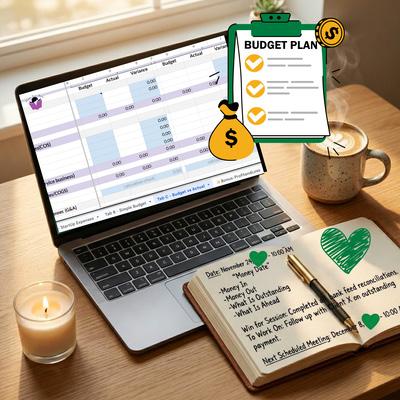
This Step-by-Step PDF Budget Guide + Done-ForYou Business Budget walks you through the process of building a profit-driven business budget. This downloadable includes a comprehensive Done-ForYou Business Budget in Google Sheet format plus a PDF Guide and full video walkthrough so you can budget like a pro starting today!
WRITTEN BY DEB MITZEL

Here's a question I want you to think about... When someone asks how your business is doing financially, what do you base your answer on?
If you're like most small business owners I talk to, the answer is some combination of gut feeling, a quick check of your bank balance, and a general sense that things seem okay. And honestly, for a while that works. Until it doesn't.
Your bank balance tells you what happened. It doesn't tell you what's actually working, which of your services is eating up your profit, or whether you're on track to hit the goals you set at the start of the year. Approaching your business this way is a little like driving while looking in the rearview mirror. You might stay on the road for a while. But pretty soon you'll crash because you won't see what's coming right at you.
The Real Cost of Flying Blind I spent 30 years in operational and financial
leadership before starting my own business, and one thing I saw consistently, across industries and business sizes, is how many otherwise smart and capable business owners were making big decisions based on feelings instead of facts. Not because they didn't care, but because nobody had ever shown them what their financial data could actually do for them.
Most small business owners treat their bookkeeping like a tax document. Set it up, hand it to the accountant in April, and forget about it until next year. Here's the thing though...when you only look at your books once a year, you're leaving one of the most powerful decision-making tools you have sitting on a shelf collecting dust. That's eleven months of information you could be using and aren't.
When your financial data is set up with intention and reviewed on a regular basis, it helps you answer the questions that actually matter. Where should you be spending your
time and energy? What's worth putting money into? Which of your revenue streams is bringing in the most sales, and is that the same one that's actually making you the most money? If those aren't the same answer, that's definitely something worth paying attention to.
Is Your Bookkeeping Actually Telling You What You Need to Know?
Here's where you may have a problem you don’t even know you have. If everything you earn goes into one income account, your books can tell you how much money came in, but they can't tell you where it came from or what it cost you to earn it. And that's information you really need to know.
Think about a business coach who offers one-on-one coaching, group coaching, live workshops, and an online course. Those are four completely different revenue streams, and the profit picture on each one looks very different. Her one-on-one clients pay a premium rate, but that work is completely tied to her time. Her live workshops require considerable prep and delivery hours. Her group coaching splits her time across multiple clients at once, which improves the prep factor a little. But her online course? Once it's built, it generates income without requiring her to show up every time someone buys it. If all four of those are going into one income account, she has no idea which part of her business is actually working hardest for her. She might be pouring energy into filling her one-on-one calendar when a better-built course business could be earning money while she sleeps.
The fix is simpler than it sounds. Set up your income accounts to reflect how your business actually makes money. If you offer services, group programs, digital products, and live events, each one gets its own account. Same goes for your expenses. Group them in a way that makes sense for how you operate, not just the way your system defaulted when you set it up. This is your business. Your books should work the way you work, not the other way around. When your categories match how you actually operate, your reports start telling a story you can actually use to make solid business decisions.
What Changes When You Actually Know Your Numbers?
Once your books are set up to show you the real picture, everything changes. And I mean that in a very practical, no-fluff kind of way.
Consider a home organizer who offers inhome sessions, virtual consultations, and a monthly membership for ongoing support. Her in-home sessions book out weeks in advance and feel like her strongest offer. But when she actually looks at her numbers broken out by service, she might find that her virtual consultations bring in nearly as much revenue in a fraction of the time, and her membership generates steady, recurring income that doesn't require her to be in a car driving across town. Without that breakdown, she keeps pouring her energy into the offer that feels busiest instead of the one that's actually working hardest for her.
That's the kind of information that can change how you make decisions. You can look at
every expense and ask whether it's earning its keep. You can set a real income goal based on what you actually need to earn, not just a number that sounds good, and then track your progress toward it every single month instead of crossing your fingers as December rolls around. You start running your business instead of just reacting to it.
The really good news is that none of this requires a finance degree or a complicated system. What it does require is the right setup on the front end and the habit of actually sitting down with your numbers every month.
Where 17hats Comes In
One of the things I love about 17hats is that it can give small business owners the financial picture they need without requiring a separate accounting platform. But it only works that way when it's set up with intention. That means income accounts that reflect your actual services or revenue streams, not everything lumped into one generic income bucket, and expense categories that actually match how your business operates.
From there, the reporting does the work for you. The profit and loss report inside 17hats shows you exactly where your money is

coming from and where it's going, broken out by the categories you've created. Running that report every month and actually reading it changes something. You stop second-guessing yourself. You stop making decisions in the dark. You walk into every month knowing where you stand, what's working, and what needs your attention. That kind of confidence doesn't come from hoping things are going well. It comes from knowing they are.
Take a few minutes every month to scroll through your transactions and make sure what's recorded in 17hats actually matches what landed in your bank account and what showed up on your credit card statement. You're looking for anything that doesn't add up, a payment a client said they sent that never actually posted, a subscription charge you forgot was still running, a deposit that's showing in your records but never hit your account. It takes maybe 20 minutes and it keeps your financial picture accurate. Small things have a sneaky way of becoming bigger things when nobody's watching for them.
So Where Do Things Stand in Your Business?
Before you can use your financial data to make better decisions, you have to have financial data worth using. And that starts
About The Author
Deb Mitzel is a Small Business Systems Strategist and one of 17hats' original Marketplace Partners. With 30 years of operational and leadership experience, she helps solopreneurs and small business owners build simple, strategic systems so their clients get the best experience possible and they still have time for the things that matter most. Learn more at debmitzelcreative.com.
with getting real about where things stand for you, right now, in your business.
Are your income sources broken out by service, or is everything going into one account? Are you reviewing your numbers every month or only when something feels off? Do you know what you need to earn each month to cover your expenses and actually pay yourself? Do you know which part of your business is making you the most money?
That's exactly why I put together the Do You Really Know Your Numbers Quiz. It's a free 13-question self-assessment that gives you a clear, honest look at where your financial foundation is strong and where there's room to build. No shame, no overwhelm. Just a starting point you can actually do something with, so you can begin running your business by design instead of by gut feeling.
Whether you're setting up your books for the first time or you've been in business for years and something in this article made you wonder if your setup is really working for you, the quiz will show you where to focus first.
Your Business Should Be a Blessing, Not a Burden
Here's what I want you to walk away with. Getting a real handle on your financial picture isn't about becoming an accountant or spending hours staring at spreadsheets. It's about having the information you need to make good decisions for your business, your income, and your life.
When you know your numbers, you stop feeling anxious every time a big expense comes up. You stop wondering whether you can afford to invest in something or whether
you should. You stop operating from a place of uncertainty and start operating from a place of confidence. That's not a small thing. That's the difference between a business that runs you and a business that works for you.
Your business has the potential to be one of the most meaningful, most rewarding things you'll ever build. But it can only get there when you have a clear enough picture of what's actually happening inside it to make the decisions that move it forward. The numbers are already there. You just have to start looking at them.

Most small business owners are making financial decisions every day based on gut feeling and a quick look at their bank balance. This free self-assessment changes that. The Do You Really Know Your Numbers? guide walks you through five key reasons why your financial data matters more than you think, then points you to a free 13-question quiz that shows you exactly where your financial foundation stands right now.

WRITTEN BY TAMMY RYDAHL
For many of us, clutter in the home feels like a minor inconvenience. Something to shove in a drawer or speed clean before company arrives. But clutter often comes with a much bigger price tag than people realize. When most people think about clutter, they rarely think about money.
As a professional organizer in San Diego, I’ve seen firsthand how disorganization quietly drains both time and finances. It usually starts small with buying duplicates of things you already own but can’t find, over buying because nobody knows what’s actually in the pantry, or spending money on storage bins that looked great on Instagram but solved absolutely nothing.
Over time, those little purchases add up.
Clutter also has a funny way of hiding inside abundance. Closets packed with unworn clothing, tags still attached. Pantries with expired snacks, six kinds of pasta, and somehow three jars of peanut butter at all times. Garages storing thousands of dollars in forgotten purchases while the cars sit outside in the driveway year-round. Home offices filled with paper piles, unused gift cards, and the occasional uncashed check hiding in plain sight.

At some point, beautiful spaces stop functioning like homes and start functioning like very expensive storage units.
But the hidden cost goes beyond the stuff itself.
Disorganization costs time and as the saying goes, time is money. Minutes spent searching for lost items, digging through overcrowded drawers, or reorganizing the same space over and over because the system never really worked in the first place. It’s the daily stress of knowing you have something… somewhere.
There’s also the cost of underused space in the home. So many rooms are designed for relaxing or entertaining but slowly become clutter catch alls instead.
The truth is, the new luxury is not having more. It’s knowing what you have, being able to find it, and having a home that works for you instead of against you. Because at the end of the day, organization is not about perfection. It’s about making life easier, calmer, and maybe saving yourself from buying a fourth bottle of olive oil you definitely did not need.
About The Author
Tammy Rydahl is a San Diego based luxury home organizer known for creating elevated, functional spaces that help busy families and homeowners simplify daily life. What sets her apart is her ability to blend organization with her background in interior design, creating spaces that feel intentional, effortless, and seamlessly aligned with the way her clients live. Connect with her on Instagram at @simpleorganization.
Crossword Puzzle: Money

ACROSS
4. The total money brought into your business before expenses.
6. Proof of a purchase or business expense.
7. Document sent to a client to request payment.
9. Money your business earns.
10. What is left after expenses are paid. DOWN 1. Money set aside for future needs or emergencies.
The process of keeping track of your business money. 3. A plan for how you will spend and manage money. 5. The costs of running your business. 8. The money moving in and out of your business.
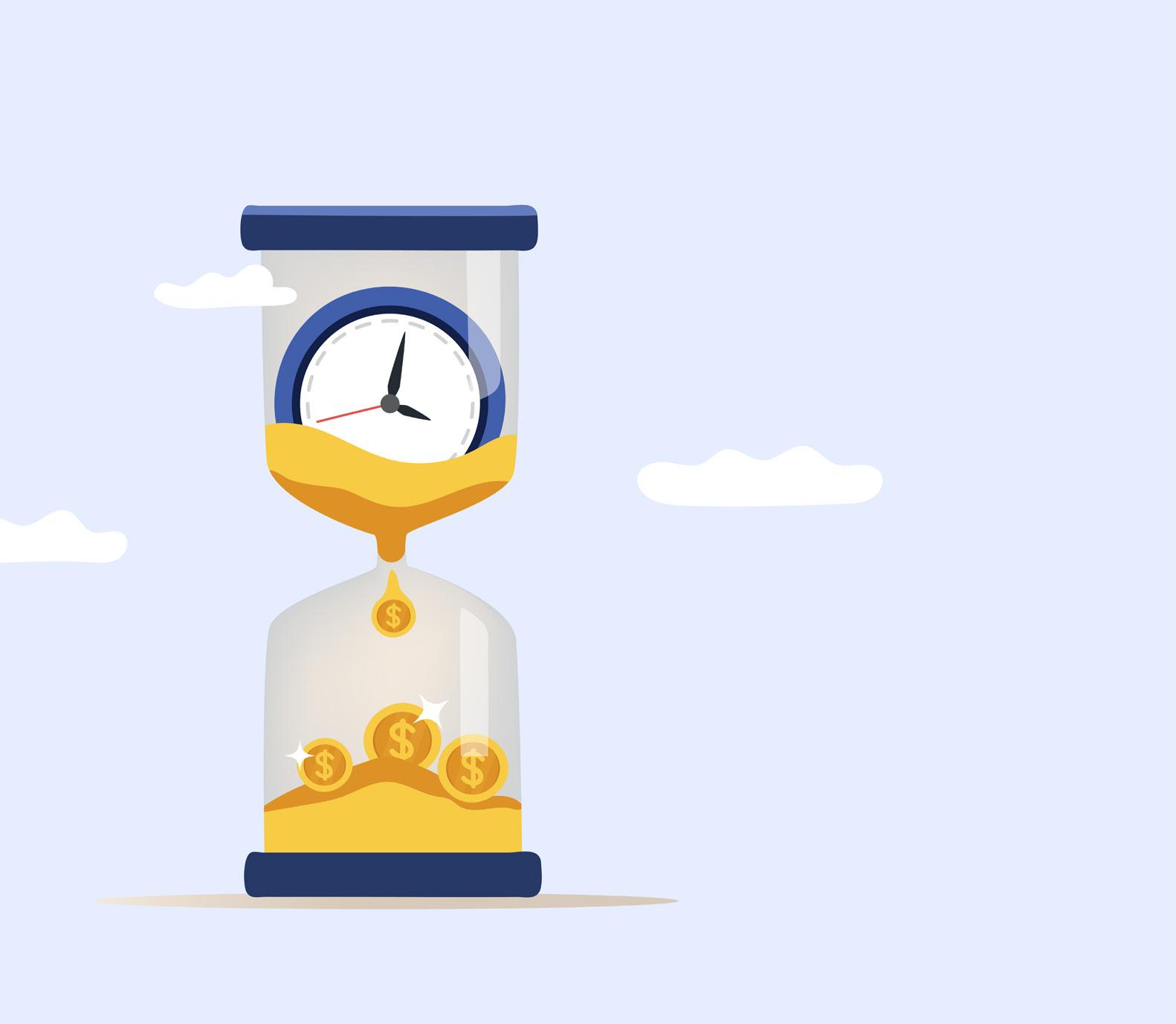
5 Ways Manual Processes Are Costing You Money
Why small operational inefficiencies
leak time, money, and energy
WRITTEN BY KRISTEN LETTINI
You’ve probably heard people talk about the mental load at home — the invisible work of remembering, tracking, anticipating, and managing all the little details that keep life running.
Small business ownership comes with a version of that too.
Following up on inquiries. Checking unpaid invoices. Scheduling appointments. Sending reminders. Remembering next steps.
None of these tasks feel particularly large on their own. But together, they create operational drag that quietly leaks time, money, energy, and attention every single week.
Here are five common ways manual processes may be quietly costing your business money — and how stronger systems inside 17hats can help reduce that operational drag.
1. Delayed Follow-Up Slows Revenue
Most small business owners know they should follow up on inquiries, quotes, and unpaid invoices.
The challenge is that when follow-up relies entirely on memory, it becomes inconsistent.
A busy week happens. A client email gets buried. A quote sits untouched longer than intended. An invoice reminder gets delayed because you were focused on delivery work instead.
Delayed follow-up often means delayed decisions — and delayed decisions often mean delayed revenue.
Even small delays compound over time. If you spend just 10 minutes a day manually checking inquiries, following up on invoices, or resending information, that adds up to more than 40 hours a year. At a $100 hourly rate, that’s over $4,000 worth of time spent on repetitive operational tasks alone.
One of the simplest ways to reduce this operational drag is by improving follow-up systems inside 17hats. Features like workflows and document reminders can help maintain momentum without requiring constant manual attention.
I recently created a free Document Reminder Prompt Pack for 17hats users to help make automated follow-up communication feel more human, professional, and consistent.
2. Manual Scheduling Creates Operational Drag
“How’s next Tuesday at 3?”
The manual back-and-forth required to schedule appointments adds up quickly.
Individually, these tasks feel manageable. But over time, they become operational clutter.
Every repetitive administrative task eats into time that could otherwise be spent serving clients or generating revenue.
Many business owners are also paying separately for scheduling tools when similar functionality already exists inside platforms they are already using.
Using 17hats’ Online Scheduling feature can reduce email ping-pong, simplify rescheduling, eliminate repetitive administrative work, and create a smoother client experience without adding another monthly subscription to your tech stack.
It also allows business owners to automatically send confirmations and reminders through both email and SMS messaging (for users in the U.S. and Canada with proper optin enabled), helping clients stay informed without requiring constant manual follow-up behind the scenes.
Small operational improvements like this reduce friction and save time.
3. Rewriting the Same Communication Wastes Billable Time
If you find yourself writing the same email over and over again, that’s usually not a workload problem. It’s a process problem.
Whether it’s onboarding instructions, scheduling details, or frequently asked questions, many business owners spend hours every month recreating communication that could be standardized and reused more intentionally.
Manual communication also creates inconsistency.
One client gets a polished, thoughtful experience. Another receives a rushed response written between meetings. Not because you care less, but because manual communication depends heavily on capacity in the moment.
Templates, workflows, and saved communication inside 17hats help create repeatable client experiences without requiring every message to be written from scratch.
Your systems should sound like you, even when they’re doing some of the heavy lifting for you.
4. Lack of Pipeline Visibility Leads to Missed Opportunities
One of the highest operational costs in small business is trying to track everything mentally.
• Who still needs a response?
• Which leads are waiting on a proposal?
• Who signed the contract?
• What project has stalled out?
Without clear visibility into where clients and leads currently sit in your process, follow-up becomes reactive instead of intentional.
And when business owners are constantly relying on memory to manage next steps, opportunities inevitably slip through the cracks.
This is where pipelines inside 17hats can make a significant difference.

Pipelines allow business owners to visually track where leads and clients are throughout the customer journey, making it easier to prioritize follow-up and maintain momentum.
Instead of mentally tracking unfinished tasks, you can see exactly what needs attention at a glance — and even take bulk actions or followup steps more efficiently when needed.
Pipelines become even more valuable when paired with workflows that automatically update stages and tags behind the scenes, helping business owners spend less time manually tracking next steps.
That kind of operational visibility reduces mental load while helping businesses respond more consistently and proactively.
5. Unstructured Data Leads to Poor Business Decisions
Most business owners ask some version of, “How did you hear about me?”
But if that information is collected inconsistently — or buried inside notes and emails — it becomes difficult to actually use.
Without organized data, many business owners end up making decisions based on assumptions instead of patterns.
One simple but powerful feature inside 17hats is the Lead Source question type. Instead of collecting open-ended responses manually, the system automatically organizes and visualizes lead source data for you.
That means you can quickly identify where leads are coming from, which marketing efforts are paying off, and where you may be wasting time, energy, or money.
The Real Cost
The real cost of doing everything manually is not just lost time.
It’s delayed cash flow. Operational drag. Decision fatigue. Missed opportunities. And the feeling that your business depends on you being “on” at all times in order to function smoothly.
The good news is that fixing this does not require overhauling your entire business overnight.
Often, the biggest improvements come from identifying a few repetitive tasks that no longer need to rely entirely on manual effort.
And if you’re not sure where to start, the 17hats Marketplace includes vetted experts who can help identify opportunities to streamline and strengthen your workflows. As a Marketplace partner myself, this is exactly the kind of operational strategy work I help business owners think through every day.

This download includes a link to both the 20min workshop replay and the free AI-ready Document Reminder Prompt Pack to help you refine your reminder timing, email + text strategy, and follow-up wording inside 17hats.

About The Author
Kristen Lettini is a Systems Strategist who helps service-based business owners create calm, professional client experiences—without increasing their workload. With an MBA and background in corporate communications, she brings a thoughtful, structured approach to small business systems. She specializes in turning everyday processes into streamlined, repeatable workflows that reduce mental load and support consistency. Kristen is the host of the Build Your Own Fairytale podcast and a 17hats Ambassador.
WRITTEN BY JEBB GRAFF
Scope Creep, Rush Jobs, And The Fees That Cover Them
Many of us learn the hard way. A project that seemed straightforward at first has grown into something unrecognizable and frustrating three months later, and you're too far in to say anything without it feeling awkward. You absorb the extra hours in the name of customer service, finish the project, and move on. But you feel tired, resentful, and possibly wondering if you’re cut out for the business you’ve created.
Ancillary fees help prevent that.
At their core, they're a tool for protecting your time and defining the edges of a working relationship. You know your work is worth something, but it can be difficult to discern the value of the work vs potentially upsetting a client with pushback when they’re asking for "just one more small change." An ancillary fee makes the boundary concrete, takes the emotional weight out of the conversation, and replaces it with a line item.
Some common ones are: rush fees, change orders, kill fees, and overtime charges. Each one addresses a different way projects tend to drift or disappear entirely.
The word "fee" carries baggage. It can sound like punishment, so it’s worth thinking about what you call them and how and when you present them.
Overnight shipping is a service people pay for because it's convenient or because their schedule demands it and it’s technically a rush fee. If you offer faster turnaround, call it expedited delivery or priority service. You're offering something of value, and the name should reflect that. That said, sometimes it’s better to call a fee a fee if there’s not a clear alternative or even if you do want to call attention to the fee as a cautionary boundary. Either way, it’s better to avoid vague language that makes it seem like you're hiding something. For example, calling a change order a "project refinement service" may
damage trust more than the fee itself. The point is to be clear and to consider whether the name of the fee communicates anything you do not intend.
Name things clearly, explain them upfront, and clients generally respect it.
Change orders are the workhorse of ancillary fees. When a project moves outside the defined scope, whether that's new deliverables, additional rounds of revisions, or a new direction, a change order documents the new work and its cost before that work begins.
The keyword is before. Change orders only work smoothly when your original contract spells out what's included. If the scope is vague everything becomes a gray area, and you risk damaging your client relationship with friction from arguing details or resentment.
A kill fee is typically a percentage of the total project cost that compensates you when a client cancels a project after work has begun, you've spent time, turned down other opportunities, and possibly reorganized your schedule around their needs. How much you charge depends on how far along the project was when it was canceled. Whatever the structure, the kill fee should be in your contract before the project starts instead of being introduced after a client has already pulled out. Cancellation Fee sounds a little less menacing than Kill Fee, but what you call it is up to you. Sometimes harsher language attracts attention to the boundary for a client who barely skims your contract.
If your contract specifies an estimated number of hours, exceeding that estimate is a natural place to charge overtime. Like the other fees I’ve mentioned, it’s best to define the rate and increment in which it will be charged in the contract before the project begins.
Ancillary fees are much easier to enforce when the client agrees to them upfront instead of trying to negotiate later and a detailed scope of work is what makes them enforceable and easy to explain. Clients who know you charge for out-of-scope work and enforce it tend to think more carefully before sending the 11pm email asking for changes. They weigh their requests differently. The fees communicate boundaries that make everyone more deliberate and help you avoid burnout.
Burnout is often about feeling undervalued. You can handle a heavy workload if you feel valued, but when you keep absorbing extra hours and extra asks without consideration or compensation, the dread sets in. New lead notifications used to be exciting, but now they feel like another chance to be taken advantage of because you feel the pain of the last project’s scope creep, overtime, or cancellation.
Ancillary fees don't completely fix the pain, but they do help soften the blow. When your time and efforts are compensated even when things go sideways, the work feels sustainable in a way it doesn't when you're just hoping clients stay in bounds.
None of this has to feel adversarial. You’re letting your clients know you're happy to serve their needs, including those outside of the original scope, and informing them about what that looks like. I prefer when restaurants tell me that a side of ranch is extra up front vs. getting it as a surprise on the bill. We don’t tend to feel nickel-and-dimed when we can clearly see all the potential costs upfront and are empowered to be willing participants.
Building these fees into your processes from the start rather than introducing them after a problem has already occurred makes them feel like structure instead of punishment. That's what they are afterall.
Your Money That Help You Understand 6 Bookkeeping Reports
Bookkeeping gets a lot easier when you stop treating it like a tax-time chore.
The real value is in knowing what’s happening with your money before there’s a problem. Are you profitable? Who still owes you? What services are actually selling? Which clients are bringing in the most revenue?
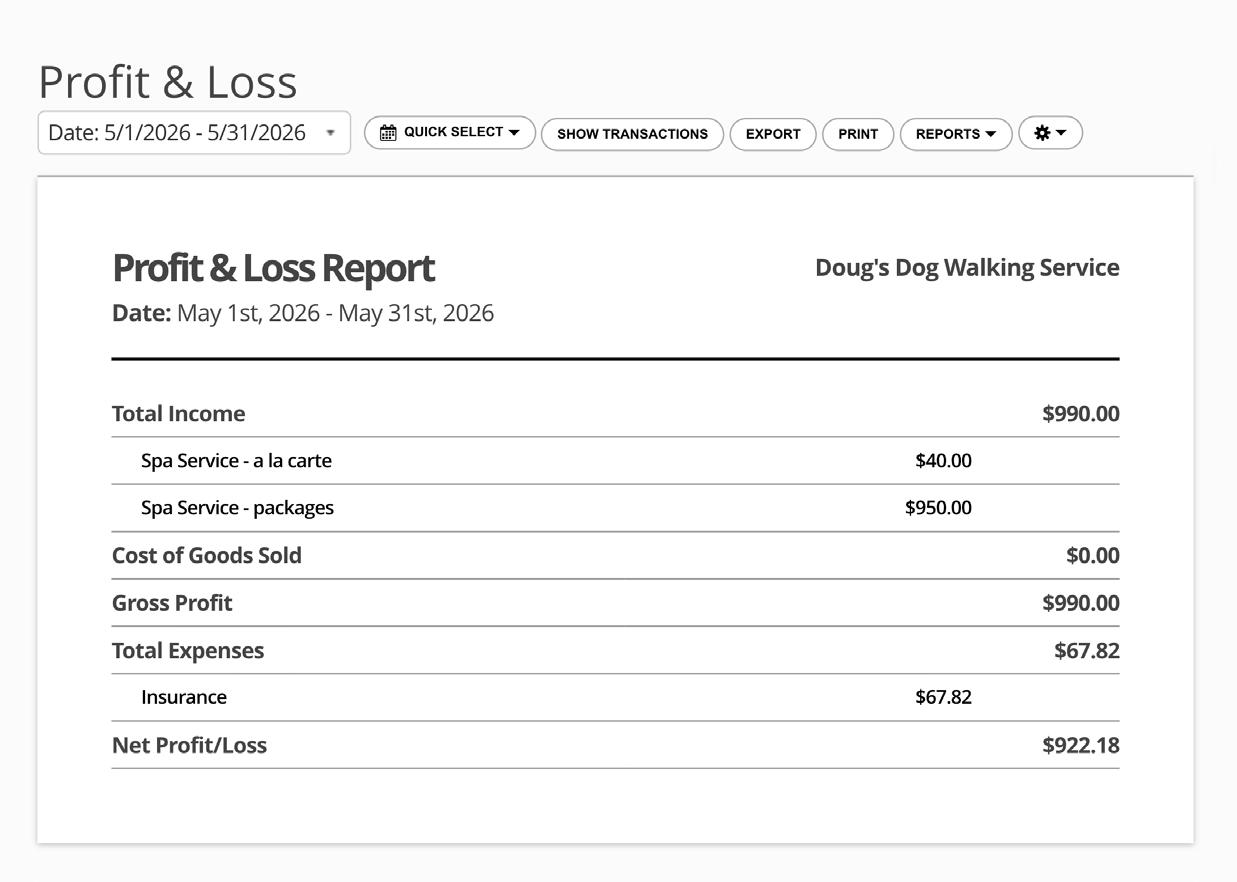
The reports inside 17hats Bookkeeping can help you answer those questions. You don’t need to be a numbers person to use them well. You just need to know what each report is telling you and how to use that information in your business.
Here are the six 17hats bookkeeping reports worth checking regularly.
1. Profit & Loss
Your Profit & Loss report shows what your business earned, what it spent, and what was left over.
This is the report that helps you get past the feeling of “I had a good month” and look at the facts. A month can feel
busy and still not be profitable. You may have brought in strong revenue, but if expenses were high, the final number may tell a different story.
Use this report to look for patterns. Are your expenses creeping up? Are certain months stronger than others? Are you pricing in a way that leaves enough room for profit?
A good next step: review your Profit & Loss report once a month. Don’t wait until the end of the year to find out whether your business is actually making money.
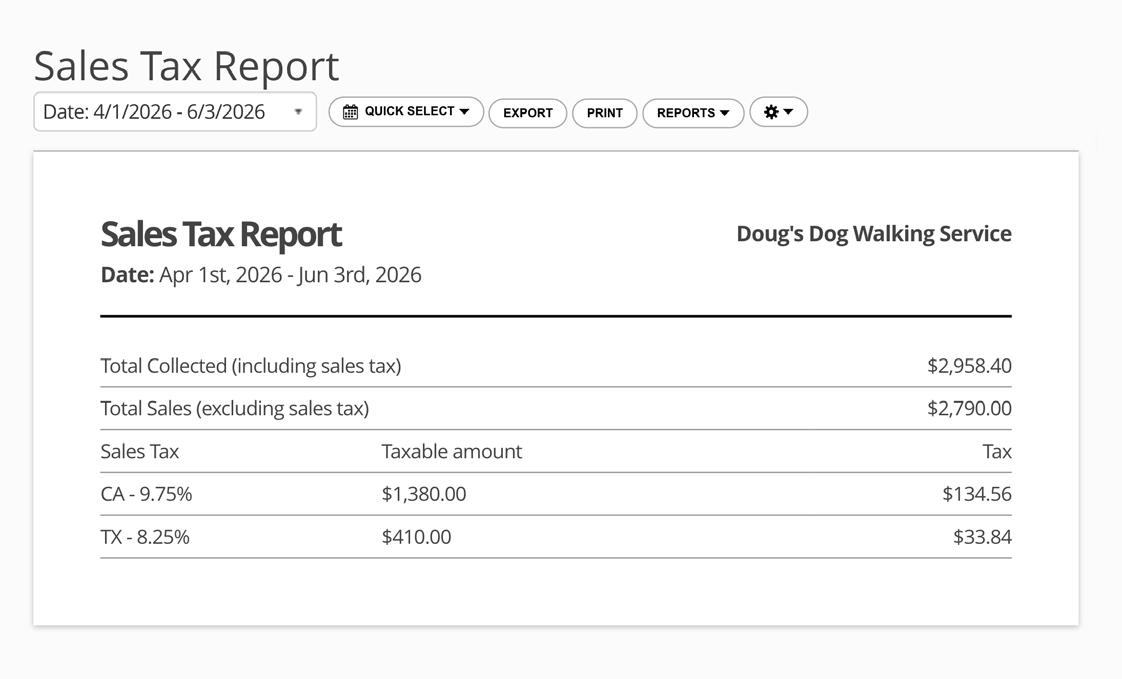
2. Sales Tax
If you collect sales tax, this report needs to stay on your radar.
The Sales Tax report helps you track taxable sales and the tax you’ve collected. That matters because sales tax isn’t business income. It’s money you’re holding until it’s time to file and pay.
This is one of those areas where staying current saves stress later. If you don’t keep track as you go, you may end up digging through payments and invoices when you’re already under pressure.
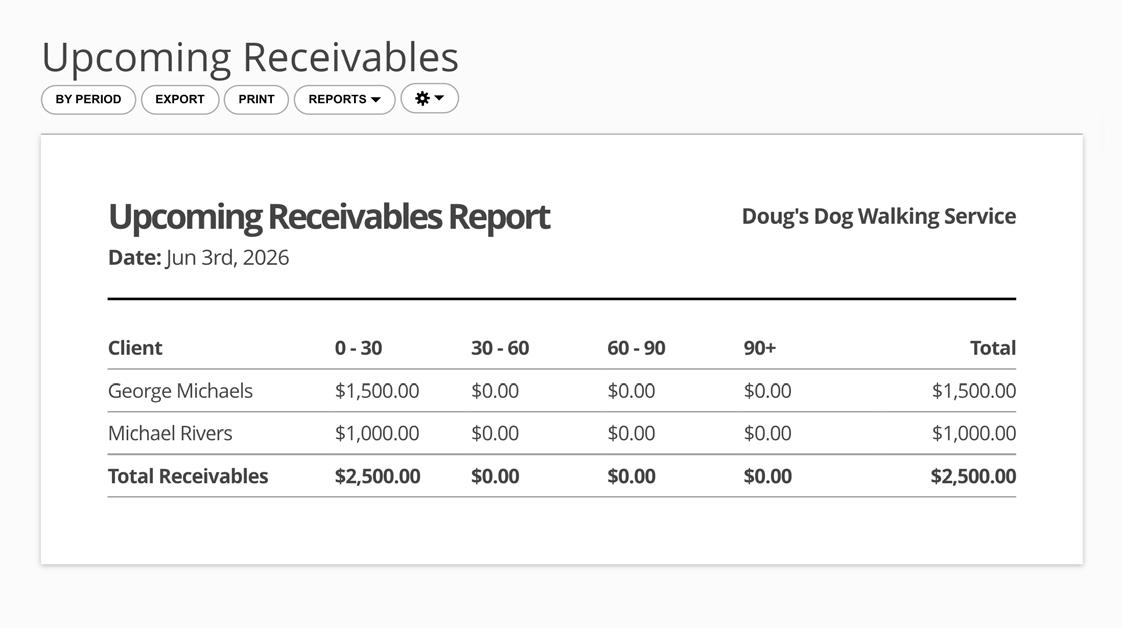
A good next step: check this report before each filing period so you know what you’ve collected and can prepare before the deadline sneaks up.
3. Upcoming Receivables
The Upcoming Receivables report shows money that’s expected to come in.
This is helpful for cash flow. You may have invoices scheduled or payments coming up, but that money isn’t useful to your business until it’s actually paid. This report helps you see what’s ahead so you can plan with more care.
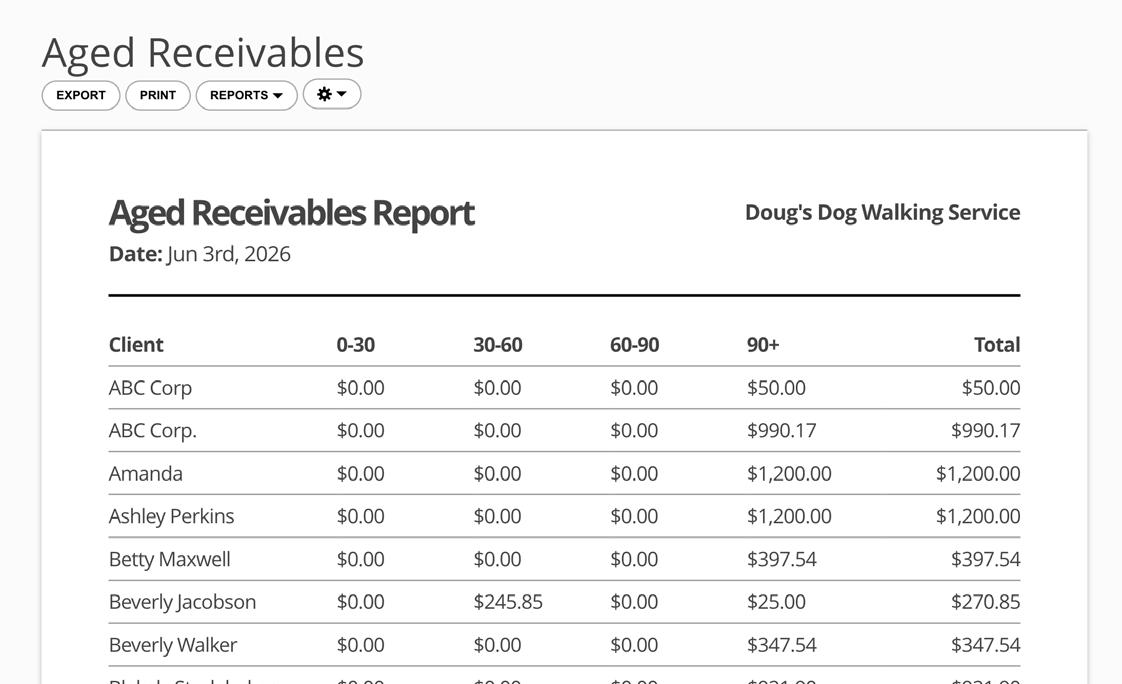
For small business owners, timing matters. You might be able to invest in a new tool next month, but not this week. You might feel tight right now, but know several payments are due soon. That
kind of visibility can keep you from making decisions based on panic or guesswork.
A good next step: look at upcoming receivables before making larger purchases or committing to new expenses.
4. Aged Receivables
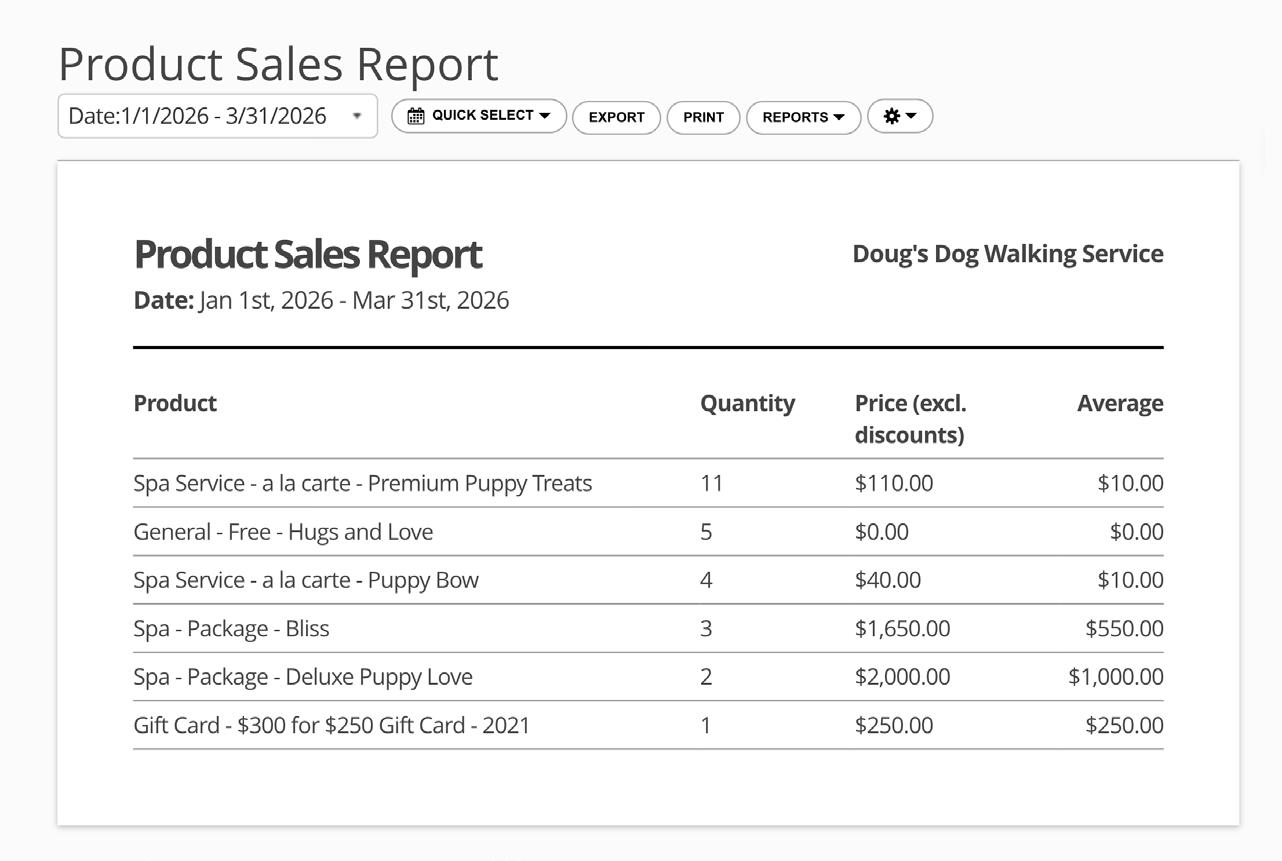
The Aged Receivables report shows which invoices are overdue and how long they’ve been sitting unpaid.
This is one of the most useful reports for protecting your cash flow. A late invoice that’s only a few days past due is much easier to address than one that’s been ignored for two months.
Use this report to build a simple followup habit. If an invoice is overdue, send a clear, professional reminder. If late payments happen often, look at your process. You may need better payment terms, earlier reminders, or a deposit before work begins.
A good next step: check this report every week. Late payments are easier to manage when they don’t have time to pile up.
5. Product Sales
The Product Sales report helps you see what’s selling.
Depending on your business, that may mean products, services, packages, addons, or other offers you’ve set up. This report gives you a better sense of where your revenue is coming from.
That’s important because business owners often make assumptions about what clients want. The numbers may show that one service sells more often,
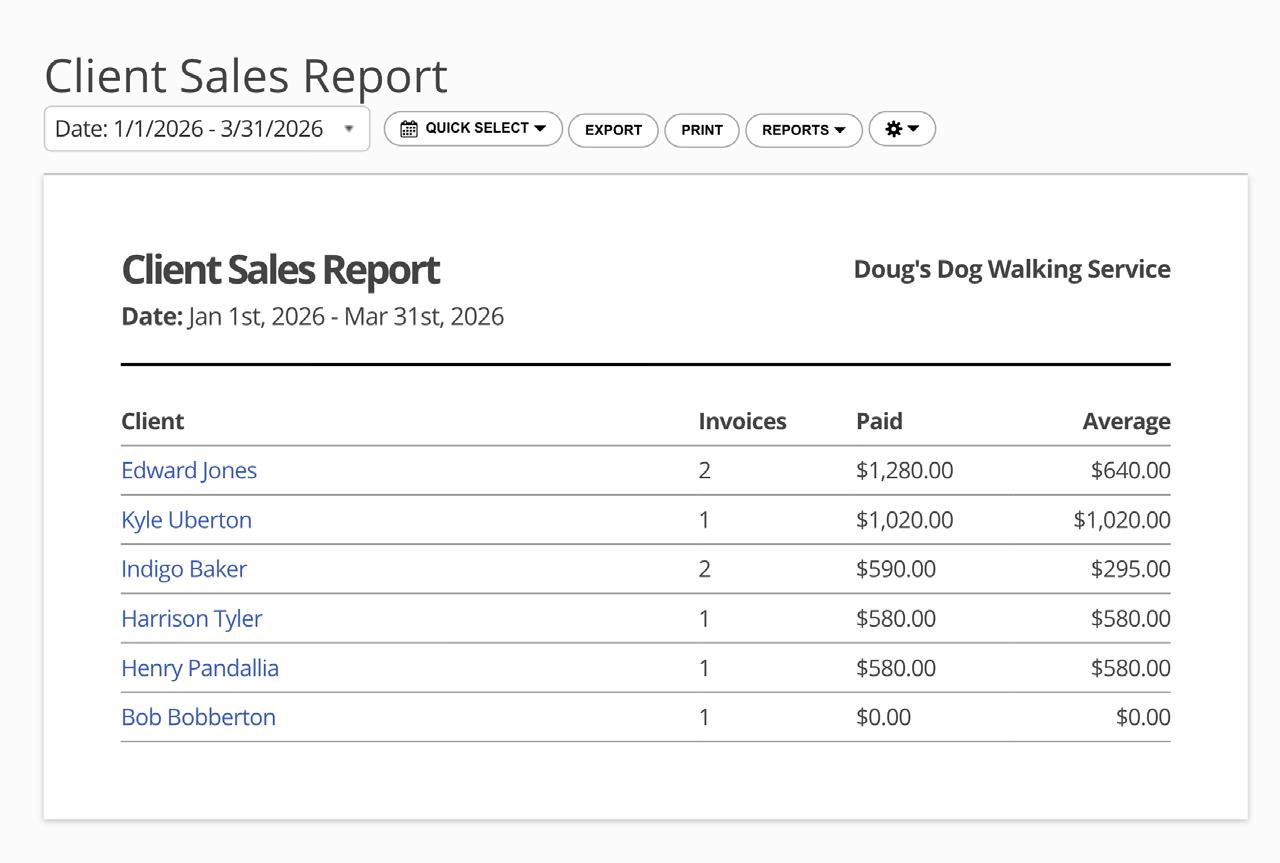
one add-on performs better than expected, or one offer isn’t pulling its weight.
This can help you decide what to promote, what to improve, and what to let go of.
A good next step: review your product sales before planning your next marketing push. Put more attention on what people are already buying.
6. Client Sales
The Client Sales report shows how much revenue is tied to each client.
This report can help you spot your strongest client relationships. Maybe a client books again and again. Maybe one type of client tends to spend more. Maybe your best revenue comes from repeat work, not brand-new leads.
That kind of information can change how you think about growth. Sometimes the next smart move isn’t chasing more leads. It’s taking better care of the clients who already trust you.
A good next step: look for clients who have booked more than once or invested in higher-value services. Then think about how you can stay in touch, offer the next right service, or create a better repeat-client experience.
Make the Numbers Part of Your Routine. Reports only help if you look at them.
You don’t need to study every number every day. Start with a simple rhythm. Check Profit & Loss monthly. Look at Aged Receivables weekly. Review Sales Tax before filing periods. Use Product Sales and Client Sales when you’re making decisions about offers, marketing, or follow-up.
The point isn’t to become obsessed with reports. The point is to stop running your business from memory.
Your numbers can show you what’s working, what needs attention, and where your money is really going. Once you know that, your decisions get a lot clearer.

7 Ways Better Bookkeeping Helps You Make Smarter Business Decisions
Bookkeeping is easy to put off until tax season, when “I’ll get to it later” turns into hours of sorting through payments, expenses, receipts, deposits, subscriptions, and processing fees.
But bookkeeping is not just recordkeeping. Good bookkeeping helps you understand the money moving through your business. It shows what is coming in, what is going out, what needs attention, and how your business is performing over time.
For small service-driven business owners, that clarity matters. You are making pricing decisions, managing expenses, tracking payments, preparing for taxes, and building a business that needs to support you.
Inside 17hats, Bookkeeping gives you a place to track income, expenses, transactions, sales tax, reports, and more. Here are seven ways it can support a stronger business.
1. It makes tax time easier
Tax season is less stressful when your bookkeeping is organized. When income and expenses are tracked throughout the year, you are not trying to remember what a transaction was from six months ago.
Clean records can also help your accountant or tax preparer work faster. Many accountants charge by the hour, often more than $150. The more prepared your books are, the less time someone else may need to spend sorting or correcting them.
2. It helps you see how your business is doing
Your bank balance does not always tell the full story. Money in the account does not automatically mean the business is profitable.
You may still have upcoming expenses, tax obligations, processing fees, subscriptions, or project costs that have not been accounted for yet. Bookkeeping gives you a clearer view of what your business is earning, what it costs to operate, and where your money is going.
3.
It
keeps invoice income connected to your records
One helpful part of 17hats Bookkeeping is that invoice payments are automatically recorded as income.
When a client pays an invoice through 17hats, that payment is added to your bookkeeping records. The income is connected to the income categories used for the invoice line items. If sales tax was included, that information is recorded as well.
4. It gives your reports better information Reports are only as helpful as the information behind them.
In 17hats, invoice income flows into your Profit & Loss Report, giving you a clearer view of income and expenses over a selected period. Sales tax information can be tracked through the Sales Tax Report, helping you review taxable sales and collected sales tax.
5. It helps you account for processing fees
Payment processing fees are easy to overlook, but they are part of the cost of doing business. For invoice payments processed through Stripe in 17hats, fees are automatically calculated and categorized as Merchant Fees on the Profit & Loss Report. For Square payments, fees can be pulled from Square and entered into 17hats as a new expense.
Small fees add up. Tracking them gives you a more realistic picture of what your business is earning.
6. It helps you capture more business expenses
Expenses are easy to miss when they are scattered across different accounts, cards, and payment methods.
With the Bank Connections add-on module, bank and credit card transactions can be automatically downloaded into 17hats Bookkeeping, when supported by your bank. Once imported, you can categorize them into the right income or expense categories.
One important note: deposits already connected to invoice payments should be categorized as “Transfer Between Accounts.” This helps prevent the same income from being counted twice.
7. It gives you a routine you can maintain
The best bookkeeping system is the one you will actually use.
Set aside time each week or month to refresh accounts, review transactions, and categorize anything new. Some banks may not deliver every transaction every day, so regular manual refreshes can help catch anything that may have been missed.
If your bank does not support direct connections, you can download transactions from your bank in .QBO, .QFX, or .OFX format and import them into 17hats Bookkeeping.
The
Bottom Line
Bookkeeping is not just something you do for tax season. It is one of the simplest ways to understand your business more clearly.
17hats Bookkeeping helps connect financial tracking to the client work you are already managing. For businesses that need more advanced accounting, 17hats integrates with QuickBooks Online so client invoices and payments can sync while banking and bookkeeping are handled there.
The more clearly you can see your money, the better you can lead your business.


Small Business Money Tools

Shannon Goode Professional Invoice Template Series for Beauty Services

Blair Beauty Group Wedding Beauty Booking System (Quote+Contract+Invoice)
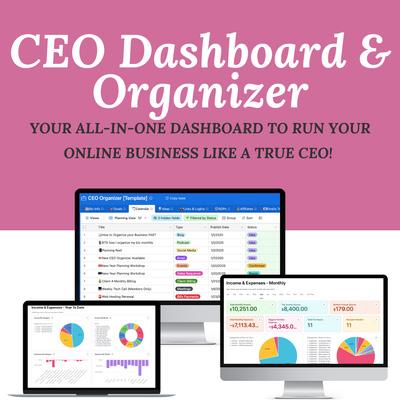
Sharee Collier CEO Dashboard & Organizer

Donna Lee Lyttle ARC System: Event Booking Protocol (Quote+Contract+Invoice)

Deb Mitzel 17hats Financial Foundations Audit

Danielle Uhl Wedding Photography Invoice Bundle
Share Your Secret to Business Success
Turn your business savvy into cash rewards by simply sharing 17hats.
Referring 17hats is a win-win. You’ll earn $50 for every new member who joins using your link — and there’s no limit to how many rewards you can collect.
Even better? Your friends get a huge head start with 50% off their first year or first two years of 17hats. That’s up to $400 in savings for them, just for being connected to you. It’s an easy way to support fellow business owners while putting extra cash in your pocket.

Easy Ways To Refer 17hats:
Share on Social Media
Post about how 17hats helps you — and include your link. Include before/after stories or screenshots! Business owners love seeing behind-the-scenes.
Send a Personal Message
Reach out to a business friend with a quick text or DM: “Hey! If you’re still juggling client stuff manually, you should check out 17hats. Here’s my referral link for 50% savings — it’s a no brainer!”
Add it Where People Already Look
Place your referral link somewhere simple, like your email signature, website resources page, or link-in-bio. That way, business owners can discover it naturally without feeling like you’re directly pitching them.
Example:
Find Your Referral Code & Link!
Head to your 17hats account settings and click the “Referrals” tab to copy your unique referral link. Your referred friend can use your code when signing up for a trial or upon checkout. You can also send them your link that allows your referral to directly buy now.
“Tools I use to keep my business organized: 17hats — here’s my referral link for 50% off.”
Your Shortcut To Working Smarter Top Tutorials!
Want to get more out of 17hats without the guesswork? Our top tutorials are the fastest way to learn, implement, and level up your business systems — no tech degree required. Each video walks you through key tools and features step-by-step, so you can spend less time figuring things out and more time doing what you love.
Get a full overview of the Bookkeeping Tab in 17hats from transactions to reports.
How to set up recurring invoices with automatic payments in 17hats.

Learn how to add receipts to transactions in the Bookkeeping tab.
Learn how to make Payment Schedules for your clients.
Craving MoreEducation?
Head over to 17hatsUniversity.com and blog.17hats.com to dive deeper into both business and 17hats education. Bookmark both sites and check back weekly for fresh insights and tutorials.


You Bring The Talent We Bring The Tools
17hats is the all-in-one business management platform you didn’t realize you need — but soon can't imagine yourself living without. Together, we'll take your business to the next level.
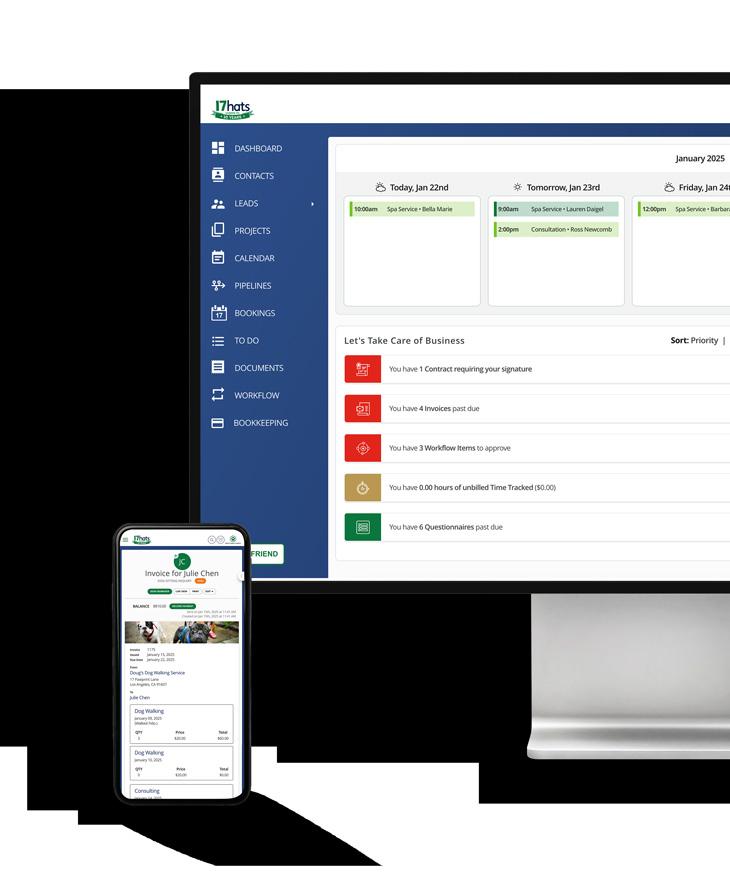
START A 7-DAY TRIAL
17hats Resources
Deep dive into our blog and learn how 17hats can help you manage your business better.

Listen to our HatsOff Podcast for business tips and tricks with our CEO, Amanda Rae.

Check out our University for 17hats tutorials, workshop replays, live events, and more.
Upcoming Conferences
The Storytellers Network Summit | Virtual
June 9 - 10, 2026
Join The Storyteller Network for a free live Business & Marketing Summit designed for photographers and creative entrepreneurs who want to get booked, elevate their client experience, strengthen their marketing, and build a more profitable business.
Free To Attend | Virtual
Maternity and Newborn Photographers Summit, Grapevine, TX
July 23 - 26, 2026
The Maternity & Newborn Photographers Summit is where photographers like you master the art, business, and confidence to grow. Learn from world-class instructors, refine your craft hands-on, and surround yourself with a community that believes in your potential.
Find something new from 17hats at the trade show!
Balloon Boss Summit 2026, Orlando, FL
November 8 - 12, 2026
Elevate your Balloon Business and Increase Your Professional Network in an Intimate Setting. Focus on increasing business skills taught by business professionals. Learn proven business systems to increase efficiency from balloon business owners.
Find Ambassador, Nicole Larson leading 4 new classes.
Ambassador Events


17hats Power Hour: Advanced Workflows
Tuesday, June 16, 2026
11:00 AM PT / 2:00 PM ET
Location: Virtual
Join 17hats Ambassador Deb Mitzel, for her 17hats Small Business Success Series: Power Hour. This series is dedicated to learning more about a 17hats feature, including use and set it up and Q&A after the feature presentation.
debmitzelcreative.com/workshops
Crossword Puzzle: Money
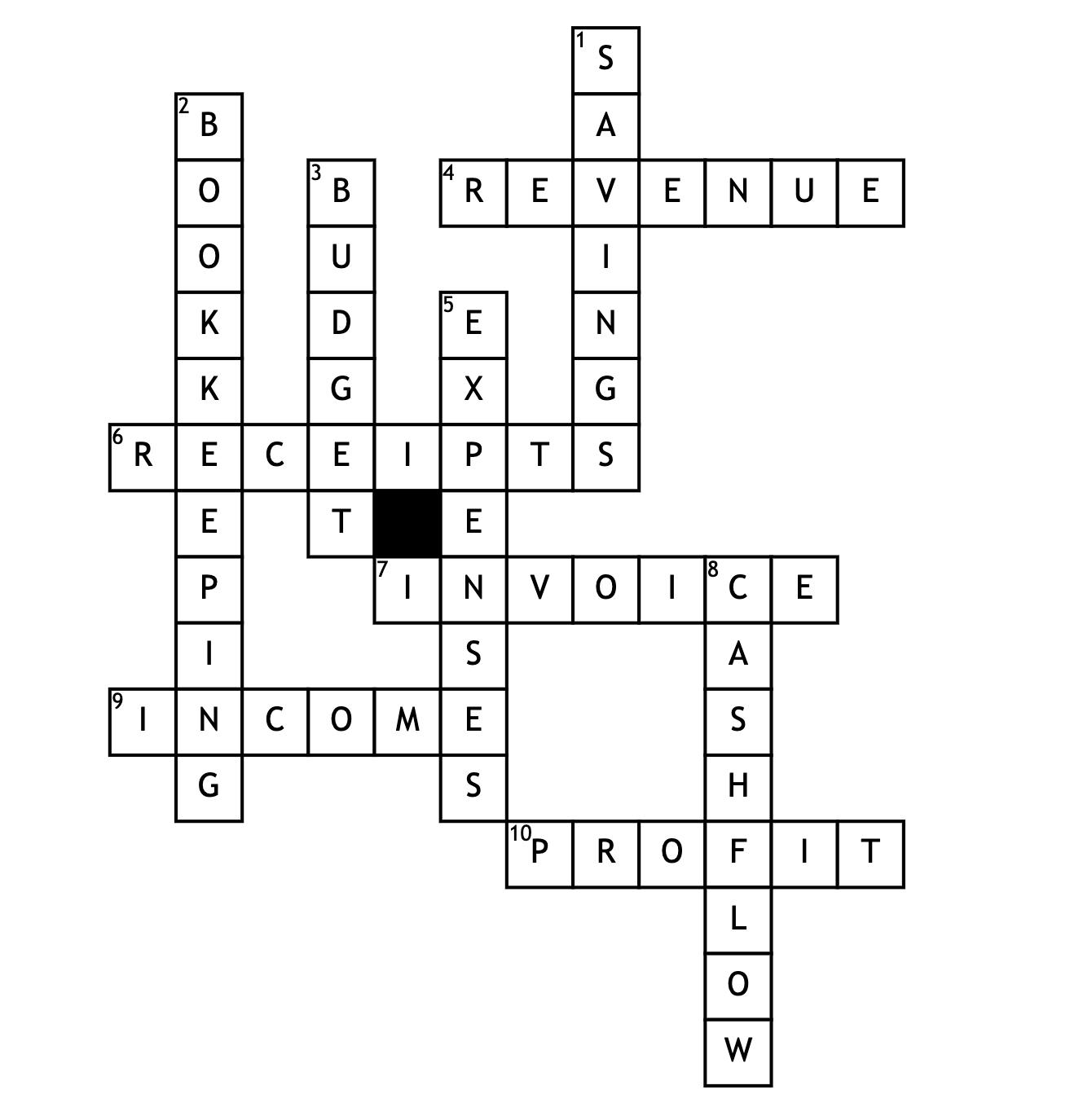
ACROSS
4. The total money brought into your business before expenses.
6. Proof of a purchase or business expense.
7. Document sent to a client to request payment.
9. Money your business earns.
10. What is left after expenses are paid.
DOWN
Money set aside for future needs or emergencies.
The process of keeping track of your business money. 3. A plan for how you will spend and manage money. 5. The costs of running your business. 8. The money moving in and out of your business.

Time is more valuable than money. You can get more money, but you cannot get more time.
– Jim Rohn
Keep In Touch