
N VRONM ENT ASSESSMENT TECH NICAL REPORTS Gyandzha TURKEY • Gyumri ELEVATION: 4000 m 2000m AZERBAIJAN l000m Cf 500m - 200 m 0 100 200 km ® Yerevan LJNEP/EAP TR/95-02 GN205024 -91


T. Bakuradze, M. Gwilawa, 7. Jintharadze, M. Khurtsidze and M. Kurtubadze
UNEP/GRID-Arendal (1995)

For bibliographic and reference purposes, this publication should be referred to as:
UNEP/GRID-Arendal 1995 Environmental Information Systems in Georgia - Assessment Report UNEP/EAP TR195-02
ISBN: 09-807-1519-4
Design and lay-out: Litangen & Kuvaas

Front cover map: Philippe Rekacewicz at Le Monde Diplomatique in Paris
UNEP P.O. Box 30552 Nairobi, KENYA Tel. +254 2 62 1234
GRID -A rendal Longum Park, P0. Box 1602, Myrene N-4801 Arendal, NORWAY Tel. +47370 35650 Fax ±47 370 35050 E-mail: gridgrida.no WWW: http://www.grida. no
BACKGROUND 2.1 Brief Country Profile ........................11 2.2 Environmental issues and environmental decision-making........14
4.5 Cooperation with international (global and regional) environmental programs...................26 4.6 Priority information technology needs ..............................27 4.7 Priority needs for database and metadatabase development...............27 4.8 Training needs ............................. ......27
OF ENVIRONMENTAL INFORMATION NETWORKS 3.1 National-level network ..................... 15 3.2 Sub-national environmental information network .........................21 3.3 International network........................ 21 3.4 Analysis of legal framework.............23 3.5 Information use in decision-making, education and the media ...................23
4.1 Priority needs of information for decision-making..........................24 4.2 Legislation regarding the management and accessibility of environmental information...........24 4.3 Financing of environmental information management..................25 4.4 Improving institutional framework ... 25
PROPOSED ACTION 5.1 Proposed action for quick improvements..........................28 5.2 Proposed pilot activities....................28 5.3 Perceived constraints for improvements..............................29
APPENDIX A Relevant Contact Addresses ....................30
APPENDIX B

Environmental Legislation.......................37 Draft Environmental Legislation .............38 List of International Conventions signed by Georgia, Date of Signature andStatus.................................................38
APPENDIX C State of the Environment Report..............39
APPENDIX D Relevant Ongoing or Planned Related Projects or Programs ................................40
In 1994, UNEP initiated a program to support environment assessment, reporting and data management capacities in countries with economies in transition in Central and Eastern Europe. This includes identification of needs and the formulation of project proposals to meet these needs. With partner agencies and other donors, UNEP seeks to leverage finances to correct any imbalances. This activity is a part of UNEP's global ENRJN (Environment and Natural Resources Networking) Program, which is a direct follow-up of Agenda 21, chapter 40 on information for decision-making. This chapter underlines that there is a need for easily accessible environmental information at all levels, from that of senior environmental decision-makers to the grass-roots. An agreement has been made with the GRIDArendal centre in Norway for implementation of the ENR1N program in Central and Eastern Europe.
In response to the invitation from UNEP's Regional Director for Europe, Hans Alders, the Georgian Minister of Environment, Mr. Shota Adamia, stated in his letter dated December 28, 1994 of Georgia's interest to be included in the program. He expressed his enthusiasm with Georgias participation in contributing to efficient international environmental assessments and to the production of relevant information for decision-making.
This report is the result of the initial analyses in Georgia. It is intended to distill and present promising avenues of cooperation, stimulate discussion and promote international consensus on the way ahead. It also seeks to attract other partners to this important venture of ensuring true international cooperation in stimulating cooperative action on issues affecting our shared resources.

Nairobi, 31. August 1995
Arendal, 31. August 1995
Director Svein Tveitdal, GRID-Arendal

This report has been compiled at GRID-Arendal under UNEP's ENR[N programme. I would like to express my sincere gratitude to the persons responsible for contributions to this publication, in particular:
For writing the report, the EGIS team at the Georgian Ministry of Environmental Protection, T. Bakuradze, M. Gwilawa, Z. Jincharadze, M. Khurtsidze and M. Kurtubadze and to Msia Gwilawa for coordinating the activities at the Georgian Ministry.
Professor Nicolas BerutchachviIi of Tbilisi State University provided valuable comments to the report and practical field support during my visit to Georgia.
For coordinating the publication and maintaining communication between the authors, the editors, the lay-out persons and others, Dawn Freund at GRID-Arendal. For making the publication fully IJNEP compatible and providing us with practical input, Danielle Mitchell of IINEP/DEA Nairobi.
The report was edited by Solfrid Tjørhom of Fevik, Norway; Per Harald Stabell of Litangen & Kuvaas (Arendal, Norway) was responsible for the lay-out; the front cover map was designed by Philippe Rekacewic.z of Le Monde Diplomatique in Paris.
Constructive advice and practical support was provided by various individuals within the IJNEP system, namely ENRIN coordinator Dan Claasen of UNEP/DEA in Nairobi, Andrea Matte-Baker of UNEP/ROE in Geneva, Director Svein Tveitdal and Claudia Heberlein of GRJD-Arendal.
Arendal, 9. September 1995
Otto Simoneit, Programme Manager Eastern European and Developing Countries
Georgia

For the Establishment ofa UNEF/GRID compatible Environment and Natural Resource Information Network on the National Level
Agenda 21, Chapter 40, on information for decision-making, outlines two program areas for Bridging the data gap and Improving information availability to ensure sustainable development. According to this guiding document, "relevant international organizations should develop practical recommendations for coordinated, hannonized collection and assessment of data on the national and international levels". The aim of this report is to assess the current status and general needs of the environmental information network in Georgia. Guiding assistance by UNEP/GRID in preparing the report is acknowledged. The objective of the Assessment Report is to help "set up continuous and accurate data-collection systems and make use of geographic information systems, expert systems, models and a variety of other techniques for the assessment and analysis of data".

Republic of Georgia - parliamentary republic, population approx. 5.5 mill. (1988), capital Tbilisi (1.5 mill.), 63 districts, average population density 78 inh/sq. km .
Georgia is located between the 410 07' and 430 35' latitudes, and between the 400 05' and 46° 44' longitudes. The total area is 69 700 sq.
km. The border length is 1970 krn, 315 km of which (1 6%) is coastline. The country is bounded in the west by the Black Sea. In the north, Georgia is bordered by the Russian Federation, in the east by Azerbaijan, and in the south by Armenia and Turkey. The territory of the Republic of Georgia features a highly contrasting topography. The north of the country is occupied by the Greater Caucasus chain (highest point - Mt. Shkhara, 5068 m), which includes the Great Caucasian Range (the main watershed) and Gagra, Bzipi, Kcdori, Svaneti, Egrisi, Racha, Lomisi, Kartli and other ranges. The intermountainous depression south of the Greater Caucasus encompasses the Kolkheti lowland, Inner Kartli, Lower Kartli and the Alazani Plain. Still further to the south the Lesser Caucasus ranges rise to a medium height (Meskheti, Shavsheti, Trialeti and other ranges), reaching 2850 m. The southernmost area of the country is covered by the volcanic South Georgian Upland (Mt. Didi-Abuli, 3301 m, its highest peak), dissected by specific canyon-like river gorges.
The Greater Caucasus and the South Georgian Upland join with the Likhi Range, which at the same time divides Georgia into two contrasting climatic zones: Western and Eastern Georgia.
The location of Georgia on the border between the moderately humid Mediterranean and the dry continental Aral-Caspian areas is responsible for the climate of the country. A humid subtropical climate dominates in Western Georgia, while Eastern Georgia features a tran-
Georgian Ministry of Environmental Protection EGIS Initiative Group T. Bakuradze, M. Gwilawa, Z. Jincharadze, M. Khurtsidze, M. Kurtubadzesition from subtropical to moderate. The mean January temperature varies from -2 °C (Kolkheti) to 3 °C; in August from 23 to 26 °C. In the seaward areas of Western Georgia, the mean annual precipitation varies from 1000 to 2800 mm (in the mountains), in Eastern Georgia from 300 to 600 mm.
The rivers of Georgia belong to the basins of the Black and Caspian Seas. In the Caspian Basin flows the Mtkvari (or Kura) River with its numerous tributaries (left) the Didi Liakhvi, the Aragvi, the Ion, the Alazani, (right) the Paravani, the Algeti, and the Khrami. The Black Sea Basin rivers include the Rioni, the Enguri, the Kodori, the Acharistskali, the Bzipi and others. There are not many lakes in Georgia, the largest being Lake Paravani (37 sq. km), and Lake Pahastomi (17.3 sq. km), and the deepest Lake Ritsa (116 m) and Lake Amtkeli (72-122 m) (both are impounded lakes).
The vegetation of Georgia is extremely rich and diverse, with numerous relict and endemic plants (dioskeria, Pontic and Caucasian rhododendron, boxtree, zelkva, persimmon, etc.). Forests cover over 1/3 of the area, with broadleafed species (oak, horn beam, chestnut, peach, etc.) common at lower levels, dark conifers (fir and spruce) in a higher mountain belt, and pine in higher-mountain valleys. Alpine meadows are spreading above 1800 m. The Kolkheti and Alazani plains and the lava plateau's of the South Georgian Upland are dominated by cultivated plants (tea, citrus's, grapes).
Georgian history has its origin in the 1st millennium BC. After that time, the Diaokhian (conquered by Urarteans between the 9th and the 8th century BC) and Coichic Kingdoms existed on the territory of modem Georgia. Greek settlements (Phasis, Dioskuria) were established on the Black Sea coast from the 6th
to the 5th century BC. At the same period of time the Ibenian Kingdom was rising in the eastern part of modem Georgia. Achaemenid Persia was spreading its influence over the Georgian states, but they managed to maintain formal independence.
In the year 65 BC, Pompeus incorporated the Colchic Kingdom into the Roman Empire and Iberia became its satellite. After the 4th century, Roman domination was changed by new regional powers, the Persian Sassanids and the Byzantine. During this period, Christianity was spreading in Georgia and was declared the State religion (in the year 337, the Autonomous Georgian Orthodox Church).
The oldest available manuscripts compiled in the original Georgian alphabet belong to the 5th century, but their origin is believed to date from as early as the 3rd century BC.
After the 7th century, Georgia was also dominated by the Arabian Caliphate. At the beginfling of the 8th century and in the 9th century, the feudal states of Kakheti, Hereti, Tao-Klarjeti, and Abkhazian Kingdom weakened the Arabian influence. The period between the 11th and the 12th century was the "Golden Age" of Georgian history; under the Bagrationi dynasty economic and cultural developments achieved the highest point in the middle age history of the country. Overall progress was interrupted in the 13th century by Mongol-Tatar conquerors. Their rule lasted for more then a century. A short period of revival ceased again at the end of the 14th century due to several invasions of Timurlane. In the period between the 15th and the 18th century, the country was divided into numerous satellite states: Kakheti, Kartli, Imereti, Samtskhe- Saatabago, Samegrelo, Guria and Abkhazeti. From the 16th to the 18th century, Iran and Turkey were fighting with each other for spheres of influence and periodically dominated Georgia, weakened by its internal conflicts.

The turbulence of the medieval history of Georgia sustained also in modem times. In 1783, after the signing of the Georgievsk Treaty, the orthodox Russian Empire established its protectorate over Eastern Georgia. Finally, Russia incorporated both the eastern (1801) and western (1803-1864) parts of the country into the Russian Empire as the Titus and Kutaisi Provinces.

After the 1917 Bolshevik Revolution, Georgia regained its independence (1918), which lasted only three years before the invasion of Red Army troops. Since 1921, Georgian SSR was part of the former Soviet Union. After the 1991 Soviet Putsch and break- up of the USSR, Georgia regained its independence (declared officially on May 26, 1991), but ethnic wars, raging in Abkhazeti and the former South Osetian Autonomous Region, led to enormous political and economic difficulties and to the subsequent membership in the Commonwealth of Independent States (1994).
Half a decade ago, living standards in Georgia were quite good. In the Soviet period, Georgia was well-known for its large underground economy; this was the only possibility of private entrepreneurship under the orthodox socialist state- controlled economic system. Unfortunately, political liberalization turned into the turbulent process of ethnic tensions and subsequent rapid decline of economic activities that Georgia has experienced during the last five years.
Agriculture has always been more important in the Georgian economy than industry: 42 % of the Gross National Product in 1991, while industry constituted another 34 %. The rest was divided between construction, transport/communication and trade. Georgia produced almost the entire citrus fruit and tea crops of the former USSR, and a large share of high-quality grapes and wine. As for industry,
it was a relatively large producer of steel pipes, electric motors, synthetic fibres, shoes and canned goods. But the recent crisis has led to an almost complete standstill in the economy, brought the country to the edge of disaster, and caused the entire Georgian population to become completely dependent on Western humanitarian aid.
Georgia relies heavily on imports of energy from other countries, notably Russia (electricity and crude oil) and Turkmenistan (natural gas). The country's inability to pay for its energy demands has resulted in sharp cuts of energy imports (Turkmenistan has virtually stopped the natural gas supply); consequently the entire population has spent the last two winters without electricity.
The fmancial sector has also experienced heavy fluctuations. Georgia was practically forced to introduce its own currency, the Coupon, after the monetary reform was carried out in Russia (March, 1993). Initially set equal to the Russian Ruble, the value of the Coupon dropped to 250 per I Ruble in a single year, a clear consequence of the 4-digit inflation rates. Nevertheless, recently achieved political stability has generally had a positive impact on the economic situation as well. Though it is too early to speak about a recovery, a stop in the decline of the Coupon exchange rate, rapid pace of economic reforms and pnivatization, and a strict monetary policy are creating a positive background for the restoration of industrial production. A moderate influx of foreign investments clearly indicates the increasing confidence in the steady economic deve lopment of the country. This trend has had a psychological effect, but has yet to be reflected in actual economic statistics. Some basic economic indicators (source: State Committee for Social and Economic Information) in comparison with the same period last year are as follows (September, 1994):
- Unemployment- 4% (official figures are essentially underestimated)
- Fall in Gross National Product - 52.1 %
- Fall in Gross Domestic Product - 49.6 %
- Industry - 54.0 %
- Agriculture-45.0%
• Trade-44.3%
- Construction Industry - 14.5 %
- increase of consumer prices in state and cooperative sectors - 196.7 times
- Minimal survival rate estimate - 447 US $ Average annual wage estimate - 300 US $

The main environmental problems facing Georgia originate from a variety of industrial and agricultural activities in the major cities and rural areas of the country. The state of the natural resources is affected by a wide spectrum of human activities, such as: - chemical industry and metallurgy, transportation (cars, railways, aviation, navigation), - energy (hydroelectric and fossil fuel power plants), - coal mining, oil drilling and refining, mining of different kinds of materials, like copper, magnesium, arsenic, marble, etc., - exploitation of land, water (sea, rivers, lakes, artificial water reservoirs) and forest resources, hunting, fisheries, - use of chemical fertilizers and pesticides in agriculture, - construction industry and production of hard materials, cement and asbestos production, - communal (municipal and rural) waste generation.
The major environmental hot spots are concentrated in the big cities. Tbilisi, with its industrial sector and huge number of inhabitants and Kutaisi, the Rustavi metallurgical factory and chemical plant Azotit, the Batumi oil refinery and port, the port of Poti, the Zestaphoni factory of ferrous compounds, the Kaspi cement production plant, the Chiatura, Tkibuli and Madneuli mining sites; this is an incomplete list of the heaviest industrial polluters. One
should also mention Mtskheta Research Nuclear Reactor near Thilisi, shut down in 1990 after public pressure, which will remain for a long period of time a potentially dangerous source of radioactive leakage.
Ethnic wars in the environmentally vulnerable regions of the country have imposed a tremendous load on the natural ecosystems. Military activities using modern heavy conventional armaments, hundreds of thousands of refugees, escaping military activities through ecologically delicate mountainous regions, and many other factors undoubtedly have affected severely the state of the environment.
This and other types of activities lead to heavy pollution of the environment Many of these processes are quite common also for other countries. At the same time the disintegration of the former Soviet Union was accompanied in Georgia by a number of difficult political problems. Political uncertainty and a kind of power vacuum in the country has severely affected the environmental situation. Although the dramatic fall in industrial production has had a positive influence on the state of the environment (almost no pollution from industrial sources), a major energy crisis and a total paralysis of electric power supply systems has initiated an uncontrollable process of tree cutting, not only in the forests, but even in the parks and streets of the large cities. The relative political stability achieved this year may in the near future lead to the restoration of industrial production at some level and, consequently, apart from deforestation, other environmental problems may also contribute to the degradation of land resources and the pollution of air and water basins.
Due to transitional processes taking place in Georgia, it is not possible to characterize the environmental situation reliably. The existing mechanism of environmental monitoring suffers greatly from the general economic stagna-
tion. A lack of financial and technical resources makes it extremely difficult to perform all the necessary measures to draw a picture of the current environmental situation in realistic terms. It is more appropriate to use maybe old, but more or less reliable statistical data to discuss the pollution problems of different media. A gradual future increase of industrial production may create a similar pattern of pollution.
The major source of air pollution used to be traffic. In 1990, 1 250 000 tons of pollutants were emitted into the air. Traffic contributed 895 000 tons (71.8 %). In this period, more than 1200 enterprises were operational, and the number of all types of cars exceeded 750 000. In comparison with the year 1989, emission from stationary industrial sources decreased by 63 000 tons, and traffic pollution decreased by 69 000 tons due to a fall in industrial production and a decrease in fuel supply. This tendency was more clear in the years 1991- 1992: total emissions have fallen to 345 000 tons (industrial sources - 159 000 tons, and the rest from traffic).
In 1992, the total discharge of waste water was approx. 1140 mill. m 3, 90 mill. m3 of which was contaminated water discharged without treatment (8%), 20 mill. m3 - contaminated but subject to insufficient treatment, 715 mill. m3 regarded as not contaminated according to existing norms (60%). and 315 mill m3 purified to the level dictated by state norms (30%). Total pollution load to Georgian waters from industrial sources in 1992 is given in the table:
Ingredients
Total Biological O'gen Demand (BOD) 10 170 tons

OfI products 190 tons
Phenols 24 tons
Heavy Metals 9 tons
Industrial pollution is mainly caused by metallurgy, oil refining, coal mining, and the chemical industry. Nitrogen compounds (8 tons), organic (8370 tons) and mechanical (9280 tons) substances were released in 1992 by municipal sewers and water treatment plants. A major problem is also the inadequately controlled agricultural contamination of surface water with fertilizers and pesticides.
Municipal wastes constitute the extreme factor affecting the state of the environment. At present 15 major garbage dumps are operational in almost every major city. Besides, all district centers are equipped with dump sites. Nevertheless, uncontrolled dumping of communal garbage lead to the worsening of hygienic conditions throughout the country. According to official estimates, the total amount of solid wastes in 1992 was 64.5 mill. tons. 70% of the total amount (45.2 mill. tons) comes from the mining industry. Metallurgy, the chemical industry, the construction industry and other sectors are responsible for the following pattern of solid waste generation: Hydrides 658 tons
Arsenic-containing substances 1899 tons
Nickel-containing substances 222 tons Oil-containing substances 70 000 tons Phosphorus-containing substances 226 000 tons Chrome-containing Substances 72.6 tons Pesticides 2500 tons
Carbon enrichment wastes 1.3 mill, tons and others
3.1 National-level network
Georgian Ministry of Environmental ProtectionThe Georgian Ministry of Environmental Protection is the main authority responsible for governing decisions on policy and manage-
ment of all environmental issues. Its current structure and a list of all subordinated governing bodies and institutions were defined in decree # 87, issued by the Cabinet of Ministers of the Republic of Georgia on February 7, 1994. According to this decree, the central apparatus of the Ministry has the following structure:

LeadershipMinister and 4 Deputy Ministers. One of the deputies is at the same time the Director of the Main Department of Hydrometeorology and Environmental Monitoring. Important decisions are taken after consultations with the Ministerial Board, consisting of 11 members (minister, deputy ministers and heads of major structural departments and subordinated institutions, as determined by the minister).
Department of Organization and Control ofEnvironmental ActivitiesSupervision of Regional Environmental Committees, organizational control of Departments, subordinated to the Ministry. Consists of two Divisions: the Organizational Division and the Division of Control.
Department ofEnvironmental Policy and International RelationsElaboration of environmental policy and strategy, coordination of activities under ongoing international environmental programs, methodologies for Integrated Coastal Zone Management, international environmental conventions, liaison with foreign partners. Consists of the Division of Environmental Policy and the Division of International Relations (UNEP INFOTERRA Georgian Focal Point).
Department ofEconomics and FinancesFinancial management and planning.
Personnel and General DepartmentOrganizational affairs.
Press CenterPublic relations and liaison with mass media (TV, radio, press).
The following governing bodies and institutions are directly subordinated to the Ministry: Atchara Autonomous Republic Ministry ofEnvironmental ProtectionCoordination of all environmental activities on the territory of the Atchara Autonomous Republic.
Main Department ofHydrometeorology and Environmental MonitoringResponsible for the coordination of activities in the fields of hydrometeorology, environmental monitoring, protection from hydrometeoro logical disasters. Structural parts are the Hydrometcenter, the Environmental Mon itoring Center, the Division of Hydrometeorological Disaster Observations, the Central Communications Service, the Computing Center, the Measurement Facilities Service, the Aviameteorology Center, the Black Sea Hydrometeorology and Environmental Monitoring Center, the Regional Hydrometeorology and Environmental Monitoring Centers, and the network of meteorological, hydrological, aerological, agrometeorological, water balance, river source observation and avalanche stations. Data processing facilities produce a wide spectrum of information, like remote sensing images (NOAA and Meteor satellites), weather diagnostics and prognosis, archiving of atmospheric and water pollution data, plotting of pressure fields and geopotential, etc.
Main Department ofBiodiversity and Protected AreasConcentrates on issues of biodiversity protection, recovery of animal and plant species, control over the environmental management of protected territories (nature reserves, national parks, etc.). Accomplishes its tasks through the Division of Protected Areas, the Division of Animals and the Division of Plants.
Main Department ofState Environmental ControlGovernment body, responsible for the State control and industrial pollution levels and supervision over the rational exploitation of water, air, land and natural resources on the Georgian territory to ensure the fulfillment of the requirements of environmental laws and regulations. Consists of the Division of the Protection of Water Resources, Atmospheric Air protection Division, Division of the Protection of Land and Natural Resources.
Department ofState Environmental ExpertiseConsideration, processing and approval of all kinds of industrial projects from the environmental point of view. Consists of the Division of Industry and the General Division.
Department ofthe Regulation of Natural Resources and NormsRegulation and elaboration of methodologies for the exploitation of natural resources, issue of permits and licenses for the exploitation of natural resources, regulation of environmentally sound land use practices, agroecological and agrotoxigological issues (methodologies for the safe usage of pesticides and fertilizers in agriculture), regulation of safe transportation, storage and usage of a wide variety of substances. Also legislative and executive activities, connected with the regulations and norms. Subordinated units are: the Division of Regulation of Natural Resources, the Division ofNorms, the Division of Agroecology.

Ecological Scientfic-InformaIion CenterInformation gathering, systematization and transfer to government and public organs, processing of various environmental programs, coordination of the activities of research institutions, public relations. Consists of the Environmental Information Systematization and Cadastre Division, the Division of Programs and the Public Relations Division.
Black Sea Protection Convention DepartmentProtection of natural resources, regulation of the exploitation of natural resources and protection of the marine environment from pollution in Georgian territorial waters and in the Exclusive Economic Zone of the Black Sea. Coordination of activities of the Batumi, Poti and Sokhumi Marine Inspections, as well as of the Batumi Black Sea Ecology and Fisheries Institute. Protection of fish stock and regulation of fisheries in the inland waters of Georgia. Subdivision: the Division of the Fisheries Regulation and Dumping, the Division of Programs and Methodologies.
The Black Sea Ecology and Fisheries InstituteBioecological monitoring of the Black Sea, research and evaluation of the fish stock resources of the Black Sea, BSEP Activity Center for the Protection of Biodiversity (See Sec. 3.3 and Appendix D).
Research Institute ofAppiled Ecology and Labor ProtectionRelevant research.
Central Environmental Control LaboratoryConducts regular sampling of water and soil resources (biological and chemical analysis), investigates effectiveness of existing purification schemes of industrial facilities, arranges expeditions and on-sight analysis of major industrial polluters. Information is generated for the Main Department of State Environmental Control. Consists of the Analytical Department, Department of Survey and Control of Harmful Industrial Emissions, On-sight Control Department.
Jiatumi Marine Convention Inspection. Pot! Marine Convention Inspection. Sokhumi Marine Convention Inspection. Three Regional inspections conduct pollution control activities in the sea and in a 1- km inland region of the Coastal Zone,
The magazine "Sakartvelos Buneba"
("Nature of Georgia")Publication, emphasizing current environmental activities, environmental education issues, promotion of sustainable exploitation of natural resources. Regularity of publication suffers due to financial difficulties.

Apart from the Ministry, other governing institutions also contribute to the improvement of the state of the environment. According to the decree mentioned above, all the decisions of the Ministry dealing with environmental issues are obligatory for all other Ministries, Departments, Government bodies, local authorities, enterprises, organizations, institutions, etc., with their activities on the entire territory of the Republic of Georgia, including its territorial waters, continental shelf and Exclusive Economic Zone.
Ministries and Government bodies with environmental concerns:
Department of Geodesy and Cartography at the Cabinet of MinistersGovernment body, responsible for the supervision of activities in the fields of geodesy, gravimetry, topography, remote sensing, cartography (analog and digital), mapping, land cadastre, GIS. Consists of the Divjsion of Topogra-phy and Geodesy, the Division of Cartography, the State Geodesic Supervision and Regime Division and the Aerogeodesy Enterprise.
Committeefor Social and Economic Information (subordinated directly to the Parliament)Collects and analyzes statistical information from different sectors (health, geology, forests, agriculture and food industry, environment, hydrometeorology, economy, recycling). Its Department of Agricultural and Environmental Statistics is responsible for environmental information. Information is gathered from corresponding Ministries and presented period i-
cally to the legislative branch of the State in the form of statistical reports.
Department of ForestryResponsible for the management of forestry, protection of forests, rational exploitation of forest resources and forest restoration, forestry statistics. Consists of the division of Protection of Forests, the Division of Forestry Inspection, the Division of Economics.
Department of Land Resources and Land Cadustre at the Ministry ofAgriculture and Food IndustryLand use regulations, land reform issues, land protection and supervision of effective exploitation of land resources. Structurally the department consists of the Central Apparatus, the Abkhazeti Autonomous Republic Department of Land Resources and Land Cadastre, the Atchara Autonomous Republic Department of Land Resources and Land Cadastre, the Research and Survey Institute of Land Resources ("Saksakhmitsaproekti") and the Service Center for Private Land Owners ("Sakkalakagroservisi")
Department of Technical Engineering, Ecology and Natural Resources at the Ministry ofAgriculture and Food IndustryControl of pollution from agriculture and the food industry, inspection of soil erosion, soil recultivation activities.
Department of GeologyResponsible for the coordination of geological surveys of the entire territory of Georgia, including the continental shelf and the Exclusive Economic Zone of the Black Sea. Regularly publishes reports for the central Government and for local authorities. Two of its units deal directly with environmental issues: the Geological and Ecological Engineering Unit (lithomonitoring of the entire country) and the Hydrogeoecology Unit (ground water pollution research).
Department ofHygiene, Epidemiology and Health Prop hylactics at the Ministry ofHealthActivities in the fields of sanitation, epidemiology, labor and industrial hygiene, communal waste monitoring, child and adult health problems.
Central Board of Reserves and Hunting ManagementSupervision and management of nature reserves of Georgia and management of hunting activities, protection of nature reserves, supervision of various scientific research projects in nature reserves. Structural units are the Department of Nature Reserves and the Department of Hunting.
Tbilisi State University:
Department of Cartography and Geoinformatics, Faculty of Geography and Geology -
Cartography, geographic and thematic mapping, remote sensing applications in geography, GIS.
Department of Geomorphology and Geoecology, Faculty of Geography and Geology -

Remote sensing applications in earth surface morphology, research in sea and river shoreline dynamics and coastal restoration.
State of Nature Research Laboratory, Faculty of Geography and GeologyInvestigation of daily dynamics of naturalterritorial complexes (STEX).
Laboratory ofRemote Sensing, Faculty of Geography and Geology -
Remote sensing applications for the survey of natural resources, ground station for satellite communications.
Department ofEcology, Biological FacultyInvestigation of the effect of anthropogenous factors on biological species, biomonitoring of water.
Georgian Academy of Sciences: Institute ofHydrometeorologyDevelopment of meteorological, hydrological and agrometeorological forecasting methods; nature disaster forecasting (mud flows, avalanches, floods, heavy rainfall, etc.); estimation of climatic, agroclimatic and renewable energy resources (water, wind, solar); estimation and forecasting of pollution levels; investigation of physical processes of cloud and precipitation formation, etc. Consists of four departments: the Meteorology Department (laboratories of weather forecasting, dynamic meteorology, climatology, agrometeorology), the Weather Modification Department (labs of cloud physics and precipitation regulation), the Hydrology Department (labs of general hydrology, mud flows, reclamation hydrology, glaciology), the Ecology Department (labs of water and soil, atmosphere pollution modeling, methods of physical and chemical analysis).
Institute of GeographyRelevant research, cartography and remote sensing. The structure of the Institute: the Department of Geomorphology and Paleogeography, the Department of Climatology, the Department of Hydrology, the Department of Physical Geography and the Department of Cartography.
Institute of Water Resources and Environmental EngineeringResearch activities focus on protection against soil erosion, reliability of hydromelioration systems, melioration, hydrotechnology, hydraulics, geological and geotechnical research, mechanization of melioration, economics of melioration, recultivation of the Kolkheti wetlands. Cooperates closely with the
Ministry of Environmental Protection on issues concerning the Black Sea and prognosis of nature disaster processes (landslides, floods, erosion, etc)
Institute ofMountain ForestryResearch of biological and ecological characteristics of Georgian forests, forest restoration methods, methodologies for rational exploitation of forest resources.
Other research institutions:
Scientific- Research Institute of Hygiene at the Ministry ofHealthResearch of medical and biological problems of human food consumption, studies of the influence of environmental factors on human health, epidemiology. Close cooperation with the Ministry of Environmental Protection as a Focal Point of BSEP Activity Center on Special Monitoring (See Sec. 33 and AppendixD).
Institute of Caucasian Mineral ResourcesResearch of mineral resources, survey and spatial distribution studies of metallic and non-metallic mineral deposits, technological issues of content identification of mineral resources.
Research and Survey Institute ofLand ResourcesPerforms for the Department of Land Resources and Land Cadastre the following activities: land inventory, large-scale mapping of land resources, agrochemical and geobotanical classification of vegetation, land cadastre, methodologies for land taxation, land recultivation activities.
Research Instil ute for Scientific and Technical Information ("Techinformi ")Offers analytic review, legislative-normative, methodological information as well as technical-economic and marketing research in the
fields of industry, agriculture, transport, ecology, standardization, quality control, etc.
Appendix A contains contact addresses of major environmental institutions mentioned in this and other sections of the Assessment Report.

NGOs: The environmental NGO movement in Georgia is quite widespread. A majority of the organizations were created after 1990. Below follows a list of NOOs according to major topics of activities:
Nature conservation, species reintroduction, replanting of deforested areas: WWF-Georgia, Georgian Society of National Parks, Forestry and Conservation, Noah's Arc for the Recovery of Endangered Species (NACRES), Center for Study and Protection of Small Animals (CSPSA), Egrisi Mountains', Vashlovani", Georgian Green Movement, [co-Center, The Society in Support of Culture and Nature of Georgia "CUNA.
Promotion of environmentally sound agricultural practices: - Association of Bio farmers, Georgian Farmers Union, Georgian Society of Tusheti.
Environmental education and public awareness, publications: 'Aragvf', Association of Scouts of the Republic of Georgia, Center for Sustainable development of Georgia, Com pester Club, Dzhvari, Ecological Center, Ecological Club 'Merrrisr', Fund 'Sitsotskhle', "Gala, Georgian Club of Rome, Georgian Ecological Foundation, Georgian Youth Center 'Dzlevar', Georgian Youth EcoMovement, Human Ecology Center, Khomli", Kutaisi Green Movement, Poseidon', Public Institute of Humanitarian Resources, Regional Fund for Environmental Protection, Society of Young Ecologists Green Cross, International Center for Reformation and Development of Georgia, Vitacenter, W'NF-Georgia, Fcc-Film.
Renewable energy sources:
responsible for monitoring activities in their Fund for Development of Environmentally Safe subordinated Districts and cooperates closely Energy (FDESE), Green Earth, Social Fund of with corresponding City and Regional ComUsage of Alternative Energy Sources. mittees.
Environmental monitoring: - Buneba, Scientific Society of Toxicology, "ShemokmedP.
Promotion of environrnentaUy sound tourism: - Alpinists Club Samorine, Caucasian Club, Georgian Association of Ecology and Tourism, Lashan' Travelers Club, Morionf Speleologists Club, Young Travelers and Reseamhe,s Club Jrao.
Environmental legislation: - Association of Young Georgian Lawyers, Ecological Law Club.
Environmental informatics: INSTEX, Georgian Geoln formation Center G.INFO', Dedamitsa (remote sensing).
According to the Decree #7 of the Minister, issued on February 23, 1995 Partial Reorganization of Authorities, Subordinated to the Ministry of Environmental Protection", following scheme of sub-national environmental network is in power: City and Regional Committees of the Ministry of Environmental Protection: there exist 4 City Committees in Tbilisi (subordinated simultaneously to the Tbilisi Municipality), Mtskheta, Khashuri and Poti and 11 Regional Comm ittees. Regional Committees supervise several local districts and provide information for central authorities.

Regional Environmental Laboratories: Central Environmental Control Laboratory (based near Tbilisi); Kutaisi, Tskaltubo, Zugdidi, Ozurgeti, Gori, Akhaltsikhe Regional Laboratories and the Laboratory of Poti Marine Convention Inspection. Each Regional Laboratory is
The Georgian Ministry of Environmental Protection participates in a number of international multilateral and bilateral environmental programs. Negotiations on bilateral agreements in the field of the environment are going on with Armenia and Azerbaijan, the Russian Federation, Ukraine, Turkey and Greece.
Georgia joined the Intergovernmental Environmental Council (IEC) of the Commonwealth of Independent States (CIS) to coordinate activities in the field of the environment with other CIS countries. The agreement relating to the establishment of the IEC was signed on February 8, 1992 in Moscow, but Georgiajoined later (September 9, 1994). IEC activities are to be financed by the Inter-governmental Environmental Fund, and Georgia also supported its establishment.
The IEC and UNEP signed a cooperative agreement on August 15, 1994, which includes the support from the UNEP side in creating environmental information systems, mutual exchange of information and user informational support in member countries of the IEC.
The Ministry of Environmental Protection actively participates in the Black Sea Environmental Program (B SEP of GEF), established in September, 1993 by 6 littoral countries. From the Georgian side the Deputy Minister is the National Coordinator of the BSEP Steering Committee. Under the BSEP Program Coordination Unit (PCU) 6 Activity Centers (one in each country) and 3 Working Parties (WP) (with at least one expert from each country) have been created. Georgia hosts the Activity Center for the Protection of Biodiversity (based in Batumi).
One of the BSEP PCU WPs deals with Data Management and Geographical Information Systems. The objective is to create DB and GIS for the entire Black Sea and adjacent territories to facilitate: planning of environmental activities and impacts on a regional scale; public awareness through training, education, workshops, lectures and media; scientific analysis, modeling, ecological impact assessment, science planning.
A list of BSEP Focal Points and WP experts is given in Appendix D.
Important activities are also planned under Georgia's Integrated Coastal Zone Management (ICZM) Program, as a part of the larger Georgia! World Bank Municipal Infrastructure Rehabilitation Project (MIRP) credit. These activities include the establishment of an ICZM Task Force and Advisory Committee at the Ministry of Environmental Protection for the implementation of the ICZM Program, which includes various activities: Kolkheti Wetland Inventory and Synthesis (WWF-Georgia), initiation of a Regional Support Group for the Kolkheti protected area management planning (WWF-Georgia), organization of various workshops, training courses, public relations activities, etc.
The EU TACIS (Technical Assistance for CIS) Program cooperates with the Ministry through the regional Black Sea Environmental Program. This cooperation mainly concentrates on the following issues:
- Integrated Coastal Zone Management, environmental audit, public awareness and education
- Environmental legislation
- Environmental monitoring
The UN ECE - international responsibilities include the elaboration of recommendations for Environment Europe. One of the Deputy Ministers (Mr. M. Sharabidze) is a member of its Environmental Committee. The Working Groups of the UN ECE cover activities con-
nected with problems of water bodies, economics and environment, management of chemical substances, etc.
The OECD and its Environmental Working Group focuses on Eastern and Central Europe. Georgia also participates in the activities of the Working Group. The main topic of this cooperation between the Ministry and the OECD is the influence of industrial activities on the state of the environment.
Georgia cooperates with researchers from other Black Sea littoral countries in the development of a common oceanographic database in all the Black Sea countries under the project "Ecosystem Modeling as a Management Tool for the Black Sea", a part of the NATO Science for Stability (NATO SfS) Program.
The Division of International Relations of the Ministry of Environmental Protection serves as the UNEP INFOTERRA Georgian Focal Point.
Other environmental institutions are also involved in international projects:
The Institute of Hydrometeoro logy, Georgian Academy of Sciences, cooperates with several programs like the World Meteorological Organization (WMO) Program on Research of Global Atmospheric Processes, the UNESCO "Man and Biosphere" program and the UN project "Global Environmental Monitoring System (GEMS): water objects".
The Institute of Soviet American Relations (tSAR-Georgia) provides small scale grants for Georgian NGOs. Priorities include environmental awareness and education, training, workshops, reforestation of regions damaged by tree cutting, sustainable agriculture. Maintains Georgian NGO directory together with the International Telecommunications and Information Center.

NGO Noah's Arc for the Recovery of Endangered Species (JUCN Member) is conducting a project financed by the Swiss/Georgian foundation MGELI with an objective of recovering the population of endangered Caucasian wolf species.
3.4
Due to various political and legislative problems, the Georgian Constitution at the present time is in a preparation phase and is expected to be adopted (at least partially) before Parliamentary elections in October 1995. The country is governed by decrees and laws issued by the Head of State, the Parliament and the Cabinet of Ministers.
Environmental legislative initiative originates in the Parliamentary Commission or at the Ministerial level. The Ministry of Environmental Protection presents draft laws and regulations to the Cabinet of Ministers. After preliminary consideration, the Parliamentary Commission on Environmental Protection and Natural Resources transfers Government proposals to the Parliament for final approval. When legislative initiative in the field of the environment comes from the Parliamentary Commission, they coordinate their activities with the following governing bodies: the Ministry of Environmental Protection, the Department of Geology, the Department of Land Resources and Land Cadastre, the Department of Forestry, the Central Board of Reserves and Hunting Management.
A draft of the General Law On the Protection of Nature was prepared by the Parliamentary Commission, and the first hearings are planned for May, 1995. Unfortunately, environmental information management issues are not covered by this law, since a separate law is in preparation.
Decrees and Laws regulating environmental activities and international conventions signed,
or signed and ratified, by Georgia are listed in Appendix B.

The Ministry of Environmental Protection maintains constant communication with the Georgian population when it comes to major decisions and the most important environmental issues through its Press Center, and regularly organizes press conferences and invites influential journalists and mass media representatives. Tbilisi Public Relations Center cooperates with the Ministry in delivering news about Georgia/World Bank ICZM activities to the population.
Georgian State TV and Radio Corporation is also engaged in the environmental education process, several programs are offered to the public in which a wide variety of environmental issues are discussed. For instance, two times per month the first channel of the Georgian Radio broadcasts a program called "Ecology". It covers issues like the state of endemic species, biodynamic agriculture, problems of mineral waters and drinking water supply, energetics, dangers of Chorokhi river cascade construction, tree cutting, etc.
The first and second channels of the Georgian TV are running programs called "Dge" (day), "Orioni", "Bunebis Kari" (door of nature), "The house in which we live", "Eco-Inform" (supervised by the Press Center and Environmental Scientific-Information Center of the Ministry) and others. Some of these programs offer discussions on a broad spectrum of environmental hot points, others offer video materials, prepared by their own staff or reproduced from materials distributed worldwide. The scope of these discussions ranges from local to regional and global environmental problems. In their coverage the authors also use official information from the Parliamentary Comm ission, the Ministry of Environmental Protection,
the Georgian Green Movement, research institutions, etc.
The NGO sector is also quite active in the field of environmental education. WWF-Georgia organizes environmental public awareness campaigns on local TV channels through its Regional Support Groups. Apart from this, they have a specially designed Environmental Education Program, which includes TV programs, publication of manuals and booklets, and in-service training for environmental teachers of schools in close cooperation with the Ministry of Education. The Georgian Youth EcoMovement has organized a six-month course of lectures for young people delivered by professors and environmentalists from the Tbilisi State University and the Georgian Academy of Sciences.
mation in the form of statistical reports, schemes, diagrams, thematic maps for various purposes, like control and optimization of environmental management decisions, reporting to higher-level government authorities, dissemination of environmental information to local authorities and the public, and generation of State-of-the-Environment reports and so on. Emerging cooperation with international environmental institutions often requires rapid preparation of relevant reports, questionnaires, and government directories. Certain on-going international programs, like the BSEP and NATO SfS, concentrate directly on the development of complex environmental information technology tools, like environmental databases and Geographical Information Systems for the entire Black Sea region.
4.2 Legislation regarding the management and accessibility of environmental information
4.1
Successful application of environmental policy and management decisions largely depends on the support and existence of a properly designed information technology infrastructure. The ever increasing complexity of environmental problems requires the exploitation of sophisticated tools for effective management of environmental information. This fact seems to be realized more and more by environmental decision-makers in Georgia. Simple printed reports, generated by government authorities and research institutions, lack the necessary flexibility for data manipulation; sometimes it is even difficult to identify needed data sources and extract all the necessary information.

The question of prime importance is the media, through which environmental information managers could deliver necessary information to decision-makers. Typically, they need infor-
The legislative process in Georgia is still in its transitional phase from the old Soviet style, and many important questions have still not been considered. Laws regulating information management in general are among those issues. It is highly desirable for all levels of legislation activities to focus on modern trends and increase efforts in this direction. The Georgian Constitution, which is still under preparation, should create a proper framework for the development of more specialized laws regulating the needs of society with regard to information processing. Issues like intellectual property rights, generation and dissemination of information, public access to information sources, etc, should comply with internationally accepted standards and take into account current developments in the country.
All these considerations apply also to environmental information management. Efforts of the Parliamentary Commission for Environmental Protection and Natural Resources to develop a special law for the regulation of environmental
information management could contribute significantly to filling this gap in the legislative infrastructure -
Transitional economic difficulties and political fluctuations do not stimulate activities in the development of instruments for advanced environmental information management. The Georgian Government currently lacks the capacily to finance on its own the application of sophisticated and expensive high-technology tools for the management of environmental information.

Assistance from the international environmental community, different on-going multilateral programs are and will remain in the near future the only significant source of funding for activities in this field. At the same time, in the long run it is not desirable to depend only on foreign assistance, and alternative resources have to be identified for the financing of env ironmental information management activities on the national level. Here we briefly discuss some possibilities for fund raising: The willingness of the Ministry of Environmental Protection to develop the structure of environmental information network will be accompanied by in kind and logistic assistance. The ministry could also provide help in identifying potential donors. Besides, the Government should define more clearly and gradually increase the financial resources allocated for the development of environmental information technology tools and networking.
It is expected that in the near future many private enterprises will emerge with activities in the field of environmental technology applications. Potentially, they could become important consumers of sound environmental information products and would provide much needed financial assistance. Some of them would concentrate on the generation of information usable directly or indirectly for envi-
ronmental purposes, and contribute to the development of the multidimensional environmental information network of the country.
Private and non-private foreign investors are usually interested in background country information, including environmental conditions at certain places or regions of Georgia. Relations with interested investors could be built on a cost recovery basis.
Regional Authorities could contribute to the financing of environmental information management activities on the local level. They could also assist in the generation of different kinds of raw data and develop a close cooperation with the country-wide environmental information network to get access to sound environmental information, accommodated for use on the local level. More generally, provision of processed information in exchange for raw data should be practiced widely, in order to keep the level of needed financial resources as low as possible. This approach has to be exploited with regard to horizontal (within a ministry or with other sectoral agencies, environmental research and monitoring institutions), as well as vertical (regional branches of the Ministry, local authorities, NGOs, the private sector, etc.) environmental data and information exchange.
4.4
The Ministry of Environmental Protection should increase its role as a central coordinating point for the management of the country-wide environmental information network. Naturally, the ministerial unit, responsible for the coordination, gathering, storage, analysis, processing and presentation of environmental data has to be based on a more solid foundation and act as a catalyst of environmental information management activities throughout the country. For this purpose it would be desirable to develop a well-equipped Environmental Information System at the ministry.
The vertical structure of information exchange within the Ministry itself has to be strengthened. The coordinating activities of the Ministry with regard to its relations with regional branches (and local Government bodies) should improve considerably the periodicity of data provision from local sources. Much has to be done in the field of harmonization and standardization of data formats. Where possible, electronic information carriers should be used instead of simple printed materials. This would require the development of simple computational resources on the local level. At the same time, vertical data and information flow should be a two-way process: information in the form of the State of the Environment Reports should be disseminated widely, and the central authorities should assist the regions in conducting complex analysis of local environmental problems.
On the horizontal level the Ministry should promote a decentralized nature of environmental information management. Compatible informational structures have to be established or further developed at subordinated institutions (the Main Department of Hydrometeorology and Environmental Monitoring, the Department of the Regulation of Natural Resources and Norms, the Main Department of Biodiversity and Protected Areas, BSEP Focal Points, etc.). Interaction with other sectoral agencies has to be strengthened (universities, research institutions, the Ministry of Agriculture and Food Industry, the Ministry of Health, the Department of Geodesy and Cartography, the State Committee for Social and Economic Information, the Lepartment of Land Resources and Land Cadastre, the Department of Geology and others). All these institutions have to be equipped with their own infrastructure for environmental information management. At the same time, the ministry itself has to be prepared to deal with the intensive flow of diverse environmental data and information between its partners.
For improved coordination of environmental information processing activities throughout the country and the establishment of information exchange standards and final transform ation of data into information acceptable for environmental decision-making, a special Network Coordination Unit (NCU) has to be created at the ministry, responsible directly for coordination of the development of the National Environmental Information Network. One of the most important aspect of the NCU functions should be liaison with global and regional international organizations engaged in env ironmental information management activities.
International networking could provide powerful momentum for the development of a national environmental information infrastructure. Bilateral and multilateral information exchange, active participation in regional (like the BSEP and NATO SfS Project) and global (UNEP GRID and TNFOTERRA; UNESCO. GEMS, the WHO, the WMO) programs could help in the development of a national institutional framework compatible with international standards for information processing. Apart from financial support, international cooperation could assist in assessing the priority needs for the development of a national environmental information network, identif'ing state-of-the-art software and hardware components for national systems, improve access to high-quality environmental information, and help in human resource development, etc.
Development of international networking requires a balanced approach to match national needs and capacities with the regional and global interests of the country. Cooperation with Caucasian neighbors has already taken place to a certain extent in the past (in the field of hydrometeorology, for example), but these ties have to be strengthened and updated to deal

with transitional circumstances. Cooperation with other CIS countries within the framework of the IEC could improve the traditional connections with former Soviet republics. At the same time relations with traditional partners have to be matched with newly established regional cooperative programs, like the BSEP, and regional activities should comply with global trends as formulated by UNEP and other UN-wide programs.

4.6
Significant investments are needed to provide major structural units for environmental decision-making with high-quality desktop PC systems. The problem with insufficient hardware resources is accompanied by the absence of networking of existing systems. Telecommunications infrastructure is limited only to simple modem connections via telephone lines of poor quality. There is an Internet e-mail service available at the Ministry of Environmental Protection and some other institutions, but the absence of a true Internet connection with advanced services, like ftp, telnet or http browsers of the World Wide Web isolates the Georgian environmental community from access to regional and global sources of environmental information.
- Development of a set of environmental database management systems, containing highly structured environmental information, ranging from a national government directo,y and various environmental registers to thoroughly documented environmental research and monitoring databases, allowing the extraction of information in the form of electronic tables. Several institutions already have some initial eerience in database development (The Main Department of Hydrometeoroiogy and Environmental Monitoring, Tbilisi State University).
- Simultaneous development of metadatabases in order to keep track of existing environmental information contained in the distributed set of decentralized environmental databases. An integral part of each database management system should be menu-driven user navigation software, easy to use even for people unfamiliar with sophisticated database query languages.
4.7
Modem information technology products offer a broad spectrum of possibilities for the extraction of information and presentation to government officials of various levels. Ideally, one could imagine a developed network of distributed environmental database management systems with the capability of on-line query from remote desktop computers. Realization of this ideal picture requires major efforts to be undertaken for the establishment of the needed environmental information infrastructure. To our understanding, the following steps should be taken to achieve this objective:
- Integration of environmental databases and remote sensing data with GIS in order to facilitate sophisticated spatial analysis for environmental impact assessment and planning purposes. This would require development of end-user tools for semiautomatic generation of all kinds of thematic maps, geographically referenced data query, etc. When dealing with GIS technology one should also design special routines for performing geographical coordinate transformations between different projections, create a digital topographic basis of the relevant scale and so on.
- On-going international and national projects usually result in the generation of new sets of environmental data. For example, one of the activities under BSEP Routine Monitoring should result in the evaluation of the Black Sea coast water and beach quality, an integral part of which is to perform the complex data processing, including the application of GIS. Institutions responsible for the accomplishment of these tasks lack necessary expertise. These difficulties could be resolved through a more integrated and cross-sectoral approach.
Human resource development is essential for the establishment of an effective mechanism of
environmental information management. As in other countries in transition, Georgia generally lacks human resources with managerial expertise capable of operating in a coordinated and concerted manner with different government and non-governmental institutions. This is particularly true of the management of the national environmental information network, since there is no experience of integration of multidimensional and complex activities in this field. Implementation of a sustainably operating environmental information infrastructure is unimaginable without hands-on experience in information technology management obtained in other countries with experience when it comes to overcoming a similar scope of difficulties. The most appropriate solution could be the detailed acquaintance of Georgian IT managers with operational GRID-compatible networks in other former Soviet block countries.

Training is also desirable in a wide variety of more specialized fields: database management, GIS, remote sensing, telecommunications and networks. Educational facilities in Georgia can provide only limited possibilities for personnel building in these and other high-tech areas. Active participation in various international courses, workshops, seminars, etc. could assist greatly in improving the educational level of specialists.
At this stage, the most appropriate action would be to pursue the process initiated by this Assessment Report and to mobilize institutional resources to continue with the Feasibility Study Report and the preparation of a detailed Implementation Proposal for the development of the National Environmental Information Network. This could only be achieved through the establishment at the Ministry of Environmental Protection of a Network Coordination
Unit (see Sec. 4.4), consisting of 3 to 5 people, engaged in activities directed to the improvement of the institutional framework for the development of a GRID-compatible national network.
NCU activities connected with the generation of the Feasibility Study Report should be accompanied by assistance to different ongoing projects at different institutions, which could lead to the development of environmental databases and registers - the backbone of the national environmental information network. At the same time procedures have to be developed for the verification of existing databases at different institutions (data quality and consistency control) and the transferring of these data from old-fashioned computers to more acceptable platforms.
5.2
Installation of a Local Area Network at the Ministry would considerably increase the effectiveness of available computational facilities. Parallel efforts should be made to arrange a Wide Area Network to improve communication with subordinated departments, data providers and sectoral agencies. This would lead to noticeable improvement of the institutional infrastructure.
Increased computational power of desktop PC systems makes it possible to manage, at least at the initial stage, environmental data sets of quite large volumes. It is desirable to develop at the Ministry of Environmental Protection at least a PC-based environmental database management system with integrated GIS software. This system could serve for the demonstration to the Georgian environmental community of possibilities and advantages of high-tech information management systems in improving the environmental decision-making process. Similar systems have to be developed at other cooperating institutions. This could form the basis for further development into the full--
scale integrated environmental information management network of the country.
5.3
Limited use of information technology products by decision-makers could pose some constraints to the incorporation of advanced computerized systems in government institutions. Besides, decision-makers are more interested in final results than in the details of information system design. This could initially create some difficulties in relations between information system managers and decision-makers. Authorities may fail to understand that the installation of complicated environmental information systems is a labor-and time-consuming process, and that a systematic approach is needed to reach the final objective.

Serious problems may be encountered with regard to high-quality data generation and provision. The relatively underdeveloped state of the national monitoring system, difficulties in acquiring remote sensing data and other factors could contribute to this problem.
A lack of necessary legislative infrastructure and scarce financial resources do not contribute to the resolution of the problems encountered.
Finally, an insufficient level of human resource development and the absence of necessary educational facilities could result in undesirable delays in the implementation of operational environmental information management systems.
Parliamentary Commission on Environmental Protection and Natural Resources
Head of Commission Mr. Z. Noghaideli
Georgian Ministry of Environmental Protection 68a Kostava St., Tbilisi 3800, Republic of Georgia
Minister, Mr. Sh, Adamia Deputy Minister Mr. N. Beradze Deputy Minister Mr. R. Chagelishvili Deputy Minister Mr. M. Sharabidze Deputy Minister Ms. N. Chkhobadze
Department of Organization and Control of Environmental Activities
Head of Department Mr. D. Glonti Organizational Division Head of Division Ms. N. Khelaia Division of Control Head of Division Mr. T. Burjanadze
Department of Environmental Policy and International Relations

Head of Department Mr. M. Dzneladze
Division ofEnvironmental Policy Head of Division Ms. Msia Gwilawa Division ofInternational Relations Head of Division, UNEP INFOTERRA, Georgian Focal Point Mr. G. Abramia
phone: +995 (8832) 933266 fax: +995 (8832) 999594
phone: +995 (8832) 230664 fax: +995 (8832) 983425 e-mail: irisigmep.kheta.ge phone: +995 (8832) 230664 phone: +995 (8832) 953682 phone: +995 (8832) 232874 phone: +995 (8832) 367340 phone: +995 (8832) 361575 phone: +995 (8832) 360452. phone: +995 (8832) 361648 phone: +995(8832) 361648 phone: +995 (8832) 230664 fax: +995 (8832) 983425 e-mail: iris i@gmep.kheta. ge
Department of Economics and Finances
Head of Department Mr. T. Lagidze phone: +995 (8832) 362592
Personnel and General Department
Head Mr. I. Beridze phone: +995 (8832) 989009
Press Center
Head Ms. M. Keidia phone: +995 (8832) 222534
Achara Autonomous Republic
Ministry of Environmental Protection
8 Ertoba St., 384501, Batumi, Republic of Georgia Minister Mr, A. Tkhilaishvili phone +995 (88200) 34950
Agmashenebeli Ave. 150, 380012, Tbilisi, Republic of Georgia
Head of-Main Department, Deputy Minister Mr. N. Beradze phone: +995 (8832) 953682 fax: +995 (8832) 955006 telex: 212969 METEO SU Hydrometcenter
Head Mr. J. Dolidze phone: +995 (8832) 953182 Environmental Monitoring Center
Head Mr. K. Kachiashvili phone: +995 (8832) 959533 Division ofHydrometeorologycal Disaster Observations
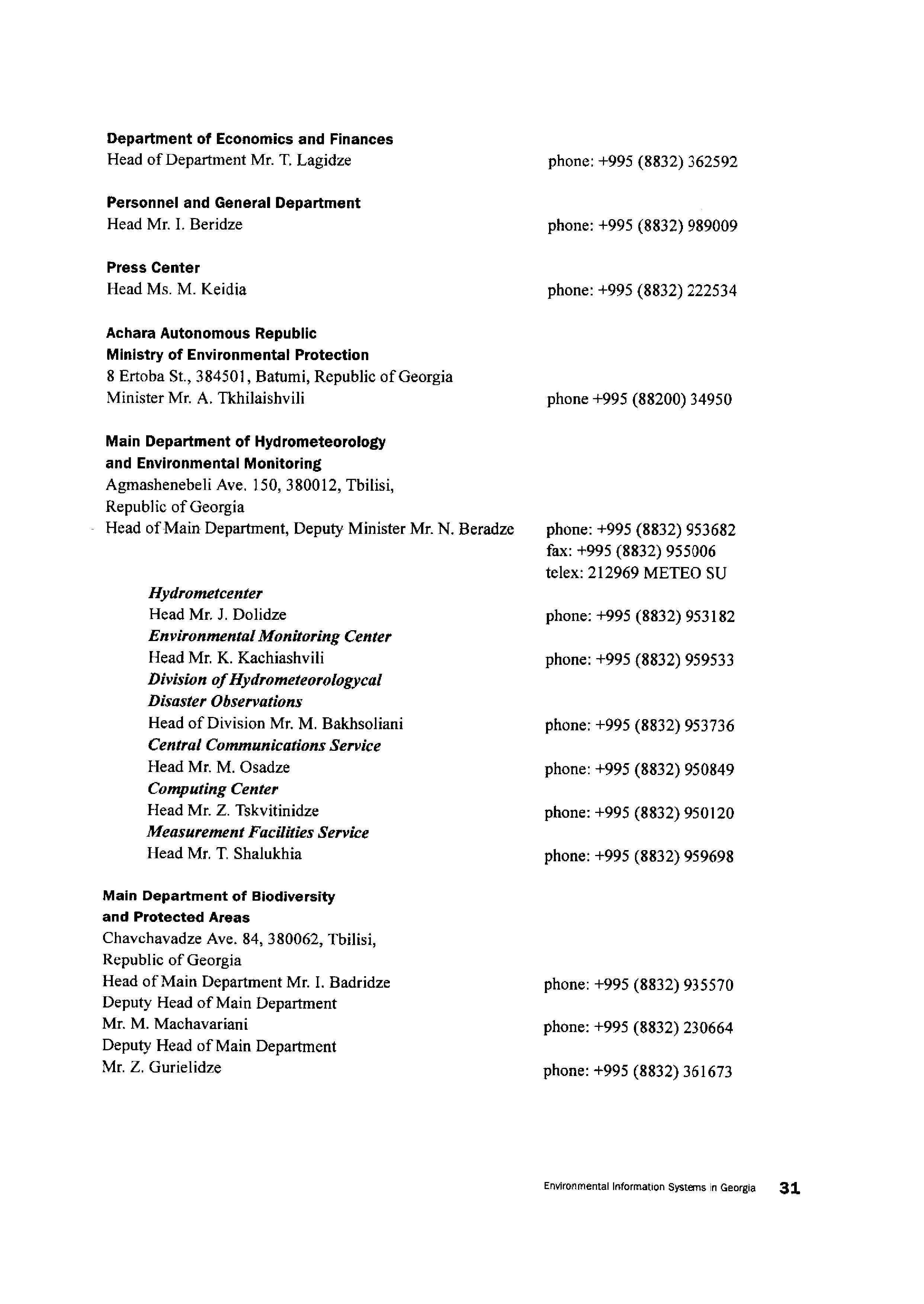
Head of Division Mr. M. Bakhsoliani phone: +995 (8832) 953736 Central Communications Service
Head Mr. M. Osadze phone: +995 (8832) 950849 Computing Center
Head Mr. Z. Tskvitinidze phone: +995 (8832) 950120 Measurement Facilities Service Head Mr. T. Shalukhia phone: +995 (8832) 959698
Main Department of Biodiversity and Protected Areas
Chavchavadze Ave. 84, 380062, Tbilisi, Republic of Georgia
Head of Main Department Mr. I. Badridze phone: +995 (8832) 935570
Deputy Head of Main Department Mr. M. Machavariani phone: +995 (8832) 230664
Deputy Head of Main Department Mr. Z. Gurielidze phone: +995 (8832) 361673
Main Department of State Environmental Control
Chavchavadze Ave. 84, Tbilisi, 380062, Republic of Georgia
Head of Department Mr. T. Cholokava Division ofthe Protection of Water Resources Head of Division Mr. K. Giorgobiani Atmospheric Air Protection Division Head of Division Mr. R. Razmadze Division ofthe Protection ofLand and Natural Resources Head of Division Mr. G. Sakhelashvili
Department of State Environmental Expertise
Chavchavadze Ave. 72, Tbilisi, Republic of Georgia Head of Department Mr. S. Tsabadze
Department of the Regulation of Natural Resources and Norms

Head of Department Mr. A. Chankseliani Deputy Head of Department Mr. D. Monaselidze Division ofRegulation of Natural Resources Head of Division Mr. R. Gogilashvili Division ofNorms Head of Division, Deputy Head of Department Ms. M. Makarova Division ofAgroecology Head of Division Ms. N. Gvajava
Environmental Scientific-Information Center Chief Mr. A. Panchulidze Environmental Information Systematization and Cadastre Division Head of Division Ms. D. Benashvili Division ofPrograms Head of Division Ms. M. Javakhishvili
phone +995 (8832) 235856 phone +995 (8832) 290884 phone +995 (8832) 290139 phone +995 (8832) 2907883 phone: +995 (8832) 230664 phone: +995 (8832) 363364 phone: +995 (8832) 230664
Central Environmental Control Laboratory
Village Dighomi, Mtskheta District, 380031
Republic of Georgia
Head of Laboratory Mr. 0. Kenia phone +995 (8832) Analytical Department
Head of Department Mr. M. Kobalava phone +995 (8832) 58009 Department ofSurvey and Control of Harmful Industrial Emissions
Head of Department Mr. T. Teneishvili phone +995 (8832) 518009 On-sight Control Department
Head of Department Mr. Z. Darchiashvili phone +995 (8832) 518198
Black Sea Protection Convention Department
Head of Department Mr. I. Stepanishvili phone: +995 (8832) 362128 Division ofthe Fisheries Regulation and Dumping Head of Division Ms. L. Sesitashvili phone: +995 (8832) 362128

The Black Sea Ecology and Fisheries Institute 51, Rustaveli St., P. B. 58, Batumi, Republic of Georgia
Director Mr. A. Komakhidze phone (satellite): (873) 1406444 fax (satellite): (873) 1406443
Batumi Marine Convention Inspection
9 April St. 6, 384550, Batumi, Republic of Georgia
Head of Inspection Mr. T. Gogotishvili phone: +995 (88200) 210102
Poti Marine Convention Inspection 52 Agmashenebeli St., 384630, Poti, Republic of Georgia
Head of Inspection Mr. A. Janjgava phone: +995 (88293) 92462, 54820
Sokhumi Marine Convention Inspection 9 April St. 6, 384550, Batumi, Republic of Georgia
do Batumi Marine Convention Inspection
Head of Inspection Mr. A. Naskidashvlli phone: +995 (88200) 20102
Environmental City Committee of Thilisi
Ketevan Tsamebuli Ave. 96, Tbilisi, 380044
Republic of Georgia
Head of the Committee Mr. Z. Tavartkiladze phone +995 (8832) 710453
Department of Geodesy and Cartography
Gamsakhurdia Ave. 27, Thilisi, Republic of Georgia
Head of Department, Mr. G. Kekelidze Division of Topography and Geodesy Head of Division Mr. V. Nebieridze Division ofCartography Head of Division Ms. N. Gogichaishvili State Geodetic Supervision and Regime Division Head of Division Mr. Gh. Todua Aerogeodesy Enterprise Head Mr. M. Nadaraia
State Committee for Social and Economic Information
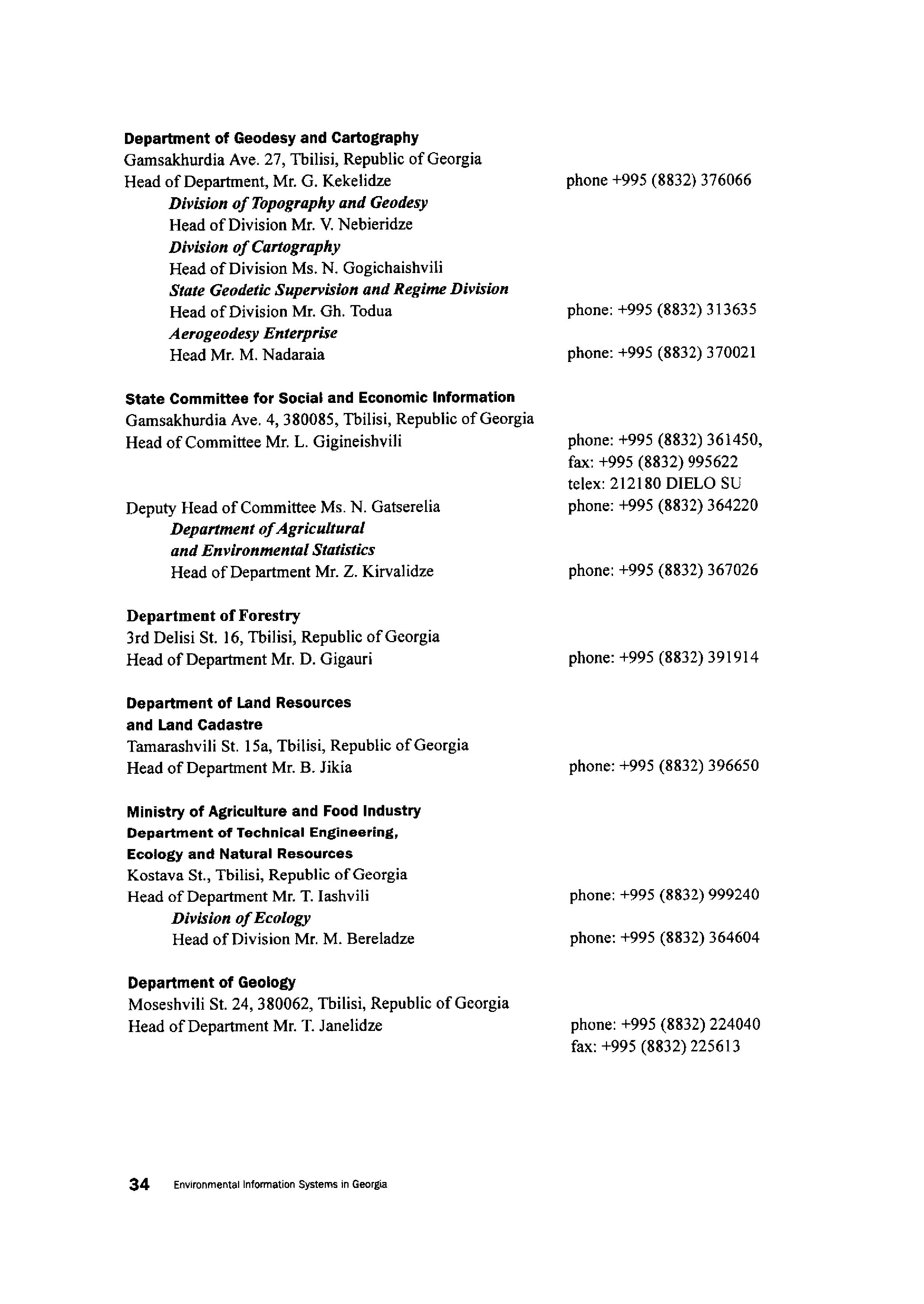
Gamsakhurdia Ave. 4, 380085, Tbilisi, Republic of Georgia Head of Committee Mr. L. Gigineishv iii
Deputy Head of Committee Ms. N. Gatserelia Department ofAgricultural and Environmental Statistics Head of Department Mr. Z. Kirvalidze
Department of Forestry 3rd Delisi St. 16, Thilisi, Republic of Georgia Head of Department Mr. D. Gigauri
Department of Land Resources and Land Cadastre Tamarashvili St. iSa, Tbilisi, Republic of Georgia Head of Department Mr. B. Jikia
Ministry of Agriculture and Food Industry Department of Technical Engineering, Ecology and Natural Resources Kostava St., Tbilisi, Republic of Georgia Head of Department Mr. T. Iashv iii Division ofEcology Head of Division Mr. M. Bereladze
Department of Geology
Moseshvili St. 24, 380062, Tbilisi, Republic of Georgia Head of Department Mr. T. Janelidze
phone +995 (8832) 376066 phone: +995 (8832) 313635 phone: +995 (8832) 370021
phone: +995 (8832) 361450, fax: +995 (8832) 995622 telex: 212180 DIELO SU phone: +995 (8832) 364220 phone: +995 (8832) 367026 phone: +995 (8832) 391914 phone: +995 (8832) 396650 phone: +995 (8832) 999240 phone: +995 (8832) 364604 phone: +995 (8832) 224040 fax: +995 (8832) 225613
Ministry of Health
Gamsakhurdia Ave. 30, 380060, Tbilisi, Republic of Georgia Minister Mr. A. Jorbenadze phone: +995 (8832) 387510, fax: +995 (8832) 983703, telex: 212223 LAZER SU
Central Board of Reserves and Hunting Management
Chavchavadze Ave. 84, 380062, Tbilisi, Republic of Georgia Chief of Board Mr. R. Shishniashvili phone: +995 (8832) 294047
Department ofNature Reserves
Head of Department Mr. B. Lobjanidze phone +995 (8832) 235077
Department ofHunting Head of Department Mr. G. Giorgobiani phone +995 (8832) 235150
Tbilisi State University
Chavchavadze Ave. 1, 380028, Tbilisi, Republic of Georgia
Department ofCartography and Geoinformatics
State ofNature Research Laboratory
Head of Department and Laboratory Mr. N. Beruchashvili phone: +995 (8832) 236490 Department of Geomorphology and Geoecology Head of Department Mr. Z. Tatashidze
Laboratory ofRemote Sensing Head Mr. G. Abuladze phone: +995 (8832) 220640, 230180
Department ofEcology Head of Department Mr. G. Kajaia phone +995 (8832) 235150

Institute of Hydrometeorology
Georgian Academy of Sciences Agmashenebeli Ave. 150a, 380012, Tbilisi Republic of Georgia Director Mr. G. Svanidze phone: +995 (8832) 236469 e-mail: gsvan@hydmet.acnet.ge
Institute of Geography Georgian Academy of Sciences 1 Rukhadze St., 380093, Tbilisi, Republic of Georgia Director Mr. Z. Tatashidze phone: +995 (8832) 365109
Institute of Water Resources and Environmental Engineering Georgian Academy of Sciences
Chavchavadze Ave. 60, 380030, Tbilisi, Republic of Georgia Director Mr. Ts. Mirtskhulava phone: +995 (8832) 224094, fax: +995 (8832) 225620
institute of Mountain Forestry Georgian Academy of Sciences
3rd Delisi St. 16, Thilisi, Republic of Georgia Director Mr. G. Gigauri
Scientific Research Institute of Hygiene 78, Uznadze St., 380002, Tbilisi, Republic of Georgia Director Mr. R. Khazaradze Deputy Director Mr. S. Tabagari
institute of Caucasian Mineral Resources Paliashvili St. 85, 380062, Tbilisi, Republic of Georgia Director Mr. T. Janelidze
Research Institute for Scientific and Technical Information Techinformi"

phone: +995 (8832) 303170
phone: +995 (8832) 955366 phone: +995 (8832) 961485, fax: +995 (8832) 985017 e-mail: tsk@who.ge phone: +995 (8832) 231315
47 Kostava St., Thilisi, 380079, Republic of Georgia Director Mr. 0. Shatberashvili phone: +995 (8832) 988321, 988322 fax: +995 (8832) 987618, telex: 212245 FOND SU e-mail: techiberiapac.ge

Parliamentary Decree on Nature Reserves and Hunting Management in GeorgiaMarch 2, 1993.
Law on Protection of Soil - March 12, 1994.
Law on Protection of Plants from Harmful Species - March 12, 1994.
Parliamentary Decree revising Decree # 10, May 7, 1992, on a 21-km-wide State Boundary Security Zone of Georgia - February 22, 1995.
Parliamentary Decree on State Regulation and Licensing of Natural ResourcesMarch 23, 1995.
Parliamentary Decree on Regulation of Interfarm Forests - March 7, 1995.
Law on Changes and Additions to the Georgian SSR Forestry Law - March 7, 1995.
Law on Import, Export and Transit of Hazardous and Other Waste - February 8, 1995.
Ministerial Decree # 87 on Georgian Ministry of Environmental Protection - February 7, 1995.
Ministerial Decree # 967 on Establishment of a Unified System of Environmental Monitoring for the Republic of Georgia - December 31, 1994.
Codes of Air, Water and Forests (old Soviet codes with appropriate amendments).
Law on Protected Areas, Water Law, Law on Mineral Resources (first hearing planned for May, 1995)
Customs Convention of International Transport of Goods under Cover of hR Carnets (TIR Convention, 1973)- March 24, 1994.
Convention of the Recognition and Enforcement of Foreign Arbitral Awards, New York, 1958 - February 3, 1994.
Agreement for Protection of the Black Sea from Pollution, Bucharest, 1992 - November 23, 1993, ratified.
Convention of Climate Change, New York, May 9, 1994 - May 16, 1994, adherence approved by the Georgian Cabinet of Ministers.
International Pact on Economic, Social and Cultural Rights, New-York, December 19, 1966 - January 25, 1994.
In April of 1994 Georgia joined the following conventions:
Convention on the International Regulations Preventing Collisions at Sea, 1972.

International Convention on Civil Liability for Oil Pollution Damage, 1969.
International Convention on Tonnage Measurement of Ships, 1969.
international Convention for the Safety of Life at Sea, 1974.
International Convention on Standards of Training, Certification and Watchkeeping of Seafarers, 1978.
International Convention for the Prevention of Pollution from Ships, 1973 (MARPOL - 1973) - took force on April 19, 1994, July 18, 1994, July 19, 1994.
12, The United Nations Convention on Contracts for the International Sale of Goods, Vienna, April II, 1980 - July 30, 1994.
The Convention of the Biological Diversity, Rio de Janeiro, 1992 - April 21, 1994, ratified.
Bishkek Agreement for Regulation of Property Rights and Relations, October 7, 1991 - May 29, 1994.
Convention on the International Maritime Satellite Organization - July 27, 1993.
Ministerial Report on the State of the Georgian Environment - Ministry of Environmental Protection, Tbilisi, 1993, pp. 1- 344,


- Black Sea Environmental Program (BSEP)
List of Georgian contact persons:
NATIONAL COORDINATOR
Ministry of Environmental Protection of the Republic of Georgia 68a Kostava St., 380015, Tbilisi, Republic of Georgia Mr. Merab Sharabidze, Deputy Minister
Activity Center for the Protection of Biodiversity The Black Sea Ecology and Fisheries Institute 51, Rustaveli St., P.B. 58, Batumi, Republic of Georgia Akaki Komakhidze, Director
FOCAL POINTS
Development of Common Methodologies for Integrated Coastal Zone Management Ministry of Environmental Protection 68a Kostava St., 380015, Thilisi, Republic of Georgia Malkhaz Dzneladze, Head of Department
Emergency Response
Conventional Inspection for the Protection of the Black Sea 68a Kostava St., 380015, Tbilisi, Republic of Georgia
Mr. Ilia Stepanishvili, Director
Tel: +995 (8832) 367340, 230664 Fax: +995 (8832) 955006
Tel (satellite): (873) 1406444 Fax (satellite): (873) 1406443
Tel: +995 (8832) 230664 Fax: +995 (8832) 955006
Tel: +995 (8832) 362128 Fax: +995 (8832) 955006
The Black Sea Ecology and Fisheries Institute 51, Rustaveli St., P.B. 58, Batumi, Republic of Georgia Mr. Akaki Komakhidze, Director
The Black Sea Hydrometeoro logical and Environmental Monitoring Center 124, Tskhakaia St., 384504 Batumi Republic of Georgia
Mr. Ismet Diasamidze, Director
Special Monitoring Programs, Biological and Human Health Effects and Environmental Quality Standards Scientific Research Institute of Hygiene 78, Uznadze St., 380002 Thilisi, Republic of Georgia Mr. Sergo Tabagari, Deputy Director
Tel (satellite): (873) 1406444 Fax (satellite): (873) 1406443

Dept. of Hydrology institute of Geography 1, Rukhadze St., 380093 Thilisi, Republic of Georgia Mr. Givi Gigineishvili, Head of Dept.
Georgiai World Bank Integrated Coastal Zone Management (ICZM) Project (Project Proposal for the development of ICZM GIS) "Ecosystem Modeling as a Management Tool for the Black Sea", NATO SfS Project (Development of the Black Sea Oceanographic database).
Tel: +995 (88200) 33050 (90- 522) 8189092 Fax: (90- 522) 8189094, 8210563
Tel: +995 (8832) 961425 Fax: +995 (8832) 985017 E-mail: tsk@who.org
Tel: +995 (8832) 360165, 361728 C/O National Coordinator Fax: +995 (8832) 983425, 955006
Information for sustainable development planning and management is of major concern for the global community. As a follow up to the 1992 United Nations Conference on Environment and Development held in Rio de Janeiro, UNEP is helping to develop environment and natural resource information networks (ENRIN) worldwide. These networks consist of key institutions active in environmental information management at national and regional levels whose main aim is to generate environmental infonnation needed by various users ranging from decision-makers to the general public.
The following publications can be requested from UNEP/GRID-Arendal at: UNEP/GRID-Areridal Information Department • Longum Park • P.O. Box 1602, Myrene • N-4801 Arendal • NORWAY Phone: +47 370 35650 • Fax: +47 370 35050 • E-mail: gridgnda.no " WWW: http://www.gida.no
Envlronmental Information Systems In Georgia"
Environmentai Information Systems in Ukraine"
"Environmental Information Systems In the Russian Federation"
FeasabIiity Study for the Establishment of a UNEP-compatibie Environmental Information Network in Hungary"
Authors: T.T. Bakuradze, M. Gwilawa, Z. Jincharadze, M. Khurtsidze and M. Kurtubadze
Author: Andrey V Semichaevsky
Author: Nickolai B. Denisov
Author: Csaba Nemes
UNEP/EAP.TRi95-02
UNEP/EAP.TW95-03 LJNEP/EAP.TR'95-04 - UNEP1EAP.TR/95-05GA'205024-95/1 G,V205024/95-2 GiV205024-95/5 GN205024-95/7 ISBN 92-807-1519-4 ISBN 92-807-1518-6 ISBN 92-807-1517-8 ISBN 92-807-1516-X
Proceedings from Baltic Workshop "National Environmental Reporting Needs and Capabilities In the Baltic States: The Roles of Information Networks, information Centres and G1S" 23-24 March 1995
Proceedings from Moscow Seminars "Integrated Environmental Information Systems in Support of Decision-Making on the Oblast Level in RussIa" 24-25 January 1995; The Development of the Unified State Environmental Monitoring System In the Russian Federation 26 January 1995
Proceedings from UNEP/OECD/1EC Moscow Seminar 29-31 May 1995 Integrated Environmental Information Systems In Support of Decision-Making In Countries in Transition"

UNEP/EARMR/95-8 GN205024-95/4
UNEP/EAP.MR'95-5 GA'205024-95/6
UNEP/EAP.MR195-11 GA'205024-95i7
