ENVIRONMENT AND SECURITY
K Y R G Y Z S T A N
Khaidarkan
Sokh Vorukh
A
i
l a
R
n
Maji Karakul
I
K
Karakul
Ma
Tajik national park
m
J
C H I N A
Peak Lenina
a
A
7134
P
T
Tavildara
V a
Altyn-Mazar
7495 Ismoil Somoni Peak Sangvor
e n-H rk a a M
uu yl-S l e y Kyz l
i Al a
u Muks
Nushor
I
S
T
A
ji-H
e
N
i
Kudara
Va nj
Darvoz
r
g tan Bar
Vanj
Murga b
Lake Sarez
Pa nj
AFGHANISTAN
Shazud Jelondi
Khorug
d ah
Roshtqala
a ar
c
eshem
Vrang Baharak Jorm
n Pa
j
Zong
Wakhan
Qizilrabot Koli Chakmakin nature reserve
ir Pam Pamir nature reserve
Rubot
Toktomush
ur Alich Zorkul nature reserve Zorkul
Yashilkul
nt Gu
Sh
ok
Alichur
Western Pamir
Taxkorgan
su
Eastern Pamir
Rushon Basenj
Murgab
Oq
Bartang
ht
K
DarootKorgon
e
Djajilan
Djirgatol h Vakhs
Jaldamuc
a
g
Sary-Tash
Buzai Gumbad
Elevation in metres
Langar
Karkar
4 000
Kandud
Ishkoshim
3 000
P A K I S T A N 0
25
50
75
100 km
Map produced by Zo誰 Environment Network, May 2010
Pressures on biodiversity can become an opportunity for cooperation. For example, two agreements on environmental cooperation signed between Afghanistan and Tajikistan in 2006 and 2007 envisage important nature conservation activities in the upper Amu Darya basin states. In particular, re-forestation of war- and erosionaffected land in pomegranate, pistachio and walnut forests134 could play a major role in improving the local economy, reducing poverty and minimizing natural disasters risks in the upper basin.
66
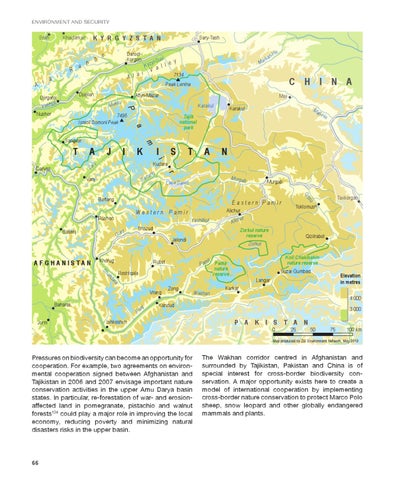
The Wakhan corridor centred in Afghanistan and surrounded by Tajikistan, Pakistan and China is of special interest for cross-border biodiversity conservation. A major opportunity exists here to create a model of international cooperation by implementing cross-border nature conservation to protect Marco Polo sheep, snow leopard and other globally endangered mammals and plants.