A PR I L 3 - A PR I L 9, 2020 | TH R E E D O LL A R S
FLOR IDA’S NE WSPAPER FOR T HE C - SUI T E
COVID-19 | The challenge at survival gear stores? Getting more inventory. PG.8 PASCO • H ILL SBOROUG H • PIN ELL AS • P OLK • M A N ATEE • SA R ASOTA • C H A R LOT TE • LEE • COLLIER
Kettle Spaces Empty Mettle Businesses across the region, with some trepidation but a lot of moxie, are primed for the battle of their lives. PANDEMIC RESPONSE: PAGES 7-15
MARK WEMPLE
BANKING
EMPLOYMENT LAW
PANDEMIC RESPONSE
Time to Shine
Big Changes
Scrub Rub
Community bankers have long been relationship-based businesspeople. Now they can prove it in a crisis. PAGE 8
Managing employees, in the face of the coronavirus pandemic, is about to get complicated. PAGE 11
Naples Soap Co. Founder Deanna Wallin uses an old lesson to navigate the new crisis: Be prepared. PAGE 15
COMMERCIAL REAL ESTATE
PANDEMIC RESPONSE
PANDEMIC RESPONSE
Freeze Frame
To Good Use
Battle Tested
The landlord-tenant relationship, g iven cash-f low cr unches, faces significant hurdles in the near future. PAGE 10
Erin Meagher, who founded her company in the recession, is readying for another survival fight. PAGE 15
Old foreclosures drive multifamily market. 16 Fort Myers business park will be developer’s biggest project. 16 Investor buys vacant Lakeland commercial site for $49.5 million. 17
PAGE
3 A prescription for the economy: Start cutting. Now. industry insights
327883-1
DON’T MISS
A be v y of a re a ma nu f ac t u rer s using some innovative approaches are gearing up to fight coronavirus. PAGE 12
REAL ESTATE
ADDRESSING BUSINESS CONCERNS AMID THE CORONAVIRUS PANDEMIC see page 3
2
BUSINESS OBSERVER | APRIL 3, 2020 - APRIL 9, 2020
BusinessObserverFL.com
Vol. XXIV, No. 12
A Division of The Observer Media Group
BusinessObserverFL.com Founded in 1997, the Business Observer is Southwest and Central Florida’s newspaper for business leaders. With offices in Hillsborough, Pinellas, Polk, Pasco, Manatee, Sarasota, Charlotte, Lee and Collier counties, the Business Observer is the only weekly business newspaper that provides business leaders with a regional perspective. The Business Observer’s mission is to deliver relevant news and information on Southwest and Central Florida’s leading and growing companies, up-and-coming entrepreneurs and economic, industry and government trends affecting business. The Business Observer is also the leading publisher of public notices on the Gulf Coast of Florida.
Editor and Publisher / Matt Walsh, mwalsh@BusinessObserverFL.com Executive Editor / Kat Hughes khughes@BusinessObserverFL.com Managing Editor / Mark Gordon mgordon@BusinessObserverFL.com Commercial Real Estate Editor / Kevin McQuaid kmcquaid@BusinessObserverFL.com Tampa Bay Editor / Brian Hartz bhartz@BusinessObserverFL.com Sarasota-Manatee Editor/ Grier Ferguson gferguson@BusinessObserverFL.com Editorial Design /Jess Eng Contributors / Steven Benna, Beth Luberecki, John Haughey
Associate Publisher / Kathleen O’Hara kohara@YourObserver.com Associate Publisher / Diane Schaefer dschaefer@BusinessObserverFL.com Director of Legal Advertising / Kristen Boothroyd kboothroyd@BusinessObserverFL.com Director of Creative Services / Caleb Stanton, cstanton@YourObserver.com Director of Information Technology / Adam Quinlin, aquinlin@YourObserver.com Chief Financial Officer / Laura Keisacker lkeisacker@YourObserver.com Director of Circulation / Anne Shumate subscriptions@ BusinessObserverFL.com
HOW TO REACH US Hillsborough County
200 S. Hoover Blvd., Suite #135 Tampa, FL 33609 Phone: 941-906-9386 (Legal Notices) Fax: 941-954-8530
Lee County
Manatee County
5570 Gulf of Mexico Dr., Longboat Key, FL 34228 Phone: 941-362-4848 Phone: 941-906-9386 (Legal Notices) Fax: 941-954-8530
Sarasota County
18070 S. Tamiami Trail, Suite 11 Fort Myers, FL 33908 Phone: 239-703-7802; Fax: 941-954-8530
Orange County
661 Garden Commerce Pkwy, Suite 180 Winter Garden, FL 34787 Phone: 941-906-9386 (Legal Notices) Fax: 941-954-8530
Charlotte County
Address: 949 Tamiami Trail, Suite 202 Port Charlotte, FL 33953 Phone: 941-906-9386 (Legal Notices) Fax: 941-954-8530
Pinellas County
14004 Roosevelt Blvd. Clearwater, FL 33762 Phone: 941-906-9386 (Legal Notices) Fax: 727-447-3944
Sarasota, FL 34230 1970 Main St., Suite 400, Sarasota, FL 34236 Phone: 941-362-4848 Phone: 941-906-9386 (Legal Notices) Fax: 941-954-8530
Collier County
The French Quarter, 501 Goodlette Road N., #D-100 Naples, FL 34102 Phone: 941-906-9386 (Legal Notices) Fax: 941-954-8530
Pasco County
3030 Starkey Blvd. New Port Richey, FL 34655 Phone: 941-906-9386 (Legal Notices) Fax: 941-954-8530
Polk County
1102 S. Florida Ave. Lakeland, FL 33803 Phone: 941-906-9386 (Legal Notices) Fax: 941-954-8530 To send Legal Notices, email to: legal@BusinessObserverFL.com. Name the county of interest in the subject line and attach notice. Deadline for legal notices is noon Wednesday. For Display Advertising, call (941) 362-4848. Deadline for display advertising space is noon Friday.
Amid the uncharted waters the world is navigating right now – we have one, simple message to share with our valued customers and communities:
We’re here for you. When life is filled with the unexpected... here’s what you can expect from us: • Personal service
• Integrity
• Dedication
• Understanding
Sarasota (941) 929-9000
St. Petersburg (727) 521-1000
Venice (941) 497-6660
HOW TO SUBSCRIBE Subscription Price
One-Year Periodical Rate........................................................................................ $75 One-Year First-Class Mail......................................................................................$107 Two-Year Periodical Rate.......................................................................................$127 Two-Year First-Class Mail.......................................................................................$180 Three-Year Periodical Rate....................................................................................$185 Three-Year First-Class Mail...................................................................................$239 Single copy price: $3 Group rates for five or more corporate subscriptions are available. To subscribe online: www.businessobserverfl.com If you have a question about your subscription or wish to suspend your subscription temporarily, call Anne Shumate, (877) 231-8834 or contact her by email: subscriptions@BusinessObserverFL.com
POSTAL INFORMATION The Business Observer (ISSN#2325-8195) is published weekly on Fridays by the Gulf Coast Review Inc., 5570 Gulf of Mexico Dr., Longboat Key, FL 34228; Periodicals Postage Paid at Sarasota, FL, and at additional mailing offices. The Business Observer is circulated in Charlotte, Collier, Hillsborough, Lee, Manatee, Pasco, Pinellas, Polk and Sarasota counties. POSTMASTER: Please send changes of address to the Business Observer, P.O. Box 15456 North Hollywood, CA 91615-9166. For information on reprints, visit BusinessObserverFL.com
331394-1
“The road is cleared,” said Galt. “We are going back to the world.” He raised his hand and over the desolate earth he traced in space the sign of the dollar.
StearnsBank.com
Ayn Rand, Atlas Shrugged
APRIL 3, 2020 - APRIL 9, 2020 | BUSINESS OBSERVER
review and comment BY MATT WALSH | EDITOR AND PUBLISHER
BusinessObserverFL.com
3
ADVERTISEMENT
WILLIAMS PARKER ATTORNEYS AT LAW, SARASOTA, FLORIDA
More prescriptions for state’s economy With the economic disaster spreading fast, supply-side economist Art Laffer says governments should cut now. “First, let me give you some background,” he said. “Florida is such a pro-growth state. It has an extreme sensitivity to the cycles. When the economy is strong, Florida is really strong. But when it collapses, it goes to the basement.” Ugh. But hold on. There’s a little bit of good news: “You’re going to have a very sharp downturn,” Laffer said. “But it won’t be as bad as ’08 and ’09.” What should the governor and Legislature do? Laffer’s prescriptions: n “Do not raise taxes.” n “Cut as much state, county and local government spending as possible — right away. Do not wait.” n “Taxes: This is not a period for exclusions. Move to as broad a base and low rates as possible. Eliminate all the sales tax exemptions you can, and lower the rate. Get rid of distortions.” n Have the state guarantee loans that banks make to creditworthy companies. Laffer’s overriding and fundamental recommendation, the one he emphasizes from the 30,000-foot economist’s view, is this: “You want to make it worthwhile for people to work. Make it more attractive for producers.” More suggestions: Lower airport landing fees; lower city and county hotel taxes (you can imagine all of the screaming over that one); lower or eliminate the sales tax on commercial leases. (“That will encourage more building,” Laffer said.) When businesses and entrepreneurs produce more supply, when they produce more goods and services of value, demand will rise. That’s the premise of Laffer’s supply-side economics. So if we want to stimulate demand, government must reduce the barriers to produce more supply. It wasn’t all that long ago that’s what occurred in Florida — during the Gov. Rick Scott years from 2010-2018. Surely you remember Scott being almost maniacal about wanting Florida to have the best business climate in the nation. He spent eight years touting “jobs, jobs,
See COMMENT page 18
NO BIG RUSH IN TALLAHASSEE Gov. Ron DeSantis doesn’t have the authority to enact many of the steps economist Arthur Laffer recommends for Florida. They would require legislative approval. Asked this week if there’s talk in Tallahassee yet of calling the Legislature back into special session to address the inevitable economic downturn, Katie Betta, communications director for Senate President Bill Galvano, R-Bradenton, referred us to a memo Galvano sent out last week to all Florida senators. Galvano noted that state revenue data just released was for February, which actually reflects January sales. It was good news — collections were $48 million more than expected.
Galvano closed his five-paragraph memo with this: “The General Revenue Collection Report for March, and more so the subsequent report for April, will provide our consensus estimators with the first concrete pieces of data they will need to formally adjust our revenue estimates. We will keep you updated as additional information becomes available. “In the meantime, I believe our state is well served by the $4 billion reserve we worked together to set aside during the 2020 session.” In other words, lawmakers won’t see data on the effects of the crisis until May and June (April sales). Thousands of businesses are likely to be gone by then.
ADDRESSING BUSINESS CONCERNS AMID THE CORONAVIRUS PANDEMIC During this uncertain time, each day brings new issues and questions for businesses, as COVID-19 continues to spread around the world. To help businesses prevent, respond to, and mitigate the effects of this medical, business, and economic challenge, Williams Parker has launched a multidisciplinary task force of lawyers to advise on issues arising from the COVID-19 pandemic. The team is closely monitoring legal developments and guidance from federal, state, and local government and public health officials. Of the many concerns, some of the key areas of interest to businesses include: The Coronavirus Aid, Relief, and Economic Security Act – The CARES Act provides financial support for individuals and businesses impacted by the COVID-19 pandemic. The $2 trillion stimulus relief package includes one-time direct payments to individuals, greater unemployment benefits, loans and grants to businesses, income tax breaks for businesses and individuals, and additional resources for hospitals, states, and municipalities. A few of the key benefits for businesses include: • A refundable payroll tax credit for 50 percent of employer wages for companies that were prohibited from operating during the crisis. • Employer-side Social Security payroll tax payments attributable to wages paid in 2020 may be delayed. Net operating losses earned in 2018, 2019, or 2020 can be carried back five (5) years. The NOL limit of 80 percent of taxable income is also temporarily suspended, so businesses may use any NOLs they have to fully offset their taxable income. • Amendment of the Small Business Act to create a new business loan program category that will provide 100 percent federally-backed loans to eligible small businesses to help cover costs of operation such as payroll, rent, health benefits, and insurance premiums. Expanded Family and Medical Leave and Paid Sick Leave – Congress enacted the Families First Coronavirus Response Act to provide emergency family and medical leave for employees that need to be away from work to care for a child when the child’s school or daycare is closed and the employee is unable to work or telework and care for the child. In addition, the Act provides for up to 12 weeks of paid sick leave to certain employees affected by COVID-19. With few exceptions, the new law applies to private businesses with fewer than 500 employees and public agencies with one or more employees. It will take effect April 1, 2020.
Tax Benefits, Grants, and Loan Programs – Several additional relief efforts are being implemented to address the economic impact of COVID-19 and to aid those affected. • Relief for Taxpayers Affected by Ongoing Coronavirus Disease 2019 Pandemic – Extends the deadline for filing income tax returns and paying income tax (with some limitations) to July 15, 2020. • Families First Coronavirus Response Act – Provides 100 percent refundable tax credit to private-sector employers with fewer than 500 employees that are required to provide paid sick leave and paid family leave benefits. • The Florida Small Business Emergency Bridge Loan Program – Businesses with between 2 and 100 employees will be eligible to take short-term, interestfree (for the first year) working capital loans of up to $50,000 (up to $100,000 in special circumstances). Eligible businesses must apply with the Florida Department of Economic Opportunity by May 8, 2020. • The U.S. Small Business Administration Economic Injury Disaster Loan Program – Provides small businesses with working capital loans of up to $2 million to help overcome temporary losses of revenue. The above information provides a highlevel overview of just some of the concerns and relief measures for businesses and their employees. For more detailed information and continued updates, visit williamsparker.com/covid-19-resources. Williams Parker has been providing experienced guidance in the areas of corporate law, employment law, tax, healthcare, intellectual property, real estate, litigation, and estate planning and administration since 1925. The firm also serves clients’ needs globally through its membership in Ally Law, an international alliance of law firms.
Phone: 941-366-4800 Website: www.WilliamsParker.com
Business Observer's Industry Insights allows brands and businesses to connect directly with the Business Observer's readership--and participate in the conversation—by creating engaging content on the Business Observer's digital publishing platform. To learn more email us directly at industryinsights@businessobserverfl.com.
327869-1
Surely by now, no one needs to be told the obvious about Florida’s economy: Brace yourself. But let’s start here this week attempting to emphasize the urgency of the point we tried to make last week in this space. This past Monday, we connected with noted economist Arthur Laffer. You remember him — author of the Laffer Curve back in the Reagan years. You know: Voodoo economics, his critics called it. To this day Arthur Laffer espouses with great enthusiasm what he showed on a napkin to Dick Cheney at the Washington Hotel in the early 1970s and what proved to be true: If you cut taxes, your economy will grow — and so will government revenue. It works every time. Figuring he might have a few good ideas for Florida’s economy, we asked him on this call what Florida’s government officials can do to help us through this economic crisis. Mind you, we understand the magnitude of the health crisis. But we will continue to argue the economic crisis that’s spreading will affect more people than the health crisis. To his credit, up until Wednesday, Florida Gov. Ron DeSantis did appear to grasp the economic side of this disaster better than other governors. He had been one of the few to show reasoned leadership and courage by resisting to shut down the entire state economy. And as we noted last week, we know DeSantis — and all elected leaders, for that matter — is fighting an intense, twofront war. Imagine being in his shoes. The public is watching his every move, looking for hope, stoicism, optimism, decisiveness, proactive responses and foresight. Of those qualities, it still appears there have been few signs of proactive response to the state’s economic plight. It would be easy to rely on the $2 trillion CARES Act. But let’s ask: Would you rely on the federal government to save your state’s economy? Of course not. What, then, should be done? We turned to Laffer:
4 topstories from BusinessObserverFL.com
BUSINESS OBSERVER | APRIL 3, 2020 - APRIL 9, 2020
BusinessObserverFL.com
SARASOTA-MANATEE
Company lays off employees One of the largest employers in Manatee County, Feld Entertainment, has laid off a chunk of its workforce in response to the coronavirus pandemic. Feld spokesman Stephen Yaros declined to provide a figure on the total number of people let go. Through 2019 Feld had some 600 employees working out of its north Manatee County facility, according to the Bradenton Area Economic Development Corp. The company had around 2,300 employees worldwide. “Over the past few weeks, the world has been racing to contain the spread of the COVID-19 outbreak,” the statement adds. “This has resulted in unprecedented and widespread government-mandated closures of public gatherings that forced us to shut down all Feld Entertainment tours. Although we hope to resume operations soon, there is no assurance of when that will happen. Therefore, we made difficult decisions to reduce the size of our workforce through companywide layoffs.”
Cleaning business adds service In the wake of the coronavirus crisis, Crystal Clean Green Cleaning has launched a disinfectant fog and misting service.
quote of theweek The strong will survive. We are going to get by. We’re from Jersey. We’re going to keep going.” Philip Solorzano | Solorzano’s Pizzerias SEE PAGE 14
The Sarasota-based company will make the service available starting March 30, according to a news release. The service consists of two different disinfection application types, and although officials expect it to be popular during the present outbreak, they also plan to continue to use it indefinitely. Crystal Clean Green Cleaning is a family-owned and -operated company with customers in Sarasota and Manatee counties. CHARLOTTE-LEE-COLLIER
Agency launches campaign An area public relations and marketing firm has created an online campaign to keep the community connected through the coronavirus crisis, dubbed #SWFLStrong. The campaign, from Fort Myers-based Conric PR & Marketing, includes a SWFL Strong Facebook group, where, according to a statement, “members of the Southwest Florida community can unite and connect to share good thoughts, community information, business developments and stories of goodwill.” Conric PR & Marketing hopes to partner with other agencies, organizations and social influencers to help spread the SWFL Strong message, using the #SWFLStrong hashtag.
Entrepreneur creates support videos Storm Smart, a manufacturer and installer of storm protection products for homes and businesses, is partnering with Southwest Florida business and community leaders on a series of coronavirus pandemic-related public service announcements. The PSAs will air on TV and online during the next few months, according to a statement. The focus of the PSAs is to remind everyone to support local businesses, help neighbors, maintain proper hygiene and donate to local food pantries. TAMPA BAY
Storage firm offers discounts PODS Enterprises LLC has cut its rental, delivery and transportation fees by 10% for college students who have lost their on-campus housing as a result of the global coronavirus pandemic. Students in the U.S. and Canada can take advantage of the six-month offer, according to a news release. PODS will deliver customers a weatherresistant container that can be transported locally or across the country, or kept in one of the Clearwater-based firm’s secure storage centers.
BY THE NUMBERS 6
Face shields for medical workers St. Petersburg College Professor Jonathan Barnes makes from a 3D printer every four hours PAGE 12
25
Employees, from a full staff of 60, working in the Beneficial Blends organic food facility in Tampa to fulfill orders PAGE 14
140%
Year-over-year sales increase in the middle two weeks of March for Naples Soap Co.’s e-commerce business PAGE 14
5
Employees Spaulding Decon, a decontamination cleanup business in Tampa, recently hired, bringing the total to 11 PAGE 15
9,700
New multifamily units delivered in Charlotte, Collier and Lee counties since 2015 PAGE 16
SPECIALIZING IN EXECUTIVE COMPENSATION AND BENEFITS
309548-1
At Professional Benefits Inc., we offer a range of insurance and executive benefits services. PBI President Taylor T. Collins is the youngest, most highly certified female insurance agent in the state of Florida. Her wealth of knowledge, in combination with her passion for serving people makes her a dynamic force when working for your business and family.
CELEBRATING 50 YEARS in the Insurance Industry!
Taylor Collins,
James Tollerton,
Taylor@ProfessionalBenefits.org
Jim@ProfessionalBenefits.org
CEBS, CLU, RHU
benefitsandplanning.com | (941) 957-1310
CLU, ChFC
APRIL 3, 2020 - APRIL 9, 2020 | BUSINESS OBSERVER
BusinessObserverFL.com
CoffeeTalk
5
FOR SALE | 2.6 ACRES FORT MYERS BEACH BOAT YARD
HOME DELIVERY UPDATE If you are working remotely and would like your delivery address changed, please email Anne at subscriptions@ BusinessObserverFL.com for immediate assistance. We appreciate your understanding.
SOLD!
available roperties p s s e c c Gulf A e Related in r a M r e oth
‘Corona with Craig’ In nearly a decade as president and CEO of FCCI Insurance Group, Craig Johnson has often met with employees, in groups big and small, under the banner Coffee with Craig. The Lakewood Ranch-based company, one of the Sarasota-Bradenton region’s largest employers, recently shifted the title and size of those gatherings. Now those meetings are called Corona with Craig. Not for beers, of course, and the cheeky name belies the seriousness of the meetings — companywide video-based virtual meetings designed to keep employees engaged and informed. “Our employees are our lifeblood,” Johnson tells Coffee Talk. “It’s important they know we have their back, that we are there for them.” A large part of FCCI’s business is done in-person, and Johnson isn’t a hide-in-the-corner-office kind of CEO, often connecting with employees and senior leaders. So when FCCI Board Member and Chief Administration Officer Lisa Krouse suggested semiweekly calls with Johnson at the helm, he embraced the idea. One of the key messages of the video chats, so far, is to let employees — who can then let vendors, business partners and family members — know FCCI is in good shape. “We have the ability to digest a black swan event like this,” says Johnson of FCCI, which does $837 million in annual revenue and operates in 19 states, with a large network of agency partners. “We will do everything we can to
PRICE: $5,250,000 • SALE INCLUDES LAND, BUSINESS & BUILDINGS • HOME OF THE TON TRAVEL LIFT • POTENTIAL FOR150RESTAURANT/TIKI BAR •
HURRY, PROPERTIES LIKE THIS RARELY COME AVAILABLE IN OUR LIFETIME!!
COURTESY PHOTO
Corona with Craig, with FCCI Insurance Group CEO CRAIG JOHNSON, is held Tuesdays and Fridays. make sure no one at FCCI loses their job because of coronavirus.” The video meetings are held Tuesdays and Fridays, with some 845 employees logging in. In addition to the state of the company, Johnson answers up to 50 questions and shares stories of employees, both those in need and those doing something extra to support customers. Johnson usually seeks to avoid talking about himself, but employees ask how he’s doing too. His answer: Like many others, he’s navigating the complicated time with family, going on walks and doing yoga with his wife. “It’s important for leaders to be visible” in times of crisis, Johnson says. “And we want to let everyone know we are still open for business.”
OVER 40+ YEARS • INEASYBUSINESS DEEP WATER • 5 MIN BOAT IDLE TOACCESS • 2.6+- ACRES ZONED: GULF IL, CM, IM •
ROBERT W. BEASLEY BROKER/OWNER
239.994.5049
RWBREALESTATE@AOL.COM JASON PADILLA BROKER-ASSOCIATE
239.233.0379
1711 MAIN ST., FORT MYERS BEACH, FL 33931 | RWBREALESTATE.COM
Court Appointed Receiver, Property Management and Specialty Oversight
Not so tragic
The coronavirus pandemic has hit the nation’s restaurant industry particularly hard. Last week, the Business Observer reported on how Dan Bavaro, the founder and owner of Bavaro’s Pizza Napoletana & Pastaria, has already had to close one of his restaurants and expects to lay off up to 50 workers — half of his workforce. Little Greek Fresh Grill, a St. Petersburg-based Greek restaurant chain that has 44 eateries in six states, including 18 in the Tampa Bay region, has also felt the COVID-19 sting. President Nick Vojnovic, who also owns and operates a Little Greek franchise near the University of South Florida campus in Tampa, says revenues are down 40% and that catering sales are practically nonexistent, but he’s doing
See COFFEE TALK page 6
Kenneth P. Saundry, Jr. brings 39+ years of business and real estate management experience to each Court Appointed Receiver assignment. Estates • Divorces or Family Disputes Guardianships • Bankruptcy Property Oversight and Supervision Foreclosure, or ‘Workouts’ Litigation Support Excellent Experience working with Lenders, Attorneys and Court Supervised Assignments.
239.348.1114 RealEstateAdvisoryServices.co 333197-1
COURTESY PHOTO
Little Greek Fresh Grill President NICK VOJNOVIC
everything he can to avoid a Greek tragedy of epic proportions. “Our first move was to tell our franchisees, ‘We’re not deferring your franchise royalties; we’re just going to waive them, so keep your employees in place, as many as possible, on a skeleton crew if you need to,’” Vojnovic tells Coffee Talk via phone from his home, where he’s in self-isolation because he’s recovering from leukemia treatments and is considered a high risk for getting COVID-19. “I’ve been in this business for four years, and this is definitely the most challenging issue we’ve ever had to address. To have a lockdown of your business and a health issue at the same time has been extremely complex and scary.” Vojnovic says he’s making the best of a dire situation with a little creativity. Thanks to its proximity to USF, his store has always had strong takeout sales, so he’s been able to shift emphasis to that aspect of the business. He’s also been selling staples including beef, chicken, eggs and even, yes, toilet paper — which he can get from his wholesale suppliers — directly to the public. “I think we can hang in there for maybe two, three months, but after that, the cash crunch is going to start catching up,” Vojnovic says. “We’re telling our franchisees to do everything they can to conserve cash.”
215 Caribbean Road, Naples, FL 34108-3408
333214-1
Due to the COVID-19 crisis, the Business Observer home delivery schedule for Pinellas, Hillsborough and Pasco subscribers will change from Friday to Sunday. This will begin with the April 10 issue and continue through the next few months.
6
BUSINESS OBSERVER | APRIL 3, 2020 - APRIL 9, 2020
BusinessObserverFL.com
CoffeeTalk
datasnapshot Big drop
FROM PAGE 5
Chain courses The impacts of the coronavirus stretch across the globe and include many far-reaching effects on supply chains. Fort Myers-based supply chain services firm Allyn International Services Inc., with that in mind, is making some of its expertise available to the public. The firm, with 23 locations worldwide and $32 million in revenue in 2018, is offering four of its online courses about introductory supply chain training for free through April 19. Allyn Operational Training and Customer Service Leader Deirdre Trevett tells Coffee Talk the online training has been available internally for employees for the past three or four years, but the firm decided to make the training available to everyone in the wake of the coronavirus. “We have medical professionals, grocery store workers, gas station attendants, everyone doing their part to keep everyone safe,” she says. “It’s a small thing we can do to help others.” The four free courses cover different supply chain topics — introduction to documents, introduction to transport modes, introduction to customs classification and Incoterms (International Commercial Terms published by the International Chamber of Commerce) 2020 changes from 2010. Allyn also has a free logistics learning game on its website that gives players a chance to learn about transport modes.
COURTESY
Allyn Operational Training and Customer Service Leader DEIRDRE TREVETT says the firm decided to make online supply chain training courses available to the public in the wake of the coronavirus.
Several coronavirus pandemic-related economic forecast projections are out — and Florida isn’t looking too good. According to one report, from Cambridge, Mass.-based StratoDem Analytics, the U.S., “and Florida in particular, already is in a recession and will see a nearly 20% decline in its GDP for the fiscal quarter beginning April 1.” That projected drop in GDP, 18.1%, stems from the slew of coronavirus-related shutdowns and is the sharpest quarterly downturn in GDP modeling history. The projection is a consensus based on the compilation of national forecasts, which StratoDem Analytics further refines down to the county level based on local economic data. The study adds that seven of the 10 counties nationwide most im-
Allyn expects a variety of people to use the resources, from individuals new to the supply chain industry who want to learn more to clients the firm works with to employees at similar companies. Allyn, for instance, asks all of its employees to take the courses within the first year of their employment. The interactive courses include text, visuals, audio and knowledge checks. The company has been building its catalog of courses since 2016. “We’re constantly looking at what team members need to learn,” Trevett says. “We think they’re a good resource.”
pacted already by the coronavirus recession are in Florida. Manatee County, projected to have the nation’s worst second-quarter decline in GDP, down 28%, leads the way in the Sunshine State, the report sates. And misery loves close-by company: Those seven counties include Collier, Sarasota and Lee counties, which, combined with Manatee, are projected to lose $5.7 billion in GDP in the second quarter. Although Mark Vitner, senior economist with Wells Fargo, in a separate report says Florida could come out of this recession quickly because it’s not real estate-related, the data remains stark. The American Hotel & Lodging Association, for one, recently estimated 305,146 Florida hotel-related workers likely will lose jobs. Other models forecast 400,000 Floridians already have lost their jobs and 2 million of the state’s 10.4 million workers are in job limbo.
GDP COLLAPSE The largest projected drops in second-quarter GDP, by county % FALL OVER COUNTY $ ECONOMIC LOSS FIRST QUARTER Manatee $993 million -28% Washoe (Reno, Nev.) $1.8 billion -27.6% Lee $2.1 billion -27.4% Collier $1.3 billion -27.2% Seminole (Orlando) $1.55 billion -25.7% Clark (Las Vegas) $7.99 billion -25.6% Lake (Orlando) $599 million -25.3% Sarasota $1.33 billion -25% Palm Beach $4.9 billion -23.7% Atlantic (Atlantic City, N.J.) $832 million -22.9%
ADVERTORIAL
Strong reputation drives Target Roofing’s success in SWFL Business growth requires focus on customers
R
331921-1
Seaglass at Bonita Bay
eputation matters to a commercial roofing contractor. Property managers, business owners and board members of homeowners associations often talk to each other, letting their counterparts know which contractors are worth their weight in gold – and which to avoid. They also post online reviews to share their experiences with the masses. If you satisfy a customer, they will call again for their next project. Any business serving commercial clients knows these are challenging times, especially in Southwest Florida, where competition is fierce among those in constructionrelated industries. There are three types of contractors – those with a growing client base, those that are stagnant and those that are shrinking or on a path toward going out
of business. In 2019, Business Observer ranked Target Roofing as the 17th fastest-growing business on the Florida’s Gulf Coast, a tremendous honor for a hardworking team that strives for perfection each and every day. Despite that growth, it’s important to still value each customer. No one wants to be treated like a number or play second fiddle to another customer. Target Roofing also strives to: • Be responsive: Phone calls, emails and texts should be answered promptly, even at nights and on weekends. • Be reliable: Deliver what is promised. Projects should start and finish on the specific day, and at the quoted price, as outlined in the contract. • Be accountable: Take charge and responsibility for a
project. Employees are held to the highest standard of professionalism and workmanship. Target Roofing’s services include installation of new roofs, reroofs and roof repairs, as well as annual maintenance plans, for flat, metal, tile and shingle roofs. The Fort Myers-based company’s portfolio of commercial clients includes high-rises, mid-rises, apartment buildings, condominiums, shopping plazas, churches, schools and government facilities. Visit TargetRoofers.com or call 239-334-7496 for more information.
APRIL 3, 2020 - APRIL 9, 2020 | BUSINESS OBSERVER
BusinessObserverFL.com
infocus | pandemic response |
7
BY GRIER FERGUSON | SARASOTA-MANATEE EDITOR
Successful remote work strategies require over-communication — and perspective Firms are shifting from office to work from home with whiplash speed. Several steps — humor among them — can ease the transition.
HOME ALONE People who worked from home prior to the pandemic have useful advice for those getting a sudden introduction to the remote work lifestyle. Tips include:
C
ompanies that had remote workers long before t he coronav i r us pandemic can offer a road map to success for the multitude of businesses of all kinds that are now shifting to a work-fromhome platform. L a ke w ood R a nch-ba s e d commercial property and casua lt y insura nce compa ny FCCI Insurance Group, for example, has nearly 200 employees who work from home regularly — nearly one-fourth of the total 845 employees. Now they’re all working from home for FCCI, which does business in 19 states and had $837 million in revenue in 2018. “We make sure, first of all, t hey a re f u l ly f unct ioning in terms of how to stay connected with technology,” says Lisa Krouse, board member, executive vice president and chief administrative officer. “Communication is critical. I think teammates need to feel the communication is transparent but more importantly that it’s relevant.” To communicate and encourage collaboration, FCCI uses the Zoom online meeting platform and Microsoft Teams app. In normal times, the company holds town hall gatherings, and employees who work remotely travel to regional locations for face-to-face time with leadership and colleagues. During the crisis, FCCI’s employees are also connecting with Chairman, President and CEO Craig Johnson twice a week through a live online video. He gives an update on business operations
Especially in times like these, FCCI Customer Experience Specialist KRISTI HOSKINSON says the No. 1 priority for every company should be the health, well-being and resiliency of its employees.
LISA KROUSE, FCCI board member, executive vice president and chief administrative officer, says communication with employees working remotely should transparent and relevant.
and answers questions submitted from staff. Especially in times like these, FCCI Customer Experience Specialist Kristi Hoskinson says the No. 1 priority for every company should be the health, well-being and resiliency of its employees. “We need to operate from a place of patience and operate from a place of assuming positive intention and give our teammates grace and time as they transition into this new work environment,” she says. On a practical level, Hoskinson says t he company has found success w ith remote employees by sharing calendars. The firm promotes openshare calendars companywide, so every employee can check colleagues’ availability. “Our teammates are really diligent
about keeping their calendars current and showing where they are and what they’re doing,” Hoskinson says. Another company with experience in remote employees is Sarasota-based S-One Holdings Corp. The digital imaging, design and print company, with subsidiaries worldwide and $140.8 million in revenue in 2018, has remote employees in the area and nationwide. President and CEO Art Lambert says as of March 16, all 185 global employees are working from home. Because the company already had remote employees, it had infrastructure in place to communicate with employees and take care of customers. “In today’s environment, we have to over-communicate,” Lambert says. That’s one of his three key pieces of advice for companies managing remote employees: Keep them focused on the customer, give them the tools they need to take care of the customer, and over-communicate. Lambert has started making one-on-one calls to each of the
The Business Observer, in print and online, has a bevy of information and resources regarding what the business community is doing in response to the coronavirus pandemic. For more, go to BusinessObserverFL.com/spotlight/covid-19-business-resources.
FEATURED PROPERTY
FOR LEASE
COURTESY PHOTOS
S-One Holdings Corp. President and CEO ART LAMBERT is making oneon-one calls to each of the company’s employees to find out how they’re doing.
•LOADING DOCK
n Keep the door shut when you don’t want to be interrupted. Make sure family (i.e. husband) knows door shut means don’t interrupt. n Don’t eat lunch at your desk (this goes for any location). n Pick up the phone every once in a while and actually talk to a human being. — Kim Livengood, The Eclipse Agency, Sarasota n Don’t dress like you’re going to the gym, doing yard work or, even worse, don’t stay in your PJs. n Communicate expectations to those who are home with you — just because you’re working from home doesn’t mean that it’s a staycation. n Don’t forget to stop. Pick a time when your work is done, and call it a night (unless, of course, the boss calls). — Jamie Miller, Innovative Politics, Sarasota
Promote Your Business to Southwest Florida’s Attorneys Award Winning Monthly Magazine
•LOCATED NEAR US301/SR70/ UNIVERSITY PKWY
— Michael Corley, The Corley Co., Sarasota
company’s employees to find out how they’re doing, what’s working and not working for them, and how they’re staying connected with their teams. He says it’s crucial for employees to know they’re connected. To help, one team at S-One hosted an end-of-the-week virtual happy hour. “I’m pretty sure the rest of the teams will join in on that one,” Lambert says. With employees working at home, some family members have gotten involved in S-One efforts too. When a customer asked for a video about applications for certain materials, an employee enlisted his 11-yearold son to help. His son likes to make videos and got a green screen as a Christmas present, so they made the video together. Lambert says the customer loved it. To boost spirits, the company also made a video showing photos of different employees at their home work stations alongside kids, cats, dogs and even a rabbit. Lambert says, “If you keep people smiling who are used to hanging out together, those things really work.”
23,000-30,000 SF WAREHOUSE FOR LEASE
6407 PARKLAND DR
n Try to separate your work area from your living area if possible. n Take 10 minutes every hour to step away from the work and refresh (walk, stretch, etc.). n Don’t buy food you don’t want to eat. If you buy chips and cookies, then you are going to eat chips and cookies.
Mailed directly to attorneys for more than 30 years Advertising starting at just $250
•3 PHASE POWER •NEWLY RENOVATED OFFICE •READY FALL 2020
CALL FOR PRICING
LeeBar.org
333201-1
333203-1
For information call Jon Kleiber at 941-780-4623 Email: jkleiber@high.net • www.WarehouseBroker.com
Call Linda Fiore at 239.690.9840 • Linda@ConricPR.com
8
BUSINESS OBSERVER | APRIL 3, 2020 - APRIL 9, 2020
BusinessObserverFL.com
infocus | pandemic response |
BY GRIER FERGUSON | SARASOTA-MANATEE EDITOR
Knives out: Survival gear stores see a surge in sales From gas masks and ammo to dehydrated food and medical supplies, it’s all flying off shelves. Mike Crea has sold a lot of knives lately. Ammunition, too. And he’s all out of gas masks. Crea’s Survive Anything store in Sarasota sells survival and outdoor gear. As COV ID-19 concerns grip the world, he’s seen a mix of old and new customers, mostly in their 20s to 40s, come in to buy those items and others on their pandemic shopping lists, from dehydrated food to medical supplies. Survival gear and related products are seeing a spike in sales in other stores in the region too. Stores that cater to a range of customers — from exmilitary and preppers to outdoor adventurers and regular folks — have seen shelves emptied of certain items. Crea has some Meals, Readyto-Eat left, but the manufacturer told him it will be 30 days before he’ll get any more. He expects to get some more ammunition in stock sometime too, and in two or three weeks, some reusable masks are supposed to come in. He’s taking
FILE
As COVID-19 concerns have gripped the world, MIKE CREA’s Survive Anything store in Sarasota has seen customers come in to buy a range of survival items, from dehydrated food to medical supplies. pre-orders for those now. “I’ve been trying to get more stuff, but masks are impossible to get,” he says. “Anything to do with infection control — disinfectant is hard to get. Hopefully, I have some stuff coming in soon, but it’s just on order right now.”
Crea considers his shop an essential business, but if he’s told to close, he’ll continue to make deliveries to customers. His advice to people who still seek certain items is to call before they come in, so they don’t come looking for something he doesn’t have anymore. “If we
don’t have it in stock, they’ll have to wait,” he says. “Times are changing. You can’t expect everything to be at your fingertips anymore.” Like Survive Anything, Jhordan Military Gear in Land O’ Lakes has sold more survival gear lately, including reusable
infocus | pandemic response |
masks, MREs, water purification tablets and knives. President and Owner William Matthiew is having trouble restocking some items, such as water purification tablets. “I can’t get any until late April because manufacturers don’t have any more,” he says. His supply of MREs is running low too. “I’ve had a lot of calls about them,” Matthiew says. Fire starters and medical supply kits have also been big sellers. At some point, Matthiew might close his store because he’s concerned about getting sick himself. If he does close, people could still place orders through his online store. Brian Luther, a manager at Sarasota adventure outfitter Environeers, says the biggest difference he’s noticed is what has been selling — and not selling — lately. Many customers visit the store to buy items for trips. They might be headed on a trip to hike the Camino de Santiago trail in Spain, he says, or to other locales worldwide for an outdoor adventure. When travel was recently curtailed because of he coronavirus, it killed that type of business, he says. Items that have been selling, instead, are dehydrated food, stoves, fuel for the stoves, water filters and water purification tablets. They’re almost out of all of it. Luther says, “We’re down to three packages of airdried cheese and two packages of milk.”
BY MARK GORDON | MANAGING EDITOR
Bankers embrace opportunities to shine for their clients In the good times you can get anything from anybody, but it’s times like these when you get to see what your bank is made of.” Bill West | Bank of Tampa
The most important thing we can do right now is be there for our customers.” Shaun Merriman | CenterState Bank
Behind the drive-thru-only branches and iPad meetings lies a core community banker belief: They want to help customers.
C
ommunity banks across the region, many with stronger-than-ever balance sheets, were looking forward to a robust 2020 — before the coronavirus pandemic. Bankers have instead shifted to a survival mindset in working with clients, many of whom will struggle to make mortgage or loan payments in coming months. “This is the time when relationship-banking reveals itself,” says Bill West, president and CEO of the Bank of Tampa, which had $1.87 billion in assets through Dec. 31. “In the good times you can get anything from anybody, but it’s times like these when you get to see what your bank is made of.” West and his fellow community bankers often say a key benefit to using a community bank over a regional or national lender is a local bank makes quicker decisions. That theory is being tested now, and several bank executives say they are coming through with loan deferment approvals and other
modifications for clients in rapid fashion, sometimes 24 hours. That gives clients a modicum of certainty in an unprecedented stressful situation, says Shaun Mer r i ma n, exec ut ive v ice president for the West Coast of Florida for Winter Havenbased CenterState Bank. The bank had $17.1 billion in assets through Dec. 31, according to Federal Deposit Insurance Corp. data. “The goal is to get out in front of this,” says Merriman, whose region has some $1.6 billion in commercial loans. “The most important thing we can do right now is be there for our customers.” Being there, of course, has taken on a different meaning for community bankers in the age of social distancing. Many banks have taken to phone lists to get a hold of clients, one at a time. That’s what a team of business bankers did at Maitland-based Axiom Bank. The $672 million asset bank has a network of branches in central
and west Florida, including several in Walmarts in Tampa, Lakeland and Bradenton. The Axiom team, Axiom President and CEO Dan Davis says, called each client one by one, working on deferments and other cash flow issues. “We know our clients need to take action to weather the storm,” Davis says. Bankers statewide are doing things like that and taking other steps to help customers navigate the crisis, says Alex Sanchez, president and CEO of the Florida Bankers Association. The list includes working with business clients on SBA or emergency bridge loans, permitting early CD withdrawals, increasing debit card and credit card limits, increasing the money held in ATMs, indefinitely postponing all foreclosures, and waiving overdraft and non-bank ATM fees. “Banks are just starting to hear from customers about
For more information and resources related to the coronavirus, visit BusinessObserverFL.com/
loans and the financial impact to individuals in our communities,” Sanchez says in a statement. “We do not yet know the extent of this crisis; therefore, we do not know the full needs of our customers at this time. As t he pandemic situation changes, Florida banks are fully prepared to respond to the changing needs of customers.” Although banks have been shifting to a digital way of doing business for years, the crisis has accelerated it. At CenterState, for example, the bank’s branches went drive-thru only March 20, but inside branchlike business, closing loans and opening accounts, is still getting done. “It’s certainly different,” Merriman says, “but it’s not impossible. It’s the new normal right now.” With bankers joining the work from home brigades, they also get to enhance their technology skills. Merriman is holding video meetings with staff off his tablet, and he’s enjoying the connectivity. “I’ve conducted more meetings off my iPad in the last two weeks than I ever have before,” Merriman says. “It’s kind of cool.”
APRIL 3, 2020 - APRIL 9, 2020 | BUSINESS OBSERVER
BusinessObserverFL.com
9
Port Manatee Commerce Center
31,000-60,000 SF FOR LEASE 2340 S Dock St, Palmetto, FL
60,000 SF Space For Lease
31,000 SF Space For Lease
· Clear span (no poles) · 30’ eave height · 5 loading docks · 5 grade level doors · Two 26’ bi-fold hangar doors · Drive through access · 20’ x 60’ project cargo door
· Rail served by CSX · 200A - 277/480V electric service · Fire sprinklered (NFPA 13 High Hazard) · Convenient to I-75/I-4 (No congestion) · Located outside the security gates of Port Manatee · 24/7 access (No TWIC card required)
Contact Kevin Button for lease terms and conditions.
Kevin@PortManateeCommerceCenter.com · (941) 729-1010 www.PortManateeCommerceCenter.com 330212-1
10
BUSINESS OBSERVER | APRIL 3, 2020 - APRIL 9, 2020
BusinessObserverFL.com
infocus | pandemic response |
BY KEVIN MCQUAID | COMMERCIAL REAL ESTATE EDITOR
Landlords, tenants seek middle ground in complicated situation A
s landlords, their tenants and lenders alike across the region face an uncertain future replete with barren storefronts, incomplete build-outs and looming mortgage payments, experts advise patience, careful consideration of relationships and, above all, communication. Another important part of the response: Avoid panicking. “Everyone that I speak to in Tampa Bay and beyond is trying to work through things right now,” says Robert Stern, co-director of the real estate lending practice group at Trenam Law in Tampa. “No one is being too aggressive at the moment, from what I can see, which is probably a good approach. At this juncture, people are talking and trying to figure out a good course of action.” With the coronavirus pandemic in the U.S. entering its fourth week impacting businesses, many struggling tenants are scouring leases looking for escape clauses and pouring through documents pertaining to their business interruption insurance. Landlords, meanwhile, are reviewing lease commitments and contemplating exercising “force majeure” — unforeseeable circumstances or “acts of God” — clauses pertaining to tenant improvements and other obligations to trim expenses and immediate cash expenditures. Others have approached lenders to outline “performance disruptions” t hat might delay mortgage payments or other obligations. One company — national restaurant chain The Cheesecake Factory — has taken a more direct approach: The publicly traded firm, with four locations in the region and 17 in Florida, sent a letter to its landlord March 27 indicating it doesn’t plan to pay rent on its leases in April. But mostly, each party to the real estate transaction appears to be attempting to formulate mutually agreeable resolutions to the crisis imposed by COVID-19 and are documenting the results. “It’s almost always positive when tenants and landlords talk,” says John Harshman, president of Harshman & Co. Inc., a Sarasota commercial rea l estate brokerage firm. “Landlords are in, or should be in, the business of giving good ser v ice to their tenants. In some cases, that may involve a forgiveness or an abatement of rent because a tenant could, if pushed, declare bankruptcy, and then the landlord would be out. That would be worse position than not receiving a rent check or two.” Noah Shaffer, senior director of asset management for Tampa-based Confidant Asset Management, agrees. “Some commercial landlords are handicapped in times like
Tenants, landlords and lenders are scrambling to evaluate — and possibly renegotiate — lease commitments amid the COVID-19 outbreak.
MARK WEMPLE
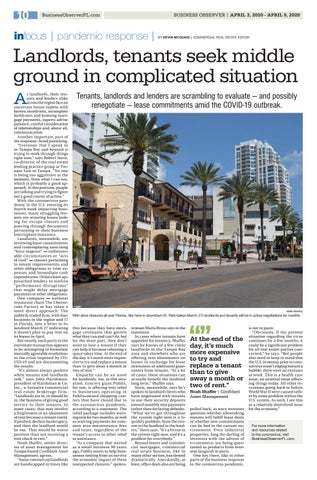
With store closures all over Florida, like here in downtown St. Pete (taken March 27) landlords and tenants will be in active negotiations for months. this because they have mortgage covenants that govern what they can and can’t do, but for the most part, they don’t want to lose a tenant if they can help it because releasing a space takes time. At the end of the day, it’s much more expensive to try and replace a tenant than to give away a month or two of rent.” Empathy can be an asset for landlords, too, in this situation. Grocery giant Publix, for one, is offering rent relief to businesses operating in Publix-owned shopping centers that have closed due to the coronav irus pandemic, according to a statement. The relief package includes waiving rent for two months, as well as waiving payments for common area maintenance fees and taxes, regardless of the tenant’s access to other relief or assistance. “As a company that started as a small business 90 years ago, Publix wants to help businesses renting from us survive the economic impact of these unexpected closures,” spokes-
woman Maria Brous says in the statement. In cases where tenants have appealed for leniency, Shaffer says he knows of a few client landlords in the Tampa Bay area and elsewhere who are offering rent abatements on leases in exchange for lease extensions or additional guarantees from tenants. “In a lot of cases, these situations can actually benefit the landlord long term,” Shaffer says. Stern, meanwhile, says he’s spoken to landlord clients who have negotiated with tenants to use their security deposits toward monthly rent payments rather than declaring defaults. “What we’ve got throughout the system right now is a liquidity problem, from the tenant to the landlord to the lenders,” Stern says. “It’s a freeze in the system right now, and it’s a problem for everybody.” Beyond leases and commercial mortgages, commercial real estate business, like in many other sectors, has slowed dramatically. Anecdotally, at least, office deals also are being
At the end of the day, it’s much more expensive to try and replace a tenant than to give away a month or two of rent.” Noah Shaffer | Confidant Asset Management pulled back, as wary investors question whether teleworking tenants will fulfill lease deals or whether new commitments can be had in the current environment. Even industrial properties, long the darling of investors with the advent of e-commerce, are being questioned as products from overseas languish in ports. One key there, like in other parts of the business response to the coronavirus pandemic,
is not to panic. “Obviously, if the present situation regarding the virus continues for a few months, it could be a significant problem for all real estate parties concerned,” he says. “But people also need to keep in mind that the U.S. economy prior to coronavirus wasn’t edging toward a bubble; there were no excesses at work. This is a health care issue, an external issue affecting things today. All other recessions going back to before World War II were caused rather by some problem within the U.S. system. As such, I see this as a relatively short-lived issue for the economy.”
For more information and resources related to the coronavirus, visit BusinessObserverFL.com.
APRIL 3, 2020 - APRIL 9, 2020 | BUSINESS OBSERVER
BusinessObserverFL.com
infocus | pandemic response |
11
BY BRIAN HARTZ | TAMPA BAY EDITOR
Employment law makes dramatic shifts
M
ore than a decade has passed since the mass layoffs of the 2008 financial crisis. In that time, unemployment has fallen to record lows in many parts of the country, especially Florida. But with the arrival of the coronav irus pandemic, the good times — for now — have come to an end, and many employers, particularly in the hard-hit tourism and hospitality sector, have let go of large portions of their workforce, have employees who work f rom home or g ra nt t hem paid time off to care for quarantined family members or children whose schools have shuttered in the wake of the outbreak. Alicia Koepke, an employm e nt l a w s p e c i a l i s t a nd shareholder at Trenam Law in Tampa, says employers dealing with coronavirus-related layoffs and time-off requests
need to be aware of new rules a nd reg u lat ions t hat stem from the federal Families First Coronavirus Response Act. It was signed into law March 18, goes into effect April 1 and will remain in place until the end of the calendar year. FFCRA, Koepke explains, expands on the Family and Medical Leave Act, first passed in 1993, which normally applies only to employers with more than 500 employees. “The first part of [FFCR A] is a new set of circumstances in which employers with less than 500 employees have to provide FMLA,” Koepke says. “It’s very important to know that it’s limited to employees who are unable to work, even remotely, because they have to care for a minor child whose school or day care closed relating to the coronavirus.” Of course, most employers, regardless of size, offer some
For more information and resources related to the coronavirus, visit BusinessObserverFL.com.
sort of paid time off policy that governs vacation days, sick days and other leave from work. They are still expected to adhere to such policies, Koepke says, but when offering time off under FFCRA, it gets a bit complicated. According to t he FFCR A, the first 10 days of leave can be unpaid; however, Koepke explains, employees can draw from unused PTO, if they wish, to get paid for some or all of the time off. After 10 days, FFCRA says employees must continue to be compensated at no less than two-thirds of their normal rate of pay, with a cap of $200 per day or an aggregate amount of $10,000. “The FFCR A provides the very first paid sick leave act under federal law,” Koepke says. “Florida doesn’t have a paid sick leave requirement for private employers, but now through the FFCRA, [it does].” Under FFCRA, Koepke adds, full-time employees must be granted up to 80 hours of paid time off. Part-time workers receive an amount of paid sick leave equivalent to the average amount of time they would work during a two-week period. “But an employer cannot require employees to use other paid sick leave that they have before they use the FFCR A
YOUR BUSINESS'S MESSAGE
ss O Dear Busine
If your business needs help navigating this challenge, call 941-366-3468 or advertise@yourobserver.com
HILLSBOROUGH
POLK
PINELLAS
The Florida Department of Economic Opportunity has expanded its reemployment assistance program to cover workers who have lost their jobs as a result of the coronavirus pandemic, who are quarantined at the direction of a medical professional or government agency or whose employment is affected by the need to care for an immediate family member who’s been diagnosed with COVID-19.
Several area law firms have blogs and statements on how to handle new employment laws in the face of the coronavirus pandemic. For Trenam Law’s, go to: bit.ly/2vRUSbi. Sarasota-based Williams Parker’s has a blog at: Blog. WilliamsParker.com/laborand-employment.
Os, wners & CE
need to e know we w l, o tr n o our c r ot just with n is out of ou — h c g u n ti m a o ic s ommun Even when community. h priority: c d ig n h a A rs . e e v m ti c to ur cus be proa t also with o u b , s e e y u’re lo emp t them. If yo is s s a n a c u e now how yo them informed. Tell th k rs e m to s Let your cu business model, keep ur ing to help. changing yo at your company is do wh nd community uccesses a s e th g n li ic chron re er has been and businesses for mo rv e s b O s s e e The Busin s a resourc trepreneurs a n e g a in d rv ri e lo s F of itted to challenges main comm eliver your message. re e W . rs a e ud than 20 y and help yo d e rm fo in to keep you vail. We will pre Godspeed.
has never been more important.
PASCO
UNEMPLOYMENT EXPANDED
response, basically,” Koepke says. “You have things like school closures that are covered, so it really is much more broad than paid sick leave.” If an employer faces the difficult task of laying off employees, such actions must still be carried out in accordance with Worker Adjustment and Retraining Notification Act, a 1988 federal labor law that requires businesses that employ more than 100 people to give workers 60 days’ advance notice of facility closures and/or mass layoffs. Employers also need to comply with FMLA regulations in regard to layoffs, Koepke adds, regardless of whether the FFCRA applies to them. “They will want to be sure that if they do lay off, that they can show that the layoff was not done because someone requested FMLA leave or any other protected legal right,” she says, “but instead it was done as a necessity and in an objective way that shows that they would not have had the right to return to work and would have been laid off regardless of utilizing [FMLA] protection.”
Matt Walsh / Owner Editor / CEO Inc edia Group, Observer M
MANATEE
SARASOTA
CHARLOTTE
LEE
COLLIER 332851-1
It’s been a while since an economic crisis roiled the workforce. Up next: key changes to major employee law legislation.
12
BUSINESS OBSERVER | APRIL 3, 2020 - APRIL 9, 2020
BusinessObserverFL.com
PANDEMIC RESPONSE
BY BRIAN HARTZ | TAMPA BAY EDITOR
Switch It Up Manufacturers across the region are responding to the coronavirus crisis in a multitude of ways, with innovation and generosity at the forefront.
T
he Defense Production Act can compel U.S. companies to use their facilities and resources to make medical and other supplies needed to combat the coronavirus pandemic. But on the west coast of Florida, manufacturers and other entities, proving the axiom that the private sector often does things faster than the government, are taking it upon themselves to pitch in. Breweries and distilleries are switching from booze to hand sanitizer. A handbag manufacturer is churning out protective face masks. A shower door and glass company is offering to make protective glass enclosures that retailers could use at checkouts. Others, of course, like Micro Matic in Brooksville, a maker and distributor of parts for bar and restaurant beer-dispensing systems, are just trying to figure out how to keep their doors open and paychecks in the hands of workers. “It’s challenging for everybody,” Micro Matic President Cian Hickey says. Given the nature of its business, Hickey thinks it’s unlikely that Micro Matic will repurpose its manufacturing capabilities to produce medical supplies. But he doesn’t rule anything out and says that the firm could produce “stainless steel face masks” if needed. “We don’t necessarily have the same synergies and f lexibility” as other manufacturers, Hickey adds, but says he “absolutely” v iews keeping workers employed as a way Micro Matic can do its part to stem the tide of economic woe. “Our commitment is to try to limp through this and make sure we don’t impact any of our full-time staff.” In Fort Myers, meanwhile, Bill Daubmann, president of My Shower Door/D3 Glass, a $17.8 million company with clients nationwide, is ready to launch production of custom-made glass health guards. The health guards can be installed in register aisles, at cashier counters and in food areas. Office spaces can also be fabricated with large glass panels, says Daubmann, whose firm opened an
FILE
BILL DAUBMANN, with My Shower Door/3D Glass, says the Fort Myers company is ready to make protective glass shields. $8 million, 60,000-square-foot headquarters and manufacturing facility off Alico Road in Fort Myers last year. “We have the capabilities to do a lot of things with flat glass,” says Daubmann, a Business Observer Top Entrepreneur in 2019 who has sat in on some Lee County conference calls connecting hospitals and other entities with companies that can help supply products. “We are putting it out there that we have a solution. We will work with anyone who has a need.” COURTESY
SANITATION ENGINEERS Thankfully, so far, there hasn’t been a run on glass like there is with toilet paper. Hand sanitizer, too, has been nearly impossible to find on store shelves in the wake of the COVID-19 pandemic. Hospitals and nursing homes are in constant need of hand sanitizer too. Sensing an opportunity, Gulf Coast beer and liquor makers have sprung into action. In Clear water, Big Storm Brewing has applied for a federal distillation license that, if
granted, will allow it to produce between 50 and 100 gallons of ethanol per day that will be packaged and sold to government agencies, hospitals, medical offices, first responders and other organizations in
desperate need of the product. In the meantime, the brewery has already been pumping out a liquid-based hand sanitizer spray that’s being made in accordance with World Health Organization standards. Big Storm co-owner L.J. Govoni says the U.S. Tax and Trade Bureau has been working overtime to speed up the application process for companies like his that want to repurpose their manufacturing capabilities. “They’ve really cut the time dow n,” he say s. “T hey ’ve
Sarasota-based handbag manufacturer BSwanky is making face masks for two nonprofit senior communities.
EXECUTIVE SUMMARY Industry. Manufacturing Trend. Repurposing machines and employees to help with the coronavirus pandemic response Key. Making changes and adapting quickly
APRIL 3, 2020 - APRIL 9, 2020 | BUSINESS OBSERVER
waived a bunch of regulations right now, saying, ‘Listen, as long as you’re following this standard and this standard, we’re going to allow you to do it without jumping through all the hoops and going through the standard licensing [process].’ So we’re hoping to legally fire up our still and start producing ethanol.” But repurposing isn’t as easy as f lipping a switch, Govoni says. Big Storm will “definitely have to spend money on installation, procuring raw materials and bottles and everything else.” The brewery will also have to invest in training for staff members who will be producing hand sanitizer. Luckily, though, the brewery had already purchased a still and had been preparing for a foray into the spirits market. “At the board level, we’ve been talking about opening a distillery one day,” Govoni says. “We started working on the idea of getting licensed months and months and months ago.” Once the hand sanitizer line is up and running, it will likely produce just one product: onegallon batches packaged in single-use jugs. “Our core competency is not chemical manufacturing,” Govoni says. “Our core competency is fermenting a liquid and packaging it sanitarily into vessels for consumption. We think our core [hand sanitizer] customers are going to be construction sites, hospitals, doctor’s offices, … so we’re just going to stick to one particular size, stick to what we do best. There’s no reason to have five
BusinessObserverFL.com
IN THE FIGHT
different sizes or SKUs for us to package.” Big Storm beer customers need not fear, however: Even with hand sanitizer and, eventually, liquor rolling off the production lines, the ale won’t cease to flow. “We’ll still have enough capacity to continue using our facility to make beer,” Govoni says.
In addition to Clearwater-based Big Storm Brewing, which also has taprooms in Odessa and Cape Coral, booze slingers across the region are stepping up to help stop the spread of the coronavirus. n List Distillery in Fort Myers already produces its own line of hand sanitizer and will fill up customers’ empty bottles, free of charge, up to 50 milliliters.
MASKED MOVEMENT Timing, they say, is everything, and although Govoni, like all of us, wishes the coronavirus pandemic had never come to American shores, it has spurred firms like his and other individuals to innovate. One example is St. Petersbu r g C ol le ge Hu ma n it ie s and Fine Arts Chair Jonathan Barnes, who, according to a statement, is using 3D printing technology to create face shields for health care workers. Barnes started using his personal 3D printer to create the face shields when he discovered a friend sought face protection for his job as an emergency room physician in Ocala. Barnes quickly realized he needed to make more. SPC leadership gave Barnes permission to bring home two 3D printers from the school’s Humanities and Fine Arts department. His output has increased, and he has since donated more than 30 shields to doctors in Clearwater, Orlando, St. Pete, Ocala and Sarasota. He’s been making six shields every four hours. Barnes found an open source design for a face shield from a Czech company, Prusa, which
n In St. Petersburg, Kozuba & Sons Distillery has halted all liquor production, tours and tastings and has turned its focus to turning out hand sanitizer product made from a spirit that would normally be used in vodka. The product will be made in accordance with World Health Organization hand sanitizer formulation recommendations, the firm states in a news release. n Although it had to lay off staff
makes 3D printers. He tried one, made a few tweaks and then went to work, the release states. After the machine makes it, he moves to handson production. “The clear part is mylar stencil film, which is hand cut, and the holes are punched w ith a three-hole punch I modified to make it a little quicker,” Barnes says in the statement. Barnes will continue to make and donate the shields as long as he has materials. “It seems like the right thing to do,” he
ARE YOU A BUSINESS OWNER?
Big Storm Brewing co-Owner L.J. GOVONI and is facing revenue losses in the 80-95% range, 3 Daughters Brewing, also based in St. Pete, has not closed its doors. Instead, it’s open for retail sales of prepackaged beer and is shifting to hand sanitizer production. It’s a similar story at Motorworks Brewing and Darwin Brewing, both based in Bradenton, as well as Loaded Cannon Distillery in Lakewood Ranch and Sarasota-based Drum Circle Distilling, makers of Siesta Key Rum.
says. “Those people are the front line heroes going into battle without proper equipment.” Gretchen Bauer, owner of Sarasota high-end handbag manufacturer BSwanky, has also shifted to the face mask needs. Bauer had to furlough her three manufacturing employees — more out of social distancing concerns than lack of sales. (She says she sold five bags with prices of at least $1,400 each in the past two weeks, online and in boutiques in the Hamptons and Florida.)
13
The CEO of the Pines of Sarasota, Mike Ward, approached Bauer on March 23 with an idea: Can she use some of the BSwanky materials and machiner y to produce face masks — personal protective equipment — for the staff at the Pines? A nonprofit senior living, nursing home and rehabilitation center with some 250 residents and more than 400 employees, the Pines, like many of its peers, desperately needs face masks. Bauer and her team jumped at the chance to help. She contacted her suppliers and received 60 yards of scrub material and 100 yards of elastic — hard to find materials. By March 24 the employees, working from home, began making the face masks, up to 100 a day for the Pines. An executive with Aviva, another nonprofit senior living community in Sarasota, has also been in touch with Bauer about getting face masks. Bauer says she won’t charge the facilities for the face masks, which can also be washed and reused. “We are doing this gratis,” she says. “We are doing this because it’s the right thing to do.” An interior designer in a past business life, Bauer moved to Sarasota from the Philadelphia area in 2012 and founded BSwanky in 2018. Given her background in design and fashion, the BSwanky face masks won’t just be protective — they will also look sharp. “They will be the most perfect masks you’ve ever seen,” Bauer says. “They will be awesome.”
SELL INVESTMENT PROPERTY
• Who has no Life and Disability Insurance?
TAX FREE
• Who should review Buy/Sell/Keyperson/Loans Insurance?
Learn about 1031 exchanges
VISIT OUR WEBSITE > US1031.COM
• Who needs Competitive Life Quotes with your Insurance?
Jefferson F. Riddell
• Who needs Free Business Tools & Resources?
President Phone: (941) 366 -1300 Fax: (941) 366 - 6973 E-mail: jriddell@rlglawfirm.com
If you answer YES to ANY of the questions above,
Board Certified Real Estate Attorney has been facilitating 1031 exchanges for over 30 years. Learn how a 1031 exchange may help you defer taxes, save money and maximize your investment dollars. Visit our website or call for a FREE consultation.
you need to talk with Alan
*
Ask Alan for a FREE Review and Get Business Tools and Resources Ask Alan for Competitive Quotes Term Life /Universal Life/Disability Insurance
Call Alan Hazley
941-755-9791
21ST CENTURY REAL ESTATE INVESTING
or Call or Text 941-962-3427
alansagency.com
3400 South Tamiami Trail, Sarasota, Florida 34239 333194-1
332842-1
EXCHANGE SERVICES, INC.
available on Amazon
Alan Hazley has 40 years + Experience in the Financial Service Business *Seek Legal advice on Agreements from your Attorney and Tax advice from your Accountant
U.S. 1031
14
BUSINESS OBSERVER | APRIL 3, 2020 - APRIL 9, 2020
BusinessObserverFL.com
Increased CAPACITY A
lthough the list of companies that face monumental challenges to survive the coronavirus pandemic is wide and deep, some business are seeing a surge in interest and sales — a few in surprising places. The Bradenton Area Economic Development Corp., for example, recently hosted two virtual meetings with companies possibly seeking to move to Manatee County. “We are still getting calls from
FILE PHOTO
DEANNA WALLIN founded Naples Soap Co. in 2009.
Naples Soap Co. Online sales are up 140% year over year at Naples Soap Co.
D
eanna Wallin has experience in guiding a business through a crisis, having launched Naples Soap Co. in the heart of the recession in 2009. Starting with a 300-square-foot store in Tin City in Naples, Wallin has since grown the company, with a niche in high quality skin care and hair care products, to 13 locations across Florida. It produces and sells more than 400 products and does some $9 million to $10 million a year in sales. A coronavirus pandemic bright spot, a decade later, is that e-commerce has been the fastest growing segment of the business, going from $540,000 in 2018 revenue to a projected $1.3 million in 2020. The crisis has only boosted the company’s online sales, with a 140% year-over-year increase the middle weeks of March 2020 over March 2019. Although Wallin temporarily shuttered the network of stores, she’s shifted to online fulfillment, where a staff of four prepares orders from the company’s facility in Fort Myers, near the Southwest Florida International Airport. One reason for the increase is product-based — more people are washing their hands, more often. “In addition to soap sales, we’re seeing an increased demand for self care and sensitive
skin products,” Wallin says. “This is a challenging time for our community. Everyone is looking for a diversion to help relieve tension and brighten their spirits. Bath bombs and bath soak sales have surged as have the sales of our sensitive skin products.” Another key reason for the growth, internally, is Wallin’s efforts to prepare for any downturn in brick-andmortar sales, driven somewhat by previous hurricane experience. For one, she increased soap production in early March, anticipating the demand. Wallin and her team have also been highly active on social media, with videos showing proper hand-washing techniques and a variety of Naples Soap Co. scrubs, oils and soaps. “People are washing their hands 100 times a day now,” Wallin says. Even more important than proactive marketing, Wallin says, has been Naples Soap Co.’s robust 150,000-strong email database of customers. Although collecting information like that at brick-andmortar checkout can be a hassle and time-consuming, Wallin says having that information has been e-commerce gold . “If we didn’t have that database to reach out to people now, we wouldn’t be having the kind of success we are seeing,” Wallin says. “It’s been key to our survival.” — Mark Gordon
companies that want to relocate here,” EDC President and CEO Sharon Hillstrom says. “It’s crazy. I didn’t expect that.” Other companies nationally seeing a business boom are more expected, such as Zoom for online video calls or Best Buy seeing a rush in curbside orders for work-from-home-related products. Several companies on the west coast of Florida have seen big boosts as well, from a pizzeria chain to a soap company.
Solorzano’s Pizzerias R estaurants around the country are hurting in the wake of coronavirus-related closings. Some have adapted quickly by adding new ways for customers to enjoy their food through pickup and delivery. Others were already uniquely prepared to shift fully to a takeout model, among them pizzerias. Philip Solorzano owns six Solorzano’s Pizzerias locations in the Sarasota area at Gulf Gate, Siesta Key, Venice Island, Longboat Key, North Port and Anna Maria Island. (Carlos Solorzano, his brother, owns Solorzano Bros. OldFashioned Pizza at Webber Street and Beneva Road.) Philip Solorzano says this time of year is usually the busy season for his restaurants. “We’re not doing the same numbers we were doing last year,” he says, given the pandemic. “Are we doing better than other restaurants that had to close and had to change into doing what we normally do? Of course we’re doing much more than them.” One advantage? Solorzano says 85% of his business is takeout and delivery anyway, so going to 100% isn’t too hard. Although the Siesta Key location, with the closed beaches, is down a bit, locations doing especially well are Longboat Key and North Port. “People are starting to get used to this lifestyle,” he says. Solorzano is resolute — he doesn’t want to close his doors like some restaurants have done. “That’s not the way you do it,” he says. “You have to adjust. You have to adapt.” The key, he says, is following guidelines from governments and health agencies. “If they tell us we can only deliver, we only deliver,” he says. “If they tell us we have to sell tacos, we sell tacos.” That adapt-or-die mind-
Pizzeria owner adapts to changing conditions in face of the coronavirus — toilet paper included.
COURTESY PHOTO
PHILIP SOLORZANO, who owns six Solorzano’s Pizzerias locations in the Sarasota area, is giving away a free roll of toilet paper to customers who place an order over $30. set has given Solorzano’s a clear advantage. When he saw what was happening in California, he stocked up on supplies, including pizza ingredients, toilet paper and hand sanitizer. He’s even giving away a free roll of toilet paper to customers who place an order over $30. Although many restaurants have laid off employees, Solorzano recently posted on Facebook telling people if they need to make extra money, they can make deliveries for Solorzano’s. One woman has already taken him up on the offer. Solorzano isn’t pay-
ing himself during the crisis, but that’s not as important to him. “Our employees are getting paid,” he says. “As long as I keep the doors open and pay employees, I’m a happy guy.” Despite the hard blow the industry has been dealt, Solorzano remains steadfast. “The restaurant business is the hardest business in the world, and it just got harder,” he says. “The strong will survive. We’re going to get by. We’re from Jersey. We’re going to keep going.” — Grier Ferguson
APRIL 3, 2020 - APRIL 9, 2020 | BUSINESS OBSERVER
BusinessObserverFL.com
15
Spaulding Decon and Bio-One Industrial and decontamination cleanup companies are the low-hanging fruit of business increases as the pandemic plays out.
C
rews with Bio-One, a franchise decontamination cleanup company with locations in Sarasota, Tampa and Orlando, are the kinds of workers who, based on a bevy of bizarre assignments, have seen it all. Then came the coronavirus pandemic. Now those crews can add some never-done-before tasks to their portfolio: In the past three weeks, they’ve cleaned the insides of buses, taxi cabs and tractor trailers, area BioOne Owner Robert Reilly says, all to remove any particles of the virus that’s gripped the world. That’s in addition to multiple structures, from a 500,000-square-foot factory to a 1,200-square-foot apartment complex clubhouse. “Anyone who’s worried about people having [the coronavirus] or thinking somebody has it in the workplace, they are calling us,” Riley says. “There was a little bit of a delay in the beginning, and then about two weeks ago our phone lines just lit up like crazy. We are working day and night, getting calls on all sorts of places for all sorts of clients.” Like Bio-One, crews of Tampa-based Spaulding Decon, which also normally handle an eclectic mix of crime scenes, meth labs and hoarder homes, are swamped with a surge in coronavirus pandemic work. Laura Spaulding, a Tampa native and former Kansas City police officer, founded the company when she saw the need firsthand in 2005. It
now has 24 franchise locations nationwide, in addition to the Tampa office. “It’s been crazy the amount of work we have had,” Spaulding says. “We are totally slammed.” How crazy and slammed? During the middle weeks of March, Spaulding says the company did some $30 million in estimates. In a normal two-week period of any month, it usually fields calls for about $100,000 in work. At industry standard rates of 30 cents to $4 a square foot, that’s a lot of potential coronavirus spaces to clean. The Tampa Spaulding Decon office has gone on the road too, by flying crews and shipping gear to locations where it doesn’t have a presence, including Kentucky, Ohio and Illinois. Spaulding says clients have included banks, cubiclefarm offices and property management firms. Both Spaulding Decon and Bio-One have hired additional front-line employees to keep up with the demand. That includes five new people at Spaulding Decon, which brings the total to 11, and three at Bio-One, which brings the total to seven. The companies expect to hire more people in the coming weeks. Both businesses, the owners say, also use the latest in EPAapproved decontamination cleaning products, and all the employees wear full hazmat suits and connected breathing gear. — Mark Gordon COURTESY
Bio-One, with locations in Sarasota, Tampa and Orlando, has seen a surge in work.
Beneficial Blends A rush of business now might cause problems later for one specialty food manufacturer — but she’s happy it’s ‘still around to fight for ourselves.’
E
mpty grocery store shelves — and not just the ones sans toilet paper — present a big, albeit complicated, opportunity for Beneficial Blends, an organic food co-packer and manufacturer. The Tampa-based, 60-employee firm, which did nearly $20 million in sales last year, specializes in edible oils and ghee (highly clarified butter)-related products. On the one hand, the firm’s roster of grocery store clients, including Publix and a host of other chains nationwide, are desperate for new products, Beneficial Blends Founder and CEO Erin Meagher says. And they’ve been calling Beneficial Blends frantically for a few weeks, looking for large and rushed orders, both in the
company’s branded Kelapo line and its private labels. Asked what lines or varieties are selling best, Meagher says “everything.” “Retailers are basically wiping out our warehouse,” Meagher adds. One large customer asked Beneficial Blends if it could sell extra goods to them, at the expense of stiffing other customers — a request it politely declined. Other clients, Meagher says, “are sending us pictures of their empty shelves and asking us to get them anything” to restock them. Sales, so far, are up at least 10% year-over-year, but when March is fully accounted for, Meagher expects the jump to be much bigger. But the surge, Meagher says, is also a “double-edged
COURTESY
ERIN MEAGHER founded Beneficial Blends in 2009. sword,” in that it strains the company’s logistics, vendors and supply chains, which are global. That makes order fulfillment more of a challenge. Another concern: Although the next three or four months, Meagher projects, will be gangbusters, the company could be looking at a slump when things normalize.
“There will be a pop,” she says. The company hasn’t added staff yet to handle the increase. It sent most of its office employees to work from home and has kept about 25 employees at the facility to work on operations and fulfillment. Those employees are cross-trained, and Meagher says everyone, including her, are pitching in. “Everyone is one the front lines of pushing product out the door,” Meagher says. Be it supply chains or stressed employees, Meagher realizes being slammed with business is a “good problem,” given the decimation the region has already seen in hotels and restaurants. “I’m glad we are still around to fight for ourselves,” says Meagher, a one-time high school teacher who founded the business in 2009. “And we will keep on fighting.” — Mark Gordon
Everyone is on the front lines of pushing product out the door.” Erin Meagher
commercial real estate
16
BUSINESS OBSERVER | APRIL 3, 2020 - APRIL 9, 2020
BusinessObserverFL.com
Gulf Coast CRE firms shift to teleworking
K.L. MCQUAID In response to the potential severity of the COVID-19 pandemic, Gulf Coast commercial real estate firms closed their doors last week and shifted almost exclusively to digital operations. From commercial real estate brokerage firm LSI Cos. in Fort Myers to SVN Saunders Ralston Dantzler in Lakeland, real estate firms spent the past week or more teleworking, thanks to contemporary technology. For many, the mandatory work-from-home order represented but a little departure from their normal schedules, though face-toface meetings and showings were replaced by virtual tours of properties. “We are well equipped with the technology to support remote communications and work via our office phone system, email, mobile devices and web conference technology,” SVN Saunders Ralston Dantzler assured clients in a March 20 email. Still others broadcast that it was “business as usual” despite the physical interruption to activities. “LSI is still up and running while our staff works remotely,” company spokesman Richard Yager says in an email. Boutique brokerage firms weren’t the only ones to shift operations to remote interactions. In Tampa, Marcus & Millichap, Cushman & Wakefield and other major firms have implemented a mandatory workfrom-home requirement for the foreseeable future.
McGarvey kicks off new industrial project As it puts the finishing touches on its 23-acre SouthLinks business park in Bonita Springs, McGarvey Development Co. is turning its attention to a new project that will be the company’s largest in its 30-year history. The CenterLinks Business Park at Three Oaks, on 42 acres at Oriole Road near Alico Road and west of Interstate 75, in Fort Myers, will contain 600,000 square feet of industrial, flex and general or medical office space when built out. McGarvey expects to break ground on CenterLinks next month, company marketing and sales director Jeff McGarvey says. See COLUMN page 17
COURTESY PHOTO
Stock Development of Naples recognized about seven years ago that renting an apartment was becoming a more socially acceptable living scenario.
Indelible IMPRINT Southwest Florida’s foreclosure crisis of a decade ago left its mark and persuaded many to opt for apartment living.
T
PART 3 OF A 3-PART SERIES
he foreclosure crisis of more than a decade ago rocked Southwest Florida and left an indelible imprint on residents and transplants — especially younger ones and empty nesters. To many, home ow nership in the years after 2010 became less an avenue towa rd longer-term wea lt h building and appreciation and instead a financial albatross that encroached upon freedom and brought with it a series of ongoing — and often costly — maintenance obligations. But when Fort Myers and Naples emerged from the last decade’s economic recession and businesses like Hertz, Gartner, NeoGenomics, Arthrex and others either relocated to the region or expanded, newly hired workers and incoming retirees alike found few places to live other than the single-family homes they didn’t want. “Southwest Florida has had relatively limited singlefamily inventory from which to choose, so there’s been heig htened compet it ion
since the recession for the housing stock that is available,” says Brian Alford, director of market analytics in Central and Southwest Florida for real estate research firm CoStar Group. “For a lot of people, they found it was simply easier to rent than to fight for the limited supply of single-family homes, which is still very undersupplied,” Alford adds. “And in many cases, people typically rent when they relocate to a new area anyway. Here, on top of that, they became renters by choice.” Into that void, apartment developers including Stock Development and Knott Realty Group responded with such projects as Spectra, Insula and Decorum, to name a few. Since 2015, more than 9,700 new multifamily rental units have been delivered in the three-county area com-
prising Charlotte, Collier and Lee counties. A long t he entire ninecounty Gulf Coast and Central Florida region, which also includes the Tampa Bay area, by comparison, 44,265 new apartment units were added between 2015 and the end of 2019, records indicate. Overwhelmingly over the past five years, Lee County has been the primary recipient of new apartment housing. Since 2015, the county has added 7,649 new multifamily rental units, according to CoStar Group, building permit and commercial real estate brokerage data. By cont rast, Cha rlot te County’s multifamily rental inventory grew by just 256 units during the same period, while Collier County added 1,838 new units over those same five years. “In prior economic growth cycles, Lee County and much of Southwest Florida, with the exception of Naples, was largely considered a bedSee IMPRINT page 17
APRIL 3, 2020 - APRIL 9, 2020 | BUSINESS OBSERVER
IMPRINT from page 16 room community for tourism,” says Brad Capas, an executive director with commercial real estate brokerage firm Cushman and Wakefield who tracks multifamily development. “But today, the region has its own employment and other economic drivers,” Capas adds. That’s completely different than prior cycles, and that’s in turn driving demand for all types of housing, especially multifamily rentals.” L e e C ou nt y h a s a dde d enough population to become one of the fastest growing counties in the U.S., according to the federal Census Bureau. Last year, the county’s total population grew by 2.1% on an annualized basis, even as employment growth topped 3.%. In response, developers began new units at a staggering pace — adding more than 14.5% to existing inventory, the highest percentage basis growth in the nation during 2019, according to CoStar. The 12 months of 2018 were by far the most active of the past five years, figures indicate. Lee County apartment starts reached 3,027 units that year, versus just 644 units in nearby Collier County. Charlotte County had no new apartment units begun that year. “We felt there was significant pent-up demand in Southwest Florida beginning in 2015 because of the lack of construction of multifamily rental units in Fort Myers and Naples, especially,” says Keith Gelder, president of Stock Luxury Apartment Living, a division of Naples-
based custom home builder and developer Stock Development. “T here had n’t been a ny meaningful inventory built there in either city for some 10 years, at least not institutionalgrade product of 300 or more units,” Gelder says. “All of the existing inventory was older, and from our analysis, we felt like if we could deliver an amenity-rich, resort-style community, it would be successful.” In 2016, Stock began constructing Spectra, a 324-unit, Class A community in Fort Myers. In early 2018, it was sold for $71.4 million. In Naples, the company then built a 304unit, upscale apartment project known as Inspira. Gelder says the company today is designing a new multifamily rental project in Estero, in Lee County, and is moving ahead with another in North Naples. He agrees that last decade’s foreclosure crisis has had a lasting impact on consumer t hink ing about housing in Southwest Florida. “It’s brought on a paradigm shift,” Gelder says. “We’re seeing that among our younger renters who are renters by choice and our older residents. We’ve found with them that if we build the apartments in a condominiumlike fashion, with an accent on lifestyle, they feel comfortable enough to forego purchasing in favor of renting. “Without question, the housing crisis shaped the ability, and in some cases the willingness, to rent,” he adds. “It definitely left an imprint.” Arturo Pena, vice president of development for Miami-based The Related Group, says macro-
transactions |
COLLIER Buyer: SDNR LLC Seller: SFI Naples Reserve LLC Address: Naples Property Type: Vacant land Price: $13,406,400
CHARLOTTE Buyer: LJCD Associates LLC Seller: 38757 Jones Loop LLC Address: 26920 Jones Loop Road, Punta Gorda Property Type: Convenience store Price: $6,318,900 Previous Price: $1,006,000, June 2019
Buyer: Gulfwater Investments LLC Seller: NBC Trade LLC Address: 1490 5th Ave. S., Naples Property Type: Hotel Price: $1,811,500
Buyer: Long Dog Wendy’s LLC Seller: B F Ft Myers Inc. Address: 3206 Tamiami Trail, Port Charlotte Property Type: Restaurant Price: $1,862,800 Previous Price: $1,075,000, September 1998
17
COURTESY RENDERING
CenterLinks Business Park at Three Oaks will be McGarvey Development Co.’s largest project in its 30-year history. COLUMN from page 16 “After 2 1/2 years of developing, we are approaching 100% build out and leasing of our Southlinks project in Bonita Springs,” McGarvey says of the 250,000 square feet of industrial and flex space constructed there. “Now we will turn our attention to the Alico Road and Three Oaks Parkway corridor, another hotbed of economic development in Lee County,” he adds. McGarvey has retained LandQwest Commercial Real Estate Services’ Managing Director Adam Palmer and Senior Associate Mike Doyle to market and lease the new CenterLinks space. The company believes CenterLinks’ central location and proximity to amenities will differentiate it from
competition. “The proximity to CenterLinks in relation to our region’s international airport, major roadways and universities will undoubtedly attract a diverse audience of tenants,” McGarvey says. “With multiple corporate headquarters and other developments coming out of the ground in this corridor, CenterLinks will offer a convenient logistical advantage for businesses to grow in the Southwest Florida market,” McGarvey adds. CenterLinks will feature tilt-wall construction and hurricane-rated windows, together with energy-efficient LED lighting throughout. The project’s exterior will be similar in appearance to that of Southlinks, McGarvey says.
BY STEVEN BENNA | CONTRIBUTING WRITER
DEEDS/MORTGAGES The following real estate transactions more than $1 million were filed in Charlotte, Collier, Hillsborough, Lee, Manatee, Pasco, Pinellas, Polk and Sarasota county courthouses. The information lists the seller, buyer, amount of sale, previous price and date, mortgage and lender, if available, address and book and page of the document.
Buyer: Agree Stores LLC Seller: TBC Retail Group Inc. Address: 24491 Sandhill Blvd., Punta Gorda Property Type: Auto repair shop Price: $2,520,000 Previous Price: $705,000, October 2018
economic factors, such as taxation, have also played a role in the region’s growth. “Resident flight from hightax states, especially in the Northeast and New England, has helped Florida tremendously,” Pena says. “It’s been a very healthy phenomenon for Southwest Florida multifamily rentals, as well.” Related has embarked on a pair of new apartment projects in Lee County totaling 784 units, a response to population predictions that project that Lee County will be among the fastest-growing places nationwide by 2030 and rental gains over the past five years. In the first quarter of 2015, for instance, average rental rates in Southwest Florida were $1,068 monthly, according to commercial real estate brokerage Newmark Knight Frank. By the end of last year, however, average rents had climbed to $1,342 per month — a 25.6% jump despite the thousands of new units that had come online. But with all the gains and new product have come concerns from some quarters that inventory has begun to outpace demand. Fort Myers’ multifamily vacancy rate now stands above 11%, according to CoStar, one of the highest rates in the nation. Gelder and others, however, believe the market remains in equilibrium at least for the time being. “We feel bullish about the area,” he says. “Yes, the biggest headwind the industry faces is potential oversupply, but there’s a sustainable and reasonable amount of demand going forward, so we’re confident.”
BusinessObserverFL.com
Buyer: SDNR LLC Seller: SFI Naples Reserve LLC Address: Naples Property Type: Vacant land Price: $4,947,600
HILLSBOROUGH Buyer: Westshore Marina Acquisition LLC Seller: Willton-BB Westshore Owner LLC Address: 5341 S. West Shore Blvd., Tampa Property Type: Apartment units and land Price: $100,000,000 Previous Price: $13,200,000, September 2017 Buyer: Ladoga Properties LLC Seller: Tampa J Automotive Management LLC Address: 4855 W. Hillsborough Ave., Tampa Property Type: Auto repair shop Price: $13,500,000 Buyer: Sanctuary Lofts LLC Seller: Tyer Temple Lofts LLC Address: 502 E. Ross Ave., Tampa Property Type: Apartment units Price: $5,000,000
LEE Buyer: 155 Grand Street Corp. Seller: 38334 Andalusia Kismet LLC Address: 2327 Andalusia Blvd., Cape Coral Property Type: Retail store Price: $4,901,903
Buyer: 64 & LWR LLC Seller: Warner Crossing LLC Address: Bradenton Property Type: Vacant land Price: $3,150,000
Buyer: Metro Parkway Retail LLC Seller: Metro Parkway Realty Associates LLC Address: 12951 Metro Parkway, Fort Myers Property Type: Community shopping center Price: $3,300,000 Previous Price: $4,050,000, April 2007
PINELLAS Buyer: Melrose Clearwater Holdings LLC, Rasok Clearwater Holdings LLC and Solomon Clearwater Holdings LLC Seller: Northside Square LLC Address: 29399 U.S. Highway 19 N., Clearwater Property Type: Office building Price: $9,150,000 Previous Price: $9,000,000, February 2005
Buyer: ALN Beachview LLC Seller: 3 Suns Management LLC Address: 1041 Third St., Fort Myers Beach Property Type: Multifamily units Price: $2,000,000 MANATEE Buyer: PR III LIV Summerhouse Apartments LP Seller: CNL 117th Street East LLC Address: 11715 18th Place E., Bradenton Property Type: Vacant land Price: $6,939,000 Previous Price: $5,855,000, December 2019 Buyer: Manatee Warner Crossing LLC Seller: Warner Crossing LLC Address: Bradenton Property Type: Vacant land Price: $6,600,000
PASCO NONE
Buyer: Largo Dental Building LLC Seller: Palms Professional Building Inc. Address: 2700 Eat Bay Drive #103, Largo Property Type: Office building Price: $3,353,400 Previous Price: $540,000, April 1996 Buyer: Nadias Magic LLC Seller: Realtech Realty Co. Address: 12435 73rd Court, Pinellas Park Property Type: Warehouse Price: $2,558,700 Previous Price: $1,181,600, October 2004
POLK Buyer: Centennial Avenues LLC Seller: Florida Avenue Ventures LLC Address: Florida Ave. S., Lakeland Property Type: Vacant commercial land Price: $49,500,000 Buyer: FL Edgewood LLC Seller: Robert Becker Address: 2050 Edgewood Drive E., Lakeland Property Type: Multifamily units Price: $7,900,000 Buyer: Florida Club Polk One LLC Seller: SAC Citrus Inc. Address: Highway 92 Way W., Winter Haven Property Type: Vacant agricultural land Price: $7,060,000 SARASOTA Buyer: Taylor Morrison of Florida Inc. Seller: McCann Holdings Ltd. Address: Sarasota Property Type: Vacant land Price: $10,455,200 Buyer: WCS Property Group LLC Seller: David and Carolyn Kiger Address: 2128 17th St., Sarasota Property Type: Church Price: $3,150,000 Buyer: Calle Minorga Siesta Key LLC Seller: Langedyk Enterprises Inc. Address: 5016 Calle Minorga, Sarasota Property Type: office building Price: $1,950,000 Previous Price: $1,200,000, February 2001
18
BUSINESS OBSERVER | APRIL 3, 2020 - APRIL 9, 2020
BusinessObserverFL.com
COMMENT from page 3 jobs,” pushing the Legislature to cut the corporate income tax and the sales tax on commercial leases and manufacturing equipment, among other cuts to taxes and fees. And he did likewise with regulations. These were steps to reduce the barriers to production, to leave more capital in business to be invested to create more supply … and demand. It worked. During Scott’s two terms, Florida employment increased by 1.67 million jobs. State sales collections — driven by a robust economy — increased 46%, from a low of $27.69 billion in 2009, in the pit of the recession, to $40.47 billion when Scott left office. Increased business supply led to increased demand. Similar steps would help now because, in truth, the CARES Act is not an economic stimulus act. There is nothing
in it that reduces barriers to economic productivity. It’s just the opposite. The $2 trillion stimulus is merely transferring money through borrowing — taking from one hand and redistributing it to another, shifting that $2 trillion in borrowed money to consumers to create more consumption. Consumption, Laffer will tell you, doesn’t stimulate growth; consumption is a result of growth that already occurred. That’s why Florida’s state, county and local politicians should take seriously Laffer’s recommendations to help Florida’s economy, to make Florida more attractive for businesses to produce as we fight our way through this war. When you talk to CEOs and entrepreneurs who navigated successfully through business crises, they almost uniformly advise this one principle of crisis management: Act fast, and don’t wait.
corporate report
RESTAURANT CARDS: ‘NO’ As part of our “6 Steps to Help Save Florida’s Economy” in this space last week, one of the recommendations was aimed at saving Florida’s restaurant industry. We suggested providing every voter with a $100 or $150 debit card to be used to buy food only at any registered restaurants in the state. The money behind the cards would come from a long-term bond issue of $1.3 billion or $1.5 billion. Told about this idea, economist Arthur Laffer responded: “That’s silly. It’s just redistribution.”
TAMPA BAY
Staffing and recruitment firm launches technology division
Laffer: Taxation is the wrong way to recovery Economist Arthur Laffer, the man credited with creating and popularizing supplyside economics, has sat with presidents through many crises — in the early 1970s when Richard Nixon devalued the dollar, took the nation off the gold standard and imposed wage and price controls; President Ford’s disastrous Whip Inflation Now campaign; crafting the Laffer tax bill after the 1981 economic crash in the early years of the Reagan administration; the 1987 crash; the onset of the Great Recession during George W. Bush’s second term; and now with President Trump in the COVID-19 crisis. This experience has made the 79-yearold fond of saying, “Whenever politicians make decisions when they are either
panicked or drunk, the consequences are rarely attractive.” He put Congress and the Trump administration in the category of the former with respect to the CARES Act. It was the wrong way to go. Laffer was unsuccessful persuading the president and Treasury Secretary Steve Mnuchin to stand strong behind the idea of cutting the payroll tax for employers and employees. You might recall that was one of early ideas the Trump administration floated before Congress. As Laffer argues, crucial to an economic recovery is making work attractive and making hiring employees attractive. In his view, giving employers and employees each a 7.65% cut in taxes would do both. Such a cut would have meant a $4,000 raise for a $50,000 employee and $4,000 of cash to the business. Laffer also advocated for the federal government to make loans or provide loan
guarantees to America’s businesses — with the expectation that the loans would be paid back. A lack of short-term cash, as we’re seeing now, Laffer says would mushroom into a national solvency crisis. Congress did respond to that part of Laffer’s prescription, but with one big exception — Congress is not expecting many of the loans to be repaid. In the end, according to Laffer, the CARES Act is massive redistribution. As Laffer explains, borrowing $2 trillion is taking money from one group (taxpayers) and giving to another group. Or as Laffer also likes to say, “Government spending is taxation, as Milton Friedman repeatedly said.” And the consequences of the CARES Act? Laffer predicts a slower recovery than it could have been. — Ed.
NextPath Career Partners Inc., a recruitment company that provides industry-specialized hiring for small and medium sized businesses, has expanded into technology staffing. The firm, launched in 2018 and now with offices in Tampa and Orlando, says its NextPath Technology division will focus on placing technology workers in direct hire, contract-to-permanent and project contract roles. Rodriguez and his NextPath cofounder, James Hawley, grew their previous firm, Veredus Corp., to more than $100 million in annual sales before selling it in 2014. COLLIER-LEE-CHARLOTTE
Motorcycle dealership targets younger buyers with new brands Haus of Trikes & Bikes, a Fort Myers based motorcycle and trike dealership, is expanding its brand portfolio The dealership was recently named an authorized reseller for Aprilia and Moto Guzzi motorcycles — Italian brands known for their racing motorcycles, according to a statement. The first delivery of 20 brand new models arrived in early 2020. As an authorized Aprilia and Moto Guzzi dealership, Haus will also be handling any warranty work for those brands, the statement adds.
Jeff Button | 941-313-1193
Jeff@SarasotaWarehouses.com | www.SarasotaWarehouses.com ND E AE EARSSAL L FOR FO
E AL S R FO
INDUSTRIAL & OFFICE PROPERTIES FOR SALE OR LEASE KLEIBER BUTTON INC. Lic Real Estate Broker KLEIBER BUTTON MANAGEMENT INC. Lic Real Estate Broker
R FO
E AS LE
2169 10th Street
10,000 SF, Two-Unit building with 3 Phase & Fenced Storage, 1 Unit Leased, 1 Unit For Lease, DTE Zoning
10,000 SF FOR SALE 5,350 SF FOR LEASE
FOR SALE $1,140,000
CALL FOR PRICING
SE EA L R FO
SE EA L R FO
1724 Barber Rd
332209-1
8072 Fruitville Rd
5.23 Acres at Signalized Intersection of Fruitville Rd & Sarasota Center Blvd In the Path of Progress!
7614 15th Street East
6503 19th St East, Bldg 1
7,618 SF Free-Standing Office/Whse with Loading Dock, 3 Phase Power, Nicely Finished Offices, Near I-75 & Fruitville Rd
5,011 SF Office/Whse with Open Showroom Multiple Private Offices, A/C Warehouse and two overhead doors
27,850 SF Office/Whse & Fenced Yard Plenty of Nicely Finished Office 3 Phase, 6 Drive-In Bays
FOR LEASE $11.25/SF
FOR LEASE CALL FOR PRICING
FOR LEASE CALL FOR PRICING
Richardson Kleiber Walter, a family-owned business celebrating 30+ Years of Excellence in Commercial and Industrial Real Estate
APRIL 3, 2020 - APRIL 9, 2020 | BUSINESS OBSERVER
bottom-line behavior
There are four keys points to establishing your leadership presence — especially in times of crisis:
1
Be fully present. In both normal times and crisis, leaders can get easily distracted. Take each issue as it comes, and be fully aware of what’s at play.
2
Communicating effectively. Never communicate just to communicate. Say what you mean, and mean what you say. Listen strategically, and ask the right questions.
3
Navigate the culture. Your culture is the glue that holds your business together. Make sure it doesn’t get lost during the crisis. Lean on it now more than ever.
4
Be self-aware. Your employees are counting on you and watching you. Be aware of your presence, and be aware of how your words and actions will be perceived.
19
BY DENISE FEDERER | CONTRIBUTING COLUMNIST
Fearless Leadership in Times of Crisis STAY STRONG
BusinessObserverFL.com
Focused and determined leaders can guide companies — no matter the environment or crisis.
T
he COVID-19 crisis has upended the entire globe in a way that none of us have every experienced. And although many business leaders are rightfully worried about everything from cash flow to employee health, the most important thing they can do in these times is to become fearless leaders. As the world seemingly shut down in a matter of hours in early March, uncertainty reigned supreme — and still does. That’s why leaders have an opportunity (and a responsibility) to fill the vacuum and help their employees and business survive and even thrive in these uncertain times. People are desperate for answers and looking for structure. Although you can’t provide answers to everything, you can provide some structure that will help your employees understand expectations — and give them some peace of mind.
SPECIAL ISSUE
PREDICTABILITY, CONSISTENCY AND ACCOUNTABILITY In times of crisis and uncertainty, people need predictability, consistency and accountability. Stress is a natural part of life. However, when faced with an event or thought that overwhelms our ability to cope, it can result in a negative response that can have both mental and physical traits. Great leadership, though, can be a type of secondary coping mechanism for your employees. Although no one can say for sure when we will come out of this crisis, leaders can instill a sense of hope and purpose in their employees by simply providing support and structure. Employees are the lifeblood of every business, and right now, the most important thing leaders can do is to help manage the mental state of their employees. It will help them thrive, and ensure they remain as productive as possible during this time. Work can be a
Denise P. Federer, Ph.D. is founder and principal of Federer Performance Management Group. She has 27 years of experience working with key executives, business leaders and Fortune 500 companies as a behavioral psychologist, consultant, coach and trainer. Contact her at DFederer@FPMG.info. great distraction — especially while employees are working from home and simultaneously dealing with family issues. But to stay focused and feel calm, employees need direction. Leaders should focus on the following actions during this time: n Set expectations. Because many employees are working from home, companies have had to scramble to set up work from home solutions and policies. Communicating these policies in a timely and clear manner will clear up any confusion and give employees clarity about expectations. n Be decisive. With rapidly changing information, this crisis has made timely decision-making imperative. Taking immediate and decisive actions regarding your work from home and other policies will help employees — and your business — stay on track. In the absence of information, fear sets in. Don’t let your information be absent.
n Be consistent. Don’t keep your employees guessing. Be consistent in your messaging, your behavior, your attitude and your policies. Employees need reassurance that things will be OK — or at least know that leadership is on the case. Although the world seems to change by the minute, being the consistent part of your employees’ day will go a long way for them and for your business. n Display emotional intelligence. Knowing and understanding what your employees need is the key to helping them overcome a stressful situation. Not everyone is born with emotional intelligence (and many leaders seem to lack it), but it can be as easy as holding a daily meeting where you check in on your employees to see how they’re feeling about life, not just work. This will show them you care, and they will work harder for you as a result. “Desperate times call for desperate measures,” as the saying goes. But becoming a fearless leader doesn’t require desperate measures at all — just some focus and determination. Good leadership can help your employees and business survive whatever comes next. Go forth and lead — your employees and your business are counting on you.
COMMERCIAL
REAL ESTATE
The top deal makers, companies and trends.
331593-1
COMING FRIDAY, APRIL 24 Reserve your ad space by Thursday, April 16. Contact your account executive at 941-366-3468 or advertise@yourobserver.com
20
BusinessObserverFL.com
BUSINESS OBSERVER | APRIL 3, 2020 - APRIL 9, 2020
Erin Houck-Toll Chair, Health Care Law, Mergers & Acquisitions, Business Organizations & Planning, Tax, and Intellectual Property Florida Bar Board Certified in both Health Care Law and Tax Law
Our Clients Know Health Care. We Know Health Care Law.
326354-1
Medical professionals and physician groups are faced with numerous and complex compliance issues that often take time, energy and resources away from their main focus, which is caring for their patients. Erin works with her clients to provide a comprehensive approach to ensure compliance with state and federal health care laws and regulations. She also counsels clients on mergers and acquisitions, tax matters, and general corporate and business issues. Erin understands that doing what she does best for our clients means that they can do what’s best for theirs – just as we’ve done since 1924.
Adapting. Changing. Moving forward. henlaw.com • 239.344.1100 Fort Myers • Bonita Springs • Naples B U S I N E S S & TA X • B U S I N E S S L I T I G AT I O N • C O N S T R U C T I O N • D I V O R C E , M A R I TA L & F A M I LY • E M P L O Y M E N T H E A LT H C A R E • I N T E L L E C T U A L P R O P E R T Y • L A N D U S E , ZO N I N G & E N V I R O N M E N TA L • M E R G E R S & ACQU ISITIONS • R E AL ES TATE • TORT & I NSU R ANCE • W ILL S , TRUS T & ES TATE PL AN N I NG • WOR K ER S’ COM PENSATION ©2020 Henderson Franklin Starnes & Holt, P.A.