UPLIF+ A
P R O J E C T
O N
H A P P I N E S S
&
T H E
P S Y C H O L O G Y
O F
M I C H E L L E Y A N G R I C E U N I V E R S I T Y D E P A R T M E N T
O F
P S Y C H O L O G I C A L
S C I E N C E S
W E L L B E I N G
Dear Reader, Do me a favor and take a moment to check in with yourself —how are you really doing today? Perhaps you are waiting for a friend to join you for lunch in commons, or you are unwinding after a day of tedious studying at Fondren. Regardless of your current state or mood, I invite you to flip through these next few pages and take note of what stands out to you. In this newsletter, you will find what the research says about the psychology of well-being as well as evidence-based interventions that can help you enhance the way you experience and lead your life, beginning today. Happy reading.
PAGE 1 • UPLIF+
TABLE OF CONTENTS
FOUNDATIONS OF POSITIVE PSYCHOLOGY Editor's Note
01
Creation of a New Field
03
The Broaden-and-Build Theory
04
Experiencing: Gratitude
09
GROWTH + DEVELOPMENT Self-Esteem vs. Self-Compassion
11
Resilience
13
Hope
14
Savoring
15
EXPERIENCE
Experiencing: Money
05 07
+FILPU • 2 EGAP
Experiencing: Elevation
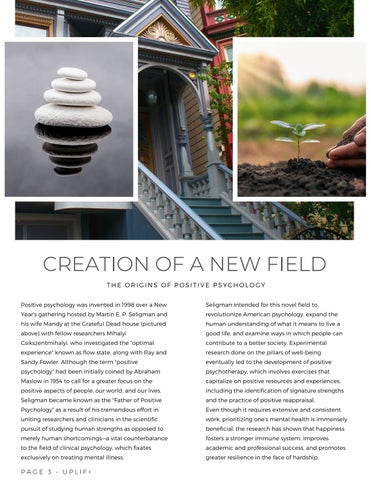
CREATION OF A NEW FIELD THE ORIGINS OF POSITIVE PSYCHOLOGY Positive psychology was invented in 1998 over a New
Seligman intended for this novel field to
Year's gathering hosted by Martin E. P. Seligman and
revolutionize American psychology, expand the
his wife Mandy at the Grateful Dead house (pictured
human understanding of what it means to live a
above) with fellow researchers Mihalyi
good life, and examine ways in which people can
Csikszentmihalyi, who investigated the "optimal
contribute to a better society. Experimental
experience" known as flow state, along with Ray and
research done on the pillars of well-being
Sandy Fowler. Although the term "positive
eventually led to the development of positive
psychology" had been initially coined by Abraham
psychotherapy, which involves exercises that
Maslow in 1954 to call for a greater focus on the
capitalize on positive resources and experiences,
positive aspects of people, our world, and our lives,
including the identification of signature strengths
Seligman became known as the "Father of Positive
and the practice of positive reappraisal.
Psychology" as a result of his tremendous effort in
Even though it requires extensive and consistent
uniting researchers and clinicians in the scientific
work, prioritizing one's mental health is immensely
pursuit of studying human strengths as opposed to
beneficial; the research has shown that happiness
merely human shortcomings—a vital counterbalance
fosters a stronger immune system, improves
to the field of clinical psychology, which fixates
academic and professional success, and promotes
exclusively on treating mental illness.
greater resilience in the face of hardship.
PAGE 3 • UPLIF+
THE BROADEN & BUILD THEORY The Broaden-and-Build Theory of Positive Emotions, developed by psychology professor Barbara Fredrickson at UNC Chapel Hill, describes the shortterm mechanism and long-term impact of positive emotions. Whereas extensive research has found that negative emotions tend to engender strong and immediate reactions to encourage specific behaviors that historically have aided our predecessors in lifethreatening circumstances, previous studies have paid little attention to the effects of positive emotions and the role they play in overall wellness. Fredrickson
The broaden hypothesis in Fredrickson's theory posits
theorizes that rather than restricting thought and
that positive emotions temporarily widen the range of
action tendencies (urges to behave in a specific way), as
perspectives and behaviors that spring to mind, leading
negative emotions do, positive emotions will
to enhanced flexibility and creativity. According to
momentarily broaden one's "thought-action
Fredrickson, these moments of broadened thought-
repertoires," which lead to the building of "enduring
action repertoires created by positive emotions are
personal resources" (Fredrickson, 2001). In other
evolutionarily advantageous in that they contribute to
words, positive emotions produce an "upward spiral" of
an individual's survival and success in future ordeals by
thoughts and actions that can eventually serve as
building upon their physical, social, psychological, or
invaluable resources to draw from long after the initial
intellectual resources (Fredrickson, 2001). For instance,
positive emotion has faded.
joy shared between two or more people promotes trust and play, which in turn not only strengthens the relationship between the individuals involved but also builds social capital and expands in-group boundaries. Likewise, joy also encourages young children to engage
of their social, physical, and cognitive skills. The durable benefits of positive emotions extend beyond the fleeting experience of the emotions themselves, and as we will continue to see in this newsletter, a vast amount of positive psychology research is grounded in the robustness of the Broaden-and-Build Theory.
+FILPU • 4 EGAP
in a various kinds of play, resulting in the development
ELEVATION
OUR EMOTIONAL REACTION TO MORAL BEAUTY
Your eyes stay glued to the TV screen as you watch the track athlete carry an injured runner across the finish line, forfeiting her spot on the podium as a result of her reduced pace. The crowd in the stands erupts into a standing ovation, and an unusually warm glow expands across your chest. What is this feeling, you wonder? Elevation—the warm, uplifting emotion prompted by the witnessing of a morally virtuous action and the subsequent desire to emulate such goodness in your own life. We've all experienced this feeling at some point in our lives, yet few of us spark conversations about it, and even fewer of us are aware that there is a name for this strangely heartwarming experience. Jonathan Haidt, an emotion researcher who spent years studying disgust before turning his focus to investigating its antithesis, describes elevation as the positive half of the "third dimension of social cognition," a continuum that spans between moral purity and pollution (Haidt, 2003). Elevation has been shown to create a warm feeling of connection with humanity by serving as an emotional source of inspiration to also act in morally beautiful ways. In the process of eliciting compassion for others and courage to do good in the world, elevation encourages individuals to expand their sense of self and turn their attention outwards toward serving and lifting up others—a prime illustration of Fredrickson's broaden-and-build theory of positive emotions. Elevation calls us to aspire to champion and mirror the goodness of human nature, or as David Whitford once put it, it is the feeling that stimulates "a tear of celebration, a tear of receptiveness to what is good in the world" (Haidt, 2oo3).
PAGE 5 • UPLIF+
— Thomas Jefferson
EGAYOV • 6 EGAP
WHEN ANY ACT OF CHARITY OR OF GRATITUDE...IS PRESENTED EITHER TO OUR SIGHT OR IMAGINATION, WE ARE DEEPLY IMPRESSED WITH ITS BEAUTY AND FEEL A STRONG DESIRE IN OURSELVES OF DOING CHARITABLE AND GRATEFUL ACTS ALSO.
MONEY And the Value of Experiential Purchases
Experiences > Things
Experiential purchases, or life experiences, provide more lasting happiness than material purchases because they are not as easily adapted to, something people happen to be astonishingly good at doing. While material goods are quickly grown used to, experiences not only promote anticipation and savoring of the events themselves but also produce positive memories that can be looked back on fondly when mentally revisited (Dunn et al., 2011).
The Gift of Giving
Research has shown that even when income is controlled for, prosocial spending of money, i.e. money spent on others or that is used to support a charitable cause, consistently results in greater happiness by fostering stronger social connections and promoting positive self-presentation (Dunn et al., 2008).
Small Pleasures
To combat the diminishing marginal return of pleasure derived from costly material goods as well as our tendency to adapt to these kinds of purchases, the data suggests that we should instead spend our money on frequent and small pleasures, or as researchers describe it, "frequent doses of lovely things rather than infrequent doses of lovelier things" (Dunn et al., 2011).
PAGE 7 • UPLIF+
HOW ARE YOU SPENDING YOUR MONEY? Money can bring happiness, but not in the way that you might think. Most people are not spending their money on things that research has shown will bring sustained happiness. Instead of spending money on experiential purchases or on others, people often grossly miscalculate how much happiness material goods will bring them, a mistake otherwise known as distorted affective forecasting. Put simply, we generally fail to recognize the ease at which we will adapt to most positive or negative situations. Furthermore, we have a events and purchases in a vacuum, which blinds us from a multitude of other details that would determine the level of happiness we will actually experience in the context of the purchase.
+FILPU • 8 EGAP
tendency to view these particular
PRACTICING
GRATITUDE Gratitude is described as a cognitive process in which a favorable outcome is attributed to the benevolence of an external source, such as another person or a higher power (Emmons and McCullough, 2003). Practicing gratitude has been shown to enhance subjective well-being— or happiness—by fixing one's attention to what one has rather than what one lacks, which reduces the capacity for unhelpful social comparison or envy (Watkins et al., 2011). Gratitude enables a deeper sense of appreciation and joy to be derived from positive circumstances and fosters stronger relationships with others by increasing feelings of being valued, all of which in turn promote a "cycle of virtue," where prosocial behavior and the resulting sense of warm connection to other people positively reinforce one another (Grant & Gino, 2010).
PAGE 9 • UPLIF+
"Be thankful for what you have; you'll end up having more. If you concentrate on what you don't have, you will never, ever have enough." — Oprah Winfrey
Count your blessings
to keep a gratitude journal and regularly reflect on the blessings in your life.
Research has shown that consistent practice of grateful thinking leads to long-term improvements in happiness (Emmons and McCullough, 2003). One recommended method is
Exercise: Consider the people, opportunities, and circumstances in your life that you are deeply grateful for. Then, at the end of each day, reflect on what was good and what went well.
GRATITUDE EXERCISE
Finding Closure "When life is sweet, say 'thank you' and celebrate. And when life is bitter, say 'thank you' and grow." — Shauna Niequist
"Bring to mind an open memory. An open memory is a troubling memory from your past that you feel is not yet behind you and is poorly understood. In many ways, this emotional memory is still an 'open book' for you. For the next 20 minutes, think back on your experience and write about your open memory. At first, it may seem that the event you wrote down might not have had any positive effects on your life. However, sometimes even when bad things happen, they ultimately have positive consequences, things we can now be grateful for.
Try to focus on the positive aspects or consequences of this difficult experience. As a result of this event, what kinds of things do you now feel thankful for? How have you grown? Were there personal strengths that grew out of your experience? How has the event made you better able to meet the challenges of the future? How has this event helped you appreciate the truly important people and things in your life? As you write, do not worry about punctuation or grammar; let go and write as much as you can about the positive aspects of your experience that you now feel you can be grateful for."
+FILPU • 01 EGAP
The following exercise was designed by Watkins et al. (2013):
SELF-ESTEEM VS. SELF-COMPASSION
Self-esteem is an individual's perceived sense of self-worth. It is a construct that relies heavily on comparison of one's own attributes and performance in relation to those of others, a mechanism that is otherwise known as selfcomparison. An overemphasis on preserving self-esteem paints an ignorant view of the self by underestimating or even opting to turn a blind eye to the commonality and acceptability of failure. Self-esteem becomes problematic when it is overly inflated or prioritized, resulting in a difficulty coping with failure. Whereas a focus on maintaining self-esteem creates a highly fragile sense of worthiness, self-compassion advocates for the adoption of a kind, understanding, and non-judgmental view of the self when confronted with personal shortcomings. Practicing selfcompassion is not only more realistic than preserving self-esteem but it also extends the opportunity for an individual to face failure feedback with grace—contrast this with attempting to protect self-esteem, which demands for such feedback to be disregarded.
PAGE 11 • UPLIF+
"If I am not good to myself, how can I expect anyone else to be good to me?" — Maya Angelou
PHOEBE LONG & KRISTIN D. NEFF
C O N S I S T E N T
S E L F - W O R T H
E X T E R N A L
W H E N
T H E
S E N S E
T H A T
T H E
G O A L S
C O M P E T E N C E
P O T E N T I A L
S E E M
S O
N O T
O F
I N
B E
A N D
D E P E N D
A R E
S A L I E N T ,
O R I E N T A T I O N
I N
F E E L I N G S
S E L F -
O F
U N D E R M I N E D
S E L F - C R I T I C I S M ,
F O R
L I F E
O N
A D D I T I O N ,
E N T A I L E D
M E A N S
W I L L
D E G R E E S
K I N D
S E L F
C O M P A S S I O N
T H E
N O T
E V A L U A T I O N S .
C O N S I S T E N T L Y
A
B E L O N G I N G
D O E S
E V A L U A T I O N
T O W A R D S
H I G H
O F
P R O V I D E S
F A I L U R E
W I L L
B Y
A N D
N O T
T H R E A T E N I N G . "
CHECK OUT THE FOLLOWING LINK FOR DR. NEFF'S GUIDED EXERCISES ON SELF-COMPASSION:
https://self-compassion.org/category/exercises/#exercises
EGAYOV • 21 EGAP
" S E L F - C O M P A S S I O N
resilience — AND WAYS TO PROTECT YOUR "ORDINARY MAGIC"
Psychologists have defined resilience as positive adaptation in response to adversity or risk. Masten et al. (2001) describe it as "ordinary magic:" an adaptational and protective process that is surprisingly far more common and normal than we might be led to believe. Every one of us will inevitably come across adversity throughout our life, and learning how to build resilience in the face of such hardships can be highly beneficial for our well-being and overall satisfaction with life.
PAGE 13 • UPLIF+
Dr. Danielle King of the WorKing Resilience Lab at Rice University suggests a number of ways to help you cultivate resilience: Create small, realistic goals. Establish an internal locus of control. As in, direct your attention to what is within the scope of your control rather than what is not. Seek social support. Practice self-compassion. Adopt a growth mindset. That is, reframe adversity as an opportunity for you to grow.
directed thoughts of a goal pursuit" (Rand & Cheavens, 2009). One essential component of hope is the synthesis of realistic, goal-oriented routes that connect the present with the future. An individual's level of hope is correlated with their ability to envision multiple pathways to their goals (Rand & Cheavens, 2009). The second crucial element of hope is "agency thinking," or the belief that one will be able to make progress along a proposed pathway. Agency serves as the source of motivation and conviction for taking action in pursuit of a goal.
Research has revealed that hope, defined
Hope is the belief in the
as a model of pathways and agency thinking, is positively associated with
possibility of attaining one's
academic success, athletic achievement,
goals using pathways to
well-being, and positive self-presentation
achieve them; in other words,
disease-preventative behavior, physical (Rand & Cheavens, 2009).
EGAYOV • 41 EGAP
THE THEORY OF HOPE
it is the ability to have "goal-
Savoring Savoring refers to the "generating, maintaining, or enhancing [of] positive affect by attending to positive experiences from the past, present, or future" (Bryant et al., 2011). It involves practicing mindfulness and gratitude in the anticipation, presence, or remembrance of something positive.
According to Bryant and his colleagues (2007), a
experiences can further be divided into processes
savoring experience can be described as "world-
that require either cognitive reflection, which
focused," in which an external source is identified as
involves introspection, or experiential absorption,
responsible for the positive experience (e.g. events
which involves enthrallment. Strategies that we can
that elicit awe or gratitude), or as "self-focused," in
use to savor more of our experiences include bearing
which the positive emotions derived from the
a positive expression throughout the experience,
experience are attributed to the self (e.g. events that
immersing ourselves in the moment, and sharing
evoke pride or physical pleasure). These savoring
these positive experiences with others.
PAGE 15 • UPLIF+
Savoring Exercise The following exercise was inspired by a class activity designed by Dr. Sandra Parsons for PSYC 480: Positive Psychology— 1. Choose an activity for you to savor. Examples of commonly enjoyed activities include taking a walk with friends, watching a movie, and baking a cake. 2.
Devote some time to give your full attention to the activity you've chosen. Pick a time when you will not be preocccupied with anything else.
3.
Go forth and savor! Embrace each moment, and take note of the thoughts,
4.
After the activity has come to an end, document your memory of the
sights, sounds, and feelings that you experience. experience and reflect on how it made you feel.
+FILPU • 61 EGAP
What has this exercise taught you about how you want to experience your life?
References Bryant, F. B., Chadwick, E. D., & Kluwe, K. (2011). Understandingthe processes that regulate positive emotional experience: Unsolved problems and future directions for theory and research on savoring. International journal of wellbeing, 1(1), 107-126. doi:10.5502/ijw.v1i1.18 Dunn, E. W., Gilbert, D. T., & Wilson, T. D. (2011). If money doesn't make you happy, then you probably aren't spending it right. Journal of consumer psychology, 21(2), 115-125. Emmons, R. A., & McCullough, M. E. (2003). Counting blessings versus burdens: An experimental investigation of gratitude and subjective well being in daily life. Journal of personality and social psychology, 84(2), 377-389. Fredrickson B. L. (2001). The role of positive emotions in positive psychology. The broaden-and-build theory of positive emotions. The American psychologist, 56(3), 218–226. https://doi.org/10.1037//0003-066x.56.3.218 Grant, A. M., & Gino, F. (2010). A little thanks goes a long way: Explaining why gratitude expressions motivate prosocial behavior. Journal of personality and social psychology, 98(6), 946. Haidt, J. (2003). Elevation and the positive psychology of morality. In C. L. M. Keyes & J. Haidt (Eds.), Flourishing: Positive psychology and the life well-lived (pp. 275–289). American Psychological Association. https://doi.org/10.1037/10594-012 King, D. (2021, July 21). Resilience in 2021 and beyond [PowerPoint slides]. Canvas. https://www.rice.edu/canvas Long, P., & Neff, K. D. (2018). Self-compassion is associated with reduced self-presentation concerns and increased student communication behavior. Learning and individual differences, 67, 223-231. Lopez, S. J., & Snyder, C. R. (Eds.). (2009). The Oxford handbook of positive psychology. Oxford University Press. Masten, A. S. (2001). Ordinary magic: Resilience processes in development. American psychologist, 56(3), 227. Seligman, M. E. (2019). Positive psychology: A personal history. Annual review of clinical psychology, 15, 1-23. https://doi.org/10.1146/annurev-clinpsy050718-095653 Watkins, P. C., Sparrow, A., & Webber, A. C. (2013). Gratitude: Taking care of business with gratitude. In J. J. Froh & A. C. Parks (Eds.), Activities for teaching positive psychology: A guide for instructors (pp. 119–127). American Psychological Association. https://doi.org/10.1037/14042-019
THANK YOU FOR READING! Cheers to your growth and flourishing.