2022 SEASON CLICK or TAP to play additional video content!
A
yet
hotel located in the

sophisticated,
relaxed,
heart of Yale University’s vibrant Arts Campus
A
yet
hotel located in the
Welcome to this performance of Edward Albee’s Who’s Afraid of Virginia Woolf?—and the start of Yale Rep’s 2022–23 season!
Devolving over the course of one very late, very boozy night in a living room in the fictional college town of New Carthage, the play sent shockwaves through American popular culture when it premiered on Broadway in 1962. Edward Albee’s wickedly funny and frank depiction of two marriages stood in stark contrast to the conservative mores and stagecraft of the preceding decade. Indeed, Who’s Afraid of Virginia Woolf? stands as a stinging critique of prevailing values of its day—and, to a considerable extent, our own—even as it holds a mirror up to the ambiguities of intimate relationships.
Although this is one of the most famous plays in contemporary drama, our production of Virginia Woolf is nonetheless the first professional staging of Albee’s masterpiece in Connecticut 30 years. I am thrilled that so many in our audience will experience the play for the first time here at Yale Rep, and it is a particular joy to share with you the talents of such an extraordinary cast of actors and our artistic, technical, and management collaborators.
Our season continues this fall with the Yale-commissioned world premiere of The Brightest Thing in the World by Leah Nanako Winkler, directed by Margot Bordelon. The funny and compassionate new play will run November 25–December 17.
In the new year, we will present Mojada: A Medea in Los Angeles, by Luis Alfaro, March 10–April 1. Laurie Woolery will stage the reimagining of the classic Greek tragedy through the story of an undocumented family caught in the grip of the American immigration system.
Playwright Christina Anderson’s latest play, the ripple, the wave that carried me home, directed by Tamilla Woodard, will be performed April 28–May 20. The work garnered Anderson the biennial Horton Foote Prize, which honors works of exceptional quality.
I hope you will join us for the entire season. Tickets for all three productions are available now at yalerep.org. And it’s not too late to subscribe: you may apply the cost of today’s ticket to a full subscription through Friday, November 18. Please call the Box Office at (203) 432-1234 to learn more.
Whether you are a longtime Yale Rep audience member or this is your first time at Yale Rep, thank you for joining us today. As always, I look forward to hearing what you think about Who’s Afraid of Virginia Woolf? or any of your experiences at Yale Rep. The best way to reach me is by email at james.bundy@yale.edu.
Sincerely, James Bundy, Artistic Director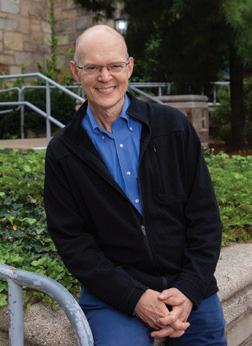

James Bundy, Artistic Director | Florie Seery, Managing Director
Scenic Designer
Miguel Urbino
Costume Designer
Kyle J. Artone
Lighting Designer


Jiahao (Neil) Qiu 邱嘉皓
Sound Designer
Joe Krempetz
Wig and Hair Designer
Matthew Armentrout
Makeup Designer
Earon Chew Nealey
Production Dramaturg
Nicholas Orvis
Technical Director
Mia Sara Haiman
Vocal Coach
Walton Wilson
Fight and Intimacy Directors
Kelsey Rainwater and Michael Rossmy
Movement Consultant
Erica Fae
Casting Director

Tara Rubin, C.S.A.
Stage Manager
James Mountcastle
Who’s Afraid of Virginia Woolf? is presented by arrangement with Concord Theatricals on behalf of Samuel French, Inc. concordtheatricals.com
Yale Repertory Theatre thanks our 2022–23 season funders:
Season Sponsor: The Study at Yale
We’re
to champion
and
by
you,
bringing their
to
The living room of a house on the campus of a small New England college.
There will be two 10-minute intermissions.
This play contains profanity; misogynist and racist language and slurs; sexually explicit language; sexual situations; and violence, which is in the context of an intimate partner relationship. In addition to specific language and slurs that are anti-AAPI, anti-Arab, and anti-Latinx, the action of the play contains acts of orientalism and the fetishization of Asian cultures.

Herbal cigarettes are smoked in this production.
The videotaping or making of electronic or other audio and/or visual recordings of this production and distributing recordings or streams in any medium, including the internet, is strictly prohibited, a violation of the author(s)’s rights and actionable under United States copyright law. For more information, please visit: concordtheatricals.com/resources/protecting-artists.
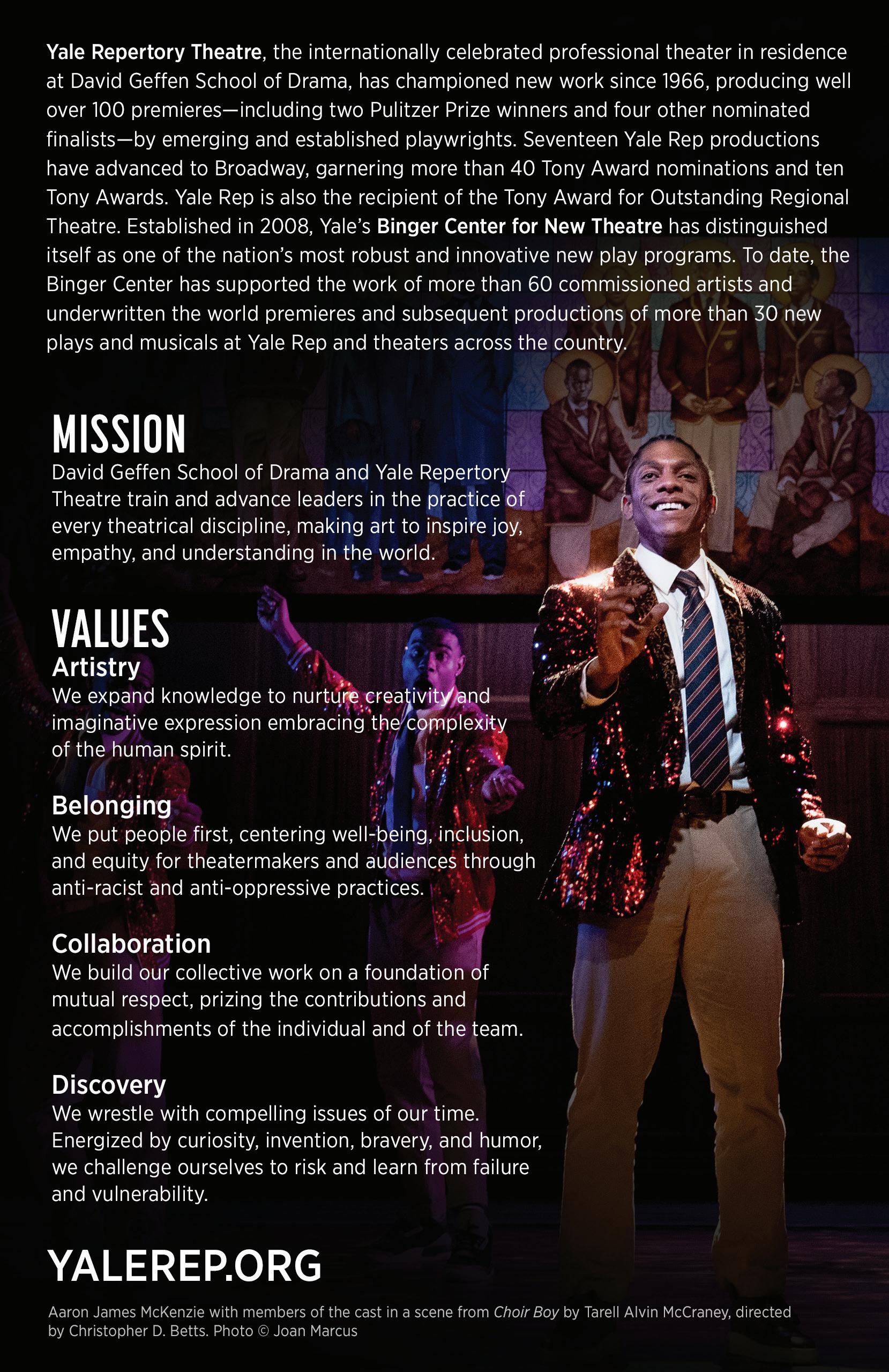
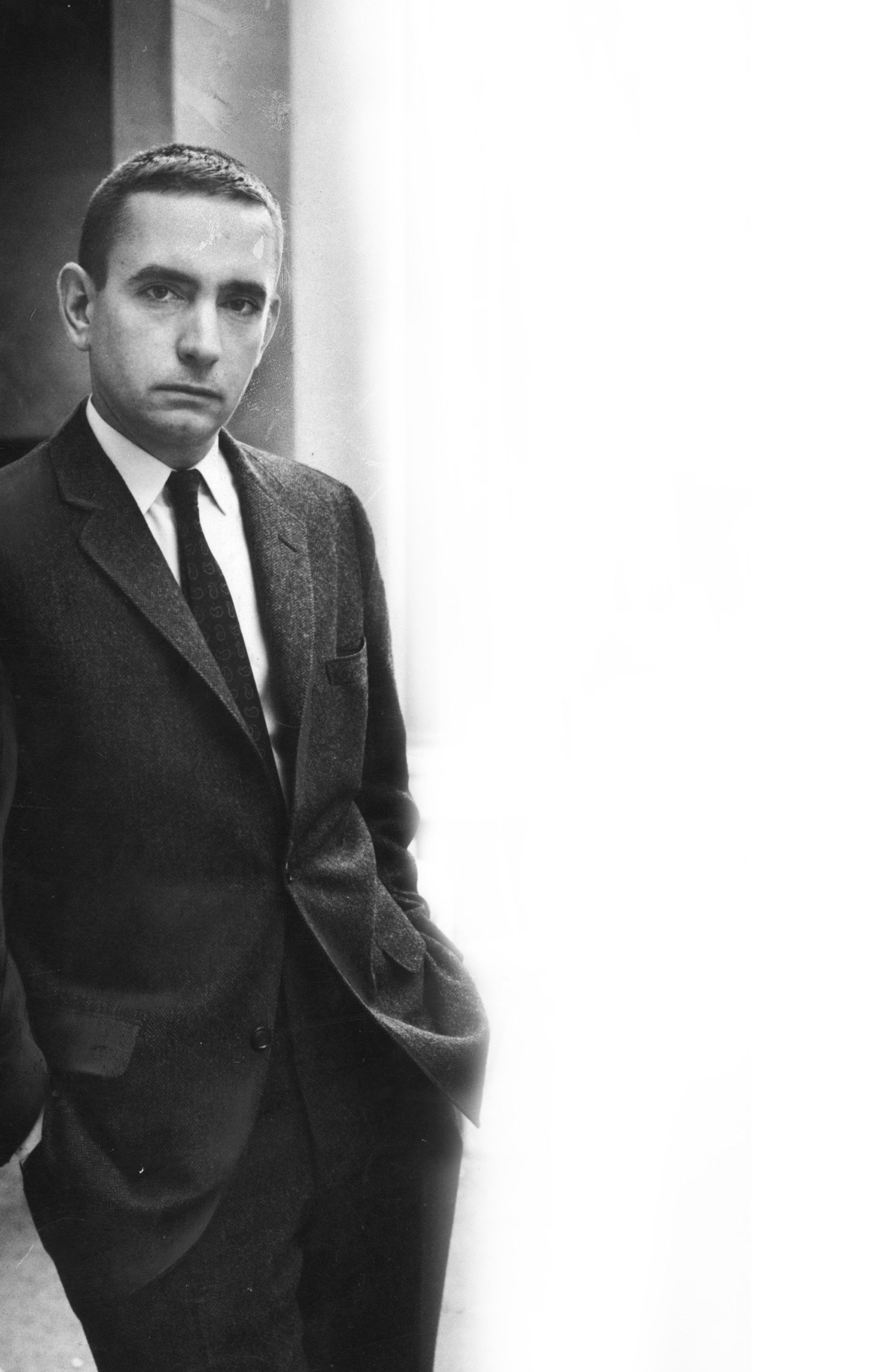
On September 14, 1962, LIFE magazine ran an issue dedicated to “The TakeOver Generation.” Its first story, a foldout portrait gallery, featured “A RedHot Hundred.” The very first portrait among the alphabetically arranged faces of young, overwhelmingly white men was that of a gangly 34-year-old with dark hair and protruding ears, smiling in a slightly uncomfortable way: playwright Edward Albee.
Albee (1928–2016) was, in 1962, just coming into his own. Adopted at two weeks old by Reed and Frances Albee, the heirs of vaudeville impresario Edward F. Albee II (for whom he was named), Albee spent much of his adolescence being shuttled from one private school to another. After a brief flirtation with college, he moved to New York’s Greenwich Village and began to work odd jobs while writing poetry. A few years later, while visiting a friend at a writers’ retreat, he shared his poems with Thornton Wilder, author of Our Town and The Skin of Our Teeth, who suggested that Albee might try his hand at playwriting instead.
Albee followed Wilder’s advice, but it took him until the cusp of his 30s to find success in the theatrical form—and he found it not in the US but Germany. Albee’s 1959 The Zoo Story, a bleakly funny play about a pair of New Yorkers from different classes meeting on a Central Park bench, was initially rejected by American producers. Thanks to a network of friends and contacts, it premiered in more avantgarde Berlin before returning to New York. Once home, the play made a splash among theater artists and afficionados,
who hailed it as an exciting experiment and Albee as an American writer in the new European style critics were calling “Theater of the Absurd.” For his part, Albee was ambivalent about that label—he commented in a 1962 essay that the true theater of the absurd seemed to be Broadway, obsessed as it was with commercial success: “What […] could be more absurd than a theatre in which the aesthetic criterion is something like this: a ‘good’ play is one which makes money; a ‘bad’ one (in the sense of ‘Naughty! Naughty!’ I guess) is one which does not…”.
Who’s Afraid of Virginia Woolf? was Albee’s attempt to mount a play of aesthetic value on Broadway and was a gamble both financially—as all Broadway shows are—and artistically. Up to that point, Albee had only had absurdist one-act plays produced. Following European writers such as Samuel Beckett and Eugene Ionesco, his plays (both before and after Virginia Woolf) frequently employ characters who eschew linear history or logic. While continental dramatists tended to focus on fundamental existential questions following the devastation of World War II and the use of the nuclear bomb, however, Albee followed a long American tradition of playwriting concerned with questions of American civic life—his 1961 play The American Dream, for example,
uses characters who are named as if archetypes (“Mommy,” “Daddy,” “The American Dream”) to comment on what Albee saw as the problems endemic to American society.
His first Broadway production, on the other hand, was a three-act saga that could pass for a realistic drama about two married couples in New England. Albee felt Virginia Woolf was what he needed to write next, and through his earlier productions he had gathered a circle of collaborators and supporters who were able to see his talent and willing to take some risks on his behalf, including director Alan Schneider and producers Richard Barr and Clinton Wilder. Their collective gamble paid off: Virginia Woolf was a hit, winning the 1963 Tony Award for Best Play and being selected for the 1963 Pulitzer Prize (the Pulitzer board refused to award the prize to Albee as they considered the play indecent). The success of Virginia Woolf, particularly its 1966 film adaptation starring Richard Burton and Elizabeth Taylor, bolstered Albee’s finances and cemented his status as a leading theatrical voice of his generation.
Albee’s popularity as a playwright waxed and waned over the remaining fifty years of his career. His plays from the ’60s were mostly acclaimed, including the Pulitzer Prize-winning A Delicate Balance (1966; also produced at Yale Rep and directed by James Bundy in 2010). His work from the ’70s and particularly the ’80s, such as The Lady from Dubuque (1980) and The Man
Who Had Three Arms (1982) were less successful, but he rebounded with Three Tall Women in 1991 (also a Pulitzer winner) and The Goat, or Who Is Sylvia? in 2000. In addition to continuing his own experiments in form and style, Albee actively supported new voices in American playwriting. Using a portion of the funds from Virginia Woolf, he founded the Playwrights’ Unit; there he developed the work of some of the most influential and avant-garde writers of the ’60s and ’70s, including Amiri Baraka, John Guare, Israel Horowitz, and Adrienne Kennedy. He later became a playwriting teacher at the University of Houston, and throughout his life he served as a producer for new plays.
Even beyond the direct reach of Albee’s work as a mentor, Virginia Woolf itself has remained a touchstone for American dramatists.
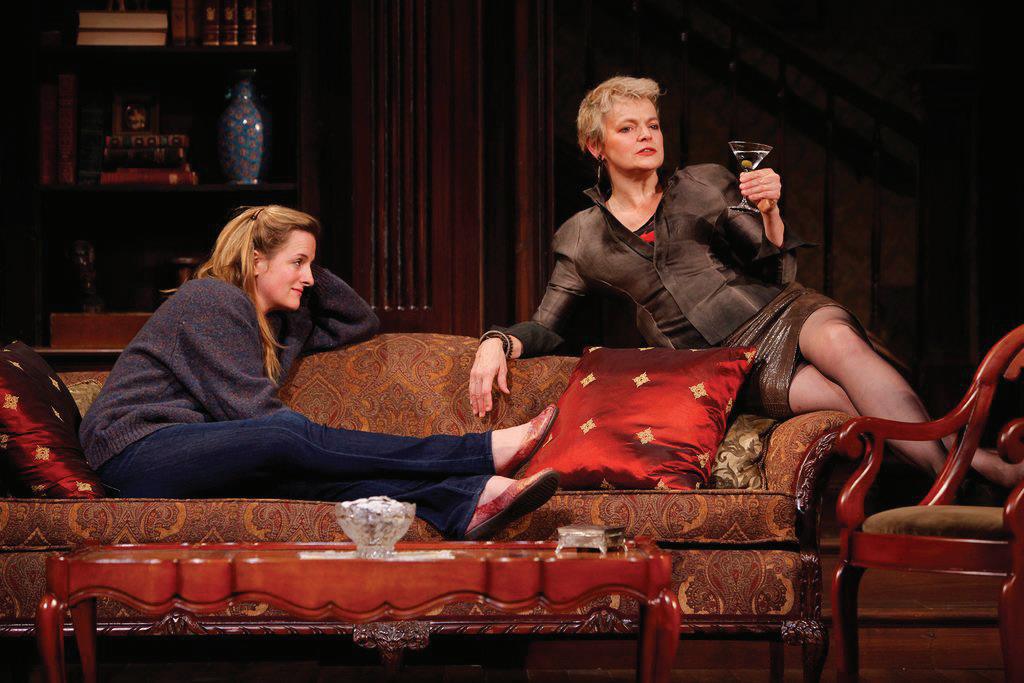
The play’s literary and theatrical fireworks, sharp critique of upperclass white American culture, and blending of American and European dramatic forms led to a revival of socially and intellectually provocative plays written with careful attention to language. Far more than just being, as LIFE put it, someone “who writes exciting plays in a new style,” Edward Albee both in 1962 and over his subsequent half-century career embodied a relentless quest for artistic excellence, for theatrical innovation, and for provocative truth-telling on the American stage.
—Nicholas Orvis, Production Dramaturg

Who’s Afraid of Virginia Woolf? premiered in October 1962, a time when the United States seemed to be on the verge of a fantastical but deeply uncertain future. The Sixties as we generally remember them hadn’t arrived yet; in many ways, it was still in the tail end of the ’50s, a time of conservatism and conformity. By 1962, though, signs of change were beginning to appear, and they were much on the minds of students and faculty in college towns like Albee’s fictional New Carthage.
—Nicholas OrvisThe Cold War between the US and USSR was approaching its peak in 1962. John F. Kennedy was in the second year of his presidency and had already exacerbated the conflict. In 1961, Kennedy supported the disastrous Bay of Pigs invasion, helping Cuban counterrevolutionaries attempt to overthrow the Castro government. The invasion failed and pushed Cuba closer to the USSR; later in 1962 (days after Virginia Woolf opened, in fact), this would precipitate the Cuban Missile Crisis. During the crisis, Yale and many campuses were divided between a majority who found Kennedy’s course “sane and intelligent” and a “deluded ‘ban the bomb’ fringe,” to use the words of the Yale Daily News on October 24, 1962.
ABOVE: Students for and against Cuban blockade, October 24, 1962. Photo courtesy of Indiana University Archives.

Students of 1962 were more progressive than their professors and administrators, but change was slow in coming. Many fraternities were desegregated in the 1950s, often over the protests of alumni, but universities admitted few students of color. Similarly, though more women were attaining a college education, that education was often oriented to preparing them to be wives and mothers. The elite college remained a predominately white and male domain—at Yale a record fourteen Black undergraduates matriculated in 1964, and no women entered Yale College at all until the fall of 1969. Even then, one anonymous “prominent lecturer” at Yale commented to the Yale Daily News that he got more satisfaction from teaching “those who will one day have a greater role in society—men.”
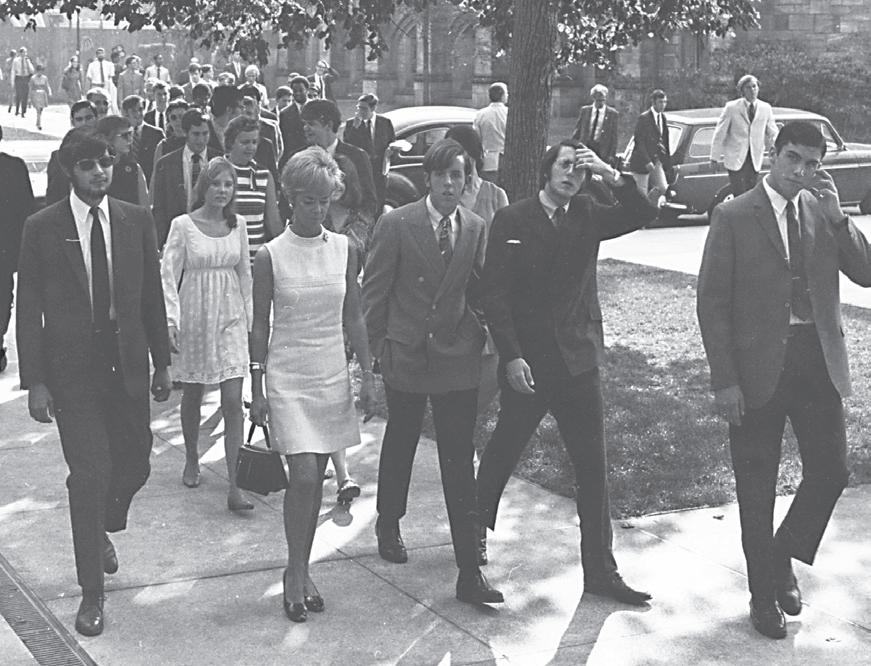
ABOVE: Yale students during co-education week, 1968. Photo courtesy of Yale University Manuscripts and Archives.
One of the Cold War’s most dynamic fronts was the competition to control outer space. In 1962, the Soviet Union was still ahead of the US; it had launched the first successful artificial satellite (Sputnik, 1957) and put the first human into space (Yuri Gagarin, 1961). The US was striving to catch up, though—on February 20, 1962, NASA astronaut John Glenn became the first

In August 1961, the East German government began construction on the Berlin Wall. The concrete barrier divided a major city and enclosed West Berlin, an island of Western influence behind the Iron Curtain. It was a fitting symbol of the suspicion and animosity of the age, and those feelings were entirely visible in college towns. Less than a decade before, Senator Joseph McCarthy had fueled the Red Scare, fomenting an atmosphere of fear and distrust among artists and intellectuals. One professor of political science, according to Calvin B. T. Lee, was known to assign the Communist Manifesto but grimly tell his students, “Go home, pull down the blinds, and read it.”

ABOVE: The Berlin Wall in 1965: Photo by Jürgen Wagner/Timeline Images/Alamy.
American to orbit the Earth, in a five-hour-flight that was followed by millions on TV. Technical progress didn’t necessarily mean social progress, though—Glenn told Congress in June 1962 that there was no need to continue funding a NASA program to train women astronauts, as “The fact that women are not [astronauts] is a fact of our social order.”
Martha: René Augesen previously appeared at Yale Rep in Good Faith, Arcadia, A Streetcar Named
Desire, A Woman of No Importance, and The Beaux’ Stratagem She was a core acting company member at American Conservatory Theater in San Francisco for twelve seasons, where she appeared in more than three dozen productions. In New York, she has appeared in Spinning into Butter (Lincoln Center Theater), Macbeth (The Public Theater), It’s My Party… (ArcLight Theatre), and Overruled (Drama League). Her other regional theatre credits include productions at South Coast Repertory, Great Lakes Theater Festival, Baltimore’s Center Stage, the Los Angeles Shakespeare Festival, and Stage West. Film and television: The Battle Studies, Law & Order, Guiding Light, Another World, and Saint Maybe (Hallmark Hall of Fame). As a 2011 Ten Chimneys Foundation Lunt-Fontanne Fellow, she was recognized for her extraordinary contributions to her community and to the overall quality of the American theater. She is a graduate of David Geffen School of Drama.
George: Dan Donohue Broadway: “Scar” in The Lion King. Over 30 roles at Oregon Shakespeare Festival including “Henry V,” “Iago,” “Richard III,” and “Hamlet.”
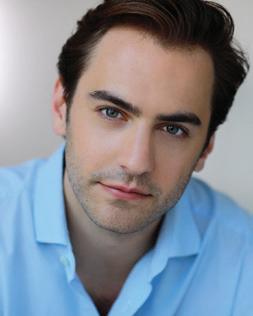
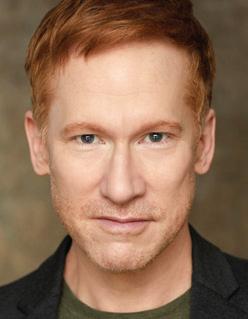
Other regional theaters include the Goodman, the Geffen, Long Wharf, Berkeley Rep, Seattle Rep and more. Recent television credits include recurring roles on For All Mankind, Longmire, Agents of S.H.I.E.L.D, and Damnation. A recording of his Hamlet at Oregon Shakespeare Festival received a Grammy Nomination in 2011.
Nick:
Nate Janis is an actor, singer, and writer based in New York City. Recent credits include A Midsummer Night’s Dream (Classical Theatre of Harlem), The Heidi Chronicles (Guild Hall of East Hampton), The Fantasticks (Infinity Theatre Company), tenderly (Edinburgh Fringe), and Three Sisters (Columbia Stages). He is over the moon to be back at his alma mater performing one of his favorite plays. Training: B.A., Yale University; William Esper Studio; Columbia M.F.A. Special thanks to Felicia Sager, Avalon Artists, Tara Rubin Casting, Brian McManamon, Ron Van Lieu, James Calleri, and friends and family.
Honey:
Emma Pfitzer Price is thrilled to be making her Yale Rep debut. Emma appeared in productions of Major Barbara, Black Snow, A Bright Room Called Day, As You Like It, and The Cherry Orchard, among others, at The Juilliard School, where she recently received her B.F.A. in drama.
The Actors and Stage Manager employed in this production are members of Actors’ Equity Association, the Union of Professional Actors and Stage Managers in the United States.
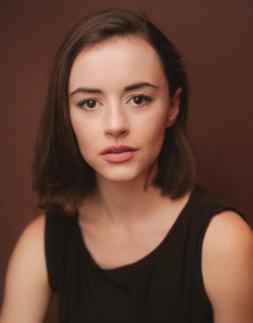
Other theater includes Steel Magnolias (Virginia Theatre Festival). She has most recently appeared in Showtime’s American Rust. Originally from Kentucky, Emma is a Governor’s School for the Arts Scholar of Drama. She is beyond grateful for this opportunity to bring one of her favorite plays to life.
Playwright: Edward Albee was born on March 12, 1928, and began writing plays 30 years later. His plays include The Zoo Story (1958), The Death of Bessie Smith (1959), The Sandbox (1959), Fam and Yam (1959), The American Dream (1960), Who’s Afraid of Virginia Woolf? (1961–62, Tony Award), Tiny Alice (1964), A Delicate Balance (1966, Pulitzer Prize; 1996, Tony Award), Malcolm (1966), Everything in the Garden (1969), Box and Quotations from Chairman Mao Tse-Tung: Two Inter-Related Plays (1969), All Over (1971), Seascape (1974, Pulitzer Prize), Listening (1975), Counting the Ways (1975), The Lady from Dubuque (1977–78), The Man Who Had Three Arms (1981), Finding the Sun (1982), Marriage Play (1986–87), Three Tall Women (1991, Pulitzer Prize), Fragments (1993), The Play About the Baby (1997), The Goat or, Who Is Sylvia? (2000, 2002 Tony Award), Occupant (2001), Knock! Knock! Who’s There!? (2003), At Home at the Zoo (Act 1: Homelife, Act 2: The Zoo Story) (2004), and Me, Myself & I (2008). He was a member of the Dramatists Guild Council and President of The Edward F. Albee Foundation. Mr. Albee was awarded the Gold Medal in
Drama from the American Academy and Institute of Arts and Letters in 1980. In 1996 he received the Kennedy Center Honors and the National Medal of Arts. In 2005, he was awarded a special Tony Award for Lifetime Achievement.

Hair Designer: Matthew Armentrout previously worked at Yale Rep on Today is My Birthday (2022) and Manahatta (2020). Broadway: Bernhardt/Hamlet. Off Broadway: Merrily We Roll Along (Roundabout), Othello (Shakespeare in the Park). Regional: Bliss (The 5th Avenue Theatre), Jitney (National Tour), Paradise Square (Berkeley Repertory Theatre).
Costume Designer: Kyle J. Artone is a fourth-year costume designer at David Geffen School of Drama and looking forward to graduating this May. He is incredibly excited and grateful to be making his Yale Rep debut designing the costumes for Who’s Afraid of Virginia Woolf?. Credits include Gidion’s Knot (Theatre Row Off-Broadway); the father, the son, and the holy spirit (Yale Summer Cabaret); She Kills Monsters (David Geffen School of Drama); Polkadots (Virginia Rep); Xanadu and The Sound of Music (State Theatre Center for the Arts); Little Shop of Horrors (Raymond Hodges Theater); Venus in Fur, The 39 Steps, and The Nightman Cometh (Shafer Street Playhouse). Kyle has won awards for Little Shop of Horrors, Venus in Fur, and The Nightman Cometh.
James Bundy has served as Elizabeth Parker Ware Dean of David Geffen School of Drama at Yale and Artistic Director of Yale Repertory Theatre since 2002. He teaches in the Acting program at the School and in the Theater Studies program at Yale College. During his tenure, Yale Rep has produced more than thirty world, American, and regional premieres, nine of which have been honored by the Connecticut Critics Circle as Best Production of the year and two of which have been Pulitzer Prize finalists. Through WILL POWER!, an educational program initiated in 2004, Yale Rep has provided low-cost theater tickets and classroom visits to thousands of middle and high school students from Greater New Haven. The Binger Center for New Theatre, founded in 2008, has enabled the theatre to commission more than sixty artists to create new work. James has directed productions at the Mark Taper Forum, Theater for a New Audience, Oregon Shakespeare Festival, Great Lakes Theater Festival, The Acting Company, California Shakespeare Festival, Alabama Shakespeare Festival, and The Juilliard School Drama Division. He served from 2007–13 on the board of directors of Theatre Communications Group. Previously, he worked as Associate Producing Director of The Acting Company, Managing Director of Cornerstone Theater Company, and Artistic Director of Great Lakes Theater Festival. James is a graduate of Harvard College and David Geffen School of Drama; he also trained at the London Academy of Music and Dramatic Art.
Movement Consultant: Erica Fae is a theater/filmmaker, actor, and teacher. Her first feature film, To Keep the Light, was awarded the Fipresci Prize (International Critics’ Prize/Mannheim), Best Director (Berlin Independent Film Festival), Best of Show (Bendfilm), Best Emerging Director, two Best Narrative Feature Awards, and two Best Cinematography Awards, and is available on Amazon Prime. Recent works for theater as creator/co-creator/performer are Saved Again and by Him and Take What Is Yours, a New York Times Critic’s Pick. As an actor, she has appeared in HBO’s Boardwalk Empire, Random Acts of Flyness, and Doll & Em; and films First Reformed, Little Children, and Synecdoche, New York. She’s also on Netflix’s newly-released Partner Track and is currently in development on her second feature film. She is a faculty member in the Acting program at David Geffen School of Drama.
Technical Director: Mia Sara Haiman (she/her) is a fourthyear M.F.A. candidate in the Technical Design and Production program at David Geffen School of Drama, where her credits include Measure for Measure, She Kills Monsters, Carlotta Festival of Plays, and Yale Summer Cabaret 2021. Yale Rep credits include Girls, The Plot, Manahatta, and A Raisin in the Sun (canceled due to COVID). As a project and production manager, Mia has worked in live entertainment for Broadway, regionally, and abroad. Prior to Yale, Mia worked as Production Manager at Boston Center for the Arts and at the Cameri Theatre
of Tel-Aviv. Most recently, Mia worked on multiple Broadway and regional productions at ShowMotion, Inc.
Sound Designer:
Joe Krempetz is a sound designer, composer, and audio engineer from the San Francisco Bay Area. Recent design credits include Transpositions (Schwarzman Center,) The Hedgehog’s Dilemma (Yale Cabaret), Eve (Phoenix Theatre, San Francisco), and Upwelling (Vetiver Oakland). Engineering credits include Between Two Knees (Yale Rep); How to Save the World in 90 Minutes (Cherry Lane Studio Theatre); and The 39 Steps, Measure for Measure, and Venus in Fur (Santa Cruz Shakespeare). Joe has managed or operated events for Microsoft Inc, Stanford Live, Berkeley Repertory Theatre, TheatreWorks Silicon Valley, The International Festival of Arts & Ideas, and many others. Joe holds a B.A. in theatrical technology from UC Santa Cruz and a technical certificate in sound from David Geffen School of Drama, where he is currently a third-year M.F.A. candidate.
James Mountcastle is the Production Stage Manager (PSM) at Yale Rep and a Professor in The Practice of Stage Management at David Geffen School of Drama. As PSM, he has supervised stage management teams through more than a hundred Yale Rep productions over the past 18 seasons. James graduated from David Geffen School of Drama himself in 1990 and before returning to teach at the School in 2004, he spent 15 years working in New York City where
he stage managed many musicals on Broadway and for Broadway National Tours. A professional stage manager for 38 years, James is proud to work on this production with two wonderful assistant stage managers. Ais Galvin and Alexus Coney are Stage Management Team Members of the very first rank, and they deserve all the applause they can possibly hear from one very proud and grateful PSM. Thank you!
Earon Chew Nealey Broadway: Macbeth (associate hair designer); Chicken and Biscuits (associate wig and makeup designer); Sweat (associate makeup designer). Other design: Dames at Sea, Kinky Boots (Bucks County Playhouse); The Last Supper (SOPAC); Twelfth Night (Marcus Garvey Park) On Killing (Soho Rep); Fat Ham, Cullad Wattah, Mojada (The Public Theater); Little Girl Blue (Goodspeed, New World Stages); Meet Vera Stark, Matilda (Colorado University); On Sugarlad (New York Theatre Workshop); Nina Simone: Four Women (Berkshire Theatre Group); Once on This Island (Pioneer Theatre Company); Little Women (Dallas Theater Center); Oklahoma!, Patsy Cline (Weston Playhouse); Memphis, Dream Girls (Cape Fear Regional Theater); Cadillac Crew, Twelfth Night (Yale Rep).
Production Dramaturg: Nicholas Orvis (he/him) is a dramaturg, critic, and director in his final year at David Geffen School of Drama, where his work includes Green Suga Bloos (Langston Hughes Festival) and Almost (Nearly) Fucking Finally (Fourth-year Acting Project); also The
The Actors and Stage Manager employed in this production are members of Actors’ Equity Association, the Union of Professional Actors and Stage Managers in the United States.
Hedgehog’s Dilemma (Yale Cabaret) and the father, the son, and the holy spirit (Yale Summer Cabaret). Prior to beginning at the Geffen School, Nick was the Literary Associate for Premiere Stages at Kean University, where he helped develop new plays by writers including Deborah Brevoort, Nicole Pandolfo, Keith Josef Adkins, and Tammy Ryan. Nick is a former managing editor of Theater magazine and a co-creator and producer of the ongoing Dungeons + Drama Nerds, a podcast exploring the intersections between theater and tabletop roleplaying games.
Lighting Designer: Jiahao (Neil) Qiu is a fourthyear M.F.A. lighting design candidate at David Geffen School of Drama, where his credits include She Kills Monsters, Romeo and Juliet, Measure for Measure; as well as Over Easy and Radiant Vermin at Yale Cabaret. Other credits include Mirage, Metamorphosis International Residency Shanghai, Xiang Xiang, Dreamers, and Awakening. For more information, please visit: neilqiu.com | @neilqiu_design
Fight and Intimacy Director: Kelsey Rainwater is an intimacy coach, fight director, and actress based out of the ancestral lands of the Quinnipiac people. Kelsey’s most recent work was seen in the premiere of In the Southern Breeze at Rattlestick, David Geffen School of Drama’s She Kills Monsters, and Mason Gross School of the Arts’ Damocles and Smart People. Some of her other credits include The Public Theater’s Measure for Measure and White Noise by Suzan-Lori Parks, directed by Oskar Eustis; A Raisin in the Sun (canceled due to COVID) at Yale
Rep; Blues for An Alabama Sky with the Keen Company; and Bess Wohl’s film Baby Ruby. She is a Lecturer in Acting at David Geffen School of Drama, coteaching stage combat and intimacy, and is a Resident Fight and Intimacy Director for Yale Rep.
Fight and Intimacy Director: Michael Rossmy is a Resident Fight and Intimacy Director for Yale Rep, a lecturer in acting at David Geffen School of Drama, and the Stage Combat and Intimacy Advisor for Yale College. Broadway credits include A Tale of Two Cities, Cymbeline, and Superior Donuts. Regional credits include Yale Repertory Theatre, The Public Theater, Westport Country Playhouse, Goodspeed Musicals, Paper Mill Playhouse, Asolo Rep, The Old Globe, TheaterWorks (Hartford), Princeton University, The Acting Company, Soho Rep, the Geffen Playhouse, Long Wharf Theatre, McCarter Theatre, Carnegie Mellon University, and others. He was nominated for a 2017 Drama Desk Award for his work on Troilus and Cressida for The Public Theater’s production in Central Park. Upcoming projects include fight and intimacy direction for the world premiere of Sally & Tom by Suzan-Lori Parks at the Guthrie Theater.
Casting Director: Tara Rubin, C.S.A. has been casting at Yale Rep since 2004. Selected Broadway/National Tours: KPOP, Mr Saturday Night, Six, Ain’t Too Proud, King Kong, The Band’s Visit, Prince of Broadway, Indecent, Bandstand, Sunset Boulevard, Miss Saigon, Dear Evan Hansen, A Bronx Tale, Cats, Falsettos, School of Rock, Les Misérables, The
Heiress, The Phantom of the Opera, Billy Elliot, Shrek, Spamalot, The 25th Annual Putnam County Spelling Bee, The Producers, Mamma Mia!, Jersey Boys.
Off-Broadway: Gloria: A Life, Smokey Joe’s Café, Jersey Boys, Here Lies Love. Regional: Paper Mill Playhouse, La Jolla Playhouse, The Old Globe, Bucks County Playhouse, Westport Country Playhouse. Film: Billy Crystal’s Here Today tararubincasting.com
Scenic Designer: Miguel Urbino (he/him) is a queer, first generation, Filipino-American designer at David Geffen School of Drama at Yale, where he was the scenic designer for She Kills Monsters. Other credits include more more more (Yale Cabaret, scenic and costumes), soft apples (Yale Cabaret, costumes), The Tap Dance Kid (New York City Center Encores!, associate scenic), The Van Gogh Café (Yale Cabaret, costumes), The Motherfucker With The Hat (T. Schreiber Studios, scenic), The Widow of Tom’s Hill (59E59, scenic). Miguel has also collaborated with Studio McLane, Clint Ramos Design, and others. He received a B.A. in theater arts from Marymount Manhattan College. Miguel is a proud new member of United Scenic Artists, Local USA 829, IATSE. murbinodesigns.com | @murbinodesigns
Vocal Coach: Walton Wilson (he/him) was trained and designated as a voice teacher by Kristin Linklater and was later trained and certified as an associate teacher by Catherine Fitzmaurice. He also studied with Richard Armstrong, Andrea Haring, Meredith Monk, Patsy Rodenburg, and members of the Roy Hart Theatre. As a voice/dialect coach, his New York credits
include The Violet Hour and Golden Child on Broadway; the world premiere productions of The Laramie Project and The Laramie Project: 10 Years Later; and Endangered Species. Regional credits include productions at Actors Theatre of Louisville, American Repertory Theater, Berkshire Theatre Group, Double Edge Theatre, Long Wharf Theatre, McCarter Theatre, Shakespeare & Company, and Williamstown Theatre Festival. At Yale Rep, he has served as voice and dialect coach for peerless, Accidental Death of an Anarchist, In a Year with 13 Moons, A Doctor in Spite of Himself, Autumn Sonata, Battle of Black and Dogs, Notes from Underground, Boleros for the Disenchanted, The Evildoers, The Unmentionables, The Cherry Orchard, The Intelligent Design of Jenny Chow, The Black Monk, Medea/Macbeth/Cinderella, Betty’s Summer Vacation, The Birds, and Richard III
Concord Theatricals is the world’s most significant theatrical company, comprising the catalogs of R&H Theatricals, Samuel French, TamsWitmark and The Andrew Lloyd Webber Collection, plus dozens of new signings each year. Our unparalleled roster includes the work of Irving Berlin, Agatha Christie, George & Ira Gershwin, Marvin Hamlisch, Lorraine Hansberry, Kander & Ebb, Ken Ludwig, Lin-Manuel Miranda, Dominique Morisseau, Cole Porter, Rodgers & Hammerstein, Thornton Wilder, and August Wilson. We are the only firm providing truly comprehensive services to the creators and producers of plays and musicals, including theatrical licensing, music publishing, script publishing, cast recording and first-class production. Follow us @concordshows.
Assistant Director:
Annelise Lawson
Assistant Scenic Designer: KIMKIM (Juhee Kim)
Assistant Costume Designer: Arthur Wilson
Assistant Lighting Designer: David DeCarolis
Assistant Sound Designer and Engineer: Joyce Ciesil
Casting Associate: Frankie Ramirez
Assistant Stage Managers: Alexus Coney
Aisling Galvin Production Associate Production Manager: Twaha Abdul Majeed
Assistant Technical Directors: Jason Dixon
Miguel Angel Lopez John Simone Luke Tarnow-Bulatowicz
Assistant Properties Supervisor: Leo Surach
Production Electrician: Steph Burke
Run Crew: Olivia Cygan Patrick Falcón
Stan Mathabane Anna Roman YuJung Shen
Mikayla Stanley
Rehearsal Line Prompters:
Josie Cooper
Hannah Louise Jones
Ellora Venkat Administration
House Managers: Annabel Guevara
Jeremy Landes
Martha: Giovanna Drummond
George: Samuel DeMuria
Nick: Lucas Iverson Honey: Rebeca Robles
Anne Tofflemire, Sharon Kugler, Merrianne Nedreberg and the CTG prop shop, Erin Peter and Long Wharf Theatre, Marcelo Martínez García, Kyle Slugg, Kate Baker, Kitty Cassetti, Kristor Lawson, Carofano Opticians, Gilberto’s Designs.
Artistic Director: James Bundy
Managing Director: Florie Seery
Associate Artistic Director, Director of New Play Programs: Jennifer Kiger
Resident Artists Playwright in Residence: Tarell Alvin McCraney
Resident Directors: Lileana Blain-Cruz Liz Diamond Tamilla Woodard
Dramaturgy Advisor: Amy Boratko
Resident Dramaturg: Catherine Sheehy
Set Design Advisor: Riccardo Hernández
Resident Set Designer: Michael Yeargan
Costume Design Advisors: Oana Botez Ilona Somogyi
Resident Costume Designer: Toni-Leslie James
Lighting Design Advisors: Alan C. Edwards Stephen Strawbridge
Sound Design Advisor: Mikaal Sulaiman
Voice and Text Advisor: Grace Zandarski
Resident Fight and Intimacy Directors: Kelsey Rainwater Michael Rossmy
Stage Management Advisor: Narda E. Alcorn
Associate Artists: 52nd Street Project Kama Ginkas Mark Lamos
MTYZ Theatre/Moscow
New Generation Theatre
Bill Rauch
Sarah Ruhl
Henrietta Yanovskaya
Artistic Management
Production Stage Manager: James Mountcastle
Senior Artistic Producer: Amy Boratko
Artistic Associate: Kay Perdue Meadows
Artistic Fellow: Jisun Kim
Casting: Tara Rubin, C.S.A. Merri Sugarman, C.S.A. Claire Burke, C.S.A. Peter Van Dam, C.S.A. Felicia Rudolph, C.S.A. Xavier Rubiano, C.S.A. Kevin Metzger-Timson, C.S.A. Spencer Gualdoni Olivia Paige West Frankie Ramirez
Senior Administrative Assistant to the Artistic Director and Associate Artistic Director: Josie Brown
Senior Administrative Assistant for Directing, Dramaturgy and Dramatic Criticism, Playwriting, and Stage Management: Laurie Coppola
Senior Administrative Assistant for the Design Program: Kate Begley Baker
Senior Administrative Assistant for the Acting Program: Krista DeVellis
Interim Arts Librarian Tess Calwell
Production Management Director of Production: Shaminda Amarakoon
Production Manager: Jonathan Reed
Production Manager for Studio Projects and Special Events: C. Nikki Mills
Senior Administrative Assistant to Production and Theater Safety: Grace O’Brien
Technical Director for Yale Rep: Neil Mulligan
Technical Directors for David Geffen School of Drama: Latiana “LT” Gourzong Matt Welander
Electro Mechanical Laboratory Supervisor Eric Lin
Scene Shop Supervisor: Eric Sparks
Senior Lead Carpenter: Matt Gaffney
Lead Carpenters: Ryan Gardner Kat McCarthey Sharon Reinhart
Libby JollyStone Painting
Paint Shop Supervisor: Ru-Jun Wang
Scenic Artists: Lia Akkerhuis Nathan Jasunas
Scenic Painting Intern: Marcus Fort Properties
Properties Supervisor: Jennifer McClure
Properties Craftsperson: David P. Schrader
Properties Associate: Zach Faber
Properties Stock Manager: Mark Dionne
Properties Intern: Bennet Goldberg
Costume Shop Manager: Christine Szczepanski
Senior Drapers: Clarissa Wylie Youngberg Mary Zihal
Senior First Hands: Deborah Bloch Patricia Van Horn
Costume Project Coordinator: Linda Kelley-Dodd
Costume Stock Manager: Jamie Farkas
Additional Costume Staff: Judianne Wallace
Electrics
Lighting Supervisor: Donald W. Titus
Senior House Electricians: Jennifer Carlson Linda-Cristal Young
Interim Production Electrician: Jasmine Moore
Sound Sound Supervisor: Mike Backhaus
Lead Sound Engineer: Stephanie Smith
Sound Interns: Saida Joshua-Smith Zoey Lin
Acting Projection Supervisor: Eric Lin
Projection Engineer: Mike Paddock
Projection Intern: Erin Sims
Stage Operations Stage Carpenter: Janet Cunningham
Lead Wardrobe Supervisor: Elizabeth Bolster
Lead Properties Runner: William Ordynowicz
Lead Light Board Programmer
David Willmore
FOH Mix Engineer: Stephanie Smith
ADMINISTRATION
General Management Associate Managing Directors: Sarah Scafidi
Matthew Sonnenfeld
Senior Administrative Assistant to the Managing Director: Emalie Mayo
Management Assistants: Andrew Valdez
Fanny Abib-Rozenberg
Company Manager: Annabel Guevara
Assistant Company Managers: Anne Ciarlone
Ramona Li
Development and Alumni Affairs Director of Development and Alumni Affairs: Deborah S. Berman
Senior Associate Director of Institutional Giving: Janice Muirhead
Senior Associate Director of Operations for Development and Alumni Affairs: Susan C. Clark
Associate Director of Development Communications and Alumni Affairs: Casey Grambo
Senior Administrative Assistant to Development and Alumni Affairs: Jennifer E. Alzona
Development Associate: Delaney Kelley Development Assistants: Anne Ciarlone
Maya Louise Shed
Finance, Human Resources, and Digital Technology
Finance Consultants: Regina Bejnerowicz
Katherine D. Burgueño
Denise Zaczek
Director of Human Resources: Trinh DiNoto
Director, Yale Tessitura Consortium, and Web Technology:
Janna J. Ellis
Manager, Business Operations: Martha Boateng
Digital Communications Associate: George Tinari
Interim Business Office Analyst: Win Knowles
Business Office Specialists: Aditya Agarwal Moriah Clarke Andrea Valcourt
Digital Technology Associates: Edison Dule Garry Heyward
Senior Administrative Assistant to Business Office, Digital and Web Technology, Operations, and Tessitura: Shainn Reaves
Database Application Consultants: Ben Silvert
Erich Bolton
Bo Du Marketing, Communications, and Audience Services
Director of Marketing: Daniel Cress
Director of Communications: Steven Padla
Senior Associate Director of Marketing and Communications: Caitlin Griffin
Assistant Director of Marketing and Communications: Jacob Santos
Senior Administrative Assistant for Marketing and Communications Mishelle Raza
Publications Assistant: Patrick Ball
Marketing Assistant: Sarah Machiko Haber
Assistant Assistant: Maggie Elliott
Production Photographer: Joan Marcus
Art and Design: Paul Evan Jeffrey/ Passage Design
Videographer: David Kane
Director of Audience Services: Laura Kirk
Assistant Director of Audience Services: Shane Quinn
Subscriptions Coordinator: Tracy Baldini
Audience Services Associate: Molly Leona
Customer Service and Safety Officers Ralph Black, Jr. Kevin Delaney Ed Jooss John Marquez (on leave)
Box Office Assistants: Sydney Raine Garick
Jordan Graf
Lucy Harvey
Aaron Magloire Kenneth Murray a.k. payne Dominic Sullivan Jessica Wang
Ushers: Tracy Bennett Danielys Batista Maura Bozeman
Denny Burke
Regina Carson Amalia Crevani Gerson Espinoza Campos Nina Gaither Madi Garfinkle Lydia Gompper Elli Herzog Şeyma Kaya Spencer Knoll Di’Jhon McCoy Justin Meadows Keenan Miller Bonnie Moeller William Romain Jana Ross Joe Webb Larsson Youngberg
Theater Safety and Occupational Health
Director of Theater Safety and Occupational Health and Interim COVID Compliance Manager: Anna Glover
COVID Compliance Coordinator: Amy Stern
Associate Safety Advisor: Megan Birdsong Operations
Director of Facility Operations: Nadir Balan
Operations Associate: Brandon Fuller
Interim Operations Assistant: Kelvin Essilfie
Arts and Graduate Studies
Superintendents: Jennifer Draughn Francisco Eduardo Pimentel
Custodial Team Leaders: Andrew Mastriano Sherry Stanley
Facility Stewards: Ronald Douglas Marcia Riley
Custodians: Rodney Heard Andrew Martino James Hansberry Sybil Bell Jerome Sonia Willia Grant Melloney Lucas Tylon Frost
Who’s Afraid of Virginia Woolf?, October 6–29, 2022, Yale Repertory Theatre, 1120 Chapel Street, New Haven, Connecticut.
Yale Repertory Theatre operates under an agreement between the League of Resident Theatres (LORT) and Actors’ Equity Association (AEA), the Union of Professional Actors and Stage Managers in the United States.
The Scenic, Costume, Lighting, and Sound Designers in LORT are represented by United Artists Local USA-829, IATSE.


October 22 at 1:30PM
An ASL-interpreted performance for patrons who are deaf or have hearing loss.
Pre-show description begins at 1:15PM
A live narration of the play’s action, sets, and costumes for patrons who are blind or have low vision.

October 29 at 1:30PM
A digital display of the play’s dialogue as it’s spoken for patrons who are deaf or have hearing loss
Open Captioner: David Chu/c2inc (caption coalition) is a 501(c)3 nonprofit consultant and the leading provider of professional Live Performance Captioning (sm) for theatrical and cultural presentations. c2 members hold the distinction of being the very first to caption live theater (the Paper Mill Playhouse, NJ), the first to debut on Broadway and Off-Broadway, and have introduced open captioning in prestigious theatres across the country and in London. Captioning in theater has gained momentum and acceptance by theatergoers since its debut in 1996. It addresses the needs of a far larger audience of hard of hearing and deaf people, which includes those who do not use sign language, are late deafened, not self-identified with hearing loss, and those who simply might have missed a punch line.
Audio Describer: Sarah Nuland’s directing credits include Blithe Spirit, The Crucible, Black Nativity by Langston Hughes; Gary Grinkle’s Race Singing Forrest, and My Red Hand, My Black Hand by Dael Orlandersmith (Long Wharf Theatre); She Stoops to Conquer (Fairfield University); La Calisto (Yale Baroque Opera Project). Regional credits: The Exact Center of the Universe (Festival Stage Theatre); The Shaker Chair (Humana Festival of New Plays, 2005); The Cocktail Hour, Lips Together Teeth Apart (Philadelphia Theatre Company); Spinning Into Butter, The Children (Stamford Theatre Works); ’Tis Pity She’s A Whore (Goodman Theatre); The Heiress (McCarter Theatre). Other theatre: The Merry Wives Of Windsor (Hudson Valley Shakespeare Festival);
Twelfth Night, The Winter’s Tale (American Shakespeare Theatre); Richard III, and The Winter’s Tale (Elm Shakespeare Company). Film credits: Jeffrey. Ms. Nuland has been providing Audio Description for Yale Rep since 2007. She is the founder and President of the Sherwin B. Nuland Foundation for Palliative Care.
ASL Interpreters: Emilia Lorenti-Wann has interpreted Aladdin, On Your Feet!, West Side Story, Les Misérables, Beauty and the Beast, and Godspell on Broadway along with Yale Rep productions including El Huracán and Twelfth Night. She also does various music concerts at Madison Square Garden and Universal Studios with well-known artists and festivals. Emilia was the featured interpreter/trainer for the cruise industry for five years, interpreting shows every night from musicals to comedy acts and trained a team of over 200 interpreters. Emilia is of Uruguayan descent, and Spanish is her first language.
Keith Wann has interpreted Aladdin, Annie, The Play That Goes Wrong, A Midsummer Night’s Dream, Mary Poppins, Something Rotten!, School of Rock, Long Day’s Journey into Night, Noises Off, West Side Story, Shrek: The Musical; Little Shop Of Horrors, Hamlet, Beauty and the Beast, and The 39 Steps. Keith has appeared in short movies, television shows, and commercials featuring sign language and is currently directing, writing, and acting in several online projects geared towards deaf children. Keith is excited to be working on his third production with Yale Rep.
As part of Yale Rep’s commitment to our community, we provide two significant youth programs.
WILL POWER! is Yale Rep’s annual educational initiative, designed to bring middle and high school students to see live theater. Since our 2003–04 season, WILL POWER! has served more than 20,000 Connecticut students and educators. In 2022–23, we will offer programming centered on Mojada: A Medea in Los Angeles to New Haven Public Schools students and educators. The program has included early schooltime matinees, free or heavily subsidized tickets, study guides, and postperformance discussions with actors and members of the creative teams. WILL POWER! is committed to giving teachers curricular support through free workshops and professional development about the content and themes of the plays.
THE DWIGHT/EDGEWOOD PROJECT (D/EP) is a community engagement program of Yale Rep and David Geffen School of Drama for middle school-aged students from Barnard Environmental Science and Technology Magnet School, a K-8 school located on the edge of the Dwight and Edgewood neighborhoods in New Haven. The students are paired with mentors from the Geffen School to write their own plays. The month-long program begins in late May, culminating in fully produced plays performed by the Yale mentors and presented for the New Haven community in late June.
Yale Rep’s youth programs are supported in part by:
NewAlliance Foundation
John B. Beinecke YC ’69, Chair
Jeremy Smith ’76, Vice Chair
Nina Adams MS ’69, NUR ’77
Rudy Aragon LAW ’79
Amy Aquino ’86
John Badham ’63, YC ’61
Pun Bandhu ’01
Sonja Berggren Special
Research Fellow ’13
Frances Black ’09
Carmine Boccuzzi YC ’90, LAW ’94
Lynne Bolton
Clare Brinkley
Sterling B. Brinkley, Jr. YC ’74
Kate Burton ’82
James Chen ’08
Lois Chiles
Patricia Clarkson ’85
Edgar M. Cullman III ’02, YC ’97
Michael David ’68
Michael Diamond ’90
Polly Draper ’80, YC ’77
Charles S. (Roc) Dutton ’83
Sasha Emerson ’84
Lily Fan YC ’01, LAW ’04
Terry Fitzpatrick ’83
Marc Flanagan ’70
Anita Pamintuan Fusco YC ’90
David Marshall Grant ’78
David Alan Grier ’81
Sally Horchow YC ’92
Ellen Iseman YC ’76
David G. Johnson YC ’78
Rolin Jones ’04
Sarah Long ’92, YC ’85
Cathy MacNeil-Hollinger ’86
Brian Mann ’79
Drew McCoy
David Milch YC ’66
Jennifer Harrison Newman ’11
Carol Ostrow ’80
Tracy Chutorian Semler YC ’86
Tony Shalhoub ’80
Michael Sheehan ’76
Anna Deavere Smith HON ’14
Andrew Tisdale
Edward Trach ’58
Esme Usdan YC ’77
Courtney B. Vance ’86
Donald R. Ware YC ’71
Shana C. Waterman YC ’94, LAW ’00
Henry Winkler ’70
Amanda Wallace Woods ’03
($50,000+)
Anonymous
John B. Beinecke
Sonja Berggren and Patrick Seaver Estate of James T. Brown*
Lois Chiles
The Roy Cockrum Foundation Connecticut Department of Economic and Community Development Estate of Nicholas Diggs* Estate of Richard Diggs* Anita Pamintuan Fusco and Dino Fusco David Geffen Foundation The Horace W. Goldsmith Foundation David G. Johnson
Victoria B. Mars Richard Ostreicher Estate of June M. Rosenblatt
The Shubert Foundation Jeremy Smith
Stephen Timbers
Nesrin and Andrew Tisdale
Edward Trach Esme Usdan
($25,000–$49,999)
James and Deborah Burrows Foundation
Sarah Long Neil Mazzella
Talia Shire Schwartzman
Tracy Chutorian Semler Estate of Eugene Shewmaker*
The Sir Peter Shaffer Charitable Foundation Donald R. Ware Estate of William Swan*
($10,000–$24,999)
Nina Adams and Moreson Kaplan Americana Arts Foundation Rudy Aragon
Carmine Boccuzzi and Bernard Lumpkin
Lynne and Roger Bolton Burry Fredrik Foundation Wendy Davies Michael Diamond Educational Foundation of America Mabel Burchard Fischer Grant Foundation Lucille Lortel Foundation Cathy MacNeil-Hollinger and Mark Hollinger National Endowment for the Arts Michael and Riki Sheehan Estate of Merrill L. Sindler* Carol L. Sirot Trust for Mutual Understanding
PATRONS
($5,000–$9,999)
Foster Bam Pun Bandhu
Richard C. Beacham James Bundy and Anne Tofflemire Ian Calderon
Janet Ciriello
CT Humanities Michael S. David
Scott Delman Robert and Mercedes Eichholz Foundation Terry Fitzpatrick Barbara and Richard Franke* Howard Gilman Foundation
The Jesse & Dorothy Hartman Foundation Brian Tyree Henry Sally Horchow Ellen Iseman in memory of Marjorie Frankenthaler Iseman Rolin Jones Rocco Landesman Tien-Tsung Ma Brian Mann
Tarell Alvin McCraney Roz and Jerry Meyer David and Leni Moore Family Foundation James Munson
Jason Najjoum NewAlliance Foundation Carol Ostrow Bill and Sharon Reynolds
($2,500–$4,999)
Anonymous
Frances Black
JANA Foundation Ann Judd and Bennett Pudlin Fred Gorelick and Cheryl MacLachlan George Lindsay, Jr. Abby Roth and R. Lee Stump
($1,000–$2,499)
Donna Alexander Anonymous
Debby Applegate and Bruce Tulgan Amy Aquino and Drew McCoy Paula Armbruster Mamoudou N. Athie Richard and Alice Baxter John Lee Beatty Santino Blumetti Kate Burton Anne and Guido Calabresi James Chen Audrey Conrad Brett Dalton Ramon Delgado Anne S. Erbe ERJ Fund
Melanie Ginter Marc Flanagan Rob Greenberg Jane Head Amy Herzog Suzanne Jackson Elizabeth Kaiden Elizabeth Katz and Reed Hundt Helen Kauder and Barry Nalebuff Fran Kumin
The Ethel & Abe Lapides Foundation Kenneth Lewis Neil Mulligan Amy Povich Kathy and George Priest Pam and Jeff Rank Lance Reddick
Dr. Michael Rigsby and Prof. Richard Lalli Douglas and Terri Robinson Russ Rosensweig
Ben and Laraine
Sammler
Slotznick Family Fund, a charitable fund of The Foundation for Enhancing Communities
Shepard and Marlene Stone
John Thomas III Courtney B. Vance Carol M. Waaser Clifford Lee Warner Shana C. Waterman Carolyn Seely Wiener Steven Waxler
($500–$999)
Actors’ Equity Foundation
Shaminda Amarakoon Ashley Bishop John Bourdeaux Joy Carlin Joan Channick and Ruth Hein Schmitt* Sarah Bartlo Chaplin Sean Cullen Bob and Priscilla Dannies Rick Davis Robert Dealy Aziz Dehkan and Barbara Moss Kelvin Dinkins, Jr. and Alexis Rodda Sasha Emerson Peter Entin Jon Farley Glen R. Fasman Randy Fullerton Tony Foreman Geballe Family Peter Gerwe
LT Gourzong William J. Grambo Eduardo Groisman Regina Guggenheim William B. Halbert Andy Hamingson Judy Hansen Peter Hunt Pam Jordan Roger Kenvin Blair Kohan Eric Lin Harvey Kliman and Sandra Stein Nancy F. Lyon Virginia (Wendy) Riggs Lyons in memory of Robert W. Lyons John McAndrew
Susie Medak and Greg Murphy
Jonathan Miller
Janice Muirhead Barbara and William Nordhaus
Janet Oetinger
Arthur Oliner
F. Richard Pappas Louise Perkins and Jeff Glans
Point Harbor Fund of the Maine Community Foundation
Alec Purves Howard Rogut Anna Deavere Smith
Matthew Specter and Marjan Mashhadi Dr. and Mrs. Dennis D. Spencer James Steerman Kenneth J. Stein Matthew Suttor David Sword Paul Walsh Vera Wells Ray Werner Walton Wilson Steven Wolff Amanda Wallace Woods Albert Zuckerman
INVESTORS ($250–$499) Bruce Ackerman and Susan Rose-Ackerman Narda Alcorn
Alexander Bagnall Georg’Ann Bona Susan Brady and Mark Loeffler Mr. and Mrs. Robert Buckholz David Budries Jonathan Busky Lawrence Casey Nicholas Cimmino Paul Cleary William Connor Daniel Cooperman and Mariel Harris Robert Cotnoir Claire A. Criscuolo John W. Cunningham William Curran F. Mitchell Dana Laura Davis and David Soper Dennis Dorn Dr. Marc Eisenberg Richard and Barbara Feldman
Joel Fontaine
David Freeman Eric Gershman and Katie Liberman
Lindy Lee Gold Linda Greenhouse Emmy Grinwis Michael Gross Barbara Hauptman
Jennifer Hershey Dale and Stephen Hoffman Casey Grambo James Guerry Hood Chuck Hughes David Henry Hwang Joanna and Lee A. Jacobus Bruce Katzman Edward Kaye Alan Kibbe Amir Kishon Mitchell Kurtz Maryanne Lavan and Larry Harris Bona Lee Irene Lewis Jennifer Lindstrom Charles H. Long Mary Lloyd Adam Man Peter Marshall Thomas G. Masse and James M. Perlotto, MD Deborah McGraw David Muse Jennifer Harrison Newman Regina and Thomas Neville Adam O’Byrne Edward and Frances O’Neill Bruce Payne and Jack Thomas Dw Phineas Perkins Jeffrey Powell and Adalgisa Caccone Jon and Sarah Reed Ted Robb Brian Robinson Steve Robman Constanza Romero Nan Ross
Jean and Ron Rozett Sarah Ruhl Robert Sandberg Suzanne Sato
Robin Sauerteig
Kenneth Schlesinger Kathleen McElfresh Scott Florie Seery Paul Selfa
William Skipper Kenneth Stein
Howard Steinman Susan Stevens
Wilma and Williams Summers Bernard Sundstedt Matthew Taniko Richard B. Trousdell George C. White Guy and Judith Yale
Paola Allais Acree Theresa Aldamlouji Christopher Akerlind Michael Albano
Jeffrey Alexander Michael Annand Anonymous William Armstrong Peter Aronson Clayton Austin Angelina Avallone Emily Bakemeier and Alain Moreaux Warren Bass William and Donna Batsford Michael Baumgarten Richard Beals Karen BedrosianRichardson Jennifer Bennick Neil Blackhawk Mark Bly Amy Brewer and David Sacco Arvin Brown Donald and Mary Brown Oscar Brownstein Stephen Bundy Richard Butler Susan Byck David Byrd Barbara Bzdyra David Calica Kathryn A. Calnan Robert Campbell Juliana Canfield H. Lloyd Carbaugh Vincent Cardinal Sami Joan Casler Gus Christiansen King-Fai Chung Nicholas Cimmino Cynthia Clair David Conte Jane Cox Douglas and Roseline Crowley Anne Danenberg Cathy Davies-Harmon
Mr. and Mrs. Paul DeCoster
Penney Detchon Connie and Peter Dickinson Derek DiGregorio Melinda DiVicino Megan and Leon Doyon Jeanne Drury Samuel Duncan John Duran Terry Dwyer Ann D’Zmura Laura Eckelman William Eckerd Phoebe and Kem Edwards Fran Egler Robert Einienkel Nancy Reeder El Bouhali Janann Eldredge Donald Engelman Dirk Epperson David Epstein Dustin Eshenroder Frank and Ellen Estes Femi Euba Connie Evans Jerry Evans John D. Ezell Ann Farris Paul and Susan Birke Fiedler Terry S. Flagg Keith Fowler Adam Frank Walter M. Frankenberger III Richard Fuhrman Gerald E. Gaab Stephen Gefroh Carol Gibson-Prugh Lorraine Golan Lindy Lee Gold Betty and Joshua Goldberg Carol Goldberg Robert Goldsby Naomi Grabel Hannah Grannemann Steve Grecco Bigelow Green David Hale Stephanie Halene Amanda Haley Marion Hampton Alexander Hammond Ann Hanley Scott Hansen John Harnagel Charlene Harrington Babo Harrison Brian Hastert Catherine Hazelhurst James Hazen
Al Heartley
Beth Heller
Robert Heller Ann Hellerman Steve Hendrickson Chris Henry Brian Herrera
Jeffrey Herrmann Caite Hevner Elizabeth Holloway Nicholas Hormann Susan Horrowitz Bruce Horton Kathleen Houle Kevin Hourigan John Howland Evelyn Huffman Charles Hughes Derek Hunt Peter H. Hunt John Huntington John W. Jacobsen Chris Jaehnig Eliot and Lois Jameson Elizabeth Johnson Martha Jurczak Jonathan Kalb Carol Kaplan Edward Lapine Jay B. Keene Samuel Kelley Roger Kenvin Peter Kim
William Kleb Dr. Lawrence Klein Fredrica Klemm Deborah Kochevar Steve Koernig Bonnie Kramm Brenda and Justin Kreuzer David Kriebs
Joan Kron
Mitchell Kurtz Ojin Kwon Marie Landry and Peter Aronson Robert Langdon James and Cynthia Lawler Clare Leinweber Martha Lidji Lazar Drew Lichtenberg Elizabeth Lewis Fred Lindauer Benjamin Lloyd Thornton Lockwood Jerry Lodynsky Robert Hamilton Long II Everett Lunning Andi Lyons Wendy MacLeod Marvin March Edwin Martin Maria Matasar-Padilla
Amy McCauley
Margaret and Robert McCaw
Robert McDonald Deborah McGraw
Bill McGuire
Patricia McMahon
Donald Michaelis Kathryn Milano George Miller Jane Ann Miller Lawrence Mirkin Jennifer Moeller Richard Mone Beth Morrison Jay Mullen
Kevin Muzin
Jim and Eileen Mydosh Kaye Neale Netalia Neparidze Jennifer Newman Kate Newman Ruth Hunt Newman Jane Nowosadko Mark Novom
Deb and Ron Nudel Adam O’Byrne Eileen O’Connor Richard Olson Alex Organ Kendric T. Packer Steven Padla Michael Parrella Jeffrey Park Dr. and Mrs. Michael Parry Amanda Peiffer Ruth Perlman
William Peters
Joel Polis Lisa Porter Michael Posnick
Gladys Powers
Robert Provenza William Purves Norman Redlich Ralph Redpath
Gail Reen
Barbara Reid Oakton Reynolds Lisa Richardson Elizabeth Riedemann Joan Robbins
Nathan Roberts
Peter S. Roberts Lori Robishaw Chantal Rodriguez Kevin Rogers
Stu Rohrer
Robert Rooy Melissa Rose Joseph Ross Donald Rossler
John Rothman
Rebecca Rugg
Janet Ruppert
John Barry Ryan
Dr. Robert and Marcia
Safirstein
Steven Saklad
Robert Sandberg
Donald Sanders
Cynthia Santos-DeCure
Adam Saunders
Peggy Sasso
Joel Schechter
Anne Schenck
Kenneth Schlesinger
Georg Schreiber
Jennifer Schwartz
Patrick Seeley
Tom Sellar
Ellen Seltzer
Subrata K. Sen
Paul Serenbetz
Sandra Shaner
Morris Sheehan
Jane Suttell
Douglas Taylor
Jane Savitt Tennen
Lorraine Siggins William and Elizabeth Sledge
Gilbert and Ruth Small E. Gray Smith, Jr. George Smith Helena L. Sokoloff Suzanne Solensky and Jay Rozgonyi Charles Steckler Louise Stein John Stevens Mark Stevens Michael Strickland Mark Sullivan Thomas Sullivan Erik Sunderman
Muriel Test
David F. Toser
Russell L. Treyz
Deb Trout
Carrie Van Hallgren
Adin Walker Jaylene Wallace Erik Walstad
Brad Ward
Joan Waricha Peter White Robert Wildman Annick Winokur and Peter Gilbert June Yearwood
Aetna Foundation
Ameriprise Financial Chevron Corporation Covidien
General Electric Corporation

IBM Mobil Foundation, Inc. Pfizer
Procter & Gamble
The Prospect Hill Foundation
the For Humanity
Drama
Anonymous (3) Nina Adams and Moreson Kaplan Amy Aquino and Drew McCoy Rudy Aragon John Badham Pun Bandhu Frances and Ed Barlow John B. Beinecke Sonja Berggren and Patrick Seaver Carmine Boccuzzi and Bernard Lumpkin James Bundy and Anne Tofflemire
Lois Chiles
Michael David and Lauren Mitchell Scott Delman Michael Diamond and Amy Miller Estate of Nicholas Diggs* Estate of Richard Diggs* Lily Fan Terry Fitzpatrick Anita Pamintuan Fusco and Dino Fusco
David Marshall Grant Gilder Foundation Lane Heard and Margaret Bauer
Cheryl Henson Ellen Iseman
David G. Johnson Rolin Jones Jane Kaczmarek Cathy MacNeil-Hollinger and Mark Hollinger Brian Mann Jennifer Newman Julie Turaj and Rob Pohly Tracy Chutorian Semler Michael and Riki Sheehan Frances Black and Matthew Strauss
1,
Andrew and Nesrin Tisdale
Ed Trach Esme Usdan Shana C. Waterman Amanda Wallace Woods and Eric Wasserstrom
The Prospect Hill Foundation Jeremy Smith Courtney B. Vance Donald and Susan Ware Henry Winkler